A Story: Earthstar Goes To Tea

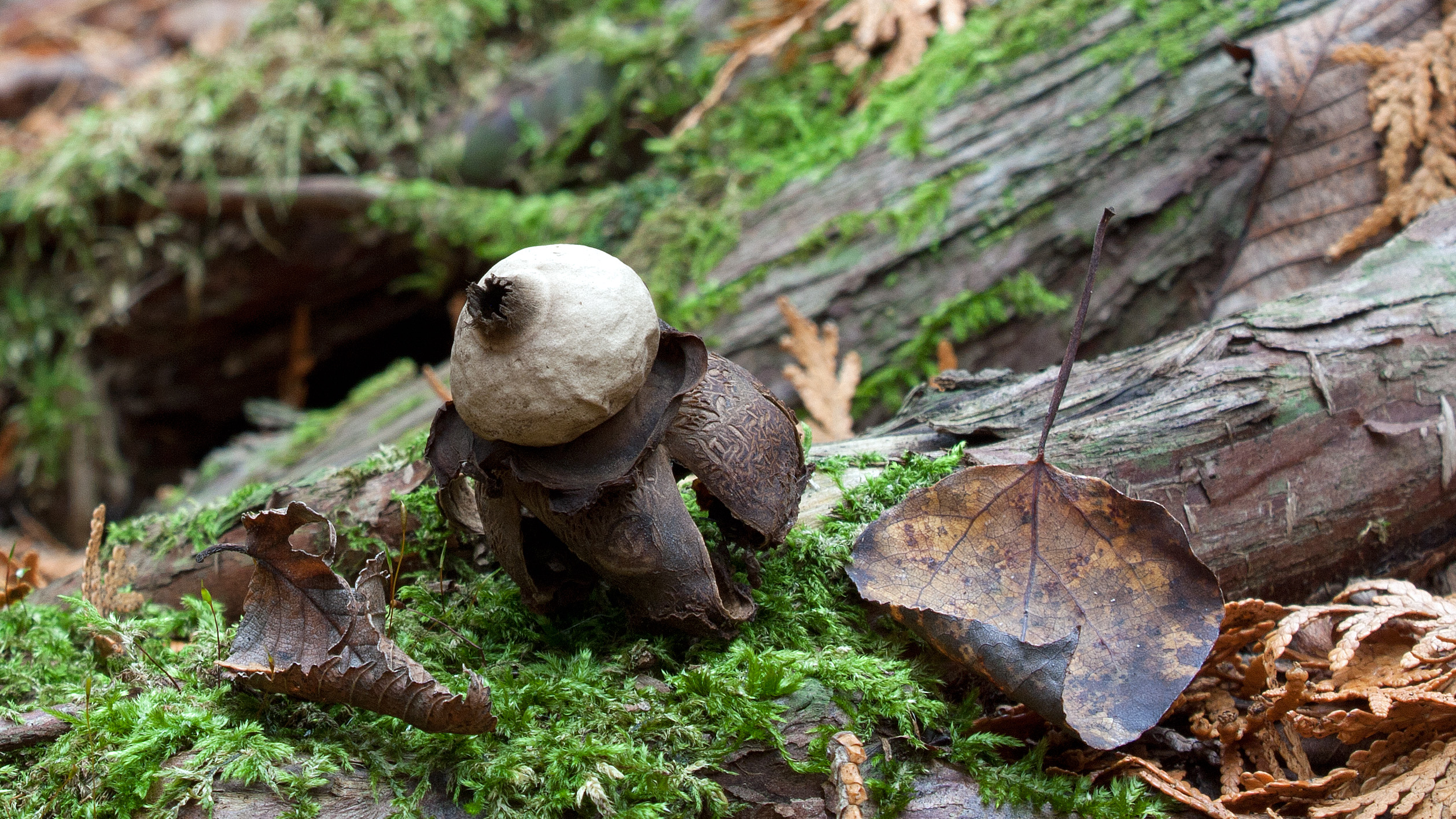
Collared Earthstar (Geastrum triplex) on mossy cedar growing on rotting cedar logs of Trent swamp forest, ON (photo by Nina Munteanu)

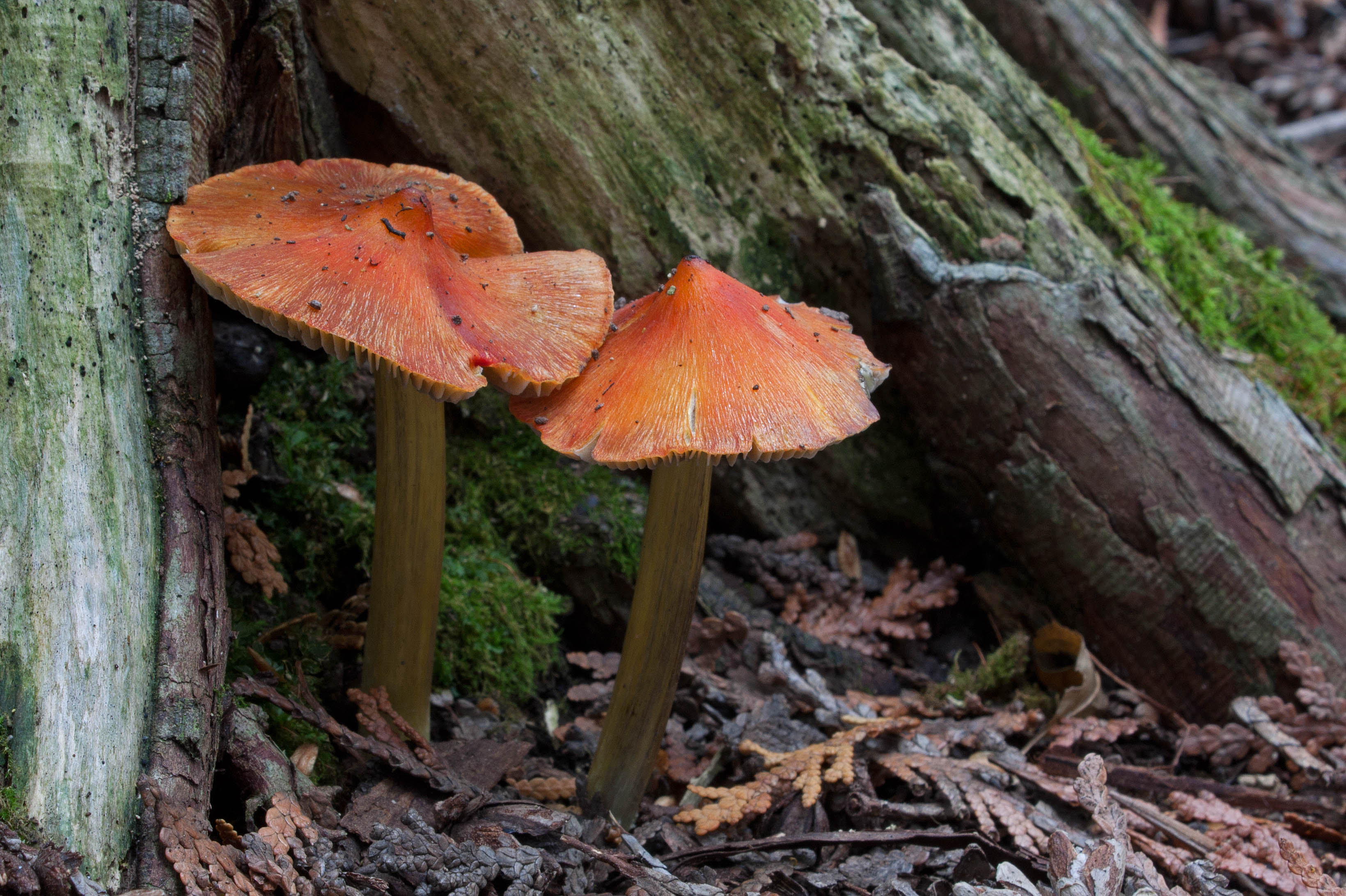
Earthstar lived in a verdant cedar forest, under a soft dappled light, where the fresh smell of moss and loam mixed with the pungency of cedar. It was a good life, thought Earthstar, gazing up at the tall canopy of green above her. She lived among many like her, scattered on and between old cedar logs that had piled on the ground and rotted into a rich woody ‘soil.’ It was just right for earthstars who grew deep in the warm, moist rot, covered in a carpet of moss and ferns. Cedar saplings had even sprouted on the rotting log piles, and grown into large mature trees. That was not surprising, given the number of caches the red squirrels left on the spongy rotting logs.
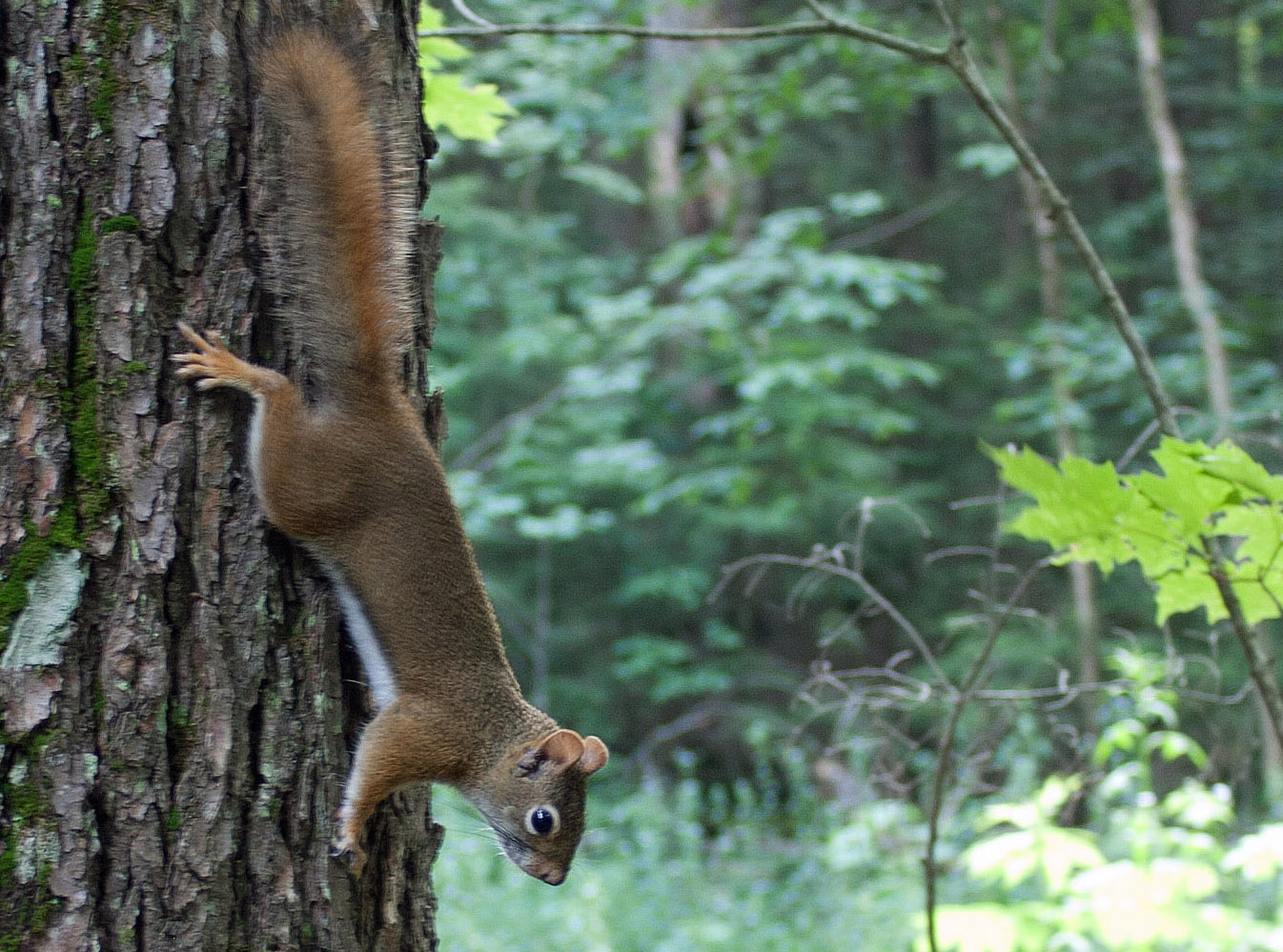
Red squirrel on a tree (photo by Nina Munteanu)
Fully opened Earthstar and sister buds in mossy humus of rotting cedar logs, Trent cedar forest, ON (photo by Nina Munteanu)

When she was just a young bud, Earthstar had pushed herself up from her parent mycelium through the woody humus then cracked open her outer shell to reveal her inner spore sac and beaked mouth. The outer shell formed arms of a ‘star’ that pushed back, raising her up to meet the world. When she surveyed her mossy terrain, she noticed that she was one of the earliest earthstars to emerge. Most of her sisters were still budding through the moss and duff. She was eager to fulfill her path. Soon she would be ready to deliver her precious spores to the world—

“Hey there!” a beaky voice called to her.

Earthstar recognized a Beaked Earthstar ambling along the rot pile using its outer skin ‘legs.’ She herself was a Collared Earthstar, and although she had long dislodged from the woody soil and become independent of the ground she sat on, she didn’t normally walk about like this Beaked Earthstar, known for its itinerant lifestyle. He was a rare and somewhat mysterious earthstar, not often seen, and somewhat of a legend. In fact, it was the first time she saw him and she felt tickled that he’d stopped in his wanderings to greet her.
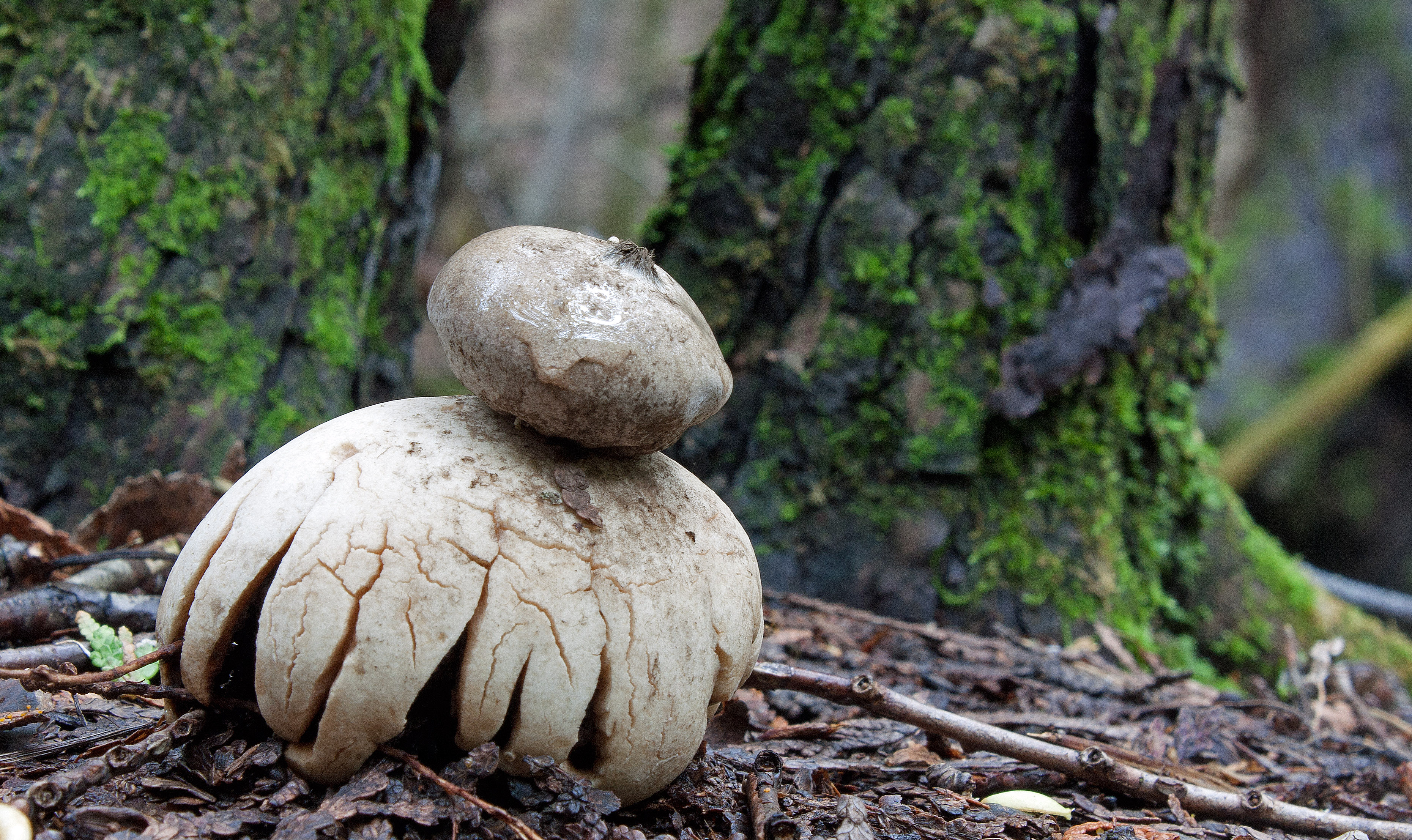
Beaked earthstar, showing many arms that keep it upright, Trent cedar forest, ON (photo by Nina Munteanu)

“I’m on my way to town,” said Beaky cheerfully. “Want to come along? There’s so much more to see than this silly forest.”

“No thanks,” said Earthstar, overcoming the flush of excitement at being invited by this exotic drifter. She’d heard about ‘the town’ but knew nothing of it—and decided she didn’t want to. Besides, the forest wasn’t silly, she thought peevishly. It was her home. It nourished her. It was where her family was. Earthstar was content.

“Suit yourself,” said Beaky. “But you don’t know what you’re missing! There’s a river out there, and strange but wonderful creatures and moving things on wheels that carry them from place to place. And the fine ladies have something called ‘High Tea,’ which is quite splendid.”

“I think this forest is quite splendid enough,” she retorted a little rudely.

“Ah… But you won’t truly know your place until you’re out of place,” Beaky said. Then with a slight nod of his beaky head, he left her and soon disappeared along the forest path that wound its way into somewhere.

What did Beaky mean by his last comment? wondered Earthstar. How can one be out of place? And why would one wish to be? As time went by, Earthstar began to wonder about that ‘somewhere’ and those wonderful creatures and fine ladies and that thing called ‘High Tea.’ And before she realized it, she was no longer content. She became very curious about that ‘somewhere’ that lay beyond her forest home.

In a sudden thrilling act, Earthstar decided to leave the forest to see the world. And once she thought of it, she did it. That’s the way of earthstars. So, within moments, Earthstar was wandering along the same forest path that Beaky had earlier taken. She took Moss with her, tucked safely inside her ‘legs’ as companion.

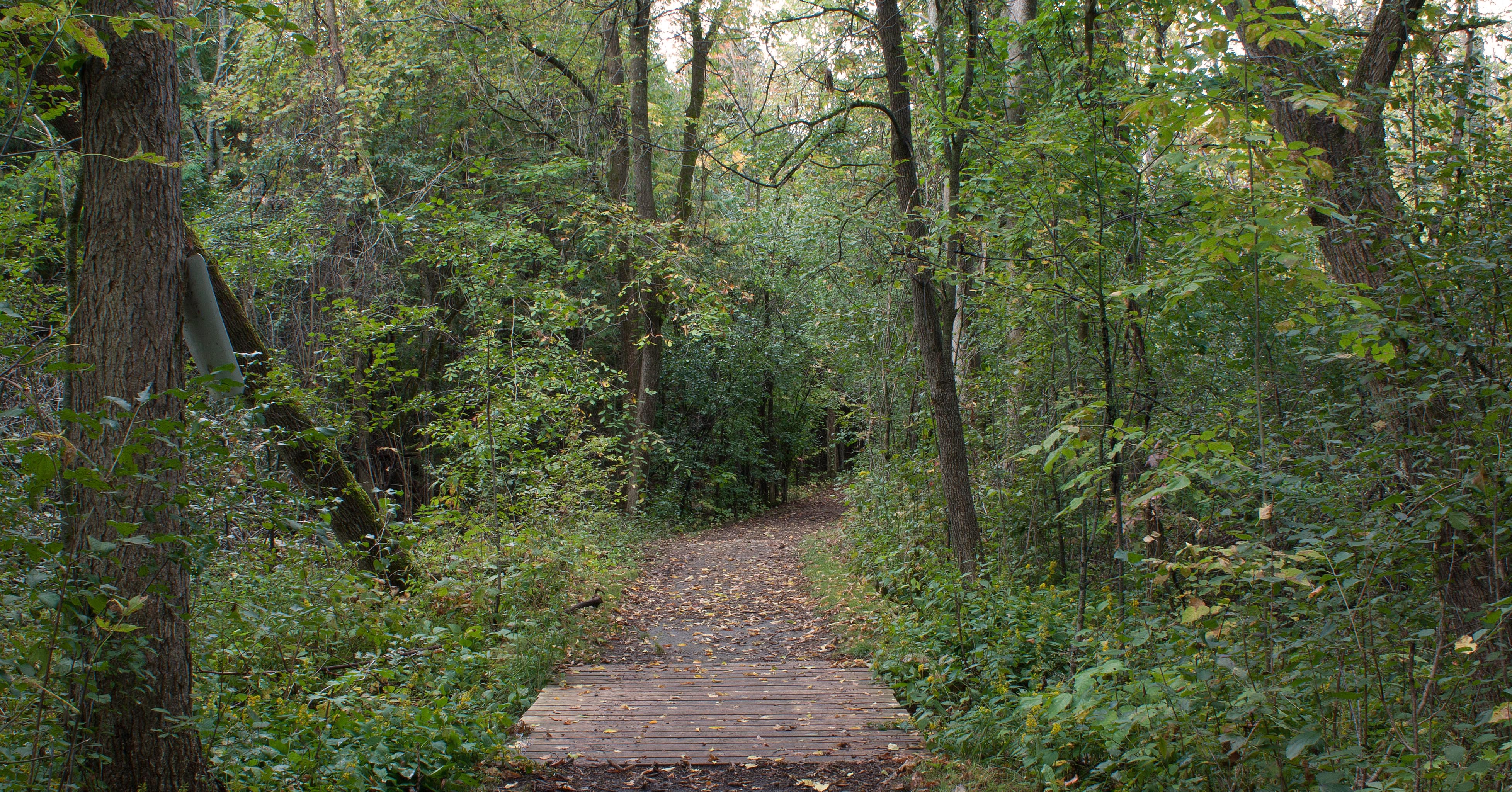
Path, damp from a morning rain, through cedar swamp forest in Trent Nature Sanctuary, ON (photo by Nina Munteanu)
Earthstar rests on small root snag on leaf-strewn trail through Trent cedar forest, ON (photo by Nina Munteanu)
Path through Trent cedar swamp forest with ash and poplar in early fall, ON (photo by Nina Munteanu)

The path wound through dense cedar forest, mixed with birch, ash, poplar and the occasional oak and maple tree. Earthstar passed many relatives. Flaming waxcaps dotted the rotting logs and ground, looking like dance partners. Graceful Fairy Fingers thrust up through the duff on either side of the path along with Ashen Coral fungi, whose delicate ‘fingers’ reached up like praying hands. By the feet of one poplar tree, Earthstar saw a party of Scaly Ink Caps loitering on one side and Striate Bird’s Nest fungi having a party on the other. Stalwart boletes towered majestic, anchored to a mossy slope. A single shield mushroom with its smart lilac cap had burst out of a cedar stump and leaned into the sun with joy.

Waxcaps on decaying cedar wood in Trent forest, ON (photo by Nina Munteanu)
Fairy Fingers in cedar duff in Trent forest, ON (photo by Nina Munteanu)
Ashen coral fungi on ground of Trent cedar forest, ON (photo by Nina Munteanu)
Scaly ink caps growing at the base of a poplar tree in Trent forest (photo by Nina Munteanu)
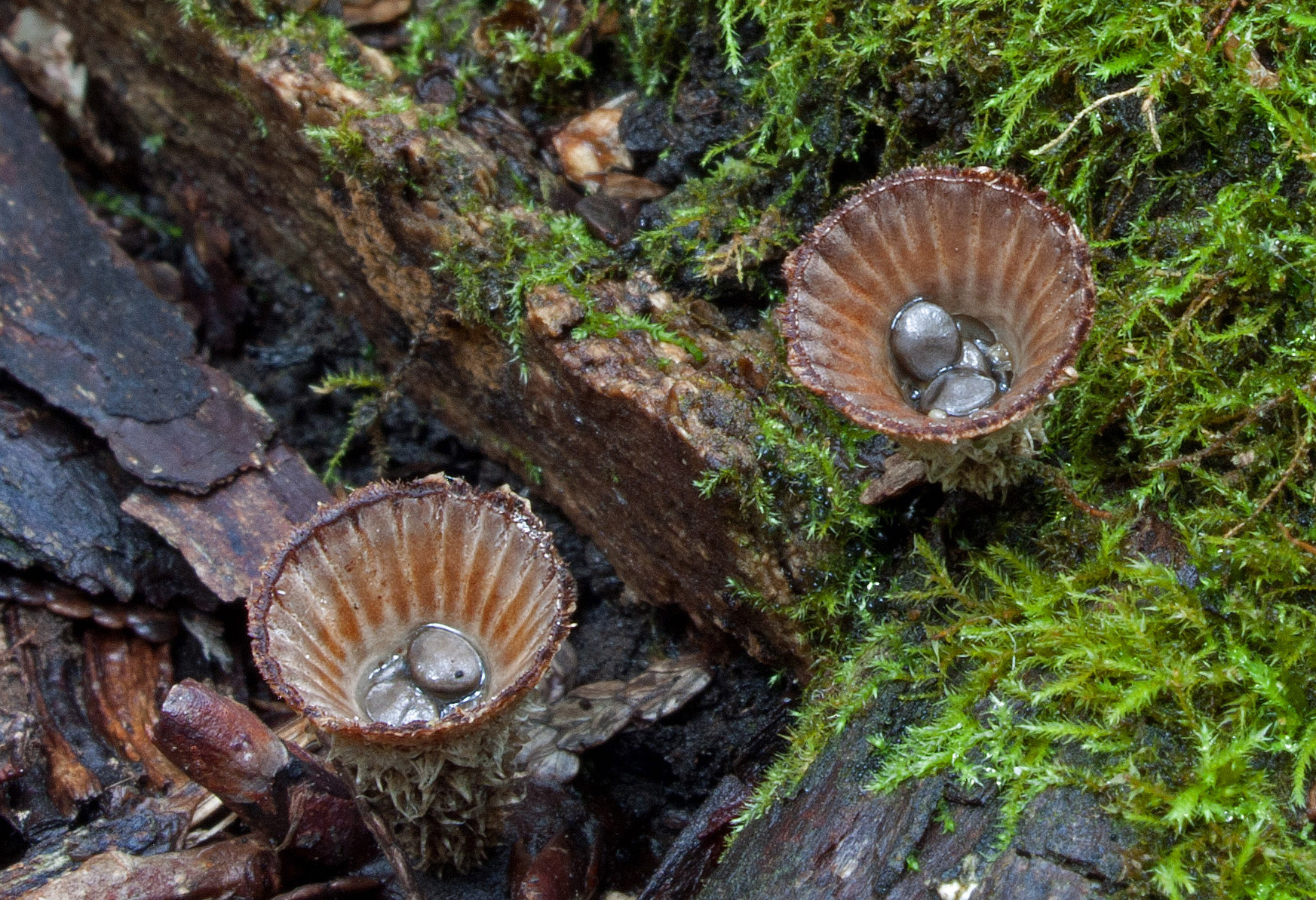
Striated Bird’s Nest fungi at the base of a poplar tree in Trent forest (photo by Nina Munteanu)
Bolete on mossy hill of Trent cedar forest, ON (photo by Nina Munteanu)
Shield fungus grows out of rotting cedar stump in Trent forest, ON (photo by Nina Munteanu)

A group of Scaly Pholiota graced an old maple tree and not much farther a gaggle of Wolf’s Milk spread orange fungus joy over a decaying log. Conifer Tufts created a fairy ring around an old ash tree. Witches hats stood at the feet of a huge cedar tree, bowing with shy wisdom to her. There was a cheerful family of brilliant Scarlet Fairy Helmets tucked in the mossy undergrowth of a buckthorn thicket.  She even saw a crowd of her closest relatives, Lycoperdon puffballs clutching a rotting birch log, and waved to them.

Scaly Pholiota on an old maple tree in Trent mixed cedar forest, ON (photo by Nina Munteanu)
Wolf’s Milk slime mould on rotting log in Trent forest, ON (photo by Nina Munteanu)
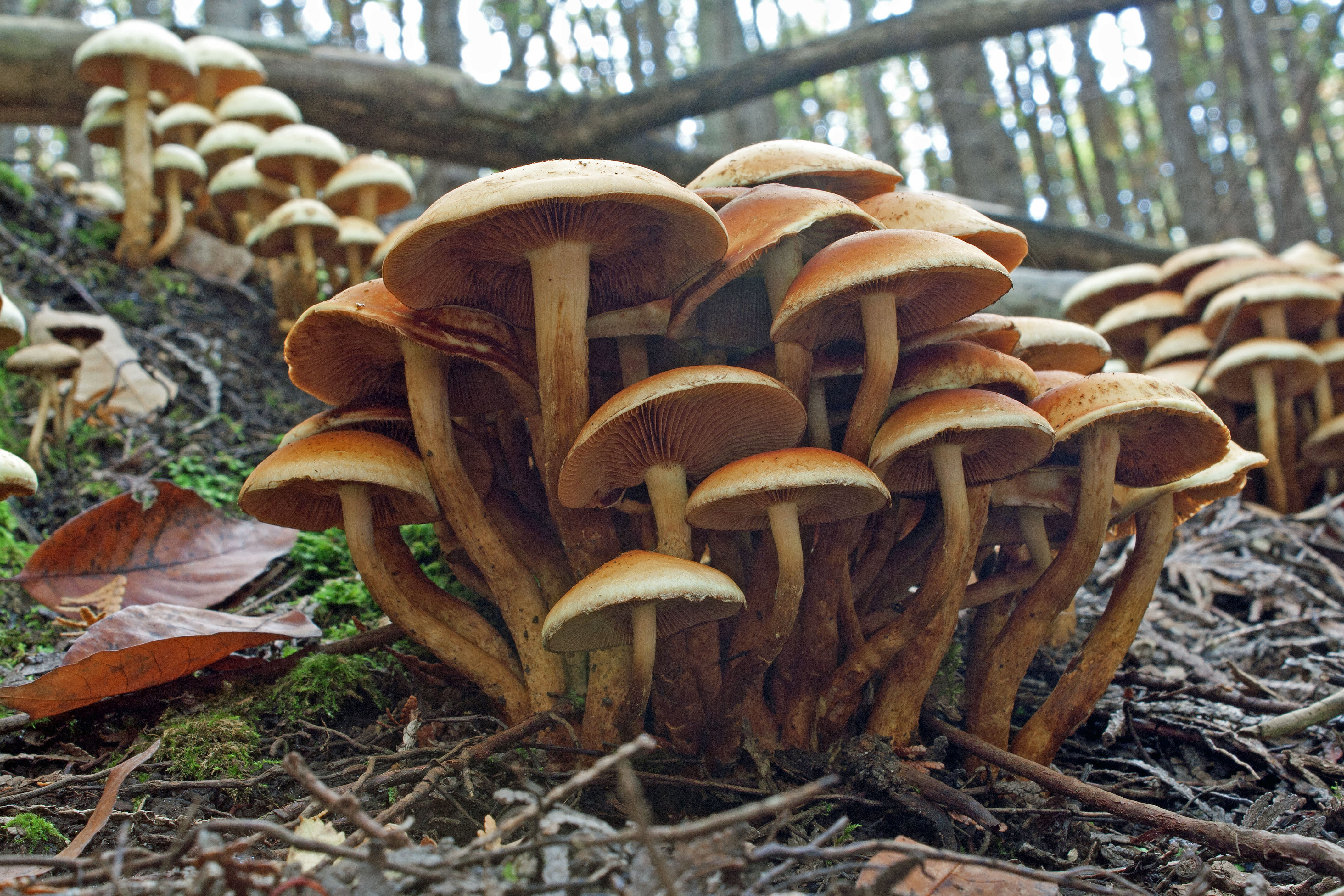
Conifer Tufts form a fairy ring around an old ash tree in Trent cedar forest, ON (photo by Nina Munteanu)
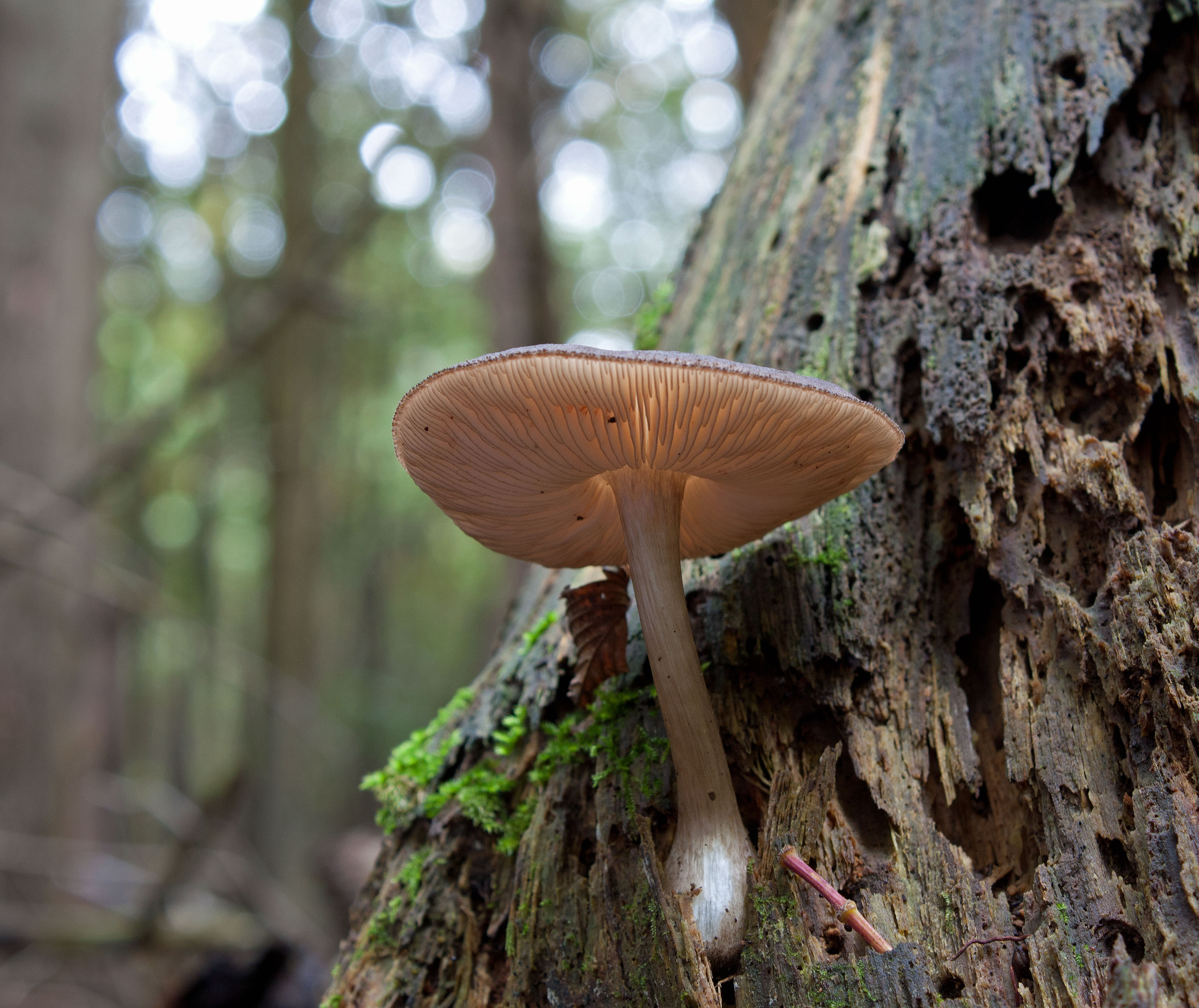
Witches hats nestled at base of a cedar tree, ON (photo by Nina Munteanu)
Scarlet Fairy Helmets in mossy undergrowth of cedar forest, ON (photo by Nina Munteanu)
Lycoperdon puffballs on decaying birch log, Trent cedar forest, ON (photo by Nina Munteanu)

Eventually, the forest opened into fields and thickets and the path became rocky. The dense cool cedar-scented air of the deep forest gave way to a fragrant floral breeze and the warmth of the sun touched Earthstar with rays of good tidings.

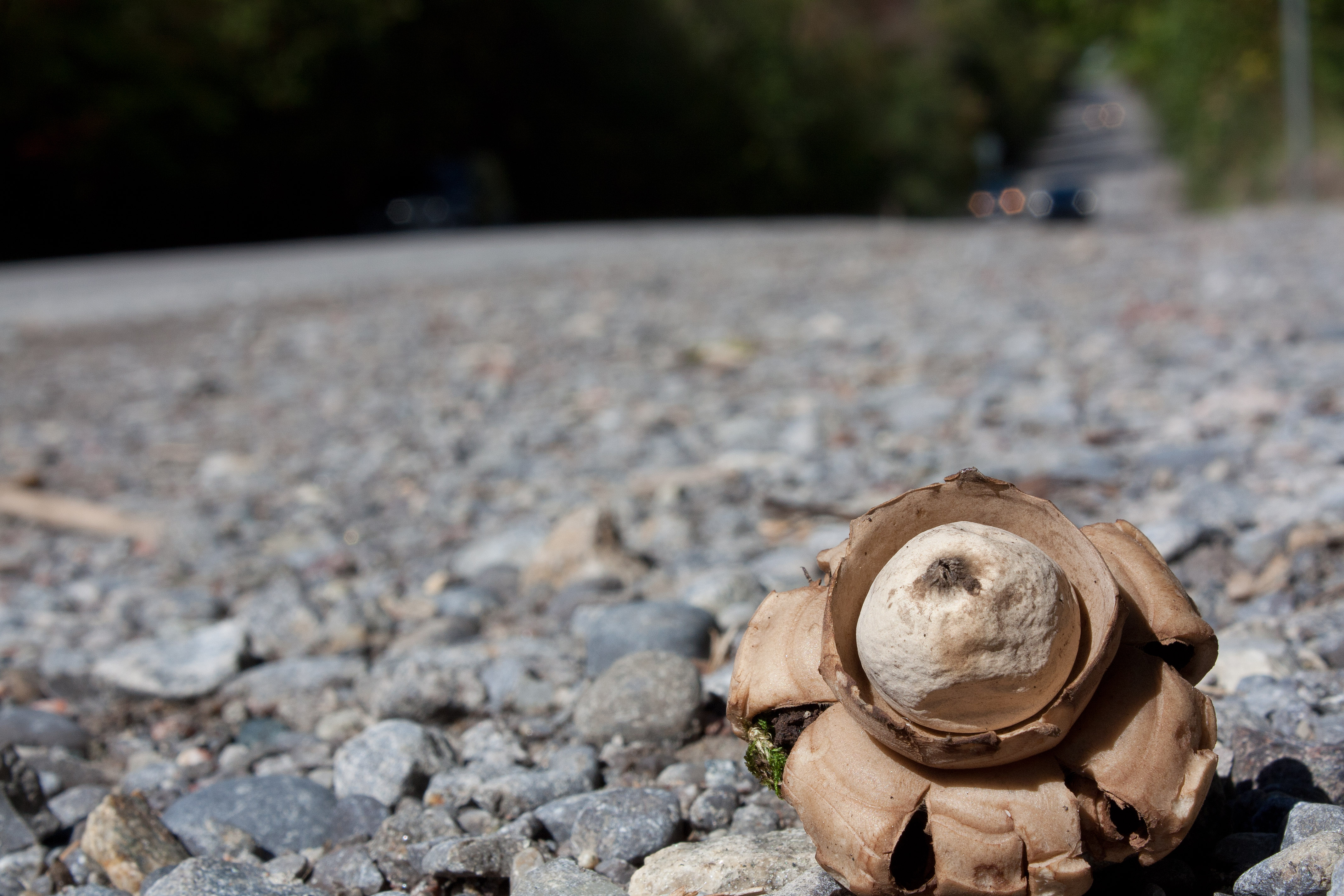
Earthstar on rocky path out of Trent cedar forest into open area, ON (photo by Nina Munteanu)
Earthstar negotiates the rocky path on her way out of the Trent forest (photo by Nina Munteanu)

Soon Earthstar reached a road and thought to follow it to town. Within moments a huge thing on wheels barrelled toward her! She froze in terror. But the cheerful wind whisked her out from under the wheel in the nick of time.
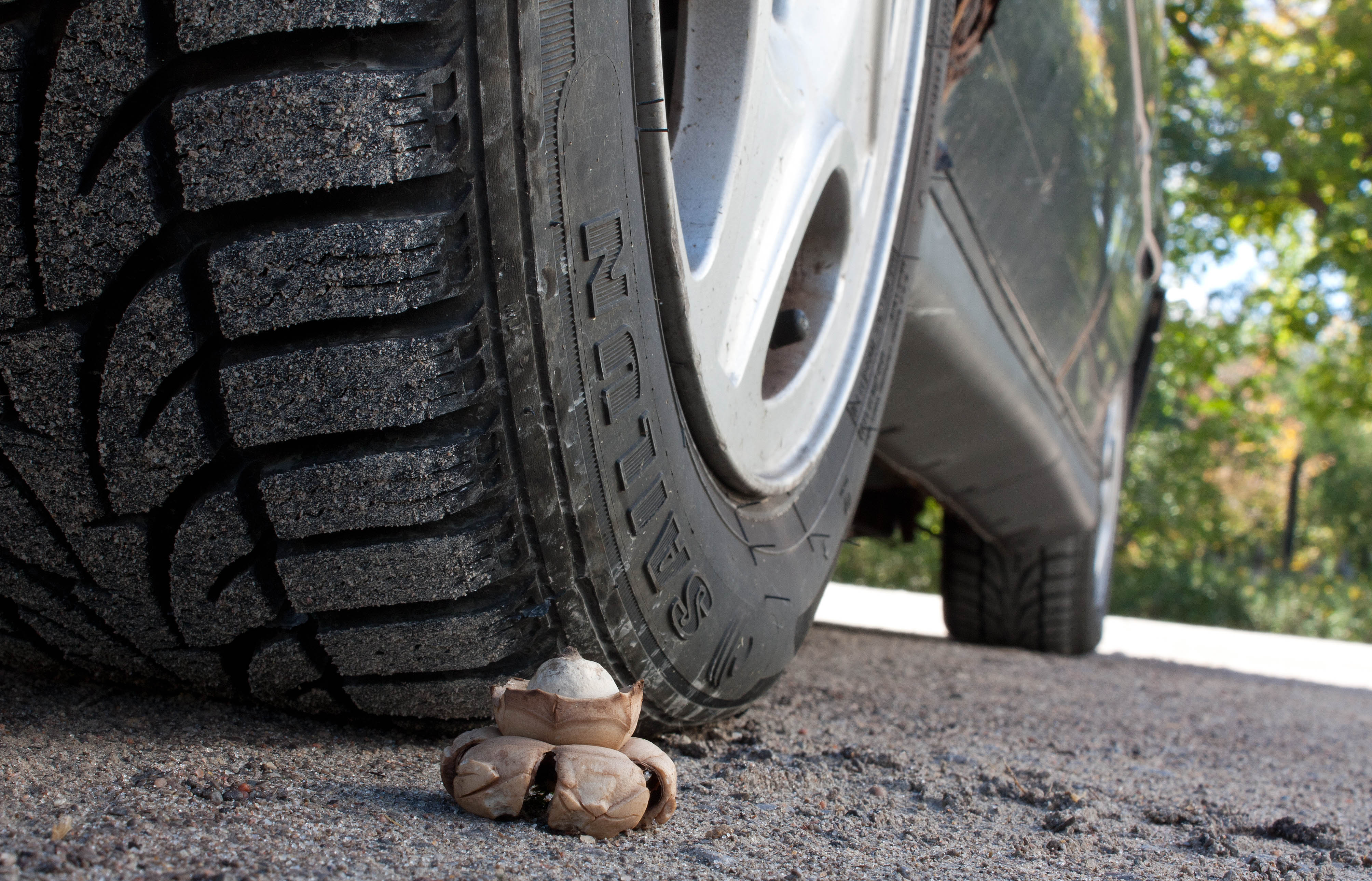
Earthstar almost gets run over by a car!

Earthstar thanked the wind and continued down the road, certain that the thing on wheels was what Beaky had mentioned and that she’d soon find the town and the river and those wonderful beings at the end of the road. And perhaps there she would encounter this marvelous “High Tea.”
Earthstar keeps to the side of the road with busy traffic
Countryside near Otonabee River, ON (photo by Nina Munteanu)

The road took Earthstar through an open countryside of meadows, flowers and trees. Earthstar kept to the side of the road to avoid getting squashed and soon found the river Beaky had mentioned. The river was magnificent. Sparkling in the radiant sun, it danced and lapped against the shore with the gurgling rush of laughter around the rocks and reeds.

The shallows of the Otonabee River, showing diatom-froth, ON (photo by Nina Munteanu)
Earthstar on Rotary Trail as bicycles bear down on her (photo by Nina Munteanu)

Sensing the lateness of the day, Earthstar continued her journey in search of “High Tea.” She wasn’t quite sure where she’d find it and followed the river on a trail through a black walnut forest.

Earthstar passed a large building with an open lawn just as a loud bell sounded and large two-legged beings spilled out onto the trail. They chattered about their lit class and laughed as Lillie, one of the students, recounted her scifi story about flying giant tardigrades that terrorized human cities for destroying the planet with fossil fuel emissions.
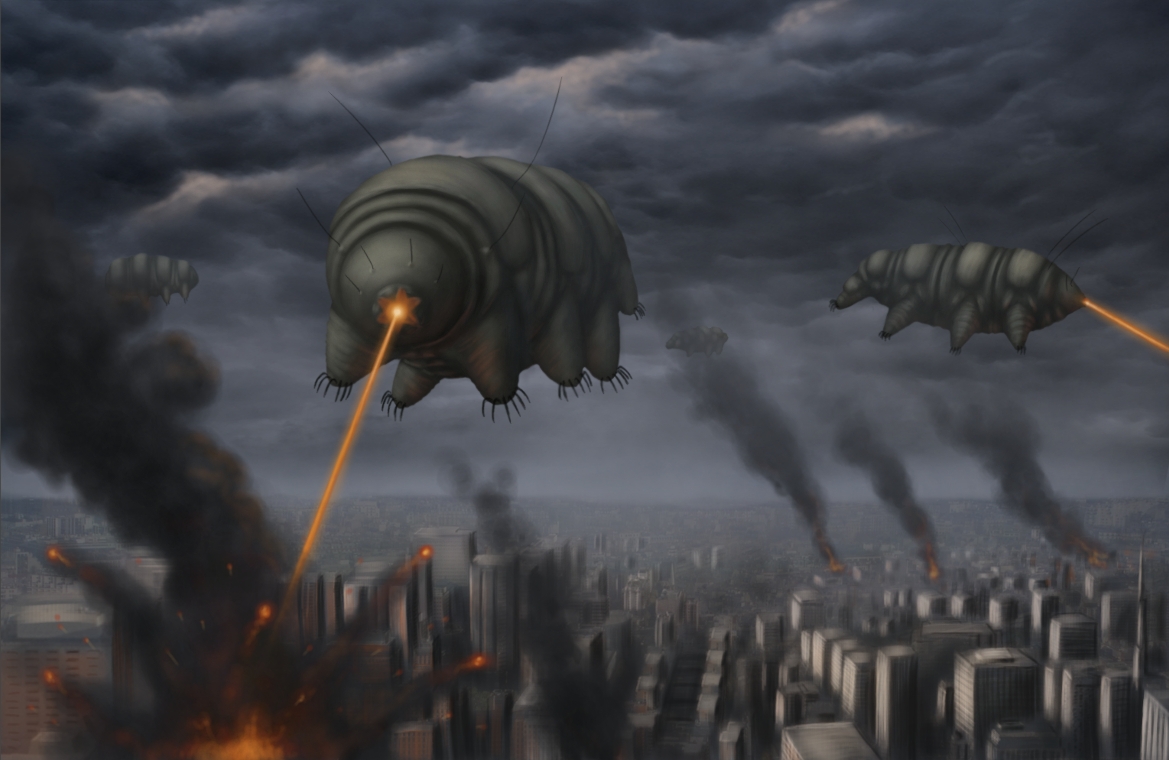
Attack of the giant tardigrades (image by Ramul in Deviant Art)

“Tardigrades are the coolest creatures,” Lillie went on. “Some people think they’re from outer space and lived among the stars. They can handle extreme temperature, the vacuum of space, and radiation, after all. And water bears can even survive a bullet impact!”

The students didn’t notice Earthstar below them.
She was so tiny after all!

Earthstar (and her moss companion) gets underfoot near the high school (photo by Nina Munteanu)

Just as the dark shadow of a giant foot loomed over her, someone shouted, “Wait, Marcus, STOP! Look!”

Earthstar was snatched off the ground before Marcus could step on her and gently cupped in the girl’s hand where the little fungus felt finally safe. “It’s an earthstar!” said the girl holding her. “How cute! See the bit of moss clutched in its arm? How adorable!”

“But, Emily, what d’you think it’s doing here on the trail by the school?” Marcus asked the girl holding Earthstar. “How did it get here?” Marcus suddenly grinned with inspiration and turned to Lillie, eyes sparkling. “Or did your giant space tardigrade drop it here? Which means we’re in your story–“

Lillie elbowed him and said something Earthstar didn’t understand.

Emily looked down at Earthstar, who sat quietly in her palm. “They’re the only mushrooms that move. Earthstars. I’ve read about them.” Emily then bent low and carefully set Earthstar on the grass by the trail, out of harm’s way.

“Maybe it’s on ‘walkabout,’” Lillie suggested, inspired by the thought of travel and thinking of the Australian term for a long walking journey of discovery.

“You mean floatabout!” Marcus laughed. “If it came all the way from Australia it’d have to float across the Pacific Ocean!”

The students giggled, visualizing little Earthstar floating on a leaf and braving the vast ocean then hitchhiking across the North American continent into the Kawarthas. Still discussing the earthstar’s epic journey, they went on their way, leaving Earthstar on the grass.

Earthstar continued her journey, wondering what ‘walkabout’ meant. She found another large building and thought this might be where she needed to go. When one of the giant beings walked out through a door, she slid inside.
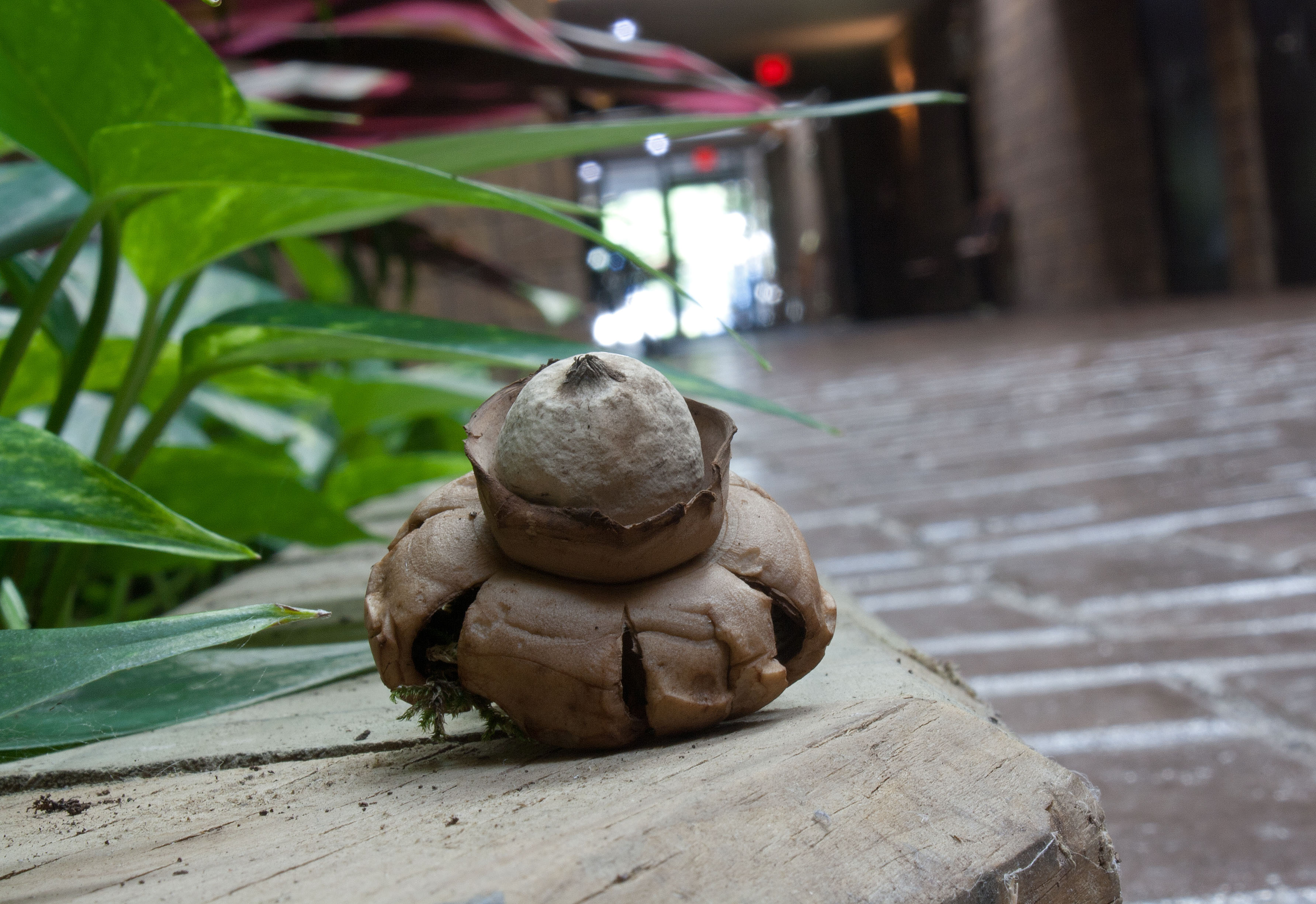
Earthstar and her Moss companion make it inside the condo complex (photo by Nina Munteanu)

She found herself in a wonderfully lit atrium with many more doors and lost herself among the indoor plants under large skylights. Within moments, as if sensing her presence, one of the large beings stepped out from a doorway and immediately saw Earthstar, perched by one of the indoor gardens.

“Well, well, what do we have here? A wandering earthstar and her little moss companion!” The being picked Earthstar up and gently cupped Earthstar in its hand. “Would you like to join me for tea?”

Earthstar in lady’s hand (photo by Nina Munteanu)

The magic word! Tea!

Earthstar jiggled on her ‘legs’ with joy. Was this being one of those fine ladies? As if sensing her excitement, the lady smiled and brought Earthstar inside her apartment.

The lady brought them outside to the patio for tea, where she had laid out tiny sandwiches, cheeses, crackers, scones with jam, and lovely pastries. Of course, Earthstar did not partake in these strange foods—being a saprophyte, she fed exclusively on decaying matter. But she enjoyed the ambience of this civilized celebration. And, of course, the tea!

Lady serving the tea (photo by Nina Munteanu)

When the lady went inside to replenish the tea, Earthstar explored the patio. Mistake!
Moments after Earthstar dropped to the patio bricks with the help of a little breeze, a very large dog (well, a rather small dog for you and me) came bounding to her and gave her a lick. The dog might have eaten her but the lady returned and rescued Earthstar.

Poppy the dog licks Earthstar! (photo by Nina Munteanu)

“Oh, my! Don’t mind Poppy, the neighbour’s shiatzu,” the lady said to Earthstar. “Poppy is harmless and only eats dog treats. I don’t think you’re a dog treat, are you?”
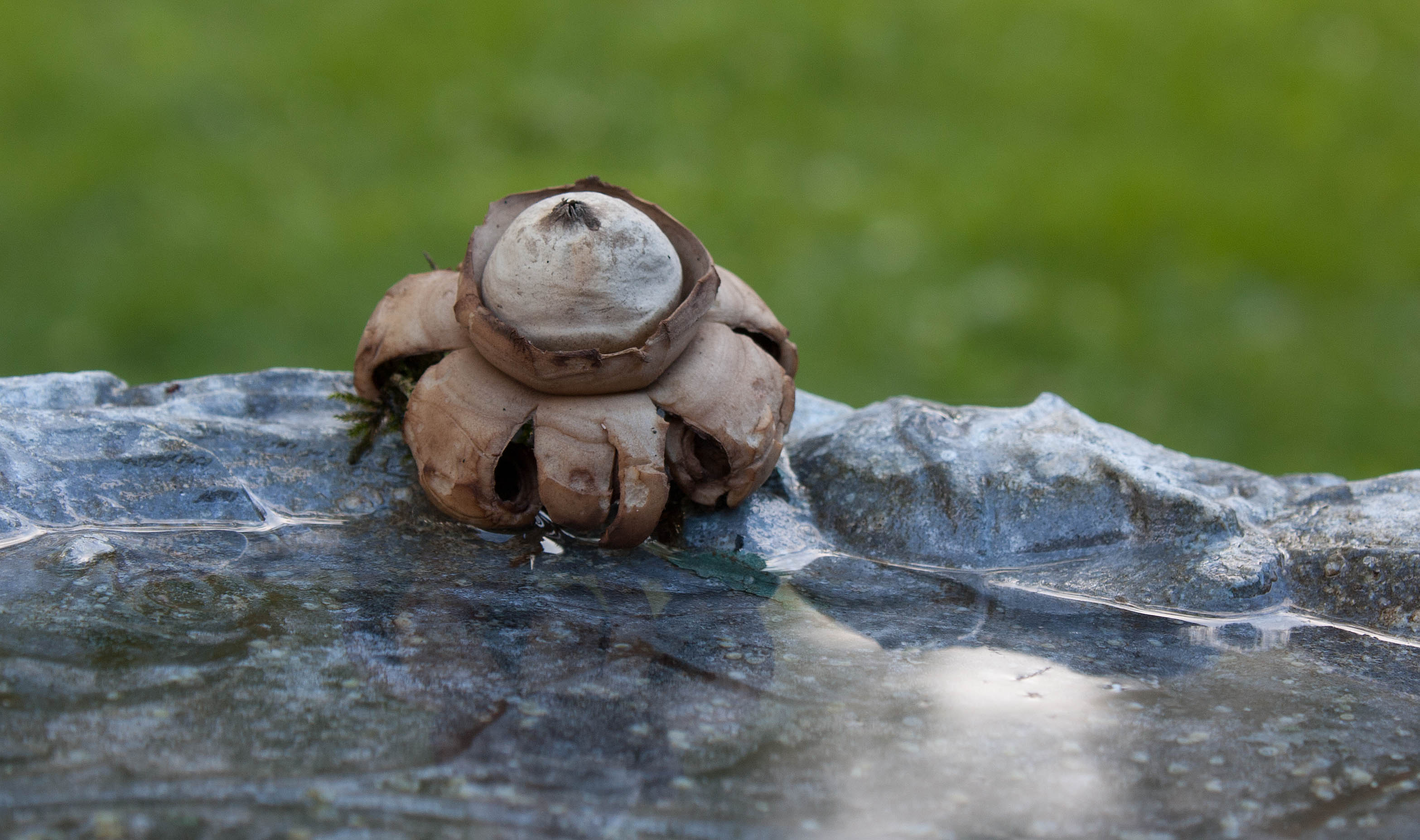
Earthstar dipping her feet into the water of the bird bath (photo by Nina Munteanu)

Thinking to get her to safety, the lady placed Earthstar on the edge of the birdbath where Earthstar dipped her tired feet. Within moments a mischievous wind pushed Earthstar into the water! Luckily, Earthstar floated. She was accustomed to deluges of water that filled her ‘collar’ and raised her spore sac to better deliver her spores. Water was an earthstar’s friend; earthstars counted on the beating drops of rain to help release their spores. After the initial shock, Earthstar rather enjoyed the swim.
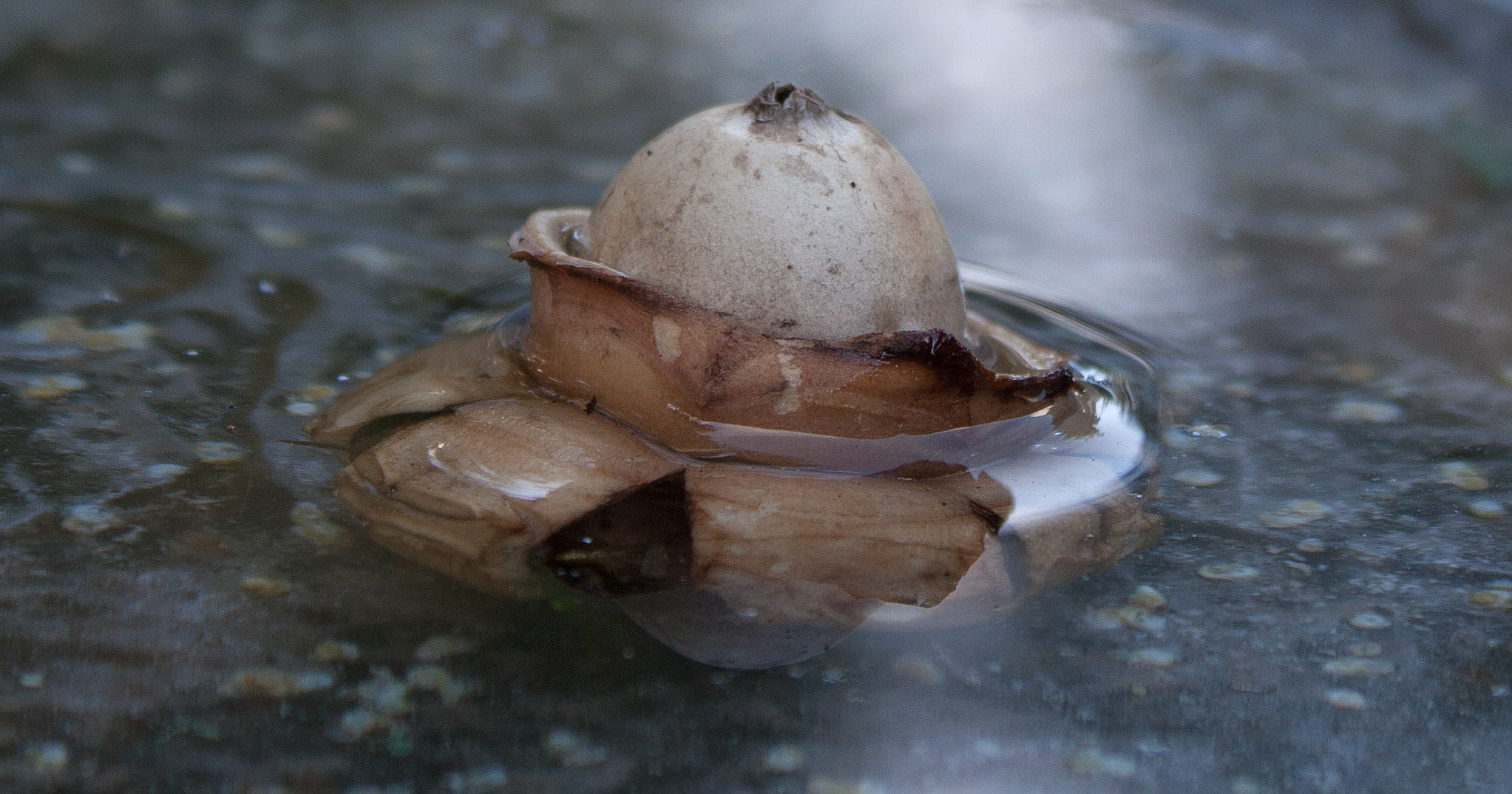
Earthstar swims happily in the birdbath (photo by Nina Munteanu)

The lady thought she ought to rescue Earthstar again and put her back down on the patio. Then the whistle of the kettle inside drew the lady away to the house. In that short time, a clever black squirrel, who had been spying from the silver maple tree nearby, leaped forward and seized her!
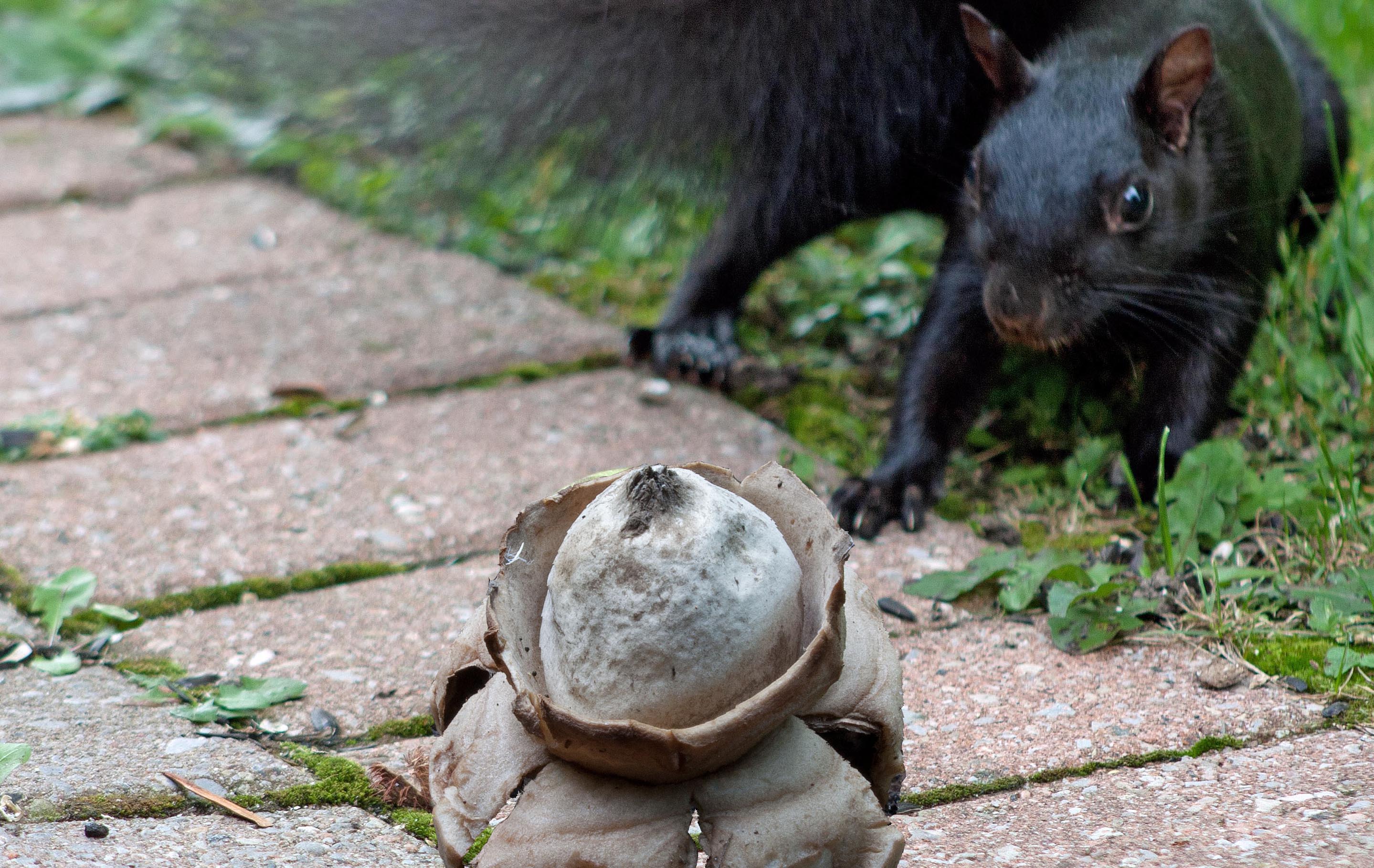
Earthstar about to be snatched by the black squirrel (photo by Nina Munteanu)

“Mine!” he shouted to himself and bounded away with her clutched in his mouth. After waiting for an oncoming bicycle, he raced across the trail–just inches in front of the zooming bicycle (squirrels are daredevils at heart)–and entered the little wood by the river.

Earthstar screamed. But no one heard her, because it was a silent scream.  

The black squirrel took his prize to a huge old willow tree by the river. The tree bowed over a small path as if reaching down to say hello. The squirrel left Earthstar on the bowing tree to dry like he would any mushroom for later caching. Then he scurried away to look for more food.  What this city squirrel didn’t know was that—unlike most other mushrooms—earthstars can move!
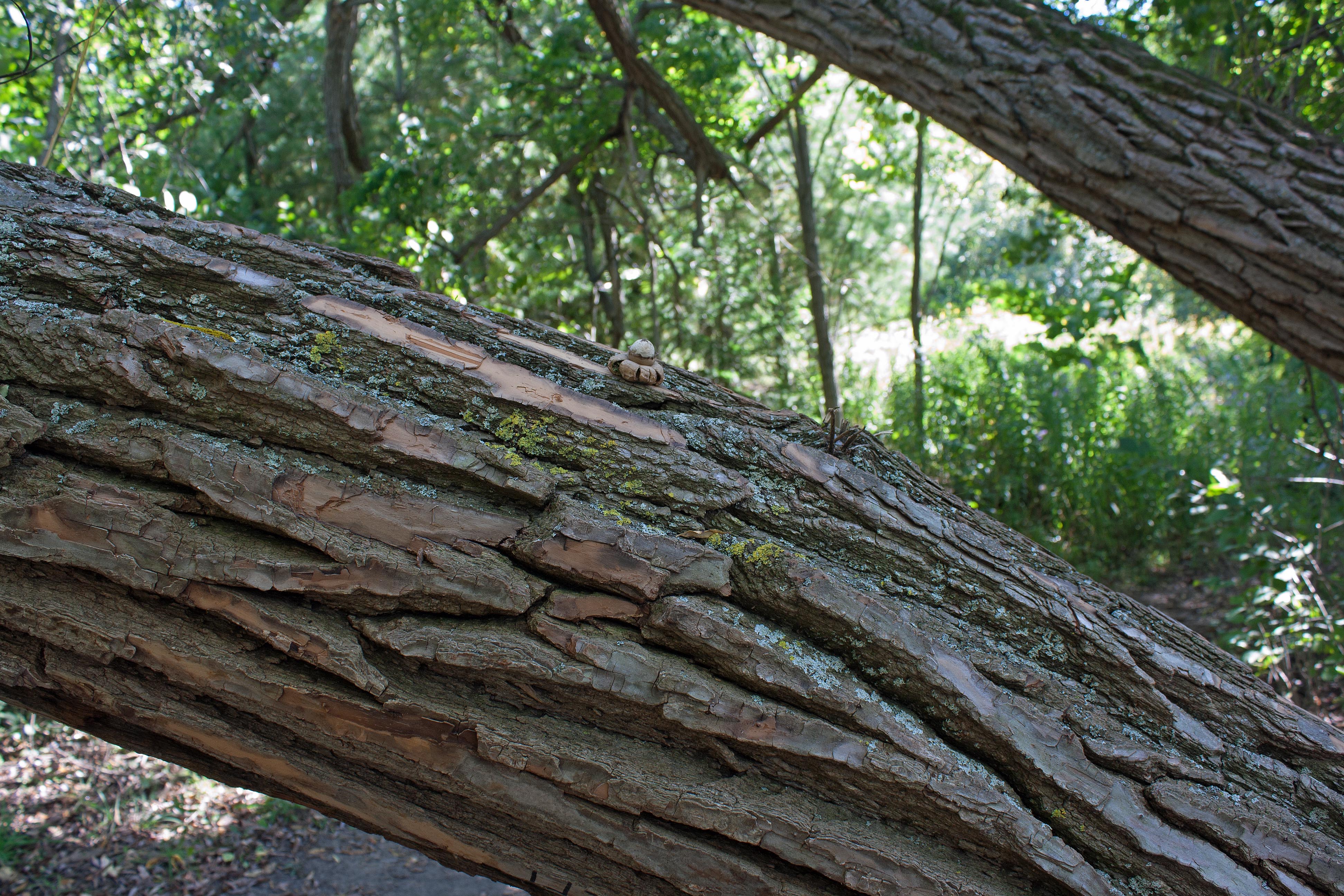
Old willow of the riparian forest by the Otonabee River, ON (photo by Nina Munteanu)

Earthstar let the wind blow her off the branch to the ground where she used her six arms to carry her back to the trail and back to the lady’s place.
“Where have you been?” asked the lady when Earthstar got there. Her eyes seemed to wink. “I suspect you were on a small adventure with squirrels.”

Driving Earthstar home to the forest (photo by Nina Munteanu)

They continued their tea and when it was finished, the lady took Earthstar in her car and drove Earthstar home to the forest. Earthstar didn’t wonder how the lady knew where Earthstar’s home was; there is only one place where earthstars grew in the region. And no doubt the lady—being a true lady—knew where that was and respected the earthstars place in the world.

Cedar trees covered in moss, growing on ancient rotting cedar logs of the cedar swamp forest, ON (photo by Nina Munteanu)
Fern-like moss grows on cedar roots that dig into old decaying cedar logs of the forest, ON (photo by Nina Munteanu)

When they reached the deep forest where the tall cedars covered the sky with green and the air stirred with the breaths of cedar and birch, Earthstar felt the exhilaration of coming home. She did not need to rely on the vagaries of a capricious wind to deliver her safely home; the kind hand of the lady set her down on the soft downy surface of woody loam. The lady set Earthstar right beside her sisters, her tiny moss companion still with her, tucked under her arm.

Gently placing Earthstar back home by several earthstar buds in moss of decaying cedars, cedar forest, ON (photo by Nina Munteanu)

The forest was her home. It nourished her. It was where her family was. Earthstar was content.
And this time she really was…

~~The End~~
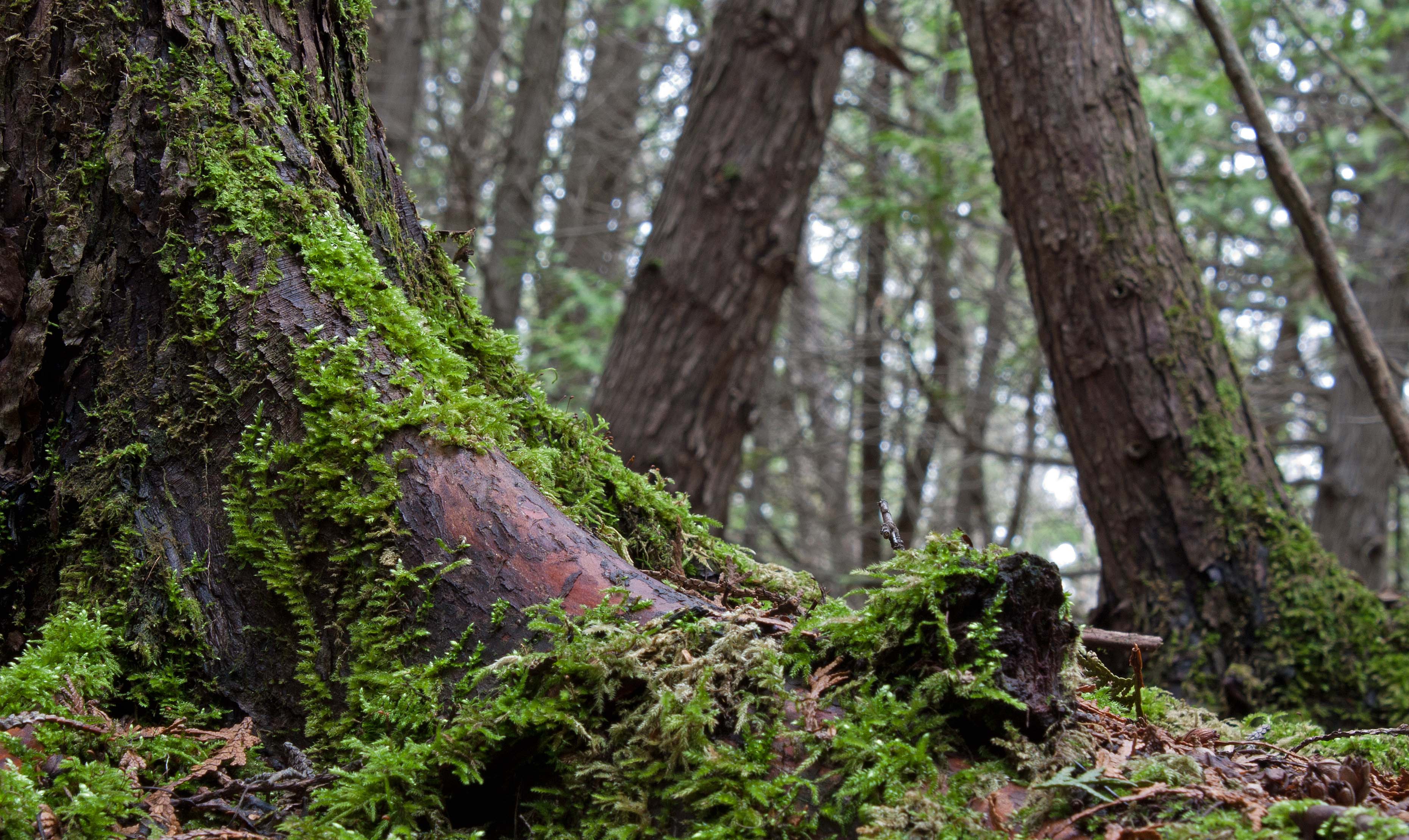
Moss-covered red bark of cedar tree in the cedar swamp forest, ON (photo by Nina Munteanu)
Earthstar, now matured; notice the fetching collar and splendid reticulated outer robes (photo by Nina Munteanu)

The Trent Nature Sanctuary

Located in the southeast corner of Symons Campus of Trent University, the Wildlife Sanctuary Nature Area includes many types of ecosystems and a network of trails. Wetlands of the area are deemed Provincially Significant by the Ontario Ministry of Natural Resources and Forestry. The cedar/maple swamps of the sanctuary support a rich diversity of fungi and lichen amid a rich ecosystem of plants and animals of the forest. It is within this area that I keep discovering interesting life each time I visit. Virtually all the images of the forest and fungi in this article come from this sanctuary, including the Collared Earthstar.

Mossy cedars in the cedar swamp forest of the Trent Nature Sanctuary, ON (photo by Nina Munteanu)

Information on the Collared Earthstar (Geastrum triplex)

Eight stages of the Collared Earthstar life cycle, Trent Nature Sanctuary, ON: 1) buds emerge in late summer; 2) the outer layer begins to crack in early fall; 3) the bud cracks open; 4) then spreads open; 5) forming a ‘flower’; 6) the outer layer cracks; 7) to form the ‘collar’ by early fall; 8) the outer layer shrivels by early winter and the earhstar persists in this form to the next spring (photo by Nina Munteanu)

Collared Earthstar Life Cycle

The Collared Earthstar (Geastrum triplex) is a Gasteromycete or stomach fungus, since it produces and releases its spores inside a saclike structure. The earthstar spends most of the year as a network of fungal cells (mycelia) that penetrate the soil and digest decaying organic material. When they are ready to reproduce, the mycelium develops the “earthstar” above ground. New earthstars emerge as ‘buds’ and develop in late summer and autumn through into winter. The matured fruiting bodies will survive the winter to be discovered the following spring by curious explorers like me. 

Spore sacs of Collared Earthstar in the frosts of winter (photo by Nina Munteanu)

Geo means earth and astrum means star. The species name triplex, which means ‘having three layers,’ refers to the way the ‘star’ arms of the outer layer crack when they peel back, making it look like the spore-sac is sitting on a dish. The three layers allow the earthstar to do something no other fungus can do: move. When it rains, the two outer layers of the peridium split and peel back, forming a ‘star’ with 4-12 rays. The rays spread with enough force to push aside leaves, raising the spore-filled sac above the surrounding debris. The rays often lift the earthstar high enough to break the connection to the parent mycelium, releasing the earthstar from its sedentary position. Detached, the earthstar can move with wind or rain to better spread its spores.

Finger poking the spore sac helps release the spores (photo by Nina Munteanu)

Fruiting bodies are large, 5-10 cm in diameter. Spores escape from the apical pointed hole (peristome) as breezes blow across it. Much larger puffs are released when raindrops hit and compress the spore-sac—or an interfering finger depresses the sac. What escapes is a powdery gleba (which distributes the tiny spores). The sides of the peristome ‘beak’ are fibrous and appear slightly ragged.

Several stages of the Collared Earthstar in late summer, from buds to opening ‘flower’
Early budding stage of Collared Earthstar in late summer (photo by Nina Munteanu)

After a late summer / autumn rain, the collared earthstar emerges from the leaf litter looking like a Hershey’s kiss or a fancy bulb-shaped truffle dusted in fine cocoa. Only the outer layer (exoperidium) is visible, peeking out of the litter and loam. The outer layer eventually cracks open, looking like a coconut husk and splits into five to seven ‘arms’ to form a star. Inside is revealed a tan to grey-coloured spore-sac (endoperidium) with a fringed beak (peristome) and its opening (ostiole). The endoperidium, or spore sac, is more like an elastic membrane resembling rubber that holds the gleba (spore-bearing mass). The star arms peel back and down, eventually cracking to form the ‘saucer’ which the round fruiting body (spore sac) sits on. The spore sac contains a mass of spores and fertile mycelial tissue, called the gleba that is white, fibrous and firm when young, but turns brown and powdery as it ages. A network of cells (capillatum) help spores move to the pore when a raindrop strikes the endoperidium. The columella, a bulbous sterile base at the centre of the spore-producing gleba forms ‘columns’ that radiate out to help spore dispersal.

Over time, the outer layer of ‘stars’ (exoperidium) form a reticulated pattern of cracks and fissures that deepen into golden-brown colours as they decompose and curl downward to lift the spore-sac farther up. The sac also grows more pale and papery. 
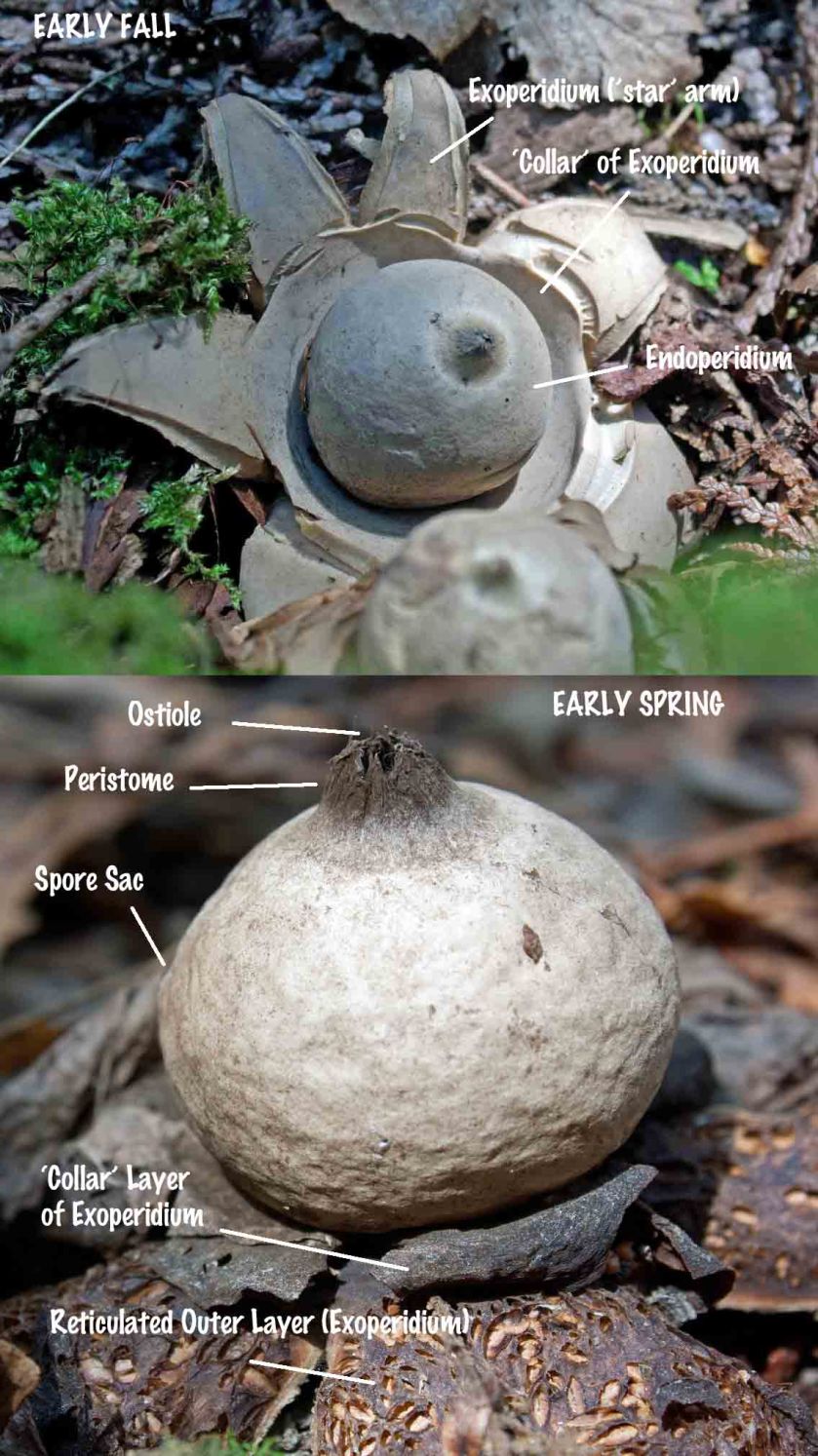
Parts of a Collared Earthstar from first ‘bloom’ in early fall to matured stage the next spring (photos by Nina Munteanu)
Just opened Collared Earthstar in late summer, not yet showing the ‘collar’ formed by cracking of exoperidium (photo by Nina Munteanu)
Good example of a more mature opened Collared Earthstar in early fall, showing the ‘collar’ formed by separation of exoperidium and extended curled back ‘arms’ (photo by Nina Munteanu)
Mature Collared Earthstar the following spring, showing papery spore sac sitting on disintegrating ‘collar’ and reticulated outer exoperidium (photo by Nina Munteanu)

However, in the rain, the sac reverts to a rubbery consistency and deepens to a dark shiny tan colour. I was surprised by its elasticity; this time when I poked it, the sac sprang back to its round sphere like a thick balloon. 

Mature Collared Earthstar; left in rain, right in dry weather (photos by Nina Munteanu)

Collared Earthstar Habitat

I also learned that the collared earthstar prefers a habitat of leaf litter in deciduous woods, especially beech on chalky soils. However, researchers acknowledge that the collared earthstar is also found under coniferous trees, especially on sloping ground—which better describes where I found them, in this cedar-birch forest of the Kawarthas. Geastrum triplex is a saprophytic organism: it gets its nutrients from decomposing organic matter—such as well-rotted cedar trees, where humus has accumulated—by further breaking down the organic matter then, in turn, returns those nutrients to the soil to complete the cycle. It does this by releasing enzymes to break down and digest the lignin, cellulose or chitin in these materials, converting them to soluble compounds that can be absorbed by them, and by plants, as nutrients. Earthstars, like all fungi, play a vital role in reducing the accumulation of dead organic material and in recycling essential nutrients, particularly carbon and nitrogen. If not for fungi, forests would choke under a mountain of logs and leaves.

Mature earthstar, with prominent collar, in the moss-covered loam of a rotting cedar, ON (photo by Nina Munteanu)

References:

Ellis JB, Ellis MB. 1990. “Fungi without Gills (Hymenomycetes and Gasteromycetes): an Identification Handbook. ”Chapman and Hall. London. ISBN 0-412-36970-2.

First Nature. “Geastrum triplexJungh.—Collared Earthstar” Online: https://www.first-nature.com/fungi/geastrum-triplex.php

Kirk, Paul M., Paul F. Cannon, David W. Minter and J. A. Stalpers. 2008. “Dictionary of the Fungi.” CABI, 2008

Kuo M. 2008. Geastrum triplexMushroomExpert.Com

Roel, Thomas. 2017. “#044: Mushroom Morphology: Earthstars.” Fungus Fact Friday.

Roody WC. 2003. “Mushrooms of West Virginia and the Central Appalachians.” University Press of Kentucky, Lexington, KY. p. 443. ISBN 0-8131-9039-8.

Torpoco V, Garbarino JA (1998). “Studies on Chilean fungi. I. Metabolites from Geastrum triplex Jungh”. Boletin de la Sociedad Chilena de Quimica43 (2): 227–29.

Woodland Trust. “Collared Earthstar.” Online: https://www.woodlandtrust.org.uk/trees-woods-and-wildlife/fungi-and-lichens/collared-earthstar/

Pegler, D.N., Laessoe, T. & Spooner, B.M. 1995. “British Puffballs, Earthstars and Stinkhorns.”Royal Botanic Gardens, Kew. 

Utah State University. “Earthstars.” Online: https://www.usu.edu/herbarium/education/fun-facts-about-fungi/earth-stars

Mature collared earthstar in early winter, ON (photo by Nina Munteanu)

Nina Munteanu is a Canadian ecologist / limnologist and novelist. She is co-editor of Europa SF and currently teaches writing courses at George Brown College and the University of Toronto. Visit www.ninamunteanu.ca for the latest on her books. Nina’s bilingual “La natura dell’acqua / The Way of Water” was published by Mincione Edizioni in Rome. Her non-fiction book “Water Is…” by Pixl Press(Vancouver) was selected by Margaret Atwood in the New York Times‘Year in Reading’ and was chosen as the 2017 Summer Read by Water Canada. Her novel “A Diary in the Age of Water” was released by Inanna Publications (Toronto) in June 2020.

Nina Munteanu Interviewed on her latest short story “Robin’s Last Song”

Left: cover of Apex Magazine Issue #128 in which my story appears; Right: cover of 2021 anthology published in fall 2022.

I was recently interviewed by Alberta writer Simon Rose about my latest eco-fiction short story “Robin’s Last Song”, which was recently published by Apex Magazine in its 2021 Compilation Anthology. Below is the interview:

Simon: Congratulations on publishing your short story “Robin’s Last Song” in Issue 128 of Apex Magazine and soon in the Apex Magazine 2021 Compilation Anthology. I’m curious about the title? Whose last song is it? Is Robin the name of a human or the bird?

Nina: Both, actually. The title is both literal and metaphoric. The premise of the story is based on the alarming trend of disappearing birds. The robin, a common bird in Ontario where the story takes place, is a good sentinel for what is happening with bird populations around the world. Robin is also the protagonist’s name; she was named after the robin, her mother’s favourite bird.

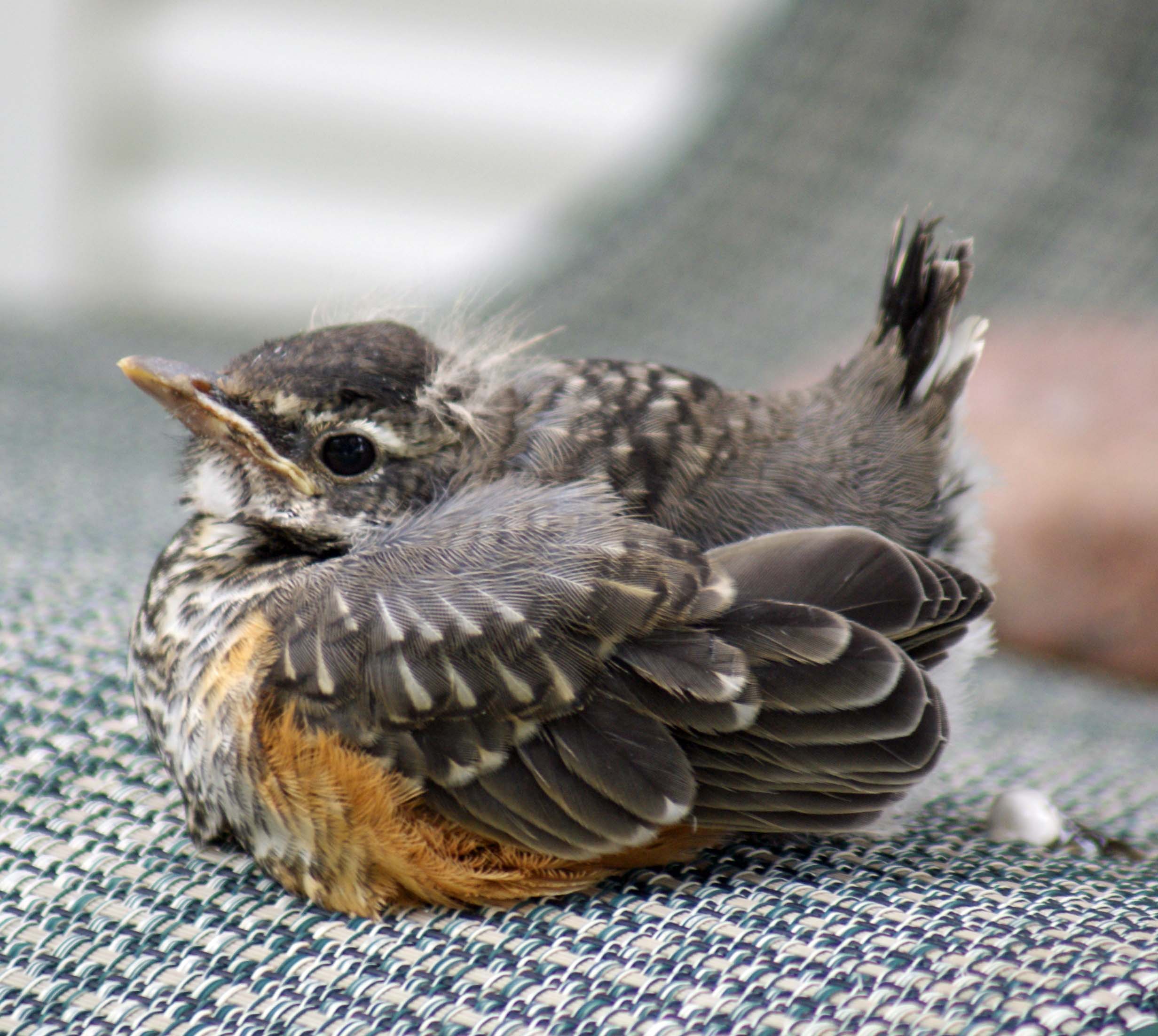
Recently fledged robin rests on patio chair, Mississauga, ON (photo by Merridy Cox)

Simon: Robin’s Last Song is obviously eco-fiction. What’s it about?

Nina: Robin’s Last Song first appeared in the #128 Issue of Apex Magazine in 2021. It tells the story of Robin, a blind elder whose digital app failed to warn the world of the sudden global loss of birds with disastrous ecological consequences. After years of living in self-exile and getting around poorly on sight-enhancing technology, a discovery gives her new hope in rekindling her talents in the field of Soundscape Ecology.

Discarded robin’s egg to deter predators, found on a woody trail in Ontario (photo by Nina Munteanu)

Simon: How did you come to write this particular story about birds and what is “soundscape ecology”?

Nina: Since I was a child, the burgeoning SF writer in me had dared to imagine a world without the sound of birds—I thought it utterly bleak and, recognizing an ever-polluting world, I feared for my feathered relatives. I didn’t follow through with a story until September 2019, when I was approached by Oliver Hockenhull, the guest editor of subTerrain Magazine, to write a piece on technology and the environment. The timing was interesting; I’d just read two impactful things that resonated with me.

The first was the October issue of Science Magazine that reported a staggering decline in North American birds. Kenneth V. Rosenberg and his team of researchers had estimated that three billion birds of various species had disappeared in Canada and the US since 1970. That’s a third of the entire bird population lost in five decades. To make it clear, we aren’t talking about rare birds going extinct; these declines are of common birds throughout the world. The wrens, sparrows, starlings, and, of course, the robins. I was devastated; I could not imagine a world without the comforting sound of birds. What would it be like if the birds all disappeared? This brought me back to my childhood fears.

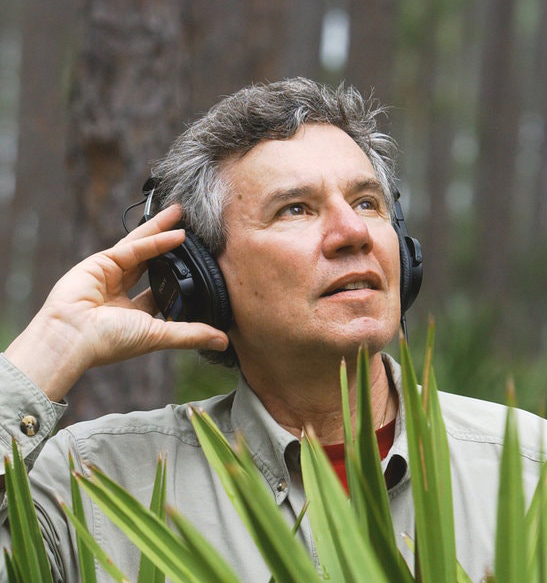
The second article I ran across talked about an emerging bioacoustics tool, soundscape ecology, that measures biodiversity and the health of an ecosystem, mostly through bird sound which well represents ecosystem health. Bernie Krause, a soundscape ecologist who had been conducting long-term recordings for decades noted how the dawn chorus in many areas had greatly diminished if not vanished altogether.

Bernie Krause, soundscape ecologist recording a soundscape in Florida

I now had my premise and my connection with technology. The title of my original story for subTerrain was “Out of the Silence”. This story focused on the technical aspects of the premise and solution. When I was approached for a story in February 2021 by Francesco Verso, the guest editor of Apex Magazine Issue #128, I rewrote the story with a stronger focus on the protagonist’s personal journey and connection with the bird catastrophe, how she coped with Asperger’s syndrome and the failure of her tool to predict the disaster. Hence the change in the title to “Robin’s Last Song”.

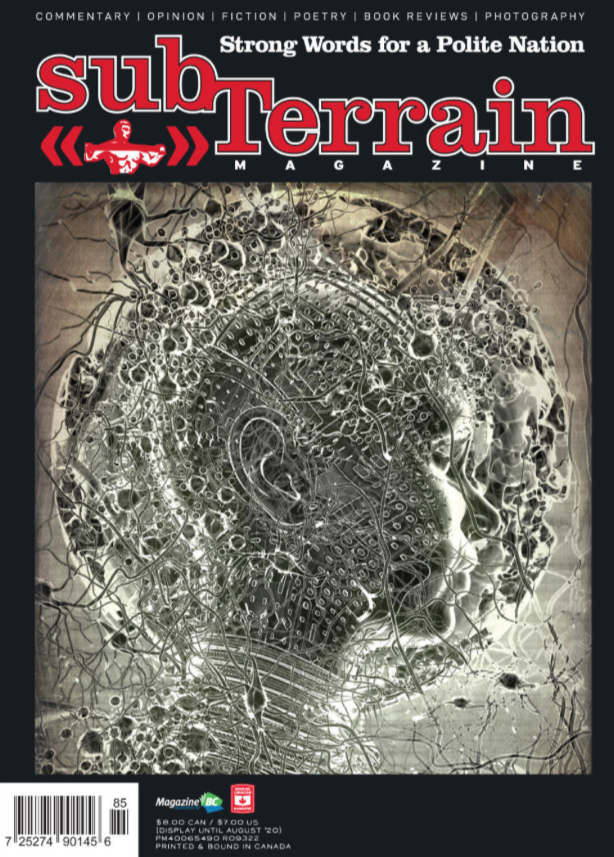
Cover of subTerrain Issue #85 in which “Out of the Silence” appears

Simon: Without wanting to bring in spoilers, isn’t there a twist to the story, suggesting a cautionary tale that touches on the dangers of genetic engineering?

Nina: Yes, thanks for bringing that up. I was already primed with research into genetic engineering for the sequel to my 2020 eco-novel “A Diary in the Age of Water.” I wanted to make the bird disappearance in “Robin’s Last Song” into a dramatic catastrophe linked to our own dangerous ecological tampering. I had the notion of using a gene hacking disaster to create ecological calamity and how this might affect birds. I wanted to make “Robin’s Last Song” a realizable work of fiction in which science and technology play both instigator of disaster and purveyor of salvation. Our biogenetic technology comes to us as a double-edged sword in the form of gene-editing, proteomics, DNA origami, and CRISPR—just to name a few. These biotechnological innovations promise a cornucopia of enhancements: from increased longevity and health in humans to giant disease-resistant crops. But, for every ‘magic’ in technology, there is often unintended consequence. Unforeseen—or even ignored—casualties and risks. I suppose my ultimate question with this story is: will synthetic biology redesign Nature to suit hubris or serve evolution? Science doesn’t make those decisions. We do.

Simon: Tell us a little bit about the Apex Magazine 2021 Compilation Anthology (that came out in both print and digital versions August).

Nina: The 350+ page anthology compiles all original short stories published in Apex Magazine during the 2021 calendar year. Published through Apex Book Company, it features 48 stories from a diverse group of new and established writers and the cover features award-winning artwork “Entropic Garden” by Marcela Bolivar. Check this link for more about the anthology and where to get it.

Cover art for Apex 2021 Compilation Anthology (art by Marcela Bolivar)

Simon: Are you still coaching writers and such?

Nina: Yes, I am, Simon. Did you know that I’ve been coaching writers to publication for close to twenty years? When I’m not teaching writing at the University of Toronto or George Brown College, I help writers with craft on their novels and short stories through my coaching services. You can find out more at: www.NinaMunteanu.me.

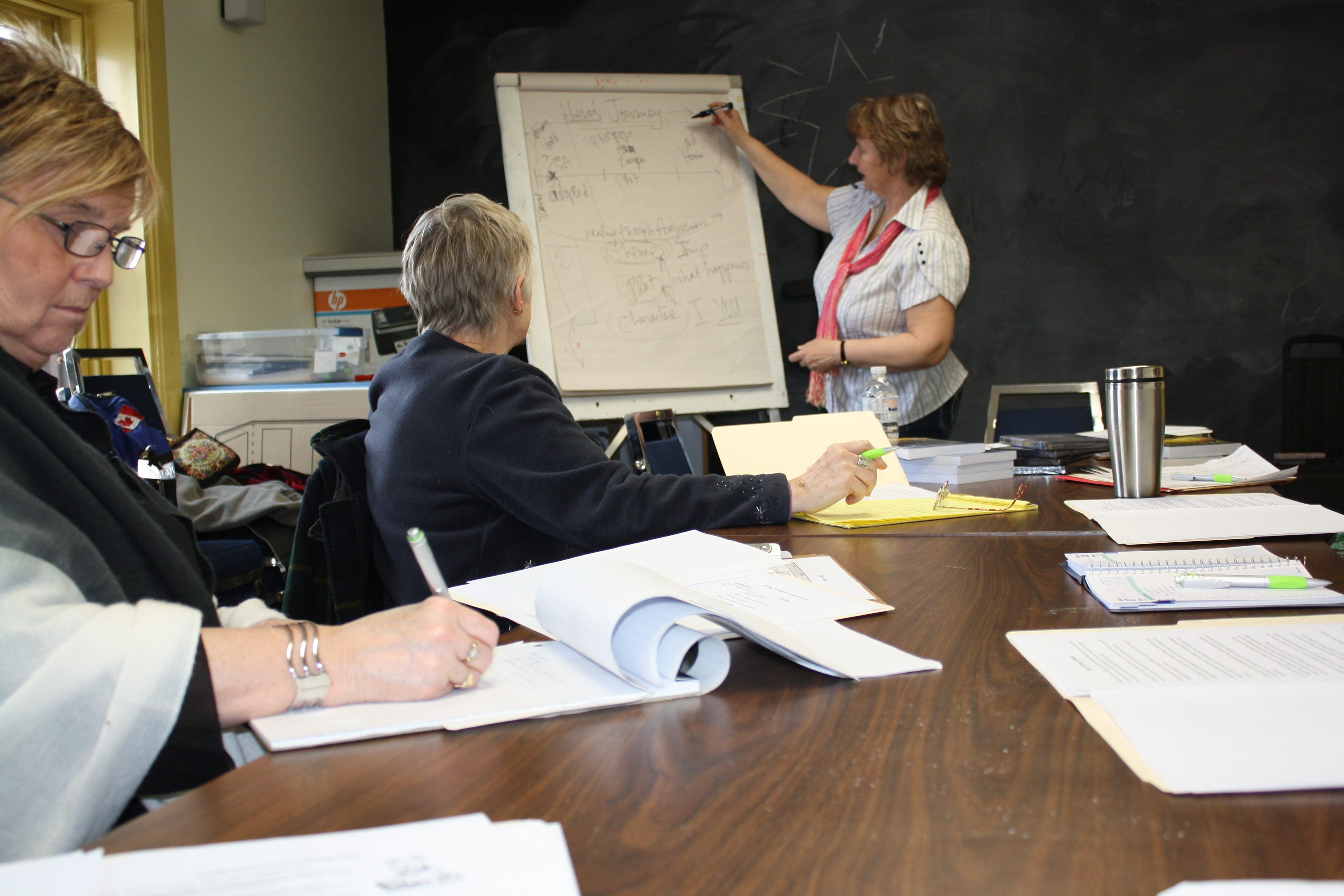
Nina teaches a writing class in Bridgewater, Nova Scotia

Simon: Tell us a little about any writing projects you’re working on these days.

Nina: I’m always busy with science articles for various online and print magazines and my own blogs. I’m also currently finishing a speculative eco-fiction novel that is a loose sequel to “A Diary in the Age of Water.” It’s set throughout Canada, from the Maritimes to the Arctic Circle, and spans a wide timeline from the Halifax Explosion of 1917 to the vast NAWAPA reservoir created a century and a half later by drowning British Columbia’s Rocky Mountain Trench. It’s a fast-paced thriller that focuses on four homeless people who battle corporate intrigue, kidnapping, human experiments and a coming climate plague.

Robin’s First Song: fledgling sits on a black walnut tree branch, ON (photo by Merridy Cox)

NINA MUNTEANU is a Canadian ecologist / limnologist and novelist. She is co-editor of Europa SF and currently teaches writing courses at George Brown College and the University of Toronto. Visit  www.ninamunteanu.ca for the latest on her books. Nina’s bilingual “La natura dell’acqua / The Way of Water” was published by Mincione Edizioni in Rome. Her non-fiction book “Water Is…” by Pixl Press(Vancouver) was selected by Margaret Atwood in the New York Times ‘Year in Reading’ and was chosen as the 2017 Summer Read by Water Canada. Her novel “A Diary in the Age of Water” was released by Inanna Publications (Toronto) in June 2020.

Apex Magazine To Release 2021 Anthology Fall 2022 with Nina Munteanu’s “Robin’s Last Song”

Over increasingly large areas of the United States, spring now comes unheralded by the return of the birds. The early mornings are strangely silent where once they were filled with the beauty of bird song.”

—Rachel Carson, Silent Spring

Apex Magazine will release its 2021 Anthology this fall with my short story, Robin’s Last Song in it.

Robin’s Last Song first appeared in the #128 Issue of Apex Magazine in 2021. It tells the story of Robin, a blind elder whose digital app failed to warn the world of the sudden global loss of birds with disastrous ecological consequences. After years of living in self-exile and getting around poorly on sight-enhancing technology, a discovery gives her new hope in rekindling her talents in the field of Soundscape Ecology.

Apex Issue #128 and upcoming 2021 Year Issue with Nina Munteanu’s “Robin’s Last Song”

May, 2071

I rock on the cedar swing on my veranda and hear the wind rustling through the gaunt forest. An abandoned nest, the forest sighs in low ponderous notes. It sighs of a gentler time. A time when birds filled it with song. A time when large and small creatures — unconcerned with the distant thrum and roar of diggers and logging trucks — roamed the thick second-growth forest. The discord was still too far away to bother the wildlife. But their killer lurked far closer in deadly silence. And it caught the birds in the bliss of ignorance. The human-made scourge came like a thief in the night and quietly strangled all the birds in the name of progress.

“Robin’s Last Song” by Nina Munteanu

Bird Population Decline

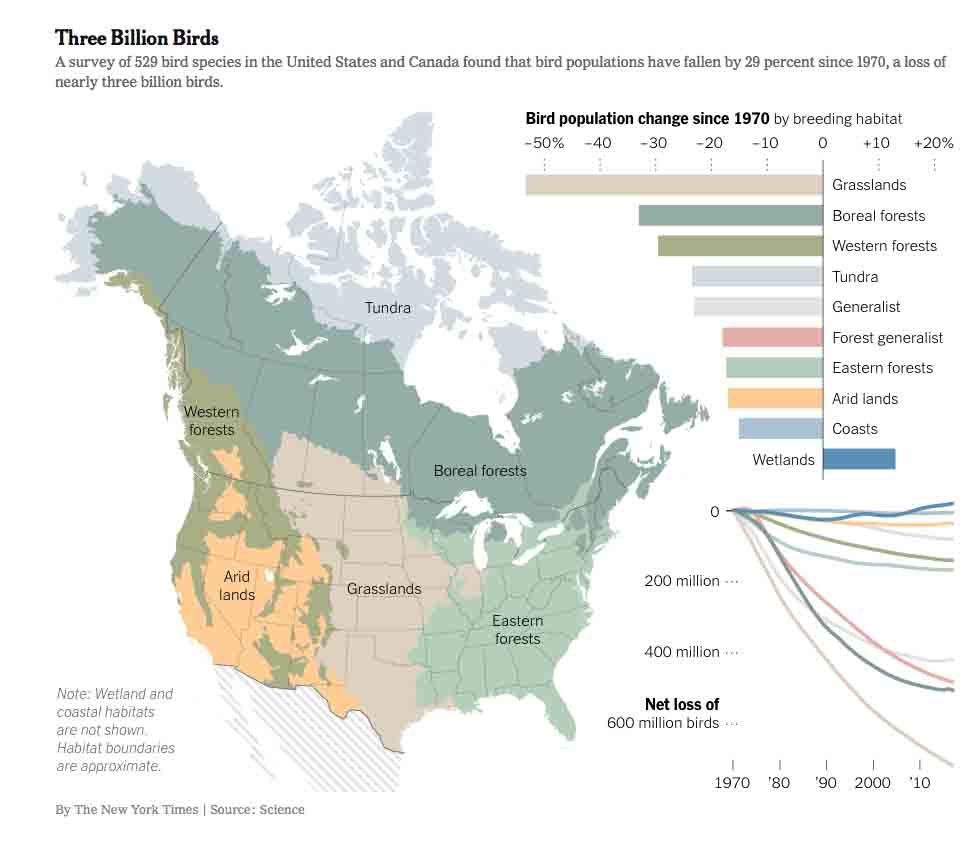
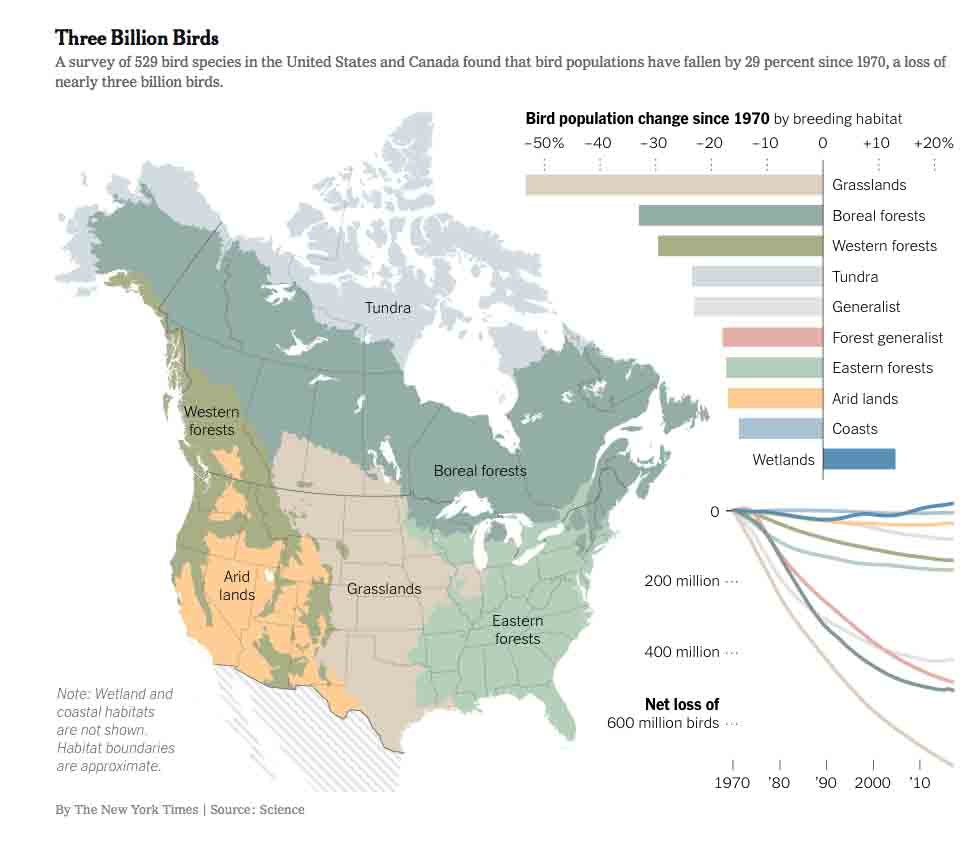
The number of birds in North America has declined by three billion, some 30 percent, over the last half-century. The October 2019 issue of Science magazine reported a staggering decline in North American birdsKenneth V. Rosenberg and his team of researchers estimated that three billion birds of various species have disappeared in Canada and the US since 1970.

Bird population change since 1970 (image The New York Times)

That’s a third of the entire bird population lost in five decades.

In North America, warbler populations dropped by 600 million. Blackbirds by 400 million. The common robins, cardinals, and blue jays had noticeably declined. Even starlings—once considered a kind of fast-breeding pest—have dwindled by 50%. The Intergovernmental Science-Policy Platform on Biodiversity and Ecosystem Services have determined that three-quarters of Earth’s terrestrial and two-thirds of the its marine environments have been severely altered by human actions.

Robin’s egg in the forest, discarded from the nest to divert predators (photo by Nina Munteanu)

Plowing of fields, deforestation, wetland draining, climate change and other land use clearing and treatments have caused great habitat loss. In addition, neonicotinoid pesticides make it harder for birds to put on weight needed for migration, delaying their travel.

A robin fledgling rests on a patio chair (photo by Merridy Cox)

Common bird species are vital to ecosystems. They control pests, pollinate flowers, spread seeds and help regenerate forests. When these birds disappear, their former habitats lose their functionality. “Declines in your common sparrow or other little brown bird may not receive the same attention as historic losses of bald eagles or sandhill cranes, but they are going to have much more of an impact,” said Hillary Young, a conservation biologist at the University of California. Kevin Gaston, a conservation biologist at the University of Exeter, lamented that: “This is the loss of nature.”

The Trump administration heinously and foolishly demolished or maimed several key bird protection acts, which hopefully the new administration has or will reinstate in full force: Migratory Bird Treaty Act; Clean Air Act; Clean Water Act; National Fish and Wildlife Act; and the Endangered Species Act.

Useful Tool: Soundscape Ecology

The new science of soundscape ecology can analyze the health of an ecosystem. Bernie Krause, a soundscape ecologist who has been conducting long-term recordings for many decades recently noted that in Sugarloaf Ridge State Park, not far from his home in Northern California, “the effect of global warming and resulting drought has created the first completely silent spring I’ve ever experienced.” Stuart Winter at Express reports that “many of the iconic birds whose mating calls ring out across woodlands and open fields during early May are vanishing at an alarming rate.”

Bernie Kraus creating one of his soundscapes

Silent Spring: Rachel Carson’s Ominous Prediction and Warning

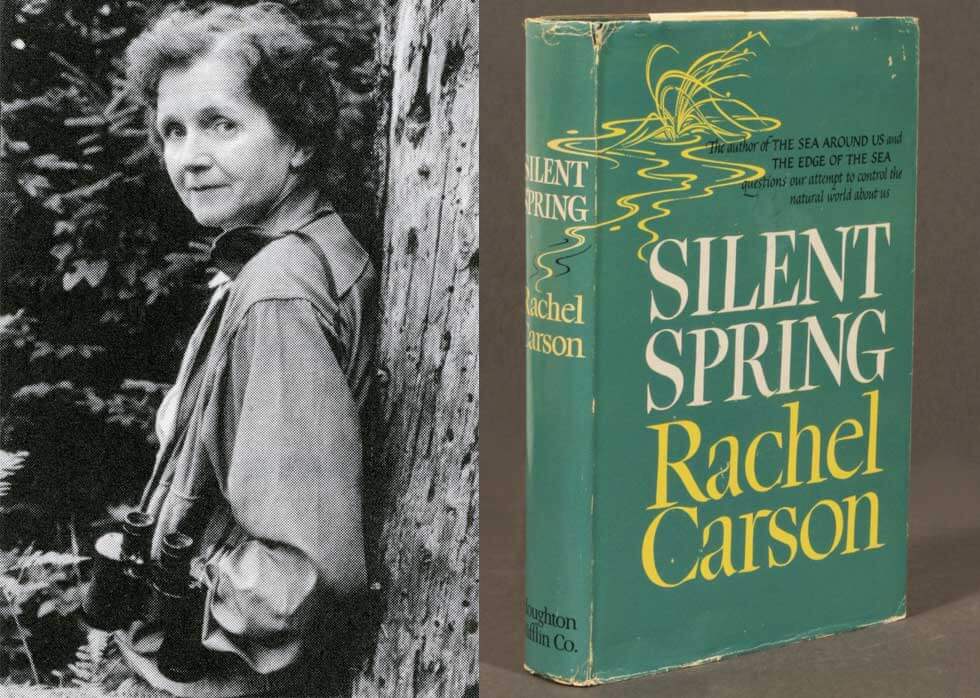
Rachel Carson was nothing short of prophetic when she published Silent Spring in 1962 (in reference to the dawn chorus most noticeable in spring during breeding). Silent Spring cautioned burgeoning ag-biotech companies (like Monsanto—now Bayer—Sygenta, Dow, and DuPont) who were carelessly and flagrantly spraying fields with pesticides and herbicides—at the time DDT was the main culprit. This would soon become a GMO world where gene-hacked plants of monocultures can withstand the onslaught of killer pesticides like neonicotinoids (currently killing bees everywhere) and Roundup.  Roundup is a carcinogenic glyphosate-based weed killer that has recently been shown to kill beneficial insects like bees) and has been linked to Alzheimer’s disease, ADHD, birth defects, autism, and several kinds of cancer in humans.

Rachel Carson and her iconic book “Silent Spring”

Despite Carson’s warnings in 1962 and despite some action eventually taken (e.g. the ban on use of DDT in 1972—the precursor to Roundup and other neonicotinoids currently in use), the use of chemicals in big ag-industry has increased over five-fold since the 1960s. And this is destroying our bee populations, other beneficial insects, beneficial weeds, small animal populations and—of course—our bird life.

And it’s making us sick too.

NINA MUNTEANU is a Canadian ecologist / limnologist and novelist. She is co-editor of Europa SF and currently teaches writing courses at George Brown College and the University of Toronto. Visit  www.ninamunteanu.ca for the latest on her books. Nina’s bilingual “La natura dell’acqua / The Way of Water” was published by Mincione Edizioni in Rome. Her non-fiction book “Water Is…” by Pixl Press(Vancouver) was selected by Margaret Atwood in the New York Times ‘Year in Reading’ and was chosen as the 2017 Summer Read by Water Canada. Her novel “A Diary in the Age of Water” was released by Inanna Publications (Toronto) in June 2020.

Apex Magazine to release 2021 Anthology This Fall with “Robin’s Last Song” by Nina Munteanu

Over increasingly large areas of the United States, spring now comes unheralded by the return of the birds. The early mornings are strangely silent where once they were filled with the beauty of bird song.”—Rachel Carson, Silent Spring

Apex Magazine will release its 2021 Anthology this fall with my short story, Robin’s Last Song in it. They are running an Apex Kickstarter Campaign until April 30 to fund the anthology.

Apex Issue 128 and upcoming Anthology for 2021

Robin’s Last Song first appeared in the #128 Issue of Apex Magazine in 2021. It tells the story of Robin, a blind elder whose digital app failed to warn the world of the sudden global loss of birds with disastrous ecological consequences. After years of living in self-exile and getting around poorly on sight-enhancing technology, a discovery gives her new hope in rekindling her talents in the field of Soundscape Ecology. Here is how it begins:

May, 2071

I rock on the cedar swing on my veranda and hear the wind rustling through the gaunt forest. An abandoned nest, the forest sighs in low ponderous notes. It sighs of a gentler time. A time when birds filled it with song. A time when large and small creatures — unconcerned with the distant thrum and roar of diggers and logging trucks — roamed the thick second-growth forest. The discord was still too far away to bother the wildlife. But their killer lurked far closer in deadly silence. And it caught the birds in the bliss of ignorance. The human-made scourge came like a thief in the night and quietly strangled all the birds in the name of progress.

Robin’s egg, discarded in the forest to distract predators, ON (photo by Nina Munteanu)

Bird Population Decline

The number of birds in North America has declined by three billion, some 30 percent, over the last half-century. The October 2019 issue of Science magazine reported a staggering decline in North American birdsKenneth V. Rosenberg and his team of researchers estimated that three billion birds of various species have disappeared in Canada and the US since 1970.

That’s a third of the entire bird population lost in five decades.

Bird population decline since 1970

In North America, warbler populations dropped by 600 million. Blackbirds by 400 million. The common robins, cardinals, and blue jays had noticeably declined. Even starlings—once considered a kind of fast-breeding pest—have dwindled by 50%. The Intergovernmental Science-Policy Platform on Biodiversity and Ecosystem Services have determined that three-quarters of Earth’s terrestrial and two-thirds of the its marine environments have been severely altered by human actions.

Plowing of fields, deforestation, wetland draining, climate change and other land use clearing and treatments have caused great habitat loss. In addition, neonicotinoid pesticides make it harder for birds to put on weight needed for migration, delaying their travel.

Robin fledgling rests on a patio chair, ON (photo by Merridy Cox)

Common bird species are vital to ecosystems. They control pests, pollinate flowers, spread seeds and help regenerate forests. When these birds disappear, their former habitats lose their functionality. “Declines in your common sparrow or other little brown bird may not receive the same attention as historic losses of bald eagles or sandhill cranes, but they are going to have much more of an impact,” said Hillary Young, a conservation biologist at the University of California. Kevin Gaston, a conservation biologist at the University of Exeter, lamented that: “This is the loss of nature.”

The Trump administration heinously and foolishly demolished or maimed several key bird protection acts, which hopefully the new administration has or will reinstate in full force: Migratory Bird Treaty Act; Clean Air Act; Clean Water Act; National Fish and Wildlife Act; and the Endangered Species Act.

Bernie Krause uses soundscape to measure ecosystem function

Useful Tool: Soundscape Ecology

The new science of soundscape ecology can analyze the health of an ecosystem. Bernie Krause, a soundscape ecologist who has been conducting long-term recordings for many decades recently noted that in Sugarloaf Ridge State Park, not far from his home in Northern California, “the effect of global warming and resulting drought has created the first completely silent spring I’ve ever experienced.” Stuart Winter at Express reports that “many of the iconic birds whose mating calls ring out across woodlands and open fields during early May are vanishing at an alarming rate.”

Rachel Carson and her iconic book, “Silent Spring”

Silent Spring: Rachel Carson’s Ominous Prediction

Rachel Carson was nothing short of prophetic when she published Silent Spring in 1962 (in reference to the dawn chorus most noticeable in spring during breeding). Silent Spring cautioned burgeoning ag-biotech companies (like Monsanto—now Bayer—Sygenta, Dow, and DuPont) who were carelessly and flagrantly spraying fields with pesticides and herbicides—at the time DDT was the main culprit. This would soon become a GMO world where gene-hacked plants of monocultures can withstand the onslaught of killer pesticides like neonicotinoids (currently killing bees everywhere) and Roundup.  Roundup is a carcinogenic glyphosate-based weed killer that has recently been shown to kill beneficial insects like bees) and has been linked to Alzheimer’s disease, ADHD, birth defects, autism, and several kinds of cancer in humans.

Despite Carson’s warnings in 1962 and despite some action eventually taken (e.g. the ban on use of DDT in 1972—the precursor to Roundup and other neonicotinoids currently in use), the use of chemicals in big ag-industry has increased over five-fold since the 1960s. And this is destroying our bee populations, other beneficial insects, beneficial weeds, small animal populations and—of course—our bird life.

And it’s making us sick too.

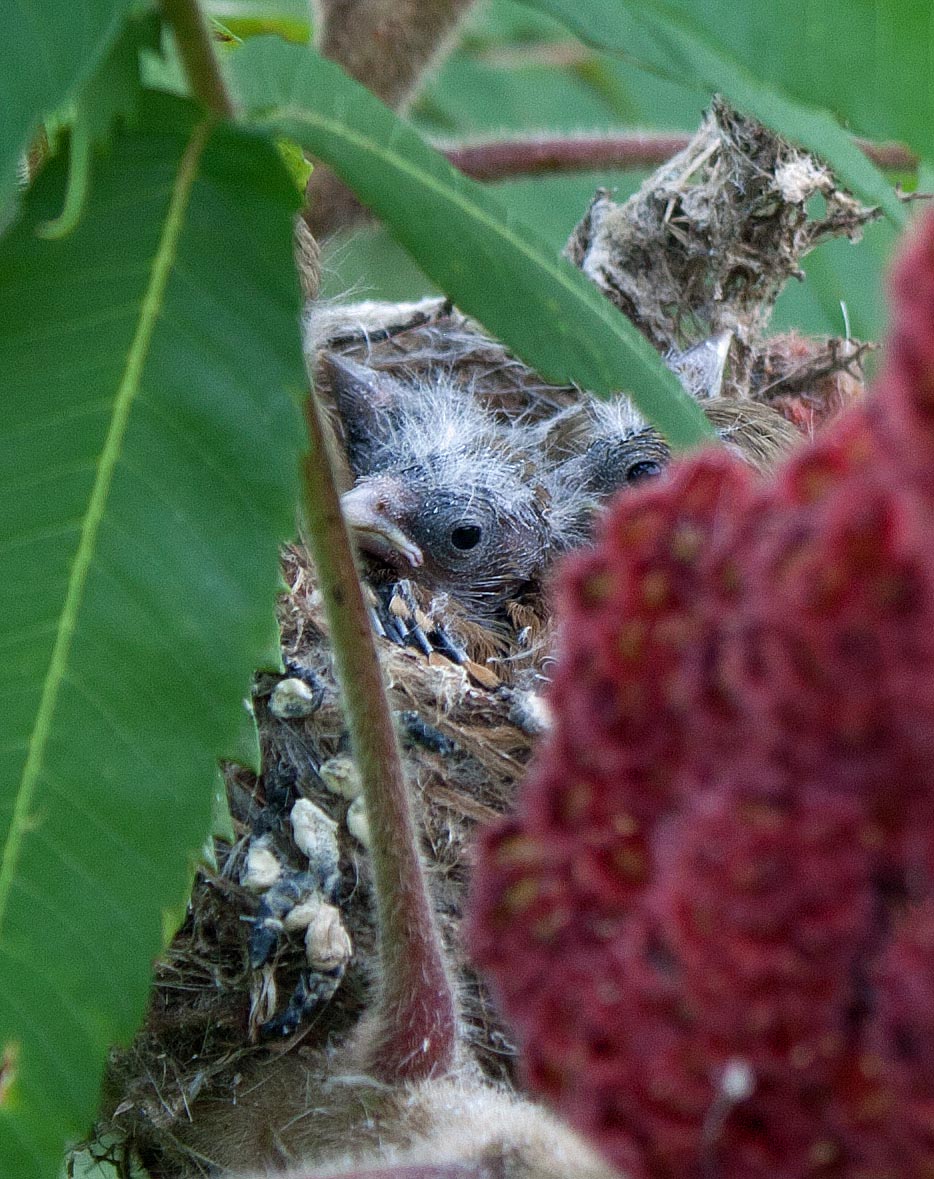
Three baby goldfinches in a nest in a staghorn sumac shrub, ON (photo by Nina Munteanu)

NINA MUNTEANU is a Canadian ecologist / limnologist and novelist. She is co-editor of Europa SF and currently teaches writing courses at George Brown College and the University of Toronto. Visit  www.ninamunteanu.ca for the latest on her books. Nina’s bilingual “La natura dell’acqua / The Way of Water” was published by Mincione Edizioni in Rome. Her non-fiction book “Water Is…” by Pixl Press(Vancouver) was selected by Margaret Atwood in the New York Times ‘Year in Reading’ and was chosen as the 2017 Summer Read by Water Canada. Her novel “A Diary in the Age of Water” was released by Inanna Publications (Toronto) in June 2020.

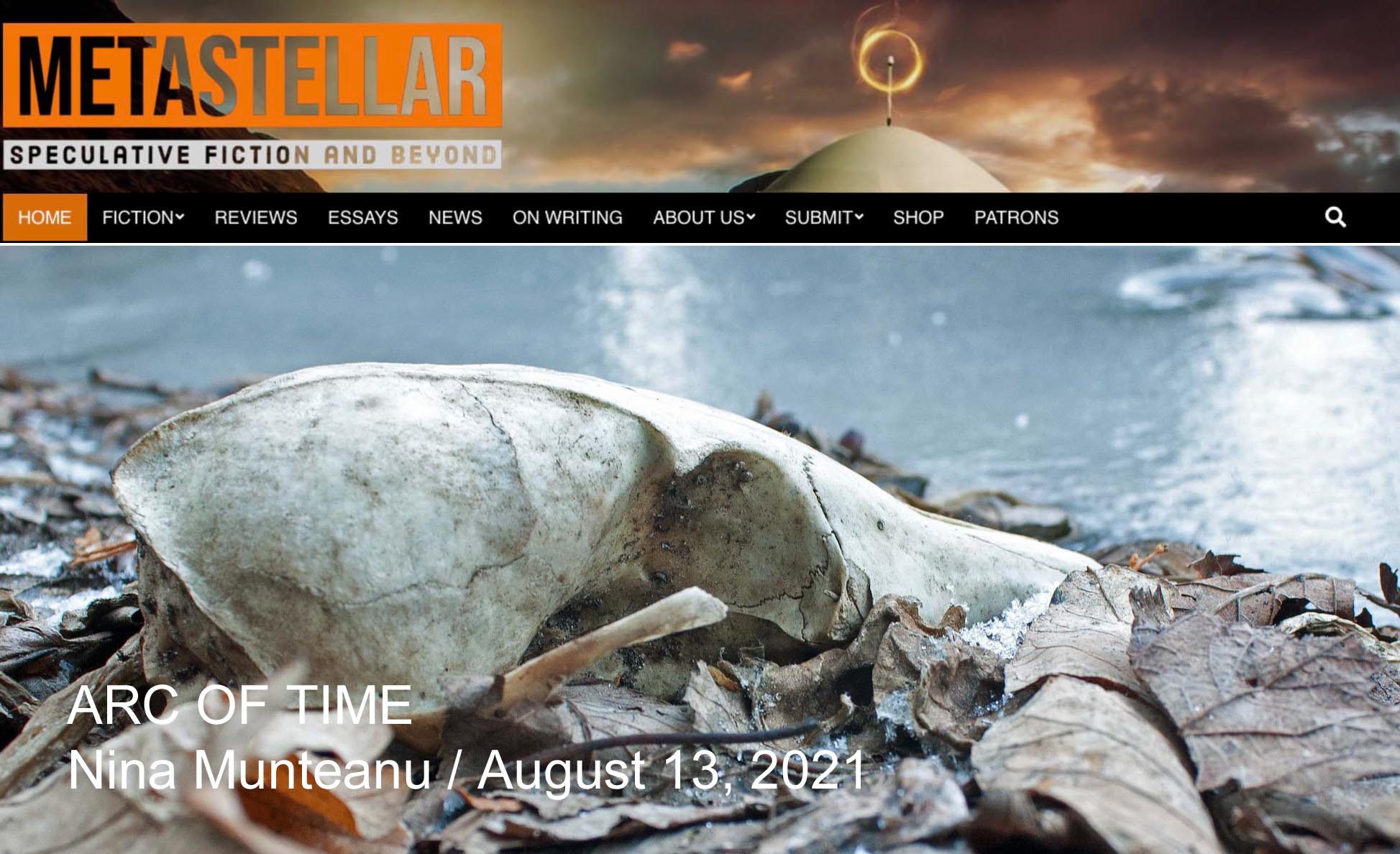
Nina Munteanu’s Short Story “Arc of Time” in Metastellar: Speculative Fiction & Beyond

My short story “Arc of Time” recently appeared in Metastellar: Speculative Fiction & Beyond. Described by them as an “epistolary account of alien discovery on Earth over time,” the story follows the fate of a mysterious and charismatic character Dante Sarpé and his associates over several centuries.

Here’s how it begins (click on the link above to read the complete story):

—I-net correspondence

from:     F. Y. Benoit, Ph.D.,Paris, France

to:     Dr. F. Wolke, Bonn, Germany

September 6, 2096

Dearest Friedrich,

I missed you at the World Sustainable Environment Congress in London last week. Where were you? I thought you were going to come? You should have heard Dante Sarpé. He captivated the congress right from the start with an introductory quote from the 20th Century social ecologist, Aldo Leopold: “Ecosystems are not only more complex than we think, they are more complex than we can think.” Describing the grave environmental calamity facing us as a symptom, Dante challenged our present paradigms and values to achieve peace and harmony. He submitted that our insatiable thirst for knowledge reflected unease with ourselves and a lack of partnership with our world.

He moved me with his parting words, Friedrich: “The branch of the tree cannot bear fruit of itself. Without compassion to fill it, knowledge is an empty house, casting its shadow on our courage to embrace the paradoxes in our lives: to feel love in the face of adversity; grace when confronted with betrayal.”

The conference was very well attended. Over 3,000 scientists and socio-economists came from all over the world. I wished you’d come, Friedrich. I drank my coffee alone, longing for your stimulating company.

Love,

Françoise Yvette

✸✸✸

A breeze braced the boy as he scrambled up the mountain. When he reached the old woman’s hut at the summit, he shielded his eyes against the sun and saw her, stepping with fluid movements in some meditative exercise. He crept closer and watched from a distance as Da’at performed her graceful dance, limbs coiling and slithering to an inner rhythm.

After completing a full turn, she pulled her rags about her and faced the boy with a nod.

He stepped forward. “What were you doing, Mama?” he asked. Da’at was not his mother, but she had looked after him since before he could remember. She always called him her blue-eyed chosen one.

“They will call it Tai Chi Chuan,” she said in a deep voice, easing herself to the ground and crossing her legs. “It is an exercise of the will, mind, and body toward the Way of Nature. Something you must learn, boy.”

“It was beautiful.” The boy squatted beside her and looked into her green eyes. Her motions had reminded him of the elegance of the cormorant and the spring of the furry Purgatorius.

“The purpose of the movements is to transfer the Chi, or the intrinsic energy, to the Shen, or spirit, by using inner rather than outer force.” She trained her gaze to the bright sun and her eyes sparkled like emeralds. “It brings me closer to my eternal love who dwells now only on the shafts of light and the whisper of the wind.”

The boy tilted his head and squinted, trying to grasp the meaning of her strange words. She often spoke cryptically, expecting him to understand.

Da’at turned to the boy. “If you practice Tai Chilong enough and execute it properly, you will become reconnected with the unity of everything, including the fourth dimension.”

“What is the fourth dimension?”

Da’at smiled wearily. “Time, my chosen one.”

The worn lines of her masculine face resembled weathered rock. She had always looked old yet she never seemed to age. “Is that why you can see into the future?” the boy asked, rocking on the balls of his feet.

She folded her arms on her knees and her thick brows knit together. “Future? What is that?” Before he could respond, she added, “You have much to learn about time and space, boy. Do you think we inhabit one place and one time? Our universe is not only more complex than you think; it is more complex than you can think.”

A dove flew overhead. Da’at gazed up at the bird and raised her hands in supplication. “My Shekhinah, I sense your presence here. How will my chosen one acquire wisdom when you elude us like the shifting wind?”

Reminded of why he’d come, the boy moved onto his knees and leaned forward. He focused on the dark hairs on Da’at’s chin and, taking a deep breath, he said, “While I was napping in the forest, I had a strange dream. About a faraway place unlike any I’ve seen. Full of huts taller than the Gingko trees and so many people like me, crowded inside them like ants.”

Da’at nodded to herself. “The dove has spoken to you.”

✸✸✸

To read the full story go to Arc of Time on the Metastellar site.

Fox skull found on shore of Jackson Creek in winter, ON (photo by Nina Munteanu)

Nina Munteanu is a Canadian ecologist / limnologist and novelist. She is co-editor of Europa SF and currently teaches writing courses at George Brown College and the University of Toronto. Visit www.ninamunteanu.ca for the latest on her books. Nina’s bilingual “La natura dell’acqua / The Way of Water” was published by Mincione Edizioni in Rome. Her non-fiction book “Water Is…” by Pixl Press(Vancouver) was selected by Margaret Atwood in the New York Times ‘Year in Reading’ and was chosen as the 2017 Summer Read by Water Canada. Her novel “A Diary in the Age of Water” was released by Inanna Publications (Toronto) in June 2020.
Anachronisms and Ambiguity in Spec-Fic: “Dreams of the Moon”, a guest post by Lorina Stephens

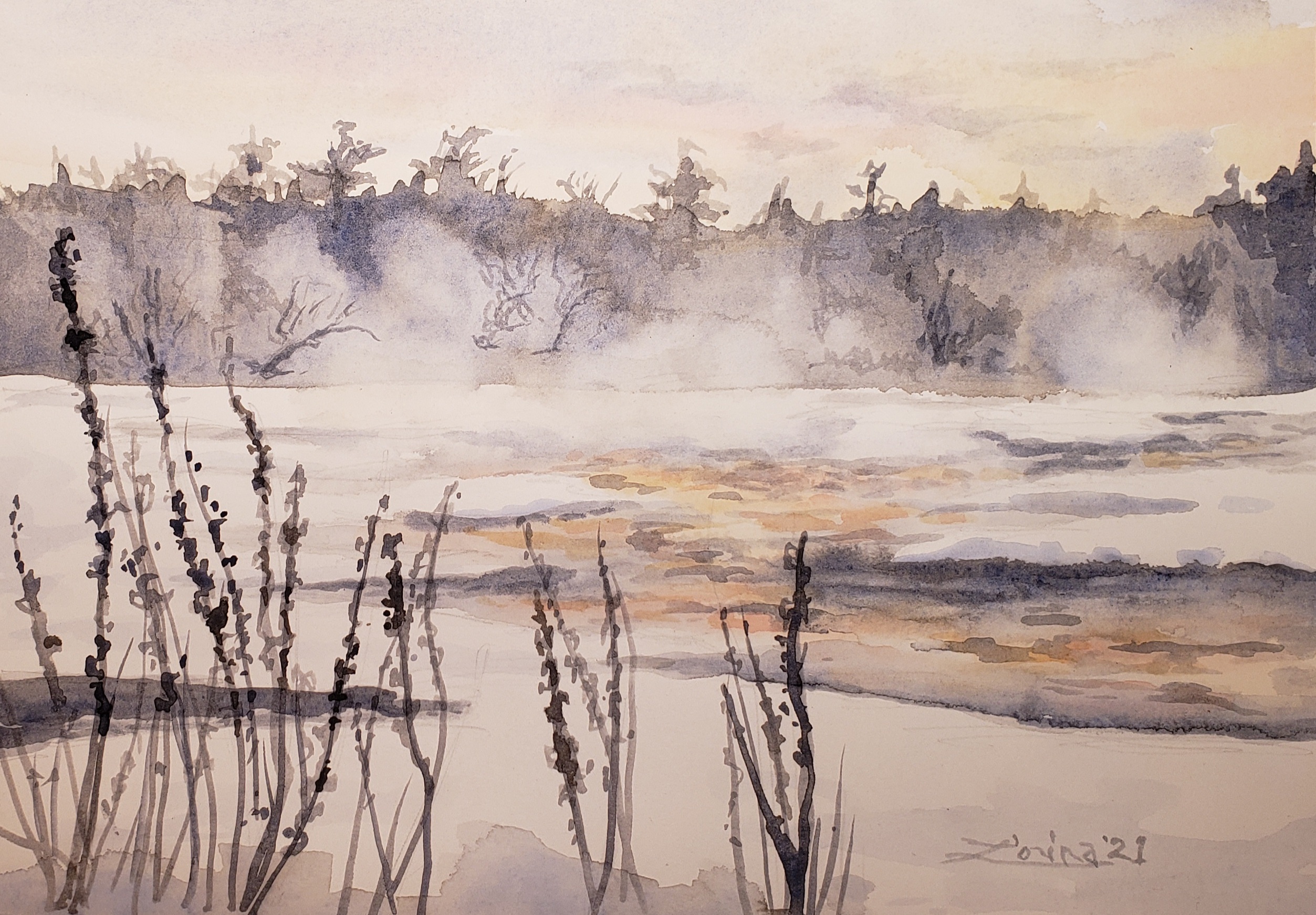
“Petawawa River” by Lorina Stephens (7″ x 10″ watercolour on Arches 140 lb hot pressed)

I first met Lorina Stephens some years back when I joined SF Canada, the organization of Canadian professional science fiction, fantasy and horror writers and publishers. Lorina was already the publisher of Five Rivers Publishing, a highly successful small book publishing house out of Neustadt, Ontario. What I didn’t know at the time was that she is also a consummate landscape artist, using watercolour to create evocative art. And, of course, a consummate storyteller.

She’s here today to talk about her latest book Dreams of the Moon, a new collection of ten fantastica short stories, described by writer/reviewer R. Graeme Cameron as “Darkness and light. Wonder and sorrow. The ambiguity, sometimes, of reflected illumination … In this new collection of both previously published and new short fiction, Lorina presents a progression from darker, sometimes horrific stories which explore religious mythology, mental health, and the beloved dead, to the more light-hearted explorations of spirit guides and illustrations made manifest.”

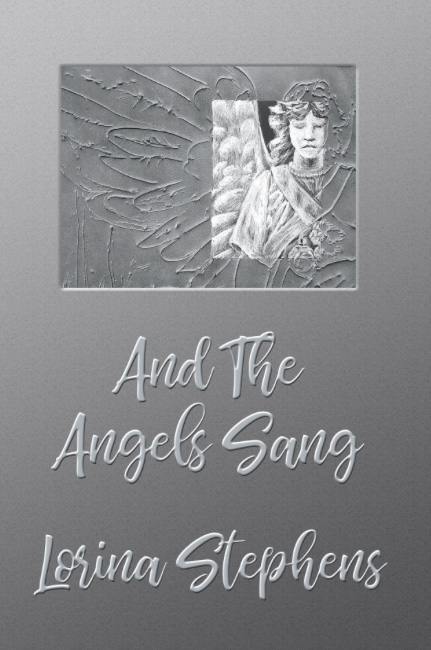
Lorina’s previous short story collection And the Angels Sang published in 2008 was described as “a provocative [collection] of speculative short fiction, from dystopia to utopia, written over the past 25 years.”

“the Angels Sangis a cornucopia of fractal glimpses into the mysterious, the fantastic, and surprises that lurk beneath the surface.”—Midwest Book Review 

“It is often the case with contemporary Canadian authors that they have a tendency to punctuate their novels with long, psychological dissertations on mundane subjects. It’s as if they feel that each everyday occurrence is fraught with deep sociological undertones. Lorina Stephens, fortunately, is free of such meanderings. She has a good economy of words and each paragraph contains vital information.”—Dan Pelton, Orangeville Citizen

Here’s Lorina’s post:

The last collection of short stories I published was in 2008. It’s an eclectic mix which I entitled And the Angels Sang, named for the lead story. To my delight, it’s met with quite a bit of positive reaction from both readers and reviewers.

In the ensuing years, I’ve crafted a number of other short stories in between operating a publishing house and all the demands of being an administrator in our other business, one which pays the bills. A lot has happened during that time: our son married his life-buddy, three major surgeries, a failed attempt at elder care, renovating this old stone house which was built c1847, and as I write this, into the second year of a global pandemic. 

And somewhere in all that still writing, still exploring ideas and what-ifs. I do have to admit a reluctance to writing short fiction. The literary form seems so restrictive to me, perhaps more having to do with the fact I have too much to say and want to make an epic out of everything. But short story writing is good discipline.

Having said that, I’m giving you 10 short works of fiction in this collection [Dreams of the Moon], spanning the boundaries of science fiction, speculative fiction, fantasy, magic realism and absurd fantastica. Apparently, I don’t much like writing in just one genre, either. Creative fences drive me batshit crazy, although I do very much appreciate fences around this sanctuary we are privileged to call home. But there is a theme to this collection, a common thread I think you will find through all the stories. What it is, I will leave up to you to decipher, and thus we will have a silent communication.

I’ve arranged the stories in some loose graduation of dark to light, and again have chosen to use the lead story as the title for the collection. But the title Dreams of the Moon is more, because as a child, and then an adolescent, I firmly believed if I arranged myself just so in the bed, so that when the moon shone in my window, something wonderful would happen. It never did. But I still felt compelled to answer the call of that pale, eerie light. 

And then there were all the moonlight walks in the deep of the night which took place well into adulthood. Wonderful moments. Moments I remember with clarity and wonder, whether moonlight so bright on a winter’s night that the trees by the river cast indigo shadows across the snow, or a brace of geese rising up and across that silver face. And as with all things, there is the dark side of the moon: a sleepless night fraught with sorrow and a desperate attempt to rescue someone I dearly loved.

All of these moments influence and underscore what I write. It’s there in these 10 stories. Darkness and light. Wonder and sorrow. The ambiguity, sometimes, of reflected light. Dreams of the Moon.

The third story in the collection, Gravity, slides from the horrific to a quieter, perhaps oppressive literary piece of speculative fiction. As in At Union, the second story in the collection, Gravity deals with the loss of a child, in this case a daughter who dies while on a scientific mission at the edge of a singularity. 

I do like playing with anachronisms, because somehow they are a metaphor for many of the ironies in our lives. So it is in this story the main character is a woman of age who is a maker of old world automatons, and in this case she’s working on a silver niello owl. 

I chose an owl because of both the dark mythology which often surrounds owls, and because of their sheer beauty. They are amazing raptors. Silent. Deadly. Reticent creatures. Amazing fliers through dense forest. 

There is also an eerie spring in the story, which is inspired by a sulphur hot spring not far from our home. It flows at a constant temperature 12 months of the year, which is remarkable given our geographic location. It’s also a very eerie spring to view. The water is a pellucid turquoise, flowing with force out of a deep funnel, and in which nothing grows. There is just this volume of warm, clear water fountaining up out of the bowels of the earth and spilling out into the Saugeen River complex.

Of course, you’re likely scratching your head at this point wondering how the hell did I weave together the death of a daughter, a singularity, a mourning mother, a hot spring, and a clockwork owl? Well, at the risk of being coy, you’ll have to read the story in order to find out.

Dreams of the Moon is available in trade paperback and ebook, either directly through my website or through your favourite online bookseller wherever you live in the world. It’s also available through elibrary services globally. 

“Big Sky” by Lorina Stephens (7″ x 1o” watercolour on Arches 140 lb hot pressed)

The Art of Lorina Stephens

Lorina tells us that the two watercolours featured here “are both part of a series I’ve been exploring the past three years since my mum died,” says Lorina. “Painting was one of the few things we shared throughout a difficult and often shattered relationship. So, in this series in particular, I have been trying to capture the sense of peace, of belonging to the planet, of harmony.”

Lorina primarily paints in watercolour: “I prefer to use transparent pigments, carefully glazing from warm, light pigments to cool, dark, which allows light to travel through those microscopic films of colour. I think that creates a clarity of colour, which then adds to the sense of luminescence I want to imbue into most of my art. I do also work in oils, acrylics, and pen and ink, as well as pencil and pastels. But my heart lies in watercolour because it’s such a precise, unforgiving, technical medium. It makes me slow down, consider. And I like that meditative process. It’s also something I do in my writing: think a lot. That’s essential to being creative, at least for me.”

Lorina mostly works in landscapes, often with lakes and rivers, icons of a water-rich nation. “We are such a remarkable land of water,” she says. “Our geography is breathtaking.”  Atmospherics—weather—fascinates Lorina. “I love the challenge of bringing that sense of fog, or mist, or rain, or even crisp, clear air to a painting, of making the viewer feel they are there, without resorting to magic realism. I like to tuck my work somewhere comfortably between realism and impressionism.” 

Biography on Lorina Stephens

Lorina Stephens has worked all sides of the publishing desk: writer, editor, publisher. From freelance journalist for regional and national periodicals, to editor of a regional lifestyle magazine and then her own publishing house, she’s been at this professionally since 1980 and has witnessed publishing evolve into the dynamic form of self-expression which exists today. For 12 years Lorina operated Five Rivers Publishing as a house which gave voice to Canadian authors. Due to life circumstances, Lorina had to change direction, and so now the house exists as a bit of a vanity press for her work.

Lorina’s short fiction has appeared in literary and genre publications, novels under her own house, Five Rivers Publishing, non-fiction under Boston Mills Press and an anthology co-edited with Susan MacGregor, Tesseracts 22: Alchemy and Artifacts.

Mostly Lorina is an introvert. You won’t find her at conventions. On social media she mostly lurks. If you really want to know what Lorina is about, read her work. It’s that simple. If you’re curious, email her at: lorina@fiveriverspublishing.com

Nina Munteanu is a Canadian ecologist / limnologist and novelist. She is co-editor of Europa SF and currently teaches writing courses at George Brown College and the University of Toronto. Visit www.ninamunteanu.ca for the latest on her books. Nina’s bilingual “La natura dell’acqua / The Way of Water” was published by Mincione Edizioni in Rome. Her non-fiction book “Water Is…” by Pixl Press(Vancouver) was selected by Margaret Atwood in the New York Times‘Year in Reading’ and was chosen as the 2017 Summer Read by Water Canada. Her novel “A Diary in the Age of Water” was released by Inanna Publications (Toronto) in June 2020.

What If the Birds All Die?


Over increasingly large areas of the United States, spring now comes unheralded by the return of the birds. The early mornings are strangely silent where once they were filled with the beauty of bird song.”—Rachel Carson, Silent Spring

Sunset 2

Sunset in Niagara on the Lake, Ontario (photo by Nina Munteanu)

I’m a science fiction writer. I’m thinking “what if” premises all the time. One that nags me is: What if the birds all die?

We might be closer to it than you think…

SONY DSC

Chickadee in Ontario (photo by Merridy Cox)

The October 2019 issue of Science magazine reported a staggering decline in North American birds. Kenneth V. Rosenberg and his team of researchers estimated that three billion birds of various species have disappeared in Canada and the US since 1970.

That’s a third of the entire bird population lost in five decades.

The focus of the study wasn’t on extinction; these are still common species—just greatly diminished in numbers. This makes sense to me. My naturalist friend and I have both noticed how even the common house sparrow have declined in our neighbourhoods. My friend noticed fewer dashes of colour in the trees provided by yellow warblers in the past few years.

SONY DSC

Northern Cardinal (photo by Merridy Cox)


The Guardian reported that two thirds of the house sparrow population have disappeared in Europe. That’s close to 150 million birds. The article blamed changes in land use (destruction of habitat), coastal management (destruction of wetlands) and weather (including climate change). In another study, car exhaust was implicated in a 60% loss of common sparrow numbers from the mid 1990s.

In North America, warbler populations dropped by 600 million. Blackbirds by 400 million. The common robins, cardinals, and blue jays had noticeably declined. Even starlings—once considered a kind of fast-breeding pest—have dwindled by 50%. The Intergovernmental Science-Policy Platform on Biodiversity and Ecosystem Services have determined that three-quarters of Earth’s terrestrial and two-thirds of the its marine environments have been severely altered by human actions.

Unchecked deforestation. Unchecked use of toxic pesticides. Turning wetlands into parking lots. Climate change. We are destroying the integrity of ecosystems throughout this planet on a massive scale. And the birds are telling us…

SONY DSC

Baby Robin rests on a porch chair in Mississauga, ON (photo by Merridy Cox)

subTerrain 85 coverMy short story “Out of the Silence,” which appeared in the Spring 2020 issue of subTerrain Literary Magazine (Issue 85), tells the story of Katherine, a blind elder whose digital app failed to warn the world of the sudden global loss of birds with disastrous ecological consequences. After years of living in self-exile and getting around poorly on sight-enhancing technology, a discovery gives her new hope in rekindling her talents in the field of soundscape ecology.

I rock on the cedar swing on my veranda and hear the wind rustling through the gaunt forest. An abandoned nest, the forest sighs in low ponderous notes. It sighs of a gentler time. A time when birds filled it with song. A time when large and small creatures—unconcerned with the distant thrum and roar of diggers and logging trucks—roamed the thick second-growth forest. The discord was still too far away to bother the wildlife. But their killer lurked far closer in deadly silence. And it caught the birds in the bliss of ignorance…

RachelCarson-SilentSpring

Rachel Carson was nothing short of prophetic when she published Silent Spring in 1962 (in reference to the dawn chorus most noticeable in spring during breeding). Silent Spring cautioned burgeoning ag-biotech companies (like Monsanto—now Bayer—Sygenta, Dow, and DuPont) who were carelessly and flagrantly spraying fields with pesticides and herbicides—at the time DDT was the main culprit. This would soon become a GMO world where gene-hacked plants of monocultures can withstand the onslaught of killer pesticides like neonicotinoids (currently killing bees everywhere) and Roundup.  Roundup is a carcinogenic glyphosate-based weed killer that has recently been shown to kill beneficial insects like bees) and has been linked to Alzheimer’s disease, ADHD, birth defects, autism, and several kinds of cancer in humans.

RachelCarson-LindaLearIn her 1997 biography Rachel Carson: Witness for Nature, historian and science biographer Linda Lear wrote:

Silent Spring, the product of [Carson’s] unrest, deliberately challenged the wisdom of a government that allowed toxic chemicals to be put into the environment before knowing the long-term consequences of their use. Writing in language that everyone could understand and cleverly using the public’s knowledge of atomic fallout as a reference point, Carson described how chlorinated hydrocarbons and organic phosphorus insecticides altered the cellular processes of plants, animals, and, by implication, humans. Science and technology, she charged, had become the handmaidens of the chemical industry’s rush for profits and control of markets. Rather than protecting the public from potential harm, the government not only gave its approval to these new products but did so without establishing any mechanism of accountability. Carson questioned the moral right of government to leave its citizens unprotected from substances they could neither physically avoid nor publicly question. Such callous arrogance could end only in the destruction of the living world.

Despite Carson’s warnings in 1962 and despite some action eventually taken (e.g. the ban on use of DDT in 1972—the precursor to Roundup and other neonicotinoids currently in use), the use of chemicals in big ag-industry has increased over five-fold since the 1960s. And this is destroying our bee populations, other beneficial insects, beneficial weeds, small animal populations and—of course—our bird life. And it’s making us sick too.

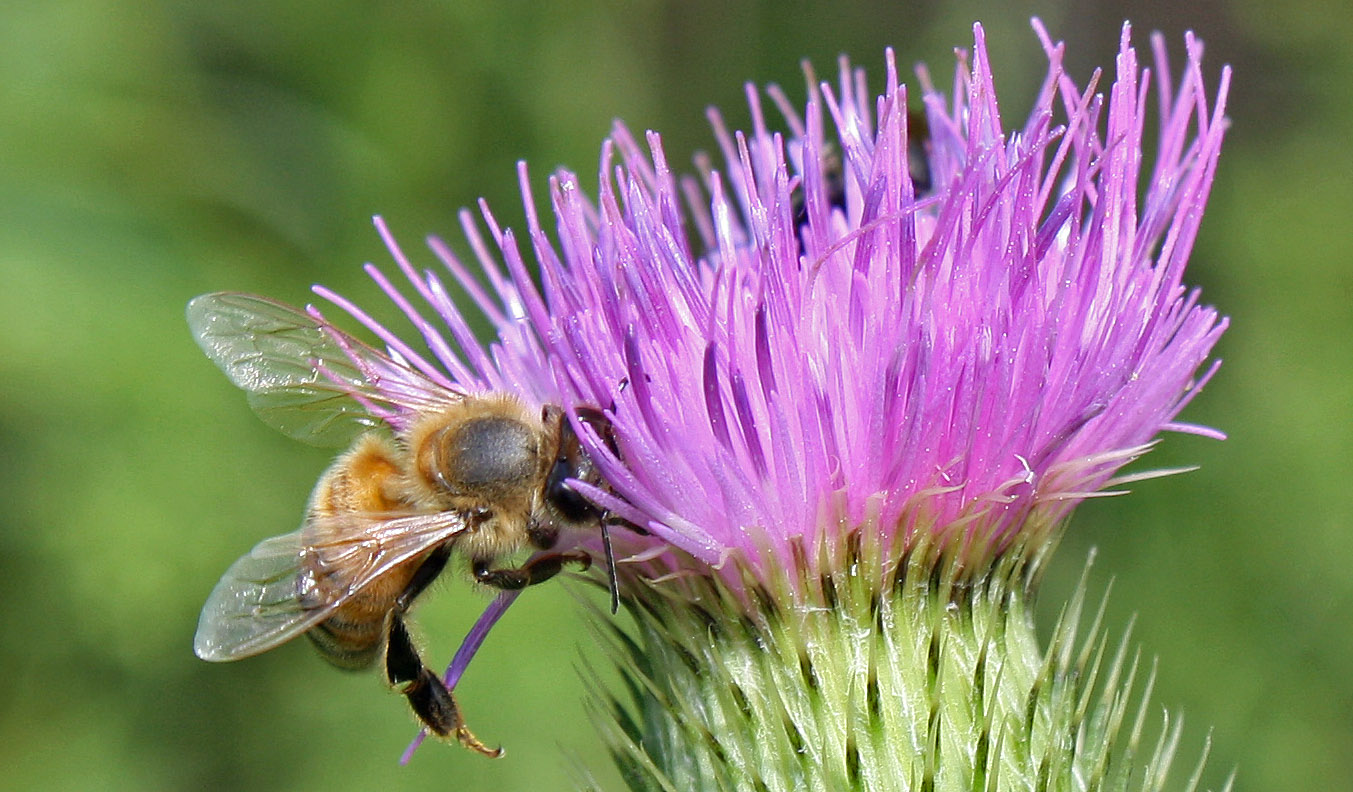
Thistle Bull and Honey bee close

In a 2012 article in the New York Times—exactly fifty years after Silent Spring was published on September 27, 1962—Nancy F. Koehn tells us that, “[Rachel Carson] was a slight, soft-spoken woman who preferred walking the Maine shoreline to stalking the corridors of power. And yet Rachel Carson, the author of Silent Spring, played a central role in starting the environmental movement, by forcing government and business to confront the dangers of pesticides.” Carson, writes Koehn, was an introverted scientist with a lyrical bent, who saw it as her mission to share her observations with a wider audience. Carson wrote Silent Spring while battling illness (including breast cancer) and caring for her young son. When the book was published, she faced an outburst of public reaction and strong backlash, primarily from chemical companies. Not unlike another female eco-hero (Greta Thunberg), Carson endured with dignity and deliberation the vulgar censure by opponents (virtually all men tied to corporate giants) who attacked her personally with vilifying stereotype. Men accused her of being disloyal and unscientific, and being a hysterical woman. One letter to the editor that the New Yorker saw fit to print read:

silent-spring-rachel carson“Miss Rachel Carson’s reference to the selfishness of insecticide manufacturers probably reflects her Communist sympathies, like a lot of our writers these days. We can live without birds and animals, but, as the current market slump shows, we cannot live without business. As for insects, isn’t it just like a woman to be scared to death of a few little bugs! As long as we have the H-bomb everything will be O.K.”

Former Secretary of Agriculture Ezra Taft Benson wrote privately to former President Dwight Eisenhower that Carson was “probably a communist.”

Environment & Society Portal provides a revealing synopsis of the response by established patriarchy at the time:

Allegations that Carson was just a hysterical woman appeared both in the pages of chemical and agricultural trade journals as well as in the popular press. Women were imagined to be less rational, more emotional, and more sentimental than men, who could be relied upon to study the issues dispassionately and propose rational solutions. An agricultural expert told a reporter at the Ribicoff hearings, “You’re never going to satisfy organic farmers or emotional women in garden clubs” (Graham 1970, 88). In his letter to Eisenhower, Benson wondered why a “spinster was so worried about genetics” (Lear 1997, 429).

As Carson had no institutional affiliation, she was dismissed as an amateur who did not understand the subject like a professional scientist would, or who distorted or misread the science. To her critics, Carson’s frequent use of terms like “nature,” “natural,” and “balance of nature” identified her as a mere sentimental nature lover or a pantheist like Ralph Waldo Emerson or Henry David Thoreau. Reviews in TimeU.S. News and World Report, and even Sports Illustrated took her to task. The reviewer in Time, for example, criticized her “emotion-fanning words” and characterized her argument as “unfair, one-sided, and hysterically overemphatic.” He traced her “emotional and inaccurate outburst” to her “mystical attachment to the balance of nature” (Brooks 1989, 297).

SONY DSC

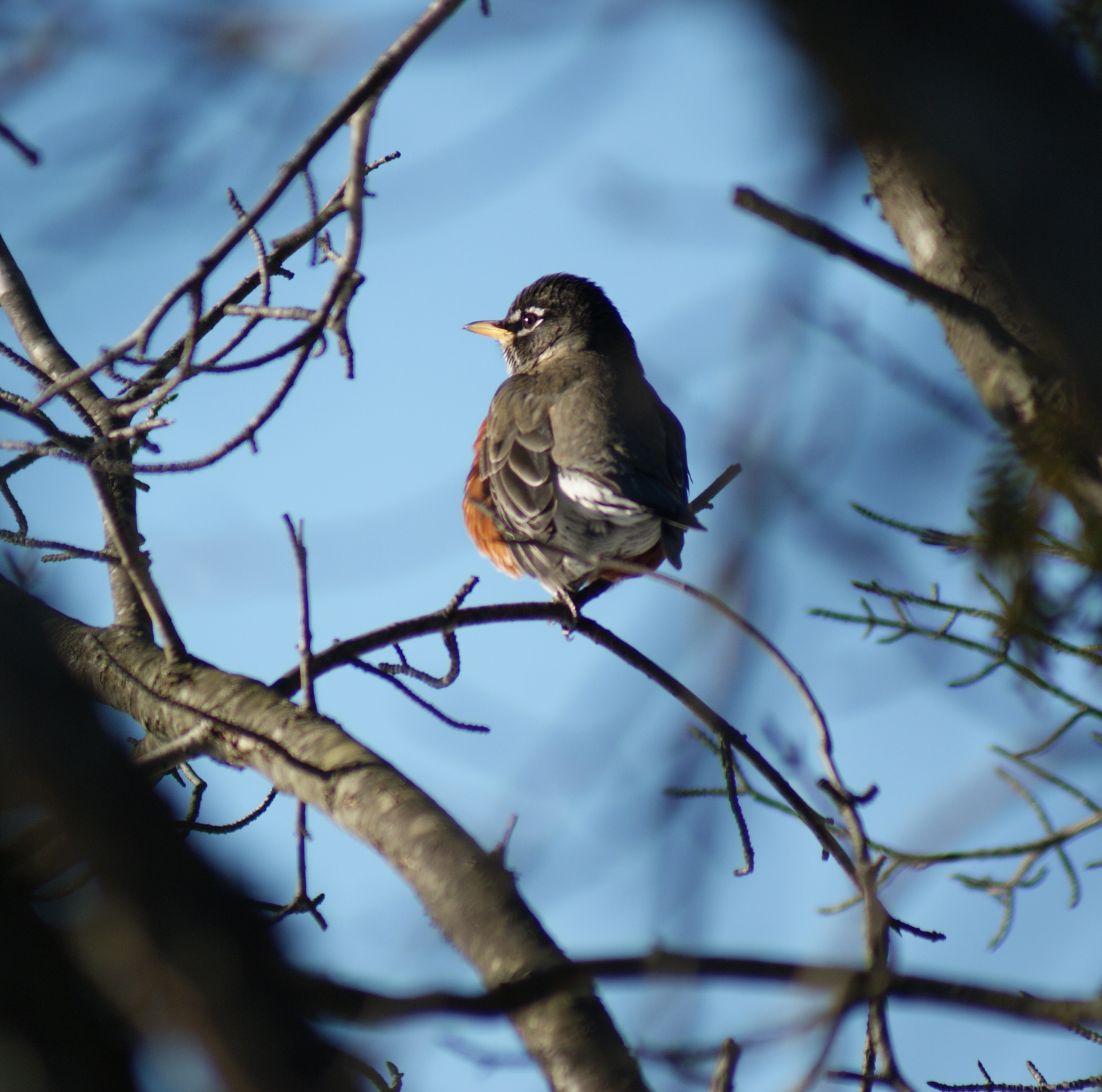
American Robin (photo by Merridy Cox)

Even inoffensive public portraits of Carson showed her in more domestic rather than scientific settings. Life magazine published a story about her accompanied by photos of her talking with children while on a nature walk or watching birds with a group of Audubon Society members. Dressed like a housewife and surrounded by children and “bird people,” Carson projected an image of a teacher or stay-at-home mother, although the picture on the first page of the article showed her at a microscope. Carson, said the story, “is unmarried but not a feminist (‘I’m not interested in things done by women or by men but in things done by people’)”

According to historian and biographer Linda Lear, “the industry spent a quarter of a million dollars to discredit her research and malign her character. In the end, the worst they could say was that she had told only one side of the story and had based her argument on unverifiable case studies.” According to Lear, “Carson was an outsider who had never been part of the scientific establishment, first because she was a woman but also because her chosen field, biology, was held in low esteem in the nuclear age. Her career path was nontraditional; she had no academic affiliation, no institutional voice. She deliberately wrote for the public rather than for a narrow scientific audience. For anyone else, such independence would have been an enormous detriment. But by the time Silent Spring was published, Carson’s outsider status had become a distinct advantage. As the science establishment would discover, it was impossible to dismiss her.”

SONY DSC

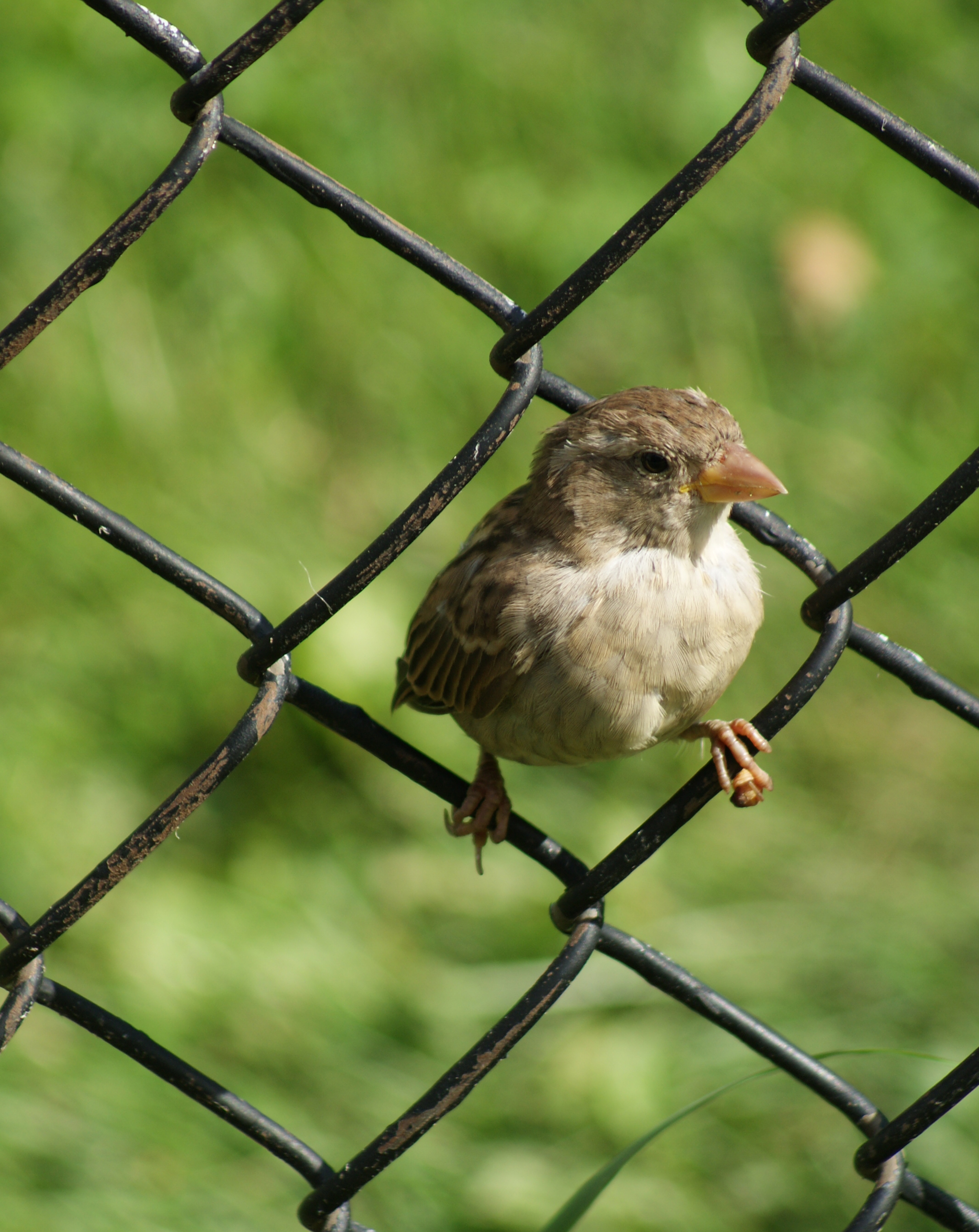
House Sparrow (photo by Merridy Cox)

Not unlike Greta, Rachel and the message in her book exerted a great impact on the environmental movement. Silent Spring became a rallying focus for a new social movement in the 1960s, which endures to the present day.

According to Lear:

“Carson’s concept of the ecology of the human body was a major departure in our thinking about the relationship between humans and the natural environment. It had enormous consequences for our understanding of human health as well as our attitudes toward environmental risk. Silent Spring proved that our bodies are not boundaries. Chemical corruption of the globe affects us from conception to death. Like the rest of nature, we are vulnerable to pesticides; we too are permeable. All forms of life are more alike than different.

“Carson believed that human health would ultimately reflect the environment’s ills. Inevitably this idea has changed our response to nature, to science, and to the technologies that devise and deliver contamination. Although the scientific community has been slow to acknowledge this aspect of Carson’s work, her concept of the ecology of the human body may well prove to be one of her most lasting contributions.”

Bernie Krause Florida

Bernie Krause

In the meantime, alarming signals suggest that Rachel Carson’s 1962 warning is currently underway. The new science of soundscape ecology can analyze the health of an ecosystem. Bernie Krause, a soundscape ecologist who has been conducting long-term recordings recently noted that in Sugarloaf Ridge State Park, not far from his home in Northern California, “the effect of global warming and resulting drought has created the first completely silent spring I’ve ever experienced.” Stuart Winter at Express reports that “many of the iconic birds whose mating calls ring out across woodlands and open fields during early May are vanishing at an alarming rate.”

“Man’s war against nature is inevitably a war against himself.”—Rachel Carson


nina-2014aaa

Nina Munteanu is a Canadian ecologist / limnologist and novelist. She is co-editor of Europa SF and currently teaches writing courses at George Brown College and the University of Toronto. Visit www.ninamunteanu.ca for the latest on her books. Nina’s bilingual “La natura dell’acqua / The Way of Water” was published by Mincione Edizioni in Rome. Her non-fiction book “Water Is…” by Pixl Press (Vancouver) was selected by Margaret Atwood in the New York Times ‘Year in Reading’ and was chosen as the 2017 Summer Read by Water Canada. Her novel “A Diary in the Age of Waterwas released by Inanna Publications (Toronto) in May 2020.


Nina Munteanu’s Short Story “Natural Selection” features in Eagle Literary Magazine Issue #1

NaturalSelection-IonutiBanuta

Illustration by Ionuț Bănuță

Sarah reached the summit, panting for breath, and grinned at her prize. She’d just caught the sun trembling over the horizon, before it dipped out of sight and left a glowing sky under pewter clouds. She glanced behind her, where the towers of Icaria blazed like embers catching fire. Struck by their beauty, Sarah admired their smooth, clean surfaces. When she looked back toward the path, the sanguine images burnt into her eyes.

Which way should she go? The deer path she’d followed now diverged into two smaller ones. She shifted her mind to veemeld with her AI, DEX. Which way should we go, DEX?

Her AI answered in her head: Sarah, shouldn’t you be returning inside? It’s dangerous to stay out this long. Statistics are now against you for getting caught—

Just a few more minutes, DEX. How about to the right?

“Natural Selection” tells the story of Sarah, an unruly veemeld who can speak to the machine world that runs Icaria. Given her immunity to the environmental disease ravaging the enclosed city, Sarah—at least her genetic material—is sought after by the Ecologist government in a bid to maintain order and reshape humanity through “selection”; but Sarah fraternizes with unsavory friends and her truant behaviour poses a great risk to her freedom and survival.

Eagle-1issue-summer2019_Cover_1600“Natural Selection” first appeared in 2013 in my short story collection of the same name by Pixl Press. The story returns in Issue #1 of Eagle Literary Magazine, Pan European Science Fiction & Fantasy Collection (Summer 2019; Nexus Project) edited by Mugur Cornilă and featuring the impeccable artwork of Ionuț Bănuță.

In the 2013 Pixl Press short story collection my introduction describes the theme that embraces the nine stories in the collection:

How do we define today a concept that Darwin originated 200 years ago in a time without bio-engineering, nano-technology, chaos theory, quantum mechanics and the internet? We live in an exciting era of complicated change, where science based on the limitation of traditional biology is being challenged and stretched by pioneers into areas some scientists might call heretical. Endosymbiosis, synchronicity, autopoiesis & self-organization, morphic resonance, Gaia Hypothesis and planetary intelligence. Some of these might more aptly be described through the language of meta physics. But should they be so confined? It comes down to language and how we communicate.

Is it possible for an individual to evolve in one’s own lifetime? To become more than oneself? And then pass on one’s personal experience irrevocably to others—laterally and vertically?

On the vertical argument, the French naturalist Jean-Baptiste Lamark developed a theory of biological evolution in the early 19th century considered so ridiculous that it spawned a name: Lamarkism. His notion — that acquired traits could be passed along to offspring—was ridiculed for over two hundred years. Until he was proven right. Evolutionary biologists at Tel Aviv University in Israel showed that all sorts of cellular machinery — an intelligence of sorts — played a vital role in how DNA sequences were inherited. When researchers inserted foreign genes into the DNA of lab animals and plants, something strange happened. The genes worked at first; then they were “silenced”. Generation after generation. The host cells had tagged the foreign genes with an “off switch” that made the gene inoperable. And although the new gene was passed onto offspring, so was the off switch. It was Larmarkism in action: the parent’s experience had influenced its offspring’s inheritance. Evolutionists gave it a new name. They called it soft inheritance [also known as epigenetics].

NaturalSelection-IonutBanua2

Illustration by Ionuț Bănuță

Horizontal gene transfer (HGT) is the movement of genetic material between organisms other than by vertical transmission of DNA from parent to offspring. Jumping genes (transposons) are mobile segments of DNA that may pick up a gene and insert it into a plastic or chromosome. Pieces of DNA move from one locus to another of a genome without parent-to-offspring by horizontal transposon transfer (HTT). Epigenetics describes the modification of DNA expression through DNA methylation—and results in “Lamarkism.” Transgenerational epigenetic inheritance is the new black: genes and environments interacting. Where do we end and where does environment begin? Researchers have proven the significant role of environmental feedback through HGT in evolutionary success. Researchers showed that up to 20% of a bdelloid rotifer’s genome is made of foreign genes that they stole from the environment through horizontal gene transfer and gene conversion. This compares to about 1% for humans and a fifth for tardigrades.

—excerpts from “A Diary in the Age of Water” due for release in 2020 by Inanna Publications.

Diary Water cover finalAs for passing on one’s experience and acquisitions to others laterally, education in all its facets surely provides a mechanism. This may run the gamut from wise mentors, spiritual leaders, storytellers, courageous heroes to our kindergarten teacher.  Who’s to say that these too are not irrevocable? This relies, after all, on how we learn, and how we “remember”.

Evolution is choice. It is a choice made on many levels, from the intuitive mind to the intelligent cell. The controversial British botanist Rupert Sheldrake proposed that the physical forms we take on are not necessarily contained inside our genes, which he suggested may be more analogous to transistors tuned in to the proper frequencies for translating invisible information into visible form. According to Sheldrake’s morphic resonance, any form always looks alike because it ‘remembers’ its form through repetition and that any new form having similar characteristics will use the pattern of already existing forms as a guide for its appearance.  This notion is conveyed through other phenomena, which truly lie in the realm of metaphysics and lateral evolution; concepts like bilocation, psychic telegraphing, telekinesis and manifestation. Critics condemn these as crazy notions. Or is it just limited vision again? Our future cannot be foretold in our present language; that has yet to be written. Shakespeare knew this…

There are more things in heaven and earth , Horatio, than are dreamt of in your philosophy—Shakespeare

NaturalSelection-front-webEach story in the “Natural Selection” short story collection reflects a perspective on what it means to be human and evolve in a world that is rapidly changing technologically and environmentally. How we relate to our rapidly changing fractal environments—from our cells to our ecosystems, our planet and ultimately our universe—will determine our path and our destiny and those we touch in some way.

My friend Heidi Lampietti, publisher of Redjack Books, expressed it eloquently, “For me, one of the most important themes that came through in the collection is the incredible difficulty, complexity, and importance of making conscious choices — and how these choices, large and small, impact our survival, either as individual humans, as a community, a species, or a world.”

DarwinsParadox-Cover-FINALsmall“Natural Selection” also features the sprawling semi-underground AI-run city of Icaria (a post-industrial plague Toronto) that was first introduced in my novel “Darwin’s Paradox” and is a character itself. Sarah is a “gifted” and troubled misfit—not in sync with the rest of the population. Yet her choices—and how she is treated by her community— will influence an entire species and world.


You can purchase Issue #1 of Eagle Literary Magazine in the United Kingdom, United States, Spain, Italy, France, Germany, Japan, Canada.


nina-2014aaaNina is a Canadian scientist and novelist. She worked for 25 years as an environmental consultant in the field of aquatic ecology and limnology, publishing papers and technical reports on water quality and impacts to aquatic systems. Nina has written over a dozen eco-fiction, science fiction and fantasy novels. An award-winning short story writer, and essayist, Nina currently lives in Toronto where she teaches writing at the University of Toronto and George Brown College. Her non-fiction book “Water Is…”—a scientific study and personal journey as limnologist, mother, teacher and environmentalist—was picked by Margaret Atwood in the New York Times as 2016 ‘The Year in Reading’. Nina’s most recent novel “A Diary in the Age of Water”— about four generations of women and their relationship to water in a rapidly changing world—will be released in 2020 by Inanna Publications.

Ecology of Story: Place as Character & Archetype

Birds deer lake

Birds flying over Deer Lake, BC (photo by Nina Munteanu)

A novelist, when portraying several characters, may often find herself painting a portrait of a place. This is place being “character.” Place functions as a catalyst, and molds the more traditional characters that animate a story. Think of any of your favorite books, particularly the epics: The Wizard of Oz, Tale of Two Cities, Doctor Zhivago, Lord of the Rings, The Odyssey, etc. In each of these books the central character is the place, which is firmly linked to its main character. How much is Frodo, for instance, an extension of his beloved Shire? They are one in the same. Just as the London of Charles Dickens spawned Scrooge.

Place ultimately portrays what lies at the heart of the story. Place as character serves as an archetype that story characters connect with and navigate in ways that depend on the theme of the story. A story’s theme is essentially the “so what part” of the story. What is at stake for the character on their journey. Theme is the backbone—the heart—of the story, driving characters to journey through time and place toward some kind of fulfillment. There is no story without theme. And there is no theme without place.

Things to consider about place as character begin with the POV character and how they interact with their environment and how they reflect their place. For instance is that interaction obvious or subtle? Is that environment constant or changing, stable or unstable, predictable, or variable? Is the place controllable or not, understandable or not? Is the relationship emotional, connected to senses such as memory?

I discuss archetypes in detail, particularly as part of the “Hero’s Journey” in Chapter J of The Fiction Writer. In summary, archetypes are ancient patterns of personality shared universally by humanity (e.g. the “mother” archetype is recognized by all cultures). When place acts as an archetype or symbol in story—particularly when linked to theme—it provides a depth of meaning that resonates through many levels for the reader. From obvious to subtle.

A subtle yet potent example of this is provided by Annie Proulx’s novel The Shipping News; Proulx uses subtle body language of her protagonist to provide a strong sense of place. The main character, Quoyle, displays a self-conscious gesture of covering his strong native chin with his hand until he leaves New York to his homeland of Newfoundland from where he is descended— a place where he can live a natural and graceful life without apology.

In Ray Bradbury’s The Martian Chronicles, Mars symbolizes a new Eden—though unimagined. Like Bradbury’s aboriginal Martians—who are mostly invisible—the planet is a mirror that reflects humanity’s best and worst. Who we are, what we are, what we bring with us and what we may become. What we inadvertently do—to others, and finally to ourselves—and how the irony of chance can change everything.

Martian ChroniclesThey came because they were afraid or unafraid, happy or unhappy. There was a reason for each man. They were coming to find something or get something, or to dig up something or bury something. They were coming with small dreams or big dreams or none at all.

The 1970 Bantam book jacket aptly calls The Martian Chronicles, “a story of familiar people and familiar passions set against incredible beauties of a new world … A skillful blending of fancy and satire, terror and tenderness, wonder and contempt.”

Written in the 1940s, The Martian Chronicles drip with a nostalgic atmosphere — shady porches with tinkling pitchers of lemonade, grandfather clocks, chintz-covered sofas. But longing for this comfortable past proves dangerous in every way to Bradbury’s characters — the golden-eyed Martians as well as the humans. Starting in the far-flung future of 1999, expedition after expedition leaves Earth to explore Mars. The chameleon-like Martians guard their mysteries well, but soon succumb to the diseases that arrive with the rockets — recapitulating the tragedies that European colonization imposed on our indigenous peoples. Colonists appear on Mars, most of them with ideas no more lofty than starting a hot-dog stand, and with no respect for the culture they are impacting and an entire people they are destroying. Bradbury weaves metaphor into the opening when the heat of a rocket ship turned an Ohio dark winter into summer:

Rocket summer. The words passed among the people in the open, airing houses. Rocket summer. The warm desert air changing the frost patterns on the windows, erasing the art work. The skis and sleds suddenly useless. The snow, falling from the cold sky upon the town, turned to a hot rain before it touched the ground.

Rocket summer. People leaned form their dripping porches and watched the reddening sky. The rocket lay on the launching field, blowing out pink clouds of fire and even heat. The rocket stood in the cold winter morning, making summer with every breath of its mighty exhausts. The rocket made climates, and summer lay for a brief moment on the land…

What unfolds is a profound and tender analysis of the quiet yet devastating power humanity can wield unawares. Bradbury paints a multi-layered tapestry of hopes and dreams through metaphor. To Bradbury everything a writer writes is metaphor. Metaphor is powerful through perspective. It makes the ordinary strange and the strange ordinary.

MemoryOfWater_Emmi ItarantaIn Emmi Itäranta’s Memory of Water—about a post-climate change world of sea level rise—water is a powerful archetype, whose secret tea masters guard with their lives:

The story tells that water has a consciousness, that it carries in its memory everything that’s ever happened in this world, from the time before humans until this moment, which draws itself in its memory even as it passes. Water understands the movements of the world; it knows when it is sought and where it is needed. Sometimes a spring or a well dries for no reason, without explanation. It’s as if the water escapes of its own will, withdrawing into the cover of the earth to look for another channel. Tea masters believe there are times when water doesn’t wish to be found because it knows it will be chained in ways that are against its nature.

ThePenelopiadWater, with its life-giving properties and other strange qualities, has been used as a powerful metaphor and archetype in many stories: from vast oceans of mystery, beauty and danger—to the relentless flow of an inland stream. Margaret Atwood’s The Penelopiad is just one example:

Water does not resist. Water flows. When you plunge your hand into it, all you feel is a caress. Water is not a solid wall, it will not stop you. But water always goes where it wants to go, and nothing in the end can stand against it. Water is patient. Dripping water wears away a stone. Remember that, my child. Remember you are half water. If you can’t go through an obstacle, go around it. Water does.

MockUpEcology copyThis article is an excerpt from “The Ecology of Story: World as Character” released in June 2019 by Pixl Press.

From Habitats and Trophic Levels to Metaphor and Archetype…

Learn the fundamentals of ecology, insights of world-building, and how to master layering-in of metaphoric connections between setting and character. Ecology of Story: World as Character is the 3rd guidebook in Nina Munteanu’s acclaimed “how to write” series for novice to professional writers.


Microsoft Word - Three Writing Guides.docx


nina-2014aaa

Nina Munteanu is a Canadian ecologist / limnologist and novelist. She is co-editor of Europa SF and currently teaches writing courses at George Brown College and the University of Toronto. Visit www.ninamunteanu.ca for the latest on her books. Nina’s bilingual “La natura dell’acqua / The Way of Water” was published by Mincione Edizioni in Rome. Her non-fiction book “Water Is…” by Pixl Press (Vancouver) was selected by Margaret Atwood in the New York Times ‘Year in Reading’ and was chosen as the 2017 Summer Read by Water Canada. Her novel “A Diary in the Age of Water” will be released by Inanna Publications (Toronto) in 2020.

Ecology of Story: The Difference Between Anecdotes and Stories—How to Tell a Good Story

Birds deer lake

Birds fly over Deer Lake, BC (photo by Nina Munteanu)

In her article in Quartz Magazine, Lila MacLellan suggests that “we’ve become masters of telling anecdotes, and terrible at telling our friends real stories.” Sometimes people think they are telling a story, but they are really just telling anecdotes, MacLellan reports after interviewing Maggie Cino, senior story producer for Moth storytelling series. While “anecdotes just relate facts,” Cino explains, stories are “about letting us know that things started one way and ended a different way.” Stories create space for movement.

Merriam-Webster defines an anecdote as a “short narrative of an interesting, amusing, or biographical incident.” Anecdotes serve to incite interest and to illustrate a point. They are often amusing, odd, sad or even tragic; if they are biographical, they often serve to reflect someone’s personality, attitude or philosophy. While anecdotes often provide a contextual jumping board to make a point—drawing you in with relevance—they lack the structure of stories. An anecdote is something that happens; a story has a structure that makes it memorable and provides a depth of meaning.

Stories move with direction; they have a beginning, middle and end. Stories evoke emotional truths. They compel with intrigue then fulfil us with awareness and, sometimes, understanding. The best stories are told through metaphor, those universal truths we all live by. And all good stories weave a premise, theme, plot, character and setting into a tapestry with meaning.

I teach new writers at the University of Toronto and George Brown College how to tell stories. I teach how stories can tell us who we are. Where we’ve been. And sometimes, where we are  going. The stories that stir our hearts come from deep inside, where the personal meets the universal, through symbols or archetypes and metaphor.

Depth psychologist Carl Jung described these shared symbols, metaphors and archetypes as pre-existing forms of the psyche. He drew parallels between synchronicity, relativity theory and quantum mechanics to describe life as an expression of a deeper order. He believed that we are both embedded in a framework of a whole and are the focus of that whole. Jung was describing a fractal whole, which reflects quantum scientist David Bohm’s quantum vision of holomovement.

Jung’s concept of embedded whole and a universal collective unconscious was embraced by Hero’s Journey author and scholar Joseph Campbell, who suggested that these mythic images lie at the depth of the unconscious where humans are no longer distinct individuals, where our minds widen and merge into the mind and memory of humankind—where we are all the same, in Unity. Carl Jung’s thesis of the “collective unconscious” in fact linked with what Freud called archaic remnants: mental forms whose presence cannot be explained by anything in the individual’s own life and which seem aboriginal, innate, and the inherited shapes of the human mind. Marie-Louise von Franz, in 1985, identified Jung’s hypothesis of the collective unconscious with the ancient idea of an all- extensive world-soul. Writer Sherry Healy suggested that Jung viewed the human mind as linked to “a body of unconscious energy that lives forever.”

What Makes a Good Story?

subway

Passengers on the Toronto subway (photo by Nina Munteanu)

A good story is about something important; attracted by gravity, it has purpose and seeks a destination. A good story goes somewhere; it flows like a river from one place to another. A good story has meaning; its undercurrents run deep across hidden substrates with intrigue. A good story resonates with place; it finds its way home. We’ve just touched upon the five main components of good story: premise, character on a journey & plot, theme and—what is ultimately at the heart of a story—setting or place.

Story Components

The premise of a story is like the anecdote, a starting point of interest. It is an idea that will be dramatized through plot, character and setting. In idea-driven stories, it can often be identified by asking the question: “What if?” For instance, what if time travel was possible?

A character on a journey propels the story through meaningful change. Characters provide dramatized meaning to premise through personal representation of global themes. A character takes an issue and through their actions and circumstance in story provide a fractal connection to a larger issue. Characters need to move. They need to “go somewhere.” Archetypes—ancient patterns of personality (symbols) shared by humanity and connected by our collective unconscious—are metaphoric characters (which includes place) in the universal language of storytelling that help carry the story forward.

The theme of a story takes the premise and gives it personal and metaphoric meaning by dramatizing through a character journey. It is often identified by asking the question: “What’s at stake?” In taking the time travel premise, a theme of forgiveness may be applied by choosing a character wishing to return to the past to right a wrong, when what they just need to do is forgive others and themselves, not travel to the past at all, and get on with their lives.

DS-2008-26

Cliff diving on BC coast (photo by Nina Munteanu)

In such a story, the plot would provide means and obstacles for the character in their journey toward enlightenment. Plot works together with theme to challenge and push a character toward their epiphany and meaningful change. Plot provides obstacles. Challenges. Emotional turning points. Opportunities for learning and change.

The role of setting or place is often not as clear to writers. Because of this, place and setting may often be neglected and haphazardly tacked on without addressing its role in story; in such a case the story will not resonate with what is often at the heart of the story: a sense of place. In stories where the setting changes (either itself changing such as in a story about the volcanic eruption of Vesuvius impacting Pompeii’s community; or by the character’s own movements from place to place) it appears easier to include how setting affects characters. However, the effect of place on character when the setting does not change can be equally compelling even if more subtle; the change is still there but lies in the POV character’s altered relationship to that place—a reflection of change within them.


MockUpEcology copyThis article is an excerpt from “The Ecology of Story: World as Character” due in June 2019 by Pixl Press.

From Habitats and Trophic Levels to Metaphor and Archetype…

Learn the fundamentals of ecology, insights of world-building, and how to master layering-in of metaphoric connections between setting and character. Ecology of Story: World as Character is the 3rd guidebook in Nina Munteanu’s acclaimed “how to write” series for novice to professional writers.


nina-2014aaa

Nina Munteanu is a Canadian ecologist / limnologist and novelist. She is co-editor of Europa SF and currently teaches writing courses at George Brown College and the University of Toronto. Visit www.ninamunteanu.ca for the latest on her books. Nina’s bilingual “La natura dell’acqua / The Way of Water” was published by Mincione Edizioni in Rome. Her non-fiction book “Water Is…” by Pixl Press (Vancouver) was selected by Margaret Atwood in the New York Times ‘Year in Reading’ and was chosen as the 2017 Summer Read by Water Canada. A collection of Nina’s short eco-fiction can be found in “Natural Selection” by Pixl Press.  Her novel “A Diary in the Age of Water” will be released by Inanna Publications (Toronto) in 2020.