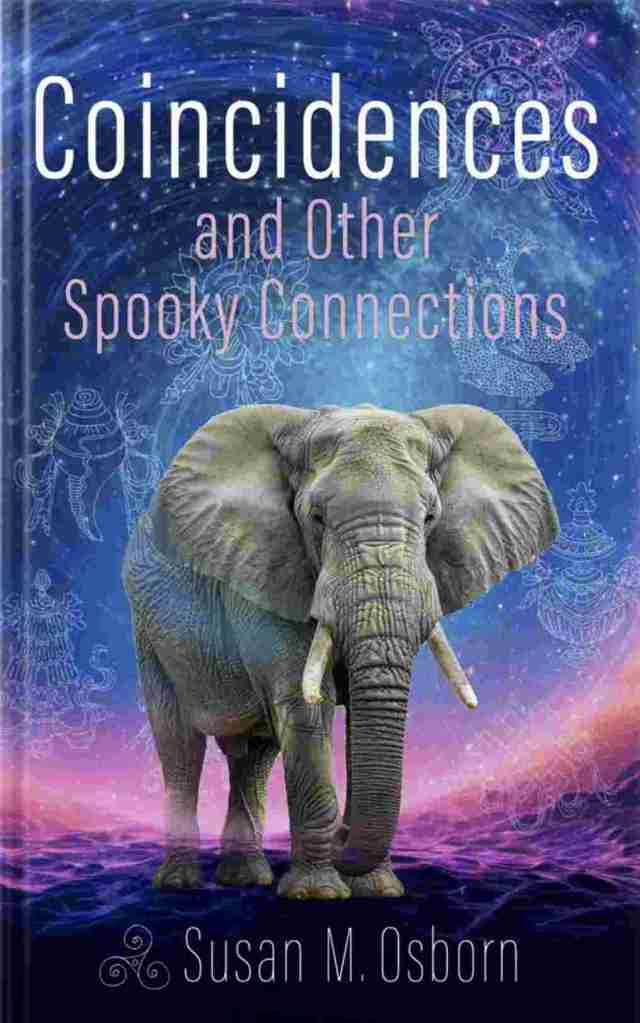
Susan M. Osborn explores the nature, influence—and importance—of coincidence, synchronicity and serendipitous discovery in our lives.
.
.
The book is laid out in ten chapters, each featuring some aspect of coincidence, synchronicity, and events of pure serendipity. Within each chapter, the narrative flows from biography to historic exposition or topical study, unraveling delicious facts, suppositions, dreams and fantasies coiled up in patterns and signs of potential significance.
.
Locked between the many entertaining and enlightening examples of synchronicity experienced by famous and not-so-famous people, are gems of interesting and notable facts and astute observations—from the origins and history of the term synchronicity with Jung’s early work in archetypes to the origins of “serendipity” with Horace Walpole to the foundations and influences of the ‘I Ching’.
The latter part of Osborn’s title, “and Other Spooky Connections”, riffs off Albert Einstein’s famous quote about “spooky actions at a distance”, a reference to quantum entanglement, which describes how two particles may remain connected regardless of the distance between them. Einstein asserted that quantum entanglement violated the principles of a realistic, deterministic universe. And, yet, experiments have repeatedly verified the reality of quantum entanglement. This speaks to the power of connection. All the “spooky connections” described in Osborn’s book ultimately address a common theme of all life: to make meaning of our world. I believe that this is essentially the purpose of all life. It even has a term: biosemiosis, which describes how all life is involved in meaning-making.
I agree with Osborn when she writes, “we can solve many of our problems if we have more than one way to look at them.” And this is how she has laid out her book, offering “a way to look at the world from a wider perspective” to gain insight from an otherwise chaotic and seemingly random pattern. When we learn from chaos, we are making meaning and fulfilling what all life is doing. This too is biosemiosis: the notion that all life embraces a process of signification and meaning-generation—from mammals to bacteria—that recognizes its Umwelt (species-specific environmental reality) through the production, action, and interpretation of non-linguistic signs and codes.
Ultimately, Osborn’s stories, disclosures and explorations challenge the reader to become more mindful and ‘present’ in our world, to exercise curiosity, integrate more aspects of our reality to arrive at meaning so we can forge connections—even spooky ones—that open doors of possibility and fulfill us with purpose and joy.
References:
Barbieri, Marcelo. 2008 (ed). “Introduction to Biosemiotics: The New Biological Synthesis” Springer, Netherlands. 525pp.
Hoffmeyer, Jesper. 2001. “Seeing virtuality in nature.” Semiotica 134.
Kull, K. 2016. “The biosemiotics concept of the species.” Biosemiotics 9:61-71.
Lowenhaupt Tsing, Anna. 2015. “The Mushroom at the End of the World: On the Possibility of Life in Capitalist Ruins” Princeton University Press, New Jersey. 331pp.
Trewavas, Anthony. 2003. “Aspects of Plant Intelligence.” Annals of Botany 92(1): 1-20.
Uexküll, Jakob von. 1931. “Die Rolle des Subjekts in der Biologie.” Die Naturwissenschaften 19: 385-391.
Uexküll, Jakob von. 1940 (1982). “The theory of meaning.” Semiotica 42(1): 25-82.
.
Nina Munteanu is a Canadian ecologist / limnologist and novelist. She is co-editor of Europa SF and currently teaches writing courses at George Brown College and the University of Toronto. Visit www.ninamunteanu.ca for the latest on her books. Nina’s bilingual “La natura dell’acqua / The Way of Water” was published by Mincione Edizioni in Rome. Her non-fiction book “Water Is…” by Pixl Press (Vancouver) was selected by Margaret Atwood in the New York Times ‘Year in Reading’ and was chosen as the 2017 Summer Read by Water Canada. Her novel “A Diary in the Age of Water” was released by Inanna Publications (Toronto) in June 2020.
The knight in Vivianne’s dream (illustration by Tomislav Tikulin)
If you want to find the secrets of the universe, think in terms of energy, frequency and vibration
Nikola Tesla
In my historical fantasy The Last Summoner, Vivianne Schön, the Baroness Von Grunwald, travels through time from the 1400s to 1905 to meet Nikola Tesla and make a deal with the eccentric scientist in a bid to make the world a better place:
The Story (excerpt of The Last Summoner)
New York, 1905
VIVIANNE straightened when she glimpsed the elegantly dressed Serbian as he entered Bryant Park. From her bench in the shade of a sycamore tree, she watched him saunter to his favourite bench then sit down and cross his legs. He emitted a somber sigh, pulled out a small notebook from his jacket pocket and began to write. Vivianne studied his long face, straight nose and well groomed mustache. It was an intense face, though worn with reserve. He quelled the fire that burned inside him beneath a shell of enigmatic reflection. He brushed a hand over his thick hair, then set his mouth in a thin line of determined concentration as he hastily sketched something inside the notebook. He didn’t look terribly heartbroken for a man who had just lost his dream, she reflected. But she did recognize disappointment on his furrowed brow. He was used to that, she decided, reviewing his personal history, which had been plagued by rivalry and betrayal for nearly all his life. A visionary of his genius quality was easy fodder for bullying, whether it was schoolmates or the scientific community.
After adjusting her brimmed hat and flowing blue lace gown, Vivianne rose and approached the forty-eight year old Serbian visionary, musing how he would later be called the “Father of the 20th Century”.
She was barely a metre away from him before he looked up, ready to express annoyance at being interrupted. She took pleasure in seeing his expression change from a glower to a startled look of curiosity. She knew she was beautiful, but it was rather delightful to see that she could divert this intense scientist.
“Hello, Mister Tesla,” Vivianne greeted him with a curtsy. “I am the Comptesse d’Anjou at your service. May I join you and sit down?”
He frowned at first then nodded politely with not quite a smile. He was not known for his smiles, she recalled. Tesla rose to his feet and bowed to her but did not offer his hand. She did not press him, knowing of his particular compulsion for avoiding human contact. “Of course you may,” he said with a mild accent and nodded to her in invitation. They both sat down in unison and he added, “To what do I owe this pleasure, Comptesse? Do I know you?”
“No, Mister Tesla.” She smiled with irony. “We have never met—not in person, anyway. But I believe you may be interested in what I have to say.” She paused to take in his curiosity and continued, “Pardon me for what I am about to reveal of your affairs, but I represent the interests of La Banque Internationale du Monde in Geneva, Switzerland—perhaps you know of us—and the law offices of Frankl & Frankl. We are one of the five largest investment banks in the world, dating back to the late 1400s with offices in Amsterdam and Hamburg. We are a private bank who screen for altruistic and environmentally conscious investors. In short, we help finance only those projects that will help make the world a better world.” She paused.
Tesla studied her inquisitively but said nothing.
She smiled internally at his puzzled expression then continued, “We are very interested in your Wardenclyffe Tower in Shoreham, Long Island, and associated global wireless power transmission.”
Tesla slid his notebook back into his jacket pocket and now gave her his full attention. She knew that he’d been trying for years to gain backing for his enigmatic projects with little to no success.
She continued, “You theorized that electrical energy can be transmitted through the earth and the atmosphere…without power lines.”
“Yes, I can light lamps at moderate distances and can detect the transmitted energy at much greater distances. The Wardenclyffe Tower uses a rapidly alternating electrostatic field and was a proof-of-concept for global wireless power trans-mission.”
“Yes, I know.”
He frowned. “But my funding—“
“Yes, I know. Your backers don’t like the idea of unmetered power consumption.”
His face hardened with dark thoughts. “Free electricity isn’t profitable.”
“Least of all to greedy bankers with no vision or faith like J.P. Morgan or John Jacob Astor,” she added. “I know you’ve been in financial trouble with high construction costs since Morgan pulled out last year and encouraged other investors to do the same.”
Her last remark made him stiffen. She was hitting a painful nerve.
“I know about your expired patents and the resulting lack of royalty payments,” she continued. “Within another five to ten years your projects will all be defunk and you will be totally broke. And no one will listen to the ideas that come to you fully formed through visions and dreams.”
He straightened and looked her directly in the eyes. “What do you want of me, Comptesse? Who are you?”
“An ally,” she answered. “I am well aware of your humanitarian pursuits and altruistic nature. I know that you wish simply to make the world a better world. That is my wish also. Energy is and will continue to be one of the most important forces on this earth. Like water, it should be free and available to each and everyone of us. I think you can provide us with that gift and would be happy to as well. Mister Tesla, I want to offer you financial backing at zero percent interest.”
He let loose a humourless laugh. He had finally learned to be cynical about bankers, she thought.
“Make no mistake, Mister Tesla; I expect to become one of the wealthiest people on this planet because of you. But I will gain that wealth only as you gain yours, through a partnership, and not at the expense of others; rather, for the benefit of others. Your wireless technology will help in areas you have yet to imagine: instant global communications and the personal computer; clean energy for homes and industry; laser medicine; robotics; interstellar travel; instant matter transference; even time travel and so much more.”
He was staring at her now. “Who are you, really?”
An angel, she thought to herself. “I’m part of the future, Mister Tesla. A future of your making.” Then without thinking, she held out her hand. “You can call me Vivianne.”
To her delighted surprise, he smiled for the first time. He took her hand then lightly kissed it, as was the custom of most eastern Europeans. “And you can call me Nikola.”
The Man
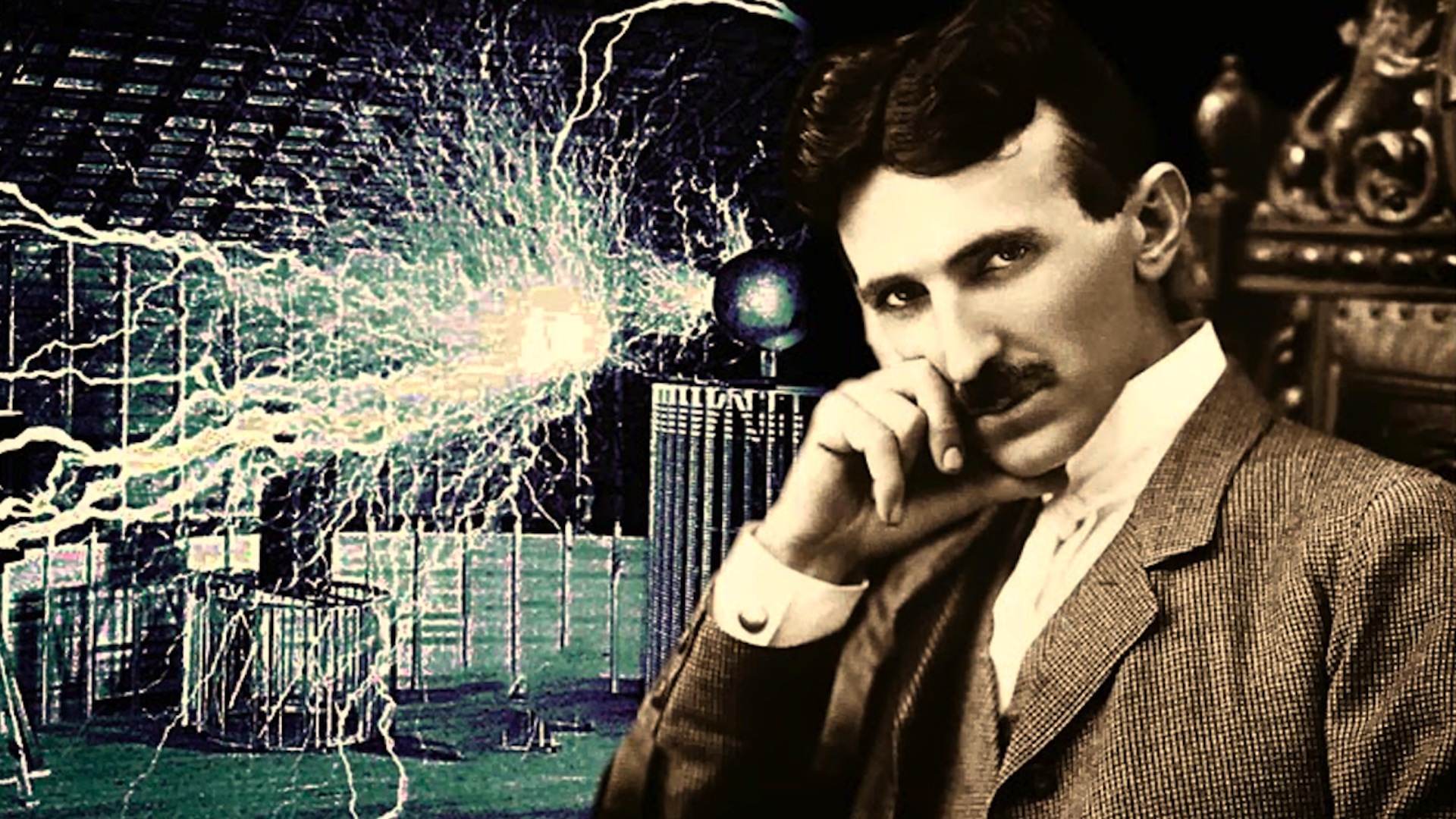
Nikola Tesla and his experiments with electricity
Nikola Tesla intuited that energy waves in the earth and the atmosphere could be used to transmit power to any point on the globe. He understood that the surface of the Earth, the ionosphere and the atmosphere together form one gigantic electrical circuit—an electrified Gaia, so to speak—and this formed the basis for his work on wireless energy transmission. Tesla was able to transmit power and energy wirelessly over long distances (via transverse waves and longitudinal waves). He transmitted extremely low frequencies (ELF) through the ground and between the Earth’s surface and the Kennelly-Heaviside layer of the ionosphere. Tesla patented wireless transceivers that developed standing waves and it was he who discovered that the resonant frequency of the Earth was about 8 Hz and in the range of the Schumann Resonance or Cavity.
Tesla in his Colorado Springs lab
Modern technology appears to be threatening humanity’s connection with earth’s fundamental frequency and the natural vibrations of Schumann Resonance. Threats include artificial man-made EMF radiation, wireless technology, and high frequency heating microwaves pulsed at 2.45 GHz. Whether we co-evolved with Earth’s natural electromagnetic environment or were created with Divine Intelligence to live in harmony with it, many experts believe that artificial man-made EMF radiation masks the natural beneficial frequency of the Earth and may create an environment that is literally `out of tune’ with Nature itself.
The Book
The Last Summonerby Nina Munteanu is a fresh twist on chaos theory and observer-induced collapse of quantum entanglement. It’s June 14th, 1410, on the eve of the Battle of Grunwald when history records that a ragtag peasant army will slaughter the arrogant monk knights of the imperialistic Teutonic Order … or will they? Because of an impetuous choice, 14-year old Vivianne Schoen, Baroness von Grunwald, makes the startling discovery that she can alter history—but not before she’s branded a witch and must flee through a time-space tear. Now in an alternate present-day France ruled by fascist Black Knights of the ancient Teutonic Order, she must decide how to remake history.
Detail of ‘The Battle of Grunwald’ (painting by Jan Matejko)
“For those in love with science fiction at its best, The Last Summoner is a complex story of ignored responsibilities and their dire consequences, of love and betrayal that span centuries and multiple worlds. Time travel, multiverse travel, immortality, alternate history in which the Nazis have won, not in the twentieth century but way earlier, in the Teutonic age. Angels and mutants, utopias and dystopias, even a Tesla occurrence— everything a science fiction reader could ever desire in a book. A masterfully told story with great characters. Nina Munteanu moves flawlessly from a medieval story to a modern one and everything in between.”
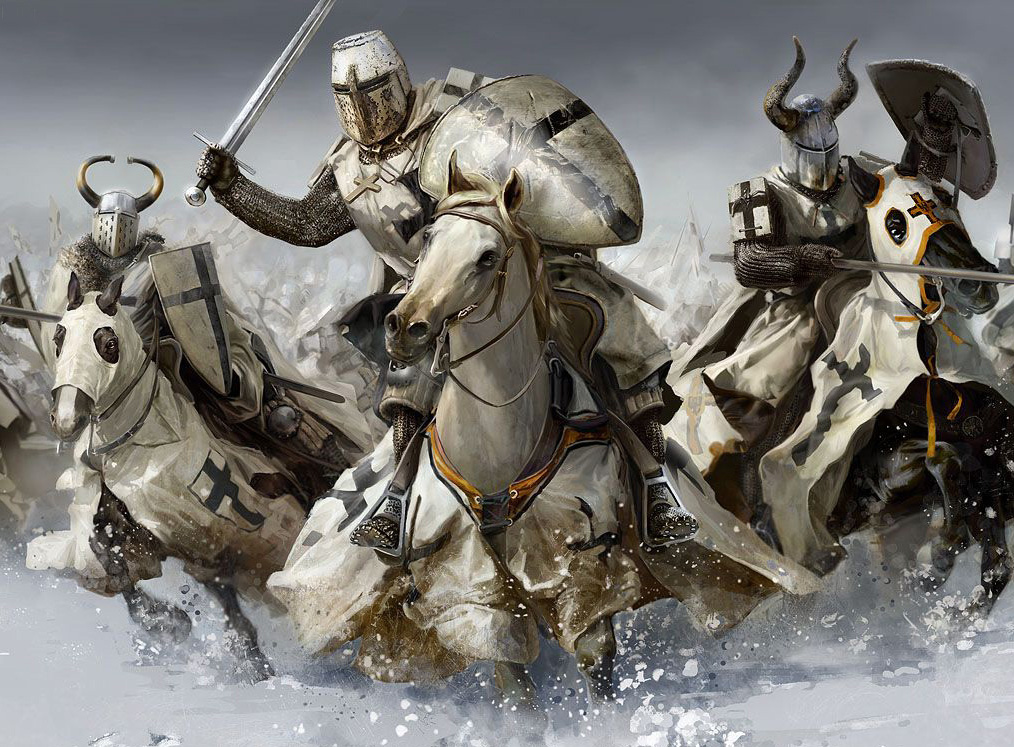
Depiction of fierce Teutonic Knights crusading in the Baltic north during the 13th Century (illustration by Mariusz Kozik)
Nina Munteanu is a Canadian ecologist / limnologist and novelist. She is co-editor of Europa SF and currently teaches writing courses at George Brown College and the University of Toronto. Visit www.ninamunteanu.ca for the latest on her books. Nina’s bilingual “La natura dell’acqua / The Way of Water” was published by Mincione Edizioni in Rome. Her non-fiction book “Water Is…” by Pixl Press (Vancouver) was selected by Margaret Atwood in the New York Times ‘Year in Reading’ and was chosen as the 2017 Summer Read by Water Canada. Her novel “A Diary in the Age of Water” was released by Inanna Publications (Toronto) in June 2020.
“The History with Magicbundle offers eleven riveting works that occupy a vital nexus in the dense, labyrinthine metropolis that is fantasy: the crossroads of alternate history and secondary world fiction. Both are venerable subgenres in speculative fiction. Alternate history has been with us at least since Titus Livius, better known as Livy, contemplated a world in which Alexander the Great survived to turn his energies westward; and humans have invented secondary universes ever since they wove and spun stories around their gatherer-hunter campfires.
As the astrogator and lead editor of acclaimed small indie press Candlemark & Gleam, I’ve had the honor and pleasure of helping to create and release some of the best new works in this mode. And now I get to share such fusions of history with magic in this spectacular bundle, whose every entry deserves to become a visual spectacle as atmospheric and studded with larger-than-life events and charismatic characters as the serialization of Bernard Cornwell’s Last Kingdom or Philip K. Dick’s Man in the High Castle… Full of rousing, sweeping derring-do and jeopardies, risky missions and fraught choices, intricate alliances and jarring betrayals, it’s all here—with the layers of real history, and its very concrete consequences, glimmering like fata morganas through the gauze of fiction.”
This bundle is available for a limited time only (from October 28 through November 19) via http://www.storybundle.com. The bundle allows easy reading on computers, smartphones, and tablets as well as Kindle and other ereaders via file transfer, email, and other methods. You get multiple DRM-free formats (.epub, .mobi) for all books.
The Last Summoner by Nina Munteanu is a fresh twist on chaos theory and observer-induced collapse of quantum entanglement. It’s June 14th, 1410, on the eve of the Battle of Grunwald when history records that a ragtag peasant army will slaughter the arrogant monk knights of the imperialistic Teutonic Order…or will they? Because of an impetuous choice, 14-year old Vivianne Schoen, Baroness von Grunwald, makes the startling discovery that she can alter history—but not before she’s branded a witch and must flee through a time-space tear. Now in an alternate present-day France ruled by fascist Black Knights of the ancient Teutonic Order, she must decide how to remake history.
“For those in love with science fiction at its best, The Last Summoner is a complex story of ignored responsibilities and their dire consequences, of love and betrayal that span centuries and multiple worlds. Time travel, multiverse travel, immortality, alternate history in which the Nazis have won, not in the twentieth century but way earlier, in the Teutonic age. Angels and mutants, utopias and dystopias, even a Tesla occurrence— everything a science fiction reader could ever desire in a book. A masterfully told story with great characters. Nina Munteanu moves flawlessly from a medieval story to a modern one and everything in between.”—COSTI GURGU, author of RecipeArium
“A good, clever read and I think that history buffs would really enjoy it…You should read this book if you love fantasy, history or a combination of the two, you’re a fan of time travel and its many twists and turns, the concept of influencing historical events to create a better world intrigues you.”—THE COCONUT CHRONICLES
“A hard book to put down. Loved the historical references of gear, place and events. The characters involved you in their lives. Fast-paced” — AMAZON REVIEW
“Exquisite! … A wonderful and skillful historical time traveler full to the brim of colourful characters intertwined with chicanery and loved, loved, loved the metaphors. A page -turner.”— AMAZON REVIEW
Nina Munteanu is a Canadian ecologist / limnologist and novelist. She is co-editor of Europa SF and currently teaches writing courses at George Brown College and the University of Toronto. Visit www.ninamunteanu.ca for the latest on her books. Nina’s bilingual “La natura dell’acqua / The Way of Water” was published by Mincione Edizioni in Rome. Her non-fiction book “Water Is…” by Pixl Press (Vancouver) was selected by Margaret Atwood in the New York Times ‘Year in Reading’ and was chosen as the 2017 Summer Read by Water Canada. Her novel “A Diary in the Age of Water” was released by Inanna Publications (Toronto) in June 2020.
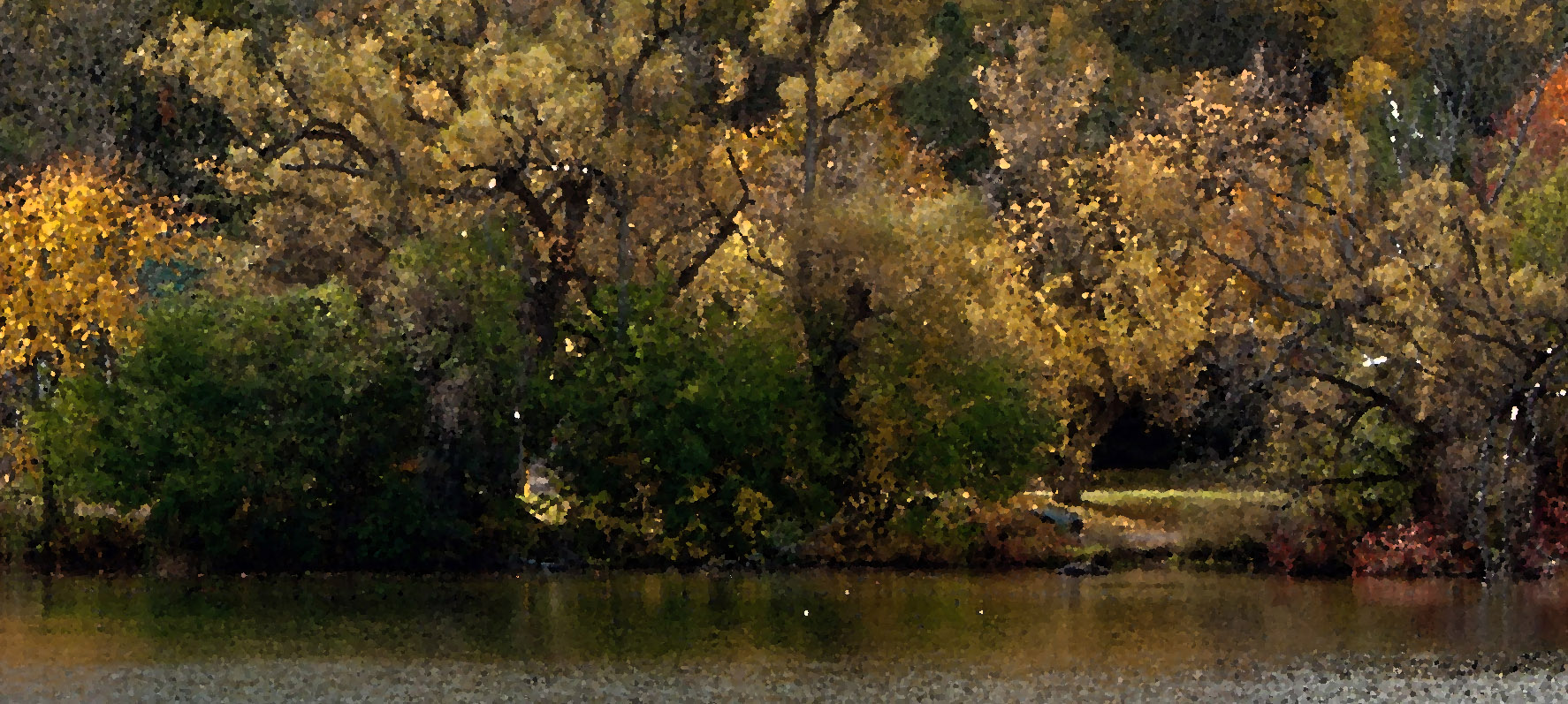
Willows on shore of Otonabee River, ON (photo and rendition by Nina Munteanu)
If COVID-19 has taught us anything I hope it is to live with less and rejoice in it. To be grateful for what we have. To take joy in acts of kindness to others. To live with less is to give more and live lightly and sustainably for this dear planet of ours. Our sustenance. Our friend.
NINA MUNTEANU
Why is it, then, that we have ceased to converse with Her? We no longer communicate with Nature and Gaia. We’ve isolated ourselves with hubris and greed and the pursuit of wealth and power. And what are these? Do they make us happy? Do they bring joy?
.
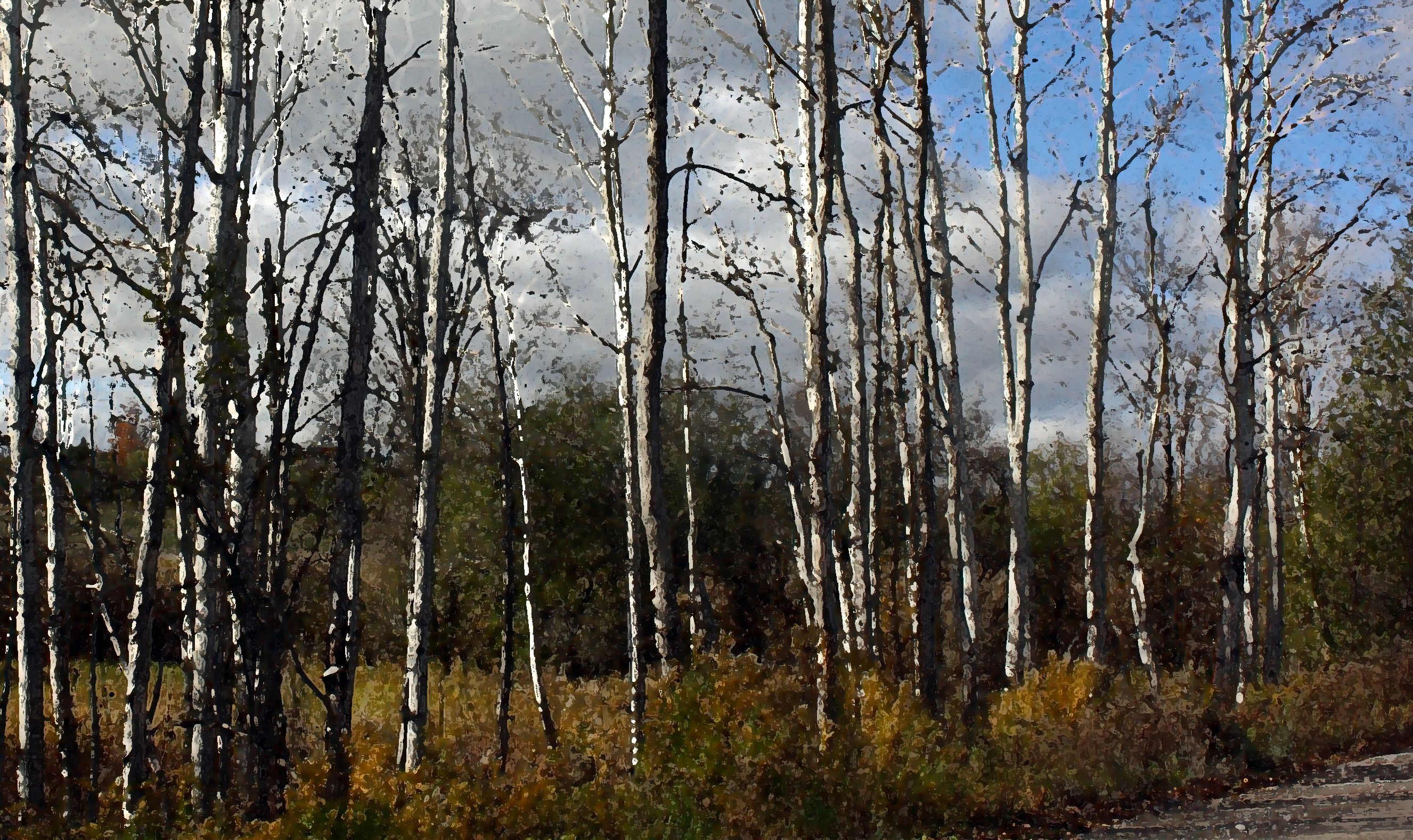
Poplars on a country road in fall, ON (photo and rendition by Nina Munteanu)
.
We’ve become unruly self-centred bullies who think somehow that Homo sapiens alone was ordained by God to rule this planet. But there is no ruling Her. Why do we still cling to the ancient human-centred philosophies that have created “the other”? Descartes expounded that no other life or being other than “man” had a soul. Or feelings, for that matter. This preposterous notion has carried on for over six hundred years into today’s abhorrent racism, the creation of homo sacer, creation of property, subjugation of women by men, patriarchy, androcracy, cruelty to animals, deforestation and so much more that ails us and the world.
.
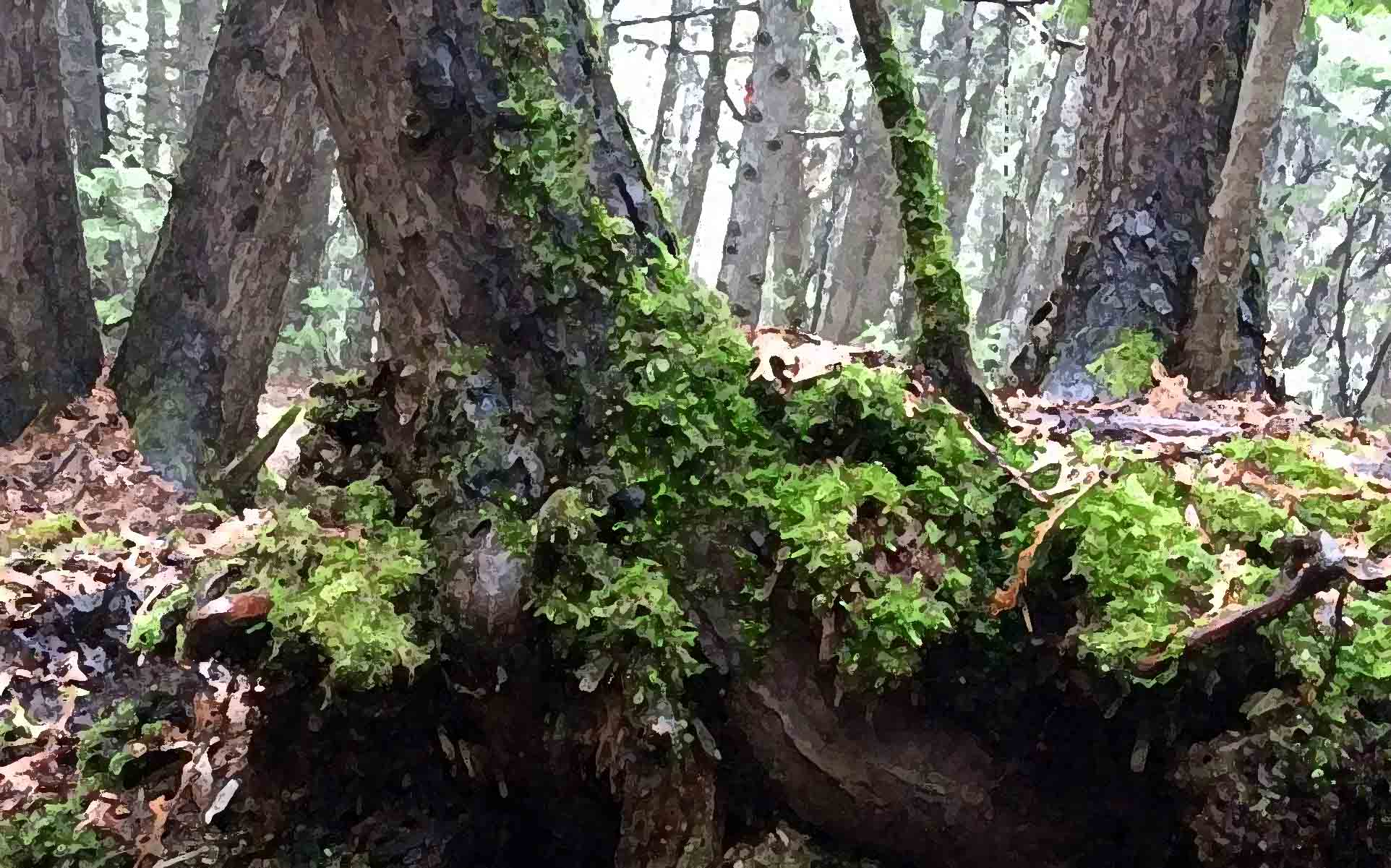
Moss on log in Cedar swamp forest, ON (photo and rendition by Nina Munteanu)
.
All indigenous peoples on the planet incorporate Nature in their beliefs, philosophies and way of life. They conduct themselves with humility and the utmost respect for the natural world they are part of. They do not separate themselves from the sacredness of creation and the evolving world of matter and energy. All matter is living and has a soul, connected to the “oneness”. European settlers dismissed their wisdom as primitive and simple. How wrong the settlers were. How simple the settlers were. This is the wisdom of quantum physics.
.
White / red pine forest, ON (photo and rendition by Nina Munteanu)
.
COVID-19 is but one iteration of a conversation Nature is trying to have with us. She is talking to us in words of climate change, storms, disease and pandemic. She is telling us something and we aren’t listening. Her message is clear: live in partnership. Live in humility and joy. Live the galanic life of cooperation, respect, and kindness to ALL THINGS in a world with no “others.” If we don’t start listening, we will find ourselves more than alone…
.
Poplar forest in northern Ontario in the fall (photo and rendition by Nina Munteanu)
.
All in Nature is a gift.
In her book “Gathering Moss” Robin Wall Kimmerer shares this wisdom:
“In indigenous ways of knowing…every being is endowed with certain gifts, its own intelligence, its own spirit, its own story. Our stories tell us that the Creator gave us these stories as original instructions. The foundation of education is to discover that gift within us and learn to use it well.”
ROBIN WALL KIMMERER
Kimmerer shares that the sage “draws up water to its leaves for the rabbits, to shelter the baby quail…Mosses clothe the rocks, purify the water, and soften the nests of birds.” The tree provides a whole ecosystem that shelters, feeds and nurtures so many organisms and its environment. Every part of a tree is involved; trunk, bark and leaf to cambium, xylem and phloem. And this from when a squirrel first embeds into the ground the nut poised to germinate to a fallen tree in full decay and returning to the soil.
.
Moss-covered Eastern cedar tree grows on decaying prone cedar in swamp forest (photo and rendition by Nina Munteanu)
.
What is our gift?
Go out into Nature. Touch a tree. Tell it that it is beautiful. Thank it for its shade. Feel its corky bark. Feel the miracle of creation sing through you. Touch a leaf, feel its supple texture and filigree of intricate markings. Imagine the chloroplasts swimming inside, capturing the gift of energy from the sun in the dance of quantum life. Imagine that energy surging through tissue, cell, interstitial water. Then in a deep sigh hear it release its Great Breath of Life in the most beautiful song. Its gift to the world.
Smell the earth and breathe in the beauty of this day.
.
Ancient red cedar in Lighthouse Park, West Vancouver (photo and rendition by Nina Munteanu)
Maple swamp in Trent Nature Sanctuary, ON (photo and rendition by Nina Munteanu)
Marsh stream off a country road in fall, ON (photo and rendition by Nina Munteanu)
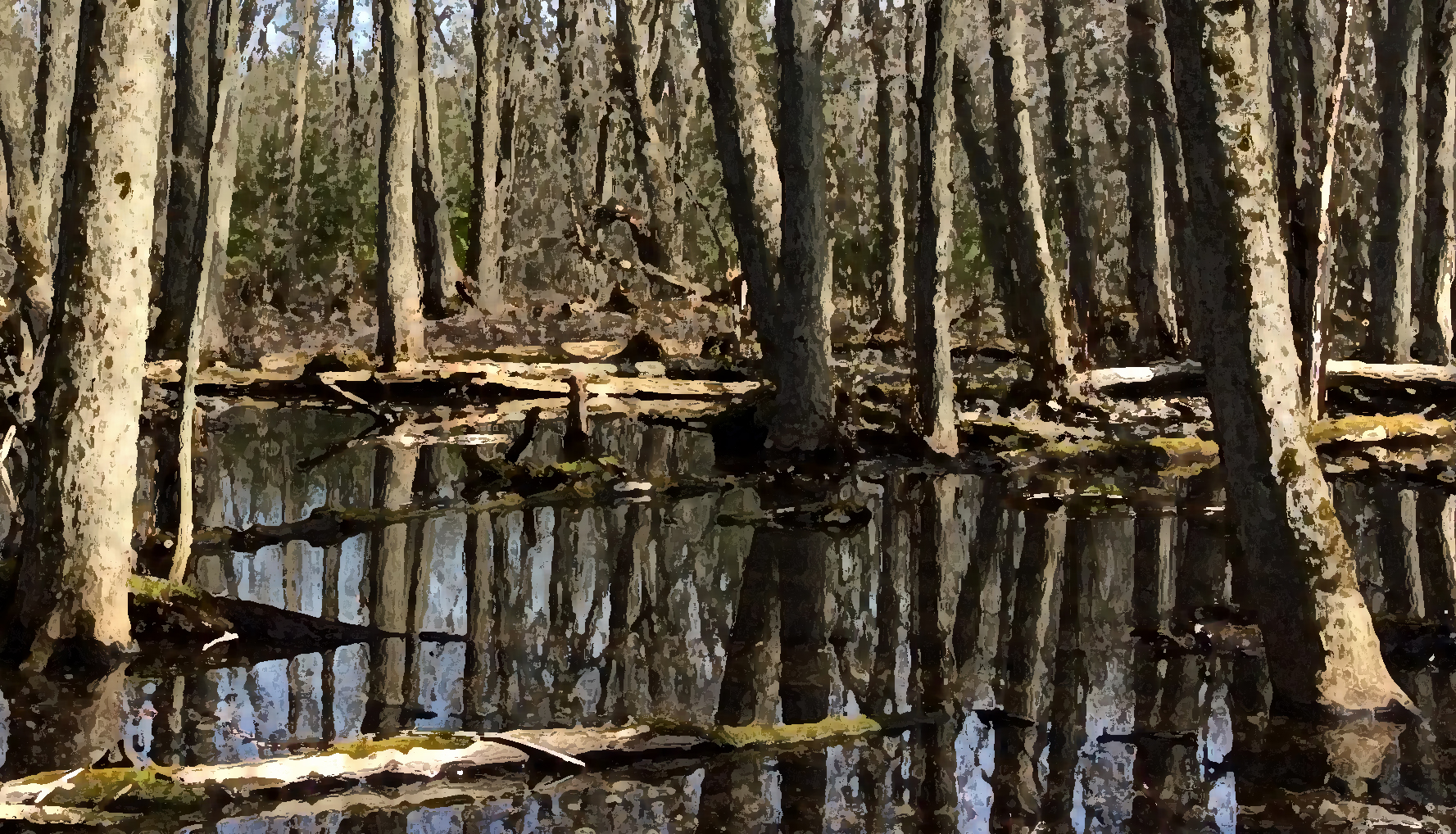
Swamp forest, Trent Nature Sanctuary, ON (photo and rendition by Nina Munteanu)
Decaying beech and ash leaves, Little Rouge River, ON (photo and rendition by Nina Munteanu)
Thompson Creek marsh, ON (photo and rendition by Nina Munteanu)
Willows at mouth of Thompson Creek, ON (photo and rendition by Nina Munteanu)
.
Reference:
Kimmerer, Robin Wall. 2003. “Gathering Moss.” Oregon State University Press, Corvalis. 168pp.
.
Nina Munteanu is a Canadian ecologist / limnologist and novelist. She is co-editor of Europa SF and currently teaches writing courses at George Brown College and the University of Toronto. Visit www.ninamunteanu.ca for the latest on her books. Nina’s bilingual “La natura dell’acqua / The Way of Water” was published by Mincione Edizioni in Rome. Her non-fiction book “Water Is…” by Pixl Press (Vancouver) was selected by Margaret Atwood in the New York Times ‘Year in Reading’ and was chosen as the 2017 Summer Read by Water Canada. Her novel “A Diary in the Age of Water” was released by Inanna Publications (Toronto) in June 2020.











 Nina Munteanu Writing Coach