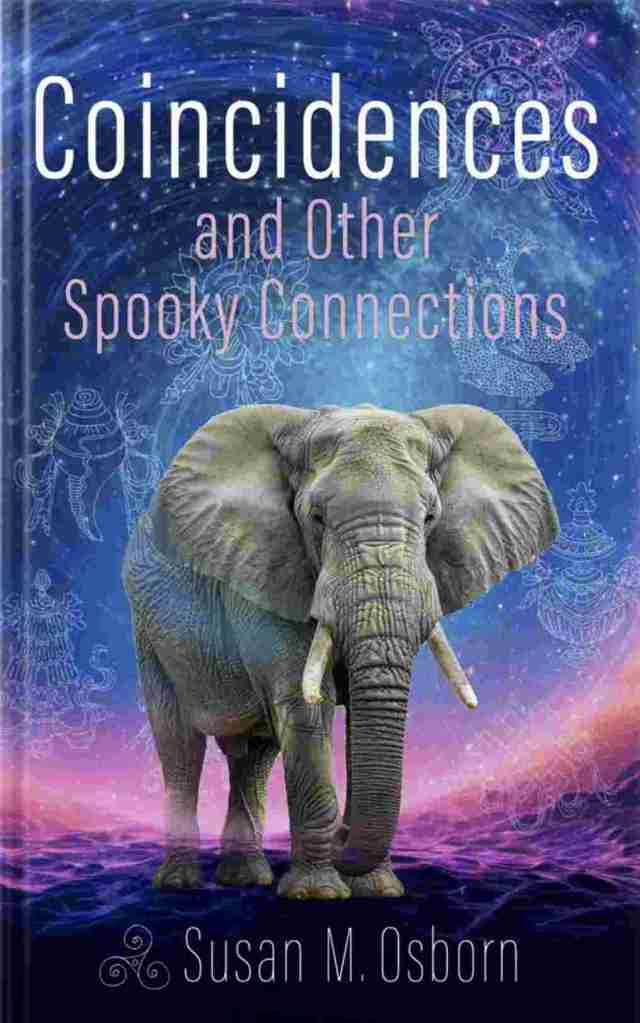
Susan M. Osborn explores the nature, influence—and importance—of coincidence, synchronicity and serendipitous discovery in our lives.
.
.
The book is laid out in ten chapters, each featuring some aspect of coincidence, synchronicity, and events of pure serendipity. Within each chapter, the narrative flows from biography to historic exposition or topical study, unraveling delicious facts, suppositions, dreams and fantasies coiled up in patterns and signs of potential significance.
.
Locked between the many entertaining and enlightening examples of synchronicity experienced by famous and not-so-famous people, are gems of interesting and notable facts and astute observations—from the origins and history of the term synchronicity with Jung’s early work in archetypes to the origins of “serendipity” with Horace Walpole to the foundations and influences of the ‘I Ching’.
The latter part of Osborn’s title, “and Other Spooky Connections”, riffs off Albert Einstein’s famous quote about “spooky actions at a distance”, a reference to quantum entanglement, which describes how two particles may remain connected regardless of the distance between them. Einstein asserted that quantum entanglement violated the principles of a realistic, deterministic universe. And, yet, experiments have repeatedly verified the reality of quantum entanglement. This speaks to the power of connection. All the “spooky connections” described in Osborn’s book ultimately address a common theme of all life: to make meaning of our world. I believe that this is essentially the purpose of all life. It even has a term: biosemiosis, which describes how all life is involved in meaning-making.
I agree with Osborn when she writes, “we can solve many of our problems if we have more than one way to look at them.” And this is how she has laid out her book, offering “a way to look at the world from a wider perspective” to gain insight from an otherwise chaotic and seemingly random pattern. When we learn from chaos, we are making meaning and fulfilling what all life is doing. This too is biosemiosis: the notion that all life embraces a process of signification and meaning-generation—from mammals to bacteria—that recognizes its Umwelt (species-specific environmental reality) through the production, action, and interpretation of non-linguistic signs and codes.
Ultimately, Osborn’s stories, disclosures and explorations challenge the reader to become more mindful and ‘present’ in our world, to exercise curiosity, integrate more aspects of our reality to arrive at meaning so we can forge connections—even spooky ones—that open doors of possibility and fulfill us with purpose and joy.
References:
Barbieri, Marcelo. 2008 (ed). “Introduction to Biosemiotics: The New Biological Synthesis” Springer, Netherlands. 525pp.
Hoffmeyer, Jesper. 2001. “Seeing virtuality in nature.” Semiotica 134.
Kull, K. 2016. “The biosemiotics concept of the species.” Biosemiotics 9:61-71.
Lowenhaupt Tsing, Anna. 2015. “The Mushroom at the End of the World: On the Possibility of Life in Capitalist Ruins” Princeton University Press, New Jersey. 331pp.
Trewavas, Anthony. 2003. “Aspects of Plant Intelligence.” Annals of Botany 92(1): 1-20.
Uexküll, Jakob von. 1931. “Die Rolle des Subjekts in der Biologie.” Die Naturwissenschaften 19: 385-391.
Uexküll, Jakob von. 1940 (1982). “The theory of meaning.” Semiotica 42(1): 25-82.
.
Nina Munteanu is a Canadian ecologist / limnologist and novelist. She is co-editor of Europa SF and currently teaches writing courses at George Brown College and the University of Toronto. Visit www.ninamunteanu.ca for the latest on her books. Nina’s bilingual “La natura dell’acqua / The Way of Water” was published by Mincione Edizioni in Rome. Her non-fiction book “Water Is…” by Pixl Press (Vancouver) was selected by Margaret Atwood in the New York Times ‘Year in Reading’ and was chosen as the 2017 Summer Read by Water Canada. Her novel “A Diary in the Age of Water” was released by Inanna Publications (Toronto) in June 2020.
The Vancouver Central Library (photo by Nina Munteanu)
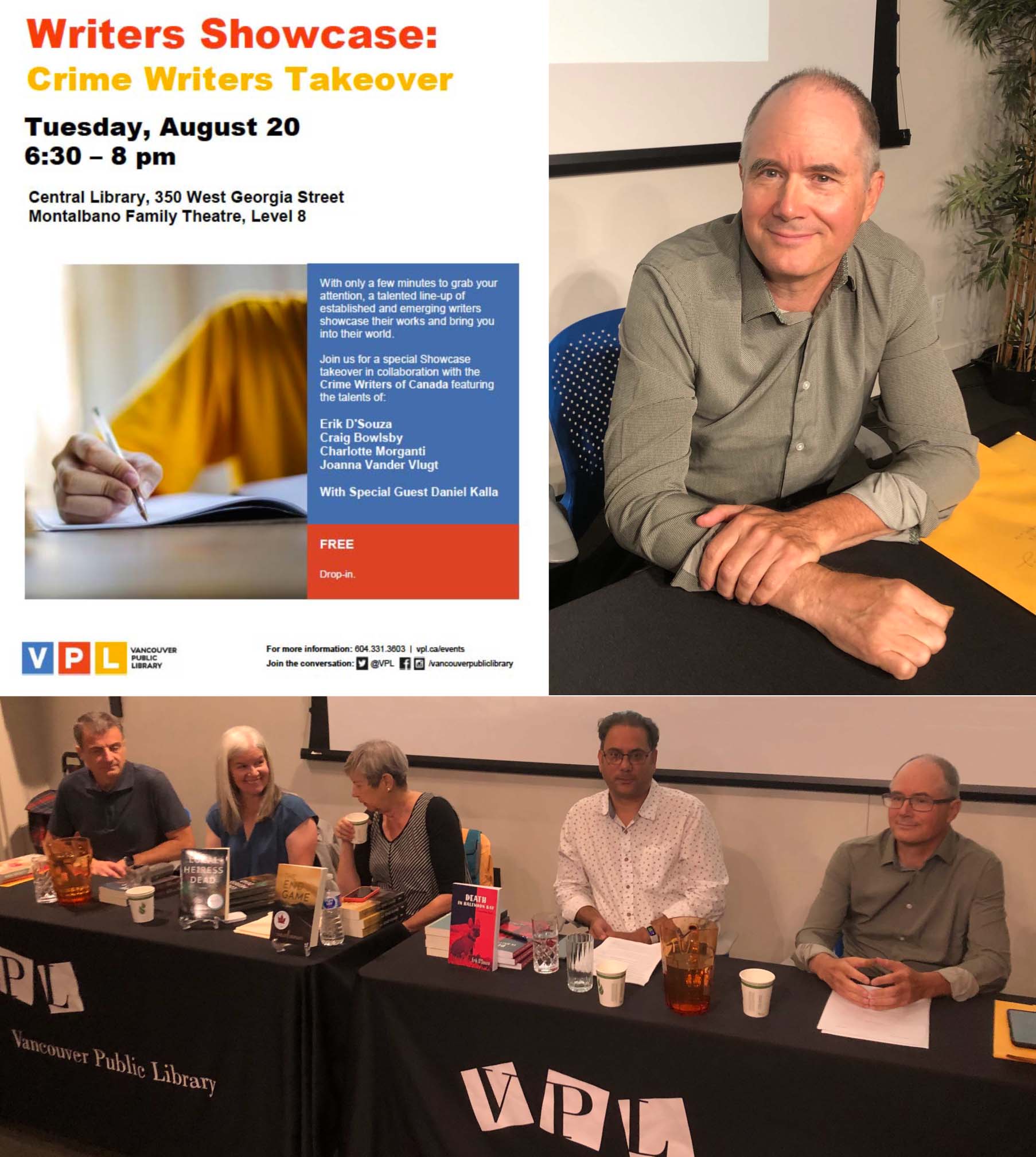
I was recently at Vancouver’s Central Library on Georgia Street to listen to my colleague Craig Bowlsby give a reading from his much anticipated novel Requiem for a Lotus. He was joined by four other crime writers who gave readings that evening, including Daniel Kalla who read from his 2024 book High Society.
Book reading at VPL Central Library
My Books
Feeling whimsical on my way out, I asked the librarian if the library carried any of Nina Munteanu’s books. They did, and plenty of them! Most of my science fiction books were on their shelves as well as my historical fantasy The Last Summoner, my writing guide The Fiction Writer, and my nonfiction book on water Water Is…The Meaning of Water.
I returned the next day to check out my books and to enjoy the wonderful setting of this large and iconic Coliseum-inspired library in downtown Vancouver. It was a typical Vancouver drizzly day; a good day to spend in a library, I thought.
My book “Water Is…” at the Vancouver Central Library; note how my book answers the question posed by the book next to it (photo by Nina Munteanu)
I found Water Is… on the ground floor among other books on water. My science fiction books were up on the fourth floor, clustered with my historical fantasy The Last Summoner. Books included Darwin’s Paradox and two books of my Splintered Universe Trilogy, Inner Diverse and Metaverse; Outer Diverse was out with a customer. They also had my short story collection Natural Selection.
My science fiction and fantasy books at the Vancouver Central Library (photo by Nina Munteanu)
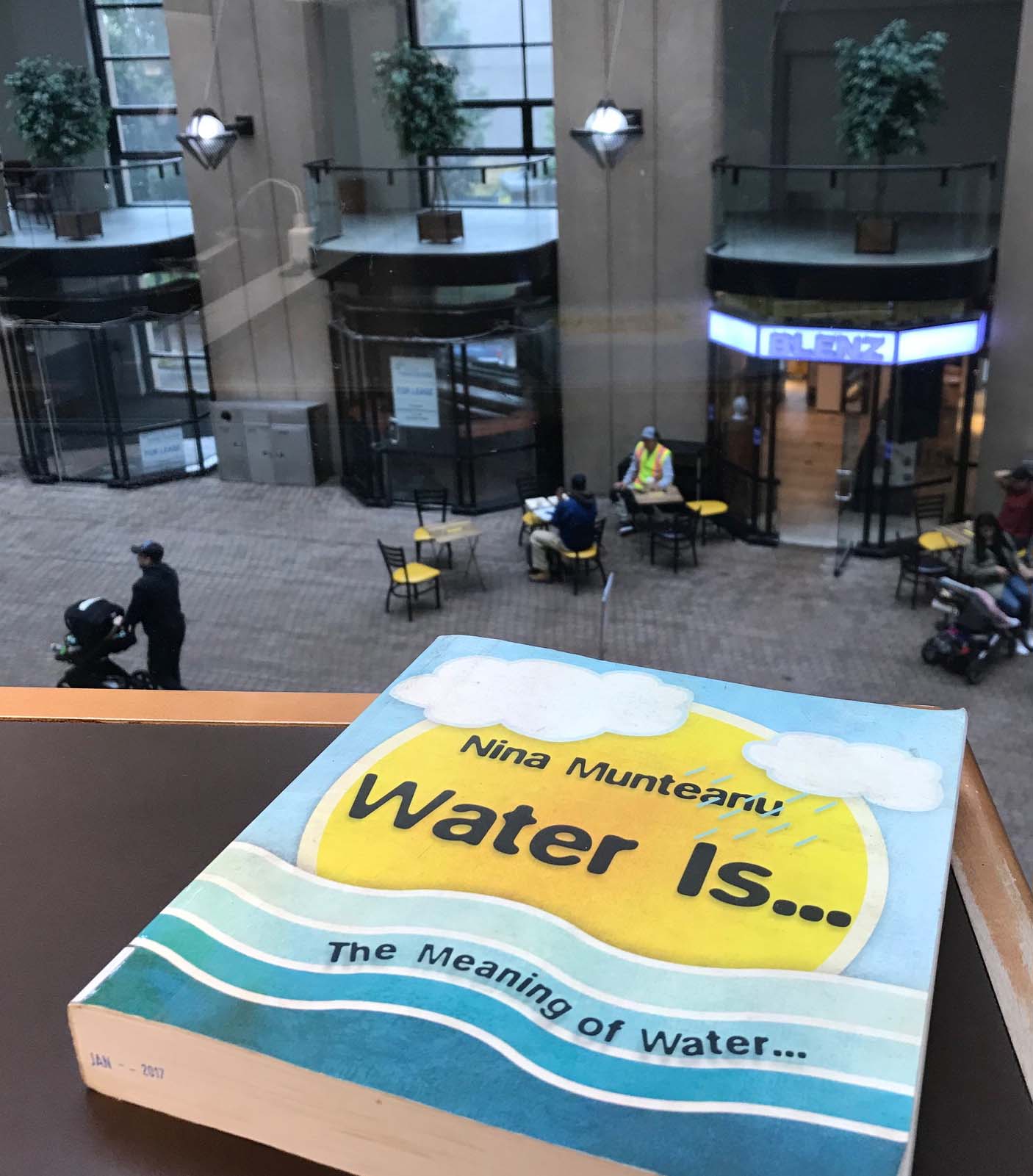
“Water Is…” sits at a desk overlooking the atrium, Vancouver Central Library (photo by Nina Munteanu)
The Library
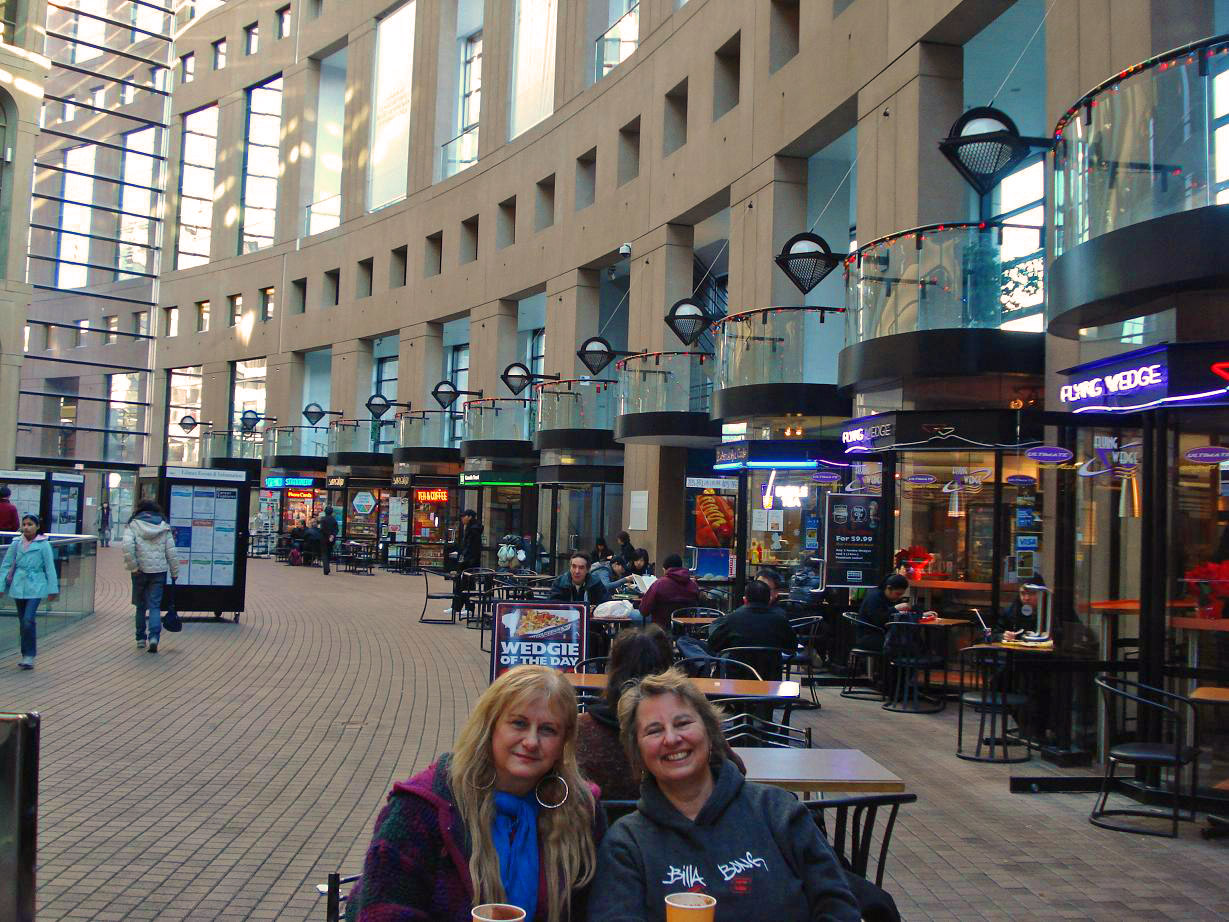
Nina Munteanu and Vancouver poet Lucia Gorea share a Blenz coffee in the atrium of the library complex, Vancouver (photo by
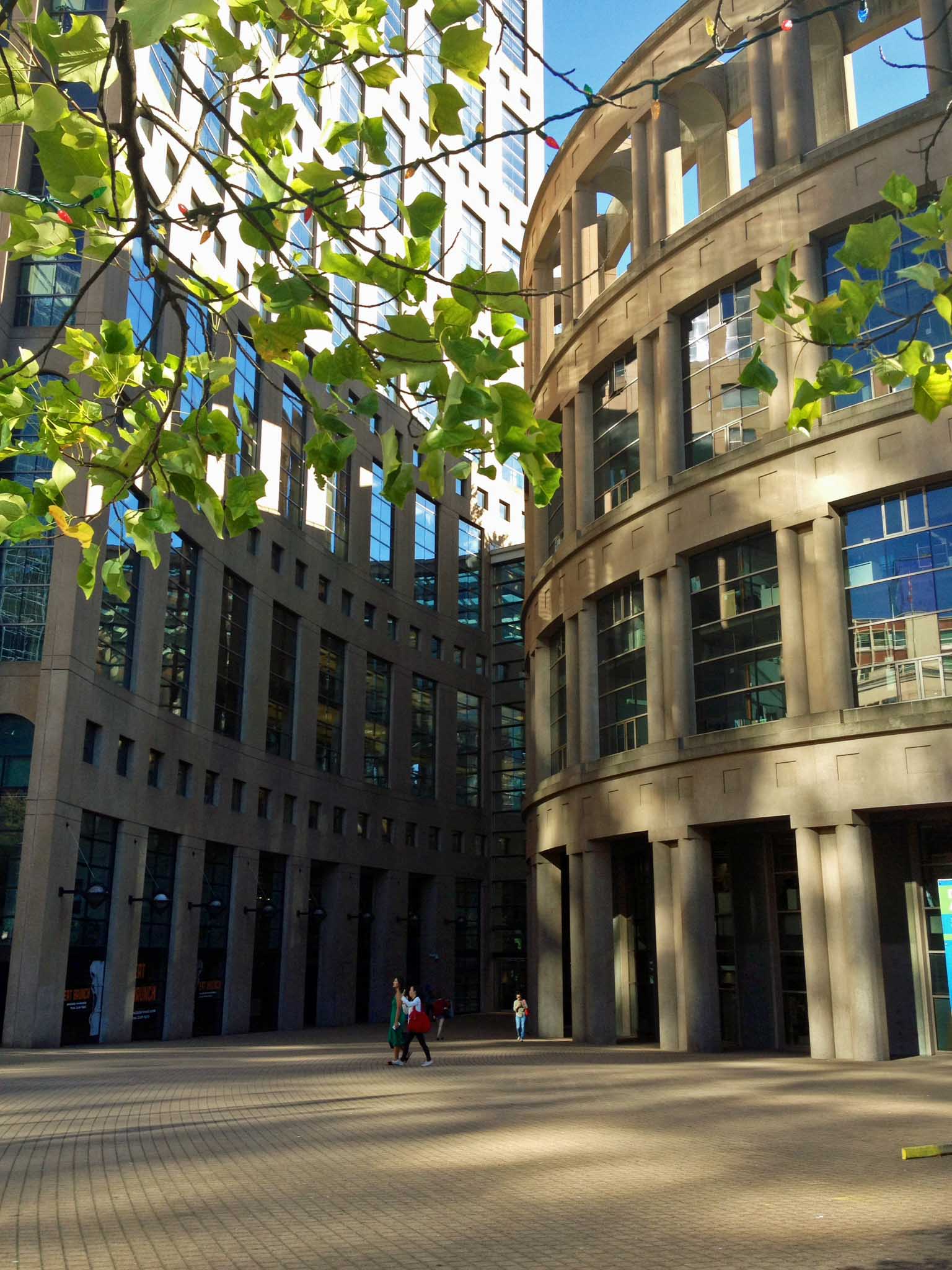
The Vancouver Central Library is an iconic feature of downtown Vancouver. Its Coliseum-style architecture lends a note of gravitas and traditional beauty to the nouveau chic revitalized downtown. Occupying an entire city block in the eastward expansion of Vancouver’s downtown core, the library complex along with federal office building tower is made of sandstone-coloured precast concrete. The building exterior is covered in granite quarried in Horsefly, BC and built to the highest seismic standards. In the words of Safdie Architects: “the heart of the Vancouver Public Library is a spiraling grand urban room that draws the public into Library Square as both a quiet place for study and contemplation and a vital community meeting place.”
Vancouver Central Library complex (photo by Nina Munteanu)
The library opened in May of 1995; then expansion of the upper floors began in June 2017. As the lease came due on the upper two floors (levels 8 and 9), the library undertook planning to transform the area and offer much needed community spaces. Rather than featuring traditional collections, the expansion now provides meeting rooms, a glass enclosed reading room, an 80-seat theatre (where I listened to Craig read his book), an exhibition space, as well as a long awaited public rooftop garden and outdoor terraces. Original architects (Moshe Safdie & Associates with local partners DA Architects) were retained to design the new expansion. Cornelia Hahn Oberlander, the landscape architect responsible for the green roof, designed the long-awaited rooftop gardens.
Rooftop gardens of the Vancouver Central Library in the fall
The Environs
I spent a drizzly morning and afternoon in the library with its spacious atrium along with bookstore and Blenz coffee bar, and other interesting places on Georgia Street nearby.
Glowbal, outside and inside (photos by Nina Munteanu)
Close by, at Glowbal, I treated myself to a wonderful lunch on their heated patio undercover. I then dashed through the rain to Telus Gardens next door that I found attractive, fresh and welcoming with its succulent jungle of plants, fragrant orchids and swimming koi ponds. I sipped my London Fog and ate a wonderful apple custard caramel croissant (from Café Bisou), while sitting in a flower-petal chair and enjoying the blissful serenade of a piano player.
Telus Gardens, Vancouver (photos by Nina Munteanu)
The day of sensual pleasures and intellectual satisfaction was complete!
Next time you find yourself in Vancouver’s downtown, check out my books at the Central Library and enjoy the vibrant downtown core.
Looking up at various floors of the Central Library from the atrium (photo by Nina Munteanu)
Nina Munteanu is a Canadian ecologist / limnologist and novelist. She is co-editor of Europa SF and currently teaches writing courses at George Brown College and the University of Toronto. Visit www.ninamunteanu.ca for the latest on her books. Nina’s bilingual “La natura dell’acqua / The Way of Water” was published by Mincione Edizioni in Rome. Her non-fiction book “Water Is…” by Pixl Press (Vancouver) was selected by Margaret Atwood in the New York Times ‘Year in Reading’ and was chosen as the 2017 Summer Read by Water Canada. Her novel “A Diary in the Age of Water” was released by Inanna Publications (Toronto) in June 2020.
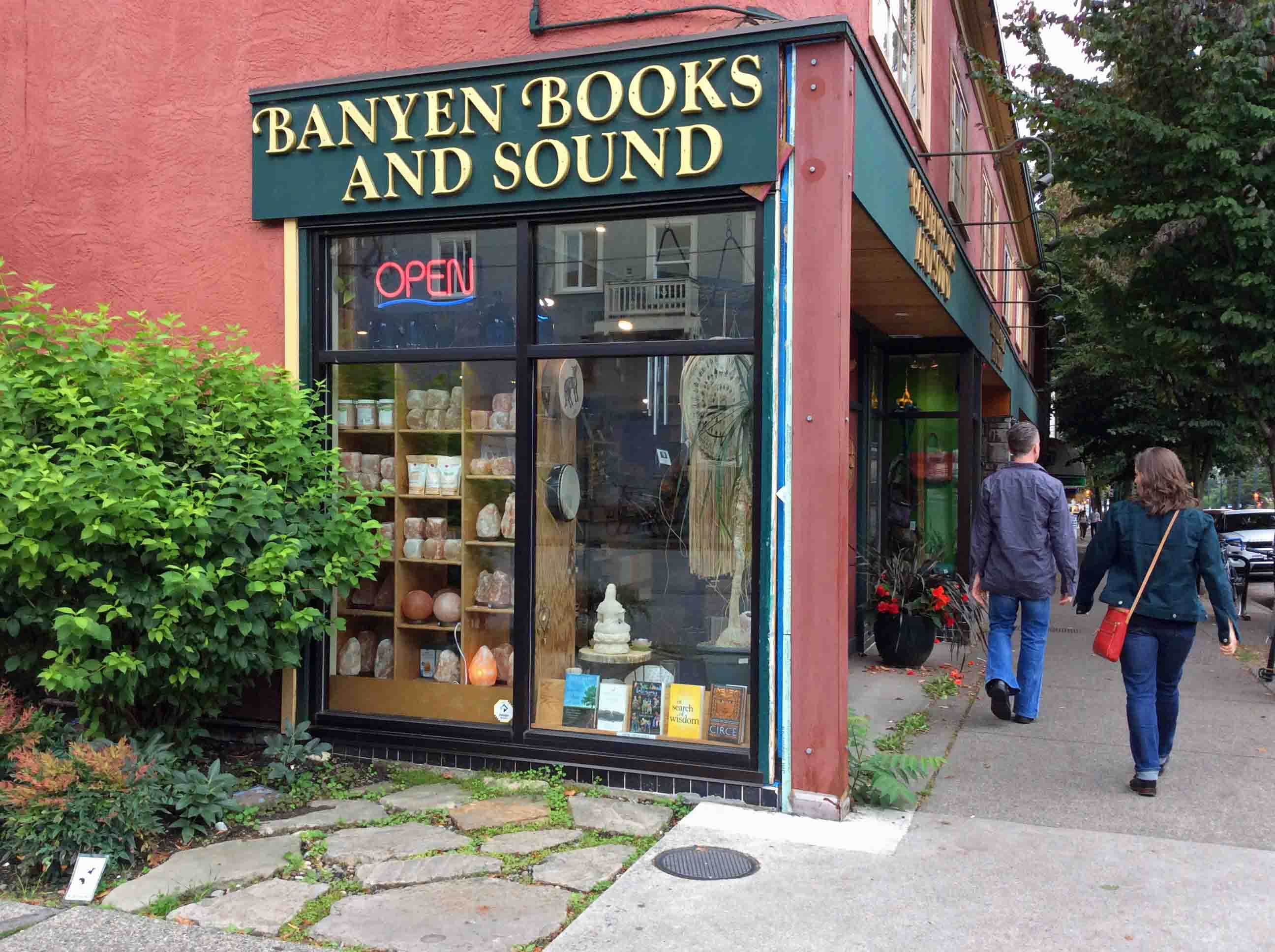
Banyen Books & Sound on corner of Dunbar and W 4th Avenue, Vancouver (photo by Nina Munteanu)
One of my favourite bookstores in Vancouver is Banyen Books & Sound on the southwest corner of W 4th Avenue and Dunbar. So, whenever I go back to my home town to visit family and friends, I stop there to linger amid the shelves of wonder and erudite adventure. Then I usually cross Dunbar to Aphrodite’s Organic Pie Shop for a delicious fresh pie—usually peach, if it is available. So good! Two things I love: books and pie!
Aphrodite’s Organic Pies, next door to Banyen’s, Vancouver (photos by Nina Munteanu)
Pacific Spirit Regional Park, Vancouver, BC (photo by Nina Munteanu)
During my recent visit this year to Vancouver, my friends and I had a fulfilling walk one morning through the big tree forest of Pacific Spirit Park near UBC. Margaret suggested we go to Aphrodite’s Organic Café for lunch, located across 4th Avenue from Banyen Books (the sister restaurant to the pie shop). After a delicious lunch, we wandered into Banyen, like desert nomads looking for water, and lost ourselves in a treasure of books, magazines, crystals, cards, singing bowls and other spiritual/healing items. Like a braided river, we dispersed according to our wayward interests.
Water Is… at Banyen Books, Vancouver (photos by Nina Munteanu)
Then friend Anne soon found me and pulled my sleeve. “Your book is here!” She led me to where my book Water Is… stood, face out, on the top shelf marked ‘Water: Life Force & Resource.’ In truth, I already knew through Pixl Press that the book was selling there. But here it was, showcased so nicely! It sat rather stately amid Emoto’s Secret Life of Water and Ryrie’s Healing Energies of Water.
Banyen customers find Water Is… and find a chair to take a look
One of the perks of Banyen Books are the comfortable seats for easy browsing. When I teasingly asked one of the clerks if they noticed people lingering for the day, they said, “yeah! They might leave for lunch then come back for the afternoon!” I can see why; Banyen is an entire world to discover. It is called Canada’s most comprehensive Body-Mind-Spirit bookstore, “offering a broad spectrum of resources from humanity’s spiritual, healing, and earth wisdom traditions…Our service is to offer life-giving nourishment for the body (resilient, vital), the mind (trained, open), and the soul (resonant, connected, in-formed). Think of us as your open source bookstore for the ‘University of Life’.”
“Banyen is an oasis, a crossroads, a meeting place…for East and West, the ‘old ways’ and current discoveries and syntheses.”
“The Golden Lotus Restaurant and Natural Food Store on Fourth Avenue at Bayswater was a hothouse for spiritual seekers, new vegetarians and spaced-out hippies grounding through good work. Banyen was born in a tiny book corner of the Golden Lotus. That lovely place was a connection to India, meditation and spiritual growth from 1967 to 1970. As its sun set, what was to become the Naam restaurant, Lifestream, Woodlands, Nature’s Path, and Banyen Books arose.”
Nina Munteanu is a Canadian ecologist / limnologist and novelist. She is co-editor of Europa SF and currently teaches writing courses at George Brown College and the University of Toronto. Visit www.ninamunteanu.ca for the latest on her books. Nina’s bilingual “La natura dell’acqua / The Way of Water” was published by Mincione Edizioni in Rome. Her non-fiction book “Water Is…” by Pixl Press (Vancouver) was selected by Margaret Atwood in the New York Times ‘Year in Reading’ and was chosen as the 2017 Summer Read by Water Canada. Her novel “A Diary in the Age of Water” was released by Inanna Publications (Toronto) in June 2020.
Poplar trees in fall, ON (photo and rendition by Nina Munteanu)
I just finished reading Ben Rawlence’s 2022 book The Treeline. It is a book that made me think. It made me cry. It made me despair. It also gave me hope.
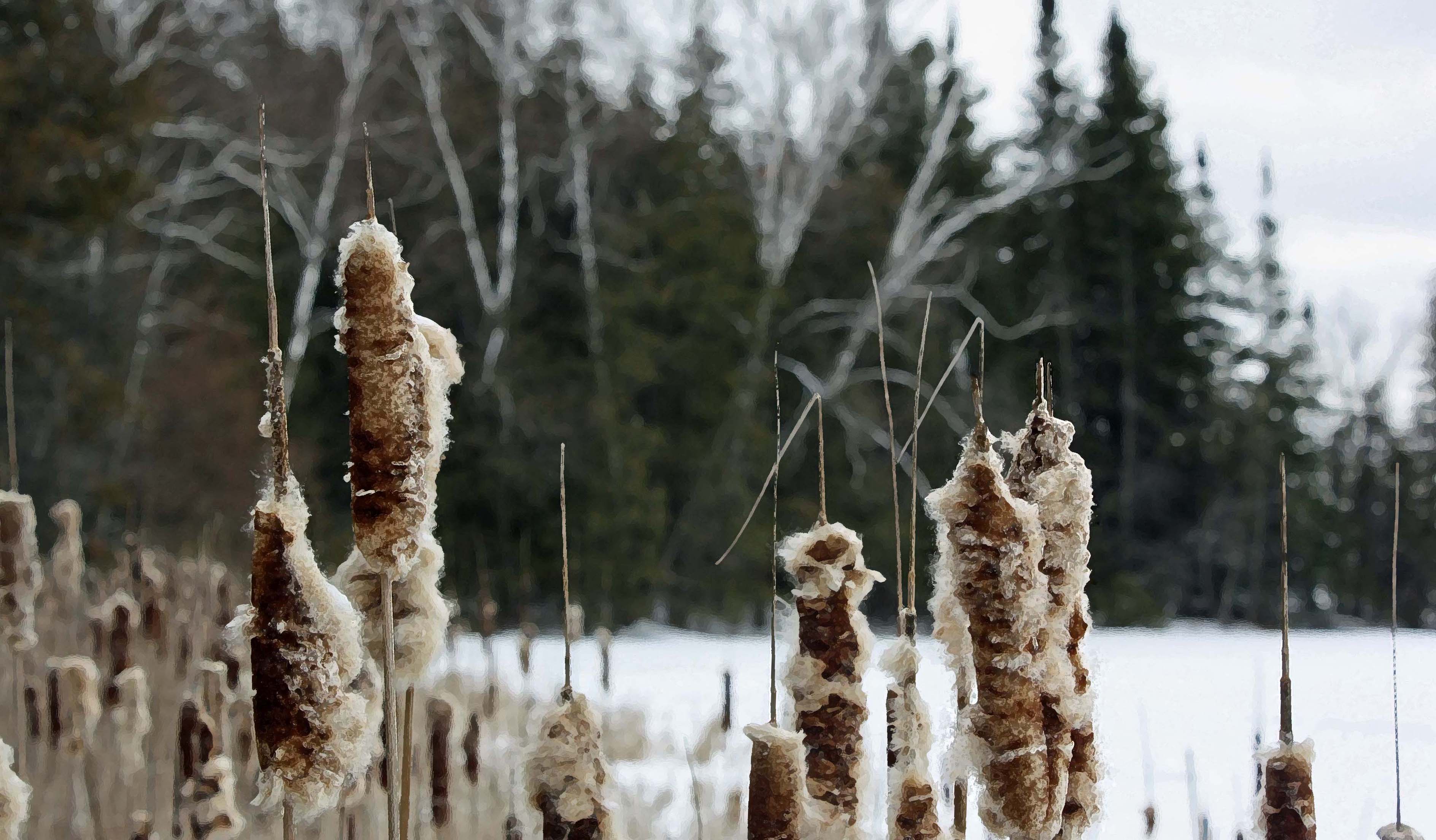
Cattails line a snow-covered marsh with spruce and fir behind, ON (photo and rendition by Nina Munteanu)
I was gripped by this honest and unflinching exploration on the moving treeline with climate change and what it will mean for humanity. Beautifully written and rigorously reported, Rawlence invited me on a journey of all major treelines over the globe from Scotland, Norway and Russia, to Alaska, Canada and Greenland. Throughout his description of a warming world and a vanishing way of life, Rawlence meditates on the many repercussions on how humans live.
Pine-cedar forest in Ontario (photo and rendition by Nina Munteanu)
He aptly describes the forests of the world as the ‘heartbeat of the planet,’ the cycles of breathing and the pulses of life from the spike of oxygen in the spring when trees put out their leaves to the peaks and troughs over day and night that regulate plant photosynthesis and respiration. The peaks and troughs are getting shallower, he writes. With more carbon dioxide in the air the trees work less; they inhale less and exhale less oxygen.
“The planet is a finely tuned system. A few degrees of change in its orbit can usher in an ice age; a few degrees of temperature change can transform the distribution of species, can melt glaciers and create oceans. In the future, when the ice is gone, there may be no such thing as a treeline at all. As the stable currents of air and water associated with the Gulf Stream, the polar front, polar vortex and Beaufort Gyre dissipate or fluctuate, the Arctic Ocean melts completely, and the Rossby waves in the upper atmosphere go haywire, the fine gradations of temperature, altitude and latitude first observed by Alexander von Humboldt will become decoupled and ecological transition zones scrambled. Instead of a majestic sweeping zone of forest around the planet, we might find discontinuous pockets of trees in odd places, refugees from soil and temperatures long gone, and crocodiles once again at the North Pole.”
Ben Rawlence, The Treeline
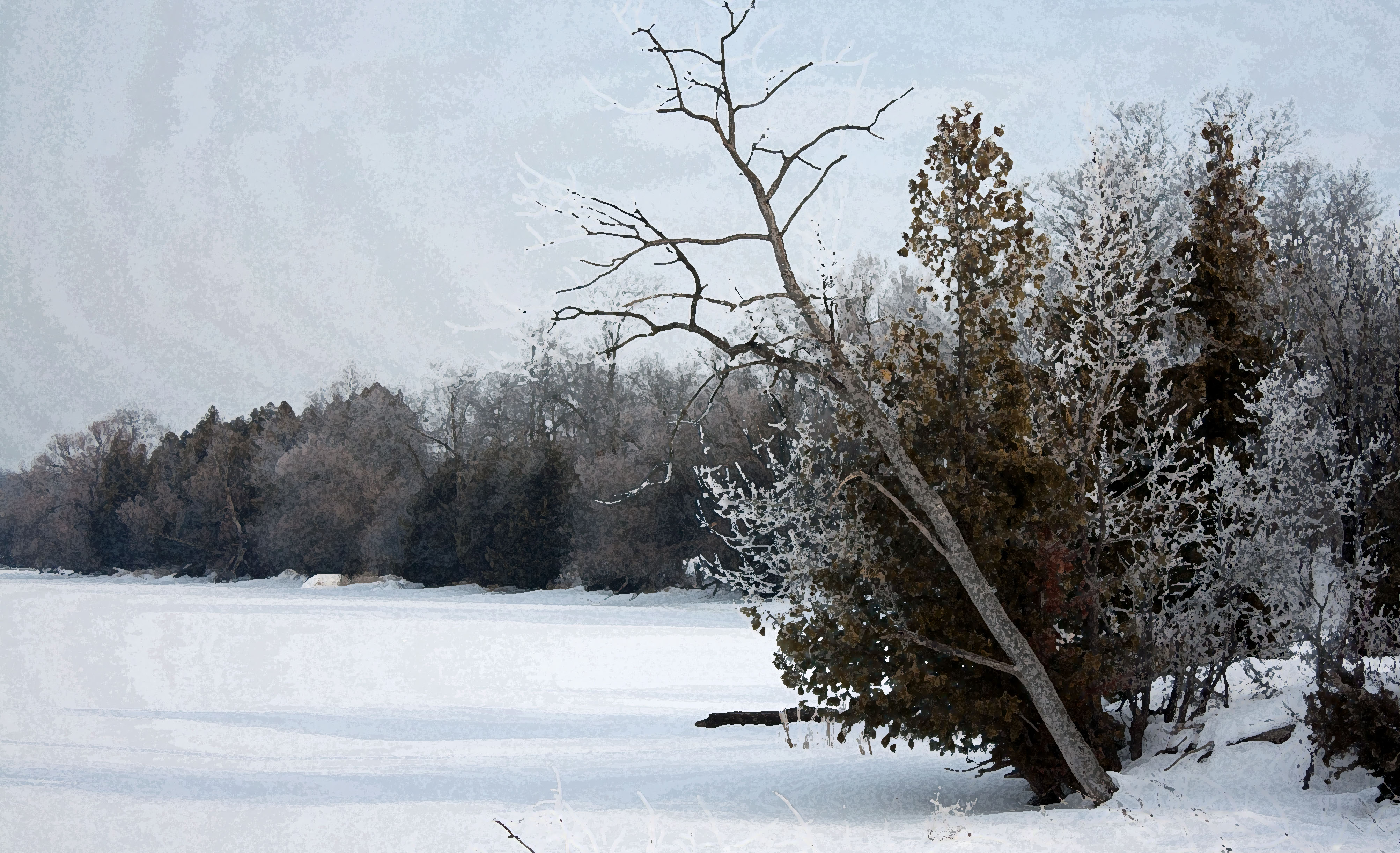
Snow-covered river shoreline with mixed forest, ON (photo and rendition by Nina Munteanu)
Rawlence brings this all into perspective to our present situation and the role science has played in our hubristic illusion of control:
“An unfortunate side effect of science is the illusion of human mastery: the idea that if we know what is happening then we can control. The irony is that we might have been able to. The tragedy is that it is too late. The chain reaction is under way. The curve only gets steeper from here…five metres of sea level rise is locked in; it’s just a question of how fast the ice melts. Once again, the models seem to underestimate the speed…”
Ben Rawlence, The Treeline
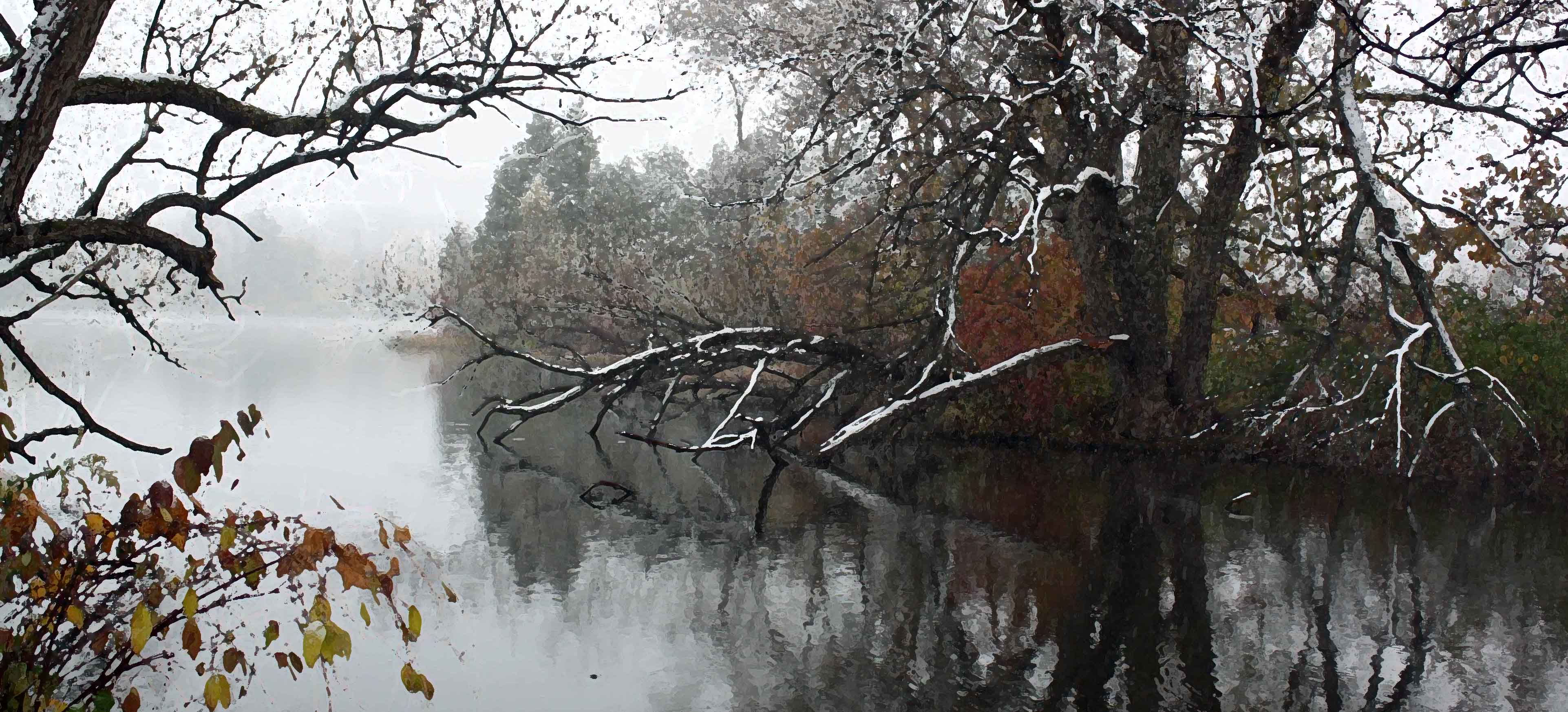
Willow by a river at first snow, ON (photo and rendition by Nina Munteanu)
What is most unfortunate for us, for humanity, is that we have known all this for some time. But we’ve done little. “Industrialist capitalism and its export colonialism” with its exploitive gaze that drives our needs and wants and actions has chosen to ignore the signs. That exploitive gaze ignored that we are not only embedded in but dependent upon the natural world and all the forests to live and flourish.
Tamarack and birch trees in the fall, ON (photo and rendition by Nina Munteanu)
What Rawlence does acknowledge is a way out of our self-created doom and accompanying solastalgia:
“Our present emergency is forcing us to remember what, until recently, we have always known: that there is a web of communication, meaning and significance beyond us, a world of life forms constantly chattering, shouting and flirting and hunting each other, indifferent to human affairs. And there is solace in such a vision. The way out of the depression and grief and guilt of the carbon cul-de-sac we have driven down is to contemplate the world without us. To know the earth, that life, will continue its evolutionary journey in all its mystery and wonder. To widen our idea of time, and of ourselves. If we see ourselves as part of a larger whole, then it is the complete picture that is beautiful, worthy of meaning and respect, worth perhaps dying for, safe in the knowledge that life is not the opposite of death but a circle, as the forest teaches us, a continuum.”
Ben Rawlence, The Treeline
Poplar trees line a road in the Ontario country (photo and rendition by Nina Munteanu)
The planet will be alright. Species will go and others will come. Earth has experienced five extinction events (we are currently experiencing the sixth extinction event now) and after each, life flourished again, albeit different life.
Is there still hope for humanity? Perhaps—if we set our hubris aside and embrace humility and kindness. And, if in that humility, we can adapt our way through the succession we’ve triggered. There might be hope for us still…
Rawlence devotes his epilogue called “Thinking Like a Forest” to the wisdom of the indigenous people who have for millennia co-existed sustainably with the natural ecosystems of the Earth. “The Koyukon, the Sámi, the Nganasan, the Anishinaabe are just a few of the countless indigenous peoples whose world view attests to our foundational reliance on the forest.”
Time to learn from them.
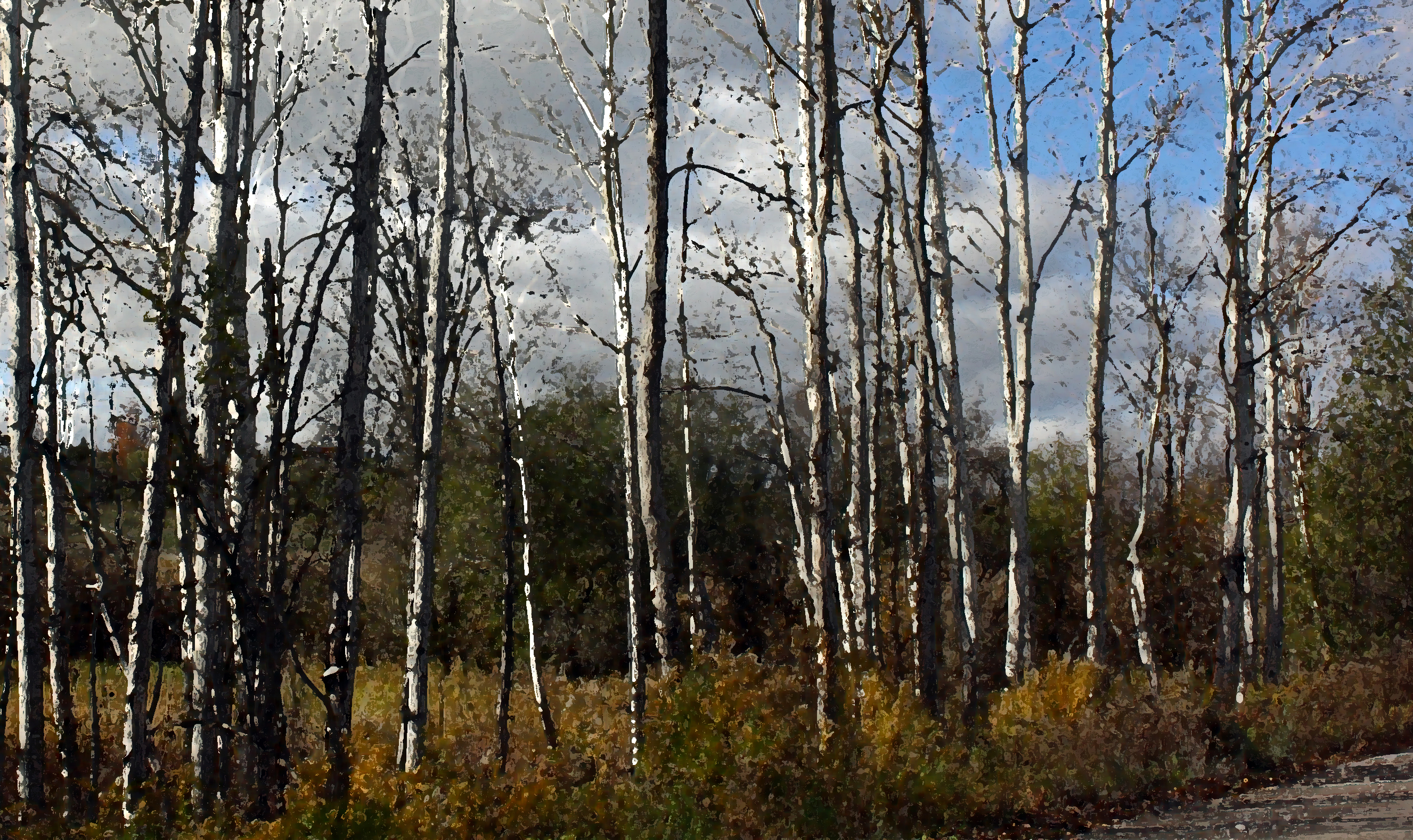
Trees at sunset in winter, ON (photo and rendition by Nina Munteanu)
Nina Munteanu is an ecologist and internationally published author of award-nominated speculative novels, short stories and non-fiction. She is co-editor of Europa SF and currently teaches writing courses at George Brown College and the University of Toronto. Visit www.ninamunteanu.ca for the latest on her books. Nina’s recent book is the bilingual “La natura dell’acqua / The Way of Water” (Mincione Edizioni, Rome). Her latest “Water Is…” is currently an Amazon Bestseller and NY Times ‘year in reading’ choice of Margaret Atwood.
Last August I was invited by the University of Saskatchewan to give a talk at 20/21 Vision, their conference on Speculating in Literature and Film in Canada. My presentation was entitled “The Power and Relevance of Diary in Near-Future Mundane Science Fiction.”
The use of mundane realism through setting and events—particularly through letters or diary—creates powerful narrative that uniquely engages the reader with metaphor, allegory, and archetypes through additional sensibilities and personal connections. Devices such as POV, tense, and voice help create this form of storytelling.
What Is a Diary?
Diaries are first person accounts of real events relevant and meaningful to that person’s life experience. They are written in casual conversational language, usually a chronological account of daily life over lifetime, have wide scope; and are autobiographical.
If the scope is more narrow and focused, we have a memoir. The memoir is often focused by theme (e.g., addiction, loss, parenting, war, etc.). Memoirs are usually written in scenes and may trade accuracy for dramatic effect (emotional truth over historical truth). Anne Frank’s diary is a mundane account of her tragic short life in Nazi Germany; Yoko Ono experienced Hiroshima during World War 2.
If the focus is by topic, we get a journal (e.g. nature journal, grief journal, travel journal). Henry Henry David Thoreau’s journal became a manifesto for living simply with Nature; Sister Gargi’s journal was an ode to a spiritual movement.
Examples of memoirs and journals
Non-Fiction in Fiction
The play of non-fiction in fiction is achieved through several tools. This includes:
use of point of view such as first person or second person; writing as an epistolary novel—or a series of letters—such as The Colour Purple
displaced narrative such as The Great Gatsby
detached autobiography such as To Kill a Mockingbird
interior monologue such as Finnegan’s Wake.
Examples of fictional diaries
Fictional diaries play on historical truth through emotional truth through narrator voice and use of metaphor. This provides authenticity, meaning, relevance, and impact to the story. Reality and fiction blur through realized premise that provides a gritty realism to the dramatization and intensifies the experience The diarist’s ability to introspect provides great insight for the reader to the protagonist’s inner voice, their eccentricities, and self-delusions. These provide great intimacy with the character.
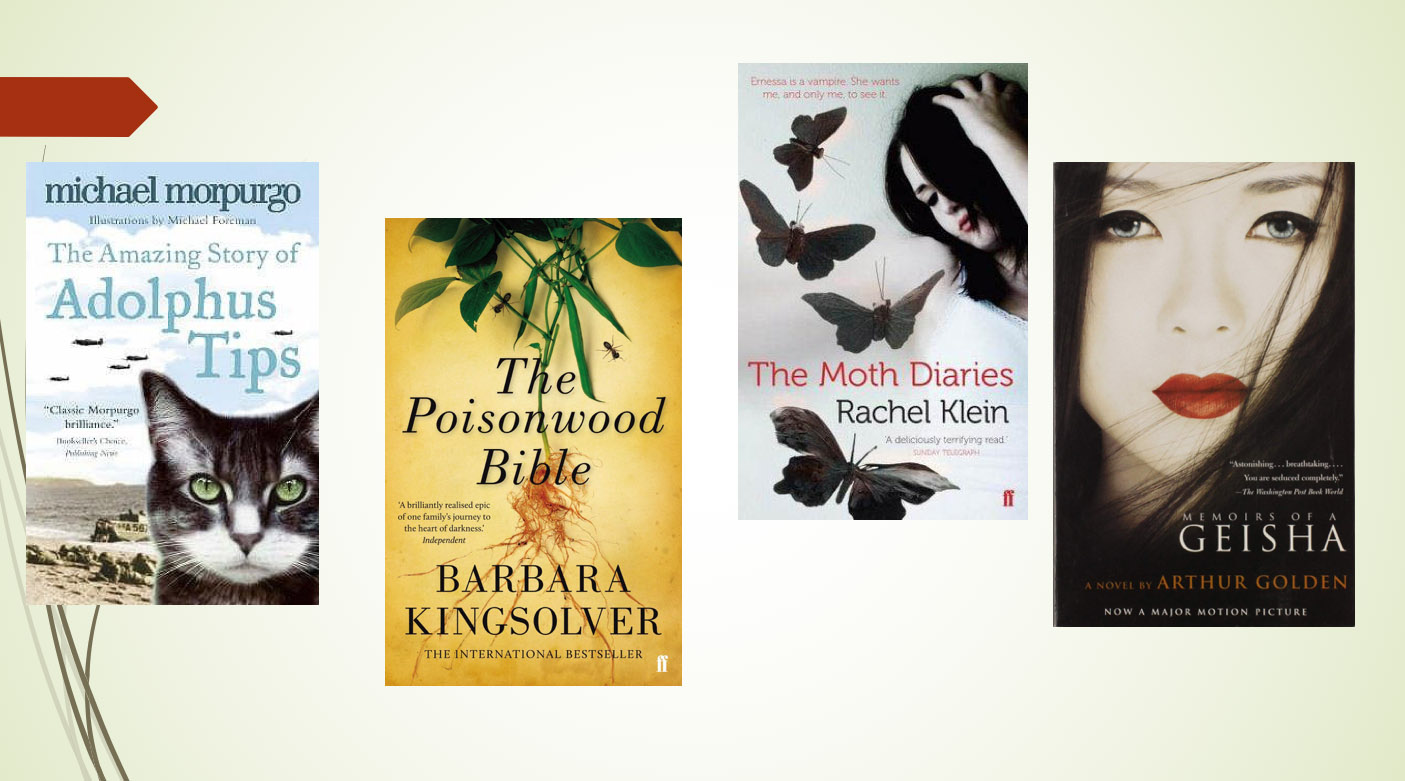
Most fictional diaries are memoir-like because they are usually based on THEME which carries the meaning of the story. In The Poisonwood Bible, Barbara Kingsolver effectively uses several first person voices—of the mother and her four daughters—to provide more perspectives of the story.
Mundane Science Fiction
Mundane science fiction is a niche literary movement from 2004 focused on near-future realism—also called speculative fiction or literary SF. The focus is on already existing technology and plausible extensions—no ray guns, warp drives or time travel. The premise lies in existing circumstances and events. It has similarities with hard science fiction, cyberpunk, ecopunk, ecofiction and climate fiction. Mundane science fiction incorporates elements of literary fiction and mainstream fiction to achieve a strong sense of realism.
Examples of mundane science fiction
Mundane science fiction is the literature of near-future realism that explores how environmental and technological changes will change our lives. Christopher Cokinos calls mundane science fiction the “science fiction that functions more as compass than chimera.” Examples include cautionary tales and dystopias, all predicated on and launched from real events and phenomena—and including my own recent climate fiction “A Diary in the Age of Water.”
“A Diary in the Age of Water”: Mundane SF with Fictionalized Diary
“A Diary in the Age of Water” is the climate-induced journey of humanity through four generations of women, each with a unique relationship to water… Centuries from now, in a dying boreal forest in what used to be northern Canada, Kyo, a young acolyte called to service in the Exodus, yearns for Earth’s past—the Age of Water, before the “Water Twins” destroyed humanity. Looking for answers and plagued by vivid dreams of this holocaust, Kyo discovers the diary of Lynna, a limnologist from a time just prior to the destruction. The diary spans a 40-year period in the mid-21st century and describes a planet in the grips of severe water scarcity. Lynna in her work for the international utility that controls everything to do with water, witnesses and records in her diary the disturbing events that will soon lead to humanity’s demise.
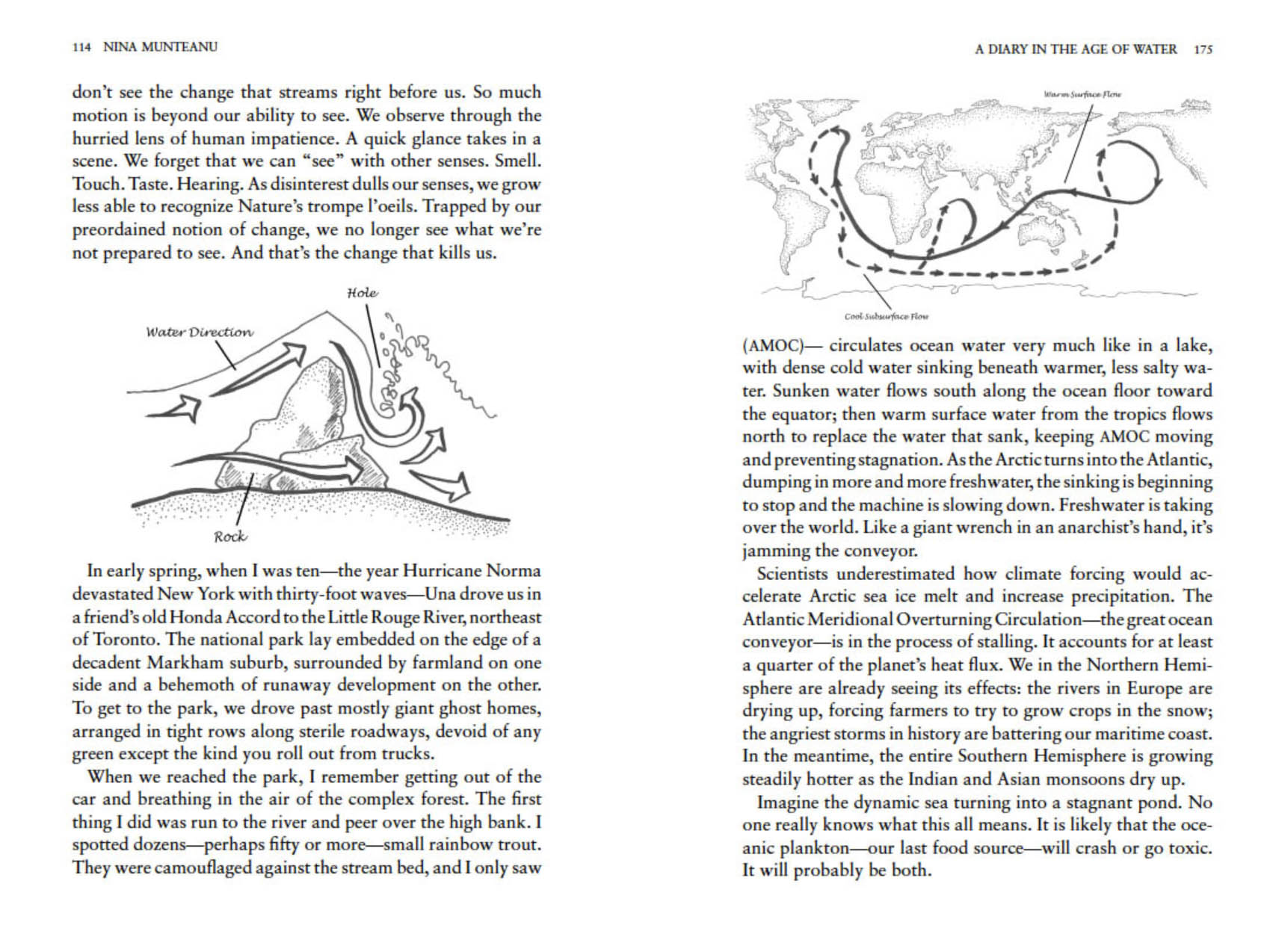
The story begins and ends in the far future with the blue being Kyo, who finds the diary of the limnologist, Lynna. The story is hard SF with a strong basis in science. This is obvious through the narrator, who is a scientist, and the form of the diary itself, in which each entry has an epigraph from a science textbook related to the experience in the entry. Lynna also includes sketches, formulas and other references to science and these appear in the entries.
The diary portion of the book is a first person narrative nested within the larger 3rd person narrative of Kyo in the far future. Its SETTING is based on many real events with dramatized fiction stitched in. This blurs what’s real and what’s fiction. VOICE and POV are used to achieve differing scope and time perspectives between the diarist’s world and that of the future being. We get insight into the inner voice of the diarist through 1st person voice; this is contrasted with the 3rd person voice of the future being—they remain on the outside, looking in. The PLOT is essentially that of a young future human “in discovery”, a metaphoric coming of age for humanity.
The diary format includes the use of:
short entries with epigraphs and quotes from fact
conversational voice of intimacy with introspection, opinion, and judgment
outer conflict with family and colleagues
inner conflict with motivations and truths
metaphoric connections with water
illustrations embedded in the diary entries
Two pages with illustrations in ‘A Diary in the Age of Water’
The diarist is a real and flawed protagonist—this makes her more like us and we are more likely to empathize with her despite her considerable flaws … Lynna makes mistakes and does some terrible things, but the diary allows the reader to find out more about why she does these things, what motivated her and how she feels, including remorse and regret. This allows the reader to forgive Lynna, even as her own daughter cannot, even as she cannot. This becomes key to the story, which is about forgiveness. The diary abruptly ends with pages torn out and Kyo is anxious to know what happened to both Lynna and her world. So is the reader.
Responses to “A Diary in the Age of Water”
Readers and reviewers had interesting responses, some paradoxical:
The blur of real events/history and fictional action brought the story into living colour. Several readers confided in me that they often did not know what was non-fiction and what was fiction and that this confusion made the book more gripping. Several reviewers, caught up in the blur of non-fiction with fiction, accused the book of being overtly polemic, when it was the fictional diarist who was proselytizing and being protective and narrow-minded; one need only look to the diarist’s daughter and her actions to see another voice).
In their analysis, reviewers gave the following visceral responses:
In her review of ‘A Diary in the Age of Water’ in The Temz Review, Marcie McCauley writes:
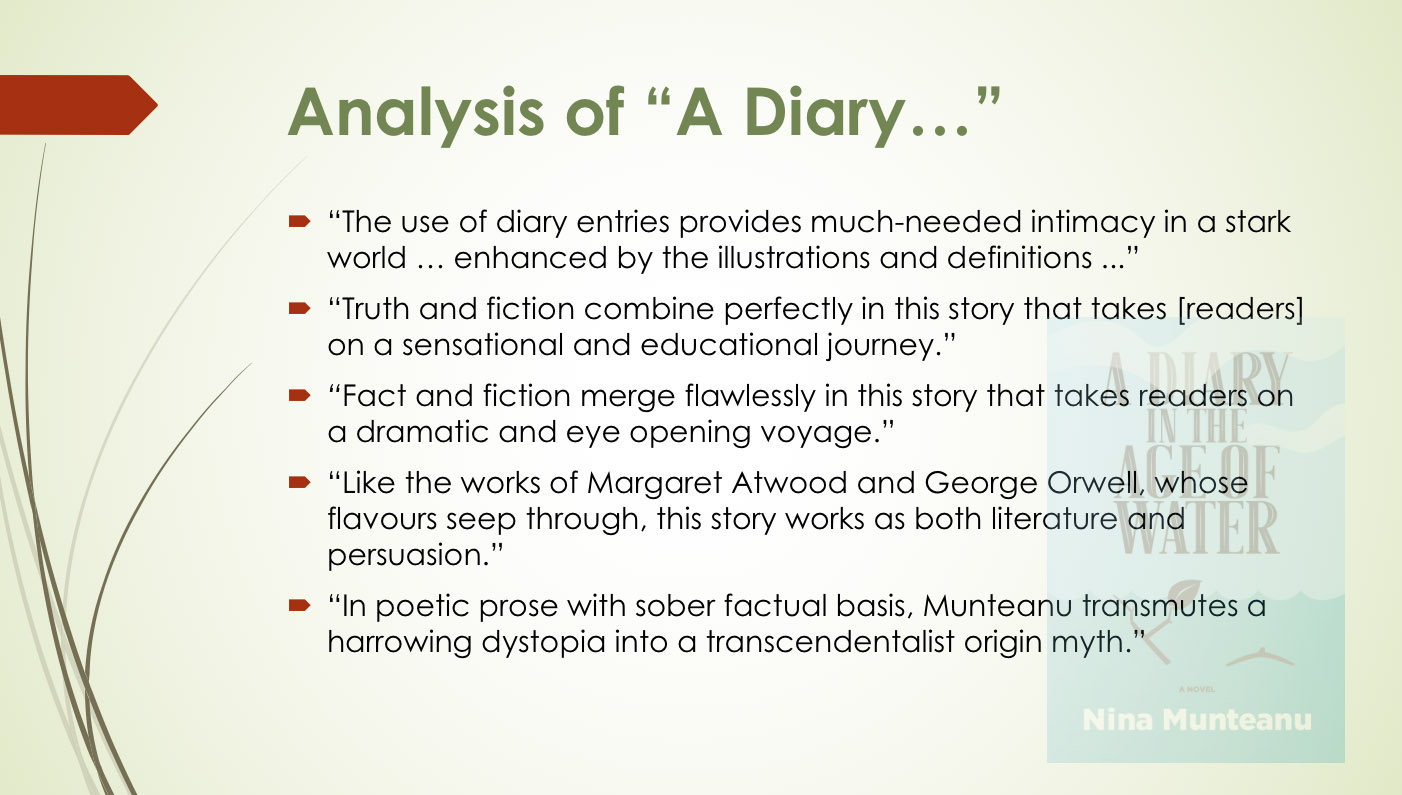
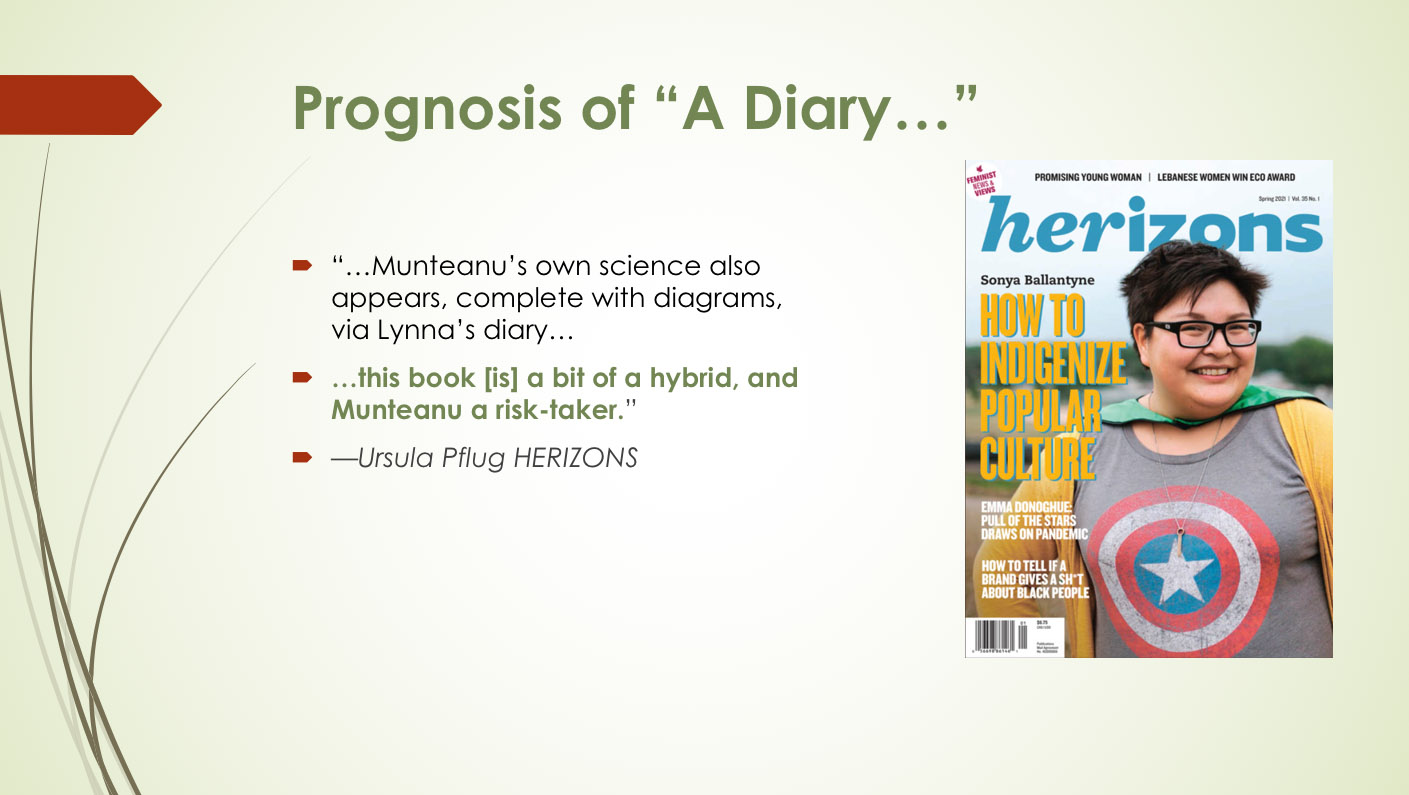
Munteanu “invites readers to recognize themselves in the ‘historical’ story and to project themselves into her imagined future…the diary…operates as a doorway…Munteanu combines methodologies, familiar literary motifs with text and images from non-fiction…She does not appear to view fiction and non-fiction as separate territories; or, if she does, then this book is a bridge between them.”
That blur with reality makes readers both love and hate the novel and it is precisely this that makes them read on. They are thoroughly invested. They need to know how it turns out, as though this is real lives at stake.
Red maple leaf sits on mossy log of old growth forest, ON (photo and rendition by Nina Munteanu)
NINA MUNTEANU is a Canadian ecologist / limnologist and novelist. She is co-editor of Europa SF and currently teaches writing courses at George Brown College and the University of Toronto. Visit www.ninamunteanu.ca for the latest on her books. Nina’s bilingual “La natura dell’acqua / The Way of Water” was published by Mincione Edizioni in Rome. Her non-fiction book “Water Is…” by Pixl Press(Vancouver) was selected by Margaret Atwood in the New York Times ‘Year in Reading’ and was chosen as the 2017 Summer Read by Water Canada. Her novel “A Diary in the Age of Water” was released by Inanna Publications (Toronto) in June 2020.
Writer and curator Mary Woodbury shares eight novels about water where fact and fiction mingle, tried by imagination, to reveal important truths about our shifting relationships with this vital and lively agent in an era of climate crisis,” writes the magazine Climate Cultures.
“While facts are something we can and should pay attention to as we follow scientific integrity, models, and reports, another mode of telling the story about water has been alive forever: churned, spoken, and written by authors who dream up fictional stories related to our past, present, and future world. Where fact and fiction mingle like this is an area of reflection and speculation, tied by imagination. These tales of water ripple out once the pebble sinks in. The intersectionality of diverse water fiction results in reader empathy, learning, inspiration, and shared commonalities around the world. Local dignity comes alive against a backdrop of planetary crises.”
She chooses the following eco-novels to discuss:
“Land-Water-Sky (Ndè-Ti-Yat’a)” by Katłıà “Oil on Water” by Helon Habila “A Diary in the Age of Water” by Nina Munteanu “The Water Knife” by Paolo Bacigalupi “Memory of Water” by Emmi Itäranta “Fever Dream” by Samanta Schweblin “Lagoon” by Nnedi Okorafor “Bangkok Wakes to Rain” by Pitchaya Sudbanthad
Here’s what she writes about my novel:
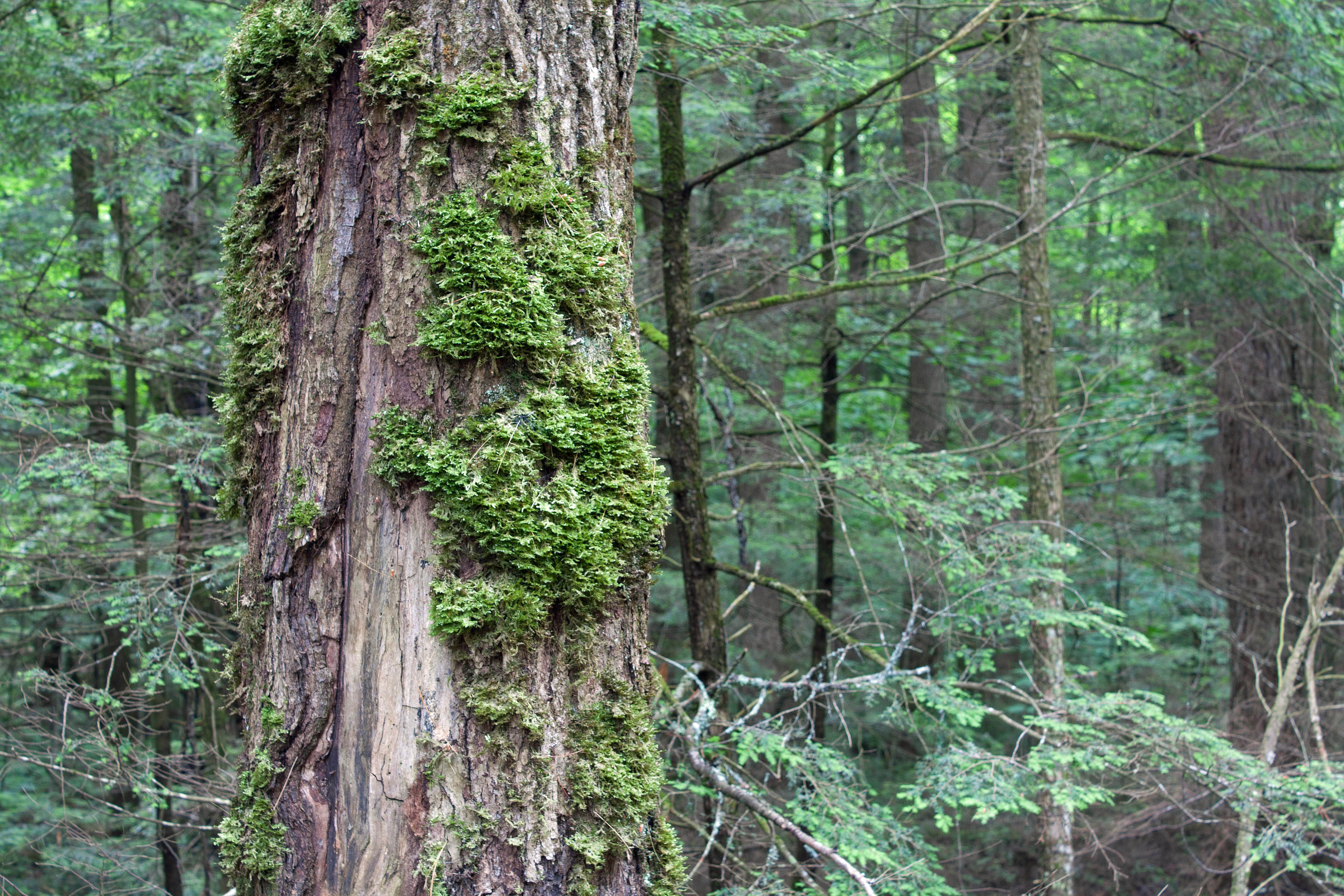
Ancient Eastern Hemlock in Catchacoma old-growth forest, ON (photo by Nina Munteanu)
NINA MUNTEANU is a Canadian ecologist / limnologist and novelist. She is co-editor of Europa SF and currently teaches writing courses at George Brown College and the University of Toronto. Visit www.ninamunteanu.ca for the latest on her books. Nina’s bilingual “La natura dell’acqua / The Way of Water” was published by Mincione Edizioni in Rome. Her non-fiction book “Water Is…” by Pixl Press(Vancouver) was selected by Margaret Atwood in the New York Times ‘Year in Reading’ and was chosen as the 2017 Summer Read by Water Canada. Her novel “A Diary in the Age of Water” was released by Inanna Publications (Toronto) in June 2020.
I recently gave a webinar through the Immigrant Writers Association on how to structure an effective, compelling and meaningful short piece of writing, whether fiction or non-fiction article.
All good writing requires setting up a purposeful narrative that directs the reader seamlessly from the lead hook to the fulfilling conclusion. I went over the process and necessary steps from idea (premise) through introduction/set up (what’s at stake) and development (the journey/theme) toward a fulfilling end (message).
I used two examples (one that needed work and one that was superlative) to explore hooks, paragraphing, overall narrative structure and development, and tips on how language can enhance or detract from compelling story.
Heron in marsh of outlet stream, ON (photo and rendition by Nina Munteanu)
NINA MUNTEANU is a Canadian ecologist / limnologist and novelist. She is co-editor of Europa SF and currently teaches writing courses at George Brown College and the University of Toronto. Visit www.ninamunteanu.ca for the latest on her books. Nina’s bilingual “La natura dell’acqua / The Way of Water” was published by Mincione Edizioni in Rome. Her non-fiction book “Water Is…” by Pixl Press(Vancouver) was selected by Margaret Atwood in the New York Times ‘Year in Reading’ and was chosen as the 2017 Summer Read by Water Canada. Her novel “A Diary in the Age of Water” was released by Inanna Publications (Toronto) in June 2020.
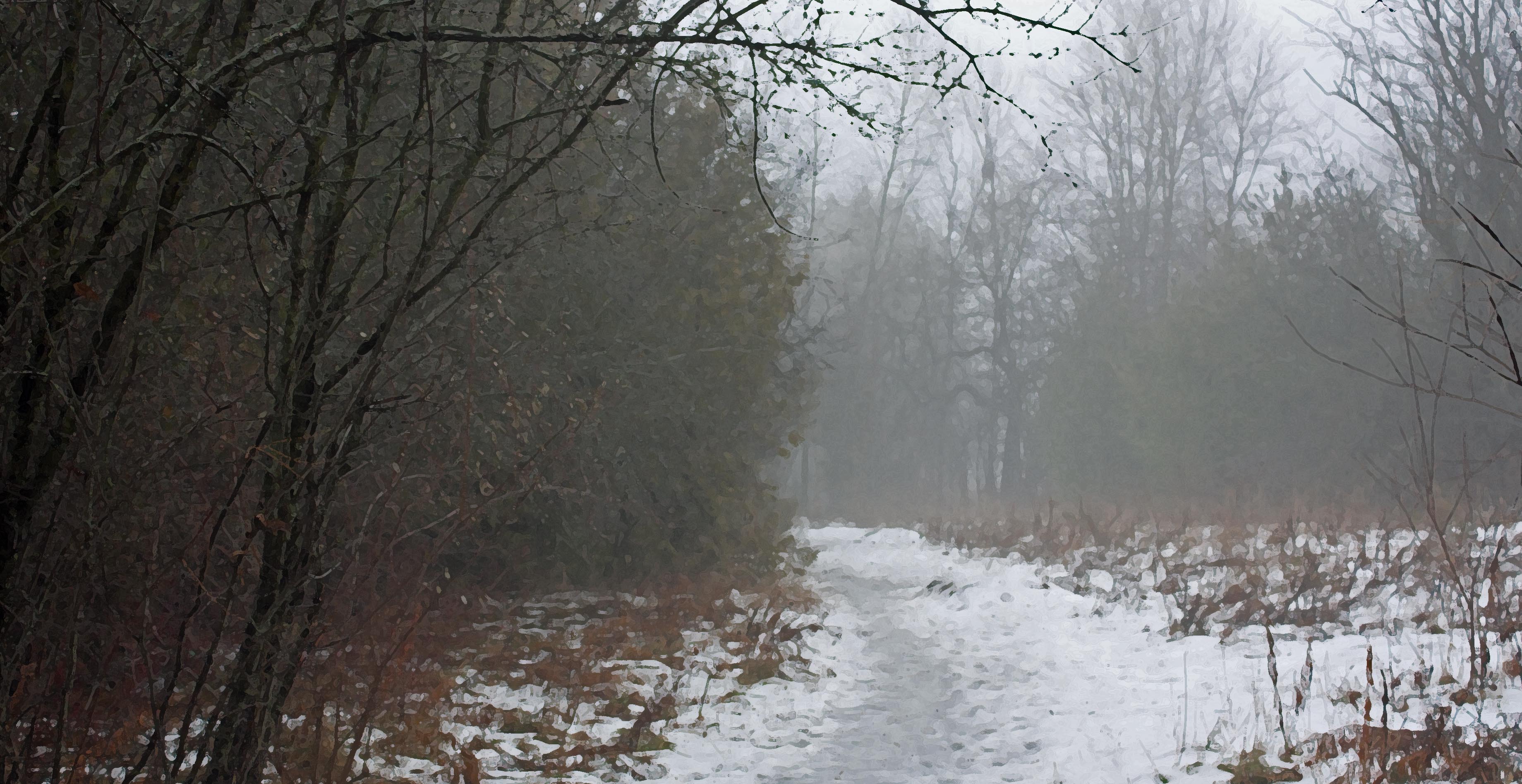
Path leading into a mixed gnarly forest in a December fog, ON (photo and rendition by Nina Munteanu)
During a recent professional development session for writing instructors at UofT, I got a prompt to share what I loved about teaching how to write. We had eight minutes to write what first came to us. I found myself writing easily and quickly. Here’s what I shared:
Path through a gnarly forest in a December fog, ON (photo and rendition by Nina Munteanu)
I love how fluid it is. I used to work as an environmental consultant (as a limnologist) and what I loved about that job was the lack of structure and the diversity of projects. No day was the same. And—like a box of chocolates—I never knew what lay in store for me. I flourish in that kind of chaotic problem-solving.
Teaching how to write is like that.
Teaching how to write is about process. It’s about the journey and the relationships, not just about things. It’s more about how they fit together, why they work, and where they go. The act of teaching is always changing. It’s fluid, like water. And how apt, considering that our bodies are over two-thirds water. Just like water, we like to flow.
Teaching how to write is more than teaching how to use a tool, how to string a good sentence together or choosing the best word; it includes “voice”, expression, identity, freedom, and autonomy. Writing is power and I am empowering when I teach writing.
What a cool thing to do!
Path along the edge of a small woodland in the December fog, ON (photo and rendition by Nina Munteanu)
Nina Munteanu is a Canadian ecologist / limnologist and novelist. She is co-editor of Europa SF and currently teaches writing courses at George Brown College and the University of Toronto. Visit www.ninamunteanu.ca for the latest on her books. Nina’s bilingual “La natura dell’acqua / The Way of Water” was published by Mincione Edizioni in Rome. Her non-fiction book “Water Is…” by Pixl Press(Vancouver) was selected by Margaret Atwood in the New York Times ‘Year in Reading’ and was chosen as the 2017 Summer Read by Water Canada. Her novel “A Diary in the Age of Water” was released by Inanna Publications (Toronto) in June 2020.
Nina Munteanu appears on “Teaching, Learning, Leading, K-12” Podcast with Dr. Steven Miletto
I was recently interviewed by Dr. Steven Miletto in Georgia on his podcast “Teaching Learning Leading K12”—Episode 401. We talked about my two recent books on water,Water Is…and A Diary in the Age of Water. The 1-hour interview covered a range of topics from why water makes us feel so good, to the study of limnology, and writing both non-fiction and fiction about water. In the latter, I talked about water as a character in story. We also talked about how characters form in a story and how to keep going when the muse or the joy buries itself.
Jackson Creek, ON (photo and dry-brush rendition by Nina Munteanu)
Nina Munteanu is a Canadian ecologist / limnologist and novelist. She is co-editor of Europa SF and currently teaches writing courses at George Brown College and the University of Toronto. Visit www.ninamunteanu.ca for the latest on her books. Nina’s bilingual “La natura dell’acqua / The Way of Water” was published by Mincione Edizioni in Rome. Her non-fiction book “Water Is…” by Pixl Press(Vancouver) was selected by Margaret Atwood in the New York Times ‘Year in Reading’ and was chosen as the 2017 Summer Read by Water Canada. Her novel “A Diary in the Age of Water” was released by Inanna Publications (Toronto) in June 2020.
“For this year’s holiday gift guide,” writes Dr. Michael Svoboda, “Yale Climate Connections has gathered celebrated anthologies, deep-dives into climate-related science and solutions, inspiring books from or about spiritual leaders, and visionary works of climate fiction.”
All were recently published, some within the month, writes Svoboda. These twelve books address decades of writing on climate change, reassess the challenges, offer hope and guidance for action, and envision very different climate-changed futures.
There is, for instance, the anthology The Fragile Earth: Writing from the New Yorker on Climate Change (Harper Collins),which includes Bill McKibben’s seminal essay “The End of Nature.” The anthology All We Can Save(Penguin Random House) edited by Ayana Elizabeth Johnson and Katharine K. Wilkinson is a collection of works dedicated to leadership “more characteristically feminine and more faithfully feminist, rooted in compassion, connection, creativity, and collaboration.”
Hope, guide to action and challenges are provided by Future Sea (University of Chicago Press) by Deborah Rowan Wright, The New Map (Penguin Random House) by Daniel Yergin, Solved:How the World’s Great Cities are Fixing the Climate Crisis (University of Toronto Press) by David Miller, Let Us Dream (Simon & Schuster) by Pope Francis. Tales of Two Planets (Penguin Random House) edited by John Freeman explores inequality and the impact of climate change.
Stand Up! Speak Up! (Penguin Random House) by Andrew Joyner celebrates the inspiration of youth in taking up action through hope, activism and community. Our Only Home: A Climate Appeal to the World (Hanover Square) by the Dalai Lama and Franz Alt is a manifesto that will empower us to take action and save the environment.
The novel The 2084 Report (Simon & Schuster) by James Lawrence Powell provides an “oral history” through interviews of the devastating effects of the Great Warming, which are both fascinating and frightening. My own novel A Diary in the Age of Water (Inanna Publications) chronicles the journeys of four generations of women, each carrying a unique relationship with water over a time of catastrophic change. Told in the form of a diary by a limnologist, the story explores a Canada mined for its water by United States, which, in turn, is owned by China. The Ministry for the Future (Hachette Book Group—Orbit) a novel by Kim Stanley Robinson uses fictional eyewitness accounts to tell the story of how climate change will affect us all.
Yale Climate Connections:
Edited by veteran journalist and journalism educator Bud Ward, Yale Climate Connections provides content developed by a network of experienced independent freelance science journalists, researchers, and educators across the country.Yale Climate Connections is an initiative of the Yale Center for Environmental Communication (YCEC), directed by Dr. Anthony Leiserowitz of the Yale School of the Environment, Yale University.
Dr. Michael Svoboda, an expert on climate change, is a professor at George Washington University and frequent contributor to Yale Climate Connections.
Jackson Creek in early winter, ON (photo and rendition by Nina Munteanu)
Nina Munteanu is a Canadian ecologist / limnologist and novelist. She is co-editor of Europa SF and currently teaches writing courses at George Brown College and the University of Toronto. Visit www.ninamunteanu.ca for the latest on her books. Nina’s bilingual “La natura dell’acqua / The Way of Water” was published by Mincione Edizioni in Rome. Her non-fiction book “Water Is…” by Pixl Press(Vancouver) was selected by Margaret Atwood in the New York Times ‘Year in Reading’ and was chosen as the 2017 Summer Read by Water Canada. Her novel “A Diary in the Age of Water” was released by Inanna Publications (Toronto) in June 2020.


























 Nina Munteanu Writing Coach