A Story: Earthstar Goes To Tea

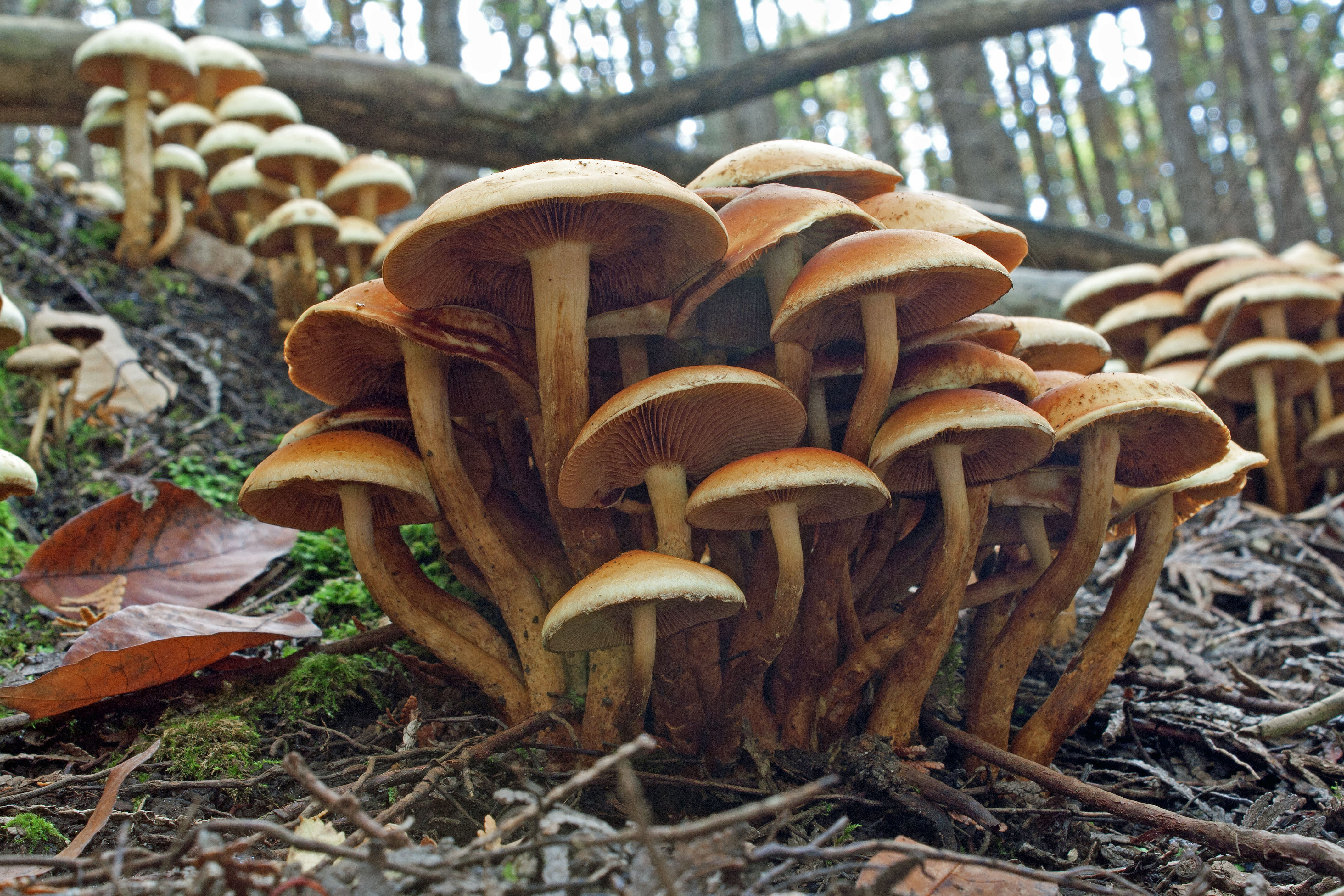
Collared Earthstar (Geastrum triplex) on mossy cedar growing on rotting cedar logs of Trent swamp forest, ON (photo by Nina Munteanu)

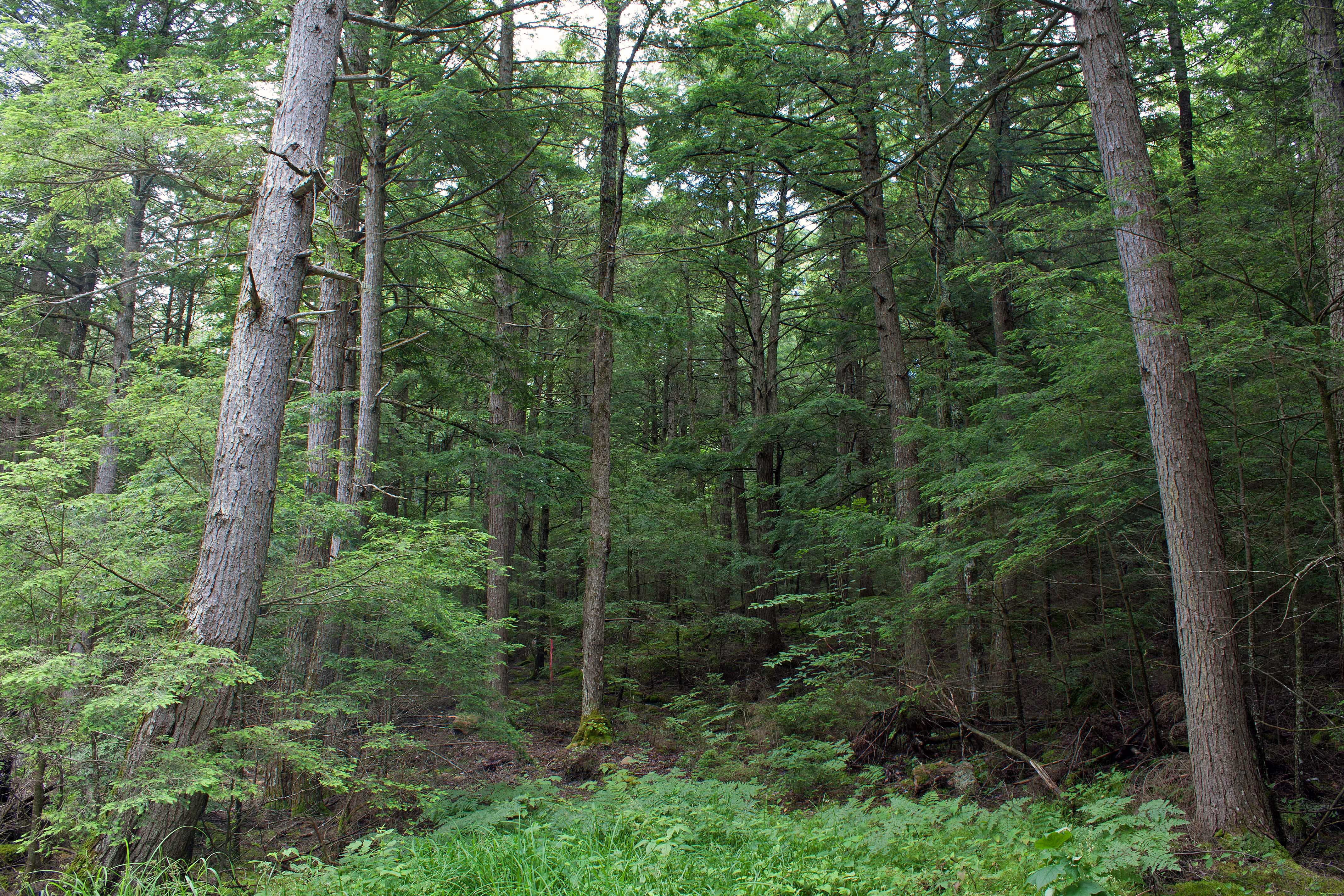
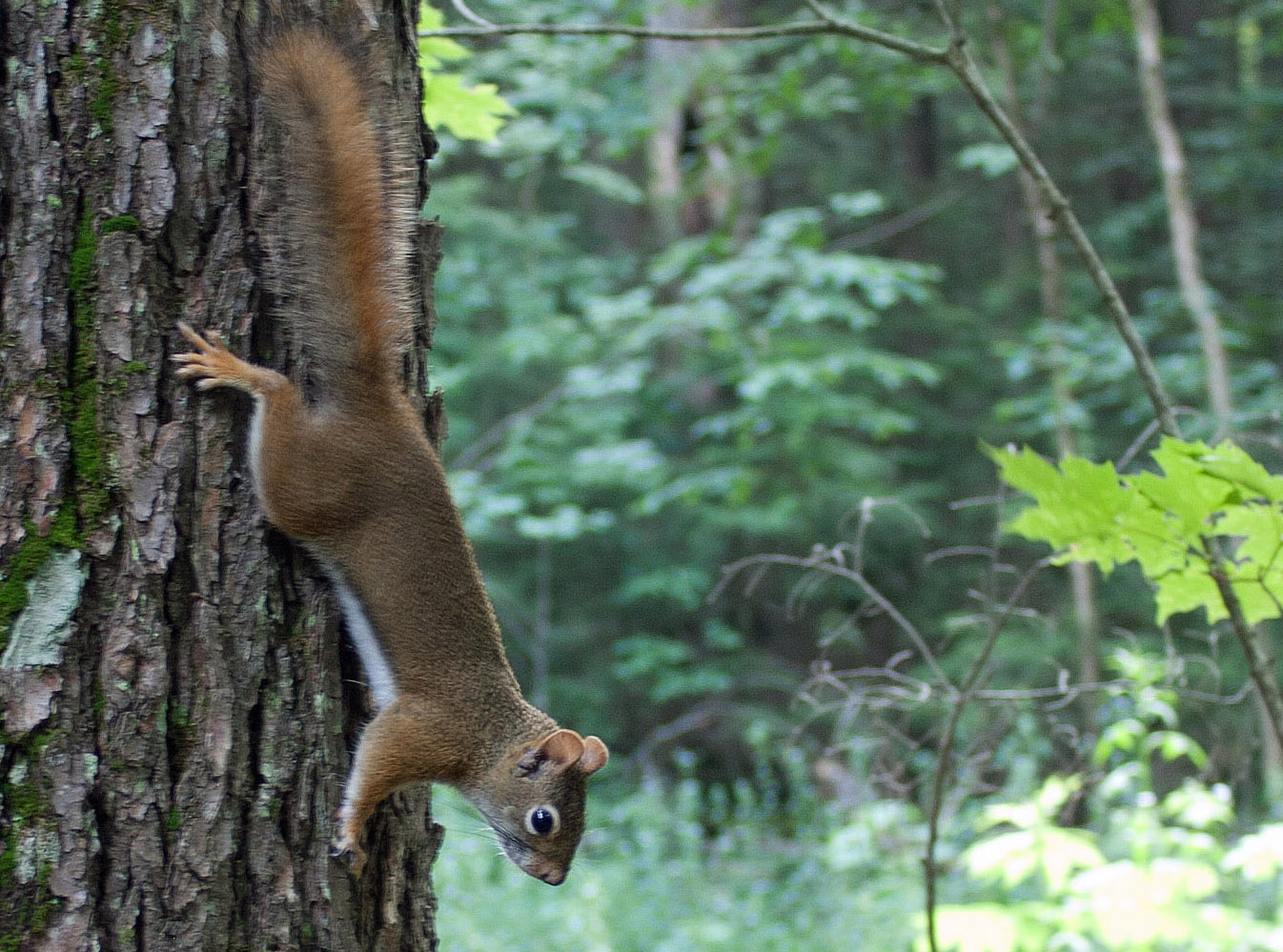
Earthstar lived in a verdant cedar forest, under a soft dappled light, where the fresh smell of moss and loam mixed with the pungency of cedar. It was a good life, thought Earthstar, gazing up at the tall canopy of green above her. She lived among many like her, scattered on and between old cedar logs that had piled on the ground and rotted into a rich woody ‘soil.’ It was just right for earthstars who grew deep in the warm, moist rot, covered in a carpet of moss and ferns. Cedar saplings had even sprouted on the rotting log piles, and grown into large mature trees. That was not surprising, given the number of caches the red squirrels left on the spongy rotting logs.

Red squirrel on a tree (photo by Nina Munteanu)
Fully opened Earthstar and sister buds in mossy humus of rotting cedar logs, Trent cedar forest, ON (photo by Nina Munteanu)

When she was just a young bud, Earthstar had pushed herself up from her parent mycelium through the woody humus then cracked open her outer shell to reveal her inner spore sac and beaked mouth. The outer shell formed arms of a ‘star’ that pushed back, raising her up to meet the world. When she surveyed her mossy terrain, she noticed that she was one of the earliest earthstars to emerge. Most of her sisters were still budding through the moss and duff. She was eager to fulfill her path. Soon she would be ready to deliver her precious spores to the world—

“Hey there!” a beaky voice called to her.

Earthstar recognized a Beaked Earthstar ambling along the rot pile using its outer skin ‘legs.’ She herself was a Collared Earthstar, and although she had long dislodged from the woody soil and become independent of the ground she sat on, she didn’t normally walk about like this Beaked Earthstar, known for its itinerant lifestyle. He was a rare and somewhat mysterious earthstar, not often seen, and somewhat of a legend. In fact, it was the first time she saw him and she felt tickled that he’d stopped in his wanderings to greet her.

Beaked earthstar, showing many arms that keep it upright, Trent cedar forest, ON (photo by Nina Munteanu)

“I’m on my way to town,” said Beaky cheerfully. “Want to come along? There’s so much more to see than this silly forest.”

“No thanks,” said Earthstar, overcoming the flush of excitement at being invited by this exotic drifter. She’d heard about ‘the town’ but knew nothing of it—and decided she didn’t want to. Besides, the forest wasn’t silly, she thought peevishly. It was her home. It nourished her. It was where her family was. Earthstar was content.

“Suit yourself,” said Beaky. “But you don’t know what you’re missing! There’s a river out there, and strange but wonderful creatures and moving things on wheels that carry them from place to place. And the fine ladies have something called ‘High Tea,’ which is quite splendid.”

“I think this forest is quite splendid enough,” she retorted a little rudely.

“Ah… But you won’t truly know your place until you’re out of place,” Beaky said. Then with a slight nod of his beaky head, he left her and soon disappeared along the forest path that wound its way into somewhere.

What did Beaky mean by his last comment? wondered Earthstar. How can one be out of place? And why would one wish to be? As time went by, Earthstar began to wonder about that ‘somewhere’ and those wonderful creatures and fine ladies and that thing called ‘High Tea.’ And before she realized it, she was no longer content. She became very curious about that ‘somewhere’ that lay beyond her forest home.

In a sudden thrilling act, Earthstar decided to leave the forest to see the world. And once she thought of it, she did it. That’s the way of earthstars. So, within moments, Earthstar was wandering along the same forest path that Beaky had earlier taken. She took Moss with her, tucked safely inside her ‘legs’ as companion.

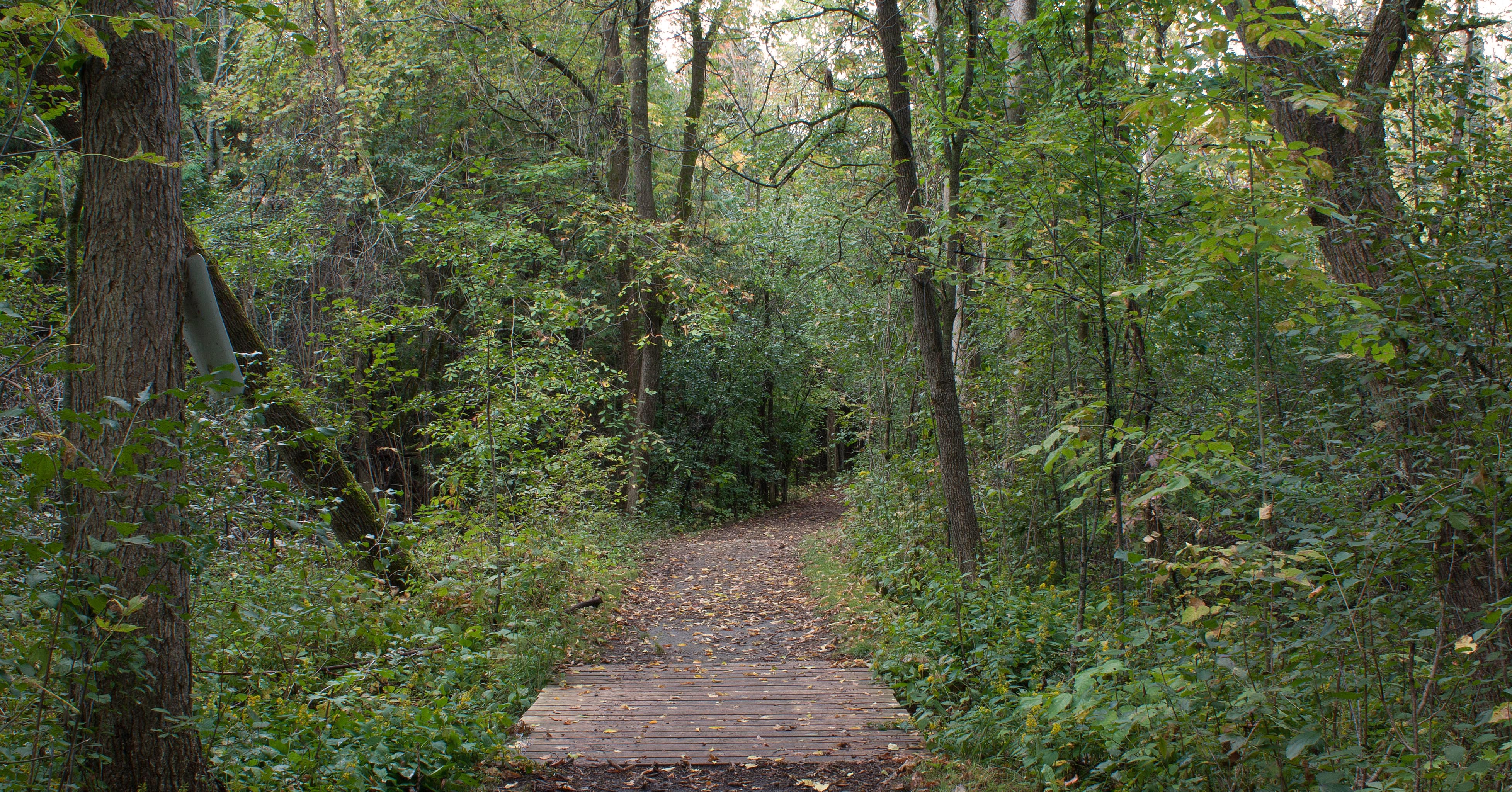
Path, damp from a morning rain, through cedar swamp forest in Trent Nature Sanctuary, ON (photo by Nina Munteanu)
Earthstar rests on small root snag on leaf-strewn trail through Trent cedar forest, ON (photo by Nina Munteanu)
Path through Trent cedar swamp forest with ash and poplar in early fall, ON (photo by Nina Munteanu)

The path wound through dense cedar forest, mixed with birch, ash, poplar and the occasional oak and maple tree. Earthstar passed many relatives. Flaming waxcaps dotted the rotting logs and ground, looking like dance partners. Graceful Fairy Fingers thrust up through the duff on either side of the path along with Ashen Coral fungi, whose delicate ‘fingers’ reached up like praying hands. By the feet of one poplar tree, Earthstar saw a party of Scaly Ink Caps loitering on one side and Striate Bird’s Nest fungi having a party on the other. Stalwart boletes towered majestic, anchored to a mossy slope. A single shield mushroom with its smart lilac cap had burst out of a cedar stump and leaned into the sun with joy.

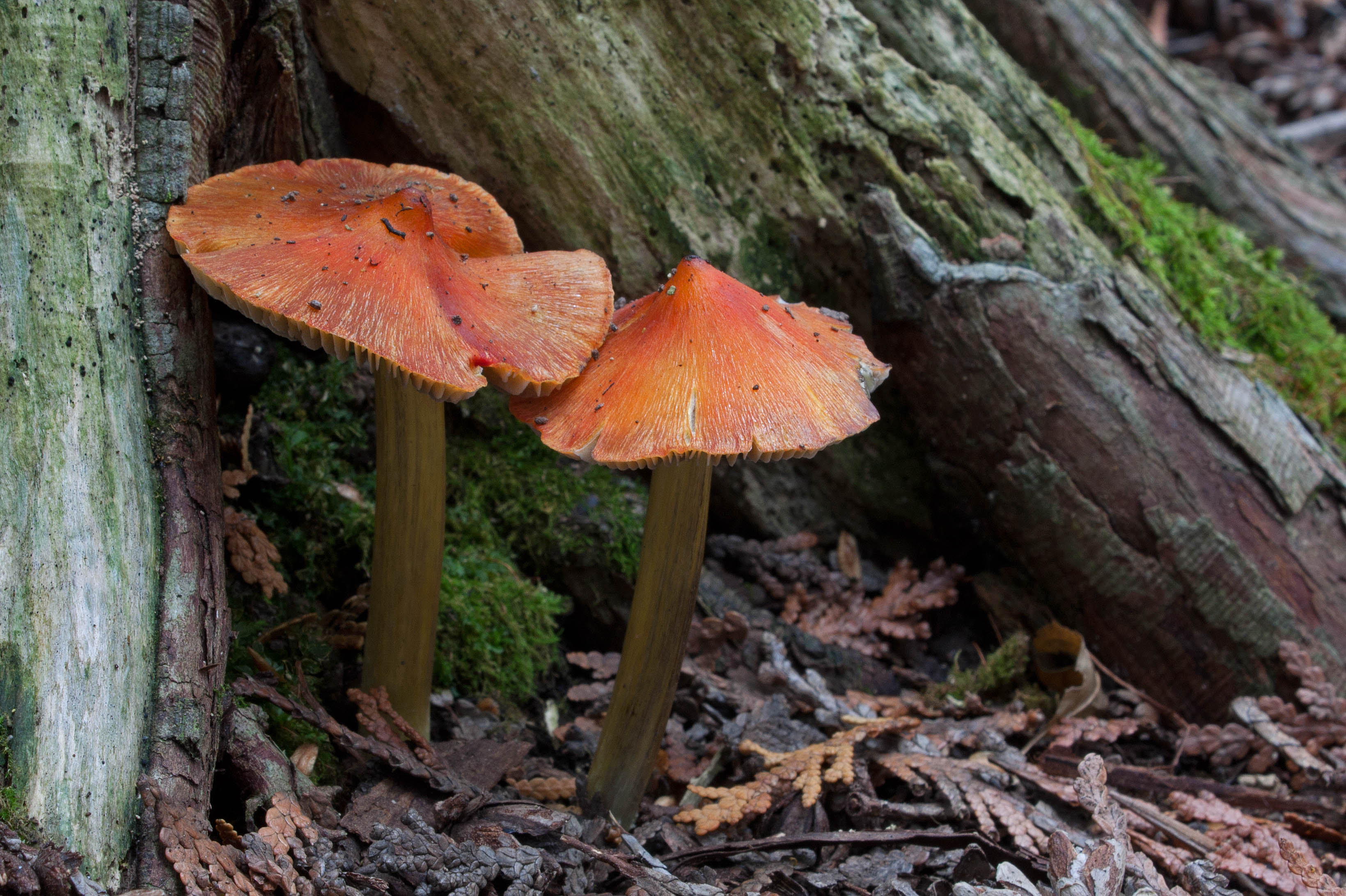
Waxcaps on decaying cedar wood in Trent forest, ON (photo by Nina Munteanu)
Fairy Fingers in cedar duff in Trent forest, ON (photo by Nina Munteanu)
Ashen coral fungi on ground of Trent cedar forest, ON (photo by Nina Munteanu)
Scaly ink caps growing at the base of a poplar tree in Trent forest (photo by Nina Munteanu)
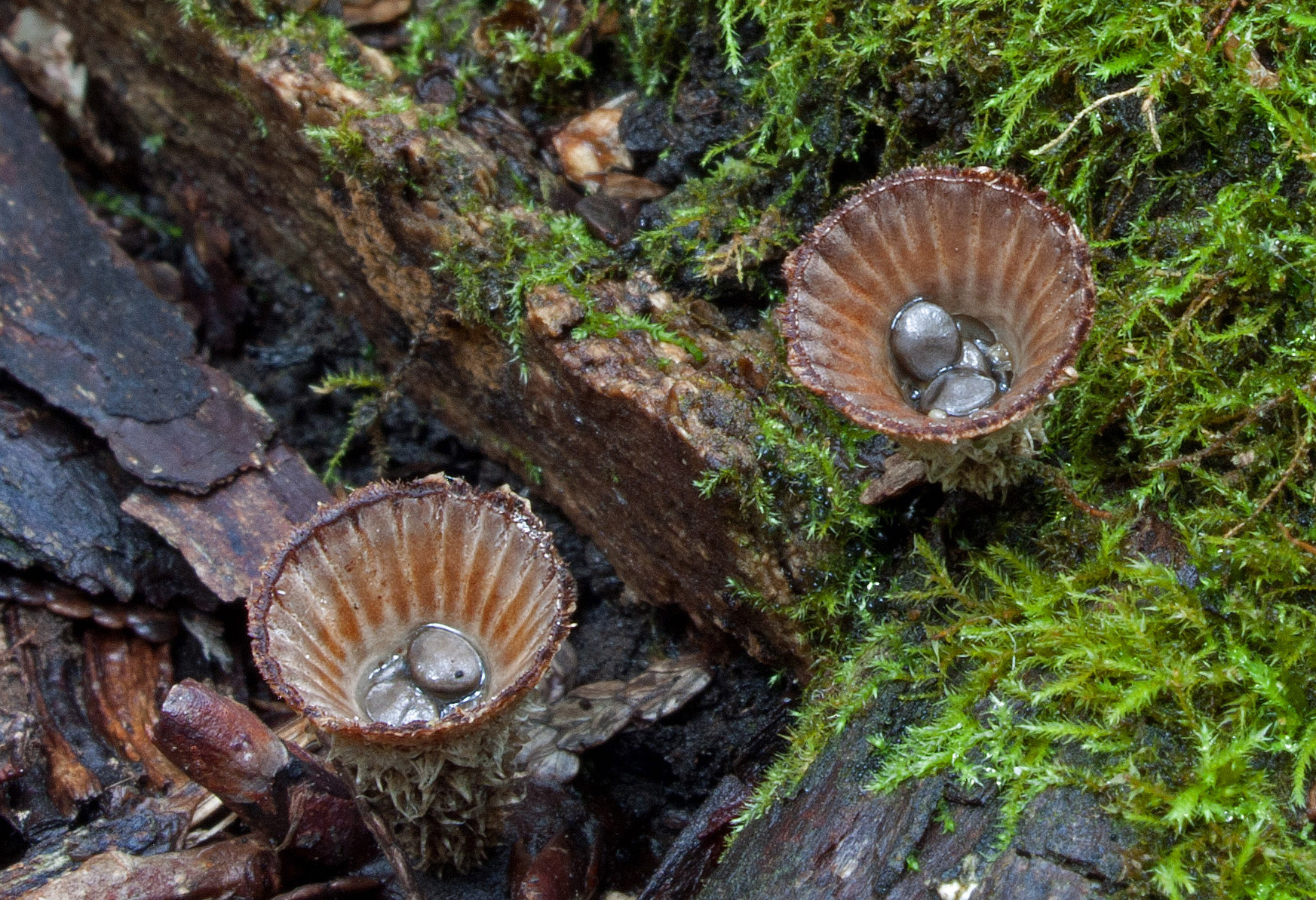
Striated Bird’s Nest fungi at the base of a poplar tree in Trent forest (photo by Nina Munteanu)
Bolete on mossy hill of Trent cedar forest, ON (photo by Nina Munteanu)
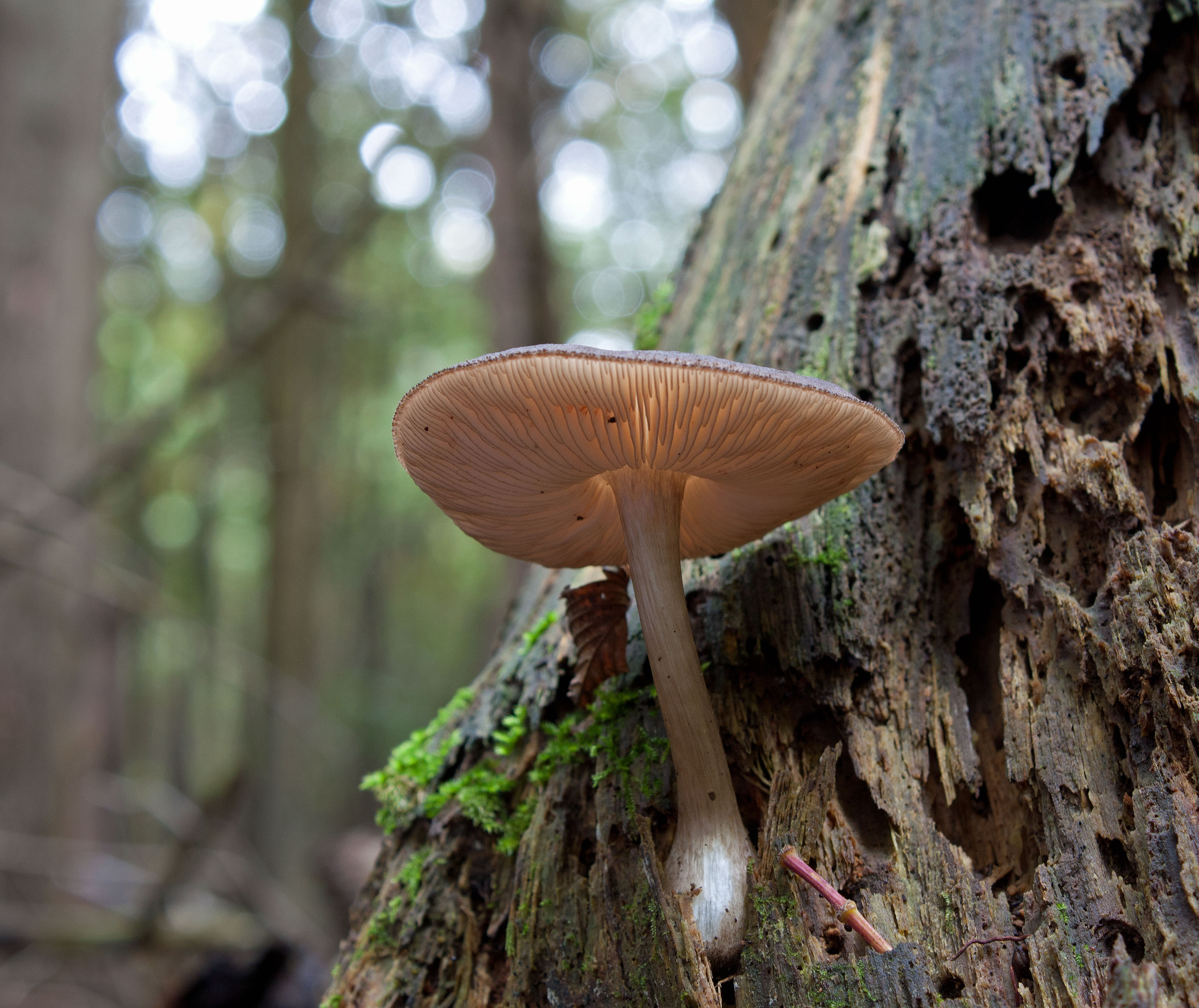
Shield fungus grows out of rotting cedar stump in Trent forest, ON (photo by Nina Munteanu)

A group of Scaly Pholiota graced an old maple tree and not much farther a gaggle of Wolf’s Milk spread orange fungus joy over a decaying log. Conifer Tufts created a fairy ring around an old ash tree. Witches hats stood at the feet of a huge cedar tree, bowing with shy wisdom to her. There was a cheerful family of brilliant Scarlet Fairy Helmets tucked in the mossy undergrowth of a buckthorn thicket.  She even saw a crowd of her closest relatives, Lycoperdon puffballs clutching a rotting birch log, and waved to them.

Scaly Pholiota on an old maple tree in Trent mixed cedar forest, ON (photo by Nina Munteanu)
Wolf’s Milk slime mould on rotting log in Trent forest, ON (photo by Nina Munteanu)
Conifer Tufts form a fairy ring around an old ash tree in Trent cedar forest, ON (photo by Nina Munteanu)
Witches hats nestled at base of a cedar tree, ON (photo by Nina Munteanu)
Scarlet Fairy Helmets in mossy undergrowth of cedar forest, ON (photo by Nina Munteanu)
Lycoperdon puffballs on decaying birch log, Trent cedar forest, ON (photo by Nina Munteanu)

Eventually, the forest opened into fields and thickets and the path became rocky. The dense cool cedar-scented air of the deep forest gave way to a fragrant floral breeze and the warmth of the sun touched Earthstar with rays of good tidings.

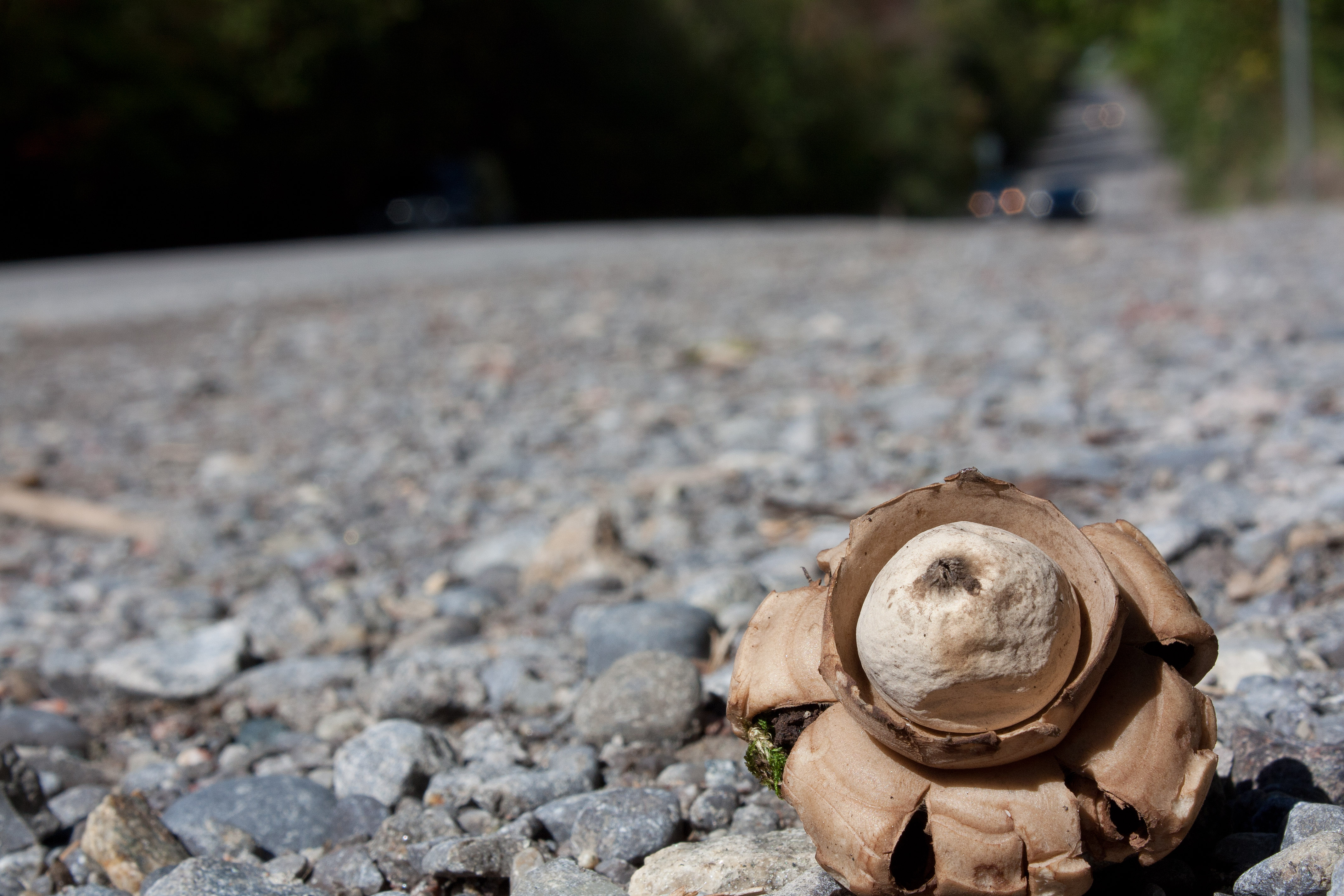
Earthstar on rocky path out of Trent cedar forest into open area, ON (photo by Nina Munteanu)
Earthstar negotiates the rocky path on her way out of the Trent forest (photo by Nina Munteanu)

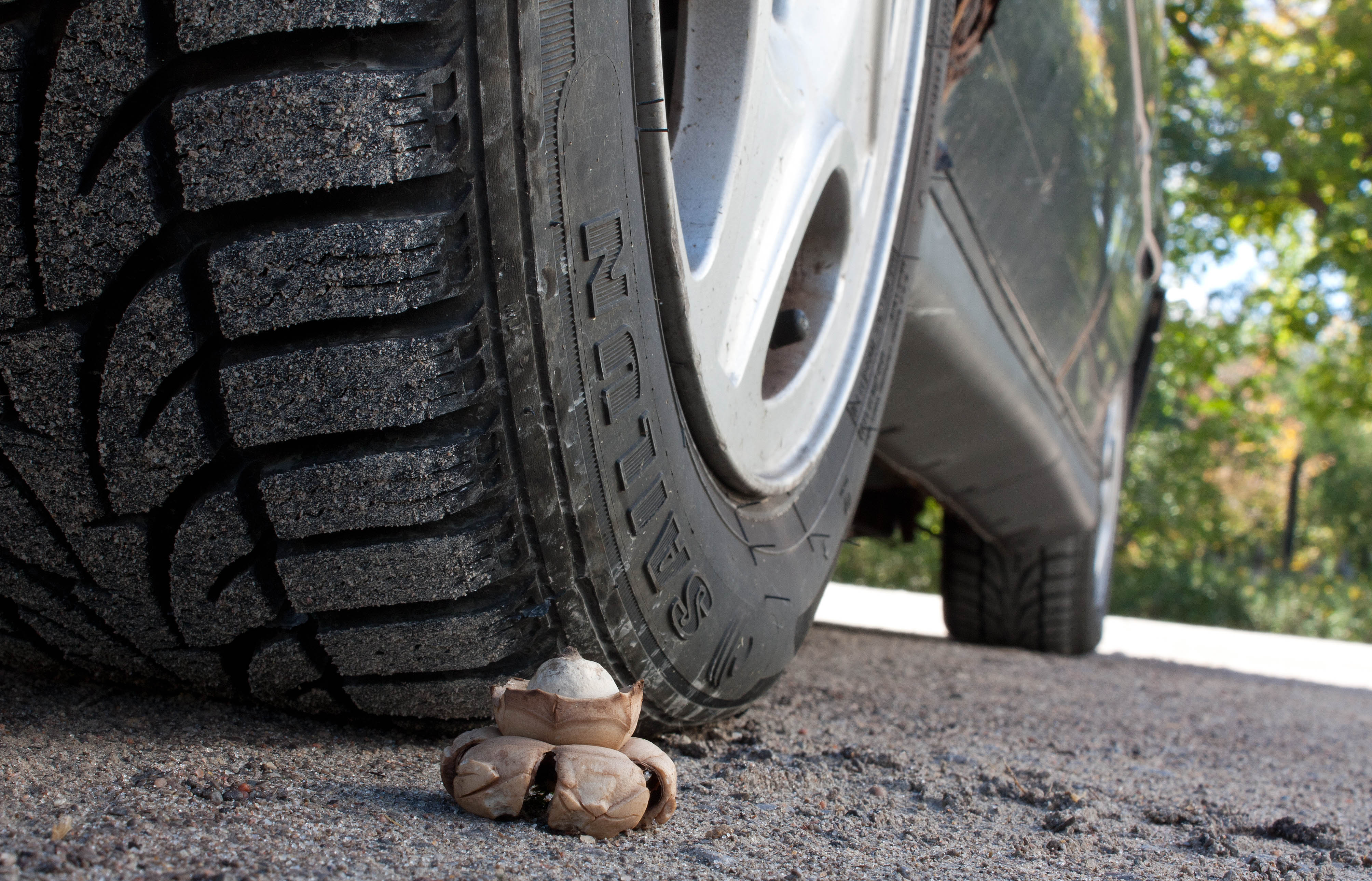
Soon Earthstar reached a road and thought to follow it to town. Within moments a huge thing on wheels barrelled toward her! She froze in terror. But the cheerful wind whisked her out from under the wheel in the nick of time.

Earthstar almost gets run over by a car!

Earthstar thanked the wind and continued down the road, certain that the thing on wheels was what Beaky had mentioned and that she’d soon find the town and the river and those wonderful beings at the end of the road. And perhaps there she would encounter this marvelous “High Tea.”

Earthstar keeps to the side of the road with busy traffic
Countryside near Otonabee River, ON (photo by Nina Munteanu)

The road took Earthstar through an open countryside of meadows, flowers and trees. Earthstar kept to the side of the road to avoid getting squashed and soon found the river Beaky had mentioned. The river was magnificent. Sparkling in the radiant sun, it danced and lapped against the shore with the gurgling rush of laughter around the rocks and reeds.

The shallows of the Otonabee River, showing diatom-froth, ON (photo by Nina Munteanu)
Earthstar on Rotary Trail as bicycles bear down on her (photo by Nina Munteanu)

Sensing the lateness of the day, Earthstar continued her journey in search of “High Tea.” She wasn’t quite sure where she’d find it and followed the river on a trail through a black walnut forest.

Earthstar passed a large building with an open lawn just as a loud bell sounded and large two-legged beings spilled out onto the trail. They chattered about their lit class and laughed as Lillie, one of the students, recounted her scifi story about flying giant tardigrades that terrorized human cities for destroying the planet with fossil fuel emissions.

Attack of the giant tardigrades (image by Ramul in Deviant Art)

“Tardigrades are the coolest creatures,” Lillie went on. “Some people think they’re from outer space and lived among the stars. They can handle extreme temperature, the vacuum of space, and radiation, after all. And water bears can even survive a bullet impact!”

The students didn’t notice Earthstar below them.
She was so tiny after all!

Earthstar (and her moss companion) gets underfoot near the high school (photo by Nina Munteanu)

Just as the dark shadow of a giant foot loomed over her, someone shouted, “Wait, Marcus, STOP! Look!”

Earthstar was snatched off the ground before Marcus could step on her and gently cupped in the girl’s hand where the little fungus felt finally safe. “It’s an earthstar!” said the girl holding her. “How cute! See the bit of moss clutched in its arm? How adorable!”

“But, Emily, what d’you think it’s doing here on the trail by the school?” Marcus asked the girl holding Earthstar. “How did it get here?” Marcus suddenly grinned with inspiration and turned to Lillie, eyes sparkling. “Or did your giant space tardigrade drop it here? Which means we’re in your story–“

Lillie elbowed him and said something Earthstar didn’t understand.

Emily looked down at Earthstar, who sat quietly in her palm. “They’re the only mushrooms that move. Earthstars. I’ve read about them.” Emily then bent low and carefully set Earthstar on the grass by the trail, out of harm’s way.

“Maybe it’s on ‘walkabout,’” Lillie suggested, inspired by the thought of travel and thinking of the Australian term for a long walking journey of discovery.

“You mean floatabout!” Marcus laughed. “If it came all the way from Australia it’d have to float across the Pacific Ocean!”

The students giggled, visualizing little Earthstar floating on a leaf and braving the vast ocean then hitchhiking across the North American continent into the Kawarthas. Still discussing the earthstar’s epic journey, they went on their way, leaving Earthstar on the grass.

Earthstar continued her journey, wondering what ‘walkabout’ meant. She found another large building and thought this might be where she needed to go. When one of the giant beings walked out through a door, she slid inside.

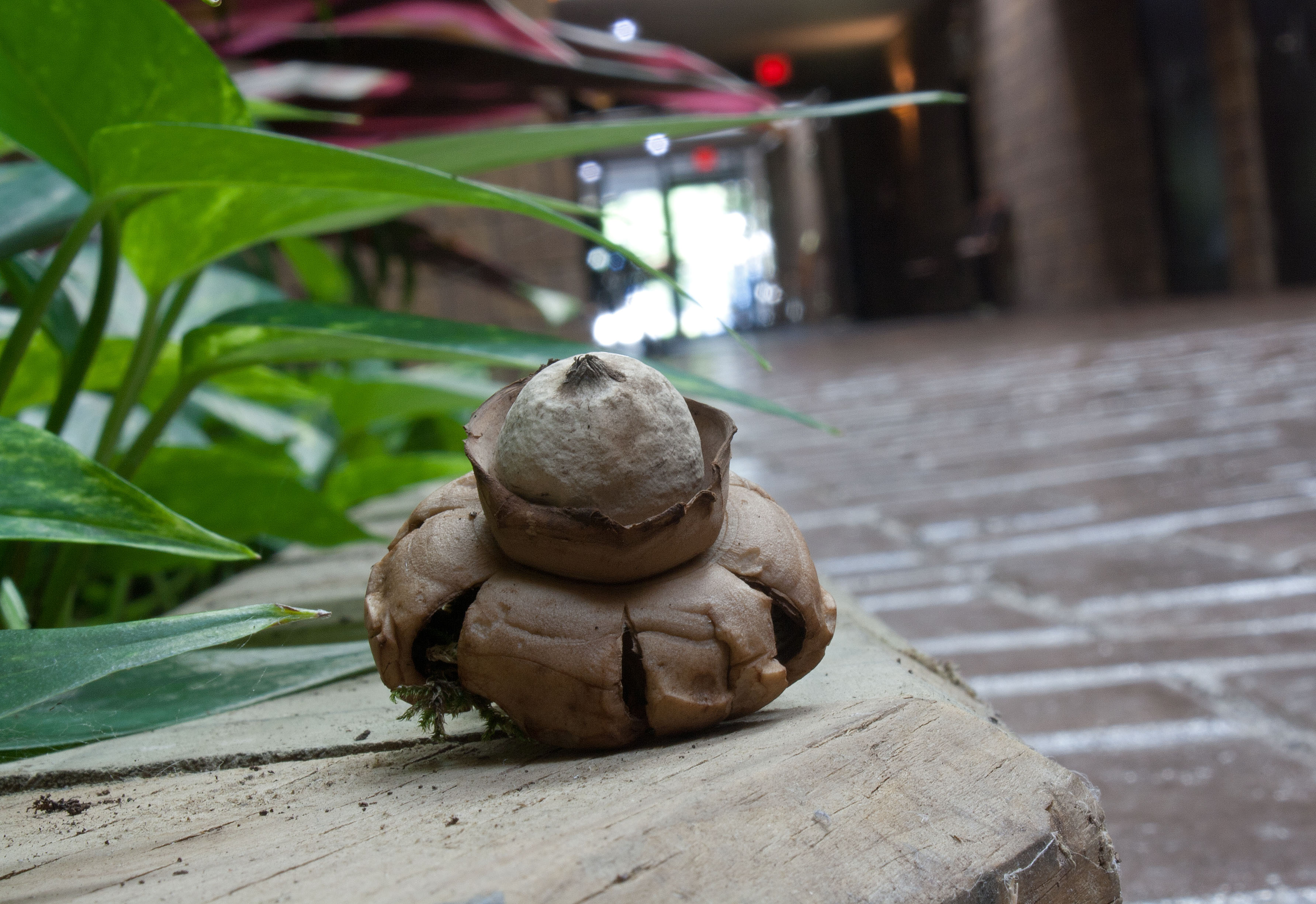
Earthstar and her Moss companion make it inside the condo complex (photo by Nina Munteanu)

She found herself in a wonderfully lit atrium with many more doors and lost herself among the indoor plants under large skylights. Within moments, as if sensing her presence, one of the large beings stepped out from a doorway and immediately saw Earthstar, perched by one of the indoor gardens.

“Well, well, what do we have here? A wandering earthstar and her little moss companion!” The being picked Earthstar up and gently cupped Earthstar in its hand. “Would you like to join me for tea?”

Earthstar in lady’s hand (photo by Nina Munteanu)

The magic word! Tea!

Earthstar jiggled on her ‘legs’ with joy. Was this being one of those fine ladies? As if sensing her excitement, the lady smiled and brought Earthstar inside her apartment.

The lady brought them outside to the patio for tea, where she had laid out tiny sandwiches, cheeses, crackers, scones with jam, and lovely pastries. Of course, Earthstar did not partake in these strange foods—being a saprophyte, she fed exclusively on decaying matter. But she enjoyed the ambience of this civilized celebration. And, of course, the tea!

Lady serving the tea (photo by Nina Munteanu)

When the lady went inside to replenish the tea, Earthstar explored the patio. Mistake!
Moments after Earthstar dropped to the patio bricks with the help of a little breeze, a very large dog (well, a rather small dog for you and me) came bounding to her and gave her a lick. The dog might have eaten her but the lady returned and rescued Earthstar.

Poppy the dog licks Earthstar! (photo by Nina Munteanu)

“Oh, my! Don’t mind Poppy, the neighbour’s shiatzu,” the lady said to Earthstar. “Poppy is harmless and only eats dog treats. I don’t think you’re a dog treat, are you?”

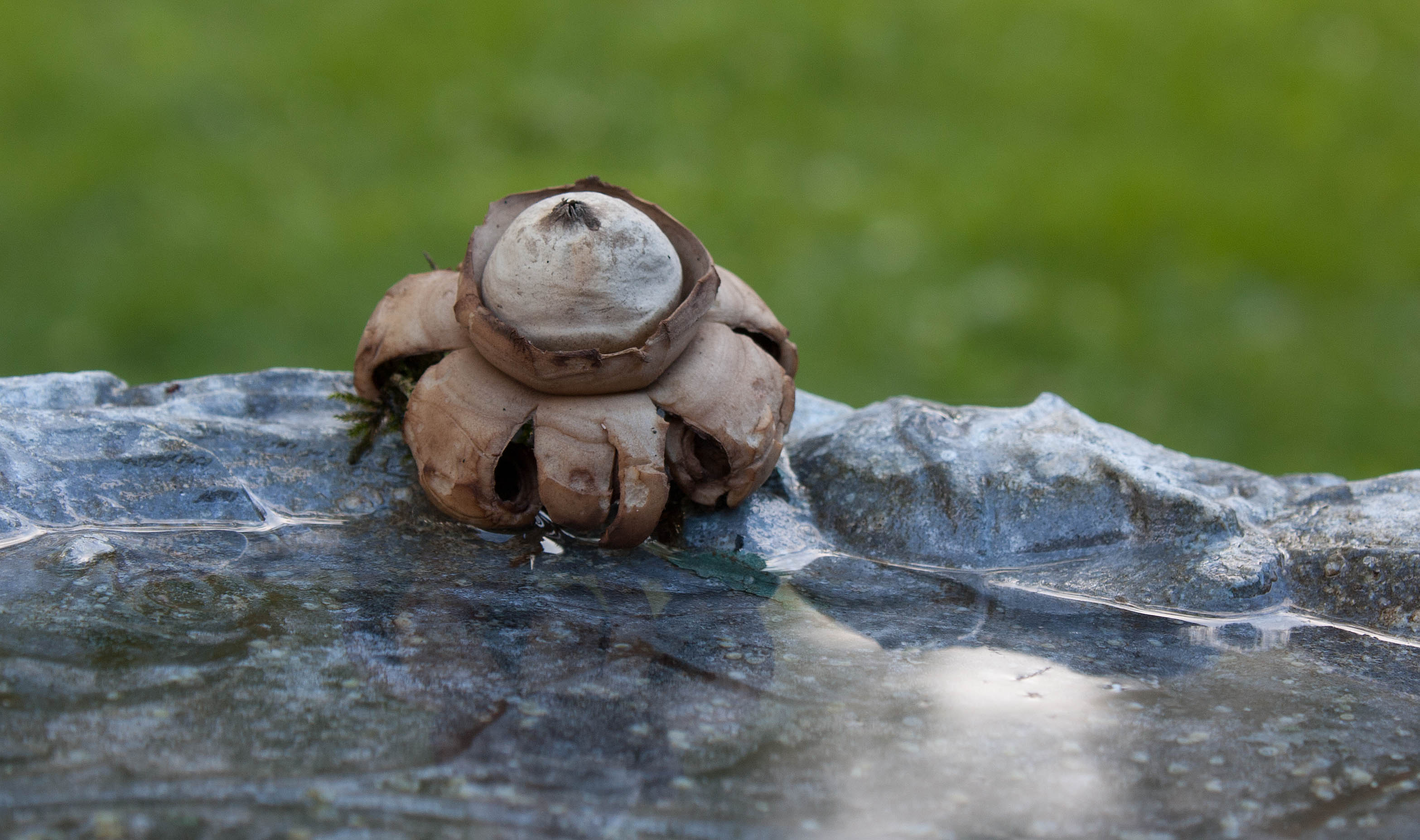
Earthstar dipping her feet into the water of the bird bath (photo by Nina Munteanu)

Thinking to get her to safety, the lady placed Earthstar on the edge of the birdbath where Earthstar dipped her tired feet. Within moments a mischievous wind pushed Earthstar into the water! Luckily, Earthstar floated. She was accustomed to deluges of water that filled her ‘collar’ and raised her spore sac to better deliver her spores. Water was an earthstar’s friend; earthstars counted on the beating drops of rain to help release their spores. After the initial shock, Earthstar rather enjoyed the swim.

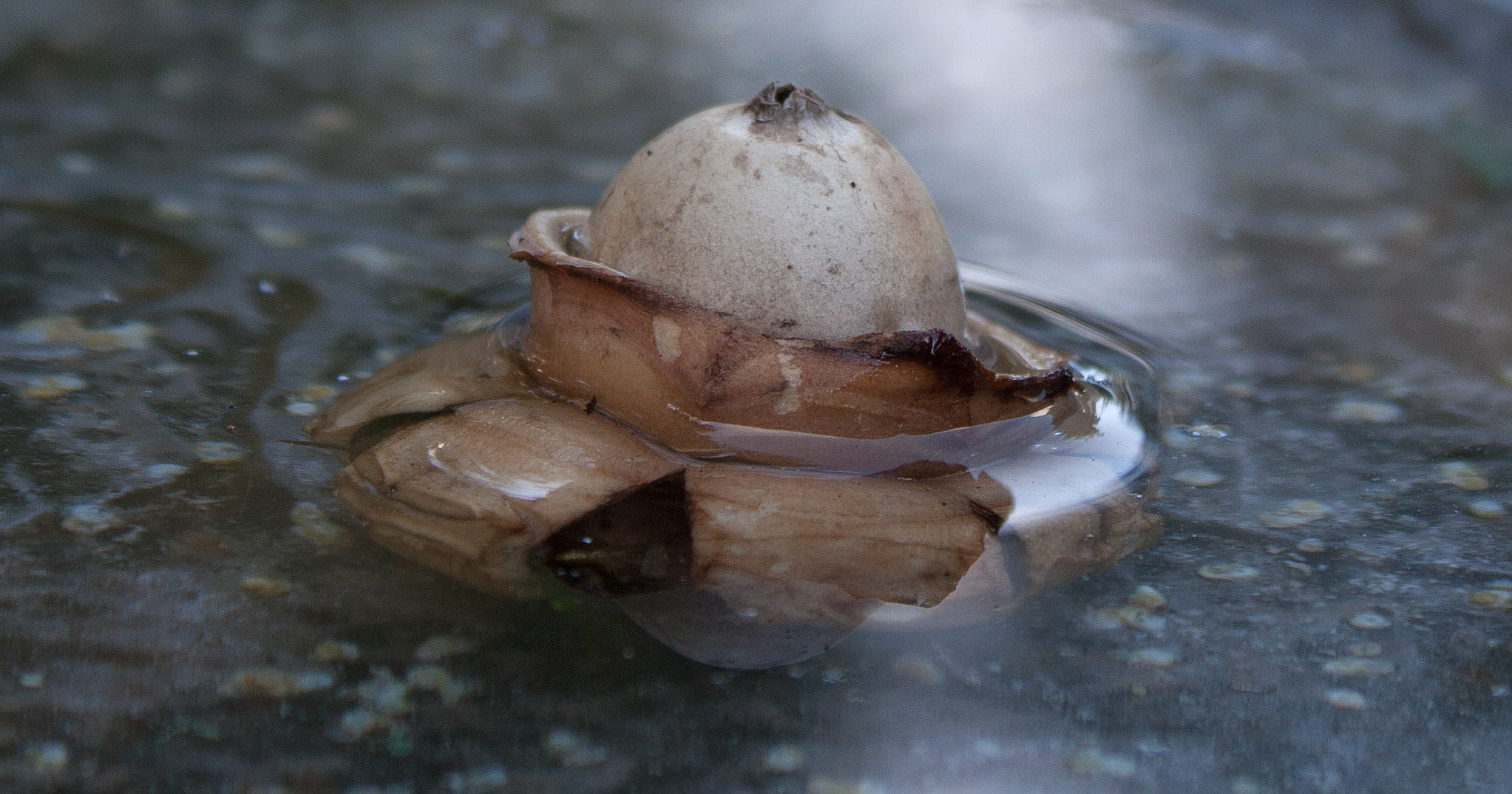
Earthstar swims happily in the birdbath (photo by Nina Munteanu)

The lady thought she ought to rescue Earthstar again and put her back down on the patio. Then the whistle of the kettle inside drew the lady away to the house. In that short time, a clever black squirrel, who had been spying from the silver maple tree nearby, leaped forward and seized her!

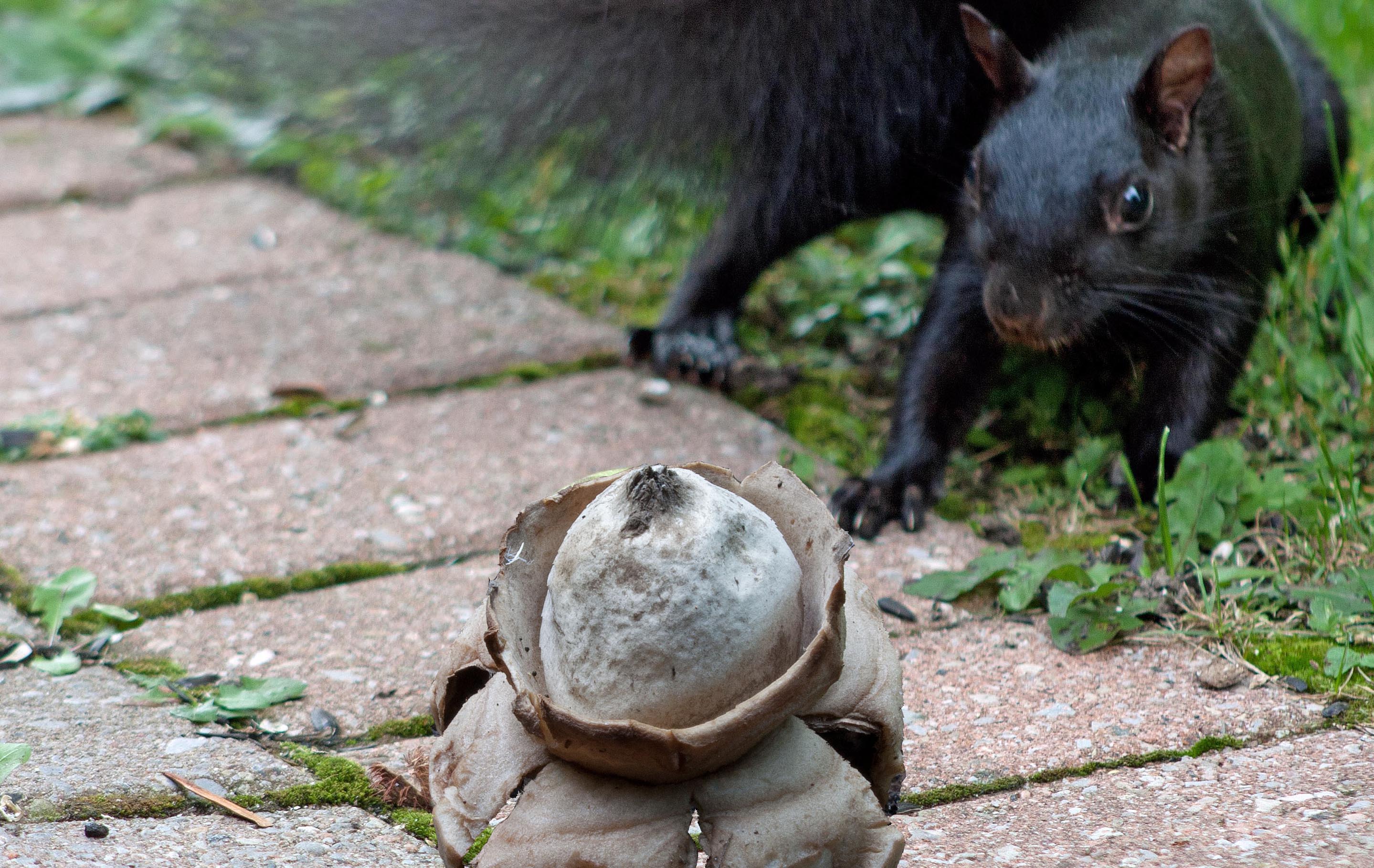
Earthstar about to be snatched by the black squirrel (photo by Nina Munteanu)

“Mine!” he shouted to himself and bounded away with her clutched in his mouth. After waiting for an oncoming bicycle, he raced across the trail–just inches in front of the zooming bicycle (squirrels are daredevils at heart)–and entered the little wood by the river.

Earthstar screamed. But no one heard her, because it was a silent scream.  

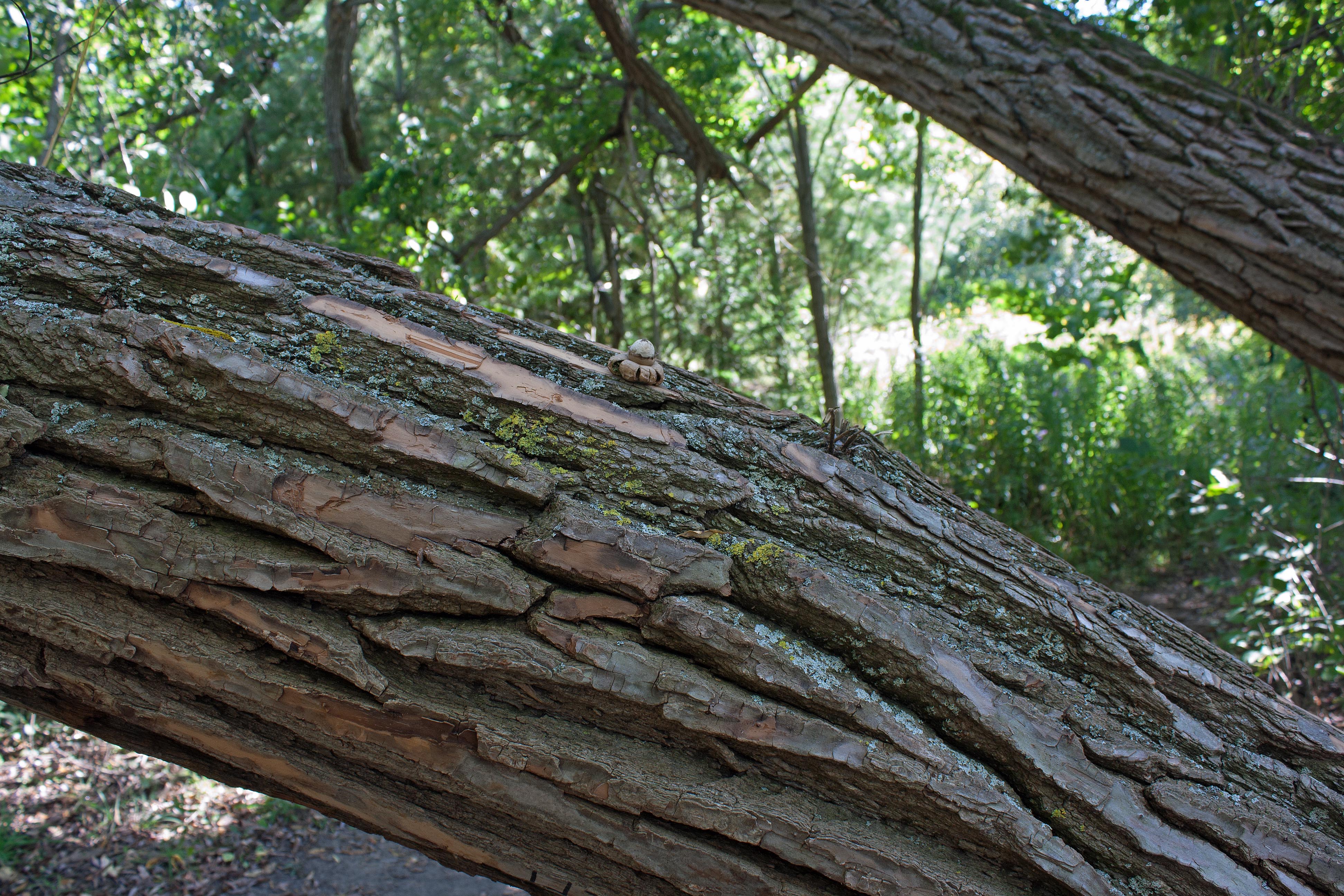
The black squirrel took his prize to a huge old willow tree by the river. The tree bowed over a small path as if reaching down to say hello. The squirrel left Earthstar on the bowing tree to dry like he would any mushroom for later caching. Then he scurried away to look for more food.  What this city squirrel didn’t know was that—unlike most other mushrooms—earthstars can move!

Old willow of the riparian forest by the Otonabee River, ON (photo by Nina Munteanu)

Earthstar let the wind blow her off the branch to the ground where she used her six arms to carry her back to the trail and back to the lady’s place.
“Where have you been?” asked the lady when Earthstar got there. Her eyes seemed to wink. “I suspect you were on a small adventure with squirrels.”

Driving Earthstar home to the forest (photo by Nina Munteanu)

They continued their tea and when it was finished, the lady took Earthstar in her car and drove Earthstar home to the forest. Earthstar didn’t wonder how the lady knew where Earthstar’s home was; there is only one place where earthstars grew in the region. And no doubt the lady—being a true lady—knew where that was and respected the earthstars place in the world.

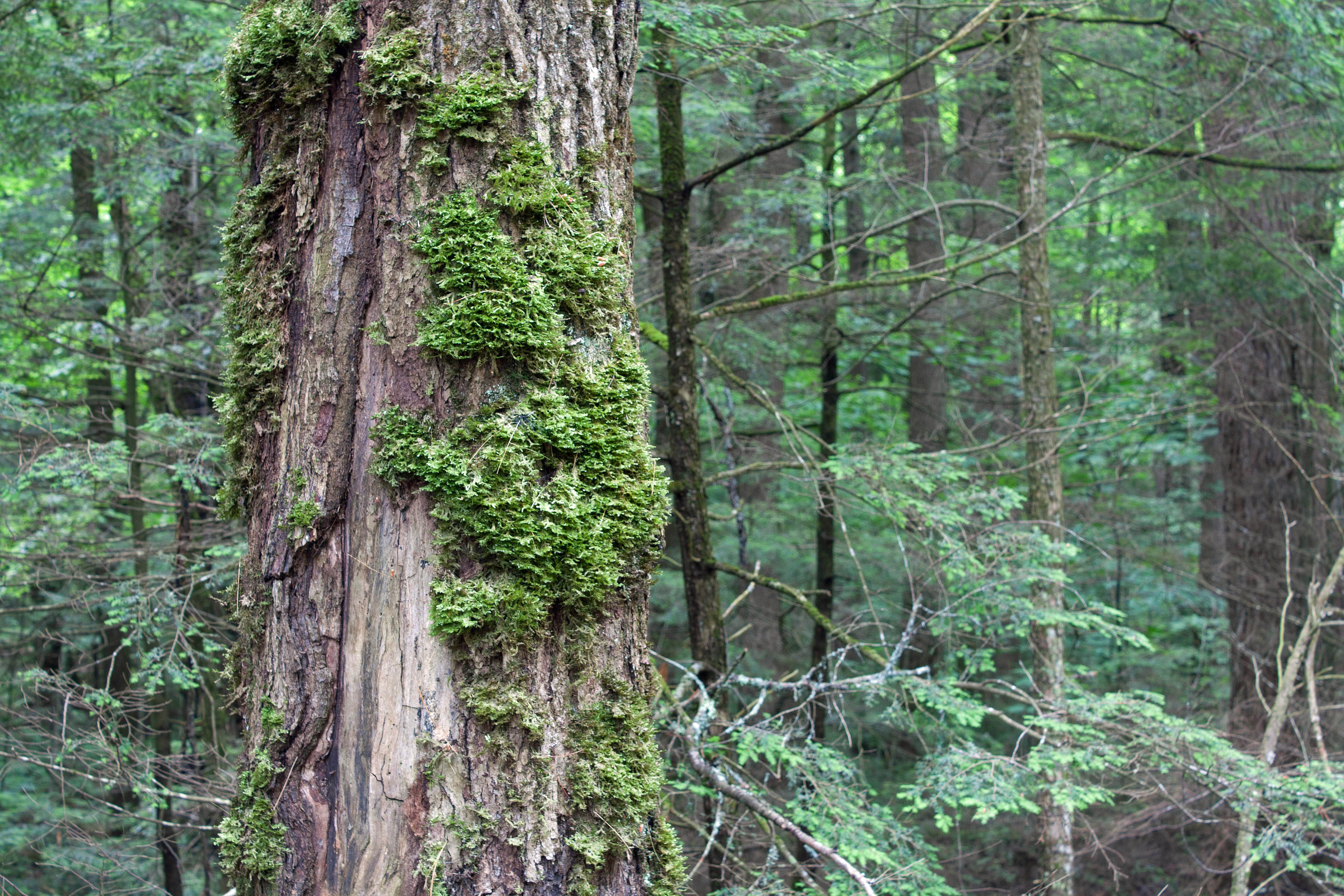
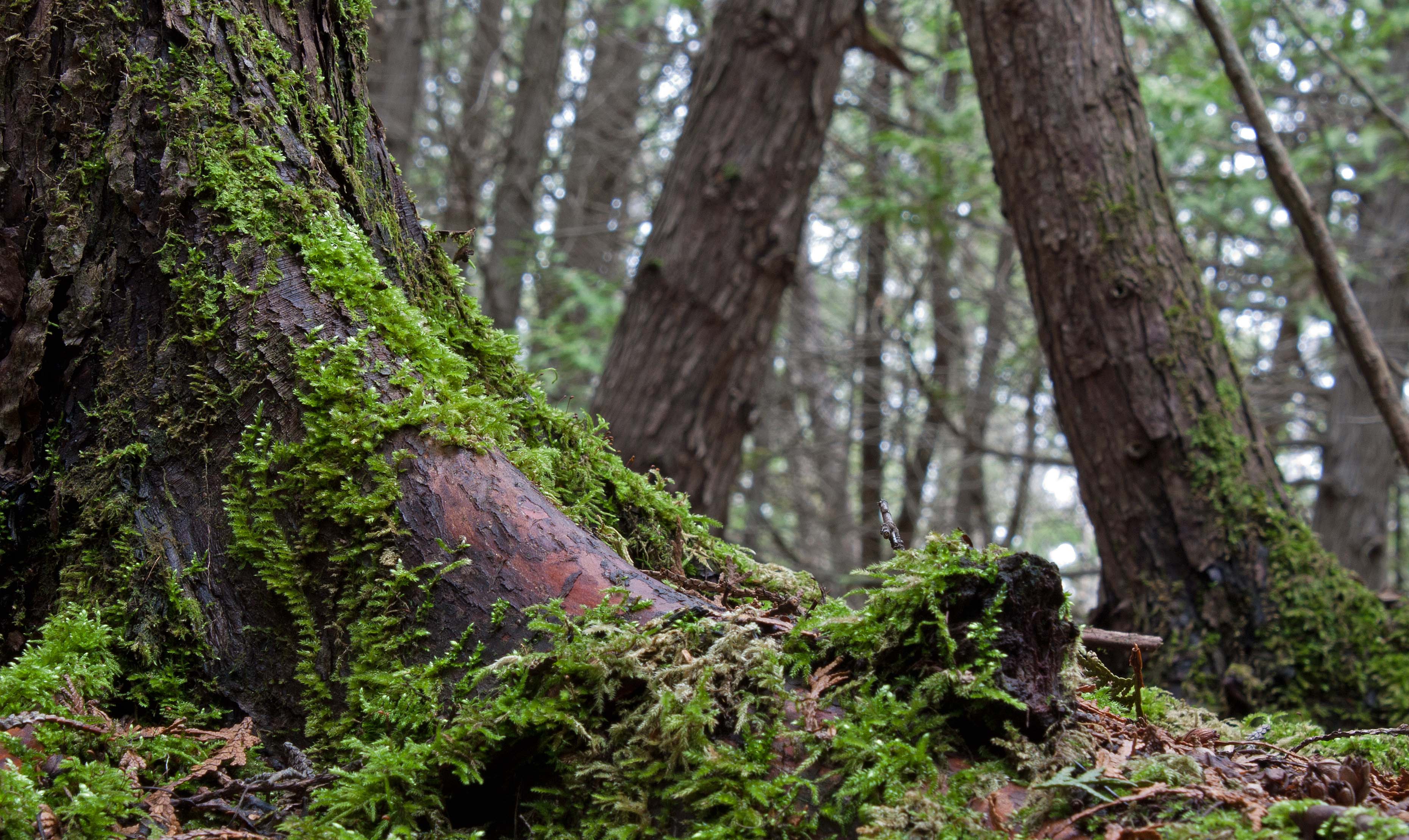
Cedar trees covered in moss, growing on ancient rotting cedar logs of the cedar swamp forest, ON (photo by Nina Munteanu)
Fern-like moss grows on cedar roots that dig into old decaying cedar logs of the forest, ON (photo by Nina Munteanu)

When they reached the deep forest where the tall cedars covered the sky with green and the air stirred with the breaths of cedar and birch, Earthstar felt the exhilaration of coming home. She did not need to rely on the vagaries of a capricious wind to deliver her safely home; the kind hand of the lady set her down on the soft downy surface of woody loam. The lady set Earthstar right beside her sisters, her tiny moss companion still with her, tucked under her arm.

Gently placing Earthstar back home by several earthstar buds in moss of decaying cedars, cedar forest, ON (photo by Nina Munteanu)

The forest was her home. It nourished her. It was where her family was. Earthstar was content.
And this time she really was…

~~The End~~

Moss-covered red bark of cedar tree in the cedar swamp forest, ON (photo by Nina Munteanu)
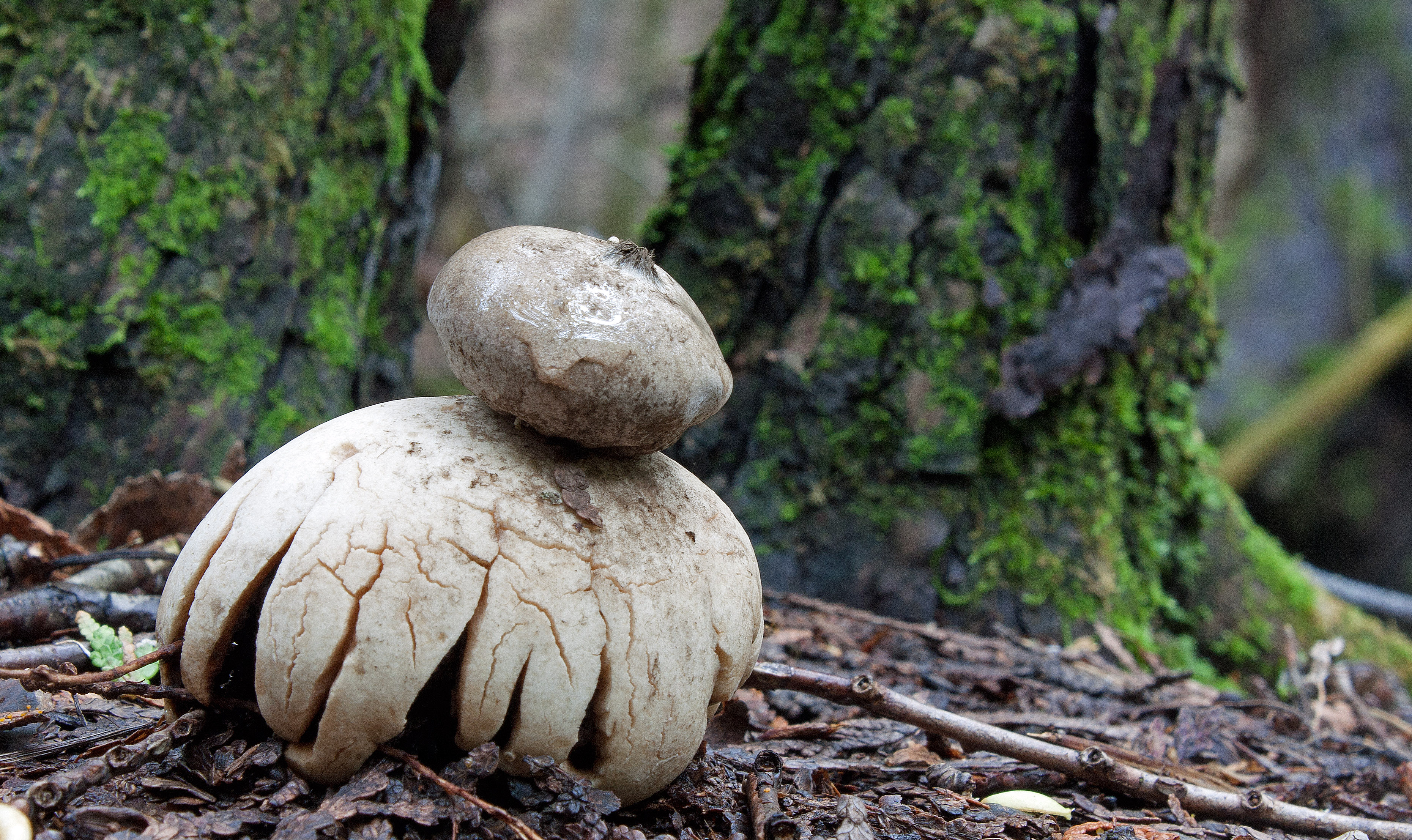
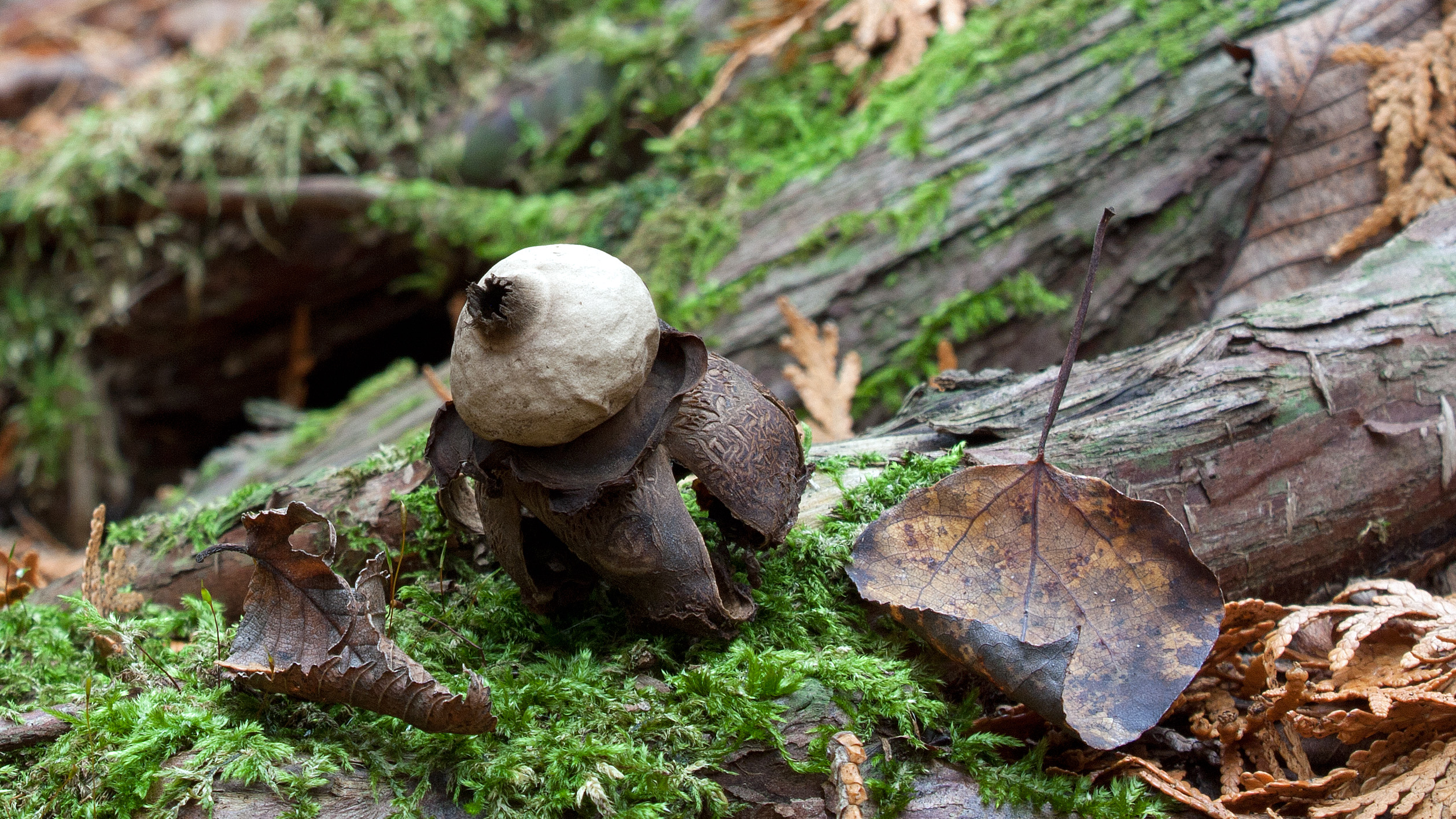
Earthstar, now matured; notice the fetching collar and splendid reticulated outer robes (photo by Nina Munteanu)

The Trent Nature Sanctuary

Located in the southeast corner of Symons Campus of Trent University, the Wildlife Sanctuary Nature Area includes many types of ecosystems and a network of trails. Wetlands of the area are deemed Provincially Significant by the Ontario Ministry of Natural Resources and Forestry. The cedar/maple swamps of the sanctuary support a rich diversity of fungi and lichen amid a rich ecosystem of plants and animals of the forest. It is within this area that I keep discovering interesting life each time I visit. Virtually all the images of the forest and fungi in this article come from this sanctuary, including the Collared Earthstar.

Mossy cedars in the cedar swamp forest of the Trent Nature Sanctuary, ON (photo by Nina Munteanu)

Information on the Collared Earthstar (Geastrum triplex)

Eight stages of the Collared Earthstar life cycle, Trent Nature Sanctuary, ON: 1) buds emerge in late summer; 2) the outer layer begins to crack in early fall; 3) the bud cracks open; 4) then spreads open; 5) forming a ‘flower’; 6) the outer layer cracks; 7) to form the ‘collar’ by early fall; 8) the outer layer shrivels by early winter and the earhstar persists in this form to the next spring (photo by Nina Munteanu)

Collared Earthstar Life Cycle

The Collared Earthstar (Geastrum triplex) is a Gasteromycete or stomach fungus, since it produces and releases its spores inside a saclike structure. The earthstar spends most of the year as a network of fungal cells (mycelia) that penetrate the soil and digest decaying organic material. When they are ready to reproduce, the mycelium develops the “earthstar” above ground. New earthstars emerge as ‘buds’ and develop in late summer and autumn through into winter. The matured fruiting bodies will survive the winter to be discovered the following spring by curious explorers like me. 

Spore sacs of Collared Earthstar in the frosts of winter (photo by Nina Munteanu)

Geo means earth and astrum means star. The species name triplex, which means ‘having three layers,’ refers to the way the ‘star’ arms of the outer layer crack when they peel back, making it look like the spore-sac is sitting on a dish. The three layers allow the earthstar to do something no other fungus can do: move. When it rains, the two outer layers of the peridium split and peel back, forming a ‘star’ with 4-12 rays. The rays spread with enough force to push aside leaves, raising the spore-filled sac above the surrounding debris. The rays often lift the earthstar high enough to break the connection to the parent mycelium, releasing the earthstar from its sedentary position. Detached, the earthstar can move with wind or rain to better spread its spores.

Finger poking the spore sac helps release the spores (photo by Nina Munteanu)

Fruiting bodies are large, 5-10 cm in diameter. Spores escape from the apical pointed hole (peristome) as breezes blow across it. Much larger puffs are released when raindrops hit and compress the spore-sac—or an interfering finger depresses the sac. What escapes is a powdery gleba (which distributes the tiny spores). The sides of the peristome ‘beak’ are fibrous and appear slightly ragged.

Several stages of the Collared Earthstar in late summer, from buds to opening ‘flower’
Early budding stage of Collared Earthstar in late summer (photo by Nina Munteanu)

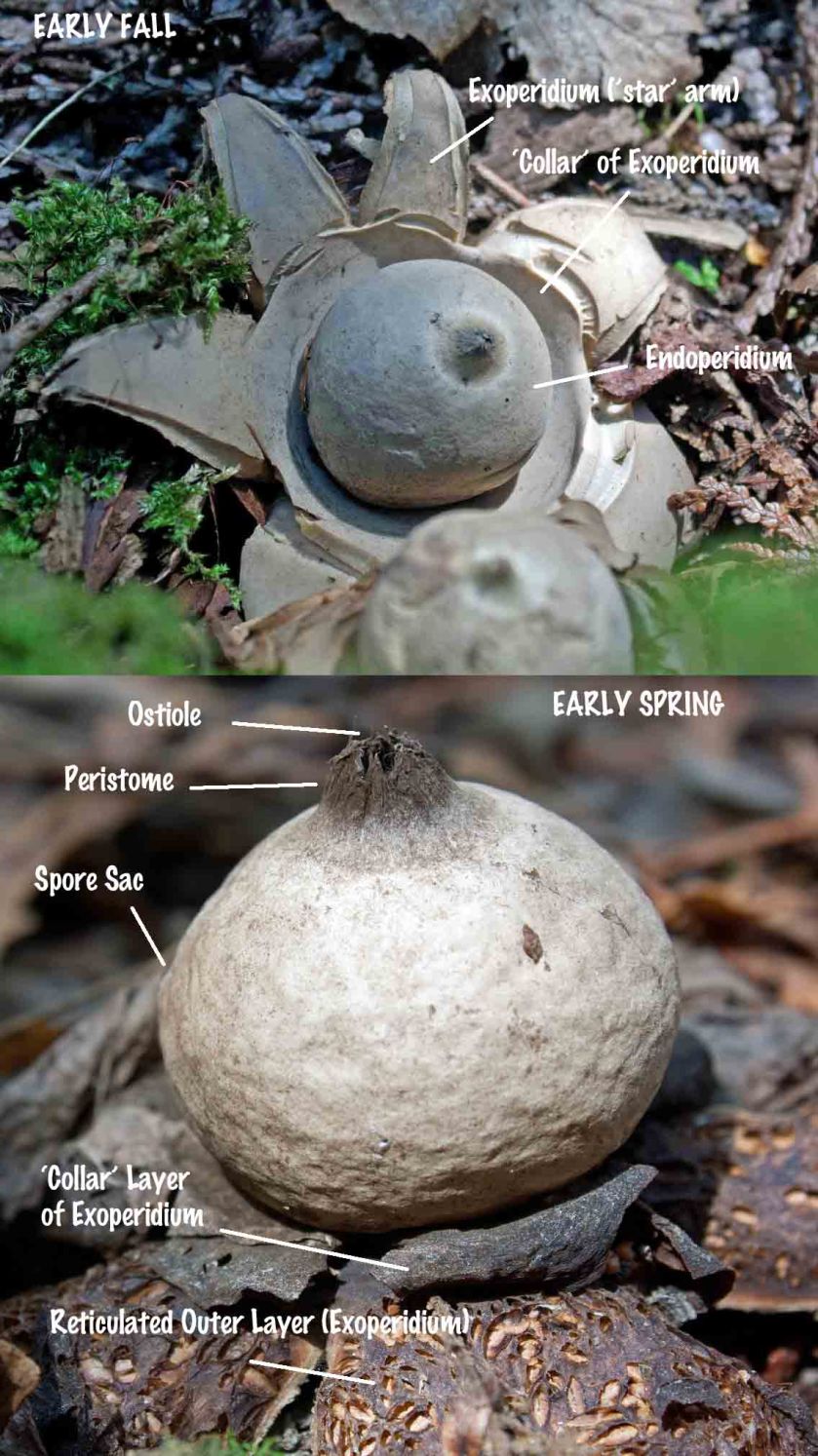
After a late summer / autumn rain, the collared earthstar emerges from the leaf litter looking like a Hershey’s kiss or a fancy bulb-shaped truffle dusted in fine cocoa. Only the outer layer (exoperidium) is visible, peeking out of the litter and loam. The outer layer eventually cracks open, looking like a coconut husk and splits into five to seven ‘arms’ to form a star. Inside is revealed a tan to grey-coloured spore-sac (endoperidium) with a fringed beak (peristome) and its opening (ostiole). The endoperidium, or spore sac, is more like an elastic membrane resembling rubber that holds the gleba (spore-bearing mass). The star arms peel back and down, eventually cracking to form the ‘saucer’ which the round fruiting body (spore sac) sits on. The spore sac contains a mass of spores and fertile mycelial tissue, called the gleba that is white, fibrous and firm when young, but turns brown and powdery as it ages. A network of cells (capillatum) help spores move to the pore when a raindrop strikes the endoperidium. The columella, a bulbous sterile base at the centre of the spore-producing gleba forms ‘columns’ that radiate out to help spore dispersal.

Over time, the outer layer of ‘stars’ (exoperidium) form a reticulated pattern of cracks and fissures that deepen into golden-brown colours as they decompose and curl downward to lift the spore-sac farther up. The sac also grows more pale and papery. 

Parts of a Collared Earthstar from first ‘bloom’ in early fall to matured stage the next spring (photos by Nina Munteanu)
Just opened Collared Earthstar in late summer, not yet showing the ‘collar’ formed by cracking of exoperidium (photo by Nina Munteanu)
Good example of a more mature opened Collared Earthstar in early fall, showing the ‘collar’ formed by separation of exoperidium and extended curled back ‘arms’ (photo by Nina Munteanu)
Mature Collared Earthstar the following spring, showing papery spore sac sitting on disintegrating ‘collar’ and reticulated outer exoperidium (photo by Nina Munteanu)

However, in the rain, the sac reverts to a rubbery consistency and deepens to a dark shiny tan colour. I was surprised by its elasticity; this time when I poked it, the sac sprang back to its round sphere like a thick balloon. 

Mature Collared Earthstar; left in rain, right in dry weather (photos by Nina Munteanu)

Collared Earthstar Habitat

I also learned that the collared earthstar prefers a habitat of leaf litter in deciduous woods, especially beech on chalky soils. However, researchers acknowledge that the collared earthstar is also found under coniferous trees, especially on sloping ground—which better describes where I found them, in this cedar-birch forest of the Kawarthas. Geastrum triplex is a saprophytic organism: it gets its nutrients from decomposing organic matter—such as well-rotted cedar trees, where humus has accumulated—by further breaking down the organic matter then, in turn, returns those nutrients to the soil to complete the cycle. It does this by releasing enzymes to break down and digest the lignin, cellulose or chitin in these materials, converting them to soluble compounds that can be absorbed by them, and by plants, as nutrients. Earthstars, like all fungi, play a vital role in reducing the accumulation of dead organic material and in recycling essential nutrients, particularly carbon and nitrogen. If not for fungi, forests would choke under a mountain of logs and leaves.

Mature earthstar, with prominent collar, in the moss-covered loam of a rotting cedar, ON (photo by Nina Munteanu)

References:

Ellis JB, Ellis MB. 1990. “Fungi without Gills (Hymenomycetes and Gasteromycetes): an Identification Handbook. ”Chapman and Hall. London. ISBN 0-412-36970-2.

First Nature. “Geastrum triplexJungh.—Collared Earthstar” Online: https://www.first-nature.com/fungi/geastrum-triplex.php

Kirk, Paul M., Paul F. Cannon, David W. Minter and J. A. Stalpers. 2008. “Dictionary of the Fungi.” CABI, 2008

Kuo M. 2008. Geastrum triplexMushroomExpert.Com

Roel, Thomas. 2017. “#044: Mushroom Morphology: Earthstars.” Fungus Fact Friday.

Roody WC. 2003. “Mushrooms of West Virginia and the Central Appalachians.” University Press of Kentucky, Lexington, KY. p. 443. ISBN 0-8131-9039-8.

Torpoco V, Garbarino JA (1998). “Studies on Chilean fungi. I. Metabolites from Geastrum triplex Jungh”. Boletin de la Sociedad Chilena de Quimica43 (2): 227–29.

Woodland Trust. “Collared Earthstar.” Online: https://www.woodlandtrust.org.uk/trees-woods-and-wildlife/fungi-and-lichens/collared-earthstar/

Pegler, D.N., Laessoe, T. & Spooner, B.M. 1995. “British Puffballs, Earthstars and Stinkhorns.”Royal Botanic Gardens, Kew. 

Utah State University. “Earthstars.” Online: https://www.usu.edu/herbarium/education/fun-facts-about-fungi/earth-stars

Mature collared earthstar in early winter, ON (photo by Nina Munteanu)

Nina Munteanu is a Canadian ecologist / limnologist and novelist. She is co-editor of Europa SF and currently teaches writing courses at George Brown College and the University of Toronto. Visit www.ninamunteanu.ca for the latest on her books. Nina’s bilingual “La natura dell’acqua / The Way of Water” was published by Mincione Edizioni in Rome. Her non-fiction book “Water Is…” by Pixl Press(Vancouver) was selected by Margaret Atwood in the New York Times‘Year in Reading’ and was chosen as the 2017 Summer Read by Water Canada. Her novel “A Diary in the Age of Water” was released by Inanna Publications (Toronto) in June 2020.

Integrate Place in Fiction To Deepen Meaning

This past August, I participated in the When Words Collide Online 2022 Writing Festival.  one of Canada’s prime writing festivals in Calgary, Alberta. I was a featured writer, sitting on several panels and conducting presentations and lectures.
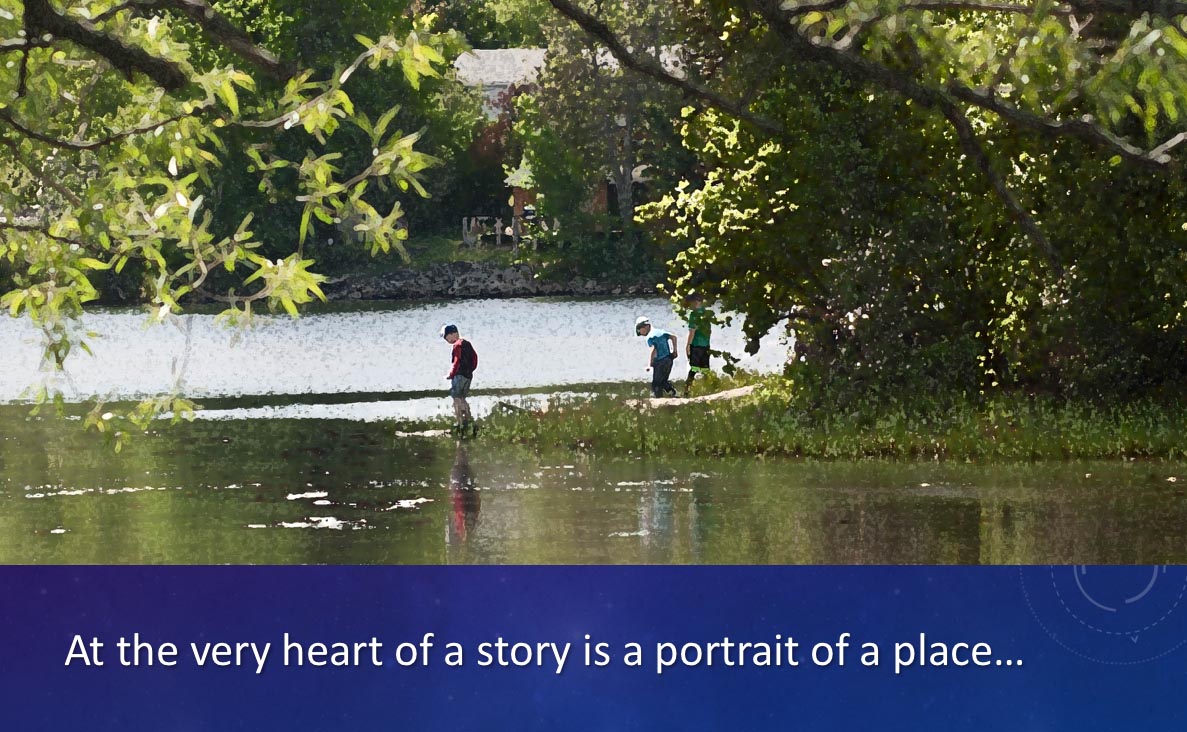
My presentation on the role of place in story kicked off the festival.

The role of place in story is a topic close to my heart and one I wrote an entire writing guidebook on: The Ecology of Story: World as Character. In my coaching sessions with writers and in my writing courses at George Brown College and the University of Toronto, I’d observed in the novice writer a need for more effective integration of setting and place in story. All too often, the lack of meaningful integration translated into a lost opportunity to explore the POV character and the story’s theme.

The lack of meaningful use of place in story can result in a lacklustre story, overly vague characterizations and a story that lacks metaphoric depth and relevance.

Nina Munteanu

The presentation and following discussion drew from my guidebook Ecology of Story and was also featured in the WWC recorded panel called “What is Eco-Fiction and Why Should We Care?” The presentation overviewed topics covered in the book, such as:

  • Place as character & archetype
  • Place as metaphor (personification, symbols, allegory)
  • Place and first impressions (openings)
  • Place and emotion (over time and by POV)
  • Place through the senses
  • Place as environmental force (including climate change)

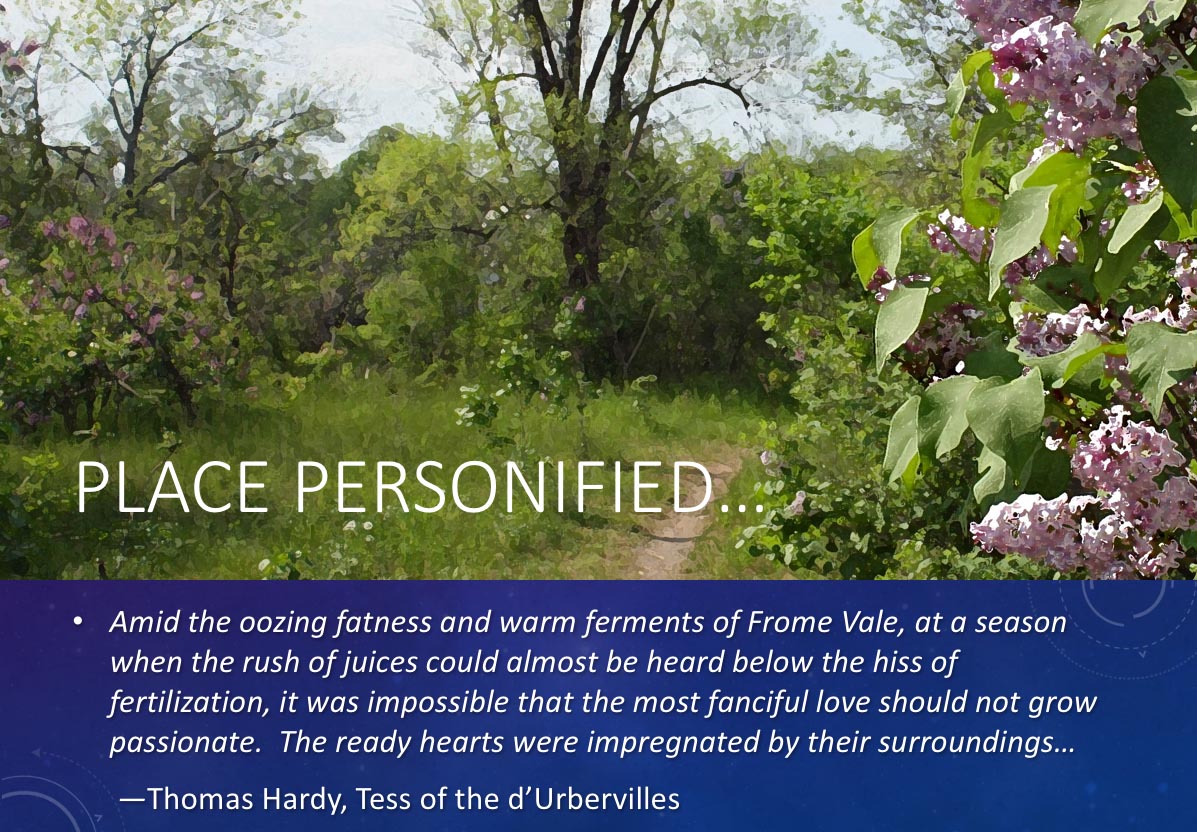
We also discussed how characters connect with their environment and I introduced the metaphoric connection between the white pine forests and the Mi’kmaq in Annie Proulx’s Barkskins. Both are exploited by the white settlers, with intentions to subdue and controll:

The Gatineau forest was noisy, echoing with ax blows and the rushing crackle of falling timber, with shouted warnings and orders. The axmen cut the great pines, but only a few in each plot were suitable for squaring. The rest were left to rot on the ground … unwanted trees lay prostrate, severed branches everywhere, heaps of bark and mountains of chips … There were so many trees, what did it matter? Maine men were used to waste—it was usual—but this was beyond anything even they had seen. 

In the Penobscot settlement, the trees fell, tracks inched through the forests, only one or two then seven, then webs of trails that over the decades widened into roads. The roads were muddy, sometimes like batter, sometimes thick and clutching until late summer; when they metamorphosed into choking dust so fine it hung in the air long after a horse and carriage passed, settling on the grass as the English people settled on the land … Fields of wheat and hay took the land, these fields enclosed by linked stumps, the root wads of the forest that had once stood there turned on their edges to bar the white man’s cows and sheep. 

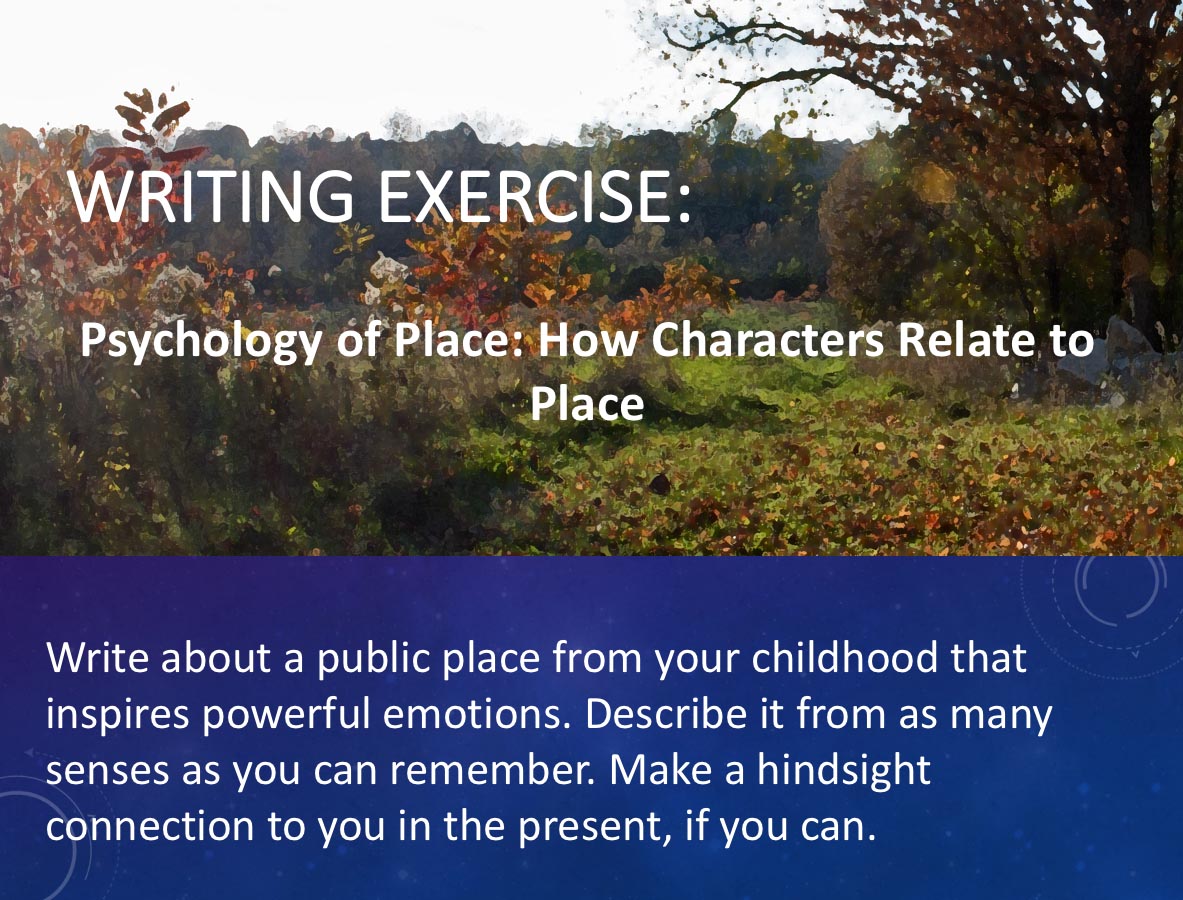
I concluded the presentation with a writing exercise asking participants to write about the psychology of a place and how they related to it.

Writers attending the presentation / workshop eagerly participated and produced some evocative narrative that contained good metaphor and sensual writing. Here are a few:

Freyja on their high school gym: “I remember rallies and lectures and sweating, running in circles for an hour and a half. The gym stayed the same but the population of people got smaller and smaller over the years. One year a kid hit his head on the wall and went into a coma. Longest seven seconds in my life.”

Roma: “As soon as I get a whiff of old pages in a book, I am reminded of Uncle Leo. The coffee coloured leather jacket he always wore had seen better days and like him, still retained most of its luster. He was the youngest of my dad’s nine siblings, born during a storm and considered a tempestuous child. Our family just didn’t understand his passion.”

Angela: “I stood on the bridge in Moscow. My mother was talking with a friend. She couldn’t believe how lucky we were to be posted here. I looked down at the river. And at the bridge. It would be so easy to just jump over the fence and land in the water. It was a sunny day. The heat was oppressive. I wanted to do it. But I stood still.”

Kylie: “The stuffy air was full of the smell of bodies and heat. The din of laughing and talking, and yelling surrounded me.”

To find out more on how place can add depth and meaning to your writing, see my third writing guide, The Ecology of Story: Place as Character.

The Ecology of Story: World as Character is presented in two parts: Part 1 provides a comprehensive summary of the science of ecology, the study of relationships, and links to useful metaphor; Part 2 discusses world and place in story. Here I discuss how the great writers have successfully integrated place with theme, character and plot to create a multi-layered story with depth and meaning. Part 2 also contains several exercises and detailed case studies.

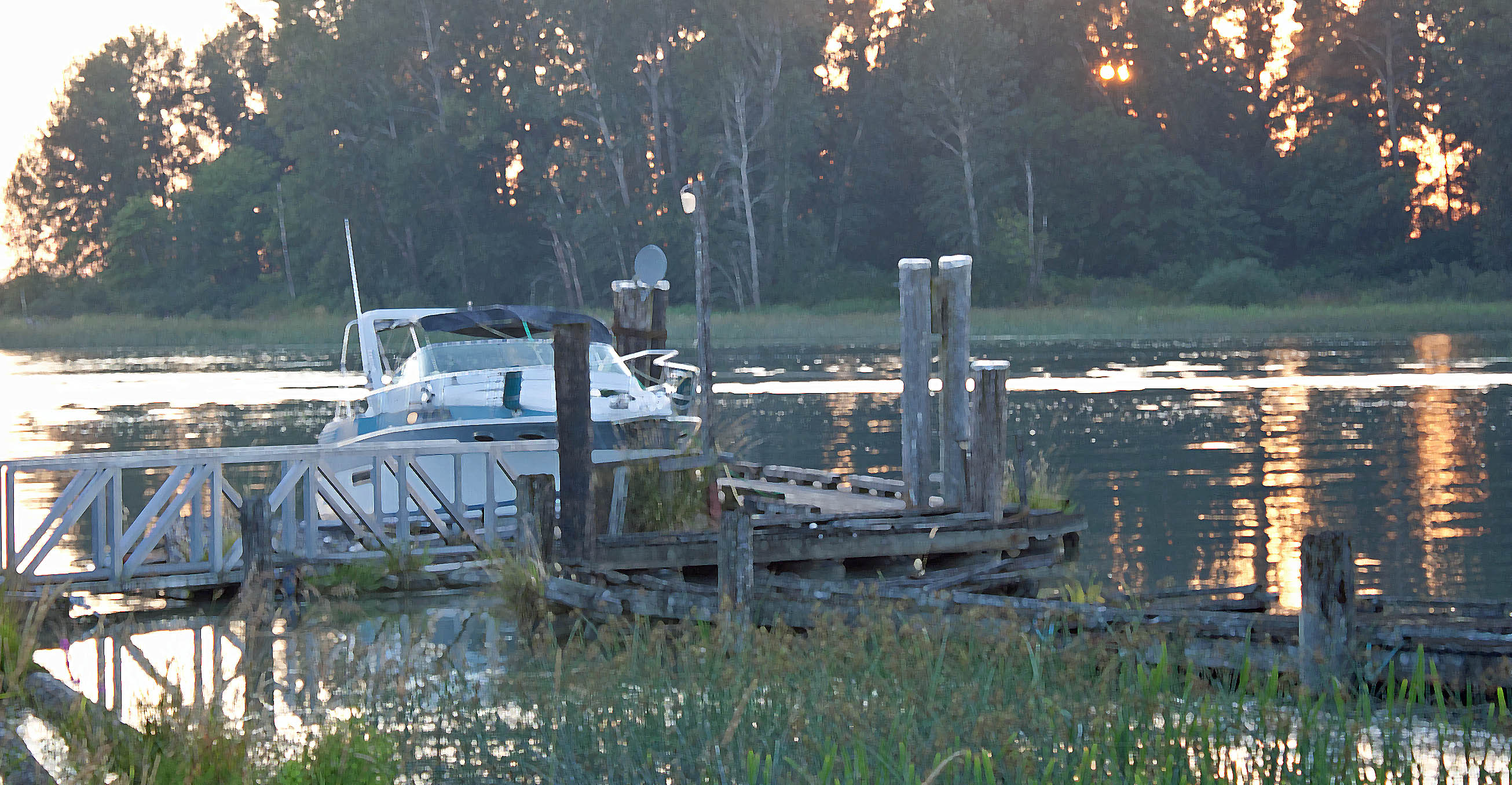
Boat dock at sunset, Ladner Slough of Fraser River, BC (photo and rendition by Nina Munteanu)

NINA MUNTEANU is a Canadian ecologist / limnologist and novelist. She is co-editor of Europa SF and currently teaches writing courses at George Brown College and the University of Toronto. Visit  www.ninamunteanu.ca for the latest on her books. Nina’s bilingual “La natura dell’acqua / The Way of Water” was published by Mincione Edizioni in Rome. Her non-fiction book “Water Is…” by Pixl Press(Vancouver) was selected by Margaret Atwood in the New York Times ‘Year in Reading’ and was chosen as the 2017 Summer Read by Water Canada. Her novel “A Diary in the Age of Water” was released by Inanna Publications (Toronto) in June 2020.

The Verge–When the Water Sprites Dance…

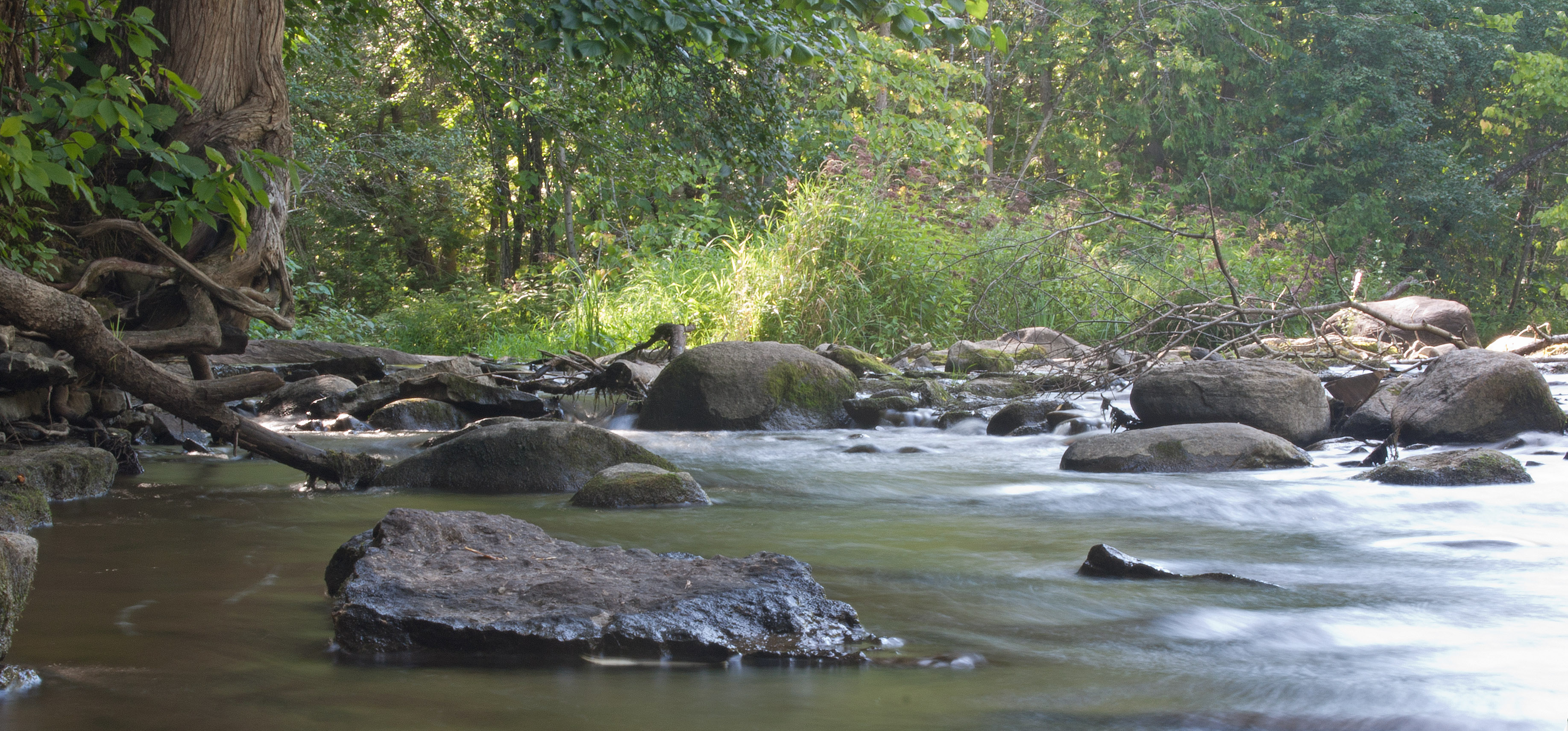
Jackson Creek just before sunset, ON (photo by Nina Munteanu)


It was early evening in late summer, when the sunlight was gentle and rich with the promise of golden light. I was walking in one of my favourite forests—the pine-cedar woodland that smelled of needles, bark and loam. This was Jackson Creek forest. Where some time ago I’d glimpsed a blue forest sprite

The water in the creek was low, in places exposing its bones—boulders and cobbles that emerged out of the stream into the dry light. I walked along the creek bank, beside tranquil glades and chortling riffles. The creek trickled with the most delicious sounds, like chatty water sprites having tea, watercress sandwiches and fresh scones with jam …

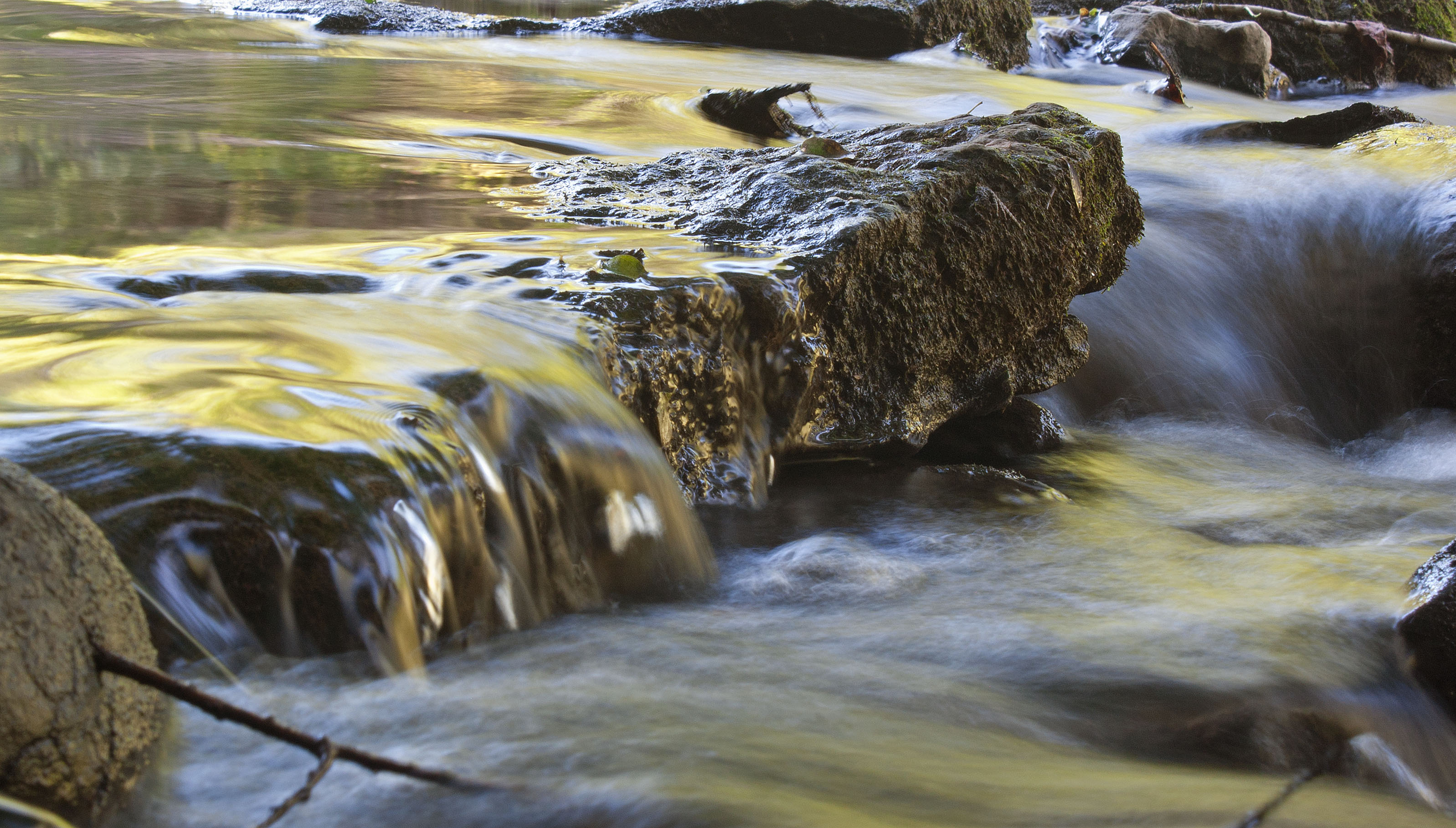
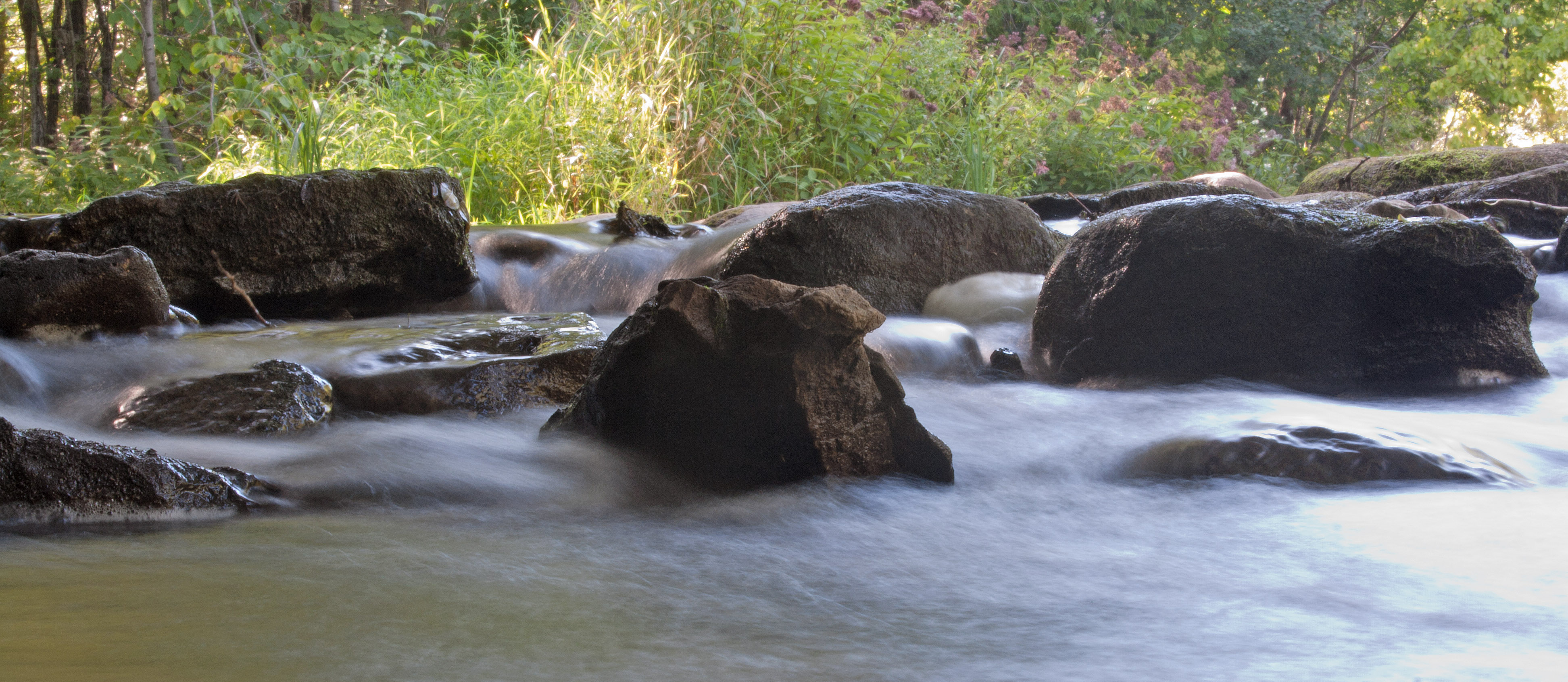
Sunlit water cascades over rocks of Jackson Creek, ON (photo by Nina Munteanu)

I set up my camera on the rocks to capture the silky green and gold reflections of the overhanging trees in the water. Oak, beech, and ironwood along with shrubs and grasses crowded the banks of the creek in a parade of leaves and flowers. Long arms of the cedar tree bent low over the creek as if reaching out to touch water’s skin.

Cedar tree overhangs Jackson Creek, ON (photo by Nina Munteanu)

In the gladed pools, the water swirled as if in slow motion in a fluid mosaic that mirrored the riparian forest. Each tree gave the water its unique shade in a diurnal dance that heralded the coming dusk and nightfall.

I walked the ythlaf, that remnant stretch of half-dried river bed, revealed by ebbing water. A place in-between land and water. I teetered on rocks and cobbles covered in dried periphyton, and angled the camera for long exposures up to f32. I crouched, squatted, crawled and kneeled on the cobbles, boulders and snags to position the camera just right. At times I danced to keep from falling in knee-deep water and laughed with thoughts of how the sprites were watching from below and taking bets on my possible spill into the water. I imagined their chortling giggles of anticipation.  

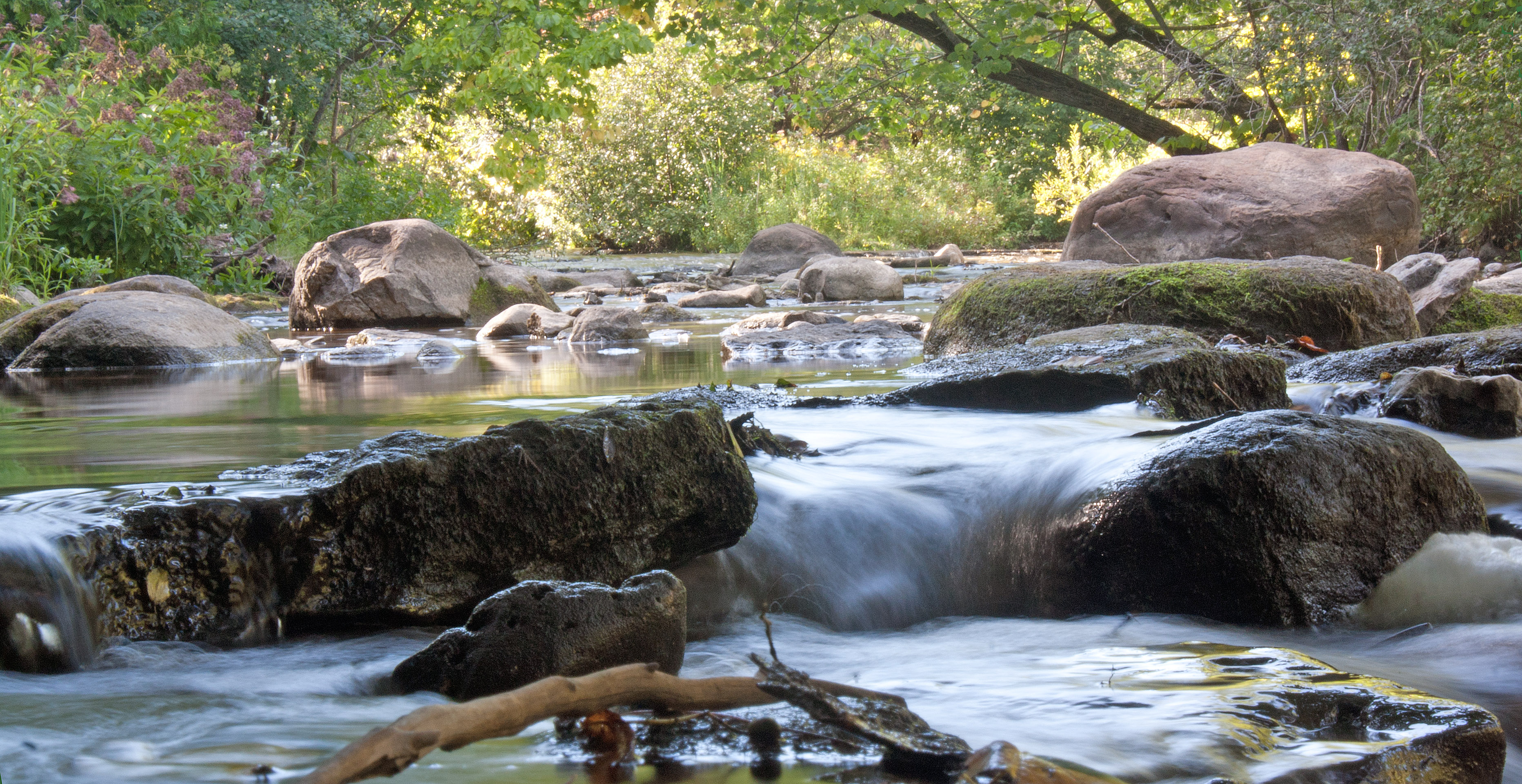
Water cascading over rocks in Jackson Creek, ON (photo by Nina Munteanu)

Then, with the patience of a heron, I captured the various faces of the creek during its golden hours. The water’s silken threads sparkled in the raking sunlight and hugged the rocks in swirling clouds.

Water swirls around rocks of Jackson Creek, ON (photo by Nina Munteanu)

We were nearing that in-between time, when all nature hushes for a life-breath as time descends for the briefest moment into a deep stillness. We lurked like thieves in that intermediate place of becoming, a diurnal ecotone poised on the threshold between night and day. The gloaming verge of a forest where dark and light danced with uncertain intent.

Glade of Jackson Creek, ON (photo by Nina Munteanu)

Immersed in the cheerful melody of the creek, I imagined the water sprites again, playing in the watercress forest, among the spinners, caddises and stonefly nymphs. I imagined them, plump gilled water-babies or slender creatures with winking faces, diaphanous wings sparkling in the slanting sunlight as they stirred up algae and organic detritus.

Were they dancing?

NINA MUNTEANU is a Canadian ecologist / limnologist and novelist. She is co-editor of Europa SF and currently teaches writing courses at George Brown College and the University of Toronto. Visit  www.ninamunteanu.ca for the latest on her books. Nina’s bilingual “La natura dell’acqua / The Way of Water” was published by Mincione Edizioni in Rome. Her non-fiction book “Water Is…” by Pixl Press(Vancouver) was selected by Margaret Atwood in the New York Times ‘Year in Reading’ and was chosen as the 2017 Summer Read by Water Canada. Her novel “A Diary in the Age of Water” was released by Inanna Publications (Toronto) in June 2020.

Climate Cultures Magazine Lists Nina Munteanu’s “A Diary in the Age of Water” Among Eight Eco-Fiction Novels to Read

Writer and curator Mary Woodbury shares eight novels about water where fact and fiction mingle, tried by imagination, to reveal important truths about our shifting relationships with this vital and lively agent in an era of climate crisis,” writes the magazine Climate Cultures.

In an article entitled, “Where Waters and Fictions Meet,” Mary Woodbury opens with this:

“While facts are something we can and should pay attention to as we follow scientific integrity, models, and reports, another mode of telling the story about water has been alive forever: churned, spoken, and written by authors who dream up fictional stories related to our past, present, and future world. Where fact and fiction mingle like this is an area of reflection and speculation, tied by imagination. These tales of water ripple out once the pebble sinks in. The intersectionality of diverse water fiction results in reader empathy, learning, inspiration, and shared commonalities around the world. Local dignity comes alive against a backdrop of planetary crises.”

She chooses the following eco-novels to discuss:

“Land-Water-Sky (Ndè-Ti-Yat’a)” by Katłıà
“Oil on Water” by Helon Habila
“A Diary in the Age of Water” by Nina Munteanu
“The Water Knife” by Paolo Bacigalupi
“Memory of Water” by Emmi Itäranta
“Fever Dream” by Samanta Schweblin
“Lagoon” by Nnedi Okorafor
“Bangkok Wakes to Rain” by Pitchaya Sudbanthad

Here’s what she writes about my novel:

Ancient Eastern Hemlock in Catchacoma old-growth forest, ON (photo by Nina Munteanu)

NINA MUNTEANU is a Canadian ecologist / limnologist and novelist. She is co-editor of Europa SF and currently teaches writing courses at George Brown College and the University of Toronto. Visit  www.ninamunteanu.ca for the latest on her books. Nina’s bilingual “La natura dell’acqua / The Way of Water” was published by Mincione Edizioni in Rome. Her non-fiction book “Water Is…” by Pixl Press(Vancouver) was selected by Margaret Atwood in the New York Times ‘Year in Reading’ and was chosen as the 2017 Summer Read by Water Canada. Her novel “A Diary in the Age of Water” was released by Inanna Publications (Toronto) in June 2020.

Nina Munteanu Interviewed on her latest short story “Robin’s Last Song”

Left: cover of Apex Magazine Issue #128 in which my story appears; Right: cover of 2021 anthology published in fall 2022.

I was recently interviewed by Alberta writer Simon Rose about my latest eco-fiction short story “Robin’s Last Song”, which was recently published by Apex Magazine in its 2021 Compilation Anthology. Below is the interview:

Simon: Congratulations on publishing your short story “Robin’s Last Song” in Issue 128 of Apex Magazine and soon in the Apex Magazine 2021 Compilation Anthology. I’m curious about the title? Whose last song is it? Is Robin the name of a human or the bird?

Nina: Both, actually. The title is both literal and metaphoric. The premise of the story is based on the alarming trend of disappearing birds. The robin, a common bird in Ontario where the story takes place, is a good sentinel for what is happening with bird populations around the world. Robin is also the protagonist’s name; she was named after the robin, her mother’s favourite bird.

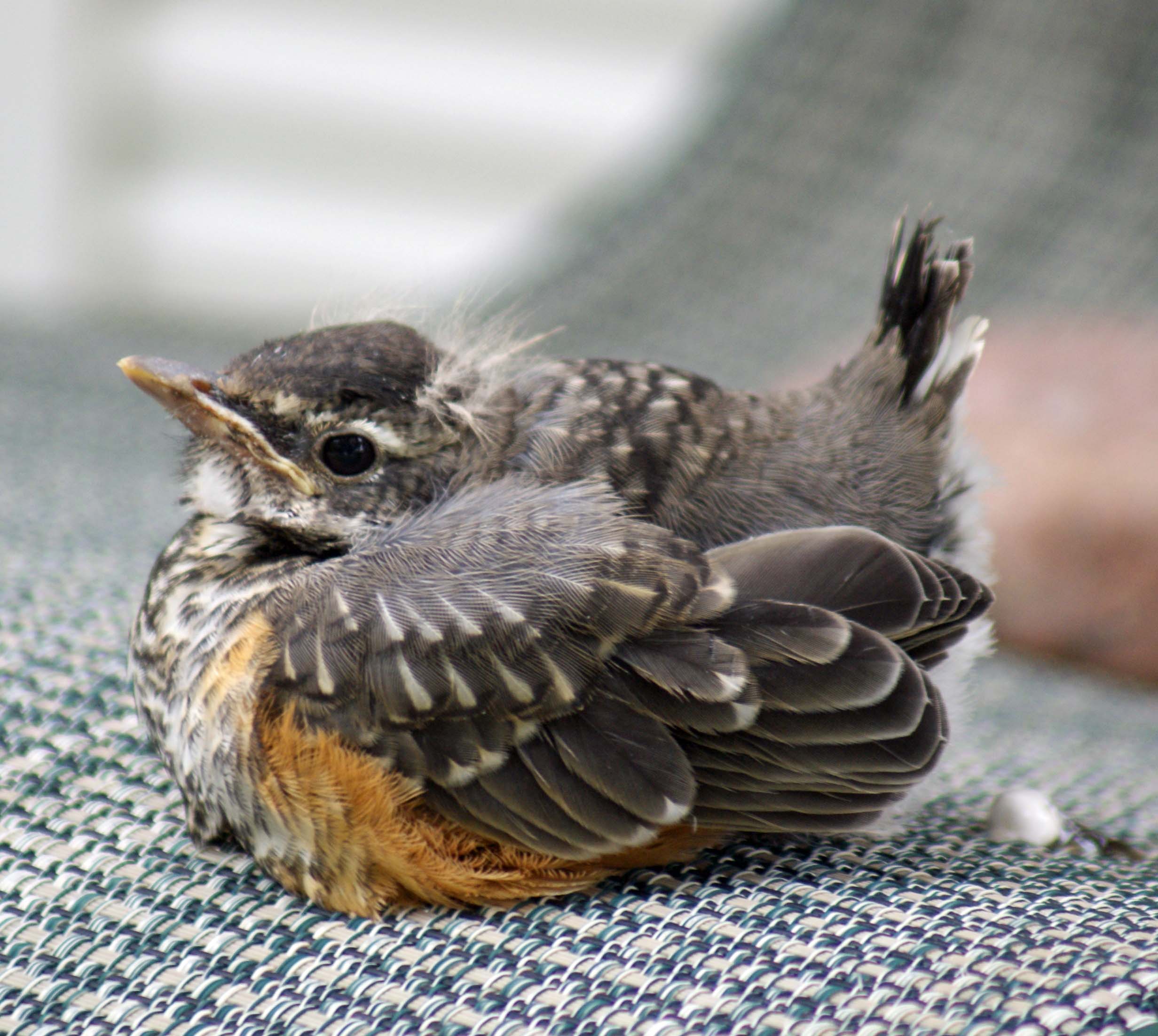
Recently fledged robin rests on patio chair, Mississauga, ON (photo by Merridy Cox)

Simon: Robin’s Last Song is obviously eco-fiction. What’s it about?

Nina: Robin’s Last Song first appeared in the #128 Issue of Apex Magazine in 2021. It tells the story of Robin, a blind elder whose digital app failed to warn the world of the sudden global loss of birds with disastrous ecological consequences. After years of living in self-exile and getting around poorly on sight-enhancing technology, a discovery gives her new hope in rekindling her talents in the field of Soundscape Ecology.

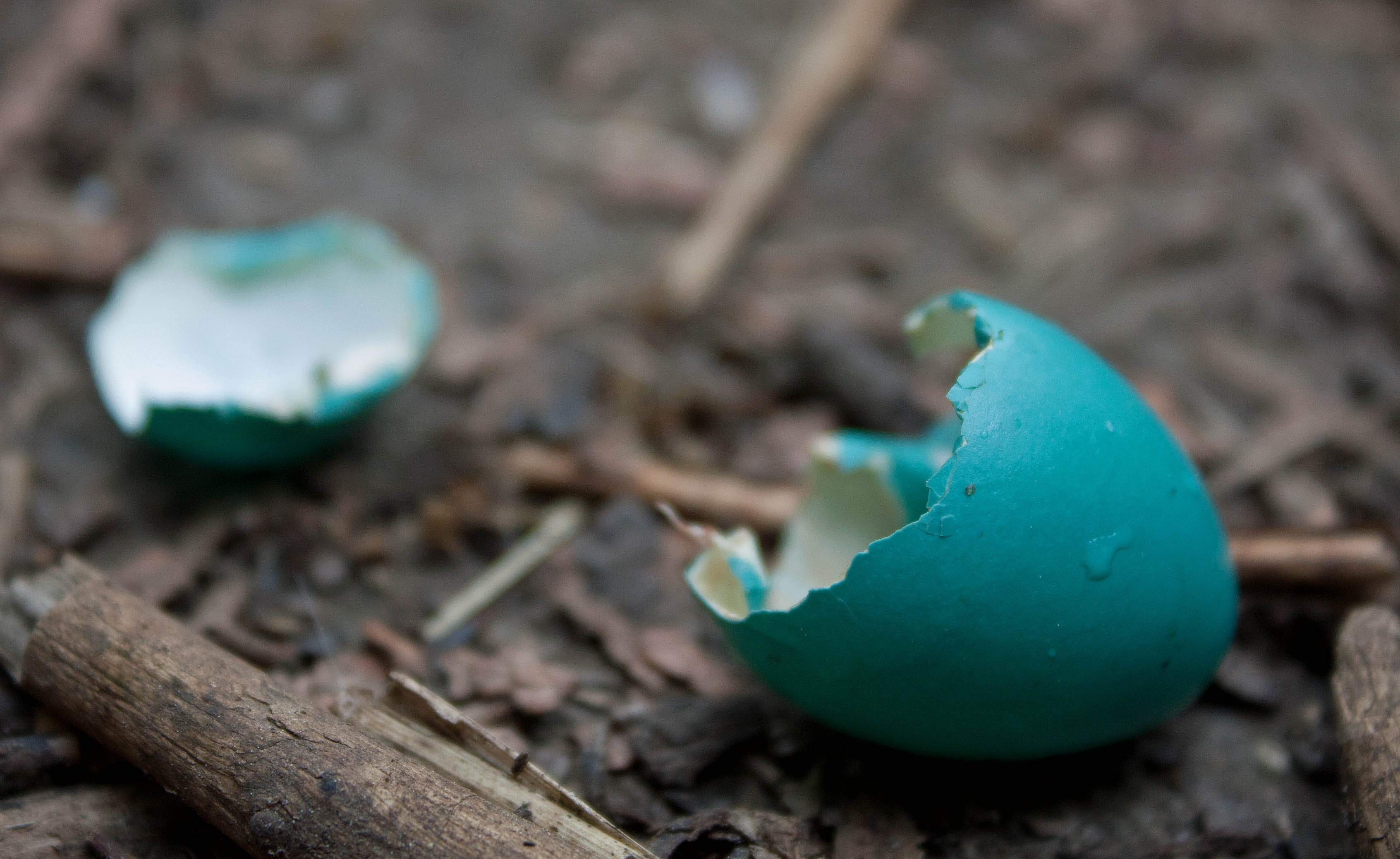
Discarded robin’s egg to deter predators, found on a woody trail in Ontario (photo by Nina Munteanu)

Simon: How did you come to write this particular story about birds and what is “soundscape ecology”?

Nina: Since I was a child, the burgeoning SF writer in me had dared to imagine a world without the sound of birds—I thought it utterly bleak and, recognizing an ever-polluting world, I feared for my feathered relatives. I didn’t follow through with a story until September 2019, when I was approached by Oliver Hockenhull, the guest editor of subTerrain Magazine, to write a piece on technology and the environment. The timing was interesting; I’d just read two impactful things that resonated with me.

The first was the October issue of Science Magazine that reported a staggering decline in North American birds. Kenneth V. Rosenberg and his team of researchers had estimated that three billion birds of various species had disappeared in Canada and the US since 1970. That’s a third of the entire bird population lost in five decades. To make it clear, we aren’t talking about rare birds going extinct; these declines are of common birds throughout the world. The wrens, sparrows, starlings, and, of course, the robins. I was devastated; I could not imagine a world without the comforting sound of birds. What would it be like if the birds all disappeared? This brought me back to my childhood fears.

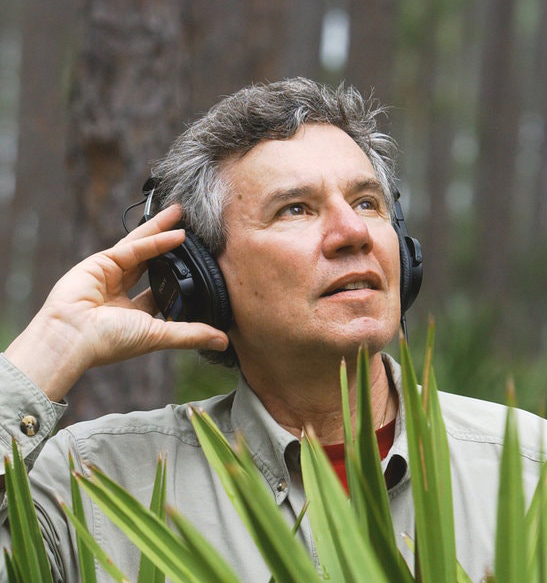
The second article I ran across talked about an emerging bioacoustics tool, soundscape ecology, that measures biodiversity and the health of an ecosystem, mostly through bird sound which well represents ecosystem health. Bernie Krause, a soundscape ecologist who had been conducting long-term recordings for decades noted how the dawn chorus in many areas had greatly diminished if not vanished altogether.

Bernie Krause, soundscape ecologist recording a soundscape in Florida

I now had my premise and my connection with technology. The title of my original story for subTerrain was “Out of the Silence”. This story focused on the technical aspects of the premise and solution. When I was approached for a story in February 2021 by Francesco Verso, the guest editor of Apex Magazine Issue #128, I rewrote the story with a stronger focus on the protagonist’s personal journey and connection with the bird catastrophe, how she coped with Asperger’s syndrome and the failure of her tool to predict the disaster. Hence the change in the title to “Robin’s Last Song”.

Cover of subTerrain Issue #85 in which “Out of the Silence” appears

Simon: Without wanting to bring in spoilers, isn’t there a twist to the story, suggesting a cautionary tale that touches on the dangers of genetic engineering?

Nina: Yes, thanks for bringing that up. I was already primed with research into genetic engineering for the sequel to my 2020 eco-novel “A Diary in the Age of Water.” I wanted to make the bird disappearance in “Robin’s Last Song” into a dramatic catastrophe linked to our own dangerous ecological tampering. I had the notion of using a gene hacking disaster to create ecological calamity and how this might affect birds. I wanted to make “Robin’s Last Song” a realizable work of fiction in which science and technology play both instigator of disaster and purveyor of salvation. Our biogenetic technology comes to us as a double-edged sword in the form of gene-editing, proteomics, DNA origami, and CRISPR—just to name a few. These biotechnological innovations promise a cornucopia of enhancements: from increased longevity and health in humans to giant disease-resistant crops. But, for every ‘magic’ in technology, there is often unintended consequence. Unforeseen—or even ignored—casualties and risks. I suppose my ultimate question with this story is: will synthetic biology redesign Nature to suit hubris or serve evolution? Science doesn’t make those decisions. We do.

Simon: Tell us a little bit about the Apex Magazine 2021 Compilation Anthology (that came out in both print and digital versions August).

Nina: The 350+ page anthology compiles all original short stories published in Apex Magazine during the 2021 calendar year. Published through Apex Book Company, it features 48 stories from a diverse group of new and established writers and the cover features award-winning artwork “Entropic Garden” by Marcela Bolivar. Check this link for more about the anthology and where to get it.

Cover art for Apex 2021 Compilation Anthology (art by Marcela Bolivar)

Simon: Are you still coaching writers and such?

Nina: Yes, I am, Simon. Did you know that I’ve been coaching writers to publication for close to twenty years? When I’m not teaching writing at the University of Toronto or George Brown College, I help writers with craft on their novels and short stories through my coaching services. You can find out more at: www.NinaMunteanu.me.

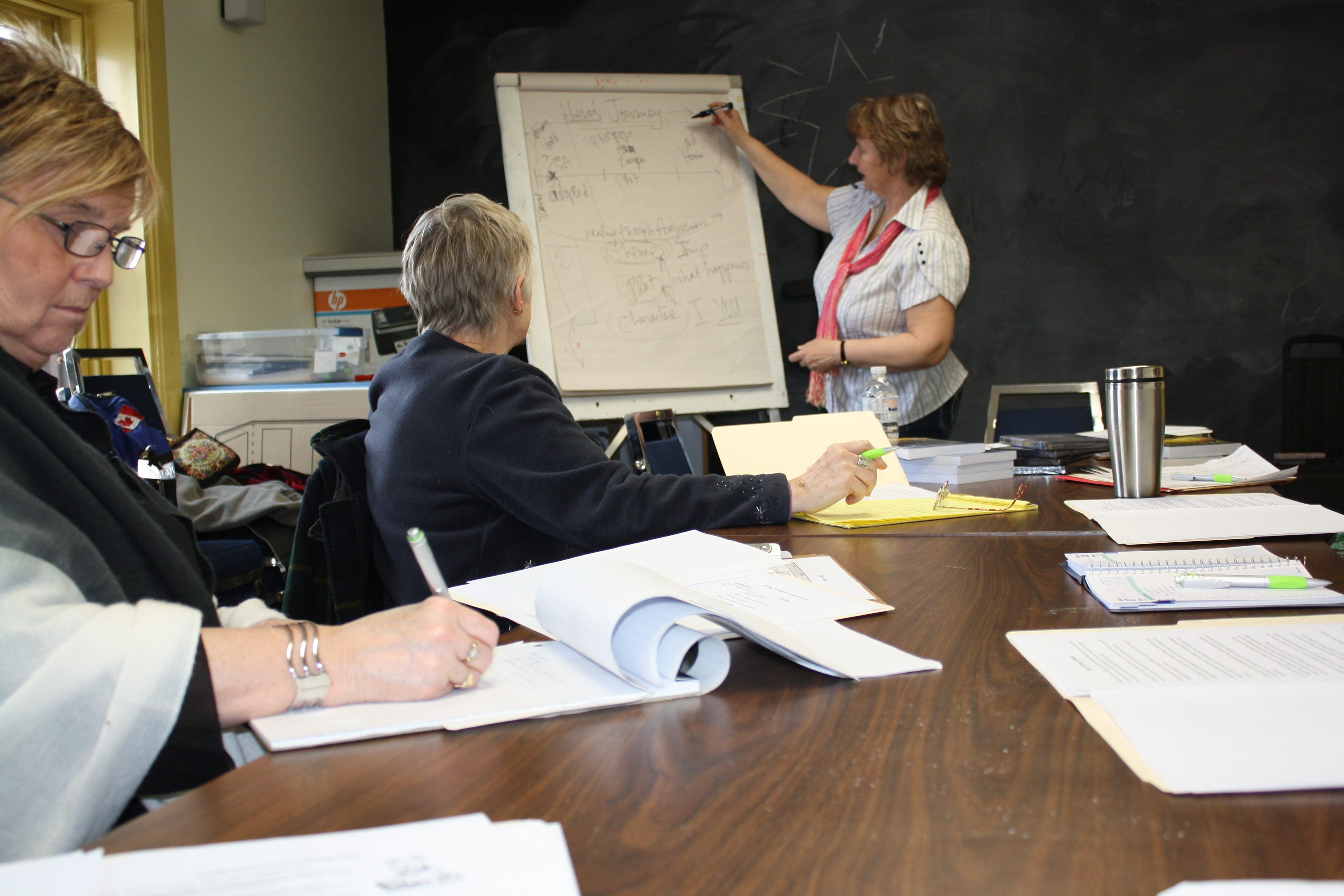
Nina teaches a writing class in Bridgewater, Nova Scotia

Simon: Tell us a little about any writing projects you’re working on these days.

Nina: I’m always busy with science articles for various online and print magazines and my own blogs. I’m also currently finishing a speculative eco-fiction novel that is a loose sequel to “A Diary in the Age of Water.” It’s set throughout Canada, from the Maritimes to the Arctic Circle, and spans a wide timeline from the Halifax Explosion of 1917 to the vast NAWAPA reservoir created a century and a half later by drowning British Columbia’s Rocky Mountain Trench. It’s a fast-paced thriller that focuses on four homeless people who battle corporate intrigue, kidnapping, human experiments and a coming climate plague.

Robin’s First Song: fledgling sits on a black walnut tree branch, ON (photo by Merridy Cox)

NINA MUNTEANU is a Canadian ecologist / limnologist and novelist. She is co-editor of Europa SF and currently teaches writing courses at George Brown College and the University of Toronto. Visit  www.ninamunteanu.ca for the latest on her books. Nina’s bilingual “La natura dell’acqua / The Way of Water” was published by Mincione Edizioni in Rome. Her non-fiction book “Water Is…” by Pixl Press(Vancouver) was selected by Margaret Atwood in the New York Times ‘Year in Reading’ and was chosen as the 2017 Summer Read by Water Canada. Her novel “A Diary in the Age of Water” was released by Inanna Publications (Toronto) in June 2020.

Nina Munteanu’s “Water Is…” Discussed in Book Club

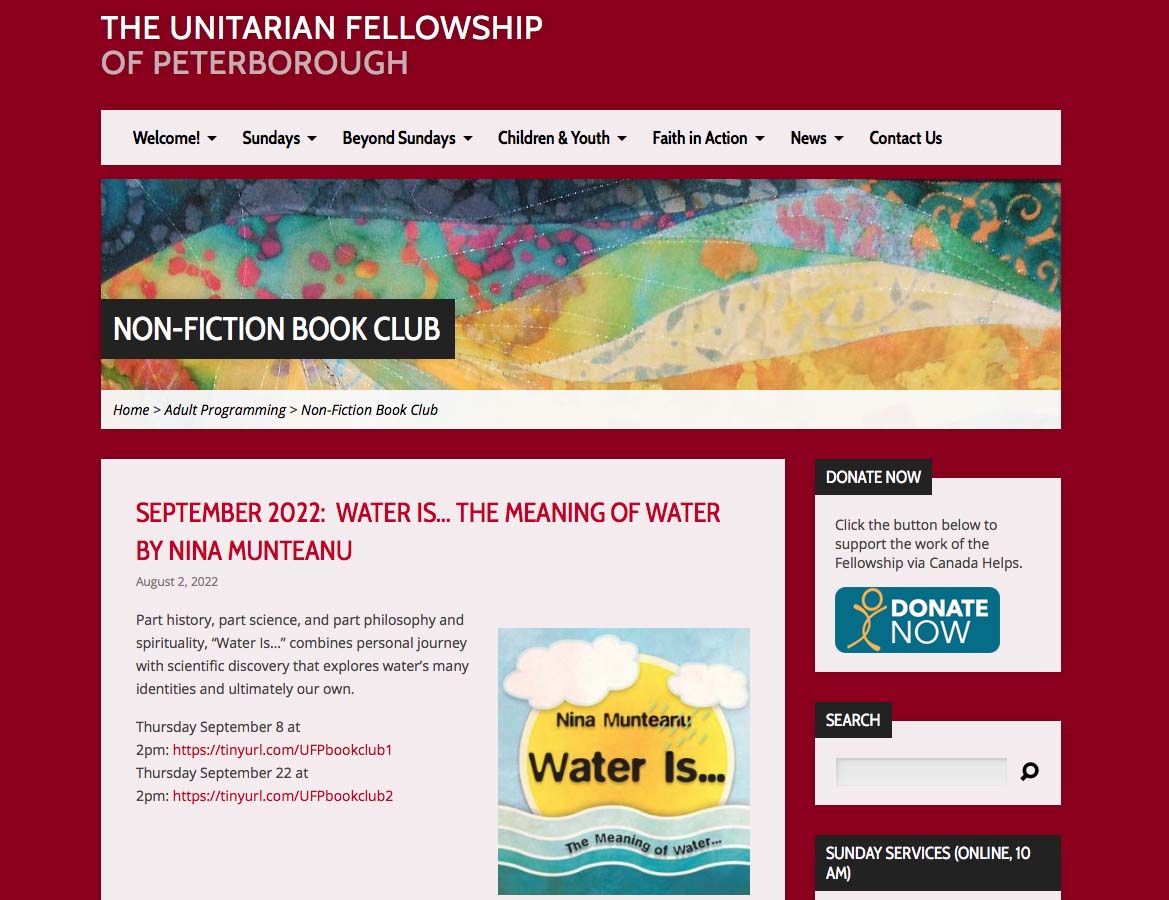
This month of September (September 8 and 22 at 2 pm) the Unitarian Fellowship of Peterborough Non-Fiction Book Club will discuss my book “Water Is…”

NINA MUNTEANU is a Canadian ecologist / limnologist and novelist. She is co-editor of Europa SF and currently teaches writing courses at George Brown College and the University of Toronto. Visit  www.ninamunteanu.ca for the latest on her books. Nina’s bilingual “La natura dell’acqua / The Way of Water” was published by Mincione Edizioni in Rome. Her non-fiction book “Water Is…” by Pixl Press(Vancouver) was selected by Margaret Atwood in the New York Times ‘Year in Reading’ and was chosen as the 2017 Summer Read by Water Canada. Her novel “A Diary in the Age of Water” was released by Inanna Publications (Toronto) in June 2020.

Mistakes Authors Make (When We Don’t Pay Attention to Place and Things

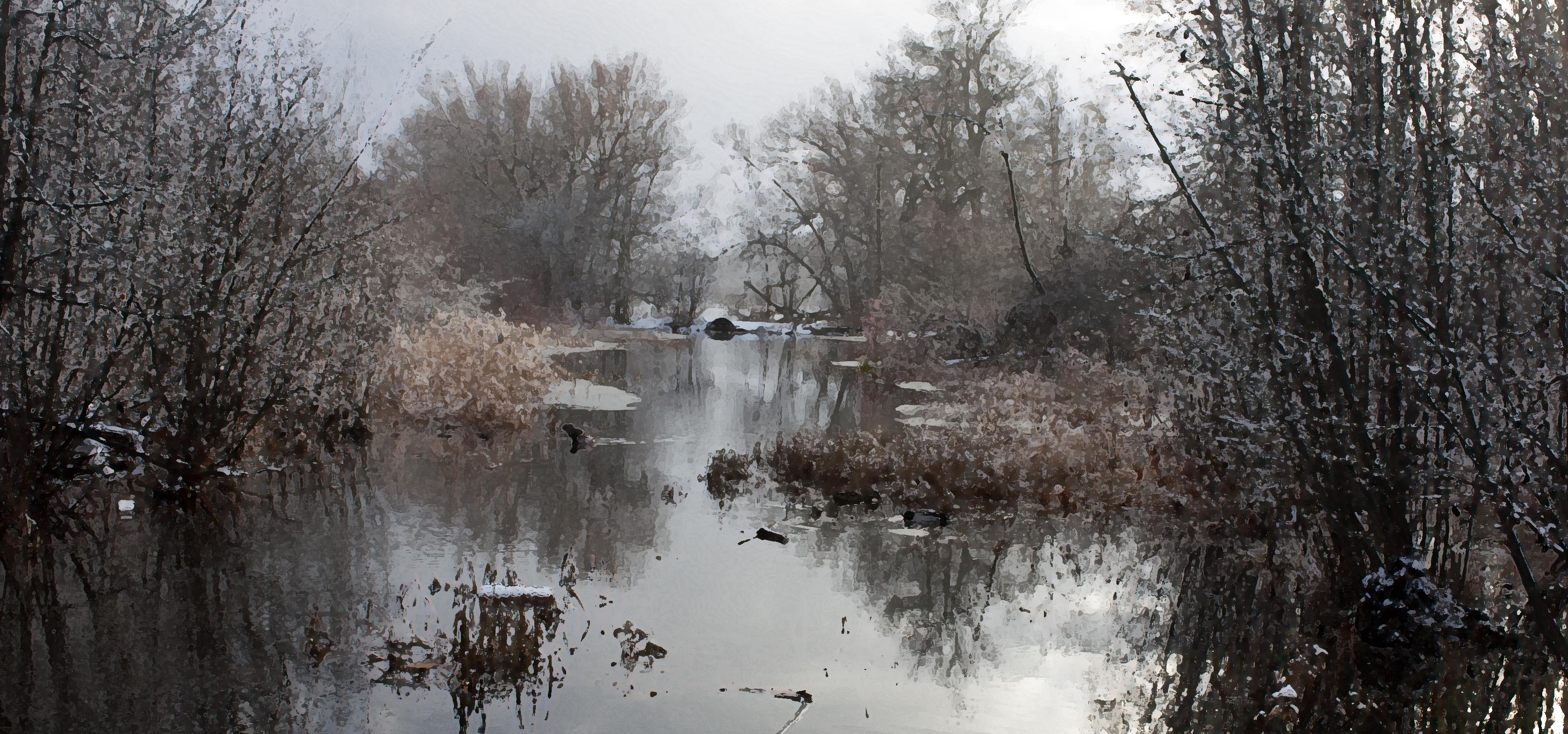
Marsh outlet of Thompson Creek, ON (photo and rendition by Nina Munteanu)

In “A Dance of Cranes” (Dundurn, 2019) author Steve Burrows erroneously describes the actions and motions associated with canoeing. In the following scene, the protagonist Jejeune is canoeing on a river in the boreal wilderness of northern Canada:

The low sun seemed to light the stand of birches from within, flickering through the trunks like a strobe light as Jejeune rowed past. 

One does not row a canoe; one paddles—with a paddle.

You might think that this is a small error, hardly worth mentioning; however, the friend who pointed out this mistake to me, was thrown out of the novel by it. She is a naturalist and has often gone canoeing in the lakes and rivers of Ontario. This mistake suggested a lack of professional attentiveness from both author and editor of the publication. By compromising the authenticity of the fictional setting the error stopped the reader from participating. We were no longer paddling with Jejeune; we were looking at the book.*

Some of you may rail at me for being overly harsh. You would remind me that this is a work of fiction, after all, not fact. You’d remind me that fiction is a work of the imagination, of characters and journeys; not a dry documentary.

I would agree with you—up to a point. Certainly, in fiction we can and do take liberties with “facts” so long as the narrative keeps the reader moving in the “fictive dream.” Authors have managed to successfully bend reality considerably in the past to great effect because the reader was fully engaged in the narrative and the characters.

But ultimately, beginning-to-end factual accuracy remains important in a made-up story for various reasons. While some “fake facts” or mistakes (such as the example above) may slip by many readers unnoticed, someone will notice. Guaranteed. And, as with my naturalist friend, it can make the difference between a seamless read and a jarring one. Writer Dorian Box shares that, “Some readers may even post reviews criticizing your book on that basis.” Dorian adds that when they spot large factual inaccuracies in a novel, “it detracts from the reading experience. I start to question other things. Credibility is damaged.”

All good fiction is anchored by consistent and believable world-building, whether the story is set in contemporary New York City or a made up planet in some made up solar system. The key to this believability is the use of grounding ‘facts’ or world-consistencies that immerse the reader in the story world. The reader relies on the author to realistically represent the world they are reading about. This allows the reader to experience the story as though it was real. Representing the facts accurately enables the writer to take liberties with other aspects of the story. Because the reader is nicely embedded in the world through accurate depiction, they will follow your characters through it eagerly.

Forest and marsh on Ontario (photo and rendition by Nina Munteanu)

The Importance and Ease of Research in Fiction Writing   

To prevent what happened in the example I gave above, authors must exercise due diligence in world building, in representation of setting and place, and in other elements of the story. Writers have easy access to so much knowledge about so many topics through local libraries, local experts, the internet, social media, and more. In other words, no excuse.

In the novel I’m currently working on I needed to understand what it felt like to handle, load and shoot a particular make of shotgun. I had handled one in the past but not actually used it. The internet provided exceptional instructional videos and sites that I could use to come close to the actual experience. I paid particular attention to nuances and sensual aspects such as texture, smell, weight, as well as mechanical aspects, like recoil; anything that would more viscerally help me experience it. When I had written the scenes, I showed them to someone who had handled a shotgun for their verdict on accurate depiction.

For more examples and discussion on place and doing research, check out Chapter H and R of my first book in The Alien Guidebook Series “The Fiction Writer: Get Published, Write Now!” and Part 2 of my third book in the series “The Ecology of Story: World as Character.”

*There is such a thing as a rowing canoe; canoes can be set up for rowing with oarlocks and sockets, oars, rowing seats and even forward rowing contraptions such as foot brace for efficient rowing. However, this was not the case in the book I gave as an example.

Fence post covered in vines on water’s edge, ON (photo and rendition by Nina Munteanu)

NINA MUNTEANU is a Canadian ecologist / limnologist and novelist. She is co-editor of Europa SF and currently teaches writing courses at George Brown College and the University of Toronto. Visit  www.ninamunteanu.ca for the latest on her books. Nina’s bilingual “La natura dell’acqua / The Way of Water” was published by Mincione Edizioni in Rome. Her non-fiction book “Water Is…” by Pixl Press(Vancouver) was selected by Margaret Atwood in the New York Times ‘Year in Reading’ and was chosen as the 2017 Summer Read by Water Canada. Her novel “A Diary in the Age of Water” was released by Inanna Publications (Toronto) in June 2020.

When the Meridional Overturning Circulation Shuts Down

Atlantic Meridional Overturning Circulation (AMOC) (drawing by Nina Munteanu, from “A Diary in the Age of Water” Inanna Publications, 2020)

March 6, 2055

Before leaving for the university this morning, I watched a news report on the storm that devastated the northwest coast of Britain last week. Over a thousand people were affected by the sudden deluge, severe winds, and flooding. Scientists are blaming another major AR (Atmospheric River). That’s the tenth so far this year for both Britain and Western Europe. Not surprising either. Due to the global temperature increase, the air holds more moisture, so these atmospheric rivers are growing in frequency and intensity. They are consequently wreaking havoc on the Atlantic west coast and the European coasts. I can hear Daniel’s ghost hissing in my ear: Between the relentless sea level rise and these storms, we’re fracked. The ARs that roar about like angry banshees have picked up the slack left by the stagnating great ocean conveyor. The conveyor or Atlantic Meridional Overturning Circulation (AMOC)— circulates ocean water very much like in a lake, with dense cold water sinking beneath warmer, less salty water. Sunken water flows south along the ocean floor toward the equator; then warm surface water from the tropics flows north to replace the water that sank, keeping AMOC moving and preventing stagnation. As the Arctic turns into the Atlantic, dumping in more and more freshwater, the sinking is beginning to stop and the machine is slowing down. Freshwater is taking over the world. Like a giant wrench in an anarchist’s hand, it’s jamming the conveyor. Scientists underestimated how climate forcing would accelerate Arctic sea ice melt and increase precipitation. The Atlantic Meridional Overturning Circulation—the great ocean conveyor—is in the process of stalling. It accounts for at least a quarter of the planet’s heat flux. We in the Northern Hemisphere are already seeing its effects: the rivers in Europe are drying up, forcing farmers to try to grow crops in the snow; the angriest storms in history are battering our maritime coast. In the meantime, the entire Southern Hemisphere is growing steadily hotter as the Indian and Asian monsoons dry up. Imagine the dynamic sea turning into a stagnant pond. No one really knows what this all means. It is likely that the oceanic plankton—our last food source—will crash or go toxic. It will probably be both.

—Lynna Dresden (scientist) in A Diary in the Age of Water

“Global ocean circulation will not change abruptly, but it will change significantly, in this century,” writes Cecilie Mauritzen, scientist with the Climate Department of the Norwegian Meteorogical Institute in Chapter 2 of “Arctic Climate Feedbacks: Global Implications”. Yet other researchers who study ancient climate change point to evidence that the AMOC can turn off abruptly. I suppose this depends on one’s definition of “abruptly.”

Mauritzen adds that “the potential for a significant change in global ocean circulation is considered one of the greatest threats to Earth’s climate: it presents a possibility of large and rapid change, even more rapid than the warming resulting directly from the build-up of human-induced greenhouse gases in the atmosphere.” An AMOC collapse would promote major cooling in most of the northern hemisphere, but also strengthen storm tracks in the North Atlantic and lead to further warming in regions of the southern hemisphere.

Climate models of an AMOC shutdown suggest a severe cooling in the whole northern hemisphere, particularly the regions closest to the zone of North Atlantic heat loss (the “radiator” of the North Atlantic central heating system). A shut down of the AMOC circulation would bring extreme cold to Europe and parts of North America, raise sea levels on these coastlines and disrupt seasonal monsoons that provide water to much of the world. It would also further endanger the Amazon rainforest and Antarctic ice sheets.

What climatologists like Mauritzen don’t discuss is the profound effects on the Earth’s biological community supported by this global circulation. The result of an AMOC stall may result in a massive ecological collapse and our existential end due to creatures so small only a microscope can see them.

In the above quote from my eco-fiction novel A Diary in the Age of Water the scientist Lynna Dresden highlights one of the most discernable effects of an AMOC shutdown: extreme weather, a cold snap with more angry and wetter storms in the north, particularly Europe, that could last hundreds of years. Scientists report that when AMOC stopped near the end of the last Ice Age, the cold spell lasted a thousand years.

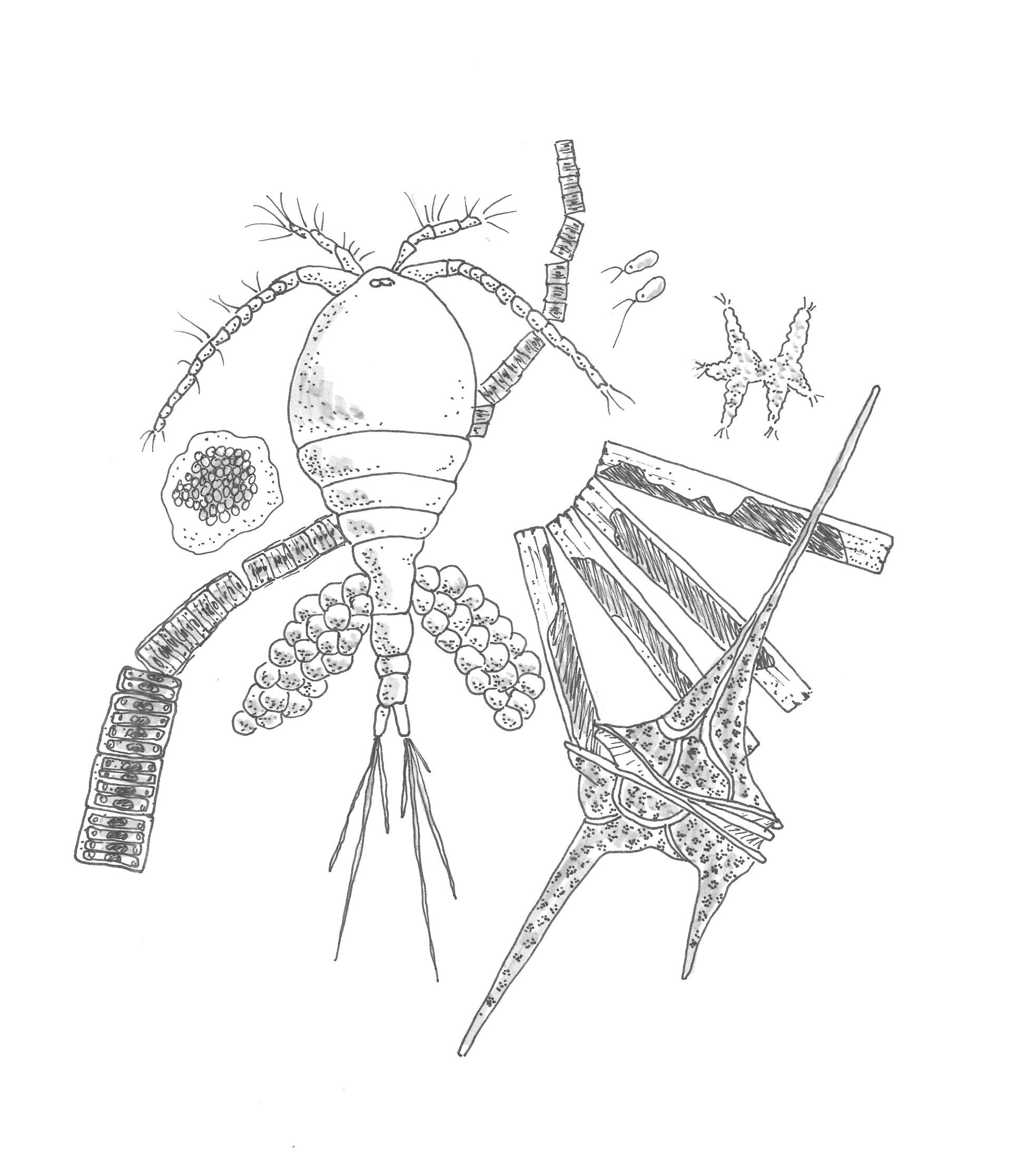
Illustration of oceanic plankton (by Nina Munteanu, in “A Diary in the Age of Water” Inanna Publications, 2020)

But Lynna also talks about our primary producers, the phytoplankton (and their cousins the zooplankton). The phytoplankton—which is made up mostly of single-celled diatoms—drift on the ocean currents and sustain all life from producing the first source of a massive food chain to sequestering carbon, creating clouds and rain, and helping to create fifty percent of the oxygen we breathe.

According to Velasco et al. in Nature, “An AMOC shutdown could lead to the collapse of North Atlantic plankton stocks.”

When plankton populations crash, recovery is slow. Plankton ecosystems in Earth’s oceans took 3 million years to fully recover after the mass extinction event 65 million years ago, according to scientists at the University of California—Santa Cruz. In their 2006 paper in the journal Geology, the researchers concluded “that the time required to repair food chains and reestablish an integrated ecosystem is extremely long.”

Perhaps even more likely is that the plankton will only partially crash; more likely is a shift in its distribution and characteristics with many going extinct and some even exploding in numbers. This is called a regime shift—a widespread and prolonged change of a biological system due to climate change—something that is occurring throughout the world right now.

Coccolithophores under electron microscope (image by NASA)

For instance, a study in NRDC reported a massive surge in plankton in the Arctic Barents Sea in 2020. Researcher Brian Palmer shared that “phytoplankton blooms are growing faster and thicker than ever seen before.” Summer blooms of Coccolithophores (unicellular Protista with calcium carbonate plates) generally occur from July through September in the Barents Sea when this shallow northern sea is ice free. The 2020 study showed that these blooms are thicker and more extensive as nutrients influx from other oceans. A recent Stanford study indicated that the growth rate of phytoplankton in the Arctic Ocean has increased 57 percent in the last twenty years.

While higher productivity may naively seem a good thing, these blooms are problematic: to begin, their growth is often not synchronous with what might feed on them, creating waste and detrimental trophic cascades (see below); although the algal blooms absorb more carbon, this higher carbon also contributes to the acidification of the ocean, which, in turn, impacts the phytoplankton: their growth, behaviour, and succession. The dying blooms may also liberate the excess carbon under certain circumstances. This becomes a positive feedback cycle with ever more impact.

Algal bloom in the Barents Sea (image by NASA)

Stephanie Dutkiewicz, principal research scientist in MIT’s Center for Global Change Science, says that while scientists have suspected ocean acidification might affect marine populations, the group’s results suggest a much larger upheaval of phytoplankton—and the species that feed on them. “The fact that there are so many different possible changes, that different phytoplankton respond differently, means there might be some quite traumatic changes in the communities over the course of the 21st century. A whole rearrangement of the communities means something to both the food web further up, but also for things like cycling of carbon.” Dutkeiwicz’s team also found that the interactive behaviour, including competition, among phytoplankton species might change.

Regime shifts also cause trophic cascades.

The guillemot seabird is an example of one casualty. The guillemot, which typically nests on the Isle of Shetland off the coast of Scotland, is starving and few are nesting. This is because the guillemot feed on sandeel fish that have all but disappeared because the cold-water plankton the fish eat have moved north. The historically icy waters between England and Scandinavia have become too warm for the plankton to survive. Of course, if the AMOC stalls, these warming waters may cool substantially.

References:

Dybas, Cheryl Lyn. 2006. “On a Collision Course: Ocean Plankton and Climate Change.” BioScience 56(8): 642-646.

Mauritzen, Celilie. 2009. “Ocean Circulation Feedbacks”,  Chapter 2 of “Arctic Climate Feedbacks: Global Implications,” Martin Sommerkorn and Susan Joy Hassol, editors. World Wildlife International Arctic Programme. 97pp.

Munteanu, Nina. 2020. “A Diary in the Age of Water.” Inanna Publications, Toronto. 300pp.

Palmer, Brian. 2020. “A Massive Surge in Plankton Has Researchers Pondering the Future of the Arctic.” NRDC September 09, 2020.

Schmittner, Andreas. 2005. “Decline of the marine ecosystem caused by a reduction in the Atlantic overturning circulation.” Nature 434: 628-633.

Velasco, Julian A. et. al. 2021. “Synergistic impacts of global warming and thermocline circulation collapse on amphibians” Nature, Communications Biology 4(141)

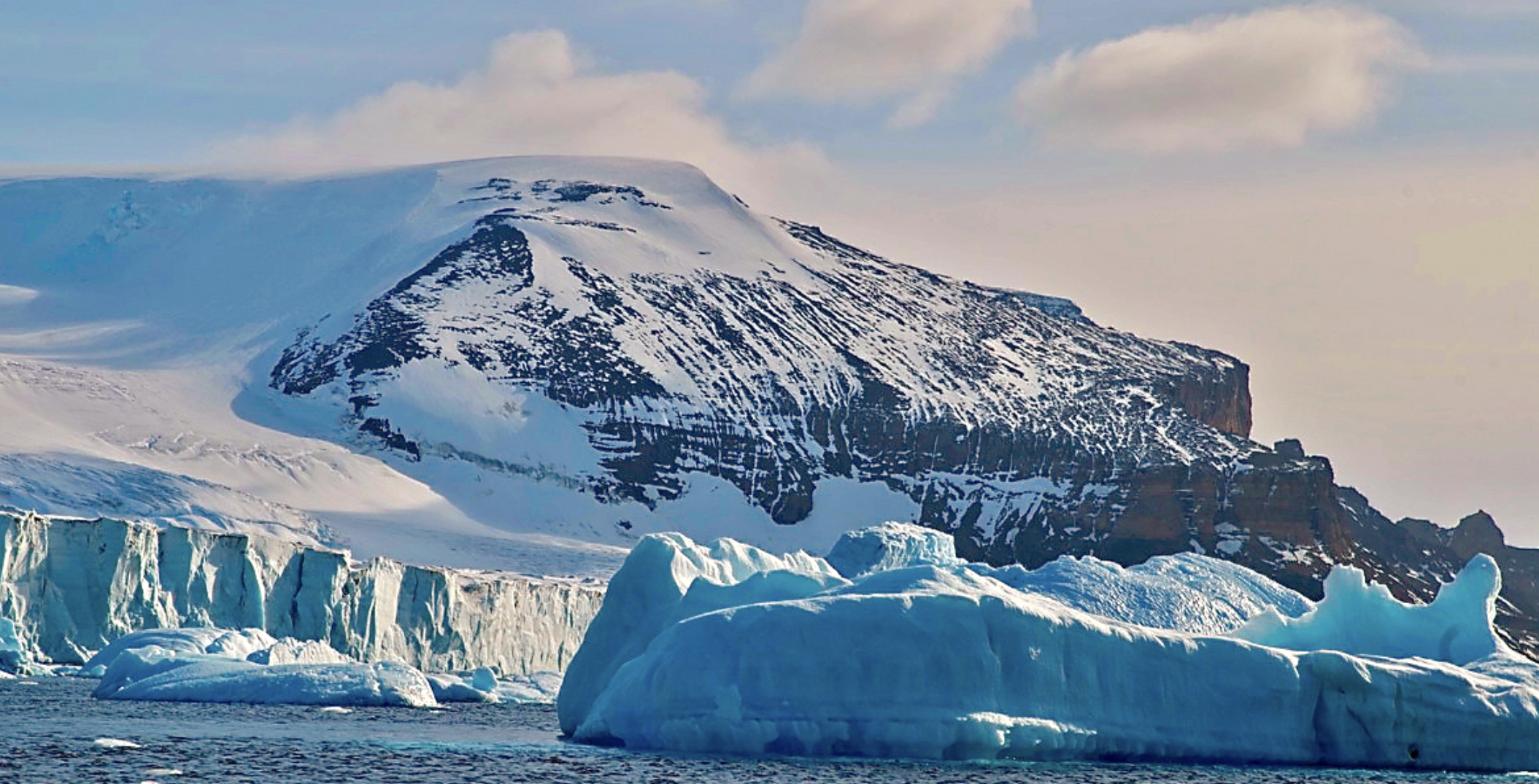
Freshwater from melting ice along the edge of Antarctica is changing the density of ocean layers, weakening the world’s strongest ocean current (ACC)

Post Script, March 8, 2025: A study by international scientists published today in the journal Environmental Research Letters projects that the fresh water from melting Antarctic ice will weaken the Antarctic Circumpolar Currrent by 20 percent in the next 30 years. The Atlantic Meridional Overturning Circulation (AMOC) is primarily responsible for poleward heat transport in the North Atlantic and the Antarctic Circumpolar Current (ACC) has the largest volume transport of any ocean current. Together, both currents are crucial components of global ocean circulation. The ACC is the only ocean current to flow around the entire planet unimpeded, carrying more than 100 times more water than all the world’s rivers combined. A paper in the journal Nature Climate Change recently documented how freshwater from melting ice has already weakened the overturning, or vertical circulation, of Antarctic shelf waters, which reduces oxygen in the deep ocean. Effects of the ACC slow down are projected to include more climate variability, with greater extremes in certain regions, and accelerated global warming.

NINA MUNTEANU is a Canadian ecologist / limnologist and novelist. She is co-editor of Europa SF and currently teaches writing courses at George Brown College and the University of Toronto. Visit  www.ninamunteanu.ca for the latest on her books. Nina’s bilingual “La natura dell’acqua / The Way of Water” was published by Mincione Edizioni in Rome. Her non-fiction book “Water Is…” by Pixl Press(Vancouver) was selected by Margaret Atwood in the New York Times ‘Year in Reading’ and was chosen as the 2017 Summer Read by Water Canada. Her novel “A Diary in the Age of Water” was released by Inanna Publications (Toronto) in June 2020.

Apex Magazine To Release 2021 Anthology Fall 2022 with Nina Munteanu’s “Robin’s Last Song”

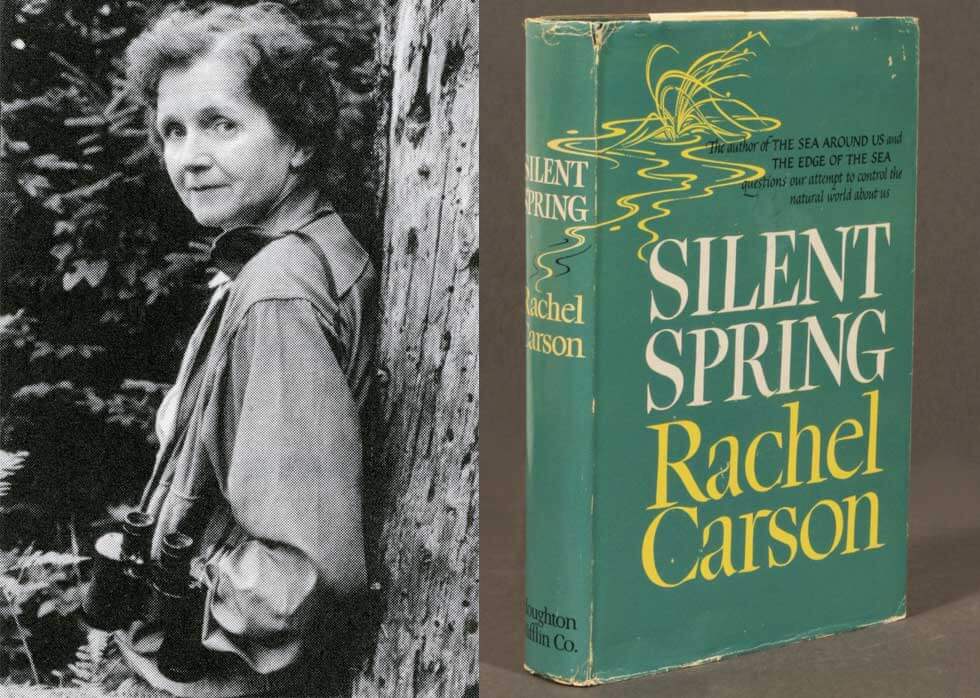
Over increasingly large areas of the United States, spring now comes unheralded by the return of the birds. The early mornings are strangely silent where once they were filled with the beauty of bird song.”

—Rachel Carson, Silent Spring

Apex Magazine will release its 2021 Anthology this fall with my short story, Robin’s Last Song in it.

Robin’s Last Song first appeared in the #128 Issue of Apex Magazine in 2021. It tells the story of Robin, a blind elder whose digital app failed to warn the world of the sudden global loss of birds with disastrous ecological consequences. After years of living in self-exile and getting around poorly on sight-enhancing technology, a discovery gives her new hope in rekindling her talents in the field of Soundscape Ecology.

Apex Issue #128 and upcoming 2021 Year Issue with Nina Munteanu’s “Robin’s Last Song”

May, 2071

I rock on the cedar swing on my veranda and hear the wind rustling through the gaunt forest. An abandoned nest, the forest sighs in low ponderous notes. It sighs of a gentler time. A time when birds filled it with song. A time when large and small creatures — unconcerned with the distant thrum and roar of diggers and logging trucks — roamed the thick second-growth forest. The discord was still too far away to bother the wildlife. But their killer lurked far closer in deadly silence. And it caught the birds in the bliss of ignorance. The human-made scourge came like a thief in the night and quietly strangled all the birds in the name of progress.

“Robin’s Last Song” by Nina Munteanu

Bird Population Decline

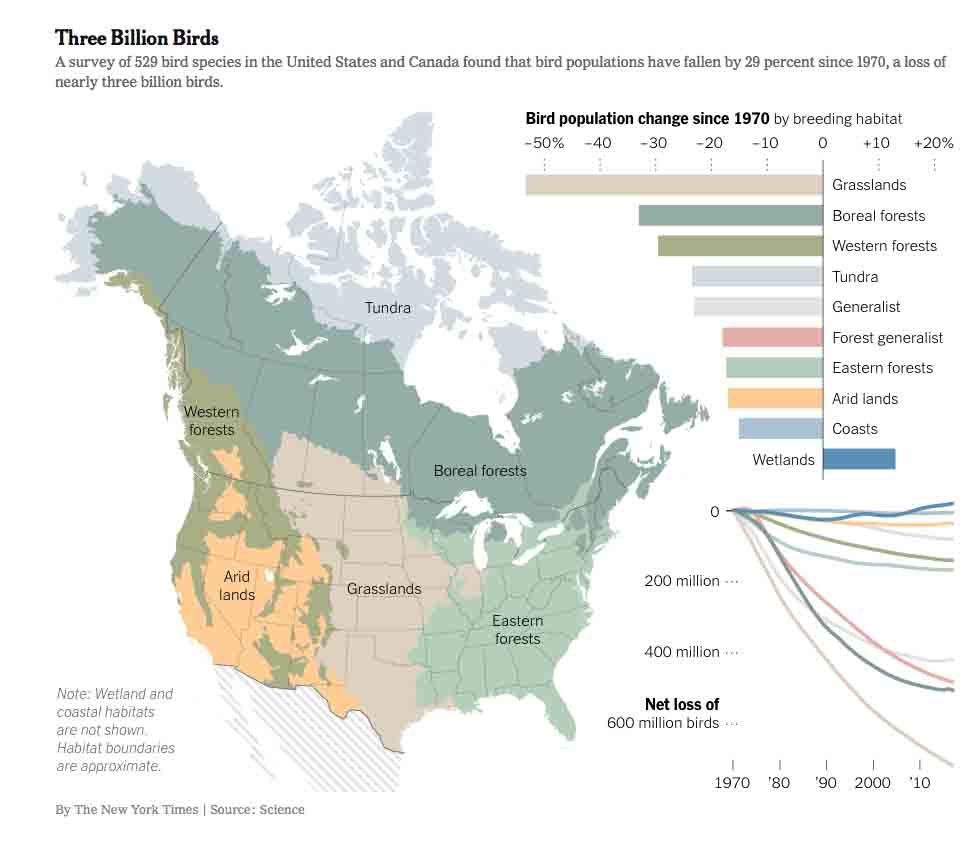
The number of birds in North America has declined by three billion, some 30 percent, over the last half-century. The October 2019 issue of Science magazine reported a staggering decline in North American birdsKenneth V. Rosenberg and his team of researchers estimated that three billion birds of various species have disappeared in Canada and the US since 1970.

Bird population change since 1970 (image The New York Times)

That’s a third of the entire bird population lost in five decades.

In North America, warbler populations dropped by 600 million. Blackbirds by 400 million. The common robins, cardinals, and blue jays had noticeably declined. Even starlings—once considered a kind of fast-breeding pest—have dwindled by 50%. The Intergovernmental Science-Policy Platform on Biodiversity and Ecosystem Services have determined that three-quarters of Earth’s terrestrial and two-thirds of the its marine environments have been severely altered by human actions.

Robin’s egg in the forest, discarded from the nest to divert predators (photo by Nina Munteanu)

Plowing of fields, deforestation, wetland draining, climate change and other land use clearing and treatments have caused great habitat loss. In addition, neonicotinoid pesticides make it harder for birds to put on weight needed for migration, delaying their travel.

A robin fledgling rests on a patio chair (photo by Merridy Cox)

Common bird species are vital to ecosystems. They control pests, pollinate flowers, spread seeds and help regenerate forests. When these birds disappear, their former habitats lose their functionality. “Declines in your common sparrow or other little brown bird may not receive the same attention as historic losses of bald eagles or sandhill cranes, but they are going to have much more of an impact,” said Hillary Young, a conservation biologist at the University of California. Kevin Gaston, a conservation biologist at the University of Exeter, lamented that: “This is the loss of nature.”

The Trump administration heinously and foolishly demolished or maimed several key bird protection acts, which hopefully the new administration has or will reinstate in full force: Migratory Bird Treaty Act; Clean Air Act; Clean Water Act; National Fish and Wildlife Act; and the Endangered Species Act.

Useful Tool: Soundscape Ecology

The new science of soundscape ecology can analyze the health of an ecosystem. Bernie Krause, a soundscape ecologist who has been conducting long-term recordings for many decades recently noted that in Sugarloaf Ridge State Park, not far from his home in Northern California, “the effect of global warming and resulting drought has created the first completely silent spring I’ve ever experienced.” Stuart Winter at Express reports that “many of the iconic birds whose mating calls ring out across woodlands and open fields during early May are vanishing at an alarming rate.”

Bernie Kraus creating one of his soundscapes

Silent Spring: Rachel Carson’s Ominous Prediction and Warning

Rachel Carson was nothing short of prophetic when she published Silent Spring in 1962 (in reference to the dawn chorus most noticeable in spring during breeding). Silent Spring cautioned burgeoning ag-biotech companies (like Monsanto—now Bayer—Sygenta, Dow, and DuPont) who were carelessly and flagrantly spraying fields with pesticides and herbicides—at the time DDT was the main culprit. This would soon become a GMO world where gene-hacked plants of monocultures can withstand the onslaught of killer pesticides like neonicotinoids (currently killing bees everywhere) and Roundup.  Roundup is a carcinogenic glyphosate-based weed killer that has recently been shown to kill beneficial insects like bees) and has been linked to Alzheimer’s disease, ADHD, birth defects, autism, and several kinds of cancer in humans.

Rachel Carson and her iconic book “Silent Spring”

Despite Carson’s warnings in 1962 and despite some action eventually taken (e.g. the ban on use of DDT in 1972—the precursor to Roundup and other neonicotinoids currently in use), the use of chemicals in big ag-industry has increased over five-fold since the 1960s. And this is destroying our bee populations, other beneficial insects, beneficial weeds, small animal populations and—of course—our bird life.

And it’s making us sick too.

NINA MUNTEANU is a Canadian ecologist / limnologist and novelist. She is co-editor of Europa SF and currently teaches writing courses at George Brown College and the University of Toronto. Visit  www.ninamunteanu.ca for the latest on her books. Nina’s bilingual “La natura dell’acqua / The Way of Water” was published by Mincione Edizioni in Rome. Her non-fiction book “Water Is…” by Pixl Press(Vancouver) was selected by Margaret Atwood in the New York Times ‘Year in Reading’ and was chosen as the 2017 Summer Read by Water Canada. Her novel “A Diary in the Age of Water” was released by Inanna Publications (Toronto) in June 2020.

‘A Diary in the Age of Water’ Listed as Ecological Fiction That Inspires Action

In the Spring 2021 Issue of Ecology & Action, author and Dragonfly.eco publisher Mary Woodbury lists some of her favourite eco-fiction that inspires action. Nina Munteanu’s clifi eco-novel “A Diary in the Age of Water” is among them:

“Fiction exploring humanity’s impacts on nature is becoming more popular. It has the distinct ability to creatively engage and appeal to readers’ emotions. In fact, it can stir environmental action. A survey I took last year showed that 88% of its participants were inspired to act after reading ecological fiction.
Principled by real science and exalting our planet’s beauty, these stories are works of art. They live within classic modes of fiction exploring the human condition, but also integrate the wild. They can be referred to as “rewilded stories.” The following Canadian titles are some of my favourites in this genre.”

Mary Woodbury, Dragonfly.eco
Mossy cedar tree in Trent Nature Sanctuary, ON (image and rendition by Nina Munteanu)

NINA MUNTEANU is a Canadian ecologist / limnologist and novelist. She is co-editor of Europa SF and currently teaches writing courses at George Brown College and the University of Toronto. Visit  www.ninamunteanu.ca for the latest on her books. Nina’s bilingual “La natura dell’acqua / The Way of Water” was published by Mincione Edizioni in Rome. Her non-fiction book “Water Is…” by Pixl Press(Vancouver) was selected by Margaret Atwood in the New York Times ‘Year in Reading’ and was chosen as the 2017 Summer Read by Water Canada. Her novel “A Diary in the Age of Water” was released by Inanna Publications (Toronto) in June 2020.