My Books Are Feeding Meta’s AI Brat

On March 20, 2025, in an article in The Atlantic entitled “The Unbelievable Scale of AI’s Pirated-Books Problem”, Alex Reisner disclosed how META pirated millions of books and research papers to train their flagship AI model Llama 3 to be competitive with products like ChatGPT. Reasons for this illegal action is simply time; asking permission and licensing takes too much time and is too expensive.

On the same day, The Atlantic provided a link to LibGen (the pirated-books database that Meta used to train its AI) so authors could search its collection of millions of illegally captured books and scientific papers. I went there and searched my name for my novels, non-fiction books and scientific papers and discovered several of my works in their AI training collection.

Two of my many scientific papers appeared in LibGen under my scientific author name Norina Munteanu. The first scholarly article came from my post grad work at the University of Victoria on the effects of mine tailing effluent on an oligotrophic lake, published in 1984 in Environmental Pollution Series A, Ecological and Biological Volume 33, Issue 1. The second article on the effect of current on settling periphyton came from my M.Sc. ecology research published in 1981 in Hydrobiologia, Volume #78.

Three of my thirteen novels appeared in LibGen under my fiction author name Nina Munteanu. I found it interesting how their bots captured a good range of my works. These included two of my earliest works. Collision with Paradise (2005) is an ecological science fiction adventure and work of erotica; Darwin’s Paradox (2007) is a science fiction medical-eco thriller that features the domination of society by an intelligent AI community. The bots also found my latest novel, A Diary in the Age of Water (2020), a climate thriller and work of eco-fiction that follows four generations of women and their relationship to water.

Each of these works has been highly successful in sales and has received a fair bit of attention and recognition.

When Genevieve Dubois, Zeta Corp’s hot shot starship pilot, accepts a research mission aboard AI ship ZAC to the mysterious planet Eos, she not only collides with her guilty past but with her own ultimate fantasy. On a yearning quest for paradise, Genevieve thinks she’s found it in Eos and its people; only to discover that she has brought the seed of destruction that will destroy this verdant planet.

Recognition: Gaylactic Spectrum Award (nominee)

Collision with Paradise is ideal for readers who enjoy dark, introspective science fiction that explores complex moral dilemmas and psychological depth within a lush mythologically-rich setting.”The Storygraph

A devastating disease. A world on the brink of violent change. And one woman who can save it or destroy it all. Julie Crane must confront the will of the ambitious virus lurking inside her to fulfill her final destiny as Darwin’s Paradox, the key to the evolution of an entire civilization. Darwin’s Paradox is a novel about a woman s fierce love and her courageous journey toward forgiveness, trust, and letting go to the tide of her heart.

Recognition: Readers Choice Award (Midwest Book Review); Readers Choice (Delta Optimist); Aurora Award (nominee)

Darwin’s Paradox is a thrill ride that makes you think and tugs the heart.”Robert J. Sawyer, Hugo and Nebula Award winning author of Rollback

This gritty memoir describes a near-future Toronto in the grips of severe water scarcity during a time when China owns the USA and the USA owns Canada. A Diary in the Age of Water follows the climate-induced journey of Earth and humanity through four generations of women, each with a unique relationship to water. The diary spans a twenty-year period in the mid-twenty-first century of 33-year-old Lynna, a single mother and limnologist of international water utility CanadaCorp, and who witnesses disturbing events that she doesn’t realize will soon lead to humanity’s demise. 

Recognition: 2020 Foreword Indies Book of the Year Award (Bronze); 2020 Titan Literary Book Award (Silver); 2021 International Book Award (Finalist).

“If you believe Canada’s water will remain free forever (or that it’s truly free now) Munteanu asks you to think again. Readers have called ‘A Diary in the Age of Water’ “terrifying,” “engrossing,” and “literary.” We call it wisdom.”—LIISBETH

The April 3, 2025 article by Ella Creamer of The Guardian noted that a US court filing alleged that Meta CEO Mark Zuckerberg approved the company’s use of the notorious “shadow library”, LibGen, which contains more than 7.5 million books and 81 million research papers. According to Toby Walsh, leading AI researcher at the University of New South Wales: “As far as we know, there was an explicit instruction from Mark Zuckerberg to ignore copyright.”

This begs the question of the role and power of copyright law.

“Copyright law is not complicated at all,” said Richard Osman, author of The Thursday Murder Club series. “If you want to use an author’s work you need to ask for permission. If you use it without permission you’re breaking the law. It’s so simple.”

If it’s so simple then why is Meta and others getting away with it? For its defence, the tech giant is claiming “fair use”, relying on this term permitting the limited use of copyrighted material without the owner’s permission (my italics).

It would seem that just as Trump trumped the presidency, Zuckerberg and his AI minion bots have trumped the copyright law—by flagrantly violating it and getting away with it—so far (on both counts).

The actions of Meta were characterized by Society of Authors chair Vanessa Fox O’Louglin as “illegal, shocking, and utterly devastating for writers.” O’Louglin added that “a book can take a year or longer to write. Meta has stolen books so that their AI can reproduce creative content, potentially putting these same authors out of business.”

Three of my novels pirated for AI training

Reflecting many authors’ outrage throughout the world, Novelist AJ West remarked, “To have my beautiful books ripped off like this without my permission and without a penny of compensation then fed to the AI monster feels like I’ve been mugged.” Australian Author Sophie Cunningham said, “The average writer earns about $18,000 a year on their writing. It’s one thing to be underpaid. It’s another thing to find that [their] work is being used by a company that you don’t trust.” Bestselling author Hannah Kent said, “If feels a little like my body of work has been plundered.” She adds that this, “opens the door to others also feeling like this is an acceptable way to treat intellectual copyright and creatives who already…are expected to [contribute] so much for free or without due recompense.” Both Kent and Cunningham exhort governments to weigh in with more powerful regulation. And this is precisely what may occur. Nicola Heath of ABC.net.au writes, “the outcomes of the various AI copyright infringement cases currently underway in the US will shape how AI is trained in the future.”

According to The March 20, 2025 Authors Guild article “Meta’s Massive AI Training Book Heist: What Authors Need to Know,” legal action is underway against Meta, OpenAI, Microsoft, Anthopic, and other AI companies for using pirated books. The Authors Guild is a plaintiff in the class action lawsuit against OpenAI, along with John Grisham, Jodi Picoult, David Baldacci, George R.R. Martin, and 13 other authors, but the claims are made on behalf of all US authors whose works have been ingested into GPT. 

The Authors Guild suggests five things authors can do to defend their rights:

  1. Send a formal notice: If your books are in the LibGen dataset, send a letter to Meta and other AI companies stating they do not have the right to use your books.
  2. Join the Authors Guild: You should join the Guild and support our joint advocacy to ensure that the writing profession remains alive and vibrant in the age of AI. We give authors a voice, and there is power in numbers. We can also help you ensure that your contracts protect you against unwanted AI use of your work. 
  3. Protect your works: Add a “NO AI TRAINING” notice on the copyright page of your works. For online work, you can update your website’s robots.txt file to block AI bots.
  4. Get Human Authored certification: Distinguish your work in an increasingly AI-saturated market with the Authors Guild’s certification program. This visible mark verifies your book was created by a human, not generated by AI.
  5. Stay informed. The Authors Guild suggest signing up for the free Guild biweekly newsletter to keep updated on lawsuits and legislation that could impact you and your rights. The legal landscape is changing rapidly, and they are keeping close watch. 

How do I feel about all this? As a female Canadian author of climate fiction? As a thinking, feeling human being living in The Age of Water? Well, to tell the truth, it kinda makes me want a donut*…

 *as delivered by James Holden in Season 3, Episode 7 of “The Expanse”

Aspens in fall, ON (photo and rendition by Nina Munteanu)

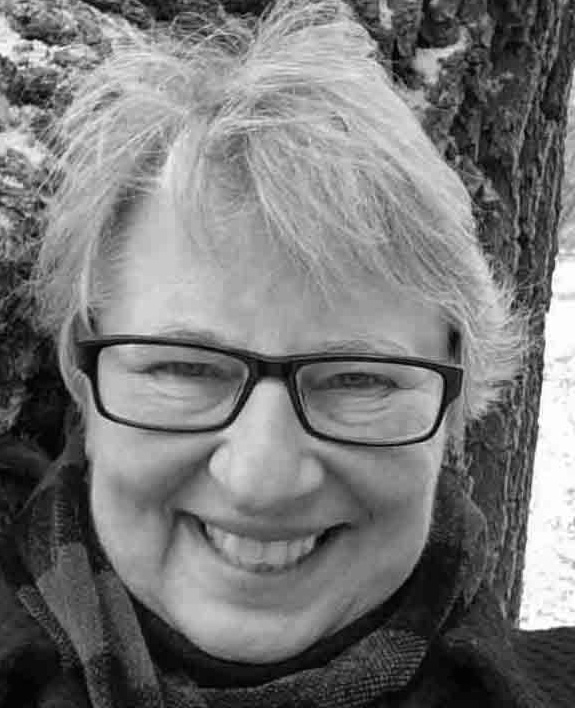
Nina Munteanu is a Canadian ecologist / limnologist and novelist. She is co-editor of Europa SF and currently teaches writing courses at George Brown College and the University of Toronto. Visit  www.ninamunteanu.ca for the latest on her books. Nina’s bilingual “La natura dell’acqua / The Way of Water” was published by Mincione Edizioni in Rome. Her non-fiction book “Water Is…” by Pixl Press (Vancouver) was selected by Margaret Atwood in the New York Times ‘Year in Reading’ and was chosen as the 2017 Summer Read by Water Canada. Her novel “A Diary in the Age of Water” was released by Inanna Publications (Toronto) in June 2020.

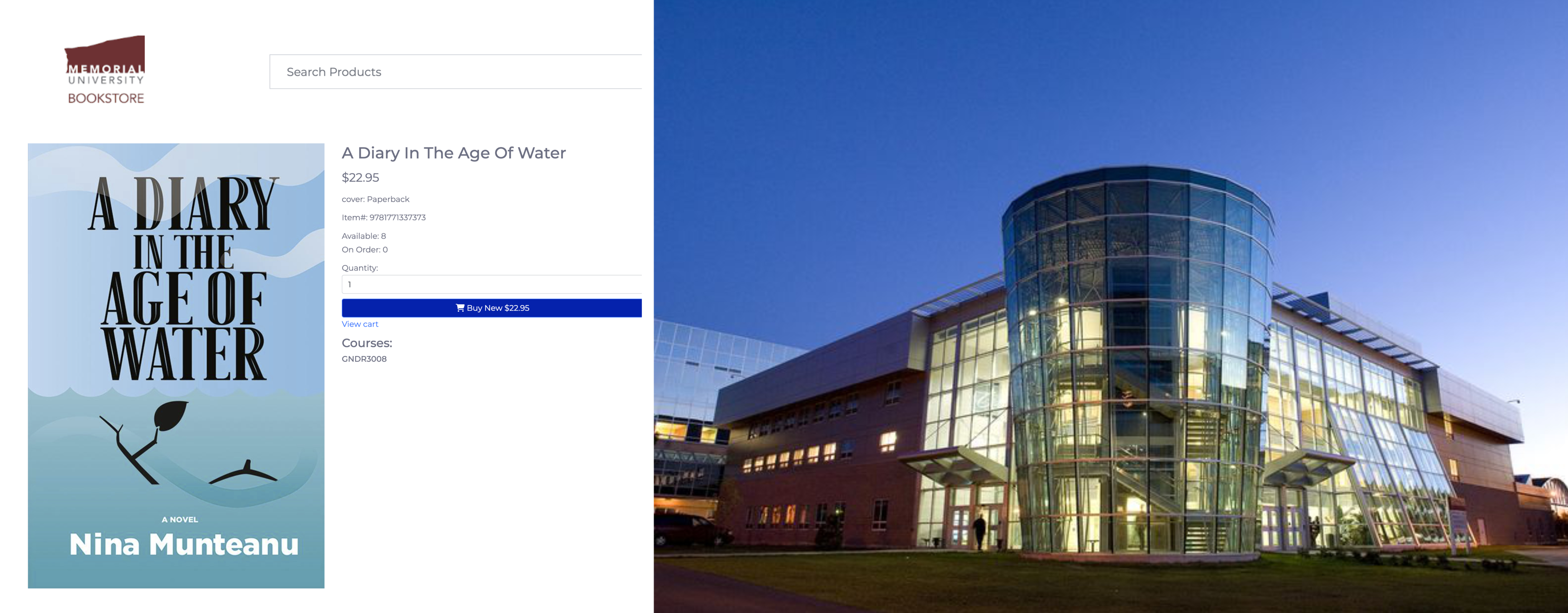
“A Diary in the Age of Water” Required Reading at Memorial University

A Diary in the Age of Water” at the Memorial University Bookstore

Instructor Keif Godbout-Kinney has made my eco-fiction novel A Diary in the Age of Water required reading in their course Feminist Practices and Global Change (GNDR 3008) at Memorial University, Newfoundland. The book is currently selling at the Memorial University Bookstore.

The Gender Studies course examines connections between feminist theories and activism for social and political change on a global scale.

My novel, told mostly through the diary of a limnologist, describes a world in the grips of severe water scarcity during a time when China owns the USA and the USA owns Canada. The diary spans a twenty-year period in the mid-twenty-first century of 33-year-old Lynna, a single mother who works in Toronto for CanadaCorp, an international utility that controls everything about water, and who witnesses disturbing events that she doesn’t realize will soon lead to humanity’s demise. A Diary in the Age of Water follows the climate-induced journey of Earth and humanity through four generations of women, each with a unique relationship to water. The novel explores identity and our concept of what is “normal”—as a nation and an individual—in a world that is rapidly and incomprehensibly changing.

Nina Munteanu is a Canadian ecologist / limnologist and novelist. She is co-editor of Europa SF and currently teaches writing courses at George Brown College and the University of Toronto. Visit www.ninamunteanu.ca for the latest on her books. Nina’s bilingual “La natura dell’acqua / The Way of Water” was published by Mincione Edizioni in Rome. Her non-fiction book “Water Is…” by Pixl Press (Vancouver) was selected by Margaret Atwood in the New York Times ‘Year in Reading’ and was chosen as the 2017 Summer Read by Water Canada. Her novel “A Diary in the Age of Water” was released by Inanna Publications (Toronto) in June 2020.

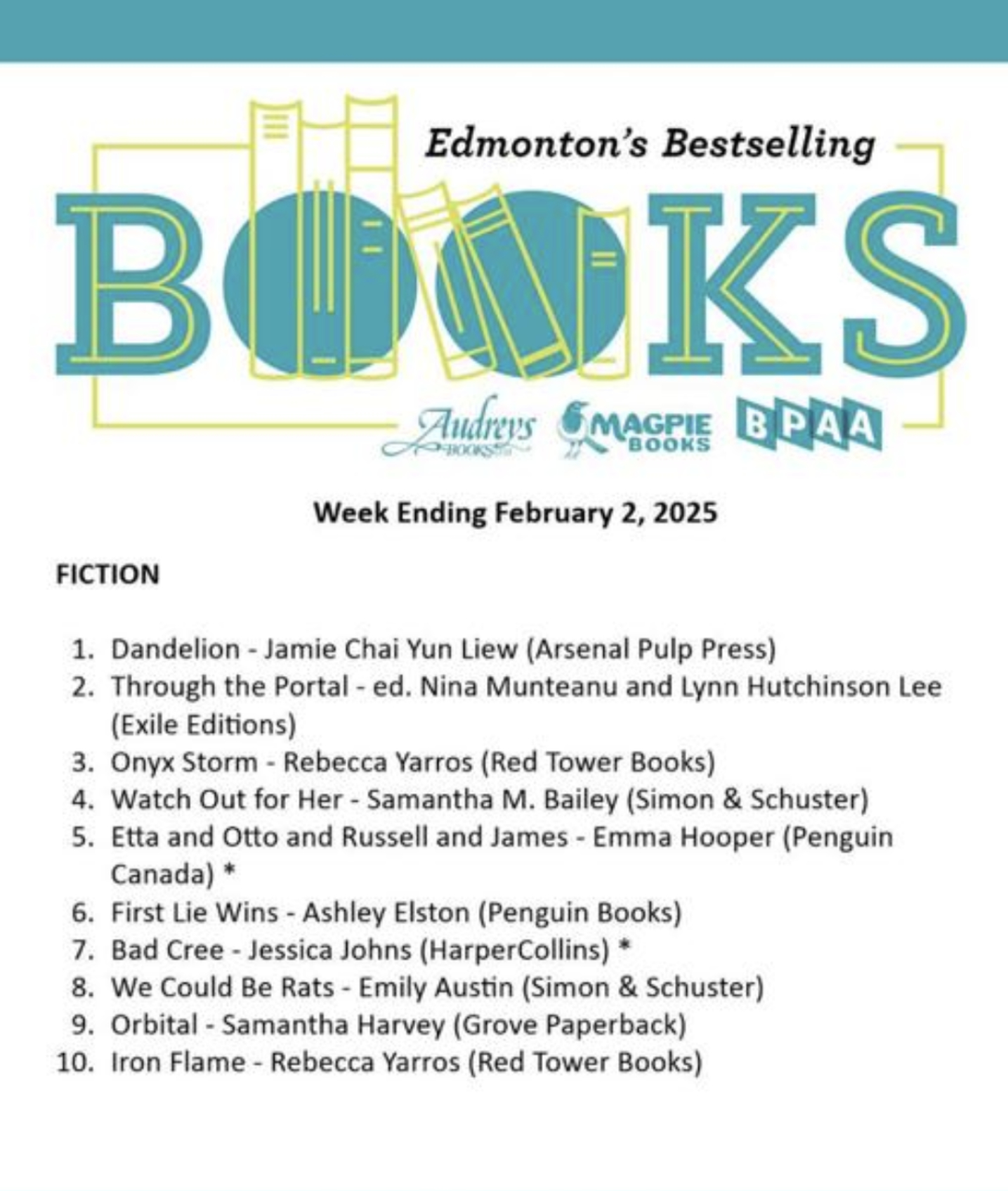
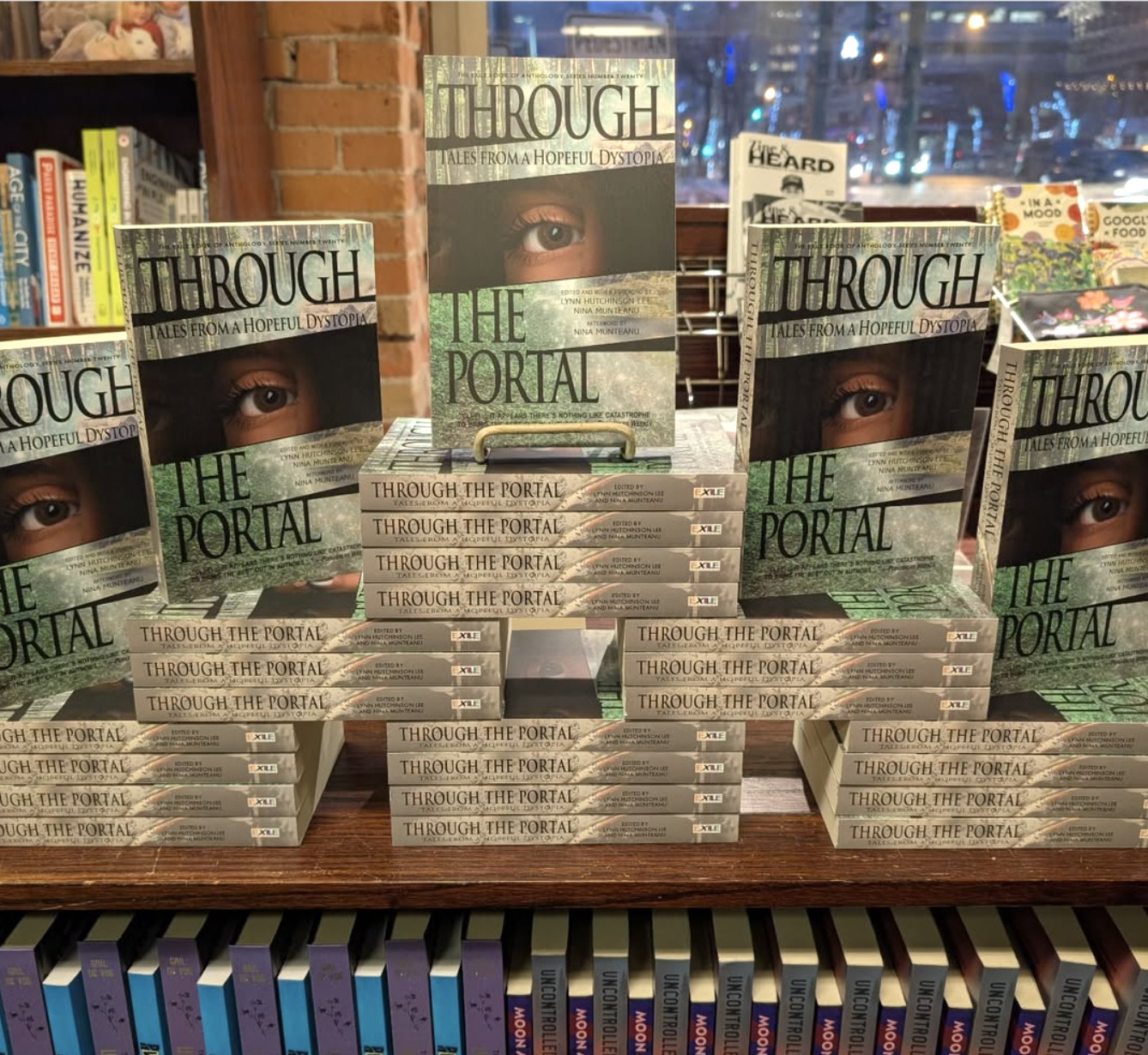
Through the Portal Anthology Bestseller in Edmonton

“Through the Portal” selling like hotcakes at Audrey’s Books in Edmonton (photo by Audrey’s Books)

Through the Portal: Tales from a Hopeful Dystopia recently made it to the number 2 position on the Edmonton Bestselling Books list ending February 2, 2025. The weekly list is compiled by Audreys Books and Magpie Books through the Book Publishers Association of Alberta.

Through the Portal anthology continues to garner attention and accolades by reviewers, booksellers, and readers throughout Canada. Released December 31, 2024 and launched in several locations in Canada, Portal is celebrated for its hopeful lens on an otherwise bleak future with thirty-five unique short stories, flash fiction, and poetry and an afterward.

There are many faces for hope; this anthology has thirty-six of them. Each story in the anthology features a unique hopeful lens that draws from a diversity of authors from around the world and throughout Canada. Stories that touch on nostalgia to respect, enlightenment to endurance. In these tales that range from compassion and healing to cautionary warnings of dark insight, hope may wear a human face or the face of a tree, black crow, or leaf.

Hopeful dystopias are so much more than an apparent oxymoron: they are in some fundamental way the spearhead of the future – and ironically often a celebration of human spirit by shining a light through the darkness of disaster. In Through the Portal: Tales from a Hopeful Dystopia, award-winning authors of speculative fiction Lynn Hutchinson Lee and Nina Munteanu present a collection that explores strange new terrains and startling social constructs, quiet morphing landscapes, dark and terrifying warnings, lush newly-told folk and fairy tales.—Exile Editions

  “A stunning collection of short stories and poetry that address our most existential concerns.”

Dragonfly.eco

“Will ingenuity, love, and respect for the earth help us work through whatever changes might lie ahead? Through the Portal offers hope that these qualities, if not enough in and of themselves, will help us find our way.”

The Seaboard Review

Nina Munteanu is a Canadian ecologist / limnologist and novelist. She is co-editor of Europa SF and currently teaches writing courses at George Brown College and the University of Toronto. Visit www.ninamunteanu.ca for the latest on her books. Nina’s bilingual “La natura dell’acqua / The Way of Water” was published by Mincione Edizioni in Rome. Her non-fiction book “Water Is…” by Pixl Press (Vancouver) was selected by Margaret Atwood in the New York Times ‘Year in Reading’ and was chosen as the 2017 Summer Read by Water Canada. Her novel “A Diary in the Age of Water” was released by Inanna Publications (Toronto) in June 2020.

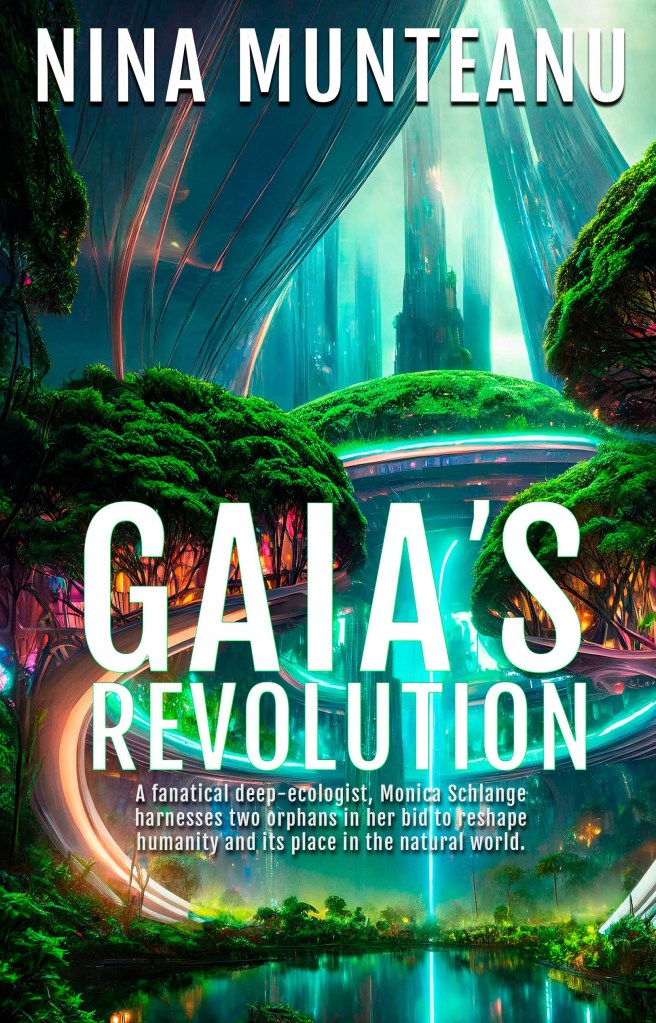
Gaia’s Revolution:  A View of a Post-Capitalist Future

My upcoming book Gaia’s Revolution (Book 1 of The Icaria Trilogy by Dragon Moon Press) explores a collapsing capitalist society in Canada through ravages of climate change and a failing technology. The story is told through the lives of ambitious twin brothers Eric and Damien Vogel, and the woman who plays them like chess pieces in her gambit to ‘rule the world.’

It is 2032 and Eric Vogel sits in the Canadian prime minister’s office, ruminating on the changes coming. He imagines what a post-capitalist world will look like and how his twin brother Damien—left behind in Germany—would disagree with his vision:

Over a hundred years ago, Spartacist Rosa Luxemburg—who was shot by the right-wing Freikorps—argued that the “Bourgeois stands at the crossroads, either transition to socialism or regress into barbarism.” Both he and Damien agree with sociologist Wolfgang Streeck who argues that the end of capitalism—of a reigning bourgeois, in love with the objects that define them—is already underway. The signs are neon loud: a ruthless downward trend in economic growth, social equality, and financial stability. All reinforced by climate change and the ongoing collapse of the planet’s sustaining environment. Any system and dialectic based on a concept of infinite resources in a finite world is bound to fail eventually. That collapse has already begun and its catastrophic end is imminent. Already, climate refugees and refugees of resource war (which amounts to the same thing) have flooded northern nations, like Canada, and caused tension and strife. Germany is just one example where left and right have torn the country apart as an influx of foreigners challenged the already tenuous German identity. When Canada granted asylum to over two million climate-refugees in ‘28, with no viable plan for the new residents during a time when unemployment was higher than it had been in decades and housing prices were skyrocketing due to environmental uncertainty, this sparked renewed tensions between ultra-right and ultra-left and opened the gap for a new party based on science and reason. The party now in power: the Technocratic Party of Canada.

But what will life after capitalism look like?

It’s no surprise that he and his brother disagree on what a post-capitalist world should look like and how to best achieve that world. Damien too easily prescribes to the old leftist shibboleth of Nature being the answer to everything and Market being evil. His deep ecology utopia would spring from an atavistic rejection of modern life, a return to ‘the ancient farm.’ But how that fantasy could be achieved without a drastic population reduction is beyond his brother’s imagination. Damien fetishizes the natural world. Just like he does their mother. The naïve fool is a blind romantic, refusing to see reality right in front of him: that Nature is ultimately cruel, cold, and preoccupied with its own survival. Just like their mother.

Brother Damien recalls an earlier argument the two brothers had in Berlin that ultimately motivated him to follow his twin to Canada. They’d been debating about the effect of climate change on the human population:

Pulled down by a truculent mood, Damien responds to Eric’s usual glib solutions by painting a dark vision of a humanity descending into some pre-technological ‘dark age’ apocalypse.

Eric just laughs. He pokes his fork into the sauerkraut as if to make a point in his argument and scoops up a pile that he shoves into his mouth. He leans forward and argues with a full mouth, “The real question is not whether humanity will survive an ecological collapse, but what part of humanity will survive. You can be sure that the stinking boujee plutocrats will find a way to survive at the expense of everyone else.” He chews down the sauerkraut followed by a gulp of beer and a loud burp. “The stinking rich are already doing it, Dame. They’re already creating their Elysium right here, right now.” Fork now swings like a conductor’s baton. “The future is already here; it’s just unevenly distributed.”

Using his fingers, Damien pulls apart some crisp skin off the pork knuckle—his favourite part—and feeds his mouth. Arguing with Eric always makes him hungry despite his surly temper. He crunches down, enjoying the tasty juices of brazed salty pork skin, and retorts, “You politicize everything and resort to cheap references in pop culture. You always do that: over-simplify the crisis and Nature’s existential power to sustain life. Trophic cascades caused by ecosystem simplification would irreparably devastate the planet and all adapted life. With the Sixth Extinction Event there won’t be any boujee plutocrats because there won’t be anything left to monetize—”

“You’re such a doom-gloom lefty, Dame!” Eric grabs the last of the pork skin—also his favourite— and shoves it into his mouth. He smacks his lips and counters, “The stinking rich will always have technology at their disposal. I’m talking about genetic engineering, nano-technology, gene modification, cybernetics, and even environmental control. For instance, look at Harvard’s RoboBee: tiny robots that mimic flying insects that can fill in as pollinators for the crashing bee populations.”

“You over-estimate technology’s ability to save the planet—and us by extension.”

Eric finishes the pork skin and wipes his mouth on his sleeve with a sniff. “I’m not talking about saving the entire planet—just enough of it. You underestimate what we’re willing to do to survive.”

That is when he brings up E.P. Thompson’s paper on stages of a neoliberal capitalist civilization and the ‘extermination endgame.’ “You’re the population ecologist, Dame, but it’s obvious that when a neoliberal capitalist society exceeds its carrying capacity— when technology makes the masses surplus—there’s no alternative in the scramble for resources and ecological support. Get rid of the surplus. That simple. Thompson tells us that under military capitalism—and you have to accept that all countries are militarizing—the ‘outcome must be the  extermination of multitudes.’”

“For God’s sake, Eric!”

“Technology will save humanity, Dame,” Eric insists. He leans back and stretches his legs under the laminate table in self-pleased satisfaction. “One way or another.”

Damien shakes his head and gulps down the last of his beer. “Whatever is left of humanity, you mean. And you accuse me of giving up on humanity. So, the greedy capitalist wins?”

“That’s why the world needs us, Dame. To keep humanity from going down the wrong road.”

And what is that for Eric, Damien wonders. Increasingly, he feels discomfort at what that might be. Eric leans forward, eyes bright with inspiration. He resembles a great bird of prey, long hawk-like nose—the iconic Vogel nose—and copious dark hair cresting back from a high forehead. It’s like looking at a more confident version of himself in the mirror, thinks Damien. And sometimes disconcerting, particularly when it reminds him of what he is not.

“You and I know that humanity won’t stop climate change,” Eric goes on animatedly. “Too many tipping points are already upon us and the direction we’re all going in now…” He swings his fork around the room to indicate this place, Germany, the world. “… isn’t promising to check that. Change is inevitable.” He points the fork at Damien. “But, if we can direct how humanity adapts to our changing environment, we can still win…” Before Damien can charge in with a rebuttal, Eric pushes his face forward, raptor eyes scintillating like sapphires on fire. “So, how do we de-thrown the ultra-rich elite—who are mostly a rabble of materialist self-serving hedonists with no vision or care for the future—and ensure a meritocracy of responsible citizens who can take humanity through the changes to come? … Like establishing a universal basic income toward an egalitarian society. Putting a full stop to fossil fuel mining and adopting clean energy. Re-wilding key ecosystems. Engaging reforestation and dedicating large areas to Nature.”

Damien shakes his head, lost for words. Where is his brother going with this? Will he suggest violent revolution to establish a dictatorship? How else would the rich give up their riches? And how is that any different from the Bolsheviks of 1917 or the Nazis of 1933 or the Stasi-run DDR? Those fascist Reichsbürgers would happily reinstate a society of surveillance, repression, and incarceration that would threaten to slide into the final solution of genocide of an unwanted ‘surplus’. A society of disposable bodies, a biopolitical world of exterminism. Damien thinks of Nietzsche’s aphorism: Beware that, when fighting monsters, you yourself do not become a monster … for when you gaze long into the abyss, the abyss gazes also into you. Violent revolution is not the answer, he decides.

Eric pulls out the worn copy of Walden Two from his jacket pocket. He slaps it on the table and pushes it toward Damien. “That’s the answer, Dame.”

Models of a Post-Capitalist Future Society

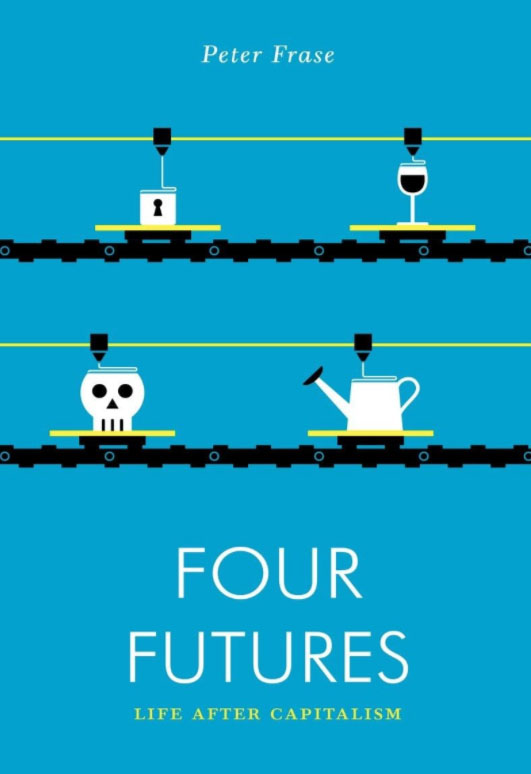
In his book Four Futures: Life After Capitalism , sociologist Peter Frase considers effects of climate change and automation in possible outcomes of a post-Trump election America. Frase envisions four scenarios based on abundance and scarcity and whether a society operates by equality (e.g., communism under abundance / socialism under scarcity) or hierarchy (rentism under abundance / exterminism under scarcity).

With scarce resources, the following scenarios are possible:

Socialism (aka Ecotopia) may arise within an egalitarian society if driven by altruistic notions of self-limitation. Ecologists describe such a self-limiting system as K-selected (see my discussion of K-selection and r-selection in “Water Is…”). A K-selected population is at or near the carrying capacity of the environment, which is usually stable and favors individuals that creatively compete, through cooperation, for resources and produce few young. The K-selected strategy runs on a successive gradient of maturity, from initially competitive to ultimately cooperative. Competition is a natural adaptive remnant of uncertainty and insecurity and forms the basis of a capitalist economy that encourages monopolization and hostile takeovers. Competition results from an initial antagonistic reaction to a perception of limited resources. It is a natural reaction based on distrust—of both the environment and of the “other”—both aspects of “self” separated from “self.” The greed for more than is sustainable reflects a fear of failure and a sense of being separate, which ultimately perpetuates actions dominated by self-interest in a phenomenon known as “the Tragedy of the Commons.” Competition naturally gives way to creative cooperation as trust in both “self” and the “other” develops and is encouraged through continued interaction.

Exterminism (aka Mad Max) may arise under a hierarchical model, driven by greed and exacerbated by uncertainty in the environment—not unlike what we are currently experiencing with the planet’s system and cyclical changes. In this scenario, in which resources are both limited and uncertain, those with access to them would guard or hide them away with desperate fervor.

“When mass labor has been rendered superfluous [through automation], a final solution* lurks: the genocidal war of the rich against the poor.”—Peter Frase

References:

Frase, Peter. 2016. “Four Futures: Life After Capitalism.” Verso Press, London. 150pp.

Luxemberg, Rosa. 1915. “The Junius Pamphlet: The Crisis in the German Democracy.” Marxists.org.

Munteanu, Nina “Gaia’s Revolution.” Book 1 of the Icaria Trilogy, Dragon Moon Press, upcoming.

Munteanu, Nina. 2016. “Water Is…The Meaning of Water.” Pixl Press, Vancouver. 586pp.

Streeck, Wolfgang. 2014. “How Will Capitalism End?” New Left Review 2 (87): 47p.

Thompson, E.P. 1980. “Notes on Exterminism: the Last Stage of Civilisation, Exterminism, and the Cold War.” New Left Review 1(121).

*the Final Solution was originally used by Nazi Germany as “the Final Solution to the Jewish Question”: the Nazi plan to exterminate the Jews during World War II, formulated in 1942 by Nazi leadership at the Wannsee Conference near Berlin, culminated in the Holocaust, which murdered 90 percent of Polish Jews.

Nina Munteanu is a Canadian ecologist / limnologist and novelist. She is co-editor of Europa SF and currently teaches writing courses at George Brown College and the University of Toronto. Visit www.ninamunteanu.ca for the latest on her books. Nina’s bilingual “La natura dell’acqua / The Way of Water” was published by Mincione Edizioni in Rome. Her non-fiction book “Water Is…” by Pixl Press (Vancouver) was selected by Margaret Atwood in the New York Times ‘Year in Reading’ and was chosen as the 2017 Summer Read by Water Canada. Her novel “A Diary in the Age of Water” was released by Inanna Publications (Toronto) in June 2020.

Nina Munteanu Workshops “Hero’s Journey” with Writers in Newmarket

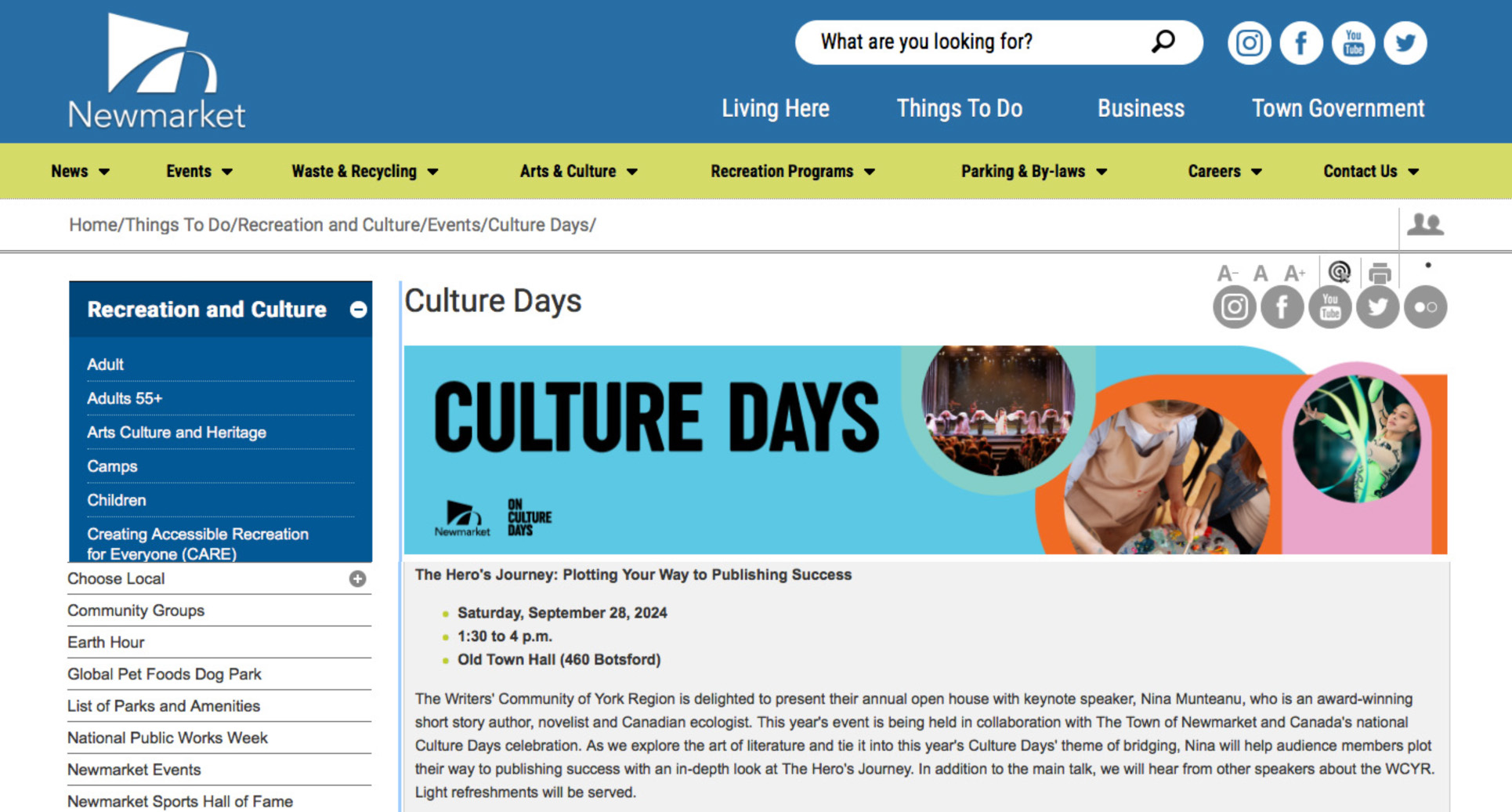
I recently gave my lecture / workshop on the Hero’s Journey plot approach to a group of writers for Culture Days in Newmarket, Ontario.

The event, organized by the WCYR (Writing Community of York Region), took place in the art gallery of the Old Town Hall, located in the old downtown part of the city—an attractive section of streets and lanes with eclectic shops, cafés, bistros and bookstores for curious amblers. 

Bustling Main Street near the Old Town Hall, Newmarket, ON

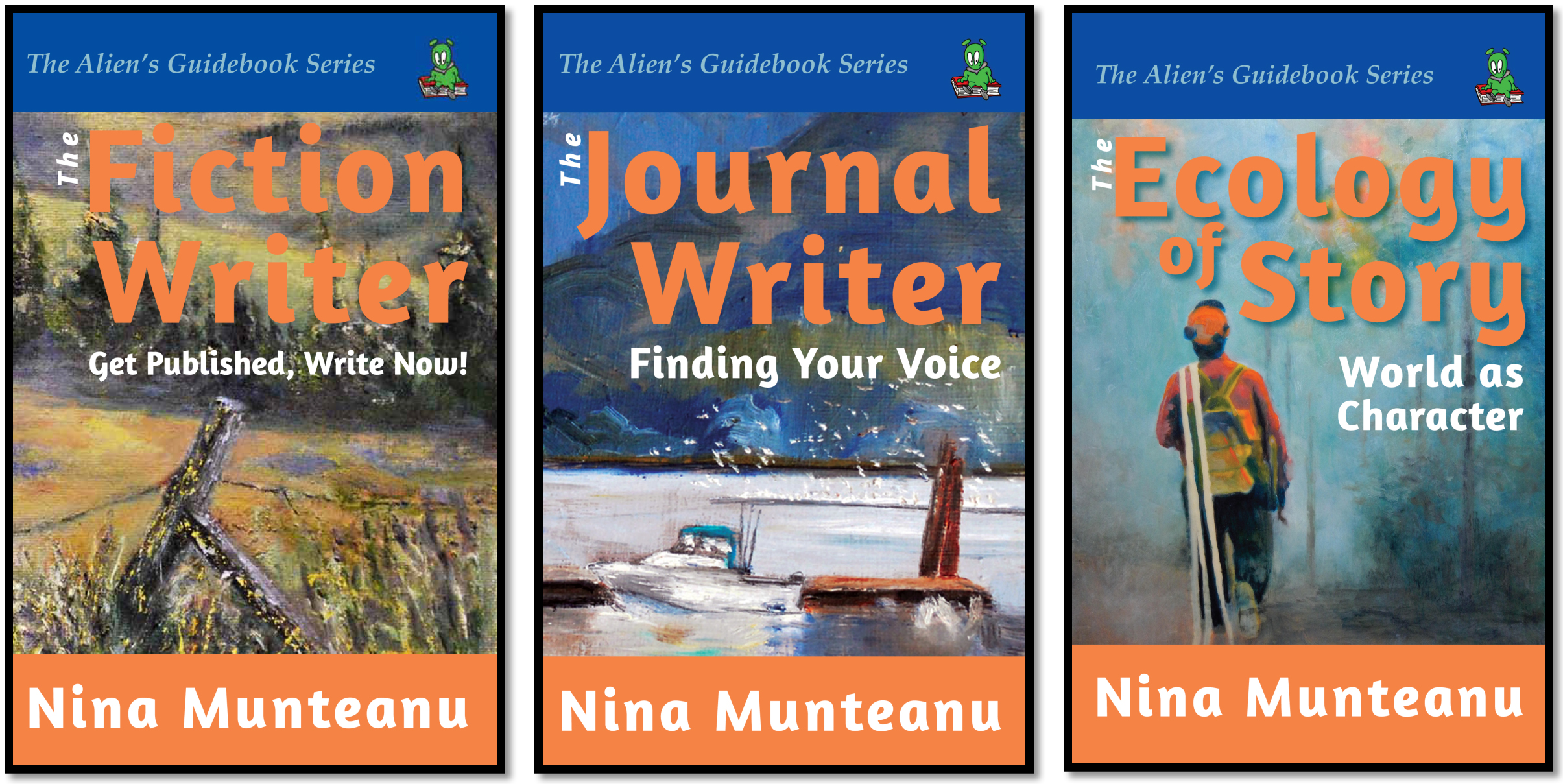
Three guidebooks of the Alien Guidebook series for writers

Cathy Miles, the program coordinator, encouraged me to brings books for sale, so I certainly included the three books of my Alien Guidebook Series on writing: The Fiction Writer, The Journal Writer, and The Ecology of Story, all also available at Amazon, Kobo, Barnes & Noble and other quality bookstores, which I sold for a workshop price. Cathy gave me a wonderful introduction to a room full of eager writers and I also had the pleasure of meeting Janice Luttrell, the Recreation Programmer with the City of Newmarket, who was hosting the event as part of Newmarket’s Culture Days.

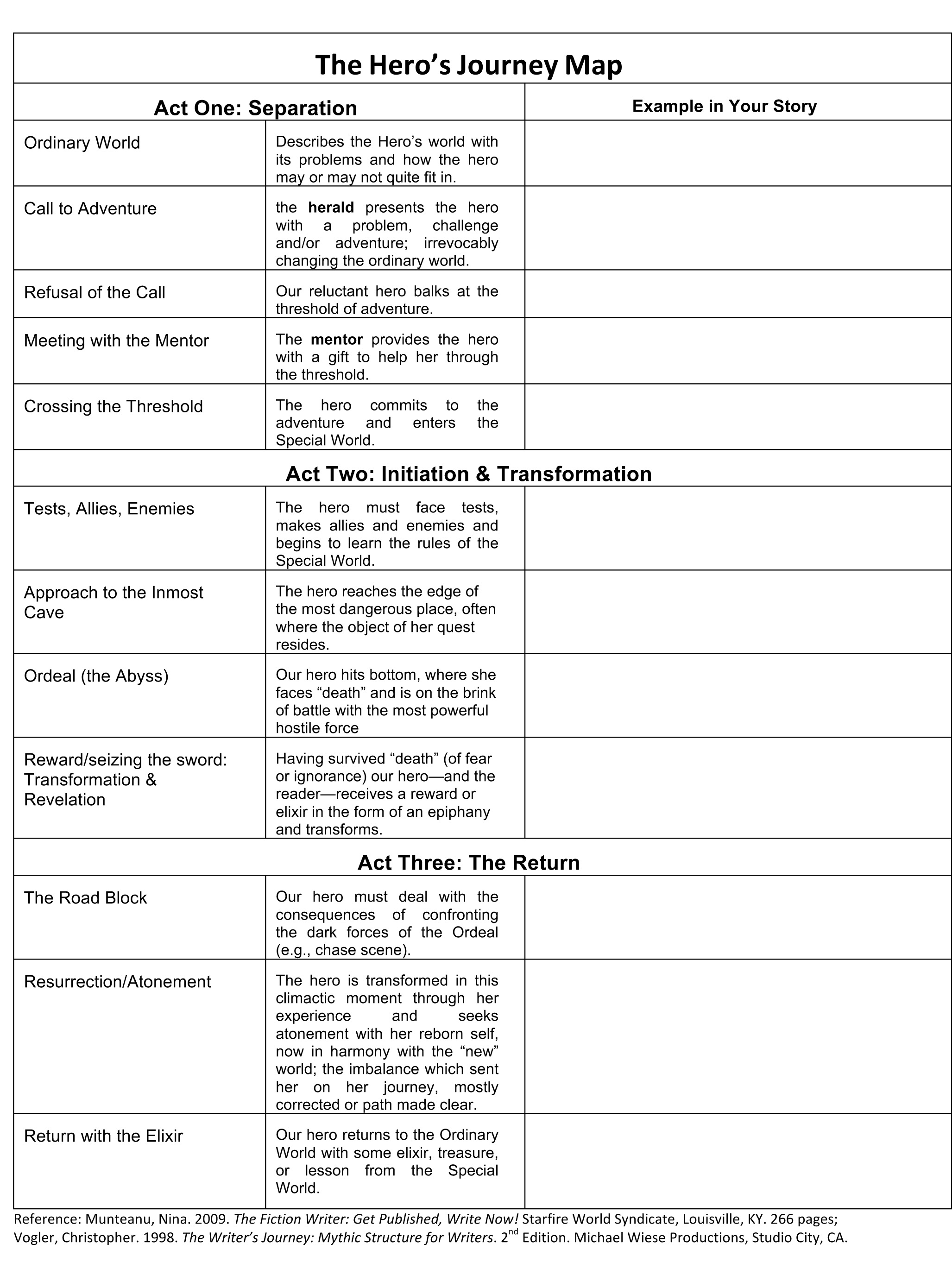
Hero’s Journey Plot Structure (Ingrid Sundberg, 2013)

Drawing from several chapters in The Fiction Writer, I introduced the Hero’s Journey map structure, based on Ingrid Sundberg’s plot structure, and discussed the 12-step hero’s journey according to mythologist Joseph Campbell.

We also discussed the seven chief archetypes associated with the journey steps: hero, mentor, herald, threshold guardian, trickster, shapeshifter, and shadow.

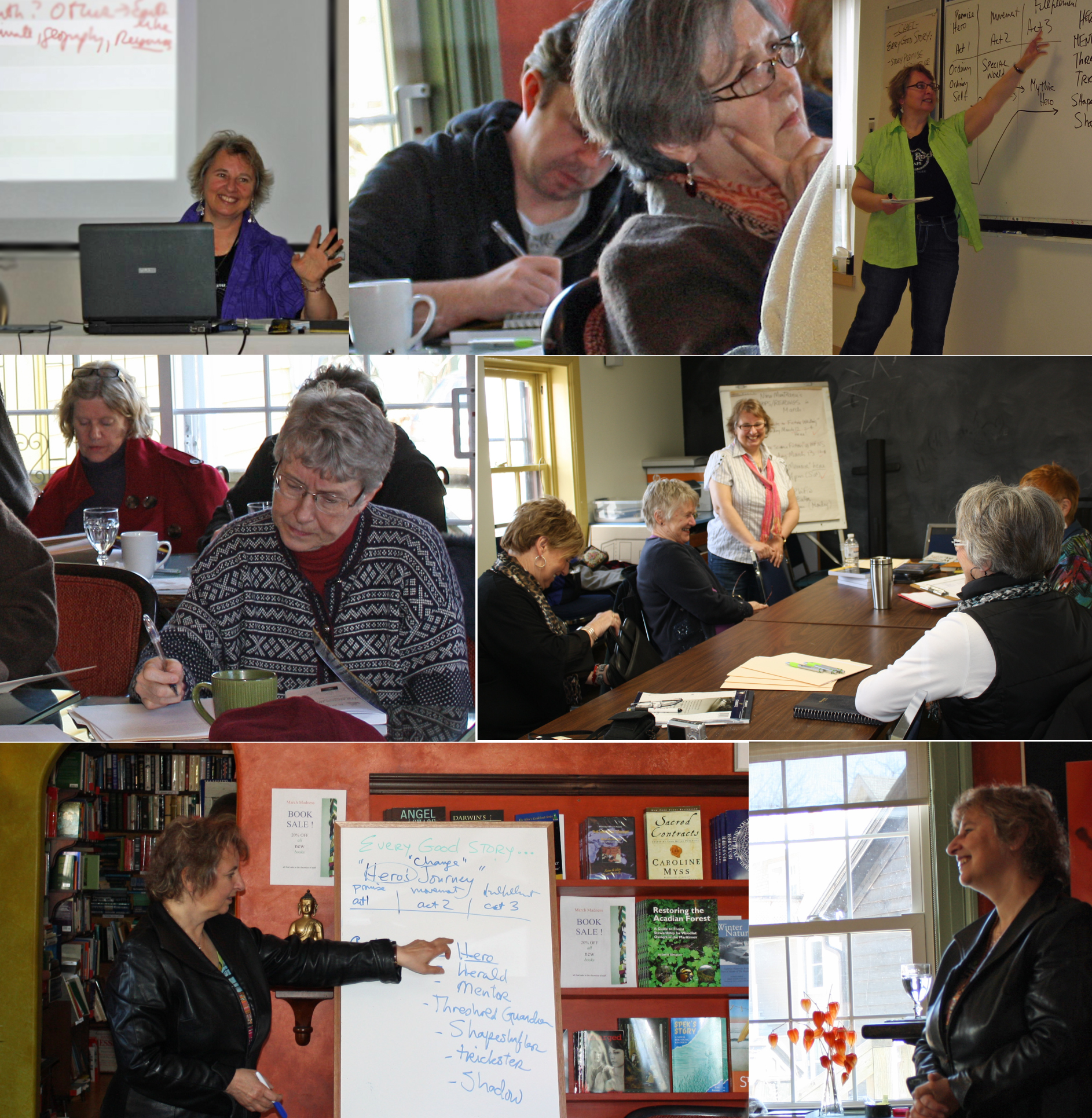
Nina teaching “The Hero’s Journey” plot approach over the years in Nova Scotia, BC and Ontario

I’ve given this workshop many times and always enjoyed the lights that came on in participants; this time was no different. My session was fun and very well received. I saw lots of interest and received many good questions—a sure sign. One participant was quoted as saying:

“What a great event! Your presentation was insightful. I really appreciated being able to follow along in the book while listening to your explanations. That is going to help me remember the concepts as I read the book and then apply them to my writing.” 

The WCYR book table at the event (photo by Nina Munteanu)

People bought every copy of my Fiction Writer, my Journal Writer and most of my Ecology of Story that sat on the book table. I also sold many of my fiction books, including my short story collection Natural Selection (also selling on Kobo) and my latest novel A Diary in the Age of Water. I sold-out of my non-fiction book Water Is…, which had received a wonderful testimonial from Margaret Atwood in the New York Times ‘Year in Reading.’

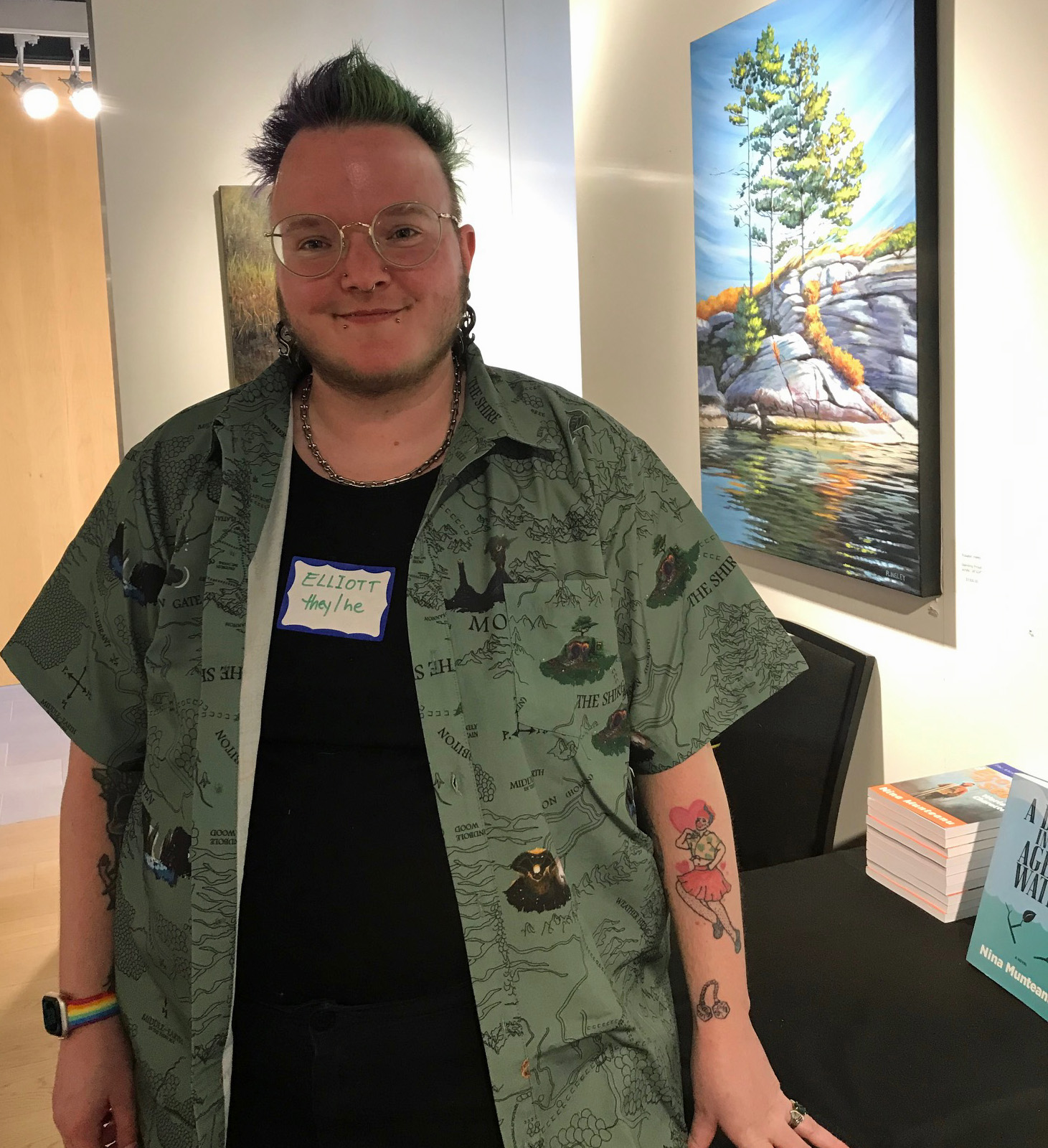
Elliott sells my books at the WCYR book table (photo by Nina Munteanu)

All in all, it was a good day…

Nina Munteanu is a Canadian ecologist / limnologist and novelist. She is co-editor of Europa SF and currently teaches writing courses at George Brown College and the University of Toronto. Visit www.ninamunteanu.ca for the latest on her books. Nina’s bilingual “La natura dell’acqua / The Way of Water” was published by Mincione Edizioni in Rome. Her non-fiction book “Water Is…” by Pixl Press (Vancouver) was selected by Margaret Atwood in the New York Times ‘Year in Reading’ and was chosen as the 2017 Summer Read by Water Canada. Her novel “A Diary in the Age of Water” was released by Inanna Publications (Toronto) in June 2020.

Ironic Tragedy of Forever Chemicals & Growing Infertility: Are We Solving Our Own Population Explosion Through Toxicity?

Screenshot

In the passage below of my eco-fiction dystopian novel A Diary in the Age of Water, the year is 2065 and the diarist Lynna (a limnologist at the University of Toronto) reflects on the steeply growing infertility in humans and our tenuous future. Lynna draws on the factual study published close to fifty years earlier (in 2017) by Hagai Levine and others at the Hebrew University of Jerusalem, who found that sperm counts among western men had reduced close to 60% in four decades:

Back in ’49, Daniel and I had several discussions about the environmental triggers and epigenetic mechanisms of infertility in humans. Daniel went on about how it was all about the men. While women showed signs of increased infertility, men’s rate of infertility was more than double that of the women, he said. Taking an inappropriately gleeful tone, Daniel cited the classic 2017 paper by the Hebrew University of Jerusalem, the one that started it all. Their findings were startling: men’s sperm count in North America, Europe, Australia, and New Zealand had diminished by sixty percent in forty years, between 1973 and 2011. The scientists predicted that by 2060, virtually all men in these parts of the world would have little to no reproductive capacity.

It’s 2065 and they’re right. Only it’s worse. Before the twenties, only the developed countries seemed to be affected, but then sperm counts started to plummet in South American countries, like Argentina and Brazil, where GMO, pesticides, and solvent manufacturing were exploding.

You get out what you put into the ground. India and Asia—where endocrine-disruptive chemicals are finding their way into the water—are reporting very low sperm counts in their men as well as higher incidents of intersex humans.

You get out what you put into the water. We are over two thirds water, after all. I find it a little ironic that we’ve inadvertently produced a non-discriminatory way to control the problem of humanity’s overpopulation. Infertility. And that infertility results from defiling the environment we live in.

But now climate change is shouldering its way in. Climate change is shutting us down.

Is this the first sign of our impending extinction?

–excerpt from “A Diary in the Age of Water”

That environmental perturbations impact our ability to reproduce has been proven. In their 2017 article, Levine et al. write that:

“Sperm count and other semen parameters have been plausibly associated with multiple environmental influences, including endocrine disrupting chemicals (Bloom et al., 2015; Gore et al., 2015), pesticides (Chiu et al., 2016), heat (Zhang et al., 2015) and lifestyle factors, including diet (Afeiche et al., 2013; Jensen et al., 2013), stress (Gollenberg et al., 2010; Nordkap et al., 2016), smoking (Sharma et al., 2016) and BMI (Sermondade et al., 2013; Eisenberg et al., 2014a). Therefore, sperm count may sensitively reflect the impacts of the modern environment on male health throughout the life course (Nordkap et al., 2012).”

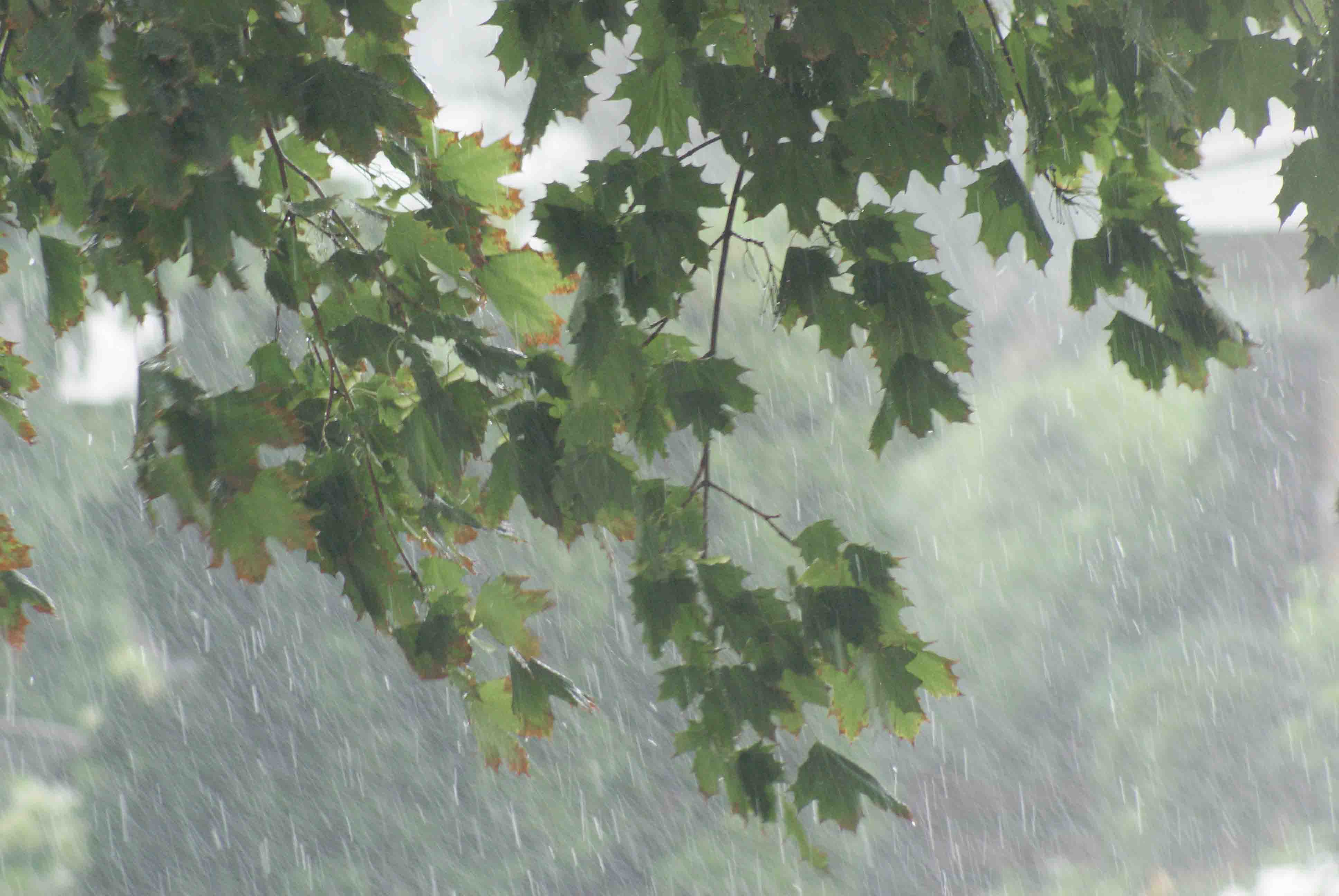
This rain falling on an Ontario marsh most certainly contains forever chemicals (photo by Nina Munteanu)

Thanks to chemical companies such as DuPont and others, forever chemicals are currently in rain water globally, and in many places in unhealthy concentrations. These endocrine-disrupting and cancer-causing chemicals often end up in drinking water and include PCBs, phthalates, PFAS, BPAs (used in pesticides, children’s products, industrial solvents and lubricants, food storage, electronics, personal care products and cookware).

If you observe a terrible irony in this short list, also know that the chemical companies, such as DuPont, have known about the dangers posed by these products for decades and decided to keep it a secret.

Heavy rain in Mississauga, ON (photo by Nina Munteanu)

Nina Munteanu is a Canadian ecologist / limnologist and novelist. She is co-editor of Europa SF and currently teaches writing courses at George Brown College and the University of Toronto. Visit www.ninamunteanu.ca for the latest on her books. Nina’s bilingual “La natura dell’acqua / The Way of Water” was published by Mincione Edizioni in Rome. Her non-fiction book “Water Is…” by Pixl Press (Vancouver) was selected by Margaret Atwood in the New York Times ‘Year in Reading’ and was chosen as the 2017 Summer Read by Water Canada. Her novel “A Diary in the Age of Water” was released by Inanna Publications (Toronto) in June 2020.

My Books at VPL Central Library, Vancouver

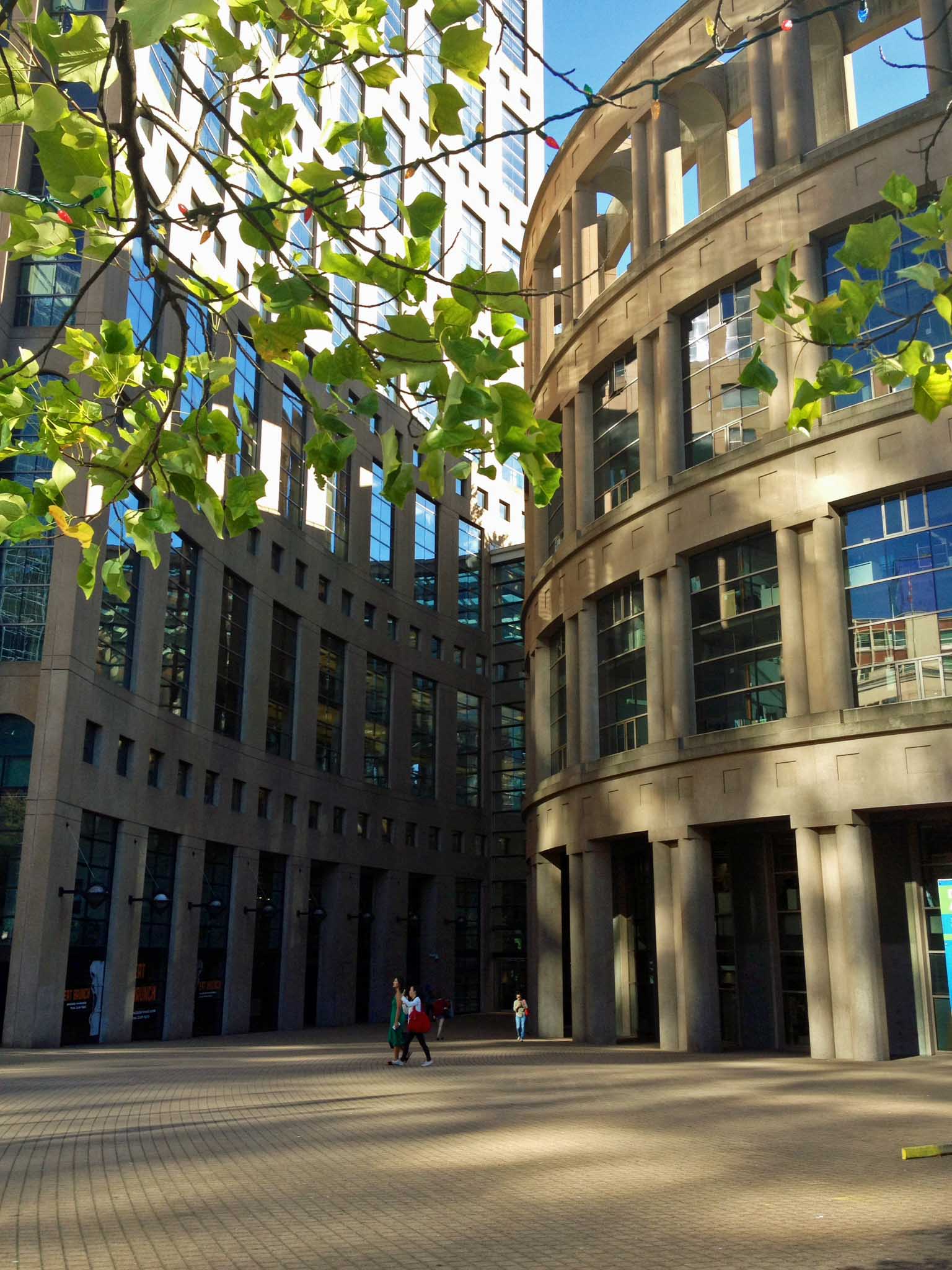
The Vancouver Central Library (photo by Nina Munteanu)

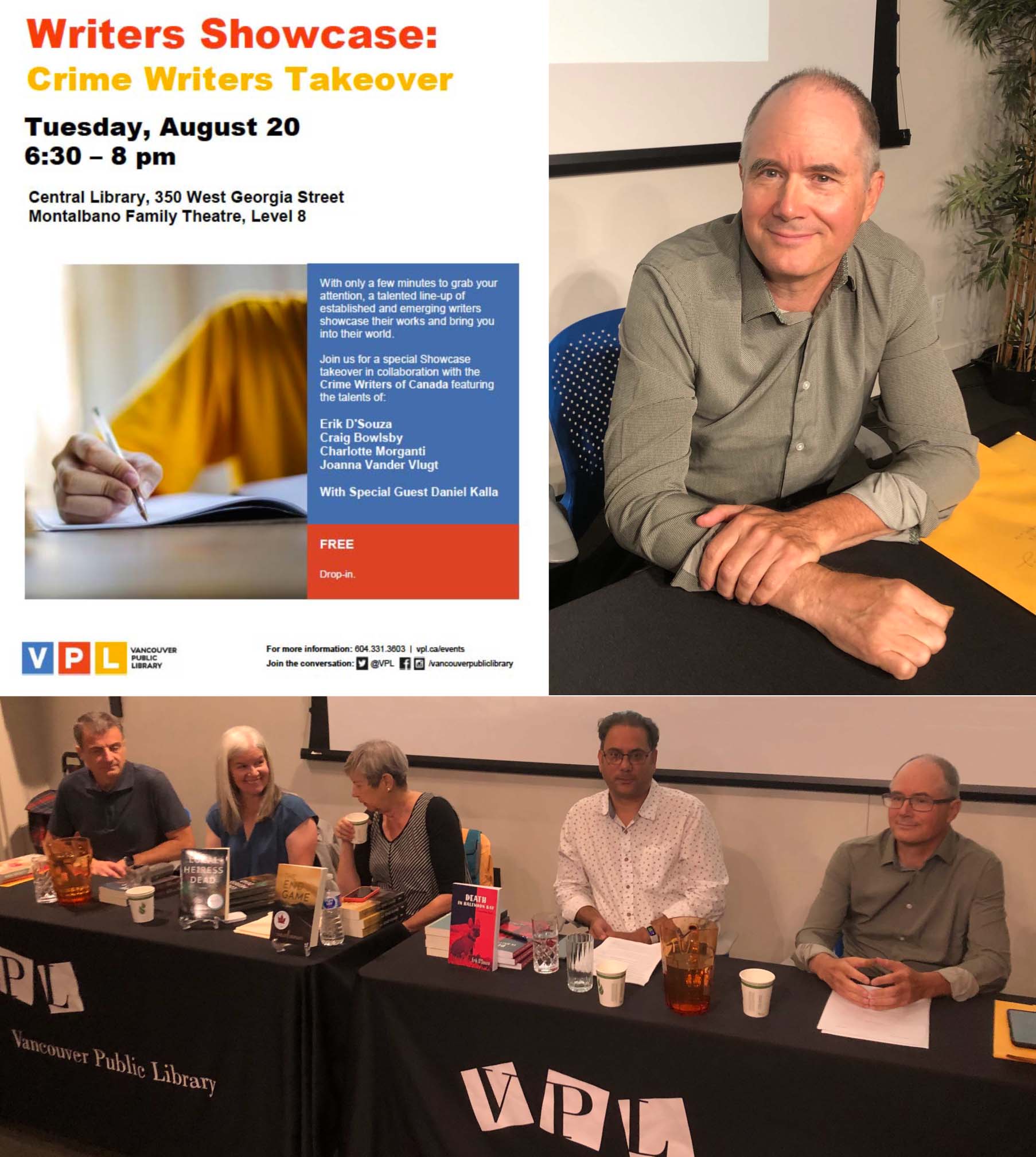
I was recently at Vancouver’s Central Library on Georgia Street to listen to my colleague Craig Bowlsby give a reading from his much anticipated novel Requiem for a Lotus. He was joined by four other crime writers who gave readings that evening, including Daniel Kalla who read from his 2024 book High Society.

Book reading at VPL Central Library

My Books

Feeling whimsical on my way out, I asked the librarian if the library carried any of Nina Munteanu’s books. They did, and plenty of them! Most of my science fiction books were on their shelves as well as my historical fantasy The Last Summoner, my writing guide The Fiction Writer, and my nonfiction book on water Water Is…The Meaning of Water.

I returned the next day to check out my books and to enjoy the wonderful setting of this large and iconic Coliseum-inspired library in downtown Vancouver. It was a typical Vancouver drizzly day; a good day to spend in a library, I thought.

My book “Water Is…” at the Vancouver Central Library; note how my book answers the question posed by the book next to it (photo by Nina Munteanu)

I found Water Is… on the ground floor among other books on water. My science fiction books were up on the fourth floor, clustered with my historical fantasy The Last Summoner. Books included Darwin’s Paradox and two books of my Splintered Universe Trilogy, Inner Diverse and Metaverse; Outer Diverse was out with a customer. They also had my short story collection Natural Selection

My science fiction and fantasy books at the Vancouver Central Library (photo by Nina Munteanu)
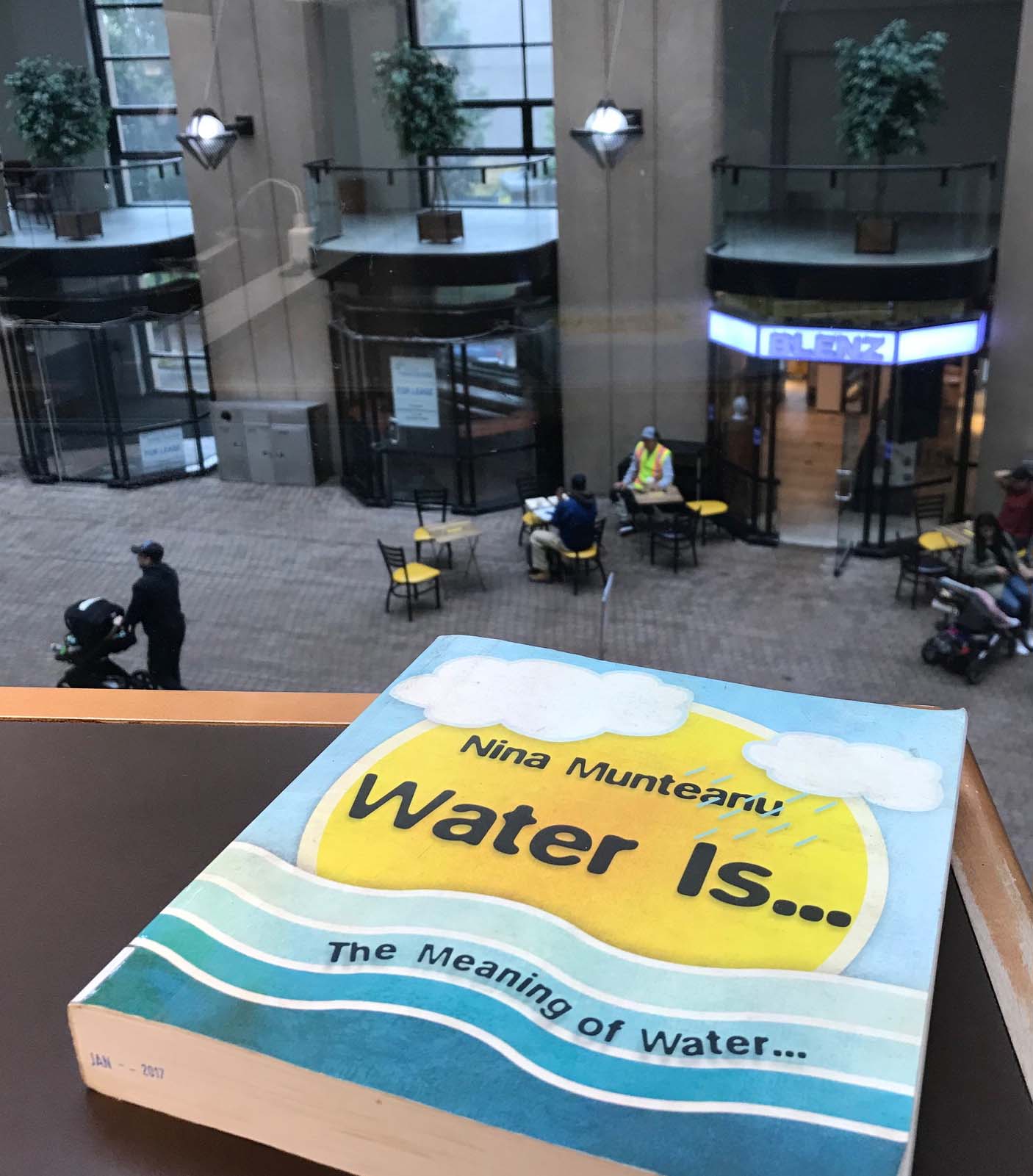
“Water Is…” sits at a desk overlooking the atrium, Vancouver Central Library (photo by Nina Munteanu)

The Library

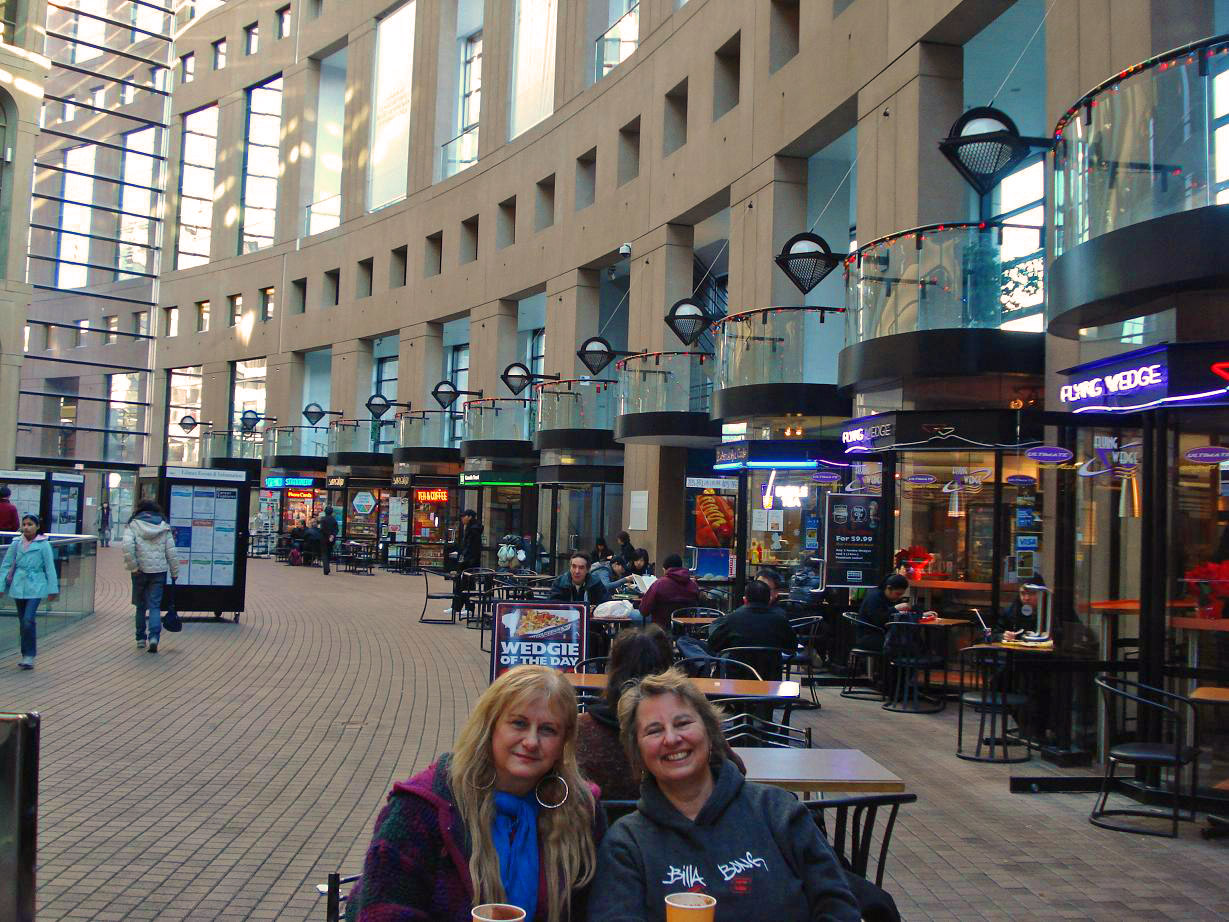
Nina Munteanu and Vancouver poet Lucia Gorea share a Blenz coffee in the atrium of the library complex, Vancouver (photo by

The Vancouver Central Library is an iconic feature of downtown Vancouver. Its Coliseum-style architecture lends a note of gravitas and traditional beauty to the nouveau chic revitalized downtown. Occupying an entire city block in the eastward expansion of Vancouver’s downtown core, the library complex along with federal office building tower is made of sandstone-coloured precast concrete. The building exterior is covered in granite quarried in Horsefly, BC and built to the highest seismic standards. In the words of Safdie Architects: “the heart of the Vancouver Public Library is a spiraling grand urban room that draws the public into Library Square as both a quiet place for study and contemplation and a vital community meeting place.”

Vancouver Central Library complex (photo by Nina Munteanu)

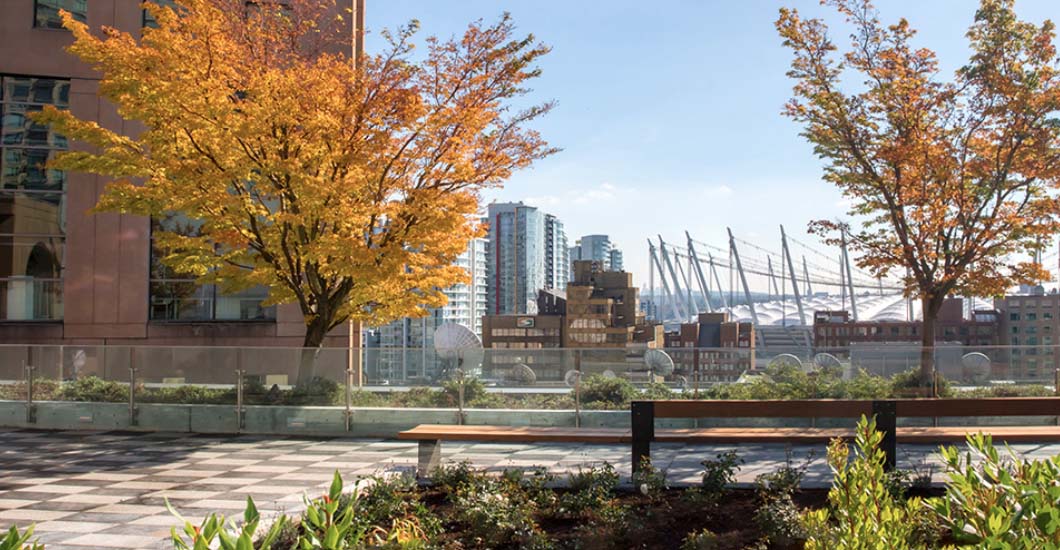
The library opened in May of 1995; then expansion of the upper floors began in June 2017.  As the lease came due on the upper two floors (levels 8 and 9), the library undertook planning to transform the area and offer much needed community spaces.  Rather than featuring traditional collections, the expansion now provides meeting rooms, a glass enclosed reading room, an 80-seat theatre (where I listened to Craig read his book), an exhibition space, as well as a long awaited public rooftop garden and outdoor terraces. Original architects (Moshe Safdie & Associates with local partners DA Architects) were retained to design the new expansion. Cornelia Hahn Oberlander, the landscape architect responsible for the green roof, designed the long-awaited rooftop gardens.

Rooftop gardens of the Vancouver Central Library in the fall

The Environs

I spent a drizzly morning and afternoon in the library with its spacious atrium along with bookstore and Blenz coffee bar, and other interesting places on Georgia Street nearby.

Glowbal, outside and inside (photos by Nina Munteanu)

Close by, at Glowbal, I treated myself to a wonderful lunch on their heated patio undercover. I then dashed through the rain to Telus Gardens next door that I found attractive, fresh and welcoming with its succulent jungle of plants, fragrant orchids and swimming koi ponds. I sipped my London Fog and ate a wonderful apple custard caramel croissant (from Café Bisou), while sitting in a flower-petal chair and enjoying the blissful serenade of a piano player.

Telus Gardens, Vancouver (photos by Nina Munteanu)

The day of sensual pleasures and intellectual satisfaction was complete!

Next time you find yourself in Vancouver’s downtown, check out my books at the Central Library and enjoy the vibrant downtown core.

Looking up at various floors of the Central Library from the atrium (photo by Nina Munteanu)

Nina Munteanu is a Canadian ecologist / limnologist and novelist. She is co-editor of Europa SF and currently teaches writing courses at George Brown College and the University of Toronto. Visit www.ninamunteanu.ca for the latest on her books. Nina’s bilingual “La natura dell’acqua / The Way of Water” was published by Mincione Edizioni in Rome. Her non-fiction book “Water Is…” by Pixl Press (Vancouver) was selected by Margaret Atwood in the New York Times ‘Year in Reading’ and was chosen as the 2017 Summer Read by Water Canada. Her novel “A Diary in the Age of Water” was released by Inanna Publications (Toronto) in June 2020.

My Books Selling at Banyen Books & Sound, Vancouver

Water Is… sits on the shelf at Banyen Books (photo by Nina Munteanu)

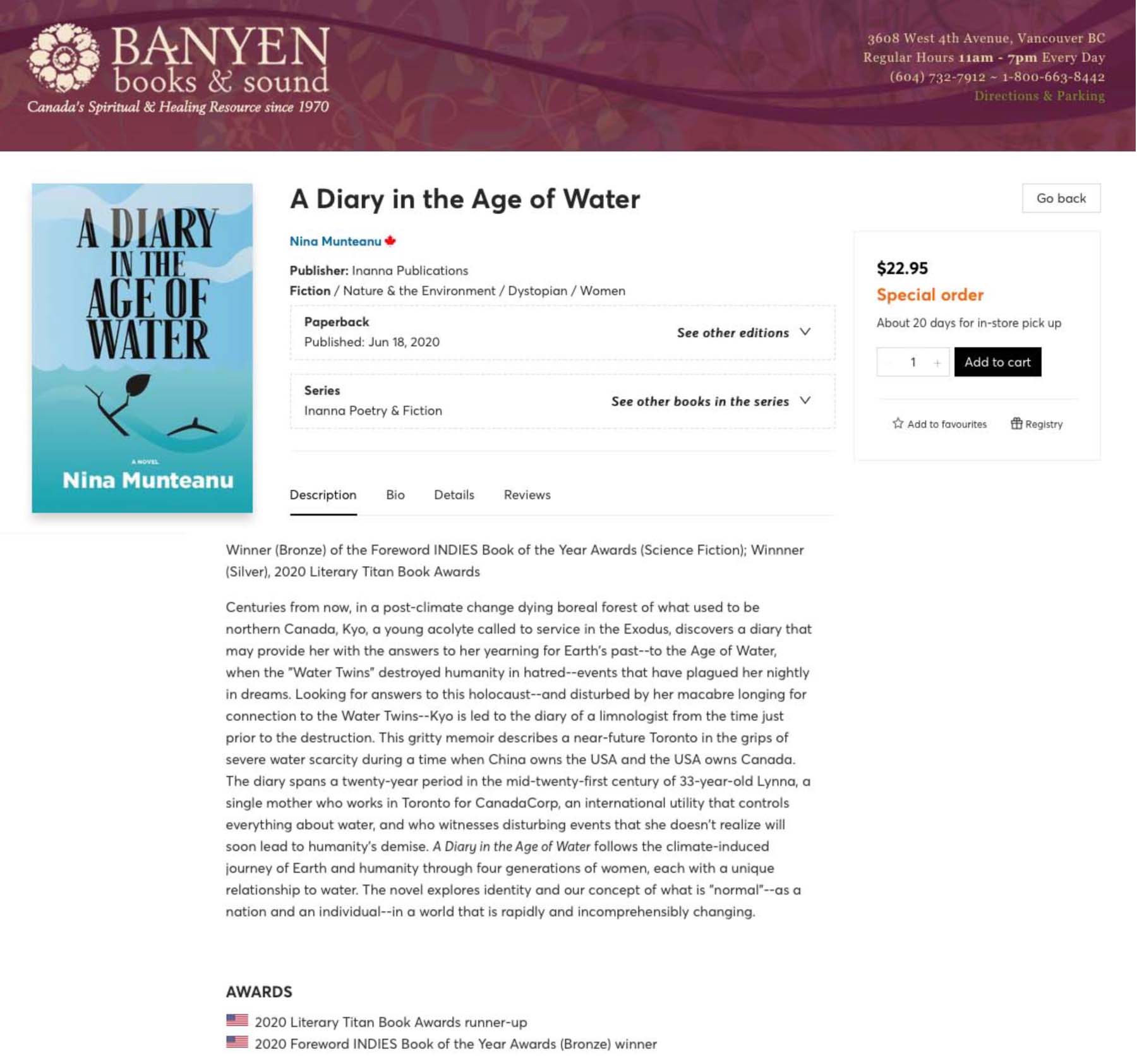
My books “Water Is… The Meaning of Water” and “A Diary in the Age of Water” are selling at Banyen Books in Kitsilano, Vancouver. While “A Diary in the Age of Water” is on Banyen’s virtual shelf for order, “Water Is…” sits on a shelf in the Water: Life-force & Resource / Ecology section.

“Water Is…” sits on the ‘water as life-force & resource’ shelf at Banyen Books, Vancouver (photo by Nina Munteanu)

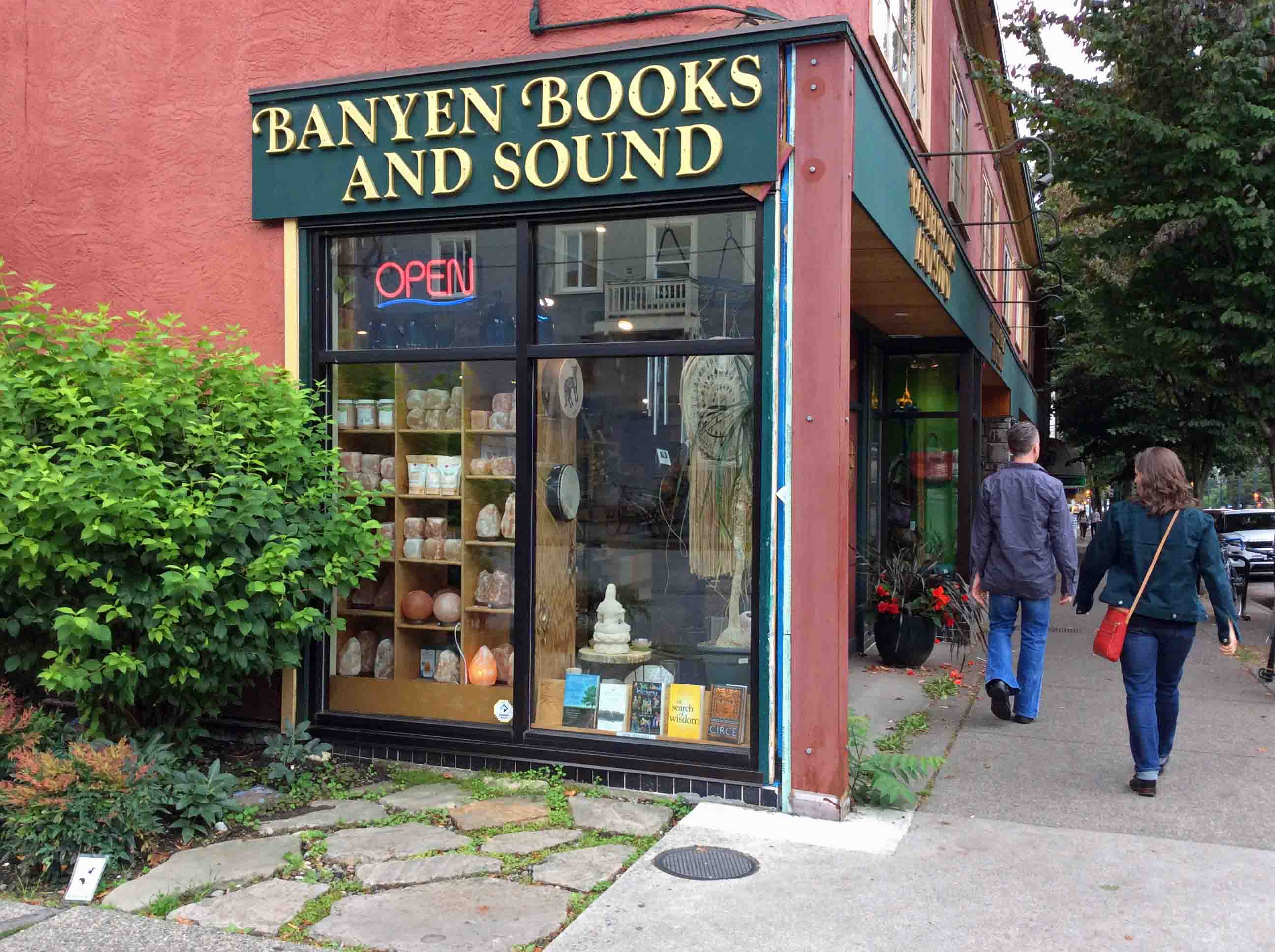
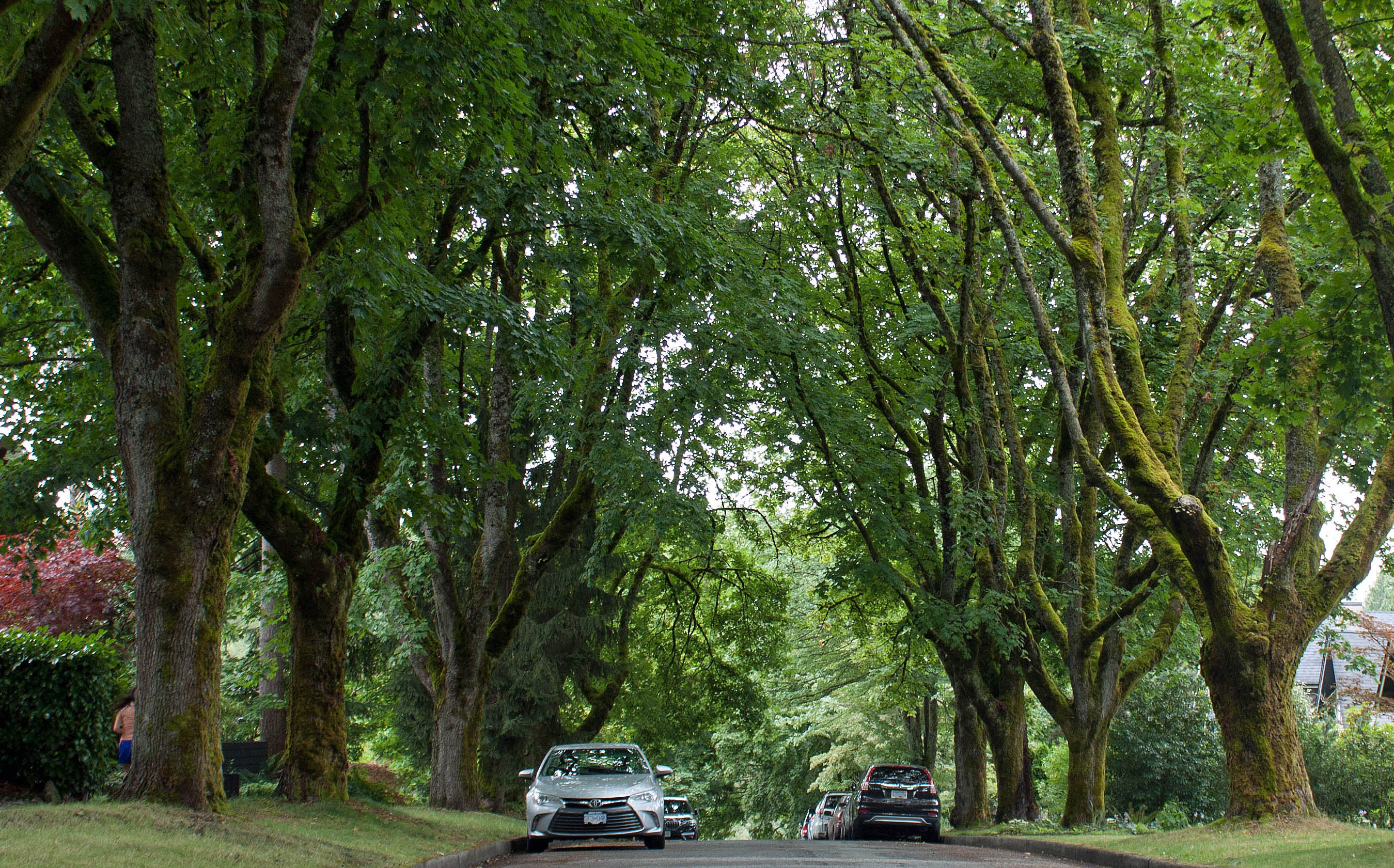
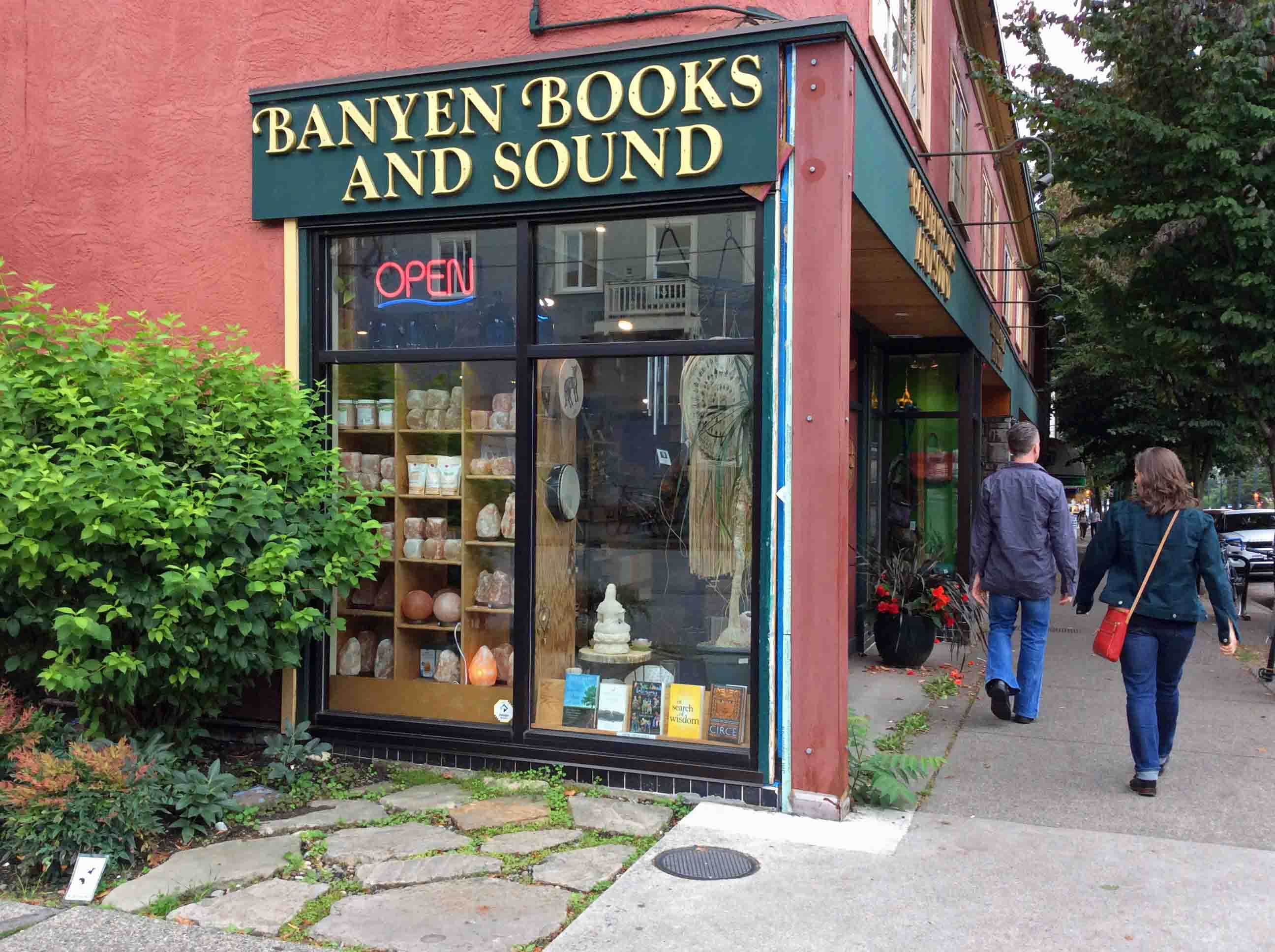
Banyen Books is located in Kitsilano on the south side of W 4th Avenue on the corner of Dunbar under a grove of healthy oak trees. Across the store is Aphrodite’s Organic Pies, itself a destination for awesome pies. Banyen Books is a beautiful store. It is spacious and surrounded with the warmth of wood and plants. Its wonderful atmosphere invites you to browse the shelves and sit on the comfortable chairs to read. Banyen Books has become a destination for me whenever I’m in Vancouver.

Banyen Books on the corner of W 4th and Dunbar, Vancouver, BC (photo by Nina Munteanu)

Since opening in 1970 Banyen Books has become Canada’s most comprehensive metaphysical bookstore, offering a broad spectrum of resources from humanity’s spiritual, healing, and earth wisdom traditions. Here is how they put it:

Banyen is an oasis, a crossroads, a meeting place… for East and West, the “old ways” and current discoveries and syntheses. Our beat is the “Perennial Philosophy” as well as our evolving learning edges and best practices in a wide variety of fields, from acupuncture to Zen, from childbirth and business to the Hermetic Mysteries, from the compost pile to the celestial spheres. We’re “in the philosophy business,” on “a street in the philosophy district” (as an old cartoon wagged). We welcome and celebrate the love of wisdom, be it in art, science, lifecraft, healing, visioning, religion, psychology, eco-design, gardening… Our service is to offer life-giving nourishment for the body (resilient, vital), the mind (trained, open), and the soul (resonant, connected, in-formed). Think of us as your open source bookstore for the “University of Life”.

Whenever I’m in Vancouver to visit family and friends, I make at least one stop at Banyen Books and often come out with an armful of books. On my most recent stop, I purchased a book on plant intelligence and several beautiful journals (I use a journal for each book project I work on).

My latest purchase at Banyen Books (photo by Nina Munteanu)

Banyen Books & Sound:

3608 West 4th Avenue
Vancouver, BC
604-732-7912

HOURS:

Mon-Fri: 10am-9pm
Sat: 10am-8pm
Sun: 11am-7pm

19th Avenue in Vancouver, BC (photo by Nina Munteanu)

Nina Munteanu is a Canadian ecologist / limnologist and novelist. She is co-editor of Europa SF and currently teaches writing courses at George Brown College and the University of Toronto. Visit www.ninamunteanu.ca for the latest on her books. Nina’s bilingual “La natura dell’acqua / The Way of Water” was published by Mincione Edizioni in Rome. Her non-fiction book “Water Is…” by Pixl Press (Vancouver) was selected by Margaret Atwood in the New York Times ‘Year in Reading’ and was chosen as the 2017 Summer Read by Water Canada. Her novel “A Diary in the Age of Water” was released by Inanna Publications (Toronto) in June 2020.

“Water Is…” now selling at Banyen Books, Vancouver

Banyen Books & Sound on corner of Dunbar and W 4th Avenue, Vancouver (photo by Nina Munteanu)

One of my favourite bookstores in Vancouver is Banyen Books & Sound  on the southwest corner of W 4th Avenue and Dunbar. So, whenever I go back to my home town to visit family and friends, I stop there to linger amid the shelves of wonder and erudite adventure. Then I usually cross Dunbar to Aphrodite’s Organic Pie Shop for a delicious fresh pie—usually peach, if it is available. So good! Two things I love: books and pie!

Aphrodite’s Organic Pies, next door to Banyen’s, Vancouver (photos by Nina Munteanu)
Pacific Spirit Regional Park, Vancouver, BC (photo by Nina Munteanu)

During my recent visit this year to Vancouver, my friends and I had a fulfilling walk one morning through the big tree forest of Pacific Spirit Park near UBC. Margaret suggested we go to Aphrodite’s Organic Café for lunch, located across 4th Avenue from Banyen Books (the sister restaurant to the pie shop). After a delicious lunch, we wandered into Banyen, like desert nomads looking for water, and lost ourselves in a treasure of books, magazines, crystals, cards, singing bowls and other spiritual/healing items. Like a braided river, we dispersed according to our wayward interests.

Water Is… at Banyen Books, Vancouver (photos by Nina Munteanu)

Then friend Anne soon found me and pulled my sleeve. “Your book is here!” She led me to where my book Water Is… stood, face out, on the top shelf marked ‘Water: Life Force & Resource.’ In truth, I already knew through Pixl Press that the book was selling there. But here it was, showcased so nicely! It sat rather stately amid Emoto’s Secret Life of Water and Ryrie’s Healing Energies of Water.

Banyen customers find Water Is… and find a chair to take a look

One of the perks of Banyen Books are the comfortable seats for easy browsing. When I teasingly asked one of the clerks if they noticed people lingering for the day, they said, “yeah! They might leave for lunch then come back for the afternoon!” I can see why; Banyen is an entire world to discover. It is called Canada’s most comprehensive Body-Mind-Spirit bookstore, “offering a broad spectrum of resources from humanity’s spiritual, healing, and earth wisdom traditions…Our service is to offer life-giving nourishment for the body (resilient, vital), the mind (trained, open), and the soul (resonant, connected, in-formed). Think of us as your open source bookstore for the ‘University of Life’.”

“Banyen is an oasis, a crossroads, a meeting place…for East and West, the ‘old ways’ and current discoveries and syntheses.”

This is how Banyen describes its birth in 1970:

“The Golden Lotus Restaurant and Natural Food Store on Fourth Avenue at Bayswater was a hothouse for spiritual seekers, new vegetarians and spaced-out hippies grounding through good work. Banyen was born in a tiny book corner of the Golden Lotus. That lovely place was a connection to India, meditation and spiritual growth from 1967 to 1970. As its sun set, what was to become the Naam restaurant, Lifestream, Woodlands, Nature’s Path, and Banyen Books arose.”

Along with Water Is… Banyen is also selling my latest eco-fiction novel A Diary in the Age of Water.

Nina Munteanu is a Canadian ecologist / limnologist and novelist. She is co-editor of Europa SF and currently teaches writing courses at George Brown College and the University of Toronto. Visit www.ninamunteanu.ca for the latest on her books. Nina’s bilingual “La natura dell’acqua / The Way of Water” was published by Mincione Edizioni in Rome. Her non-fiction book “Water Is…” by Pixl Press (Vancouver) was selected by Margaret Atwood in the New York Times ‘Year in Reading’ and was chosen as the 2017 Summer Read by Water Canada. Her novel “A Diary in the Age of Water” was released by Inanna Publications (Toronto) in June 2020.

When the Permafrost Thaws…

Ice and snow cover the Otonabee River in winter, ON (photo and rendition by Nina Munteanu)

In my upcoming novel “Gaia’s Revolution,” one of the protagonists, Damien Vogel, contemplates in 2022 a key event from 2020 that only a few seem to take seriously:

In Siberia in June 2020, record heat of thirty degrees Centigrade, over the average of 11 degrees, collapsed permafrost and caused oil tanks in Norilsk to rupture. Over twenty thousand tonnes of diesel spilled into the Pyasina lake and river system. Damien remembers looking at the veins of red on satellite images from space. That disaster is just the beginning of what the ‘sleeping bear’ of methane hydrates promise to unleash when the permafrost reaches a critical thaw and those hydrates awaken. Melting permafrost is a quiet sleeper in the climate change procession, he considers. At a microscopic level, in the chemistry of the water and in the change in the atmosphere, a time bomb is ticking.

A decade later, Damien’s twin brother, Eric, notes that:

“Back in the ‘20s scientists started noticing major permafrost melt on the Siberian Shelf,” Eric goes on. “The melting released hydrates, which set the oil and gas companies frothing at the mouth with joy and the climate scientists spinning in a panic because of what they knew it meant for the planet. It was the harbinger of the largest methane ‘burp’ ever.”

Eric then adds:

“Permafrost thaw kicked us into this devastating global warming, Dame, and everyone—even the climate modellers—ignored it, because they didn’t have enough data. Gott verdammt! They’re all still asleep, Dame!”

In his book The Treeline, Ben Rawlence writes about the ongoing extinction of indigenous peoples in the north as the treeline migrates northward into tundra and the permafrost and sea ice change and go extinct themselves.

Ice fragments on the Otonabee River, ON (photo by Nina Munteanu)

Methane & The Clathrate Gun Hypothesis 

Because methane is present in much smaller concentrations many scientists have mistakenly deemed it as important as carbon dioxide in the climate change equation; however, it is becoming obvious that methane poses a real and largely unacknowledged danger. Methane is twenty times more efficient in trapping heat than carbon dioxide. Permafrost—which is currently melting rapidly in the north—contains almost twice as much carbon as is currently in the atmosphere. In the rapidly warming Arctic (warming twice as fast as the globe as a whole), the upper layers of this frozen soil are thawing, allowing deposited organic material to decompose and release methane.

.

The clathrate gun hypothesis is the notion that sea temperature rises (and/or drops in sea levels) may trigger a catastrophic positive feedback on climate:  warming would cause a sudden release of methane from methane clathrate (hydrate) compounds buried in seabeds, in the permafrost, and under ice sheets.

Something of this nature has already occurred in Siberia in 2020. In his book The Treeline Ben Rawlence reports the following warning by Dutch scientist Dr. Ko van Huissteden, a leading authority on permafrost:

“It is hard to measure methane release … [but] some studies have suggested that an unstable seabed could release a methane ‘burp’ of 500-5000 gigatonnes, equivalent to decades of greenhouse gas emissions, contributing to an abrupt jump in temperature that humans will be powerless to arrest.” (Wadhams, 2015)

Creation of gas hydrates requires high pressure; water; gas—mainly methane—and low temperatures. Three environments considered suitable for this process to occur include: sub-seabed along the world’s continental margins; permafrost areas on land and off shore; and a process for storing methane hydrates: ice sheets. As long as the climate is cold and the ice sheet stable, the gas hydrate zone remains stable. As the ice sheets melt, the pressure on the ground decreases; hydrates destabilize and release methane into rising seawater and finally into the atmosphere.

A recent study in Science revealed that hundreds of massive, kilometer-wide craters on the ocean floor in the Arctic were formed by substantial methane expulsions. Because methane is a powerful greenhouse gas, temperatures would rise exponentially. Once started, this runaway process could be as irreversible as the firing of a gun—and on a time scale less than a human lifetime.

The sudden release of large amounts of natural warming gas from methane clathrate deposits in runaway climate change could be a cause of past, future, and present climate changes.

Latest research on the Greenland ice sheet and elsewhere throughout the Arctic has revealed major methane discharges in Arctic lakes in areas of permafrost thaw. Scientists are exploring areas where methane is bubbling to the surface and releasing to the atmosphere.

If human emissions continue at their current rate, rapidly changing ocean currents and retreating ice sheets may uncork methane from under ice caps, ocean sediments and Arctic permafrost, causing a jump in radiative forcing. Even if rapid ice sheet disintegration were to scatter large amounts of ice into the oceans, the net cooling effect would be strongly countered and likely overwhelmed. The areas that did cool would likely trigger severe weather outbreaks.

As I write, we are pumping out CO2 into the atmosphere at a rate 10 times faster than at any point in the past 66 m years, with the resulting sea level rises, extreme weather events, heat waves, droughts, unseasonal storms, and stress on biodiversity around the globe.  Research published in the journal Nature Geoscience demonstrates that “the world has entered ‘uncharted territory’ and that the consequences for life on land and in the oceans may be more severe than at any time since the extinction of the dinosaurs,” writes Damian Carrington of The Guardian.

In an interview with Guardian reporter John Abraham, Woods Hole expert Robert Max Holmes, exhorted:

It’s essential that policymakers begin to seriously consider the possibility of a substantial permafrost carbon feedback to global warming. If they don’t, I suspect that down the road we’ll all be looking at the 2°C threshold in our rear-view mirror.

Ice break up on the Otonabee River in early spring, ON (photo by Nina Munteanu)

References:

Hansen, James and Sato, Makiko; Update of Greenland ice sheet mass loss: Exponential?; (26 December 2012).

Adams, J., M.A. Maslin and E. Thomas Sudden climate transitions during the Quaternary; Progress in Physical Geography, 23, 1, 1-36 (1999)

Andreassen et al. 2017. “Massive blow-out craters formed by hydrate-controlled methane expulsion from the Arctic seafloor,” Sciencescience.sciencemag.org/cgi/doi … 1126/science.aal4500


Carrington, Damian. 2016. “Carbon emission release rate ‘unprecedented’ in past 66 m years.” The Guardian, March 21, 2016.

Hansen, James and Sato, Makiko. 2012. Update of Greenland ice sheet mass loss: Exponential?; (26 December 2012).

Portnov et al. 2016. Ice-sheet-driven methane storage and release in the ArcticNature Communications 7

Rawlence, Ben. 2022. “The Treeline.” Jonathan Cape, London. 342pp.

Sachs, Julian and Anderson, Robert. 2005. Increased productivity in the subantarctic ocean during Heinrich events; Nature 434, 1118-1121;(28 April 2005).

Sojtaric, Maja. 2016. Ice Sheets May be Hiding Vast Reservoirs of Powerful Greenhouse GasCAGE.

Wadhams, Peter. 2015. “A Farewell to Ice.” Penguin.

Flowing water in a river, ON (photo by Nina Munteanu)

Nina Munteanu is a Canadian ecologist / limnologist and novelist. She is co-editor of Europa SF and currently teaches writing courses at George Brown College and the University of Toronto. Visit www.ninamunteanu.ca for the latest on her books. Nina’s bilingual “La natura dell’acqua / The Way of Water” was published by Mincione Edizioni in Rome. Her non-fiction book “Water Is…” by Pixl Press (Vancouver) was selected by Margaret Atwood in the New York Times ‘Year in Reading’ and was chosen as the 2017 Summer Read by Water Canada. Her novel “A Diary in the Age of Water” was released by Inanna Publications (Toronto) in June 2020.

This entry was posted in booksCanadaChoices for WaterClimate Changeeco-fictionecologyenvironmentSciencesustainabilityThe FutureWater Is and tagged arctic ice meltArctic OceanBen Rawlenceclathrate gun hypothesisClimate Changeeco-fictionecologyenvironmentGaia’s Revolutionglobal warmingice sheetsmelting permafrostmethanemethane clathratesmethane hydratespermafrostpermafrost thawrunaway climate changeScienceThe Treelinewater. Bookmark the permalinkEdit