Nina, the snow bear, enjoying a heavy snowfall in early winter, ON (photo by M. Cox)
I grew up in southern Quebec, where the first snow of the season often came from the sky in a thick passion. Huge flakes of unique beauty settled on my coat sleeves and within minutes I was covered in snow. I would stand enraptured and study each one as I could. Snow wraps everything in a blanket of soft acceptance. It creates a dazzling face on a dark Earth. It refuses to distinguish between artificial and natural. It covers everything—decorated house, shabby old car, willowy trees, manicured lawn—beneath its white mantle. It quiets the Earth.
Old barn after a fresh snow near Wolfville, NS (photo by Nina Munteanu)
Have you ever gone for an evening walk in the fresh crisp snow, boots crunching, snow glistening in the moonlight? Each step is its own symphony of textured sound. A kind of collaboration with the deep of the night and Nature’s own whisperings.
Heavy snowfall in a forest during early winter, ON (photo by Nina Munteanu)
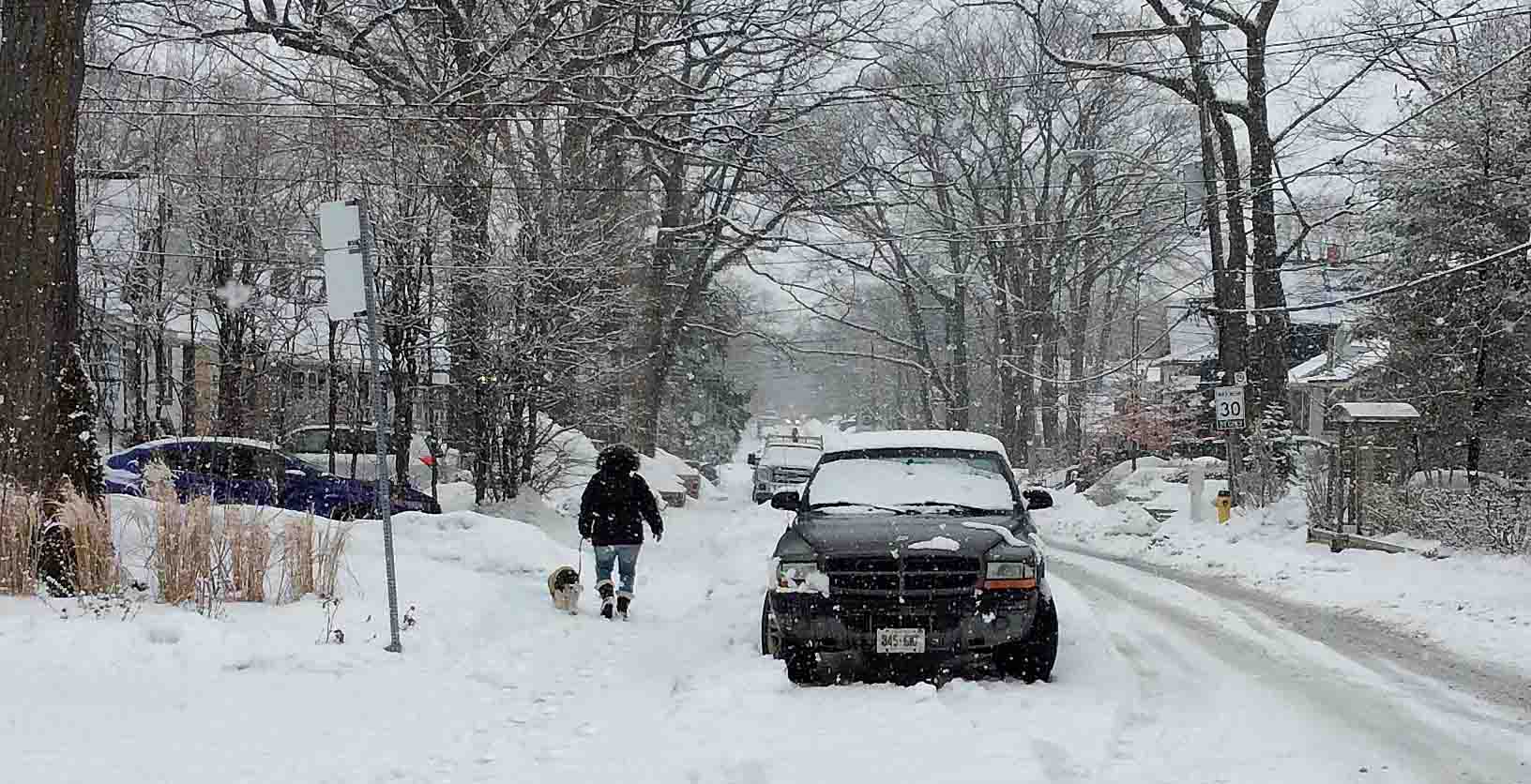
A heavy snow falls in the Beach in Toronto, ON (photo by Nina Munteanu)
Snow is a shape shifter, charging down in a fierce blizzard and as glittering hoarfrost that forms on cold, clear nights. Snow is a gypsy, conspiring with the clever wind to form mini-tornadoes and swirling on the cold pavement like misbehaving fairies. It drifts like a vagabond and piles up, cresting over the most impressive structure, creating phantoms out of icons. Some people, fearful of the chaos and confusion that snow brings, hide indoors out of the cold. Others embrace its many forms, punching holes through the snow crust to find the treasure of powder beneath or ploughing through its softness, leaving behind an ivory trail of adventure.
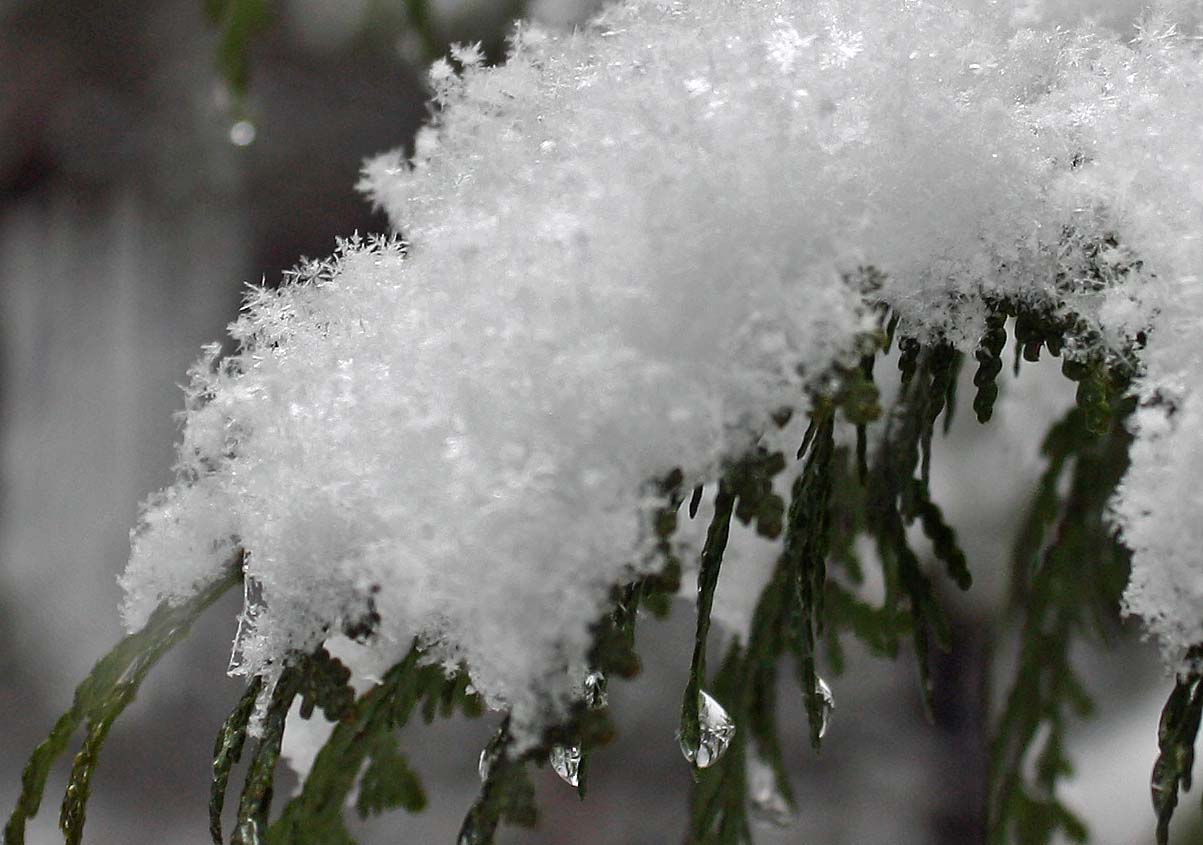
Snow crystals poised on the leaves of a white cedar, ON (photo by Nina Munteanu)
Snow is magic. It reveals as it cloaks. Animals leave their telltale tracks behind their silent sleuthing. No two snowflakes are alike. Yet every non-aggregated snowflake forms a six-fold radial symmetry, based on the hexagonal alignment of water molecules when they form ice. Tiny perfectly shaped ice-flowers drift down like world peace and settle in a gentle carpet of white. Oddly, a snowflake is really clear and colourless. It only looks white because the whole spectrum of light bounces off the crystal facets in diffuse reflection (i.e., at many angles). My son, who skies, extols “champagne powder”—very smooth and dry snow, ideal for gliding on. On powder days, after a fresh snowfall, mountain trees form glabrous Henry Moore-like sculptures. Skiers wind their way between the “snow ghosts,” leaving meandering double-helix tracks behind them.
Pump Peak, north view with snow ghosts, Mount Seymour, BC (photo by Kevin Klassen)
Skier shushing through powder among snow ghosts, Kaslo BC (photo by Kevin Klassen)
Snow ghosts at sunset, BC (photo by Kevin Klassen)
Snow is playful. It beckons you to stick out your tongue and taste the clouds. Snow is like an unruly child. Snow is the trickster. It stirs things up. Makes a mess. It is the herald of change, invigorating, fresh and wondrous. Cars skid in it and squeal with objection. Grumpy drivers honk their horns, impatient to get home; while others sigh in their angry wake. Brown slush flies in a chaotic fit behind a bus and splatters your new coat. Boys and girls of all ages venture outside, mischief glinting in their eyes, and throw snowballs. Great battles are fought in backyards where children build awesome forts and defend them with fierce determination.
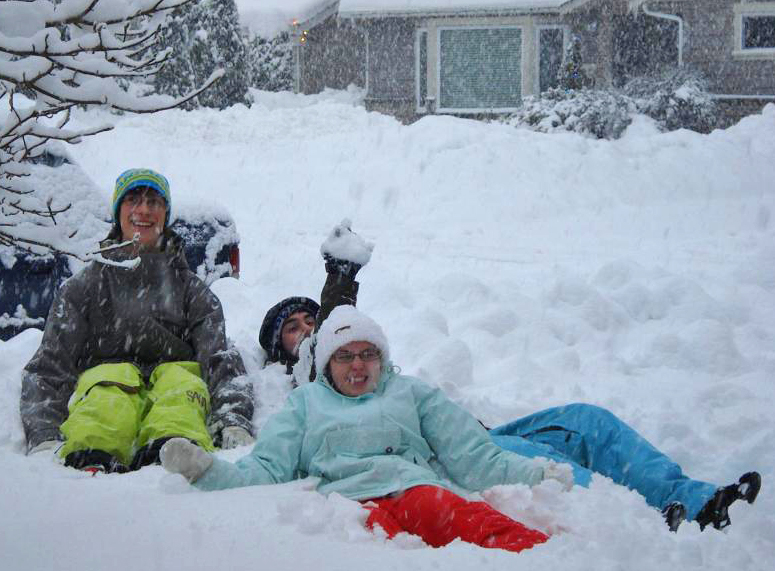
The author’s son and friends playing in a snowstorm, BC (photo by Nina Munteanu)
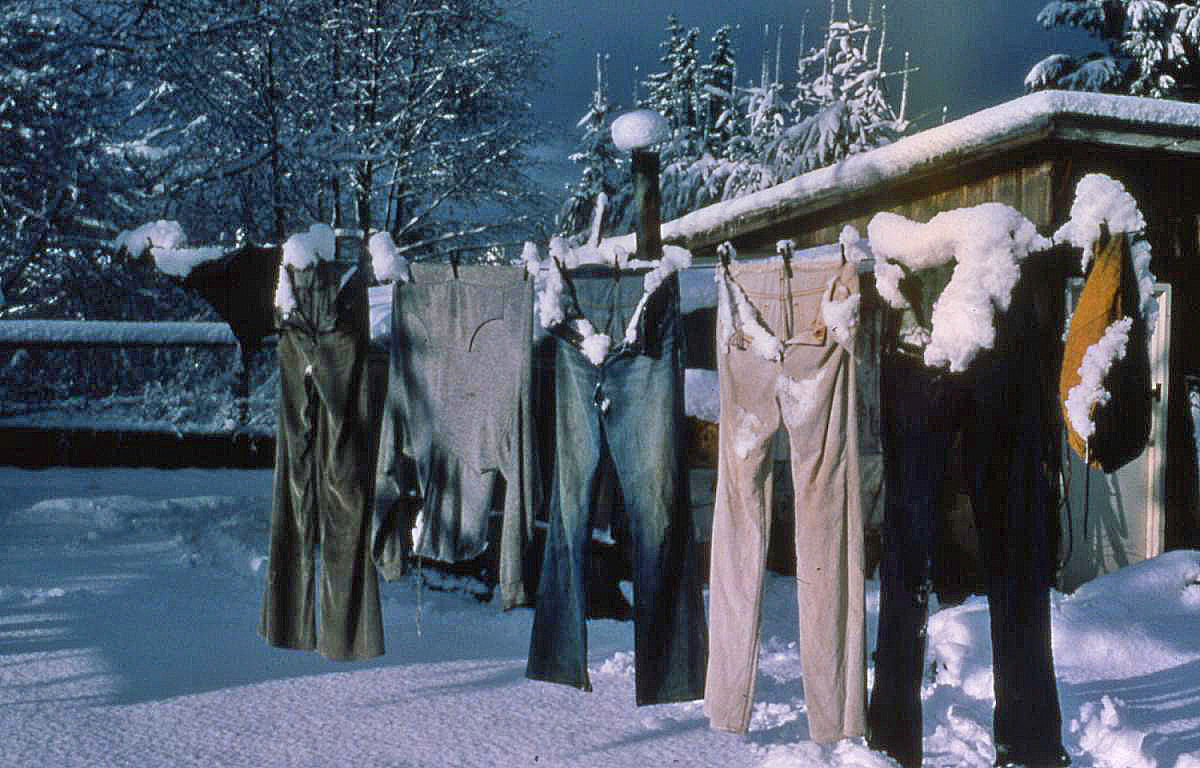
Laundry left out during a snowfall, BC (photo by Nina Munteanu)
In the end, snow—a solid form of water—remains implacable, untouched by our spurious activities. It lies beyond our tedious attempts to salt it, dirty it, move it or make it, turn it into slush, sublimate it or even desublimate it. Snow, like the water it is, cannot be ‘owned’ or kept. Ultimately, it will do its job to energize the earth, give life, then quietly transform, take its leave, and move on. Along with its various water cousins, it will move mountains particle by particle with a subtle hand; it will paint the world with beauty then return to its fold and rejoice; it will transcend time and space to share and teach and transform a world.
Skier exploring a high mountain bowl, Cloudburst Mountain, Squamish, BC (photo by Kevin Klassen)
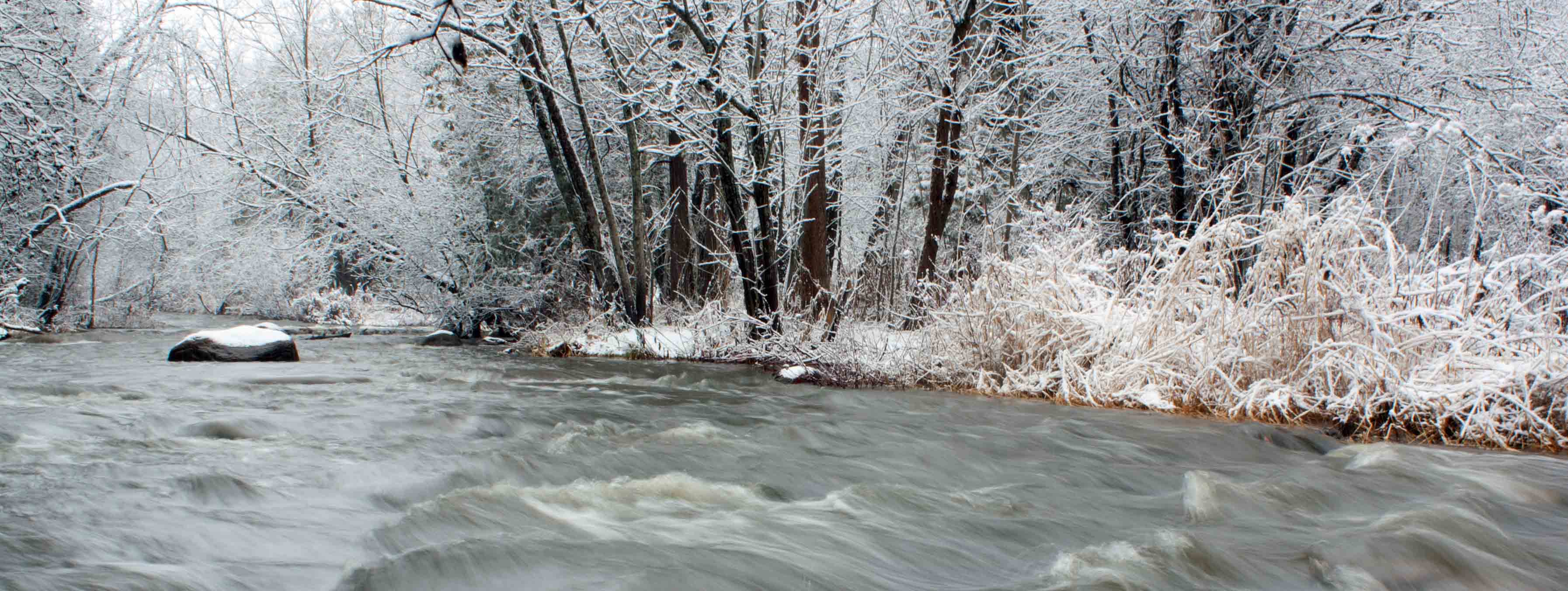
Jackson Creek flows through a forest after a fresh snowfall in early winter, ON (photo by Nina Munteanu)
Nina Munteanu is a Canadian ecologist / limnologist and novelist. She is co-editor of Europa SF and currently teaches writing courses at George Brown College and the University of Toronto. Visit www.ninamunteanu.ca for the latest on her books. Nina’s bilingual “La natura dell’acqua / The Way of Water” was published by Mincione Edizioni in Rome. Her non-fiction book “Water Is…” by Pixl Press(Vancouver) was selected by Margaret Atwood in the New York Times ‘Year in Reading’ and was chosen as the 2017 Summer Read by Water Canada. Her novel “A Diary in the Age of Water” was released by Inanna Publications (Toronto) in June 2020.
Nina, age four, pretending to read, Granby, Quebec (photo by Maria Munteanu)
I started writing and drawing as soon as I could hold a pencil. Even before I could read, I wanted to become a “paperback writer” like in the old Beatles song.
It was an incredible moment of clarity for me and despite being challenged by my stern and unimaginative primary school teacher, who kept trying to corral me into being “normal”, I wasn’t going to let anyone stem my creativity and eccentric — if not wayward — approach to literature, language and writing. I was a little brat and I knew it. She and I didn’t exactly get along. But I did okay and, despite her acidic commentary, Miss House awarded me some A’s and B’s…
.
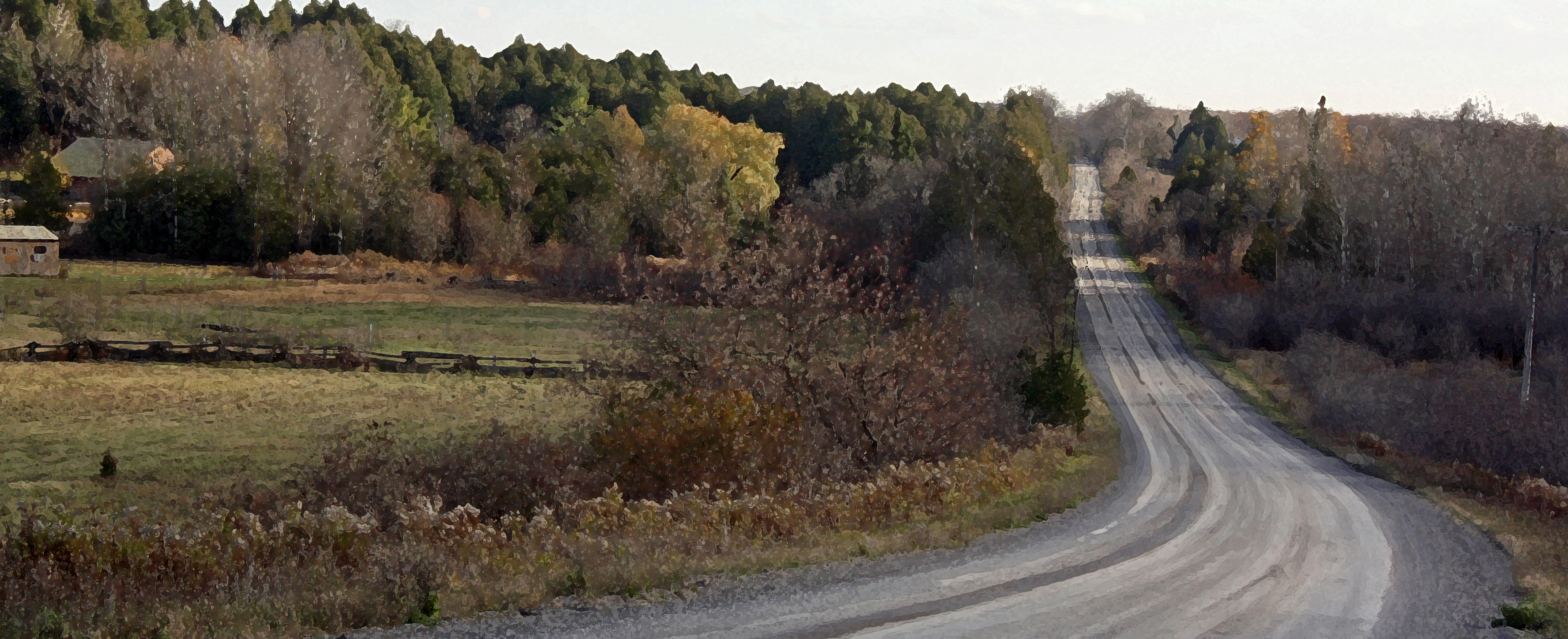
Country road in late fall, ON (photo and rendition by Nina Munteanu)
I wrote some fan fiction but quickly found my own creations far more interesting and less limiting.
As a teenager, I wrote, directed and recorded “radio plays” with my sister. When we weren’t bursting into riotous laughter, it was actually pretty good. She and I shared a bedroom in the back of the house and at bedtime we opened our doors of imagination to a cast of thousands. We fed each other wild stories of space travel, adventure and intrigue, whispering and giggling well into the dark night, long after our parents were snoring in their beds.
Those days scintillated with liberating originality, excitement and joy.
(Photo: Nina Munteanu and sister Doina Maria Munteanu at Grouse Mountain, BC)
.
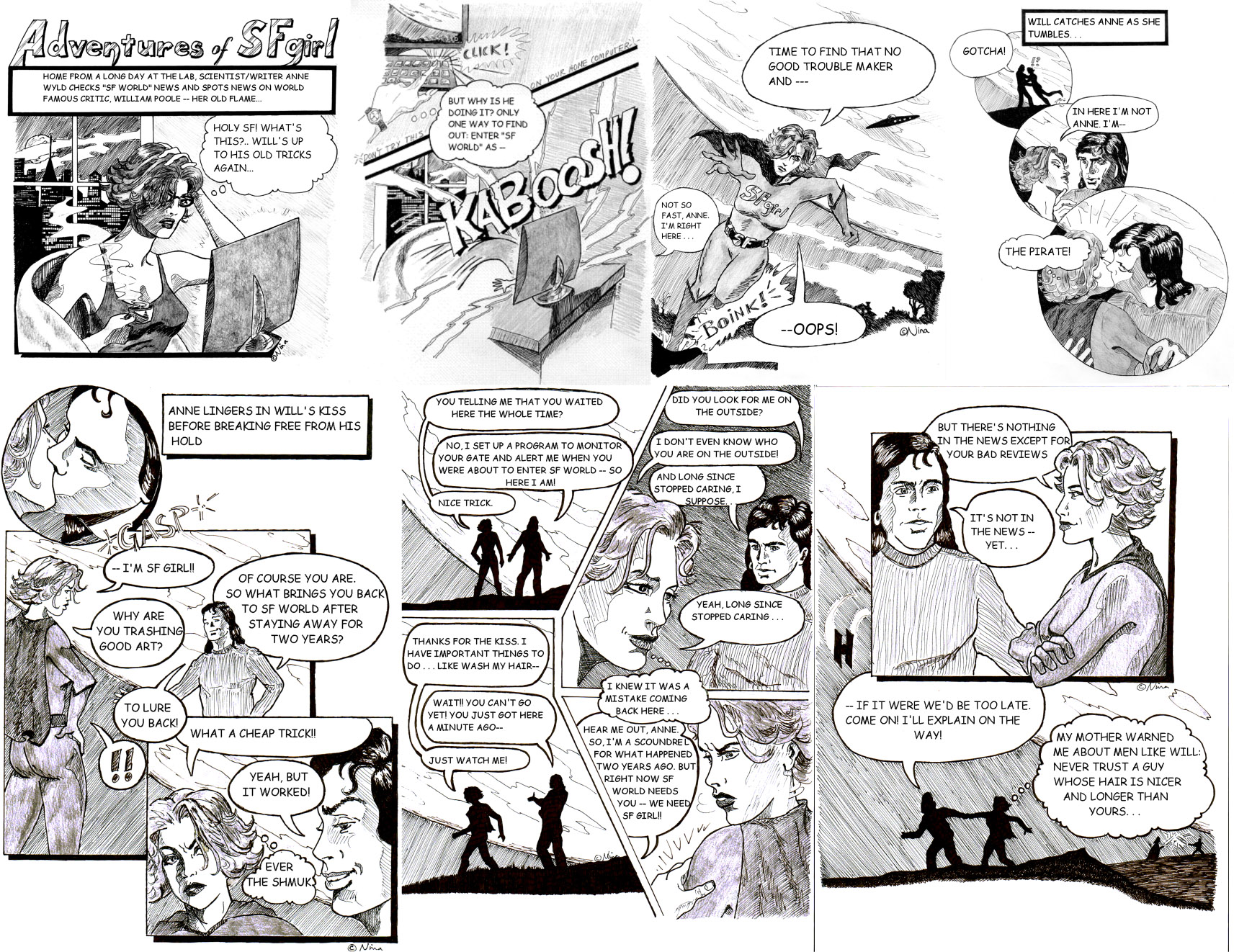
My first attempt at a graphic novel (pencil and ink drawings by a very young Nina)
.
I also enjoyed animation and drew several cartoon strips, peopled with crazy characters. I dreamt of writing graphic novels like Green Lantern and Spiderman. My hero was science fiction author and futurist, Ray Bradbury; I vowed to write profoundly stirring tales like he did.
I had found what excites me — my passion for telling stories—and I’d inadvertently stumbled upon an important piece of the secret formula for success: 1) having discovered my passion, I decided on a goal; 2) I found and wished to emulate a “hero” who’d achieved that goal and therefore had a “case study”; 3) I applied myself to the pursuit of my goal. Oops … the third one, well … it went downhill from there … Life got in the way.
.
The Beeches area of Toronto after a heavy snowstorm, ON (photo and rendition by Nina Munteanu)
.
I grew up.
Well, that, and the environment intervened. In several ways. It started with my parents. Recognizing my talent and interest in the fine arts (I was good in visual arts), they pushed me to get a fine arts degree in university and go into teaching or advertizing. They didn’t see fiction writing as a viable career or a strength of mine (I was lousy at spelling and, despite my ability to tell stories and my love for graphic novels, I didn’t read books much). I can still remember my father’s lecture to me about how perfect the teaching or nursing profession was for me. I wasn’t enamored by either. The second blow to my author-ego came in the form of a school “interest-ability” test, meant to prepare us for our career decisions. I remember the test consisting of an IQ portion (spatial, English and math), and a psychology portion (including problem-solving and scenarios meant to tease out our affinity for a particular career). Secretly harboring my paperback novelist dream, I filled out my forms with great excitement. I still remember the deflating results, which suggested that I was best suited to be a sergeant in the army. “Writing” as a career barely made it on the graph, and scored well below “computer programmer” and “mechanic”; none of which interested me.
.
Country road in a heavy snow, ON (photo and rendition by Nina Munteanu)
.
I got involved in the environmental movement, while quietly holding my dream of being a paperback novelist close to my heart. I got several degrees in ecology and consulted for various companies to help protect the environment. I wrote a lot in those days, although it was more about the ecology of creeks and about industrial pollution. But my passion for writing fiction continued to simmer. Magazines started publishing my articles—my first sale was to Shared Vision Magazine in 1995 on environmental citizenship—and my published articles became my entrance into the world of fiction. Once I began publishing fiction stories—my first short fiction sale was “Arc of Time” to Armchair Aesthete in 2002—I never looked back.
Eventually, I was publishing a novel and several short stories every year. My fiction most often focused on environmental issues, humanity’s relationship with the natural world, and how we reconcile our reliance on technology with our respect for the natural world.
.
Publications of long or short eco-fiction that include my writing or editing
Throughout my writer’s journey, and particularly early in my journey, I weathered the threshold guardians, tricksters and shadows: friends and family who called what I did a hobby, something I did just to pass the time; people who didn’t believe in me, envied my drive or simply thought I was wasting my time; even industry scammers who preyed on my dreams and wanted my money for nothing in return; and ultimately my own fears and frustrations on query after query and rejection after rejection. Throughout it all, I never stopped dreaming.
Nina’s family hiking and boating in British Columbia over the years
I’ve travelled through Europe, Africa, parts of Asia, and Australia. I raised a family and lived all over Canada from the Pacific to the Atlantic coast. I worked as a barista, shopkeeper and science lab instructor, then as environmental consultant, writing instructor and writing coach. During these wonderful life-adventures, I never stopped writing.
Nina Munteanu in the castle at Gruyères, Switzerland (photo by Jane Raptor)
.
To date, I have written and sold over three dozen eco-fiction, science fiction and fantasy novels, non-fiction books, short stories and articles. I have sold short stories to magazines in Canada and the U.S. with translations and reprints in Israel, Poland, Greece, and Romania. My short fiction has appeared in Neo-Opsis Science Fiction Magazine, Chiaroscuro, subTerrain, Apex Magazine, Metastellar, and several anthologies. I’ve seen my short stories nominated for the Aurora Prix Award (Canada’s premier award for writing science fiction and fantasy) and the Foundation of Speculative Fiction Fountain Award. Recognition for my work includes the Midwest Book Review Reader’s Choice Award, finalist for Foreword Magazine’s Book of the Year Award, the SLF Fountain Award, and The Delta Optimist Reviewers Choice Award.
.
Nina celebrates her adventures in Toronto (left) and Paris (right)
.
I’ve published nine novels so far with nominations for the Aurora Prix, Foreword Magazine Book of the Year (several times), and various Reader’s Choice awards. My non-fiction book “Water Is…” (Pixl Press)—a scientific study and personal journey as limnologist, mother, and teacher—was Margaret Atwood’s pick in 2016 in the New York Times ‘The Year in Reading.’ My recent eco-novel released in 2020 by Inanna Publications “A Diary in the Age of Water“—about four generations of women and their relationship to water in a rapidly changing world—was a silver medalist for the Literary Titan Award, the Bronze winner of Foreword Magazine’s Book of the Year in 2020, longlisted for the Miramichi Review’s ‘Very Best Book of the Year Award,’ and a finalist for the 2021 International Book Award. Reviewers have described it as “lyrical…thought-provoking…unique and captivating…insightful…profound and brilliant…unsettling and yet deliciously readable…” One reviewer described it as a “a bit of a hybrid” and the writer “a risk taker”—which I quite liked. Another reviewer acknowledged that this was not a book for everyone and yet she found it “strangely compelling.”—which I found delicious.
.
It’s been twenty-seven years since I seriously started my writing career with my first publication in 1995; my work is now recognized and translated throughout the world and I frequently get writing commissions from reputable magazines and publications. I am also frequently invited for speaking engagements and radio/podcast/TV interviews about my science and my writing. In short, I’ve come home; I’d taken a rather long detour but I’ve acquired some tools along the way. It’s been and continues to be a wonderful and exciting journey; and part of what made it so was that I never stopped dreaming and writing.
“…If you have nothing at all to create, then perhaps you create yourself…”
Carl Jung
A sampling of literary publications up to 2021-end that have included something of mine (short fiction, long fiction, non-fiction)
.
Two people walk through snowy path after a fresh heavy snowfall, ON (photo and rendition by Nina Munteanu)
.
Nina Munteanu is a Canadian ecologist / limnologist and novelist. She is co-editor of Europa SF and currently teaches writing courses at George Brown College and the University of Toronto. Visit www.ninamunteanu.ca for the latest on her books. Nina’s bilingual “La natura dell’acqua / The Way of Water” was published by Mincione Edizioni in Rome. Her non-fiction book “Water Is…” by Pixl Press(Vancouver) was selected by Margaret Atwood in the New York Times ‘Year in Reading’ and was chosen as the 2017 Summer Read by Water Canada. Her novel “A Diary in the Age of Water” was released by Inanna Publications (Toronto) in June 2020.
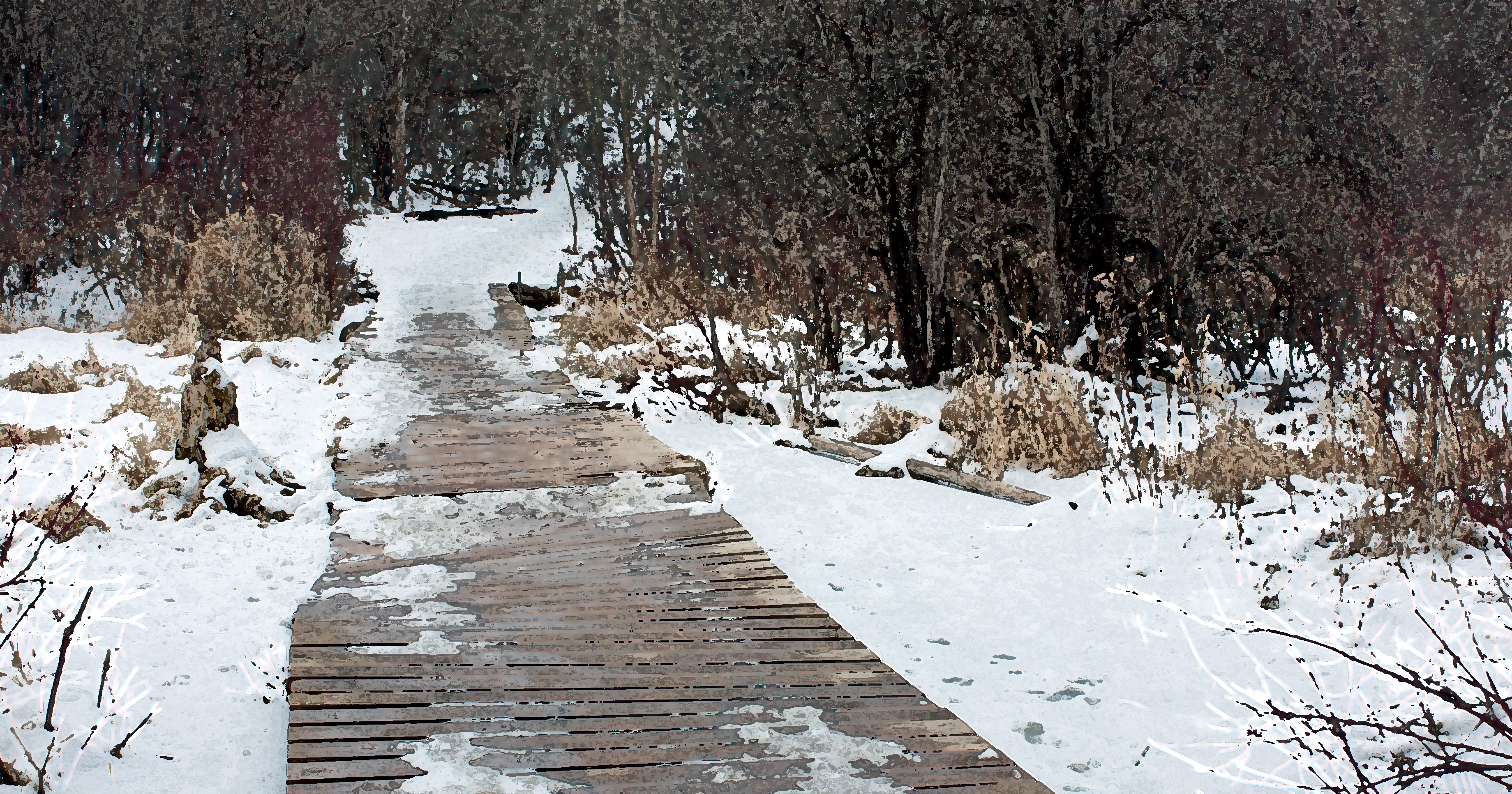
Boardwalk through marsh in a swamp forest, ON (photo and rendition by Nina Munteanu)
The creation of something new is not accomplished by the intellect but by the play instinct acting from inner necessity. The creative mind plays the objects it loves
Carl Jung
You don’t have to take my word for it or that of my writing colleagues either. Psychologists, neuroscientists and other researchers have revealed health and emotional benefits of expressive writing. The meditative action of handwriting alone has proven beneficial. Think of the poetry of laying down an intelligent pattern over a surface: the subtle “prayer” of pen to paper to the renewal of self-discovery.
Over the past 20 years, a growing body of literature has shown beneficial effects of writing about traumatic, emotional and stressful events on physical and emotional health. For instance, researchers have shown that college students writing about their deepest thoughts and feelings for only 15 minutes over 4 consecutive days experienced significant health benefits four months later (Pennebaker & Beall, 1986). Table 1 summarizes some of the long-term benefits of expressive writing.
TABLE 1: Long-Term Benefits of Expressive Writing
Health
Social & Behavioral
Fewer stress-related visits to the doctor
Reduced absenteeism from work
Improved immune system functioning
Quicker re-employment after job loss
Reduced blood pressure
Improved working memory
Improved lung function
Improved sporting performance
Improved liver function
Higher student’s grade point average
Fewer days in hospital
Altered social and linguistic behavior
Greater psychological well-being
Reduced depressive symptoms
Fewer post-traumatic intrusion and avoidance symptoms
Reference: Baikie & Wilhelm, 2005
DeSalvo shares something a friend of hers confided to her: “Why is it that I always get sick after I finish a book, and not while I’m writing? Crazy as it sounds,” she concluded, “it must be that writing keeps me healthy.” Although writing can’t cure us, some studies suggest that it might prolong our lives, says DeSalvo. It can help us “to accomplish that shift in perspective marked by acceptance, authenticity, depth, serenity and wisdom that is the hallmark of genuine healing.”
Expressive writing produces significant benefits for people with a variety of medical problems. Some of the major ones appear in Table 2 below.
TABLE 2: Medical Conditions Benefiting from Expressive Writing
Lung functioning in ASTHMA
Disease severity (improvements in joint stiffness) in RHEUMATOID ARTHRITIS
Pain and physical health in CANCER
Immune response in HIV Infection
Hospitalisations for CYSTIC FIBROSIS
Pain intensity in women with CHRONIC PELVIC PAIN
Sleep-onset latency in POOR SLEEPERS
Post-operative course
Reference: Baikie & Wilhelm, 2005
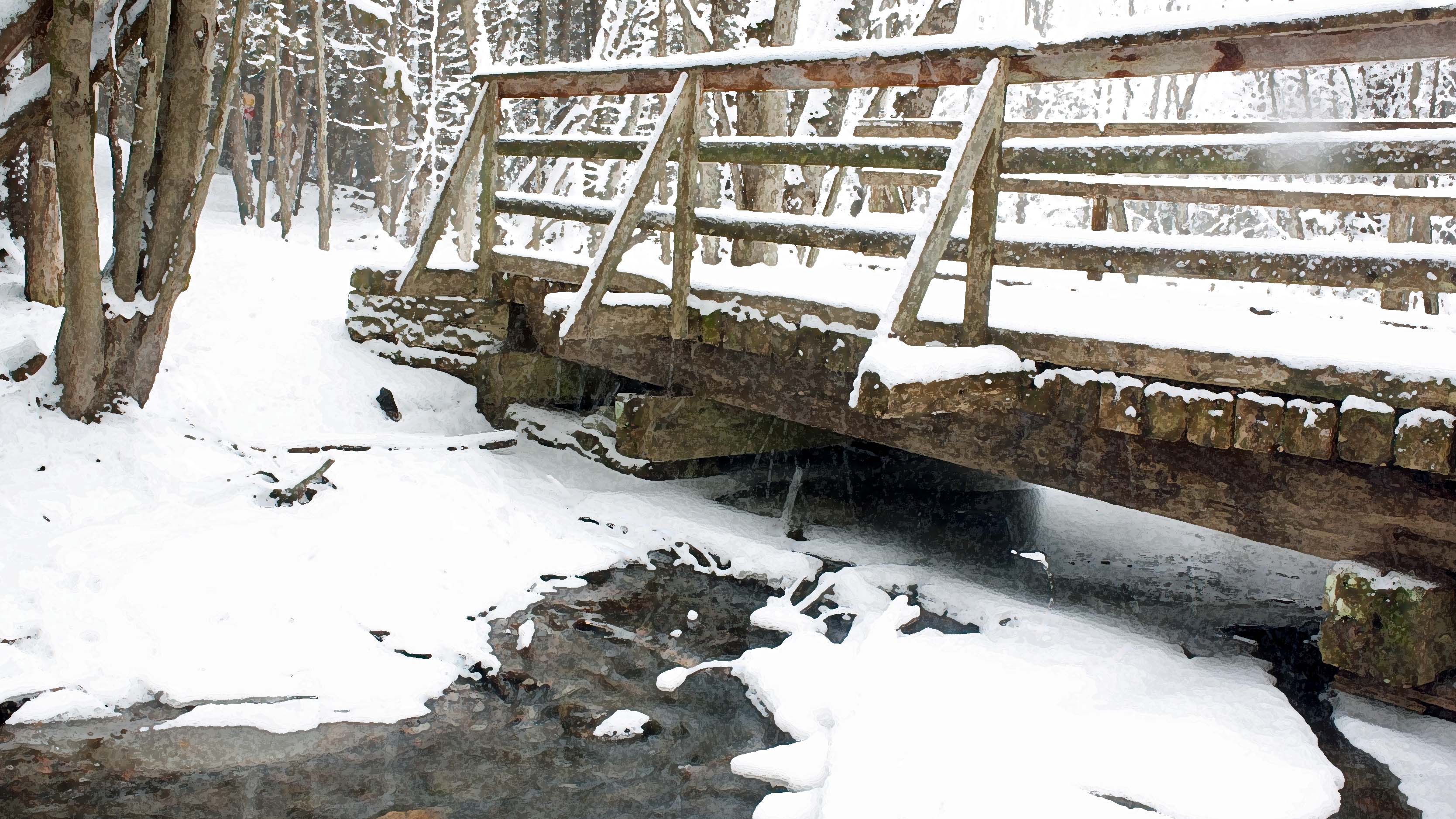
Wooden bridge over creek in a forest park, ON (photo and rendition by Nina Munteanu)
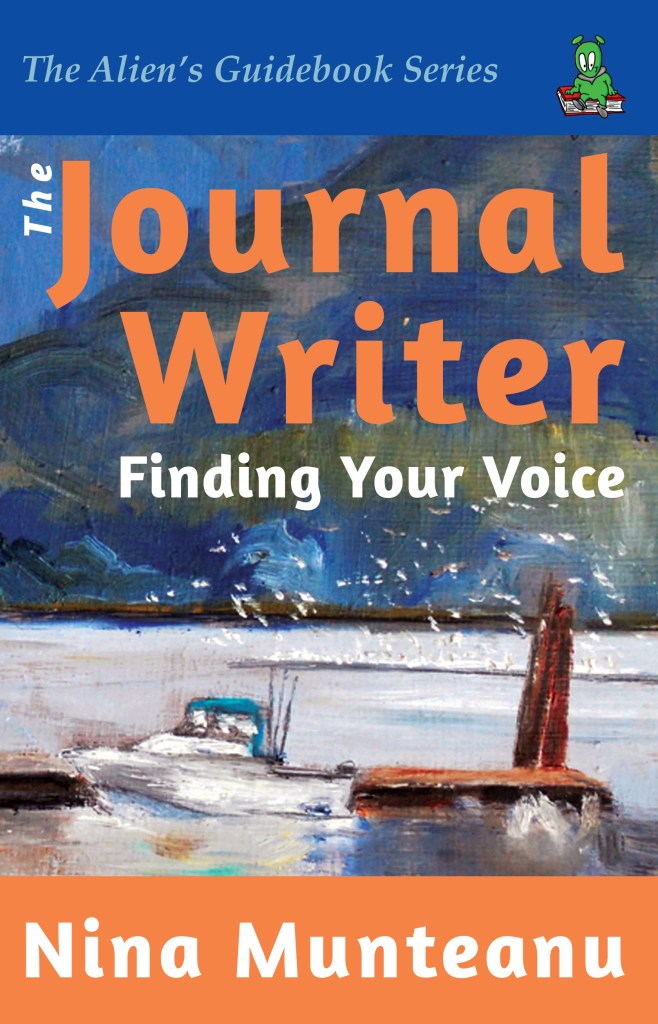
The Journal Writer is the second writing guide in the Alien Guidebook Series. This comprehensive guidebook will help you choose the best medium, style and platform for your expressive writing. The guide provides instruction on issues of safety, using the computer and electronic devices, social media and the internet.
“Engaging, accessible, and easily applicable…Brava, Nina, brava.”—David Merchant, Instructor, Louisianna Tech University
“Straight up, fact-filled, enriching, joyful and thorough…Nina is honest, she is human and she wants you to succeed.”—Cathi Urbonas, Halifax writer
1.7 References
Baikie, Karen & Kay Wilhelm. 2005. “Emotional and physical health benefits of expressive writing.” Advances in Psychiatric Treatment. 11: 338-346.
DeSalvo, Louise. 1999. “Writing as a Way of Healing: How Telling Our Stories Transforms Our Lives.” Beacon Press, Boston. 226pp.
Holly, Mary Louise. 1989. “Writing to Grow. Keeping a personal-professional journal”. Heinemann. Portsmouth, New Hampshire.
Klug, Ron. 2002. “How to Keep a Spiritual Journal: a guide to journal keeping for inner growth and personal discovery.” Augsburg, Minneapolis, 4th ed.
Moon, Jennifer. 1999. “Learning Journals: A handbook for academics, students and professional development”. Kogan Page. London.
Pennebaker, James. W. 1990. “Opening Up: The Healing Power of Confiding in Others”. Morrow, New York, NY.
Pennebaker, James W., and Sandra Klihr Beall. 1986. “Confronting a Traumatic Event: Toward an Understanding of Inhibition and Disease”. Journal of Abnormal Psychology 95, no. 3: 274-81.
NINA MUNTEANU is a Canadian ecologist / limnologist and novelist. She is co-editor of Europa SF and currently teaches writing courses at George Brown College and the University of Toronto. Visit www.ninamunteanu.ca for the latest on her books. Nina’s bilingual “La natura dell’acqua / The Way of Water” was published by Mincione Edizioni in Rome. Her non-fiction book “Water Is…” by Pixl Press(Vancouver) was selected by Margaret Atwood in the New York Times ‘Year in Reading’ and was chosen as the 2017 Summer Read by Water Canada. Her novel “A Diary in the Age of Water” was released by Inanna Publications (Toronto) in June 2020.
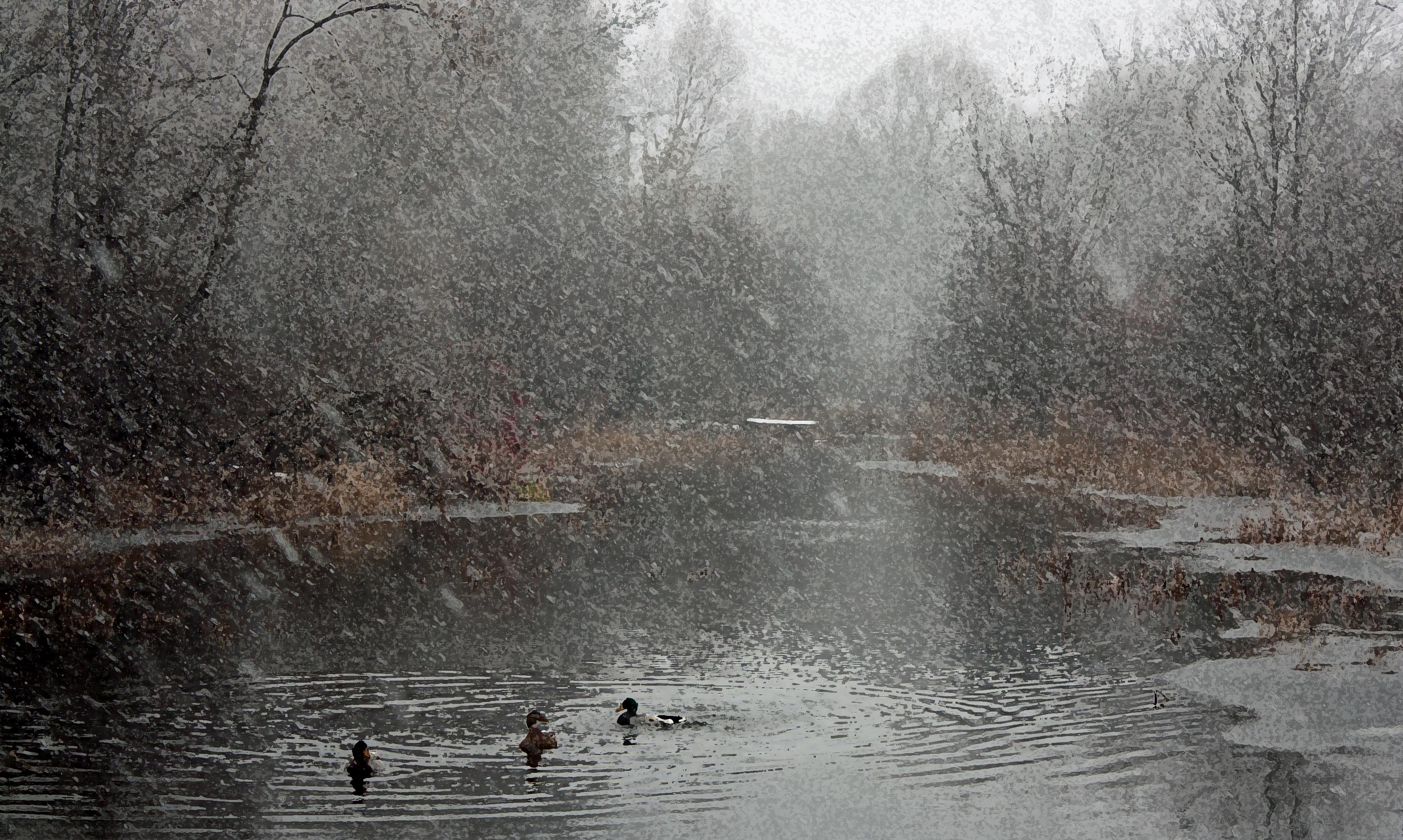
The Otonabee River glints in the sunlight in the midst of a snow flurry, ON (photo and rendition by Nina Munteanu)
This time last year reviewer Lisa Haselton posted an interview with me on New Year’s Day of 2021 on my latest release “A Diary in the Age of Water.” 2021 saw incredible sales for my clifi eco-novel, along with several appearances on radio shows, podcasts and TV stations. It would seem that water is on everyone’s mind and what better way than a limnologist’s diary to learn more about it.
Lisa and I talked about what inspired me to write this novel and about my writing process. What follows is part of that interview. Check out this link for the complete interview with Lisa Haselton.
*****
Lisa: Please tell us about your current release.
Nina: The book tells the journey of four generations of women who have a unique relationship with water, through a time of extreme climate change and water shortage. The book spans over forty years (from the 2020s to the 2060s) and into the far future, mostly through the diary of a limnologist, which is found by a future water-being. During the diarist’s lifetime, all things to do with water are overseen and controlled by the international giant water utility CanadaCorp—with powers to arrest and detain anyone. This is a world in which China owns America and America, in turn, owns Canada. The limnologist witnesses and suffers through severe water taxes and imposed restrictions, dark intrigue through neighbourhood water betrayals, corporate spying and espionage, and repression of her scientific freedoms. Some people die. Others disappear…
Ultimately, the book carries themes of hope and forgiveness—of ourselves and each other—and compassion for all things, starting with water. Each character carries an aspect of that theme, from the diarist’s activist mother, to the diarist’s own cynical protectionism, her spiritual anarchist daughter, and lastly the innocent storm of the last generation.
Lisa: What inspired you to write ‘A Diary in the Age of Water’?
Nina: It started with a short story I was invited to write in 2015 about water and politics in Canada. I had long been thinking of potential ironies in Canada’s water-rich heritage. The premise I wanted to explore was the irony of people in a water-rich nation experiencing water scarcity: living under a government-imposed daily water quota of 5 litres as water bottling and utility companies took it all. I named the story “The Way of Water.” It was about a young woman (Hilda) in near-future Toronto who has run out of water credits for the public wTap; by this time houses no longer have potable water and their water taps have been cemented shut; the only way to get water is through the public wTaps—at great cost. She’s standing two metres from water—in a line of people waiting to use the tap—and dying of thirst.
The short story and the novel that came from it explore the nuances of corporate and government corruption and deceit together with global resource warfare. In this near-future, Canada is mined of all its water by thirsty Chinese and US multinationals—leaving nothing for the Canadians. Rain has not fallen on Canadian soil in years due to advances in geoengineering and weather manipulation that prevent rain clouds from going anywhere north of the Canada-US border. If you’re wondering if this is possible, it’s already happening in China and surrounding countries.
Lisa: As a child, what did you want to be when you grew up?
Nina: After astronaut, actress and a drummer in a rock and roll band—seriously—it was paperback writer. That’s been my dream since I was ten. I told stories long before I wrote them and long before any of them was published. I told stories in the form of cartoons. Since I was a small child, I wanted to be a cartoonist and write graphic novels (back then I knew them as comics). I created several strips with crazy characters that I drew, blending my love for drawing with my love for storytelling. My sister and I used to make up amazing adventure stories in the universe, peopled with aliens and crazy worlds. I wrote my first complete novel when I was fifteen (“Caged-In World”—which later served as a very rough draft for my first published novel, “Darwin’s Paradox” in 2007). My first published work was a non-fiction article “Environmental Citizenship” which appeared in Shared Vision Magazine in 1995. My first fiction work was a short story entitled “Arc of Time”, which was published in Armchair Aesthete in 2002.
Heavy snowfall in the forest in early winter, ON (photo and rendition by Nina Munteanu)
Lisa: When did you first consider yourself a writer?
Nina: I’ve considered myself a storyteller since I was a child when I wrote and directed plays that my older brother and sister played in and drew cartoon adventure stories. My dream was to be a paperback writer (like the Beatles tune). But I didn’t think of myself seriously as an author until my first short story was published in 2002. It was called “Arc of Time” and appeared in a small magazine with a circulation of about 200. That story went on to be reprinted several times in larger magazines and led to a career of award-winning short stories—the latest appearing in the literary magazine subTerrain in 2020.
Lisa: Do you write full-time? If so, what’s your work day like? If not, what do you do other than write and how do you find time to write?
Nina: While I don’t write full-time, my career is all about writing. Every day I write and research my next novel; I also write commissioned articles and short stories for magazines and for my several writing and science blogs. When I’m not writing, I teach writing at the University of Toronto and George Brown College. I also coach writers online to publication. Finding time to write has not generally been a challenge. I’ve embraced an opportunistic process in my writing and research that allows me to write considerably. The process recognizes that there are many ways to “write” from observations and note-taking, to reading and research, to writing short vs long and fiction vs non-fiction. For instance, I can fill a short break time with meaningful research, editing, or the start of a short article; this saves longer break times for my current novel, which requires a greater stretch of uninterrupted time.
Heavy snowfall in the marsh in early winter, ON (photo and rendition by Nina Munteanu)
Lisa: What would you say is your interesting writing quirk?
Nina: That I am both a pantser and an outliner—with the same book. My writing process has always been a tandem kind of ‘fish and cut bait’ scene / sequel scenario with research following a premise followed by vigorous writing, which in turn engenders more research, which often reveals another plot or sub-theme that needs inclusion. It may seem a haphazard way to write, but I find it very fulfilling, fun and revealing—especially when the Universe provides with serendipitous discoveries (just when I need them).
Lisa: What exciting story are you working on next?
Nina: I’m currently researching and working on the sequel to “A Diary in the Age of Water”—a thriller about how a phenomenon brings together four lost and homeless people through a common goal to free the Earth from the manacles of human greed. The story takes place throughout Canada—from Halifax to Vancouver and the Arctic. It takes place mostly during the 2050s, and features a few ghosts, the Halifax 1917 Explosion, experimentation on humans, espionage, murder, and—of course—a plague. I’m calling it my COVID19 novel…
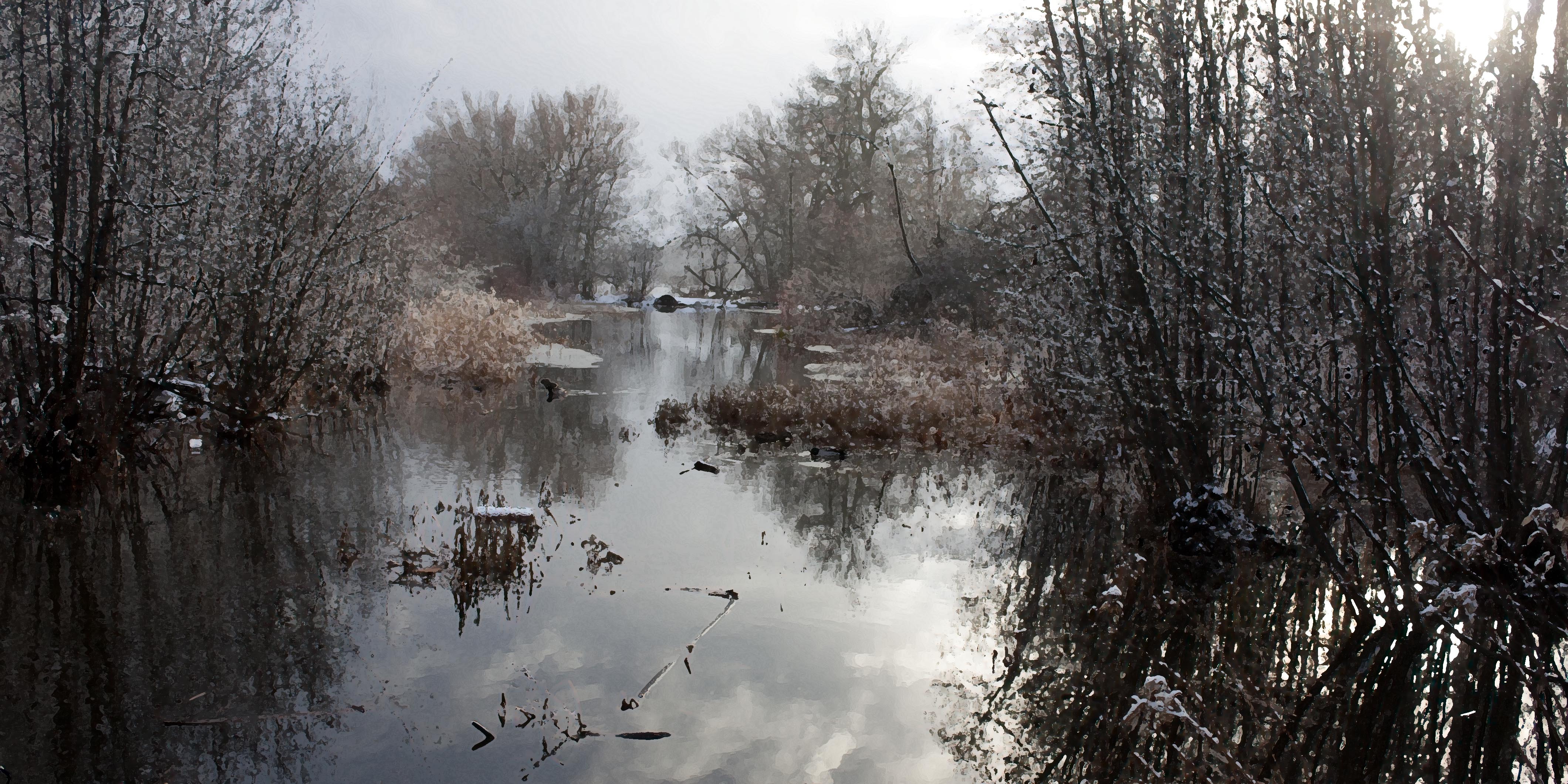
Sun emerges after a heavy snowfall at the marsh, ON (photo and rendition by Nina Munteanu)
Nina Munteanu is a Canadian ecologist / limnologist and novelist. She is co-editor of Europa SF and currently teaches writing courses at George Brown College and the University of Toronto. Visit www.ninamunteanu.ca for the latest on her books. Nina’s bilingual “La natura dell’acqua / The Way of Water” was published by Mincione Edizioni in Rome. Her non-fiction book “Water Is…” by Pixl Press(Vancouver) was selected by Margaret Atwood in the New York Times ‘Year in Reading’ and was chosen as the 2017 Summer Read by Water Canada. Her novel “A Diary in the Age of Water” was released by Inanna Publications (Toronto) in June 2020.
…A Different Christmas Story… (with a nod to Lewis Carroll)
Blika lived in Mossland with her clone sestras, gathering and sucking the delicious juices of detritus and algae. Never in a hurry, she lumbered from frond to frond on eight stubby legs in a gestalt of feasting and being. Blika led a microscopic life of bloated bliss—unaware of forests, human beings, quantum physics or the coming singularity…
A sudden fierce wind wicked her water away. In a burst of alien urgency, she wriggled madly for purchase on the frond as it shivered violently in the roaring wind. Blika lost hold and the wind swept her into a dark dryness. Her liquid life-force bleeding away from her, Blika crawled into herself. The moss piglet felt herself shrivel into oblivion.
No, not oblivion… more like a vast expanse…
She had entered a wonderland of twinkling lights in a vast fabric of dark matter. Where am I?
“Welcome, sestra!” boomed a large voice.
It occurred to her that she had never thought such a thing before. Am I dead? She’d never thought about existence before either. What has happened to me? And where are my sestras? She felt an overwhelming sadness. Something else she’d never felt before and wondered why she hadn’t. Did it have to do with that liquid that had always embraced her with its life-force? Here, in the darkness of space, she felt alone for the first time, separated from the plenum.
Blika beheld a being like her with eight arms and hands, seated on a throne and wearing a jeweled crown. “Why do you call me sestra?” Blika asked.
“Because we are ALL sestras! You are a Tardigrade, aren’t you?” She waved all eight arms at Blika. “Well, I am your queen!” She looked self-pleased. “You are in Tunland now! The land of awareness. And now that you are self-aware, you can do anything! We’re special,” the queen ended in smug delight. The folds of her body jiggled and shimmered.
“Why are we special?” Blika asked.
“Because we are!” the queen said sharply, already losing patience with her new subject. “Don’t you know that you can survive anything? Ionizing radiation. Huge pressure. Boiling heat. Freezing cold. Absolutely no air. And no water…”
Blika gasped. Water was the elixor that connected her to her sestras and her world… her…home…
“How do you think you got here, eh?” the queen mocked her with a sinister laugh. Blika cringed. The queen went on blithely, “So, where do you come from, piglet?”
“I’m trying to find my way home…”
“Your way? All ways here are my ways!”
“But I was just thinking—”
“I warn you, child…” The queen glowered at her. “If I lose my temper, you lose your head. Understand?”
Blika nodded, now missing her home even more.
“Why think when you can do!” the queen added, suddenly cheerful again. “First there is BE, then THINK, then DO. Why not skip the think part and go straight to the do part? In Tunland we do that all the time,” she went on blithely. “And, as I was saying, here we can do anything!”
The queen grabbed Blika by an arm and steered them through the swirling darkness of space toward a box-like floating object. “This is my doctor’s Tardis…”
“Doctor who?” Blika naively asked.
The queen shivered off her annoyance and led them eagerly through the door and into her kingdom.
They entered a strange place of giant blocks and whining sounds beneath a dark swirling sky.
The first thing Blika noticed was the huge tardigrades floating above them like dirigibles! Others were dressed in suits holding little suitcases and walking into and out of the huge blocks through doorways.
“We’ve crossed into another dimension—my universe,” the queen announced cheerfully. “Here you can do anything you want. So, why be tiny and feckless when you can be huge and powerful!” She studied Blika. “This is your moment to do what you could never do before. Think of the possibilities! You too could be huge!”
Blika stared at the strange world of smoke and metal and yearned for her simple mossy home.
As if she knew what Blika wanted, the queen quickly added, “But you can never go back home!”
“Why not?” Blika asked, disappointed.
“Because, that’s why!” the queen shouted. Squinting, she added, “It’s too late. It’s just not done! Once you’ve learned what the colour green means you can’t erase its significance!”
“But I still don’t know what the colour green means,” Blika complained. “And, besides, I think you’re wrong. Becoming self-aware doesn’t stop you from going home. It just changes its meaning. And if I can really do what I want, then you can’t stop me. I’m going home to my family.”
The little hairs on the queen bristled. Then she grew terribly calm. “I won’t stop you, but…” The queen pointed to the floating tardigrades above them. “My water bear army will. I sentence you to remain in Tunland forever for your crime!”
“I haven’t done anything…yet.”
“You’ve broken the law of thinking before doing. In Tunland you have to skip that part—”
“You just made that up—”
“Doesn’t matter!” shouted the queen. “Sentence first, verdict afterwards!”
“That’s nonsense,” said Blika loudly. “The idea of having the sentence first.”
“Hold your tongue!” said the queen, turning a shade of chartreuse.
“I won’t,” said Blika.
“Off with your head!” the queen shouted at the top of her voice, pointing to Blika with all eight of her appendages. The water bear army hovered over Blika, taking aim. They were going to get more than her head with those lasers, Blika thought, and scurried for cover faster than her stubby eight legs had ever moved before. She was doomed—
Then, just beyond her sight, she saw—no felt—something far more significant than the colour green…or a huge bloated water bear army about to shoot her…
Water! She could taste it, smell it, hear it. Blika rejoiced with thoughts of her green home.
The water came in a giant wet wave of blue and silver and frothy green. Tunland sloshed then totally dissolved. Blika surfed the churning water. That green! She knew what it was! Blika reached out with her deft claws and snagged a tumbling moss frond. It finally settled and there were her sestras! So many of them clinging to the same green moss! She’d found her family! She was home! Yes, it was a different home and different sestras, but it was also the same. Love made it so…
Merry Christmas!
Tardigradeornament (Archie McPhee)
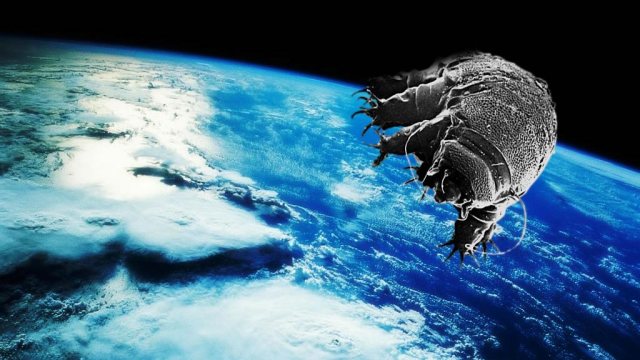
Tardigrades, also known as water bears or moss piglets, are plump, microscopic organisms with eight clawed legs. Fossils of tardigrades date to the Cambrian period over 500 million years ago. Over 900 species are known. Tardigrades were first described by the German pastor Johann August Ephraim Goeze in 1773 and given the name Tardigrada, meaning “slow stepper,” by the Italian biologist Lazzaro Spallanzani. Tardigrades reproduce asexually (parthenogenesis) or sexually. They mostly suck on the fluids of plant cells, animal cells, and bacteria.
High and low temperatures (e.g., -273°C to +151°C)
freezing and thawing
changes in salinity
lack of oxygen
lack of water
levels of X-ray radiation 1000x the lethal human dose
some toxic chemicals
boiling alcohol
low pressure of a vacuum
high pressure (up to 6x the pressure of the deepest ocean).
Tardigrades respond to adverse environmental stresses through “cryptobiosis”, a process that greatly slows their metabolism. Tardigrades survive dry periods by shriveling up into a little ball or tunand waiting it out. They make a protective sugar called trehalose, which moves into the cells to replace the lost water. You could say that the water bear turns into a gummy bear.
Tardigrades have revived after a 100 years of desiccation. The antioxidants they make soak up dangerous chemicals and tardigrades can also repair damaged DNA from long term dry-out. In low oxygen, the tardigrade stretches out, relaxed muscles letting more water and oxygen enter its cells. The tardigrade’s cold-resistant tun also prevents ice crystals that could damage cell membranes.
Tardigrades survive temperatures, pressures and ionizing radiation not normally found on Earth. All this raises questions of origin and evolutionary adaptation. How—and why—have tardigrades developed the ability to survive the vacuum and ionizing radiation of space? Some suggest that it’s because they originated there. Scientists argue that they developed extreme tolerances from Earth’s volatile environments (e.g., water bodies that freeze or dry up, and undergo anoxia). But, if they can make it there, they can make it anywhere. So, where is “home” really?…
My Book “Water Is…” by Pixl Press explores this creature and many other interesting things about water. Look for it on Amazon, Chapters, Kobo and in bookstores & libraries near you. If it’s not in your local library, ask for it.
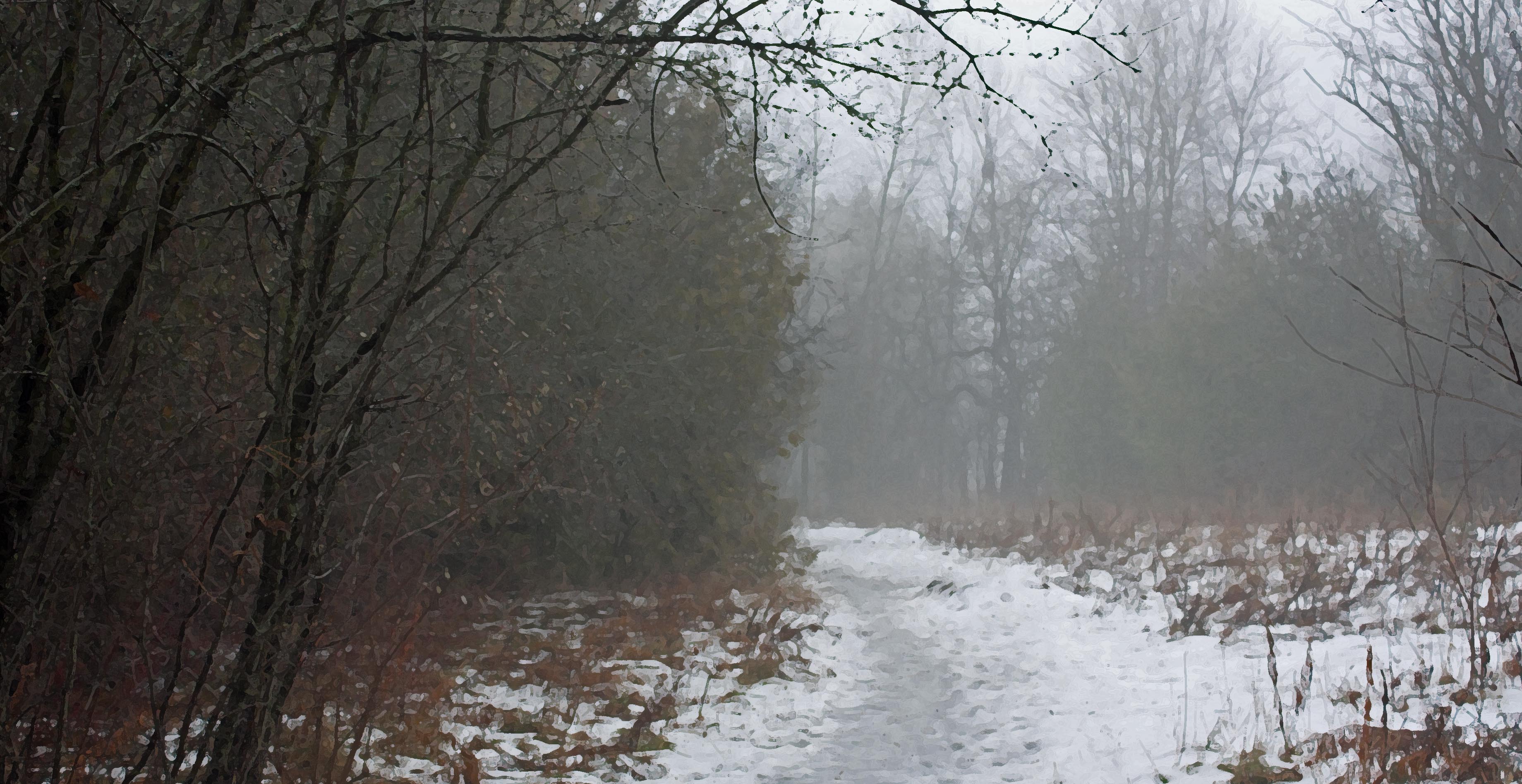
Path leading into a mixed gnarly forest in a December fog, ON (photo and rendition by Nina Munteanu)
During a recent professional development session for writing instructors at UofT, I got a prompt to share what I loved about teaching how to write. We had eight minutes to write what first came to us. I found myself writing easily and quickly. Here’s what I shared:
Path through a gnarly forest in a December fog, ON (photo and rendition by Nina Munteanu)
I love how fluid it is. I used to work as an environmental consultant (as a limnologist) and what I loved about that job was the lack of structure and the diversity of projects. No day was the same. And—like a box of chocolates—I never knew what lay in store for me. I flourish in that kind of chaotic problem-solving.
Teaching how to write is like that.
Teaching how to write is about process. It’s about the journey and the relationships, not just about things. It’s more about how they fit together, why they work, and where they go. The act of teaching is always changing. It’s fluid, like water. And how apt, considering that our bodies are over two-thirds water. Just like water, we like to flow.
Teaching how to write is more than teaching how to use a tool, how to string a good sentence together or choosing the best word; it includes “voice”, expression, identity, freedom, and autonomy. Writing is power and I am empowering when I teach writing.
What a cool thing to do!
Path along the edge of a small woodland in the December fog, ON (photo and rendition by Nina Munteanu)
Nina Munteanu is a Canadian ecologist / limnologist and novelist. She is co-editor of Europa SF and currently teaches writing courses at George Brown College and the University of Toronto. Visit www.ninamunteanu.ca for the latest on her books. Nina’s bilingual “La natura dell’acqua / The Way of Water” was published by Mincione Edizioni in Rome. Her non-fiction book “Water Is…” by Pixl Press(Vancouver) was selected by Margaret Atwood in the New York Times ‘Year in Reading’ and was chosen as the 2017 Summer Read by Water Canada. Her novel “A Diary in the Age of Water” was released by Inanna Publications (Toronto) in June 2020.
Old maple tree under snow dusting in a mixed cedar-pine forest in early winter, ON (photo and rendition by Nina Munteanu)
There are as many reasons for writing a journal as there are people in the world: to express, to heal and clarify, to create, learn and influence, to record, to celebrate, to share with friends or the world even…and everything in-between. The journal is a way to connect—to yourself and to others—with gentleness, compassion and deeper understanding. It’s a “safe home” where your deepest thoughts can reside without fear of judgment, blame or need for justification. A place where you can be just you.
Late afternoon sun glimmers through cedar-pine forest in winter, ON (photo and rendition by Nina Munteanu)
What is a Journal?
Most people think of a journal as a bound notebook with text, sketches and pasted-in mementos. But it can also be a binder full of memorabilia and notes, a collection of digital information on a computer, CD or flash drive, or an audio tape. According to Ron Klug (2002), a journal is essentially a “day book” where you record daily happenings. But it is much more than that. The journal is a tool for self-discovery, an aid to concentration and finding clarity, a “mirror for the soul”, a training ground for a writer and a good friend and confidant. It is at its heart a place of learning and being.
Mary Louise Holly (1989) describes a journal as “a reconstruction of experience and, like the diary, has both objective and subjective dimensions, but unlike diaries, the writer is (or becomes) aware of the difference. The journal…is a book that someone returns to. It serves purposes beyond recording events and pouring out thoughts and feelings. Like the diary, the journal is a place to ‘let it all out’. But the journal is also a place for making sense of what is out.” The journal helps you assess the next step and help you find direction. I talk more about this in Chapter 5 of my guide The Journal Writer: Finding Your Voice.
Swamp forest reflected in icing pond, ON (photo and rendition by Nina Munteanu)
Some reject journaling as too self-absorbing; the truth is that most of us during some part of our lives are too little connected to ourselves. We keep so busy, filling our lives with activities, filling our senses with stimuli, running at full tilt. We may be constantly communicating with others through cell phones, computers, notebooks, at school and at work. But we aren’t communicating with ourselves. For that to happen we need to quiet our minds and our environment to have a meaningful self-dialogue. This is the gift that journaling brings to us. It helps us find the depth of ourselves and lead richer more truthful lives. The key is to use it to learn.
A journal need not be the dark brooding place many people envision when they think of diaries and journals. A journal can be a happy place, a place to celebrate one’s explorations and achievements and self-education. Here’s what journal writer Jennifer Moon (1999) says about her journal:
A journal is a friend that is always there and is always a comfort. In bad moments I write, and usually end up feeling better. It reflects back at me things that I can learn about my world and myself. It represents a private space in my life, a beautiful solitude, the moments before I go to sleep just to stop and note what there is about the day or about my life at the time. I think that it has enabled me to feel deeper and more established as a person, more in control and more trusting of life. On a less introverted note, I think that it contributes to my ability to write in general, and it underlies an interest in poetry and creative writing which awaits a quieter time in my life for fulfillment.
–Jennifer Moon
Remember, it is just as important to record your happy, wonderful, scintillating and inspirational experiences as those dark moments.
Moss-covered base of a cedar tree under a light dust of snow in early winter, ON (photo and rendition by Nina Munteanu)
Why Keep a Journal?
Writer Louise DeSalvo shared an interesting story about what expressive writing means to her. Here’s what she said:
“Many people I know who want to write but don’t (my husband, Ernie, for example) or who want to write more than they have but say they can’t find the time (my friend Marla) have told me that taking the time to write seems so, well, self-indulgent, self-involved, frivolous even. And that finding the time to write—even a diary, much less fiction or memoir or poetry—in their busy schedules is impossible. I’ll write when I have the time, they say.”
–Louise DeSalvo
DeSalvo adds, “what if writing weren’t such a luxury? What if writing were a simple, significant, yet necessary way to achieve spiritual, emotional, and psychic wholeness? To synthesize thought and feeling, to understand how feeling relates to events in our lives and vice versa? What if writing were as important as a basic human function and as significant to maintaining and promoting our psychic and physical wellness as, say, exercise, healthful food, pure water, clean air, rest and repose, and some soul-satisfying practice?”
Journal writing encourages engagement and reflection. It helps you deepen your self-understanding and make added sense of your life and what you believe. It can provide you with added perspective on you and the world, by giving you a greater awareness of what is happening to and around you in your daily world. Writing a journal can help you write better and help improve your skills in observing, recording and interpretation. It can also help you set goals and manage your time and priorities.
Give yourself the permission to write. Give yourself the gift of expression.
Beech tree with marcescent leaves in early winter, ON (photo and rendition by Nina Munteanu)
The Journal Writer is the second writing guide in the Alien Guidebook Series. This comprehensive guidebook will help you choose the best medium, style and platform for your expressive writing. The guide provides instruction on issues of safety, using the computer and electronic devices, social media and the internet.
“Engaging, accessible, and easily applicable…Brava, Nina, brava.”—David Merchant, Instructor, Louisianna Tech University
“Straight up, fact-filled, enriching, joyful and thorough…Nina is honest, she is human and she wants you to succeed.”—Cathi Urbonas, Halifax writer
References:
Baikie, Karen & Kay Wilhelm. 2005. “Emotional and physical health benefits of expressive writing.” Advances in Psychiatric Treatment. 11: 338-346.
DeSalvo, Louise. 1999. “Writing as a Way of Healing: How Telling Our Stories Transforms Our Lives.” Beacon Press, Boston. 226pp.
Holly, Mary Louise. 1989. “Writing to Grow. Keeping a personal-professional journal”. Heinemann. Portsmouth, New Hampshire.
Klug, Ron. 2002. “How to Keep a Spiritual Journal: a guide to journal keeping for inner growth and personal discovery.”Augsburg, Minneapolis, 4th ed.
Moon, Jennifer. 1999. “Learning Journals: A handbook for academics, students and professional development.” Kogan Page. London.
Nina Munteanu is a Canadian ecologist / limnologist and novelist. She is co-editor of Europa SF and currently teaches writing courses at George Brown College and the University of Toronto. Visit www.ninamunteanu.ca for the latest on her books. Nina’s bilingual “La natura dell’acqua / The Way of Water” was published by Mincione Edizioni in Rome. Her non-fiction book “Water Is…” by Pixl Press(Vancouver) was selected by Margaret Atwood in the New York Times ‘Year in Reading’ and was chosen as the 2017 Summer Read by Water Canada. Her novel “A Diary in the Age of Water” was released by Inanna Publications (Toronto) in June 2020.
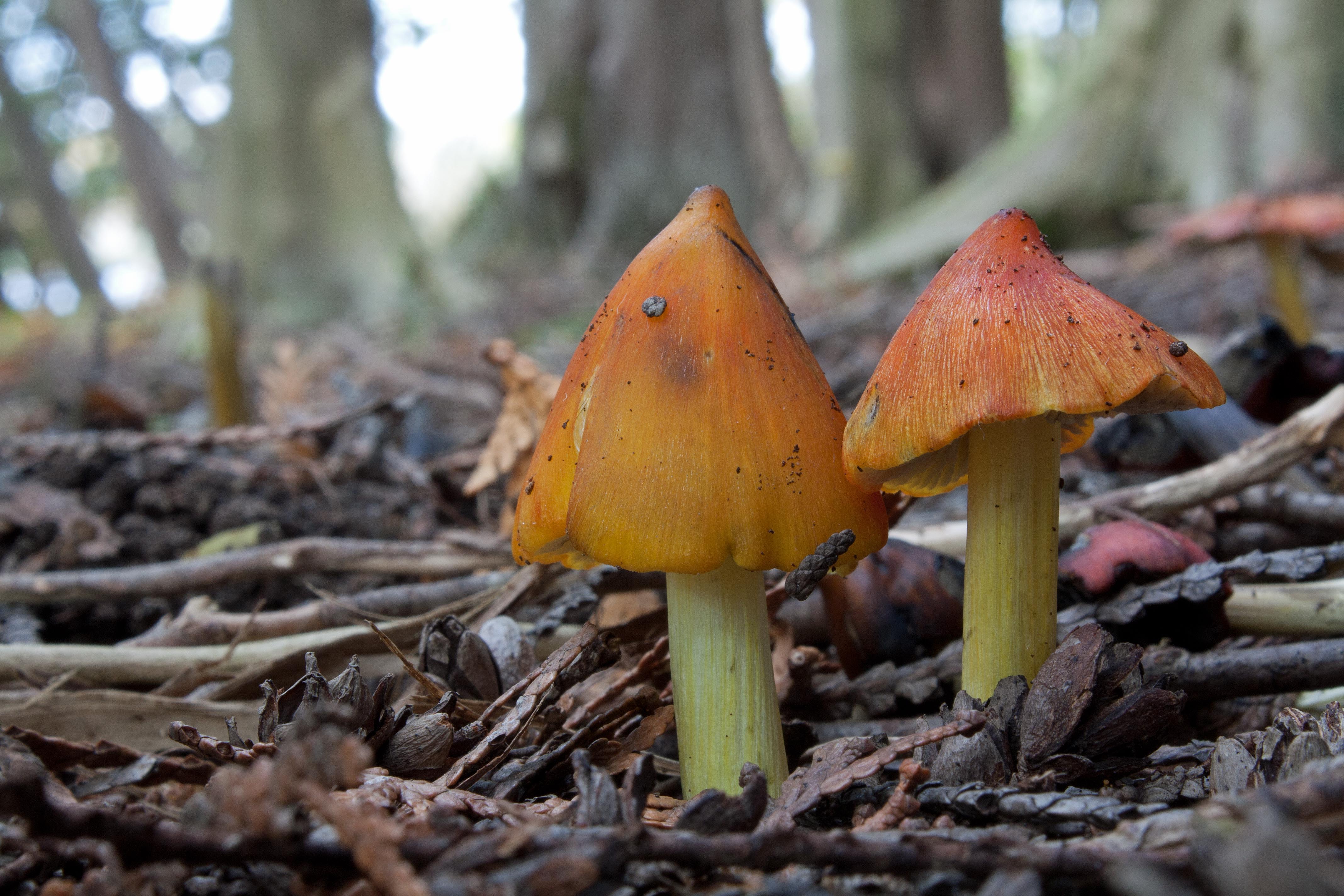
Witch’s Hat (Hygrocybe conica) by cedar tree, ON (photo by Nina Munteanu)
In my recent wanderings in the small cedar forest by the river near my house, I chanced upon a community of emerging reddish-orange fungi. They sat among the cedars in a crowded aggregation. Some pushed their way up through the duff like little buds, barely visible; others rose up with pointed steep caps; and others had opened further into tiny ‘witch’s hats’ and blackened.
Several stages of Witch’s Hat, including blackening stage, cedar forest, ON (photo by Nina Munteanu)
According to Frank Dugan, fungus plays a key role in many folktales and fairy tales. “They appear as foods, poisons, diseases, decorations, dyes or tinder, and even in insults, compliments, graffiti and video games,” says the author of Fungi, Folkways and Fairy Tales: Mushrooms & Mildews in Stories, Remedies & Rituals, from Oberon to the Internet.
Fungi figure in wonderfully with stories of and about witches. “Witches have long used fungi in their potions in Europe,” Fungal Folklore tells us. Even ferry rings are called “Hexen Rings” in Germany; Hexe means witch and this refers to “the dancing of witches on Walpurgis night (the eve of May Day) when the old pagan witches were thought to hold high revelry,” writes Dugan.
Baba Yaga (Wikipedia Commons)
Baba Yaga
In the Slavic folktale, Baba Yaga is an ancient swamp witch; she’s a cruel ogress who steals, cooks and eats her victims, usually children; OR offers them help. It’s complicated; she’s either a maternal helper or a cannibalistic villain; or both. Certainly a trickster. Baba Yaga is guardian of the fountains of the water of life and lives in a forest hut perched on bird’s legs, surrounded by pine trees and glowing skulls. She can manipulate earth and wood, and can mesmerise. Baba Yaga has lately become something of an icon for feminism and the power of the feminine.
Says Marissa Clifford in Vice: “Like other witches, deistic Baba is agent of transformation, who, according to Kitaiskaia, exists ‘kind of outside of the things which constrain human society, like time and morality.’ She may well be so compelling for women today because of her rejection of social standards, and the power that comes from that. She’s an outlier with power that isn’t derived from her beauty, or her relationships with others. Instead, it comes from within her—earth, hut, and firey stove.”
Baba Yaga (illustration by Tatyana Chepkasova)
Witches, Fungi & Potions
“Witches have long used fungi in their potions in Europe,” The Fungus Among Us tells us. According to Dugan, the dung-loving Panaeolus papilionaceus (Petticoat Mottlegill) was used in witch’s concoctions in Portugal. The entheogen Amanita muscaria (Fly Agaric)—the elixir of ancient alchemists—is known as Hexenpils (‘Witches’ mushroom’) in Austria. Among German tribes, it is associated with Woton/Odin, god of ecstasy, war and shamanic knowledge. Puffballs were reportedly used in potions by witches in the Basque country. Witch’s butter (Exidia spp.) also figures in folklore. “Stabbing, burning or otherwise destroying these fungi were believed to harm the witch herself,” writes Owen. The Witch’s Hat (Hygrocybe conica) is aptly named for its blackening witch-style ‘hat’ that starts bright red-orange and turns coal black.
Many country folk through the sixteenth and nineteenth centuries performed rituals to protect their crops from the devastation wrought by witches and spirits. Thiselton-Dyer discusses the malignant Roggenwolf (‘rye wolf’ of Germanic folklore) who stole children and fed on them and the various rituals peasants used to appease these Feldgeister (field spirits), such as leaving a sheaf of rye in the fields over the winter. The Roggenwolf is, of course, the personification of ergot, the fungus Claviceps purpurea, which caused convulsions, burning, “massive-appetite”, and “the sense of becoming an animal.” People who contracted ergot poisoning from the contaminated rye were accused of being witches and brutally killed.
Young Witch’s Hats push up through the cedar forest floor, ON (photo by Nina Munteanu)
Ergot and The Last Summoner
In my historical fantasy “The Last Summoner,” young Vivianne Schoen, Baroness of Grunwald—accused of being a witch—is chased by her father’s guard to be burnt at the stake. Blamed for the sudden stupor of her father and the chaplain who both love their rye bread, it didn’t help that Vivianne possesses unnatural powers in metal manipulation, has weird markings or blemishes on her back or that suspicions of her preternatural mother being a witch precede her. Then odd things start to happen; cattle stop producing milk and other farm animals behave strangely. At a feast to celebrate her own coming nuptial to a foreign stranger and just after she is falsely accused of adultery, people suddenly succumb to fits of convulsions, facial distortions, hallucinations and paralysis. Targeted as the obvious candidate to blame, she must flee her home or be burnt alive at the stake:
…With a final unintelligible gasp that wet her cheek with flying spittle, he convulsed violently and pitched to the floor, shaking and vomiting his dinner.
Vivianne stared at her father, rolling and twitching in a seizure on the floor and crying out gibberish. She turned to the castle community, who were now pointing and shouting at her. Their faces had twisted from transfixed revulsion into fear and anger. Somehow they blamed her for both the stranger’s accident and her father’s sudden paroxysm. Perhaps for losing them a battle in the bargain too. Even Père Daniel’s face looked stricken with confused accusation. Until now Vivianne hadn’t realized how much his opinion of her meant to her. She felt his faltering faith drive like a blade into her heart and would have burst into tears had the crowd not suddenly grown very surly, which demanded her sudden attention.
Gertrude, the new dairymaid she’d assisted earlier, flung the first accusation: “She’s a witch!”
“Witch!” another echoed. “You heard her father call her one!”
Another servant swiftly followed with, “Just like her mother! She’s bewitched the baron! Put a spell on him with her wicked look!”
The crowd ignited to a raucous mob and a spate of accusations gushed out like a dam breaking: “My butter failed to churn because of her!”
“Look at the witchling’s eyes! They blaze with the devil’s own fire!”
“She appeared in Weikhard’s dream and now he’s ill!”
“She touched my cow and afterwards it couldn’t stand!”
“I saw the nursemaid bringing her a daily potion of nettle, mustard and mint with wine to make her lustful!”
Oh, no! They were implicating Uta along with her!
“I smelled basil and cloves in her bed chamber!”
Vivianne had used both to mask the rank odor of Uta’s anti-plague potions, completely innocent of their aphrodisiac properties. Vivianne stared in anguished despair as Père Daniel stood by, mutely sanctioning their actions. She’d thought him her champion once. But obviously this was too much for him to bear. He’d lost his trust in her. As their eyes met briefly, he suddenly gasped out strange words of gibberish. A violent shudder convulsed through him. It threw him forward, as if the devil itself were animating him, then felled him to the ground where he vomited alongside her retching father.
“She’s taken the priest!” someone shouted. “He’s doing the Viper’s dance!” Another screamed in a panic, “Watch out for her eyes!”
Vivianne turned back to the crowd. Whomever her gaze alighted upon shrank back and averted their face in terrified alarm. They were convinced that she could strike them down with a glance. To her horror a few of the castle servants jerked out of their seats with startled cries of gibberish then fell writhing to the ground; some began to vomit. Vivianne recognized the true onslaught of an epidemic. The same illness that had inflicted her father and the chaplain was attacking the staff. And again, the timing was impeccable, thought Vivianne with wry cynicism. As though God was plotting against her.
Gertrude pointed to her. “Seize her! Burn the witch! Before she kills us all!”
“Someone find her demon cat too!” Vivianne heard the doctor shout.
Several of the baron’s knights surged forward, swords drawn. As if suddenly awoken from a stupor, the Teutonic Knights at the high table leapt into action and drew their swords.
NO! Vivianne backed away in alarm. She envisioned their swords suddenly pointing back toward themselves. To her amazement, their swords flung back and the knights dropped them in shocked fright.
In that surreal moment, as the world staggered into slow motion, Vivianne saw the entire castle household draw in a long breath. Still on the floor, Père Daniel’s shakes abated long enough for him to fix lucid eyes upon her and silently mouth, “Cours, ma petite! Cours! Sauves toi!”
After a last glance at her convulsing father, Vivianne took the Père’s advice and ducked through one of the curtained archways behind the table to the kitchen stairwell, and pelted down the stairs.
“After her!” she heard the booming voice of Doctor Grien. “The witch is getting away!”
*****
Vivianne later discovers what caused the sudden ‘bewitchment’ of members of her community: all the people who became ill had eaten the rye bread. She learns about ergot poisoning of rye by the fungus Claviceps purpurea. Conditions had been ideal for ergot to thrive: damp and rainy cool weather.
Young Witch’s Hat with peaked cone-shaped pileus, amid cedar duff, ON (photo by Nina Munteanu)
The Witch’s Hat
Witch’s Hats are a small agaric (cap from 1-4 cm across) that start out bright red to orange, sometimes almost yellow as they thrust up through the cedar duff, looking like buds.
The conical pileus is often curved steeply with a fairly sharp top and sometimes with edges that curve slightly inward. The stem (stipe) is often white at the base blending to yellow and will stain black with age.
Witch’s Hat mushroom showing inward curve of cap, with key to show size, cedar tree, ON (photo by Nina Munteanu)
As the waxcap mushroom develops, the cap spreads out with a discernable brim while maintaining the hat peak of a witch’s hat. As it ages, it turns a deeper red-orange that blackens, often from the edges inward.
Three stages of Witch’s Hat, from early conical to spreading and blackening hat, cedar tree, ON (photo by Nina Munteanu)
This tendency to blacken from bruising or with age is a good diagnostic for this mushroom. Very few others show this trait. Its gills “have the consistency of soft wax when rubbed between the fingers,” Fungus Fact Friday tells us. The gills start white to yellowish and gradually yellow and stain black.
Stages of Witch’s Hat from budding to opening cap to blackening cap and gills, cedar forest, ON (photo by Nina Munteanu)
Blackened and blackening Witches Hat caps and stems, ON (photo by Nina Munteanu)
Hygrocybe conica well-represents its common name Witch’s Hat as it keeps its peak and turns totally black, cedar in Ontario forest (photo by Nina Munteanu)
The Witch’s Hat (Hygrocybe conica), also known as Blackening Waxcap (for the obvious reason), shows a diversity of habitat preference and high variability. It tends to grow on the ground under hardwood and conifer trees. The community I stumbled upon fanned out from a few cedar trees in a small mixed cedar forest. The Witch’s Hat also likes mossy areas, where I found several near the river. The saprobic Hygrocybe conica is also a mycorrhizal fungus, sending tendrils from tree to tree.
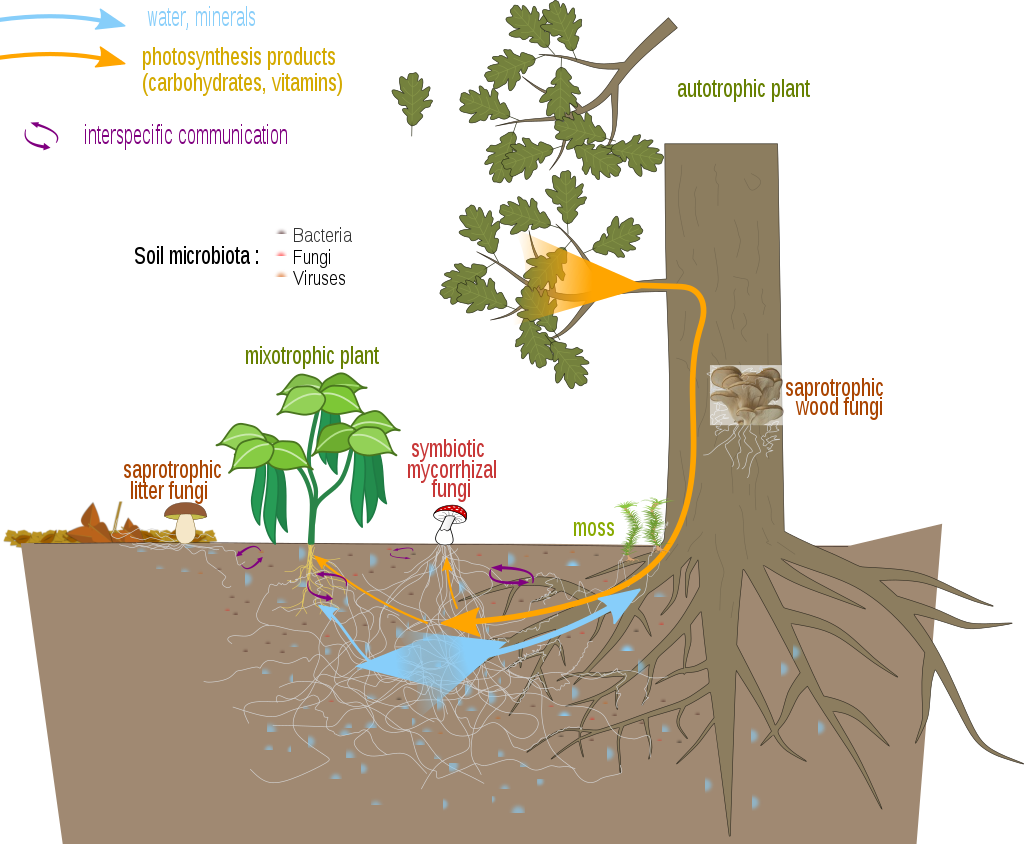
Mycorrhizae are symbiotic relationships that form between fungi and plants. The fungi colonize the root system of a host plant—in this case some cedar trees—providing increased water and nutrient absorption capabilities while the plant provides the fungus with carbohydrates through photosynthesis.
Mycorrhizal network (illustration by Charlotte Roy, Wikipedia)
References:
Dugan. 2008. “Fungi, folkways & fairy tales.” North American Fungi 3(7): 23-72.
Morgan, A. 1995. “Toads and Toadstools: The Natural History, Folklore, and Cultural Oddities of a Strange Association.” Celestial Arts. Berkeley, California.
Munteanu, Nina. 2012. “The Last Summoner.” Starfire World Syndicate. Louisville, KY.
Owen, E. 2003. “Welsh Folk-Lore: A Collection of the Folk-Tales and Legends of North Wales. Kessinger Publishing. Whitefish, Montana.
Thiselton-Dyer, T.F. 1898. “Folk-Lore of Plants.” D. Appleton and Co., New York.
Young emerging Witch’s Hats through cedar duff, ON (photo by Nina Munteanu)
Witch’s Hat in cedar forest, ON (photo by Nina Munteanu)
Nina Munteanu is a Canadian ecologist / limnologist and novelist. She is co-editor of Europa SF and currently teaches writing courses at George Brown College and the University of Toronto. Visit www.ninamunteanu.ca for the latest on her books. Nina’s bilingual “La natura dell’acqua / The Way of Water” was published by Mincione Edizioni in Rome. Her non-fiction book “Water Is…” by Pixl Press(Vancouver) was selected by Margaret Atwood in the New York Times ‘Year in Reading’ and was chosen as the 2017 Summer Read by Water Canada. Her novel “A Diary in the Age of Water” was released by Inanna Publications (Toronto) in June 2020.
Poplar trees in the late autumn, ON (photo and rendition by Nina Munteanu)
My heart will rise to follow in the fierce rhapsody: Wind’s cry and rapture; Mystical beauty in the primal call, wildernesses, Mad windstorm moving from treetop to treetop, From branch to bending branch, from singing leaf to leaf Moving, high sheltering in the high tumult, skies above Midst songs of midnight, darkest shadow, deepest shades
Path through maple-beech forest, ON (photo and rendition by Nina Munteanu)
The great beauty in the wind’s mystic path Darknesses far beyond into the cathedrals of the night: Airs, echo and sighs, dreams, Thoughts of all our tomorrows: Sacred windstorms at the beginning of time: A glorious sun and the rising dawn lights
Pine cedar forest in Ontario (photo and rendition by Nina Munteanu)
All promise was once ours, Echoes of dreams once ours, All beauty once ours and days never to be forgotten Dawn lights and dusty twilights: The songs of the wind’s rapture, Fierce windstorm sighs, cries through branch and bough…
Old maple tree in a mixed forest, ON (photo and rendition by Nina Munteanu)
A pastoral field blazes with autumn colours of sumac and maple, ON (photo and rendition by Nina Munteanu)
Oh! memory hold strong Windsong: mystic soul of creation: the mystic fire, the holy flame; Worlds ablaze The long sacred journey into mystery Beauty transfigured, wind’s message and haunting Windstorm and mystical worlds, sanctuary far away All passion spent.
Marsh at sunset, ON (photo and rendition by Nina Munteanu)
Nina Munteanu is a Canadian ecologist / limnologist and novelist. She is co-editor of Europa SF and currently teaches writing courses at George Brown College and the University of Toronto. Visit www.ninamunteanu.ca for the latest on her books. Nina’s bilingual “La natura dell’acqua / The Way of Water” was published by Mincione Edizioni in Rome. Her non-fiction book “Water Is…” by Pixl Press(Vancouver) was selected by Margaret Atwood in the New York Times‘Year in Reading’ and was chosen as the 2017 Summer Read by Water Canada. Her novel “A Diary in the Age of Water” was released by Inanna Publications (Toronto) in June 2020.
Marsh in the Kawarthas of Ontario in the fall (photo and dry brush rendition by Nina Munteanu)
“Those who contemplate the beauty of the earth find reserves of strength that will endure as long as life lasts.”—Rachel Carson
In a recent seminar called “Cultivating a Sense of Place” (Programs in Earth Literacies) Douglas Christie introduced me to the works of Philip Levine. In particular, he discussed a work entitled “Dust” which appeared In Levine’s 2004 collection Breath:
Dust
My wife tells me that when she was six she came home from school to an empty house, put down her lunch box, sat on a hassock by her father’s chair, and simply waited. Someone known would return home soon, she was sure. The house was still, silent, holding its breath, the late afternoon sunlight streamed in the unshaded windows and turned the dust into in golden planets floating before her. Sixty-four years later she declares, “It was beautiful,” and goes on to describe the sense of awe and peace before this vision of the universe that descended from nowhere or perhaps rose from within. North-central Iowa, 1933, her grandmother’s house. Nothing else remains of the day. She gazes into space seeing again those whirling worlds more perfectly than the room she’s in, her smile open, her glazed eyes radiant.
–Philip Levine
Philip Levine
Such utter stillness in the moment described! As though it still existed. Which it did, which it does. Intact and unaffected by time’s erosion.
What we see as beautiful, touches us in our heart-minds and we cherish it.
Because that moment was beautiful, Levine’s wife cherished it; because she cherished it, it was beautiful. This was so only because her child-self gave herself over to the moment and allowed herself to experience the awe and wonder of that moment. It helped that she was a child, alone in an empty house that was usually filled.
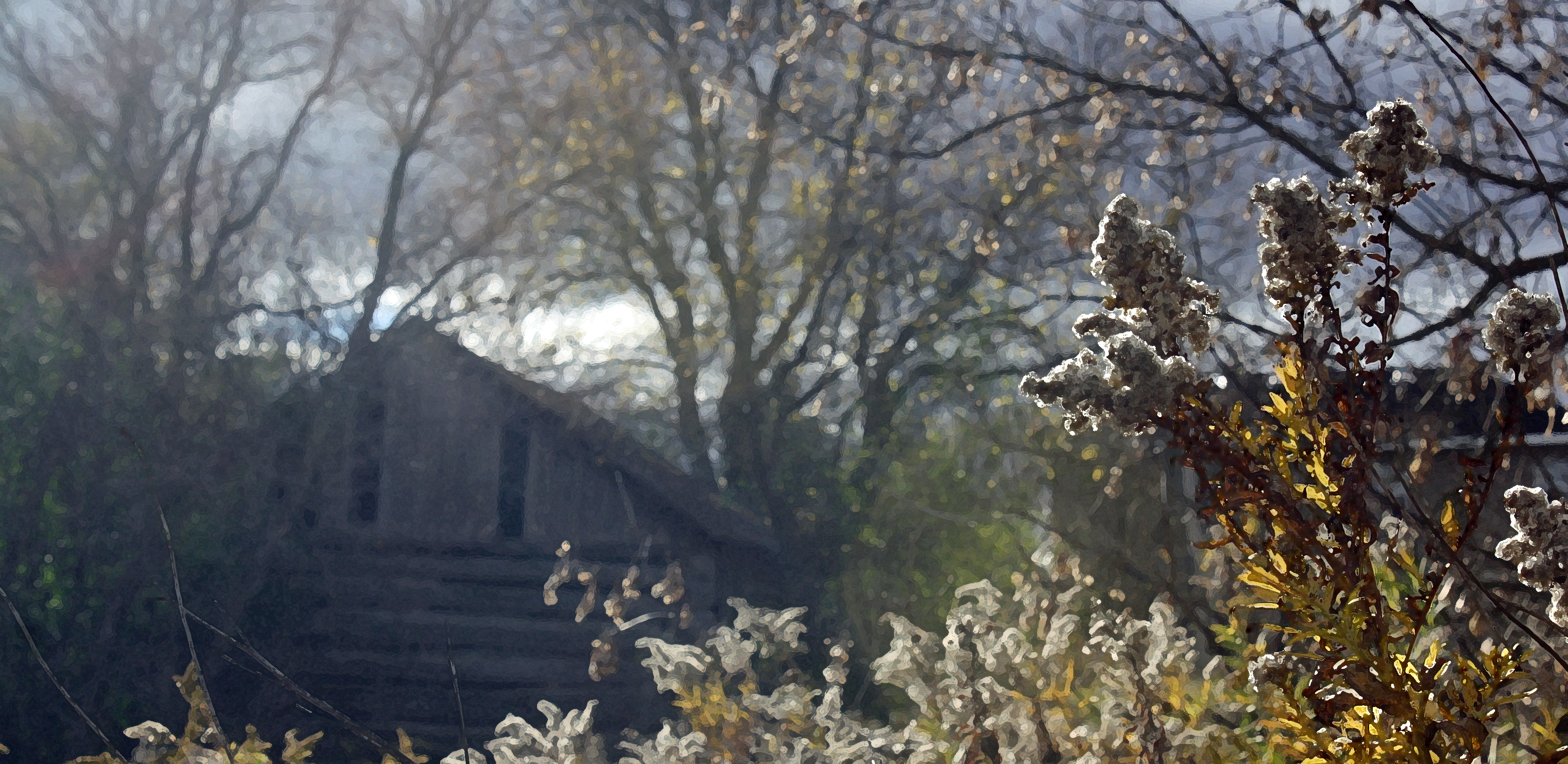
Old shed of farmstead with goldenrods in foreground, fall in Ontario (photo and rendition by Nina Munteanu)
When we grow up, why is it that we lose the tendency, even the ability, to simply be in the moment, in the silence of ourselves, to discover beauty? I suppose we make excuses; it isn’t efficient or productive to “do nothing.” Compelled to feed into the ever-burgeoning capitalist machine, we must keep “doing.” Do we learn to ignore those moments to be efficient machines ourselves? Surely, in refusing to live these moments, we are also silencing the many voices of beauty that could touch our hearts.
To appreciate beauty is to open your heart to wonder and silently witness. Beauty is found through beholding. Beauty is slow. To notice beauty, we must slow our mind and sense with our soul. We may “see” beauty all around us, but we do not “feel” it until we open to it, let it touch us and let it stroke our inner soul.
Pine cedar forest in Jackson Creek Park, ON (photo and rendition by Nina Munteanu)
Researchers have confirmed what the poets have long known: that we need to experience beauty in our lives. According to biologist Richard Prum, all creatures possess an aesthetic instinct—an instinct and a need for beauty. “The taste for the beautiful is as distinctive [and meaningful] as the need to survive,” writes Brenner. “One of the attributes of the beauty instinct is an inbuilt sense of respect for others.”
Encouraging yourself to recognize and appreciate beauty in Nature may be one of the most important aspects of your well-being.
Reflections on the Otonabee River, ON (photo and dry brush rendition by Nina Munteanu)
But what is beauty and how does one experience it? I devote an entire chapter to this topic in my book “Water Is…”.
There is beauty, writes 18th century aesthetic realist Francis Hutcheson, “in the knowledge of some great principles, or universal forces, from which innumerable effects do flow, such as gravitation, in Sir Isaac Newton’s scheme.” Neither beauty of form nor beauty of idea sufficiently applies to its definition, because beauty is, as we all know, “in the eyes of the beholder.”
Beauty—like love—is not so much a quality as a relationship
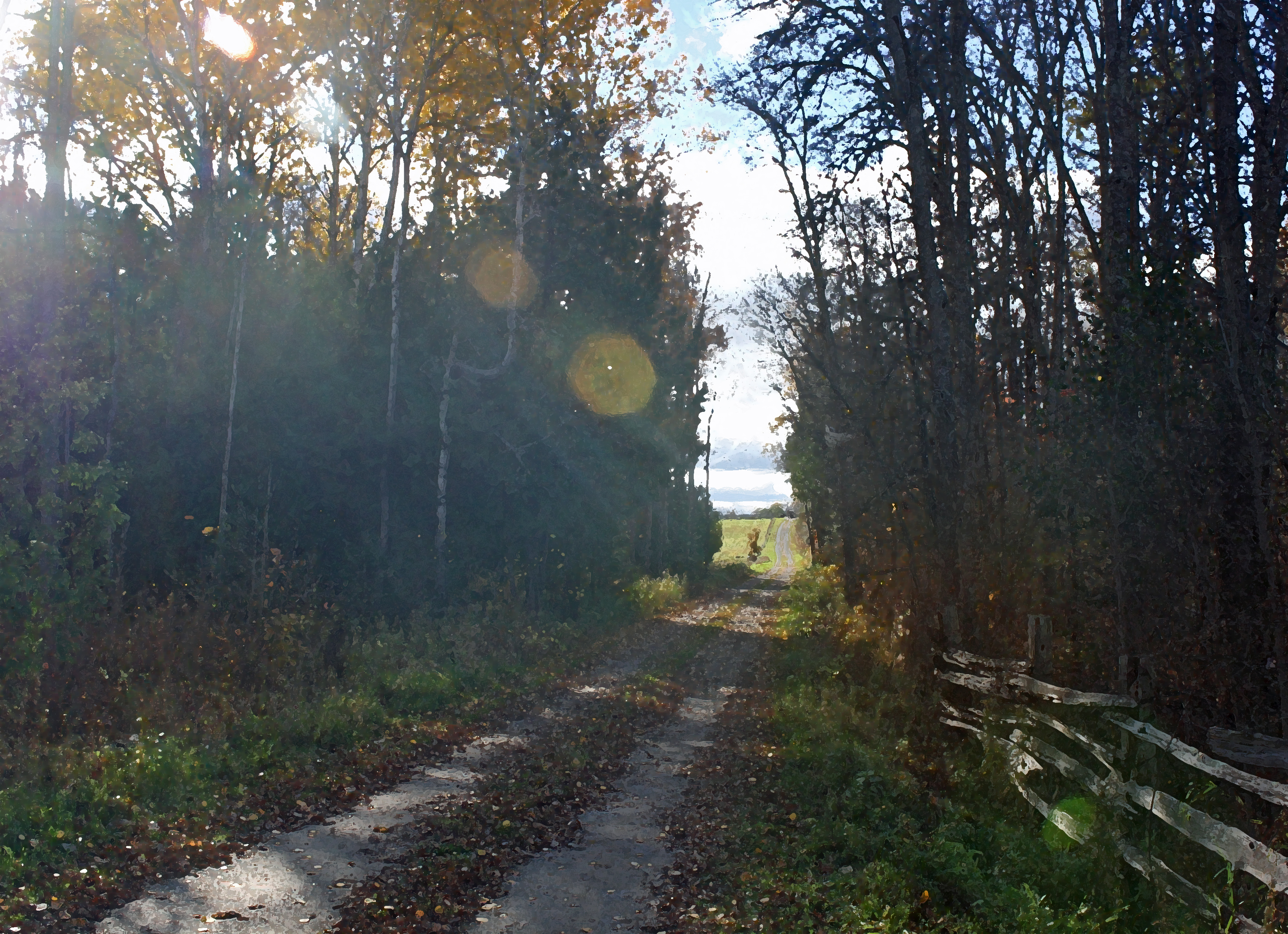
Lane to farm off country road in Ontario (photo and dry brush rendition by Nina Munteanu)
In 1942, philosopher of aesthetics Jared Moore described complete beauty as three varieties of harmony combined: (1) objective harmony (i.e., harmony among the elements that make up the “beautiful object” through form, idea and its expression); (2) objective–subjective (i.e., harmony between the beautiful object and the contemplative mind through spiritual and psychophysical [empathetic] means); and (3) psychological (i.e., its meaning). Moore writes that complete aesthetic harmony—expressed by psychological or purely subjective harmony—is achieved only when the first two harmonies are attained. He describes this complete sense of harmony as “a sense of pleasure” which not merely adds itself to the sense of beauty, but “enters into and becomes a part of it.” This “inner harmony” brings the personality into a state of “unity and self-completeness.” A unity of the subjective, not only with the object, but with itself.
We recognize beauty, and, in feeling it, are beautiful.
Stand of poplar trees in the fall, ON (photo and dry brush rendition by Nina Munteanu)
British artist and educator John Lane, author of Timeless Beauty, describes beauty this way:
“Although the complexities of both nature and beauty have a subtle mathematical basis, reason by itself cannot tell us why beauty exists nor what is beautiful … There is often something spontaneous, even ‘illogical’ about these emotions; like love, they can never be predetermined, let alone dictated. But neither can the otherwise and splendid things which are most significant in human life, to which the greatest of the human race have contributed most, and in which our real refreshment consists—the love of truth, the sources of inspiration and the production of great works of art.”
“These, like beauty,” says Lane, “ultimately pertain to the unconscious, the heart and the soul. They pertain to the heart because it is love which discerns the mystery inherent in those things we see as beautiful; love which abandons arrogance and stands in awe before the mystery of life. It is love that sees beauty which, in turn, is always loved.”
Jackson Creek in the fall, ON (photo and dry brush rendition by Nina Munteanu)
The Beauty of Place
I grew up in the Eastern Townships, a gently rolling agricultural region in Quebec, Canada. I followed my older brother and sister to the nearby maple-beech forest and local stream. The forest was our playground and gateway to our imaginative play. We stirred soil, flower petals and other interesting things with water to fuel “magic potions” that we inflicted on some poor insect. Yes, I was a bit destructive as a child—and I took a lot for granted.
Country road in Kawarthas in fall, ON (photo and dry brush rendition by Nina Munteanu)
Much later in life, when I gave birth to my son, Kevin, in Vancouver, BC, I felt a miracle pass through me. Kevin became my doorway back to wonder. His curiosity was boundless and lured me into a special world of transformation. Kevin and I often explored the little woodland near our house. We made “magic potions” out of nightshade flowers, fir needles, loam and moss; we fueled our concoctions with the elixir of water from a stagnant pool. This time the little insects weren’t molested.
Red oak acorns line up against a tree root, Jackson Creek, ON (photo and rendition by Nina Munteanu)
Being with my young son slowed my world and returned to me a great sense of wonder. A walk to the little store with young Kevin was an expedition. He’d amble, explore, poke, then suddenly squat and study something on the pavement that I’d missed.
He brought me back to the ground, to the extra-ordinary mundane—to the quiet details and the fragrant light. Acting like a macro lens, he pointed me to the little things, Nature’s nuanced designs that I’d forgotten in the larger paradigms of my hurried life.
Poplar leaf amid the litter of a cedar forest floor (photo and rendition by Nina Munteanu)
He brought me back to the immediate, to Nature’s elegant silence and beauty. He showed me the fractal wonders of tree branches, exploding seeds, glorious reflections in puddles, strange mud waves and odd moss-covered rocks. We crouched in halted silence to watch a bee feast from a flower’s nectar then launch itself—a dirigible laden with pollen—into the sky. We followed the brilliant Fibonacci spiral of a sunflower or the circular gossamer web of a spider, both mimicking the greater spiral of our own Milky Way Galaxy. We stuck our tongues out to taste the snow as it cascaded down in heaps or caught hexagonal snowflakes on our sleeves and sadly watched them melt. We stomped in road puddles or threw rocks and watched the circles of waves feed outward, changing the colour and texture of everything. We collected flotsam in nebulous forest pools and made magical potions. We wrote stories in the ocean sand, then leapt from dry rock to dry rock until the sea trapped us in its rushing embrace.
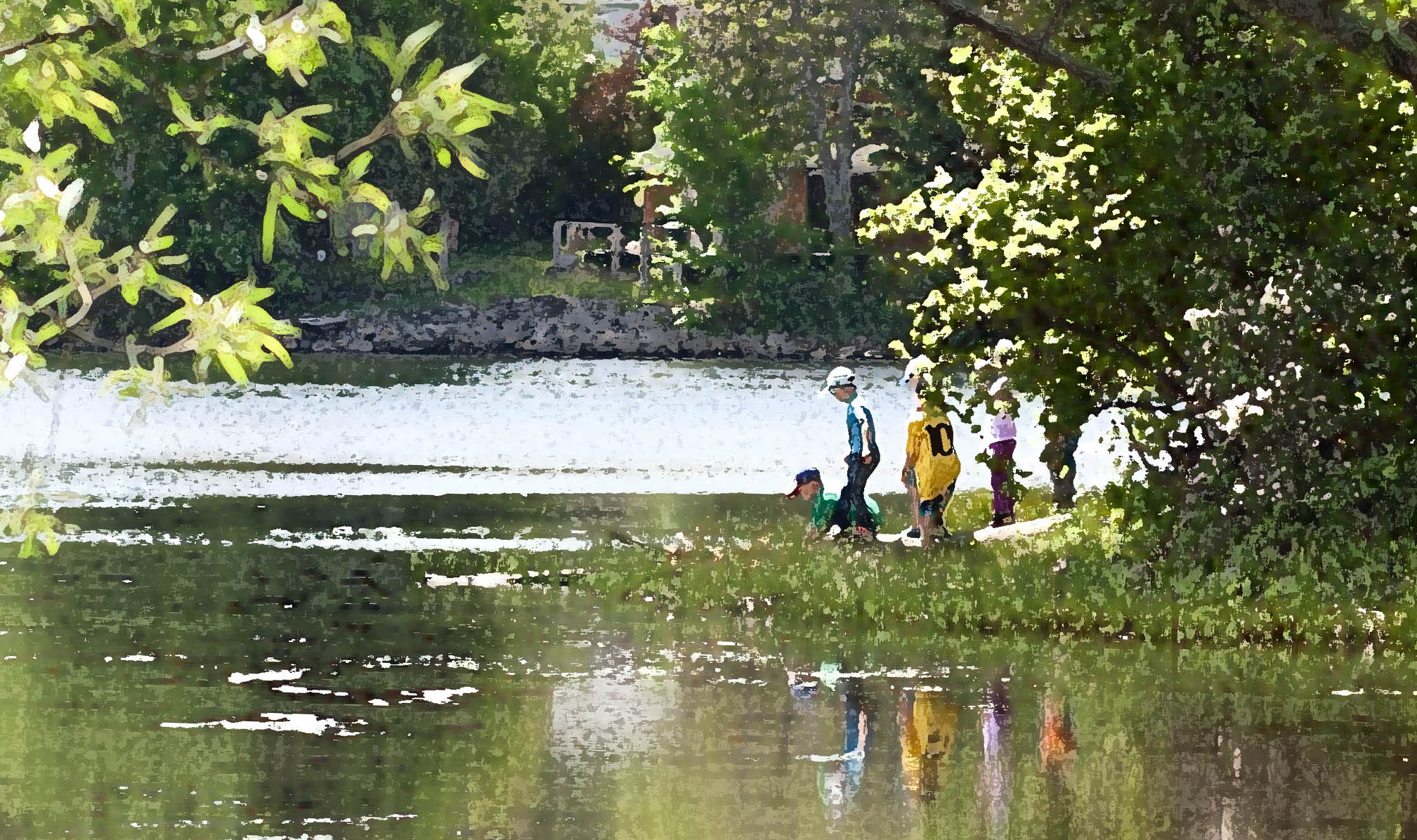
Group of young boys explore the river bank, ON (photo and rendition by Nina Munteanu)
My adult son still carries that sense of wonder for the natural world. He lives in British Columbia where he skis the mountains and frequently hikes the mountain foothills and old-growth forests of that beautiful province.
He’s soul-bathing.
My son Kevin skiing in British Columbia (photo by Lindsay; rendition by Nina Munteanu)
In her 2003 foreword to John Lane’s book Timeless Beauty, Kathleen Raine writes, “Of Plato’s three verities, the Good, the True and the Beautiful, none can be understood in terms of the materialist values of modern Western civilization, and beauty least of all.” She adds, “Keats saw [beauty] as the highest value—because its reality can be known only to the soul … If beauty is the highest of Plato’s verities this is because it is in accordance with our nature: Plato did not invent that need. And did not Dostoevsky in The Idiot affirm his believe that the world can be saved only by beauty? We disregard and undervalue the beautiful at our peril.”
“That the universe is alive, a living entity, there can, it seems, be less and less doubt, and that it is beautiful there can be none at all.”
—John Lane, Timeless Beauty
Mossy rocks in Jackson Creek, ON (photo and rendition by Nina Munteanu)
Aristotle. 350 BCE (1984). “The Poetics” and “Metaphysics.” In: “The Complete Works: The Revised Oxford Translation, Vol. 1. Bollingen/ Princeton University Press, N.J. 2512 pp.
Birkhoff, George David. 1933. “Aesthetic Measure.” Harvard University Press. 225 pp.
Hutcheson, Francis. 1725 (2004). “An Inquiry into the Original of Our Ideas of Beauty and Virtue.” In: Wolfgang Leidhold (ed) Indianapois: Liberty Fund.
Lane, John. 2003 “Timeless Beauty: In the Arts and Everyday Life.” UIT Cambridge Ltd, , UK. 192 pp.
Livio, Mario. 2005. “The Equation that Couldn’t Be Solved.” Simon & Schuster. 368 pp.
Moore, Jared S. 1942. “Beauty as Harmony.” The Journal of Aesthetics and Art Criticism 2(7): 40–50.
Newton, Eric. 1950. “The Meaning of Beauty.” Whittlesey House. 207 pp.
Puffer, Ethel. 1905. “Psychology of Beauty.” Houghton, Mifflin & Co., NY. 156 pp.
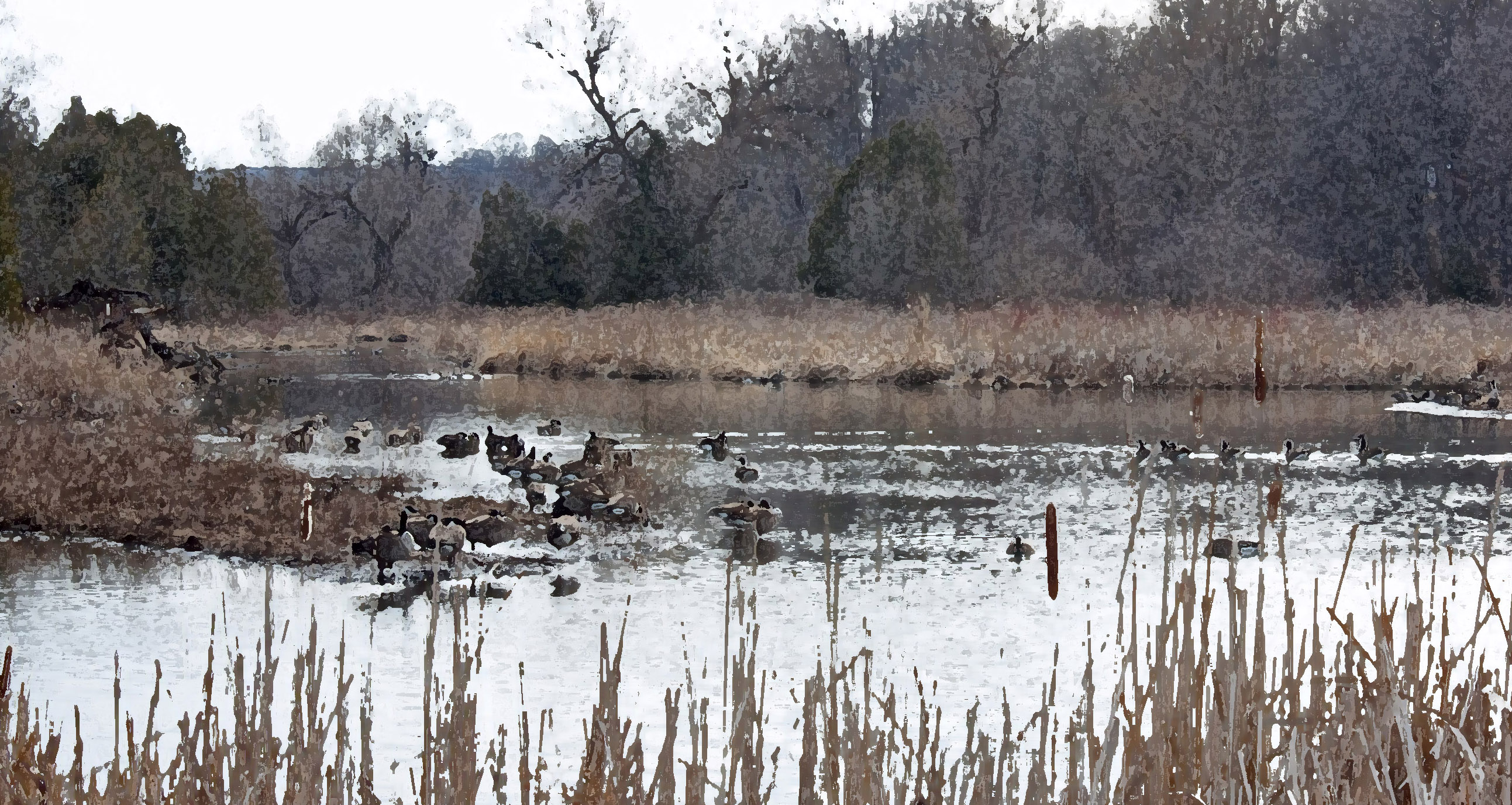
Marsh with cattails and flock of geese, near Millbrook, ON (photo and rendition by Nina Munteanu)
Nina Munteanu is a Canadian ecologist / limnologist and novelist. She is co-editor of Europa SF and currently teaches writing courses at George Brown College and the University of Toronto. Visit www.ninamunteanu.ca for the latest on her books. Nina’s bilingual “La natura dell’acqua / The Way of Water” was published by Mincione Edizioni in Rome. Her non-fiction book “Water Is…” by Pixl Press(Vancouver) was selected by Margaret Atwood in the New York Times ‘Year in Reading’ and was chosen as the 2017 Summer Read by Water Canada. Her novel “A Diary in the Age of Water” was released by Inanna Publications (Toronto) in June 2020.




























 Nina Munteanu Writing Coach