A short while ago I was contacted by fellow SF Canada member Lisa Timpf to provide information on an article she was writing about editing anthologies. Lisa’s article, entitled “Anthology Editing: Advice and Insights from Those Who’ve Been There”recently appeared on the Jane Friedman site.
Lisa interviewed two publishers and several editors, including me, on what’s involved in putting out an anthology. The article was thorough and well written and provided useful insight and advice to would be anthology editors. Aspects included: what the job entails, what skills are needed (e.g. storytelling, organization, communication and negotiation, flexibility, the ability to deal with difficult situations, and the willingness to go outside your comfort zone), and the payoffs, of course.
The article covered all stages of producing the anthology, from pitching to a publisher to the process of acquisition and production. She ends her article with “Final Words” of her own reflection and great advice. Lisa draws on Christine Lowther’s advice to be patient and to be “honest about your priorities.” Given how long and involved the process can be (it took three years from call for submissions to final release for the latest anthology I edited), she rightly suggests strongly considering whether you “can dedicate the time and effort to editing without resenting the impact on [your] own writing.”
Lisa then ends with:
“If you, too, are on the fence, consider Nina Munteanu’s reflection on the anthology editing process. As she explains it, ‘Watching the anthology emerge through the slow collection of many outside sources of individual creativity, style and message is akin to watching the birth of a galaxy full of stars—gathered and orchestrated by you but so much more than the sum of its parts—comprising many singular notes of a symphony that together create something wondrous and beautiful.’
Lisa Timpf served as guest editor for Eye to the Telescope 32: Sports and Games. Her book reviews, poems, and short stories have appeared in a variety of venues, and her speculative poetry collection, Cats and Dogs in Space, is available from Hiraeth Publishing. You can find out more about Lisa’s writing and artwork at lisatimpf.blogspot.com, and also find her on Bluesky.
.
Go to this link to read my review of Lisa’s speculative poetry collection, Cats and Dogs in Space.
.
Nina Munteanu is a Canadian ecologist / limnologist and novelist. She is co-editor of Europa SF and currently teaches writing courses at George Brown College and the University of Toronto. For the latest on her books, visit www.ninamunteanu.ca. Nina’s bilingual “La natura dell’acqua / The Way of Water” was published by Mincione Edizioni in Rome. Her non-fiction book “Water Is…” by Pixl Press (Vancouver) was selected by Margaret Atwood in the New York Times ‘Year in Reading’ and was chosen as the 2017 Summer Read by Water Canada. Her novel “A Diary in the Age of Water” was released by Inanna Publications (Toronto) in June 2020.
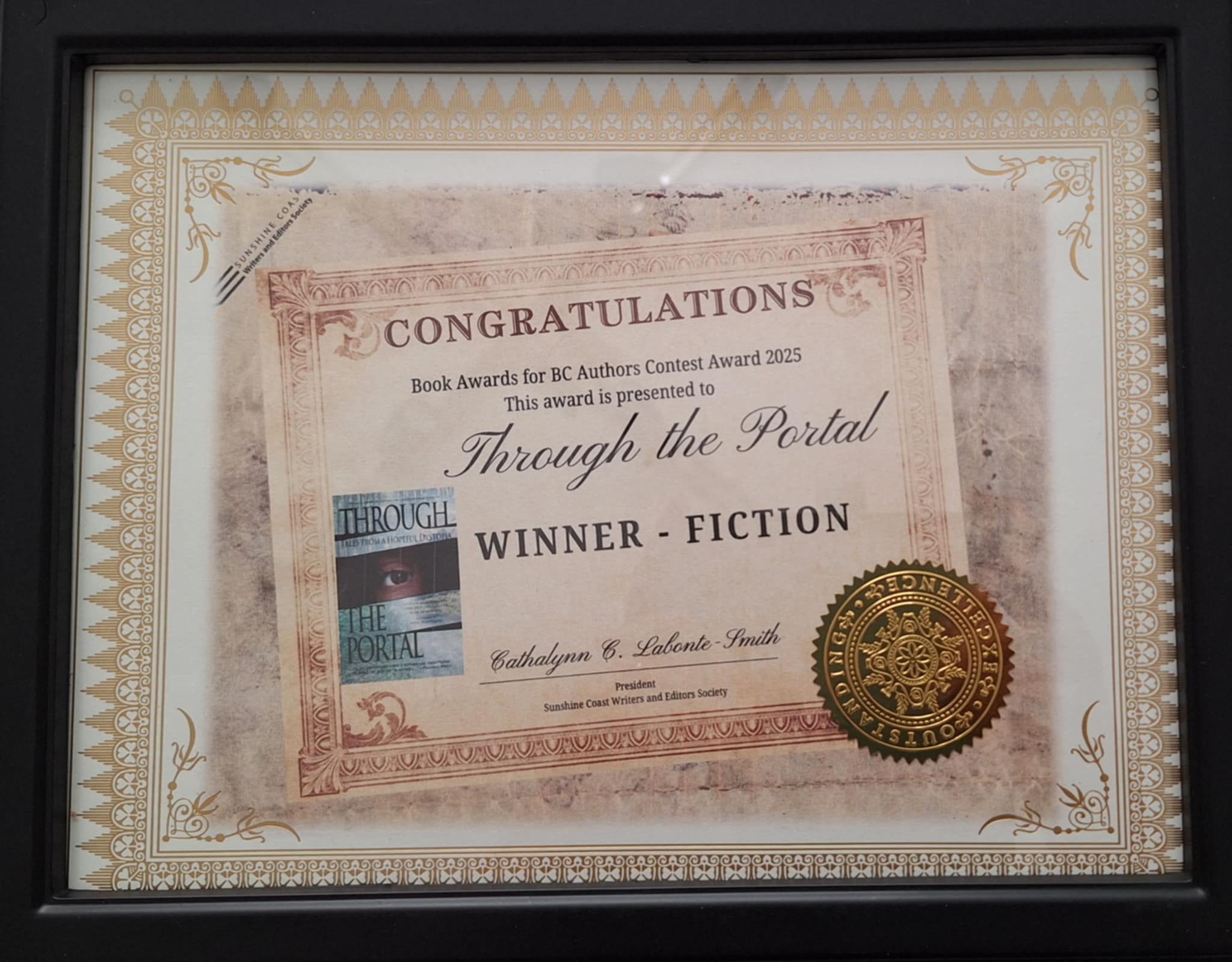
On August 23, 2025, Through the Portal: Tales for a Hopeful Dystopia, edited by Lynn Hutchinson Lee and Nina Munteanu for Exile Editions, won the BC Sunshine Coast Award for 2025.
The fiction prize was award to Exile Edition’s 20th anthology along with three other fiction works that include Blackheart Man by Nalo Hopkinson, The Cipher by Genni Gunn, and Inside Outside by Faye Arcand.
Here is what the judges said about Through the Portal:
“Every story in here is a delicious short gem.”
“An ambitious project with an unusual slant of positivity in the face of a dystopian future has turned into a solid piece of work, incorporating a good range of stories, some very literary and abstract, others simple tales of destruction and regrowth or the hope of regrowth.”
“Characters and situations in the selected stories show optimism and the power of the human spirit across a wide array of possible near- and far-term futures.”
“Most of the situations are inherently believable based on what we know about climate, industry, and the powerful politics of denialism.”
.
.
Nina Munteanu is a Canadian ecologist / limnologist and novelist. She is co-editor of Europa SF and currently teaches writing courses at George Brown College and the University of Toronto. Visit www.ninamunteanu.ca for the latest on her books. Nina’s bilingual “La natura dell’acqua / The Way of Water” was published by Mincione Edizioni in Rome. Her non-fiction book “Water Is…” by Pixl Press (Vancouver) was selected by Margaret Atwood in the New York Times ‘Year in Reading’ and was chosen as the 2017 Summer Read by Water Canada. Her novel “A Diary in the Age of Water” was released by Inanna Publications (Toronto) in June 2020.
Art is the oar that guides us through dystopian rivers
Mary Woodbury, dragonfly.eco
.
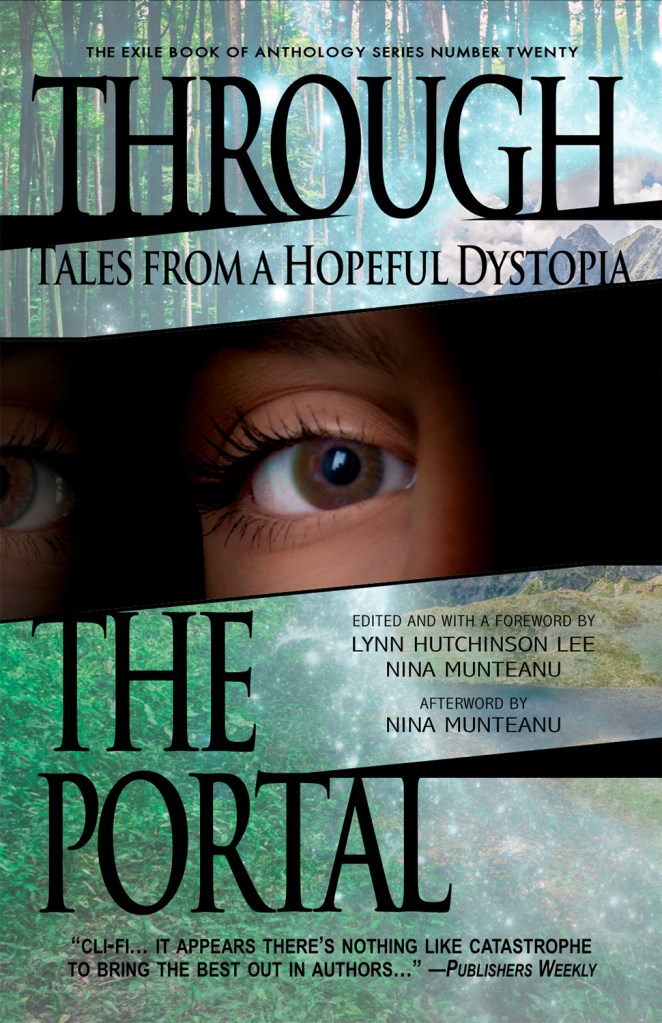
Through the Portal: Tales from a Hopeful Dystopiathe ecofiction anthology edited by Lynn Hutchinson Lee and me and published December 2024 by Exile Editions, recently received another wonderful review from Mary Woodbury at dragonfly.eco. Here is an excerpt:
As the world teeters on disaster, what saves us ranges from graceful failure to full-fledged resistance and opposition. Through the Portal, an anthology of eco-fiction, offers 35 artful, provoking stories to propel us forward. The book serves to reconnect us with Nature in diverse storytelling, from cautionary tales to fiction that brims with hope while also helping us grieve what we’ve lost—described as solastalgia.
The anthology is a stunning collection of short stories and poetry that address our most existential concerns through metaphysical, epic, solarpunk, mythological, and contemporary perspectives. From landscape and weather transformations to stars, fairy tales, parking lots, mermaids, whales, storms, bees, and much more, the reader is treated to a journey of colorful narratives woven into a chronology: imagination, after the fall, and Earth hour.
Hopeful dystopias are so much more than an apparent oxymoron: they are in some fundamental way the spearhead of the future—and ironically often a celebration of human spirit by shining a light through the darkness of disaster. In Through the Portal: Tales from a Hopeful Dystopia, award-winning authors of speculative fiction Lynn Hutchinson Lee and Nina Munteanu present a collection that explores strange new terrains and startling social constructs, quiet morphing landscapes, dark and terrifying warnings, lush newly told folk and fairy tales.—Exile Editions
.
Nina Munteanu is a Canadian ecologist / limnologist and novelist. She is co-editor of Europa SF and currently teaches writing courses at George Brown College and the University of Toronto. Visit www.ninamunteanu.ca for the latest on her books. Nina’s bilingual “La natura dell’acqua / The Way of Water” was published by Mincione Edizioni in Rome. Her non-fiction book “Water Is…” by Pixl Press (Vancouver) was selected by Margaret Atwood in the New York Times ‘Year in Reading’ and was chosen as the 2017 Summer Read by Water Canada. Her novel “A Diary in the Age of Water” was released by Inanna Publications (Toronto) in June 2020.
A recent favourable review of Through the Portal: Tales from a Hopeful Dystopia (edited by Lynn Hutchinson Lee and Nina Munteanu, released by Exile Editions) appeared in On Spec Magazine. The review by Lorina Stephens applauded the anthology for its genuine Canadian perspective, excellent writing, and “remarkable voice of many.”
.
Excerpts of the review follow below:
“What unfolds in these 35 stories is a quintessentially Canadian perspective on climate change, the probable dystopia of our own making, and how we as not only humans, but Canadians, may deal with the breakdown of environment and society, of how we construct mythology to interpret our experience.”
The stories, writes Stephens, “are filled with that remarkable pragmatism and resilience, little say a reverence for the land, which seems to be hardwired into a people who deal with constant change, and sometimes extremes, dictated by climate and geography.”
“…the quality of the writing from this enclave of writers is quite remarkable…I am steadfast in my praise of the skill of these writers, and the stories they’ve crafted, collected into this remarkable voice of many.”
“The stories manage that most adroit of transformations from genre fiction meant as escapism and consumable, to that other dimension which is provoking, illuminating, and exactly what good literary fiction should engender.”
Through the Portal has received other favourable reviews:
“Through the Portal offers intriguing and imaginative glimpses into the future.” – The Seaboard Review
“A stunning collection of short stories and poetry that address our most existential concerns through metaphysical, epic, solarpunk, mythological, and contemporary perspectives.” – dragonfly.eco.
Nina Munteanu is a Canadian ecologist / limnologist and novelist. She is co-editor of Europa SF and currently teaches writing courses at George Brown College and the University of Toronto. Visit www.ninamunteanu.ca for the latest on her books. Nina’s bilingual “La natura dell’acqua / The Way of Water” was published by Mincione Edizioni in Rome. Her non-fiction book “Water Is…” by Pixl Press (Vancouver) was selected by Margaret Atwood in the New York Times ‘Year in Reading’ and was chosen as the 2017 Summer Read by Water Canada. Her novel “A Diary in the Age of Water” was released by Inanna Publications (Toronto) in June 2020.
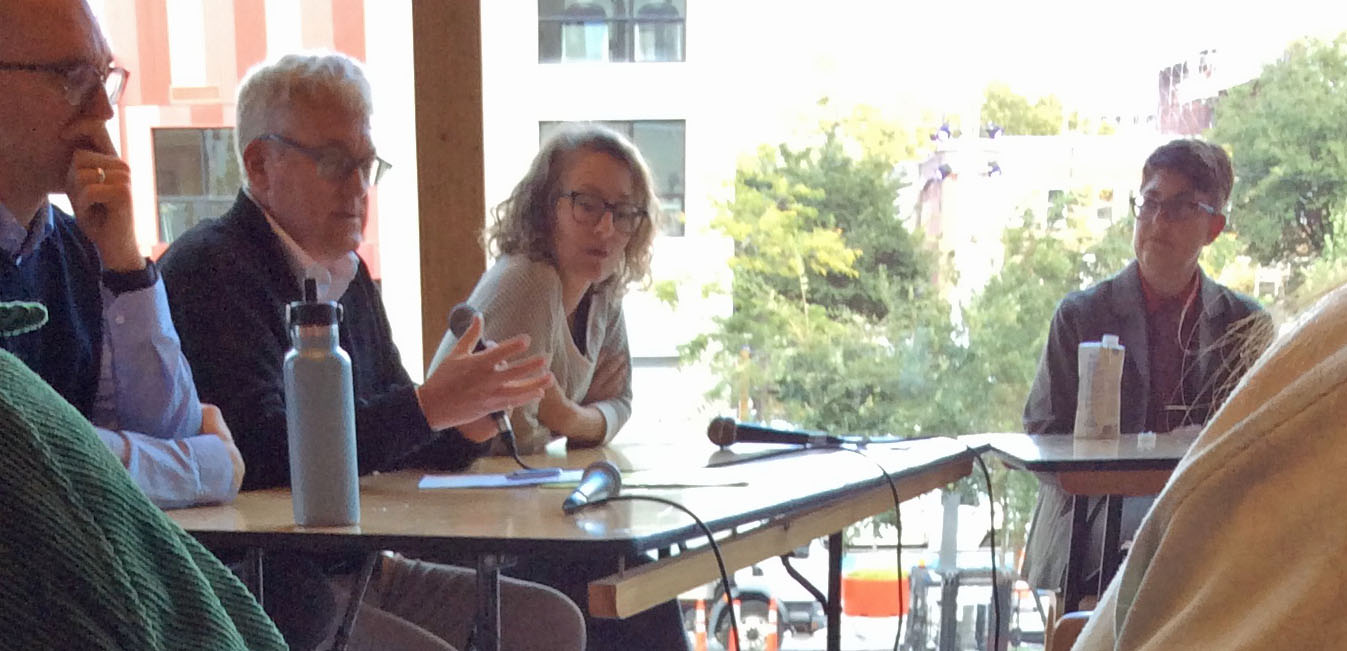
I recently participated in author readings from the eco-fiction anthology “Through the Portal: Tales from a Hopeful Dystopia.” Co-editor Lynn Hutchinson Lee and I opened the session with some introductory remarks, followed by readings by four of the anthology writers: Annaliese Schultz, Jade Wallace, Isabella Mori, and Matt Freeman.
Co-editors Lynn Hutchinson Lee and Nina Munteanu introduce the anthology at the reading; authors and moderator pictured above
.
The readings generated a lot of discussion about the nature and role of eco-fiction and stories in general on how we view the world and how that, in turn, influences the choices we make in life. Below, I include a short story excerpt and audience reaction for each author who read.
Annaliese Schultz read from her story Water & Oil. “Bursting from months, maybe years, of inertia born of dismay (engendered by the unending disasters of the world), Zip is instantly galvanized and greater than himself and gone.” One audience member shared that her story “sounded horrifyingly too possible.”
Jade Wallace read from her story Pluck. “It was only after I started working at the florist a few months ago that I began to think of plants as things that move. I learned that algae may swim towards the light; sundew can catch insects in their stalks; the leaves of touch-me-nots will slouch when they feel rain.” A member of the audience shared that “with what we now know about the way trees/plants communicate with each other, it was a neat story of crossing over to try to tell humans something.”
.
Jade Wallace reads from her story “Pluck”
.
Isabella Mori read from her story Shift. “Red Nelly, that’s what they called my grandmother; always looked a little dishevelled. So did her living room. Four book shelves were squeezed into the small room, sagging with dark tomes, oversized coffee-table books, Greenpeace brochures, and video cassettes that even her questionable looking TV couldn’t play anymore.” Someone in the audience mentioned that the author had woven a very human story. “Stories are sometimes better teachers than all other forms available to us. I felt moments of warmness and reflection.” Another audience member added, “The wisdom of animals and plants—there’s hope for the planet. I’m ordering this book from my local independent as soon as I close his meeting!”
Matt Freeman read from his story Birdseed: “Near the end I began to devote the bulk of my time to what I believed to be a gregarious individual of the species Corvus brachyrhynchos—the American Crow. By then a chemical scythe had begun to carve up the clouds hanging over the lands of ‘Vancouver’ in a psychedelic frenzy, and the shocked blue skyline often bled in shades of lime.” One audience member shared, “I loved he way ‘birdish’ words kept appearing: perch, cage. This may be Matt’s first published story, but I’m sure it won’t be the last.” Another audience member shared, “I loved the connection with the wisdom and personification of your crow.”
.
Nina Munteanu commenting on one of the readings
.
The readings generated a lot of discussion about the nature and role of eco-fiction and stories in general on how we view the world and how that, in turn, influences the choices we make in life.
Audience members shared that they found the readings inspiring. One member shared, “I find stories and poems have a more transcendent or at least deeper connection when read aloud. I wasn’t sure what to expect. So glad to be a part of this reading. The book sounds amazing.” Another member shared, “Keep hope alive!”
For more about how this anthology came about go to my previous post on Through the Portal.
.
.
Hopeful dystopias are so much more than an apparent oxymoron: they are in some fundamental way the spearhead of the future – and ironically often a celebration of human spirit by shining a light through the darkness of disaster. In Through the Portal: Tales from a Hopeful Dystopia, award-winning authors of speculative fiction Lynn Hutchinson Lee and Nina Munteanu present a collection that explores strange new terrains and startling social constructs, quiet morphing landscapes, dark and terrifying warnings, lush newly-told folk and fairy tales.–Exile Editions
“A stunning collection of short stories and poetry that address our most existential concerns.”
“Will ingenuity, love, and respect for the earth help us work through whatever changes might lie ahead? Through the Portal offers hope that these qualities, if not enough in and of themselves, will help us find our way.”
Farmer’s field at sunset, winter in Ontario (photo and rendition by Nina Munteanu)
.
Nina Munteanu is a Canadian ecologist / limnologist and novelist. She is co-editor of Europa SF and currently teaches writing courses at George Brown College and the University of Toronto. Visit www.ninamunteanu.ca for the latest on her books. Nina’s bilingual “La natura dell’acqua / The Way of Water” was published by Mincione Edizioni in Rome. Her non-fiction book “Water Is…” by Pixl Press (Vancouver) was selected by Margaret Atwood in the New York Times ‘Year in Reading’ and was chosen as the 2017 Summer Read by Water Canada. Her novel “A Diary in the Age of Water” was released by Inanna Publications (Toronto) in June 2020.
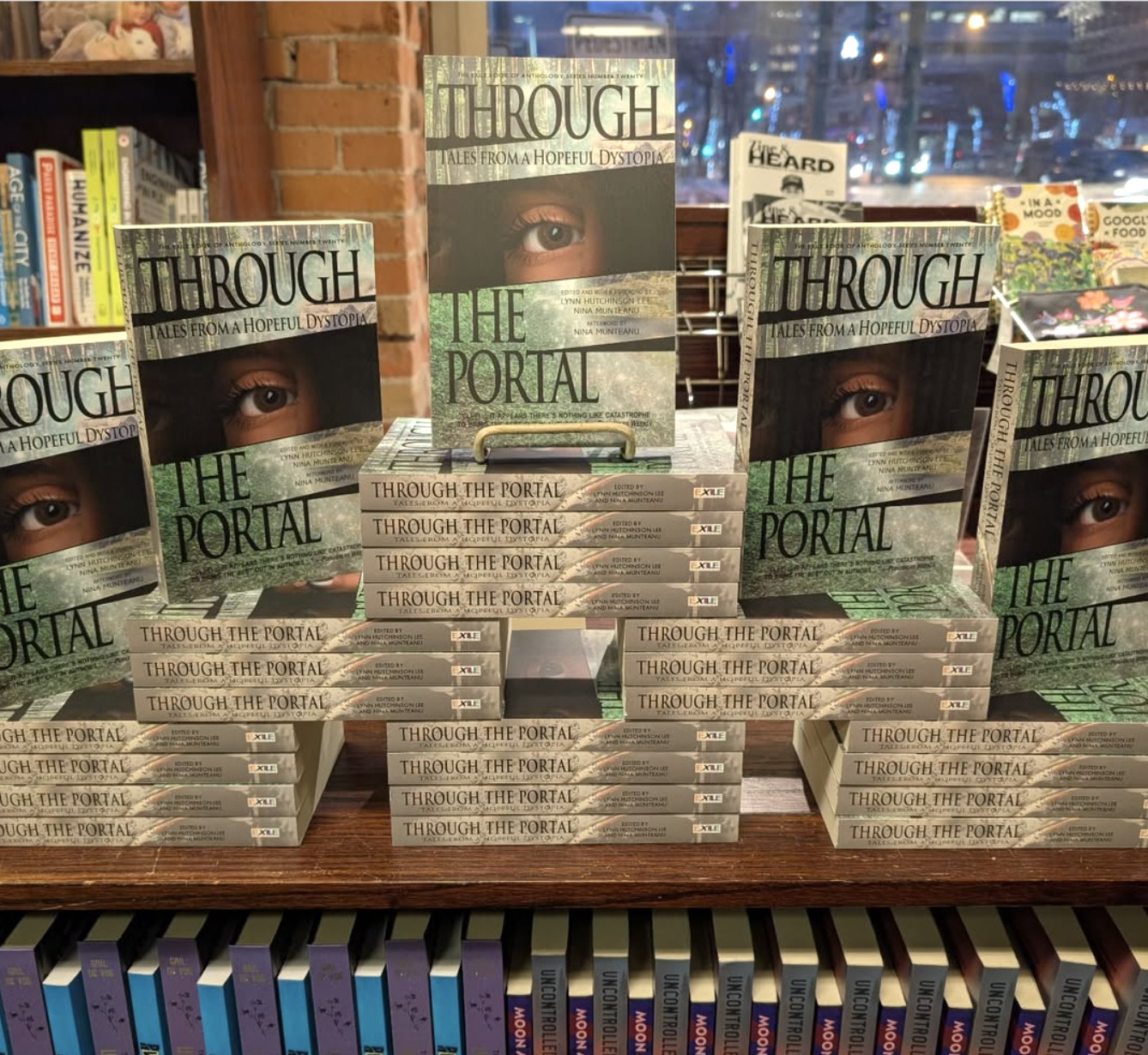
Through the Portal anthology continues to garner attention and accolades by reviewers, booksellers, and readers throughout Canada. Released December 31, 2024 and launched in several locations in Canada, Portal is celebrated for its hopeful lens on an otherwise bleak future with thirty-five unique short stories, flash fiction, and poetry and an afterward.
There are many faces for hope; this anthology has thirty-six of them. Each story in the anthology features a unique hopeful lens that draws from a diversity of authors from around the world and throughout Canada. Stories that touch on nostalgia to respect, enlightenment to endurance. In these tales that range from compassion and healing to cautionary warnings of dark insight, hope may wear a human face or the face of a tree, black crow, or leaf.
Hopeful dystopias are so much more than an apparent oxymoron: they are in some fundamental way the spearhead of the future – and ironically often a celebration of human spirit by shining a light through the darkness of disaster. In Through the Portal: Tales from a Hopeful Dystopia, award-winning authors of speculative fiction Lynn Hutchinson Lee and Nina Munteanu present a collection that explores strange new terrains and startling social constructs, quiet morphing landscapes, dark and terrifying warnings, lush newly-told folk and fairy tales.—Exile Editions
“A stunning collection of short stories and poetry that address our most existential concerns.”
Dragonfly.eco
“Will ingenuity, love, and respect for the earth help us work through whatever changes might lie ahead? Through the Portal offers hope that these qualities, if not enough in and of themselves, will help us find our way.”
The Seaboard Review
.
Nina Munteanu is a Canadian ecologist / limnologist and novelist. She is co-editor of Europa SF and currently teaches writing courses at George Brown College and the University of Toronto. Visit www.ninamunteanu.ca for the latest on her books. Nina’s bilingual “La natura dell’acqua / The Way of Water” was published by Mincione Edizioni in Rome. Her non-fiction book “Water Is…” by Pixl Press (Vancouver) was selected by Margaret Atwood in the New York Times ‘Year in Reading’ and was chosen as the 2017 Summer Read by Water Canada. Her novel “A Diary in the Age of Water” was released by Inanna Publications (Toronto) in June 2020.
In his 2006 book The Seven Basic Plots: Why We Write Stories, Christopher Booker tells us that there are seven types of plots in story. One is entitled “Overcoming the Monster,” an underdog story where the hero sets out to destroy an evil to restore safety to the land. It is a story I admire and never tire of. The evil force is typically much larger than the hero, who must find a way, often through great courage, strength, inventive cunning—and help from her community—to defeat the evil force. This is the story of David and Goliath, of Beowulf and Grendel, of Luke Skywalker and Darth Vader in Star Wars, of Jake Sully and Miles Quaritchs in Avatar—notice, all men who, for the most part, do their hero-ing alone. I may get to that later (in another post)…
The “Overcoming the Monster” plot, whether told literally or through metaphor, reflects an imbalance in the world—usually of power—that the hero must help right.
Enter the “Monster” DuPont…
DuPont Washington Works plant in Parkersburg, West Virginia
The true story of DuPont’s decades-long evil maleficence reflects the great power imbalance of many large corporations and the evil they enact through willful deception and mischief to increase profit, their god.
This brings me to my heroic journey. For in some terrible way, the story of DuPont is also my story. One of power imbalance, of deception and ignorance. Their deception; my ignorance:
.
In 1954, the year I was born, during the ramp up for the Teflon rollout at DuPont’s Washington Works plant in Parkersburg, toxicologist R.A. Dickison noted possible toxicity of the surfactant C8 (PFOA or Perfluorooctanoic Acid) used to make Teflon. DuPont ignored the warning and proceeded to roll it out for mass use.
1950s DuPont ad for the Teflon “Happy Pan”
.
In 1961, while I was contending with recess bullies in grade two, DuPont rolled out their Teflon-coated “Happy Pan” with the full knowledge that C8 was a toxic endocrine disruptor and caused cancer. DuPont’s chief toxicologist Dorothy Hood cautioned executives in a memo that the substance was toxic and should be “handled with extreme care.” She explained that a new study had found enlarged livers in rats and rabbits exposed to C8, confirming that the chemical was toxic. It didn’t stop the roll out.
In 1962, while I was exploring my artistic talents at school,DuPont scientists conducted tests on humans, asking a group of volunteers to smoke cigarettes laced with C8. Nine out of ten people in the highest-dosed group were noticeably ill for an average of nine hours with flu-like symptoms that included chills, backache, fever, and coughing. Further experiments by DuPont linked C8 exposure to the enlargement of rats’ testes, adrenal glands, and kidneys.
In 1964, I was ten years old and struggling with my Grade 5 teacher who was trying to curb my unique self-expression. I was already aware of environmental imbalance and destruction in the world. My pet peeve was littering because it demonstrated great disrespect for others and the environment. I told environmental stories. That year DuPont had already begun its great deception; having confirmed the toxicity of C8, they simply watched (and recorded) as this cancer-causing endocrine disruptor injured, maimed and killed their own workers. The company did nothing to prevent it and they told no one.
In 1965, I was in the process of figuring out my heroic self and my unique gift to the world in Grade seven: was it in fine arts and advertising? Writing and storytelling? Environmentalism and law? Internal DuPont memos revealed that preliminary studies showed even low doses of a related surfactant to Teflon could increase the size of rats’ livers, a classic response to poison.
In the mid- to late-60s, I became an environmental activist, putting up posters and writing in the school paper. I wrote letters to industry and politicians, trying to incite interest in being good corporate citizens and promoting global environmental action. I remember a well-meaning teacher chiding me for my extravagant worldview. “Stick to little things and your community—like recycling,” he suggested patronizingly. I remember the shock of realizing that not everyone felt the planet like I did. Perhaps it was a teenage-thing, or a girl-thing, or a nina-thing. I prayed it wasn’t just a nina-thing…
I started writing stories in high school. Mostly eco-fiction, though I didn’t know that’s what it was at the time. There was no genre called eco-fiction back then. It all went under the umbrella of scifi.
In 1969, at fifteen, I wrote my first dystopia, Caged in World. The eco-novel was about a subway train driver and a data analyst caught in the trap of a huge lie. The story later morphed into Escape from Utopia. Several drafts and years later the novel became the eco-medical thriller Angel of Chaos, published in 2010. The story is set in 2095 as humanity struggles with Darwin’s Disease—a mysterious neurological environmental pandemic assaulting Icaria 5, an enclosed city within the slowly recovering toxic wasteland of North America. The city is run by deep ecologists who call themselves Gaians, and consider themselves guardians of the planet. The Gaians’ secret is that they are keeping humanity “inside” not to protect humanity from a toxic wasteland but to protect the environment from a toxic humanity.
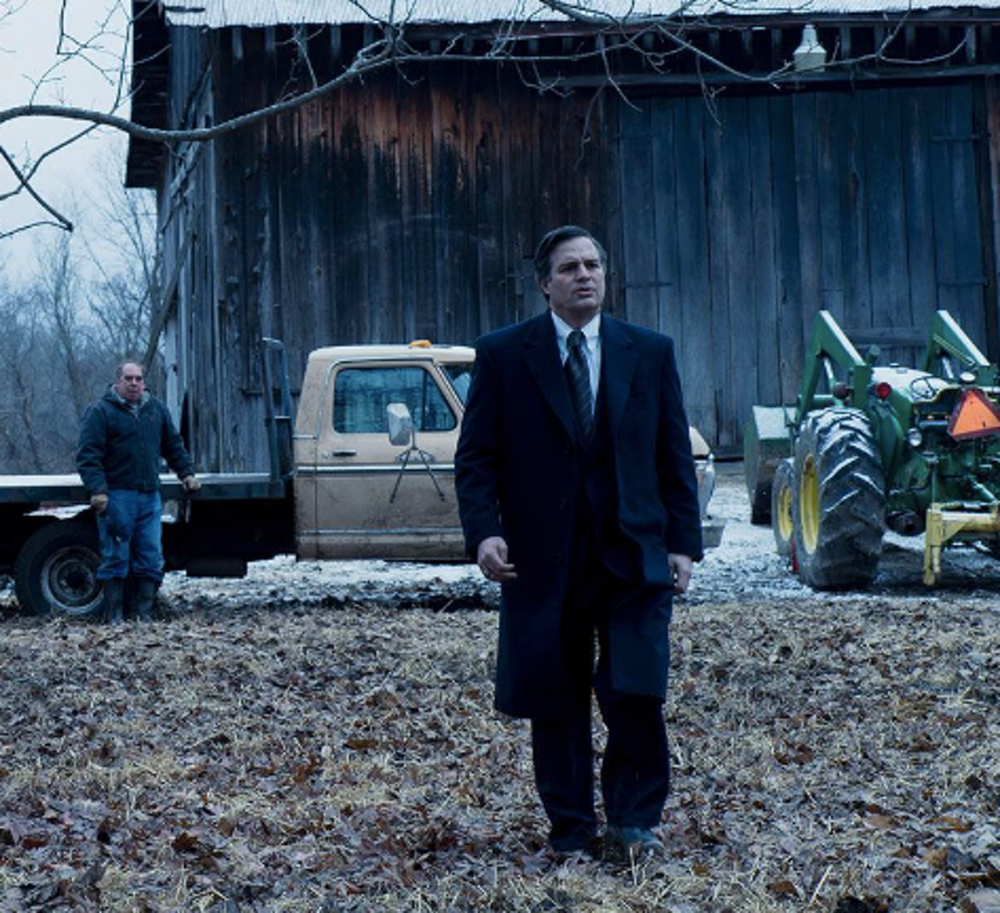
Lawyer Robert Bilott (Mark Ruffalo) investigates leachate-infected cows from nearby DuPont landfill (photo from film “Dark Waters”)
.
In the early 1970s, I entered university and contemplated becoming an environmental lawyer; I wrote short stories, mostly eco-fiction, and joined marches protesting environmental destruction by large corporations. DuPont confirmed that C8 not only persisted in the environment; it bioaccumulated in animals. In 1979, when I graduated with a Master of Science degree in limnology/ecology, DuPont circulated an internal memo in which humans exposed to C8 were referred to as “receptors,” describing how scientists found “significantly higher incidence of allergic, endocrine and metabolic disorders” as well as “excess risk of developing liver disease.” DuPont kept this knowledge to themselves and withheld it from EPA.
In the late 1970s early ‘80s, while I was addressing local environmental issues as a practicing limnological consultant, DuPont was dumping 7,100 tons of PFOA-laced sludge into unlined ‘‘digestion ponds’’: open, unlined pits on the Washington Works property, from which the chemical could seep straight into the ground. PFOA entered the local water table, which supplied drinking water to the communities of Parkersburg, Vienna, Little Hocking and Lubeck — more than 100,000 people.
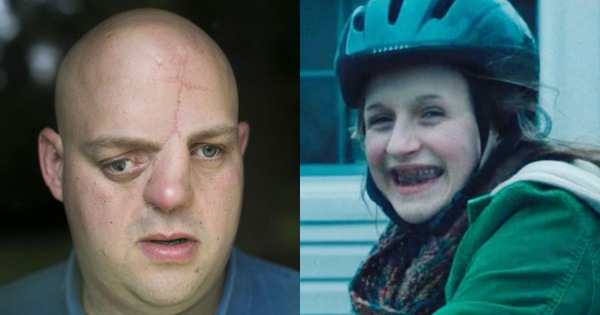
Effects of PFOA (birth defect in Bucky Bailey whose mother was on the Teflon line without protection during her first trimester; blackening teeth from the excessive fluoride, from scene in “Dark Waters”)
.
In 1981, when I got my first job as a limnologist and environmental consultant in Vancouver, DuPont confirmed that C8 caused birth defects in its own workers—and did not warn its workers. A DuPont pathologist confirmed that the observed fetal eye defects were due to C8. With that confirmation the pregnancy study was quietly abandoned and a decision made not to inform EPA. Less than a year later DuPont created false data for EPA then moved women of childbearing age back into areas with C8 exposure. Many in the company coined the term “Teflon flu” to describe the ill-effects of working close to the compound. By 1982, DuPont had confirmed the high toxicity of C8/PFOA in humans.
In 1984, a year after I formed my own consulting company Limnology Services in Vancouver, DuPont staffers secretly tested their community’s drinking water and found it to contain alarming levels of C8. Deciding that any cleanup was likely to cost too much and tarnish their reputation, DuPont chose to do nothing. In fact, they scaled up their use of C8 in Teflon products and bought land to dump their toxic sludge in unlined landfills. Deaths in DuPont workers from leukemia and kidney cancer climbed.
In 1989, at 35 years old, and still blissfully unaware of DuPont’s nefarious activities, I continued consulting for my own company Limnology Services, addressing mostly local environment issues with communities and local governments. By that year, DuPont employees found an elevated number of leukemia deaths at the West Virginia plant, followed by an inordinately high number of kidney cancers among male workers. Earl Tennant, whose farm was close to the DuPont landfill at Dry Run creek, sent videos of foamy water and diseased cows to the West Virginia Department of Environmental Protection; state regulators documented “numerous deficiencies in the landfill operation and erosion gullies that funnelled waste into Dry Run creek; DuPont made a deal with the department: the company paid a $250,000 fine and the department took no further action against the landfill. (The official who negotiated the deal later became a DuPont consultant.)
Throughout the 90s, I started teaching college biology and university environmental education courses in Vancouver. The magazine Shared Vision Magazine published my first article “Environmental Citizenship” in 1995. Meantime, DuPont’s Washington Works plant pumped hundreds of thousands of pounds of PFOA sludge, powder and vapor through stacks into the atmosphere and outfall pipes into the Ohio River.
In 1996, I was consulting for local industry and municipalities. By then, C8 was in the drinking water of Parkersburg and other communities. Despite what they knew of C8’s toxicity, DuPont kept it a secret (no one else was testing for PFOA because it was unregulated).
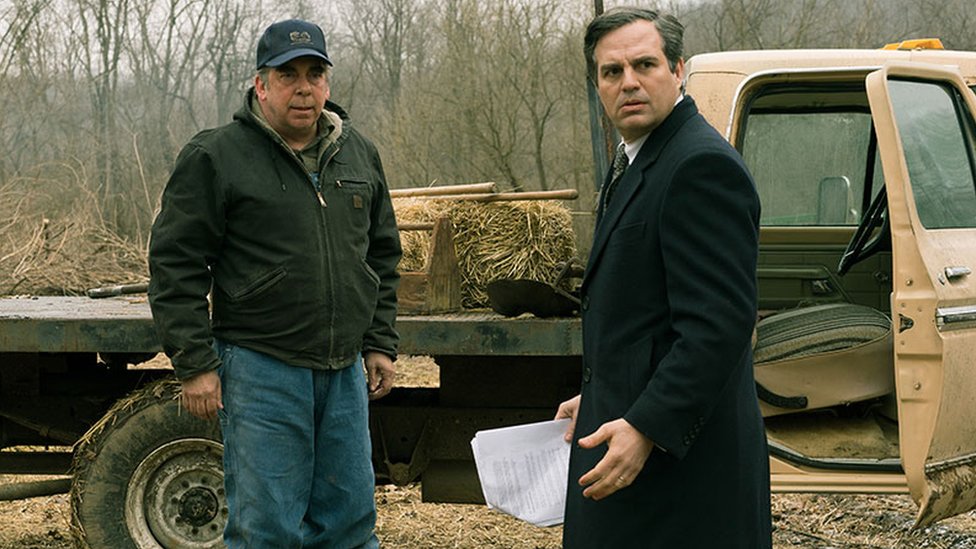
Farmer Tennant and lawyer Rob Billot encounter a leachate-infected mad cow in the 2019 film “Dark Waters”
.
In 1999, still serving as environmental consultant to mining and pulp mill companies, I still knew nothing about DuPont’s duplicitous environmental atrocities. 3M—troubled by its studies on C8 with monkeys—notified EPA and phased out PFOS and PFOA; DuPont started producing its own PFOA. On behalf of Earl Tennant whose cattle were dying adjacent to DuPont’s landfill site, lawyer Rob Bilott filed a small suit against DuPont to gain legal discovery and starting the decade-long process of finally unravelling the buried truth of their insidious criminality–over thirty years after DuPont knew and did nothing.
In 2003, I continued consulting as an environmental scientist in ignorance of DuPont’s misdealings, though by now much had come out in the press. By that year, DuPont had knowingly dispersed almost 2.5 million pounds of harmful C8 from its Washington Works plant into the air and water of the mid-Ohio River Valley area.
DuPont’s Washington Works plant in Parkersburg, West Virginia
.
In 2004, DuPont agreed to settle the class-action suit filed by lawyer Rob Bilott. Under the terms of the settlement, the company was not obliged to pull C8 from the market. The best the EPA could negotiate was a voluntary phase-out by 2015. That same year There It Is reported on how DuPont denied poisoning consumers with Teflon products. The dangers and spread of PFOA and other forever chemicals appeared more and more in the scientific literature (see the reference list below, which is by no means exhaustive).
In 2007, Darwin’s Paradox, my eco-fiction novel about an environmental pandemic, was published by Dragon Moon Press in Calgary, Alberta. Four years earlier, the law had finally caught up to DuPont, but not before they had dispersed 2.5 million pounds of harmful C8 from their Washington Works plant into the air and water of the mid-Ohio River Valley area. It would be another twelve years before DuPont would stop making C8 (in 2015) and another four years after that when C8 would be banned from use globally (2019). PFOA is still unregulated by EPA; the best they can do is issue a non-enforceable health advisory set at 70 parts per trillion.
In 2012, shortly after I moved to Nova Scotia to write for a living (having quit environmental consulting due to disillusionment with integrity of companies I worked for), the C8 Science Panel, tasked to study the possible health effects of PFOA in a highly exposed population in the mid-Ohio Valley, determined a probable link between C8 exposure and six disease categories: kidney cancer, testicular cancer, ulcerative colitis, thyroid disease, preeclampsia, and high cholesterol.
In 2015, two years after I began teaching writing at the University of Toronto, DuPont began a series of complex transactions that transferred its responsibility for environmental obligations and liabilities associated with PFAS (C8) onto other entities such as Chemours, Corteva, and NewDupont. A year later New York Times Magazineran a story “The Lawyer Who Became DuPont’s Worst Nightmare” and Sharon Lerner of The Intercept ran an in-depth series on DuPont’s duplicitous criminality: “The Teflon Toxin: DuPont and the Chemistry of Deception.”
In 2017, DuPont and its spinoff company Chemours agreed to settle a lawsuit with roughly 3,500 people living near the Parkersburg plant in both West Virginia and Ohio and many ailing from toxicity-related problems. The company agreed to pay $671 million. That’s one day’s sales in a $27 billion annual profit stream. The Fayetteville Observer reported that this “Discontinued chemical [was] still in well water” after DuPont agreed in 2009 to stop using C8. They noted that the company was facing a class action lawsuit from thousands of people in Ohio and West Virginia for discharging the toxic chemical into the Ohio River since the 1950s.
In 2019—sixty-seven years after DuPont knew PFOA was toxic and did nothing—this forever chemical was finally banned globally under the Stockholm Convention. Unfortunately, by 2019, PFOA was already literally everywhere on the planet in concentrations considered unsafe. Given its high water-solubility, long-range transport potential, and lack of degradation in the environment, PFOA persists in groundwater and is ubiquitously present in oceans and other surface water around the globe. It is found in remote areas of the Arctic and Antarctic (where it was not used or manufactured), no doubt transported there through ocean currents and in the air, bound on particles. NBC Newsran a news piece about ‘forever chemicals’ contaminating drinking water near military bases. The Guardian ran a news article: “Companies deny responsibility for toxic ‘forever chemicals.’” In Maine, The Portland Press Herald ran a story: “Households are awash in ‘forever chemicals’.”
In 2020, NBC News revealed that DuPont was still avoiding its responsibility to clean up its C8 mess and compensate those harmed by DuPont’s negligence.
In 2022, I finally learned about DuPont’s decades-long environmental dispersal of toxic PFOA (C8) and their criminal deception throughout this life time. I’d lived through DuPont’s entire six decades of deception in ignorance.
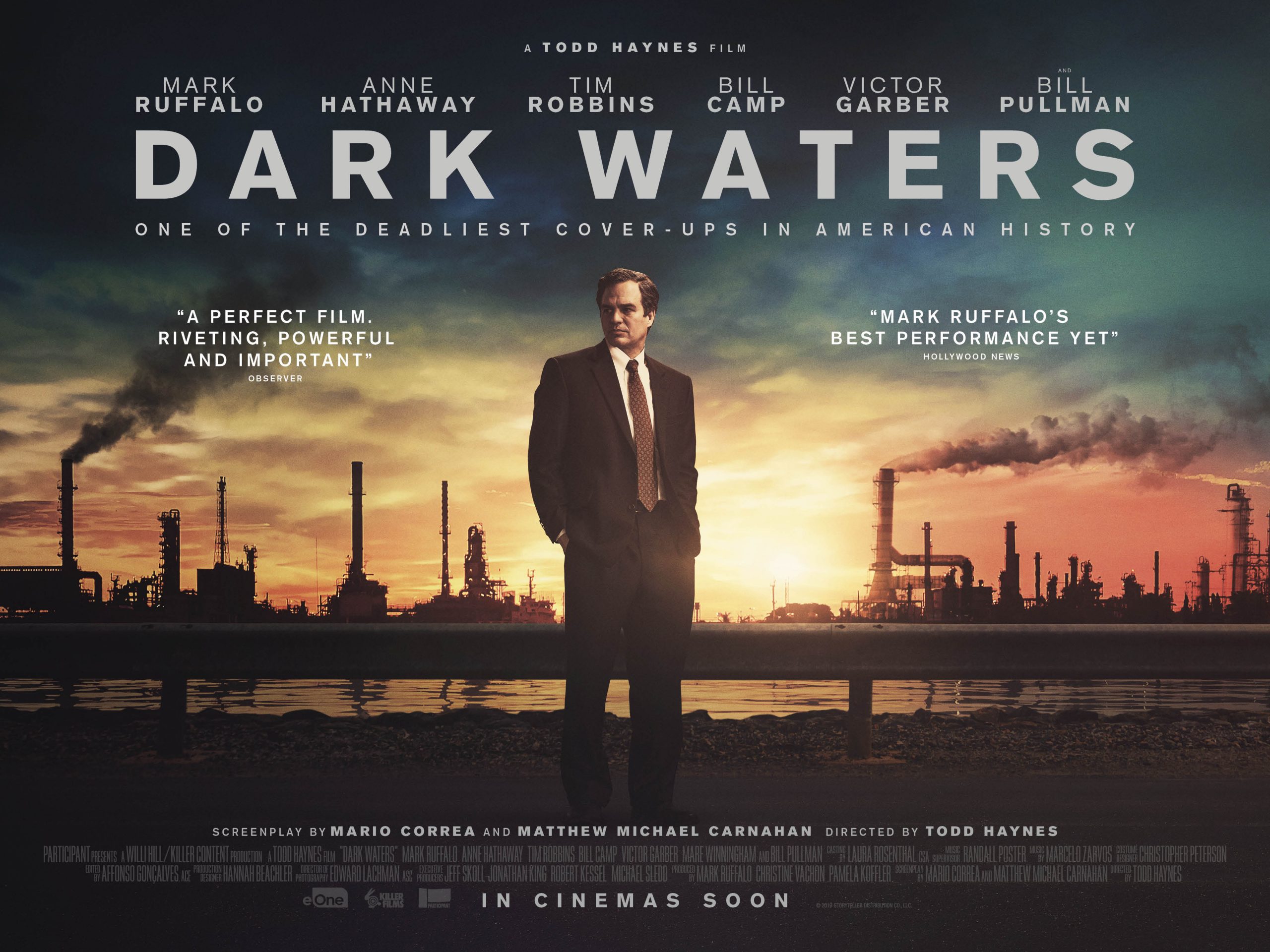
Poster for the 2019 film “Dark Waters” on DuPont’s criminal activities and the lawyer who exposed them
.
In 2022, three years after its release, I chanced upon “Dark Waters,” the 2019 film starring Mark Ruffalo who plays lawyer Robert Bilott, the man who took DuPont to court in 2002. I found out seven years after DuPont was forced to stop using PFOA and a lifetime after they started their egregious pollution and deception in the 1950s. For over six decades, from when I was born to well into my sixties, DuPont executives chose to:
Below are the faces of the DuPont men and women who sanctioned–encouraged–the willful harm of other life. Despite knowing the danger posed by exposure to PFOAs to people, these DuPont CEOs chose to: 1) continue to poison the environment and people, 2) cover up their actions from authorities, and 3) fight the courts and regulators from doing the right thing when they were caught. No one went to jail. No one was fired. They just paid $$$ and shamefully kept going. These people are criminals.
DuPont CEOs from 1950-2019 who sanctioned release of PFOA into the environment then covered it up: Crawford H. Greenewalt, Lammot Copeland, Charles B. McCoy, Edward G. Jefferson, Richard E. Heckert, Edgar S. Woolard, John A. Krol, Charles O. Holliday Jr., Ellen Kullman, Edward D. Breen
.
It’s not over either; DuPont currently uses other PFAS compounds that are unregulated but whose toxicity is being found to be as potent. And, of course, these other ‘forever chemicals’ are finding themselves everywhere. I was ignorant of all this the whole time. Meantime, I am drinking DuPont’s forever chemicals, I am eating DuPont’s forever chemicals, and I am feeling DuPont’s forever chemicals falling on my face in the rain.
My hard lesson: Ignorance breeds complacency and hubris; both will lead to downfall.
To return to the “Overcoming the Monster” story plot and the monster archetype, I’m convinced that it isn’t the Darth Vaders or Miles Quaritchs we must overcome. Yes, they are monsters, but they serve a greater monster. For Vader it was Emperor Palpatine and for Quaritch it was the executives of the RDA Corporation. While Vader and Quaritch may be the face of evil, true evil lurks behind them, orchestrating, in the shadows. It is an evil we must fight internally, because each of us carries that potential evil inside us—in the urge to cheat on our taxes; in looking for the free ride (there are no free rides); in coveting what others have when what we have is enough; in embracing self-deception through unsubstantiated narratives and confabulation; and in choosing to remain ignorant to suit a short-sighted and self-serving agenda. I’m guilty too.
I hope some aspects of the hero that live in me, as with everyone, are helping to overcome the monster by writing about it in articles I share here and elsewhere and by presenting a different narrative—one of resistance and hope—through my fiction.
In a post on The Meaning of Water, I list which CEO was on watch and responsible for each criminal atrocity enacted. The post also goes into more detail on the six decade history of DuPont’s criminal atrocities and great deception. For more detail on each decade of atrocity and deception, check out my posts by decade: 1950s, 1960s, 1970s, 1980s, 1990s, and 2000s. What follows into the present day is perhaps even more atrocious, given that all is supposedly out in the open. This predatory company continues to bribe officials, lie and deny, threaten the weak, and so much more.
p.s. To understand the nature of industrial duplicity of large corporations such as DuPont, I highly recommend reading the 2023 study by Nadia Gaber and colleagues in the Annals of Global Health. The authors evaluated previously secret industry documents on PFAS to understand the significant delayed disclosure of harm posed by PFAS: from its production in the 1940s, to suggestions of toxicity in the 1950s, to irrefutable knowledge of PFAS toxicity in the 1960s, and–due to lack of transparency and suppression of scientific findings–public knowledge of this only arising in the late 1990s (mainly because of legal suits and discovery).
.
References:
Ahrens L. 2011. “Polyfluoroalkyl compounds in the aquatic environment: a review of their occurrence and fate.” J Environ Monit 13: 20–31. 10.1039/c0em00373e
Barton CA, Butler LE, Zarzecki CJ, Laherty JM. 2006. “Characterizing perfluorooctanoate in ambient air near the fence line of a manufacturing facility: comparing modeled and monitored values.” J Air Waste Manage Assoc 56: 48–55. 10.1080/10473289.2006.10464429
Barton CA, Kaiser MA, Russell MH. 2007. “Partitioning and removal of perfluorooctanoate during rain events: the importance of physical-chemical properties.” J Environ Monit 9: 839–846. 10.1039/b703510a
Busch J, Ahrens L, Xie Z, Sturm R, Ebinghaus R. 2010. “Polyfluoroalkyl compounds in the East Greenland Arctic Ocean.” J Environ Monit 12: 1242–1246. 10.1039/c002242j
Gaber, Nadia, Lisa Bero, and Tracey J. Woodruff. 2023. “The Devil they Knew: Chemical Documents Analysis of Industry Influenc on PFAS Science.” Ann Glob Health 89(1): 37.
McMurdo CJ, Ellis DA, Webster E, Butler J, Christensen RD, Reid LK. 2008. “Aerosol enrichment of the surfactant PFO and mediation of the water-air transport of gaseous PFOA.” Environ Sci Technol 42: 3969–3974. 10.1021/es7032026
Paustenbach, Dennis, Julie Panko, Paul K. Scott, and Kenneth M. Unice. 2007. “A Methodology for Estimating Human Exposure to Perfluorooctanoic Acid (PFOA): A Retrospective Exposure Assessment of a Community (1951-2003)” Journal of Toxicology and Environmental Health
Prevedouros K, Cousins IT, Buck RC, Korzeniowski SH. 2006. “Sources, fate and transport of perfluorocarboxylates” Environ Sci Technol 40: 32–44. 10.1021/es0512475
Velez, M.P., T.E. Arbuckle, W.D. Fraser. 2015. “Maternal exposure to perfluorinated chemicals and reduced fecundity: the MIREC study.” Human Reproduction 30(3): 701-9.
Vierke, Lena, Claudia Staude, Annegret Biegel-Engler, Wiebke Drost, and Christoph Schulte. 2012. “Perflurorooctanoic acid (PFOA)–main concerns and regulatory developments in Europe from an environmental point of view.” Environmental Sciences Europe 24: 16
Yamashita N, Kannan K, Taniyasu S, Horii Y, Petrick G, Gamo T. 2005. “A global survey of perfluorinated acids in oceans.” Mar Pollut Bull 51: 658–668. 10.1016/j.marpolbul.2005.04.026
.
Nina Munteanu is a Canadian ecologist / limnologist and novelist. She is co-editor of Europa SF and currently teaches writing courses at George Brown College and the University of Toronto. Visit www.ninamunteanu.ca for the latest on her books. Nina’s bilingual “La natura dell’acqua / The Way of Water” was published by Mincione Edizioni in Rome. Her non-fiction book “Water Is…” by Pixl Press (Vancouver) was selected by Margaret Atwood in the New York Times ‘Year in Reading’ and was chosen as the 2017 Summer Read by Water Canada. Her novel “A Diary in the Age of Water” was released by Inanna Publications (Toronto) in June 2020.
Mermaids, arborists, and pollinators are among the characters to be found in Through the Portal: Tales from a Hopeful Dystopia. Edited by Lynn Hutchinson Lee and Nina Munteanu, this eco-fiction collection gathers over thirty stories that fall under the general umbrella of hopeful dystopias…
Through the Portal offers intriguing and imaginative glimpses into the future. As [one of its short stories] “A Fence Made of Names” suggests, we often don’t appreciate what we have until we lose it. By showing us what we stand to lose, these stories offer a reason to increase our actions to preserve the planet…
While many of the tales hint at dark times ahead, it was refreshing to find so many that offered a ray of hope despite that. Whether it’s finding the will to live another day, returning to a better relationship with the land and the Earth, or taking steps to improve the world in even a small way, these stories affirm humanity’s potential for resilience in challenging times.
Will ingenuity, love, and respect for the earth help us work through whatever changes might lie ahead? Through the Portal offers hope that these qualities, if not enough in and of themselves, will help us find our way.
Nina Munteanu is a Canadian ecologist / limnologist and novelist. She is co-editor of Europa SF and currently teaches writing courses at George Brown College and the University of Toronto. Visit www.ninamunteanu.ca for the latest on her books. Nina’s bilingual “La natura dell’acqua / The Way of Water” was published by Mincione Edizioni in Rome. Her non-fiction book “Water Is…” by Pixl Press (Vancouver) was selected by Margaret Atwood in the New York Times ‘Year in Reading’ and was chosen as the 2017 Summer Read by Water Canada. Her novel “A Diary in the Age of Water” was released by Inanna Publications (Toronto) in June 2020.
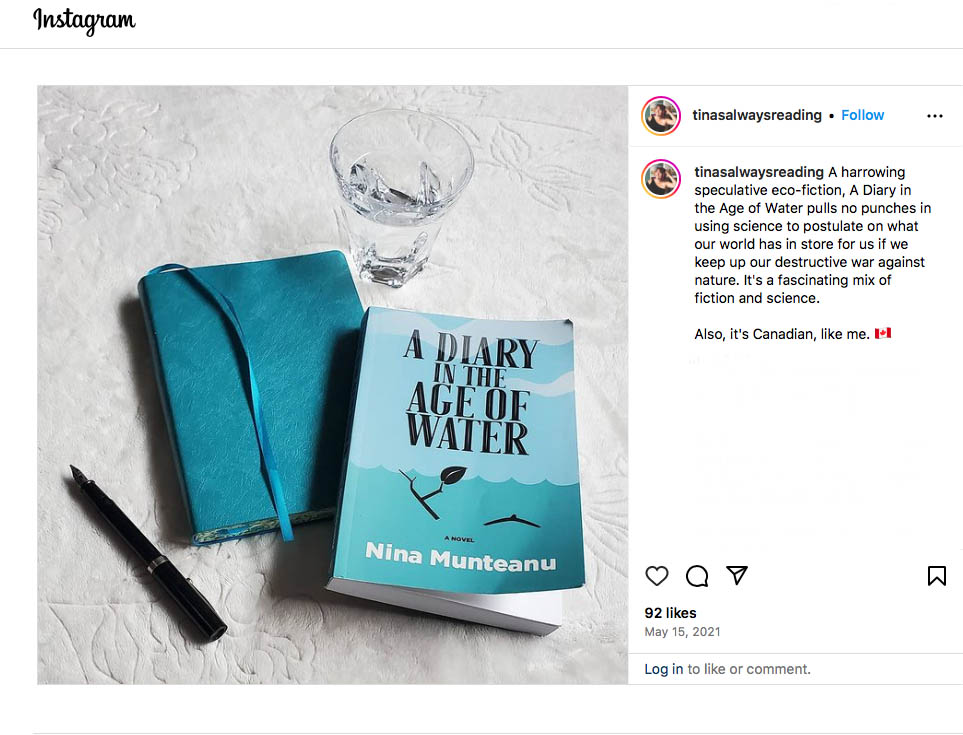
I recently came across this beautiful Instagram post by TinasAlwaysReading, and was reminded of a wonderfully in-depth review of my eco-fiction novel A Diary in the Age of Water that Tina did on Sound & Fury Book Reviews.
You can watch the review below:
Sound & Fury reviews “A Diary in the Age of Water” by Nina Munteanu
Nina Munteanu is a Canadian ecologist / limnologist and novelist. She is co-editor of Europa SF and currently teaches writing courses at George Brown College and the University of Toronto. Visit www.ninamunteanu.ca for the latest on her books. Nina’s bilingual “La natura dell’acqua / The Way of Water” was published by Mincione Edizioni in Rome. Her non-fiction book “Water Is…” by Pixl Press (Vancouver) was selected by Margaret Atwood in the New York Times ‘Year in Reading’ and was chosen as the 2017 Summer Read by Water Canada. Her novel “A Diary in the Age of Water” was released by Inanna Publications (Toronto) in June 2020.
McGill University, view from main gate on Rue Sherbrooke (photo by Nina Munteanu)
I’ve just returned from Montreal, where I was invited to participate in a two-day conference hosted by McGill University’s Bieler School of Environment at Esplanade Tranquil. Named after Kim Stanley Robinson’s eco-fiction novel New York 2140, the conference brought together a diverse assemblage of scientists, academic researchers, urban planners, speculative fiction writers, artists, and students in a small setting dedicated to encourage cross-pollination of ideas and visions through panels and workshops. I sat on a panel and a roundtable with other writers, urban planners, engineers, scientists and activists to discuss futures through science and story. Much of the event focused on the literary genre called Hopepunk—a sub-genre of Speculative Fiction devoted to optimistic themes of scientific transformation, discovery and empathy. Resulting dialogue explored forms of communication, expression, and ways not just to deal with growing solastalgia, eco-grief, and environmental anxiety but to move forward through action and hope.
Breakout groups in Seeds of Good Anthropocenes Workshop (photo by Nina Munteanu)
McGill faculty in Panel on ‘Turning Research into Hopeful Stories’ (photo by Nina Munteanu)
In the Thursday morning writer’s panel, in which we explored the role of science knowledge and hope in story, I shared the writing process I underwent with my latest published novel A Diary in the Age of Water, which I categorize as a hopeful dystopia (‘Hopeful dystopias’ are much more than an apparent oxymoron; they are in some fundamental way, the spearhead of the future—and ironically often a celebration of human spirit by shining a light through the darkness of disaster):
The main character in A Diary in the Age of Water was a limnologist like me who kept a journal (the diary referenced in the title of the book). This part of the story took place in the near-future when the water crisis and associated climate change phenomena had become calamitous. Being a scientist with so much intimate knowledge of the crisis, the diarist became cynical and lost her faith in humanity. I recall my own journey into despair as I did the research needed to convey the character’s knowledge and situation. I found myself creating a new character (the diarist’s daughter) much in the way a drowning swimmer takes hold of a life-saver, to pull me out of the darkness I’d tumbled into. The daughter’s hopeful nature and faith in humanity pulled both me and the reader out of the darkness. The cynical nature of the diarist came from a sense of being overwhelmed by the largeness of the crisis and froze her with feelings of powerlessness. The diarist’s daughter rose like an underground spring from the darkness by focusing on a single light: her friend and lover who pointed to a way forward. As Greta so aptly said once, “action leads to hope” and hope leads to action. Despite the dire circumstances in the novel, I think of A Diary in the Age of Water as a story of resilience. And ultimately of hope.
I came to the conference as a writer, scientist, mother, and environmental activist. What I discovered was an incredible solidarity with a group so diverse in culture, disciplines, expression and language—and yet so singularly united. It was heartwarming. Hopeful. And necessary. This conference ultimately felt like a lifeline to a world of possibilities.
Organizers brought in a wide variety of talent, skill, and interest and challenged everyone through well-run workshops to think, feel, discover, discuss, collaborate and express. Workshops, panels, and multimedia art incited co-participation with all attendees in imaginative and fun ways. On-site lunches and drinks helped keep everyone together and provided further space for interaction and discussion.
Student-led break out group discussing ways to transform eco-emotions into hope (photo by Nina Munteanu)
At every turn, I made contacts across disciplines and interests and had stimulating and meaningful conversations. I discovered many hopeful ‘stories’ of Montreal and elsewhere on hopeful visions and endeavors. These included “Seeds of good Anthropocenes” (small ground-rooted projects and initiatives aimed at shaping a future that is just, prosperous, and sustainable); turning scientific research into hopeful stories; and world building as resistance. I talked with artistic creators, students doing masters in Hopepunk literature and co-panelists on all manner of subjects from urban encampments, greening and rewilding Montreal, to how Rachel Carson’s Silent Spring informed a main character in Liu Cixin’s novel The Three Body Problem.
Creating visual art via MAPP (photo by Nina Munteanu)
Marc-Olivier Lamothe stands next to a MAPP projection (photo by Nina Munteanu)
Conversations often led to an acknowledgement of art as an effective means of expression and creative therapy in the context of the climate crisis. I met creatives such as Marc-Olivier Lamothe and his colleagues at MAPP and had the chance to experiment first hand with his creative tools. I had wonderful discussions with storytelling visual artist Alina Gutierrez Mejia of Visual Versa, whose evolving mural of each day’s events was truly mesmerizing to watch—and rather revealing.
Alina Gutierrez Mejia creates a visual representation of the day’s conference (photo by Nina Munteanu)
In future, I’ll post more on these and other creatives I encountered at the conference.
Program for Montreal 2140
THURSDAY morning began with an introduction by BDE Director Frédéric Fabry.
This was followed by a panel entitled Hopeful Stories Across Science and Fiction, in which I participated, along with fellow writers Su J. Sokol (author of Zee), Alyx Dellamonica (author of Gamechanger), Rich Larson (author of Annex and Ymir), Genevieve Blouin (author of Le mouroir des anges) and Andrea Renaud Simard (author of Les Tisseurs). The panel was moderated by McGill geographer Renee Sieber and McGill urban planner Lisa Bornstein.
After lunch, a panel entitled Faculty Workshop: Turning Research into Hopeful Stories was moderated by McGill researcher Kevin Manaugh and Annalee Newitz (journalist and author of Four Lost Cities). McGill researchers included: Caroline Wagner (bioengineering), Hillary Kaell (anthropology and religious studies); Jim Nicell (civil engineering); Sébastien Jodoin (law); and Michael Hendricks (biology).
McGill students who lead the workshop on Hope and the Future stand with one of the conference organizers Daniel Lukes (photo by Nina Munteanu)
The faculty panel was followed by the Student Workshop, Hope and the Future, led by McGill students Tom Nakasako, Rachel Barker, Tatum Hillier, and Lydia Lepki.
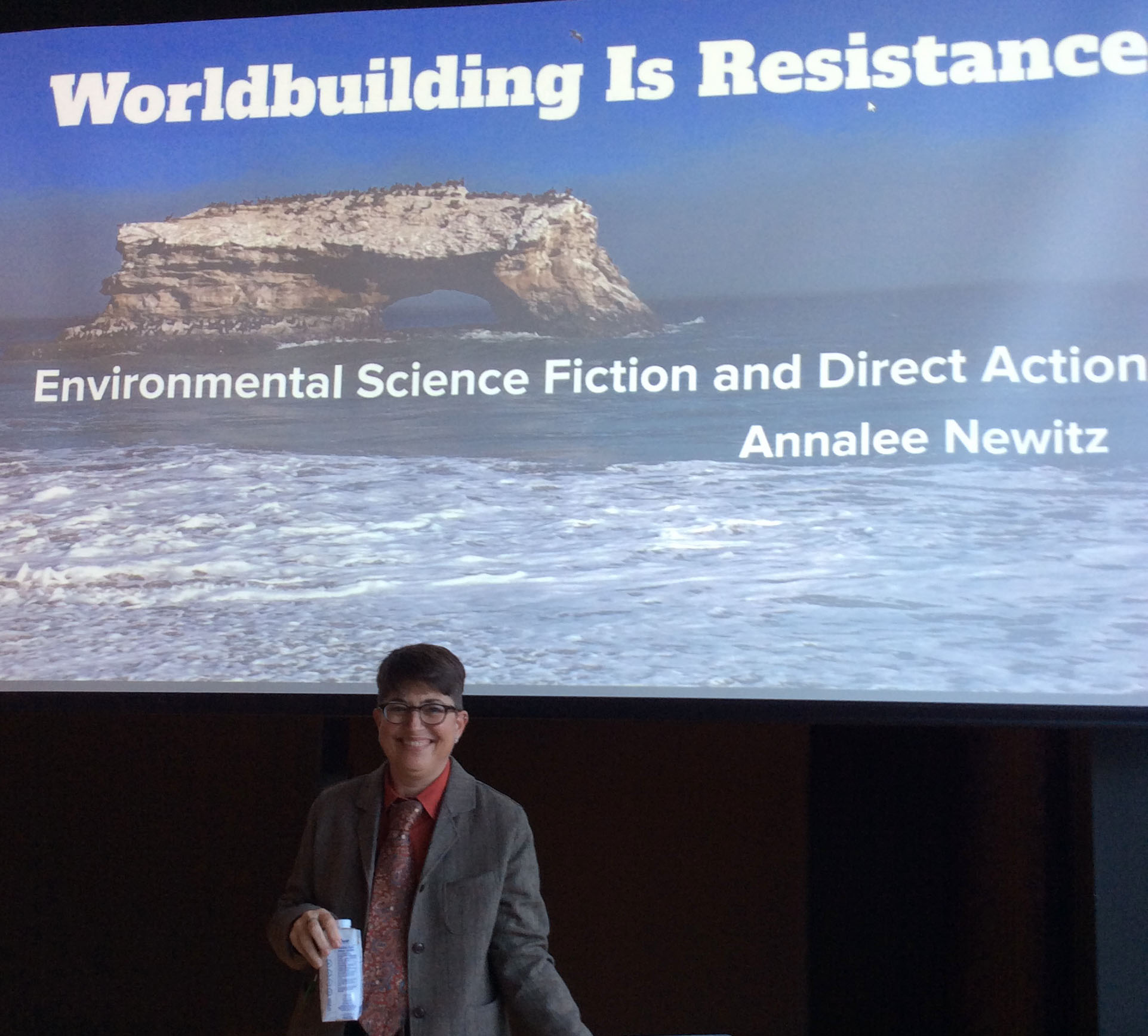
Annalee Newitz gives her keynote (photo by Nina Munteanu)
Annalee Newitz closed the day with their keynote presentation Worldbuilding Is Resistance that explored the dystopia binary of environmental science fiction. A theme to which the next keynote by Kim Stanley Robinson would touch on as well.
Elson Galang presenting Seeds workshop (photo by Nina Munteanu)
FRIDAY morning started with Elson Galang and Elena Bennett (McGill University), who led the Seeds of Good Anthropocenes Workshop, which introduced the concept of seeds programs then further explored through breakout discussion groups they moderated.
This was followed by faculty-led Teaching and Learning for Hopeful Futures Workshop, in which McGill instructors from varied disciplines (including education, political science, environment, urban planning and planetary sciences) discussed translating science into hopeful narratives.
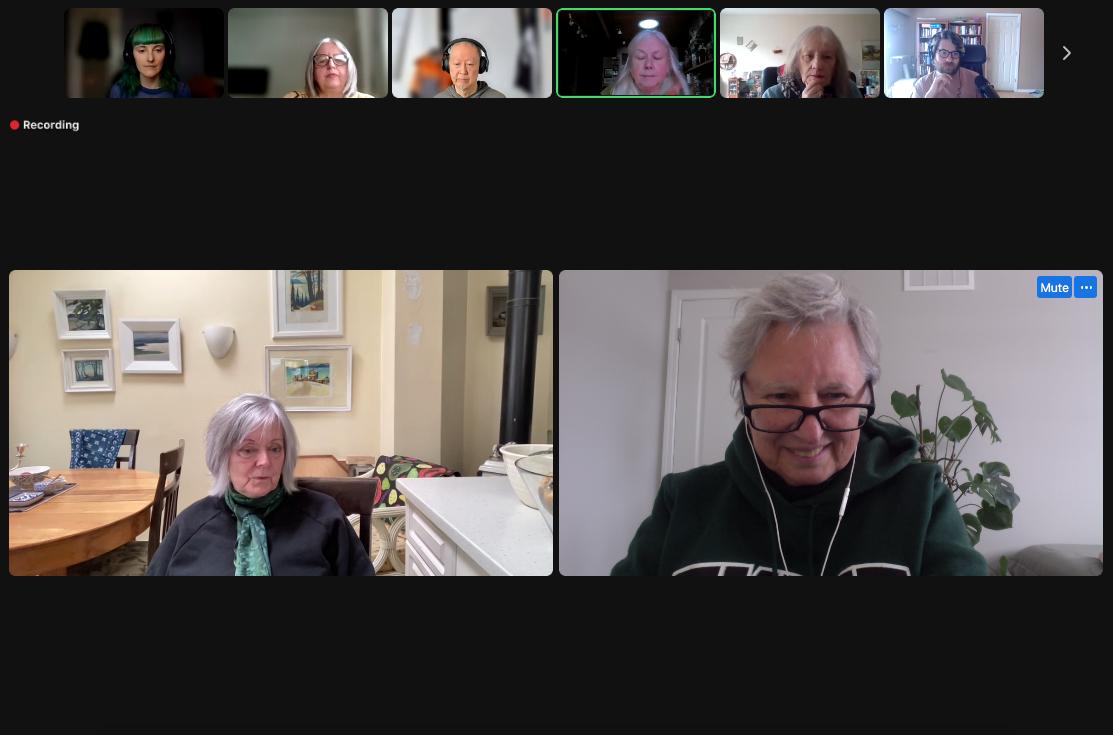
pre-meet on Zoom of participants of the Roundtable
I then participated in a roundtable of authors, scholars, researchers and planners entitled Telling the Story of the Future, moderated by Chris Barrington-Leigh (McGill BSE/Health and Social Policy). The roundtable included fellow authors Alyx Dellamonica and Su J. Sokol. Other participants of the roundtable included Stephanie Posthumus (languages, literatures, cultures at McGill), Jayne Engle (public policy at McGill) Richard Sheamur (urban planning at McGill), and limnologist Irene Gregory-Eaves (biology at McGill).
BDE Director Frédéric Fabry introduces the conference (photo by Nina Munteanu)
The final keynote was given by Kim Stanley Robinson (author of New York 2140 and The Ministry of the Future).
Storyboard of the first day of the conference by Visual Versa (photo by Nina Munteanu)
Nina Munteanu is a Canadian ecologist / limnologist and novelist. She is co-editor of Europa SF and currently teaches writing courses at George Brown College and the University of Toronto. Visit www.ninamunteanu.ca for the latest on her books. Nina’s bilingual “La natura dell’acqua / The Way of Water” was published by Mincione Edizioni in Rome. Her non-fiction book “Water Is…” by Pixl Press (Vancouver) was selected by Margaret Atwood in the New York Times ‘Year in Reading’ and was chosen as the 2017 Summer Read by Water Canada. Her novel “A Diary in the Age of Water” was released by Inanna Publications (Toronto) in June 2020.




















 Nina Munteanu Writing Coach