Interview with Simon Rose on his Latest Book: “An Untimely Death”

My guest today is author Simon Rose, who has published nineteen novels for children and young adults, eight guides for writers, more than a hundred nonfiction books, and many articles on a wide variety of topics. Today, we’re looking at his latest novel for young adults, An Untimely Death:

Nina: So, what’s the book all about?

Simon: An Untimely Death is an exciting science fiction and historical fantasy adventure for young adults. When Peter’s great-grandfather, Ted, passes away, Peter is looking through his belongings in the attic. Peter knows about Ted’s experiences with the Canadian Army in World War II and absentmindedly flips a coin. To his astonishment, Peter finds himself in the heat of battle in 1944, where he embarks on a highly dangerous mission to ensure that history is placed back on track.

Nina: What’s the story behind the story?

Simon: In the present day, Peter is fourteen and lives in Calgary, Alberta, Canada. He’s long known about the stories concerning the experiences of his great-grandfather during World War II. Peter knows that Ted participated in the invasion of Normandy in 1944, then in the Allied advance across Europe and into the Netherlands and Germany following D-Day.

When Ted passes away, Peter is looking through his great-grandfather’s belongings. Peter looks at some of Ted’s campaign medals, although Ted’s friend, Frank, had received the Military Medal, after saving the life of a young Dutch girl. The medal was awarded posthumously since Frank had been killed in action shortly after his heroic act. Peter also examines an old coin, which he knows Ted had found in a ruined house during the fighting in the Netherlands. The coin depicts the head of Queen Wilhelmina of the Netherlands, and Peter is aware that Princess Juliana, who later became the Queen, lived in Ottawa during the war, establishing strong links between Canada and the Netherlands.

When Peter flips the coin, the attic around him vanishes. To his astonishment, Peter finds himself in the Battle of the Scheldt in the Southern Netherlands in 1944. He encounters the younger versions of Ted and Frank, as well as the Dutch girl, but Peter’s presence in the past has disastrous consequences for the world he knows when he returns to his own era. Suspecting that he may have very limited opportunities to make a difference, Peter embarks on a highly dangerous mission to ensure that history is placed back on track, before it’s too late.

Nina: You must have done quite a lot of historical research for this novel.

Simon: Yes, the story, main characters, and some of the settings in this novel are fictional but are based on true events that took place in World War II. I did lots of research into the latter stages of the conflict, the Canadian soldiers and their battles to liberate the Netherlands, the connections between the Dutch Royal Family and Canada, the beginnings of the Canadian Tulip Festival after the war, and the links between Canada and the Netherlands that still exist today.

Following the story, the glossary has links to online sources where readers can learn more about the historical events, military campaigns, settings, and leading characters from World War II that are featured in the story. On my website, there’s a page dedicated to the book, along with links to separate pages featuring information regarding the book’s historical background and links to many online sources.

Nina: What are you currently working on?

Simon: I always have a few current projects and right now I’m working on another historical fantasy novel series, this time set in the early years of World War II. I’m also working on more books in the same genre as my previously published paranormal Flashback series, a fantasy series, and a historical fiction novel. I also continue to work on the adaptations of my Shadowzone series into screenplays for movies and TV shows, some other scripts, as well as teaching writing courses at the University of Calgary.

Anyone interested in keeping up to date with the projects that I’m working on is always welcome to subscribe to my monthly newsletter, which you can do at www.simon-rose.com.

Nina: You work with other authors, as well as on a variety of projects related to writing and publishing, don’t you?

Simon: Yes, I offer coaching, editing, consulting, and mentoring services for writers of novels, short stories, fiction, nonfiction, biographies, and in many other genres, plus do work with writers of scripts and screenplays. I’m also a writing instructor and mentor at the University of Calgary and served as the Writer-in-Residence with the Canadian Authors Association. You can find details of some of the projects I’ve worked on with other authors, along with some references and recommendations, at www.simon-rose.com.

Nina: Where can people buy An Untimely Death?

Simon: The book can be purchased at most of the usual places, as follows:

Ebook: Amazon Canada, Amazon USAKoboiBooks, Barnes and NobleScribd, Amazon UK, Amazon GermanyAmazon FranceAmazon JapanSmashwords

Paperback: Amazon Canada, Amazon USA, Amazon UK

Nina: Thanks Simon, for being my guest here today and the very best of luck with the AnUntimely Death. I hope that the book sells thousands and thousands of copies in the coming months.

You can learn more about Simon and his work on his website at www.simon-rose.com, where you can also link to him on social media and at other locations online.

When The Last Summoner Meets Nikola Tesla

The knight in Vivianne’s dream (illustration by Tomislav Tikulin)

If you want to find the secrets of the universe, think in terms of energy, frequency and vibration

Nikola Tesla

In my historical fantasy The Last Summoner, Vivianne Schön, the Baroness Von Grunwald, travels through time from the 1400s to 1905 to meet Nikola Tesla and make a deal with the eccentric scientist in a bid to make the world a better place:

The Story (excerpt of The Last Summoner)

New York, 1905

VIVIANNE straightened when she glimpsed the elegantly dressed Serbian as he entered Bryant Park. From her bench in the shade of a sycamore tree, she watched him saunter to his favourite bench then sit down and cross his legs. He emitted a somber sigh, pulled out a small notebook from his jacket pocket and began to write. Vivianne studied his long face, straight nose and well groomed mustache. It was an intense face, though worn with reserve. He quelled the fire that burned inside him beneath a shell of enigmatic reflection. He brushed a hand over his thick hair, then set his mouth in a thin line of determined concentration as he hastily sketched something inside the notebook. He didn’t look terribly heartbroken for a man who had just lost his dream, she reflected. But she did recognize disappointment on his furrowed brow. He was used to that, she decided, reviewing his personal history, which had been plagued by rivalry and betrayal for nearly all his life. A visionary of his genius quality was easy fodder for bullying, whether it was schoolmates or the scientific community.

After adjusting her brimmed hat and flowing blue lace gown, Vivianne rose and approached the forty-eight year old Serbian visionary, musing how he would later be called the “Father of the 20th Century”.

She was barely a metre away from him before he looked up, ready to express annoyance at being interrupted. She took pleasure in seeing his expression change from a glower to a startled look of curiosity. She knew she was beautiful, but it was rather delightful to see that she could divert this intense scientist.

“Hello, Mister Tesla,” Vivianne greeted him with a curtsy. “I am the Comptesse d’Anjou at your service. May I join you and sit down?”

He frowned at first then nodded politely with not quite a smile. He was not known for his smiles, she recalled. Tesla rose to his feet and bowed to her but did not offer his hand. She did not press him, knowing of his particular compulsion for avoiding human contact. “Of course you may,” he said with a mild accent and nodded to her in invitation. They both sat down in unison and he added, “To what do I owe this pleasure, Comptesse? Do I know you?”

“No, Mister Tesla.” She smiled with irony. “We have never met—not in person, anyway. But I believe you may be interested in what I have to say.” She paused to take in his curiosity and continued, “Pardon me for what I am about to reveal of your affairs, but I represent the interests of La Banque Internationale du Monde in Geneva, Switzerland—perhaps you know of us—and the law offices of Frankl & Frankl. We are one of the five largest investment banks in the world, dating back to the late 1400s with offices in Amsterdam and Hamburg. We are a private bank who screen for altruistic and environmentally conscious investors. In short, we help finance only those projects that will help make the world a better world.” She paused.

Tesla studied her inquisitively but said nothing.

She smiled internally at his puzzled expression then continued, “We are very interested in your Wardenclyffe Tower in Shoreham, Long Island, and associated global wireless power transmission.”

Tesla slid his notebook back into his jacket pocket and now gave her his full attention. She knew that he’d been trying for years to gain backing for his enigmatic projects with little to no success.

She continued, “You theorized that electrical energy can be transmitted through the earth and the atmosphere…without power lines.”

“Yes, I can light lamps at moderate distances and can detect the transmitted energy at much greater distances. The Wardenclyffe Tower uses a rapidly alternating electrostatic field and was a proof-of-concept for global wireless power trans-mission.”

“Yes, I know.”

He frowned. “But my funding—“

“Yes, I know. Your backers don’t like the idea of unmetered power consumption.”

His face hardened with dark thoughts. “Free electricity isn’t profitable.”

“Least of all to greedy bankers with no vision or faith like J.P. Morgan or John Jacob Astor,” she added. “I know you’ve been in financial trouble with high construction costs since Morgan pulled out last year and encouraged other investors to do the same.”

Her last remark made him stiffen. She was hitting a painful nerve.

“I know about your expired patents and the resulting lack of royalty payments,” she continued. “Within another five to ten years your projects will all be defunk and you will be totally broke. And no one will listen to the ideas that come to you fully formed through visions and dreams.”

He straightened and looked her directly in the eyes. “What do you want of me, Comptesse? Who are you?”

“An ally,” she answered. “I am well aware of your humanitarian pursuits and altruistic nature. I know that you wish simply to make the world a better world. That is my wish also. Energy is and will continue to be one of the most important forces on this earth. Like water, it should be free and available to each and everyone of us. I think you can provide us with that gift and would be happy to as well. Mister Tesla, I want to offer you financial backing at zero percent interest.”

He let loose a humourless laugh. He had finally learned to be cynical about bankers, she thought.

“Make no mistake, Mister Tesla; I expect to become one of the wealthiest people on this planet because of you. But I will gain that wealth only as you gain yours, through a partnership, and not at the expense of others; rather, for the benefit of others. Your wireless technology will help in areas you have yet to imagine: instant global communications and the personal computer; clean energy for homes and industry; laser medicine; robotics; interstellar travel; instant matter transference; even time travel and so much more.”

He was staring at her now. “Who are you, really?”

An angel, she thought to herself. “I’m part of the future, Mister Tesla. A future of your making.” Then without thinking, she held out her hand. “You can call me Vivianne.”

To her delighted surprise, he smiled for the first time. He took her hand then lightly kissed it, as was the custom of most eastern Europeans. “And you can call me Nikola.”  

The Man

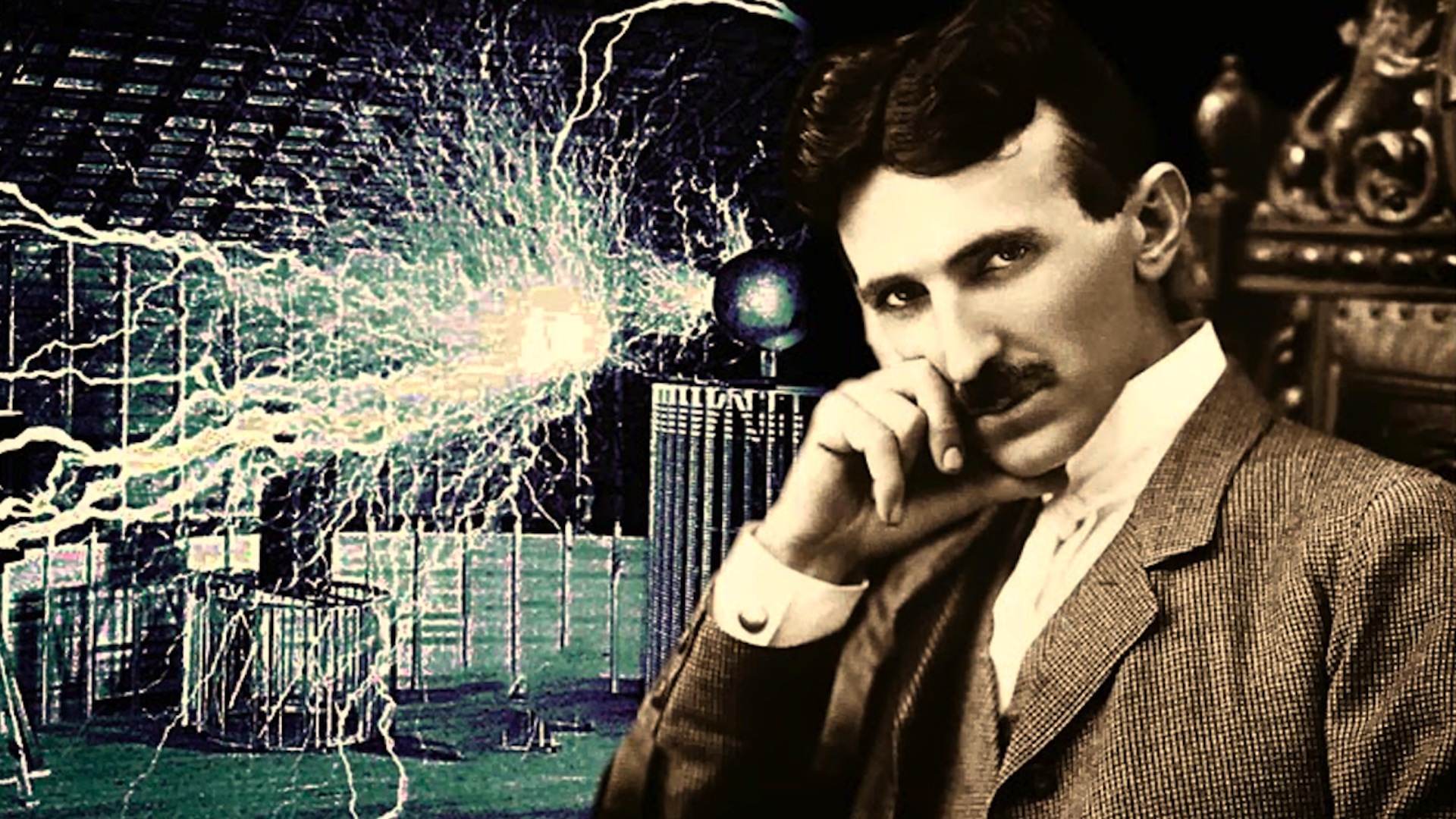
Nikola Tesla and his experiments with electricity

Nikola Tesla intuited that energy waves in the earth and the atmosphere could be used to transmit power to any point on the globe. He understood that the surface of the Earth, the ionosphere and the atmosphere together form one gigantic electrical circuit—an electrified Gaia, so to speak—and this formed the basis for his work on wireless energy transmission. Tesla was able to transmit power and energy wirelessly over long distances (via transverse waves and longitudinal waves). He transmitted extremely low frequencies (ELF) through the ground and between the Earth’s surface and the Kennelly-Heaviside layer of the ionosphere. Tesla patented wireless transceivers that developed standing waves and it was he who discovered that the resonant frequency of the Earth was about 8 Hz and in the range of the Schumann Resonance or Cavity.

Tesla in his Colorado Springs lab

Modern technology appears to be threatening humanity’s connection with earth’s fundamental frequency and the natural vibrations of Schumann Resonance. Threats include artificial man-made EMF radiation, wireless technology, and high frequency heating microwaves pulsed at 2.45 GHz. Whether we co-evolved with Earth’s natural electromagnetic environment or were created with Divine Intelligence to live in harmony with it, many experts believe that artificial man-made EMF radiation masks the natural beneficial frequency of the Earth and may create an environment that is literally `out of tune’ with Nature itself.

The Book

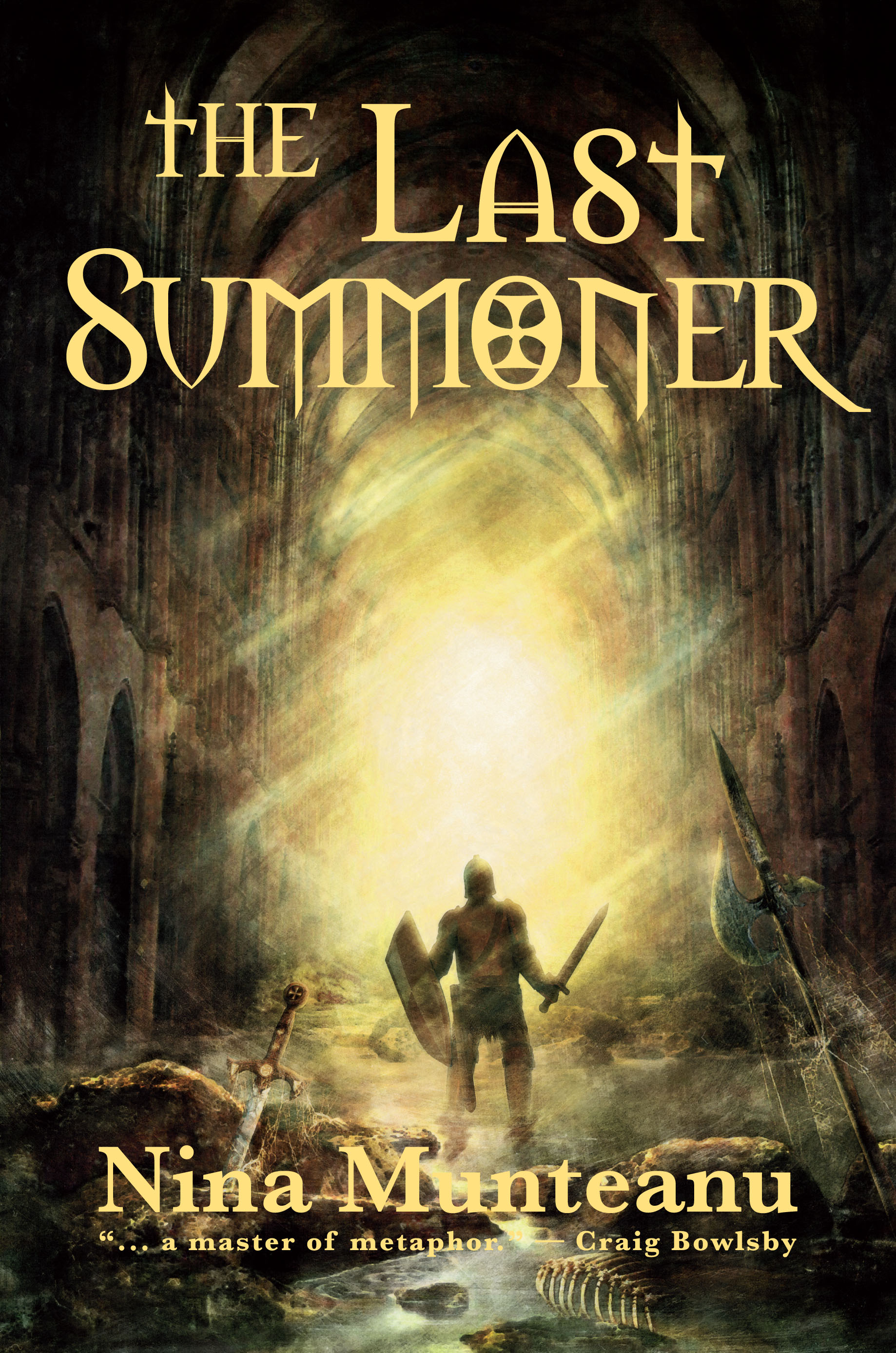
The Last Summoner by Nina Munteanu is a fresh twist on chaos theory and observer-induced collapse of quantum entanglement. It’s June 14th, 1410, on the eve of the Battle of Grunwald when history records that a ragtag peasant army will slaughter the arrogant monk knights of the imperialistic Teutonic Order … or will they? Because of an impetuous choice, 14-year old Vivianne Schoen, Baroness von Grunwald, makes the startling discovery that she can alter history—but not before she’s branded a witch and must flee through a time-space tear. Now in an alternate present-day France ruled by fascist Black Knights of the ancient Teutonic Order, she must decide how to remake history.

Detail of ‘The Battle of Grunwald’ (painting by Jan Matejko)

For those in love with science fiction at its best, The Last Summoner is a complex story of ignored responsibilities and their dire consequences, of love and betrayal that span centuries and multiple worlds. Time travel, multiverse travel, immortality, alternate history in which the Nazis have won, not in the twentieth century but way earlier, in the Teutonic age. Angels and mutants, utopias and dystopias, even a Tesla occurrence— everything a science fiction reader could ever desire in a book. A masterfully told story with great characters. Nina Munteanu moves flawlessly from a medieval story to a modern one and everything in between.”

Costi Gurgu, author of RecipeArium

Find other articles on The Last Summoner here:

Defining Moments and The Last Summoner

The Witch’s Hat and Other Fungi Tales

Delos Ditigal Publishes Nina Munteanu’s “l’Ultima Evocatrice”

The Battle of Grunwald and the Fate of the Teutonic Knights

Summoning the Slow Train to Find the Last Summoner

The Art and Magic of Storytelling: Part 1, Sparking the Premise

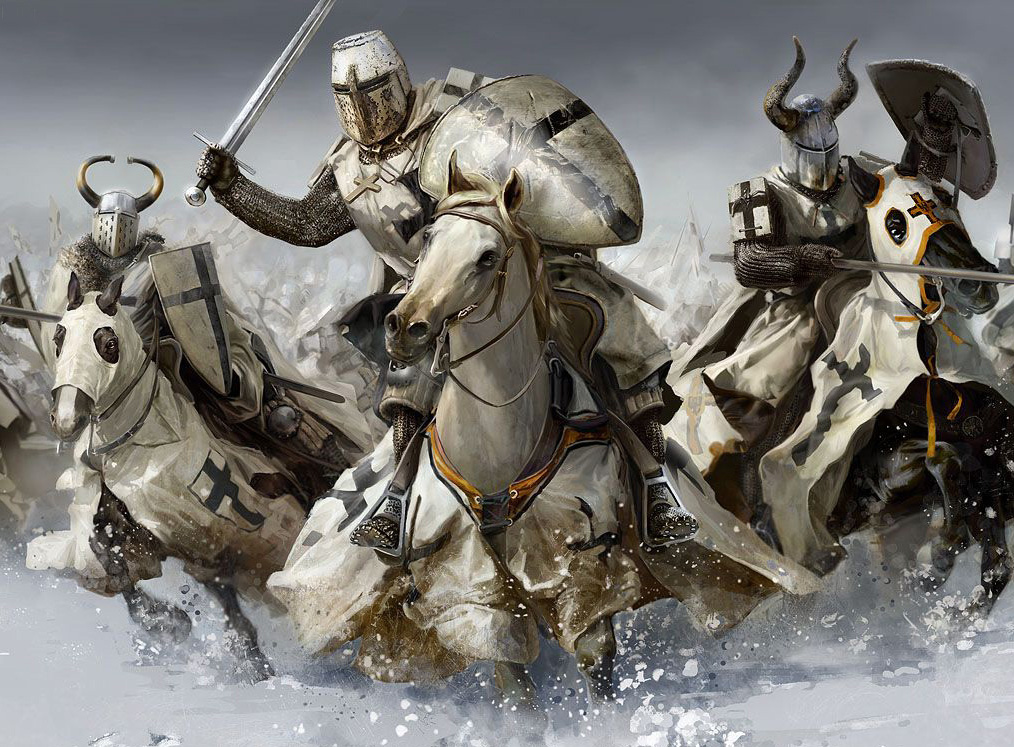
Depiction of fierce Teutonic Knights crusading in the Baltic north during the 13th Century (illustration by Mariusz Kozik)

Nina Munteanu is a Canadian ecologist / limnologist and novelist. She is co-editor of Europa SF and currently teaches writing courses at George Brown College and the University of Toronto. Visit www.ninamunteanu.ca for the latest on her books. Nina’s bilingual “La natura dell’acqua / The Way of Water” was published by Mincione Edizioni in Rome. Her non-fiction book “Water Is…” by Pixl Press (Vancouver) was selected by Margaret Atwood in the New York Times ‘Year in Reading’ and was chosen as the 2017 Summer Read by Water Canada. Her novel “A Diary in the Age of Water” was released by Inanna Publications (Toronto) in June 2020.

Interview with Author Simon Rose

My guest today is Calgary author Simon Rose, who has published eighteen novels for children and young adults, eight guides for writers, more than a hundred nonfiction books, and numerous articles on a wide range of topics.

Nina: Your most recently published books were those in The Stone of the Seer series. Remind us again of what it’s all about.

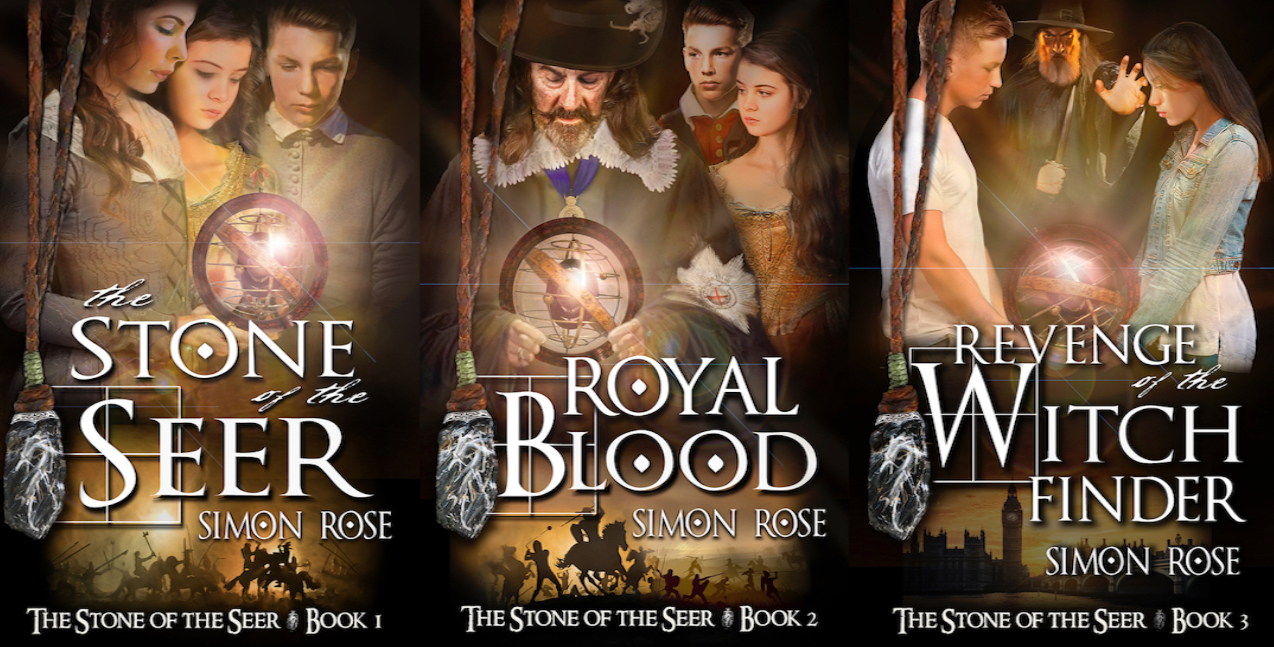
Simon: The Stone of the Seer is young adult historical fantasy series, featuring The Stone of the Seer, Royal Blood, and Revenge of the Witchfinder. The exciting story is mostly set in the mid-seventeenth century during the English Civil War. In The Stone of the Seer, Lady Elizabeth Usborne, Kate, and Tom encounter a magical stone, mysterious parchments and manuscripts, and an incredible time viewing device. In Royal Blood, Lady Elizabeth, Kate, and Tom are in London, witnessing the political turmoil at the time of the Civil War, including the king’s trial and execution. Revenge of the Witchfinder takes place in multiple time periods. The story features weird dreams, disturbing visions, parallel lives, and a bewildering identity crisis, as the lead characters discover to their horror that not even the passage of centuries can prevent a bloodthirsty witchfinder from the 1640s from seeking his deadly revenge.

Nina: Do you have any current projects?

Simon: Right now, I’m working on another historical fantasy novel series, this time set in the early years of World War II, that I’m hoping to publish next year. I’ve recently finished another story that takes place in the later stages of World War II and am putting the finishing touches to that one as well, potentially for publication the following year. Yet another series is currently in development in the same paranormal genre as my previously published Flashback series, which can learn more about on my website.

I’ve also been working on the script for a film project and continue to work on the adaptations of my Shadowzone series into screenplays for movies and TV shows. You can learn more about my work writing screenplays for clients and creating adaptations of my own work here on my website

Anyone interested in keeping up to date with the projects that I’m working on is always welcome to subscribe to my monthly newsletter, which you can do on my website.

Nina: You certainly seem to be very busy. You also do other work related to writing and publishing, right?

Simon: Yes, I offer coaching, editing, consulting, and mentoring services for writers of novels, short stories, fiction, nonfiction, biographies, and in many other genres, plus work with writers of scripts and screenplays.

I’m also a writing instructor and mentor at the University of Calgary and have some courses coming up in the fall, including Writing for Children and Youth. My own online courses, including Writing Historical Fiction and Writing for Children and Young Adults, are also always available.

I’ve just wrapped up work on a study guide for a fellow author’s historical fiction novel, set in World War I and World War II. You can learn more about my various coaching, editing, and consulting services, for all age groups and genres, on my website, as well as my services for business writing projects

Nina: So where can people buy your books?

Simon: People can buy The Stone of the Seer, Royal Blood, and Revenge of the Witchfinder, as well as all my other books, at Amazon and all the other usual places online, which you can link to on my website at www.simon-rose.com I’ll also be making some personal appearances at local events in the fall, where people can buy autographed copies of all the books in the series, as well as all my other novels.

Nina: Thanks Simon, for being my guest here today.

Simon: My pleasure, Nina.

You can learn more about Simon and his work on his website at www.simon-rose.com where you can also link to him on social media and at other locations online.

‘Revenge of the Witchfinder’ Interview with Simon Rose

My guest today is Calgary author Simon Rose and we’re looking at his latest release, Revenge of the Witchfinder, the third novel in the Stone of the Seer series. Simon has published eighteen novels for children and young adults, eight guides for writers, more than a hundred nonfiction books, and numerous articles on a wide range of topics.

Although this is the final part of the Stone of the Seer series, remind us of what the series is all about?

The Stone of the Seer is young adult historical fantasy series. It’s mostly set in the mid-seventeenth century during the English Civil War. In The Stone of the Seer, the first book in the series. Lady Elizabeth Usborne, Kate, and Tom encounter a magical stone, mysterious parchments and manuscripts, and an incredible time viewing device. In part two, Royal Blood, Lady Elizabeth, Kate, and Tom are in London, witnessing the political turmoil at the time of the Civil War, including the king’s trial and execution. In both novels, the main characters are threatened by the witchfinder, Daniel Tombes. There are numerous twists and turns, until the story’s cliffhanger ending, but all is resolved in the final installment.

Sounds amazing. How much can you tell us about the story’s conclusion?

Well, without giving too much away, Revenge of the Witchfinder takes place in multiple time periods. The story features weird dreams, disturbing visions, parallel lives, and a bewildering identity crisis, as the lead characters discover to their horror that not even the passage of centuries can prevent a bloodthirsty witchfinder from the 1640s from seeking his deadly revenge. Readers will consistently be engaged and unable to put the book down until they reach the dramatic conclusion.And of course, people will now be able to buy all three books in the series.

And there’s quite a story behind the story, isn’t there?

The story and main characters in the series may be fictional, but they’re based on real events and characters. In the 1640s, Charles I and Parliament went to war over how the country should be governed. The English Civil War led to the king’s defeat, trial, and execution in 1649. There was no monarchy for eleven years, but then Charles II, son of the former king, was restored to the throne in 1660. However, things were never the same again and it had been established that an English king or queen had to have the consent of Parliament to rule the country.

As with the first two books in the series, did you engage in a great deal of historical research for this one?

I did lots of research into the English Civil War, Charles I, the trial of the king and so on, as well as into the other time periods that are a part of the overall story, such as the Viking era, for The Stone of the Seer and Royal Blood. For the third installment, I researched things such as archaeology and excavations, how London has changed from how it looked during the Civil War compared to today, how some areas were damaged or in some places totally destroyed during the Blitz in World War II, all of which was vital to ensure that the story was as perfect as possible.

As I did in The Stone of the Seer and Royal Blood, I’ve included a glossary at the end of Revenge of the Witchfinder. Readers can learn more about the historical events, settings, and characters that feature throughout the story. On my website, there’s a page dedicated to each book in the series, along with links to separate pages featuring information regarding each book’s historical background and links to many online sources. All of this should be even more fascinating for readers, now that the entire series is available for them to enjoy.

Do you have any current projects?

Right now, I’m working on another historical fantasy novel series, this time set in the early years of World War II. I’m also working on another story that takes place in the later stages of World War II, as well as more books in the same genre as my previously published paranormal Flashback series. You can learn more about those books at www.simon-rose.com. I also continue to work on the adaptations of my Shadowzone series into screenplays for movies and TV shows, as well as teaching writing courses at the University of Calgary.

Anyone interested in keeping up to date with the projects that I’m working on is always welcome to subscribe to my monthly newsletter, which you can do at www.simon-rose.com.

You still do other work related to writing and publishing, right?

Yes, I offer coaching, editing, consulting, and mentoring services for writers of novels, short stories, fiction, nonfiction, biographies, and in many other genres, plus work with writers of scripts and screenplays. I’m also a writing instructor and mentor at the University of Calgary and served as the Writer-in-Residence with the Canadian Authors Association. You can find details of some of the projects I’ve worked on with other authors, along with some references, at www.simon-rose.com.

Where can people buy Revenge of the Witchfinder, Royal Blood, and The Stone of the Seer?

I’ll be making some personal appearances at local events in the fall, where people can buy autographed copies of all the books in the series, as well as all the other novels. The latest series can also be purchased at most of the usual places, as follows:

Revenge of the Witchfinder

Ebook: Amazon CanadaAmazon USA, KoboiBooksBarnes and Noble, Smashwords

Paperback: Amazon Canada, Amazon USA

Royal Blood

Ebook: Amazon CanadaAmazon USA, Kobo, iBooks, Barnes and NobleSmashwords

Paperback: Amazon Canada, Amazon USA

The Stone of the Seer

Ebook: Amazon CanadaAmazon USAKoboiBooksBarnes and NobleSmashwords 

Paperback: Amazon Canada, Amazon USA

Thanks Simon, for being my guest here today and the very best of luck with Revenge of the Witchfinder, and indeed with the entire Stone of the Seer series. I hope that all the books sell thousands and thousands of copies in the coming months.

You can learn more about Simon and his work on his website at www.simon-rose.com, where you can also link to him on social media and at other locations online.

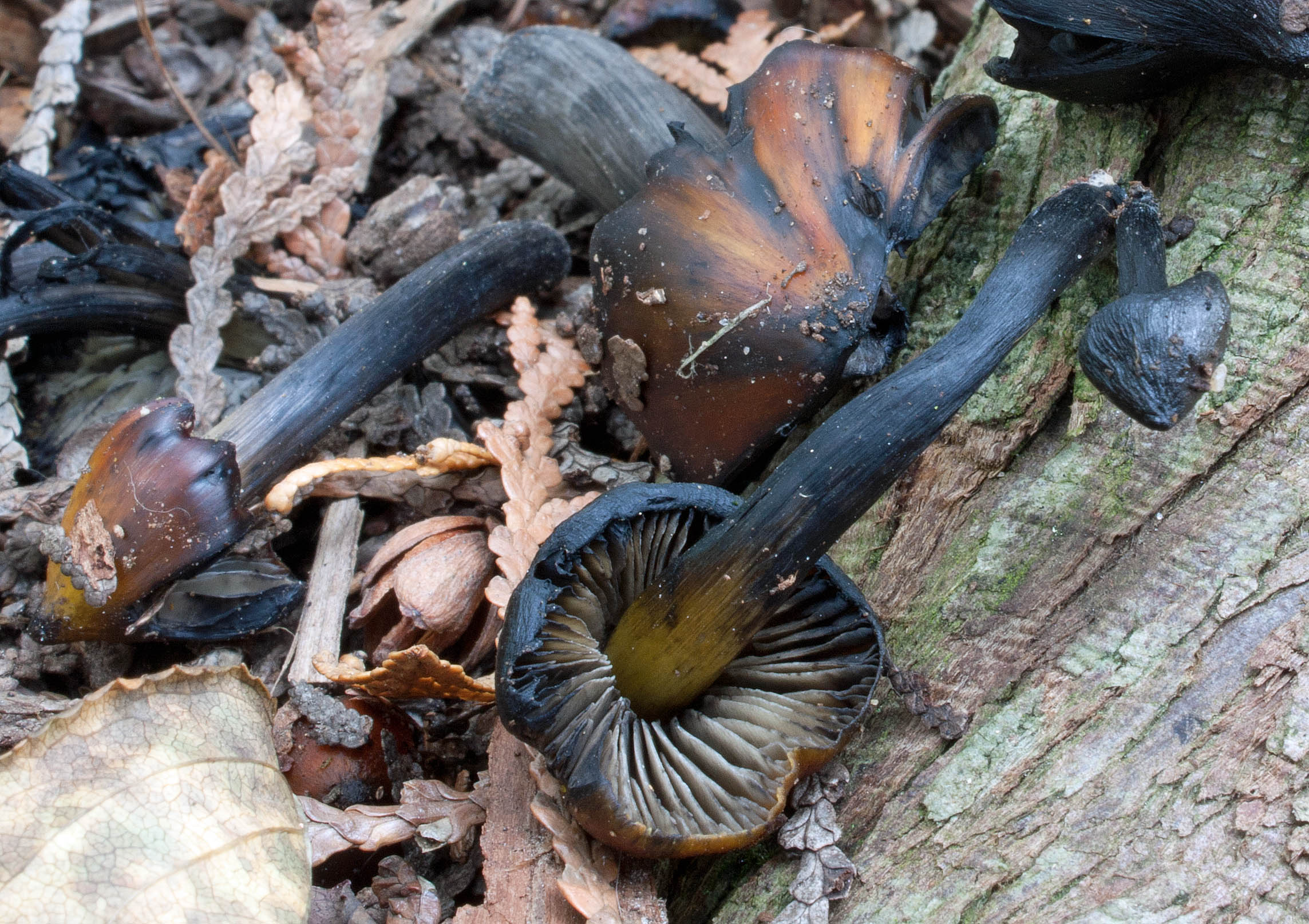
Later stage of hallucinogenic Witch’s Hat mushroom (Hygrocybe conica), as the ‘hat’ blackens (photo by Nina Munteanu)

Interview with Author Simon Rose About His Latest Book “Royal Blood”

My guest today is Calgary author Simon Rose, who has published eighteen novels for children and young adults, eight guides for writers, more than a hundred nonfiction books, and many articles on a wide variety of topics. Today, we’re looking at his latest release, Royal Blood, the second novel in the Stone of the Seer series.

Remind us about the Stone of the Seer series. What’s it all about?

The Stone of the Seer is an exciting historical fantasy series for young adults, primarily set during the English Civil War in the mid-seventeenth century. The Stone of the Seer, is the first book in the series. At Habingdon House, Lady Elizabeth Usborne, Kate, and Tom discover a magical black stone, mysterious ancient manuscripts, and the tempus inpectoris, an incredible time viewing device. They are also in grave danger from Daniel Tombes, who has a fearsome reputation as a witchfinder.

And without giving too much away, what can readers look forward to in the second novel?

In Royal Blood, Lady Elizabeth, Kate, and Tom move to London in the middle of the Civil War, experiencing the great political changes taking place at the time, including the

trial and execution of Charles I. They are also still under threat from Tombes, who is also in the city. The story has many twists and turns, and I doubt if any of the readers will expect the novel’s cliffhanger ending.

And then they’ll have to wait for the third book?

Yes, they certainly will. I’m hoping that Revenge of the Witchfinder, the final novel and the conclusion of the story,will be published later this year. After that, people will be able to buy all three books in the series.

And what’s the story behind the story?

The story, main characters, and some of the settings in Royal Blood are fictional, but like in The Stone of the Seer, they’re based on real events and historical characters, such as King Charles I, appear in the story. The English Civil War broke out as a result of the struggle between Charles I and Parliament, regarding how the country should be governed. The king’s defeat in the war was followed by his trial and execution in January 1649. The monarchy was abolished and replaced first by the Commonwealth of England and then the Protectorate. However, although the monarchy was restored in 1660, in the person of Charles II, his father’s defeat confirmed that an English monarch couldn’t rule the country without the consent of Parliament. This was eventually legally established in 1688 after the Glorious Revolution.

Did you conduct extensive historical research for this book, as you did with the first one?

Although the English Civil War is a time period I’ve always been interested in, I still engaged in lots of research. I needed to study what life was like in seventeenth century London, the political and religious beliefs that were around at the time, the influence of real witchfinders such as Matthew Hopkins and others like him, and of course the trial and execution of Charles I. The trial itself was very well recorded and I was able to ensure that the words spoken by both the king and his accusers were accurate. There were also many witnesses to the execution, so I was able to include established facts about that aspect as well.

As I did in The Stone of the Seer, I’ve included a glossary at the end of Royal Blood, where readers can learn more about the events, settings, and leading characters from the era, locations that are mentioned in the text, life in the seventeenth century, and about other historical periods that are featured in the story. On my website, there’s also a page with details about the historical background behind the books, with links to online sources about the time period.

Do you have any current projects?

Right now I’m working on another historical fantasy novel series, this time set in the early years of World War II. I’m also working on another series of paranormal novels, in the same genre as my previously published series that includes Flashback, Twisted Fate, and Parallel Destiny. You can learn more about those books at www.simon-rose.com. In addition, I’m in the early stages of another couple of historical projects, and am also working on some screenplays, including adaptations of my Shadowzone series, and on several other topics.

Do you still work with other authors as well?

Yes, I offer coaching, editing, consulting, and mentoring services for writers of novels, short stories, fiction, nonfiction, biographies, inspirational books, and in many other genres, plus work with writers of scripts and screenplays. I’m also a writing instructor at the University of Calgary and served as the Writer-in-Residence with the Canadian Authors Association. You can find details of some of the projects I’ve worked on with other authors, along with references and recommendations, at www.simon-rose.com.

Where can people buy Royal Blood and The Stone of the Seer?

The novel can be purchased at most of the usual places, as follows:

Royal Blood

Ebook: Amazon CanadaAmazon USA, Kobo, iBooks, Barnes and NobleSmashwords

Paperback: Amazon Canada, Amazon USA

The Stone of the Seer

Ebook: Amazon CanadaAmazon USAKoboiBooksBarnes and NobleSmashwords 

Paperback: Amazon Canada, Amazon USA

Thanks Simon, for being my guest here today and the very best of luck with Royal Blood and the Stone of the Seer series. I hope the books sell thousands and thousands of copies in the coming weeks and months.

You can learn more about Simon and his work on his website at www.simon-rose.com, where you can also link to his social media sites and other locations online.

Tangle of roots of an old yellow birch tree, ON (photo and rendition by Nina Munteanu)

The Witch’s Hat and Other Fungi Tales

Witch’s Hat (Hygrocybe conica) by cedar tree, ON (photo by Nina Munteanu)

In my recent wanderings in the small cedar forest by the river near my house, I chanced upon a community of emerging reddish-orange fungi. They sat among the cedars in a crowded aggregation. Some pushed their way up through the duff like little buds, barely visible; others rose up with pointed steep caps; and others had opened further into tiny ‘witch’s hats’ and blackened.

Several stages of Witch’s Hat, including blackening stage, cedar forest, ON (photo by Nina Munteanu)

According to Frank Dugan, fungus plays a key role in many folktales and fairy tales. “They appear as foods, poisons, diseases, decorations, dyes or tinder, and even in insults, compliments, graffiti and video games,” says the author of Fungi, Folkways and Fairy Tales: Mushrooms & Mildews in Stories, Remedies & Rituals, from Oberon to the Internet.

Fungi figure in wonderfully with stories of and about witches. “Witches have long used fungi in their potions in Europe,” Fungal Folklore tells us. Even ferry rings are called “Hexen Rings” in Germany; Hexe means witch and this refers to “the dancing of witches on Walpurgis night (the eve of May Day) when the old pagan witches were thought to hold high revelry,” writes Dugan.

Baba Yaga (Wikipedia Commons)

Baba Yaga

In the Slavic folktale, Baba Yaga is an ancient swamp witch; she’s a cruel ogress who steals, cooks and eats her victims, usually children; OR offers them help. It’s complicated; she’s either a maternal helper or a cannibalistic villain; or both. Certainly a trickster.  Baba Yaga is guardian of the fountains of the water of life and lives in a forest hut perched on bird’s legs, surrounded by pine trees and glowing skulls. She can manipulate earth and wood, and can mesmerise. Baba Yaga has lately become something of an icon for feminism and the power of the feminine.

Says Marissa Clifford in Vice: “Like other witches, deistic Baba is agent of transformation, who, according to Kitaiskaia, exists ‘kind of outside of the things which constrain human society, like time and morality.’ She may well be so compelling for women today because of her rejection of social standards, and the power that comes from that. She’s an outlier with power that isn’t derived from her beauty, or her relationships with others. Instead, it comes from within her—earth, hut, and firey stove.”

Baba Yaga (illustration by Tatyana Chepkasova)

Witches, Fungi & Potions

“Witches have long used fungi in their potions in Europe,” The Fungus Among Us tells us. According to Dugan, the dung-loving Panaeolus papilionaceus (Petticoat Mottlegill) was used in witch’s concoctions in Portugal. The entheogen Amanita muscaria (Fly Agaric)—the elixir of ancient alchemists—is known as Hexenpils (‘Witches’ mushroom’) in Austria.  Among German tribes, it is associated with Woton/Odin, god of ecstasy, war and shamanic knowledge.  Puffballs were reportedly used in potions by witches in the Basque country. Witch’s butter (Exidia spp.) also figures in folklore. “Stabbing, burning or otherwise destroying these fungi were believed to harm the witch herself,” writes Owen. The Witch’s Hat (Hygrocybe conica) is aptly named for its blackening witch-style ‘hat’ that starts bright red-orange and turns coal black.

Many country folk through the sixteenth and nineteenth centuries performed rituals to protect their crops from the devastation wrought by witches and spirits. Thiselton-Dyer discusses the malignant Roggenwolf (‘rye wolf’ of Germanic folklore) who stole children and fed on them and the various rituals peasants used to appease these Feldgeister (field spirits), such as leaving a sheaf of rye in the fields over the winter. The Roggenwolf is, of course, the personification of ergot, the fungus Claviceps purpurea, which caused convulsions, burning, “massive-appetite”, and “the sense of becoming an animal.” People who contracted ergot poisoning from the contaminated rye were accused of being witches and brutally killed.

Young Witch’s Hats push up through the cedar forest floor, ON (photo by Nina Munteanu)

Ergot and The Last Summoner

In my historical fantasy “The Last Summoner,” young Vivianne Schoen, Baroness of Grunwald—accused of being a witch—is chased by her father’s guard to be burnt at the stake. Blamed for the sudden stupor of her father and the chaplain who both love their rye bread, it didn’t help that Vivianne possesses unnatural powers in metal manipulation, has weird markings or blemishes on her back or that suspicions of her preternatural mother being a witch precede her. Then odd things start to happen; cattle stop producing milk and other farm animals behave strangely. At a feast to celebrate her own coming nuptial to a foreign stranger and just after she is falsely accused of adultery, people suddenly succumb to fits of convulsions, facial distortions, hallucinations and paralysis. Targeted as the obvious candidate to blame, she must flee her home or be burnt alive at the stake:

…With a final unintelligible gasp that wet her cheek with flying spittle, he convulsed violently and pitched to the floor, shaking and vomiting his dinner.

Vivianne stared at her father, rolling and twitching in a seizure on the floor and crying out gibberish. She turned to the castle community, who were now pointing and shouting at her. Their faces had twisted from transfixed revulsion into fear and anger. Somehow they blamed her for both the stranger’s accident and her father’s sudden paroxysm. Perhaps for losing them a battle in the bargain too. Even Père Daniel’s face looked stricken with confused accusation. Until now Vivianne hadn’t realized how much his opinion of her meant to her. She felt his faltering faith drive like a blade into her heart and would have burst into tears had the crowd not suddenly grown very surly, which demanded her sudden attention.

Gertrude, the new dairymaid she’d assisted earlier, flung the first accusation: “She’s a witch!”

“Witch!” another echoed. “You heard her father call her one!”

Another servant swiftly followed with, “Just like her mother! She’s bewitched the baron! Put a spell on him with her wicked look!”

The crowd ignited to a raucous mob and a spate of accusations gushed out like a dam breaking: “My butter failed to churn because of her!”

“Look at the witchling’s eyes! They blaze with the devil’s own fire!”

“She appeared in Weikhard’s dream and now he’s ill!”

“She touched my cow and afterwards it couldn’t stand!”

“I saw the nursemaid bringing her a daily potion of nettle, mustard and mint with wine to make her lustful!”

Oh, no! They were implicating Uta along with her!

“I smelled basil and cloves in her bed chamber!”

Vivianne had used both to mask the rank odor of Uta’s anti-plague potions, completely innocent of their aphrodisiac properties. Vivianne stared in anguished despair as Père Daniel stood by, mutely sanctioning their actions. She’d thought him her champion once. But obviously this was too much for him to bear. He’d lost his trust in her. As their eyes met briefly, he suddenly gasped out strange words of gibberish. A violent shudder convulsed through him. It threw him forward, as if the devil itself were animating him, then felled him to the ground where he vomited alongside her retching father.

“She’s taken the priest!” someone shouted. “He’s doing the Viper’s dance!” Another screamed in a panic, “Watch out for her eyes!”

Vivianne turned back to the crowd. Whomever her gaze alighted upon shrank back and averted their face in terrified alarm. They were convinced that she could strike them down with a glance. To her horror a few of the castle servants jerked out of their seats with startled cries of gibberish then fell writhing to the ground; some began to vomit. Vivianne recognized the true onslaught of an epidemic. The same illness that had inflicted her father and the chaplain was attacking the staff. And again, the timing was impeccable, thought Vivianne with wry cynicism. As though God was plotting against her.

Gertrude pointed to her. “Seize her! Burn the witch! Before she kills us all!”

“Someone find her demon cat too!” Vivianne heard the doctor shout.

Several of the baron’s knights surged forward, swords drawn. As if suddenly awoken from a stupor, the Teutonic Knights at the high table leapt into action and drew their swords.

NO! Vivianne backed away in alarm. She envisioned their swords suddenly pointing back toward themselves. To her amazement, their swords flung back and the knights dropped them in shocked fright.  

In that surreal moment, as the world staggered into slow motion, Vivianne saw the entire castle household draw in a long breath. Still on the floor, Père Daniel’s shakes abated long enough for him to fix lucid eyes upon her and silently mouth, “Cours, ma petite! Cours! Sauves toi!”

After a last glance at her convulsing father, Vivianne took the Père’s advice and ducked through one of the curtained archways behind the table to the kitchen stairwell, and pelted down the stairs.

“After her!” she heard the booming voice of Doctor Grien. “The witch is getting away!”

*****

Vivianne later discovers what caused the sudden ‘bewitchment’ of members of her community: all the people who became ill had eaten the rye bread. She learns about ergot poisoning of rye by the fungus Claviceps purpurea. Conditions had been ideal for ergot to thrive: damp and rainy cool weather.

Young Witch’s Hat with peaked cone-shaped pileus, amid cedar duff, ON (photo by Nina Munteanu)

The Witch’s Hat

Witch’s Hats are a small agaric (cap from 1-4 cm across) that start out bright red to orange, sometimes almost yellow as they thrust up through the cedar duff, looking like buds.

The conical pileus is often curved steeply with a fairly sharp top and sometimes with edges that curve slightly inward. The stem (stipe) is often white at the base blending to yellow and will stain black with age.

Witch’s Hat mushroom showing inward curve of cap, with key to show size, cedar tree, ON (photo by Nina Munteanu)

As the waxcap mushroom develops, the cap spreads out with a discernable brim while maintaining the hat peak of a witch’s hat. As it ages, it turns a deeper red-orange that blackens, often from the edges inward.

Three stages of Witch’s Hat, from early conical to spreading and blackening hat, cedar tree, ON (photo by Nina Munteanu)

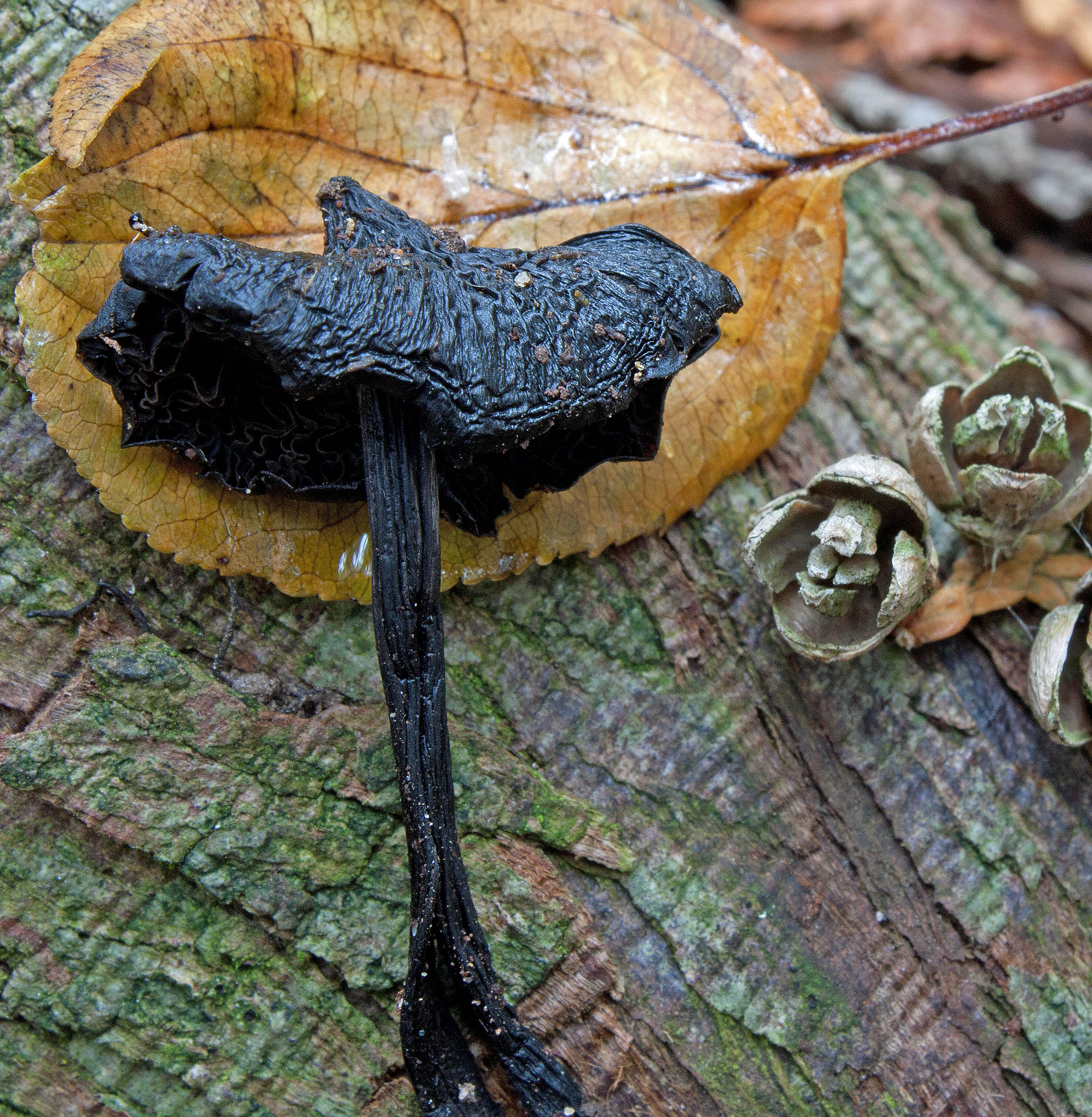
This tendency to blacken from bruising or with age is a good diagnostic for this mushroom. Very few others show this trait. Its gills “have the consistency of soft wax when rubbed between the fingers,” Fungus Fact Friday tells us. The gills start white to yellowish and gradually yellow and stain black.

Stages of Witch’s Hat from budding to opening cap to blackening cap and gills, cedar forest, ON (photo by Nina Munteanu)
Blackened and blackening Witches Hat caps and stems, ON (photo by Nina Munteanu)
Hygrocybe conica well-represents its common name Witch’s Hat as it keeps its peak and turns totally black, cedar in Ontario forest (photo by Nina Munteanu)

The Witch’s Hat (Hygrocybe conica), also known as Blackening Waxcap (for the obvious reason), shows a diversity of habitat preference and high variability. It tends to grow on the ground under hardwood and conifer trees. The community I stumbled upon fanned out from a few cedar trees in a small mixed cedar forest. The Witch’s Hat also likes mossy areas, where I found several near the river. The saprobic Hygrocybe conica is also a mycorrhizal fungus, sending tendrils from tree to tree.

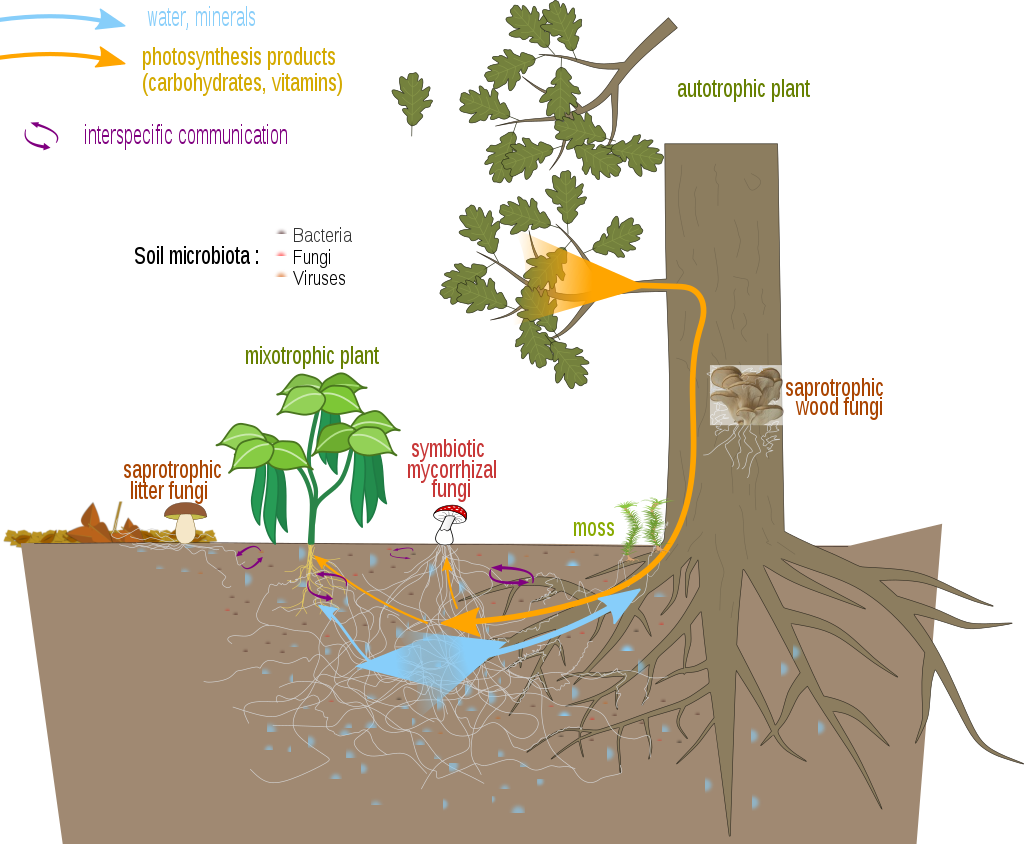
Mycorrhizae are symbiotic relationships that form between fungi and plants. The fungi colonize the root system of a host plant—in this case some cedar trees—providing increased water and nutrient absorption capabilities while the plant provides the fungus with carbohydrates through photosynthesis.

Mycorrhizal network (illustration by Charlotte Roy, Wikipedia)

References:

Dugan. 2008. “Fungi, folkways & fairy tales.” North American Fungi 3(7): 23-72.

Morgan, A. 1995. “Toads and Toadstools: The Natural History, Folklore, and Cultural Oddities of a Strange Association.” Celestial Arts. Berkeley, California.

Munteanu, Nina. 2012. “The Last Summoner.” Starfire World Syndicate. Louisville, KY.

Owen, E. 2003. “Welsh Folk-Lore: A Collection of the Folk-Tales and Legends of North Wales. Kessinger Publishing. Whitefish, Montana.

Thiselton-Dyer, T.F. 1898. “Folk-Lore of Plants.” D. Appleton and Co., New York.

Young emerging Witch’s Hats through cedar duff, ON (photo by Nina Munteanu)
Witch’s Hat in cedar forest, ON (photo by Nina Munteanu)

Nina Munteanu is a Canadian ecologist / limnologist and novelist. She is co-editor of Europa SF and currently teaches writing courses at George Brown College and the University of Toronto. Visit www.ninamunteanu.ca for the latest on her books. Nina’s bilingual “La natura dell’acqua / The Way of Water” was published by Mincione Edizioni in Rome. Her non-fiction book “Water Is…” by Pixl Press(Vancouver) was selected by Margaret Atwood in the New York Times ‘Year in Reading’ and was chosen as the 2017 Summer Read by Water Canada. Her novel “A Diary in the Age of Water” was released by Inanna Publications (Toronto) in June 2020.

Delos Digital Publishes Nina Munteanu’s “l’Ultima Evocatrice”

I was recently commissioned by Andrea Franco at Delos Digitalin Milan to write a novelette for their Fantasy Tales Series. The resulting story was Summoning the Future’s Past a short adaptation of my alternative history novel The Last Summoner published by Starfire in 2012.

The novelette was translated by Chiara Beltrami then released by Delos Digital as the ebook l’Ultima Evocatrice, (Fantasy Tales 66), on April 13, 2021. 

Here is what Andrea Franco said about l’Ultima Evocatrice:

“Recentemente in Fantasy Tales-Delos Digital abbiamo pubblicato il primo testo ‘internatiozionale’, della bravissima scrittrice Canadese Nina Munteanu, tradotta per noi in modo eccellente da Chiara Beltrami. Un bellissimo racconto lungo che gli appassionati di fantasy non dovrebbero farsi scappare. Lo avete letto?”

As with The Last Summonerl’Ultima Evocatrice(Summoning the Future’s Past) is a fresh twist on chaos theory and observer-induced collapse of quantum entanglement. It’s June 14th, 1410, on the eve of the Battle of Grunwald, when history records that a ragtag peasant army will slaughter the arrogant monk knights of the imperialistic Teutonic Order … or will they? Because of an impetuous choice, 14-year old Vivianne Schoen, Baroness von Grunwald, makes the startling discovery that her mother is from the future and Vivianne herself can alter history—but not before she’s branded a witch and must make the most difficult choice of her life …

 “l’Ultima Evocatrice”was recently featured in Fantasy Magazine

Nina Munteanu is a Canadian ecologist / limnologist and novelist. She is co-editor of Europa SF and currently teaches writing courses at George Brown College and the University of Toronto.  Visit www.ninamunteanu.ca for the latest on her books. Nina’s bilingual “La natura dell’acqua / The Way of Water” was published by Mincione Edizioni in Rome. Her non-fiction book “Water Is…” by Pixl Press(Vancouver) was selected by Margaret Atwood in the New York Times‘Year in Reading’ and was chosen as the 2017 Summer Read by Water Canada. Her novel “A Diary in the Age of Water” was released by Inanna Publications (Toronto) in June 2020.

The Last Summoner & “The History with Magic” Book Bundle

The History with Magic Book Bundle

“The Last Summoner”by Nina Munteanu is now available as part of “The History with Magic”Book Bundle, curated by Athena Andreadis. The Bundle includes eleven books, each described here. Here’s what Athena writes:

The History with Magic bundle offers eleven riveting works that occupy a vital nexus in the dense, labyrinthine metropolis that is fantasy: the crossroads of alternate history and secondary world fiction. Both are venerable subgenres in speculative fiction. Alternate history has been with us at least since Titus Livius, better known as Livy, contemplated a world in which Alexander the Great survived to turn his energies westward; and humans have invented secondary universes ever since they wove and spun stories around their gatherer-hunter campfires.

As the astrogator and lead editor of acclaimed small indie press Candlemark & Gleam, I’ve had the honor and pleasure of helping to create and release some of the best new works in this mode. And now I get to share such fusions of history with magic in this spectacular bundle, whose every entry deserves to become a visual spectacle as atmospheric and studded with larger-than-life events and charismatic characters as the serialization of Bernard Cornwell’s Last Kingdom or Philip K. Dick’s Man in the High Castle… Full of rousing, sweeping derring-do and jeopardies, risky missions and fraught choices, intricate alliances and jarring betrayals, it’s all here—with the layers of real history, and its very concrete consequences, glimmering like fata morganas through the gauze of fiction.”

This bundle is available for a limited time only (from October 28 through November 19) via http://www.storybundle.com. The bundle allows easy reading on computers, smartphones, and tablets as well as Kindle and other ereaders via file transfer, email, and other methods. You get multiple DRM-free formats (.epub, .mobi) for all books.

The Last Summoner by Nina Munteanu is a fresh twist on chaos theory and observer-induced collapse of quantum entanglement. It’s June 14th, 1410, on the eve of the Battle of Grunwald when history records that a ragtag peasant army will slaughter the arrogant monk knights of the imperialistic Teutonic Order…or will they? Because of an impetuous choice, 14-year old Vivianne Schoen, Baroness von Grunwald, makes the startling discovery that she can alter history—but not before she’s branded a witch and must flee through a time-space tear. Now in an alternate present-day France ruled by fascist Black Knights of the ancient Teutonic Order, she must decide how to remake history.

For those in love with science fiction at its best, The Last Summoner is a complex story of ignored responsibilities and their dire consequences, of love and betrayal that span centuries and multiple worlds. Time travel, multiverse travel, immortality, alternate history in which the Nazis have won, not in the twentieth century but way earlier, in the Teutonic age. Angels and mutants, utopias and dystopias, even a Tesla occurrence— everything a science fiction reader could ever desire in a book. A masterfully told story with great characters. Nina Munteanu moves flawlessly from a medieval story to a modern one and everything in between.”—COSTI GURGU, author of RecipeArium

“A good, clever read and I think that history buffs would really enjoy it…You should read this book if you love fantasy, history or a combination  of the two, you’re a fan of time travel and its many twists and turns, the concept of influencing historical events to create a better world intrigues you.”—THE COCONUT CHRONICLES

“A hard book to put down. Loved the historical references of gear, place and events. The characters involved you in their lives. Fast-paced”
— AMAZON REVIEW

Exquisite! … A wonderful and skillful historical time traveler full to the brim of colourful characters intertwined with chicanery and loved, loved, loved the metaphors.  A page -turner.”— AMAZON REVIEW

For more on the writing of this book, go to:

“The Art and Magic of Storytelling: Part 1, Sparking the Premise”

“Defining Moments and the Last Summoner”

“The Battle of Grunwald and the Fate of the Teutonic Knights”

“Cymatics: How Frequency Changes the Very Nature of Matter and Energy”

Nina Munteanu is a Canadian ecologist / limnologist and novelist. She is co-editor of Europa SF and currently teaches writing courses at George Brown College and the University of Toronto. Visit www.ninamunteanu.ca for the latest on her books. Nina’s bilingual “La natura dell’acqua / The Way of Water” was published by Mincione Edizioni in Rome. Her non-fiction book “Water Is…” by Pixl Press (Vancouver) was selected by Margaret Atwood in the New York Times ‘Year in Reading’ and was chosen as the 2017 Summer Read by Water Canada. Her novel “A Diary in the Age of Water” was released by Inanna Publications (Toronto) in June 2020.

Defining Moments and The Last Summoner

A few years ago I attended a panel at Toronto’s Ad Astra convention called “Stealth Science Fiction in Person of Interest.” The panel was the brainchild of fellow science fiction writer Ira Nayman, an avid watcher of the TV show. Unbeknownst to me, the panel I’d been assigned to participate with Ira and another panelist was about a TV show (which I’d never seen)—not just an expression.

I bumbled in the beginning as realization dawned on me that this was what the panel was about and quietly berated myself for not rereading the short description (which had been sufficiently vague—at least to me). I finally let the panelists and audience know my limitation when Ira astutely noted that I was being extra reticent (not one of my usual traits in panels). We muddled along, despite my infirmity, and the panel went along admirably—mainly because Ira moderated with great astuteness and audience members participated enthusiastically.

One of the plot points of the show led Ira to share a personality-defining hypothetical dilemma that he’d encountered. Here’s how he described it: if you knew you could save five people by instigating the death of another person, would you do it? Or would you, by your inaction, allow the five to die by not instigating that person’s death? The premise, of course, is that you could tell the future of two divergent actions.

LastSummoner-coverI realized soon after that this is exactly the situation that my main character Vivianne Schoen, the Baroness Von Grunwald, faced in her journey to change the history she’d inadvertently authored (in The Last Summoner). As a medieval time traveler, she was presented with several courses of history and needed to choose her actions carefully in accordance with both short-term and long-term consequences. Faced with the possibility of saving utterly millions of people who were fated to perish in World War I by instigating the death of one man—Kaiser Wilhelm II—Vivianne sets out to do the deed.

Besides her ability to time travel, Vivianne is able to manipulate metal through mind-wave energy. Because of this power, she decides to participate in a momentous event in which her power will have a potentially deadly effect. The year is 1889, just a year after Kaiser Wilhelm II was crowned Emperor, and the place is Charlottenburg Race Course in Berlin in this excerpt from The Last Summoner:

VIVIANNE pulled up the collar and hood of her fur coat to ward off the November chill as she walked next to Jurgen von Eisenreich in Berlin’s Charlottenburg Race Course. The coat barely kept the winter wind from cutting through her cream- colored evening gown. Fastened at the back, it had no bustle and signaled the upcoming style. They were here to watch Europe’s latest touring attraction from America: Buffalo Bill’s Wild West Show. Steering her by the elbow, von Eisenreich guided her up the rafter stairs toward the Royal Box, where the new Emperor was already seated with his retinue of several statesmen, including his aides-de-camp, and two imperial guards. Vivianne recognized the odious and obsequious Count Alfred von Waldersee, seated beside the Emperor. Twenty-seven years the Kaiser’s senior, the Count was a power-mongering anti-Semite, who would prove to mold the weak-minded Crown Prince into the bigoted warlord Kaiser Wilhelm II was becoming.
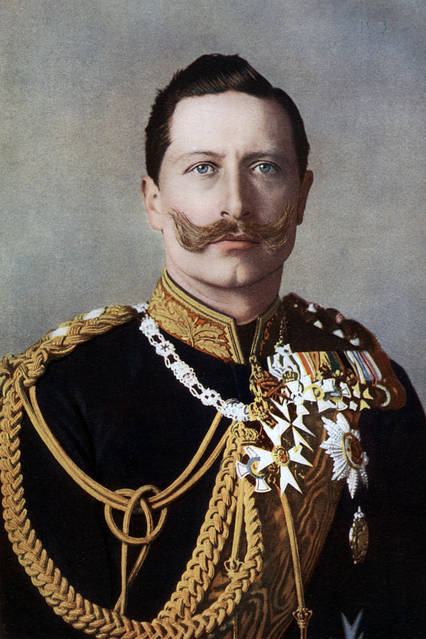
Wilhelm II

Kaiser Wilhelm II

Vivianne stole a long glance to the Reich’s young ruler. It had been just a year since the Crown Prince had ascended to the imperial thrown and he had already stirred up trouble with his insulting behavior of his mother, the dowager Empress, and his uncompassionate handling of his father’s funeral; then his shabby treatment of England’s Queen and her son, the Prince of Wales.

Vivianne furtively studied the dashing thirty-year old ruler with deep interest. Dressed impeccably in uniform, he was rakishly handsome, she decided, with sharp intelligent eyes, a long aristocratic nose and well-waxed handle-bar mustache. She found herself staring at his withered left arm, which he rested on his lap. Though she could not make it out, it was a good six inches shorter than the other arm and partially lifeless. He’d been a breech birth and both he and his mother were lucky to be alive.

Vivianne reflected on that eventful day when she’d botched her attempt to save the last Emperor of Germany from an unnatural birth. While Oskar had been instantly killed, the doctor had survived the carriage accident with only a severe concussion; he’d still only managed to get to Unter den Linden by early afternoon, having lain unconscious and unattended for most of the morning then having awoken at Humboldt Hospital where he’d ironically been scheduled to speak that day and had then foolishly insisted on tending to Vivianne first, who’d suffered a nasty head wound that she hadn’t even been aware of receiving.

The Emperor—like Vivianne—was here, in the District of Charlottenburg in West Berlin, to see the show’s star attraction, Annie Oakley, who acquired world fame for her skills with a Colt .45. The young sharpshooter had been invited by the Kaiser for a private performance for the Union-Club. Vivianne found her breaths escalate at the thought of what the impetuous Kaiser was about to do; and what she intended to do, as a result. Was it an ironic twist of history that only months ago Adolf Hitler was born this year? Vivianne glanced down at the program in her gloved hand:

Programme of Miss Annie Oakley’s Private Performance Before the Members and Their Friends of the Union-Club, Berlin, on November 13, 1889, at Charlottenburg Race Course.

There followed a list of up to seventeen feats she would perform, beginning with her exhibition of rifle shooting, followed by clay-pigeon sharp-shooting then various feats involving trapping and agility in weapon handling. She was not fated to get very far in her program before calamity of sorts would strike, Vivianne thought cynically.

“He’s alone…without his family?” she asked von Eisenreich. That would make it much easier, she concluded with an inward sigh.

“Dona prefers the comfort and warmth of the royal palace in Potsdam, and the company of her children,” he responded. “She’s not interested in this sort of thing. She has few interests other than church service, I’m afraid.” Then he leaned his head close to hers to confide. “Ten years ago, Wilhelm was smitten by his beautiful cousin, Victoria Elizabeth, the second eldest daughter of the Grand Duke and Duchess of Hesse and the Rhine. But Ella wouldn’t have him.” Then von Eisenreich surveyed Vivianne with an appraising look and smiled enigmatically. “In fact, she looked a lot like you.”

Vivianne swallowed down a sudden discomfort, not sure of its source. Von Eisenreich went on, “Poor Wilhelm became very self-conscious about his arm and thought himself unattractive. That might be why he chose a plain and simple, but pious woman.”

More like narrow-minded, anti-Semitic and bigoted thought Vivianne. Unfortunately the Empress fit in too well with the Kaiser’s own bigoted views and apparently her nature only served to exacerbate the Kaiser’s arrogance and insufferable nature.

Von Eisenreich chuckled to himself. “I heard that the Empress Dona was called unimaginative and prejudiced by the Emperor’s own mother. Dona hates the English. But don’t we all!” He laughed.

Vivianne thought of the cutting words of the gossiping socialite, Daisy, Princess of Pless: for a woman in that position I have never met anyone so devoid of any individual thought or agility of brain and understanding. She is just like a good, quiet, soft cow that has calves and eats grass slowly then lies down and ruminates.

“Apart from that homosexual, Count Philipp von Eulenburg, I’m the Emperor’s only real friend,” von Eisenreich confided rather smugly to Vivianne as they approached the Royal Box.

As if he felt her stealthy glance, the Kaiser turned to look directly at her. After an unabashedly long appraisal, he let his eyes drift away and leaned out, looking past his aide to focus on von Eisenreich. “Ah, Jurgen! So that’s why you dallied and missed my retinue!” The Kaiser yelled in a coarse Potsdam accent, eyes flitting back critically to Vivianne like she was merchandize. He stood up and clapped von Eisenreich hard on the back, clearly happy to see him. Vivianne got a clear view of his short left arm with dark brown mole on his shriveled hand. She noted that he was rather short in stature for a man, about her height or less, with a squat and slightly lopsided neck—owing to his left arm being shorter than the other. Eisenreich drew Vivianne forward.

“This is the Comptesse d’Anjou,” von Eisenreich said.

She pulled down her hood and curtsied slightly, eyes downcast. “I’m honored and humbled, your Imperial Majesty,” she said.

“No doubt you are!” he responded, swiftly tucking his left hand in his pocket. When she raised her eyes to meet his, Vivianne caught the brief instant as his eyes grew wide and deep with hidden intensity.
 Jurgen caught it too. “I thought so, also,” he said with amusement to the Emperor. He was, no doubt referring to her likeness to the Princess Ella.

The Kaiser sucked in a breath and straightened with an imperceptible tremble, as if to shake off an old memory. Then he gave Vivianne a cold smile and extended his good hand to her in greeting. She accepted and instantly winced with excruciating pain. He barked out a cruel laugh and said, “The French are, I’m afraid, just like the English when it comes to my German mailed fist!”

Vivianne had heard of his sadistic handshake: he was in the habit of turning his many rings inward prior to clasping one’s hand with a vice-like grip. Somehow, she hadn’t expected him to inflict her with it. Perhaps it was his way of punishing his cousin for not accepting his marriage proposal, she concluded, regretful of her resemblance. The Kaiser hung on to her hand much longer than he needed to, Vivianne decided, squirming and attempting to retract it from his painful grasp. His grip was too strong.

Their eyes locked. And to her frustrated anger, her eyes teared up with the stinging pain through her glove.

In that moment she saw the hurt little boy in that bigoted, arrogant and angry face. She instantly knew that she’d misjudged one of his critical nexuses. Her mission this day might have been prevented. If she’d intersected with his life earlier, and somehow convinced his beloved Ella to accept his proposal, the single-minded but compassionate princess might have softened him, completed him, inspired him to be the great man he could have become instead of the bitter and insecure bully he now was.

Something passed between them and he abruptly let go of her hand with a sudden intake of air. “I beg pardon,” he said, voice softening from that harsh Potsdam accent. “You reminded me of someone I once knew…” In a flush of solicitous emotion, he pulled off her glove to inspect the damage he’d inflicted on her hand. Several red welts had surfaced on the inside of her lower palm where his rings had gouged into her flesh. “Ahh…such dear soft and warm hands…” he cooed in near reverence. “How remarkable…the soft insides of your hands…”

Vivianne slowly pulled her hand away.

They both looked awkward for a moment. Then the Kaiser broke out into a blustery laugh and turned to von Eisenreich.

“So, where’s your good wife, von Eisenreich?”

“Like you, I left her at home with my dear children, where she should be, your Majesty,” von Eisenreich responded cheerfully. “They’re no fun at these sorts of things.”

“Ah, but I wager the Comptesse is,” said the Emperor brashly and took the opportunity to rake her over with appreciative eyes.

Von Eisenreich let loose a conspiratorial laugh, as if to ratify the Kaiser’s innuendo. He then leaned into Vivianne beside him with a chuckle until his shoulder collided into hers. “I brought my lovely companion, the charming Comptesse d’Anjou, to improve my demeanour and make me interesting.”

The Kaiser threw his head back and shouted an open- mouthed laugh of abandon then stomped his foot. “Indeed, she has managed that!” He surveyed Vivianne with critical eyes that flashed with approval. When she’d first been introduced to him, she’d felt the Kaiser’s burning gaze roam over her like the eager hands of a lover. “Good choice,” Wilhelm said.

He’d clearly deduced that she was von Eisenreich’s mistress and Jurgen had as much as confirmed it. The Kaiser had several mistresses of his own and Vivianne had the impression he wouldn’t have minded another.

As Uta had predicted, Vivianne had indeed filled out into what most men commonly considered a woman of striking beauty. And she’d had many years to cultivate it into an irresistible package. She was now over four hundred years old, yet she looked no more than in her early twenties. That arcane quality alone, she knew, was enough to drive men to distraction.

Vivianne had only met von Eisenreich last week at a masked ball and, knowing his weakness for beautiful women, she’d shamelessly flirted with him; within short order she’d seduced his keen interest in her and ensured for herself an invitation to this event.

The Kaiser let his gaze stray to Vivianne as he spoke to von Eisenreich. Then he finally let his eyes rest openly on her with a cool smile. “You speak German very well for a French woman, Comptesse,” he said to her. “I detected no accent when we were first introduced.”

She smiled demurely and didn’t bother to correct him on her German lineage.
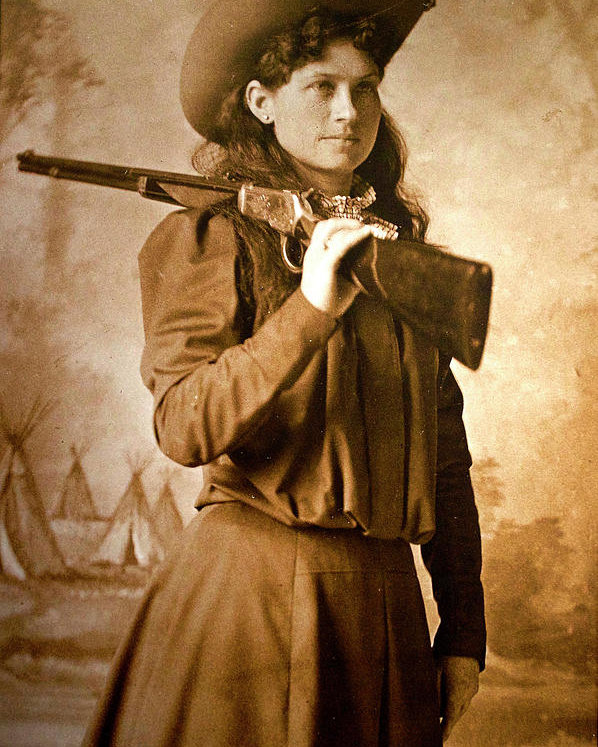
Annie Oakley

Annie Oakley

Then the show began and their attention was diverted to the ring below. Vivianne’s heart raced when Annie Oakley finally emerged. The diminutive woman stood facing the royal box in a smartly collared buckskin dress, bedecked with glittering metals from contests she’d won, cowboy hat, and holding her Colt .45.

Von Eisenreich leaned his head close to hers. “Chief Sitting Bull gave her the nickname of ‘Little Sure Shot’ because of her dead shot with a pistol, rifle and shotgun. Did you know that she began handling firearms at the tender age of nine to supply her widowed mother with game and eventually paid off the mortgage on her mother’s house?”

Vivianne let her brows rise in impressed surprise. In truth she knew. She knew everything about the American sharp-shooter. At 90 feet Annie could shoot a dime tossed in the air. With the thin edge of a playing card facing her at 90 feet, she could hit the card and puncture it with five or six more shots as it settled to the ground.

Vivianne felt her mouth go dry; she knew what came next.

With a flourishing turn, Annie faced the royal box and announced, “For my final act, I will attempt to shoot the ashes from the cigar of a lady or gentleman in the audience. “Who will volunteer to hold the cigar?” she asked the audience. Vivianne’s heart pounded. She knew that the little sharpshooter from Cincinnati expected no one to volunteer; Annie had simply asked for laughs. Her attentive manager-husband, Frank Butler, always stepped forward and offered himself. Not this time—

Just as laughter bubbled up in the crowd, Kaiser Wilhelm leapt out of the royal box and strutted into the arena to a stunned audience. Laughter turned to gasps as the Kaiser approached the sharpshooter. Annie Oakley visibly stiffened. In horror, Vivianne thought. The two guards scrambled forward from the rafters but the Kaiser gruffly waved them off. Vivianne marveled at Annie’s cool resolve; after handing the cigar to Wilhelm, the performer paced off her usual distance and the Kaiser lit the cigar with flourish.

Several German policemen rushed into the arena in a panicked attempt to preempt the stunt, but the Kaiser brusquely waved them off too. Then he lifted his head and placed the cigar to his mouth in a pose of a statue.

“No,” Annie said. “In your hand, please, Your Majesty,” she instructed. He looked disappointed but did as she’d asked.

Annie raised her Colt and took aim.

Royal_Irish_Rifles first day at Somme_July_1916

Royal Irish Rifles in the Somme, 1916

Vivianne swallowed the gorge in her throat. This was the moment she’d waited for; the moment for which she’d come. If this volatile and ambitious ruler were removed from the scene, one of the key reasons for World War I would also vanish. An entire world war would likely be averted. She only had to redirect the bullet; it was made of metal, after all. Kill a bully and incriminate and ruin the life of an innocent young woman … in exchange for over two million lives and the prevention of an age of non-stop violence—

Annie fired.
First World War wounded

Carrying the wounded and dead out of the battle field

“For those in love with science fiction at its best, The Last Summoner is a complex story of ignored responsibilities and their dire consequences, of love and betrayal that span centures and multiple worlds. Time travel, multiverse travel, immortality, alternate history in which the Nazies have won, not in the twentieth century but way earlier, in the Teutonic age. Angels and mutants, utopias and dystopias, even a Tesla occurrence—everything a science fiction reader could ever desire in a book. A masterfully told story with great characters. Nina Munteanu moves flawlessly from a medieval story to a modern one and everything in between.”—Costi Gurgu, author of RecipeArium

Grapevine-dogwood 2 willow water TC

At the mouth of Thompson Creek, ON (photo by Nina Munteanu)

nina-2014aaa

Nina Munteanu is a Canadian ecologist / limnologist and novelist. She is co-editor of Europa SF and currently teaches writing courses at George Brown College and the University of Toronto. Visit www.ninamunteanu.ca for the latest on her books. Nina’s bilingual “La natura dell’acqua / The Way of Water” was published by Mincione Edizioni in Rome. Her non-fiction book “Water Is…” by Pixl Press (Vancouver) was selected by Margaret Atwood in the New York Times ‘Year in Reading’ and was chosen as the 2017 Summer Read by Water Canada. Her novel “A Diary in the Age of Waterwas released by Inanna Publications (Toronto) in June 2020.

Cymatics: How Frequency Changes the Very Nature of Matter and Energy

Water rain reeds4 Pb

Reeds in Otonabee River (photo by Nina Munteanu)

Music can help recover damaged brain function by activating parts of the brain that are nearby—Oliver Sacks

If, indeed God moves us to express that within us which is divine, then poetry is the language of the heart and music is the language of the soul—Nina Munteanu

We are creatures of rhythm; circadian, diurnal, seasonal. Let’s face it; our environment—light especially—affects our behavior, psychologically, physiologically and even socially. For instance, mood-altering chemicals generated in the pineal gland in our brain, are partially affected by the light received from our retina. In an earlier post, entitled “The Mozart Effect: The Power of Music” I discussed how music can heal the body, strengthen the mind and unlock the creative spirit. For instance, music with a pulse of about sixty beats per minute can shift consciousness from the beta wave (ordinary consciousness at 14-20 Hz) toward the alpha range (heightened awareness at 8-13 Hz), enhancing alertness and general well-being.

Our world is composed of energy, light, sound and matter, all expressed at different frequencies.

The study of cymatics, coined by Hans Jenny from the Greek word kyma (wave), explores how sound affects gases, liquids, plasmas and solids and how vibrations, in the broad sense, generate and influence patterns, shapes and moving processes. When sound travels through non-solids it moves in longitudinal waves called compression waves. In matter, the medium is displaced by sound waves, causing it to oscillate at a frequency relative to the sound, and visible patterns emerge.

Water rain reeds 10 Pb

Water drops in rainfall on Otanabee River, ON (photo by Nina Munteanu)

Leonardo da Vinci, Galileo Galilei, Robert Hooke, and Ernst Chladni investigated this phenomenon in the 1400s, 1500s, 1700s, and 1800s, respectively. In 1967, Hans Jenny, a Swiss doctor, artist, and researcher, published Kymatik-Wellen und Schwingungen mit ihrer Struktur und Dynamik/ Cymatics (The Structure and Dynamics of Waves and Vibrations). Like Chladni two hundred years earlier, Jenny showed what happened when one took various materials like sand, spores, iron filings, water, and viscous substances, and placed them on vibrating metal plates and membranes. What then appeared were shapes and motion-patterns which varied from the nearly perfectly ordered and stationary to those that were turbulently developing, organic, and constantly in motion.

Using crystal oscillators and his invention called a “tonoscope” to set plates and membranes vibrating, Jenny controlled frequency and amplitude/volume to demonstrate that simple frequencies and songs could rearrange the essential molecular structure of water and other materials.

water rain reeds 9 Pb

Raindrops falling among reeds in Otonabee River, ON (photo by Nina Munteanu)

Jenny was convinced that biological evolution was a result of vibrations, and that their nature determined the ultimate outcome. He speculated that every cell has its own frequency and that a number of cells with the same frequency create a new frequency which is harmonious with the original, which in its turn possibly formed an organ that also created a new frequency in harmony with the two preceding ones. Jenny was saying that the key to understanding how we can heal the body with the help of tones lies in our understanding of how different frequencies influence genes, cells and various structures in the body.

Boldly extended his tonoscope research into voice and language, Jenny discovered that when the vowels of ancient Hebrew and Sanskrit were pronounced, the sand took the shape of the written symbols for these vowels, while modern languages didn’t generate the same result. This has led spiritual philosophers to ponder if “sacred languages” (including Tibetan and Egyptian) have the power to influence and transform physical reality, to create things through their inherent power, or through the recitation or singing of sacred texts, to heal a person who has gone “out of tune”?

Cymatics photographer and author Alexander Lauterwasser showed that:

  • Higher frequencies created more intricate and complex patterns
  • Typical line types were radial and spherical or elliptical lines that repeated the outer form of the perimeter
  • When asymmetrical shapes developed at certain frequencies, symmetrical shapes always formed in between

In a controversial movie called “Water”, Rustum Roy, professor at the State University of Pennsylvania and Member of the International Academy of Sciences, suggested that water has “memory”, based on the structure it takes on as a result of electromagnetic fields and various frequencies to which it is exposed.

Water rain reeds 2

Rain falling among reeds in Otonabee River, ON (photo by Nina Munteanu)

I’m a practicing aquatic scientist and this is what I find fascinating: noting that the human brain is 75% water, it is not surprising that we can be affected by the shape and form of water itself—and, in turn, may shape water with our minds. This is in itself a startling admission and opens up a myriad of controversial topics, which many scientists find hard to reconcile and refuse to investigate, let alone entertain. And, yes, I am edging into the area of metaphysics, of “science fiction”, of “fanciful thinking”. A place populated by heretics who do “questionable science”, those rogue mavericks who dare step outside the realm of traditional science to imagine, to dare ask the unaskable, to dare pursue a truth using unconventional means.

Here’s my point: water is important to us in ways science can’t even begin to explain. Because science can’t yet explain it, should we abandon the potential and its investigation? All good science was once perceived as magic before it was understood.

Let me take it one step further:

I posit that our entire bodies are sending and receiving vibrations at different frequencies with our environment, other people, other animals around us, inanimate objects, even the seemingly ‘empty’ space. Our intimate relationship with frequency and waves has permeated our culture more than you may realize, including the metaphors we have seamlessly adopted in our common language: terms like “bad vibes”, “making waves”, “you can feel the tension”, and “you could cut the air in here with a knife”.

LastSummoner-coverIf you think this is all too weird, consider the weirdness of quantum mechanics, which shows us that not only is “solid” matter made up mostly of energy and “empty” space but what makes a solid a chair vs. you sitting on it is the vibration of its energy. Quantum science has demonstrated that light and matter are made of both particles and waves (New Scientist, May 6, 2010) and can exist in two simultaneous states. Let’s consider, for instance, “entanglement” (quantum non-local connection), the notion that particles can be linked in such a way that changing the quantum state of one instantaneously affects the other, even if they are light years apart. And what does it mean when solid flows, ghost-like, through itself under certain conditions? Or parallel universes created by splitting realities? Check out my historical fantasy novel The Last Summoner for a unique take on this popular notion.

Nobel prize-winning physicist Richard Feyman says of the paradoxes presented by quantum mechanics, “the ‘paradox’ is only a conflict between reality and your feeling of what reality ought to be.”

Magic, again… The mind is powerful and graceful in its unanswerable and infinite beauty.

Water rocks Otonabee R Pb

Near shore of Otonabee River early evening, ON (photo by Nina Munteanu)

nina-2014aaa

Nina Munteanu is a Canadian ecologist / limnologist and novelist. She is co-editor of Europa SF and currently teaches writing courses at George Brown College and the University of Toronto. Visit www.ninamunteanu.ca for the latest on her books. Nina’s bilingual “La natura dell’acqua / The Way of Water” was published by Mincione Edizioni in Rome. Her non-fiction book “Water Is…” by Pixl Press(Vancouver) was selected by Margaret Atwood in the New York Times ‘Year in Reading’ and was chosen as the 2017 Summer Read by Water Canada. Her novel “A Diary in the Age of Waterwas released by Inanna Publications (Toronto) in June 2020.