
Nina Munteanu doing an interview on SiriusXM Radio
Being a Smart Reporter
Whether you’re writing non-fiction or fiction, at some point in your research you may need to conduct an interview. It might be a local police officer who handled a case similar to something you are writing about; it might be a scientist in the university who has critical information on something covered in your story; it might be a friend who has experienced something you wish to get first-hand knowledge of for one of your characters. Either way, you need to conduct your interview professionally, efficiently and with sufficient thoroughness and accuracy to get what you need.
In other words, you need to be a good journalist.
Pillars of Good Journalism
The pillars of good journalism include: 1) thoroughness; 2) accuracy; 3) fairness; and 4) transparency.
These days, thoroughness means more than exhausting your resources, real or virtual. It also includes getting input from your readers, says Robin Good, online publisher and new media communication expert.
Likewise, says Good, being accurate may include saying what you don’t know and being open to input from your readership; this invites dialogue between you and your respected reader. The key, of course, is respect.
Which brings us to fairness: this includes listening to different viewpoints and incorporating them into your journalism. Fairness, says Good, is about letting people respond and listening to them, particularly if they disagree with you. Both learn from the experience.
And, lastly, part of being transparent is revealing and making accessible to your readers your source material.
Things to Consider When Doing That Interview
As a writer it’s guaranteed that you will at some time require information from a real person. Depending on the nature of your research and its intended destination and audience, you may wish to conduct anything from a casual phone or email enquiry to a full-blown formal face-to-face interview. This will also depend on who you are interviewing, from a neighbor to a government official.
In an article in Writer’s Digest, Joy Lanzendorfer suggests that you adopt the following tactics to get your interview further than the basics and to fully take advantage of your source (oh, I didn’t mean it that way!):
- Do your research ahead of time: read up on your subject and include both sides of an issue (if that’s relevant). This helps you to respond intelligently with better follow-up questions.
- Ask open-ended questions: avoid yes and no questions and get them to elaborate. Asking “why” solicits explanation, which will give your article depth.
- Ask for examples: this provides a personal aspect to the article that gives it warmth and makes it more interesting.
- Ask personal questions: what’s the worst thing that can happen? They can simply say “no”; the up side is you may get a gem. The personal angle from the interviewee’s perspective gives your article some potential emotional aspect that gives it human-interest.
- Ask the interviewee for any further thoughts to share: it’s an innocuous question, but can offer-up more gems. What it provides you with is the possibility of getting something you might not have thought of, sparked by your conversation.
Don’t be afraid to confirm names, places or any facts your interviewee brings up. This will inspire confidence in them about the thoroughness and accuracy in your reporting.
What NOT to Say…
In an article in Writer’s Digest, Nancie Hudson gives the following excellent advice about what you should never say to a source:
- “There’s no rush.”—never reveal your deadline. Think about it; what do you normally do when there’s a deadline? Right … If you’re going to share a deadline, say it’s sooner than it really is.
- “I’ve never covered this topic before.”—this kind of information is inappropriate and may make your interviewee uncomfortable (and worried about your unproven abilities to properly interview her instead of focusing on herself and what you’re interviewing her about). Besides, it’s not what you know but what you learn that counts.
- “I’ll be using what you say extensively.”—don’t assume and make promises you may not be able to keep, until after the interview.
- “I don’t get it.”—if you don’t understand something, get clarification rather than making a negative remark that tends to stop them dead in their tracks.
- “you can review the piece before it’s published.”—this is something that can be dealt with over the phone to confirm facts; the source doesn’t need to see the whole piece before it’s published.
- “This is going to be a fantastic article!”—keep your tone professional; there’s nothing wrong with being positive, but you should maintain a professional attitude that inspires confidence in the interviewee rather than giddy wild energy.
References
Good, Robin. “The Pillars of Good Journalism”. In: Master New Media: http://www.masternewmedia.org/news/2005/01/29/the_pillars_of_good_journalism.htm
Hudson, Nancie. 2007. “6 Things You Should Never Say to a Source”. In: Writer’s Digest. April, 2007.
Lanzendorfer, Joy. 2008. “Interview Tactics”. In: Writer’s Digest. February, 2008.
Munteanu, Nina. 2009. “The Fiction Writer: Get Published, Write Now!” Starfire World Syndicate. Chapter “I”.

Nina Munteanu is an ecologist, limnologist and internationally published author of award-nominated speculative novels, short stories and non-fiction. She is co-editor of Europa SF and currently teaches writing courses at George Brown College and the University of Toronto. Visit www.ninamunteanu.ca for the latest on her books.
 Writer Timea Noemi selected
 Timea Noemi also recommended the Romanian translated version of
 Cu plecere, Timi!
 My father is originally from Romania and grew up in Bucharest. So, I was delighted to attend the launch of
 Unclutter your writing: There is a Mennonite adage that applies to writing: “less is more”. Sentences in early works tend to be full of extra words (e.g., using “ing” verbs, add-ons like “he started to think” instead of simply “he thought”). Cut down the words in your paragraphs (often in the intro chapters) by at least 20%. Be merciless; you won’t miss them, believe me, and you will add others later in your second round of edits.
 Nina Munteanu is an ecologist and internationally published author of award-nominated speculative novels, short stories and non-fiction. She is co-editor of Europa SF and currently teaches writing courses at George Brown College and the University of Toronto. Visit
 Part 2 of the Beginning Novelist will focus on language.

 In “Outer Diverse”, the first book of “The Splintered Universe Trilogy” (Starfire), Galactic Guardian Rhea Hawke speaks with Ka, an alien mystic, about music, frequency and harmony. And something called “the music of the spheres”. Says Ka:
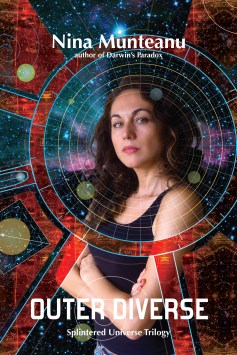 imprint,” Ka continued, now leaning forward with his cup in both hands, “and said that in the vital power of the human being, ignited at birth, that remembered image glows. That geometric-harmonic imprint is the music that impels each listener to dance … from the particle to the cosmic. Your own heart finds its shifting harmony between excessive order and complete randomness, encompassing complex variability—a symphony—in its beating pattern. Sound—vibration—is the language of the mind and the secret to creation.”
 On Friday, June 9th, I drove with friend, songwriter and poet Honey Novick, to the 15th International Writers’ and Artists’ Festival in Val-David, Quebec (June 10th and 11th, 2017). Celebrated artists, poets, writers and singers with an international heritage that included France, Chile, Argentina, Romania, Canada and the USA would congregate at the festival, set in a large house nestled deep in the Maple Laurentian forest.

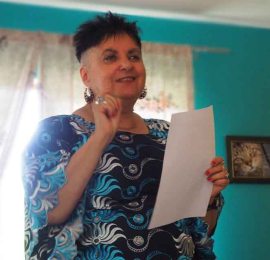



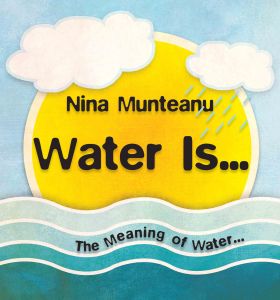 “Water Is…”: I shared the inspiration and making of my latest book, “Water Is…”, a scientific study and personal journey as limnologist, mother, teacher and environmentalist, which was recently picked by Margaret Atwood in the NY Times as 2016 ‘Year in Reading’ and recommended by Water Canada as ‘


 Eco-Fiction






 Nina Munteanu Writing Coach