The A to Z of Writing Fiction: G, H, I…

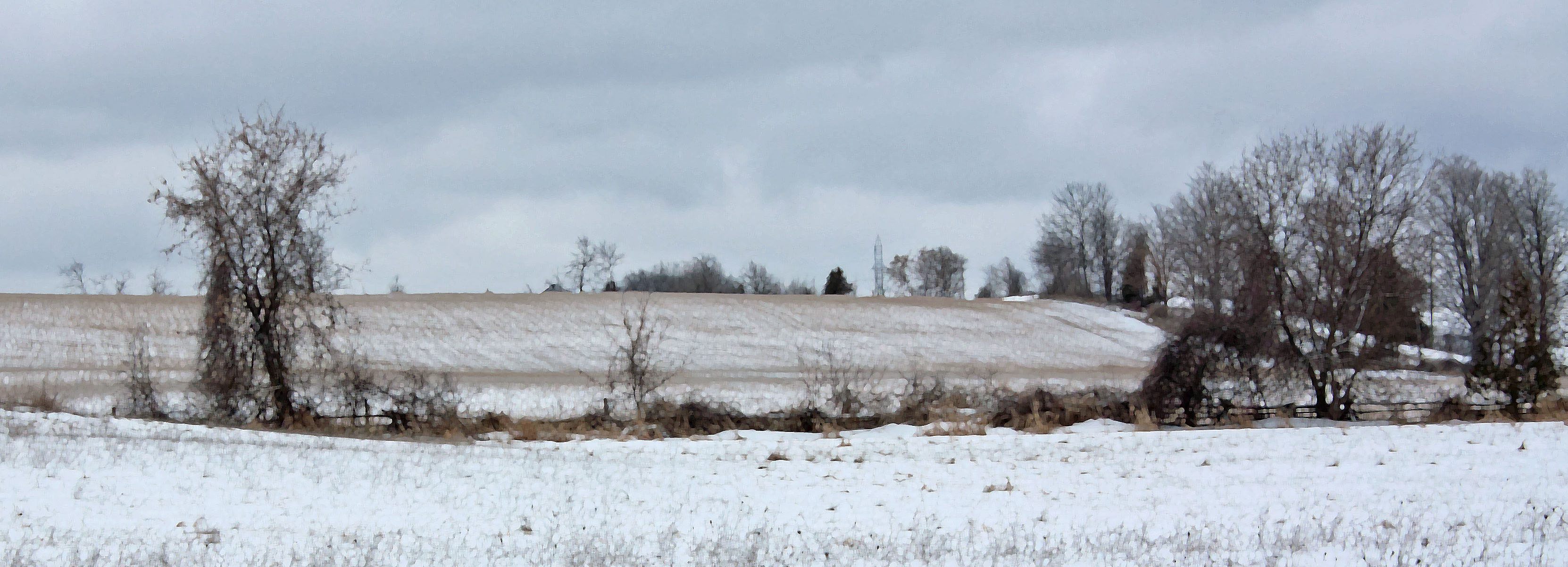
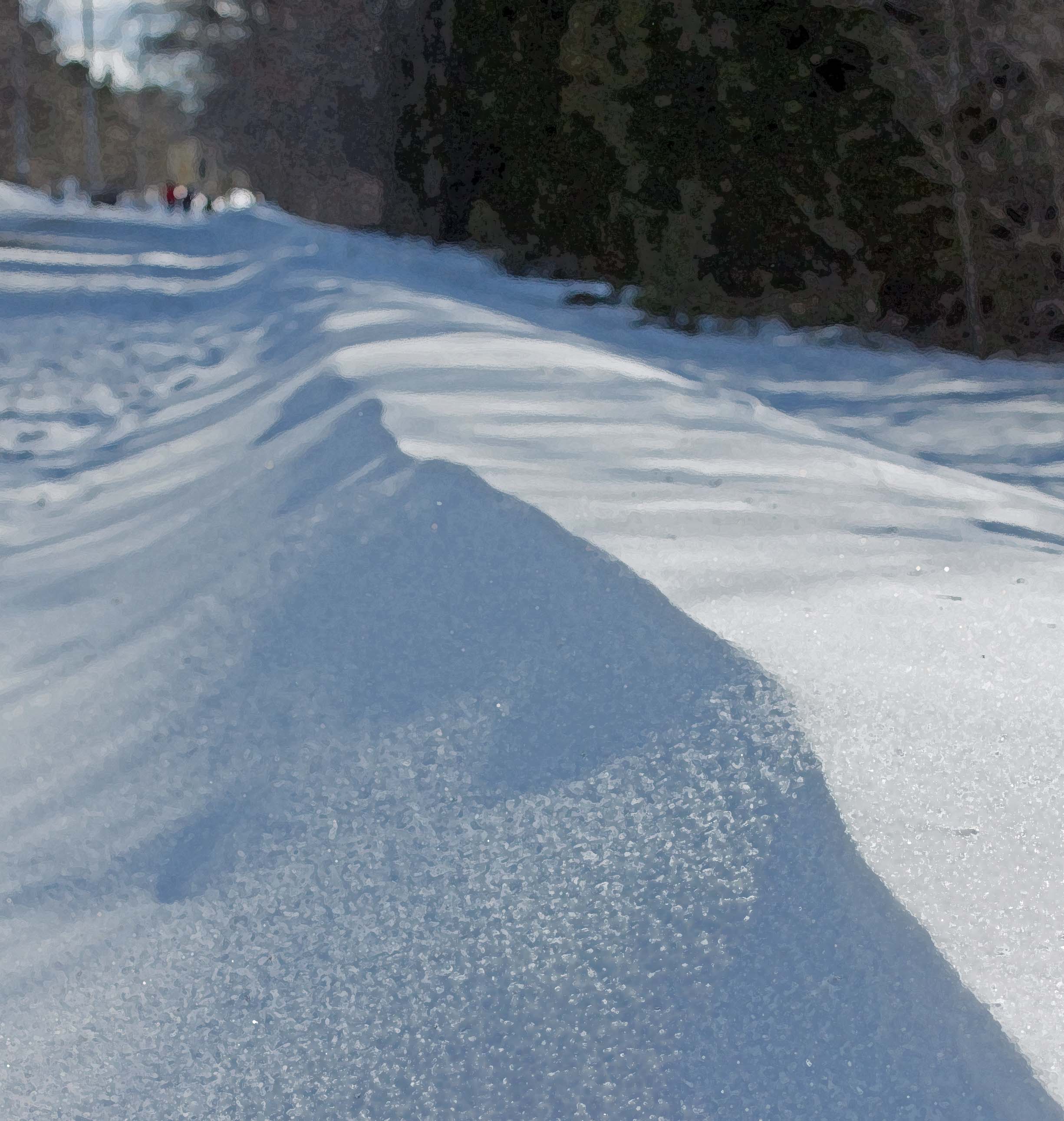
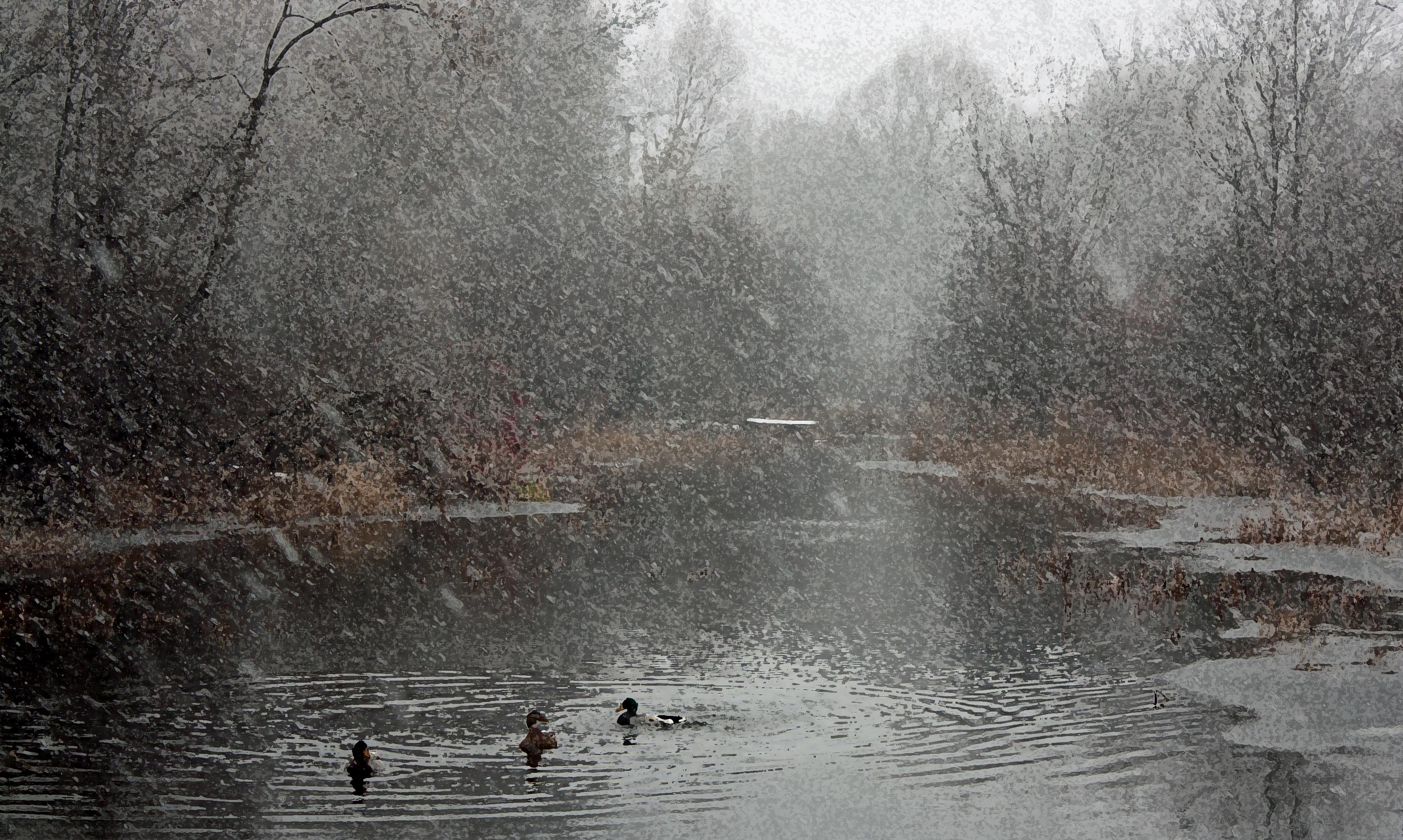
Snowing in the Kawarthas, ON (photo and rendition by Nina Munteanu)

In this series of articles, I draw from key excerpts of my textbook on how to write fiction The Fiction Writer: Get Published, Write Now! whose 26 chapters go from A to Z on the key aspects of writing good and meaningful fiction.

G is for Defining your Genre & Going Beyond It

Although genres are not precisely definable, genre considerations are one of the most important factors in determining what a person will see or read. Many genres have built-in audiences and corresponding publications that support them, such as magazines and websites.

For a long time people considered that books and movies that are difficult to categorize into a genre were likely to be less successful commercially. This is no longer the case, thanks to online bookstores like Amazon, that are able to ‘shelve’ books under multiple categories for people to find. In fact, having your book cross several genres (called “cross-genre” or slipstream) may even provide an advantage in that your book will occupy not just one but several niches—akin to placing your bets on several horses rather than just one.

So, if you haven’t figured out what genre your writing falls under, start figuring it out now; your future publisher and marketer will want to know because they, in turn, have to tell their distributor and bookseller where to shelve the book. This is why you need to do this, no matter what you think of categorizing your work; the alternative is leaving it to Jack in the marketing department who may not have even read your book, but used the cover picture to figure it out. Yikes!

The key to this exercise, whether your work falls under one or more categories, is to understand your work well enough to be able to categorize it. And, by all means, break the rules of categorizing—just know why you are.

H is for House or Home…Creating Memorable Settings

Setting fulfills most of the core aspects of a story. Without a place there is no story. Setting serves multipurpose roles from helping with plot, determining and describing character to providing metaphoric links to theme. Setting, like the force in Star Wars, provides a landscape that binds everything into context and meaning. Without setting, characters are simply there, in a vacuum, with no reason to act and most importantly, no reason to care.

Settings can not only have character; they can be a character in their own right. A novelist may often find herself, when portraying several characters, painting a portrait of place. This is setting being “character”. The setting functions as a catalyst, and molds the more traditional characters that animate a story. Think of any of your favourite books, particularly the epics: The Wizard of Oz, Tale of Two Cities, Doctor Zhivago, Lord of the Rings, The Odyssey, etc. In each of these books the central character is really the place, which is inexorably linked to its main character.

Settings depict the theme of your story through metaphor. The setting and all the objects in it are described to your reader through your POV character. This gives you an excellent opportunity to show the mood, temperament, judgment and bias of your character and their place in their world.

I is for Interviews and other Weird Experiences

As a writer of either fiction or non-fiction, you will at some time require information from a real person. Depending on the nature of your research and its intended destination and audience, you may wish to conduct anything from a casual phone or email enquiry to a full-blown formal face-to-face interview. This will also depend on who you are interviewing, from a neighbour to a government official. The pillars of good journalism include:

  • thoroughness
  • accuracy
  • fairness and
  • transparency.

Here are some tips on what to do:

  • Do your research ahead of time: read up on your subject and include both sides of an issue (if that’s relevant). This helps you to respond intelligently with better follow-up questions.
  • Ask open-ended questions: avoid yes and no questions and get them to elaborate. Asking “why” solicits explanation, which will give your article depth.
  • Ask for examples: this provides a personal aspect to the article that gives it warmth and makes it more interesting.
  • Ask personal questions: what’s the worst thing that can happen? They can simply say no; the up side is you may get a gem. The personal angle from the interviewee’s perspective gives your
  • article some potential emotional aspect that gives it human-interest.
  • Ask the interviewee for any further thoughts to share: it’s an innocuous question, but can offer-up more gems. What it provides you with is the possibility of getting something you might not have thought of, sparked by your conversation.

Here are some tips on what NOT to do:

  • “There’s no rush.” Never reveal your deadline. Think about it; what do you normally do when there’s a deadline? Right…say it’s sooner than it really is.
  • “I’ve never covered this topic before.” This kind of information is inappropriate and may make your interviewee uncomfortable (worrying about your unproven abilities to properly interview her instead of focusing on her). Besides, it’s not what you know but what you learn that counts.
  • “I’ll be using what you say extensively.” Don’t assume and make promises you may not be able to keep, until after the interview.
  • “I don’t get it.” If you don’t understand something, get clarification rather than make a negative remark that tends to stop them dead in their tracks.“You can review the piece before it’s published.” This is something that can be dealt with over the phone to confirm facts; the source doesn’t need to see the whole piece before it’s published.
  • “This is going to be a fantastic article!” Keep your tone professional; there’s nothing wrong with being positive, but you should maintain a professional attitude that inspires confidence in the interviewee.

The Fiction Writer: Get Published, Write Now! (Starfire World Syndicate) May 2009. Nominated for an Aurora Prix Award. Available through Chapters/IndigoAmazonThe Book Depository, and Barnes & Noble.

The Fiction Writer is a digest of how-to’s in writing fiction and creative non-fiction by masters of the craft from over the last century. Packaged into 26 chapters of well-researched and easy to read instruction, novelist and teacher Nina Munteanu brings in entertaining real-life examples and practical exercises. The Fiction Writer will help you learn the basic, tried and true lessons of a professional writer: 1) how to craft a compelling story; 2) how to give editors and agents what they want; and 3) how to maintain a winning attitude.

“…Like the good Doctor’s Tardis, The Fiction Writer is larger than it appears… Get Get Published, Write Now! right now.”

David Merchant, Creative Writing Instructor
Snowing in cedar forest, ON (photo and rendition by Nina Munteanu)

Click here for more about my other guidebooks on writing.

Nina Munteanu is a Canadian ecologist / limnologist and novelist. She is co-editor of Europa SF and currently teaches writing courses at George Brown College and the University of Toronto. Visit www.ninamunteanu.ca for the latest on her books. Nina’s bilingual “La natura dell’acqua / The Way of Water” was published by Mincione Edizioni in Rome. Her non-fiction book “Water Is…” by Pixl Press (Vancouver) was selected by Margaret Atwood in the New York Times ‘Year in Reading’ and was chosen as the 2017 Summer Read by Water Canada. Her novel “A Diary in the Age of Water” was released by Inanna Publications (Toronto) in June 2020.

Interview with Author Simon Rose

My guest today is Calgary author Simon Rose, who has published eighteen novels for children and young adults, eight guides for writers, more than a hundred nonfiction books, and numerous articles on a wide range of topics.

Nina: Your most recently published books were those in The Stone of the Seer series. Remind us again of what it’s all about.

Simon: The Stone of the Seer is young adult historical fantasy series, featuring The Stone of the Seer, Royal Blood, and Revenge of the Witchfinder. The exciting story is mostly set in the mid-seventeenth century during the English Civil War. In The Stone of the Seer, Lady Elizabeth Usborne, Kate, and Tom encounter a magical stone, mysterious parchments and manuscripts, and an incredible time viewing device. In Royal Blood, Lady Elizabeth, Kate, and Tom are in London, witnessing the political turmoil at the time of the Civil War, including the king’s trial and execution. Revenge of the Witchfinder takes place in multiple time periods. The story features weird dreams, disturbing visions, parallel lives, and a bewildering identity crisis, as the lead characters discover to their horror that not even the passage of centuries can prevent a bloodthirsty witchfinder from the 1640s from seeking his deadly revenge.

Nina: Do you have any current projects?

Simon: Right now, I’m working on another historical fantasy novel series, this time set in the early years of World War II, that I’m hoping to publish next year. I’ve recently finished another story that takes place in the later stages of World War II and am putting the finishing touches to that one as well, potentially for publication the following year. Yet another series is currently in development in the same paranormal genre as my previously published Flashback series, which can learn more about on my website.

I’ve also been working on the script for a film project and continue to work on the adaptations of my Shadowzone series into screenplays for movies and TV shows. You can learn more about my work writing screenplays for clients and creating adaptations of my own work here on my website

Anyone interested in keeping up to date with the projects that I’m working on is always welcome to subscribe to my monthly newsletter, which you can do on my website.

Nina: You certainly seem to be very busy. You also do other work related to writing and publishing, right?

Simon: Yes, I offer coaching, editing, consulting, and mentoring services for writers of novels, short stories, fiction, nonfiction, biographies, and in many other genres, plus work with writers of scripts and screenplays.

I’m also a writing instructor and mentor at the University of Calgary and have some courses coming up in the fall, including Writing for Children and Youth. My own online courses, including Writing Historical Fiction and Writing for Children and Young Adults, are also always available.

I’ve just wrapped up work on a study guide for a fellow author’s historical fiction novel, set in World War I and World War II. You can learn more about my various coaching, editing, and consulting services, for all age groups and genres, on my website, as well as my services for business writing projects

Nina: So where can people buy your books?

Simon: People can buy The Stone of the Seer, Royal Blood, and Revenge of the Witchfinder, as well as all my other books, at Amazon and all the other usual places online, which you can link to on my website at www.simon-rose.com I’ll also be making some personal appearances at local events in the fall, where people can buy autographed copies of all the books in the series, as well as all my other novels.

Nina: Thanks Simon, for being my guest here today.

Simon: My pleasure, Nina.

You can learn more about Simon and his work on his website at www.simon-rose.com where you can also link to him on social media and at other locations online.

The Sound of Snow…

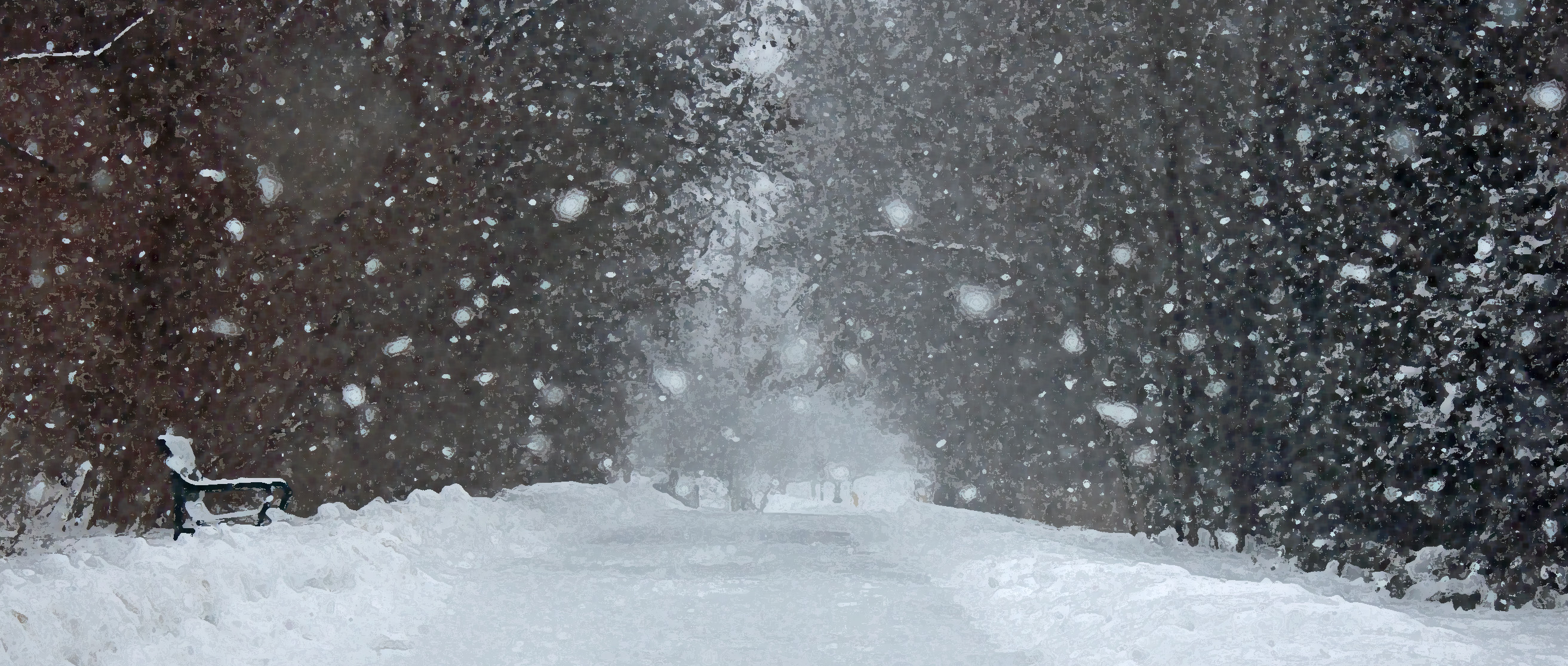
Heavy snowfall where I live in Ontario (photo by Nina Munteanu)

I currently live in Ontario, Canada, where the four seasons are still distinct and winter comes with signature cold temperature well below zero degrees Centigrade along with lots and lots of snow. I grew up in Quebec, where the snow often piled up higher than I stood tall. Temperatures often went into the minus zero teens and twenties with wind chills reaching minus thirty degrees. This called for the right equipment. Insulated coat or jacket, snow pants, wool toque and mittens and/or gloves that are also well insulated. And, of course, warm snow boots.

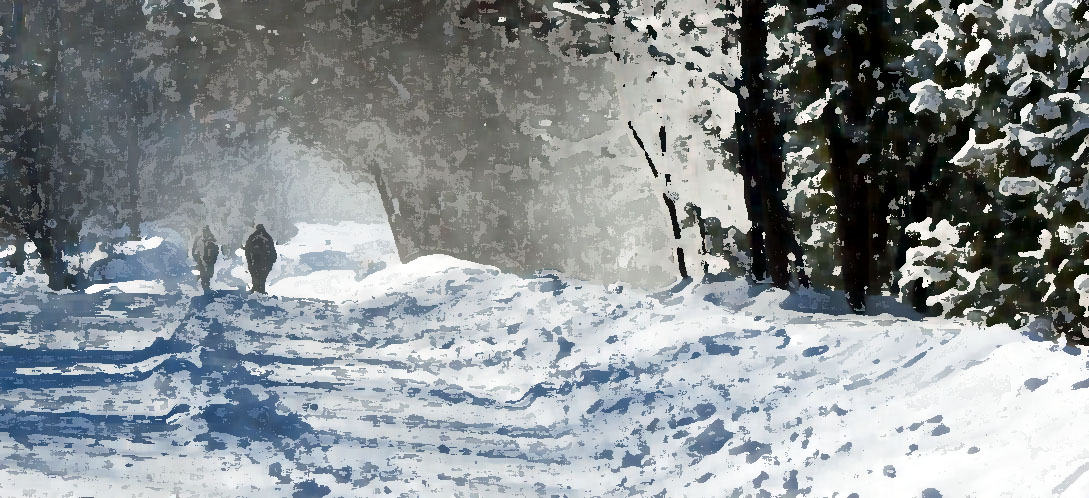
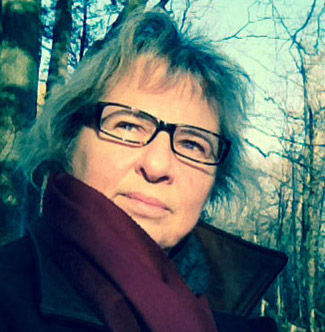
Nina on a walk during a snowstorm, ON (photo by Merridy Cox)
Country road in the Kawarthas, ON (photo and rendition by Nina Munteanu)
Nina’s car on ‘walkabout’ through Kawartha country after a fresh snowfall, ON (photo and rendition by Nina Munteanu)
Farm in the Kawarthas, ON (photo and rendition by Nina Munteanu)
Cows on a farm in the Kawarthas, ON (photo and rendition by Nina Munteanu)
Country field in Kawarthas, ON (photo and rendition by Nina Munteanu)
School kids heading to class after a fresh snow, ON (photo by Nina Munteanu)
The Rotary Trail after a fresh snowfall, ON (photo and rendition by Nina Munteanu)
Heavy snow falls on a trail in the Kawarthas, ON (photo and rendition by Nina Munteanu)

Since moving to the West Coast then back east to Ontario, I’ve come to realize that I love winters. I love how snow covers everything, how it quiets the landscape and changes it in subtle ways. I love the frigid wind, how it bites the face with invigorating energy, reminding me that I am so alive. I love the sounds of winter, of walking on snow, crunching and squeaking, of the howl of the wind and the creaking and groaning of the trees, or the cracking and booming of the ice forming and reforming on the river.

Bridge over creek in Trent Nature Sanctuary during heavy snowfall, ON (photo and rendition by Nina Munteanu)
Jackson Creek after a fresh snowfall, ON (photo and rendition by Nina Munteanu)
Woman and her dog walk through cedar swamp forest after a fresh snowfall, ON (photo and rendition by Nina Munteanu)
Riparian forest clothed in fresh snow, ON (photo and rendition by Nina Munteanu)
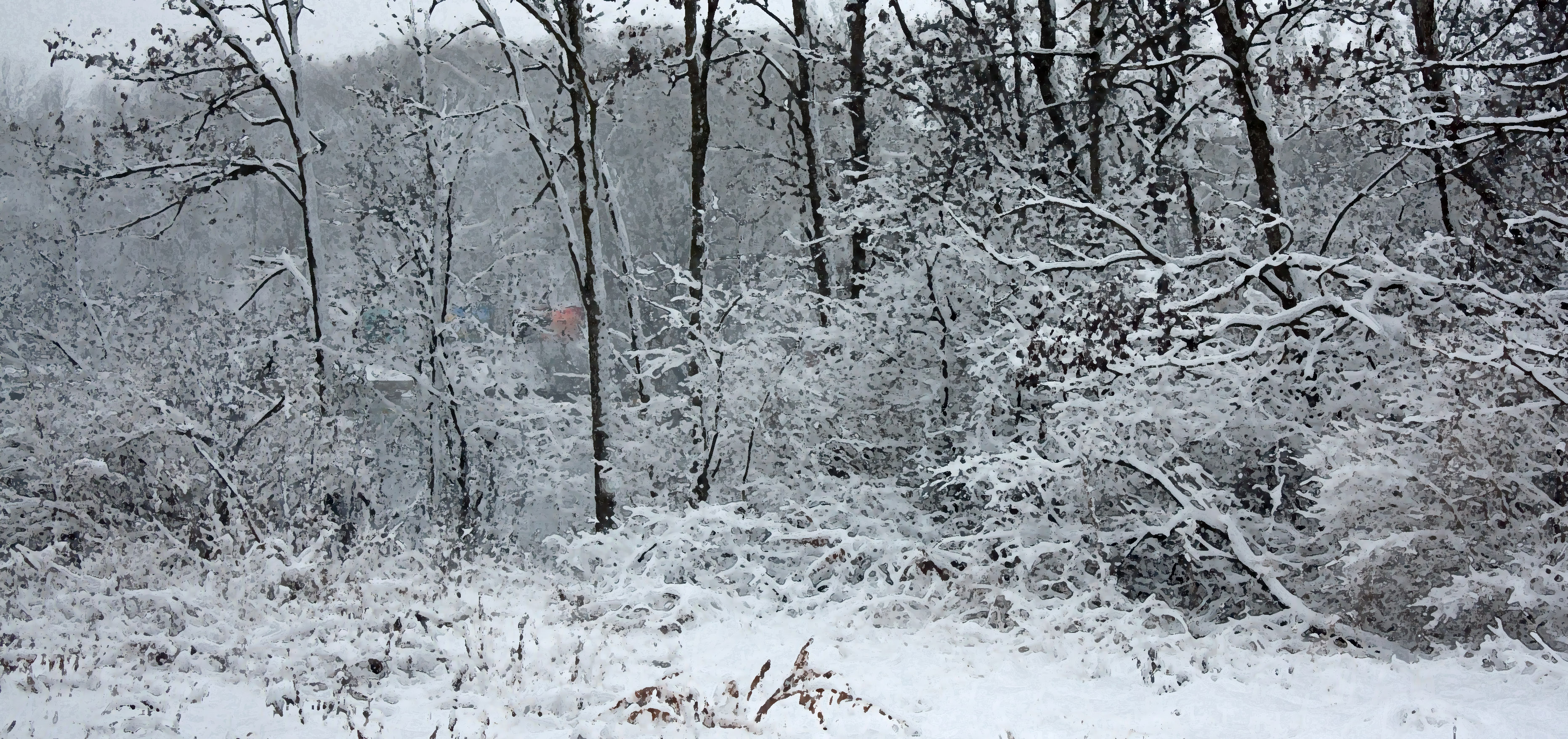
Riparian forest after a fresh snowfall, ON (photo and rendition by Nina Munteanu)

I am currently finishing my fiction book Thalweg, which takes place throughout Canada, but predominantly in northern British Columbia and the arctic of the Northwest Territories. My main character, a Gwich’in scientist, explores the land during a time of climate change, and much of it involves the expansive vast snowfields of northern Canada in which she describes the look, smell, feel, and sounds of snow. She thinks with great fondness of home in the Arctic where snow prominently features and, bringing in all her senses, of course, includes sound:

There are many different kinds of snow, and any native of the north can recognize them. We can not only tell something of the quality of weather from it, but also its history. Without having experienced the day or history of the place, we will know simply from walking through it. For instance, on a minus twenty-degree Centigrade day, when the cold bites your face and your breath coils out of your mouth like steam, old snow shines under a raking sun like an ice sheet. As though clear plastic was stretched over it. Sometimes, a hoar frost will form on the glassy thin layer, adding more glitter. Walking through it creates a symphony of crunch, pop and skittle sounds as each step breaks through the thin brittle layer into soft snow underneath. The scattering flat shards tingle like glass across the glistening ice-snow sheet.

Fresh snow that has fallen on a frigid night of minus fifteen degrees in a drier climate is fluffy, individual snowflakes glinting like jewels in the sun, and emits a high-pitched squeak and crunch as your boots press down on it. The colder the temperature, the higher the squeak. I just made that up. I’m not sure if it’s true. But considering the relationship of harmonics with temperature, it’s plausible.

Squeaky snow is the snow of my home up north, where it arrives in a thick passion in October with the winter darkness, and where a constant minus 16°C to minus 30°C pervades until spring, six months later. The snow resembles powdered sugar, glittering like millions of tiny mica flakes under the moonlight of an arctic winter night. It covers everything, the ground, the trees and tiniest vegetation with a white blanket of snow. And when the wind teases the trees, they rain glitter-dust. In places where the north wind freely drifts across open landscape, sastrugi form; frozen wavelets, mini-barchans and dune chains that resemble the wave ripples of a sandy white beach. In some vast open areas, the wind will sculpt a frozen sea of irregular ridges and grooves up to a metre high. Mary’s friend Jem from Igloolik calls these snowdrifts qimugruk, whose distinctive shapes become permanent features of the snowscape, with tips always pointing west-northwest. Igloolik hunters use these uqalurait to set their bearings when travelling across the expansive tundra, particularly during poor visibility from storms or darkness.

Tracks through a small path by the river, ON (photo and rendition by Nina Munteanu)
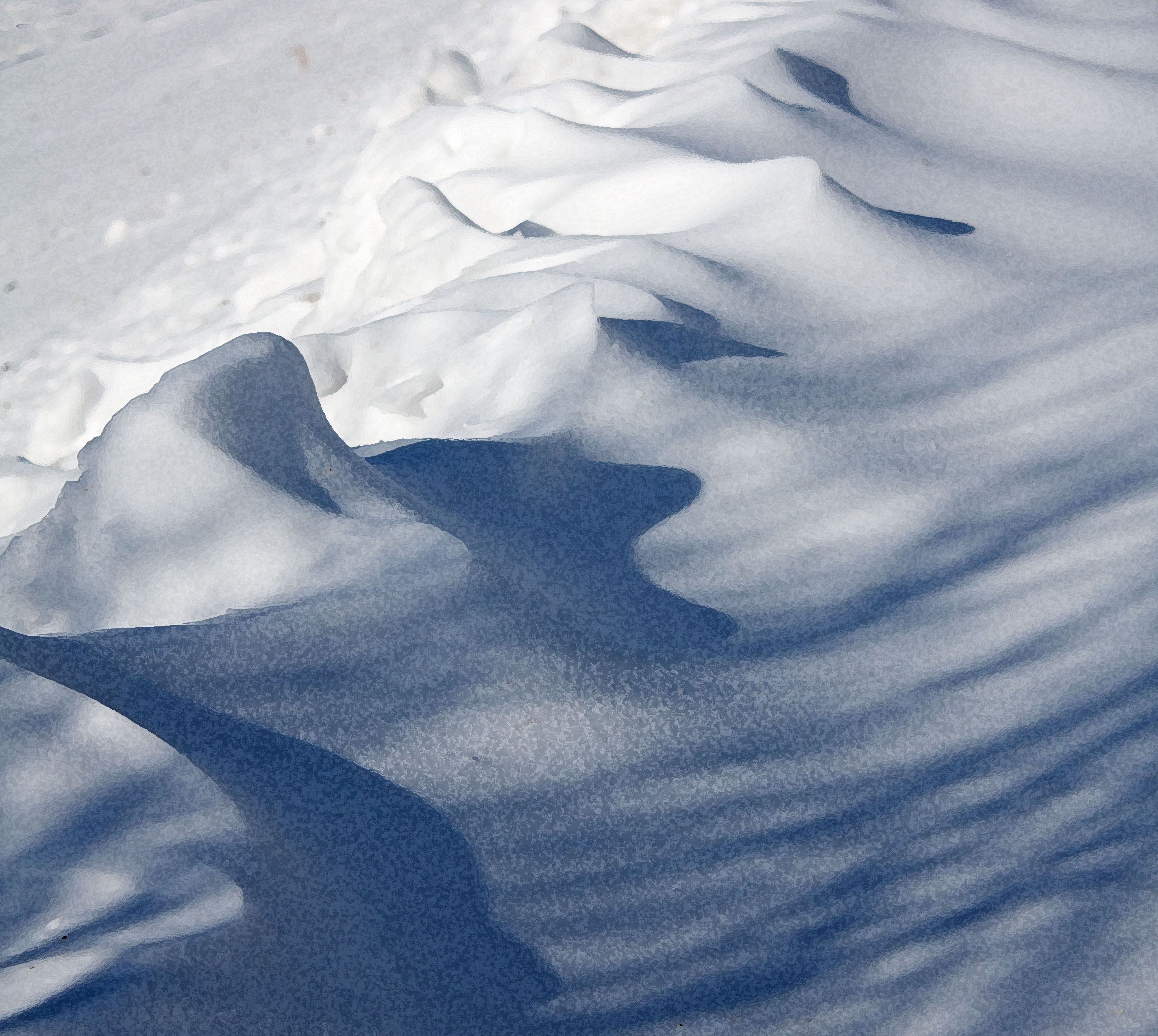
Snow drift on a trail by the river, ON (photo and rendition by Nina Munteanu)

One of the sensitivity readers for Thalweg, anthropologist and Gwich’in scholar Ingrid Kritsch, related to me an interesting account during attempts to open up to oil and gas development the Arctic National Wildlife Refuge–a critical area where the Porcupine Caribou herd calve. “To many Americans, it was just a big, white, barren expanse of unused lands,” said Ingrid. “She recalled a Senator speaking for development on these lands. The Senator held up a blank sheet of white paper and claimed ‘this is what the area looks like!’

The vast snowfields look nothing like that…

Snow drifts in Ontario (photo and rendition by Nina Munteanu)

…Now, don’t forget to play in the snow…

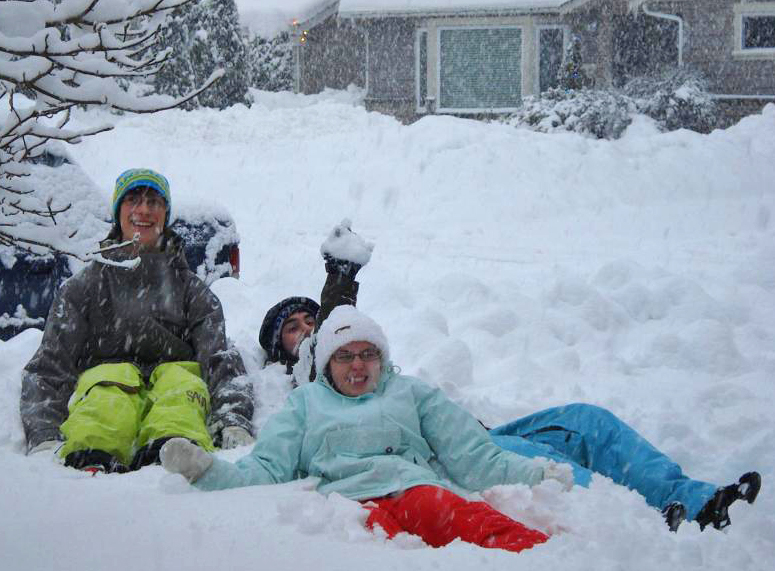
Author’s son and friends play in fresh snow on Christmas in BC (photo by Nina Munteanu)
Nina Munteanu reads a book with her cup of tea in +8 degree C, ON (photo by Merridy Cox)

Nina Munteanu is a Canadian ecologist / limnologist and novelist. She is co-editor of Europa SF and currently teaches writing courses at George Brown College and the University of Toronto. Visit www.ninamunteanu.ca for the latest on her books. Nina’s bilingual “La natura dell’acqua / The Way of Water” was published by Mincione Edizioni in Rome. Her non-fiction book “Water Is…” by Pixl Press(Vancouver) was selected by Margaret Atwood in the New York Times‘Year in Reading’ and was chosen as the 2017 Summer Read by Water Canada. Her novel “A Diary in the Age of Water” was released by Inanna Publications (Toronto) in June 2020.

The Power of Diary in Fiction—with Focus on “A Diary in the Age of Water” by Nina Munteanu

Last August I was invited by the University of Saskatchewan to give a talk at 20/21 Vision, their conference on Speculating in Literature and Film in Canada. My presentation was entitled “The Power and Relevance of Diary in Near-Future Mundane Science Fiction.”

The use of mundane realism through setting and events—particularly through letters or diary—creates powerful narrative that uniquely engages the reader with metaphor, allegory, and archetypes through additional sensibilities and personal connections. Devices such as POV, tense, and voice help create this form of storytelling.

What Is a Diary?

Diaries are first person accounts of real events relevant and meaningful to that person’s life experience. They are written in casual conversational language, usually a chronological account of daily life over lifetime, have wide scope; and are autobiographical.

If the scope is more narrow and focused, we have a memoir. The memoir is often focused by theme (e.g., addiction, loss, parenting, war, etc.). Memoirs are usually written in scenes and may trade accuracy for dramatic effect (emotional truth over historical truth). Anne Frank’s diary is a mundane account of her tragic short life in Nazi Germany; Yoko Ono experienced Hiroshima during World War 2.

If the focus is by topic, we get a journal (e.g. nature journal, grief journal, travel journal). Henry Henry David Thoreau’s journal became a manifesto for living simply with Nature; Sister Gargi’s journal was an ode to a spiritual movement.

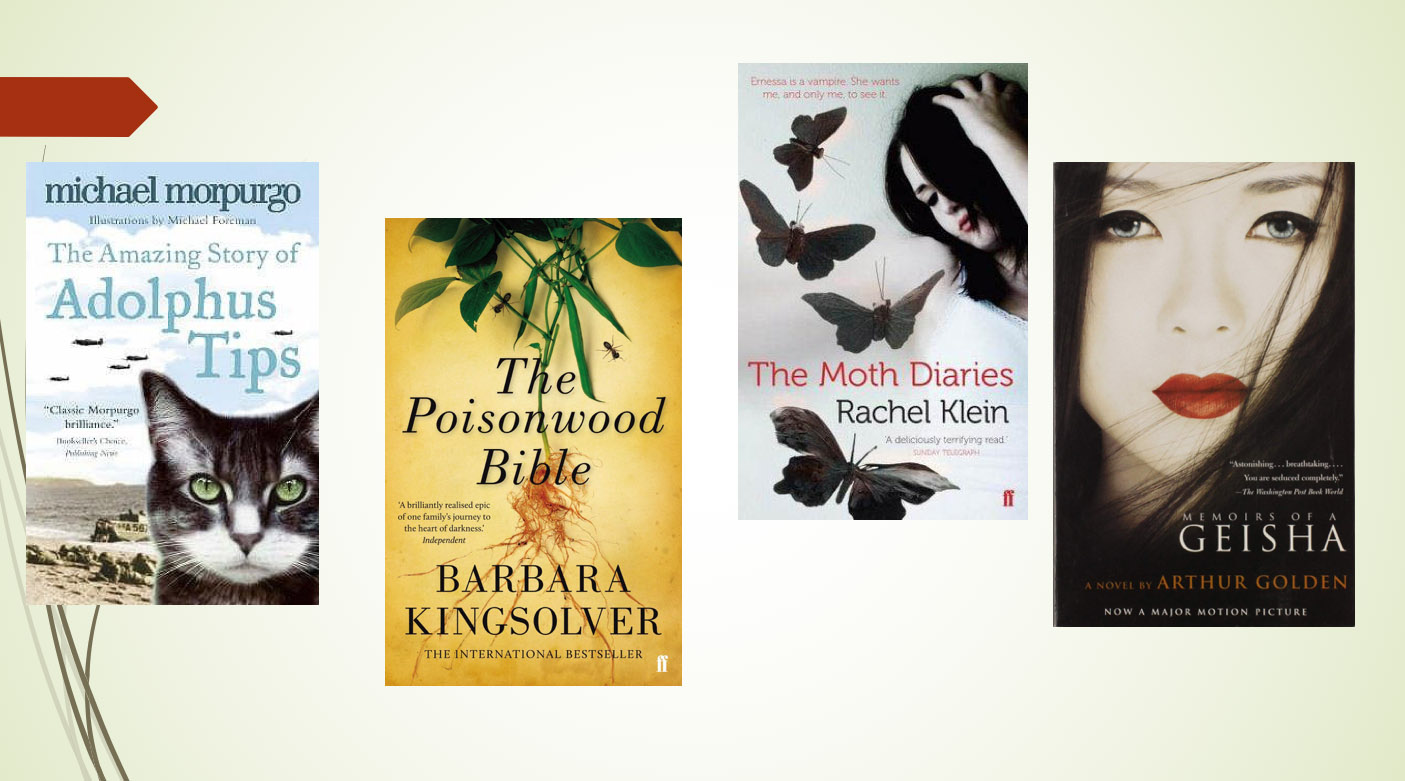
Examples of memoirs and journals

Non-Fiction in Fiction

The play of non-fiction in fiction is achieved through several tools. This includes:

  • use of point of view such as first person or second person; writing as an epistolary novel—or a series of letters—such as The Colour Purple
  • displaced narrative such as The Great Gatsby
  • detached autobiography such as To Kill a Mockingbird
  • interior monologue such as Finnegan’s Wake.
Examples of fictional diaries

Fictional diaries play on historical truth through emotional truth through narrator voice and use of metaphor. This provides authenticity, meaning, relevance, and impact to the story. Reality and fiction blur through realized premise that provides a gritty realism to the dramatization and intensifies the experience The diarist’s ability to introspect provides great insight for the reader to the protagonist’s inner voice, their eccentricities, and self-delusions. These provide great intimacy with the character.

Most fictional diaries are memoir-like because they are usually based on THEME which carries the meaning of the story. In The Poisonwood Bible, Barbara Kingsolver effectively uses several first person voices—of the mother and her four daughters—to provide more perspectives of the story.

Mundane Science Fiction

Mundane science fiction is a niche literary movement from 2004 focused on near-future realism—also called speculative fiction or literary SF. The focus is on already existing technology and plausible extensions—no ray guns, warp drives or time travel. The premise lies in existing circumstances and events. It has similarities with hard science fiction, cyberpunk, ecopunk, ecofiction and climate fiction. Mundane science fiction incorporates elements of literary fiction and mainstream fiction to achieve a strong sense of realism.

Examples of mundane science fiction

Mundane science fiction is the literature of near-future realism that explores how environmental and technological changes will change our lives. Christopher Cokinos calls mundane science fiction the “science fiction that functions more as compass than chimera.” Examples include cautionary tales and dystopias, all predicated on and launched from real events and phenomena—and including my own recent climate fiction “A Diary in the Age of Water.”

“A Diary in the Age of Water”: Mundane SF with Fictionalized Diary 

A Diary in the Age of Water” is the climate-induced journey of humanity through four generations of women, each with a unique relationship to water… Centuries from now, in a dying boreal forest in what used to be northern Canada, Kyo, a young acolyte called to service in the Exodus, yearns for Earth’s past—the Age of Water, before the “Water Twins” destroyed humanity. Looking for answers and plagued by vivid dreams of this holocaust, Kyo discovers the diary of Lynna, a limnologist from a time just prior to the destruction. The diary spans a 40-year period in the mid-21st century and describes a planet in the grips of severe water scarcity. Lynna in her work for the international utility that controls everything to do with water, witnesses and records in her diary the disturbing events that will soon lead to humanity’s demise.

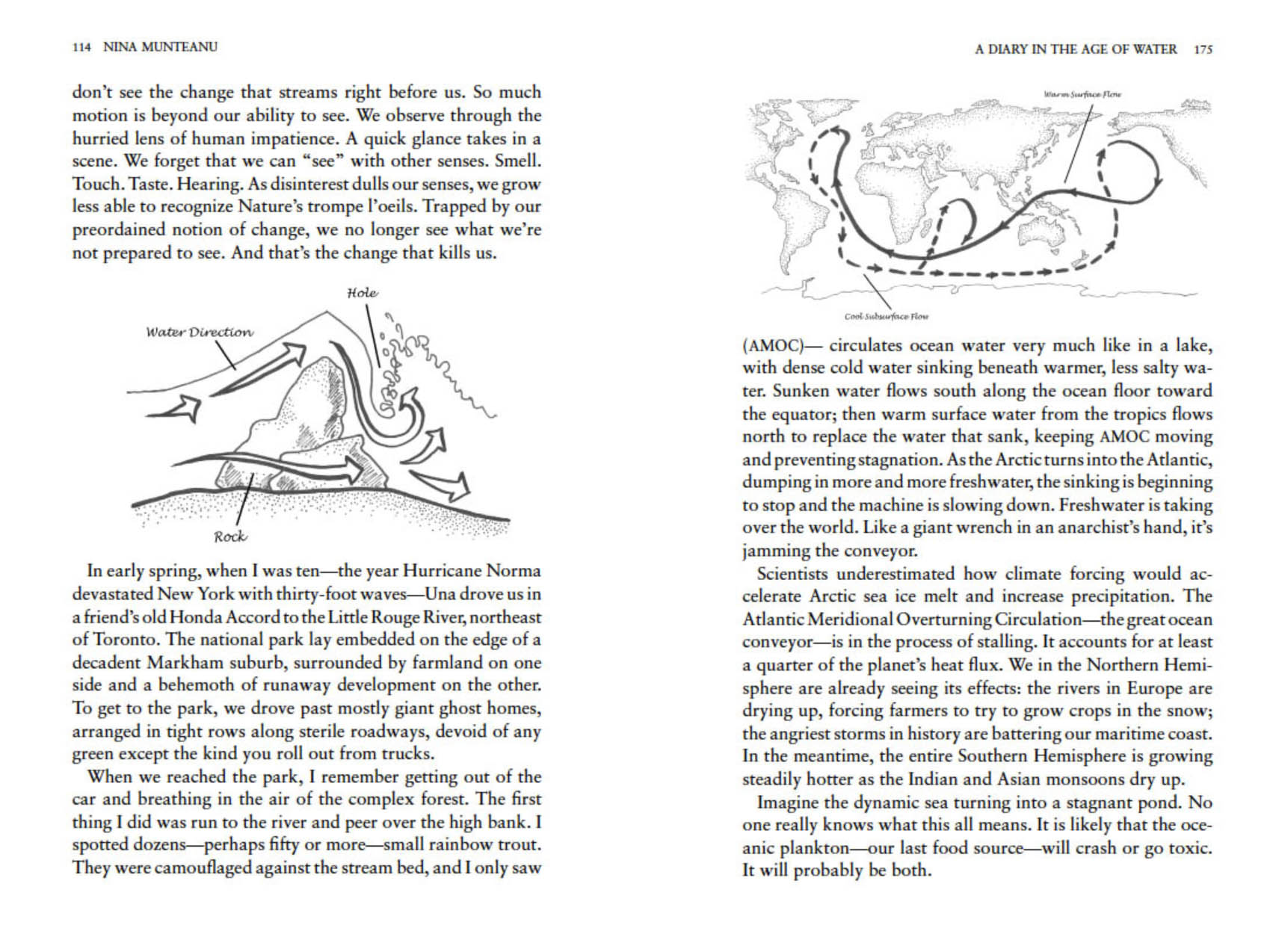
The story begins and ends in the far future with the blue being Kyo, who finds the diary of the limnologist, Lynna. The story is hard SF with a strong basis in science. This is obvious through the narrator, who is a scientist, and the form of the diary itself, in which each entry has an epigraph from a science textbook related to the experience in the entry. Lynna also includes sketches, formulas and other references to science and these appear in the entries.

The diary portion of the book is a first person narrative nested within the larger 3rd person narrative of Kyo in the far future. Its SETTING is based on many real events with dramatized fiction stitched in. This blurs what’s real and what’s fiction. VOICE and POV are used to achieve differing scope and time perspectives between the diarist’s world and that of the future being. We get insight into the inner voice of the diarist through 1st person voice; this is contrasted with the 3rd person voice of the future being—they remain on the outside, looking in. The PLOT is essentially that of a young future human “in discovery”, a metaphoric coming of age for humanity.

The diary format includes the use of:

  • short entries with epigraphs and quotes from fact
  • conversational voice of intimacy with introspection, opinion, and judgment
  • outer conflict with family and colleagues
  • inner conflict with motivations and truths
  • metaphoric connections with water
  • illustrations embedded in the diary entries
Two pages with illustrations in ‘A Diary in the Age of Water’

The diarist is a real and flawed protagonist—this makes her more like us and we are more likely to empathize with her despite her considerable flaws … Lynna makes mistakes and does some terrible things, but the diary allows the reader to find out more about why she does these things, what motivated her and how she feels, including remorse and regret. This allows the reader to forgive Lynna, even as her own daughter cannot, even as she cannot. This becomes key to the story, which is about forgiveness. The diary abruptly ends with pages torn out and Kyo is anxious to know what happened to both Lynna and her world. So is the reader.  

Responses to “A Diary in the Age of Water”

Readers and reviewers had interesting responses, some paradoxical:

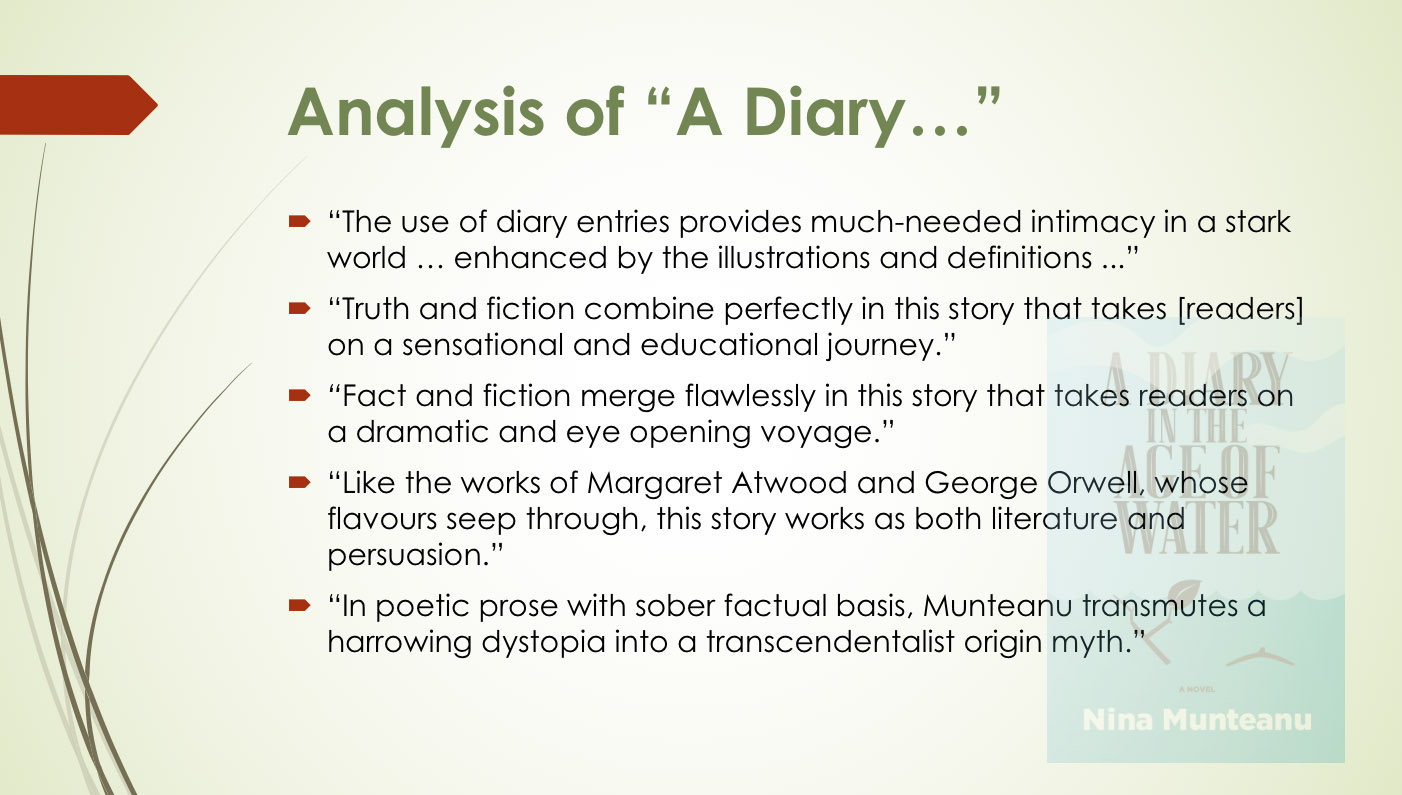
The blur of real events/history and fictional action brought the story into living colour. Several readers confided in me that they often did not know what was non-fiction and what was fiction and that this confusion made the book more gripping. Several reviewers, caught up in the blur of non-fiction with fiction, accused the book of being overtly polemic, when it was the fictional diarist who was proselytizing and being protective and narrow-minded; one need only look to the diarist’s daughter and her actions to see another voice).

In their analysis, reviewers gave the following visceral responses:

In her review of ‘A Diary in the Age of Water’ in The Temz Review, Marcie McCauley writes:

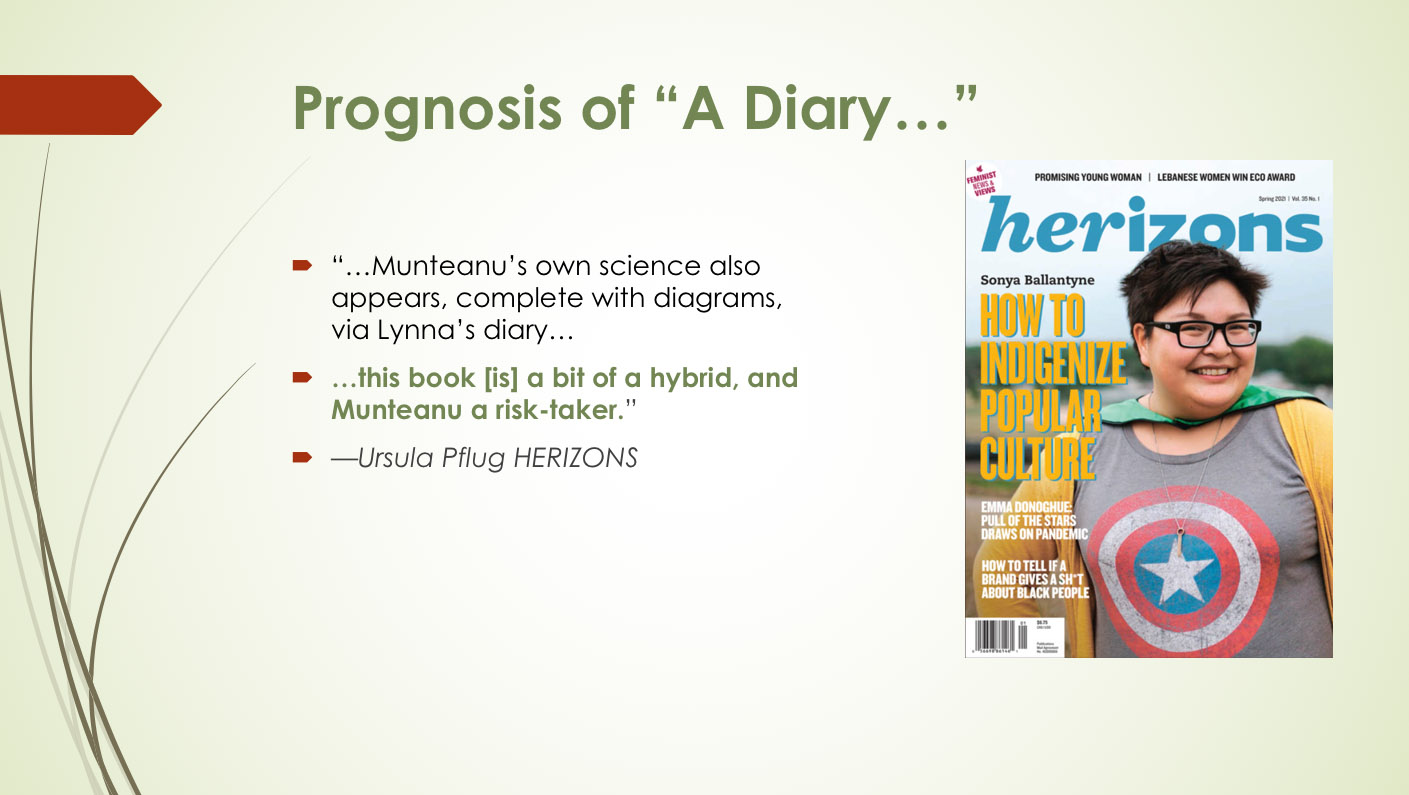
Munteanu “invites readers to recognize themselves in the ‘historical’ story and to project themselves into her imagined future…the diary…operates as a doorway…Munteanu combines methodologies, familiar literary motifs with text and images from non-fiction…She does not appear to view fiction and non-fiction as separate territories; or, if she does, then this book is a bridge between them.”

That blur with reality makes readers both love and hate the novel and it is precisely this that makes them read on. They are thoroughly invested. They need to know how it turns out, as though this is real lives at stake.

Red maple leaf sits on mossy log of old growth forest, ON (photo and rendition by Nina Munteanu)

NINA MUNTEANU is a Canadian ecologist / limnologist and novelist. She is co-editor of Europa SF and currently teaches writing courses at George Brown College and the University of Toronto. Visit  www.ninamunteanu.ca for the latest on her books. Nina’s bilingual “La natura dell’acqua / The Way of Water” was published by Mincione Edizioni in Rome. Her non-fiction book “Water Is…” by Pixl Press(Vancouver) was selected by Margaret Atwood in the New York Times ‘Year in Reading’ and was chosen as the 2017 Summer Read by Water Canada. Her novel “A Diary in the Age of Water” was released by Inanna Publications (Toronto) in June 2020.

Climate Cultures Magazine Lists Nina Munteanu’s “A Diary in the Age of Water” Among Eight Eco-Fiction Novels to Read

Writer and curator Mary Woodbury shares eight novels about water where fact and fiction mingle, tried by imagination, to reveal important truths about our shifting relationships with this vital and lively agent in an era of climate crisis,” writes the magazine Climate Cultures.

In an article entitled, “Where Waters and Fictions Meet,” Mary Woodbury opens with this:

“While facts are something we can and should pay attention to as we follow scientific integrity, models, and reports, another mode of telling the story about water has been alive forever: churned, spoken, and written by authors who dream up fictional stories related to our past, present, and future world. Where fact and fiction mingle like this is an area of reflection and speculation, tied by imagination. These tales of water ripple out once the pebble sinks in. The intersectionality of diverse water fiction results in reader empathy, learning, inspiration, and shared commonalities around the world. Local dignity comes alive against a backdrop of planetary crises.”

She chooses the following eco-novels to discuss:

“Land-Water-Sky (Ndè-Ti-Yat’a)” by Katłıà
“Oil on Water” by Helon Habila
“A Diary in the Age of Water” by Nina Munteanu
“The Water Knife” by Paolo Bacigalupi
“Memory of Water” by Emmi Itäranta
“Fever Dream” by Samanta Schweblin
“Lagoon” by Nnedi Okorafor
“Bangkok Wakes to Rain” by Pitchaya Sudbanthad

Here’s what she writes about my novel:

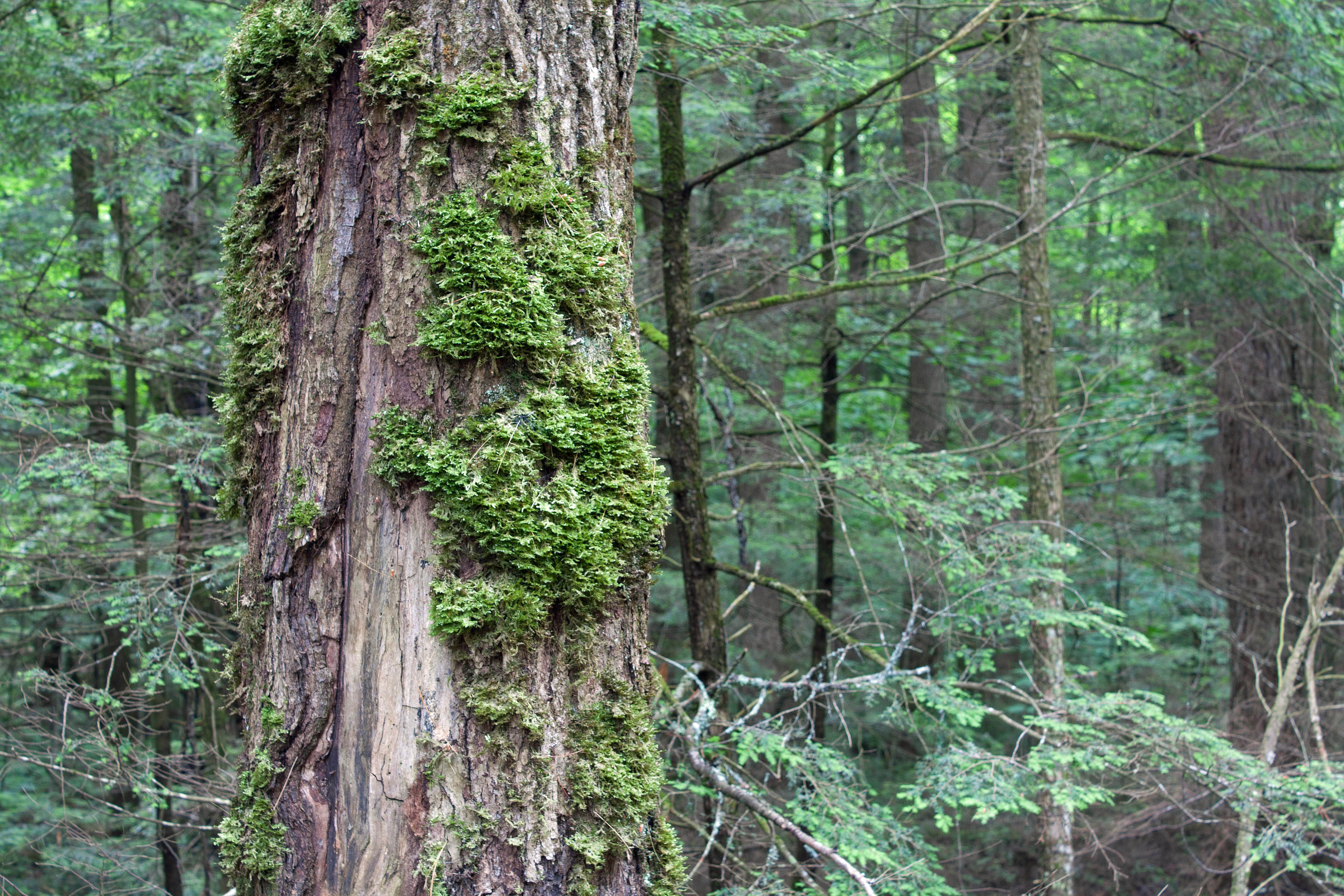
Ancient Eastern Hemlock in Catchacoma old-growth forest, ON (photo by Nina Munteanu)

NINA MUNTEANU is a Canadian ecologist / limnologist and novelist. She is co-editor of Europa SF and currently teaches writing courses at George Brown College and the University of Toronto. Visit  www.ninamunteanu.ca for the latest on her books. Nina’s bilingual “La natura dell’acqua / The Way of Water” was published by Mincione Edizioni in Rome. Her non-fiction book “Water Is…” by Pixl Press(Vancouver) was selected by Margaret Atwood in the New York Times ‘Year in Reading’ and was chosen as the 2017 Summer Read by Water Canada. Her novel “A Diary in the Age of Water” was released by Inanna Publications (Toronto) in June 2020.

Nina Munteanu Interviewed by Joseph Planta on ‘The Commentary’

Joseph Planta had interviewed me before, when my non-fiction book Water Is…The Meaning of Water was published in 2016. He interviewed me again when my latest novel a cli-fi dystopian speculative fiction A Diary in the Age of Water was released by Inanna Publications.

Here’s how Joseph began the interview:

“I am Planta: On the Line, in Vancouver, British Columbia, at TheCommentary.ca

Nina Munteanu joins me again. She has just published a new novel, A Diary in the Age of Water. The noted writer and limnologist, a freshwater scientist, has written a book that could be considered science fiction. I suppose ‘cli-fi’ is the better term, climate-based science fiction. In the book, far away in a post-climate change world, Kyo finds a diary that gives her insight into the world before water scarcity. I’ll get Nina to tell us about Kyo, about the themes in this book, especially the world ahead if we continue as we do. Nina Munteanu is an author and ecologist. She has published many books of science fiction and fantasy, and was first on the program in 2016 when her book Water Is… The Meaning of Water was published. The website for more is at www.ninamunteanu.ca. This new book is from Inanna Publications. Please welcome back to the Planta: On the Line program, Nina Munteanu; Ms. Munteanu, good morning…”

Here’s the Interview.

NINA MUNTEANU is a Canadian ecologist / limnologist and novelist. She is co-editor of Europa SF and currently teaches writing courses at George Brown College and the University of Toronto. Visit  www.ninamunteanu.ca for the latest on her books. Nina’s bilingual “La natura dell’acqua / The Way of Water” was published by Mincione Edizioni in Rome. Her non-fiction book “Water Is…” by Pixl Press(Vancouver) was selected by Margaret Atwood in the New York Times ‘Year in Reading’ and was chosen as the 2017 Summer Read by Water Canada. Her novel “A Diary in the Age of Water” was released by Inanna Publications (Toronto) in June 2020.

On Writing: Nina Munteanu Interviewed by Lisa Haselton

The Otonabee River glints in the sunlight in the midst of a snow flurry, ON (photo and rendition by Nina Munteanu)

This time last year reviewer Lisa Haselton posted an interview with me on New Year’s Day of 2021 on my latest release “A Diary in the Age of Water.” 2021 saw incredible sales for my clifi eco-novel, along with several appearances on radio shows, podcasts and TV stations. It would seem that water is on everyone’s mind and what better way than a limnologist’s diary to learn more about it.

Lisa and I talked about what inspired me to write this novel and about my writing process. What follows is part of that interview. Check out this link for the complete interview with Lisa Haselton.

*****

Lisa: Please tell us about your current release.

Nina: The book tells the journey of four generations of women who have a unique relationship with water, through a time of extreme climate change and water shortage. The book spans over forty years (from the 2020s to the 2060s) and into the far future, mostly through the diary of a limnologist, which is found by a future water-being. During the diarist’s lifetime, all things to do with water are overseen and controlled by the international giant water utility CanadaCorp—with powers to arrest and detain anyone. This is a world in which China owns America and America, in turn, owns Canada. The limnologist witnesses and suffers through severe water taxes and imposed restrictions, dark intrigue through neighbourhood water betrayals, corporate spying and espionage, and repression of her scientific freedoms. Some people die. Others disappear…

Ultimately, the book carries themes of hope and forgiveness—of ourselves and each other—and compassion for all things, starting with water. Each character carries an aspect of that theme, from the diarist’s activist mother, to the diarist’s own cynical protectionism, her spiritual anarchist daughter, and lastly the innocent storm of the last generation.

Lisa: What inspired you to write ‘A Diary in the Age of Water’?

Nina: It started with a short story I was invited to write in 2015 about water and politics in Canada.  I had long been thinking of potential ironies in Canada’s water-rich heritage. The premise I wanted to explore was the irony of people in a water-rich nation experiencing water scarcity: living under a government-imposed daily water quota of 5 litres as water bottling and utility companies took it all. I named the story “The Way of Water.” It was about a young woman (Hilda) in near-future Toronto who has run out of water credits for the public wTap; by this time houses no longer have potable water and their water taps have been cemented shut; the only way to get water is through the public wTaps—at great cost. She’s standing two metres from water—in a line of people waiting to use the tap—and dying of thirst.

The short story and the novel that came from it explore the nuances of corporate and government corruption and deceit together with global resource warfare. In this near-future, Canada is mined of all its water by thirsty Chinese and US multinationals—leaving nothing for the Canadians. Rain has not fallen on Canadian soil in years due to advances in geoengineering and weather manipulation that prevent rain clouds from going anywhere north of the Canada-US border. If you’re wondering if this is possible, it’s already happening in China and surrounding countries.

Lisa: As a child, what did you want to be when you grew up?

Nina: After astronaut, actress and a drummer in a rock and roll band—seriously—it was paperback writer. That’s been my dream since I was ten. I told stories long before I wrote them and long before any of them was published. I told stories in the form of cartoons. Since I was a small child, I wanted to be a cartoonist and write graphic novels (back then I knew them as comics). I created several strips with crazy characters that I drew, blending my love for drawing with my love for storytelling. My sister and I used to make up amazing adventure stories in the universe, peopled with aliens and crazy worlds. I wrote my first complete novel when I was fifteen (“Caged-In World”—which later served as a very rough draft for my first published novel, “Darwin’s Paradox” in 2007). My first published work was a non-fiction article “Environmental Citizenship” which appeared in Shared Vision Magazine in 1995. My first fiction work was a short story entitled “Arc of Time”, which was published in Armchair Aesthete in 2002.

Heavy snowfall in the forest in early winter, ON (photo and rendition by Nina Munteanu)

Lisa: When did you first consider yourself a writer?

Nina: I’ve considered myself a storyteller since I was a child when I wrote and directed plays that my older brother and sister played in and drew cartoon adventure stories. My dream was to be a paperback writer (like the Beatles tune). But I didn’t think of myself seriously as an author until my first short story was published in 2002. It was called “Arc of Time” and appeared in a small magazine with a circulation of about 200. That story went on to be reprinted several times in larger magazines and led to a career of award-winning short stories—the latest appearing in the literary magazine subTerrain in 2020.

Lisa: Do you write full-time? If so, what’s your work day like? If not, what do you do other than write and how do you find time to write?

Nina: While I don’t write full-time, my career is all about writing. Every day I write and research my next novel; I also write commissioned articles and short stories for magazines and for my several writing and science blogs. When I’m not writing, I teach writing at the University of Toronto and George Brown College. I also coach writers online to publication. Finding time to write has not generally been a challenge. I’ve embraced an opportunistic process in my writing and research that allows me to write considerably. The process recognizes that there are many ways to “write” from observations and note-taking, to reading and research, to writing short vs long and fiction vs non-fiction. For instance, I can fill a short break time with meaningful research, editing, or the start of a short article; this saves longer break times for my current novel, which requires a greater stretch of uninterrupted time.

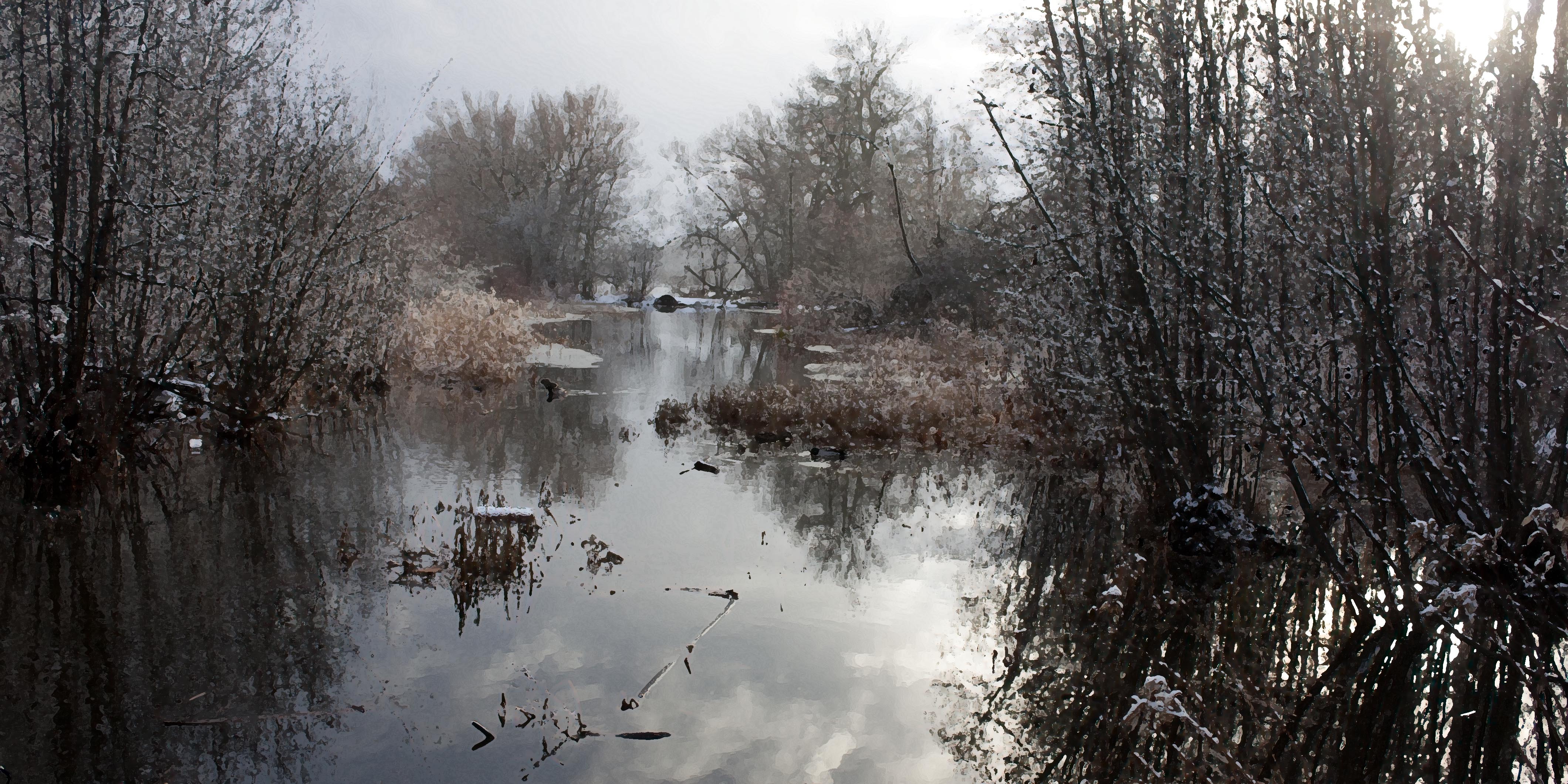
Heavy snowfall in the marsh in early winter, ON (photo and rendition by Nina Munteanu)

Lisa: What would you say is your interesting writing quirk?

Nina: That I am both a pantser and an outliner—with the same book. My writing process has always been a tandem kind of ‘fish and cut bait’ scene / sequel scenario with research following a premise followed by vigorous writing, which in turn engenders more research, which often reveals another plot or sub-theme that needs inclusion. It may seem a haphazard way to write, but I find it very fulfilling, fun and revealing—especially when the Universe provides with serendipitous discoveries (just when I need them). 

Lisa: What exciting story are you working on next?

Nina: I’m currently researching and working on the sequel to “A Diary in the Age of Water”—a thriller about how a phenomenon brings together four lost and homeless people through a common goal to free the Earth from the manacles of human greed. The story takes place throughout Canada—from Halifax to Vancouver and the Arctic. It takes place mostly during the 2050s, and features a few ghosts, the Halifax 1917 Explosion, experimentation on humans, espionage, murder, and—of course—a plague. I’m calling it my COVID19 novel…

Use this link to read my entire interview with Lisa Haselton.

Sun emerges after a heavy snowfall at the marsh, ON (photo and rendition by Nina Munteanu)

Nina Munteanu is a Canadian ecologist / limnologist and novelist. She is co-editor of Europa SF and currently teaches writing courses at George Brown College and the University of Toronto. Visit www.ninamunteanu.ca for the latest on her books. Nina’s bilingual “La natura dell’acqua / The Way of Water” was published by Mincione Edizioni in Rome. Her non-fiction book “Water Is…” by Pixl Press(Vancouver) was selected by Margaret Atwood in the New York Times ‘Year in Reading’ and was chosen as the 2017 Summer Read by Water Canada. Her novel “A Diary in the Age of Water” was released by Inanna Publications (Toronto) in June 2020.

I Became a Climate Activist in the 1960s

Two cedar trees entangle their roots in a cedar forest in Warsaw Caves Park, ON (photo and rendition by Nina Munteanu)

In 1969, I completed my first novel at the tender age of fifteen. Caged in World was a hundred-page speculative story about a world that had moved “inside” to escape the ravages of a harsh post climate-change environment. 

1969 was the year that humans first stepped on the moon and the first Concorde test flight was conducted in France. But I was concerned by the environment and what was happening on our planet. It was seven years since Rachel Carson had published Silent Spring, which warned of our declining bird and bee populations and impacts to human health from unregulated pesticide/herbicide use (such as carcinogens and hormone disruptors). It was just a year after Paul Erlich’s Population Bomb warned that attempts to stretch the Earth’s resources to support the ever-growing population would result in mass starvation, epidemics, and, ultimately, the breakdown of social order. 

In the 1960s it was already apparent to me that environmental imbalance and destruction were global concerns and we were on the brink of an environmental crisis.  Unchecked deforestation was destroying forests around the world, including the boreal and old-growth forests of my own country Canada. Brazil had already begun cutting down trees and burning forest at an alarming rate. Unregulated use of pesticides, herbicides and growth hormones created toxic contamination of our natural world and our food and water supply—despite Carson’s dire warning with Silent Spring. Our waterways were being contaminated by mining wastes and industrial effluents. Killer smog. Noxious algal blooms. Oil spills. Dead zones. The list was growing.

Rachel Carson and her iconic book, Silent Spring

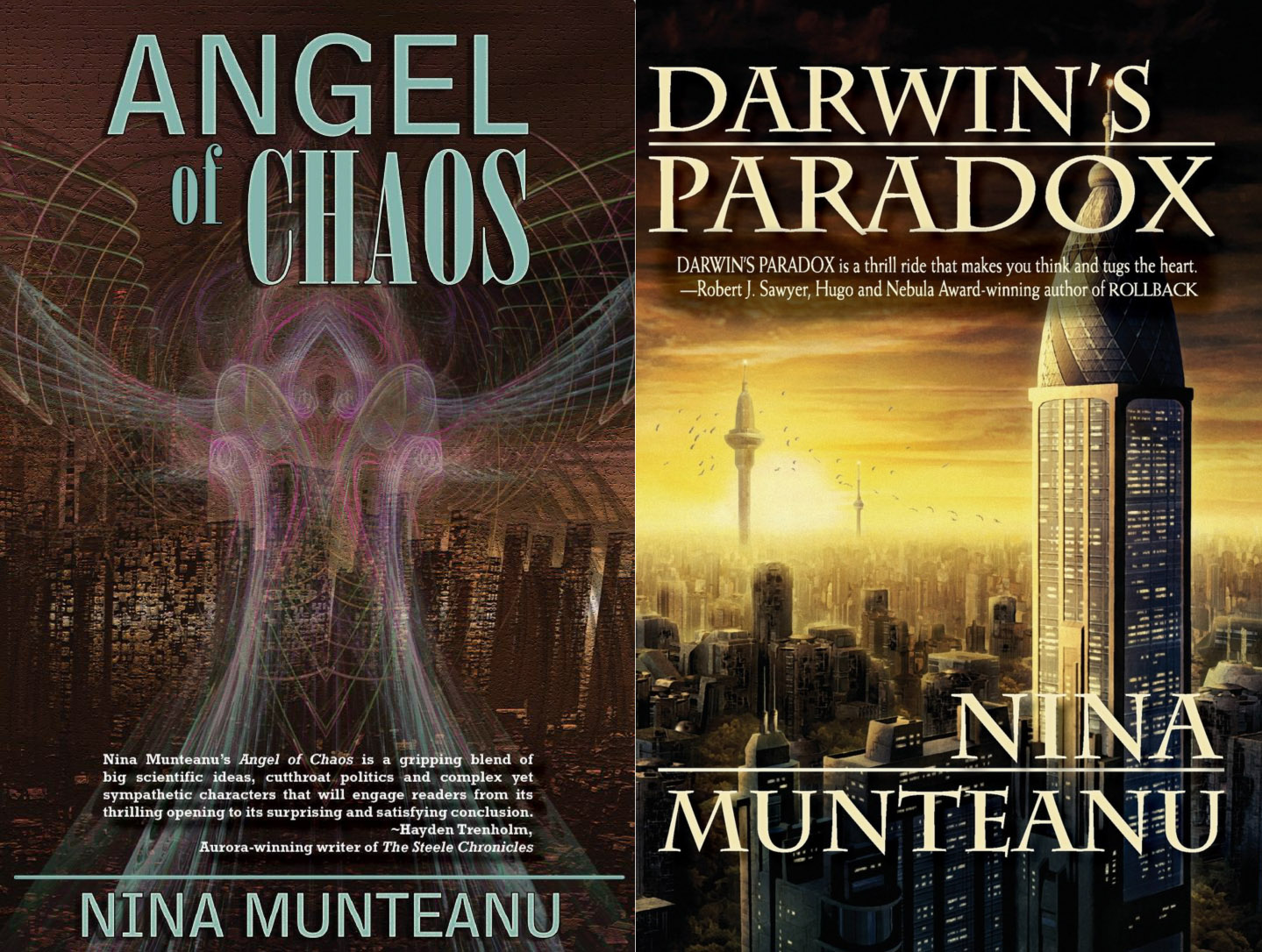
I joined S.T.O.P. (Society To Overcome Pollution) and marched in protests to call for responsible behaviour by governments and large corporations. I tried to raise awareness at my school about our deteriorating environment and likely consequences to human survival; my own teachers tried to silence me! I wrote my first dystopia, Caged in World.  The eco-novel was about a subway train driver and a data analyst caught in the trap of a huge lie. The story later morphed into Escape from Utopia. Several drafts—and years later—the novel became the eco-medical thriller Angel of Chaos, set in 2095 as humanity struggles with Darwin’s Disease—a mysterious neurological environmental pandemic. Icaria 5 is one of many enclosed cities within the slowly recovering toxic wasteland of North America, and where the protagonist Julie Crane works and lives. The city is run by technocrats, deep ecologists who call themselves Gaians, and consider themselves guardians of the planet. The Gaians’ secret is that they are keeping humanity “inside” not to protect humanity from a toxic wasteland but to protect the environment from a toxic humanity.

I spent several years shopping Angel of Chaos to agents and publishing houses. Although I received many bites, all finally let go. In the meantime, I did several things: 1) I started writing short stories, some of which were cannibalized from the book, and several of these were published; 2) I wrote Angel’s prequel, The Great Revolution (never published, The Great Revolution sits in a drawer hibernating) and Angel’s sequel Darwin’s Paradox, (which was published).


Angel of Chaos and Darwin’s Paradox Duology by Nina Munteanu

I thought of going into environmental law at university then decided that I didn’t have the temperament for it and instead pursued ecology and limnology. I taught limnology at the University of Victoria then found work as an environmental consultant. In 2007, Dragon Moon Press in Calgary made an offer to publish Darwin’s Paradox; the sequel became my debut novel. Dragon Moon Press later picked up Angel of Chaos and published it in 2010 as a prequel. I haven’t stopped publishing since (with a book pretty much every year).

A selection of eco-Fiction stories / novels Nina Munteanu wrote or edited

My whole career-life has been dedicated to helping the environment, doing field studies as a limnologist and ecologist, publishing papers and reports, giving talks about water and the environment. I feel strongly that stories can go much farther in bringing not only awareness but direction for people to act on behalf of the environment and the planet. The narrative we give one another is the key. 

What story do we tell of ourselves and each other?

Nina Munteanu is a Canadian ecologist / limnologist and novelist. She is co-editor of Europa SF and currently teaches writing courses at George Brown College and the University of Toronto. Visit www.ninamunteanu.ca for the latest on her books. Nina’s bilingual “La natura dell’acqua / The Way of Water” was published by Mincione Edizioni in Rome. Her non-fiction book “Water Is…” by Pixl Press(Vancouver) was selected by Margaret Atwood in the New York Times‘Year in Reading’ and was chosen as the 2017 Summer Read by Water Canada. Her novel “A Diary in the Age of Water” was released by Inanna Publications (Toronto) in June 2020.

Nina Munteanu Talks Books, Water and COVID on ConversationsLIVE

I recently had a wonderful discussion on Cyrus Webb’s show ConversationsLIVE on BlogTalkRadio and WYAD Radio in Mississippi.

We talked about curiosity in our world and how fiction connects us with relevance and meaning. We discussed writing eco-fiction, my latest eco-novel and work of mundane science fiction “A Diary in the Age of Water. We also discussed what was involved in combining art with science in mundane science fiction. Cyrus then asked me what it was like to get a book out during COVID. I enjoyed this interview for its refreshing questions. They made me think.

You can listen to the interview through the link below:

https://www.blogtalkradio.com/conversationslive/2021/06/22/author-nina-munteanu-talks-adiaryintheageofwater-on-conversationslive

Pond lilies in Thompson Creek marsh, ON (photo and rendition by Nina Munteanu)

Nina Talks About Being a Scientist and a Storytelling Artist on “The Authors Book Club”

Cedar beside swift water of Jackson Creek, ON (photo and rendition by Nina Munteanu)

Fiona Ross with The Authors Book Club talked with limnologist and eco-fiction author Nina Munteanu about her journey as both author and scientist and her latest book A Diary in the Age of Water (Inanna Publications). 

Advice on writing:

“Write with passion. A lot of people say ‘write what you know.’ Those two in some ways are the same thing. You can do a lot of research on things that you don’t know and bring that in [to your writing.] But to know in your soul, in your heart, the thing that’s important that you need to write about is more what I mean by ‘write what you know.’ If you’re passionate about something—a global catastrophe or a personal journey with abuse—if it comes from the heart, it will keep you on track through those rejections and to finish and complete your work. Otherwise you won’t persist and you’ll let someone tell you that it isn’t important, it’s just a hobby.”

On water:

Nina and Fiona discuss the perils of commodifying water and Canada’s role in protecting the freshwater of the world and the boreal zone of Canada.

Nina talks about how she turned her fear of water as a child into a fascination for water and a passion for its protection. “I’m a limnologist, an ecologist. I’ve have been studying it since I was a little kid who was scared of water. I triumphed over that into fascination and made that into a career.” Nina’s non-fiction book Water Is… was published in 2016 as a biography of water and was endorsed by Margaret Atwood in the New York Times ‘Year in Reading.’

Nina talks about some of water’s over 70 anomalous properties and how virtually each is life-giving. She shares how water can teach us to be stewards and protectors of water within an emerging paradigm of gratitude and humbleness.  

On being both scientist and artist:

Nina suggests that: “All great scientists are informed by art. They are creative in some way. [Scientists] bring that creativity, that original thinking and that curiosity, with them into their science. That’s what makes their science great because they are willing to look outward…We try to compartmentalize so we can better understand [art and science] but the irony is that we better understand them by bringing them together and integrating them…”

Nina Munteanu is a Canadian ecologist / limnologist and novelist. She is co-editor of Europa SF and currently teaches writing courses at George Brown College and the University of Toronto. Visit www.ninamunteanu.ca for the latest on her books. Nina’s bilingual “La natura dell’acqua / The Way of Water” was published by Mincione Edizioni in Rome. Her non-fiction book “Water Is…” by Pixl Press(Vancouver) was selected by Margaret Atwood in the New York Times‘Year in Reading’ and was chosen as the 2017 Summer Read by Water Canada. Her novel “A Diary in the Age of Water” was released by Inanna Publications (Toronto) in June 2020.