In March this year, Calgary writer Simon Rose interviewed me on his blog about the recent release of the first book of The Icaria Trilogy, Gaia’s Revolution.
Below is the interview:
.
My guest today is Nina Munteanu, Canadian author, essayist, and blogger. Nina has published over a dozen fiction and non-fiction books, mostly on the environment. She does a column on Reality Skimming Press and blogs about the environment on her site The Meaning of Water. Today, we’ll be discussing her just-released ecological thriller, Gaia’s Revolution, Book 1 of The Icaria Trilogy, put out by Dragon Moon Press in Calgary.
Simon: So, what’s the Trilogy about?
Nina: It’s a bit of a saga that starts in Berlin in 2022 (Book 1, Gaia’s Revolution) and moves to the Toronto area in Canada, through several generations over seven decades (Books 2 and 3). The trilogy explores a collapsing capitalist society in Canada through ravages of climate change and a failing technology. Book 1 starts with ambitious twin brothers Eric, a gifted engineer, and Damien Vogel, a brilliant scientist, who escape the growing racial violence of Berlin, to ‘peaceful’ Canada in a rivalry to control the evolution of the human race. The warring brothers set off a violent revolution that destroys the Canadian technocratic government and whose weapons ultimately risk the survival of humanity. Fanatical deep ecologist Monica Schlange snares both brothers in her gambit to reshape humanity and its place in the natural world. Three orphaned children, caught in the web of intrigue and violence, will ultimately determine the direction of humanity by introducing the first veemelds (people who can communicate with machines), a new environmental disease, and a new set of rules neither brother envisioned.
By 2095 (Book 2, Angel of Chaos and Book 3, Darwin’s Paradox), humanity—now under Gaian rule—has fled inside environmental dome cities called Icarias, chased inside by an unruly environment. Icarians struggle with Darwin’s Disease—a mysterious neurological environmental pandemic. Icaria 5 (formerly Toronto, Canada) is one of many enclosed cities within the slowly recovering toxic wasteland of North America, and where the protagonist Julie Crane (daughter of one of the orphans in Gaia’s Revolution and a veemeld) lives and works. Julie must deal with the ghosts of the characters in Book 1: including her dead and discredited father, now implicated in spreading subversive science and charged with several political assassinations.
Simon: A technocratic government in Canada? How did you envision that?
Nina: My premise involves several key climate disasters coupled with a highly unpopular decision by the Liberal government to welcome millions of climate refugees, providing housing and amenities that disaster-affected Canadians did not get. This scenario and accompanying sentiment is not new. In 2015, Angela Merkel welcomed over a million refugees from Iraq and Syria into Germany; public support quickly waned and the far right exploited rejection of the policy. Continuing with my premise, increased unrest grew in Canada as protests mobilized the far-right and gave voice to Christian fundamentalists, white supremacists, anti-Semitic conspiracy theorists and Islamophobic nationalists. The growing rift between the polarized major parties opened a gap filled by a new party, neither far right nor far left and based on the logic and merit of science & technology: the Technocratic Party of Canada. The party skyrocketed in popularity with an intelligent population who were fed up with political sophistry and empty rhetoric and excuses. The Technocrats had a plan that made sense and they demonstrated the expertise to carry it out: ways to successfully adapt to climate change, using technology and scientific research. The party subscribed to a scientific management approach, a Taylorism approach based on four principles: select methods based on science; assign jobs based on aptitude; monitor performance; and divide workload based on a systems approach. But, as you read above, they, too, are overthrown for something else: the Gaian dynasty of deep ecologists.
Simon: You’ve brought in many characters in this saga. Who is your favourite?
Nina: You’ll laugh: the main antagonist of Gaia’s Revolution, Monica Schlange (and what she becomes). I really enjoyed writing about the twin brothers—contrasting them despite their twin origins. I also enjoyed writing the three orphan characters: about their terrible journey to safety when the violent revolution moved from the cities to the countryside. I also enjoyed writing Julie’s character (in Books 2 and 3), her journey as a veemeld (gifted and cursed) and being the daughter of a traitor, who must find her way in a treacherous world of lies and intrigue. But my favourite is Monica Schlange: the fanatical deep ecologist, revolutionary, shape-shifter, bad-ass warrior, villain with a conscience. She is a paradox: she cares immensely about the planet, the welfare of the planet’s ecosystems and displays compassion for the orphans; but she has no qualms about killing a man in cold blood—which she does, on several occasions.
There is a scene where twin brother Eric unleashes a techno-clone to murder a colleague of Monica’s; techno-clones are hybrid cyborgs, DNA-altered men merged with synthetics and weapons fused into them, all connected by a hive mind. Monica takes on this murder-machine and cleverly dispatches him—when no one else has been able to. This quickly earns her a reputation as a Badass warrior and soon images of her face—scar across her temple—is plastered everywhere by the revolutionaries.
Throughout the first book, I provide a few moments of perspective into Monica’s past. An only child, she grew up on one of the last independent dairy farms in Ontario—before the Technocrats seized it and converted it into a Corporation Farm using scientific agriculture. It killed her father, who she dearly loved. Her mother took to whoring with the first trucker who came along, abandoning her. A ruthless eco-terrorist and subversive, Monica is bent on destroying the capitalist-technocratic machinery to save the planet at the expense of human domination. An unscrupulous eco-terrorist, she uses sabotage and internet tampering to disrupt and hurt climate offenders. She is the quintessential anti-hero. I guess you could say that I realized some terrible fantasies through this character.
Simon:What are you currently working on?
Nina: Not much. I’m taking a wee break from novel-writing and focusing on marketing. I’m currently shopping an eco-fiction novel around that takes place in southern Ontario and the Kurpiowska Forest in Poland during the communist era (specifically the 50s to 70s). I did a lot of research for that book and it was so fascinating!
I am actively coaching writers to publication (see www.NinaMunteanu.me) and writing nature and environmental articles for various magazines and my own blogs (www.TheMeaningOfWater.com). I’m also curating a column on Lynda Williams’s Reality Skimming Press blog on sustainability. Called “Sustainability Over Ambition”, the column consists of a series of articles and interviews I’m conducting with mostly Canadian authors on that complex subject. If you’re a Canadian author, feel free to reach out to me if you’re interested in being interviewed.
Simon: Tell me a little more about your coaching services?
Nina: My coaching includes advice on all story aspects (like storyboarding, world building, character, plot, etc.). I also edit, but my service usually encompasses far more, such as narrative flow, sentence structure, meaning, clarity, and concision. I look at just about every kind of fiction, except horror. I help writers with their nonfiction such as memoirs, biographies, how-to books, and technical books. I also do technical and scientific editing of papers and reports.
Simon: Where can people buy Gaia’s Revolution and the entire trilogy?
Nina: The entire Icaria Trilogy can be purchased on Amazon and other online and brick and mortar bookstores, such as Chapters. Books 2 and 3 are also available in many libraries throughout Canada, given that they’ve been out for a while.
Simon:Thanks, Nina, for being my guest here today and the very best of luck with The Icaria Trilogy.
.
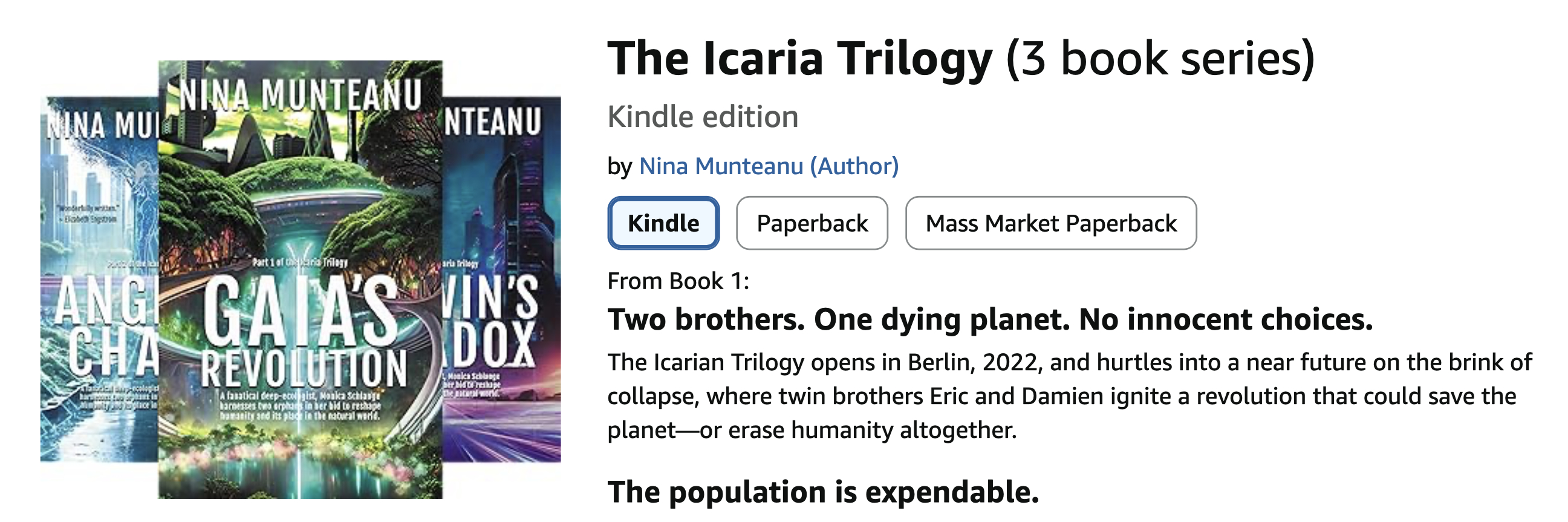
The Icaria Trilogy by Dragon Moon Press
.
Nina Munteanu is a Canadian ecologist / limnologist and novelist. She is co-editor of Europa SF and currently teaches writing courses at George Brown College and the University of Toronto. Visit www.ninamunteanu.ca for the latest on her books. Nina’s bilingual “La natura dell’acqua / The Way of Water” was published by Mincione Edizioni in Rome. Her non-fiction book “Water Is…” by Pixl Press (Vancouver) was selected by Margaret Atwood in the New York Times ‘Year in Reading’ and was chosen as the 2017 Summer Read by Water Canada. Her novel “A Diary in the Age of Water” was released by Inanna Publications (Toronto) in June 2020.Her latest novel “Gaia’s Revolution” was released in 2026 by Dragon Moon Press.
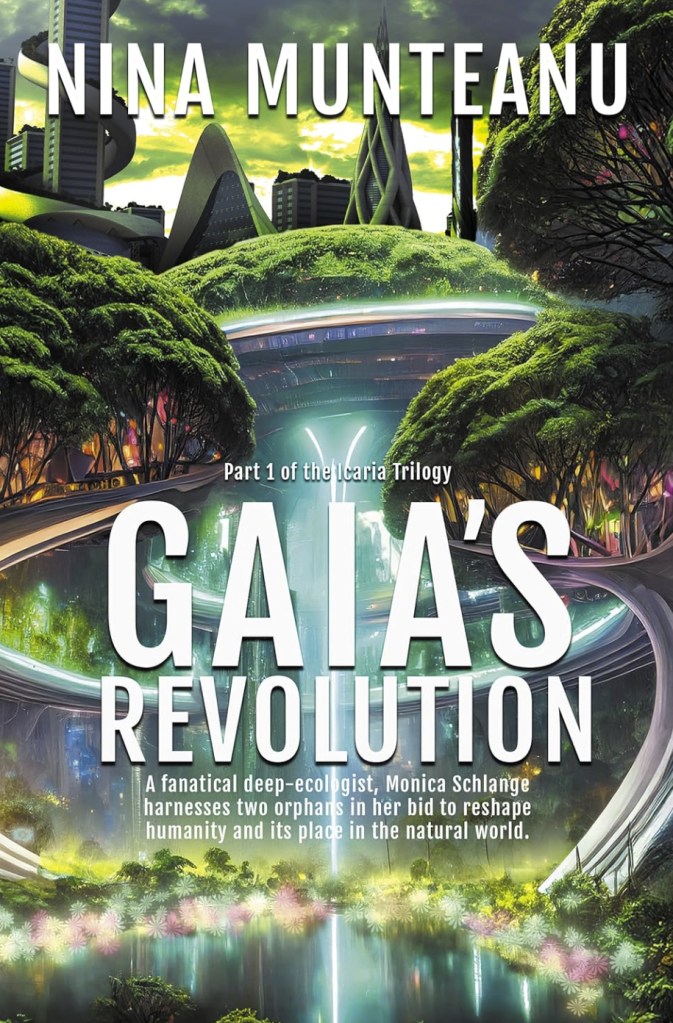
A fanatical deep-ecologist, Monica Schlange, harnesses two orphans in her bid to reshape humanity and its place in the natural world.
.
My novel Gaia’s Revolution, Book 1 of The Icaria Trilogy—which released March 10, 2026, by Dragon Moon Press—explores a collapsing capitalist society in Canada through ravages of climate change, water shortages, plague, and a failing technology.
.
The story begins in Berlin in 2022, with maverick scholar Damien Vogel, a deep ecologist and environmentalist who joined the climate activist group Letzte Generation* to do acts of civil disobedience to bring public awareness to climate offenders. The novel progresses from acts of civil disobedience to genuine eco-terrorism as Damien follows his revolutionary anarchist twin brother Eric to Canada and forms the Gaians, a radical eco-activist group, recruiting fanatic Monica Schlange—herself a sly eco-terrorist. Monica is an unscrupulous deep ecologist, proficient in using sabotage and internet tampering to disrupt and hurt climate offenders. The twin brothers end up on opposite sides of a violent revolution as Monica—guided by her own agenda as an extremist planetary guardian—plays them both.
.
The Icaria Trilogy by Dragon Moon Press
.
By 2095 (Book 2Angel of Chaos and Book 3Darwin’s Paradox), humanity has fled inside environmental dome cities called Icarias*, chased inside by an unruly environment. Icarians struggle with Darwin’s Disease—a mysterious neurological environmental pandemic. Icaria 5 is one of many enclosed cities within the slowly recovering toxic wasteland of North America, and where the protagonist Julie Crane (daughter of one of the orphans in Gaia’s Revolution) lives and works. Icarias are run by The Circle, a governing body of deep ecologists who call themselves Gaians. The Gaians’ secret is that they are keeping humanity “inside” not to protect humanity from a toxic wasteland but to protect the environment from a toxic humanity.
.
Ecology vs. Deep Ecology vs. Eco-Terrorism
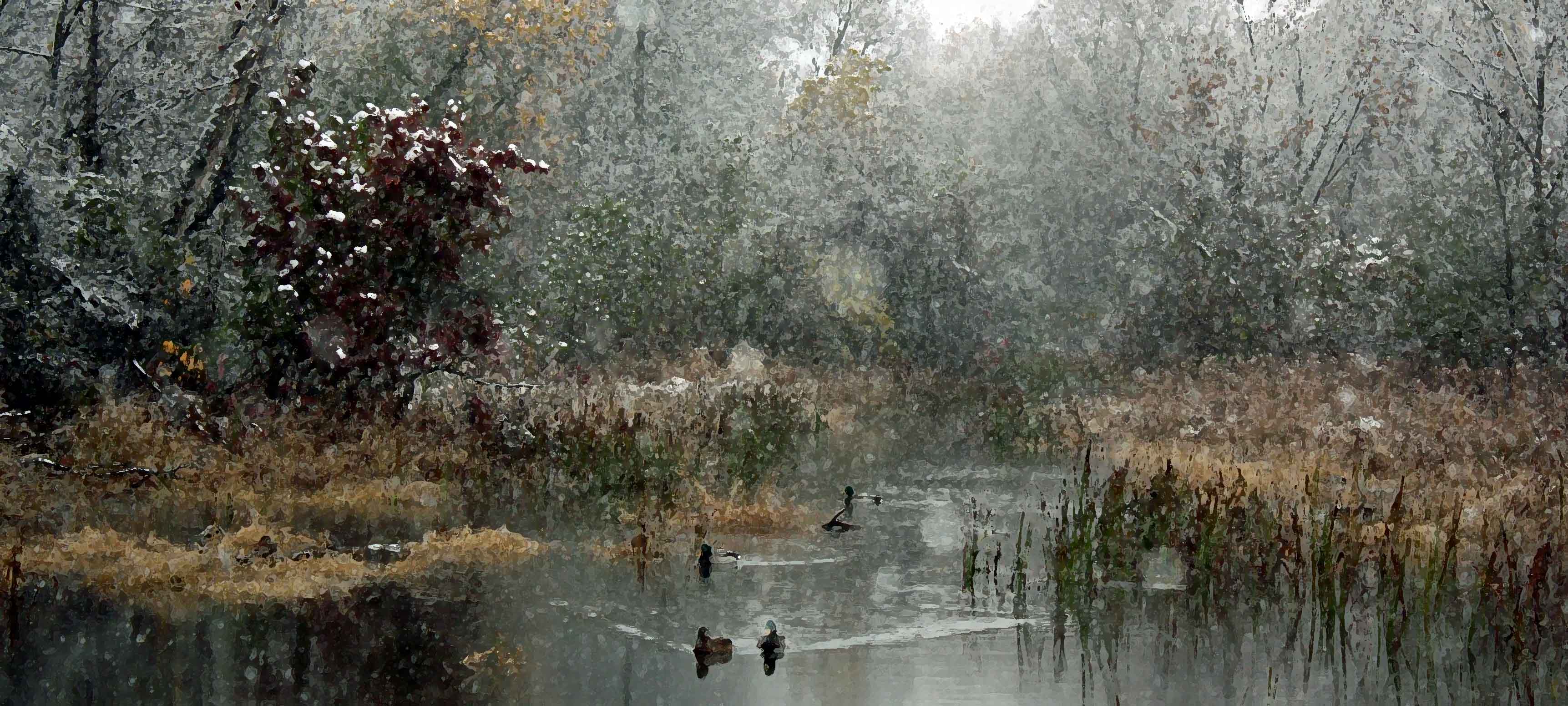
Snow falls on a Scots Pine forest, ON (photo and rendition by Nina Munteanu)
.
Ecology: Ecology is the science of relationships. Ecologists study ecosystems (aquatic and terrestrial), how they form, their structure and function, and how they relate to one another within the biosphere. Ecologists look at the relationship of all biota and non-biota, at individuals and communities, how all evolve (succession), at community richness, perturbations and recoveries, and natural enrichment. Ecologists model the flow of energy and cycling of matter over time and space.
Deep Ecology: Deep ecologists are usually ecologists themselves, who have adopted
An environmental philosophy and social movement advocating that all living beings have intrinsic value, independent of their utility to human needs. The philosophy promotes a holistic, ecocentric worldview—often termed “ecosophy”—that demands radical, structural changes to human society to prioritize nature’s flourishing. See the Eight Basic Principles of Deep Ecology.
Eco-Terrorism: Both ecologists and deep ecologists may grow cynical, seeing humanity as an existential threat, a virus that impacts the rest of life on Earth and exacerbates hyperobjects like climate change, loss of biodiversity and habitat destruction. This may lead to activism which some with a fanatical and destructive warrior spirit may move toward eco-terrorism such as criminal actions to halt development, and various acts of violence (e.g. arson, destruction of research facilities, threats against individuals).
.
Ecologists, Deep Ecologists & Eco-Terrorists in The Icaria Trilogy
In Gaia’s Revolution deep ecologist / scholar Damien Vogel and his nihilist revolutionary twin brother Eric Vogel trigger a violent revolution and eventual migration of humanity into the enclosed worlds of Icaria. While Damien follows deep ecology as an intellectual and scholar, believing in the eight basic principles of deep ecology, Eric uses the principles to enact merciless ‘solutions’ through brutal acts of eco-terrorism. Deep ecologist / eco-terrorist Monica Schlange insinuates herself into both brother’s plans to orchestrate her own unique vision of the world. Monica differs from Eric in her sense of humanity; a consummate and ruthless eco-terrorist and subversive, she is bent on entirely destroying the capitalist-technocratic machinery of which Eric is a part—to save the planet at the expense of human domination.
.
Damien and Christian Isabo meet to discuss recruiting her into their radical group:
Christian says, leaning forward, “She’s a bit of a wild card and possibly a genuine eco-terrorist. For instance, I discovered that she was behind the viral social media fiasco that embarrassed Prime Minister Robinson last year and almost cost him his seat. You know the one—those pictures of him fooling around with the German Chancellor, Magda Zimmermann, who’s married with two kids… Damien. I think that she’s extremely resourceful, stealthy, good at subterfuge and covers her tracks impeccably. Of course, there are definitely anger issues there. But, I also think we can count on her because her motives to help the environment lie on a deep visceral level, tied to her childhood experience and love of Nature.”
Damien studies her image on his phone with a thoughtful frown. He looks up at Christian. “What do we know about her?”
“Well, to begin with, she’s an only child and grew up on one of the last independent dairy farms in Ontario, near Guelph. Her father was strict and encouraged a strong work ethic and love for the natural world. He doted on her but died of a heart attack when she was only thirteen, the year their farm was seized by the Technocrats and converted into a Corporation Farm using scientific agriculture. In fact, their seizure may have precipitated the father’s heart attack. Her mother was assigned as a scullery maid in the farm kitchen; she took to drink then ran off with some truck driver travelling across Canada from Surrey, BC. He didn’t treat the girl well and she ran away before they reached Halifax. She ended up living with her aunt—her father’s sister—in the Beaches. The aunt worked as a librarian at York University and was a fervent member of Extinction Rebellion before it dissolved. She was a real bohemian, a deep ecologist herself, and encouraged the girl.”
While Monica shows the same level of dedication, she betrays a lack of integrity in her less than altruistic motivations and means, thinks Damien. The fact that she’s with Eric [his twin brother and nemesis] proves this. But even that—especially that—can work in their favour. It would seem that, without knowing it, she is already working as an undercover spy for their revolution. He can work with that, Damien thinks. Yes, he can certainly do that. And more. It’s my turn now, brother…
“OK. Set up a meeting,” Damien says. “Let’s get her into the fold.”
.
Mist over swelling spring stream, ON (photo and rendition by Nina Munteanu)
.
Leonard Crane—one of the three orphans impacted by the revolution and both rescued and tormented by Monica Schlange—studies ecology under new Gaian rule and is eventually inducted into the prestigious Department of Industrial Ecology (DIE) where he works on subversive ecological theories about Icaria’s inevitable demise and is eventually ostracised from the scientific community for his unpopular work. His legacy echoes throughout Books 2 and 3 of the trilogy.
.
Books 2 and 3 follow Julie Crane (Leonard’s daughter), a self-taught ecologist. In Angel of Chaos and Darwin’s Paradox, her skills as an amateur ecologist (in a world where ecology is not taught) are tested by the ruthless deep ecologist Gaia, head of The Circle. Gaia denigrates Julie’s ecological pursuits as shallow and ineffectual. When a subordinate of hers asks her if Julie would make a good candidate for The Circle (the governing body of Icaria), Gaia scoffs:
.
“You mistake a good scientific ecologist with someone who possesses a genuine empathy for deep ecology,” she said. Her eyes sparkled like sapphires. “No one enters our elite cadre without having impeccable qualifications and submitting to many more initiations than she is capable of passing. She may be an ecologist but she is not a deep ecologist. The science of ecology does not ask what kind of society would be the best suited to maintain a particular ecosystem. Our greater concern is with questions aimed at the level of organic wholeness and ‘Earth wisdom’. She knows nothing of these things.”—Gaia, Angel of Chaos
.
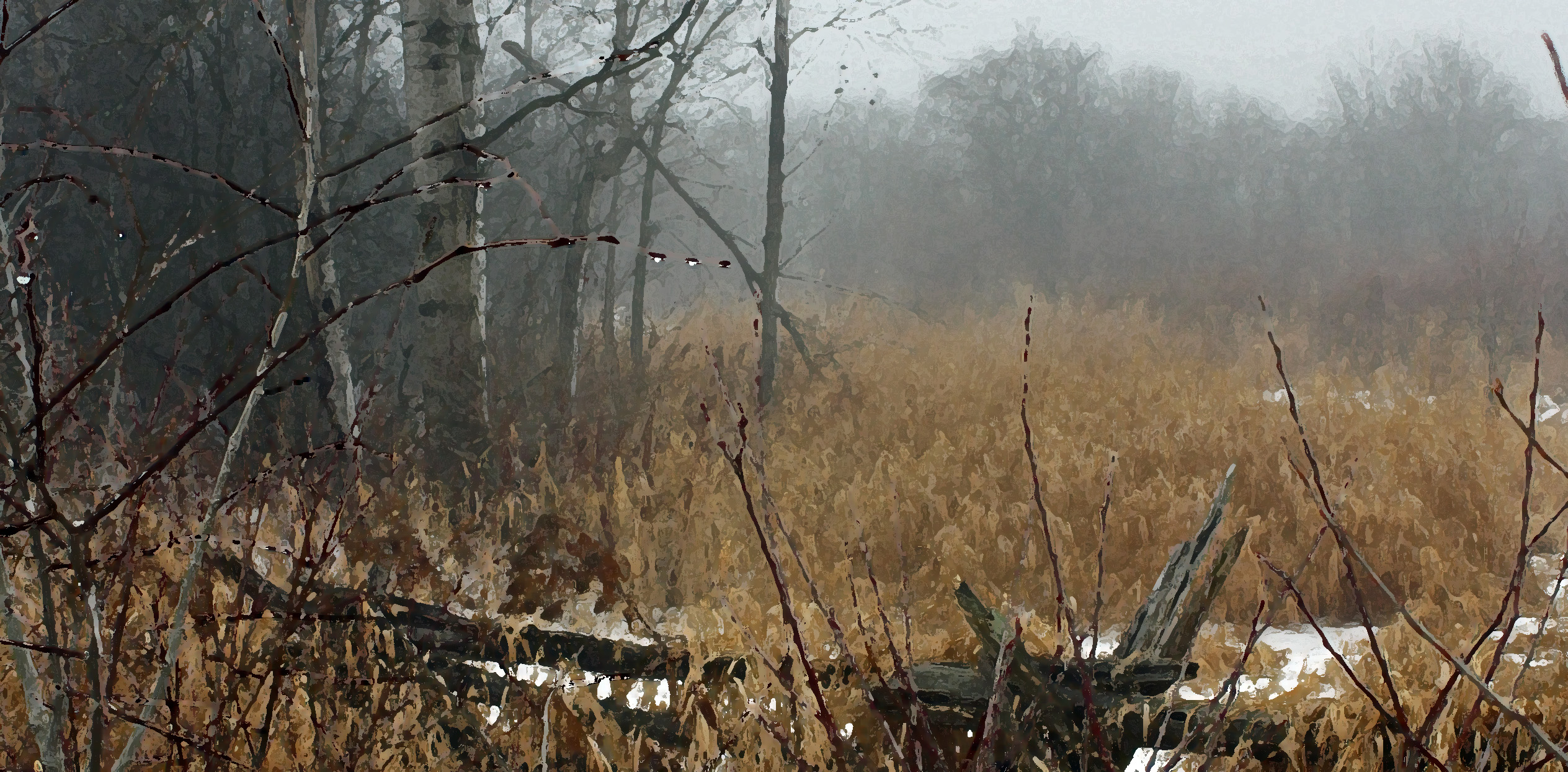
Fog enshrouded marsh in early winter, ON (photo and rendition by Nina Munteanu)
Munteanu, Nina. 2026. “Gaia’s Revolution, Part 1 of Icaria Trilogy.” Dragon Moon Press, Calgary, AB. 369 pp.
Munteanu, Nina. 2010. “Angel of Chaos, Part 2 of Icaria Trilogy.” Dragon Moon Press, Calgary, AB. 518 pp.
Munteanu, Nina. 2007. “Darwin’s Paradox, Part 3 of Icaria Trilogy.” Dragon Moon Press, Calgary, AB. 294 pp.
Sessions, George, Bill Devall. 2000. “Deep Ecology: Living as if Nature Mattered.” Gibbs Smith. 267pp.
Skinner, B.F. 1948. “Walden Two” The Macmillan Company, New York. 301pp.
.
Terminology:
*Deep Ecology: An environmental philosophy and social movement advocating that all living beings have intrinsic value, independent of their utility to human needs. Coined by Arne Næss in 1972, it promotes a holistic, ecocentric worldview—often termed “ecosophy”—that demands radical, structural changes to human society to prioritize nature’s flourishing.
*Icaria: the name of Étienne Cabet’s utopia. Cabet was a French lawyer in Dijon, who published his novel Voyage en Icarie in 1839. The novel was a sort of manifesto-blueprint of utopian socialism, with elements of communism (abolished private property and individual enterprise), influenced by Fourierist and Owenite thinking. Key elements, such as the four-hour work day, are reflected in B.F. Skinner’s Walden Two. Cabet’s novel explores a society in which capitalist production is replaced by workers’ cooperatives with a focus on small communities.
*Letzte Generation: a prominent European climate activist group, founded in 2021, known for its acts of civil disobedience—such as roadblocks, defacing art, and vandalizing structures—to pressure governments on climate action. The term was chosen because they considered themselves to be the last generation before tipping points in the earth’s climate system would be reached. They are mostly active in Germany, Italy, Poland and Canada. In Germany, they have faced accusations of forming a criminal organization, leading to police raids.
.
Nina Munteanu is an award-winning novelist and short story writer of eco-fiction, science fiction and fantasy. She also has three writing guides out: The Fiction Writer; The Journal Writer; and The Ecology of Writing and teaches fiction writing and technical writing at university and online. Check the Publications page on this site for a summary of what she has out there. Nina teaches writing at the University of Toronto and has been coaching fiction and non-fiction authors for over 20 years. You can find Nina’s short podcasts on writing on YouTube. Check out this site for more author advice from how to write a synopsis to finding your muse and the art and science of writing.
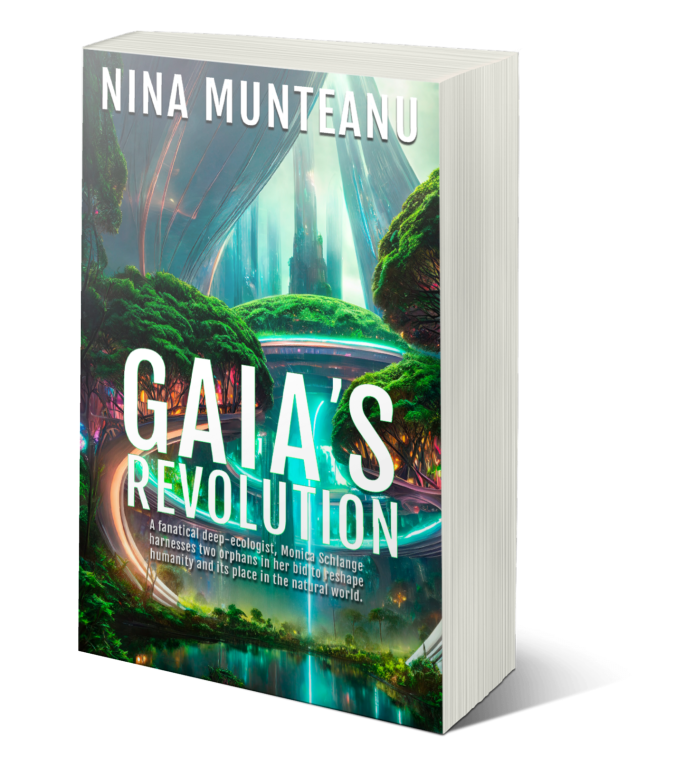
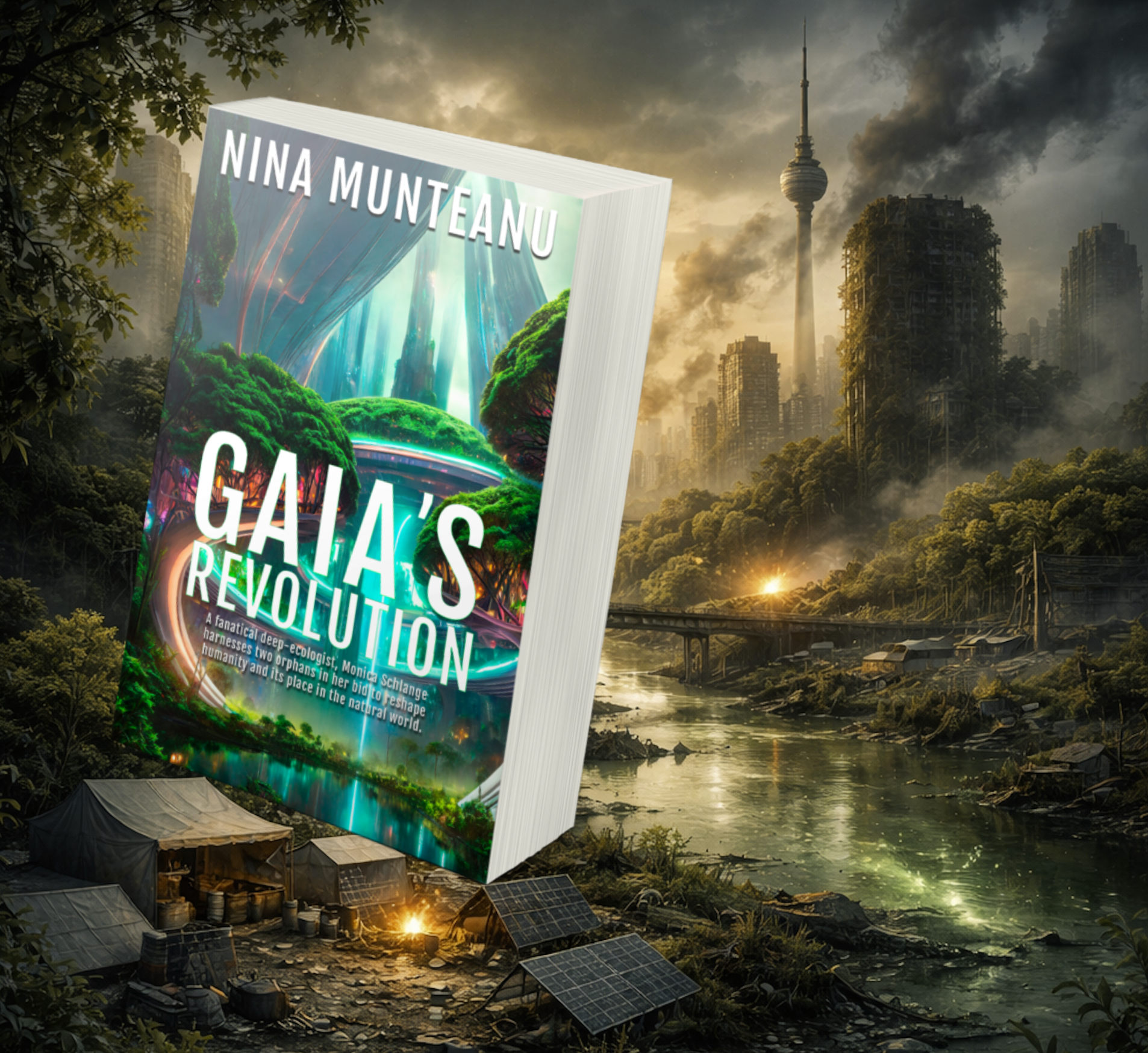
Today my eco-fiction novel Gaia’s Revolution (Book 1 of The Icaria Trilogy) releases through Dragon Moon Press in paperback and ebook form on Amazon (and other book retailers).
Gaia’s Revolution explores a collapsing capitalist society in Canada through ravages of climate change and a failing technology. The story is told through the lives of ambitious twin brothers Eric and Damien Vogel, and the woman who plays them like chess pieces in her gambit to ‘rule the world.’ The novel starts out in Berlin—with a scuffle between police and climate activists of Letzte Generation-then moves to Toronto Canada, where an unlikely revolution is brewing…
This day is special for me in a number of ways. Today is also my dad’s birthday. He passed away a while ago, but I know he is here with me as this is happening. You see, when I was just 15, I’d written my first book, an early version of Angel of Chaos. My dad, who had met and befriended an editor at Doubleday, and proud of my accomplishment, arranged a meeting with me and the editor to look at my book. I put on my highest pumps—I could barely walk in them!—and best outfit and met with the gentleman. He did not take my book for publication but praised my work and gave me some wonderful advice. “Keep writing!” he said. I have carried that meeting and advice to this day and thank my dad for his belief in me as a writer—particularly given that he had been pushing for me to become a teacher or nurse. Four decades later, a more polished version of that same book was published in 2010 by Dragon Moon Press (as Angel of Chaos, the prequel to Darwin’s Paradox, which was published in 2007).
.
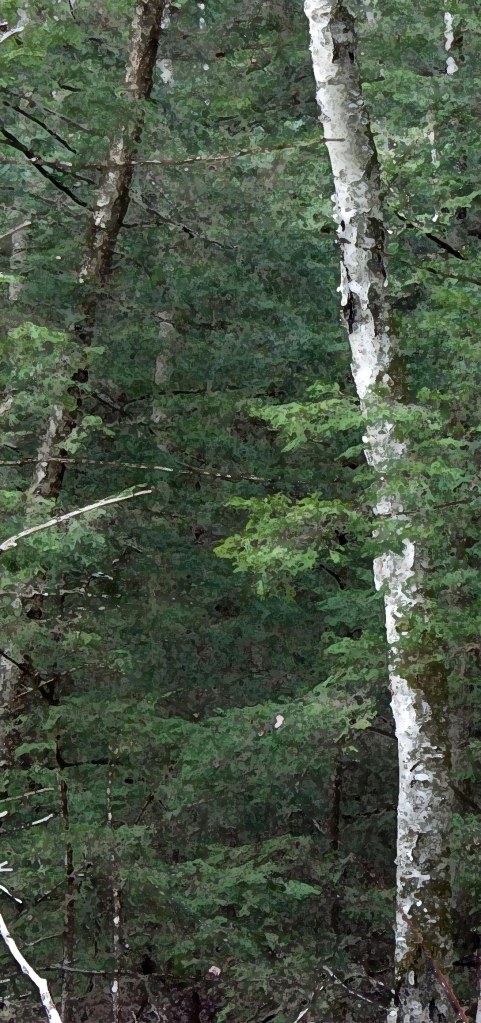
Birch forest in Ontario (photo and rendition by Nina Munteanu)
.
The Icaria Trilogy by Dragon Moon Press
.

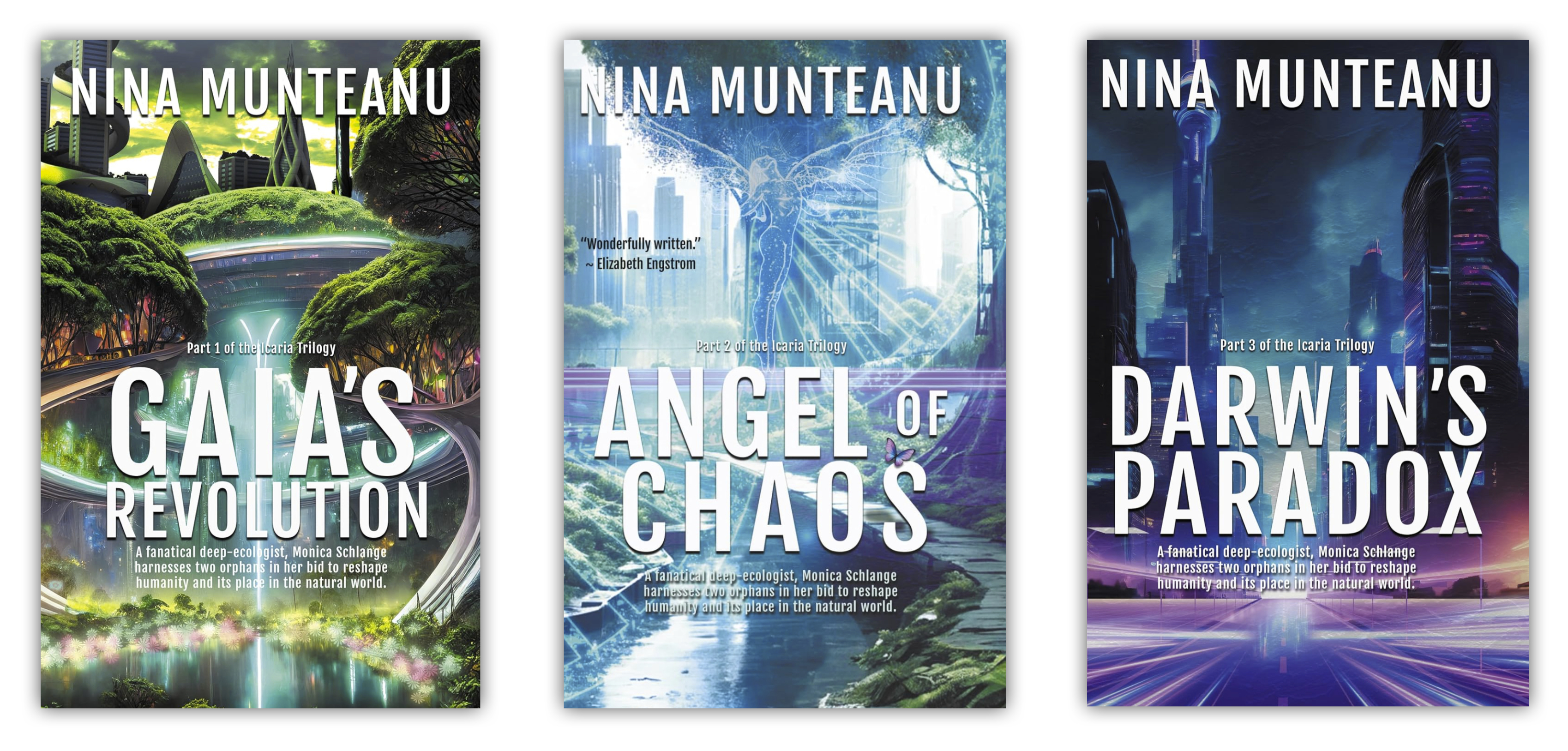
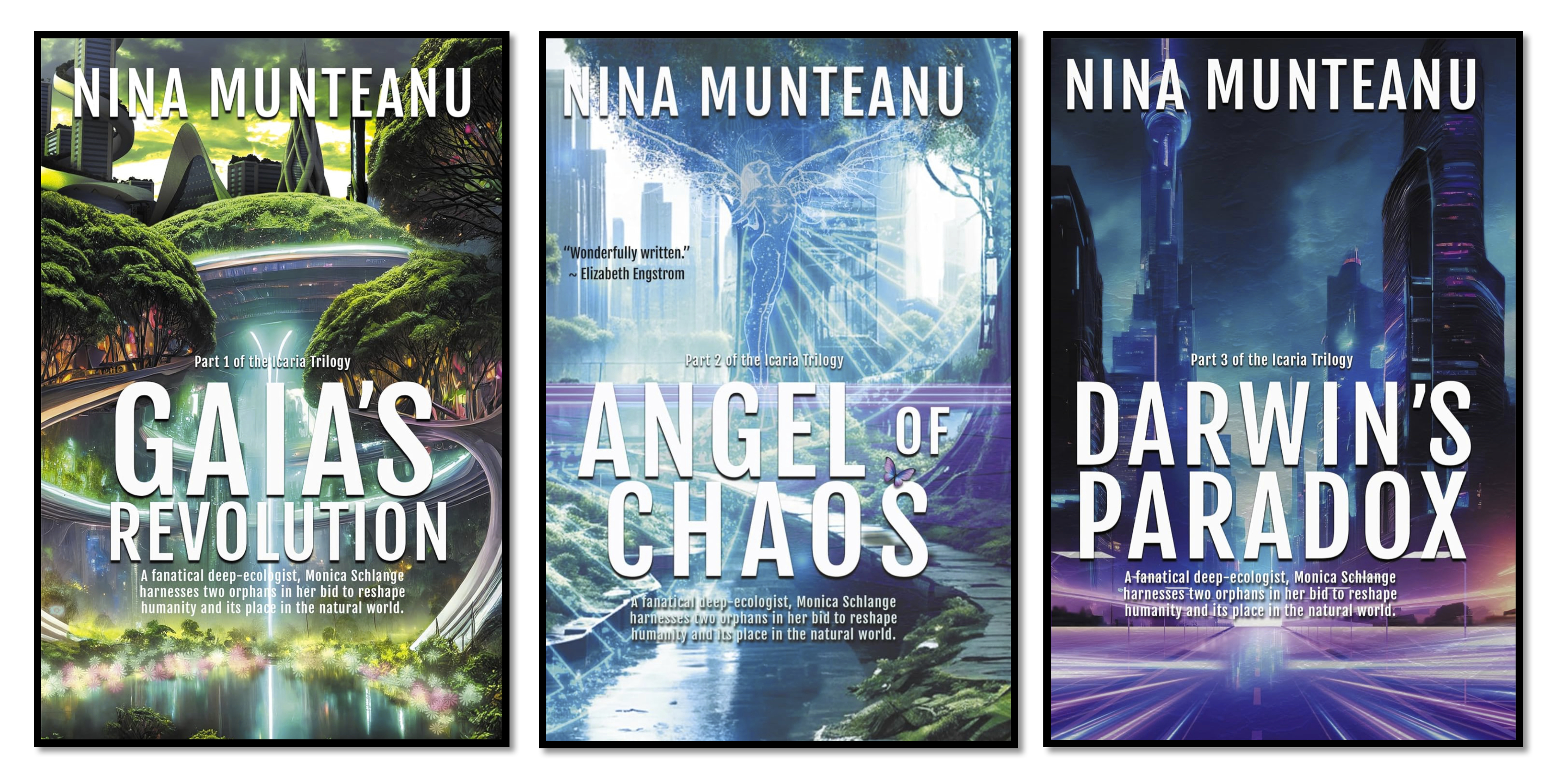
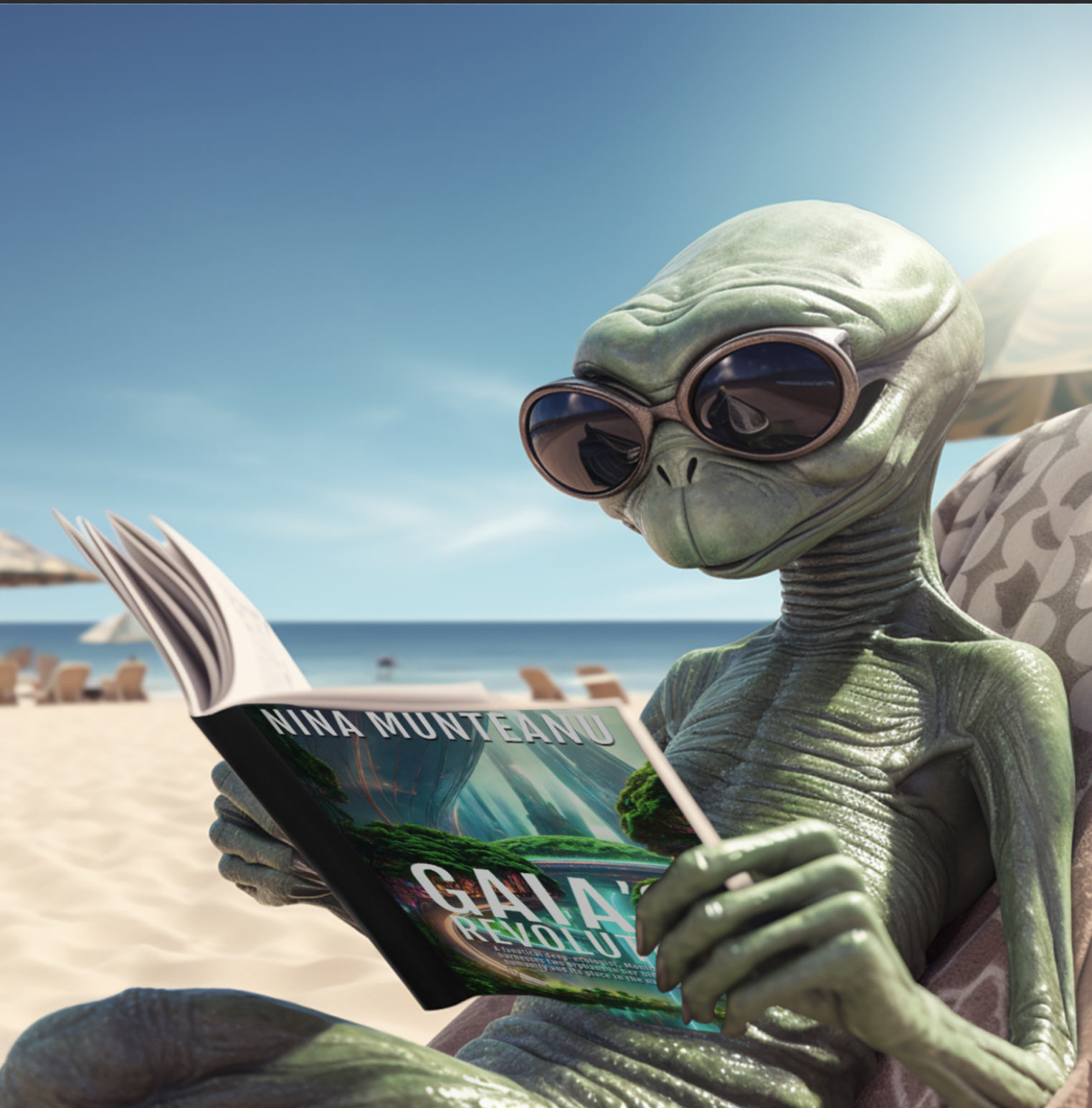
Now, with newly written Gaia’s Revolution (the prequel to the prequel) released, Dragon Moon has reissued new covers for the entire trilogy. Here they are! Oh! And look who’s already reading Gaia’s Revolution!
.
Aliens get to read everything before we do…
.
Nina Munteanu is an award-winning novelist and short story writer of eco-fiction, science fiction and fantasy. She also has three writing guides out: The Fiction Writer; The Journal Writer; and The Ecology of Writing and teaches fiction writing and technical writing at university and online. Check the Publications page on this site for a summary of what she has out there. Nina teaches writing at the University of Toronto and has been coaching fiction and non-fiction authors for over 20 years. You can find Nina’s short podcasts on writing on YouTube. Check out this site for more author advice from how to write a synopsis to finding your muse and the art and science of writing.
Twin brothers—a brilliant scientist and a gifted engineer—escape the growing racial violence of Berlin, to ‘peaceful’ Canada in a rivalry to control the evolution of the human race.
.
My novel Gaia’s Revolution, the first of The Icaria Trilogy—releasing March 10, 2026, by Dragon Moon Press—explores a collapsing capitalist society in Canada through ravages of climate change, water shortages, plague, and a failing technology. The story is told through the lives of ambitious twin brothers Eric and Damien Vogel, and the woman who plays them like chess pieces in her gambit to rule the world.
.
The novel starts on December 13th, 2022, in Berlin, the day several members of the climate activist group Letzte Generation* to which Damien belongs, are raided by police who seize their computers and phones. Damien is a quiet scholar, an introvert and deep ecologist*, devoted to the teachings of Arne Næss and George Sessions, who promoted an environmental philosophy of eight basic principles of deep ecology. Næss and Sessions advocated that all living beings have intrinsic value, independent of their utility to human needs. Their philosophy has become a movement that promotes a holistic, eco-centric worldview demanding radical, structural changes to human society to prioritize nature’s flourishing.
.
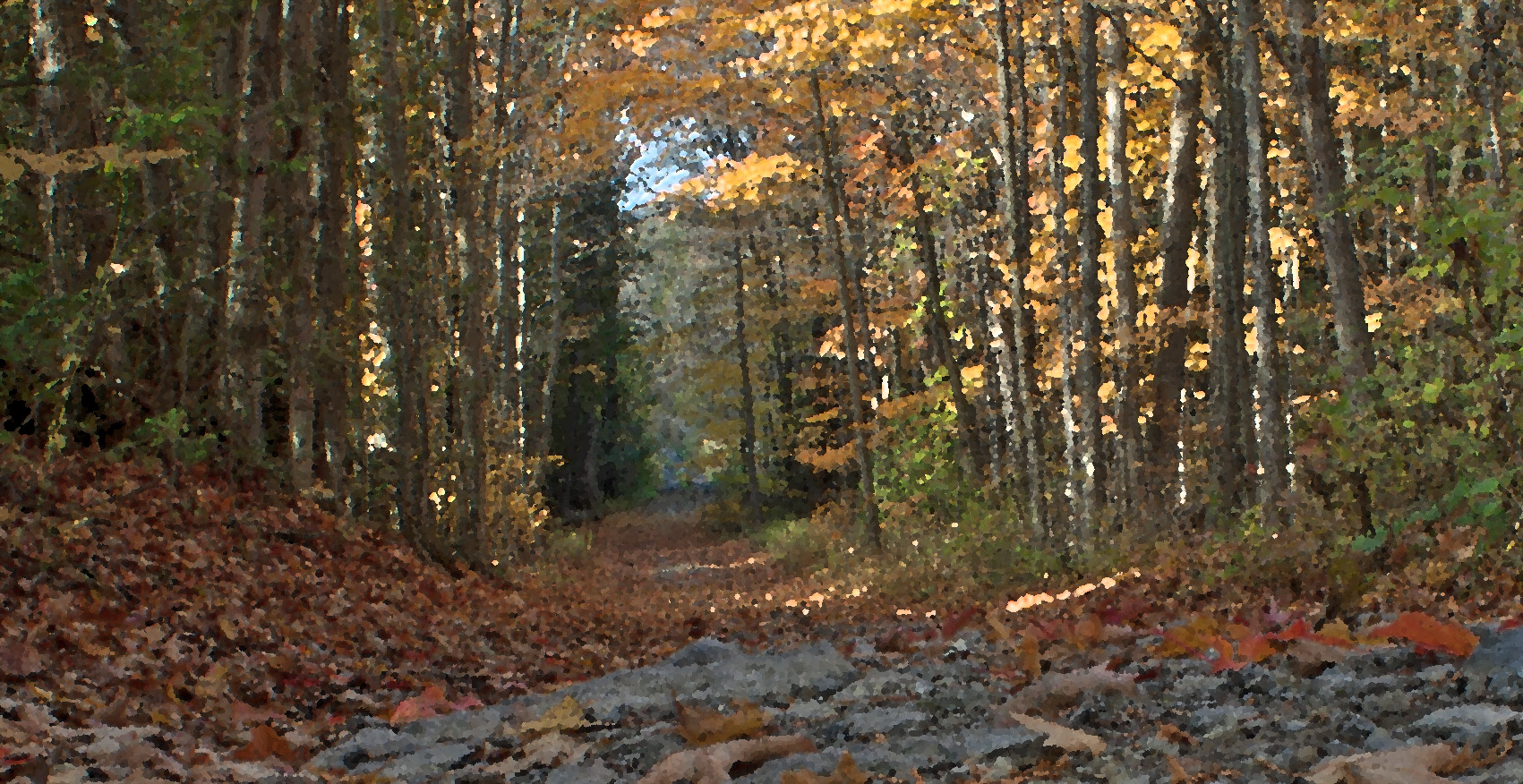
Road through a beech tree forest, ON (photo and rendition by Nina Munteanu)
.
Damien later meets with his extrovert anarchist brother in Treffpunkt, near the university campus, and they argue ideology and revolution. Eric contends that the only way humanity will survive is to adapt to climate change by somehow overthrowing the bourgeois plutocrats through violent revolution: preventing the small ruling class carving out a comfortable life for itself while the rest of the world suffers terrible deprivation. Eric pulls out the worn copy of B.F. Skinner’s Walden Two from his jacket pocket, slaps it on the table and pushes it toward Damien. “That’s the answer, Dame.”
Each brother plans to create a new humanity: Eric’s plan is to control humanity through gene manipulation and behaviour engineering (aka Walden Two); Damien’s plan is to draw on deep ecology and use environmental triggers with biotechnologies to empower humanity with physical/chemical abilities to adapt to climate and its changing environment via transhumanist AI.
Neither addresses the elephant in the room: population. Only a much-reduced population will ensure success for either plan.
To this point, Eric, who is far more cynical and ruthless, thinks Damien naïve and feckless in his deep ecological view:
Damien too easily prescribes to the old leftist shibboleth of Nature being the answer to everything and Market being evil. His deep ecology utopia would spring from an atavistic rejection of modern life, a return to ‘the ancient farm.’ But how that fantasy could be achieved without a drastic population reduction is beyond his brother’s imagination. Damien fetishizes the natural world. Just like he does their mother. The naïve fool is a blind romantic, refusing to see reality right in front of him: that Nature is ultimately cruel, cold, and preoccupied with its own survival. Just like their mother.–Eric Vogel, Gaia’s Revolution
.
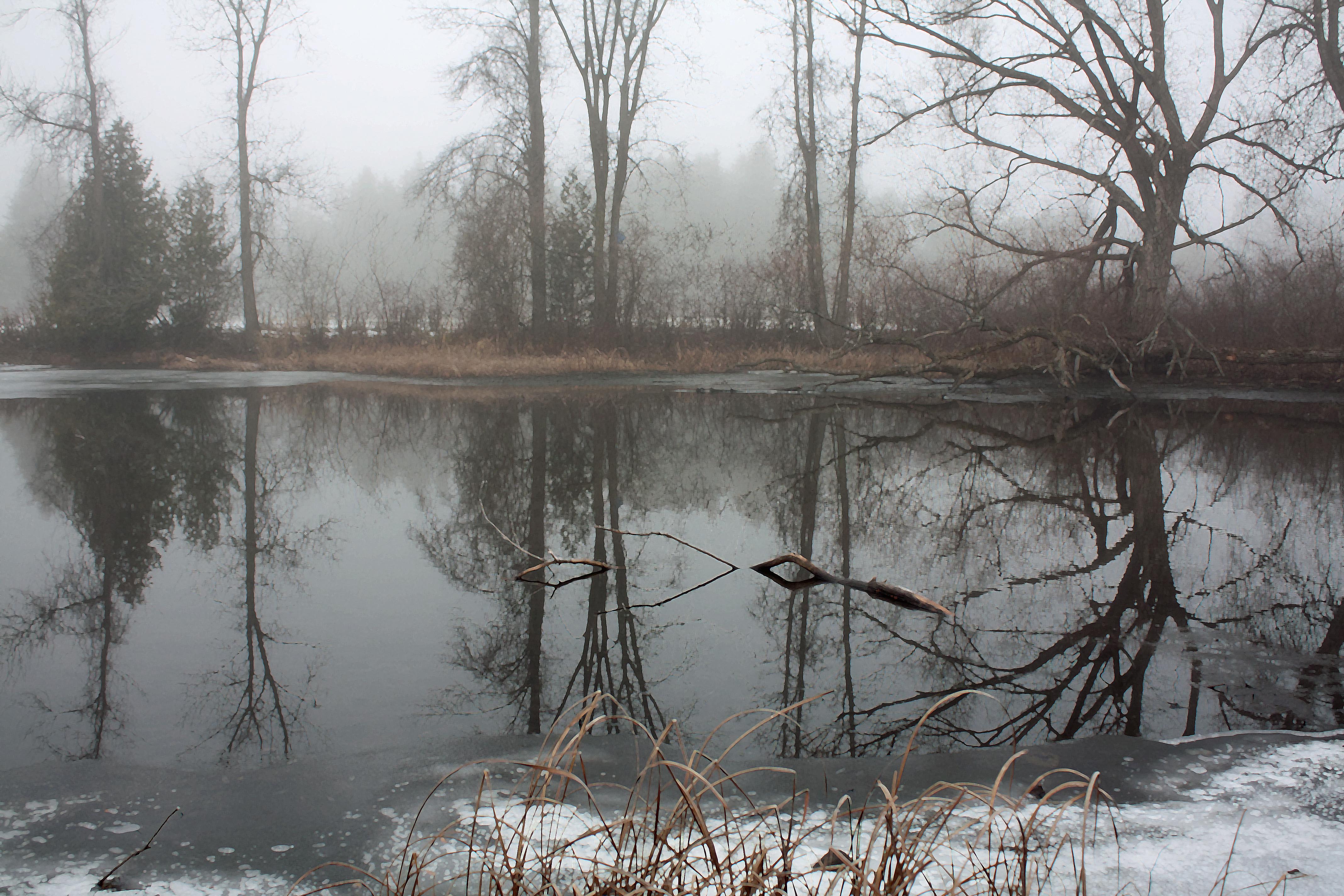
Foggy morning on an Ontario marsh in winter (photo and rendition by Nina Munteanu)
The well-being and flourishing of human and nonhuman Life on Earth have value in themselves (synonyms: intrinsic value, inherent value). These values are independent of the usefulness of the non-human world for human purposes.
Richness and diversity of life forms contribute to the realization of these values and are also values in themselves.
Humans have no right to reduce this richness and diversity except to satisfy vital needs.
The flourishing of human life and cultures is compatible with a substantial decrease of the human population. The flourishing of nonhuman life requires such a decrease.
Present human interference with the nonhuman world is excessive, and the situation is rapidly worsening.
Policies must therefore be changed. These policies affect basic economic, technological, and ideological structures. The resulting state of affairs will be deeply different from the present.
The ideological change is mainly that of appreciating life quality (dwelling in situations of inherent value) rather than adhering to an increasingly higher standard of living. There will be a profound awareness of the difference between big and great.
Those who subscribe to the foregoing points have an obligation directly or indirectly to try to implement the necessary changes.
.
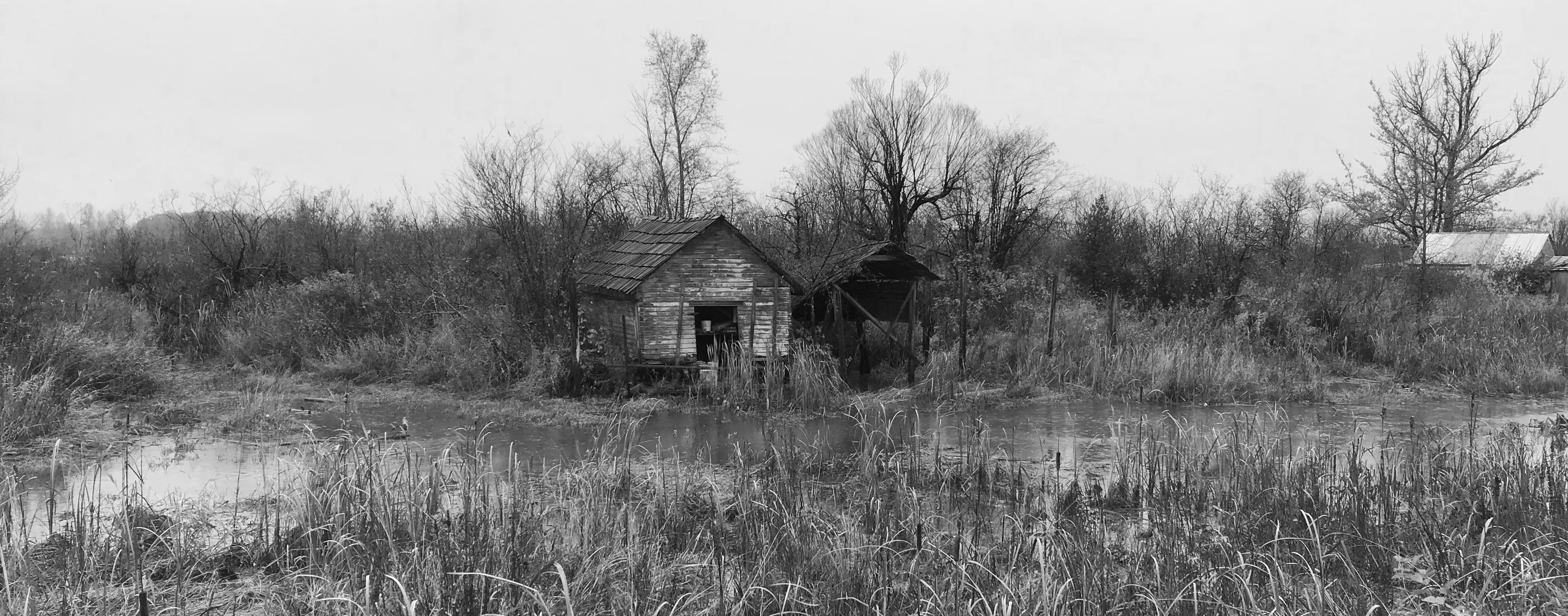
Finn Slough old shed, BC (photo by Nina Munteanu)
.
Eric plans to address the 5th Basic Principle of Deep Ecology—present human interference with the nonhuman world is excessive and the situation is rapidly worsening— by using nefarious means to meet the 4th Basic Principle of Deep Ecology: the flourishing of human life and cultures is compatible with a substantial decrease of the human population and the flourishing of nonhuman life requires such a decrease. With a reduced population, he plans to make the remaining principles (e.g. 6th and 7th) realizable through his behaviour engineering.
But Eric hasn’t accounted for fanatical deep ecologist / eco-terrorist Monica Schlange in his plan… (More on this shapeshifting character in Part 2).
.
The Icaria Trilogy by Dragon Moon Press
.
You can pre-order the ebook of Gaia’s Revolution by Dragon Moon Press on Amazon. Release date is March 10, 2026. The print version will release soon after. Book 2 (Angel of Chaos) and Book 3 (Darwin’s Paradox) of theThe Icaria Trilogy are already available in both ebook and print form.
.
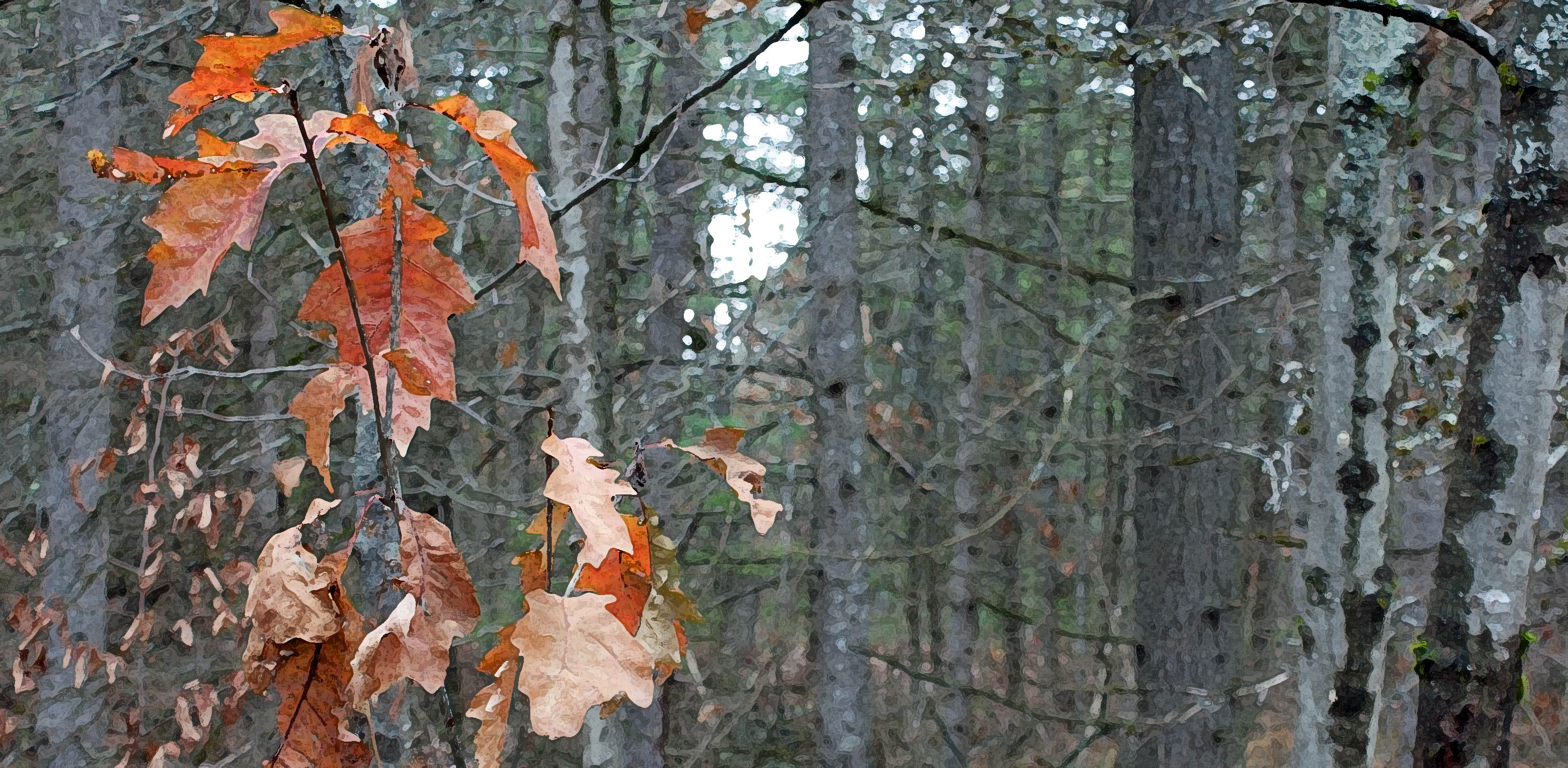
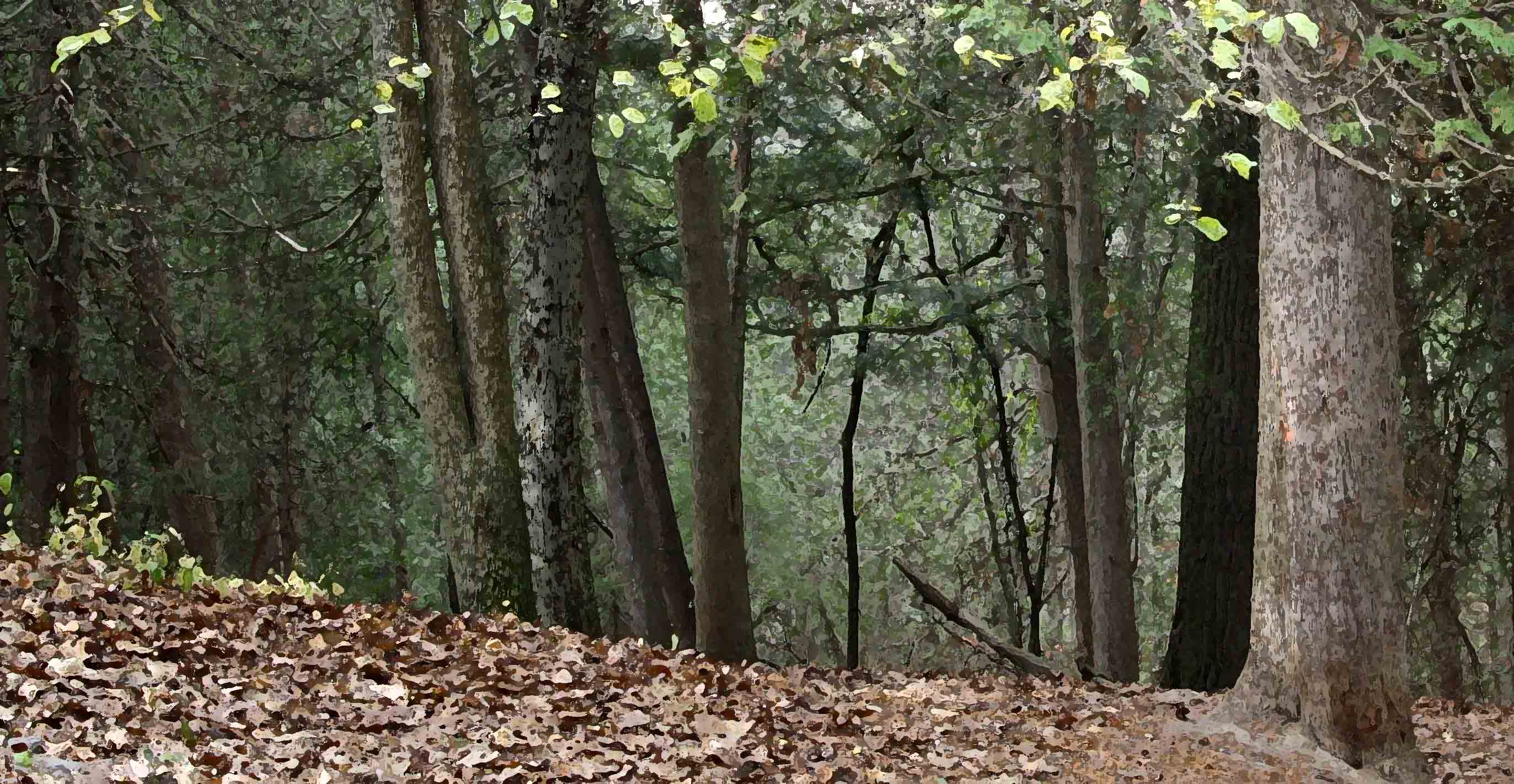
Oak leaves light up a dark pine forest in fall, ON (photo by Nina Munteanu)
.
References:
Munteanu, Nina. 2026. “Gaia’s Revolution, Part 1 of Icaria Trilogy.” Dragon Moon Press, Calgary, AB. 369 pp.
Munteanu, Nina. 2010. “Angel of Chaos, Part 2 of Icaria Trilogy.” Dragon Moon Press, Calgary, AB. 518 pp.
Munteanu, Nina. 2007. “Darwin’s Paradox, Part 3 of Icaria Trilogy.” Dragon Moon Press, Calgary, AB. 294 pp.
Sessions, George, Bill Devall. 2000. “Deep Ecology: Living as if Nature Mattered.” Gibbs Smith. 267pp.
Skinner, B.F. 1948. “Walden Two” The Macmillan Company, New York. 301pp.
.
Terminology:
*Deep Ecology: An environmental philosophy and social movement advocating that all living beings have intrinsic value, independent of their utility to human needs. Coined by Arne Næss in 1972, it promotes a holistic, ecocentric worldview—often termed “ecosophy”—that demands radical, structural changes to human society to prioritize nature’s flourishing.
*Letzte Generation: a prominent European climate activist group, founded in 2021, known for its acts of civil disobedience—such as roadblocks, defacing art, and vandalizing structures—to pressure governments on climate action. The term was chosen because they considered themselves to be the last generation before tipping points in the earth’s climate system would be reached. They are mostly active in Germany, Italy, Poland and Canada. In Germany, they have faced accusations of forming a criminal organization, leading to police raids.
.
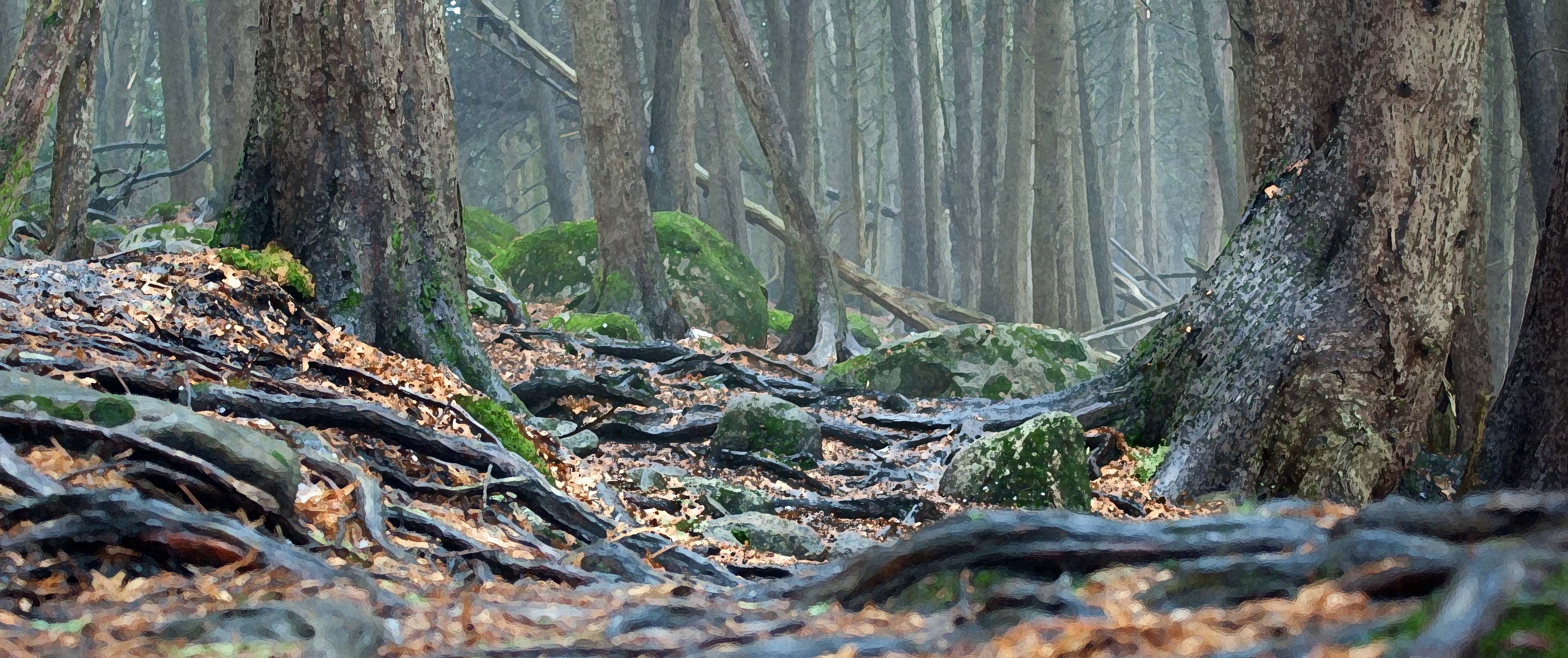
Root-covered cedar-pine forest in early winter, ON (photo and rendition by Nina Munteanu)
.
Nina Munteanu is a Canadian ecologist / limnologist and novelist. She is co-editor of Europa SF and currently teaches writing courses at George Brown College and the University of Toronto. For the latest on her books, visit www.ninamunteanu.ca. Nina’s bilingual “La natura dell’acqua / The Way of Water” was published by Mincione Edizioni in Rome. Her non-fiction book “Water Is…” by Pixl Press (Vancouver) was selected by Margaret Atwood in the New York Times ‘Year in Reading’ and was chosen as the 2017 Summer Read by Water Canada. Her novel “A Diary in the Age of Water” was released by Inanna Publications (Toronto) in June 2020.
A fanatical deep-ecologist, Monica Schlange, harnesses two orphans in her bid to reshape humanity and its place in the natural world.
.
My upcoming book Gaia’s Revolution(Book 1 of The Icaria Trilogy by Dragon Moon Press) explores a collapsing capitalist society in Canada through ravages of climate change and a failing technology. The story is told through the lives of ambitious twin brothers Eric—a gifted engineer—and Damien Vogel—a brilliant scientist and deep ecologist*—and the woman who plays them like chess pieces in her gambit to ‘rule the world.’
.
The brothers meet at Treffpunkt, a café near Humboldt University in Berlin, nursing Kellerbiers over a late lunch of Einsbeinmit Sauerkraut. They argue ideology and reform. Canada represents an ideal canvas for revolution, argues Eric. Damien is puzzled by this. To him Canada represents a quietly reposed nation of polite intellectuals who accept a healthy multicultural society and whose practical leaders are connected with their people. Not a restive rabble ripe for change.
As if reading his brother’s mind, Eric replies:
“Because it’s a huge nation with a lot of space and few people,” Eric argues. “Did you know that Canada holds on average only 4 people per square kilometer? Germany stuffs 240 people in the same area. And China, which is virtually the same size as Canada, holds 153 people per square kilometer.” He picks up Walden Two and waves it at Damien. “Canada is a perfect place to start these [Walden Two colonies called Icarias*]. And, with global warming, we could settle in the boreal.” He then slides the book back in his pocket and leans back, eyes sparkling with purpose. “But the real reason to start a revolution there is because, like you, Canadians are naïve. Even their leaders. And this is because, unlike the rest of the world, they are still asleep…
“Climate is not our enemy, Dame; it’s our friend. Climate is our fierce archangel of change. And let’s not forget that ‘crisis is opportunity…” … He grins, self-pleased, like a wolf in a hen house. Then he practically snarls out, “We must first destroy before we can create. We must be unruly like climate. We must be relentless like climate. We must ride that wave before we can become the wave, Bruder. And then by being that wave, we change the world.”
.
Pine cedar forest in Ontario (photo and rendition by Nina Munteanu)
.
The brothers escape the growing racial violence of Berlin, to ‘peaceful’ Canada in a rivalry to control the evolution of the human race. Years later, Eric Vogel, who has created a niche for himself in the technocratic government*, sits in the Canadian prime minister’s office and imagines what a post-capitalist world will look like and how his twin brother Damien—left behind in Germany—would disagree with his vision:
Damien too easily prescribes to the old leftist shibboleth of Nature being the answer to everything and Market being evil. His deep ecology utopia would spring from an atavistic rejection of modern life, a return to ‘the ancient farm.’ But how that fantasy could be achieved without a drastic population reduction is beyond his brother’s imagination. Damien fetishizes the natural world. Just like he does their mother. The naïve fool is a blind romantic, refusing to see reality right in front of him: that Nature is ultimately cruel, cold, and preoccupied with its own survival. Just like their mother.
.
First snow in an Ontario marsh (photo and rendition by Nina Munteanu)
.
Each brother plans to create a new humanity: one to control through gene manipulation and behaviour engineering; the other to empower through biotechnology and transhumanist AI. The warring brothers end up in Canada and set off a violent revolution that destroys the Canadian technocratic government and whose weapons ultimately risk the survival of humanity. Deep ecologist Monica Schlange snares the brothers in her gambit to reshape humanity and its place in the natural world. Three orphaned children, caught in the web of intrigue and violence, will ultimately determine the direction of humanity by introducing the first veemelds (people who can communicate with machines), a new environmental disease (Darwin), and a new set of rules neither brother envisioned.
Birch trees in a winter marsh, ON (photo and rendition by Nina Munteanu)
.
References:
Munteanu, Nina. 2026. “Gaia’s Revolution, Part 1 of Icaria Trilogy.” Dragon Moon Press, Calgary, AB. 369 pp.
Munteanu, Nina. 2010. “Angel of Chaos, Part 2 of Icaria Trilogy.” Dragon Moon Press, Calgary, AB. 518 pp.
Munteanu, Nina. 2007. “Darwin’s Paradox, Part 3 of Icaria Trilogy.” Dragon Moon Press, Calgary, AB. 294 pp.
Sessions, George, Bill Devall. 2000. “Deep Ecology: Living as if Nature Mattered.” Gibbs Smith. 267pp.
Skinner, B.F. 1948. “Walden Two” The Macmillan Company, New York. 301pp.
.
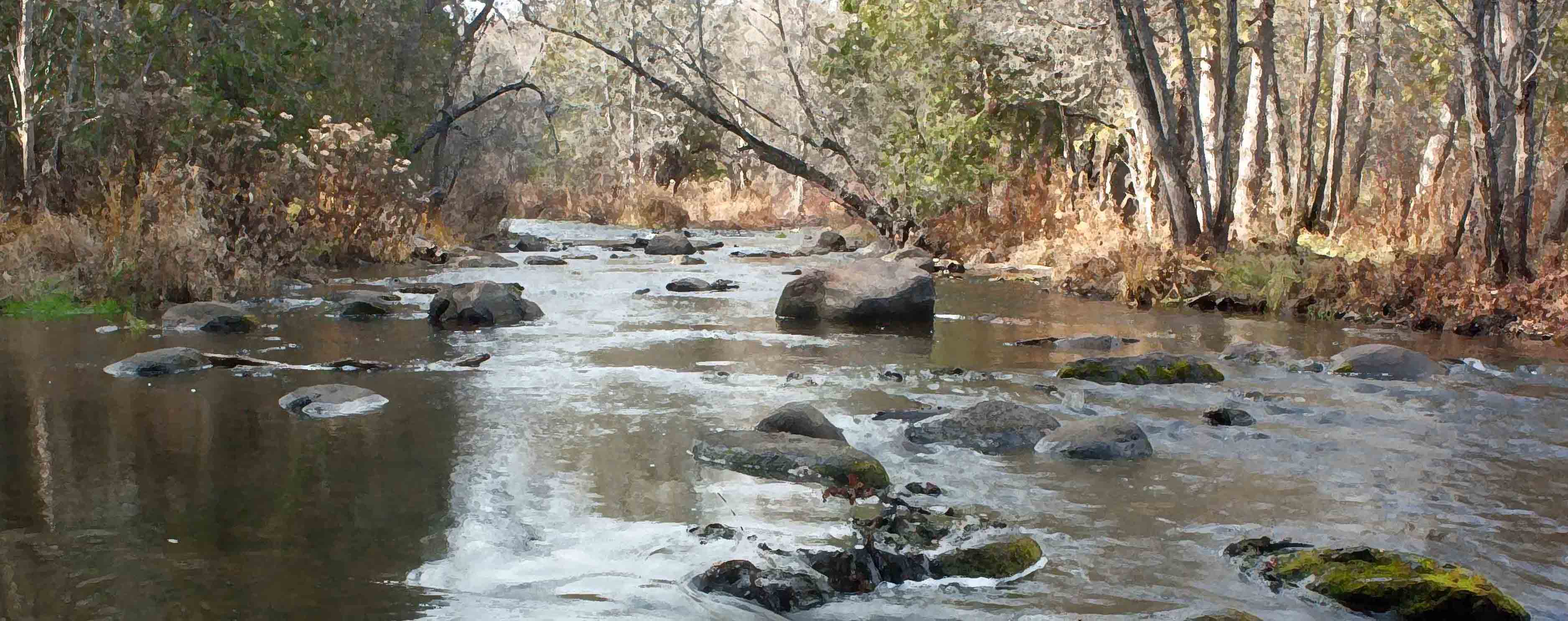
Jackson Creek in the fall, ON (photo and rendition by Nina Munteanu)
.
Terminology:
*Deep Ecology: An environmental philosophy and social movement advocating that all living beings have intrinsic value, independent of their utility to human needs. Coined by Arne Naess in 1972, it promotes a holistic, ecocentric worldview—often termed “ecosophy”—that demands radical, structural changes to human society to prioritize nature’s flourishing.
*Icaria: the name of Étienne Cabet’s utopia. Cabet was a French lawyer in Dijon, who published his novel Voyage en Icarie in 1839. The novel was a sort of manifesto-blueprint of utopian socialism, with elements of communism (abolished private property and individual enterprise), influenced by Fourierist and Owenite thinking. Key elements, such as the four-hour work day, are reflected in B.F. Skinner’s Walden Two. The novel explores a society in which capitalist production is replaced by workers’ cooperatives with a focus on small communities.
*Technocracy: A form of government in which the decision-maker(s) are selected based on their expertise in a given area; any portion of a bureaucracy run by technologists. Technocracies control society or industry through an elite of technical experts. The term was initially used to signify the application of the scientific method to solving social problems.
.
Nina Munteanu is an award-winning novelist and short story writer of eco-fiction, science fiction and fantasy. She also has three writing guides out: The Fiction Writer; The Journal Writer; and The Ecology of Writing and teaches fiction writing and technical writing at university and online. Check the Publications page on this site for a summary of what she has out there. Nina teaches writing at the University of Toronto and has been coaching fiction and non-fiction authors for over 20 years. You can find Nina’s short podcasts on writing on YouTube. Check out this site for more author advice from how to write a synopsis to finding your muse and the art and science of writing.
“Bourgeois society stands at the crossroads, either transition to socialism or regression into barbarism.”—Rosa Luxemburg, 1915
.
I wrote my first novel in 1969 when I was fifteen. Caged in World was a hundred-page speculative story about a world that had moved “inside” to escape the ravages of a post climate-change environment. It would later become Book 2 of The Icaria Trilogy. I was already disillusioned with my world. I saw how corporations and governments and society in general—individuals around me—‘othered’ the environment by either treating it with disrespect and apathy or outright ignoring it in a kind of torpor of obliviousness. As though it didn’t exist.
.
I remember being chastised by a school teacher for thinking globally about what was happening to the planet at our hands: worldwide deforestation (e.g., clearcutting the old-growth forests of Canada), infilling saltwater and freshwater marshes, massive use of pesticides and fertilizers, contamination of lakes, unregulated mining and toxic pollution, and ultimately climate change. Stick to local concerns, he advised me; recycling and such.
I remember wondering if I was just being weird. That my odd sensibility for the planet-entire was just a nina-thing. I prayed that I was not alone and it wasn’t just a nina-thing.
.
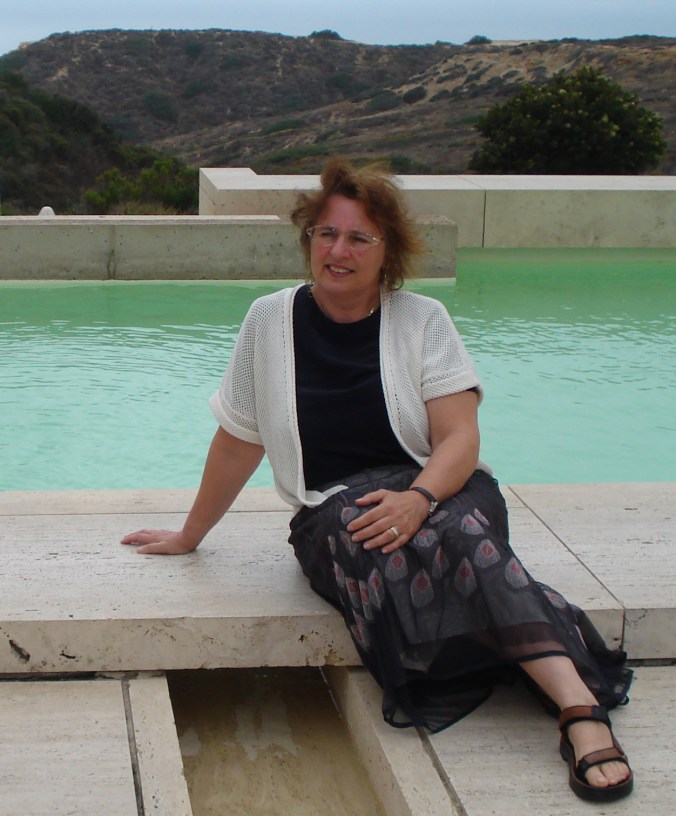
(Photo: Nina Munteanu, Salk Institute, California)
Throughout high school and university, I read scientific papers, news articles and books on revolution. I became a student of climate change long before the term entered the zeitgeist. I studied industrial capitalism and its roots in neoliberalism and colonialism. I noted how the post-war expansion of capitalism shifted from Fordist mass production to flexible automation, technology and AI. I saw the rise of multinational corporations, income inequality, and the commodification of everything—from water to human beings (Foucault’s homo economicus).
.
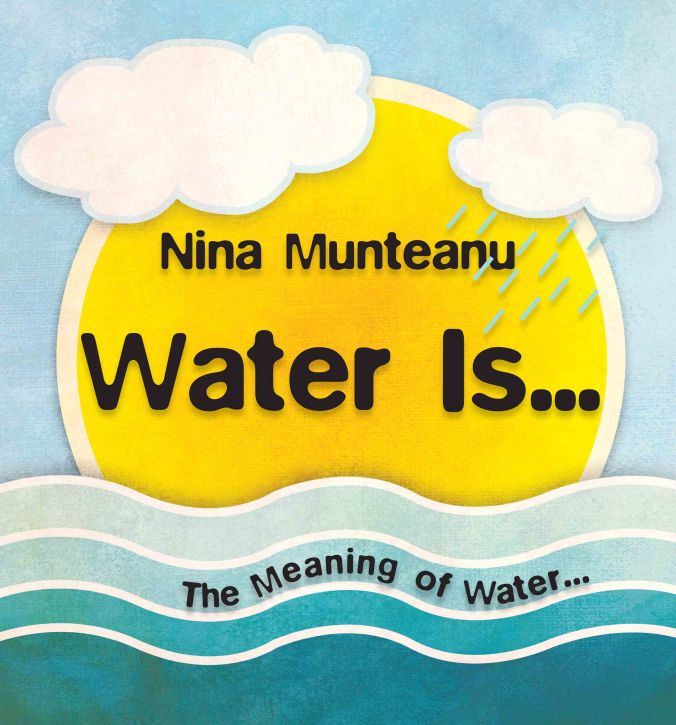
I pursued a university degree in ecology and limnology to study and help protect the environment and educate industry and their governments in the process. I became an expert on water. See my book Water Is…The Meaning of Water, which celebrates water from twelve perspectives (and got a shout out from Margaret Atwood!).
.
I soon concluded that a hegemony that follows the economic system of late capitalism inevitably commodifies and ‘others’ with ruthless purpose. Once something (or someone) is commodified, they are given a finite value and purpose outside their own existence. They become an object, a symbol to use and trade. They become a resource to manipulate, exchange, and dispose of with impunity. And through this surrender to utility, they become ‘othered.’ The consumer. The trees of the forest. Water. Homo sacer*. Each has a role to play in the late capitalist narrative of digital abundance and physical scarcity.
Capitalism hasn’t been kind to the environment. Economic pundits and sociologists insist that Capitalism is devolving. But what will replace it? Cloud capital? Technofeudalism? Something else?
.
Deep Ecology* & Gaia’s Revolution
The Icaria Trilogy (Dragon Moon Press)
.
My three Icaria novels—starting with Gaia’s Revolution, (the first of The Icaria Trilogy, releasing March 10, 2026, by Dragon Moon Press)—chronicle the collapse of a capitalist society in Canada as climate change, water shortages, habitat destruction, plague and a failing technology devastate the Canadian population.
.
Gaia’s Revolution (Book 1 of The Icaria Trilogy) explores a transition in Canada from semi-socialized capitalist system to a technocratic* meritocracy of technologists and scientists. Triggered by catastrophic environmental and sociological tipping points and following violent revolution, a dictatorship of deep ecologists* called Gaians seize power. By the end of the book, enclosed cities called Icarias* now populate North America. Separated from their environment, humans now live inside domes protecting them from a hostile and toxic environment.
.
In truth, the deep ecologists are keeping people “inside” not to protect humanity from a toxic wasteland but to protect the environment from a toxic humanity.
.
How realistic is this vision? Well, it is science fiction, after all, and though it takes liberties with its narrative, it is science-based and ultimately draws on precedent. As Margaret Atwood so astutely attested of her cautionary SF book The Handmaid’s Tale: “I didn’t put in anything that we haven’t already done, we’re not already doing, we’re seriously trying to do, coupled with trends that are already in progress.”
Science fiction is itself powerful metaphor; it is the fiction of political and social allegory or satire and makes astute social commentary about a world and civilization: how it has come to be, how it works—or doesn’t—and how it may evolve.
So, it is visionary and predictive? I prefer to think as Ray Bradbury:
.
“The function of science fiction is not only to predict the future, but to prevent it.”–Ray Bradbury
.
Jackson Creek in winter, ON (photo and rendition by Nina Munteanu)
.
References:
Angus, Ian. 1012. “The Spectre of 21st Century Barbarism.” Climate & Capitalism, August 20, 2012.
Atwood, Margaret. 2004. “The Handmaid’s Tale and Oryx and Crake ‘In Context'”. PMLA. 119 (3): 513–517.
Bradbury, Ray. 1991. “Yestermorrow: Obvious Answers to Impossible Futures” and “Beyond 1984: The People Machines” by Ray Bradbury, dated 1982, Page 155, Joshua Odell Editions: Capra Press, Santa Barbara, California.
Foucault, Michel. 2010. “The Birth of Biopolitics (Naissance de la biopolitique): Lectures at the Collège de France, 1978-1979.” Picador. 368pp.
Luxemburg, Rosa. 1915. “The Junius Pamphlet: The Crisis in the German Democracy”, Marxist.org.
Munteanu, Nina. 2026. “Gaia’s Revolution, Part 1 of Icaria Trilogy.” Dragon Moon Press, Calgary, AB. 369 pp.
Munteanu, Nina. 2010. “Angel of Chaos, Part 2 of Icaria Trilogy.” Dragon Moon Press, Calgary, AB. 518 pp.
Munteanu, Nina. 2007. “Darwin’s Paradox, Part 3 of Icaria Trilogy.” Dragon Moon Press, Calgary, AB. 294 pp.
Neuman, Sally. 2006. “‘Just a Backlash’: Margaret Atwood, Feminism, and The Handmaid’s Tale“. University of Toronto Quarterly. 75 (3): 857–868.
Sessions, George, Bill Devall. 2000. “Deep Ecology: Living as if Nature Mattered.” Gibbs Smith. 267pp.
Skinner, B.F. 1948. “Walden Two” The Macmillan Company, New York. 301pp.
Streeck, Wolfgang. 2014. “How Will Capitalism End?” New Left Review 2 (87): 47p.
.
Terminology:
*Deep Ecology: An environmental philosophy and social movement advocating that all living beings have intrinsic value, independent of their utility to human needs. Coined by Arne Næss in 1972, it promotes a holistic, ecocentric worldview—often termed “ecosophy”—that demands radical, structural changes to human society to prioritize nature’s flourishing.
*Homo sacer: a figure from Roman law denoting a person excluded from society who is outside human law (can be killed) and divine law (cannot be sacrificed). The term represents “bare life”: stripped of political rights, legal protection, and social value. Philosopher Giorgo Agamben popularized the term to describe individuals excluded from the political community, such as refugees, stateless persons, or camp detainees. The term illustrates the power of a sovereign in deciding which lives are worthy of protection and which are not.
*Icaria: the name of Étienne Cabet’s utopia. Cabet was a French lawyer in Dijon, who published his novel Voyage en Icarie in 1839. The novel was a sort of manifesto-blueprint of utopian socialism, with elements of communism (abolished private property and individual enterprise), influenced by Fourierist and Owenite thinking. Key elements, such as the four-hour work day, are reflected in B.F. Skinner’s Walden Two. Cabet’s novel explores a society in which capitalist production is replaced by workers’ cooperatives with a focus on small communities.
*Letzte Generation: a prominent European climate activist group, founded in 2021, known for its acts of civil disobedience—such as roadblocks, defacing art, and vandalizing structures—to pressure governments on climate action. The term was chosen because they considered themselves to be the last generation before tipping points in the earth’s climate system would be reached. They are mostly active in Germany, Italy, Poland and Canada. In Germany, they have faced accusations of forming a criminal organization, leading to police raids.
*Technocracy: A form of government in which the decision-maker(s) are selected based on their expertise in a given area; any portion of a bureaucracy run by technologists. Technocracies control society or industry through an elite of technical experts. The term was initially used to signify the application of the scientific method to solving social problems.
.
Nina Munteanu is an award-winning novelist and short story writer of eco-fiction, science fiction and fantasy. She also has three writing guides out: The Fiction Writer; The Journal Writer; and The Ecology of Writing and teaches fiction writing and technical writing at university and online. Check the Publications page on this site for a summary of what she has out there. Nina teaches writing at the University of Toronto and has been coaching fiction and non-fiction authors for over 20 years. You can find Nina’s short podcasts on writing on YouTube. Check out this site for more author advice from how to write a synopsis to finding your muse and the art and science of writing.
In his 2006 book The Seven Basic Plots: Why We Write Stories, Christopher Booker tells us that there are seven types of plots in story. One is entitled “Overcoming the Monster,” an underdog story where the hero sets out to destroy an evil to restore safety to the land. It is a story I admire and never tire of. The evil force is typically much larger than the hero, who must find a way, often through great courage, strength, inventive cunning—and help from her community—to defeat the evil force. This is the story of David and Goliath, of Beowulf and Grendel, of Luke Skywalker and Darth Vader in Star Wars, of Jake Sully and Miles Quaritchs in Avatar—notice, all men who, for the most part, do their hero-ing alone. I may get to that later (in another post)…
The “Overcoming the Monster” plot, whether told literally or through metaphor, reflects an imbalance in the world—usually of power—that the hero must help right.
Enter the “Monster” DuPont…
DuPont Washington Works plant in Parkersburg, West Virginia
The true story of DuPont’s decades-long evil maleficence reflects the great power imbalance of many large corporations and the evil they enact through willful deception and mischief to increase profit, their god.
This brings me to my heroic journey. For in some terrible way, the story of DuPont is also my story. One of power imbalance, of deception and ignorance. Their deception; my ignorance:
.
In 1954, the year I was born, during the ramp up for the Teflon rollout at DuPont’s Washington Works plant in Parkersburg, toxicologist R.A. Dickison noted possible toxicity of the surfactant C8 (PFOA or Perfluorooctanoic Acid) used to make Teflon. DuPont ignored the warning and proceeded to roll it out for mass use.
1950s DuPont ad for the Teflon “Happy Pan”
.
In 1961, while I was contending with recess bullies in grade two, DuPont rolled out their Teflon-coated “Happy Pan” with the full knowledge that C8 was a toxic endocrine disruptor and caused cancer. DuPont’s chief toxicologist Dorothy Hood cautioned executives in a memo that the substance was toxic and should be “handled with extreme care.” She explained that a new study had found enlarged livers in rats and rabbits exposed to C8, confirming that the chemical was toxic. It didn’t stop the roll out.
In 1962, while I was exploring my artistic talents at school,DuPont scientists conducted tests on humans, asking a group of volunteers to smoke cigarettes laced with C8. Nine out of ten people in the highest-dosed group were noticeably ill for an average of nine hours with flu-like symptoms that included chills, backache, fever, and coughing. Further experiments by DuPont linked C8 exposure to the enlargement of rats’ testes, adrenal glands, and kidneys.
In 1964, I was ten years old and struggling with my Grade 5 teacher who was trying to curb my unique self-expression. I was already aware of environmental imbalance and destruction in the world. My pet peeve was littering because it demonstrated great disrespect for others and the environment. I told environmental stories. That year DuPont had already begun its great deception; having confirmed the toxicity of C8, they simply watched (and recorded) as this cancer-causing endocrine disruptor injured, maimed and killed their own workers. The company did nothing to prevent it and they told no one.
In 1965, I was in the process of figuring out my heroic self and my unique gift to the world in Grade seven: was it in fine arts and advertising? Writing and storytelling? Environmentalism and law? Internal DuPont memos revealed that preliminary studies showed even low doses of a related surfactant to Teflon could increase the size of rats’ livers, a classic response to poison.
In the mid- to late-60s, I became an environmental activist, putting up posters and writing in the school paper. I wrote letters to industry and politicians, trying to incite interest in being good corporate citizens and promoting global environmental action. I remember a well-meaning teacher chiding me for my extravagant worldview. “Stick to little things and your community—like recycling,” he suggested patronizingly. I remember the shock of realizing that not everyone felt the planet like I did. Perhaps it was a teenage-thing, or a girl-thing, or a nina-thing. I prayed it wasn’t just a nina-thing…
I started writing stories in high school. Mostly eco-fiction, though I didn’t know that’s what it was at the time. There was no genre called eco-fiction back then. It all went under the umbrella of scifi.
In 1969, at fifteen, I wrote my first dystopia, Caged in World. The eco-novel was about a subway train driver and a data analyst caught in the trap of a huge lie. The story later morphed into Escape from Utopia. Several drafts and years later the novel became the eco-medical thriller Angel of Chaos, published in 2010. The story is set in 2095 as humanity struggles with Darwin’s Disease—a mysterious neurological environmental pandemic assaulting Icaria 5, an enclosed city within the slowly recovering toxic wasteland of North America. The city is run by deep ecologists who call themselves Gaians, and consider themselves guardians of the planet. The Gaians’ secret is that they are keeping humanity “inside” not to protect humanity from a toxic wasteland but to protect the environment from a toxic humanity.
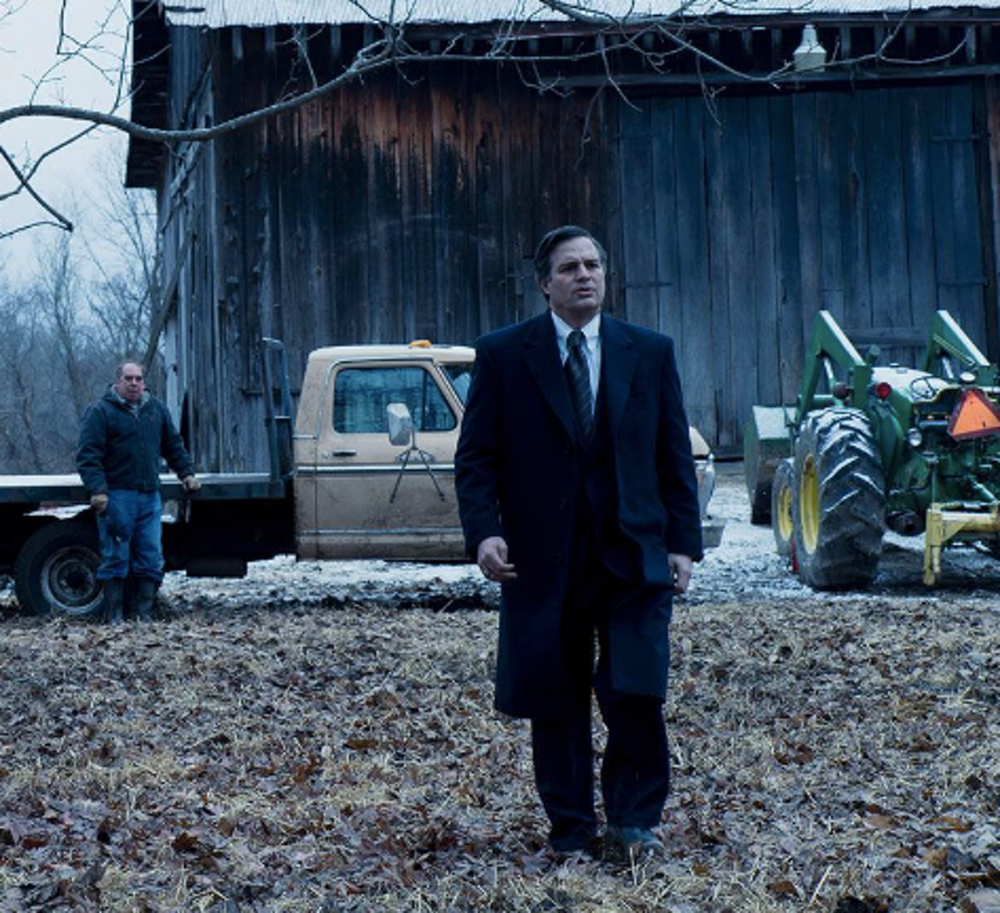
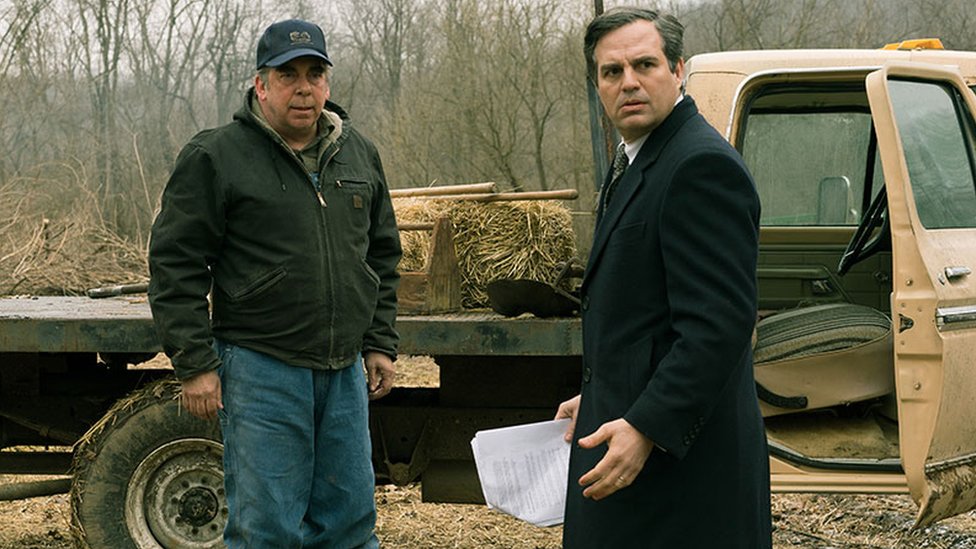
Lawyer Robert Bilott (Mark Ruffalo) investigates leachate-infected cows from nearby DuPont landfill (photo from film “Dark Waters”)
.
In the early 1970s, I entered university and contemplated becoming an environmental lawyer; I wrote short stories, mostly eco-fiction, and joined marches protesting environmental destruction by large corporations. DuPont confirmed that C8 not only persisted in the environment; it bioaccumulated in animals. In 1979, when I graduated with a Master of Science degree in limnology/ecology, DuPont circulated an internal memo in which humans exposed to C8 were referred to as “receptors,” describing how scientists found “significantly higher incidence of allergic, endocrine and metabolic disorders” as well as “excess risk of developing liver disease.” DuPont kept this knowledge to themselves and withheld it from EPA.
In the late 1970s early ‘80s, while I was addressing local environmental issues as a practicing limnological consultant, DuPont was dumping 7,100 tons of PFOA-laced sludge into unlined ‘‘digestion ponds’’: open, unlined pits on the Washington Works property, from which the chemical could seep straight into the ground. PFOA entered the local water table, which supplied drinking water to the communities of Parkersburg, Vienna, Little Hocking and Lubeck — more than 100,000 people.
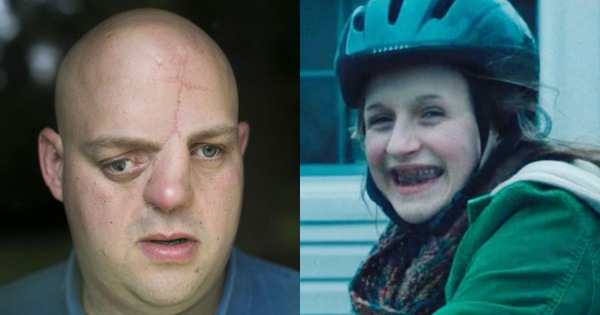
Effects of PFOA (birth defect in Bucky Bailey whose mother was on the Teflon line without protection during her first trimester; blackening teeth from the excessive fluoride, from scene in “Dark Waters”)
.
In 1981, when I got my first job as a limnologist and environmental consultant in Vancouver, DuPont confirmed that C8 caused birth defects in its own workers—and did not warn its workers. A DuPont pathologist confirmed that the observed fetal eye defects were due to C8. With that confirmation the pregnancy study was quietly abandoned and a decision made not to inform EPA. Less than a year later DuPont created false data for EPA then moved women of childbearing age back into areas with C8 exposure. Many in the company coined the term “Teflon flu” to describe the ill-effects of working close to the compound. By 1982, DuPont had confirmed the high toxicity of C8/PFOA in humans.
In 1984, a year after I formed my own consulting company Limnology Services in Vancouver, DuPont staffers secretly tested their community’s drinking water and found it to contain alarming levels of C8. Deciding that any cleanup was likely to cost too much and tarnish their reputation, DuPont chose to do nothing. In fact, they scaled up their use of C8 in Teflon products and bought land to dump their toxic sludge in unlined landfills. Deaths in DuPont workers from leukemia and kidney cancer climbed.
In 1989, at 35 years old, and still blissfully unaware of DuPont’s nefarious activities, I continued consulting for my own company Limnology Services, addressing mostly local environment issues with communities and local governments. By that year, DuPont employees found an elevated number of leukemia deaths at the West Virginia plant, followed by an inordinately high number of kidney cancers among male workers. Earl Tennant, whose farm was close to the DuPont landfill at Dry Run creek, sent videos of foamy water and diseased cows to the West Virginia Department of Environmental Protection; state regulators documented “numerous deficiencies in the landfill operation and erosion gullies that funnelled waste into Dry Run creek; DuPont made a deal with the department: the company paid a $250,000 fine and the department took no further action against the landfill. (The official who negotiated the deal later became a DuPont consultant.)
Throughout the 90s, I started teaching college biology and university environmental education courses in Vancouver. The magazine Shared Vision Magazine published my first article “Environmental Citizenship” in 1995. Meantime, DuPont’s Washington Works plant pumped hundreds of thousands of pounds of PFOA sludge, powder and vapor through stacks into the atmosphere and outfall pipes into the Ohio River.
In 1996, I was consulting for local industry and municipalities. By then, C8 was in the drinking water of Parkersburg and other communities. Despite what they knew of C8’s toxicity, DuPont kept it a secret (no one else was testing for PFOA because it was unregulated).
Farmer Tennant and lawyer Rob Billot encounter a leachate-infected mad cow in the 2019 film “Dark Waters”
.
In 1999, still serving as environmental consultant to mining and pulp mill companies, I still knew nothing about DuPont’s duplicitous environmental atrocities. 3M—troubled by its studies on C8 with monkeys—notified EPA and phased out PFOS and PFOA; DuPont started producing its own PFOA. On behalf of Earl Tennant whose cattle were dying adjacent to DuPont’s landfill site, lawyer Rob Bilott filed a small suit against DuPont to gain legal discovery and starting the decade-long process of finally unravelling the buried truth of their insidious criminality–over thirty years after DuPont knew and did nothing.
In 2003, I continued consulting as an environmental scientist in ignorance of DuPont’s misdealings, though by now much had come out in the press. By that year, DuPont had knowingly dispersed almost 2.5 million pounds of harmful C8 from its Washington Works plant into the air and water of the mid-Ohio River Valley area.
DuPont’s Washington Works plant in Parkersburg, West Virginia
.
In 2004, DuPont agreed to settle the class-action suit filed by lawyer Rob Bilott. Under the terms of the settlement, the company was not obliged to pull C8 from the market. The best the EPA could negotiate was a voluntary phase-out by 2015. That same year There It Is reported on how DuPont denied poisoning consumers with Teflon products. The dangers and spread of PFOA and other forever chemicals appeared more and more in the scientific literature (see the reference list below, which is by no means exhaustive).
In 2007, Darwin’s Paradox, my eco-fiction novel about an environmental pandemic, was published by Dragon Moon Press in Calgary, Alberta. Four years earlier, the law had finally caught up to DuPont, but not before they had dispersed 2.5 million pounds of harmful C8 from their Washington Works plant into the air and water of the mid-Ohio River Valley area. It would be another twelve years before DuPont would stop making C8 (in 2015) and another four years after that when C8 would be banned from use globally (2019). PFOA is still unregulated by EPA; the best they can do is issue a non-enforceable health advisory set at 70 parts per trillion.
In 2012, shortly after I moved to Nova Scotia to write for a living (having quit environmental consulting due to disillusionment with integrity of companies I worked for), the C8 Science Panel, tasked to study the possible health effects of PFOA in a highly exposed population in the mid-Ohio Valley, determined a probable link between C8 exposure and six disease categories: kidney cancer, testicular cancer, ulcerative colitis, thyroid disease, preeclampsia, and high cholesterol.
In 2015, two years after I began teaching writing at the University of Toronto, DuPont began a series of complex transactions that transferred its responsibility for environmental obligations and liabilities associated with PFAS (C8) onto other entities such as Chemours, Corteva, and NewDupont. A year later New York Times Magazineran a story “The Lawyer Who Became DuPont’s Worst Nightmare” and Sharon Lerner of The Intercept ran an in-depth series on DuPont’s duplicitous criminality: “The Teflon Toxin: DuPont and the Chemistry of Deception.”
In 2017, DuPont and its spinoff company Chemours agreed to settle a lawsuit with roughly 3,500 people living near the Parkersburg plant in both West Virginia and Ohio and many ailing from toxicity-related problems. The company agreed to pay $671 million. That’s one day’s sales in a $27 billion annual profit stream. The Fayetteville Observer reported that this “Discontinued chemical [was] still in well water” after DuPont agreed in 2009 to stop using C8. They noted that the company was facing a class action lawsuit from thousands of people in Ohio and West Virginia for discharging the toxic chemical into the Ohio River since the 1950s.
In 2019—sixty-seven years after DuPont knew PFOA was toxic and did nothing—this forever chemical was finally banned globally under the Stockholm Convention. Unfortunately, by 2019, PFOA was already literally everywhere on the planet in concentrations considered unsafe. Given its high water-solubility, long-range transport potential, and lack of degradation in the environment, PFOA persists in groundwater and is ubiquitously present in oceans and other surface water around the globe. It is found in remote areas of the Arctic and Antarctic (where it was not used or manufactured), no doubt transported there through ocean currents and in the air, bound on particles. NBC Newsran a news piece about ‘forever chemicals’ contaminating drinking water near military bases. The Guardian ran a news article: “Companies deny responsibility for toxic ‘forever chemicals.’” In Maine, The Portland Press Herald ran a story: “Households are awash in ‘forever chemicals’.”
In 2020, NBC News revealed that DuPont was still avoiding its responsibility to clean up its C8 mess and compensate those harmed by DuPont’s negligence.
In 2022, I finally learned about DuPont’s decades-long environmental dispersal of toxic PFOA (C8) and their criminal deception throughout this life time. I’d lived through DuPont’s entire six decades of deception in ignorance.
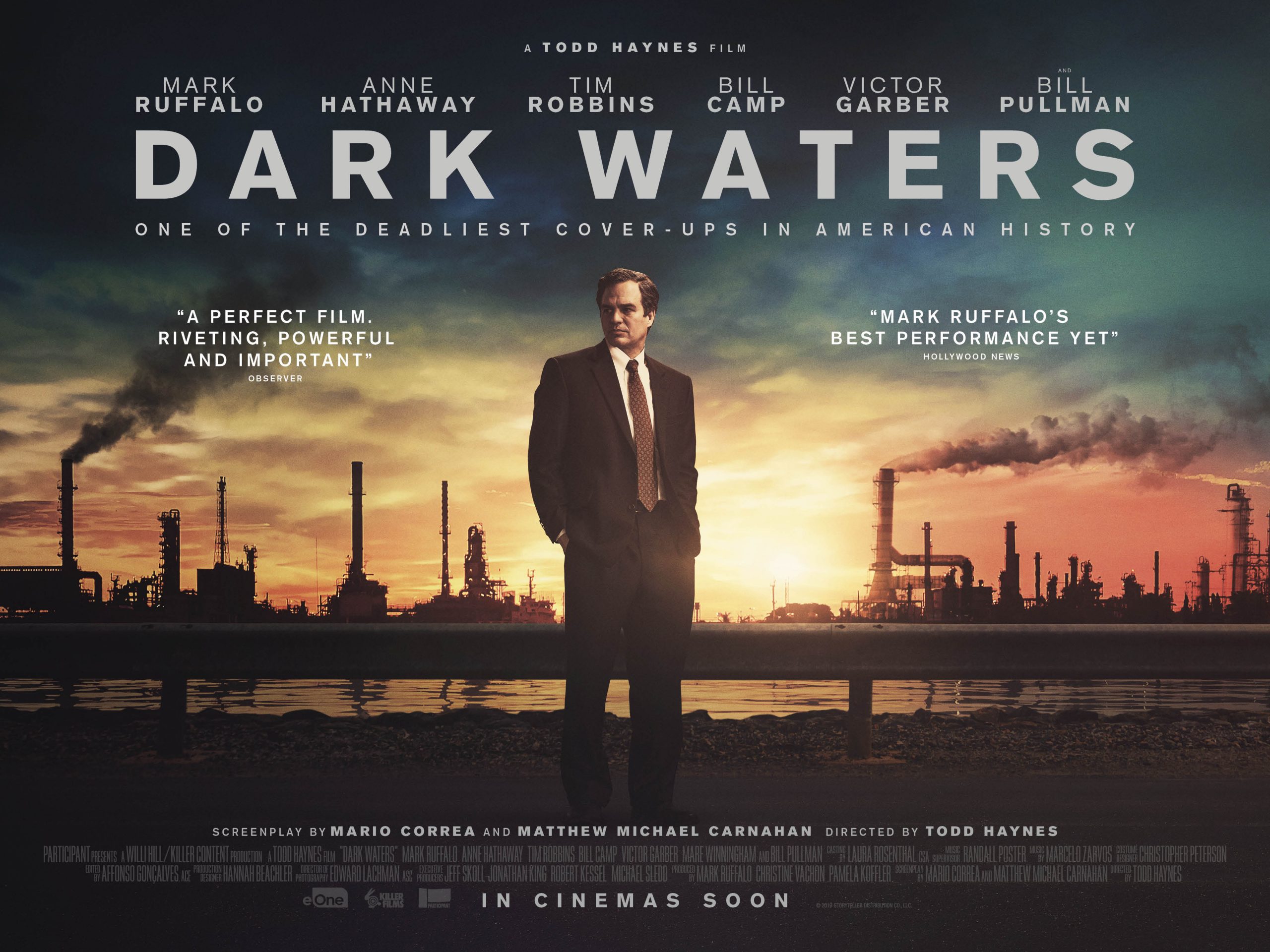
Poster for the 2019 film “Dark Waters” on DuPont’s criminal activities and the lawyer who exposed them
.
In 2022, three years after its release, I chanced upon “Dark Waters,” the 2019 film starring Mark Ruffalo who plays lawyer Robert Bilott, the man who took DuPont to court in 2002. I found out seven years after DuPont was forced to stop using PFOA and a lifetime after they started their egregious pollution and deception in the 1950s. For over six decades, from when I was born to well into my sixties, DuPont executives chose to:
Below are the faces of the DuPont men and women who sanctioned–encouraged–the willful harm of other life. Despite knowing the danger posed by exposure to PFOAs to people, these DuPont CEOs chose to: 1) continue to poison the environment and people, 2) cover up their actions from authorities, and 3) fight the courts and regulators from doing the right thing when they were caught. No one went to jail. No one was fired. They just paid $$$ and shamefully kept going. These people are criminals.
DuPont CEOs from 1950-2019 who sanctioned release of PFOA into the environment then covered it up: Crawford H. Greenewalt, Lammot Copeland, Charles B. McCoy, Edward G. Jefferson, Richard E. Heckert, Edgar S. Woolard, John A. Krol, Charles O. Holliday Jr., Ellen Kullman, Edward D. Breen
.
It’s not over either; DuPont currently uses other PFAS compounds that are unregulated but whose toxicity is being found to be as potent. And, of course, these other ‘forever chemicals’ are finding themselves everywhere. I was ignorant of all this the whole time. Meantime, I am drinking DuPont’s forever chemicals, I am eating DuPont’s forever chemicals, and I am feeling DuPont’s forever chemicals falling on my face in the rain.
My hard lesson: Ignorance breeds complacency and hubris; both will lead to downfall.
To return to the “Overcoming the Monster” story plot and the monster archetype, I’m convinced that it isn’t the Darth Vaders or Miles Quaritchs we must overcome. Yes, they are monsters, but they serve a greater monster. For Vader it was Emperor Palpatine and for Quaritch it was the executives of the RDA Corporation. While Vader and Quaritch may be the face of evil, true evil lurks behind them, orchestrating, in the shadows. It is an evil we must fight internally, because each of us carries that potential evil inside us—in the urge to cheat on our taxes; in looking for the free ride (there are no free rides); in coveting what others have when what we have is enough; in embracing self-deception through unsubstantiated narratives and confabulation; and in choosing to remain ignorant to suit a short-sighted and self-serving agenda. I’m guilty too.
I hope some aspects of the hero that live in me, as with everyone, are helping to overcome the monster by writing about it in articles I share here and elsewhere and by presenting a different narrative—one of resistance and hope—through my fiction.
In a post on The Meaning of Water, I list which CEO was on watch and responsible for each criminal atrocity enacted. The post also goes into more detail on the six decade history of DuPont’s criminal atrocities and great deception. For more detail on each decade of atrocity and deception, check out my posts by decade: 1950s, 1960s, 1970s, 1980s, 1990s, and 2000s. What follows into the present day is perhaps even more atrocious, given that all is supposedly out in the open. This predatory company continues to bribe officials, lie and deny, threaten the weak, and so much more.
p.s. To understand the nature of industrial duplicity of large corporations such as DuPont, I highly recommend reading the 2023 study by Nadia Gaber and colleagues in the Annals of Global Health. The authors evaluated previously secret industry documents on PFAS to understand the significant delayed disclosure of harm posed by PFAS: from its production in the 1940s, to suggestions of toxicity in the 1950s, to irrefutable knowledge of PFAS toxicity in the 1960s, and–due to lack of transparency and suppression of scientific findings–public knowledge of this only arising in the late 1990s (mainly because of legal suits and discovery).
.
References:
Ahrens L. 2011. “Polyfluoroalkyl compounds in the aquatic environment: a review of their occurrence and fate.” J Environ Monit 13: 20–31. 10.1039/c0em00373e
Barton CA, Butler LE, Zarzecki CJ, Laherty JM. 2006. “Characterizing perfluorooctanoate in ambient air near the fence line of a manufacturing facility: comparing modeled and monitored values.” J Air Waste Manage Assoc 56: 48–55. 10.1080/10473289.2006.10464429
Barton CA, Kaiser MA, Russell MH. 2007. “Partitioning and removal of perfluorooctanoate during rain events: the importance of physical-chemical properties.” J Environ Monit 9: 839–846. 10.1039/b703510a
Busch J, Ahrens L, Xie Z, Sturm R, Ebinghaus R. 2010. “Polyfluoroalkyl compounds in the East Greenland Arctic Ocean.” J Environ Monit 12: 1242–1246. 10.1039/c002242j
Gaber, Nadia, Lisa Bero, and Tracey J. Woodruff. 2023. “The Devil they Knew: Chemical Documents Analysis of Industry Influenc on PFAS Science.” Ann Glob Health 89(1): 37.
McMurdo CJ, Ellis DA, Webster E, Butler J, Christensen RD, Reid LK. 2008. “Aerosol enrichment of the surfactant PFO and mediation of the water-air transport of gaseous PFOA.” Environ Sci Technol 42: 3969–3974. 10.1021/es7032026
Paustenbach, Dennis, Julie Panko, Paul K. Scott, and Kenneth M. Unice. 2007. “A Methodology for Estimating Human Exposure to Perfluorooctanoic Acid (PFOA): A Retrospective Exposure Assessment of a Community (1951-2003)” Journal of Toxicology and Environmental Health
Prevedouros K, Cousins IT, Buck RC, Korzeniowski SH. 2006. “Sources, fate and transport of perfluorocarboxylates” Environ Sci Technol 40: 32–44. 10.1021/es0512475
Velez, M.P., T.E. Arbuckle, W.D. Fraser. 2015. “Maternal exposure to perfluorinated chemicals and reduced fecundity: the MIREC study.” Human Reproduction 30(3): 701-9.
Vierke, Lena, Claudia Staude, Annegret Biegel-Engler, Wiebke Drost, and Christoph Schulte. 2012. “Perflurorooctanoic acid (PFOA)–main concerns and regulatory developments in Europe from an environmental point of view.” Environmental Sciences Europe 24: 16
Yamashita N, Kannan K, Taniyasu S, Horii Y, Petrick G, Gamo T. 2005. “A global survey of perfluorinated acids in oceans.” Mar Pollut Bull 51: 658–668. 10.1016/j.marpolbul.2005.04.026
.
Nina Munteanu is a Canadian ecologist / limnologist and novelist. She is co-editor of Europa SF and currently teaches writing courses at George Brown College and the University of Toronto. Visit www.ninamunteanu.ca for the latest on her books. Nina’s bilingual “La natura dell’acqua / The Way of Water” was published by Mincione Edizioni in Rome. Her non-fiction book “Water Is…” by Pixl Press (Vancouver) was selected by Margaret Atwood in the New York Times ‘Year in Reading’ and was chosen as the 2017 Summer Read by Water Canada. Her novel “A Diary in the Age of Water” was released by Inanna Publications (Toronto) in June 2020.
From Anne in Monument Valley, Arizona, to George in Brighton Pier, UK … from Heather coasting on the Ohio River to Noah gliding in a BC Ferry and Jo-Anne basking in the Gulf Islands of BC Canada … from Honoka in Kyoto’s Higashiyama District and Mika in Kyoto’s Bamboo Forest to Rick in his cozy Alberta home and Viviann in a cozy café … from Anne with her favourite dog in Ladner Marsh and Margaret with a favourite ale in an outdoor pub to Carina beside her favourite Buddha and Cathy by her favourite pool …and Noah wearing his hat …
People are reading Darwin’s Paradox.
Nina Munteanu is a Canadian ecologist / limnologist and novelist. She is co-editor of Europa SF and currently teaches writing courses at George Brown College and the University of Toronto. Visit www.ninamunteanu.ca for the latest on her books. Nina’s bilingual “La natura dell’acqua / The Way of Water” was published by Mincione Edizioni in Rome. Her non-fiction book “Water Is…” by Pixl Press(Vancouver) was selected by Margaret Atwood in the New York Times‘Year in Reading’ and was chosen as the 2017 Summer Read by Water Canada. Her novel “A Diary in the Age of Water” was released by Inanna Publications (Toronto) in June 2020.
On Writing My First Speculative Fiction Novel: The Darwin-Angel Duology
The first novel I wrote at the tender age of fifteen was Caged in World, a hundred-page speculative story about a world that had moved “inside” to escape the ravages of a harsh post climate-change environment.
It was 1969, the year that humans first stepped on the moon and the first Concorde test flight was conducted in France. But I was concerned by the environment and what was happening on our planet. It was seven years since Rachel Carson had published Silent Spring, which warned of our declining bird and bee populations and impacts to human health from unregulated pesticide/herbicide use (such as carcinogens and hormone disruptors). It was just a year after Paul Erlich’s Population Bomb warned that attempts to stretch the Earth’s resources to support the ever-growing population would result in mass starvation, epidemics, and, ultimately, the breakdown of social order.
In the 1960s it was already apparent that environmental imbalance and destruction were global concerns and we were on the brink of an environmental crisis. Unchecked deforestation was destroying forests around the world, including the boreal and old-growth forests of my own country Canada. Brazil had already begun cutting down trees and burning forest at an alarming rate. Unregulated use of pesticides, herbicides and growth hormones created toxic contamination of our natural world and our food and water supply—despite Carson’s dire warning with Silent Spring. Our waterways were being contaminated by mining wastes and industrial effluents. Killer smog. Noxious algal blooms. Oil spills. Dead zones. The list was growing.
Bamboo Forest, Kyoto, Japan (photo by Nina Munteanu)
I joined S.T.O.P. (Society To Overcome Pollution) and marched in protests to call for responsible behaviour by governments and large corporations. I tried to raise awareness at my school about our deteriorating environment and likely consequences to human survival; my own teachers tried to silence me. I wrote my first dystopia, Caged in World. The eco-novel was about a subway train driver and a data analyst caught in the trap of a huge lie. The story later morphed into Escape from Utopia. My dad, who was impressed with my dedication and what I’d done, became my first agent; he brokered a meeting with a Doubleday editor he’d met and impressed (my dad was a character and very charming); I did my first book pitch at age sixteen. The editor read my book and, while he didn’t pick the book for Doubleday, he told me that the story was original and imaginative and that I should keep writing.
Several drafts—and years later—the novel became the eco-medical thriller Angel of Chaos, set in 2095 as humanity struggles with Darwin’s Disease—a mysterious neurological environmental pandemic. Icaria 5 is one of many enclosed cities within the slowly recoving toxic wasteland of North America, and where the protagonist Julie Crane works and lives. The city is run by technocrats, deep ecologists who call themselves Gaians, and consider themselves guardians of the planet.
The Gaians’ secret is that they are keeping humanity “inside” not to protect humanity from a toxic wasteland but to protect the environment from a toxic humanity.
Since she was a young child, Julie has been hearing voices in her head. She’s not a schizophrenic, but a gifted veemeld (someone who can tap into machine intelligence wavebands). Feeling an inexplicable “karmic” guilt and intent on making a contribution to her society, Julie searches for a cure to Darwin Disease; instead, she makes a horrifying discovery that incriminates her in a heinous conspiracy to recast humankind.
“This is a story with great scope … As Julie finds out the truth about her father, she discovers a truth that will tear her world apart.“
Bill Johnson, author of “a story is a promise”
By virtue of their gifted powers in communicating with the machine world, veemelds are considered a commodity, to be used, traded, hoarded and discarded by ruling technocrats all over North America.
I spent several years shopping the book to agents and publishing houses. Although I received many bites, all finally let go. In the meantime, I did several things: 1) I started writing short stories, some of which were cannibalized from the book, and several were published; 2) I wrote Angel’s prequel, The Great Revolution (never published, it sits in a drawer hibernating) and Angel’s sequel Darwin’s Paradox, (which was published). In fact, in 2007, Dragon Moon Press in Calgary made an offer to publish Darwin’s Paradox; the sequel became my debut novel. Dragon Moon Press later picked up Angel of Chaos and published it in 2010 as a prequel.
“Angel of Chaos is a gripping blend of big scientific ideas, cutthroat politics and complex yet sympathetic characters that will engage readers from its thrilling opening to its surprising and satisfying conclusion.”
Hayden Trenholm, Aurora-winning author of The Steele Chronicles
Darwin’s Paradox follows humanity in its cloistered indoor world as it deteriorates with the disease. Darwin’s Disease—related to indoor living—sweeps across humanity with debilitating genetic deterioration, violent death and the promise of extinction. This is something the self-professed deep ecology Gaians are content to see in—if it means preserving the natural world. Of course, the Gaians—being self-serving humans after all—have an exit plan.
In 2012, Derek Newman-Stille of Speculating Canada wrote an essay on Darwin’s Paradox entitled “Patient Zero and the Post Human”; the article provides an insightful description of the eco-novel and interesting historical context and irony to our current situation with the COVID-19 pandemic:
“In Darwin’s Paradox Nina Munteanu displays her awareness of scientific discourse: focussing on areas like chaos theory, biological theories of co-evolution, symbiosis and virology, and ecological theories. Her protagonist, Julie, is patient zero in a spreading epidemic that has infected most of modern civilisation. Munteanu creates a civilisation where human society is centred around a few urban locales, leaving large parts of the world unoccupied by human beings, and allowing for ecological development uninterrupted by human interference. Technology in this future world has fused with the viral epidemic, questioning the barriers of the human and the nature of human existence. The nature of humanity has changed with this introduction of other elements into the human biosystem, creating a post-human world in which the possibilities of the future of human existence are called into question, and in which several powers are vying for control of the next stage of humanity and the future of the human race.
Munteanu’s Darwin’s Paradox illustrates a collision of past and future as Julie is haunted by her past and ideas of home, while simultaneously representing a next stage in human evolution. The city Icaria 5 itself is a representation of past and present intersecting: buried under the city of Toronto and rising from the structures of the past. Munteanu’s plot is full of family secrets, the hidden past, and the resurfacing of guilt (particularly Julie’s guilt about being patient zero in the spreading viral apocalypse). She explores the draw of the past and home and the continual pull the past has upon one’s existence. Munteanu explores Julie’s simultaneous desire to return home and her realisation that home has forever changed – becoming a foreign place.
Munteanu explores society’s fear of epidemic and the role of medical technology as a mechanism for solving all of the world’s problems. She illustrates that medical technology has its limits and complicates the nature of technological methods of solving problems by allowing virus and technology to meld. Simultaneously Munteanu explores the continuation of society’s obsession with beauty and perfection by creating a society where one can restore one’s beauty through instant medical treatments: Nuyu and Nuergery, using nanites to restore one’s youth and change undesirable aspects of one’s form. Political groups fearing the over-use of technology and the complications to the idea of the human that these surgeries may cause begin using scarring to assert their difference and reluctance to submit to social controls.
Media plays an important role in Munteanu’s vision of the future, illustrating the continuance of the media hegemony for defining the nature of “truth” as media messages replace facts and political leaders manipulate the media system to enforce their own controls over society and further embed their interests into the developing social system. She illustrates the danger of the current system of using the politics of fear as a mechanism for controlling voters (particularly focussing on the use of fear by political groups to shift cultural ideas, sympathies, and ultimately gain control of the developing social system). In Munteanu’s vision of the future, it is impossible to trust anyone completely and layers within layers of plot are illustrated, leaving the reader distrusting of every message he or she receives.
Munteanu raises questions and challenges the development of society’s current systems, asking her readers to think critically about messages they are given and to question everything. She illustrates that the truth is socially constructed and that ideas of the truth serve social purposes and can be used to support hidden agendas.”—Derek Newman-Stille, Patient Zero and the Post-Human
In some ways, the Darwin duology shares a special place in my heart—not just because the duology became my first and second traditionally published novels, but because through them I found my writing voice. Since first writing Caged In World, I spent close to four decades honing my craft; I published short stories and two novellas (Collision with Paradise in 2005 andThe Cypol in 2006), and attended writing workshops and conventions, before publishing my first novel with a traditional publisher. It was a fulfilling heuristic path that taught me writing craft in all its facets.
Since publishing my first novel in 2007, I have published on average a book every year (alternating each year between fiction and non-fiction). I now have fourteen books published with various publishing houses. Most are in keeping with an environmental theme. My latest non-fiction book Water Is… was picked by Margaret Atwood in New York Time’s ‘Year in Reading’ in 2016. My latest eco-novel A Diary in the Age of Water was published by Inanna Publications in 2020 in the midst of the COVID-19 pandemic.
My journey as writer has been rich and varied. I’ve moved and lived from one end of Canada to the other. I raised a family and travelled the world. I worked as a field researcher and environmental consultant, investigating many water bodies in Canada and helping communities in watersheds. I taught limnology and phycology at the University of Victoria and currently teach writing at the University of Toronto. I continue my personal research in the natural world to satisfy my unending curiosity. I’ve changed. My writing has changed. But one thing will never change: my passion for the written word and the worlds of the imagination. That journey will never end (until the end, that is).
Readers have asked for a sequel to Darwin’s Paradox. I’ve also been approached by several writers to collaborate on a sequel. While many of their ideas were wonderfully original, I’ve not taken any of them on their offer. Others have said that both novels would make a great series or movie. I’m inclined to agree. If that were to come to pass, I might be persuaded to create a Darwin’s Paradox series and continue the story of Julie, Daniel, and Angel.
Bamboo Forest in Kyoto, Japan (photo by Nina Munteanu)
Nina Munteanu is a Canadian ecologist / limnologist and novelist. She is co-editor of Europa SF and currently teaches writing courses at George Brown College and the University of Toronto. Visit www.ninamunteanu.ca for the latest on her books. Nina’s bilingual “La natura dell’acqua / The Way of Water” was published by Mincione Edizioni in Rome. Her non-fiction book “Water Is…” by Pixl Press(Vancouver) was selected by Margaret Atwood in the New York Times‘Year in Reading’ and was chosen as the 2017 Summer Read by Water Canada. Her novel “A Diary in the Age of Water” was released by Inanna Publications (Toronto) in June 2020.
Farmer’s field, ON (photo and rendition by Nina Munteanu)
Sometime in the future, Earth is recovering from a devastating 50-year plague that has destroyed most of its natural forests and grasslands and killed two out of every three people. Environmental technocrats now run the world under strict rule: while virgin ecosystems are re-created from original templates through genetic engineering, no human is permitted to set foot in these sanctuaries. As sanctuaries grow ever larger, humanity is pressed into over-crowded cities where boredom and strife dominate. The Emerald Coalition hires reclamation company EcoTech to “recreate the world their great, great grandparents lost.” But their ecosystems are morphing into “aberrations” (new species with surprising properties), which would shock the applied Ecology community—except EcoTech is keeping it a secret. So begins Danita Maslan’s eco-thriller Rogue Harvest by Red Deer Press. Published in 2005, this powerful environmental story is as relevant today as it was fifteen years ago. Perhaps more so.
In his Foreword to Maslan’s book, Hugo-winning author Robert J. Sawyer, shared a story from a 2004 presentation he gave at Mount Royal College in Calgary. In his presentation, Sawyer lamented that science fiction seemed to pull in opposite directions to such an extent that any message was cancelled by its opposition. The example he gave in the Foreword came from two bestselling authors: Kim Stanley Robinson whose Forty Signs of Rainwarned of rising temperatures due to climate change; and Michael Crichton, who denied global warming as fearmongering in State of Fear. According to Sawyer, Rogue Harvest provided a fresh story grounded in the balance of a third perspective—not a neutral middle-ground, but “one that shears away at right angles from the current polarized debate, taking our thinking in new directions by predicting both environmental collapse andenvironmental salvation.”
Told through the unruly character of Jasmine, Rogue Harvest explores a post-plague world in recovery. After radical environmentalists from Green Splinter assassinate her father, Jasmine enlists a street-smart mercenary to help her vindicate her father’s call to open the forbidden preservesto the public. This leads Jasmine into the depths of the genetically re-created South American rainforest, where political intrigue, corporate greed and violence collide in a combustible mix. This is where it gets messy—which biology certainly is. But it gets messy for other reasons. Human-reasons. Reasons of power-mongering and lack of compassion. The very reasons why the environmental technocrats established their hands-off edict in the first place. This is explored through great irony in Rogue Harvest. An irony that L.E. Modesitt, Jr. astutely notes, “[the environmental technocrats] prove that, given power, they’re just like everyone else.” Just as there remain uncompassionate exploiters and pillagers in the likes of harvester Gunther Vint, who heedlessly pollutes the rainforest as he harvests it.
buttressed strangler fig in Costa Maya jungle (photo by Nina Munteanu)
The South American rainforest provides some of the most vivid, colourful and memorable scenes in the book. Maslan traveled to the tropics and ensured accurate science of this incredibly rich ecosystem through Mark W. Moffett’s The High Frontierand Donald Perry’s Life Above the Jungle Floor, as well as Tropical Nature: Life and Death in the Rain Forests of Central and South America by Adrian Forsyth and Ken Miyata. It is in the South American recreated jungle that the key elements—and posed questions—of the story play out.
In his testimonial to Rogue Harvest, Hugo Award Finalist James Alan Gardner poses: “We see both sides of an ecological conundrum that resonates with the present day: how can we live in harmony with our environment, neither vandalizing it nor walling it off as too precious to touch?”
This is the tantamount question. Can our species achieve this balance? Rogue Harvest answers this clarion call with mixed optimism. While showcasing the propensity for greed and careless exploitation, the book also reveals a more altruistic and kinder side of humanity. One that promises hope and light to our darker side. But, is this realistic, given our current dominant worldview?
On page 149 in Rogue Harvest, Jasmine’s politician father Owen Lamberin defends his position of wishing to open up the protected Nature preserves to regular folk by proclaiming, “Do they want to keep us out forever? Then who are we reseeding the globe for if not for us?” This is later echoed by Jasmine to justify flouting the preservationist edicts of the Emerald Coalition. When I first read this passage, part of me rankled. Does not the natural world have an intrinsic value and right to simply be? Must we justify all things by our own presence and direct use of them? Surely functional ecosystems provide ecosystem services for planetary wellness that benefit ALL life, not just humans, and not all directly. For example, our terrestrial and marine forests provide necessary oxygen and climate balance (by removing excess carbon dioxide) that benefits all life on the planet. Ecologists—particularly Canadians—recognize the benefit of ‘preservation’ (wilderness that is not accessed by humans) over ‘conservation’ (areas where humans extract resources with some environmental risk) and the need for both to exist for the planet’s overall well-being. This is based on the simple fact that not all humans behave as they should. Those of us who follow a utilitarian neo-liberal worldview of consumption and “othering nature” are not acting as efficient partners in the natural world. Many see themselves as apart from Nature, above Her, even, and will act less than kindly. Current deforestation of the Amazon and the old-growth forests of British Columbia, are just two examples that reflect this destructive “Nature othering” force.
Ancient red cedar tree in Lighthouse Park, BC (photo by Nina Munteanu)
In contrast, indigenous peoples on the planet incorporate Nature in their beliefs, philosophies and way of life. They conduct themselves with humility and the utmost respect for the natural world of which they are a part. Knowing that they are part of Nature, they act accordingly, with respect. They are efficient partners, taking only what they need, thanking Nature for her gifts, and giving back in return in a process of reciprocal altruism and mutualism.
Robin Wall Kimmerer, author of “Gathering Moss” and “Braiding Sweetgrass” writes:
“In indigenous ways of knowing, it is understood that each living being has a particular role to play. Every being is endowed with certain gifts, its own intelligence, its own spirit, its own story. Our stories tell us that the Creator gave these to us, as original instructions. The foundation of education is to discover that gift within us and learn to use it well.
These gifts are also responsibilities, a way of caring for each other. Wood Thrush received the gift of song; it’s his responsibility to say the evening prayer. Maple received the gift of sweet sap and the coupled responsibility to share that gift in feeding the people at a hungry time of year. This is the web of reciprocity that the elders speak of, that which connects us all. I find no discord between this story of creation and my scientific training. This reciprocity is what I see all the time in studies of ecological communities. Sage has its duties, to draw up water to its leaves for the rabbits, to shelter the baby quail. Part of its responsibility is also to the people. Sage helps us clear our minds of ill thoughts, to carry our good thoughts upward. The roles of mosses are to clothe the rocks, purify the water, and soften the nests of birds … Traditional knowledge is rooted in intimacy with a local landscape where the land itself is the teacher.”
Robin wall kimmerer
Wall-Kimmerer is talking about a way of life through willing participation and an attitude of great respect and humility. But many non-indigenous people do not ascribe to this philosophy and way of life—with dire consequence to our environment and our own welfare. In Rogue Harvest Maslan rightfully demonstrated the continued presence of this destructive force in humanity even as a respectful and thankful attitude was shown by Jasmine and her harvesting team. The question is: How many does it take to spoil this balance?
It would be close to fifteen years after Rogue Harvest was published that I would finally read Maslan’s book—this year, in 2020, during an ongoing planetary-wide plague. Ironically, only two years after Danita’s debut novel, my own debut eco-thriller Darwin’s Paradox was released by Dragon Moon Press in 2007. And the theme was eerily similar: struggling with the devastation of an environmental plague (Darwin Disease), the Gaians—environmental technocrats who run the world—have isolated humanity from Earth’s treasured natural environment. One main difference between Rogue Harvest and Darwin’s Paradox is that in the latter book the technocrats have kept the public ignorant of how the environment has recovered, ensuring its safety from destructive human hands—except for the ‘enlightened’ Gaians, who secretly live out in the beauty of a recovered natural world and commute to the indoor world. However, as the environment recovers, humanity deteriorates in its cloistered indoor world. Darwin’s Disease—related to indoor living—sweeps across humanity with debilitating genetic deterioration, violent death and the promise of extinction. This is something the self-professed deep ecology Gaians—akin to Maslan’s Emerald Coalition—are content to see in—if it means preserving the natural world.
Both the Gaians and Maslan’s Emerald Coalition demonstrate a lack of faith in humanity and an unrealistic need to restore environments to their pristine pre-human levels; something that is highly unrealistic—and doomed to fail. “Aberrations” (as Maslan’s characters called them) are part of the natural process of adaptation and change inherent in the natural world. As a practicing ecological consultant, I was constantly running against an idealised and unrealizable notion to put everything back to what it used to be. For several decades ecologists were tasked to restore habitats to their pristine condition—when the notion of “pristine” was impossible to achieve, let along discern. It would have been like turning back the clock of history to prevent John F. Kennedy from being shot–with its own unknown consequences. Ecologists finally realized that in lieu of “restoration” and looking back, we needed to “rehabilitate” by looking forward. This is what Nature has always done. Nature adapts. So must we. Our management programs must incorporate Nature’s ever-changing processes of resilience and look forward—not backward—to achieve a sacred balance.
If there is a deeper message in Maslan’s book, it is this: that our salvation—and the salvation of the world—lies in not obsessing on returning to a past pristine state (with attempts at over-protection), but in looking forward to healing and nurturing a world in which we have a place. This would involve reimagining our niche (our job) as efficient partners in an ever-evolving and changing natural world, by casting off the parasitoid1 role we’ve all too often assumed and replacing with a role of mutualism2. But … and there is a huge BUT here. This will only work if we pursue this approach with integrity. With our eyes and hearts open to Gaia’s sacred plan of which we are a part. Robin Wall Kimmerer shows us the way through Traditional Ecological Knowledge:
“If each plant has a particular role and is interconnected with the lives of humans, how do we come to know what that role is? How do we use the plant in accordance to its gifts? The legacy of traditional ecological knowledge, the intellectual twin to science, has been handed down in the oral tradition for countless generations. It passes from grandmother to granddaughter gathering together in the meadow, from uncle to nephew fishing on the riverbank … How did they know which plant to use in childbirth, which plant to conceal the scent of a hunter? Like scientific information, traditional knowledge arises from careful systematic observation of nature, from the results of innumerable lived experiments. Traditional knowledge is rooted in intimacy with a local landscape where the land itself is the teacher. Plant knowledge comes from watching what the animals eat, how Bear harvests lilies and how Squirrel taps maple trees. Plant knowledge also comes from the plants themselves. To the attentive observer, plants reveal their gifts.”
Robin Wall Kimmerer, Gathering Moss
But is this possible? To return to Sawyer’s remark and Gardner’s question, can we achieve this sacred balance and harmony? For many of us, I think, yes. But for many more, I’m not sure. And that is what worries me. It is my firm belief that until our worldview embraces humility in partnership with the natural world—until we cast off our parasitoid archetype of self-serving, neo-liberal, capitalist ideologies—we will remain hampered in our journey forward towards a sacred balance. And time is running out for us. Time to rewrite our story.
In Maslan’s book, humanity is given a second chance to prove itself worthy of inclusion. Her book is a call to action. Can we do this before it’s too late for us? Time to listen and learn from our indigenous peoples. Time to learn about Traditional Ecological Knowledge. Time to slow down, set aside our egos, and use all our senses to learn from Birch, Bear, and Beaver…
Cedar pine forest in early winter, Jackson Creek Park, ON (photo by Nina Munteanu)
1.parasitoid is a term that describes a parasite that grows on the body of another organism from which they get nutrients and shelter. Unlike typical parasites, a parasitoid usually kills its host (Munteanu, 2019).
2.mutualism describes an ecological interaction between two or more species that increases fitness in both, through direct interaction and co-adaptation. Two examples include vascular plants and mycorrhizae, their fungal partners, and flowering plants and their pollinating insects. Even predators act in some form of mutualism when their role of culling weaker individuals from the prey gene pool is considered (Munteanu, 2019).
References:
Kimmerer, Robin Wall. 2003. “Gathering Moss.” Oregon State University Press, Corvalis. 168pp.
Munteanu, Nina. 2019. “The Ecology of Story: World as Character.” Pixl Press, Vancouver. 198pp.
White cedar tree and stump in early winter, Jackson Creek Park, ON (photo by Nina Munteanu)
Nina Munteanu is a Canadian ecologist / limnologist and novelist. She is co-editor of Europa SF and currently teaches writing courses at George Brown College and the University of Toronto. Visit www.ninamunteanu.ca for the latest on her books. Nina’s bilingual “La natura dell’acqua / The Way of Water” was published by Mincione Edizioni in Rome. Her non-fiction book “Water Is…” by Pixl Press(Vancouver) was selected by Margaret Atwood in the New York Times ‘Year in Reading’ and was chosen as the 2017 Summer Read by Water Canada. Her novel “A Diary in the Age of Water” was released by Inanna Publications (Toronto) in June 2020.