
climate fiction
Canadian Tales of Climate Change–Launch in Toronto, May 7th 2017
Launching CLI-FI: Canadian Tales of Climate Change (anthology)
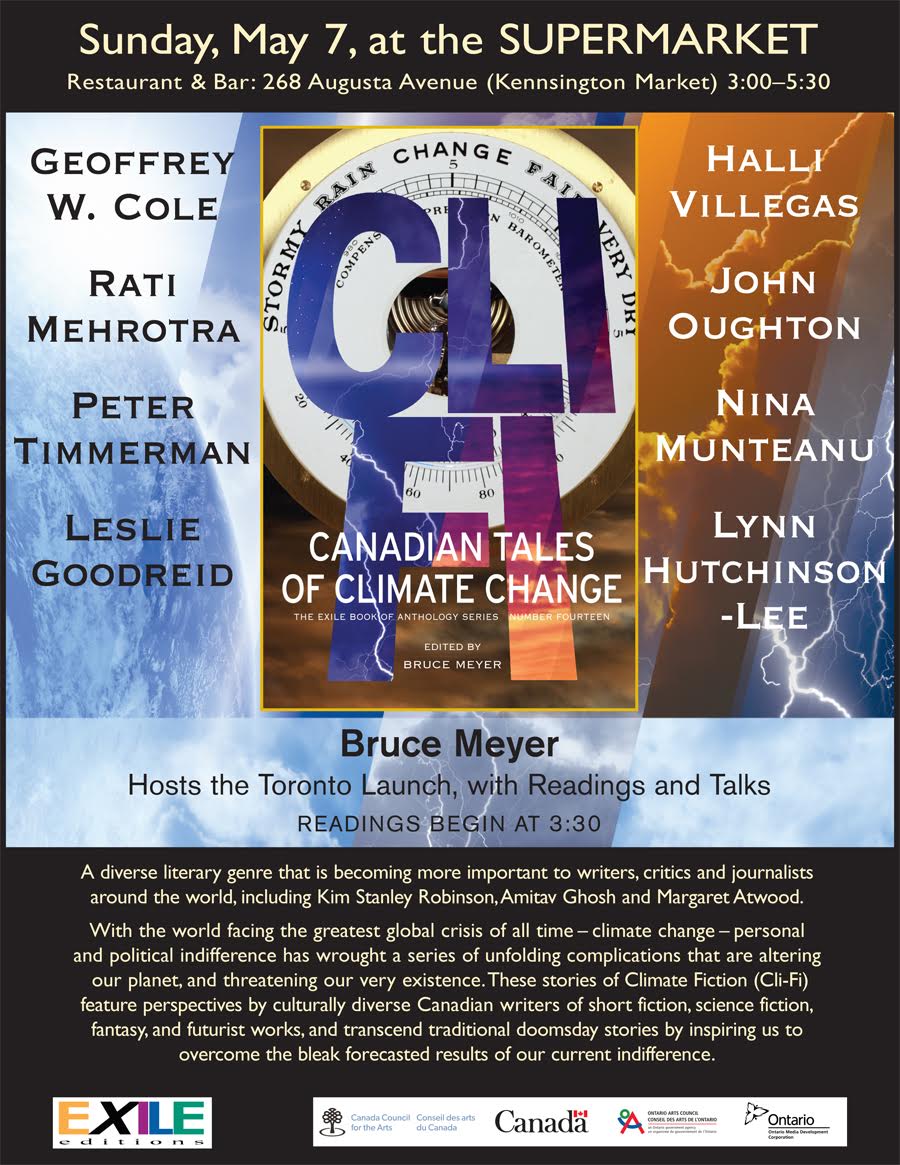
Sunday, May 7, at the SUPERMARKET Restaurant & Bar
268 Augusta Avenue (Kennsington Market) 3:00–5:30
Toronto, ON
Readings start at 3:30
Featuring:
Geoffrey W. Cole, Rati Mehrotra
Peter Timmerman, Leslie Goodreid, Halli Villegas
John Oughton, Nina Munteanu, Lynn Hutchinson-Lee
“With the world facing the greatest global crisis of all time – climate change – personal and political indifference has wrought a series of unfolding complications that are altering our planet, and threatening our very existence. These stories of Climate Fiction (Cli-Fi) feature perspectives by culturally diverse Canadian writers of short fiction, science fiction, fantasy, and futurist works, and transcend traditional doomsday stories by inspiring us to overcome the bleak forecasted results of our current indifference.”

Crossing into the Ecotone to Write Meaningful Eco-Fiction
“If you have an apple and I have an apple and we exchange apples then you and I will still each have one apple. But if you have an idea and I have an idea and we exchange these ideas, then each of us will have two ideas.”—George Bernard Shaw
 At Calgary’s When Words Collide this past August, I moderated a panel on Eco-Fiction with publisher/writer Hayden Trenholm, and writers Michael J. Martineck, Sarah Kades, and Susan Forest. The panel was well attended; panelists and audience discussed and argued what eco-fiction was, its role in literature and storytelling generally, and even some of the risks of identifying a work as eco-fiction.
Someone in the audience brought up the notion that “awareness-guided perception” may suggest an increase of ecological awareness in literature when it is more that readers are just noticing what was always there. Authors agreed and pointed out that environmental fiction has been written for years and it is only now—partly with the genesis of the term eco-fiction—that the “character” and significance of environment is being acknowledged beyond its metaphor; for its actual value. It may also be that the metaphoric symbols of environment in certain classics are being “retooled” through our current awareness much in the same way that Aldous Huxley’s Brave New World or George Orwell’s Nineteen Eighty Four are being re-interpreted—and newly appreciated— in today’s world of pervasive surveillance and bio-engineering.
 I submit that if we are noticing it more, we are also writing it more. Artists are cultural leaders and reporters, after all. My own experience in the science fiction classes I teach at UofT and George Brown College, is that I have noted a trend of increasing “eco-fiction” in the works in progress that students are bringing in to workshop in class. Students were not aware that they were writing eco-fiction, but they were indeed writing it.
I started branding my writing as eco-fiction a few years ago. Prior to that—even though my stories were strongly driven by an ecological premise and strong environmental setting—I described them as science fiction and many as technological thrillers. Environment’s role remained subtle and—at times—insidious. Climate change. Water shortage. Environmental disease. A city’s collapse. War. I’ve used these as backdrops to explore relationships, values (such as honour and loyalty), philosophies, moralities, ethics, and agencies of action. The stuff of storytelling.
Environment, and ecological characteristics were less “theme” than “character,” with which the protagonist and major characters related in important ways.
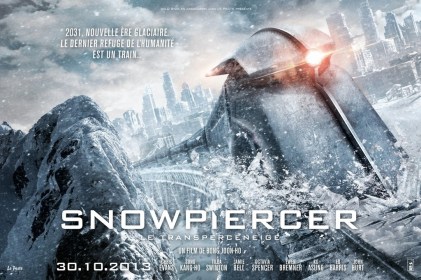 Just as Bong Joon-Ho’s 2014 science fiction movie Snowpiercer wasn’t so much about climate change as it was about exploring class struggle, the capitalist decadence of entitlement, disrespect and prejudice through the premise of climate catastrophe. Though, one could argue that these form a closed loop of cause and effect (and responsibility).
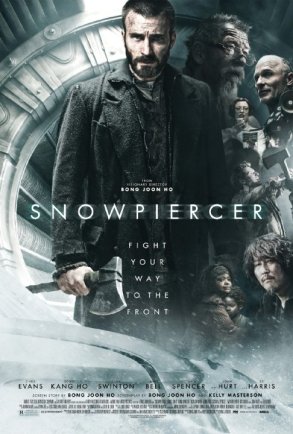 The self-contained closed ecosystem of the Snowpiercer train is maintained by an ordered social system, imposed by a stony militia. Those at the front of the train enjoy privileges and luxurious living conditions, though most drown in a debauched drug stupor; those at the back live on next to nothing and must resort to savage means to survive. Revolution brews from the back, lead by Curtis Everett (Chris Evans), a man whose two intact arms suggest he hasn’t done his part to serve the community yet.
Minister Mason (Tilda Swinton), an imperious yet simpering figure who serves the ruling class without quite being part of it, reminds the lower class that:
“We must all of us on this train of life remain in our allotted station. We must each of us occupy our preordained particular position. Would you wear a shoe on your head? Of course you wouldn’t wear a shoe on your head. A shoe doesn’t belong on your head. A shoe belongs on your foot. A hat belongs on your head. I am a hat. You are a shoe. I belong on the head. You belong on the foot. Yes? So it is.
In the beginning, order was prescribed by your ticket: First Class, Economy, and freeloaders like you…Now, as in the beginning, I belong to the front. You belong to the tail. When the foot seeks the place of the head, the sacred line is crossed. Know your place. Keep your place. Be a shoe.”

Ecotones are places where “lines are crossed,” where barriers are breached, where “words collide” and new opportunities arise. Sometimes from calamity. Sometimes from tragedy. Sometimes from serendipity.
When environment shapes a story as archetype—hero, victim, trickster, shadow or shape shifter—we get strong eco-fiction. Good eco-fiction, like any good story, explores the choices we make and the consequences of those choices. Good eco-fiction ventures into the ecotone of overlap, collision, exchange and ultimate change.
 In my latest book Water Is… I define an ecotone as the transition zone between two overlapping systems. It is essentially where two communities exchange information and integrate. Ecotones typically support varied and rich communities, representing a boiling pot of two colliding worlds. An estuary—where fresh water meets salt water. The edge of a forest with a meadow. The shoreline of a lake or pond.
For me, this is a fitting metaphor for life, given that the big choices we must face usually involve a collision of ideas, beliefs, lifestyles or worldviews: these often prove to enrich our lives the most for having gone through them. Evolution (any significant change) doesn’t happen within a stable system; adaptation and growth occur only when stable systems come together, disturb the equilibrium, and create opportunity. Good social examples include a close friendship or a marriage in which the process of “I” and “you” becomes a dynamic “we” (the ecotone) through exchange and reciprocation. Another version of Bernard Shaw’s quote, above, by the Missouri Pacific Agriculture Development Bulletin reads: “You have an idea. I have an idea. We swap. Now, you have two ideas and so do I. Both are richer. What you gave you have. What you got I did not lose. This is cooperation.” This is ecotone.
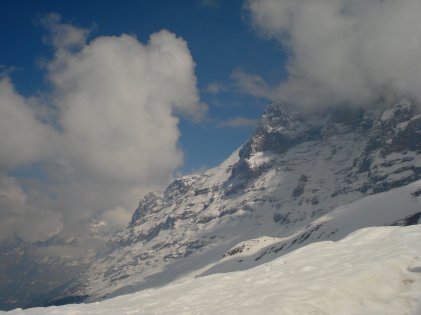
Jungfrau, Switzerland (photo by Nina Munteanu)
I think we are seeing more eco-fiction out there because ecosystems, ecology and environment are becoming more integral to story: as characters in their own right. I think we are seeing more eco-fiction out there because we are ready to see it. Just as quantum physics emerged when it did and not sooner, an idea—a thought—crystalizes when we are ready for it.
Don’t stay a shoe … go find an ecotone. Then write about it.
 Nina Munteanu is an ecologist and internationally published author of award-nominated speculative novels, short stories and non-fiction. She is co-editor of Europa SF and currently teaches writing courses at George Brown College and the University of Toronto. Visit www.ninamunteanu.ca for the latest on her books.
Flight Behavior
In a world that’s quickly heating up and drying up, you can’t go home again—even if you never leave—Clive Thompson
 Barbara Kingsolver’s 2012 novel Flight Behavior was, according to The Globe and Mail, the first novel that dealt “specifically, determinedly and overtly with climate change. And “only Kingsolver could pull it off,” they add.
The premise of climate change and its affect on the monarch butterfly migration is told through the eyes of Dellarobia Turnbow, a rural housewife, who yearns for meaning in her life.
The book starts with her scrambling up the forested mountain—slated to be clear cut—behind her eastern Tennessee farmhouse; she is desperate to take flight from her dull and pointless marriage of myopic routine. The first line of Kingsolver’s book reads: “A certain feeling comes from throwing your good life away, and it is one part rapture.” Dellarobia thinks she’s about to throw away her ordinary life by running away with the telephone man. But the rapture she’s about to experience is not from the thrill of truancy; it will come from the intervention of Nature:
A small shift between cloud and sun altered the daylight, and the whole landscape intensified, brightening before her eyes. The forest blazed with its own internal flame. “Jesus,” she said, not calling for help, she and Jesus weren’t that close, but putting her voice in the world because nothing else present made sense…The mountain seemed to explode with light. Brightness of a new intensity moved up the valley in a rippling wave. Like the disturbed surface of a lake. Every bough glowed with an orange blaze. “Jesus God,” she said again…Trees turned to fire…The flame now appeared to lift from individual treetops in shows of orange sparks, exploding the way a pine log does in a campfire when it’s poked. The sparks spiraled upwards in swirls like funnel clouds….It was a lake of fire, something far more fierce and wondrous than either of those elements alone. The impossible…She was on her own here, staring at glowing trees. Fascination curled itself around her fright. This was no forest fire. She was pressed by the quiet elation of escape and knowing better and seeing straight through to the back of herself, in solitude. She couldn’t remember when she’d had such room for being. This was not just another fake thing in her life’s cheap chain of events, leading up to this day of sneaking around in someone’s thrown-away boots. Here that ended. Unearthly beauty had appeared to her, a vision of glory to stop her in the road. For her alone these orange boughs lifted, these long shadows became brightness rising. It looked like the inside of joy, if a person could see that. A valley of lights, and ethereal wind.
It had to mean something.
Although Dellarobia doesn’t realize it yet, that moment proves life-changing for her: no longer “watching a nearly touchable lover behind her eyelids but now seeing flame in patterns that swirled and rippled. A lake of fire.” That day, she participates in the sheep shearing, greatly distracted from a new awakening to the power and wisdom of Nature:

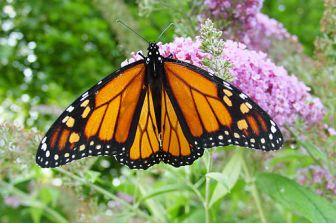
Monarch butterfly
“Watch and learn, Dellarobia thought, feeling an unaccustomed sympathy for the animals, whose dumb helplessness generally aggrieved her. Today they struck her as cannier than the people. If the forest behind them burned, these sheep would come to terms with their fate in no time flat. Flee or cower, they’d make their best call and fill up their bellies with grass to hedge their bets. In every way more realistic about their circumstances. And the border collies too. They would watch, ears up, forepaws planted, patiently bearing with the mess made by undisciplined humans as the world fell down around them.”
Entomologist Ovid Byron (in response to a reporter’s suggestion that scientists disagree about whether it’s happening and whether humans have a role) talks about the tipping point we’ve ignorantly raced past: “The Arctic is genuinely collapsing. Scientists used to call these things the canary in the mine. What they say now is, the canary is dead. We are at the top of Niagara Falls… in a canoe. There is an image for your viewers. We got here by drifting, but we cannot turn around for a lazy paddle back when you finally stop pissing around. We have arrived at the point of an audible roar. Does it strike you as a good time to debate the existence of the falls?” Ovid (really Kingsolver) effectively reiterates what most scientists know: that we have already crossed the tipping point of no return. There is no point in looking back to restore what we are losing; there is only the option of looking forward to adapt—and assist—as best we can.
Climate change—and all that is associated with it—is altering our planet irreparably, one sure-footed step at a time. The irony is that, as audible a roar climate change is for scientists like Ovid, to most of us climate change whispers insidious notes too subtle for us to comprehend or care about.
How does one grasp the gravity of a few degrees difference in temperature? The subtle rise in sea level? The almost imperceptible shift in the migratory pattern of a bird? When we are already so disconnected from Nature and lack the sensibilities—and compassion—to recognize and empathize with her trials and tribulations. Kingsolver suggests—quite accurately, I think—that only scientists can truly appreciate the portent of these subtle changes because it speaks in a language only they can understand.
Flight Behavior resonated with Kristen Poppleton, climate change educator, who shared that Kingsolver was spot on in her “description of the grief and sensation of loss most of us in this business of climate change education, communication and science carry around daily.” This type of grief is so prevalent, in fact, that it has a name: solastalgia. Poppleton empathized with scientist Ovid’s grief as Kingsolver writes, “The one thing most beloved to him was dying. Not a death in the family…but maybe as serious as that. He’d chased this life for all his years; it had brought him this distance…Now began the steps of grief. It would pass through this world…while most people paid no attention.”
Flight Behavior isn’t so much about climate change and its effects and its continued denial as it is about our perceptions and the actions that rise from them: the motives that drive denial and belief. This is no more apparent than in Kingsolver’s use of biblical references of fire and flood. Both water and flame are potent cleansing agents. They evoke powerful change. They represent givers—and takers—of life. Together, fire and water frame Kingsolver’s book with a strong metaphoric beginning and end that embrace creative destruction.
 Kathleen Byrne of The Globe and Mail writes: “We begin in flames and end in flood, which suits the biblical (and scientific) parameters of a novel whose setting in Tennessee’s Appalachian mountains is the nexus of a God-fearing religious literalism and an untaught but unbudging righteousness that finds expression in the view that “weather is the Lord’s business.”
When Dellarobia questions Cub, her farmer husband, “Why would we believe Johnny Midgeon about something scientific, and not the scientists?” he responds, “Johnny Midgeon gives the weather report.” Kingsolver writes: “and Dellarobia saw her life pass before her eyes, contained in the small enclosure of this logic.” Because Johnny told me…

Mammatous clouds, Wyoming (photo by Nina Munteanu)
Ovid shares with Dellarobia a terrible insight about science and our perceptions of scientists:
“There are always more questions. Science as a process is never complete. It is not a foot race, with a finish line…. People will always be waiting at a particular finish line: journalists with their cameras, impatient crowds eager to call the race, astounded to see the scientists approach, pass the mark, and keep running. It’s a common misunderstanding, [Ovid] said. They conclude there was no race. As long as we won’t commit to knowing everything, the presumption is we know nothing.”
The grief that Poppleton feels, voiced by Kingsolver through her character Ovid, is really a grief for us, for the “home” we grew up in and love. The world we made. Near the end of Kingsolver’s book, Dellarobia makes this observation: “Mistakes wreck your life. But they make what you have. It’s kind of all one…it’s no good to complain about your flock, because it’s the put-together of all your past choices.”
 We—humanity—may not be around here for much longer. Nature will endure without us. Planet Earth will continue, in some form and Nature and life will endure, evolve, and flourish—in its own way. It will change, perhaps grow more unruly than it is already, but Gaia will continue after she has kicked us off. Ecologists have long recognized the pattern of colonization, exploitation, decadence and succession. How hubristic of humanity not to include itself in that cycle. The cycle of continuing change. We grasp—we clamor—for the world we knew—even as we senselessly impose irreparable change. Shaving forests to the ground so water has no where else to go but down and in a torrent. Creating hot deserts by diverting great rivers somewhere else. Mining vast oil and mineral reserves by scraping the earth until it “bleeds” from unhealable wounds.
Evolution and Nature march on, greater than us, encompassing us—whether we recognize it or not—and in ways we can’t imagine (and science is only beginning to discover). Our vast Universe is so much more than we are capable of even imagining.
Flight Behavior is a multi-layered metaphoric study of “flight” in all its iterations: as movement, flow, change, transition, beauty and transcendence.
Kingsolver ends her book with Dellarobia caught in a mountain flood that may take her

Barbara Kingsolver
life; yet, she remains suspended—transfixed in the moment of the miracle unfolding before her. The monarchs survived the winter and are taking flight:
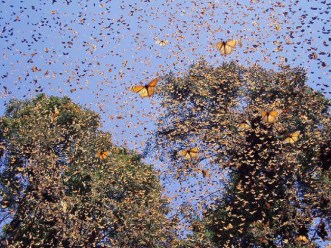
“The vivid blur of their reflections glowed on the rumpled surface of the water, not clearly defined as individual butterflies but as masses of pooled, streaky color, like the sheen of floating oil, only brighter, like a lava flow. That many.
She was wary of taking her eyes very far from her footing, but now she did that, lifted her sights straight up to watch them passing overhead. Not just a few, but throngs, an airborne zootic force flying out in formation, as if to war…Her eyes held steady on the fire bursts of wings reflected across the water, a merging of flame and flood. Above the lake of the world, flanked by white mountains, they flew out to a new earth.”
And a new earth is what we can be sure of. Whether we’ll be there is debatable—unless we too change.
 Nina Munteanu is an ecologist and internationally published author of award-nominated speculative novels, short stories and non-fiction. She is co-editor of Europa SF and currently teaches writing courses at George Brown College and the University of Toronto. Visit www.ninamunteanu.ca for the latest on her books. Read Nina’s climate/eco-fiction Darwin’s Paradox, Angel of Chaos and Natural Selection.
 Nina Munteanu Writing Coach