Movie Review: Soylent Green Is…

“The year is 2022. Our overpopulated planet is experiencing catastrophic climate change, mega-corporations have excessive power over the government, and clean living is a luxury only the 1 percent can afford. It may read like a scan of the front-page headlines, but these predictions were laid out half a century ago in the dystopian film Soylent Green,” writes George Bass of The Washington Post.

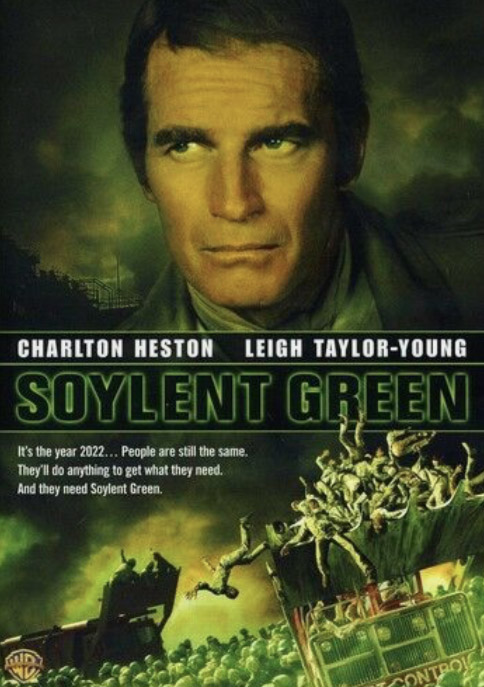
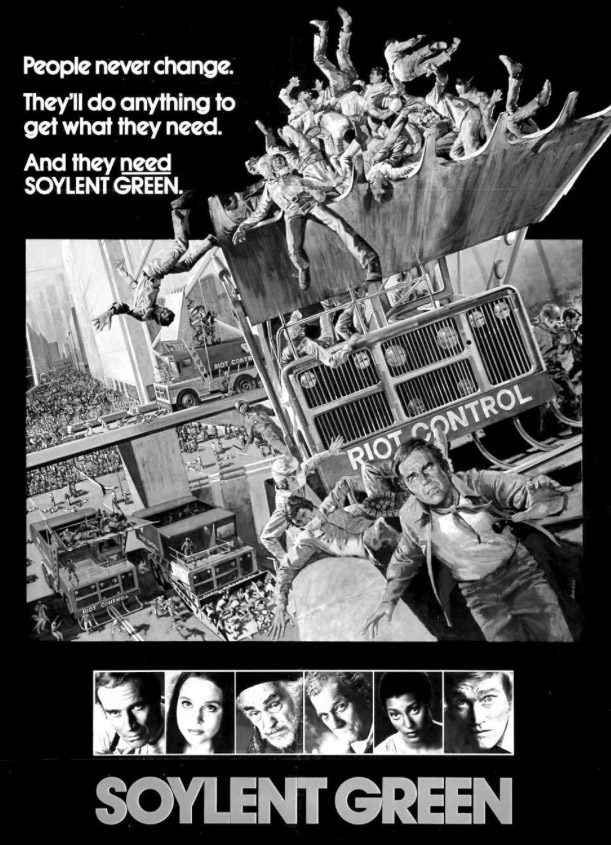
The 1973 science fiction eco-thriller Soylent Green, directed by Richard Fleischer, was based on the 1966 novel Make Room! Make Room! by Harry Harrison. The movie stars Charlton Heston as Robert Thorn, an illiterate rather wily NYC detective who must solve the murder of a Soylent executive with the help of his sidekick researcher and friend Sol Roth (Edward G. Robinson). In one scene, Thorn notes that the city of over 40 million logs 137 homicides a day.

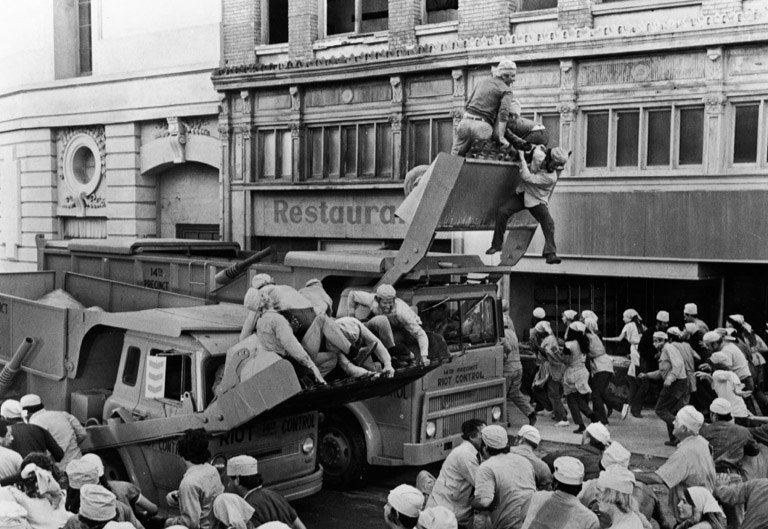
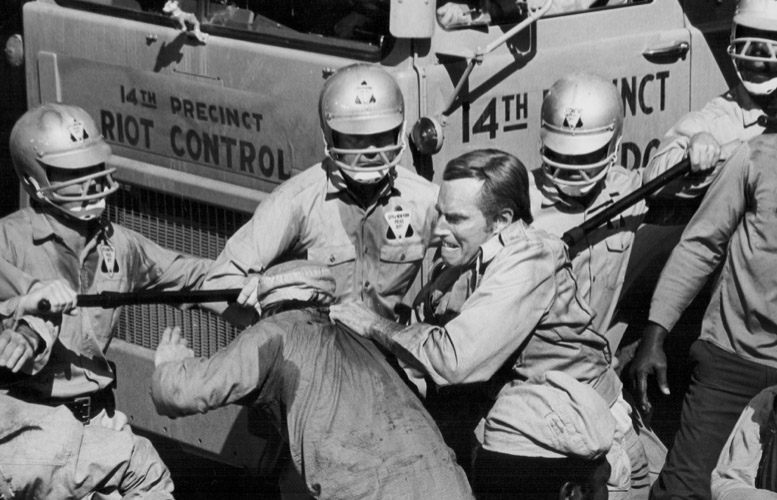
Riot trucks scoop up rioters without regard to injury

The murder mystery unravels a hive of intrigue in a sweltering 90° New York City, over-crowded with a restive population of homeless and starving people. “Margarine spoils in the fridge, and a sickly fog … hangs in the air,” writes Bass. Thorn shares a small room with friend and helper Sol in a building where he must daily negotiate an obstacle course of occupants who crowd the stairs and hallways. These scenes contrast with those within the enclaves of the corporate elite, who enjoy a luxurious lifestyle of spacious homes equipped with ample water and food and the latest technology and games—a common trope of ‘haves’ and ‘have nots’ in several dystopian works such as the Brazilian TV show 3%, and the movies Elysium, Advantageous, and Snowpiercer.

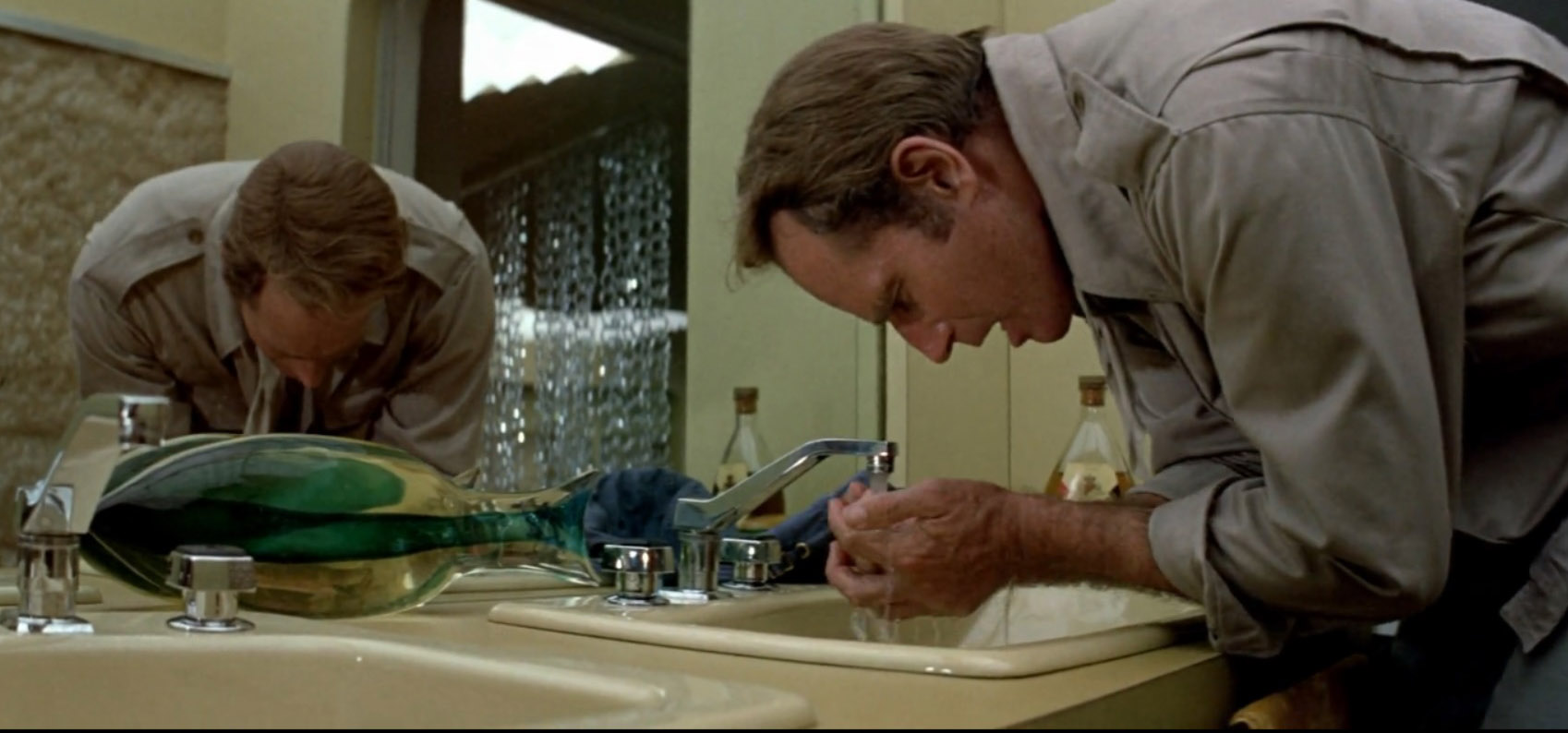
Thorn mesmerized by soap and running water

Accustomed to living a scorched existence, Thorn becomes infatuated with a bar of soap he finds in the victim’s mansion and an air conditioner that can make a room “cold, like winter used to be.” I’m reminded of another crusty detective scrabbling for comfort items in a less than comfortable world: Detective Miller in the TV series The Expanse breaks into his subject’s apartment to use her shower.

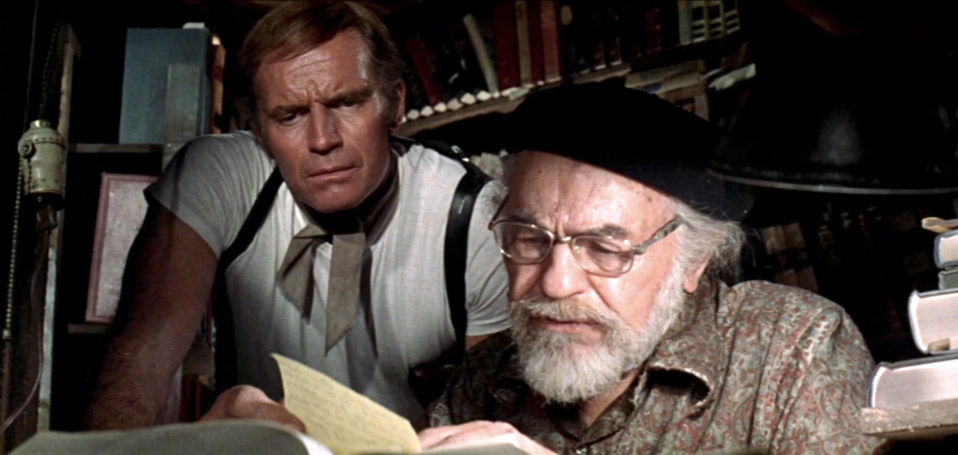
Thorn and Roth research the Soylent Corporation

In this ‘future’ world of synthetic food, the public lives off the high-energy vegetable concentrates created by the Soylent Corporation. Their latest synthetic food product is Soylent Green, advertised as a “miracle food of high-energy plankton gathered from the oceans of the world,” and is so popular that it must be rationed to a single day availability per week—causing more of those riots I already mentioned. Of course, the wealthy elite still eat meat and semi-fresh vegetables, but even these are not to the standard that we in North America are accustomed to. The meat is old and the vegetables imperfect. Bass notes that “Each door in the luxury tower block is automated, the penthouse butler is dressed in garish hunting pink, and the height of decadence is a fresh shower.” Climate change even impacts the super-rich.

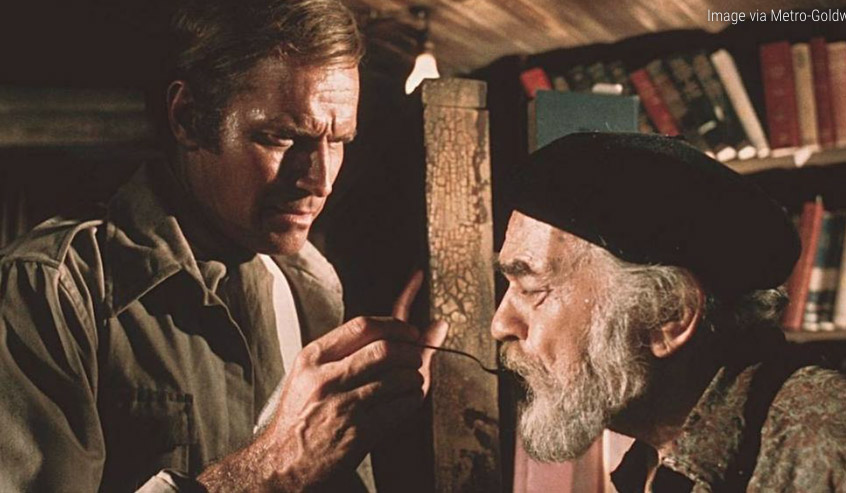
Most pressing on the public’s mind is hunger and food insecurity. Micheal Peck of The Break Through writes that corporations and governments commit murder and state-sanctioned mass cannibalism to protect their food supply. Soylent Corporation employs an assassin to dispatch its enemies and the killer doesn’t spend his pay on a car or a house; instead, he splurges on real strawberry jam (which goes for $150 a jar, marvels Roth).

Thorn lets Roth taste the $150 jam he perloined

In another scene Roth laments to Thorn, “When I was a kid food was food. Before our scientific magicians poisoned the water, polluted the soil. Decimated plant and animal life. Why, in my day you could buy meat anywhere. Eggs, they had. Real butter. Fresh lettuce in the store.” Thorn answers, “I know, Sol. You told me before. A heat wave all year long. A greenhouse effect. Everything is burning up.” When Thorn brings back a prize of meat and some old vegetables he’d scavenged from the murder victim’s apartment, Roth grows emotional and shares, “I haven’t eaten like this in years.” Thorn responds, “I never ate like this.”

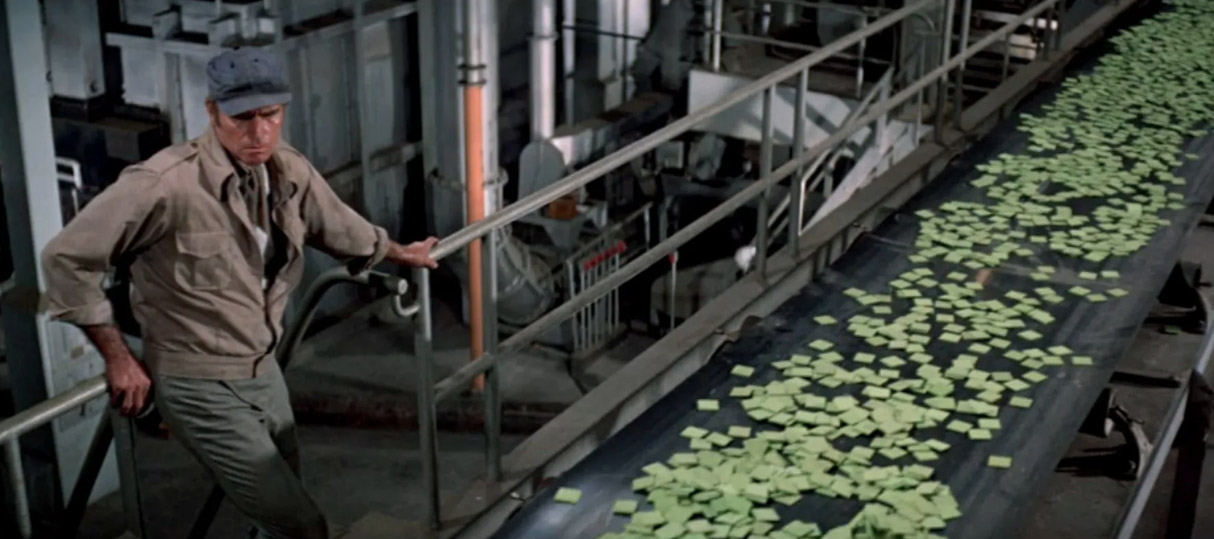
Thorn’s investigation ultimately leads him to a discovery that goes way beyond the murder, which he discovers is really an assassination, one that will reveal the ultimate corporate conspiracy: Soylent Green is people.

Thorn discovers the horrific secret of Soylent Green

“The uncanny (un)timeliness of the film is profoundly disturbing while at the same time deeply gratifying, as if hearing a voice from the past tell you that your daily anxiety about capitalism-induced climate chaos is not only well justified, it has actually been anticipated for some time,” writes Alisa Lebow in Film Quarterly.

Lebow adds that Soylent Green did not receive the critical acclaim it deserved on its release (though it has since become somewhat of a classic with an eclectic audience). “What none of the critics writing in 1973 could have foreseen … is the near prophetic view of the absolute callousness of late capitalism wherein profit and the enrichment of the few reign supreme.” According to Lebow, while Soylent Green has been largely forgotten, more recent films such as The Day After Tomorrow have been received with great fanfare and have been credited with helping change perceptions about climate change, especially in the US. Lebow argues that The Day After Tomorrow pales in comparison to Soylent Green in terms of urgency and clarity of message and “that the focus on climate as the driver of change is more forthrightly posited in this film than in any popular genre film on the topic that I have seen.”

The crisis of over-population in the film resonates powerfully today and runs in concert with the destruction of our habitable world. The alarming question remains: how to feed an over-crowded planet when the climate is unpredictable and the relentless industrial machine continues to strain the planet’s resources.

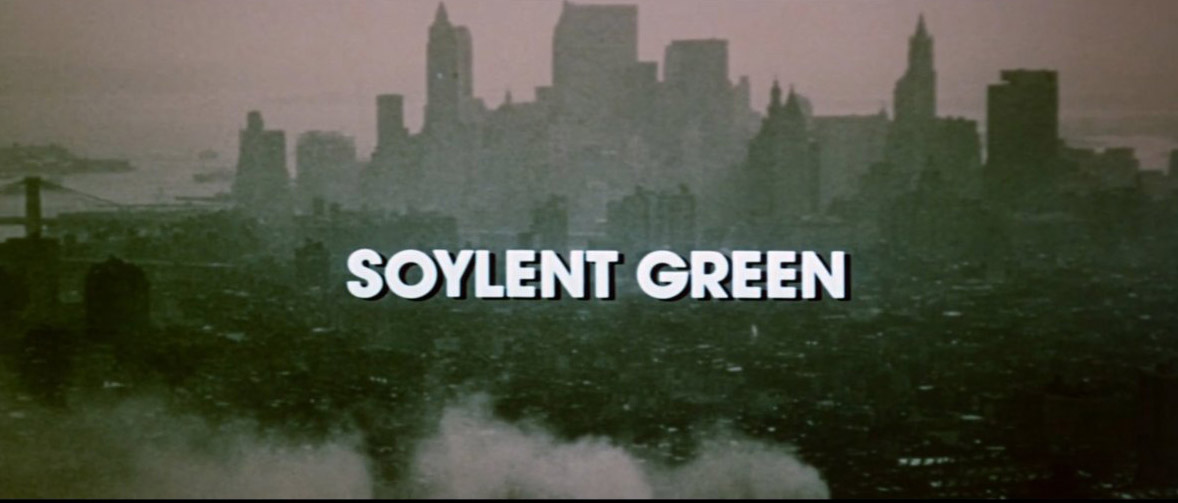
The Opening Title of the Film

Alisa Lebow, Professor of Screen Media at University of Sussex ascribes the opening title of the film as nothing less than brilliant and worthy of study:

“Charles Braverman’s two and a half minute documentary montage that opens the film is a revelation in and of itself and worthy of sustained analysis. Beginning with sepia images of early American settlers, the montage unwittingly apportions blame correctly to the white settler colonists for the maddening pace of industrialization and the demise of any balanced and respectful relationship with the lived environment. The montage quickly accelerates from its proto-Ken Burns Effect zooms and pulls to a frenzied barrage of cuts and dissolves with some nifty split screen effects that could not have been simple to produce at the time. Comprised exclusively of stills, it manages to convey the dizzying pace of development and its often unnoticed effects. Highways are choked with cars, factory chimneys belch black smoke, people crowd the streets in all reaches of the globe, as mountains of junked cars threaten to overtake the frame and garbage piles up in every corner.”

Decades-Old Cautionary Tale Highly Relevant Today

The 1960s was a time of great activism and environmental awareness, igniting an environmental movement led by Rachel Carson’s 1962 Silent Spring and Paul R. Ehrlich’s 1968 The Population Bomb, among other calls for action. Maurice Mitchell of the Geektwins shares that many important scientific works warning of the future devastation of climate change came to us in the 1960s. “By the 1960s, aerosol pollution had become a serious local problem and scientists began to consider the cooling effect of particulate pollution on global temperatures. Paul R. Ehrlich wrote that the greenhouse effect is being enhanced by carbon dioxide and is being countered by low-level clouds generated by contrails, dust, and other contaminants. In 1963, J. Murray Mitchell presented one of the first up-to-date temperature reconstructions, which showed that global temperatures increased steadily until 1940. In 1965, the Science Advisory Committee warned of the harmful effects of fossil fuel emissions.”

Mitchell adds that Soylent Green was the first movie to caution about greenhouse gas—long before The Day After Tomorrow (2004), The Day the Earth Stood Still (2008), Interstellar (2014), and Don’t Look Up (2021) moved people to ponder the devastation of climate change.

Elisa Guimarães of Collider writes: “At the height of the 21st century, Richard Fleischer’s Soylent Green can make for a somewhat weird watch. Originally released in 1973, the film first produces a sense of disconnect in modern viewers with its initial card, which dates its plot as taking place in the far-off year of 2022. The film’s extremely 1970s brand of sexism and neo-Malthusian approach to overpopulation can also feel uncomfortable for contemporary eyes. And, yet, Soylent Green’s social and environmental concerns feel all the more urgent in a world in which climate change has become undeniable.”

In her article entitled “The Greatest Horror of ‘Soylent Green’ Isn’t Soylent Green—It’s This”, Guimarães notes that “there’s something in Soylent Green that feels even more wrong than the realization that humanity has been engaging in involuntary cannibalism.” Guimarães argues that the scene with the assisted suicide clinic helps viewers comprehend “just how devoid of value human life has become in such a scarcity-ridden world.” The film shows only too clearly how people are treated: as homo sacer commodities in a Foucault biopolitical world of disposable humans. Guimarães argues that the euthanasia facility “is the one place in which the poor and weak of the Soylent Green society may find some semblance of dignity; but it is also the place to which you go to be turned from an unproductive individual into a product.”

In the final scene, when Thorn reveals his horrific discovery of hidden cannibalism, he instantly understands its deeper consequence: in a world of severe resource depletion, humaneness is the main casualty.

“Ocean’s dying, plankton’s dying … it’s people. Soylent Green is made out of people. They’re making our food out of people. Next think they’ll be breeding us like cattle for food…We’ve gotta stop them somehow!”  

Thorn on riot duty

“While [Soylent Green] inevitably gets many things wrong, it also gets something dead right.”

Alisa Lebow 

Soylent Green deserves to be watched. It deserves to be discussed. Go watch it and lament how after fifty years we have done so little to change this trajectory.

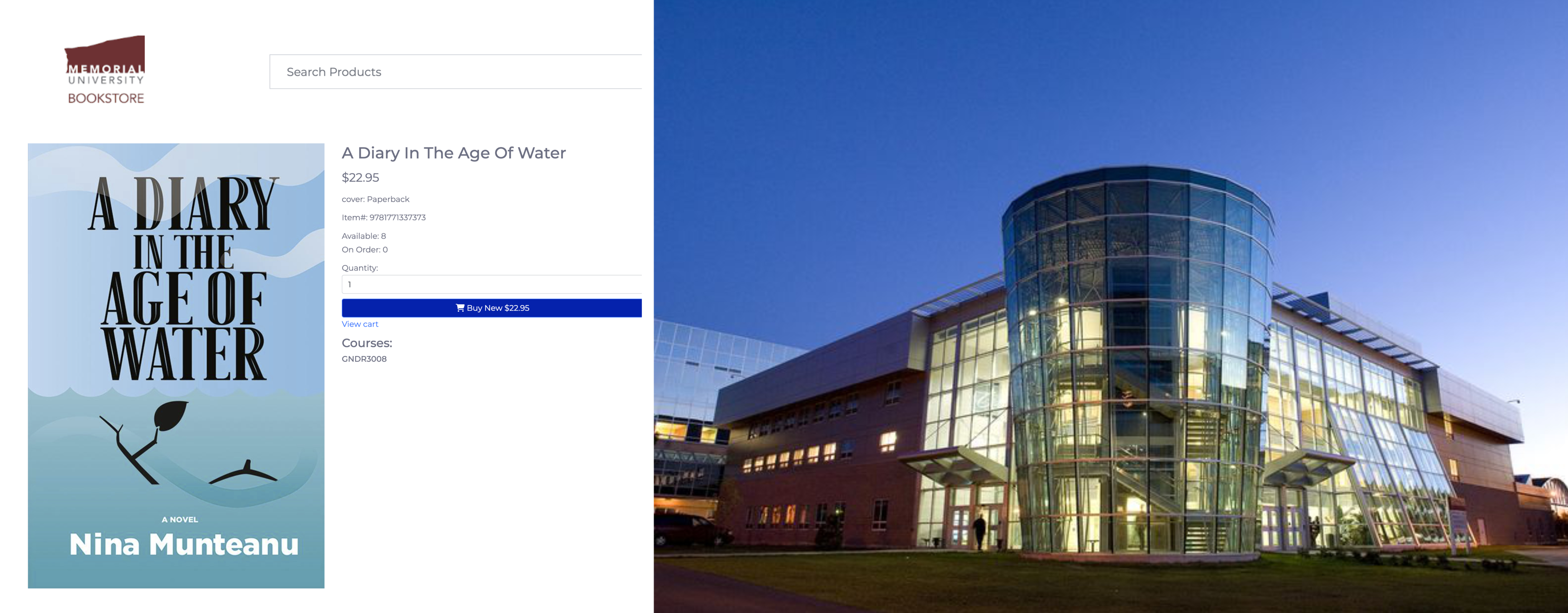
Nina Munteanu is a Canadian ecologist / limnologist and novelist. She is co-editor of Europa SF and currently teaches writing courses at George Brown College and the University of Toronto. Visit www.ninamunteanu.ca for the latest on her books. Nina’s bilingual “La natura dell’acqua / The Way of Water” was published by Mincione Edizioni in Rome. Her non-fiction book “Water Is…” by Pixl Press (Vancouver) was selected by Margaret Atwood in the New York Times ‘Year in Reading’ and was chosen as the 2017 Summer Read by Water Canada. Her novel “A Diary in the Age of Water” was released by Inanna Publications (Toronto) in June 2020.
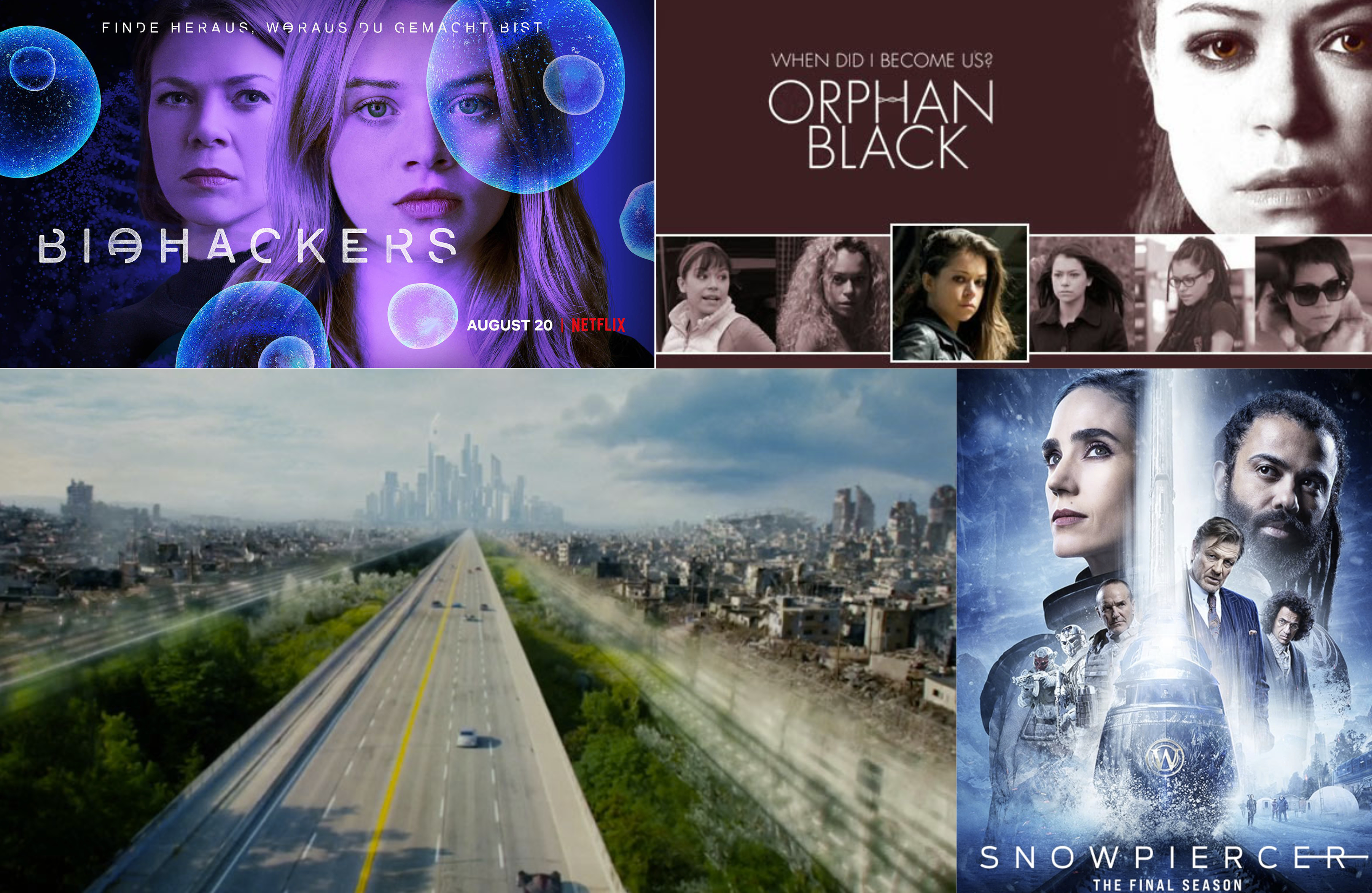
Movie Review: Snowpiercer and the Machine of Life


What’s left of humanity—after we broke the world—is crammed in a speeding train that circles a frozen Earth … forever.

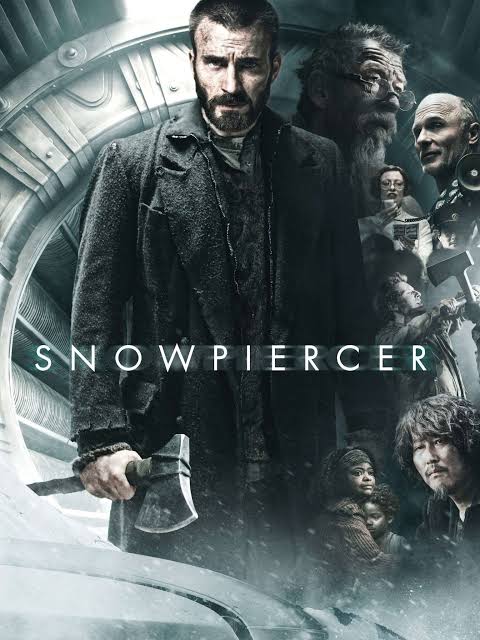
Bong Joon-Ho’s 2013 motion picture Snowpiercer is a stylish post-climate change apocalypse allegory. A dark pastiche of surrealistic insanity, welded together with moments of poetic pondering and steam-punk slick in a frenzied frisson you can almost smell.  Joon-Ho casts each scene in metallic grays and blues that make the living already look half-dead. The entire film plays like a twisted steampunkish baroque symphony. Violence personified in a garish ballet.  

One of the many excessive fight scenes

The train’s self-contained closed ecosystem is maintained by an ordered social system, imposed by a stony militia. Those at the front enjoy privileges and luxurious living conditions, though most drown in a debauched drug stupor; those at the back live on next to nothing and must resort to savage means to survive. This film isn’t about climate change—that’s just a plot point to serve the premise of a study on how society functions—or rather copes—within a decadent capitalist system, based on an edict of productivity: serve the machine of “life”. Satisfy the sacred machine at all costs; complete with subterfuge, oppression and references to cannibalism. Beneath the film’s blatant statement on the emptiness of the pursuit of capital at any cost lies a deeper more subtle exploration on the nature of humanity. Die to live or live to die?

In a recent interview with io9, Joon-Ho said, “the science fiction genre lends itself perfectly to questions about class struggle, and different types of revolution.”

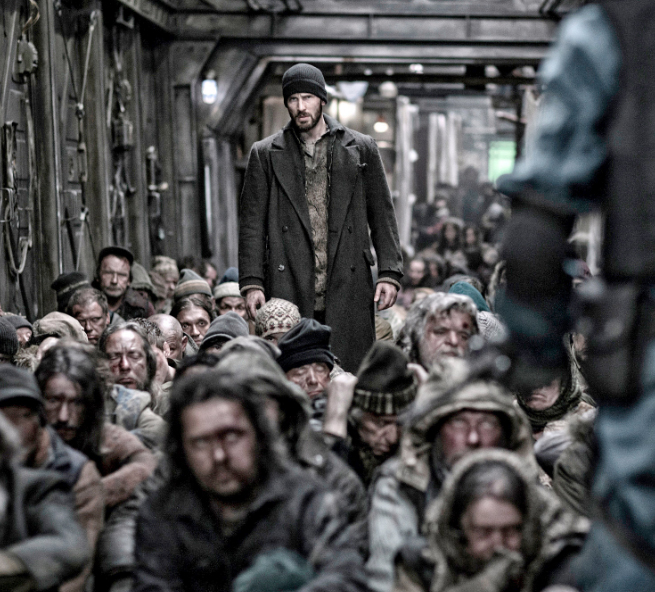
Curtis singled out by militia

Revolution brews from the back, led by Curtis Everett (Chris Evans), who confesses to a forced recruit, along the way, “A thousand people in an iron box. No food, no water. After a month we ate the weak. You know what I hate about myself? I know what people tastes like….I know that babies taste best.”

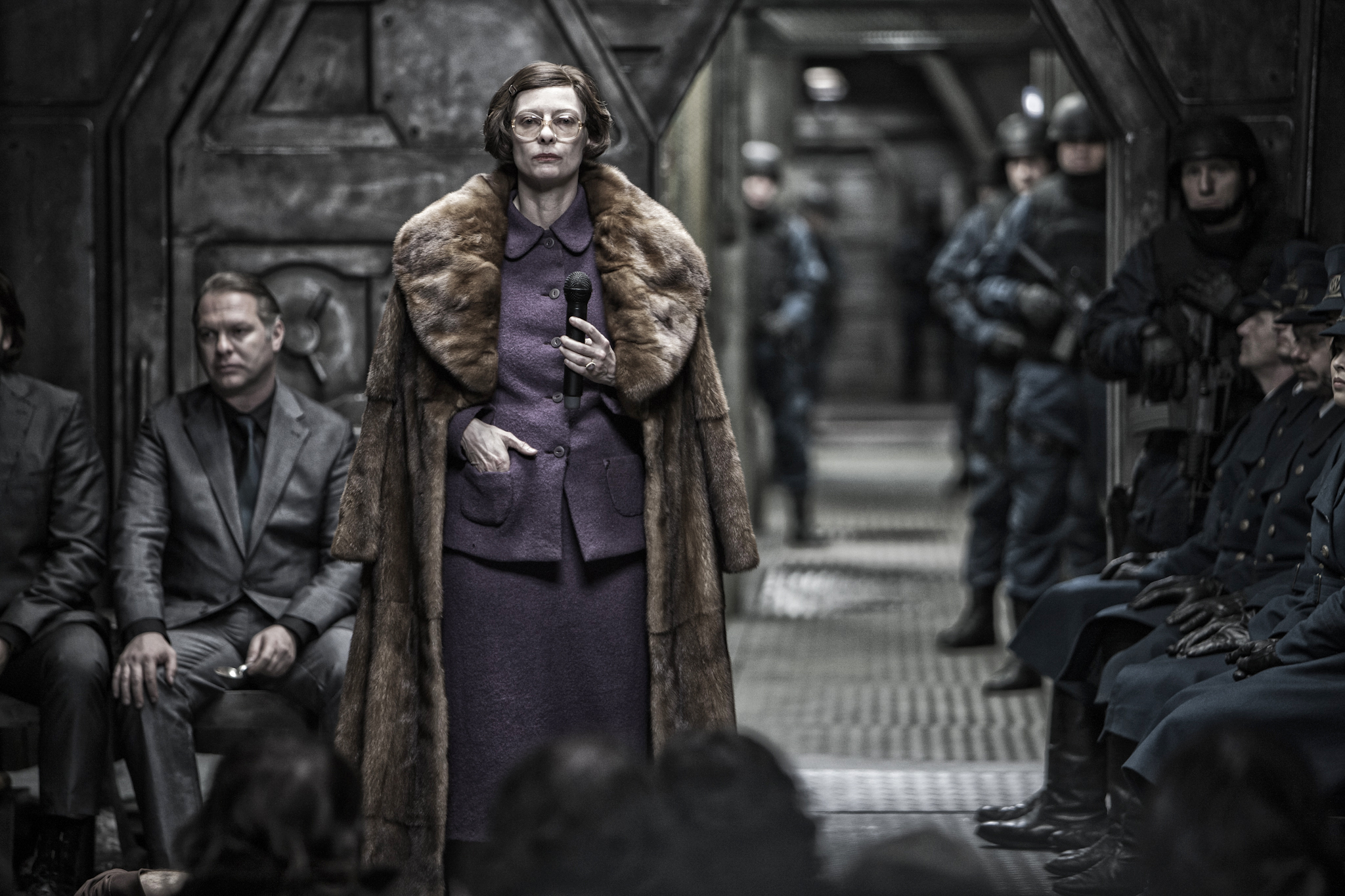
Minister Mason (Tilda Swinton), an imperious yet simpering figure who serves the ruling class without quite being part of it, reminds the lower class that, “Eternal order flows from the sacred engine. We must occupy our preordained position. I belong to the front, you belong to the tail. Know your place!”

Minister Mason dispenses the law to the tail

It’s all about the engine for both front and tail. It saved humanity, after all. It is their future. Curtis tells his colleagues that they will move forward: “We take the engine and we control the world. It’s time we take the engine.”

Revolution brews in the tail

“Reform and revolution are shibboleths that distinguish liberals from radicals,” explains Aaron Bady of The New Inquiry. “While liberals want to reform capitalism, without fundamentally transforming it, radicals want to tear it up from the roots (the root word of “radical” is root!) and replace capitalism with something that isn’t capitalism…If you’re the kind of leftist who thinks that the means of production just need to be in better hands—Obama, for example, instead of George W. Bush, or Elizabeth Warren instead of Obama, or Bernie Sanders instead of Elizabeth Warren, and so on—then this movie buries a poison pill inside its protein bar: soylent green is people.”

The tail faces the goons of the front

The train “eats” the children of the poor; using them to replace the sacred engine parts that have worn out in a kind of retro-transhumanist collaboration of human and machine and creating a perverse immortal cyborg entity. Only, the individual children die in the process and need to be constantly replaced to maintain the eternal whole. They have literally become cogs in a giant wheel of eternity.

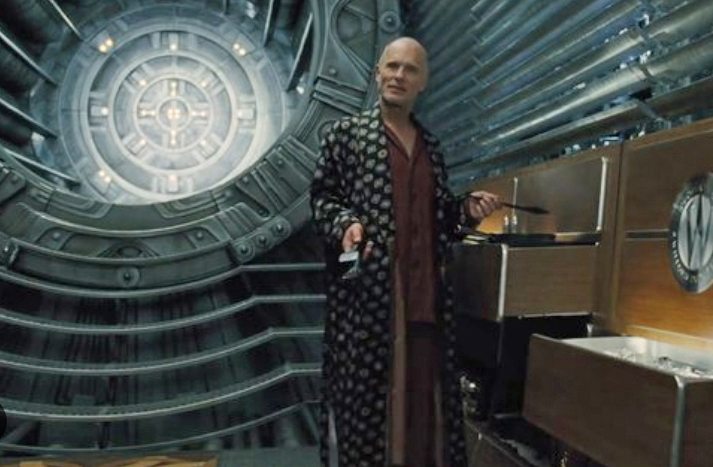
Curtis’s revolution is doomed from the start; once he reaches the front, it is revealed to him that the entire conflict and resulting deaths were orchestrated all along to help maintain population balance. Wilford (Ed Harris), the genius who created the train with a perpetual motion engine, tells Curtis once they meet that, “this is the world…The engine lasts forever. The population must always be kept in balance.” Which begs the obvious question: why not just get rid of all of the lower class “scum” (as Mason calls them)? That would make room for the privileged. What purpose do these lower class serve? The answer is both obvious and simple: aside from providing their children as parts to the sacred engine, they are there to be hated, feared and despised by the elite. When the soul is empty and needs “filling” but can’t be filled, then it finds a substitute.

Wilford lectures Curtis on the train’s functional ecosystem

Aaron Bady of The New Inquirer shares that, “Instead of giving Texans a health care system, for example, late capitalism gives them the illegal immigrant, to hate, to fear, and to dis-identify with. Prisons do more and more of the system-maintaining work that was once done by schools and hospitals: instead of giving us something to want, they give us something to fear, hate, and kill. And so, we eat ourselves.” We die to live.

Wilford grooms Curtis as the new engineer and reveals to him the true nature of the engine. “You’ve seen what people do without leadership,” says Wilford to Curtis. “They devour one another.” This is dark irony considering what the train is doing. And it is when Curtis discovers this awful truth that his reformist revolution comes to a dead halt and he makes a decision that takes him into the realm beyond the train.

Snowpiercer is about hard choices and transcendence. … Save humanity, but at the consequence of our souls? Or transcend a machine that has robbed us of our souls at the expense of our mortality? The film continually questions our definition of what life is and what makes life worth living.

Snowpiercer crosses one of many treacherous bridges

The film, whose script by Joon-Ho and Kelly Masterson is based loosely on the French graphic novel Le Transperceneige by Jacques Lob, graphically portrays the fecklessness of a reformist/revolutionary movement to transcend the decadent capitalist machine (the train). It begins with the adoption of a failing system from a previously failed system. Perhaps it is a truism that most reformist movements fail to challenge the true hegemony of the system they intend to overtake, given their origin. What we get is little genuine change; just a shuffle in protocol.

Peter Frase of Jacobin Magazine shares that, “it’s all the more effective because the heart of that critique comes as a late surprise, from a character we might not expect.”

Namgoong languishes in a drugged state on the train after he is liberated from a drawer

Namgoong Minsoo (Song Kang-Ho) is a spaced-out drug addict that Curtis ‘liberates’ from a drawer to help them open the gates to the forward sections. Like everyone on the train, Nam is a little crazy. But he differs in one important way: he believes there is hope outside the train. Unlike his reformist brothers, he looked outside the construct and studied the realm beyond the train. Perhaps it is drug-induced fantasy. Perhaps he’s simply had enough of a lifetime of “non-life” onboard the train and would rather die outside to truly live, even if for a brief moment. When the chance for this moment materializes, we, like Nam and his daughter Yona (Ko Ah-sung), are more than ready to jump the train. In fact, we’re desperate to get off this shadow game of bread and circuses. Even if it means freezing to death in moments.

Only Yona and one of the rescued children from the engine, survive the ensuing train crash, thanks to Curtis’s truly revolutionary decision.

“Is it more revolutionary to want to take control of the society that’s oppressed you, or to try and escape from that system altogether?” asks Joon-Ho.

Yona and Curtis on the train

I felt a cathartic surge of relief when the train came to a violent crashing stop; even though it effectively meant the end of humanity. My visceral response was incredible relief. The scene following the train crash was —despite the inhospitable and cold environment—surrealistically fresh, invigorating and serene.  Along with Yona and one of the children Curtis rescued, we’ve escaped the rushing perversity: the obsession to survive at any cost. We’ve chosen to live to die. That Curtis (had to) die with the train to ensure the safe escape of Yona and the child, made sense to me. Curtis remained trapped in the old paradigm; but he possessed enough vision to understand the need for change beyond his sight. His was a sacrifice for true change.

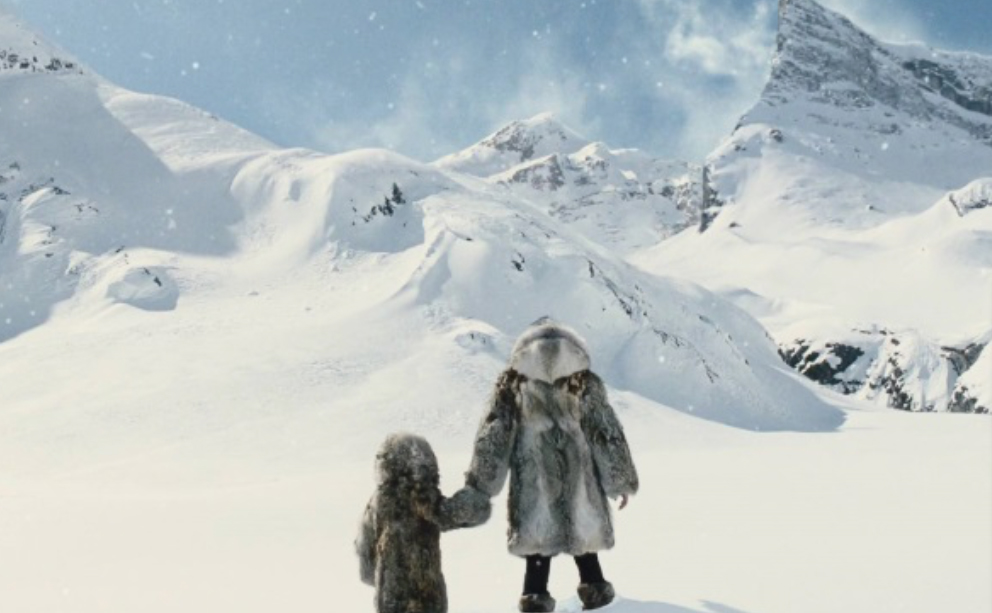
As Yona and the child crunch through the snow in the quiet depth of coldness, they glimpse a polar bear. There is life! Perhaps not humanity. But life on Earth.

And in that connection, we live. Even if just for a moment.

Yona and the child face a bleak but hopeful future after escaping the Snowpiercer

Postscript on the ending of the movie: In an interview with Vulture, Bong Jung-Ho shared his thoughts on Snowpiercer’s ending: “For me, it’s a very hopeful ending … The engine is itself on its way to extinction along with cigarettes, and other goods. Extinction is a repeated word throughout the film. But outside the train, life is actually returning. It’s nature that’s eternal, and not the train or the engine, as you see with the polar bear at the end.”

Ultimately, Bong Jung-Ho’s message with the ending of this baroque political allegory is the vindication of a choice against reform capitalism for something new, that there is indeed “Life after Capitalism”, not easy but worth living…

Nina Munteanu is a Canadian ecologist / limnologist and novelist. She is co-editor of Europa SF and currently teaches writing courses at George Brown College and the University of Toronto. Visit www.ninamunteanu.ca for the latest on her books. Nina’s bilingual “La natura dell’acqua / The Way of Water” was published by Mincione Edizioni in Rome. Her non-fiction book “Water Is…” by Pixl Press (Vancouver) was selected by Margaret Atwood in the New York Times ‘Year in Reading’ and was chosen as the 2017 Summer Read by Water Canada. Her novel “A Diary in the Age of Water” was released by Inanna Publications (Toronto) in June 2020.

Ironic Tragedy of Forever Chemicals & Growing Infertility: Are We Solving Our Own Population Explosion Through Toxicity?

In the passage below of my eco-fiction dystopian novel A Diary in the Age of Water, the year is 2065 and the diarist Lynna (a limnologist at the University of Toronto) reflects on the steeply growing infertility in humans and our tenuous future. Lynna draws on the factual study published close to fifty years earlier (in 2017) by Hagai Levine and others at the Hebrew University of Jerusalem, who found that sperm counts among western men had reduced close to 60% in four decades:

Back in ’49, Daniel and I had several discussions about the environmental triggers and epigenetic mechanisms of infertility in humans. Daniel went on about how it was all about the men. While women showed signs of increased infertility, men’s rate of infertility was more than double that of the women, he said. Taking an inappropriately gleeful tone, Daniel cited the classic 2017 paper by the Hebrew University of Jerusalem, the one that started it all. Their findings were startling: men’s sperm count in North America, Europe, Australia, and New Zealand had diminished by sixty percent in forty years, between 1973 and 2011. The scientists predicted that by 2060, virtually all men in these parts of the world would have little to no reproductive capacity.

It’s 2065 and they’re right. Only it’s worse. Before the twenties, only the developed countries seemed to be affected, but then sperm counts started to plummet in South American countries, like Argentina and Brazil, where GMO, pesticides, and solvent manufacturing were exploding.

You get out what you put into the ground. India and Asia—where endocrine-disruptive chemicals are finding their way into the water—are reporting very low sperm counts in their men as well as higher incidents of intersex humans.

You get out what you put into the water. We are over two thirds water, after all. I find it a little ironic that we’ve inadvertently produced a non-discriminatory way to control the problem of humanity’s overpopulation. Infertility. And that infertility results from defiling the environment we live in.

But now climate change is shouldering its way in. Climate change is shutting us down.

Is this the first sign of our impending extinction?

–excerpt from “A Diary in the Age of Water”

That environmental perturbations impact our ability to reproduce has been proven. In their 2017 article, Levine et al. write that:

“Sperm count and other semen parameters have been plausibly associated with multiple environmental influences, including endocrine disrupting chemicals (Bloom et al., 2015; Gore et al., 2015), pesticides (Chiu et al., 2016), heat (Zhang et al., 2015) and lifestyle factors, including diet (Afeiche et al., 2013; Jensen et al., 2013), stress (Gollenberg et al., 2010; Nordkap et al., 2016), smoking (Sharma et al., 2016) and BMI (Sermondade et al., 2013; Eisenberg et al., 2014a). Therefore, sperm count may sensitively reflect the impacts of the modern environment on male health throughout the life course (Nordkap et al., 2012).”

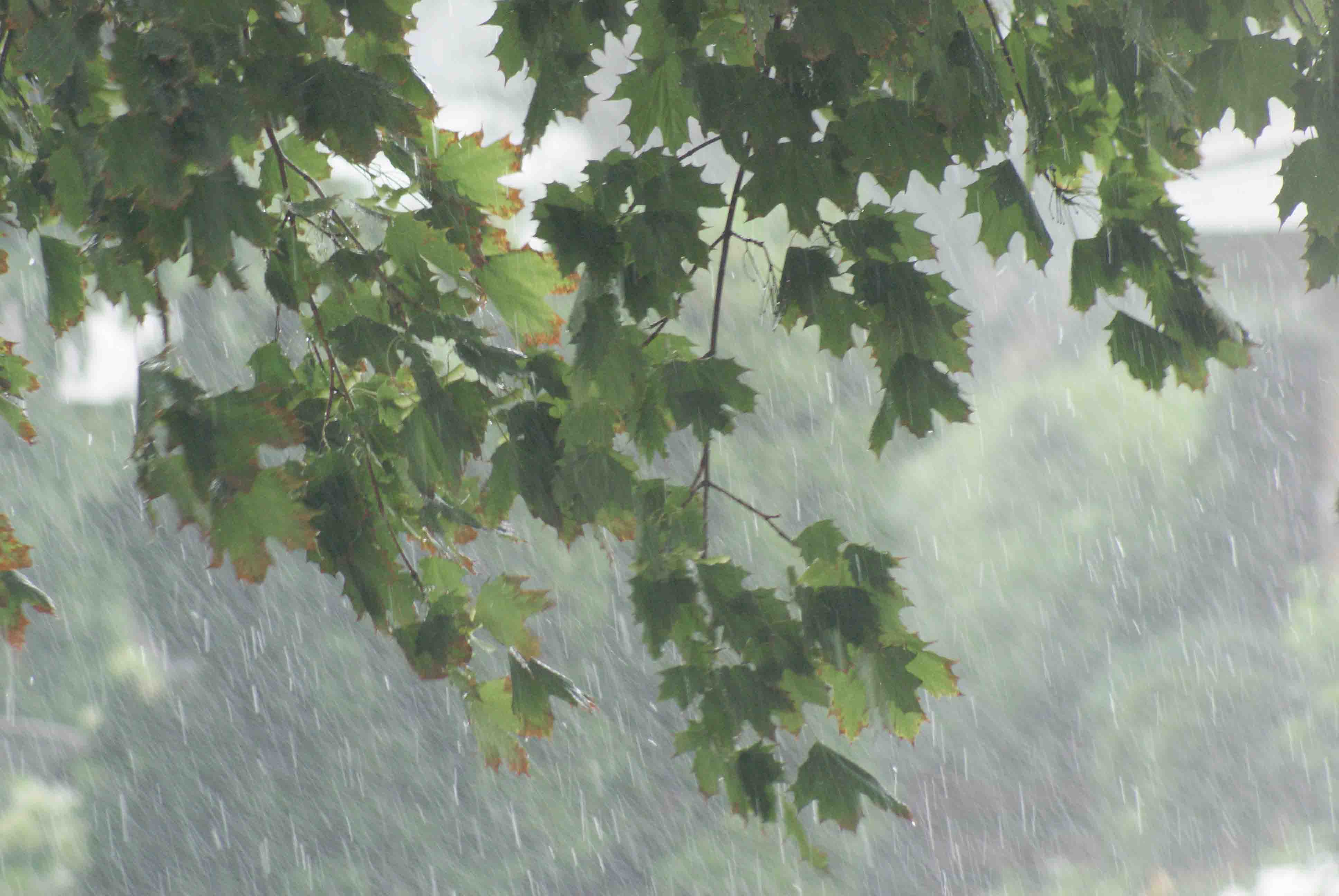
This rain falling on an Ontario marsh most certainly contains forever chemicals (photo by Nina Munteanu)

Thanks to chemical companies such as DuPont and others, forever chemicals are currently in rain water globally, and in many places in unhealthy concentrations. These endocrine-disrupting and cancer-causing chemicals often end up in drinking water and include PCBs, phthalates, PFAS, BPAs (used in pesticides, children’s products, industrial solvents and lubricants, food storage, electronics, personal care products and cookware).

If you observe a terrible irony in this short list, also know that the chemical companies, such as DuPont, have known about the dangers posed by these products for decades and decided to keep it a secret.

Heavy rain in Mississauga, ON (photo by Nina Munteanu)

Nina Munteanu is a Canadian ecologist / limnologist and novelist. She is co-editor of Europa SF and currently teaches writing courses at George Brown College and the University of Toronto. Visit www.ninamunteanu.ca for the latest on her books. Nina’s bilingual “La natura dell’acqua / The Way of Water” was published by Mincione Edizioni in Rome. Her non-fiction book “Water Is…” by Pixl Press (Vancouver) was selected by Margaret Atwood in the New York Times ‘Year in Reading’ and was chosen as the 2017 Summer Read by Water Canada. Her novel “A Diary in the Age of Water” was released by Inanna Publications (Toronto) in June 2020.

Water Scarcity and ‘A Diary in the Age of Water’

My eco-fiction book A Diary in the Age of Water was recently cited along with Paolo Bacigalupi’s book The Water Knife, in an article on conflict risk in international transboundary water bodies.

The citation was made in Ken Conca’s article (Chapter 1: “Climate change, adaptation, and the risk of conflict in international river basins: Beyond the conventional wisdom”) of the 2024 Routledge book New Perspectives on Transboundary Water Governance: Interdisciplinary Approaches and Global Case Studies” (edited by Luis Paulo Batista da Silva, Wagner Costa Ribeiro, and Isabela Battistello Espíndola).

Conca begins his chapter with a statistic—an estimated 310 rivers in the world cross national borders, form borders, or both—and goes on to discuss the risk of conflict that naturally arises in such situations. Conca traces a rich history of disputes, with one of the oldest occurring between Lagash and Umma (present-day southern Iraq) in 2500 BCE. Conca explores the early warning indicators explored by the World Resources Institute that imply “a future in which our bordered politics, combined with hydrologic interdependencies, could yield a combustible mix of tension and grievances” and adds that several rivers flagged in the WRI study lie in regions of crhonic tension and political instability. He then includes a 2013 quote by former UN Secretary-General Ban Ki-moon:

“Our experiences tell us that environmental stress, due to lack of water, may lead to conflict, and would be greater in poor nations … population growth will make the problem worse. So will climate change. As the global economy grows, so will its thirst. Many more conflicts lie just over the horizon.” Ban also stated that climate change promised “an unholy brew that can create dangerous security vacuums” in which “mega-crises may well become the new normal.”

Conca makes his point by quoting the U.S. Center for Strategic and International Studies: “the real wild card for political and social unrest in the Middle East over the next 20 years is not war, terrorism, or revolution—it is water.”

Conca makes the connection with narratives of fiction:

“This framing of scarcity-induced conflict risk has even crept into the world of fiction. Paulo Bacigalupi’s dystopian novel The Water Knife (2016) portrays a parched southwestern United States of the near future. He foresees American states militarizing both their water relations (with corporate militias destroying infrastructure meant to divert water) and their borders (with the water-rich states seeking to keep thirsty migrant out, and the water poor states seeking to keep them in). Nina Munteanu’s A Diary in the Age of Water (2020) envisions Canada as a wholly-owned colony of the United States (itself owned by China). She describes a world in which Niagara Falls has been turned off and pet ownership is outlawed as an unacceptable water burden.”

Conca unpacks various misconceptions on sources of conflict and conflict resolution to do with transboundary water bodies. The chapter is very enlightening, as is the entire book!

The 2024 Routledge book New Perspectives on Transboundary Water Governance: Interdisciplinary Approaches and Global Case Studies” (edited by Luis Paulo Batista da Silva, Wagner Costa Ribeiro, and Isabela Battistello Espíndola) is described by the publisher below:

This book presents a novel examination of transboundary water governance, drawing on global case studies and applying new theoretical approaches.

Excessive consumption and degradation of natural resources can either heighten the risks of conflicts or encourage cooperation within and among countries, and this is particularly pertinent to the governance of water. This book fills a lacuna by providing an interdisciplinary examination of transboundary water governance, presenting a range of novel and emerging theoretical approaches. Acknowledging that issues vary across different regions, the book provides a global view from South and Central America, Africa, Asia, and the Middle East, with the case studies offering civil society and public managers concrete situations that indicate difficulties and successes in water sharing between bordering countries. The volume highlights the links between natural resources, political geography, international politics, and development, with chapters delving into the role of paradiplomacy, the challenges of climate change adaptation, and the interconnections between aquifers and international development. With rising demand for water in the face of climate change, this book aims to stimulate further theoretical, conceptual, and methodological debate in the field of transboundary water governance to ensure peaceful and fair access to shared water resources.

This book will be of interest to students and scholars of water resource governance from a wide variety of disciplines, including geography, international relations, global development, and law. It will also be of interest to professionals and policymakers working on natural resource governance and international cooperation.

Nina Munteanu is a Canadian ecologist / limnologist and novelist. She is co-editor of Europa SF and currently teaches writing courses at George Brown College and the University of Toronto. Visit  www.ninamunteanu.ca for the latest on her books. Nina’s bilingual “La natura dell’acqua / The Way of Water” was published by Mincione Edizioni in Rome. Her non-fiction book “Water Is…” by Pixl Press (Vancouver) was selected by Margaret Atwood in the New York Times ‘Year in Reading’ and was chosen as the 2017 Summer Read by Water Canada. Her novel “A Diary in the Age of Water” was released by Inanna Publications (Toronto) in June 2020.

Crossing into the Ecotone to Write Meaningful Eco-Fiction

If you have an apple and I have an apple and we exchange apples then you and I will still each have one apple. But if you have an idea and I have an idea and we exchange these ideas, then each of us will have two ideas.”—George Bernard Shaw

At Calgary’s When Words Collide some years ago, I moderated a panel on Eco-Fiction with publisher/writer Hayden Trenholm, and writers Michael J. Martineck, Sarah Kades, and Susan Forest. The panel was well attended; panelists and audience discussed and argued what eco-fiction was, its role in literature and storytelling generally, and even some of the risks of identifying a work as eco-fiction.

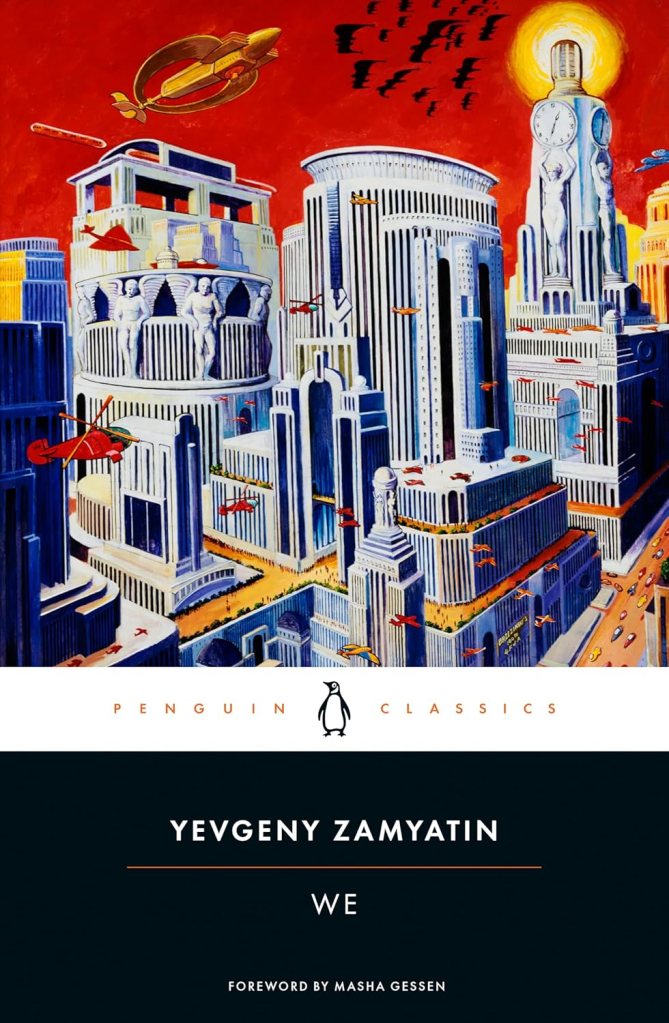
Someone in the audience brought up the notion that “awareness-guided perception” may suggest an increase of ecological awareness in literature when it is more that readers are just noticing what was always there. Authors agreed and pointed out that environmental fiction has been written for years and it is only now—partly with the genesis of the term eco-fiction—that the “character” and significance of environment is being acknowledged beyond its metaphor; for its actual value. It may also be that the metaphoric symbols of environment in certain classics are being “retooled” through our current awareness much in the same way that Aldous Huxley’s Brave New World or George Orwell’s Nineteen Eighty Four are being re-interpreted—and newly appreciated— in today’s world of pervasive surveillance and bio-engineering.

I would submit that if we are noticing it more, we are also writing it more. Artists are cultural leaders and reporters, after all. I shared my own experience in the science fiction classes I was teaching at UofT and George Brown College, in which I noted a trend of increasing “eco-fiction” in the works in progress that students were bringing in to workshop in class. Students were not aware that they were writing eco-fiction, but they were indeed writing it.

I started branding my writing as eco-fiction a few years ago. Prior to that—even though my stories were strongly driven by an ecological premise and strong environmental setting—I described them as science fiction and many as technological thrillers. Environment’s role remained subtle and—at times—insidious. Climate change. Water shortage. Environmental disease. A city’s collapse. War. I’ve used these as backdrops to explore relationships, values (such as honour and loyalty), philosophies, moralities, ethics, and agencies of action. The stuff of storytelling.

Environment, and ecological characteristics were less “theme” than “character,” with which the protagonist and major characters related in important ways.

Just as Bong Joon-Ho’s 2014 science fiction movie Snowpiercer wasn’t so much about climate change as it was about exploring class struggle, the capitalist decadence of entitlement, disrespect and prejudice through the premise of climate catastrophe. Though, one could argue that these form a closed loop of cause and effect (and responsibility).

The self-contained closed ecosystem of the Snowpiercer train is maintained by an ordered social system, imposed by a stony militia. Those at the front of the train enjoy privileges and luxurious living conditions, though most drown in a debauched drug stupor; those at the back live on next to nothing and must resort to savage means to survive. Revolution brews from the back, lead by Curtis Everett (Chris Evans), a man whose two intact arms suggest he hasn’t done his part to serve the community yet.

Minister Mason (Tilda Swinton), an imperious yet simpering figure who serves the ruling class without quite being part of it, reminds the lower class that: 

We must all of us on this train of life remain in our allotted station. We must each of us occupy our preordained particular position. Would you wear a shoe on your head? Of course you wouldn’t wear a shoe on your head. A shoe doesn’t belong on your head. A shoe belongs on your foot. A hat belongs on your head. I am a hat. You are a shoe. I belong on the head. You belong on the foot. Yes? So it is.  In the beginning, order was prescribed by your ticket: First Class, Economy, and freeloaders like you…Now, as in the beginning, I belong to the front. You belong to the tail. When the foot seeks the place of the head, the sacred line is crossed. Know your place. Keep your place. Be a shoe.”

Ecotones are places where “lines are crossed,” where barriers are breached, where “words collide” and new opportunities arise. Sometimes from calamity. Sometimes from tragedy. Sometimes from serendipity.

When environment shapes a story as archetype—hero, victim, trickster, shadow or shape shifter—we get strong eco-fiction. Good eco-fiction, like any good story, explores the choices we make and the consequences of those choices. Good eco-fiction ventures into the ecotone of overlap, collision, exchange and ultimate change.

In my non-fiction book Water Is… I define an ecotone as the transition zone between two overlapping systems. It is essentially where two communities exchange information and integrate. Ecotones typically support varied and rich communities, representing a boiling pot of two colliding worlds. An estuary—where fresh water meets salt water. The edge of a forest with a meadow. The shoreline of a lake or pond.

For me, this is a fitting metaphor for life, given that the big choices we must face usually involve a collision of ideas, beliefs, lifestyles or worldviews: these often prove to enrich our lives the most for having gone through them. Evolution (any significant change) doesn’t happen within a stable system; adaptation and growth occur only when stable systems come together, disturb the equilibrium, and create opportunity. Good social examples include a close friendship or a marriage in which the process of “I” and “you” becomes a dynamic “we” (the ecotone) through exchange and reciprocation. Another version of Bernard Shaw’s quote, above, by the Missouri Pacific Agriculture Development Bulletin reads: “You have an idea. I have an idea. We swap. Now, you have two ideas and so do I. Both are richer. What you gave you have. What you got I did not lose. This is cooperation.” This is ecotone.

I think we are seeing more eco-fiction out there because ecosystems, ecology and environment are becoming more integral to story: as characters in their own right. I think we are seeing more eco-fiction out there because we are ready to see it. Just as quantum physics emerged when it did and not sooner, an idea—a thought—crystalizes when we are ready for it.

Don’t stay a shoe … go find an ecotone. Then write about it.

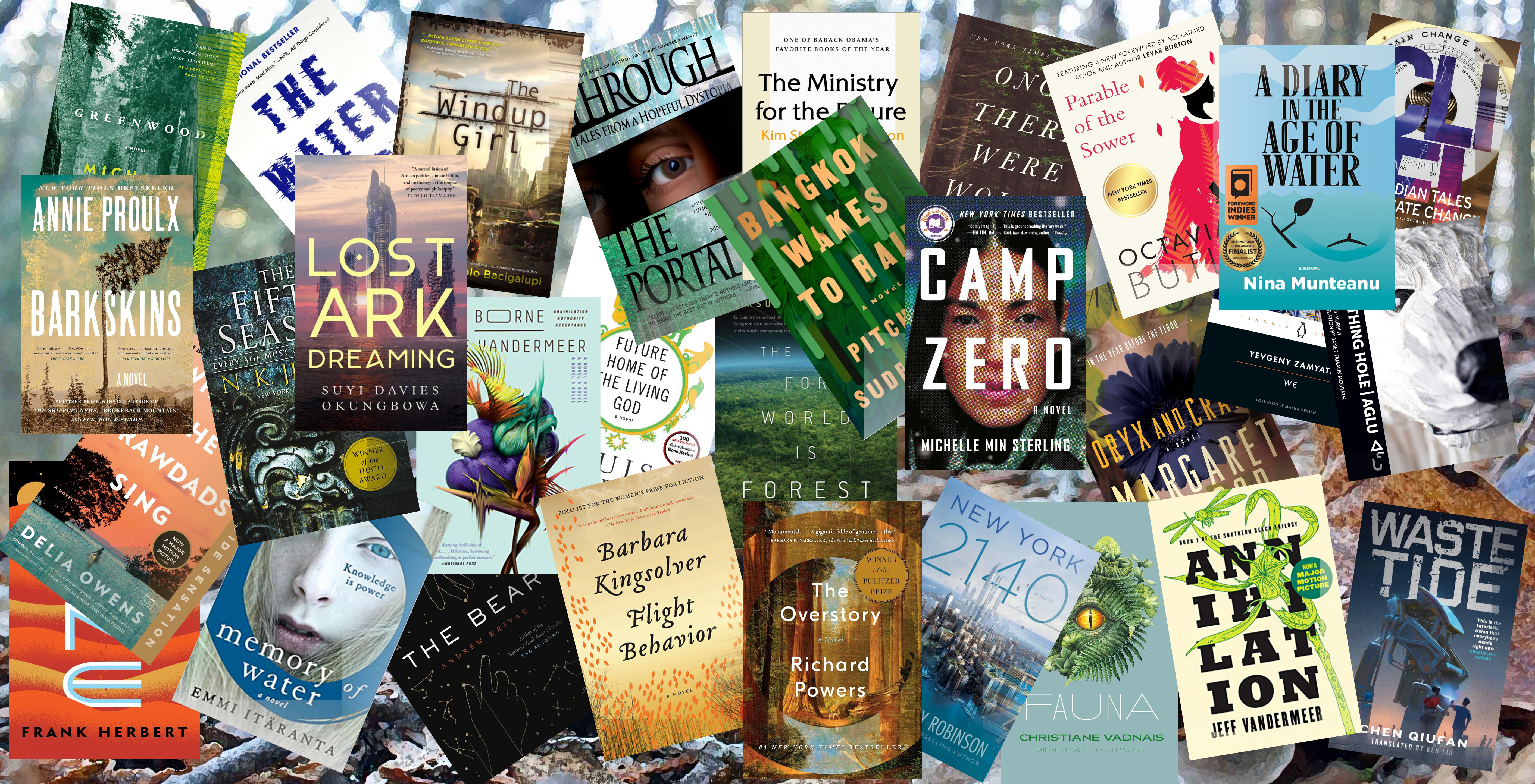
Thirty-Six Eco-Fiction Books Worth Reading…

Nina Munteanu is a Canadian ecologist / limnologist and novelist. She is co-editor of Europa SF and currently teaches writing courses at George Brown College and the University of Toronto. Visit www.ninamunteanu.ca for the latest on her books. Nina’s bilingual “La natura dell’acqua / The Way of Water” was published by Mincione Edizioni in Rome. Her non-fiction book “Water Is…” by Pixl Press (Vancouver) was selected by Margaret Atwood in the New York Times ‘Year in Reading’ and was chosen as the 2017 Summer Read by Water Canada. Her novel “A Diary in the Age of Water” was released by Inanna Publications (Toronto) in June 2020.
Sound & Fury Reviews “A Diary in the Age of Water” by Nina Munteanu

I recently came across this beautiful Instagram post by TinasAlwaysReading, and was reminded of a wonderfully in-depth review of my eco-fiction novel A Diary in the Age of Water that Tina did on Sound & Fury Book Reviews.

You can watch the review below:

Sound & Fury reviews “A Diary in the Age of Water” by Nina Munteanu

Nina Munteanu is a Canadian ecologist / limnologist and novelist. She is co-editor of Europa SF and currently teaches writing courses at George Brown College and the University of Toronto. Visit www.ninamunteanu.ca for the latest on her books. Nina’s bilingual “La natura dell’acqua / The Way of Water” was published by Mincione Edizioni in Rome. Her non-fiction book “Water Is…” by Pixl Press (Vancouver) was selected by Margaret Atwood in the New York Times ‘Year in Reading’ and was chosen as the 2017 Summer Read by Water Canada. Her novel “A Diary in the Age of Water” was released by Inanna Publications (Toronto) in June 2020.

TV Series Review: “Incorporated”–Or How I Lost My Soul to Climate Change

Spiga employees submit to security checks when they enter the facility

Incorporated is a science fiction thriller (on Netflix) that offers a chilling glimpse of a post-climate change dystopia. Created by David and Alex Pastor and produced by Ben Affleck, Matt Damon, Ted Humphrey and Jennifer Todd, the show (filmed in Toronto, Canada) opens in 82 °F Milwaukee in November 2074 after environmental degradation, widespread famine and mismanagement have bankrupted governments. We learn later that Milwaukee Airport served as a FEMA climate relocation centre that resembles an impoverished shantytown. In the wake of the governments demise, a tide of multinational corporations has swept in to control 90% of the globe and ratified the 29th amendment, granting them total sovereignty.

Corporate climber at Spiga, Ben Larson receives climate news updates as he gets ready for work

Corporations fight a brutal covert war for market share and dwindling natural resources. Like turkey vultures circling overhead, they position themselves for what’s left after short-sighted government regulations, lack of corporate check and FEMA mismanagement have ‘had their way’ with the planet. The world is now a very different place. There is no Spain or France. Everything south of the Loire is toxic desert; New York City reduced to a punch line in a joke. Reykjavik and Anchorage are sandy beach destinations and Norway is the new France—at least where champagne vineyards are concerned. Asia and Canada are coveted for their less harsh climates.

Red Zone with Green Zone backdrop

Those who work for the corporations live in privilege behind the sentried walls of the Green Zones. The rest fend for themselves with scarcity in the contaminated slums of the Red Zones. The numbers aren’t provided in the show’s intro but we can guess that they are similar to Pedro Aguilera’s TV thriller 3% and Blomkamp’s motion picture Elysium—both about living with scarcity, where the few elite enjoy the many privileges—so long as they follow the elite rules.

Spiga Biotechs screening employees

“Kleptocracy reigns, paranoia rules, and the marketplace determines human worth,” writes Jeff Jensen of Entertainment Weekly about Incorporated. “Only the most obedient, cunning, and technologically adept can flourish. Question authority? You’re fired! And maybe worse.”

Security at Spiga Biotechs catches Chad, Ben’s boss with illegal tech

The ‘Elysium’ of Incorporated is an ‘Alice in Wonderland’ mixture of realizable technological advances, gadgetry and thrilling–if not chilling–consequence: like self-driving cars, intelligent wristbands, surrogate pregnancies and remote deliveries, genetic testing of ‘inferiors’, DNA theft and malware sabotage.

Corporate stealth tech presentation

The first episode (Vertical Mobility) opens to a corporate ‘traitor’ being dragged into “the quiet room”, rumoured to be a torture chamber run by taciturn head of security Julian Morse (Dennis Haysbert). The scene shifts to the Green zone suburban house of corporate climber Ben Larson (Sean Teale). As he prepares to go to work, the news streams of hurricanes breaching levies; Canada building a wall to stem the tide of illegal American climate refugees–12 million already there; offshore oil rigs in the waters of the former Arctic ice cap; and finally to the “terrorist” bombing of the R&D lab of biochemical giant Spiga, where Ben works. Spiga, we later learn, plays the same games as Monsanto and Nestle to ensure profits at the expense of well-being.

Building of biochemical giant Spiga Biotechnics stands tall next to the corporation’s motto
Spiga CEO speaks to employees

“Over the past forty years,” says a giant image of CEO Elizabeth Krauss (Julia Ormond) to the suits passing security in the giant corporate lobby below, “Spiga Biotech has been at the forefront of the genetic engineering revolution. We design seeds capable of thriving in the increasing harsh environments of our planet. Our pest and drought resistant crops are now sold in over a hundred countries. And our advancements in in-vitro testing have transformed the synth food industry.” She ends with the mantra, “Spiga: committed to feeding our ever-growing world.”

Red Zone at night
Ben stands in his office at Spiga

Ben is, of course, not what he pretends he is. The upwardly mobile executive has wed Laura Larson (Allison Miller), a doctor with a courageous heart who also happens to be the daughter of the unscrupulous Kraus. Ben is really Aaron, a former Red Zone techno-hustler who covertly searches for his Red Zone sweetheart, now a sex slave to corporate executives at Arcadia, the ‘men’s club’ of Spiga. If he’s going to spring her, Ben will have to get promoted to the 40th floor.

Climate refugee camp in the Red Zone

“If our [current] political climate has you feeling apocalyptic, Incorporated may or may not be the show for you,” writes Jensen. “It’s a triggering dystopian thriller and wannabe allegory-for-now about… well, apocalyptic climate change.” This show, perhaps more than any other, stirs disquieting thoughts of now—and with it, guilt about what we’re doing or not doing. At the heart of Incorporated is climate change, which is also its main character.

Laura meets her new patient for facial reconstruction

“The most impressive performance and character in Incorporated is its deeply imagined world,” writes Jensen. “Throwaway ideas, like a grieving widow who hires Laura to remake a poor immigrant in the image of her dead husband, could seed whole episodes of Black Mirror. James Bond would kill for the arsenal of gadgets Aaron deploys in his soul-staining subversions.” Nuanced minutiae and brilliant minor characters weave a mad tapestry that enrich and intrigue.

Water price in the Red Zone

And like a Seurat painting, their subtle details change with perspective and build into a subliminal realism you can’t shake: from the food porn in the opening scene to eating rats in climate relocation camps or drinking dirty Red Zone water that costs $5. In Cost Containment we learn that Spiga competitor Inazagi is developing salt-tolerant crops that, like the mangroves, will thrive on irrigated seawater in the deserts left by an exploitive short-sighted America: Iowa, Missouri, Kansas—all the dust storm states. In a later episode, a murdered corporate executive is found by two dowsers on the dried lakebed of Missouri’s Lake Lotawana. We hear about the “oil wars” in Capetown.

Aaron (Ben) in the Red Zone

“This “makes it hard to not think of the current political and cultural state of things across the globe,” writes Aaron Pruner of Screener TV. The fourth episode (Cost Containment) “opened with a familiar feeling infomercial. Yet, instead of Sally Struthers pleading with the common American to donate money to help feed a starving child in a third-world country, [a Chinese narrator presented] the United States as that third world.” Liz Shannon Miller of IndieWire writes: “watching [that scene] at this exact moment in our history is science fiction that might be a little too real. You can forget about The Walking Dead or The Exorcist: Incorporated may be the scariest show on television. Says Pruner, “The thing that brought us here? Climate change.”

Julian Morse interrogates Ben about illegal use of Spiga tech

“It’s what gives us … the refugee camps and ration hacking, the high-class cut-throat world of corporations and the privileged, yet dangerous, culture that comes with it,” adds Pruner. The corporation’s tyrannical demand for allegiance through rumours of loss of privileges, “contract termination”—or worse—resonates through the ranks in what the hacker in the Red Zone calls ‘cattle prod.’

Red Zone hacker sets Caplan to catch a rat as payment for her creating an illegal hacking device for him

“You poor suits, always trying to catch up,” says the Red Zone hacker (Sara Botsford) to Roger Caplan (Douglas Nyback), ambitious executive looking to steal his way to the top. “A climber like you gets caught with something like this [a ‘keyhole’, which “allows you to snoop in any system without leaving any footprints”] he’s gonna get spanked. Or worse.”  Word is out that Spiga security can be very inventive with cattle prod.

Spiga’s main competitor Inazagi (a take on Izanagi, the male Japanese Shinto god responsible for creation) starts its propaganda machine on the very young to keep its corporate family in line. The third episode (Human Resources) opens with an Izanagi propaganda video for children. TV Fanatic calls it “both cute and chilling. Teaching your children to rat out Mom and Dad is pretty cold, but hey, this is the future, right?” But is it just the future? I’m confident that TV Fanatic wasn’t born yet when the Nazis formed the Hitlerjugend. But I would suggest they look up what Santayana said about history…

In one of the best played and most gratifying narrative threads of the show, a Red Zone techno-hacker (played by Canadian actress Sara Botsford)  provides some twisted humour as she easefully negotiates the Spiga machine to put corporate brat Roger Caplan in his place, enlighten us on some history and entertain us all at the same time. After Caplan disdainfully throws money at her to create a skeleton key to bypass the self-destruct protocol of his stolen keyhole, the hacker ops for entertainment instead as payment: she takes him outside her secured warehouse enclave and points to a small rat feeding on the debris in the adjoining alley.

Caplan chases after the rat as the Red hacker looks on, amused

“You see her?” To Caplan’s quizzing look, she points. “Beady eyes, pair of whiskers, long tail…” He finally gets it; the rat. “I want you to catch it,” the hacker bates him. “All ya gotta do is catch a little animal with the brains the size of a peanut. How hard can that be?”

After Caplan’s first attempt, in which he cuts his head, she croons, “Now that’s entertainment!” And chortles like a witch; but we find ourselves cackling with her. After successfully humiliating Caplan, the hacker forces him to do more. She starts with her own history: “I got here with the first wave of climate refugees, chased up north by the sandstorms. Government rations were never enough. You were probably sucking on your gestator’s tit,” she scoffs at Caplan, “while my brother and I had to scramble for enough protein. Sometimes there was only one source of it. Although it was everywhere, really…” Her gaze drifts down to the dead rat on the floor that Caplan had brought in at great expense to his clothes and pride. She adds, “I’d tell you it tastes like chicken but I don’t really remember what chicken tastes like. Why don’t you tell me whether it tastes like chicken…”

What follows is some deep gratification in witnessing Caplan—self-centered and greedy corporate archetype—get schooled by a “lowly” but sly plebe. A “little old lady” no less! And let’s not forget the wily rat who sent him on that hellish chase in the first place… 

Disgruntled Caplan after his first attempt to catch the rat

Pruner asks, “Could climate change push us into a collapsed society, informed consistently by the ongoing threat of class warfare? Will we eventually be separated by electric fences and really big walls? Are fear and greed going to be the currencies of our reality? These burning questions should sound far-fetched and silly, but as we watch Incorporated’s tale unfold, it’s hard not to wonder what our own future will bring.” Far-fetched and silly? Is it any more far-fetched and silly than voting in a president who claims that the Chinese invented climate change to make American manufacturing non-competitive?

Ben studies a file

The best entertainment doesn’t put you to sleep; it wakes you up. The best entertainment doesn’t just offer visceral escape; it engages you on many levels to connect, think and feel. And like all good things—friendship, love, family and home—its core value lies in its subtle yet deep truths. The best entertainment shows you a mirror of yourself. Incorporated is less thriller than satire. It is less science fiction than cautionary tale.

The real and the unreal worlds of the post-climate change world of Incorporated

“You look to Incorporated for dystopian fiction that expresses our current anxieties,” says Jensen. “What you get is fitful resonance that makes you realize it might be too soon for any show to meet that challenge.”

Or is it more that we may be too late…

Nina Munteanu is a Canadian ecologist / limnologist and novelist. She is co-editor of Europa SF and currently teaches writing courses at George Brown College and the University of Toronto. Visit www.ninamunteanu.ca for the latest on her books. Nina’s bilingual “La natura dell’acqua / The Way of Water” was published by Mincione Edizioni in Rome. Her non-fiction book “Water Is…” by Pixl Press (Vancouver) was selected by Margaret Atwood in the New York Times ‘Year in Reading’ and was chosen as the 2017 Summer Read by Water Canada. Her novel “A Diary in the Age of Water” was released by Inanna Publications (Toronto) in June 2020.
Climate Change and the Colour of Resilience

I’m an ecologist; I study environmental relationships. Something you’d think is easy to learn and very accessible; we’re surrounded by it, after all. We live, work and play in it. While I learned about environmental relationships with my eco-minded parents, I didn’t learn it or experience it in my school growing up. With the exception of some indigenous schools (which teach respect for the spirit of wildness), most of us certainly didn’t learn about environmental relationships in our schools.

Earthstar sits on moss-covered rotting cedar log as new cedar roots take hold, ON (photo by Nina Munteanu)

Most Canadians live in a city; we don’t really understand what the natural environment is. Many of us have learned to ignore it, stop recognizing it, pocket it away as we go about our busy lives in the city. A park is a bit of greenery. A tree is a decoration that provides shade. Shrubs border a mall.

Walk through urban forest along the Credit River, ON (photo by Nina Munteanu)

But if we can’t even recognize the natural environment, how can we understand its functional role in the intricate well-being of this entire precious planet and ultimately ourselves?

It is no wonder then that most Canadians—though we may intellectually accept climate change and its effects on this planet (because we’re smarter than some)—likely do not viscerally understand or appreciate why and how it will drastically change our lives. For most of us, climate change—as with Nature—is something that is happening to someone else, somewhere else. From those far away calamities to the quiet struggles no one talks about. We hear and lament over the flooding in Bangladesh or the Maldives. Or the wildfires in northern British Columbia. Or the bomb cyclones of the eastern seaboard.

Meanwhile, the polar bear struggles quietly with disappearing sea ice in the Canadian arctic. The koala copes quietly with the disappearing eucalyptus. Coral reefs quietly disappear in an acidifying ocean. Antarctic penguins silently starve with disappearing krill due to ice retreat. And while jellyfish invade the Mediterranean, UK seas and northeast Atlantic, the humble Bramble Cay melomys slips quietly into extinction—the first mammal casualty of climate change.

Yellow Creek flows through an urban forest in the heart of Toronto, ON (photo by Nina Munteanu)

So, those of us who are enlightened speak of climate resilience and adaptation. We talk of arming our cities with words like green infrastructure, stormwater management, urban runoff control, flood mitigation. Ecological literacy. But what are these things to us? They are tools, yes. Good tools to combat and adapt to the effects of climate change. But will they create resilience? I think not.

I’m a limnologist and I’ve consulted for years as a scientist and an environmental consultant. I played a role in educating industry, in the use of mitigating tools, in changing the narrative even.

Trail through urban forest on a foggy winter day in Peterborough, ON (photo by Nina Munteanu)

But I’ve come to realize that resilience comes only from within and through a genuine connection with our environment. Tools, no matter how proficient, are only as good as how they are used based on intention from a deep understanding. It isn’t enough to achieve the HOW of things; we must embrace the WHY of things. And that comes from the heart. We must feel it in our hearts. Or it won’t work. And we quite simply won’t survive.

Various flowers and trees of Ontario (photos by Nina Munteanu)

Canadians celebrate our multi-cultural heritage. We pride ourselves in our tolerance and welcoming nature. Our national anthem speaks of our land. Our national symbols embrace nature with the maple, beaver, caribou and loon. Yet who of us knows the habitat of the loon—now at risk, by the way (climate change will impact much of its breeding grounds). Who knows what the boreal forest—which makes up over half of our country—is? How it functions to keep this entire planet healthy, and what that ecosystem needs, in turn, to keep doing it? How to help it from literally burning up? 

Ecology isn’t rocket science. Ecology is mostly common sense. Ecology is about relationship and discovery. Ecology is a lifestyle choice, based on respect for all things on this planet and a willingness to understand how all things work together.

Various mushrooms in Ontario forests (photos by Nina Munteanu)

Here’s what I’ve learned to keep me caring and remain positive and not become apathetic or fall into despair:

I’ve learned to open myself to discovery. To find Nature, even if it is in the city. To connect with something natural and wild and to find and savour the wonder of it. All that matters will naturally come from that.

Become curious and find something to love.

When you do, you will find yourself. And that is where you will find resilience. What colour is it? It doesn’t need to be green…

Throughout this article I’ve shown you some of my colours…

Red fox skull emerges on a leaf-strewn icy bank of Jackson Creek, ON (photo by Nina Munteanu)

Here are the steps I taught myself toward healthy resilience (the first two steps are both the hardest and the easiest):

Step 1: Slow down, pay attention. Give yourself the time to relax and look around your local surroundings. Until you slow down to actually look, you will not really take in your surroundings. You need to be in the moment. Only then can you take the time to use all your senses to take in your environment. Try to look at it from a different perspective. Notice the light, the smells and sounds. What is different? What is the same?

Step 2: Lower your guard, open yourself to curiosity. Rely on as many senses as you can (sight, hearing, smell, texture, taste) to sample your environment and show some humility to ask questions. Whenever I go out, particularly in Nature, I make a point of coming home with three gifts, discoveries that make me smile or think and wonder. I’m hardly ever disappointed.

Step 3: Process what you’ve seen and discovered. Do some follow-up research to questions that may arise. Look at consequences. Share with others, discuss. From there it will be easy to ‘take responsibility’ for some section of nature that you really like; perhaps a particular tree in a park or a short path through an urban forest or stretch of urban stream. This can easily lead to good stewardship.

Step 4: Take responsibility for your chosen part of Nature. Get to know it well, how it works, what it needs, what’s right and what’s wrong. Do something about it and share with others.

Step 5: You’re there. You are resilient.

Barred owl hiding in plain sight in an urban forest near Peterborough, ON (photo by Nina Munteanu)

Nina Munteanu is a Canadian ecologist / limnologist and novelist. She is co-editor of Europa SF and currently teaches writing courses at George Brown College and the University of Toronto. Visit www.ninamunteanu.ca for the latest on her books. Nina’s bilingual “La natura dell’acqua / The Way of Water” was published by Mincione Edizioni in Rome. Her non-fiction book “Water Is…” by Pixl Press (Vancouver) was selected by Margaret Atwood in the New York Times ‘Year in Reading’ and was chosen as the 2017 Summer Read by Water Canada. Her novel “A Diary in the Age of Water” was released by Inanna Publications (Toronto) in June 2020.

“Robin’s Last Song” at Climate Imaginarium in New York City’s Governor’s Island

Governor’s Island, NYC

My short story Robin’s Last Song was selected by the NYC Climate Writers Collective as part of an exhibition in the Climate Imaginarium on Governors Island in New York. The exhibition, starting May 18, will run throughout the summer of 2024.

Robin’s Last Song

Robin’s Last Song first appeared in the #128 Issue of Apex Magazine in 2021. It tells the story of Robin, a blind elder whose digital app failed to warn the world of the sudden global loss of birds with disastrous ecological consequences. After years of living in self-exile and getting around poorly on sight-enhancing technology, a discovery gives her new hope in rekindling her talents in the field of Soundscape Ecology.

In a recent interview with writer Simon Rose, I described my thoughts in writing Robin’s Last Song:

I wanted to make “Robin’s Last Song” a realizable work of fiction in which science and technology play both instigator of disaster and purveyor of salvation. Our biogenetic technology comes to us as a double-edged sword in the form of gene-editing, proteomics, DNA origami, and CRISPR—just to name a few. These biotechnological innovations promise a cornucopia of enhancements: from increased longevity and health in humans to giant disease-resistant crops. But, for every ‘magic’ in technology, there is often unintended consequence. Unforeseen—or even ignored—casualties and risks. I suppose my ultimate question with this story is: will synthetic biology redesign Nature to suit hubris or serve evolution? Science doesn’t make those decisions. We do.

You can read my interview with Rebecca E. Treasure at Apex Magazine (where Robin’s Last Song first appeared) about the greater implications of the story and my other eco-fiction. You can also read the story on Metastellar Speculative Fiction and Beyond.

Climate Imaginarium

Anyone living in or visiting the NYC area is welcome to the Climate Imaginarium launch on May 18 on Governor’s Island. Check this Eventbrite link for details. The exhibition will continue throughout the summer of 2024 and will include: climate storytelling and poetry by Climate Café, the Sixth Festival, and the Climate Writers Collective; opening exhibition of “What is Environmental Art?” by Forest for Trees; artwork from the Climate Imaginarium community and Climate Writers exhibition; “Eye of Flora” virtual reality exhibition by Synphisica Collective; and more.

Here’s what they say:

Come to Governors Island for the grand opening of our Climate Imaginarium house! The Climate Imaginarium will serve as a community center for climate and culture, with galleries and spaces for exhibitions, performances, film screenings, and events that respond to the climate crisis with solutions and visions for hope and justice. Join us at Building 406A on Colonels Row for a lively celebration of climate art, storytelling, and community.

Exhibitions will be open to the public at noon, and the party will officially start at 2pm. All donations will support programming in our community space.

Nina Munteanu is a Canadian ecologist / limnologist and novelist. She is co-editor of Europa SF and currently teaches writing courses at George Brown College and the University of Toronto. Visit www.ninamunteanu.ca for the latest on her books. Nina’s bilingual “La natura dell’acqua / The Way of Water” was published by Mincione Edizioni in Rome. Her non-fiction book “Water Is…” by Pixl Press (Vancouver) was selected by Margaret Atwood in the New York Times ‘Year in Reading’ and was chosen as the 2017 Summer Read by Water Canada. Her novel “A Diary in the Age of Water” was released by Inanna Publications (Toronto) in June 2020.
How Climate Change Is Altering My Winter

Cedar-pine forest covered in new snow of winter, ON (photo and rendition by Nina Munteanu)

I’m Canadian, and I love the snow. When I grew up in the Eastern Townships of Quebec, we enjoyed a brisk cold winter with deep snow for a good six months of the year. I’ve since lived in Vancouver, British Columbia, which experiences a milder regional climate; I now live in the Kawarthas of Ontario, which has a similar regional climate to what I experienced growing up in Quebec. Living in the Kawarthas reminds me of my childhood days with winter snow.

Heavy snowfall in Trent Nature Sanctuary, ON (photo and rendition by Nina Munteanu)

I love how the first snow of the season often comes from the sky in a thick passion. Huge flakes of unique beauty would settle on my coat sleeves and within minutes I’d be covered in snow. I would stand enraptured, arms out to catch snowflakes, and study each individual with admiration.

Farm and road in winter in Kawarthas, ON (photo and rendition by Nina Munteanu)
Young locust trees covered in new snow, ON (photo and rendition by Nina Munteanu)

Snow wraps everything in a blanket of soft acceptance. It creates a dazzling face on a dark earth. It refuses to distinguish between artificial and natural. It covers everything—decorated house, shabby old car, willowy trees, manicured lawn—beneath its white mantle. It quiets the Earth.

Trees and shrubs covered in new soft snow during snowfall, ON (photo and rendition by Nina Munteanu)

I often walk a trail through the forest after a fresh snow has fallen and the sun reveals itself on a crisp day. Like a balancing tightrope walker, the snow piles itself on everything, from fat fir branch to thin black locust twig. The snow then gives itself to the vagaries of a playful wind. Occasionally, a gust would send a shower of glitter snow dust raining down on me.

Snow-covered branches overlook path in show, ON (photo and rendition by Nina Munteanu)
Twigs piled with snow on a calm morning, ON (photo and rendition by Nina Munteanu)

I particularly enjoy walking a trail in the evening light after a fresh snow. Boots crunch on the fresh crisp snow that glistens in the moonlight. Each step is its own symphony of textured sound. A kind of collaboration with the deep of the night and Nature’s own whisperings.

Jackson Creek after a snowfall, ON (photo and rendition by Nina Munteanu)

Since moving to the Kawarthas, close to the Otonabee River, I walk daily along the river and its riparian forest. Winters here have graced us with a variety of typical winter morphology: thick and copious snowfall, enduring fog, imaginative ice formations on the river, and glittering hoarfrost and rime everywhere else.  The first snowfall can come in November, large flakes falling on still fully-clothed shrubs and trees, creating a painter’s landscape of reds, yellows, and greens dusted in a white blanket. This is when, some mornings, mist will rise like a cold breath from the river or flow and pool in depressions of the rolling Kawartha drumlins.

Thick first snowfall on Thompson Creek marsh in early winter, ON (photo and rendition by Nina Munteanu)

On cold nights in December, hoarfrost will form filigreed ‘leaves’ over everything—ground, sticks, ice and even snow. For a brief magical moment, this miniature crystal forest glitters like a field of jewels in the morning sun before vanishing by coffee break time. The river ices up in December, first with frazil that froths and fizzes as it coagulates into grease ice then shuga and finally to ice pancakes that crowd the shore, nudging each other like suburban women at a sale, then stitching themselves together into solid ice sheets attached to shore. By January and February, all is in place and the deep winter is upon us until ice break up and snow melt in late April into May. The river ice extends out from the bays in vast thick sheets where people can skate. The snow forms deep banks and drifts everywhere through which only snowshoes or skis can penetrate.

Mist off the river rises like steam on a cold day in winter, ON (photo by Nina Munteanu)
Old shed by the Otonabee River during a snowfall, ON (photo and rendition by Nina Munteanu)

Lately (in the past few years) I’ve noticed that this pattern has become interrupted by extremely mild weather throughout the winter season. January can look like November, with the exception of the absence of leaves on trees and shrubs; the greens and browns of other vegetation such as grasses, forbs and forest litter can still be revealed. The fogs of early winter may also return. The river ice sheets may fragment and flow downstream, only to reform as waters refreeze. The formerly uninterrupted reign of winter is waning and this saddens me with feelings of solastalgia. The Kawarthas still get good dumps of snow and magical frost. But for each champagne powder snow day, and hoarfrost glitter, there is a melt day, when snow melts and it rains, turning the parking lot into a skating rink as temperatures plummet with nightfall.

Snow melt on the side of a country road, ON (photo and rendition by Nina Munteanu)

I grew up in a part of Canada that experienced four distinct seasons. While spring and fall exemplify transition into and out of the two stable seasons of summer and winter, this is no longer the case in many parts of Canada, where formerly well-defined and uninterrupted winters and summers could be predicted. Now all the seasons experience transition and unpredictable phenomena. Winter temperatures in the Kawarthas were often stable at just below zero Centigrade to minus 20°; they now fluctuate more highly from minus 20° to +10.
Author’s car parks on a country road after a snowfall, ON (photo and rendition by Nina Munteanu)

A report by NASA’s Goddard Institute for Space Studies released in 2022 confirmed that global temperatures in 2022 were 1.6 degrees Fahrenheit above the average baseline period of 1951 to 1980 and 2 degrees warmer than the late 19th century average. They reported that the past nine years have been the warmest since modern record keeping began in 1880.

Teenagers walk the Rotary Trail after a snowfall, ON (photo and rendition by Nina Munteanu)

The winter that I grew up with is changing into something else. It, like the changing world, is in transition. There is no denying that global warming is upon us and each region is uniquely experiencing its effects. Climate is changing and the environment is adapting to that change.

Thompson Creek after a snowfall, ON (photo and rendition by Nina Munteanu)

While solastalgia creeps into my psyche at times, I am assiduously learning to pace myself with my changing environment. As the regional weather adapts to the warming climate, I am learning to adapt too. One way is through the equipment I use: I still use my snowshoes (a recent gift from my son) in winter; but, more often, I use snow/rain boots with crampons for terrain that includes wet snow, slush, and ice. Being prepared for change allows me to accept it with grace. I have learned to cherish those moments when fresh snow falls from the heavens like confetti. I charge outside in my snow gear and enjoy it while it’s there. I have learned to live in discovery and to thrill in the unpredictable. Each day is a gift of unknown and thrilling surprise.

First snow in early winter at Thompson Creek, ON (photo and rendition by Nina Munteanu)

I have learned to live in the moment and to cherish that moment as a gift.

Because, even change is a gift.

Partially iced over Otonabee River, ON (photo and rendition by Nina Munteanu)

Article originally published January 2023 in Rewilding Our Stories (edited by Mary Woodbury) then January 2, 2024 on Dragon.eco.

Trees and dogwood shrubs in winter by the Thompson Marsh, ON (photo and rendition by Nina Munteanu)
Woman and her dog walk among giant cedars after a snowfall, ON (photo and rendition by Nina Munteanu)

Nina Munteanu is a Canadian ecologist / limnologist and novelist. She is co-editor of Europa SF and currently teaches writing courses at George Brown College and the University of Toronto. Visit www.ninamunteanu.ca for the latest on her books. Nina’s bilingual “La natura dell’acqua / The Way of Water” was published by Mincione Edizioni in Rome. Her non-fiction book “Water Is…” by Pixl Press (Vancouver) was selected by Margaret Atwood in the New York Times ‘Year in Reading’ and was chosen as the 2017 Summer Read by Water Canada. Her novel “A Diary in the Age of Water” was released by Inanna Publications (Toronto) in June 2020.