 In the Green Kingdom, stimulation through the sense of taste has become a powerful and complex art form that rules the lives of the males—the phrils. Not only does it bring pleasure, it can change a phril’s destiny, even guide him into death and beyond. But only if he can afford the services of the artists called Recipears. Without a Recipear, a phril will live and die a pagan, with no chance of an afterlife. The female of the species, called phriliras, cannot experience RecipeArium; they replace it with their faith in one God with changing names. In the world within the huge body of a monstrous beast, the Recipears rule society.
RecipeArium is a tale of sensation and flesh, in which the very hope of an afterlife is determined by one’s sex. The novel takes us on a journey to discover the meaning of love in a boldly imagined world where art is transformative and immortality the destiny of the few.
Carrying the soul of his RecipeArium master within him, Morminiu comes to the royal Court with two objectives: to exact revenge on his master’s enemies and to win for himself the most desired and treacherous position in the realm: Master Recipear of the Kingdom.

Costi Gurgu, launching at Pierre Leon Gallery
My own testimonial of the book follows:
Gurgu delivers a full course meal of epic transcendence in an alien landscape that is at once grotesque and wondrously compelling.
From the vast and forgotten lands of the Edge of the World to the corrupt decadence and intrigue of the nobility who dwell inside the monstrous Carami, Gurgu’s Recipearium unveils a fascinating world in transformation. Recipearium is a sensual metaphoric tale that explores the dialectic quest of duality to realize itself as whole.
Imaginative. Outrageous. Original.
Gurgu subverts traditional fantasy and SF with the promise of new heights in storytelling.
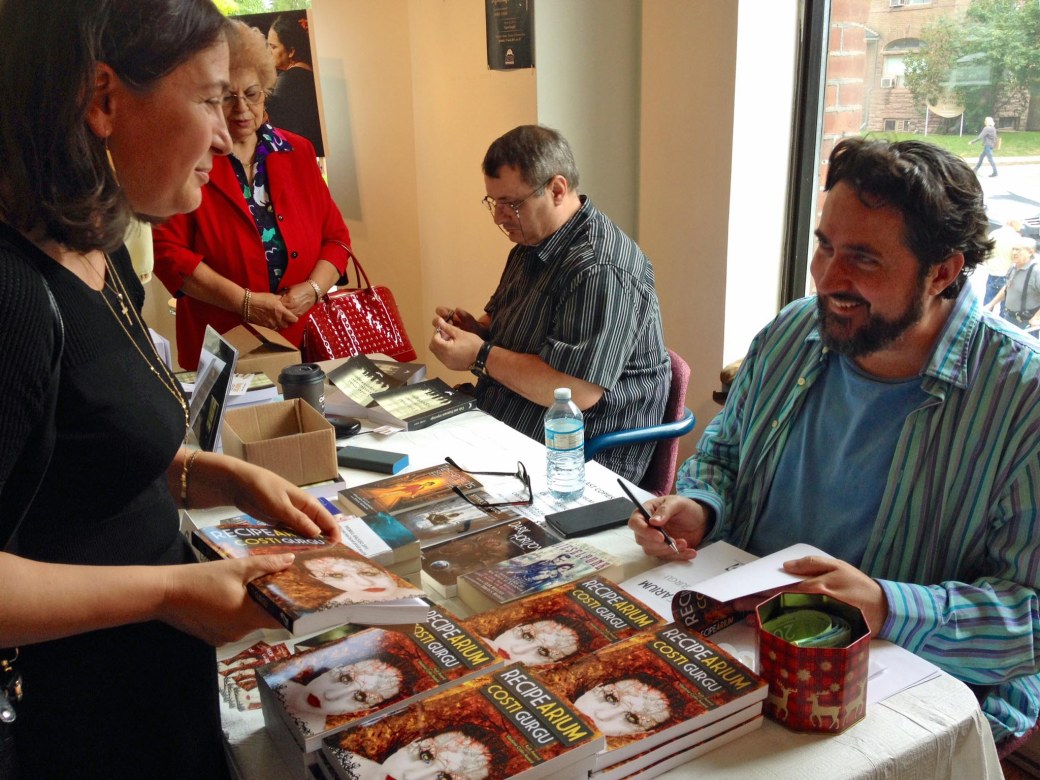
Costi Gurgy signing his book at launch in Pierre Leon Gallery
The publisher, White Cat Publishers interviewed Costi recently; a few choice questions and answers appear below:
Regarding his aspirations for the book, Costi responded:
First of all, this new release will bring Recipearium to the English speaking market, which is quite a big aspiration in itself. And through Recipearium I hope to open the hearts of North American readers to the rest of my fiction as well as to Romanian Speculative Fiction in general.
To their mention that RecipeArium is considered the “new weird” (even in science  fiction, which is itself considered strange), Costi responded:
Several publishers told me that they hadn’t read anything like it, and therefore they couldn’t compare it to any other book. Yes, at first I wanted to thank them because they practically told me it really was an original novel, but only later I realized that they meant they wouldn’t know how to market it and sell it. They didn’t even know if it would sell, because nobody has sold something similar before.
When I signed the contract in Romania, my Romanian publisher also didn’t know how to market it. So, my editor decided to write and talk about it like any other book and completely ignored that one thing that made it different. He hoped that when the readers discovered it, they would already be hooked and therefore it would be too late for them to freeze in awe. J
It paid off. The story proved a success. Not only because of the awards and the numerous reviews but mostly because of the satisfied readers … So, as a conclusion, I won’t tell you what makes it different from the rest. I want my readers to discover it for themselves. And I promise you it’s not the kind of surprise that goes BANG! It creeps on you slowly.
White Cat then asked Costi to elaborate on his earlier comment about the difference between European and American genre writing. Here’s what Costi said:
Sure. In my opinion there are two major differences. The first one is of perception. In Europe we read fiction works by writers from over seventy countries from all around the world. That is over seventy different cultures in which their authors write stories without worrying that maybe a foreign reader would not understand a certain social, political or cultural event, or a certain attitude, habit or tradition.
Yes, maybe the South American characters act according to a different code of social conduct than Romanians, or maybe French characters’ attitude is strange for a Bulgarian reader, or Chinese motivations are weird to Greeks. But if the story or the characters are gripping enough, all those things don’t stop us from getting the underlying concept from the context and we just keep reading.
The stories we read can take place in real cities or villages from different and unfamiliar parts of the world. Usually the European writer doesn’t care that his readers may have never been in his city and he keeps telling the story as if all his readers are his co-nationals, or even his neighbours.
We embrace the exotic, the foreign, the strange, the unknown… the alien.
American editors have rejected translating huge names from European speculative fiction because they’re considered too strange and not easily understood by North American readers. Because the North American readership has read only North American genre writers for the past fifty years and they wouldn’t accept something different than an American way of perceiving reality and interpreting information. Something that may be too far from the North American system of values.
“But they’re readers of Science Fiction! I mean, they read Science Fiction or Fantasy because they want to be transported to different worlds. You mean that the American readers better understand a story happening on a strange planet or in the underworld, but they will find it difficult to follow a story happening in Bruges, or Warsaw?” I replied.
North American editors don’t appear to have that confidence in their readers. I, on the other hand, have that confidence. It has been proven to me over and over again, that the true SF&F reader, European or North American, is thirsty for new and exotic, and strange, and alien.
The second aspect is technical. It’s about the writing techniques, the story structure, the point of view approach, and so on. It’s an aspect I will not detail here. Suffice to say that while in North America a writer is supposed to write according to a certain and more strict system of technical rules if she’s to be accepted by professional markets, in Europe the editors don’t care if the writer abides by the rules or breaks them, as long as it’s good writing and the readers want more of that author.

 Every year, near Christmas,
  Margaret Atwood is a winner of the Arthur C. Clarke Award and the Prince of Asturias Award for Literature as well as the Booker Prize (several times) and the Governor General’s Award. Animals and the environment feature in many of her books, particularly her speculative fiction, which reflects a strong view on environmental issues.
 “
“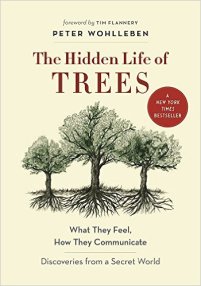 “The Hidden Life of Trees: What They Feel, How They Communicate—Discoveries From a Secret World” (Greystone Books) by Peter Wohlleben. In The Hidden Life of Trees, Peter Wohlleben shares his deep love of woods and forests and explains the amazing processes of life, death, and regeneration he has observed in the woodland and the amazing scientific processes behind the wonders of which we are blissfully unaware. Much like human families, tree parents live together with their children, communicate with them, and support them as they grow, sharing nutrients with those who are sick or struggling and creating an ecosystem that mitigates the impact of extremes of heat and cold for the whole group. As a result of such interactions, trees in a family or community are protected and can live to be very old. In contrast, solitary trees, like street kids, have a tough time of it and in most cases die much earlier than those in a group. Drawing on groundbreaking new discoveries, Wohlleben presents the science behind the secret and previously unknown life of trees and their communication abilities; he describes how these discoveries have informed his own practices in the forest around him. As he says, a happy forest is a healthy forest, and he believes that eco-friendly practices not only are economically sustainable but also benefit the health of our planet and the mental and physical health of all who live on Earth.
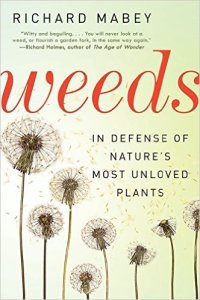 “Weeds: In Defense of Nature’s Most Unloved Plants” (Ecco) by Richard Mabey. “They’re better for you than you think,” says Atwood. “They hold the waste spaces of the world in place, and you can eat some of them.” Ever since the first human settlements 10,000 years ago, weeds have dogged our footsteps. They are there as the punishment of ‘thorns and thistles’ in Genesis and , two millennia later, as a symbol of Flanders Field. They are civilisations’ familiars, invading farmland and building-sites, war-zones and flower-beds across the globe. Yet living so intimately with us, they have been a blessing too. Weeds were the first crops, the first medicines. Burdock was the inspiration for Velcro. Cow parsley has become the fashionable adornment of Spring weddings. Weaving together the insights of botanists, gardeners, artists and poets with his own life-long fascination, Richard Mabey examines how we have tried to define them, explain their persistence, and draw moral lessons from them. One persons weed is another’s wild beauty.
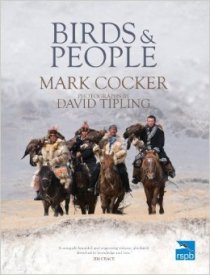 “Birds and People” (Jonathan Cape) by Mark Cocker. “Vast, historical, contemporary, many-levelled,” says Atwood. “We’ve been inseparable from birds for millenniums. They’re crucial to our imaginative life and our human heritage, and part of our economic realities.” Vast in both scope and scale, the book draws upon Mark Cocker’s forty years of observing and thinking about birds. Part natural history and part cultural study, it describes and maps the entire spectrum of our engagements with birds, drawing in themes of history, literature, art, cuisine, language, lore, politics and the environment. In the end, this is a book as much about us as it is about birds.

 Barbara Kingsolver’s 2012 novel Flight Behavior was, according to


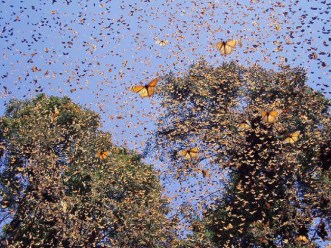 Kathleen Byrne of The Globe and Mail
 We—humanity—may not be around here for much longer. Nature will endure without us. Planet Earth will continue, in some form and Nature and life will endure, evolve, and flourish—in its own way. It will change, perhaps grow more unruly than it is already, but Gaia will continue after she has kicked us off. Ecologists have long recognized the pattern of colonization, exploitation, decadence and succession. How hubristic of humanity not to include itself in that cycle. The cycle of continuing change. We grasp—we clamor—for the world we knew—even as we senselessly impose irreparable change. Shaving forests to the ground so water has no where else to go but down and in a torrent. Creating hot deserts by diverting great rivers somewhere else. Mining vast oil and mineral reserves by scraping the earth until it “bleeds” from unhealable wounds.
 Nina Munteanu is an ecologist and internationally published author of award-nominated speculative novels, short stories and non-fiction. She is co-editor of Europa SF and currently teaches writing courses at George Brown College and the University of Toronto. Visit
  Nina Munteanu Writing Coach