In the passage below of my eco-fiction dystopian novel A Diary in the Age of Water, the year is 2065 and the diarist Lynna (a limnologist at the University of Toronto) reflects on the steeply growing infertility in humans and our tenuous future. Lynna draws on the factual study published close to fifty years earlier (in 2017) by Hagai Levine and others at the Hebrew University of Jerusalem, who found that sperm counts among western men had reduced close to 60% in four decades:
Back in ’49, Daniel and I had several discussions about the environmental triggers and epigenetic mechanisms of infertility in humans. Daniel went on about how it was all about the men. While women showed signs of increased infertility, men’s rate of infertility was more than double that of the women, he said. Taking an inappropriately gleeful tone, Daniel cited the classic 2017 paper by the Hebrew University of Jerusalem, the one that started it all. Their findings were startling: men’s sperm count in North America, Europe, Australia, and New Zealand had diminished by sixty percent in forty years, between 1973 and 2011. The scientists predicted that by 2060, virtually all men in these parts of the world would have little to no reproductive capacity.
It’s 2065 and they’re right. Only it’s worse. Before the twenties, only the developed countries seemed to be affected, but then sperm counts started to plummet in South American countries, like Argentina and Brazil, where GMO, pesticides, and solvent manufacturing were exploding.
You get out what you put into the ground. India and Asia—where endocrine-disruptive chemicals are finding their way into the water—are reporting very low sperm counts in their men as well as higher incidents of intersex humans.
You get out what you put into the water. We are over two thirds water, after all. I find it a little ironic that we’ve inadvertently produced a non-discriminatory way to control the problem of humanity’s overpopulation. Infertility. And that infertility results from defiling the environment we live in.
But now climate change is shouldering its way in. Climate change is shutting us down.
Is this the first sign of our impending extinction?
–excerpt from “A Diary in the Age of Water”
.
.
That environmental perturbations impact our ability to reproduce has been proven. In their 2017 article, Levine et al. write that:
“Sperm count and other semen parameters have been plausibly associated with multiple environmental influences, including endocrine disrupting chemicals (Bloom et al., 2015; Gore et al., 2015), pesticides (Chiu et al., 2016), heat (Zhang et al., 2015) and lifestyle factors, including diet (Afeiche et al., 2013; Jensen et al., 2013), stress (Gollenberg et al., 2010; Nordkap et al., 2016), smoking (Sharma et al., 2016) and BMI (Sermondade et al., 2013; Eisenberg et al., 2014a). Therefore, sperm count may sensitively reflect the impacts of the modern environment on male health throughout the life course (Nordkap et al., 2012).”
.
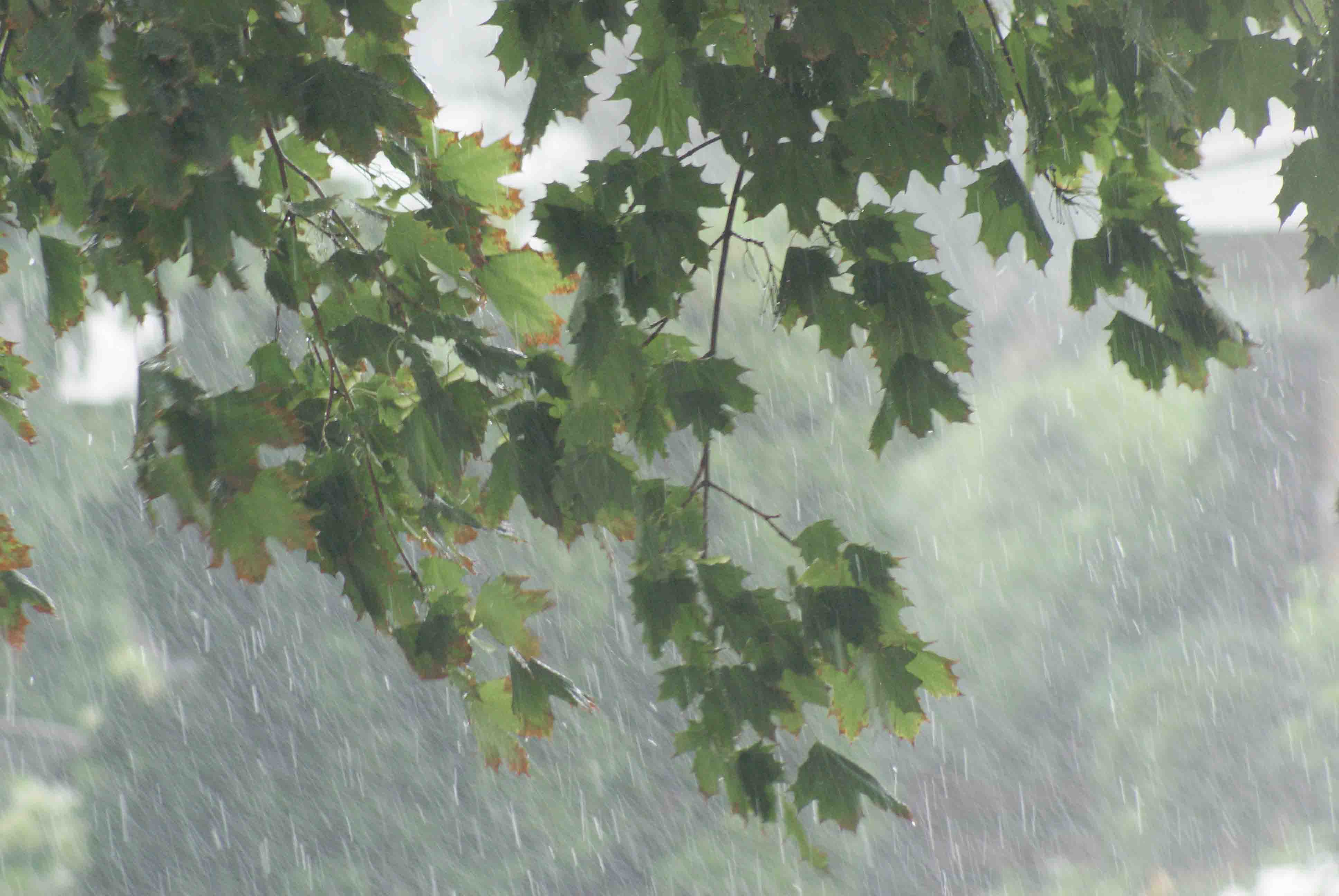
This rain falling on an Ontario marsh most certainly contains forever chemicals (photo by Nina Munteanu)
Thanks to chemical companies such as DuPont and others, forever chemicalsare currently in rain water globally, and in many places in unhealthy concentrations. These endocrine-disrupting and cancer-causing chemicals often end up in drinking water and include PCBs, phthalates, PFAS, BPAs (used in pesticides, children’s products, industrial solvents and lubricants, food storage, electronics, personal care products and cookware).
Heavy rain in Mississauga, ON (photo by Nina Munteanu)
.
Nina Munteanu is a Canadian ecologist / limnologist and novelist. She is co-editor of Europa SF and currently teaches writing courses at George Brown College and the University of Toronto. Visit www.ninamunteanu.ca for the latest on her books. Nina’s bilingual “La natura dell’acqua / The Way of Water” was published by Mincione Edizioni in Rome. Her non-fiction book “Water Is…” by Pixl Press (Vancouver) was selected by Margaret Atwood in the New York Times ‘Year in Reading’ and was chosen as the 2017 Summer Read by Water Canada. Her novel “A Diary in the Age of Water” was released by Inanna Publications (Toronto) in June 2020.
The knight in Vivianne’s dream (illustration by Tomislav Tikulin)
If you want to find the secrets of the universe, think in terms of energy, frequency and vibration
Nikola Tesla
In my historical fantasy The Last Summoner, Vivianne Schön, the Baroness Von Grunwald, travels through time from the 1400s to 1905 to meet Nikola Tesla and make a deal with the eccentric scientist in a bid to make the world a better place:
The Story (excerpt of The Last Summoner)
New York, 1905
VIVIANNE straightened when she glimpsed the elegantly dressed Serbian as he entered Bryant Park. From her bench in the shade of a sycamore tree, she watched him saunter to his favourite bench then sit down and cross his legs. He emitted a somber sigh, pulled out a small notebook from his jacket pocket and began to write. Vivianne studied his long face, straight nose and well groomed mustache. It was an intense face, though worn with reserve. He quelled the fire that burned inside him beneath a shell of enigmatic reflection. He brushed a hand over his thick hair, then set his mouth in a thin line of determined concentration as he hastily sketched something inside the notebook. He didn’t look terribly heartbroken for a man who had just lost his dream, she reflected. But she did recognize disappointment on his furrowed brow. He was used to that, she decided, reviewing his personal history, which had been plagued by rivalry and betrayal for nearly all his life. A visionary of his genius quality was easy fodder for bullying, whether it was schoolmates or the scientific community.
After adjusting her brimmed hat and flowing blue lace gown, Vivianne rose and approached the forty-eight year old Serbian visionary, musing how he would later be called the “Father of the 20th Century”.
She was barely a metre away from him before he looked up, ready to express annoyance at being interrupted. She took pleasure in seeing his expression change from a glower to a startled look of curiosity. She knew she was beautiful, but it was rather delightful to see that she could divert this intense scientist.
“Hello, Mister Tesla,” Vivianne greeted him with a curtsy. “I am the Comptesse d’Anjou at your service. May I join you and sit down?”
He frowned at first then nodded politely with not quite a smile. He was not known for his smiles, she recalled. Tesla rose to his feet and bowed to her but did not offer his hand. She did not press him, knowing of his particular compulsion for avoiding human contact. “Of course you may,” he said with a mild accent and nodded to her in invitation. They both sat down in unison and he added, “To what do I owe this pleasure, Comptesse? Do I know you?”
“No, Mister Tesla.” She smiled with irony. “We have never met—not in person, anyway. But I believe you may be interested in what I have to say.” She paused to take in his curiosity and continued, “Pardon me for what I am about to reveal of your affairs, but I represent the interests of La Banque Internationale du Monde in Geneva, Switzerland—perhaps you know of us—and the law offices of Frankl & Frankl. We are one of the five largest investment banks in the world, dating back to the late 1400s with offices in Amsterdam and Hamburg. We are a private bank who screen for altruistic and environmentally conscious investors. In short, we help finance only those projects that will help make the world a better world.” She paused.
Tesla studied her inquisitively but said nothing.
She smiled internally at his puzzled expression then continued, “We are very interested in your Wardenclyffe Tower in Shoreham, Long Island, and associated global wireless power transmission.”
Tesla slid his notebook back into his jacket pocket and now gave her his full attention. She knew that he’d been trying for years to gain backing for his enigmatic projects with little to no success.
She continued, “You theorized that electrical energy can be transmitted through the earth and the atmosphere…without power lines.”
“Yes, I can light lamps at moderate distances and can detect the transmitted energy at much greater distances. The Wardenclyffe Tower uses a rapidly alternating electrostatic field and was a proof-of-concept for global wireless power trans-mission.”
“Yes, I know.”
He frowned. “But my funding—“
“Yes, I know. Your backers don’t like the idea of unmetered power consumption.”
His face hardened with dark thoughts. “Free electricity isn’t profitable.”
“Least of all to greedy bankers with no vision or faith like J.P. Morgan or John Jacob Astor,” she added. “I know you’ve been in financial trouble with high construction costs since Morgan pulled out last year and encouraged other investors to do the same.”
Her last remark made him stiffen. She was hitting a painful nerve.
“I know about your expired patents and the resulting lack of royalty payments,” she continued. “Within another five to ten years your projects will all be defunk and you will be totally broke. And no one will listen to the ideas that come to you fully formed through visions and dreams.”
He straightened and looked her directly in the eyes. “What do you want of me, Comptesse? Who are you?”
“An ally,” she answered. “I am well aware of your humanitarian pursuits and altruistic nature. I know that you wish simply to make the world a better world. That is my wish also. Energy is and will continue to be one of the most important forces on this earth. Like water, it should be free and available to each and everyone of us. I think you can provide us with that gift and would be happy to as well. Mister Tesla, I want to offer you financial backing at zero percent interest.”
He let loose a humourless laugh. He had finally learned to be cynical about bankers, she thought.
“Make no mistake, Mister Tesla; I expect to become one of the wealthiest people on this planet because of you. But I will gain that wealth only as you gain yours, through a partnership, and not at the expense of others; rather, for the benefit of others. Your wireless technology will help in areas you have yet to imagine: instant global communications and the personal computer; clean energy for homes and industry; laser medicine; robotics; interstellar travel; instant matter transference; even time travel and so much more.”
He was staring at her now. “Who are you, really?”
An angel, she thought to herself. “I’m part of the future, Mister Tesla. A future of your making.” Then without thinking, she held out her hand. “You can call me Vivianne.”
To her delighted surprise, he smiled for the first time. He took her hand then lightly kissed it, as was the custom of most eastern Europeans. “And you can call me Nikola.”
The Man
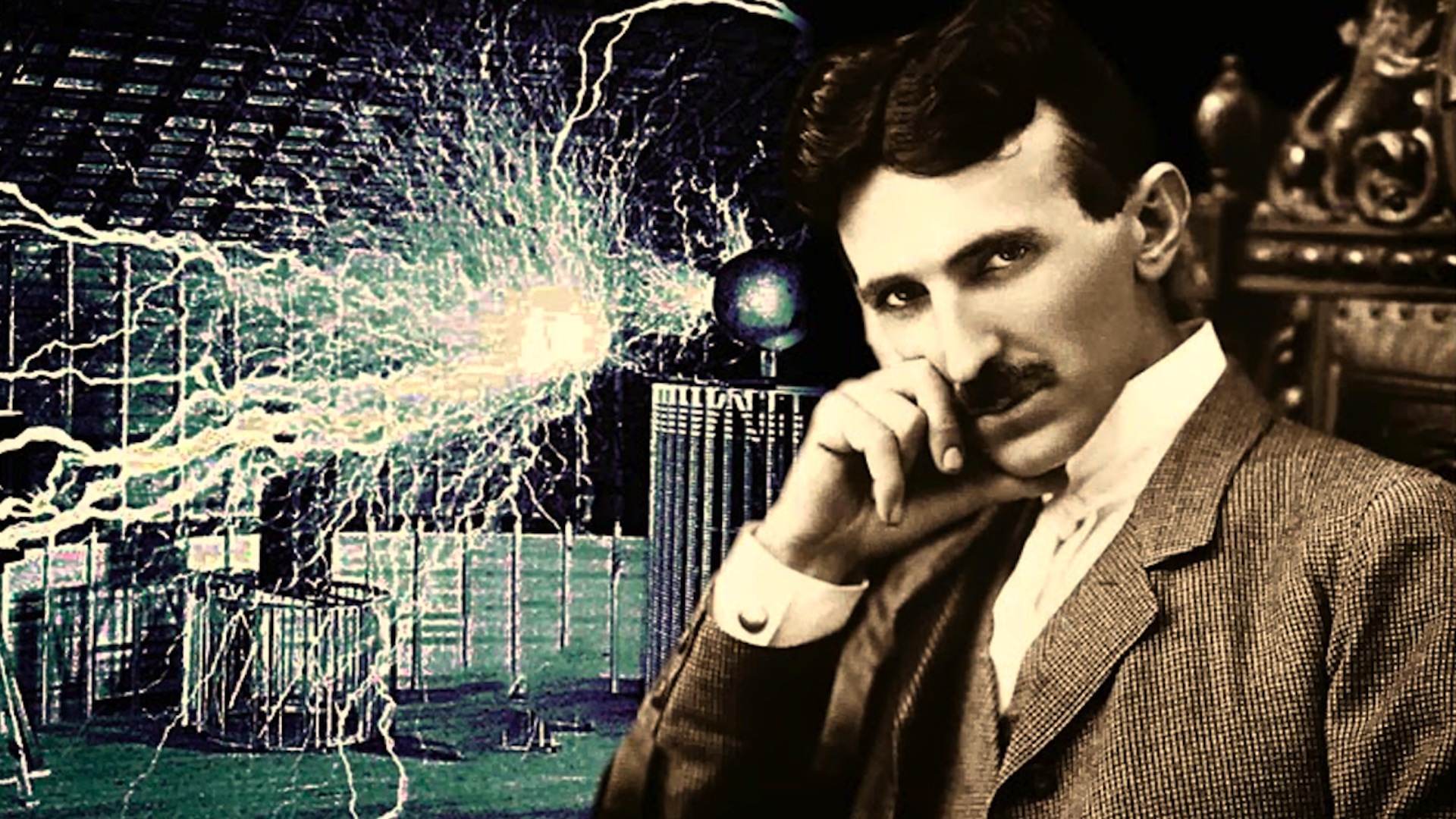
Nikola Tesla and his experiments with electricity
Nikola Tesla intuited that energy waves in the earth and the atmosphere could be used to transmit power to any point on the globe. He understood that the surface of the Earth, the ionosphere and the atmosphere together form one gigantic electrical circuit—an electrified Gaia, so to speak—and this formed the basis for his work on wireless energy transmission. Tesla was able to transmit power and energy wirelessly over long distances (via transverse waves and longitudinal waves). He transmitted extremely low frequencies (ELF) through the ground and between the Earth’s surface and the Kennelly-Heaviside layer of the ionosphere. Tesla patented wireless transceivers that developed standing waves and it was he who discovered that the resonant frequency of the Earth was about 8 Hz and in the range of the Schumann Resonance or Cavity.
Tesla in his Colorado Springs lab
Modern technology appears to be threatening humanity’s connection with earth’s fundamental frequency and the natural vibrations of Schumann Resonance. Threats include artificial man-made EMF radiation, wireless technology, and high frequency heating microwaves pulsed at 2.45 GHz. Whether we co-evolved with Earth’s natural electromagnetic environment or were created with Divine Intelligence to live in harmony with it, many experts believe that artificial man-made EMF radiation masks the natural beneficial frequency of the Earth and may create an environment that is literally `out of tune’ with Nature itself.
The Book
The Last Summonerby Nina Munteanu is a fresh twist on chaos theory and observer-induced collapse of quantum entanglement. It’s June 14th, 1410, on the eve of the Battle of Grunwald when history records that a ragtag peasant army will slaughter the arrogant monk knights of the imperialistic Teutonic Order … or will they? Because of an impetuous choice, 14-year old Vivianne Schoen, Baroness von Grunwald, makes the startling discovery that she can alter history—but not before she’s branded a witch and must flee through a time-space tear. Now in an alternate present-day France ruled by fascist Black Knights of the ancient Teutonic Order, she must decide how to remake history.
Detail of ‘The Battle of Grunwald’ (painting by Jan Matejko)
“For those in love with science fiction at its best, The Last Summoner is a complex story of ignored responsibilities and their dire consequences, of love and betrayal that span centuries and multiple worlds. Time travel, multiverse travel, immortality, alternate history in which the Nazis have won, not in the twentieth century but way earlier, in the Teutonic age. Angels and mutants, utopias and dystopias, even a Tesla occurrence— everything a science fiction reader could ever desire in a book. A masterfully told story with great characters. Nina Munteanu moves flawlessly from a medieval story to a modern one and everything in between.”
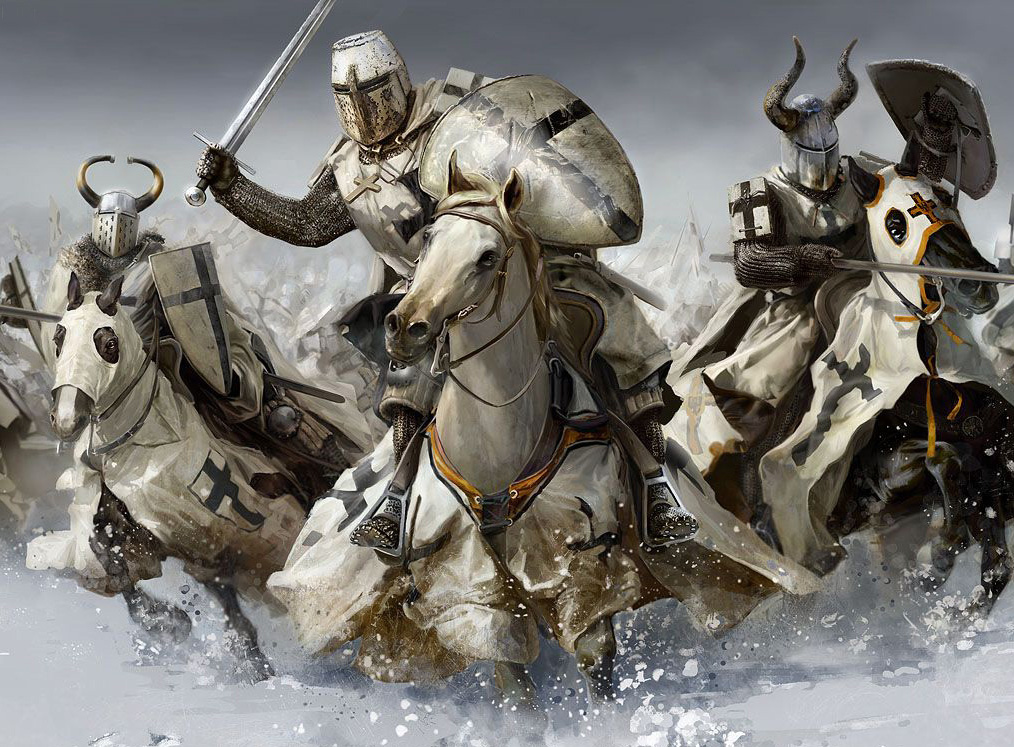
Depiction of fierce Teutonic Knights crusading in the Baltic north during the 13th Century (illustration by Mariusz Kozik)
Nina Munteanu is a Canadian ecologist / limnologist and novelist. She is co-editor of Europa SF and currently teaches writing courses at George Brown College and the University of Toronto. Visit www.ninamunteanu.ca for the latest on her books. Nina’s bilingual “La natura dell’acqua / The Way of Water” was published by Mincione Edizioni in Rome. Her non-fiction book “Water Is…” by Pixl Press (Vancouver) was selected by Margaret Atwood in the New York Times ‘Year in Reading’ and was chosen as the 2017 Summer Read by Water Canada. Her novel “A Diary in the Age of Water” was released by Inanna Publications (Toronto) in June 2020.
EXCERPT from Inner Diverse, Book 2 of The Splintered Universe Trilogy; Galactic Guardian Detective Rhea Hawke is travelling in her AI ship Benny in search of the “assassin” Serge to return him to the precinct for questioning:
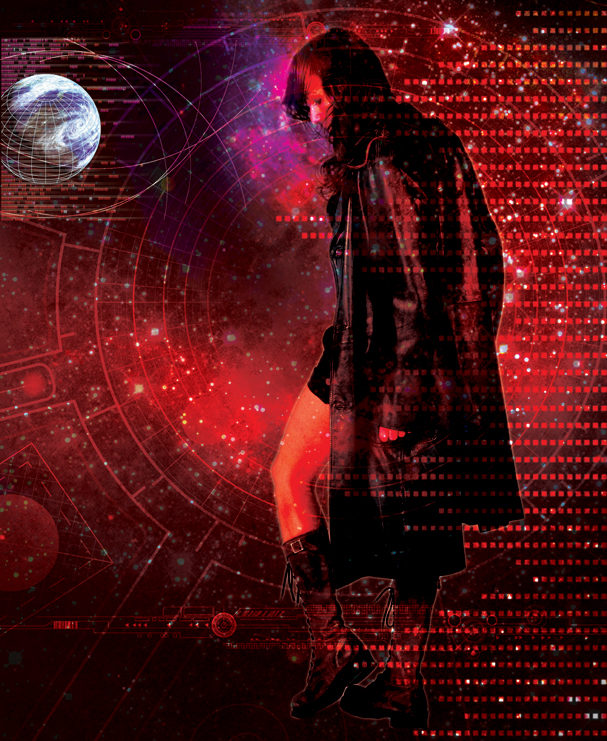
Rhea Hawke (Vali Gurgu)
…I slouched in my pilot’s chair, cosy in Serge’s old crewneck sweater, the one he’d worn—and taken off—when I’d last seen him. I hugged myself and tucked my nose into my elbow, breathing in the delicious fragrance of old wool and Serge’s faint but intoxicating scent—
Benny signalled me: “Scimitar class ship ahead, Rhea. I believe it’s Serge.”
I jerked up, feeling an irrational thrill surge through me. I let a predator’s smile slide across my face as I sat back and pulled out a wad of soyka gum, threw it casually in my mouth, and chewed lazily with an open mouth. “Well, let’s catch ourselves a little prey, Benny.” I blew out a bubble, popped it, then carved out a ferocious smile. “I’m hungry.”
I seized the controls and banked hard toward the stolen ship. “Lock on the scimitar, Benny. On my mark…Now!” I watched the ship shudder in the violent concussion wave.
“The scimitar is disabled, Rhea. We are being hailed.”
The holo-com lit up with Serge’s distraught face and I felt my own heat. He looked stunning in a grey crewneck sweater and black trousers. The sweater was identical to the one he’d worn when I’d last seen him—the one I was now wearing. As soon as he saw me, Serge’s face relaxed and he gave me a rakish smile. I noticed his fleeting glance down at what I was wearing and felt an awkward moment of recognition pass between us as our eyes locked. My face blazed with embarrassment.
“I should have guessed it was you, Rhea,” he said casually. “That your way of saying hello?”
“It is with you,” I bit back, casually chewing and throwing the gum around with my tongue, despite the warmth surging up my face. “We’ve disabled your ship and intend to dock and take you aboard. Don’t give me any trouble, Serge, and I won’t have to kill you.”….
*****
…I kneeled down and gruffly pulled at the restraints to check their strength then rose and paused. I locked eyes with his, lips smirking, and played the gum in my mouth with my tongue. “Feels familiar, doesn’t it? Only in reverse.”
Serge took in a long breath, eyes roaming my body, then met my gaze head-on. “Go ahead.” His fragrance of musk and strawberries flared. “I know you want to kiss me.”
I jerked back, face flushing with anger. “You’re so full of shit, Serge. So hubristic about your powers of seduction―”
“Not hubristic, Rhea. I just know,” he said calmly, inching toward me even as I recoiled. “Haven’t you ever wondered about love at first sight?”
“Hormones,” I said flatly and blew out a bubble.
“Karma,” he returned.
I abruptly popped the bubble with my tongue and sucked my gum back into my mouth.
When Galactic Guardian Rhea Hawke investigates the genocide of an entire spiritual sect, she collides not only with dark intrigue but with her own tarnished past. Her quest for justice catapults Rhea into the heart of a universal struggle across alien landscapes of cruel beauty and toward an unbearable truth she’s hidden from herself since she murdered an innocent man.
Read the Splintered Universe reviews on Goodreads.
Nina Munteanu is a Canadian ecologist / limnologist and novelist. She is co-editor of Europa SF and currently teaches writing courses at George Brown College and the University of Toronto. Visit www.ninamunteanu.ca for the latest on her books. Nina’s bilingual “La natura dell’acqua / The Way of Water” was published by Mincione Edizioni in Rome. Her non-fiction book “Water Is…” by Pixl Press (Vancouver) was selected by Margaret Atwood in the New York Times ‘Year in Reading’ and was chosen as the 2017 Summer Read by Water Canada. Her novel “A Diary in the Age of Water” will be released by Inanna Publications (Toronto) in 2020.
EXCERPT from Chapter One of Outer Diverse; Galactic Guardian Detective Rhea Hawke sprawls, broken, in the acid-rain mud of an AI-run city—her chase gone terribly awry. Rhea had just jacked the particle-wave stream to the ancient dusty solar system of Fomalhaut, a bright isolated star below the galactic plane about twenty-five light-years from Earth. She’d chased the Dust smuggler V’mer to the sentient city on Mar Delena, home of the largest Dust-addict population in the galaxy:
Rhea Hawke (Vali Gurgu)
My heart pounded up my throat. I gazed past the long barrel of the Q-gun drilled into my face to V’mer’s menacing grin. The shapeshifter bent over me like a vulture as I lay on my back in the mud. My chest heaved with pain and acid rain stung my eyes, forcing me to blink.
“Now whose fear do you smell, bitch?” V’mer snarled. He shoved the gun further up my nose. The sour smell of congealing blood cloyed in my nostrils. I gulped in sobbing breaths, tasting blood. V’mer sneered down at me out of yet another alien face he’d taken on. He’d assumed the giant form of a hairless purple-skinned Eosian. He’d literally torn out of his clothes. Rain sluiced down the smooth muscular flesh of his naked body, and his bald head shone in the amber street light. “I heard about you,” he went on. “Rhea Hawke, the only human Galactic Enforcer. She loved baldies so much she tecked herself into one—”
I squirmed up in sudden rage, but he slammed his boot hard on my torn shoulder and laughed sharply. I seized in an agonized breath and let my head fall back. White spots strobed in front of my eyes.
“You’re one to talk,” I hissed out between wheezing breaths and fought against passing out.
“You mean the form I’ve taken on? I did it so you could feast on my magnificent body and use your baldie tecks to smell all of me.” He barked out a stuttering laugh. “Wanna kiss me, Officer Hawke?” He went into a mock sing-song: “Rhea, scare-ya, wouldn’t you cry? She kissed the baldies and made them die …”
Alarm seized my heart. How did V’mer know about that malicious tease at the precinct?
V’mer let his laugh die down to a frown of concentration and stroked his face, mock-philosopher style. “Or is it more that you hate your own kind so much …?”
My eyelids involuntarily fluttered shut, and I felt myself slide into darkness. How did it come to this? It was only minutes ago that I was the one in control …
When Galactic Guardian Rhea Hawke investigates the genocide of an entire spiritual sect, she collides not only with dark intrigue but with her own tarnished past. Her quest for justice catapults Rhea into the heart of a universal struggle across alien landscapes of cruel beauty and toward an unbearable truth she’s hidden from herself since she murdered an innocent man.
Nina Munteanu is a Canadian ecologist / limnologist and novelist. She is co-editor of Europa SF and currently teaches writing courses at George Brown College and the University of Toronto. Visit www.ninamunteanu.ca for the latest on her books. Nina’s bilingual “La natura dell’acqua / The Way of Water” was published by Mincione Edizioni in Rome. Her non-fiction book “Water Is…” by Pixl Press (Vancouver) was selected by Margaret Atwood in the New York Times ‘Year in Reading’ and was chosen as the 2017 Summer Read by Water Canada. Her novel “A Diary in the Age of Water” will be released by Inanna Publications (Toronto) in 2020.











 Nina Munteanu Writing Coach