Book Review: A Discussion on Costi Gurgu’s Political Thriller Servitude

In Costi Gurgu’s near-future political thriller Servitude (Kult Books, 2022), what is real and what is fiction blurs with terrible prescience and possibility. Gurgu has created a scenario based on a premise that stirs dangerously in the reality of today’s capitalist western world: what if corporations were allowed to take back with impunity what their debtors owed them—in whatever way they pleased?

In Gurgu’s near-future America, the fourth Republican president in a row will be elected with virtually 100% Republican representation in Congress and the Senate—ensuring a monopoly government and creating a potential dictatorship (something a certain Republican president was trying to achieve not too long ago—and came dangerously close).

The story begins in the UK, which has recently made corporate slavery law. Under the Freedom Act, corporations under the British Servitude Exchange (BSX) can lawfully capture and detain persons with significant debt to sell them and their services in exchange for what is owed.

Wishing to do the same, the American corpocracy pushes the Freedom Act bill through Congress, potentially making corporate slavery a lawful pursuit using the concept of servitude. The concept of unconditional restitution in a country of people living largely on credit becomes popular among wealthy corporations; (consider that over two thirds of Americans are currently in debt with an average of $96,000 owed by each American, which includes mortgage, student loans, auto and credit card, personal loans and home equity1).

Neoliberal idealogues and proponents of the Freedom Act suggest that citizens should learn to be responsible for their lifestyles and should not expect the government to bail them out of bankruptcy every time they overspend (ignoring the fact that the U.S. government’s current national debt is some 30 trillion dollars—to corporate investors, China, Japan, and intra-government agencies.2 However, given that corporate investors currently hold over a third of the national debt2, dominant corporate influence on government to create a slavery act as demonstrated in Servitude is not outlandish).

A fifth of the way into the book, a Texas governor proclaims: “Servitude is merely a form of adult education. If you have graduated from the American education system and proceeded to live your life as though there is no tomorrow and spent more money than you have earned, well beyond your fair share, then you must be re-educated with America’s modernized value system. Servitude is an educational tool for the people.”

Gurgu hints at key events that brought us to this point: from the shenanigans of Donald Trump to starving children in New York City and Chinese troops taking down the American flag at the Hawaii State Legislature. The European Union has been dismantled and the Eastern Block reborn. Climate change related resource wars were waged by the Second Ottoman Empire and others, leading to the collapse of the global market. All have led to the reintroduction of slavery and homo sacer, the disposable human. Foucault would attest that the biopolitical hegemony of Capitalism already enslaves human beings as disposable ‘human capital.’  

In my upcoming eco-thriller Thalweg, character Daniel considers his 2050s world in which humanity is largely commodified, a world similar to Gurgu’s Servitude world:

It’s the end of the world…The beginning of the end of the world really came with the steam engine back in 1784 and the enslavement of water, when James Watt’s ‘universal machine’ coerced water to help usher in the industrial age of carbon extraction and the disposable human, homo sacer. By 1920, 97% of electricity in Canada came from hydropower. We were sure eager beavers. Enslaved water germinated a culture obsessed with defining itself through a ‘precession of simulacra’—the truth which conceals that there is none. Social media. Facebook. Twitter. Echo-chambers of denatured reality, signs reflecting other signs, saturated with ‘likes’ and emojis, where meaning becomes infinitely mutable to the point of being meaningless.

What’s left is a ‘desert of the real,’ a Kafkaesque menagerie of interminable, unresponsive fragments of experience in a fiction that no longer knows it’s fiction. One in which Huxley’s Soma rules in a kind of warped Foucauldian governmentality, where corporations like CanadaCorp use facial recognition and Pegasis spyware to manage plebian behaviour through quiet authoritarianism. Like bioelectricity subverting the neural pathway, it infects our fragile brains with subliminal notions of freedom when we’ve already surrendered our sovereignty to the omnioptic gaze of capitalism …

Why is it easier to imagine the end of the world than the end of capitalism? Half a century ago, Mark Fisher took up that concept first introduced by Fredric Jameson and Slavoj Žižek in his book Capitalist Realism3… Several things Fisher pointed out resonate, such as, “Capitalism is what is left when beliefs have collapsed at the level of ritual or symbolic elaboration, and all that is left is the consumer-spectator, trudging through the ruins and the relics.”3 This sad construct leaves us with a kind of ‘post-literate’ world in which the ruling ideology is cynicism or what Fisher calls ‘reflexive impotence.’4

Daniel Schindler in “Thalweg” by Nina Munteanu

How realizable is Gurgu’s Servitude?…

Since 1989, neoliberal ideologues have fed us the narrative that capitalism is the only realistic political-economic system. We cheerfully engage in this confabulation to feed our rapacious desires; and like an insatiable amoeba, capitalist realism consumes and digests our dreams and desires then feeds it back to us at a price. At what cost? Fisher astutely tells us that in our current world, “ultra-authoritarianism and Capital are by no means incompatible: internment camps and franchise coffee bars co-exist.”3 Gilles Deleuze tells us that “Control societies are based on debt rather than enclosure.”5

In Gurgu’s story, Detective Blake Frye—himself burdened with heavy debt—becomes ensnared in an inter-agency investigation into the for-now-still illegal slave trade in America that has already created secret slave camps and is actively kidnapping ‘nobodies’ off the streets. Connected somehow to UK’s BSX and several billionaire tycoons, the slave trade has become highly lucrative. Earlier, Frye’s wife, Isa—who is an investigative journalist and TV producer—embarks on an exposé of the illegal slave trade. Just before her show “Debt Hunters” is about to air, the material is confiscated by the NSA who consider it a breach of national security; her entire crew is detained and the NSA investigate her on suspicion of treason. Later, when slavers kidnap Isa and put her on the market, Frye must navigate through corrupt government officials and rogue agency operatives to find her before she’s sold and disappears forever.

Near the end of the book, Gurgu’s not-so-hidden message resonates loudly through Detective Frye’s lamentations:

“Hard-hitting investigative journalism appealed to an increasingly smaller pool of customers. People were always working, always checking their phones and other electronic devices, and they wanted their news to be just as easy to digest. Well documented and researched reportages took too many minutes to watch, and didn’t often line up with their social or political viewpoints. Truth had become debatable. Everyone had their own, personalized version of the facts, easy to access on targeted media outlets. They no longer questioned the facts they consumed. Doubt took too much effort. Everyone was entitled to their own opinions, and considered them the definition of a political truth. That philosophy had been in effect since 2017, the year that practically everything that mattered in the world deteriorated.”

Detective Frye’s analysis is relevant to today’s sybaritic North American society. Gurgu’s fiction is not about the future; it is about today. And his message is clear: we have become lazy and apathetic, seduced by a craving for comfort and pleasure at the expense of integrity and freedom. Freedom is not given; it is earned. Only through active responsible vigilance will we keep it.

Path meanders through a black walnut forest in an early winter fog, ON (photo and rendition by Nina Munteanu)

References:

  1. First Republic. 2022 “Average American Dept.” September 13, 2022. FirstRepublic.com
  2. Porter, TJ. 2022. “Who Owns the US National Debt?” September 3, 2022. Finmasters
  3. Fisher, Mark. 2009. “Capitalist Realism: Is There No Alternative?” Zero Books. 92pp.
  4. Munteanu, Nina. “Thalweg.” Upcoming novel.
  5. Deleuze, Gilles. 1990. “Postscript on Societies of Control.” L’Autre journal, no. 1 (May)

Writing a Review on Amazon or Goodreads…It’s Not So Hard To Do

NewYork-BryantPark-grill

Bryant Park, New York City (photo by Jane Raptor)

WHY Do a Review

There are several reasons to provide an online review.

As a reader, you can offer a recommendation to your fellow readers on a writer whose work you like. You are doing that writer a BIG favor by providing the review; just by adding an additional voice to that book’s virtual shelf. Any voice is better than no voice at all. This is why I generally don’t do negative reviews: just by adding a review (good or bad) you are adding to the voices associated with that book. I prefer to concentrate on adding a positive voice to the conversation. I’d rather spend my time helping and supporting writers and works that I like than bashing works I don’t care for. So, if you like a writer / book, letting other readers know right where the book is selling is a very effective way to help.

water-is-amazoncan-usa

Figure 1. Amazon Canada reviews of “Water Is…” (with added Amazon USA reviews)

Online reviews on Kobo, Barnes & Noble, and Amazon (primarily Amazon.com, but also Amazon.ca for Canada, and others throughout the world) are very useful and much appreciated by writers who you are reading and who want to keep writing for you. Goodreads (a primary book review and recommendation site) is another excellent site to place a review. It’s a free website for book lovers, who can feature their bookshelves, write reviews and rank books.

last-summoner-goodreads

Figure 2. Goodreads reviews and ranks for “The Last Summoner”

Reviews are one of the best ways to give back to the writers you wish to support. And, believe me, writers need that support! With Christmas coming around the corner, now is a prime time to get that review out that you’ve been thinking of doing to help your favorite writer or book. As a writer, if you aren’t writing reviews or making some recommendations on books and authors you like, you may wish to read my article on reciprocal altruism and the case of the vampire bat.

natural-selection-amazon

Figure 3. Amazon USA Kindle reviews for “Natural Selection”

HOW to Do a Review

I think so many of us get into thinking that we must write a “book report” like the one we hated doing in high school. But a review—particularly a good one—is not a book report. It is not the same as a critique, which may go into depth about artistic interpretation and symbolism. A review for a bookseller, like Amazon, Kobo or Barnes & Noble, is a lot simpler and serves a different purpose.

A good review provides key information on how the book resonated—or didn’t—with you. It’s really not that hard to write. Here are some tips:

  • A book review is NOT a plot outline. You don’t need to tell the potential reader all the ins and outs of the story. In fact, to get a good sense of the book, particularly if it is a non-fiction reference book, you don’t need to finish the book before you review it. What you do need to have done is read enough to have the book “speak” to you in some way.
  • Reviews are about connection and resonation. What did you like most about the book or what bothered you the most? The best reviews have a balance of both positive and negative things. But they don’t need to. Are you glad you bought it? Why? Did you learn something? Did it change your perspective? How did it touch you? Would you buy more by the same author? Would you recommend it? And if so, why. Think of your fellow readers. In fact, that’s a good way to write the review:
  • Write in a conversational tone as if you are describing the book to a friend you are recommending it to. You don’t need to get all technical or “literary” or use fancy or clever language. Write in the language that feels familiar to you. Remember, you’re writing to other readers.
  • Just be honest. What’s the first thing that comes to you? Write from the heart: “I loved this book because…” Perhaps it’s the memorable main character. Or the rich setting and history. Or the incredible world. Or the imaginative idea and twists in the story. Or the unforeseen but appropriate end. Did the book linger with you? Tell us why.
  • A book review can be short and work very well. I’ve seen a single under 10-word sentence for some reviews of my books. But those less than 10 words mean a lot, especially if they say: “Amazing wealth of information!” Or “A wonderful read.” Or “brilliantly written!” Short is direct and clean—like a poem—and distills your impressions down to an essence that will appeal to many. It will more likely be read in a sea of longer reviews. See examples in Figures 1, 2, and 5.
  • Combine this with a good title and you have a very powerful statement. I’m talking about the space that Amazon also provides for a “title” to your review (see examples in Figure 1 and 3), which appears at the top in bold and is, therefore very prominent. Be mindful of this title as readers may skim through these and use them alone to gain a sense of the reviews. Think of it as a one-line book tag, a distillation of how you felt about the book (e.g., This book changed my perspective on water; I want to be her when I grow up), or who you are, even (e.g., Limnologist Recommends…)
  • Ranking a book is useful. Most bookseller and book review sites include a place for you to rank the book, without even needing to put in a written review. These all help a reader sense the book’s popularity. You can also help by “liking” other people’s reviews, helping to give them importance.

darwins-paradox-goodreads

Figure 4. Goodreads rankings for “Darwin’s Paradox”

WHERE to Do a Review

I’ve already mentioned the main sites that either sell books online or talk about books. The major bookstore sites include: Amazon, Kobo, Barnes & Noble, and Indigo. There are many other online booksellers, but the ones I mentioned will get to the most readers; so, your review will serve its purpose more powerfully there.

Just a note here about Amazon: I’m a Canadian and my books sell on Amazon.ca as well as on Amazon.com (in the USA). My books also sell in Japan, Australia, UK, Germany, France, Spain and Italy, just to name a few countries. Each of these countries is represented by its own Amazon online store (like Amazon.ca for Canada). If you write a review on Amazon.ca, it will only show up on Amazon.ca. If you write a review on Amazon.com, it will show up on all the other Amazon sites (see Figure 1). Generally, it’s best to write your review on the site from where you bought the book; but, this isn’t a hard and fast rule. I’ve bought a book on one Amazon site and written a review on another.

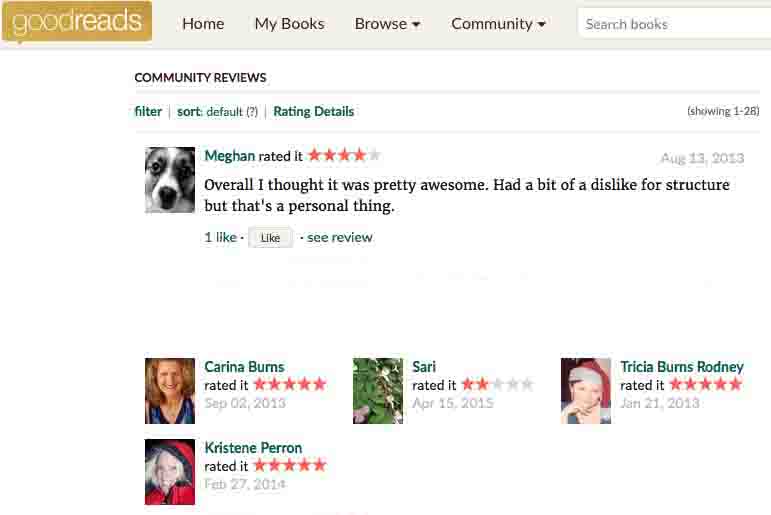
Goodreads is one of the best book review sites, given its popularity and large, diverse and active membership. Goodreads readers—and their authors—take books seriously. But even there, reviews can vary from extensive to a few sentences as shown in these reviews for my writing guide “The Fiction Writer” (Figure 5), and in Figure 2 for “The Last Summoner.”

fiction-writer-goodreads

Figure 5. Goodreads Reviews for “The Fiction Writer”

WHAT Reviews Look Like

I’ve included throughout this article examples of reviews for my various books which show you a range of style and impression—both positive and negative. Writers do want an honest review. Yes, we’d rather see all positive reviews. But the negative review has its place, the very least, to demonstrate to readers that the critique forum is objective and unbiased and embraces free expression.

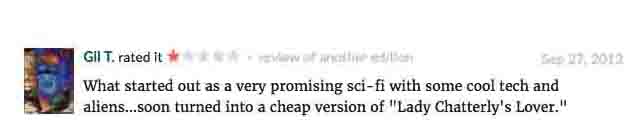
Notice that Goodreads embraces a platform that shows a combination of review and rank, which works very well (see Figure 2). Also, notice the Goodreads ranks for my first novel, “Darwin’s Paradox” in Figure 4, which represent a healthy range from 1 to five stars. Figures 6 and 7, below, demonstrate the full range of reviews a single book can get, in this case for the first book, “Outer Diverse”, of my space adventure trilogy, “Splintered Universe”.

outer-diverse-goodreads2

outer-diverse-goodreads-neg

Figure 7. Another Goodreads review of “Outer Diverse”

So, have fun writing your review; but go and write it!


nina-2014aaa

Nina Munteanu is a Canadian ecologist / limnologist and novelist. She is co-editor of Europa SF and currently teaches writing courses at George Brown College and the University of Toronto. Visit www.ninamunteanu.ca for the latest on her books. Nina’s bilingual “La natura dell’acqua / The Way of Water” was published by Mincione Edizioni in Rome. Her non-fiction book “Water Is…” by Pixl Press (Vancouver) was selected by Margaret Atwood in the New York Times ‘Year in Reading’ and was chosen as the 2017 Summer Read by Water Canada. Her novel “A Diary in the Age of Water” will be released by Inanna Publications (Toronto) in 2020.