My Short Story “The Polywater Equation” (Die Polywasser-Gleichung) in “Tales of Science II” Anthology

Author Nina Munteanu holding copy of Tales of Science II (photo by Jane Raptor)

A few weeks ago, I looked into my mail box and found my contributor’s copy of “Tales of Science II” Anthology (edited by Marianne Labisch & Kiran Ramakrishnan) with my short story Die Polywasser-Gleichung (“The Polywater Equation”) inside. Beaming, I did a little dance because the anthology was marvelous looking! And it was all in German! (My mother is German, so I could actually read it; bonus!).

This science-fiction anthology, for which I was invited to contribute, collected seventeen short stories, all based on sound science. Here’s how the book jacket blurb (translated from German) describes the anthology:

It’s all just fiction. Someone made it up; it has nothing to do with reality, right? Well, in this anthology, there’s at least a grain of truth in all the stories, because scientific sponsors collaborated with authors. Here, they looked into the future based on current research What does such an experiment look like? See for yourself what the authors and scientific sponsors have come up with: about finding a way to communicate with out descendants, finding the ideal partner, conveying human emotions to an AI, strange water phenomena [that’s my story], unexpected research findings, lonely bots, and much more. The occasion for this experiment is the 20th anniversary of the microsystems technology cluster microTEC Südwest e. V.

(cover image and illustrations by Mario Franke and Uli Benkick)

In our initial correspondence, editor Marianne Labisch mentioned that they were “looking for short stories by scientists based on their research but ‘spun on’ to create a science fiction story;” she knew I was a limnologist and was hoping I would contribute something about water. I was glad to oblige her, having some ideas whirling in my head already. That is how “The Polywater Equation” (Die Polywasser-Gleichung) was born.

I’d been thinking of writing something that drew on my earlier research on patterns of colonization by periphyton (attached algae, mostly diatoms) in streams using concepts of fluid mechanics. Elements that worked themselves into the story and the main character, herself a limnologist, reflected some aspects of my own conflicts as a scientist interpreting algal and water data (you have to read the story to figure that out).

My Work with Periphyton

As I mentioned, the short story drew on my scientific work, which you can read about in the scientific journal Hydrobiologia. I was studying the community structure of periphyton (attached algae) that settled on surfaces in freshwater streams. My study involved placing glass slides in various locations in my control and experimental streams and in various orientations (parallel or facing the current), exposing them to colonizing algae. What I didn’t expect to see was that the community colonized the slides in a non-random way. What resulted was a scientific paper entitled “the effect of current on the distribution of diatoms settling on submerged glass slides.”

A. Distribution of diatoms on a submerged glass slide parallel to the current; treated diatom frustules are white on a dark background. B. diagram of water movement around a submerged glass slide showing laminar flow on the inner face and turbulent flow on the edges (micrograph photo and illustration by Nina Munteanu)

For more details of my work with periphyton, you can go to my article called Championing Change. How all this connects to the concept of polywater is something you need to read in the story itself.

The Phenomenon of Polywater

The phenomenon started well before the 1960s, with a 19th century theory by Lord Kelvin (for a detailed account see The Rise and Fall of Polywater in Distillations Magazine). Kelvin had found that individual water droplets evaporated faster than water in a bowl. He also noticed that water in a glass tube evaporated even more slowly. This suggested to Kelvin that the curvature of the water’s surface affected how quickly it evaporated.

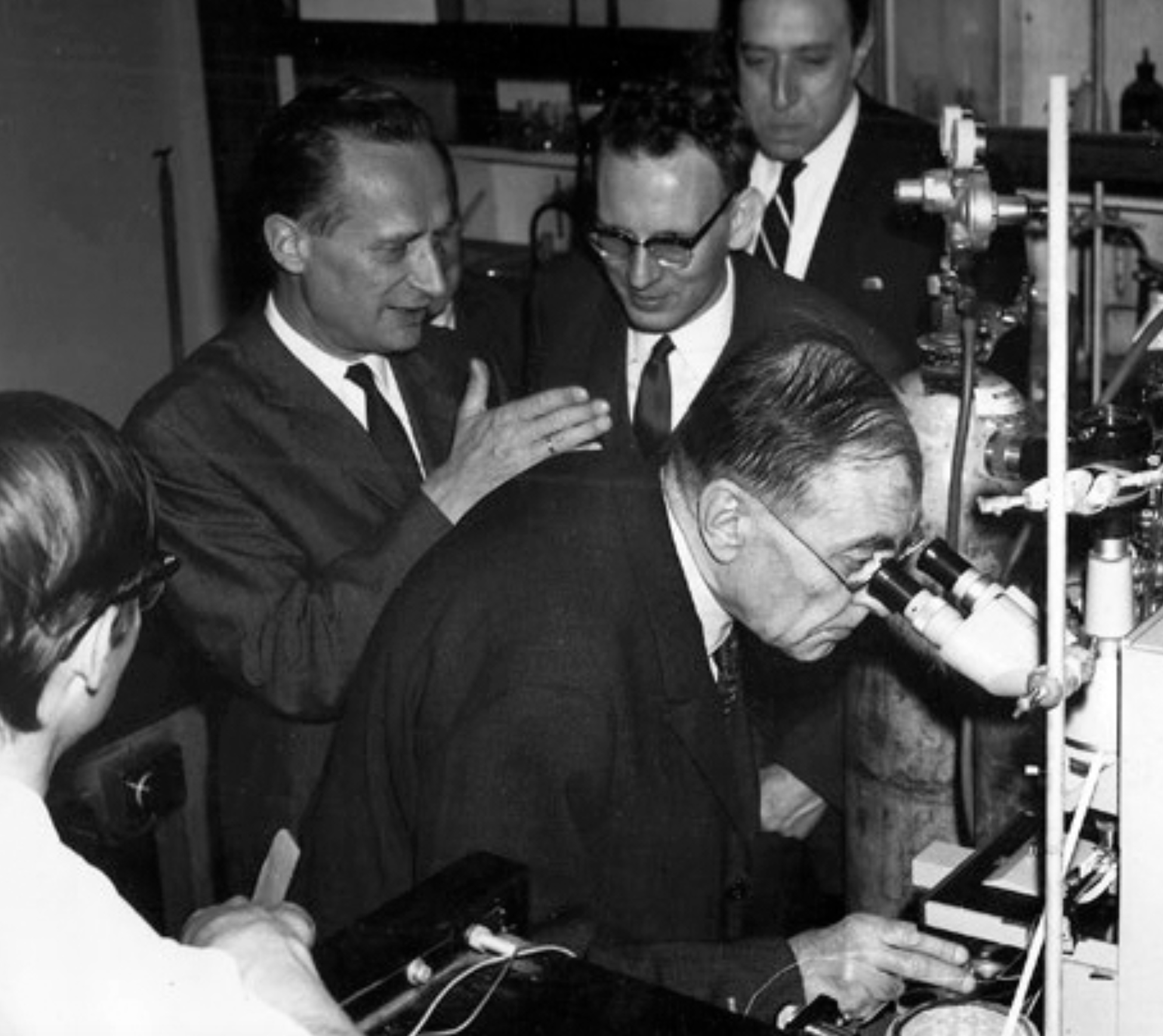
Soviet chemist Boris Deryagin peers through a microscope in his lab

In the 1960s, Nikolai Fedyakin picked up on Lord Kelvin’s work at the Kostroma Technological Institute and through careful experimentation, concluded that the liquid at the bottom of the glass tube was denser than ordinary water and published his findings. Boris Deryagin, director of the Institute of Physical Chemistry in Moscow, was intrigued and his team confirmed that the substance at the bottom of the glass tube was denser and thicker than ordinary water and had additional anomalous properties. This phase of water had a thick, gel-like consistency; it also had a higher stability, like a polymer, over bulk water. It demonstrated a lower freezing point, a higher boiling point, and much higher density and viscosity than ordinary water. It expanded more than ordinary water when heated and bent light differently. Deryagin became convinced that this “modified water” was the most thermodynamically stable form of water and that any water that came into contact with it would become modified as well. In 1966, Deryagin shared his work in a paper entitled “Effects of Lyophile Surfaces on the Properties of Boundary Liquid Films.” British scientist Brian Pethica confirmed Deryagin’s findings with his own experiments—calling the odd liquid “anomalous water”—and published in Nature. In 1969, Ellis Lippincott and colleagues published their work using spectroscopic evidence of this anomalous water, showing that it was arranged in a honeycomb-shaped network, making a polymer of water—and dubbed it “polywater.” Scientists proposed that instead of the weak Van der Waals forces that normally draw water molecules together, the molecules of ‘polywater’ were locked in place by stronger bonds, catalyzed somehow by the nature of the surface they were adjacent to.

Molecular structure of polywater

This sparked both excitement and fear in the scientific community, press and the public. Industrialists soon came up with ways to exploit this strange state of water such as an industrial lubricant or a way to desalinate seawater. Scientists further argued for the natural existence of ‘polywater’ in small quantities by suggesting that this form of water was responsible for the ability of winter wheat seeds to survive in frozen ground and how animals can lower their body temperature below zero degrees Celsius without freezing.

When one scientist discounted the phenomenon and blamed it on contamination by the experimenters’ own sweat, the significance of the results was abandoned in the Kuddelmuddel of scientific embarrassment. By 1973 ‘polywater’ was considered a joke and an example of ‘pathological science.’ This, despite earlier work by Henniker and Szent-Györgyi, which showed that water organized itself close to surfaces such as cell membranes. Forty years later Gerald Pollack at the University of Washington identified a fourth phase of water, an interfacial water zone that was more stable, more viscous and more ordered, and, according to biochemist Martin Chaplin of South Bank University, also hydrophobic, stiffer, more slippery and thermally more stable. How was this not polywater?

The Polywater Equation

In my story, which takes place in Berlin, 2045, retired limnologist Professor Engel grapples with a new catastrophic water phenomenon that looks suspiciously like the original 1960s polywater incident:

The first known case of polywater occurred on June 19, 2044 in Newark, United States. Housewife Doris Buchanan charged into the local Water Department office on Broad Street with a complaint that her faucet had clogged up with some kind of pollutant. She claimed that the faucet just coughed up a blob of gel that dangled like clear snot out of the spout and refused to drop. Where was her water? she demanded. She’d paid her bill. But when she showed them her small gel sample, there was only plain liquid water in her sample jar. They sent her home and logged the incident as a prank. But then over fifty turbines of the combined Niagara power plants in New York and Ontario ground to a halt as everything went to gel; a third of the state and province went dark. That was soon followed by a near disaster at the Pickering Nuclear Generating Station in Ajax, Ontario when the cooling water inside a reactor vessel gummed up, and the fuel rods—immersed in gel instead of cooling water—came dangerously close to overheating, with potentially catastrophic results. Luckily, the gel state didn’t last and all went back to normal again.

If you read German, you can pick up a copy of the anthology in Dussmann das KulturKaufhaus or Thalia, both located in Berlin but also available through their online outlets. You’ll have to wait to read the English version; like polywater, it’s not out yet.

References:

Chaplin, Martin. 2015. “Interfacial water and water-gas interfaces.” Online: “Water Structure and Science”: http://www1.lsbu.ac.uk/water/interfacial_water.html  

Chaplin, Martin. 2015. “Anomalous properties of water.” Online: “Water Structure and Science: http://www1.lsbu.ac.uk/water/water_anomalies.html  

Henniker, J.C. 1949. “The depth of the surface zone of a liquid”. Rev. Mod. Phys. 21(2): 322–341.

Kelderman, Keene, et. al. 2022. “The Clean Water Act at 50: Promises Half Kept at the Half-Century Mark.” Environmental Integrity Project (EIP). March 17. 75pp.

Munteanu, N. & E. J. Maly, 1981. The effect of current on the distribution of diatoms settling on submerged glass slides. Hydrobiologia 78: 273–282.

Munteanu, Nina. 2016. “Water Is…The Meaning of Water.” Pixl Press, Delta, BC. 584 pp.

Pollack, Gerald. 2013. “The Fourth Phase of Water: Beyond Solid, Liquid and Vapor.” Ebner & Sons Publishers, Seattle WA. 357 pp. 

Ramirez, Ainissa. 2020. “The Rise and Fall of Polywater.” Distillations Magazine, February 25, 2020.

Szent-Györgyi, A. 1960. “Introduction to a Supramolecular Biology.” Academic Press, New York. 135 pp. 

Roemer, Stephen C., Kyle D. Hoagland, and James R. Rosowski. 1984. “Development of a freshwater periphyton community as influenced by diatom mucilages.” Can. J. Bot. 62: 1799-1813.

Schwenk, Theodor. 1996. “Sensitive Chaos.” Rudolf Steiner Press, London. 232 pp.

Szent-Györgyi, A. 1960. “Introduction to a Supramolecular Biology.” Academic Press, New York. 135 pp. 

Wilkens, Andreas, Michael Jacobi, Wolfram Schwenk. 2005. “Understanding Water”. Floris Books, Edinburgh. 107 pp.

Nina Munteanu is a Canadian ecologist / limnologist and novelist. She is co-editor of Europa SF and currently teaches writing courses at George Brown College and the University of Toronto. Visit www.ninamunteanu.ca for the latest on her books. Nina’s bilingual “La natura dell’acqua / The Way of Water” was published by Mincione Edizioni in Rome. Her non-fiction book “Water Is…” by Pixl Press (Vancouver) was selected by Margaret Atwood in the New York Times ‘Year in Reading’ and was chosen as the 2017 Summer Read by Water Canada. Her novel “A Diary in the Age of Water” was released by Inanna Publications (Toronto) in June 2020.

Vonnegut’s Ice-Nine and Superionic Ice

CatsCradle-KurtVonnegutIn 1963 science fiction writer Kurt Vonnegut used the fictionalized concept of ice-IX—a crystalline polymorph of ice that remains stable at room temperature—in his novel Cat’s Cradle.  Ice-nine was a form of water so stable that it never melted and would crystallize all water it touched. It was the Ebola of water…

In Vonnegut’s book, physicist Felix Hoenikker created ice-nine as a tool to help troops easily traverse mud and swamps. Unfortunately, once the process started, it could not be stopped and with a melting point of 114 degrees F, the ice wasn’t likely to melt; in a pivotal scene some of the ice-nine is introduced to the ocean, which freezes solid entirely along with the rest of the planet’s freshwater. This throws the planet into calamity and threatens the natural world with violent storms and tornadoes ravaging the landscape.

With all water on Earth crystalized, locked in the Ice-Nine configuration, humanity is lost:

There were no smells. There was no movement. Every step I took made a gravelly squeak in blue-white frost. And every squeak was echoed loudly. The season of locking was over. The Earth was locked up tight.

In fact, Ice-IX does exist; it was discovered in 1968 and exits under high pressure as a tetragonal crystal lattice but without the properties of Vonnegut’s ice-nine. It forms by cooling Ice III; it has an identical structure to Ice III other than being hydrogen-ordered. According to Dr. Martin Chaplin, London South Bank University, Vonnegut’s ice-nine has no scientific basis: “The actual Ice-IX is a proton-ordered form of Ice-III, and only exists at very low temperatures and high pressures and cannot exist alongside liquid water under any conditions.”

Ice Phases - unit cells

Ice phases–unit ‘cells’

A form of Vonnegut’s Ice-IX was “created” by Harvard researchers recently through a computer simulation that shows how it might be possible for water to remain frozen at body temperature. They showed how a layer of diamond, coated with sodium atoms, kept water frozen indefinitely at up to 108 degrees Fahrenheit. The technique only works on a very thin layer of water—a few molecules thick—to successfully keep the ice structure intact. The researchers explain:

In ice, water molecules are arranged in a rigid framework that gives the substance its hardness. The process of melting is like a building falling down: pieces that had been arranged into a rigid structure move and flow against one another, becoming liquid water.

The computer model shows that whenever a water molecule near the diamond-sodium surface starts to fall out of place, the surface stabilizes it and reassembles the crystalline ice structure.

hexagonal-water-crystal

Hexagonal structure of water crystal (snowflake)

Ordinary ice—the kind we skate on—has a hexagonal structure and is called Ice-Ih. It’s the kind of crystal that forms snowflakes (which are all hexagonal). Including the hexagonal arrangement of common ice, scientists have already discovered a bewildering 18 architectures of ice crystal. At different temperatures and pressures, water forms solids that may be hexagonal (Ice Ih) rhombohedral (Ice II and Ice IV), tetragonal (Ice III and IX), cubic (Ice Ic and Ice XIc), or orthorhomboic (Ice XI) in structure. Some forms of frozen water are disordered (non-crystalline). Eighteen crystalline phases of ice polymorphs have been identified based on the structure of the molecules and atoms and their bonds.

Ice Phases

Ice phases Ih to XV at different temperatures and pressures

Liquid Crystals & Polywater

Around the time that Vonnegut’s novel came out, a similar potential phenomenon of contact-induced change to water structure was discovered: polywater.

In 1961, the Russian physicist Nikolai Fedyakin discovered a new polymerized form of water. He had been measuring the properties of water which had been condensed in, or repeatedly forced through, narrow quartz capillary tubes. Some experiments revealed water with a higher boiling point, lower freezing point, and much higher viscosity than ordinary water; it had the consistency of syrup and was 40% denser and 15 times more viscous. Boris Derjaquin, director of surface physics at the Institute for Physical Chemistry in Moscow reproduced the results and used the term anomalous water.

WaterAnthology-RealitySkimmingPress copyThe media spread a panic about polywater-contaminated oceans of “jelly” aka Vonnegut’s novel Cat’s Cradle.

You can read a compelling version of this scenario in Costi Gurgu’s “Corrosion” in the anthology Water (Reality Skimming Press, 2017) edited by Nina Munteanu.

Subsequent analysis of polywater found that the samples were contaminated with other substances, which explained the changes in melting and boiling points due to colligative properties. Electron microscopy confirmed that the polywater also contained small particles of various solids – from silica to phospholipids, which explained its greater viscosity.

When the experiments which had initially produced polywater were repeated with thoroughly cleaned glassware, the anomalous properties of the resulting water vanished, and even the scientists who had originally advanced the case for polywater agreed it did not exist. The anomalous properties were finally attributed to impurities rather than to the existence of polymeric water molecules.

Fourth Phase of Water

ice_ih_molecular_arrangement

Hexagonal structure of bulk water and ice Ih

The significance of the Russian results was abandoned in the hubbub of scientific embarrassment. “Contaminants” are natural features of water, given its impeccable universal solvent characteristics, and their presence in limited quantities does not necessarily imply that observed features are not relevant to water’s behaviour. The natural question abandoned by the community was this: In the presence of contaminants, why does water take on the interesting features described by Derjaguin’s team? Earlier work by Henniker and Szent-Györgyi had established that water organized itself close to surfaces such as cell membranes.

This was later demonstrated by Gerald Pollack and his team at the University of Washington. Forty years after the polywater debacle, Pollack and other scientists discussed a fourth phase of water, an interfacial water zone that Pollack calls Exclusion Zone water or EZ water, given that it excludes materials. Interfacial EZ water was more stable, more viscous and more ordered, and according to biochemist Martin Chaplin of South Bank University this water was, “hydrophobic, stiffer, superfluidic and thermally more stable than bulk water.” While Chaplin discounts Pollack’s suggested structure for EZ-water (as nonsense), he acknowledges the existence of EZ-water, which forms a liquid ‘phase’ that can be legitimately treated as different from ‘bulk’ liquid water.

Not the same as “polywater” but certainly related. And questions remain.

superionic ice

Superionic ice

Superionic Ice

Recently, the Laboratory for Laser Energetics in Brighton, New York, blasted a droplet of water that created a shock wave, raising the water’s pressure to millions of atmospheres and temperature to thousands of degrees. The water atoms inside the shock wave didn’t form superheated liquid or gas; they froze solid into crystalline ice—something called “superionic ice,” a new phase of water with weird properties. It’s black and hot. And weighs four times as much as normal ice.

According to Joshua Sokol of Quanta Magazine, scientists suggest that this black hot ice may be the universe’s most common form of water. Superionic ice fills Uranus and Neptune and comprises the bulk of giant icy planets throughout the universe.

gas giants2

Gas giants in our solar system

Superionic ice—called  ice XVIII—is a new cubic crystal but with a twist, writes Sokol:

Superionic Ice3

Superionic ice nearly as hot as the sun

All the previously known water ices are made of intact water molecules, each with one oxygen atom linked to two hydrogen atoms. But superionic ice, the new measurements confirm, isn’t like that. It exists in a sort of surrealist limbo, part solid, part liquid. Individual water molecules break apart. The oxygen atoms form a cubic lattice, but the hydrogen atoms spill free, flowing like a liquid through the rigid cage of oxygens.

Sokol adds, “Experts say the discovery of superionic ice vindicates computer predictions, which could help material physicists craft future substances.”

Because its water molecules break apart, said physicist Livia Bove of France’s National Center for Scientific Research and Pierre and Marie Curie University, it’s not quite a new phase of water. “It’s really a new state of matter,” she said, “which is rather spectacular.”

Sokol tells us that computer simulations led by Pierfranco Demontis in 1988 predicted “water would take on this strange, almost metal-like form if you pushed it beyond the map of known ice phases.” Atoms in the water had rearranged into the long-predicted but never-before-seen architecture, ice XVIII: a cubic lattice with oxygen atoms at every corner and the center of each face. “It’s quite a breakthrough,” Coppari said.

Superionic-Ice-Giant

Superionic ice giant

When Ice Flows

The simulations showed that under extreme pressure and heat water molecules break. With the oxygen atoms locked in a cubic lattice, “the hydrogens now start to jump from one position in the crystal to another, and jump again, and jump again,” Millot said. The jumps between lattice sites are so fast that the ionized hydrogen atoms act as positively charged protons and appear to move like a liquid.

This suggests that superionic ice might conduct electricity, like a metal, with the hydrogens acting as electrons. “Having these loose hydrogen atoms gushing around would also boost the ice’s disorder, or entropy. In turn, that increase in entropy would make this ice much more stable than other kinds of ice crystals, causing its melting point to soar upward,” writes Sokol, and continues:

Neptune

Neptune

Other planets and moons in the solar system likely don’t host the right interior sweet spots of temperature and pressure to allow for superionic ice. But many ice giant-sized exoplanets might, suggesting that the substance could be common inside icy worlds throughout the galaxy.

No real planet contains just water. The ice giants in our solar system also mix in chemical species like methane and ammonia. The extent to which superionic behavior actually occurs in nature is “going to depend on whether these phases still exist when we mix water with other materials,” Stanley said. So far, that isn’t clear, although other researchers have argued superionic ammonia should also exist.

References:

Chaplin, Martin. 2019. “Ice Phases” In: Water Structure and Science. Updated May 16, 2019. Online: http://www1.lsbu.ac.uk/water/ice_phases.html

Munteanu, Nina. 2016. “Water Is…The Meaning of Water.” Pixl Press, Vancouver. 583pp.

Sokol, Joshua. 2019. “Black, Hot Ice May Be Nature’s Most Common Form of Water.” Quanta Magazine. Online: https://www.quantamagazine.org/black-hot-superionic-ice-may-be-natures-most-common-form-of-water-20190508/

nina-2014aaa

Nina Munteanu is a Canadian ecologist / limnologist and novelist. She is co-editor of Europa SF and currently teaches writing courses at George Brown College and the University of Toronto. Visit www.ninamunteanu.ca for the latest on her books. Nina’s bilingual “La natura dell’acqua / The Way of Water” was published by Mincione Edizioni in Rome. Her non-fiction book “Water Is…” by Pixl Press (Vancouver) was selected by Margaret Atwood in the New York Times ‘Year in Reading’ and was chosen as the 2017 Summer Read by Water Canada. Her novel “A Diary in the Age of Water” will be released by Inanna Publications (Toronto) in 2020.