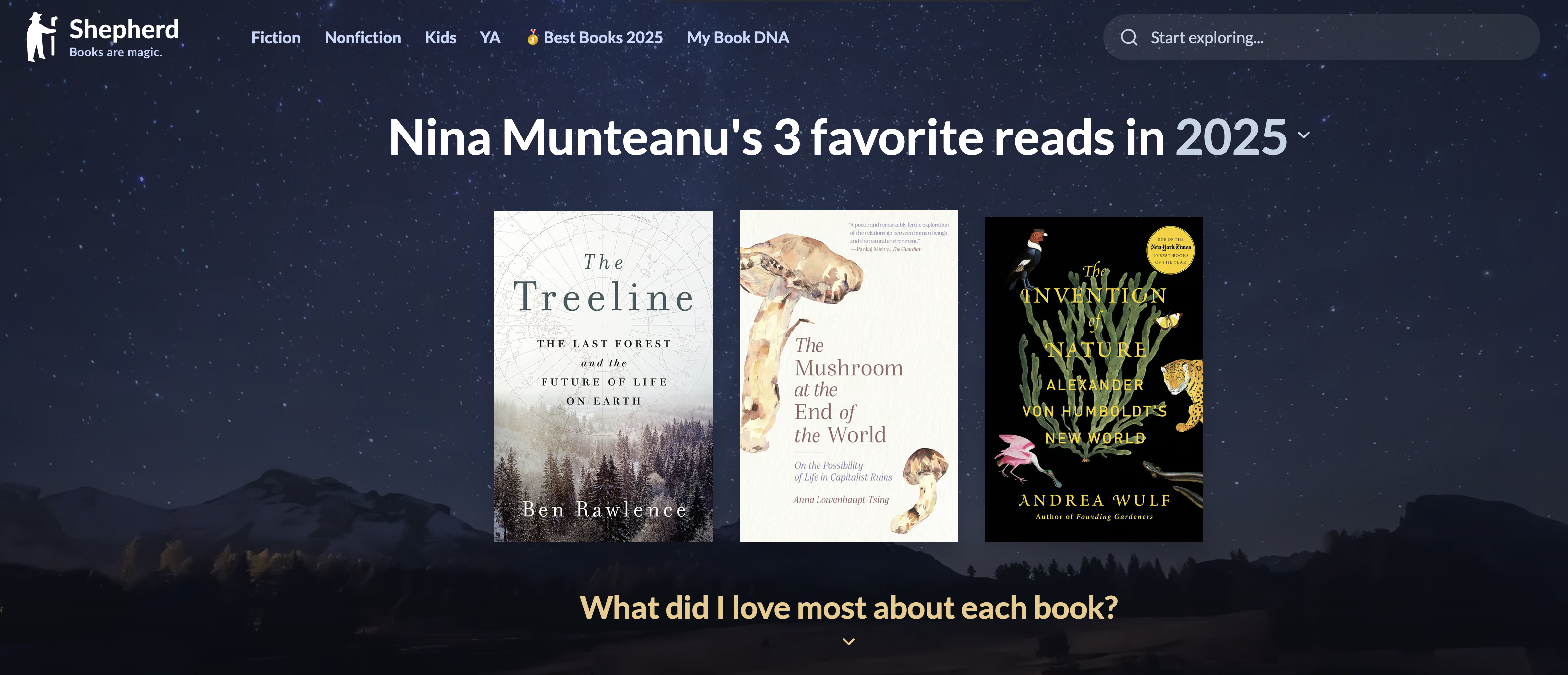
As with previous years, Shepherd invited me to post my three favourite reads of 2025. These aren’t necessarily books published in 2025; just books I read in that year. Each time I do this, I find that, without conscious intent, my favourites fall under a general theme that have touched me that year. Past favourite reads included Feminist Eco-Fiction in 2023 and Cautionary Eco-Fiction in 2024.
.
.
2025 yielded a non-fiction book theme; books that touch on humanity’s understanding—or lack of understanding—of our fragile environment and the importance of humility and collaboration to our survival on a changing planet. Here are my three favourites:
.
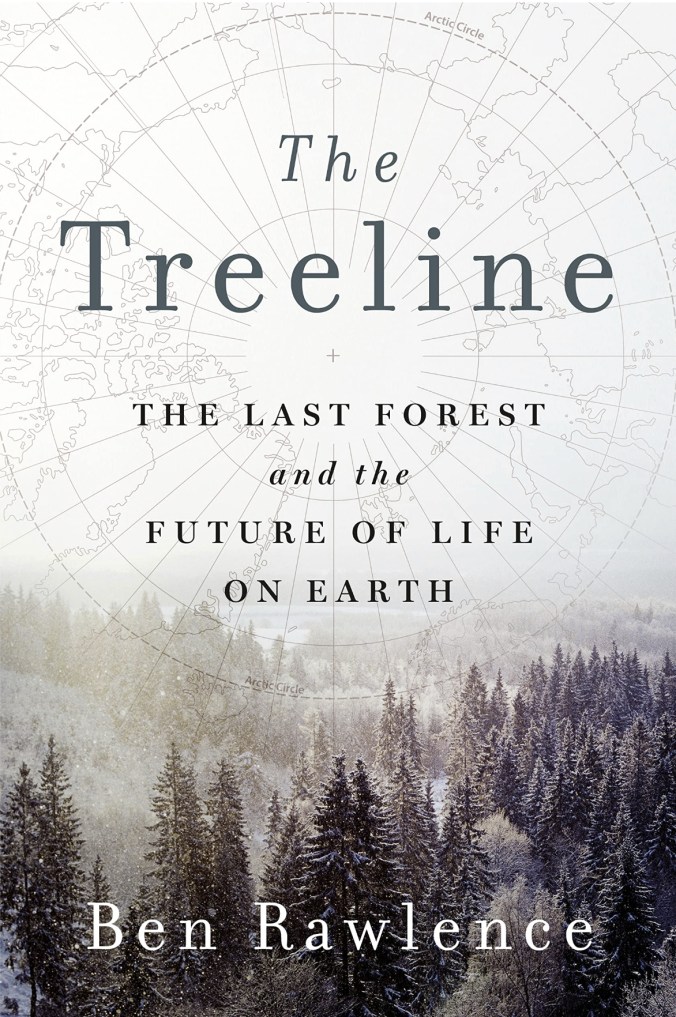
Treeline (St. Martin’s Press, 2022) by Ben Rawlence
This book made me think. It made me cry. It made me despair. It also gave me hope. I was gripped by Rawlence’s honest and unflinching exploration on the moving treeline with climate change and what it will mean for humanity. Rawlence describes the forests of the world as the ‘heartbeat of the planet,’ the cycles of breathing and the pulses of life from the spike of oxygen in the spring when trees put out their leaves to the peaks and troughs over day and night that regulate plant photosynthesis and respiration. Their breaths are getting shallower, he writes. With more carbon dioxide in the air the trees inhale less and exhale less oxygen.
Beautifully written and rigorously reported, Rawlence invited me on a journey of the major treelines over the globe from Scotland, Norway and Russia, to Alaska, Canada and Greenland. Throughout his description of a warming world and a vanishing way of life, Rawlence meditates on the many repercussions on how humans live. There is warning. And there is optimism. This is an important book.
.
.
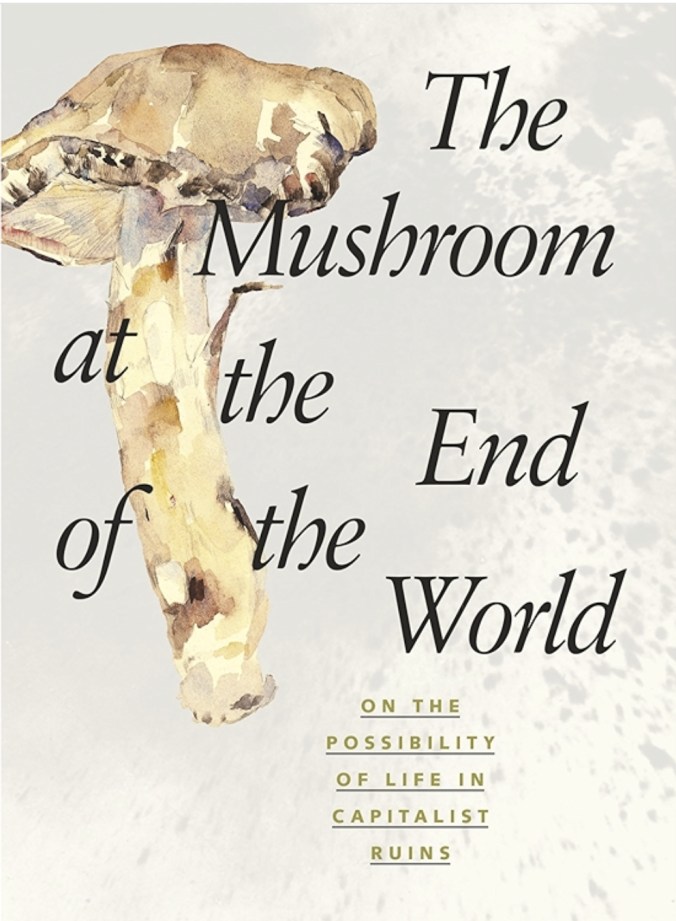
The Mushroom at the End of the World (Princeton University Press, 2021) by Anna Lowenhaupt Tsing
Tsing’s colourful narrative drew me into a metaphoric study of humanity’s journey through the ecology and commerce of the rare Matsutake mushroom. Both treatise on industrial capitalism and parable of survival and renewal under post-capitalist ruin, Tsing’s brilliant storytelling uses the matsutake mushroom and its industry to explore our ecological crisis: how it came about, what drives its continuation and what the consequences may look like.
The matsutake mushroom is considered a weed, growing in human-disturbed forests in the Northern Hemisphere; yet it is prized for its gourmet value. Tsing’s investigation of this rare sought-after mushroom, serves as an excellent metaphor for the study of a post-industrialist world and the promise of life after ruin. Tsing draws together a web of interconnected human and natural ecologies—from the foragers in Oregon and the Hmong jungle fighters to the capitalist traders and Japanese gourmets—to tell a fascinating tale of intrigue, greed, and violence. Laced throughout the story, are her personal reflections on the possibilities of collaborative survival of human and nonhuman.
The book is simply brilliant. The writing riveting. The story important.
.
.
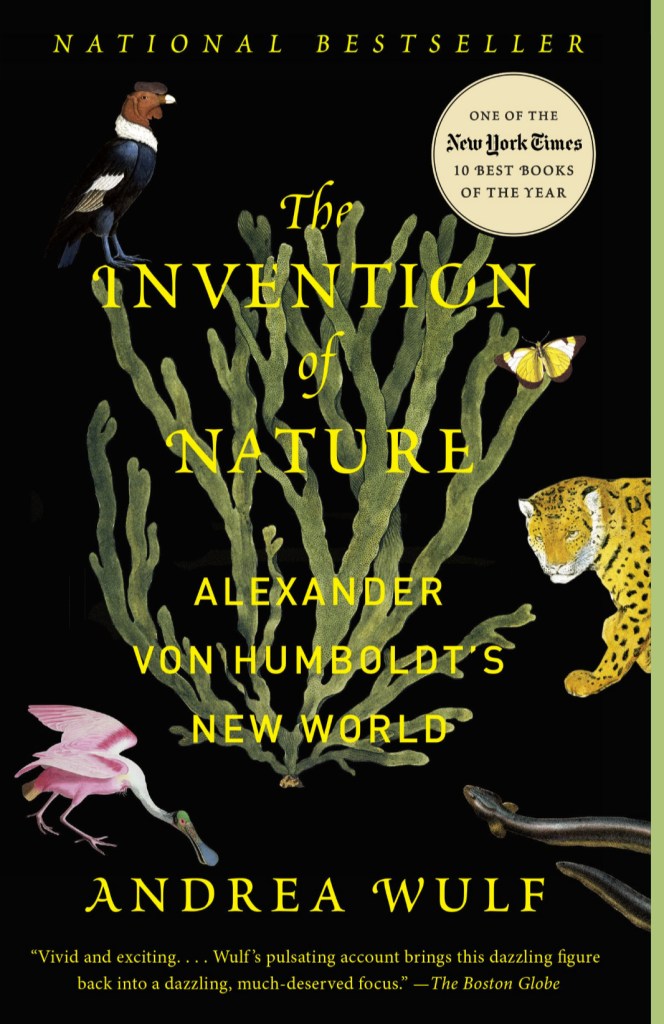
The Invention of Nature: Alexander von Humboldt’s New World (Vintage, 2016) by Andrea Wulf
I was riveted by this fascinating and illuminating biography of a visionary German naturalist and polymath—mostly forgotten—brought back to life through vivid narrative and seamless research to interesting detail. Wulf’s storytelling style drew me into this man’s incredible life, a planetologist way ahead of his time, who predicted human-induced climate change, and formulated a radical concept of nature as both a complex and intertwined global entity—long before Lovelock and Margulis came up with the Gaia Hypothesis in the 1960s.
Humboldt was the first ecologist, practicing the science of ecology for fifty years by the time German scientist Ernst Haeckel created a name for it (ökologie) in 1869. Humboldt embraced Schelling’s naturphilosophie, which espoused an organic and dynamic worldview as an alternative to the atomist and mechanist outlook that prevailed at the time. He saw nature as a living organism, animated by dynamic forces. True to his holistic vision, Humboldt invented global temperature isopleths—still used today. It is no surprise that the world’s first ecologist would also predict humanity’s devastating effect on global climate.
I found Wulf’s biography of von Humboldt fascinating, surprising, often sad, and poignant. What struck me the most was how von Humboldt’s discoveries and predictions were lost to the world with devastating effect. He made the connection and warned of human-induced climate change 200 years ago. If civilization had only heeded his warning!
.
.
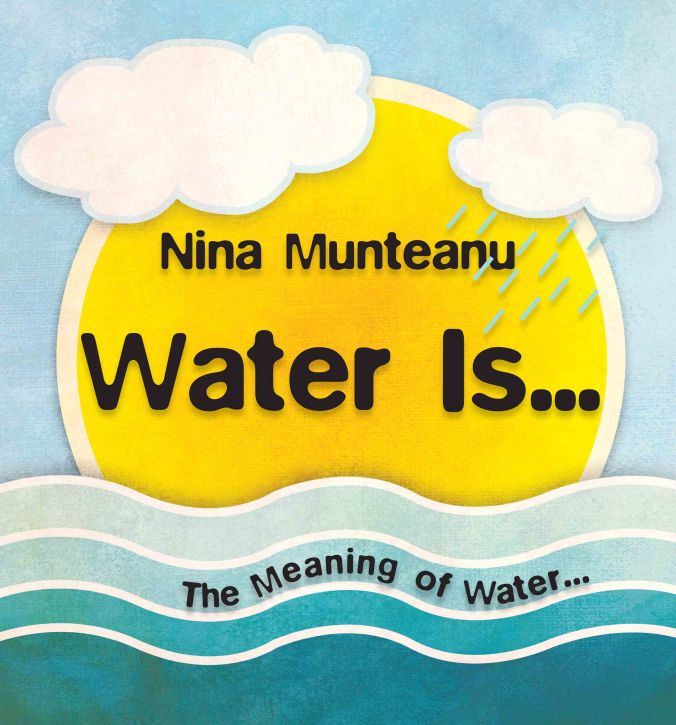
Water Is… The Meaning of Water (Pixl Press, 2016) by Nina Munteanu
My own non-fiction book Water Is…The Meaning of Water—a celebration of water in all its facets—is offered here as fitting this theme of celebrating Nature and educating us on how to live more lightly and responsibly. Here’s what the publisher’s blurb says:
.
Internationally published author, teacher and limnologist Nina Munteanu explores one of the most important substances of Earth. Nina Munteanu’s Water Is… The Meaning of Water represents the culmination of over twenty-five years of dedication as limnologist and aquatic ecologist in the study of water. As a research scientist and environmental consultant, Nina studied water’s role in energizing and maintaining the biomes, ecosystems, and communities of our precious planet. During her consulting career for industry and government, Nina discovered a great disparity between humanity’s use, appreciation and understanding of water. This set in motion a quest to further explore our most incredible yet largely misunderstood and undervalued substance. Part history, part science and part philosophy and spirituality, Water Is… combines personal journey with scientific discovery that explores water’s many “identities” and ultimately our own.
.
Water Is… was chosen by Margaret Atwood that year as one of her favourites in The New York Times ‘Year in Reading.’
.
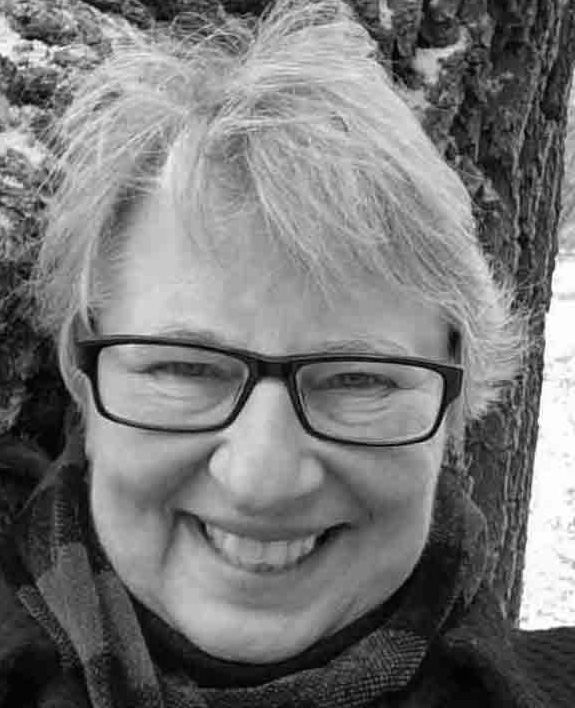
Nina Munteanu is an award-winning novelist and short story writer of eco-fiction, science fiction and fantasy. She also has three writing guides out: The Fiction Writer; The Journal Writer; and The Ecology of Writing and teaches fiction writing and technical writing at university and online. Check the Publications page on this site for a summary of what she has out there. Nina teaches writing at the University of Toronto and has been coaching fiction and non-fiction authors for over 20 years. You can find Nina’s short podcasts on writing on YouTube. Check out this site for more author advice from how to write a synopsis to finding your muse and the art and science of writing.
.
 Nina Munteanu Writing Coach