“If you have an apple and I have an apple and we exchange apples then you and I will still each have one apple. But if you have an idea and I have an idea and we exchange these ideas, then each of us will have two ideas.”—George Bernard Shaw
At Calgary’s When Words Collide some years ago, I moderated a panel on Eco-Fiction with publisher/writer Hayden Trenholm, and writers Michael J. Martineck, Sarah Kades, and Susan Forest. The panel was well attended; panelists and audience discussed and argued what eco-fiction was, its role in literature and storytelling generally, and even some of the risks of identifying a work as eco-fiction.
Someone in the audience brought up the notion that “awareness-guided perception” may suggest an increase of ecological awareness in literature when it is more that readers are just noticing what was always there. Authors agreed and pointed out that environmental fiction has been written for years and it is only now—partly with the genesis of the term eco-fiction—that the “character” and significance of environment is being acknowledged beyond its metaphor; for its actual value. It may also be that the metaphoric symbols of environment in certain classics are being “retooled” through our current awareness much in the same way that Aldous Huxley’s Brave New World or George Orwell’s Nineteen Eighty Four are being re-interpreted—and newly appreciated— in today’s world of pervasive surveillance and bio-engineering.
I would submit that if we are noticing it more, we are also writing it more. Artists are cultural leaders and reporters, after all. I shared my own experience in the science fiction classes I was teaching at UofT and George Brown College, in which I noted a trend of increasing “eco-fiction” in the works in progress that students were bringing in to workshop in class. Students were not aware that they were writing eco-fiction, but they were indeed writing it.
I started branding my writing as eco-fiction a few years ago. Prior to that—even though my stories were strongly driven by an ecological premise and strong environmental setting—I described them as science fiction and many as technological thrillers. Environment’s role remained subtle and—at times—insidious. Climate change. Water shortage. Environmental disease. A city’s collapse. War. I’ve used these as backdrops to explore relationships, values (such as honour and loyalty), philosophies, moralities, ethics, and agencies of action. The stuff of storytelling.
Environment, and ecological characteristics were less “theme” than “character,” with which the protagonist and major characters related in important ways.
Just as Bong Joon-Ho’s 2014 science fiction movie Snowpiercer wasn’t so much about climate change as it was about exploring class struggle, the capitalist decadence of entitlement, disrespect and prejudice through the premise of climate catastrophe. Though, one could argue that these form a closed loop of cause and effect (and responsibility).
The self-contained closed ecosystem of the Snowpiercer train is maintained by an ordered social system, imposed by a stony militia. Those at the front of the train enjoy privileges and luxurious living conditions, though most drown in a debauched drug stupor; those at the back live on next to nothing and must resort to savage means to survive. Revolution brews from the back, lead by Curtis Everett (Chris Evans), a man whose two intact arms suggest he hasn’t done his part to serve the community yet.
Minister Mason (Tilda Swinton), an imperious yet simpering figure who serves the ruling class without quite being part of it, reminds the lower class that:
“We must all of us on this train of life remain in our allotted station. We must each of us occupy our preordained particular position. Would you wear a shoe on your head? Of course you wouldn’t wear a shoe on your head. A shoe doesn’t belong on your head. A shoe belongs on your foot. A hat belongs on your head. I am a hat. You are a shoe. I belong on the head. You belong on the foot. Yes? So it is. In the beginning, order was prescribed by your ticket: First Class, Economy, and freeloaders like you…Now, as in the beginning, I belong to the front. You belong to the tail. When the foot seeks the place of the head, the sacred line is crossed. Know your place. Keep your place. Be a shoe.”
Ecotones are places where “lines are crossed,” where barriers are breached, where “words collide” and new opportunities arise. Sometimes from calamity. Sometimes from tragedy. Sometimes from serendipity.
When environment shapes a story as archetype—hero, victim, trickster, shadow or shape shifter—we get strong eco-fiction. Good eco-fiction, like any good story, explores the choices we make and the consequences of those choices. Good eco-fiction ventures into the ecotone of overlap, collision, exchange and ultimate change.
In my non-fiction book Water Is… I define an ecotone as the transition zone between two overlapping systems. It is essentially where two communities exchange information and integrate. Ecotones typically support varied and rich communities, representing a boiling pot of two colliding worlds. An estuary—where fresh water meets salt water. The edge of a forest with a meadow. The shoreline of a lake or pond.
For me, this is a fitting metaphor for life, given that the big choices we must face usually involve a collision of ideas, beliefs, lifestyles or worldviews: these often prove to enrich our lives the most for having gone through them. Evolution (any significant change) doesn’t happen within a stable system; adaptation and growth occur only when stable systems come together, disturb the equilibrium, and create opportunity. Good social examples include a close friendship or a marriage in which the process of “I” and “you” becomes a dynamic “we” (the ecotone) through exchange and reciprocation. Another version of Bernard Shaw’s quote, above, by the Missouri Pacific Agriculture Development Bulletin reads: “You have an idea. I have an idea. We swap. Now, you have two ideas and so do I. Both are richer. What you gave you have. What you got I did not lose. This is cooperation.” This is ecotone.
I think we are seeing more eco-fiction out there because ecosystems, ecology and environment are becoming more integral to story: as characters in their own right. I think we are seeing more eco-fiction out there because we are ready to see it. Just as quantum physics emerged when it did and not sooner, an idea—a thought—crystalizes when we are ready for it.
Don’t stay a shoe … go find an ecotone. Then write about it.
Thirty-Six Eco-Fiction Books Worth Reading…
Nina Munteanu is a Canadian ecologist / limnologist and novelist. She is co-editor of Europa SF and currently teaches writing courses at George Brown College and the University of Toronto. Visit www.ninamunteanu.ca for the latest on her books. Nina’s bilingual “La natura dell’acqua / The Way of Water” was published by Mincione Edizioni in Rome. Her non-fiction book “Water Is…” by Pixl Press (Vancouver) was selected by Margaret Atwood in the New York Times ‘Year in Reading’ and was chosen as the 2017 Summer Read by Water Canada. Her novel “A Diary in the Age of Water” was released by Inanna Publications (Toronto) in June 2020.
I steer away from them. I find them generally tasteless, unimaginative and lacking anything remotely connected to “story”. Most appear, at least from their trailers, to focus on violence and gore with little interest in anything else (what could be more gruesome than a person stalking then eating another?).
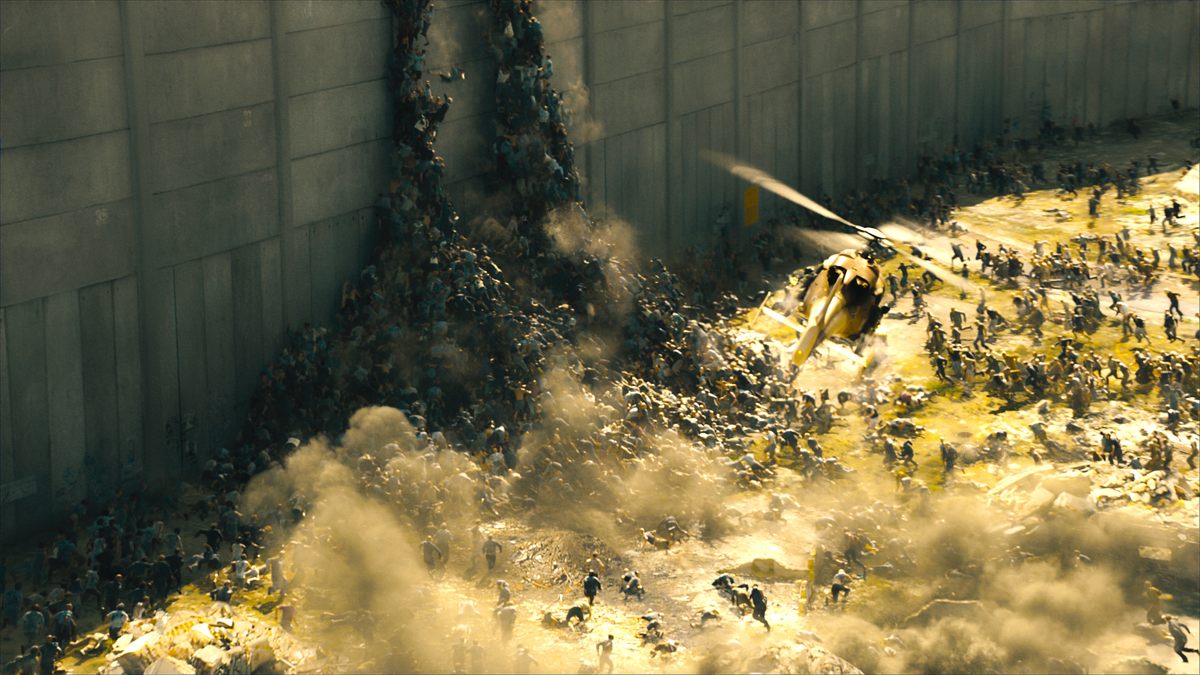
Zombies form an ‘ant hill’ as they climb the wall into acaptive city
As a writer of science fiction and fantasy and avid fan of this genre in motion pictures, I lamented that zombies had become the “in thing” in stories and film these days. We’d just gotten over werewolves and vampires. Now I felt doomed by an infestation of the “undead”. I mean, how many ways can you portray such listless deadbeats?
then there’s the action thriller “World War Z”. Despite my intrigue with the trailer, it took my trusted friend’s insistence for me to go see it.
Escaping the first zombie onslaught
I was vindicated in my trust of her good taste.
“World War Z” is not your typical zombie movie. In fact, to call it a zombie movie is to fail to acknowledge the deeper thematic reflections portrayed. What struck most was that this action thriller focused less on what zombies did (all that missing blood and gore that some reviewers lamented over gave me relief and gratitude) than on the effect of a plague that turned most of humanity into them. It actually had a story! While the motion picture apparently honoured the iconic lore and criteria established in the zombie mythos, director Marc Forster and screen writers J. Michael Straczynski and Matthew Michael Carnahan (based on the book by Max Brooks) cleverly did not let themselves be limited by it. In fact, zombies per se serve more as plot tools in a far more interesting and deeper story arc and theme.
I’m referring to the subtle notes of ecology, biology and co-evolution interlaced throughout this visually stunning and rather disturbing film. What happens when you disturb Nature? The opening titles and scenes show a montage of curious and subtly dark reflections on the consequences of our general indifference to Nature and her growing unbalanced ecosystems. “Mother Nature is a serial killer,” virologist Andrew Fassbach tells our hero during his first—and last—ten minutes on screen. During that short time they spend together, Fassbach shares some key insights into how Gaia plays. And she doesn’t always play “fair”. Fassbach also tells us that this zombie plague started with a virus. Which brings up some interesting questions. Was it an “intelligent virus”, manufactured and introduced? Did the virus co-evolve with some organism as an aggressive symbiont and was spontaneously triggered by a disturbance? What was that disturbance and was it an accident or a mistake? How did it come to be?
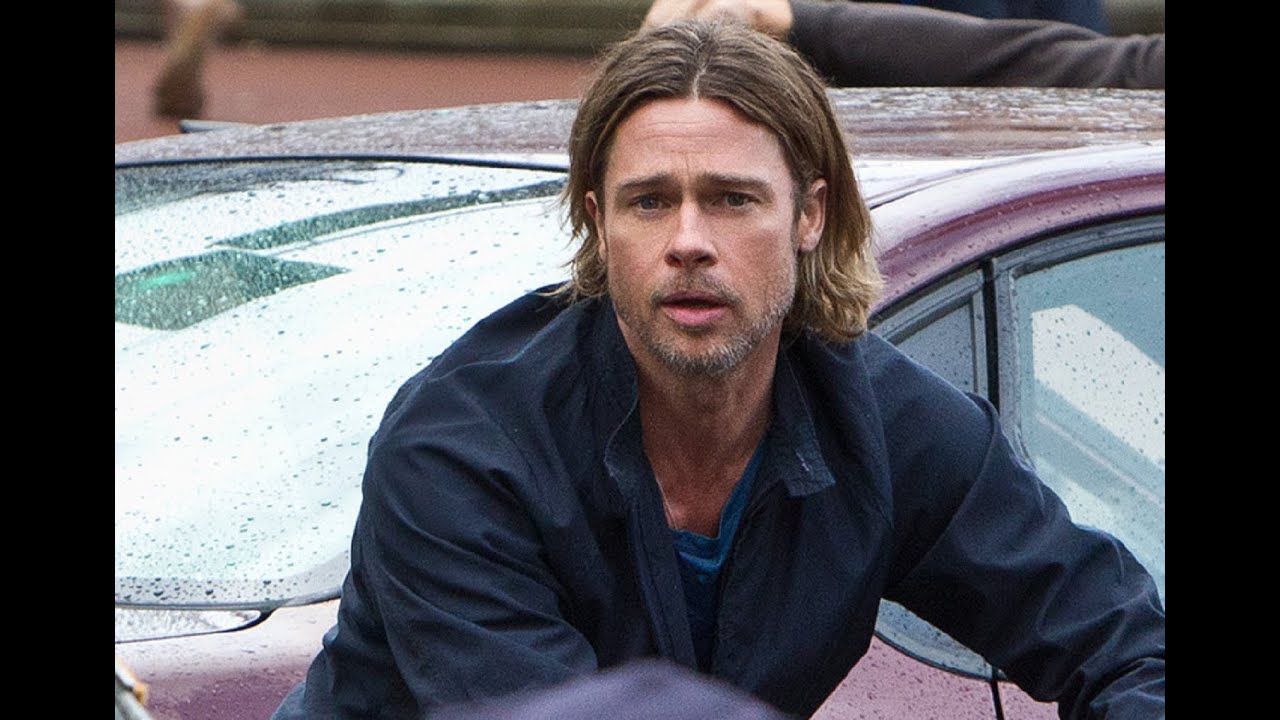
Brad Pitt’s character faces a zombie
In a 2020 interview with Yahoo Entertainment, Max Brooks (the author of the bestselling book of the same name) shared how uncannily similar the WWZ was to the Corona Virus (COVID-19) outbreak:
“Similarities between Brooks’s imagined outbreak, a virus called solanum (first introduced in 2003’s Zombie Survival Guide) and the coronavirus are uncanny. Never mind that Brooks has said he was using the novel to generally comment on government ineptitude and U.S. isolationism.
Patient Zero was in China. The virus is eventually nicknamed “African Rabies,” which sounds an awfully lot like “The Chinese Virus.” The U.S. greatly downplayed the severity of its threat and reacted too slowly, likely in part because it was an election year. Check. There was a much hyped-treatment that was ultimately ineffective (hello, hydroxychloroquine).”
“I was just being historically accurate,” says Brooks. “I wasn’t looking forward, I was looking back. Everything that’s happening today has already happened throughout history. Pandemics tend to come in very predictable cycles. And everything that is happening today happened with SARS, happened with AIDS, even happened with Ebola.”
Brad Pitt’s character on the run
I also didn’t fail to notice the reference to swarming ant colonies in the title montage that foreshadowed a later scene of zombies piling onto each other on the walls of Jerusalem in a frenzied search for warm bodies to eat. This is clearly a film about Nature’s powers and mysteries. You can be sure that questions about what triggered and defined the zombie plague will be addressed in the sequel, already scheduled. Because, like any serial killer, Mother Nature wants to be caught, says Fassbach.
Swarming zombies form ‘ant hill’ as they climb a walled city
Co-Evolution & Symbiogenesis
Which brings me to what this film really touches on: how Mother Nature takes care of herself and her own… whether we like it or not. The key is evolution and something called co-evolution: this is when two normal aggressors cooperate in an evolutionary partnership to benefit each other. Ehrlich and Raven coined co-evolution to explain how butterflies and their host plants developed in parallel. I wrote about it in an earlier post called “Co-evolution: Cooperation & Aggressive Symbiosis”
Virologist Frank Ryan calls co-evolution “a wonderful marriage in nature—a partnership in which the definition of predator and prey blurs, until it seems to metamorphose to something altogether different.” Co-evolution is now an established theme in the biology of virus-host relationships. The ecological “home” of the virus is the genome of any potential host and scientists have remained baffled by the overwhelming evidence for ‘accommodation’.
Brad Pitt’s character running with soldiers from zombie onslaught
“Today…every monkey, baboon, chimpanzee and gorilla is carrying at least ten different species of symbiotic viruses,” says Ryan.
“Why,” asks Ryan, “is co-evolution [and its partner, symbiosis] such a common pattern in nature?” Ryan coined the term “genomic intelligence” to explain the form of intelligence exerted by viruses and the capacity of the genome to be both receptive and responsive to nature. It involves an incredible interaction between the genetic template and nature that governs even viruses. Symbiosis and natural selection need not be viewed as mutually contradictory. Russian biologists, Andrei Famintsyn and Konstantine Merezhkovskii invented the term “symbiogenesis” to explain the fantastic synthesis of new living organisms from symbiotic unions. Citing the evolution of mitochondria and the chloroplast within a primitive host cell to form the more complex eukaryotic cell (as originally theorized by Lynn Margulis), Ryan noted that “it would be hard to imagine how the step by step gradualism of natural selection could have resulted in this brazenly passionate intercourse of life!”
Brad Pitt’s character fighting for his life
Aggressive Symbiosis
In his book, “Virus X” Dr. Frank Ryan coined the term “aggressive symbiont” to explain a common form of symbiosis where one or both symbiotic partners demonstrates an aggressive and potentially harmful effect on the other’s competitor or potential predator. Examples abound, but a few are worth mentioning here. In the South American forests, a species of acacia tree produces a waxy berry of protein at the ends of its leaves that provides nourishment for the growing infants of the ant colony residing in the tree. The ants, in turn not only keep the foliage clear of herbivores and preying insects through a stinging assault, but they make hunting forays into the wilderness of the tree, destroying the growing shoots of potential rivals to the acacia. Viruses commonly form “aggressive symbiotic” relationships with their hosts, one example of which is the herpes-B virus, Herpesvirus saimiri, and the squirrel monkey (the virus induces cancer in the competing marmoset monkey). Ryan suggests that the Ebola and hantavirus outbreaks follow a similar pattern of “aggressive symbiosis”. All you need is a perceived hostile trigger. A disturbance in an otherwise balanced ecosystem, for instance.
Aggressive Symbiosis & Human History
The historian, William H. McNeill, suggested that a form of “aggressive symbiosis” played a key role in the history of human civilization. “At every level of organization—molecular, cellular, organismic, and social—one confronts equilibrium [symbiotic] patterns. Within such equilibria, any alteration from ‘outside’ tends to provoke compensatory changes [aggressive symbiosis] throughout the system to minimize overall upheaval.”
So…what triggered the zombie plague of “World War Z”? And how will humanity prevail in this new paradigm of nature? The sequel (which I haven’t watched) may provide some answers. Check out author Max Brooks’s interview with Yahoo (link above) for some ideas.
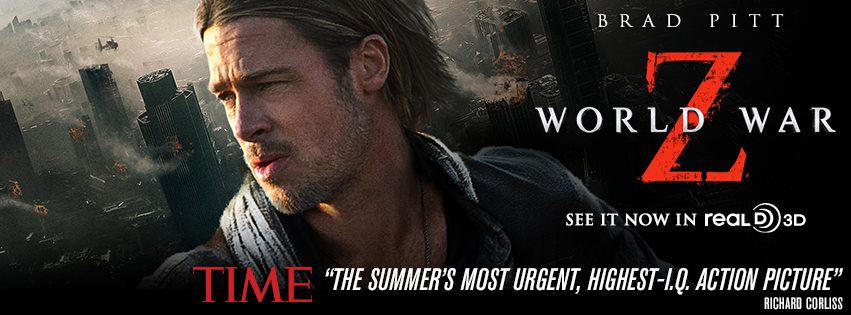
Poster for WWZ with Brad Pitt
Nina Munteanu is a Canadian ecologist / limnologist and novelist. She is co-editor of Europa SF and currently teaches writing courses at George Brown College and the University of Toronto. Visit www.ninamunteanu.ca for the latest on her books. Nina’s bilingual “La natura dell’acqua / The Way of Water” was published by Mincione Edizioni in Rome. Her non-fiction book “Water Is…” by Pixl Press (Vancouver) was selected by Margaret Atwood in the New York Times ‘Year in Reading’ and was chosen as the 2017 Summer Read by Water Canada. Her novel “A Diary in the Age of Water” was released by Inanna Publications (Toronto) in June 2020.
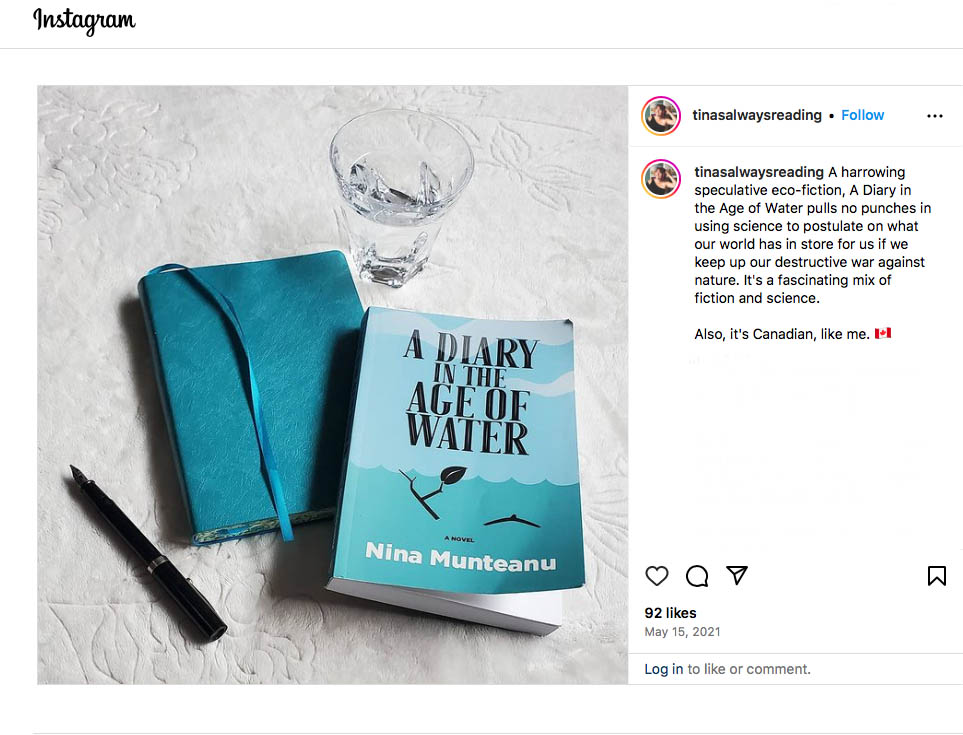
I recently came across this beautiful Instagram post by TinasAlwaysReading, and was reminded of a wonderfully in-depth review of my eco-fiction novel A Diary in the Age of Water that Tina did on Sound & Fury Book Reviews.
You can watch the review below:
Sound & Fury reviews “A Diary in the Age of Water” by Nina Munteanu
Nina Munteanu is a Canadian ecologist / limnologist and novelist. She is co-editor of Europa SF and currently teaches writing courses at George Brown College and the University of Toronto. Visit www.ninamunteanu.ca for the latest on her books. Nina’s bilingual “La natura dell’acqua / The Way of Water” was published by Mincione Edizioni in Rome. Her non-fiction book “Water Is…” by Pixl Press (Vancouver) was selected by Margaret Atwood in the New York Times ‘Year in Reading’ and was chosen as the 2017 Summer Read by Water Canada. Her novel “A Diary in the Age of Water” was released by Inanna Publications (Toronto) in June 2020.
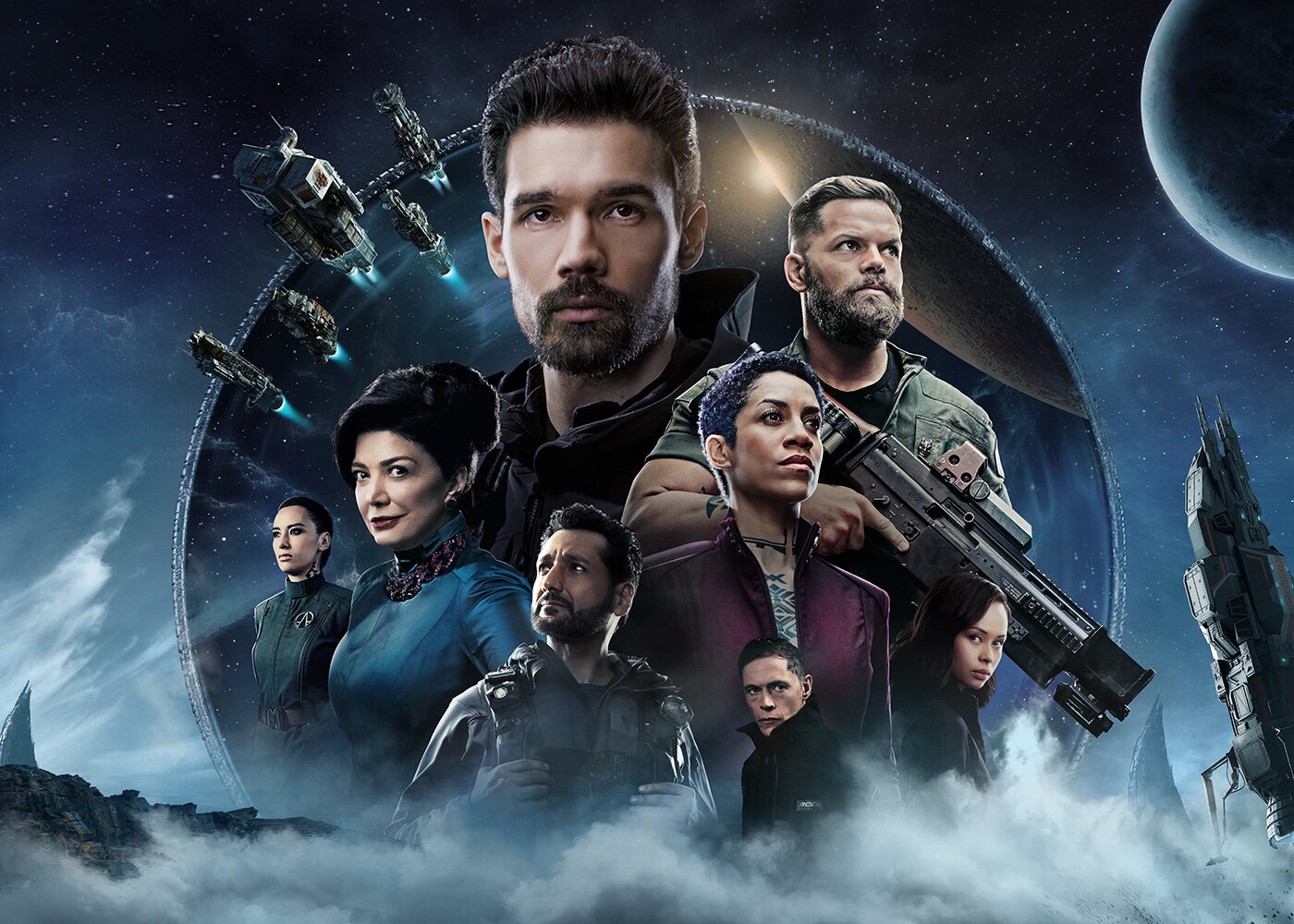
In 2015, Syfy released Season 1 of The Expanse, a stylish and intelligent science fiction (SF) TV series set 200 years in the future when humanity has colonized the moon, Mars and the Asteroid Belt to mine minerals and water. The six-season series is based on the novel series by James S.A. Corey with first novel “Leviathan Wakes”.
New York City of the Expanse
Humanity has split three ways culturally, ethnically and even biologically: Earth is currently run by the United Nations; Mars is an independent state, devoted to terraforming with high technology; and the Belt contains a diverse mix of mining colonies, settlers, workers and entrepreneurs. Belters’ physiology differ from their Earth or Mars cousins, given their existence in low gravity.
Ship heading to Ceres
One of the creators Mark Fergus explains the setting and premise of The Expanse: “We always felt that the great struggle of a lot of sci-fi we grew up on takes us into a story world where we’ve already jumped over the interesting part, which is the first fumbling steps of us pushing off this planet, getting out into the solar system, sorting ourselves out as a race. All the struggle and the pain and the glory of that, usually sci-fi … hops over it.” Fergus and his colleagues were attracted by what he called “the scaffolding,” how it all got built. “Here is who built it. Here is how humanity started looking at itself differently and getting rid of old forms of racism and creating new forms of racism.” This is the story of The Expanse.
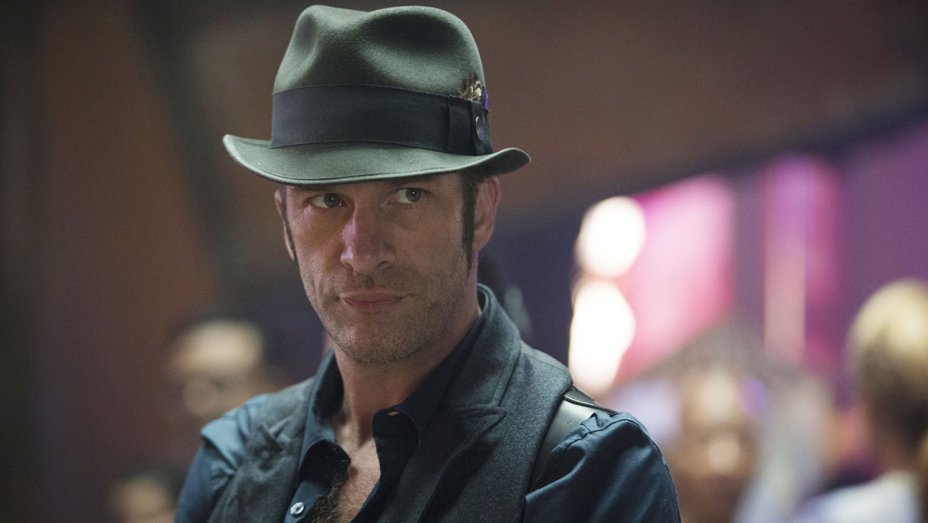
Josephus Miller, cynical detective on Ceres
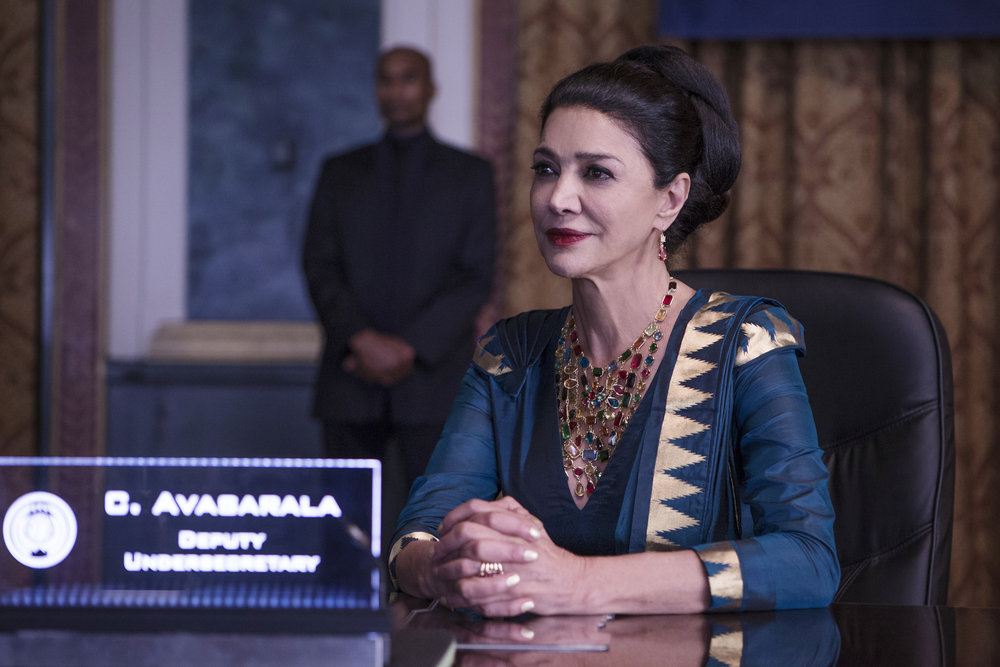
The series starts by following three main characters: U.N. Deputy Undersecretary Chrisjen Avasaraia (Shohreh Aghdashloo) on Earth; cynical police detective Josephus Miller (Thomas Jane), a native of Ceres (in the Belt); and ship’s officer Jim Holden (Steven Strait) and his crew as each unravels a piece of a conspiracy (related to an unknown extra-solar material discovered on a Saturn moon) that threatens a fragile peace in the solar system and the survival of humanity.
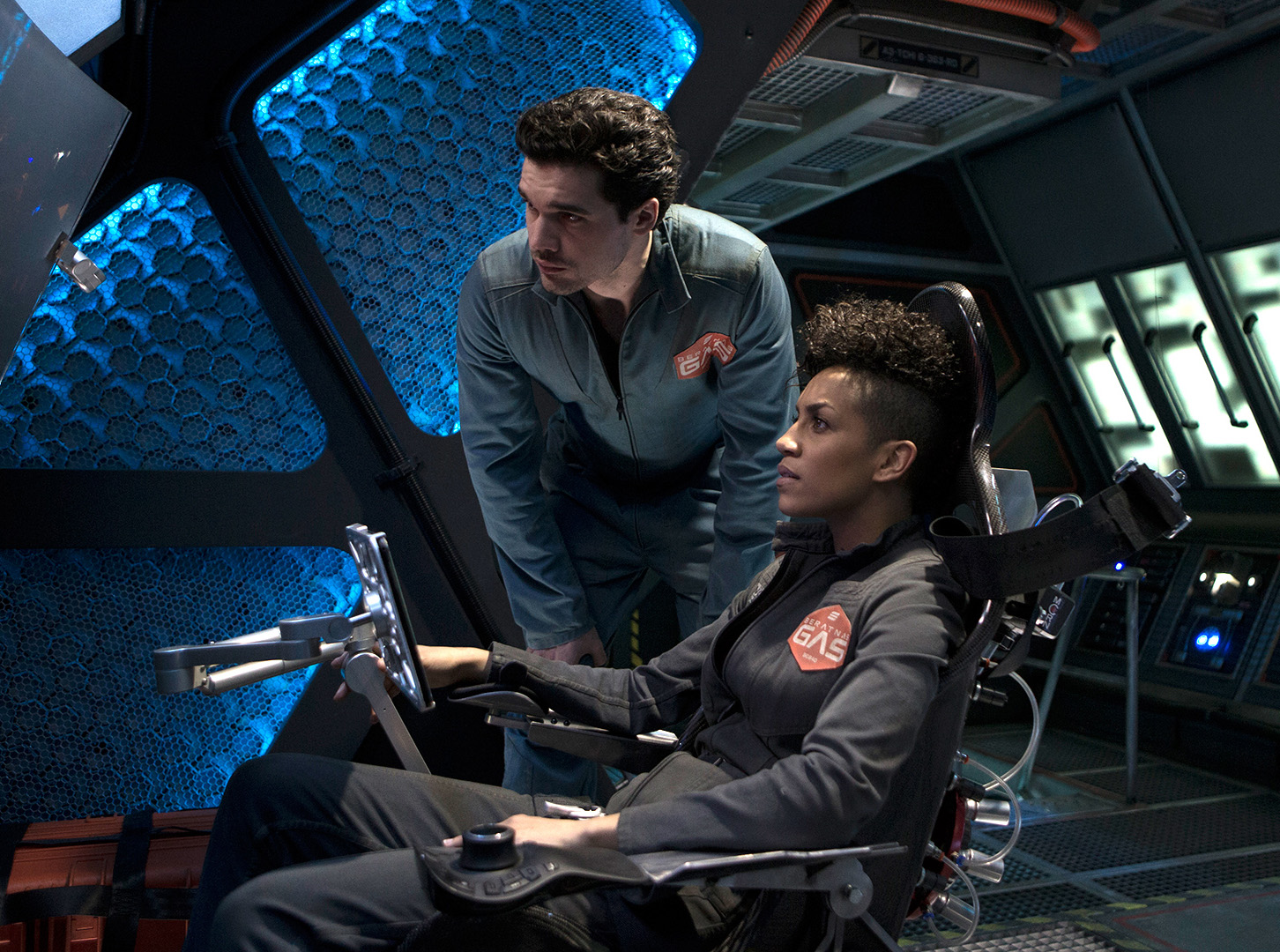
Holden and Naomi in their ship
First, Miller’s boss, Shaddid (Lola Glaudini) tosses him a missing person case: find Julie Mao (Florence Faivre), wayward daughter of a Luna-based shipping magnate (Mao-Kwikowski Mercantile); then Holden and four other crew members of the ice trawler Canterbury barely survive an attack that could spark a war between Earth and Mars. Miller and Holden eventually learn that the missing girl and the ice trawler’s fate are connected to a larger threat.
The only person who may stand a chance of figuring out the big picture is Chrisjen Avasarala, a brilliant 23rd-century Machiavelli, hoping to prevent simmering tensions between the United Nations, Mars and the Belt from erupting into all-out war. She will stop at nothing in her search for the truth, including gravity torturing a Belter or playing her friends and contacts like chess pieces to find answers.
Chrisjen speaking to Belter under gravity torture
What makes Chrisjen incredibly more interesting than, say a Circe or Claire Underwood, is that her scheming—as reprehensible as it may be at times—comes from a higher calling, not from lust for power or self-serving greed. She seeks the truth. And, like Miller, she struggles with a conscience. When her grandson asks if people are fighting again, Chrisjen says, “not yet; that’s why we [her contacts] need to talk and tell the truth; when people don’t tell the truth it always ends badly.” She may have been thinking of herself.
Chrisjen is a complex and paradoxical character. Her passionate search for the truth together with unscrupulous methods, makes her one of the most interesting characters in the growing intrigue of The Expanse. The Expanse further dignifies itself with subtle nuances of multi-layered social commentary—sewn into virtually every interaction.
After Chrisjen’s friend Franklin Degraaf (Kenneth Welsh), Earth ambassador to Mars, suffers as a casualty in one of her intel games, he quietly shares: “You know what I love about Mars?… They still dream; we gave up. They are an entire culture dedicated to a common goal: working together as one to turn a lifeless rock into a garden. We had a garden and we paved it.” Chrisjen offers consolation to the loss of his position (because of her): “we may have prevented a war.”
Chrisjen consoles Degraaf with a bottle of wine after causing his forced resignation as ambassador to Mars
The subtle details and rich set-pieces of The Expanse universe rival the best world building of Ridley Scott. In fact, I was reminded of the grit and immediacy of Bladerunner. The Expanse is SF without feeling like it’s SF; it just feels real. Powerful storytelling—from judicious use of slow motion, odd shot angles, haunting music and background sounds, to superlative acting—draws you into a complete and realizable world.
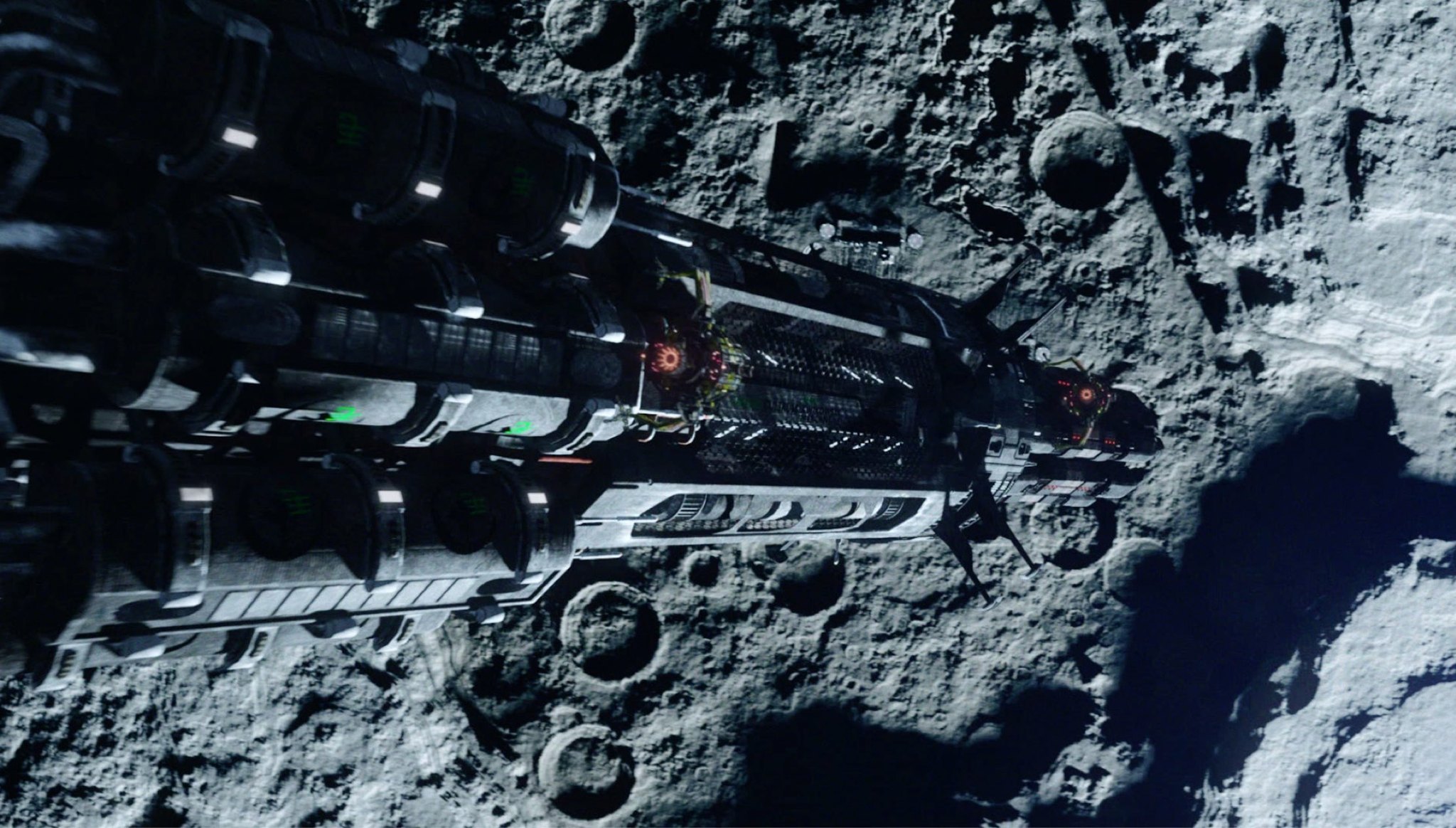
Ceres Station
Annalee Newitz of ARS Technica wrote, “the little details of this universe are so finely rendered that they become stories unto themselves, like the way interracial tensions developed on Ceres between humans who grew up gravity-deprived and spindly, versus those whose gravity-rich childhoods allow them to pass as Earthers.” Newitz adds that no clumsy Star Trek-style representation of exo-planetary civilizations occurs in The Expanse. It’s all humans. “Instead, there are political factions whose members stretch across worlds. And planets (or planetoids) whose populations are fragmented by class, race, and ideology. The politics here are nuanced, and we are always being asked to rethink who is right and who is wrong, because there are no easy answers.”
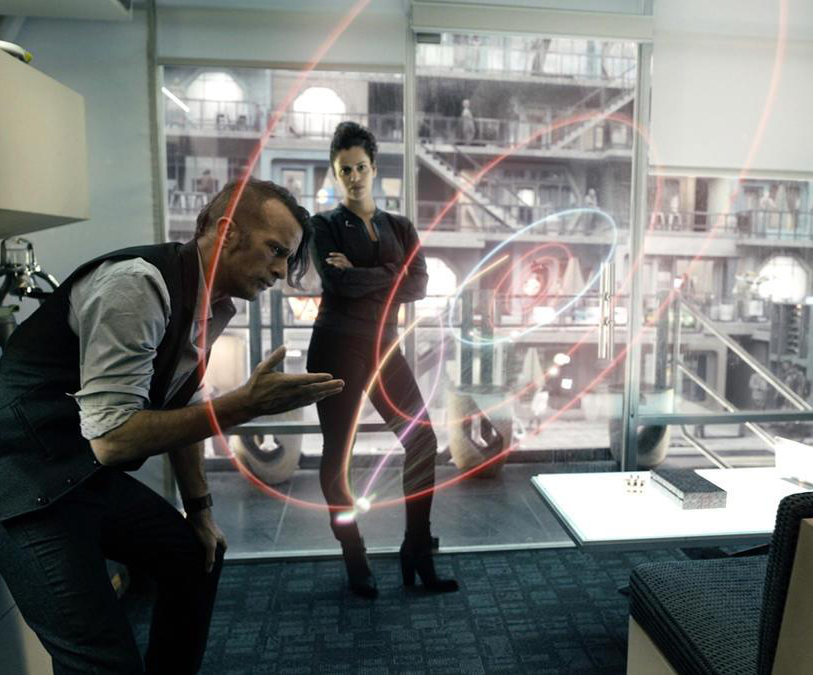
Miller and Tavi Muss, his former partner at Star Helix, discuss the recent strange events in the solar system while at his apartment in Ceres
Subtle but powerful differences between the Belter culture, Earthers and Martians (all human) includes language. Belters use a creole that’s a mix of several Earth languages that were spoken by the original human settlers in the Belt colonies. Resembling a Caribbean twang and cadence, words contain a mix of slang English, Chinese, French, Zulu, Arabic, Dutch, Russian, German, Spanish, Polish and others. For instance, “Inyalowda” means inner or non-belter. “Sa-sa” means to know. “Copin” means friend. An Expanse Wikia provides an in-depth list of Belter Creole used in the TV show.
Liz Shannon Miller of Indiewire.com shares: “In the 23rd century, the smart phones look fancier but their screens still crack. There are people in straight relationships and gay relationships and group marriages. There are still Mormons, who are preparing for a whole new level of mission. The rich live well. The poor struggle. It’s not “Star Trek” — there’s no grand glorious yet vague cause to which our heroes have devoted themselves. Survival is what matters.”
The Expanse is a sophisticated SF film noir thriller that elevates the space opera sub-genre with a meaningful metaphoric exploration of issues relevant in today’s world—issues of resource allocation, domination & power struggle, values, prejudice, and racism. These issues are explored particularly well through its diverse female protagonists with subtle nuances of multi-layered social commentary sewn into virtually every interaction.
Julie Mao trapped onboard a stealth ship
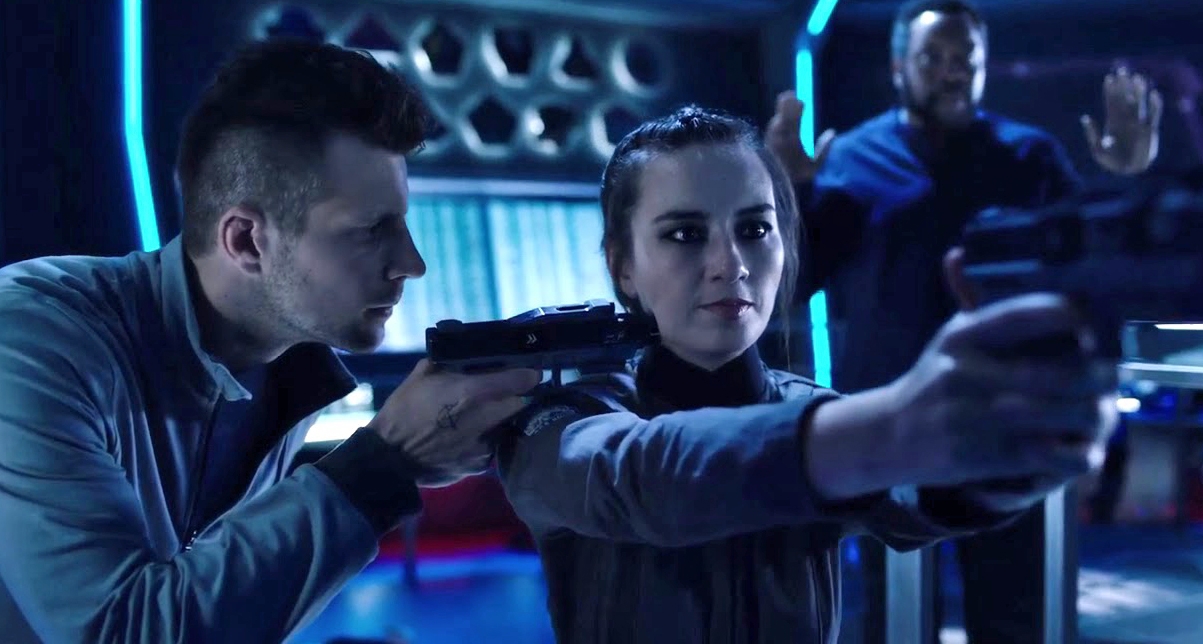
In Season 1 alone we are presented with Julie Mao (Florence Faivre), who is according to Detective Miller (tasked to find her) the “richest bachelorette in the system”, and an OPA collaborator; Naomi Nagata (Dominique Tipper), a highly-skilled Belter technologist and former OPA agent; Camina Drummer (Cara Gee), a no-nonsense calculating Belter who used to work with OPA leader Anderson Dawes but now helps run Tycho Station that is building a giant interstellar ship for the Mormons; and Chrisjen Avasarala (Shohreh Aghdashloo) a sharp-minded ruthless political strategist in search of the truth.
(Left: Naomi Nagata)
Drummer in a sticky situation during a coup on Tycho Station
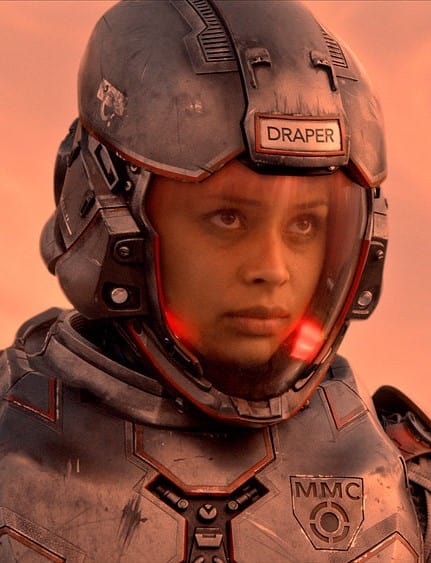
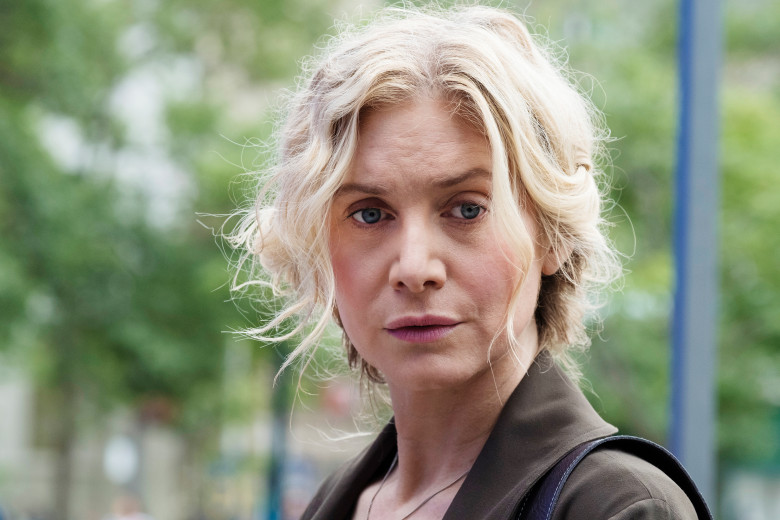
Season 2 and 3 introduce yet more powerful female characters with agency, such as Bobbie Draper, a staunch hard-fighting Martian marine who dreams of a terraformed Mars; and the Reverend Anna Volovodov (Elizabeth Mitchell), a gay Methodist doctor, who brings faith, hope, and inclusion to her acts of heroism.
(Left: Bobbie Draper)
Anna Volovodov dealing with a protest on Earth
I found the music by Clinton Shorter particularly appropriate: subtle, edgy, haunting, and deeply engaging: like its characters, the story, and world. The haunting title song, sung by Lisbeth Scott, lingers in each episode throughout the six seasons.
Amidst the unfolding intrigue of war, corruption and secrecy, a rich tapestry of characters take shape —with the added spice of an extra-solar alien entity (and a nod to panspermia). The alien entity is called the protomolecule based on its evolving nature (it eventually evolves into a ring-gate to other worlds). We eventually learn that the alien blue goo was sent by an alien civilization (directed panspermia) inside an interstellar asteroid (lithopanspermia) millennia ago; although it was captured by Saturn’s gravity to become one of its many moons (Phoebe), its target was Earth’s rich biology to bioengineer. Considered a bio-weapon, it is coveted by the politicians of Earth, Mars, and the Belt.
Miller, who was born on Ceres but received some cheap bone density implants—so he looks like an Earther—is a cynical detective (not above being bribed by merchants cutting corners) and trying hard to hide the fact that he has a big heart and is looking for meaning in his empty existence as a Star Helix cop (Miller: “No laws on Ceres; just cops.”) Belters call him a “well wala”, traitor to his own kind.
Miller and Dawes discuss the disappearance of Julie Mao
Ceres-born Anderson Dawes (Jared Harris), suave and ruthless leader of the separatist OPA (Outer Planet Alliance) challenges Miller: “I think that under that ridiculous hat there’s a Belter yearning to find his way home.” Except what is “home”? When asked by his new Star Helix partner, Dmitri Havelock (Jay Hernandez) about ‘why the hat?’, Miller quips, “to keep out the rain.” There is no rain on Ceres. Never was. Never will be.
The militant OPA is an activist organization that sells itself as a liberator for Belters but is really a terrorist revolutionary group, looking to shift the balance of power. Led by Dawes, the OPA’s ambitious agenda ranges from staging protests in the gritty Medina district of Ceres to stealing stealth technology and bio-weapons from Mars and Earth. Some of the best scenes occur between the intense Dawes and crusty Miller, as they banter over what it means to be a Belter in a solar system where they are clearly not players but sandwiched in a power struggle between Earth and Mars.
Dawes confides to Miller: “All we’ve ever known is low G and an atmosphere we can’t breathe. Earthers,” he continues, “get to walk outside into the light, breathe pure air, look up at a blue sky and see something that gives them hope. And what do they do? They look past that light, past that blue sky. They see the stars and they think ‘mine’… Earthers have a home; it’s time Belters had one too.”
Subtle. Not so subtle. The show takes a few opportunities to point out what we are doing to our planet. Cherish what you have. Cherish your home and take care of it. We’re reminded time and again, that we aren’t doing a good job of that.
Onboard the MCRN Donnager, Martian Lopez asks his prisoner Holden if he misses Earth and Holden grumbles, “If I did, I’d go back.” Lopez then dreamily relates stories his uncle told him about the “endless blue sky and free air everywhere. Open water all the way to the horizon.” Then he turns a cynical eye back on Holden. “I could never understand your people. Why, when the universe has bestowed so much upon you, you seem to care so little for it.” Holden admits, “Wrecking things is what Earthers do best…” Then he churlishly adds, “Martians too, by the look of your ship.” Lopez retorts, “We are nothing like you. The only thing Earthers care about is government handouts. Free food, free water. Free drugs to forget the aimless lives you lead. You’re shortsighted. Selfish. It will destroy you. Earth is over, Mr. Holden. My only hope is that we can bring Mars to life before you destroy that too.”
The underlying message in Expanse becomes clear in the last show of Season One. Near the end, Miller asks Holden what rain tastes like and Holden admits he never thought about it. Miller then asks, “How could you leave a place like Earth?…” Holden responds, “Everything I loved was dying.”
Critic Maureen Ryan of Variety says, “It’s to the show’s credit that it is openly political, and takes on issues of class, representation and exploitation.”
Bobbie and her Martian crew patrolling Ganymede
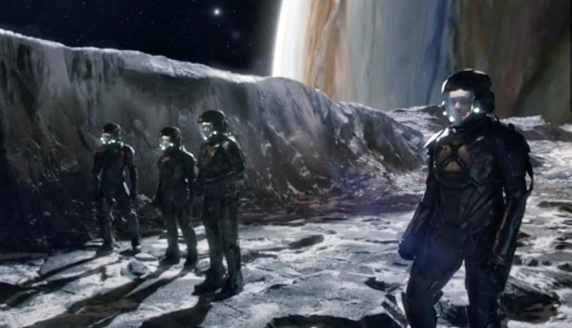
As the seasons progress (ending in Season 6), the plot doesn’t so much thicken as branch like a fractal tree or the braiding delta of a river into the sea, expanding as the galaxy itself into infinite space. Season 2 witnesses biological and political developments with the protomolecule, from the use of an entire station as a human laboratory to the testing of protomolecule-human hybrid weapons on Ganymede Station. Stationed there, Martian marine Bobbie Draper barely survives an encounter with a hybrid as it easily dispatches her entire crew and UNN soldiers alike. Events related to the secret war among powers to hold and control this alien weapon precipitate war between Earth and Mars.
Chrisjen Avasarala questions Bobbie at an Earth-Mars summit inquiry into the incident on Ganymede
The plot train goes into high gear in Season 3 with high stakes scenes of war, intrigue, and violent change. Through the various set-pieces of place, new characters are introduced and embed themselves in the larger story with amazing potency. One example of the various plot threads surrounding Ganymede Station introduces botanist Prax Meng (Terry Chen) and his 12-year old daughter Mei (Leah Jung), secretly taken from him by a Pierre Mao scientist to become a protomolecule hybrid. Introduced in Episode 8 (Pyre) of Season 2, Prax and kidnapped Mei immediately stir our hearts with their story. I was struck by how powerful a brief appearance by one character could be: Prax, who thinks he has lost Mei when the mirrors fell on Ganymede Station, finds himself on a refugee ship with Doris Bourne (Grace Lynn Kung), a botanist colleague from Mars. We are introduced to Doris and lose her within a single episode; yet we feel incredible pathos on her demise (thanks to their performances, and the circumstances that drive their short-lived story together).
Doris and Prax onboard the refuge ship after the Ganymede incident
The Expanse is filled with these potent vignettes, focused on one or two characters, that tug our heartstrings with personal drama. Several come immediately to mind: ‘Big Guy’s’ (Gugun Deep Singh) heartfelt sacrifice in Episode 12 (The Monster and the Rocket) of Season 2; the slaughter of all miners of Anderson Station, with particular focus on Marama Brown (Billy MacLellan) and his daughter Kiri (Raven Stewart), in Episode 5 (Back to the Butcher) of Season 1.
Throughout its expansive six seasons, The Expanse never loses sight of its strongest feature: its characters who each tell a heart-felt story and whose threads weave a greater story tapestry. This is a TV show that writes large through its many intimate stories; all smaller wholes entangled with the larger whole.
Variety’s Whitney Friedlander writes that The Expanse is Syfy’s most expensive series to date. It shows. And it shows well because it does not trade story for effects. Story comes first. The Expanse is a welcome breath of fresh air for high quality “space opera” science fiction on TV. It fills a gaping hole left by the conclusion of Battlestar Galactica in 2009.
Poster for Season Five of The Expanse
p.s. Since my title includes a comparison of The Expanse with Game of Thrones, I feel compelled to state another important difference between these two highly successful TV shows, and ultimately why I disliked one as I loved the other: while both shows created fully-fleshed compelling characters that viewers quickly embraced and loved (or hated), GOT chose to wily-nily give them brutal (and often grotesque) deaths for no other apparent reason than to shock the viewer—creating a tension of suspicion and fear. Viewers became nervous for their favourite character. It was like a crap shoot and the viewer was the real victim. The death of virtually every character in the Expanse however—though also often a heart-wrenching surprise—could be explained and understood. This was because their demise filled the greater purpose of the overall story. That simple. I give ultimate credit to the writers of The Expanse. And shame on the Game of Thrones screenwriters and producers.
“Story must come first!”
Julie Mao escaping imprisonment in the stealth ship
Nina Munteanu is a Canadian ecologist / limnologist and novelist. She is co-editor of Europa SF and currently teaches writing courses at George Brown College and the University of Toronto. Visit www.ninamunteanu.ca for the latest on her books. Nina’s bilingual “La natura dell’acqua / The Way of Water” was published by Mincione Edizioni in Rome. Her non-fiction book “Water Is…” by Pixl Press (Vancouver) was selected by Margaret Atwood in the New York Times ‘Year in Reading’ and was chosen as the 2017 Summer Read by Water Canada. Her novel “A Diary in the Age of Water” was released by Inanna Publications (Toronto) in June 2020.
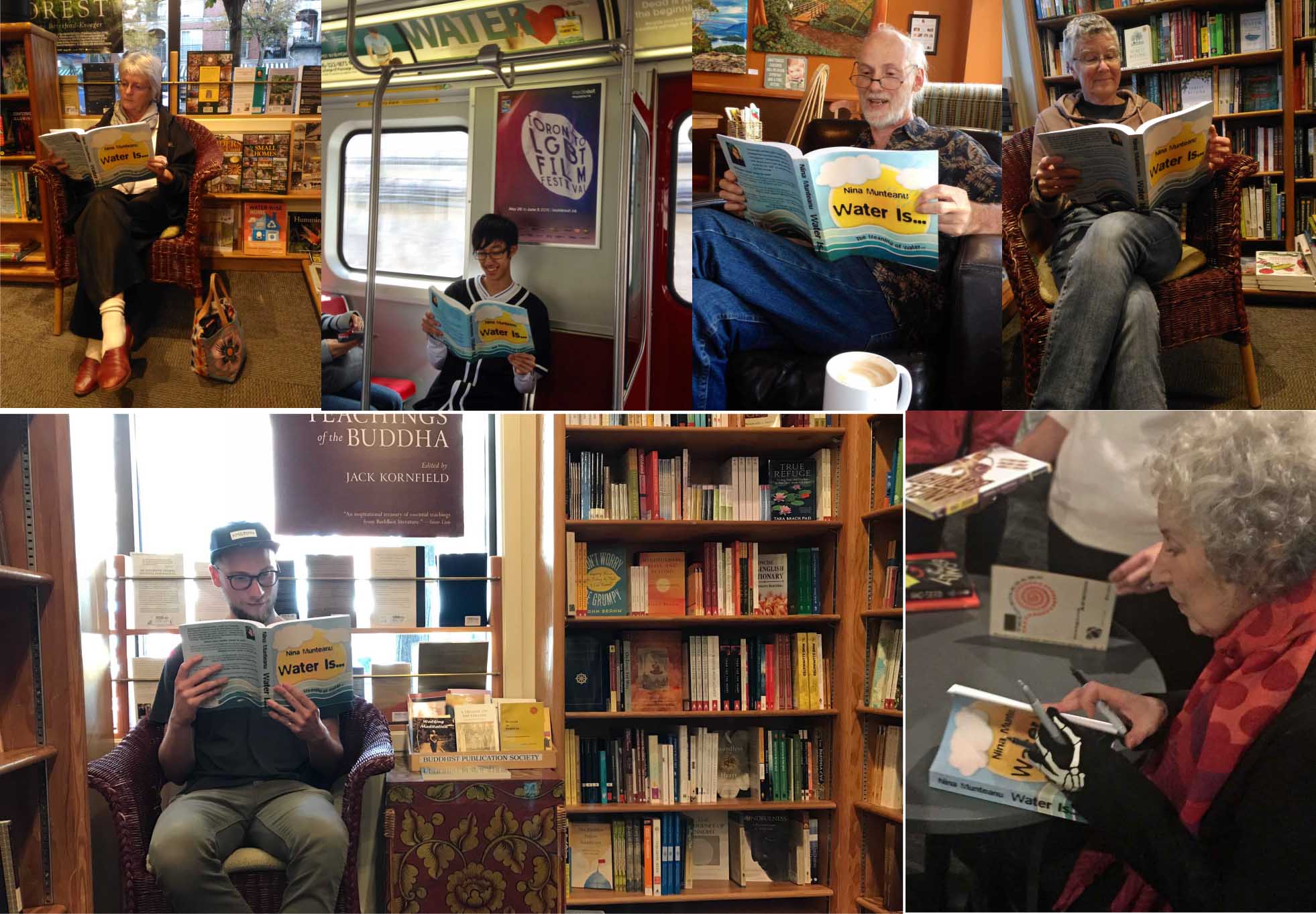
People reading “Water Is…”in Vancouver and Toronto
Margaret McCaffery, chair of the PROBUS Toronto Speakers Committee invited me some time ago to speak to their club in June of 2024 on my experience with water: as scientist, mother, and environmentalist. The audience was mostly retired professional and business people with enquiring minds. I gave my Powerpoint talk in the Holy Rosary Parish Hall on St. Clair West and then enjoyed a vigorous session of challenging and interesting questions to which I responded with equal vigour.
Here is the blurb for the presentation:
Canadian limnologist Nina Munteanu explores the many dimensions of water through her journey with water as mother, educator, and scientist. She describes an emotional connection with nature that compels us to take care of our environment with love versus a sense of duty.
Nina’s talk draws on her book Water Is… The Meaning of Water, part history, part science and part philosophy and spirituality. The book examines water’s many anomalous properties and what these meant to us. In sharing her personal journey with this mysterious elixir, Nina explores water’s many ‘identities’ and, ultimately, our own. Water Is… was Margaret Atwood’s first choice in the 2016 New York Times ‘Year in Reading.’ Water is… will be available for sale at the talk.
I started with my story as a child, growing up in the Eastern Townships of Canada
I defined “limnology” and talked about my career as a limnologistand environmental consultant
I discussed some of water’s anomalous properties, all life-giving
I brought in some interesting things about water…
I tied my journey with water to family and friends and my watershed
I ended my talk with a discussion of the Watermark Project to catalogue significant stories to water bodies all over the world
I also brought my latest eco-clifi novel A Diary in the Age of Water for sale. It interested quite a few people and generated several wonderful discussions.
Nina Munteanu and her latest eco-novel
Nina Munteanu is a Canadian ecologist / limnologist and novelist. She is co-editor of Europa SF and currently teaches writing courses at George Brown College and the University of Toronto. Visit www.ninamunteanu.ca for the latest on her books. Nina’s bilingual “La natura dell’acqua / The Way of Water” was published by Mincione Edizioni in Rome. Her non-fiction book “Water Is…” by Pixl Press (Vancouver) was selected by Margaret Atwood in the New York Times ‘Year in Reading’ and was chosen as the 2017 Summer Read by Water Canada. Her novel “A Diary in the Age of Water” was released by Inanna Publications (Toronto) in June 2020.
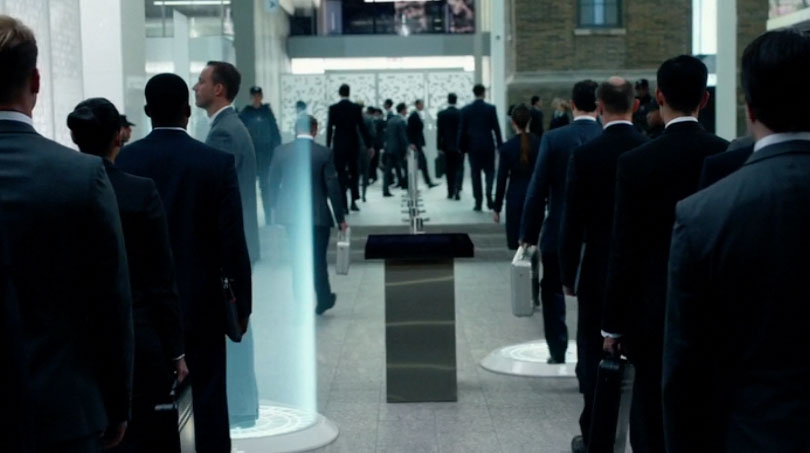
Spiga employees submit to security checks when they enter the facility
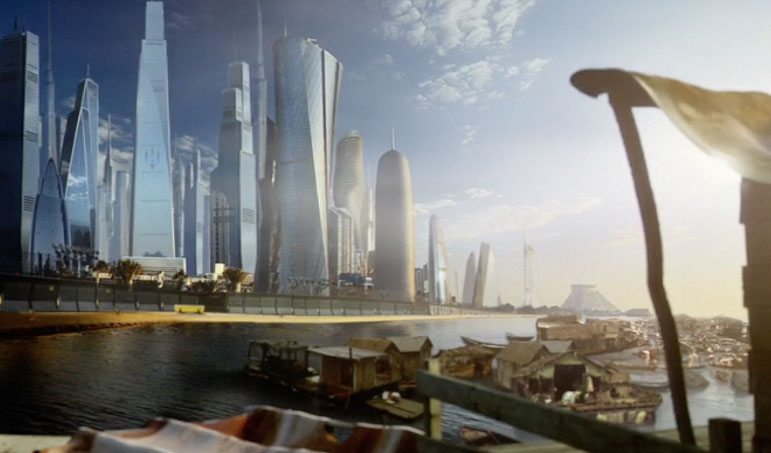
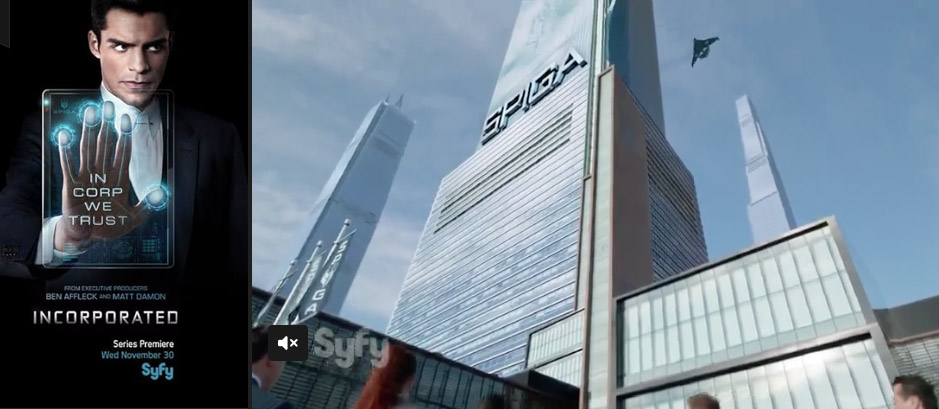
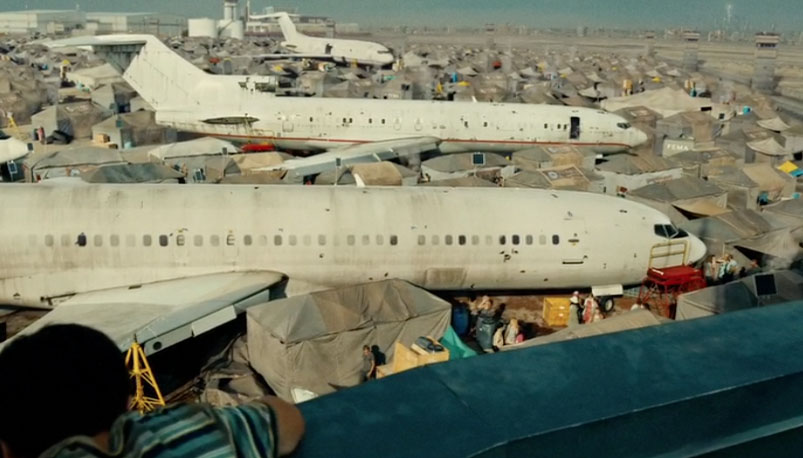
Incorporated is a science fiction thriller (on Netflix) that offers a chilling glimpse of a post-climate change dystopia. Created by David and Alex Pastor and produced by Ben Affleck, Matt Damon, Ted Humphrey and Jennifer Todd, the show (filmed in Toronto, Canada) opens in 82 °F Milwaukee in November 2074 after environmental degradation, widespread famine and mismanagement have bankrupted governments. We learn later that Milwaukee Airport served as a FEMA climate relocation centre that resembles an impoverished shantytown. In the wake of the governments demise, a tide of multinational corporations has swept in to control 90% of the globe and ratified the 29th amendment, granting them total sovereignty.
Corporate climber at Spiga, Ben Larson receives climate news updates as he gets ready for work
Corporations fight a brutal covert war for market share and dwindling natural resources. Like turkey vultures circling overhead, they position themselves for what’s left after short-sighted government regulations, lack of corporate check and FEMA mismanagement have ‘had their way’ with the planet. The world is now a very different place. There is no Spain or France. Everything south of the Loire is toxic desert; New York City reduced to a punch line in a joke. Reykjavik and Anchorage are sandy beach destinations and Norway is the new France—at least where champagne vineyards are concerned. Asia and Canada are coveted for their less harsh climates.
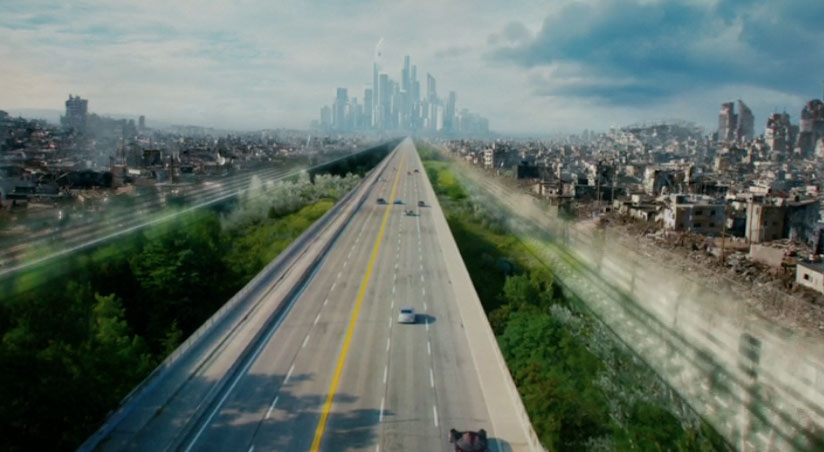
Red Zone with Green Zone backdrop
Those who work for the corporations live in privilege behind the sentried walls of the Green Zones. The rest fend for themselves with scarcity in the contaminated slums of the Red Zones. The numbers aren’t provided in the show’s intro but we can guess that they are similar to Pedro Aguilera’s TV thriller 3% and Blomkamp’s motion picture Elysium—both about living with scarcity, where the few elite enjoy the many privileges—so long as they follow the elite rules.
Spiga Biotechs screening employees
“Kleptocracy reigns, paranoia rules, and the marketplace determines human worth,” writes Jeff Jensen of Entertainment Weekly about Incorporated. “Only the most obedient, cunning, and technologically adept can flourish. Question authority? You’re fired! And maybe worse.”
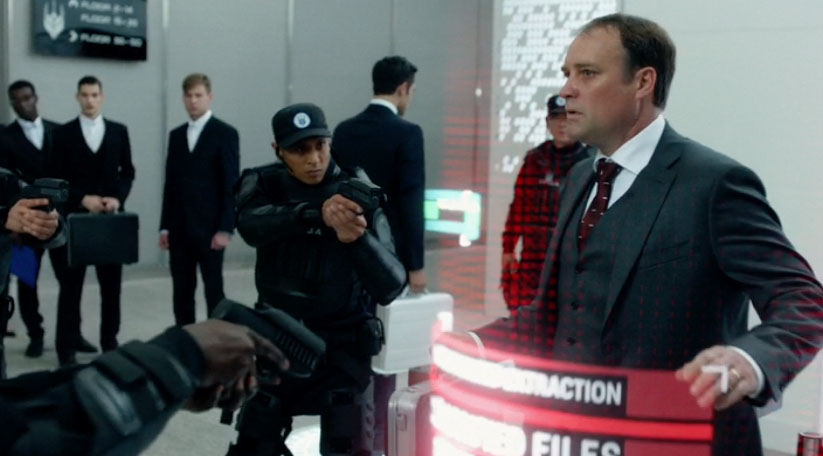
Security at Spiga Biotechs catches Chad, Ben’s boss with illegal tech
The ‘Elysium’ of Incorporated is an ‘Alice in Wonderland’ mixture of realizable technological advances, gadgetry and thrilling–if not chilling–consequence: like self-driving cars, intelligent wristbands, surrogate pregnancies and remote deliveries, genetic testing of ‘inferiors’, DNA theft and malware sabotage.
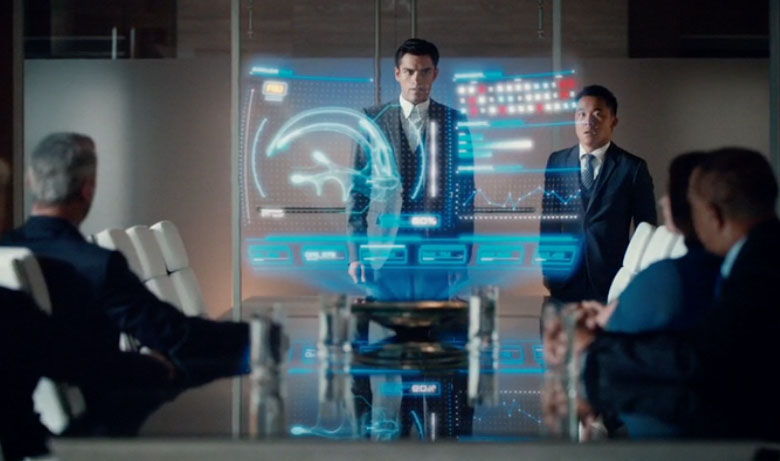
Corporate stealth tech presentation
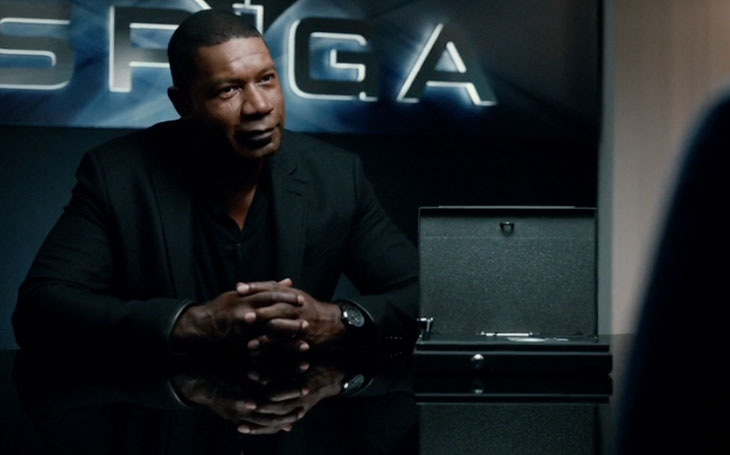
The first episode (Vertical Mobility) opens to a corporate ‘traitor’ being dragged into “the quiet room”, rumoured to be a torture chamber run by taciturn head of security Julian Morse (Dennis Haysbert). The scene shifts to the Green zone suburban house of corporate climber Ben Larson (Sean Teale). As he prepares to go to work, the news streams of hurricanes breaching levies; Canada building a wall to stem the tide of illegal American climate refugees–12 million already there; offshore oil rigs in the waters of the former Arctic ice cap; and finally to the “terrorist” bombing of the R&D lab of biochemical giant Spiga, where Ben works. Spiga, we later learn, plays the same games as Monsanto and Nestle to ensure profits at the expense of well-being.
Building of biochemical giant Spiga Biotechnics stands tall next to the corporation’s motto
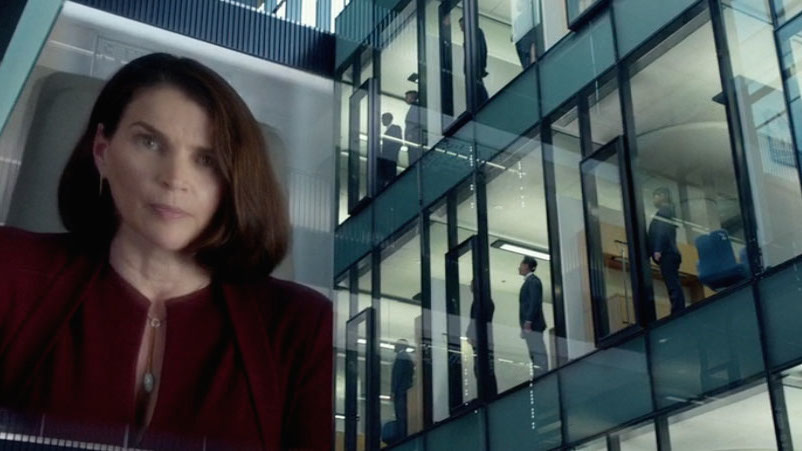
Spiga CEO speaks to employees
“Over the past forty years,” says a giant image of CEO Elizabeth Krauss (Julia Ormond) to the suits passing security in the giant corporate lobby below, “Spiga Biotech has been at the forefront of the genetic engineering revolution. We design seeds capable of thriving in the increasing harsh environments of our planet. Our pest and drought resistant crops are now sold in over a hundred countries. And our advancements in in-vitro testing have transformed the synth food industry.” She ends with the mantra, “Spiga: committed to feeding our ever-growing world.”
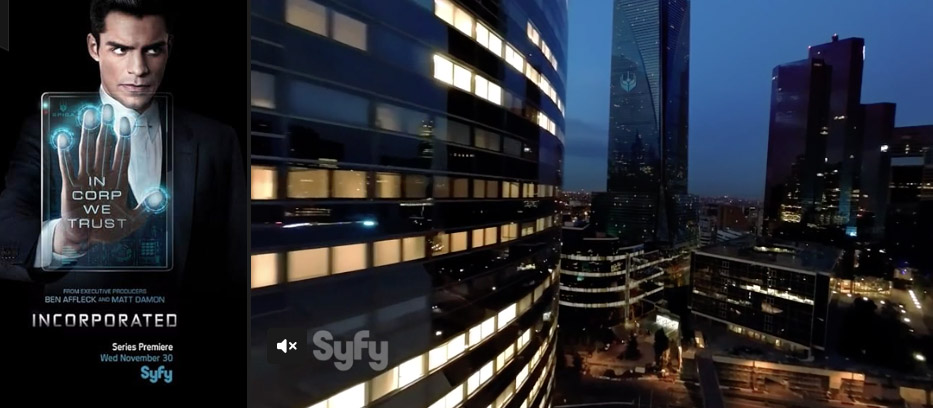
Red Zone at night
Ben stands in his office at Spiga
Ben is, of course, not what he pretends he is. The upwardly mobile executive has wed Laura Larson (Allison Miller), a doctor with a courageous heart who also happens to be the daughter of the unscrupulous Kraus. Ben is really Aaron, a former Red Zone techno-hustler who covertly searches for his Red Zone sweetheart, now a sex slave to corporate executives at Arcadia, the ‘men’s club’ of Spiga. If he’s going to spring her, Ben will have to get promoted to the 40th floor.
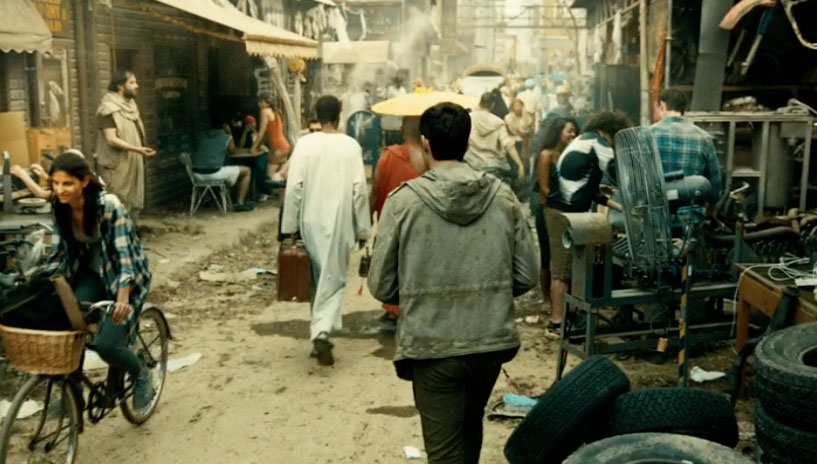
Climate refugee camp in the Red Zone
“If our [current] political climate has you feeling apocalyptic, Incorporated may or may not be the show for you,” writes Jensen. “It’s a triggering dystopian thriller and wannabe allegory-for-now about… well, apocalyptic climate change.” This show, perhaps more than any other, stirs disquieting thoughts of now—and with it, guilt about what we’re doing or not doing. At the heart of Incorporated is climate change, which is also its main character.
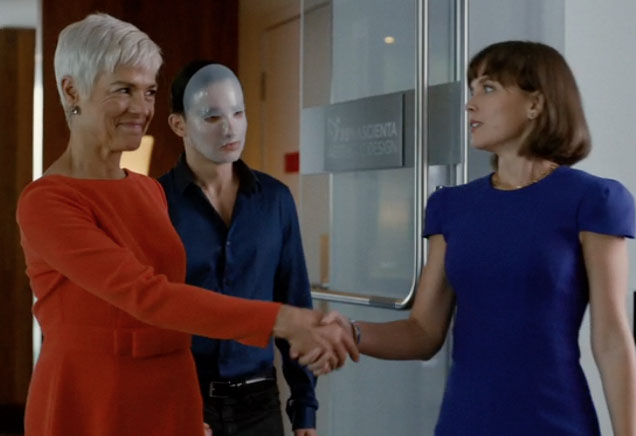
Laura meets her new patient for facial reconstruction
“The most impressive performance and character in Incorporated is its deeply imagined world,” writes Jensen. “Throwaway ideas, like a grieving widow who hires Laura to remake a poor immigrant in the image of her dead husband, could seed whole episodes of Black Mirror. James Bond would kill for the arsenal of gadgets Aaron deploys in his soul-staining subversions.” Nuanced minutiae and brilliant minor characters weave a mad tapestry that enrich and intrigue.
Water price in the Red Zone
And like a Seurat painting, their subtle details change with perspective and build into a subliminal realism you can’t shake: from the food porn in the opening scene to eating rats in climate relocation camps or drinking dirty Red Zone water that costs $5. In Cost Containment we learn that Spiga competitor Inazagi is developing salt-tolerant crops that, like the mangroves, will thrive on irrigated seawater in the deserts left by an exploitive short-sighted America: Iowa, Missouri, Kansas—all the dust storm states. In a later episode, a murdered corporate executive is found by two dowsers on the dried lakebed of Missouri’s Lake Lotawana. We hear about the “oil wars” in Capetown.
Aaron (Ben) in the Red Zone
“This “makes it hard to not think of the current political and cultural state of things across the globe,” writes Aaron Pruner of Screener TV. The fourth episode (Cost Containment) “opened with a familiar feeling infomercial. Yet, instead of Sally Struthers pleading with the common American to donate money to help feed a starving child in a third-world country, [a Chinese narrator presented] the United States as that third world.” Liz Shannon Miller of IndieWire writes: “watching [that scene] at this exact moment in our history is science fiction that might be a little too real. You can forget about The Walking Dead or The Exorcist: Incorporated may be the scariest show on television. Says Pruner, “The thing that brought us here? Climate change.”
Julian Morse interrogates Ben about illegal use of Spiga tech
“It’s what gives us … the refugee camps and ration hacking, the high-class cut-throat world of corporations and the privileged, yet dangerous, culture that comes with it,” adds Pruner. The corporation’s tyrannical demand for allegiance through rumours of loss of privileges, “contract termination”—or worse—resonates through the ranks in what the hacker in the Red Zone calls ‘cattle prod.’
Red Zone hacker sets Caplan to catch a rat as payment for her creating an illegal hacking device for him
“You poor suits, always trying to catch up,” says the Red Zone hacker (Sara Botsford) to Roger Caplan (Douglas Nyback), ambitious executive looking to steal his way to the top. “A climber like you gets caught with something like this [a ‘keyhole’, which “allows you to snoop in any system without leaving any footprints”] he’s gonna get spanked. Or worse.” Word is out that Spiga security can be very inventive with cattle prod.
Spiga’s main competitor Inazagi (a take on Izanagi, the male Japanese Shinto god responsible for creation) starts its propaganda machine on the very young to keep its corporate family in line. The third episode (Human Resources) opens with an Izanagi propaganda video for children. TV Fanatic calls it “both cute and chilling. Teaching your children to rat out Mom and Dad is pretty cold, but hey, this is the future, right?” But is it just the future? I’m confident that TV Fanatic wasn’t born yet when the Nazis formed the Hitlerjugend. But I would suggest they look up what Santayana said about history…
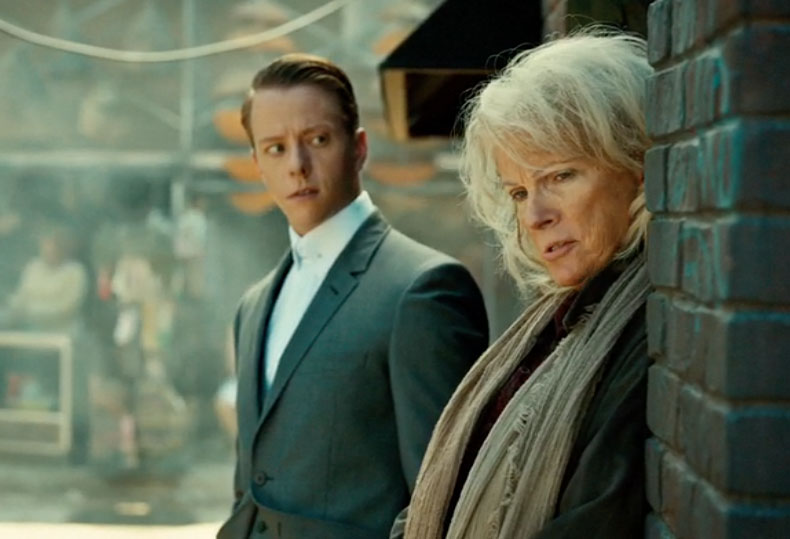
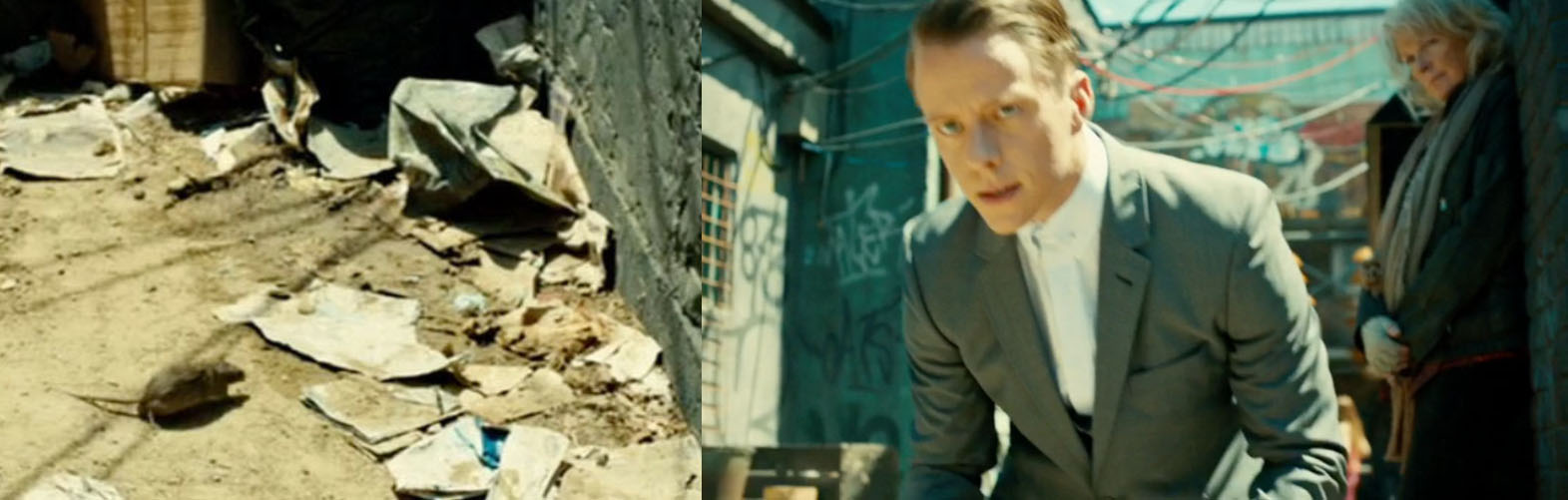
In one of the best played and most gratifying narrative threads of the show, a Red Zone techno-hacker (played by Canadian actress Sara Botsford) provides some twisted humour as she easefully negotiates the Spiga machine to put corporate brat Roger Caplan in his place, enlighten us on some history and entertain us all at the same time. After Caplan disdainfully throws money at her to create a skeleton key to bypass the self-destruct protocol of his stolen keyhole, the hacker ops for entertainment instead as payment: she takes him outside her secured warehouse enclave and points to a small rat feeding on the debris in the adjoining alley.
Caplan chases after the rat as the Redhacker looks on, amused
“You see her?” To Caplan’s quizzing look, she points. “Beady eyes, pair of whiskers, long tail…” He finally gets it; the rat. “I want you to catch it,” the hacker bates him. “All ya gotta do is catch a little animal with the brains the size of a peanut. How hard can that be?”
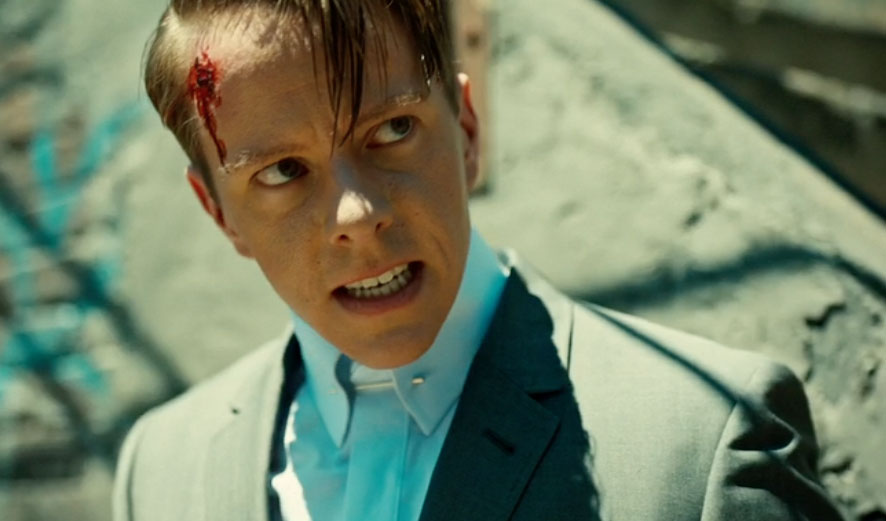
After Caplan’s first attempt, in which he cuts his head, she croons, “Now that’s entertainment!” And chortles like a witch; but we find ourselves cackling with her. After successfully humiliating Caplan, the hacker forces him to do more. She starts with her own history: “I got here with the first wave of climate refugees, chased up north by the sandstorms. Government rations were never enough. You were probably sucking on your gestator’s tit,” she scoffs at Caplan, “while my brother and I had to scramble for enough protein. Sometimes there was only one source of it. Although it was everywhere, really…” Her gaze drifts down to the dead rat on the floor that Caplan had brought in at great expense to his clothes and pride. She adds, “I’d tell you it tastes like chicken but I don’t really remember what chicken tastes like. Why don’t you tell me whether it tastes like chicken…”
What follows is some deep gratification in witnessing Caplan—self-centered and greedy corporate archetype—get schooled by a “lowly” but sly plebe. A “little old lady” no less! And let’s not forget the wily rat who sent him on that hellish chase in the first place…
Disgruntled Caplan after his first attempt to catch the rat
Pruner asks, “Could climate change push us into a collapsed society, informed consistently by the ongoing threat of class warfare? Will we eventually be separated by electric fences and really big walls? Are fear and greed going to be the currencies of our reality? These burning questions should sound far-fetched and silly, but as we watch Incorporated’s tale unfold, it’s hard not to wonder what our own future will bring.” Far-fetched and silly? Is it any more far-fetched and silly than voting in a president who claims that the Chinese invented climate change to make American manufacturing non-competitive?
Ben studies a file
The best entertainment doesn’t put you to sleep; it wakes you up. The best entertainment doesn’t just offer visceral escape; it engages you on many levels to connect, think and feel. And like all good things—friendship, love, family and home—its core value lies in its subtle yet deep truths. The best entertainment shows you a mirror of yourself. Incorporated is less thriller than satire. It is less science fiction than cautionary tale.
The real and the unreal worlds of the post-climate change world of Incorporated
“You look to Incorporated for dystopian fiction that expresses our current anxieties,” says Jensen. “What you get is fitful resonance that makes you realize it might be too soon for any show to meet that challenge.”
Or is it more that we may be too late…
Nina Munteanu is a Canadian ecologist / limnologist and novelist. She is co-editor of Europa SF and currently teaches writing courses at George Brown College and the University of Toronto. Visit www.ninamunteanu.ca for the latest on her books. Nina’s bilingual “La natura dell’acqua / The Way of Water” was published by Mincione Edizioni in Rome. Her non-fiction book “Water Is…” by Pixl Press (Vancouver) was selected by Margaret Atwood in the New York Times ‘Year in Reading’ and was chosen as the 2017 Summer Read by Water Canada. Her novel “A Diary in the Age of Water” was released by Inanna Publications (Toronto) in June 2020.
I’m an ecologist; I study environmental relationships. Something you’d think is easy to learn and very accessible; we’re surrounded by it, after all. We live, work and play in it. While I learned about environmental relationships with my eco-minded parents, I didn’t learn it or experience it in my school growing up. With the exception of some indigenous schools (which teach respect for the spirit of wildness), most of us certainly didn’t learn about environmental relationships in our schools.
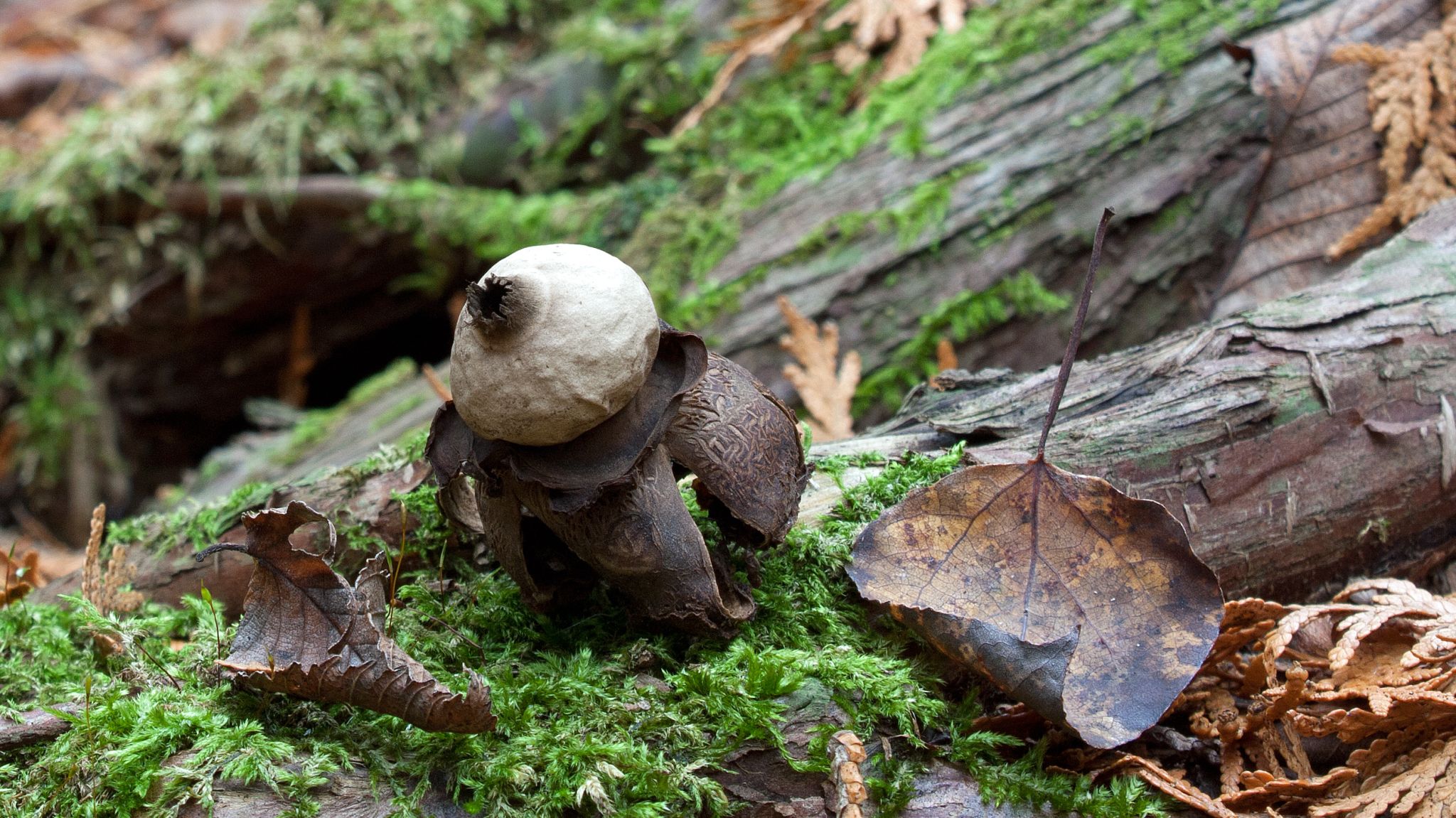
Earthstar sits on moss-covered rotting cedar log as new cedar roots take hold, ON (photo by Nina Munteanu)
Most Canadians live in a city; we don’t really understand what the natural environment is. Many of us have learned to ignore it, stop recognizing it, pocket it away as we go about our busy lives in the city. A park is a bit of greenery. A tree is a decoration that provides shade. Shrubs border a mall.
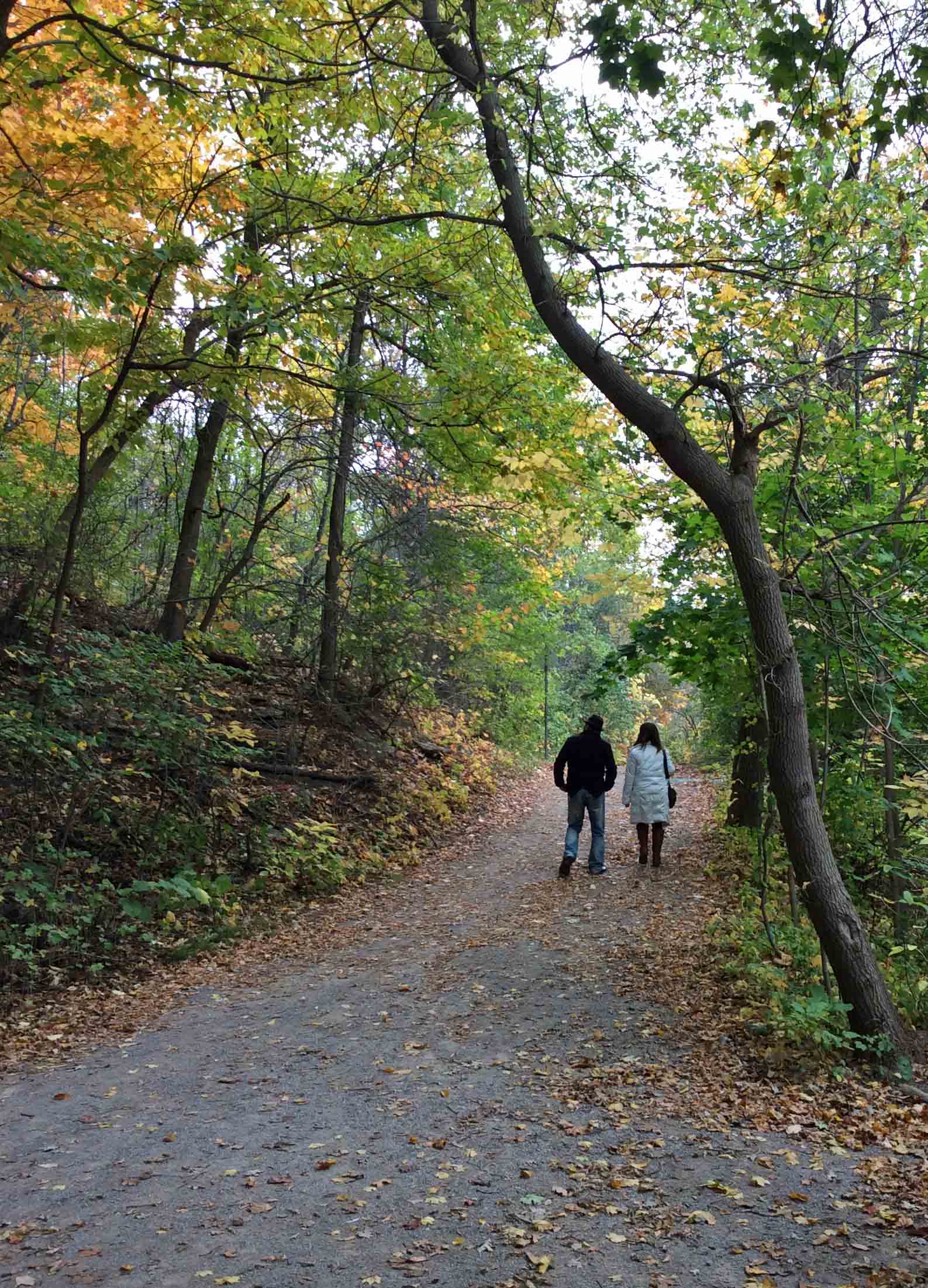
Walk through urban forest along the Credit River, ON (photo by Nina Munteanu)
But if we can’t even recognize the natural environment, how can we understand its functional role in the intricate well-being of this entire precious planet and ultimately ourselves?
It is no wonder then that most Canadians—though we may intellectually accept climate change and its effects on this planet (because we’re smarter than some)—likely do not viscerally understand or appreciate why and how it will drastically change our lives. For most of us, climate change—as with Nature—is something that is happening to someone else, somewhere else. From those far away calamities to the quiet struggles no one talks about. We hear and lament over the flooding in Bangladesh or the Maldives. Or the wildfires in northern British Columbia. Or the bomb cyclones of the eastern seaboard.
Meanwhile, the polar bear struggles quietly with disappearing sea ice in the Canadian arctic. The koala copes quietly with the disappearing eucalyptus. Coral reefs quietly disappear in an acidifying ocean. Antarctic penguins silently starve with disappearing krill due to ice retreat. And while jellyfish invade the Mediterranean, UK seas and northeast Atlantic, the humble Bramble Cay melomys slips quietly into extinction—the first mammal casualty of climate change.
Yellow Creek flows through an urban forest in the heart of Toronto, ON (photo by Nina Munteanu)
So, those of us who are enlightened speak of climate resilience and adaptation. We talk of arming our cities with words like green infrastructure, stormwater management, urban runoff control, flood mitigation. Ecological literacy. But what are these things to us? They are tools, yes. Good tools to combat and adapt to the effects of climate change. But will they create resilience? I think not.
I’m a limnologist and I’ve consulted for years as a scientist and an environmental consultant. I played a role in educating industry, in the use of mitigating tools, in changing the narrative even.
Trail through urban forest on a foggy winter day in Peterborough, ON (photo by Nina Munteanu)
But I’ve come to realize that resilience comes only from within and through a genuine connection with our environment. Tools, no matter how proficient, are only as good as how they are used based on intention from a deep understanding. It isn’t enough to achieve the HOW of things; we must embrace the WHY of things. And that comes from the heart. We must feel it in our hearts. Or it won’t work. And we quite simply won’t survive.
Various flowers and trees of Ontario (photos by Nina Munteanu)
Canadians celebrate our multi-cultural heritage. We pride ourselves in our tolerance and welcoming nature. Our national anthem speaks of our land. Our national symbols embrace nature with the maple, beaver, caribou and loon. Yet who of us knows the habitat of the loon—now at risk, by the way (climate change will impact much of its breeding grounds). Who knows what the boreal forest—which makes up over half of our country—is? How it functions to keep this entire planet healthy, and what that ecosystem needs, in turn, to keep doing it? How to help it from literally burning up?
Ecology isn’t rocket science. Ecology is mostly common sense. Ecology is about relationship and discovery. Ecology is a lifestyle choice, based on respect for all things on this planet and a willingness to understand how all things work together.
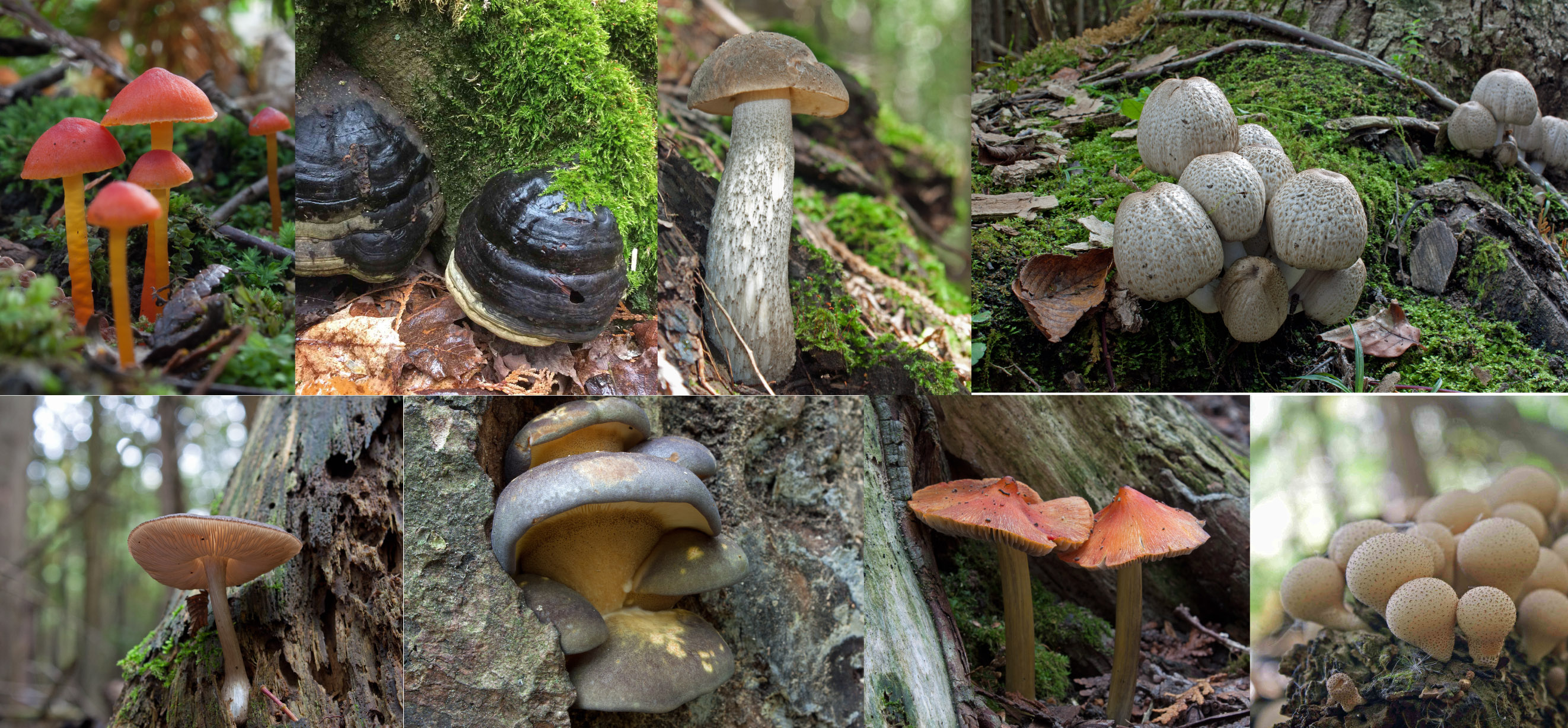
Various mushrooms in Ontario forests (photos by Nina Munteanu)
Here’s what I’ve learned to keep me caring and remain positive and not become apathetic or fall into despair:
I’ve learned to open myself to discovery. To find Nature, even if it is in the city. To connect with something natural and wild and to find and savour the wonder of it. All that matters will naturally come from that.
Become curious and find something to love.
When you do, you will find yourself. And that is where you will find resilience. What colour is it? It doesn’t need to be green…
Throughout this article I’ve shown you some of my colours…
Red fox skull emerges on a leaf-strewn icy bank of Jackson Creek, ON (photo by Nina Munteanu)
Here are the steps I taught myself toward healthy resilience (the first two steps are both the hardest and the easiest):
Step 1:Slow down, pay attention. Give yourself the time to relax and look around your local surroundings. Until you slow down to actually look, you will not really take in your surroundings. You need to be in the moment. Only then can you take the time to use all your senses to take in your environment. Try to look at it from a different perspective. Notice the light, the smells and sounds. What is different? What is the same?
Step 2:Lower your guard, open yourself to curiosity. Rely on as many senses as you can (sight, hearing, smell, texture, taste) to sample your environment and show some humility to ask questions. Whenever I go out, particularly in Nature, I make a point of coming home with three gifts, discoveries that make me smile or think and wonder. I’m hardly ever disappointed.
Step 3: Process what you’ve seen and discovered. Do some follow-up research to questions that may arise. Look at consequences. Share with others, discuss. From there it will be easy to ‘take responsibility’ for some section of nature that you really like; perhaps a particular tree in a park or a short path through an urban forest or stretch of urban stream. This can easily lead to good stewardship.
Step 4: Take responsibility for your chosen part of Nature. Get to know it well, how it works, what it needs, what’s right and what’s wrong. Do something about it and share with others.
Step 5: You’re there. You are resilient.
Barred owl hiding in plain sight in an urban forest near Peterborough, ON (photo by Nina Munteanu)
Nina Munteanu is a Canadian ecologist / limnologist and novelist. She is co-editor of Europa SF and currently teaches writing courses at George Brown College and the University of Toronto. Visit www.ninamunteanu.ca for the latest on her books. Nina’s bilingual “La natura dell’acqua / The Way of Water” was published by Mincione Edizioni in Rome. Her non-fiction book “Water Is…” by Pixl Press (Vancouver) was selected by Margaret Atwood in the New York Times ‘Year in Reading’ and was chosen as the 2017 Summer Read by Water Canada. Her novel “A Diary in the Age of Water” was released by Inanna Publications (Toronto) in June 2020.
Requiem for a Lotus takes place in 1917 Shanghai, where police detective Harmon Fletcher must solve the murder of a Chinese sing-song girl he’d failed to protect. Adding his Canadian prairie hunting experience to modern forensic techniques, Fletcher scours Shanghai’s dangerous jig-saw underworld for answers. But while he brings one killer to justice, another escapes, and Fletcher must sacrifice more than he expected before he’s done.
Here’s the opening to Requiem for a Lotus:
“When a man named Hong Song Lin shot his neighbour five times for blowing roasted pig smoke onto his second floor balcony, it wasn’t a hard case to figure out. There was two angry men, a gun, and a hot Shanghai summer.”
The judges selected Craig’s novel for its excellent writing and storytelling, a tense and compelling plot and pace, and intriguing characters:
“… What enjoyable reading! The author quickly pulls the reader into 1917 Shanghai and pins them there with its smells, sights, customs and politics … A very engaging crime novel.”
“… Loved the historical setting of Shanghai and it kept me fascinated … Inspector Fletcher is a solid and clever character, a somewhat rougher Sherlock Holmes.”
Requiem for a Lotus is the first novel of a trilogy. I’m confident that this exciting crime novel and series will be snapped up by a publisher soon. And when it is, I’ll be buying a copy.
Here’s Craig’s podcast interview with CWC interviewer Erik D’Souza when the manuscript was a finalist before it won top prize:
Nina Munteanu is a Canadian ecologist / limnologist and novelist. She is co-editor of Europa SF and currently teaches writing courses at George Brown College and the University of Toronto. Visit www.ninamunteanu.ca for the latest on her books. Nina’s bilingual “La natura dell’acqua / The Way of Water” was published by Mincione Edizioni in Rome. Her non-fiction book “Water Is…” by Pixl Press (Vancouver) was selected by Margaret Atwood in the New York Times ‘Year in Reading’ and was chosen as the 2017 Summer Read by Water Canada. Her novel “A Diary in the Age of Water” was released by Inanna Publications (Toronto) in June 2020.
No writer works alone. Sure, we may work alone when writing, but all other aspects of getting our writing out to you, the reader, involves a team of other people. Like all good things, writing is a collaborative affair. All professional writers enter a contract with their publisher to work with editors, marketers, and also with cover artists, designers and interior artists. All together create the final artistic expression shared with the reading audience.
I want to focus on the latter here and celebrate how art and design help create more than what the writer alone produces. When my writing career started in earnest in 1995 with my first publication in a professional magazine, I was involved in collaborations with artists, who all improved my work.
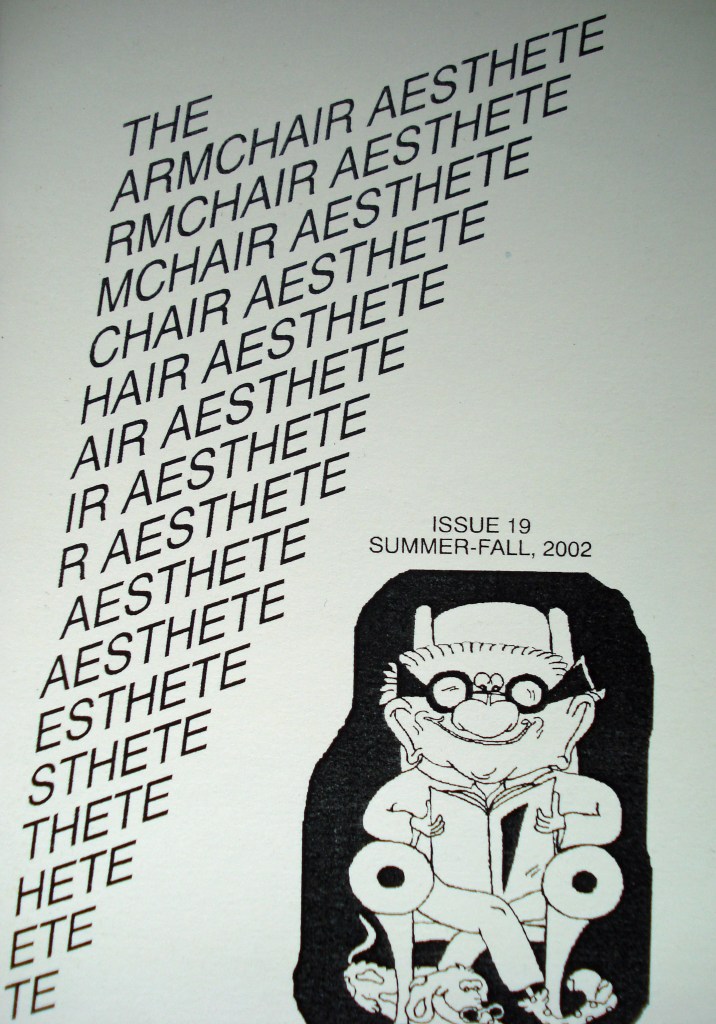
Arc of Time was my first short story publication, appearing in Armchair Aesthete in the Summer/Fall issue of 2002. Armchair Aesthete is a small literary magazine in the United States and features funky cover art.
Magazine cover for Ultra! and interior design for “Arc of Time”
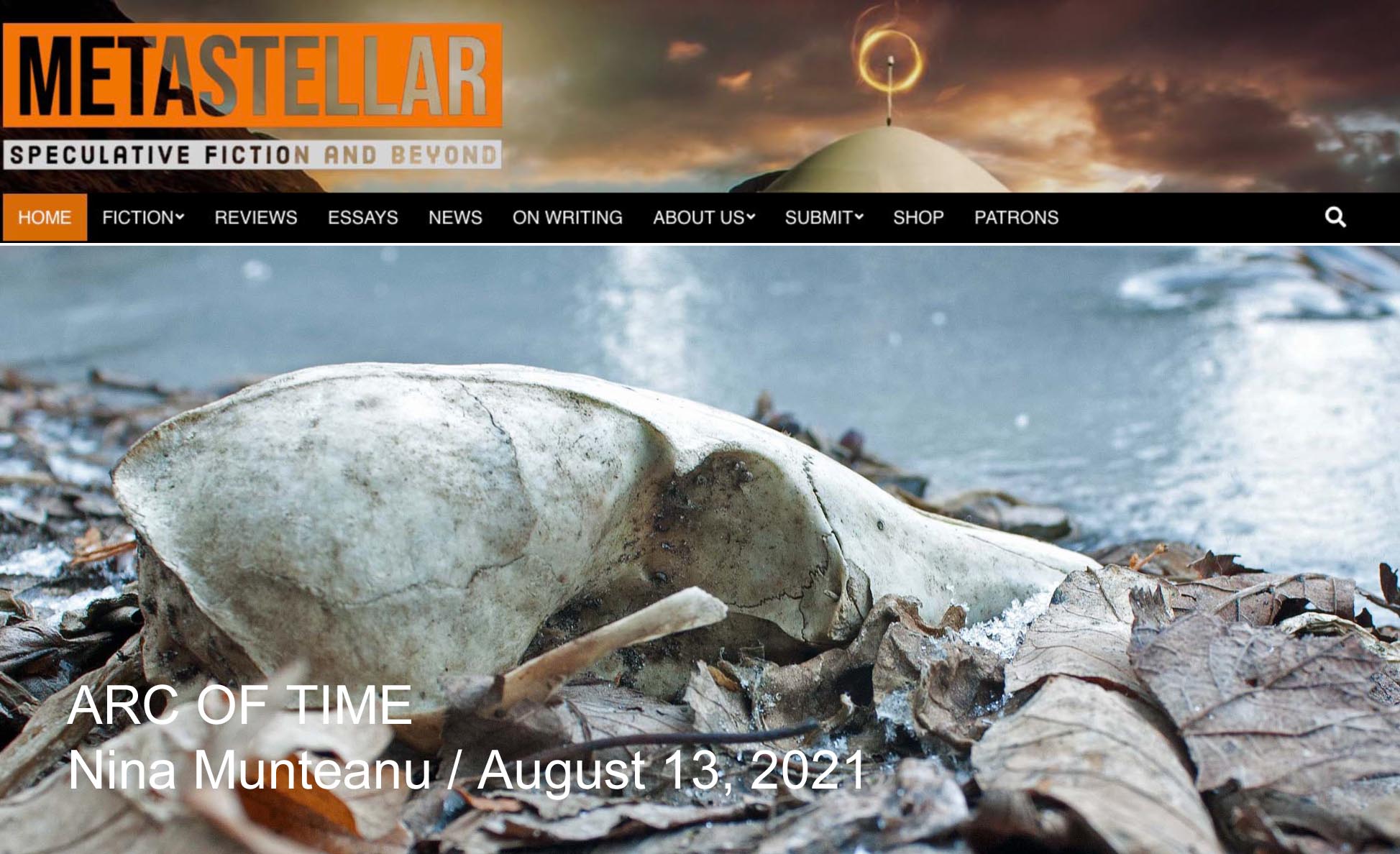
Arc of Time was then accepted in the premiere issue of Ultra! (Aardwolf Publications) in 2004. That issue contained a fully illustrated and designed interior, which really set off the story—an epistemological exchange of emails linked with narrative. In 2013, MetaStellar Speculative Fiction and Beyond, which provides illustrations for each story it carries, used one of my own photographs to illustrate Arc of Time.
Feature cover illustration for “Arc of Time” on MetaStellar site
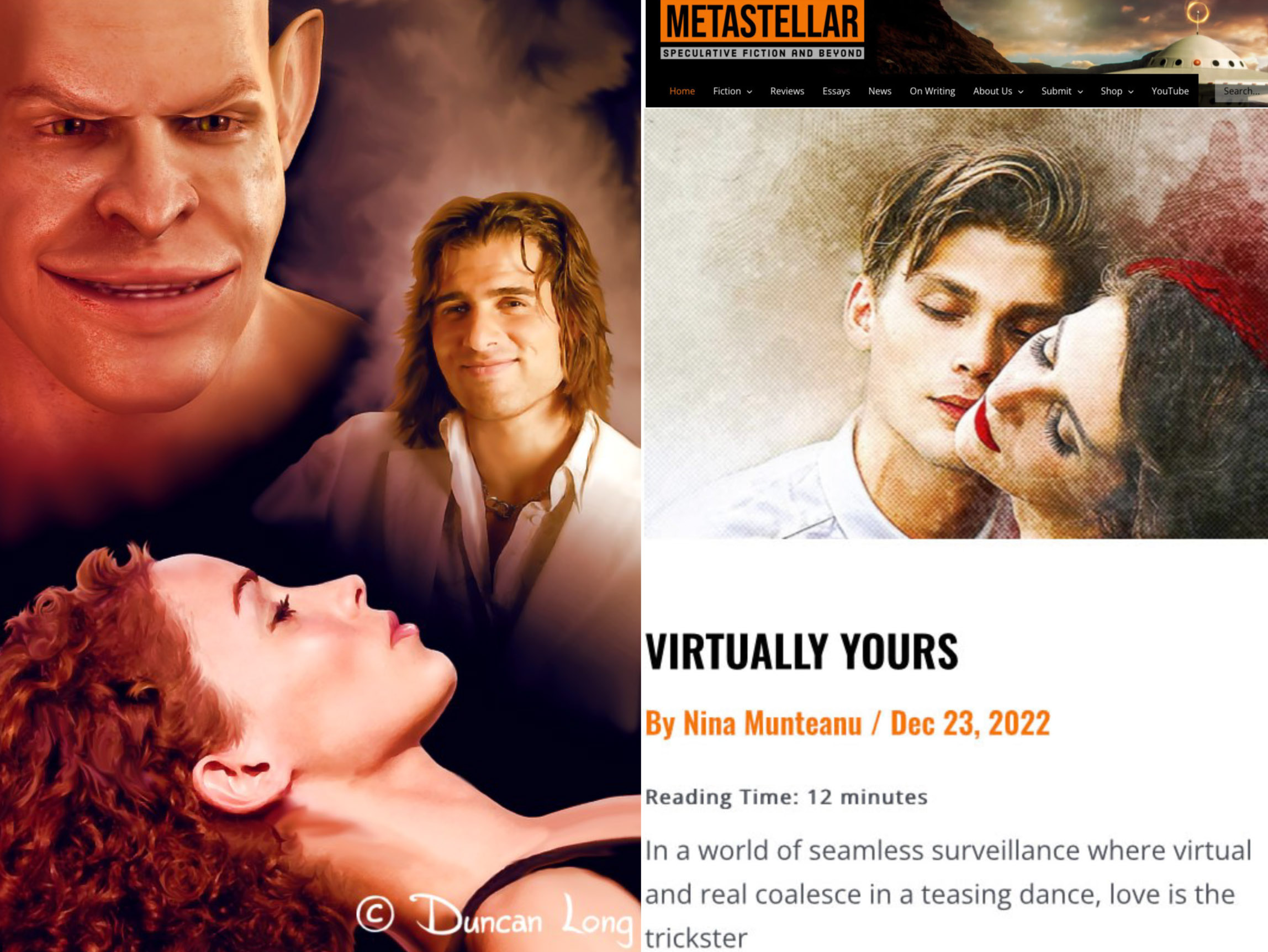
Virtually Yours first appeared in Hadrosaur Tales in Issue #15 in December 2002. Hadrosaur Tales is a small but vibrant literary magazine out of Las Cruces, New Mexico and featured interesting covers.
Cover and story illustrations in Nowa Fantastyka for “Virtually Yours”
Virtually Yours was republished all over the world and is up to its tenth publication this year. Several publications included artwork specifically for the story. Nowa Fantastyka, out of Poland, is a slick magazine that boasts a lot of images, colour interiors and illustrations. My story was introduced with illustrations that enhanced its impact.
Interior illustrations for “Virtually Yours” in Amazing Stories and MetaStellar, respectively
Its reprint in Amazing Stories was illustrated evocatively by Duncan Long. In the story’s later reprint in MetaStellarSpeculative Fiction and Beyond, Brigitte Werner created a beautiful illustration for the story.
Nowa Fantastyka cover art and story artfor “A Butterfly in Peking”
A Butterfly in Peking first appeared in Issue #17 of Chiaroscuro in 2003. Its reprint in the Polish magazine Nowa Fantastyka in 2005 included interior art that introduced the tone and feel of the story.
Megan Survival Anthology cover art and story artfor “Fingal’s Cave”
Fingal’s Cave was first published in The Megan Survival Anthology (Reality Skimming Press) in December 2016. The publication included art by Jeff Doten specific to each story in the anthology and I found his artwork for Fingal’s Cave wonderfully intriguing.
Artwork for “The Way of Water” in various publications
The Way of Water was first published in Future Fiction then in a smart print publication by Mincione Edizioni in Rome, Italy in May 2016. The story was reprinted several times and artwork associated with it included in some of the publications. One is Little Blue Marble, an online magazine that features artwork for each story it runs.
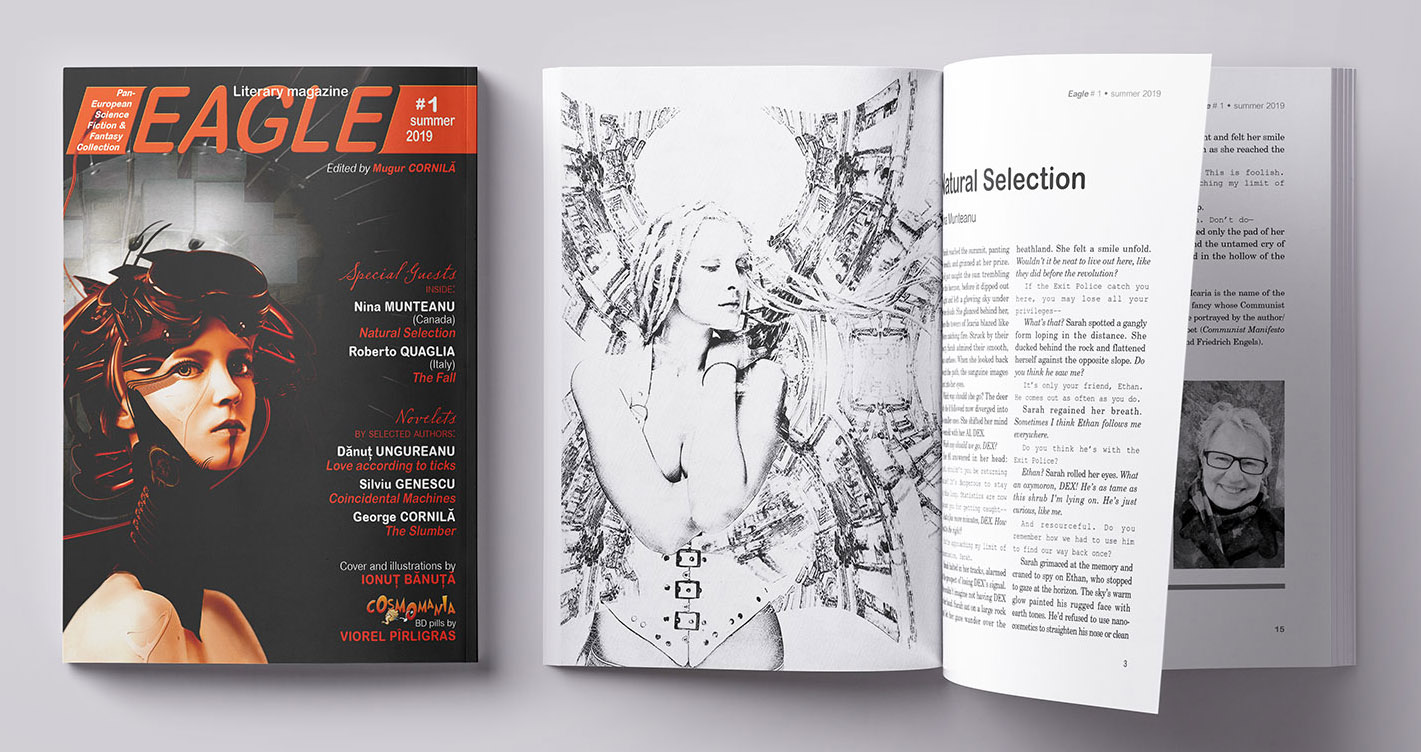
Cover art of Eagle Magazine and story art for “Natural Selection”
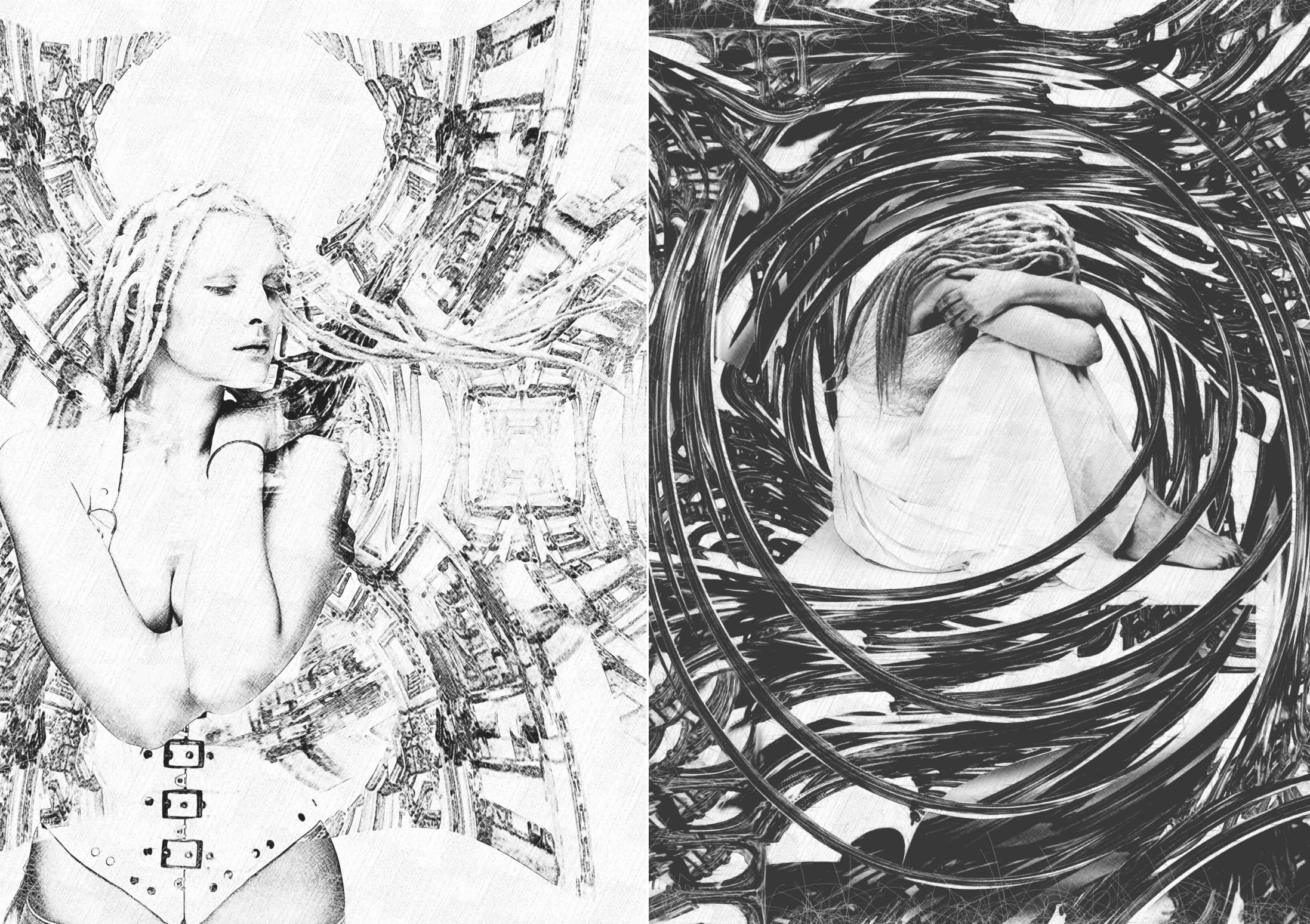
Natural Selection first came out in my short story collection of the same name in 2013. It was then reprinted in the premiere issue of Eagle Magazine and featured stellar and evocative interior illustrations by Ionuț Bănuță.
Interior story art for “Natural Selection”
Out of the Silence first appeared in Issue #85 of subTerrain Magazine in May 2020 and featured diverse and rich interior art and design (not pictured here). Its reprint in A House of Dawn in 2021 received its own artwork, which enhanced the tone and subject of the story.
Cover art for subTerrain Magazine and story art for “Out of the Silence” in A House of Dawn
I’d be remiss if I didn’t add the important artwork of artists on the covers of several of my novels and collections. As a reader, I can attest that cover art plays an important role in introducing a book to a potential reader. Whether we pick up a new author’s book to peruse depends upon the image, title and design of the cover. I have been very fortunate with my publishers and their artists.
Book covers for “Collision with Paradise” and “The Cypol”
My first published novel (Collision with Paradise) and novella (The Cypol)—both SF erotica—were designed to intrigue and titillate.
Costi Gurgu illustrated and designed the covers of my space detective thriller The Splintered Universe Trilogy for Starfire. The three books and their covers, formed a tryptic that reflected the journey of the lead character—a badass galactic detective—and her evolution.
Cover art for books of “The Splintered Universe” Trilogy
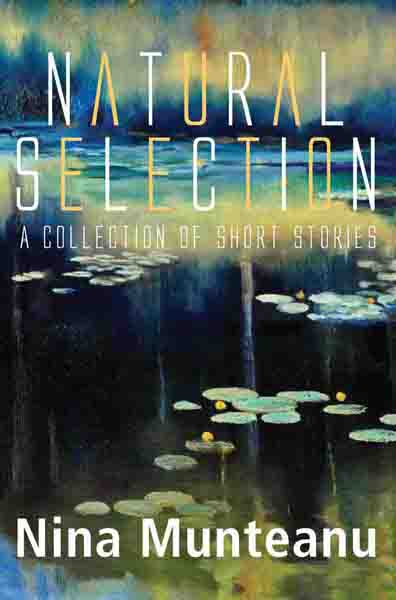
Costi Gurgu also designed the cover of my short story collection Natural Selection for Pixl Press in 2013 using an illustration by West Coast artist Anne Moody that showed the fluidity of nature.
Tikulin-illustrated covers for “Darwin’s Paradox” and “The Last Summoner”
Tomislav Tikulin illustrated the cover of my novel Darwin’s Paradox for Dragon Moon Press in 2007. The cover image ostensibly represented a work of hard science fiction and attracted much attention from SF fans. Tikulin’s evocative illustration of a knight in a drowning cathedral was then used for the cover of The LastSummoner for Starfire, with attractive typology design by Costi Gurgu. As with all of Tikulin’s work, this mysterious cover attracted the attention of many readers with many questions.
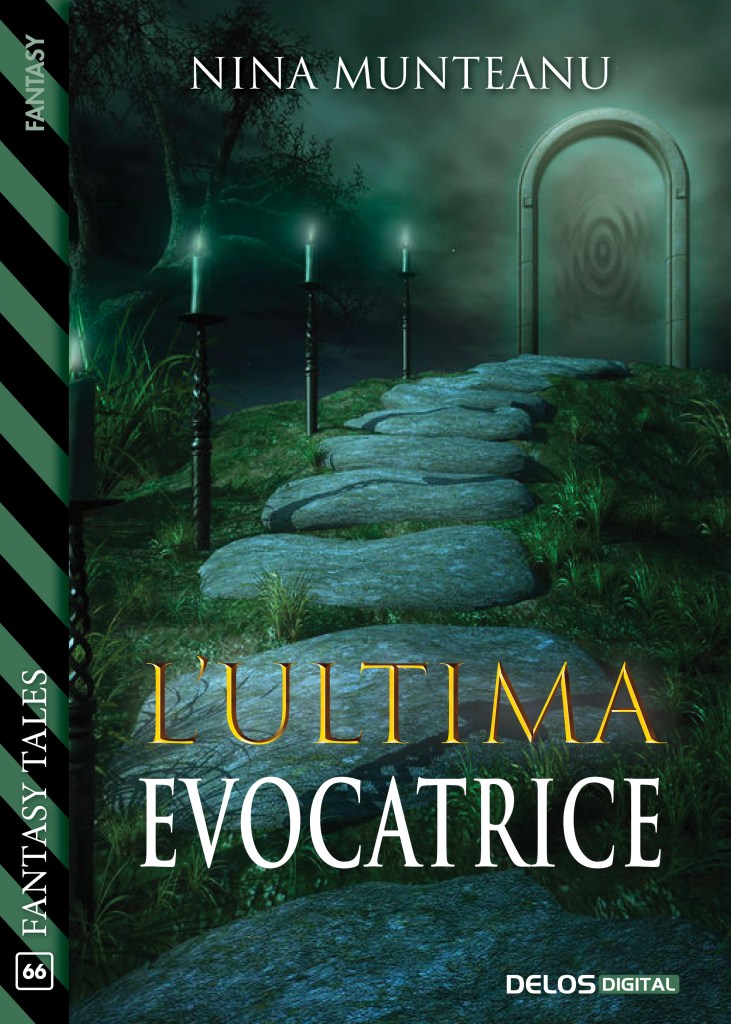
L’Ultima Evocatrice, a novella version of The Last Summoner in Italian was illustrated and designed for Delos Digital Publications in 2021 and draws the reader into the intrigue of the story.
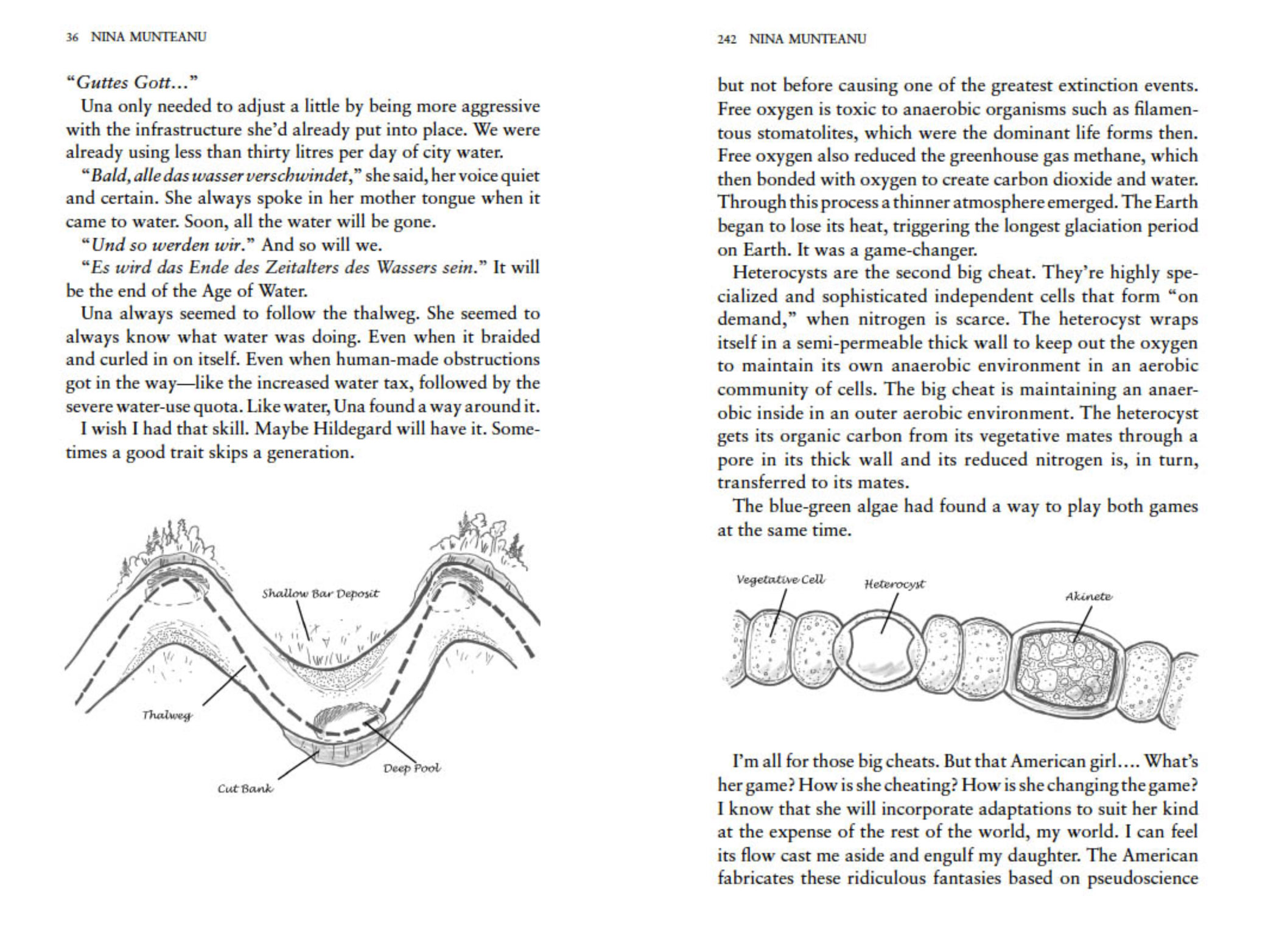
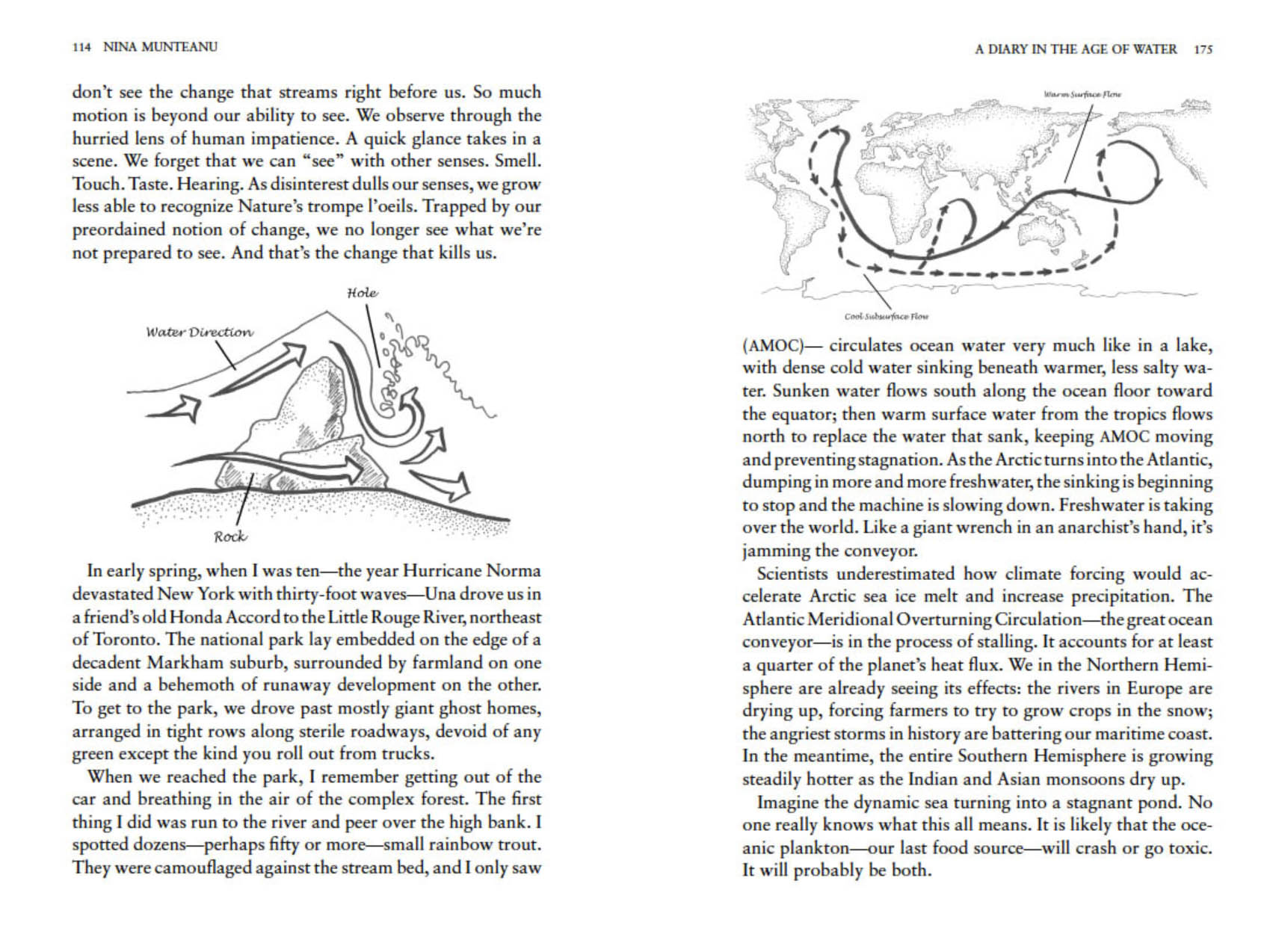
My most recent novel, A Diary in the Age of Water, published by Inanna Publications in 2020, features elegant cover art by Val Fullard and over thirty pieces of interior art work by my own hand.
Interior art representing the diarist’s sketches in “A Diary in the Age of Water
I wasn’t sure if the publisher would agree to use my sketches, but she did, to my surprised delight. She agreed with me that the interior illustrations, which represent sketches by the scientist diarist, lend a tangible reality to the story and a further focus of interest.
Interior art representing the diarist’s sketches in “A Diary in the Age of Water
Interior art representing the diarist’s sketches in “A Diary in the Age of Water”
The excitement never ends for me as a writer … With the newest installation to the Icaria Series imminent, Dragon Moon Press will be re-issuing Darwin’s Paradox and Angel of Chaos, along with the newest addition Gaia’s Revolution along with new covers and interiors. I can’t wait to see what Dragon Moon Press comes up with! …
Cover art of print publications my work has appeared in up to 2021-end
Nina Munteanu is a Canadian ecologist / limnologist and novelist. She is co-editor of Europa SF and currently teaches writing courses at George Brown College and the University of Toronto. Visit www.ninamunteanu.ca for the latest on her books. Nina’s bilingual “La natura dell’acqua / The Way of Water” was published by Mincione Edizioni in Rome. Her non-fiction book “Water Is…” by Pixl Press (Vancouver) was selected by Margaret Atwood in the New York Times ‘Year in Reading’ and was chosen as the 2017 Summer Read by Water Canada. Her novel “A Diary in the Age of Water” was released by Inanna Publications (Toronto) in June 2020.
It started with a simple tweet of mine on X regarding doing research for one’s writing projects. I’d met Isabella Mori a few years ago, when we both contributed to an ekphrastic anthology of flash fiction, inspired by Group of Seven art. We met again when she submitted a story to an anthology I was editing for Exile Editions. After my tweet on research, Isabella and I traded brief stories about rewrites based on research findings and ‘mistakes’ and the arcane revelations in the creative process that may result. I was intrigued by her recounting and asked her to share it with you; so here it is:
“Synchronicities And The Sea”by Isabella Mori
(Trigger warning: Substance use and suicide)
This is about the magic that comes to pass when we let the Muse guide our work and consent to synchronicity. Here is what happened:
When I go away on vacation, I try to visit the local library, and always make sure to check out the community announcements. On one of those forays, I came across a notice of a project that teamed up visual artists with writers for a short story or poem. I love these types of collaborations and immediately jumped on it. Max was the artist I paired up with, and we hit it off right away. After a few conversations, we settled on the painting below, for which I was going to write a story. As you can see, it had a moody, dark feeling. I drafted this text as a response:
The memory of a map showed her the way as she wandered, blinded by the night, along the shore. Numb with cold, her bare feet dug into the wet sand. She could not see that she left no tracks. There was something in her searching; she felt it in the deep pit of her stomach but there was no image in her mind’s eye of what it was, no tinkling that alerted her, no smell, no taste. A sense of despair drained the blood from her heart and tugged at her from the right, where the forest rushed. Foot-dragging ennui invited her onto a soft-moss carpet to the left, and thoughts of numbers, cars and cash register receipts tried to wrangle her back to where she came from. She was near giving up. But at that precise moment there tracked the light only she of the searching could see—a light bigger more forceful than giants could ever imagine; all-embracing, all-revealing, all-nurturing just like the frothy ocean beneath it, just like the sand with its fierce sparkle, each grain a diamond just like the heart-bud that could not help but open under its rays, under those rays that only she of the searching could see.
However, for reasons we have both forgotten, Max decided to lighten the colours, and the dark mood of the first draft didn’t fit anymore. This is the version we ended up with:
Walk With The Angels
The ocean has known her share of angels over the eons. They come and go but the tide is older. When an angel appears in a cloud of glistening light, beats its wings and brings out the trumpets, little humans fall to their knees and beg for mercy and miracles.
But the water stays still.
Great mother ocean has seen it all.
She waits until the angel grows tired, then she takes the worn-out wings and heavenly body into her arms and carries them into her depths. Brings the apparition to visit kelp, salmon, starfish, barnacles, otters and crabs. Anemones. Killer whales. A visit one by one, under the summer sun, beneath the light of the Hunter’s moon, when the snow falls, with the Easter rains. The angel leaves a bit of themselves here, a bit there, a gift everywhere, until only the tiniest of diamonds are left.
And that’s the sand.
Walk with the angels.
There were a few tweaks before we arrived at this text, the major one being that in a previous version, I referred to ‘angel dust’ for the sand until the editor pointed out that that term refers to a street drug, PCP. In my enthusiasm I had forgotten that.
The change away from ‘angel dust’ was very important. When Max read the new version, they called me, their tone of voice both moved and perturbed.
“When I read this,” they said, “it feels like you channeled what happened with my cousin last year, not far from the place that inspired my painting. She had had problems with drugs all her life, and one day she just walked into the ocean. Her body was found a day later.”
Under those circumstances, we definitely did not want to refer to drugs.
That story stayed with me for months until one day when I was listening to one of my playlists of Latin music. I lived in Paraguay and Chile 1977-1980, and often enjoy the nostalgia of the music I listened to back then. The first song that came on was one of my all-time favourites, Alfonsina Y El Mar – Alfonsina And The Sea. Now I have to confess, I am terrible with lyrics, no matter what language, whether it be my native German, English, or the Spanish I was fluent in for quite a few years. For some reason, I really listened to the song last summer, and then looked up the lyrics. That’s when it hit me – was it possible that the lyrics of that song had subconsciously influenced me to write the second text? Or was it one of those Jungian collective conscious moments?
Alfonsina And The Sea
(Music: Ariel Ramirez. Lyrics: Felix Luna)
In the soft sand Licked by the sea Her small footprints Don’t return. Just one path Full of pain and silence Led to the water, Deep water, And one single path of unspoken pain Led to the foam.
God knows what sorrows accompanied you, What old suffering shut down your voice That made you lie down and nestle into the songs Of the sea snails, The song that sings in the deep dark of the sea, The sea snail.
There you go, Alfonsina, with your loneliness, What new poems did you go find? An old, old voice of wind and salt Sways your soul and carries it And you go there dreaming, Sleeping, Alfonsina, clothed in the sea
Five little sirens will carry you Through passages of algae and corals And glowing sea horses will dance Around you And all the creatures of the sea will soon Play at your side.
Turn down the light a little more, Nurse, let me sleep in peace. And when he calls tell him I’m not in, Tell him Alfonsina won’t come back. And when he calls don’t ever tell him I’m in, Tell him I’m gone.
There you go, Alfonsina, with your loneliness, What new poems did you go find? An old, old voice of wind and salt Sways your soul and carries it And you go there dreaming, Sleeping, Alfonsina, clothed in the sea.
(Used with permission, my translation.)
Alfonsina ended up in the ocean just like Max’s cousin did.
With some research, I found out that the story was about the Argentinian poet Alfonsina Storni who, after a difficult life that included poverty, questions she had about gender identity, and breast cancer, one night wrote a last poem to her son and then let herself fall into the ocean amid torrential rain. (An apocryphal version has her just walk into the ocean, and that’s the one the lyricist chose.) Some of that last poem was incorporated into Alfonsina Y El Mar – the nurse who is asked to lower the light, and told to tell ‘him’ that she won’t come back. Nobody seems to know who ‘he’ is.
The other research that had to happen was to find who the inheritors of Felix Luna’s estate were to obtain permission should I tell the story that you have before you. It turned out to be his daughters. Then I had to sleuth out their contact.
Felix Luna, the lyricist, imagined Alfonsina’s death not only as the terrible tragedy that it was but also as a mystical transformation into a sea creature that nestles into the songs of the sea snails. She finds new poems and sleeps clothed in the sea. She is embraced by sirens and wanders through algae and corals. She dances with sea horses and plays with all the other sea creatures.
I definitely cannot compare myself with a great poet like Felix Luna but notice with humility the similarities of my transformed angel who sinks into the embrace of mother ocean and also visits the more-than-humans of the sea.
I went pregnant with the idea of writing about the experience of Max’s and my collaboration for half a year when in February, I chanced upon a tweet by Nina about research for writing. I met Nina through submitting a story to an anthology she was editing. I told her about needing to tweak the angel story so that it does not talk about angel dust and ended up telling her the outline of what happened. She invited me to write a guest post about this, and here we are.
So many synchronicities. I could have not gone to that library. A different artist could have been paired up with me. Max could have wanted to stay with the original painting. Or they could have chosen a painting that would not have reminded them of their cousin. They could have opted not to share that sad story with me, or they could have been paired up with someone who doesn’t understand suicide as intimately as I do (I look back on a 30+ year career in social services.) I could have heard Alfonsina Y El Mar and still not really listened to the lyrics. There was no guarantee I could have managed to find out from whom to get permission to quote the song. I could not have submitted a story to one of Nina’s anthologies, and could not have followed her on Twitter. Coming across the particular tweet that prompted the publication of this story was like chancing upon a needle in a haystack. All this, and probably more, had to come together for this magical synchronicity to happen.
Thank you, Muse.
(Note: Since this is a sensitive topic, the artist’s name and some of the circumstances of my collaboration with them have been changed. However, the artist has consented to using their images.)
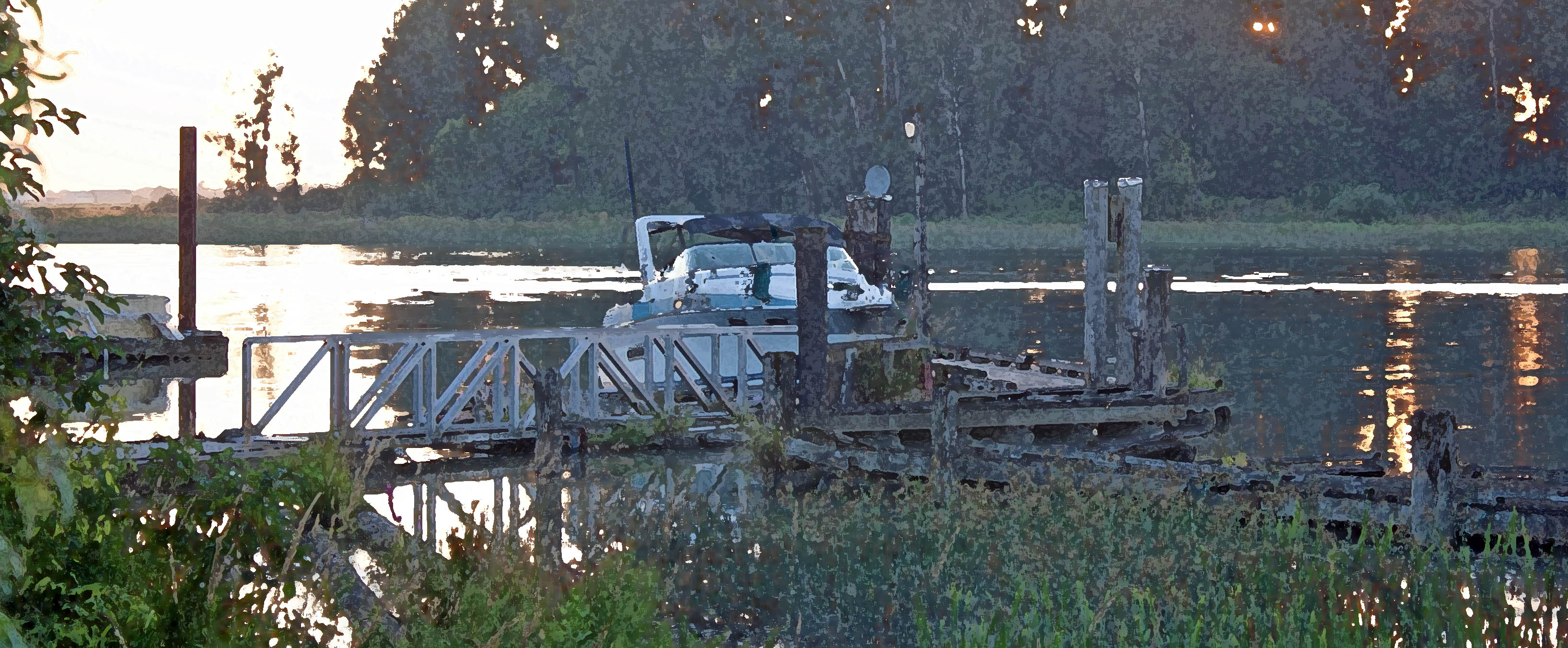
Boat wharf at sunset in Ladner Marsh, BC (photo and rendition by Nina Munteanu)










































 Nina Munteanu Writing Coach

