The Ecology of Print Books: Niche Partitioning by Young Readers

Anne-walking-Cedars

Friend Anne walks boardwalk in giant cedar forest, BC (photo by Nina Munteanu)

A while ago, I wrote about the S-curve in publishing, an ecological phenomenon applied to the book industry. Today I’d like to talk about another ecological phenomenon: niche partitioning.

Earlier this year, SF author and fellow Canadian Cory Doctorow cited several reports on his blog BoingBoing suggesting that “young readers generally prefer to read books from paper, not screens.” More than that, he adds, “they find ebooks and printed books complementary.”

I’m an ecologist and this makes sense to me. It comes down to niche-partitioning. Every organism occupies a niche, which can be defined as that organism’s “job” in its ecosystem; so niche-partitioning is a way for organisms to co-exist cooperatively—rather than competitively and exclusively—by apportioning or segregating various jobs or roles in an ecosystem. It’s a bit like syndicalism vs. capitalism, in which functional, rather than territorial precepts are used.

“The future composts the past,” says Doctorow. “The advent of films made it possible for performances that couldn’t work onstage to be born and it moved all the plays that were uncomfortable fits onstage to the screen. What it left behind were plays that were more like plays—and a theater industry that’s still going strong, even if it’s dwarfed by the screen.” He’s talking about niche-partitioning here.

I generally find that ebooks are convenient for my mobile lifestyle. I’ve recently adopted an itinerant, gypsy life from my former “nesting” days. My family has grown up and left the nest and I’ve gone “walkabout”. My giant library of print books had to find good homes, rather than travel with me to all parts of the world. I keep a collection of virtual books on my device for reference (like a dictionary). I also find ebooks a good option for a one-off read—something I can get cheap and read without needing to “befriend” and keep.

I treasure my few printed books, both reference and story. My reference print books are underlined and marked and worn from being used over and over again. Printed books are best for protracted reading and comprehension. You want a print book when you wish to delve deep into “story” and relax.

As with the theatre becoming more theatre-like, Doctorow adds that, “books are becoming more book-like. Books that work best as e-books—for example, big reference books; but also short works that are too slight to rest comfortably on their own between covers—are moving to e-book-land. Things that are produced as printed books have passed a test in which someone has asked, Is there an important reason for this to exist in print, instead of exclusively onscreen?

I talked about this in my previous article The Future of Books on this blog: “print books will become the epitome of publishing value and worth. Already coveted by collectors whose libraries will represent the best of the best in the literary world, print books will come to represent the highest status in literature. Only the best stories will endure as print books; perhaps only the ‘best book’ will even be published in print form. Its existence in print form will define its literary value.” Niche-partitioning, like I said…

In an article called Why Digital Natives Prefer Reading in Print. Yes, You Read That Right, Washington Post reporter Michael S. Rosenwald reported that, “Textbook makers, bookstore owners and college student surveys all say millennials still strongly prefer print for pleasure and learning, a bias that surprises reading experts given the same group’s proclivity to consume most other content digitally.”

students-print-online2014Rosenwald adds, “The preference for print over digital can be found at independent bookstores such as the Curious Iguana in downtown Frederick, Md., where owner Marlene England said millennials regularly tell her they prefer print because it’s “easier to follow stories.” Pew studies show the highest print readership rates are among those ages 18 to 29, and the same age group is still using public libraries in large numbers.” Rosenwald adds, “And it can be seen most prominently on college campuses, where students still lug backpacks stuffed with books, even as they increasingly take notes (or check Facebook) on laptops during class. At American, Cooper Nordquist, a junior studying political science, is even willing to schlep around Alexis de Tocqueville’s 900-plus-page “Democracy in America.”

I’ve noticed the same phenomenon at the University of Toronto campus where I teach. Rosenwald writes about Frank Schembary, a young student who loves books—printed books. He loves how they smell. He loves scribbling in the margins, underlining interesting sentences, folding a page corner to mark his place. “I like the feeling of it,” says Schembary, reading under natural light in a campus atrium, his smartphone next to him. “I like holding it. It’s not going off. It’s not making sounds.”

Cedar trunk base-LR

Cedar tree, Little Rouge woodland (photo by Nina Munteanu)

Naomi S. Baron, an American University linguist who studies digital communication, wrote a book Words Onscreen that reported her studies of students’ reading patterns. She found, along with other studies, that readers tend to skim on screens. Her favourite response to her question of what students disliked the most about reading in print was: “It takes me longer because I read more carefully.”

Students prefer digital for science and math subjects, where they also have access to online portals and resources linked to their subject matter and assignments.

Niche partitioning makes the world go round. Now, if we can only use its logic in economic systems.

nina-2014aaNina Munteanu is an ecologist and internationally published author of award-nominated speculative novels, short stories and non-fiction. She is co-editor of Europa SF and currently teaches writing courses at George Brown College and the University of Toronto. Visit www.ninamunteanu.ca for the latest on her books.

The Future of “Books”

Path deas park

Deas Park, BC (photo by Nina Munteanu)

An August 2013 survey by bestselling author Marie Force revealed some interesting trends about what American readers like, what format they prefer and where they find their writers. While the survey was fairly small and restricted to Americans (just under 3,000 people responded to 44 questions), I think it provides a good microcosm of what the trend is out there in North America generally.

Here are Marie’s main findings and conclusions:

1. FORM: Readers prefer e-books to paperbacks (77%); many buy in multiple formats, including paperback. 52% of surveyed readers do buy their books in print form. Audio books are slowly gaining popularity.

2. REVIEWS & TESTIMONIALS: Retail reviews such as those on Amazon, Barnes & Noble and other retail sites were more important to readers than author endorsements and reviews by professional reviewers on review sites. Fifty percent of readers preferred reviews posted on retail sites for their information; 16% used Goodreads; 72% said that the designation of “New York Times Bestselling Author” did not make a difference in their purchasing choice. 81% did not subscribe or read the major review publications (e.g., RT Book Reviews, Publishers Weekly, Kirkus, Booklist, NYT Sunday Edition, USA Today)

3. BOOKSTORES: A majority of readers bought their books from a virtual bookseller: 80% of surveyed readers buy from Amazon (Barnes & Noble online was second at 23%; iBookstore/Apple scored 13%). 58% of readers surveyed had visited a real bookstore twice or less in the past year. The remaining percent visited more often.

4. PUBLISHER: readers are more likely to buy a self-published book by an author they know; 94% of readers surveyed are “more likely” to buy a self-published book from an author who is known to them; 68% of readers are “less likely” to purchase a self-published book by an author they don’t know.

5. CONTENT & GENRE: Readers are most interested in stories with outstanding characters, setting, storytelling and writing; 75% chose “all of the above” to encompass each of the elements. Unsurprisingly, 81% of readers chose “Romance” is their favorite genre of fiction; contemporary romance is the favorite subgenre with historical romance as the second favorite.

6. HOW READERS FIND & FOLLOW AUTHORS: the best single-most best social media platform for authors is Facebook, used by 85% of surveyed readers; 75% of readers also subscribed to the newsletters of their favorite authors and 55% subscribed to the blogs of their favorite authors. Twitter was not a major site for readers to find and follow their authors. Goodreads was one of the most frequently mentioned sites in the open-ended portion of the questionnaire.
The numbers don’t always match up; nor is the catchment or method of making statistical conclusions sufficiently explained; but the results as presented make logical sense to me. They make sense because the feedback I am getting in my circles is very similar. So, there you go, writers and readers.

Here’s my take on this phenomenon:

1. Increased sales of Digital Books: the increasing sales of digital books (ebooks) and the rising sales of audiobooks is a wonderful and uplifting icon of rising literacy. More people are reading (and listening) to books now than ever. And we have the digital book, Kindles, Kobos and iPads to thank for it. The “book” has become more accessible and readable. People swarm the public transit, clutching their iPhones and reading devices.

2. Readers still choosing Print Books: Obviously, print books are cherished by readers for their intrinsic value. Books—their tangible tactile presence—will always remain with us; in collector’s showcase libraries, in trendy artistic venues, and funky local neighbourhood venues.

3. My Prediction: print books will become the epitome of publishing value and worth. Already coveted by collectors whose libraries will represent the best of the best in the literary world, print books will come to represent the highest status in literature. Only the best stories will endure as print books; perhaps only the “best book” will even be published in print form. Its existence in print form will define its literary value.

4. Take Home Message to Authors: ensure that your book appears in print form and get it into the hands of classy libraries and classy people.

nina-2014aaNina Munteanu is an ecologist and internationally published author of award-nominated speculative novels, short stories and non-fiction. She is co-editor of Europa SF and currently teaches writing courses at George Brown College and the University of Toronto. Visit www.ninamunteanu.ca for the latest on her books.

When We Burn Books & Ray Bradbury’s Fireman

Book burning Opernplatz

Book burning Opernplatz

The burning of an author’s books…has always been the tribute that an ignorant age pays to the genius of its time — Joseph Lewis

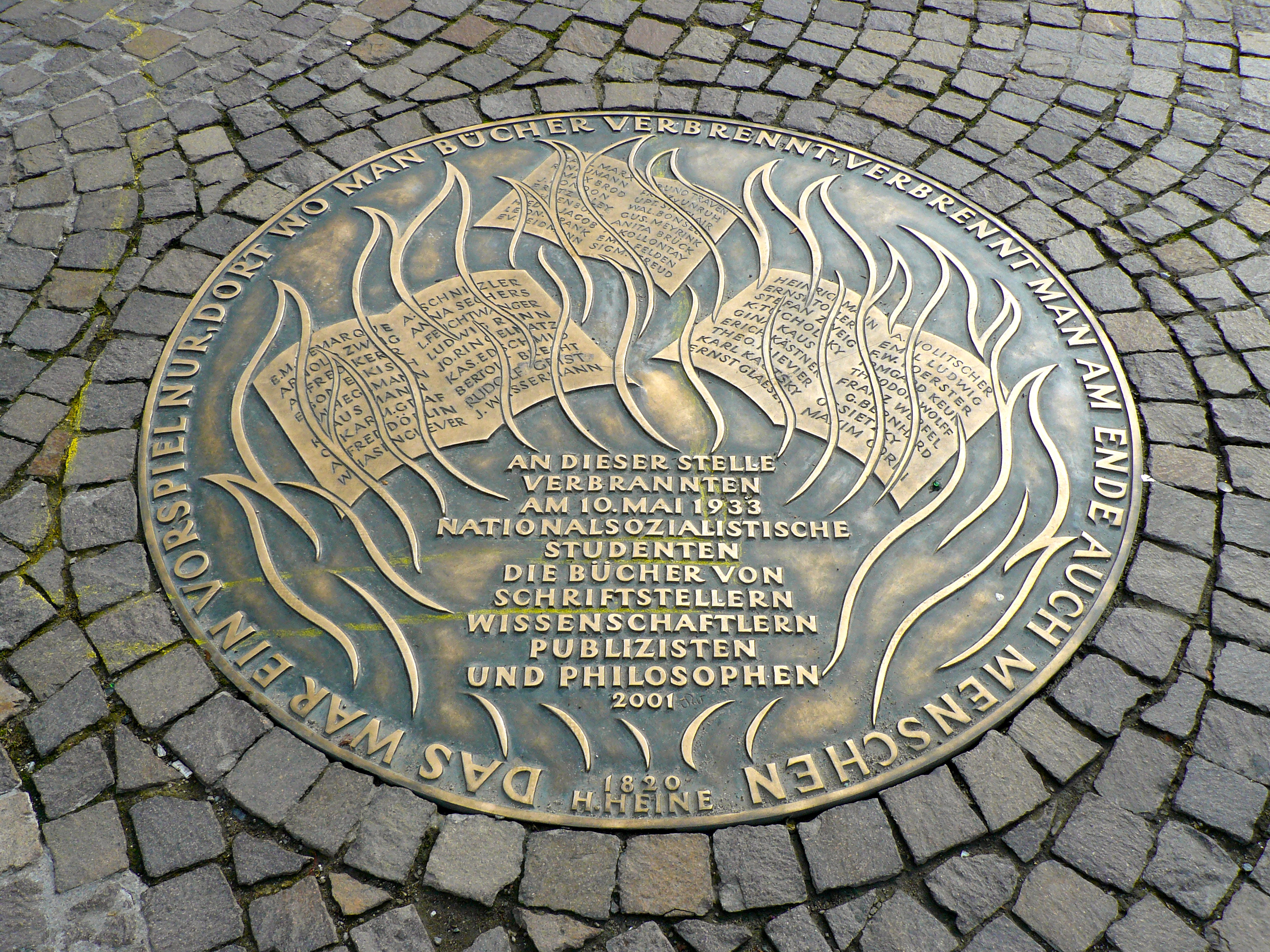
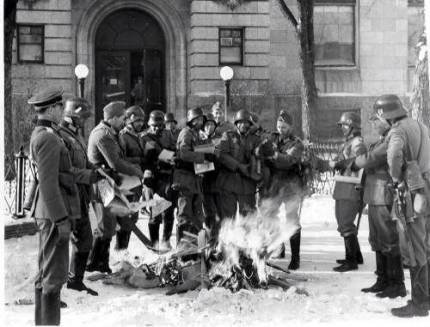
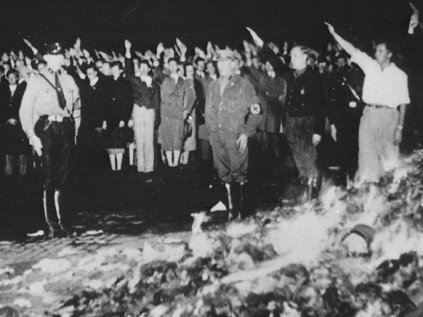
In his 1821 play Almansor the German writer Heinrich Heine wrote (referring to the burning of the Muslim holy book, the Koran, during the Spanish Inquisition): “Dort, wo man Bucher verbrennt, verbrennt man am Ende auch Menschen” –“Where they burn books, they will end in burning human beings.” A century later, on May 10th, 1933, Heine’s books were among the thousands of volumes publicly hauled out and burned in the streets by the Nazis in Berlin’s Opernplatz (Bebelplatz). A violent outburst that did, in fact, foreshadow the blazing ovens of the Holocaust.Commemorative_Plaque_book_burning_Frankfurt_Hesse_Germany

Wikipedia defines ‘book burning’ as the “practice of ceremoniously destroying by fire one or more copies of a book or other written material.” The practice, usually carried out in public (like public hangings in Medieval times) is generally motivated by moral, religious or political objections to the material. Some notable and particularly destructive book burnings have included:

  • the destruction of the Library of Alexandria;
  • burning books and burying scholars (they mean ‘live burying’, folks!) under China’s Qin Dynasty (3rd Century);
  • Cathar texts in the Lanquedoc region of France in the 13th Century;
  • the Talmud in Paris by the French crown in 1242;
  • Arabic and Hebrew books at Andalucia, Spain, in 1499;
  • Servetus’s “heretical” writings along with the writer in Geneva in 1553;
  • Maya sacred books in Yucatan (1562);
  • Tyndale’s New Testament by the English authorities in 1525 and 1526;
  • Luthar’s Bible in Germany (1624) as ordered by the Pope;
  • Robespierre’s destruction of religious libraries in 1793;
  • anti-communist books by the Bolsheviks in 1917;
  • Jewish, anti-Nazi and “degenerate” books by the Nazis in the 1930s and 1940s;
  • Communist and “fellow traveller” books by Senator McCarthy in 1953;
  • The Satanic Verses by Muslims in the UK in 1988; and,
  • Harry Potter books in various American cities, 2001-2005.
Ray Bradbury copy

Ray Bradbury

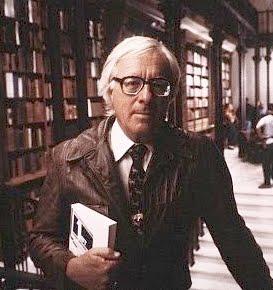
In the 1967 introduction of his novel, Fahrenheit 451 (based on his novella, The Fireman), Ray Bradbury implied that the Nazi book burnings inspired his story. I found his statement both eloquent and powerful: “It follows then that when Hitler burned a book I felt it as keenly, please forgive me, as his killing a human, for in the long sum of history they are one in the same flesh.” For those of you who haven’t yet read his novel (one of my favourite books, ever), this cautionary tale explores a fictional future society that has institutionalized book burning in an effort by authorities to maintain order and ‘happiness’. In Bradbury’s fictional world, firemen don’t put out fires; they start them. The story begins with Montag, an ordinary fireman:

It was a pleasure to burn. It was a special pleasure to see things eaten, to see things blackened and changed. With the brass nozzle in his fists, with this great python spitting its venomous kerosene upon the world, the blood pounded in his head, and his hands were the hands of some amazing conductor playing all the symphonies of blazing and burning to bring down the tatters and charcoal ruins of historyMontag grinned the fierce grin of all men singed and driven back by the flame. He knew that when he returned to the firehouse, he might wink at himself, a minstrel man, burnt-corked, in the mirror.”

bookburning-Opernplatz

book burning in Opernplatz

Bradbury wove a multi-layered political and social tale that followed one man’s journey to find his soul. Fahrenheit 451 explores the theme of intellectual freedom using censorship as his plot device. Montag is “everyman” who must make a choice for personal freedom at the expense of the “good censored life”. It is the choice all artists must make. In choosing freedom, we make an obligation to respect and tolerate those with whom we disagree; otherwise we are just tyrants and not really free.

fahrenheit-451-book-coverIn 1795 Thomas Paine wrote, “He that would make his own liberty secure, must guard even his enemy from opposition: for if he violates this duty he establishes a precedent that will reach to himself.”

The American Library Association defines intellectual freedom as the right of every individual to both seek and receive information from all points of view without restriction. It also encompasses the freedom to hold, and disseminate ideas. Intellectual freedom is the basis for our democratic system. We expect our people to be self-governors. But to do so responsibly, our citizenry must be well-informed. Libraries — and the free internet — provide the ideas and information to allow people to inform themselves.

John F. Kennedy once said that “a nation that is afraid to let its people judge the truth and falsehood in an open market is a nation that is afraid of its people.”

nazi book burning2Censorship suppresses ideas and information that certain people — individuals, groups or government officials — find objectionable or dangerous. Censors pressure public institutions, like libraries, to suppress and remove from public access information they judge inappropriate or dangerous, so that no one else has the chance to read or view the material and make up their own minds about it. “Censorship … creates, in the end, the kind of society that is incapable of exercising real discretion,” said Henry Steel Commager.

When does simple disapproval turn into active disallowing; when does banning of books turn into burning of books?

I believe that censorship occurs when one submits to fear and insecurity: the bully being bullied and ruled by his own fear. Okay, we all fear; that’s only natural. We’re animals and fear is a survival instinct we all need and use. But, we don’t live in caves and hunt sloth anymore; that fear can be tempered by a civilized educated culture. Without the benefit of a nurturing faith and belief in the goodness of humankind, fear will lead to prejudice, racism and a general isolationist paranoia.

Winston Churchill said: “You see these dictators on their pedestals, surrounded by the bayonets of their soldiers and the truncheons of their police. Yet in their hearts there is unspoken–unspeakable–fear. They are afraid of words and thoughts! Words spoken abroad, thoughts stirring at home, all the more powerful because they are forbidden. These terrify them. A little mouse–a little tiny mouse! -of thought appears in the room, and even the mightiest potentates are thrown into panic.”

nazi book burning3

Book burning in Opernplatz

The danger comes when an organized group subscribes to a common fear. It is often driven by a charismatic leader, who has somehow captured that fear, harnessed its raging force then propelled it like a projectile. One’s anonymity and shared (and supposedly diluted) responsibility within the “mob” may compel the individual to commit irrational acts of atrocity he/she would never otherwise contemplate on his/her own. How many of us have been caught up in the mass enthusiasm of a sports match? We’ve all felt it; the power of the mob, its energy crackling in the air around our pounding hearts and cries. To yield to a mob-mentality is to subscribe to a condoned insanity, within which the ‘mob’ takes on its own irrational personality that is more than the sum of its parts…to become a kind of autopoietic entity that swiftly and ruthlessly dispenses its own perverse form of justice.

Perhaps for this reason more than any other, I see the artist’s path as a singular one, part of, yet apart from, the crowd. Neither leader, nor follower; rather, a wizard and a “trickster”, a shining beacon, both reviled and honored simultaneously. We are our books.

It was Victor Frankl, survivor of Auschwitz, who said, “what is to give light must endure burning.”

In her acceptance speech for a lifetime award by the NBA, author Ursula K. LeGuin said:

le-guin copy

Ursula K. LeGuin

“I think hard times are coming, when we will be wanting the voices of writers who can see alternatives to how we live now, and can see through our fear-stricken society and its obsessive technologies, to other ways of being. And even imagine some real grounds for hope. We will need writers who can remember freedom: poets, visionaries–the realists of a larger reality. Right now, I think we need writers who know the difference between production of a market commodity and the practice of an art…The profit motive is often in conflict with the aims of art…We live in capitalism. Its power seems inescapable; so did the divine right of kings… Power can be resisted and changed by human beings; resistance and change often begin in art, and very often in our art–the art of words. I’ve had a long career and a good one, in good company, and here, at the end of it, I really don’t want to watch American literature get sold down the river… The name of our beautiful reward is not profit. Its name is freedom.”

nina-2014aaNina Munteanu is an ecologist and internationally published author of award-nominated speculative novels, short stories and non-fiction. She is co-editor of Europa SF and currently teaches writing courses at George Brown College and the University of Toronto. Visit www.ninamunteanu.ca for the latest on her books.

Feeding the Muse: Going on a “Writer’s Date”

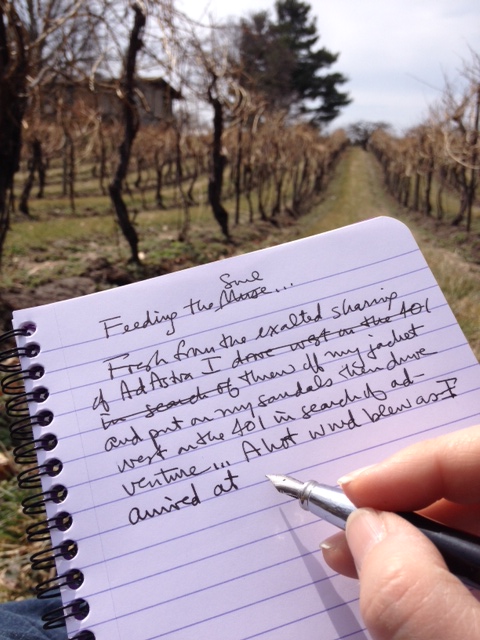
SONY DSCLate Sunday afternoon, minutes after my last panel and still exalted from stimulating sharing at Ad Astra 2015, I threw off my jacket and put on my sandals then drove west on the 401 in search of adventure. A playful wind blew as I reached my destination: Niagara on the Lake.

This was my first writer’s date this year. And, in truth, I’d almost forgotten to attend the SF con because I was so excited about my date. No, it wasn’t that kind of date; more like a mini-writer’s retreat. Julia Cameron coined the term “artist’s date” to define any kind of muse-feeding activity. The key is to do it ALONE. Basically an artist/writer date is a block of time you set aside to nurture your creative muse. In its primary form, says Cameron, “the artist date is an excursion, a play date that you preplan and defend against all interlopers…That means no lovers, friends, spouses, children—no taggers-on of any stripe.”

It’s just you and your inner-artist: your inner creative child.

My Writer’s Date started with Niagara on the Lake and La Toscana di Carlotta, possibly NOTL’s primo Bed and Breakfast (go check the rave reviews on Trip Advisor). Located close to King Street in the historic village, the B&B is a lovely heritage house with beautifully designed rooms. Carlotta passionately prepares an authentic Italian breakfast that includes freshly squeezed orange juice, yogurt and fresh fruit, bread, crostini, eggs created like a work of art and even dessert! But that’s not even the best part; both Carlotta and partner Kash are such beautiful people and wonderful hosts. You start out thinking they’re so interesting and end up embracing them as friends.

I stayed 2 days and my activities included a evening walks through the charming historic town (where Il Gelato di Carlotta is a must—considered a gem by actress Moya O’Connel), several ice-wine tastings, walks along the Niagara River and even a blitz look at Niagara Falls and Tesla’s statue.notebook01

It was a dizzying sensory intake, tempered with wonderful reflection to Nature’s awakening. Spring in southern Ontario lies just on the cusp of bursting into its full glory. I could smell its intent on the warm breeze and in the joyful excitement of birds and butterflies in the still-Spartan forest. At the edge of the wooded bluff I found a moss-covered log to sit on and listened to the water lapping below. I pulled out my new fountain pen and notepad and started to write. I’d left my computer behind and revelled in the pen flowing across the paper, forming words like a magician.

I had set no solid itinerary (except that I had to be back in Toronto to teach the next day). And, because of it, I experienced everything with the open wonder that comes with no expectation. I relaxed and explored. I poked around and smelled the dirt. I napped. I dawdled. I went in circles and changed my mind. I chased after butterflies and listened to the wind. I got a hazelnut gelato and licked it slowly. I wandered off the forest path and got lost. I discovered an obscure winery and tasted Cabernet Franc ice wine. I wept to Bocelli and Brightman’s “Time to Say Goodbye” … Mama Mia! I took my socks and shoes off and took pictures of my feet (No, I didn’t then put them on Facebook). I sat on a forest path bench and read a book. I drove down roads I’d never been on and let them take me somewhere… I found myself somehow back at Il Gelato di Carlotta and decided that fate had brought me there to try another ice cream flavour.

notebook02Think of doing a writer’s date from time to time. If not consciously to re-awaken your Muse, then to let it know you care. Every muse needs a bit of tender loving care. Spend time in solitude. A long country walk. A stroll along the beach. An exploration of your own area at night or at the break of dawn.

You don’t even need to leave the house. In a panel I sat on with Kelly Armstrong at Ad Astra, she shared what a colleague of hers did. From time to time the colleague disappeared into the bathroom of her house with a snorkel. The snorkel was the critical element. With it, she could completely immerse herself in a dark calm and block out the whole outside world, leaving her with her own infinite universe.

NoteTaking-NiagaraThe writer’s date is a gift you give yourself. It’s a gift of receiving, of opening yourself to discovery, wonder, and inspiration. It is ultimately a self-nurturing activity in which you let your child-self out to play. “The imagination-at-play is at the heart of all good work,” Cameron tells us. Cameron also warns that you may find yourself avoiding artist dates. “Recognize this resistance as a fear of intimacy—self-intimacy.”

It may be one of the hardest things to do. You (never mind others) will insist that it’s a selfish thing and you are shirking some duty you must be leaving behind with it. And you’ll find some reason to back out or include someone. Learn to guard against these invasions!

Keep it sacred. Let your imagination play and discover—or rediscover—what it loves.

As Carl Jung astutely observed, “The creation of something new is not accomplished by the intellect but by the play instinct acting from inner necessity. The creative mind plays with the objects it loves.”

Horseshoe falls-mist

Horseshoe Falls, Niagara Falls, ON (photo by Nina Munteanu)


nina-2014aaNina Munteanu is an ecologist and internationally published author of award-nominated speculative novels, short stories and non-fiction. She is co-editor of Europa SF and currently teaches writing courses at George Brown College and the University of Toronto. Visit www.ninamunteanu.ca for the latest on her books.

Why You Want to Go To A Writer’s Convention

IMG_0304A while ago I attended (and participated as panelist and guest author) at the World Fantasy Convention in Toronto. And I was all jazzed about it! Why?… Well, let me tell you why…

If you haven’t yet attended a writer’s conference or convention, it’s high time you did. Because, not only are you missing out on an education, you are missing out on a sub-culture that may change your life as a writer, help feed the hungry and align the universe. Seriously.

The last World Fantasy Convention I attended was several years ago in 2008. It was held in Calgary, Alberta, when I still lived in Vancouver, British Columbia. The ten-hour drive through some of the most glorious Canadian wilderness and mountains was bracing and we were lucky that the weather played fair. It was an auspicious start to a wonderful journey of self-discovery.

Hosted by toastmaster Tad Williams, this world-class convention featured guests of honor, David Morrell, Barbara Hambly, Tom Doherty and Todd Lockwood. The World Fantasy Convention promised great things and delivered them. And I’m not just talking about that white chocolate cranberry-date-nut dip that had me loitering at the hospitality suite. Or all those midnight parties that served savory wine with salted almonds, sharp cheese and colorful conversation with the likes of David Hartwell, Tor editor and impeccable dresser (gotta love those ties!). I’m not even talking about the hot tub that sprung a leak on the 18th floor at 1 am or the entertaining panels and readings, which rocked for both writer and reader.

What made the con great for me was seeing my writing community (both writing colleagues and readers who followed my writing) and meeting new people, all lovers of books and “story”.

I was rudely eyeballing someone’s nametag on his chest, when I collided with the Prince George crowd that included authors, Lynda Williams (herself responsible for some pretty nasty intergalactic wars), Nathalie Mallet (who cages princes) and publisher Virginia O’Dine of Bundoran Press (rumored to have been somehow responsible for the hot tub fiasco). I also chummed with Jennifer Rahn, author of The Longevity Thesis, who was charmed by my sly cat (she’s a softy at heart). My cat-colleague Toulouse just kept charming his way through the crowd right to the book fair. We wandered to the back where Anita Hades of Edge Books gave Toulouse her usual greeting (a feline move that was a cross between Sophie Marceau and Brigitte Helm; both she and Toulouse have French blood coursing through their veins, after all—c’est vrai!).

I’d come a long way from the first writer’s conference I went to as a budding writer of a few short stories and non-fiction articles…

Here’s what author Susan Denney says about her first writer’s conference: “Going to my first writers’ conference was an act of faith. I was just starting to make some freelance sales when the members of my writers’ group encouraged me to join them at a conference a few hundred miles away. The expense didn’t seem justified to me. The cost was far more than I had earned through writing that year. But they convinced me at last and it proved to be a great investment. The benefits of a writers’ conference are there for anyone who has a desire to be a better writer.”

Here are some reasons why you can’t afford NOT to go to a conference or convention:

Contacts: you will make contacts with people working in the industry, an extremely valuable asset; this industry is a social one, based on trust, respect and joyfulness. While there’s no guarantee that you will meet anyone famous or influential, you will definitely meet people who know more about writing than you do. Just hanging out with professional writers, editors and agents is educational. If nothing else, you will gain some confidence and ease with industry people, who are real people too. Some may become friends; some may become colleagues; some will become both.

Appointments: through agent/editor/author appointments, you will have a chance to have a quality private conversation with a professional on all aspects of writing and publishing. This is your chance to pitch your novel or ask that one burning question. You know you’ll get a candid and professional answer. That in itself is invaluable and may be enough reason to attend the con. Appointments are also your best chance of getting your manuscript read. This is because it bypasses the slush-pile and months of waiting for a response. More and more editors and agents look to conferences to meet potential authors. For them, meeting an author in person is a bonus to their gauging potential success in a relationship with them.

Education on Craft & Marketing: you will learn something about craft and marketing, no matter what stage you are in your writing career. Depending on the conference or convention, aside from good information from panels, you may also get personal mentoring, 1-page critiques, or attend small themed workshops. Feedback from an experienced writer can save you months of frustration and grief. Just hearing about what is currently going on in the industry is also valuable and conferences are a good way to get the skinny on what the current issues in the writing and publishing industry are. Getting it from those who are working inside avoids the idle and potentially harmful gossip.

Community: you will be exposed to a community of writers, hundreds of creative people in various stages of their careers. By interacting with both those you can help and those who can help you, you will gain a measure of both humility and confidence and satisfaction. We learn so much by helping others. Simply being with other writers can help hone your people-skills, the same ones you will need when approaching agents, editors, publishers and research sources during your career as a professional. Remember, if you aren’t having fun, you are missing one of the most important aspects of attending a writer’s conference, and you will lose your own effectiveness.

Energy: there is nothing more energizing than a common sharing among those of like-minded thought and vision. Writing is primarily an individual pursuit, often thought to belong to the introvert; but, to succeed in the writing/publishing industry a writer must display staying power, persistence, confidence and enduring energy. There is nothing quite as inspirational as hearing an accomplished writer provide their story of victory against odds. I will never forget the moving words of Ray Bradbury at a conference in Palm Springs years ago. I have repeated those words many times since. If you come to a conference with the right mind-set, I guarantee that you will leave with more energy than you came and with a burning need to write.

Exposure: depending on the kind of conference or convention you attend, you will have the opportunity to expose yourself to something different (e.g., different fiction genres and associated communities; fiction vs. non-fiction; different media; etc.). I attended a romance writers conference a few years back (I write mostly science fiction and fantasy—but often with romance elements in them) and found it bracingly educational.

New Markets & Ideas: conferences attract writers of all kinds. Conferences provide fertile ground for cross-pollination of ideas, markets and marketing ploys. Writers, like you, are generally a nice crowd; most are willing and eager to share their successes and failures. And contacts. Sharing is one of the great things that happens at conferences. There may be a common pin board set up for people to share. Most conferences are Twitter and Facebook enabled for quick and easy viral sharing. If you don’t come away from a conference with at least one new idea, contact or market, you haven’t done your job: talk to people.

Here are a few do’s and don’ts for when you go conferencing:

  1. Wear comfortable but not sloppy clothing and shoes (it’s likely that you will be doing a fair bit of standing and walking); you want to make a good impression. Be yourself and dress accordingly.
  2. Bring promotional material with you (e.g., business cards, flyers on your book, stories, etc.). Have something to share and exchange with other writers and professionals. Most conferences also have tables devoted to shareware. This is your chance to introduce you and your writing to others.
  3. Take something to write with (e.g., notebook and pen or iPad, etc.).
  4. Talk to people. Chances are that everyone there is interesting.
  5. Respect the time, particularly other people’s time, and keep your appointments and meetings.
  6. Don’t bring your heavy manuscript with you to the conference. Agents and editors don’t have the time or inclination or space in their suitcase for it. Use the conference to make an impression and get an invitation for something later in writing.
  7. Keep all of your interactions verbal and face-to-face. Don’t rely on memorized speeches or a folded up written pitch in your pocket. Keep it casually professional. Make eye contact and speak from the heart. Show your passion.
  8. Have fun. And don’t be afraid to show it; there’s nothing more infectious and attractive than someone having fun.


Some upcoming writing-artistic conferences/ conventions / festivals in the Toronto area include:IMG_0306


nina-2014aaNina Munteanu is an ecologist and internationally published author of award-nominated speculative novels, short stories and non-fiction. She is co-editor of Europa SF and currently teaches writing courses at George Brown College and the University of Toronto. Visit www.ninamunteanu.ca for the latest on her books.


Learn How to Write Science Fiction at George Brown College

For those in the Toronto area, I’m teaching a 12-week course on how to write science fiction at George Brown College this spring.

Called “Creating Science Fiction”, the course runs Wednesday nights from 6:15 to 9:15 starting April 8th through to June 24th and costs $278. The course is also part of George Brown’s Creative Writing Certificate.
.
Meant for both beginning writers and those already published, the 12-week course is run like a workshop with student input and feedback on student’s WIPs. I explore with students the essential tools used in the SF genre (including world building, research and plot approaches). Students will work toward a publishable original piece by learning to generate and follow through with premise, idea and theme.
Microsoft Word - GBC-SF course-APRIL2015 AD.docx
George Brown College is located on 200 King Street, Toronto, Canada.
.
.
.
.
nina-2014aaNina Munteanu is an ecologist and internationally published author of award-nominated speculative novels, short stories and non-fiction. She is co-editor of Europa SF and currently teaches writing courses at George Brown College and the University of Toronto. Visit www.ninamunteanu.ca for the latest on her books.

Walking the Tightrope Between Innocent and Cynical

jungfrau05

Jungfrau, Switzerland (photo by Nina Munteanu)

The writer’s journey from the passion and vulnerability of innocence to the wisdom of experience can be a dark and twisted road. In fact, if you are a writer of any merit, I guarantee you that yours will be too. Think Dante in the forest…

YellowCreek1

Yellow Creek, Ontario (photo by Nina Munteanu)

Let me tell you a story … It starts in the early 1990s. I was an eager young sprite entering the novel publishing world with my newly finished science fiction novel: “Escape from Utopia”. I’d published a few short stories and many articles by then. In addition, I’d published many scientific papers and reports. Confident and cocky, I was proud of my novel and eager to share it with the world. And I thought I knew my way through that dark forest…

I zealously sent the manuscript to a bazillion agents and editors. I was rewarded for my zealous efforts with a tidal wave of rejection letters. Mostly form letters (see my amusing account of the evolution of rejection letters in my fiction writing guidebook, The Fiction Writer) and an excerpt in a previous post here: “Rejection, Part 2: the Evolution of Rejection

Then it came: an enthusiastic letter from an agent (I can’t remember the name: Literary Bridge or something); they said my work had great promise and that with some help from an editing firm they would consider representing me if I had it edited and resubmitted.

They recommended Edit Ink.

Those of you in the know and with some history in the industry may recall the Edit Ink scandal of the 90s. In short, it was a bait-and-switch scam that Bill Appel and Denise Sterrs (of Edit Ink) and their associated literary agents ran for close to a decade. Edit Ink was a “book doctor” firm near Buffalo, New York. The State of New York eventually convicted Appel and Sterrs and associates for defrauding prospective writers of several million dollars.

I remember my heart swelling with gratitude and optimism. Finally, someone liked my book! I naively considered their recommendation. Soon after—within days—I got an invitational letter from the pro-active Edit Ink. I can’t remember the exact content, except that they assured me that only the most promising writers were recommended to them by this particular agent. I remember seriously considering their offer. Then I got two more letters, one from another agent who recommended Edit Ink and another invitational letter from Edit Ink. Alarm bells went off. I went from naively hopeful to cynically suspicious. I did some investigating (something I should have done initially); by then the buzz was already on the Internet on their questionable practices. The lawsuit by New York State had yet to happen.

The Science Fiction Writers Association (SFWA) runs a “writer Beware” page, where memorable cases are reviewed. It’s worthwhile perusing just for your general knowledge and edification.

Here’s what they said about Edit Ink:

Founded by the husband and wife team of Bill Appel and Denise Sterrs, Edit Ink was a New York State-based editing service that engaged in a kickback referral scheme with a wide network of literary agents. Here’s how the scheme worked.

  • Participating agents sent letters to writers who’d submitted manuscripts the agents didn’t want to represent, saying that the writer’s work showed “promise” but “wasn’t quite ready for publication.” A useful service was recommended: Edit Ink, which for a fee would polish the ms. to make it more salable. Once the ms. had been edited, the agent would then be glad to reconsider it.
  • The agent forwarded the writer’s name to Edit Ink, which sent off a solicitation letter claiming, among other things, that Edit Ink received referrals for only a “select few” manuscripts (false), and that most publishing houses insisted on receiving “professionally edited” work (falser).
  • If the writer took the bait and paid for an edit, the referring agent received a kickback of 15%.
  • Writers who resubmitted their edited manuscripts to referring agents, per the referring agents’ suggestions, were given the brushoff. Either the market had “changed in the interim”, or the agency was “no longer representing that genre.”

Edit Ink charged $5 per page–exorbitant at the time even for a qualified editorial service, which Edit Ink very definitely was not. Its staff mostly consisted of recent college graduates with no publishing experience, working long hours for minimum wage. The typical Edit Ink edit was slipshod and superficial, consisting mainly of basic copy editing suggestions, and omitting the kind of in-depth analysis of plot, theme, character, and structure that might make a professional edit worthwhile.

At its height, dozens of literary agencies participated in the scheme. Edit Ink even set up its own bogus agencies and publishers to funnel more manuscripts its way. It’s estimated that the company made in excess of $5 million.

Mounting complaints from writers, and efforts by writers’ advocacy groups, at last spurred New York State to take action. In January 1998 the NYS Attorney General announced a lawsuit against Edit Ink for deceptive business practices, false advertising, and fraud.

Throughout the appeals process, Edit Ink continued to operate. Many questionable agents continued to refer manuscripts, and Aardvark Literary Agents (one of Edit Ink’s original bogus agencies) was taken over by co-defendant Kelley Culmer so it could go on functioning as a conduit for Edit Ink referrals. Business was dwindling, however–in part as a result of media attention, but largely because of spreading word in the then relatively new environment of the Internet. Once the appeal was denied, the thrill was gone. In August 1999, Appel and Sterrs closed Edit Ink’s doors for good.

Shades of Edit Ink

Edit Ink is by no means unique in the publishing industry. “Book doctors”, associated kick-back agents and subsidy publishers are, in fact, on the rise. This is not surprising, in view of the current rise in self-publishing and associated models. The industry is currently inundated with a range of publishing models from straight printing-only firms to full service publishing houses and anything in-between.

Author Victoria Strauss on her blog “Writer Beware” shares this story:

Over the past couple of days, I’ve heard from several writers who queried agents at Objective Entertainment, a relatively new literary agency with a strong track record and experienced staff, and received the following response:

Dear [name retracted], 

Thank you so much for contacting us at Objective Entertainment. We have reviewed your material and we would like to refer you to one of our Publishers who we trust and believe will be able to serve you best. In order to do this I need your permission and the following information so they can either contact you via Phone or Email. The following information we need is if you would like to receive their newsletter and special offers. I think this is an amazing opportunity for you. 

Please reply with the information we asked so that we can get you that one step closer to getting your work published! 

Best 

Tracey Ravenelle
Objective Entertainment

When the writers, eager to know the name of the publisher, requested more information, they received this response from Ms. Ravenelle:

We work with Iuniverse and AuthorHouse. Iuniverse has the number 5 book this week on the NY Times Best Seller List!

The writers then asked why Objective was recommending a self-publishing service. As of this writing, only one has received a response, which Ms. Strauss reproduced below exactly as it was sent to her:

Because we believe they would be the most beneficial for you at this point in time. Then you would come back to us after the sales starting racking up and we go major! This is the best way for an author to get their work out their. One of their books is number 5 on this weeks upcoming NY Times Best Seller list. So we believe they can help our potential future clients immensely.

EEK… aside from their atrocious grammar, Objective made some questionable recommendations. The major one being that of referring rejected clients to a self-publishing service (of course, they got a fee for referring clients to the house).

Vanity and Subsidy Publishers

SFWA shares another story:

Thousands of writers worldwide entered into contracts with Commonwealth Publications of Canada, a vanity publisher founded in 1995 by fee-charging literary agent Donald Phelan. Phelan worked with a number of other fee-charging agents who, in exchange for a kickback, recommended Commonwealth’s vanity contracts to their clients. Phelan also advertised for manuscripts in magazines such as Writer’s Digest and Writer’s Journal. (Writers take note: this is just one example of why you shouldn’t trust the classified ads in writers’ magazines.)

Commonwealth, which identified itself as a “subsidy” publisher (the implication being that the writer was contributing only a portion of the cost) typically charged $4,500 for publication, with a promised print run of 10,000. Its glossy promotional material promised all kinds of support to its authors: editing, proofreading, marketing, international distribution. But few of these services were actually delivered–and there were many other problems. Publication dates were delayed. Authors didn’t receive the number of books they were promised. The quality of finished books was poor. Books never showed up in bookstores. Royalties from books supposedly sold were never paid.

Fee-Charging Agents

SWFA shares this recent story:

On January 7, 2010, UK literary agent/film producer Robin Price appeared in court, accused of stealing more than half a million pounds from clients.

Price is alleged to have encouraged authors to pay exaggerated literary fees and invest in non-existent film deals, and has been charged with six counts of theft, most committed over the course of several years.

Even successful established writers were taken in by this one.

Writer Brian Knight, who suffered a book doctor agent scam, shares this advice: “New writers need to know that these people are still out there, spewing false promises … patting us on the back with one hand and picking our pockets with the other.” He advises new writers to research every individual and business with which they intend to do business.

Reign in your excitement and enthusiasm. Breathe. Then do the research. “Google.com is your friend,” says Knight. “There are other online resources available to writers. In this era of the information super-highway, it has never been easier to arm yourself against the scumbags and swindlers who make their living off the trusting and naive.” Knight also suggests, www.duotrope.com.

A great site to check out anyone in the writing and publishing industry is “Preditors and Editors” (intentionally misspelled). A site I have come to rely on for excellent market advice is www.ralan.com.

The writer’s journey is a hero’s journey, fraught with obstacles, dangerous distractions, and great disappointments (see Christopher Vogel’s excellent book The Writers Journey: Mythic Structure for Writers for more). But it is a path illuminated by a beacon of passionate expression, great sharing and exquisite victory. Choose your hero archetype carefully: choose magician.

We are the shamans, the myth-makers of our community and society. The artist / writer carries her archetypal message through story to her tribe, her community, her society and her world. It is both fulfilling and a great responsibility.

After the Edit Ink debacle, I picked myself up—a little wiser and a little more careful—and went on to find a traditional publishing house who published my first and second novels. Escape from Utopia became Angel of Chaos published by Dragon Moon Press (Part 1 of the Darwin’s Paradox duology), and I went on to publish seven more novels through traditional, indie, and self-publishing models: a historical fantasy, an SF adventure trilogy, two romantic SF novels, a short story collection (Natural Selection) and two text books on writing.

I haven’t looked back since… except to write this article, that is.
 

nina-2014aaNina Munteanu is an ecologist and internationally published author of award-nominated speculative novels, short stories and non-fiction. She is co-editor of Europa SF and currently teaches writing courses at George Brown College and the University of Toronto. Visit www.ninamunteanu.ca for the latest on her books.

Know What You’re Writing: Short Story or Long Story?

freighter-rowers-sailboat-web

Freighter off Toronto Harbour, Lake Ontario (photo by Nina Munteanu)

How to Decide on the Length of Your Story 

Figuring out what you are writing isn’t always as easy as you think. Many writers, when they begin, may think they are writing a short story when they are actually writing a novel; or vice versa. When I first started, in fact this is what occurred.

Some time ago, when I was a budding novelist working on my second unpublished novel, I decided to write short stories. I’d been told time and again that it was easier to publish short stories (the market is far more diverse) and they provided excellent qualifications for when it came time to market my novel. It wasn’t as easy as I thought. I kept getting rejections with comments that my short story ought to be a novel! It took some time to master the art of short story telling. But when I did, I realized that I’d learned a lot about storytelling that I could apply to my novel. And by the time I was ready to publish my novel, I had several short story publications behind me to prove the salability of my work.

So, what are you really writing? Or, more to the point, what should you be writing?

A short story only has 7,500 words or less to get your tale across while a novel has over ten times that many words to do the same. It follows then that the short story format is a simpler one. This does not necessarily mean easier.

Short Vs. Long—What’s Your Focus?

Novels provide a sense of change, growth and solutions to problems and conflicts. Short stories must be more succinct, contain fewer characters and subplots, have less complicated story arcs and a single theme. You could say that a short story is a poem to a novel’s prose. “The short story doesn’t have the luxury of depicting change; the closest it can come is awareness,” writes Shelley Lowenkopf in her 2007 article “Telling Tales” in The Portable Writer’s Conference: Your Guide to Getting Published by Quill Driver Books. She goes on to describe the short story as a close-up to a novel’s landscape. The short story is, therefore, often more intense and powerful. A short story, more than a novel, has the power to transport, disturb and enlighten.

Renowned short story authors like Edgar Allen Poe, Nathanial Hawthorne, and Somerset Maugham emphasize the importance of striving for one effect when writing a short story: the single effect you wish to leave with the reader at the end. This is accomplished by selecting events or situations that build quickly into a combustible response.

Jack Bickham, in his book, Elements of Fiction Writing: Scene and Structure by Writer’s Digest Books (1993) writes that, “story length, author intention, traditional expectations of the audience, and all sorts of things may affect the form a story may take.” Choosing the appropriate length to tell your story relies on the complexity of your premise and theme.

Pick Your Length Checklist

The following short checklist will help you determine whether you should be writing a short story or something longer like a novel:

  • does your story have several main characters and minor characters?
  • is your story full of subplots?
  • does your story contain multilayered themes and story arcs?
  • do your characters learn and change notably?
  • is there significant change in your story?
  • does your story contain several settings and sub-stories?
  • does your story explore several ideas as opposed to one main idea?
  • does your story investigate several issues rather than making a single point?

If you answered “yes” to most of the above, then you should be writing a novel.

Defining Story Length

The Science Fiction & Fantasy Writers of America defined story length forms in the table below. Definitions vary among other sources but remain close to these.

Table 1: Terminology of Story Lengths
Name Description
Drabble (Flash Fiction) Exactly 100 words
Flash Fiction Less than 500 words
Short short Fiction 500-1,000 words
Short Story Less than 7,500 words
Novelette 7,500 to 17,500 words
Novella 17,500 to 40,000 words
Novel More than 40,000 words


Creative Options & Market Tips

During my early “salad” writing years as a short story writer, I discovered a system that helped me send out material and publish with more ease and efficiency. It helped that I was rather prolific with short story telling and that I was simultaneously working on a few novels. Here are some creative things you can do with both your short stories and novels (in the works or already published) to increase your productivity and publishing opportunities:

  • Use Novel Excerpts: Here’s something I did to save time, hone my craft, and receive early recognition: I took “aha” excerpts from my ongoing novel and adapted them into stand alone short stories—altering at least 20% of the content and other elements like setting, names, etc. In each case, I ensured a powerful story by focusing on the single thematic element. I sold at least five short stories to good magazines this way. The short stories went on to receive recognition, awards and a place in some “Best of” anthologies, long before my novels received similar recognition. In each case, the short story became an equally—if not more—powerful version of its sister work in my novel, much like a poem is to a piece of prose. Try it; you might really like it.
  • Adapt A Short Story into a Novel or Novella: you may find that a powerful thought expressed in your short story engenders interest in a larger plot with more depth, such as a novel. Nancy Kress and Ray Bradbury are two short story/Novella writers who adapted some of their works into longer forms to create something both new and compelling.
  • FictionWriter-front cover-2nd ed-webRun Your Novel and Short Story Submissions Like a Bus Depot: When I was writing a lot of short stories, I kept a list of what and where I submitted, along with the most important item: where to submit NEXT. At any given time, I made sure that I had at least x-number of submissions out there and each story had a designated place to go if it returned. As soon as a story came back from magazine A, I simply re-packaged it and sent it to magazine B. The critical part of the list was to have a contingency for each story: the next place where I would send the story once it returned. I was planning on the story being rejected with the hope that it would be accepted; that way, a rejection became part of a story’s journey rather than a final comment. I ran my submissions like a bus terminal. A story was in and out so fast it never had a chance to cool off. And, since I had five other pieces out there, I could do this with little emotion. I was running a fast-paced “story depot”, after all. All my stories had to be out there as soon as possible; if they were sitting in the terminal, they were doing nothing for me.
  • Reprint Your Published Short Stories: You can only do this if you ensure that you initially only sell First Rights with your story’s first publication. My short story “Virtually Yours” has been reprinted five times and is continuing its journey still. It has appeared in “Best of” anthologies, several collections (e.g., Natural Selection); it has been translated into several languages and published all over the planet. Don’t let your story languish on its first success. See where else it can go. Foreign markets are a largely untapped area.
  • Do Foreign Translations and Reprints: Thankfully, Douglas Smith, a colleague of mine and celebrated short story writer has compiled a list for short story foreign markets. He also recently put out a book on marketing your short story, called “Playing the Short Game”.


References:

Smith, Douglas. 2014. “Playing the Short Game: How to Market and Sell Short Fiction”. Lucky Bat Books. 230pp

Munteanu, Nina. 2009. The Fiction Writer: Get Published, Write Now! Starfire World Syndicate. 266pp.

NaturalSelection-frontHRMunteanu, Nina. 2013. “Virtually Yours” in Natural Selection: a Collection of Short Stories. Pixl Press. 120pp.


This article is an excerpt from Chapter R of The Fiction Writer: Get Published, Write Now! (Starfire, 2009).


nina-2014aaNina Munteanu is an ecologist and internationally published author of award-nominated speculative novels, short stories and non-fiction. She is co-editor of Europa SF and currently teaches writing courses at George Brown College and the University of Toronto. Visit www.ninamunteanu.ca for the latest on her books.

Ten Things to Consider When Revising Your Novel

Log patterns 6

Spalted log (photo by Nina Munteanu)

No piece of writing is complete without submitting it to the scrutiny of revision. A colleague of mine once shared the story of what a student of hers had said about revision: it’s “like beating up a nice friend. Why would I want to do that?” Because, my colleague replied, without a little pummelling all you have is a “nice draft”.

Here are ten things you can do to revise your first and subsequent drafts into something stellar.

  1. Let Your Work Breathe

Once you’ve completed your draft, set it aside for a while. This is key to helping you make objective observations about your writing when you return. The longer you leave it, the more objective you will be. Don’t worry about losing momentum or interest; they most certainly will return. But if hey don’t, then you didn’t have a story in the first place—and that, too, is a good thing to discover.

  1. Dig Deep

Now that you have the whole story in front of you, you’re in the position to restructure plotlines, subplots, events and characters to best reflect your overall story and its main theme. Don’t be afraid to remove large sections or even whole characters; you will likely add others.

  1. Take Inventory

Take stock of how each chapter and scene/sequel contributes to plotline and theme; root out the inconsistencies as you relate the minutia to the whole. You may decide to merge two characters into one or add a character or change a character’s gender or age to better serve your plotline and theme.

  1. Highlight the Surges

Some passages will stand out as being particularly stunning; pay attention to them in each chapter and apply their energy to the rest of your writing.

  1. Purge & Un-clutter

Make a point of shortening everything; this forces you to use more succinct language and replace adjectives and adverbs with power-verbs. Doing this will tighten prose and make it more clear. Reading aloud, particularly dialogue, can help streamline your prose.

  1. Check Point of View

This is the time to take stock of whether you’ve chosen the best point of view style for your story (e.g., first person, third person limited, omniscient). Many first manuscripts by my students have suffered from shifting or inconsistent point of view. Ensure that yours is consistent. You may wish to experiment with different points of view at this stage (e.g., changing your narrative from the third person to the first person, for instance); the results may surprise you.

  1. Make a Plot (Story) Promise

Given that you are essentially making a promise to your readers, it is advisable that you revisit that promise. Tie up your plot points; don’t leave any hanging unless you’re intentionally doing this. But, be aware that readers don’t generally like it. Similarly, if you’ve written a scene that is lyrical, beautiful and compelling but doesn’t contribute to your plotline, nix it. You can file it away for another story where it may be more applicable.

  1. Deepen Your Characters

The revision process is an ideal time to add subtle detail to your main characters: a nervous scratch of his beard, an absent twisting of the ring on her finger, the frequent use of a particular expression. Purposefully adding unique qualities to your characters, like vernacular, body language, and inflections grounds them in reality and makes them more personable and memorable. However, if you want a particular character trait to stick with the reader, you should repeat it a few times throughout the story. This applies to minor characters as well. When you paint your minor characters with more detail, you create a more three-dimensional tapestry for your main characters to walk through.

  1. Write Scenes (show, don’t tell)

Use the revision process to convert flat narrative into “scene” through dramatization. Narrative summaries often read like lecture or polemic. They tend to be passive, slow, and less engaging. Scenes are animated by action, tension and conflict, dialogue and physical movement.

  1. Be Concrete

Ground your characters in vivid setting and rich but unobtrusive detail. Don’t abandon them to a generic and prosaic setting, drinking “beverages” and driving “vehicles” on “roads”; instead brighten up their lives by having them speeding along Highway 66 in a red Carmen Ghia while sipping a Pinot Noir.

Remember to pace yourself when revising; otherwise you may become overwhelmed and discouraged, even confused into incessant rewrites. Your story needs to settle between revision stages. As my colleague said, “you don’t need to beat up your nice friend all at once.”


nina-2014aaNina Munteanu is an ecologist and internationally published author of award-nominated speculative novels, short stories and non-fiction. She is co-editor of Europa SF and currently teaches writing courses at George Brown College and the University of Toronto. Visit www.ninamunteanu.ca for the latest on her books.


Who’s Your Audience and Why Should You Care?


Beaches-snow06

Winter in The Beach (photo by Nina Munteanu)

The artistic process, whether painting or prose, is admittedly the child of self-expression. The long-standing image of the cloistered artist in her studio — hunched over her writing desk or standing before her canvas to create from the depths of her soul — is surely a truism. Artists create from the heart; we dive deep inside our often tortured souls and closeted past to draw out the universal metaphors that speak to humanity and share—

Ay, there’s the rub. For to share is to have a dialogue and to have a meaningful dialogue is to demonstrate consideration of the other. Somewhere in that journey that began with self, others entered. It is, in fact, something of a paradox and a conundrum for many artists. One that has challenged the artistic community for centuries. It is also why many artists have relied on agents, benefactors, and advocates to effectively communicate, target — and even interpret — their often abstruse “message” to their appropriate audiences.

Purists will tell you that a true artist need not consider her audience; because her self-expression naturally finds relevance with the culture and zeitgeist from which she writes through universally understood metaphor: her story is their story.

But is that enough?

I suppose it finally comes back to whether you are interested in sharing. I don’t know any published authors who don’t wish their books to sell. Every storyteller needs an audience to connect with and engage. That is ultimately what good storytelling does: engage, connect, rouse emotions and evoke empathic feelings. Make an impact.

Beaches-snow03

Photo N. Munteanu

Does identifying and targeting a specific audience result in more satisfied readers and ultimately better sales? Of course it does. The more you—and whoever is helping you market your work—know about your audience, the more likely you are going to attract them to your book, convince them to buy it and ultimately connect with them. That’s the irony of art: it is a treasure that is created out of the depths of solitude but ultimately brought into the light and shared with the world. For your art to have impact, you must know and understand your world.

Knowing your audience will affect every aspect of your book project. It will help determine:

  • What your story is about and how you write it (from language, voice or personality, narrative style, tone or mood/attitude, characters, setting and theme)
  • What genre it lies under
  • the look and tone of the cover and blurb
  • all aspects of promotion

For instance, who are your intended readers? To what age group to they belong? What culture and sub-culture? What gender(s)? What education and intellectual capacity? Economic status? What regions? What political leanings? Prejudices and beliefs? What knowledge-base?

To know your audience is to know your story better.


nina-2014aaNina Munteanu is an ecologist and internationally published author of award-nominated speculative novels, short stories and non-fiction. She is co-editor of Europa SF and currently teaches writing courses at George Brown College and the University of Toronto. Visit www.ninamunteanu.ca for the latest on her books.