Scholarly Lichen: When a Lichen Writes…

Script Lichen on a white birch tree, Trent Forest, ON (photo by Nina Munteanu)

I’m an ecologist and limnologist (someone who studies water systems). But I’m a writer too. I write novels and short stories and lots of articles on nature and science for various magazines including my own sites. I walk almost daily in the local forests and by the river near my place and write about my adventures there. So, when I encountered lichens that ‘write’ I was more than intrigued. What? You don’t believe that lichens can write? Well, read on…

Lichens that Write

Script Lichen on a poplar tree; A. showing grey-green thallus on poplar bark; B. close up showing the squiggly apothecia or fruiting bodies, Trent Nature Sanctuary, ON (photo by Nina Munteanu)

It was a warmish day in early fall as I was walking through the lowland mixed beech-hemlock stand in the Mark S. Burnham old-growth forest. I was studying an old beech tree and chanced on some interesting growths on a neighbouring young beech tree. It looked like pale green to grey paint and covered in black dots like bits of soot. I surmised that the powdery ‘paint’ was one of the crustose dust lichens (e.g., Lepraria or Lecanora) that like to colonize trees. On closer inspection, I saw that the black ‘dots’ were in fact dark squiggles, concentrated at the centre of the grey-white smear of leprose (powdery) lichen (the thallus). The dark squiggles, raised like tiny eskers, resembled hieroglyphs, strange symbols, scrawled there in cryptic code like the poetry of shy forest sprites. My first thought was that these dark squiggles were a parasitic fungus or some insect egg infestation on the crustose patch of grey-green lichen; the latter was a stretch considering the strange patterns of the markings.

When I returned home and did more research, I discovered that the mysterious markings were in fact the raised fruiting bodies (apothecia) of the Common Script Lichen (Graphis scripta), a pale green-grey crustose and leprose lichen that prefers smooth bark on which to write its stories.

The apothecia of Graphis scripta aren’t always visible, becoming more prominent in late fall and winter. I was lucky to see them. These lichens start rather inconspicuously as green-grey smears on a tree, eventually developing visible squiggles of apothecia (elongated, branched fruiting bodies) that may look like a pair of lips, called lirellae. During my winter excursions in several nearby forests I’ve seen the Common Script Lichen on the smooth bark of young red and sugar maple, white and yellow birch, alder and poplar trees.

Script Lichen colonizing A. sugar maple, B. yellow birch, and C. white birch, Trent Forest, ON (photos by Nina Munteanu)

There are many species of Script Lichen in the Graphis genus. Wikipedia lists a few hundred of them, most with squiggly apothecia. Other literary lichens include the Scribble Lichens (e.g., Opegrapha and Alyxoria), Comma Lichens (e.g., Chrysothrix, Arthonia, Arthothelium), Asterisk Lichens (Arthonia) and the Dot Lichens (e.g. Arthonia or Micarea) which should be named Period Lichens, if you ask me.

Script Lichen colonizing a young poplar tree and displaying ‘mosaic’ of darker lining where thalli meet, Trent Forest, ON (photo by Nina Munteanu)

But here’s the thing.

While Graphis scripta is busy colonizing maple or poplar bark, another lichen is busy growing on it! Graphis scripta is a common host to the lichenicolous Arthonia graphidicola, a lichen without a thallus whose apothecia (fruiting bodies), which resemble G. scripta apothecia, colonize the host thallus then erupt through the host’s thallus—somewhat like the alien in Alien, though without the devastating mess left behind (as in a dead eviscerated human). The apothecia of A. graphidicola, which appear as rounded, many-sided, or elongated structures, are difficult to distinguish from the host’s own apothecia, which is bizarre and reminds me of the cuckoo bird that parasitizes a wren’s nest by dropping off its look-a-like egg, which the wren looks after—often at the expense of its own.

I’m not making all this up; go see the British Lichen Society. Some researchers suggest that the apothecia of A. graphidicola are smaller and less elongated or elaborate as those of G. scripta (check out the image below for comparison). This lichenicolous lichen may also show its presence by staining the thallus of its host pink. I may have witnessed that before I learned about this interesting tell.

Apothecia of Arthonia graphidicola, shown at top centre, and larger and more elongated Graphis scripta apothecia, shown at bottom centre (photo by iNaturalist)

A lichenicolous lichen is basically a lichen that grows on or in another lichen. Diederich et al. (2018) estimated over 2,000 species worldwide of lichenicolous fungi—many that evolve into lichen once they colonize a host—known to live on lichens as host-specific parasites, pathogens, saprotrophs and commensals. Lichenicolous lichens are considered a subset of this group with a few hundred species recognized so far. According to Knudsen (2013) lichenicolous lichen have a two-stage cycle. Many start as juvenile non-lichenized fungal parasites which then develop into a lichen by stealing an algal partner from the host lichen. More on this delightful process in another article.

Nimis et al. (2024) suggest that at least some lichenicolous lichen are not true “parasites”, as they are often called, but gather their algal partners (photobionts), which have already adapted to local ecological conditions, from their hosts, and eventually develop an independent thallus.

So, in the end, I may have been right after all in thinking the black marks were a fungal parasite. They still might be! I’m reminded of Augustus De Morgan’s famous ditty about fleas and thought I would adapt it for lichens:

Big lichen have little lichen upon their backs to mine them, and little lichen have lesser lichen, and so ad infinitum.

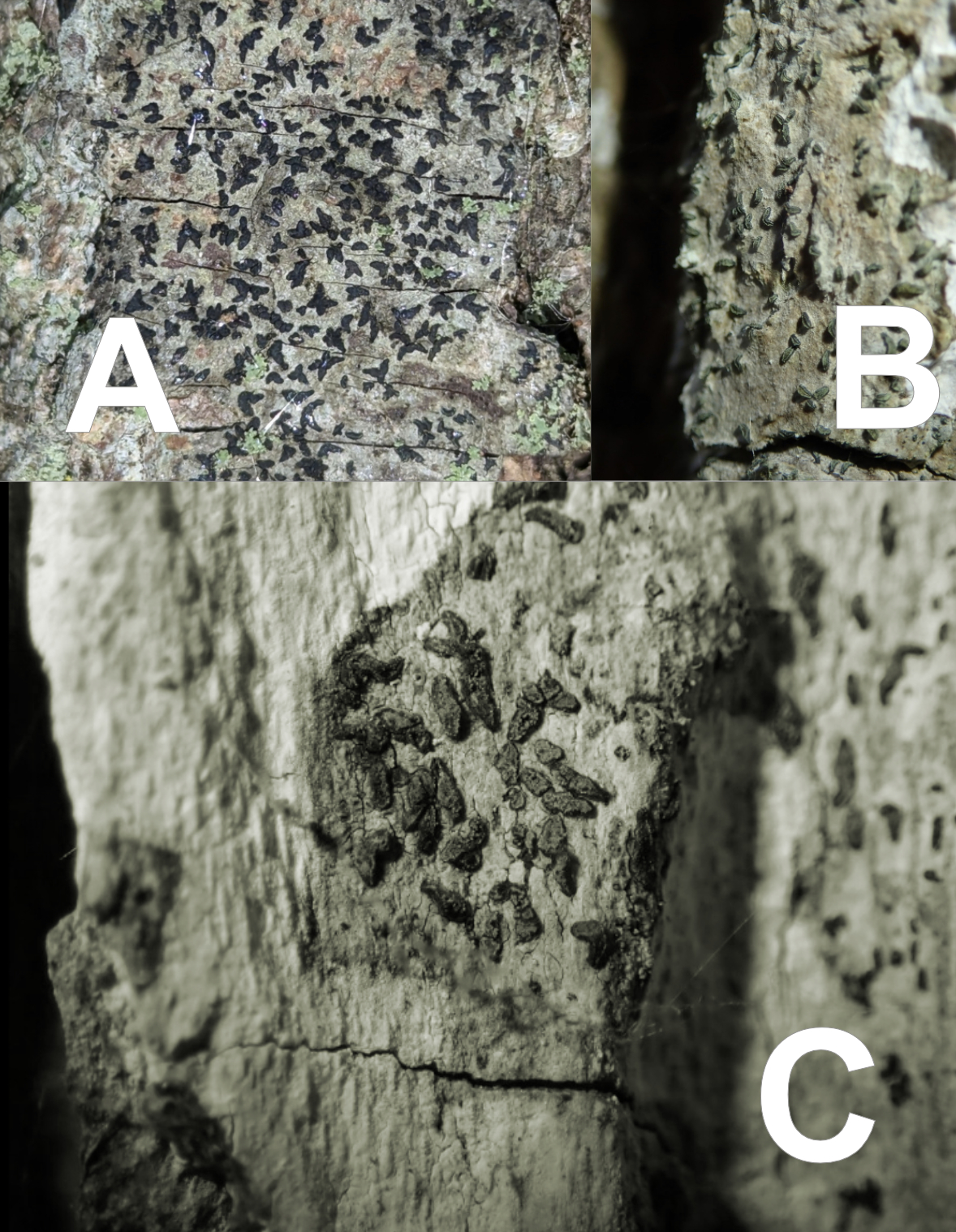
Bark Scribble on bark of deciduous tree (A. and B. photos by Jurga Motiejunaite; C. by William Van Hamessen in iNaturalist.org)

Another writing lichen is the Bark Scribble, Alyxoria varia, previously classified in the genus Opegrapha. The site iNaturalist.org tells us that Alyxoria varia “is thought to represent a complex of species with uncertain phylogenetic placement.” All to say that the jury isn’t out yet and it may change its name again. Its common name, scribble lichen, refers to the form of its ascomata (fruiting bodies) that are long or short, sometimes branched with blackened walls and bases. The thallus of Bark Scribble is hidden mostly within the bark itself. Fungi of Great Britain and Ireland tell us that this writing lichen is most frequently found on the shaded neutral to basic rough bark, especially of oak, maple and elm. I spotted what I think is this lichen on an old maple tree in a mixed forest.

Sugar maple tree bark with ‘specks’ (apothecia) of Bark Scribble, Mark S. Burnham Forest, ON (photo by Nina Munteanu)
Bark Scribble Lichen (Alyxoria varia) on the bark of an old maple tree, Trent Forest, ON (photo by Nina Munteanu)

Lichens that Punctuate

Lichens don’t just write ‘words’; they also punctuate. As with word-use there are numerous commas (comma Llchen), periods (button and dot lichen) and even asterisks (asterisk lichen). Some lichens even map. Those I’ve encountered are included below.

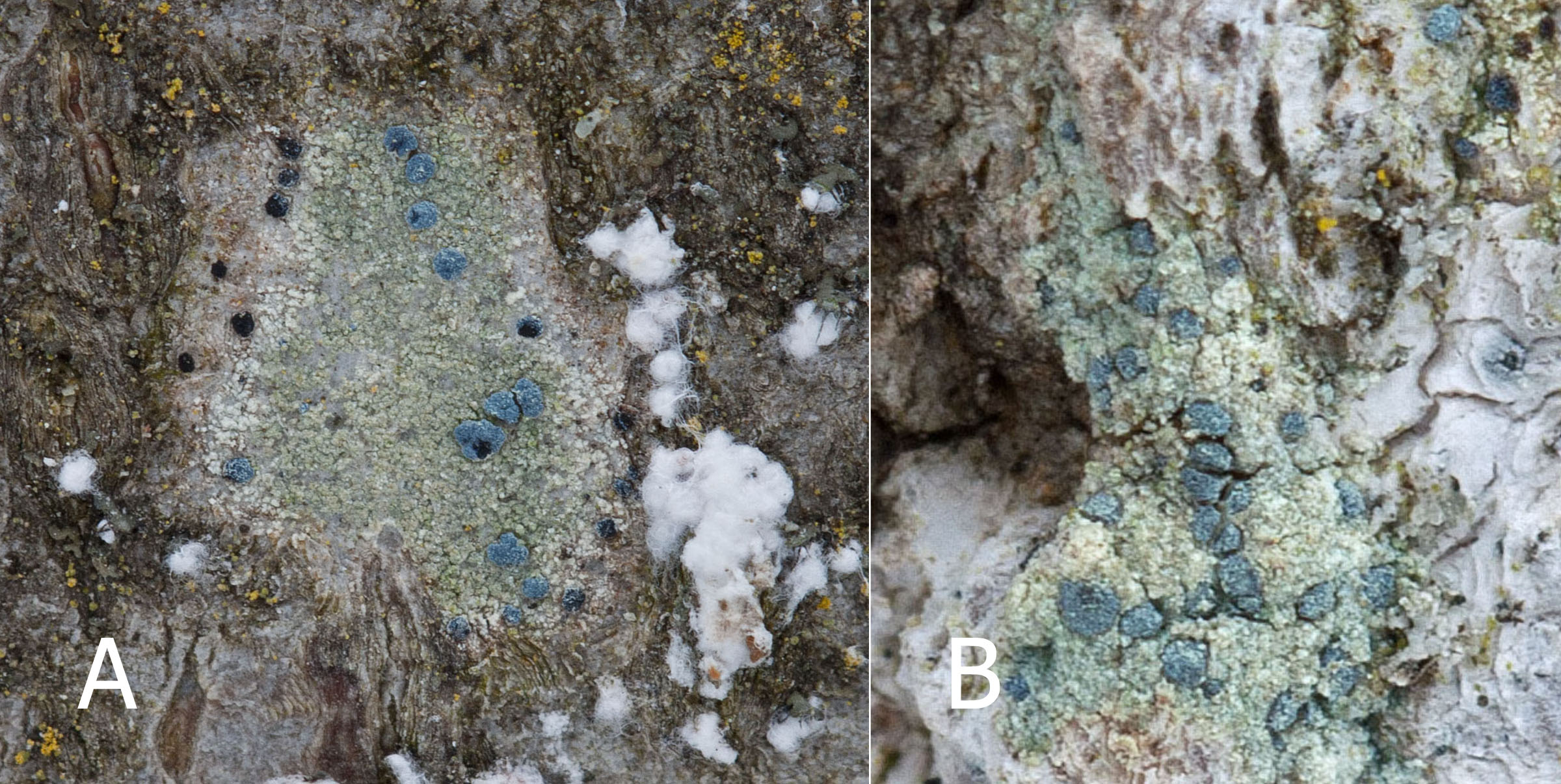
Two views of Frosted Comma Lichen, A. on a poplar tree and B. on a birch tree, Trent Forest, ON (photos by Nina Munteanu)

I found this lichen growing on a young red maple in the Trent Forest in mid-winter. Known to prefer exposed bark near water, where I found it, this lichen forms a small dime- or quarter-sized whitish-to-pale-green-yellow granular thallus with ‘frosted’ pruinose blue fruiting bodies (called ascomata on this lichen). Apparently, it only fruits in winter, so I was seeing its best face. Its photobiont is a coccal green alga.

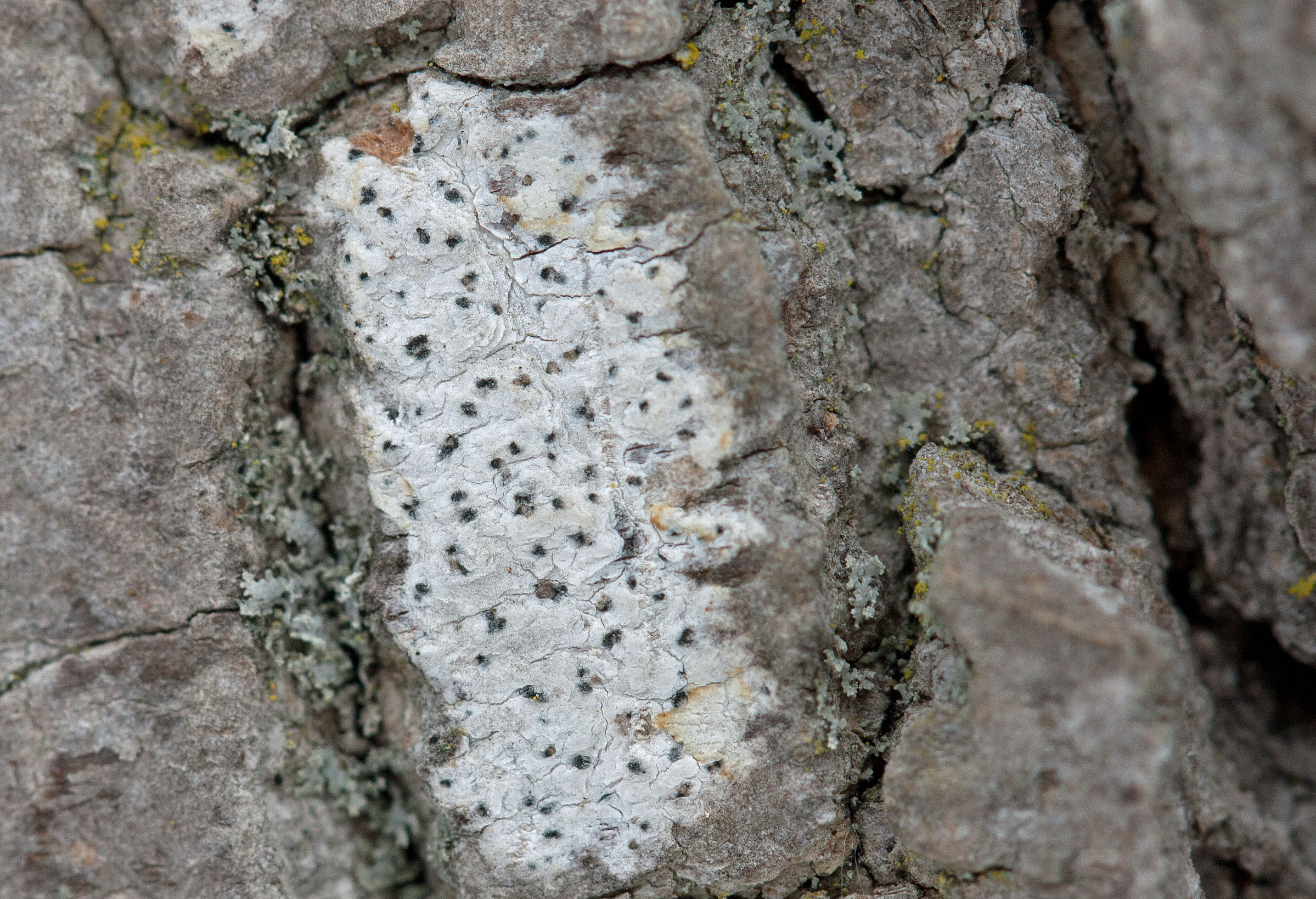
Aspen Comma Lichen (below the Common Script Lichen) on a Trembling Aspen tree, Trent Forest, ON (photo by Nina Munteanu)

I found the Aspen Comma Lichen on … you guessed it … an aspen tree, likely a Trembling Aspen (Populus tremuloides), in the Trent Forest. This crustose lichen had a powdery whitish thallus and black ‘frosted’ pruinose mostly roundish black dots that looked more like ‘periods’ than ‘commas’; these are the fruiting bodies (called ascomata on this lichen). The Aspen Comma Lichen prefers the smooth bark of younger poplar (Aspen) trees, forming a very thin grey-white thallus and rounded black apothecia.

Comma Lichen on a maple tree, Trent Forest, ON (photo by Nina Munteanu)

I found this comma lichen on several maple trees, mostly young ones. At least this comma lichen looks a little more like a ‘comma’, with a whitish powdery thallus on which are scattered tiny black not quite round ‘frosted’ epruinose fruiting bodies. This lichen is known to prefer the bark of hardwood trees. Italic 8.0 describes this lichenicolous species as having a crustose thallus, mostly endosubstratic (living inside the substrate whether bark or lichen), effuse, greyish white to greenish grey and with apothecia that are rounded or angular and black epruinose, slightly convex rough disk. Its algal partner is Trentepohlia.

Comma Lichen on an old maple tree, Trent Forest (photo by Nina Munteanu)
Asterick Lichen (Arthonia radiata) showing squiggly apothecia on a poplar tree, Trent Forest, ON (photo by Nina Munteanu)

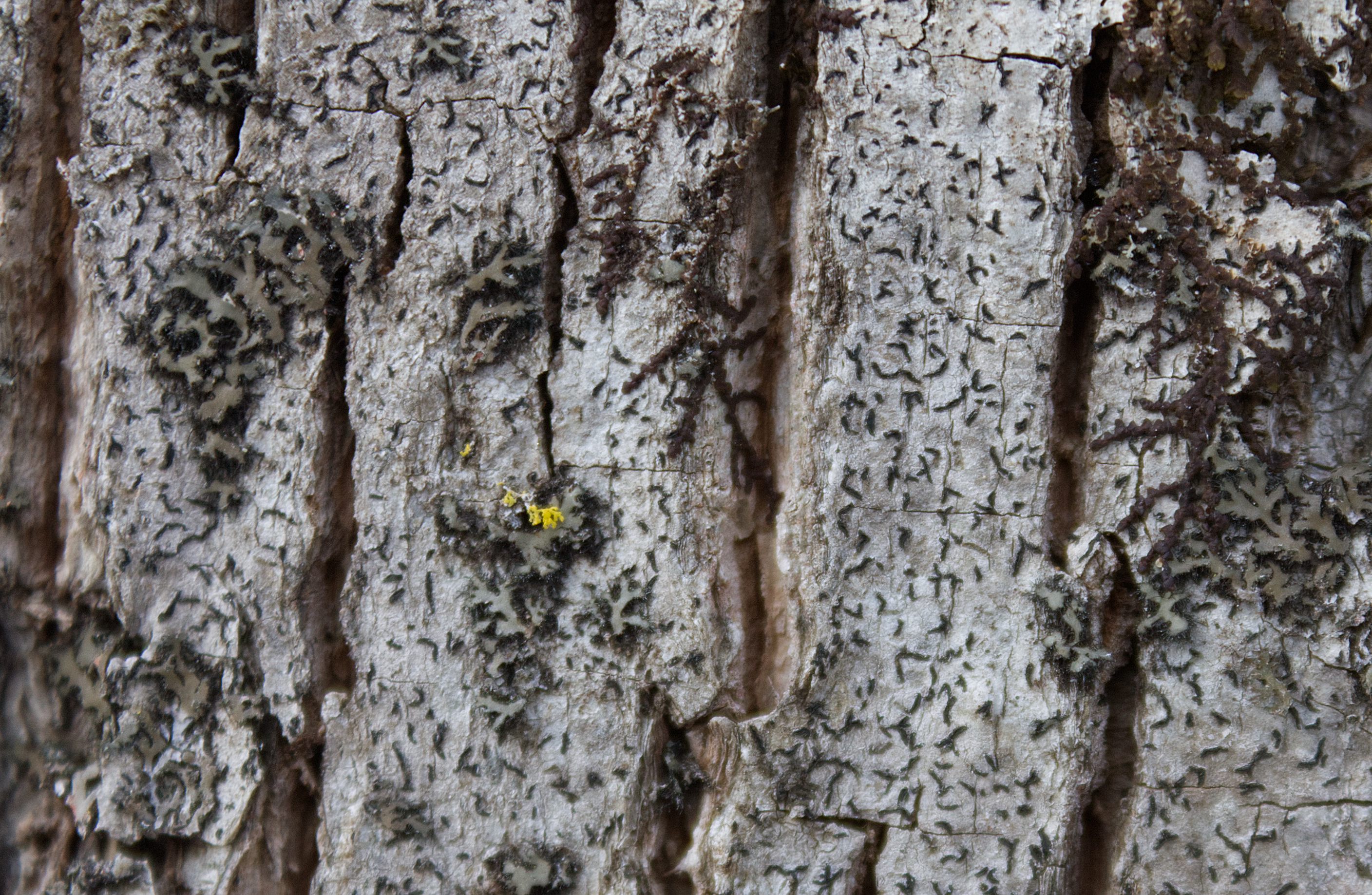
The Asterisk Lichen, whose fruiting bodies in fact can resemble an asterisk, is a common and widespread corticolous lichen that prefers the smooth bark of many young trees and shrubs. I didn’t see this lichen but look forward to finding it. According to iNaturalist, Its pale white to grey thallus forms a mosaic-like pattern on the bark, often separated from its surroundings by a thin brown line, (see photo below); I also witnessed this with the Common Script Lichen (see image above in Script Lichen section). The tiny black ‘unfrosted’ apothecia (fruiting bodies) are star-like (stellate), round or elongated. 

Asterisk Lichen (Arthonia radiata) showing branched squiggles of apothecia and brown border on a poplar tree, Trent Forest, ON (photo by Nina Munteanu)

Lichens that Map

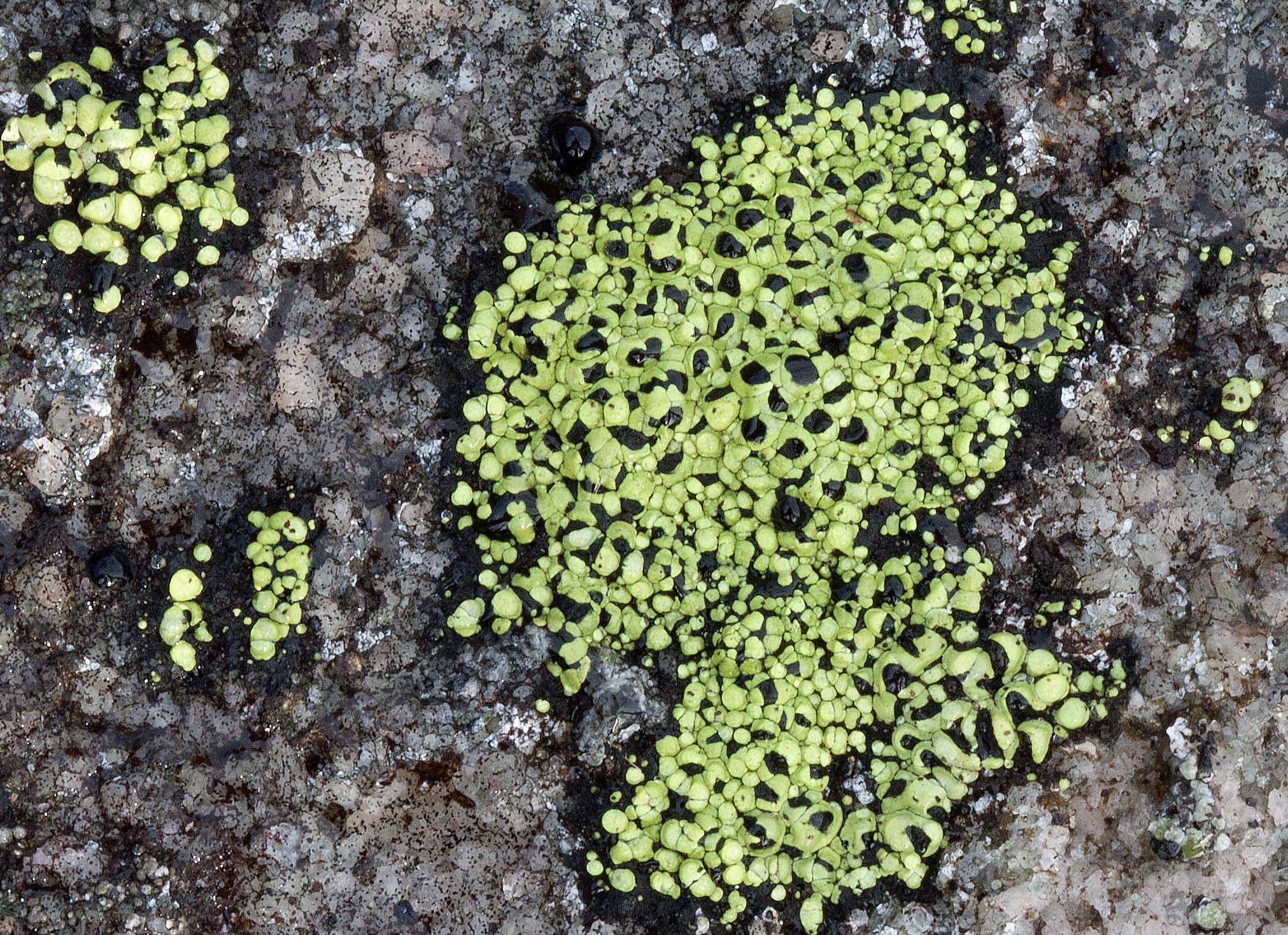
Yellow Map Lichen (goes green when wet) on granite outcrop, Catchacoma Forest, ON (photo by Nina Munteanu)

If we push the narrative to include illustration and mapping, we have the Yellow Map Lichen (Rhizocarpon geographica), a saxicolous lichen that I found colonizing a granite outcrop in the wetland of Catchacoma old-growth forest, Ontario.  Yellow Map Lichen is normally found on silicate rocks. Lichenologist William Purvis describes them as “minute yellow green islands, which contain the pigment rhizocarpic acid, growing on a black layer lacking algae.” The black edging of the thallus is called the prothallus, a fungal layer that advances out and contains allelopathic chemicals to ward off competitors.

There is something strangely invigorating about the thought of lichen that express themselves. A kind of gestalt presence, a genius that defies Cartesian epistemology. Nature winking. The Natur und Kunst of Goethe’s naturphilosophie.

Patches of Graphis scripta lichen on a young poplar tree, Trent Forest, ON (photo by Nina Munteanu)

“Nature! We are surrounded and embraced by her; powerless to separate ourselves from her, and powerless to penetrate beyond her … We live in her midst and know her not. She is incessantly speaking to us, but betrays not her secret. …She has always thought and always thinks; though not as man, but as Nature. …She loves herself, and her innumerable eyes and affections are fixed upon herself. She has divided herself that she may be her own delight. She causes an endless succession of new capacities for enjoyment to spring up, that her insatiable sympathy may be assuaged. …The spectacle of nature is always new, for she is always renewing the spectators. Life is her most exquisite invention; and death is her expert contrivance to get plenty of life.”

Johann Wolfgang von Goethe

References:

Deiderich, P., JD. Lawrey, and D. Ertz. 2018. “The 2018 classification and checklist of lichenicolous fungi with 2000 non-lichenized, obligately lichenicolous taxa.” The Bryologist 121(3): 340-425.

Friedl, T. 1987. “Thallus development and phycobionts of the parasitic lichen Diploschistes muscorum.” Lichenologist 19(2): 183-191.

Knudsen, Kerry, John W. Sheard, Jana Kocourkova, and Helmut Mayrhofer. 2013. “A new lichenicolous lichen from Europe and western North America in the genus Dimelaena (Physciaceae).” The Bryologist 116(3): 257-262.

Nimis, Pier Luigi, Elena Pittao, Monica Caramia, Piero Pitacco, Stefano Martellos, and Lucia Muggia. 2024. “The ecology of lichenicolous lichens: a case-study in Italy.” MycoKeys 105: 253-266.

Purvis, William. 2000. “Lichens.” Natural History Museum, London. 112pp.

Nina Munteanu is a Canadian ecologist / limnologist and novelist. She is co-editor of Europa SF and currently teaches writing courses at George Brown College and the University of Toronto. Visit www.ninamunteanu.ca for the latest on her books. Nina’s bilingual “La natura dell’acqua / The Way of Water” was published by Mincione Edizioni in Rome. Her non-fiction book “Water Is…” by Pixl Press (Vancouver) was selected by Margaret Atwood in the New York Times ‘Year in Reading’ and was chosen as the 2017 Summer Read by Water Canada. Her novel “A Diary in the Age of Water” was released by Inanna Publications (Toronto) in June 2020.

Spiritual Ecology & the Lesson of Crete

In a time when North American scientists and politicians are still debating the pros and cons of a carbon tax—when the current US President, within hours of his inauguration, orders the withdrawal of the U.S. from the Paris Climate Agreement and promotes fossil fuels and mineral mining—theologian Sallie McFague contends that climate change poses a greater danger to the globe than Nazism prior to the Second World War (See my postscript at the bottom of this post).

In another post, I described the debilitating psychological condition called solastalgia, a response to the loss felt in climate change-related impacts. McFague goes so far as to embrace a militant approach to the problem, urging citizens to dedicate themselves fully and be willing to sacrifice to save the planet’s eco-system. In her book, A New Climate for Theology, McFague espouses a spiritual attitude of gratitude and praise toward the natural world while adopting a radical war footing against global warming.

McFague widely defines “spiritual” to include the secular appreciation of nature. Rather than regarding God as a “being, McFague subscribes to the idea that God is the source of life, love and hope. A spiritual approach would provide the inner strength to tackle the worst effects of changing climate patterns, says Douglas Todd of The Vancouver Sun, who added, “I have been re-convinced of the necessity of a spiritual response to environmental problems.”

A spiritual connection with nature is nothing new. First Nations peoples have practiced it for millennia.

Riane Eisler, author of The Chalice & the Blade, writes of the ancient Bronze Age culture of Minoan (later Minoan-Mycenean) Crete (1,000 to 1,500 BCE), who still revered the Goddess. Citing Nicolas Platon, an archeologist who had excavated the island for over fifty years, Eisler writes of a society in which “the whole of life was pervaded by an ardent faith in the goddess Nature, the source of all creation and harmony”; this in a time when art extolled the symbols of nature—such as the serpent and butterfly, both symbols of transformation, rebirth and wisdom.


“In Crete,” writes Eisler, “for the last time in recorded history, a spirit of harmony between women and men as joyful and equal participants in life appears to pervade [in] a tradition that is unique in its ‘delight in beauty, grace, and movement’ and in its ‘enjoyment of life and closeness to nature.’ ” This way of life has been termed gylany*, a social sysem based on equality of all sexes. Despite the fact that they were surrounded by threats from an increasingly warlike and male-dominated (androcratic*) world, Cretans remained an “exceptionally peace-loving people” and their art did not idealize warfare. Cretans maintained “an ardent faith in the goddess Nature,” writes Platon. “This led to a love of peace, a horror of tyranny, and a respect for the law. Even among the ruling classes, personal ambition seems to have been unknown; nowhere do we find the name of an author attached to a work of art or a record of the deeds of a ruler.”

“The differences between the spirit of Crete and that of its neighbours,” writes Eisler, “are of more than academic interest.” The lack of Cretan military fortifications and signs of aggressive war—in sharp contrast to the walled cities and chronic warfare that were elsewhere already the norm—provides a confirmation from the past that peaceful human co-existence is not just a utopian dream.”


Cretan art reflected a society in which power was not equated with dominance, destruction and oppression. I think it is no coincidence that gender equality and harmony is linked to the pantheistic value of nature. The appreciation of beauty, grace and harmony is a “feminine” gylanic characteristic, one that ambitious warlike and highly competitive exploitive androcratic societies have no time to cultivate.

Eisler notes that a “recognition of our oneness with all of nature” lay at the heart of both the Neolithic and Cretan worship of the Goddess. She adds, “Increasingly, the work of modern ecologists indicate that this earlier quality of mind, in our time often associated with some types of Eastern spirituality, was far advanced beyond today’s environmentally destructive ideology. In fact, it foreshadows new scientific theories that all the living matter of earth, together with the atmosphere, oceans, and soil [and I would add the universe] forms one complex and inter-connected “life” system.” Quite fittingly, scientists James Lovelock and Lynn Margulis called this the Gaia Hypothesis—Gaia being one of the ancient Greek names of the Goddess.

At the same time that Riane Eisler was writing The Chalice & the BladeLynn Margulis developed her theory of endosymbiosis and suggested that evolution advanced through cooperation more than the Darwinian paradigm of competition (surely a “masculine” androcratic outlook).

Eisler provides examples of sociobiologists who draw on nineteenth-century Darwinism by citing insect societies to support their androcratic (social and political rule by men) theories. If we are to truly rise victorious over the scourge of climate change—a function of our current lifestyle and paradigms—we will need to adopt a cultural evolution that embraces a partnership society heralded by new and renewed symbology, language and “myth”.

For a few years I co-taught an environmental education course for primary and secondary school teachers. The course was intended to help teachers introduce environmental precepts and general awareness in all aspects of the primary and secondary school curriculum, such as creative ways to infuse environmental stewardship in courses from math to art. As much as I liked the integrative approach to this program, it is my belief that the “soft” science of Ecology should be taught as a basic course throughout a student’s entire school career (from Grade 1 to 12), giving it the prominence it deserves as a life-lesson mandate not unlike the three Rs.

Ecology is considered a “soft” science, because it integrates all other sciences and, as such, is more the study of relationships, links and consequence. As the study of ecosystems and the environment, Ecology lets us look at ourselves and how we relate to all other things, living and non-living, on this planet and ultimately the universe: the approach is only limited by our own perceptions. Ecologists study natural systems, which include all the systems in our society such as our economic systems, our social systems, business and financial models, cultural interactions and technological use. It behooves us to look to Nature’s Wisdom, to Gaia (our “mother”) for Her timeless lessons in our evolution. 

If Gaia is our “natural mother” then Ecology is her language.

Postscript:

Nazi Germany, contends Riane Eisler, demonstrated the most violent reaction to a gylanic concept (e.g., a society in which there is balance and equality between the sexes), proving to be the modern regression to the earliest and most brutal form of proto-androcracy and a foreshadower of a neo-androcratic future.


Like the Kurgans before them, the Nazis killed, plundered and looted—particularly in their wholesale slaughter of Jews. Likewise, they ‘idealized’ women as the hausfrau, akin to an “often pleasant domestic animal” (Nietzsche) to be used by men for sexual enjoyment, personal service, entertainment, and procreation. It was, in fact, Hitler’s plan to reward decorated soldiers with the right to have more than one wife as a warrior’s booty. According to the Führer, not only women but “weak” and “effeminate” men like Jews were the natural inferiors to his new race of “supermen.” Sound familiar?…

Beware of comments that refer to “the enemy from within.” Or “they are poisoning the blood of our country.” Or the catch phrase “make America great again.” Or “you know, Hitler did some good things, too.” Or promises like: “this is a fork in the road of human civilization,” particularly just prior to a Nazi-style (Seig-Heil) salute from someone who will supposedly be responsible for a new Department of Government Efficiency (DOGE).

Elon Musk gestures as he speaks during the inaugural parade inside Capital One Arena, Washington DC. According to Rolling Stone: “Right-wing extremists, white nationalists, and neo-Nazis are celebrating an alarming gesture made by the world’s richest man.” (photo Rolling Stone)
This is how you do it, Elon…”

Get out your copy of Margaret Atwood’s The Handmaid’s Tale and read it before it’s too late for freedom and any chance at gylany.

*Gylany: a social system based on equality of men and women
*Androcracy: a form of governing system in which rulers are male

Nina Munteanu is a Canadian ecologist / limnologist and novelist. She is co-editor of Europa SF and currently teaches writing courses at George Brown College and the University of Toronto. Visit www.ninamunteanu.ca for the latest on her books. Nina’s bilingual “La natura dell’acqua / The Way of Water” was published by Mincione Edizioni in Rome. Her non-fiction book “Water Is…” by Pixl Press (Vancouver) was selected by Margaret Atwood in the New York Times ‘Year in Reading’ and was chosen as the 2017 Summer Read by Water Canada. Her novel “A Diary in the Age of Water” was released by Inanna Publications (Toronto) in June 2020.

Movie Review: Soylent Green Is…

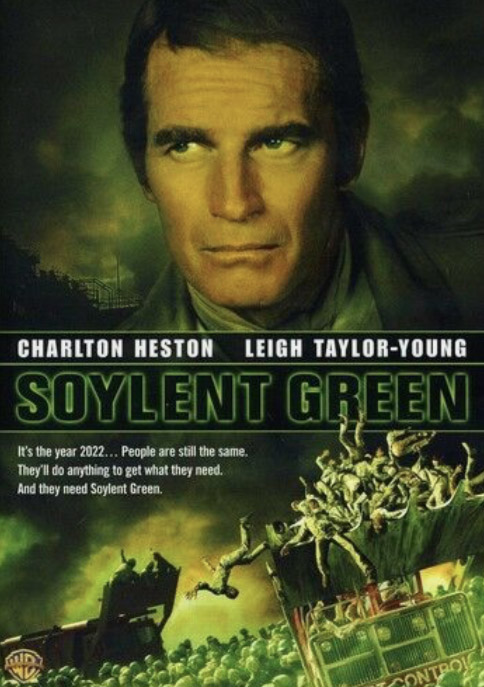
“The year is 2022. Our overpopulated planet is experiencing catastrophic climate change, mega-corporations have excessive power over the government, and clean living is a luxury only the 1 percent can afford. It may read like a scan of the front-page headlines, but these predictions were laid out half a century ago in the dystopian film Soylent Green,” writes George Bass of The Washington Post.

The 1973 science fiction eco-thriller Soylent Green, directed by Richard Fleischer, was based on the 1966 novel Make Room! Make Room! by Harry Harrison. The movie stars Charlton Heston as Robert Thorn, an illiterate rather wily NYC detective who must solve the murder of a Soylent executive with the help of his sidekick researcher and friend Sol Roth (Edward G. Robinson). In one scene, Thorn notes that the city of over 40 million logs 137 homicides a day.

Riot trucks scoop up rioters without regard to injury

The murder mystery unravels a hive of intrigue in a sweltering 90° New York City, over-crowded with a restive population of homeless and starving people. “Margarine spoils in the fridge, and a sickly fog … hangs in the air,” writes Bass. Thorn shares a small room with friend and helper Sol in a building where he must daily negotiate an obstacle course of occupants who crowd the stairs and hallways. These scenes contrast with those within the enclaves of the corporate elite, who enjoy a luxurious lifestyle of spacious homes equipped with ample water and food and the latest technology and games—a common trope of ‘haves’ and ‘have nots’ in several dystopian works such as the Brazilian TV show 3%, and the movies Elysium, Advantageous, and Snowpiercer.

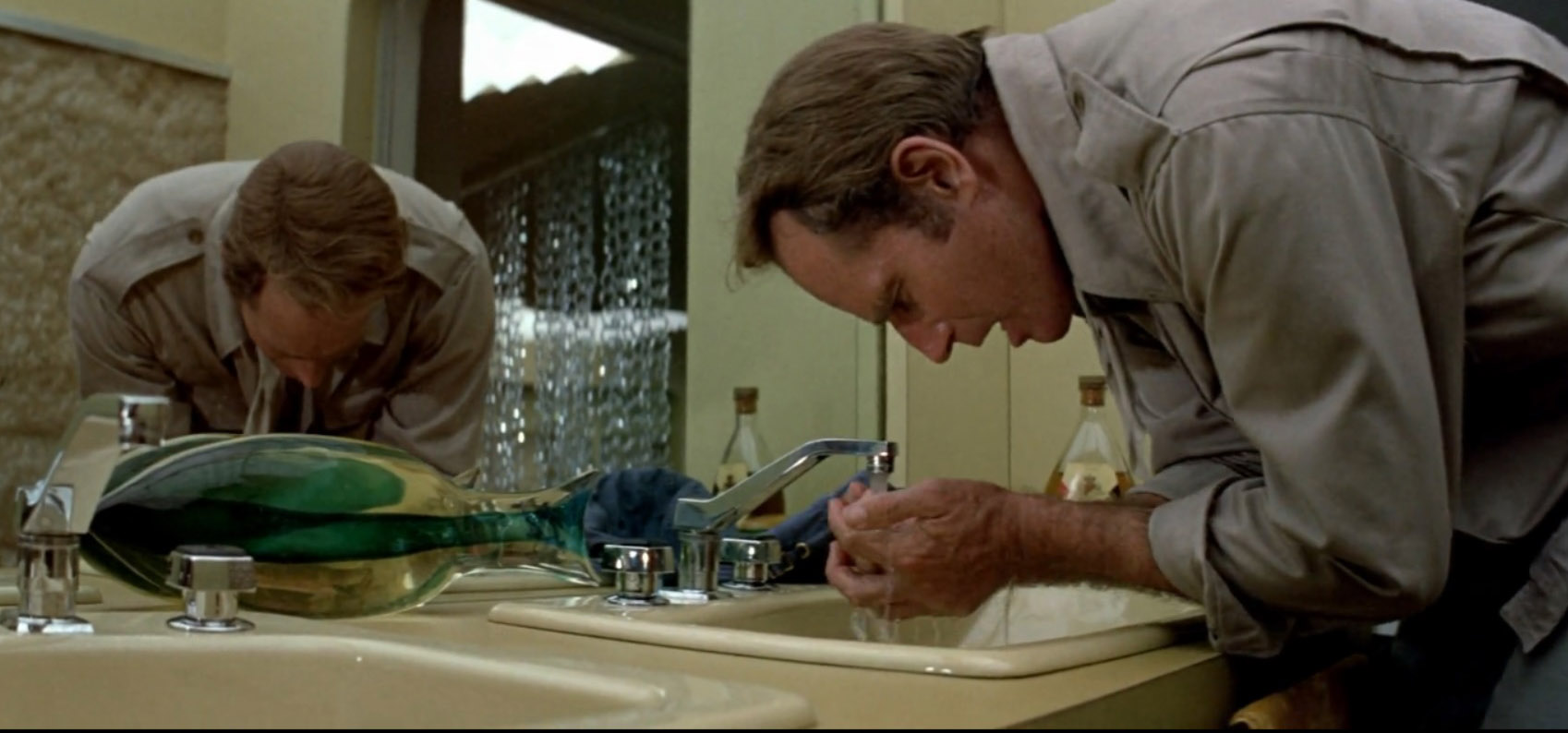
Thorn mesmerized by soap and running water

Accustomed to living a scorched existence, Thorn becomes infatuated with a bar of soap he finds in the victim’s mansion and an air conditioner that can make a room “cold, like winter used to be.” I’m reminded of another crusty detective scrabbling for comfort items in a less than comfortable world: Detective Miller in the TV series The Expanse breaks into his subject’s apartment to use her shower.

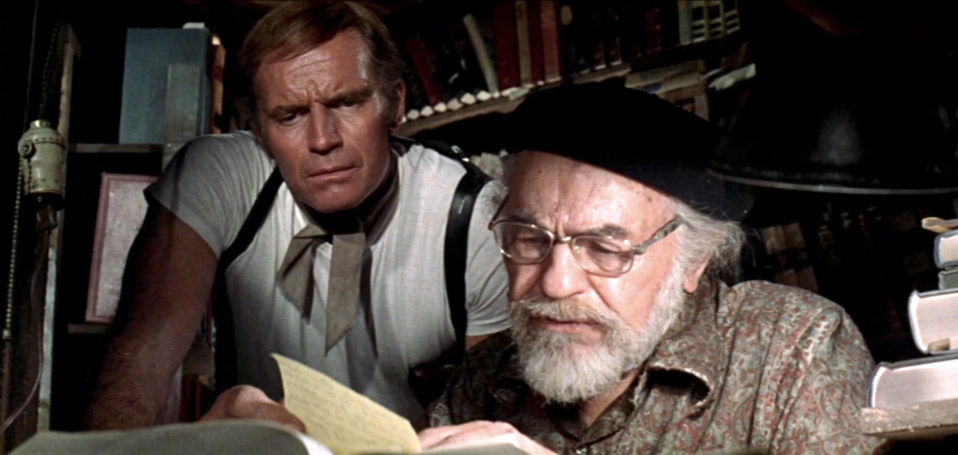
Thorn and Roth research the Soylent Corporation

In this ‘future’ world of synthetic food, the public lives off the high-energy vegetable concentrates created by the Soylent Corporation. Their latest synthetic food product is Soylent Green, advertised as a “miracle food of high-energy plankton gathered from the oceans of the world,” and is so popular that it must be rationed to a single day availability per week—causing more of those riots I already mentioned. Of course, the wealthy elite still eat meat and semi-fresh vegetables, but even these are not to the standard that we in North America are accustomed to. The meat is old and the vegetables imperfect. Bass notes that “Each door in the luxury tower block is automated, the penthouse butler is dressed in garish hunting pink, and the height of decadence is a fresh shower.” Climate change even impacts the super-rich.

Most pressing on the public’s mind is hunger and food insecurity. Micheal Peck of The Break Through writes that corporations and governments commit murder and state-sanctioned mass cannibalism to protect their food supply. Soylent Corporation employs an assassin to dispatch its enemies and the killer doesn’t spend his pay on a car or a house; instead, he splurges on real strawberry jam (which goes for $150 a jar, marvels Roth).

Thorn lets Roth taste the $150 jam he perloined

In another scene Roth laments to Thorn, “When I was a kid food was food. Before our scientific magicians poisoned he water, polluted the soil. Decimated plant and animal life. Why, in my day you could buy meat anywhere. Eggs, they had. Real butter. Fresh lettuce in the store.” Thorn answers, “I know, Sol. You told me before. A heat wave all year long. A greenhouse effect. Everything is burning up.” When Thorn brings back a prize of meat and some old vegetables he’d scavenged from the murder victim’s apartment, Roth grows emotional and shares, “I haven’t eaten like this in years.” Thorn responds, “I never ate like this.”

Thorn’s investigation ultimately leads him to a discovery that goes way beyond the murder, which he discovers is really an assassination, one that will reveal the ultimate corporate conspiracy: Soylent Green is people.

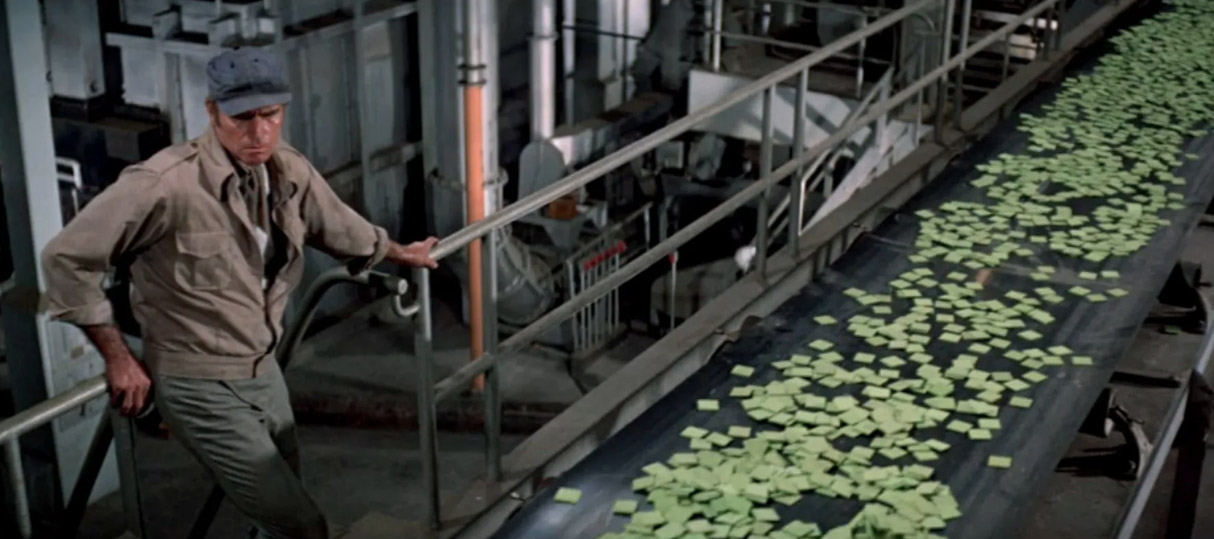
Thorn discovers the horrific secret of Soylent Green

“The uncanny (un)timeliness of the film is profoundly disturbing while at the same time deeply gratifying, as if hearing a voice from the past tell you that your daily anxiety about capitalism-induced climate chaos is not only well justified, it has actually been anticipated for some time,” writes Alisa Lebow in Film Quarterly.

Lebow adds that Soylent Green did not receive the critical acclaim it deserved on its release (though it has since become somewhat of a classic with an eclectic audience). “What none of the critics writing in 1973 could have foreseen … is the near prophetic view of the absolute callousness of late capitalism wherein profit and the enrichment of the few reign supreme.” According to Lebow, while Soylent Green has been largely forgotten, more recent films such as The Day After Tomorrow have been received with great fanfare and have been credited with helping change perceptions about climate change, especially in the US. Lebow argues that The Day After Tomorrow pales in comparison to Soylent Green in terms of urgency and clarity of message and “that the focus on climate as the driver of change is more forthrightly posited in this film than in any popular genre film on the topic that I have seen.”

The crisis of over-population in the film resonates powerfully today and runs in concert with the destruction of our habitable world. The alarming question remains: how to feed an over-crowded planet when the climate is unpredictable and the relentless industrial machine continues to strain the planet’s resources.

The Opening Title of the Film

Alisa Lebow, Professor of Screen Media at University of Sussex ascribes the opening title of the film as nothing less than brilliant and worthy of study:

“Charles Braverman’s two and a half minute documentary montage that opens the film is a revelation in and of itself and worthy of sustained analysis. Beginning with sepia images of early American settlers, the montage unwittingly apportions blame correctly to the white settler colonists for the maddening pace of industrialization and the demise of any balanced and respectful relationship with the lived environment. The montage quickly accelerates from its proto-Ken Burns Effect zooms and pulls to a frenzied barrage of cuts and dissolves with some nifty split screen effects that could not have been simple to produce at the time. Comprised exclusively of stills, it manages to convey the dizzying pace of development and its often unnoticed effects. Highways are choked with cars, factory chimneys belch black smoke, people crowd the streets in all reaches of the globe, as mountains of junked cars threaten to overtake the frame and garbage piles up in every corner.”

Decades-Old Cautionary Tale Highly Relevant Today

The 1960s was a time of great activism and environmental awareness, igniting an environmental movement led by Rachel Carson’s 1962 Silent Spring and Paul R. Ehrlich’s 1968 The Population Bomb, among other calls for action. Maurice Mitchell of the Geektwins shares that many important scientific works warning of the future devastation of climate change came to us in the 1960s. “By the 1960s, aerosol pollution had become a serious local problem and scientists began to consider the cooling effect of particulate pollution on global temperatures. Paul R. Ehrlich wrote that the greenhouse effect is being enhanced by carbon dioxide and is being countered by low-level clouds generated by contrails, dust, and other contaminants. In 1963, J. Murray Mitchell presented one of the first up-to-date temperature reconstructions, which showed that global temperatures increased steadily until 1940. In 1965, the Science Advisory Committee warned of the harmful effects of fossil fuel emissions.”

Mitchell adds that Soylent Green was the first movie to caution about greenhouse gas—long before The Day After Tomorrow (2004), The Day the Earth Stood Still (2008), Interstellar (2014), and Don’t Look Up (2021) moved people to ponder the devastation of climate change.

Elisa Guimarães of Collider writes: “At the height of the 21st century, Richard Fleischer’s Soylent Green can make for a somewhat weird watch. Originally released in 1973, the film first produces a sense of disconnect in modern viewers with its initial card, which dates its plot as taking place in the far-off year of 2022. The film’s extremely 1970s brand of sexism and neo-Malthusian approach to overpopulation can also feel uncomfortable for contemporary eyes. And, yet, Soylent Green’s social and environmental concerns feel all the more urgent in a world in which climate change has become undeniable.”

In her article entitled “The Greatest Horror of ‘Soylent Green’ Isn’t Soylent Green—It’s This”, Guimarães notes that “there’s something in Soylent Green that feels even more wrong than the realization that humanity has been engaging in involuntary cannibalism.” Guimarães argues that the scene with the assisted suicide clinic helps viewers comprehend “just how devoid of value human life has become in such a scarcity-ridden world.” The film shows only too clearly how people are treated: as homo sacer commodities in a Foucault biopolitical world of disposable humans. Guimarães argues that the euthanasia facility “is the one place in which the poor and weak of the Soylent Green society may find some semblance of dignity; but it is also the place to which you go to be turned from an unproductive individual into a product.”

In the final scene, when Thorn reveals his horrific discovery of hidden cannibalism, he instantly understands its deeper consequence: in a world of severe resource depletion, humaneness is the main casualty.

“Ocean’s dying, plankton’s dying … it’s people. Soylent Green is made out of people. They’re making our food out of people. Next think they’ll be breeding us like cattle for food…We’ve gotta stop them somehow!”  

Thorn on riot duty

“While [Soylent Green] inevitably gets many things wrong, it also gets something dead right.”

Alisa Lebow 

Soylent Green deserves to be watched. It deserves to be discussed. Go watch it and lament how after fifty years we have done so little to change this trajectory.

Nina Munteanu is a Canadian ecologist / limnologist and novelist. She is co-editor of Europa SF and currently teaches writing courses at George Brown College and the University of Toronto. Visit www.ninamunteanu.ca for the latest on her books. Nina’s bilingual “La natura dell’acqua / The Way of Water” was published by Mincione Edizioni in Rome. Her non-fiction book “Water Is…” by Pixl Press (Vancouver) was selected by Margaret Atwood in the New York Times ‘Year in Reading’ and was chosen as the 2017 Summer Read by Water Canada. Her novel “A Diary in the Age of Water” was released by Inanna Publications (Toronto) in June 2020.

When Curiosity Saves (the Cat)

The texture of the world, its filigree and scrollwork, means that there is a possibility for beauty here

Annie Dillard, Pilgrim at Tinker Creek

Something parents often say to get their kids to behave and not run wild and create chaos is: curiosity killed the cat. It’s a clear warning of the dangers of unnecessary investigation or experimenting without reason. It implies that being curious could sometimes lead to misfortune or danger. Better safe than sorry, eh?…

I think it’s the opposite: curiosity saves lives. Curiosity keeps us alive.

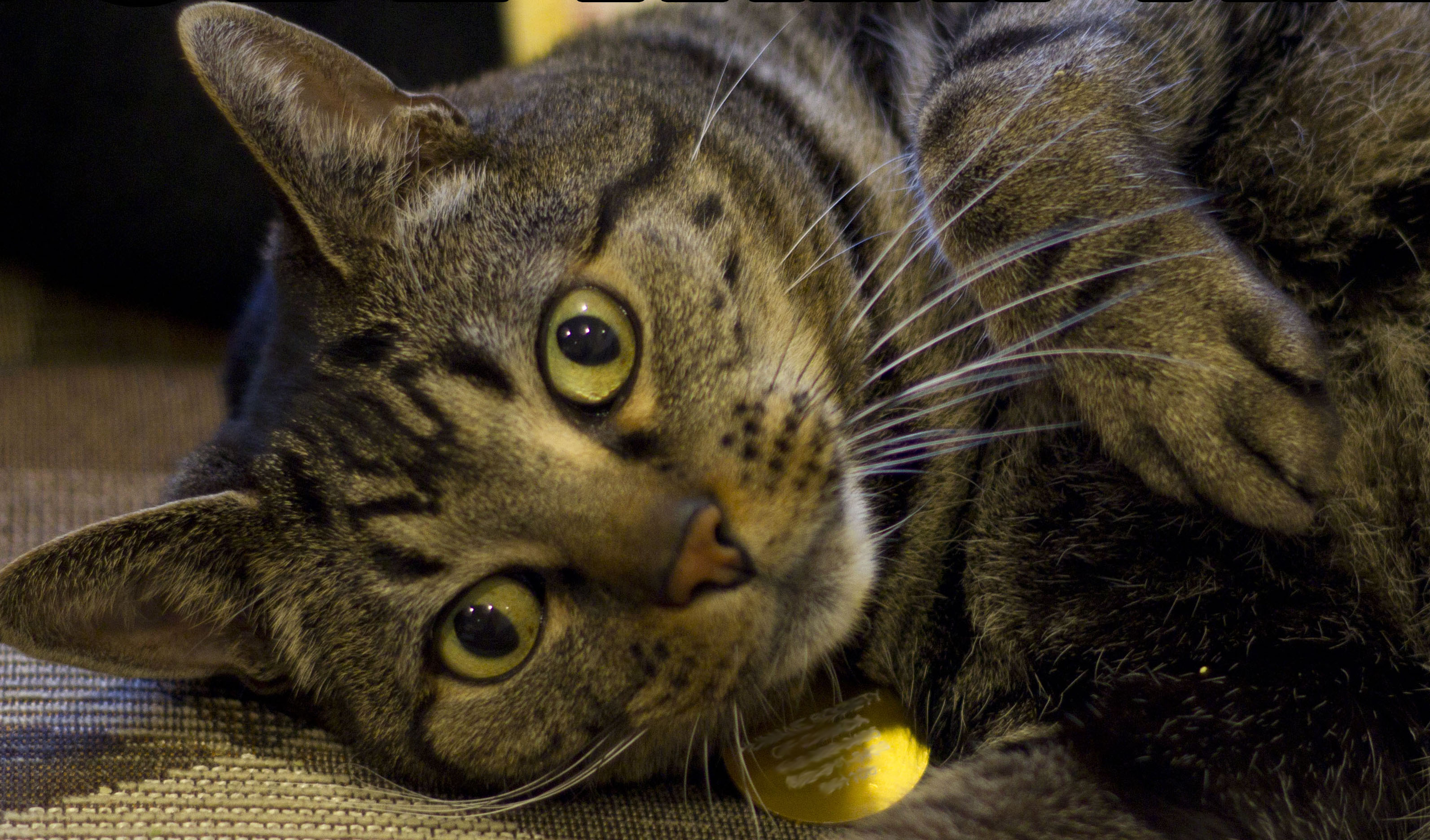
Sammy, author’s cat takes a stroll (photo by Nina Munteanu)

Let me tell you a story about my mother first:

One of seven siblings of a cattle farmer in Germany, my mom was not formally educated past Grade 7. This did not mean that she wasn’t educated. Curiosity led her to learn an entire language (English) by first reading comic books. She mastered elements of several sciences including botany, genetics, horticulture, and geology. Whatever caught her interest, my mother dove into finding out more with research. We weren’t rich and this was well before the internet and personal laptop computers, so this meant applying herself by visiting the library and borrowing books from friends to acquire information. Her research was impeccable.

Doing research is both an art and a science that opens up a world of both answers and more questions. It always starts with curiosity and leads to more curiosity by not only answering specific questions but by creating new ones. And so the process goes. My mom’s inquisitive mind led her to amazing discoveries of how the world worked, what grew where and why and all the strange and wonderful things on planet Earth. She was a naturalist with a keen mind for finding out more.

When I was the only kid left at home and began to travel in my late teens, it became a kind of running joke that whenever I left for an adventure, say to Europe, she didn’t get lonely or bored; she dove right into a new world in some scientific quest. When I returned from my adventure, we both had discoveries to share. While I’d experienced a new country and its culture and food, she’d explored a whole new scientific discipline.

My mother’s indefatigable curiosity for the natural world was inspiring. It kept her motivated and interested in life in general. She was never satisfied with answering just “what”, or even “how;” what caught her interest was “why”: the question of context and meaning. She kept herself young, connected, motivated well into her nineties through her curiosity.

Author’s family cat Sammy after a session with catnip

Nurturing Mental Health with Curiosity

Curiosity helps motivate learning, encourages creative problem-solving and plays a crucial role in healthy human development. In a nutshell, curiosity is a sign of mental health.

Researchers have shown that curiosity improves memory, creativity, and higher life satisfaction, and—contrary to the poor curious cat—aging well. Others have shown that curiosity can even protect against anxiety and depression. In fact, contrary to what scientists thought decades ago, the older human brain continues to have a great capacity for learning and developing. The study of neuroplasticity shows that pathways in your brain can develop and strengthen, even when you’re older—like my mom, and me now… The brain functions like a muscle: the more you use it, the stronger it gets. If you don’t exercise it, it will get weaker.

So, having a curious mind and being naturally inquisitive seems like a pretty good thing.

Anand Tamboli at Medium.com notes that “one of the benefits of being curious is that you will end up making fewer errors … When we are curious, it is easier to avoid confirmation bias. With a curious mind, we tend to look at more alternatives, and the chances of stereotyping someone [or something] are quite low.” Tamboli adds that “we don’t get defensive when we stay curious. That is because instead of making any assumptions, we ask more questions, which in turn makes us more empathetic. When we’re curious, we listen better.” All together, this makes us more creative and innovative—and, ultimately successful.

Sammy watching the world through a window

What You See Is What You Get

In a four minute read in the Daily Good, Annie Dillard writes in an excerpt from Pilgrim at Tinker Creek about how when she was six or seven years old, growing up in Pittsburgh, she used to take a precious penny of hers and hide it for someone else to find. I’ll let you read the excerpt because she writes it best, but the upshot is to cultivate a natural curiosity borne of humility and simplicity: what you see is what you get. And the best gifts are surprises. You just need to see… “The secret of seeing is to sail on solar wind. Hone and spread your spirit till you yourself are a sail, whetted, translucent, broadside to the merest puff.”

When I go for my daily walks in Nature, I am an explorer aiming for discovery. I tell myself that I must come back with three gifts. They could be anything: things I found, new observations or surprising experiences. I don’t actively look for them; I let them present themselves to me through simple exploration. Ultimately, these gifts always come when and where I least expect. A profusion of mushrooms presenting themselves where I’d sat on a log to eat my lunch; a sudden flurry of winter diving ducks I’d aroused from their quietude by the river; a lone fox loping carefree along the icy shore of the river before suddenly noticing me and scampering away. I seem to have no problem acquiring these gifts. The idea makes me smile and I think of Annie Dillard and her copper pennies.

Sammy watches the world from high the rooftop patio

Navigating a Changing World with Curiosity

So much of humanity operates on a purpose-driven model of “progress” delivered to us by a stable Holocene world. But that world was never ‘delivered’ to us; and it’s changing. A lot.

With the onset of climate change, environmental degradation, and associated political strife and confusion in the world, everything is becoming more precarious. For some, it seems like the world is falling apart. “A precarious world is a world without teleology,” writes Anna Lowenhaupt Tsing in her book The Mushroom at the End of the World. She adds that precarity is the condition of being vulnerable. “Unpredictable encounters transform us; we are not in control, even of ourselves. Unable to rely on a stable structure of community, we are thrown into shifting assemblages, which remake us as well as others…Everything is in flux, including our ability to survive.”

“What do you do when your world starts to fall apart?” Tsing asks. “I go for a walk,” she says, “and if I’m lucky, I find mushrooms. Mushrooms pull me back into my senses, not just—like flowers—through their riotous colours and smells, but because they pop up unexpectedly, reminding me of the good fortune of just happening to be there. Then I know that there are still pleasures amidst the terrors of indeterminacy … indeterminacy also makes life possible.”

Changing with circumstances is the stuff of survival. Tsing describes something she calls collaborative survival, which requires working across differences, crossing into ecotones of change and flux and opening to ‘contaminating’ encounters that lead to collaboration. Messy? Darn right; but also exciting and full of wonderful promise.

Using the matsutake mushroom as her example, Tsing declares that, “If we open ourselves to their … attractions, matsutake [or any natural phenomenon] can catapult us into the curiosity that seems to me the first requirement of collaborative survival in precarious times.”

Remaining curious is tantamount to our survival.

Sammy keeps an eye out through the window

Staying Curious…

Tamboli gives five tips on keeping your mind alive with curiosity.

1. Explore, observe, and listen: Look at things like mysteries and explore possibilities. “They say that instead of looking at things like puzzles, look at them as mysteries. Because puzzles have definitive answers. Once you find the missing information, it’s done. But mysteries are more nuanced. They pose questions that cannot be answered definitively. The answers are complex, interrelated, and can involve both known and unknown factors.”

2. Diversify your interests: Activate your mind. “When you diversify your interests, you get new experiences. These new experiences can help in activating your mind in many ways other things cannot.”

3. Teach others: It’s one of the best ways to learn new things. “The next time you’re feeling bored, talk to someone. Think about your skills or facts that you know. Offer to teach them. Teaching, as they say, is one of the best ways to learn new things. Plus, it can be a highly rewarding activity.” This is similar to “going into service” to help a community or group in need. Thinking beyond myself but to the needs of others, often directs me to something wonderfully new.

4. Mingle with non-likeminded people: “This practice will help you see the world with more empathy. It will also help you make a better case for your own beliefs. And that is because you will understand various arguments and counter-arguments much better than you would otherwise.” What this means to me is: seek out discussion with people who have a different view of things, where you can argue your points; this often leads to new, more full-bodied understandings of issues. This keeps your mind sharp and active, and so alive!

5. Stop relying on Google or the internet: stay curious and become more creative by learning the facts for yourself. “If you stop committing information to your memory, you are essentially damaging your neuroplasticity. When we learn new things, our brain goes through many long-lasting functional changes. It is what we call neuroplasticity. Over-reliance on the internet and the thinking that ‘I can always Google it’ means you are not learning. You are not curious.”

This is akin to learning to do your own research, to seek the truth through cross referencing (and not relying on one simple answer), poring over books, asking questions. It comes down to figuring out context and why things are, not just what they are.

Sammy playing

The Proverb

The expression “Curiosity killed the cat” is actually a recent version of an older saying from the as early as 1598: “Care killed the Cat. It is said that a cat has nine lives, but care would wear them all out.” Either saying is appropriate for cats, in that they are by nature curious creatures (one of the reasons I so adore them!) and this can indeed lead them into odd circumstances.

The trait of curiosity, it seems, has not fared well in the eyes of some philosophers.

Phrases.org shares that in AD 397, Saint Augustine wrote that God “fashioned hell for the inquisitive.” In 1639, John Clarke suggested that “He that pryeth into every cloud may be struck with a thunderbolt.” Clearly these men didn’t care for scientists! And let’s not forget that the phrase “curiosity killed the cat” has a rejoinder: “but the truth brought it back.”

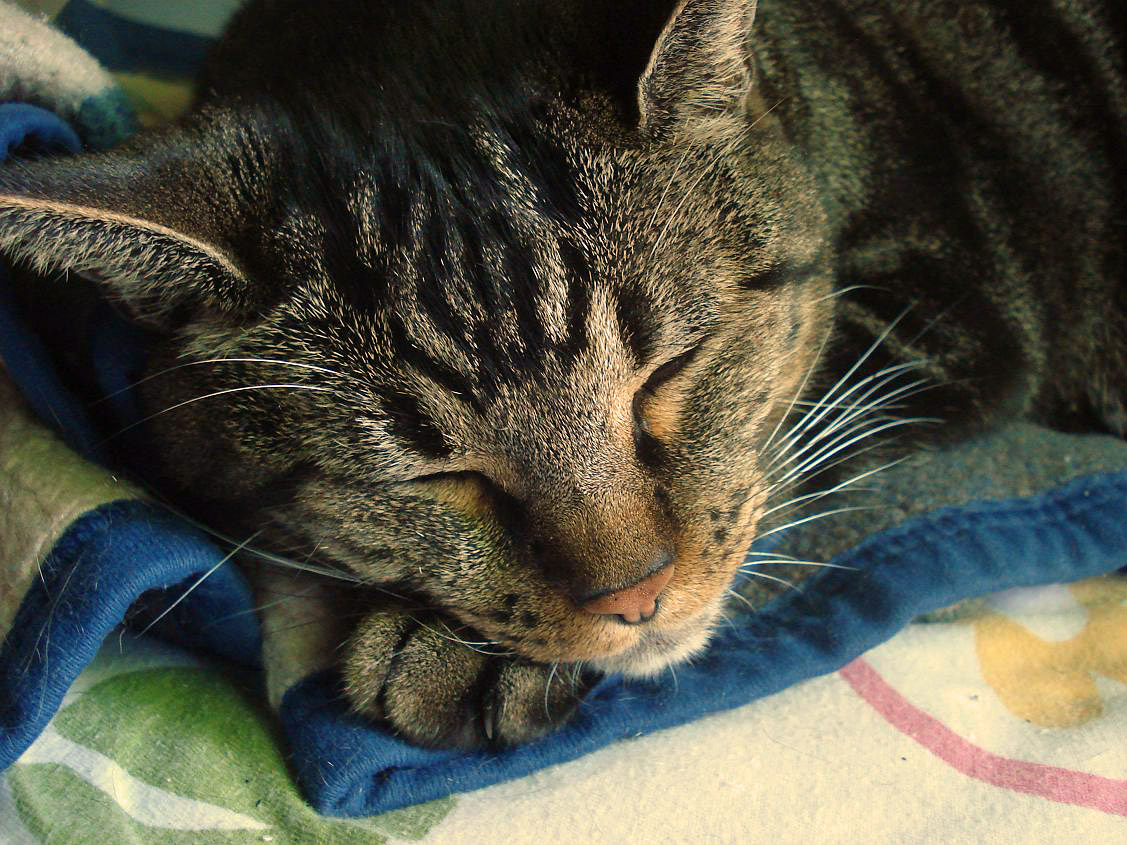
Sammy napping after an adventure outside

p.s. Anthony K. on Bluesky made this insightful comment: “What a profound take on the proverb! Curiosity can lead us into uncharted territory, but it’s the pursuit of truth that brings us back stronger and wiser. Sometimes, seeking answers is the only way forward.”

References:

Dillard, Annie. 1974. “Pilgrim at Tinker Creek.” Harper’s Magazine Press. 271pp.

Gruber, M. J., & Ranganath, C. (2019). How curiosity enhances hippocampus-dependent memory: The prediction, appraisal, curiosity, and exploration (PACE) framework. Trends in cognitive sciences23(12), 1014-1025.

Proctor, C., Maltby, J., & Linley, P. A. (2011). Strengths use as a predictor of well-being and health-related quality of life. Journal of Happiness Studies12, 153-169.

Sakaki, M., Yagi, A., & Murayama, K. (2018). Curiosity in old age: A possible key to achieving adaptive aging. Neuroscience & Biobehavioral Reviews88, 106-116.

Tsing, Anna Lowenhaupt. 2015. “The Mushroom at the End of the World.” Princeton University Press, Princeton. 331pp.

Nina Munteanu is a Canadian ecologist / limnologist and novelist. She is co-editor of Europa SF and currently teaches writing courses at George Brown College and the University of Toronto. Visit www.ninamunteanu.ca for the latest on her books. Nina’s bilingual “La natura dell’acqua / The Way of Water” was published by Mincione Edizioni in Rome. Her non-fiction book “Water Is…” by Pixl Press (Vancouver) was selected by Margaret Atwood in the New York Times ‘Year in Reading’ and was chosen as the 2017 Summer Read by Water Canada. Her novel “A Diary in the Age of Water” was released by Inanna Publications (Toronto) in June 2020.

Book Review: Nina’s Favourite 3 Reads of 2024—Cautionary Eco-fiction

In late 2023, I was invited by Shepherd to post an article of my favourite three reads of 2023 (books I’d read in 2023; not necessarily published in 2023). I had earlier that year posted on Shepherd an article describing what I considered to be some of the best eco-fiction books that make you care and give you hope. My favourite three of 2023 resonated with a feminist theme that featured hopeful stories of strong women, acting in solidarity and out of compassion, with intelligence, kindness and courage. For me, 2023 was a year of strong feminine energy for the planet and my favourite books reflected that. They included: Camp Zero by Michelle Min Sterling; We by Yevgeni Zamyatin; and Wool by Hugh Howie.

This year Shepherd invited me to share my favourite three reads of 2024 (same rules applied: books I’d read in 2024, not just books published that year). For me, 2024 was an intense year for the environment on the planet and a year of personal healing for me; my selection reflects that. The books that spoke most to me this year were compelling eco-fiction cautionary tales with great scope and incredibly vivid and immersive world building. All featured strong but flawed eco-champions in transition. Two start from an almost frail naiveté and initial victimization; but all eventually embrace—at heroic expense—a monster-archetype to challenge the cruelty of capitalist greed and corruption. All three books explored incredible, often disturbing and terrifying worlds that lingered with me long after I put the book down. All three books featured complex characters who transcended their own weakness and frailty to rise up like a great tsunami and shake a world order. Here they are (read the original article on Shepherd here):   

Waste Tide

by Chen Qiufan, Ken Liu (translator)

Compelling light-giving characters navigate the dark bleak world of profiteers and greedy investors in this eco-techno-thriller. Mimi is a migrant worker off the coast of China who scavenges through piles of hazardous technical garbage to make a living. She struggles, like the environment, in a larger power struggle for profit and power; but she finds a way to change the game, inspiring others. The story of Mimi and Kaizong—who she inspires—stayed with me long after I put the book down.

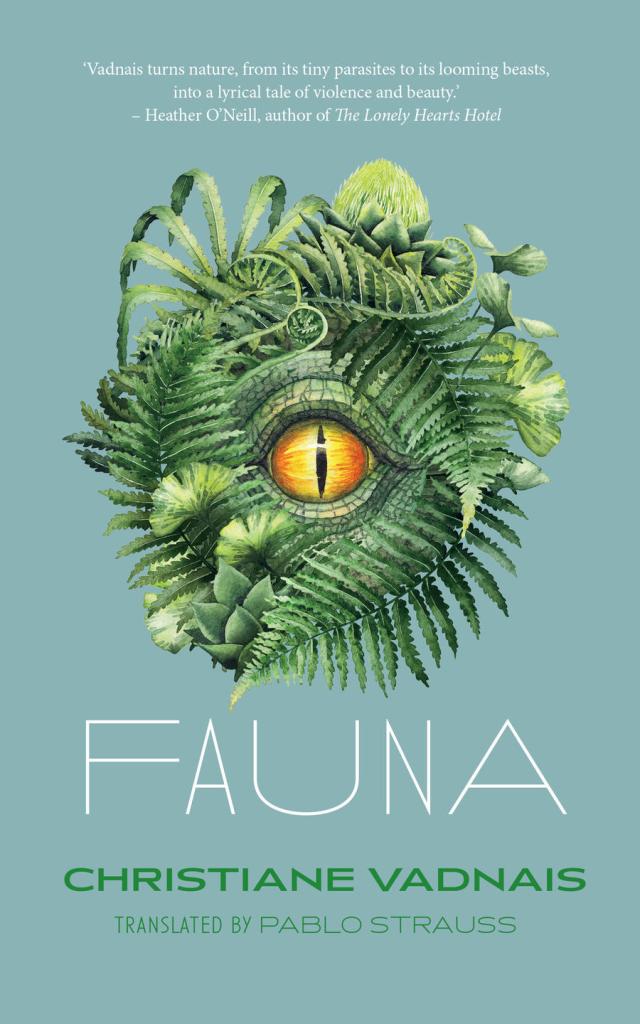
Fauna

by Christiane Vadnais, Pablo Strauss (translator)

At once beautiful and terrifying, Vadnais’s liquid prose immersed me instantly in her flowing story about change in this Darwinian eco-horror ode to climate change. I felt connected to the biologist Laura as she navigated through a torrent of rising mists and coiling snakes and her own transforming body with the changing world around her. It was an emotional rollercoaster ride that made me think.

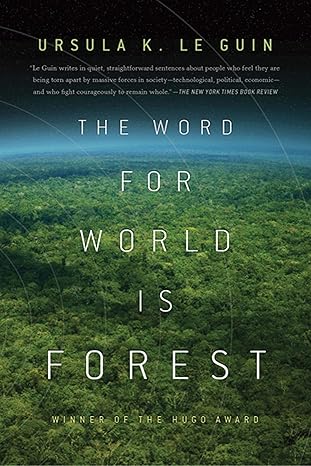
The Word for World is Forest

by Ursula K. Le Guin

I was immediately drawn in by the struggles of the indigenous people to the conquering settlers through excellent characters who I cared about. The irony of what the indigenous peoples must do to save themselves runs subtle but tragic throughout the narrative. Given its relevance to our own colonial history and present situation, this simple tale rang through me like a tolling bell.

Here’s my recent eco-novel:

A Diary in the Age of Water follows the climate-induced journey of Earth and humanity through four generations of women, each with a unique relationship to water.

Centuries from now, in a dying boreal forest in what used to be northern Canada, Kyo, a young acolyte called to service in the Exodus, yearns for Earth’s past—the Age of Water—before the “Water Twins” destroyed humanity. Looking for answers and plagued by vivid dreams of this holocaust, Kyo discovers the diary of Lynna, a limnologist from that time of severe water scarcity just prior to the destruction. In her work for a global giant that controls Earth’s water, Lynna witnesses and records in her diary the disturbing events that will soon lead to humanity’s demise.

Path through a black locust grove in a larger mixed forest, ON (photo and rendition by Nina Munteanu)

Nina Munteanu is a Canadian ecologist / limnologist and novelist. She is co-editor of Europa SF and currently teaches writing courses at George Brown College and the University of Toronto. Visit www.ninamunteanu.ca for the latest on her books. Nina’s bilingual “La natura dell’acqua / The Way of Water” was published by Mincione Edizioni in Rome. Her non-fiction book “Water Is…” by Pixl Press (Vancouver) was selected by Margaret Atwood in the New York Times ‘Year in Reading’ and was chosen as the 2017 Summer Read by Water Canada. Her novel “A Diary in the Age of Water” was released by Inanna Publications (Toronto) in June 2020.

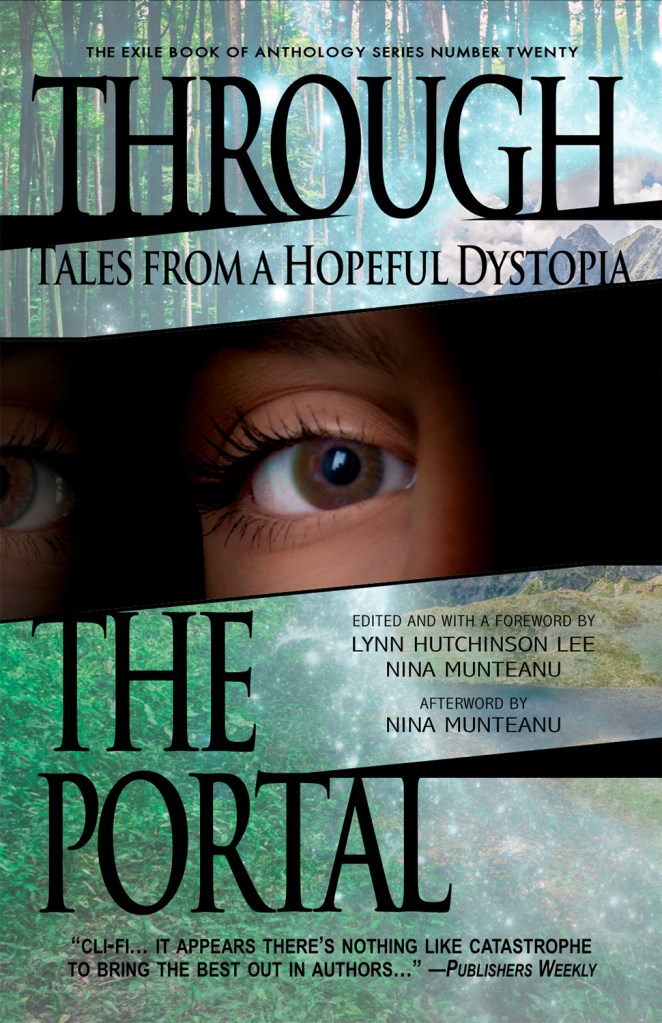
‘Through the Portal: Tales from a Hopeful Dystopia’ Anthology Releases December 31

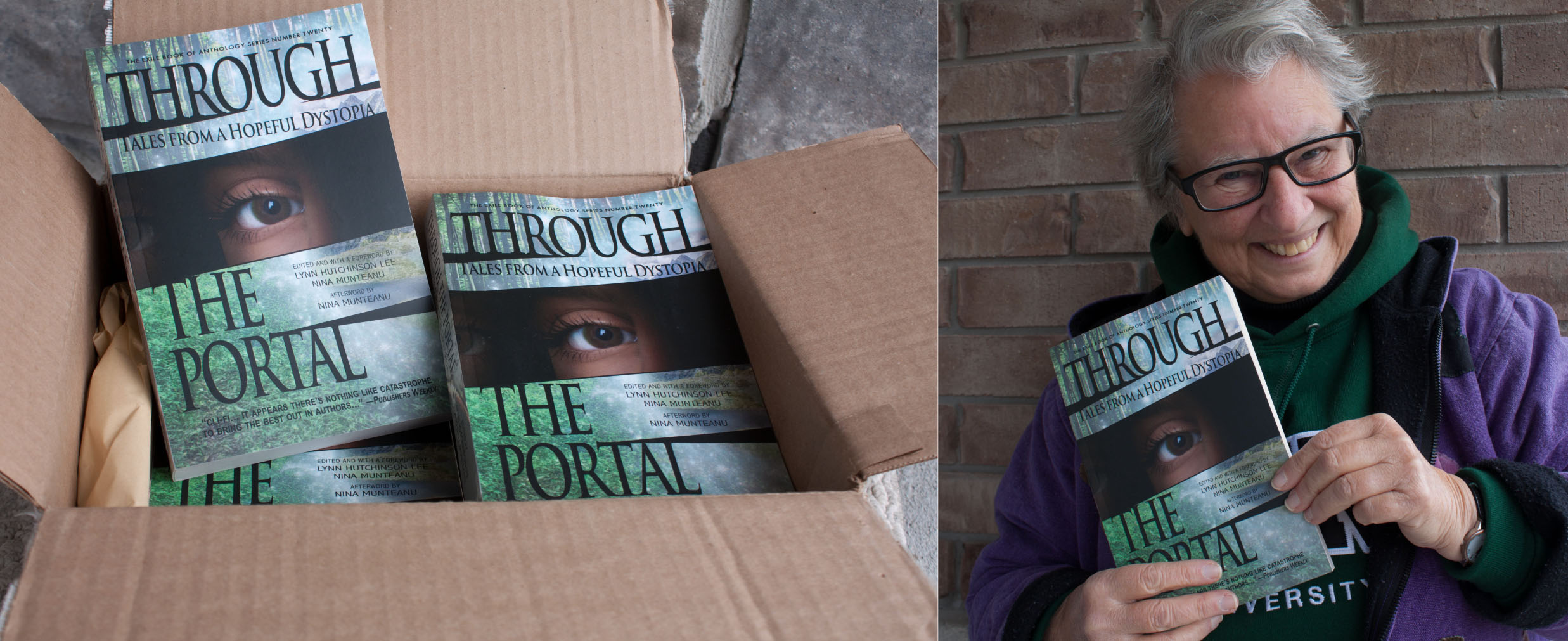
‘Through the Portal’ anthology arrives! (photos by Nina Munteanu)

Just before the Canada Postal strike halted mail dead in its tracks, I got a box full of books; pre-release copies of the anthology that Lynn Hutchinson Lee and I have been nurturing along from our idea three years ago when we pitched it to Exile Editions.

I cracked open the box, like it was Christmas, and cuddled a book, so beautiful!

Ever since we had both had climate fiction stories appear in Exile Edition’s CLI-FI: Tales of Climate Change, Lynn and I had been discussing the possibility of collaborating on something. We liked the idea of something hopeful and Exile’s publisher agreed on the lure of something optimistic. We pitched the concept and Portal was born.

Writers, mostly Canadian, but also from the United States and around the world, submitted to us. We whittled down some 245 submissions to thirty-five stellar short stories, poetry, and flash fiction that reflected the theme of the anthology: hope in the face of ecological adversity.

This was a labour of love, grounded in optimism and hope: to create a collection of optimistic dystopian short stories that celebrate the spirit of humanity in a changing world. As one reader said, “We definitely need more optimism and hope to offset the bombardment of negativity that is running rampant these days.”

Hopeful dystopias are so much more than an apparent oxymoron: they are in some fundamental way the spearhead of the future – and ironically often a celebration of human spirit by shining a light through the darkness of disaster. In Through the Portal: Tales from a Hopeful Dystopia, award-winning authors of speculative fiction Lynn Hutchinson Lee and Nina Munteanu present a collection that explores strange new terrains and startling social constructs, quiet morphing landscapes, dark and terrifying warnings, lush newly-told folk and fairy tales.

Exile‘s back book jacket

Exile: This is a fascinating collection of all-new, modern-day speculative storytelling, with insightful “Tales from a Hopeful Dystopia” featuring Agata Antonow, Sarah Christina Brown, Mary Burns, K.R. Byggdin, Petra Chambers, Katie Conrad, M.L.D. Curelas, Matthew Freeman, R. Haven, Liam Hogan, Cornelia Hoogland, Vanessa Hua, Jerri Jerreat, Zilla Jones, Katherine Koller, Erin MacNair, Melanie Marttila, Bruce Meyer, Isabella Mori, E. Martin Nolan, Avery Parkinson, Ursula Pflug, Marisca Pichette, Shana Ross, Lynne Sargent, Karen Schauber, Holly Schofield, Anneliese Schultz, Gin Sexsmith, Sara C. Walker, Jade Wallace, and Melissa Yuan-Innes. These authors show us that now, more than ever, our world urgently needs stories about hope.

You can order pre-release copies at 15% discount on the Exile Editions Portal sales page.

You can also pre-order copies on Amazon

Nina Munteanu is a Canadian ecologist / limnologist and novelist. She is co-editor of Europa SF and currently teaches writing courses at George Brown College and the University of Toronto. Visit www.ninamunteanu.ca for the latest on her books. Nina’s bilingual “La natura dell’acqua / The Way of Water” was published by Mincione Edizioni in Rome. Her non-fiction book “Water Is…” by Pixl Press (Vancouver) was selected by Margaret Atwood in the New York Times ‘Year in Reading’ and was chosen as the 2017 Summer Read by Water Canada. Her novel “A Diary in the Age of Water” was released by Inanna Publications (Toronto) in June 2020.
Creating A Science Fiction Story at Vision 2024

I recently participated in Vision 2024, a major school fair of educational workshops and seminars for high school students in Brantford, Ontario. The event was hosted by Sir Wilfred Laurier University in downtown Brantford.

I gave several 1-hour workshops on how to write science fiction. I’d given this workshop four years ago at Vision 2020. My thought this time was to be low-tech: no computers, screens or internet. I went with handouts, paper to write on and physical prompts.

I started the workshop with a brief exploration of what a story is (and is not) then described five key components of writing good story (e.g. premise, plot, theme, character, and setting) and how these worked together in story through the use of archetypes and the “hero’s journey” plot structure. I went over some important aspects of good science fiction, such as original idea or premise (driven by science) and imaginative but grounded world building. The key, I noted, was in how the character dramatized the theme of the story. If the storyteller could connect these two well, they would have a hopping good story. I had the students form into several groups of five or six students, and each table was provided with materials for note-taking and eventual sharing with the entire class. Four choices of some science fiction image was provided for each group to choose and use as premise and world building prompt.

Each group then set out to create the framework for a story using the five story components based on a premise from their chosen image; they then shared what they’d put together. Each group worked on their own story as I went from team to team, coaching them on and reminding them to address the character(s) on a journey who carried the story.

Then it was time for each group to share. Amazing stories emerged from the image prompts chosen. Students demonstrated imaginative, mature and original premises and carried through with thoughtful plot, and relevent theme and character journeys. I was very impressed.

Drowned city

One group had taken a subversive direction on the apocalyptic scenario (a sunken overgrown set of ruins) by adopting a more eco-centric POV and creating an anti-hero and unreliable narrator of the one remaining human. They called it “Turbulence.”

“Turbulence” group

Another group had chosen the image of a knight in a drowned cathedral that graces the cover of my alternative history fantasy (The Last Summoner) and wove a wonderful intrigue of betrayal, deception, and destiny—all cleverly layered and driven through the main character, himself a deceiver.  

Drowned knight group
Three images used to create story of prejudice

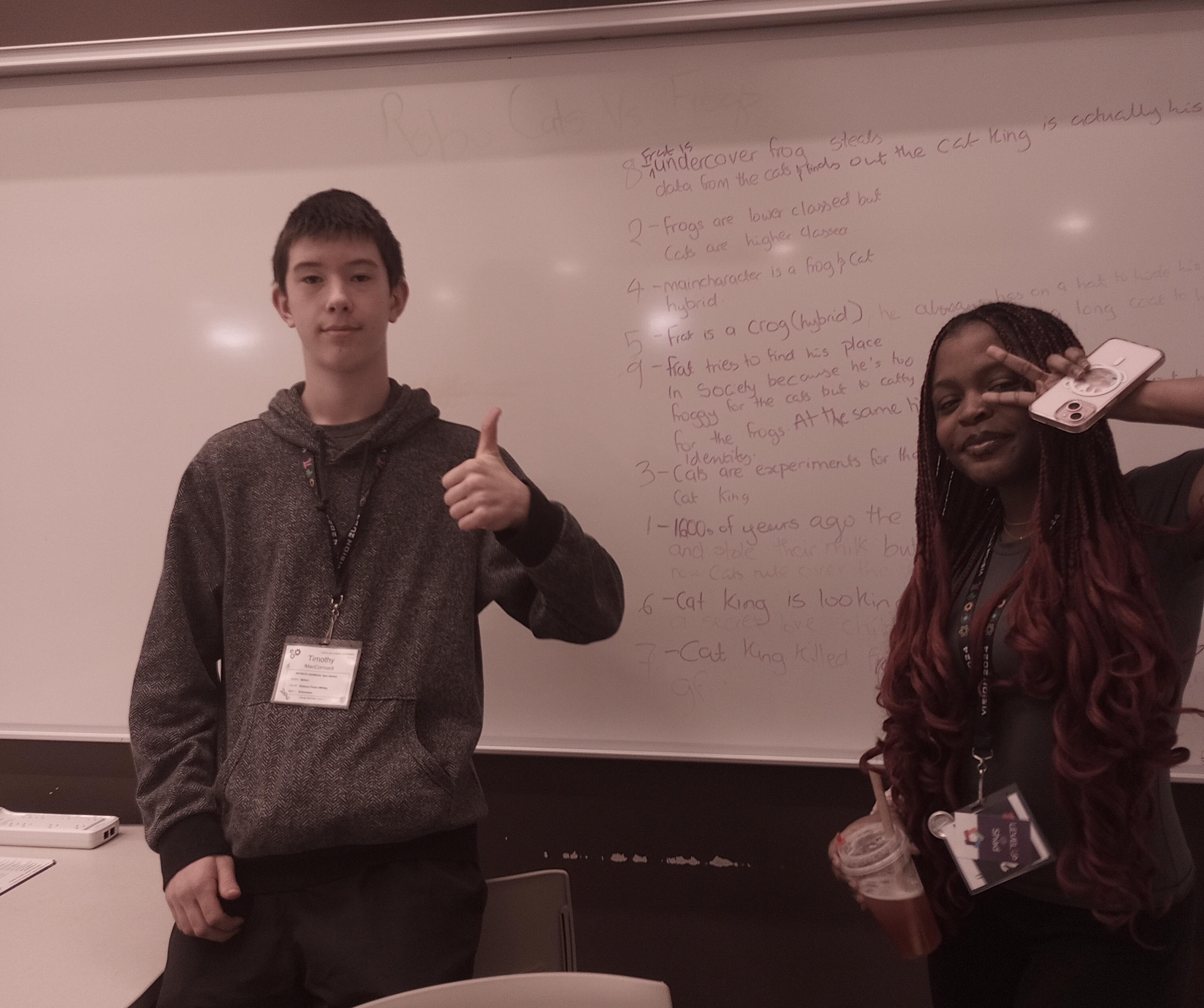
Another group threw away the restriction of choice and chose all the images presented to them; the group quickly developed wonderfully strange and delightful characters, which they then wove together into a twisted satire of identity, prejudice and self-discovery. In this world, there are cats (who rule) and frogs (of lower class) and other strange beings created through experimentation. The story centres on Frat, a hybrid of a cat and a frog (called crogs)—loathed by both cats and frogs as being neither. Frat navigates the treacherous waters of prejudice by clever disguise—avoiding the eye of the imperious Cat-King who, determines to keep all races pure and separate, is out to exterminate crogs. Frat’s journey (linked to the theme of self-determination against prejudice) is in learning to accept himself and recognize perceived weakness as strength.

The ambitious strategy of this group—In choosing all the images as inspiration (images that on the surface had nothing in common)—worked wonderfully because the group focused on fleshing out characters with issues first and let the story emerge from them.

Two students of the cat-frog group stand in front of their notes on the white board

The workshops were very successful thanks to the eager and artistic imagination and collaborative teamwork of the students.  


Nina Munteanu is a Canadian ecologist / limnologist and novelist. She is co-editor of Europa SF and currently teaches writing courses at George Brown College and the University of Toronto. Visit www.ninamunteanu.ca for the latest on her books. Nina’s bilingual “La natura dell’acqua / The Way of Water” was published by Mincione Edizioni in Rome. Her non-fiction book “Water Is…” by Pixl Press (Vancouver) was selected by Margaret Atwood in the New York Times ‘Year in Reading’ and was chosen as the 2017 Summer Read by Water Canada. Her novel “A Diary in the Age of Water” was released by Inanna Publications (Toronto) in June 2020.

What Does it Mean When We See the Aurora Borealis?

Aurora Borealis (photo by Varjisakka, Wikipedia)

I recently returned to southern Ontario from a novel-research trip to the Arctic, where I hope next time to see the incredible northern lights (this recent visit was during their midnight sun period; so, no luck with northern lights). But, in the future I may not have to travel north to see them…

My eco-novel A Diary in the Age of Water begins sometime in the future with Kyo, a blue multi-armed being, living in the dying boreal forest of post-apocalypse Canada; Kyo finds a diary by Lynna Dresden, a limnologist from the calamitous time when climate change ravaged the planet and when the Water Twins destroyed humanity. Yearning for clarity about that holocaust, Kyo reads the diary. 

Lynna begins her February 24, 2057 diary entry with a definition of the Aurora Borealis:

“Also called northern lights, this is a natural electrical phenomenon caused by the interaction of electrically charged particles from the sun with the upper atmosphere near the north magnetic pole. It is characterized by the appearance of bands of reddish, greenish, and other coloured lights in the sky that follow the magnetic lines of force. The colours differ based on the type of gas particles that are colliding. The most common colour—a pale yellowish-green—comes from oxygen molecules some sixty miles above the earth. All-red auroras are rare and are associated with high-altitude oxygen, up to two hundred miles high. Nitrogen produces blue or purplish-red aurora.”

A Diary in the Age of Water

Lynna lives with her daughter Hilde in now warm Toronto, in southern Canada, where the northern lights had been up to recently only rarely observed. By 2057, this has changed:

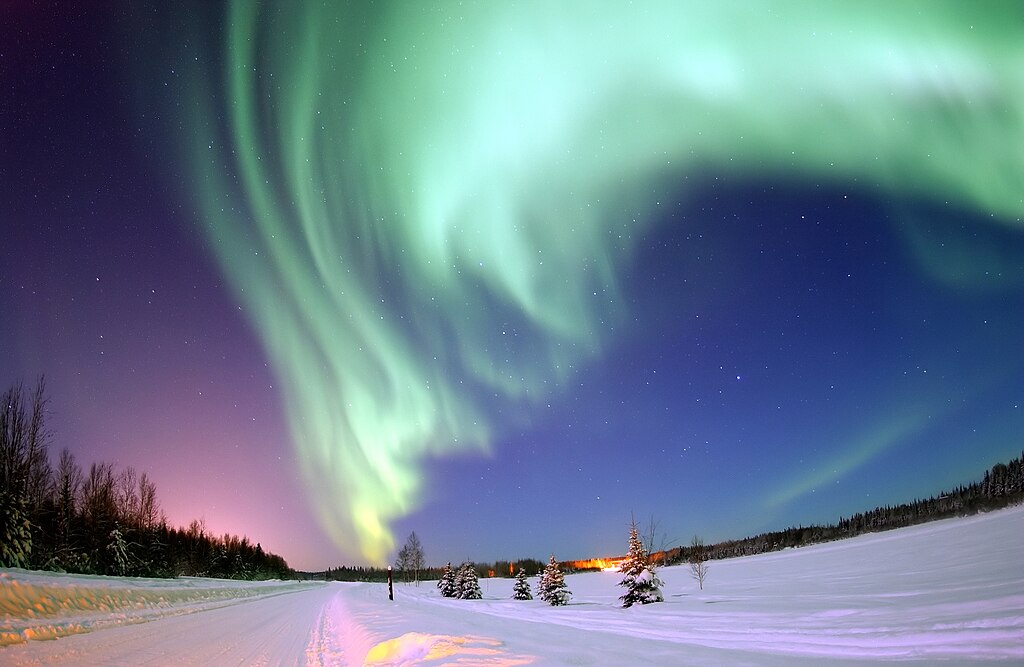
Last night after supper, Hilde and I went for a walk along Shaw to Christie Pits, where I used to play as a kid. She wanted to show me the magnificent aurora borealis that had been streaming dramatically for the past several weeks. When I was a kid, auroras this far south were unheard of. Now they are common. The night sky was clear, and we enjoyed the fresh spring air as we ambled down Shaw Street. We parked ourselves on the damp grass among other spectators of the colourful night sky and watched the dancing light show. It was mesmerizing: ribbons of mostly green and pink light rippled as if tugged by a mischievous wind. They danced with a kind of life that brought me back to my childhood.

Northern lights happen when the magnetic field of our planet is disturbed by the solar wind. As the particles slide along the contours of the Earth’s magnetosphere, they glow as they lose their energy. The particles energize the air molecules enough to make them glow in various colours, depending on the composition of the gases.

Earth’s magnetic field is generated and maintained by an ocean of superheated, swirling metal around a solid iron core. These act like a dynamo to create electrical currents, which, in turn, create our magnetic field. But our magnetic field is weakening, and a flip is imminent. In the past two hundred years, the field has weakened by fifteen percent. That’s why we’re seeing these auroras in Toronto. A weaker field creates more auroras. They’ve become common here, particularly during the winter and spring months. NASA predicts that the field could be gone in five hundred years or less and then take another two hundred years to rebuild.

The field will first become more complex and might show more than two magnetic poles—playing havoc with our navigation systems and God knows what else—until it is entirely gone. Then it will presumably build and align in the opposite direction. When the magnetic field goes, so will our shield against radiation. First, the ozone layer—our shield against ultraviolet rays—will be stripped away, and then the atmosphere may lose other key elements and grow thinner. Will we end up like Mars 4.2 billion years ago, when severe solar storms stole its very atmosphere and evaporated all its water?

Mars once had a strong magnetic field like Earth. But then Mars cooled and its conducting geodynamo stopped rotating. In the absence of the protective field, the solar wind surged in and excited the ions in the upper Martian atmosphere to an escape velocity. The solar wind just swept the air away. The surface pressure of the Martian atmosphere dwindled from one thousand millibars to six millibars. Mars lost about the same atmosphere that Earth has today.

Mars is our destiny; it’s just a question of when. We’re all batteries, running dry. I considered this probable fate for Earth as we watched the exquisite example of our changing magnetic field. But I didn’t share it with Hilde, who watched with her mouth open in rapt wonder. If she’s lucky, she will experience no more of this progression than these amazing auroras. The weakening magnetic field and the associated loss of protection and atmosphere won’t happen for a while. I hope.

I shared none of my thoughts with Hilde.

a Diary in the Age of Water

How Auroras Work

The Aurora Borealis is named after the Roman goddess of the dawn, Aurora, and the Greek name for north wind, Boreas. According to scientists, the colorful and eerie streams of light known as the Aurora Borealis result from “magnetic ropes” that link the Earth’s upper atmosphere to the sun. Solar winds surf them, providing energy for geomagnetic storms and auroras. NASA researchers describe the “ropes” as “a twisted bundle of magnetic fields organized much like the twisted hemp of a mariner’s rope.”

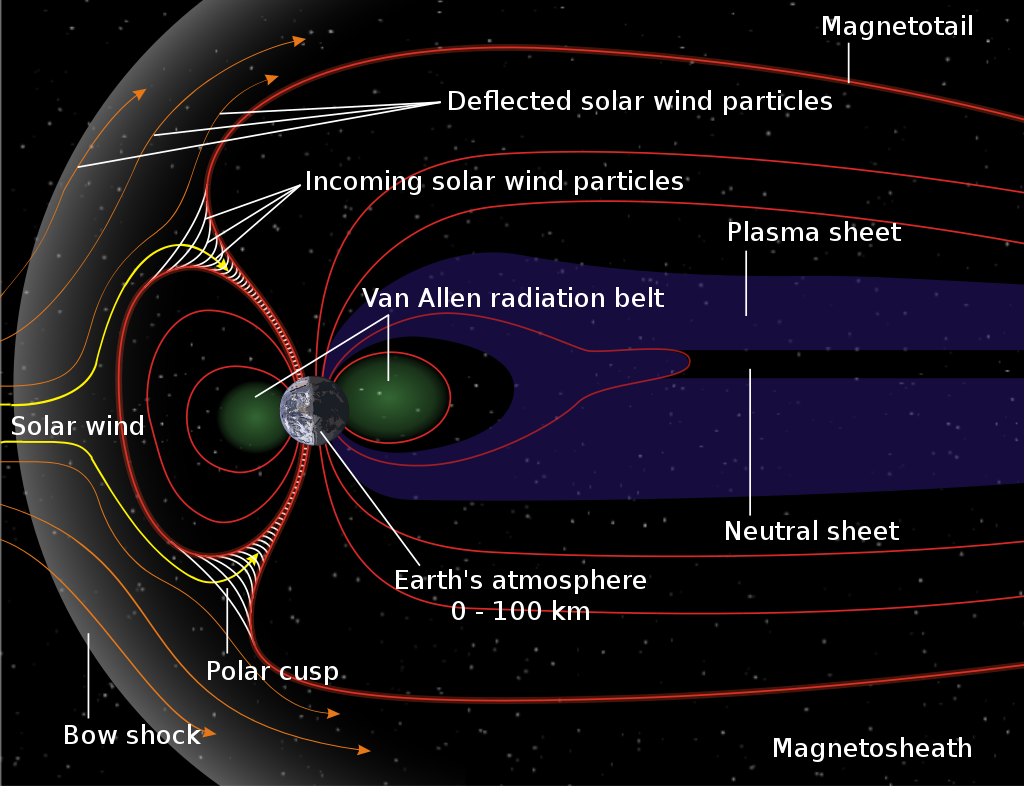
The earth is constantly immersed in the solar wind, a rarefied flow of hot plasma emitted by the sun in all directions. Auroras happen when charged particles from the magnetosphere collide with atoms and molecules of the Earth’s upper atmosphere (at altitudes above 80 km). Most of these particles originate from the sun and arrive in a relatively low-energy solar wind. When the trapped magnetic field of the solar wind is favourably oriented (mostly southwards) it reconnects with the earth’s magnetic field and solar particles then enter the magnetosphere and are swept to the magnetotail. Further magnetic reconnection accelerates the particles towards earth.

Earth’s magnetosphere (image by Wikipedia)

These atmospheric collisions electronically excite atoms and molecules in the upper atmosphere. The excitation energy can be lost by light emission or collisions. Most auroras are green and red emissions from atomic oxygen. Molecular nitrogen and nitrogen ions produce some low level red and very high blue/violet auroras. Typically, an aurora appears either as a diffuse glow or as “curtains” that extend more or less in an east-west direction. Each curtain is made of many parallel rays, each lined up with the local direction of the magnetic field lines, suggesting that aurora are shaped by the earth’s magnetic field.

The earth’s magnetosphere is the space region dominated by its magnetic field. It forms an obstacle in the path of the solar wind, causing it to be diverted around. When the solar wind is “perturbed”, it transfers energy and material into the magnetosphere. The electrons and ions in the magnetosphere that become energized move along the magnetic field lines to the polar regions of the atmosphere.

Auroras have been observed on Jupiter, Saturn, Venus, Mars, Uranus and Neptune. The auroras on the gas giants appear to be powered by the solar wind. In addition, Jupiter’s moons, especially Io, are powerful sources of auroras. These come from electric currents along field lines, generated by a dynamo mechanism due to the relative motion between the rotating planet and the moving moon. Io, which experiences active volcanism and has an ionosphere, is a particularly strong source, and its currents also generate radio emissions.

The passage from A Diary in the Age of Water I quoted from A Diary in the Age of Water was based on current science by NASA and real predictions by scientists. It isn’t so much a question of what, but of when… Who will witness the change in the magnetic pole?

EIELSON AIR FORCE BASE, Alaska. The Aurora Borealis, or Northern Lights, shines above Bear Lake ( photo by Senior Airman Joshua Strang)

Nina Munteanu is a Canadian ecologist / limnologist and novelist. She is co-editor of Europa SF and currently teaches writing courses at George Brown College and the University of Toronto. Visit www.ninamunteanu.ca for the latest on her books. Nina’s bilingual “La natura dell’acqua / The Way of Water” was published by Mincione Edizioni in Rome. Her non-fiction book “Water Is…” by Pixl Press (Vancouver) was selected by Margaret Atwood in the New York Times ‘Year in Reading’ and was chosen as the 2017 Summer Read by Water Canada. Her novel “A Diary in the Age of Water” was released by Inanna Publications (Toronto) in June 2020.
Nature’s Elegance: When Dying is Beautiful…

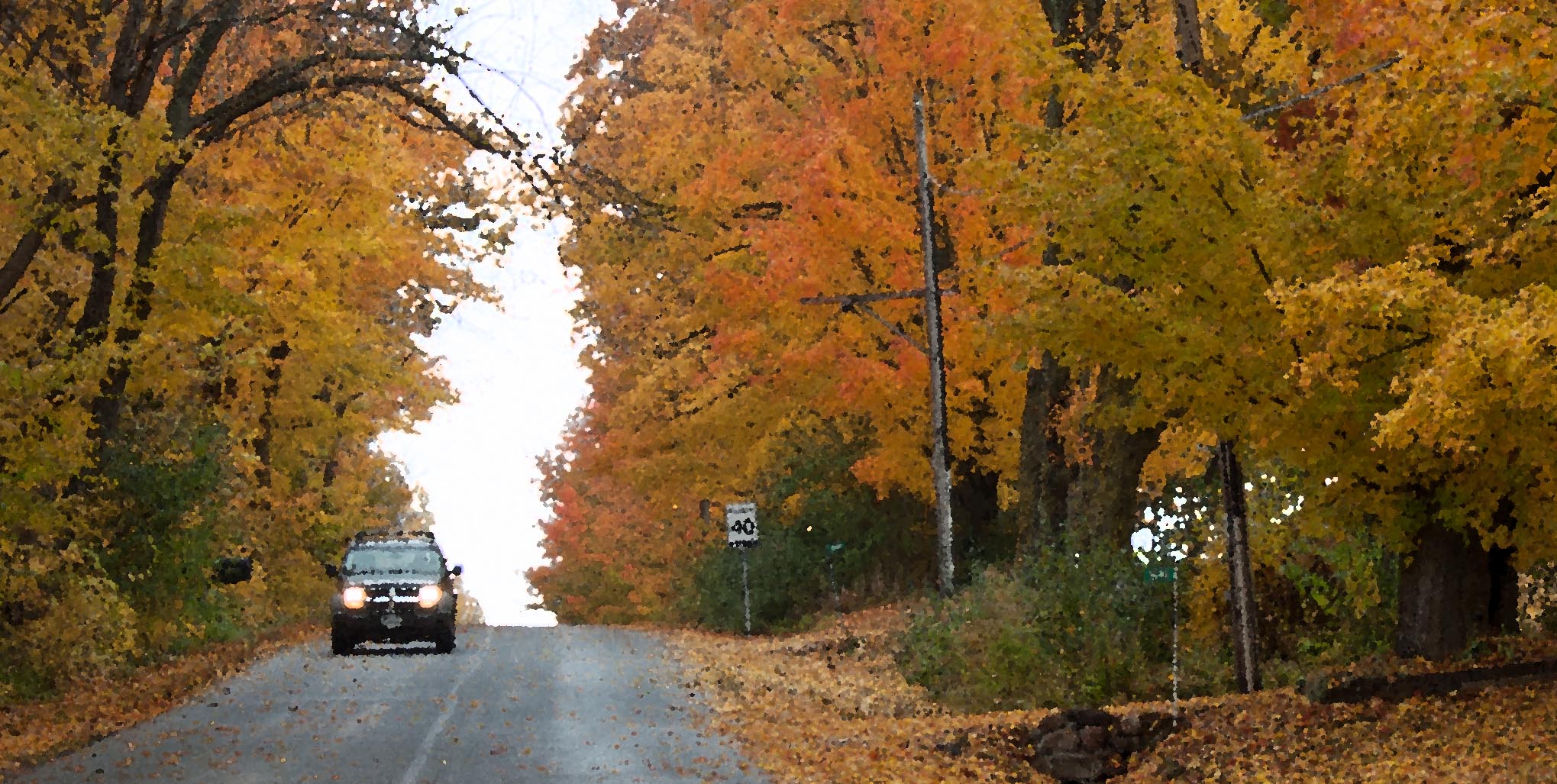
Hayes Line on a wet autumn day in the Kawartha’s, ON (photo by Nina Munteanu)

It started with my need for change. My need to discover. To witness beauty. That meant going outside. And I knew exactly where to go.

I made a lunch and took some snacks, saddled myself in Benny (my trusted VW steed) and drove west.

Hayes Line, ON (photo and rendition by Nina Munteanu)

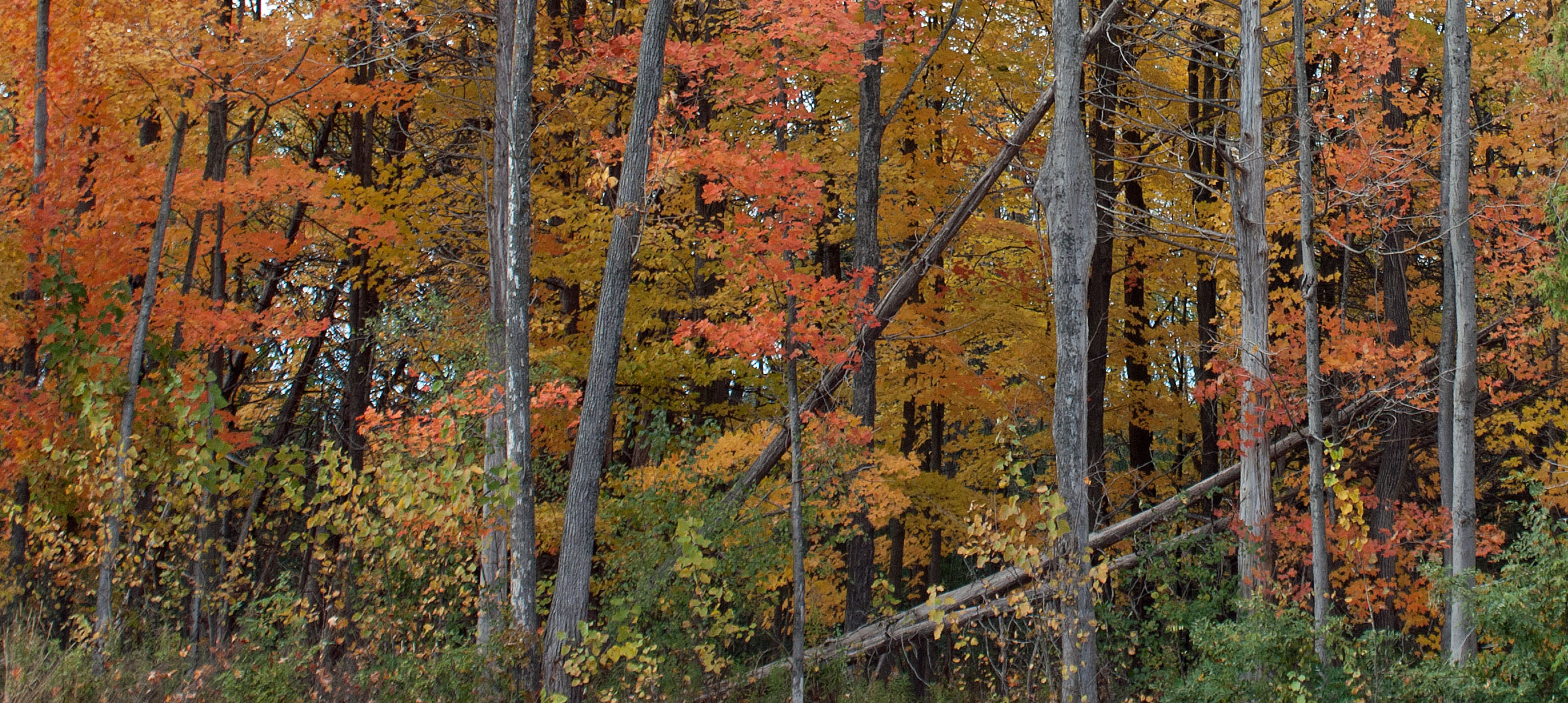
It was late October and the cold winds hadn’t yet cajoled the colourful leaves off the maples, aspens, birches and oaks. I knew I would witness something remarkable. I was in the north temperate zone of Canada, after all, and this was the height of autumn magic…

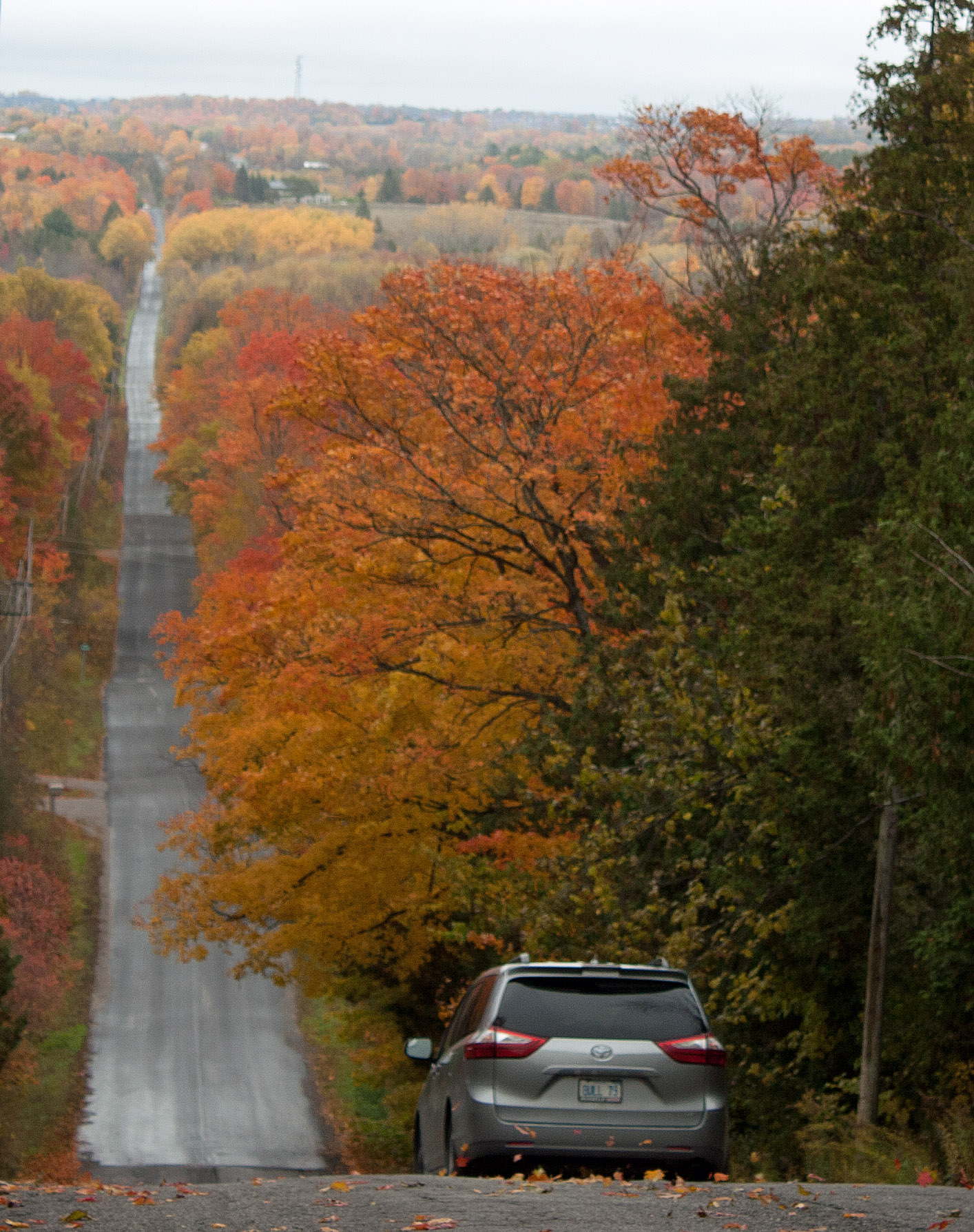
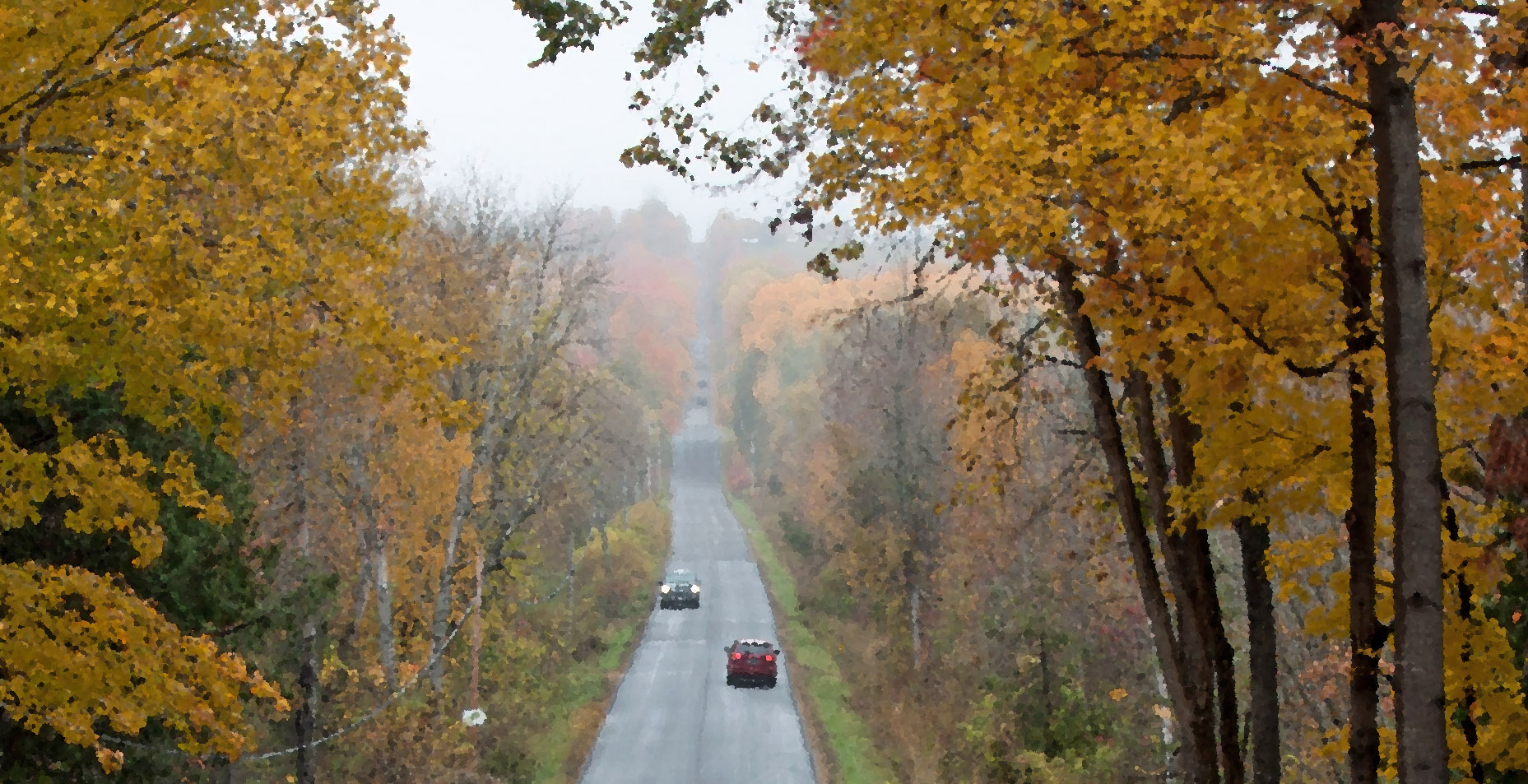
View of Hayes Line in a misty morning from top of drumlin, ON (photo by Nina Munteanu)

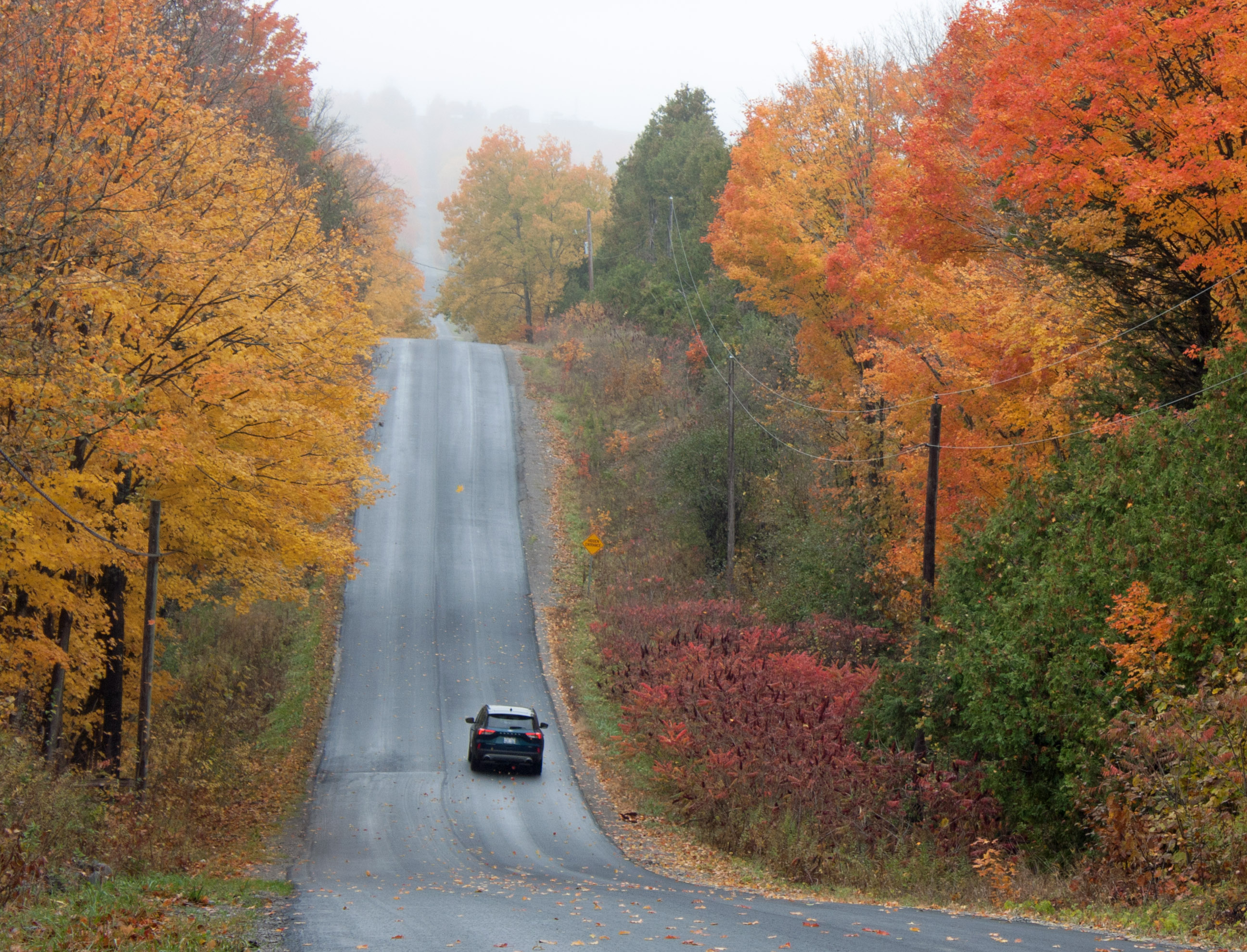
Soon, I was driving along one of my favourite country roads, a gently rolling barely paved road through forest and farmland that rose and fell over drumlins and eskers with views that make you sigh. A vibrant carpet of orange-crimson forest and copper-hued fields covered the undulating hills in a patchwork of colour.

View of Hayes Line on a misty morning from top of drumlin, ON (photo by Nina Munteanu)
Sugar maple drapes over Hayes Line, ON (photo and rendition by Nina Munteanu)

I stopped frequently and stepped out into the light rain to take photographs. The air was fresh and clean against my skin as I breathed in the scent of wet vegetation and loam. A light mist washed the distant hills in muted shades of a watercolour painting. The nearby forests were anything but muted. I drove past flaming thickets of red-purple dogwoods and sumacs. Benny took me beneath neon canopies: the brilliant orange and deep reds of sugar and red maples, the lemon yellows and bronzes of aspens, oaks and beeches.

Colourful hillside off of Ski Hill Road, ON (photo by Nina Munteanu)

The flaming colours signify approaching death for the leaf. The deeper the colour, the closer to the end.

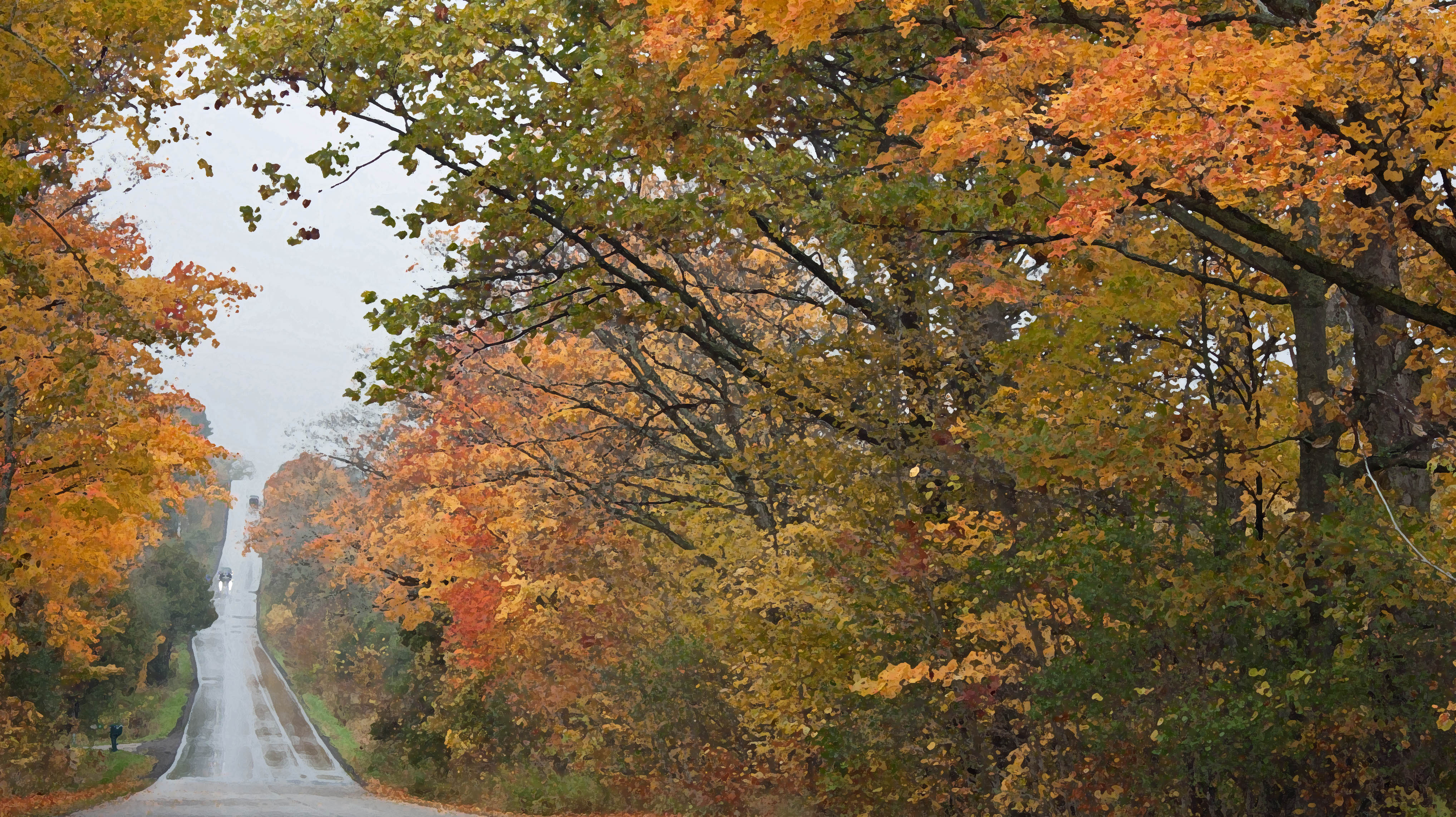
Canopy of maples and aspens drape over wet Hayes Line, ON (photo by Nina Munteanu)

With less light in fall, the green sugar-making pigment, chlorophyll, starts to break down. Other pigments, previously masked by the chlorophyll are revealed: the red-purples of anthocyanin and the oranges and yellows of carotenoids. As chlorophyll degrades, light striking the leaf may cause injury to its biochemical machinery, particularly the parts that regulate nutrient movement. So, these other pigments help to create a physical light shield and help the leaves efficiently move their nutrients into the twigs for the tree to use later.  

As the temperature plummets, the trees build a protective seal between the leaves and their branches, taking in as many nutrients as possible from the sugar-building leaves. Once the leaves are cut off from the fluid in the branches, they separate and drop to the ground, helped by the winds. Even in death, the leaves continue to contribute. On the ground, the fallen leaves decompose and restock the soil with nutrients; they also contribute to the spongy humus layer of the forest floor that absorbs and holds rainfall. Fallen leaves are also food for soil organisms, whose actions in turn keep the forest functional.

Poplars arch over Hayes Line road in a misty morning, ON (photo and rendition by Nina Munteanu)

As I wove through the deep colours of autumn, I felt humbled by this naked beauty, so simply shown. So ingenuously revealed. How elegantly yet guileless nature went through its stages of individual dying to ensure renewal and growth for the whole. 

Aspen trees add colour to Sky Hill road, ON (photo and rendition by Nina Munteanu)

I returned home, invigorated and humbled by nature’s transient show.

Within weeks, the bright leaves would fall, leaving the trees bare and gray and the ground a thick slippery carpet of brownish gray-black rot. Beauty enfolded, dissected and integrated. Insects, fungi, and bacteria would deliver what the leaves used to be and create something else, a gift to the living forest.

Mixed forest shows its colours near Trent University, ON (photo by Nina Munteanu)

Is that not what death is? The end of something to ensure the beginning of something else?

Hayes Line rolls up and over one of the many drumlins in the Kawarthas, ON (photo by Nina Munteanu)

Nina Munteanu is a Canadian ecologist / limnologist and novelist. She is co-editor of Europa SF and currently teaches writing courses at George Brown College and the University of Toronto. Visit www.ninamunteanu.ca for the latest on her books. Nina’s bilingual “La natura dell’acqua / The Way of Water” was published by Mincione Edizioni in Rome. Her non-fiction book “Water Is…” by Pixl Press (Vancouver) was selected by Margaret Atwood in the New York Times ‘Year in Reading’ and was chosen as the 2017 Summer Read by Water Canada. Her novel “A Diary in the Age of Water” was released by Inanna Publications (Toronto) in June 2020.

What Would You Give Up to Save the Planet? A Conversation On Identity vs Action

Jonathan Safron Foer

That is the question American novelist Jonathan Safron Foer asks us in his 2019 book We Are the Weather: Saving the Planet Begins at Breakfast.
“This is a life-changing book and will alter your relationship to food forever.”—Alex Preston, The Guardian

.

In an October 19, 2019 interview with Jason McBride of The Globe and Mail, Foer answers that question (e.g. researchers have proven that animal agriculture is the No. 1 or 2 source of greenhouse gas emissions, depending on what’s included in the calculation, and the No. 1 cause of deforestation [91% of the Amazon burning and deforestation is for animal agriculture]. Grazing animals produce high amounts of methane and require large amounts of water and land).

Foer argues that “the climate crisis can only be solved if we radically reduce the amount of meat (and eggs and milk and cheese) we eat,” writes McBride, who calls the book philosophical and personal: in the book, Foer devotes many pages to his own hypocrisy around food. Foer responds with, “it’s not being hard on myself to be honest. We’re so used to measuring our distance from this unattainable ethical perfection. Which is unnecessary and often precludes action more than it inspires it. We need to applaud each other for making efforts.” Foer makes the point that, “if you were to ask me in 10 years if half of Americans or Canadians would be vegetation, I would say it’s extremely unlikely. But if you were to ask me in two years would half of the meals eaten in America and Canada be vegetarian, I could really see that happening. It’s the same outcome, with regards to the environment, with regards to animals, but one is based on identities and one is based on actions.”

Foer agreed with ecologist Bill McKibben when he argued that we can’t solve our problems one consumer at a time; we have to do it as societies or civilizations. “But,” said Foer, “the changes that we make in our lives, when they’re accumulated, have a known and significant impact on the climate…they have a known and significant impact on culture and on legislators.”

“It’s not that individual change wouldn’t be enough, it’s that individuals can’t [won’t] change.”

“I think one of the big problems with climate change now … is how the story is told, and how the conversation is had. For years, we were battling ignorance or misinformation. Now, people know. It’s not a significant number of people who deny the science of climate change. It’s a question of connecting the dots, emotionally, primitively even. So that what we know and what we care about is converted into action.”

What will you give up for something you love?

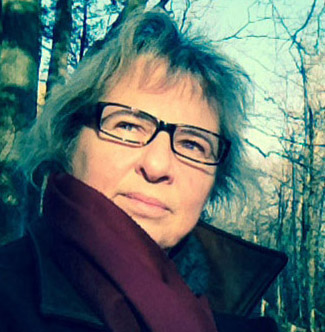
Nina Munteanu walks Emily Tract Park, ON (photo by Merridy Cox)

Nina Munteanu is a Canadian ecologist / limnologist and novelist. She is co-editor of Europa SF and currently teaches writing courses at George Brown College and the University of Toronto. Visit www.ninamunteanu.ca for the latest on her books. Nina’s bilingual “La natura dell’acqua / The Way of Water” was published by Mincione Edizioni in Rome. Her non-fiction book “Water Is…” by Pixl Press(Vancouver) was selected by Margaret Atwood in the New York Times ‘Year in Reading’ and was chosen as the 2017 Summer Read by Water Canada. Her novel “A Diary in the Age of Water” was released by Inanna Publications (Toronto) in June 2020.