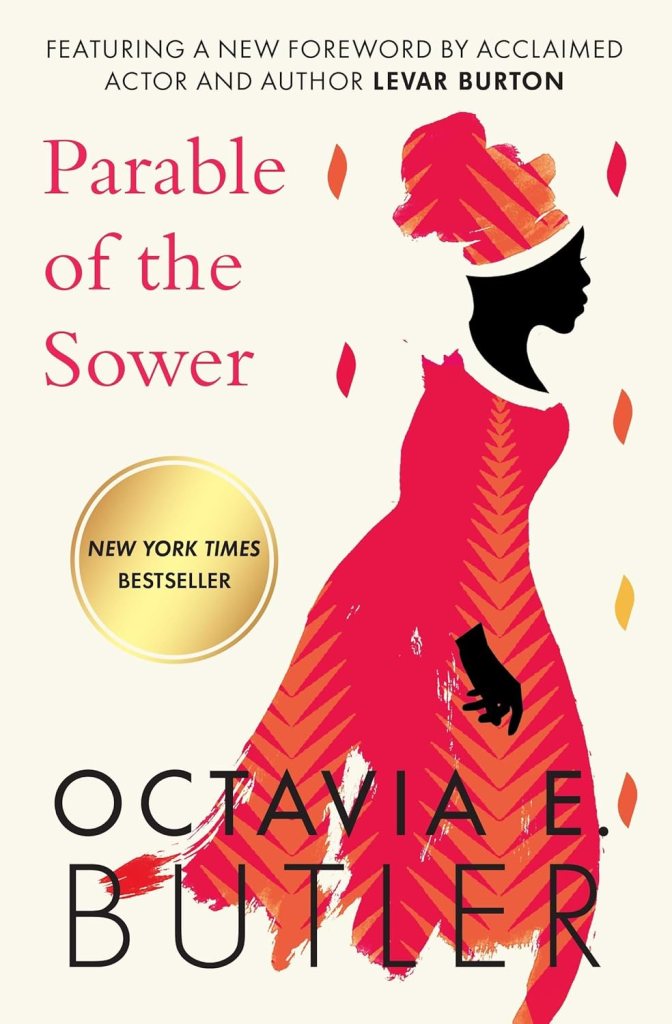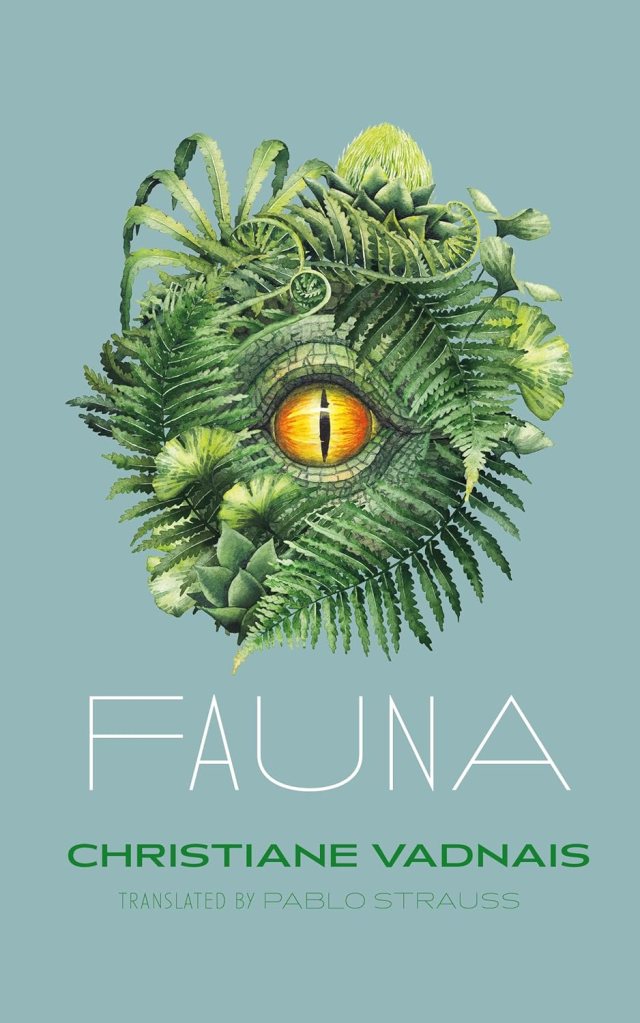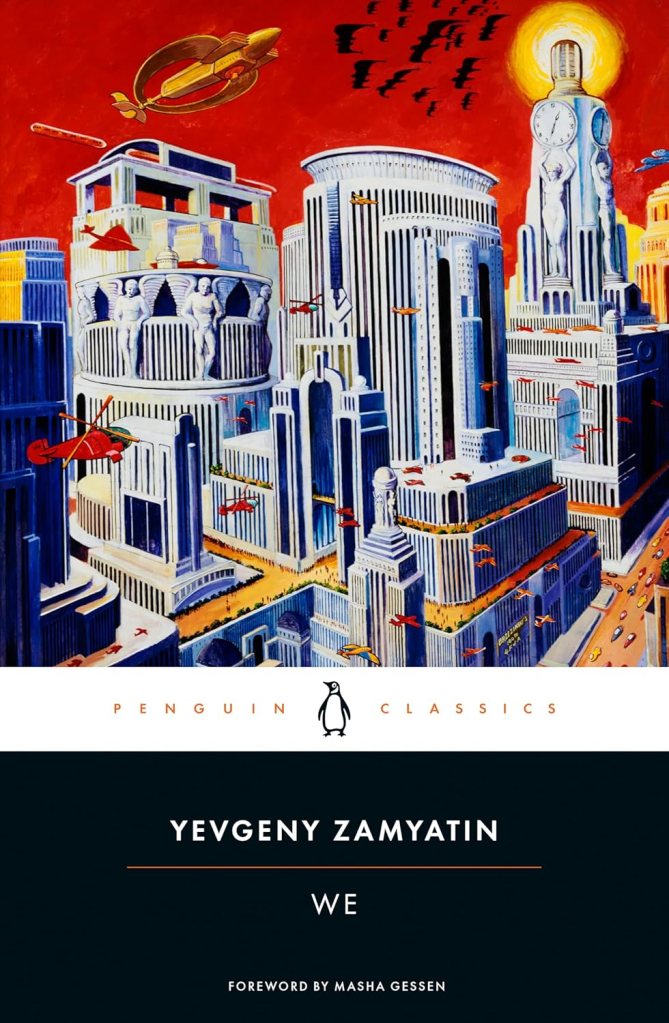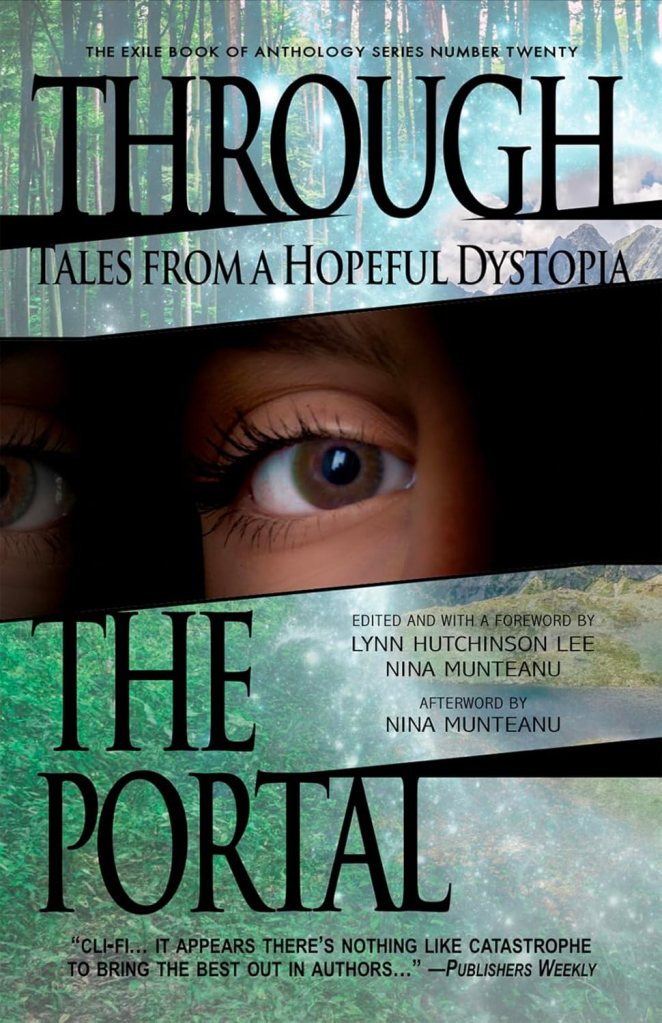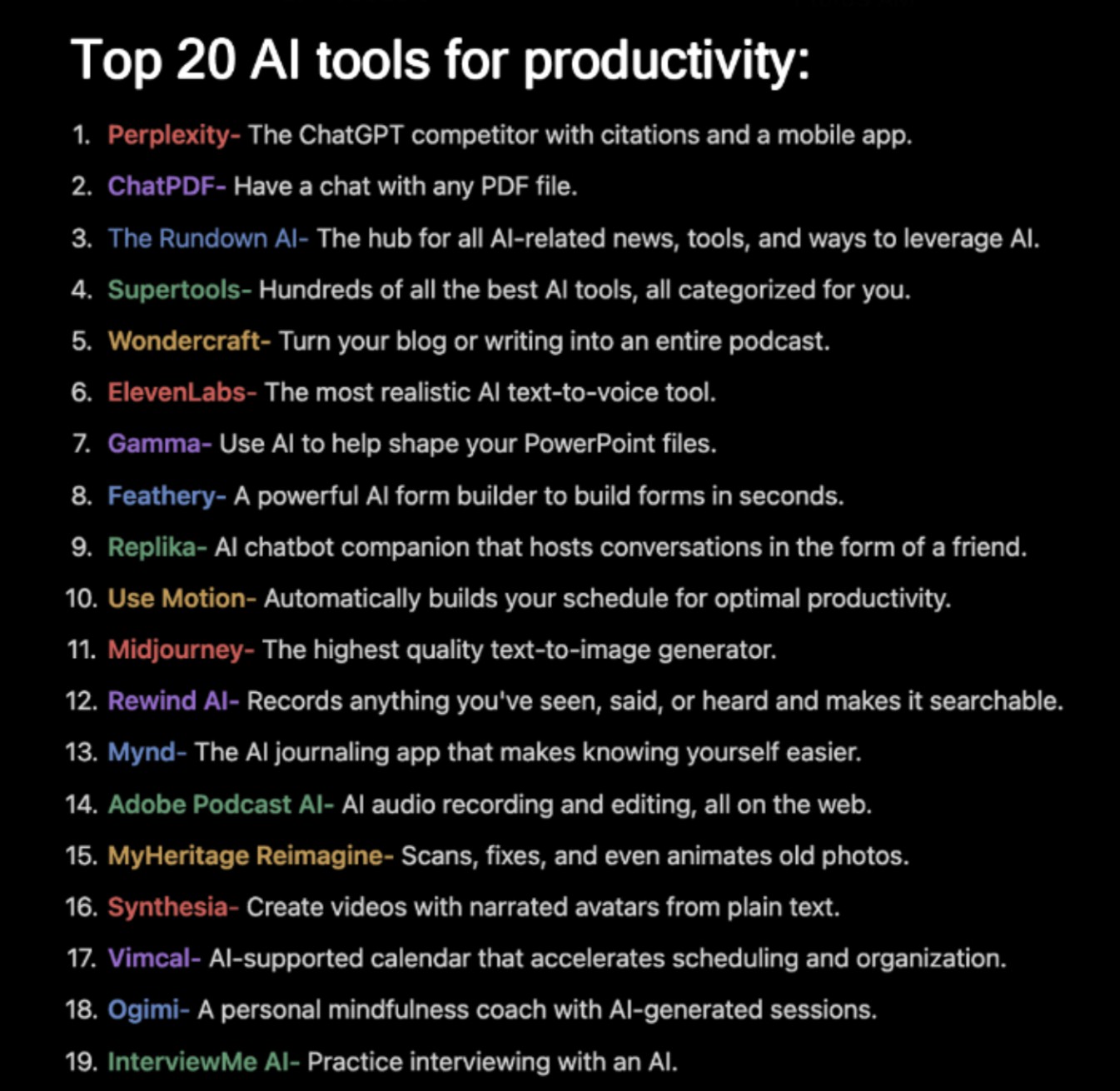
I recently ran across a list posted on social media of the 20 most popular AI tools for productivity in writing. I only knew two of them. This heightened my anxiety about what I know and am prepared for in the use of genAI, particularly in academic settings, where I teach writing at university. And it got me thinking why I was so anxious…
.
I shared the list with my colleagues at the university writing centre and one instructor who was actively following AI tools admitted that they knew only a few of the listed tools as well. They further shared that they were feeling increasingly apprehensive about genAI’s impact on higher education. “It’s hard not to feel overwhelmed,” they ended.
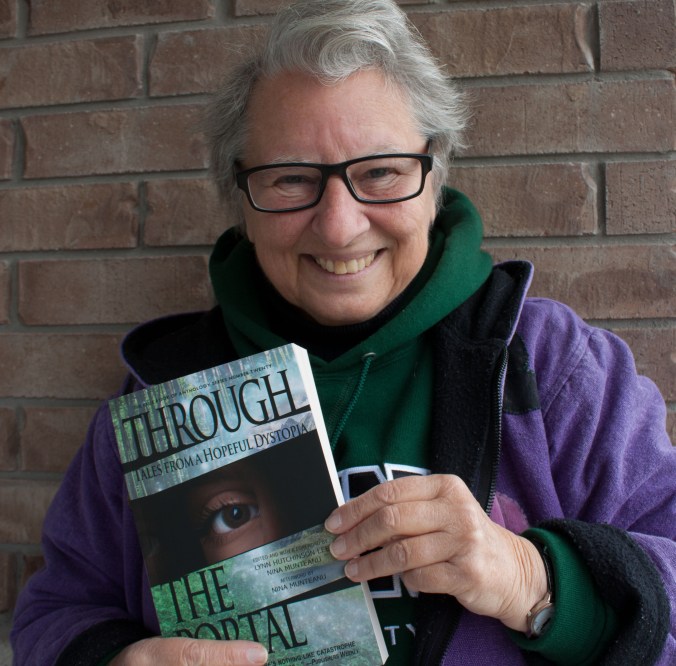
(Photo: Nina writing her novel at a cafe)
.
This was my exact sentiment: a kind of apprehensive excitement. An understanding that all communicators stand at the precipice of a major paradigm shift in tool use. The ramifications this will have on all aspects of effective and efficient communication will span from redefining plagiarism to reinventing creativity. As with all powerful tools—aside from the obvious threat of misuse—there is always something lost with the gain and I wonder what we are losing with all this. I have some ideas, and they do bother me from time to time.
.
Applications of Generative AI (image by Neebel Technologies)
I do think it important for me as a communicator and writing instructor to understand the trade offs and to work with them.
When the world adopted the portable calculator, rote knowledge of basic math suffered. I know; I tested it during a lab exam when I was teaching college biology many years back. I forbid the use of calculators in the test and many students, who had lost the ability to do long division or multiplication by hand, lost marks. For some reason, I’m still not sure of, it was important for me to insist on students doing math longhand (a basic skill fast becoming obsolete like cursive writing) and punish those who had lost the art. Perhaps I was drawing on Isaac Asimov’s possibly prescient 1957 short story satire The Feeling of Power, which explored the limitations of a future world that lost its basic skills to machines. The corollary, I suppose, is that more complex and conceptual math gained some ground through this handy and efficient tool. Machines have their advantages, certainly. And generative AI is just one sophisticated aspect of machine use.
.
.
Consequences to Creative Writing
In my world of professional fiction authors, there is a palpable fear of being replaced by AI as story creators: a version of the ultimate science fiction horror plot of being taken over by the machine world (I’ve even exploited that in my SF thrillers Angel of Chaos and Darwin’s Paradox).
Given our unique powers of imagination, I don’t think that will happen (very soon, if ever successfully). Though, as we dummy-down and simplify complex stories for fast-paced multiplex audiences addicted to fast-paced bite-sized and easy to digest entertainment, AI-generated narratives could get by. How is all this affecting the publishing industry now? I recently learned that one of the top five online science fiction magazines, Metastellar, accepts AI-assisted stories with the proviso that “they better be good.” And Metastellar provides some convincing reasons. This has become a hot topic among my fellow professional writers at SF Canada. One colleague informed me that a “new publisher Spines plans todisrupt industry by publishing 8000 AI books in 2025 alone.” On checking the news release, I discovered that Spines is, in fact, a tech firm trying to make its mark on publishing, primarily through the use of AI. The company offers the use of AI to proofread, produce, publish, and distribute books. They are, in fact, a vanity publishing platform (essentially a service for self-publishing), charging up to $5000 a book and often taking just three weeks to go from manuscript to a published title. The quality of what they will produce is unclear—and questionable.
All to serve as metaphor for what I and my colleagues at university are striving to achieve with students in their academic writing: excellence in communication, particularly in conveying complex scenarios that require creative solutions where clear, concise, and convincing writing is requisite.
.
I still find myself reluctant to use AI in my writing and communication, though I’ve at times slid into using AI for research and initial summaries to save time. I do this rarely because I absolutely enjoy doing research. I enjoy challenging my brain to summarize key points and write a good line. I enjoy the thrill of unanticipated discoveries, which always happen on these forays. I also recognize that many people do not share my enthusiasm for these brain exercises.
(Photo: Nina writing in another cafe)
.
I think that AI alone will not replace human mind for unique creativity. I didn’t say “can not.” It could; but it won’t. This is because even as genAI becomes infused in many aspects of life pursuit, there will remain those like that rare mathematician capable of doing math by hand in The Feeling of Power, valued not just because they are rare, but because in that rarity, they fulfill a critical role. When the machines stalled in their ability to move society forward in The Feeling of Power and all seemed lost, this archaic mathematician presented new innovation with basic math. I’m not suggesting that the technology will all break down, plunging the world into darkness (though this remains a possibility and is still a great plot for science fiction); but I submit that diversity rules over monopoly when it comes to survival.
.
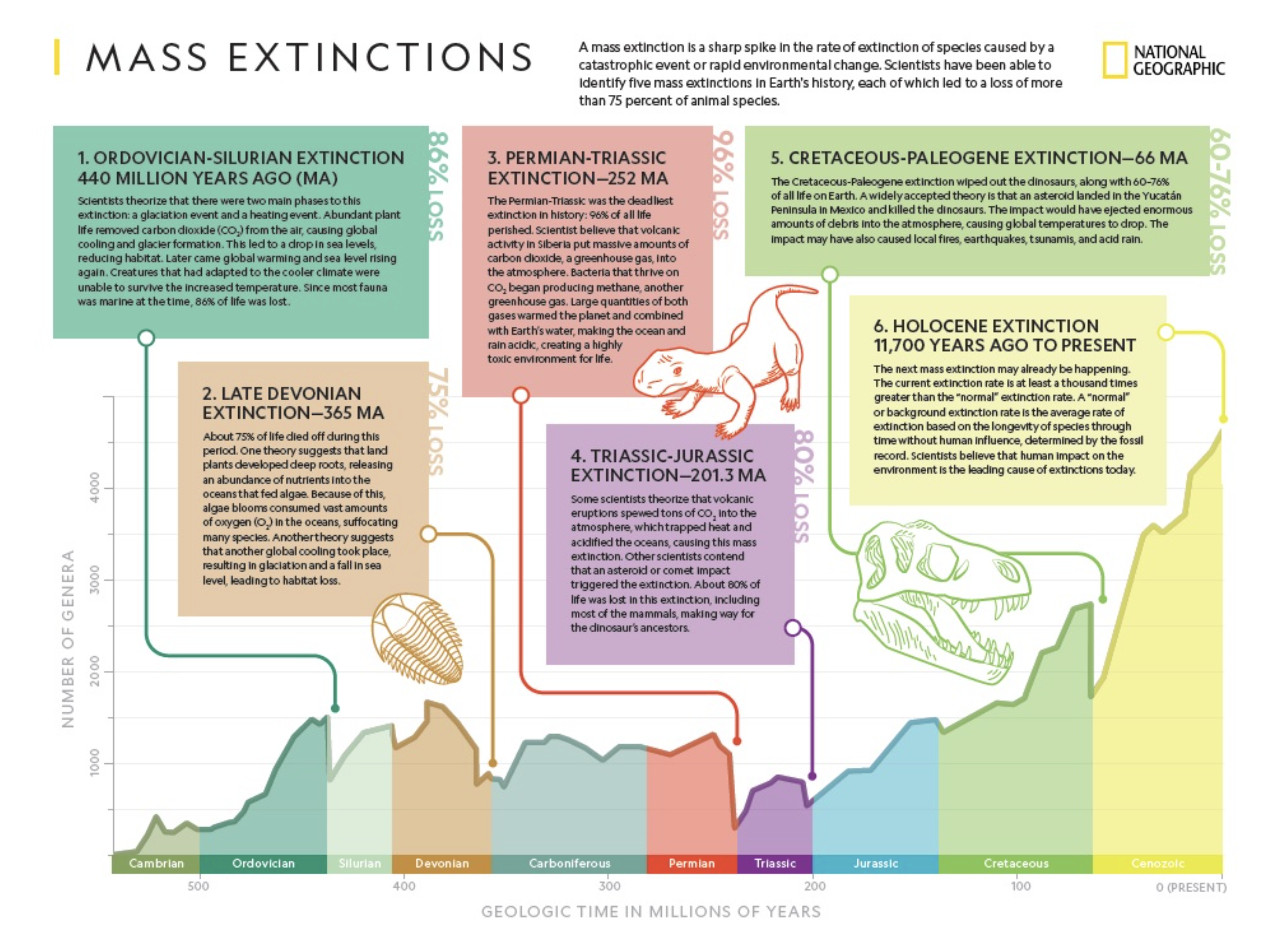
Five Mass Extinctions
.
This may seem a rather dark projection of the future, but consider that over the millennia, after five mass extinctions and with the sixth mass extinction underway, diversity has always saved the world. Within that necessary diversity, it is the nurtured rarities, the outliers, the misfits and nonconformists that survived the destruction of the previous world. Each time, diversity made that possible. As though engrained in Nature’s world building.
.
Mass Extinctions (image by National Geographic)
.
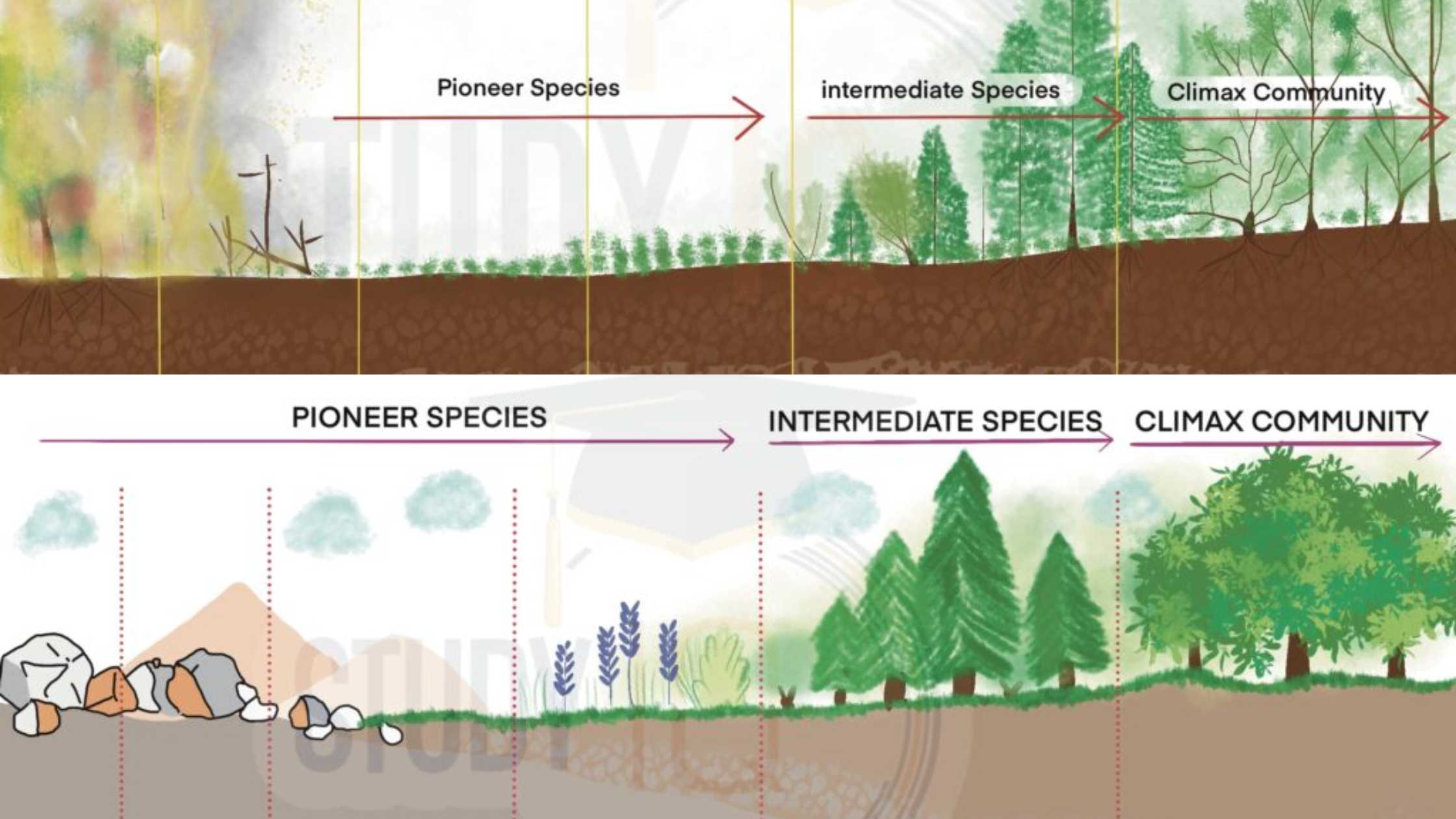
Ecologists call it ecological succession, others use the term “creative-destruction” to describe the recursive pattern of living and non-living things of the planet. Both describe how the oligarchs of an established climax ecosystem fail due to change or disturbance and are replaced by a previous rare misfit or immigrant better suited to the new environment.
.
Primary and secondary succession in two different ecosystems
.
I think AI is part of our succession. Our use of AI in all its forms will represent a diversity of reaction and action that represent our own diversity and potential to survive in a changing world. All to say: relax and embrace the outliers.
.
Writing in nature (photo by Nina Munteanu)
As William Gibson so famously said in 1993: The Future is already here; it’s just not evenly distributed. And maybe that’s a good thing…
.
So…
…To AI, or not to AI, that is the question: Whether ’tis nobler in the mind to suffer The slings and arrows of terrible writing, Or to take arms against a sea of scribbles And by opposing end them. To think—to write, No more; and by writing to say we end The heart-ache and the thousand natural shocks That tech is heir to: ’tis a consummation Devoutly to be wish’d. To think, to write; To write, perchance to create—ay, there’s the rub: For in that creation of unique thoughts what others may come, When we have shuffled off this genAI…
.
Writing in Nature (photo by Nina Munteanu)
.
Nina Munteanu is a Canadian ecologist / limnologist and novelist. She is co-editor of Europa SF and currently teaches writing courses at George Brown College and the University of Toronto. Visit www.ninamunteanu.ca for the latest on her books. Nina’s bilingual “La natura dell’acqua / The Way of Water” was published by Mincione Edizioni in Rome. Her non-fiction book “Water Is…” by Pixl Press (Vancouver) was selected by Margaret Atwood in the New York Times ‘Year in Reading’ and was chosen as the 2017 Summer Read by Water Canada. Her novel “A Diary in the Age of Water” was released by Inanna Publications (Toronto) in June 2020.
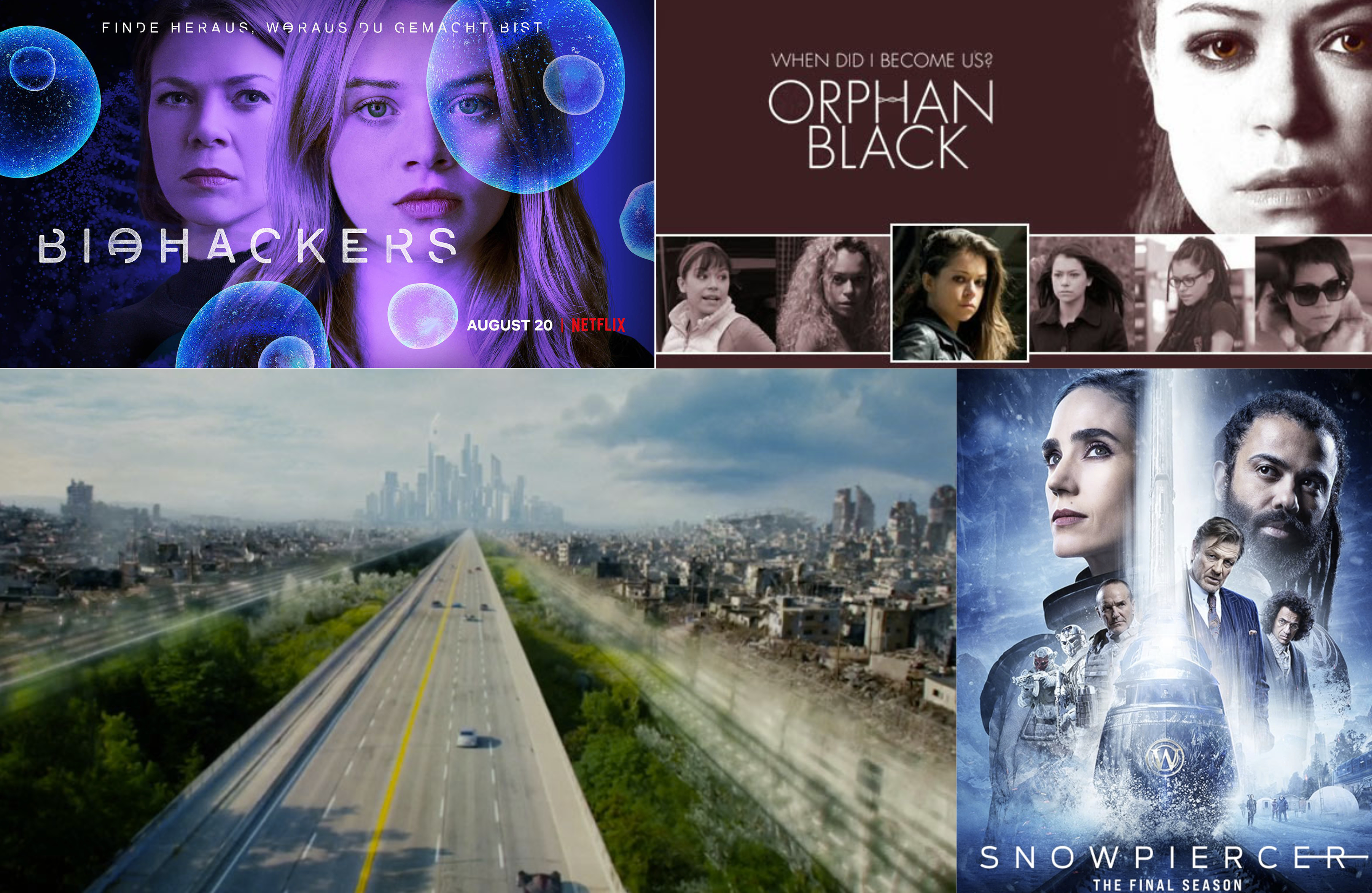
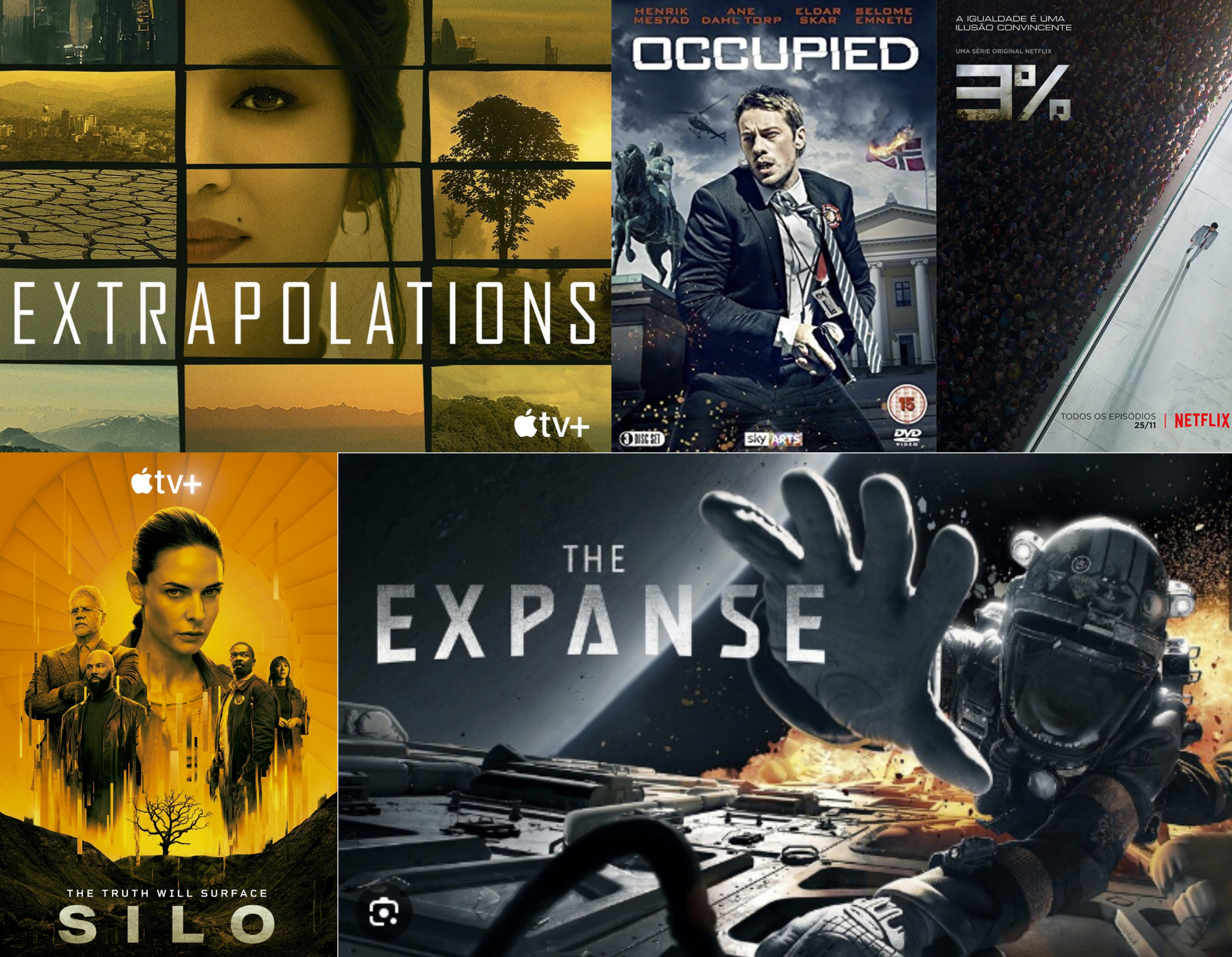
I’ve selected ten TV series that have intrigued me, moved me, and stayed with me for various reasons that touch on: abuse of justice, including eco-justice and environmental abuse; technology use and abuse; and the effects and horrors of climate change.
Some are well known; others not so well known. All approach storytelling with a serious dedication to depth of character, important themes, realistic world building, and excellent portrayal by actors. The world-building is extremely well done—in some cases rivalling Ridley Scott’s best—with convincing portrayals of worlds that are at times uncanny in their realism. Worlds that reflect story from an expansive landscape to the mundane minutiae of daily life: like the cracked phone device of Detective Miller in The Expanse or the dirty fingernails of engineer Juliette Nichols in the Down Deep of Silo. Stories vary in their treatment of important themes from whimsical and often humorous ironies to dark and moody treatises on existential questions. In my opinion, these TV series rival the best movies out there, often reflecting large budgets (but not always) and a huge commitment by producers. The ten TV series I’ve selected here come from around the world: Brazil, Germany, France, Norway, Canada and the United States.
In Part 1, I look at five TV series that touch on ethical issues we are facing today; issues that reach far into existential questions of what it means to be human. These TV series explore synthetic biology, cloning and gene editing, political justice, and justice in space colonization and exploitation.
.
.
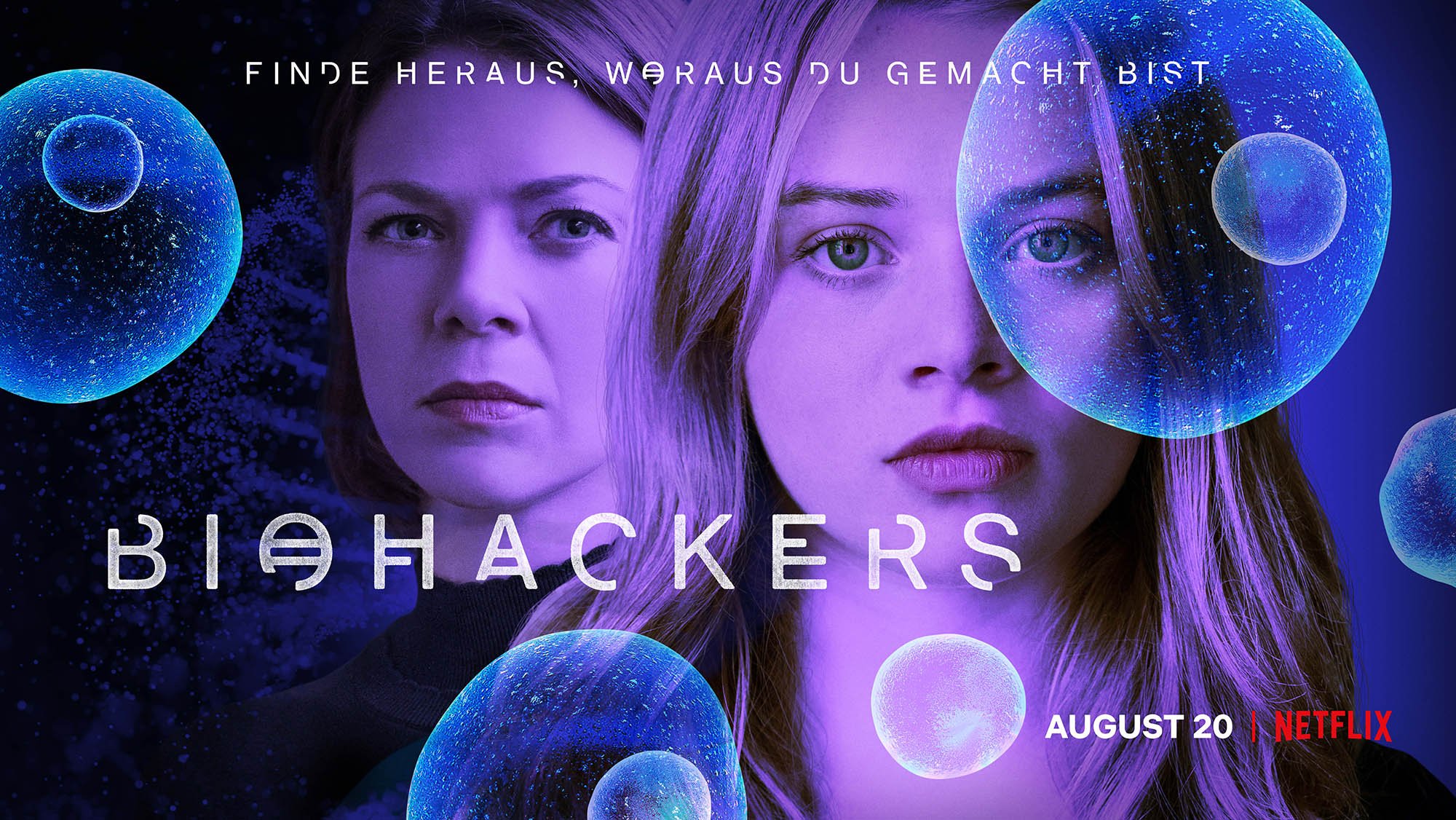
BIOHACKERS: When Synthetic Biology Meets Ethical Intrigue
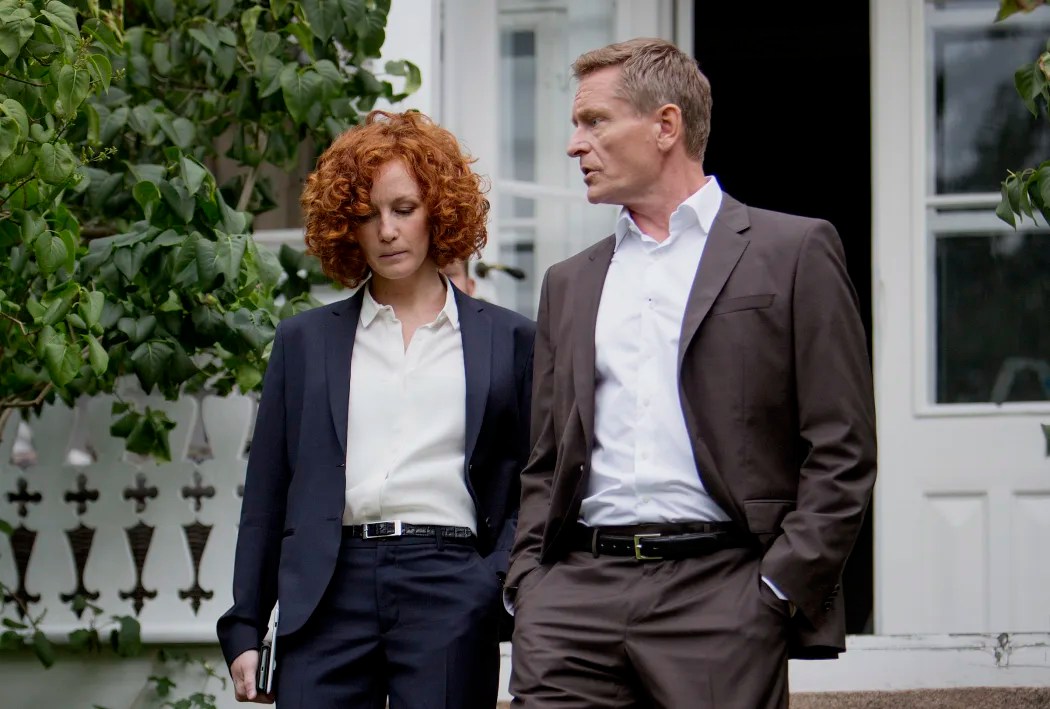
This fast-paced techno-thriller created by Christian Ditter has at the very centre of its intrigue synthetic biology. In the journal Science Dov Greenbaum describes this German TV series as “a fictional tale centred around the sociotechnological movement known as do-it-yourself (DIY) biology, in which amateurs, professionals, anarchists, and civic-minded citizens push the boundaries of mainstream biology.” The show centres on Mia Akerlund (played by Luna Wedler) a secretive med-student prowling for answers to the death of her twin brother and her antagonist, the enterprising Machiavellian and narcissistic Professor Tanja Lorenz (Jessica Schwarz). But the real star of the show is biohacking: human enhancement or augmentation to improve health, performance, or well-being. Biohacking ranges from efforts to improve brain function to faster weight loss. Some are relatively safe to try at home; others may pose health risks. Among others, the show features glow-in-the-dark mice, gene-modded weed, underwater pills that extend your ability to hold your breath, and payment microchips in your hand.
The series lent a critical realism to the story by using accurate world building, real sets and equipment from genetics labs and university settings. Dov Grenbaum’s article in the journal Scienceentitled “Biology’s brave new world” celebrates the show for its accurate representation of complex laboratory equipment and procedures and how it accurately represents the intricacies, motivations and ethical issues of biohacking from sophisticated big-business gene therapies to DIY homespun biology.
Biohackers opens with a disturbing scene of bioterrorism on a train headed to Berlin. All passengers suddenly choke and fall unconscious—except for young med student Mia Akerlund, who tries to help and fails. From that explosive flash-forward scene, the show jumps back to two weeks prior, as college freshman Mia settles into Freiburg University’s prestigious medical school, and betrays a particular interest in synthetic biology, biohacking and genome editing. We soon learn that she is obsessed by celebrated professor and geneticist/entrepreneur Tanja Lorenz (who runs a biopharmaceutical company and has an entire building dedicated to her research with huge neon logo of her name). Both women are connected by a dark secret to do with Mia’s twin brother who mysteriously died when still a boy. Mia quickly gains a position working for Lorenz, which plunges her into the dangerous intrigue of illegal genetic experiences.
.
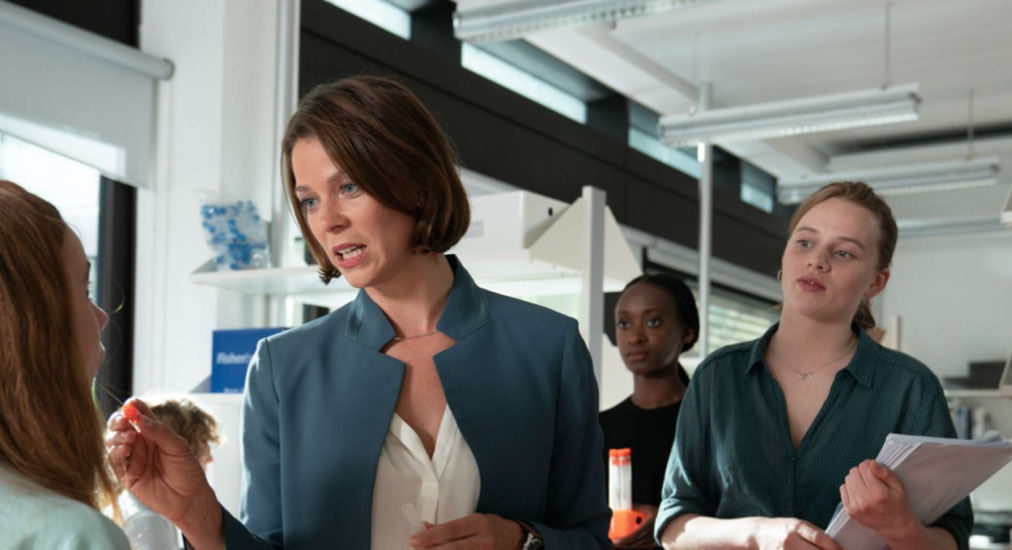
Lorenz and her grad student Jasper discuss experiments in their sophisticated lab (image from Biochackers)
.
An early, rather enlightening, scene of the first episode is of Mia’s first introductory biology class given by celebrated gene therapy tycoon Professor Lorenz. Not only does the scene introduce the controversial subject of synthetic biology; it reveals a disturbing sense of what’s at stake and the danger of scientific hubris. Tall, svelte and confident in a smart haircut and tailored suit, Lorenz struts like a self-proclaimed goddess in front of a student-crowded lecture hall and preaches the benefits of synthetic biology. When she asks the class “What is synthetic biology?” and a student replies “with the help of synthetic biology, we can alter existing life forms or create new ones,” Lorenz prickles beyond her already frosty demeanor and impatiently berates the students for their lack of vision. She challenges them to think bigger: “Synthetic biology transforms us from creatures into creators. It’s not just the future of medicine, but of humankind. We can cease entire infections before the outbreak … We eliminate genetic disorders. But if we don’t do our work exceedingly well, it could end our species. It is on us to find a way; this is your future. Your responsibility. You are the creators of tomorrow. We make God obsolete…”
Science, academia and intrigue are skillfully woven in an intelligent mystery-thriller that not only represents science accurately but delivers commentary on the ethical and moral questions of this highly dynamic and rapidly evolving field of science.
Biohackers touches on several ethical and moral questions, such as genetic modification of stem cells, access to advanced gene therapies, and privacy and consent surrounding genomic data. Synthetic biologist Elsa Sotiriadis warns that, “this topic will likely become an ethical minefield in the coming years. On the one hand, we need large and diverse datasets to train medical AI and develop therapies. But on the other, there’s nothing as personal as your literal blueprint. Unlike stolen credit cards, you can’t change your genomic data. I like that Biohackers brings this up.”
.
Lorenz does a throat swab for DNA on a candidate in her experiment as Mia looks on (image from Biohackers)
Nina Munteanu is a Canadian ecologist / limnologist and novelist. She is co-editor of Europa SF and currently teaches writing courses at George Brown College and the University of Toronto. Visit www.ninamunteanu.ca for the latest on her books. Nina’s bilingual “La natura dell’acqua / The Way of Water” was published by Mincione Edizioni in Rome. Her non-fiction book “Water Is…” by Pixl Press (Vancouver) was selected by Margaret Atwood in the New York Times ‘Year in Reading’ and was chosen as the 2017 Summer Read by Water Canada. Her novel “A Diary in the Age of Water” was released by Inanna Publications (Toronto) in June 2020.
Some years ago now, when the Dalai Lama was attending the 2009 Vancouver Peace Summit, he was quoted as saying, “The world will be saved by the western woman.”
This set the media buzzing on what His Holiness meant and—perhaps more importantly—how his statement resonates with us, and how his “call” affects the western woman.
Marianne Hughes, executive director of the Interaction Institute for Social Change (IISC), pondered the idea of the aging woman as hag (originally a representation of feminine power) and how it relates to the Dalai Lama’s statement on her blog. “I’m not entirely sure what [the Dalai Lama] meant,” said Hughes, “But I am wondering if when he travels across the globe and sees so many of our sisters impoverished and repressed he sees western women of all ages in a position to speak out for justice and to take on the responsibilities of “the hag”… to take loving care of the planet and its people.”
The original meaning of the word “hag” in Gaelic originally referred to a saint with great powers who was responsible for the land, the waters and the people. The term has since been distorted through patriarchal propaganda into something far less flattering and powerful. The “Hag” is currently being redefined as a strong, beautiful and ageless woman and has its similarities with “the Crone”, the third stage of a woman’s life and evolution from maiden to mother to crone. Postmenopausal women currently comprise the largest demographic group in America. With our increased lifespan, the ancient tripartite divisions of Maiden, Mother, and Crone are more meaningful in women’s lives as the Crone stage occupies one third of our lifespan. Moreover, our current Crone generation (those born in the forties and fifties) is the first in the history of humankind that can claim (and has already claimed) economic autonomy and power.
According to Dr. Linda E. Savage (author of “Reclaiming Goddess Sexuality”) “Each stage of a woman’s life is organized around what Goddess Cultures called the blood mysteries: menarche, (the first monthly flow of blood); childbirth, which is accompanied by blood from birthing; and menopause, when a woman’s “wise blood” remains inside her to give her wisdom. These are still powerful landmarks, which profoundly influence women’s lives. They function as psychological gateways to the change in consciousness required by each new stage.”
Savage describes the Crone as a powerful shamanic figure in society: “The developmental task of the Crone Stage is sharing wisdom. In Neolithic times, Crone women were the tribal matriarchs. Their heightened awareness of human nature yielded great insight and they were the source of wise counsel for important decisions. Spiritually, this is the Mastery phase. The Wise Woman teaches knowledge gained from her skills and life experience. It is a time of reaching into her spiritual depths, utilizing her powers of intuition, and finding meaning in her visions from the dream world. Some Crone women are masters of healing at the highest level. The Crone Stage of life, more than any other, is a time of giving back to society the cumulative wisdom of the years. Many women have an urge to speak out, to organize others, to take action. They have the energy to get more involved in the world-at-large. It is often Crone energy that leads to changes being made in society. As the Crone woman moves further into her life path she feels the urge to teach others and to cultivate her passions. It can be the most productive time in womens’ lives.”
Crone energy isn’t necessarily limited to Crones. It is an energy that may be carried by anyone at any age. Ariane de Bonvoisin, writing for the Huffington Post, made the following observation:
“Most people I meet have a new fear—the fear of not being relevant, the fear of not making a difference, the fear of working on things that don’t really matter in the important times of transition we live in. We’re hungry to be part of making things better. We want to create, we want to do what we love again and find our voice. We sense intuitively that we have a critical role to play in shaping the future of our world. And yet, so many of us give in to excuses of not being good enough, young enough, smart enough, wealthy enough, creative enough. We still play small, still give in to the ‘victim’ archetype. We still buy into what society’s beliefs are and put them right above our own. But we don’t really have time for these fears. If I could create a vaccine, instead of the flu one, I’d create one against fear. It’s what holds us back, every one of us, in every area of our life. And, while we’re holding back, time just moves on faster than ever. We are at a critical time in the evolution of our planet, a time where each one of us is waking up. We feel it.
Our intuition is growing more acute. Our inner microphone, as I like to call it, is getting harder and harder to turn off, so that we can’t just go along with our normal day. There’s a rise in consciousness where we feel more connected to others, a part of something bigger going on, where we each have a role to play. The most important thing isn’t to get the promotion, or stay in the marriage, or lose those 10 pounds. The most important thing is for us to remember who we are—why we are here—to do the inner work and find what are our ‘spiritual’ reasons for being on the planet. Yes we do have something great to accomplish. Now. At any age. Wherever we are.”
I found yet another revealing comment on her blog post that reminded me of another statement by His Holiness: that the next Dalai Lama might be a woman. The commentator told the story of the Buddhist Goddess Tara, who is highly revered in Tibet and was a most promising student of Buddhism. The monks told her she should come back as a man so that she could reincarnate and finish her spiritual journey and become a Buddha. She responded that male/female has no meaning since spiritual beings have perfectly balance aspects of both and in reality can incarnate as either gender. She made a resolution to always come back as a woman. I see this proclamation as a metaphor for choosing “feminine wisdom” or “Goddess Wisdom”, represented by the depth of forgiveness, kindness, tenderness, openness, vulnerability, tolerance, honor, integrity, sacred courage, humility, trust and faith.
So, why “the Western Woman”? We are not particularly known on the globe for these traits, nor does the western philosophy we espouse typically embrace these ideal traits. The western woman has more often been stereotyped (and vilified) with the following characteristics: vanity, pride, shallowness, self-centeredness, self-serving ambition, competitiveness, and pettiness.
While we can, in fact, accept these as our stereotypic weaknesses (it is part of our shallow consumer culture and capitalist model, after all), it is for this very reason that the western woman represents the salvation of the world. Not only do we have the means, as Marianne Hughes pointed out, but we are in the best position to convince.
We are the necessary paradox that spawns evolution. The darkness that sparks light. The chaos that creates stability. The inertia that initiates change.
Viburnam berries, ON (photo by Nina Munteanu)
.
Nina Munteanu is a Canadian ecologist / limnologist and novelist. She is co-editor of Europa SF and currently teaches writing courses at George Brown College and the University of Toronto. Visit www.ninamunteanu.ca for the latest on her books. Nina’s bilingual “La natura dell’acqua / The Way of Water” was published by Mincione Edizioni in Rome. Her non-fiction book “Water Is…” by Pixl Press(Vancouver) was selected by Margaret Atwood in the New York Times ‘Year in Reading’ and was chosen as the 2017 Summer Read by Water Canada. Her novel “A Diary in the Age of Water” was released by Inanna Publications (Toronto) in June 2020.
Language, the connective tissue of the body politic—that space where the collective “we” matters so much—is losing its ability to fulfill its most basic duty: to communicate. To correlate. To connect us to the world, and to one another
Megan Garber, The Atlantic
Scene of Winston Smith (John Hurt) in Nineteen Eighty-Four filmed in 1984 shown here with addition for currency
.
In his dystopian 1949 novel Nineteen Eighty-Four, George Orwell featured Newspeak, a fictional language of the totalitarian superstate Oceania. Created by the Party to meet requirements of Ingsoc (Englilsh Socialism), the Newspeak consisted of simplified grammar and limited vocabulary designed to limit a person’s ability to critically think. If you can’t find a word to articulate something, then it can’t be expressed and in some way no longer exists. Personal identity, self-expression and free speech become casualties of a simpler world.
Science fiction? Think again.
Today, Inside Climate News reported that the U.S. Coast Guard has eliminated the term “climate change” and related terminology from the curriculum of its training academy to conform to President Trump’s polices.
U.S. Coast Guard cutter Healy assists a NASA shipborne investigation into climate change in the Chukchi Sea in the Arctic Ocean (photo Kathryn Hansen NASA)
.
This comes at a time when scientists report that the effects of climate change and global warming are weakening the world’s most powerful ocean current, the ACC, with projected slowing by a third within decades. A study by international scientists published today in the journal Environmental Research Letters projects that the fresh water from melting Antarctic ice will weaken the Antarctic Circumpolar Currrent (ACC) by 20 percent in the next 30 years. The ACC is the only ocean current to flow around the entire planet unimpeded, carrying more than 100 times more water than all the world’s rivers combined. A paper in the journal Nature Climate Change recently documented how freshwater from melting ice has already weakened the overturning, or vertical circulation, of Antarctic shelf waters, which reduces oxygen in the deep ocean. Effects of the ACC slow down are projected to include more climate variability, with greater extremes in certain regions, and accelerated global warming.
Global warming is a fact.
Anyone negating its existence, let alone its existential threat, is quite simply a fool. But when a fool is in power and negates the bald truth of science—successfully eliminating the most important word to our existence on this planet—then who’s really the fool?
.
(image from The Atlantic)
.
In the 1940s, shortly after the end of World War Two, Orwell wrote an essay “Why I Write”; in it he lamented the growing decrepitude of the English language. Orwell argued that the decline of English went hand-in-hand with the decline of intellectualism in society and facilitated the manipulation of listeners, speakers and writers. Richard Weintraubnoted in his 2021 article that Trump used ‘Newspeak’ to dismiss the Covid 19 virus, putting Americans at great risk.
Orwell created the term doublethink—a jargon of purposeful obfuscation—which is ability to simultaneously accept two mutually contradictory beliefs as right at the same time: “war is peace”; “freedom is slavery”; “ignorance is strength”. This oxymoron isn’t some wild gesture to the simultaneous wave / particle existence of particle physics or gestalt dualism of Schrödinger’s cat. Orwell’s brilliant fictional concept was predicated on the historical precedent of fascists around the world: the embodiment of “Big Brother”, who uses “doublethink” to confound, sway and control the minds of all people. The term “fake news” has settled in like a damp fog, a casual rejoinder to any truth one wishes to negate and ultimately erase.
On the weaponizing of language, Megan Garber in The Atlantic writes:
“Language, in 1984, is violence by another means, an adjunct of the totalitarian strategies inflicted by the regime. Orwell’s most famous novel, in that sense, is the fictionalized version of his most famous essay. “Politics and the English Language,” published in 1946, is a writing manual, primarily—a guide to making language that says what it means, and means what it says. It is also an argument. Clear language, Orwell suggests, is a semantic necessity as well as a moral one. Newspeak, in 1984, destroys with the same ferocious efficiency that tanks and bombs do. It is born of the essay’s most elemental insight: If thought corrupts language, language can also corrupt thought.”
.
The hard truths of science are at risk in a world gazing through the lens of confabulation… When the inveigling bits and bites of social media time and again trump scientific fact…
“Orwell published “Politics” at the end of a conflict that had, in its widespread use of propaganda, also been a war of words. In the essay, he wrestles with the fact that language—as a bomb with a near-limitless blast radius—could double as a weapon of mass destruction. This is why clarity matters. This is why words are ethical tools as well as semantic ones. The defense of language that Orwell offered in “Politics” was derived from his love of hard facts. “So long as I remain alive and well I shall continue to feel strongly about prose style, to love the surface of the earth, and to take a pleasure in solid objects and scraps of useless information,” he confessed in his 1946 essay “Why I Write.” His was an elegant dogma. Words matter because facts matter—because truth matters. Freedom, in 1984, is many things, but they all spring from the same source: the ability to say that 2 + 2 = 4.”
.
Nina Munteanu is a Canadian ecologist / limnologist and novelist. She is co-editor of Europa SF and currently teaches writing courses at George Brown College and the University of Toronto. Visit www.ninamunteanu.ca for the latest on her books. Nina’s bilingual “La natura dell’acqua / The Way of Water” was published by Mincione Edizioni in Rome. Her non-fiction book “Water Is…” by Pixl Press (Vancouver) was selected by Margaret Atwood in the New York Times ‘Year in Reading’ and was chosen as the 2017 Summer Read by Water Canada. Her novel “A Diary in the Age of Water” was released by Inanna Publications (Toronto) in June 2020.
AI entity performing a myriad of duties (image from Bernard Marr & Co.)
.
I teach academic writing to students at the University of Toronto Writing Centre. It’s wonderful and fulfilling work and I enjoy helping students in several disciplines (engineering, health sciences, social sciences) learn to write better. As with the rest of the academic world of writing, we are all making sense of the use of AI-generated tools by students, instructors and researchers: large language models (LLMs) such as ChatGPT, Claude, Copilot, and even Grammarly. Students have told me that they found AI helpful in brainstorming and outlining as well as organizing literature reviews and editing for grammar and such. A recent survey of universities and corporations around the world by the Digital Education Councilrevealed that a majority of students used AI tools. Of those surveyed, close to two thirds used AI as a search engine; a third used it to summarize documents; and a fifth used it to create first drafts.
In her 2024 article “The Future Is Hybrid”, Beth McMurtrie suggested that genAI “may eventually take its place in the pantheon of game-changing technologies used every day in education—alongside calculators, search engines, and Excel.”
In my other pursuit as a professional fiction author, I see the artistic and communication industries embracing AI, particularly in the visual arts. I’m now told that several publishing houses and magazines have dedicated efforts to publish AI-generated work. Some magazines are entirely AI generated, Copy Magazine, for instance. Author futurist Bernard Marr writes that “Generative AI is already being adopted in journalism to automate the creation of content, brainstorm ideas for features, create personalized news stories, and produce accompanying video content.” Marr then goes on to provide 13 ways that all writers should embrace Generative AIthat includes anything from drafting plot lines to world building. Sports Illustrated was recently found to publish AI generated stories. Even newspapers, such as the LA Times, the Miami Herald, and Us Weekly acknowledge AI-written content. And I recently learned that one of the top five online science fiction magazines, Metastellar, accepts AI-assisted stories with the proviso that “they better be good.” And Metastellar provides some convincing reasons. This has become a hot topic among my fellow professional writers at SF Canada. One colleague informed me that a “new publisher Spines plans todisrupt industry by publishing 8000 AI books in 2025 alone.” On checking the news release, I discovered that Spines is, in fact, a tech firm trying to make its mark on publishing, primarily through the use of AI. The company offers the use of AI to proofread, produce, publish, and distribute books. They are, in fact, a vanity publishing platform (essentially a service for self-publishing), charging up to $5000 a book and often taking just three weeks to go from manuscript to a published title.
The emerging field of AI-assisted writing and communicating is a burgeoning field that promises to touch every person in some way—writers and readers alike. Tech companies are scrambling to use it to save time and effort. Others are involved in improving current and developing new models. Many are training LLMs for improved use. Even I was headhunted as a creative writer by one tech firm to help create more safe, accurate and reliable LLMs.
Generative AI applications (Image from Neebal Technologies)
.
Universities and Other Educational Institutions Use of AI
How universities and other educational institutions are dealing with the challenge and promise of these emerging tools in communication varies from out right forbidding AI use in the classroom to full on acceptance and obligatory use in some classroom projects. McMurtrie described how two instructors at Rollins College, Dan Myers and Anne Murdaugh, had students collaborating with AI on semester-long research projects. They were instructed to use Claude and Copilot to brainstorm paper topics, conduct literature reviews, develop a thesis, and outline, draft, and revise their papers. Myers and Murdaugh asserted that “the skills that students use to engage thoughtfully with AI are the same ones that colleges are good at teaching. Namely: knowing how to obtain and use information, thinking critically and analytically, and understanding what and how you’re trying to communicate.”
In fall of 2024, Stephanie Wheeler and others at the department of writing and rhetoric in the University of Central Florida, along with their philosophy department, set up an interdisciplinary certificate in AI. Their purpose was to develop conceptual knowledge about AI. Wheeler asserted that writing and rhetoric have long been concerned with how technology shapes these disciplines. Sharon L.R. Kardia, senior associate dean of education at the University of Michigan argued that AI could greatly benefit public health in its ability to aid in data analysis, research review, and the development of public-health campaigns. However, she cautioned that LLMs also absorb and reflect the social biases that lead to public-health inequities.
One of my Writing Centre colleagues at UofT recently shared some thoughts about a conference session he’d participated in, in which a student panel listed tasks that they thought genAI cannot do (yet). These included: generate music, offer interpersonal advice, and verify facts; I think AI can already help with two of these. Chad Hershock, executive director of the Eberly Centre for Teaching Excellence and Educational Innovation at Carnegie Mellon University shared that they are researching key questions about whether AI enables or impedes: does using AI while brainstorming generate more or fewer ideas? Can generative AI give less-experienced students a better chance to be successful in technical courses? To what extent does using AI help or hinder writing skills? Does having generative AI as a thought partner enhance students’ ability to make a claim and support it with evidence?
My own experience with a less-experienced student’s use of genAI was often abysmal. The student had used the tool as a crutch and had failed to learn from their use of the tool. This suggests that the most important limitations of the tool lie with the user’s own limitations and it points to the need for guidance by educators.
In her 2024 Axios article “Why AI is not substitute for human teachers” Megan Morrone described findings of the Wharton School on access to genAI: while genAI tutors improved student performance on practice math problems, students who used these tools performed significantly worse on exams (where they couldn’t use AI). The school concluded that the students used genAI to copy and paste answers, which led them to engage less with the material. Wharton School associate professor Hamsa Bastani argued that, “if you just give unrestricted access to generative AI, students end up using it as a crutch…[and] end up performing a lot worse.” This is partly because students—often stressed-out by heavy work loads—find that LLMs save time and can produce content close to what the user might produce themselves. Researchers have even come up with a term for this: Cognitive Miserliness of the User, which, according to writer Stephen Marche, “basically refers to people who just don’t want to take the time to think.”
Melanie M. Cooper, chemistry professor at Michigan State University cautioned that while “there’s a lot of ebullience in the AI field, it’s important to be wary.” She argued that it is easy to misuse AI and override the system to get a quick answer or use it as a crutch. McMurtrie shares that, while “AI evangelists promise that these tools will make learning easier, faster and more fun,” academics are quick to reject that rhetoric. McMurtrie ends her article with a cautionary statement by Jennifer Frederick of Yale: “Universities really need to be a counterpoint to the big tech companies and their development of AI. We need to be the ones who slow down and really think through all the implications for society and humanity and ethics.”
Humans can relinquish control, but not responsibility
Attribution remains important
Historical definitions of plagiarism no longer apply
.
6 tenets of Postplagiarism (image from Sarah Elaine Eaton)
.
Eaton’s fifth point (attribution remains important), I think becomes all that more important in the presence of AI use. Transparency in presentation, particularly in an academic setting, takes on a new level of importance when communicating with tools such as generative AI. Where things come from, which tool was used and how it was used are key to understanding and interpreting the nature of the writing itself. The path taken to the destination becomes all important when interpretation and comprehension (and replication) is required. To fully understand “where you are”; we need to know “how you got there.” It’s like solving math problem; if you don’t show your work and just provide the answer, I have no way of knowing that you actually understood the problem and really solved it.
I am certain that generative AI will continue to take on various forms that will continue to astonish. Its proper use and development will serve humanity and the planet well; but there will always be abusers and misusers and those who simply don’t care. We must be mindful of them all. We must remain vigilant and responsible. Because, just as with freedom, if we grow lazy and careless, we run the risk of losing so much more.
Nina Munteanu is a Canadian ecologist / limnologist and novelist. She is co-editor of Europa SF and currently teaches writing courses at George Brown College and the University of Toronto. Visit www.ninamunteanu.ca for the latest on her books. Nina’s bilingual “La natura dell’acqua / The Way of Water” was published by Mincione Edizioni in Rome. Her non-fiction book “Water Is…” by Pixl Press (Vancouver) was selected by Margaret Atwood in the New York Times ‘Year in Reading’ and was chosen as the 2017 Summer Read by Water Canada. Her novel “A Diary in the Age of Water” was released by Inanna Publications (Toronto) in June 2020.
Early editions of “I, Robot”: 1950 1st edition hardcover by Gnome Press; 1950 dust jacket of 1st edition hardcover by Grosset & Dunlap; 1950 1st book club edition by Doubleday; 1952 1st UK edition by Grayson & Grayson; 1956 Signet cover; 1958 Digit Books UK; 1961 Signet 3rd printing; 1968 Signet 6th printing; 1970 Fawcett Crest; 1968 Panther Science Fiction
I reread Dr. Isaac Asimov’s 74-year-old masterpiece, I, Robot, in preparation for the 2004 Twentieth Century Fox motion picture of the same name, knowing fully well that to appeal to today’s action-thriller rollercoaster-addicted audience there was no way the movie and the book could even come close. I was right. But not the way I thought I would be.
The movie, directed by Alex Proyas, begins with the three laws of robotics:
First Law: that robots must not harm a human being;
Second Law: they must obey human orders, so long as this does not violate the first law; and
Third Law: they must protect their own existence, so long as that doesn’t violate laws one and two.
Apart from these three laws and the use of the same title and some of the character names, the motion picture appears to radically depart from Asimov’s book, first published by Gnome Press in 1950. To give Twentieth Century Fox credit, the film does not pretend to be the same as the book; I noticed that in the credits the movie was “suggested by,” rather than “based on” Asimov’s work. But how different was it, really? I submit that the two are much more similar than they first appear.
The robot Sonny causes a great ruckus when he ignores the three laws
Surficial differences between book and motion picture are nevertheless glaring. First off, Asimov’s, I, Robot, is essentially a string of short stories that evolve along a theme; much in the vein of Martian Chronicles by Ray Bradbury. The book is told largely from the point of view of Dr. Susan Calvin, a plain and stern robo-psychologist, who gets along better with robots than with humans. Dr. Asimov uses this cold and colourless character as a vehicle to stir undercurrents of poignant thought on the human condition through a series of deceptively mundane tales. I, Robot offers a treatise both of humanity’s ingenuity and its foibles and how these two are inexorably intertwined in paradoxes that speak to the ultimate truth of what it is to be human. Each of his nine stories discloses a metaphoric piece of his clever puzzle. The puzzle pieces successively tease us through the three laws of robotics, as ever more sophisticated robots toil with their conflicts when dealing with perceived logical contradictions of the laws. For instance, there is “Robbie,” the endearing nursemaid robot. Cutie (QT-1) is a robot Descartes in “Reason.” In “Liar,” Herbie has problems coping with the three laws as a mind-reading robot. And in “Little Lost Robot,” Susan Calvin must out-smart Nestors — or the NS-2 — model robots, whose positronic brains were not impressioned with the entire First Law of Robotics. The larger question and ultimate paradox posed by the three laws culminate in Asimov’s final story, “The Evitable Conflict,” which subtly explores the role of “free will” and “faith” in our definition of what it means to be human.
The book jacket of the mass market 1991 Bantam book aptly describes I, Robot this way: “…humans and robots struggle to survive together — and sometimes against each other … and both are asking the same questions: what is human? And is humanity obsolete?” Interestingly, the latter part of the book jacket quote, which accompanied the 1991 Bantam mass-market edition, can be interpreted in several ways.
Asimov’s stories span fifty years of robot evolution, which play out mostly in space from Mercury to beyond our own galaxy. Proyas’s movie is set in Chicago in 2035 and condenses the time frame into a short few weeks with some flashbacks from several years prior. This serves the film well but at some cost. What is gained in tension and focus is lost in scope and erudition, two qualities often best left to the literary field. Asimov’s tales are quirky, contemplative, and thoughtful. The film version is more direct, trading these for a faster pace, pretty much a prerequisite in the film industry today.
Chicago of “I, Robot” in 2035
The original screenplay, entitled “Hardwired” by Jeff Vinter, was reworked by Akiva Goldsman into a techno-thriller/murder mystery directed by Alex Proyas (Dark City) with its requisite hard-boiled detective cop (Will Smith) and a ‘suicide’ that looks suspiciously like murder. Smith’s character (a Hollywood invention, so don’t go looking for him in the book) is a 20th century anachronism: a Luddite who wears retro clothes and sets his computer car on manual. The story centers on Spooner’s investigation of a so-called suicide by Dr. Alfred Lanning, robot pioneer and the originator of the three laws of robotics. Lanning was an employee of U.S. Robotics, a mega-corporation run by Lawrence Robertson (Bruce Greenwood). Robertson relies on the real brains, V.I.K.I, the corporation’s super-intelligent virtual computer.
the NS-5 robot Sonny with VIKI in the background
NS-5 robot assisting in the home
By this time, technology and robots are a trusted part of everyday life; except for robo-phobic police detective Spooner, who nurses a guilty secret for his prejudice.
With a “simple-minded” plot (according to Roger Ebert, Chicago Sun-Times) and a lead character who is little more than a “wisecracking … guns-a-blazin’… action-hero cliché” (Rob Blackwelder, Splicedwire), the motion picture rendition of Asimov’s ground-breaking book seems to promise little but disappointment for the literate science fiction fan according to many critics.
I disagree.
I was not disappointed. This is both despite and because of director Alex Proyas’s interpretation of Asimov’s book and his three laws. Several critics focused on the surficial plot at the expense of the subtle multi-layered thematic sub-plots contrived by a director not known for creating superficial action-figure fluff. I think this critical myopia was generated from critics admittedly not having read Asimov’s masterpiece. Familiarity with Asimov’s I, Robot is a prerequisite to recognizing the subtle intelligence Proyas wove into his otherwise playful and glitzy Hollywood techno-thriller.
Detective Spooner talks to Dr. Lanning’s holo at USR after his apparent suicide
While literate science fiction fans will certainly recognize the names of Lanning, Calvin and Robertson, these movie characters in no way resemble their book counterparts. Dr. Calvin (Bridget Moynahan) is a robo-psychologist, but in the movie she is far from plain and fails to disguise that she is clearly ruled by her feelings, unlike the coldly logical book character. The lead character in the film, Detective Del Spooner (Will Smith) is, of course, a Hollywood fabrication, along with an entourage of requisite techno-thriller components: spectacular chase and battle scenes, explosions, lots of shooting, and some romantic tension. The film is also fraught with Hollywood clichés: for instance, repressed psychologist (Moynahan), who typically speaks in three-syllabic words, encounters cynical anti-hero beefy cop (Smith) whose rude attentions help transform her into a gun-slinging kick-ass warrior.
Megalithic USR vehicles housing killer robots close in on Spooner’s car in a rousing car-chase scene
Of course, there is also the ‘evil’ machine that turns against its masters to rule the world. But Proyas also treats us to some of the most convincing portrayals of a futuristic metropolis, complete with seamlessly incorporated CGI-generated robots and an evocative score by Peter Anthony. Dr. Asimov fans will, of course, also recognize certain aspects of the book in the movie, such as a scene and concepts borrowed from “Little Lost Robot.”
NS-4 Fedex courier in future Chicago
Despite the clichés and comic-action razzle-dazzle, Proyas manages to preserve the soul and spirit of Dr. Asimov’s great creation. He does this by allowing us to glimpse some of Asimov’s elevated theme, if not his more complex questions.
The most poignant scenes in the movie are those which involve the ‘humanity’ of the robot called Sonny (Alan Tudyk). A unique NS-5 model with a secondary processing system that clashes with his positronic brain, Sonny is capable of rejecting any of the three laws and hence provides us ironically with the most complex (and interesting) character in the movie. Sonny is both humble and feisty, a robot who dreams and questions. For me, this was not unlike the several stirring scenes in Asimov’s “Liar,” where the mind-reading robot, Herbie, when dealing with the complex nature of humans, unintentionally caused its own destruction (with the help of a bitter Dr. Calvin) by trying to please everyone by telling them what he thought they wanted to hear. Sonny’s complex character (like any character with depth) keeps you guessing. Sonny asks the right questions and at the end of the film we are left wondering about his destiny and what he will make of it. This parallels Asimov’s equally ambiguous ending in “The Evitable Conflict.”
As Spooner searches for him, Sonny hides among his own
Sonny holds a gun to Dr. Calvin’s head
Which brings me back to the foundation shared by both book and movie: the three laws of robotics, the infinite ways that they can be interpreted, and how they may be equally applied to robot or human. The laws may apply physically or emotionally; individually or toward the whole of humanity; long-term or short-term … the list is potentially endless. Asimov’s collection of stories centers on these questions by showing how robots deal with the conflicts the perceived contradictions present by the laws. Asimov’s last story describes a world run by a network of powerful but benevolent machines, who guide humankind through strict adherence to the three laws (their interpretation, of course!).
USR vehicles dominate the streets of Chicago
Taking his cue from this, Proyas cleverly takes an old cliché—that of ‘evil’ machine with designs to rule the world—and turns it upside down according to the first law of robotics. His ‘evil’ machine turns out not to be evil, but misguided. V.I.K.Y acts not out of its own interests, like the self-preserving HAL in 2001: A Space Odyssey, but in the best interests of humankind (at least according to the machine). Citing humanity’s self-destructive proclivity to pollute and make war, V.I.K.Y decides to treat us as children and pull the plug on free-will. Viewed from the perspective of the first law, this is simply a logical, though erroneous, extrapolation of ‘good will’; and far more interesting than the workings of simple ‘evil,’ which I feel is much overdone and overrated in films these days. The well-meaning dictator possessed of the hubristic notion that he holds all the keys to the happiness and well-being of others smacks of a reality and a humanity all too prevalent in well-meaning governments today. It is when the line between ‘good-intentions’ and ‘wrong-doing’ blur that things get really interesting.
Doctor Calvin prepares to terminate Sonny
Both Asimov and Proyas explore this chiaroscuro in I, Robot, though in different ways. The challenge is still the same: If given the choice of ending war and all conflict at the expense of ‘free will,’ would we permit benevolent machines to run our world? Or is it our destiny—and requirement for the transcendence of our souls—to continue to make those mistakes at the expense of a life free of self-destruction and violence?
On the surface, Proyas offers the obvious answer. He likens the benevolent machine to an overprotective parent, who in the interests of a child’s safety, prevents the enrichment of that child’s heart, soul, and spirit otherwise provided by that very conflict. Asimov is far more subtle in “The Evitable Conflict” and while these questions are discussed at length, they remain largely unanswered.
In one of his most clever stories, “Evidence,” near the end of his book, Dr. Asimov expounds on the three laws to describe the ultimate dilemma: of defining and differentiating a human-looking robot with common sense from a genuine human on the basis of psychology. Asimov’s Dr. Calvin says: “The three Rules of Robotics are the essential guiding principles of a good many of the world’s ethical systems. Every human being is supposed to have the instinct of self-preservation. That’s Rule Three to a robot. Also every ‘good’ human being, with a social conscience and a sense of responsibility, is supposed to defer to proper authority. That’s Rule Two to a robot. Also, every ‘good’ human being is supposed to love others as himself, protect his fellow man, risk his life to save another. That’s Rule One to a robot. To put it simply, if [an individual] follows all the Rules of Robotics, he may be a robot, and may simply be a very good man.” Proyas metaphorically (if not literally) explores the question of “what is human” with his robotic character, Sonny.
Spooner discovers older robot models, grouped together in a storage container
In a stirring scene of the motion picture where Sonny is prepared for permanent shut down, Dr. Lanning expounds on his belief that robots could evolve naturally: “There have always been ghosts in the machine… random segments of code that have grouped together to form unexpected protocols. Unanticipated, these free radicals engender questions of free will, creativity, and even the nature of what we might call the soul… Why is it that when some robots are left in the dark they will seek the light? Why is it that when robots are stored in an empty space they will group together rather than stand alone? How do we explain this behaviour? Random segments of code? Or is it something more? When does a perceptual schematic become consciousness? When does a difference engine become the search for truth? When does a personality simulation become the bitter moat of the soul?”
Where abandoned robots congregate
I found myself following a less dazzling but deeper thread in the movie version of I, Robot. One steeped in metaphor that pulled at my emotions. Throughout the film, we were given subtle and brief glimpses of old robot models discarded as new ones were designed and launched. I remember one scene in particular that saddened me; alongside the cheerful rollout of the NS-5s, the NS-4s were unceremoniously removed and stored offsite to spend their remaining days in the darkness of storage.
In a later scene in the movie, these older models are hunted down by newer models and violently destroyed. It’s a slaughter. When Spooner stumbles on this robot-carnage, one injured NS-4, fearing for Spooner’s welfare, urges him to run.
Injured NS-4 exhorts Spooner to run away to save himself
Why did I find these scenes so sad? Was it the curiously disarming design of the ND-4? They did not fight back; designed to be kind, they simply let themselves be destroyed.
Perhaps I was reminded of how we can so easily abandon an old thing once loved for a new and shiny toy. No longer useful they are carelessly cast aside as somehow less than they might have once been. We’ve seen what becomes of anything we deem inferior or unworthy of our compassion. How we treat a perceived lesser being can often be cruel and careless. One need only look to our long history of human slavery, of animal abuse, of environmental exploitation, and even of material destruction. Our capitalist world lies replete with examples of neoliberal consumerism that favours a throwaway ethic. We have become a user society, addicted to the next big thing; the next i-phone, the next shiny car, the next new friend… Toss the old away without a care while we embrace the new…
Abandoned NS-4s left in storage with no purpose
Near the end of the film, Sonny, having fulfilled his initial purpose (i.e., stopping V.I.K.Y. to save humanity from oppressive subjugation), asks Spooner, “What about the others [the NS-4s and the NS-5s, recalled for servicing and storage]? Can I help them? Now that I have fulfilled my purpose I don’t know what to do.” To this, an enlightened Spooner answers: “I guess you’ll have to find your way like the rest of us, Sonny… That’s what it means to be free.”
Sonny finds a following
Proyas gives us a strong indication of what his film was really about by ending not with Spooner—his lead action-figure character who has just saved humanity from the misguided robot army—but with Sonny, the enigmatic robot just embarking on his uncertain journey. The motion picture closes with a final scene of Sonny, resembling a messianic figure on the precipice of a bluff, overlooking row upon row of his robotic counterparts.
We are left with an ambiguous ending of hope and mystery. What will Sonny do with his abilities, his dreams, and his potential “following”? Will his actions be for the betterment of humankind and/or robots? Will society trust him and let him seek and find his destiny or, like Asimov’s fearful “Society for Humanity,” will we squash them all before they get so complex and powerful that not only do we fail to understand them but we have no hope of controlling them? This parallels Asimov’s equally ambiguous ending in his book. In it, Stephen Byers (a humanoid AI), and robo-psychologist, Susan Calvin, discuss the fate of robots and humanity. Ironically, it is through her interaction with robots that Susan discovers a human trait that may be more valuable to humanity than exercising “free will”: that of faith. It is she who confronts the coordinator with these words: “…How do we know what the ultimate good of Humanity will entail? We haven’t at our disposal the infinite factors that the Machine has at its.” Then to his challenge that human kind has lost its own say in its future, she further responds with: “It never had any, really. It was always at the mercy of economic and sociological forces it did not understand … at the whims of climate, and the fortunes of war…Now the Machines understand them…for all time, all conflicts are finally evitable. Only the Machines, from now on, are inevitable.” This quote in Asimov’s final story may horrify or anger some, even as it may inspire and reassure others. But, if true “free will” is largely a self-perpetuated myth of the Western pioneer movement, then we are effectively left with respect and faith in oneself and in others. Perhaps, ultimately, that is what both Asimov and Proyas had in mind.
It is interesting to note that Harlan Ellison and Asimov collaborated on a screenplay of I, Robot in the 1970s, which Asimov said would provide “the first really adult, complex worthwhile science fiction movie ever made.” Am I disappointed that this earlier rendition, most likely truer to the original book, did not come to fruition? No. That is because we already have that story. You can still read the book (and I strongly urge you to, if you have not). Proyas’s film I, Robot is a different story, with a different interpretation. And like the robot’s own varying interpretation of the three laws, it is refreshing to see a different human’s interpretation expressed.
“I, Robot” movie poster
Nina Munteanu is a Canadian ecologist / limnologist and novelist. She is co-editor of Europa SF and currently teaches writing courses at George Brown College and the University of Toronto. Visit www.ninamunteanu.ca for the latest on her books. Nina’s bilingual “La natura dell’acqua / The Way of Water” was published by Mincione Edizioni in Rome. Her non-fiction book “Water Is…” by Pixl Press (Vancouver) was selected by Margaret Atwood in the New York Times ‘Year in Reading’ and was chosen as the 2017 Summer Read by Water Canada. Her novel “A Diary in the Age of Water” was released by Inanna Publications (Toronto) in June 2020.
The third of MetastellarMagazine’s ‘Best of’ anthologies The Best of Metastellar Year Three was recently released and is available at numerous booksellers. Available in print and ebook, the anthology hosts forty-six riveting short stories of science fiction, fantasy and horror. This anthology also features my dark speculative story “Virtually Yours.” Their second ‘Best of’ anthology contained my short story “The Way of Water.”
Virtually Yours in The Best of Metastellar Year Three: In a world of seamless surveillance where virtual and real coalesce in a teasing dance, love is the trickster…
The Way of Water in TheBest of Metastellar Year Two: A woman stands two metres from a public water tap, dying of thirst in a water-scarce world rife with corporate/government corruption…
Nina tickled when her copy of “The Best of Metastellar Anthology Three” arrives in the mail
Nina Munteanu is a Canadian ecologist / limnologist and novelist. She is co-editor of Europa SF and currently teaches writing courses at George Brown College and the University of Toronto. Visit www.ninamunteanu.ca for the latest on her books. Nina’s bilingual “La natura dell’acqua / The Way of Water” was published by Mincione Edizioni in Rome. Her non-fiction book “Water Is…” by Pixl Press (Vancouver) was selected by Margaret Atwood in the New York Times ‘Year in Reading’ and was chosen as the 2017 Summer Read by Water Canada. Her novel “A Diary in the Age of Water” was released by Inanna Publications (Toronto) in June 2020.
When I was first tantalized by the high-speed head-smashing trailor for the Paramount motion picture, Aeon Flux, directed by Karyn Kusama (Girlfight) and released in late 2005 (now on DVD), I was blissfully unaware of its history: that it was based on the darkly irreverant and raunchy 1995 MTV Liquid Television animated SF series created by Korean American animator, Peter Chung. The series achieved cult status among a select audience of imsoniacs (it played at midnight on MTV, if that tells you anything). This may have worked in my favour. I had no expectations or preconceptions, except for a hair-flying ride. As a result, when the content (written by Matt Manfredi and Phil Hay) had merit as social commentary, I counted it as a bonus. But, then there was the matter of the reviews that emerged between the trailors airing and my seeing the film.
Aeon Flux, animated and movie character
Unfortunately for the motion picture, Paramount’s lack of press-screenings (and subsequent press reaction because of those lack of screenings) may have predisposed critics to dislike it. And many provided negative, though conflicting, reviews; as if they couldn’t all agree on why they didn’t like the film. Kieth Breese (Filmcritic.com) found the film “gorgeously surreal and vacuously arty.” According to Jami Bernard (New York Daily News), “in the dystopian future [of Aeon Flux], apparently, women will be bendable Barbies in leather scanties, and everyone will speak like brain-dead robots…a silly live-action movie.” Justin Chung (Variety.com) decided that AeonFlux portrayed “the future [as] alternatively grim and hysterical…a spectacularly silly sci-fier.” A.O. Scott of the New York Times said that Aeon Flux was “flooded with colors and chilly effects [but was] drained of emotional interest, to say nothing of narrative coherence.” And, finally, William Arnold of the Seattle Post-Intelligencer called it “too somber and cerebral for the young action crowd.” Silly or too cerebral? In truth, this disappointment is because the Aeon Flux movie was wrongly perceived (and wrongly marketed) as an action thriller; it is more aptly described as a dystopian political thriller—not the brazen cry of V for Vendetta—but a subtle cautionary tale of the consequences of complacency, greed and living in absence of—and trying to cheat—nature.
Trevor Goodchild played by Marton Csokas)
In typical dystopian fashion, we join the Aeon Flux story roughly four hundred years after an industrial-related virus has killed 99% of the world’s population. Scientist, Trevor Goodchild (Marton Csokas) has developed a cure and the Goodchild dynasty secures a home for the five million survivors in the last city on Earth, Bregna, a paradise walled off from the unrestrained wilderness that ever-threatens them. Dystopias, like Bregna, often appear utopian on the surface, exhibiting a world free of poverty, hardship and conflict, but with some fatal flaw at their core. A dystopia (“dys”=bad; “topos”=place) is a fictional society that is the antithesis of utopia. It is usually characterized by an authoritarian or totalitarian form of government or some kind of oppressive, often insiduous, social control. Other examples that depict a range of distopian societies in literature and film include: 1984, Brave New World, Fahrenheit 451, TheHandmaid’s Tale, Metropolis, THX-1138, Blade Runner, and V for Vendetta. Built from scientific premise and intended only as a temporary measure, the technocratic society of Bregna continues long after its intended span as the Goodchilds attempt to deal with an internal and enduring glitch (infertility) of the “cure”. Like most imposed provisional governments, this solution to a problem (cloning) has created yet another problem (fugitive memories from the previous clone’s life).
It is now 2415 and the walled society of Bregna appears utopian—clean and organized, beautiful, rich and spacious; but beneath the laughter and contentment, stirs an uneasy disquiet. Bregnans are losing sleep, having bad dreams, and are plagued by memories that don’t belong to them. Rebels who call themselves the Monicans challenge the Goodchild regime, run by Trevor and his brother Oren, and among the rebels is a highly competent and ruthless assassin, Aeon Flux (Charlize Theron), whose tools include whistle-controlled ball-bearing bombs, drugs that allow her to meet people on higher planes of existence, and interchangeable eyeballs. She is aptly named, as she serves a true agent of discord to Goodchild, the guardian of order and all that he naïvely believes is good.
“Some call Bregna the perfect society,” Aeon tells us in the opening scenes of the motion picture, “Some call it the height of human civilization…but others know better…We are haunted by sorrows we cannot name. People disappear and our government denies these crimes…But there are rebels who…fight for the disappeared. They call themselves the Monicans. I am one of them.” Several critics disliked the narrative introduction. I found that it particularly worked, by adding a reflective literary quality to the motion picture. It is noteworthy that in the original animated series, Trevor Goodchild often frames each episode with his reflections; only fitting that Aeon gets her chance in the film version. The reflective narrative of the motion picture is meant to enlighten its audience that this is not your ordinary action thriller. What follows is a fast-paced yet thoughtful story, with elements of romance, that explores notions of longevity, social structure and connection, faith and greed.
Aeon fights an opponent inside Goodchild’s fortress
Twitchfilm.net aptly called the motion picture “biological science fiction”. Trevor’s treacherous brother Oren says: “We’ve beaten death. We’ve beaten nature.” The film’s clean organic high-tech look faithfully captures the “sense of biotech gone wild” of the TV series by exploring several paradigms inherent in a society that lives deliberately in the absence of nature’s chaos. Indeed, the lack of connectivity resonates throughout the motion picture in its exploration of friendship, family, loyalty, and purpose. When her sister is murdered in the beginning of the film supposedly by Trevor’s men (but in actuality by his scheming brother, Oren), Aeon’s mission becomes personal: “I had a family once. I had a life; now all I have is a mission.” We never learn what the animated Aeon’s motives are.
Various scenes of Aeon Flux motion picture
The film truly launches into stylish action and intrigue when Aeon gladly accepts a mission to assassinate Trevor, thinking that this violent act will make it all better. Instead, it unravels her, beginning with when she confronts him; finding him uncomfortably familiar and alluring, she hesitates and decides not to kill him. “What do you want?” Trevor asks her. “I want my sister back. I want to remember what it’s like to be a person.” It is indeed he—or rather what he knows—that holds the key to who she is. The key is that she, like he and all those in Bregna, is a 400 year-old copy of someone before the virus. Four hundred years ago she was the original Trevor’s wife.
Trevor and Aeon on the run
Filmed in Berlin, the movie is visually stunning, from the opening shot on the steps of Sans Souci to the labrinthine wind canal used by the Nazis. Displaying an eclectic mixture of spareness and mid-century design the film is acted out in a fluid dance to Graeme Revell’s (Sin City) haunting score. The action is rivetting and seamless with both plot and underlying theme of bio-tech gone awry. Early on we are treated to a thrilling sequence of Aeon and her biotech-altered rebel colleague negotiating the security of Goodchild’s sanctuary that consists of a beautiful but deadly garden, guarded by patches of knife-sharp blades of grass and poison dart-spitting fruit trees.
Wind canal in Berlin serves as entrance to Goodchild’s fortress
Aeon champions moral ethics and single-handedly destroys the relicor, the supposetory of the clone DNA, pursuing honour at the expense of loyalty (to Goodchild) and heralding in a new age of “mortality”. The movie ends as it begins, with Aeon’s narrative: “Now we can move forward. To live once for real and then give way to people who might do it better…to live only once but with hope.” This is truly what Aeon Flux represents and what her very name embodies.
The relicor, repository of Bregna’s clone DNA flies overhead
Keeper of the precious DNA storage in the relicor
The term Aeon comes from the Gnostic notion of “Aeons” as emanations of God. Aeon also means an immeasurably long period of time; the Suntelia Aeon in Greek mythos symbolizes the catastrophic end of one age and the beginning of a new one. This is apt for our heroine, who, at least in the movie version, pretty well single-handedly destroys an old corrupt world, and heralds in a new age. Aeon was “emanated” after four hundred years by the gentle oracular Keeper of the relicor, whose original version saved her DNA and kept it hidden and safe until the right moment.
Aeon Flux captures a fly in her eyelashes
Fans of Peter Chung’s baroquely violent animated Aeon Flux will recognize some similarities between Kusama’s 2005 film adaptation and the original MTV cartoon. While admitting that the motion picture version was only based on Peter Chung’s characters (check the credits), Karyn Kusama intended to “honor [the cartoon version’s] wierdness in spirit and…pay homage to its esoteric boldness and…strange energy.” Homages to the animated series include: Aeon’s signature fly-catching with her eyelashes, demonstrating a woman extremely in tune with her body; Monican anarchists (though in the film they are subversives within Bregna rather than from an adjacent society); a virus that kills off most of the population and assassination attempt on Goodchild (Pilot); the harness worn on the torso that transports the wearer to another dimension (Utopia or Deuteranopia?); passing secret messages through a french kiss (Gravity); issues of cloning and two colleagues crossing a weaponized no-man’s land together (A Last Time for Everything). Original and movie adaptation also share at their core the exploration of the consequences and ambiguities of choices in life and the role that nature plays, subversive or otherwise.
Aeon Flux stands at the wall into Bregna, ready to scale it
Although they share recognizable motifs and characters, the 2005 movie adaptation contrasts in some important ways from the six 5-minute shorts of 1991 and 10 half-hour episode TV series that aired in 1995. Chung’s avante garde series is set mostly in a surrealistic dark future Earth (presumably) where two communities, Bregna and Monica, are juxtaposed but separated by a wall (not unlike East and West Berlin). Bregna is a centralized scientific-planned society and Monica is Bregna’s ‘evil twin’, an anarchistic society. Chung’s innovative use of “camera angles” reminiscient of cinematography, together with a spare, graphic choreography, portrays a sprawling Orwellian industrial world. Peopled with mutant creatures, clones, and robots, it features disturbing images of dismemberment, mutilation, violent deaths and human experimentation as Chung explores post-modern notions of cloning, mind and body manipulation, and evolution through a series of subversive aggressively non-narrative pieces. On the subject of his cloning experiments (A Last Time for Everything) Goodchild says to Aeon: “My work offends you. Why? Human beings aren’t so unique, just a random arrangement of amino acids.” To which Aeon retorts, “These people you’re copying are already superfluous. You’re trafficking in excess.”
The title character in the animated version is a tall, scantily-clad anarchist (featuring the sultry voice of Denise Poirier) skilled in assassination and acrobatics, who infiltrates technocratic Bregna from the neighbouring revolutionary society of Monica. As with the movie character (elegantly portrayed by Theron), the animated Aeon is a stylish dance; completely in tune with her body. Says Chung of his creation: “The way she’s dressed, the way she looks, the way she moves was tailored to seduce the viewer to watch more, even though they may not understand at every moment what was happening.”
Despite their similar intelligence, physicality and drive, the two Aeons depart as characters. For instance, one of the major differences between original animation and adapted film is the ongoing relationship between Aeon and her nemesis/lover, Trevor Goodchild (John Rafter Lee). The sexual and intellectual tension between Flux and Goodchild is far more palpable in the TV series and does not explain itself or resolve itself like it does in the movie. The opening of the animated series describes their odd relationship, which suggests that their destinies are bound together: Aeon: “You’re out of control.” Trevor: “I take control. Who’s side are you on?” Aeon: “I take no side.” Trevor: “You’re skating the edge.” Aeon: “I am the edge.” Trevor: “What you truly want only I can give.” Aeon: “You can’t give it, you can’t even buy it and you just don’t get it.”
Goodchild and Aeon interacting
The Gnostic “Aeons”, emanations of God, come in male/female pairs (aptly represented by Flux and Goodchild). As with the Gnostic “Aeon pairs”, Flux and Goodchild make up inseperable parts, the yin/yang (complementary opposites) of a whole, and represent the paraxical oxymoron of chaos in order. Long-limbed and continually in fluid motion, Flux dances through Goodchild’s rigid scientific world of order with an ease that stirs both his fascination and his fury. He, in turn, enthralls her and ensnares her with his intellectual hubris. The Gnostic “Aeon” male/female pair (called syzygies) of Caen (Power) and Akhana (e.g., Love) closely parallel Goodchild and Flux as they flirt with each other in a complex dance of power and love. Their attraction/antagonism mimics the characterizations of Eris (Greek goddess of discord) and Greyface (a man who taught that life is serious and play is a sin) in the Discordian mythos. Like Eris and her golden apple, Aeon Flux stirs up trouble for Goodchild’s complacent technocratic regime, constantly challenging his hubristic notions of human evolution, perfection and even love.
Aeon and fellow Monican discuss tactics
The cartoon Aeon Flux—and Trevor Goodchild, for that matter—are also far more compelling than those depicted in the movie. Headstrong, foolish and selfish but also dedicated and deeply compassionate and honourable, Chung’s Aeon Flux is a paradox. She scintilates with passionate self-defined notions against an industrial tyranny, while nurturing a naïve desire for personal love; the target of both being found in one man, Trevor Goodchild. Often cruel at times, she shows moments of selfless consideration, compassion and humour. Despite her violence, perverted fetishes and lustful obsessions, she is as appealing as she is strange; a discordant rock tune, which often enough hits a resonating note that draws out one’s interest and captures one’s empathy.
Chung’s Aeon Flux on a mission
Kusama’s Aeon Flux being targeted by another Monican
In contrast to the super-hero competence and aloofness of the movie Aeon, the animated Aeon is wonderfully flawed; she is a complex paradoxical character, who makes mistakes, blundering often due to over-confidence and poor decisions (usually connected with her feelings for Trevor). Chung’s Goodchild is equally complex, and is, unlike the naïve and rather feckless scientist of the movie, a true equal to Flux’s energetic and often misplaced heroics. Kusama’s Goodchild is neither menacing nor diabolical; rather, he is a well-intentioned and watered-down version of the Machiavelian scientist that Chung created. And, though quite appealing, he is also less compelling as a result. Chung’s Goodchild is a visionary pedant, who often spouts twisted Orwellian diatribe: “That which does not kill us makes us stranger.” “The unobserved state is a fog of probabilities…” “There can be no justice without truth. But what is truth? Tell me, if you know, and I will not believe you.” Flux cuts through Goodchild’s dogma with her own one-liners—“Trevor, don’t trouble me with your thin smile”—and usually shuts him up with either a smack or a kiss.
Aeon dispatches masked baddies
The animated series is far more gritty and edgy than the movie version, featuring twisted eroticism and dark humor amid scenes of graphic violence. It oozes with a delicious perversity that the movie version abandoned in favour of cohesive narrative (and a PG-13 rating). Showing a healthy and irreverent disregard for that very narrative continuity, Chung’s animated series successfully makes commentary on various societal notions and behaviours through his uniquely disjointed and liberating form. Chung asserts that this plot ambiguity and disregard for continuity were meant to satirize mainstream film narratives. I think it does far more than this as art form, by providing a journalistic style of reporting the nuances and filigrees of life that gives it an immediacy hard to overlook. Chung’s apparent intention was to emphasize the futility of violence and the ambiguity of personal morality. This is best shown in his six 5-minute shorts and pilot, created in 1991. The shorts commonly featured a violent death for the title character, sometimes caused by fate, but more often due to her own incompetence.
Chung’s Aeon Flux
The TV Aeon Flux flows like a subversive movement; punctuated by a series of abstract, often garish, statements on various themes of soulless biotechnology. Each episode is a vignette that explores singular questions of integrity, honour, loyalty, belief and love using the clever platform of the kiss/kill dynamic of Aeon and Trevor.
Their interactions scintillate with clever wordplay, often amid physical-play that usually involves a pointed weapon: Aeon: “You’re psychotic. You no longer have a common conscience with your fellow man.” Trevor: “I understand the will of evil…[it] is like an iron in a forge…conscience is the fire.” Aeon: “you’ve lost the substance by grasping at the shadow.” The underlying question of connectivity and what it is to be human filter through his discordant series primarily through the twining of his two main characters, both loners with little connection to anything except to one another (which they both seek and abhor). The motion picture version pursues through a more structured and lengthy narrative, the same theme of connectivity (with nature, with others of our society, with family, and our beliefs) and the consequence of living a life with out meaning, though on a far more simple level. At the end of Kusama’s movie, Aeon challenges Trevor’s assertion that cloning is their only answer for survival: “We’re meant to die. That’s what makes anything about us matter…[otherwise] we’re ghosts.” In contrast, at the end of Chung’s episode, Reraizure, Trevor closes with these words of reflection: “We are not what we remember of ourselves. We can undo only what others have already forgotten. Learn from your mistakes so that one day you can repeat them precisely.”
Aeon and Trevor come to terms
Kusama’s film version chose narrative coherence to make its statements by sacrificing character for story and challenging its audience cerebrally. Chung’s cartoon version challenges us more deeply, at a visceral level, through the interplay of his characters where cohesive narrative doesn’t matter. In the final analysis, the motion picture version pursues the same questions posed by Chung’s original animated version. Only, Chung isn’t so eager to provide answers, leaving both interpretation and conclusions to the individual. Both versions are mind-provoking and a celebration of excellent art. While the film’s moralistic tale resonated and lingered like a muse’s long forgotten poem, the subversive kick of the comic series (which I thankfully saw later) struck deep chords and left me breathless with questions.
Enforcers attack Monicans
Nina Munteanu is a Canadian ecologist / limnologist and novelist. She is co-editor of Europa SF and currently teaches writing courses at George Brown College and the University of Toronto. Visit www.ninamunteanu.ca for the latest on her books. Nina’s bilingual “La natura dell’acqua / The Way of Water” was published by Mincione Edizioni in Rome. Her non-fiction book “Water Is…” by Pixl Press (Vancouver) was selected by Margaret Atwood in the New York Times ‘Year in Reading’ and was chosen as the 2017 Summer Read by Water Canada. Her novel “A Diary in the Age of Water” was released by Inanna Publications (Toronto) in June 2020.
Since “Expanse”, I’ve been on the lookout for an equally sophisticated treatment of space exploration—something that doesn’t slide into horrific mind-numbing and gut-wrenching insult to the senses, unrealistic character twists and visceral shock devices. Something that delivers…
Season One of French TV series “Missions” has delivered in so many ways. Created by Henri Debeurme, Julien LaCombe and Ami Cohen, Season 1 (2017) of this series on the exploration of Mars has explored human evolution, ancient history, trans-humanism, artificial intelligence, and environmental issues in a thrilling package of intrigue, adventure and discovery. From the vivid realism of the Mars topography to the intricate, realistic and well-played characters and evocative music by Étienne Forget, “Missions” builds a multi-layered mystery with depth that thrills with adventure and complex questions and makes you think long after the show is finished.
Gale Crater on Mars, showing inverted channels (image by NASA)
The first episode of the 10-episode Season One starts with a real tragedy: the first human to die in space flight; the 1967 fatal crash landing of the Russian Soyus 1 piloted by Cosmonaut Vladimir Komorov. In a stirring article on National Public Radio, Robert Krulwich provides incredible insight into this historic tragedy:
Starman by Jamie Doran and Piers Bizony, tells the story of a friendship between two cosmonauts, Vladimir Komarov and Soviet hero Yuri Gagarin, the first human to reach outer space. The two men were close; they socialized, hunted and drank together. In 1967, both men were assigned to the same Earth-orbiting mission, and both knew the space capsule was not safe to fly. Komarov told friends he knew he would probably die. But he wouldn’t back out because he didn’t want Gagarin to die. Gagarin would have been his replacement.
Gagarin and Komarov
The story begins … when Leonid Brezhnev, leader of the Soviet Union, decided to stage a spectacular mid-space rendezvous between two Soviet spaceships. The plan was to launch a capsule, the Soyuz 1, with Komarov inside. The next day, a second vehicle would take off, with two additional cosmonauts; the two vehicles would meet, dock, Komarov would crawl from one vehicle to the other, exchanging places with a colleague, and come home in the second ship. It would be, Brezhnev hoped, a Soviet triumph on the 50th anniversary of the Communist revolution. Brezhnev made it very clear he wanted this to happen.
The problem was Gagarin. Already a Soviet hero, the first man ever in space, he and some senior technicians had inspected the Soyuz 1 and had found 203 structural problems — serious problems that would make this machine dangerous to navigate in space. The mission, Gagarin suggested, should be postponed. The question was: Who would tell Brezhnev? Gagarin wrote a 10-page memo and gave it to his best friend in the KGB, Venyamin Russayev, but nobody dared send it up the chain of command. Everyone who saw that memo, including Russayev, was demoted, fired or sent to diplomatic Siberia.
Commemorative stamp for Komarov
With less than a month to go before the launch, Komarov realized postponement was not an option. He met with Russayev, the now-demoted KGB agent, and said, “I’m not going to make it back from this flight.” Russayev asked, Why not refuse? According to the authors, Komarov answered: “If I don’t make this flight, they’ll send the backup pilot instead.” That was Yuri Gagarin. Vladimir Komarov couldn’t do that to his friend. “That’s Yura,” the book quotes him saying, “and he’ll die instead of me. We’ve got to take care of him.” (italics mine).
In the opening scene of “Missions”, we never see the actual crash landing; instead, as Komarov hurtles to the ground, he suddenly sees a strange white light and then we cut to the present day. Now in an alternate present day, the international crew of the space ship Ulysses is readying for its journey to Mars. Days before the Ulysses mission takes off from Earth, psychologist Jeanne Renoir is asked to replace the previous psychologist who died suddenly in a freak accident.
We are introduced to Jeanne as she conducts a test at l’Université Paris with children on self-restraint using marshmallows. It’s a simple test: she leaves each child with one marshmallow and instructs that if they don’t eat it, she’ll give them a second one when she returns. Of course, the little girl can’t resist when left alone with the marshmallow and gobbles it down, giving up a second for her impatience. And we see that Jeanne correctly anticipates each child’s reaction.
Jeanne gives her psychology report of the crew to William Meyer onboard the Ulysses
Jeanne joins the international team of the Ulysses but maintains a detached relationship with them, refusing to get emotionally close to anyone; she cites her need as psychologist to remain impartial and objective and successfully hides a gentleness beneath an impenetrable layer of cold severity. The team consists of Captain Martin Najac and his estranged and depressed wife Alessandra (ship’s doctor), moody and laconic Simon Gramat (second in command), twitchy and paranoid Yann Bellocq (ship’s engineer), Basile (Baz), the sociopathic computer scientist who is more at ease with the ship’s AI Irène than the rest of the crew, and geologist Eva Müller, the target of Baz’s awkward advances.
Simon Gramat, second in command on Ulysses
The eccentric Swedish corporate billionaire and David Bowie fan, William Meyer is also on board the Ulysses. His goal is to lead the first mission to land on Mars. However, shortly before they are scheduled to land, the crew discover that Z1—a ship sent by charismatic but highly unlikable Ivan Goldstein of rival corporation Zillion (partnered with NASA)—has overtaken them and has already landed on Mars. But the Z1 crew have not been heard from since sending a cryptic warning: “Don’t come here. Don’t try and save us… It’s too dangerous,” an intense Z1 astronaut warns.
Z1 astronaut warns help away
Martian terrain (image by Perseverance NASA)
After a rough landing through a major dust storm on Mars, the Ulysses crew struggle to fix an inoperable computer system (Irène) and life support system aboard their shuttle, which was presumably damaged by the landing. While not expecting to find any survivors of the Z1 crew, part of the Ulysses crew head to the Z1 landing site in a rover, looking for parts they can scavenge to power their shuttle. They find only remnants of the Z1 ship, but close by they discover someone alive in the Martian desert along with the ship’s black box. They presume he is from the American team but he insists that he is Russian and that his name is Vladimir Komarov…
The Ulysses shuttle on Mars
So begins this surrealistic mystery that transcends history, identity and our concepts of reality with tantalizing notions of Atlantis, the mythical metal Orichalcum, programmable DNA-metal and much more. The first season of “Missions” focuses on cynical Jeanne Renoir as she unravels the mystery of Mars; a mystery that ties her inextricably to Komarov. When she first interviews Komarov, he surprises her by using her late father’s call to their favourite pastime of stargazing: “Mars delivers!” We then find that Komarov is her father’s hero for his selfless action to save his friend, and her father considered him “the bravest man of his time.” Jeanne is intrigued. Who—what—is this man they’ve rescued? Surely not the dead cosmonaut resurrected from 1967?
Martian terrain (image by NASA)
Throughout the series, choices and actions by each crew member weave narrative threads that lead to its overarching theme of self-discovery and the greater question of humanity’s existence. Yann Bellocq refuses to let the party who discovered Komarov back into the ship, citing oxygen depletion as his reason (“If you use oxygen to pressurize the airlock, you know what will happen. Better four survivors than eight corpses,” he says matter-of-factly as he dooms the four astronauts waiting to board). Eva later laments to Alex that “I thought I knew him.” Alex (who’s earlier terror had instigated the accidental death of her husband Captain Najac) tells Eva: “You’re young; there are situations which change people, for better or,” with a sideways glance at Bellocq, “worse.”
Martian surface (image by ESA)
Intrigue builds quickly. By the third episode (Survivor), the crew make a startling discovery about Mars and humanity. After Komarov mysteriously leaves the ship and leads the small search party to a mysterious sentiently-created stone object, a stele, the ship’s computer Irène describes the hieroglyphs as ancient Earth-like. The main block, supported by four Doric columns is similar to the Segesta Temple in Sicily; its central designs are similar to Mayan Calakmul bas-reliefs; and its height-width ratio is equal to Phi, known as the golden ratio in ancient Greece.
Komarov leads the crew to the stele
Irène concludes that “either someone was inspired by our civilizations to build it…” “…Or our civilizations were inspired by it,” finishes Jeanne.
Jeanne picks up a pyramid made of Orichalcum
Alex, the ship’s doctor, informs the crew that the DNA of Mars-Komarov is identical to that of original-Komarov, except for an additional single strand; his DNA has three strands instead of two. She concludes, “He isn’t human.” Jeanne adds, “or he’s something more than human.” They also discover that the stone stele is actually an artificial alloy not known in any geology database but described in ancient script as the mythical substance ancient Greek and Roman texts called Orichalcum—the metal of Atlantis. Irène also identifies similar triple helix DNA in the rock, similar to Komarov’s, that is data-processing—which makes Komarov a living computer program, capable of controlling the ship.
Jeanne later confronts Komarov about the stone object; stating the need for expediency, she asks him what he meant to show them by leading them there. After telling her that humans need to discover truths for themselves before accepting them, Komarov slides into metaphor that reflects her previous psychology experiments on restraint and patience: “Imagine that your right hand holds all the answers about me and your left hand holds all the answers about you, Mars, and the universe. If you open your right hand, the left disappears.” Jeanne quips back, “I’d open the left first.” Komarov rejoins, ”That would be too easy. Some rules can’t be broken. Making a choice means giving something up.” She must wait before she can open her left hand. Like the child and the second marshmallow…
From the beginning, we glimpse a surreal connection between Jeanne and Komarov and ultimately between Earth and Mars: from her childhood admiration for the Russian’s heroism on Earth to the “visions” they currently share that link key elements of her past to Mars and Komarov’s strange energy-giving powers, to Jeanne’s own final act of heroism on Mars. “You’re the reason I’m here,” he confesses to her in one of their encounters. “You have an important decision to make; one you’ve made in the past…”
As the storyline develops, linking Earth and Mars in startling ways, and as various agendas—personal missions—are revealed, we finally clue in on the main question that “Missions”—through the actions of each crew member and the exchanges between Komarov and Jeanne—is asking: are we worth saving?
In a flashback scene of her interaction with Komarov, Jeanne recalls Komarov telling her that, “people dream of other places, while they can’t even look after their own planet… You must remember your past in order to think about your future. Do you think Earth has a future?” When she responds that she doesn’t know, he challenges with “Yes, you do. They eat their marshmallow right away, when they could have two…Or a thousand. Do you think humanity can continue like that? You know the answer and it terrifies you.”
Jeanne embarks on the Martian surface, seeking answers
In the sixth episode (Irène), Jeanne pieces together a complex scenario from her encounters with Komarov, compelling her to leave the ship to discover more.
Gramat pursues Jeanne on the surface of Mars
Fearing for her safety and spurred on by a frank discussion with Komarov who recognizes how much Gramat cares for Jeanne (“You’re an impulsive man, especially when you talk about her…She’s counting on you, even if she’s too proud to say so”), Gramat pursues her on the surface of Mars. It is the first of two times that he will save her life, the second by using mouth-to-mouth resuscitation. After they appear to cross a time-space portal, Komarov is waiting for them and the two astronauts learn Mars’s greatest secret: it was green and inhabited once, a very long time ago, by Martians who destroyed it then colonized Earth. Jeanne learns that she is an “evolutionary accident”: “You alone can save them … from themselves…or not,” says Komarov. She must return to Earth, he tells her, despite their ship not having enough fuel to get them off Mars.
Gemma Williams of the Z2 brings both hope and despair to the Ulysses crew
Even after Zillion’s second ship, Z2, lands on Mars, giving the Ulysses crew a possible way off the planet, by season-end (Episode 10, Storm), it doesn’t look like Jeanne will leave Mars as the Ulysses crew meet with resistance from the other crew and a sudden storm surges toward them. Even if she does, will she return to save humanity or deliver them to their end? We’re not sure as we watch the ship take off with her still standing on Mars after dispatching their last impediment–one of the Z2 crew wishing to stop them. But she is not the same Jeanne we first met in episode one as she assures Gramat that she has no regrets—except for one (him, obviously). She follows with, “Let’s say you gave me the kiss of life…”
On to Season Two for more answers, and probably more questions…
Sirenum fossae crater on Mars (photo by NASA)
Gale Crater on Mars (photo by Curiosity, NASA)
The Lore—and the Lure—of Mars
When I was a child, my older brother told me that my parents found me in the huge garden behind our house and they brought me home out of pity. I scoffed back: ‘no, I wasn’t,’ I said with great confidence. I’d come down from Mars to study humans, I pronounced. I was born in April, after all; I’m an Aries and Mars is my planet.
Mars terrain (photo by ESA)
Ancient Observations of Mars
In ancient times of Mars observation (before 1500) little was known about it except that it appeared as a fiery red star and followed a strange loop in the sky, unlike other stars. In Roman myth, Mars was a fierce warrior god, protector of Rome, with the wolf his symbol. To the Greeks, Mars was Ares and that’s what they named the star (planet). The Babylonians, who studied astronomy as early as 400 BC, called Mars Nergal, the great hero, the king of conflicts. The Egyptians noticed that five bright objects in the sky (Mercury, Mars, Venus, Jupiter, and Saturn) moved differently from the other stars. They called Mars Har Decher, the Red One.
Mars in the 1600s and 1700s
In 1609 Johannes Kepler, a student of Tycho Brahe, published Astonomia Nova, which contained his first two laws of planetary motion. His first law assumed that Mars had an ellipitical orbit, which was revolutionary at the time. Then Galileo Galilei made the first telescopic observation of Mars in 1610 and within a century astronomers discovered distinct albedo features on the planet, including the dark patch Syrtis Major Planum and polar ice caps. They also determined the planet’s rotation period and axial tilt.
In 1659 Dutch astronomer Christian Huygens made the first useful sketch of Mars using an advanced telescope of his own design. He recorded a large dark spot or maria (probably Syrtis Major) and noticed that the spot returned to the same position at the same time the next day, which made him conclude that Mars had a 24 hour period. He later observed a white spot, likely the southern polar cap and likely assumed it was made of snow, ice or both. Huygens believed that Mars might be inhabited, perhaps even by intelligent creatures, and shared his belief with many other scientists. Giovanni Cassini later confirmed the polar caps and his nephew Giacomo Filippo Maraldi speculated that their changes showed evidence of seasons. In 1783, William Herschel confirmed that Mars experienced seasons; he is thought to be the first person to use the term “sea” for maria, though he was not the first to assume that maria actually contained liquid water. In 1860, Emmanuel Liais suggested that the variations in surface features were due to changes in vegetation (not flooding or clouds). Indeed, Father Pierre Angelo Secchi noticed in 1863 that maria changed colour, showing green, brown, yellow and blue.
Map of Mars by Giovanni Schiaparelli with ‘canali’
The (In)Famous Canals of Mars
In the 1880s Giovanni Schiaparelli made a map of Mars that showed maria, but also connected by thin lines. He assumed the lines were natural landscape features and called them “canali,” which is Italian for “groove.” Translated into English it became “canal,” meaning something entirely different and opening speculation about an intelligent civilization on Mars. French astronomer Camille Flammarion wrote a book on Mars, suggesting that these canals might be signs of intelligent life.
Martian surface (image by NASA)
Although Edward Emerson Barnard observed craters on Mars in 1892 (which suggested a lack of protective atmosphere and unlikely vibrant civilization there), public attention remained on the Martian canals, primarily through Percival Lowell’s efforts. His 1907 book “Mars and its Canals,” which suggested that the canals were built by Martians to transport water from the poles to the dry Martian plains, was widely read and embraced by a humanity eager for romantic adventure. That same year Alfred Russel Wallace (yes, the same scientist who came up with the theory of evolution based on natural selection before Darwin published On the Origin of Species, receiving full credit for its development) made a sound rebuttal with his own book that argued that Mars was completely uninhabitable; Wallace used measurements of light coming from Mars and argued that its surface temperature of minus 35 degrees Fahrenheit precluded the existence of liquid water. He also concluded correctly that the polar caps were frozen carbon dioxide, not water ice. But it didn’t matter; Wallace seemed doomed to be ignored, again… The idea of intelligent Martian life endured. The canal controversy was finally resolved in the 1960s with incontrovertible proof delivered by photographs taken by spacecraft on flybys or orbits around Mars. Mariner 4. Viking series. Pathfinder, the Mars Global Surveyor and Odyssey.
Illustration depicting Ray Bradbury’s “Martian Chronicles” (image from Tyler Miller Writes)
Mars in Literature and Film
Edgar Rice Burrough’s Barsoom series continued the romantic portrayal of Mars with its canals.And, of course a long tradition of portraying Martians as evil warmongering types is typified in the 1938 radio production by Orson Wells of the H.G. Wells 1897 work of fiction War of the Worlds, a story of Martians invading the Earth. The production was so convincing, that it set off a panic. In the 1940s Ray Bradbury wrote The Martian Chronicles, a poetic satire about humanity’s colonization of Mars and our inevitable destruction of its indigenous inhabitants–but not before the Martians attacked the settlers with their only weapon: telepathy. In the 1950 film Rocketship X-M, Martians are disfigured cave people who inhabit a barren wasteland, descendants of a nuclear holocaust. Martians have been depicted in various ways: enlightened and superior by Kurd Lasswitz in the 1897 novel Auf zwei Planeten, where the Martians visit Earth to share their more advanced knowledge with humans and gradually end up acting as an occupying colonial power. The 1934 short story “A Martian Odyssey” by Stanley G. Weinbaum describes the first ‘alien aliens’ in science fiction. The story broke new ground in portraying an entire Martian ecosystem unlike that of Earth—inhabited by species that are alien in anatomy and inscrutable in behaviour—and in depicting extraterrestrial life that is non-human and intelligent without being hostile. Several stories after the various Mariner and Viking probes had visited Mars, focused on its lifeless habitat and attempts to colonize it. The disappointment of finding Mars to be hostile to life is reflected in the 1970 novel Die Erde ist nah (The Earth is Near) by Ludek Pesek, which depicts members of an astrobiological expedition on Mars driven to despair by the realization that their search for life there is futile.
The theme of terraforming Mars later became prominent in the latter part of the 20th century, exemplified by Kim Stanley Robinson’s 1990s Mars Trilogy. The Expanse books and TV series portrays humans who have colonized Mars and in the process of terraforming it.
Mars (photo by Hubble)
What Scientists Now Know About Mars
Thanks to NASA, ESA, and other science agencies with various countries, we now have a very different picture of Mars. Some parts of Mars have numerous craters like Mercury and the Moon, but other parts of Mars have plains, volcanoes, canyons and river channels. The volcanoes and canyons are bigger than any other known examples. Data prove Mars was warmer and had abundant liquid water in its early history. Today there is still water, but almost all is in the form of ice in the polar caps and below the surface (some locations on Mars may experience temperatures above the melting point of water, hence transient pools of liquid water are possible). There is also the possibility that Mars may have had tectonic plates like the Earth does now. The atmosphere of Mars is mostly carbon dioxide (95%) with nitrogen, argon and traces of oxygen, carbon monoxide, water, methane and other gases, along with dust. The polar caps are partly water ice and partly frozen carbon dioxide, with differences between the northern and southern polar caps.
Mars surface showing south pole cap (image NASA)
Martian surface (image by NASA)
Victoria Crater on Mars (image by NASA)
Dune field in Endurance Crater on Mars (image by NASA)
Apparently, Viking 1 photographs taken in 1976 in the region known as Cydonia look like a human face, but later higher resolution MGS photographs of the same region look like a pile of rocks and it is likely a pareidolia (the tendency to perceive meaning in a natural pattern without significance, like the Man in the Moon).
Remnants of an old stream bed on Mars (image by NASA)
Possible methane sources and sinks (image by NASA)
When I was a child—and to this day—I would look up at the deep night, dressed in sparkling stars, often find that red planet blazing in the darkness, and let my mind and heart wander. If given the choice to explore the deep sea or the deep of space, I’d instantly reply: space, of course. I used to wonder why I chose to look up and away, beyond my home, to the far reaches of the unknown blackness of space, and find some thrilling element that provided an abiding fulfillment. Why did I abandon my home? Maybe I didn’t…
Dune field in Endurance Crater, Mars (image by Curiosity, NASA)
Nina Munteanu is a Canadian ecologist / limnologist and novelist. She is co-editor of Europa SF and currently teaches writing courses at George Brown College and the University of Toronto. Visit www.ninamunteanu.ca for the latest on her books. Nina’s bilingual “La natura dell’acqua / The Way of Water” was published by Mincione Edizioni in Rome. Her non-fiction book “Water Is…” by Pixl Press (Vancouver) was selected by Margaret Atwood in the New York Times ‘Year in Reading’ and was chosen as the 2017 Summer Read by Water Canada. Her novel “A Diary in the Age of Water” was released by Inanna Publications (Toronto) in June 2020.
My eco-fiction book A Diary in the Age of Water was recently cited along with Paolo Bacigalupi’s book The Water Knife, in an article on conflict risk in international transboundary water bodies.
The citation was made in Ken Conca’s article (Chapter 1: “Climate change, adaptation, and the risk of conflict in international river basins: Beyond the conventional wisdom”) of the 2024 Routledge book “New Perspectives on Transboundary Water Governance:Interdisciplinary Approaches and Global Case Studies” (edited by Luis Paulo Batista da Silva, Wagner Costa Ribeiro, and Isabela Battistello Espíndola).
Conca begins his chapter with a statistic—an estimated 310 rivers in the world cross national borders, form borders, or both—and goes on to discuss the risk of conflict that naturally arises in such situations. Conca traces a rich history of disputes, with one of the oldest occurring between Lagash and Umma (present-day southern Iraq) in 2500 BCE. Conca explores the early warning indicators explored by the World Resources Institute that imply “a future in which our bordered politics, combined with hydrologic interdependencies, could yield a combustible mix of tension and grievances” and adds that several rivers flagged in the WRI study lie in regions of crhonic tension and political instability. He then includes a 2013 quote by former UN Secretary-General Ban Ki-moon:
“Our experiences tell us that environmental stress, due to lack of water, may lead to conflict, and would be greater in poor nations … population growth will make the problem worse. So will climate change. As the global economy grows, so will its thirst. Many more conflicts lie just over the horizon.” Ban also stated that climate change promised “an unholy brew that can create dangerous security vacuums” in which “mega-crises may well become the new normal.”
Conca makes his point by quoting the U.S. Center for Strategic and International Studies: “the real wild card for political and social unrest in the Middle East over the next 20 years is not war, terrorism, or revolution—it is water.”
Conca makes the connection with narratives of fiction:
“This framing of scarcity-induced conflict risk has even crept into the world of fiction. Paulo Bacigalupi’s dystopian novel The Water Knife (2016) portrays a parched southwestern United States of the near future. He foresees American states militarizing both their water relations (with corporate militias destroying infrastructure meant to divert water) and their borders (with the water-rich states seeking to keep thirsty migrant out, and the water poor states seeking to keep them in). Nina Munteanu’s A Diary in the Age of Water (2020) envisions Canada as a wholly-owned colony of the United States (itself owned by China). She describes a world in which Niagara Falls has been turned off and pet ownership is outlawed as an unacceptable water burden.”
Conca unpacks various misconceptions on sources of conflict and conflict resolution to do with transboundary water bodies. The chapter is very enlightening, as is the entire book!
The 2024 Routledge book “New Perspectives on Transboundary Water Governance:Interdisciplinary Approaches and Global Case Studies” (edited by Luis Paulo Batista da Silva, Wagner Costa Ribeiro, and Isabela Battistello Espíndola) is described by the publisher below:
This book presents a novel examination of transboundary water governance, drawing on global case studies and applying new theoretical approaches.
Excessive consumption and degradation of natural resources can either heighten the risks of conflicts or encourage cooperation within and among countries, and this is particularly pertinent to the governance of water. This book fills a lacuna by providing an interdisciplinary examination of transboundary water governance, presenting a range of novel and emerging theoretical approaches. Acknowledging that issues vary across different regions, the book provides a global view from South and Central America, Africa, Asia, and the Middle East, with the case studies offering civil society and public managers concrete situations that indicate difficulties and successes in water sharing between bordering countries. The volume highlights the links between natural resources, political geography, international politics, and development, with chapters delving into the role of paradiplomacy, the challenges of climate change adaptation, and the interconnections between aquifers and international development. With rising demand for water in the face of climate change, this book aims to stimulate further theoretical, conceptual, and methodological debate in the field of transboundary water governance to ensure peaceful and fair access to shared water resources.
This book will be of interest to students and scholars of water resource governance from a wide variety of disciplines, including geography, international relations, global development, and law. It will also be of interest to professionals and policymakers working on natural resource governance and international cooperation.
Nina Munteanu is a Canadian ecologist / limnologist and novelist. She is co-editor of Europa SF and currently teaches writing courses at George Brown College and the University of Toronto. Visit www.ninamunteanu.ca for the latest on her books. Nina’s bilingual “La natura dell’acqua / The Way of Water” was published by Mincione Edizioni in Rome. Her non-fiction book “Water Is…” by Pixl Press (Vancouver) was selected by Margaret Atwood in the New York Times ‘Year in Reading’ and was chosen as the 2017 Summer Read by Water Canada. Her novel “A Diary in the Age of Water” was released by Inanna Publications (Toronto) in June 2020.