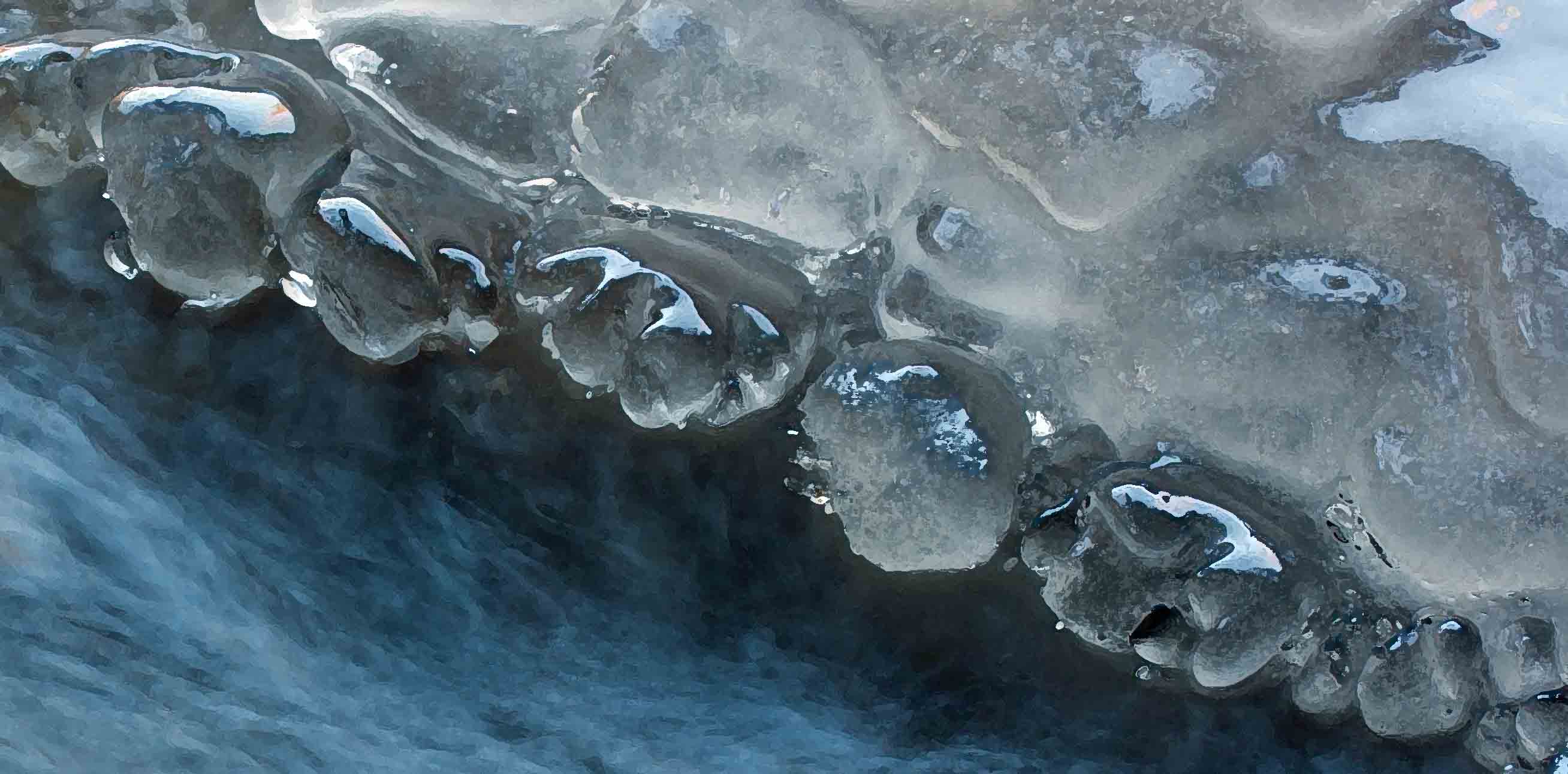
The Journal Writer: How to Keep Going When You Really Don’t Want To

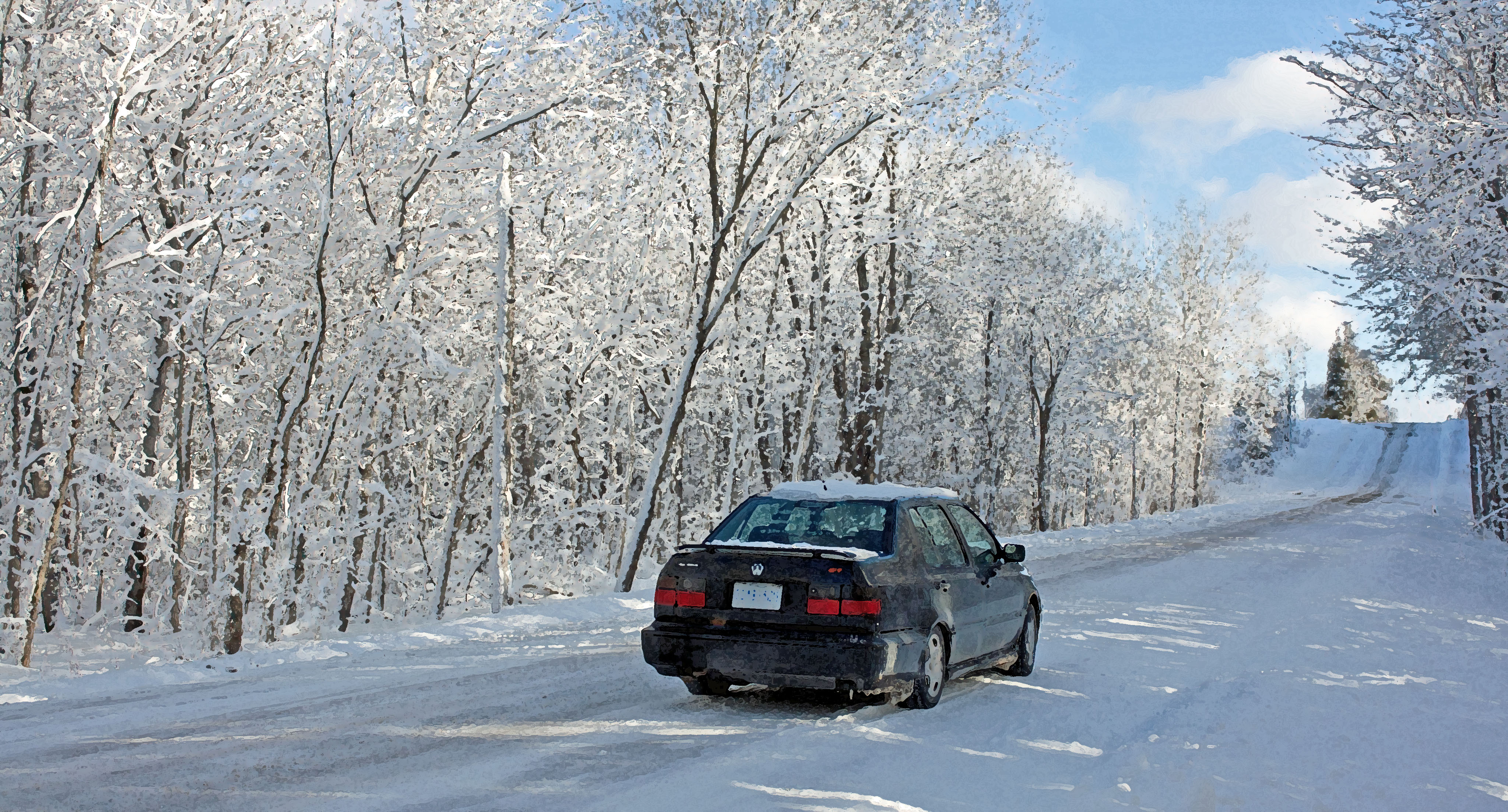
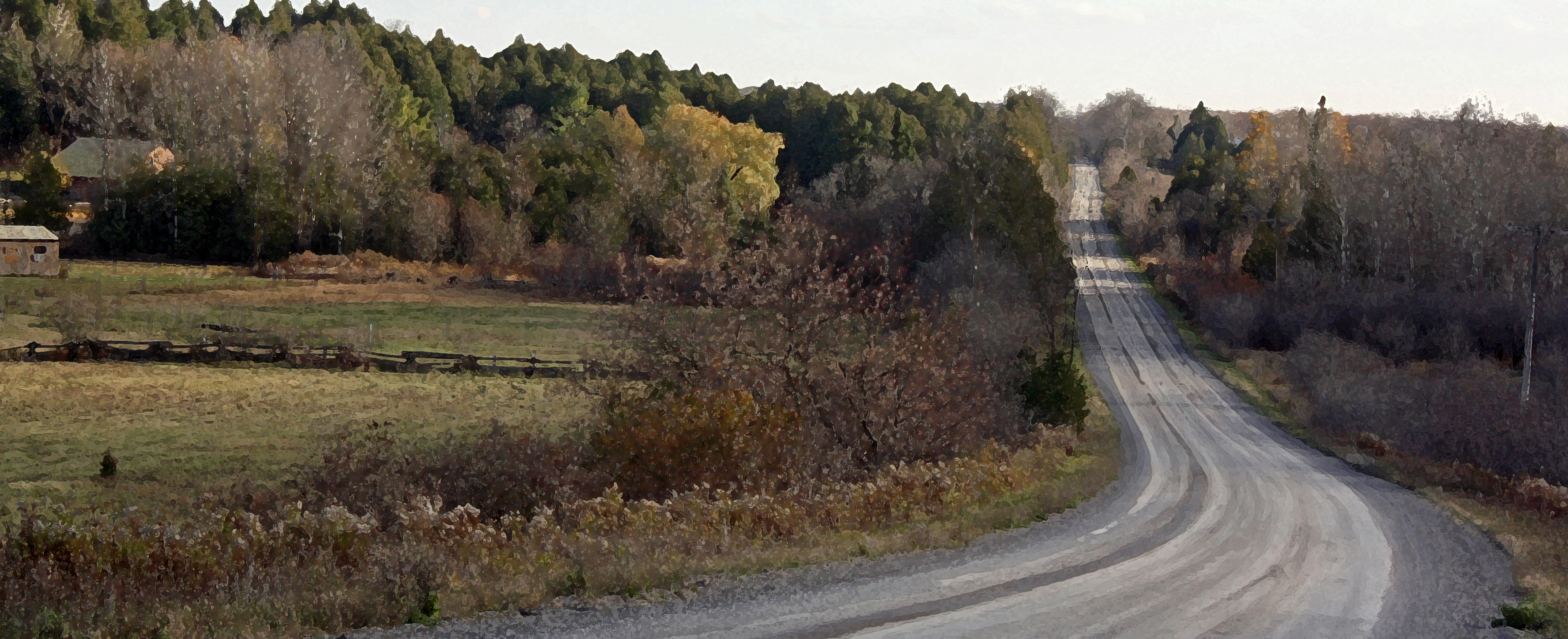
Country road through Kawartha region, ON (photo and rendition by Nina Munteanu)

Every blade of grass has its Angel that bends over it and whispers, ‘Grow, grow’

The Talmud

There will come a time when you just don’t feel like writing in your journal, when you are blue or frustrated or angry, even. It may be that you’re just bored with your journal, with your work and school and life in general. It may be simply that you have nothing to say, your muses have fled to Tahiti or someplace far away and you are left with a blank page or more importantly—and alarmingly—a blank mind.

Chasing the Journeying Muse

Here’s my solution: don’t sweat it. Embrace the emptiness and something wonderful will fill it. I said something; not necessarily what you expect. I believe that when your muse “leaves” you, it is on a journey. More to the point you are on a journey. You’re living. More often than not, our directed muse leaves us because something has gotten in the way. What you probably need to do is pay attention to that something. It’s telling you something. Ironically, by doing this, you open yourself to something wonderful. Okay, enough of somethings!…

Writing is a lot like fishing. In order to write you need something to write about. So, when the world gets in your way, you should pay attention. This is what you’re here for. A writer is an artist who reports on her society. A good artist, at least an accessible one, needs to be both participant as well as observer. So, take a break and live. Chances are, you will have much more to write about after you do.

Dealing with Writer’s Block

I’m not a very patient person. I make no time for writer’s block or lingering in useless limbo over some plot issue or misbehaving minor character. I write pretty much to a tight schedule: this short story to that market by this date; edits to this book to the editor by that date; blog posts created by such and such a time; an article to another market by another date. It goes on and on. When I go to my computer to write, I write

Then there’s Sammy. My cat.

Who likes to jump on my lap, make himself all comfortable and then lie over my arm — trapping it along with five of my typing digits. Now what??? Some of you would advise me to simply pull out my pinned arm and/or shove him off.  But how can I disturb such a blissful creature? He is so content furled on me, so satisfied that he has captured that wandering appendage of business that is all his now. Content in the bliss of now.

Pinned in the moment, my mind first struggles with the need to pound out the next line. My mind then rephrases and teases out nuances of that line. Finally, it wanders out with my gaze and I find myself daydreaming in a kind of trance.  It is here that magic happens. In the being; not in the doing.

This is the irony of writing and the muse. To write we need to live; we need to have something to write about and we need to be in that state of mind that allows us to set it to print. I am at my best as a writer when I am focused on the essence of the story, its heart and soul beating through me with a life of its own.

My cat Sammy isn’t the only vehicle to my magical muses.    

Waking Up The Muse

Here are a few things that help me entice those capricious muses into action:

Music: music moves me in inexplicable ways. I use music to inspire my “muse”. Every book I write has its thematic music, which I play while I write and when I drive to and from work (where I do my best plot/theme thinking). I even go so far as to have a musical theme for each character. You can do the same for your journals.

Walks: going for a walk, particularly in a natural environment, uncluttered with human-made distractions, also opens the mind and soul. It grounds you back to the simplicity of life, a good place to start.

Cycling: one of my favorite ways to clear my mind is to cycle (I think any form of exercise would suffice); just getting your heart rate up and pumping those endorphins through you soothes the soul and unleashes the brain to freely run the field.

Attend literary functions: go to the library and listen to a writer read from her work. You never know how it might inspire you. Browse the bookshelves of the library or bookstore.  Attend a writer’s convention or conference.

Visit an art gallery, go to a movie: art of any kind can inspire creativity. Fine art is open to interpretation and can provoke your mind in ways you hadn’t thought before. If you go with an appreciative friend and discuss what you’ve seen you add another element to the experience.

Go on a trip with a friend: tour the city or, better yet, take a road trip with a good friend or alone (if you are comfortable with it). I find that travelling is a great way to help me focus outward, forget myself, and open my mind and soul to adventure and learning something new. Road trips are metaphoric journeys of the soul.

Form a writer’s or journal-keeping group: sharing ideas with people of like mind (or not, but of respectful mind) can both inspire you and provide the seeds of ideas.

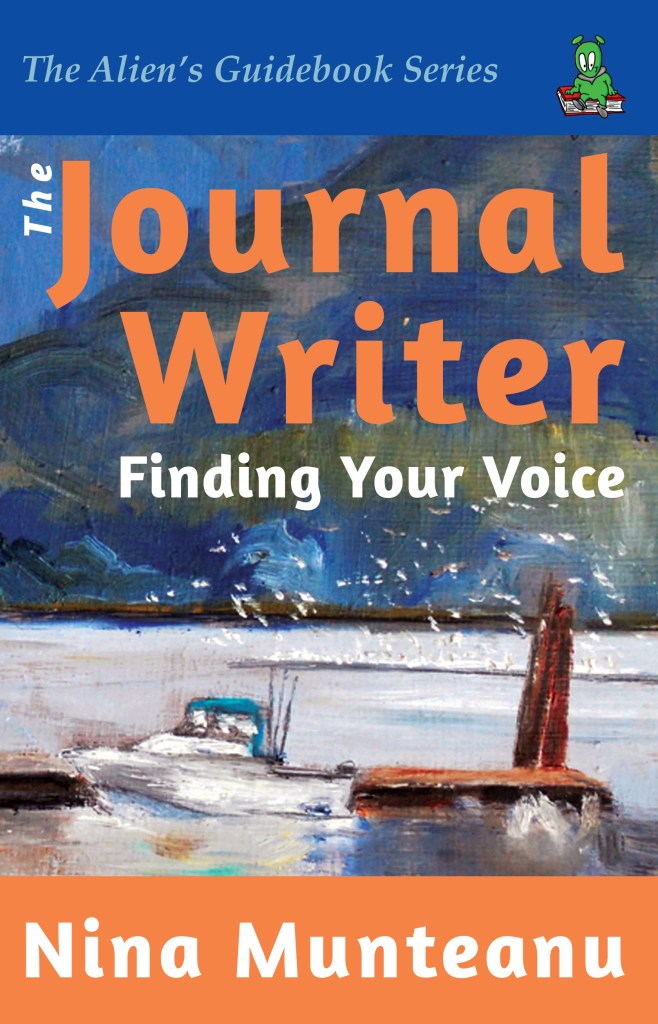
This article is an excerpt from The Journal Writer: Finding Your Voice (Pixl Press, 2013) by Nina Munteanu.

The Journal Writer is the second writing guide in the Alien Guidebook Series. This comprehensive guidebook will help you choose the best medium, style and platform for your expressive writing. The guide provides instruction on issues of safety, using the computer and electronic devices, social media and the internet.

Engaging, accessible, and easily applicable…Brava, Nina, brava.”—David Merchant, Instructor, Louisianna Tech University

Straight up, fact-filled, enriching, joyful and thorough…Nina is honest, she is human and she wants you to succeed.”—Cathi Urbonas, Halifax writer

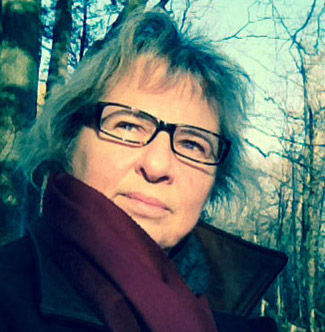
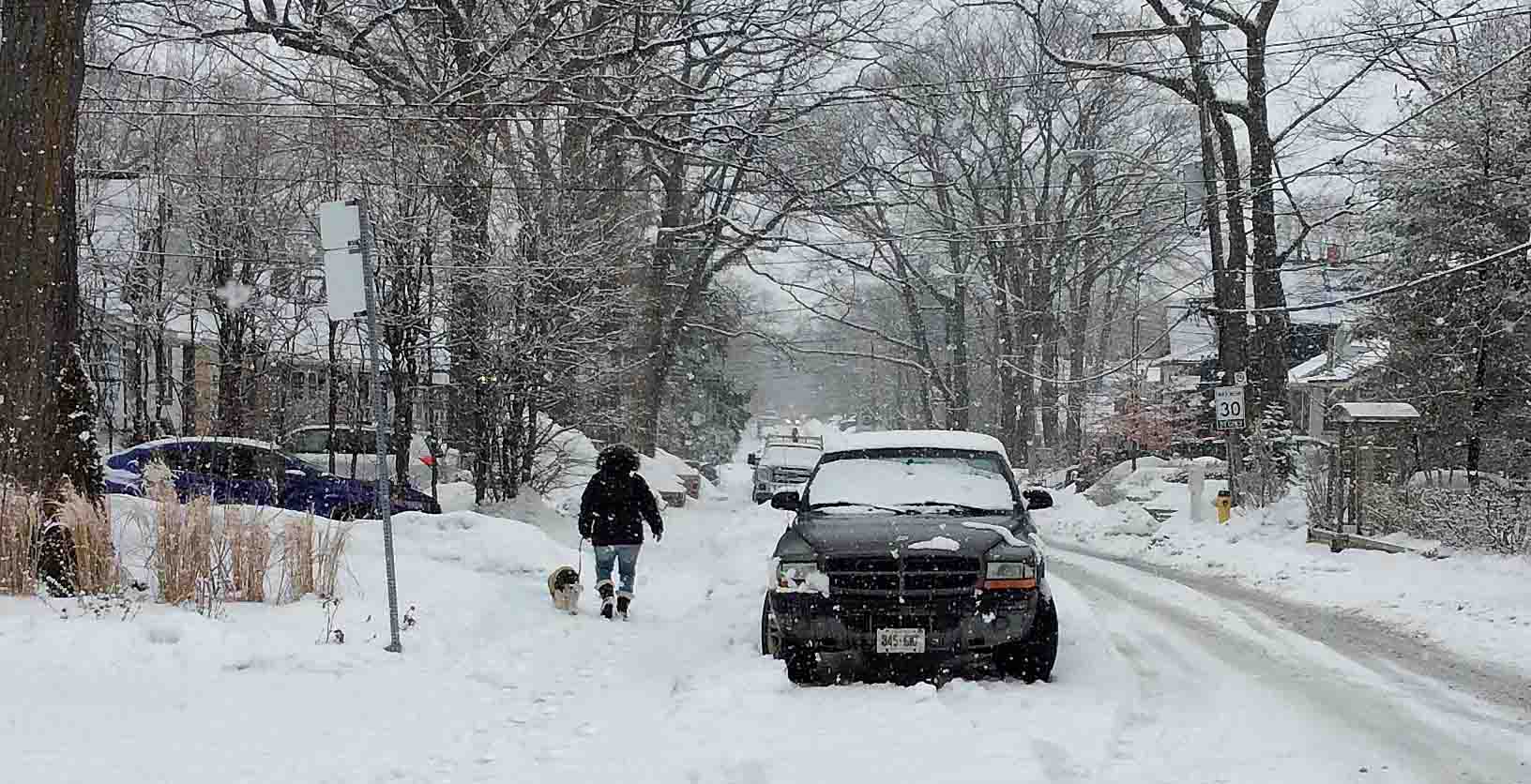
Nina Munteanu enjoys a snowstorm in Ontario

NINA MUNTEANU is a Canadian ecologist / limnologist and novelist. She is co-editor of Europa SF and currently teaches writing courses at George Brown College and the University of Toronto. Visit  www.ninamunteanu.ca for the latest on her books. Nina’s bilingual “La natura dell’acqua / The Way of Water” was published by Mincione Edizioni in Rome. Her non-fiction book “Water Is…” by Pixl Press(Vancouver) was selected by Margaret Atwood in the New York Times ‘Year in Reading’ and was chosen as the 2017 Summer Read by Water Canada. Her novel “A Diary in the Age of Water” was released by Inanna Publications (Toronto) in June 2020.

The Beauty & Magic of Snow

Nina, the snow bear, enjoying a heavy snowfall in early winter, ON (photo by M. Cox)

I grew up in southern Quebec, where the first snow of the season often came from the sky in a thick passion. Huge flakes of unique beauty settled on my coat sleeves and within minutes I was covered in snow. I would stand enraptured and study each one as I could. Snow wraps everything in a blanket of soft acceptance. It creates a dazzling face on a dark Earth. It refuses to distinguish between artificial and natural. It covers everything—decorated house, shabby old car, willowy trees, manicured lawn—beneath its white mantle. It quiets the Earth.

Old barn after a fresh snow near Wolfville, NS (photo by Nina Munteanu)

Have you ever gone for an evening walk in the fresh crisp snow, boots crunching, snow glistening in the moonlight? Each step is its own symphony of textured sound. A kind of collaboration with the deep of the night and Nature’s own whisperings.

Heavy snowfall in a forest during early winter, ON (photo by Nina Munteanu)
A heavy snow falls in the Beach in Toronto, ON (photo by Nina Munteanu)

Snow is a shape shifter, charging down in a fierce blizzard and as glittering hoarfrost that forms on cold, clear nights. Snow is a gypsy, conspiring with the clever wind to form mini-tornadoes and swirling on the cold pavement like misbehaving fairies. It drifts like a vagabond and piles up, cresting over the most impressive structure, creating phantoms out of icons. Some people, fearful of the chaos and confusion that snow brings, hide indoors out of the cold. Others embrace its many forms, punching holes through the snow crust to find the treasure of powder beneath or ploughing through its softness, leaving behind an ivory trail of adventure.

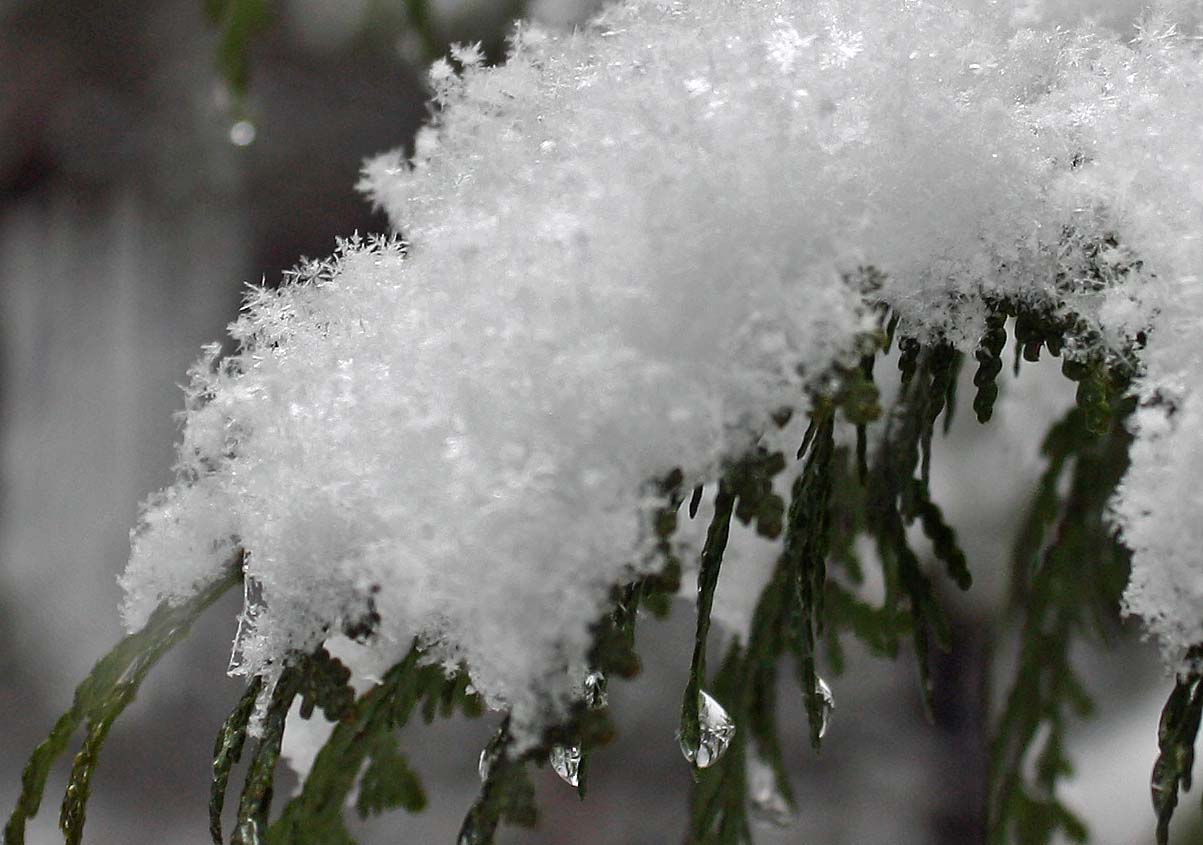
Snow crystals poised on the leaves of a white cedar, ON (photo by Nina Munteanu)

Snow is magic. It reveals as it cloaks. Animals leave their telltale tracks behind their silent sleuthing. No two snowflakes are alike. Yet every non-aggregated snowflake forms a six-fold radial symmetry, based on the hexagonal alignment of water molecules when they form ice. Tiny perfectly shaped ice-flowers drift down like world peace and settle in a gentle carpet of white. Oddly, a snowflake is really clear and colourless. It only looks white because the whole spectrum of light bounces off the crystal facets in diffuse reflection (i.e., at many angles). My son, who skies, extols “champagne powder”—very smooth and dry snow, ideal for gliding on. On powder days, after a fresh snowfall, mountain trees form glabrous Henry Moore-like sculptures. Skiers wind their way between the “snow ghosts,” leaving meandering double-helix tracks behind them.

Pump Peak, north view with snow ghosts, Mount Seymour, BC (photo by Kevin Klassen)
Skier shushing through powder among snow ghosts, Kaslo BC (photo by Kevin Klassen)
Snow ghosts at sunset, BC (photo by Kevin Klassen)

Snow is playful. It beckons you to stick out your tongue and taste the clouds. Snow is like an unruly child. Snow is the trickster. It stirs things up. Makes a mess. It is the herald of change, invigorating, fresh and wondrous. Cars skid in it and squeal with objection. Grumpy drivers honk their horns, impatient to get home; while others sigh in their angry wake. Brown slush flies in a chaotic fit behind a bus and splatters your new coat. Boys and girls of all ages venture outside, mischief glinting in their eyes, and throw snowballs. Great battles are fought in backyards where children build awesome forts and defend them with fierce determination.

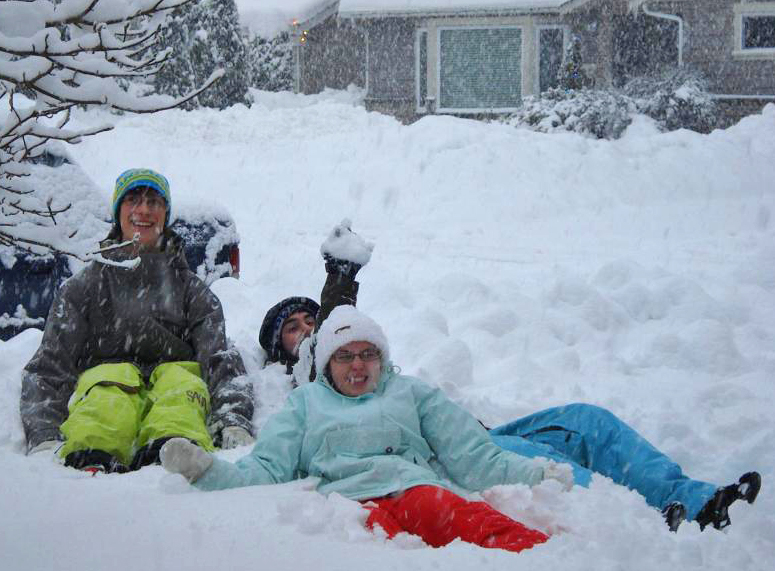
The author’s son and friends playing in a snowstorm, BC (photo by Nina Munteanu)
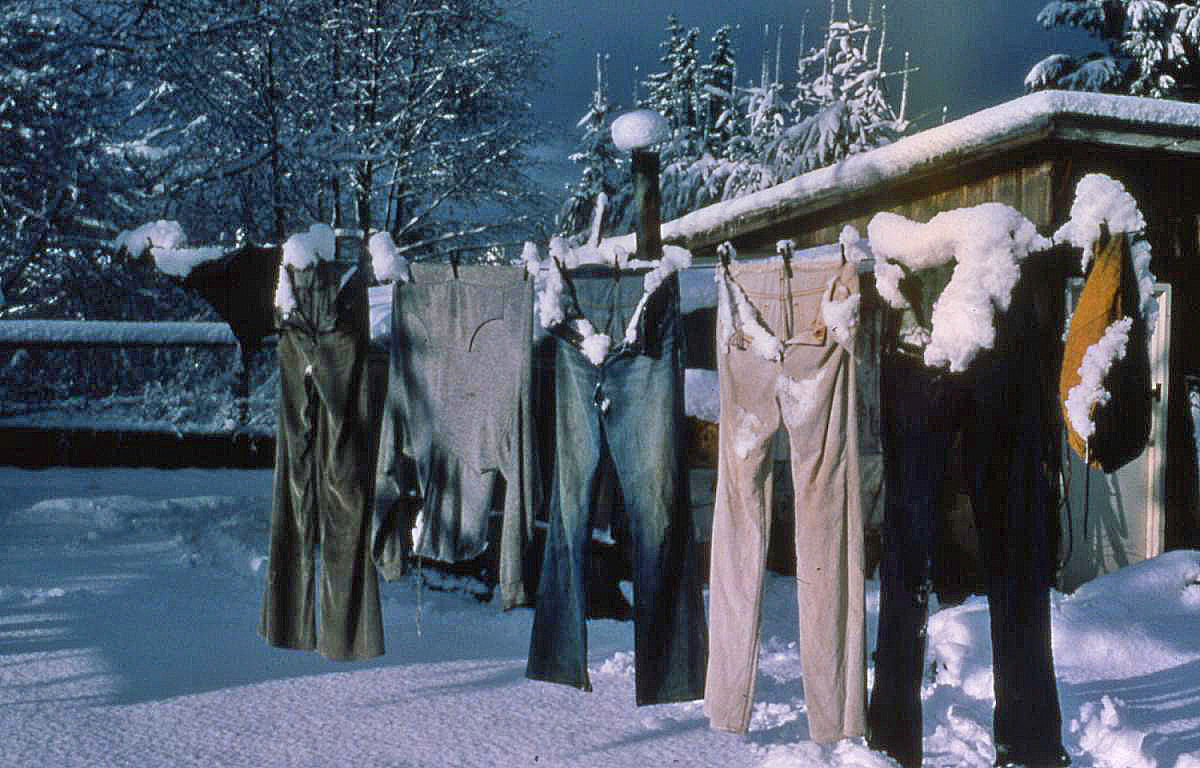
Laundry left out during a snowfall, BC (photo by Nina Munteanu)

In the end, snow—a solid form of water—remains implacable, untouched by our spurious activities. It lies beyond our tedious attempts to salt it, dirty it, move it or make it, turn it into slush, sublimate it or even desublimate it. Snow, like the water it is, cannot be ‘owned’ or kept. Ultimately, it will do its job to energize the earth, give life, then quietly transform, take its leave, and move on. Along with its various water cousins, it will move mountains particle by particle with a subtle hand; it will paint the world with beauty then return to its fold and rejoice; it will transcend time and space to share and teach and transform a world.

Skier exploring a high mountain bowl, Cloudburst Mountain, Squamish, BC (photo by Kevin Klassen)

This article is an excerpt from “Water Is…The Meaning of Water”(Pixl Press)

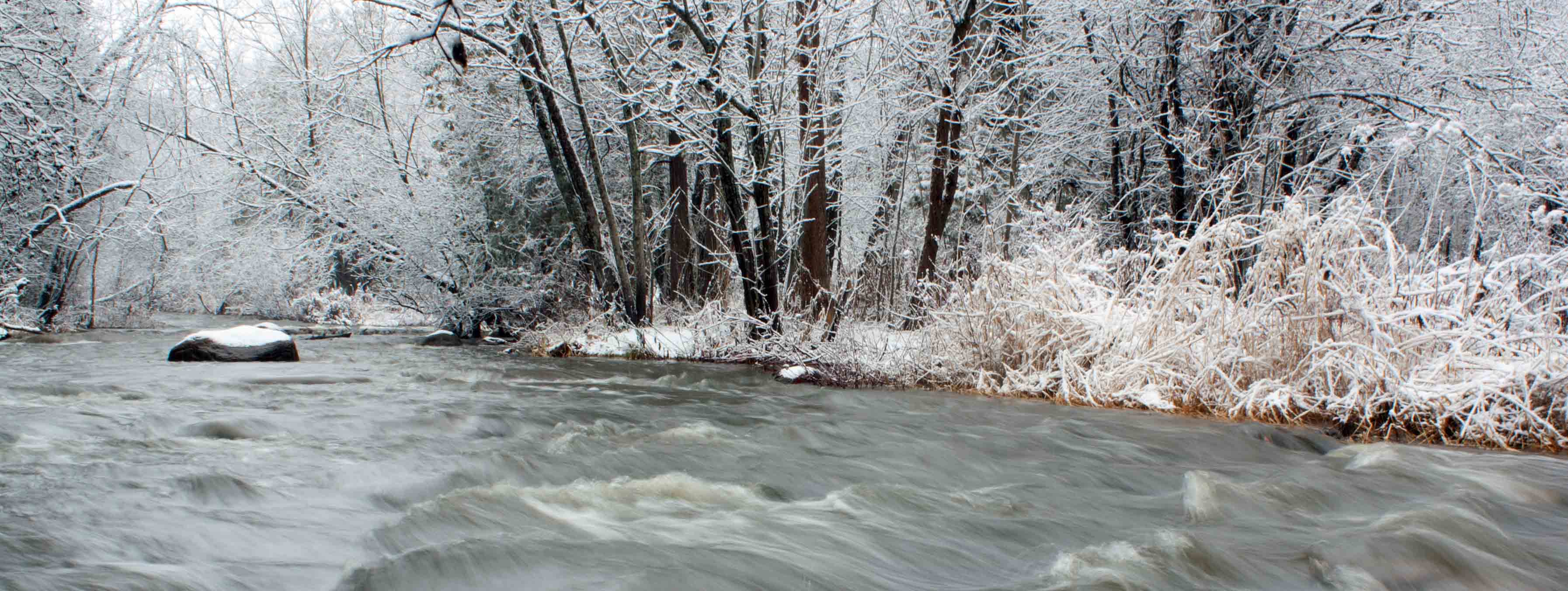
Jackson Creek flows through a forest after a fresh snowfall in early winter, ON (photo by Nina Munteanu)

Nina Munteanu is a Canadian ecologist / limnologist and novelist. She is co-editor of Europa SF and currently teaches writing courses at George Brown College and the University of Toronto. Visit www.ninamunteanu.ca for the latest on her books. Nina’s bilingual “La natura dell’acqua / The Way of Water” was published by Mincione Edizioni in Rome. Her non-fiction book “Water Is…” by Pixl Press(Vancouver) was selected by Margaret Atwood in the New York Times ‘Year in Reading’ and was chosen as the 2017 Summer Read by Water Canada. Her novel “A Diary in the Age of Water” was released by Inanna Publications (Toronto) in June 2020.
My Story … And My Dream

Nina, age four, pretending to read, Granby, Quebec (photo by Maria Munteanu)

I started writing and drawing as soon as I could hold a pencil. Even before I could read, I wanted to become a “paperback writer” like in the old Beatles song.

It was an incredible moment of clarity for me and despite being challenged by my stern and unimaginative primary school teacher, who kept trying to corral me into being “normal”, I wasn’t going to let anyone stem my creativity and eccentric — if not wayward — approach to literature, language and writing. I was a little brat and I knew it. She and I didn’t exactly get along. But I did okay and, despite her acidic commentary, Miss House awarded me some A’s and B’s…

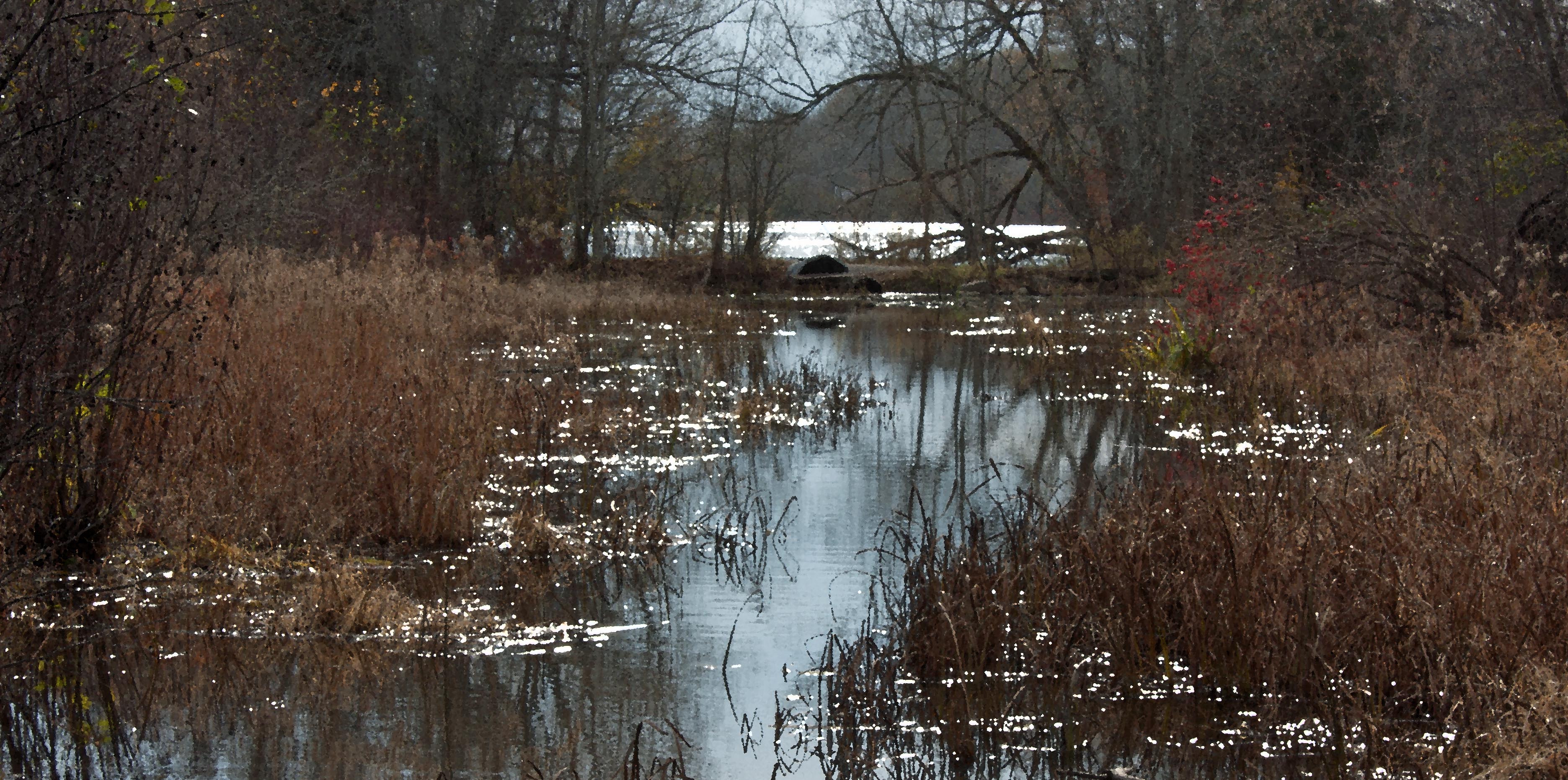
Country road in late fall, ON (photo and rendition by Nina Munteanu)

I wrote some fan fiction but quickly found my own creations far more interesting and less limiting.

As a teenager, I wrote, directed and recorded “radio plays” with my sister. When we weren’t bursting into riotous laughter, it was actually pretty good. She and I shared a bedroom in the back of the house and at bedtime we opened our doors of imagination to a cast of thousands. We fed each other wild stories of space travel, adventure and intrigue, whispering and giggling well into the dark night, long after our parents were snoring in their beds.

Those days scintillated with liberating originality, excitement and joy.

(Photo: Nina Munteanu and sister Doina Maria Munteanu at Grouse Mountain, BC)

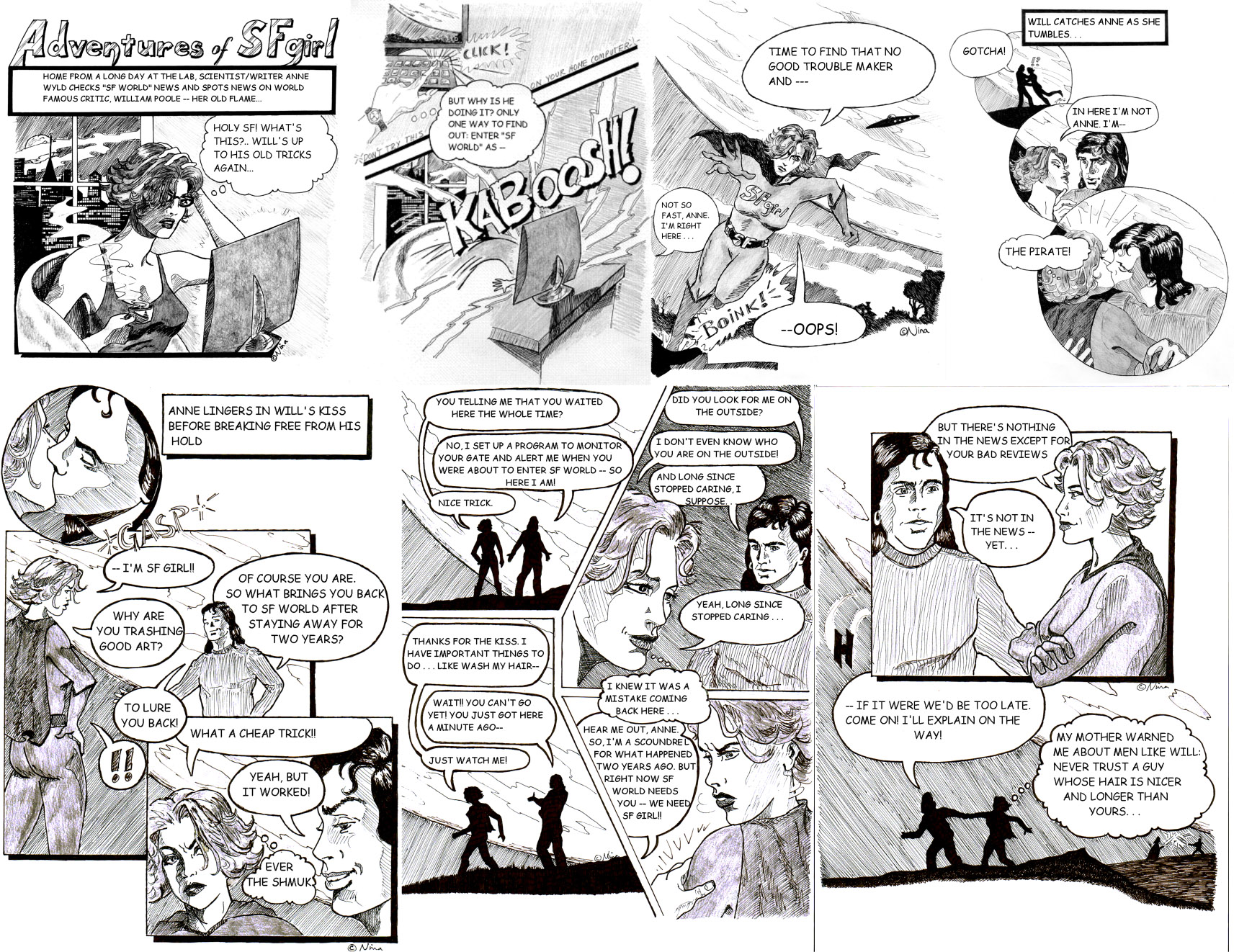
My first attempt at a graphic novel (pencil and ink drawings by a very young Nina)

I also enjoyed animation and drew several cartoon strips, peopled with crazy characters. I dreamt of writing graphic novels like Green Lantern and Spiderman. My hero was science fiction author and futurist, Ray Bradbury; I vowed to write profoundly stirring tales like he did.

I had found what excites me — my passion for telling stories—and I’d inadvertently stumbled upon an important piece of the secret formula for success: 1) having discovered my passion, I decided on a goal; 2) I found and wished to emulate a “hero” who’d achieved that goal and therefore had a “case study”; 3) I applied myself to the pursuit of my goal. Oops … the third one, well … it went downhill from there … Life got in the way.

The Beeches area of Toronto after a heavy snowstorm, ON (photo and rendition by Nina Munteanu)

I grew up.

Well, that, and the environment intervened. In several ways. It started with my parents. Recognizing my talent and interest in the fine arts (I was good in visual arts), they pushed me to get a fine arts degree in university and go into teaching or advertizing. They didn’t see fiction writing as a viable career or a strength of mine (I was lousy at spelling and, despite my ability to tell stories and my love for graphic novels, I didn’t read books much). I can still remember my father’s lecture to me about how perfect the teaching or nursing profession was for me. I wasn’t enamored by either. The second blow to my author-ego came in the form of a school “interest-ability” test, meant to prepare us for our career decisions. I remember the test consisting of an IQ portion (spatial, English and math), and a psychology portion (including problem-solving and scenarios meant to tease out our affinity for a particular career). Secretly harboring my paperback novelist dream, I filled out my forms with great excitement. I still remember the deflating results, which suggested that I was best suited to be a sergeant in the army. “Writing” as a career barely made it on the graph, and scored well below “computer programmer” and “mechanic”; none of which interested me. 

Country road in a heavy snow, ON (photo and rendition by Nina Munteanu)

I got involved in the environmental movement, while quietly holding my dream of being a paperback novelist close to my heart. I got several degrees in ecology and consulted for various companies to help protect the environment. I wrote a lot in those days, although it was more about the ecology of creeks and about industrial pollution. But my passion for writing fiction continued to simmer. Magazines started publishing my articles—my first sale was to Shared Vision Magazine in 1995 on environmental citizenship—and my published articles became my entrance into the world of fiction. Once I began publishing fiction stories—my first short fiction sale was “Arc of Time” to Armchair Aesthete in 2002—I never looked back.

Eventually, I was publishing a novel and several short stories every year. My fiction most often focused on environmental issues, humanity’s relationship with the natural world, and how we reconcile our reliance on technology with our respect for the natural world.

Publications of long or short eco-fiction that include my writing or editing

Throughout my writer’s journey, and particularly early in my journey, I weathered the threshold guardians, tricksters and shadows: friends and family who called what I did a hobby, something I did just to pass the time; people who didn’t believe in me, envied my drive or simply thought I was wasting my time; even industry scammers who preyed on my dreams and wanted my money for nothing in return; and ultimately my own fears and frustrations on query after query and rejection after rejection. Throughout it all, I never stopped dreaming.

Nina’s family hiking and boating in British Columbia over the years

I’ve travelled through Europe, Africa, parts of Asia, and Australia. I raised a family and lived all over Canada from the Pacific to the Atlantic coast. I worked as a barista, shopkeeper and science lab instructor, then as environmental consultant, writing instructor and writing coach.  During these wonderful life-adventures, I never stopped writing. 

Nina Munteanu in the castle at Gruyères, Switzerland (photo by Jane Raptor)

To date, I have written and sold over three dozen eco-fiction, science fiction and fantasy novels, non-fiction books, short stories and articles. I have sold short stories to magazines in Canada and the U.S. with translations and reprints in Israel, Poland, Greece, and Romania. My short fiction has appeared in Neo-Opsis Science Fiction Magazine, Chiaroscuro, subTerrain, Apex Magazine, Metastellar, and several anthologies. I’ve seen my short stories nominated for the Aurora Prix Award (Canada’s premier award for writing science fiction and fantasy) and the Foundation of Speculative Fiction Fountain Award. Recognition for my work includes the Midwest Book Review Reader’s Choice Award, finalist for Foreword Magazine’s Book of the Year Award, the SLF Fountain Award, and The Delta Optimist Reviewers Choice Award.  

Nina celebrates her adventures in Toronto (left) and Paris (right)

I’ve published nine novels so far with nominations for the Aurora Prix, Foreword Magazine Book of the Year (several times), and various Reader’s Choice awards.  My non-fiction book “Water Is…” (Pixl Press)—a scientific study and personal journey as limnologist, mother, and teacher—was Margaret Atwood’s pick in 2016 in the New York Times ‘The Year in Reading.’ My recent eco-novel released in 2020 by Inanna PublicationsA Diary in the Age of Water“—about four generations of women and their relationship to water in a rapidly changing world—was a silver medalist for the Literary Titan Award, the Bronze winner of Foreword Magazine’s Book of the Year in 2020, longlisted for the Miramichi Review’s ‘Very Best Book of the Year Award,’ and a finalist for the 2021 International Book Award. Reviewers have described it as “lyrical…thought-provoking…unique and captivating…insightful…profound and brilliant…unsettling and yet deliciously readable…” One reviewer described it as a “a bit of a hybrid” and the writer “a risk taker”—which I quite liked. Another reviewer acknowledged that this was not a book for everyone and yet she found it “strangely compelling.”—which I found delicious.

It’s been twenty-seven years since I seriously started my writing career with my first publication in 1995; my work is now recognized and translated throughout the world and I frequently get writing commissions from reputable magazines and publications. I am also frequently invited for speaking engagements and radio/podcast/TV interviews about my science and my writing. In short, I’ve come home; I’d taken a rather long detour but I’ve acquired some tools along the way. It’s been and continues to be a wonderful and exciting journey; and part of what made it so was that I never stopped dreaming and writing.

“…If you have nothing at all to create, then perhaps you create yourself…”

Carl Jung
A sampling of literary publications up to 2021-end that have included something of mine (short fiction, long fiction, non-fiction)
Two people walk through snowy path after a fresh heavy snowfall, ON (photo and rendition by Nina Munteanu)

Nina Munteanu is a Canadian ecologist / limnologist and novelist. She is co-editor of Europa SF and currently teaches writing courses at George Brown College and the University of Toronto. Visit www.ninamunteanu.ca for the latest on her books. Nina’s bilingual “La natura dell’acqua / The Way of Water” was published by Mincione Edizioni in Rome. Her non-fiction book “Water Is…” by Pixl Press(Vancouver) was selected by Margaret Atwood in the New York Times ‘Year in Reading’ and was chosen as the 2017 Summer Read by Water Canada. Her novel “A Diary in the Age of Water” was released by Inanna Publications (Toronto) in June 2020.

“Virtually Yours” Reprinted in Speculative North Issue #6

Nina Munteanu with her copy of Speculative North, Issue #6

My speculative short story “Virtually Yours” was published for the eighth time, most recently in December 2021 in Speculative North, Issue #6. Originally published in Issue #15 of Hadrosaur Tales in 2002, the story explores concepts of cyber-spying, virtual workspace, anonymity, and identity.

A short excerpt follows below.

You can find the short story’s publication history in the Publications page on this site. You can see some of the main publications below. The story was translated into Polish and published by Nowa Fantastyka in 2006.

A selection of publications in which “Virtually Yours” appears from 2002 to 2021
Illustration by Duncan Long for the Amazing Stories publication of “Virtually Yours”
Snow-covered shrub after new snow in mid-winter, ON (photo and rendition by Nina Munteanu)

Nina Munteanu is a Canadian ecologist / limnologist and novelist. She is co-editor of Europa SF and currently teaches writing courses at George Brown College and the University of Toronto. Visit www.ninamunteanu.ca for the latest on her books. Nina’s bilingual “La natura dell’acqua / The Way of Water” was published by Mincione Edizioni in Rome. Her non-fiction book “Water Is…” by Pixl Press(Vancouver) was selected by Margaret Atwood in the New York Times ‘Year in Reading’ and was chosen as the 2017 Summer Read by Water Canada. Her novel “A Diary in the Age of Water” was released by Inanna Publications (Toronto) in June 2020.

The Journal Writer: Benefits of Expressive Writing

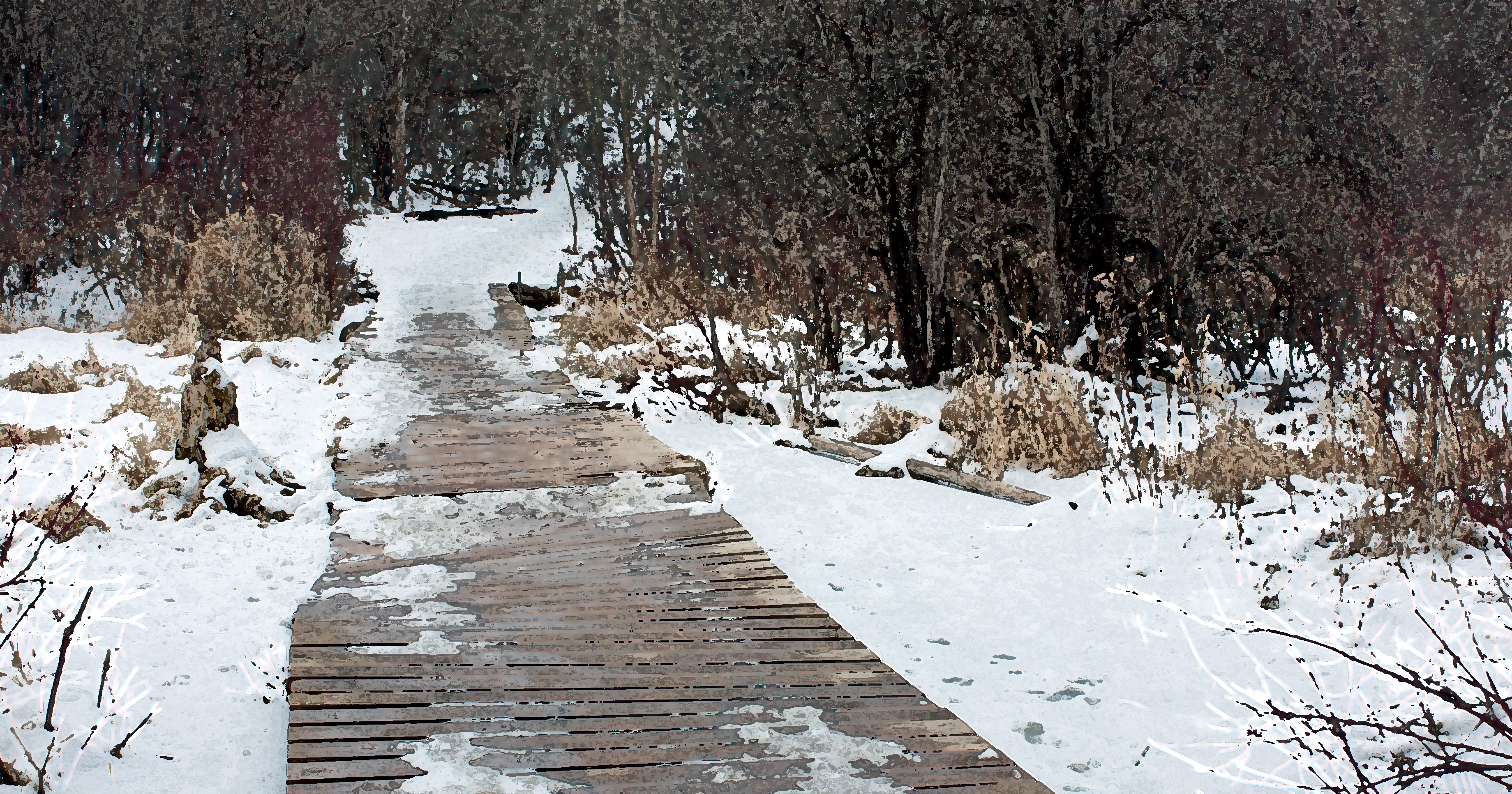
Boardwalk through marsh in a swamp forest, ON (photo and rendition by Nina Munteanu)

The creation of something new is not accomplished by the intellect but by the play instinct acting from inner necessity. The creative mind plays the objects it loves

Carl Jung

You don’t have to take my word for it or that of my writing colleagues either. Psychologists, neuroscientists and other researchers have revealed health and emotional benefits of expressive writing. The meditative action of handwriting alone has proven beneficial. Think of the poetry of laying down an intelligent pattern over a surface: the subtle “prayer” of pen to paper to the renewal of self-discovery.

Over the past 20 years, a growing body of literature has shown beneficial effects of writing about traumatic, emotional and stressful events on physical and emotional health. For instance, researchers have shown that college students writing about their deepest thoughts and feelings for only 15 minutes over 4 consecutive days experienced significant health benefits four months later (Pennebaker & Beall, 1986). Table 1 summarizes some of the long-term benefits of expressive writing.

TABLE 1: Long-Term Benefits of Expressive Writing
HealthSocial & Behavioral
Fewer stress-related visits to the doctorReduced absenteeism from work
Improved immune system functioningQuicker re-employment after job loss
Reduced blood pressureImproved working memory
Improved lung functionImproved sporting performance
Improved liver functionHigher student’s grade point average
Fewer days in hospitalAltered social and linguistic behavior
Greater psychological well-being 
Reduced depressive symptoms 
Fewer post-traumatic intrusion and avoidance symptoms 
Reference: Baikie & Wilhelm, 2005 

DeSalvo shares something a friend of hers confided to her: “Why is it that I always get sick after I finish a book, and not while I’m writing? Crazy as it sounds,” she concluded, “it must be that writing keeps me healthy.” Although writing can’t cure us, some studies suggest that it might prolong our lives, says DeSalvo. It can help us “to accomplish that shift in perspective marked by acceptance, authenticity, depth, serenity and wisdom that is the hallmark of genuine healing.”

Expressive writing produces significant benefits for people with a variety of medical problems. Some of the major ones appear in Table 2 below.

TABLE 2: Medical Conditions Benefiting from Expressive Writing
Lung functioning in ASTHMA
Disease severity (improvements in joint stiffness) in RHEUMATOID ARTHRITIS
Pain and physical health in CANCER
Immune response in HIV Infection
Hospitalisations for CYSTIC FIBROSIS
Pain intensity in women with CHRONIC PELVIC PAIN
Sleep-onset latency in POOR SLEEPERS
Post-operative course
Reference: Baikie & Wilhelm, 2005
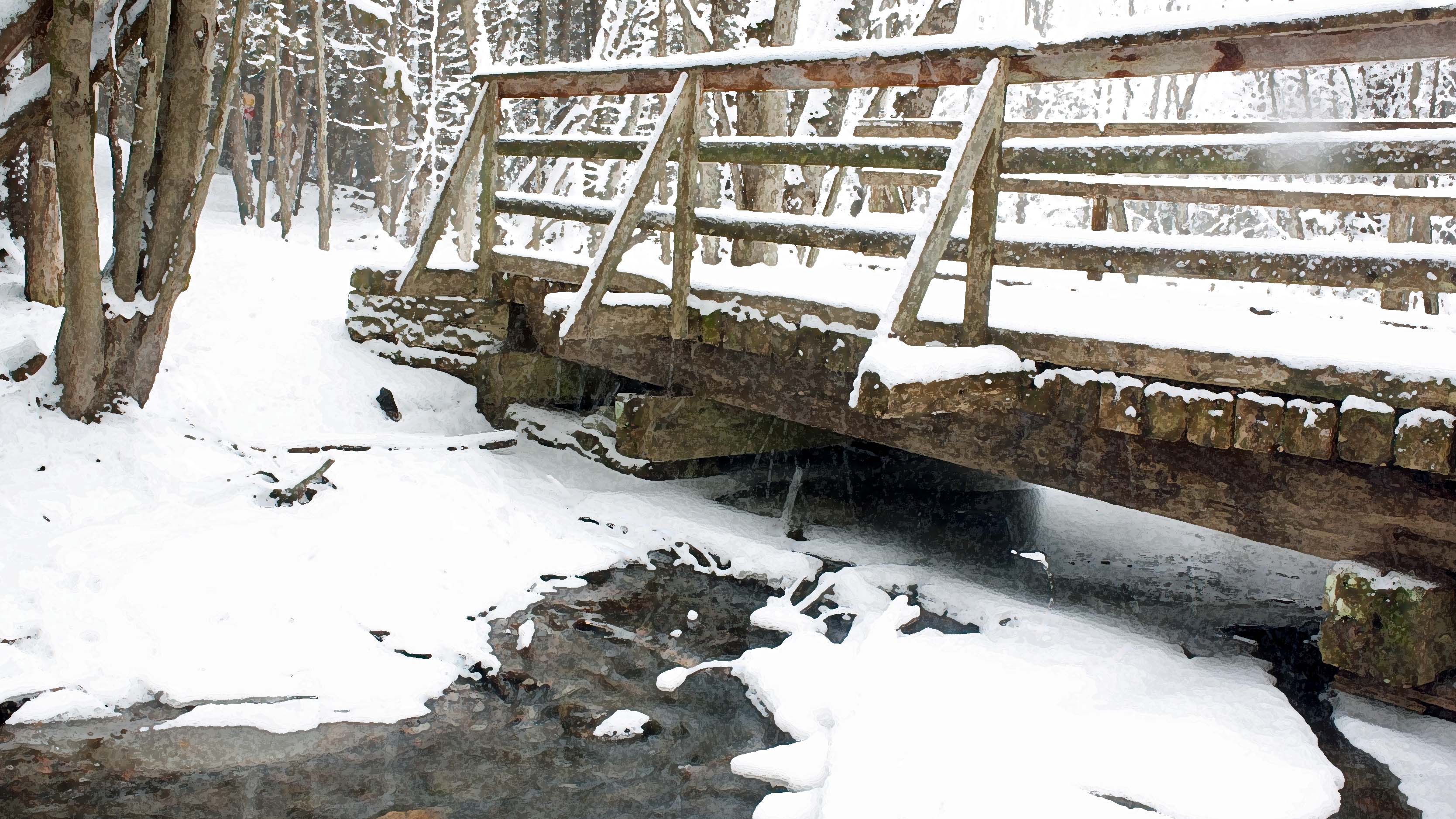
Wooden bridge over creek in a forest park, ON (photo and rendition by Nina Munteanu)

This article is an excerpt from The Journal Writer: Finding Your Voice (Pixl Press, 2013) by Nina Munteanu.

The Journal Writer is the second writing guide in the Alien Guidebook Series. This comprehensive guidebook will help you choose the best medium, style and platform for your expressive writing. The guide provides instruction on issues of safety, using the computer and electronic devices, social media and the internet.

Engaging, accessible, and easily applicable…Brava, Nina, brava.”—David Merchant, Instructor, Louisianna Tech University

Straight up, fact-filled, enriching, joyful and thorough…Nina is honest, she is human and she wants you to succeed.”—Cathi Urbonas, Halifax writer

1.7  References

Baikie, Karen & Kay Wilhelm. 2005. “Emotional and physical health benefits of expressive writing.” Advances in Psychiatric Treatment. 11: 338-346.

DeSalvo, Louise. 1999. “Writing as a Way of Healing: How Telling Our Stories Transforms Our Lives.” Beacon Press, Boston. 226pp.

Hieb, Marianne. 2005. “Inner Journeying Through Art-Journaling”. Jessica Kingsley Publishers, London, England. 176pp.

Holly, Mary Louise. 1989. “Writing to Grow. Keeping a personal-professional journal”. Heinemann. Portsmouth, New Hampshire.

Klug, Ron. 2002. “How to Keep a Spiritual Journal: a guide to journal keeping for inner growth and personal discovery.” Augsburg, Minneapolis, 4th ed.

Moon, Jennifer. 1999. “Learning Journals: A handbook for academics, students and professional development”. Kogan Page. London.

Pennebaker, James. W. 1990. “Opening Up: The Healing Power of Confiding in Others”. Morrow, New York, NY.

Pennebaker, James W., and Sandra Klihr Beall. 1986. “Confronting a Traumatic Event: Toward an Understanding of Inhibition and Disease”. Journal of Abnormal Psychology 95, no. 3: 274-81.

Munteanu, Nina. 2013. “The Journal Writer: Finding Your Voice.” Pixl Press, Vancouver. 170pp.

Nina Munteanu enjoys a snowstorm

NINA MUNTEANU is a Canadian ecologist / limnologist and novelist. She is co-editor of Europa SF and currently teaches writing courses at George Brown College and the University of Toronto. Visit  www.ninamunteanu.ca for the latest on her books. Nina’s bilingual “La natura dell’acqua / The Way of Water” was published by Mincione Edizioni in Rome. Her non-fiction book “Water Is…” by Pixl Press(Vancouver) was selected by Margaret Atwood in the New York Times ‘Year in Reading’ and was chosen as the 2017 Summer Read by Water Canada. Her novel “A Diary in the Age of Water” was released by Inanna Publications (Toronto) in June 2020.

When We Burn Books…

Dort, wo man Bücher verbrennt, verbrennt man am Ende auch Menschen


—Heinrich Heine
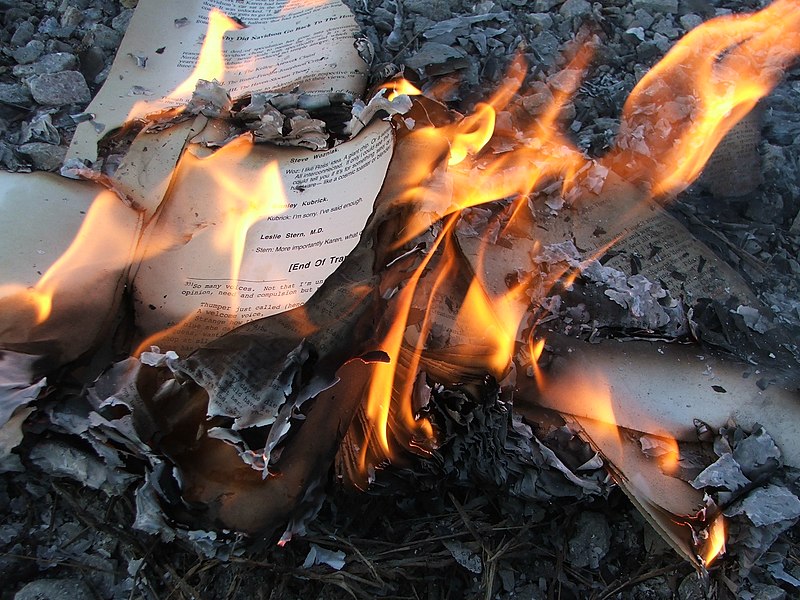
House of Leaves burning (photo by Learning Lark)

In her 2017 article A Brief History of Book Burning, from the Printing Press to Internet Archives Lorraine Boissoneault writes, “As long as there have been books, people have burned them.” Books were burned to silence a dissonant, threatening and potentially rousing voice; they were burned to wipe out a cultural presence; They were burned to control and curtail intellectual freedom; they were burned to simply ruin and pillage and destroy.

Books and libraries have been targeted by people of all backgrounds for thousands of years, sometimes intentionally and sometimes as a side-effect of war, Boissoneault tells us. “In 213 B.C., Chinese emperor Qin Shi Huang (more widely remembered for his terracotta army in Xian) ordered a bonfire of books as a way of consolidating power in his new empire.” According to historian Lois Mai Chan, “His basic objective was not so much to wipe out these schools of thought completely as to place them under governmental control.” 

Boissoneault adds, “When al-Qaida Islamists invaded Mali, and then Timbuktu in 2012, among their targets were priceless manuscripts—books that needed to be burned.” The damage might have been much worse if not for men like Abdel Kader Haidara, who risked their lives to protect the medieval works. He and others succeeded in smuggling out 350,000 manuscripts.”

“Qin was only one in a long line of ancient rulers who felt threatened enough by the ideas expressed in written form to advocate arson,” says Boissoneault. Qin and religious leaders like him are only a small part of the early book-burning equation. “A lot of ancient book burning was a function of conquest,” writes author Rebecca Knuth. The Library of Alexandria had its contents and structure burned during several periods of political upheaval as a casualty of brutal war and associated despoliation and pillaging.

When Johannes Gutenberg invented the printing press in 1440, there were suddenly far more books—and more accessible knowledge. Book burning continued, unfettered, perhaps taking on a more symbolic and insidious role, and no less violent.

In 1966, when Mao Zedong took power in China and implemented the Cultural Revolution, any book that did not conform to party propaganda, such as those that promoted capitalism or other dangerous ideas, were destroyed. In 1992, the Jaffna Public Library of Sri Lanka—repository of nearly 100,000 rare books of Tamil history and literature—was burned by Sinhalese Buddhists.

German writer/poet Heinrich Heine

Heinrich Heine’s Prediction

In his 1821 play, Almansor, the German writer/poet Heinrich Heine wrote: Dort, wo man Bücher verbrennt, verbrennt man am Ende auch Menschen, “Where they burn books, they will in the end burn human beings.” He was referring to the burning of the Muslim holy book, the Qoran as part of the eradication of the Moors from the Iberian Peninsula, during the Spanish Inquisition half a century before.

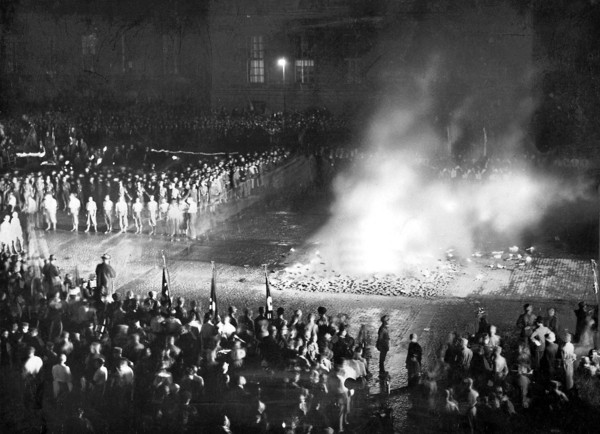
A century later, on May 6-10th, 1933, Heine’s books were among the thousands of volumes publicly hauled out and burned by Nazi brownshirts, SS and Hitler Youth groups in Berlin’s Opernplatz (Bebelplatz). A violent outburst that, in fact, did foreshadow the blazing ovens of the Holocaust. Some twenty thousand books were burned, including those by Heinrich Mann, Karl Marx, Albert Einstein.

Nazi book burning in Opernplatz, Berlin, 1933
Brownshirts and Hitlerjugend perform Nazi salut as books burn in Opernplatz, Berlin in 1933

Wikipedia defines ‘book burning’ as the “practice of ceremoniously destroying by fire one or more copies of a book or other written material.” The practice, usually carried out in public (like public hangings in Medieval times) is generally motivated by moral, religious or political objections to the material. Some notable and particularly destructive book burnings have included:

  • the destruction of the Library of Alexandria;
  • burning books and burying scholars (‘live burying’) under China’s Qin Dynasty (3rd Century);
  • Cathar texts in the Lanquedoc region of France in the 13th Century;
  • the Talmud in Paris by the French crown in 1242;
  • Arabic and Hebrew books at Andalucia, Spain, in 1499;
  • Servetus’s “heretical” writings along with the writer at Geneva;
  • Maya sacred books in Yucatan (1562);
  • Tyndale’s New Testament by the English authorities in 1525 and 1526;
  • Luthar’s Bible in Germany (1624) as ordered by the Pope;
  • Robespierre’s destruction of religious libraries in 1793;
  • anti-communist books by the Bolsheviks in 1917;
  • Jewish, anti-Nazi and “degenerate” books by the Nazis in the 1930s and 1940s;
  • Communist and “fellow traveller” books by Senator McCarthy in 1953;
  • The Satanic Verses by Muslims in the UK in 1988; and,
  • Harry Potter books at various American cities.
Hitler youth burning books at Opernplatz, Berlin, in 1933
Book-burning crowd at Opernplatz, Berlin, in 1933

“Even when the knowledge itself isn’t prevented from reaching the public, the symbolic weight of burning books is heavy,” writes Boissoneault.

“Books are not absolutely dead things, but do contain a potency of life in them as to be as active as that soul was whose progeny they are,” wrote John Milton, author of Paradise Lost, in his 1644 book Areopagitica. “Who kills a man kills a reasonable creature… but he who destroys a good book, kills reason itself.”

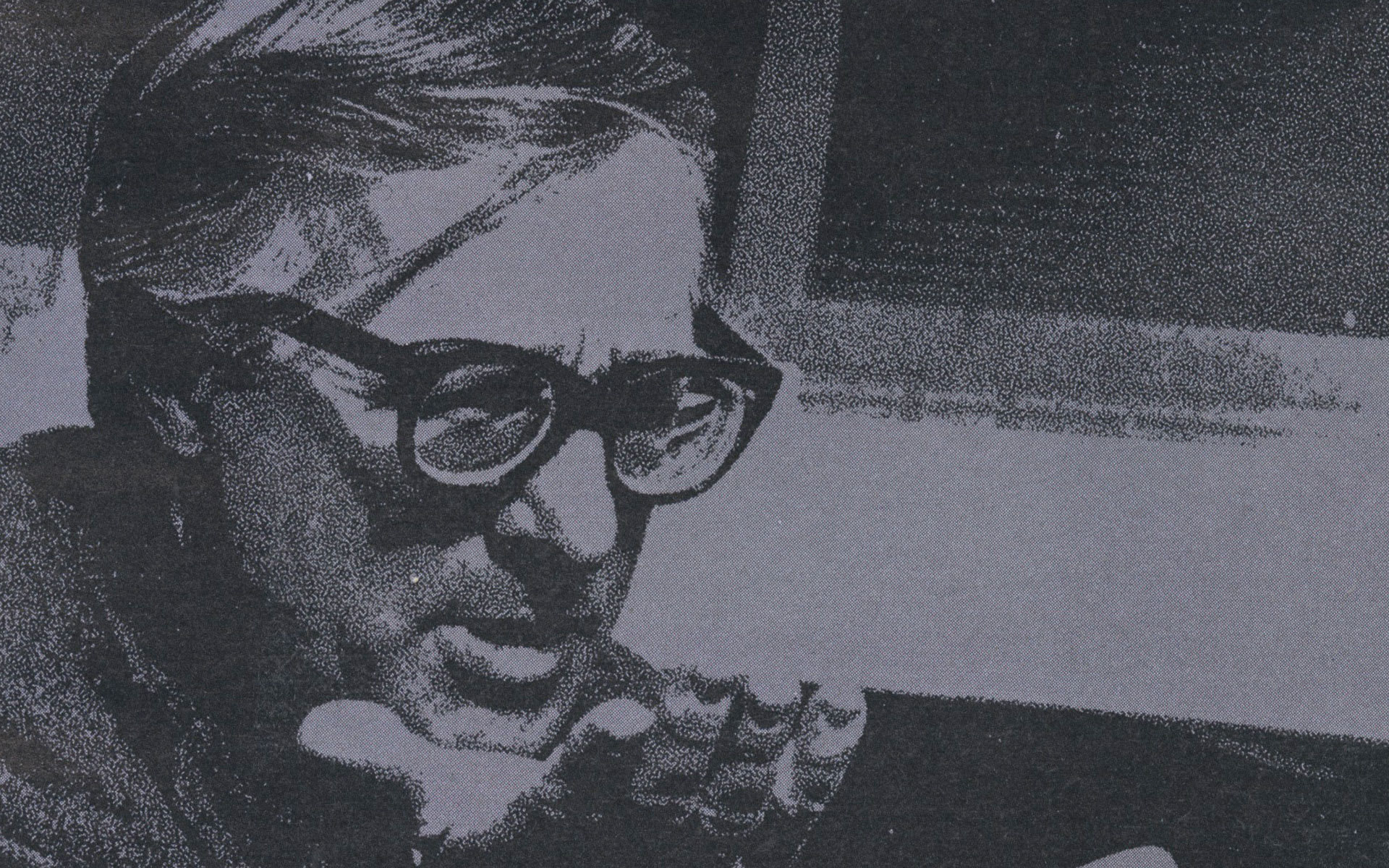
Ray Bradbury

Ray Bradbury on the Dummying Down of an Obedient Society

In the 1967 introduction of his novel, Fahrenheit 451, Ray Bradbury implied that the Nazi book burnings inspired his story. I found this statement both eloquent and powerful: “It follows then that when Hitler burned a book I felt it as keenly, please forgive me, as his killing a human, for in the long sum of history they are one in the same flesh.”

Addressing currently relevant themes of censorship, conformity and anti-intellectualism, Bradbury’s 1953 cautionary tale explores a fictional future society that has institutionalized book burning in an effort by authorities to maintain order and ‘happiness’. In this world, firemen don’t put out fires; they start them. The book gets its title from the temperature that paper catches fire and burns.

The book-burning fireman Guy Montag in Francois Truffaut’s 1966 film Fahrenheit 451

The story begins with Montag, an ordinary fireman, after a day’s work of burning:

It was a pleasure to burn. It was a special pleasure to see things eaten, to see things blackened and changed. With the brass nozzle in his fists, with this great python spitting its venomous kerosene upon the world, the blood pounded in his head, and his hands were the hands of some amazing conductor playing all the symphonies of blazing and burning to bring down the tatters and charcoal ruins of historyMontag grinned the fierce grin of all men singed and driven back by the flame. He knew that when he returned to the firehouse, he might wink at himself, a minstrel man, burnt-corked, in the mirror.”

–Fahrenheit 451
Firemen Beatty and Montag on their way to burn books (from Francois Truffaut’s 1966 film)

Soon after, Montag encounters an old lady who refuses to leave her house when the firemen come to burn her books. She dies alongside the stories she cherishes. Montag then meets the girl, Clarisse, who knows something of the past, when firemen used to put out fires, during a time when there were no informers and people were not afraid.

“A book is a loaded gun in the house next door,” Montag’s superior warns him, arguing for why they must be burned and their knowledge erased. “Who knows who might be the target of the well-read man?” A foreshadowing of what follows.

Fahrenheit 451 weaves a compelling political and social tale that follows one man’s journey in finding his soul and his ability to judge for himself—through his rediscovery of literature.

Book burning in Opernplatz, Berlin, 1933

“Books are the carriers of civilization. Without books, history is silent, literature dumb, science crippled, thought and speculation at a standstill. Without books, the development of civilization would have been impossible.”

Barbara Tuchman, 1980 address at Library of Congress
Burning German book (photo by Amnesty International)

Nina Munteanu is a Canadian ecologist / limnologist and novelist. She is co-editor of Europa SF and currently teaches writing courses at George Brown College and the University of Toronto. Visit www.ninamunteanu.ca for the latest on her books. Nina’s bilingual “La natura dell’acqua / The Way of Water” was published by Mincione Edizioni in Rome. Her non-fiction book “Water Is…” by Pixl Press(Vancouver) was selected by Margaret Atwood in the New York Times ‘Year in Reading’ and was chosen as the 2017 Summer Read by Water Canada. Her novel “A Diary in the Age of Water” was released by Inanna Publications (Toronto) in June 2020.
On Writing: Nina Munteanu Interviewed by Lisa Haselton

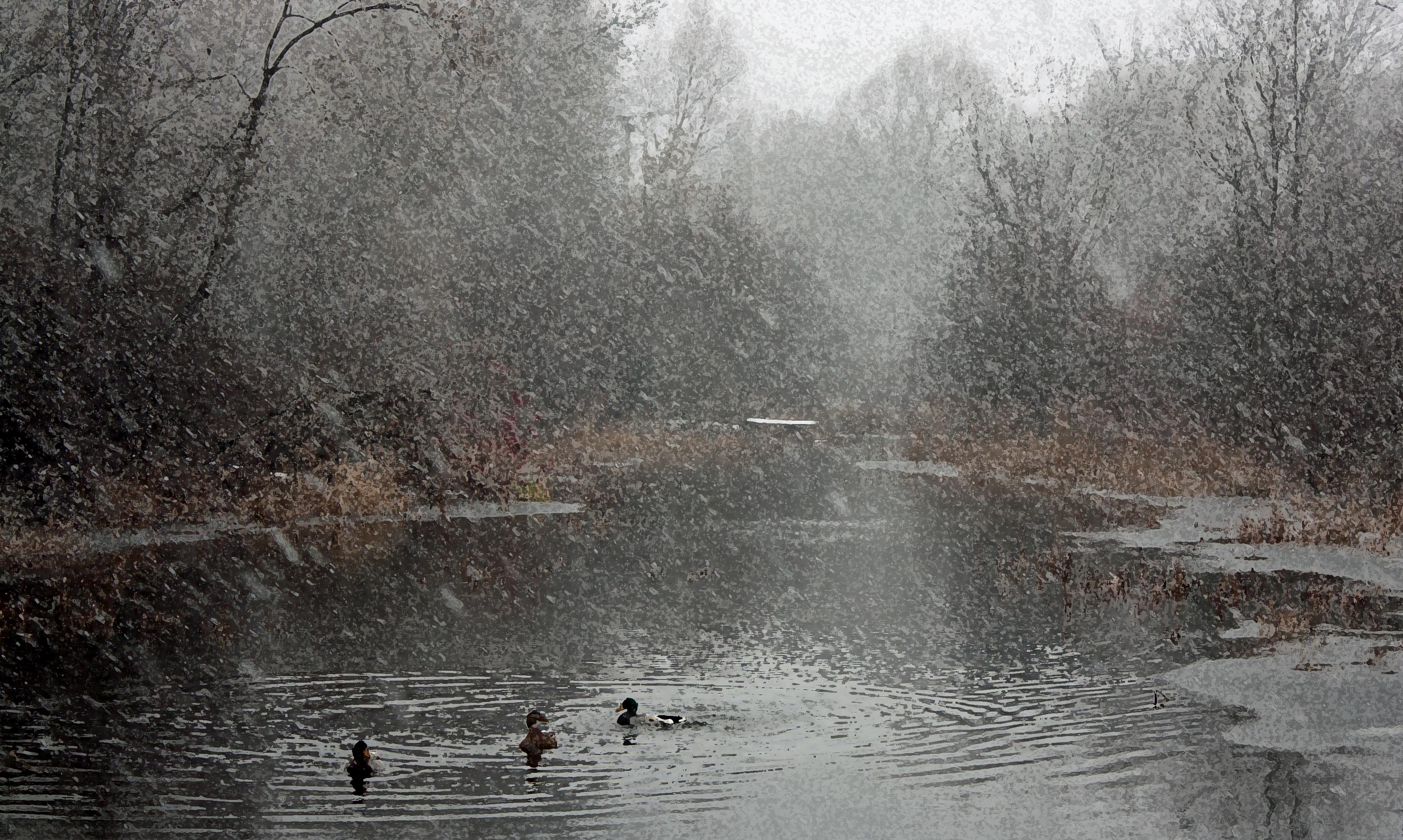
The Otonabee River glints in the sunlight in the midst of a snow flurry, ON (photo and rendition by Nina Munteanu)

This time last year reviewer Lisa Haselton posted an interview with me on New Year’s Day of 2021 on my latest release “A Diary in the Age of Water.” 2021 saw incredible sales for my clifi eco-novel, along with several appearances on radio shows, podcasts and TV stations. It would seem that water is on everyone’s mind and what better way than a limnologist’s diary to learn more about it.

Lisa and I talked about what inspired me to write this novel and about my writing process. What follows is part of that interview. Check out this link for the complete interview with Lisa Haselton.

*****

Lisa: Please tell us about your current release.

Nina: The book tells the journey of four generations of women who have a unique relationship with water, through a time of extreme climate change and water shortage. The book spans over forty years (from the 2020s to the 2060s) and into the far future, mostly through the diary of a limnologist, which is found by a future water-being. During the diarist’s lifetime, all things to do with water are overseen and controlled by the international giant water utility CanadaCorp—with powers to arrest and detain anyone. This is a world in which China owns America and America, in turn, owns Canada. The limnologist witnesses and suffers through severe water taxes and imposed restrictions, dark intrigue through neighbourhood water betrayals, corporate spying and espionage, and repression of her scientific freedoms. Some people die. Others disappear…

Ultimately, the book carries themes of hope and forgiveness—of ourselves and each other—and compassion for all things, starting with water. Each character carries an aspect of that theme, from the diarist’s activist mother, to the diarist’s own cynical protectionism, her spiritual anarchist daughter, and lastly the innocent storm of the last generation.

Lisa: What inspired you to write ‘A Diary in the Age of Water’?

Nina: It started with a short story I was invited to write in 2015 about water and politics in Canada.  I had long been thinking of potential ironies in Canada’s water-rich heritage. The premise I wanted to explore was the irony of people in a water-rich nation experiencing water scarcity: living under a government-imposed daily water quota of 5 litres as water bottling and utility companies took it all. I named the story “The Way of Water.” It was about a young woman (Hilda) in near-future Toronto who has run out of water credits for the public wTap; by this time houses no longer have potable water and their water taps have been cemented shut; the only way to get water is through the public wTaps—at great cost. She’s standing two metres from water—in a line of people waiting to use the tap—and dying of thirst.

The short story and the novel that came from it explore the nuances of corporate and government corruption and deceit together with global resource warfare. In this near-future, Canada is mined of all its water by thirsty Chinese and US multinationals—leaving nothing for the Canadians. Rain has not fallen on Canadian soil in years due to advances in geoengineering and weather manipulation that prevent rain clouds from going anywhere north of the Canada-US border. If you’re wondering if this is possible, it’s already happening in China and surrounding countries.

Lisa: As a child, what did you want to be when you grew up?

Nina: After astronaut, actress and a drummer in a rock and roll band—seriously—it was paperback writer. That’s been my dream since I was ten. I told stories long before I wrote them and long before any of them was published. I told stories in the form of cartoons. Since I was a small child, I wanted to be a cartoonist and write graphic novels (back then I knew them as comics). I created several strips with crazy characters that I drew, blending my love for drawing with my love for storytelling. My sister and I used to make up amazing adventure stories in the universe, peopled with aliens and crazy worlds. I wrote my first complete novel when I was fifteen (“Caged-In World”—which later served as a very rough draft for my first published novel, “Darwin’s Paradox” in 2007). My first published work was a non-fiction article “Environmental Citizenship” which appeared in Shared Vision Magazine in 1995. My first fiction work was a short story entitled “Arc of Time”, which was published in Armchair Aesthete in 2002.

Heavy snowfall in the forest in early winter, ON (photo and rendition by Nina Munteanu)

Lisa: When did you first consider yourself a writer?

Nina: I’ve considered myself a storyteller since I was a child when I wrote and directed plays that my older brother and sister played in and drew cartoon adventure stories. My dream was to be a paperback writer (like the Beatles tune). But I didn’t think of myself seriously as an author until my first short story was published in 2002. It was called “Arc of Time” and appeared in a small magazine with a circulation of about 200. That story went on to be reprinted several times in larger magazines and led to a career of award-winning short stories—the latest appearing in the literary magazine subTerrain in 2020.

Lisa: Do you write full-time? If so, what’s your work day like? If not, what do you do other than write and how do you find time to write?

Nina: While I don’t write full-time, my career is all about writing. Every day I write and research my next novel; I also write commissioned articles and short stories for magazines and for my several writing and science blogs. When I’m not writing, I teach writing at the University of Toronto and George Brown College. I also coach writers online to publication. Finding time to write has not generally been a challenge. I’ve embraced an opportunistic process in my writing and research that allows me to write considerably. The process recognizes that there are many ways to “write” from observations and note-taking, to reading and research, to writing short vs long and fiction vs non-fiction. For instance, I can fill a short break time with meaningful research, editing, or the start of a short article; this saves longer break times for my current novel, which requires a greater stretch of uninterrupted time.

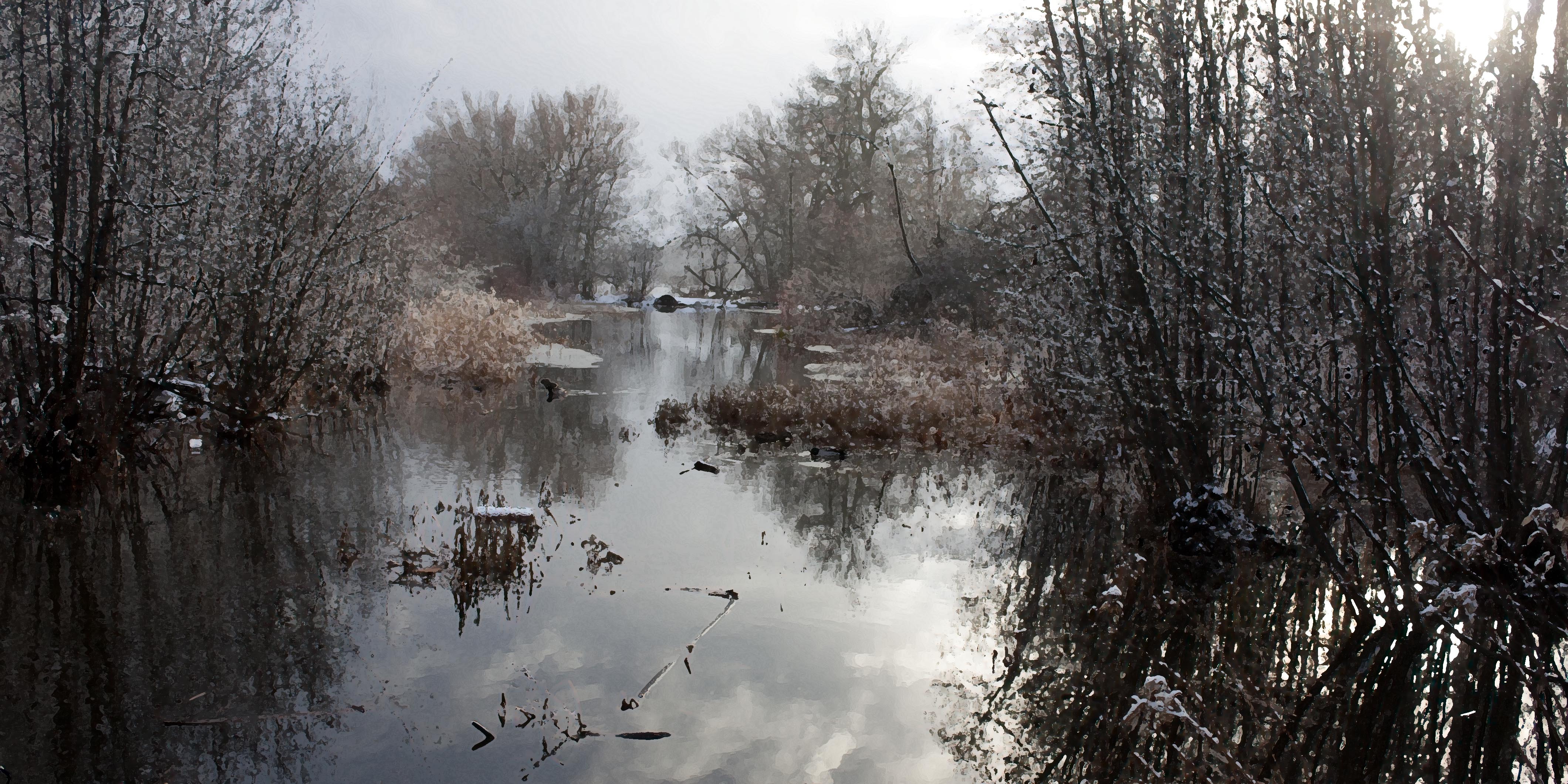
Heavy snowfall in the marsh in early winter, ON (photo and rendition by Nina Munteanu)

Lisa: What would you say is your interesting writing quirk?

Nina: That I am both a pantser and an outliner—with the same book. My writing process has always been a tandem kind of ‘fish and cut bait’ scene / sequel scenario with research following a premise followed by vigorous writing, which in turn engenders more research, which often reveals another plot or sub-theme that needs inclusion. It may seem a haphazard way to write, but I find it very fulfilling, fun and revealing—especially when the Universe provides with serendipitous discoveries (just when I need them). 

Lisa: What exciting story are you working on next?

Nina: I’m currently researching and working on the sequel to “A Diary in the Age of Water”—a thriller about how a phenomenon brings together four lost and homeless people through a common goal to free the Earth from the manacles of human greed. The story takes place throughout Canada—from Halifax to Vancouver and the Arctic. It takes place mostly during the 2050s, and features a few ghosts, the Halifax 1917 Explosion, experimentation on humans, espionage, murder, and—of course—a plague. I’m calling it my COVID19 novel…

Use this link to read my entire interview with Lisa Haselton.

Sun emerges after a heavy snowfall at the marsh, ON (photo and rendition by Nina Munteanu)

Nina Munteanu is a Canadian ecologist / limnologist and novelist. She is co-editor of Europa SF and currently teaches writing courses at George Brown College and the University of Toronto. Visit www.ninamunteanu.ca for the latest on her books. Nina’s bilingual “La natura dell’acqua / The Way of Water” was published by Mincione Edizioni in Rome. Her non-fiction book “Water Is…” by Pixl Press(Vancouver) was selected by Margaret Atwood in the New York Times ‘Year in Reading’ and was chosen as the 2017 Summer Read by Water Canada. Her novel “A Diary in the Age of Water” was released by Inanna Publications (Toronto) in June 2020.
A Tardigrade Christmas…

 …A Different Christmas Story… (with a nod to Lewis Carroll)
water bear03 copy
water bear010 copy

Blika lived in Mossland with her clone sestras, gathering and sucking the delicious juices of detritus and algae. Never in a hurry, she lumbered from frond to frond on eight stubby legs in a gestalt of feasting and being. Blika led a microscopic life of bloated bliss—unaware of forests, human beings, quantum physics or the coming singularity…

A sudden fierce wind wicked her water away. In a burst of alien urgency, she wriggled madly for purchase on the frond as it shivered violently in the roaring wind. Blika lost hold and the wind swept her into a dark dryness. Her liquid life-force bleeding away from her, Blika crawled into herself. The moss piglet felt herself shrivel into oblivion.

water bear08 copy

No, not oblivion… more like a vast expanse…

She had entered a wonderland of twinkling lights in a vast fabric of dark matter. Where am I?

“Welcome, sestra!” boomed a large voice.

It occurred to her that she had never thought such a thing before. Am I dead? She’d never thought about existence before either. What has happened to me? And where are my sestras? She felt an overwhelming sadness. Something else she’d never felt before and wondered why she hadn’t. Did it have to do with that liquid that had always embraced her with its life-force? Here, in the darkness of space, she felt alone for the first time, separated from the plenum.

Blika beheld a being like her with eight arms and hands, seated on a throne and wearing a jeweled crown. “Why do you call me sestra?” Blika asked.

tardigrade-queen-by-thomas a gieseke copy

“Because we are ALL sestras! You are a Tardigrade, aren’t you?” She waved all eight arms at Blika. “Well, I am your queen!” She looked self-pleased. “You are in Tunland now! The land of awareness. And now that you are self-aware, you can do anything! We’re special,” the queen ended in smug delight. The folds of her body jiggled and shimmered.

“Why are we special?” Blika asked.

“Because we are!” the queen said sharply, already losing patience with her new subject. “Don’t you know that you can survive anything? Ionizing radiation. Huge pressure. Boiling heat. Freezing cold. Absolutely no air. And no water…”

Blika gasped. Water was the elixor that connected her to her sestras and her world… her…home…

“How do you think you got here, eh?” the queen mocked her with a sinister laugh. Blika cringed. The queen went on blithely, “So, where do you come from, piglet?”

“I’m trying to find my way home…”

tardigrades holiday copy

“Your way? All ways here are my ways!”

“But I was just thinking—”

“I warn you, child…” The queen glowered at her. “If I lose my temper, you lose your head. Understand?”

Blika nodded, now missing her home even more.

“Why think when you can do!” the queen added, suddenly cheerful again. “First there is BE, then THINK, then DO. Why not skip the think part and go straight to the do part? In Tunland we do that all the time,” she went on blithely. “And, as I was saying, here we can do anything!”

The queen grabbed Blika by an arm and steered them through the swirling darkness of space toward a box-like floating object. “This is my doctor’s Tardis…”

“Doctor who?” Blika naively asked.

The queen shivered off her annoyance and led them eagerly through the door and into her kingdom.

tardigradetardis copy

They entered a strange place of giant blocks and whining sounds beneath a dark swirling sky.

The first thing Blika noticed was the huge tardigrades floating above them like dirigibles! Others were dressed in suits holding little suitcases and walking into and out of the huge blocks through doorways.

“We’ve crossed into another dimension—my universe,” the queen announced cheerfully. “Here you can do anything you want. So, why be tiny and feckless when you can be huge and powerful!” She studied Blika. “This is your moment to do what you could never do before. Think of the possibilities! You too could be huge!”

Blika stared at the strange world of smoke and metal and yearned for her simple mossy home.

tardigrade-helmet-1 copy

As if she knew what Blika wanted, the queen quickly added, “But you can never go back home!”

“Why not?” Blika asked, disappointed.

Because, that’s why!” the queen shouted.  Squinting, she added, “It’s too late. It’s just not done! Once you’ve learned what the colour green means you can’t erase its significance!”

“But I still don’t know what the colour green means,” Blika complained. “And, besides, I think you’re wrong. Becoming self-aware doesn’t stop you from going home. It just changes its meaning. And if I can really do what I want, then you can’t stop me. I’m going home to my family.”

attack_of_the_tardigrades_by_ramul copy 2

The little hairs on the queen bristled. Then she grew terribly calm. “I won’t stop you, but…” The queen pointed to the floating tardigrades above them. “My water bear army will. I sentence you to remain in Tunland forever for your crime!”

“I haven’t done anything…yet.”

“You’ve broken the law of thinking before doing. In Tunland you have to skip that part—”

“You just made that up—”

“Doesn’t matter!” shouted the queen. “Sentence first, verdict afterwards!”

“That’s nonsense,” said Blika loudly. “The idea of having the sentence first.”

“Hold your tongue!” said the queen, turning a shade of chartreuse.

“I won’t,” said Blika.

“Off with your head!” the queen shouted at the top of her voice, pointing to Blika with all eight of her appendages. The water bear army hovered over Blika, taking aim. They were going to get more than her head with those lasers, Blika thought, and scurried for cover faster than her stubby eight legs had ever moved before. She was doomed—

Then, just beyond her sight, she saw—no felt—something far more significant than the colour green…or a huge bloated water bear army about to shoot her…

Water! She could taste it, smell it, hear it. Blika rejoiced with thoughts of her green home.

The water came in a giant wet wave of blue and silver and frothy green. Tunland sloshed then totally dissolved. Blika surfed the churning water. That green! She knew what it was! Blika reached out with her deft claws and snagged a tumbling moss frond. It finally settled and there were her sestras! So many of them clinging to the same green moss! She’d found her family! She was home! Yes, it was a different home and different sestras, but it was also the same. Love made it so…

Merry Christmas!

Tardigrade ornament (Archie McPhee)

water bear02 copy

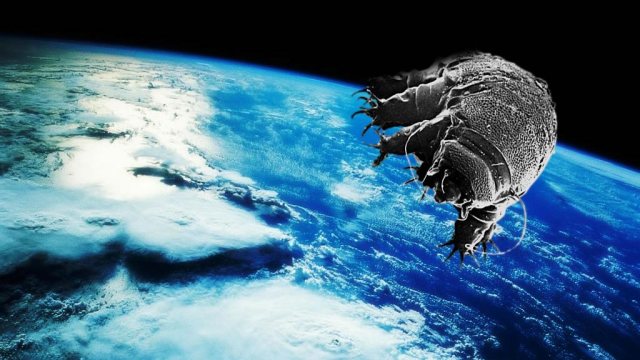
Tardigrades, also known as water bears or moss piglets, are plump, microscopic organisms with eight clawed legs. Fossils of tardigrades date to the Cambrian period over 500 million years ago. Over 900 species are known. Tardigrades were first described by the German pastor Johann August Ephraim Goeze in 1773 and given the name Tardigrada, meaning “slow stepper,” by the Italian biologist Lazzaro Spallanzani. Tardigrades reproduce asexually (parthenogenesis) or sexually. They mostly suck on the fluids of plant cells, animal cells, and bacteria.

Tardigrades survive adverse environmental stresses including:

  • High and low temperatures (e.g., -273°C to +151°C)
  • freezing and thawing
  • changes in salinity
  • lack of oxygen
  • lack of water
  • levels of X-ray radiation 1000x the lethal human dose
  • some toxic chemicals
  • boiling alcohol
  • low pressure of a vacuum
  • high pressure (up to 6x the pressure of the deepest ocean).
Water Bear or Tardigrade

Tardigrades respond to adverse environmental stresses through “cryptobiosis”, a process that greatly slows their metabolism. Tardigrades survive dry periods by shriveling up into a little ball or tunand waiting it out. They make a protective sugar called trehalose, which moves into the cells to replace the lost water. You could say that the water bear turns into a gummy bear.

Tardigrades have revived after a 100 years of desiccation. The antioxidants they make soak up dangerous chemicals and tardigrades can also repair damaged DNA from long term dry-out. In low oxygen, the tardigrade stretches out, relaxed muscles letting more water and oxygen enter its cells. The tardigrade’s cold-resistant tun also prevents ice crystals that could damage cell membranes.

Tardigrades survive temperatures, pressures and ionizing radiation not normally found on Earth. All this raises questions of origin and evolutionary adaptation. How—and why—have tardigrades developed the ability to survive the vacuum and ionizing radiation of space? Some suggest that it’s because they originated there. Scientists argue that they developed extreme tolerances from Earth’s volatile environments (e.g., water bodies that freeze or dry up, and undergo anoxia). But, if they can make it there, they can make it anywhere. So, where is “home” really?…

Water Is-COVER-web copy

My Book “Water Is…” by Pixl Press explores this creature and many other interesting things about water. Look for it on Amazon, Chapters, Kobo and in bookstores & libraries near you. If it’s not in your local library, ask for it.

On Writing Hopeful Dystopias and the Blur of Fiction with Non-Fiction

‘Hopeful dystopias’ are much more than an apparent oxymoron; they are in some fundamental way, the spearhead of the future—and ironically often a celebration of human spirit by shining a light through the darkness of disaster. I discussed this in a recent interview on Solarpunk Futures Podcast.

In a recent interview on the CBC Radio show Ideas “Beyond Dystopia”, Canadian author Margaret Atwood (who penned the dystopic The Handmaid’s Tale and Maddaddam trilogy) said much the same thing. Atwood argued that dystopias and cautionary tales ultimately embrace an element of hope, through a character’s experience. Dystopias can serve as a road map for individual endurance, resilience, and triumph through disaster.

I talked with Solarpunk Futures about how the purposeful blur of fiction with non-fiction in my latest eco-novel A Diary in the Age of Water produced a heightened relevance to the dystopic journey for the reader.

Solarpunk: Your latest book is an eco-novel, or rather something of a fiction-nonfiction hybrid perhaps, called A Diary in the Age of Water. Tell us a bit about that novel and the role that water plays in the story.

Nina: A Diary in the Age of Water follows the climate-induced journey of Earth and humanity through four generations of women and their battles against a global giant that controls and manipulates Earth’s water. The book spans over forty years (from the 2020s to the 2060s) and into the far future, mostly through the diary of a limnologist, which is found by a future water-being. While A Diary in the Age of Water is a work of fiction, its premise and much of its story are firmly based on real events, people and phenomena. The dramatization of these through four main characters carry the reader into consequence and accountability. Water’s relationship with each character provides four different perspectives on the value of water to humanity—from the personal and practical to the spiritual and existential. For readers with an evidence-based approach to learning about water’s importance, the diarist provides interesting facts on water in each of her entries in the form of epigraphs (mostly from Robert Wetzel’s Limnology). Things like: watershed, hypolimnion, aquifer, thalweg, clapotis gaufre, and petrichor, to name a few…

I chose a diary format to purposely blur the fiction with non-fiction. I was writing about both the far and the near future and much of it was based—like Margaret Atwood and her books—on real events and real people. I wanted personal relevance to what was going on, particularly with climate change. I also wanted to achieve a gritty realism of “the mundane” and a diary felt right. Lynna—the diarist—is a reclusive inexpressive character, so I thought a personal diary would help bring out her thoughts and feelings. There’s nothing like eves-dropping to make the mundane exciting. The diary-aspect of the book characterizes it as “mundane science fiction” by presenting an “ordinary” setting for characters to play out. The tension arises from insidious cumulative events and circumstances that slowly grow into something incendiary. The real events are the fuel that incite a slow-burn fictional drama that blurs the reader’s perception of reality and heightens its relevance.

Solarpunk: Can you give us an example of an event in your book where the lines between fiction and nonfiction get blurred?

Nina: In the diary entry entitled “Watershed,”, for July 14, 2049, Lynna writes:

Today, CanadaCorp announced that the collection of rainwater was illegal. As of today, I could be arrested for using my rain catcher and cistern. I’ve decided to continue using the cistern, and I’ve warned Hildegard not to breathe a word to anyone at school about what we’re doing with the water. Thankfully, I have time to train her in the art of subterfuge before she starts Grade Two in the fall.

What follows in the story is a series of greater water restrictions that mimic some of the currenet ongoing scenarios in other parts of the world (e.g. illegal rainwater collection in parts of the USA; shutting down of home water taps in Detroit; required and restricted water collection at public water taps in parts of the world).

Lynna’s August 13, 2051 diary entry in my 2020 novel seemed to predict the atmospheric river disaster that befell British Columbia in November 2021:

In the mid- to late-twenties the west coast succumbed to massive atmospheric river storms. San Francisco. Los Angeles. Seattle. Even earthquakes seemed to follow climate change’s lead. The earthquake / tsunami that hit Vancouver Island in 2029 shifted the Earth’s axis by three inches, Daniel informed me. The American military stormed over the border with swift aid. “Did you know that they never left?” Daniel asked me. I hadn’t known that. But I wasn’t surprised either.

Of course, these “predictions” were really just good research into the current scientific knowledge and what current circumstances may naturally generate in the future. I was just doing a good job at reading water.

Thompson Creek marsh in early winter, ON (photo and rendition by Nina Munteanu)

Given that cli-fi features climate change, environmental destruction, and species extinction, you must think ‘how can it not be all doom and gloom?’ But dystopias often do reflect—in their depiction of terrible circumstance—an element of triumph, of overcoming adversity, and ultimately of hope. In fact, dystopias generally draw on a writer’s optimism; else, why would we write these cautionary tales? A strong belief in humanity underlies much of eco-fiction. Solarpunk is a rising light of eco-fiction that has emerged recently in response to the denial-despair dilemma many of us face when we think of climate change. This kind of eco-fiction features ingenuity, generativity, independence, and community. And it ultimately leads us through it all toward the light. A Diary in the Age of Water is in fact a dystopia with elements of solarpunk.

You can listen to the entire podcast interview on Solarpunk Futures: Imagining a New World here.

Thompson Creek Marsh in early winter, ON (photo and rendition by Nina Munteanu)

Nina Munteanu is a Canadian ecologist / limnologist and novelist. She is co-editor of Europa SF and currently teaches writing courses at George Brown College and the University of Toronto. Visit www.ninamunteanu.ca for the latest on her books. Nina’s bilingual “La natura dell’acqua / The Way of Water” was published by Mincione Edizioni in Rome. Her non-fiction book “Water Is…” by Pixl Press(Vancouver) was selected by Margaret Atwood in the New York Times ‘Year in Reading’ and was chosen as the 2017 Summer Read by Water Canada. Her novel “A Diary in the Age of Water” was released by Inanna Publications (Toronto) in June 2020.

Solaris: Planet as Alien Character in Science Fiction

Kelvin (played by George Clooney) arrives on Solaris in Steven Soderberg’s 2002 film

Some time ago, I participated in an inquiry to name my choice of “Best Alien in Science Fiction,” posed by John DeNardo at SF Signal. “Aliens are a classic trope dating back to the earliest days of science fiction,” John said. They are the quintessential “other” archetype in science fiction.

From conquering warlords (War of the Worlds) to instructing sages (The Day the Earth Stood Still) to victimized pacifists (Martian Chronicles), how the “other” is portrayed and how humanity interacts with it, has been explored throughout science fiction since it began with Mary Shelley’s Frankenstein.

Of course, in science fiction—a metaphoric literature of grand scope—these ‘others’ / aliens make representation through archetype. So, the aliens of War of the Worlds represent a conquering nation; Klaatu of The Day the Earth Stood Still may represent a benevolent dictator; the Martians of Martian Chronicles represent our indigenous peoples under the yoke of settler colonialism and an exploitive resource-extraction mindset; and the monster of Frankenstein exemplifies the disabled/deformed unsavory departure from our ‘perfect’ self-image. Author Brian Ott tells us that “it is a profound mistake to interpret the genre [of science fiction] literally.” He reminds us that it is not what the aliens are but what they represent that matters (except when, in some cases, they are one in the same). Science fiction is both “the great modern literature of metaphor” and “pre-eminently the modern literature not of physics but of metaphysics,” adds Peter Nicholls, Australian scholar and critic.

Steven Spielberg’s 2005 film of H.G. Wells’s book “War of the Worlds”

In a previous article entitled “Dreams and Perceptions And ‘the Other” I described an experience with the unfamiliar. Have you ever done the same? Looked backward while driving through a familiar scene to gain a different perspective? And just felt different for a moment? Like you’d entered a different dimension and briefly glimpsed ‘the other.’

What is it like to meet ‘the other’?

In story, characters are defined through their experience and their approach to the unfamiliar. A new relationship. A stranger in town. A different culture. An alien encounter… How does the character react? Is it with fear? Wonder? Curiosity? A mixture of these? By describing “the other” science fiction writers describe “us”, given that it is through our own eyes that the other is viewed and described.

In his book Orientalism: Western Conceptions of the Orient Edward W. Said contended that for there to be an ‘us’, there has to be a ‘not-us.’ According to Patricia Kerslake of Central Queensland University, this arises from a postcolonial notion of ‘the Other’, through a mutual process of exclusion. This exclusion inspires the very idea of ‘alien’ by imposing expectation on perception. Kerslake argues that: “When one culture imposes its perceptions on another, in that it begins to see the Other not as they are but as, in Said’s words, ‘they ought to be’, then the process of representation becomes inevitable: a choice is made to see a ‘preferred’ real.”

Klaatu greets humanity in “The Day the Earth Stood Still”

In her 1975 article “American SF and the Other,” Ursula K. LeGuin unequivocally scolded the Western SF genre for representing and promoting colonialism and androcratic motives by “othering” or making inconsequential the poor, the uneducated, the marginalized and women.

…The question involved here is the question of The Other—the being who is different from yourself. This being can be different from you in its sex; or in its annual income; or in its way of speaking and dressing and doing things; or in the color of its skin; or the number of its legs and heads. In other words, there is the sexual Alien, and the social Alien, and the cultural Alien, and finally the racial Alien…

The people in SF are not people. They are masses, existing for one purpose to be led by their superiors…

If you deny any affinity with another person or kind of person, if you declare it to be wholly different from yourself–as men have done wo women, and class has done to class, and nation has done to nation–you may hate it, or deify it; but in either case you have denied its spiritual equality, and its human reality. You have made it into a thing, to which the only possible relationship is a power relationship. And thus you have fatally impoverished your own reality.

You have, in fact, alienated yourself.

Ursula K. LeGuin

Written 45 years ago, Le Guin’s scathing article may have accurately represented the North American science fiction community of writers of that time. Today, despite the remnants of a strong old guard that still promotes a patriarchal colonialist hegemony, the science fiction genre has matured and grown beyond this self-limiting view. This is partly because current authors—many who are women and many who are representatives of minority or marginalized groups—have given SF a new face and voice that promises to include equality, inclusion, and a fresh look at exploration and ‘the other.’ In most cases it is ‘the other’ whose voice—for so long missing—is now being expressed.

The genre of science fiction has diversified and matured to embrace “mundane science fiction,” literary fiction, speculative fiction, climate fiction, cli-fi, eco-fiction, indigenous futurisms and more. Each of these genres provide new opportunities that give voice to ‘the other’ from women (Octavia Butler’s Parable of the Sower and N.K. Jemison’s The Broken Earth series) to disabled people (Mishell Baker’s Borderline) to the indigenous human (Cherie Dimaline’s The Marrow Thieves) to the non-human (Costi Gurgu’s RecipeArium) and the environment such as water (Emmi Itäranta’s The Memory of Water and my own A Diary in the Age of Water).

My Choice for ‘Best’ Alien Character: Solaris

The most memorable aliens for me have been those that helped illuminate our history and our very humanity, whether they played the archetype of simple antagonist or misunderstood as “commentator” on human prejudice, insecurities, greed, heroism, compassion and honor. I can think of several aliens who have provided excellent examples of this: the victimized ” prawns” of Peter Jackson’s District 9 come to mind. Each provided a platform for the exploration and exposition of human’s strengths and weaknesses. How we handle or even recognize “the other” is very compelling and illuminating.

The planet Solaris

My choice for alien character is the ‘self-aware’ planet in Stanislaw Lem’s Solaris: see my film review of Steven Soderbergh’s film interpretation of Stanislaw Lem’s book Solaris in a previous article on this site. What follows is a brief summary:

In response to his friend’s plea, a depressed psychologist with the ironic name of Kris Kelvin (George Clooney), sets out on a mission to bring home the dysfunctional crew of a research space station orbiting the distant planet, Solaris. Kelvin arrives at the space station, Prometheus, to find his friend, Gibarian, dead by suicide and a paranoid and disturbed crew obviously withholding a terrible secret from him. It is not long before he learns the secret first-hand: some unknown power (apparently the planet itself) taps into his mind and produces a solid corporeal version of his tortured longing: his beloved wife, Rheya (Natascha McElhone) who years ago had committed suicide herself. Faced with a solid reminder, Kelvin yearns to reconcile with his guilt in his wife’s death and struggles to understand the alien force manifested in the form of his wife. He learns that the other crew are equally influenced by Solaris and have been grappling, each in their own way, with their “demons,” psychologically trapping them there.

Crew onboard the Prometheus orbiting Solaris: Snow (Jeremy Davies), Rheya (Natascha McElhone), Kelvin (George Clooney) and Gordon (Viola Davis)

Ironically, our hero’s epic journey of great distance has only led him back to himself. The alien force defies Kelvin’s efforts to understand its motives; whether it is benign, hostile, or even sentient. Kelvin has no common frame of reference to judge and therefore to react. This leaves him with what he thinks he does understand: that Rheya is a product of his own mind, his memories of her, and therefore a mirror of his deepest guilt—but perhaps also an opportunity to redeem himself.

Kelvin and his ‘dead’ wife Rheya onboard the Prometheus orbiting Solaris

Solaris is the epitome of the “other”, a force and entity unrecognizable and unfathomable. Lem’s existentialist portrayal of “the other”—and by extension of humanity—serves as excellent commentary on what is important to us and our identity. Unlike the familiar human-like figures of a Spock, Zhaan or the fremen, Solaris accomplishes its ‘other’ role through arcane manipulation of the human characters’ dreams and yearnings. We never understand its motivations or intelligence, yet we are drawn to its force and reflective mirror of our souls. It is its very incomprehensibility that attracts us, as to an abstract artwork, and challenges our very identities. Solaris shows neither judgment nor morality. It exists through the lens of paradox. Both there and not there. Fluid but enduring. Fractured yet whole. Like water. 

All lead to the ultimate question asked of science fiction: who are we and why are we here?

Kelvin arrives at the space station orbiting Solaris

Nina Munteanu is a Canadian ecologist / limnologist and novelist. She is co-editor of Europa SF and currently teaches writing courses at George Brown College and the University of Toronto. Visit www.ninamunteanu.ca for the latest on her books. Nina’s bilingual “La natura dell’acqua / The Way of Water” was published by Mincione Edizioni in Rome. Her non-fiction book “Water Is…” by Pixl Press(Vancouver) was selected by Margaret Atwood in the New York Times ‘Year in Reading’ and was chosen as the 2017 Summer Read by Water Canada. Her novel “A Diary in the Age of Water” was released by Inanna Publications (Toronto) in June 2020.