Talking with Author Lucia Monica Gorea about “Yukon, the Polar Bear”

Yukon 8.5x8.5_KDP Cover.indd

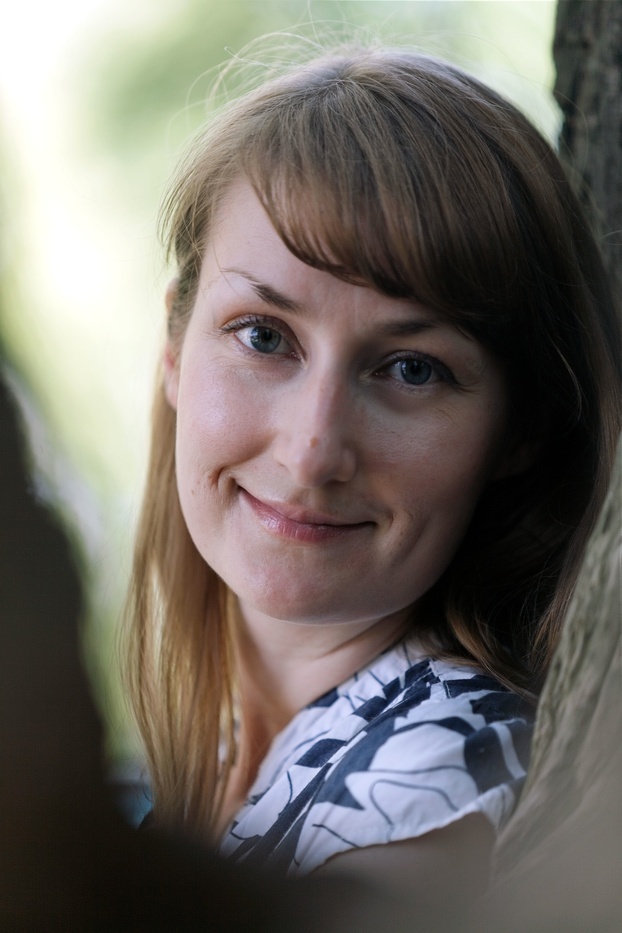
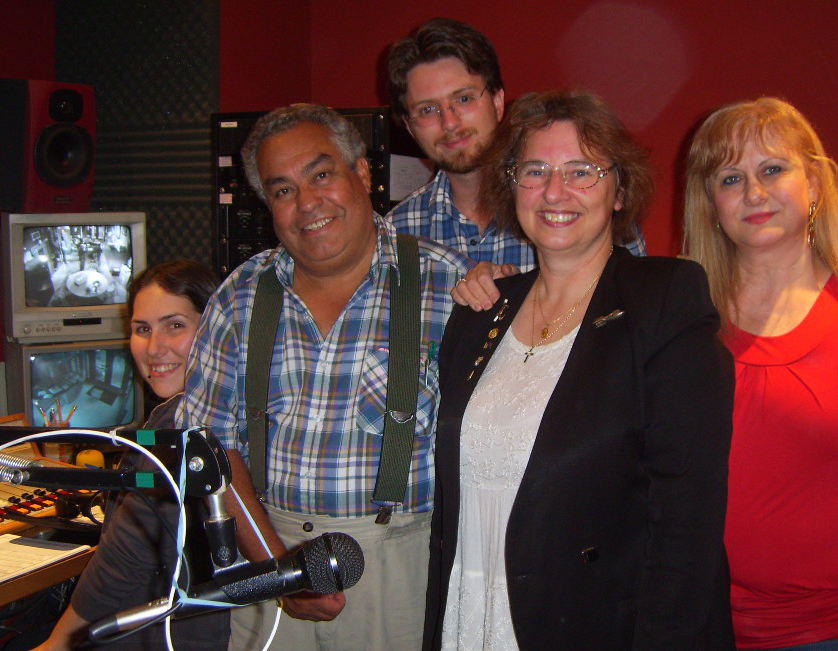
I met my fellow Romanian author friend Lucia Monica Gorea several years ago at a writer’s function in Vancouver and our (Romanian) passion for writing and storytelling made us fast friends. At the time Lucia was teaching writing at UBC and was co-hosting a radio show on Vancouver Coop Radio. She interviewed me several times about my science fiction publications, about water, my limnology and my eco-fiction.
coop-radio-team

Co-host Lucia with Nina and Coop Radio team, Vancouver, BC

Nina-Lucia Editura Gaudeamus

Nina Munteanu and Lucia Monica Gorea at Gaudeamus Book Fair, Bucharest, Romania

We also together attended the launch of our books with Romanian publisher Editura Paralela 45 in Bucharest Romania at the Gaudeamus Book Fair. I was launching my translated book on fiction writing, “Manual de Scriere Creativa” (The Fiction Writer: Get Published, Write Now!) and Lucia was launching her English / Romanian translation of Petre Ispirescu’s fairy tale “The Morning Star and the Evening Star.”

I’ve since moved to Ontario and teach writing at the University of Toronto and Lucia moved to Nanaimo, BC, where she teaches at Vancouver Island University.

I recently interviewed Lucia, who just reissued her most recent children’s book “Yukon,” a wonderfully illustrated story about a young polar bear who loses his mother and goes on a perilous adventure:

  1. You recently republished your children’s climate fiction book “Yukon” through Bestsellers Publishing Academy. Tell us about the book.

Yukon, the Polar Bear is a story that brings awareness about global warming and climate change and teaches children how important our planet is. The reader is not only drawn into the story, but he or she learns how climate change affects polar bear habitat, and how polar bears will eventually become extinct if we don’t take action now.

Yukon 8.5x8.5_Working.indd

Yukon and his mom 

Since younger children can’t easily grasp concepts such as, glaciers and sea ice melting, or ocean acidification, they can better understand the issues our planet faces at the moment, through stories that are age appropriate.


  1. What inspired you to write “Yukon”?

I have always been fascinated by polar bears. I believe that they are so cool.

Seeing that their habitat is in huge danger, I wanted to bring my small apport to educate children, by letting them know how important our planet is through this children’s book.
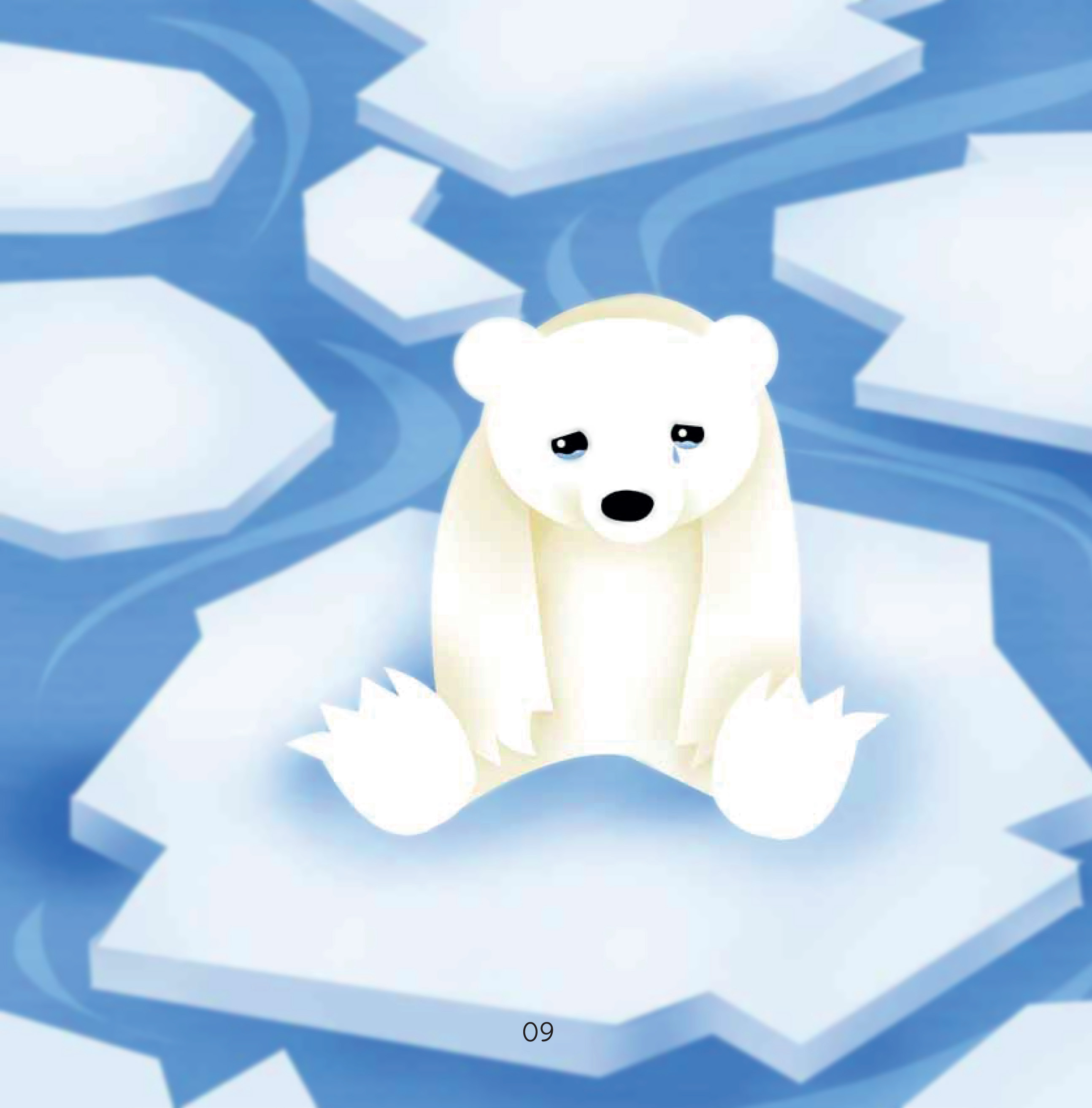
Yukon 8.5x8.5_Working.indd

Yukon alone on a melting ice float after losing his mother 

  1. Who do you hope will read “Yukon”?

“Yukon” is intended for grade school children, ages 7+, for parents, and teachers alike. The topic of climate change can initiate interesting discussions and debates at school or home, during circle time, book clubs, or science classes. Teachers can assign research topics and invite children to further explore polar bear habitat, and learn how the Arctic animals are being affected by global warming.


  1. What does the polar bear represent in our awareness and fight against climate change?

Polar bears represent a “healthy planet.” As climate change forces polar bears to spend longer time offshore, they come in contact with Arctic coastal communities. Unfortunately, these interactions sometimes end badly for both humans and bears.  At the same time, the melting of the ice is resulting in more polar bears spending longer periods on land.

The expansion of offshore petroleum installations and operations in the Arctic are expected to increase in number. This expansion would affect polar bears and their habitat in many negative ways. As oil tankers and cargo ships in Arctic waters increase, so do the risks of polar bear disturbance. It is our responsibility to protect these iconic creatures.  It is no wonder that the polar bear is of great cultural significance to the Canadian people. For the Inuit and many northern communities, polar bears are especially significant culturally, spiritually, and economically.
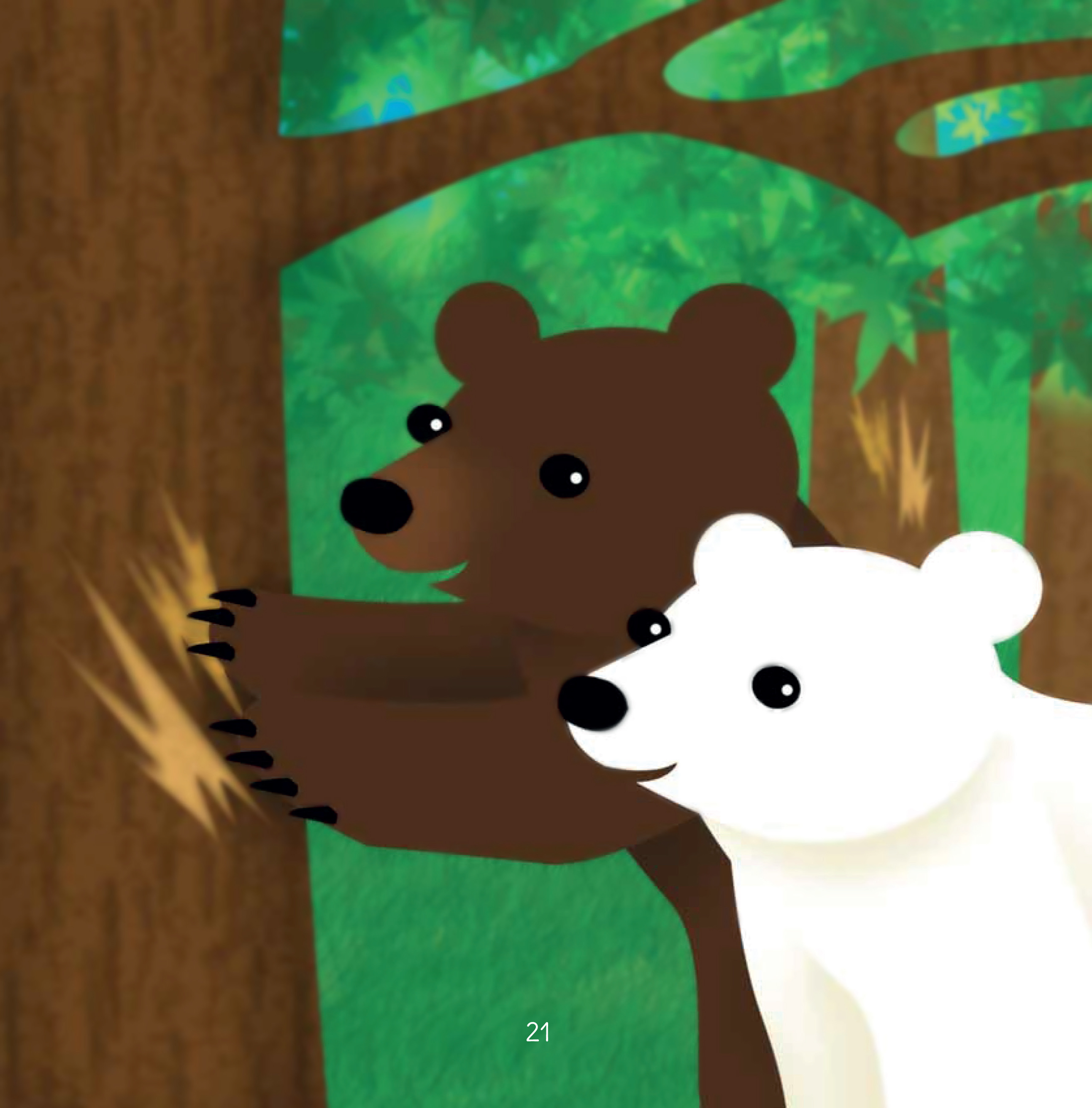
Yukon 8.5x8.5_Working.indd

Jasper teaches Yukon how to survive on terra firma 

  1. In your book, Yukon meets a brown bear named Jasper and Jasper’s family teaches Yukon how to feed and take care of himself in his new environment. How close do you think this matches what is already happening in our northern regions as melting sea ice is forcing polar bears onto dry land into northern communities and the Inuvialuit Game Council reports that more and more grizzly bears are moving into Canada’s High ArcticIs this heralding a future written by climate change?

Experts say that interbreeding is happening more frequently now due to climate change.

With climate change, grizzly bears are moving further north, so there is more overlap between grizzly bears and polar bears in terms of their range. A hybrid bear is unofficially called a grolar bear if the sire is a grizzly bear, and a pizzly bear if the sire is a polar bear. A third potential name is nanurlak — a word combining the Inuit-language words for polar bear and grizzly, nanuk and aklak.

grizzly-polar-pizzly

Grizzly bear + Polar bear = Pizzly or Grolar (depending on who the mother bear is)

Grizzly bears in Alaska and Canada are moving north as their environment warms, bringing them into contact with polar bears located on the coastline

“…predicting that far into the future is a challenge and it really depends on what we do about global warming as a whole,” says Andrew Derocher, bear biologist.


  1. Will you do an educational tour with the book?

Yukon_eBook-CoverAbsolutely! As soon as COVID- 19 will not pose a threat to BC schools, and to schools around the country, and when the students are safe to return to class, I plan a reading and educational tour on Vancouver Island, then I will visit various schools within the province.


  1. Where can individuals and schools purchase “Yukon”?

“Yukon” can be purchased in both paperback and electronic format on Amazon, Draft to Digital, Smashwords, Ingram, and Barnes and Noble.


  1. What projects are you working on next?

I have already started working on two projects. One is a How-to book titled, “Write! Publish! Sell!” – and the second book is a collection of supernatural short stories that take place in my native Transylvania, “The Hills of Magherani.”

On the podcast “Age of Water”, co-host Claudiu Murgan and I interviewed Lucia about her book, about young readers and climate change, and about writing in general. The podcast episode with Lucia will air in December, 2020.


More about Lucia Monica Gorea 

LuciaMonicaGorea

Lucia Monica Gorea

Lucia Monica Gorea, is a Canadian poet and award-winning author of fifteen books spanning multiple genres including poetry, short stories, a historical novel, ESL texts, children’s books, fairy tales, and translations.

The Transylvanian province of Romania, which filled Lucia with literary passion inspired her to write at a young age. She graduated from the University of Bucharest with degrees in English, French and Linguistics then earned her PhD in English and Education in the USA.

Her interest in history inspired The Impaler, her debut novel, which tells the captivating and intriguing story of Vlad the Impaler. She has also written Journey Through My Soul—a collection of love and mystical poems, Welcome to America! ESL Games and Classroom Activities, and Speak English for Success. Lucia also wrote several children’s stories that were inspired by her son, Alex: How Alex Saved Christmas, The Crow That Swallowed a Pearl, Halloween in Transylvania, and Yukon, the Polar Bear.

lucia-girl-reading-web

Lucia with young girl, reading her translated book at Gaudeamus

Lucia translated several fairy tales and poetry books from Romanian into English: The Enchanted Turtle, Aleodor the Emperor, The Morning Star and the Evening Star, and The Enchanted Pig, fairy tales authored by Petre Ispirescu. 

Lucia was the keynote speaker at the 8th International Symposium on Translation, Interpretation, and Terminology in Havana (2013). Lucia currently teaches English courses at Vancouver Island University in British Columbia, and graduate studies at Atlantic International University in the United States.

Lucia founded BestSellers Publishing Academy – Your Story Must Be Told in 2019. She also founded Poetry Around the World, Monica’s Writers’ Café and Poets and Writers’ Café, online groups. She hosted radio (World Poetry Café Radio Show) and television poetry shows (Poetry Around the World) in Portland, Oregon, Vancouver, and Nanaimo, BC.


More about the Polar Bear

Temperatures in the Arctic are rising at least twice as fast as the global average and sea ice cover is diminishing by nearly four per cent per decade.

The primary habitat of the polar bear is sea ice, which they use to hunt seals. Polar bears live in the Arctic regions of Canada, Greenland/Denmark, Norway, Russia and the United States. The primary habitat of the polar bear is sea ice, which they use to hunt seals. Polar bears feed on ringed seals that live at the ice edge; the bears get two thirds of the energy they need for the entire year in late spring and early summer. Sea ice loss due to climate change poses the single largest threat to polar bear numbers according to a recent comprehensive review. As the ice retreats earlier in spring and forms later in winter, the bears have less time to hunt prey. Consequences mean that the bears average weight declines and fewer cubs survive; the ones that do are smaller. Warming has also caused bear dens to collapse, trapping a female’s young.

Scientists’ best estimate is that there’s a 70% chance the global population of polar bears will fall by more than a third within the next three generations.
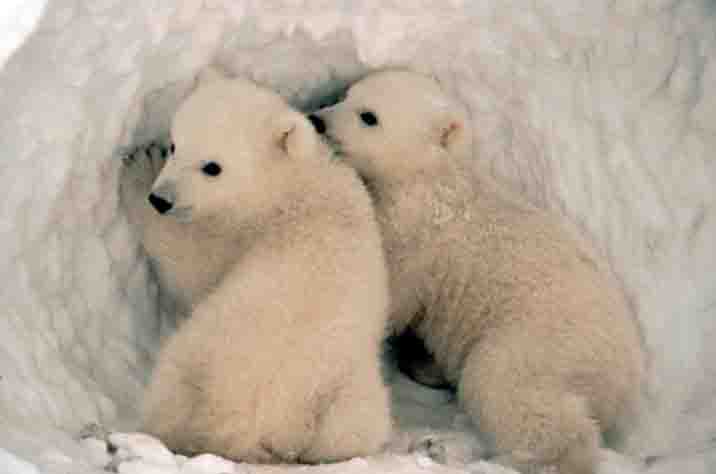
Baby polar bears in den

Polar bear cubs in their den


nina-2014aaa

Nina Munteanu is a Canadian ecologist / limnologist and novelist. She is co-editor of Europa SF and currently teaches writing courses at George Brown College and the University of Toronto. Visit www.ninamunteanu.ca for the latest on her books. Nina’s bilingual “La natura dell’acqua / The Way of Water” was published by Mincione Edizioni in Rome. Her non-fiction book “Water Is…” by Pixl Press (Vancouver) was selected by Margaret Atwood in the New York Times ‘Year in Reading’ and was chosen as the 2017 Summer Read by Water Canada. Her novel “A Diary in the Age of Waterwas released by Inanna Publications (Toronto) in June 2020.


Reconciling Yesterday’s Future with Today’s Past

Metropolis man on clock

A worker tied to “the machine” in Fritz Lang’s Metropolis

Metropolis posterOur predictions and visions of the future are certainly predicated on our perceptions of the present and the past. So, what happens when yesterday’s “future” collides with today’s past? Well, retro-fiction, alternate history and steam-punk, you quip, eyes askance with mischief: edgy sociopathic Sherlock Holmes with bipolar or obsessive /compulsive tendencies; flying aircraft carriers in Sky Captain and the World of Tomorrow, robot-like workers of Metropolis

But what of the vision itself? History provides us with a panoply of realized predictions in speculative fiction:

In 1961, Stanislaw Lem’s novel Return From the Stars predicted the invention of the touch pad, iPhone, iPad and Kindle. The telescreens that monitored the citizens of George Orwell’s Oceania in his dystopian 1949 novel Nineteen Eighty-Four was reflected, twenty years later, in the first closed circuit TV (CCTV) installed in the United Kingdom. Almost a century before the Internet was conceived, Mark Twain alluded to the future of a global, pervasive information network. In his 1968 novel 2001: A Space Odyssey Arthur C. Clarke discussed a future where people scanned headlines online and got their news through RSS feeds. In his 1888 novel Looking Backward, Edward Bellamy describes a “future” society in 2000 where money is eliminated due to the proliferation of plastic credit cards. Philip K. Dick’s Minority Report accurately predicted personalized ads, voice-controled homes, facial and optical recognition, and gesture-based computing. Other advances and usage of technology have been predicted in speculative literature, including body scans, RFIDs, spy-surveillance, and touch screen interfaces.

Minority Report movie

Tom Cruise’s character using gesture-based computing in the film “Minority Report”

FlyingCar 1950s

1950s ad for flying car of future

But there have been many speculations not realized. Where are the flying cars? Where are the moon colonies, rotating space stations and space elevator? What of the envisioned totalitarian states not realized; civilizations not demolished; utopias not developed?

Are those past dystopian or utopian visions failed attempts at predicting a future that eluded their writers? Or is it a question more of defining vision in speculative writing?

Ray Bradbury suggested that “the function of science fiction is not only to predict the future but to prevent it.”

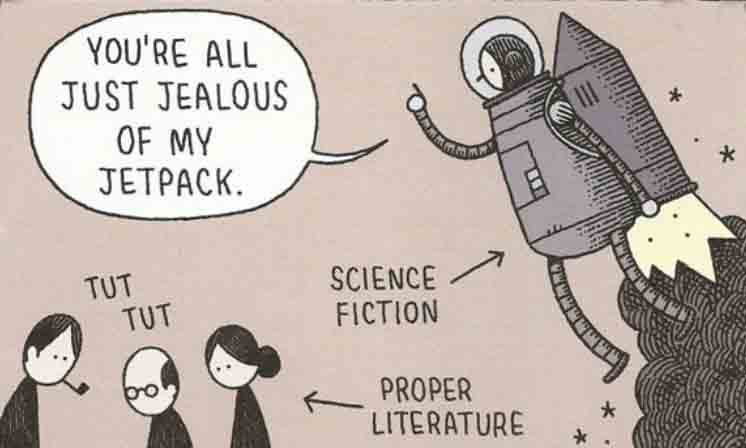
2001 a space odysseyThere are, in most cases, no technological impediments to the flying car, the jetpack, and moon-bases; only cultural ones.  “These SF predictions ought to be viewed as visions of where we could be, as opposed to where we will be, or, keeping Bradbury in mind, visions of where we don’t want to go and, thankfully, have mostly managed to avoid to date,” says Steve Davidson of Grasping for the Wind. “Perhaps it’s all cultural,” he adds.

How and why is it that our contemporary view of dystopian and utopian speculative fiction has shifted from an open-minded imaginative acceptance of “predictions” nested within a cautionary or visionary tale to a knowledge-based demand for largely unattainable predictive accuracy?

GeorgeOrwell 1984 signetGeorge Orwell wrote his dystopian satire in 1949 about a mind-controlled society in response to the Cold War. The book was a metaphor “against totalitarianism and for democratic socialism,” said Orwell in his 1947 essay Why I Write, adding, “Good prose is like a windowpane.” Was Orwell’s Nineteen Eighty-Four a failed novel because the real 1984 didn’t turn out quite like his 1984? Hugo Award-winning novelist Robert J. Sawyer suggests that we consider it a success, “because it helped us avoid that future. So just be happy that the damn dirty apes haven’t taken over yet.”

Dystopian and utopian literature, like all good allegory, provides us with scenarios predicated on a concrete premise. What if we kept doing this?…What if that went on unchecked?… What if we decided to end this?…

LookingBackward EdwardBellamyA hundred years before 1984, Edward Bellamy published Looking Backward, “a romance of an ideal world”. It tells the story of a young man who falls into a hypnotic sleep in 1887, waking up in 2000 when the world has evolved into a great socialist paradise.  It sold over a million copies and ranked only behind Uncle Tom’s Cabin and Ben-Hur: A Tale of the Christ as the top best-seller of the era. Looking Backward laid out a futuristic socialism, or was it a socialistic future?

At any rate, it influenced a large number of intellectuals and generated an unprecedented political mass movement. The book spawned experiments in communal living and fed socialist movements that promoted the nationalization of all industry and the elimination of class distinctions. Bellamy’s book was cited in many Marxist polemic works. Groups all over the world praised and embraced its ideals: Crusading Protestant ministers, American feminists, Australian trade unionists, British town planners, Bolshevik propagandists, French technocrats, German Zionists, and Dutch welfare-state advocates.

Bellamy’s conviction that cooperation among humans is healthier than competition formed the basis of Looking Backward. He predicted a revolution in retail that resembled today’s warehouse clubs and big-box stores. He also predicted a card system much like a modern debit card and people using enhanced telephone lines to listen to shows and music.

SF vs literary jet pack

“Socialism, of course, had different connotations in the 19th century when it rose, principally as a backlash to the brutalities of industrialization and the exploitation of the workers by the ruling class,” says Tony Long of Wired Magazine. Bellamy’s socialism is perhaps best described as a syndicalism than what most of us think of as socialism today. Long somberly adds, “Were he alive today, Bellamy might note, with interest, that while the worst excesses of the industrial age are gone, the exploitation continues. Had Bellamy lived to the ripe old age of 150, he no doubt would have been disappointed to find capitalism running amok, and his fellow man no less greedy and self-serving than in his own time. But he didn’t live to be 150. In fact, Bellamy was still a relatively young man when he died of tuberculosis in 1898.”


So, what happens when history catches up to the vision?

BraveNewWorld-AldousHuxleyIn a foreward to a later printing of Brave New World years after it was first published, Aldous Huxley explained why, when given the chance to revise the later edition, he left it exactly as it was initially written twenty years earlier:

Chronic remorse, as all the moralists are agreed, is almost an undesirable sentiment. If you have behaved badly, repent, make what amends you can and address yourself to the task of behaving better next time. On no account brood over your wrongdoing. Rolling in the muck is not the best way of getting clean.

Art also has its morality, and many of the rules of this morality are the same as, or at least analogous to, the rules of ordinary ethics. Remorse, for example is as undesirable in relation to our bad art as it is in relation to our bad behavior. The badness should be hunted out, acknowledged and, if possible, avoided in the future. To pore over the literary shortcomings of twenty years ago, to attempt to patch a faulty work into the perfection it missed at its first execution, to spend one’s middle age in trying to mend the artistic sins committed and bequeathed by that different person who was oneself in youth–all this is surely vain and futile. And that is why this new Brave New World is the same as the old one. Its defects as a work of art are considerable; but in order to correct them I should have to rewrite the book–and in the process of rewriting, as an older, other person, I should probably get rid not only of some of the faults of the story, but also of such merits as it originally possessed. And so, resisting the temptation to wallow in artistic remorse, I prefer to leave both well and ill alone and to think about something else.

And with that, I leave you with a quote:

“…the past gives you an identity and the future holds the promise of salvation, of fulfillment in whatever form. Both are illusions.”–Eckhart Tolle

DSC03969

Snowing in New York City (photo by Nina Munteanu)


nina-2014aaa

Nina Munteanu is a Canadian ecologist / limnologist and novelist. She is co-editor of Europa SF and currently teaches writing courses at George Brown College and the University of Toronto. Visit www.ninamunteanu.ca for the latest on her books. Nina’s bilingual “La natura dell’acqua / The Way of Water” was published by Mincione Edizioni in Rome. Her non-fiction book “Water Is…” by Pixl Press (Vancouver) was selected by Margaret Atwood in the New York Times ‘Year in Reading’ and was chosen as the 2017 Summer Read by Water Canada. Her novel “A Diary in the Age of Waterwas released by Inanna Publications (Toronto) in June 2020.


Age of Water Podcast: Nina Reads from “Barkskins”

AoW Logo-smallWe are now living in the Age of Water. Water is the new “gold”, with individuals, corporations and countries positioning themselves around this precious resource. Water is changing everything. The Age of Water Podcast covers anything of interest from breaking environmental news to evergreen material. This also includes human interest stories, readings of eco-literature, discussion of film and other media productions of interest.

In this episode of Age of Water, Nina reads from the novel “Barkskins” by Annie Proulx a poignant exploration of the forest industry in Canada and North America.


Annie Proulx’s Barkskins chronicles two immigrants who arrive in Canada in 1693 (Rene Sel and Charles Duquet) and their descendants over 300 years of deforestation of North America starting with the arrival of the Europeans to contemporary global warming. “Barkskins” (woodcutters) are, in fact indentured servants who were brought from the Paris slums to the wilds of New France “to clear the land, to subdue this evil wilderness,” says their seigneur. Sel is forced to marry a native woman and their descendants live trapped between two cultures; Duquet runs away to become a fur trader and build a timber empire.

Barkskins AnnieProulxProulx immerses the reader in rich sensory detail of a place and time, equally comfortable describing a white pine stand in Michigan and logging camp in Upper Gatineau to a Mi’kmaq village on the Nova Scotia coast or the stately Boston home of Charles Duquet. The foreshadowing of doom for the magnificent forests is cast by the shadow of how settlers treat the Mi’kmaq people. The fate of the forests and the Mi’kmaq are inextricably linked through settler disrespect and a fierce hunger for “more.”

The novel rolls out events in a relentless stream of life and death; no character is safe from the ravages of nature or the notions of that time period. While most of the book flows like a great amoral river—filled with feckless, unheroic and at times miserable characters—there are moments of emotional shoring. They act like exclamation marks for their rarity.

EcologyOfStory“The reader comes to realize that the novel isn’t really about the human characters so much as it is about the forests,” Gus Powell of The National Post concludes of Barkskins. “As [the forests] disappear, the narrative seems to recede in importance, revealing a crucial interdependence between the human and the natural world previously handled almost entirely as subtext. This is especially true in the novel’s closing, where the anger and despair that have characterized the novel shift into an outspoken environmental advocacy.”

I further explore the use of metaphor and other storytelling devices used by Annie Proulx in this strongly symbolic novel in my writing guidebook “Ecology of Story: World as Character.”


nina-2014aaa

Nina Munteanu is a Canadian ecologist / limnologist and novelist. She is co-editor of Europa SF and currently teaches writing courses at George Brown College and the University of Toronto. Visit www.ninamunteanu.ca for the latest on her books. Nina’s bilingual “La natura dell’acqua / The Way of Water” was published by Mincione Edizioni in Rome. Her non-fiction book “Water Is…” by Pixl Press(Vancouver) was selected by Margaret Atwood in the New York Times‘Year in Reading’ and was chosen as the 2017 Summer Read by Water Canada. Her novel “A Diary in the Age of Waterwas released by Inanna Publications (Toronto) in June 2020.

Launch of “A Diary in the Age of Water” by Nina Munteanu

june 18 launch evite1

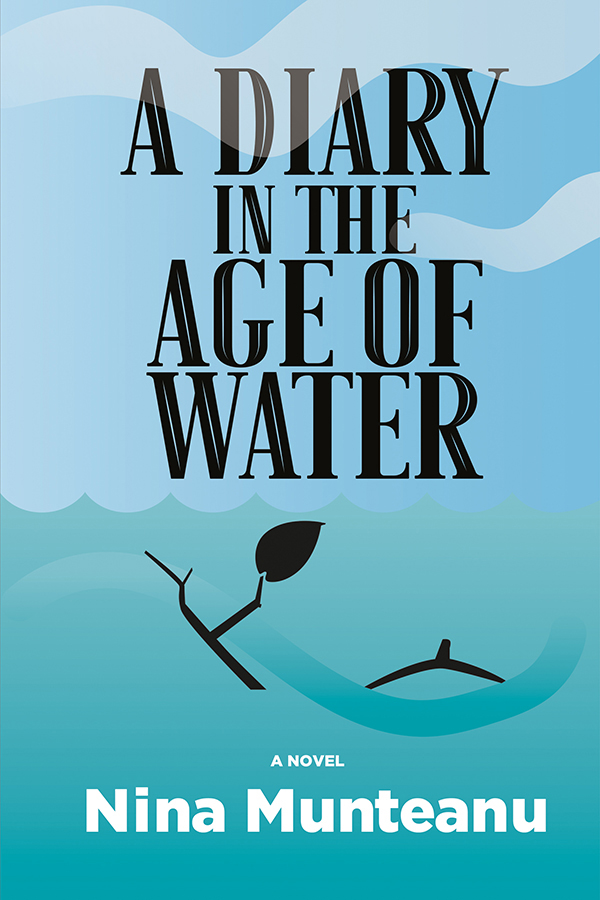
Diary Water cover finalOn June 18th, Toronto book publishing house Inanna Publications launched its second spring series and A Diary in the Age of Water, my near-future/far-future speculative fiction book was among them.

A Diary in the Age of Water follows the climate-induced journey of Earth and humanity through four generations of women, each with a unique relationship to water.

Evoking Ursula LeGuin’s unflinching humane and moral authority, Nina Munteanu takes us into the lives of four generations of women and their battles against a global giant that controls and manipulates Earth’s water. In a diary that entwines acute scientific observation with poignant personal reflection, Lynna’s story unfolds incrementally, like climate change itself. Particularly harrowing are the neighbourhood water betrayals, along with Lynna’s deliberately dehydrated appearance meant to deflect attention from her own clandestine water collection. Her estrangement from her beloved daughter, her “dark cascade” who embarks upon a deadly path of her own, is heartwrenching. Munteanu elegantly transports us between Lynna’s exuberant youth and her tormented present, between microcosm and macrocosm, linking her story and struggles – and those of her mother, daughter and granddaughter – to the life force manifest in water itself. In language both gritty and hauntingly poetic, Munteanu delivers an uncompromising warning of our future.

—Lynn Hutchinson Lee


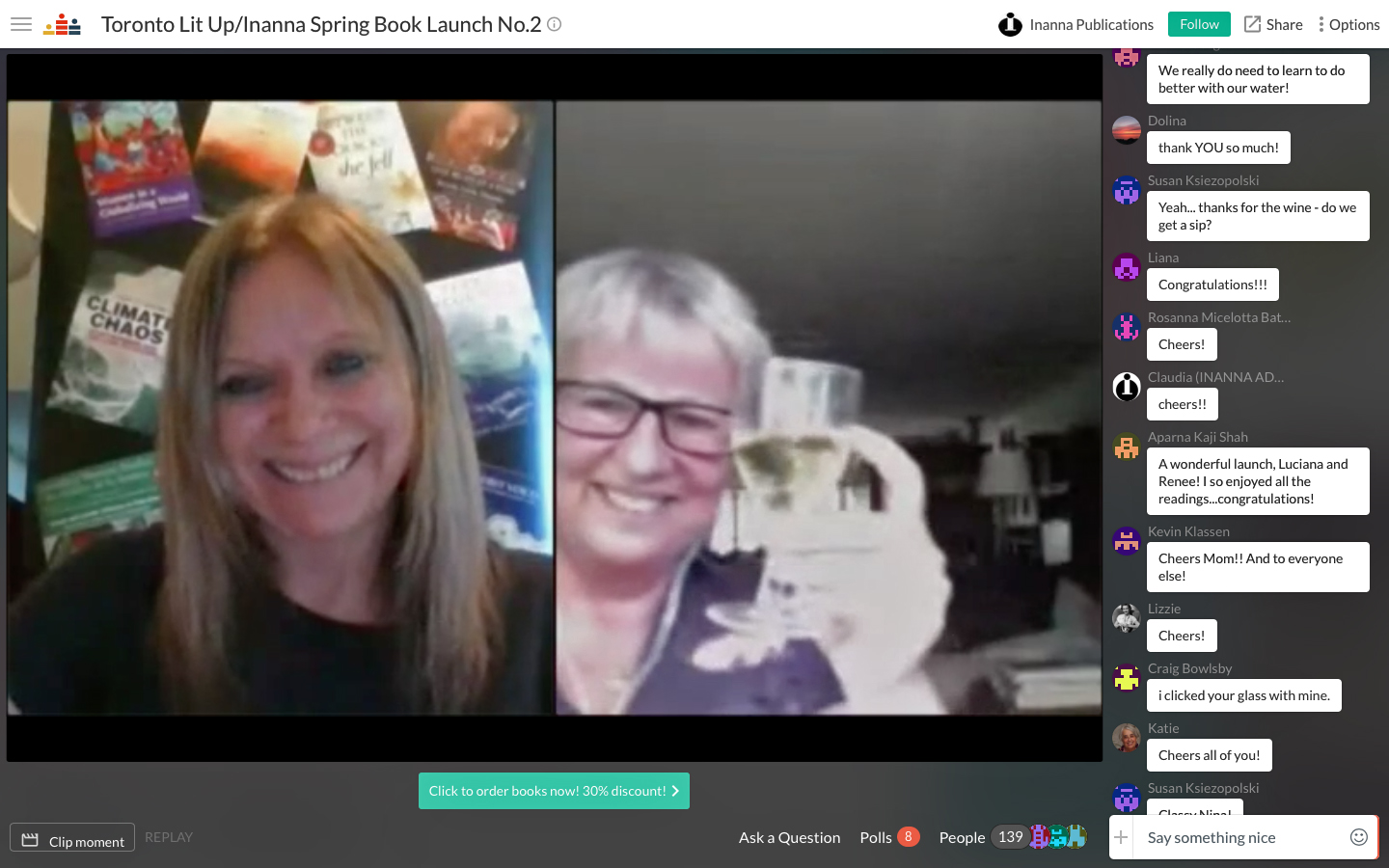
NINA-RENEE-TOAST2a

Renee Knapp and Nina Munteanu toast Inanna and all participants at the launch

A Diary in the Age of Water starts with young Kyo in the dying boreal forest of what used to be northern Canada. Kyo yearns inordinately for the Age of Water, a turbulent time of great change, before the “Water Twins” destroyed humanity. Looking for answers and plagued by vivid dreams of this holocaust, Kyo discovers the diary of Lynna, a limnologist from a time just prior to the destruction.

At the book launch, I read from Lynna’s first diary entry—in 2045. I then answered questions from audience members who came from Canada’s coast to coast:


What inspired you to write this book?

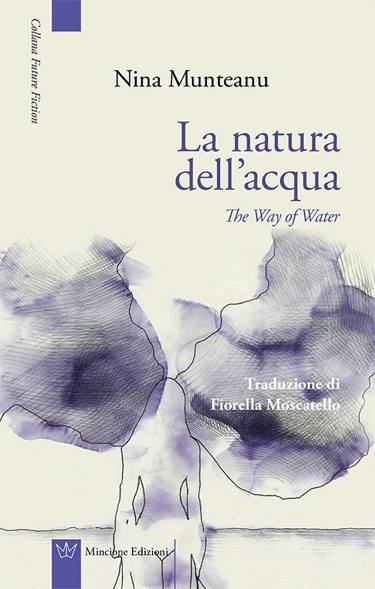
The Way of Water-COVERWho really… My publisher in Rome (Mincione Edizioni) had asked me for a short story on water and politics. I wanted to write about Canada and I wanted something ironic… so I chose water scarcity in Canada, a nation rich in water. “The Way of Water” (“La natura dell’acqua”) resulted, which has been reprinted in several magazines and anthologies, including Cli-Fi: Canadian Tales of Climate Change (Exile Editions), Future Fiction: New Dimensions in International Science Fiction (Future Fiction/Rosarium Publishing), Little Blue Marble Magazine, and Climate Crisis Anthology (Little Blue Marble). The story was about young Hilde—the daughter of the diarist—dying of thirst in Toronto… It begged for more … so the novel came from it…


Why did you choose to write your novel as a diary?

I was writing about both the far and the near future and much of it was based—like Margaret Atwood and her books—on real events and even real people. I wanted personal relevance to what’s going on, particularly with climate change.  I also wanted to achieve a gritty realism of the mundane and a diary felt right. The diarist—Lynna—is also a reclusive inexpressive character, so I thought a personal diary would help bring out her thoughts and feelings. There’s nothing like eves-dropping to make the mundane exciting.


If the oceans are rising because the ice caps are melting, is the ocean actually getting less salty?

The short answer is “yes.” As glaciers melt and introduce fresh water to the ocean—contributing to the rise in sea level—salinity is reduced in the surrounding sea. This has far-reaching consequences that lie beyond just rising sea levels and promise to affect all ocean life. Because freshwater is less dense than seawater—hence the saltwater wedge we experience on the lower Fraser River in Vancouver—freshwater increase in seawater will interfere with the pattern, mixing, and movement of ocean currents; this could be devastating to ocean life. The overall movement of ocean currents throughout the planet is called the Great Ocean Conveyor—or Atlantic Meridional Overturning Circulation (AMOC)—which circulates ocean water very much like in a lake, with dense water sinking beneath warmer, less salty water. As my diarist in the book writes, dumping in more and more freshwater into the ocean has slowed the sinking (and mixing) and the whole machine is slowing down. Freshwater is jamming the conveyor. If it stalls, this would unbalance the heat flux of the planet with more climate devastation.

Illustration 17 AMOC

Sketch of Atlantic Meridional Overturning Circulation (AMOC) from “A Diary in the Age of Water” Inanna Publications (sketch by Nina Munteanu)

The main protagonist is a limnologist; so are you; is there any resemblance?

Oh yes! Well, apart from the obvious—we both chose the same scientific discipline, we have similar views on the environment and humanity’s place in it. I might even have some of her foibles…hopefully not ALL of them… But, I’d say that all good characters have a piece of ourselves in them. Some dark and some light. The resemblance is heightened because she is depicted through her diary, which adds a gritty realism and a highly personal aspect to the fiction. In truth there’s a piece of me in each of the four women depicted in the story.


What is happening to the water in Ontario?

Water quality in Ontario waterways has not improved in the last decade and this can be placed squarely on the shoulders of local, regional and provincial governments and their failure to legislate and act. Inaction varies from lack of regulations and policing of industry to lack of city infrastructure and lack of ecological foresight.

SONY DSC

Cladophora alga in Lake Ontario

Lake Ontario itself receives pollution from Chicago, Sarnia, Detroit, Cleveland, Buffalo, Hamilton and Toronto. Pollution includes agricultural runoff (such as excess nutrients and cancer-causing pesticides and herbicides), disease-carrying sewage, and hormone-disrupting storm water runoff. Nine million people rely on the lake for drinking water. Greatest threats to the lake’s health come from urban development, electricity generation, sewage, and storm water contamination. In cities with large amounts of impervious surfaces, storm water runs over pavement and parking lots, picking up oil and other pollutants before flowing into a nearby river or stream. Flash floods are often accompanied by sewage overflow, which carries numerous pathogens. In addition, storm water picks up toxic heavy metals, endocrine disrupting chemicals and pharmaceuticals. All with devastating consequences to humans, never mind aquatic life and other wildlife.

Every five years the Conservation Authority Watershed Report Cards provide an assessment of ground and surface water quality in various watersheds of Ontario. The latest one by the TRCA (Toronto and Region Conservation Authority) in 2018 gave an overall grade of “D” (unchanged from 2013). They cited storm water runoff and lack of its management improvement as the chief reason for the poor grade. Increasing chloride concentrations in the Toronto region (mostly from liberal use of road salt) poses a real problem to aquatic life.


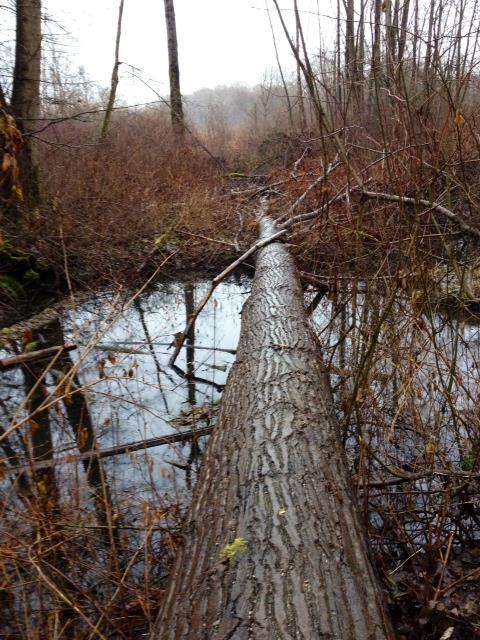
Log over water forest-DeasPark copy

Forest swamp in Deas Park, BC (photo by Nina Munteanu)

You mentioned that each of the four generations of women have a singular relationship with water. What role does water play in the book?

Well, in some important way, water is the fifth character. You could say even the main character. Water is the theme that carries each woman on her personal journey with climate change and the devastation that occurs—through water, I might add. Climate change is a water phenomenon, after all… So, water—like place and setting—plays a subtle yet powerful role in the story, influencing each character in her own way and bringing them together in the overall journey of humanity during a time of great and catastrophic change.


Are there other ages/epochs?

Yes. The story begins in the far future with young Kyo during the Age of Trees, after the end of the Age of Water. It is, in fact, the end of that age as well and that is why she prepares for the Exodus to “humanity’s” new home.

All Inanna titles are 30% off with coupon code: summer20. Please also consider purchasing “A Diary in the Age of Water” from an independent bookstore this summer. Find your local bookstore: http://open-book.ca/News/Your-Community-Your-Bookstore. And here is the current map of independent bookstores that are doing curbside pick up and delivery across Canada.


Beach stones foam HB-NS drybrush

Surf on Hirtle Beach, NS (photo and illustration by Nina Munteanu)

nina-2014aaa

Nina Munteanu is a Canadian ecologist / limnologist and novelist. She is co-editor of Europa SF and currently teaches writing courses at George Brown College and the University of Toronto. Visit www.ninamunteanu.ca for the latest on her books. Nina’s bilingual “La natura dell’acqua / The Way of Water” was published by Mincione Edizioni in Rome. Her non-fiction book “Water Is…” by Pixl Press(Vancouver) was selected by Margaret Atwood in the New York Times‘Year in Reading’ and was chosen as the 2017 Summer Read by Water Canada. Her novel “A Diary in the Age of Waterwas released by Inanna Publications (Toronto) in June 2020.


What If the Birds All Die?


Over increasingly large areas of the United States, spring now comes unheralded by the return of the birds. The early mornings are strangely silent where once they were filled with the beauty of bird song.”—Rachel Carson, Silent Spring

Sunset 2

Sunset in Niagara on the Lake, Ontario (photo by Nina Munteanu)

I’m a science fiction writer. I’m thinking “what if” premises all the time. One that nags me is: What if the birds all die?

We might be closer to it than you think…

SONY DSC

Chickadee in Ontario (photo by Merridy Cox)

The October 2019 issue of Science magazine reported a staggering decline in North American birds. Kenneth V. Rosenberg and his team of researchers estimated that three billion birds of various species have disappeared in Canada and the US since 1970.

That’s a third of the entire bird population lost in five decades.

The focus of the study wasn’t on extinction; these are still common species—just greatly diminished in numbers. This makes sense to me. My naturalist friend and I have both noticed how even the common house sparrow have declined in our neighbourhoods. My friend noticed fewer dashes of colour in the trees provided by yellow warblers in the past few years.

SONY DSC

Northern Cardinal (photo by Merridy Cox)


The Guardian reported that two thirds of the house sparrow population have disappeared in Europe. That’s close to 150 million birds. The article blamed changes in land use (destruction of habitat), coastal management (destruction of wetlands) and weather (including climate change). In another study, car exhaust was implicated in a 60% loss of common sparrow numbers from the mid 1990s.

In North America, warbler populations dropped by 600 million. Blackbirds by 400 million. The common robins, cardinals, and blue jays had noticeably declined. Even starlings—once considered a kind of fast-breeding pest—have dwindled by 50%. The Intergovernmental Science-Policy Platform on Biodiversity and Ecosystem Services have determined that three-quarters of Earth’s terrestrial and two-thirds of the its marine environments have been severely altered by human actions.

Unchecked deforestation. Unchecked use of toxic pesticides. Turning wetlands into parking lots. Climate change. We are destroying the integrity of ecosystems throughout this planet on a massive scale. And the birds are telling us…

SONY DSC

Baby Robin rests on a porch chair in Mississauga, ON (photo by Merridy Cox)

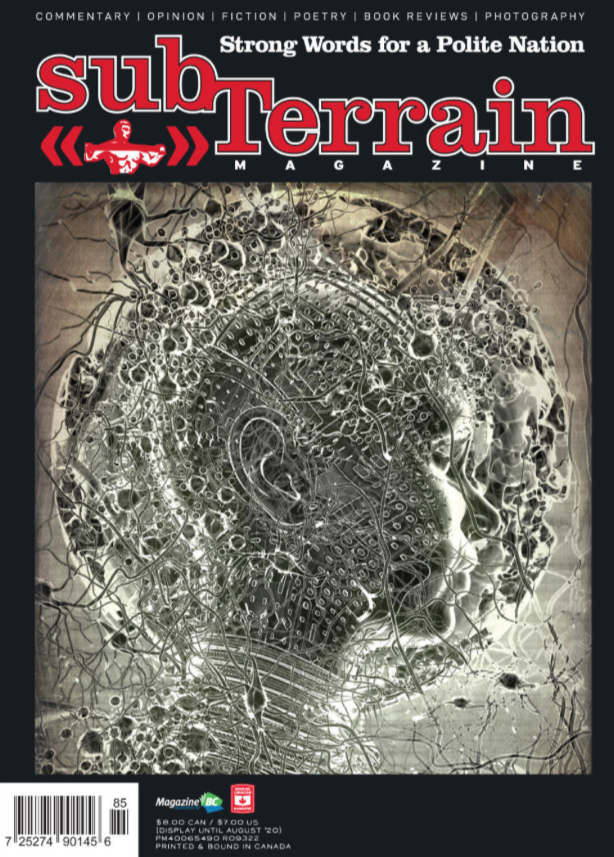
subTerrain 85 coverMy short story “Out of the Silence,” which appeared in the Spring 2020 issue of subTerrain Literary Magazine (Issue 85), tells the story of Katherine, a blind elder whose digital app failed to warn the world of the sudden global loss of birds with disastrous ecological consequences. After years of living in self-exile and getting around poorly on sight-enhancing technology, a discovery gives her new hope in rekindling her talents in the field of soundscape ecology.

I rock on the cedar swing on my veranda and hear the wind rustling through the gaunt forest. An abandoned nest, the forest sighs in low ponderous notes. It sighs of a gentler time. A time when birds filled it with song. A time when large and small creatures—unconcerned with the distant thrum and roar of diggers and logging trucks—roamed the thick second-growth forest. The discord was still too far away to bother the wildlife. But their killer lurked far closer in deadly silence. And it caught the birds in the bliss of ignorance…

RachelCarson-SilentSpring

Rachel Carson was nothing short of prophetic when she published Silent Spring in 1962 (in reference to the dawn chorus most noticeable in spring during breeding). Silent Spring cautioned burgeoning ag-biotech companies (like Monsanto—now Bayer—Sygenta, Dow, and DuPont) who were carelessly and flagrantly spraying fields with pesticides and herbicides—at the time DDT was the main culprit. This would soon become a GMO world where gene-hacked plants of monocultures can withstand the onslaught of killer pesticides like neonicotinoids (currently killing bees everywhere) and Roundup.  Roundup is a carcinogenic glyphosate-based weed killer that has recently been shown to kill beneficial insects like bees) and has been linked to Alzheimer’s disease, ADHD, birth defects, autism, and several kinds of cancer in humans.

RachelCarson-LindaLearIn her 1997 biography Rachel Carson: Witness for Nature, historian and science biographer Linda Lear wrote:

Silent Spring, the product of [Carson’s] unrest, deliberately challenged the wisdom of a government that allowed toxic chemicals to be put into the environment before knowing the long-term consequences of their use. Writing in language that everyone could understand and cleverly using the public’s knowledge of atomic fallout as a reference point, Carson described how chlorinated hydrocarbons and organic phosphorus insecticides altered the cellular processes of plants, animals, and, by implication, humans. Science and technology, she charged, had become the handmaidens of the chemical industry’s rush for profits and control of markets. Rather than protecting the public from potential harm, the government not only gave its approval to these new products but did so without establishing any mechanism of accountability. Carson questioned the moral right of government to leave its citizens unprotected from substances they could neither physically avoid nor publicly question. Such callous arrogance could end only in the destruction of the living world.

Despite Carson’s warnings in 1962 and despite some action eventually taken (e.g. the ban on use of DDT in 1972—the precursor to Roundup and other neonicotinoids currently in use), the use of chemicals in big ag-industry has increased over five-fold since the 1960s. And this is destroying our bee populations, other beneficial insects, beneficial weeds, small animal populations and—of course—our bird life. And it’s making us sick too.

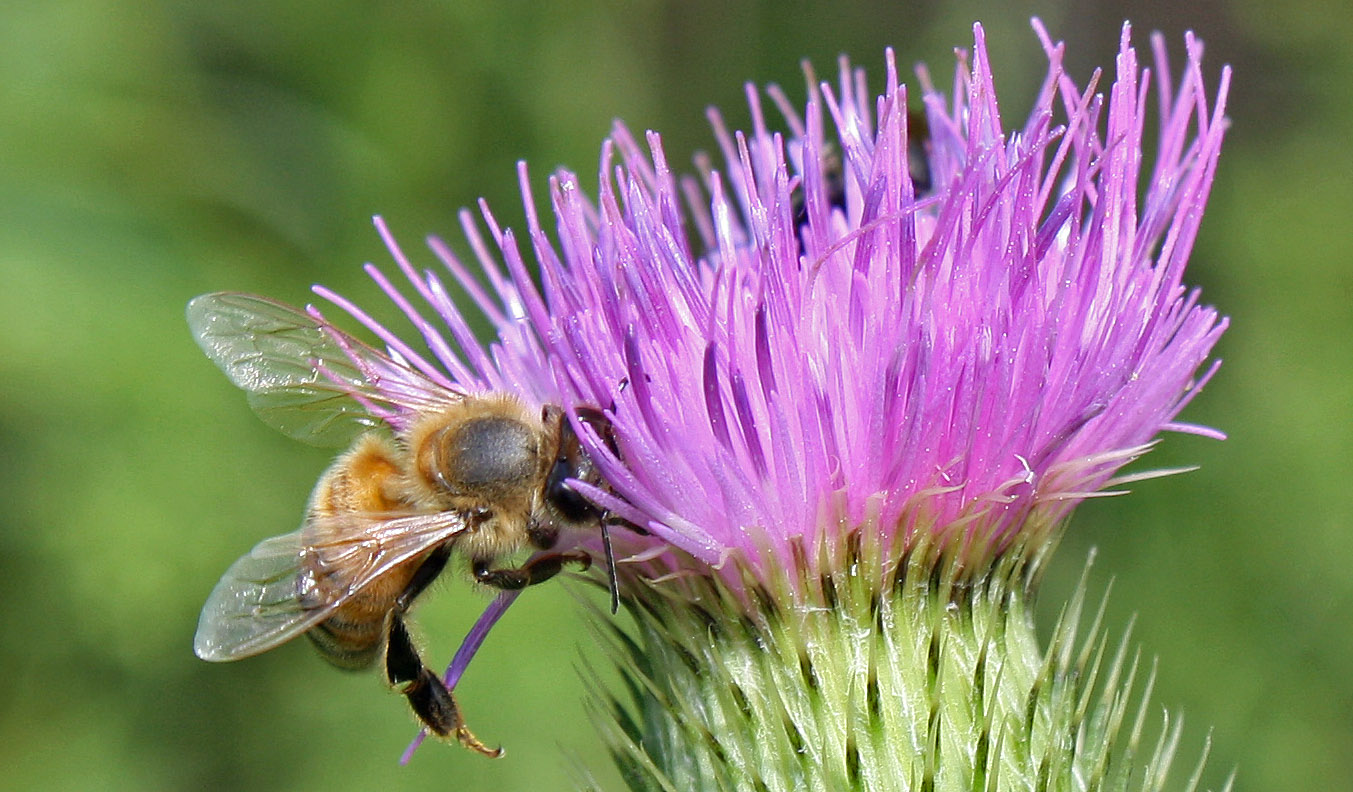
Thistle Bull and Honey bee close

In a 2012 article in the New York Times—exactly fifty years after Silent Spring was published on September 27, 1962—Nancy F. Koehn tells us that, “[Rachel Carson] was a slight, soft-spoken woman who preferred walking the Maine shoreline to stalking the corridors of power. And yet Rachel Carson, the author of Silent Spring, played a central role in starting the environmental movement, by forcing government and business to confront the dangers of pesticides.” Carson, writes Koehn, was an introverted scientist with a lyrical bent, who saw it as her mission to share her observations with a wider audience. Carson wrote Silent Spring while battling illness (including breast cancer) and caring for her young son. When the book was published, she faced an outburst of public reaction and strong backlash, primarily from chemical companies. Not unlike another female eco-hero (Greta Thunberg), Carson endured with dignity and deliberation the vulgar censure by opponents (virtually all men tied to corporate giants) who attacked her personally with vilifying stereotype. Men accused her of being disloyal and unscientific, and being a hysterical woman. One letter to the editor that the New Yorker saw fit to print read:

silent-spring-rachel carson“Miss Rachel Carson’s reference to the selfishness of insecticide manufacturers probably reflects her Communist sympathies, like a lot of our writers these days. We can live without birds and animals, but, as the current market slump shows, we cannot live without business. As for insects, isn’t it just like a woman to be scared to death of a few little bugs! As long as we have the H-bomb everything will be O.K.”

Former Secretary of Agriculture Ezra Taft Benson wrote privately to former President Dwight Eisenhower that Carson was “probably a communist.”

Environment & Society Portal provides a revealing synopsis of the response by established patriarchy at the time:

Allegations that Carson was just a hysterical woman appeared both in the pages of chemical and agricultural trade journals as well as in the popular press. Women were imagined to be less rational, more emotional, and more sentimental than men, who could be relied upon to study the issues dispassionately and propose rational solutions. An agricultural expert told a reporter at the Ribicoff hearings, “You’re never going to satisfy organic farmers or emotional women in garden clubs” (Graham 1970, 88). In his letter to Eisenhower, Benson wondered why a “spinster was so worried about genetics” (Lear 1997, 429).

As Carson had no institutional affiliation, she was dismissed as an amateur who did not understand the subject like a professional scientist would, or who distorted or misread the science. To her critics, Carson’s frequent use of terms like “nature,” “natural,” and “balance of nature” identified her as a mere sentimental nature lover or a pantheist like Ralph Waldo Emerson or Henry David Thoreau. Reviews in TimeU.S. News and World Report, and even Sports Illustrated took her to task. The reviewer in Time, for example, criticized her “emotion-fanning words” and characterized her argument as “unfair, one-sided, and hysterically overemphatic.” He traced her “emotional and inaccurate outburst” to her “mystical attachment to the balance of nature” (Brooks 1989, 297).

SONY DSC

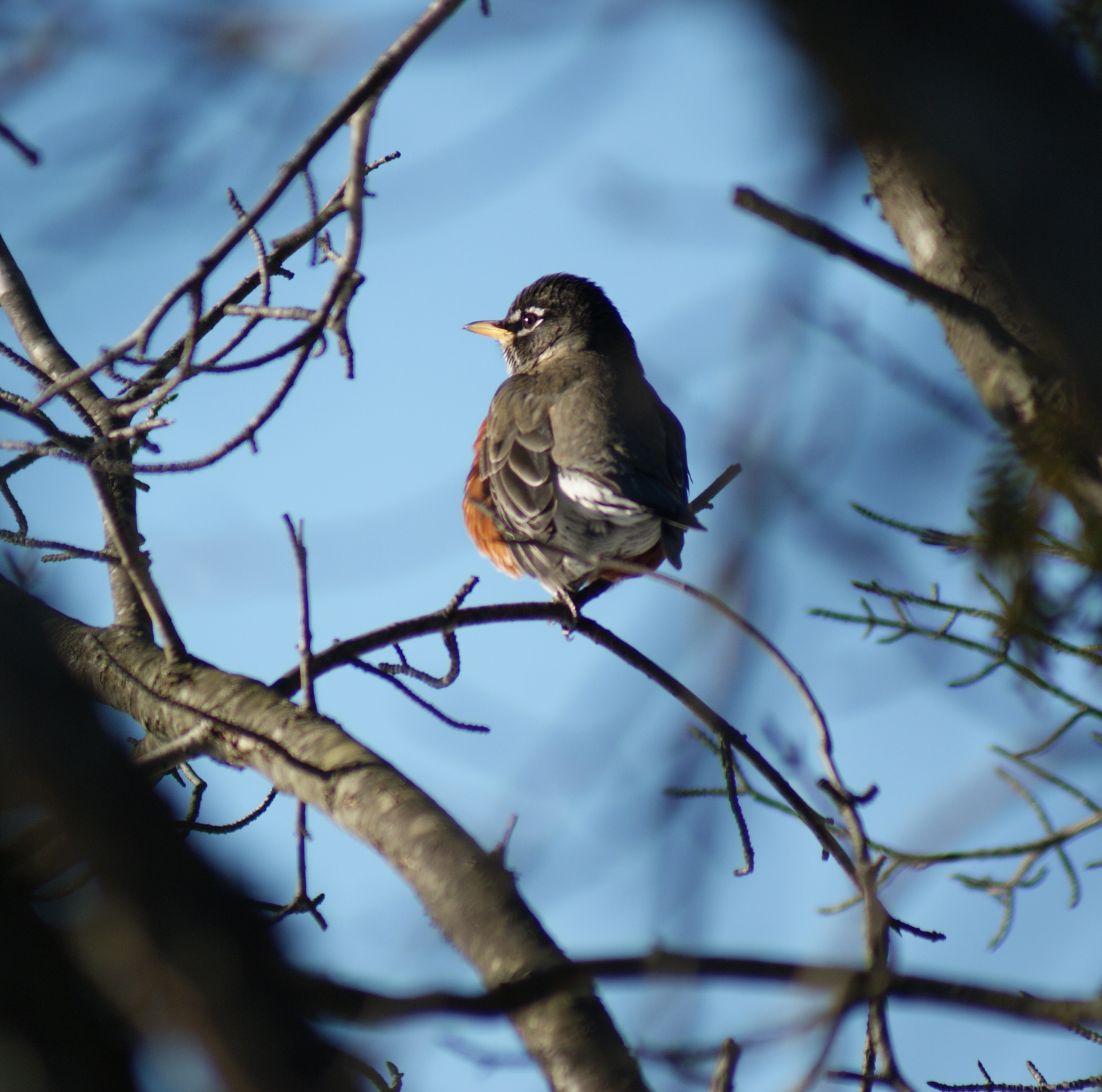
American Robin (photo by Merridy Cox)

Even inoffensive public portraits of Carson showed her in more domestic rather than scientific settings. Life magazine published a story about her accompanied by photos of her talking with children while on a nature walk or watching birds with a group of Audubon Society members. Dressed like a housewife and surrounded by children and “bird people,” Carson projected an image of a teacher or stay-at-home mother, although the picture on the first page of the article showed her at a microscope. Carson, said the story, “is unmarried but not a feminist (‘I’m not interested in things done by women or by men but in things done by people’)”

According to historian and biographer Linda Lear, “the industry spent a quarter of a million dollars to discredit her research and malign her character. In the end, the worst they could say was that she had told only one side of the story and had based her argument on unverifiable case studies.” According to Lear, “Carson was an outsider who had never been part of the scientific establishment, first because she was a woman but also because her chosen field, biology, was held in low esteem in the nuclear age. Her career path was nontraditional; she had no academic affiliation, no institutional voice. She deliberately wrote for the public rather than for a narrow scientific audience. For anyone else, such independence would have been an enormous detriment. But by the time Silent Spring was published, Carson’s outsider status had become a distinct advantage. As the science establishment would discover, it was impossible to dismiss her.”

SONY DSC

House Sparrow (photo by Merridy Cox)

Not unlike Greta, Rachel and the message in her book exerted a great impact on the environmental movement. Silent Spring became a rallying focus for a new social movement in the 1960s, which endures to the present day.

According to Lear:

“Carson’s concept of the ecology of the human body was a major departure in our thinking about the relationship between humans and the natural environment. It had enormous consequences for our understanding of human health as well as our attitudes toward environmental risk. Silent Spring proved that our bodies are not boundaries. Chemical corruption of the globe affects us from conception to death. Like the rest of nature, we are vulnerable to pesticides; we too are permeable. All forms of life are more alike than different.

“Carson believed that human health would ultimately reflect the environment’s ills. Inevitably this idea has changed our response to nature, to science, and to the technologies that devise and deliver contamination. Although the scientific community has been slow to acknowledge this aspect of Carson’s work, her concept of the ecology of the human body may well prove to be one of her most lasting contributions.”

Bernie Krause Florida

Bernie Krause

In the meantime, alarming signals suggest that Rachel Carson’s 1962 warning is currently underway. The new science of soundscape ecology can analyze the health of an ecosystem. Bernie Krause, a soundscape ecologist who has been conducting long-term recordings recently noted that in Sugarloaf Ridge State Park, not far from his home in Northern California, “the effect of global warming and resulting drought has created the first completely silent spring I’ve ever experienced.” Stuart Winter at Express reports that “many of the iconic birds whose mating calls ring out across woodlands and open fields during early May are vanishing at an alarming rate.”

“Man’s war against nature is inevitably a war against himself.”—Rachel Carson


nina-2014aaa

Nina Munteanu is a Canadian ecologist / limnologist and novelist. She is co-editor of Europa SF and currently teaches writing courses at George Brown College and the University of Toronto. Visit www.ninamunteanu.ca for the latest on her books. Nina’s bilingual “La natura dell’acqua / The Way of Water” was published by Mincione Edizioni in Rome. Her non-fiction book “Water Is…” by Pixl Press (Vancouver) was selected by Margaret Atwood in the New York Times ‘Year in Reading’ and was chosen as the 2017 Summer Read by Water Canada. Her novel “A Diary in the Age of Waterwas released by Inanna Publications (Toronto) in May 2020.


Age of Water Podcast: Interview with Emmi Itäranta

Emmi Itaranta 1

Emmi Itäranta

We are now living in the Age of Water. Water is the new “gold”, with individuals, corporations and countries positioning themselves around this precious resource. Water is changing everything. The Age of Water Podcast covers anything of interest from breaking environmental news to evergreen material. This also includes human interest stories, readings of eco-literature, discussion of film and other media productions of interest.

In this episode of Age of Water, we join award-winning Finnish author Emmi Itäranta in the UK, where she talks about her eco-fiction including The Memory of Water and how her childhood in Finland helped shape her own activism.

ListenNow button


Emmi ItarantamemoryofwaterEmmi Itäranta is an award-winning Finnish author. She holds a MA in Drama from the University of Tampere and worked as a columnist, theatre critic, script writer and press officer. She wrote her debut novel Memory of Water simultaneously in Finnish and English during a creative writing course. The English version was published by HarperCollins in 2014 in the United States, United Kingdom and Australia and was nominated for the 2014 Philip K. Dick Award, and the Golden Tentacle Award and the Arthur C. Clarke Award. The book was translated into over a dozen languages throughout the world. Her novel The City of Woven Streets (The Weaver) won the City of Tampere Literary Award. Emmi Itäranta lives in Canterbury, United Kingdom.


nina-2014aaa

Nina Munteanu is a Canadian ecologist / limnologist and novelist. She is co-editor of Europa SF and currently teaches writing courses at George Brown College and the University of Toronto. Visit www.ninamunteanu.ca for the latest on her books. Nina’s bilingual “La natura dell’acqua / The Way of Water” was published by Mincione Edizioni in Rome. Her non-fiction book “Water Is…” by Pixl Press (Vancouver) was selected by Margaret Atwood in the New York Times ‘Year in Reading’ and was chosen as the 2017 Summer Read by Water Canada. Her novel “A Diary in the Age of Water” will be released by Inanna Publications (Toronto) in June 2020.

Petrichor—The Smell of Rain…

Diary Water cover finalIn my novel A Diary in the Age of Water, the diarist, Lynna Dresden, writes in her entry for September 9, 2048:

Petrichor: A pleasant smell that frequently accompanies the first rain after a long period of warm, dry weather. The rain helps release plant oils into the air and chemicals produced by soil-dwelling bacteria called actinomycetes. The term arose from the Greek petra (“stone”) and ichor, the fluid that flows in the veins of the gods.

I know that musty, barky aroma of fresh rain on the dry earth. I know it well. It was the scent in the air when I gave birth to Hildegard seven years ago. She was born on the first rain in forty days. It wouldn’t rain for another forty.

Despite the nurses at the hospital discouraging me, I took my baby girl outside and let the fresh rain spatter our faces and soak us through. Little Hilde loved it. She cooed and watched with the awe of innocence. She’s still so innocent and still loves water.

She’s in Grade Two now and doesn’t comprehend that it isn’t God who controls the weather and the rain; it’s CanadaCorp.

raindrops creek03

Raindrops in a creek, ON (photo by Nina Munteanu)

Rich Hardy of New Atlas adds that a recent study in Nature Microbiology demonstrates that the bacteria evolved to release this chemical to attract a particular arthropod as a way to spread their spores. “The smell is a 500-million-year-old example of chemical communication, evolved to help a particular type of bacteria spread,” writes Hardy.

The term petrichor was created by Isabel Joy Bear and Richard G. Thomas, two Australian researchers after an article in Nature, in which authors described how the smell originates from an oil produced by plants during dry periods. The oil is released into the air along with geosmin, a metabolic by-product of certain actinobacteria when it rains.

One major component of petrichor is an organic compound called geosmin. Scientists already knew that a common genus of bacteria, known as Streptomyces, produce geosmin. Virtually all species of Streptomyces release geosmin when they die; but until now it was unclear why they generated this distinctive scent.

“The fact that they all make geosmin suggested that it confers a selective advantage on the bacteria, otherwise they wouldn’t do it,” says Mark Buttner, one of the researchers. “We suspected they were signaling to something and the most obvious thing would be some animal or insect that might help distribute the Streptomyces spores.”

Researchers discovered that geosmin specifically attracts springtails—a type of tiny arthropod—that use their antennae to sense chemical. The Streptomyces serve as food for the springtails; the springtails in turn help spread the bacterial spores. This suggests that the two organisms co-evolved in a symbiotic relationship. “This is analogous to birds eating the fruits of plants; they get food but they also distribute the seeds, which benefits the plants,” said Buttner.

Streptomyces—one of the most important sources of antibiotics to humans—relies on the springtail, given that its antibiotic compounds make it toxic to other potential distributors such as fruit flies or nematodes. Springtails generate a number of enzymes that can detoxify the antibiotics produced by Streptomyces. This suggests a form of aggressive symbiosis in a co-evolution between these two organisms—an interaction that is more common in Nature than previously thought.

The earthy scent of rain on dry soil evokes wonderful memories of playful childhood, freedom and awestruck wonder. Why not? Petrichor is, after all, the fluid that flows in the veins of the gods…

EcologyOfStoryFor more on “ecology” and a good summary and description of environmental factors like aggressive symbiosis, co-evolution, and other ecological relationships, read my book “The Ecology of Story: World as Character” (Pixl Press, 2019).



Glossary of Terms: 

Aggressive Symbiosis: a common form of symbiosis where one or both symbiotic partners demonstrates an aggressive and potentially harmful effect on the other’s competitor or potential predator (Ryan, 1997). 

Co-evolution: when two or more species reciprocally affect each other’s evolution through the process of natural selection and other processes. 

Petrichor: A pleasant smell that frequently accompanies the first rain after a long period of warm, dry weather. The rain helps release plant oils into the air and chemicals produced by soil-dwelling bacteria called actinomycetes. The term arose from the Greek petra (“stone”) and ichor, the fluid that flows in the veins of the gods. 

Symbiosis: Greek for “companionship” describes a close and long term interaction between two organisms that may be beneficial (mutualism), beneficial to one with no effect on the other (commensalism), or beneficial to one at the expense of the other (parasitism). (Munteanu, 2019).


References:

Frazer, Jennifer. 2015. “Root Fungi Can Turn Pine Trees Into Carnivores—or at Least Accomplices.” Scientific American, May 12, 2015. Online: https://blogs. scientificamerican.com/artful-amoeba/root-fungi-can-turn-pine-trees-into- carnivores-8212-or-at-least-accomplices/

Hardy, Rich. 2020. “The 500-million-year-old reason behind the unique scent of rain” New Atlas.

Munteanu, N. 2019. “The Ecology of Story: World as Character.” Pixl Press, Vancouver, BC. 198pp. (Section 2.7 Evolutionary Strategies)

Munteanu, N. 2020. “A Diary in the Age of Water.” Inanna Publications, Toronto. 300pp.


nina-2014aaa

Nina Munteanu is a Canadian ecologist / limnologist and novelist. She is co-editor of Europa SF and currently teaches writing courses at George Brown College and the University of Toronto. Visit www.ninamunteanu.ca for the latest on her books. Nina’s bilingual “La natura dell’acqua / The Way of Water” was published by Mincione Edizioni in Rome. Her non-fiction book “Water Is…” by Pixl Press (Vancouver) was selected by Margaret Atwood in the New York Times ‘Year in Reading’ and was chosen as the 2017 Summer Read by Water Canada. Her novel “A Diary in the Age of Waterwill be released by Inanna Publications (Toronto) in June 2020.


Vision 2020 and Water Is…

BHNCDSB_STEM_Poster_36x24-4.pdf

In February 2020, I was invited to speak and do workshops with over a hundred Grade 11 and 12 students about the future in the “2020 Vision into the Future” conference at Wilfrid Laurier University in Brantford, Ontario.

FutureOfFuture-GLindsay

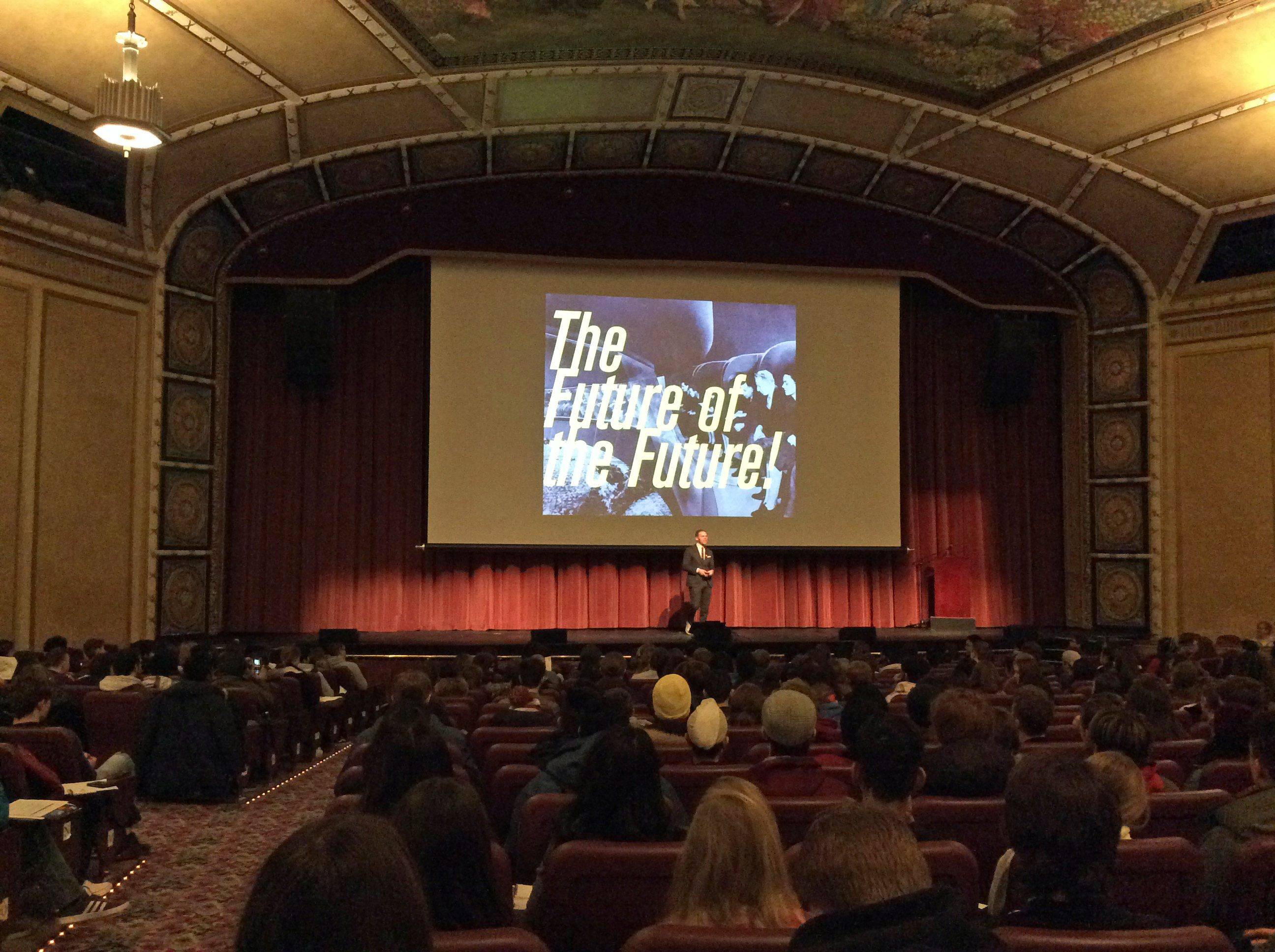
Keynote speaker Greg Lindsay talks to students at Sanderson Centre

AerotropolisJournalist, urbanist and futurist Greg Lindsay gave a rousing keynote speech to start the conference. Greg spoke about the future of cities, technology, and mobility. He is the director of applied research at NewCities and director of strategy at its mobility offshoot CoMotion. He also co-authored the international bestseller Aerotropolis: The Way We’ll Live Next.
I joined a suite of technologists, visionaries and other scientists in presenting various scenarios of the future through workshops and seminars.

Workshop subjects included quantum cryptography, autonomous vehicles, flying cars, robotic surgery, zero waste, computer glasses, and my workshop “writing science fiction.”

Instructive seminars included topics such as feeding 9 billion people, mental health, AI & computers, the science and meaning of water, urban development, the future of transportation and space exploration.

How to Write Science Fiction

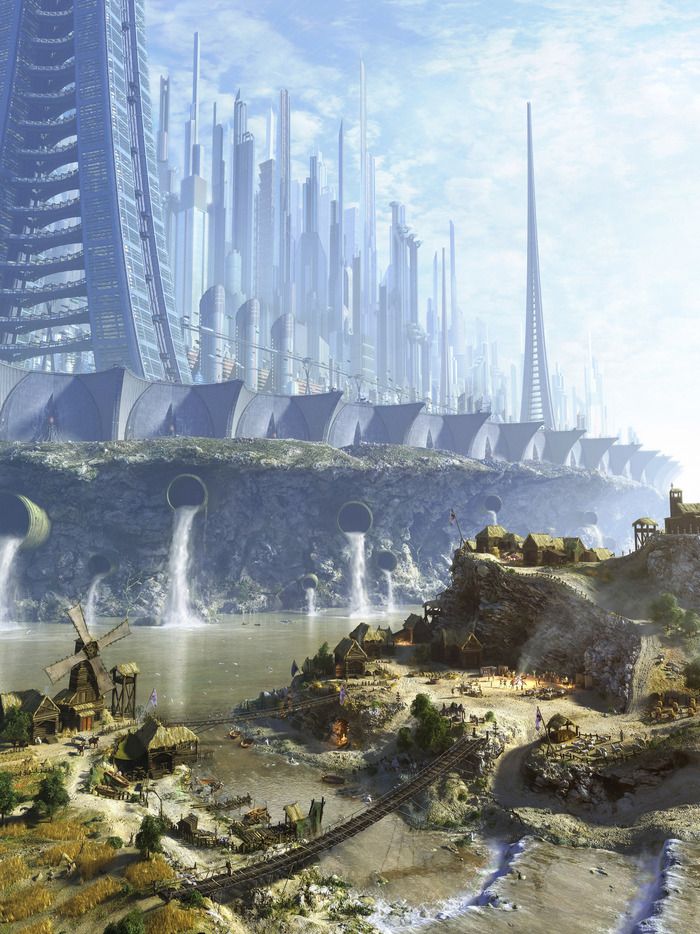
the-city-cgtrader copy

Top choice image prompt for storytelling

I gave two workshops on how to write science fiction. The workshop began with a brief discussion on what a story is (and is not) and a summary of the key tools of writing good story (e.g. premise, plot, theme, character, and setting) with a focus on world-building and the role of science.

Each group then set out to create the framework for a story based on a premise from an image prompt and shared what they’d put together. In one session we all worked together with me scribing on one whiteboard, creating together as a class; in another session, small groups formed and created their own story among four to five members as I went from team to team.

everyday hero-2 copy

Next popular storytelling image (cover illustration for “Ecology of Story” by Anne Moody)

Amazing stories emerged in both cases from the image prompts chosen. Students demonstrated imaginative, mature and original premises and carried through with thoughtful and imaginative plot, theme and character journeys. I was very impressed.

The Science and Meaning of Water

In this seminar I gave a summary of water’s life-giving anomalous properties on Earth and discussed the history and field of limnology (study of freshwater). I explored our history with water (including our impacts) and the implications of climate change on our future with water on the planet. Points of interest included water’s many weird properties, water’s ubiquity and its origins, the hydrological cycle, and the often strange adaptations of life with (or without) water.

Water Is-COVER-webWe then discussed future implications of water scarcity (and geopolitical conflict) and some of the things individuals and communities can do. Much of the talk drew from my recent book Water Is… The Meaning of Water.


nina-2014aaa

Nina Munteanu is a Canadian ecologist / limnologist and novelist. She is co-editor of Europa SF and currently teaches writing courses at George Brown College and the University of Toronto. Visit www.ninamunteanu.ca for the latest on her books. Nina’s bilingual “La natura dell’acqua / The Way of Water” was published by Mincione Edizioni in Rome. Her non-fiction book “Water Is…” by Pixl Press (Vancouver) was selected by Margaret Atwood in the New York Times ‘Year in Reading’ and was chosen as the 2017 Summer Read by Water Canada. Her novel “A Diary in the Age of Waterwill be released by Inanna Publications (Toronto) in June 2020.


Book Review: Craig Russell’s “Fragment” in the time of COVID-19

Fragment-CraigRussellCraig Russell begins his eco-thriller Fragment with a TV interview of glaciologist Kate Sexsmith in Scott Base Antarctica. The interview is interrupted by what turns out to be four runaway glaciers that have avalanched into the back of the Ross Ice Shelf and a fragment the size of Switzerland surges out into the open sea. Hence the title: Fragment.

The original slide / wave and ensuing tsunami wipes out both Scott Station and the American McMurdo Station. The TV station records the moment:

Where Kate had stood to touch the map of Antarctica moments before, something hit the wall like an artillery round. It left a ragged hole through wall and map alike, framing an eerie light-show. A sheet of jewels flickered, glinting greens and blues, until a white mountain appeared and the screen went black.

Ross Ice Shelf 4

Ross Ice Shelf, Antartica

With astute prescience, Russell reveals humanity’s behaviour in the stress of such a momentous event: from scientists who understand the global significance of this rogue fragment to those who minimize its effect such as the media and tourist industry who wish to exploit this anomaly and self-centred politicians obsessed with protecting their status.

antarctic-glaciers

Antartica


snowball in senate

Senator Inhofe and infamous snow ball

My first thought was: he’s stereotyping a little. Then COVID-19 broke out to become a global pandemic. The reactions of scientists, media and certain politicians (e.g. the Trumps of the world) have played out with COVID-19 just as Russell had predicted with Fragment. Then again, good science fiction reaches deeply into a society’s core being, our motivations, fears and strengths; this is why science fiction is so eerily good at predicting. The best way to predict possibilities of the future is to understand the present and, as Russell demonstrates, science fiction writers are in touch with the zeitgeist of the world.

Reflecting the American government’s ridiculous denial of climate change, and calling to mind Republican Senator Inhofe’s snow ball in the senate scene, Russell’s character David Rookland (Washington’s Science Advisor) uses the glacier avalanche and fragment that he (purposely) misunderstands to illustrate with equal lack of logic the same misguided myth: “these theorists claim that around the world, glaciers have been receding. Thankfully, as you can see in the second photo, dear old Mother Nature has proven them wrong again.”

blue whale 2

Blue whale


Russell’s chapters devoted to the POV of character Ring, a young blue whale also fragmented from his pod, are particularly touching and powerful. Chased alternatively by Killer whales and human hunters, Ring must warn his kind of the danger posed by the fragment. In one chapter Ring observes that “there’s a special taste to the air here, a tang carried north from the twin Smoking Mountains, which send their steamy vapors into the sky forever.”

Russell then weaves an inspiring legend among the blues about a whale named Long-Throat and the “hard/noisy things” that came to hunt. Men slaughtered so many and scattered the pods in all directions. According to the legend of Long-Throat, the faint bitter smell of the Smoking Mountains brought the pods together again. This had been a time, thinks Ring, when the pods were not afraid to be different, or of new places and strange experiences. But no more. “The Slaughter scarred his race and young Blues are fed fear with their mother’s milk. Fear that never heals, never sleeps. Fight it though he may, that fear lives inside him too.” Ring hopes that, by facing this new fear of the fragment and its incredible power to devastate (any whale caught under its massive moving force will drown), “the old fear can be allowed to sink away.” His course is clear: he must compose a new song to warn other blues. Ring ends up doing far more than sound the warning of the moving behemoth to his people when he is discovered by an American nuclear missile submarine. What follows is what I think is the real story and its magic.

Ross Ice Shelf

Ross ice shelf, Antarctica

The book is appropriately titled Fragment because in some ways the fragment is a main character, carrying the theme. It is herald, harbinger, and misunderstood by many. Its power is greatly underestimated by others, and it is set apart from its fold to become something else. Like Ring and his people. Like humanity, even. Just as the Corona virus pandemic (currently ravaging the world as I write this article) promises to change every aspect of our world, so too does the fragment.

The fragment: “….Its northern rim is a world of chaos. Pack-ice, bulldozed by the Fragment, has been swept up into a bramble, miles deep, piled up and over itself in a frozen explosion. The corpses of countless penguins lie within, broken by the onslaught. Behind this jumble rises the Wall. A hundred metres above the water line and six hundred below, the Shelf is old, formed before Columbus stumbled his way across the Atlantic. In the Fragment’s back, imbedded like spears, are vast sections of the four glaciers. Byrd, Nimrod, Beardmore, and Shackleton. Truly ancient, each is a fortress, hard as granite, laminated layer upon layer over millennia…The creatures of the sea meet the wall in their millions. The air breathers, penguins, seals, dolphins, and so on, have no hope. They swim and die, exhausted and drowned. For many of the water breathers like fish and squid, the drop in temperature near the Fragment is too much…Some species of fish, well able to withstand the cold, succumb instead to the unfamiliar fresh water that has begun to pool around the Fragment.”–Craig Russell, Fragment

In a scene near the end of the book, which could be taken out of our current COVID-19 crisis, Russell describes how carefully considered warnings by scientists are downplayed as “alarmist” resulting in devastating inaction:

When Kate Sexsmith presents a possible scenario of the Fragment smashing into Europe, the Chairman of the European Fragment Conference counters with “in that highly unlikely event” all is under control by the world community. To this dangerous platitude, Sexsmith challenges (only to receive a mealy-mouthed double-speak reply):

“Respectfully, Mr. Chairman, [says Sexsmith] the world has faced plenty of hurricanes, tidal waves, and earthquakes. But we have no historical event to compare with the Fragment. And Europe isn’t the only place in danger. There are millions of people at risk on the Caribeean islands. Many are poorly educated and have no resources of their own. When do we mov them? How do we move them? Who is prepared to take them in? And based on Stanley [which was totally destroyed by the Fragment] who is prepared to take them in on a permanent basis?”

“We are not blind to these concerns, Doctor [says the chairman]. But we must take a balanced view. We cannot simply adopt an alarmist approach. Our scientific community’s reputation for sound council is too important to risk…”

But when great disaster strikes, all peoples (whales and humanity) come together in solidarity. With new humility, kindness and wisdom. I was astonished at the way Russell pulled things together toward a unique resolution. I give Craig Russell five stars for the courage to end his book the way he did. It was pure magic. The kind of magic we all want to see more of in this currently beleaguered, divisive and consumer-obsessed world.

Antarctica ice

Antartica

As Dutch trends forecaster Li Edelkoort said of COVID-19, the Fragment “might just turn the world around for the better [as] an amazing grace for the planet.”

Antarctica melting

Antarctica melting


Whales and Intelligence:

Scientists are still finding ways to assess “intelligence”, particularly in life that isn’t human. Whales have been shown to have emotional intelligence. They show signs of empathy, grief, joy, and playfulness. All of these learned behaviors, types of intelligence, and signs of teamwork have led scientists to think about groups of whales in new ways.

blue-whales-commercial-whaling-shipping-population-endangered-species-ocean-sea-whale-whaling-hunting-recovery

Blue whale

Most humans believe that our ability to communicate is far more complex and evolved than that of other animals, but cetaceans may be superior. According to a comparison of cetacean to primate brains from Michigan State University, “They have the distinct advantage over us in that their primary sense is the same as their primary means of communication, both are auditory. With primates, the primary sense is visual and the primary means of communication is auditory.” Communication is so great in cetaceans that there is a strong possibility they are able to literally project an “auditory image” that replicates a sonar message they may receive.  MSU describes it this way: “So a dolphin wishing to convey the image of a fish to another dolphin can literally send the image of a fish to the other animal. The equivalent of this in humans would be the ability to create instantaneous holographic pictures to convey images to other people.”

Specialized brain cells called spindle neurons are most often associated with an organism’s ability to “recognize, remember, reason, communicate, perceive, adapt to change, problem solve and understand.” Spindle neurons have been isolated in the brains of both whales and dolphins, which suggests that whales do a lot more thinking than previously thought. Dolphins, for example, have been known to recognize themselves in mirrors, solve problems, follow recipes, and associate a part of their anatomy with that of a human’s (such as when a dolphin waves it’s fin whenever a trainer waves their arm). Recent studies even indicate that dolphins are capable of creating personalized whistles that act as names for individual members of a pod. With this name, dolphins are able to communicate more efficiently while roaming the open seas.

mother calf humpback whale

Mother humpback and her calf

In a Scientific American article entitled “Are Whales Smarter Then We Are?” R. Douglas Fields writes: Logically, brain function and intelligence must relate to the number of neurons. Intelligence resides in the neocortex (the thin, convuluted “rind” of the brain) rather than in other, underlying areas devoted to controlling vital housekeeping functions for the body, so Eriksen and Pakkenberg focused their investigation there. The frontal lobes of the dolphin brain are comparatively smaller than in other mammals, but the researchers found that the neocortex of the Minke whale was surprisingly thick. The whale neocortex is thicker than that of other mammals and roughly equal to that of humans (2.63 mm). However, the layered structure of the whale neocortex is known to be simpler than that of humans and most other mammals. In particular, whales lack cortical layer IV, and thus have five neocortical layers to humankind’s six. This means that the wiring of connections into and out of the neocortex is much different in whales than in other mammals. The researchers’ cellular census revealed that the total number of neocortical neurons in the Minke whale was 12.8 billion. This is 13 times that of the rhesus monkey and 500 times more than rats, but only 2/3 that of the human neocortex. What can account for the fact that whales have bigger brains — and similarly thick neocortexes — but fewer neurons? Eriksen and Pakkenberg found that there were 98.2 billion non-neuronal cells, called glia, in the Minke whale neocortex. This is the highest number of glial cells in neocortex seen in any mammal studied to date. The ratio of neocortical glial cells to neocortical neurons is 7.7 to 1 in Minke whales and only 1.4 to 1 in humans. This finding may indicate a tendency for larger glia/neuron ratios as brain mass increases to support the growing neurons. But when one considers other recent research revealing that glia play an important role in information processing (see “The Other Half of the Brain,” fromn Sci. Am. April 2004), one is left to wonder. Is the whale brain intellectually weaker than the human brain, or just different? They have fewer neurons but more glia, and in traditional views of the glia, the neurons count for much more.

In her article in One Green Planet entitled “Whales and Dolphins Might Be The Smartest Animals”, Madison Montgomery leaves us a strong message and exhortation: “While it appears that cetaceans have incredible abilities to feel emotions, understand complex problems and communicate in ways we can’t even imagine, humans don’t seem to value this. Because we assume we are so smart, we put the other creatures of the world underneath us. Knowing how dynamic cetaceans are, keeping them in glorified bathtubs and forcing them to do tricks for food is insulting and cruel. Could you imagine the pain of living in a small room your entire life and having to do flips to be fed? Sounds like a miserable existence, doesn’t it?”

As a postscript, Fragment was selected by the American National Oceanic and Atmospheric Administration (NOAA) for their “Planet Stewards” 2023-2024 Book Club.

nina-2014aaa

Nina Munteanu is a Canadian ecologist / limnologist and novelist. She is co-editor of Europa SF and currently teaches writing courses at George Brown College and the University of Toronto. Visit www.ninamunteanu.ca for the latest on her books. Nina’s bilingual “La natura dell’acqua / The Way of Water” was published by Mincione Edizioni in Rome. Her non-fiction book “Water Is…” by Pixl Press (Vancouver) was selected by Margaret Atwood in the New York Times ‘Year in Reading’ and was chosen as the 2017 Summer Read by Water Canada. Her novel “A Diary in the Age of Waterwill be released by Inanna Publications (Toronto) in June 2020.


A Diary in the Age of Water: The Rocky Mountain Trench Inland Sea

Diary Water cover finalIn my novel A Diary in the Age of Water (Inanna Publications) the diarist writes about the huge 800-km reservoir complex built in the late 2020s in the Rocky Mountain Trench to rehydrate the United States. Of course, it’s science fiction, but it was based on real plans that went all the way to Congress in the 1960s.

Snaking along the length of the Rocky Mountain Trench, the reservoir promised to submerge numerous British Columbia towns such as Dunster, McBride and Valemount and pose an existential threat to northern communities of BC and Alaska.

The Trench

The Rocky Mountain Trench is a long and deep valley walled by sedimentary, volcanic and igneous rock that extends about 1,500 km from Flathead Lake and the ‘banana but’ of the Bitterroot Valley of western Montana through British Columbia to the Liard Plain just south of the Yukon Territory. Blanketed mostly by white and black spruce, subalpine fir and lodgepole pine, the northern trench stretches 3–20 km wide to accommodate the major river systems that snake along its mostly flat floor. This rich ecosystem is home to bears, caribou, moose and wolves. To the south, where the valley meanders more at lower elevation, the forest opens up and gives way to grasslands, marsh and farmland. The Trench is sometimes referred to as the “Valley of a Thousand Peaks” because of the towering mountain ranges on either side: the Rocky Mountains to the east and the Columbia, Omineca and Cassiar mountains to the west.

The Trench is a large fault—a crack in the Earth’s crust—and bordered along much of its length by smaller faults. Major structural features resulted from the shifting and thrusting of tectonic plates of the crust during the early Cenozoic Era, some 65 million years ago to form mountains. The ridges of fractured crust then pulled apart and the land in between dropped, creating the floor of the Trench.

RMT near Golden-south of Kinbasket

Rocky Mountain Trench, near Golden, B.C.

Among the major rivers that flow through the trench are the Fraser, Liard, Peace and Columbia rivers. Construction of hydroelectric projects—particularly those at Peace Canyon and Mica Dam—have disrupted the seven major rivers that once flowed through the Trench. All but the Fraser and Kechika rivers now empty into reservoirs on the valley floor; these include several reservoirs along the Columbia River in the southern trench such as the Kinbasket reservoir (created by the Mica Dam in 1973 to form Canoe Reach), and Revelstoke Lake (created by the Revelstoke Dam in 1984). Williston Lake was formed by the A.C. Bennet Dam on the Peace River in 1968. I had studied the effects of pulp mill activities for the federal government’s Environmental Effects Monitoring (EEM) Program.

Mackenzie-RMT

The Rocky Mountain Trench is topographically visible as it follows the BC-Alberta border south from Williston Lake

The Inland Sea

Like pseudopods of a hunting amoeba, the Rocky Mountain Trench reservoir system would have sent tendrils of water up river arms, and drowned swaths of ancient oroboreal rainforest. The rainforest corridor of Robson Valley—a conservation area that continues to experience existential risk due to development, resource harvest, and other disturbance—would have been one of the many casualties.

Cedar base-old growth copy 2

Ancient Redcedars in old-growth rainforest (photo by Nina Munteanu)

Una stopped the car and we stared out across the longest reservoir in North America. What had once been a breathtaking view of the valley floor of the Rocky Mountain Trench was now a spectacular inland sea. It ran north-south over eight hundred kilometres and stretched several kilometres across to the foothills of the Cariboo Mountain Range. Una pointed to Mount Mica, Mount Pierre Elliot Trudeau and several other snow-covered peaks. They stood above the inland sea like sentinels of another time. Una then pointed down to what used to be Jackman Flats—mostly inundated along with McLellan River and the town of Valemont to the south. Hugging the shore of what was left of Jackman Flats was a tiny village. “That’s the new Tête Jaune Cache,” my mother told me.

If villages had karma this one was fated to drown over and over until it got it right.  Once a bustling trading town on the Grand Trunk Pacific railway, Tête Jaune Cache drowned in the early 1900s when the Fraser naturally flooded. The village relocated to the junction of the original Yellowhead 16 and 5 Highways. Villagers settled close to where the Fraser, Tête Creek, and the McLellan River joined, all fed by the meltwater from the glaciers and icefields of the Premiere Range of the Cariboo Mountains. The village drowned again in 2025. I imagined the pool halls, restaurants, saloons and trading posts crushed by the flood.

“This area used to be a prime Chinook spawning ground,” Una said. “They swam over 1,200 km from the Pacific Ocean to lay their eggs right there.” She pointed to the cobalt blue water below us.

Kinbasket Lake-RMT

Kinbasket Reservoir

The reservoir sparkled in the sun like an ocean. Steep shores rose into majestic snow-capped mountains. The village lay in a kind of cruel paradise, I thought. It was surrounded by a multi-hued forest of Lodgepole pine, Western red cedar, Douglas fir, paper birch and trembling Aspen. Directly behind the village was Mount Terry Fox and across the Robson valley mouth, to the northeast, rose Mount Goslin. Behind it, Mount Robson cut a jagged pyramid against a stunning blue sky. Wispy clouds veiled its crown. I couldn’t help thinking it was the most beautiful place I’d seen. And yet, for all its beauty, the villagers had lost their principle livelihood and food. The reservoir had destroyed the wildlife habitats and the fishery. And its people with it.

Una pointed to where the giant reservoir snaked northwest and where towns like Croydon, Dunster, and McBride lay submerged beneath a silent wall of water. Her eyes suddenly misted as she told me about Slim Creek Provincial Park, between what used to be Slim and Driscoll Creeks just northwest of what used to be the community of Urling. She told me about the Oroboreal rainforest, called an “Antique Rainforest”—ancient cedar-hemlock stands over a 1000-years old. She described how massive trunks the width of a small house once rose straight up toward a kinder sun. The Primordial Grove was once home to bears, the gray wolf, cougar, lynx, wolverine and ungulates. It was the last valley in North America where the grizzly bear once fished ocean-going salmon. Now even the salmon were no longer there, she said. Then she bent low beside me and pulled me close to her in a hug. She quietly said to me, “This is what killed Trudeau.”

I stared at her and firmly corrected, “but that was an accident.”

“Yes,” she agreed. Then added, “a planned one.”

A Diary in the Age of Water

NAWAPA (North America Water Power Alliance)

The original NAWAPA Plan was drawn up by the Pasadena-based firm of Ralph M. Parsons Co. in 1964, and had a favorable review by Congress for completion in the 1990s. The plan—thankfully never completed—was drafted by the US Army Corps of Engineers and entailed the southward diversion of a portion (if not all) of the Mackenzie and Yukon rivers in northern Canada and Alaska, now flowing into the Arctic Ocean as well as the Peace, Liard and other rivers flowing into the Pacific by creating massive dams in the north. This would cause the rivers to flow backwards into the mountains to form vast reservoirs that would flood one-tenth of British Columbia. The water would be channeled south through the 800-km Rocky Mountain Trench Reservoir into the Northern USA, and from there along various routes into the dry regions of the South, to California and reaching as far as Mexico.

NAWAPA proposal Ralph M. ParsonsCo-1960s copy

NAWAPA was envisioned as the largest construction effort of all times, comprising some 369 separate projects of dams, canals, and tunnels, for water diversion. The water diversion would be accomplished through a series of connecting tunnels, canals, lakes, dams, and pump-lifts, as the trench itself is located at an elevation of 914 m (3,000 feet). To the east, a 9 m (thirty-foot) deep canal would be cut from the Peace River to Lake Superior. NAWAPA’s largest proposed dam would be 518 m (1,700 feet) tall, more than twice the height of Hoover Dam (at 221 m) and taller than any dam in the world today, including the Jinping-I Dam in China (at 305 m).

Conspiracy theorist and convicted fraudster Lyndon LaRouche was a principle proponent of the environmentally destructive NAWAPA plan. Although the plan was scrapped in the 1970s due to environmental concerns, it resurfaced in 1982 particularly by Parsons engineer Roland Kelley, who wrote a report called NAWAPA Plan Can Work. LaRouche and his movement revived interest more recently. In 2012 the LaRouche Political Action Committee released their NAWAPA XXI special report, which contained a detailed plan for the revival of an updated and expanded version of NAWAPA. The LaRouche movement continues to promote this outlandish plan today with support from various American politicians and industrialists.

In his book Cadillac Desert, environmental writer Marc Reisner described the plan as one of “brutal magnificence” and “unprecedented destructiveness.” Historian Ted Steinberg suggested that NAWAPA summed up “the sheer arrogance and imperial ambitions of the modern hydraulic West.”

NAWAPA copy 2

Expanded NAWAPA XXI plan

Rocky Mountain Trench near Radium Hot Springs, BC

Rocky Mountain Trench near Radium Hot Springs

nina-2014aaa

Nina Munteanu is a Canadian ecologist / limnologist and novelist. She is co-editor of Europa SF and currently teaches writing courses at George Brown College and the University of Toronto. Visit www.ninamunteanu.ca for the latest on her books. Nina’s bilingual “La natura dell’acqua / The Way of Water” was published by Mincione Edizioni in Rome. Her non-fiction book “Water Is…” by Pixl Press (Vancouver) was selected by Margaret Atwood in the New York Times ‘Year in Reading’ and was chosen as the 2017 Summer Read by Water Canada. Her novel “A Diary in the Age of Waterwill be released by Inanna Publications (Toronto) in June 2020.