I was recently commissioned by Andrea Franco at Delos Digitalin Milan to write a novelette for their Fantasy Tales Series. The resulting story was Summoning the Future’s Past a short adaptation of my alternative history novel The Last Summoner published by Starfire in 2012.
The novelette was translated by Chiara Beltrami then released by Delos Digital as the ebook l’Ultima Evocatrice, (Fantasy Tales 66), on April 13, 2021.
“Recentemente in Fantasy Tales-Delos Digital abbiamo pubblicato il primo testo ‘internatiozionale’, della bravissima scrittrice Canadese Nina Munteanu, tradotta per noi in modo eccellente da Chiara Beltrami. Un bellissimo racconto lungo che gli appassionati di fantasy non dovrebbero farsi scappare. Lo avete letto?”
As with The Last Summoner, l’Ultima Evocatrice(Summoning the Future’s Past) is a fresh twist on chaos theory and observer-induced collapse of quantum entanglement. It’s June 14th, 1410, on the eve of the Battle of Grunwald, when history records that a ragtag peasant army will slaughter the arrogant monk knights of the imperialistic Teutonic Order … or will they? Because of an impetuous choice, 14-year old Vivianne Schoen, Baroness von Grunwald, makes the startling discovery that her mother is from the future and Vivianne herself can alter history—but not before she’s branded a witch and must make the most difficult choice of her life …
Nina Munteanu is a Canadian ecologist / limnologist and novelist. She is co-editor of Europa SF and currently teaches writing courses at George Brown College and the University of Toronto. Visit www.ninamunteanu.ca for the latest on her books. Nina’s bilingual “La natura dell’acqua / The Way of Water” was published by Mincione Edizioni in Rome. Her non-fiction book “Water Is…” by Pixl Press(Vancouver) was selected by Margaret Atwood in the New York Times‘Year in Reading’ and was chosen as the 2017 Summer Read by Water Canada. Her novel “A Diary in the Age of Water” was released by Inanna Publications (Toronto) in June 2020.
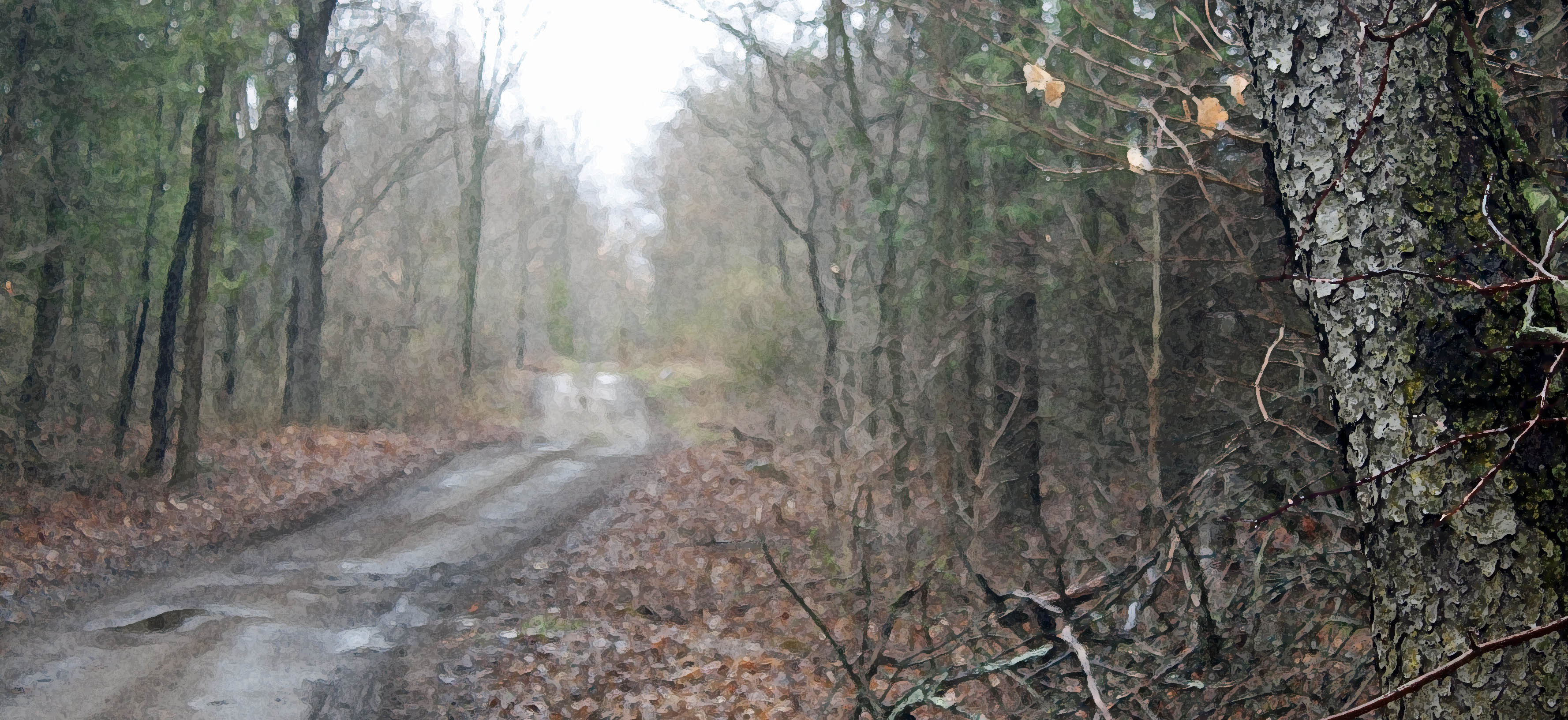
Dirt road to Long Lake in misty rain, ON (photo and dry brush rendition by Nina Munteanu)
.
A short time ago, I had a wonderful conversation with good friend Margaret about how walking in nature—along a river, in a forest, by a marsh or lake—centres us and feeds our soul. Margaret and I agreed that walking in nature fulfills the “explorer” in us, brings us out of ourselves in discovery and allows us to enter that wonderful blissful state of being “in wonder.” Margaret then shared how surly she got when it was a rainy day and she couldn’t go for her walk. I didn’t share that those are the very days I covet for my walks.
It got me thinking about why a walk in the rain is so special for me.
.
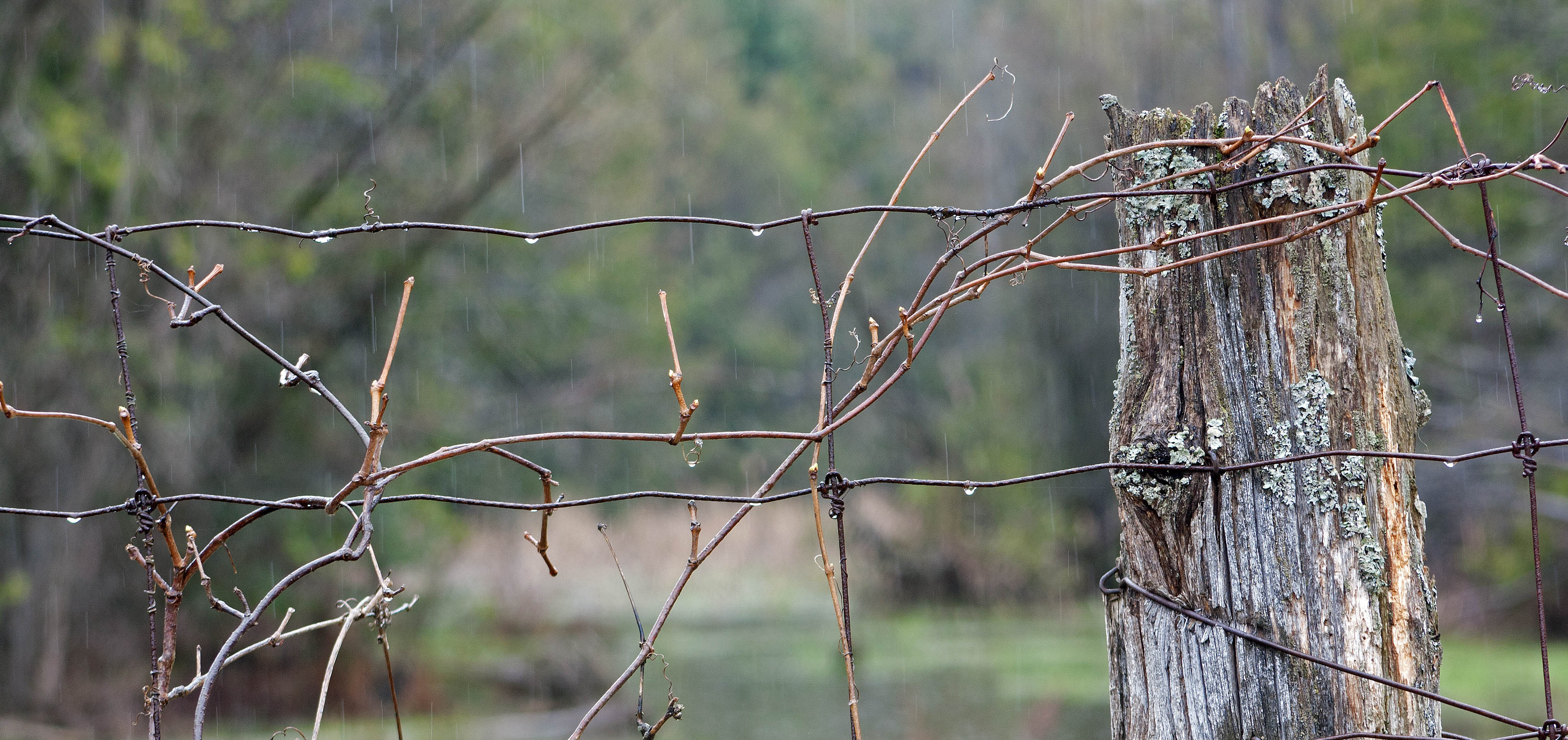
Fence post in front of marsh by country road, ON in the rain (photo by Nina Munteanu)
.
Why Rain Makes Us Feel Good
As a little girl, I used to get caught in the odd thunderstorm that swept through my small town on a sudden wind. I could taste the fresh air after the storm and felt exhilarated by it. What I didn’t know then was that the air was charged with negative ions from both the lightning and the rain—as water molecules crashed into one another.
We are all familiar with the feeling of well-being we get from moving water—rivers, waterfalls, crashing or surging waves, thunderstorms, fresh snow, transpiration by plants, even showers and fountains. Part of this feeling comes from negative ions in the air. Negative ions are basically oxygen ions with an extra electron attached, produced in water molecules.
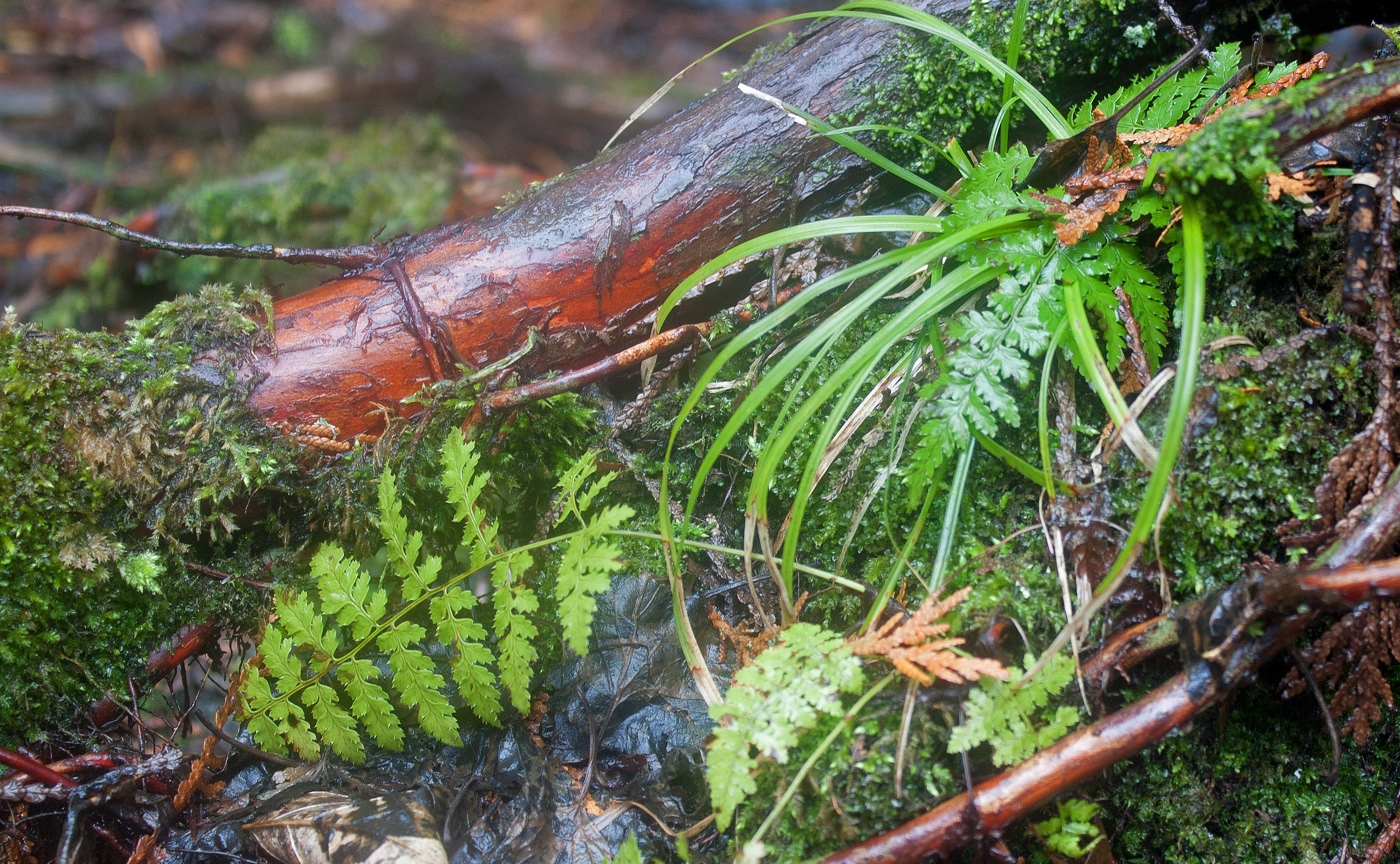
Devils club, moss and ground cover by a stream in rain, Robson National Park (photo by Nina Munteanu)
.
As early as the 1700s, with the work of Swiss researcher Horace Bénédicte de Saussure, scientists have shown that negative ions are generated by moving water and by plants when exposed to intense light during photosynthesis. Negative ions clean the air. They do this by attaching to positively charged particles such as pollen, mold, bacteria and dust, which then become too heavy to stay airborne. A country meadow typically contains from 2,000 to 5,000 negative ions per cubic centimetre (cc); mountains, forests and seashores provide up to 50,000 negative ions/cc. Niagara Falls generates anywhere from 30,000 to 100,000 negative ions/cc in its air.
Rain on its own is incredibly therapeutic, not just in its ability to support life and to refresh, but in its nature to make us feel wonderful. The chaotic yet stable sound of rain is gently calming. Rain mutes and lacks the jolting sounds that activate our defence and vigilance system. It’s a non-threatening sound that blocks out sudden noises that otherwise alert us. The simple repetitive sound of water falling lets us rest our brains and induces a mild meditative state. Studies have shown that the sound of rain produces alpha waves in a human brain, which is close to the brain’s state when we are asleep. The sound of rain not only relaxes but brings out our creativity. Marine biologist Wallace J. Nichols (author of Blue Mind) argues that the sound of rain allows our brain to wander, eventually reaching a state known as the default mode network. In her book The Artist’s Way, Julia Cameron mentions “s” activities, such as “shower” as creativity-inducing.
Walking in the rain can be pure joy.
.
Pond lily just after a rain, ON (photo by Nina Munteanu)
.
Why Walking in the Forest in the Rain Is Even Better
These days, when I get up in the morning, if the day is foggy or a light rain is falling, I feel compelled to quickly down my breakfast, pack up my camera gear in a waterproof bag, shrug into my raincoat and boots and hightail it to the marsh or the forest, where I’m greeted with the fresh scent of petrichor—the pleasant smell that accompanies the first rain after a long period of warm, dry weather. The rain helps release plant oils and chemicals produced by soil-dwelling bacteria called actinomycetes into the air. The term arose from the Greek petra (stone) and ichor (the fluid that flows in the veins of the gods). The earthy scent of rain on dry soil evokes wonderful memories of playful childhood, freedom and awestruck wonder. The complex loamy organic aroma of a forest during a rain easily ranks among my favourite smells. The link of a smell to strong memories is a scientific fact. In my writing class at George Brown College, I teach my students that the sense of smell is most associated with memory. This is because smell is first processed by the olfactory bulb and has direct connections to the two brain areas most strongly connected to emotion and memory formation—the amygdala and the hippocampus.
Rain intensifies a forest’s mosaic of unique scents from pungent, heavy and sharp to floral, fresh and sweet—based on the forest ecosystem’s qualities. A cedar-hemlock forest will give off different smells than a maple-beech woodland.
.
Cedar root among ferns and moss during a misty wet morning, Trent Nature Sanctuary, ON (photo by Nina Munteanu)
.
The conditions are best in the morning.
The morning light favours photography with a gentleness that softens and deepens everything, and invites intimacy. This is particularly magical if a morning mist settles or rises like stream from the damp earth, slowing time. When it rains, moisture covers everything. It brings out vivid colours and textures.
Infinite shades of green, brown, grey and yellow create a fluid landscape that water paints into a vibrant watercolour scene. I move through it, boots crunching and squelching along the spongy loam path, as though wrapped in a moving artwork.
The moisture carries the warbles and fluting chirps of lively bird song amid the hush of raindrops on vegetation. Each surface has a unique voice. And each rainfall—from light drizzle to hard pour—carries its own tune, rhythm and percussion. It’s all a wonderful symphony of diverse frequency from rich infrasound to beyond.
.
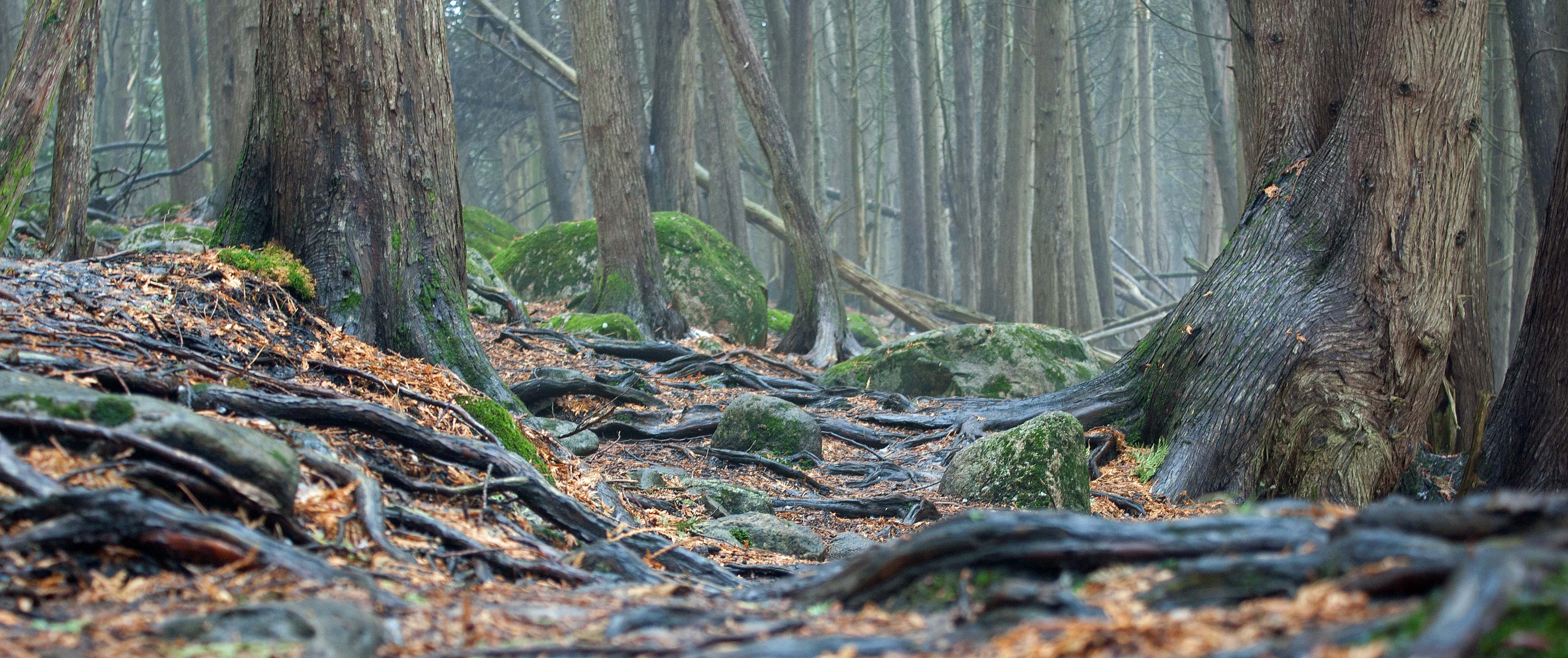
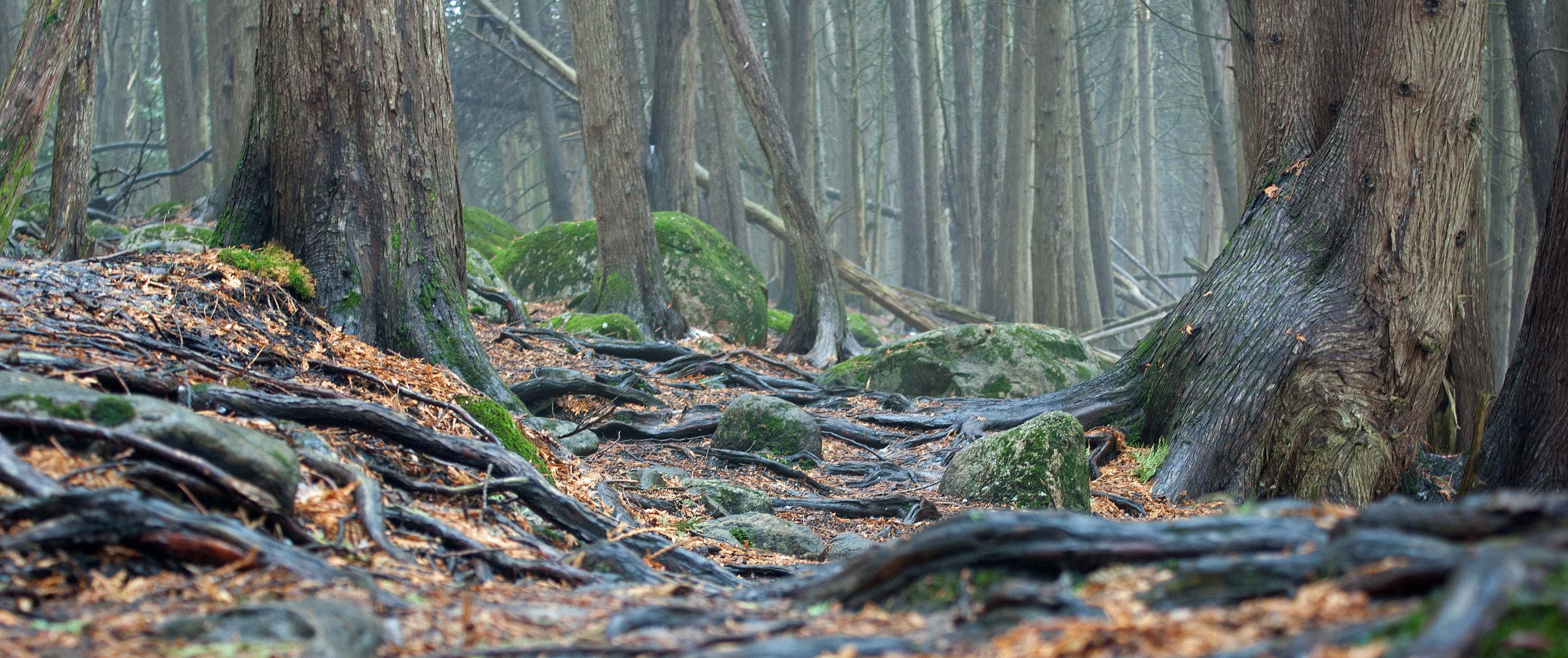
Root-strewn cedar-hemlock forest in morning mist, ON (photo by Nina Munteanu)
Perhaps the exhilaration I feel in the dripping forest is because this is when I can better hear Nature’s conversation with herself. When many of the human sounds grow muted in rainfall, Nature’s sounds fill in the gaps. The rain and the fog bring it all close, palpable, filtering. Like connective tissue, the rain unites me with my surroundings. I breathe in the subtle flavours, the whispers and perfumes, then breathe them out. I’m no longer separate. I am stone. Leaf. Tree.
Many of us feel a sense of peace in a forest. I have no doubt that this is the result of several factors including sounds and frequencies (e.g., infrasound), increased negative charge, scents, wood essential oils, genetic heritage and memory, and simple aesthetic appreciation and beauty. But it is so much more than this; water as rain or flowing stream or river plays a major role in this potential euphoric state.
.
Dew on grass in the morning, ON (photo by Nina Munteanu)
.
Water doesn’t just help us live; “Water teaches us how to live,” says Japanese researcher Masaru Emoto. Water teaches us “how to forgive, how to believe. If you open your ears to the possibilities in life, you may just be able to hear the sound of the pure water that flows through your body even now. It is the sound of your life—a melody of healing.” Emoto adds that, “The human body is … a universe of its own. Our bodies consist of some 60 trillion cells, each carrying out its specialized responsibility while simultaneously harmonizing with other cells in a wonderful way to make us who we are. The organs, nerves, and cells of the body have their own unique frequency. The body is like a grand orchestra consisting of the harmonization of various sounds.”
Water is the great conductor. I love it when it plays me.
.
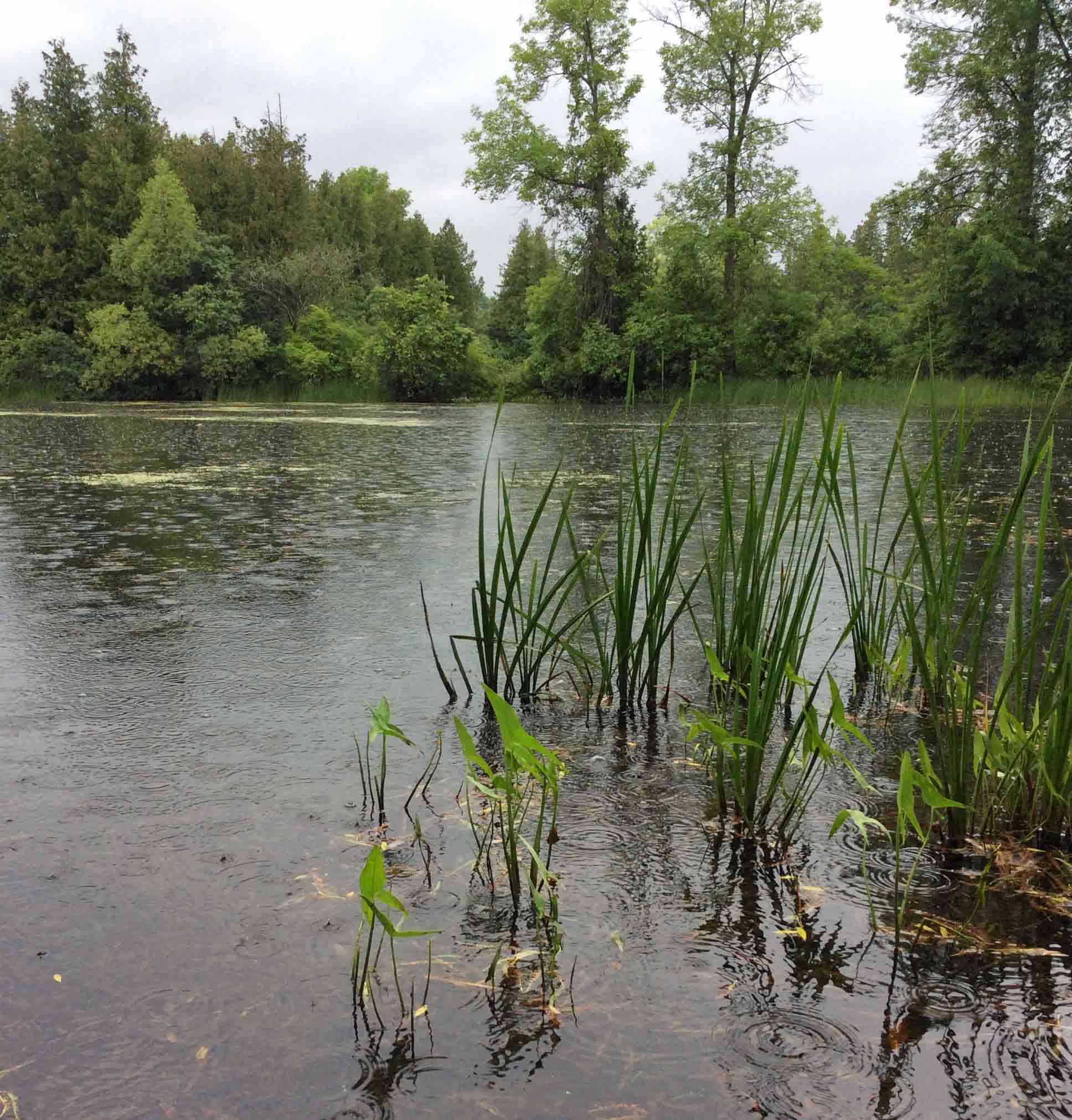
Thompson Creek marsh in a spring rain, ON (photo by Nina Munteanu)
.
Tips For Enjoying Your Walk in the Rain
Equip yourself for the rain. Invest in good raingear: a rainproof slicker or jacket, sturdy boots (preferably waterproof), and warm clothes. I prefer to go bareheaded to get the most of my experience; but I don’t mind getting soaked. If you do mind, invest in a good rain hat. Avoid using a rain hood as it will mute too many sounds and sensations, negating the point of the experience.
Be prepared to get wet. That’s part of the experience: to feel, see, hear, smell and taste the rain and your environment.
Get into the mindset of an explorer. Focus outward with all your senses. Slow your mind and breathing and think with the heart of one in wonder. Think of your five senses and use them all in discovery.
Don’t overdo the experience. If you get cold or too wet, the positive aspects lose to the negative aspects of the experience. Pace yourself and be kind to yourself.
If you use a camera, like I do, keep it dry by using something waterproof to carry it in. When you use it, either protect it with something or have something to dry it immediately once you’ve used it in the rain. Photographing in the rain can be an incredibly rewarding experience and can produce breathtakingly wonderful images that can not be created in any other weather. But you have to look after your equipment too.
Have fun!
.
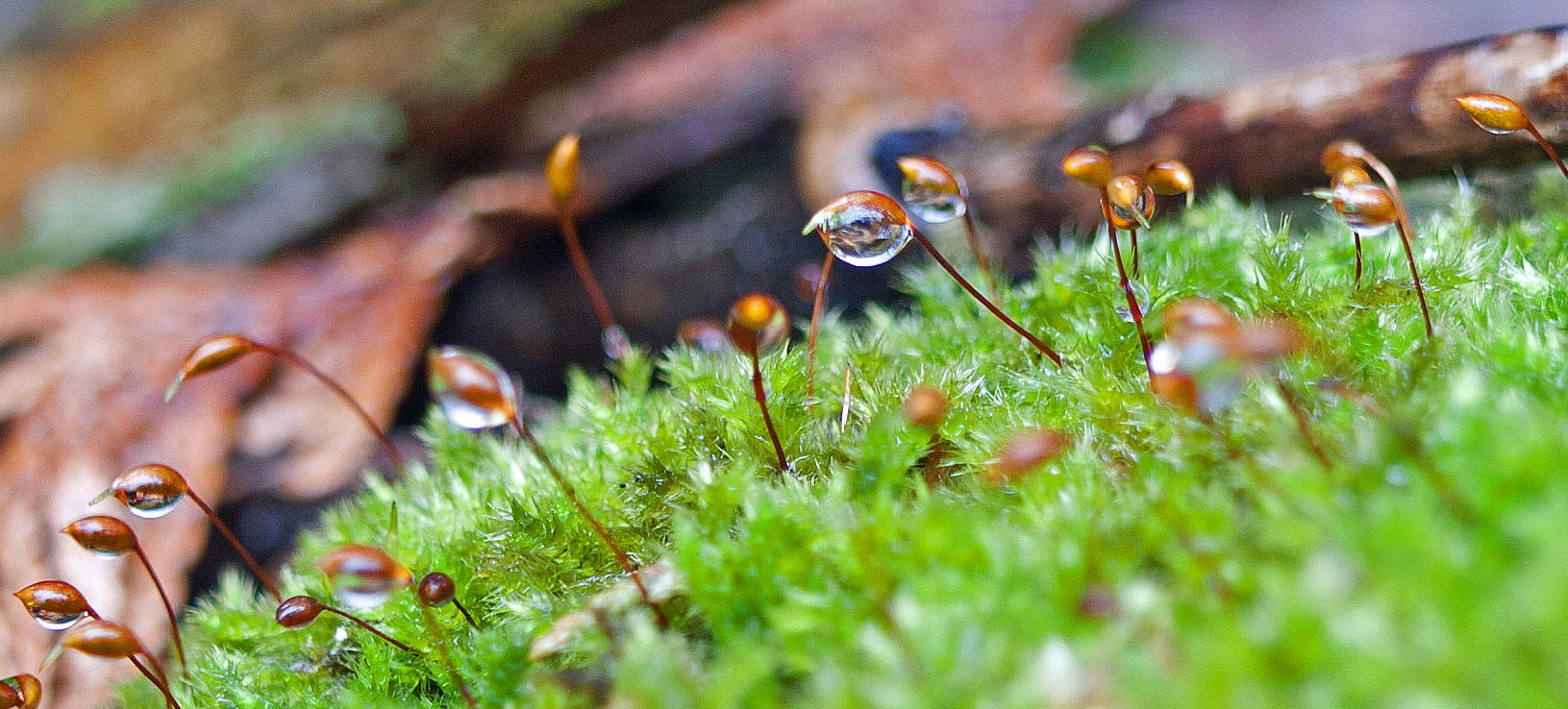
Moss with spore capsules in the rain, ON (photo by Nina Munteanu)
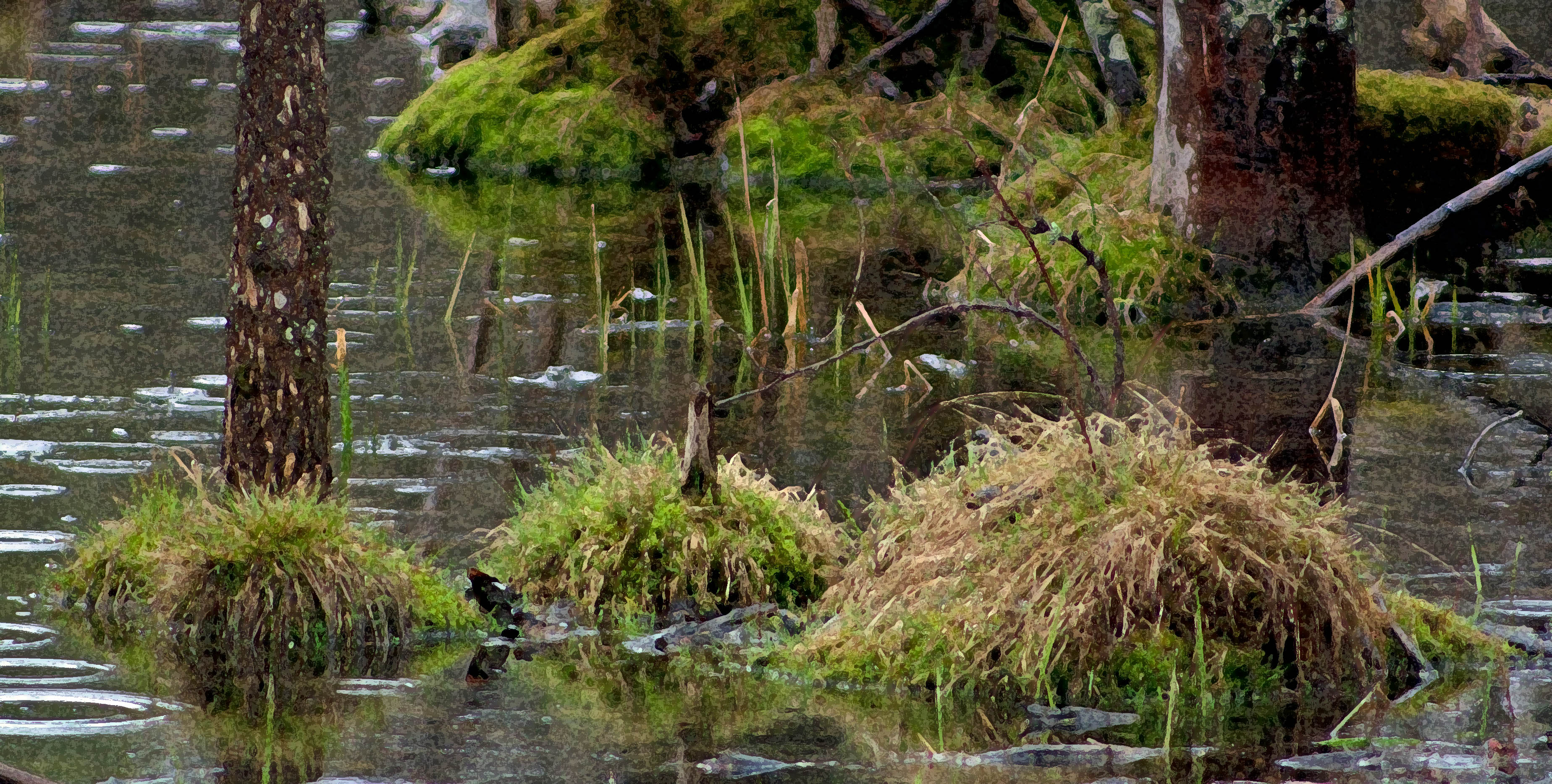
Swamp forest in the rain, off a country road, ON (photo and dry brush rendition by Nina Munteanu)
Geese at the mouth of tributary to the Otonabee River, ON during a spring shower (photo by Nina Munteanu)
.
Nina Munteanu is a Canadian ecologist / limnologist and novelist. She is co-editor of Europa SF and currently teaches writing courses at George Brown College and the University of Toronto. Visit www.ninamunteanu.ca for the latest on her books. Nina’s bilingual “La natura dell’acqua / The Way of Water” was published by Mincione Edizioni in Rome. Her non-fiction book “Water Is…” by Pixl Press(Vancouver) was selected by Margaret Atwood in the New York Times ‘Year in Reading’ and was chosen as the 2017 Summer Read by Water Canada. Her novel “A Diary in the Age of Water” was released by Inanna Publications (Toronto) in June 2020.
Alex and I discussed water scarcity and climate change as a water phenomenon. I also shared my thoughts on water as a character in the novel, water’s many anomalous properties–all of which promote life and wellness, and why writing a dystopian cautionary tale is an act of optimism.
Boys exploring by the Otonabee River, ON (photo and dry brush rendition by Nina Munteanu)
Nina Munteanu is a Canadian ecologist / limnologist and novelist. She is co-editor of Europa SF and currently teaches writing courses at George Brown College and the University of Toronto. Visit www.ninamunteanu.ca for the latest on her books. Nina’s bilingual “La natura dell’acqua / The Way of Water” was published by Mincione Edizioni in Rome. Her non-fiction book “Water Is…” by Pixl Press(Vancouver) was selected by Margaret Atwood in the New York Times ‘Year in Reading’ and was chosen as the 2017 Summer Read by Water Canada. Her novel “A Diary in the Age of Water” was released by Inanna Publications (Toronto) in June 2020.
“Write with passion. A lot of people say ‘write what you know.’ Those two in some ways are the same thing. You can do a lot of research on things that you don’t know and bring that in [to your writing.] But to know in your soul, in your heart, the thing that’s important that you need to write about is more what I mean by ‘write what you know.’ If you’re passionate about something—a global catastrophe or a personal journey with abuse—if it comes from the heart, it will keep you on track through those rejections and to finish and complete your work. Otherwise you won’t persist and you’ll let someone tell you that it isn’t important, it’s just a hobby.”
On water:
Nina and Fiona discuss the perils of commodifying water and Canada’s role in protecting the freshwater of the world and the boreal zone of Canada.
Nina talks about how she turned her fear of water as a child into a fascination for water and a passion for its protection. “I’m a limnologist, an ecologist. I’ve have been studying it since I was a little kid who was scared of water. I triumphed over that into fascination and made that into a career.” Nina’s non-fiction book Water Is… was published in 2016 as a biography of water and was endorsed by Margaret Atwood in the New York Times ‘Year in Reading.’
Nina talks about some of water’s over 70 anomalous properties and how virtually each is life-giving. She shares how water can teach us to be stewards and protectors of water within an emerging paradigm of gratitude and humbleness.
On being both scientist and artist:
Nina suggests that: “All great scientists are informed by art. They are creative in some way. [Scientists] bring that creativity, that original thinking and that curiosity, with them into their science. That’s what makes their science great because they are willing to look outward…We try to compartmentalize so we can better understand [art and science] but the irony is that we better understand them by bringing them together and integrating them…”
Nina Munteanu is a Canadian ecologist / limnologist and novelist. She is co-editor of Europa SF and currently teaches writing courses at George Brown College and the University of Toronto. Visit www.ninamunteanu.ca for the latest on her books. Nina’s bilingual “La natura dell’acqua / The Way of Water” was published by Mincione Edizioni in Rome. Her non-fiction book “Water Is…” by Pixl Press(Vancouver) was selected by Margaret Atwood in the New York Times‘Year in Reading’ and was chosen as the 2017 Summer Read by Water Canada. Her novel “A Diary in the Age of Water” was released by Inanna Publications (Toronto) in June 2020.
“It’s hard to resist identifying the author with Lynna, the most prominent character, who also works as a limnologist, although her employment is increasingly precarious, as her timeline hastens toward ecological devastation.
A predominantly female cast, a mythic forming narrative and, most saliently, the focus on water, all made this an interesting read for me.
The book’s epigraphs are from Maude Barlow and the chapter’s epigraphs from textbook definitions (sometimes excerpts from limnology tests), and there are even cutaway diagrams that you’d expect in lecture hall.
Ultimately it exists in an in-between place, some mystical elements of the generational tale possibly alienating the dedicated science-y readers and the instructional elements possibly alienating fiction devotees. And, yet, I read on: strangely compelling.”
Forest swamp in Kawarthas in spring, ON (photo and dry brush rendition by Nina Munteanu)
Nina Munteanu is a Canadian ecologist / limnologist and novelist. She is co-editor of Europa SF and currently teaches writing courses at George Brown College and the University of Toronto. Visit www.ninamunteanu.ca for the latest on her books. Nina’s bilingual “La natura dell’acqua / The Way of Water” was published by Mincione Edizioni in Rome. Her non-fiction book “Water Is…” by Pixl Press(Vancouver) was selected by Margaret Atwood in the New York Times ‘Year in Reading’ and was chosen as the 2017 Summer Read by Water Canada. Her novel “A Diary in the Age of Water” was released by Inanna Publications (Toronto) in June 2020.
“A spindly middle-aged mathematician with a soaring mind, a sunken heart, and bad skin is being thrown about the back of a carriage in the bone-hollowing cold of a German January…He is now racing through the icy alabaster expanse of the countryside in the precarious hope of averting another: Four days after Christmas and two days after his forty-fourth birthday, a letter from his sister has informed him that their widowed mother is on trial for witchcraft — a fact for which he holds himself responsible.”
This is how Maria Popova of brainpickings starts her article entitled: “How Kepler Invented Science Fiction and Defended His Mother in a Witchcraft Trial While Revolutionizing Our Understanding of the Universe.”
It all started with Somnium (The Dream), Kepler’s work of science fiction.
Despite having sufficient mathematical evidence to confirm Copernicus’s heliocentric model of the universe, Kepler understood that the proof was overly complex and abstract to persuade his peers, much less the scientifically illiterate public. He realized that where data and evidence could not dismantle their “celestial parochialism,” storytelling could. Somnium resulted.
Somnium (The Dream), was a fictional account of a young astronomer who travels to the Moon. Rich in scientific ingenuity and symbolism, the allegory advanced the controversial Copernican model of the universe—that our planet revolves around the Sun, not the other way around. The young astronomer finds that lunar beings believe Earth revolves around them. Using the moon beings’ delusion as metaphor for our delusion about Earth’s central position in an immutable universe, Kepler hoped to awaken people to the truth of Copernicus’s heliocentric model of the universe. But we weren’t ready for the truth; instead Somniumresulted in Kepler’s elderly mother’s being accused of witchcraft.
Popova adds: “As Kepler is galloping through the German countryside to prevent his mother’s execution, the Inquisition in Rome is about to declare the claim of Earth’s motion heretical — a heresy punishable by death.” This was a dangerous time for anyone with a scientific mind.
This was a world, Popova reminds us, where the will of God supersedes the laws of nature. A world where the Devil is more real and powerful than gravity. A time when most people believed that the sun revolved around the Earth every day in a circular orbit. Kepler would disprove this belief by demonstrating that physical forces move the heavenly bodies in calculable ellipses. But he paid a price for his unconventionality. Kepler was a game-changer, a scientific seditionist who would spill the apple cart of conventional thought with ungodly science. He invented the word orbit and developed a scientific method to predict eclipses. He was the first astrophysicist. And yet…
“All of this he would accomplish while drawing horoscopes, espousing the spontaneous creation of new animal species rising from bogs and oozing from tree bark, and believing the Earth itself to be an ensouled body that has digestion, that suffers illness, that inhales and exhales like a living organism,” writes Popova. “Three centuries later, the marine biologist and writer Rachel Carson would reimagine a version of this view woven of science and stripped of mysticism as she makes ecology a household word.”
The superstitious villagers of Kepler’s hometown overlooked the metaphor and science of Somnium and focused instead on what they recognized as autobiographical: the young narrator (a young astronomer who apprenticed with Tycho Brahe like Kepler did) and a witch-like mother, who was a herb doctor (like Kepler’s own mother). Having recognized a likeness, they saw Kepler’s allegory as non-fiction. This meant that the narrator’s mother, who conjures up spirits to assist her son in his lunar voyage, and Kepler’s mother were one in the same. Katharina Kepler—a blunt, independent and outspoken woman—was soon called out as a witch. Villagers who had a bone to pick with her took advantage and rumors spread: a mother claimed that her daughter’s arm grew numb after Katharina brushed against it in the street; the butcher’s wife swore that pain pierced her husband’s thigh when Katharina walked by; the limping schoolmaster dated the onset of his disability to a night ten years earlier when he had taken a sip from a tin cup at Katharina’s house while reading her one of Kepler’s letters. She was accused of appearing magically through closed doors, of having caused the deaths of infants and animals.
The burning at the stake of Anne Drake (anonymous engraving)
“After years of exerting reason against superstition, Kepler ultimately succeeded in getting his mother acquitted,” writes Popova. “But the seventy-five-year-old woman never recovered from the trauma of the trial and the bitter German winter spent in the unheated prison.” She died shortly after she was released.
Thousands of people were tried for witchcraft during that time. Most of the accused were women, whose defense fell on their sons, brothers, and husbands. Most trials ended in execution. In Germany, some twenty-five thousand were killed. In Kepler’s small hometown, six women had been burned as witches just a few weeks before his mother was indicted.
Popova tells us that Katharina Kepler “first enchanted her son with astronomy when she took him to the top of a nearby hill and let the six-year-old boy gape in wonderment as the Great Comet of 1577 blazed across the sky.”
But Katharina’s fate was written by the world she lived in. Kepler understood that as a man, his privileges in education—and standing—provided him with additional social standing beyond his mother’s. “I was born a man, not a woman,” he wrote, “a difference in sex which the astrologers seek in vain in the heavens.”
Maple-Oak swamp forest in spring, Trent Nature Sanctuary, ON (photo by Nina Munteanu)
Nina Munteanu is a Canadian ecologist / limnologist and novelist. She is co-editor of Europa SF and currently teaches writing courses at George Brown College and the University of Toronto. Visit www.ninamunteanu.ca for the latest on her books. Nina’s bilingual “La natura dell’acqua / The Way of Water” was published by Mincione Edizioni in Rome. Her non-fiction book “Water Is…” by Pixl Press(Vancouver) was selected by Margaret Atwood in the New York Times‘Year in Reading’ and was chosen as the 2017 Summer Read by Water Canada. Her novel “A Diary in the Age of Water” was released by Inanna Publications (Toronto) in June 2020.
In the Spring issue of Ecology & Action, Mary Woodbury, author and publisher of Dragonfly.eco, lists some of her favourite Eco-Fiction that Inspires Action. Among them is Nina Munteanu’s eco-novel “A Diary in the Age of Water.”
“Fiction exploring humanity’s impacts on nature is becoming more popular. It has the distinct ability to creatively engage and appeal to readers’ emotions. In fact, it can stir environmental action. A survey I took last year showed that 88% of its participants were inspired to act after reading ecological fiction.
Principled by real science and exalting our planet’s beauty, these stories are works of art. They live within classic modes of fiction exploring the human condition, but also integrate the wild. They can be referred to as “rewilded stories.” The following Canadian titles are some of my favourites in this genre.”
MARY WOODBURY
Dirt road to Long Lake in a misty light rain in early spring, ON (photo and dry brush rendition by Nina Munteanu)
Nina Munteanu is a Canadian ecologist / limnologist and novelist. She is co-editor of Europa SF and currently teaches writing courses at George Brown College and the University of Toronto. Visit www.ninamunteanu.ca for the latest on her books. Nina’s bilingual “La natura dell’acqua / The Way of Water” was published by Mincione Edizioni in Rome. Her non-fiction book “Water Is…” by Pixl Press(Vancouver) was selected by Margaret Atwood in the New York Times‘Year in Reading’ and was chosen as the 2017 Summer Read by Water Canada. Her novel “A Diary in the Age of Water” was released by Inanna Publications (Toronto) in June 2020.
You walk toward English Bay to the nearest Hydrogenase Hub, where you are meeting with your team to discuss the presentation.
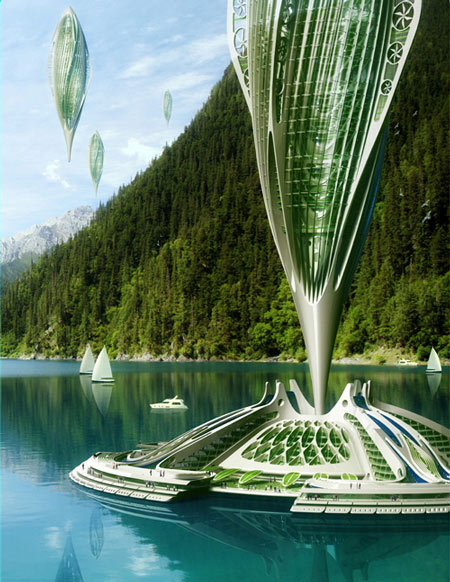
The hub is a floating algal farm. The farm and the elongated seed-shaped airship docked at its centre both produce biofuel—essentially hydrogen—from the microorganism Chlamydomonas reinhardtii. Your mom, a former environmental consultant and algal scientist—now she writes science fiction—explained to you that this unicellular organism has both plant and animal properties; it carries out photosynthesis but is also heterotrophic (able to use organic carbon to grow) and will in the absence of oxygen produce gaseous hydrogen and metabolites such as formate and ethanol through hydrogenase enzymes. Chlamydomonas reinhardtii was first discovered as a clean source of hydrogen back in 1939 by German scientist Hans Gaffron at the University of Chicago (ironically the same year Germany invaded Poland). Gaffron called it “photosynthetic hydrogen production by algae”; and today it is a process that produces electricity and biofuel with zero emissions.
The algae farm recycles CO2for the bio-hydrogen airship you will be boarding after your meeting in the hub. You enter the airy station, whose honeycomb circular design resembles a stylized lily pad and glance up through the high nano-glass ceiling toward the elongated seed-shaped transport rising ten stories above you. The sun glances off the diaphanous double helix frame that resembles a freshwater spirogyra. The hub you’re standing in is a floating algae farm with solar cells on top and hydro-turbines below to capture tidal energy. The algae farm recycles CO2 for the bio-hydrogen airship you will be boarding after your meeting in the hub. You enter the airy station, whose honeycomb circular design resembles a stylized lily pad and glance up through the high nano-glass ceiling toward the elongated seed-shaped transport rising ten stories above you.
The sun glances off the diaphanous double helix frame that resembles a freshwater spirogyra. The hub you’re standing in is a floating algae farm with solar cells on top and hydro-turbines below to capture tidal energy.
The concept is the “subversive architecture” of Belgian architect Vincent Callebaut and inspired by the principles of biomimicry, coined by Janine Benyus in 2002 in her book “Biomimicry: Innovation Inspired by Nature”. Callebaut conceived Hydrogenase in 2010 as a 100% self-sufficient and zero-emission transport system using algae. He claimed that a hectare of seaweeds could produce 120 times more biofuel than a hectare of colza, soya or sunflower without consuming land needed for crops or forests. He called Hydrogenase a true miniature biochemical power station. Able to absorb CO2 as the main nutrient through photosynthesis the algae, under anaerobic conditions, produce hydrogen in vitro or in bioreactors.
You swipe your PAL over the ticket booth sensor and the optional ticket-brochure pops out. You take it and read the specs between glances at the tall vessel loading in the dock of the hub. It’s really like a vertical dirigible, you think, studying the seed-shaped airship with self-cleaning “intelligent” nanostructured glass—inspired by the lotus leaf that doesn’t get wet. The semi-rigid unpressurised airship stretches vertically around an arborescent spine that twists like chloroplast ribbons 400 meters high and 180 meters in diameter.
You read that each Hydrogenase airship is covered with flexible inflatable photovoltaic cells and twenty wind turbines to maneuver and collect energy. The interior spaces provide room for housing, offices, scientific laboratories, and entertainment, and a series of vegetable gardens that provide a source of food while recycling waste.
You read that this self-sufficient organic transport flies about 2000 meters high at about 175 km/hr (twice the speed of a conventional ship). Given its ease in negotiating airspace and its ability to land and take off from virtually any location, the Hydrogenase is used by many groups in various capacities. Your friend Michael who teaches at the University of Victoria uses one as a mobile research station in his studies along the coast of northern British Columbia.
The vessel is made of “intelligent layers” and “self-separable ceramics”. Its bionic coating draws inspiration from sharkskin that is self-cleaning and flow-efficient.
Hydrogenase concept with algal farm pods and air ships
You head down the spiral staircase to the third subsea level toward the meeting room you booked earlier on your PAL. The view is spectacular from here through the nano-glass panes. Rays of shimmering light stream through a gently swaying forest of kelp. You glimpse the sun-glinted flickering of hundreds of anchovies as they school through the kelp. This floating farm is an organic purifying station of four carbon wells where the algae recycle the carbonated waste brought by the airships and, in turn, feed the airship with biohydrogen. It’s the new “gas station”, you reflect with a smile.
After your meeting with staff, you and three others of your team board the airship and settle in one of the skyview chambers. The journey is relaxing, like the BC Ferry used to be, but without the pungent smell and pollution of conventional motorized sea vessels. It’s a quiet and relaxing trip with a spectacular view of the Gulf Islands. Your team strategizes your presentation over a light lunch and Matcha lattes.
Vincent Callebaut’s Hydrogenase
The PA system sounds and a woman’s voice informs you that the ship will be making an emergency landing on Saturna Island to rescue two hikers injured at East Point. This will only add twenty minutes to the trip, the woman assures you. You don’t mind and recall the disclaimer at the bottom of the ticket. Given the ability of this airship to take off and accurately land virtually anywhere, all Hydrogenases are by law mandated to be on standby for rescue missions in rough terrain.
You pull out the ticket and read again: The Hydrogenase is affiliated with the International Red Cross and BC Coastguard. The Hydrogenase must by law respond to any distress call at sea or rough terrain associated with coastal waters. Because of this service, we cannot guarantee a timely schedule.
You recall how Hydrogenases were deployed in the last hurricane disaster off the coast of Florida last year, saving countless people trapped in the flooding that accompanied the storm. The International Red Cross uses them as flying hospitals.
Bernard frets over the time delay. He is concerned about the lack of preparation and set up time once you get into Victoria. You assuage him gently. The best preparation is sincerity, you tell him. The landscape architect Thomas Woltz, whose work you highly respect, saw himself as someone who embraces the complexity of modern life while seeking meaning and narrative in both natural and human-made environments.
“We’re storytellers,” you tell Andre. Invoking metaphor through design. “They know we’re coming and they know we’re helping someone; they’ll wait for our story. And it’s all about harmony.”
The lines of Henry David Thoreau come to you: Man’s life must be of equal simplicity and sincerity with nature, and his actions harmonize with her grandeur and beauty.
Then you point your PAL at the ServiceBot and order three more lattes. You lean back in your bamboo fabric chair and cross your legs over the leg rest.
It’s a brave new world.
Pine forest in Jackson Creek Park, ON (photo and dry brush rendition by Nina Munteanu)
Nina Munteanu is a Canadian ecologist / limnologist and novelist. She is co-editor of Europa SF and currently teaches writing courses at George Brown College and the University of Toronto. Visit www.ninamunteanu.ca for the latest on her books. Nina’s bilingual “La natura dell’acqua / The Way of Water” was published by Mincione Edizioni in Rome. Her non-fiction book “Water Is…” by Pixl Press(Vancouver) was selected by Margaret Atwood in the New York Times‘Year in Reading’ and was chosen as the 2017 Summer Read by Water Canada. Her novel “A Diary in the Age of Water” was released by Inanna Publications (Toronto) in June 2020.
“Every story is a story of water,” says Mojave American poet Natalie Diaz.
In her article on Diaz, Maria Popova reiterates, “we ourselves are a story of water—biologically and culturally, in our most elemental materiality and our mightiest metaphors.”
There is a reason that women are recognized worldwide as water keepers. Women are intimately connected with flowing water; everything about us is flowing: from our menstrual and birthing waters to the waters of our nurturing milk and the tears we shed for our lost ones. We flow with life and it flows out of us.
The water walk with Grandmother Josephine along Lake Ontario in 2019 (photo by Nina Munteanu)
So, when Lake Erie became a person with rights in February 2019, this landmark designation came with both triumph and some irony to womankind and water keepers around the world.
Based on that quote, it would seem that only men did the trammelling (given that women are not included or the more correct term would be “human”). It was only a hundred years ago, in 1920, that the 19thAmendment granted women legal personhood in the United States; and in that amendment Native American women were not included—until years after. In her poem Lake-loop, Mojave poet Natalie Diaz explored “how that nesting doll of exclusions breaks open into the living reality of this Earth”:
“Part of the San Andreas fault runs along the Mojave Desert. We see and feel the fault, it has always been a part of Mojave stories and geography. We have always existed with it–in rift–part land. We are land’s action, maybe. I am always wondering and wandering around what it means to be part of this condition, in shift. What it means to embrace discontinuity, to need it and even to need to cause it in order to be–depression but also moving energy. The necessary fracturing of what is broken. The idea of being made anything or nothing in this country–“to be ruined before becoming”–the idea that this country tried to give us no space to exist, yet we made that space, and make it still–in stress, in friction, glide and flow, slip and heave. We are tectonic, and ready.”
NATALIE DIAZ
The Earth is indeed shifting. As are we. If we are to survive, that is. This will come with a connection with Earth’s natural rhythms. We haven’t been doing that very well, particularly under an “othering” capitalist, exploitive, hubristic dogma. It’s time to ride the swells and turbulence of a Nature evolving. And co-evolve; or get left behind. We can learn much from the stories of our Indigenous relatives. We can learn much from the stories of our non-human relatives too.
That’s what climate change is: a new story. And that story is all about water.
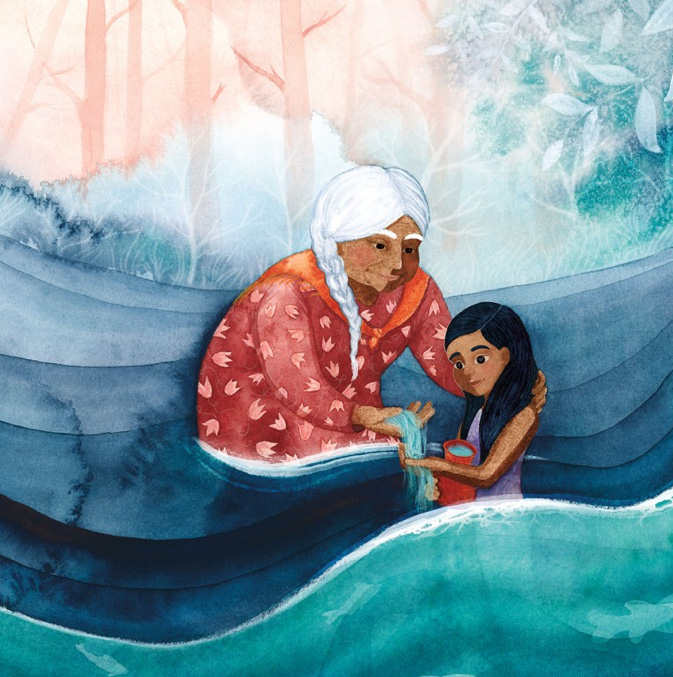
Grandmother with young water keeper (illustration by Michaela Goade)
For this World Water Day, I share with you a wonderful story of water keepers and the water we keep safe. Author Carole Lindstrom, member of the Turtle Mountain Band of Ojibwe, and artist Michaela Goade, member of the Central Council of the Tlingit Haida Tribe of Alaska. have produced “We Are Water Protectors”, a lyrical illustrated celebration of cultural heritage and the courage to stand up for nature.
“Yours is a grave and sobering responsibility, but it is also a shining opportunity. You go out into a world where [human]kind is challenged, as it has never been challenged before, to prove its maturity and its mastery–not of nature but of itself. Therein lies our hope and our destiny.”
RACHEL CARSON
Today is World Water Day…
I exhort you to do something for water today. Plant a tree (they love water and water loves them). Clean up a local stream or lakeshore. Write a letter to a government official about protecting your watershed. Research something about water and share with someone. Share your watermark on the WatermarkProject.ca site. Buy We Are Water Protectors and share it with someone or give it away. Or buy Silent Spring and share it with someone who hasn’t read it yet.
Keep it flowing…
Nina Munteanu is a Canadian ecologist / limnologist and novelist. She is co-editor of Europa SF and currently teaches writing courses at George Brown College and the University of Toronto. Visit www.ninamunteanu.ca for the latest on her books. Nina’s bilingual “La natura dell’acqua / The Way of Water” was published by Mincione Edizioni in Rome. Her non-fiction book “Water Is…” by Pixl Press(Vancouver) was selected by Margaret Atwood in the New York Times‘Year in Reading’ and was chosen as the 2017 Summer Read by Water Canada. Her novel “A Diary in the Age of Water” was released by Inanna Publications (Toronto) in June 2020.
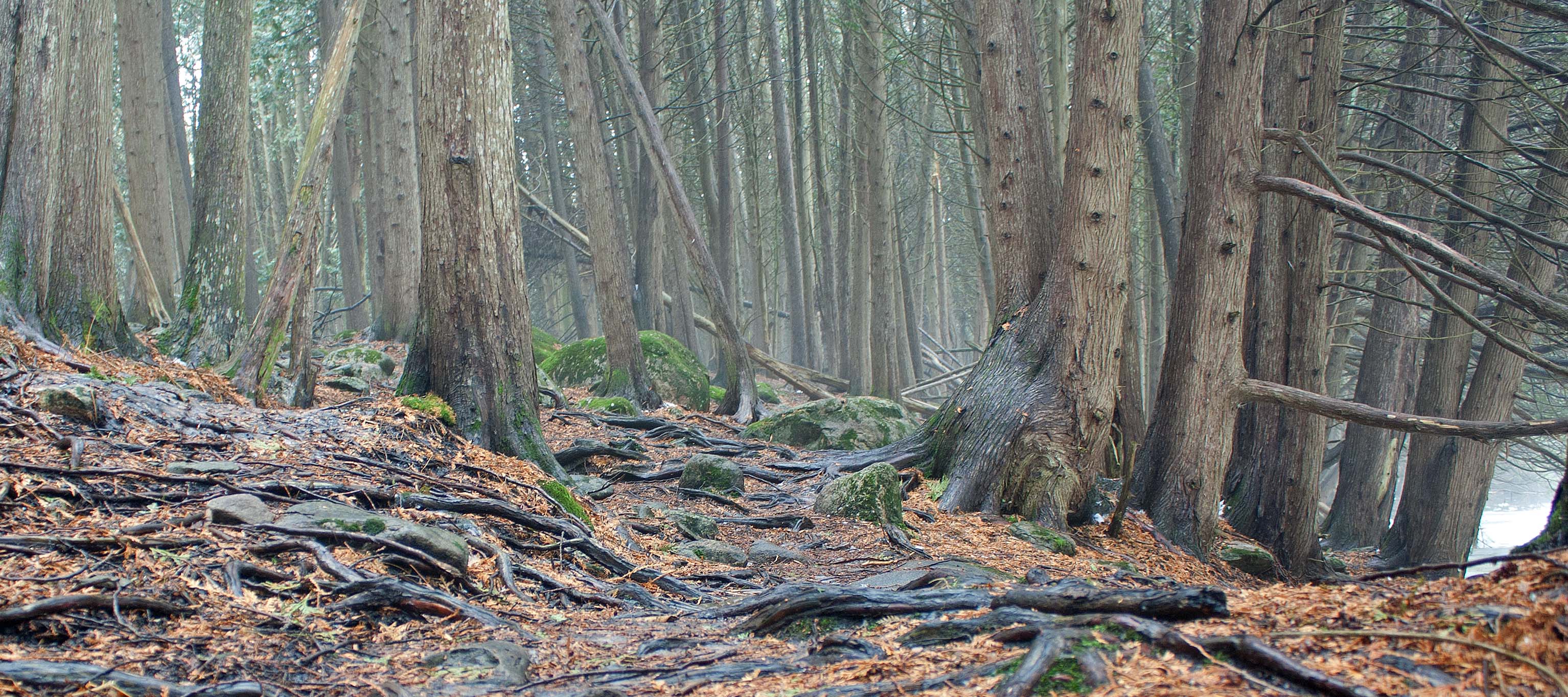
Cedar forest and extensive roots amid glacial erratics flank Jackson Creek on the right, ON (photo by Nina Munteanu)
.
It was a cold November day, after a light snow, as I wandered the Jackson Creek old-growth forest. Centuries-old cedar, pine and hemlock towered above me, giving off the fresh scent of forest. The trees creaked and cracked, swaying in a mischievous wind. I left the main path and descended the leaf-strewn slope toward the river. My boots pressed through a frosty crust into the spongy ground of dead leaves and organic soil. I stopped and breathed in the fresh coolness of the air. A damp mist huddled among the trees, adding wisps of mystery to the ancient forest. It was as though I’d entered an enchanted forest in some fanciful fairy tale.
Cedar forest on slope of Jackson Creek Park in early winter, ON (photo by Nina Munteanu)
.
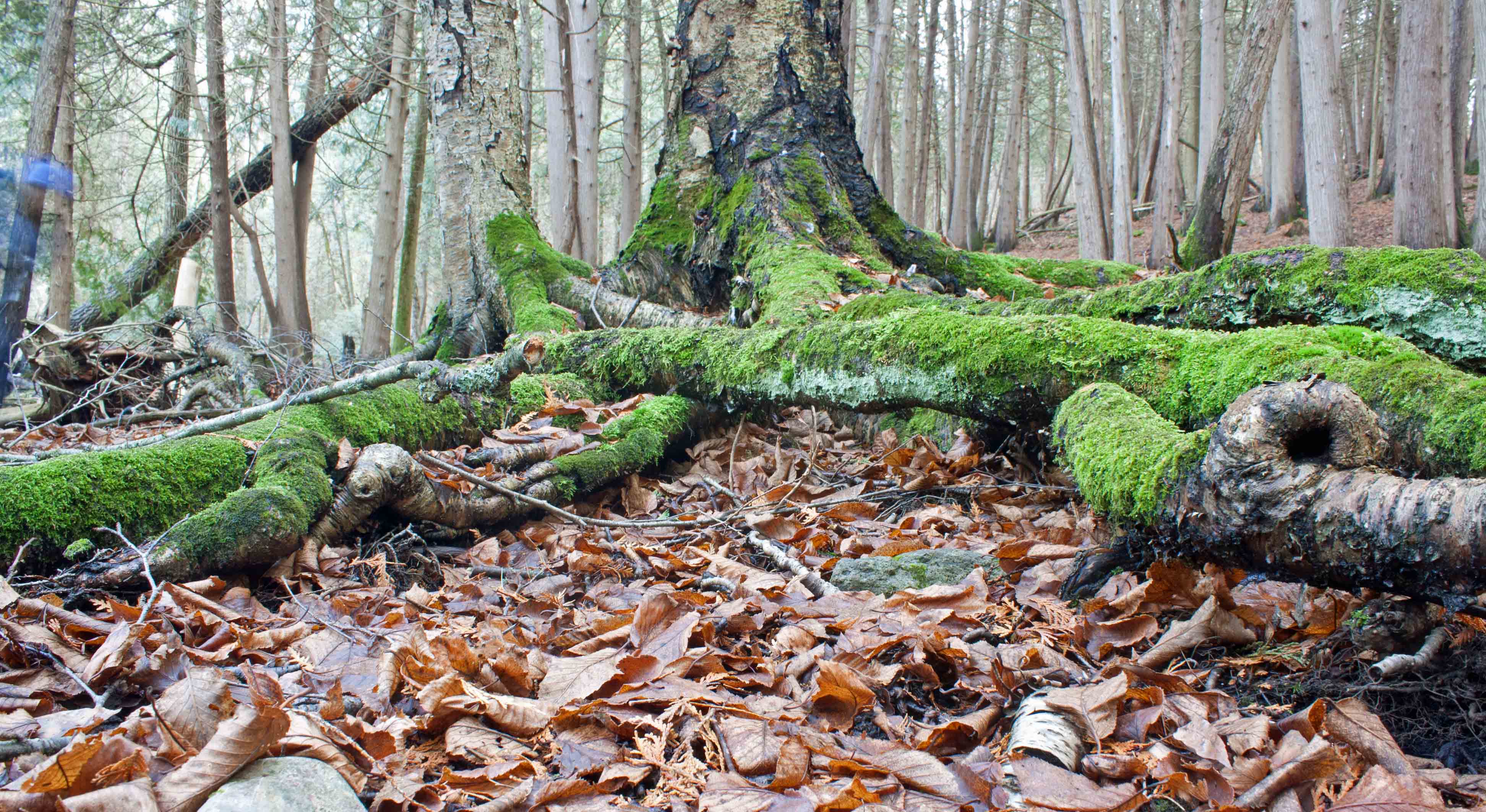
Not far from the river, I approached an old yellow birch tree, large trunk rising as tall as some of the cedars and pines around it. Golden flakes of bark curled and formed craggy patterns around the girth of the old tree. Radiating out from the tree, moss-covered roots snaked out like tangled ropes in a profusion of brilliant green. This was fairy country, I suddenly thought.
I dropped to my knees, crouching down, and set up my tripod and camera to capture this magical tree from the perspective of the forest floor. Head almost touching the ground, I inhaled the scent of loam and decaying leaves. The fresh pungency of cedar, pine, and humid moss hung in the air. Nearby, the river chortled and bubbled in a content symphony of motion. A curious red squirrel parked itself on a log nearby to watch me. It didn’t scold me like they normally did when I entered the forest; like it understood… It then occurred to me, as I set up my equipment under the squirrel’s careful stare, that I was in the presence of an enchantment. Like I was peering into a secret dance of feral celebration. But being there and appreciating it, I had now become part of it; I was Alice going down the rabbit hole into a true wonderland…
It was then that I glimpsed it as I carefully took my timed pictures. A blur of blue. What had I witnessed? A motion? A colour? Then it was gone. But in that moment, I’d felt the spark of an elation that comes with a glimpse into a secret world.
Old yellow birch tree and moss-covered roots with approaching blue sprite from left (photo by Nina Munteanu)
.
When I returned home to look at the images I saw that my camera had captured a wispy blue entity that flowed into its view and peered around the old birch at me with a kind of curious though mischievous grin.
Had I just captured a blue sprite? Something was unmistakably there!
Forest sprite peers around a yellow birch tree, Jackson Creek Park, ON (photo by Nina Munteanu)
.
I read up on sprites. According to European lore, a sprite is a supernatural entity. They are often depicted as fairy-like creatures or as an ethereal entity. The word sprite comes from the Latin spiritus (“spirit”), via the French esprit.
Given that the sprite I’d observed was blue and we were close to the river, I wondered if it was not a forest or wood sprite, but a water sprite. According to alchemist Paracelsus, the term ‘water sprite’ is used for any elemental spirit associated with water. They can breathe water or air and sometimes can fly. They also possess the power of hydrokinesis, which is the ability to create and manipulate water at will. Also known as ‘water nymphs’ and naiads (or nyads), these divine entities tend to be fixed in one place. Slavic mythology calls them vilas. Sprites are not corporeal beings (like selkies, mermaids and sirens) given that they are not purely physical; they are more like local deities than animals. This explained the wispy nature of the being I’d seen peering at me from the tree.
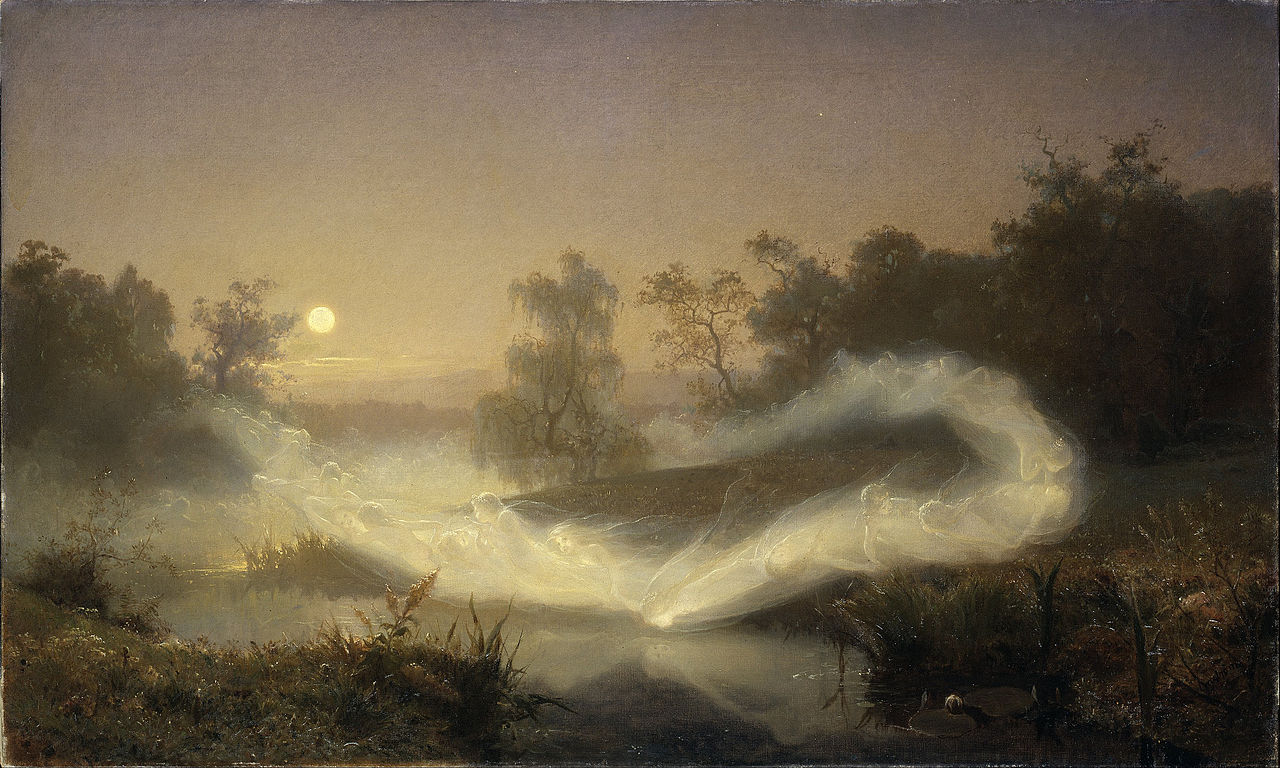
“Dancing Fairies” by August Malmström
.
After consulting with several friends—some who purported to know much more about sprites than I did—I concluded that this sprite was, in fact, a forest sprite and it was blue because it was near the water. Friend Merridy suggested that “forest sprites, normally green, may turn blue if a nearby brook calls to them.” She added that “water sprites can be distinguished by their chatty nature. They rarely go beyond the banks of a river or brook. Forest sprites are mostly silent.” Which this one certainly was. Friend Craig then pondered, “Are digital sprites in our world or in an electro-magnetic world? Or something else?” He was referring to them showing up on my camera without me even noticing they were there. When I told him I would return in search of them he observed, “if you’re looking for them that might be when they hide. Or maybe not. Any type of sprite is probably good, mischievous or friendly.” Thanks, Craig! That was helpful…
Glacial erratic boulders in Jackson Creek, ON (photo by Nina Munteanu)
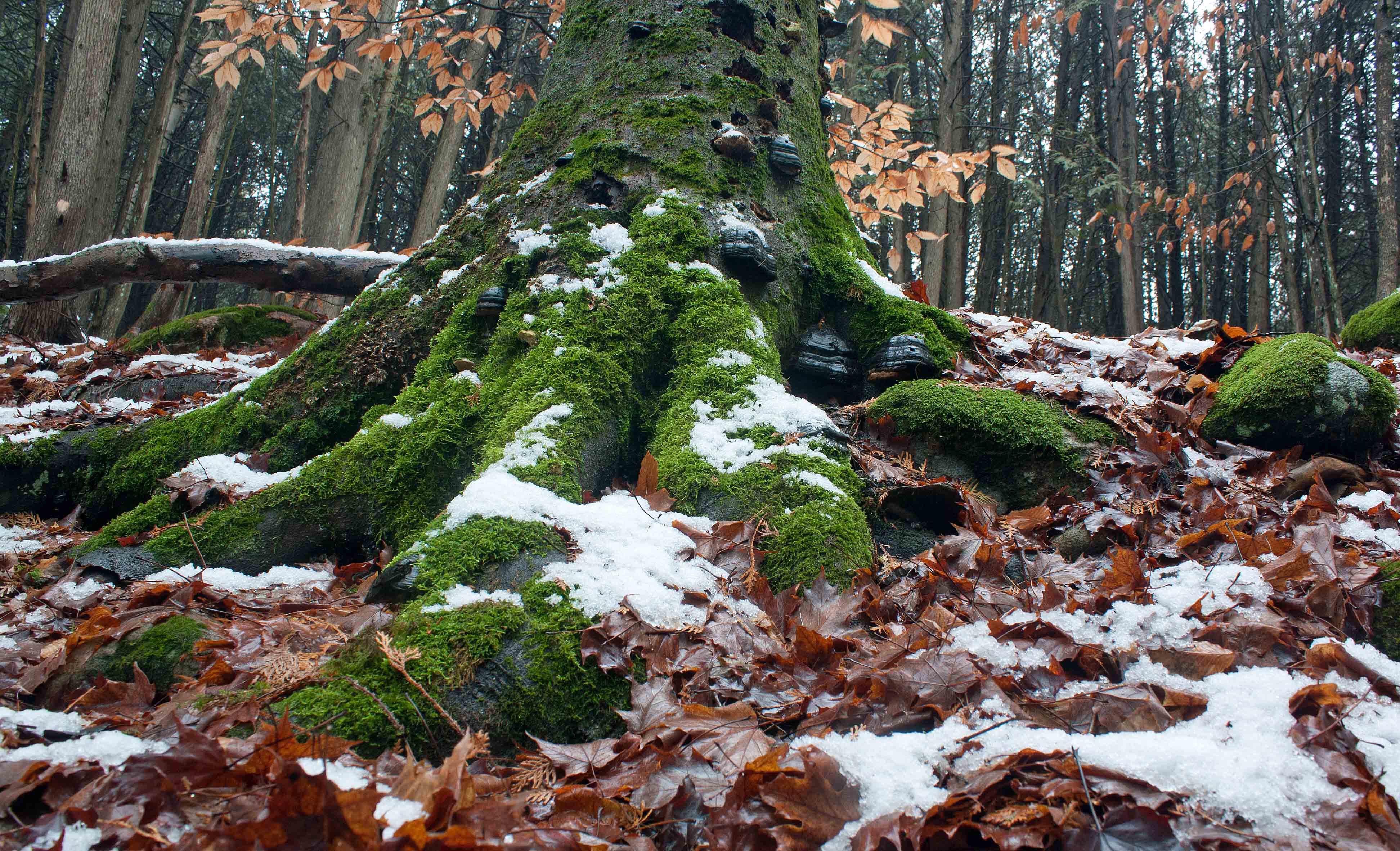
Century-old beech tree, decaying and moss-covered in early winter, Jackson Creek Park, ON (photo by Nina Munteanu)
Ancient cedar tree stands next to an ice sheet on the path beside Jackson Creek, ON (photo by Nina Munteanu)
.
I visited the forest many times after but saw no sign of any sprites. Perhaps Craig was right; they were hiding from me.
Then, on a foggy late December day, after a light dusting of snow, I returned to document the ice forming in the river. Islands and columns of ice had created a new topography for the flowing waters of Jackson Creek. Ice sheets also covered the forest path in places—making the walk somewhat treacherous. At times, I had to scramble and seize hold of branches to haul my way up precipitous banks from where I’d captured sculptures of ice ‘pearls,’ ‘platforms,’ and ‘columns’ on the river.
Ice forming on Jackson Creek in early winter, ON (photo by Nina Munteanu)
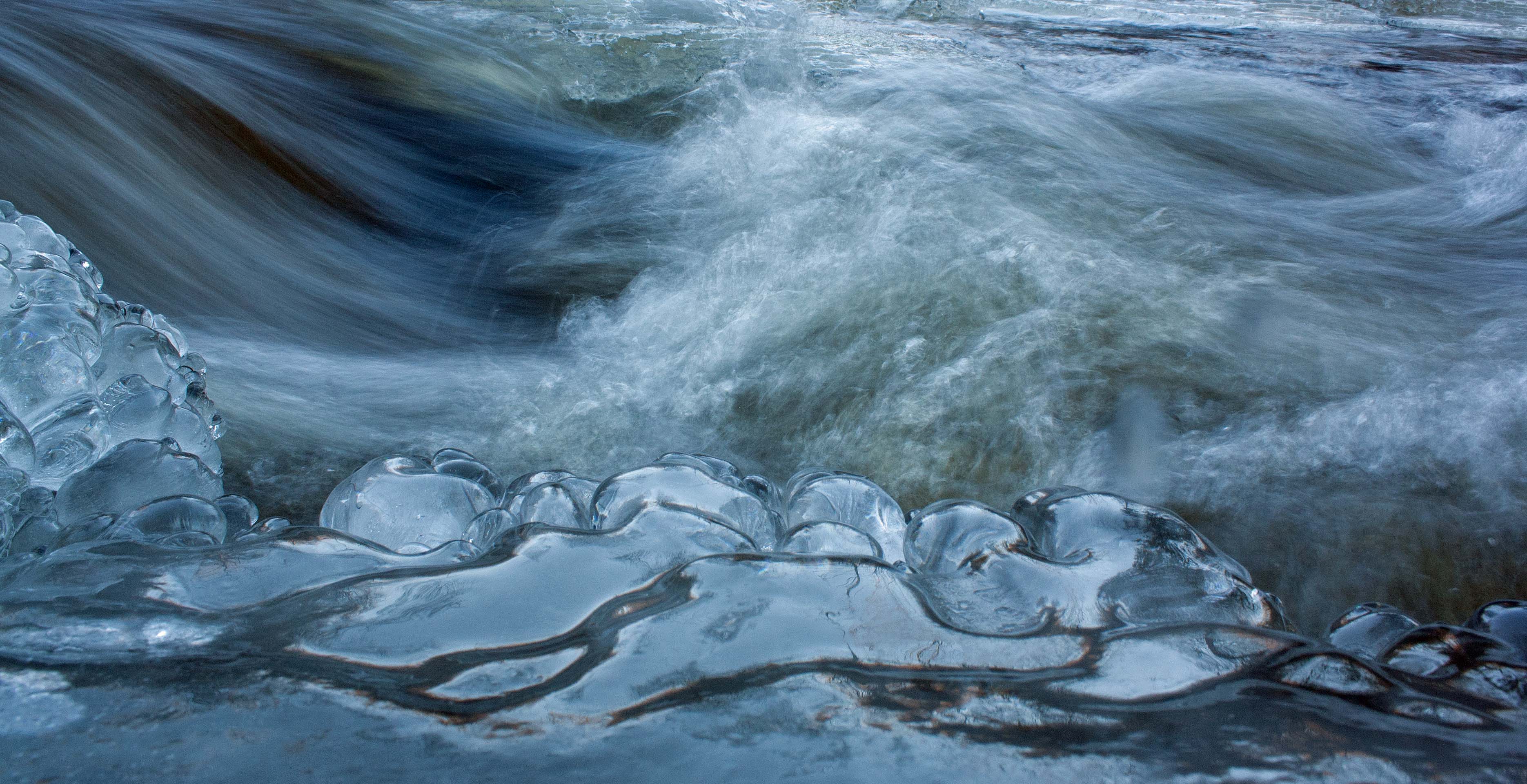
Ice ‘pearls’ forming on shore by rushing river, Jackson Creek, ON (photo by Nina Munteanu)
.
The fog grew thick as my walk eventually led me into an area of eccentric lopsided cedars in a ‘drunken’ stand by the river bank. The cedars sent out a tangled tapestry of gnarly roots I had to negotiate. I could feel the earth-magic. I dropped to my knees again and set my camera and tripod to the level of the roots. That is when I saw the blue sprite again! This time the sprite wasn’t playful; it appeared startled and disoriented. But, I managed to capture it as it fled the scene in wisps of blue smoke. As I left the forest, my thoughts returned to this serendipitous moment. Had I interrupted the wood /earth sprite in its work in the forest? These sprites are known to have the power of chlorokinesis, the ability to grow and control plants at will. When I checked my images at home, the sprite appeared to float near one of the cedars.
Blue forest sprite floats by cedar tree, Jackson Creek Park, ON (photo by Nina Munteanu)
.
When she saw the image, friend Merridy asked, “was the sprite entering the tree?” Thinking of incantations, friend Dyana asked if I’d had my recording feature on, which I’d never thought to do. On second thought, she decided that it might be dangerous. Not a good idea to anger a sprite. Friend Gabriela then challenged me: “did you ask what message they have for you, Nina? They keep showing up in your way, they might have a message for you or to be delivered through you to…” whoever… I hadn’t thought of that either. How would I hear their message when they were silent and so fleeting, I challenged back. She wisely responded, “Just ask yourself the question; you might be surprised when your next thought brings the answer. Since everything is energy, and you saw them at least twice, you’re probably connected with them.”
Sprite vaporizes behind tree, Jackson Creek Park, ON (photo by Nina Munteanu)
.
I didn’t tell her that the question that came to mind after seeing the sprite was: I wonder what’s for dinner!
I must ponder this more, however.
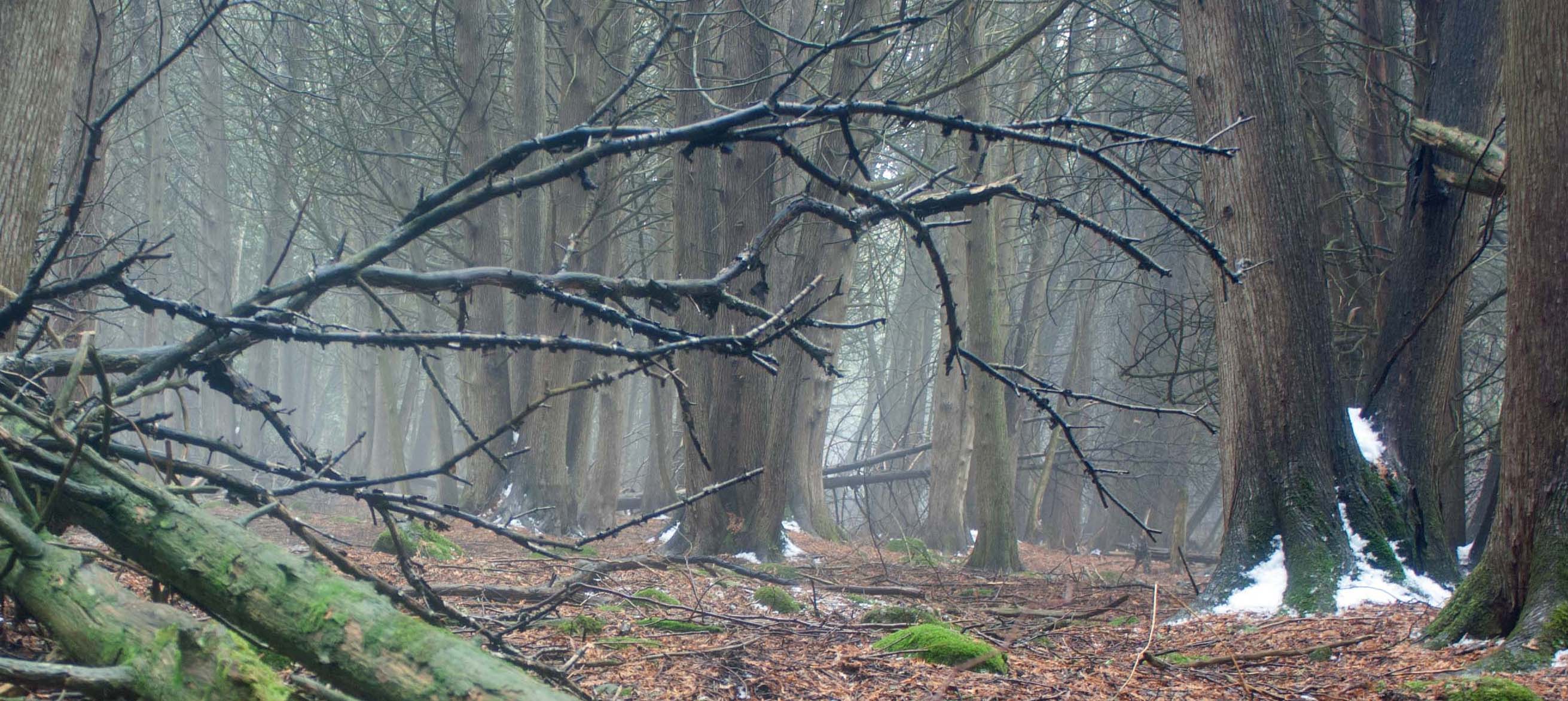
Cedar forest on a misty winter day, Jackson Creek Park, ON (photo by Nina Munteanu)
Thinking of Gabriela’s interesting remark, I am reminded of a rather sad but evocative tale by Vladimir Nabokov entitled “The Wood Sprite.” Told in the first person, it recounts the narrator’s experience when he was visited at his desk by an old wood sprite, “powdered with the pollen of the frosty, starry night.” The creature tells of his exile from a country wood in Russia, all cut down and burned amid the treachery of war.
Now that I think of it, I know the blue sprite’s message. And now you know it too.
Cedar forest and roots amid glacial erratics in Jackson Creek Park, ON (photo by Nina Munteanu)
Nina Munteanu is a Canadian ecologist / limnologist and novelist. She is co-editor of Europa SF and currently teaches writing courses at George Brown College and the University of Toronto. Visit www.ninamunteanu.ca for the latest on her books. Nina’s bilingual “La natura dell’acqua / The Way of Water” was published by Mincione Edizioni in Rome. Her non-fiction book “Water Is…” by Pixl Press(Vancouver) was selected by Margaret Atwood in the New York Times‘Year in Reading’ and was chosen as the 2017 Summer Read by Water Canada. Her novel “A Diary in the Age of Water” was released by Inanna Publications (Toronto) in June 2020.




























 Nina Munteanu Writing Coach