Apex Magazine Interviews Nina Munteanu About Story, Ecology, and the Future—Part 2

Issue  #128 of Apex Magazine featured an interview that Rebecca E. Treasure did with me, posted on December 10, 2021. We discussed the power of story, the use of dystopian narrative, and the blur between fiction and non-fiction to create meaningful eco-fiction. Here’s part two of the interview. For the complete interview go here:

INTERVIEW

Nina Munteanu, author of “Robin’s Last Song,” is a prolific creator with multiple books, podcasts, short stories, and nonfiction essays in publication. Her work spans genre, from eco-fiction to historical fantasy to thrillers, and of course, science fiction. Her work as an ecologist informs all of her writing, which circles around an essential exploration; the relationship between humanity and our environment.

 At the top of Nina Munteanu’s website, there is a quote: “I live to write, I write to live.” This sentiment is reflected in her fiction, which is not just about characters in compelling situations solving their problems with compassion, but is about all of us, our planet, our environment, and our future.

Nina Munteanu sat down with Apex for a conversation about story, ecology, and the future.

APEX MAGAZINE: Your novels and short stories examine the role and evolution of humanity in the context of nature and technology. As an ecologist, what do you believe needs to happen—internationally, nationally, locally, and personally—to restore our planet and move forward in a sustainable way?

NINA MUNTEANU: All things animate and inanimate naturally oscillate toward equilibrium or balance in a kind of stable chaos of polarities. Goethe and Hegel told us this long ago. Our actions have exacerbated this oscillation through massive extraction, habitat destruction, and pollution with associated conflicts, take-over and subjugation. Everything is connected and all have contributed to climate change and habitat change. Our mission—given that we’re responsible for much of that imbalance—is to help the planet return itself to balance. That means ensuring that Nature’s natural checks can do their job to ensure functional forests and phytoplankton, a healthy ocean, a resilient biodiversity—all systems that we rely on for our own healthy existence. Restoring our denuded global forests, and the oceans will need the concerted and united efforts of all nations and individuals. We have the knowledge, the science, and technology; all that is needed is the will. And that can only change as our own narrative changes. That’s where storytelling plays a key part. Surveys have proven that fiction can be deeply persuasive through character journey that convinces at a deeper more emotional level (as opposed to a litany of facts that appeals only at an intellectual level).

AM: Do you believe industry and sustainability are compatible? What about colonialism and sustainability? Capitalism? In other words, is sustainability something we can achieve with our current systems, or is global systemic change required?

NM: Some people—mostly economists—would say definitely yes to the first question; we just need to be conservationist in our approach to doing business. But the very basis of capitalism is exploitation, not conservation. The driving force behind capitalism is fear and uncertainty and its main process is exploitation. From an ecologist’s perspective, this makes sense for a community during its early succession and growth stage …  when it first colonizes a new area. Ecologists call this approach r-selected (for rate), based on the need to be profligate and fast-growing to successfully establish. But as we reach a climax community and our carrying capacity—where we are now—this r-selected approach no longer works. We need an economic model that better matches this new paradigm. NOT based on continued growth! A climax global economy, one based on cooperation not competition. Elisabet Sahtouris calls this ecological economy “ecosophy.” In his book Designing Regenerative Cultures, Daniel Christian Wahl talks about changing our evolutionary narrative from one based on fear defined by a perception of scarcity, competition, and separation to one based on love defined by a perception of abundance, a sense of belonging, collaboration, and inclusion. He promotes a regenerative economy based on true reciprocation.

And moving forward we can take a lesson from Robin Wall Kimmerer who promotes a gift economy—an economy of abundance—whose basis lies in recognizing the value of kindness, sharing, and gratitude in an impermanent world. This is what she says: “Climate change is a product of [our] extractive economy and is forcing us to confront the inevitable outcome of our consumptive lifestyle, genuine scarcity for which the market has no remedy. Indigenous story traditions are full of these cautionary teachings. When the gift is dishonored, the outcome is always material as well as spiritual. Disrespect the water and the springs dry up. Waste the corn and the garden grows barren. Regenerative economies which cherish and reciprocate the gift are the only path forward. To replenish the possibility of mutual flourishing, for birds and berries and people, we need an economy that shares the gifts of the Earth, following the lead of our oldest teachers, the plants.”

AM: The language in your stories is richly thematic, using strong description to weave the subtext into the piece. For example, “killing two squirrels with one stone.” Is that something that comes about organically as you compose a piece, or a more intentional part of editing?

NM: I use both processes to achieve a final narrative that is multi-layered with metaphor, symbols, and deep meaning. The first process is through intuition derived through intimacy; the second process is more deliberate and generated through objectivity. Insights from intimacy come about organically, during moments of true inspiration, when my muse connects me to the deeper truth of a character’s voice and actions. Given that the inner story runs many layers (some of which I, as writer, may not even be overtly aware) and links in a fractal relationship with the outer story, those moments of inner inspiration happen as if of their own accord. That’s what writers mean when they admit that their characters “talk” to them and instruct them on what to write. When a writer achieves that level of intimacy and understanding, they can let the muse guide them.

Much of the description that is woven into story is generated through the editing process when I read the manuscript as a reader. The process involves letting the story sit for a while so when I return to it, I am reading more objectively. During this process, I apply my knowledge in storytelling craft to showcase combustible moments in plot, and work in foreshadowing, subtext, and compelling metaphor. A writer can’t add metaphor without context related to story theme (otherwise this may result in what the industry calls “purple prose”). Metaphor—given its roots in the deeper psyche of a culture—must arise organically from a deep, sometimes intuitive, understanding—where the personal meets the universal.   

AM: Your work takes complex topics that are nonetheless critical to humanity’s future and pulls stories with compelling characters out of them, making the science accessible, the warnings personal to the reader. This has always been one of the callings of science fiction. What is the role of stories in the climate action movement?

NM: Our capacity and need to tell stories is as old as our ancient beginnings. From the Paleolithic cave paintings of Lascaux to our blogs on the internet, humanity has always shared story. Story is powerful in how it helps us define who we are, what’s important to us, and where we are going. Stories compel with intrigue, stir our emotions, connect with our souls through symbols, archetypes and metaphor. Stories inspire action. We live by the stories we tell.

For too long, our stories have promoted a dominant worldview of exploitation and capitalism. We’ve been telling the patriarchal story of “othering” for too long; we need a new voice and a new worldview to replace our old stories of conquering and taming a “savage land” and “savage people.” When Copernicus proclaimed in 1543 that the sun did not revolve around the Earth, it took a long time for the world to accept and let go of its Ptolemaic Earth-centered view. But the world did come around eventually to the point now that this is common knowledge and lies embedded in our daily lives and language.

Storytelling about how the Earth takes care of us and how we can take care of Earth is urgently needed. This means shifting our stories from an exploitive capitalist narrative of separation toward an inclusive partnership narrative. This means embracing a more eco-centric worldview; a worldview in which humanity is not central, but lies embedded within greater planetary forces and phenomena. A worldview that sees humanity only as part of a greater entity, as participant in a greater existential celebration of life and the elements. A humanity that must learn to play along, not bully and take over. A humanity that must embrace compassion, respect and kindness; a humanity directed by humility—not hubris. It is my firm belief that until our worldview embraces humility in partnership with the natural world—until we cast off our self-serving, neo-liberal, capitalist ideologies—we will remain hampered in our journey forward. When we change our stories, we change our lives and we change the world along with it.

This is already happening with the emergence of a strong eco-voice by writers through the feminine voice, the gylanic voice, the voice of the marginalized, of ecology and the environment itself. Authors such as Barbara Kingsolver, Annie Proulx, Margaret Atwood, Richard Powers, Emmi Itäranta Cherie Demaline, Grace Dillon, and Cormac McCarthy give Nature a face and voice to care about. And caring is the first step.

AM: Your stories also bridge fiction with nonfiction, using speculative fiction as a lens to bring your subject into focus for the reader. How does that work? Why do you approach story in this way?

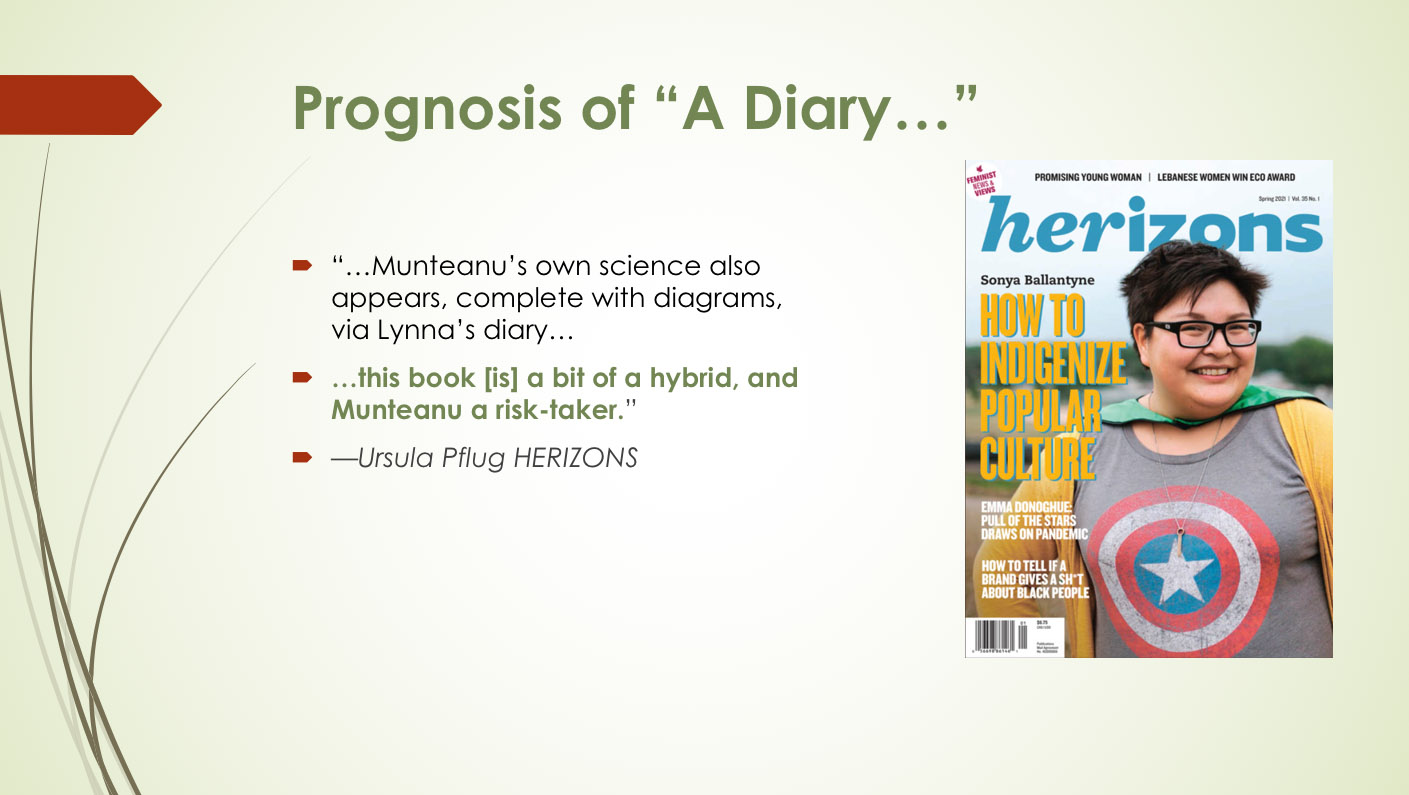
NM: Marcie McCauley with Temz Review observed that, “[Munteanu] does not appear to view fiction and non-fiction as separate territories; or, if she does, then this book [A Diary in the Age of Water] is a bridge between them.” In Herizons, Ursula Pflug called the book “a bit of a hybrid, and Munteanu a risk-taker.” Buried in Print wrote of the same book, “ultimately it exists in an in-between place, some mystical elements of the generational tale possibly alienating the dedicated science-y readers and the instructional elements possibly alienating fiction devotees. And, yet, I read on: strangely compelling.”

I find that I enjoy this in-between place that blurs fiction with nonfiction. It’s more edgy, gripping, and believable, albeit fantastical, even playfully challenging at times. For instance, I may subvert facts, creating semi-facts to tease the discerning reader (e.g. when the diarist in “A Diary in the Age of Water” observed that President Trump had gone blind from staring at the sun during an eclipse; while Trump did stare directly at the sun without eye protection during an eclipse in 2017, he did not go blind—yet). Readers have told me that the story was more impactful; they honestly didn’t know what was taken from fact and what was fictionalized. Such narrative reads like a true story and there is little more tantalizing than eavesdropping on another’s real experience and intrigue. The risk—that the blur will either confuse the reader or invalidate its truths and message—is hopefully addressed through compelling narrative that engages the reader. But this is also why I tend to include an extensive bibliography at the end of a novel or short story.

Readers have told me that my fiction/nonfiction storytelling trope, like “mundane science fiction,” grips my stories with a more keen sense of relevance. Given that I am writing mostly climate fiction and eco-fiction these days, that sense of relevance is exactly what I wish to achieve. 

AM: A last question. Both “The Way of Water” and “Robin’s Last Song” showcase the relationships women have with each other, the importance of human connection, the damage that disconnecting from each other can do and, inversely, the power of connection. In your view, what is the role of individuals and local communities in the climate crisis?

NM: There are many things we can do as individuals and as part of a community. I was recently asked this question by the Toronto Star and I responded with three things:

●      First, plant a tree; make an actual difference through action. By doing that, we get out from hiding under the bed and face the monster of climate change and show that we care and that we are not alone.

●      Second, vote for green politicians. Politicians need to hear directly from their communities. They need you to push them to act on climate change.

●      Third, find your tribe and create a movement. Everyone says that people have the power, but that power comes best through numbers and solidarity. Find your tribe and you’ll find yourself more motivated. So, start with you and your home: plant trees; put in a rain garden; put in permeable driveways and solar panels; lower meat intake, especially beef; don’t buy bottled water. Then connect with your physical community and social media community. Let them know what you’re doing and why. Work with your community. All members of a community can help change how your street looks and behaves by communicating with your local government, attending meetings, and having a voice. Initiate a tree-planting program in your parks and street greens. Do stream or lake cleanups. Let the leaders of your community know you care and are willing to do something about it. The wave of change starts local and ripples out into a global phenomenon. Change comes from the heart and heart is where the home is.

For the entire interview, go to Apex Magazine, December 10, 2021.

Birch trees and marsh on a foggy morning in winter, ON (photo and rendition by Nina Munteanu)

Rebecca E. Treasure grew up reading science fiction and fantasy in the foothills of the Rocky Mountains. After grad school, she began writing fiction. Rebecca has lived many places, including the Gulf Coast of Mississippi and Tokyo, Japan. She currently resides in Texas Hill Country with her husband, where she juggles two children, two corgis, a violin studio, and writing. She only drops the children occasionally. To read more visit www.rebeccaetreasure.com.
NINA MUNTEANU is a Canadian ecologist / limnologist and novelist. She is co-editor of Europa SF and currently teaches writing courses at George Brown College and the University of Toronto. Visit  www.ninamunteanu.ca for the latest on her books. Nina’s bilingual “La natura dell’acqua / The Way of Water” was published by Mincione Edizioni in Rome. Her non-fiction book “Water Is…” by Pixl Press(Vancouver) was selected by Margaret Atwood in the New York Times ‘Year in Reading’ and was chosen as the 2017 Summer Read by Water Canada. Her novel “A Diary in the Age of Water” was released by Inanna Publications (Toronto) in June 2020.

Apex Magazine Interviews Nina Munteanu About Story, Ecology, and The Future

Issue  #128 of Apex Magazine featured an interview that Rebecca E. Treasure did with me, posted on December 10, 2021. We discussed the power of story, the use of dystopian narrative, and the blur between fiction and non-fiction to create meaningful eco-fiction. Here’s part of the interview. For the complete interview go here:

INTERVIEW

Nina Munteanu, author of “Robin’s Last Song,” is a prolific creator with multiple books, podcasts, short stories, and nonfiction essays in publication. Her work spans genre, from eco-fiction to historical fantasy to thrillers, and of course, science fiction. Her work as an ecologist informs all of her writing, which circles around an essential exploration; the relationship between humanity and our environment.

 At the top of Nina Munteanu’s website, there is a quote: “I live to write, I write to live.” This sentiment is reflected in her fiction, which is not just about characters in compelling situations solving their problems with compassion, but is about all of us, our planet, our environment, and our future.

Rebecca E. Treasure

Nina Munteanu sat down with Apex for a conversation about story, ecology, and the future.

APEX MAGAZINE: “The Way of Water” in Little Blue Marble is such a powerful piece touching on water scarcity and friendship, a dry future and the potential for technology to overtake natural ecology. “Robin’s Last Song” explores extinction, human fallibility, friendship, and again, that conflict between technology and nature. Do you think we’re heading toward the kind of dystopia shown in these stories?

NINA MUNTEANU: The scenarios portrayed in these eco-fiction narratives are deeply grounded in current realities that involve a kind of dissonance between technology and natural processes—more specifically our myopic use of technological “fixes” to make nature more efficient for our use, whether it’s to mine water from the air (disrupting the water cycle) or gene-hack monocrops to increase yield (compromising the crop’s resilience and long-term productivity). It isn’t so much the technology, but the thought process driving its use that is undermining the environment we live in. Our unwillingness to think of ourselves as part of the very environment we’re manipulating for shortsighted purposes could certainly bring about some version of these dystopias.   

While these narratives are based on the realistic premise of current and projected water use and food production, their trajectories are fluid and multi-faceted. We still have many directions we can go. Concrete precedents set by a changing climate and our several-century interference will ensure continued extinction of species, reduction of bio-diversity, the proliferation of unstable simple ecosystems prone to crashing, and an unruly water cycle. Despite these, planetary responses remain fluid and unpredictable; there is so much about the natural world we still don’t know. And that is what my story “Robin’s Last Song” touches on: even when it looks utterly bleak and nothing seems left, Nature surprises us with hidden gifts. If nothing else, we are humbled by it. And a little wiser, hopefully.

AM: Your stories show readers the kind of world we could be facing if nothing changes. Do you believe such disaster is preventable?

NM: Humanity can destroy habitats and ecosystems; but we can’t destroy the planet—well, not yet anyway. We can only change it. Earth will endure. The question is: as Nature changes will we endure? We are currently destroying and simplifying the ecosystems that best support our species, and heralding in those that may not. Ecologists use a term “natural succession” to describe when one species or group of species create better conditions for another group that will succeed them. We are in danger of doing this. And we’re taking down a lot with us. This planet has experienced four major extinction events in the past (wiping out up to 90% of its species) and each time life came back in full force; but each time, that life looked different from what had preceded it.

To ensure our own survival, we need to ensure the survival of our supporting network: forests that balance a climate best suited to us; a biodiversity that brings resilience; a clean healthy ocean that nurtures all life. But I am hopeful. We need creativity and joy and connection to do this right. We are creators at heart and are more joyful when creating. We are capable of creating so much beauty in our music, art, and science. When faced with insurmountable odds and terrible circumstance, our earnest hearts fill with kindness and compassion. Some countries have embraced the Happy Index—over the GDP—to measure their success. Bhutan has achieved carbon negativity and others are following its lead. We know what the solutions are. We have the technologies. We understand the science. We just need the will.

As Yuval Harari noted, we remain an insecure species; despite our curiosity and capacity for wonder, we are prone to fear, suspicion, and defensive action in the face of the unknown. Our preoccupation with “self” in all its iterations limits our ability to gain a more healthy perspective and to see ourselves as part of our environment, not apart from it. Our hubris and separation comes from that same insecurity. Like the hero in the hero’s journey, we’ve strayed from our “home” to find ourselves. The changes in the world that we’re largely responsible for creating (e.g., climate change, habitat destruction, and oversimplification) are also part of our journey to find ourselves. When we find our humility and our unique gifts to the world, we can prevent disaster. It won’t be the tool—technology—that does it. It will be the wisdom that comes with loss of ego, allowing us to forge a partnership with the rest of the world, human and non-human.

With the wisdom of feminine energy emerging from the shadows and lighting its voice with kindness, humility, compassion, unity, and wholeness, I’m ever hopeful. It’s time to grow up, forgive ourselves and each other, and become whole.

For the entire interview, go to Apex Magazine, December 10, 2021.

Birch trees and marsh on a foggy winter morning, ON (photo and rendition by Nina Munteanu)

Rebecca E. Treasure grew up reading science fiction and fantasy in the foothills of the Rocky Mountains. After grad school, she began writing fiction. Rebecca has lived many places, including the Gulf Coast of Mississippi and Tokyo, Japan. She currently resides in Texas Hill Country with her husband, where she juggles two children, two corgis, a violin studio, and writing. She only drops the children occasionally. To read more visit www.rebeccaetreasure.com.

NINA MUNTEANU is a Canadian ecologist / limnologist and novelist. She is co-editor of Europa SF and currently teaches writing courses at George Brown College and the University of Toronto. Visit  www.ninamunteanu.ca for the latest on her books. Nina’s bilingual “La natura dell’acqua / The Way of Water” was published by Mincione Edizioni in Rome. Her non-fiction book “Water Is…” by Pixl Press(Vancouver) was selected by Margaret Atwood in the New York Times ‘Year in Reading’ and was chosen as the 2017 Summer Read by Water Canada. Her novel “A Diary in the Age of Water” was released by Inanna Publications (Toronto) in June 2020.

The Power of Diary in Fiction—with Focus on “A Diary in the Age of Water” by Nina Munteanu

Last August I was invited by the University of Saskatchewan to give a talk at 20/21 Vision, their conference on Speculating in Literature and Film in Canada. My presentation was entitled “The Power and Relevance of Diary in Near-Future Mundane Science Fiction.”

The use of mundane realism through setting and events—particularly through letters or diary—creates powerful narrative that uniquely engages the reader with metaphor, allegory, and archetypes through additional sensibilities and personal connections. Devices such as POV, tense, and voice help create this form of storytelling.

What Is a Diary?

Diaries are first person accounts of real events relevant and meaningful to that person’s life experience. They are written in casual conversational language, usually a chronological account of daily life over lifetime, have wide scope; and are autobiographical.

If the scope is more narrow and focused, we have a memoir. The memoir is often focused by theme (e.g., addiction, loss, parenting, war, etc.). Memoirs are usually written in scenes and may trade accuracy for dramatic effect (emotional truth over historical truth). Anne Frank’s diary is a mundane account of her tragic short life in Nazi Germany; Yoko Ono experienced Hiroshima during World War 2.

If the focus is by topic, we get a journal (e.g. nature journal, grief journal, travel journal). Henry Henry David Thoreau’s journal became a manifesto for living simply with Nature; Sister Gargi’s journal was an ode to a spiritual movement.

Examples of memoirs and journals

Non-Fiction in Fiction

The play of non-fiction in fiction is achieved through several tools. This includes:

  • use of point of view such as first person or second person; writing as an epistolary novel—or a series of letters—such as The Colour Purple
  • displaced narrative such as The Great Gatsby
  • detached autobiography such as To Kill a Mockingbird
  • interior monologue such as Finnegan’s Wake.
Examples of fictional diaries

Fictional diaries play on historical truth through emotional truth through narrator voice and use of metaphor. This provides authenticity, meaning, relevance, and impact to the story. Reality and fiction blur through realized premise that provides a gritty realism to the dramatization and intensifies the experience The diarist’s ability to introspect provides great insight for the reader to the protagonist’s inner voice, their eccentricities, and self-delusions. These provide great intimacy with the character.

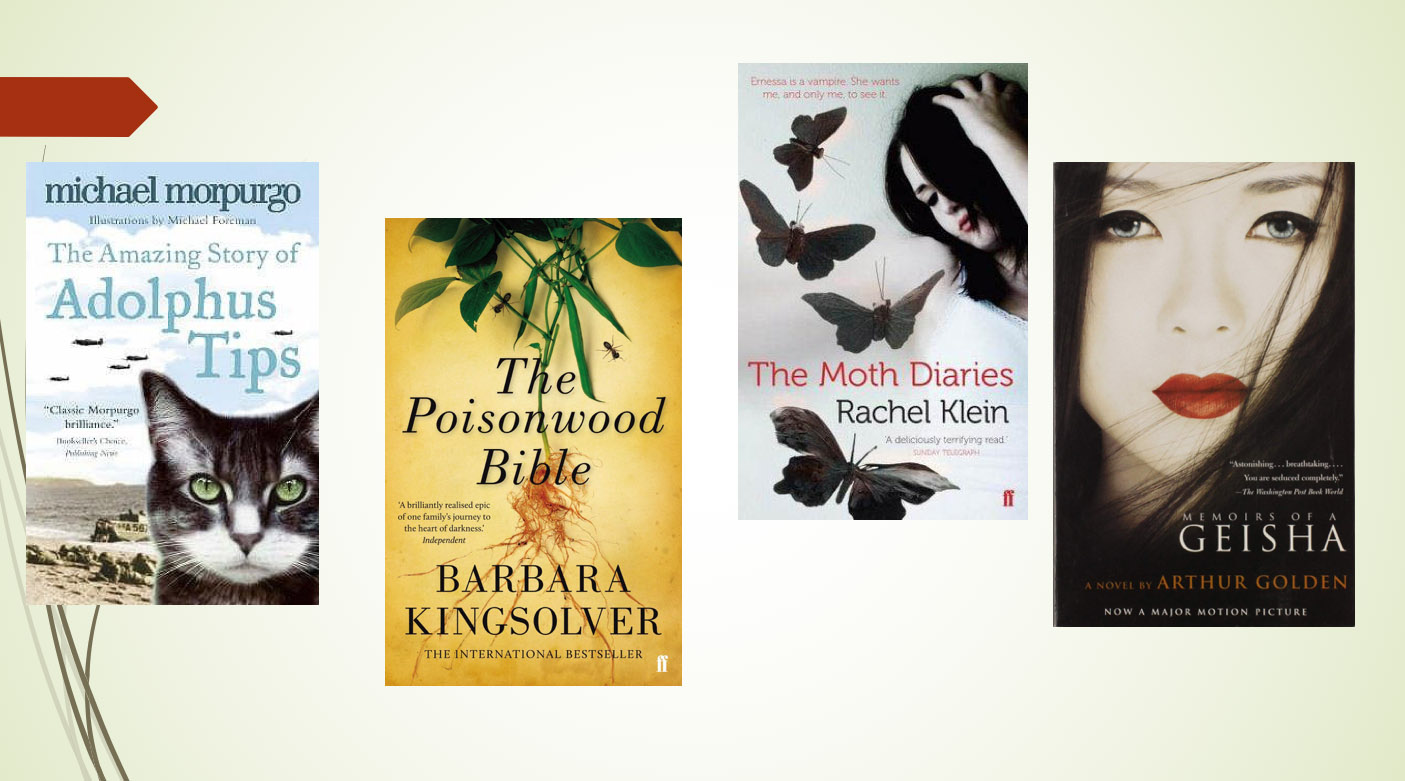
Most fictional diaries are memoir-like because they are usually based on THEME which carries the meaning of the story. In The Poisonwood Bible, Barbara Kingsolver effectively uses several first person voices—of the mother and her four daughters—to provide more perspectives of the story.

Mundane Science Fiction

Mundane science fiction is a niche literary movement from 2004 focused on near-future realism—also called speculative fiction or literary SF. The focus is on already existing technology and plausible extensions—no ray guns, warp drives or time travel. The premise lies in existing circumstances and events. It has similarities with hard science fiction, cyberpunk, ecopunk, ecofiction and climate fiction. Mundane science fiction incorporates elements of literary fiction and mainstream fiction to achieve a strong sense of realism.

Examples of mundane science fiction

Mundane science fiction is the literature of near-future realism that explores how environmental and technological changes will change our lives. Christopher Cokinos calls mundane science fiction the “science fiction that functions more as compass than chimera.” Examples include cautionary tales and dystopias, all predicated on and launched from real events and phenomena—and including my own recent climate fiction “A Diary in the Age of Water.”

“A Diary in the Age of Water”: Mundane SF with Fictionalized Diary 

A Diary in the Age of Water” is the climate-induced journey of humanity through four generations of women, each with a unique relationship to water… Centuries from now, in a dying boreal forest in what used to be northern Canada, Kyo, a young acolyte called to service in the Exodus, yearns for Earth’s past—the Age of Water, before the “Water Twins” destroyed humanity. Looking for answers and plagued by vivid dreams of this holocaust, Kyo discovers the diary of Lynna, a limnologist from a time just prior to the destruction. The diary spans a 40-year period in the mid-21st century and describes a planet in the grips of severe water scarcity. Lynna in her work for the international utility that controls everything to do with water, witnesses and records in her diary the disturbing events that will soon lead to humanity’s demise.

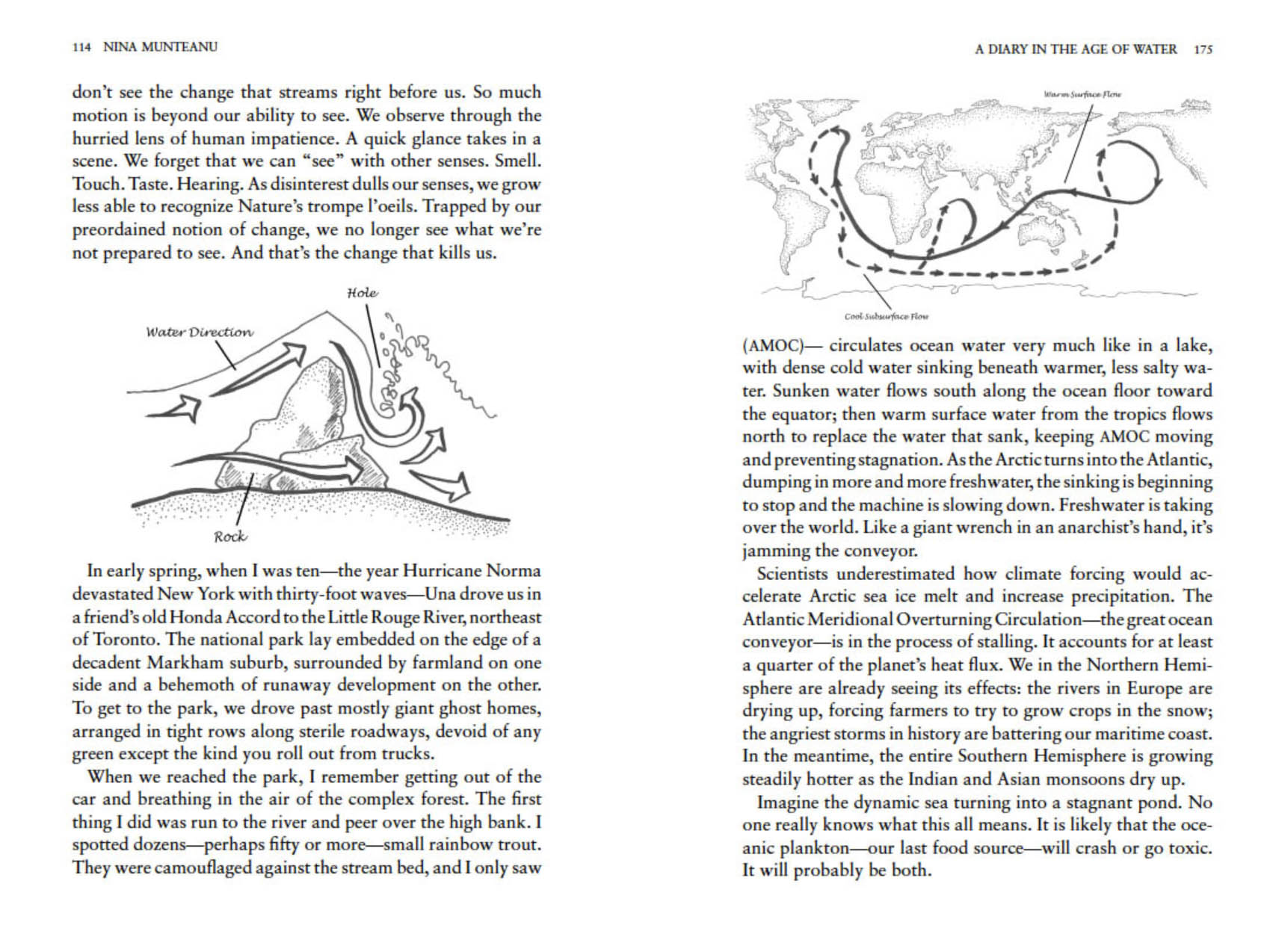
The story begins and ends in the far future with the blue being Kyo, who finds the diary of the limnologist, Lynna. The story is hard SF with a strong basis in science. This is obvious through the narrator, who is a scientist, and the form of the diary itself, in which each entry has an epigraph from a science textbook related to the experience in the entry. Lynna also includes sketches, formulas and other references to science and these appear in the entries.

The diary portion of the book is a first person narrative nested within the larger 3rd person narrative of Kyo in the far future. Its SETTING is based on many real events with dramatized fiction stitched in. This blurs what’s real and what’s fiction. VOICE and POV are used to achieve differing scope and time perspectives between the diarist’s world and that of the future being. We get insight into the inner voice of the diarist through 1st person voice; this is contrasted with the 3rd person voice of the future being—they remain on the outside, looking in. The PLOT is essentially that of a young future human “in discovery”, a metaphoric coming of age for humanity.

The diary format includes the use of:

  • short entries with epigraphs and quotes from fact
  • conversational voice of intimacy with introspection, opinion, and judgment
  • outer conflict with family and colleagues
  • inner conflict with motivations and truths
  • metaphoric connections with water
  • illustrations embedded in the diary entries
Two pages with illustrations in ‘A Diary in the Age of Water’

The diarist is a real and flawed protagonist—this makes her more like us and we are more likely to empathize with her despite her considerable flaws … Lynna makes mistakes and does some terrible things, but the diary allows the reader to find out more about why she does these things, what motivated her and how she feels, including remorse and regret. This allows the reader to forgive Lynna, even as her own daughter cannot, even as she cannot. This becomes key to the story, which is about forgiveness. The diary abruptly ends with pages torn out and Kyo is anxious to know what happened to both Lynna and her world. So is the reader.  

Responses to “A Diary in the Age of Water”

Readers and reviewers had interesting responses, some paradoxical:

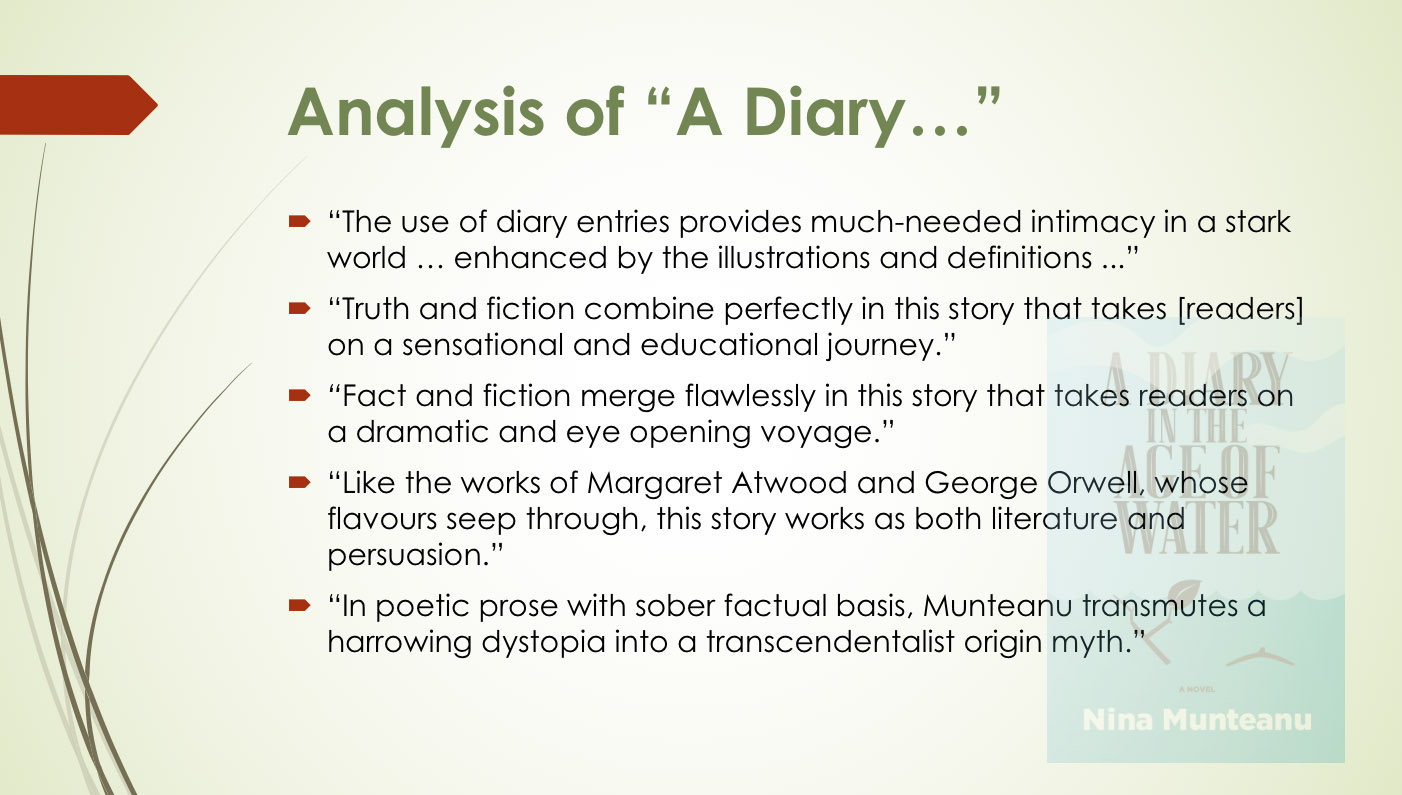
The blur of real events/history and fictional action brought the story into living colour. Several readers confided in me that they often did not know what was non-fiction and what was fiction and that this confusion made the book more gripping. Several reviewers, caught up in the blur of non-fiction with fiction, accused the book of being overtly polemic, when it was the fictional diarist who was proselytizing and being protective and narrow-minded; one need only look to the diarist’s daughter and her actions to see another voice).

In their analysis, reviewers gave the following visceral responses:

In her review of ‘A Diary in the Age of Water’ in The Temz Review, Marcie McCauley writes:

Munteanu “invites readers to recognize themselves in the ‘historical’ story and to project themselves into her imagined future…the diary…operates as a doorway…Munteanu combines methodologies, familiar literary motifs with text and images from non-fiction…She does not appear to view fiction and non-fiction as separate territories; or, if she does, then this book is a bridge between them.”

That blur with reality makes readers both love and hate the novel and it is precisely this that makes them read on. They are thoroughly invested. They need to know how it turns out, as though this is real lives at stake.

Red maple leaf sits on mossy log of old growth forest, ON (photo and rendition by Nina Munteanu)

NINA MUNTEANU is a Canadian ecologist / limnologist and novelist. She is co-editor of Europa SF and currently teaches writing courses at George Brown College and the University of Toronto. Visit  www.ninamunteanu.ca for the latest on her books. Nina’s bilingual “La natura dell’acqua / The Way of Water” was published by Mincione Edizioni in Rome. Her non-fiction book “Water Is…” by Pixl Press(Vancouver) was selected by Margaret Atwood in the New York Times ‘Year in Reading’ and was chosen as the 2017 Summer Read by Water Canada. Her novel “A Diary in the Age of Water” was released by Inanna Publications (Toronto) in June 2020.
Climate Cultures Magazine Lists Nina Munteanu’s “A Diary in the Age of Water” Among Eight Eco-Fiction Novels to Read

Writer and curator Mary Woodbury shares eight novels about water where fact and fiction mingle, tried by imagination, to reveal important truths about our shifting relationships with this vital and lively agent in an era of climate crisis,” writes the magazine Climate Cultures.

In an article entitled, “Where Waters and Fictions Meet,” Mary Woodbury opens with this:

“While facts are something we can and should pay attention to as we follow scientific integrity, models, and reports, another mode of telling the story about water has been alive forever: churned, spoken, and written by authors who dream up fictional stories related to our past, present, and future world. Where fact and fiction mingle like this is an area of reflection and speculation, tied by imagination. These tales of water ripple out once the pebble sinks in. The intersectionality of diverse water fiction results in reader empathy, learning, inspiration, and shared commonalities around the world. Local dignity comes alive against a backdrop of planetary crises.”

She chooses the following eco-novels to discuss:

“Land-Water-Sky (Ndè-Ti-Yat’a)” by Katłıà
“Oil on Water” by Helon Habila
“A Diary in the Age of Water” by Nina Munteanu
“The Water Knife” by Paolo Bacigalupi
“Memory of Water” by Emmi Itäranta
“Fever Dream” by Samanta Schweblin
“Lagoon” by Nnedi Okorafor
“Bangkok Wakes to Rain” by Pitchaya Sudbanthad

Here’s what she writes about my novel:

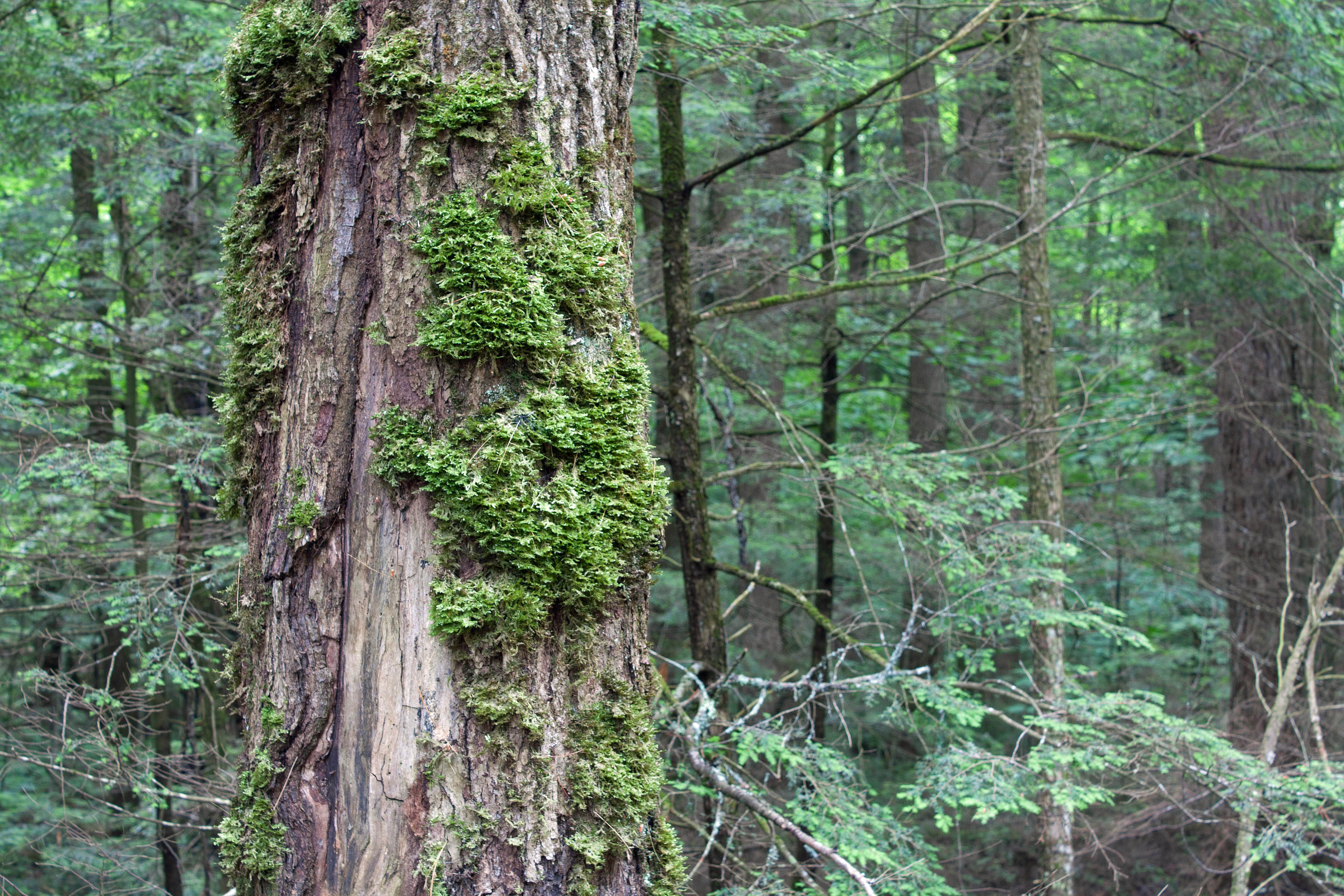
Ancient Eastern Hemlock in Catchacoma old-growth forest, ON (photo by Nina Munteanu)

NINA MUNTEANU is a Canadian ecologist / limnologist and novelist. She is co-editor of Europa SF and currently teaches writing courses at George Brown College and the University of Toronto. Visit  www.ninamunteanu.ca for the latest on her books. Nina’s bilingual “La natura dell’acqua / The Way of Water” was published by Mincione Edizioni in Rome. Her non-fiction book “Water Is…” by Pixl Press(Vancouver) was selected by Margaret Atwood in the New York Times ‘Year in Reading’ and was chosen as the 2017 Summer Read by Water Canada. Her novel “A Diary in the Age of Water” was released by Inanna Publications (Toronto) in June 2020.

Nina Munteanu Interviewed on her latest short story “Robin’s Last Song”

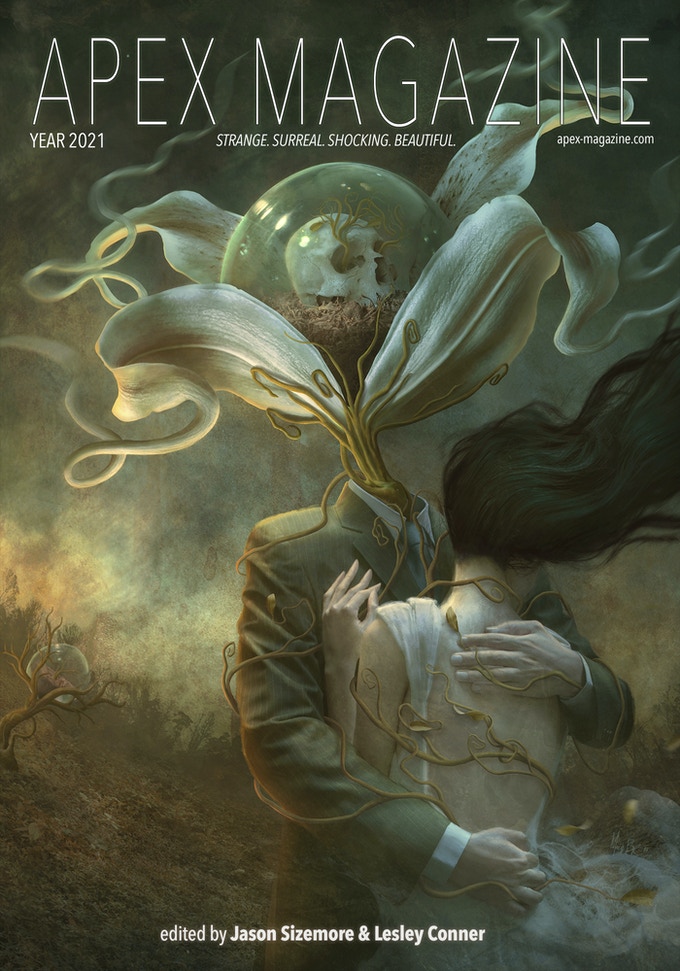
Left: cover of Apex Magazine Issue #128 in which my story appears; Right: cover of 2021 anthology published in fall 2022.

I was recently interviewed by Alberta writer Simon Rose about my latest eco-fiction short story “Robin’s Last Song”, which was recently published by Apex Magazine in its 2021 Compilation Anthology. Below is the interview:

Simon: Congratulations on publishing your short story “Robin’s Last Song” in Issue 128 of Apex Magazine and soon in the Apex Magazine 2021 Compilation Anthology. I’m curious about the title? Whose last song is it? Is Robin the name of a human or the bird?

Nina: Both, actually. The title is both literal and metaphoric. The premise of the story is based on the alarming trend of disappearing birds. The robin, a common bird in Ontario where the story takes place, is a good sentinel for what is happening with bird populations around the world. Robin is also the protagonist’s name; she was named after the robin, her mother’s favourite bird.

Recently fledged robin rests on patio chair, Mississauga, ON (photo by Merridy Cox)

Simon: Robin’s Last Song is obviously eco-fiction. What’s it about?

Nina: Robin’s Last Song first appeared in the #128 Issue of Apex Magazine in 2021. It tells the story of Robin, a blind elder whose digital app failed to warn the world of the sudden global loss of birds with disastrous ecological consequences. After years of living in self-exile and getting around poorly on sight-enhancing technology, a discovery gives her new hope in rekindling her talents in the field of Soundscape Ecology.

Discarded robin’s egg to deter predators, found on a woody trail in Ontario (photo by Nina Munteanu)

Simon: How did you come to write this particular story about birds and what is “soundscape ecology”?

Nina: Since I was a child, the burgeoning SF writer in me had dared to imagine a world without the sound of birds—I thought it utterly bleak and, recognizing an ever-polluting world, I feared for my feathered relatives. I didn’t follow through with a story until September 2019, when I was approached by Oliver Hockenhull, the guest editor of subTerrain Magazine, to write a piece on technology and the environment. The timing was interesting; I’d just read two impactful things that resonated with me.

The first was the October issue of Science Magazine that reported a staggering decline in North American birds. Kenneth V. Rosenberg and his team of researchers had estimated that three billion birds of various species had disappeared in Canada and the US since 1970. That’s a third of the entire bird population lost in five decades. To make it clear, we aren’t talking about rare birds going extinct; these declines are of common birds throughout the world. The wrens, sparrows, starlings, and, of course, the robins. I was devastated; I could not imagine a world without the comforting sound of birds. What would it be like if the birds all disappeared? This brought me back to my childhood fears.

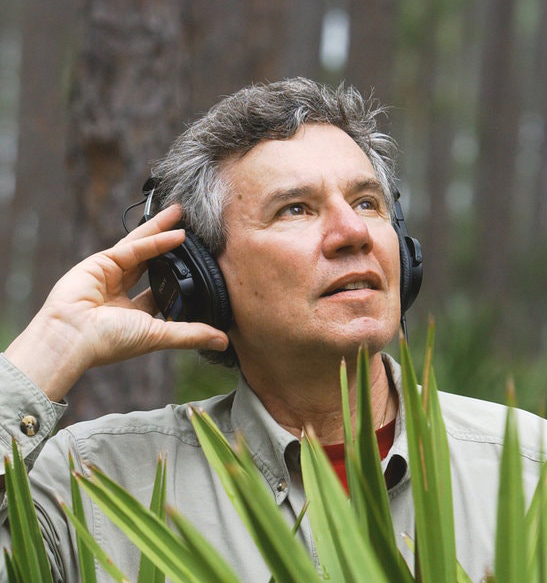
The second article I ran across talked about an emerging bioacoustics tool, soundscape ecology, that measures biodiversity and the health of an ecosystem, mostly through bird sound which well represents ecosystem health. Bernie Krause, a soundscape ecologist who had been conducting long-term recordings for decades noted how the dawn chorus in many areas had greatly diminished if not vanished altogether.

Bernie Krause, soundscape ecologist recording a soundscape in Florida

I now had my premise and my connection with technology. The title of my original story for subTerrain was “Out of the Silence”. This story focused on the technical aspects of the premise and solution. When I was approached for a story in February 2021 by Francesco Verso, the guest editor of Apex Magazine Issue #128, I rewrote the story with a stronger focus on the protagonist’s personal journey and connection with the bird catastrophe, how she coped with Asperger’s syndrome and the failure of her tool to predict the disaster. Hence the change in the title to “Robin’s Last Song”.

Cover of subTerrain Issue #85 in which “Out of the Silence” appears

Simon: Without wanting to bring in spoilers, isn’t there a twist to the story, suggesting a cautionary tale that touches on the dangers of genetic engineering?

Nina: Yes, thanks for bringing that up. I was already primed with research into genetic engineering for the sequel to my 2020 eco-novel “A Diary in the Age of Water.” I wanted to make the bird disappearance in “Robin’s Last Song” into a dramatic catastrophe linked to our own dangerous ecological tampering. I had the notion of using a gene hacking disaster to create ecological calamity and how this might affect birds. I wanted to make “Robin’s Last Song” a realizable work of fiction in which science and technology play both instigator of disaster and purveyor of salvation. Our biogenetic technology comes to us as a double-edged sword in the form of gene-editing, proteomics, DNA origami, and CRISPR—just to name a few. These biotechnological innovations promise a cornucopia of enhancements: from increased longevity and health in humans to giant disease-resistant crops. But, for every ‘magic’ in technology, there is often unintended consequence. Unforeseen—or even ignored—casualties and risks. I suppose my ultimate question with this story is: will synthetic biology redesign Nature to suit hubris or serve evolution? Science doesn’t make those decisions. We do.

Simon: Tell us a little bit about the Apex Magazine 2021 Compilation Anthology (that came out in both print and digital versions August).

Nina: The 350+ page anthology compiles all original short stories published in Apex Magazine during the 2021 calendar year. Published through Apex Book Company, it features 48 stories from a diverse group of new and established writers and the cover features award-winning artwork “Entropic Garden” by Marcela Bolivar. Check this link for more about the anthology and where to get it.

Cover art for Apex 2021 Compilation Anthology (art by Marcela Bolivar)

Simon: Are you still coaching writers and such?

Nina: Yes, I am, Simon. Did you know that I’ve been coaching writers to publication for close to twenty years? When I’m not teaching writing at the University of Toronto or George Brown College, I help writers with craft on their novels and short stories through my coaching services. You can find out more at: www.NinaMunteanu.me.

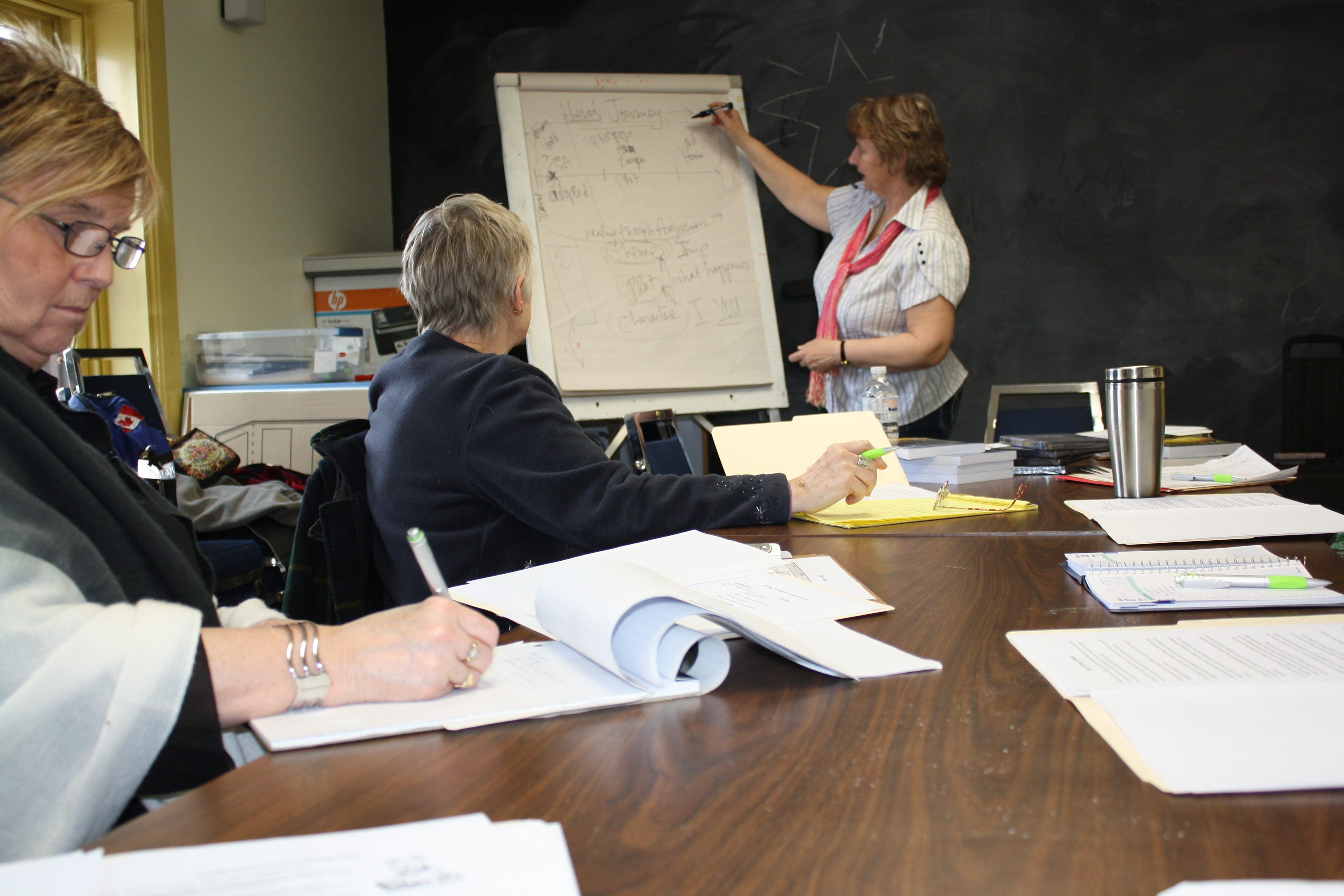
Nina teaches a writing class in Bridgewater, Nova Scotia

Simon: Tell us a little about any writing projects you’re working on these days.

Nina: I’m always busy with science articles for various online and print magazines and my own blogs. I’m also currently finishing a speculative eco-fiction novel that is a loose sequel to “A Diary in the Age of Water.” It’s set throughout Canada, from the Maritimes to the Arctic Circle, and spans a wide timeline from the Halifax Explosion of 1917 to the vast NAWAPA reservoir created a century and a half later by drowning British Columbia’s Rocky Mountain Trench. It’s a fast-paced thriller that focuses on four homeless people who battle corporate intrigue, kidnapping, human experiments and a coming climate plague.

Robin’s First Song: fledgling sits on a black walnut tree branch, ON (photo by Merridy Cox)

NINA MUNTEANU is a Canadian ecologist / limnologist and novelist. She is co-editor of Europa SF and currently teaches writing courses at George Brown College and the University of Toronto. Visit  www.ninamunteanu.ca for the latest on her books. Nina’s bilingual “La natura dell’acqua / The Way of Water” was published by Mincione Edizioni in Rome. Her non-fiction book “Water Is…” by Pixl Press(Vancouver) was selected by Margaret Atwood in the New York Times ‘Year in Reading’ and was chosen as the 2017 Summer Read by Water Canada. Her novel “A Diary in the Age of Water” was released by Inanna Publications (Toronto) in June 2020.
When the Meridional Overturning Circulation Shuts Down

Atlantic Meridional Overturning Circulation (AMOC) (drawing by Nina Munteanu, from “A Diary in the Age of Water” Inanna Publications, 2020)

March 6, 2055

Before leaving for the university this morning, I watched a news report on the storm that devastated the northwest coast of Britain last week. Over a thousand people were affected by the sudden deluge, severe winds, and flooding. Scientists are blaming another major AR (Atmospheric River). That’s the tenth so far this year for both Britain and Western Europe. Not surprising either. Due to the global temperature increase, the air holds more moisture, so these atmospheric rivers are growing in frequency and intensity. They are consequently wreaking havoc on the Atlantic west coast and the European coasts. I can hear Daniel’s ghost hissing in my ear: Between the relentless sea level rise and these storms, we’re fracked. The ARs that roar about like angry banshees have picked up the slack left by the stagnating great ocean conveyor. The conveyor or Atlantic Meridional Overturning Circulation (AMOC)— circulates ocean water very much like in a lake, with dense cold water sinking beneath warmer, less salty water. Sunken water flows south along the ocean floor toward the equator; then warm surface water from the tropics flows north to replace the water that sank, keeping AMOC moving and preventing stagnation. As the Arctic turns into the Atlantic, dumping in more and more freshwater, the sinking is beginning to stop and the machine is slowing down. Freshwater is taking over the world. Like a giant wrench in an anarchist’s hand, it’s jamming the conveyor. Scientists underestimated how climate forcing would accelerate Arctic sea ice melt and increase precipitation. The Atlantic Meridional Overturning Circulation—the great ocean conveyor—is in the process of stalling. It accounts for at least a quarter of the planet’s heat flux. We in the Northern Hemisphere are already seeing its effects: the rivers in Europe are drying up, forcing farmers to try to grow crops in the snow; the angriest storms in history are battering our maritime coast. In the meantime, the entire Southern Hemisphere is growing steadily hotter as the Indian and Asian monsoons dry up. Imagine the dynamic sea turning into a stagnant pond. No one really knows what this all means. It is likely that the oceanic plankton—our last food source—will crash or go toxic. It will probably be both.

—Lynna Dresden (scientist) in A Diary in the Age of Water

“Global ocean circulation will not change abruptly, but it will change significantly, in this century,” writes Cecilie Mauritzen, scientist with the Climate Department of the Norwegian Meteorogical Institute in Chapter 2 of “Arctic Climate Feedbacks: Global Implications”. Yet other researchers who study ancient climate change point to evidence that the AMOC can turn off abruptly. I suppose this depends on one’s definition of “abruptly.”

Mauritzen adds that “the potential for a significant change in global ocean circulation is considered one of the greatest threats to Earth’s climate: it presents a possibility of large and rapid change, even more rapid than the warming resulting directly from the build-up of human-induced greenhouse gases in the atmosphere.” An AMOC collapse would promote major cooling in most of the northern hemisphere, but also strengthen storm tracks in the North Atlantic and lead to further warming in regions of the southern hemisphere.

Climate models of an AMOC shutdown suggest a severe cooling in the whole northern hemisphere, particularly the regions closest to the zone of North Atlantic heat loss (the “radiator” of the North Atlantic central heating system). A shut down of the AMOC circulation would bring extreme cold to Europe and parts of North America, raise sea levels on these coastlines and disrupt seasonal monsoons that provide water to much of the world. It would also further endanger the Amazon rainforest and Antarctic ice sheets.

What climatologists like Mauritzen don’t discuss is the profound effects on the Earth’s biological community supported by this global circulation. The result of an AMOC stall may result in a massive ecological collapse and our existential end due to creatures so small only a microscope can see them.

In the above quote from my eco-fiction novel A Diary in the Age of Water the scientist Lynna Dresden highlights one of the most discernable effects of an AMOC shutdown: extreme weather, a cold snap with more angry and wetter storms in the north, particularly Europe, that could last hundreds of years. Scientists report that when AMOC stopped near the end of the last Ice Age, the cold spell lasted a thousand years.

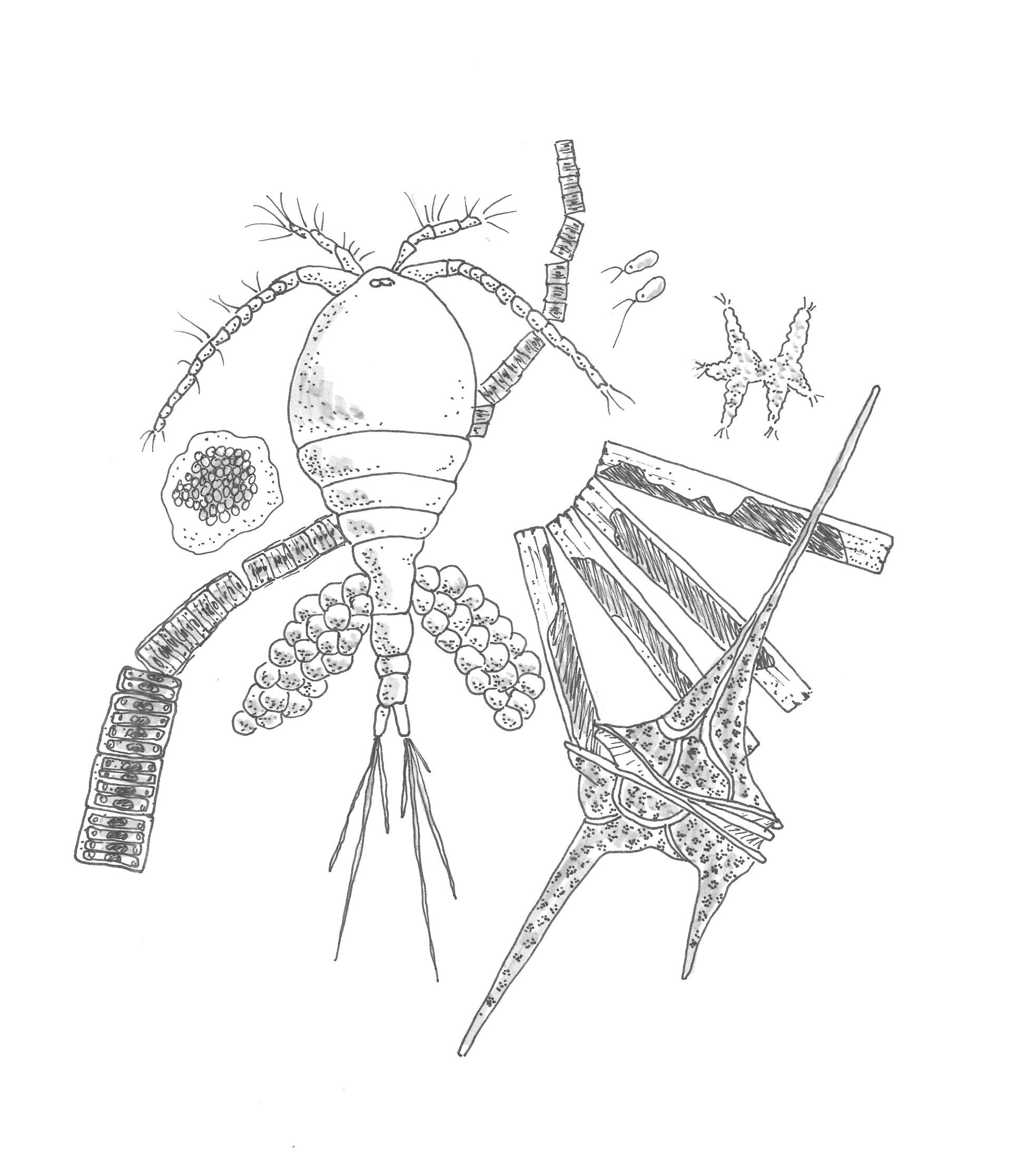
Illustration of oceanic plankton (by Nina Munteanu, in “A Diary in the Age of Water” Inanna Publications, 2020)

But Lynna also talks about our primary producers, the phytoplankton (and their cousins the zooplankton). The phytoplankton—which is made up mostly of single-celled diatoms—drift on the ocean currents and sustain all life from producing the first source of a massive food chain to sequestering carbon, creating clouds and rain, and helping to create fifty percent of the oxygen we breathe.

According to Velasco et al. in Nature, “An AMOC shutdown could lead to the collapse of North Atlantic plankton stocks.”

When plankton populations crash, recovery is slow. Plankton ecosystems in Earth’s oceans took 3 million years to fully recover after the mass extinction event 65 million years ago, according to scientists at the University of California—Santa Cruz. In their 2006 paper in the journal Geology, the researchers concluded “that the time required to repair food chains and reestablish an integrated ecosystem is extremely long.”

Perhaps even more likely is that the plankton will only partially crash; more likely is a shift in its distribution and characteristics with many going extinct and some even exploding in numbers. This is called a regime shift—a widespread and prolonged change of a biological system due to climate change—something that is occurring throughout the world right now.

Coccolithophores under electron microscope (image by NASA)

For instance, a study in NRDC reported a massive surge in plankton in the Arctic Barents Sea in 2020. Researcher Brian Palmer shared that “phytoplankton blooms are growing faster and thicker than ever seen before.” Summer blooms of Coccolithophores (unicellular Protista with calcium carbonate plates) generally occur from July through September in the Barents Sea when this shallow northern sea is ice free. The 2020 study showed that these blooms are thicker and more extensive as nutrients influx from other oceans. A recent Stanford study indicated that the growth rate of phytoplankton in the Arctic Ocean has increased 57 percent in the last twenty years.

While higher productivity may naively seem a good thing, these blooms are problematic: to begin, their growth is often not synchronous with what might feed on them, creating waste and detrimental trophic cascades (see below); although the algal blooms absorb more carbon, this higher carbon also contributes to the acidification of the ocean, which, in turn, impacts the phytoplankton: their growth, behaviour, and succession. The dying blooms may also liberate the excess carbon under certain circumstances. This becomes a positive feedback cycle with ever more impact.

Algal bloom in the Barents Sea (image by NASA)

Stephanie Dutkiewicz, principal research scientist in MIT’s Center for Global Change Science, says that while scientists have suspected ocean acidification might affect marine populations, the group’s results suggest a much larger upheaval of phytoplankton—and the species that feed on them. “The fact that there are so many different possible changes, that different phytoplankton respond differently, means there might be some quite traumatic changes in the communities over the course of the 21st century. A whole rearrangement of the communities means something to both the food web further up, but also for things like cycling of carbon.” Dutkeiwicz’s team also found that the interactive behaviour, including competition, among phytoplankton species might change.

Regime shifts also cause trophic cascades.

The guillemot seabird is an example of one casualty. The guillemot, which typically nests on the Isle of Shetland off the coast of Scotland, is starving and few are nesting. This is because the guillemot feed on sandeel fish that have all but disappeared because the cold-water plankton the fish eat have moved north. The historically icy waters between England and Scandinavia have become too warm for the plankton to survive. Of course, if the AMOC stalls, these warming waters may cool substantially.

References:

Dybas, Cheryl Lyn. 2006. “On a Collision Course: Ocean Plankton and Climate Change.” BioScience 56(8): 642-646.

Mauritzen, Celilie. 2009. “Ocean Circulation Feedbacks”,  Chapter 2 of “Arctic Climate Feedbacks: Global Implications,” Martin Sommerkorn and Susan Joy Hassol, editors. World Wildlife International Arctic Programme. 97pp.

Munteanu, Nina. 2020. “A Diary in the Age of Water.” Inanna Publications, Toronto. 300pp.

Palmer, Brian. 2020. “A Massive Surge in Plankton Has Researchers Pondering the Future of the Arctic.” NRDC September 09, 2020.

Schmittner, Andreas. 2005. “Decline of the marine ecosystem caused by a reduction in the Atlantic overturning circulation.” Nature 434: 628-633.

Velasco, Julian A. et. al. 2021. “Synergistic impacts of global warming and thermocline circulation collapse on amphibians” Nature, Communications Biology 4(141)

Freshwater from melting ice along the edge of Antarctica is changing the density of ocean layers, weakening the world’s strongest ocean current (ACC)

Post Script, March 8, 2025: A study by international scientists published today in the journal Environmental Research Letters projects that the fresh water from melting Antarctic ice will weaken the Antarctic Circumpolar Currrent by 20 percent in the next 30 years. The Atlantic Meridional Overturning Circulation (AMOC) is primarily responsible for poleward heat transport in the North Atlantic and the Antarctic Circumpolar Current (ACC) has the largest volume transport of any ocean current. Together, both currents are crucial components of global ocean circulation. The ACC is the only ocean current to flow around the entire planet unimpeded, carrying more than 100 times more water than all the world’s rivers combined. A paper in the journal Nature Climate Change recently documented how freshwater from melting ice has already weakened the overturning, or vertical circulation, of Antarctic shelf waters, which reduces oxygen in the deep ocean. Effects of the ACC slow down are projected to include more climate variability, with greater extremes in certain regions, and accelerated global warming.

NINA MUNTEANU is a Canadian ecologist / limnologist and novelist. She is co-editor of Europa SF and currently teaches writing courses at George Brown College and the University of Toronto. Visit  www.ninamunteanu.ca for the latest on her books. Nina’s bilingual “La natura dell’acqua / The Way of Water” was published by Mincione Edizioni in Rome. Her non-fiction book “Water Is…” by Pixl Press(Vancouver) was selected by Margaret Atwood in the New York Times ‘Year in Reading’ and was chosen as the 2017 Summer Read by Water Canada. Her novel “A Diary in the Age of Water” was released by Inanna Publications (Toronto) in June 2020.

Apex Magazine To Release 2021 Anthology Fall 2022 with Nina Munteanu’s “Robin’s Last Song”

Over increasingly large areas of the United States, spring now comes unheralded by the return of the birds. The early mornings are strangely silent where once they were filled with the beauty of bird song.”

—Rachel Carson, Silent Spring

Apex Magazine will release its 2021 Anthology this fall with my short story, Robin’s Last Song in it.

Robin’s Last Song first appeared in the #128 Issue of Apex Magazine in 2021. It tells the story of Robin, a blind elder whose digital app failed to warn the world of the sudden global loss of birds with disastrous ecological consequences. After years of living in self-exile and getting around poorly on sight-enhancing technology, a discovery gives her new hope in rekindling her talents in the field of Soundscape Ecology.

Apex Issue #128 and upcoming 2021 Year Issue with Nina Munteanu’s “Robin’s Last Song”

May, 2071

I rock on the cedar swing on my veranda and hear the wind rustling through the gaunt forest. An abandoned nest, the forest sighs in low ponderous notes. It sighs of a gentler time. A time when birds filled it with song. A time when large and small creatures — unconcerned with the distant thrum and roar of diggers and logging trucks — roamed the thick second-growth forest. The discord was still too far away to bother the wildlife. But their killer lurked far closer in deadly silence. And it caught the birds in the bliss of ignorance. The human-made scourge came like a thief in the night and quietly strangled all the birds in the name of progress.

“Robin’s Last Song” by Nina Munteanu

Bird Population Decline

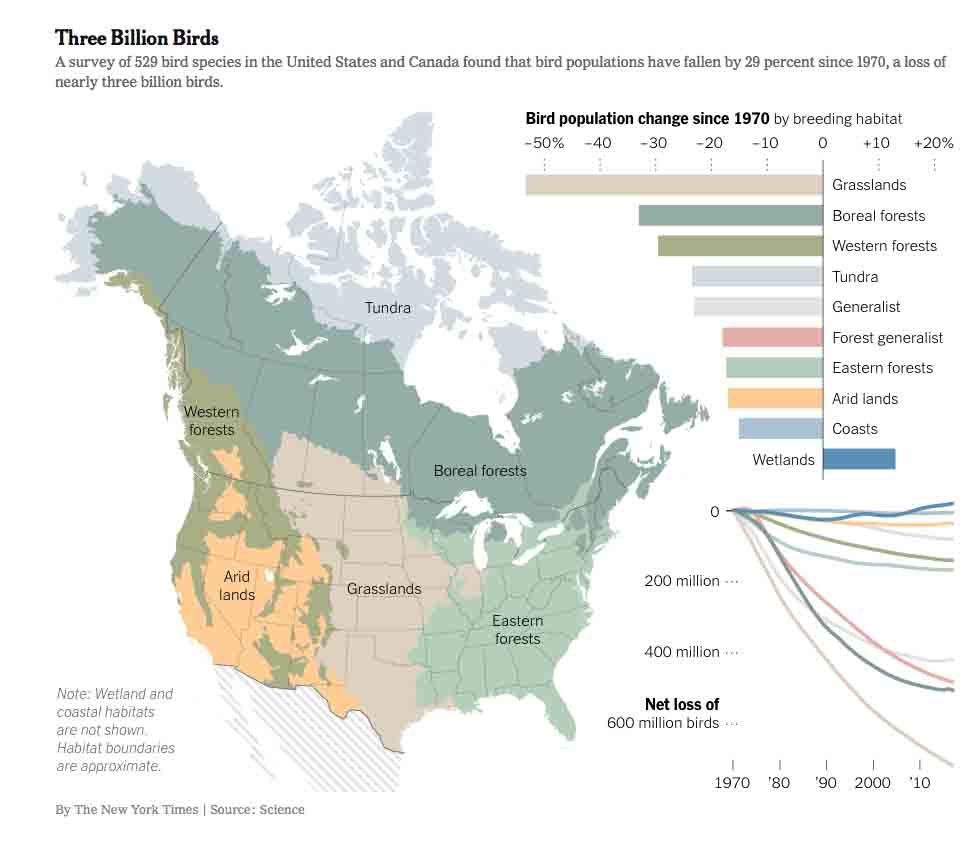
The number of birds in North America has declined by three billion, some 30 percent, over the last half-century. The October 2019 issue of Science magazine reported a staggering decline in North American birdsKenneth V. Rosenberg and his team of researchers estimated that three billion birds of various species have disappeared in Canada and the US since 1970.

Bird population change since 1970 (image The New York Times)

That’s a third of the entire bird population lost in five decades.

In North America, warbler populations dropped by 600 million. Blackbirds by 400 million. The common robins, cardinals, and blue jays had noticeably declined. Even starlings—once considered a kind of fast-breeding pest—have dwindled by 50%. The Intergovernmental Science-Policy Platform on Biodiversity and Ecosystem Services have determined that three-quarters of Earth’s terrestrial and two-thirds of the its marine environments have been severely altered by human actions.

Robin’s egg in the forest, discarded from the nest to divert predators (photo by Nina Munteanu)

Plowing of fields, deforestation, wetland draining, climate change and other land use clearing and treatments have caused great habitat loss. In addition, neonicotinoid pesticides make it harder for birds to put on weight needed for migration, delaying their travel.

A robin fledgling rests on a patio chair (photo by Merridy Cox)

Common bird species are vital to ecosystems. They control pests, pollinate flowers, spread seeds and help regenerate forests. When these birds disappear, their former habitats lose their functionality. “Declines in your common sparrow or other little brown bird may not receive the same attention as historic losses of bald eagles or sandhill cranes, but they are going to have much more of an impact,” said Hillary Young, a conservation biologist at the University of California. Kevin Gaston, a conservation biologist at the University of Exeter, lamented that: “This is the loss of nature.”

The Trump administration heinously and foolishly demolished or maimed several key bird protection acts, which hopefully the new administration has or will reinstate in full force: Migratory Bird Treaty Act; Clean Air Act; Clean Water Act; National Fish and Wildlife Act; and the Endangered Species Act.

Useful Tool: Soundscape Ecology

The new science of soundscape ecology can analyze the health of an ecosystem. Bernie Krause, a soundscape ecologist who has been conducting long-term recordings for many decades recently noted that in Sugarloaf Ridge State Park, not far from his home in Northern California, “the effect of global warming and resulting drought has created the first completely silent spring I’ve ever experienced.” Stuart Winter at Express reports that “many of the iconic birds whose mating calls ring out across woodlands and open fields during early May are vanishing at an alarming rate.”

Bernie Kraus creating one of his soundscapes

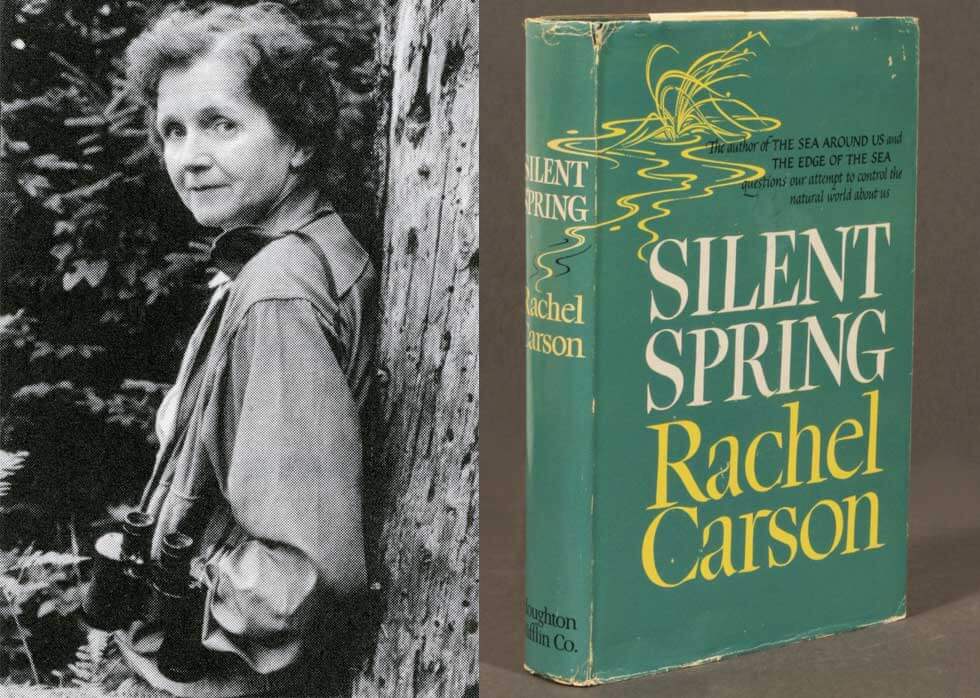
Silent Spring: Rachel Carson’s Ominous Prediction and Warning

Rachel Carson was nothing short of prophetic when she published Silent Spring in 1962 (in reference to the dawn chorus most noticeable in spring during breeding). Silent Spring cautioned burgeoning ag-biotech companies (like Monsanto—now Bayer—Sygenta, Dow, and DuPont) who were carelessly and flagrantly spraying fields with pesticides and herbicides—at the time DDT was the main culprit. This would soon become a GMO world where gene-hacked plants of monocultures can withstand the onslaught of killer pesticides like neonicotinoids (currently killing bees everywhere) and Roundup.  Roundup is a carcinogenic glyphosate-based weed killer that has recently been shown to kill beneficial insects like bees) and has been linked to Alzheimer’s disease, ADHD, birth defects, autism, and several kinds of cancer in humans.

Rachel Carson and her iconic book “Silent Spring”

Despite Carson’s warnings in 1962 and despite some action eventually taken (e.g. the ban on use of DDT in 1972—the precursor to Roundup and other neonicotinoids currently in use), the use of chemicals in big ag-industry has increased over five-fold since the 1960s. And this is destroying our bee populations, other beneficial insects, beneficial weeds, small animal populations and—of course—our bird life.

And it’s making us sick too.

NINA MUNTEANU is a Canadian ecologist / limnologist and novelist. She is co-editor of Europa SF and currently teaches writing courses at George Brown College and the University of Toronto. Visit  www.ninamunteanu.ca for the latest on her books. Nina’s bilingual “La natura dell’acqua / The Way of Water” was published by Mincione Edizioni in Rome. Her non-fiction book “Water Is…” by Pixl Press(Vancouver) was selected by Margaret Atwood in the New York Times ‘Year in Reading’ and was chosen as the 2017 Summer Read by Water Canada. Her novel “A Diary in the Age of Water” was released by Inanna Publications (Toronto) in June 2020.
Nina Munteanu Interviewed by Joseph Planta on ‘The Commentary’

Joseph Planta had interviewed me before, when my non-fiction book Water Is…The Meaning of Water was published in 2016. He interviewed me again when my latest novel a cli-fi dystopian speculative fiction A Diary in the Age of Water was released by Inanna Publications.

Here’s how Joseph began the interview:

“I am Planta: On the Line, in Vancouver, British Columbia, at TheCommentary.ca

Nina Munteanu joins me again. She has just published a new novel, A Diary in the Age of Water. The noted writer and limnologist, a freshwater scientist, has written a book that could be considered science fiction. I suppose ‘cli-fi’ is the better term, climate-based science fiction. In the book, far away in a post-climate change world, Kyo finds a diary that gives her insight into the world before water scarcity. I’ll get Nina to tell us about Kyo, about the themes in this book, especially the world ahead if we continue as we do. Nina Munteanu is an author and ecologist. She has published many books of science fiction and fantasy, and was first on the program in 2016 when her book Water Is… The Meaning of Water was published. The website for more is at www.ninamunteanu.ca. This new book is from Inanna Publications. Please welcome back to the Planta: On the Line program, Nina Munteanu; Ms. Munteanu, good morning…”

Here’s the Interview.

NINA MUNTEANU is a Canadian ecologist / limnologist and novelist. She is co-editor of Europa SF and currently teaches writing courses at George Brown College and the University of Toronto. Visit  www.ninamunteanu.ca for the latest on her books. Nina’s bilingual “La natura dell’acqua / The Way of Water” was published by Mincione Edizioni in Rome. Her non-fiction book “Water Is…” by Pixl Press(Vancouver) was selected by Margaret Atwood in the New York Times ‘Year in Reading’ and was chosen as the 2017 Summer Read by Water Canada. Her novel “A Diary in the Age of Water” was released by Inanna Publications (Toronto) in June 2020.

Nina Munteanu Reflects on Her Eco-Fiction Journey at Orchard Park Secondary School

I recently gave a talk at Orchard Park Secondary School during their “Eco Crawl” week. “Eco crawl is a cross curricular initiative promoting environmental awareness, natural conservation, and well-being,” says Teresa Grainger, Library Learning Commons Technician at the school. The “week long initiative will include animal visitors, presentations, displays, and outdoor activities. We like to involve as many departments as possible.”

The school invited me to participate with a presentation. I spoke about my work as a writer and as a scientist, how I was inspired to write eco-fiction and a little about the process of how I started. I shared the challenges I faced and my victories. I also spoke about the importance of eco-fiction as narrative and the importance of storytelling generally to incite interest, bring awareness and ultimately action.

The word is a powerful tool. And the stories that carry them are vehicles of change.

Here is some of that talk:

My story begins with the magic of water, Quebec water … I was born in a small town in the Eastern Townships of Quebec, a gently rolling and verdant farming community, where water bubbles and gurgles in at least two languages.

Pastoral Eastern Townships and Granby, Quebec; Nina Munteanu as a child

I spent a lot of my childhood days close to the ground, observing, poking, catching, destroying and creating. Perhaps it was this early induction to the organic fragrances of soil, rotting leaves and moss that set my path in later life as a limnologist, environmental consultant and writer of eco-fiction.

My mother kept a garden in our back yard that she watered mostly with rain she collected in a large barrel out back. I remember rows of bright dahlias with their button-faces and elegant gladiolas of all colours, tall like sentinels. And, her gorgeous irises.

In the winter, my mother flooded the garden to create an ice rink for the neighbourhood to use for hockey. Somehow, I always ended up being the goalie, dodging my brother’s swift pucks to the net. I got good at dodging—probably a useful life skill in later life…

Our dad frequently took us to the local spring just outside town. We walked a few miles up Mountain Road to an unassuming seepage from a rock outcrop with a pipe attached to it by the local farmer. I remember that the water was very cold. Even the air around the spring was cooler than the surrounding air. I remember that the spring water tasted fresh and that the ice it formed popped and fizzed more than tap water.

I followed my older brother and sister to the nearby forest and local river. We stirred soil, flower petals and other interesting things with water to fuel “magic potions” then told wild stories of mayhem and adventure. I became a storyteller. My passion for storytelling eventually morphed into writing; but, the underlying spark came through environmental activism.

In early high school, during the mid-60s, I became an environmental activist, putting up posters and writing in the school paper. I wrote letters to industry and politicians, trying to incite interest in being good corporate citizens and promoting global environmental action. I remember a well-meaning teacher chiding me for my extravagant worldview. “Stick to little things and your community—like recycling,” he suggested patronizingly. I remember the shock of realizing that not everyone felt the planet like I did. Perhaps it was a teenage-thing, or a girl-thing, or a nina-thing. I prayed it wasn’t just a nina-thing

I started writing stories in high school. Mostly eco-fiction, though I didn’t know that’s what it was at the time. There was no genre called eco-fiction back then. It all went under the umbrella of scifi.

I completed my first novel, Caged in World when I was fifteen—in Grade 9—in 1969.  Caged in World was a hundred-page speculative story about a world that had moved “inside” to escape the ravages of a post climate-change environment. The eco-novel was about a subway train driver and a data analyst caught in the trap of a huge lie. The story later morphed into Escape from Utopia. Several drafts—and years later—the novel became the eco-medical thriller Angel of Chaos, set in 2095 as humanity struggles with Darwin’s Disease—a mysterious neurological environmental pandemic. Icaria 5 is one of many enclosed cities within the slowly recovering toxic wasteland of North America, and where the protagonist Julie Crane works and lives. The city is run by technocrats, deep ecologists who call themselves Gaians, and consider themselves guardians of the planet. The Gaians’ secret is that they are keeping humanity “inside” not to protect humanity from a toxic wasteland but to protect the environment from a toxic humanity.

Some of the scientific papers, reports and articles I wrote or participated in

When I enrolled in college and university, I thought of going into environmental law then decided that I didn’t have the temperament for it and switched to biology. Without realizing it, I put fiction writing on hold while I pursued ecology at university. One professor got me very interested in limnology and it became my focus when I realized that I’d always been fascinated by water. I started out being scared of water—not being a strong swimmer—and the best thing you can do to get over a fear is to study it and understand it. That’s exactly what I did. I did some cool research on stream ecology and published scientific papers, articles and reports. Then I moved to the westcoast to teach limnology at the University of Victoria and do consulting work in aquatic ecology.

So, in a way, I’d gone back to what I loved best as a child—mucking about in nature, spending my days close to the ground, observing, poking, catching, destroying and creating.

Kevin as a toddler

In 1991, my son Kevin was born. I felt a miracle pass through me. Kevin became my doorway into wonder. His curiosity was boundless and lured me into a special world of transformation. I took time off work to spend with Kevin when he was young. We went on great trips, from the local mall, where we had a hot chocolate and played with Lego, to the local beach on the Fraser River, where we explored the rocks. When he was no more than three, I took him on endless adventures in the city and its surroundings. We didn’t have to go far. The mud puddles of a new subdivision after a rain were enough to keep our attention for dozens of minutes. We became connoisseurs of mud. The best kind was “chocolate mud,” with a consistency and viscosity that created the best crater when a rock was thrown into it.

Kevin and I often explored the little woodland near our house. We made “magic potions” out of nightshade flowers, fir needles, loam and moss; we fueled our concoctions with the elixir of water from a stagnant pool then told wild stories of mayhem and adventure.

Storytelling kept calling to me. It was the 1990s—twenty years after I finished Angel of Chaos—and I’d published lots of short stories and articles. But no novels.

Some of Nina’s short story publications

I spent several years shopping Angel of Chaos to agents and publishing houses. Although I received many bites, all finally let go. I kept writing short stories, some of which were cannibalized from the book, and several were published; I also wrote Angel’s prequel, The Great Revolution and Angel’s sequel Darwin’s Paradox and shopped them.

Then In 2007, Dragon Moon Press in Calgary made an offer to publish Darwins Paradox; the sequel became my debut novel. Dragon Moon Press later picked up Angel of Choas and published it in 2010 as a prequel. I haven’t stopped publishing books since (with a book pretty much every year), both fiction and non-fiction…including writing guidebooks in my Alien Guidebook Series.

Kevin hiking the mountains of the west coast, BC

My son left the nest to go to university and work and I went on walkabout and eventually left the westcoast, returning to my old home in the east. I did lots of house-sitting in the Maritimes, then ended up teaching at UofT in Toronto.

UofT, west gate to quadrangle of University College, ON (photo by Nina Munteanu)

In 2016, I published Water Is… with Pixl Press in Vancouver.  It’s a biography and celebration of water—my attempt to write a lay book on my water science, something that all could appreciate. Turns out that Margaret Atwood really liked it too!

On its heels, I got a book deal with Inanna Publications in Toronto for my eco-novel A Diary in the Age of Water. This eco-fiction novel follows the journeys of four generations of women during a time of catastrophic environmental change. The novel explores each woman’s relationship with water, itself an agent of change…

Eco-fiction (short for ecological fiction) is a kind of fiction in which the environment—or one aspect of the environment—plays a major role in story, either as premise or as character. For instance, several of my eco-fiction stories give Water a voice as character. In my latest novel, A Diary in the Age of Water, each of the four women characters reflects her relationship with water and, in turn, her view of and journey in a changing world.

In eco-fiction, strong relationships are forged between the major character on a journey and an aspect of their environment and place. Such strong relationship can linger in the minds and hearts of readers, shaping deep and meaningful connections that will often move a reader into action. Our capacity—and need—to share stories is as old as our ancient beginnings. From the Paleolithic cave paintings of Lascaux to our blogs on the Internet, humanity has left a grand legacy of ‘story’ sharing. By providing context to knowledge, story moves us to care, to cherish, and, in turn, to act. What we cherish, we protect.  It’s really that simple.

Eco-fiction—whether told as dystopia, post-apocalypse, cautionary tale or hopeful solarpunk—can help us co-create a new narrative, one about how the Earth gifts us with life and how we can give in return. It’s time to start giving.

That starts with story.

NINA MUNTEANU is a Canadian ecologist / limnologist and novelist. She is co-editor of Europa SF and currently teaches writing courses at George Brown College and the University of Toronto. Visit  www.ninamunteanu.ca for the latest on her books. Nina’s bilingual “La natura dell’acqua / The Way of Water” was published by Mincione Edizioni in Rome. Her non-fiction book “Water Is…” by Pixl Press(Vancouver) was selected by Margaret Atwood in the New York Times ‘Year in Reading’ and was chosen as the 2017 Summer Read by Water Canada. Her novel “A Diary in the Age of Water” was released by Inanna Publications (Toronto) in June 2020.

Nina Munteanu’s “The Splintered Universe Trilogy” Audiobooks on Audible

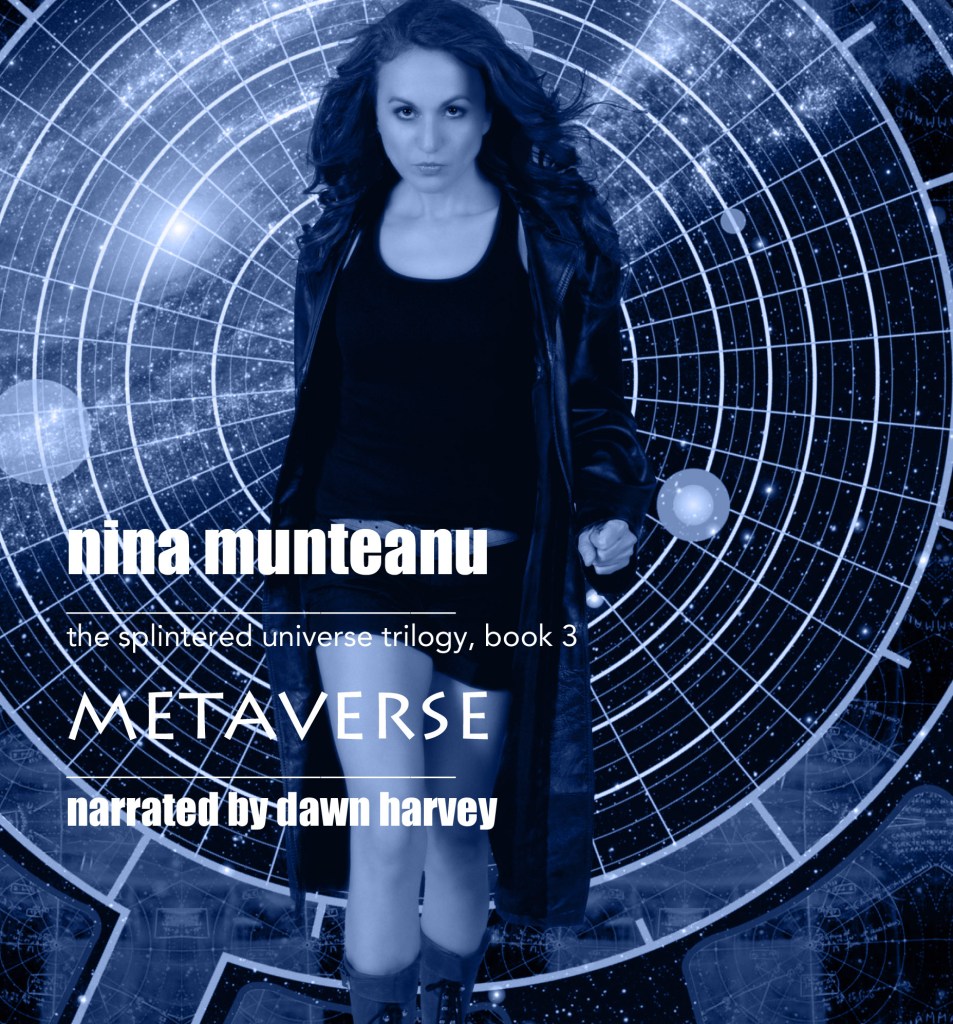
The Splintered Universe Trilogy audiobooks

My detective thriller trilogy “The Splintered Universe,” which came out in print and ebook format in 2012-2014 were made into audiobooks by Iambik in 2019 and narrated impeccably by voice artist Dawn Harvey. When Iambik closed its doors, Spoken Realms and Pixl Press picked up the trilogy and reissued them in 2022. They are now remastered and available for purchase. Canadian author Simon Rose recently interviewed me about the re-release of The Splintered Universe Audiobooks. Part of that interview appears below. For the entire interview find the link below.

 Interview with Nina Munteanu on New Audiobook Release of “The Splintered Universe” Trilogy

I had the pleasure recently of talking with Canadian author Nina Munteanu about the new release of her audiobook set The Splintered Universe Trilogy. Nina is a scientist (limnologist) who also writes science fiction and fantasy with a focus on eco-fiction and climate fiction. She has nine novels and five non-fiction books published, including “Water Is…” recommended by Margaret Atwood as her #1 choice in the New York Times ‘Year in Reading’ in 2016.

The Splintered Universe Trilogy follows the thrilling adventures of Galactic Guardian Rhea Hawke, human detective who must save a world she hardly understands. It’s full of exciting planets, space travel, tall secrets, intrigue and even some romance. I interviewed Nina in 2019 about the trilogy when the three formats first became available and we talked about her world building, Rhea Hawke’s cool arsenal of gadgets and weapons, and concepts of metaphysics, existentialism and identity. So, what’s happening with all that now?  

Simon: So, tell us about these new releases.

Nina: You’re right, Simon, the audiobooks of the trilogy did all come out in 2019, completing the three formats of print, ebook and audiobook. I was over the moon. What we’ve done recently is remaster the audiobooks and we’re now selling them as a package through the new publishers, Spoken Realms (first two audiobooks) and Pixl Press (third audiobook).

Briefly, the trilogy follows our intrepid (though slightly misguided) detective Rhea Hawke as she tries to solve the genocide of a spiritual sect on some backwater planet. She bungles her mission by killing her only lead and instead discovers a conspiracy to exterminate humanity by an alien race only she thinks exists. It goes downhill for her from there. She gets fired and her sentient ship—her only friend—is impounded. Her whole life comes apart. Her only chance to rebuild it is to prove that her discovery is true. That leads her down a rabbit hole into a dangerous world of intrigue, full of unsavory shape-shifting characters, dust smuggling, giant flying crustaceans, amorous toxic plants, and portals into mirror universes.  

Rhea’s inventiveness gets her into even more trouble. She gained some notoriety with her created weapon, the MEC (short for Magnetic-Electro-Concussion) pistol, a versatile wave-weapon that can target DNA signatures and do almost anything you want with a single sweep. Her proprietary MEC design—coveted by shady crime syndicates and her own Guardians alike—becomes the centre piece to a universal war.

“An addictive start to the trilogy”–BOOK ADDICT

Simon: What makes these new audiobooks so special?

Nina: What makes these audiobooks special lies ultimately in their narration. When the original audiobook publisher took on the books as audiobooks, they provided me with three voice artists to audition. I chose Dawn Harvey because I could visualize my main character through her voice. Given that the entire trilogy is told in the first person, the narrator’s voice had to be just right. Dawn’s voice is dark and sultry like coffee. It is sexy and irreverent with a hidden vulnerability and sensitivity that perfectly captured the main character, Detective Rhea Hawke. What I didn’t realize then was how well Harvey would represent the thirty-odd other characters, mostly aliens—one who spoke through several mouths.

“Rhea is a fascinating character from the start and she continues to grow throughout the tale.”–DAB OF DARKNESS 

Simon: Tell us about this narration process of the audiobooks.

Nina: Dawn is a dedicated professional. Working with her was an absolute pleasure. She created unique and consistent voices for the books many characters. She ensured that each character had the appropriate vernacular, tone, accent and cadence. She did proofs and confirmed them with me. She also tackled the “alien” vocabulary; many are made-up words. Dawn literally breathed life into Rhea Hawke and all the other characters. When I first listened to the Outer Diverse audiobook in the car on my way to Nova Scotia, I lost myself in her storytelling and forgot that I’d written it.

Here’s what one Amazon review said: “Dawn Harvey breathed incredible life into the lead character, Rhea Hawke—both sarcastic and vulnerable at the same time; a detective with a cynical edge, and sultry voice tinged with wiry sarcasm. The story unfolded through Rhea’s narrative like an old film noir as she unraveled mysteries that led to the greatest one: her own.”

Martha’s Bookshelf wrote: “Ms. Harvey manages to enthuse the personality of the characters into each voice. The wise, gentle Ka has a soft, strong sound that reminds you of a wise old bird. Shlsh She She, a slippery, slimy creature has a slurry, garbled voice like a mouthful of mushy, wet food. Dawn’s reading conveys the loneliness in Rhea, the sexiness of Serge, the frustrated friendliness of Bas, and the faithful coziness of Benny. She is able to bring emphasis to the action or romance, weariness or fear elements of the story. The narration never takes over the story; but rather enhances it.”

“An explosive ending … such a great series!”–LILLY’S BOOK WORLD

Simon: What has been the reception to the audiobooks so far?

Nina: the reception has been wonderful and overwhelming.

Dab of Darkness says: “There’s so much I have enjoyed about this series so far … There’s her AI ship, Benny, her sentient great coat, her special made gun, and her own hidden shapeshifting abilities. Then there’s a cast of interesting characters, good guys and bad guys. I love that I don’t know how things will turn out; the plot keeps me guessing.”

One Goodreads review wrote: “Rhea Hawke is a Galactic Guardian, and I love to say her name. Her name alone lets you know that there is a bad ass super hero of a woman on site. I can picture her boots, her great coat, and her side arms. I want to be her when I grow up.”

Simon: Where can people buy The Splintered Universe Trilogy?

Nina: The trilogy can be purchased at most of the usual places in print and ebook formats. These include Amazon all over the world, Kobo, iBooks, Barnes and Noble and other quality retailers.

The audiobooks of the trilogy are available through Audible. The links on Audible for the three audio books are as follows: Outer Diverse, Inner Diverse, Metaverse.

Nina Munteanu is a Canadian ecologist / limnologist and novelist. She is co-editor of Europa SF and currently teaches writing courses at George Brown College and the University of Toronto. Visit www.ninamunteanu.ca for the latest on her books. Nina’s bilingual “La natura dell’acqua / The Way of Water” was published by Mincione Edizioni in Rome. Her non-fiction book “Water Is…” by Pixl Press(Vancouver) was selected by Margaret Atwood in the New York Times ‘Year in Reading’ and was chosen as the 2017 Summer Read by Water Canada. Her novel “A Diary in the Age of Water” was released by Inanna Publications (Toronto) in June 2020.