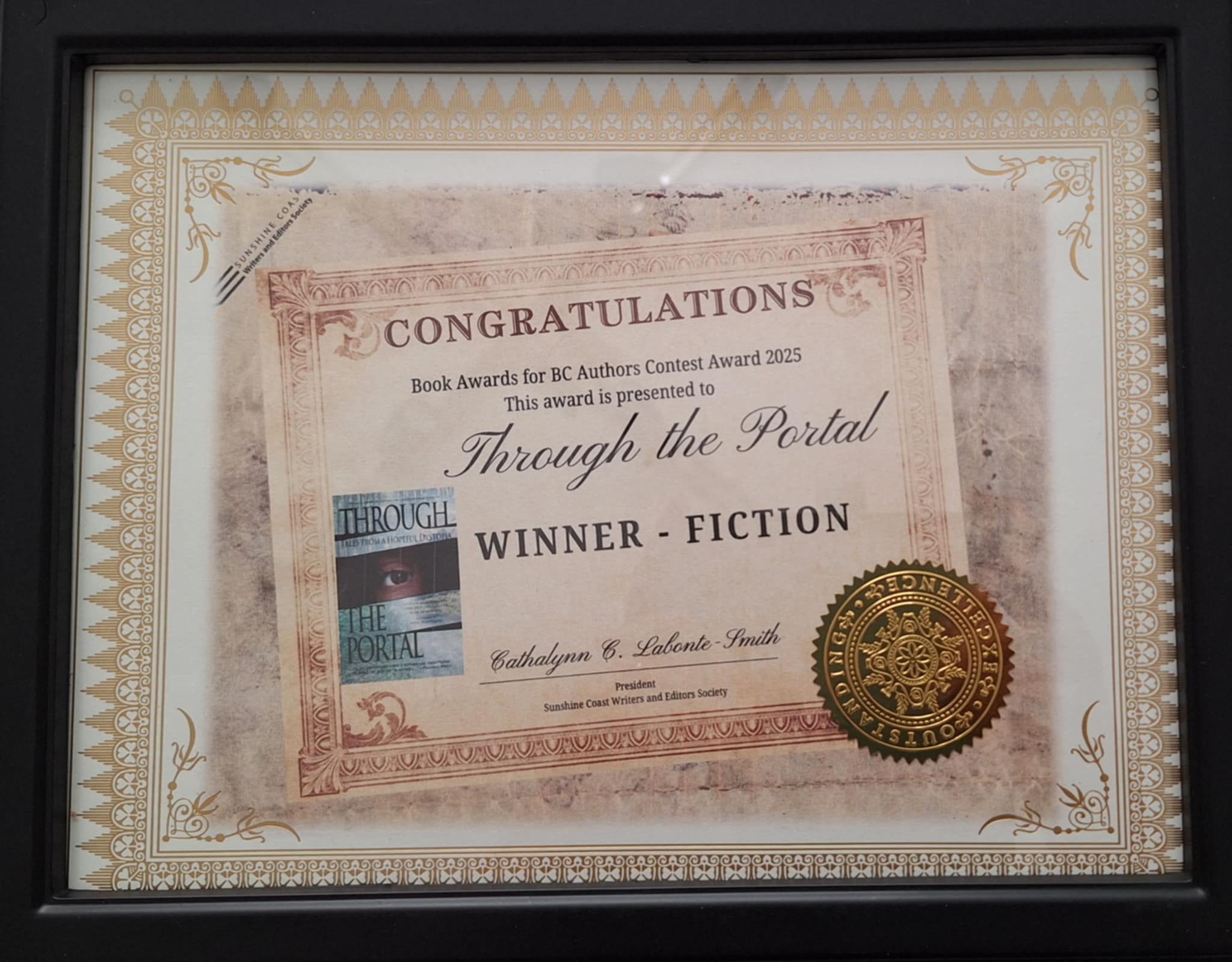
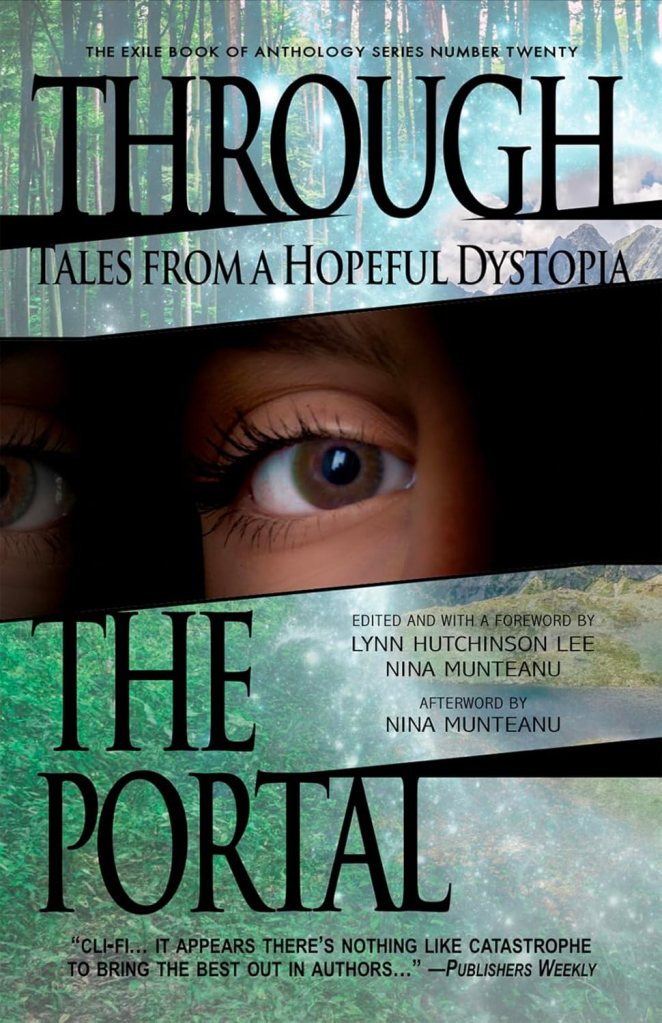
On August 23, 2025, Through the Portal: Tales for a Hopeful Dystopia, edited by Lynn Hutchinson Lee and Nina Munteanu for Exile Editions, won the BC Sunshine Coast Award for 2025.
The fiction prize was award to Exile Edition’s 20th anthology along with three other fiction works that include Blackheart Man by Nalo Hopkinson, The Cipher by Genni Gunn, and Inside Outside by Faye Arcand.
Here is what the judges said about Through the Portal:
“Every story in here is a delicious short gem.”
“An ambitious project with an unusual slant of positivity in the face of a dystopian future has turned into a solid piece of work, incorporating a good range of stories, some very literary and abstract, others simple tales of destruction and regrowth or the hope of regrowth.”
“Characters and situations in the selected stories show optimism and the power of the human spirit across a wide array of possible near- and far-term futures.”
“Most of the situations are inherently believable based on what we know about climate, industry, and the powerful politics of denialism.”
.
.
Nina Munteanu is a Canadian ecologist / limnologist and novelist. She is co-editor of Europa SF and currently teaches writing courses at George Brown College and the University of Toronto. Visit www.ninamunteanu.ca for the latest on her books. Nina’s bilingual “La natura dell’acqua / The Way of Water” was published by Mincione Edizioni in Rome. Her non-fiction book “Water Is…” by Pixl Press (Vancouver) was selected by Margaret Atwood in the New York Times ‘Year in Reading’ and was chosen as the 2017 Summer Read by Water Canada. Her novel “A Diary in the Age of Water” was released by Inanna Publications (Toronto) in June 2020.
Given that several of the authors in the anthology are BC writers, Through the Portal: Tales from a Hopeful Dystopia(edited by Lynn Hutchinson Lee and Nina Munteanu) was considered and became part of the short list for fiction.
Post Script: On August 23, 2025, “Through the Portal” won the award for fiction. Here is what the judges said:
“Every story in here is a delicious short gem.”
“An ambitious project with an unusual slant of positivity in the face of a dystopian future has turned into a solid piece of work, incorporating a good range of stories, some very literary and abstract, others simple tales of destruction and regrowth or the hope of regrowth.”
“Characters and situations in the selected stories show optimism and the power of the human spirit across a wide array of possible near- and far-term futures.”
“Most of the situations are inherently believable based on what we know about climate, industry, and the powerful politics of denialism.”
.
Nina Munteanu is a Canadian ecologist / limnologist and novelist. She is co-editor of Europa SF and currently teaches writing courses at George Brown College and the University of Toronto. Visit www.ninamunteanu.ca for the latest on her books. Nina’s bilingual “La natura dell’acqua / The Way of Water” was published by Mincione Edizioni in Rome. Her non-fiction book “Water Is…” by Pixl Press (Vancouver) was selected by Margaret Atwood in the New York Times ‘Year in Reading’ and was chosen as the 2017 Summer Read by Water Canada. Her novel “A Diary in the Age of Water” was released by Inanna Publications (Toronto) in June 2020.
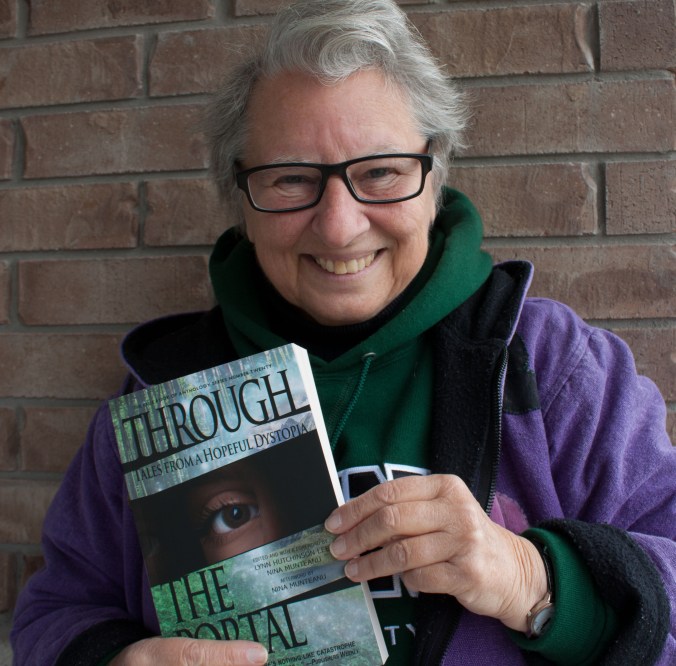
Author Nina Munteanu holding copy of Tales of Science II (photo by Jane Raptor)
.
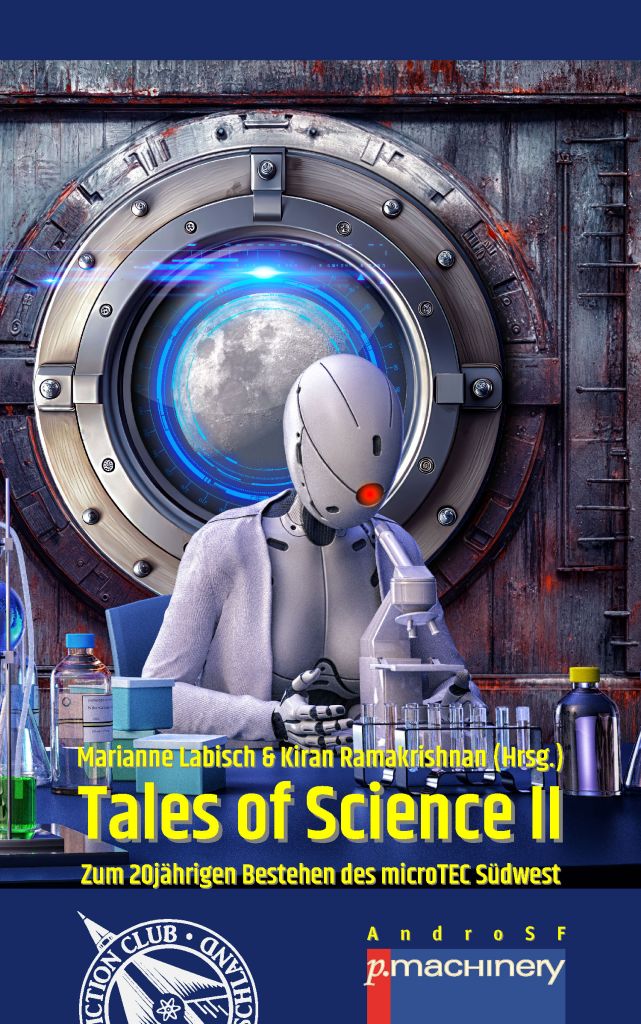
A few weeks ago, I looked into my mail box and found my contributor’s copy of “Tales of Science II” Anthology (edited by Marianne Labisch & Kiran Ramakrishnan) with my short story Die Polywasser-Gleichung (“The Polywater Equation”) inside. Beaming, I did a little dance because the anthology was marvelous looking! And it was all in German! (My mother is German, so I could actually read it; bonus!).
This science-fiction anthology, for which I was invited to contribute, collected seventeen short stories, all based on sound science. Here’s how the book jacket blurb (translated from German) describes the anthology:
.
It’s all just fiction. Someone made it up; it has nothing to do with reality, right? Well, in this anthology, there’s at least a grain of truth in all the stories, because scientific sponsors collaborated with authors. Here, they looked into the future based on current research What does such an experiment look like? See for yourself what the authors and scientific sponsors have come up with: about finding a way to communicate with out descendants, finding the ideal partner, conveying human emotions to an AI, strange water phenomena [that’s my story], unexpected research findings, lonely bots, and much more. The occasion for this experiment is the 20th anniversary of the microsystems technology cluster microTEC Südwest e. V.
(cover image and illustrations by Mario Franke and Uli Benkick)
.
In our initial correspondence, editor Marianne Labisch mentioned that they were “looking for short stories by scientists based on their research but ‘spun on’ to create a science fiction story;” she knew I was a limnologist and was hoping I would contribute something about water. I was glad to oblige her, having some ideas whirling in my head already. That is how “The Polywater Equation” (Die Polywasser-Gleichung) was born.
I’d been thinking of writing something that drew on my earlier research on patterns of colonization by periphyton (attached algae, mostly diatoms) in streams using concepts of fluid mechanics. Elements that worked themselves into the story and the main character, herself a limnologist, reflected some aspects of my own conflicts as a scientist interpreting algal and water data (you have to read the story to figure that out).
As I mentioned, the short story drew on my scientific work, which you can read about in the scientific journal Hydrobiologia. I was studying the community structure of periphyton (attached algae) that settled on surfaces in freshwater streams. My study involved placing glass slides in various locations in my control and experimental streams and in various orientations (parallel or facing the current), exposing them to colonizing algae. What I didn’t expect to see was that the community colonized the slides in a non-random way. What resulted was a scientific paper entitled “the effect of current on the distribution of diatoms settling on submerged glass slides.”
.
A. Distribution of diatoms on a submerged glass slide parallel to the current; treated diatom frustules are white on a dark background. B. diagram of water movement around a submerged glass slide showing laminar flow on the inner face and turbulent flow on the edges (micrograph photo and illustration by Nina Munteanu)
.
For more details of my work with periphyton, you can go to my article called Championing Change. How all this connects to the concept of polywater is something you need to read in the story itself.
.
The Phenomenon of Polywater
The phenomenon started well before the 1960s, with a 19th century theory by Lord Kelvin (for a detailed account see The Rise and Fall of Polywater in Distillations Magazine). Kelvin had found that individual water droplets evaporated faster than water in a bowl. He also noticed that water in a glass tube evaporated even more slowly. This suggested to Kelvin that the curvature of the water’s surface affected how quickly it evaporated.
.
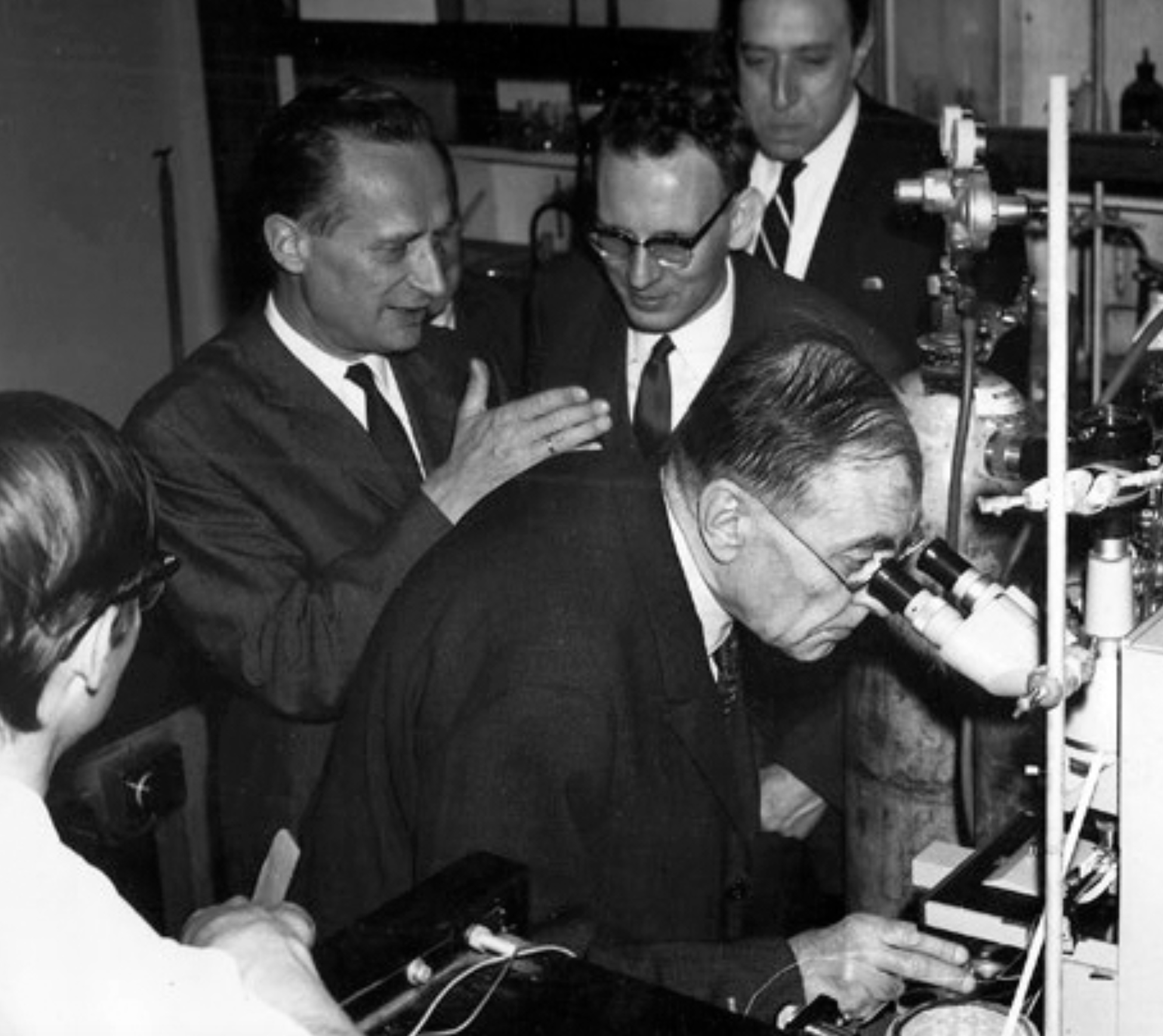
Soviet chemist Boris Deryagin peers through a microscope in his lab
.
In the 1960s, Nikolai Fedyakin picked up on Lord Kelvin’s work at the Kostroma Technological Institute and through careful experimentation, concluded that the liquid at the bottom of the glass tube was denser than ordinary water and published his findings. Boris Deryagin, director of the Institute of Physical Chemistry in Moscow, was intrigued and his team confirmed that the substance at the bottom of the glass tube was denser and thicker than ordinary water and had additional anomalous properties. This phase of water had a thick, gel-like consistency; it also had a higher stability, like a polymer, over bulk water. It demonstrated a lower freezing point, a higher boiling point, and much higher density and viscosity than ordinary water. It expanded more than ordinary water when heated and bent light differently. Deryagin became convinced that this “modified water” was the most thermodynamically stable form of water and that any water that came into contact with it would become modified as well. In 1966, Deryagin shared his work in a paper entitled “Effects of Lyophile Surfaces on the Properties of Boundary Liquid Films.” British scientist Brian Pethica confirmed Deryagin’s findings with his own experiments—calling the odd liquid “anomalous water”—and published in Nature. In 1969, Ellis Lippincott and colleagues published their work using spectroscopic evidence of this anomalous water, showing that it was arranged in a honeycomb-shaped network, making a polymer of water—and dubbed it “polywater.” Scientists proposed that instead of the weak Van der Waals forces that normally draw water molecules together, the molecules of ‘polywater’ were locked in place by stronger bonds, catalyzed somehow by the nature of the surface they were adjacent to.
.
Molecular structure of polywater
.
This sparked both excitement and fear in the scientific community, press and the public. Industrialists soon came up with ways to exploit this strange state of water such as an industrial lubricant or a way to desalinate seawater. Scientists further argued for the natural existence of ‘polywater’ in small quantities by suggesting that this form of water was responsible for the ability of winter wheat seeds to survive in frozen ground and how animals can lower their body temperature below zero degrees Celsius without freezing.
When one scientist discounted the phenomenon and blamed it on contamination by the experimenters’ own sweat, the significance of the results was abandoned in the Kuddelmuddel of scientific embarrassment. By 1973 ‘polywater’ was considered a joke and an example of ‘pathological science.’ This, despite earlier work by Henniker and Szent-Györgyi, which showed that water organized itself close to surfaces such as cell membranes. Forty years later Gerald Pollack at the University of Washington identified a fourth phase of water, an interfacial water zone that was more stable, more viscous and more ordered, and, according to biochemist Martin Chaplin of South Bank University, also hydrophobic, stiffer, more slippery and thermally more stable. How was this not polywater?
.
The Polywater Equation
In my story, which takes place in Berlin, 2045, retired limnologist Professor Engel grapples with a new catastrophic water phenomenon that looks suspiciously like the original 1960s polywater incident:
The first known case of polywater occurred on June 19, 2044 in Newark, United States. Housewife Doris Buchanan charged into the local Water Department office on Broad Street with a complaint that her faucet had clogged up with some kind of pollutant. She claimed that the faucet just coughed up a blob of gel that dangled like clear snot out of the spout and refused to drop. Where was her water? she demanded. She’d paid her bill. But when she showed them her small gel sample, there was only plain liquid water in her sample jar. They sent her home and logged the incident as a prank. But then over fifty turbines of the combined Niagara power plants in New York and Ontario ground to a halt as everything went to gel; a third of the state and province went dark. That was soon followed by a near disaster at the Pickering Nuclear Generating Station in Ajax, Ontario when the cooling water inside a reactor vessel gummed up, and the fuel rods—immersed in gel instead of cooling water—came dangerously close to overheating, with potentially catastrophic results. Luckily, the gel state didn’t last and all went back to normal again.
If you read German, you can pick up a copy of the anthology in Dussmanndas KulturKaufhaus or Thalia, both located in Berlin but also available through their online outlets. You’ll have to wait to read the English version; like polywater, it’s not out yet.
Henniker, J.C. 1949. “The depth of the surface zone of a liquid”. Rev. Mod. Phys. 21(2): 322–341.
Kelderman, Keene, et. al. 2022. “The Clean Water Act at 50: Promises Half Kept at the Half-Century Mark.” Environmental Integrity Project (EIP). March 17. 75pp.
Munteanu, N. & E. J. Maly, 1981. The effect of current on the distribution of diatoms settling on submerged glass slides. Hydrobiologia 78: 273–282.
Szent-Györgyi, A. 1960. “Introduction to a Supramolecular Biology.” Academic Press, New York. 135 pp.
Roemer, Stephen C., Kyle D. Hoagland, and James R. Rosowski. 1984. “Development of a freshwater periphyton community as influenced by diatom mucilages.” Can. J. Bot.62: 1799-1813.
Schwenk, Theodor. 1996. “Sensitive Chaos.” Rudolf Steiner Press, London. 232 pp.
Szent-Györgyi, A. 1960. “Introduction to a Supramolecular Biology.” Academic Press, New York. 135 pp.
Wilkens, Andreas, Michael Jacobi, Wolfram Schwenk. 2005. “Understanding Water”. Floris Books, Edinburgh. 107 pp.
.
Nina Munteanu is a Canadian ecologist / limnologist and novelist. She is co-editor of Europa SF and currently teaches writing courses at George Brown College and the University of Toronto. Visit www.ninamunteanu.ca for the latest on her books. Nina’s bilingual “La natura dell’acqua / The Way of Water” was published by Mincione Edizioni in Rome. Her non-fiction book “Water Is…” by Pixl Press (Vancouver) was selected by Margaret Atwood in the New York Times ‘Year in Reading’ and was chosen as the 2017 Summer Read by Water Canada. Her novel “A Diary in the Age of Water” was released by Inanna Publications (Toronto) in June 2020.
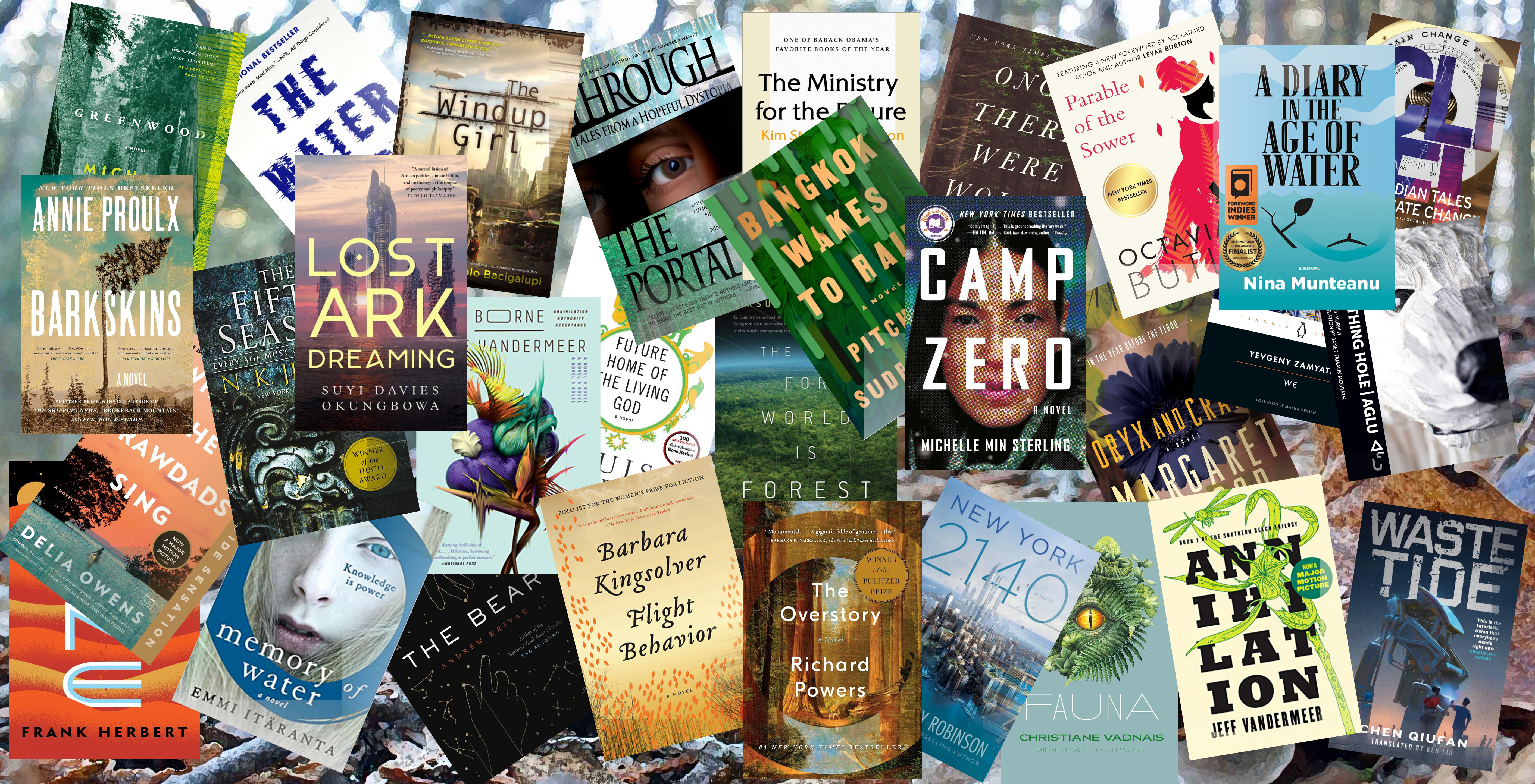
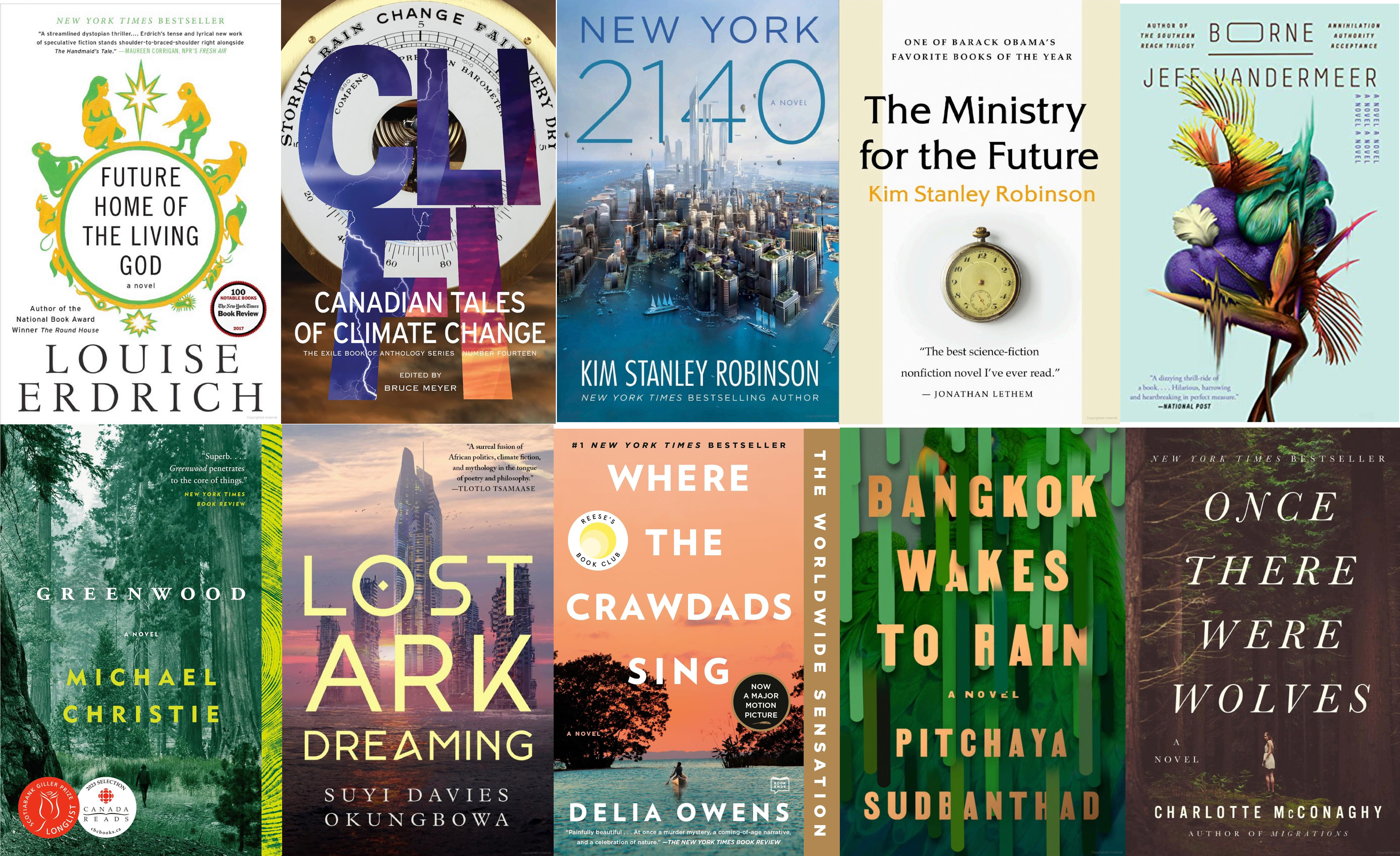
Here is my current list of 30 favourite eco-fiction novels and short story collections that have impacted me, and incited me to think, to feel and to act.
Flight Behavior is a multi-layered metaphoric study of “flight” in all its iterations: as movement, flow, change, transition, beauty and transcendence. Flight Behavior isn’t so much about climate change and its effects and its continued denial as it is about our perceptions and the actions that rise from them: the motives that drive denial and belief. When Dellarobia questions Cub, her farmer husband, “Why would we believe Johnny Midgeon about something scientific, and not the scientists?” he responds, “Johnny Midgeon gives the weather report.” Kingsolver writes: “and Dellarobia saw her life pass before her eyes, contained in the small enclosure of this logic.”
.
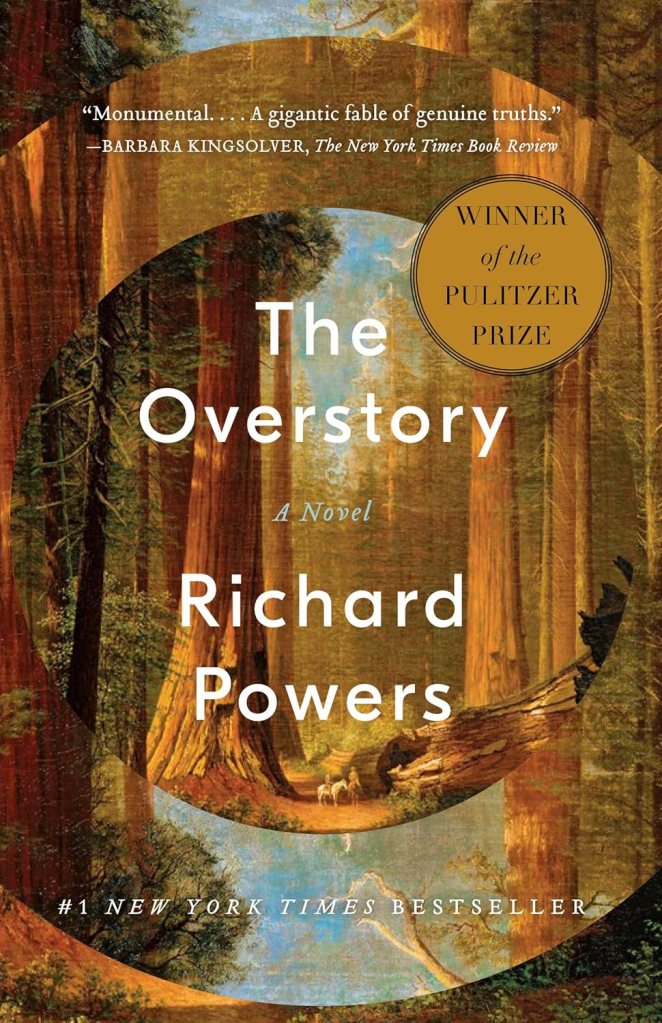
The Overstory follows the life-stories of nine characters and their journey with trees–and ultimately their shared conflict with corporate capitalist America. At the heart of The Overstory is the pivotal life of botanist Patricia Westerford, who will inspire movement. Westerford is a shy introvert who discovers that trees communicate, learn, trade goods and services—and have intelligence. When she shares her discovery, she is ridiculed by her peers and loses her position at the university. What follows is a fractal story of trees with spirit, soul, and timeless societies–and their human avatars.
.
The Maddaddam Trilogy is a work of speculative dystopian fiction that explores the premise of genetic experimentation and pharmaceutical engineering gone awry. On a larger scale the cautionary trilogy examines where the addiction to vanity, greed, and power may lead. Often sordid and disturbing, the trilogy explores a world where everything from sex to learning translates to power and ownership. The dark poetry of Atwood’s smart and edgy slice-of-life commentary is a poignant treatise on our dysfunctional society. Atwood accurately captures a growing zeitgeist that has lost the need for words like honor, integrity, compassion, humility, forgiveness, respect, and love in its vocabulary. And she has projected this trend into an alarmingly probable future. This is subversive eco-fiction at its best.
.
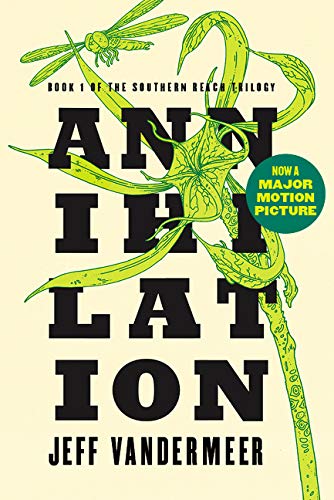
Annihilation is a science fiction eco-thriller that explores humanity’s impulse to self-destruct within a natural world of living ‘alien’ profusion. Annihilation is a bizarre exploration of how our own mutating mental states and self-destructive tendencies reflect a larger paradigm of creative-destruction—a hallmark of ecological succession, change, and overall resilience. VanderMeer masters the technique of weaving the bizarre intricacies of ecological relationship, into a meaningful tapestry of powerful interconnection. Bizarre but real biological mechanisms such as epigenetically-fluid DNA drive aspects of the story’s transcendent qualities of destruction and reconstruction. On one level Annihilation acts as parable to humanity’s cancerous destruction of what is ‘normal’ (through climate change and habitat destruction); on another, it explores how destruction and creation are two sides of a coin.
.
Barkskins chronicles two wood cutters who arrive from the slums of Paris to Canada in 1693 and their descendants over 300 years of deforestation in North America. Proulx weaves generational stories of two settler families into a crucible of terrible greed and tragic irony. The bleak impressions by immigrants of a harsh environment crawling with pests underlies the combative mindset of the settlers who wish only to conquer and seize what they can of a presumed infinite resource. From the arrival of the Europeans in pristine forest to their destruction under the veil of global warming, Proulx lays out a saga of human-environmental interaction and consequence that lingers with the aftertaste of a bitter wine.
.
Memory of Water is a work of speculative fiction about a post-climate change world of sea level rise. Symbols of water as shapeshifter archetype and its omnipotent life- and death-giving associations flow throughout the story, from the ‘fishfires’ in the northern skies to the painted blue circles on the doors of water criminals about to die. Water couples to main character Tea Master Noria, to explore consequences of commodification and exploitation. Teamaster Noria Kaitio guards its secrets; she alone knows the location of the hidden water source, coveted by the new government. Told in the literary fiction style of emotional nuances, Itäranta’s lyrical narrative follows a deceptively quiet yet tense pace that builds like a slow tide into compelling crisis and a poignant end.
.
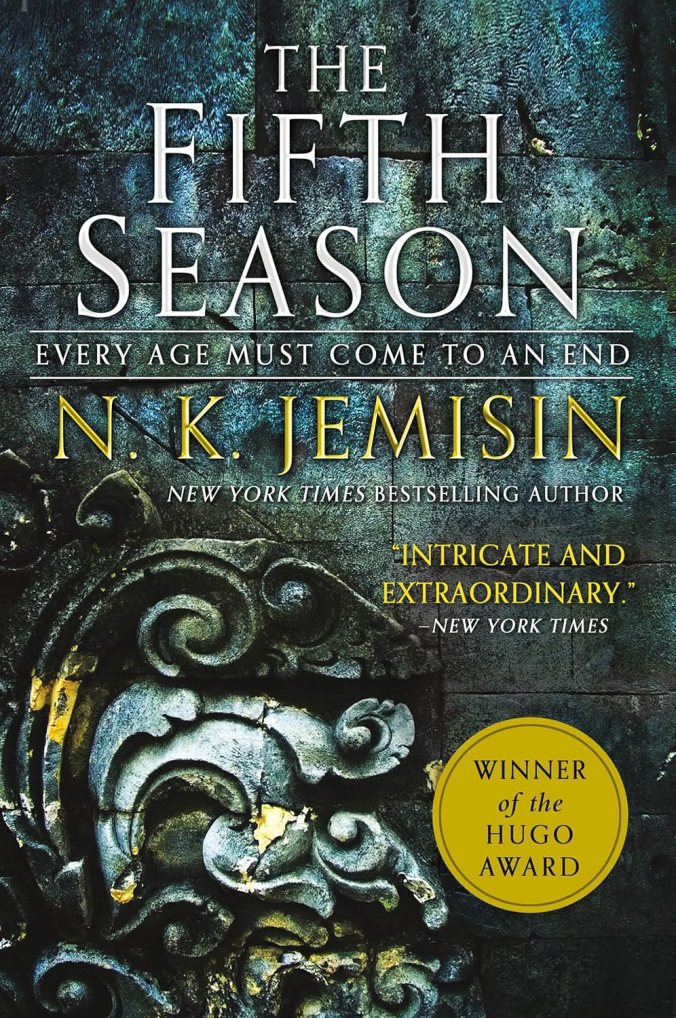
The Broken Earth Trilogy is a fantasy trilogy set in a far-future Earth devastated by periodic cataclysmic storms known as ‘seasons.’ These apocalyptic events last over generations, remaking the world and its inhabitants each time. Giant floating crystals called Obelisks suggest an advanced prior civilization. The first book of the trilogy introduces Essun, an Orogene—a person gifted with the ability to draw magical power from the Earth such as quelling earthquakes. The trilogy focuses on the dangers of marginalization, oppression, and misuse of power. Jemison’s cautionary dystopia explores the consequence of the inhumane profiteering of those who are marginalized and commodified.
.
The Windup Girl is a work of mundane science fiction that occurs in 23rd century post-food crash Thailand after global warming has raised sea levels and carbon fuel sources are depleted. Thailand struggles under the tyrannical boot of predatory ag-biotech multinational giants that have fomented corruption and political strife through their plague-inducing genetic manipulations. The rivalry between Thailand’s Minister of Trade and Minister of the Environment represents the central conflict of the novel, reflecting the current global conflict of neoliberal promotion of globalization and unaccountable exploitation with the forces of sustainability and environmental protection. Given the setting, both are extreme and there appears no middle ground for a balanced existence using responsible and sustainable means. The Windup Girl, Emiko, who represents the future, is precariously poised.
.
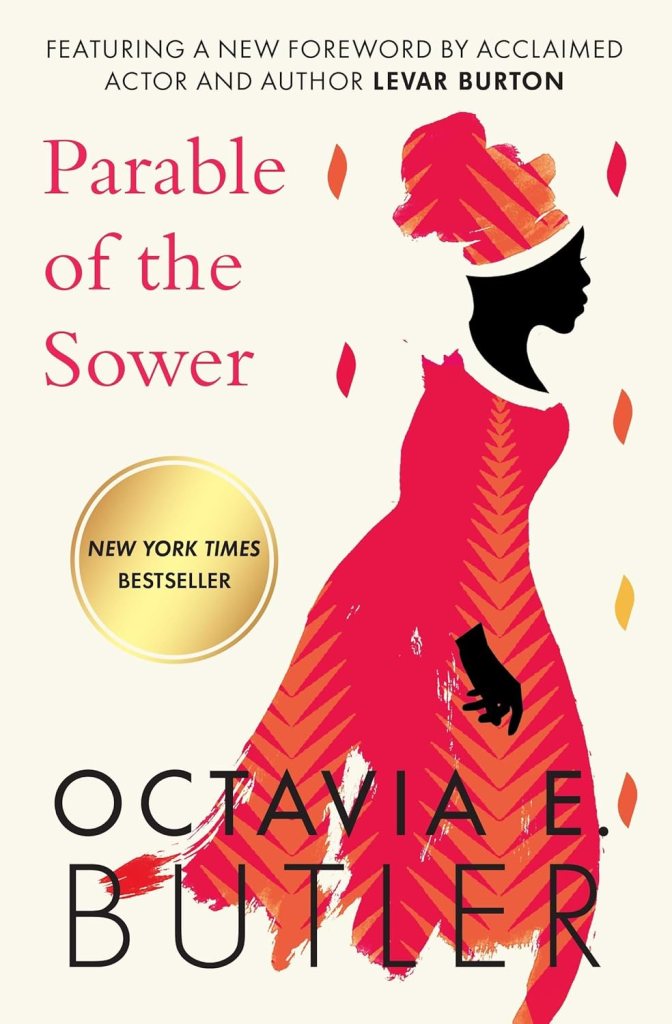
Parable of the Sower is a science fiction dystopian novel set in 21stcentury America where civilization has collapsed due to climate change, wealth inequality and greed. Parable of the Soweris both a coming-of-age story and cautionary allegorical tale of race, gender and power. Told through journal entries, the novel follows the life of young Lauren Oya Olamina—cursed with hyperempathy—and her perilous journey to find and create a new home. What starts as a fight to survive inspires in Lauren a new vision of the world and gives birth to a new faith based on science: Earthseed. Written in 1993, this prescient novel and its sequel Parable of the Talent speak too clearly about the consequences of “making America Great Again.”
.
The Water Knife is set in the near-future in the drought-stricken American southwest, where corrupt state-corporations have supplanted the foundering national government. Water is the new gold—to barter, steal, and murder for. Corporations have formed militias and shut down borders to climate refugees, fomenting an ecology of poverty and tragedy. Massive resorts—arcadias—constructed across the parched landscape, flaunt their water-wealth in the face of exploited workers and gross ecological disparity. Water is controlled by corrupt gangsters and “water knives” who cleverly navigate the mercurial nature of water rights in a world where “haves” hydrate and “have nots” die of thirst.
.
A Diary in the Age of Water explores the socio-political consequences of corruption in Canada, now owned by China and America as an indentured resource ‘reservoir’; it is a story told through four generations of women and their unique relationship with water during a time of great unheralded change. Centuries from now, in a dying boreal forest in what used to be northern Canada, Kyo, a young acolyte called to service in the Exodus, yearns for Earth’s past—the Age of Water—before the “Water Twins” destroyed humanity. Looking for answers and plagued by vivid dreams of this holocaust, Kyo discovers the diary of Lynna, a limnologist from that time of severe water scarcity just prior to the destruction. In her work for a global giant that controls Earth’s water, Lynna witnesses and records in her diary the disturbing events that will soon lead to humanity’s demise.
.
Waste Tide is an eco-techno thriller with compelling light-giving characters who navigate the dark bleak world of profiteers and greedy investors. Mimi is a migrant worker off the coast of China who scavenges through piles of hazardous technical garbage to make a living. She struggles, like the environment, in a larger power struggle for profit and power; but she finds a way to change the game, inspiring others. The story of Mimi and Kaizong—who she inspires—stayed with me long after I put the book down.
.
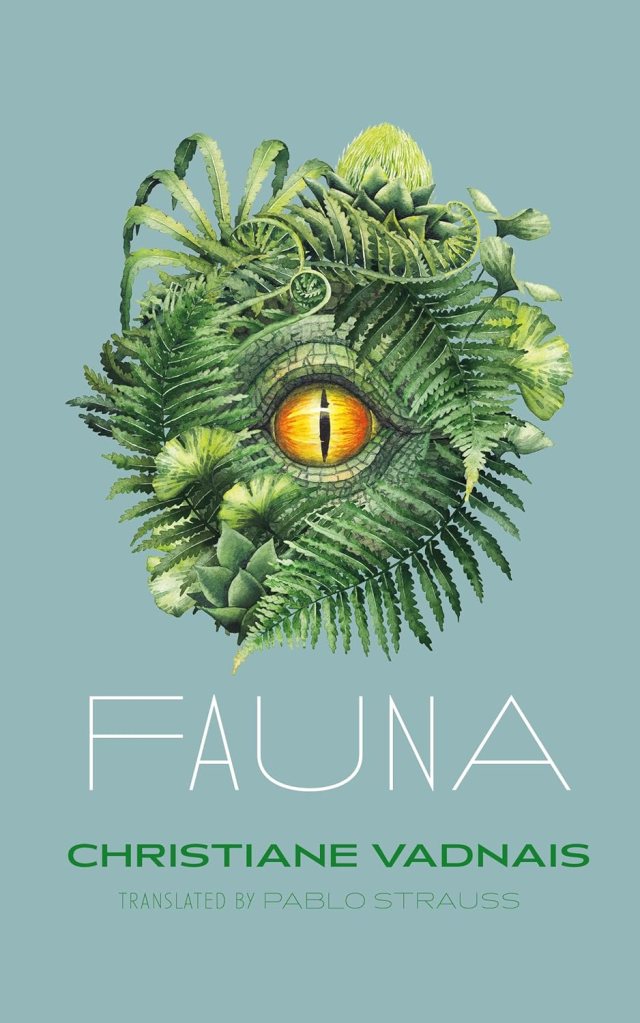
Fauna is at once beautiful and terrifying. Vadnais’s liquid prose immersed me instantly in her flowing story about change in this Darwinian eco-horror ode to climate change. I felt connected to the biologist Laura as she navigated through a torrent of rising mists and coiling snakes and her own transforming body with the changing world around her. It was an emotional rollercoaster ride that made me think.
.
The Word for World is Forest chronicles the struggles of the indigenous people under the conquering settlers through empathetic characters. The irony of what the indigenous peoples must do to save themselves runs subtle but tragic throughout the narrative. Given its relevance to our own colonial history and present situation, this simple tale rang through me like a tolling bell.
.
The Breathing Hole story begins in 1535, when the Inuk widow Hummiktuq risks her life to save a lost one-eared polar bear cub on an ice floe and adopts him. She names him Angu’ruaq. We soon learn that Angu’ruaq is timeless when we encounter him in scenes over the centuries from the Franklin Expedition in 1845 (who he helps by bringing them food) to 2031 when Angu’ruaq—old, hungry, his fur yellowing—returns to the breathing hole where long-dead Hummiktuq rescued him. By then the glaciers have receded and the ground is slush. Murphy’s spare and focused narrative achieves a timeless, dreamlike quality that plays strongly on the emotional connections of the reader; it elicits immense empathy for the Other in a deeply moving saga on the tragic dance of colonialism and climate change.
.
The Bearby Andrew Krivak is a fable of a post-anthropocene Earth told through the point of view of a young girl—possibly the only remaining human in the world—and the bear that guides her. Unlike the polar bear of The Breathing Hole, who remains silent and is clearly victimized by humanity’s actions, the black bear of The Bear lives with agency in a post-anthropocene world; he proselytizes and tells stories to instruct the girl on living harmoniously with Nature. His actions and elegant use of speech reflect his archetype as mentor in this story. This is foreshadowed in the fairytale the girl’s father recounts to her of a bear that saved a village from a cruel despot through cleverness and a sense of community.
.
Duneuses powerful world building and symbols of desert, water and spice coupled to the indigenous Fremen, to address exploitation and oppression by colonial greed.
The novel chronicles the journeys of new colonists and indigenous peoples of the desert planet Arrakis, enslaved by its previous colonists. The planet known as Dune lies at the heart of an epic story about taking, giving and sharing. The planet also serves as symbol to any new area colonized by settlers and already inhabited by Othered indigenous. It is the Mars of Martian Chronicles, the Bangkok of The Windup Girl, the North America of Barkskins.
.
Camp Zero, set in the remote Canadian north, is a feminist climate fiction that explores a warming climate through the perilous journeys of several female characters, each relating to her environment in different ways. Each woman exerts agency in surprising ways that include love, bravery and shared community. The strength of female power carried me through the pages like a braided river heading to a singular ocean. These very different women journey through the dark ruins of violent capitalism, colonialism and patriarchy—flowing past and through hubristic men pushing north with agendas and jingoistic visions—to triumph in an ocean of solidarity. I empathized with each woman as she found her strength and learned to wield true heroism—one based on collaboration and humble honesty.
.
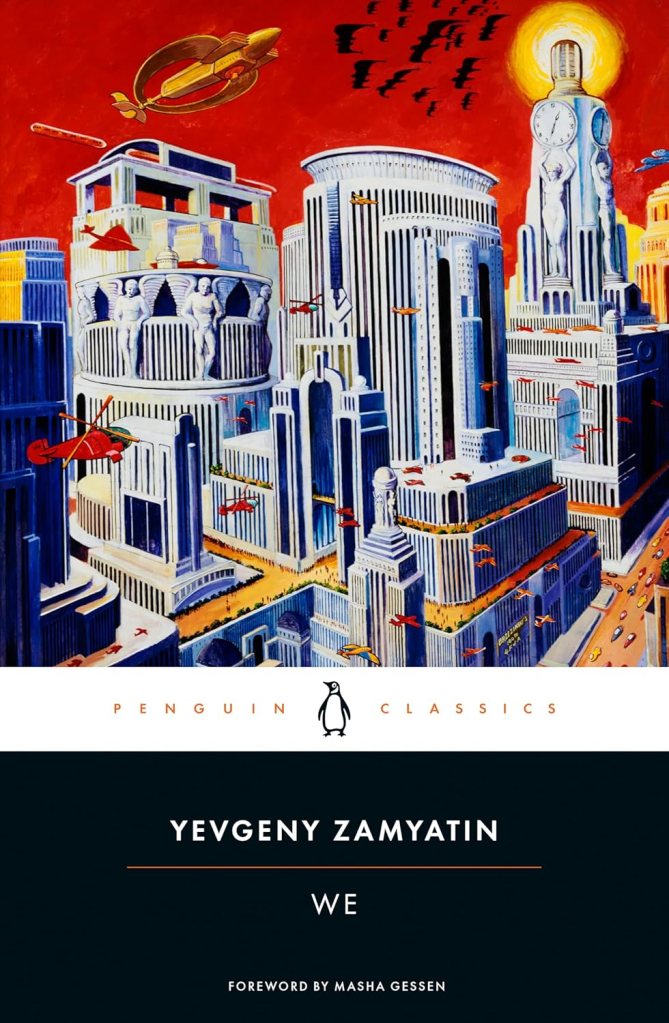
We, written in 1920, is a hopeful dystopic work of courageous and unprecedented feminism. While the story centres on logical D-503, a man vacuously content as a number in the One State, it is I-330—Zamyatin’s unruly heroine—who stole my attention. Confident, powerful and heroic, the liberated I-330 embraces the Green Wind of change to influence D-503. A force of hope and resilience, she braves torture to successfully orchestrate a revolution that breaches the Green Wall—feats typically relegated to a male protagonist in novels of that era. When pregnant O-90 refuses to surrender her child to the State, I-330 helps her escape to the outside, where the Green Wind of freedom blows. I resonated with Zamyatin’s cautionary tale on the folly of logic without love and Nature.
.
In Through the Portal: Tales from a Hopeful Dystopia, award-winning authors of speculative fiction Lynn Hutchinson Lee and Nina Munteanu present a collection that explores strange new terrains and startling social constructs, quiet morphing landscapes, dark and terrifying warnings, lush newly-told folk and fairy tales.
.
I list other significant and impactful eco-fiction books below:
New York 2140 by Kim Stanley Robinson
Canadian Tales of Climate Change (edited) by Bruce Meyer
Ministry for the Future by Kim Stanley Robinson
Borne by Jeff Vandermeer
Bangkok Wakes to Rain by Pitchaya Sudbanthad
Future Home of the Living God by Louise Erdrich
Lost Arc Dreaming by Suyi Davies Okungbowa
Greenwood by Micheal Christie
Where the Crawdads Sing by Della Owens
Once There Were Wolves by Charlotte McConaghy
.
.
Nina Munteanu is a Canadian ecologist / limnologist and novelist. She is co-editor of Europa SF and currently teaches writing courses at George Brown College and the University of Toronto. Visit www.ninamunteanu.ca for the latest on her books. Nina’s bilingual “La natura dell’acqua / The Way of Water” was published by Mincione Edizioni in Rome. Her non-fiction book “Water Is…” by Pixl Press (Vancouver) was selected by Margaret Atwood in the New York Times ‘Year in Reading’ and was chosen as the 2017 Summer Read by Water Canada. Her novel “A Diary in the Age of Water” was released by Inanna Publications (Toronto) in June 2020.
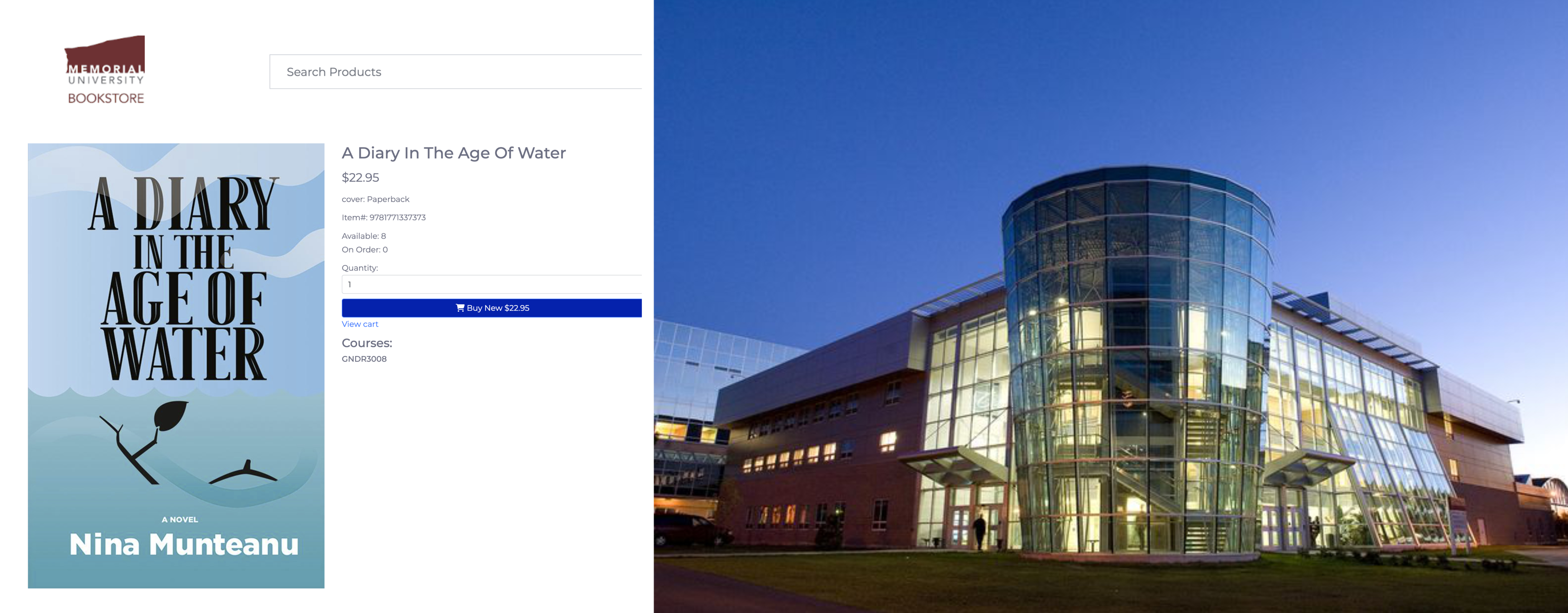
“A Diary in the Age of Water” at the Memorial University Bookstore
Instructor Keif Godbout-Kinney has made my eco-fiction novel A Diary in the Age of Water required reading in their course Feminist Practices and Global Change (GNDR 3008) at Memorial University, Newfoundland. The book is currently selling at the Memorial University Bookstore.
The Gender Studies course examines connections between feminist theories and activism for social and political change on a global scale.
.
.
My novel, told mostly through the diary of a limnologist, describes a world in the grips of severe water scarcity during a time when China owns the USA and the USA owns Canada. The diary spans a twenty-year period in the mid-twenty-first century of 33-year-old Lynna, a single mother who works in Toronto for CanadaCorp, an international utility that controls everything about water, and who witnesses disturbing events that she doesn’t realize will soon lead to humanity’s demise. A Diary in the Age of Water follows the climate-induced journey of Earth and humanity through four generations of women, each with a unique relationship to water. The novel explores identity and our concept of what is “normal”—as a nation and an individual—in a world that is rapidly and incomprehensibly changing.
.
Nina Munteanu is a Canadian ecologist / limnologist and novelist. She is co-editor of Europa SF and currently teaches writing courses at George Brown College and the University of Toronto. Visit www.ninamunteanu.ca for the latest on her books. Nina’s bilingual “La natura dell’acqua / The Way of Water” was published by Mincione Edizioni in Rome. Her non-fiction book “Water Is…” by Pixl Press (Vancouver) was selected by Margaret Atwood in the New York Times ‘Year in Reading’ and was chosen as the 2017 Summer Read by Water Canada. Her novel “A Diary in the Age of Water” was released by Inanna Publications (Toronto) in June 2020.
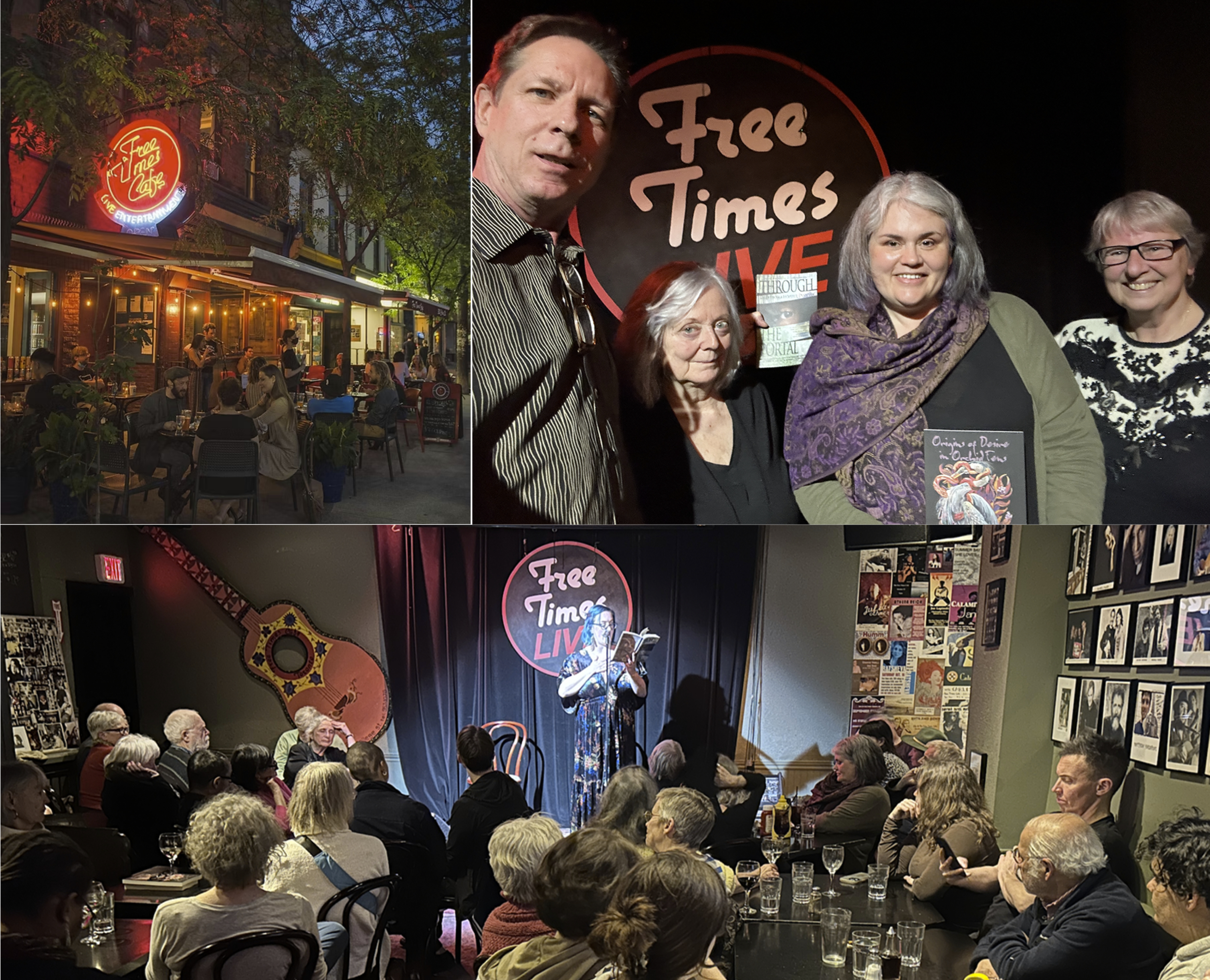
Free Times Cafe venue at night (photo by Ashish Pillai)
.
Appropriately, on the eve of Earthday, Exile Editions and Stelliform Press launched two eco-fiction books at one of Toronto’s oldest and established cultural/dining venues, Free Times Café, by Kensington Market. Both books were works of eco-fiction and climate fiction that focused on issues of environmental treatment and destruction. Both works focused on hope.
.
Top left: Free Times Cafe venue at night (photo by Nick Wons). Top right: Michael Callaghan of Exile Editions, Lynn Hutchinson Lee, Selena Middleton of Stelliform Press, Nina Munteanu. Bottom: Lynne Sargent reads from Portal.
.
Exile launched their anthology Through the Portal: Tales of a Hopeful Dystopia, edited by Lynn Hutchinson Lee and Nina Munteanu. It was their twentieth in a series; this one focused on hope in a climate-changing world that is progressively becoming more dystopic. Short stories and poems were read by authors.
.
Top left: Ursula Pflug reads from Portal. Top right: Michael Callaghan introduces the anthology. Bottom: Lynn Hutchinson Lee reads from her novel Origins of Desire in Orchid Fens.
.
Stelliform launched Origins of Desire in Orchid Fens a novel written by Lynn Hutchinson Lee, who read several excerpts of her novel.
Both works have received much praise.
.
.
Nina Munteanu is a Canadian ecologist / limnologist and novelist. She is co-editor of Europa SF and currently teaches writing courses at George Brown College and the University of Toronto. Visit www.ninamunteanu.ca for the latest on her books. Nina’s bilingual “La natura dell’acqua / The Way of Water” was published by Mincione Edizioni in Rome. Her non-fiction book “Water Is…” by Pixl Press (Vancouver) was selected by Margaret Atwood in the New York Times ‘Year in Reading’ and was chosen as the 2017 Summer Read by Water Canada. Her novel “A Diary in the Age of Water” was released by Inanna Publications (Toronto) in June 2020.
Art is the oar that guides us through dystopian rivers
Mary Woodbury, dragonfly.eco
.
Through the Portal: Tales from a Hopeful Dystopiathe ecofiction anthology edited by Lynn Hutchinson Lee and me and published December 2024 by Exile Editions, recently received another wonderful review from Mary Woodbury at dragonfly.eco. Here is an excerpt:
As the world teeters on disaster, what saves us ranges from graceful failure to full-fledged resistance and opposition. Through the Portal, an anthology of eco-fiction, offers 35 artful, provoking stories to propel us forward. The book serves to reconnect us with Nature in diverse storytelling, from cautionary tales to fiction that brims with hope while also helping us grieve what we’ve lost—described as solastalgia.
The anthology is a stunning collection of short stories and poetry that address our most existential concerns through metaphysical, epic, solarpunk, mythological, and contemporary perspectives. From landscape and weather transformations to stars, fairy tales, parking lots, mermaids, whales, storms, bees, and much more, the reader is treated to a journey of colorful narratives woven into a chronology: imagination, after the fall, and Earth hour.
Hopeful dystopias are so much more than an apparent oxymoron: they are in some fundamental way the spearhead of the future—and ironically often a celebration of human spirit by shining a light through the darkness of disaster. In Through the Portal: Tales from a Hopeful Dystopia, award-winning authors of speculative fiction Lynn Hutchinson Lee and Nina Munteanu present a collection that explores strange new terrains and startling social constructs, quiet morphing landscapes, dark and terrifying warnings, lush newly told folk and fairy tales.—Exile Editions
.
Nina Munteanu is a Canadian ecologist / limnologist and novelist. She is co-editor of Europa SF and currently teaches writing courses at George Brown College and the University of Toronto. Visit www.ninamunteanu.ca for the latest on her books. Nina’s bilingual “La natura dell’acqua / The Way of Water” was published by Mincione Edizioni in Rome. Her non-fiction book “Water Is…” by Pixl Press (Vancouver) was selected by Margaret Atwood in the New York Times ‘Year in Reading’ and was chosen as the 2017 Summer Read by Water Canada. Her novel “A Diary in the Age of Water” was released by Inanna Publications (Toronto) in June 2020.
A recent favourable review of Through the Portal: Tales from a Hopeful Dystopia (edited by Lynn Hutchinson Lee and Nina Munteanu, released by Exile Editions) appeared in On Spec Magazine. The review by Lorina Stephens applauded the anthology for its genuine Canadian perspective, excellent writing, and “remarkable voice of many.”
.
Excerpts of the review follow below:
“What unfolds in these 35 stories is a quintessentially Canadian perspective on climate change, the probable dystopia of our own making, and how we as not only humans, but Canadians, may deal with the breakdown of environment and society, of how we construct mythology to interpret our experience.”
The stories, writes Stephens, “are filled with that remarkable pragmatism and resilience, little say a reverence for the land, which seems to be hardwired into a people who deal with constant change, and sometimes extremes, dictated by climate and geography.”
“…the quality of the writing from this enclave of writers is quite remarkable…I am steadfast in my praise of the skill of these writers, and the stories they’ve crafted, collected into this remarkable voice of many.”
“The stories manage that most adroit of transformations from genre fiction meant as escapism and consumable, to that other dimension which is provoking, illuminating, and exactly what good literary fiction should engender.”
Through the Portal has received other favourable reviews:
“Through the Portal offers intriguing and imaginative glimpses into the future.” – The Seaboard Review
“A stunning collection of short stories and poetry that address our most existential concerns through metaphysical, epic, solarpunk, mythological, and contemporary perspectives.” – dragonfly.eco.
Nina Munteanu is a Canadian ecologist / limnologist and novelist. She is co-editor of Europa SF and currently teaches writing courses at George Brown College and the University of Toronto. Visit www.ninamunteanu.ca for the latest on her books. Nina’s bilingual “La natura dell’acqua / The Way of Water” was published by Mincione Edizioni in Rome. Her non-fiction book “Water Is…” by Pixl Press (Vancouver) was selected by Margaret Atwood in the New York Times ‘Year in Reading’ and was chosen as the 2017 Summer Read by Water Canada. Her novel “A Diary in the Age of Water” was released by Inanna Publications (Toronto) in June 2020.
“It is a novel to learn from, and it is a novel to take forward into life as inspirational guide. Each of us is called upon to examine, not only our relationship with water, but with all Earth gifts.”
Jane Buchan, author & educator
Vermont author Jane Buchan recently wrote a review of my 2020 eco-fiction novel A Diary in the Age of Water. Here is an excerpt:
As climate, social, and political crises escalate, one source of guidance becomes essential to our continued optimism and activism: a Numinous Story… A Diary in the Age of Water by Nina Munteanu, is, for many of us alive in these terrifying times, a numinous story. It meanders through our consciousness with the enlightening science of fresh-water lakes and rivers and streams, sometimes heavy with sediment and toxicity, sometimes fast flowing and cleansing, sometimes terrifying with truths smacking us down with the force of a tidal bore. Its characters are story tellers and story receivers, and despite their diverse natures, all the stories they tell reveal the many threats to our source of life on Earth – our water.
Nina Munteanu’s novel structure is perfect for the weaving of human scientific and mystical relationships with water. It’s initial and final sections create a frame for the inner story of bitterness, despair, self-serving behaviours, and corporate rapaciousness described by a professional scientist, a limnologist named Lynna. In the outer story we meet Kyo and Nam, Kyo’s mentor, as well as Ho, a librarian and keeper of a remnant of rare books. These characters exist on the other side of a mysterious cataclysm, the causes of which are the novel’s key themes.
Kyo, a small, four-armed blue being whose story begins and ends the novel, introduces us to the characters who form the larger diary section framed by the opening Library section and final Seed Ship section. Kyo makes glancing references to Una, mother of Lynna, and Lynna, mother of Hilde. Only Lynna is fully realized through her own perceptions and thoughts, these expressed in diary entries beginning in the spring of 2045 and ending in the late fall of 2066. Her diary, taking up 250 pages of this 303-page novel, provides the chronological spine connecting our past and present to a possible future that is not the one most humans want to think about, let alone welcome.
A Diary in the Age of Water is best sipped and savoured rather than gulped. Gulping will lead to choking for most non-scientist readers, and this book deserves to be experienced as it is written, in slow, undulating, revelatory waves… Like all complex stories, A Diary in the Age of Water requires patience, something our video-oriented age does not foster. The richest stories ask that we learn to hold many apparently divergent story threads at once. One of my fears as I read the diary was that the darkness of greed and short-sighted thinking and feeling would win out over that wondrous mystical relationship with the world that Una carried. While Una does her best to pass the experience of the sacred on to Lynna, Una’s spiritual influence is eclipsed by Lynna’s oppressive dependence on scientific knowledge to the exclusion of all else.
Through these characters, Nina Munteanu offers a warning for our times. Science is vitally important to our understanding of natural systems but science best serves us when it is balanced with an experience of the responsiveness of the natural world, a responsiveness that evokes our reverence and respect. Every culture honours the spiritual nature of the greater-than-human world, encoding its reverence in mythology, folktales, and wisdom traditions. – all keepers of numinous stories that transform our relationships with one another and the world. When we live honouring the sacred nature of all life, we become partners and co-creators. When we do not, we are highly dangerous parasites…
Lynna is called to hold the science of water firmly in her mind as her heart slowly opens to water’s responsiveness, water’s intelligence, water’s generosity, water’s love. It is a huge transformation for her, because science has been her safe place, her refuge. But knowing how something works is only the first part of the journey for those of us alive on this watery planet; we must all experience the why – the joy of unbreakable interconnections that make our lives meaningful… It is not Una’s daughter, Lynna, who carries this numinosity forward. It is Hilde, Una’s granddaughter, whose name means, significantly, Warrior Woman. How Kyo fits in to this lineage is one of the novel’s most unique speculations, one best discovered by reading the entire novel.
This novel is rich with information about water’s evolutionary journeys; it also describes the horrors of human greed that directly impact our relationships with water. It is not an easy book, but it is an important one, especially for people ready to engage, to advocate, to stand against the corporate insanity currently destroying Earth’s delicate balances. It is a novel to learn from, and it is a novel to take forward into life as inspirational guide. Each of us is called upon to examine, not only our relationship with water, but with all Earth gifts.
Go to Jane’s site Winterblooms to read the full review, worth reading in its entirety for its rich and poetic narrative.
.
Jane Buchan is a writer currently living in Vermont and originally from southwest Ontario. Her books include Under the Moon, Kinder Sadist and her latest, The Buttes. She is also an emotional Freedom Techniques (EFT) coach, Master Trainer and educator.
.
Jackson Creek flowing through ice formations (photo and rendition by Nina Munteanu)
.
Nina Munteanu is a Canadian ecologist / limnologist and novelist. She is co-editor of Europa SF and currently teaches writing courses at George Brown College and the University of Toronto. Visit www.ninamunteanu.ca for the latest on her books. Nina’s bilingual “La natura dell’acqua / The Way of Water” was published by Mincione Edizioni in Rome. Her non-fiction book “Water Is…” by Pixl Press (Vancouver) was selected by Margaret Atwood in the New York Times ‘Year in Reading’ and was chosen as the 2017 Summer Read by Water Canada. Her novel “A Diary in the Age of Water” was released by Inanna Publications (Toronto) in June 2020.
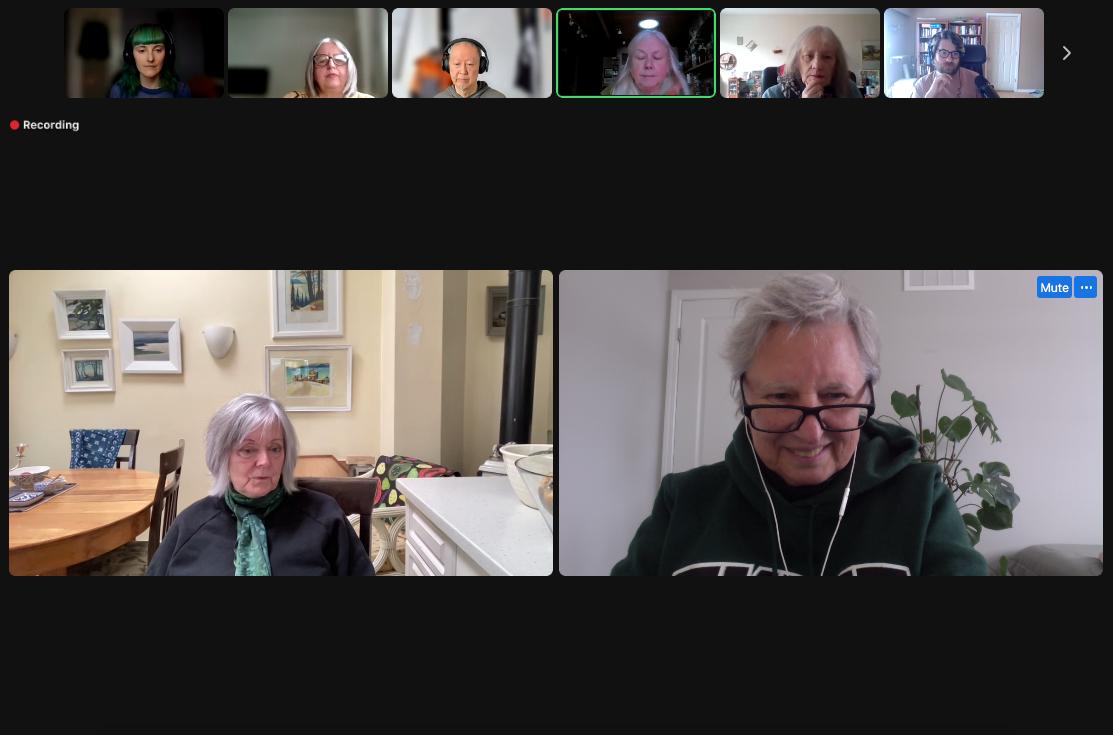
I recently participated in author readings from the eco-fiction anthology “Through the Portal: Tales from a Hopeful Dystopia.” Co-editor Lynn Hutchinson Lee and I opened the session with some introductory remarks, followed by readings by four of the anthology writers: Annaliese Schultz, Jade Wallace, Isabella Mori, and Matt Freeman.
Co-editors Lynn Hutchinson Lee and Nina Munteanu introduce the anthology at the reading; authors and moderator pictured above
.
The readings generated a lot of discussion about the nature and role of eco-fiction and stories in general on how we view the world and how that, in turn, influences the choices we make in life. Below, I include a short story excerpt and audience reaction for each author who read.
Annaliese Schultz read from her story Water & Oil. “Bursting from months, maybe years, of inertia born of dismay (engendered by the unending disasters of the world), Zip is instantly galvanized and greater than himself and gone.” One audience member shared that her story “sounded horrifyingly too possible.”
Jade Wallace read from her story Pluck. “It was only after I started working at the florist a few months ago that I began to think of plants as things that move. I learned that algae may swim towards the light; sundew can catch insects in their stalks; the leaves of touch-me-nots will slouch when they feel rain.” A member of the audience shared that “with what we now know about the way trees/plants communicate with each other, it was a neat story of crossing over to try to tell humans something.”
.
Jade Wallace reads from her story “Pluck”
.
Isabella Mori read from her story Shift. “Red Nelly, that’s what they called my grandmother; always looked a little dishevelled. So did her living room. Four book shelves were squeezed into the small room, sagging with dark tomes, oversized coffee-table books, Greenpeace brochures, and video cassettes that even her questionable looking TV couldn’t play anymore.” Someone in the audience mentioned that the author had woven a very human story. “Stories are sometimes better teachers than all other forms available to us. I felt moments of warmness and reflection.” Another audience member added, “The wisdom of animals and plants—there’s hope for the planet. I’m ordering this book from my local independent as soon as I close his meeting!”
Matt Freeman read from his story Birdseed: “Near the end I began to devote the bulk of my time to what I believed to be a gregarious individual of the species Corvus brachyrhynchos—the American Crow. By then a chemical scythe had begun to carve up the clouds hanging over the lands of ‘Vancouver’ in a psychedelic frenzy, and the shocked blue skyline often bled in shades of lime.” One audience member shared, “I loved he way ‘birdish’ words kept appearing: perch, cage. This may be Matt’s first published story, but I’m sure it won’t be the last.” Another audience member shared, “I loved the connection with the wisdom and personification of your crow.”
.
Nina Munteanu commenting on one of the readings
.
The readings generated a lot of discussion about the nature and role of eco-fiction and stories in general on how we view the world and how that, in turn, influences the choices we make in life.
Audience members shared that they found the readings inspiring. One member shared, “I find stories and poems have a more transcendent or at least deeper connection when read aloud. I wasn’t sure what to expect. So glad to be a part of this reading. The book sounds amazing.” Another member shared, “Keep hope alive!”
For more about how this anthology came about go to my previous post on Through the Portal.
.
.
Hopeful dystopias are so much more than an apparent oxymoron: they are in some fundamental way the spearhead of the future – and ironically often a celebration of human spirit by shining a light through the darkness of disaster. In Through the Portal: Tales from a Hopeful Dystopia, award-winning authors of speculative fiction Lynn Hutchinson Lee and Nina Munteanu present a collection that explores strange new terrains and startling social constructs, quiet morphing landscapes, dark and terrifying warnings, lush newly-told folk and fairy tales.–Exile Editions
“A stunning collection of short stories and poetry that address our most existential concerns.”
“Will ingenuity, love, and respect for the earth help us work through whatever changes might lie ahead? Through the Portal offers hope that these qualities, if not enough in and of themselves, will help us find our way.”
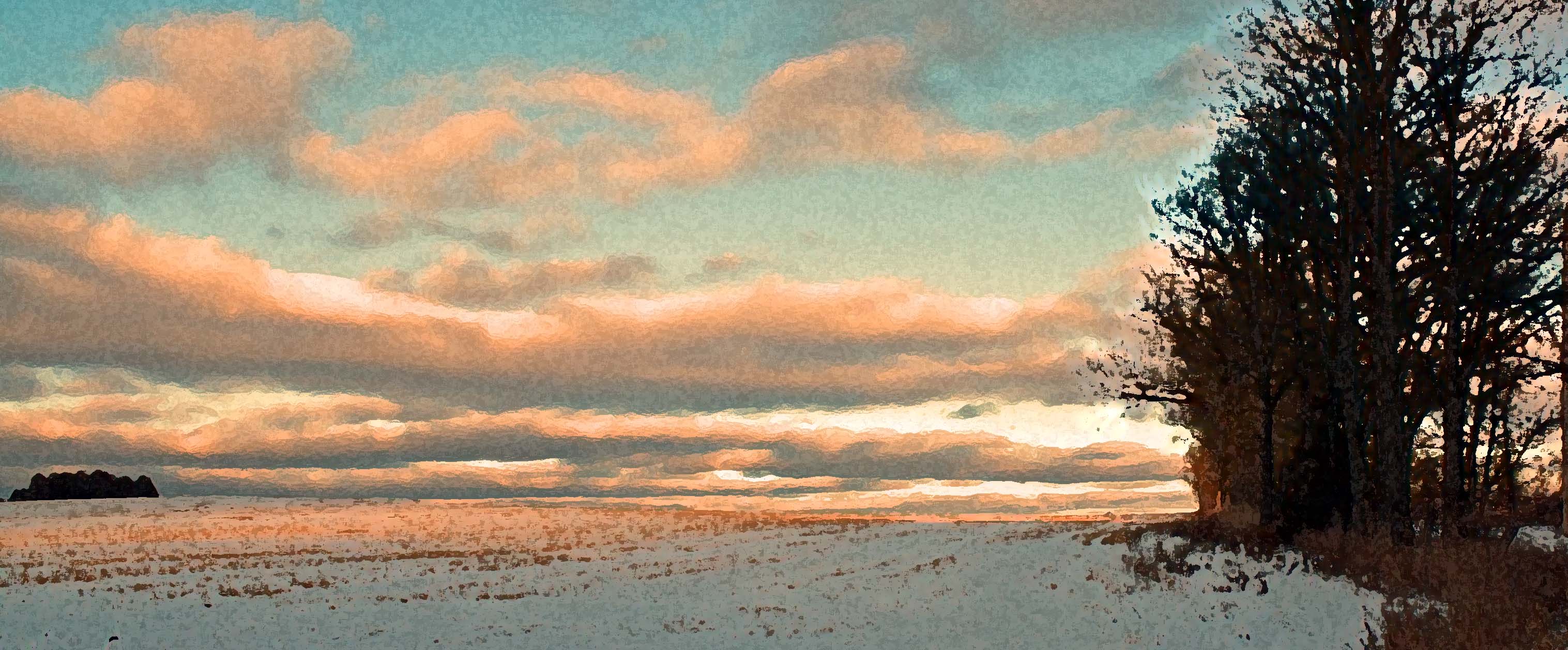
Farmer’s field at sunset, winter in Ontario (photo and rendition by Nina Munteanu)
.
Nina Munteanu is a Canadian ecologist / limnologist and novelist. She is co-editor of Europa SF and currently teaches writing courses at George Brown College and the University of Toronto. Visit www.ninamunteanu.ca for the latest on her books. Nina’s bilingual “La natura dell’acqua / The Way of Water” was published by Mincione Edizioni in Rome. Her non-fiction book “Water Is…” by Pixl Press (Vancouver) was selected by Margaret Atwood in the New York Times ‘Year in Reading’ and was chosen as the 2017 Summer Read by Water Canada. Her novel “A Diary in the Age of Water” was released by Inanna Publications (Toronto) in June 2020.























 Nina Munteanu Writing Coach