A few years ago I attended a panel at Toronto’s Ad Astra convention called “Stealth Science Fiction in Person of Interest.” The panel was the brainchild of fellow science fiction writer Ira Nayman, an avid watcher of the TV show. Unbeknownst to me, the panel I’d been assigned to participate with Ira and another panelist was about a TV show (which I’d never seen)—not just an expression.
I bumbled in the beginning as realization dawned on me that this was what the panel was about and quietly berated myself for not rereading the short description (which had been sufficiently vague—at least to me). I finally let the panelists and audience know my limitation when Ira astutely noted that I was being extra reticent (not one of my usual traits in panels). We muddled along, despite my infirmity, and the panel went along admirably—mainly because Ira moderated with great astuteness and audience members participated enthusiastically.
One of the plot points of the show led Ira to share a personality-defining hypothetical dilemma that he’d encountered. Here’s how he described it: if you knew you could save five people by instigating the death of another person, would you do it? Or would you, by your inaction, allow the five to die by not instigating that person’s death? The premise, of course, is that you could tell the future of two divergent actions.
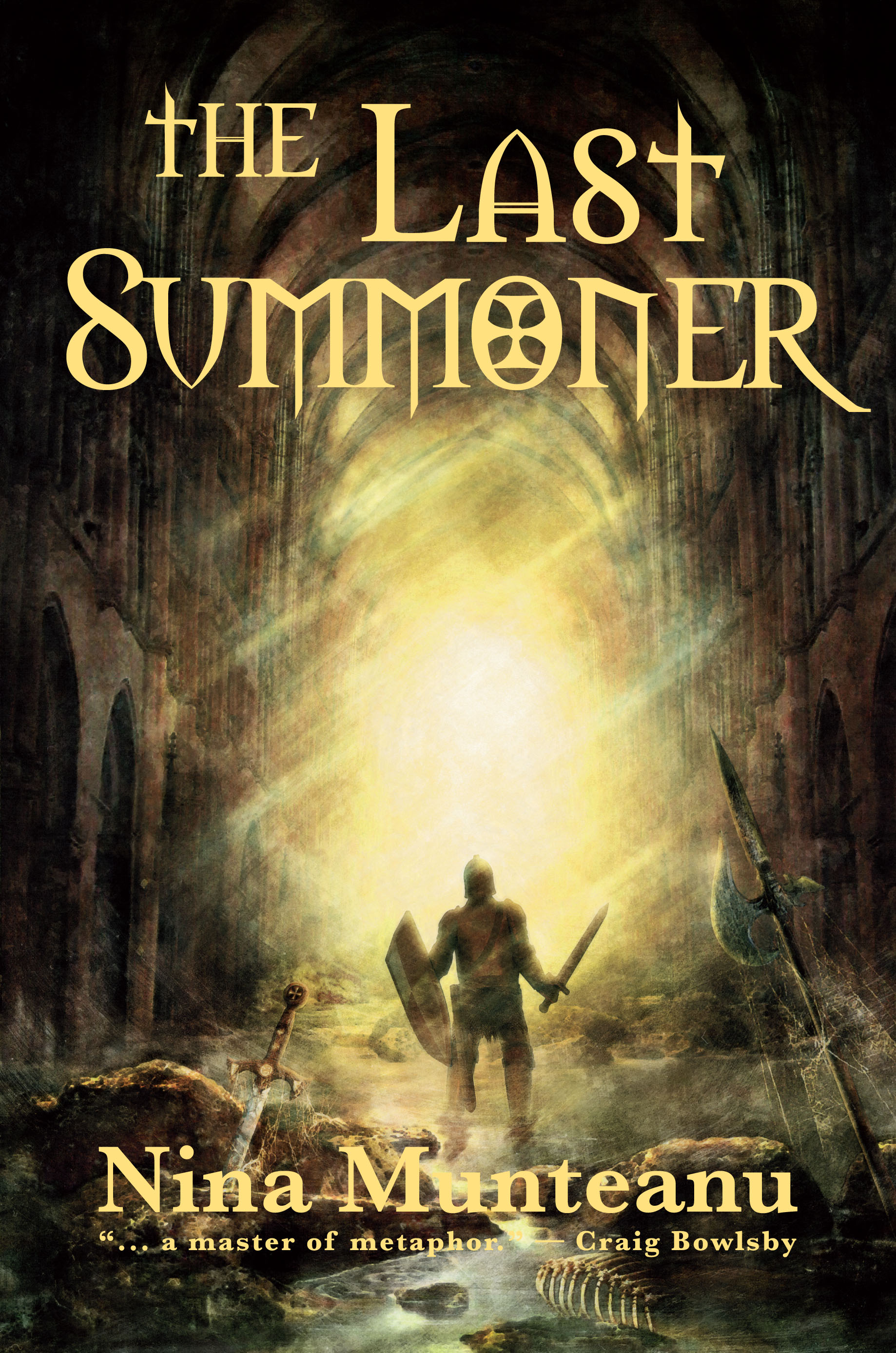
Besides her ability to time travel, Vivianne is able to manipulate metal through mind-wave energy. Because of this power, she decides to participate in a momentous event in which her power will have a potentially deadly effect. The year is 1889, just a year after Kaiser Wilhelm II was crowned Emperor, and the place is Charlottenburg Race Course in Berlin in this excerpt from The Last Summoner:
VIVIANNE pulled up the collar and hood of her fur coat to ward off the November chill as she walked next to Jurgen von Eisenreich in Berlin’s Charlottenburg Race Course. The coat barely kept the winter wind from cutting through her cream- colored evening gown. Fastened at the back, it had no bustle and signaled the upcoming style. They were here to watch Europe’s latest touring attraction from America: Buffalo Bill’s Wild West Show. Steering her by the elbow, von Eisenreich guided her up the rafter stairs toward the Royal Box, where the new Emperor was already seated with his retinue of several statesmen, including his aides-de-camp, and two imperial guards. Vivianne recognized the odious and obsequious Count Alfred von Waldersee, seated beside the Emperor. Twenty-seven years the Kaiser’s senior, the Count was a power-mongering anti-Semite, who would prove to mold the weak-minded Crown Prince into the bigoted warlord Kaiser Wilhelm II was becoming.
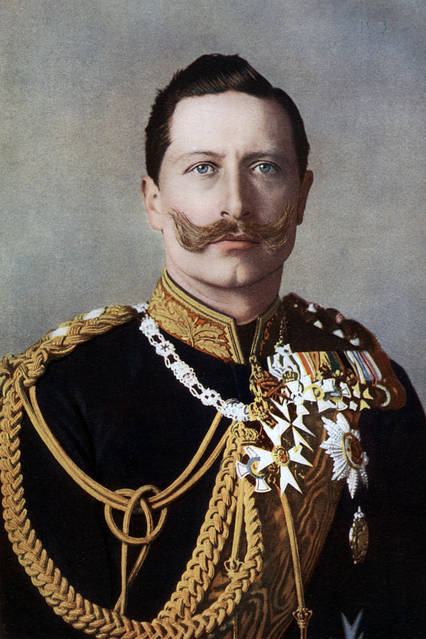
Kaiser Wilhelm II
Vivianne stole a long glance to the Reich’s young ruler. It had been just a year since the Crown Prince had ascended to the imperial thrown and he had already stirred up trouble with his insulting behavior of his mother, the dowager Empress, and his uncompassionate handling of his father’s funeral; then his shabby treatment of England’s Queen and her son, the Prince of Wales.
Vivianne furtively studied the dashing thirty-year old ruler with deep interest. Dressed impeccably in uniform, he was rakishly handsome, she decided, with sharp intelligent eyes, a long aristocratic nose and well-waxed handle-bar mustache. She found herself staring at his withered left arm, which he rested on his lap. Though she could not make it out, it was a good six inches shorter than the other arm and partially lifeless. He’d been a breech birth and both he and his mother were lucky to be alive.
Vivianne reflected on that eventful day when she’d botched her attempt to save the last Emperor of Germany from an unnatural birth. While Oskar had been instantly killed, the doctor had survived the carriage accident with only a severe concussion; he’d still only managed to get to Unter den Linden by early afternoon, having lain unconscious and unattended for most of the morning then having awoken at Humboldt Hospital where he’d ironically been scheduled to speak that day and had then foolishly insisted on tending to Vivianne first, who’d suffered a nasty head wound that she hadn’t even been aware of receiving.
The Emperor—like Vivianne—was here, in the District of Charlottenburg in West Berlin, to see the show’s star attraction, Annie Oakley, who acquired world fame for her skills with a Colt .45. The young sharpshooter had been invited by the Kaiser for a private performance for the Union-Club. Vivianne found her breaths escalate at the thought of what the impetuous Kaiser was about to do; and what she intended to do, as a result. Was it an ironic twist of history that only months ago Adolf Hitler was born this year? Vivianne glanced down at the program in her gloved hand:
Programme of Miss Annie Oakley’s Private Performance Before the Members and Their Friends of the Union-Club, Berlin, on November 13, 1889, at Charlottenburg Race Course.
There followed a list of up to seventeen feats she would perform, beginning with her exhibition of rifle shooting, followed by clay-pigeon sharp-shooting then various feats involving trapping and agility in weapon handling. She was not fated to get very far in her program before calamity of sorts would strike, Vivianne thought cynically.
“He’s alone…without his family?” she asked von Eisenreich. That would make it much easier, she concluded with an inward sigh.
“Dona prefers the comfort and warmth of the royal palace in Potsdam, and the company of her children,” he responded. “She’s not interested in this sort of thing. She has few interests other than church service, I’m afraid.” Then he leaned his head close to hers to confide. “Ten years ago, Wilhelm was smitten by his beautiful cousin, Victoria Elizabeth, the second eldest daughter of the Grand Duke and Duchess of Hesse and the Rhine. But Ella wouldn’t have him.” Then von Eisenreich surveyed Vivianne with an appraising look and smiled enigmatically. “In fact, she looked a lot like you.”
Vivianne swallowed down a sudden discomfort, not sure of its source. Von Eisenreich went on, “Poor Wilhelm became very self-conscious about his arm and thought himself unattractive. That might be why he chose a plain and simple, but pious woman.”
More like narrow-minded, anti-Semitic and bigoted thought Vivianne. Unfortunately the Empress fit in too well with the Kaiser’s own bigoted views and apparently her nature only served to exacerbate the Kaiser’s arrogance and insufferable nature.
Von Eisenreich chuckled to himself. “I heard that the Empress Dona was called unimaginative and prejudiced by the Emperor’s own mother. Dona hates the English. But don’t we all!” He laughed.
Vivianne thought of the cutting words of the gossiping socialite, Daisy, Princess of Pless: for a woman in that position I have never met anyone so devoid of any individual thought or agility of brain and understanding. She is just like a good, quiet, soft cow that has calves and eats grass slowly then lies down and ruminates.
“Apart from that homosexual, Count Philipp von Eulenburg, I’m the Emperor’s only real friend,” von Eisenreich confided rather smugly to Vivianne as they approached the Royal Box.
As if he felt her stealthy glance, the Kaiser turned to look directly at her. After an unabashedly long appraisal, he let his eyes drift away and leaned out, looking past his aide to focus on von Eisenreich. “Ah, Jurgen! So that’s why you dallied and missed my retinue!” The Kaiser yelled in a coarse Potsdam accent, eyes flitting back critically to Vivianne like she was merchandize. He stood up and clapped von Eisenreich hard on the back, clearly happy to see him. Vivianne got a clear view of his short left arm with dark brown mole on his shriveled hand. She noted that he was rather short in stature for a man, about her height or less, with a squat and slightly lopsided neck—owing to his left arm being shorter than the other. Eisenreich drew Vivianne forward.
“This is the Comptesse d’Anjou,” von Eisenreich said.
She pulled down her hood and curtsied slightly, eyes downcast. “I’m honored and humbled, your Imperial Majesty,” she said.
“No doubt you are!” he responded, swiftly tucking his left hand in his pocket. When she raised her eyes to meet his, Vivianne caught the brief instant as his eyes grew wide and deep with hidden intensity.
Jurgen caught it too. “I thought so, also,” he said with amusement to the Emperor. He was, no doubt referring to her likeness to the Princess Ella.
The Kaiser sucked in a breath and straightened with an imperceptible tremble, as if to shake off an old memory. Then he gave Vivianne a cold smile and extended his good hand to her in greeting. She accepted and instantly winced with excruciating pain. He barked out a cruel laugh and said, “The French are, I’m afraid, just like the English when it comes to my German mailed fist!”
Vivianne had heard of his sadistic handshake: he was in the habit of turning his many rings inward prior to clasping one’s hand with a vice-like grip. Somehow, she hadn’t expected him to inflict her with it. Perhaps it was his way of punishing his cousin for not accepting his marriage proposal, she concluded, regretful of her resemblance. The Kaiser hung on to her hand much longer than he needed to, Vivianne decided, squirming and attempting to retract it from his painful grasp. His grip was too strong.
Their eyes locked. And to her frustrated anger, her eyes teared up with the stinging pain through her glove.
In that moment she saw the hurt little boy in that bigoted, arrogant and angry face. She instantly knew that she’d misjudged one of his critical nexuses. Her mission this day might have been prevented. If she’d intersected with his life earlier, and somehow convinced his beloved Ella to accept his proposal, the single-minded but compassionate princess might have softened him, completed him, inspired him to be the great man he could have become instead of the bitter and insecure bully he now was.
Something passed between them and he abruptly let go of her hand with a sudden intake of air. “I beg pardon,” he said, voice softening from that harsh Potsdam accent. “You reminded me of someone I once knew…” In a flush of solicitous emotion, he pulled off her glove to inspect the damage he’d inflicted on her hand. Several red welts had surfaced on the inside of her lower palm where his rings had gouged into her flesh. “Ahh…such dear soft and warm hands…” he cooed in near reverence. “How remarkable…the soft insides of your hands…”
Vivianne slowly pulled her hand away.
They both looked awkward for a moment. Then the Kaiser broke out into a blustery laugh and turned to von Eisenreich.
“So, where’s your good wife, von Eisenreich?”
“Like you, I left her at home with my dear children, where she should be, your Majesty,” von Eisenreich responded cheerfully. “They’re no fun at these sorts of things.”
“Ah, but I wager the Comptesse is,” said the Emperor brashly and took the opportunity to rake her over with appreciative eyes.
Von Eisenreich let loose a conspiratorial laugh, as if to ratify the Kaiser’s innuendo. He then leaned into Vivianne beside him with a chuckle until his shoulder collided into hers. “I brought my lovely companion, the charming Comptesse d’Anjou, to improve my demeanour and make me interesting.”
The Kaiser threw his head back and shouted an open- mouthed laugh of abandon then stomped his foot. “Indeed, she has managed that!” He surveyed Vivianne with critical eyes that flashed with approval. When she’d first been introduced to him, she’d felt the Kaiser’s burning gaze roam over her like the eager hands of a lover. “Good choice,” Wilhelm said.
He’d clearly deduced that she was von Eisenreich’s mistress and Jurgen had as much as confirmed it. The Kaiser had several mistresses of his own and Vivianne had the impression he wouldn’t have minded another.
As Uta had predicted, Vivianne had indeed filled out into what most men commonly considered a woman of striking beauty. And she’d had many years to cultivate it into an irresistible package. She was now over four hundred years old, yet she looked no more than in her early twenties. That arcane quality alone, she knew, was enough to drive men to distraction.
Vivianne had only met von Eisenreich last week at a masked ball and, knowing his weakness for beautiful women, she’d shamelessly flirted with him; within short order she’d seduced his keen interest in her and ensured for herself an invitation to this event.
The Kaiser let his gaze stray to Vivianne as he spoke to von Eisenreich. Then he finally let his eyes rest openly on her with a cool smile. “You speak German very well for a French woman, Comptesse,” he said to her. “I detected no accent when we were first introduced.”
She smiled demurely and didn’t bother to correct him on her German lineage.
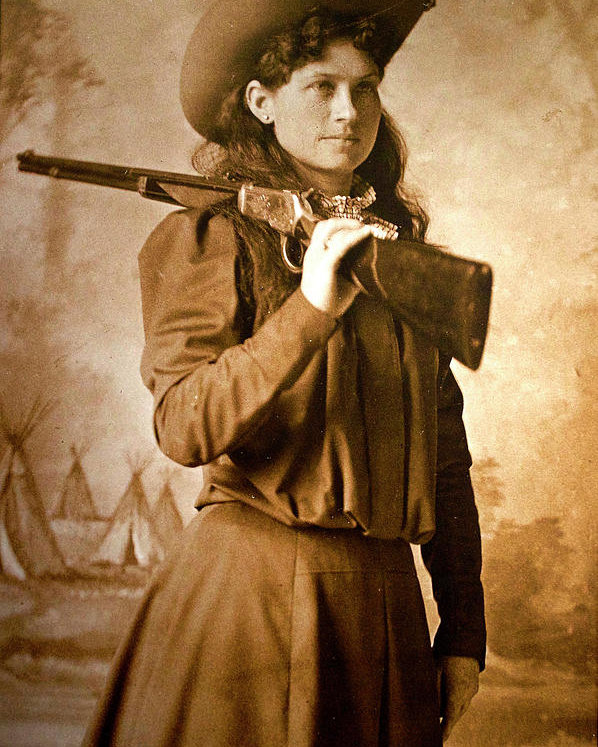
Annie Oakley
Then the show began and their attention was diverted to the ring below. Vivianne’s heart raced when Annie Oakley finally emerged. The diminutive woman stood facing the royal box in a smartly collared buckskin dress, bedecked with glittering metals from contests she’d won, cowboy hat, and holding her Colt .45.
Von Eisenreich leaned his head close to hers. “Chief Sitting Bull gave her the nickname of ‘Little Sure Shot’ because of her dead shot with a pistol, rifle and shotgun. Did you know that she began handling firearms at the tender age of nine to supply her widowed mother with game and eventually paid off the mortgage on her mother’s house?”
Vivianne let her brows rise in impressed surprise. In truth she knew. She knew everything about the American sharp-shooter. At 90 feet Annie could shoot a dime tossed in the air. With the thin edge of a playing card facing her at 90 feet, she could hit the card and puncture it with five or six more shots as it settled to the ground.
Vivianne felt her mouth go dry; she knew what came next.
With a flourishing turn, Annie faced the royal box and announced, “For my final act, I will attempt to shoot the ashes from the cigar of a lady or gentleman in the audience. “Who will volunteer to hold the cigar?” she asked the audience. Vivianne’s heart pounded. She knew that the little sharpshooter from Cincinnati expected no one to volunteer; Annie had simply asked for laughs. Her attentive manager-husband, Frank Butler, always stepped forward and offered himself. Not this time—
Just as laughter bubbled up in the crowd, Kaiser Wilhelm leapt out of the royal box and strutted into the arena to a stunned audience. Laughter turned to gasps as the Kaiser approached the sharpshooter. Annie Oakley visibly stiffened. In horror, Vivianne thought. The two guards scrambled forward from the rafters but the Kaiser gruffly waved them off. Vivianne marveled at Annie’s cool resolve; after handing the cigar to Wilhelm, the performer paced off her usual distance and the Kaiser lit the cigar with flourish.
Several German policemen rushed into the arena in a panicked attempt to preempt the stunt, but the Kaiser brusquely waved them off too. Then he lifted his head and placed the cigar to his mouth in a pose of a statue.
“No,” Annie said. “In your hand, please, Your Majesty,” she instructed. He looked disappointed but did as she’d asked.
Annie raised her Colt and took aim.

Royal Irish Rifles in the Somme, 1916
Vivianne swallowed the gorge in her throat. This was the moment she’d waited for; the moment for which she’d come. If this volatile and ambitious ruler were removed from the scene, one of the key reasons for World War I would also vanish. An entire world war would likely be averted. She only had to redirect the bullet; it was made of metal, after all. Kill a bully and incriminate and ruin the life of an innocent young woman … in exchange for over two million lives and the prevention of an age of non-stop violence—
Annie fired.
























 I realized soon after that this is exactly the situation that my main character Vivianne Schoen, the Baroness Von Grunwald, faced in her journey to change the history she’d inadvertently authored (in






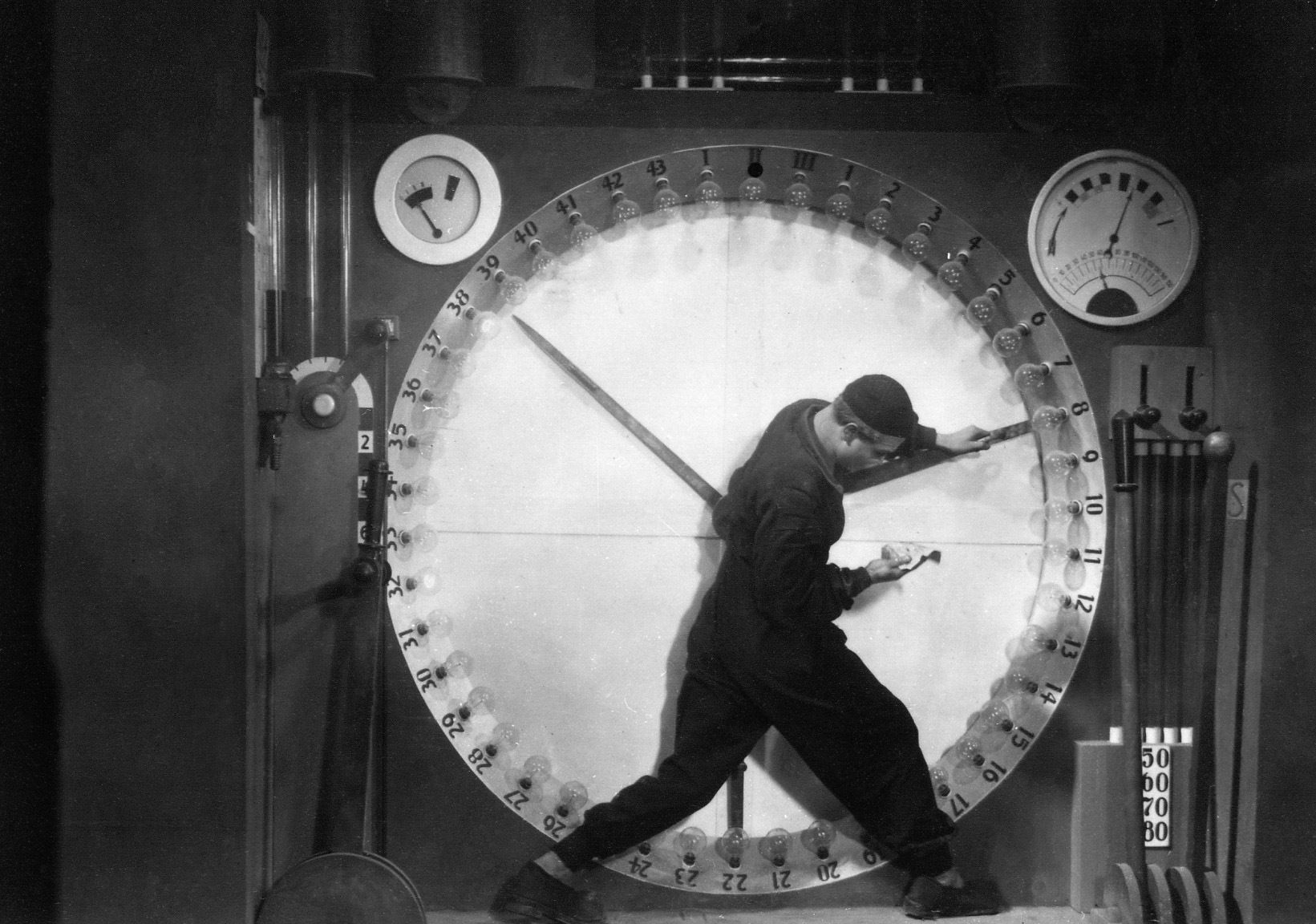
 Our predictions and visions of the future are certainly predicated on our perceptions of the present and the past. So, what happens when yesterday’s “future” collides with today’s past? Well, retro-fiction, alternate history and steam-punk, you quip, eyes askance with mischief: edgy sociopathic Sherlock Holmes with bipolar or obsessive /compulsive tendencies; flying aircraft carriers in Sky Captain and the World of Tomorrow, robot-like workers of Metropolis…

 There are, in most cases, no technological impediments to the flying car, the jetpack, and moon-bases; only cultural ones. “These SF predictions ought to be viewed as visions of where we could be, as opposed to where we will be, or, keeping Bradbury in mind, visions of where we don’t want to go and, thankfully, have mostly managed to avoid to date,” says Steve Davidson of Grasping for the Wind. “Perhaps it’s all cultural,” he adds.
 George Orwell wrote his dystopian satire in 1949 about a mind-controlled society in response to the Cold War. The book was a metaphor “against totalitarianism and for democratic socialism,” said Orwell in his 1947 essay Why I Write, adding, “Good prose is like a windowpane.” Was Orwell’s Nineteen Eighty-Four a failed novel because the real 1984 didn’t turn out quite like his 1984? Hugo Award-winning novelist Robert J. Sawyer suggests that we consider it a success, “because it helped us avoid that future. So just be happy that the damn dirty apes haven’t taken over yet.”
 A hundred years before 1984, Edward Bellamy published Looking Backward, “a romance of an ideal world”. It tells the story of a young man who falls into a hypnotic sleep in 1887, waking up in 2000 when the world has evolved into a great socialist paradise. It sold over a million copies and ranked only behind Uncle Tom’s Cabin and Ben-Hur: A Tale of the Christ as the top best-seller of the era. Looking Backward laid out a futuristic socialism, or was it a socialistic future?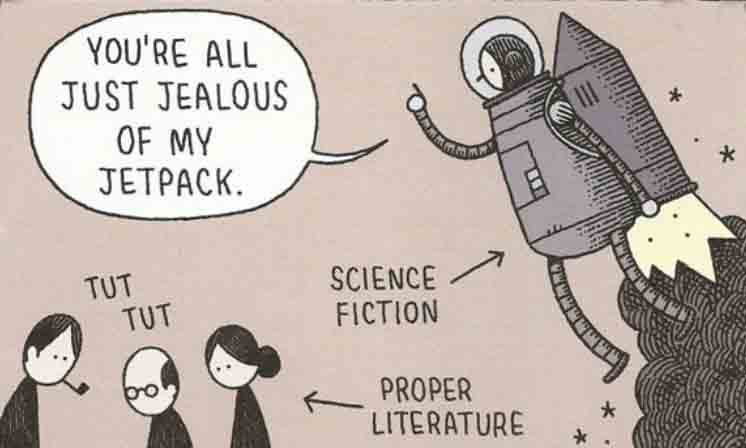
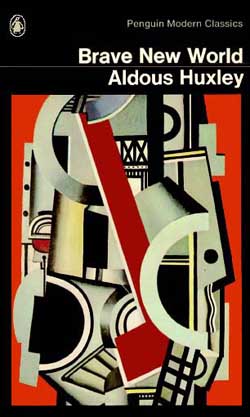 In a foreward to a later printing of Brave New World years after it was first published, Aldous Huxley explained why, when given the chance to revise the later edition, he left it exactly as it was initially written twenty years earlier:
 Nina Munteanu Writing Coach