Some years ago now, when the Dalai Lama was attending the 2009 Vancouver Peace Summit, he was quoted as saying, “The world will be saved by the western woman.”
This set the media buzzing on what His Holiness meant and—perhaps more importantly—how his statement resonates with us, and how his “call” affects the western woman.
Marianne Hughes, executive director of the Interaction Institute for Social Change (IISC), pondered the idea of the aging woman as hag (originally a representation of feminine power) and how it relates to the Dalai Lama’s statement on her blog. “I’m not entirely sure what [the Dalai Lama] meant,” said Hughes, “But I am wondering if when he travels across the globe and sees so many of our sisters impoverished and repressed he sees western women of all ages in a position to speak out for justice and to take on the responsibilities of “the hag”… to take loving care of the planet and its people.”
The original meaning of the word “hag” in Gaelic originally referred to a saint with great powers who was responsible for the land, the waters and the people. The term has since been distorted through patriarchal propaganda into something far less flattering and powerful. The “Hag” is currently being redefined as a strong, beautiful and ageless woman and has its similarities with “the Crone”, the third stage of a woman’s life and evolution from maiden to mother to crone. Postmenopausal women currently comprise the largest demographic group in America. With our increased lifespan, the ancient tripartite divisions of Maiden, Mother, and Crone are more meaningful in women’s lives as the Crone stage occupies one third of our lifespan. Moreover, our current Crone generation (those born in the forties and fifties) is the first in the history of humankind that can claim (and has already claimed) economic autonomy and power.
According to Dr. Linda E. Savage (author of “Reclaiming Goddess Sexuality”) “Each stage of a woman’s life is organized around what Goddess Cultures called the blood mysteries: menarche, (the first monthly flow of blood); childbirth, which is accompanied by blood from birthing; and menopause, when a woman’s “wise blood” remains inside her to give her wisdom. These are still powerful landmarks, which profoundly influence women’s lives. They function as psychological gateways to the change in consciousness required by each new stage.”
Savage describes the Crone as a powerful shamanic figure in society: “The developmental task of the Crone Stage is sharing wisdom. In Neolithic times, Crone women were the tribal matriarchs. Their heightened awareness of human nature yielded great insight and they were the source of wise counsel for important decisions. Spiritually, this is the Mastery phase. The Wise Woman teaches knowledge gained from her skills and life experience. It is a time of reaching into her spiritual depths, utilizing her powers of intuition, and finding meaning in her visions from the dream world. Some Crone women are masters of healing at the highest level. The Crone Stage of life, more than any other, is a time of giving back to society the cumulative wisdom of the years. Many women have an urge to speak out, to organize others, to take action. They have the energy to get more involved in the world-at-large. It is often Crone energy that leads to changes being made in society. As the Crone woman moves further into her life path she feels the urge to teach others and to cultivate her passions. It can be the most productive time in womens’ lives.”
Crone energy isn’t necessarily limited to Crones. It is an energy that may be carried by anyone at any age. Ariane de Bonvoisin, writing for the Huffington Post, made the following observation:
“Most people I meet have a new fear—the fear of not being relevant, the fear of not making a difference, the fear of working on things that don’t really matter in the important times of transition we live in. We’re hungry to be part of making things better. We want to create, we want to do what we love again and find our voice. We sense intuitively that we have a critical role to play in shaping the future of our world. And yet, so many of us give in to excuses of not being good enough, young enough, smart enough, wealthy enough, creative enough. We still play small, still give in to the ‘victim’ archetype. We still buy into what society’s beliefs are and put them right above our own. But we don’t really have time for these fears. If I could create a vaccine, instead of the flu one, I’d create one against fear. It’s what holds us back, every one of us, in every area of our life. And, while we’re holding back, time just moves on faster than ever. We are at a critical time in the evolution of our planet, a time where each one of us is waking up. We feel it.
Our intuition is growing more acute. Our inner microphone, as I like to call it, is getting harder and harder to turn off, so that we can’t just go along with our normal day. There’s a rise in consciousness where we feel more connected to others, a part of something bigger going on, where we each have a role to play. The most important thing isn’t to get the promotion, or stay in the marriage, or lose those 10 pounds. The most important thing is for us to remember who we are—why we are here—to do the inner work and find what are our ‘spiritual’ reasons for being on the planet. Yes we do have something great to accomplish. Now. At any age. Wherever we are.”
I found yet another revealing comment on her blog post that reminded me of another statement by His Holiness: that the next Dalai Lama might be a woman. The commentator told the story of the Buddhist Goddess Tara, who is highly revered in Tibet and was a most promising student of Buddhism. The monks told her she should come back as a man so that she could reincarnate and finish her spiritual journey and become a Buddha. She responded that male/female has no meaning since spiritual beings have perfectly balance aspects of both and in reality can incarnate as either gender. She made a resolution to always come back as a woman. I see this proclamation as a metaphor for choosing “feminine wisdom” or “Goddess Wisdom”, represented by the depth of forgiveness, kindness, tenderness, openness, vulnerability, tolerance, honor, integrity, sacred courage, humility, trust and faith.
So, why “the Western Woman”? We are not particularly known on the globe for these traits, nor does the western philosophy we espouse typically embrace these ideal traits. The western woman has more often been stereotyped (and vilified) with the following characteristics: vanity, pride, shallowness, self-centeredness, self-serving ambition, competitiveness, and pettiness.
While we can, in fact, accept these as our stereotypic weaknesses (it is part of our shallow consumer culture and capitalist model, after all), it is for this very reason that the western woman represents the salvation of the world. Not only do we have the means, as Marianne Hughes pointed out, but we are in the best position to convince.
We are the necessary paradox that spawns evolution. The darkness that sparks light. The chaos that creates stability. The inertia that initiates change.
Viburnam berries, ON (photo by Nina Munteanu)
.
Nina Munteanu is a Canadian ecologist / limnologist and novelist. She is co-editor of Europa SF and currently teaches writing courses at George Brown College and the University of Toronto. Visit www.ninamunteanu.ca for the latest on her books. Nina’s bilingual “La natura dell’acqua / The Way of Water” was published by Mincione Edizioni in Rome. Her non-fiction book “Water Is…” by Pixl Press(Vancouver) was selected by Margaret Atwood in the New York Times ‘Year in Reading’ and was chosen as the 2017 Summer Read by Water Canada. Her novel “A Diary in the Age of Water” was released by Inanna Publications (Toronto) in June 2020.
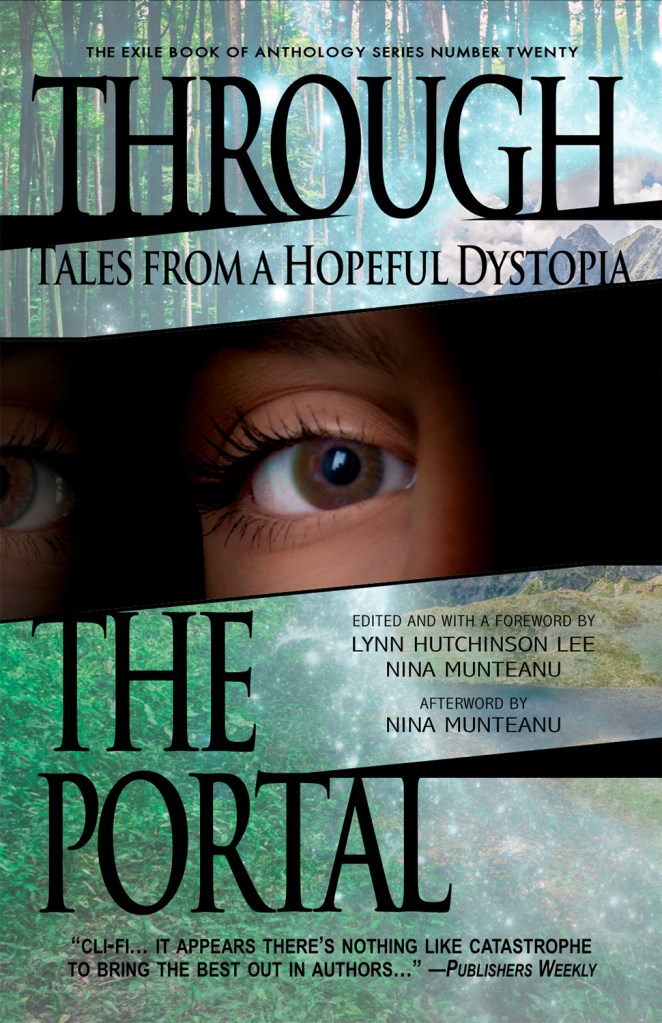
A recent favourable review of Through the Portal: Tales from a Hopeful Dystopia (edited by Lynn Hutchinson Lee and Nina Munteanu, released by Exile Editions) appeared in On Spec Magazine. The review by Lorina Stephens applauded the anthology for its genuine Canadian perspective, excellent writing, and “remarkable voice of many.”
.
Excerpts of the review follow below:
“What unfolds in these 35 stories is a quintessentially Canadian perspective on climate change, the probable dystopia of our own making, and how we as not only humans, but Canadians, may deal with the breakdown of environment and society, of how we construct mythology to interpret our experience.”
The stories, writes Stephens, “are filled with that remarkable pragmatism and resilience, little say a reverence for the land, which seems to be hardwired into a people who deal with constant change, and sometimes extremes, dictated by climate and geography.”
“…the quality of the writing from this enclave of writers is quite remarkable…I am steadfast in my praise of the skill of these writers, and the stories they’ve crafted, collected into this remarkable voice of many.”
“The stories manage that most adroit of transformations from genre fiction meant as escapism and consumable, to that other dimension which is provoking, illuminating, and exactly what good literary fiction should engender.”
Through the Portal has received other favourable reviews:
“Through the Portal offers intriguing and imaginative glimpses into the future.” – The Seaboard Review
“A stunning collection of short stories and poetry that address our most existential concerns through metaphysical, epic, solarpunk, mythological, and contemporary perspectives.” – dragonfly.eco.
Nina Munteanu is a Canadian ecologist / limnologist and novelist. She is co-editor of Europa SF and currently teaches writing courses at George Brown College and the University of Toronto. Visit www.ninamunteanu.ca for the latest on her books. Nina’s bilingual “La natura dell’acqua / The Way of Water” was published by Mincione Edizioni in Rome. Her non-fiction book “Water Is…” by Pixl Press (Vancouver) was selected by Margaret Atwood in the New York Times ‘Year in Reading’ and was chosen as the 2017 Summer Read by Water Canada. Her novel “A Diary in the Age of Water” was released by Inanna Publications (Toronto) in June 2020.
Language, the connective tissue of the body politic—that space where the collective “we” matters so much—is losing its ability to fulfill its most basic duty: to communicate. To correlate. To connect us to the world, and to one another
Megan Garber, The Atlantic
Scene of Winston Smith (John Hurt) in Nineteen Eighty-Four filmed in 1984 shown here with addition for currency
.
In his dystopian 1949 novel Nineteen Eighty-Four, George Orwell featured Newspeak, a fictional language of the totalitarian superstate Oceania. Created by the Party to meet requirements of Ingsoc (Englilsh Socialism), the Newspeak consisted of simplified grammar and limited vocabulary designed to limit a person’s ability to critically think. If you can’t find a word to articulate something, then it can’t be expressed and in some way no longer exists. Personal identity, self-expression and free speech become casualties of a simpler world.
Science fiction? Think again.
Today, Inside Climate News reported that the U.S. Coast Guard has eliminated the term “climate change” and related terminology from the curriculum of its training academy to conform to President Trump’s polices.
U.S. Coast Guard cutter Healy assists a NASA shipborne investigation into climate change in the Chukchi Sea in the Arctic Ocean (photo Kathryn Hansen NASA)
.
This comes at a time when scientists report that the effects of climate change and global warming are weakening the world’s most powerful ocean current, the ACC, with projected slowing by a third within decades. A study by international scientists published today in the journal Environmental Research Letters projects that the fresh water from melting Antarctic ice will weaken the Antarctic Circumpolar Currrent (ACC) by 20 percent in the next 30 years. The ACC is the only ocean current to flow around the entire planet unimpeded, carrying more than 100 times more water than all the world’s rivers combined. A paper in the journal Nature Climate Change recently documented how freshwater from melting ice has already weakened the overturning, or vertical circulation, of Antarctic shelf waters, which reduces oxygen in the deep ocean. Effects of the ACC slow down are projected to include more climate variability, with greater extremes in certain regions, and accelerated global warming.
Global warming is a fact.
Anyone negating its existence, let alone its existential threat, is quite simply a fool. But when a fool is in power and negates the bald truth of science—successfully eliminating the most important word to our existence on this planet—then who’s really the fool?
.
(image from The Atlantic)
.
In the 1940s, shortly after the end of World War Two, Orwell wrote an essay “Why I Write”; in it he lamented the growing decrepitude of the English language. Orwell argued that the decline of English went hand-in-hand with the decline of intellectualism in society and facilitated the manipulation of listeners, speakers and writers. Richard Weintraubnoted in his 2021 article that Trump used ‘Newspeak’ to dismiss the Covid 19 virus, putting Americans at great risk.
Orwell created the term doublethink—a jargon of purposeful obfuscation—which is ability to simultaneously accept two mutually contradictory beliefs as right at the same time: “war is peace”; “freedom is slavery”; “ignorance is strength”. This oxymoron isn’t some wild gesture to the simultaneous wave / particle existence of particle physics or gestalt dualism of Schrödinger’s cat. Orwell’s brilliant fictional concept was predicated on the historical precedent of fascists around the world: the embodiment of “Big Brother”, who uses “doublethink” to confound, sway and control the minds of all people. The term “fake news” has settled in like a damp fog, a casual rejoinder to any truth one wishes to negate and ultimately erase.
On the weaponizing of language, Megan Garber in The Atlantic writes:
“Language, in 1984, is violence by another means, an adjunct of the totalitarian strategies inflicted by the regime. Orwell’s most famous novel, in that sense, is the fictionalized version of his most famous essay. “Politics and the English Language,” published in 1946, is a writing manual, primarily—a guide to making language that says what it means, and means what it says. It is also an argument. Clear language, Orwell suggests, is a semantic necessity as well as a moral one. Newspeak, in 1984, destroys with the same ferocious efficiency that tanks and bombs do. It is born of the essay’s most elemental insight: If thought corrupts language, language can also corrupt thought.”
.
The hard truths of science are at risk in a world gazing through the lens of confabulation… When the inveigling bits and bites of social media time and again trump scientific fact…
“Orwell published “Politics” at the end of a conflict that had, in its widespread use of propaganda, also been a war of words. In the essay, he wrestles with the fact that language—as a bomb with a near-limitless blast radius—could double as a weapon of mass destruction. This is why clarity matters. This is why words are ethical tools as well as semantic ones. The defense of language that Orwell offered in “Politics” was derived from his love of hard facts. “So long as I remain alive and well I shall continue to feel strongly about prose style, to love the surface of the earth, and to take a pleasure in solid objects and scraps of useless information,” he confessed in his 1946 essay “Why I Write.” His was an elegant dogma. Words matter because facts matter—because truth matters. Freedom, in 1984, is many things, but they all spring from the same source: the ability to say that 2 + 2 = 4.”
.
Nina Munteanu is a Canadian ecologist / limnologist and novelist. She is co-editor of Europa SF and currently teaches writing courses at George Brown College and the University of Toronto. Visit www.ninamunteanu.ca for the latest on her books. Nina’s bilingual “La natura dell’acqua / The Way of Water” was published by Mincione Edizioni in Rome. Her non-fiction book “Water Is…” by Pixl Press (Vancouver) was selected by Margaret Atwood in the New York Times ‘Year in Reading’ and was chosen as the 2017 Summer Read by Water Canada. Her novel “A Diary in the Age of Water” was released by Inanna Publications (Toronto) in June 2020.
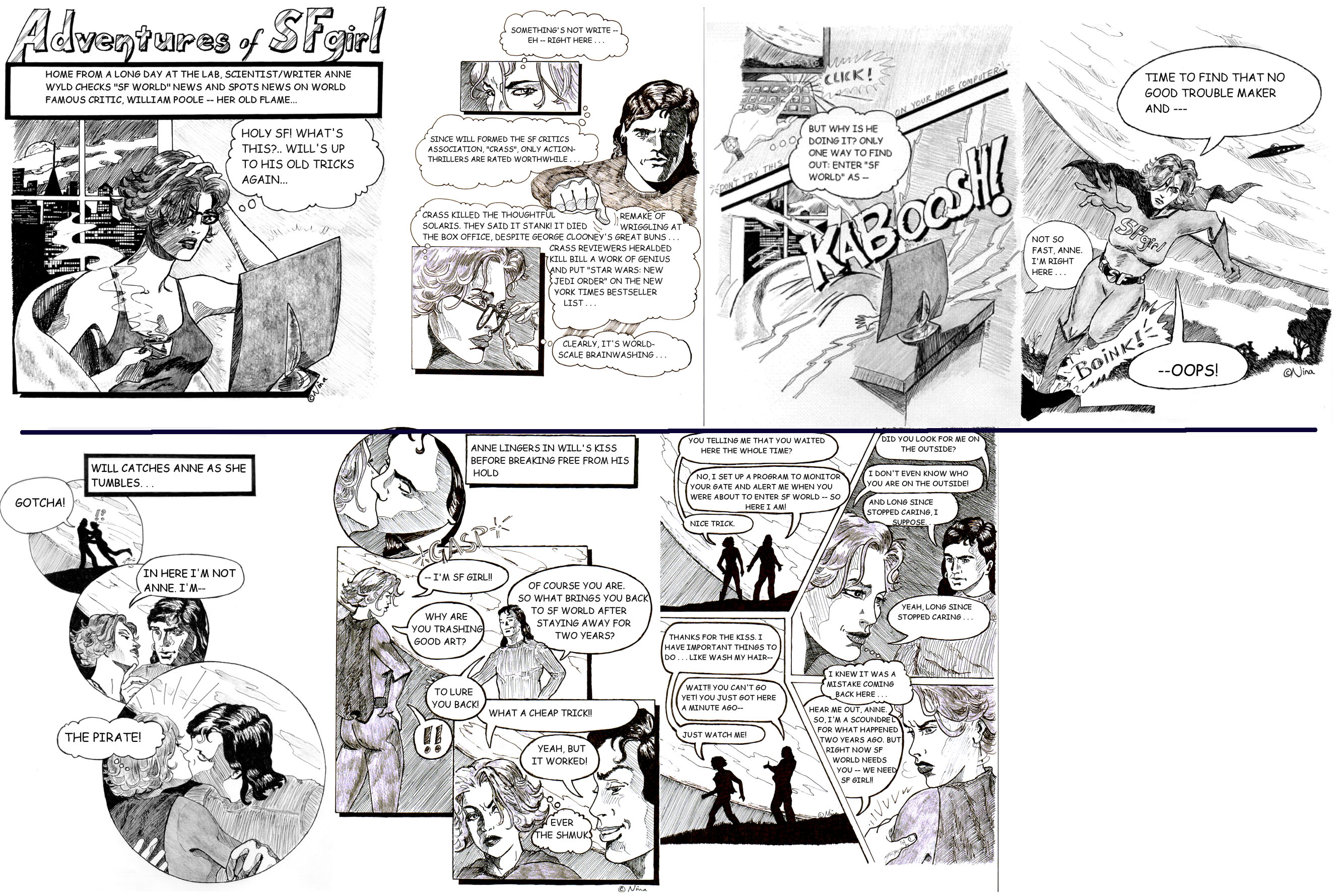
When I was little, I wanted to be a storyteller, a cartoonist specifically. I was reading graphic novels before I could read. That didn’t stop me from understanding what was going on. Being a virtual learner and an artist, I understood context: expressions, body language…
Nina, age three, pretending to read (photo by Martha Munteanu)
.
.
I wrote and drew wild adventure thriller detective stories and stories about exploring other planets. While my first love was telling stories, I was called by the needs of the environment. This percolated through me as I grew up and wouldn’t let go. When I could read and write, I still read graphic novels; I wrote and illustrated short stories about the environment, dystopian tales that focussed on how we were destroying our planet.
.
At school, I loitered in the hallways, pasting subversive posters on the walls. They were a call to action: Restrain … Reuse … Repurpose … Recycle … Remain true to the environment. I wrote in the school paper. I quoted global statistics, mentioned global warming (yes, people knew about it back in the ‘60s and ‘70s), and submitted cheesy emotional drawings of pollution and toxic waste.
By the time I was ready to go to university (I’d been accepted early into the fine arts program at Concordia University in Montreal), I switched my major on registration day. Like a horse bolting from a fire, I charged out of the arts and into the sciences. I’d heard environment’s call for help and had notions of becoming an environmental lawyer. I kept a few arts courses as electives but focused on a biology degree in the environmental sciences. I understood that the tools I needed to wield as an eco-warrior in law were rooted in science.
.
A twenty-some old Nina exploring the forest
.
I learned something about ecology, botany, animal, plant, and cell physiology, genetics and biochemistry, and limnology (the study of water systems). The sciences fascinated me and I became entranced in the study of how the natural world worked. I was particularly attracted by lichens, plant-like organisms called cryptogams that grow like miniature forests on substrates—trees,fence posts, rock, cement. My attraction was partly because these often overlooked organisms were actually more of a symbiotic community or mini-ecosystem: an intriguing community of fungi, algae, cyanobacteria, bacteria and yeast growing together. I felt that on some level, lichen had much to teach us on lifestyle and approach to living on this planet. They’d been around for millennia, a lot longer than we’ve been.
Having long abandoned law (I convinced myself that I wasn’t cut out for it; maybe I was but that’s another universe), I decided to pursue lichen ecology for my masters degree. But fate had another path in mind for me. The botany professor who I wished to study under was retiring and no one was taking her place. She referred me to the limnology professor and he got me interested in another microscopic community: periphyton (the algae and associated organisms that colonize plants, rock and cement in water).
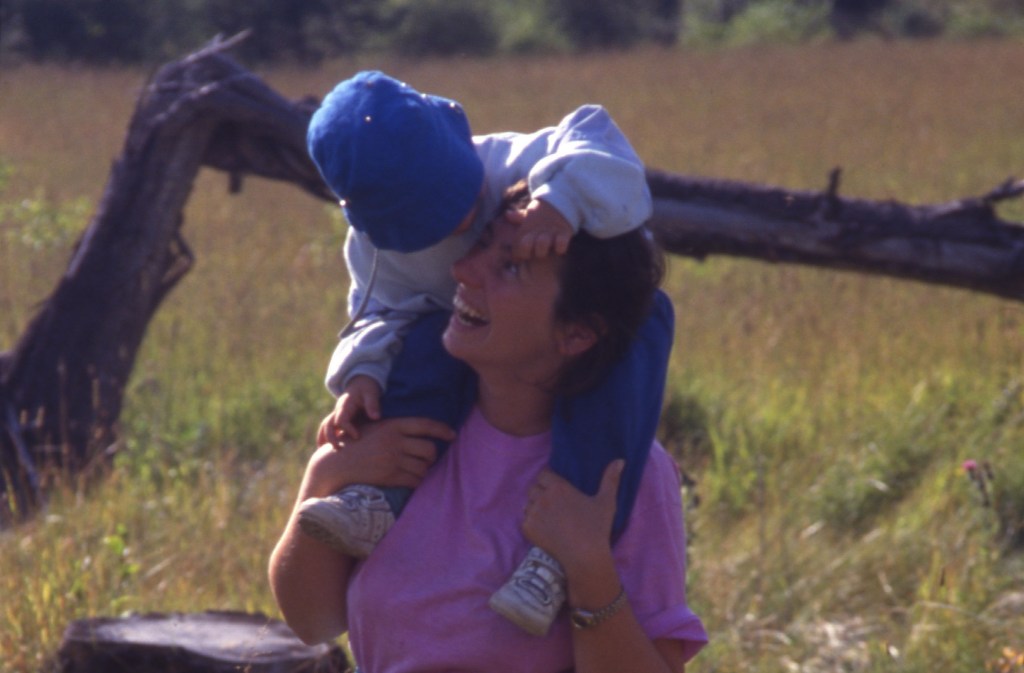
Nina and son Kevin explore nature (photo by Herb Klassen)
.
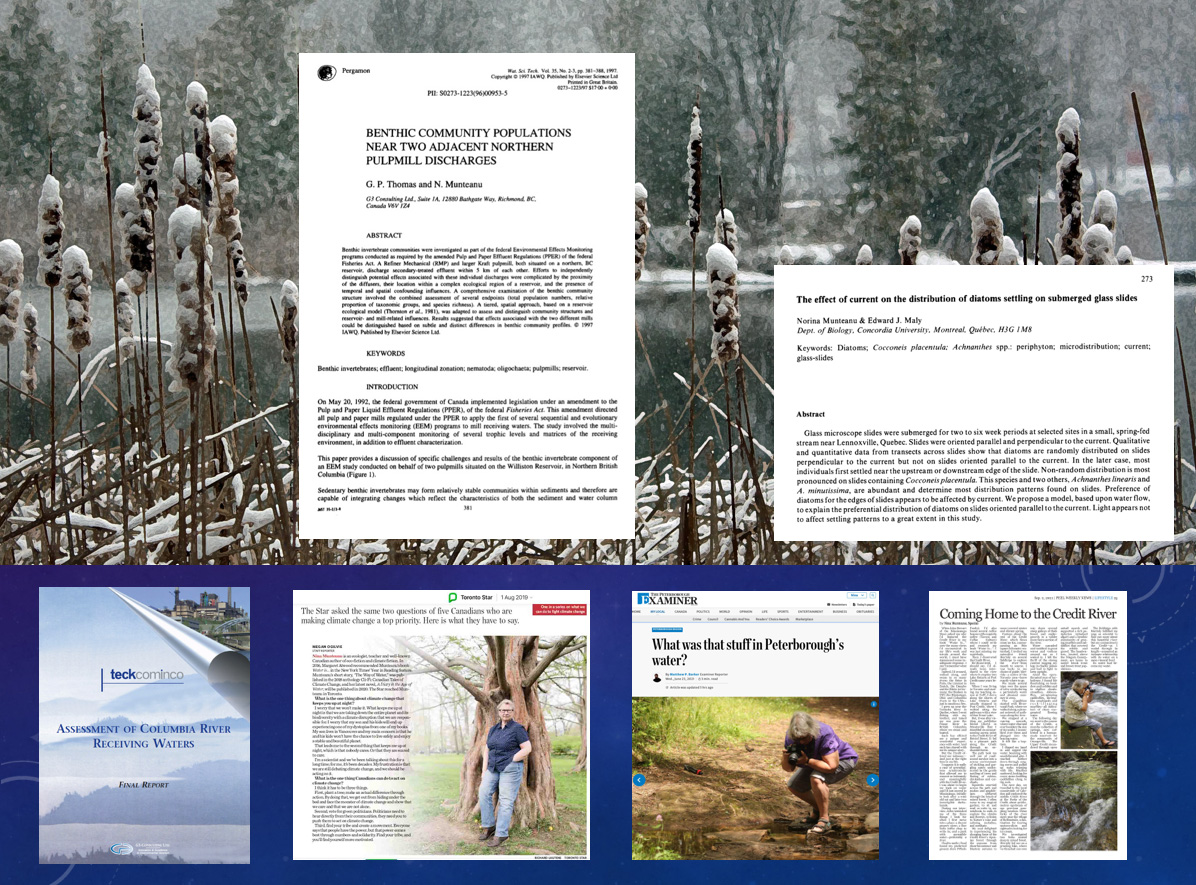
I’d come somewhat full circle to be an eco-warrior, pursuing environmental problems (and corporate mischief) through biology rather than law. I designed and conducted environmental impact assessments and recommended mitigation, restoration, and remediation procedures to various clients from lakefront communities and city planners to mining companies dealing with leaky tailings ponds and pulp mills discharging effluent into the ocean.
.
Various reports, scientific papers and articles I’ve written or been interviewed for
.
It worked for me. I consulted for twenty-some years. It was for the most part both satisfying and encouraging. I felt as though I was making a difference: mostly through educating my clients. But that became less and less the case as the consulting firms I worked for, and the corporations they worked for, seemed to have less and less integrity. They also seemed to care less about the environment and more about profit.
So, just as I’d done on the day of registration at university, I bolted like a horse in a fire and quit my job as a consultant. I never returned to consulting.
Nina photographing pollution of a small creek entering a drinking water source (photo by Matthew Barker, Peterborough Examiner)
My sights went back to storytelling, journalism, and reporting/interviews. Mostly eco-fiction. Creating narratives that would hopefully move people, nudge them to act for the environment. Change their worldview somewhat into eco-friendly territory. Make them care. I’m still an eco-warrior, but my pen and my storytelling is my tool.
The word is a powerful tool. And the stories that carry them are vehicles of change.
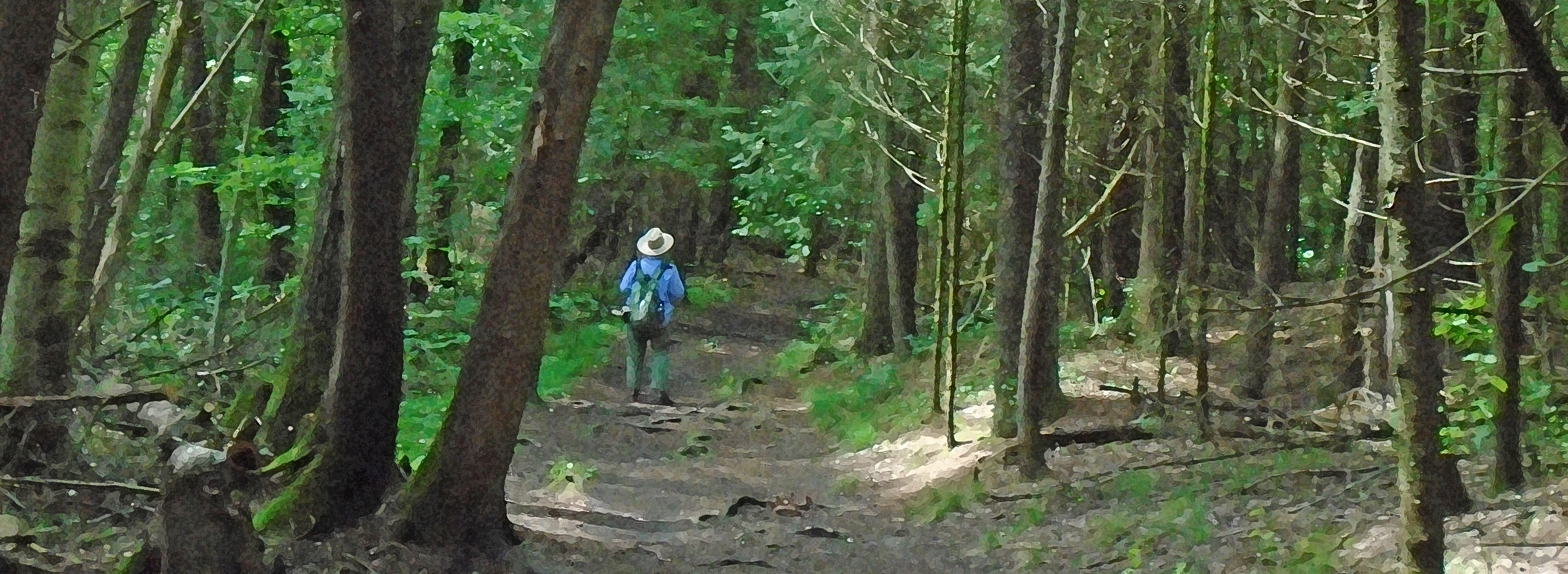
Nina Munteanu wandering the Emily Tract forest, ON (photo by Merridy Cox)
.
Nina Munteanu is a Canadian ecologist / limnologist and novelist. She is co-editor of Europa SF and currently teaches writing courses at George Brown College and the University of Toronto. Visit www.ninamunteanu.ca for the latest on her books. Nina’s bilingual “La natura dell’acqua / The Way of Water” was published by Mincione Edizioni in Rome. Her non-fiction book “Water Is…” by Pixl Press (Vancouver) was selected by Margaret Atwood in the New York Times ‘Year in Reading’ and was chosen as the 2017 Summer Read by Water Canada. Her novel “A Diary in the Age of Water” was released by Inanna Publications (Toronto) in June 2020.
In his 2006 book The Seven Basic Plots: Why We Write Stories, Christopher Booker tells us that there are seven types of plots in story. One is entitled “Overcoming the Monster,” an underdog story where the hero sets out to destroy an evil to restore safety to the land. It is a story I admire and never tire of. The evil force is typically much larger than the hero, who must find a way, often through great courage, strength, inventive cunning—and help from her community—to defeat the evil force. This is the story of David and Goliath, of Beowulf and Grendel, of Luke Skywalker and Darth Vader in Star Wars, of Jake Sully and Miles Quaritchs in Avatar—notice, all men who, for the most part, do their hero-ing alone. I may get to that later (in another post)…
The “Overcoming the Monster” plot, whether told literally or through metaphor, reflects an imbalance in the world—usually of power—that the hero must help right.
Enter the “Monster” DuPont…
DuPont Washington Works plant in Parkersburg, West Virginia
The true story of DuPont’s decades-long evil maleficence reflects the great power imbalance of many large corporations and the evil they enact through willful deception and mischief to increase profit, their god.
This brings me to my heroic journey. For in some terrible way, the story of DuPont is also my story. One of power imbalance, of deception and ignorance. Their deception; my ignorance:
.
In 1954, the year I was born, during the ramp up for the Teflon rollout at DuPont’s Washington Works plant in Parkersburg, toxicologist R.A. Dickison noted possible toxicity of the surfactant C8 (PFOA or Perfluorooctanoic Acid) used to make Teflon. DuPont ignored the warning and proceeded to roll it out for mass use.
1950s DuPont ad for the Teflon “Happy Pan”
.
In 1961, while I was contending with recess bullies in grade two, DuPont rolled out their Teflon-coated “Happy Pan” with the full knowledge that C8 was a toxic endocrine disruptor and caused cancer. DuPont’s chief toxicologist Dorothy Hood cautioned executives in a memo that the substance was toxic and should be “handled with extreme care.” She explained that a new study had found enlarged livers in rats and rabbits exposed to C8, confirming that the chemical was toxic. It didn’t stop the roll out.
In 1962, while I was exploring my artistic talents at school,DuPont scientists conducted tests on humans, asking a group of volunteers to smoke cigarettes laced with C8. Nine out of ten people in the highest-dosed group were noticeably ill for an average of nine hours with flu-like symptoms that included chills, backache, fever, and coughing. Further experiments by DuPont linked C8 exposure to the enlargement of rats’ testes, adrenal glands, and kidneys.
In 1964, I was ten years old and struggling with my Grade 5 teacher who was trying to curb my unique self-expression. I was already aware of environmental imbalance and destruction in the world. My pet peeve was littering because it demonstrated great disrespect for others and the environment. I told environmental stories. That year DuPont had already begun its great deception; having confirmed the toxicity of C8, they simply watched (and recorded) as this cancer-causing endocrine disruptor injured, maimed and killed their own workers. The company did nothing to prevent it and they told no one.
In 1965, I was in the process of figuring out my heroic self and my unique gift to the world in Grade seven: was it in fine arts and advertising? Writing and storytelling? Environmentalism and law? Internal DuPont memos revealed that preliminary studies showed even low doses of a related surfactant to Teflon could increase the size of rats’ livers, a classic response to poison.
In the mid- to late-60s, I became an environmental activist, putting up posters and writing in the school paper. I wrote letters to industry and politicians, trying to incite interest in being good corporate citizens and promoting global environmental action. I remember a well-meaning teacher chiding me for my extravagant worldview. “Stick to little things and your community—like recycling,” he suggested patronizingly. I remember the shock of realizing that not everyone felt the planet like I did. Perhaps it was a teenage-thing, or a girl-thing, or a nina-thing. I prayed it wasn’t just a nina-thing…
I started writing stories in high school. Mostly eco-fiction, though I didn’t know that’s what it was at the time. There was no genre called eco-fiction back then. It all went under the umbrella of scifi.
In 1969, at fifteen, I wrote my first dystopia, Caged in World. The eco-novel was about a subway train driver and a data analyst caught in the trap of a huge lie. The story later morphed into Escape from Utopia. Several drafts and years later the novel became the eco-medical thriller Angel of Chaos, published in 2010. The story is set in 2095 as humanity struggles with Darwin’s Disease—a mysterious neurological environmental pandemic assaulting Icaria 5, an enclosed city within the slowly recovering toxic wasteland of North America. The city is run by deep ecologists who call themselves Gaians, and consider themselves guardians of the planet. The Gaians’ secret is that they are keeping humanity “inside” not to protect humanity from a toxic wasteland but to protect the environment from a toxic humanity.
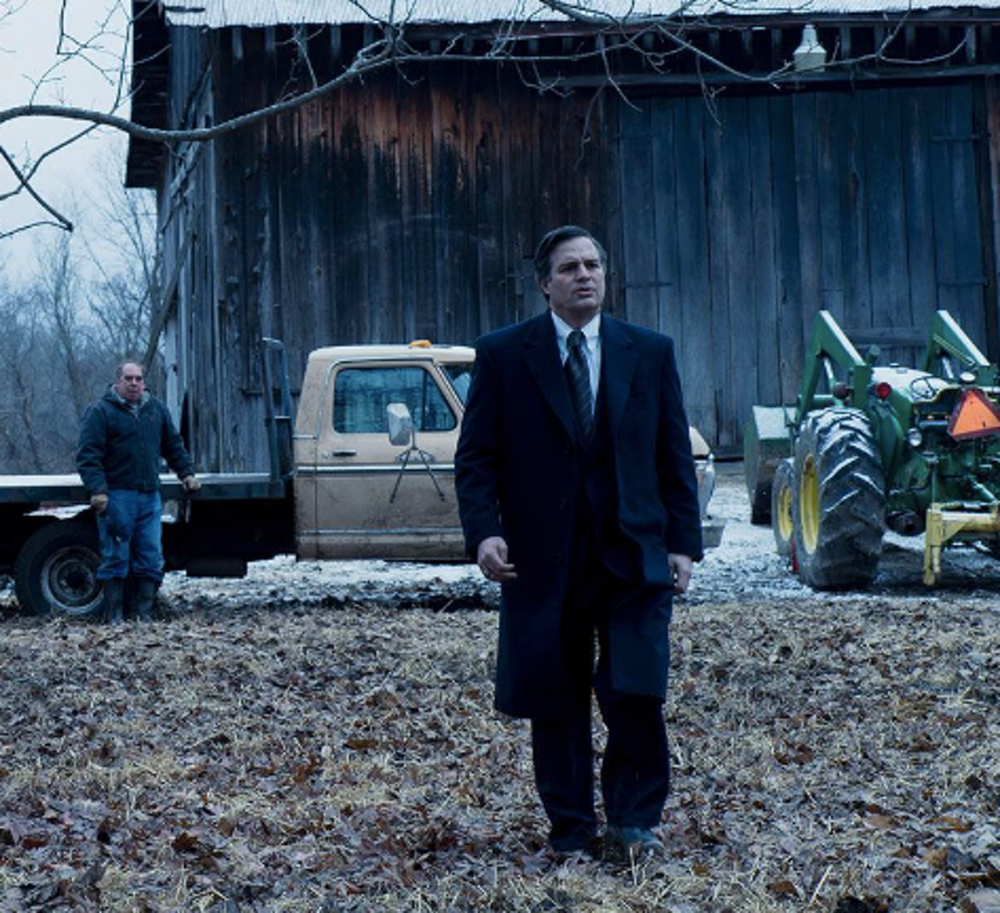
Lawyer Robert Bilott (Mark Ruffalo) investigates leachate-infected cows from nearby DuPont landfill (photo from film “Dark Waters”)
.
In the early 1970s, I entered university and contemplated becoming an environmental lawyer; I wrote short stories, mostly eco-fiction, and joined marches protesting environmental destruction by large corporations. DuPont confirmed that C8 not only persisted in the environment; it bioaccumulated in animals. In 1979, when I graduated with a Master of Science degree in limnology/ecology, DuPont circulated an internal memo in which humans exposed to C8 were referred to as “receptors,” describing how scientists found “significantly higher incidence of allergic, endocrine and metabolic disorders” as well as “excess risk of developing liver disease.” DuPont kept this knowledge to themselves and withheld it from EPA.
In the late 1970s early ‘80s, while I was addressing local environmental issues as a practicing limnological consultant, DuPont was dumping 7,100 tons of PFOA-laced sludge into unlined ‘‘digestion ponds’’: open, unlined pits on the Washington Works property, from which the chemical could seep straight into the ground. PFOA entered the local water table, which supplied drinking water to the communities of Parkersburg, Vienna, Little Hocking and Lubeck — more than 100,000 people.
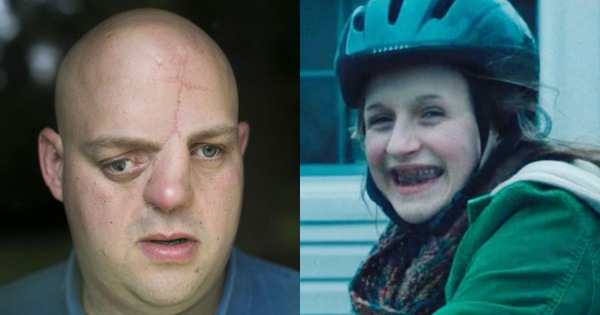
Effects of PFOA (birth defect in Bucky Bailey whose mother was on the Teflon line without protection during her first trimester; blackening teeth from the excessive fluoride, from scene in “Dark Waters”)
.
In 1981, when I got my first job as a limnologist and environmental consultant in Vancouver, DuPont confirmed that C8 caused birth defects in its own workers—and did not warn its workers. A DuPont pathologist confirmed that the observed fetal eye defects were due to C8. With that confirmation the pregnancy study was quietly abandoned and a decision made not to inform EPA. Less than a year later DuPont created false data for EPA then moved women of childbearing age back into areas with C8 exposure. Many in the company coined the term “Teflon flu” to describe the ill-effects of working close to the compound. By 1982, DuPont had confirmed the high toxicity of C8/PFOA in humans.
In 1984, a year after I formed my own consulting company Limnology Services in Vancouver, DuPont staffers secretly tested their community’s drinking water and found it to contain alarming levels of C8. Deciding that any cleanup was likely to cost too much and tarnish their reputation, DuPont chose to do nothing. In fact, they scaled up their use of C8 in Teflon products and bought land to dump their toxic sludge in unlined landfills. Deaths in DuPont workers from leukemia and kidney cancer climbed.
In 1989, at 35 years old, and still blissfully unaware of DuPont’s nefarious activities, I continued consulting for my own company Limnology Services, addressing mostly local environment issues with communities and local governments. By that year, DuPont employees found an elevated number of leukemia deaths at the West Virginia plant, followed by an inordinately high number of kidney cancers among male workers. Earl Tennant, whose farm was close to the DuPont landfill at Dry Run creek, sent videos of foamy water and diseased cows to the West Virginia Department of Environmental Protection; state regulators documented “numerous deficiencies in the landfill operation and erosion gullies that funnelled waste into Dry Run creek; DuPont made a deal with the department: the company paid a $250,000 fine and the department took no further action against the landfill. (The official who negotiated the deal later became a DuPont consultant.)
Throughout the 90s, I started teaching college biology and university environmental education courses in Vancouver. The magazine Shared Vision Magazine published my first article “Environmental Citizenship” in 1995. Meantime, DuPont’s Washington Works plant pumped hundreds of thousands of pounds of PFOA sludge, powder and vapor through stacks into the atmosphere and outfall pipes into the Ohio River.
In 1996, I was consulting for local industry and municipalities. By then, C8 was in the drinking water of Parkersburg and other communities. Despite what they knew of C8’s toxicity, DuPont kept it a secret (no one else was testing for PFOA because it was unregulated).
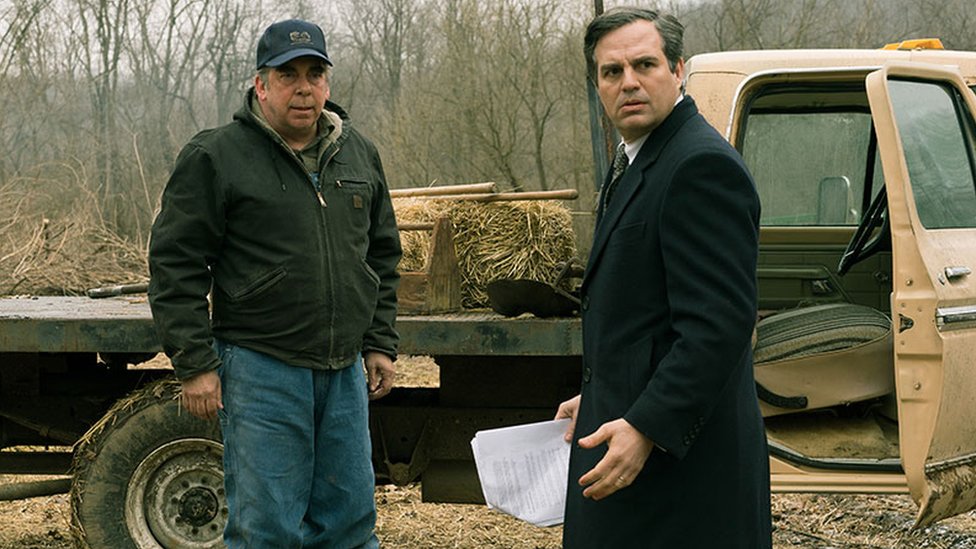
Farmer Tennant and lawyer Rob Billot encounter a leachate-infected mad cow in the 2019 film “Dark Waters”
.
In 1999, still serving as environmental consultant to mining and pulp mill companies, I still knew nothing about DuPont’s duplicitous environmental atrocities. 3M—troubled by its studies on C8 with monkeys—notified EPA and phased out PFOS and PFOA; DuPont started producing its own PFOA. On behalf of Earl Tennant whose cattle were dying adjacent to DuPont’s landfill site, lawyer Rob Bilott filed a small suit against DuPont to gain legal discovery and starting the decade-long process of finally unravelling the buried truth of their insidious criminality–over thirty years after DuPont knew and did nothing.
In 2003, I continued consulting as an environmental scientist in ignorance of DuPont’s misdealings, though by now much had come out in the press. By that year, DuPont had knowingly dispersed almost 2.5 million pounds of harmful C8 from its Washington Works plant into the air and water of the mid-Ohio River Valley area.
DuPont’s Washington Works plant in Parkersburg, West Virginia
.
In 2004, DuPont agreed to settle the class-action suit filed by lawyer Rob Bilott. Under the terms of the settlement, the company was not obliged to pull C8 from the market. The best the EPA could negotiate was a voluntary phase-out by 2015. That same year There It Is reported on how DuPont denied poisoning consumers with Teflon products. The dangers and spread of PFOA and other forever chemicals appeared more and more in the scientific literature (see the reference list below, which is by no means exhaustive).
In 2007, Darwin’s Paradox, my eco-fiction novel about an environmental pandemic, was published by Dragon Moon Press in Calgary, Alberta. Four years earlier, the law had finally caught up to DuPont, but not before they had dispersed 2.5 million pounds of harmful C8 from their Washington Works plant into the air and water of the mid-Ohio River Valley area. It would be another twelve years before DuPont would stop making C8 (in 2015) and another four years after that when C8 would be banned from use globally (2019). PFOA is still unregulated by EPA; the best they can do is issue a non-enforceable health advisory set at 70 parts per trillion.
In 2012, shortly after I moved to Nova Scotia to write for a living (having quit environmental consulting due to disillusionment with integrity of companies I worked for), the C8 Science Panel, tasked to study the possible health effects of PFOA in a highly exposed population in the mid-Ohio Valley, determined a probable link between C8 exposure and six disease categories: kidney cancer, testicular cancer, ulcerative colitis, thyroid disease, preeclampsia, and high cholesterol.
In 2015, two years after I began teaching writing at the University of Toronto, DuPont began a series of complex transactions that transferred its responsibility for environmental obligations and liabilities associated with PFAS (C8) onto other entities such as Chemours, Corteva, and NewDupont. A year later New York Times Magazineran a story “The Lawyer Who Became DuPont’s Worst Nightmare” and Sharon Lerner of The Intercept ran an in-depth series on DuPont’s duplicitous criminality: “The Teflon Toxin: DuPont and the Chemistry of Deception.”
In 2017, DuPont and its spinoff company Chemours agreed to settle a lawsuit with roughly 3,500 people living near the Parkersburg plant in both West Virginia and Ohio and many ailing from toxicity-related problems. The company agreed to pay $671 million. That’s one day’s sales in a $27 billion annual profit stream. The Fayetteville Observer reported that this “Discontinued chemical [was] still in well water” after DuPont agreed in 2009 to stop using C8. They noted that the company was facing a class action lawsuit from thousands of people in Ohio and West Virginia for discharging the toxic chemical into the Ohio River since the 1950s.
In 2019—sixty-seven years after DuPont knew PFOA was toxic and did nothing—this forever chemical was finally banned globally under the Stockholm Convention. Unfortunately, by 2019, PFOA was already literally everywhere on the planet in concentrations considered unsafe. Given its high water-solubility, long-range transport potential, and lack of degradation in the environment, PFOA persists in groundwater and is ubiquitously present in oceans and other surface water around the globe. It is found in remote areas of the Arctic and Antarctic (where it was not used or manufactured), no doubt transported there through ocean currents and in the air, bound on particles. NBC Newsran a news piece about ‘forever chemicals’ contaminating drinking water near military bases. The Guardian ran a news article: “Companies deny responsibility for toxic ‘forever chemicals.’” In Maine, The Portland Press Herald ran a story: “Households are awash in ‘forever chemicals’.”
In 2020, NBC News revealed that DuPont was still avoiding its responsibility to clean up its C8 mess and compensate those harmed by DuPont’s negligence.
In 2022, I finally learned about DuPont’s decades-long environmental dispersal of toxic PFOA (C8) and their criminal deception throughout this life time. I’d lived through DuPont’s entire six decades of deception in ignorance.
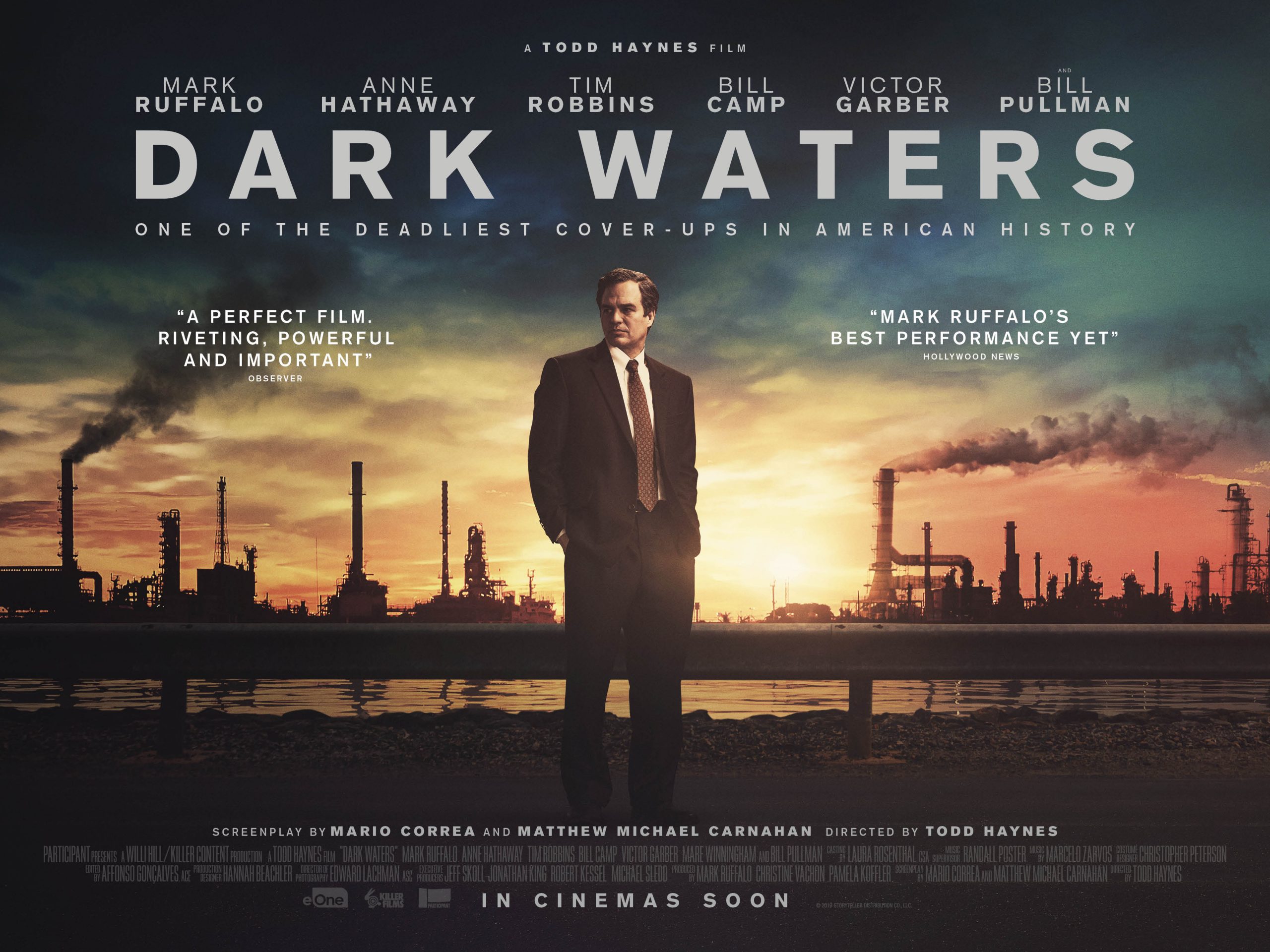
Poster for the 2019 film “Dark Waters” on DuPont’s criminal activities and the lawyer who exposed them
.
In 2022, three years after its release, I chanced upon “Dark Waters,” the 2019 film starring Mark Ruffalo who plays lawyer Robert Bilott, the man who took DuPont to court in 2002. I found out seven years after DuPont was forced to stop using PFOA and a lifetime after they started their egregious pollution and deception in the 1950s. For over six decades, from when I was born to well into my sixties, DuPont executives chose to:
Below are the faces of the DuPont men and women who sanctioned–encouraged–the willful harm of other life. Despite knowing the danger posed by exposure to PFOAs to people, these DuPont CEOs chose to: 1) continue to poison the environment and people, 2) cover up their actions from authorities, and 3) fight the courts and regulators from doing the right thing when they were caught. No one went to jail. No one was fired. They just paid $$$ and shamefully kept going. These people are criminals.
DuPont CEOs from 1950-2019 who sanctioned release of PFOA into the environment then covered it up: Crawford H. Greenewalt, Lammot Copeland, Charles B. McCoy, Edward G. Jefferson, Richard E. Heckert, Edgar S. Woolard, John A. Krol, Charles O. Holliday Jr., Ellen Kullman, Edward D. Breen
.
It’s not over either; DuPont currently uses other PFAS compounds that are unregulated but whose toxicity is being found to be as potent. And, of course, these other ‘forever chemicals’ are finding themselves everywhere. I was ignorant of all this the whole time. Meantime, I am drinking DuPont’s forever chemicals, I am eating DuPont’s forever chemicals, and I am feeling DuPont’s forever chemicals falling on my face in the rain.
My hard lesson: Ignorance breeds complacency and hubris; both will lead to downfall.
To return to the “Overcoming the Monster” story plot and the monster archetype, I’m convinced that it isn’t the Darth Vaders or Miles Quaritchs we must overcome. Yes, they are monsters, but they serve a greater monster. For Vader it was Emperor Palpatine and for Quaritch it was the executives of the RDA Corporation. While Vader and Quaritch may be the face of evil, true evil lurks behind them, orchestrating, in the shadows. It is an evil we must fight internally, because each of us carries that potential evil inside us—in the urge to cheat on our taxes; in looking for the free ride (there are no free rides); in coveting what others have when what we have is enough; in embracing self-deception through unsubstantiated narratives and confabulation; and in choosing to remain ignorant to suit a short-sighted and self-serving agenda. I’m guilty too.
I hope some aspects of the hero that live in me, as with everyone, are helping to overcome the monster by writing about it in articles I share here and elsewhere and by presenting a different narrative—one of resistance and hope—through my fiction.
In a post on The Meaning of Water, I list which CEO was on watch and responsible for each criminal atrocity enacted. The post also goes into more detail on the six decade history of DuPont’s criminal atrocities and great deception. For more detail on each decade of atrocity and deception, check out my posts by decade: 1950s, 1960s, 1970s, 1980s, 1990s, and 2000s. What follows into the present day is perhaps even more atrocious, given that all is supposedly out in the open. This predatory company continues to bribe officials, lie and deny, threaten the weak, and so much more.
p.s. To understand the nature of industrial duplicity of large corporations such as DuPont, I highly recommend reading the 2023 study by Nadia Gaber and colleagues in the Annals of Global Health. The authors evaluated previously secret industry documents on PFAS to understand the significant delayed disclosure of harm posed by PFAS: from its production in the 1940s, to suggestions of toxicity in the 1950s, to irrefutable knowledge of PFAS toxicity in the 1960s, and–due to lack of transparency and suppression of scientific findings–public knowledge of this only arising in the late 1990s (mainly because of legal suits and discovery).
.
References:
Ahrens L. 2011. “Polyfluoroalkyl compounds in the aquatic environment: a review of their occurrence and fate.” J Environ Monit 13: 20–31. 10.1039/c0em00373e
Barton CA, Butler LE, Zarzecki CJ, Laherty JM. 2006. “Characterizing perfluorooctanoate in ambient air near the fence line of a manufacturing facility: comparing modeled and monitored values.” J Air Waste Manage Assoc 56: 48–55. 10.1080/10473289.2006.10464429
Barton CA, Kaiser MA, Russell MH. 2007. “Partitioning and removal of perfluorooctanoate during rain events: the importance of physical-chemical properties.” J Environ Monit 9: 839–846. 10.1039/b703510a
Busch J, Ahrens L, Xie Z, Sturm R, Ebinghaus R. 2010. “Polyfluoroalkyl compounds in the East Greenland Arctic Ocean.” J Environ Monit 12: 1242–1246. 10.1039/c002242j
Gaber, Nadia, Lisa Bero, and Tracey J. Woodruff. 2023. “The Devil they Knew: Chemical Documents Analysis of Industry Influenc on PFAS Science.” Ann Glob Health 89(1): 37.
McMurdo CJ, Ellis DA, Webster E, Butler J, Christensen RD, Reid LK. 2008. “Aerosol enrichment of the surfactant PFO and mediation of the water-air transport of gaseous PFOA.” Environ Sci Technol 42: 3969–3974. 10.1021/es7032026
Paustenbach, Dennis, Julie Panko, Paul K. Scott, and Kenneth M. Unice. 2007. “A Methodology for Estimating Human Exposure to Perfluorooctanoic Acid (PFOA): A Retrospective Exposure Assessment of a Community (1951-2003)” Journal of Toxicology and Environmental Health
Prevedouros K, Cousins IT, Buck RC, Korzeniowski SH. 2006. “Sources, fate and transport of perfluorocarboxylates” Environ Sci Technol 40: 32–44. 10.1021/es0512475
Velez, M.P., T.E. Arbuckle, W.D. Fraser. 2015. “Maternal exposure to perfluorinated chemicals and reduced fecundity: the MIREC study.” Human Reproduction 30(3): 701-9.
Vierke, Lena, Claudia Staude, Annegret Biegel-Engler, Wiebke Drost, and Christoph Schulte. 2012. “Perflurorooctanoic acid (PFOA)–main concerns and regulatory developments in Europe from an environmental point of view.” Environmental Sciences Europe 24: 16
Yamashita N, Kannan K, Taniyasu S, Horii Y, Petrick G, Gamo T. 2005. “A global survey of perfluorinated acids in oceans.” Mar Pollut Bull 51: 658–668. 10.1016/j.marpolbul.2005.04.026
.
Nina Munteanu is a Canadian ecologist / limnologist and novelist. She is co-editor of Europa SF and currently teaches writing courses at George Brown College and the University of Toronto. Visit www.ninamunteanu.ca for the latest on her books. Nina’s bilingual “La natura dell’acqua / The Way of Water” was published by Mincione Edizioni in Rome. Her non-fiction book “Water Is…” by Pixl Press (Vancouver) was selected by Margaret Atwood in the New York Times ‘Year in Reading’ and was chosen as the 2017 Summer Read by Water Canada. Her novel “A Diary in the Age of Water” was released by Inanna Publications (Toronto) in June 2020.
Mermaids, arborists, and pollinators are among the characters to be found in Through the Portal: Tales from a Hopeful Dystopia. Edited by Lynn Hutchinson Lee and Nina Munteanu, this eco-fiction collection gathers over thirty stories that fall under the general umbrella of hopeful dystopias…
Through the Portal offers intriguing and imaginative glimpses into the future. As [one of its short stories] “A Fence Made of Names” suggests, we often don’t appreciate what we have until we lose it. By showing us what we stand to lose, these stories offer a reason to increase our actions to preserve the planet…
While many of the tales hint at dark times ahead, it was refreshing to find so many that offered a ray of hope despite that. Whether it’s finding the will to live another day, returning to a better relationship with the land and the Earth, or taking steps to improve the world in even a small way, these stories affirm humanity’s potential for resilience in challenging times.
Will ingenuity, love, and respect for the earth help us work through whatever changes might lie ahead? Through the Portal offers hope that these qualities, if not enough in and of themselves, will help us find our way.
Nina Munteanu is a Canadian ecologist / limnologist and novelist. She is co-editor of Europa SF and currently teaches writing courses at George Brown College and the University of Toronto. Visit www.ninamunteanu.ca for the latest on her books. Nina’s bilingual “La natura dell’acqua / The Way of Water” was published by Mincione Edizioni in Rome. Her non-fiction book “Water Is…” by Pixl Press (Vancouver) was selected by Margaret Atwood in the New York Times ‘Year in Reading’ and was chosen as the 2017 Summer Read by Water Canada. Her novel “A Diary in the Age of Water” was released by Inanna Publications (Toronto) in June 2020.
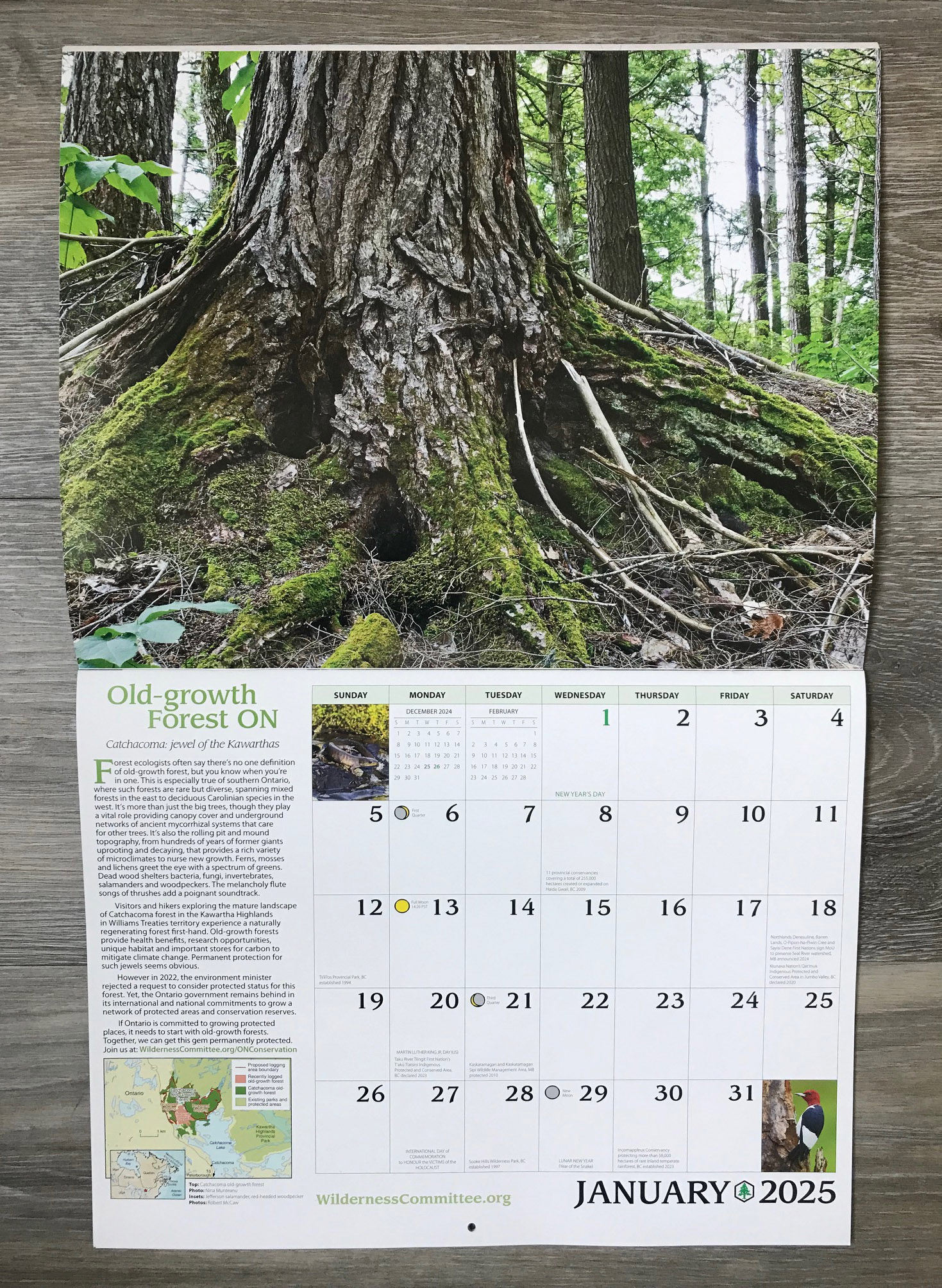
I recently received my copies of the 2025 Wild Canada calendar put out by WildernessCommittee.ca. The calendar has 12 months of gorgeous images of wild and sacred places throughout Canada; heartfelt and informative stories accompany each image.
2025 Wild Canada calendar featuring January spread
My own photo of an old-growth hemlock in Catchacoma Forest, Ontario, is featured for January! Go check out the Wilderness Committee site then go to their store to see the whole calendar. It’s worth buying for its beauty and its meaningful narratives. And it is an excellent way to support a worthwhile cause.
Nina Munteanu is a Canadian ecologist / limnologist and novelist. She is co-editor of Europa SF and currently teaches writing courses at George Brown College and the University of Toronto. Visit www.ninamunteanu.ca for the latest on her books. Nina’s bilingual “La natura dell’acqua / The Way of Water” was published by Mincione Edizioni in Rome. Her non-fiction book “Water Is…” by Pixl Press (Vancouver) was selected by Margaret Atwood in the New York Times ‘Year in Reading’ and was chosen as the 2017 Summer Read by Water Canada. Her novel “A Diary in the Age of Water” was released by Inanna Publications (Toronto) in June 2020.
The third of MetastellarMagazine’s ‘Best of’ anthologies The Best of Metastellar Year Three was recently released and is available at numerous booksellers. Available in print and ebook, the anthology hosts forty-six riveting short stories of science fiction, fantasy and horror. This anthology also features my dark speculative story “Virtually Yours.” Their second ‘Best of’ anthology contained my short story “The Way of Water.”
Virtually Yours in The Best of Metastellar Year Three: In a world of seamless surveillance where virtual and real coalesce in a teasing dance, love is the trickster…
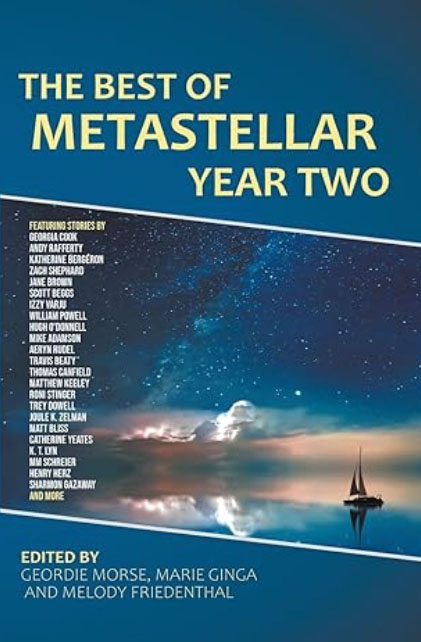
The Way of Water in TheBest of Metastellar Year Two: A woman stands two metres from a public water tap, dying of thirst in a water-scarce world rife with corporate/government corruption…
Nina tickled when her copy of “The Best of Metastellar Anthology Three” arrives in the mail
Nina Munteanu is a Canadian ecologist / limnologist and novelist. She is co-editor of Europa SF and currently teaches writing courses at George Brown College and the University of Toronto. Visit www.ninamunteanu.ca for the latest on her books. Nina’s bilingual “La natura dell’acqua / The Way of Water” was published by Mincione Edizioni in Rome. Her non-fiction book “Water Is…” by Pixl Press (Vancouver) was selected by Margaret Atwood in the New York Times ‘Year in Reading’ and was chosen as the 2017 Summer Read by Water Canada. Her novel “A Diary in the Age of Water” was released by Inanna Publications (Toronto) in June 2020.
In the passage below of my eco-fiction dystopian novel A Diary in the Age of Water, the year is 2065 and the diarist Lynna (a limnologist at the University of Toronto) reflects on the steeply growing infertility in humans and our tenuous future. Lynna draws on the factual study published close to fifty years earlier (in 2017) by Hagai Levine and others at the Hebrew University of Jerusalem, who found that sperm counts among western men had reduced close to 60% in four decades:
Back in ’49, Daniel and I had several discussions about the environmental triggers and epigenetic mechanisms of infertility in humans. Daniel went on about how it was all about the men. While women showed signs of increased infertility, men’s rate of infertility was more than double that of the women, he said. Taking an inappropriately gleeful tone, Daniel cited the classic 2017 paper by the Hebrew University of Jerusalem, the one that started it all. Their findings were startling: men’s sperm count in North America, Europe, Australia, and New Zealand had diminished by sixty percent in forty years, between 1973 and 2011. The scientists predicted that by 2060, virtually all men in these parts of the world would have little to no reproductive capacity.
It’s 2065 and they’re right. Only it’s worse. Before the twenties, only the developed countries seemed to be affected, but then sperm counts started to plummet in South American countries, like Argentina and Brazil, where GMO, pesticides, and solvent manufacturing were exploding.
You get out what you put into the ground. India and Asia—where endocrine-disruptive chemicals are finding their way into the water—are reporting very low sperm counts in their men as well as higher incidents of intersex humans.
You get out what you put into the water. We are over two thirds water, after all. I find it a little ironic that we’ve inadvertently produced a non-discriminatory way to control the problem of humanity’s overpopulation. Infertility. And that infertility results from defiling the environment we live in.
But now climate change is shouldering its way in. Climate change is shutting us down.
Is this the first sign of our impending extinction?
–excerpt from “A Diary in the Age of Water”
.
.
That environmental perturbations impact our ability to reproduce has been proven. In their 2017 article, Levine et al. write that:
“Sperm count and other semen parameters have been plausibly associated with multiple environmental influences, including endocrine disrupting chemicals (Bloom et al., 2015; Gore et al., 2015), pesticides (Chiu et al., 2016), heat (Zhang et al., 2015) and lifestyle factors, including diet (Afeiche et al., 2013; Jensen et al., 2013), stress (Gollenberg et al., 2010; Nordkap et al., 2016), smoking (Sharma et al., 2016) and BMI (Sermondade et al., 2013; Eisenberg et al., 2014a). Therefore, sperm count may sensitively reflect the impacts of the modern environment on male health throughout the life course (Nordkap et al., 2012).”
.
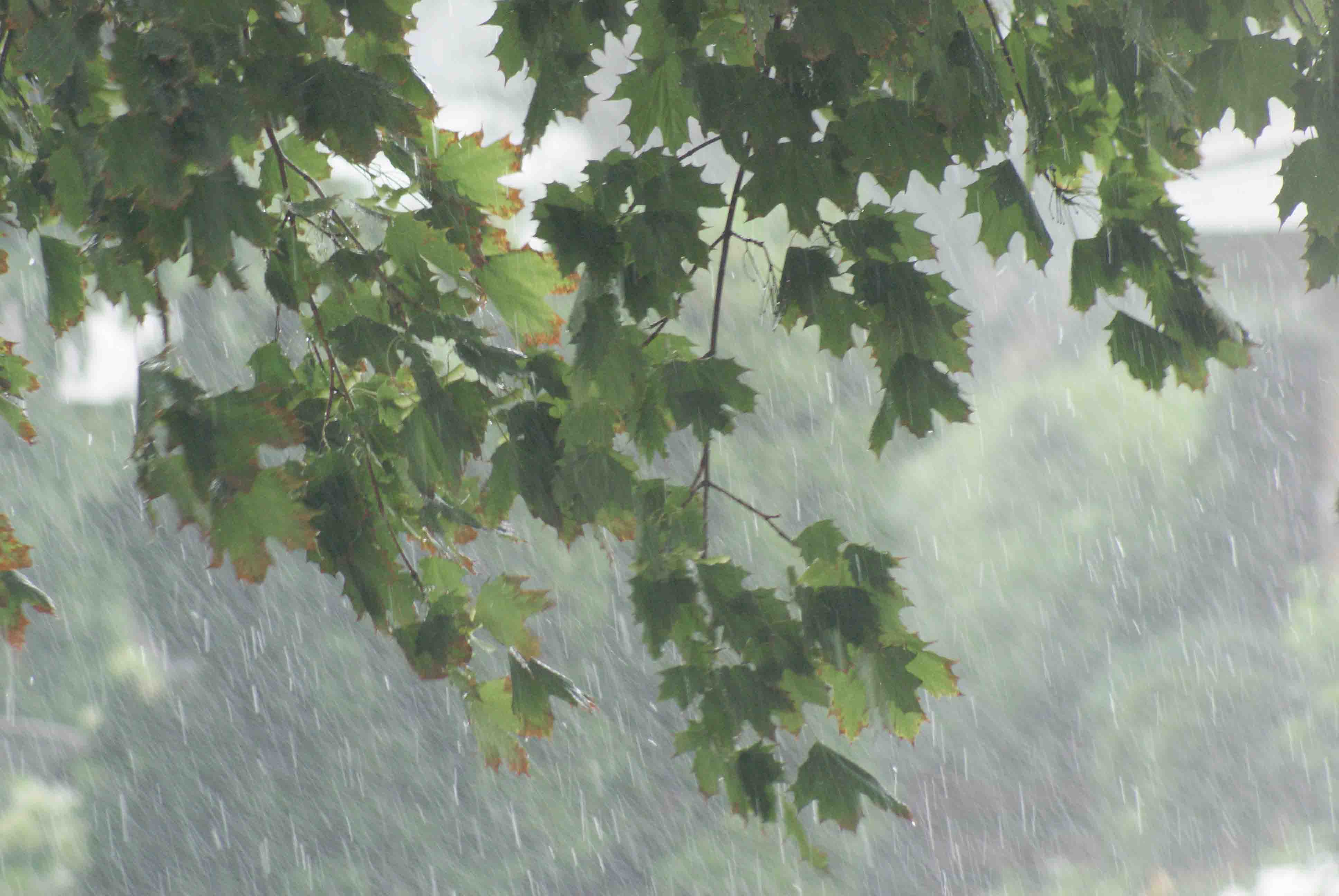
This rain falling on an Ontario marsh most certainly contains forever chemicals (photo by Nina Munteanu)
Thanks to chemical companies such as DuPont and others, forever chemicalsare currently in rain water globally, and in many places in unhealthy concentrations. These endocrine-disrupting and cancer-causing chemicals often end up in drinking water and include PCBs, phthalates, PFAS, BPAs (used in pesticides, children’s products, industrial solvents and lubricants, food storage, electronics, personal care products and cookware).
Heavy rain in Mississauga, ON (photo by Nina Munteanu)
.
Nina Munteanu is a Canadian ecologist / limnologist and novelist. She is co-editor of Europa SF and currently teaches writing courses at George Brown College and the University of Toronto. Visit www.ninamunteanu.ca for the latest on her books. Nina’s bilingual “La natura dell’acqua / The Way of Water” was published by Mincione Edizioni in Rome. Her non-fiction book “Water Is…” by Pixl Press (Vancouver) was selected by Margaret Atwood in the New York Times ‘Year in Reading’ and was chosen as the 2017 Summer Read by Water Canada. Her novel “A Diary in the Age of Water” was released by Inanna Publications (Toronto) in June 2020.
Illustration depicting ‘Rocket Summer’ (image from The Black Cat Moan)
They came because they were afraid or unafraid, happy or unhappy. There was a reason for each man. They were coming to find something or get something, or to dig up something or bury something. They were coming with small dreams or big dreams or none at all
Ray Bradbury, The Martian Chronicles
When I was but a sprite, and before I became an avid reader of books (I preferred comic books), I read Ray Bradbury’s The Martian Chronicles. It changed me, what I thought of books and what I felt about the power of stories. It made me cry. And perhaps that was when I decided to become a writer. I wanted to move people as Bradbury had moved me.
The 1970 Bantam book jacket aptly describes The Martian Chronicles as, “a poetic fantasy about the colonization of Mars. The story of familiar people and familiar passions set against incredible beauties of a new world…A skillful blending of fancy and satire, terror and tenderness, wonder and contempt.”
.
Rockets land on Mars overlooking Bradbury Lane (illustration from Sutori)
.
The Martian Chronicles isn’t really about Mars. True to Bradbury’s master metaphoric storytelling, The Martian Chronicles is about humanity. Who we are, what we are and what we may become. What we inadvertently do—to others, and finally to ourselves—and how the irony of chance can change everything. Despite the knowledge of no detectable amounts of oxygen, Bradbury gave Mars a breathable atmosphere: “Mars is a mirror, not a crystal,” he said, using the planet for social commentary rather than to predict the future.
From “Rocket Summer” to “The Million-Year Picnic,” Ray Bradbury’s stories of the colonization of Mars form an eerie tapestry of past and future. Written in the 1940s, the chronicles long with the nostalgia of shady porches with pitchers of lemonade, ponderously ticking grandfather clocks, and comfortable sofas. Expedition after expedition leave Earth to investigate and colonize Mars. Though the Martians guard their mysteries well, they succumb to the diseases that come with the rocketeers and grow extinct—not unlike the quiet disappearance of the golden toad, the Pinta giant tortoise, or the Bramble Cay melomys. Humans, with ideas often no more lofty than starting a tourist hot-dog stand, bear no regret for the native alien culture they exploit and eventually displace.
It is a common theme of human colonialism and expansionism, armed with the entitlement of privilege. Mars is India to the imperialistic British Empire. It is Rwanda or Zaire to the colonial empire of the cruel jingoistic King Leopold II of Belgium. Mars is Europe to Nazi Germany’s sonderweg. We need look no further than our own Canadian soil for a reflection of this slow violence of disrespect and apathy by our settler ancestors on the indigenous peoples of Canada.
Mars was a distant shore, and the men spread upon it in waves… Each wave different, and each wave stronger.
The Martian Chronicles
Tyler Miller of The Black Cat Moan makes excellent commentary in their 2016 article entitled “How Ray Bradbury’s ‘The Martian Chronicles’ changed Science Fiction (and Literature).”The article begins with a quote from Argentinean author Jorge Luis Borges (in the introduction to the Spanish-language translation of The Martian Chronicles: “What has this man from Illinois done, I ask myself when closing the pages of this book, that episodes from the conquest of another planet fill me with horror and loneliness?”
.
Remember, this was the 1950s … halfway through a century dominated by scientific discovery, and expansion. The 1950s saw developments in technology, such as nuclear energy and space exploration. On the heels of the end of World War II, the 1950s was ignited by public imagination on conquering space, creating technological futures and robotics. The 1950s was considered by some as the real golden age for science fiction, still a kind of backwater genre read mostly by boys and young men, that told glimmering tales of adventure, exploration, and militarism, of promising technologies, and often-androcratic societies who used them in the distant future to conquer other worlds full of strange and disposable alien beings in the name of democracy and capitalism. (In some ways, this is still very much the same.Though, it is thankfully changing…)
(Bantam 1951 1st edition cover)
Many scientists deeply involved in the exploration of the solar system (myself among them) were first turned in that direction by science fiction. And the fact that some of that science fiction was not of the highest quality is irrelevant. Ten year‐olds do not read the scientific literature.
Carl Sagan, 1978
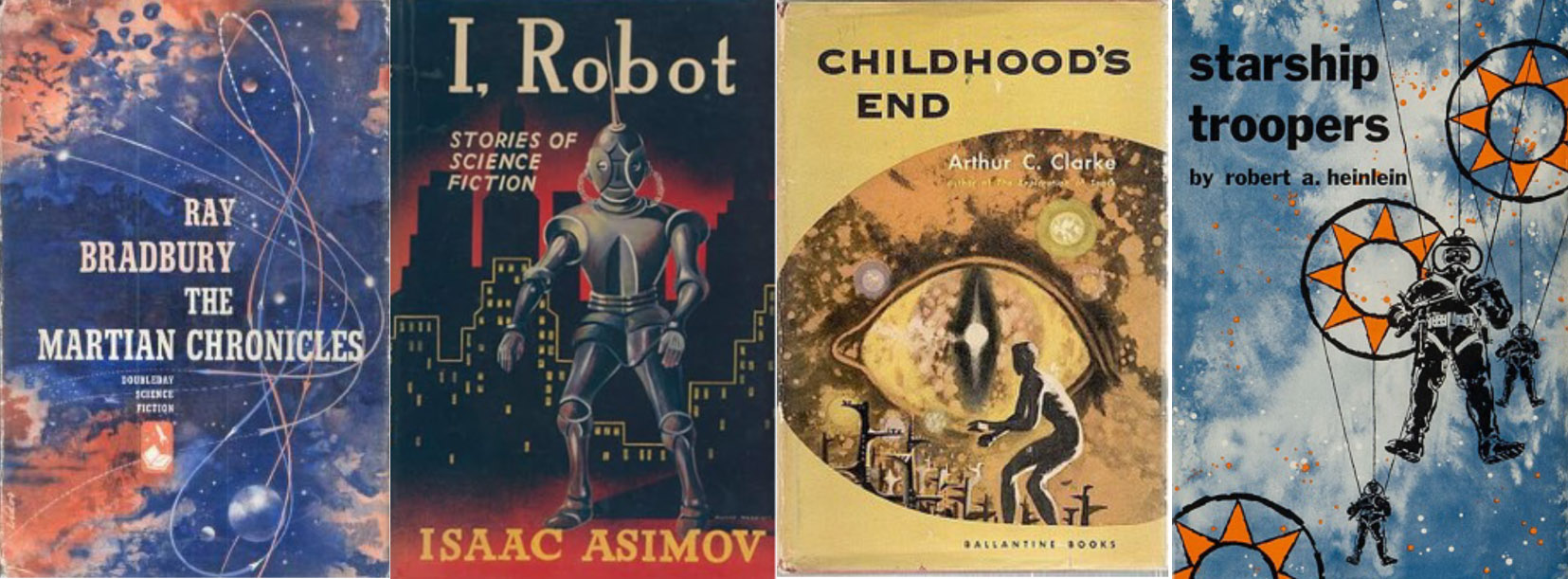
First edition book covers of Martian Chronicles (Doubleday, 1950); I, Robot (Grayson & Grayson, 1952); Childhood’s End (Ballantine Books, 1953); and Starship Troopers (G.P. Putnam’s Sons, 1959)
Large idea-driven SF works that typified this time period included Robert A. Heinlein’s Starship Troopers, Arthur C. Clarke’s Childhood’s End, Isaac Asimov’s I, Robot and his Foundation series.
It was at this time that Ray Bradbury published The Martian Chronicles. Though filled with the requisite rocket ships, gleaming Martian cities, ray guns, and interplanetary conquest, from the very start—as Borges noted—The Martian Chronicles departed radically from its SF counterparts of the time.
(Illustration on album cover of “Rocket Summer”, music by Chris Byman)
Instead of starting with inspiring technology or a stunning action sequence, or a challenging idea or discovery, Bradbury’s The Martian Chronicles opens with a domestic scene.
One minute it was Ohio winter, with doors closed, windows locked, the panes blind with frost, icicles fringing every roof, children skiing on the slopes, housewives lumbering like great black bears in their furs along the icy streets.
And then a long wave of warmth crossed the small town. A flooding sea of hot air; it seemed as if someone had left a bakery door open. The heat pulsed among the cottages and bushes and children. The icicles dropped, shattering, to melt. The doors flew open. The windows flew up. The children worked off their wool clothes. The housewives shed their bear disguises. The snow dissolved and showed last summer’s ancient green lawns.
Rocket summer. The words passed among the people in the open air, airing houses. Rocket summer. The warm desert air changing the frost patterns on the windows, erasing the art work. The skis and sleds suddenly useless. The snow, falling from the cold sky upon the town, turned to a hot rain before it touched the ground.
Rocket summer. People leaned from their dripping porches and watched the reddening sky.
The rocket lay on the launching field, lowing out pink clouds of fire and oven heat. The rocket stood in the cold winter morning, making summer with every breath of its mighty exhausts. The rocket made climates, and summer lay for brief moment upon the land…
Ray Bradbury, The Martian Chronicles, Rocket Summer
Bradbury’s focus was on the domestic. Housewives fighting off the ice and snow of Ohio. A Martian woman “cleaning the house with handfuls of magnetic dust which, taking all dirt with it, blew away on the hot wind.”
They had a house of crystal pillars on the planet Mars by the edge of the empty sea, and every morning you could see Mrs. K eating the golden fruits that grew from the crystal walls, or cleaning the house with handfuls of magnet dust which, taking all dirt with it, blew away on the hot wind. Afternoons, when the fossil sea was warm and motionless, and the wine trees stood stiff in the yard…you could see Mr. K in his room, reading from a metal book with raised hieroglyphs over which he brushed his hand, as one might play a harp. And from the book, as his fingers stroked, a voice sang, a soft ancient voice, which told tales of when the sea was red steam on the shore and ancient men had carried clouds of metal insects and electric spiders into battle…
This morning Mrs. K stood between the pillars, listening to the desert sands heat, melt into yellow wax, and seemingly run on the horizon.
Something was going to happen.
She waited.
Ray Bradbury, The Martian Chronicles, Ylla
Bradbury’s gift to literature—and to his SF genre—was his use of metaphor. Unlike the science fiction of his colleagues, Bradbury’s stories are a lens to study the past and the present. According to Miller, “The Earthmen’s exploration and desolation of Mars allowed Bradbury to look not forward but backward at exploration and desolation on Earth, namely the European arrival in the New World. Just as Europeans landed in North and Central America wholly unprepared for what they found there, Bradbury’s Earthmen are unprepared time and again for the wonder and the horror of Mars. And just as European diseases decimated native people in the Americas, it is chicken-pox which wipes out the Martians.”
.
.
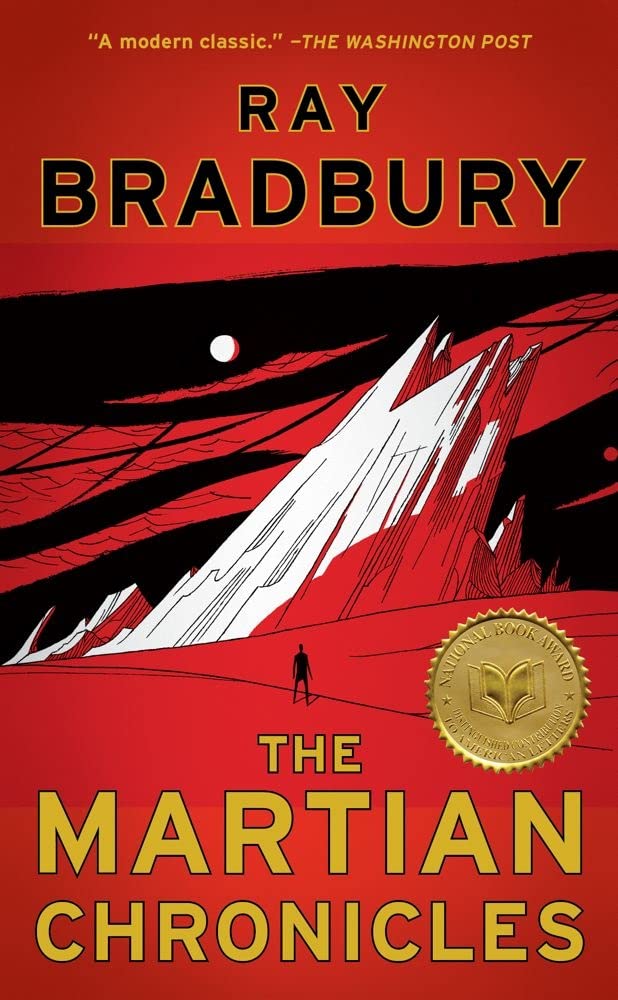
The back cover of the 2012 mass market paperback Simon & Schuster Reprint edition of The Martian Chronicles reads:
Bradbury’s Mars is a place of hope, dreams and metaphor—of crystal pillars and fossil seas—where a fine dust settles on the great, empty cities of a silently destroyed civilization. It is here the invaders have come to despoil and commercialize, to grow and to learn—first a trickle, then a torrent, rushing from a world with no future toward a promise of tomorrow. The Earthman conquers Mars … and then is conquered by it, lulled by dangerous lies of comfort and familiarity, and enchanted by the lingering glamour of an ancient, mysterious native race.
“Ask me then, if I believe in the spirit of the things as they were used, and I’ll say yes. They’re all here. All the things which had uses. All the mountains which had names. And we’ll never be able to use them without feeling uncomfortable. And somehow the mountains will never sound right to us; we’ll give them new names, but the old names are there, somewhere in time, and the mountains were shaped and seen under those names. The names we’ll give to the canals and the mountains and the cities will fall like so much water on the back of a mallard. No matter how we touch Mars, we’ll never touch it. And then we’ll get mad at it, and you know what we’ll do? We’ll rip it up, rip the skin off, and change it to fit ourselves.”
“We won’t ruin Mars,” said the captain. “It’s too big and too good.”
“You think not? We Earth Men have a talent for ruining big, beautiful things.”
Ray Bradbury, The Martian Chronicles, And the Moon be Still as Bright
Ray Bradbury’s The Martian Chronicles is a profound and tender analysis of the quiet power humanity can wield unawares and how we define and treat ‘the other.’ It is a tragic tale that reflects only too well current world events where the best intended interventions can go awry. From the meddling friend who gossips to “help” another (only to make things worse) to the righteous “edifications” of a religious group imposing its “order” on the “chaos” of a “savage” peoples … to the inadvertent tragedy of simply and ignorantly being in the wrong place at the wrong time (e.g., the introduction of weeds, disease, etc. by colonizing “aliens” to the detriment of the native population; e.g., smallpox, AIDs, etc.). Bradbury is my favourite author for this reason (yes, and because he makes me cry…)
.
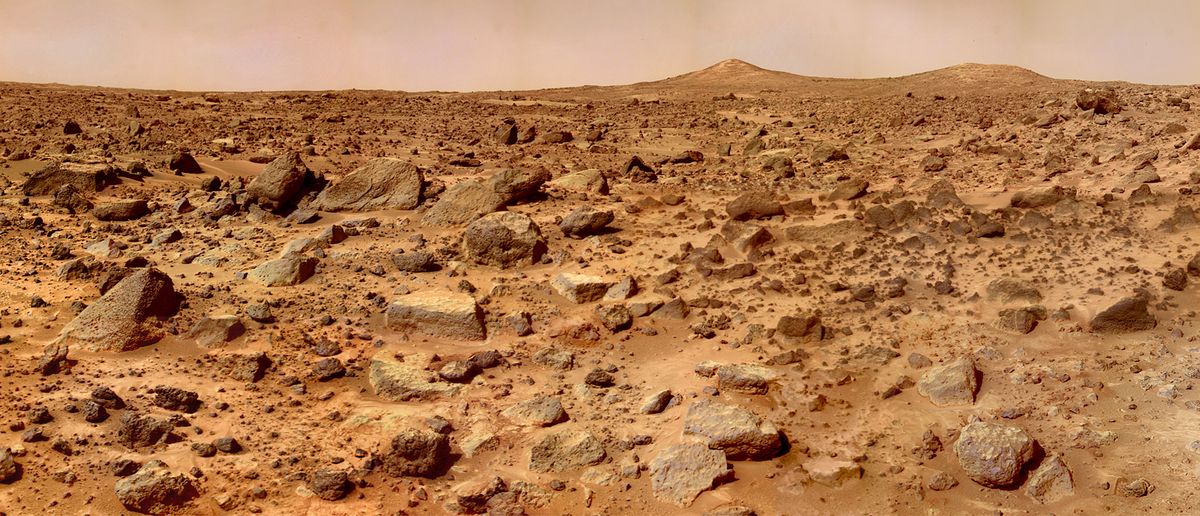
Mars terrain (photo by NASA)
Nina Munteanu is a Canadian ecologist / limnologist and novelist. She is co-editor of Europa SF and currently teaches writing courses at George Brown College and the University of Toronto. Visit www.ninamunteanu.ca for the latest on her books. Nina’s bilingual “La natura dell’acqua / The Way of Water” was published by Mincione Edizioni in Rome. Her non-fiction book “Water Is…” by Pixl Press (Vancouver) was selected by Margaret Atwood in the New York Times ‘Year in Reading’ and was chosen as the 2017 Summer Read by Water Canada. Her novel “A Diary in the Age of Water” was released by Inanna Publications (Toronto) in June 2020.




















 Nina Munteanu Writing Coach