“During spring thaw or fall turnover, the thermocline erodes and the changing temperature forces a lake to mix, revealing her secrets.”
Lynna Dresden
“Munteanu’s experience in bridging the worlds of biology and writing makes A Diary in the Age of Water unique in being strong and focused from both the scientific and literary perspectives.”
STRANGE HORIZONS
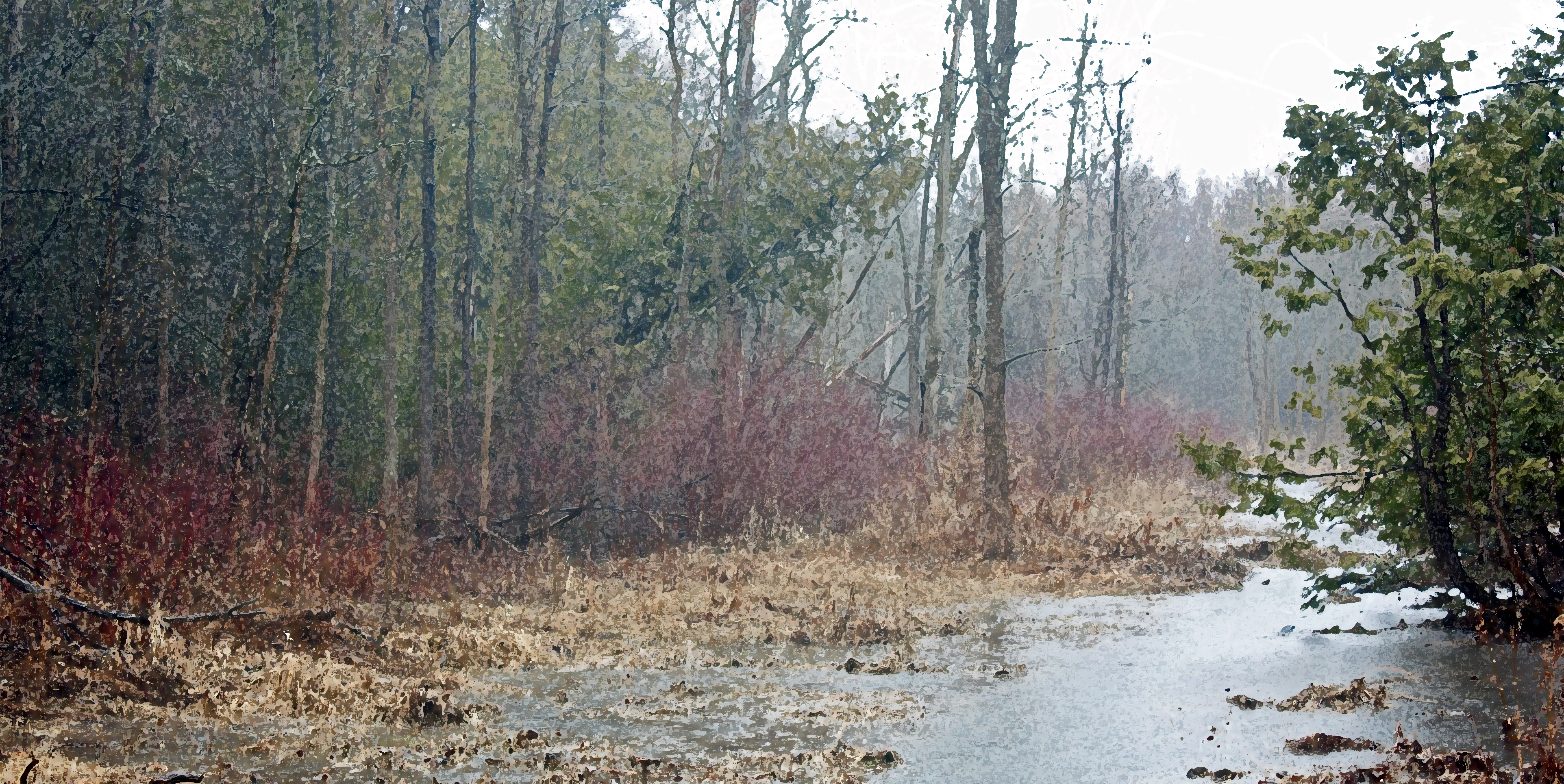
Overflowing marshy creek in Trent Nature Sanctuary in spring, ON (photo and rendition by Nina Munteanu)
“The prose here is beautiful and purposeful in the tradition of environmentally and socially minded novelists such as Ursula K. LeGuin and Margaret Atwood.”
WINNIPEG FREE PRESS
Flooded farmer’s field, ON (photo and rendition by Nina Munteanu)
“Water wants to flow. It doesn’t like to be restricted. If confined in a ravine, it speeds up and cuts a channel along the thalweg, eroding the hardest material and polishing a path that uniquely suits it. Water is selfish. It is always moving, even when it isn’t.”
Lynna Dresden
A Diary in the Age of Water is “An exceptional and thought-provoking dystopian fiction.”
LITERARY TITAN
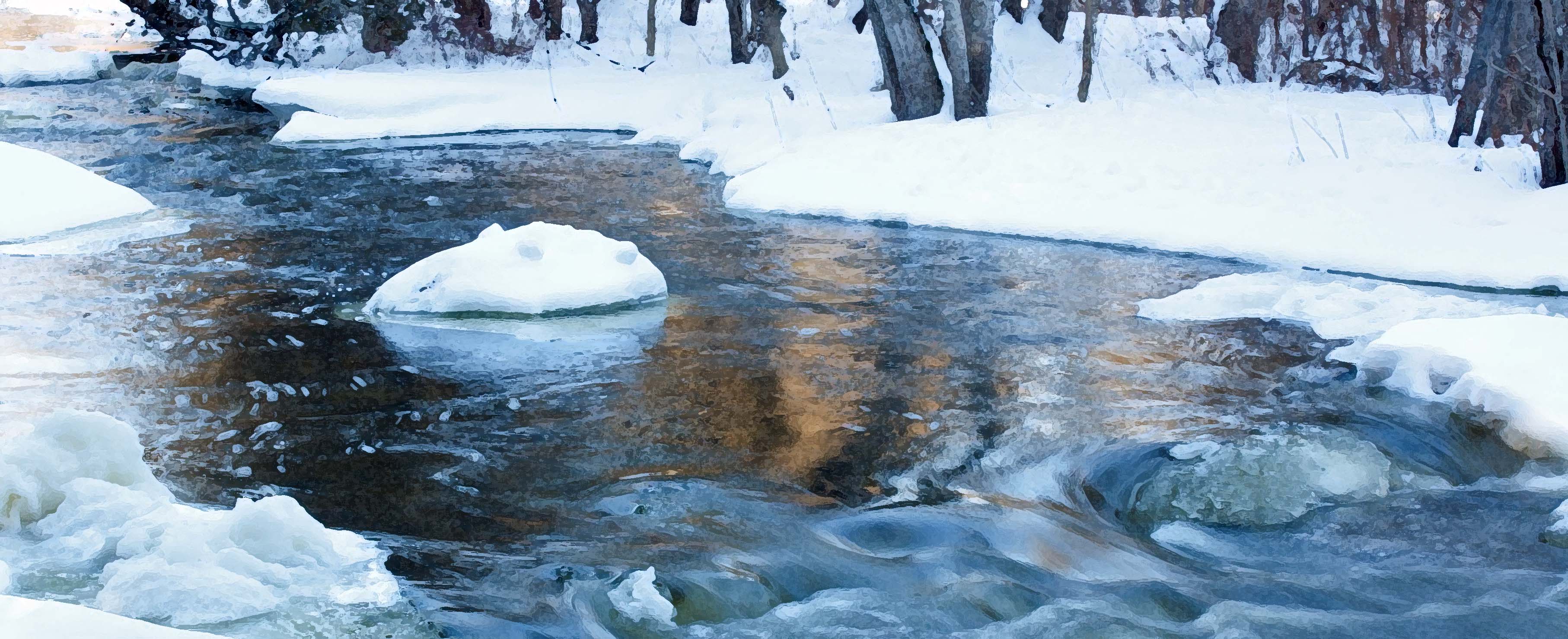
Jackson Creek in winter, ON (photo and rendition by Nina Munteanu)
Jackson Creek after a fresh snowfall, ON (photo and rendition by Nina Munteanu)
Issue #128 of Apex Magazine featured an interview that Rebecca E. Treasure did with me. We discussed the power of story, the use of dystopian narrative, and the blur between fiction and non-fiction to create meaningful eco-fiction. Below we talk about the role of stories in the climate action movement. For the complete interview go here:
AM:Your work takes complex topics that are nonetheless critical to humanity’s future and pulls stories with compelling characters out of them, making the science accessible, the warnings personal to the reader. This has always been one of the callings of science fiction. What is the role of stories in the climate action movement?
NM: Our capacity and need to tell stories is as old as our ancient beginnings. From the Paleolithic cave paintings of Lascaux to our blogs on the internet, humanity has always shared story. Story is powerful in how it helps us define who we are, what’s important to us, and where we are going. Stories compel with intrigue, stir our emotions, connect with our souls through symbols, archetypes and metaphor. Stories inspire action. We live by the stories we tell.
For too long, our stories have promoted a dominant worldview of exploitation and capitalism. We’ve been telling the patriarchal story of “othering” for too long; we need a new voice and a new worldview to replace our old stories of conquering and taming a “savage land” and “savage people.” When Copernicus proclaimed in 1543 that the sun did not revolve around the Earth, it took a long time for the world to accept and let go of its Ptolemaic Earth-centered view. But the world did come around eventually to the point now that this is common knowledge and lies embedded in our daily lives and language.
Storytelling about how the Earth takes care of us and how we can take care of Earth is urgently needed.
This means shifting our stories from an exploitive capitalist narrative of separation toward an inclusive partnership narrative. This means embracing a more eco-centric worldview; a worldview in which humanity is not central, but lies embedded within greater planetary forces and phenomena. A worldview that sees humanity only as part of a greater entity, as participant in a greater existential celebration of life and the elements. A humanity that must learn to play along, not bully and take over. A humanity that must embrace compassion, respect and kindness; a humanity directed by humility—not hubris. It is my firm belief that until our worldview embraces humility in partnership with the natural world—until we cast off our self-serving, neo-liberal, capitalist ideologies—we will remain hampered in our journey forward. When we change our stories, we change our lives and we change the world along with it.
This is already happening with the emergence of a strong eco-voice by writers through the feminine voice, the gylanic voice, the voice of the marginalized, of ecology and the environment itself. Authors such as Barbara Kingsolver, Annie Proulx, Margaret Atwood, Richard Powers, Emmi Itäranta, Jeff Vandermeer, Cherie Demaline, Christiane Vadnais, Pitchaya Sudbanthad, Chen Qiufan, Paolo Bacigalupi, Grace Dillon, Andrew Krivak, Kim Stanley Robinson, and Coleen Murphy … These all give Nature a face and voice to care about. And caring is the first step.
Nina Munteanu and her award-winning eco-novel “A Diary in the Age of Water”
Nina Munteanu is a Canadian ecologist / limnologist and novelist. She is co-editor of Europa SF and currently teaches writing courses at George Brown College and the University of Toronto. Visit www.ninamunteanu.ca for the latest on her books. Nina’s bilingual “La natura dell’acqua / The Way of Water” was published by Mincione Edizioni in Rome. Her non-fiction book “Water Is…” by Pixl Press(Vancouver) was selected by Margaret Atwood in the New York Times‘Year in Reading’ and was chosen as the 2017 Summer Read by Water Canada. Her novel “A Diary in the Age of Water” was released by Inanna Publications (Toronto) in June 2020.
The Darwin duology by Dragon Moon Press, depicting the late 21st Century, by Nina Munteanu
.
.
In my 2007 novel Darwin’s Paradox and its 2010 prequel Angel of Chaos—dystopian tales set in an unrecognizable post-climate change Canada at the end of the 21st Century—the father of the main character lectures his impressionable young daughter about how climate change helped create the heathland scrub that replaced the mixed woodlands of the old Carolinian and sub-Boreal environments:
“What’s over there?” She points to a far, dark hill.
“Woodland. This was all forest before the cities got built and the climate changed.”
“Climate changed?”
“Yes, honey.” He focuses on the distance. “Caused the revolution thirty years ago. Since then the Ecologists have virtually eliminated our greenhouse gas emissions. Of course, the planet will be feeling the effects of global warming for decades to come. Perhaps centuries.”
“They saved the planet, didn’t they?”
His brows knit. “Perhaps they did, perhaps they didn’t,” he says enigmatically.
.
I’d originally written the novel and its prequel in the seventies, before entering university. So, you might think that I was incredibly imaginative and prescient to come up with such climate devastation. But this simply isn’t so (well, not entirely, anyway). Just as with Margaret Atwood—who says: “When I wrote the Handmaid’s Tale, nothing went into it that had not happened in real-life somewhere at some time”—I was simply reading the signs.
.
Margaret Atwood demonstrating a fire-proof version of her book The Handmaid’s Tale
.
.
When it came to climate change, of course, I had some help. During my days at university, studying limnology, and in the 1980s and ‘90s when I worked as an environmental scientist and consultant, I encountered evidence of a changing environment and climate; people in the environmental sciences certainly knew the dangers of climate change long before it entered the common zeitgeist.
Science fiction dystopias aren’t so much predictive as realistically projecting possibilities based on current or past social patterns (these past social patterns, as Santayana notes, have a way of returning to us when we don’t pay attention to them). This notion lies at the root of the term cautionary tale and what makes one truly harrowing or terrifying; we sense to our very core how likely these scenarios are.
My near-future climate dystopia released by Inanna Publications in 2020
Response to my 2020 cautionary tale A Diary in the Age of Water reflects this visceral reaction by readers who shared that this blur of fiction with non-fiction and sense of realism—a “this could happen” quality—totally unbalanced them and engrossed them. Comments included “unique and captivating,” “unsettling and yet deliciously readable,” “strangely compelling” “scary and comforting at the same time,” “made my heart clench,” “a book of genuine power.”
Scene from Michael Radford’s film “Nineteen Eighty-Four” released in 1984, based on George Orwell’s 1949 novel
.
.
Indeed, many successful predictions have been made in speculative fiction. In 1961, Stanislaw Lem’s novel Return From the Stars predicted the invention of the touch pad, iPhone, iPad and Kindle. The telescreens that monitored the citizens of George Orwell’s Oceania in his dystopian 1949 novel Nineteen Eighty-Four was reflected, twenty years later, in the first CCTV installed in the United Kingdom. Philip K. Dick’s Minority Report accurately predicted personalized ads, voice-controlled homes, facial and optical recognition, and gesture-based computing. Self-driving cars were showcased in many speculative books and films such as Bladerunner, and Isaac Asimov’s I, Robot.
.
Scene from the film Minority Report with Tom Cruise
.
.
But many speculations have also not been realized. No flying cars—OK, some companies such as Toyota, Hyundai and Tesla are working on prototypes. While NASA plans to construct a surface habitat called Artemis Base Camp so that astronauts can remain on the moon’s surface for days or perhaps even weeks, it is far from happening soon. Also, no rotating space stations and space elevator—yet.
Many envisioned totalitarian/dystopian states in speculative fiction have also not been realized (e.g. We, Nineteen Eighty-Four, Brave New World, Fahrenheit 451, Handmaid’s Tale, Hunger Games, The Dispossessed, V for Vendetta )—though one could argue that aspects of each world envisioned by an author has occurred or is occurring in some form. One need only recall Edward Snowdon’s disclosures of NSA’s insidious surveillance to see parallels with Orwell’s Nineteen Eighty-Four. And as Margaret Atwood famously said in the quote above, nothing goes into her stories “that have not happened in real-life somewhere at some time.”
“The function of science fiction is not only to predict the future but to prevent it.”
Ray Bradbury
There are, in most cases, no technological impediments to the flying car, the jetpack, and moon-bases; only cultural ones. “These SF predictions ought to be viewed as visions of where we could be, as opposed to where we will be, or, keeping Bradbury in mind, visions of where we don’t want to go and, thankfully, have mostly managed to avoid to date,” says Steve Davidson of Grasping for the Wind. “Perhaps it’s all cultural,” he adds. Science fiction writer and futurist David Brin says that he is “more interested in exploring possibilities than likelihoods, because a great many more things might happen than do.”
In his book Four Futures: Life After Capitalism Peter Frase writes: “the importance of assessing possibility rather than likelihood is that it puts our collective action at the centre, while making confident predictions only encourages passivity.” In his 2010 essay, David Brin cites Orwell’s 1984 as a “self-preventing prophecy” that helped prevent the scenario (at least in its fullest).
George Orwell wrote his dystopian satire in 1949 about a mind-controlled society in response to the Cold War. The book was a metaphor “against totalitarianism and for democratic socialism,” said Orwell in his 1947 essay Why I Write, adding that, “Good prose is like a windowpane.” Was Orwell’s Nineteen Eighty-Four a failed novel because the real 1984 didn’t turn out quite like his 1984? Hardly. Hugo Award-winning novelist Robert J. Sawyer argues that we consider it a success, “because it helped us avoid that future. So just be happy that the damn dirty apes haven’t taken over yet.”
.
References:
Brin, David. 2010. “The Self-Preventing Prophecy: Or How a Dose of Nightmare Can Help Tame Tomorrow’s Path.” in Abbott Gleason et al. eds., On Nineteen Eighty-Four: Orwell and Our Future. Princeton University Press, Princeton, p.222.
Frase, Peter. 2016. “Four Futures: Life After Capitalism.” Verso Press, London. 150pp.
.
Country road in the Kawarthas during a foggy morning, ON (photo by Nina Munteanu)
.
Nina Munteanu is a Canadian ecologist / limnologist and novelist. She is co-editor of Europa SF and currently teaches writing courses at George Brown College and the University of Toronto. Visit www.ninamunteanu.ca for the latest on her books. Nina’s bilingual “La natura dell’acqua / The Way of Water” was published by Mincione Edizioni in Rome. Her non-fiction book “Water Is…” by Pixl Press(Vancouver) was selected by Margaret Atwood in the New York Times‘Year in Reading’ and was chosen as the 2017 Summer Read by Water Canada. Her novel “A Diary in the Age of Water” was released by Inanna Publications (Toronto) in June 2020.
Issue #128 of Apex Magazine featured an interview that Rebecca E. Treasure did with me, posted on December 10, 2021. We discussed the power of story, the use of dystopian narrative, and the blur between fiction and non-fiction to create meaningful eco-fiction. Here’s part two of the interview. For the complete interview go here:
INTERVIEW
Nina Munteanu, author of “Robin’s Last Song,” is a prolific creator with multiple books, podcasts, short stories, and nonfiction essays in publication. Her work spans genre, from eco-fiction to historical fantasy to thrillers, and of course, science fiction. Her work as an ecologist informs all of her writing, which circles around an essential exploration; the relationship between humanity and our environment.
At the top of Nina Munteanu’s website, there is a quote: “I live to write, I write to live.” This sentiment is reflected in her fiction, which is not just about characters in compelling situations solving their problems with compassion, but is about all of us, our planet, our environment, and our future.
Nina Munteanu sat down with Apex for a conversation about story, ecology, and the future.
∞
APEX MAGAZINE:Your novels and short stories examine the role and evolution of humanity in the context of nature and technology. As an ecologist, what do you believe needs to happen—internationally, nationally, locally, and personally—to restore our planet and move forward in a sustainable way?
NINA MUNTEANU: All things animate and inanimate naturally oscillate toward equilibrium or balance in a kind of stable chaos of polarities. Goethe and Hegel told us this long ago. Our actions have exacerbated this oscillation through massive extraction, habitat destruction, and pollution with associated conflicts, take-over and subjugation. Everything is connected and all have contributed to climate change and habitat change. Our mission—given that we’re responsible for much of that imbalance—is to help the planet return itself to balance. That means ensuring that Nature’s natural checks can do their job to ensure functional forests and phytoplankton, a healthy ocean, a resilient biodiversity—all systems that we rely on for our own healthy existence. Restoring our denuded global forests, and the oceans will need the concerted and united efforts of all nations and individuals. We have the knowledge, the science, and technology; all that is needed is the will. And that can only change as our own narrative changes. That’s where storytelling plays a key part. Surveys have proven that fiction can be deeply persuasive through character journey that convinces at a deeper more emotional level (as opposed to a litany of facts that appeals only at an intellectual level).
AM:Do you believe industry and sustainability are compatible? What about colonialism and sustainability? Capitalism? In other words, is sustainability something we can achieve with our current systems, or is global systemic change required?
NM: Some people—mostly economists—would say definitely yes to the first question; we just need to be conservationist in our approach to doing business. But the very basis of capitalism is exploitation, not conservation. The driving force behind capitalism is fear and uncertainty and its main process is exploitation. From an ecologist’s perspective, this makes sense for a community during its early succession and growth stage … when it first colonizes a new area. Ecologists call this approach r-selected (for rate), based on the need to be profligate and fast-growing to successfully establish. But as we reach a climax community and our carrying capacity—where we are now—this r-selected approach no longer works. We need an economic model that better matches this new paradigm. NOT based on continued growth! A climax global economy, one based on cooperation not competition. Elisabet Sahtouris calls this ecological economy “ecosophy.” In his book Designing Regenerative Cultures, Daniel Christian Wahl talks about changing our evolutionary narrative from one based on fear defined by a perception of scarcity, competition, and separation to one based on love defined by a perception of abundance, a sense of belonging, collaboration, and inclusion. He promotes a regenerative economy based on true reciprocation.
And moving forward we can take a lesson from Robin Wall Kimmerer who promotes a gift economy—an economy of abundance—whose basis lies in recognizing the value of kindness, sharing, and gratitude in an impermanent world. This is what she says: “Climate change is a product of [our] extractive economy and is forcing us to confront the inevitable outcome of our consumptive lifestyle, genuine scarcity for which the market has no remedy. Indigenous story traditions are full of these cautionary teachings. When the gift is dishonored, the outcome is always material as well as spiritual. Disrespect the water and the springs dry up. Waste the corn and the garden grows barren. Regenerative economies which cherish and reciprocate the gift are the only path forward. To replenish the possibility of mutual flourishing, for birds and berries and people, we need an economy that shares the gifts of the Earth, following the lead of our oldest teachers, the plants.”
AM: The language in your stories is richly thematic, using strong description to weave the subtext into the piece. For example, “killing two squirrels with one stone.” Is that something that comes about organically as you compose a piece, or a more intentional part of editing?
NM: I use both processes to achieve a final narrative that is multi-layered with metaphor, symbols, and deep meaning. The first process is through intuition derived through intimacy; the second process is more deliberate and generated through objectivity. Insights from intimacy come about organically, during moments of true inspiration, when my muse connects me to the deeper truth of a character’s voice and actions. Given that the inner story runs many layers (some of which I, as writer, may not even be overtly aware) and links in a fractal relationship with the outer story, those moments of inner inspiration happen as if of their own accord. That’s what writers mean when they admit that their characters “talk” to them and instruct them on what to write. When a writer achieves that level of intimacy and understanding, they can let the muse guide them.
Much of the description that is woven into story is generated through the editing process when I read the manuscript as a reader. The process involves letting the story sit for a while so when I return to it, I am reading more objectively. During this process, I apply my knowledge in storytelling craft to showcase combustible moments in plot, and work in foreshadowing, subtext, and compelling metaphor. A writer can’t add metaphor without context related to story theme (otherwise this may result in what the industry calls “purple prose”). Metaphor—given its roots in the deeper psyche of a culture—must arise organically from a deep, sometimes intuitive, understanding—where the personal meets the universal.
AM:Your work takes complex topics that are nonetheless critical to humanity’s future and pulls stories with compelling characters out of them, making the science accessible, the warnings personal to the reader. This has always been one of the callings of science fiction. What is the role of stories in the climate action movement?
NM: Our capacity and need to tell stories is as old as our ancient beginnings. From the Paleolithic cave paintings of Lascaux to our blogs on the internet, humanity has always shared story. Story is powerful in how it helps us define who we are, what’s important to us, and where we are going. Stories compel with intrigue, stir our emotions, connect with our souls through symbols, archetypes and metaphor. Stories inspire action. We live by the stories we tell.
For too long, our stories have promoted a dominant worldview of exploitation and capitalism. We’ve been telling the patriarchal story of “othering” for too long; we need a new voice and a new worldview to replace our old stories of conquering and taming a “savage land” and “savage people.” When Copernicus proclaimed in 1543 that the sun did not revolve around the Earth, it took a long time for the world to accept and let go of its Ptolemaic Earth-centered view. But the world did come around eventually to the point now that this is common knowledge and lies embedded in our daily lives and language.
Storytelling about how the Earth takes care of us and how we can take care of Earth is urgently needed. This means shifting our stories from an exploitive capitalist narrative of separation toward an inclusive partnership narrative. This means embracing a more eco-centric worldview; a worldview in which humanity is not central, but lies embedded within greater planetary forces and phenomena. A worldview that sees humanity only as part of a greater entity, as participant in a greater existential celebration of life and the elements. A humanity that must learn to play along, not bully and take over. A humanity that must embrace compassion, respect and kindness; a humanity directed by humility—not hubris. It is my firm belief that until our worldview embraces humility in partnership with the natural world—until we cast off our self-serving, neo-liberal, capitalist ideologies—we will remain hampered in our journey forward. When we change our stories, we change our lives and we change the world along with it.
This is already happening with the emergence of a strong eco-voice by writers through the feminine voice, the gylanic voice, the voice of the marginalized, of ecology and the environment itself. Authors such as Barbara Kingsolver, Annie Proulx, Margaret Atwood, Richard Powers, Emmi Itäranta Cherie Demaline, Grace Dillon, and Cormac McCarthy give Nature a face and voice to care about. And caring is the first step.
AM:Your stories also bridge fiction with nonfiction, using speculative fiction as a lens to bring your subject into focus for the reader. How does that work? Why do you approach story in this way?
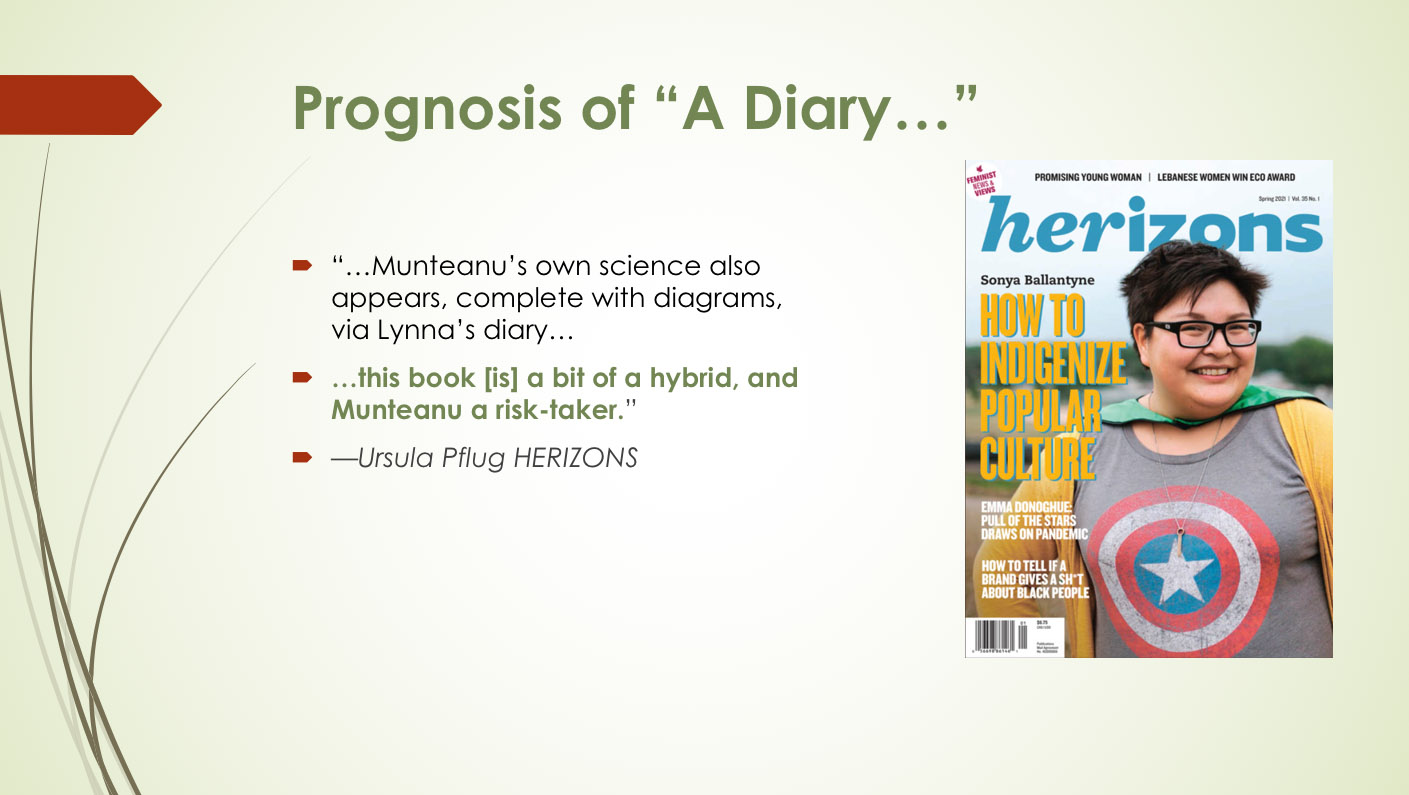
NM: Marcie McCauley with Temz Review observed that, “[Munteanu] does not appear to view fiction and non-fiction as separate territories; or, if she does, then this book [A Diary in the Age of Water] is a bridge between them.” In Herizons, Ursula Pflug called the book “a bit of a hybrid, and Munteanu a risk-taker.” Buried in Print wrote of the same book, “ultimately it exists in an in-between place, some mystical elements of the generational tale possibly alienating the dedicated science-y readers and the instructional elements possibly alienating fiction devotees. And, yet, I read on: strangely compelling.”
I find that I enjoy this in-between place that blurs fiction with nonfiction. It’s more edgy, gripping, and believable, albeit fantastical, even playfully challenging at times. For instance, I may subvert facts, creating semi-facts to tease the discerning reader (e.g. when the diarist in “A Diary in the Age of Water” observed that President Trump had gone blind from staring at the sun during an eclipse; while Trump did stare directly at the sun without eye protection during an eclipse in 2017, he did not go blind—yet). Readers have told me that the story was more impactful; they honestly didn’t know what was taken from fact and what was fictionalized. Such narrative reads like a true story and there is little more tantalizing than eavesdropping on another’s real experience and intrigue. The risk—that the blur will either confuse the reader or invalidate its truths and message—is hopefully addressed through compelling narrative that engages the reader. But this is also why I tend to include an extensive bibliography at the end of a novel or short story.
Readers have told me that my fiction/nonfiction storytelling trope, like “mundane science fiction,” grips my stories with a more keen sense of relevance. Given that I am writing mostly climate fiction and eco-fiction these days, that sense of relevance is exactly what I wish to achieve.
AM: A last question. Both “The Way of Water” and “Robin’s Last Song” showcase the relationships women have with each other, the importance of human connection, the damage that disconnecting from each other can do and, inversely, the power of connection. In your view, what is the role of individuals and local communities in the climate crisis?
NM: There are many things we can do as individuals and as part of a community. I was recently asked this question by the Toronto Star and I responded with three things:
● First, plant a tree; make an actual difference through action. By doing that, we get out from hiding under the bed and face the monster of climate change and show that we care and that we are not alone.
● Second, vote for green politicians. Politicians need to hear directly from their communities. They need you to push them to act on climate change.
● Third, find your tribe and create a movement. Everyone says that people have the power, but that power comes best through numbers and solidarity. Find your tribe and you’ll find yourself more motivated. So, start with you and your home: plant trees; put in a rain garden; put in permeable driveways and solar panels; lower meat intake, especially beef; don’t buy bottled water. Then connect with your physical community and social media community. Let them know what you’re doing and why. Work with your community. All members of a community can help change how your street looks and behaves by communicating with your local government, attending meetings, and having a voice. Initiate a tree-planting program in your parks and street greens. Do stream or lake cleanups. Let the leaders of your community know you care and are willing to do something about it. The wave of change starts local and ripples out into a global phenomenon. Change comes from the heart and heart is where the home is.
Birch trees and marsh on a foggy morning in winter, ON (photo and rendition by Nina Munteanu)
Rebecca E. Treasure grew up reading science fiction and fantasy in the foothills of the Rocky Mountains. After grad school, she began writing fiction. Rebecca has lived many places, including the Gulf Coast of Mississippi and Tokyo, Japan. She currently resides in Texas Hill Country with her husband, where she juggles two children, two corgis, a violin studio, and writing. She only drops the children occasionally. To read more visit www.rebeccaetreasure.com.
NINA MUNTEANU is a Canadian ecologist / limnologist and novelist. She is co-editor of Europa SF and currently teaches writing courses at George Brown College and the University of Toronto. Visit www.ninamunteanu.ca for the latest on her books. Nina’s bilingual “La natura dell’acqua / The Way of Water” was published by Mincione Edizioni in Rome. Her non-fiction book “Water Is…” by Pixl Press(Vancouver) was selected by Margaret Atwood in the New York Times ‘Year in Reading’ and was chosen as the 2017 Summer Read by Water Canada. Her novel “A Diary in the Age of Water” was released by Inanna Publications (Toronto) in June 2020.
Issue #128 of Apex Magazine featured an interview that Rebecca E. Treasure did with me, posted on December 10, 2021. We discussed the power of story, the use of dystopian narrative, and the blur between fiction and non-fiction to create meaningful eco-fiction. Here’s part of the interview. For the complete interview go here:
INTERVIEW
Nina Munteanu, author of “Robin’s Last Song,” is a prolific creator with multiple books, podcasts, short stories, and nonfiction essays in publication. Her work spans genre, from eco-fiction to historical fantasy to thrillers, and of course, science fiction. Her work as an ecologist informs all of her writing, which circles around an essential exploration; the relationship between humanity and our environment.
At the top of Nina Munteanu’s website, there is a quote: “I live to write, I write to live.” This sentiment is reflected in her fiction, which is not just about characters in compelling situations solving their problems with compassion, but is about all of us, our planet, our environment, and our future.
Rebecca E. Treasure
Nina Munteanu sat down with Apex for a conversation about story, ecology, and the future.
∞
APEX MAGAZINE:“The Way of Water” in Little Blue Marble is such a powerful piece touching on water scarcity and friendship, a dry future and the potential for technology to overtake natural ecology. “Robin’s Last Song” explores extinction, human fallibility, friendship, and again, that conflict between technology and nature. Do you think we’re heading toward the kind of dystopia shown in these stories?
NINA MUNTEANU: The scenarios portrayed in these eco-fiction narratives are deeply grounded in current realities that involve a kind of dissonance between technology and natural processes—more specifically our myopic use of technological “fixes” to make nature more efficient for our use, whether it’s to mine water from the air (disrupting the water cycle) or gene-hack monocrops to increase yield (compromising the crop’s resilience and long-term productivity). It isn’t so much the technology, but the thought process driving its use that is undermining the environment we live in. Our unwillingness to think of ourselves as part of the very environment we’re manipulating for shortsighted purposes could certainly bring about some version of these dystopias.
While these narratives are based on the realistic premise of current and projected water use and food production, their trajectories are fluid and multi-faceted. We still have many directions we can go. Concrete precedents set by a changing climate and our several-century interference will ensure continued extinction of species, reduction of bio-diversity, the proliferation of unstable simple ecosystems prone to crashing, and an unruly water cycle. Despite these, planetary responses remain fluid and unpredictable; there is so much about the natural world we still don’t know. And that is what my story “Robin’s Last Song” touches on: even when it looks utterly bleak and nothing seems left, Nature surprises us with hidden gifts. If nothing else, we are humbled by it. And a little wiser, hopefully.
AM:Your stories show readers the kind of world we could be facing if nothing changes. Do you believe such disaster is preventable?
NM: Humanity can destroy habitats and ecosystems; but we can’t destroy the planet—well, not yet anyway. We can only change it. Earth will endure. The question is: as Nature changes will we endure? We are currently destroying and simplifying the ecosystems that best support our species, and heralding in those that may not. Ecologists use a term “natural succession” to describe when one species or group of species create better conditions for another group that will succeed them. We are in danger of doing this. And we’re taking down a lot with us. This planet has experienced four major extinction events in the past (wiping out up to 90% of its species) and each time life came back in full force; but each time, that life looked different from what had preceded it.
To ensure our own survival, we need to ensure the survival of our supporting network: forests that balance a climate best suited to us; a biodiversity that brings resilience; a clean healthy ocean that nurtures all life. But I am hopeful. We need creativity and joy and connection to do this right. We are creators at heart and are more joyful when creating. We are capable of creating so much beauty in our music, art, and science. When faced with insurmountable odds and terrible circumstance, our earnest hearts fill with kindness and compassion. Some countries have embraced the Happy Index—over the GDP—to measure their success. Bhutan has achieved carbon negativity and others are following its lead. We know what the solutions are. We have the technologies. We understand the science. We just need the will.
As Yuval Harari noted, we remain an insecure species; despite our curiosity and capacity for wonder, we are prone to fear, suspicion, and defensive action in the face of the unknown. Our preoccupation with “self” in all its iterations limits our ability to gain a more healthy perspective and to see ourselves as part of our environment, not apart from it. Our hubris and separation comes from that same insecurity. Like the hero in the hero’s journey, we’ve strayed from our “home” to find ourselves. The changes in the world that we’re largely responsible for creating (e.g., climate change, habitat destruction, and oversimplification) are also part of our journey to find ourselves. When we find our humility and our unique gifts to the world, we can prevent disaster. It won’t be the tool—technology—that does it. It will be the wisdom that comes with loss of ego, allowing us to forge a partnership with the rest of the world, human and non-human.
With the wisdom of feminine energy emerging from the shadows and lighting its voice with kindness, humility, compassion, unity, and wholeness, I’m ever hopeful. It’s time to grow up, forgive ourselves and each other, and become whole.
Birch trees and marsh on a foggy winter morning, ON (photo and rendition by Nina Munteanu)
Rebecca E. Treasure grew up reading science fiction and fantasy in the foothills of the Rocky Mountains. After grad school, she began writing fiction. Rebecca has lived many places, including the Gulf Coast of Mississippi and Tokyo, Japan. She currently resides in Texas Hill Country with her husband, where she juggles two children, two corgis, a violin studio, and writing. She only drops the children occasionally. To read more visit www.rebeccaetreasure.com.
NINA MUNTEANU is a Canadian ecologist / limnologist and novelist. She is co-editor of Europa SF and currently teaches writing courses at George Brown College and the University of Toronto. Visit www.ninamunteanu.ca for the latest on her books. Nina’s bilingual “La natura dell’acqua / The Way of Water” was published by Mincione Edizioni in Rome. Her non-fiction book “Water Is…” by Pixl Press(Vancouver) was selected by Margaret Atwood in the New York Times ‘Year in Reading’ and was chosen as the 2017 Summer Read by Water Canada. Her novel “A Diary in the Age of Water” was released by Inanna Publications (Toronto) in June 2020.
Last August I was invited by the University of Saskatchewan to give a talk at 20/21 Vision, their conference on Speculating in Literature and Film in Canada. My presentation was entitled “The Power and Relevance of Diary in Near-Future Mundane Science Fiction.”
The use of mundane realism through setting and events—particularly through letters or diary—creates powerful narrative that uniquely engages the reader with metaphor, allegory, and archetypes through additional sensibilities and personal connections. Devices such as POV, tense, and voice help create this form of storytelling.
What Is a Diary?
Diaries are first person accounts of real events relevant and meaningful to that person’s life experience. They are written in casual conversational language, usually a chronological account of daily life over lifetime, have wide scope; and are autobiographical.
If the scope is more narrow and focused, we have a memoir. The memoir is often focused by theme (e.g., addiction, loss, parenting, war, etc.). Memoirs are usually written in scenes and may trade accuracy for dramatic effect (emotional truth over historical truth). Anne Frank’s diary is a mundane account of her tragic short life in Nazi Germany; Yoko Ono experienced Hiroshima during World War 2.
If the focus is by topic, we get a journal (e.g. nature journal, grief journal, travel journal). Henry Henry David Thoreau’s journal became a manifesto for living simply with Nature; Sister Gargi’s journal was an ode to a spiritual movement.
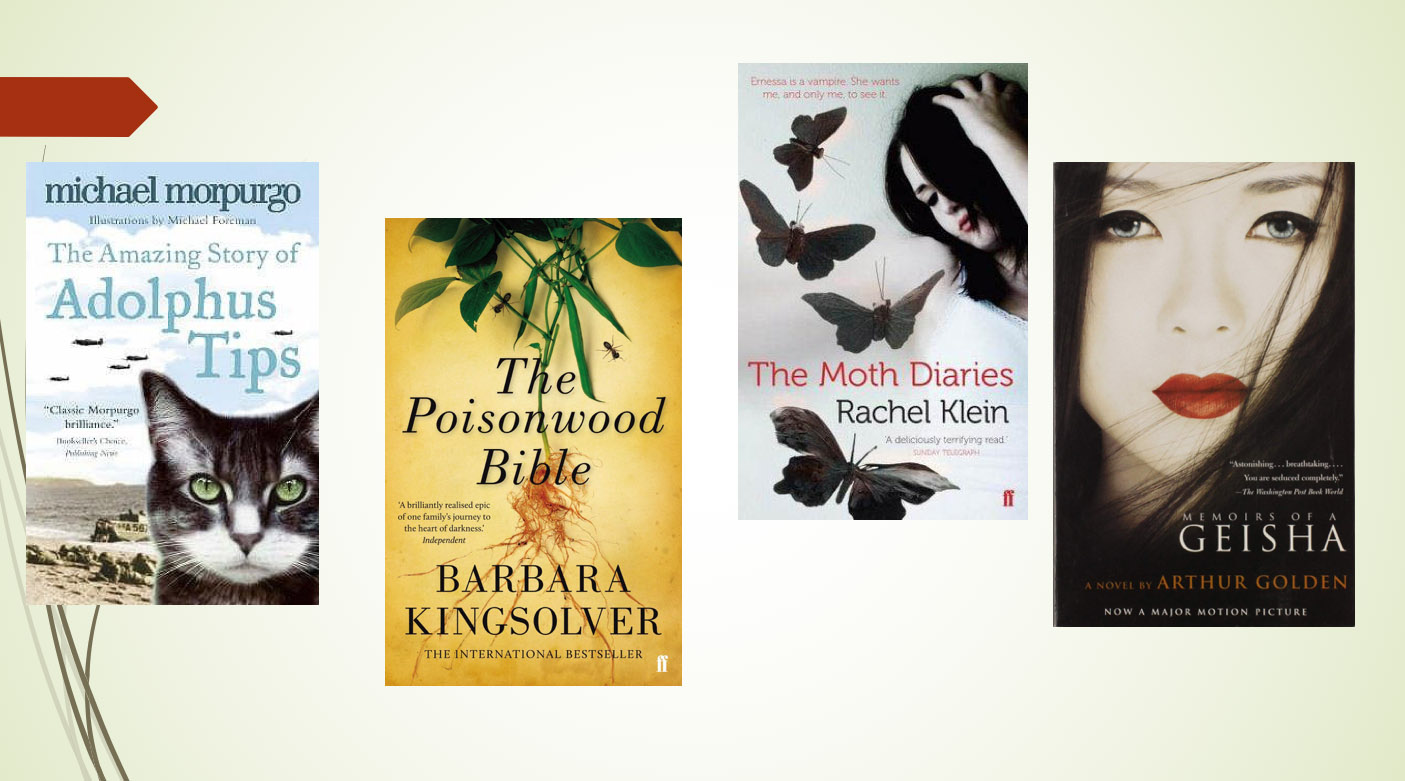
Examples of memoirs and journals
Non-Fiction in Fiction
The play of non-fiction in fiction is achieved through several tools. This includes:
use of point of view such as first person or second person; writing as an epistolary novel—or a series of letters—such as The Colour Purple
displaced narrative such as The Great Gatsby
detached autobiography such as To Kill a Mockingbird
interior monologue such as Finnegan’s Wake.
Examples of fictional diaries
Fictional diaries play on historical truth through emotional truth through narrator voice and use of metaphor. This provides authenticity, meaning, relevance, and impact to the story. Reality and fiction blur through realized premise that provides a gritty realism to the dramatization and intensifies the experience The diarist’s ability to introspect provides great insight for the reader to the protagonist’s inner voice, their eccentricities, and self-delusions. These provide great intimacy with the character.
Most fictional diaries are memoir-like because they are usually based on THEME which carries the meaning of the story. In The Poisonwood Bible, Barbara Kingsolver effectively uses several first person voices—of the mother and her four daughters—to provide more perspectives of the story.
Mundane Science Fiction
Mundane science fiction is a niche literary movement from 2004 focused on near-future realism—also called speculative fiction or literary SF. The focus is on already existing technology and plausible extensions—no ray guns, warp drives or time travel. The premise lies in existing circumstances and events. It has similarities with hard science fiction, cyberpunk, ecopunk, ecofiction and climate fiction. Mundane science fiction incorporates elements of literary fiction and mainstream fiction to achieve a strong sense of realism.
Examples of mundane science fiction
Mundane science fiction is the literature of near-future realism that explores how environmental and technological changes will change our lives. Christopher Cokinos calls mundane science fiction the “science fiction that functions more as compass than chimera.” Examples include cautionary tales and dystopias, all predicated on and launched from real events and phenomena—and including my own recent climate fiction “A Diary in the Age of Water.”
“A Diary in the Age of Water”: Mundane SF with Fictionalized Diary
“A Diary in the Age of Water” is the climate-induced journey of humanity through four generations of women, each with a unique relationship to water… Centuries from now, in a dying boreal forest in what used to be northern Canada, Kyo, a young acolyte called to service in the Exodus, yearns for Earth’s past—the Age of Water, before the “Water Twins” destroyed humanity. Looking for answers and plagued by vivid dreams of this holocaust, Kyo discovers the diary of Lynna, a limnologist from a time just prior to the destruction. The diary spans a 40-year period in the mid-21st century and describes a planet in the grips of severe water scarcity. Lynna in her work for the international utility that controls everything to do with water, witnesses and records in her diary the disturbing events that will soon lead to humanity’s demise.
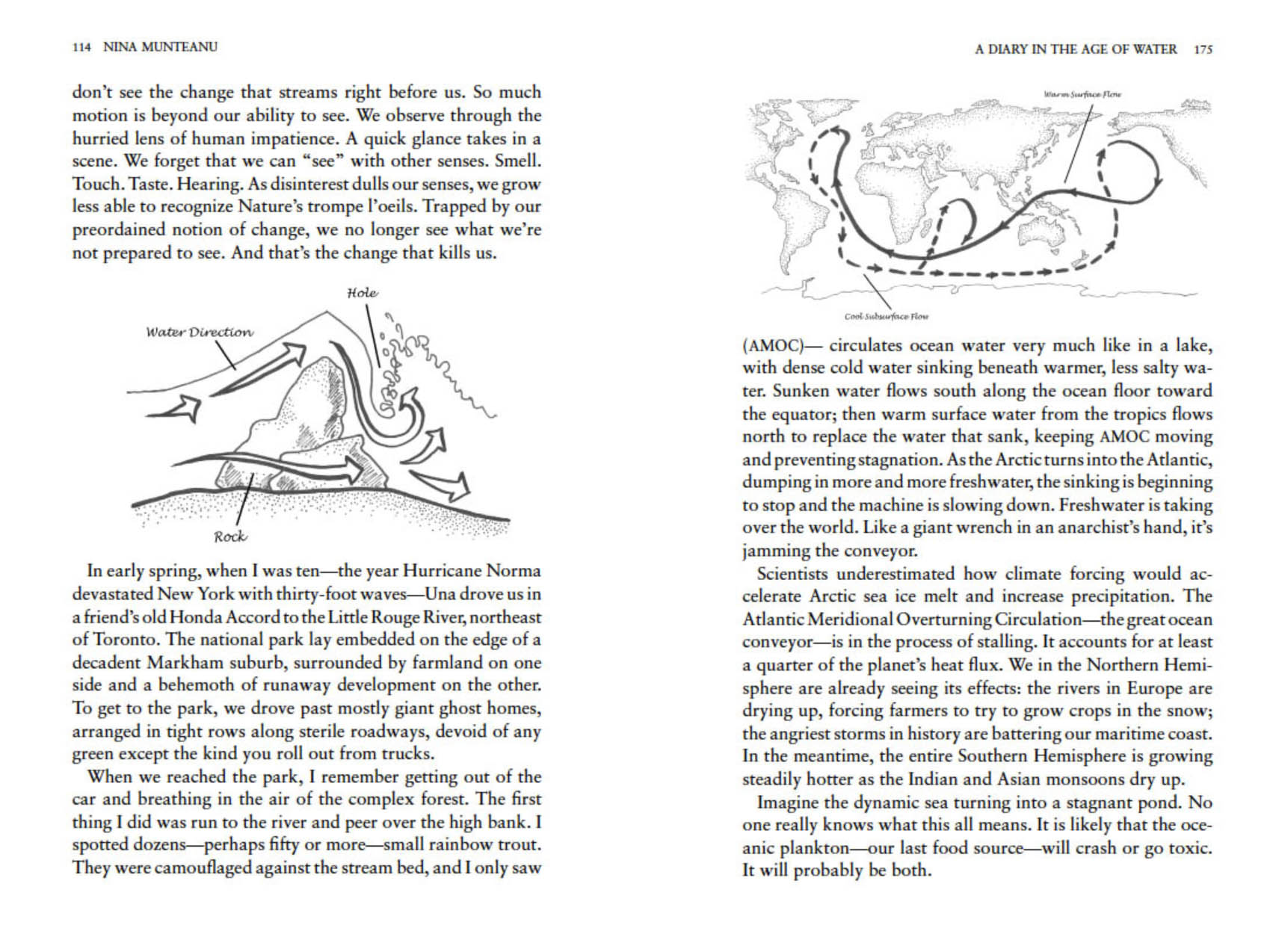
The story begins and ends in the far future with the blue being Kyo, who finds the diary of the limnologist, Lynna. The story is hard SF with a strong basis in science. This is obvious through the narrator, who is a scientist, and the form of the diary itself, in which each entry has an epigraph from a science textbook related to the experience in the entry. Lynna also includes sketches, formulas and other references to science and these appear in the entries.
The diary portion of the book is a first person narrative nested within the larger 3rd person narrative of Kyo in the far future. Its SETTING is based on many real events with dramatized fiction stitched in. This blurs what’s real and what’s fiction. VOICE and POV are used to achieve differing scope and time perspectives between the diarist’s world and that of the future being. We get insight into the inner voice of the diarist through 1st person voice; this is contrasted with the 3rd person voice of the future being—they remain on the outside, looking in. The PLOT is essentially that of a young future human “in discovery”, a metaphoric coming of age for humanity.
The diary format includes the use of:
short entries with epigraphs and quotes from fact
conversational voice of intimacy with introspection, opinion, and judgment
outer conflict with family and colleagues
inner conflict with motivations and truths
metaphoric connections with water
illustrations embedded in the diary entries
Two pages with illustrations in ‘A Diary in the Age of Water’
The diarist is a real and flawed protagonist—this makes her more like us and we are more likely to empathize with her despite her considerable flaws … Lynna makes mistakes and does some terrible things, but the diary allows the reader to find out more about why she does these things, what motivated her and how she feels, including remorse and regret. This allows the reader to forgive Lynna, even as her own daughter cannot, even as she cannot. This becomes key to the story, which is about forgiveness. The diary abruptly ends with pages torn out and Kyo is anxious to know what happened to both Lynna and her world. So is the reader.
Responses to “A Diary in the Age of Water”
Readers and reviewers had interesting responses, some paradoxical:
The blur of real events/history and fictional action brought the story into living colour. Several readers confided in me that they often did not know what was non-fiction and what was fiction and that this confusion made the book more gripping. Several reviewers, caught up in the blur of non-fiction with fiction, accused the book of being overtly polemic, when it was the fictional diarist who was proselytizing and being protective and narrow-minded; one need only look to the diarist’s daughter and her actions to see another voice).
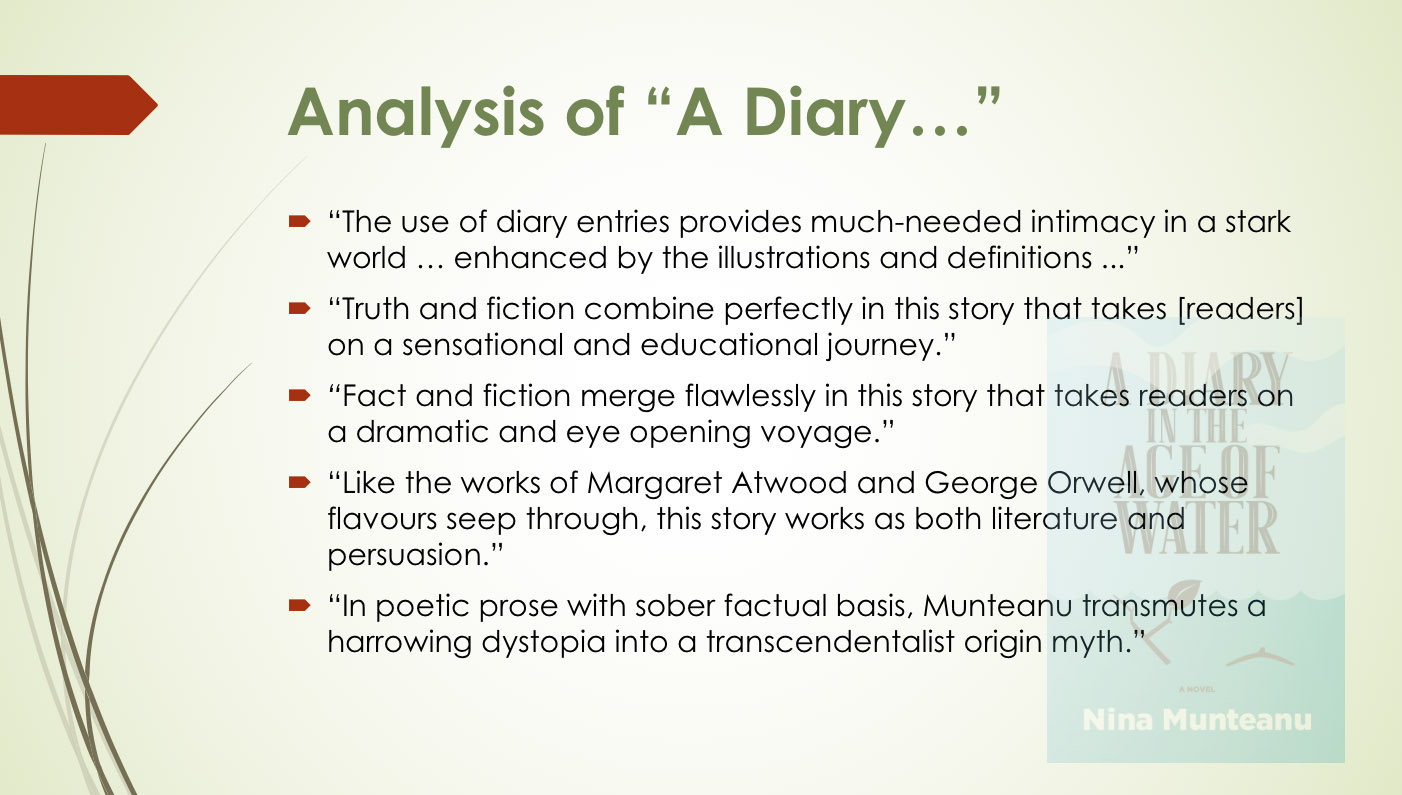
In their analysis, reviewers gave the following visceral responses:
In her review of ‘A Diary in the Age of Water’ in The Temz Review, Marcie McCauley writes:
Munteanu “invites readers to recognize themselves in the ‘historical’ story and to project themselves into her imagined future…the diary…operates as a doorway…Munteanu combines methodologies, familiar literary motifs with text and images from non-fiction…She does not appear to view fiction and non-fiction as separate territories; or, if she does, then this book is a bridge between them.”
That blur with reality makes readers both love and hate the novel and it is precisely this that makes them read on. They are thoroughly invested. They need to know how it turns out, as though this is real lives at stake.
Red maple leaf sits on mossy log of old growth forest, ON (photo and rendition by Nina Munteanu)
NINA MUNTEANU is a Canadian ecologist / limnologist and novelist. She is co-editor of Europa SF and currently teaches writing courses at George Brown College and the University of Toronto. Visit www.ninamunteanu.ca for the latest on her books. Nina’s bilingual “La natura dell’acqua / The Way of Water” was published by Mincione Edizioni in Rome. Her non-fiction book “Water Is…” by Pixl Press(Vancouver) was selected by Margaret Atwood in the New York Times ‘Year in Reading’ and was chosen as the 2017 Summer Read by Water Canada. Her novel “A Diary in the Age of Water” was released by Inanna Publications (Toronto) in June 2020.
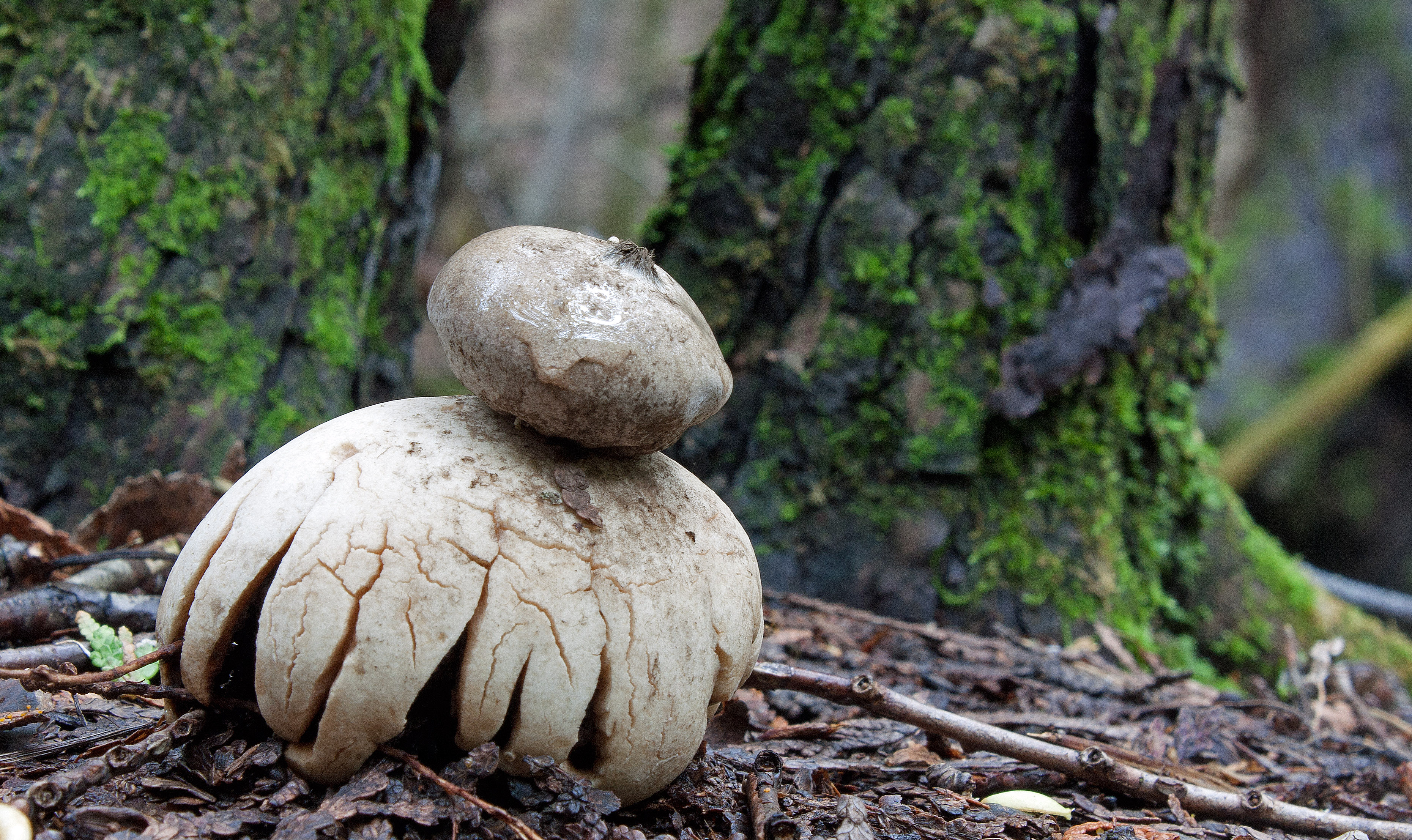
Collared Earthstar (Geastrum triplex) on mossy cedar growing on rotting cedar logs of Trent swamp forest, ON (photo by Nina Munteanu)
Earthstar lived in a verdant cedar forest, under a soft dappled light, where the fresh smell of moss and loam mixed with the pungency of cedar. It was a good life, thought Earthstar, gazing up at the tall canopy of green above her. She lived among many like her, scattered on and between old cedar logs that had piled on the ground and rotted into a rich woody ‘soil.’ It was just right for earthstars who grew deep in the warm, moist rot, covered in a carpet of moss and ferns. Cedar saplings had even sprouted on the rotting log piles, and grown into large mature trees. That was not surprising, given the number of caches the red squirrels left on the spongy rotting logs.
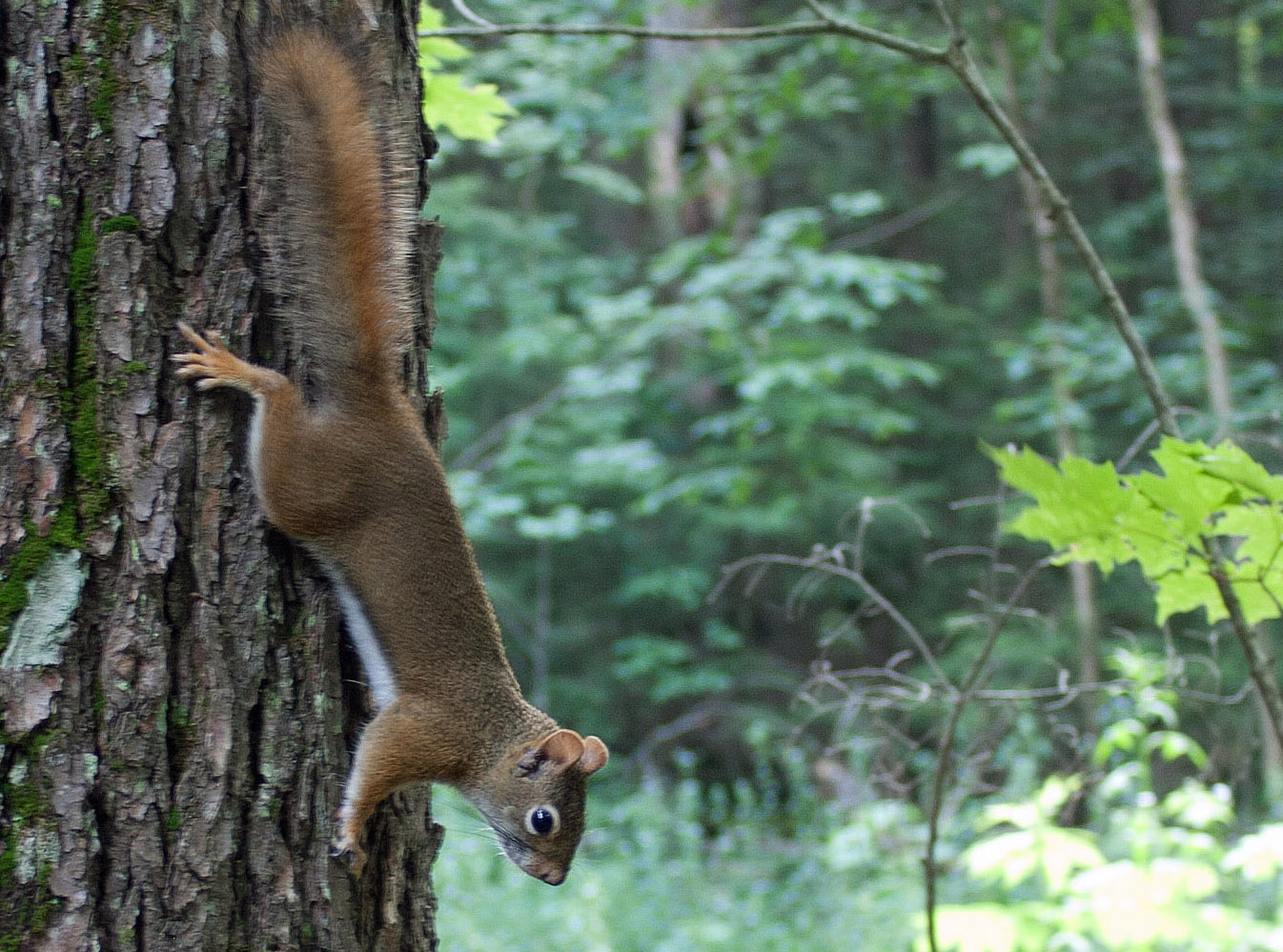
Red squirrel on a tree (photo by Nina Munteanu)
Fully opened Earthstar and sister buds in mossy humus of rotting cedar logs, Trent cedar forest, ON (photo by Nina Munteanu)
When she was just a young bud, Earthstar had pushed herself up from her parent mycelium through the woody humus then cracked open her outer shell to reveal her inner spore sac and beaked mouth. The outer shell formed arms of a ‘star’ that pushed back, raising her up to meet the world. When she surveyed her mossy terrain, she noticed that she was one of the earliest earthstars to emerge. Most of her sisters were still budding through the moss and duff. She was eager to fulfill her path. Soon she would be ready to deliver her precious spores to the world—
“Hey there!” a beaky voice called to her.
Earthstar recognized a Beaked Earthstar ambling along the rot pile using its outer skin ‘legs.’ She herself was a Collared Earthstar, and although she had long dislodged from the woody soil and become independent of the ground she sat on, she didn’t normally walk about like this Beaked Earthstar, known for its itinerant lifestyle. He was a rare and somewhat mysterious earthstar, not often seen, and somewhat of a legend. In fact, it was the first time she saw him and she felt tickled that he’d stopped in his wanderings to greet her.
Beaked earthstar, showing many arms that keep it upright, Trent cedar forest, ON (photo by Nina Munteanu)
“I’m on my way to town,” said Beaky cheerfully. “Want to come along? There’s so much more to see than this silly forest.”
“No thanks,” said Earthstar, overcoming the flush of excitement at being invited by this exotic drifter. She’d heard about ‘the town’ but knew nothing of it—and decided she didn’t want to. Besides, the forest wasn’t silly, she thought peevishly. It was her home. It nourished her. It was where her family was. Earthstar was content.
“Suit yourself,” said Beaky. “But you don’t know what you’re missing! There’s a river out there, and strange but wonderful creatures and moving things on wheels that carry them from place to place. And the fine ladies have something called ‘High Tea,’ which is quite splendid.”
“I think this forest is quite splendid enough,” she retorted a little rudely.
“Ah… But you won’t truly know your place until you’re out of place,” Beaky said. Then with a slight nod of his beaky head, he left her and soon disappeared along the forest path that wound its way into somewhere.
What did Beaky mean by his last comment? wondered Earthstar. How can one be out of place? And why would one wish to be? As time went by, Earthstar began to wonder about that ‘somewhere’ and those wonderful creatures and fine ladies and that thing called ‘High Tea.’ And before she realized it, she was no longer content. She became very curious about that ‘somewhere’ that lay beyond her forest home.
In a sudden thrilling act, Earthstar decided to leave the forest to see the world. And once she thought of it, she did it. That’s the way of earthstars. So, within moments, Earthstar was wandering along the same forest path that Beaky had earlier taken. She took Moss with her, tucked safely inside her ‘legs’ as companion.
Path, damp from a morning rain, through cedar swamp forest in Trent Nature Sanctuary, ON (photo by Nina Munteanu)
Earthstar rests on small root snag on leaf-strewn trail through Trent cedar forest, ON (photo by Nina Munteanu)
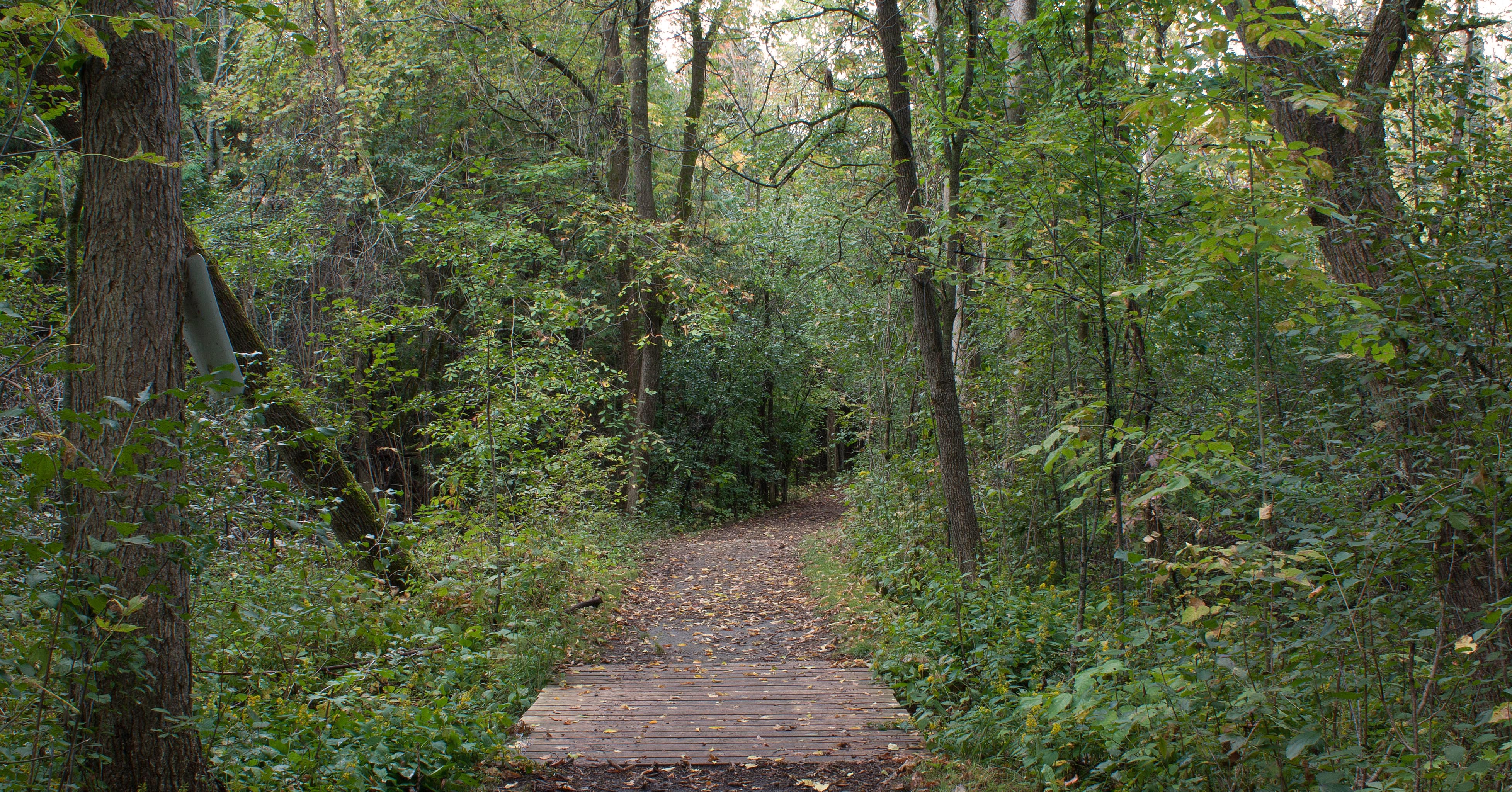
Path through Trent cedar swamp forest with ash and poplar in early fall, ON (photo by Nina Munteanu)
The path wound through dense cedar forest, mixed with birch, ash, poplar and the occasional oak and maple tree. Earthstar passed many relatives. Flaming waxcaps dotted the rotting logs and ground, looking like dance partners. Graceful Fairy Fingers thrust up through the duff on either side of the path along with Ashen Coral fungi, whose delicate ‘fingers’ reached up like praying hands. By the feet of one poplar tree, Earthstar saw a party of Scaly Ink Caps loitering on one side and Striate Bird’s Nest fungi having a party on the other. Stalwart boletes towered majestic, anchored to a mossy slope. A single shield mushroom with its smart lilac cap had burst out of a cedar stump and leaned into the sun with joy.
Waxcaps on decaying cedar wood in Trent forest, ON (photo by Nina Munteanu)
Fairy Fingers in cedar duff in Trent forest, ON (photo by Nina Munteanu)
Ashen coral fungi on ground of Trent cedar forest, ON (photo by Nina Munteanu)
Scaly ink caps growing at the base of a poplar tree in Trent forest (photo by Nina Munteanu)
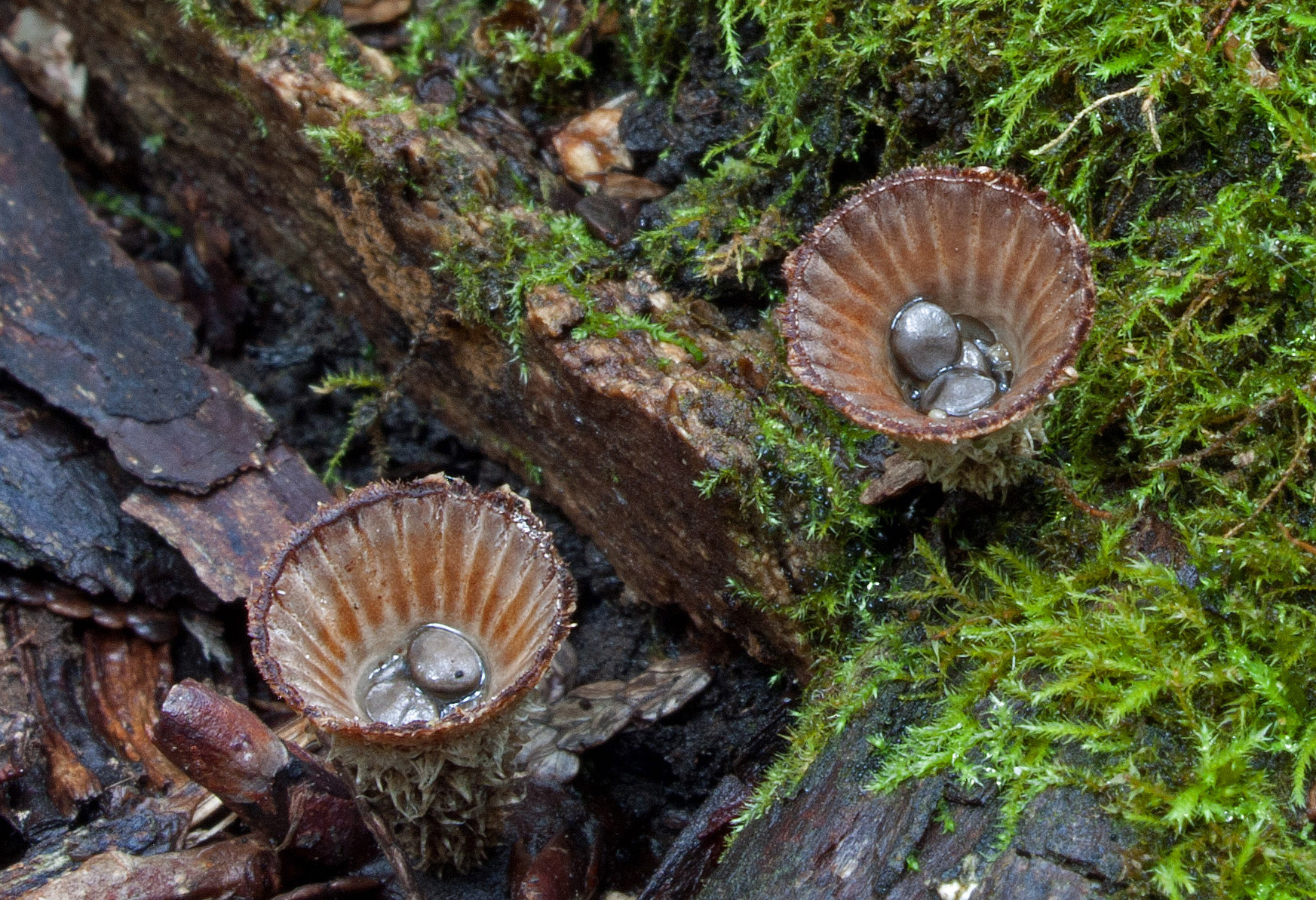
Striated Bird’s Nest fungi at the base of a poplar tree in Trent forest (photo by Nina Munteanu)
Bolete on mossy hill of Trent cedar forest, ON (photo by Nina Munteanu)
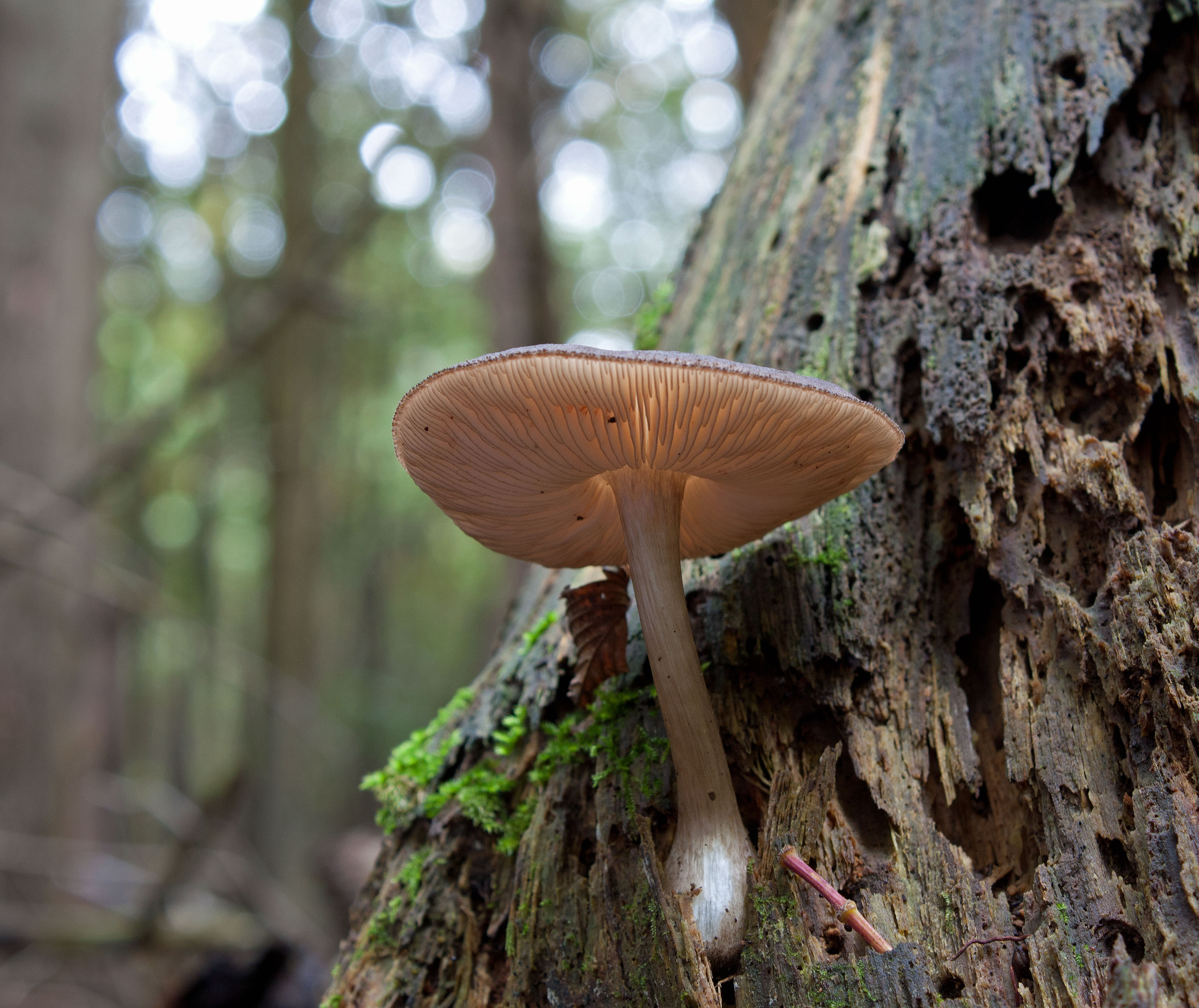
Shield fungus grows out of rotting cedar stump in Trent forest, ON (photo by Nina Munteanu)
A group of Scaly Pholiota graced an old maple tree and not much farther a gaggle of Wolf’s Milk spread orange fungus joy over a decaying log. Conifer Tufts created a fairy ring around an old ash tree. Witches hats stood at the feet of a huge cedar tree, bowing with shy wisdom to her. There was a cheerful family of brilliant Scarlet Fairy Helmets tucked in the mossy undergrowth of a buckthorn thicket. She even saw a crowd of her closest relatives, Lycoperdon puffballs clutching a rotting birch log, and waved to them.
Scaly Pholiota on an old maple tree in Trent mixed cedar forest, ON (photo by Nina Munteanu)
Wolf’s Milk slime mould on rotting log in Trent forest, ON (photo by Nina Munteanu)
Conifer Tufts form a fairy ring around an old ash tree in Trent cedar forest, ON (photo by Nina Munteanu)
Witches hats nestled at base of a cedar tree, ON (photo by Nina Munteanu)
Scarlet Fairy Helmets in mossy undergrowth of cedar forest, ON (photo by Nina Munteanu)
Lycoperdon puffballs on decaying birch log, Trent cedar forest, ON (photo by Nina Munteanu)
Eventually, the forest opened into fields and thickets and the path became rocky. The dense cool cedar-scented air of the deep forest gave way to a fragrant floral breeze and the warmth of the sun touched Earthstar with rays of good tidings.
Earthstar on rocky path out of Trent cedar forest into open area, ON (photo by Nina Munteanu)
Earthstar negotiates the rocky path on her way out of the Trent forest (photo by Nina Munteanu)
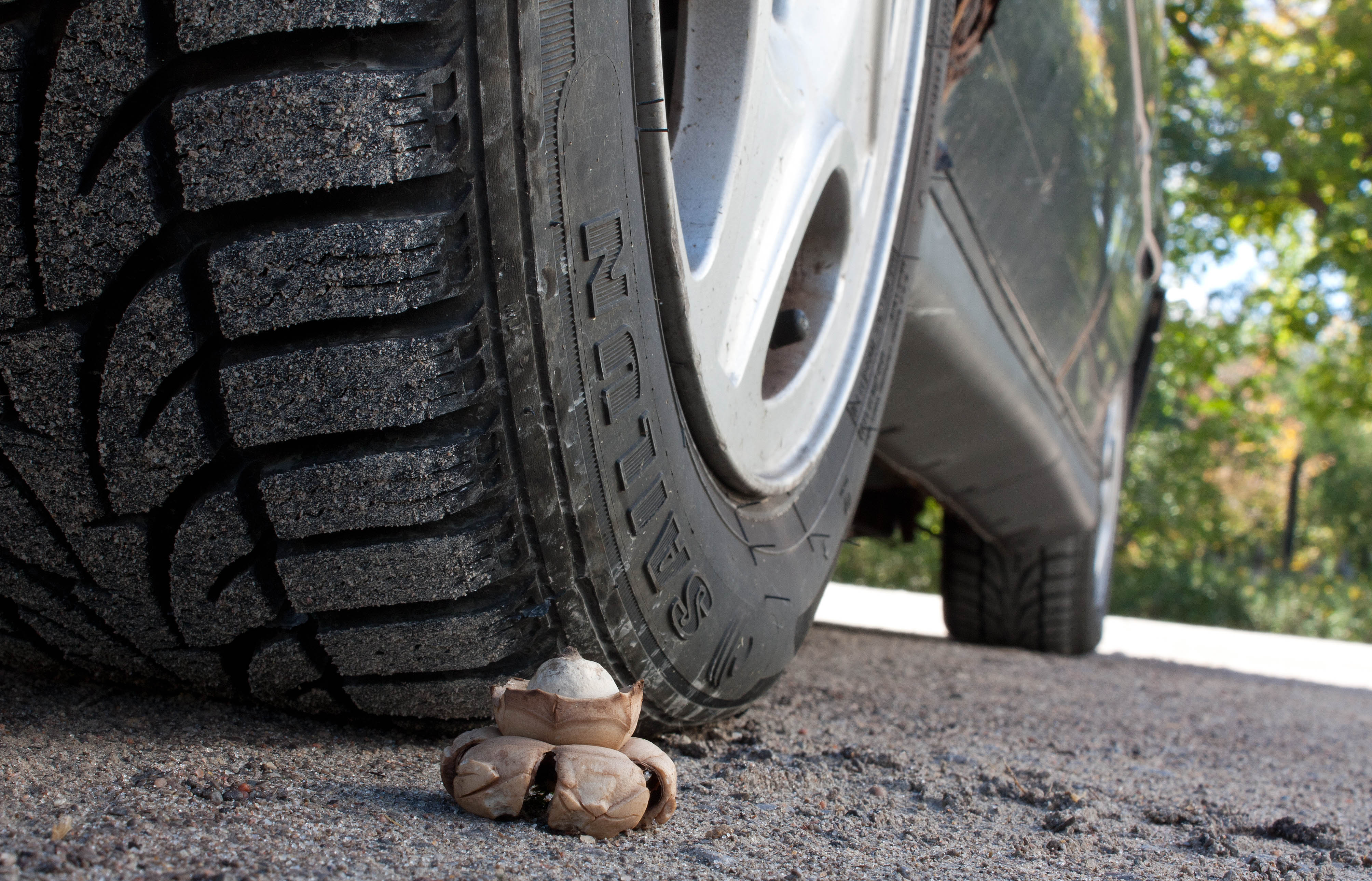
Soon Earthstar reached a road and thought to follow it to town. Within moments a huge thing on wheels barrelled toward her! She froze in terror. But the cheerful wind whisked her out from under the wheel in the nick of time.
Earthstar almost gets run over by a car!
Earthstar thanked the wind and continued down the road, certain that the thing on wheels was what Beaky had mentioned and that she’d soon find the town and the river and those wonderful beings at the end of the road. And perhaps there she would encounter this marvelous “High Tea.”
Earthstar keeps to the side of the road with busy traffic
Countryside near Otonabee River, ON (photo by Nina Munteanu)
The road took Earthstar through an open countryside of meadows, flowers and trees. Earthstar kept to the side of the road to avoid getting squashed and soon found the river Beaky had mentioned. The river was magnificent. Sparkling in the radiant sun, it danced and lapped against the shore with the gurgling rush of laughter around the rocks and reeds.
The shallows of the Otonabee River, showing diatom-froth, ON (photo by Nina Munteanu)
Earthstar on Rotary Trail as bicycles bear down on her(photo by Nina Munteanu)
Sensing the lateness of the day, Earthstar continued her journey in search of “High Tea.” She wasn’t quite sure where she’d find it and followed the river on a trail through a black walnut forest.
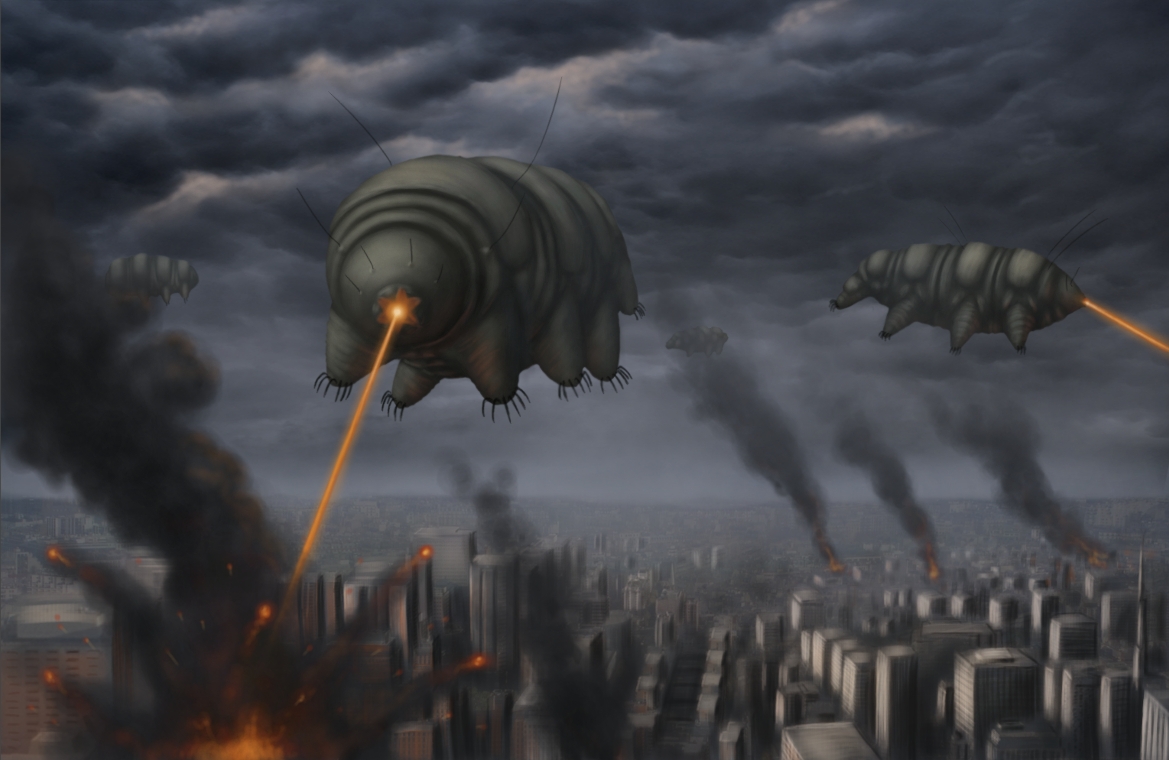
Earthstar passed a large building with an open lawn just as a loud bell sounded and large two-legged beings spilled out onto the trail. They chattered about their lit class and laughed as Lillie, one of the students, recounted her scifi story about flying giant tardigrades that terrorized human cities for destroying the planet with fossil fuel emissions.
Attack of the giant tardigrades (image by Ramul in Deviant Art)
“Tardigrades are the coolest creatures,” Lillie went on. “Some people think they’re from outer space and lived among the stars. They can handle extreme temperature, the vacuum of space, and radiation, after all. And water bears can even survive a bullet impact!”
The students didn’t notice Earthstar below them. She was so tiny after all!
Earthstar (and her moss companion) gets underfoot near the high school(photo by Nina Munteanu)
Just as the dark shadow of a giant foot loomed over her, someone shouted, “Wait, Marcus, STOP! Look!”
Earthstar was snatched off the ground before Marcus could step on her and gently cupped in the girl’s hand where the little fungus felt finally safe. “It’s an earthstar!” said the girl holding her. “How cute! See the bit of moss clutched in its arm? How adorable!”
“But, Emily, what d’you think it’s doing here on the trail by the school?” Marcus asked the girl holding Earthstar. “How did it get here?” Marcus suddenly grinned with inspiration and turned to Lillie, eyes sparkling. “Or did your giant space tardigrade drop it here? Which means we’re in your story–“
Lillie elbowed him and said something Earthstar didn’t understand.
Emily looked down at Earthstar, who sat quietly in her palm. “They’re the only mushrooms that move. Earthstars. I’ve read about them.” Emily then bent low and carefully set Earthstar on the grass by the trail, out of harm’s way.
“Maybe it’s on ‘walkabout,’” Lillie suggested, inspired by the thought of travel and thinking of the Australian term for a long walking journey of discovery.
“You mean floatabout!” Marcus laughed. “If it came all the way from Australia it’d have to float across the Pacific Ocean!”
The students giggled, visualizing little Earthstar floating on a leaf and braving the vast ocean then hitchhiking across the North American continent into the Kawarthas. Still discussing the earthstar’s epic journey, they went on their way, leaving Earthstar on the grass.
Earthstar continued her journey, wondering what ‘walkabout’ meant. She found another large building and thought this might be where she needed to go. When one of the giant beings walked out through a door, she slid inside.
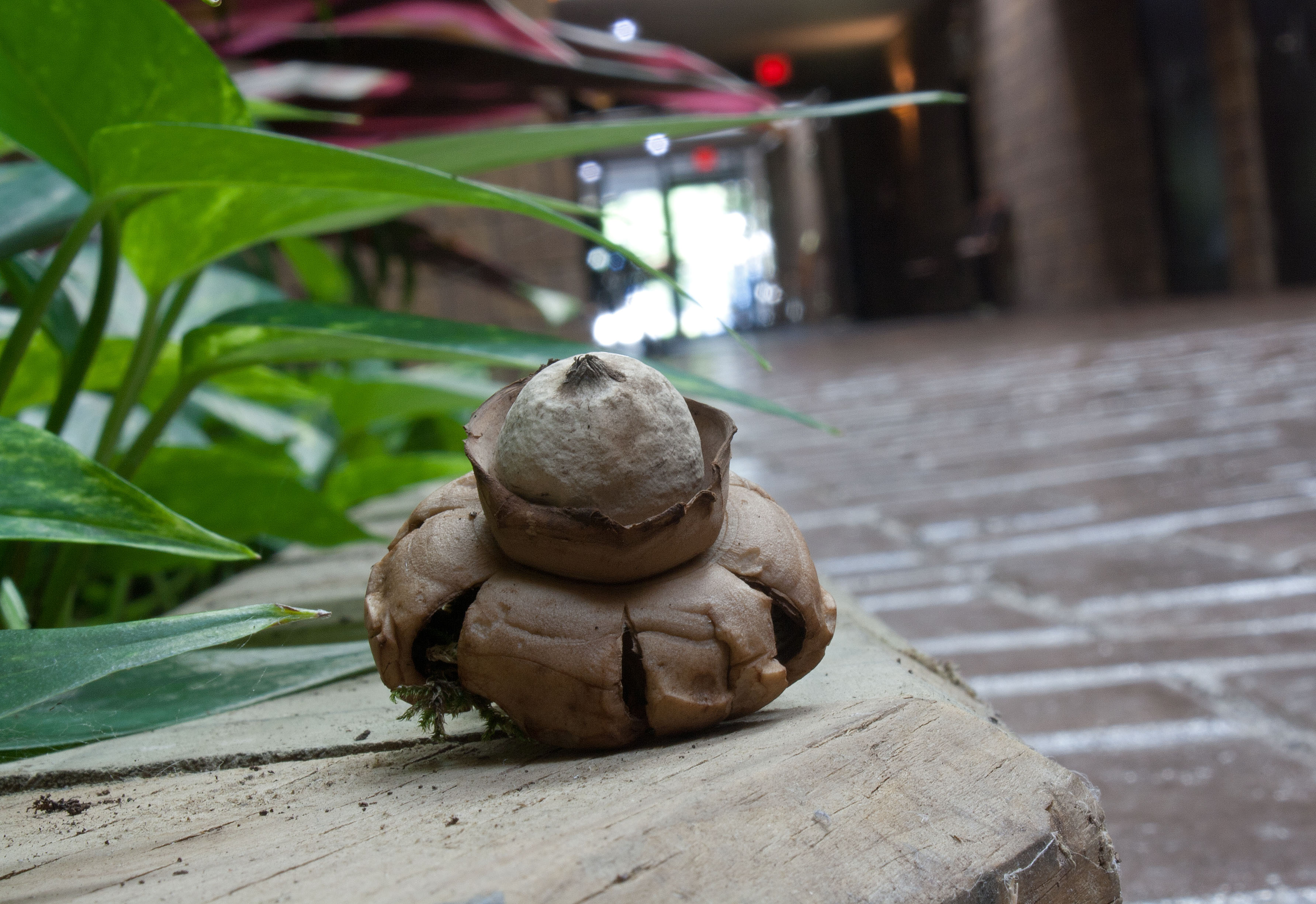
Earthstar and her Moss companion make it inside the condo complex(photo by Nina Munteanu)
She found herself in a wonderfully lit atrium with many more doors and lost herself among the indoor plants under large skylights. Within moments, as if sensing her presence, one of the large beings stepped out from a doorway and immediately saw Earthstar, perched by one of the indoor gardens.
“Well, well, what do we have here? A wandering earthstar and her little moss companion!” The being picked Earthstar up and gently cupped Earthstar in its hand. “Would you like to join me for tea?”
Earthstar in lady’s hand(photo by Nina Munteanu)
The magic word! Tea!
Earthstar jiggled on her ‘legs’ with joy. Was this being one of those fine ladies? As if sensing her excitement, the lady smiled and brought Earthstar inside her apartment.
The lady brought them outside to the patio for tea, where she had laid out tiny sandwiches, cheeses, crackers, scones with jam, and lovely pastries. Of course, Earthstar did not partake in these strange foods—being a saprophyte, she fed exclusively on decaying matter. But she enjoyed the ambience of this civilized celebration. And, of course, the tea!
Lady serving the tea (photo by Nina Munteanu)
When the lady went inside to replenish the tea, Earthstar explored the patio. Mistake! Moments after Earthstar dropped to the patio bricks with the help of a little breeze, a very large dog (well, a rather small dog for you and me) came bounding to her and gave her a lick. The dog might have eaten her but the lady returned and rescued Earthstar.
Poppy the dog licks Earthstar!(photo by Nina Munteanu)
“Oh, my! Don’t mind Poppy, the neighbour’s shiatzu,” the lady said to Earthstar. “Poppy is harmless and only eats dog treats. I don’t think you’re a dog treat, are you?”
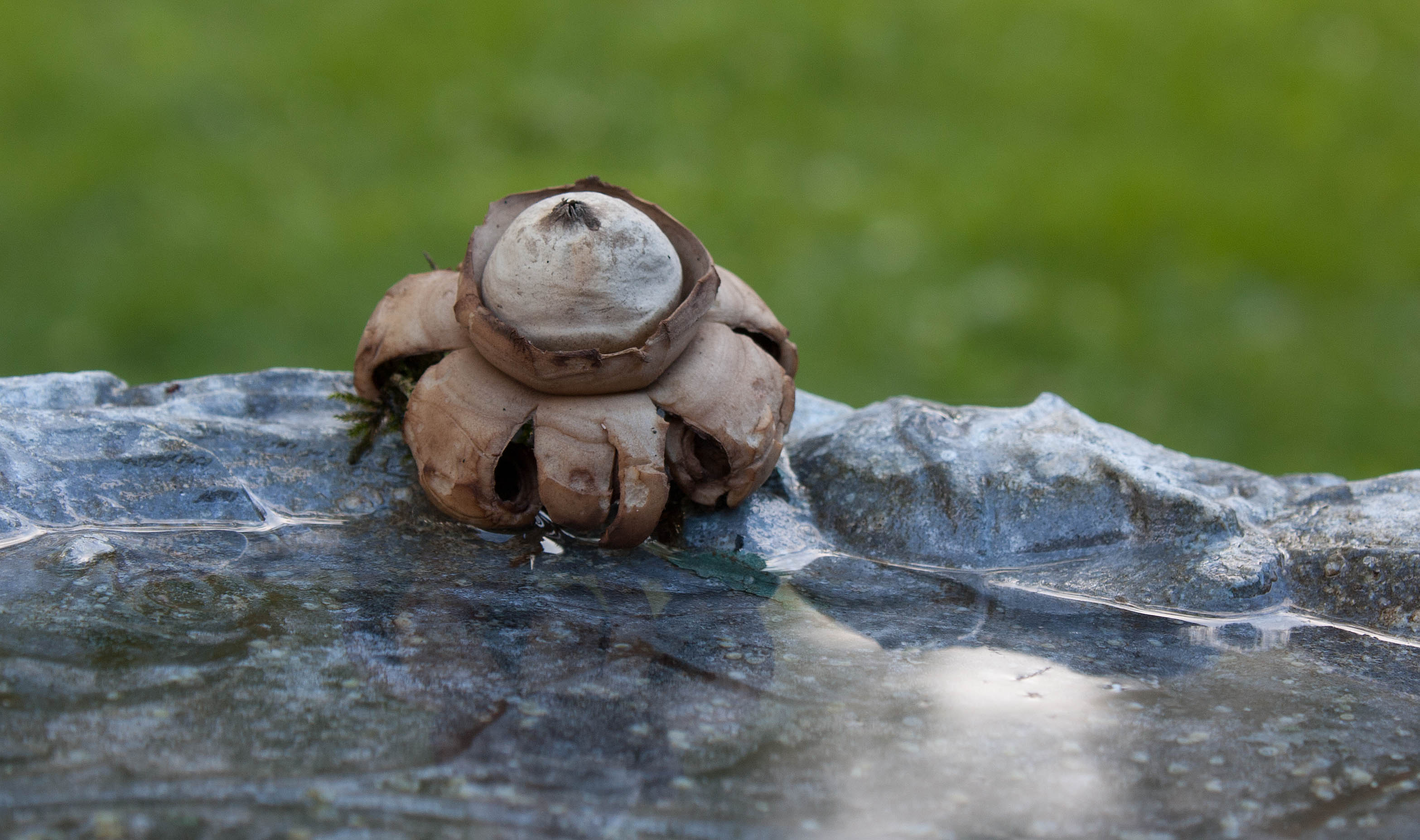
Earthstar dipping her feet into the water of the bird bath(photo by Nina Munteanu)
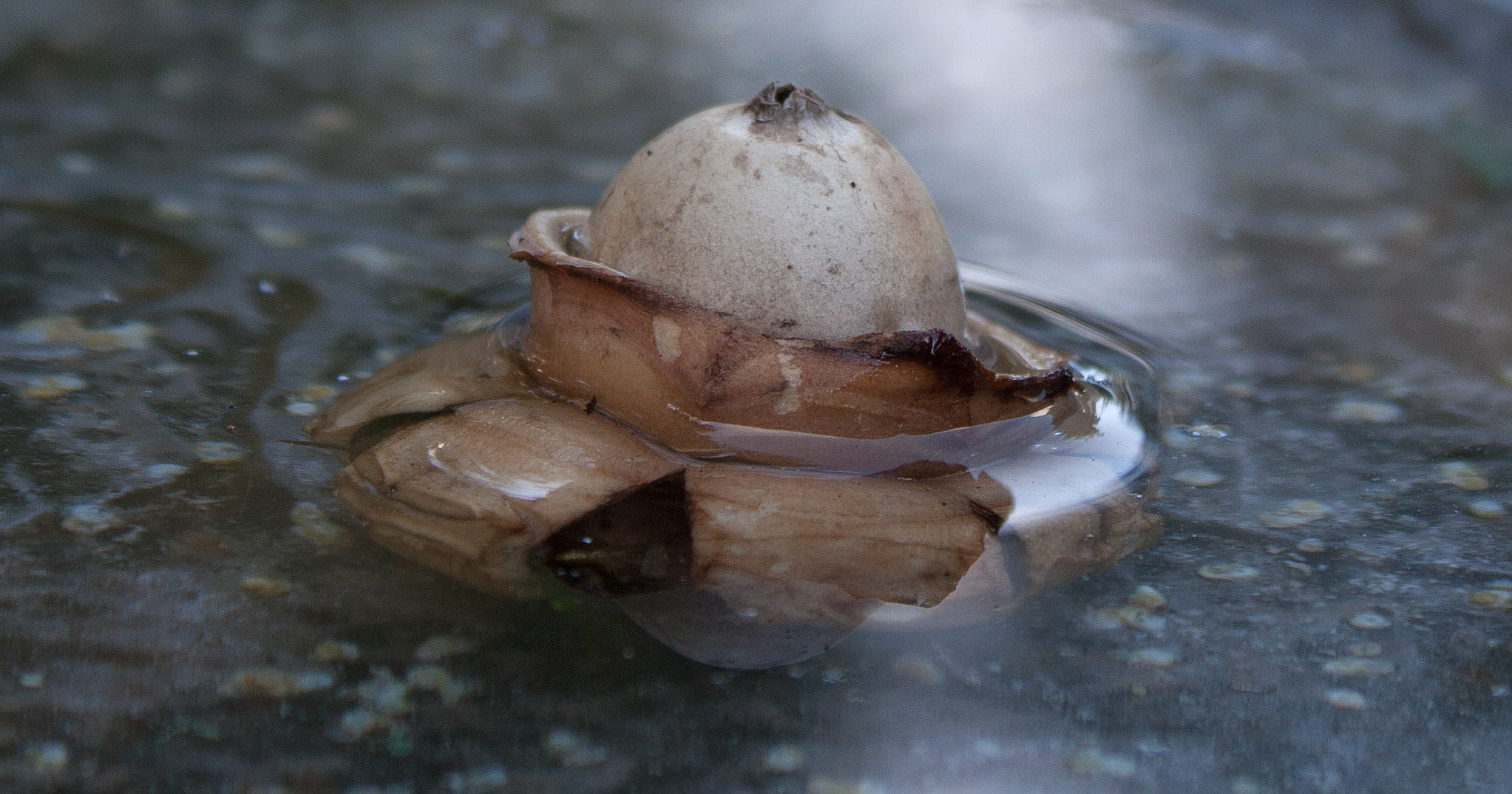
Thinking to get her to safety, the lady placed Earthstar on the edge of the birdbath where Earthstar dipped her tired feet. Within moments a mischievous wind pushed Earthstar into the water! Luckily, Earthstar floated. She was accustomed to deluges of water that filled her ‘collar’ and raised her spore sac to better deliver her spores. Water was an earthstar’s friend; earthstars counted on the beating drops of rain to help release their spores. After the initial shock, Earthstar rather enjoyed the swim.
Earthstar swims happily in the birdbath(photo by Nina Munteanu)
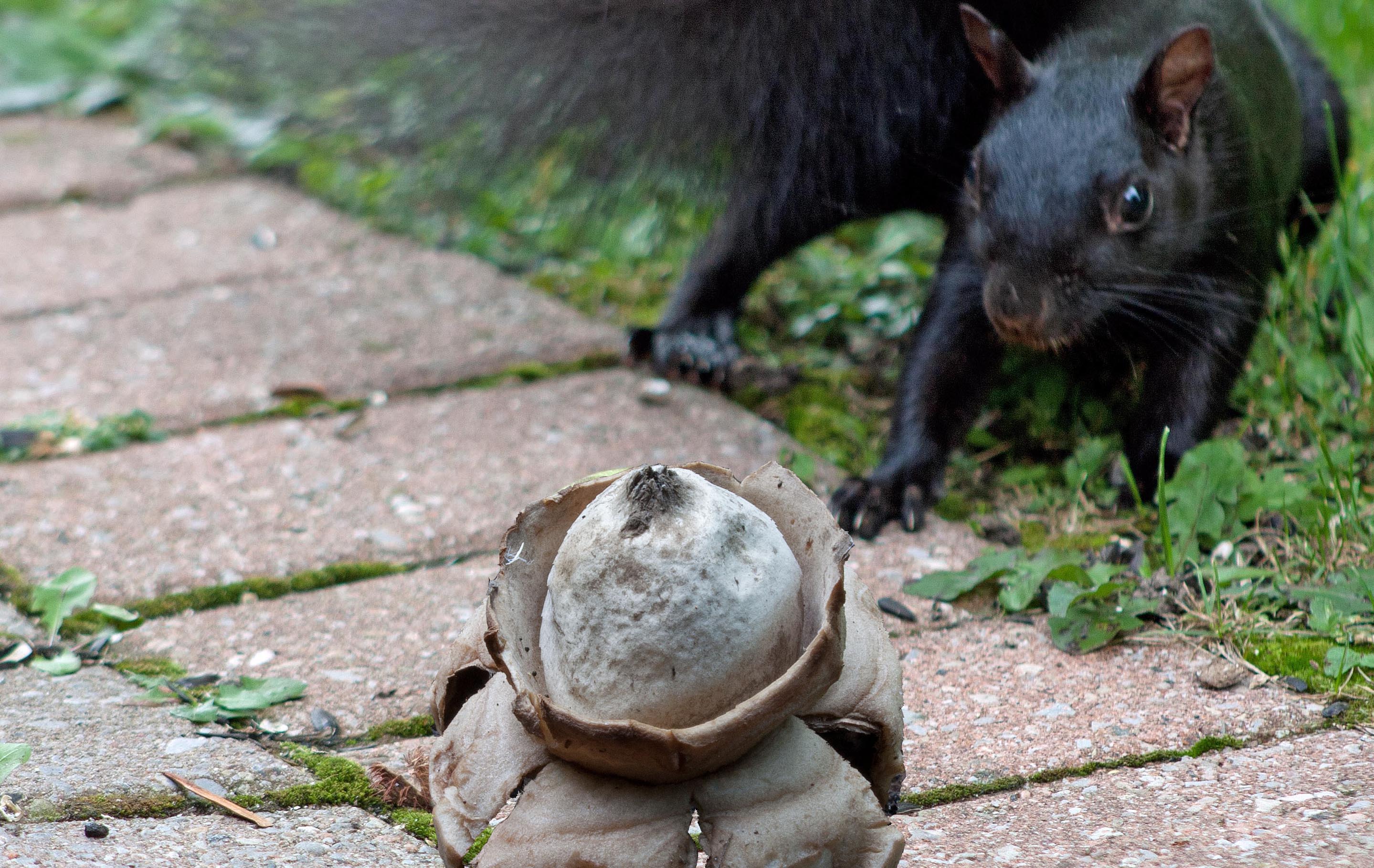
The lady thought she ought to rescue Earthstar again and put her back down on the patio. Then the whistle of the kettle inside drew the lady away to the house. In that short time, a clever black squirrel, who had been spying from the silver maple tree nearby, leaped forward and seized her!
Earthstar about to be snatched by the black squirrel (photo by Nina Munteanu)
“Mine!” he shouted to himself and bounded away with her clutched in his mouth. After waiting for an oncoming bicycle, he raced across the trail–just inches in front of the zooming bicycle (squirrels are daredevils at heart)–and entered the little wood by the river.
Earthstar screamed. But no one heard her, because it was a silent scream.
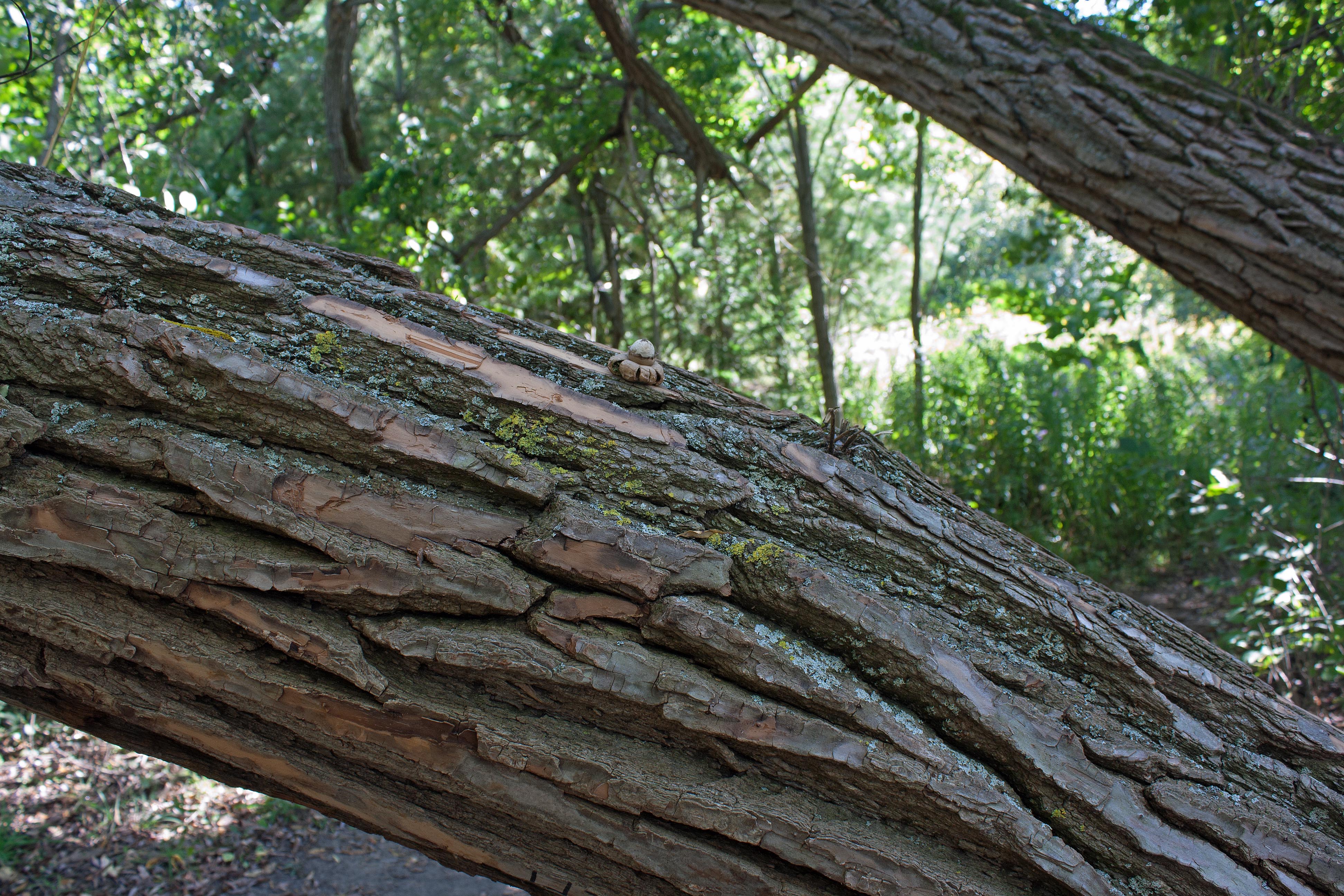
The black squirrel took his prize to a huge old willow tree by the river. The tree bowed over a small path as if reaching down to say hello. The squirrel left Earthstar on the bowing tree to dry like he would any mushroom for later caching. Then he scurried away to look for more food. What this city squirrel didn’t know was that—unlike most other mushrooms—earthstars can move!
Old willow of the riparian forest by the Otonabee River, ON (photo by Nina Munteanu)
Earthstar let the wind blow her off the branch to the ground where she used her six arms to carry her back to the trail and back to the lady’s place. “Where have you been?” asked the lady when Earthstar got there. Her eyes seemed to wink. “I suspect you were on a small adventure with squirrels.”
Driving Earthstar home to the forest (photo by Nina Munteanu)
They continued their tea and when it was finished, the lady took Earthstar in her car and drove Earthstar home to the forest. Earthstar didn’t wonder how the lady knew where Earthstar’s home was; there is only one place where earthstars grew in the region. And no doubt the lady—being a true lady—knew where that was and respected the earthstars place in the world.
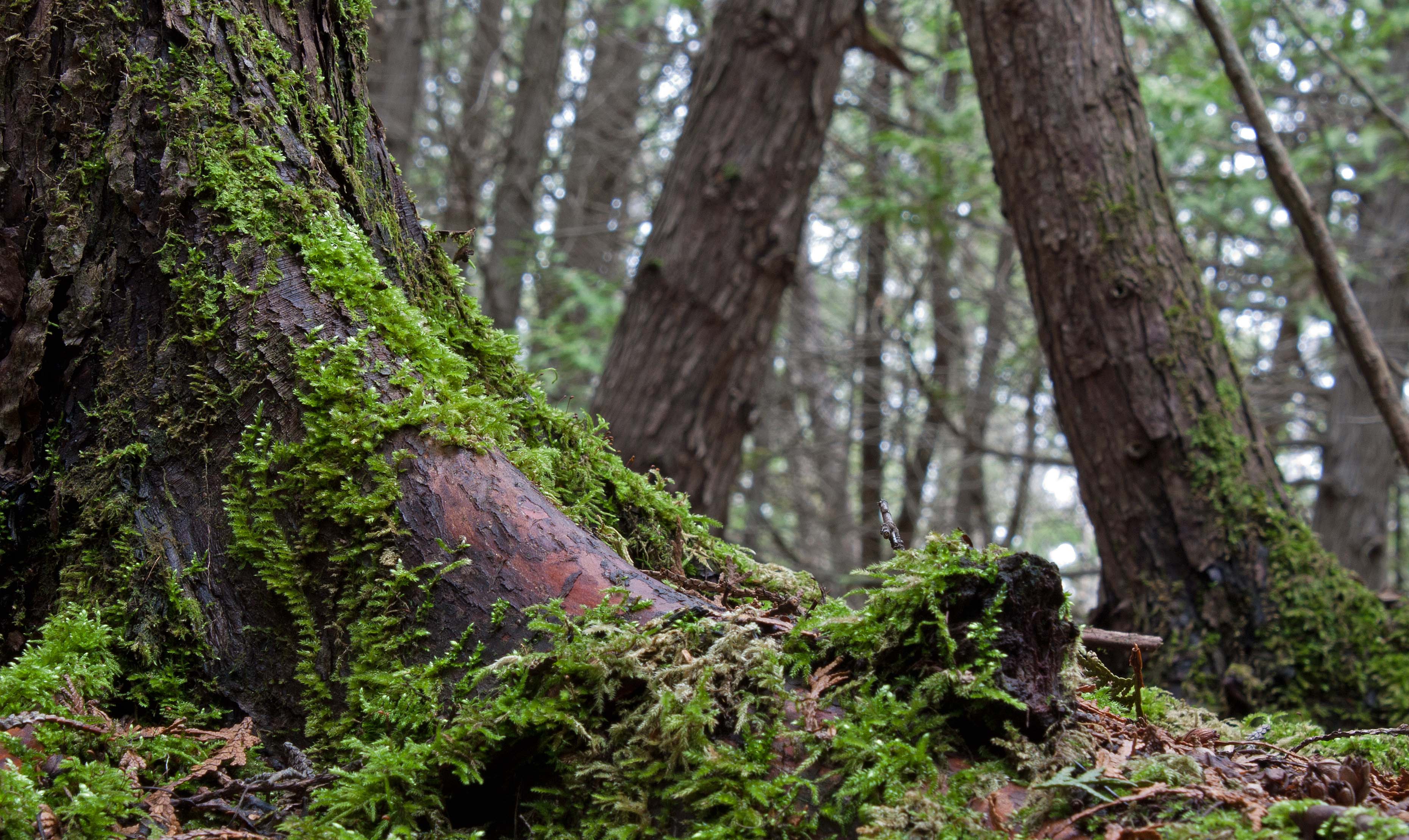
Cedar trees covered in moss, growing on ancient rotting cedar logs of the cedar swamp forest, ON (photo by Nina Munteanu)
Fern-like moss grows on cedar roots that dig into old decaying cedar logs of the forest, ON (photo by Nina Munteanu)
When they reached the deep forest where the tall cedars covered the sky with green and the air stirred with the breaths of cedar and birch, Earthstar felt the exhilaration of coming home. She did not need to rely on the vagaries of a capricious wind to deliver her safely home; the kind hand of the lady set her down on the soft downy surface of woody loam. The lady set Earthstar right beside her sisters, her tiny moss companion still with her, tucked under her arm.
Gently placing Earthstar back home by several earthstar buds in moss of decaying cedars, cedar forest, ON (photo by Nina Munteanu)
The forest was her home. It nourished her. It was where her family was. Earthstar was content. And this time she really was…
~~The End~~
Moss-covered red bark of cedar tree in the cedar swamp forest, ON (photo by Nina Munteanu)
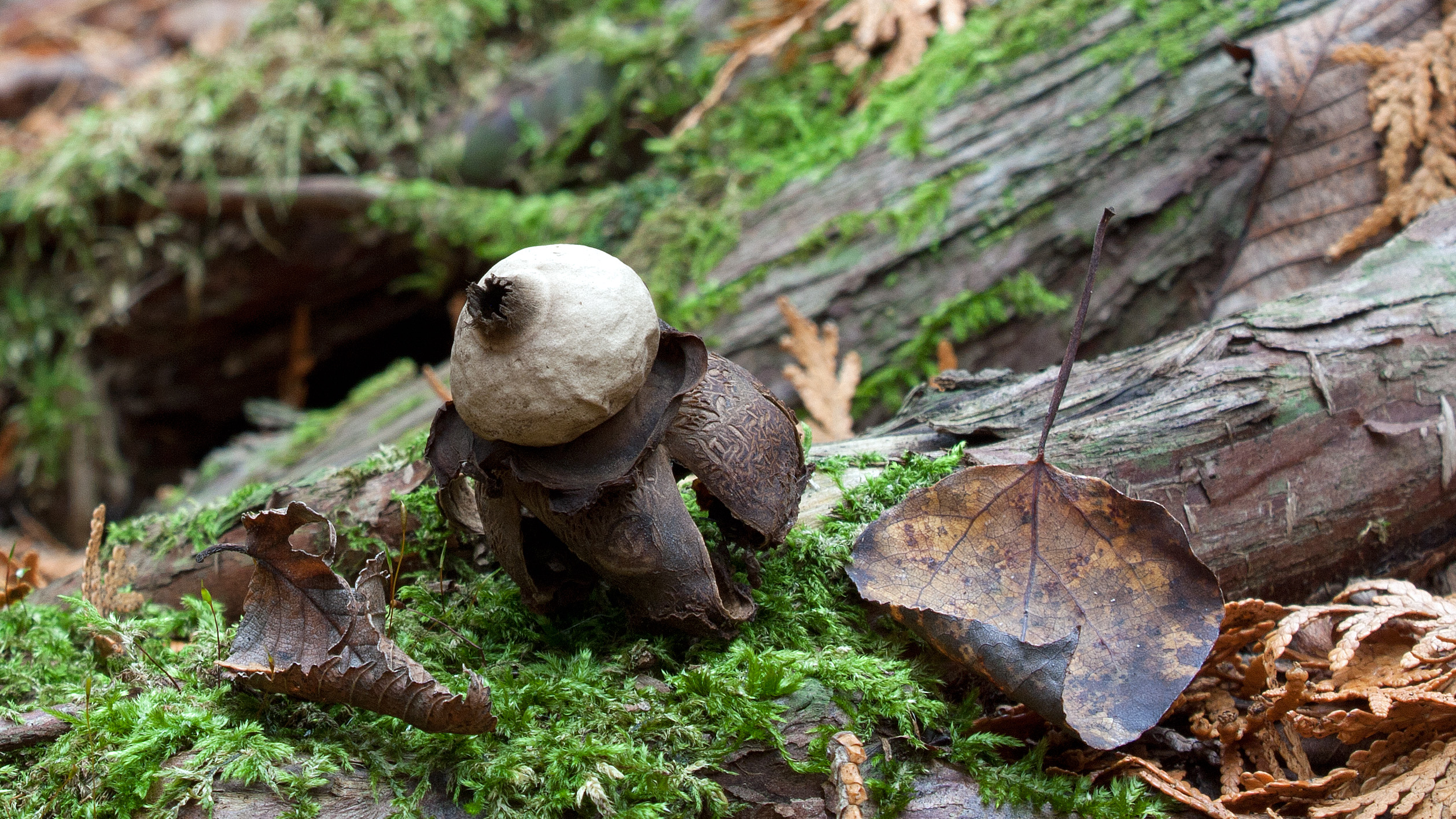
Earthstar, now matured; notice the fetching collar and splendid reticulated outer robes (photo by Nina Munteanu)
The Trent Nature Sanctuary
Located in the southeast corner of Symons Campus of Trent University, the Wildlife Sanctuary Nature Area includes many types of ecosystems and a network of trails. Wetlands of the area are deemed Provincially Significant by the Ontario Ministry of Natural Resources and Forestry. The cedar/maple swamps of the sanctuary support a rich diversity of fungi and lichen amid a rich ecosystem of plants and animals of the forest. It is within this area that I keep discovering interesting life each time I visit. Virtually all the images of the forest and fungi in this article come from this sanctuary, including the Collared Earthstar.
Mossy cedars in the cedar swamp forest of the Trent Nature Sanctuary, ON (photo by Nina Munteanu)
Information on the Collared Earthstar (Geastrum triplex)
Eight stages of the Collared Earthstar life cycle, Trent Nature Sanctuary, ON: 1) buds emerge in late summer; 2) the outer layer begins to crack in early fall; 3) the bud cracks open; 4) then spreads open; 5) forming a ‘flower’; 6) the outer layer cracks; 7) to form the ‘collar’ by early fall; 8) the outer layer shrivels by early winter and the earhstar persists in this form to the next spring (photo by Nina Munteanu)
Collared Earthstar Life Cycle
The Collared Earthstar (Geastrum triplex) is a Gasteromycete or stomach fungus, since it produces and releases its spores inside a saclike structure. The earthstar spends most of the year as a network of fungal cells (mycelia) that penetrate the soil and digest decaying organic material. When they are ready to reproduce, the mycelium develops the “earthstar” above ground. New earthstars emerge as ‘buds’ and develop in late summer and autumn through into winter. The matured fruiting bodies will survive the winter to be discovered the following spring by curious explorers like me.
Spore sacs of Collared Earthstar in the frosts of winter (photo by Nina Munteanu)
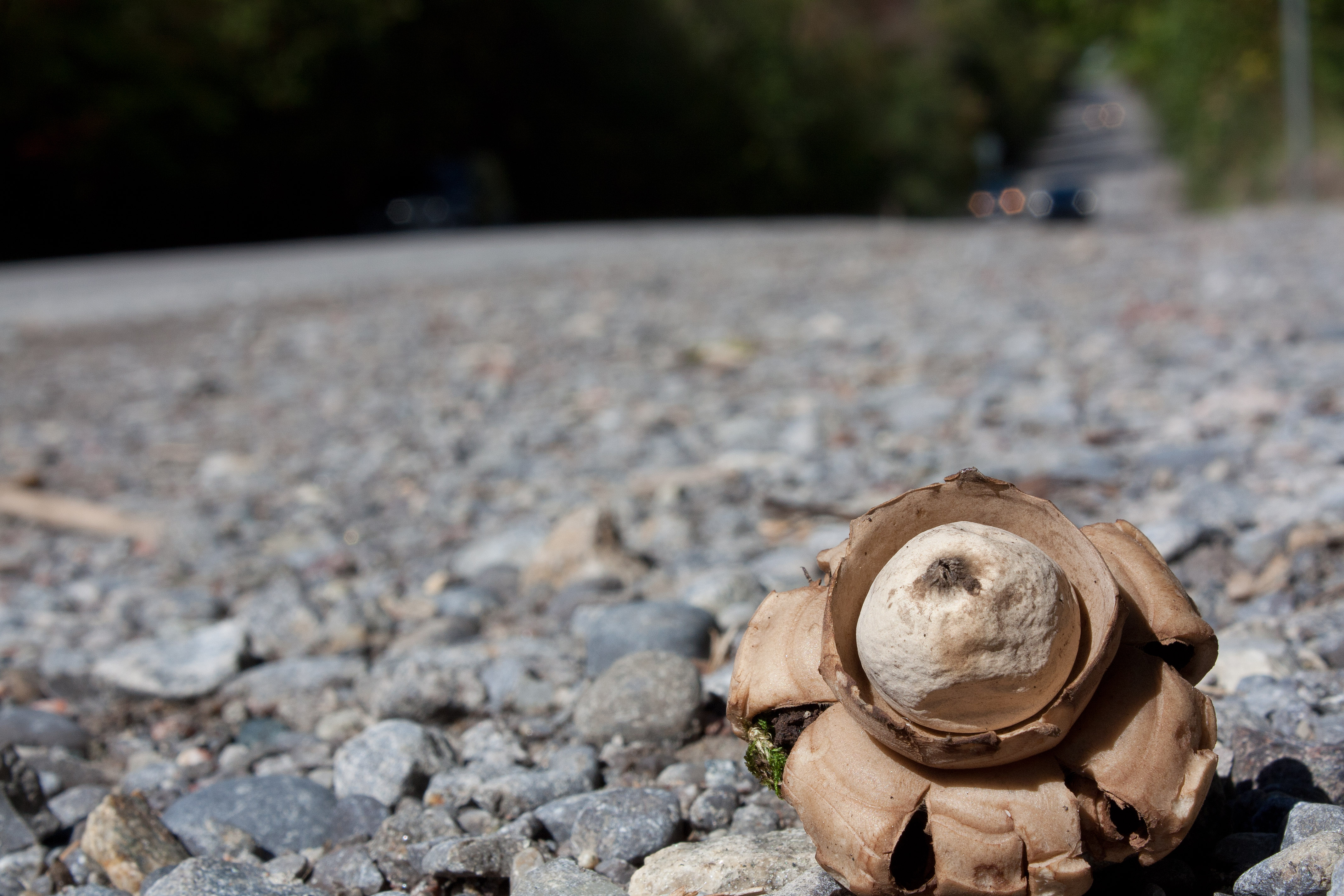
Geo means earth and astrum means star. The species name triplex, which means ‘having three layers,’ refers to the way the ‘star’ arms of the outer layer crack when they peel back, making it look like the spore-sac is sitting on a dish. The three layers allow the earthstar to do something no other fungus can do: move. When it rains, the two outer layers of the peridium split and peel back, forming a ‘star’ with 4-12 rays. The rays spread with enough force to push aside leaves, raising the spore-filled sac above the surrounding debris. The rays often lift the earthstar high enough to break the connection to the parent mycelium, releasing the earthstar from its sedentary position. Detached, the earthstar can move with wind or rain to better spread its spores.
Finger poking the spore sac helps release the spores (photo by Nina Munteanu)
Fruiting bodies are large, 5-10 cm in diameter. Spores escape from the apical pointed hole (peristome) as breezes blow across it. Much larger puffs are released when raindrops hit and compress the spore-sac—or an interfering finger depresses the sac. What escapes is a powdery gleba (which distributes the tiny spores). The sides of the peristome ‘beak’ are fibrous and appear slightly ragged.
Several stages of the Collared Earthstar in late summer, from buds to opening ‘flower’
Early budding stage of Collared Earthstar in late summer (photo by Nina Munteanu)
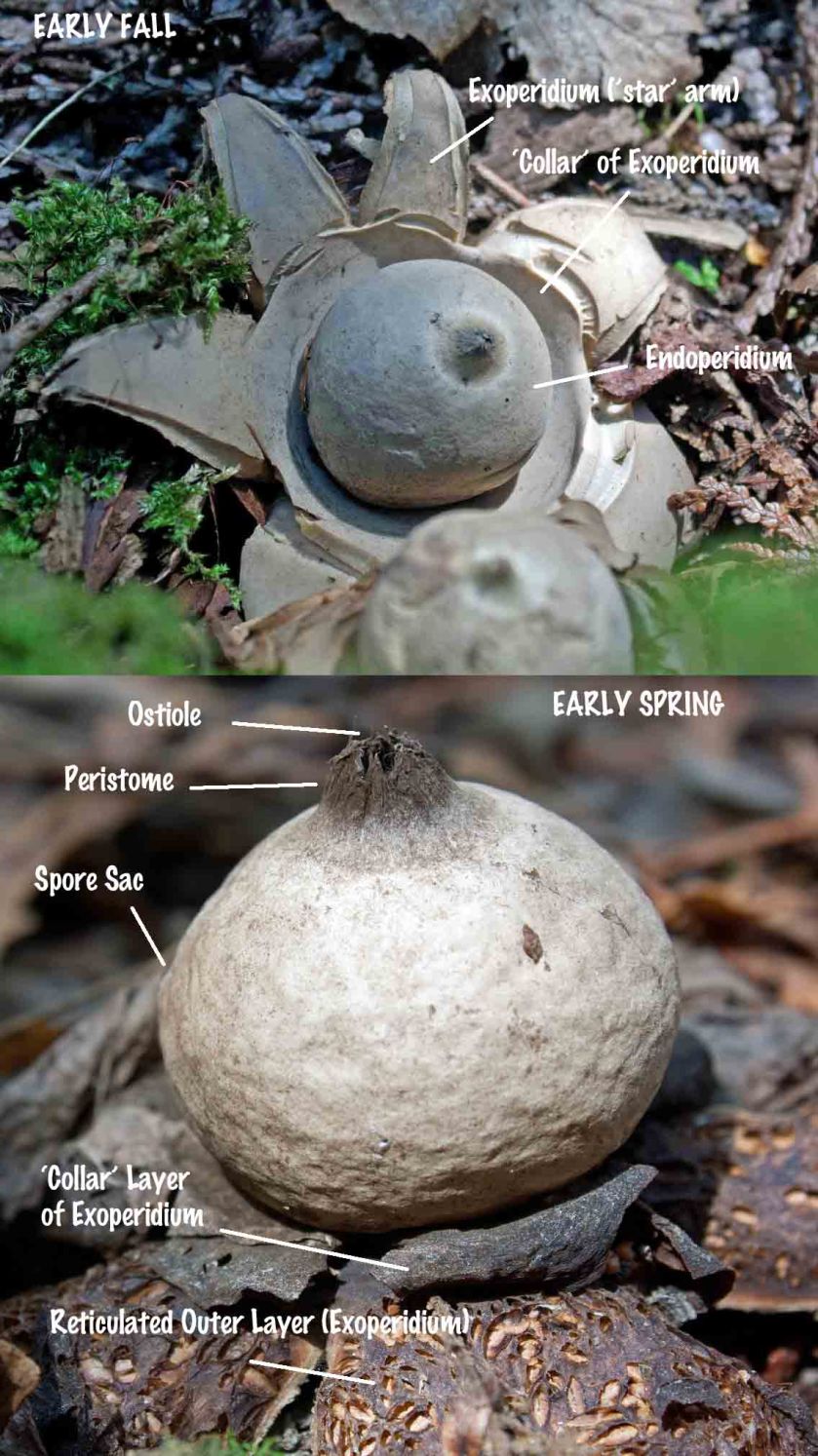
After a late summer / autumn rain, the collared earthstar emerges from the leaf litter looking like a Hershey’s kiss or a fancy bulb-shaped truffle dusted in fine cocoa. Only the outer layer (exoperidium) is visible, peeking out of the litter and loam. The outer layer eventually cracks open, looking like a coconut husk and splits into five to seven ‘arms’ to form a star. Inside is revealed a tan to grey-coloured spore-sac (endoperidium) with a fringed beak (peristome) and its opening (ostiole). The endoperidium, or spore sac, is more like an elastic membrane resembling rubber that holds the gleba (spore-bearing mass). The star arms peel back and down, eventually cracking to form the ‘saucer’ which the round fruiting body (spore sac) sits on. The spore sac contains a mass of spores and fertile mycelial tissue, called the gleba that is white, fibrous and firm when young, but turns brown and powdery as it ages. A network of cells (capillatum) help spores move to the pore when a raindrop strikes the endoperidium. The columella, a bulbous sterile base at the centre of the spore-producing gleba forms ‘columns’ that radiate out to help spore dispersal.
Over time, the outer layer of ‘stars’ (exoperidium) form a reticulated pattern of cracks and fissures that deepen into golden-brown colours as they decompose and curl downward to lift the spore-sac farther up. The sac also grows more pale and papery.
Parts of a Collared Earthstar from first ‘bloom’ in early fall to matured stage the next spring (photos by Nina Munteanu)
Just opened Collared Earthstar in late summer, not yet showing the ‘collar’ formed by cracking of exoperidium (photo by Nina Munteanu)
Good example of a more mature opened Collared Earthstar in early fall, showing the ‘collar’ formed by separation of exoperidium and extended curled back ‘arms’ (photo by Nina Munteanu)
Mature Collared Earthstar the following spring, showing papery spore sac sitting on disintegrating ‘collar’ and reticulated outer exoperidium (photo by Nina Munteanu)
However, in the rain, the sac reverts to a rubbery consistency and deepens to a dark shiny tan colour. I was surprised by its elasticity; this time when I poked it, the sac sprang back to its round sphere like a thick balloon.
Mature Collared Earthstar; left in rain, right in dry weather (photos by Nina Munteanu)
Collared Earthstar Habitat
I also learned that the collared earthstar prefers a habitat of leaf litter in deciduous woods, especially beech on chalky soils. However, researchers acknowledge that the collared earthstar is also found under coniferous trees, especially on sloping ground—which better describes where I found them, in this cedar-birch forest of the Kawarthas. Geastrum triplex is a saprophytic organism: it gets its nutrients from decomposing organic matter—such as well-rotted cedar trees, where humus has accumulated—by further breaking down the organic matter then, in turn, returns those nutrients to the soil to complete the cycle. It does this by releasing enzymes to break down and digest the lignin, cellulose or chitin in these materials, converting them to soluble compounds that can be absorbed by them, and by plants, as nutrients. Earthstars, like all fungi, play a vital role in reducing the accumulation of dead organic material and in recycling essential nutrients, particularly carbon and nitrogen. If not for fungi, forests would choke under a mountain of logs and leaves.
Mature earthstar, with prominent collar, in the moss-covered loam of a rotting cedar, ON (photo by Nina Munteanu)
References:
Ellis JB, Ellis MB. 1990. “Fungi without Gills (Hymenomycetes and Gasteromycetes): an Identification Handbook. ”Chapman and Hall. London. ISBN 0-412-36970-2.
Torpoco V, Garbarino JA (1998). “Studies on Chilean fungi. I. Metabolites from Geastrum triplex Jungh”. Boletin de la Sociedad Chilena de Quimica. 43 (2): 227–29.
Mature collared earthstar in early winter, ON (photo by Nina Munteanu)
Nina Munteanu is a Canadian ecologist / limnologist and novelist. She is co-editor of Europa SF and currently teaches writing courses at George Brown College and the University of Toronto. Visit www.ninamunteanu.ca for the latest on her books. Nina’s bilingual “La natura dell’acqua / The Way of Water” was published by Mincione Edizioni in Rome. Her non-fiction book “Water Is…” by Pixl Press(Vancouver) was selected by Margaret Atwood in the New York Times‘Year in Reading’ and was chosen as the 2017 Summer Read by Water Canada. Her novel “A Diary in the Age of Water” was released by Inanna Publications (Toronto) in June 2020.
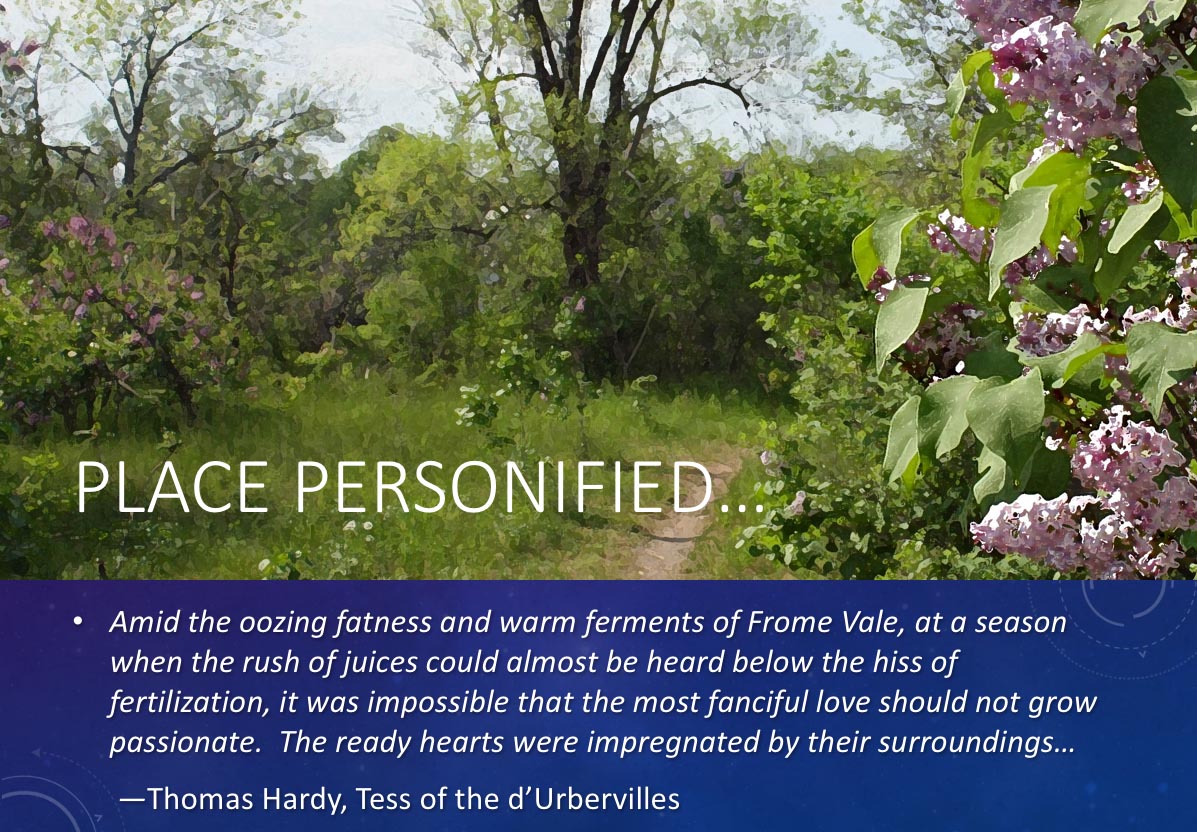
This past August, I participated in the When Words Collide Online 2022 Writing Festival. one of Canada’s prime writing festivals in Calgary, Alberta. I was a featured writer, sitting on several panels and conducting presentations and lectures. My presentation on the role of place in story kicked off the festival.
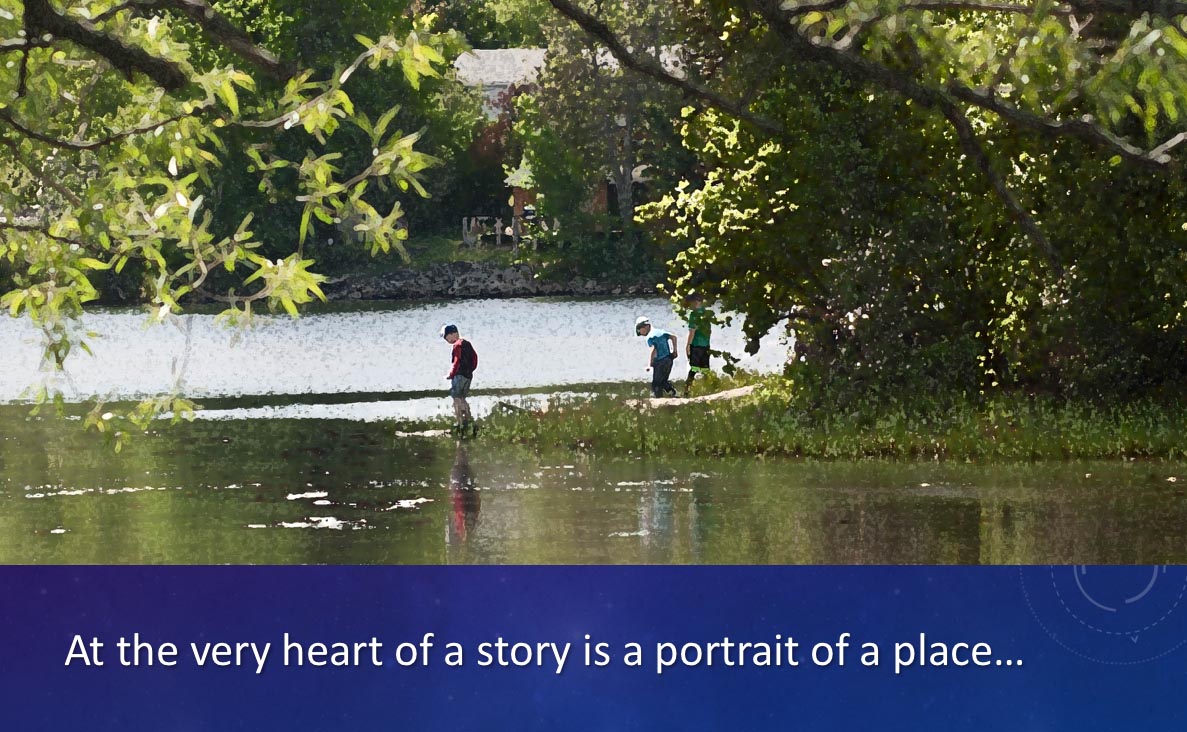
The role of place in story is a topic close to my heart and one I wrote an entire writing guidebook on: The Ecology of Story: World as Character. In my coaching sessions with writers and in my writing courses at George Brown College and the University of Toronto, I’d observed in the novice writer a need for more effective integration of setting and place in story. All too often, the lack of meaningful integration translated into a lost opportunity to explore the POV character and the story’s theme.
The lack of meaningful use of place in story can result in a lacklustre story, overly vague characterizations and a story that lacks metaphoric depth and relevance.
Nina Munteanu
The presentation and following discussion drew from my guidebook Ecology of Story and was also featured in the WWC recorded panel called “What is Eco-Fiction and Why Should We Care?” The presentation overviewed topics covered in the book, such as:
Place as character & archetype
Place as metaphor (personification, symbols, allegory)
Place and first impressions (openings)
Place and emotion (over time and by POV)
Place through the senses
Place as environmental force (including climate change)
We also discussed how characters connect with their environment and I introduced the metaphoric connection between the white pine forests and the Mi’kmaq in Annie Proulx’s Barkskins. Both are exploited by the white settlers, with intentions to subdue and controll:
The Gatineau forest was noisy, echoing with ax blows and the rushing crackle of falling timber, with shouted warnings and orders. The axmen cut the great pines, but only a few in each plot were suitable for squaring. The rest were left to rot on the ground … unwanted trees lay prostrate, severed branches everywhere, heaps of bark and mountains of chips … There were so many trees, what did it matter? Maine men were used to waste—it was usual—but this was beyond anything even they had seen.
In the Penobscot settlement, the trees fell, tracks inched through the forests, only one or two then seven, then webs of trails that over the decades widened into roads. The roads were muddy, sometimes like batter, sometimes thick and clutching until late summer; when they metamorphosed into choking dust so fine it hung in the air long after a horse and carriage passed, settling on the grass as the English people settled on the land … Fields of wheat and hay took the land, these fields enclosed by linked stumps, the root wads of the forest that had once stood there turned on their edges to bar the white man’s cows and sheep.
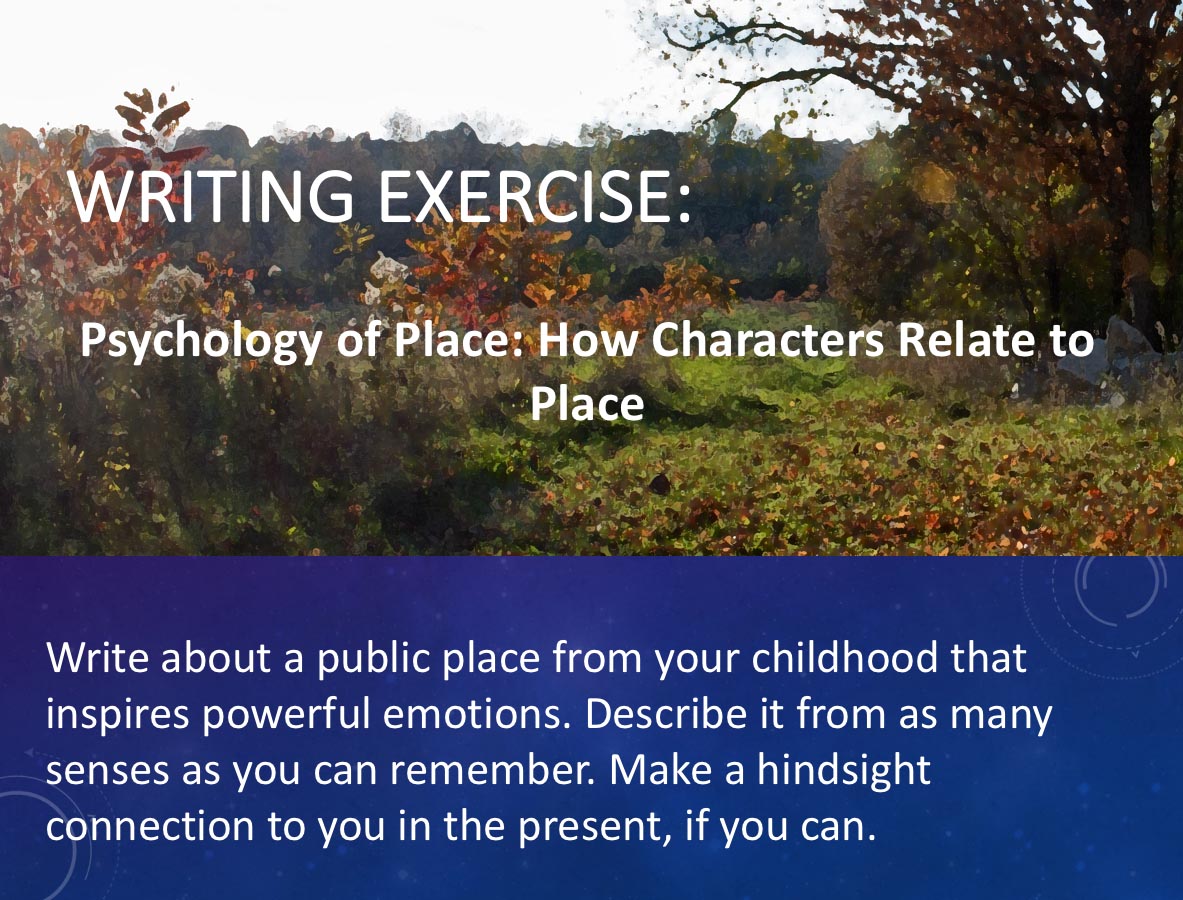
I concluded the presentation with a writing exercise asking participants to write about the psychology of a place and how they related to it.
Writers attending the presentation / workshop eagerly participated and produced some evocative narrative that contained good metaphor and sensual writing. Here are a few:
Freyja on their high school gym: “I remember rallies and lectures and sweating, running in circles for an hour and a half. The gym stayed the same but the population of people got smaller and smaller over the years. One year a kid hit his head on the wall and went into a coma. Longest seven seconds in my life.”
Roma: “As soon as I get a whiff of old pages in a book, I am reminded of Uncle Leo. The coffee coloured leather jacket he always wore had seen better days and like him, still retained most of its luster. He was the youngest of my dad’s nine siblings, born during a storm and considered a tempestuous child. Our family just didn’t understand his passion.”
Angela: “I stood on the bridge in Moscow. My mother was talking with a friend. She couldn’t believe how lucky we were to be posted here. I looked down at the river. And at the bridge. It would be so easy to just jump over the fence and land in the water. It was a sunny day. The heat was oppressive. I wanted to do it. But I stood still.”
Kylie: “The stuffy air was full of the smell of bodies and heat. The din of laughing and talking, and yelling surrounded me.”
The Ecology of Story: World as Character is presented in two parts: Part 1 provides a comprehensive summary of the science of ecology, the study of relationships, and links to useful metaphor; Part 2 discusses world and place in story. Here I discuss how the great writers have successfully integrated place with theme, character and plot to create a multi-layered story with depth and meaning. Part 2 also contains several exercises and detailed case studies.
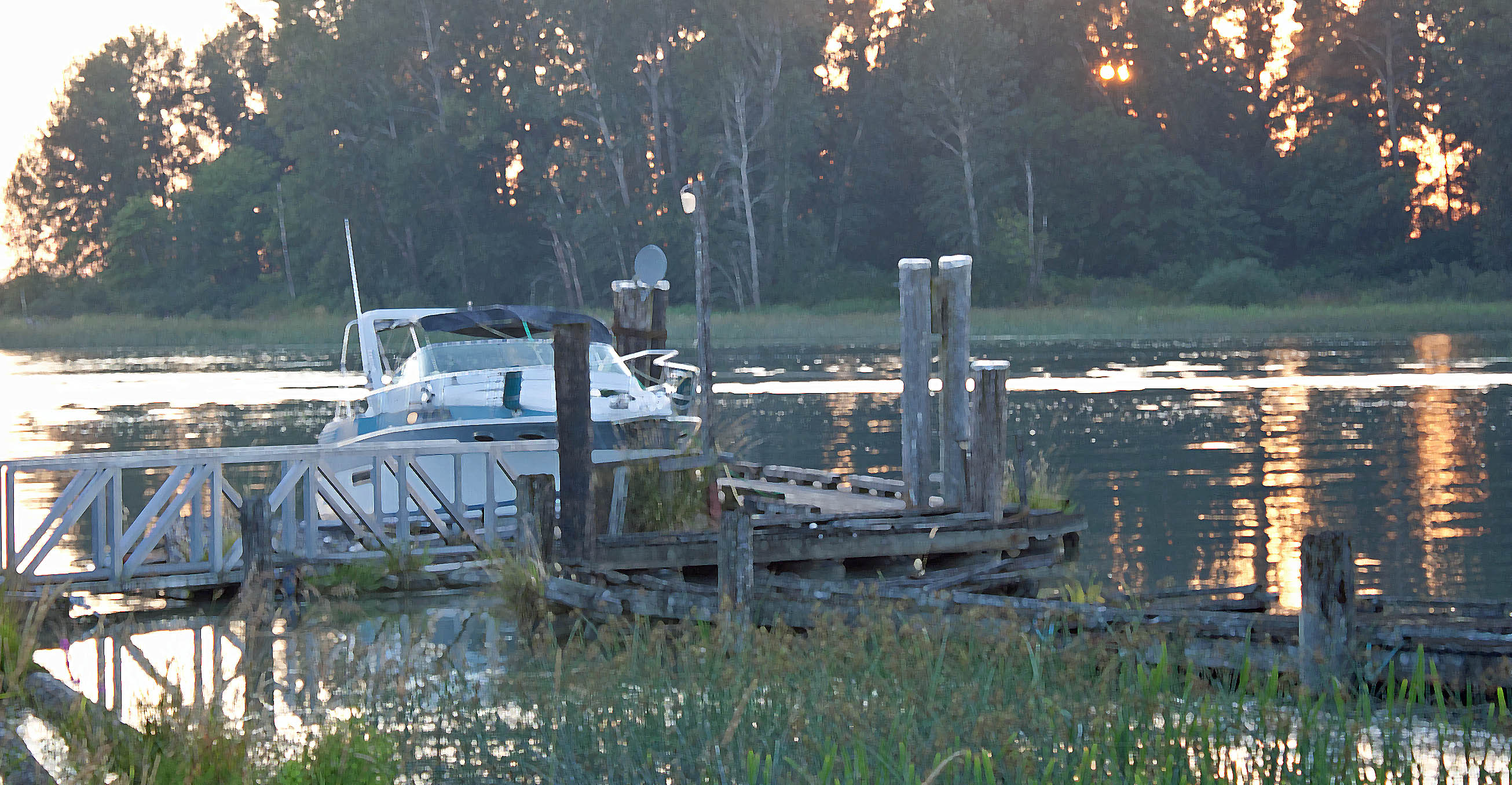
Boat dock at sunset, Ladner Slough of Fraser River, BC (photo and rendition by Nina Munteanu)
NINA MUNTEANU is a Canadian ecologist / limnologist and novelist. She is co-editor of Europa SF and currently teaches writing courses at George Brown College and the University of Toronto. Visit www.ninamunteanu.ca for the latest on her books. Nina’s bilingual “La natura dell’acqua / The Way of Water” was published by Mincione Edizioni in Rome. Her non-fiction book “Water Is…” by Pixl Press(Vancouver) was selected by Margaret Atwood in the New York Times ‘Year in Reading’ and was chosen as the 2017 Summer Read by Water Canada. Her novel “A Diary in the Age of Water” was released by Inanna Publications (Toronto) in June 2020.