Writing About the Truth…and Other Lies: Monsanto’s Big Cheat

The June 2019 issue of Walrus Magazine addresses a current publishing crisis in academia. In his article “Fake Science Is the New Fake News,” reporter Alex Gillis reveals the alarming rise of fake and bogus professional journals and how scientists are both duped and drawn to publish with them.

The lure came from frustrations of scientists with the very gate-keeping devices that ensure good science is being conducted and accurately reported: high standards for acceptance; long wait times for peer review and publication; and high expense to the scientist. With the advent of online journals and the open-access model (that allowed free access), many scientists flocked to them, claiming more timely and less expensive publication. Unfortunately, the open-access model that made reporting of and access to science more easy, also permitted its exploitation by unscrupulous entrepreneurs who set up predatory (fake) journals. This allowed scientists with less integrity to publish material of lower standard. Even more insidious, the model and its fake journals also supports fake science with an agenda. Essentially, science as propaganda.

1984Nineteen Eighty-Four kind of science.

An example of the publication of Nineteen Eighty-Four kind of science with corporate motive was revealed in 2018 with the lawsuit against Monsanto (now part of Bayer) in which evidence showed that Monsanto had been funding junk studies to discredit legitimate research about its cancer-causing herbicide, Roundup. A terrible example in 2015 is the fake studies that underplayed risks to children exposed to lead from improperly maintained pipes in the drinking water service lines in Flint, Michigan.

So, what is it to write about the truth?

Here’s a bit of truth from seven years ago: New York Times reporter Stephanie Strom in an article on September 19th, 2012, entitled Uneasy Allies in the Grocery Aisle: “Giant bioengineering companies like Monsanto and DuPont are spending millions of dollars to fight a California ballot initiative aimed at requiring the labeling of genetically modified foods. That surprises no one, least of all the proponents of the law, which if approved by voters would become the first of its kind in the nation.”

Let’s dig a bit deeper into this truth: “companies behind some of the biggest organic brands in the country—Kashi, Cascadian Farm, Horizon Organic—also joined the anti-labeling effort, adding millions of dollars to defeat the initiative, known as Proposition 37.”

Strom revealed even deeper truths when she disclosed that these well-known “organic” companies are owned by larger conglomerates like Kellogg, General Mills, Dean Foods, Smucker’s and Coca-Cola. Other food companies who had thrown in funds to help defeat the bill for transparency include PepsiCo., Neslé, and ConAgra Foods.

Strom reported that those who support the bill to label GMO products include Whole Foods, Nature’s Path (a Canadian company) Organic Valley, Cliff Bar and Amy’s Kitchen.

Whenever an issue of importance arises, the truth reveals itself. And sometimes in the oddest way. It often slides in through a back door. I’m not just talking about factual truth; I’m talking about resonating hair-standing gut-grabbing truth.

The kind of truth that resonates through you in a scintillating frisson. The kind of truth that stops you mid-stride, like someone shouting your name. Subversive truth. The kind of truth that vibrates deep inside and radiates out in a flood of epiphany.  The kind of truth that stirs your heart in a relentless wave of flaming light.

The kind of truth that “changes” you.

At first glance it’s rather obvious why those fighting the bill were against it: they had something to lose in transparency. The question is, why do they think that way? These giant biotech food companies are feeding the entire world, after all, with revolutionary strains of super-plants. They are doing a great good, surely. Could it simply be a concern that they may lose some customers who do not wish to consume GE products but who are unwittingly doing so now? That is being dishonestly self-serving as well as short-sighted (the European Union has required biotech labeling since 1997—it’s just a matter of time).

Could it be the bad publicity from findings of the long-term effects of GMO products and Roundup on test animals? (See the incendiary paper by French and Italian scientists in Food Chem. Toxicol., referenced below, that started it all).  Despite the barrage of bad press, the paper’s results could not be refuted entirely or ignored (if only from the basis of scientific inquiry and professional due diligence to do with Type II Error).

Or is it more insidious?

Far more insidious than a lie is to dissemble with a half-lie—or half-truth—a truth that veils a festering lie beneath its candy-coated mantle of equivocation. A “truth” so delicious that we want to believe it, even when we see the lie lurking beneath. Little lies always hide bigger lies.

For more than a decade, consumers in North America have purchased cereals, snack foods, and salad dressings, among other products, blithely unaware that these products contained ingredients from plants whose DNA was manipulated in a laboratory.

Here’s my witnessed truth: The aggressive multi-million dollar campaign waged by multi-national corporations against transparency in food labeling in the USA is the culmination of self-serving protectionism in a most heinous way. Their decade-long silence and current reluctance to label their products (and all this before the Seralini et al. study) points to a far greater lie.

Since the long-term toxicity study by Seralini et al. was released in Food & Chemical Toxicology, a massive campaign to discredit the study was waged on the Internet. This despite the soundness of the 2-year study, its glaringly obvious results (e.g. test animals died 2-3 times more quickly than controls among many other findings) and the fact that it sets precedent by being the longest and most detailed study ever conducted on a herbicide and a GMO to date; all previous studies by Monsanto labs and others were only 90-day trials (and we now know that these studies were fake studies).

So, what is it to write about the truth?

I’ve been a practicing scientist for over twenty years. I did research and wrote papers that were published in scientific peer-reviewed journals. I diligently used the scientific method, hypothesis-testing, objective observation and appropriate statistics to back up my work. I also write articles for magazines, blogs and places like this site. I write short stories and novels. I write how-to books and guidebooks. And I write letters. Lots of letters. In all this, I have made a point to do my research. I try always to go to the source and verify my information through cross-checking, and various other quality assurance procedures I learned over the years to best represent and communicate the truth.

For instance, in writing this article, I perused many articles that presented both sides of the several issues I covered, including the source paper by Seralini et al.

Science is the rational tool for the pursuit of truth. This is why scientists are burdened to proceed under an objective protocol in their premise presentation, experimental design, methodology and interpretation and conclusions drawn. Because the introduction of error and bias is possible in each of these areas, researchers with integrity ensure through design and quality assurance protocol that these errors and biases are minimized. This includes the use of contols, sufficient sample size and statistical power, blind or even double-blind experiments and more. Experiments are reported with sufficient transparency to be replicated (an icon of good science).

Once they are reported in a paper, results transform from science into politics. Objectivity gives way to agenda. That is inevitable. However, what has changed in the last decade is that science itself has become seconded for agenda. Science by agenda to fulfill a propaganda is flooding in as assuredly as the rising seas of climate change.

Gillis writes: “Fake and flawed studies are so pervasive that the presumed authority of an expert or researcher in a scholarly journal is no longer what it used to be…the traditional knowledge-sharing process has been corrupted.”

america-missouri02

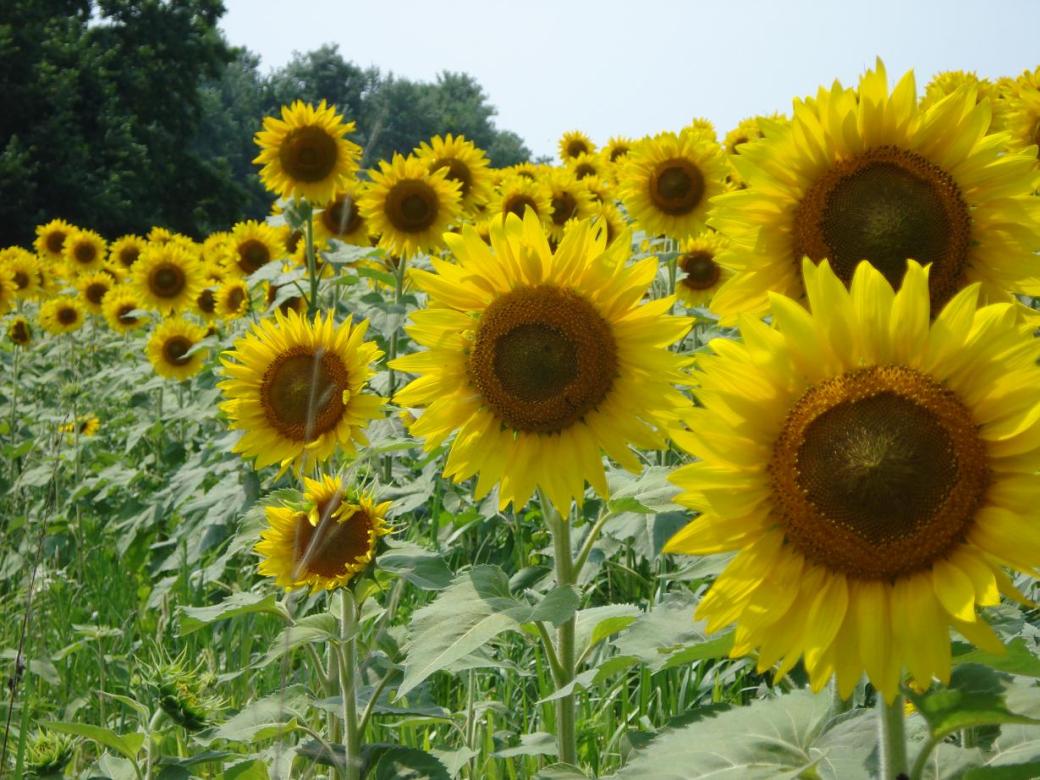
Sunflowers in Missouri (photo by Nina Munteanu)

Who are the politicians behind the “soldiers” of science and what are their motives? That is where the truth lies.

In the end, I have found that listening to the conviction of my heart, to my inner “soul wisdom”, best serves the truth. Then again I prefer the resonating hair-standing gut-grabbing truth.

Reference:

Gillis, Alex. 2019. “The Rise of Junk Science.” Walrus Magazine, Toronto, ON. June 2019.

Seralini, G.-E., et al. 2012. “Long term toxicity of a Roundup herbicide and a Roundup-tolerant genetically modified maize.” Food Chem. Toxicolhttp://www.sciencedirect.com/science/article/pii/S0278691512005637

Strom, Stephanie. 2012. “Uneasy Allies in the Grocery Aisle.” New York Times, New York, September 19, 2012.

nina-2014aaa

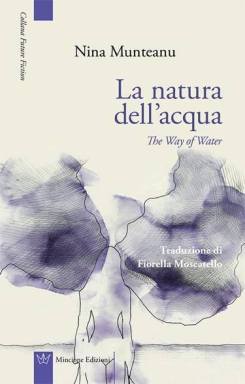
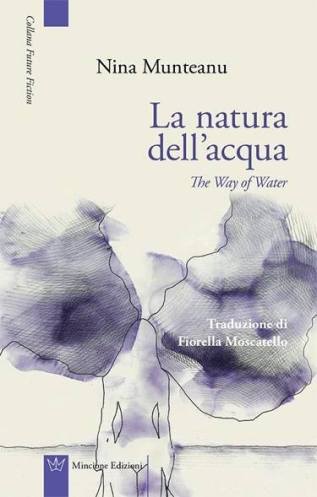
Nina Munteanu is a Canadian ecologist / limnologist and novelist. She is co-editor of Europa SF and currently teaches writing courses at George Brown College and the University of Toronto. Visit www.ninamunteanu.ca for the latest on her books. Nina’s bilingual “La natura dell’acqua / The Way of Water” was published by Mincione Edizioni in Rome. Her non-fiction book “Water Is…” by Pixl Press (Vancouver) was selected by Margaret Atwood in the New York Times ‘Year in Reading’ and was chosen as the 2017 Summer Read by Water Canada. Her novel “A Diary in the Age of Water” will be released by Inanna Publications (Toronto) in 2020.

Book Review: “The Windup Girl” When Monsanto Gets Its Way…

Windup GirlPaolo Bacigalupi’s 2015 biopunk science fiction novel The Windup Girl occurs in 23rd century post-food crash Thailand after global warming has raised sea levels and carbon fuel sources are depleted. Thailand struggles under the tyrannical boot of ag-biotech multinational giants such as AgriGen, RedStar, and PurCal—predatory companies who have fomented corruption and political strife through their plague-inducing and sterilizing genetic manipulations. The story’s premise could very easily be described as “what would happen if Monsanto got its way?”

Bacigalupi’s story opens in Bangkok, “City of Angels”, now below sea level and precariously protected by a giant sea wall and pumps that run on bio-power:

Windup Girl-closeIt’s difficult not to always be aware of those high walls and the pressure of the water beyond. Difficult not to think of the City of Divine Beings as anything other than a disaster waiting to happen. But the Thais are stubborn and have fought to keep their revered city of Krung Thep from drowning. With coal-burning pumps and leveed labor and a deep faith in the visionary leadership of their Chakri Dynasty they have so far kept at bay that thing which has swallowed New York and Rangoon, Mumbai and New Orleans.

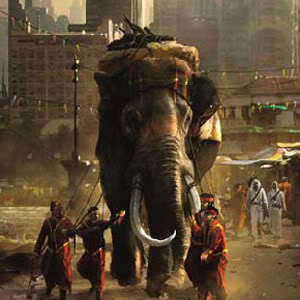
Energy storage in this post-oil society is provided by manually-wound springs using cruelly mistreated genehacked megodonts—elephant-slave labor. Biotechnology dominates via international mega-corporations—called calorie companies—that control food production through genehacked seeds. The companies use bioterrorism and economic hitmen to secure markets for their products—just as Monsanto is currently doing. Plagues (some they created, others unintended mutations) have wiped out the natural seed stock, now virtually supplanted by genetically engineered sterile plants and mutant pests such as cibiscosis, blister rust, and genehack weevil. Thailand—one of the economically disadvantaged—has avoided economic subjugation by the foreign calorie companies through some ingenuity—a hidden seedbank of diverse natural seeds—and is now targeted by the agri-corporations.

julien-gauthier-bangkok

future Bangkok envisioned by Julien Gauthier

Bacigalupi’s opening entwines the clogged and crumbling city of Bangkok and its swarming beggars, slaves and laborers in a microcosm of a world spinning out of control:

Overhead, the towers of Bangkok’s old Expansion loom, robed in vines and mold, windows long ago blown out, great bones picked clean. Without air conditioning or elevators to make them habitable, they stand and blister in the sun. The black smoke of illegal dung fires wafts from their pores, marking where Malayan refugees hurriedly scald chapatis and boil kopi before the white shirts can storm the sweltering heights and beat them for their infringements.

Anderson Lake is a farang (of white race) who owns an AgriGen factory trying to mass-produce kink-springs—successors to the internal combustion engine) to store energy. The factory is in fact a cover for his real mission: to find and exploit the secret Thai seedbank with its wealth of genetic material. We later discover that Lake is an economic hitman and spy whose previous missions have destroyed entire countries for the sake of monopoly.

Emiko is an illegal Japanese “windup” (genetically modified human), owned by a Thai sex club owner, and treated as a sub-human slave. When she meets Lake, he cavalierly shares that a refuge in the remnant forests of northern Thailand exists for people like her (the “New People”); Emiko dreams of escaping her bonds to find her own people in the north. But like Bangkok itself, both protected and trapped by the wall against a sea poised to claim it—a bustling city of squalor caught up in the clash of new and old—Emiko cannot escape who and what she is: a gifted modified human—and possible herald of a sustainable future—vilified and feared by the very humanity that created her.

Bangkok-floating market

Bangkok’s floating market

Bangkok emerges as a central character in a story that explores the paradox of conflicting dialectics battling for survival in a violently changing world. Anyone who has spent time in Bangkok will recognize the connective tissue that holds together its crumbling remnants with ambitious chic. Just like the novel’s cheshires: genetically created “cats” (made by an agri-giant as a “toy”) that wiped out the regular cat Felis domesticus.

cheshire-cat

Cheshire Cat of “Alice in Wonderland”

Named after Alice in Wonderland’s Cheshire Cat, these crafty creatures have adapted well to Bangkok’s unstable environment. The cheshires exemplify the cost of unintended consequence (a major theme in the novel); the cheshires also reflect the paradoxical nature of a shape-shifting city of Thais, Chinese and Malaya refuges who struggle to survive in a place that is both haven and danger:

Cheshire cat-disappearing

Cheshire cat disappearing

The flicker-shimmer shapes of cheshires twine, yowling and hoping for scraps … The old man’s flinch is as hallucinogenic as a cheshire’s fade—one moment there, the next gone and doubted … The devil cats flicker closer. Calico and ginger, black as night—all of them fading in and out of view as their bodies take on the colors of their surroundings.

Captain Jaidee Rojjanasukchai is a righteous white shirt—the strong arm of the Ministry of the Environment. He is a faithful Thai Buddhist, whose only weakness is his sense of invincibility borne from a mistaken sense of government integrity. Revered by fellow white shirts as the “Tiger of Bangkok,” he is incorruptible—we find out that he may be the only person in the entire place who refuses to be swayed by bribes. A true and passionate believer in the cause he is fighting for—the very survival of the environment and his people by association—Jaidee is ruthless in his raids and attacks on those who wish to open the markets of globalization and potential contamination. Early in the novel, Jaidee reflects on humanity’s impact on the ecological cycle:

All life produces waste. The act of living produces costs, hazards, and disposal questions, and so the Ministry has found itself in the centre of all life, mitigating, guiding and policing the detritus of the average person along with investigating the infractions of the greedy and short-sighted, the ones who wish to make quick profits and trade on others’ lives for it.

Bacigalupi astutely identifies the tenuous role of any government’s environment ministry—to protect and champion the environment—within a government that values its economy more highly and when, in fact, most of the time its members operate quietly in the pocket of short-sighted politicians and business men who focus myopically on short-term gain. “The symbol for the Environment Ministry is the eye of the tortoise, for the long view—the understanding that nothing comes cheap or quickly without a hidden cost,” Jaidee thinks. The United States EPA is a prime example of such paradox—in which the agency’s top executive is in fact a former industrialist who lobbied for deregulation. The current EPA no longer fulfills its role as guardian of the environment. In Canada, I have witnessed terrible conflict between one ministry with another in a game of greed vs. protection. Bacigalupi showcases this diametric with his characters Pracha (Environment) and Akkarat (Trade).

Abandoned Shopping Mall now Koi Pond

Abandoned supermarket now a giant koi pond, Bangkok

The rivalry between Thailand’s Minister of Trade and Minister of the Environment represent the central conflict of the novel, reflecting the current conflict of neo-liberal promotion of globalization and its senseless exploitation (Akkarat) with the forces of sustainability, fierce environmental protection and (in some cases) isolationism (Pracha). Given the setting and the two men vying for power, both scenarios are extreme and there appears no middle ground for a balanced existence using responsible and sustainable means. Emiko, who represents a possible future, is precariously poised; Jaidee, the single individual who refuses to succumb to the bribes of a dying civilization—is sacrificed: just as integrity and righteousness are violently destroyed when chaos threatens and engulfs.

Bangkok dam

“Windup Girl” Bangkok dam

Various reviewers of the novel identify the gaijin (foreigner) Anderson Lake as the closest thing to a protagonist. In fact, Lake never manages to rise from his avatar as the human face to the behemoth of ruthless globalization, the face of a Monsanto-look-alike. He is an unsympathetic and weak character, who—despite showing some feelings for the windup girl—connives and lacks human compassion to the end. Not a protagonist. During a meeting with the Minister of Trade, in which Lake hubristically offers “aid”, Akkarat confronts Lake on the destruction of his greedy corporation: “Ever since your first missionaries landed on our shores, you have always sought to destroy us. During the old Expansion your kind tried to take every part of us. Chopping off the arms and legs of our country…With the Contraction, your worshipped global economy left us starving and over-specialized. And then your calorie plagues came.” Lake shrugs this off and continues his aggressive exchange with the minister—sealing his fate beneath Nature’s relentless tsunami.

rob-davies-WIndupGirl-twug-tank

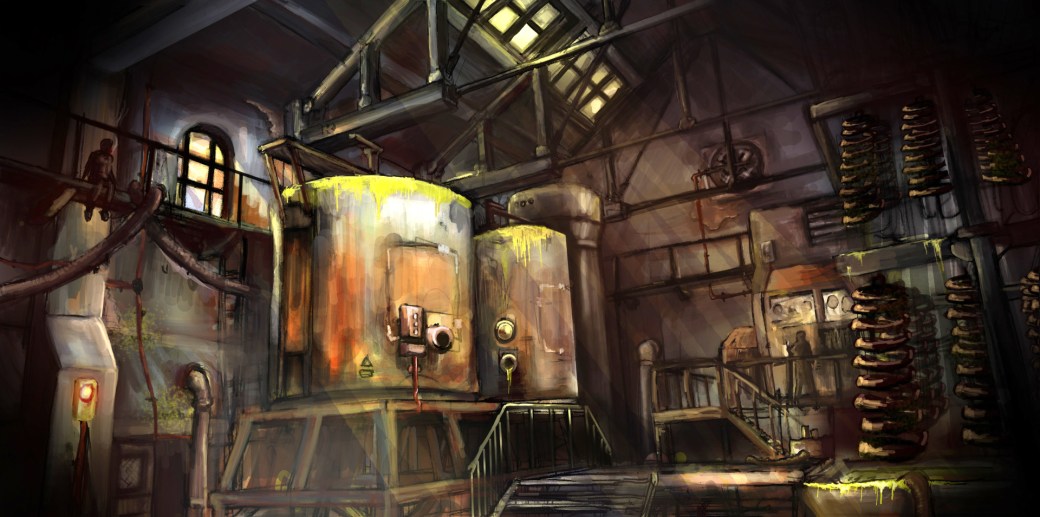
Twug tank, imagined by Rob Davies

Jaidee—who is brutally killed on page 197 of the novel with another 200 pages to go—remains Bacigalupi’s only character of agency worth following. The Tiger of Bangkok represents the Ministry of Environment’s hard policy of environmental protection—the only thing that kept Thailand from falling to the global mega-corporation’s plagues. With Jaidee’s demise, we tumble in free fall into a “Game of Thrones” miasma of “who goes next—I don’t care.” While I continued to read, it was more from post-traumatic shock than from eager interest. It was as though I’d lost a good friend—my safety anchor in a horrid place—and was now set adrift. I drifted, alone, amid the remaining characters—each pathetic in their own way—on a slow slide into the wrathful hell of a vengeful Nature. I found myself rooting for the cheshires and windups, experiments-turned victims-turned adapted survivors of a vast unintended consequence in human greed.

Perhaps that is what Bacigalupi intended.

WindupGirl-megadonts

Concept of megadonts in “Windup Girl”

And yet, there is unsmiling monosyllabic Kanya, Jaidee’s not-so-pure lieutenant, now promoted to his position and eager to atone for her former betrayal—we learn that she was planted as a Trade mole in Environment. Struggling to do the right thing after Jaidee’s murder, Kanya emerges as the true protagonist in the novel. As we learn more of her unfortunate history and gain a clear understanding of her complex motivations (we get no such insight into Lake), Kanya’s journey unfolds through heartbreak and redemption. Kanya picks up Jaidee’s spirit—literally—and, accompanied by his phii (his ghost), tries to settle the warring factions to gain peace for a rioting city. Of course, it doesn’t work and the gaiji devils return in full force as Akkarat hands over Thailand and its precious seedbank to the American corporations.

Happy with Akkarat’s coup, corporate mogul Carlyle says to Lake: “The first thing we do is go find some whiskey and a rooftop, and watch the damn sun rise over the country we just bought.”

Instructed to take the AgriGen gaigi to the vault and hand over the seedbank to them, “Kanya studies the people who used to be called calorie demons and who now walk so brazenly in Krung Thep, the City of Divine Beings.” Jeering and laughing with no respect, the gaiji behave like they own the place. In a sudden moment of clarity—inspired by Jaidee’s phii—Kanya then singlehandedly creates her own coup by executing the AgriGen gaigi and instructing the monks to dispatch Thailand’s precious seedbank safely to the jungle wilderness. Husked of its precious treasure, the city implodes.  Floodwater pumps and locks fail to sabotage. Then the monsoons arrive. The City of Angels gives in to the sea that chases refugees into the genehack-destroyed outer forests.

paolo-bacigalupi

Paolo Bacigalupi

While Kanya triumphs in her own personal battle, she remains less agent of change than feckless witness to Nature’s powerful force as it unfurls like a giant cheshire and sends dominoes crashing into one another.

Fittingly, Bacigalupi’s Epilogue belongs to the windup girl and the cheshires. And an uncertain future with promise of change.

And that is certainly what Bacigalupi intended.

julien-gauthier-bangkoksunset

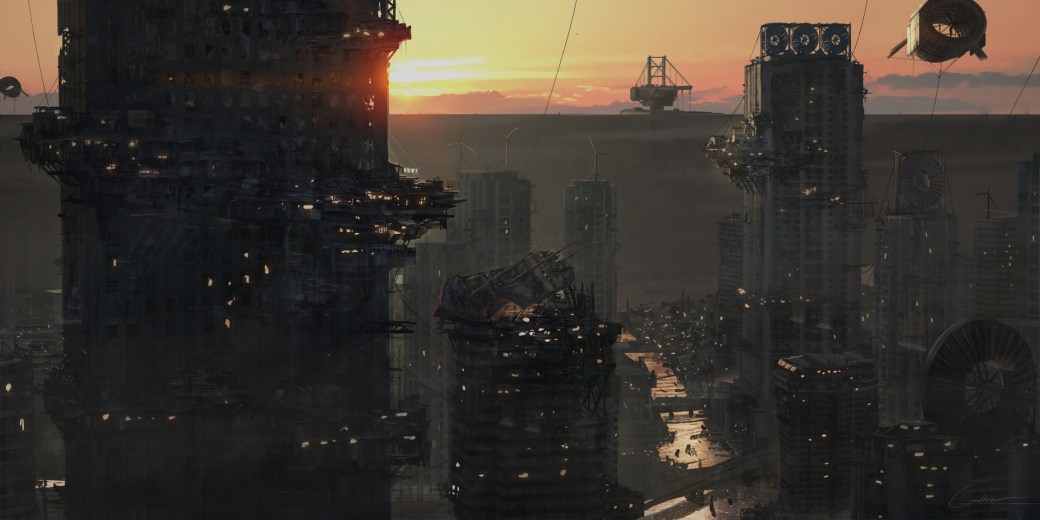
Bangkok sunset by Julien Gauthier

nina-2014aaa

Nina Munteanu is a Canadian ecologist / limnologist and novelist. She is co-editor of Europa SF and currently teaches writing courses at George Brown College and the University of Toronto. Visit www.ninamunteanu.ca for the latest on her books. Nina’s bilingual “La natura dell’acqua / The Way of Water” was published by Mincione Edizioni in Rome. Her non-fiction book “Water Is…” by Pixl Press (Vancouver) was selected by Margaret Atwood in the New York Times ‘Year in Reading’ and was chosen as the 2017 Summer Read by Water Canada. Her novel “A Diary in the Age of Water” will be released by Inanna Publications (Toronto) in 2020.

On Writing “A Diary in the Age of Water”

How does any fire begin? With a spark…

FillingAtWaterTap copyIn Summer of 2016, I attended a talk given by Maude Barlow on water justice. The radical talk was based on her recent book “Boiling Point”, a comprehensive exploration of Canada’s water crisis—a crisis that most Canadians weren’t—and still aren’t—aware. Canada is steward to a fifth of the world’s fresh water, after all. It is a water-rich country. Of the dozen largest inland lakes in the world, Canada holds eight of them. So, why water crisis? Well, Maude explains. And you should read “Boiling Point.” It will open your eyes to the politics of water and how multinational corporations—like Nestlé—are already grabbing and funneling water away from Canadians and into the global profit machine.

Maude’s talk was in a church on Bloor Street in Toronto. I sat close to the front to best see her. But I soon noticed that many people had elected to sit in the gallery above. I found myself focusing on a young mother and her little girl. The girl had some paper and crayons and was busy with that as the enthusiastic mother listened to Maude deliver dire facts about corporate water high-jacking and government complicity.

I saw a story there.

What mother would take her pre-school child to a socio-political talk on water? I would later reflect that memory of the mother and her little girl through my characters Una and her little daughter Lynna, the diarist in my novel “A Diary in the Age of Water” (due for publication in 2020 with Inanna Publications).


Elora Park something river 4

Reflections on the Eramosa River, Ontario (photo by Nina Munteanu)

The spark for my novel began with a short story I was invited to write in 2015 about water and politics in Canada.  I had long been thinking of potential ironies in Canada’s water-rich heritage. The premise I wanted to explore was the irony of people in a water-rich nation experiencing water scarcity: living under a government-imposed daily water quota of 5 litres as water bottling and utility companies took it all.

The Way of Water-COVERI named the story “The Way of Water.” It was about a young woman (Hilda) in near-future Toronto who has run out of water credits for the public iTap; by this time houses no longer have potable water and their water taps have been cemented shut; the only way to get water is through the public iTaps—at great cost. She is two metres from water—in a line of people waiting to use the tap—and dying of thirst.

The Way of Water” captures a vision that explores the nuances of corporate and government corruption and deceit together with global resource warfare. In this near-future, Canada is mined of all its water by thirsty Chinese and US multinationals—leaving nothing for the Canadians. Rain has not fallen on Canadian soil in years due to advances in geoengineering and weather manipulation that prevent rain clouds from going anywhere north of the Canada-US border. If you’re wondering if this is possible, it’s already happening in China and surrounding countries.

Exile-CanTales ClimateChangeThe story first appeared in 2015 in Future Fiction, edited by Francesco Verso, and in 2016 as a bilingual (English and Italian) book and essay published by Mincione Edizioni in Rome. The story was reprinted in magazines and anthologies several times since, including “Cli-Fi: Canadian Tales of Climate Change Anthology” (Exile Editions, Bruce Meyer, ed), in 2017, Future Fiction: New Dimensions in International Science Fiction (Francesco Verso & Bill Campbell, eds; Future Fiction / Rosarium Publishing, Rome and Greenbelt, MD) in 2018; and in Little Blue Marble Magazine (Katrina Archer, ed) in January, 2019. “The Way of Water” received generous praise from review sites and the press worldwide.

FF - Rosarium CoverAfter the success of this short story, I realized that I needed to tell the larger story—how did the world—Canada—get to where Hilda was? Her mysterious mother, the limnologist Lynna who was taken away by the RCMP in 2063, clamored for more attention. I remembered that four-year old girl and her mother in the gallery at Maude Barlow’s talk on water politics. And I thought of my characters: young Lynna and her mother Una. How does a daughter of an activist mother behave and think? How best to express her voice?

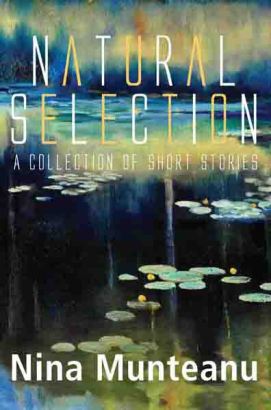
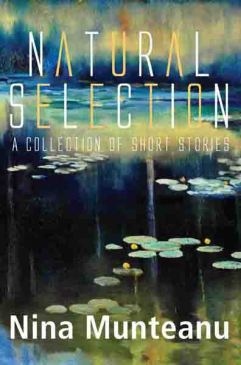
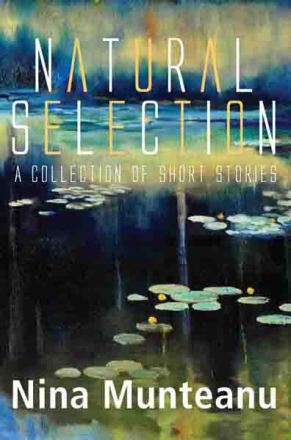
NaturalSelection-front-webI had earlier written a short story that was a mix of correspondence (emails) and third person narrative (“The Arc of Time” in Natural Selection), which I felt captured the voices of the characters well. I realized that a diary by Lynna would be an ideal way for her to express her unique worldview and cynicism—yet allow her vulnerable humanity to reveal itself through this unique relationship with her diary. The remaining characters and their narratives emerged easily from there: Una, her activist mother; Daniel, her conspiracy theorist colleague (and her conscience); Orvil, the water baron (and lover she betrayed); and Hilda, her “wayward” supposedly mind-challenged daughter—who appears in the short story that takes place later.

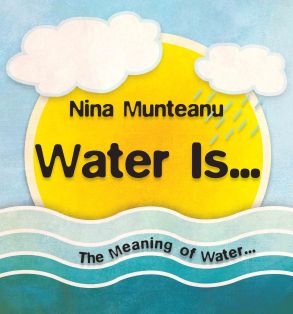
Water Is-COVER-webI had a lot of material; I had already been researching water issues and climate change in my activism as a science reporter. I had recently published “Water Is… The Meaning of Water”, essentially a biography of water, written from the perspective of mother, environmentalist and scientist. I had practiced as a limnologist for over twenty-five years and could mine my various personal experiences in the field, lab and office with genuine realism. I chose Robert Wetzel’s Limnology (the classic text book I used in my introductory limnology course) for quotes to each of Lynna’s entries; this added an opportunity to provide additional metaphor and irony through Lynna’s scientific voice. I placed the child Lynna (who was born in 2012) into actual events in Toronto, where I currently live. This pushed the story further into the area of documentary and blurred the lines between fiction and non-fiction to achieve a gritty and textured reality. Lynna also taught limnology at the University of Toronto, where I currently teach.

Just as Water Is…” served as a watershed for all my relevant experiences as mother, environmentalist and scientist, “A Diary in the Age of Water” would galvanize many of my personal experiences, doubts, challenges and victories into compelling story. Although parts of the story wrote themselves, the entire book was not easy to write. There were times when I had to walk away from the book to gain some perspective—and optimism—before continuing. When I found myself drowning in Lynna’s voice, I invoked Hilda to guide me to shore. I found a balance that worked and compelled. Ultimately this opened to some of the best internal conflict and tension I have experienced in my writing.

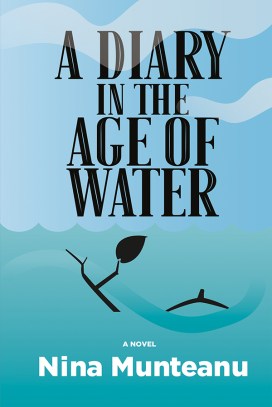
Diary Water cover finalLike water itself, A Diary in the Age of Water expresses through many vessels and in many perspectives, spanning hundreds of years—and four generations of women—with a context wider than human life. Through its characters, A Diary in the Age of Water explores the big question of humanity’s deadlock with planetary wellness and whether one is worth saving at the expense of the other. One of the characters asks Lynna the hard question: “If you had the chance to save the planet [stop the mass extinctions, deforestation and pollution ravaging the planet], but it was at the expense of humanity, would you do it?”


Water is, in fact, a character in the book—sometimes subtle and revealed in subtext, other times horrific and roaring with a clamorous voice. Water plays both metaphoric and literal roles in this allegorical tale of humanity’s final journey from home. The story explores identity and our concept of what is “normal”—as a nation and an individual—in a world that is rapidly and incomprehensibly changing—and in which each of us plays a vital role simply by doing or not doing.

A Diary in the Age of Water” promises to leave you adjusting your frame of reference to see the world, yourself—and water—in a different way. “A Diary in the Age of Water” is scheduled for release by Inanna Publications in 2020.

WaterDrop-byPeterJames

Water drops (photo by Peter James)


nina-2014aaa

Nina Munteanu is a Canadian ecologist / limnologist and novelist. She is co-editor of Europa SF and currently teaches writing courses at George Brown College and the University of Toronto. Visit www.ninamunteanu.ca for the latest on her books. Nina’s bilingual “La natura dell’acqua / The Way of Water” was published by Mincione Edizioni in Rome. Her non-fiction book “Water Is…” by Pixl Press (Vancouver) was selected by Margaret Atwood in the New York Times ‘Year in Reading’ and was chosen as the 2017 Summer Read by Water Canada. Her novel “A Diary in the Age of Waterwill be released by Inanna Publications (Toronto) in May 2020.


Can Dystopian Eco-Fiction Save the Planet?

NewYork 2140By failing to engage with climate change, artists and writers are contributing to an impoverished sense of the world, right at the moment when art and literature are most needed to galvanize a grassroots movement in favor of climate justice and carbon mitigation.”—Amitav Ghosh, 2017

…Margaret Atwood’s The Year of the Flood. Paolo Bacigalupi’s The Windup Girl or The Water Knife. Kim Stanley Robinson’s New York 2140. Nina Munteanu’s A Diary in the Age of Water. Richard Power’s Overstory. Annie Proulx’s Barkskins. Emmi Itäranta’s The Memory of Water

Diary Water cover finalWhat these novels have in common is that they are all Dystopian Eco-Fiction. Humanity’s key role in environmental destruction serves a strong thematic element. In eco-fiction dystopias (as opposed to political or socio-cultural dystopias such as Brave New World, 1984, The Handmaid’s Tale) the environment—whether forest, ocean, water generally, or the animal world—plays a key character.

Our Literature in the Anthropocene

In 2017, Amitav Ghosh observed that the literary world has responded to climate change with almost complete silence (The Great Derangement: Climate Change and the Unthinkable). “How can we explain the fact that writers of fiction have overwhelmingly failed to grapple with the ongoing planetary crisis in their works?” writes Fredrick Albritton Jonsson of The Guardian, who observes that, “for Ghosh, this silence is part of a broader pattern of indifference and misrepresentation. Contemporary arts and literature are characterized by ‘modes of concealment that [prevent] people from recognizing the realities of their plight.’”

Windup GirlAccording to Ghosh, plots and characters of contemporary literature tend to reflect the regularity of middle-class life and the worldview of the Victorian natural sciences, one that depends on a principle of uniformity. Change in Nature has been perceived as gradual (or static by some) and never catastrophic. Extraordinary or bizarre happenings were left to marginal genres like the Gothic tale and—of course—science fiction. The strange and unlikely have been externalized: hence the failure of modern novels and art to recognize anthropogenic climate change.

From Adam Smith’s 18th Century economic vision to the conceit of bankers who drove the 2008 American housing bubble, humanity’s men have consistently espoused the myth of a constant natural world capable of absorbing infinite abuse without oscillation. When James Lovelock and Lynn Margulis proposed the Gaia Hypothesis in the 1970s, many saw its basis in a homeostatic balance of the natural order as confirmation of Nature’s infinite resilience to abuse. They failed to recognize that we are Nature and abuse of Nature is really self-abuse.

Jonsson suggests that these Enlightenment ideas are essentially ideological manifestations of Holocene stability, remnants from 11,000 years of small variability in temperature and carbon dioxide levels, giving rise to deep-seated habits and ideas about the resilience of the natural world. “The commitment to indefinite economic growth espoused by the economics profession in the postwar era is perhaps its most triumphant [and dangerous] expression.”

barkskins

Louise Fabiani of Pacific Standard suggests that novels are still the best way for us to clarify planetary issues and prepare for change—even play a meaningful part in that change. In her article “The Literature of Climate Change” she points to science fiction as helping “us prepare for radical change, just when things may be getting too comfortable.”

Referring to our overwhelming reliance on technology and outsourced knowledge, Fabiani suggests that “our privileged lives (particularly in consumer-based North America) are built on unconscious trust in the mostly invisible others who make this illusion of domestic independence possible—the faith that they will never stop being there for us. And we have no back-ups in place should they let us down.” Which they certainly will—given their short-term thinking.
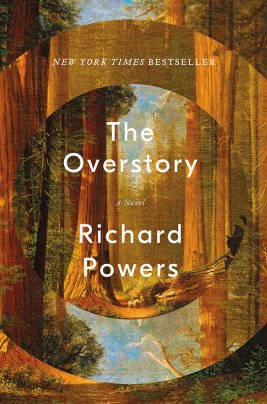
TheOverstory“To counteract this epidemic of short-term thinking,” says Fabiani, “it might be a good idea for more of us to read science fiction, specifically the post-apocalyptic sub-genre: that is, fiction dealing with the aftermath of major societal collapse, whether due to a pandemic, nuclear fallout, or climate change.”

I suggest widening the genre to include good dystopian eco-fiction, which includes not just post-apocalyptic tales but also cautionary tales, worlds in upheaval, and satires. Dystopian literature is ultimately an exploration of hope through personal experience. The eco-fiction protagonist navigates their dystopia by learning meaningful lessons—lessons that pertain directly to our reader in their current world. This is because the premise of a dystopia lies squarely in the present world. Good dystopias can enlighten and suggest possibilities; they can warn and herald. At the very least, they incite the necessary conversation.

On the Role of Dystopian Eco-Fiction
NaturalSelection-front-webI recently shared a panel discussion with writer Kristen Kiomall-Evans at the 2019 Limestone Genre Expo in Kingston entitled: “On the Role of (Dystopian) Literature and Environmental Issues: Can Books Save the Planet.” The audience of mostly women shared enlightened input in an open discussion, which spanned a range of topics and directions from what dystopian literature actually is to whether we are turned off by its negativity—that it may be too close to reality and makes us cringe and want to hide. One person even brought up Game of Thrones as an example; which I then bluntly suggested was not real “story”—it is a stream of episodic sensationalism and horror—aimed at thrilling shock value, not fulfilling meaning.

The group explored what Eco-Fiction is and the possibility of how eco-fiction writers can influence their audience to engage in helping the planet and humanity, in turn.

 “Science doesn’t tell us what we should do,” Barbara Kingsolver wrote in Flight Behavior “It only tells us what is.” Stories can never be a solution in themselves, but they have the capacity to inspire action. Margaret Atwood wrote in MaddAddam, “People need such stories, because however dark, a darkness with voices in it is better than a silent void.”

We explored several areas in which writers could elucidate ways to engage readers for edification, connection and participation. We discussed optimism, new perspectives, envisioning our future, and imaginative use of “product placement” to gain reader engagement and galvanize a movement of action.

Optimism in Story

I pointed out that good dystopias—like all good fiction—follow a character and story arc that must ultimately resolve (which Game of Thrones may never do, certainly not well—J.R.R. Martin’s books series upon which it is based are not even finished yet!). Eco-Fiction Dystopias often conclude with a strong element of hope, based on some positive aspect of humanity and the human spirit—which may include our own evolution. Think Day After Tomorrow, Year of the Flood, Windup Girl, The Postman, Darwin’s Paradox.
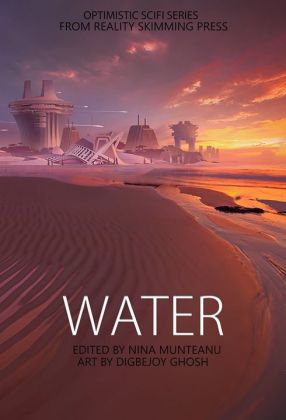
WaterAnthology-RealitySkimmingPress copyIn 2015, I joined Lynda Williams of Reality Skimming Press in creating an optimistic science fiction anthology with the theme of water. My foreword to Water addressed this point:

As we drank Schofferhoffers over salmon burgers, Lynda lamented that while the speculative / science fiction genre has gained a literary presence, this has been at some expense. Much of the current zeitgeist of this genre in Canada tends toward depressing, “self-interested cynicism and extended analogies to drug addiction as a means of coping with reality,” Lynda remarked. Where was the optimism and associated hope for a future? I brought up the “hero’s journey” and its role in meaningful story. One of the reasons this ancient plot approach, based on the hero journey myth, is so popular is that its proper use ensures meaning in story. This is not to say that tragedy is not a powerful and useful story trope; so long as hope for someone—even if just the reader—is generated. Lynda and I concluded that the science fiction genre could use more optimism. [As a result,] these stories explore individual choices and the triumph of human imagination in the presence of adversity. [Each story explores] the surging spirit of humanity toward hopeful shores.

New Perspectives in Story

Evans spoke of the emergence of and need for a strong voice by marginalized groups who would be most affected by things like habitat destruction and climate change. The poor and marginalized will most certainly make up the majority of climate change refugees, starved out and water shorted, and suffering malnutrition, violence and disease.

FifthSeason-JemisinEvans pointed out that afro-American writers (e.g., Octavia Butler, Walter Mosley, Nalo Hopkinson and N.K. Jemisin) and indigenous writers (Cherie Dimaline, Daniel Wilson, Drew Hayden Taylor) are an exciting voice, providing a new and compelling perspective on ongoing global issues.

I would add that the “feminine” voice—the voice of women and the voice of ecology and those who embrace the gylanic voice—are needed. This was strangely not mentioned in the group—perhaps because we were all women—but one. Such a voice can help personalize the experience to readers, by creating discovery, connection and understanding—and ultimately serving a key force in engaging readers to act.

Envisioning Our Future Through Story

One audience member shared a yearning for an optimistic focus through an envisioned world where solutions have successfully created that world. She wasn’t so much suggesting writing a utopia, but including elements of future wishes as an integral part of the world, following Ghandi’s wise advice: be the change you seek. In a recent interview in which I also participated in The Globe and Mail on women science fiction writers, Ottawa writer Marie Bilodeau addressed this concept:

“the best part about writing science fiction is showing different ways of being without having your characters struggle to gain rights. Invented worlds can host a social landscape where debated rights in this world – such as gay marriage, abortion and euthanasia – are just a fact of life.”

People are looking for hopeful fiction that addresses the issues but explores a successful paradigm shift. One that accurately addresses our current issues with intelligence and hope. The power of envisioning a certain future is that the vision enables one to see it as possible.

Product Placement in Story

Editor and naturalist Merridy Cox suggested that writers could make motivating connections through altruistic (not market-driven) “product placement.” She gave the example of an Ash tree. The Ash (Fraxinus species) could subtly make its name, its character and ecology known in the story, along with its plight—its destruction by the non-native invasive emerald ash borer. The use of metaphor and personification would easily link the Ash to a character and at the same time illuminate the reader on a real aspect of the environment to consider. Another example she gave was of the threatened bobolink bird, now all but gone. The bobolink originally made its home in the tallgrass prairie and other open meadows. As native prairies were cleared for farming, the bobolink was displaced and moved to living in hayfields and fallow fields—building their nests on the ground in dense grasses. Changing farm practices (shorter crop rotation and earlier maturing seed mixtures) are now destroying the bobolink’s last refuge.

bobolink-chicks-mom

Bobolink mother and her chicks

Such “product placement” essentially gives Nature and the environmental a personalized face that can easily interact with the story’s theme and its characters. “Product placement”—like symbol—lies embedded in its own story. In the case of the bobolink, it is a story of colonialism, exploitation, and single-minded pursuit at the expense of others not considered, known or understood. These examples have anthropogenic connections to human behaviour, action and knowledge—all related to story and theme.
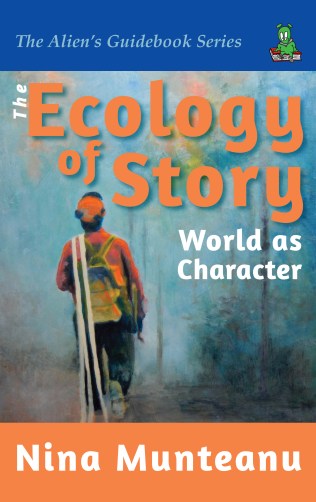
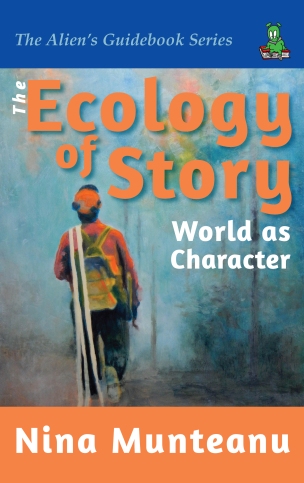
MockUpEcology copyIn my new writing guidebook The Ecology of Story: World as Character I discuss and explore how some authors do this impeccably. Authors such as Barbara Kingsolver, Richard Powers, Frank Herbert, Ray Bradbury, Thomas Hardy, Margaret Atwood, Alice Munro, Janet Fitch, John Steinbeck, David Mitchell, Joanne Harris and many others.

Writing for the Anthropocene

Learn how to write for the Anthropocene: from Habitats and Trophic Levels to Metaphor and Archetype…

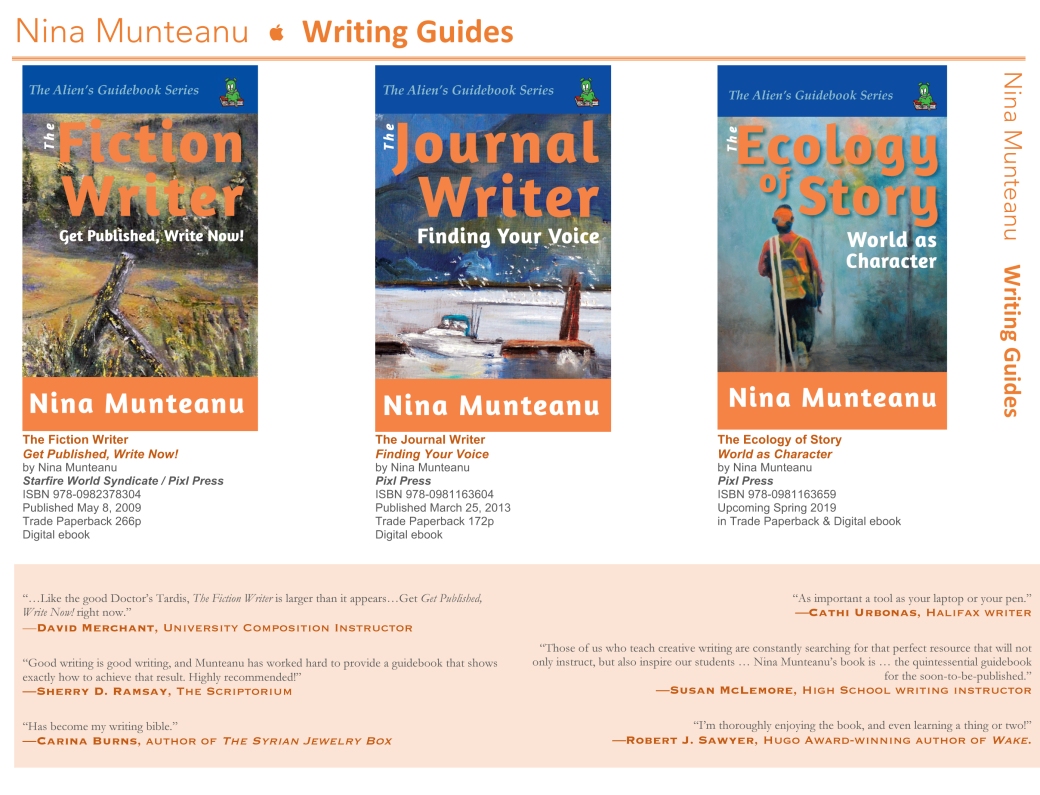
Learn the fundamentals of ecology, insights of world-building, and how to master layering-in of metaphoric connections and symbols between setting and character. “Ecology of Story: World as Character” is the 3rd guidebook in Nina Munteanu’s acclaimed “how to write” series for novice to professional writers.

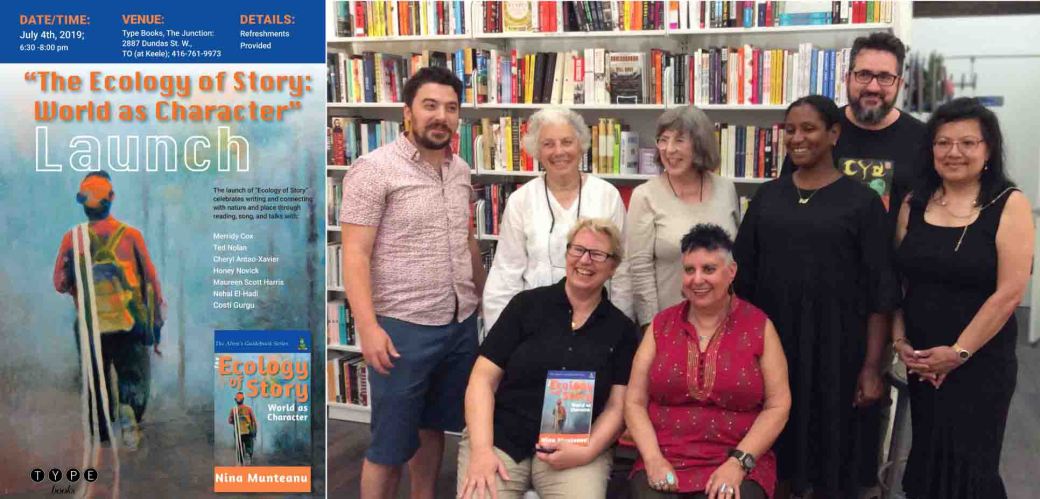
The Ecology of Story will be released by Pixl Press in June 2019.

nina-2014aaa

Nina Munteanu is a Canadian ecologist / limnologist and novelist. She is co-editor of Europa SF and currently teaches writing courses at George Brown College and the University of Toronto. Visit www.ninamunteanu.ca for the latest on her books. Nina’s bilingual “La natura dell’acqua / The Way of Water” was published by Mincione Edizioni in Rome. Her non-fiction book “Water Is…” by Pixl Press (Vancouver) was selected by Margaret Atwood in the New York Times ‘Year in Reading’ and was chosen as the 2017 Summer Read by Water Canada. Her novel “A Diary in the Age of Water” will be released by Inanna Publications (Toronto) in May 2020.

Ecology of Story: Place as Allegory

Birds deer lake

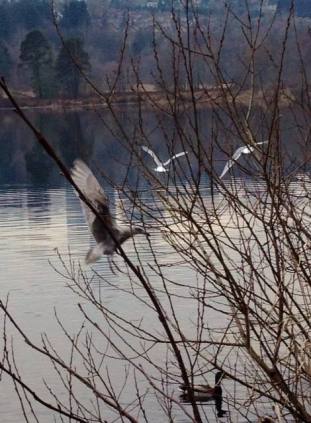
Birds on Deer Lake, BC (photo by Nina Munteanu)

An allegory is a complete narrative whose images and material things represent an abstract idea or theme such as a political system, religious practice or figure, or a philosophical viewpoint. The entire narrative is a metaphor in which all components are symbolic. Most fairy tales, folk tales and myths are allegories. Examples include: Edmund Spencer’s Faerie Queen; Mary Shelley’s Frankenstein; and Beowulf.

The narrative of allegory is a fractal nest of symbolic names, places and things, that contribute key elements to the story (e.g., Luke Skywalker and Han Solo in Star Wars; Gabriel Oak in Far From the Madding Crowd; John Savage of Stanger in a Strange Land; Darwin Mall in Darwin’s Paradox; Middle Earth in Lord of the Rings; Lilliput in Gulliver’s Travels). Setting and place in allegory symbolizes the theme being explored (e.g. Orwell’s farm in Animal Farm represents a totalitarian world of oppression; the road in John Bunyan’s Pilgrim’s Progress represents the journey of humankind; the island in William Golding’s Lord of the Flies represents the world at war).

As an aside, the science of place names, geographical names or toponyms (derived from a topographic feature) is called toponymy. The city of Montreal, for instance, is a toponym (named after le Mont Royal). Toponyms often come through the local vernacular. Given their link to cultural identity, such place names can provide a significant symbolic role in story.

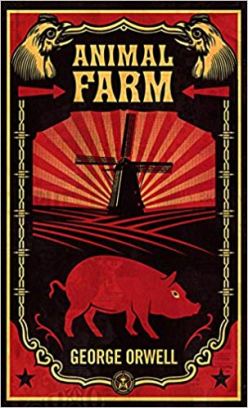
Animal Farm-GeorgeOrwellIn Animal Farm, George Orwell uses animals to describe the revolution against a totalitarian regime (e.g. the overthrow of the last Russian Csar and the Communist Revolution of Russia). The animals embrace archetypes to symbolize the actions and thoughts of various sectors within that world. The pigs are the leaders of the revolution; Mr. Jones represents the ruling despot who is overthrown; the horse Boxer is the ever-loyal and unquestioning labor class.
John Bunyan’s The Pilgrim’s Progress, published in 1678, tells the story of a narrator who falls asleep and dreams of a man named Christian fleeing the City of Destruction while bearing a heavy burden (e.g., symbolizing his own sins) on his back. A character named Evangelist shows Christian the way to Celestial City, a perilous journey through the Slough (swamp) as characters called Mr. Worldly Wiseman and Hypocrisy try to lead him astray.

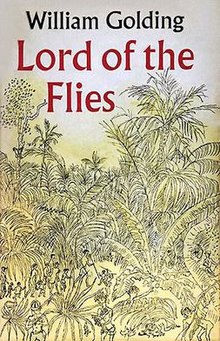
LordOfTheFlies-WilliamGoldingIn Lord of the Flies, William Golding explores the conflict in humanity between the impulse toward civilization and the impulse toward savagery. The symbols of the island, the ocean, the conch shell, Piggy’s glasses, and the Lord of the Flies, or the Beast, represent central ideas that reinforce this main theme. Each character has recognizable symbolic significance: Ralph represents civilization and democracy; Piggy represents intellect and rationalism; Jack represents self-interested savagery and dictatorship; and Simon (the outsider in so many ways) represents altruistic purity.
Many of Golding’s potent symbols to power his allegory come from the natural world. These include the use of smoke, fire, and snakes to invoke the imaginary beast (that exists within each of them). The scar left from the plane crash that destroys this natural paradise symbolizes our savage and destructive nature.

Allegories may also be powerful as satires. The social commentary of satires expose and criticize corruption and foolhardiness of societies, groups or even individuals through humor, irony and even ridicule. Gulliver’s Travels by Jonathan Swift is a good example of satire and parody. Swift targets politics, religion and western culture through satire. Aspects of place, landscape and setting are effectively used to feature his commentary. Another excellent example of political satire and use of place and setting with embedded character is found in Lewis Carroll’s Alice’s Adventures in Wonderland.

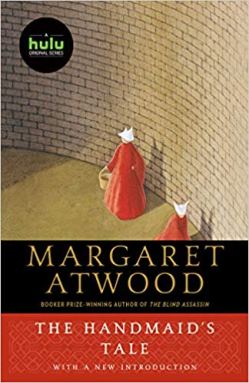
TheHandmaidsTale-MargaretAtwoodExcellent examples of satires with less obvious allegorical structure (but it’s there) can be found in the genre of science fiction—a highly metaphorical literature that makes prime use of place and setting with archetypal characters to satirize an aspect of society. Brave New World by Aldous Huxley is a satirical response to his observation of humans’ addiction to (sexual) pleasure and vulnerability to mind control and the dumbing of civilization in the 1930s. George Orwell’s Nineteen Eight-Four satirizes humanity’s vulnerability to fascism, based on his perception of humans’ sense of fear and helplessness under powerful governments and their oppressive surveillance. Margaret Atwood’s The Handmaid’s Tale satirizes a society in which a woman struggles in a fundamentalist Christian dictatorship patriarchy where women are forced into a system of sexual slavery for the ruling patriarchy.
Other examples include Stranger in a Strange Land by Robert Heinlein; The Dispossessed by Ursula K. Le Guin; The Time Machine by H. G. Wells; The Hunger Games by Suzanne Collins. Each of these stories examines the world of the day and provides critical commentary through premise, place and character. In each of these stories, place and setting help define premise and theme (e.g., what is being satirized.)


MockUpEcology copyThis article is an excerpt from The Ecology of Story: World as Character released in June 2019 by Pixl Press.

From Habitats and Trophic Levels to Metaphor and Archetype…

Learn the fundamentals of ecology, insights of world-building, and how to master layering-in of metaphoric connections between setting and character. “Ecology of Story: World as Character” is the 3rd guidebook in Nina Munteanu’s acclaimed “how to write” series for novice to professional writers.


Microsoft Word - Three Writing Guides.docx


nina-2014aaa

Nina Munteanu is a Canadian ecologist / limnologist and novelist. She is co-editor of Europa SF and currently teaches writing courses at George Brown College and the University of Toronto. Visit www.ninamunteanu.ca for the latest on her books. Nina’s bilingual “La natura dell’acqua / The Way of Water” was published by Mincione Edizioni in Rome. Her non-fiction book “Water Is…” by Pixl Press (Vancouver) was selected by Margaret Atwood in the New York Times ‘Year in Reading’ and was chosen as the 2017 Summer Read by Water Canada. Her novel “A Diary in the Age of Water” will be released by Inanna Publications (Toronto) in 2020.

Ecology of Story: Place as Symbol

Birds deer lake

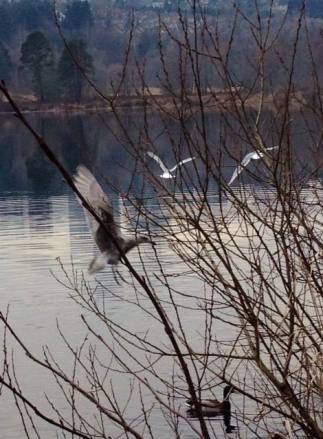
Birds over Deer Lake, BC (photo by Nina Munteanu)

“In their simplest form, symbols are anything outward that stands in for anything inward or abstract, such as a mood or an idea,” writes Donald Maass in Writing the Breakout Novel Workbook. As representations, symbols often serve as markers in a story. They may be a talisman, a totem that inspires a shift or awakening. In story, a symbol—particularly as talisman—may come as a gift to a character in need of inspiration. In the Hero’s Journey trope, this is often provided by a mentor archetype.

An example in story is the light saber that Obi Wan Kenobi presents to Luke Skywalker to aid him on his journey as a Jedi master. Symbols often reoccur as motif to incite an emotional trigger or turning point for a character.

Symbolism in literature provides richness, colour and depth of meaning. Use of symbols helps deepen theme beyond conscious appreciation and into emotional and subconscious levels. Symbolism can be portrayed through figure of speech in which an object or situation has another meaning than its literal meaning. It can also express through the actions and observations of a character, language or event that creates deeper meaning through context.

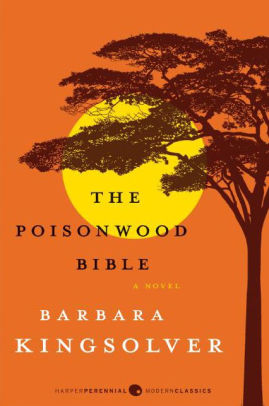
Maass provides the example of Barbara Kingsolver’s The Poisonwood Bible to depict superb use of symbol in storytelling:

Poisonwood Bible-KingsolverShe is inhumanly alone. And then, all at once, she isn’t. A beautiful animal stands on the other side of the water. They look up from their lives, woman and animal, amazed to find themselves in the same place. He freezes, inspecting her with his black-tipped ears. His back is purplish-brown in the dim light, sloping downward from the gentle hump of his shoulders. The forest’s shadows fall into lines across his white-striped flanks. His stiff forelegs play out to the sides like stilts, for he’s been caught in the act of reaching down for water. Without taking his eyes from her, he twitches a little at the knee, then the shoulder, where a fly devils him. Finally he surrenders his surprise, looks away, and drinks. She can feel the touch of his long, curled tongue on the water’s skin, as if he were lapping from her hand. His head bobs gently, nodding small, velvet horns lit white from behind like new leaves. 
It lasted just a moment, whatever that is. One held breath? An ant’s afternoon? It was brief, I can promise that much, for although it’s been many years now since my children ruled my life, a mother recalls the measure of the silences. I never had more than five minutes peace unbroken. I was that woman on the stream bank, of course. Orleanna  Price, Southern Baptist by marriage, mother of children living and dead. That one time and no other the okapi came to the stream, and I was the only one to see it.

In this opening to her novel, Kingsolver explores a multi-layered symbol for her main character’s bewilderment at the mystery and beauty of the environment around her, tied into her own essential helplessness, says Maass. “Part of what makes [Kingsolver’s] symbols poetic is that all of them emerge from the natural world around her characters,” he adds. Nature’s symbols are powerful archetypes that reveal compelling story. These symbols abound in Kingsolver’s novel that explores the relationships of five women with their environment and the rigid ignorance of their patriarch, Nathan Price. The garden, Maass tells us, provides many examples of this. Price has planted his seeds in a flat, not accounting for the torrential afternoon downpours, which wash away his garden in a flash. Later, the poisonwood tree in their yard gives Price a horrid rash, suggesting that he is messing with a place he does not understand or respect. How each of the women interacts with her environment over time provides a deeply felt and metaphoric revelation of how she relates to others and to herself—all reflecting her personal journey in the story. As the quote indicates, Orleanna Price experienced a turning point through discovery. In this example the discovery occurred through a sudden encounter with a natural element.

In my near-future speculative novel A Diary in the Age of Water, cynical limnologist Lynna sees everything in her life through limnological metaphors, ironically predicting her own future:

Diary Water cover finalAn oligotrophic lake is basically a young lake. Still immature and undeveloped, an oligotrophic lake often displays a rugged untamed beauty. An oligotrophic lakes hungers for the stuff of life. Sediments from incoming rivers slowly feed it with dissolved nutrients and particulate organic matter. Detritus and associated microbes slowly seed the lake. Phytoplankton eventually flourish, food for zooplankton and fish. The shores then gradually slide and fill, as does the very bottom. Deltas form and macrophytes colonize the shallows. Birds bring in more creatures. And so on. Succession is the engine of destiny and trophic status its shibboleth.
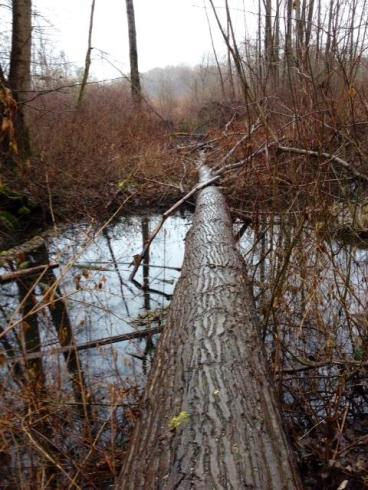
As Nature tames the unruly lake over time, one thing replaces another. As a lake undergoes its natural succession from oligotrophic to highly productive eutrophic lake, its beauty mellows and it surrenders to the complexities of destiny. Minimalism yields to a baroque richness that, in turn, heralds extinction. The lake shrinks to a swamp then buries itself under a meadow.

We hold ourselves apart from our profligate nature. But we aren’t unique. We are more part of Nature than we admit. Using the thread of epigenetics and horizontal gene transfer, Nature stitches in us a moving tapestry of terrible irony. The irony lies in our conviction that we were made in the inimitable divine image of God. That we are special. Yet over a third of the human population is secular—atheists and agnostics—who do not believe in God. Or anything, for that matter. 

Water flows endlessly through us, whether we’re devout Catholics or empty vessels with no purpose. Water makes no distinction. It flows through us even after we bury ourselves.

Log over water forest-DeasPark

Log in water, BC (photo by Nina Munteanu)

In the following excerpt from Brokeback Mountain, Annie Proulx uses a mix of senses—but mostly smell—in an evocative description of two shirts to symbolize a love loss:

The shirt seemed heavy until he saw there was another shirt inside it, the sleeves carefully worked down inside Jack’s sleeves. It was his own plaid shirt, lost, he’d thought, long ago in some damn laundry, his dirty shirt, the pocket ripped, buttons missing, stolen by Jack and hidden here inside Jack’s own shirt, the pair like two skins, one inside the other, two in one. He pressed his face into the fabric and breathed in slowly through his mouth and nose, hoping for the faintest smoke and mountain sage and salty sweet stink of Jack, but there was no real scent, only the memory of it, the imagined power of Brokeback Mountain of which nothing was left but what he held in his hands. 

In my short story The Way of Water, water’s connection with love flows throughout the story:

The Way of Water-COVERThey met in the lobby of a shabby downtown Toronto hotel. Hilda barely knew what she looked like but when Hanna entered the lobby through the front doors, Hilda knew every bit of her. Hanna swept in like a stray summer rainstorm, beaming with the self- conscious optimism of someone who recognized a twin sister. She reminded Hilda of her first boyfriend, clutching flowers in one hand and chocolate in the other. When their eyes met, Hilda knew. For an instant, she knew all of Hanna. For an instant, she’d glimpsed eternity. What she didn’t know then was that it was love.
Love flowed like water, gliding into backwaters and lagoons with ease, filling every swale and mire. Connecting, looking for home. Easing from crystal to liquid to vapour then back, water recognized its hydrophilic likeness, and its complement. Before the inevitable decoherence, remnants of the entanglement lingered like a quantum vapour, infusing everything. Hilda always knew where and when to find Hanna on Oracle, as though water inhabited the machine and told her. Water even whispered to her when her wandering friend was about to return from the dark abyss and land unannounced on her doorstep.

In a world of severe water scarcity through climate catastrophe and geopolitical oppression, the bond of these two girls—to each other through water and with water—is like the shifting covalent bond of a complex molecule, a bond that fuses a relationship of paradox linked to the paradoxical properties of water. Just as two water drops join, the two women find each other in the wasteland of intrigue. Hilda’s relationship with Hanna—as with water—is both complex and shifting according to the bonds they make and break.


MockUpEcology copyThis article is an excerpt from “The Ecology of Story: World as Character” released in June 2019 by Pixl Press.

From Habitats and Trophic Levels to Metaphor and Archetype…

Learn the fundamentals of ecology, insights of world-building, and how to master layering-in of metaphoric connections between setting and character. Ecology of Story: World as Character is the 3rd guidebook in Nina Munteanu’s acclaimed “how to write” series for novice to professional writers.


Microsoft Word - Three Writing Guides.docx


nina-2014aaa

Nina Munteanu is a Canadian ecologist / limnologist and novelist. She is co-editor of Europa SF and currently teaches writing courses at George Brown College and the University of Toronto. Visit www.ninamunteanu.ca for the latest on her books. Nina’s bilingual “La natura dell’acqua / The Way of Water” was published by Mincione Edizioni in Rome. Her non-fiction book “Water Is…” by Pixl Press (Vancouver) was selected by Margaret Atwood in the New York Times ‘Year in Reading’ and was chosen as the 2017 Summer Read by Water Canada. Her novel “A Diary in the Age of Water” will be released by Inanna Publications (Toronto) in 2020.

Ecology of Story: Place as Metaphor

Birds deer lake

Birds flying over Deer Lake, BC (photo by Nina Munteanu)

Ray Bradbury once told me that everything in story is metaphor. That is no more apparent than in setting and place, in which a story is embedded and through which characters move and interact. Metaphor is the subtext that provides subtleties in story, subtleties that evoke mood, anticipation, and memorable scenes. Richard Russo says, “to know the rhythms, the textures, the feel of a place is to know more deeply and truly its people.” When you choose your setting, remember that its primary metaphoric role is to help depict theme. This is because place is destiny.

Metaphor provides similarity to two dissimilar things through meaning. In the metaphor “Love danced in her heart” or the simile “his love was like a slow dance”, love is equated with the joy of dance. By providing figurative rather than literal description to something, metaphor invites participation through interpretation.

When I write “John’s office was a prison,” I am efficiently and sparingly suggesting in five words—in what would normally take a paragraph—how John felt about his workplace. The reader would conjure imagery suggested by their knowledge of a prison cell: that John felt trapped, cramped, solitary, stifled, oppressed—even frightened and threatened. Metaphor relies on sub-text knowledge.

This is why metaphor is so powerful and universally relevant: the reader fully participates—the reader brings in relevance through their personal knowledge and experience and this creates the memorable aspect to the scene.

Russo tells us that place is crucial to human destiny and the formation of human personality. “The more specific and individual things become, the more universal they feel,” says Russo. This is not an oxymoron, but an example of the principle of a truism that primarily comes to us in the form of paradox (like all good truisms). Detail provides the color and texture of your story and helps it resonate with a sense of place. This does not necessarily translate into a lot of exposition; but it does require creative choice of words. So, instead of “He took a drag from his cigarette as he drove his sports car along a winding road in the country”; (twenty words) try something like “Vinnie sucked on a Camel as his red Corvette careered the hair-pinned curves of Hell’s Gate.” (seventeen words).

Place Personified

Tree-YellowBirch winter-LR

Old yellow birch tree in Little Rouge woodland (photo by Nina Munteanu)

Personification is powerful metaphor that gives nonhuman things human qualities. It personalizes, energizes and emotionalizes. Place described through personification can illuminate both characters and their environment in compelling ways. By giving an object, place, or animal the qualities of a person, personification provides subtle aspects of mood and links the reader to a cocktail subtext of human feelings and struggles. Personification can connect the reader to “lifeless” objects such as water, soil, rock, the sun, moon, planet, concrete, paper, etc., to map the larger meaning of the story. Putting a character’s feelings into the objects around her—as POV character—creates a subtle but deep connection with the reader: “The darkness embraced her”; “The open-throated roar of the river pulled her near.”

D.H. Lawrence’s creates strong personification of Thomas Hardy’s Egdon Heath in Return of the Native:

…Egdon, whose dark soil was strong and crude and organic as the body of a beast.

In The Handmaid’s Tale—a dystopian tale of oppression and intrigue—Margaret Atwood writes:

There is something subversive about this garden of Serena’s, a sense of buried things bursting upwards, wordlessly, into the light, as if to point, to say: Whatever is silenced will clamour to be heard, though silently … Light pours down upon it from the sun, true, but also heat rises, from the flowers themselves, you can feel it: like holding your hand an inch above an arm, a shoulder. It breathes, in the warmth, breathing itself in.

Martin Nolan’s Still Point creates powerful imagery of a storm aftermath through an abandoned old shed and contrasts its loneliness to the half-wild woods nearby:

A deserted shed by the road, buckling under its roof, kneels into the tall grass. The woods beyond it hide the river … I turn back to the half-wild woods. These trees speak to each other, are wild enough for that. They live together, holding the riverbanks in place.

Cixin Liu’s The Three Body Problem—set against the backdrop of China’s Cultural Revolution—follows Wenji Ye, disillusioned by the massive environmental deforestation in the labour camps she is sent to work:

Her company wielded hundreds of chain saws like a swarm of steel locusts, and after they passed, only stumps were left. The fallen Dahurian larch, now bereft of branches, was ready to be taken away by tractor. Ye gently caressed the freshly exposed cross section of the felled trunk. She did this often, as though such surfaces were giant wounds, as though she could feel the tree’s pain …

Clearcut gordon valley-BW

Clearcut in Gordon Valley, British Columbia (photo by T.J. Watts)

In Memory of Water, Emmi Itäranta personifies this life-giving substance whose very nature is tightly interwoven with her main character. As companion and harbinger, water is portrayed simultaneously as friend and enemy. As giver and taker of life.

Water is the most versatile of all elements … Water walks with the moon and embraces the earth, and it isn’t afraid to die in fire or live in air. When you step into it, it will be as close as your own skin, but if you hit it too hard, it will shatter you … Death is water’s close companion. The two cannot be separated, and neither can be separated from us, for they are what we are ultimately made of: the versatility of water, and the closeness of death. Water has no beginning and no end, but death has both. Death is both. Sometimes death travels hidden in water, and sometimes water will chase death away, but they go together always, in the world and in us.

Personification of natural things provides the reader with an image they can clearly and emotionally relate to and care about. When a point-of-view character does the describing, we get a powerful and intimate indication of their thoughts and feelings—mainly in how they connect to place (often as symbol). When this happens, place and perception entwine in powerful force.


MockUpEcology copyThis article is an excerpt from “The Ecology of Story: World as Character” due in June 2019 by Pixl Press.


From Habitats and Trophic Levels to Metaphor and Archetype…

Learn the fundamentals of ecology, insights of world-building, and how to master layering-in of metaphoric connections between setting and character. Ecology of Story: World as Character is the 3rd guidebook in Nina Munteanu’s acclaimed “how to write” series for novice to professional writers.


Microsoft Word - Three Writing Guides.docx

nina-2014aaa

Nina Munteanu is a Canadian ecologist / limnologist and novelist. She is co-editor of Europa SF and currently teaches writing courses at George Brown College and the University of Toronto. Visit www.ninamunteanu.ca for the latest on her books. Nina’s bilingual “La natura dell’acqua / The Way of Water” was published by Mincione Edizioni in Rome. Her non-fiction book “Water Is…” by Pixl Press (Vancouver) was selected by Margaret Atwood in the New York Times ‘Year in Reading’ and was chosen as the 2017 Summer Read by Water Canada. Her novel “A Diary in the Age of Water” will be released by Inanna Publications (Toronto) in 2020.


Ecology of Story: Place as Character & Archetype

Birds deer lake

Birds flying over Deer Lake, BC (photo by Nina Munteanu)

A novelist, when portraying several characters, may often find herself painting a portrait of a place. This is place being “character.” Place functions as a catalyst, and molds the more traditional characters that animate a story. Think of any of your favorite books, particularly the epics: The Wizard of Oz, Tale of Two Cities, Doctor Zhivago, Lord of the Rings, The Odyssey, etc. In each of these books the central character is the place, which is firmly linked to its main character. How much is Frodo, for instance, an extension of his beloved Shire? They are one in the same. Just as the London of Charles Dickens spawned Scrooge.

Place ultimately portrays what lies at the heart of the story. Place as character serves as an archetype that story characters connect with and navigate in ways that depend on the theme of the story. A story’s theme is essentially the “so what part” of the story. What is at stake for the character on their journey. Theme is the backbone—the heart—of the story, driving characters to journey through time and place toward some kind of fulfillment. There is no story without theme. And there is no theme without place.

Things to consider about place as character begin with the POV character and how they interact with their environment and how they reflect their place. For instance is that interaction obvious or subtle? Is that environment constant or changing, stable or unstable, predictable, or variable? Is the place controllable or not, understandable or not? Is the relationship emotional, connected to senses such as memory?

I discuss archetypes in detail, particularly as part of the “Hero’s Journey” in Chapter J of The Fiction Writer. In summary, archetypes are ancient patterns of personality shared universally by humanity (e.g. the “mother” archetype is recognized by all cultures). When place acts as an archetype or symbol in story—particularly when linked to theme—it provides a depth of meaning that resonates through many levels for the reader. From obvious to subtle.

A subtle yet potent example of this is provided by Annie Proulx’s novel The Shipping News; Proulx uses subtle body language of her protagonist to provide a strong sense of place. The main character, Quoyle, displays a self-conscious gesture of covering his strong native chin with his hand until he leaves New York to his homeland of Newfoundland from where he is descended— a place where he can live a natural and graceful life without apology.

In Ray Bradbury’s The Martian Chronicles, Mars symbolizes a new Eden—though unimagined. Like Bradbury’s aboriginal Martians—who are mostly invisible—the planet is a mirror that reflects humanity’s best and worst. Who we are, what we are, what we bring with us and what we may become. What we inadvertently do—to others, and finally to ourselves—and how the irony of chance can change everything.

Martian ChroniclesThey came because they were afraid or unafraid, happy or unhappy. There was a reason for each man. They were coming to find something or get something, or to dig up something or bury something. They were coming with small dreams or big dreams or none at all.

The 1970 Bantam book jacket aptly calls The Martian Chronicles, “a story of familiar people and familiar passions set against incredible beauties of a new world … A skillful blending of fancy and satire, terror and tenderness, wonder and contempt.”

Written in the 1940s, The Martian Chronicles drip with a nostalgic atmosphere — shady porches with tinkling pitchers of lemonade, grandfather clocks, chintz-covered sofas. But longing for this comfortable past proves dangerous in every way to Bradbury’s characters — the golden-eyed Martians as well as the humans. Starting in the far-flung future of 1999, expedition after expedition leaves Earth to explore Mars. The chameleon-like Martians guard their mysteries well, but soon succumb to the diseases that arrive with the rockets — recapitulating the tragedies that European colonization imposed on our indigenous peoples. Colonists appear on Mars, most of them with ideas no more lofty than starting a hot-dog stand, and with no respect for the culture they are impacting and an entire people they are destroying. Bradbury weaves metaphor into the opening when the heat of a rocket ship turned an Ohio dark winter into summer:

Rocket summer. The words passed among the people in the open, airing houses. Rocket summer. The warm desert air changing the frost patterns on the windows, erasing the art work. The skis and sleds suddenly useless. The snow, falling from the cold sky upon the town, turned to a hot rain before it touched the ground.

Rocket summer. People leaned form their dripping porches and watched the reddening sky. The rocket lay on the launching field, blowing out pink clouds of fire and even heat. The rocket stood in the cold winter morning, making summer with every breath of its mighty exhausts. The rocket made climates, and summer lay for a brief moment on the land…

What unfolds is a profound and tender analysis of the quiet yet devastating power humanity can wield unawares. Bradbury paints a multi-layered tapestry of hopes and dreams through metaphor. To Bradbury everything a writer writes is metaphor. Metaphor is powerful through perspective. It makes the ordinary strange and the strange ordinary.

MemoryOfWater_Emmi ItarantaIn Emmi Itäranta’s Memory of Water—about a post-climate change world of sea level rise—water is a powerful archetype, whose secret tea masters guard with their lives:

The story tells that water has a consciousness, that it carries in its memory everything that’s ever happened in this world, from the time before humans until this moment, which draws itself in its memory even as it passes. Water understands the movements of the world; it knows when it is sought and where it is needed. Sometimes a spring or a well dries for no reason, without explanation. It’s as if the water escapes of its own will, withdrawing into the cover of the earth to look for another channel. Tea masters believe there are times when water doesn’t wish to be found because it knows it will be chained in ways that are against its nature.

ThePenelopiadWater, with its life-giving properties and other strange qualities, has been used as a powerful metaphor and archetype in many stories: from vast oceans of mystery, beauty and danger—to the relentless flow of an inland stream. Margaret Atwood’s The Penelopiad is just one example:

Water does not resist. Water flows. When you plunge your hand into it, all you feel is a caress. Water is not a solid wall, it will not stop you. But water always goes where it wants to go, and nothing in the end can stand against it. Water is patient. Dripping water wears away a stone. Remember that, my child. Remember you are half water. If you can’t go through an obstacle, go around it. Water does.

MockUpEcology copyThis article is an excerpt from “The Ecology of Story: World as Character” released in June 2019 by Pixl Press.

From Habitats and Trophic Levels to Metaphor and Archetype…

Learn the fundamentals of ecology, insights of world-building, and how to master layering-in of metaphoric connections between setting and character. Ecology of Story: World as Character is the 3rd guidebook in Nina Munteanu’s acclaimed “how to write” series for novice to professional writers.


Microsoft Word - Three Writing Guides.docx


nina-2014aaa

Nina Munteanu is a Canadian ecologist / limnologist and novelist. She is co-editor of Europa SF and currently teaches writing courses at George Brown College and the University of Toronto. Visit www.ninamunteanu.ca for the latest on her books. Nina’s bilingual “La natura dell’acqua / The Way of Water” was published by Mincione Edizioni in Rome. Her non-fiction book “Water Is…” by Pixl Press (Vancouver) was selected by Margaret Atwood in the New York Times ‘Year in Reading’ and was chosen as the 2017 Summer Read by Water Canada. Her novel “A Diary in the Age of Water” will be released by Inanna Publications (Toronto) in 2020.

Ecology of Story: The Difference Between Anecdotes and Stories—How to Tell a Good Story

Birds deer lake

Birds fly over Deer Lake, BC (photo by Nina Munteanu)

In her article in Quartz Magazine, Lila MacLellan suggests that “we’ve become masters of telling anecdotes, and terrible at telling our friends real stories.” Sometimes people think they are telling a story, but they are really just telling anecdotes, MacLellan reports after interviewing Maggie Cino, senior story producer for Moth storytelling series. While “anecdotes just relate facts,” Cino explains, stories are “about letting us know that things started one way and ended a different way.” Stories create space for movement.

Merriam-Webster defines an anecdote as a “short narrative of an interesting, amusing, or biographical incident.” Anecdotes serve to incite interest and to illustrate a point. They are often amusing, odd, sad or even tragic; if they are biographical, they often serve to reflect someone’s personality, attitude or philosophy. While anecdotes often provide a contextual jumping board to make a point—drawing you in with relevance—they lack the structure of stories. An anecdote is something that happens; a story has a structure that makes it memorable and provides a depth of meaning.

Stories move with direction; they have a beginning, middle and end. Stories evoke emotional truths. They compel with intrigue then fulfil us with awareness and, sometimes, understanding. The best stories are told through metaphor, those universal truths we all live by. And all good stories weave a premise, theme, plot, character and setting into a tapestry with meaning.

I teach new writers at the University of Toronto and George Brown College how to tell stories. I teach how stories can tell us who we are. Where we’ve been. And sometimes, where we are  going. The stories that stir our hearts come from deep inside, where the personal meets the universal, through symbols or archetypes and metaphor.

Depth psychologist Carl Jung described these shared symbols, metaphors and archetypes as pre-existing forms of the psyche. He drew parallels between synchronicity, relativity theory and quantum mechanics to describe life as an expression of a deeper order. He believed that we are both embedded in a framework of a whole and are the focus of that whole. Jung was describing a fractal whole, which reflects quantum scientist David Bohm’s quantum vision of holomovement.

Jung’s concept of embedded whole and a universal collective unconscious was embraced by Hero’s Journey author and scholar Joseph Campbell, who suggested that these mythic images lie at the depth of the unconscious where humans are no longer distinct individuals, where our minds widen and merge into the mind and memory of humankind—where we are all the same, in Unity. Carl Jung’s thesis of the “collective unconscious” in fact linked with what Freud called archaic remnants: mental forms whose presence cannot be explained by anything in the individual’s own life and which seem aboriginal, innate, and the inherited shapes of the human mind. Marie-Louise von Franz, in 1985, identified Jung’s hypothesis of the collective unconscious with the ancient idea of an all- extensive world-soul. Writer Sherry Healy suggested that Jung viewed the human mind as linked to “a body of unconscious energy that lives forever.”

What Makes a Good Story?

subway

Passengers on the Toronto subway (photo by Nina Munteanu)

A good story is about something important; attracted by gravity, it has purpose and seeks a destination. A good story goes somewhere; it flows like a river from one place to another. A good story has meaning; its undercurrents run deep across hidden substrates with intrigue. A good story resonates with place; it finds its way home. We’ve just touched upon the five main components of good story: premise, character on a journey & plot, theme and—what is ultimately at the heart of a story—setting or place.

Story Components

The premise of a story is like the anecdote, a starting point of interest. It is an idea that will be dramatized through plot, character and setting. In idea-driven stories, it can often be identified by asking the question: “What if?” For instance, what if time travel was possible?

A character on a journey propels the story through meaningful change. Characters provide dramatized meaning to premise through personal representation of global themes. A character takes an issue and through their actions and circumstance in story provide a fractal connection to a larger issue. Characters need to move. They need to “go somewhere.” Archetypes—ancient patterns of personality (symbols) shared by humanity and connected by our collective unconscious—are metaphoric characters (which includes place) in the universal language of storytelling that help carry the story forward.

The theme of a story takes the premise and gives it personal and metaphoric meaning by dramatizing through a character journey. It is often identified by asking the question: “What’s at stake?” In taking the time travel premise, a theme of forgiveness may be applied by choosing a character wishing to return to the past to right a wrong, when what they just need to do is forgive others and themselves, not travel to the past at all, and get on with their lives.

DS-2008-26

Cliff diving on BC coast (photo by Nina Munteanu)

In such a story, the plot would provide means and obstacles for the character in their journey toward enlightenment. Plot works together with theme to challenge and push a character toward their epiphany and meaningful change. Plot provides obstacles. Challenges. Emotional turning points. Opportunities for learning and change.

The role of setting or place is often not as clear to writers. Because of this, place and setting may often be neglected and haphazardly tacked on without addressing its role in story; in such a case the story will not resonate with what is often at the heart of the story: a sense of place. In stories where the setting changes (either itself changing such as in a story about the volcanic eruption of Vesuvius impacting Pompeii’s community; or by the character’s own movements from place to place) it appears easier to include how setting affects characters. However, the effect of place on character when the setting does not change can be equally compelling even if more subtle; the change is still there but lies in the POV character’s altered relationship to that place—a reflection of change within them.


MockUpEcology copyThis article is an excerpt from “The Ecology of Story: World as Character” due in June 2019 by Pixl Press.

From Habitats and Trophic Levels to Metaphor and Archetype…

Learn the fundamentals of ecology, insights of world-building, and how to master layering-in of metaphoric connections between setting and character. Ecology of Story: World as Character is the 3rd guidebook in Nina Munteanu’s acclaimed “how to write” series for novice to professional writers.


nina-2014aaa

Nina Munteanu is a Canadian ecologist / limnologist and novelist. She is co-editor of Europa SF and currently teaches writing courses at George Brown College and the University of Toronto. Visit www.ninamunteanu.ca for the latest on her books. Nina’s bilingual “La natura dell’acqua / The Way of Water” was published by Mincione Edizioni in Rome. Her non-fiction book “Water Is…” by Pixl Press (Vancouver) was selected by Margaret Atwood in the New York Times ‘Year in Reading’ and was chosen as the 2017 Summer Read by Water Canada. A collection of Nina’s short eco-fiction can be found in “Natural Selection” by Pixl Press.  Her novel “A Diary in the Age of Water” will be released by Inanna Publications (Toronto) in 2020.


Morphology 2019–Celebrating A New Marsh in Mississauga with Quotes from “Water Is…”

Water Is Life copy

March 22 was World Water Day. As with last year at this same time and place, a brisk wind followed me into the industrial brick building that used to be the Small Arms Inspection Building—now converted into a community arts and culture centre.

JimTovey-Dowd-Morphology-JStewart

Councillor Jim Tovey and Lieutenant Governor Elizabeth Dowdeswell (photo by John Stewart)

Lakeview Plan copy

Plan of the conservation site

I was here to celebrate the late Jim Tovey’s dream of creating a 26-hectare park and marsh on Mississauga’s Lake Ontario shore that will connect the Waterfront Trail with Lake Ontario’s shorefront for the public.

Several dozen photographs that documented the annual and seasonal changes of the developing marsh occupied the spacious hall. The glow of evening sunlight streamed through, touching large photographs that hung from the high ceilings or were mounted on walls. Some photographs spanned over 2 by 3 metres.

Quotes from my books “Water Is…” (Pixl Press, 2016) and upcoming “A Diary in the Age of Water” (Inanna Publications, 2020) were displayed among the photographs.

Photo Julie Knox

Photograph by Julie Knox

I was mesmerized by the spectacular photographic display.

Larger than life photographs caught my attention through light, form and unique perspective. Once caught, I was drawn into their complex narrative. A narrative of morphing shapeshifters, flowing humours and tricksters in the night. Panoramas that stretched over giant muddy holes depicting an evolution of landscape from wet

Photo Gabriella Bank2 copy

Photo by Gabriella Bank

to dry to wet again.

Tree bole, rock and rebar formed bizarre companions in murky pools that harbour life finding itself. Piles of giant boulders shouted their presence to a stormy lake. A frontend loader sat peacefully beneath a glowing sunset. Slopes of wild herbs reached into ponds as if looking for hidden treasure.  Mangled rebar contorted in a frozen ice-dance. A man’s boot tracks cut recursive patterns in the silky mud.

The photographs provided a range of perspectives over the seasons on the early phase of the marsh construction that featured aquatic habitat structures built four metres below the level of Lake Ontario. Councillor Tovey had earlier said of the construction project: “It sort of looks like a Salvador Dali surrealistic sculpture garden…and what an interesting way to really celebrate all of this.”

WaterMeanders2

The Morphology 2019 Photography Exhibit marks the third year of celebrating this morphing natural landscape through the photography of eleven creative photo artists. The opening day of Morphology 2019 was celebrated with a blessing by Cathie Jamieson, Councillor Mississaugas of the Credit First Nation. Lee Tovey spoke as did members of the contributing partners and Mayor Bonnie Crombie of the City of Mississauga.

Water Is Wisdom copy

Construction of the site and marsh began in November 2016 and is ongoing and expected to continue until 2024-2026, when the site will be opened to the public. Starting in 2017, the eleven photographers toured the site to capture the seasonal and annual changes of the developing wetland. I was also invited to tour the site to glimpse a moonscape of dirt and clean rubble as dozers pushed material out to form cells and reclaim marsh habitat from open lake.

Nina-Lee-marsh2Z

the author and Lee Tovey overlooking one of the marsh cells

In November of 2017, I walked the undulating “moonscape” with Lee Tovey and Zoe Danahy. Rolling berms snaked around pooled and dry depressions that disappeared in the fog. The smell of rain and mud pervaded as we set out in ankle-deep mud toward the snaking berms. I scrambled over rip rap chunks larger than me to glimpse Lake Ontario—its new shoreline re-imagined. Beyond, the lake vanished in a veil of fog. I was told that on a clear day you could see the Toronto Waterfront and the CN Tower. All I could make out was a few ghost trees that marked the nearby eastern shoreline.

Lee took me along a dyke embankment of clean fill made of red brick and cement riprap from various construction sites. “Clean fill” refers to anything like brick, top soil, gravel, and cement that has been tested for possible contaminants, as opposed to plastic, glass, or metals.

Nina-Lee-marsh bermZ

The author with Lee Tovey on riprap berm

Lee pointed left and right of us to depressions (containment cells) where Lake Ontario was being reclaimed for marsh-building. The depression on my left was still full of water; but the one on my right was fairly dry and already populated with anchored logs and shrub plantings to consolidate the wetland and provide refuge for marsh life. I could hear the large pump actively removing lake water at the south end of the evolving wetland. Beyond the high berm of human-sized riprap was the lake, its shoreline now redefined.

Water-travel

As I gazed over the brown monochromatic landscape, I imagined a tapestry of greens in Councillor Jim Tovey’s vision: 26 hectares of future wetlands, forest and meadow and beach spanning the Lake Ontario shoreline from the old Lakeview generating station to the Toronto line at Marie Curtis Park. Part of the Inspiration Lakeview development, the marsh and wetland park have now been named The Jim Tovey Lakeview Conservation Area.

WaterIs magic-photo

Morphology

Morphology was conceived by the late visionary councillor Jim Tovey who envisioned an evolving photography and writing exhibit to follow the progress of the marsh creation project of what is now The Jim Tovey Lakeview Conservation Area. Spearheaded and nurtured by Councillor Tovey, the marsh construction was part of 26 hectares of future wetlands, forest, meadow and beach. The Lakeview Waterfront Connection will span the Lake Ontario shoreline from the old Lakeview generating station to the Toronto line at Marie Curtis Park. Part of the Inspiration Lakeview development, it will restore pedestrian and cyclist access to a previously forbidden section of the waterfront to “connect 9.5 kilometers of shoreline for water’s edge experience for the public,” said Councillor Tovey.

P01

To celebrate the residential / park development, eleven professional photographers were invited to photograph the marsh construction during its early phases. These images, along with water-inspired narrative provided by limnologist-author Nina Munteanu, were first displayed in an exhibit during a gala event January 14 2018, hosted at the Lakeview water treatment plant. Following Councillor Tovey’s untimely passing, his wife Lee Tovey and others (e.g., TRCA, CVC, Region of Peel) are continuing the project. Morphology was displayed for the public on World Water Day, March of 2018, at the Great Hall in the Mississauga Civic Centre. Its third appearance was at the In Situ Multi Arts Festival in November 2018.

Morphology-Exhibit hall

Morphology Exhibit at the Great Hall, Mississauga Civic Centre

The artist showcase is expected to become an annual event, highlighting the progress of constructed ecosystem. Morphology features works from: Gabriella Bank, Sandor Bank, PJ Bell, Darren Clarke, Julie Knox, Nina Munteanu, Lachlan McVie, Marcelo Leonardo Pazán, Martin Pinker, Annette Seip, Stephen Uhraney and Bob Warren.
https://www.dropbox.com/s/orsich16lbqgamf/MORPHOLOGY_2019.mp4?dl=0

Nina at Morphology

Nina joyfully standing in front of a Sandor Bank photo of the marsh (photo by Gabriella Bank)

nina-2014aaaNina Munteanu is an ecologist and internationally published author of award-nominated speculative novels, short stories and non-fiction. She is co-editor of Europa SF and currently teaches writing courses at George Brown College and the University of Toronto. Visit www.ninamunteanu.ca for the latest on her books. Nina’s recent book is the bilingual “La natura dell’acqua / The Way of Water” (Mincione Edizioni, Rome). Her latest “Water Is…” is currently an Amazon Bestseller and NY Times ‘year in reading’ choice of Margaret Atwood.