In the Spring 2021 Issue of Ecology & Action, author and Dragonfly.eco publisher Mary Woodbury lists some of her favourite eco-fiction that inspires action. Nina Munteanu’s clifi eco-novel “A Diary in the Age of Water” is among them:
“Fiction exploring humanity’s impacts on nature is becoming more popular. It has the distinct ability to creatively engage and appeal to readers’ emotions. In fact, it can stir environmental action. A survey I took last year showed that 88% of its participants were inspired to act after reading ecological fiction. Principled by real science and exalting our planet’s beauty, these stories are works of art. They live within classic modes of fiction exploring the human condition, but also integrate the wild. They can be referred to as “rewilded stories.” The following Canadian titles are some of my favourites in this genre.”
Mary Woodbury, Dragonfly.eco
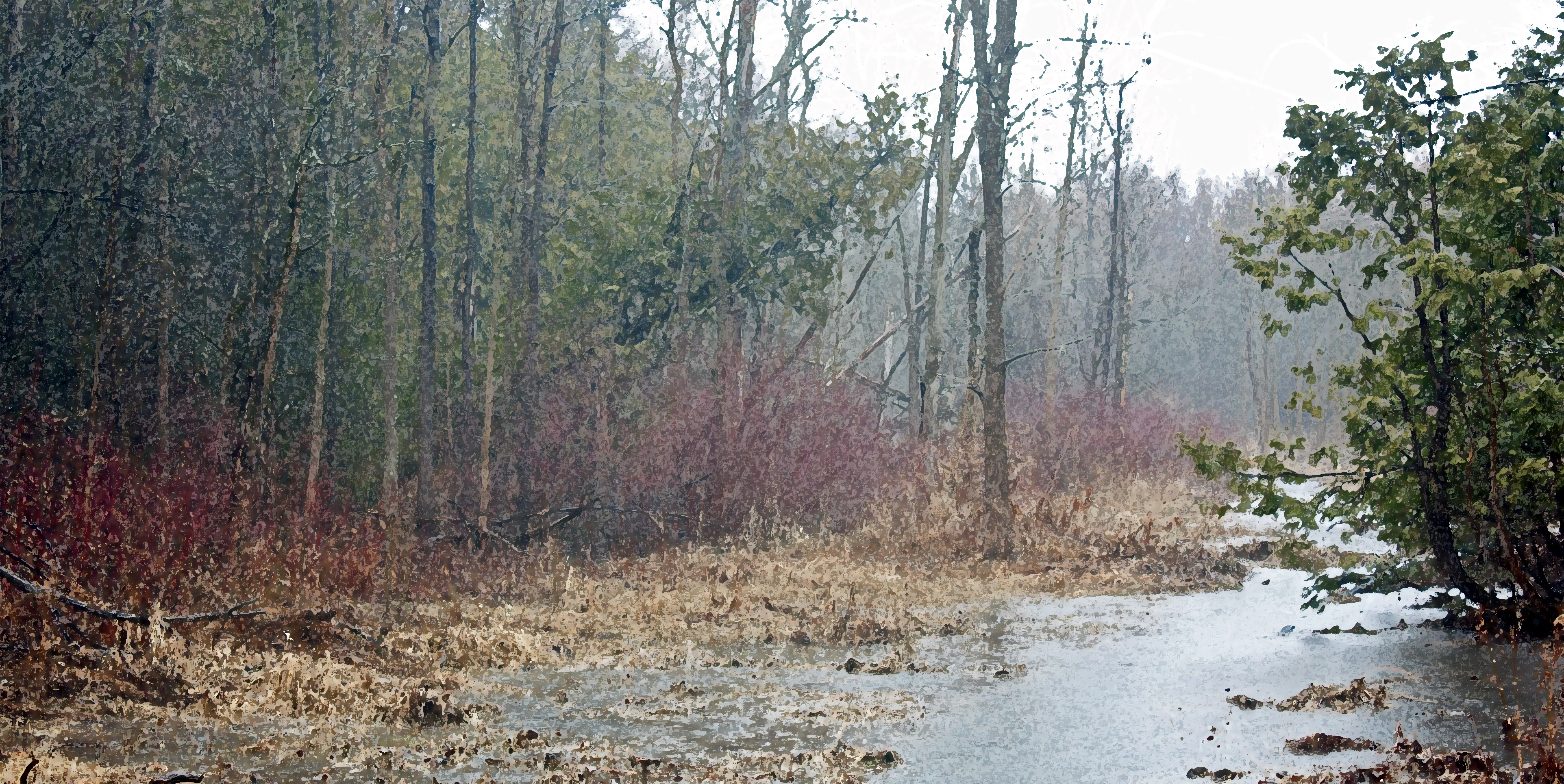
Mossy cedar tree in Trent Nature Sanctuary, ON (image and rendition by Nina Munteanu)
NINA MUNTEANU is a Canadian ecologist / limnologist and novelist. She is co-editor of Europa SF and currently teaches writing courses at George Brown College and the University of Toronto. Visit www.ninamunteanu.ca for the latest on her books. Nina’s bilingual “La natura dell’acqua / The Way of Water” was published by Mincione Edizioni in Rome. Her non-fiction book “Water Is…” by Pixl Press(Vancouver) was selected by Margaret Atwood in the New York Times ‘Year in Reading’ and was chosen as the 2017 Summer Read by Water Canada. Her novel “A Diary in the Age of Water” was released by Inanna Publications (Toronto) in June 2020.
“I am Planta: On the Line, in Vancouver, British Columbia, at TheCommentary.ca.
Nina Munteanu joins me again. She has just published a new novel, A Diary in the Age of Water. The noted writer and limnologist, a freshwater scientist, has written a book that could be considered science fiction. I suppose ‘cli-fi’ is the better term, climate-based science fiction. In the book, far away in a post-climate change world, Kyo finds a diary that gives her insight into the world before water scarcity. I’ll get Nina to tell us about Kyo, about the themes in this book, especially the world ahead if we continue as we do. Nina Munteanu is an author and ecologist. She has published many books of science fiction and fantasy, and was first on the program in 2016 when her book Water Is… The Meaning of Water was published. The website for more is at www.ninamunteanu.ca. This new book is from Inanna Publications. Please welcome back to the Planta: On the Line program, Nina Munteanu; Ms. Munteanu, good morning…”
NINA MUNTEANU is a Canadian ecologist / limnologist and novelist. She is co-editor of Europa SF and currently teaches writing courses at George Brown College and the University of Toronto. Visit www.ninamunteanu.ca for the latest on her books. Nina’s bilingual “La natura dell’acqua / The Way of Water” was published by Mincione Edizioni in Rome. Her non-fiction book “Water Is…” by Pixl Press(Vancouver) was selected by Margaret Atwood in the New York Times ‘Year in Reading’ and was chosen as the 2017 Summer Read by Water Canada. Her novel “A Diary in the Age of Water” was released by Inanna Publications (Toronto) in June 2020.
I recently gave a talk at Orchard Park Secondary School during their “Eco Crawl” week. “Eco crawl is a cross curricular initiative promoting environmental awareness, natural conservation, and well-being,” says Teresa Grainger, Library Learning Commons Technician at the school. The “week long initiative will include animal visitors, presentations, displays, and outdoor activities. We like to involve as many departments as possible.”
The school invited me to participate with a presentation. I spoke about my work as a writer and as a scientist, how I was inspired to write eco-fiction and a little about the process of how I started. I shared the challenges I faced and my victories. I also spoke about the importance of eco-fiction as narrative and the importance of storytelling generally to incite interest, bring awareness and ultimately action.
The word is a powerful tool. And the stories that carry them are vehicles of change.
Here is some of that talk:
My story begins with the magic of water, Quebec water … I was born in a small town in the Eastern Townships of Quebec, a gently rolling and verdant farming community, where water bubbles and gurgles in at least two languages.
Pastoral Eastern Townships and Granby, Quebec; Nina Munteanu as a child
.
I spent a lot of my childhood days close to the ground, observing, poking, catching, destroying and creating. Perhaps it was this early induction to the organic fragrances of soil, rotting leaves and moss that set my path in later life as a limnologist, environmental consultant and writer of eco-fiction.
My mother kept a garden in our back yard that she watered mostly with rain she collected in a large barrel out back. I remember rows of bright dahlias with their button-faces and elegant gladiolas of all colours, tall like sentinels. And, her gorgeous irises.
In the winter, my mother flooded the garden to create an ice rink for the neighbourhood to use for hockey. Somehow, I always ended up being the goalie, dodging my brother’s swift pucks to the net. I got good at dodging—probably a useful life skill in later life…
Our dad frequently took us to the local spring just outside town. We walked a few miles up Mountain Road to an unassuming seepage from a rock outcrop with a pipe attached to it by the local farmer. I remember that the water was very cold. Even the air around the spring was cooler than the surrounding air. I remember that the spring water tasted fresh and that the ice it formed popped and fizzed more than tap water.
I followed my older brother and sister to the nearby forest and local river. We stirred soil, flower petals and other interesting things with water to fuel “magic potions” then told wild stories of mayhem and adventure. I became a storyteller. My passion for storytelling eventually morphed into writing; but, the underlying spark came through environmental activism.
.
In early high school, during the mid-60s, I became an environmental activist, putting up posters and writing in the school paper. I wrote letters to industry and politicians, trying to incite interest in being good corporate citizens and promoting global environmental action. I remember a well-meaning teacher chiding me for my extravagant worldview. “Stick to little things and your community—like recycling,” he suggested patronizingly. I remember the shock of realizing that not everyone felt the planet like I did. Perhaps it was a teenage-thing, or a girl-thing, or a nina-thing. I prayed it wasn’t just a nina-thing…
I started writing stories in high school. Mostly eco-fiction, though I didn’t know that’s what it was at the time. There was no genre called eco-fiction back then. It all went under the umbrella of scifi.
.
I completed my first novel, Caged in World when I was fifteen—in Grade 9—in 1969. Caged in World was a hundred-page speculative story about a world that had moved “inside” to escape the ravages of a post climate-change environment. The eco-novel was about a subway train driver and a data analyst caught in the trap of a huge lie. The story later morphed into Escape from Utopia. Several drafts—and years later—the novel became the eco-medical thriller Angel of Chaos, set in 2095 as humanity struggles with Darwin’s Disease—a mysterious neurological environmental pandemic. Icaria 5 is one of many enclosed cities within the slowly recovering toxic wasteland of North America, and where the protagonist Julie Crane works and lives. The city is run by technocrats, deep ecologists who call themselves Gaians, and consider themselves guardians of the planet. The Gaians’ secret is that they are keeping humanity “inside” not to protect humanity from a toxic wasteland but to protect the environment from a toxic humanity.
Some of the scientific papers, reports and articles I wrote or participated in
.
When I enrolled in college and university, I thought of going into environmental law then decided that I didn’t have the temperament for it and switched to biology. Without realizing it, I put fiction writing on hold while I pursued ecology at university. One professor got me very interested in limnology and it became my focus when I realized that I’d always been fascinated by water. I started out being scared of water—not being a strong swimmer—and the best thing you can do to get over a fear is to study it and understand it. That’s exactly what I did. I did some cool research on stream ecology and published scientific papers, articles and reports. Then I moved to the westcoast to teach limnology at the University of Victoria and do consulting work in aquatic ecology.
So, in a way, I’d gone back to what I loved best as a child—mucking about in nature, spending my days close to the ground, observing, poking, catching, destroying and creating.
Kevin as a toddler
.
In 1991, my son Kevin was born. I felt a miracle pass through me. Kevin became my doorway into wonder. His curiosity was boundless and lured me into a special world of transformation. I took time off work to spend with Kevin when he was young. We went on great trips, from the local mall, where we had a hot chocolate and played with Lego, to the local beach on the Fraser River, where we explored the rocks. When he was no more than three, I took him on endless adventures in the city and its surroundings. We didn’t have to go far. The mud puddles of a new subdivision after a rain were enough to keep our attention for dozens of minutes. We became connoisseurs of mud. The best kind was “chocolate mud,” with a consistency and viscosity that created the best crater when a rock was thrown into it.
Kevin and I often explored the little woodland near our house. We made “magic potions” out of nightshade flowers, fir needles, loam and moss; we fueled our concoctions with the elixir of water from a stagnant pool then told wild stories of mayhem and adventure.
Storytelling kept calling to me. It was the 1990s—twenty years after I finished Angel of Chaos—and I’d published lots of short stories and articles. But no novels.
Some of Nina’s short story publications
I spent several years shopping Angel of Chaos to agents and publishing houses. Although I received many bites, all finally let go. I kept writing short stories, some of which were cannibalized from the book, and several were published; I also wrote Angel’s prequel, The Great Revolution and Angel’s sequel Darwin’s Paradox and shopped them.
Then In 2007, Dragon Moon Press in Calgary made an offer to publish Darwins Paradox; the sequel became my debut novel. Dragon Moon Press later picked up Angel of Choas and published it in 2010 as a prequel. I haven’t stopped publishing books since (with a book pretty much every year), both fiction and non-fiction…including writing guidebooks in my Alien Guidebook Series.
Kevin hiking the mountains of the west coast, BC
My son left the nest to go to university and work and I went on walkabout and eventually left the westcoast, returning to my old home in the east. I did lots of house-sitting in the Maritimes, then ended up teaching at UofT in Toronto.
UofT, west gate to quadrangle of University College, ON (photo by Nina Munteanu)
In 2016, I published Water Is… with Pixl Press in Vancouver. It’s a biography and celebration of water—my attempt to write a lay book on my water science, something that all could appreciate. Turns out that Margaret Atwood really liked it too!
.
On its heels, I got a book deal with Inanna Publications in Toronto for my eco-novel A Diary in the Age of Water. This eco-fiction novel follows the journeys of four generations of women during a time of catastrophic environmental change. The novel explores each woman’s relationship with water, itself an agent of change…
.
Eco-fiction (short for ecological fiction) is a kind of fiction in which the environment—or one aspect of the environment—plays a major role in story, either as premise or as character. For instance, several of my eco-fiction stories give Water a voice as character. In my latest novel,A Diary in the Age of Water, each of the four women characters reflects her relationship with water and, in turn, her view of and journey in a changing world.
In eco-fiction, strong relationships are forged between the major character on a journey and an aspect of their environment and place. Such strong relationship can linger in the minds and hearts of readers, shaping deep and meaningful connections that will often move a reader into action. Our capacity—and need—to share stories is as old as our ancient beginnings. From the Paleolithic cave paintings of Lascaux to our blogs on the Internet, humanity has left a grand legacy of ‘story’ sharing. By providing context to knowledge, story moves us to care, to cherish, and, in turn, to act. What we cherish, we protect. It’s really that simple.
Eco-fiction—whether told as dystopia, post-apocalypse, cautionary tale or hopeful solarpunk—can help us co-create a new narrative, one about how the Earth gifts us with life and how we can give in return. It’s time to start giving.
That starts with story.
NINA MUNTEANU is a Canadian ecologist / limnologist and novelist. She is co-editor of Europa SF and currently teaches writing courses at George Brown College and the University of Toronto. Visit www.ninamunteanu.ca for the latest on her books. Nina’s bilingual “La natura dell’acqua / The Way of Water” was published by Mincione Edizioni in Rome. Her non-fiction book “Water Is…” by Pixl Press(Vancouver) was selected by Margaret Atwood in the New York Times ‘Year in Reading’ and was chosen as the 2017 Summer Read by Water Canada. Her novel “A Diary in the Age of Water” was released by Inanna Publications (Toronto) in June 2020.
The Ohio River at Parkersburg, West Virginia, contaminated for decades with C8 used by DuPont to make Teflon
.
I write science fiction and fantasy. On occasion magic or something that stands for magic enters in.
But that’s my fiction. In my ordinary very real life, I tend to be suspicious of claims of ‘magical’ properties, particularly those that claim to provide great convenience and utility with no expenditure (except money). Perhaps it’s my half-German ethic of good old-fashioned honest work; these claims seem like a big cheat: mops that clean the floor spotless without you ever having to bend over or scrub; carpets that resist spills or clean themselves; non-stick pans where cooked food just slides cheerfully from pan to plate without sticking.
In my experience, I have often found that if something seems too good to be true—like magic—there’s a catch. And just like magic in a good fiction story, it comes with great hidden cost.
Enter DuPont and its dark magic…
DuPont Washington Works facility at Parkersburg, West Virginia
.
DuPont is one of the richest families in the United States since French aristocrat Irénée du Pont de Nemours fled the French Revolution in 1802 and built a gunpowder mill in northeast Delaware. DuPont soon expanded to bombs and poison gas and over its more than a hundred years of operation DuPont has been linked to dangerous products that have caused health problems, particularly to its own workers. By the 1930s DuPont had created leaded gasoline, which ended up causing madness and violent deaths and life-long institutionalization of workers. Certain rubber and industrial chemicals turned the skin of exposed workers blue. Bladder cancers developed in many dye workers.
Spruce trees damaged by Imprelis
.
Then there was DuPont’s Imprelis, an aminocyclopyrachlor herbicide to control weeds that caused widespread death of mature trees and created ‘killer compost.’ DuPont failed to submit reports to the EPA about potential adverse effects of Imprelis and sold the product with misleading labelling. When damage reports began to surface weeks after Imprelis was introduced, DuPont simply continued to sell the product until the EPA finally banned its sale and DuPont was charged for negligence and violation of FIFRA.A year after the ban, impact from Imprelis use continued to be reported throughout the northern United States for a range of trees including maples, oaks, honey locust, Norway spruce and white pine (stunted, twisted or curled new growth, bud-kill, delayed leaf-out, stem die-back). Trees that initially experienced minor affects from Imprelis later developed more severe damage (e.g. bud formation and cold hardiness).
Concerned over DuPont’s “tendency to believe [chemicals] are harmless until proven otherwise,” staff doctor George Gehrmann convinced DuPont to create Haskell Laboratories in 1935. The lab became the first in-house toxicology facility; but, due to its position within DuPont, Haskell Lab also inherited limitations on its ability to conduct and report objective science. Just as self-regulation is a ridiculous concept, self-analysis is feckless and fraught with the potential for omission and false reporting. When pathologist Wilhelm Hueper tried to share his results with the scientific community on how dye chemicals led to bladder cancer, he was gagged and fired, and DuPont went on to use the chemicals for decades after in what appeared to become a common pattern for this company.
Early ad for DuPont’s “Happy Pan”
.
DuPont developed many astonishing products, mostly for warfare, including nylon, Lycra, Saran wrap and, of course, Teflon—their magic non-stick compound. By the late 1940s, they were producing worldwide a wide variety of industrial chemicals, synthetic fibers, petroleum-based fuels and lubricants, pharmaceuticals, building materials, sterile and specialty packaging materials, cosmetics ingredients, and agricultural chemicals. By the early 1950s, a group of Columbia University scientists published several papers describing high rates of cancer in rats exposed to plastics such as vinyl, Saran wrap and Teflon. This did not deter DuPont from continuing its production line for these products.
Representation of 1950s DuPont “Happy Pan”
.
By 1954, during the ramp up for the Teflon rollout, DuPont’s toxicologist R.A. Dickison noted possible toxicity of the surfactant C8 (PFOA or Perfluorooctanoic Acid) used to make Teflon. By 1961, the same year they rolled out their Teflon-coated “Happy Pan”, DuPont knew C8 was a toxic endocrine disruptor and caused cancer. DuPont’s chief toxicologist Dorothy Hood cautioned executives in a memo that the substance was toxic and should be “handled with extreme care.” It didn’t stop the roll out. By 1982, DuPont had confirmed the high toxicity of C8 in humans.
Effects of PFOA (birth defect in Bucky Bailey whose mother was on the Teflon line without protection during her first trimester; blackening teeth from the excessive fluoride, from scene in “Dark Waters”)
DuPont’s Washington Works plant in Parkersburg, West Virginia
.
Finally, in 2019—sixty-seven years after DuPont knew PFOA was toxic and did nothing—this forever chemical was banned globally under the Stockholm Convention. Unfortunately, by 2019, PFOA was already literally everywhere on the planet in concentrations considered unsafe. Given its high water-solubility, long-range transport potential, and lack of degradation in the environment, PFOA persists in groundwater and is ubiquitously present in oceans and other surface water around the globe. It is found in remote areas of the Arctic and Antarctic (where it was not used or manufactured), no doubt transported there through ocean currents and in the air, bound on particles.
Average surface water levels of PFOA and PFOS by country in 2012 (from Kunacheva et al. 2012)
.
In 2020, NBC News revealed that DuPont was still avoiding its responsibility to clean up its C8 mess and compensate those harmed by DuPont’s negligence. In 2015, DuPont began a series of complex transactions that sheltered it from responsibility for environmental obligations and liabilities associated with PFAS (C8); this included creating other entities such as Chemours, Corteva, and NewDupont. If Chemours becomes insolvent, Corteva will be responsible. Corteva does not have the funds to cover tens of billions in estimated PFAS (C8) costs to their victims.
Timeline for DuPont’s use of PFOA (C8) to 2006 (image from The Intercept)
.
Their Story…My Story…
In his 2006 book The Seven Basic Plots: Why We Write Stories, Christopher Booker told us that there are seven types of plots in story. One is entitled “Overcoming the Monster,” an underdog story where the hero sets out to destroy an evil to restore safety or order to the land. The evil force is typically much larger than the hero, who must find a way, often through great courage, strength, and inventive cunning, to defeat the evil force. This is the story of David and Goliath, of Beowulf and Grendel, of Luke Skywalker and Darth Vader in Star Wars, of Jake Sully and Miles Quaritch in Avatar, of Rita Vrataski and the Mimics in Edge of Tomorrow. The list goes on…
Miles Quaritch and Jake Sully face off in the film “Avatar”
The “Overcoming the Monster” plot, whether told literally or through metaphor, reflects an imbalance in the world—usually of power—that the hero must right. The true story of DuPont’s evil maleficence reflects the great power imbalance of many large corporations and the evil they enact through willful deception and mischief to increase profit, their god.
We’ve now come full circle to me and my relationship with magic. For in some terrible way, the story of DuPont is also my story. One of power imbalance, of deception and ignorance. Their deception; my ignorance:
In 1954, the year I was born, DuPont discovered the toxicity of C8 in its Teflon products at its Washington Works plant in Parkersburg—and proceeded to roll it out for mass use.
In 1964, I was ten years old and struggling with my Grade 5 teacher who was trying to curb my unique self-expression. I was already aware of environmental imbalance and destruction in the world. My pet peeve was littering because it demonstrated great disrespect for others and the environment; I told environmental stories. That year DuPont had already begun its great deception; having confirmed the toxicity of C8, they simply watched (and recorded) as this cancer-causing endocrine disruptor injured, maimed and killed their own workers. The company did nothing to prevent it and they told no one.
In 1969, I wrote my first dystopia, Caged in World. The eco-novel was about a subway train driver and a data analyst caught in the trap of a huge lie. The story later morphed into Escape from Utopia. Several drafts and years later the novel became the eco-medical thriller Angel of Chaos, set in 2095 as humanity struggles with Darwin’s Disease—a mysterious neurological environmental pandemic assaulting Icaria 5, an enclosed city within the slowly recovering toxic wasteland of North America. The city is run by deep ecologists who call themselves Gaians, and consider themselves guardians of the planet. The Gaians’ secret is that they are keeping humanity “inside” not to protect humanity from a toxic wasteland but to protect the environment from a toxic humanity.
In the early 1970s, I entered college and contemplated becoming an environmental lawyer; I wrote short stories, mostly eco-fiction, and joined marches protesting environmental destruction by large corporations. DuPont confirmed that C8 not only persisted in the environment; it bioaccumulated in animals. A 1979 internal memo in which humans exposed to C8 were referred to as “receptors,” DuPont scientists found “significantly higher incidence of allergic, endocrine and metabolic disorders” as well as “excess risk of developing liver disease.” DuPont withheld this information from EPA.
In 1981, when I got my first job as a limnologist and environmental consultant in Vancouver, DuPont confirmed that C8 caused birth defects in its own workers—and did not warn its workers; in fact they created false data for EPA and continued exposing women of childbearing age to C8. In 1984, a year after I formed my own consulting company Limnology Services in Vancouver, DuPont staffers secretly tested their community’s drinking water and found it to contain alarming levels of C8. Deciding that any cleanup was likely to cost too much and tarnish their reputation, DuPont chose to do nothing. In fact, they scaled up their use of C8 in Teflon products and bought land to dump their toxic sludge in unlined landfills. Deaths in DuPont workers from leukemia and kidney cancer climbed.
Throughout the 90s, I started teaching college ecology courses in Vancouver; Shared Vision Magazine published my first article “Environmental Citizenship” in 1995. Meantime, DuPont’s Washington Works plant pumped hundreds of thousands of pounds of PFOA sludge, powder and vapor through stacks and outfall pipes into the Ohio River and surrounding air. By 1996, C8 was in the drinking water of Parkersburg and other communities. Despite what they knew of C8’s toxicity, DuPont kept it a secret (no one else was testing for PFOA because it was unregulated).
In 2007, Darwin’s Paradox, my eco-fiction novel about an environmental pandemic, was published by Dragon Moon Press in Calgary, Alberta. Four years earlier, the law had finally caught up to DuPont, but not before they had dispersed 2.5 million pounds of harmful C8 from their Washington Works plant into the air and water of the mid-Ohio River Valley area. It would be another twelve years before DuPont would stop making C8 (in 2015) and another four years after that when C8 would be banned from use globally (2019). PFOA is still unregulated by EPA; the best they can do is issue a non-enforceable health advisory set at 70 parts per trillion.
Darth Vader and Luke Skywalker face off as Palpatine looks on in the film “Star Wars”
.
It isn’t the Darth Vaders or Miles Quaritchs we must overcome. Yes, they are monsters, but they serve a greater monster. For Vader it is Emperor Palpatine and for Quaritch it is the RDA Corporation. While Vader and Quaritch may be the face of evil, true evil lurks behind them, orchestrating. It is an evil we must fight internally, because each of us carries that evil inside us—in the urge to cheat on our taxes; in looking for the free ride (there are no free rides); in coveting what others have when what we have is enough; in embracing self-deception through unsubstantiated narratives and choosing to remain ignorant to suit a self-serving agenda.
I only heard of the decades-long environmental dispersal of PFOA (C8) by DuPont in 2022. I’d lived in total ignorance through DuPont’s entire five decades of deception with C8. This past year, I chanced upon “Dark Waters,” the 2019 film starring Mark Ruffalo as lawyer Robert Bilott, who took DuPont to court in 2002. I found out seven years after DuPont agreed to stop using PFOA (DuPont currently uses other PFAS compounds that are unregulated and whose toxicity is unknown).
Lawyer Robert Bilott (Mark Ruffalo) investigates leachate-infected cows from nearby DuPont landfill (photo from film “Dark Waters”)
Ignorance breeds complacency and hubris. Both will lead to downfall.
If you think you’re getting away with something … if you think you’re getting a free ride … think again. You’re being taken for one. Short cuts are dangerous. Nature is complex for good reason. Complexity builds in a diverse spider web of safeguards that interact to sustain the greater existential collaborative.
That is the real magic. And we’re not even close to understanding it.
“Angel of Chaos” and “Darwin’s Paradox” explore human-induced environmental catastrophe
.
DuPont’s Forever Weapon of Death: Teflon and C8 (PFOA)
Teflon was created in 1938, quite by accident, by Dr. Roy J. Plunkett, who was working on alternative refrigerant gases. Plunkett had stored the gas (tetrafluroethylene) in small cylinders where they were frozen and compressed. The gas had solidified into a waxy white material, which came to be called Polyetrafluoroethylene (PTFE), a slippery substance that was non-corrosive, chemically stable and with an extremely high melting point. Through polymer research, PTFE was combined with PFOA to make Teflon, a type of fluoropolymer and telomere-based consumer product. For every two carbon atoms, there are four fluorine atoms attached throughout the entire molecular structure. The fluorine atoms surround the carbon atoms, creating a protective armor, preventing the carbon atoms from reacting when anything comes into contact with them—such as food in a non-stick frying pan. The fluorine atoms also decrease friction, making it slippery.
Chemical formula for Perfluorooctanoic Acid (PFOA) also called C8
DuPont registered the Teflon trademark in 1944, and the coating was used in the Manhattan Project’s A-bomb effort. Like DuPont’s other wartime innovations, such as nylon and pesticides, Teflon found its way into the home. In 1951, DuPont started using PFOA (perfluorooctanoic acid) known as C8 in its Teflon production at the Parkersburg factory. By the 1960s, DuPont was producing Teflon for cookware and advertising it as “a housewife’s best friend.” C8 was eventually used in hundreds of DuPont products, including Gore-Tex and other waterproof clothing; coatings for eye glasses and tennis rackets; stain-proof coatings for carpets and furniture; fire-fighting foam; fast food wrappers; microwave popcorn bags; bicycle lubricants; satellite components; ski wax; communications cables; and pizza boxes.
Farmer Tennant and lawyer Rob Billot encounter a leachate-infected mad cow in the 2019 film “Dark Waters”
.
PFOA is a member of a family of over 4,500 synthetic chemicals called PFAS (polyfluorinated alkyl substances), also known as the Forever Chemicals. Due to their strong carbon-fluorine bond, PFAS chemicals don’t break down easily and persist in the environment for decades. PFAS also bioaccumulate, which means these chemicals are absorbed and not excreted and therefore buildup in the body. The higher up the food chain, the greater the PFAS concentrations. Before their manufacture started in the 1940s, no PFAS compounds were present in the environment. Now, thanks to their persistence and bioaccumulation, they exist everywhere in the environment, occupying virtually 99% of all life on the globe.
.
Currently, PFOA is one of only two PFAS chemicals regulated globally (the other being PFOS, which was banned in 2009, that DuPont replaced with another toxic unregulated chemical, GenX). Over 4,000 other PFAS chemicals remain in use that have not been studied and are not regulated. CHEMtrust, points out that when one PFAS chemical is regulated, “it is replaced in products and manufacturing processes by a similar, unregulated PFAS chemical. Unfortunately, the chemicals’ similarities often extend to their hazardous properties, and the replacement chemical is found to have similar harmful impacts on human health and the environment.”
DuPont’s Washington Works facility in Parkersburg, West Virginia
.
References:
Ahrens L. 2011. “Polyfluoroalkyl compounds in the aquatic environment: a review of their occurrence and fate.” J Environ Monit 13: 20–31. 10.1039/c0em00373e
Barton CA, Butler LE, Zarzecki CJ, Laherty JM. 2006. “Characterizing perfluorooctanoate in ambient air near the fence line of a manufacturing facility: comparing modeled and monitored values.” J Air Waste Manage Assoc 56: 48–55. 10.1080/10473289.2006.10464429
Barton CA, Kaiser MA, Russell MH. 2007. “Partitioning and removal of perfluorooctanoate during rain events: the importance of physical-chemical properties.” J Environ Monit 9: 839–846. 10.1039/b703510a
Busch J, Ahrens L, Xie Z, Sturm R, Ebinghaus R. 2010. “Polyfluoroalkyl compounds in the East Greenland Arctic Ocean.” J Environ Monit 12: 1242–1246. 10.1039/c002242j
Kunacheva, Chinagarn, Shigeo Fujii, Shuhei Tanaka, et al. 2012. “Worldwide surveys of perfluorooctane sulfonate (PFOS) and perflurorooctanoic acid (PFOA) in water environment in recent years.” Water Science & Technology 66(12): 2764-71.
McMurdo CJ, Ellis DA, Webster E, Butler J, Christensen RD, Reid LK. 2008. “Aerosol enrichment of the surfactant PFO and mediation of the water-air transport of gaseous PFOA.” Environ Sci Technol 42: 3969–3974. 10.1021/es7032026
Paustenbach, Dennis, Julie Panko, Paul K. Scott, and Kenneth M. Unice. 2007. “A Methodology for Estimating Human Exposure to Perfluorooctanoic Acid (PFOA): A Retrospective Exposure Assessment of a Community (1951-2003)” Journal of Toxicology and Environmental Health
Prevedouros K, Cousins IT, Buck RC, Korzeniowski SH. 2006. “Sources, fate and transport of perfluorocarboxylates” Environ Sci Technol 40: 32–44. 10.1021/es0512475
Rauert, Cassandra, Mahiba Shoieb, Jasmin K. Schuster, Anita Eng, Tom Harner. 2018. “Atmospheric concentrations and trends of poly- and perfluoroalkyl substances (PFAS) and volatile methyl siloxanes (VMS) over 7 years of sampling in the Global Atmospheric Passive Sampling (GAPS) network.” Environmental Pollution 238: 94-102.
Velez, M.P., T.E. Arbuckle, W.D. Fraser. 2015. “Maternal exposure to perfluorinated chemicals and reduced fecundity: the MIREC study.” Human Reproduction 30(3): 701-9.
Vierke, Lena, Claudia Staude, Annegret Biegel-Engler, Wiebke Drost, and Christoph Schulte. 2012. “Perflurorooctanoic acid (PFOA)–main concerns and regulatory developments in Europe from an environmental point of view.” Environmental Sciences Europe 24: 16
Yamashita N, Kannan K, Taniyasu S, Horii Y, Petrick G, Gamo T. 2005. “A global survey of perfluorinated acids in oceans.” Mar Pollut Bull 51: 658–668. 10.1016/j.marpolbul.2005.04.026
.
Nina Munteanu is a Canadian ecologist / limnologist and novelist. She is co-editor of Europa SF and currently teaches writing courses at George Brown College and the University of Toronto. Visit www.ninamunteanu.ca for the latest on her books. Nina’s bilingual “La natura dell’acqua / The Way of Water” was published by Mincione Edizioni in Rome. Her non-fiction book “Water Is…” by Pixl Press(Vancouver) was selected by Margaret Atwood in the New York Times ‘Year in Reading’ and was chosen as the 2017 Summer Read by Water Canada. Her novel “A Diary in the Age of Water” was released by Inanna Publications (Toronto) in June 2020.
“Over increasingly large areas of the United States, spring now comes unheralded by the return of the birds. The early mornings are strangely silent where once they were filled with the beauty of bird song.”—Rachel Carson, Silent Spring
Apex Magazine will release its 2021 Anthology this fall with my short story, Robin’s Last Song in it. They are running an Apex Kickstarter Campaign until April 30 to fund the anthology.
Apex Issue 128 and upcoming Anthology for 2021
Robin’s Last Song first appeared in the #128 Issue of Apex Magazine in 2021. It tells the story of Robin, a blind elder whose digital app failed to warn the world of the sudden global loss of birds with disastrous ecological consequences. After years of living in self-exile and getting around poorly on sight-enhancing technology, a discovery gives her new hope in rekindling her talents in the field of Soundscape Ecology. Here is how it begins:
May, 2071
I rock on the cedar swing on my veranda and hear the wind rustling through the gaunt forest. An abandoned nest, the forest sighs in low ponderous notes. It sighs of a gentler time. A time when birds filled it with song. A time when large and small creatures — unconcerned with the distant thrum and roar of diggers and logging trucks — roamed the thick second-growth forest. The discord was still too far away to bother the wildlife. But their killer lurked far closer in deadly silence. And it caught the birds in the bliss of ignorance. The human-made scourge came like a thief in the night and quietly strangled all the birds in the name of progress.
Robin’s egg, discarded in the forest to distract predators, ON (photo by Nina Munteanu)
Bird Population Decline
The number of birds in North America has declined by three billion, some 30 percent, over the last half-century. The October 2019 issue of Science magazine reported a staggering decline in North American birds. Kenneth V. Rosenberg and his team of researchers estimated that three billion birds of various species have disappeared in Canada and the US since 1970.
That’s a third of the entire bird population lost in five decades.
Bird population decline since 1970
In North America, warbler populations dropped by 600 million. Blackbirds by 400 million. The common robins, cardinals, and blue jays had noticeably declined. Even starlings—once considered a kind of fast-breeding pest—have dwindled by 50%. The Intergovernmental Science-Policy Platform on Biodiversity and Ecosystem Services have determined that three-quarters of Earth’s terrestrial and two-thirds of the its marine environments have been severely altered by human actions.
Plowing of fields, deforestation, wetland draining, climate change and other land use clearing and treatments have caused great habitat loss. In addition, neonicotinoid pesticides make it harder for birds to put on weight needed for migration, delaying their travel.
Robin fledgling rests on a patio chair, ON (photo by Merridy Cox)
Common bird species are vital to ecosystems. They control pests, pollinate flowers, spread seeds and help regenerate forests. When these birds disappear, their former habitats lose their functionality. “Declines in your common sparrow or other little brown bird may not receive the same attention as historic losses of bald eagles or sandhill cranes, but they are going to have much more of an impact,” said Hillary Young, a conservation biologist at the University of California. Kevin Gaston, a conservation biologist at the University of Exeter, lamented that: “This is the loss of nature.”
The Trump administration heinously and foolishly demolished or maimed several key bird protection acts, which hopefully the new administration has or will reinstate in full force: Migratory Bird Treaty Act; Clean Air Act; Clean Water Act; National Fish and Wildlife Act; and the Endangered Species Act.
Bernie Krause uses soundscape to measure ecosystem function
Useful Tool: Soundscape Ecology
The new science of soundscape ecology can analyze the health of an ecosystem. Bernie Krause, a soundscape ecologist who has been conducting long-term recordings for many decades recently noted that in Sugarloaf Ridge State Park, not far from his home in Northern California, “the effect of global warming and resulting drought has created the first completely silent spring I’ve ever experienced.” Stuart Winter at Express reports that “many of the iconic birds whose mating calls ring out across woodlands and open fields during early May are vanishing at an alarming rate.”
Rachel Carson and her iconic book, “Silent Spring”
Silent Spring: Rachel Carson’s Ominous Prediction
Rachel Carson was nothing short of prophetic when she published Silent Spring in 1962 (in reference to the dawn chorus most noticeable in spring during breeding). Silent Spring cautioned burgeoning ag-biotech companies (like Monsanto—now Bayer—Sygenta, Dow, and DuPont) who were carelessly and flagrantly spraying fields with pesticides and herbicides—at the time DDT was the main culprit. This would soon become a GMO world where gene-hacked plants of monocultures can withstand the onslaught of killer pesticides like neonicotinoids (currently killing bees everywhere) and Roundup. Roundup is a carcinogenic glyphosate-based weed killer that has recently been shown to kill beneficial insects like bees) and has been linked to Alzheimer’s disease, ADHD, birth defects, autism, and several kinds of cancerin humans.
Despite Carson’s warnings in 1962 and despite some action eventually taken (e.g. the ban on use of DDT in 1972—the precursor to Roundup and other neonicotinoids currently in use), the use of chemicals in big ag-industry has increased over five-fold since the 1960s. And this is destroying our bee populations, other beneficial insects, beneficial weeds, small animal populations and—of course—our bird life.
And it’s making us sick too.
Three baby goldfinches in a nest in a staghorn sumac shrub, ON (photo by Nina Munteanu)
NINA MUNTEANU is a Canadian ecologist / limnologist and novelist. She is co-editor of Europa SF and currently teaches writing courses at George Brown College and the University of Toronto. Visit www.ninamunteanu.ca for the latest on her books. Nina’s bilingual “La natura dell’acqua / The Way of Water” was published by Mincione Edizioni in Rome. Her non-fiction book “Water Is…” by Pixl Press(Vancouver) was selected by Margaret Atwood in the New York Times ‘Year in Reading’ and was chosen as the 2017 Summer Read by Water Canada. Her novel “A Diary in the Age of Water” was released by Inanna Publications (Toronto) in June 2020.
Sample of eco-fiction publications Nina contributed as author or editor
“What is Eco-Fiction and Why Should We Care?”
In 2019, at the When Words Collide writer’s conference in Alberta, I participated in a panel on eco-fiction. The panel, consisting of Alex Reissen, Merilyn Ruth Liddell, Claudiu Murgan, Nina Munteanu, and moderated by Canadian speculative author Candas Jane Dorsey, discussed what eco-fiction is, what it means to its writers and its readers and why it’s an important genre of literature. How, for instance can eco-fiction writers influence our audience to engage in helping the planet and humanity, in turn? How can we do it without turning to the polemic of non-fiction? We discussed the importance of “storytelling”, bringing in characters to care about, making the global experience (and issue) personal. Essentially dramatizing the premise.
Candas described fiction writers as “sneaky,” exploring the issue (and message) through context and setting with a focus on character journey. This includes use of sub-text and subtleties embodied by individuals. I mentioned treating the environment as a character—a character to care about.
We explored several areas in which writers could elucidate ways to engage readers for edification, connection and participation. We discussed optimism, new perspectives, and envisioning our future.
“Science doesn’t tell us what we should do,” Barbara Kingsolver wrote in Flight Behavior. “It only tells us what is.” Stories can never be a solution in themselves, but they have the capacity to inspire action.
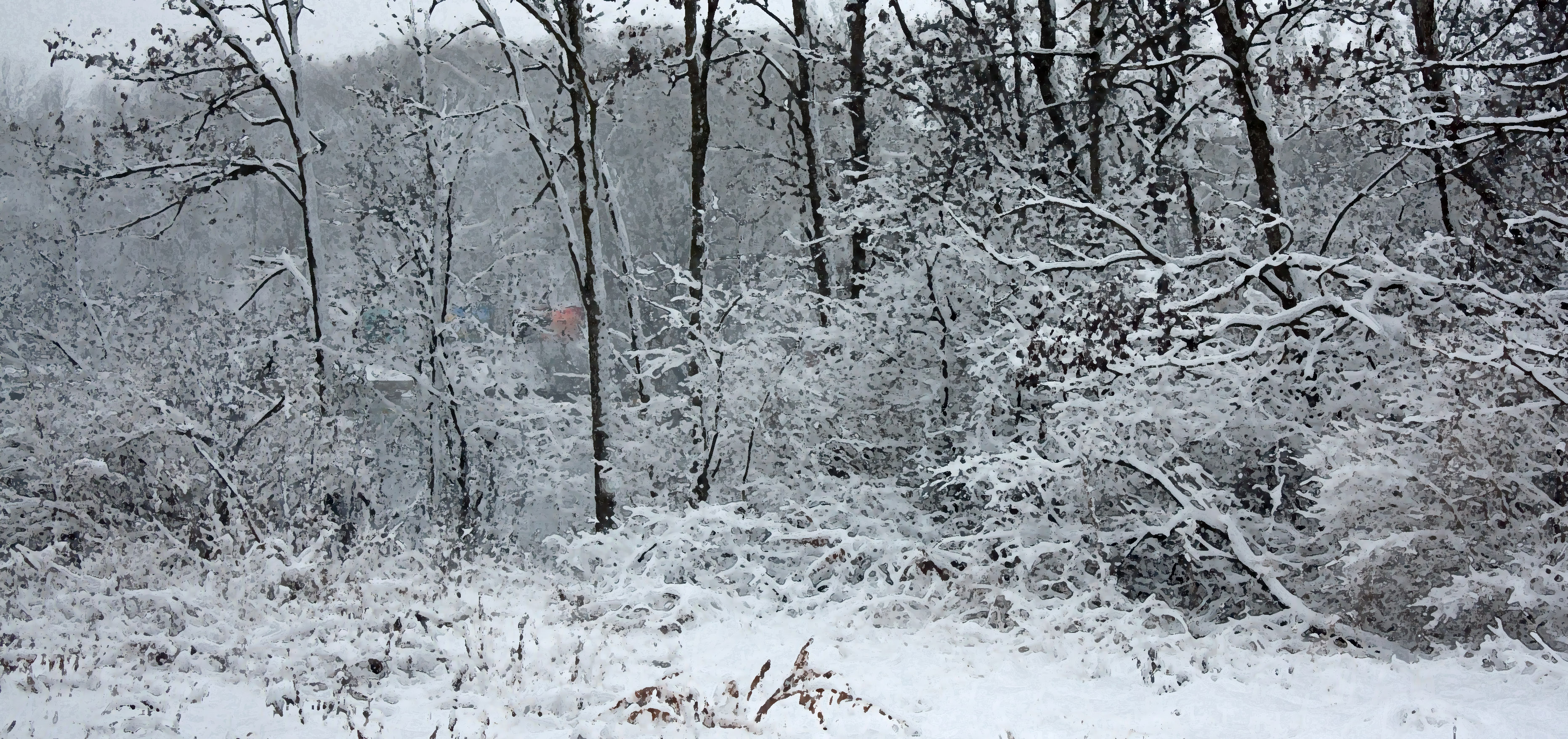
Cedar pine forest during winter snow, Jackson Creek Park, ON (photo and rendition by Nina Munteanu)
“People need such stories, because however dark, a darkness with voices in it is better than a silent void.”
Margaret Atwood, Maddaddam
Nina Munteanu is a Canadian ecologist / limnologist and novelist. She is co-editor of Europa SF and currently teaches writing courses at George Brown College and the University of Toronto. Visit www.ninamunteanu.ca for the latest on her books. Nina’s bilingual “La natura dell’acqua / The Way of Water” was published by Mincione Edizioni in Rome. Her non-fiction book “Water Is…” by Pixl Press(Vancouver) was selected by Margaret Atwood in the New York Times ‘Year in Reading’ and was chosen as the 2017 Summer Read by Water Canada. Her novel “A Diary in the Age of Water” was released by Inanna Publications (Toronto) in June 2020.
Nina, age four, pretending to read, Granby, Quebec (photo by Maria Munteanu)
I started writing and drawing as soon as I could hold a pencil. Even before I could read, I wanted to become a “paperback writer” like in the old Beatles song.
It was an incredible moment of clarity for me and despite being challenged by my stern and unimaginative primary school teacher, who kept trying to corral me into being “normal”, I wasn’t going to let anyone stem my creativity and eccentric — if not wayward — approach to literature, language and writing. I was a little brat and I knew it. She and I didn’t exactly get along. But I did okay and, despite her acidic commentary, Miss House awarded me some A’s and B’s…
.
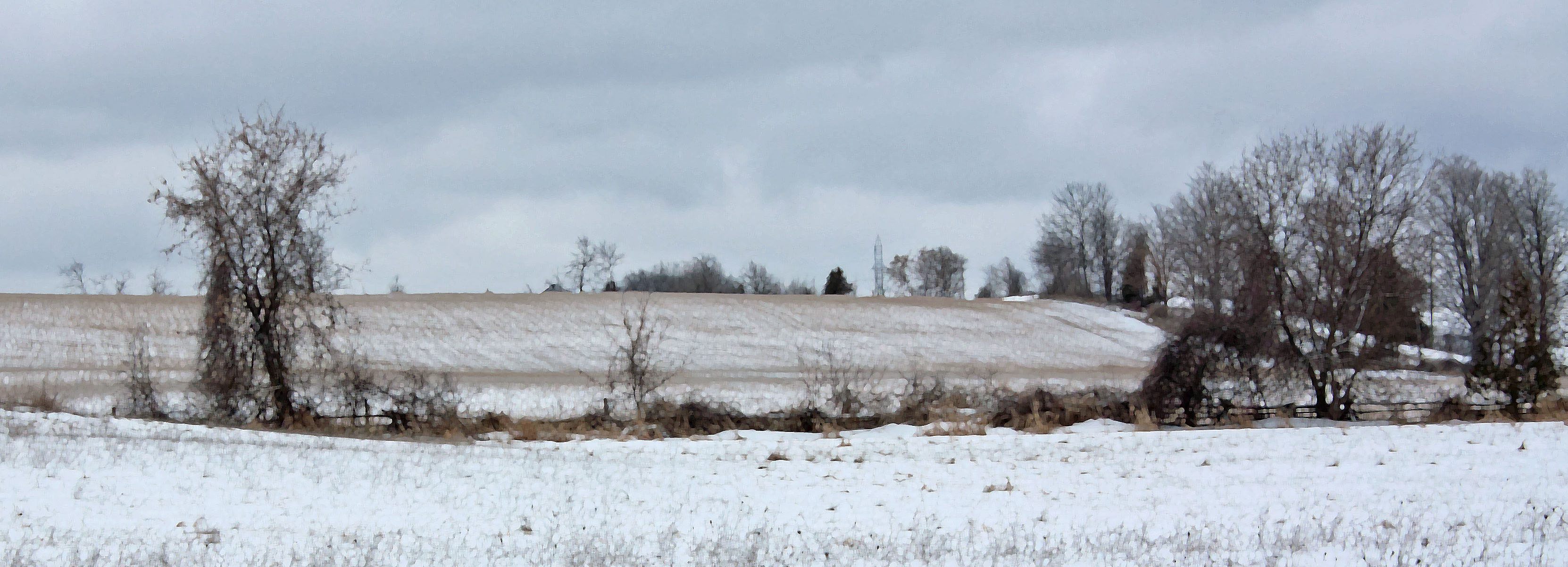
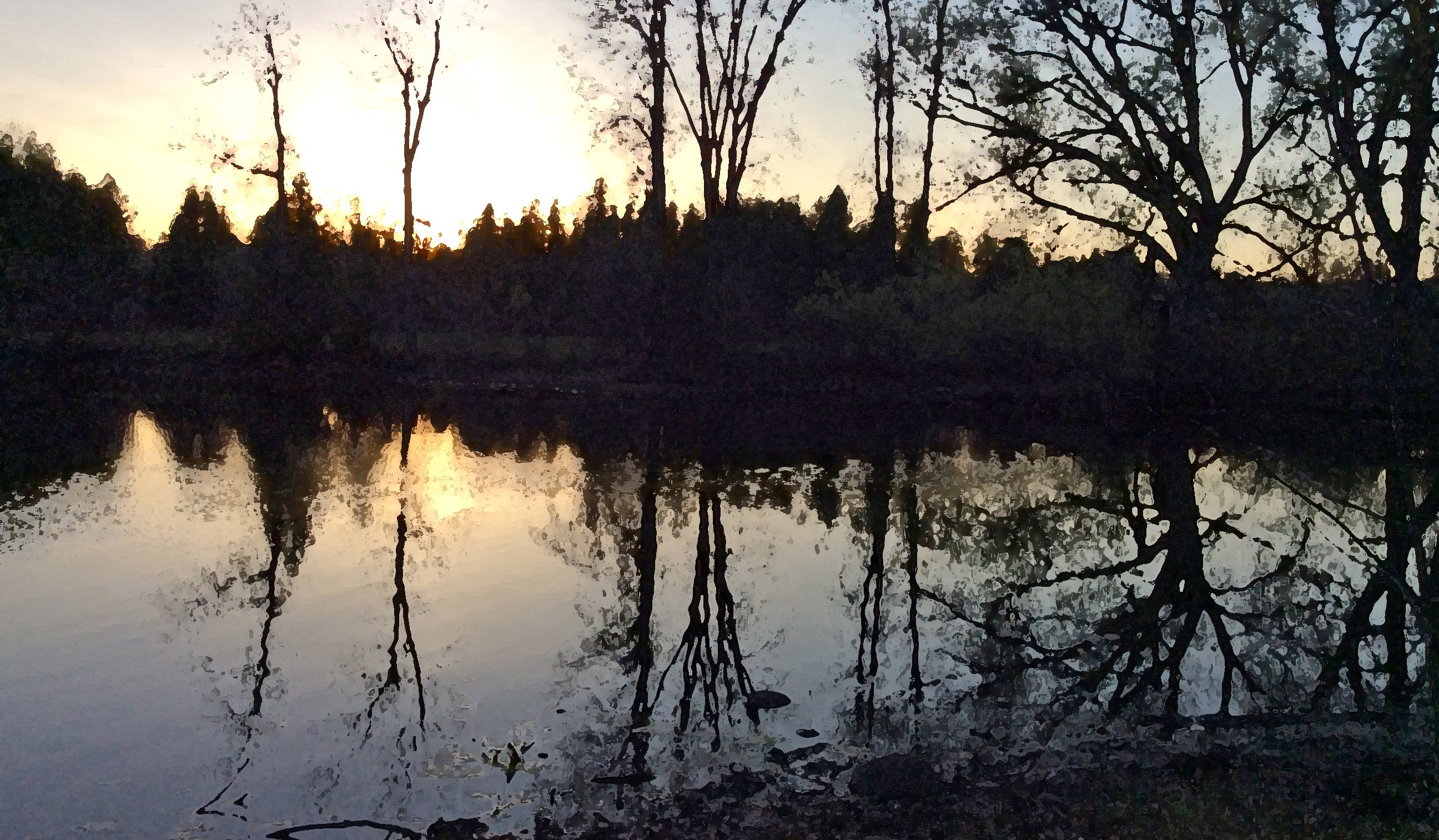
Country road in late fall, ON (photo and rendition by Nina Munteanu)
I wrote some fan fiction but quickly found my own creations far more interesting and less limiting.
As a teenager, I wrote, directed and recorded “radio plays” with my sister. When we weren’t bursting into riotous laughter, it was actually pretty good. She and I shared a bedroom in the back of the house and at bedtime we opened our doors of imagination to a cast of thousands. We fed each other wild stories of space travel, adventure and intrigue, whispering and giggling well into the dark night, long after our parents were snoring in their beds.
Those days scintillated with liberating originality, excitement and joy.
(Photo: Nina Munteanu and sister Doina Maria Munteanu at Grouse Mountain, BC)
.
My first attempt at a graphic novel (pencil and ink drawings by a very young Nina)
.
I also enjoyed animation and drew several cartoon strips, peopled with crazy characters. I dreamt of writing graphic novels like Green Lantern and Spiderman. My hero was science fiction author and futurist, Ray Bradbury; I vowed to write profoundly stirring tales like he did.
I had found what excites me — my passion for telling stories—and I’d inadvertently stumbled upon an important piece of the secret formula for success: 1) having discovered my passion, I decided on a goal; 2) I found and wished to emulate a “hero” who’d achieved that goal and therefore had a “case study”; 3) I applied myself to the pursuit of my goal. Oops … the third one, well … it went downhill from there … Life got in the way.
.
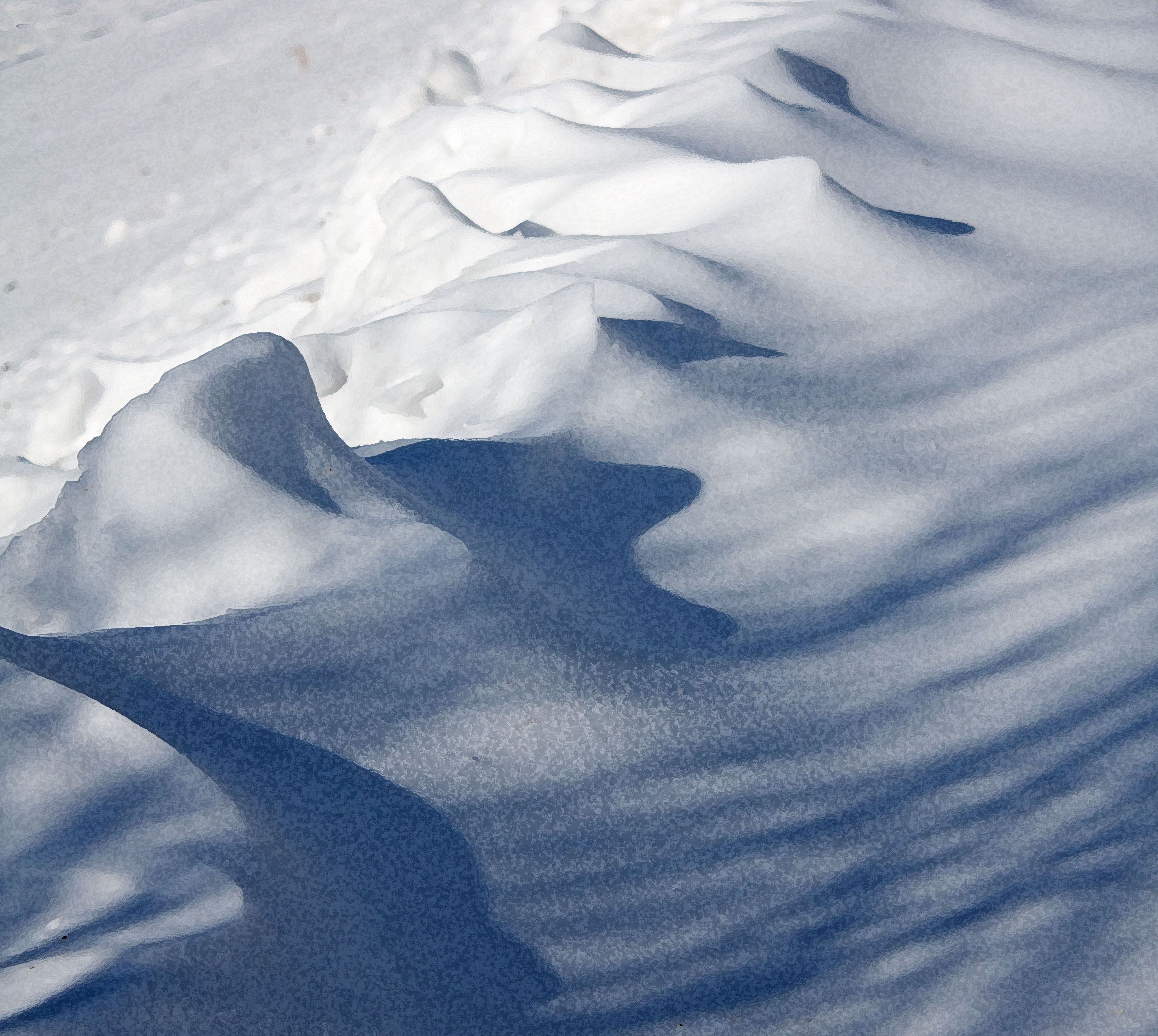
The Beeches area of Toronto after a heavy snowstorm, ON (photo and rendition by Nina Munteanu)
.
I grew up.
Well, that, and the environment intervened. In several ways. It started with my parents. Recognizing my talent and interest in the fine arts (I was good in visual arts), they pushed me to get a fine arts degree in university and go into teaching or advertizing. They didn’t see fiction writing as a viable career or a strength of mine (I was lousy at spelling and, despite my ability to tell stories and my love for graphic novels, I didn’t read books much). I can still remember my father’s lecture to me about how perfect the teaching or nursing profession was for me. I wasn’t enamored by either. The second blow to my author-ego came in the form of a school “interest-ability” test, meant to prepare us for our career decisions. I remember the test consisting of an IQ portion (spatial, English and math), and a psychology portion (including problem-solving and scenarios meant to tease out our affinity for a particular career). Secretly harboring my paperback novelist dream, I filled out my forms with great excitement. I still remember the deflating results, which suggested that I was best suited to be a sergeant in the army. “Writing” as a career barely made it on the graph, and scored well below “computer programmer” and “mechanic”; none of which interested me.
.
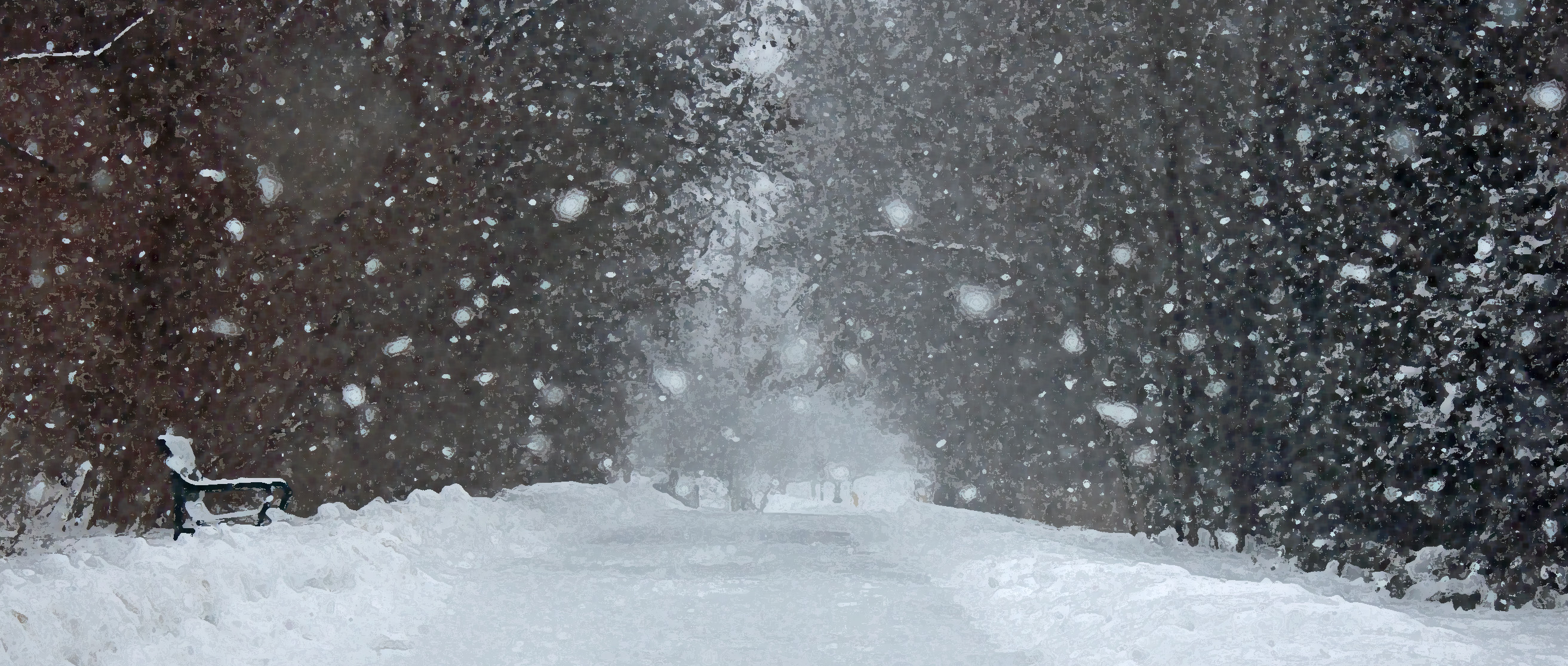
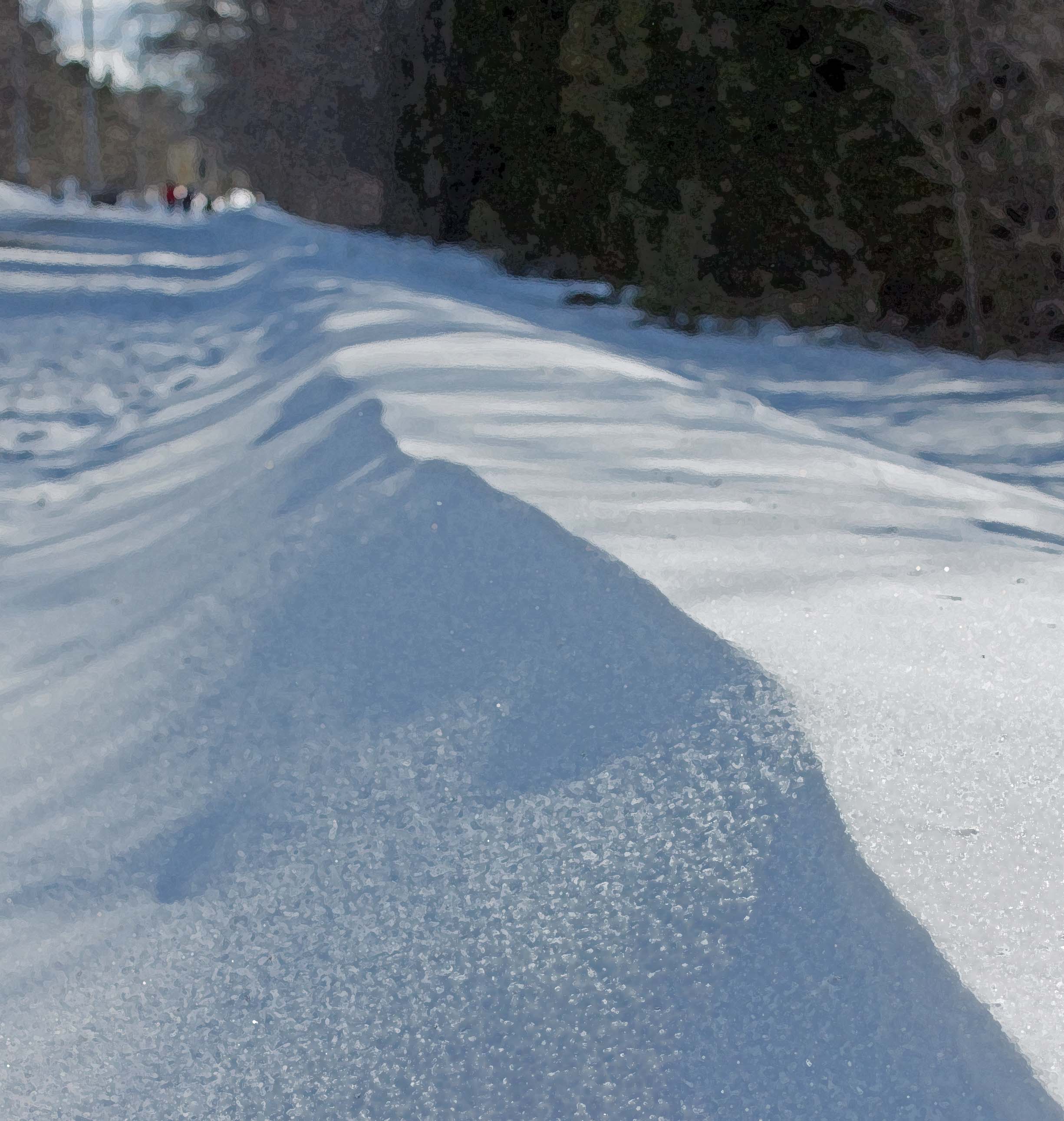
Country road in a heavy snow, ON (photo and rendition by Nina Munteanu)
.
I got involved in the environmental movement, while quietly holding my dream of being a paperback novelist close to my heart. I got several degrees in ecology and consulted for various companies to help protect the environment. I wrote a lot in those days, although it was more about the ecology of creeks and about industrial pollution. But my passion for writing fiction continued to simmer. Magazines started publishing my articles—my first sale was to Shared Vision Magazine in 1995 on environmental citizenship—and my published articles became my entrance into the world of fiction. Once I began publishing fiction stories—my first short fiction sale was “Arc of Time” to Armchair Aesthete in 2002—I never looked back.
Eventually, I was publishing a novel and several short stories every year. My fiction most often focused on environmental issues, humanity’s relationship with the natural world, and how we reconcile our reliance on technology with our respect for the natural world.
.
Publications of long or short eco-fiction that include my writing or editing
Throughout my writer’s journey, and particularly early in my journey, I weathered the threshold guardians, tricksters and shadows: friends and family who called what I did a hobby, something I did just to pass the time; people who didn’t believe in me, envied my drive or simply thought I was wasting my time; even industry scammers who preyed on my dreams and wanted my money for nothing in return; and ultimately my own fears and frustrations on query after query and rejection after rejection. Throughout it all, I never stopped dreaming.
Nina’s family hiking and boating in British Columbia over the years
I’ve travelled through Europe, Africa, parts of Asia, and Australia. I raised a family and lived all over Canada from the Pacific to the Atlantic coast. I worked as a barista, shopkeeper and science lab instructor, then as environmental consultant, writing instructor and writing coach. During these wonderful life-adventures, I never stopped writing.
Nina Munteanu in the castle at Gruyères, Switzerland (photo by Jane Raptor)
.
To date, I have written and sold over three dozen eco-fiction, science fiction and fantasy novels, non-fiction books, short stories and articles. I have sold short stories to magazines in Canada and the U.S. with translations and reprints in Israel, Poland, Greece, and Romania. My short fiction has appeared in Neo-Opsis Science Fiction Magazine, Chiaroscuro, subTerrain, Apex Magazine, Metastellar, and several anthologies. I’ve seen my short stories nominated for the Aurora Prix Award (Canada’s premier award for writing science fiction and fantasy) and the Foundation of Speculative Fiction Fountain Award. Recognition for my work includes the Midwest Book Review Reader’s Choice Award, finalist for Foreword Magazine’s Book of the Year Award, the SLF Fountain Award, and The Delta Optimist Reviewers Choice Award.
.
Nina celebrates her adventures in Toronto (left) and Paris (right)
.
I’ve published nine novels so far with nominations for the Aurora Prix, Foreword Magazine Book of the Year (several times), and various Reader’s Choice awards. My non-fiction book “Water Is…” (Pixl Press)—a scientific study and personal journey as limnologist, mother, and teacher—was Margaret Atwood’s pick in 2016 in the New York Times ‘The Year in Reading.’ My recent eco-novel released in 2020 by Inanna Publications “A Diary in the Age of Water“—about four generations of women and their relationship to water in a rapidly changing world—was a silver medalist for the Literary Titan Award, the Bronze winner of Foreword Magazine’s Book of the Year in 2020, longlisted for the Miramichi Review’s ‘Very Best Book of the Year Award,’ and a finalist for the 2021 International Book Award. Reviewers have described it as “lyrical…thought-provoking…unique and captivating…insightful…profound and brilliant…unsettling and yet deliciously readable…” One reviewer described it as a “a bit of a hybrid” and the writer “a risk taker”—which I quite liked. Another reviewer acknowledged that this was not a book for everyone and yet she found it “strangely compelling.”—which I found delicious.
.
It’s been twenty-seven years since I seriously started my writing career with my first publication in 1995; my work is now recognized and translated throughout the world and I frequently get writing commissions from reputable magazines and publications. I am also frequently invited for speaking engagements and radio/podcast/TV interviews about my science and my writing. In short, I’ve come home; I’d taken a rather long detour but I’ve acquired some tools along the way. It’s been and continues to be a wonderful and exciting journey; and part of what made it so was that I never stopped dreaming and writing.
“…If you have nothing at all to create, then perhaps you create yourself…”
Carl Jung
A sampling of literary publications up to 2021-end that have included something of mine (short fiction, long fiction, non-fiction)
.
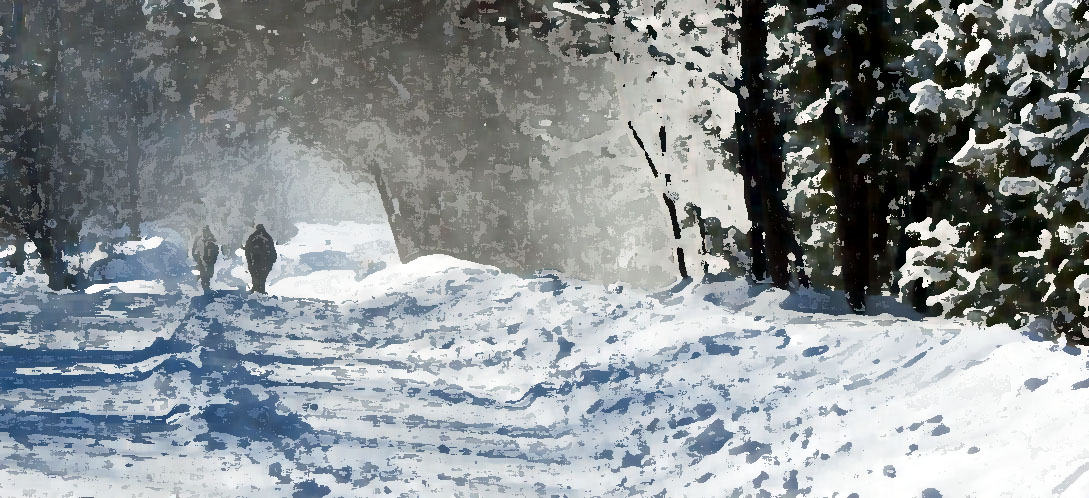
Two people walk through snowy path after a fresh heavy snowfall, ON (photo and rendition by Nina Munteanu)
.
Nina Munteanu is a Canadian ecologist / limnologist and novelist. She is co-editor of Europa SF and currently teaches writing courses at George Brown College and the University of Toronto. Visit www.ninamunteanu.ca for the latest on her books. Nina’s bilingual “La natura dell’acqua / The Way of Water” was published by Mincione Edizioni in Rome. Her non-fiction book “Water Is…” by Pixl Press(Vancouver) was selected by Margaret Atwood in the New York Times ‘Year in Reading’ and was chosen as the 2017 Summer Read by Water Canada. Her novel “A Diary in the Age of Water” was released by Inanna Publications (Toronto) in June 2020.
Dew drops on Hawkweed hairs, ON (photo by Nina Munteanu)
That day may seem like science fiction or the far future, but as William Gibson famously proclaimed, “The future is already here—it’s just not very evenly distributed.”
This is partly why I’ve been recently writing speculative (mundane) science fiction in which components of fiction blur with non-fiction. In a recent interview on the SolarPunk Magazine Podcast, I discussed with hosts Justine and Bria how my recent novel A Diary in the Age of Water blurred fiction with non-fiction. The novel achieved this through the use of a diary to create a gritty realism in a mundane narrative hard to put down. The intention was to achieve personal relevance for the reader to what was going on, particularly with climate change—a water-driven phenomenon. In TheTemz Review, Marcie McCauley postulated that “[Munteanu] does not appear to view fiction and non-fiction as separate territories; or, if she does, then this book is a bridge between them.” I had to laugh when I read this; “she gets me,” I concluded.
In the near-future of A Diary in the Age of Water, Canada has privatized its water utilities after the Conservative Party comes into power, and a giant company called CanadaCorp removes municipal water connections from people’s homes and imposes strict water rations, all while selling off Canada’s precious water to US states like California that would otherwise be uninhabitable.
In her entry for July 13, 2049, Lynna the diarist writes:
“Today CanadaCorp announced that the collection of rainwater was illegal. As of today, I could be arrested for using my rain catcher and cistern. I’ve decided to continue using the cistern, and I’ve warned Hildegard not to breathe a word to anyone at school about what we’re doing with the water. Thankfully, I have time to train her in the art of subterfuge before she starts Grade Two in the fall.”
Nina Munteanu, A Diary in the Age of Water
Raindrops on a black locust leaf, ON (photo by Nina Munteanu)
What follows in the novel is complete commodification of water and further restrictions for citizens in the form of house tap closures and daily water quantity quotas from paying public water taps. No form of water is free or available without payment. And if you can’t pay, well…
Dizzy and shivering in the blistering heat, Hilda shuffles forward with the snaking line of people in the dusty square in front of University College where her mother used to teach. The sun beats down, crawling on her skin like an insect. She’s been standing for an hour in the queue for the public water tap… The man behind Hilda pushes her forward. She stumbles toward the tap and glances at the wCard in her blue-grey hand. Her skin resembles a dry riverbed.
Heart throbbing in her throat, Hilda fumbles with the card and finally gets it into the reader. The reader takes it. The light screams red. Her knees almost give out. She dreaded this day…
A tiny water drop hangs, trembling, from the wTap faucet mouth, as if considering which way to go: give in gravity and drop onto the dusty ground or defy it and cling to the inside of the tap. Hilda lunges forward and touches the faucet mouth with her card to capture the drop. Then she laps up the single drop with her tongue. She thinks of Hanna and her throat tightens.
The man behind her grunts. He barrels forward and violently shoves her aside. Hilda stumbles away from the long queue in a daze. The brute gruffly pulls out her useless card and tosses it to her. She misses it and the card flutters like a dead leaf to the ground at her feet. The man shoves his own card into the pay slot. Hilda watches the water gurgle into his plastic container. He is sloppy and some of the water splashes out of his container, raining on the ground. Hilda stares as the water bounces off the parched pavement before finally pooling. The ache in her throat burns like sandpaper and she wavers on her feet. The lineup tightens, as if the people fear she might cut back in. She stares at the water pooling on the ground, glistening into a million stars in the sunlight…and knows she is dying of thirst…
Nina Munteanu, The Way of Water / la natura dell’acqua
This excerpt from my bilingual short story “The Way of Water / la natura dell’acqua” (Mincione Edizioni, 2016) follows the life of Hilda Dresden, daughter of Lynna, the diarist in “A Diary in the Age of Water.”
Science fiction, you think…
Far future, you think…
Think again…
In 2010, Mike Adams of Natural News reported that collecting rainwater was now illegal in several states of the USA. Utah, Washington and Colorado had outlawed individuals from collecting rainwater on their own properties because, according to officials, that rain belonged to someone else.
In 2015, thousands of citizens in two of America’s poorest cities, Detroit and Baltimore, had their water shut off for being behind on their water bills (which had been sharply increased).
Both are inhumane examples of government-imposed oppression over what should be a public and free resource: water.
Dew drops on hawkweed hairs and Mealy Pixie Cup lichens, ON (photo by Nina Munteanu)
Maude Barlow, the Chairperson of the Council of Canadians, writes in Boiling Point of the water crisis in Canada—perhaps our best kept secret, considering that Canada is supposedly so water-rich. Are we giving it all away? And what of our indigenous communities, some of whom have not had potable water for decades?
So, I agree with Gibson about the future not being evenly distributed. This is because the present isn’t evenly distributed. Much of this disparity arises from an extractive and exploitive mentality and practice. One that commodifies what needs to remain free and available for all users. Capitalism ensures an uneven future by focusing on fear and stressing competition, separation, and exclusion.
In his book Designing Regenerative Cultures Daniel Christian Wahl talks about changing our evolutionary narrative from one based on fear defined by a perception of scarcity, competition, and separation to one based on love defined by a perception of abundance, a sense of belonging, collaboration and inclusion.
And moving forward we can take a lesson from Robin Wall Kimmerer, author of Braiding Sweetgrass, who talks about a gift economy—an economy of abundance—whose basis lies in recognizing the value of kindness, sharing, and gratitude in an impermanent world.
This is what she says: “Climate change is a product of this extractive economy and is forcing us to confront the inevitable outcome of our consumptive lifestyle, genuine scarcity for which the market has no remedy. Indigenous story traditions are full of these cautionary teachings. When the gift is dishonored, the outcome is always material as well as spiritual. Disrespect the water and the springs dry up. Waste the corn and the garden grows barren. Regenerative economies which cherish and reciprocate the gift are the only path forward. To replenish the possibility of mutual flourishing, for birds and berries and people, we need an economy that shares the gifts of the Earth, following the lead of our oldest teachers, the plants.”
So, “The Day We’re Not Allowed to Drink Water…”
…Let that day never come.
Make it so…
Moss with raindrops on capsules, ON (photo by Nina Munteanu)
References:
Barlow, Maude. 2016. “Boiling Point: Government Neglect, Corporate Abuse, and Canada’s Water Crisis.” ECW Press, Toronto. 312pp.
Kimmerer, Robin Wall. 2020. “The Serviceberry, An Economy of Abundance.” Emergence Magazine, December 10, 2020.
Munteanu, Nina. 2016. “La natura dell’acqua / The Way of Water.” Mincione Edizioni, Roma. 114pp.
Munteanu, Nina. 2020. “A Diary in the Age of Water.” Inanna Publications, Toronto. 300pp.
Raindrops ‘float’ on a black locust leaf in a light rain, ON (photo by Nina Munteanu)
Nina Munteanu is a Canadian ecologist / limnologist and novelist. She is co-editor of Europa SF and currently teaches writing courses at George Brown College and the University of Toronto. Visit www.ninamunteanu.ca for the latest on her books. Nina’s bilingual “La natura dell’acqua / The Way of Water” was published by Mincione Edizioni in Rome. Her non-fiction book “Water Is…” by Pixl Press(Vancouver) was selected by Margaret Atwood in the New York Times ‘Year in Reading’ and was chosen as the 2017 Summer Read by Water Canada. Her novel “A Diary in the Age of Water” was released by Inanna Publications (Toronto) in June 2020.
The Otonabee River glints in the sunlight in the midst of a snow flurry, ON (photo and rendition by Nina Munteanu)
This time last year reviewer Lisa Haselton posted an interview with me on New Year’s Day of 2021 on my latest release “A Diary in the Age of Water.” 2021 saw incredible sales for my clifi eco-novel, along with several appearances on radio shows, podcasts and TV stations. It would seem that water is on everyone’s mind and what better way than a limnologist’s diary to learn more about it.
Lisa and I talked about what inspired me to write this novel and about my writing process. What follows is part of that interview. Check out this link for the complete interview with Lisa Haselton.
*****
Lisa: Please tell us about your current release.
Nina: The book tells the journey of four generations of women who have a unique relationship with water, through a time of extreme climate change and water shortage. The book spans over forty years (from the 2020s to the 2060s) and into the far future, mostly through the diary of a limnologist, which is found by a future water-being. During the diarist’s lifetime, all things to do with water are overseen and controlled by the international giant water utility CanadaCorp—with powers to arrest and detain anyone. This is a world in which China owns America and America, in turn, owns Canada. The limnologist witnesses and suffers through severe water taxes and imposed restrictions, dark intrigue through neighbourhood water betrayals, corporate spying and espionage, and repression of her scientific freedoms. Some people die. Others disappear…
Ultimately, the book carries themes of hope and forgiveness—of ourselves and each other—and compassion for all things, starting with water. Each character carries an aspect of that theme, from the diarist’s activist mother, to the diarist’s own cynical protectionism, her spiritual anarchist daughter, and lastly the innocent storm of the last generation.
Lisa: What inspired you to write ‘A Diary in the Age of Water’?
Nina: It started with a short story I was invited to write in 2015 about water and politics in Canada. I had long been thinking of potential ironies in Canada’s water-rich heritage. The premise I wanted to explore was the irony of people in a water-rich nation experiencing water scarcity: living under a government-imposed daily water quota of 5 litres as water bottling and utility companies took it all. I named the story “The Way of Water.” It was about a young woman (Hilda) in near-future Toronto who has run out of water credits for the public wTap; by this time houses no longer have potable water and their water taps have been cemented shut; the only way to get water is through the public wTaps—at great cost. She’s standing two metres from water—in a line of people waiting to use the tap—and dying of thirst.
The short story and the novel that came from it explore the nuances of corporate and government corruption and deceit together with global resource warfare. In this near-future, Canada is mined of all its water by thirsty Chinese and US multinationals—leaving nothing for the Canadians. Rain has not fallen on Canadian soil in years due to advances in geoengineering and weather manipulation that prevent rain clouds from going anywhere north of the Canada-US border. If you’re wondering if this is possible, it’s already happening in China and surrounding countries.
Lisa: As a child, what did you want to be when you grew up?
Nina: After astronaut, actress and a drummer in a rock and roll band—seriously—it was paperback writer. That’s been my dream since I was ten. I told stories long before I wrote them and long before any of them was published. I told stories in the form of cartoons. Since I was a small child, I wanted to be a cartoonist and write graphic novels (back then I knew them as comics). I created several strips with crazy characters that I drew, blending my love for drawing with my love for storytelling. My sister and I used to make up amazing adventure stories in the universe, peopled with aliens and crazy worlds. I wrote my first complete novel when I was fifteen (“Caged-In World”—which later served as a very rough draft for my first published novel, “Darwin’s Paradox” in 2007). My first published work was a non-fiction article “Environmental Citizenship” which appeared in Shared Vision Magazine in 1995. My first fiction work was a short story entitled “Arc of Time”, which was published in Armchair Aesthete in 2002.
Heavy snowfall in the forest in early winter, ON (photo and rendition by Nina Munteanu)
Lisa: When did you first consider yourself a writer?
Nina: I’ve considered myself a storyteller since I was a child when I wrote and directed plays that my older brother and sister played in and drew cartoon adventure stories. My dream was to be a paperback writer (like the Beatles tune). But I didn’t think of myself seriously as an author until my first short story was published in 2002. It was called “Arc of Time” and appeared in a small magazine with a circulation of about 200. That story went on to be reprinted several times in larger magazines and led to a career of award-winning short stories—the latest appearing in the literary magazine subTerrain in 2020.
Lisa: Do you write full-time? If so, what’s your work day like? If not, what do you do other than write and how do you find time to write?
Nina: While I don’t write full-time, my career is all about writing. Every day I write and research my next novel; I also write commissioned articles and short stories for magazines and for my several writing and science blogs. When I’m not writing, I teach writing at the University of Toronto and George Brown College. I also coach writers online to publication. Finding time to write has not generally been a challenge. I’ve embraced an opportunistic process in my writing and research that allows me to write considerably. The process recognizes that there are many ways to “write” from observations and note-taking, to reading and research, to writing short vs long and fiction vs non-fiction. For instance, I can fill a short break time with meaningful research, editing, or the start of a short article; this saves longer break times for my current novel, which requires a greater stretch of uninterrupted time.
Heavy snowfall in the marsh in early winter, ON (photo and rendition by Nina Munteanu)
Lisa: What would you say is your interesting writing quirk?
Nina: That I am both a pantser and an outliner—with the same book. My writing process has always been a tandem kind of ‘fish and cut bait’ scene / sequel scenario with research following a premise followed by vigorous writing, which in turn engenders more research, which often reveals another plot or sub-theme that needs inclusion. It may seem a haphazard way to write, but I find it very fulfilling, fun and revealing—especially when the Universe provides with serendipitous discoveries (just when I need them).
Lisa: What exciting story are you working on next?
Nina: I’m currently researching and working on the sequel to “A Diary in the Age of Water”—a thriller about how a phenomenon brings together four lost and homeless people through a common goal to free the Earth from the manacles of human greed. The story takes place throughout Canada—from Halifax to Vancouver and the Arctic. It takes place mostly during the 2050s, and features a few ghosts, the Halifax 1917 Explosion, experimentation on humans, espionage, murder, and—of course—a plague. I’m calling it my COVID19 novel…
Sun emerges after a heavy snowfall at the marsh, ON (photo and rendition by Nina Munteanu)
Nina Munteanu is a Canadian ecologist / limnologist and novelist. She is co-editor of Europa SF and currently teaches writing courses at George Brown College and the University of Toronto. Visit www.ninamunteanu.ca for the latest on her books. Nina’s bilingual “La natura dell’acqua / The Way of Water” was published by Mincione Edizioni in Rome. Her non-fiction book “Water Is…” by Pixl Press(Vancouver) was selected by Margaret Atwood in the New York Times ‘Year in Reading’ and was chosen as the 2017 Summer Read by Water Canada. Her novel “A Diary in the Age of Water” was released by Inanna Publications (Toronto) in June 2020.