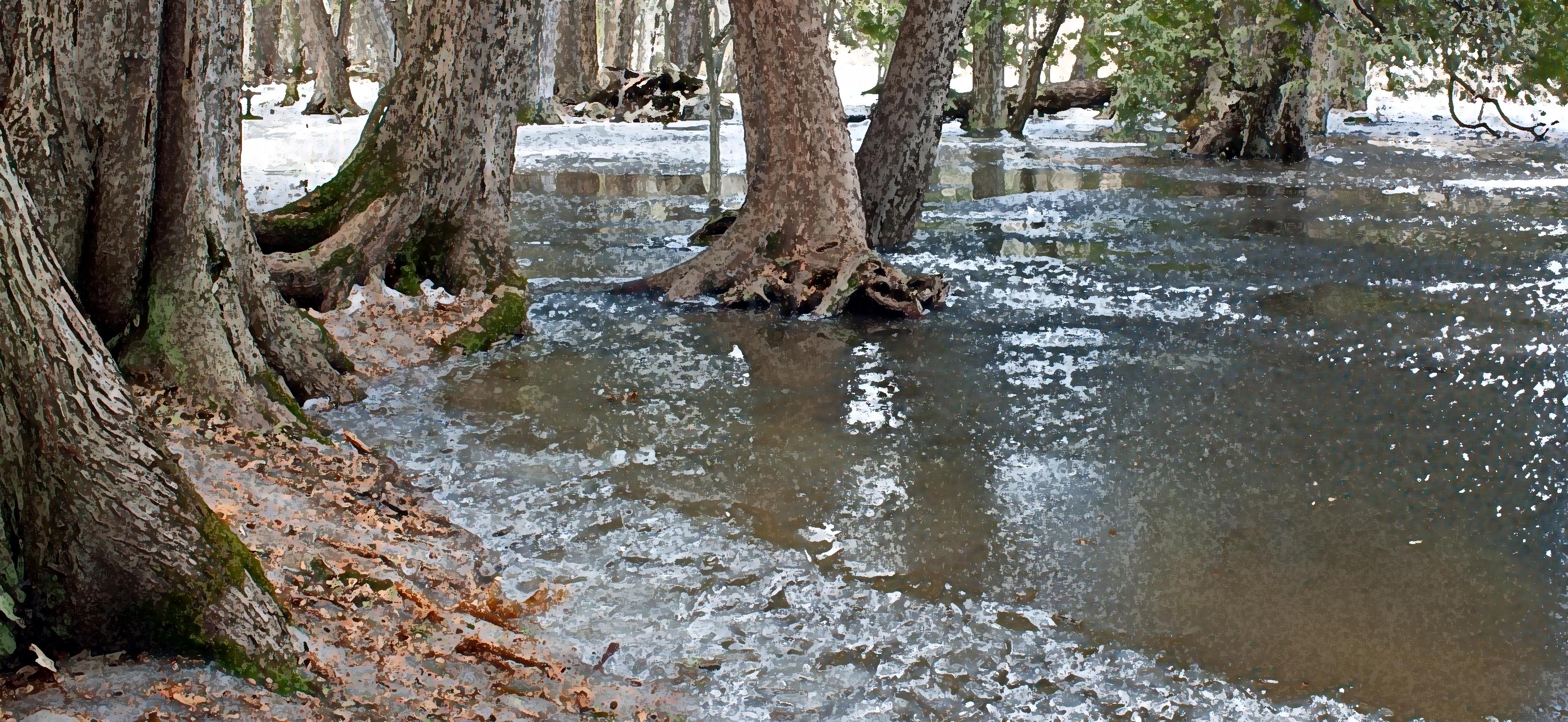
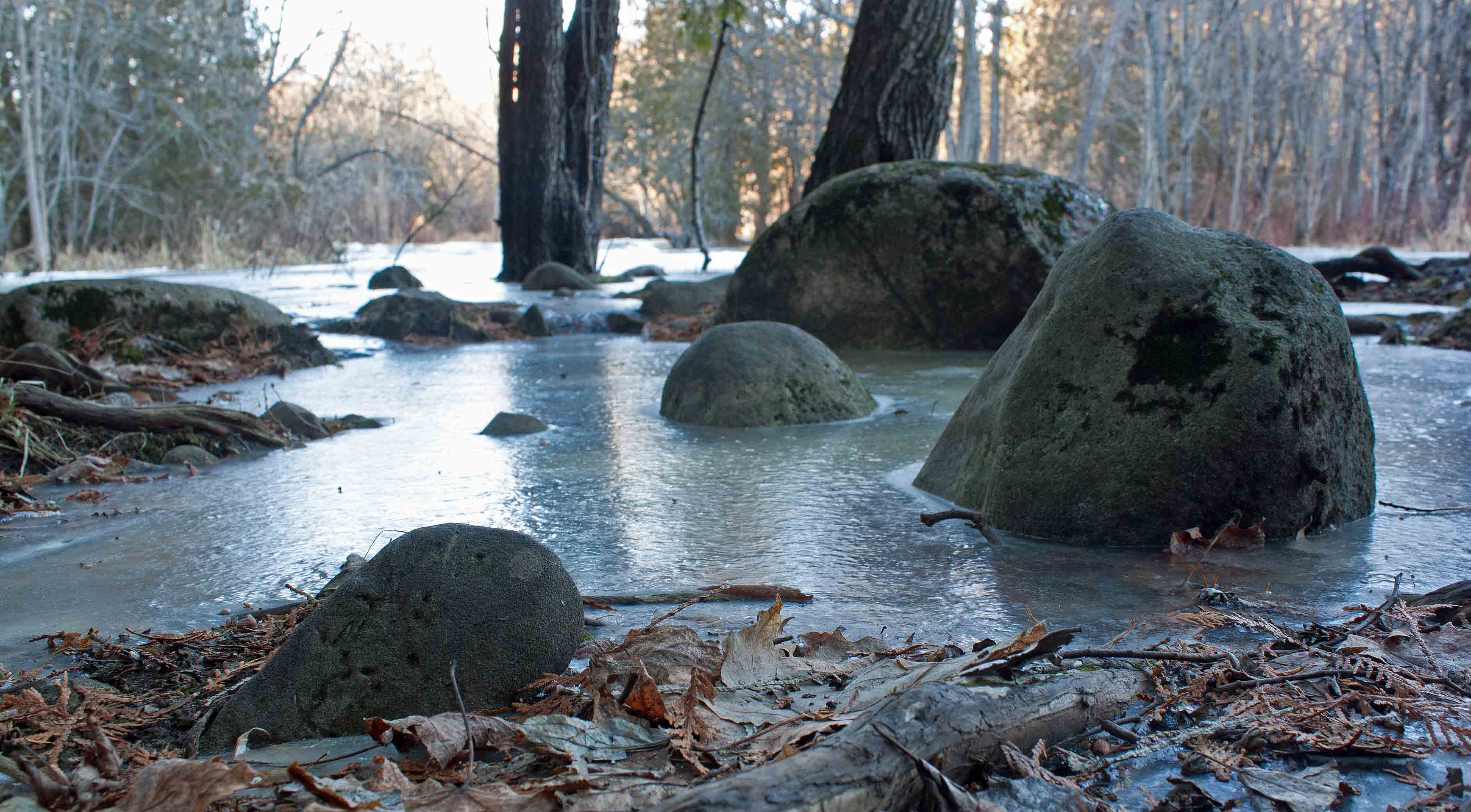
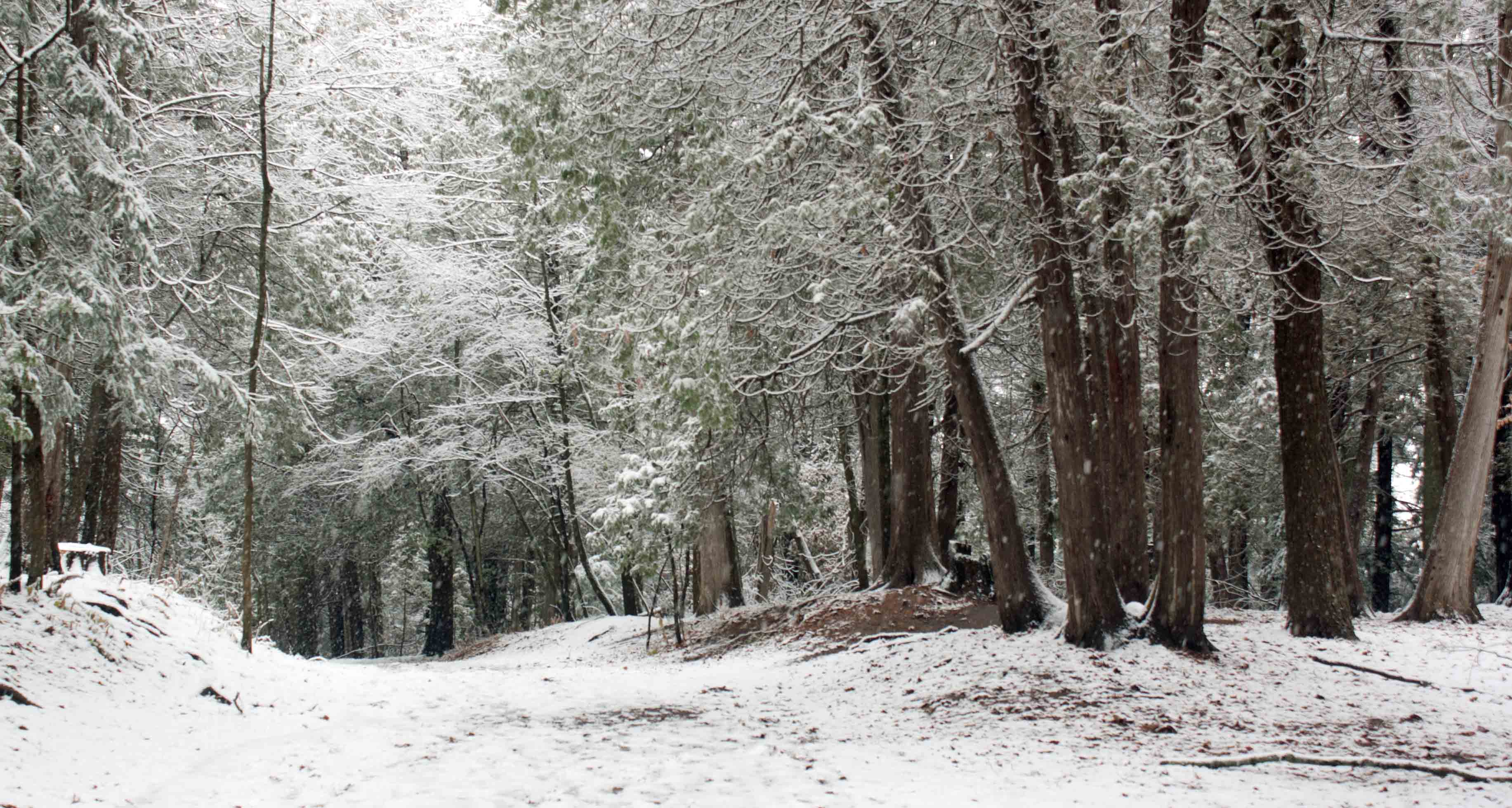
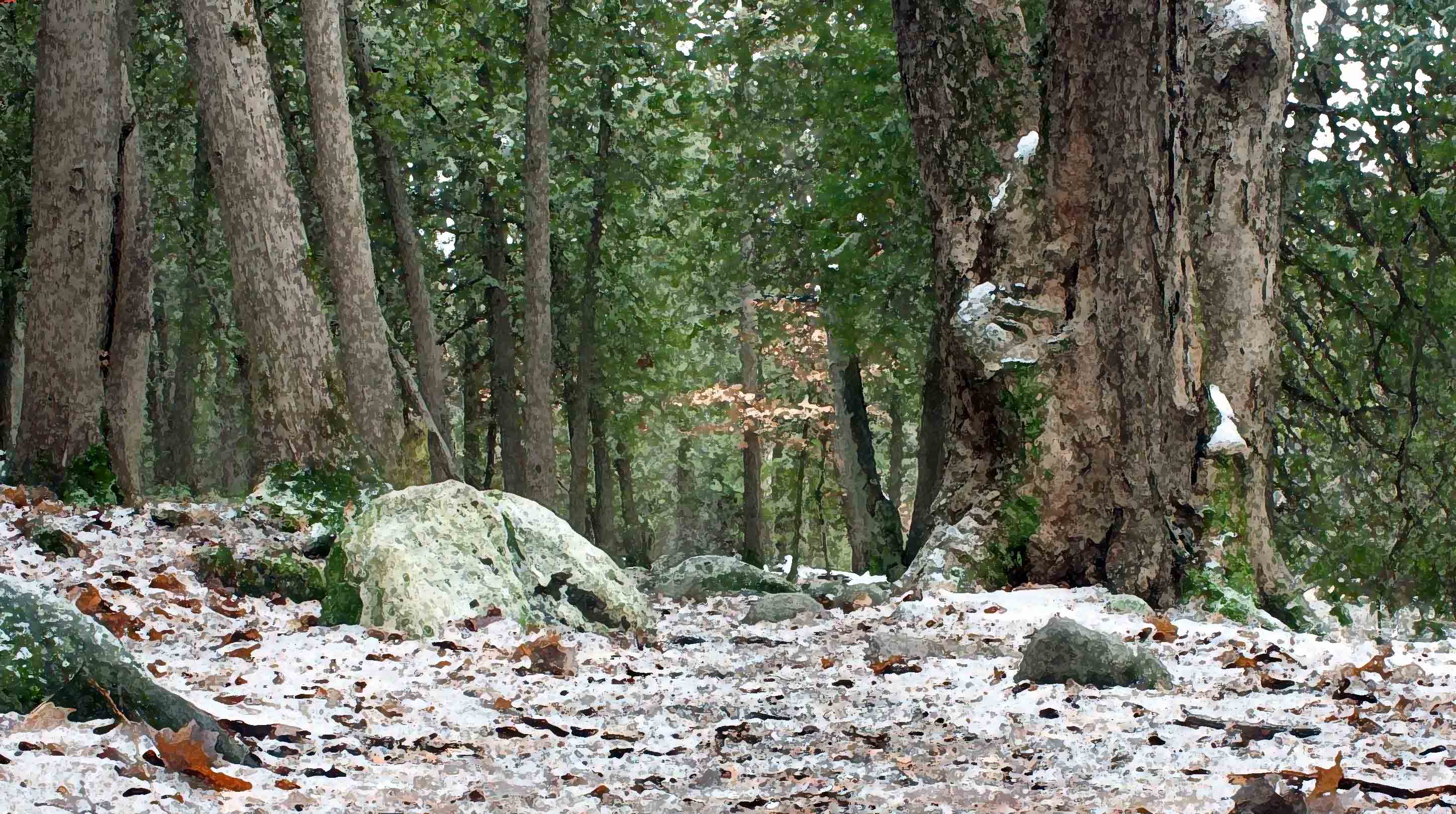
Cedar trees in ice shallows of Jackson Creek, ON (photograph and dry brush rendition by Nina Munteanu)
Dialogue spices narrative and increases pace because it is read more quickly. Dialogue is pleasing to the reader’s eye and gets readers involved. Dialogue is action.
Five tools for achieving relevant and exciting dialogue include: showing not telling; simplification; voice; interactive devices, and use of narrative.
Defining Dialogue and its Purpose in Story
Good dialogue neither mimics actual speech (e.g., it’s not usually mundane, repetitive or broken with words like “uh”) nor does it educate the reader through long discourse (unless the character is that kind of person). Good dialogue in a story should be somewhere in the middle. While it should read as fluid conversation, dialogue remains a device to propel the plot or enlighten the reader to the character of the speaker). No conversation follows a perfect linear progression. People interrupt one another, talk over one another, often don’t answer questions posed to them or avoid them by not answering them directly. These can all be used by the writer to establish character, tension, and relationship.
The writer uses dialogue to move the story along, increase tension and speed up pace. Dialogue helps define setting, characters and objects. It allows characters to confront each other and crystallizes relationships and situations. Dialogue can effectively deliver a punch or blow in a conflict. It can cue into a transition to a new scene
Show, Don’t Tell
Beginning writers commonly use dialogue to explain something that both participants should already know but the reader doesn’t. It is both awkward and unrealistic and immediately exposes the writer as a novice. Writers should avoid the use of “As you know…” It’s better to keep the reader in the dark for a while than to use dialogue to explain something. On the same note, characters should talk to one another, not indirectly to the reader through polemic or long dissertation and exposition.
Use Relevant Tag Lines and Reduce Them
When using tag lines for dialogue, take care to avoid the use of redundant tag lines. For instance: “I’m sorry,” he apologized; “Do you have a dog?” she asked. The primary purpose of a tag is to establish whois speaking, not necessarily how; the howis usually achieved through the actual speech. Novice writers tend to avoid “said” and replace with creative but distracting verbs (e.g., snarled, hissed, purred) or add excessive speech modifiers (e.g., he said pleadingly or he said dramatically). Instead, look for ways to express the way they said it in actual dialogue. Let the dialogue speak for itself. In the example—“He can’t be there!” she said in disbelief—disbeliefis unnecessary because the dialogue already shows it. In truth, most professional writers use said and let the dialogue do the talking.
Develop Character “Voice” & Speech Signatures
Each of us develops our own idiosyncratic way of speaking, based on our ethnic background, the community or region we grew up in, our education and the circles we frequent. Writers can create a character’s distinctive “voice” by introducing a unique vernacular to each character. This can take on the form of a certain repeated phrase, a body movement (itself a “language”), a stutter or speech intonation or accent. For instance, I know a person who adds “don’t you think?” to almost everything he says. This says something about how that person thinks. Another person I know uses “do you see?” at the end of his phrase. Again, rather revealing. The writer can add additional depth to these specific traits by linking them to metaphor.
Use Oblique Conversation & Overlapping Speech
People often don’t respond directly to questions posed them. This may be due to them avoiding the question or excitement or rudeness. The writer can make use of these as devices to enlighten the reader on theme, plot and character, while making the conversation more interesting and realistic. People cut each other off or talk over one another all the time. You can incorporate this into your dialogue to achieve a note of hastiness, abruptness, nervousness or panic.
Intersperse Dialogue with Descriptive Narrative
Many beginning writers forget to “ground” the reader with sufficient cues as to where the characters are and what they’re doing while they are talking. This phenomenon is so common, it even has a name. It’s called “talking heads.” As writers we must achieve a balance between a lack of setting, which disorients the reader, and info-dump, which halts conversation and slows pace considerably. Narrative can also be used to contradict what’s actually said through body language or by simply telling the reader. My previous article “title” discusses ways you can use body language to reveal subtle undercurrent of communications between characters, the comic or tragic elements behind dialogue, and a character’s true feelings. Here are some examples:
“How did it go?”
“Great,” he lied.
“Yes, I feel so much better now,” she said, eyes wandering from his.
Well, you get the picture. And I just revealed myself as a visual thinker…
Cedar trees inundated by ice sheet in shallows of Jackson Creek, ON (photo and dry brush rendition by Nina Munteanu)
Nina Munteanu is a Canadian ecologist / limnologist and novelist. She is co-editor of Europa SF and currently teaches writing courses at George Brown College and the University of Toronto. Visit www.ninamunteanu.ca for the latest on her books. Nina’s bilingual “La natura dell’acqua / The Way of Water” was published by Mincione Edizioni in Rome. Her non-fiction book “Water Is…” by Pixl Press(Vancouver) was selected by Margaret Atwood in the New York Times‘Year in Reading’ and was chosen as the 2017 Summer Read by Water Canada. Her novel “A Diary in the Age of Water” was released by Inanna Publications (Toronto) in June 2020.
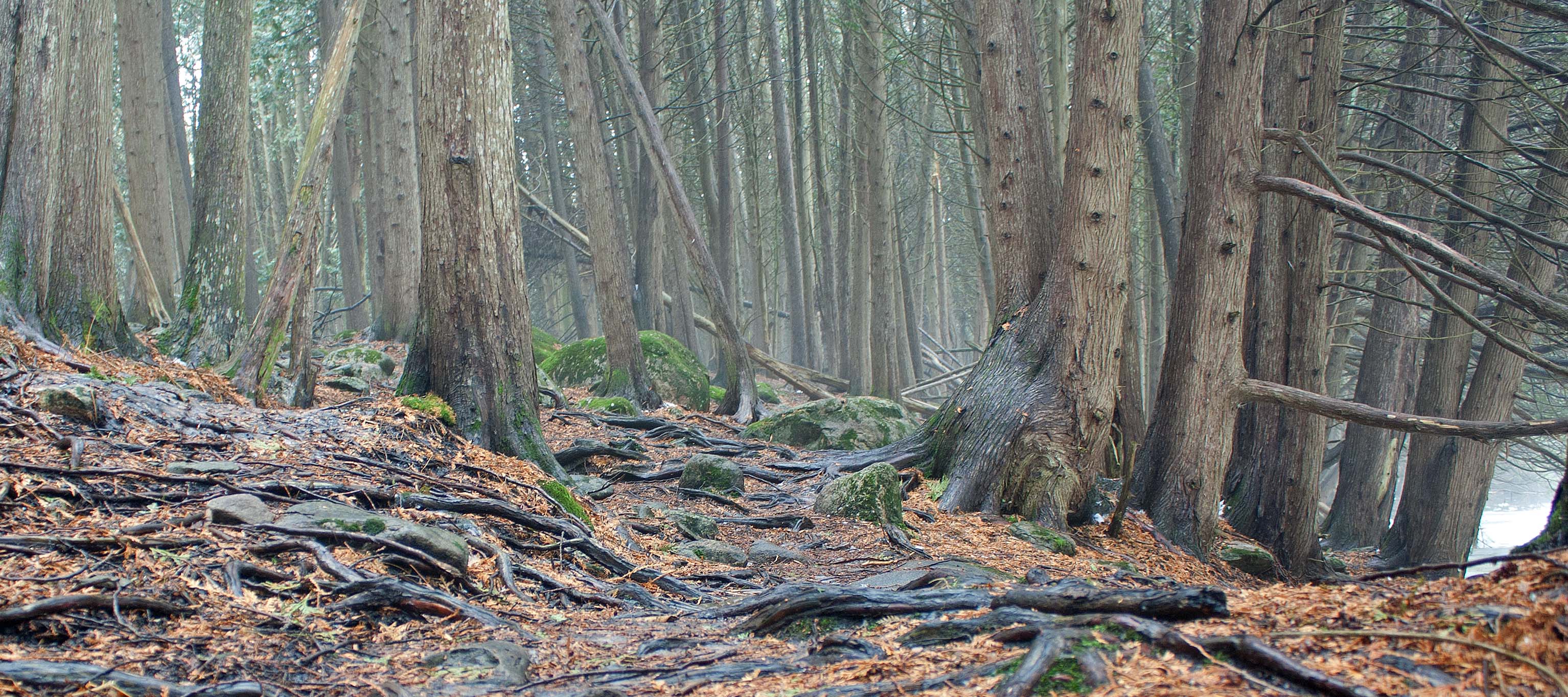
Cedar forest and extensive roots amid glacial erratics flank Jackson Creek on the right, ON (photo by Nina Munteanu)
.
It was a cold November day, after a light snow, as I wandered the Jackson Creek old-growth forest. Centuries-old cedar, pine and hemlock towered above me, giving off the fresh scent of forest. The trees creaked and cracked, swaying in a mischievous wind. I left the main path and descended the leaf-strewn slope toward the river. My boots pressed through a frosty crust into the spongy ground of dead leaves and organic soil. I stopped and breathed in the fresh coolness of the air. A damp mist huddled among the trees, adding wisps of mystery to the ancient forest. It was as though I’d entered an enchanted forest in some fanciful fairy tale.
Cedar forest on slope of Jackson Creek Park in early winter, ON (photo by Nina Munteanu)
.
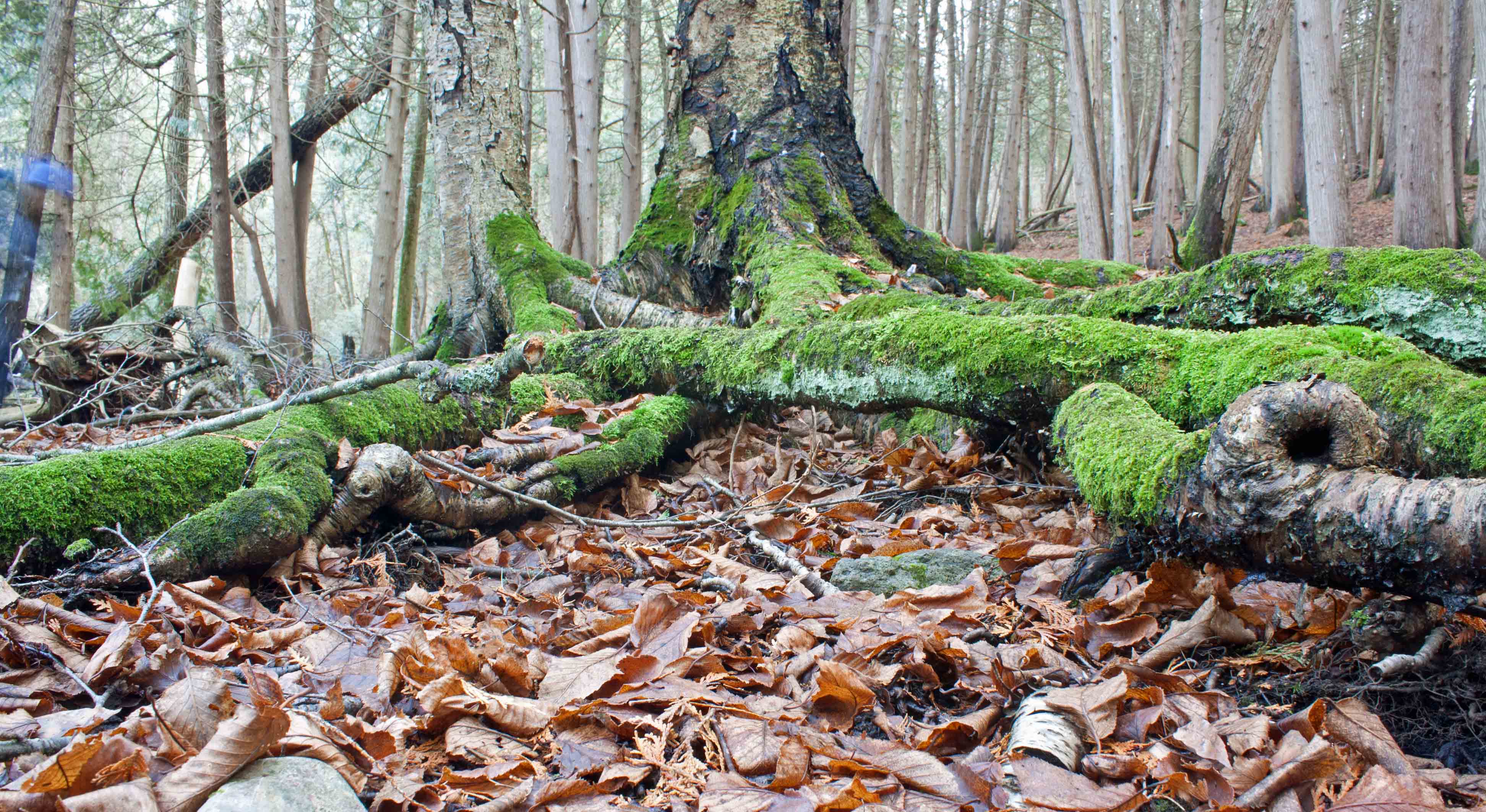
Not far from the river, I approached an old yellow birch tree, large trunk rising as tall as some of the cedars and pines around it. Golden flakes of bark curled and formed craggy patterns around the girth of the old tree. Radiating out from the tree, moss-covered roots snaked out like tangled ropes in a profusion of brilliant green. This was fairy country, I suddenly thought.
I dropped to my knees, crouching down, and set up my tripod and camera to capture this magical tree from the perspective of the forest floor. Head almost touching the ground, I inhaled the scent of loam and decaying leaves. The fresh pungency of cedar, pine, and humid moss hung in the air. Nearby, the river chortled and bubbled in a content symphony of motion. A curious red squirrel parked itself on a log nearby to watch me. It didn’t scold me like they normally did when I entered the forest; like it understood… It then occurred to me, as I set up my equipment under the squirrel’s careful stare, that I was in the presence of an enchantment. Like I was peering into a secret dance of feral celebration. But being there and appreciating it, I had now become part of it; I was Alice going down the rabbit hole into a true wonderland…
It was then that I glimpsed it as I carefully took my timed pictures. A blur of blue. What had I witnessed? A motion? A colour? Then it was gone. But in that moment, I’d felt the spark of an elation that comes with a glimpse into a secret world.
Old yellow birch tree and moss-covered roots with approaching blue sprite from left (photo by Nina Munteanu)
.
When I returned home to look at the images I saw that my camera had captured a wispy blue entity that flowed into its view and peered around the old birch at me with a kind of curious though mischievous grin.
Had I just captured a blue sprite? Something was unmistakably there!
Forest sprite peers around a yellow birch tree, Jackson Creek Park, ON (photo by Nina Munteanu)
.
I read up on sprites. According to European lore, a sprite is a supernatural entity. They are often depicted as fairy-like creatures or as an ethereal entity. The word sprite comes from the Latin spiritus (“spirit”), via the French esprit.
Given that the sprite I’d observed was blue and we were close to the river, I wondered if it was not a forest or wood sprite, but a water sprite. According to alchemist Paracelsus, the term ‘water sprite’ is used for any elemental spirit associated with water. They can breathe water or air and sometimes can fly. They also possess the power of hydrokinesis, which is the ability to create and manipulate water at will. Also known as ‘water nymphs’ and naiads (or nyads), these divine entities tend to be fixed in one place. Slavic mythology calls them vilas. Sprites are not corporeal beings (like selkies, mermaids and sirens) given that they are not purely physical; they are more like local deities than animals. This explained the wispy nature of the being I’d seen peering at me from the tree.
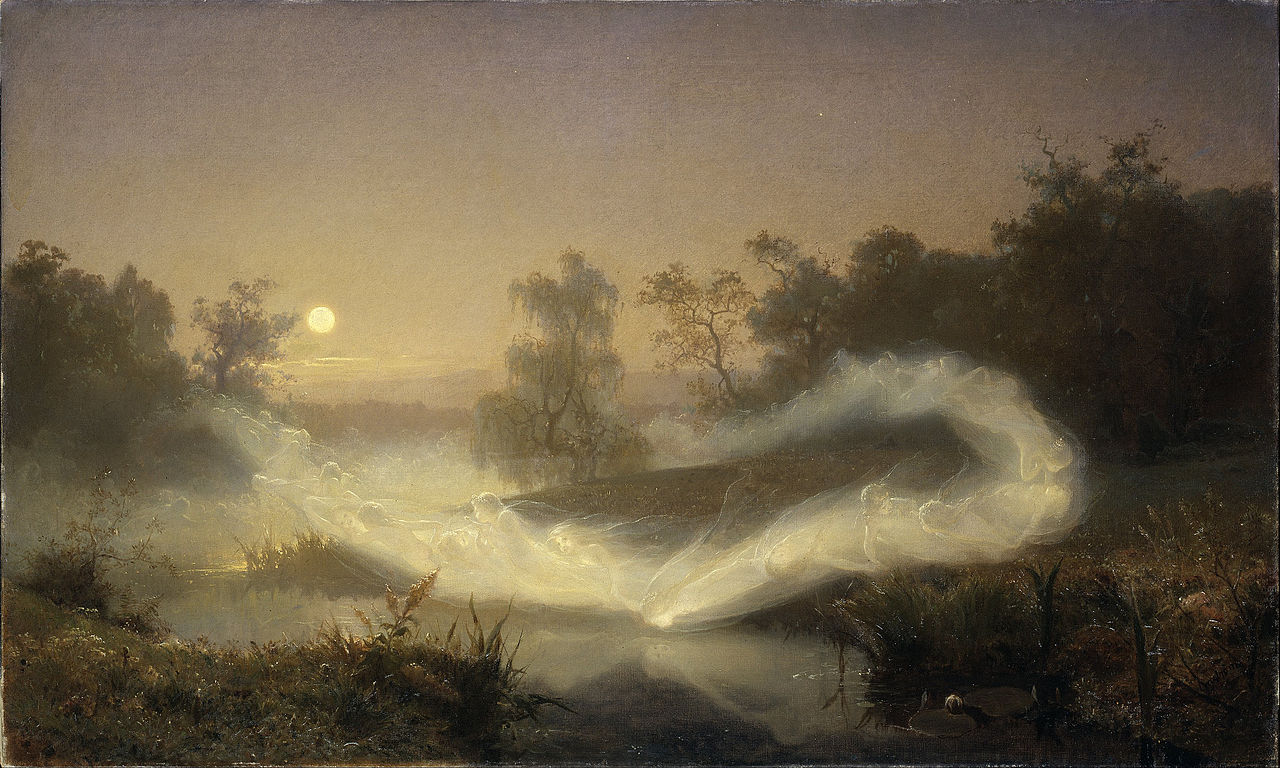
“Dancing Fairies” by August Malmström
.
After consulting with several friends—some who purported to know much more about sprites than I did—I concluded that this sprite was, in fact, a forest sprite and it was blue because it was near the water. Friend Merridy suggested that “forest sprites, normally green, may turn blue if a nearby brook calls to them.” She added that “water sprites can be distinguished by their chatty nature. They rarely go beyond the banks of a river or brook. Forest sprites are mostly silent.” Which this one certainly was. Friend Craig then pondered, “Are digital sprites in our world or in an electro-magnetic world? Or something else?” He was referring to them showing up on my camera without me even noticing they were there. When I told him I would return in search of them he observed, “if you’re looking for them that might be when they hide. Or maybe not. Any type of sprite is probably good, mischievous or friendly.” Thanks, Craig! That was helpful…
Glacial erratic boulders in Jackson Creek, ON (photo by Nina Munteanu)
Century-old beech tree, decaying and moss-covered in early winter, Jackson Creek Park, ON (photo by Nina Munteanu)
Ancient cedar tree stands next to an ice sheet on the path beside Jackson Creek, ON (photo by Nina Munteanu)
.
I visited the forest many times after but saw no sign of any sprites. Perhaps Craig was right; they were hiding from me.
Then, on a foggy late December day, after a light dusting of snow, I returned to document the ice forming in the river. Islands and columns of ice had created a new topography for the flowing waters of Jackson Creek. Ice sheets also covered the forest path in places—making the walk somewhat treacherous. At times, I had to scramble and seize hold of branches to haul my way up precipitous banks from where I’d captured sculptures of ice ‘pearls,’ ‘platforms,’ and ‘columns’ on the river.
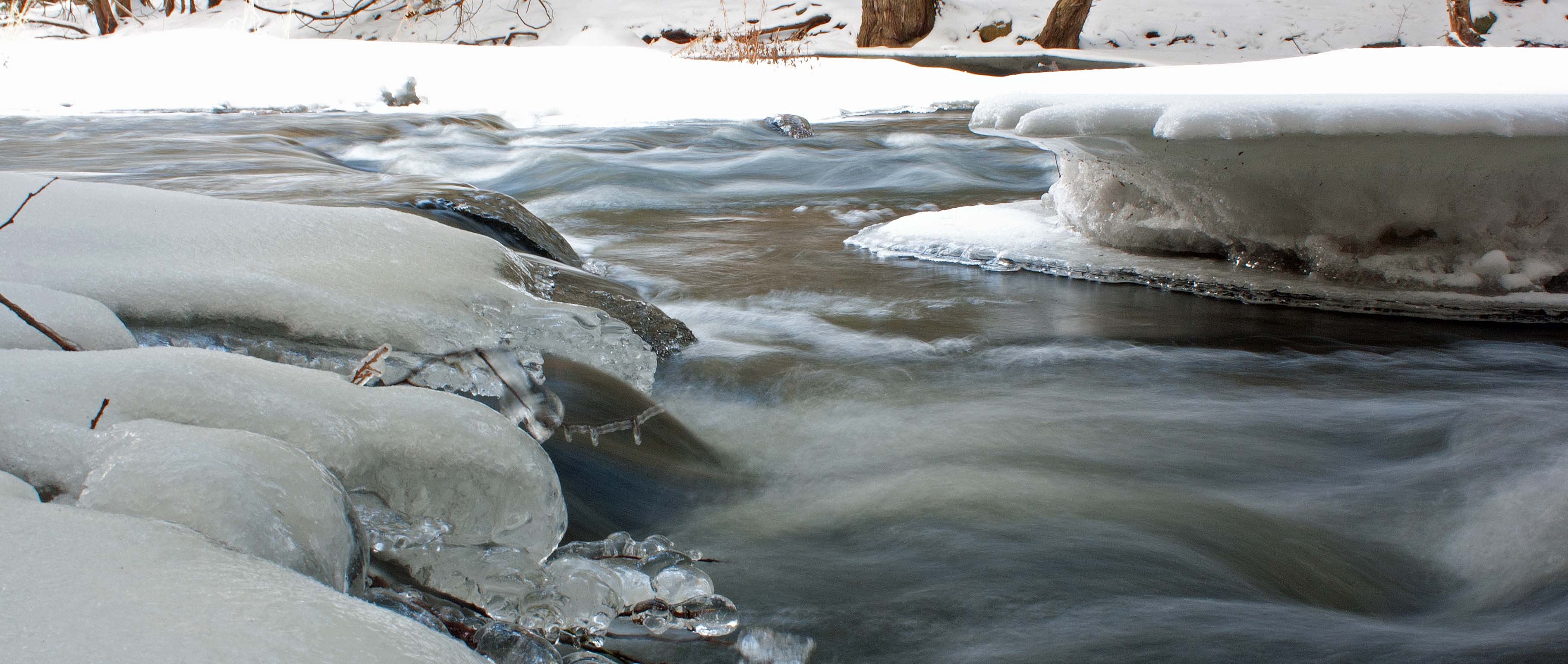
Ice forming on Jackson Creek in early winter, ON (photo by Nina Munteanu)
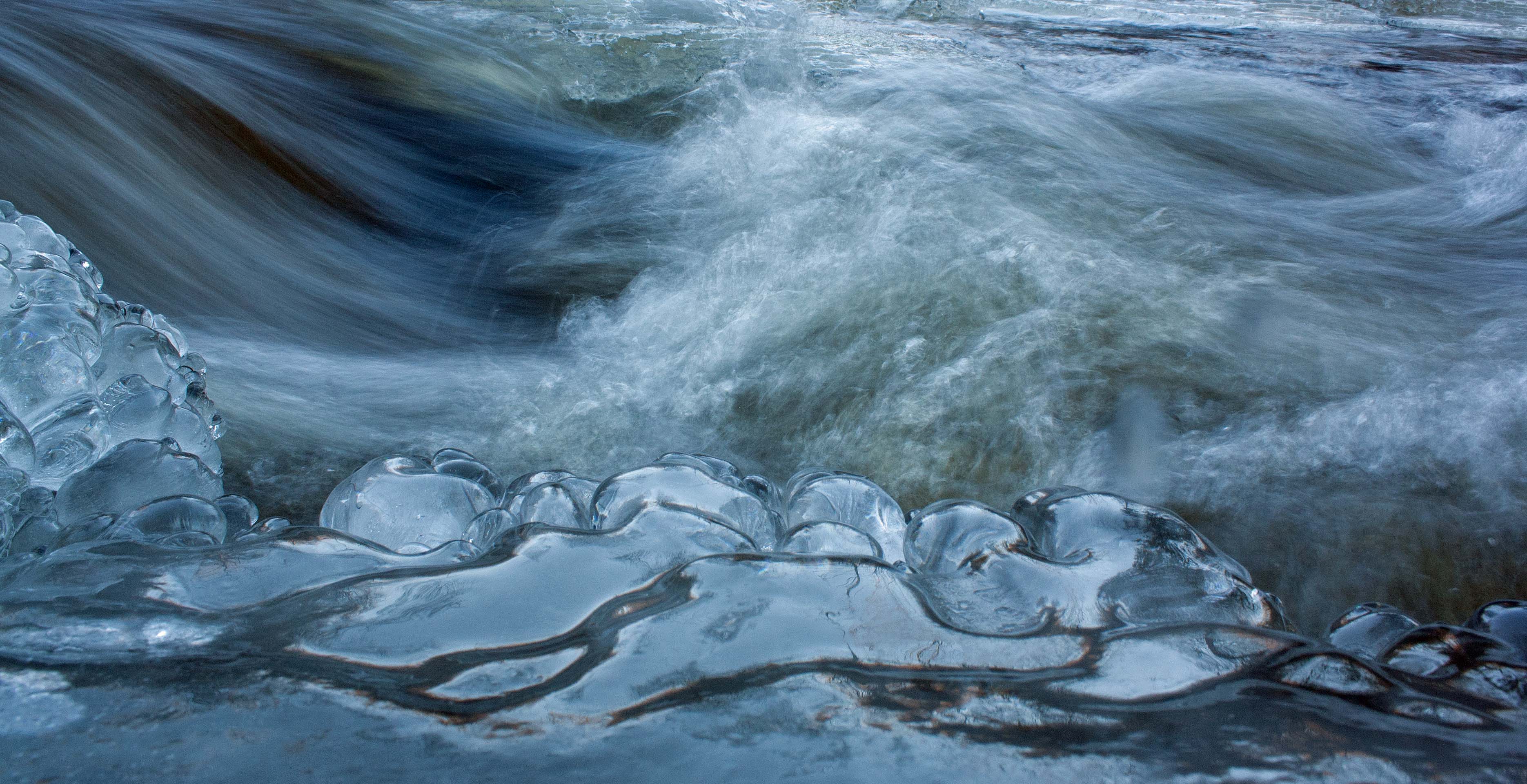
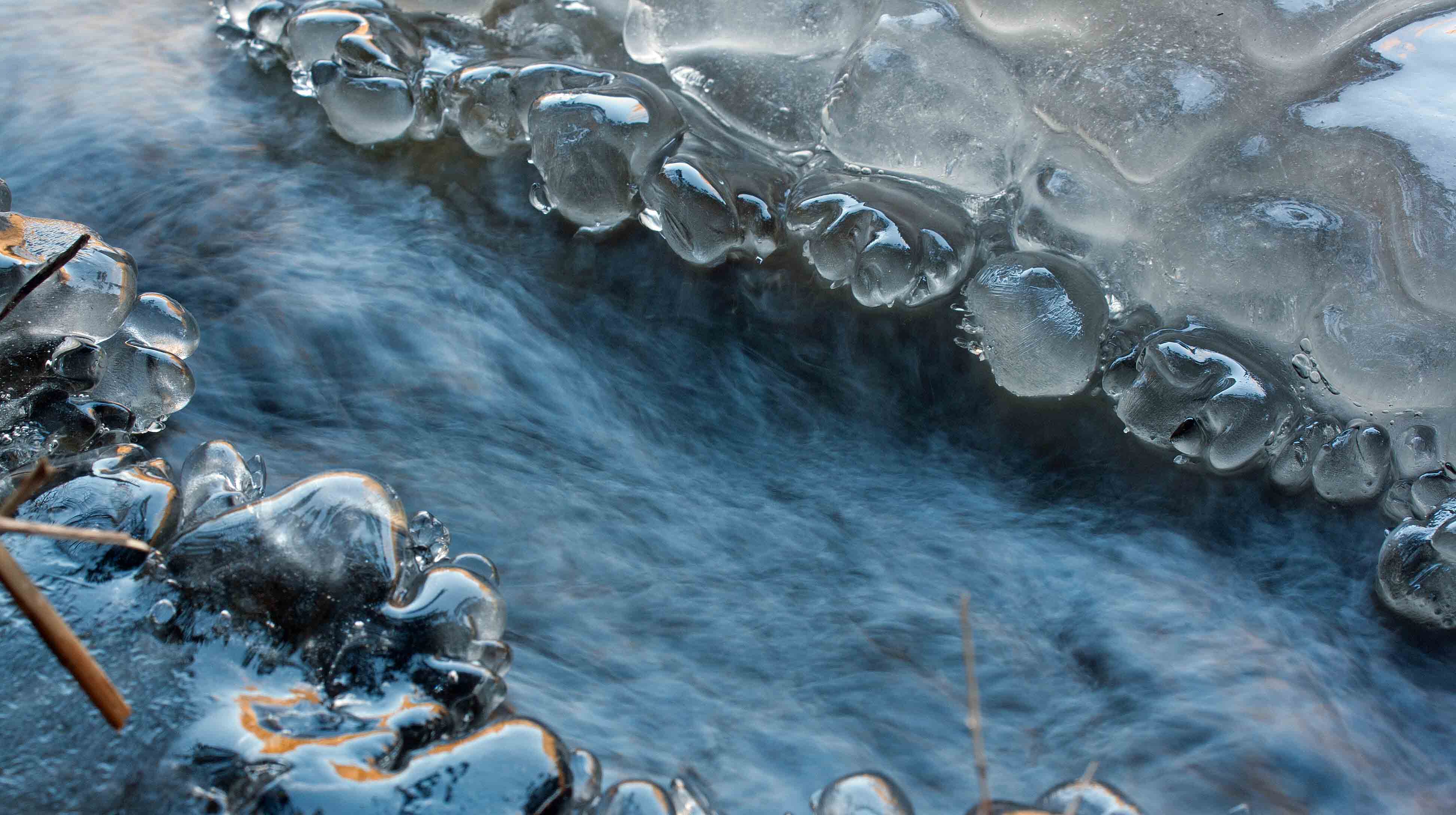
Ice ‘pearls’ forming on shore by rushing river, Jackson Creek, ON (photo by Nina Munteanu)
.
The fog grew thick as my walk eventually led me into an area of eccentric lopsided cedars in a ‘drunken’ stand by the river bank. The cedars sent out a tangled tapestry of gnarly roots I had to negotiate. I could feel the earth-magic. I dropped to my knees again and set my camera and tripod to the level of the roots. That is when I saw the blue sprite again! This time the sprite wasn’t playful; it appeared startled and disoriented. But, I managed to capture it as it fled the scene in wisps of blue smoke. As I left the forest, my thoughts returned to this serendipitous moment. Had I interrupted the wood /earth sprite in its work in the forest? These sprites are known to have the power of chlorokinesis, the ability to grow and control plants at will. When I checked my images at home, the sprite appeared to float near one of the cedars.
Blue forest sprite floats by cedar tree, Jackson Creek Park, ON (photo by Nina Munteanu)
.
When she saw the image, friend Merridy asked, “was the sprite entering the tree?” Thinking of incantations, friend Dyana asked if I’d had my recording feature on, which I’d never thought to do. On second thought, she decided that it might be dangerous. Not a good idea to anger a sprite. Friend Gabriela then challenged me: “did you ask what message they have for you, Nina? They keep showing up in your way, they might have a message for you or to be delivered through you to…” whoever… I hadn’t thought of that either. How would I hear their message when they were silent and so fleeting, I challenged back. She wisely responded, “Just ask yourself the question; you might be surprised when your next thought brings the answer. Since everything is energy, and you saw them at least twice, you’re probably connected with them.”
Sprite vaporizes behind tree, Jackson Creek Park, ON (photo by Nina Munteanu)
.
I didn’t tell her that the question that came to mind after seeing the sprite was: I wonder what’s for dinner!
I must ponder this more, however.
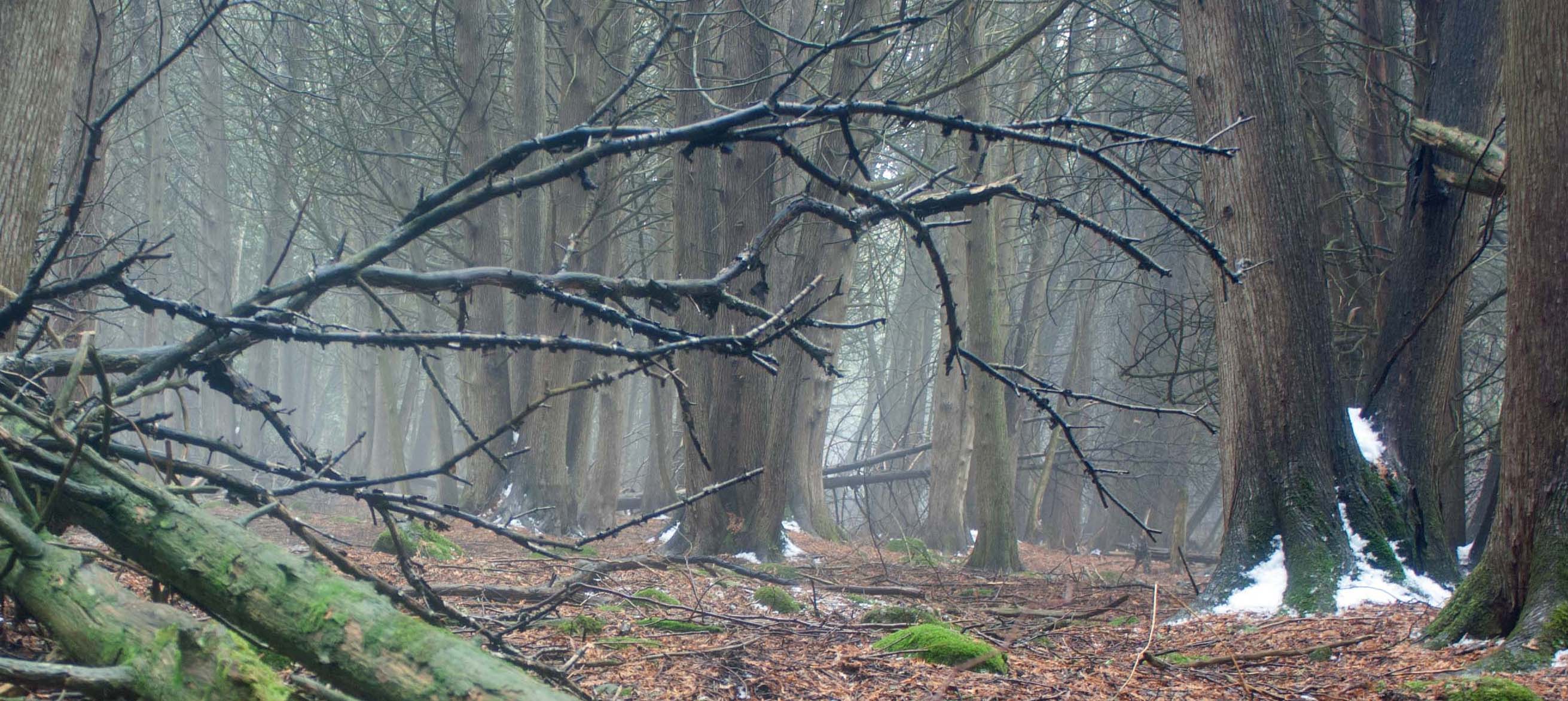
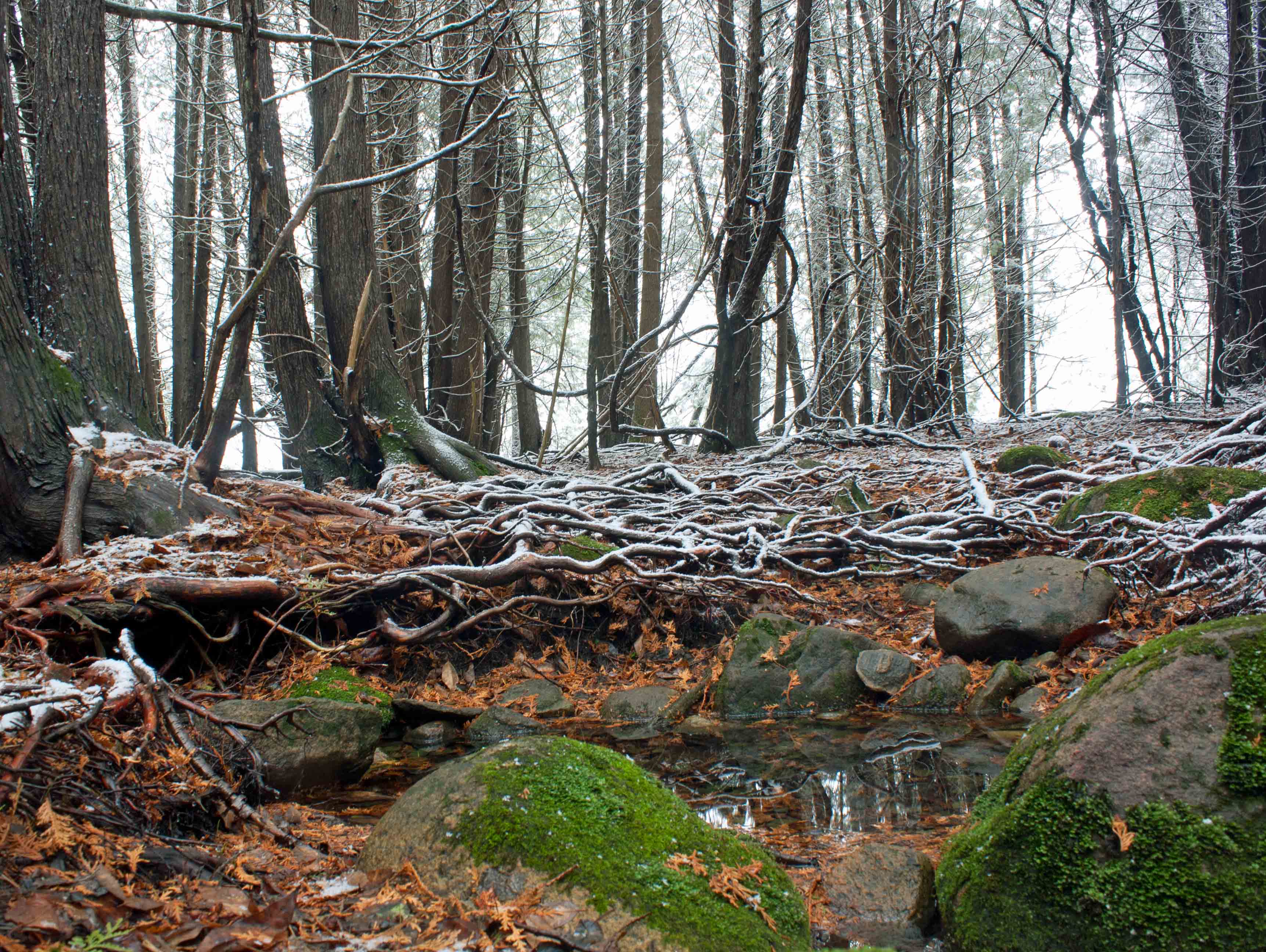
Cedar forest on a misty winter day, Jackson Creek Park, ON (photo by Nina Munteanu)
Thinking of Gabriela’s interesting remark, I am reminded of a rather sad but evocative tale by Vladimir Nabokov entitled “The Wood Sprite.” Told in the first person, it recounts the narrator’s experience when he was visited at his desk by an old wood sprite, “powdered with the pollen of the frosty, starry night.” The creature tells of his exile from a country wood in Russia, all cut down and burned amid the treachery of war.
Now that I think of it, I know the blue sprite’s message. And now you know it too.
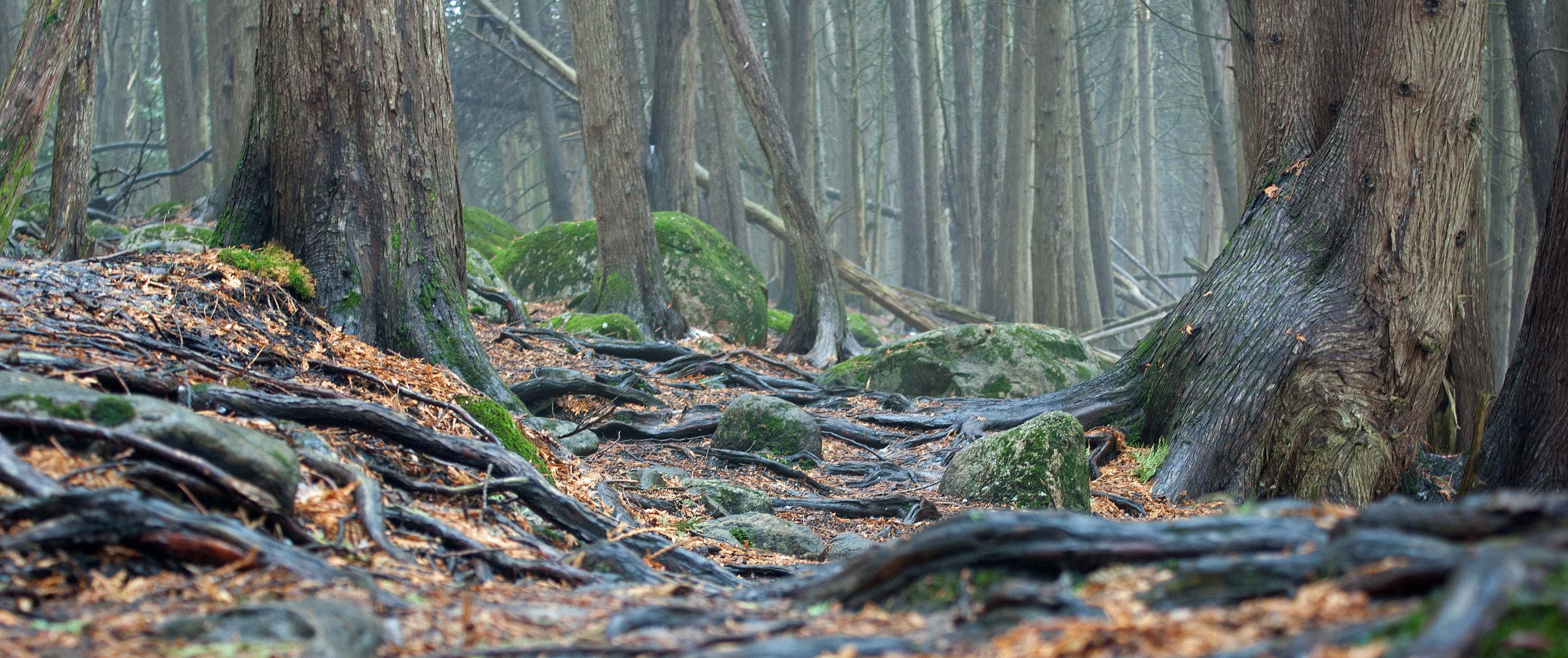
Cedar forest and roots amid glacial erratics in Jackson Creek Park, ON (photo by Nina Munteanu)
Nina Munteanu is a Canadian ecologist / limnologist and novelist. She is co-editor of Europa SF and currently teaches writing courses at George Brown College and the University of Toronto. Visit www.ninamunteanu.ca for the latest on her books. Nina’s bilingual “La natura dell’acqua / The Way of Water” was published by Mincione Edizioni in Rome. Her non-fiction book “Water Is…” by Pixl Press(Vancouver) was selected by Margaret Atwood in the New York Times‘Year in Reading’ and was chosen as the 2017 Summer Read by Water Canada. Her novel “A Diary in the Age of Water” was released by Inanna Publications (Toronto) in June 2020.
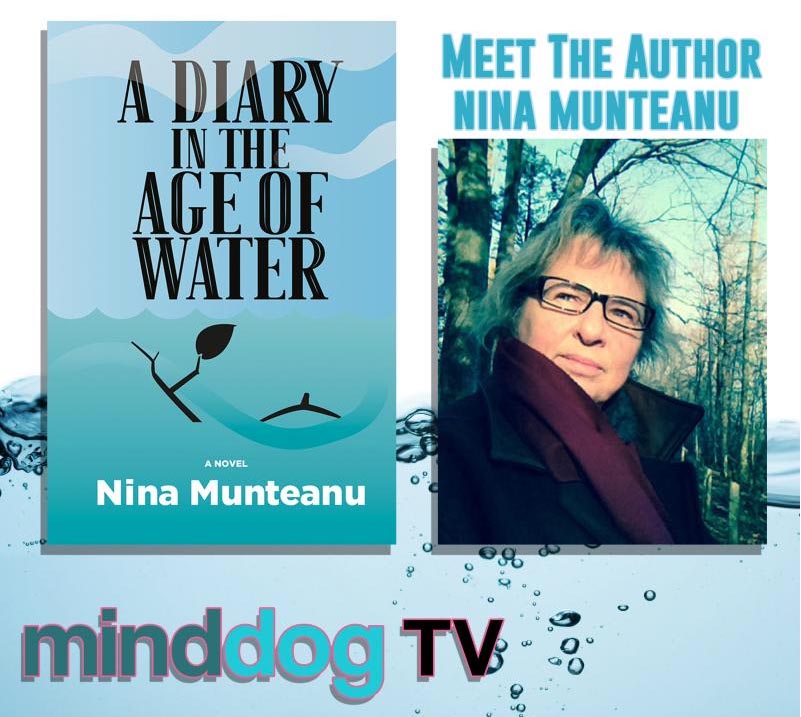
I was recently interviewed by Matt Nappo on Minddog TV in New York, where we talked about the science and magic of water, climate change and how to not become cynical, the process of writing, what scares us and what takes us through it into great storytelling.
Here’s the interview:
Matt Nappo interviews limnologist and clifi author Nina Munteanu on minddog TV
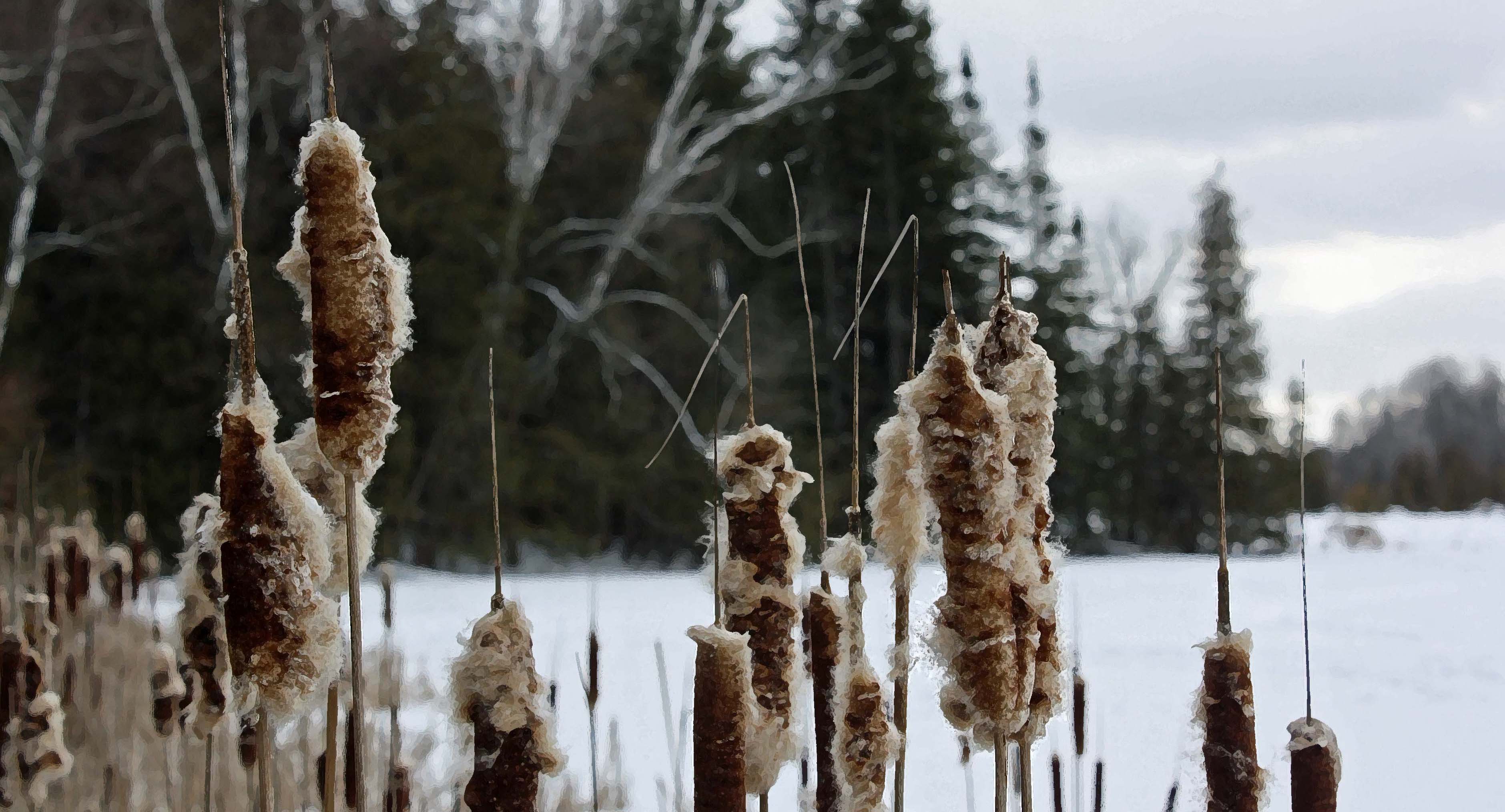
Cattails oversee the snowy plain of the iced-over Trent Canal, ON (photo and dry brush rendition by Nina Munteanu)
Nina Munteanu is a Canadian ecologist / limnologist and novelist. She is co-editor of Europa SF and currently teaches writing courses at George Brown College and the University of Toronto. Visit www.ninamunteanu.ca for the latest on her books. Nina’s bilingual “La natura dell’acqua / The Way of Water” was published by Mincione Edizioni in Rome. Her non-fiction book “Water Is…” by Pixl Press(Vancouver) was selected by Margaret Atwood in the New York Times‘Year in Reading’ and was chosen as the 2017 Summer Read by Water Canada. Her novel “A Diary in the Age of Water” was released by Inanna Publications (Toronto) in June 2020.
Ice forms on the shores of Jackson Creek in early winter, ON (photo by Nina Munteanu)
I’ve been a coaching writers for over two decades. I help fiction and non-fiction writers get published. I teach courses on novel writing and tutor technical and scientific writers at the University of Toronto writing centres. I’ve helped with plot, theme, characterization, and setting. I’ve worked with writers on establishing directed narratives and clarifying content. When it comes to grammar and punctuation, there is one punctuation that students of writing all too often misuse, abuse, or outright ignore: the semi-colon. They really don’t get it…And I’m trying to change that.
Recently, Dena Bain Taylor (my former supervisor in the University of Toronto Health Sciences Writing Centre), wrote a rousing post about this dear but often neglected and misused punctuation. It resonated with my experience and I just had to share it here:
The Sad Death of the Semi-Colon
As you drown your lockdown sorrows in that last bottle of wine, spare a thought for the semi-colon. Its demise, slow and terrible, long predates the pandemic.
The semi-colon is a particularly elegant piece of punctuation and doesn’t deserve its fate. I can think of a number of emojis I’d happily consign to the dustbin if it meant saving the semi-colon.The elegance of the semi-colon lies in its ability to both join and separate. It is, after all, a combination of a period and a comma.
In its glory days, the semi-colon filled two main functions.
One was to join two independent clauses; in other words, you have two elements that could stand as separate sentences but their ideas come together to make a single point. These days, people often replace the semi-colon with a period, splitting the thought into two sentences. I can live with that. What I can’t live with is replacing the semi-colon with a comma.
Its other function is to separate elements in a list that themselves contain internal commas. See how much easier this is to read because of the semi-colons:
The breakfast menu included toast, eggs and bacon; refried rice, beans and tortillas; and coffee or juice.
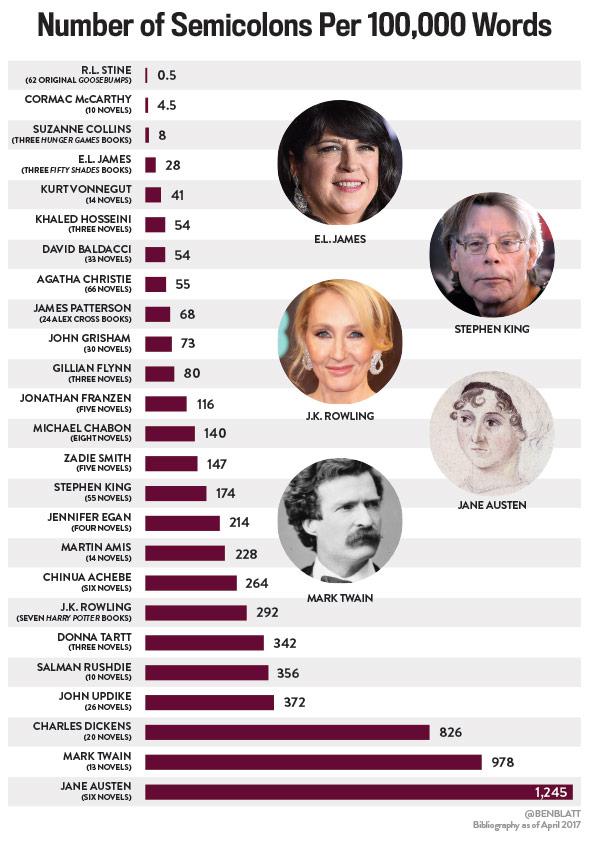
Some might say that “a semi-colon was used when a sentence could have been ended; but it wasn’t.” This isn’t necessarily a bad thing. Some of you may recall Kurt Vonnegut’s scathing edict in his 2005 book A Man Without a Country to all would-be creative writers: “First Rule: Do not use semicolons. They are transvestite hermaphrodites representing absolutely nothing. All they do is show you’ve been to college.” This was followed by novelist John Irving’s pithy observation: “No one knows what they are anymore. If you’re not in the habit of reading nineteenth-century novels, you think that the author has killed a fruit fly directly above a comma—semicolons have become nothing but a distraction.” And yet, author Gordon Gravley tells us that “John Irving (once a student of Vonnegut) is quite liberal with semicolons; they cover the pages of his novels like acne on the face of a fast-food restaurant employee. He loves them.” Irving was, after all, the anti-Hemingway; he often used long sentences with subordinate clauses punctuated by semi-colons. Author John Pistelli gives Irving credit for his own love of the semicolon: “Insofar as I aspired to write fiction that felt as densely fated as [Irving’s], both complex and unified, it seemed useful to adopt the mark of punctuation that stood for complexity and unity.” Who’d have thought this innocuous hybrid of comma and colon would stir such vehement condemnation, confusion, and self-denial?
Of the semi-colon, Abraham Lincoln once wrote: I must say I have a great respect for the semicolon; it’s a very useful little chap. While Cormac McCarthy noted simply: No semicolons. Even George Orwell proclaimed: I had decided about this time that the semicolon is an unnecessary stop and that I would write my next book without one.
I submit that it is the semi-colon’s very quality of eluding an exact definition that gives it so much versatility. That is its power over both period and comma; like Schrödinger’s cat, it is neither, yet both. The true power of the semi-colon—aside from its quantum properties—lies in how it brings two otherwise independent thoughts together (that may share something of significance even if elusive) to elegantly compare or contrast. And to create wonderful irony. Wonderful and subtle irony!
“Semi-colons signal, rather than shout, a relationship … A semi-colon is a compliment from the writer to the reader. It says: ‘I don’t have to draw you a picture; a hint will do.’”
George Will, Washington Post columnist
In the thread that followed Dena Bain Taylor’s article, one writer shared that his fiction editor had admonished him for using the semi-colon, proclaming that: “It’s generally not the practice in fiction.” Nabokov, Chekhov, and Woolf certainly ignored that prognosis. I have noted its use in many other excellent works of fiction; I use it in my own fiction.
Responding to Bain Taylor’s Linked In post, John Collins, strategic and creative marketer, wrote: “A comma gives you pause; a semi-colon leaves you room to breathe. The world is full of LOLs and BRBs, but there is still room for the intentioned difference that timely breathing engenders. And because its use is becoming rarer, it becomes even more meaningful and impactful if wielded properly.”
Returning to John Irving, here is what he wrote in an essay on Dickens:
It was relatively late in his life that he began to give public readings, yet his language was consistently written to be read aloud—the use of repetition, of refrains; the rich, descriptive lists that accompany a newly introduced character or place; the abundance of punctuation. Dickens overpunctuates; he makes long and potentially difficult sentences slower but easier to read—as if his punctuation is a form of stage direction, when reading aloud; or as if he is aware that many of his readers were reading his novels in serial form and needed nearly constant reminding. He is a master of that device for making short sentences seem long, and long sentences readable—the semicolon!
–John Irving, The King of the Novel
Author John Pistelli attempts an explanation for the evolution of the growing controversy of the semi-colon, which was certainly used more in classic literature: “Dickens used commas and semicolons to give direction to breath, a script for performance. Over the course of the last century, however, we have split text from speech, literature from orature. Poetry and fiction may trace their roots to song and stage, but modern technology and reading habits have removed the voice from literature. We read silently, whether in public or private.” Despite this, Pistelli draws on the work of Christian Thorne, to extol how the semi-colon’s “push-pull suggests the tense relationship of the clauses it both marries and divorces”:
It is through punctuation marks that even ordinary writing overcomes its own ingrained positivism, its tendency to reduce the world to rubble, static things and discrete events. Commas introduce relation to the simplest sentences, as periods do disjunction. Dashes and semicolons establish relation and disjunction at once; they sunder even as they join, which makes them the typographical face of dialectical thought.
Christian Thorne
I have often used not so much typography but topography to metaphorically describe the three dimensional face of narrative: how verbs, nouns and prepositions conspire with idea to create relief; how sentences–passive / active, short or long–flow into larger relief. If words and sentences are the bones of our thoughts, then punctuation is the connective tissue of their meaning in a three-dimensional world.
With that last remark, I urge you to rethink this under-used tool. Include it in your Writer’s Toolkit and join the great writers and thinkers—from unknown to famous—who have masterfully embraced the semi-colon:
“Celebrate failure; it means you took a risk.”—Anonymous
“I think; therefore I am.”—Rene Descartes
“Happy families are all alike; every unhappy family is unhappy in its own way.”—Leo Tolstoy, Anna Karenina
“The decline of literature indictes the decline of a nation. Knowing is not enough; we must apply. Willing is not enough; we must do.”—Johann Wolfgang von Goethe
“Love does not dominate; it cultivates.”—Johann Wolfgang von Goethe
Nina Munteanu is a Canadian ecologist / limnologist and novelist. She is co-editor of Europa SF and currently teaches writing courses at George Brown College and the University of Toronto. Visit www.ninamunteanu.ca for the latest on her books. Nina’s bilingual “La natura dell’acqua / The Way of Water” was published by Mincione Edizioni in Rome. Her non-fiction book “Water Is…” by Pixl Press(Vancouver) was selected by Margaret Atwood in the New York Times‘Year in Reading’ and was chosen as the 2017 Summer Read by Water Canada. Her novel “A Diary in the Age of Water” was released by Inanna Publications (Toronto) in June 2020.
“In this bonus episode, we continue our conversation with limnologist and cli-fi author Nina Munteanu. We discuss her book A Diary in the Age of Water and what led her to write this dystopian tale of a future that revolves around water scarcity. Nina’s background as a limnologist gives her a unique perspective on the challenges that await us if we do not address climate change.”
Click below to listen:
Nina Munteanu is a Canadian ecologist / limnologist and novelist. She is co-editor of Europa SF and currently teaches writing courses at George Brown College and the University of Toronto. Visit www.ninamunteanu.ca for the latest on her books. Nina’s bilingual “La natura dell’acqua / The Way of Water” was published by Mincione Edizioni in Rome. Her non-fiction book “Water Is…” by Pixl Press(Vancouver) was selected by Margaret Atwood in the New York Times‘Year in Reading’ and was chosen as the 2017 Summer Read by Water Canada. Her novel “A Diary in the Age of Water” was released by Inanna Publications (Toronto) in June 2020.
Woman and her dog walk the cedar swamp forest, Trent Nature Sanctuary, ON (photo and dry brush rendition by Nina Munteanu
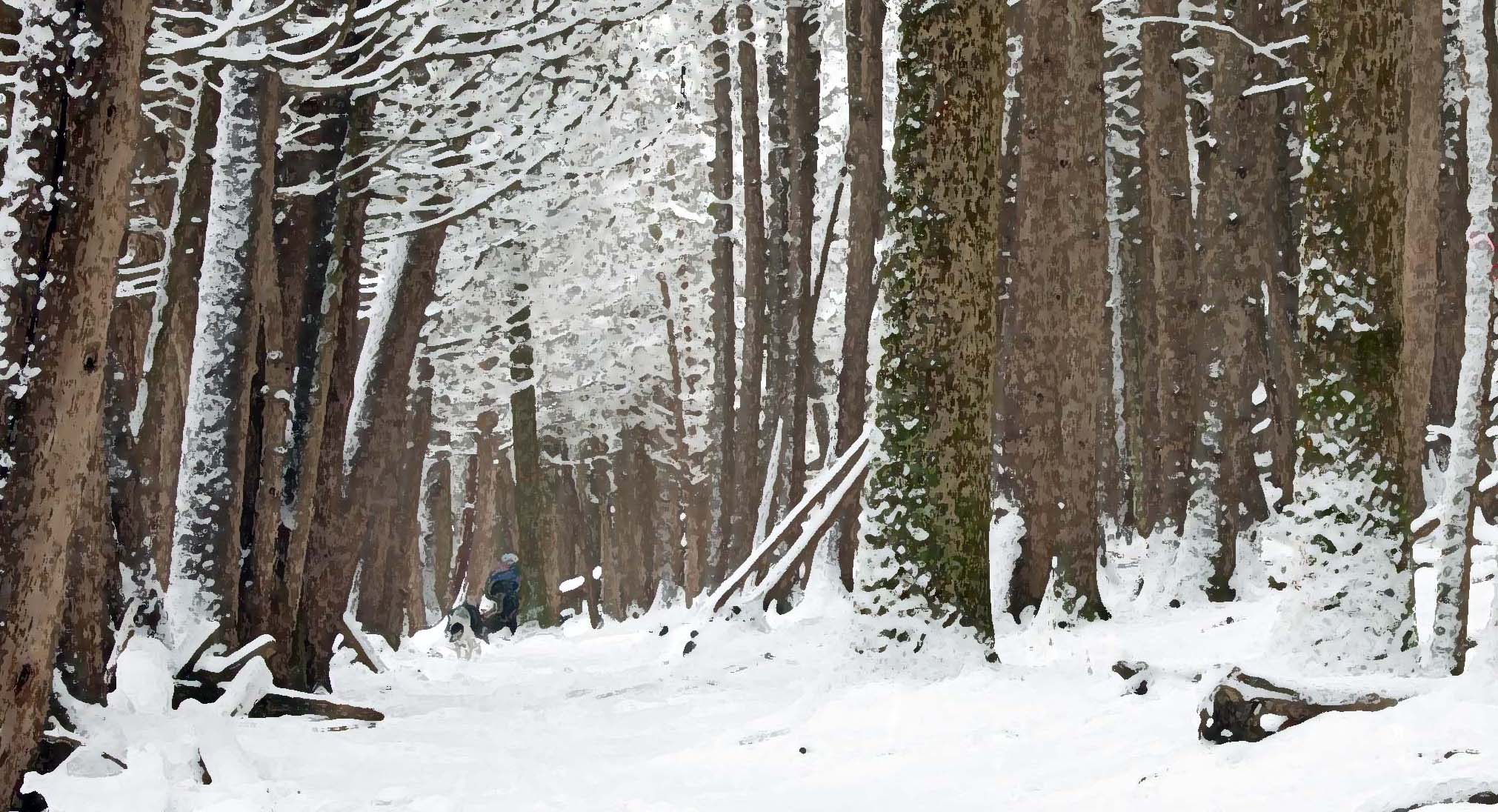
Trail through cedar forest in first snow, Trent Nature Sanctuary, ON (photo and dry brush rendition by Nina Munteanu)
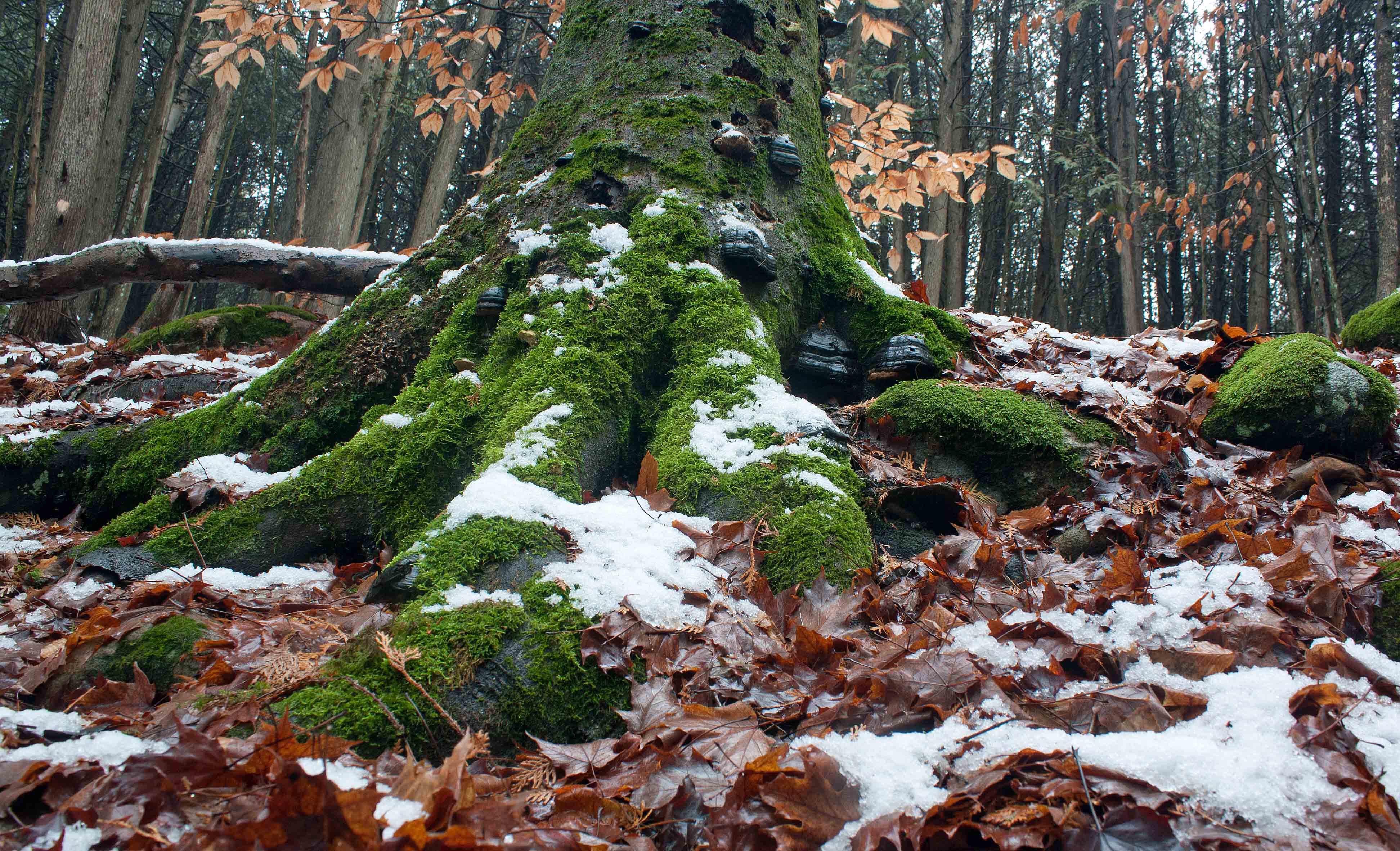
Moss covered roots and trunk of yellow birch after snowfall, Jackson Creek Park, ON (photo and dry brush rendition by Nina Munteanu)
Young marcescent beech tree among moss covered glacial erratics in Jackson Creek Park, ON (photo and dry brush rendition by Nina Munteanu)
Snow-covered marcescent beech leaves in Jackson Creek Park, ON (photo and dry brush rendition by Nina Munteanu)
Heavy snowfall at bridge in Trent Nature Sanctuary, ON (photo and rendition by Nina Munteanu)
Cedar pine forest after first snow, Jackson Creek Park, ON (photo and dry brush rendition by Nina Munteanu)
Nina Munteanu is a Canadian ecologist / limnologist and novelist. She is co-editor of Europa SF and currently teaches writing courses at George Brown College and the University of Toronto. Visit www.ninamunteanu.ca for the latest on her books. Nina’s bilingual “La natura dell’acqua / The Way of Water” was published by Mincione Edizioni in Rome. Her non-fiction book “Water Is…” by Pixl Press(Vancouver) was selected by Margaret Atwood in the New York Times ‘Year in Reading’ and was chosen as the 2017 Summer Read by Water Canada. Her novel “A Diary in the Age of Water” was released by Inanna Publications (Toronto) in June 2020.
Jackson Creek ices up in December (photo by Nina Munteanu)
Like the purest of sounds, Like the rhapsodic tinkling, windblown days, Of glass wind chime and bell, The call, the pure rhythm, the lyrical song River of crystal waters pouring down under ice
Jackson Creek flows like liquid sunshine around terraced ice islands in morning light, ON (photo by Nina Munteanu)
Holy nature’s melody, all the grace, the sacred beauty Of the wild outdoors… The magical distortions of light under ice, Luminescence and glow, bright sunlight On a cold winter’s day…
Ice shoals of Jackson Creek, ON (photo by Nina Munteanu)
The lightening glitter in moving prisms of light… Majesty, deep within water and ice, Carousels of prismatic light moving elegantly across The stony river bed below… And above, a magnificent solemnity: Backlit snow drift, detritus of crystal flake: Azure and lavender lights
Ice shelves forming on quiet shore of Jackson Creek, ON (photo by Nina Munteanu)
Everywhere a reverential light reflected upwards To catch the delighted eye… Radiant reflections of warmth and comfort: The sound of the dancing winds high above,
Jackson Creek and forest after first snow (photo by Nina Munteanu)
Snow-covered cedars in Trent Sanctuary forest, ON (photo by Nina Munteanu)
And icey patches, snowdrift on treetop and cold bough, Gently melting drops, rainbow lights Softly falling down to touch a lyric memory: The pure song, wind chime echo and dream, Sacred memory: sacred river, deepest reflection…
–Bev Gorbet, December, 2020
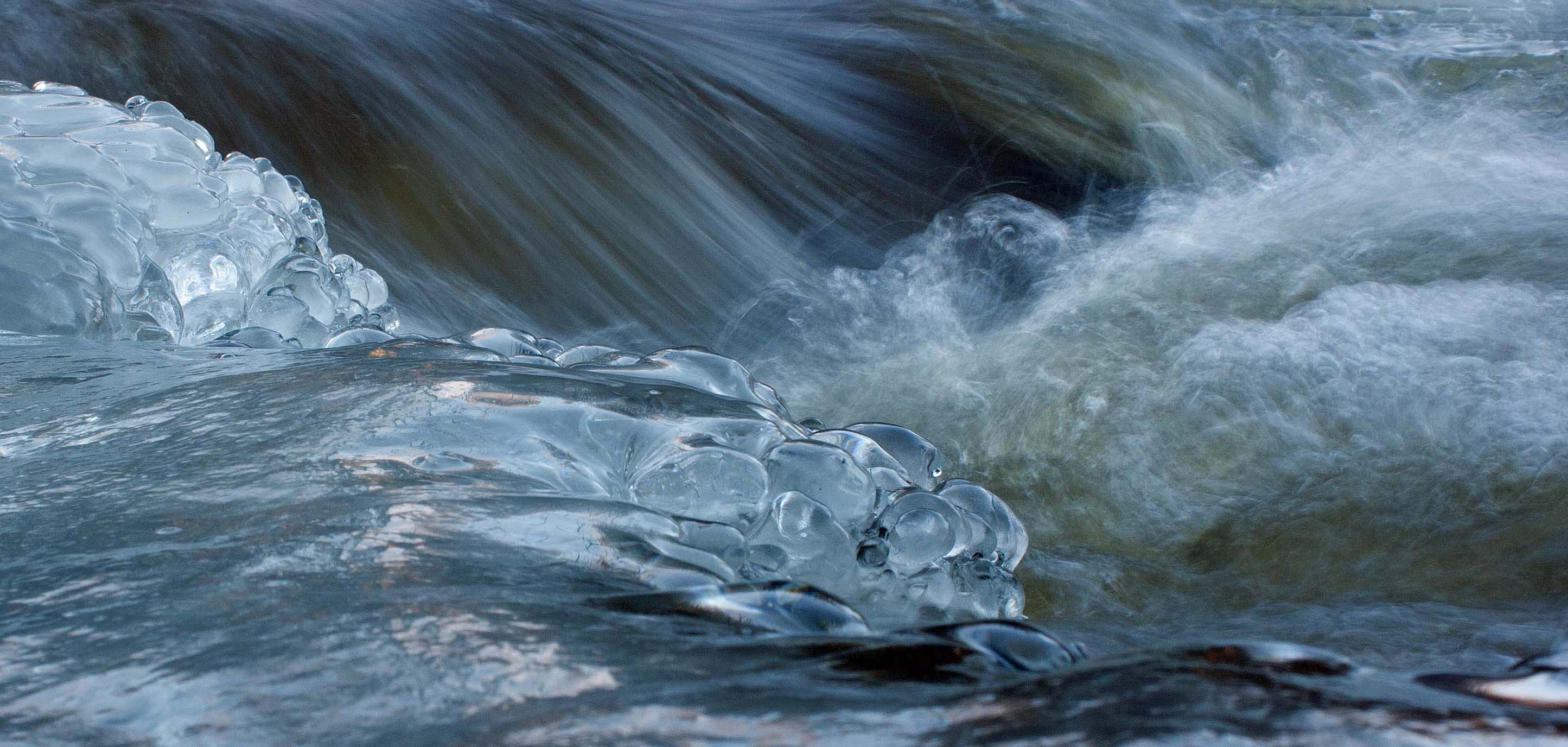
Clouds of ice pearls in Jackson Creek, ON (photo by Nina Munteanu)
Ice pearls form over rocks in Jackson Creek, ON (photo by Nina Munteanu)
Ice shore beside flowing Jackson Creek, ON (photo by Nina Munteanu)
Ice beads form islands in froth of Jackson Creek water, ON (photo by Nina Munteanu)
Ice beads form off ice columns over Jackson Creek, ON (photo by Nina Munteanu)
Ice platforms and ice-covered twigs peer over flowing Jackson Creek, ON (photo by Nina Munteanu)
Nina Munteanu is a Canadian ecologist / limnologist and novelist. She is co-editor of Europa SF and currently teaches writing courses at George Brown College and the University of Toronto. Visit www.ninamunteanu.ca for the latest on her books. Nina’s bilingual “La natura dell’acqua / The Way of Water” was published by Mincione Edizioni in Rome. Her non-fiction book “Water Is…” by Pixl Press(Vancouver) was selected by Margaret Atwood in the New York Times‘Year in Reading’ and was chosen as the 2017 Summer Read by Water Canada. Her novel “A Diary in the Age of Water” was released by Inanna Publications (Toronto) in June 2020.
Cedar roots dusted in winter snow, Jackson Creek Park, ON (photo by Nina Munteanu)
.
It’s late December in the old-growth riparian forest of Jackson Creek, Peterborough. A light snow is falling on the cedars. When I walk by the creek through this deep forest, my senses reach out like tendrils, touching the mysteries of Nature’s complexity. To my right, the river’s multi-timbral chorus gurgles and chortles in chaotic symphony. Occasionally, I hear the percussion of ice cracking and booming like a designer rearranging furniture. The cedar pine forest sloping up to my left hisses and giggles as the snow falls and melts. My footfalls crunch over a frozen sponge of litter and loam. Nature’s sounds and aromas coarse through me like sweet nectar and my soul rejoices. I quiet my mind and become one with all of it. Serene in discovery. In sensing. Feeling. Embedding. I’m awestruck with the simple beauty of complex form, pattern and purpose: from the tiniest moss covering a boulder erratic to the largest cedar trees creaking and swaying above me in the whisper of a brisk winter wind.
Today is different.
I see something unexpected. A skull.
.
Red fox skull embedded in frozen shore of Jackson Creek, ON (photo by Nina Munteanu)
.
I’ve been following the icing of Jackson Creek. Huge ice “islands” have formed over boulders, creating new channels for the freezing water to coarse around. I stop near a small tributary of the river to study the formation of ice “pearls” on either side of an ice-formed channel. I venture out onto an ice shelf and set up my small tripod to take slow shots of water magic. The sun paints the water a brilliant turquoise hue.
.
Jackson Creek with ice formation on shore, ON (photo by Nina Munteanu)
.
Breathing hard from my efforts and satisfied with the shots I’ve taken, I stand up and step back from the shore. It’s then, as I look down to where I’ve placed my feet, that I see it. A small white “rock”—No! A skull! Embedded in the frozen leaf litter and ground, not more than several centimetres from the frozen shore of the river, lies an animal skull the size of my hand with a long snout. How have I managed not to step on it and crush it with all my tramping there? I must have stepped past it several times to get to my photo op. I bend low to get a better look. What is it doing there? Who—or what—had brought it there, depositing it on the creek shore?
I returned the next day, eager to show my discovery to a friend and naturalist; she suggested it was a red fox. Excited, I returned the following day with a ruler to measure it and a trowel and some hot water to help me extricate it for better examination. A light snow had fallen the night before but the top of the skull was still visible. I removed the snow and the skull came out of the ground rather easily, revealing several back teeth still embedded in it. While the skull was mostly intact, the lower jaw was missing and a loose tooth lay on the ground below it. I removed my prize and brought it home. After cleaning it with some bleach, I examined it further.
.
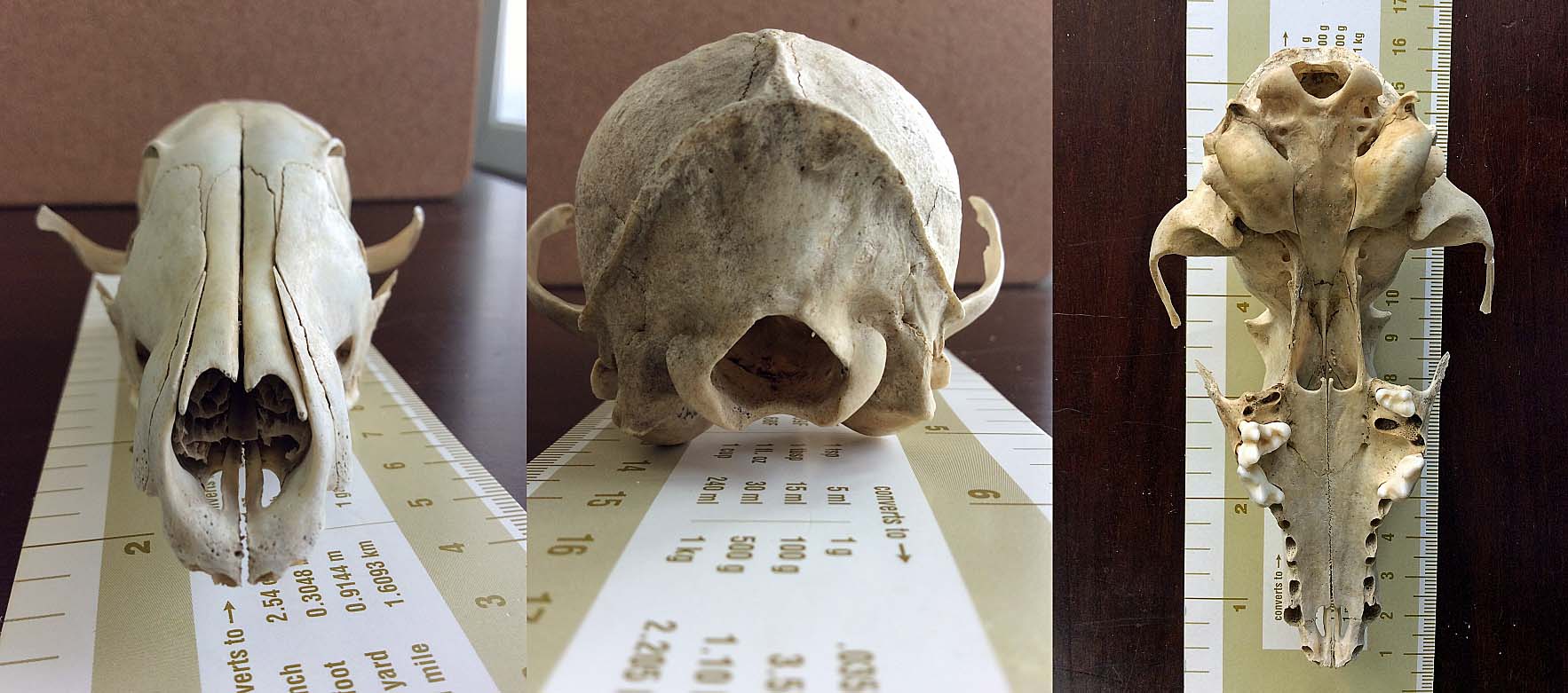
Red fox skull, left to right: front, back, ventral aspects (photos by Nina Munteanu)
.
The skull showed no signs of trauma or injuries to the head. I guessed that while this fox was an adult, it was young; the teeth that were there were in excellent condition. The skull measured 133 mm from end of snout to external occipital protuberance (inion). The average skull length of an adult male measures 129 to 167 mm and vixens 128-159 mm. Steve Harris in BBC’s Discover Wildlife tells us that dog foxes also tend to have broader and more domed skulls than vixens; my skull was rather sleek, I thought. From this I guessed that the skull belonged to a young adult female, a vixen. Statistics for fox deaths also favoured a young fox (see below).
Measurement
Value
Skull Length
Inion to prosthion
133 mm
Skull width
Widest interzygomatic distance
70 mm
Facial length
Nasion to prosthion
63 mm
Facial width
Widest interzygomatic distance
45 mm
Cranial length
Inion to nasion
79 mm
Cranial width
Widest interparietal distance
47 mm
Cranial height
Middle of external acoustic meatus to bregma
43 mm
Red fox skull, lateral aspect (photo by Nina Munteanu)
.
I couldn’t help wondering about this fox which had appeared as if by magic at my feet. What was Vera Vixen’s story? (Somewhere between bringing her home and cleaning her, I decided to name her). How did Vera meet her demise and where was the rest of her? Had the skull recently washed onshore or was it recently brought to the shore by a scavenging racoon, badger (they’re more common in this area than most people think) or another fox? Or had the skull been there longer and the winter ice and water just washed away the litter to reveal the embedded skull? Was it a death of misadventure? Had Vixen drowned when Jackson Creek flooded? Or was she hit by a car at the edge of the park, torn up by scavengers and her skull brought here to eat? Jake McGown-Lowe of BBC’s The One Show shares that “Fox bones are hard to find.” He had found his specimens at the edge of a wood. “In the countryside the main predator of foxes are farmers and gamekeepers, especially around lambing time, and the gamekeepers usually take the bodies away to dispose of.” Jackson Creek is an urban park. Thirty percent of its perimeter is surrounded by urban and suburban streets of Peterborough; sixty percent of the park is surrounded by farmland and some marsh at its upstream end. A Bristol University study on cub survival determined that major sources of mortality included hypothermia, attack by domestic dogs, attack by badgers, and death of the mother.
.
Red fox skull, dorsal side (photo by Nina Munteanu)
.
Various hunters have indicated that in a temperate climate it takes several weeks to several years for decomposers (insects, fungi and bacteria) to clean a skull left in the elements of nature. Temperature, humidity, presence of insects and water play key roles in the process of skeletonization. The skull at my feet could have died as recently as the fall of 2020 and as long ago as spring of 2019 during lambing season. Had Vera been shot or poisoned (including indirectly through scavenging) as she hunted for her kits?
Bristol University estimated that two thirds of the fox population die each year by predators (including humans), disease and vehicles with the single largest cause of fox mortality being through road collisions. An Oxford study corroborated this with observations that 60% of the fox population were run-over by vehicles. Apparently most of the fox deaths are the young. In their 2004 review of the red fox, David Macdonald and Jonathan Reynolds at Oxford noted that “roughly 75% of the fox population die in their first year.” Studies in Europe have also shown that three to seven-month old foxes are most susceptible to traffic collisions—associated with the cub’s increase in ranging behaviour around the den and their lack of experience—and larger propensity for misadventure.
BBC Wildlife Magazine tells us that “spring is a good time to look for mammal skulls. The end of winter is a peak period of mortality for many species, and skulls can be found virtually anywhere.”
.
Red fox pups in refuge park in Delaware (photo by Jennifer Cross, USFWS)
.
The red fox (Vulpes vulpes) is one of Canada’s most widespread mammals, living in a wide range of habitats including forests, grasslands, meadows and farmland. Known for their ability to adapt quickly to new environments, foxes have adapted well to urban settings and ecotones between city and wilderness; in fact, they prefer mixed vegetation communities such as edge habitats and mixed scrub and woodland. They are highly athletic, agile and incredibly fast (they can run up to 30 mph); foxes are known for pouncing on mice and other small rodents, burrowing in the snow using the earth’s magnetic field to help them hunt. Foxes have good visual acuity, capable of seeing small movements from far away and for navigating dense forests as they sprint after prey; but their most useful sense is their ultrasonic hearing. Treehugger reported on a 2014 study by the University of Duisburg-Essen and Czech University of Life Sciences who discovered that “red foxes have the best known maximal absolute hearing sensitivity of any mammal. They can hear a mouse squeak from 100 feet away.” This along with their ability to move swiftly and quietly through most terrain makes them effective crepuscular (dawn and dusk) predators in open country and nocturnal hunters in areas of concentrated human habitation. Foxes generally live an average of 3-7 years in the wild.
Foxes are monogamous. They live in family units in which both parents take equal part in raising their young. Older siblings also care for the young pups. The young kits remain with their parents at least until the fall of the year they were born in and sometimes longer, especially females. Pups are typically born from February-April. They are born blind, deaf and toothless, with dark brown fluffy fur. Mom fox stays close to guard the kits and nurse them for several weeks and the father or barren vixens feed the mothers. The kits leave the den a month after and are fully weaned by 8-10 weeks. The mother and her pups remain together until the autumn after the birth. After the pups are weaned and begin to play about the den’s entrance, Dad fox helps watch them while Mom fox gets in some hunting. If the mother dies, the father takes over caring for the pups. Kits reach adult form by seven months and some vixens reach sexual maturity by ten months—enabling them to bear their first litter at one year of age.
Red foxes help balance ecosystems by controlling population of prey animals such as rodents and rabbits. They also disperse seeds by eating fruit. Steve Hall of Adirondack Almanack reminds us that red foxes play an important ecological role:
“Now and then, vulnerable farm animals such as chickens, ducks and lamb will be taken. While farmers used to routinely trap foxes, many now realize that the fox brings far more benefit in its constant predation on crop-destroying rodents and insects, than the harm they cause in taking the occasional barnyard animal; secure enclosures for hens and [use of] guard dogs to keep the fox in the field but out of the barnyard, are the key to discouraging unwanted fox predation.”
James Fair of BBC Discover Wildlife noted that a single fox during its lifetime may be worth £150-190 to a farmer through rabbit predation. Most farmers in Wiltshire consider the fox a helpmate in reducing the pest of rabbits. Hall adds that while, “Deer are significant carriers of the tick, Lyme disease starts with rodents… [the red fox] eats huge quantities of rodents. If for no other reason, fox hunting and trapping should be banned.”
.
Cedar-pine-hemlock forest after first snow, Jackson Creek Park, ON (photo by Nina Munteanu)
.
Foxes take shelter in thickets and heavy bushes in the autumn until March of the next year. They are omnivores with a varied diet of small mammals such as voles, mice, squirrels and rabbits, and a variety of plants, berries, other fruit and nuts. Foxes have good eyesight but very keen hearing and sense of smell; this along with their ability to move swiftly and quietly through most terrain makes them effective crepuscular (dawn and dusk) predators in open country and nocturnal hunters in areas of concentrated human habitation. Foxes generally live an average of 3-7 years in the wild.
The red fox communicates through a wide range of body language and vocalizations. Foxes use scent glands and urination to communicate their individuality through their skunk-like smell. They use scent to mark territory and show status. The smell increases during mating season. The fox vocal range spans across five octaves with at least 28 different sounds that include those for “contact” and those for “interaction.” Individual voices can be distinguished. One contact sound between two foxes approaching one another resembles the territorial call of a tawny owl. When foxes draw close together, they use a greeting warble similar to the clucking of chickens. Adults greet their kits with gruff huffing sounds.
Red foxes feature prominently in the folklore and mythology of human cultures with which they are sympatric. In Greek mythology, the Teumessian fox or Cadmean vixen, was a gigantic fox that was destined never to be caught. The fox was one of the children of Echidna. In Japanese mythology,the kitsune are fox-like spirits that possess magical abilities which increase with age and wisdom. This includes the ability to assume human form. Some folktales suggest that kitsune use this ability to trick others; others portray them as faithful guardians, friends and love. In the Cotswolds, witches were thought to take the shape of foxes to steal butter from their neighbours. In later European folklore, Reynard the Fox symbolizes trickery and deceit. In the actual world, this translates to resourcefulness, a quick study, and swift and decisive action. And perhaps that is the true meaning of Vixen.
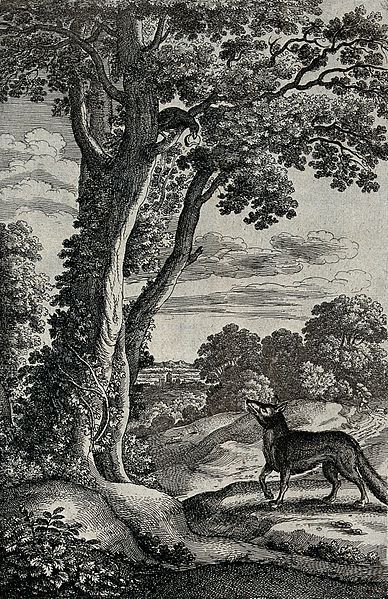
Image of fox and crow from Aesop’s Fables
.
Fox teaches us that gender equality helps to create a strong family, says Chris Lüttichau, author of Animal Spirit Guides. Fox’s medicine is family, survival and voice. Fox embodies resourcefulness and daring in her quest to feed herself and her young. “Fox survives and flourishes because she is clever and adaptable; she is now found living in cities. Fox teaches us to be flexible rather than to resist change.” According to Lüttichau, Fox’s medicine is “swiftness, surefootedness and a quick mind that always knows what to do.” Foxes have a wide vocal capacity and range, from screams and calls to low barks—something for each case as the fox calls and listens and calls back. We can learn from Fox’s varied voice to transcend traditions and prejudices through healing council and stories.
With thoughts returning to my Vera Vixen, I think that perhaps she is not a young unlucky fox who met with misadventure after all; rather, she’s a smart old vixen who’s birthed and nurtured several litters of four to six kits each spring. Her natural death after four to seven years of a rich life in the old growth forest and marsh of Jackson Creek would have led her to a quiet place to lay herself to rest; there her corpse was ultimately found by a badger, racoon or other fox and parts of her scattered throughout the forest to decompose and feed the ecosystem. Ever the mother, Vera now feeds the forest that nurtured her and her family’s existence.
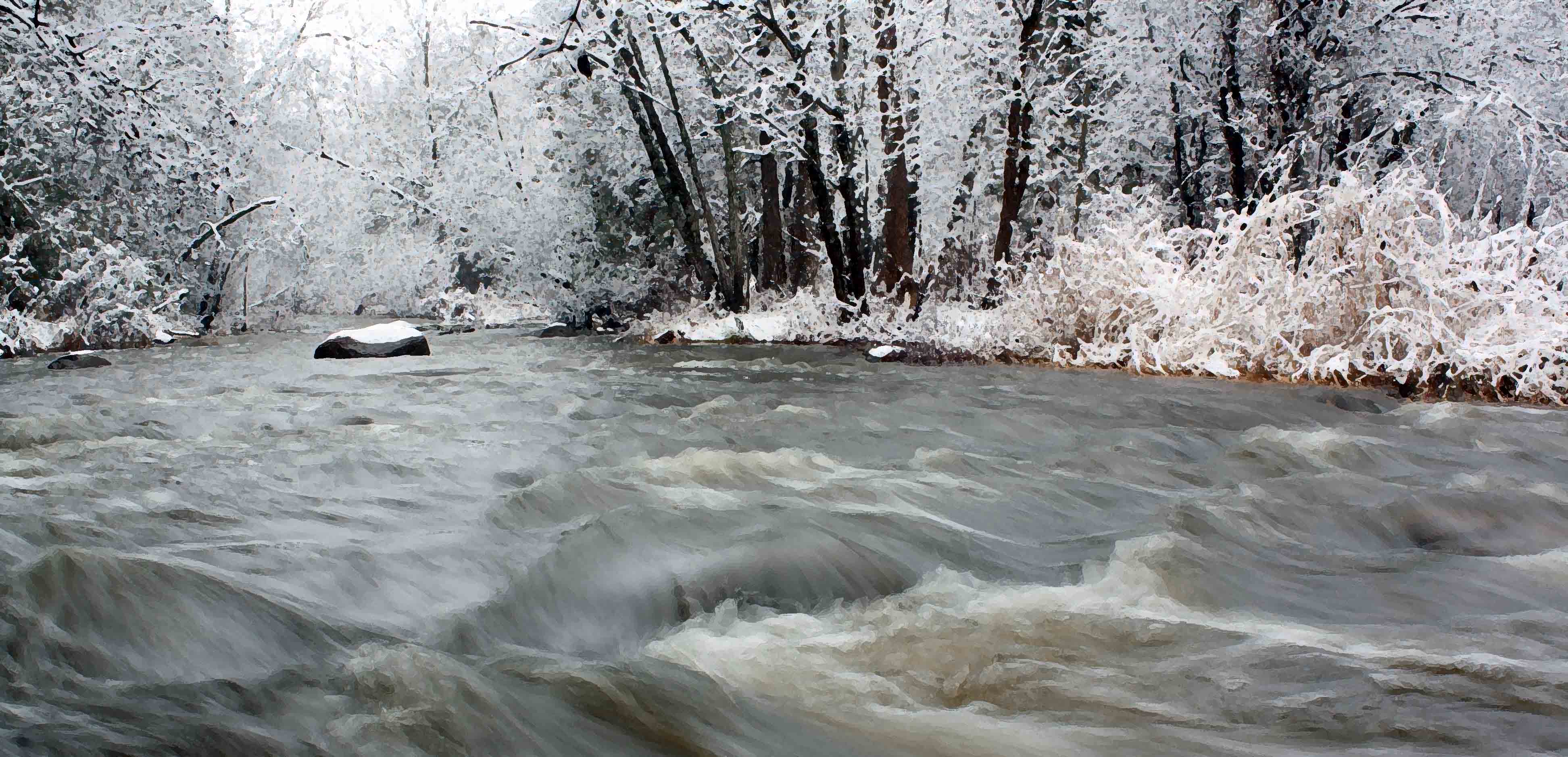
Jackson Creek during first heavy snow, ON (photo by Nina Munteanu)
.
The Story of Fleet, the Fox of Surrey: In January 2014 it was reported that “Fleet”, a relatively tame urban red fox tracked as part of a wider study by the University of Brighton in partnership with the BBC’s TV series Winterwatch, had unexpectedly traveled 195 miles in 21 days from his neighbourhood in Hove, at the western edge of East Sussex, across rural countryside as far as Rye, at the eastern edge of the county. He was still continuing his journey when the GPS collar stopped transmitting due to suspected water damage. Along with setting a record for the longest journey undertaken by a tracked red fox in the United Kingdom, his travels have highlighted the fluidity of movement between rural and urban red fox populations.
Fox Prayer for 2021:
I call on Fox. Shapeshifter and trickster. Edge-walker and messenger. Help me blend with my surroundings and adapt to the changing landscapes. Show me the hidden paths between the worlds. Teach me the ways of invisibility and camouflage. Gift me your keen senses that i might see more of what is around me and use it to accomplish my goals. I call on you, Fox, to bring magic and discernment into my life. Lead me at your steady gait to those places where I might do the greatest good. Let us walk the borders between day and night and follow the scent of divine mischief. Fox, I call on you.
TRAVIS BOWMAN
Jackson Creek ices up in December, ON (photo by Nina Munteanu)
Map of Jackson Creek Park and surrounding area, ON
Jackson Creek Old-Growth Forest:
Jackson Creek Old-Growth Forest (OGF) is a 4.5 hectare urban forest located on a glacial spillway slope littered with granite erratic boulders. The OGF lies within the Jackson Creek Riparian Forest, a 92-ha valley land forest which extends into a major wetland of importance. Dominant conifers in the OGF include white cedar (Thuja occidentalis), white pine (Pinus strobus), and eastern hemlock (Tsuga Canadensis). Sugar maple, American beech, yellow birch, white ash and white oak contribute to the mixed riparian forest. Trees are commonly over 150 years old with some reaching over 250 years. Largest trees—which tend to be the pines and cedars—reach diameters of 97 cm dbh and heights of 35 metres.
Cedar-pine-hemlock forest in Jackson Creek Park, ON (photo by Nina Munteanu)
The Jackson Creek valley was formed by the torrent of glacial meltwater that flowed from the ancient Lakes Algonquin and Jackson through the overlying till to create a glacial spillway some 12,000 years ago (Adams and Taylor 2009); the outflow of glacial Lake Algonquin was channeled to the former glacial Lake Iroquois—a body of water larger than the current Lake Ontario but in the same general area (Ecclestone and Cogley 2009).
The Jackson Creek OGF is a good example of a mature White Cedar—White Pine—Eastern Hemlock stand on a glacial spillway slope in Ecodistrict 6E-8. This eco-district extends in a band from south of Lake Simcoe eastward to the Bay of Quinte, north of the Oak Ridges Moraine, and is characterized by rolling till plains with drumlins, eskers, and intervening wide river valleys (Hanna 1984).
Red fox skull found embedded on iced shore of Jackson Creek, ON (photo by Nina Munteanu)
References:
Adams, P. and C. Taylor. 2009. Peterborough and the Kawarthas (Third Edition). Geography Department, Trent University, Peterborough, Ontario. 252 pp.
Ecclestone, M. and G. Cogley. 2009. “The Physical Landscape of Peterborough and the Kawarthas.” In: Peterborough and the Kawarthas, Third Edition, ed. by P. Adams and C. Taylor, pp. 19-40. Geography Department, Trent University, Peterborough, Ontario.
Hanna, R. 1984. “Life Science Areas of Natural and Scientific Interest in Site District 6-8.” Parks and Recreational Areas Section, Central Region, Ontario Ministry of Natural Resources, Richmond Hill, Ontario. 71 pp. & map.
MacDonald, D. and J. Reynolds. 2005. “Red fox (Vulpes vulpes)” IUCN Canid Specialist Group. Online
Malkemper, E. Pascal, Vaclav Topinka, and Hynek Burda. 2015. “A behavioral audiogram of the red fox (Vulpes vulpes). Hearing Research Vol. 320: 30-37: Online
Monaghan, Patricia. 2004. “The Encyclopedia of Celtic Mythology and Folklore”. Infobase Publishing. pp. 199–200. ISBN978-0-8160-4524-2.
The Nature Conservancy: Nature.org. “Wetlands Mammals: Red Fox.” PDF Online
“Relatives are the worst friends, said the fox as the dogs took after him.” – Danish
Nina Munteanu is a Canadian ecologist / limnologist and novelist. She is co-editor of Europa SF and currently teaches writing courses at George Brown College and the University of Toronto. Visit www.ninamunteanu.ca for the latest on her books. Nina’s bilingual “La natura dell’acqua / The Way of Water” was published by Mincione Edizioni in Rome. Her non-fiction book “Water Is…” by Pixl Press(Vancouver) was selected by Margaret Atwood in the New York Times ‘Year in Reading’ and was chosen as the 2017 Summer Read by Water Canada. Her novel “A Diary in the Age of Water” was released by Inanna Publications (Toronto) in June 2020.
Farmer’s field, ON (photo and rendition by Nina Munteanu)
Sometime in the future, Earth is recovering from a devastating 50-year plague that has destroyed most of its natural forests and grasslands and killed two out of every three people. Environmental technocrats now run the world under strict rule: while virgin ecosystems are re-created from original templates through genetic engineering, no human is permitted to set foot in these sanctuaries. As sanctuaries grow ever larger, humanity is pressed into over-crowded cities where boredom and strife dominate. The Emerald Coalition hires reclamation company EcoTech to “recreate the world their great, great grandparents lost.” But their ecosystems are morphing into “aberrations” (new species with surprising properties), which would shock the applied Ecology community—except EcoTech is keeping it a secret. So begins Danita Maslan’s eco-thriller Rogue Harvest by Red Deer Press. Published in 2005, this powerful environmental story is as relevant today as it was fifteen years ago. Perhaps more so.
In his Foreword to Maslan’s book, Hugo-winning author Robert J. Sawyer, shared a story from a 2004 presentation he gave at Mount Royal College in Calgary. In his presentation, Sawyer lamented that science fiction seemed to pull in opposite directions to such an extent that any message was cancelled by its opposition. The example he gave in the Foreword came from two bestselling authors: Kim Stanley Robinson whose Forty Signs of Rainwarned of rising temperatures due to climate change; and Michael Crichton, who denied global warming as fearmongering in State of Fear. According to Sawyer, Rogue Harvest provided a fresh story grounded in the balance of a third perspective—not a neutral middle-ground, but “one that shears away at right angles from the current polarized debate, taking our thinking in new directions by predicting both environmental collapse andenvironmental salvation.”
Told through the unruly character of Jasmine, Rogue Harvest explores a post-plague world in recovery. After radical environmentalists from Green Splinter assassinate her father, Jasmine enlists a street-smart mercenary to help her vindicate her father’s call to open the forbidden preservesto the public. This leads Jasmine into the depths of the genetically re-created South American rainforest, where political intrigue, corporate greed and violence collide in a combustible mix. This is where it gets messy—which biology certainly is. But it gets messy for other reasons. Human-reasons. Reasons of power-mongering and lack of compassion. The very reasons why the environmental technocrats established their hands-off edict in the first place. This is explored through great irony in Rogue Harvest. An irony that L.E. Modesitt, Jr. astutely notes, “[the environmental technocrats] prove that, given power, they’re just like everyone else.” Just as there remain uncompassionate exploiters and pillagers in the likes of harvester Gunther Vint, who heedlessly pollutes the rainforest as he harvests it.
buttressed strangler fig in Costa Maya jungle (photo by Nina Munteanu)
The South American rainforest provides some of the most vivid, colourful and memorable scenes in the book. Maslan traveled to the tropics and ensured accurate science of this incredibly rich ecosystem through Mark W. Moffett’s The High Frontierand Donald Perry’s Life Above the Jungle Floor, as well as Tropical Nature: Life and Death in the Rain Forests of Central and South America by Adrian Forsyth and Ken Miyata. It is in the South American recreated jungle that the key elements—and posed questions—of the story play out.
In his testimonial to Rogue Harvest, Hugo Award Finalist James Alan Gardner poses: “We see both sides of an ecological conundrum that resonates with the present day: how can we live in harmony with our environment, neither vandalizing it nor walling it off as too precious to touch?”
This is the tantamount question. Can our species achieve this balance? Rogue Harvest answers this clarion call with mixed optimism. While showcasing the propensity for greed and careless exploitation, the book also reveals a more altruistic and kinder side of humanity. One that promises hope and light to our darker side. But, is this realistic, given our current dominant worldview?
On page 149 in Rogue Harvest, Jasmine’s politician father Owen Lamberin defends his position of wishing to open up the protected Nature preserves to regular folk by proclaiming, “Do they want to keep us out forever? Then who are we reseeding the globe for if not for us?” This is later echoed by Jasmine to justify flouting the preservationist edicts of the Emerald Coalition. When I first read this passage, part of me rankled. Does not the natural world have an intrinsic value and right to simply be? Must we justify all things by our own presence and direct use of them? Surely functional ecosystems provide ecosystem services for planetary wellness that benefit ALL life, not just humans, and not all directly. For example, our terrestrial and marine forests provide necessary oxygen and climate balance (by removing excess carbon dioxide) that benefits all life on the planet. Ecologists—particularly Canadians—recognize the benefit of ‘preservation’ (wilderness that is not accessed by humans) over ‘conservation’ (areas where humans extract resources with some environmental risk) and the need for both to exist for the planet’s overall well-being. This is based on the simple fact that not all humans behave as they should. Those of us who follow a utilitarian neo-liberal worldview of consumption and “othering nature” are not acting as efficient partners in the natural world. Many see themselves as apart from Nature, above Her, even, and will act less than kindly. Current deforestation of the Amazon and the old-growth forests of British Columbia, are just two examples that reflect this destructive “Nature othering” force.
Ancient red cedar tree in Lighthouse Park, BC (photo by Nina Munteanu)
In contrast, indigenous peoples on the planet incorporate Nature in their beliefs, philosophies and way of life. They conduct themselves with humility and the utmost respect for the natural world of which they are a part. Knowing that they are part of Nature, they act accordingly, with respect. They are efficient partners, taking only what they need, thanking Nature for her gifts, and giving back in return in a process of reciprocal altruism and mutualism.
Robin Wall Kimmerer, author of “Gathering Moss” and “Braiding Sweetgrass” writes:
“In indigenous ways of knowing, it is understood that each living being has a particular role to play. Every being is endowed with certain gifts, its own intelligence, its own spirit, its own story. Our stories tell us that the Creator gave these to us, as original instructions. The foundation of education is to discover that gift within us and learn to use it well.
These gifts are also responsibilities, a way of caring for each other. Wood Thrush received the gift of song; it’s his responsibility to say the evening prayer. Maple received the gift of sweet sap and the coupled responsibility to share that gift in feeding the people at a hungry time of year. This is the web of reciprocity that the elders speak of, that which connects us all. I find no discord between this story of creation and my scientific training. This reciprocity is what I see all the time in studies of ecological communities. Sage has its duties, to draw up water to its leaves for the rabbits, to shelter the baby quail. Part of its responsibility is also to the people. Sage helps us clear our minds of ill thoughts, to carry our good thoughts upward. The roles of mosses are to clothe the rocks, purify the water, and soften the nests of birds … Traditional knowledge is rooted in intimacy with a local landscape where the land itself is the teacher.”
Robin wall kimmerer
Wall-Kimmerer is talking about a way of life through willing participation and an attitude of great respect and humility. But many non-indigenous people do not ascribe to this philosophy and way of life—with dire consequence to our environment and our own welfare. In Rogue Harvest Maslan rightfully demonstrated the continued presence of this destructive force in humanity even as a respectful and thankful attitude was shown by Jasmine and her harvesting team. The question is: How many does it take to spoil this balance?
It would be close to fifteen years after Rogue Harvest was published that I would finally read Maslan’s book—this year, in 2020, during an ongoing planetary-wide plague. Ironically, only two years after Danita’s debut novel, my own debut eco-thriller Darwin’s Paradox was released by Dragon Moon Press in 2007. And the theme was eerily similar: struggling with the devastation of an environmental plague (Darwin Disease), the Gaians—environmental technocrats who run the world—have isolated humanity from Earth’s treasured natural environment. One main difference between Rogue Harvest and Darwin’s Paradox is that in the latter book the technocrats have kept the public ignorant of how the environment has recovered, ensuring its safety from destructive human hands—except for the ‘enlightened’ Gaians, who secretly live out in the beauty of a recovered natural world and commute to the indoor world. However, as the environment recovers, humanity deteriorates in its cloistered indoor world. Darwin’s Disease—related to indoor living—sweeps across humanity with debilitating genetic deterioration, violent death and the promise of extinction. This is something the self-professed deep ecology Gaians—akin to Maslan’s Emerald Coalition—are content to see in—if it means preserving the natural world.
Both the Gaians and Maslan’s Emerald Coalition demonstrate a lack of faith in humanity and an unrealistic need to restore environments to their pristine pre-human levels; something that is highly unrealistic—and doomed to fail. “Aberrations” (as Maslan’s characters called them) are part of the natural process of adaptation and change inherent in the natural world. As a practicing ecological consultant, I was constantly running against an idealised and unrealizable notion to put everything back to what it used to be. For several decades ecologists were tasked to restore habitats to their pristine condition—when the notion of “pristine” was impossible to achieve, let along discern. It would have been like turning back the clock of history to prevent John F. Kennedy from being shot–with its own unknown consequences. Ecologists finally realized that in lieu of “restoration” and looking back, we needed to “rehabilitate” by looking forward. This is what Nature has always done. Nature adapts. So must we. Our management programs must incorporate Nature’s ever-changing processes of resilience and look forward—not backward—to achieve a sacred balance.
If there is a deeper message in Maslan’s book, it is this: that our salvation—and the salvation of the world—lies in not obsessing on returning to a past pristine state (with attempts at over-protection), but in looking forward to healing and nurturing a world in which we have a place. This would involve reimagining our niche (our job) as efficient partners in an ever-evolving and changing natural world, by casting off the parasitoid1 role we’ve all too often assumed and replacing with a role of mutualism2. But … and there is a huge BUT here. This will only work if we pursue this approach with integrity. With our eyes and hearts open to Gaia’s sacred plan of which we are a part. Robin Wall Kimmerer shows us the way through Traditional Ecological Knowledge:
“If each plant has a particular role and is interconnected with the lives of humans, how do we come to know what that role is? How do we use the plant in accordance to its gifts? The legacy of traditional ecological knowledge, the intellectual twin to science, has been handed down in the oral tradition for countless generations. It passes from grandmother to granddaughter gathering together in the meadow, from uncle to nephew fishing on the riverbank … How did they know which plant to use in childbirth, which plant to conceal the scent of a hunter? Like scientific information, traditional knowledge arises from careful systematic observation of nature, from the results of innumerable lived experiments. Traditional knowledge is rooted in intimacy with a local landscape where the land itself is the teacher. Plant knowledge comes from watching what the animals eat, how Bear harvests lilies and how Squirrel taps maple trees. Plant knowledge also comes from the plants themselves. To the attentive observer, plants reveal their gifts.”
Robin Wall Kimmerer, Gathering Moss
But is this possible? To return to Sawyer’s remark and Gardner’s question, can we achieve this sacred balance and harmony? For many of us, I think, yes. But for many more, I’m not sure. And that is what worries me. It is my firm belief that until our worldview embraces humility in partnership with the natural world—until we cast off our parasitoid archetype of self-serving, neo-liberal, capitalist ideologies—we will remain hampered in our journey forward towards a sacred balance. And time is running out for us. Time to rewrite our story.
In Maslan’s book, humanity is given a second chance to prove itself worthy of inclusion. Her book is a call to action. Can we do this before it’s too late for us? Time to listen and learn from our indigenous peoples. Time to learn about Traditional Ecological Knowledge. Time to slow down, set aside our egos, and use all our senses to learn from Birch, Bear, and Beaver…
Cedar pine forest in early winter, Jackson Creek Park, ON (photo by Nina Munteanu)
1.parasitoid is a term that describes a parasite that grows on the body of another organism from which they get nutrients and shelter. Unlike typical parasites, a parasitoid usually kills its host (Munteanu, 2019).
2.mutualism describes an ecological interaction between two or more species that increases fitness in both, through direct interaction and co-adaptation. Two examples include vascular plants and mycorrhizae, their fungal partners, and flowering plants and their pollinating insects. Even predators act in some form of mutualism when their role of culling weaker individuals from the prey gene pool is considered (Munteanu, 2019).
References:
Kimmerer, Robin Wall. 2003. “Gathering Moss.” Oregon State University Press, Corvalis. 168pp.
Munteanu, Nina. 2019. “The Ecology of Story: World as Character.” Pixl Press, Vancouver. 198pp.
White cedar tree and stump in early winter, Jackson Creek Park, ON (photo by Nina Munteanu)
Nina Munteanu is a Canadian ecologist / limnologist and novelist. She is co-editor of Europa SF and currently teaches writing courses at George Brown College and the University of Toronto. Visit www.ninamunteanu.ca for the latest on her books. Nina’s bilingual “La natura dell’acqua / The Way of Water” was published by Mincione Edizioni in Rome. Her non-fiction book “Water Is…” by Pixl Press(Vancouver) was selected by Margaret Atwood in the New York Times ‘Year in Reading’ and was chosen as the 2017 Summer Read by Water Canada. Her novel “A Diary in the Age of Water” was released by Inanna Publications (Toronto) in June 2020.
Those who are inspired by a model other than Nature, a mistress above all masters, are laboring in vain—Leonardo daVinci
You pause at the front door of the eco-house that you and your partner designed in Vancouver’s Point Grey and pull up the collar of your jacket. The air is fresh with the promise of snow and you smile with thoughts of spring skiing at Whistler.
You glance at the time display on your Smart Glasses. You’ve decided to forego the WaveGate and walk to the café; you have plenty of time to walk through the hilly forested streets, with a view of English Bay. You want to check out the refurbished solar-house on Locarno Cresent that your company helped design. Based on a living model of Biomimicry, the house is the latest iteration of your company’s “symbiosis” model of 100% sustainability, in which people live in a cooperative and synergistic partnership with their environment. The house is an intelligent organic facility with self-cleaning floors and walls; heated, fueled and lit by organisms in a commensal relationship. Everything works on a natural cycle of harmonious renewal and natural evolution. You smile, rather self-pleased. It has taken you a few years to convince the city council to accept this new model in community design. Now, it’s happening everywhere.
It’s April 12, 2074. A special day. And a special year. The year of the wooden horse in the Chinese calendar. Also called the green horse, it’s associated with spring, growth and vitality. The horse symbolizes nobility, class speed and perseverance. Horse energy is pure unbridled spirit. Playful, wild and independent, the horse has a refined instinct that flows through action and movement. Together, these symbols promise both chaos and great opportunity. And transformation.
The year of the wooden horse only occurs every sixty years. And sixty years ago today your mom turned sixty. You release a boyish grin at what you intend to do in celebration. On that day, sixty years ago, she celebrated her sixtieth birthday with the release of Natural Selection, her collection of speculative short stories about human evolution, AI, genetic manipulation, transhumanism, and the human-‘machine’ interface. She also celebrated the local printing of Metaverse, the third book of her space detective trilogy, The Splintered Universe. It was the second book to be printed by Toronto Public Library’s newly acquired Espresso Book Machine; one of only two EBMs in Toronto at the time.
A smile slants across your face as you remember what libraries and bookstores used to look like then. Both were struggling with a changing paradigm of reading, writing and publishing. Many of the older folk feared that books—print books, particularly—were going extinct as more exciting channels of communication like videos, interactive games and instant social networking took over. Of course, that didn’t happen. “Story” and “storytelling” were simply evolving and the paradigm shift simply embraced a new model that incorporated more diverse expression. You remember conversations with your mom about Chapters-Indigo, whose face changed from a bookstore to a gift store and tchotchke filled more and more of the storefront. As large bookstores struggled to dominate, the EBM—like its lithe mammal cousins in the Cenozoic Era—created a new niche for itself: the book ATM.
The size of a Smart Car, the EBM could fit nicely in a stylish café, housing and dispensing—Tardis-style—many more books than its diminutive size. In 2014, the EBM carried over eight million titles, including commercial books and out-of print gems. That number has tripled as virtually every publisher embraced the Book ATM model to sell books.
You inhale the tantalizing aroma of freshly ground and brewed coffee before you reach Zardoz Café. The retro-style café is a converted Edwardian-style house with high arched windows and a living roof overlooked by tall sycamore trees. You climb the stairs and enter the café. Its 2020’s style interior that your company helped design is decorated in earthy tones, avant-garde art, a forest of dracaenas and ferns and a stepped creek, complete with goldfish and crayfish. A shiny brass Elektra Belle Epoque espresso maker sits at the bar, bestowing the finest fair trade coffee.
Your sweeping gaze notes several people at the small round tables, enjoying good coffee and conversation; your special guest hasn’t arrived yet. You spot the WaveGate at the back, resembling an old English pay phone. Next to it sits the EBM. Eager to do your deed before your guest arrives, you sidle to the coffee bar and catch Grace’s eye. She smiles; you’re a regular. You touch her wrist with your watch and the data passes onto her embedded interface. She taps her hand to process the book order—she insists that you not pay—then she makes your double-shot espresso—the old-fashioned way. As she grinds and taps and runs the machine, you and she chat about skiing this spring. Just as Grace hands you a perfect crema-topped espresso, the WaveGate shimmers briefly and then its door opens like an accordian.
Your mom emerges from the “tardis”, smartly dressed in an early-century blazer and skirt, and grinning like an urchin. She resembles the seventeenth Doctor a bit, you decide—the first female Doctor Who, finally! Somehow—you don’t know how she does it—her old-fashioned style manages to embrace “retro-cool”. She’s arrived from Switzerland, where she is house and cat-sitting for good friends in Gruyeres. From there she still commutes—Tardis-style—as sessional lecturer at the University of Toronto, where she maintains a tiny book-festooned office.
“Kevy!” she squeals like a girl, obviously happy to see you. You don’t cringe; you’ve grown accustomed to the ripples of interest your mom’s unalloyed enthusiasm usually creates.
“Happy birthday, Mom!” You seize her in a hug. “I’m glad you made it for your 120th birthday.” Traveling the WaveGate suits her, you consider.
“I like the tardis better than you, I think,” she says, smiling sideways at you with knowing. She’s right; you prefer the old-fashioned way of traveling, without having to reconfigure your molecules from one place to another. In fact, you prefer the old-fashioned way of doing a lot of things, you decide with an inner smile.
“I have a surprise for you, Mom,” you say with a knowing grin. Your mom likes surprises. Her eyes light up and she beams at you. You glance at Grace with a conspiratorial look. She takes the cue and starts the EBM.
“Over here,” you say, steering your mom toward the EBM, already humming like an old tomcat getting its chin scratched. Your mom bends down to watch the pages spew out of the paper holder and stack neatly in a tray, then get snatched by robotic fingers as a colour cover is created then laid below, ready to envelope the book interior. After the gluing and binding, the robots trim the book on three sides then summarily send it sliding out a chute on the side.
Your mom has guessed what the book is; but she still squeals with glee when she sees it. It’s Metaverse, of course; the book she first had printed on the EBM in Toronto’s Public Library sixty years ago on her birthday.
“I just thought you’d like another book,” you say with a laugh. Like she needs another book. But this one’s special; it’s sixty years old today. Just like she was, sixty years ago—today. You pull out your PAL and point at your mom, as she seizes the perfectly bound book. “Let me take your picture!”
She poses with the book, looking like a kid with candy. You check the image and laugh. “There it is. You don’t look a year over sixty!” You grin at your 120-year old mother.
“And you don’t look a day over twenty-three!” she teases back. You give her a slanted smile. You’re eighty-three. Beaming, she goes on, “I remember doing this exact thing sixty years ago in Toronto! Those same feelings of overwhelming gratitude and wonder are still there,” she confides. “I remember telling the CBC reporter who covered the EBM launch that it felt like a birthing.” She throws me a crooked grin. “Only the labour was on the computer instead of in the hospital!”
Visibly pleased and touched, she snatches me in a bear hug.
“This is the best present a mom could get from her son. Thanks for remembering. It’s been an incredible ride and it’s all been worth it.”
“Join me in a coffee; then I have a house to show you…” you say, smiling with pride.
The Espresso Book Machine
Many bookstores, libraries, and universities around the world are hosting the Espresso Book Machine® (EBM) by On Demand Books LLC (and associated with Lightning-Ingram). The EBM makes millions of titles available via the EspressNet® software and produces quality paperbacks in minutes at point of sale. The EBM is not a print-on-demand solution, but a powerful new digital-to-print channel that eliminates lost sales due to out-of-stock inventory or the hassle of returns.
Advantages:
Readers: millions of books, multiple languages, made on demand for you.
Bookstores, Libraries and other Retailers: sell (or lend) more titles without the extra inventory; capture the growing self-publishing market.
Publishers: the EBM offers an additional sales channel and greater visibility to a publisher’s titles. It also avoids out-of-stocks and eliminates returns.
Authors: earn additional income otherwise lost through the used-book market.
Old maple tree in Jackson Creek Park in December snow, ON (photo and dry brush rendition by Nina Munteanu)
Nina Munteanu is a Canadian ecologist / limnologist and novelist. She is co-editor of Europa SF and currently teaches writing courses at George Brown College and the University of Toronto. Visit www.ninamunteanu.ca for the latest on her books. Nina’s bilingual “La natura dell’acqua / The Way of Water” was published by Mincione Edizioni in Rome. Her non-fiction book “Water Is…” by Pixl Press(Vancouver) was selected by Margaret Atwood in the New York Times ‘Year in Reading’ and was chosen as the 2017 Summer Read by Water Canada. Her novel “A Diary in the Age of Water” was released by Inanna Publications (Toronto) in June 2020.