A few weeks ago, I (virtually) participated in When Words Collide, one of Canada’s prime writing festivals in Calgary, Alberta. I was a featured writer, sitting on several panels and conducting presentations and lectures. One of the two presentations I did was on the role of place in story.
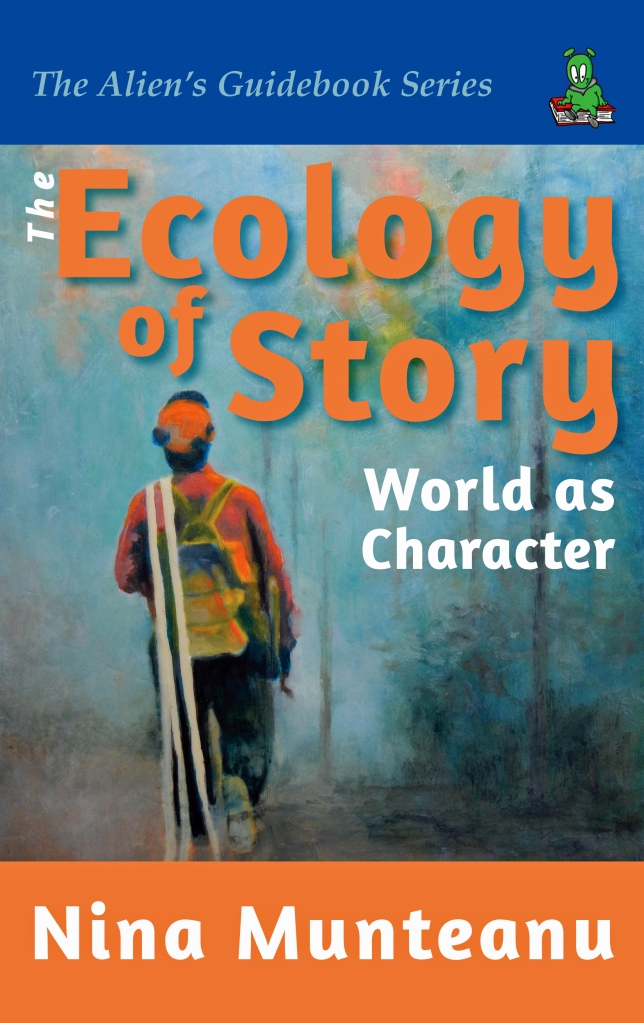
The role of place in story is a topic close to my heart and one I recently wrote an entire writing guidebook on: The Ecology of Story: World as Character. In my coaching sessions with writers and in my writing courses at George Brown College and the University of Toronto, I’ve observed in the novice writer a need for more effective integration of setting and place in story. All too often, the lack of meaningful integration translated into a lost opportunity to explore the POV character and the story’s theme. The lack of meaningful use of place in story can result in a lacklustre story, overly vague characterizations and a story that lacks metaphoric depth and relevance.
The presentation and following discussion drew from my guidebook Ecology of Story and I used many examples from a wide range of literature to overview topics covered in the book, such as:
Place as character & archetype
Place as metaphor (personification, symbols, allegory)
Place and first impressions (openings)
Place and emotion (over time and by POV)
Place through the senses
Place as environmental force (including climate change)
We also discussed how characters connect with their environment and I introduced the metaphoric connection between the Mi’kmaq and the white pine forests in Annie Proulx’s Barkskins, among others.
I concluded the presentation with a discussion on the “paradox in the details”: the more specific description is, the more universal its appeal. This is because the details can establish relevance and realism to the scene and the POV character experiencing them. Vagueness and lack of tangibility are avoided through specificity. The key, however, is to use details that resonate with the theme and tone of the book: as metaphor. Details as metaphor is what you want to achieve.
Because, as Ray Bradbury once told me, “everything in story is metaphor.”
Part 1 provides a comprehensive summary of the science of ecology, the study of relationships, and links to useful metaphor.
Part 2 discusses world and place in story. Here I discuss how the great writers have successfully integrated place with theme, character and plot to create a multi-layered story with depth and meaning. Part 2 also contains several writing exercises and detailed case studies.
Nina Munteanu is a Canadian ecologist / limnologist and novelist. She is co-editor of Europa SF and currently teaches writing courses at George Brown College and the University of Toronto. Visit www.ninamunteanu.ca for the latest on her books. Nina’s bilingual “La natura dell’acqua / The Way of Water” was published by Mincione Edizioni in Rome. Her non-fiction book “Water Is…” by Pixl Press(Vancouver) was selected by Margaret Atwood in the New York Times ‘Year in Reading’ and was chosen as the 2017 Summer Read by Water Canada. Her novel “A Diary in the Age of Water” was released by Inanna Publications (Toronto) in June 2020.
Shanella Ramkissoon reviews my latest eco-fiction mundane science fiction novel “A Diary in the Age of Water” in Issue 46 of Alternatives Journal (Playbook for Progress):
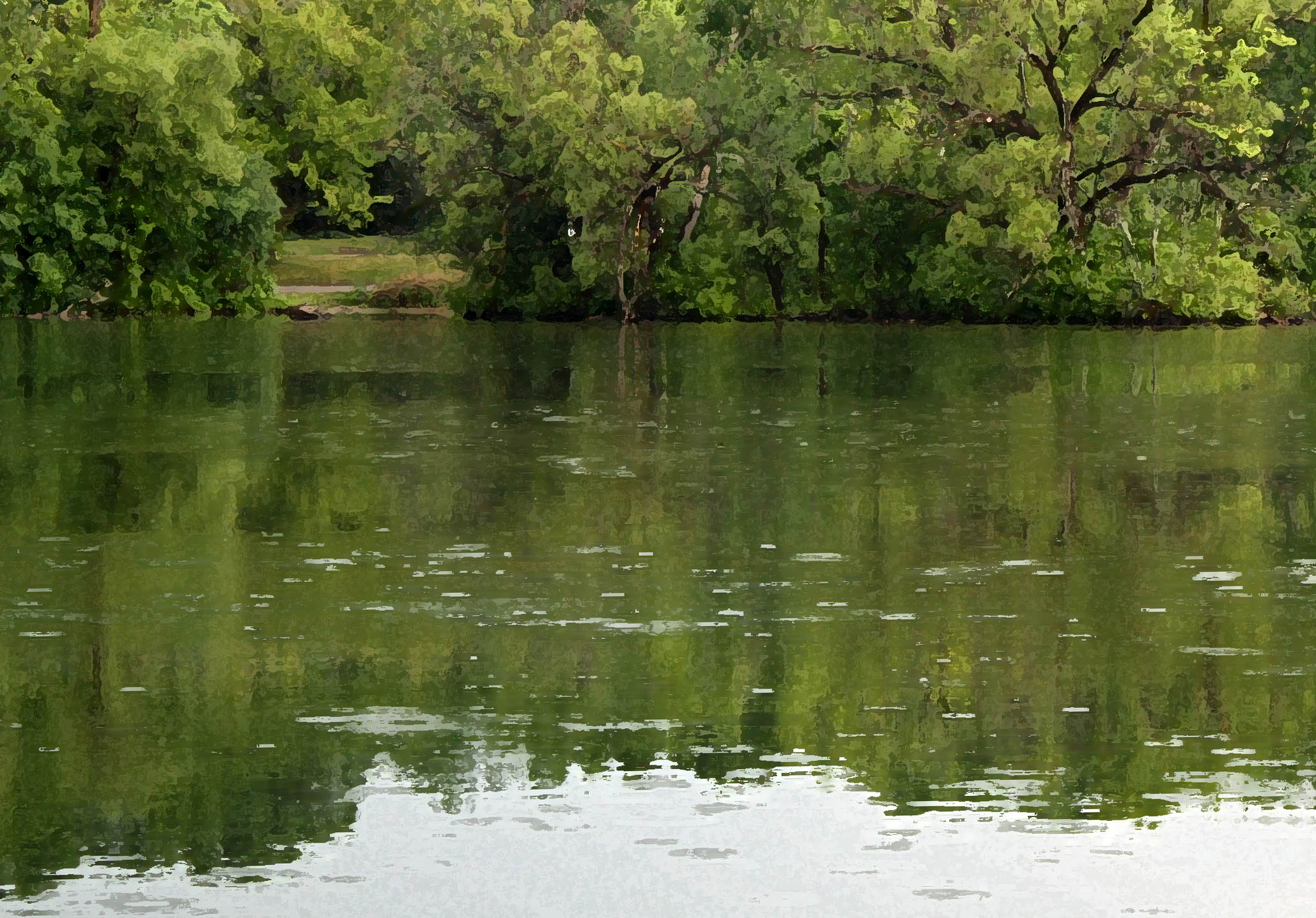
Rain falls on the Otonabee River, ON (photo and rendition by Nina Munteanu)
Nina Munteanu is a Canadian ecologist / limnologist and novelist. She is co-editor of Europa SF and currently teaches writing courses at George Brown College and the University of Toronto. Visit www.ninamunteanu.ca for the latest on her books. Nina’s bilingual “La natura dell’acqua / The Way of Water” was published by Mincione Edizioni in Rome. Her non-fiction book “Water Is…” by Pixl Press(Vancouver) was selected by Margaret Atwood in the New York Times ‘Year in Reading’ and was chosen as the 2017 Summer Read by Water Canada. Her novel “A Diary in the Age of Water” was released by Inanna Publications (Toronto) in June 2020.
I recently had a wonderful discussion on Cyrus Webb’s show ConversationsLIVE on BlogTalkRadio and WYAD Radio in Mississippi.
We talked about curiosity in our world and how fiction connects us with relevance and meaning. We discussed writing eco-fiction, my latest eco-novel and work of mundane science fiction “A Diary in the Age of Water. We also discussed what was involved in combining art with science in mundane science fiction. Cyrus then asked me what it was like to get a book out during COVID. I enjoyed this interview for its refreshing questions. They made me think.
You can listen to the interview through the link below:
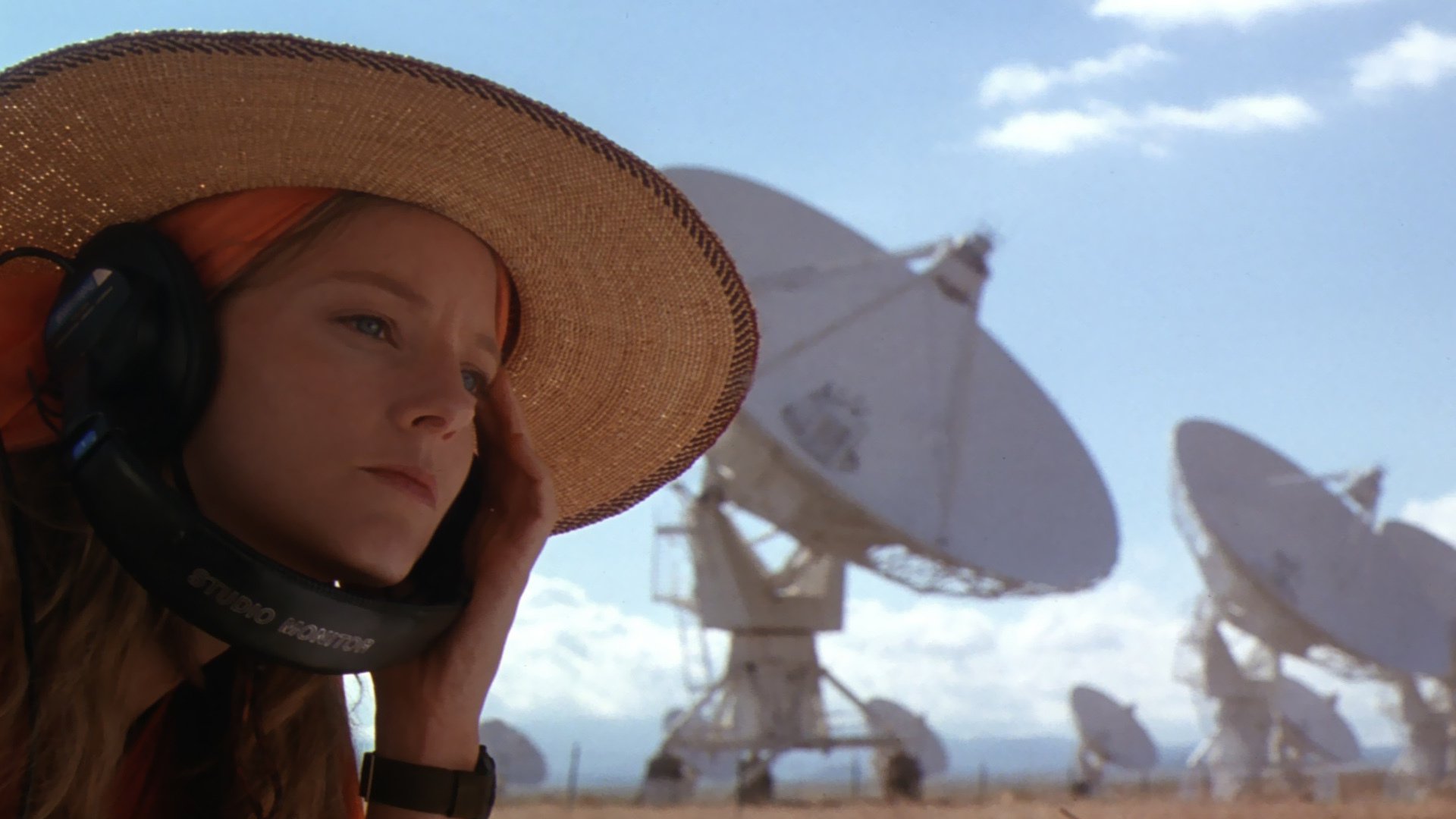
Ellie (Jodie Foster) listens for aliens at the array in “Contact”
The opening sequence tells the entire story… It is both spectacular and humbling at the same time as we begin with a view of Earth gleaming in a sunrise. An almost frantic jumble of broadcasts— news, TV shows, music—assail our ears. As we pull back from Earth and pass the outer planets, we hear older broadcasts… disco…Kennedy… the Beatles… Hitler…then ultimately the unintelligible static of all the radio stations on Earth. Then, as we leave the solar system, passing breathtaking nebulae, the sounds give way to silence. A dead silence, as we continue to pull back out of the galaxy and out of the local group of galaxies into the quiet depth of our vast universe. “It’s enough to make you feel tiny and insignificant and alone,” says Maryann Johanson of FlickFilosopher.com. “Which is precisely the feeling it’s meant to evoke.” From that arcane vastness, we are brought back to our own “intimate” existence within it as the universe transforms into a dark reflection in a young girl’s eye.
With a powerful entrance like that, it is hard to imagine that this 1997 movie directed by Robert Zemeckis (Forrest Gump) and based on the novel by Carl Sagan, received very mixed reviews by critics.
Cindy Fuchs of the Philadelphia City Paper called it “far more mundane than its aspirations to cosmic insights might have produced.” Kevin N. Laforest with the Montreal Film Journal said, “Contact is not a bad film, but I can’t say it’s all that good either.” Even TVGuide.com rated it a two out of four: “It’s really about [Jodie] Foster, and with her lips pressed tightly together and her hair carelessly shoved behind her ears, she’s utterly convincing as a researcher who’s subverted everything to a life of the mind. Unfortunately that adds up to a rather remote protagonist and Ellie is surrounded by a supporting cast of one-dimensional types…far too cold-blooded for summer audiences.” This is ironic, considering that the advertizing pitch calls Contact “a journey to the heart of the universe.” Finally, Christopher Null (Filmcritic.com) recommended it for its looks but not highly. Said Null: “Carl Sagan’s ode to the superior intelligence of aliens (and how us darned humans mess everything up) is consistently beautiful and interesting, but it never makes a point (except for that bit about the darned humans).
I think these critics have missed the point. Contact—and its somewhat tortured protagonist—demonstrates much in the way of “heart” and in doing so, makes a compelling story. Hearts beat deeply inside us, and this movie is no different; its “heart” runs deep, deep beneath the surface rhetoric that seems to have distracted several critics who likely prefer to take a shallow sip of their coffee steaming hot than wait and savor the rich flavor of a dark blend in a deep swallow.
Contact examines the moral, social and religious implications of our first contact with extraterrestrial intelligence through the personal journey of astronomer, Eleanor (Ellie) Arroway (played impeccably and sensitively by Jodie Foster). Never knowing her mother (who died at child birth) and having lost her father when she was ten, Ellie grows into a strong-willed scientist who dedicates her life to finding alien life in the universe by foregoing a career at Harvard to join a SETI Observatory in the Puerto Rico jungle. In an earlier scene with her father, she asks the question we have all pondered at least once: “Do you think there are people on other planets?” to which her father blithely answers, “if it’s just us, seems like an awful lot of wasted space,” a simple argument that appeals to the young logically-minded Ellie and one that will dominate the perseverance of her adult life in her resolute search for life in the universe.
And persevere Ellie must, because nothing comes easy for her. Shortly after she settles at the SETI Observatory her teacher (and nemesis) David Drumlin (Tom Skerritt) pays her a visit with implied threats of shutting the place down. Ellie also meets Palmer Joss (Mathew McConaughey), a man of faith, who is writing a book about the effects of science and technology on the third world. Although she is attracted to him, alarm bells go off in Ellie, who feels threatened by his faith (something she does not outwardly understand yet clings to in another form). Wanting to see him again, she introduces him to the man he wants to interview: Drumlin. And one of the most poignant conversations follows:
When Ellie challenges Drumlin’s apparent wish to do away with all pure research, he responds with, “What’s wrong with science being practical, even profitable? Nothing—”
Palmer cuts in, “—As long as your motive is the search for truth, which is exactly what the pursuit of science is.”
Drumlin counters peevishly, “Well, that’s an interesting position coming from a man who crusades against the evils of technology.”
To which Palmer responds, “I’m not against technology; I’m against the men who deify it at the expense of human truth.”
Palmer and Ellie collide from two different worlds and despite their differences, they are profoundly attracted to one another. But as quickly as she falls for Palmer, she recoils from him.
Nothing comes easy for Ellie: “small moves, Ellie,” her father is accustomed to telling her, “small moves…” Shortly after she and her colleagues have been shut down by Drumlin and have set up anew (thanks to eccentric billionaire entrepreneur, S.R. Hadden, played by John Hurt), Drumlin and others shut them down yet again. But, as though a greater force intervenes, this is when Ellie makes her momentous discovery and intercepts an alien message from Vega, a young star still surrounded by a proto-planetary cloud of debris about 27 light years away from us. The scene is scientifically plausible and elegantly powerful—as we witness the drama of this phenomenal discovery unfold in a frisson of action.
Zemeckis wisely shows us exactly how such an event would really play out. And Sagan didn’t pick Vega out of whimsy: a sphere sixty light years thick of radio communication radiates from Earth from our radio and TV broadcasts. These signals may be captured by alien technology and sent back as a “message”. In theory, such a signal could be received on Earth anytime after 1990, the round trip time for a light or radio signal to travel to Vega and back from the first global signal, which in itself is momentous and telling. In another spine-tingling scene, the scientists who have descended upon Ellie decipher the arcane harmonics of the “message” as the broadcast of the opening ceremony of the Berlin Olympics in 1936 (the first truly global TV broadcast made) over which Hitler presided. In fact, in another stroke of irony, the now infamous swastika is the first icon they decipher. Later still, they discover embedded instructions to build a machine that appears made to take a human on an extra-galactic trip.
Ellie (Jodie Foster) listens for aliens at the giant array in “Contact”
At the same time that Ellie intercepts this message, Palmer Joss experiences a meteoric rise to stardom with his bestselling book, Losing Faith: the Search for Meaning in the Age of Reason (which could well have been the alternate title for the film; it certainly describes the subtext of the story and the major thematic element: Faith & Meaning). In an interview with a prominent news show host, Palmer asks the question that most of us have avoided: “The question that I’m asking is this: are we happier? Is the world fundamentally a better place because of science and technology?…We shop at home, we search the web—at the same time we feel emptier, lonelier, and more cut off from each other than any other time in human history…We have meaningless jobs, we take frantic vacations [and] trips to the mall to buy more things to fill these holes in our lives.” Ironically, Palmer touches a similar nerve in Ellie when he brings up her dead parents: “It must have been hard… being alone…” insinuating that her fanatical search for intelligent alien life may simply be filling a hole in her heart. She flees Palmer shortly after, fearing his revealing intimacy. When they next meet, years later, they fall naturally into their familiar banter and she turns the table to challenge his faith in the same way: “What if science simply revealed that [God] never existed in the first place?” She then evokes Occam’s Razor, which says that “…all things being equal, the simplest explanation tends to be the right one…what’s more likely? An all powerful mysterious God [who] created the universe then decided not to give us proof of his existence or that he simply doesn’t exist at all and we created him so we wouldn’t have to feel so small and alone?” Both of them are saved from an answer by the intrusive rings of their cell phones.
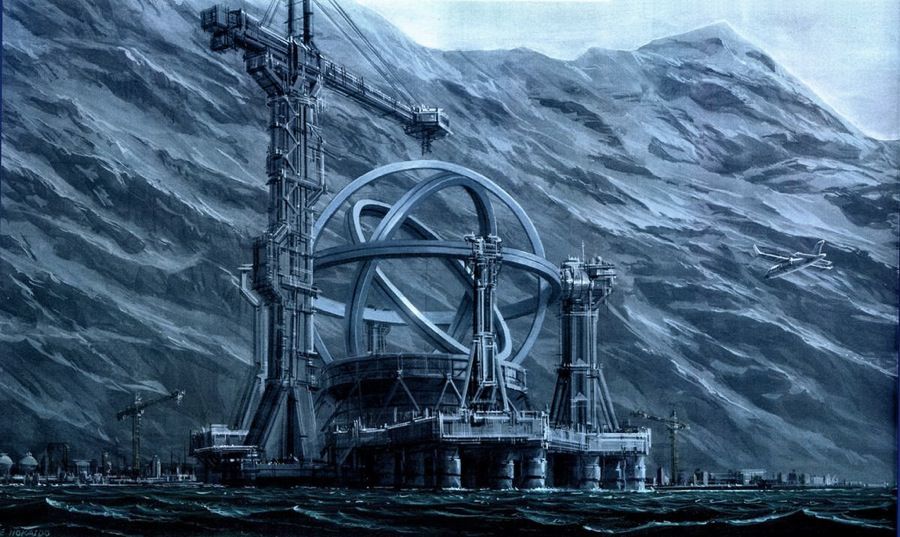
Space-time vehicle in the film Contact
Ironically again, it is Ellie’s lack of belief in God that causes her to be overlooked for the momentous journey in the alien craft, in favor of the crafty Drumlin with the oily smile. Unfortunately, a religious zealot sabotages the mission and Drumlin, along with the whole alien craft and construct, are blown up in a spectacular explosion at NASA’s Cape Canaveral. Ellie gets her chance after all when they build a second one. Her journey in the alien space craft, which we are later told takes up eighteen hours of her time but passes instantaneously on Earth (to the point where they all think nothing actually happened), is truly epic and elegantly portrayed. Her encounter with the aliens is also in keeping with the plot and imagery of the story. One of the most poignant scenes in the movie is the one where Ellie is introduced to the incredible and indescribable beauty of the vast Universe. It is at this point that she experiences her epiphany: science is not the sole purveyor of truth in the Universe. As she gazes at the splendor revealed before her, she acknowledges that the language of science is unable to express the sheer magnitude of the breathtaking scene. Grasping at something to say, she blubbers with a scientific term then finally gasps, “No words…to describe it…they should have sent a poet…”
Upon her return, Ellie is challenged by skeptics who think she suffered a giant delusion (remember that on Earth, no time had passed during her supposed eighteen-hour voyage). Ellie offers up a strained scientific explanation (e.g., wormhole travel through space-time also called Einstein-Rosen bridges) which is challenged by National Security Advisor, Michael Kitz (James Woods) as only theory, and must finally resort to her faith; one she selflessly offers to the world: “I… had an experience. I can’t prove it, I can’t even explain it, but everything that I know as a human being, everything that I am tells me that it was real. I was given something wonderful, something that changed me forever. A vision of the universe, that tells us undeniably, how tiny, and insignificant and how… rare, and precious we all are. A vision that tells us that we belong to something that is greater than ourselves, that none of us are alone.”
Frederic and Mary Ann Brussat of Spirituality Practice said it best: “Robert Zemeckis has fashioned a truly awesome movie that celebrates the spiritual practices of listening, wonder, love, and zeal. It affirms that there are times and places where reason must yield to mystery.”
The SETI Institute, who currently conduct the search for alien life, have a website dedicated to the movie.
Very large array in New Mexico (photo Wikipedia)
Nina Munteanu is a Canadian ecologist / limnologist and novelist. She is co-editor of Europa SF and currently teaches writing courses at George Brown College and the University of Toronto. Visit www.ninamunteanu.ca for the latest on her books. Nina’s bilingual “La natura dell’acqua / The Way of Water” was published by Mincione Edizioni in Rome. Her non-fiction book “Water Is…” by Pixl Press(Vancouver) was selected by Margaret Atwood in the New York Times‘Year in Reading’ and was chosen as the 2017 Summer Read by Water Canada. Her novel “A Diary in the Age of Water” was released by Inanna Publications (Toronto) in June 2020.
I recently had the pleasure of chatting with Crystal Fletcher on “All About Canadian Books” about my recent clifi dystopian novel “A Diary in the Age of Water.” We covered a number of topics from water’s over 70 anomalous properties–virtually all of them life-giving–to how water seems to inform all aspects of my life, particularly my writing life. Crystal was particularly fascinated with the four generations of women in the book and we talked at length about how these characters were developed and the roles they played in the greater saga.
After bringing up the Toronto Star’s question of me (“What keeps you up at night about climate change”) in which I admitted that I lose sleep over the thought of how my son and his children will fair in this changing world, Crystal admitted that “Your book, Nina, is an eye opener…it freaked me out when I was reading it…and now I’m losing sleep!”
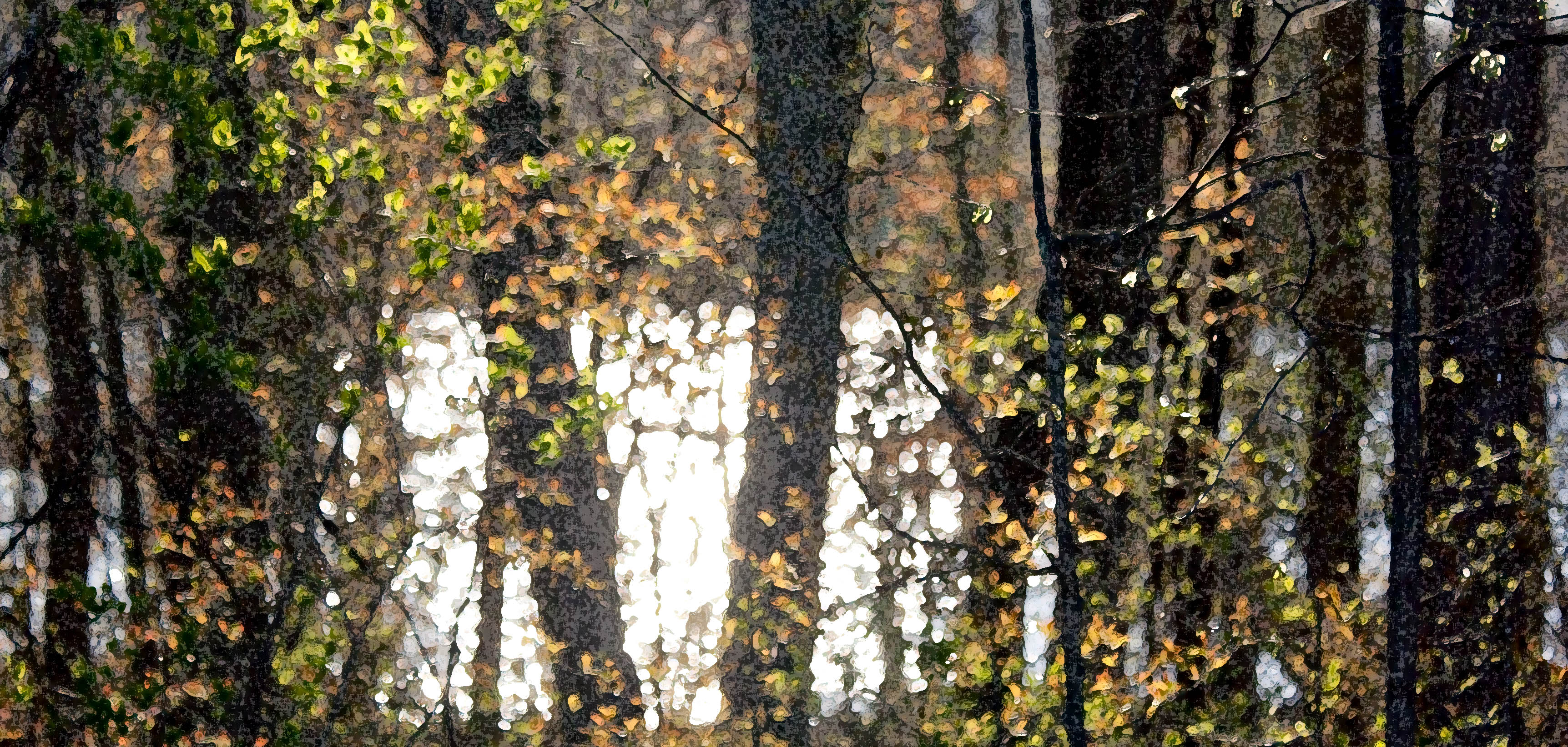
Hardwood forest back lit by glittering Otonabee River, ON (photo and rendition by Nina Munteanu)
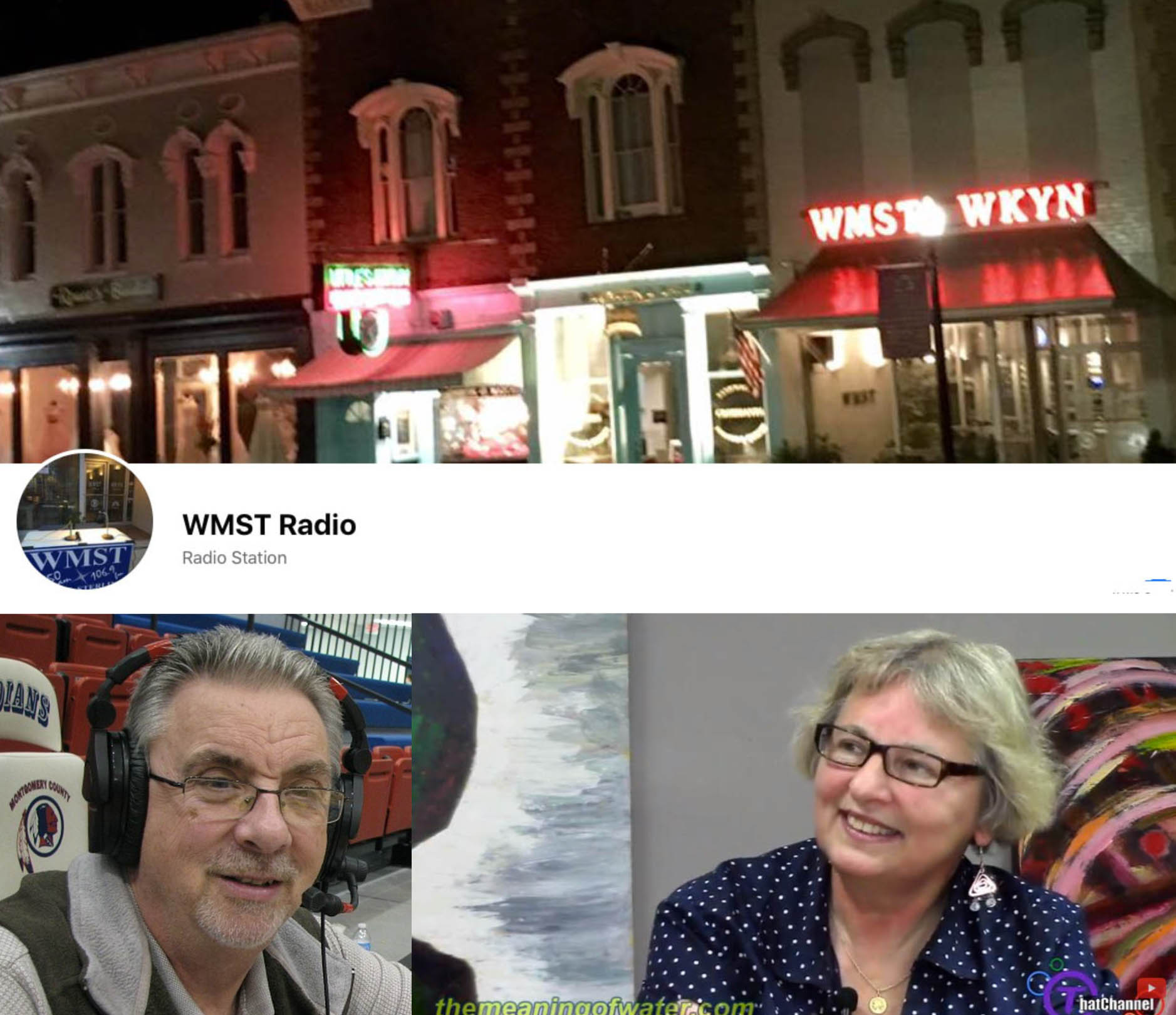
Dan Manley interviews Nina Munteanu on Mid Morning on Main WMST-AM Radio
I was recently interviewed (on June 21) by Dan Manley on Kentucky’s Mid-Morning on Main show on WMST-AM Radio. I’ve visited Kentucky several times before, including the famous Bardstown Road in Louisville, but this time it was a virtual visit.
Dan and I talked about how I became a limnologist and ecologist, about my growing up in a small town and playing in the local forest with my older brother and sister and how we made ‘potions’ out of moss, soil, evening nightshade and water.
We talked about my recent eco-novel “A Diary in the Age of Water” and why I wrote it and its effect on people. We covered the difference between stereotypes and archetypes and how science informs me and my writing. We also explored how life changes us and our writing and how writing, in turn, changes us.
We covered a vast range of water-related topics from the movie “Water World” to the TV show “Bonanza.” We talked about water scarcity and water politics and what Canada was doing and what’s happening in America.
I really enjoyed this interview because Dan asked me some surprising and challenging questions that led us into interesting territory. My interview with him starts about 43 minutes into the show. Go have a listen!
Otonabee River sparkles behind a hardwood forest in spring, ON (photo and dry brush rendition by Nina Munteanu)
Nina Munteanu is a Canadian ecologist / limnologist and novelist. She is co-editor of Europa SF and currently teaches writing courses at George Brown College and the University of Toronto. Visit www.ninamunteanu.ca for the latest on her books. Nina’s bilingual “La natura dell’acqua / The Way of Water” was published by Mincione Edizioni in Rome. Her non-fiction book “Water Is…” by Pixl Press(Vancouver) was selected by Margaret Atwood in the New York Times‘Year in Reading’ and was chosen as the 2017 Summer Read by Water Canada. Her novel “A Diary in the Age of Water” was released by Inanna Publications (Toronto) in June 2020.
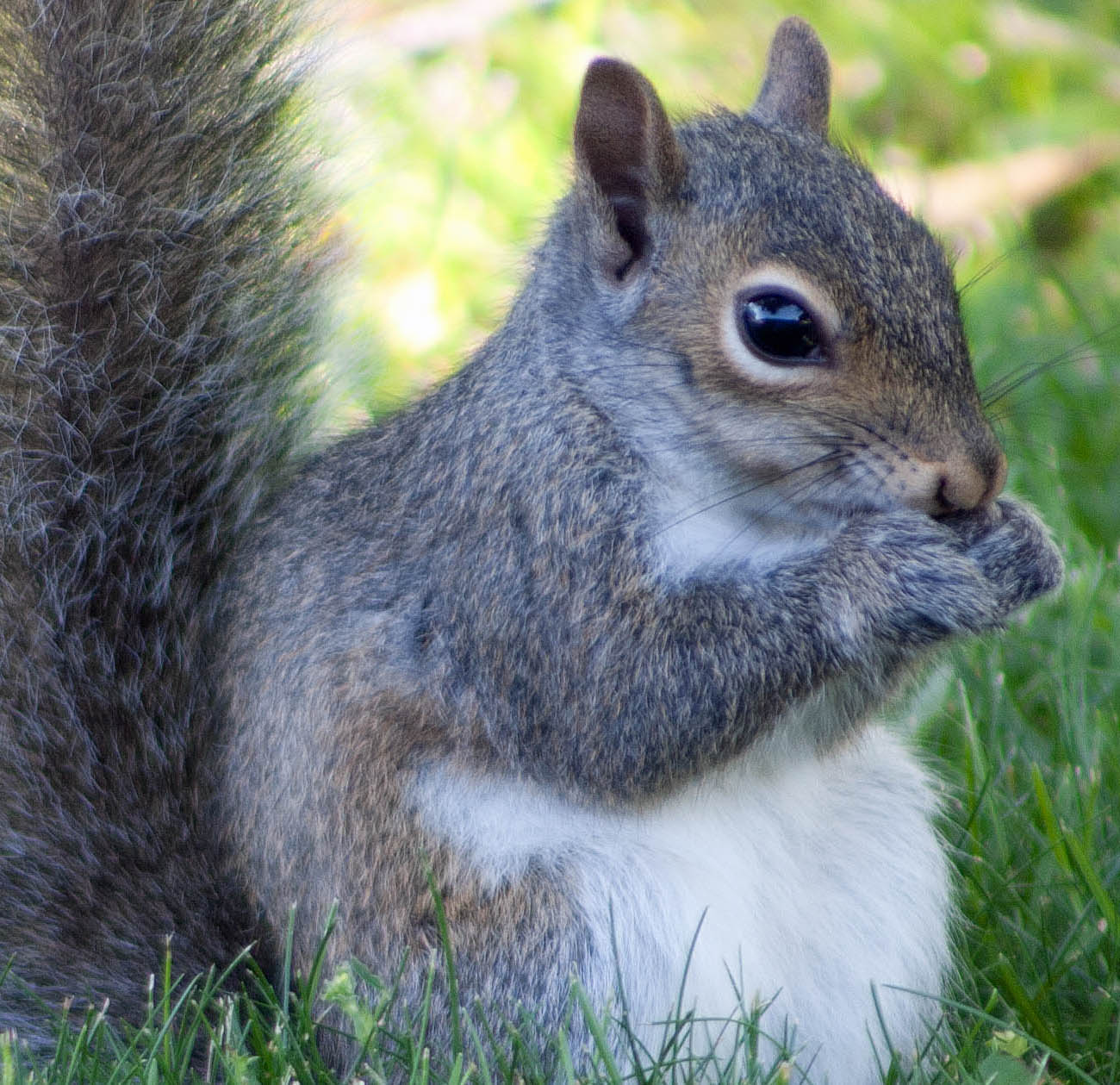
Grey squirrel munching on a maple seed, ON (photo by Nina Munteanu)
Do you believe in serendipity or destiny? That all things are interconnected in a flowing web that responds like a super consciousness?
Swiss psychiatrist Carl Jung called it “meaningful coincidence.” Bohm used the term “implicate order”; the Vedas call it “akasha; Goethe gave it the name “the ground of all being”; and Mae-Wan Ho described it as “quantum entanglement”: when puzzle pieces cooperatively arrange themselves into a symbiotic pattern of synchronicity to provide meaning.
The universe provides…
I’ve come to rely on it in my writing: moments when key things of interest reveal themselves to me just when I need them. I call it writing in sync. Time and again, I’ve serendipitously discovered just what I needed for a plot point or something to complete a backstory: a news event, a conversation with a friend, or an image on the internet. Synchronicity occurs all around us. Birds flying in formation during migration. Electrons synchronizing by the billions and passing through impenetrable barriers. Fireflies flashing in harmony.
Rupert Sheldrake , British botanist and author of The Rebirth of Nature, suggests that “our minds are extended in both space and time with other people’s minds, and with the group mind or cultural mind by way of their connection to the collective unconscious.” Sheldrake posits that we tune into archetypal fields or patterns and “our minds are much broader than the ‘things’ inside our brains. He’s talking about Jungian archetypal gestalt synchronicity. The notion of consciousness as a global phenomenon that occurs everywhere in the body, not just our brains. “Consciousness, at its most basic, [is] coherent light,”writes science journalist Lynne McTaggart in her book The Field.
young black squirrel lies on the branch of a silver maple tree (photo by Nina Munteanu)
It started when I was lunching with good friend Merridy and we were observing several young black and grey squirrels stretched out, lying down on the grass or a branch of the silver maple. They were obviously litter mates and had just finished a playful romp on the grass with sneak-ups, great leaps in the air, twirls and ‘attacks’ and rolls. Such fun! Merridy and I agreed that they looked satisfied and happy after their play, stretched out and languishing in the sun. We talked about how playful squirrels were and how science didn’t seem to acknowledge this. That led to a discussion on people’s perception being largely based on worldview. I shared how we see only what we’re prepared to see and we discussed how science, in its preoccupation with objectivity, can take the ‘soul’ out of life by not observing as much as it could by observing. The concept of anthropomorphism—ascribing exclusively human traits and behaviours to other animals—is based on our own limited definition of what is an exclusively human trait. Who unequivocally proved that only humans are capable of thought or feelings? This recalled a quote of Goethe that I used in the preface of my book Water Is…: “Whatever you cannot calculate, you do not think is real.” We are often blinded by our beliefs and hubris.
Young grey squirrel climbs up the silver maple tree, ON (photo by Nina Munteanu)
During the 1600s in what is ironically called the “Age of Enlightenment,” the highly regarded philosopher René Descartes denied thought to animals; he claimed that animals could not process pain through thought and certainly not through emotions such as joy, sadness, or embarrassment. Only humans were conscious, had souls, and were capable of meaningful communication and language. What he failed to observe—in his own pet dog, even—was that animals other than humans are capable of these thoughts and emotions. One need only pay attention through an unrestricted lens to recognize their expressions and behaviours.
In western exploitive society and religions particularly, this Cartesian view has persisted into the present day with those who still argue that animals are incapable of altruism or empathy, can’t reason or calculate, are bound by the “selfish gene”, and don’t have souls. These persist in the face of scientific evidence to the contrary and ironically serve an economic and social worldview of Nature exploitation.
Then, in a wonderfully serendipitous moment of synchronicity, Merridy announced the next day that she had just read the following passage by David George Haskell in his recent book The Forest Unseen. It was as though he had overheard our conversation about the squirrels:
Four grey squirrels loaf in the bright upper branches of a dead shagbark hickory tree fifty meters down the slope. I watch them for an hour, and mostly they loll in the sun, limbs sprawled. They seem companionable, sporadically nibbling the fur on one another’s hind legs or tails. Occasionally one will break from sunbathing and chew the fungus-encrusted dead branches, then return to sit silently with the other squirrels.
This scene of scoured tranquility makes me unaccountably delighted. Perhaps I so often see and hear squabbling among the squirrels that today’s ease seems particularly sweet. But something more is behind my delight; I feel freed from some burden carried by my over-trained mind. Wild animals enjoying one another and taking pleasure in their world is so immediate and so real, yet this reality is utterly absent from textbooks and academic papers about animals and ecology.
This insight is not that science is wrong or bad. On the contrary; science, done well, deepens our intimacy with the world. But there is a danger in an exclusively scientific way of thinking. The forest is turned into a diagram; animals become mere mechanism; nature’s workings become clever graphs. Today’s conviviality of squirrels seems a refutation of such narrowness. Nature is not a machine. These animals feel. They are alive; they are our cousins, with the shared experience that kinship implies.
And they appear to enjoy the sun, a phenomenon that occurs nowhere in the curriculum of modern biology.
Sadly, modern science is too often unable or unwilling to visualize or feel what others experience. Certainly science’s “objective” gambit can be helpful in understanding parts of nature and in freeing us from some cultural preconceptions. Our modern scientific taste for dispassion when analyzing animal behaviour formed in reaction to the Victorian naturalists and their predecessors who saw all nature as an allegory confirming their cultural values. But a gambit is just an opening move, not a coherent vision of the whole game. Science’s objectivity sheds some assumptions but takes on others that, dressed up in academic rigour, can produce hubris and callousness about the world. The danger comes when we confuse the limited scope of our scientific methods with the true scope of the world. It may be useful or expedient to describe nature as a flow diagram or an animal as a machine, but such utility should not be confused with a confirmation that our liming assumptions reflect the shape of the world.
Not coincidentally, the hubris of narrowly applied science serves the needs of the industrial economy. Machines are bought, sold, and discarded; joyful cousins are not.
David George Haskell, “The Forest Unseen”
Grey squirrel peers at the camera, ON (photo by Nina Munteanu)
A sugar maple tree flowers in early spring in Ontario (photo and dry brush rendition by Nina Munteanu)
Nina Munteanu is a Canadian ecologist / limnologist and novelist. She is co-editor of Europa SF and currently teaches writing courses at George Brown College and the University of Toronto. Visit www.ninamunteanu.ca for the latest on her books. Nina’s bilingual “La natura dell’acqua / The Way of Water” was published by Mincione Edizioni in Rome. Her non-fiction book “Water Is…” by Pixl Press(Vancouver) was selected by Margaret Atwood in the New York Times ‘Year in Reading’ and was chosen as the 2017 Summer Read by Water Canada. Her novel “A Diary in the Age of Water” was released by Inanna Publications (Toronto) in June 2020.
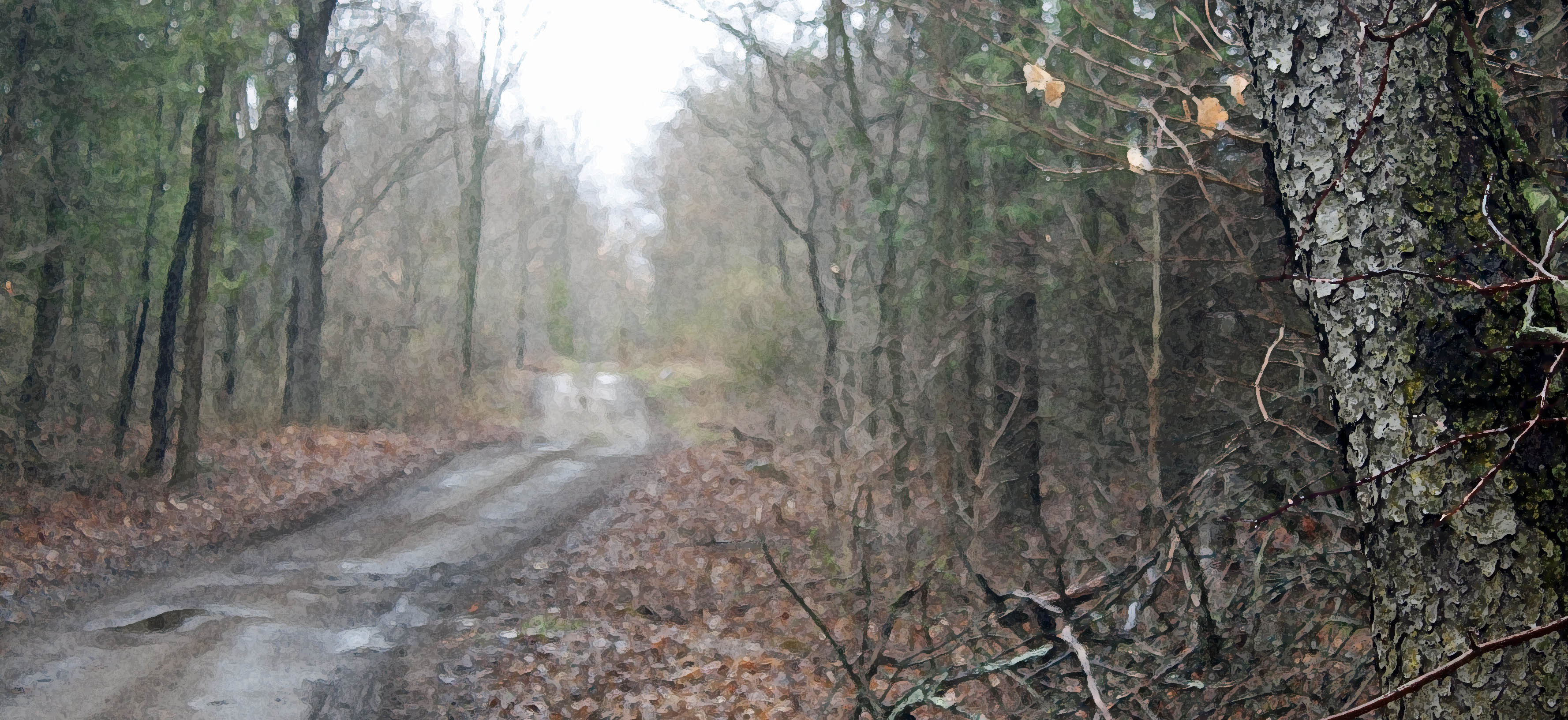
Dirt road to Long Lake in misty rain, ON (photo and dry brush rendition by Nina Munteanu)
.
A short time ago, I had a wonderful conversation with good friend Margaret about how walking in nature—along a river, in a forest, by a marsh or lake—centres us and feeds our soul. Margaret and I agreed that walking in nature fulfills the “explorer” in us, brings us out of ourselves in discovery and allows us to enter that wonderful blissful state of being “in wonder.” Margaret then shared how surly she got when it was a rainy day and she couldn’t go for her walk. I didn’t share that those are the very days I covet for my walks.
It got me thinking about why a walk in the rain is so special for me.
.
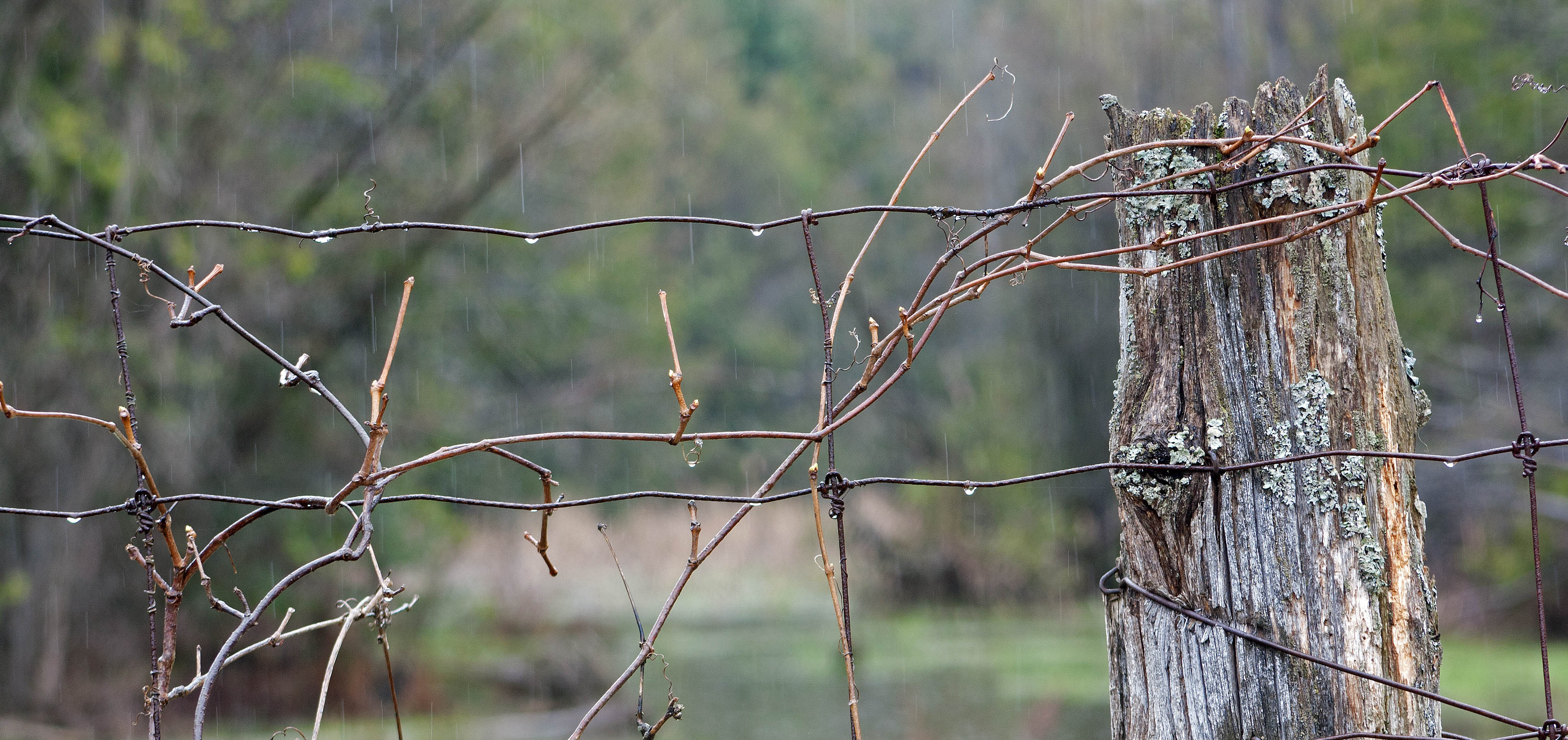
Fence post in front of marsh by country road, ON in the rain (photo by Nina Munteanu)
.
Why Rain Makes Us Feel Good
As a little girl, I used to get caught in the odd thunderstorm that swept through my small town on a sudden wind. I could taste the fresh air after the storm and felt exhilarated by it. What I didn’t know then was that the air was charged with negative ions from both the lightning and the rain—as water molecules crashed into one another.
We are all familiar with the feeling of well-being we get from moving water—rivers, waterfalls, crashing or surging waves, thunderstorms, fresh snow, transpiration by plants, even showers and fountains. Part of this feeling comes from negative ions in the air. Negative ions are basically oxygen ions with an extra electron attached, produced in water molecules.
Devils club, moss and ground cover by a stream in rain, Robson National Park (photo by Nina Munteanu)
.
As early as the 1700s, with the work of Swiss researcher Horace Bénédicte de Saussure, scientists have shown that negative ions are generated by moving water and by plants when exposed to intense light during photosynthesis. Negative ions clean the air. They do this by attaching to positively charged particles such as pollen, mold, bacteria and dust, which then become too heavy to stay airborne. A country meadow typically contains from 2,000 to 5,000 negative ions per cubic centimetre (cc); mountains, forests and seashores provide up to 50,000 negative ions/cc. Niagara Falls generates anywhere from 30,000 to 100,000 negative ions/cc in its air.
Rain on its own is incredibly therapeutic, not just in its ability to support life and to refresh, but in its nature to make us feel wonderful. The chaotic yet stable sound of rain is gently calming. Rain mutes and lacks the jolting sounds that activate our defence and vigilance system. It’s a non-threatening sound that blocks out sudden noises that otherwise alert us. The simple repetitive sound of water falling lets us rest our brains and induces a mild meditative state. Studies have shown that the sound of rain produces alpha waves in a human brain, which is close to the brain’s state when we are asleep. The sound of rain not only relaxes but brings out our creativity. Marine biologist Wallace J. Nichols (author of Blue Mind) argues that the sound of rain allows our brain to wander, eventually reaching a state known as the default mode network. In her book The Artist’s Way, Julia Cameron mentions “s” activities, such as “shower” as creativity-inducing.
Walking in the rain can be pure joy.
.
Pond lily just after a rain, ON (photo by Nina Munteanu)
.
Why Walking in the Forest in the Rain Is Even Better
These days, when I get up in the morning, if the day is foggy or a light rain is falling, I feel compelled to quickly down my breakfast, pack up my camera gear in a waterproof bag, shrug into my raincoat and boots and hightail it to the marsh or the forest, where I’m greeted with the fresh scent of petrichor—the pleasant smell that accompanies the first rain after a long period of warm, dry weather. The rain helps release plant oils and chemicals produced by soil-dwelling bacteria called actinomycetes into the air. The term arose from the Greek petra (stone) and ichor (the fluid that flows in the veins of the gods). The earthy scent of rain on dry soil evokes wonderful memories of playful childhood, freedom and awestruck wonder. The complex loamy organic aroma of a forest during a rain easily ranks among my favourite smells. The link of a smell to strong memories is a scientific fact. In my writing class at George Brown College, I teach my students that the sense of smell is most associated with memory. This is because smell is first processed by the olfactory bulb and has direct connections to the two brain areas most strongly connected to emotion and memory formation—the amygdala and the hippocampus.
Rain intensifies a forest’s mosaic of unique scents from pungent, heavy and sharp to floral, fresh and sweet—based on the forest ecosystem’s qualities. A cedar-hemlock forest will give off different smells than a maple-beech woodland.
.
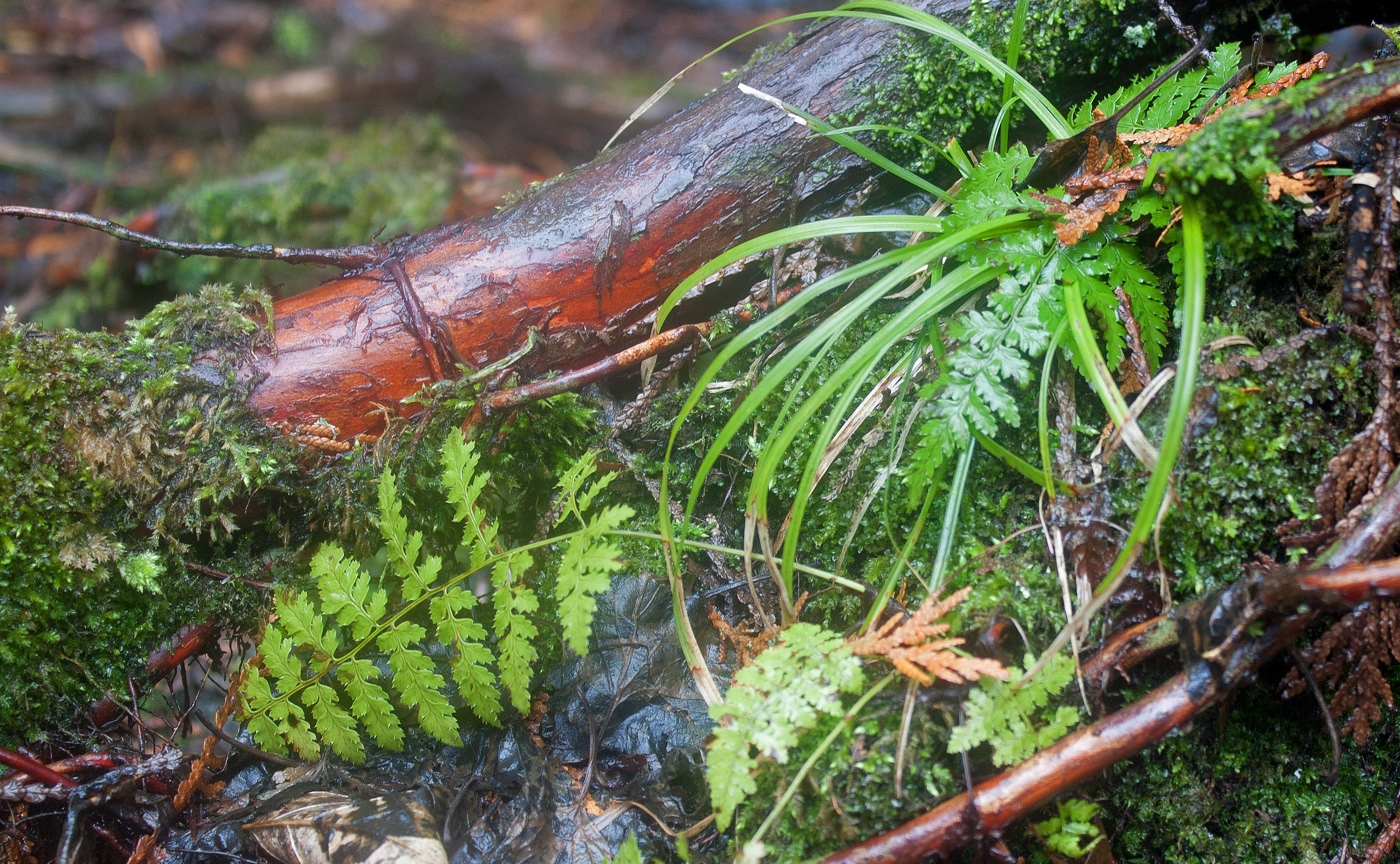
Cedar root among ferns and moss during a misty wet morning, Trent Nature Sanctuary, ON (photo by Nina Munteanu)
.
The conditions are best in the morning.
The morning light favours photography with a gentleness that softens and deepens everything, and invites intimacy. This is particularly magical if a morning mist settles or rises like stream from the damp earth, slowing time. When it rains, moisture covers everything. It brings out vivid colours and textures.
Infinite shades of green, brown, grey and yellow create a fluid landscape that water paints into a vibrant watercolour scene. I move through it, boots crunching and squelching along the spongy loam path, as though wrapped in a moving artwork.
The moisture carries the warbles and fluting chirps of lively bird song amid the hush of raindrops on vegetation. Each surface has a unique voice. And each rainfall—from light drizzle to hard pour—carries its own tune, rhythm and percussion. It’s all a wonderful symphony of diverse frequency from rich infrasound to beyond.
.
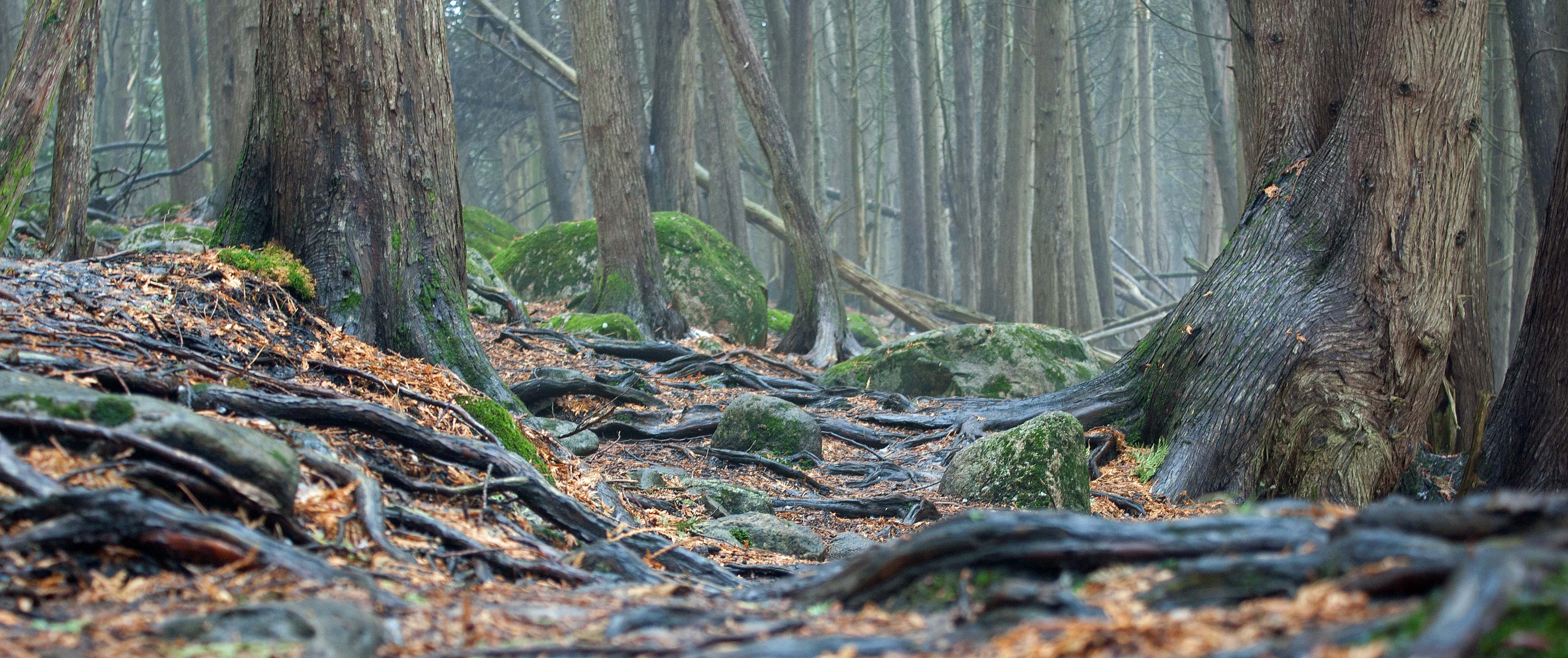
Root-strewn cedar-hemlock forest in morning mist, ON (photo by Nina Munteanu)
Perhaps the exhilaration I feel in the dripping forest is because this is when I can better hear Nature’s conversation with herself. When many of the human sounds grow muted in rainfall, Nature’s sounds fill in the gaps. The rain and the fog bring it all close, palpable, filtering. Like connective tissue, the rain unites me with my surroundings. I breathe in the subtle flavours, the whispers and perfumes, then breathe them out. I’m no longer separate. I am stone. Leaf. Tree.
Many of us feel a sense of peace in a forest. I have no doubt that this is the result of several factors including sounds and frequencies (e.g., infrasound), increased negative charge, scents, wood essential oils, genetic heritage and memory, and simple aesthetic appreciation and beauty. But it is so much more than this; water as rain or flowing stream or river plays a major role in this potential euphoric state.
.
Dew on grass in the morning, ON (photo by Nina Munteanu)
.
Water doesn’t just help us live; “Water teaches us how to live,” says Japanese researcher Masaru Emoto. Water teaches us “how to forgive, how to believe. If you open your ears to the possibilities in life, you may just be able to hear the sound of the pure water that flows through your body even now. It is the sound of your life—a melody of healing.” Emoto adds that, “The human body is … a universe of its own. Our bodies consist of some 60 trillion cells, each carrying out its specialized responsibility while simultaneously harmonizing with other cells in a wonderful way to make us who we are. The organs, nerves, and cells of the body have their own unique frequency. The body is like a grand orchestra consisting of the harmonization of various sounds.”
Water is the great conductor. I love it when it plays me.
.
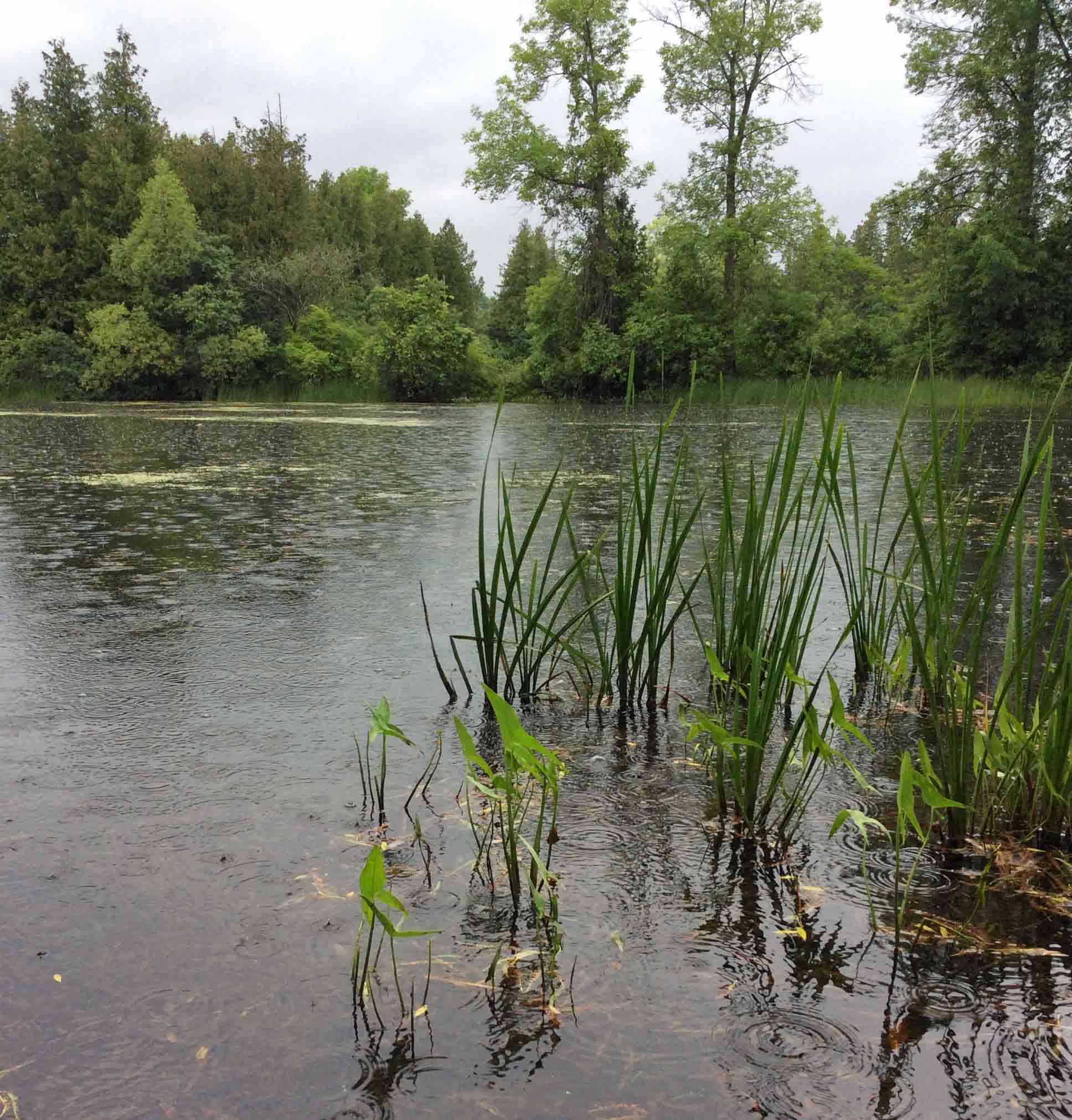
Thompson Creek marsh in a spring rain, ON (photo by Nina Munteanu)
.
Tips For Enjoying Your Walk in the Rain
Equip yourself for the rain. Invest in good raingear: a rainproof slicker or jacket, sturdy boots (preferably waterproof), and warm clothes. I prefer to go bareheaded to get the most of my experience; but I don’t mind getting soaked. If you do mind, invest in a good rain hat. Avoid using a rain hood as it will mute too many sounds and sensations, negating the point of the experience.
Be prepared to get wet. That’s part of the experience: to feel, see, hear, smell and taste the rain and your environment.
Get into the mindset of an explorer. Focus outward with all your senses. Slow your mind and breathing and think with the heart of one in wonder. Think of your five senses and use them all in discovery.
Don’t overdo the experience. If you get cold or too wet, the positive aspects lose to the negative aspects of the experience. Pace yourself and be kind to yourself.
If you use a camera, like I do, keep it dry by using something waterproof to carry it in. When you use it, either protect it with something or have something to dry it immediately once you’ve used it in the rain. Photographing in the rain can be an incredibly rewarding experience and can produce breathtakingly wonderful images that can not be created in any other weather. But you have to look after your equipment too.
Have fun!
.
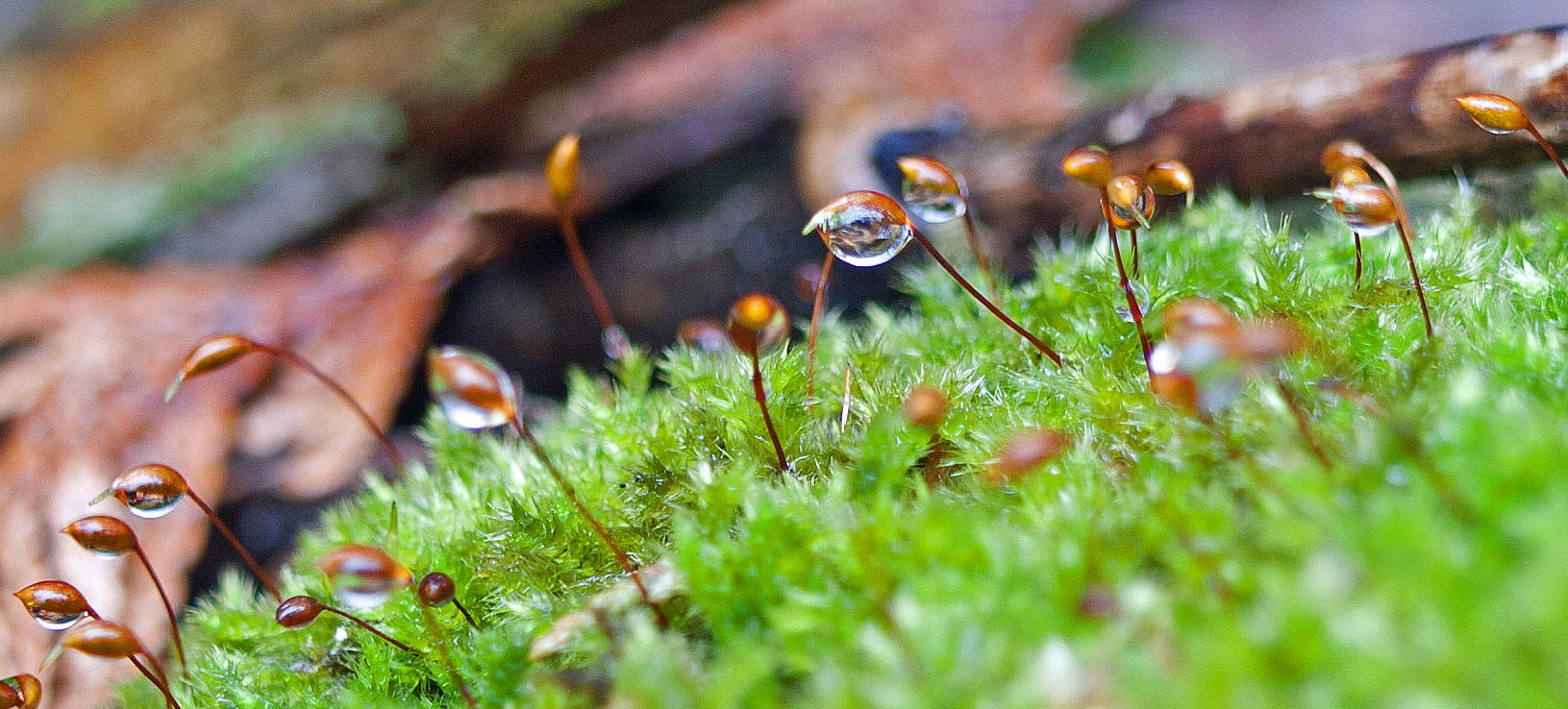
Moss with spore capsules in the rain, ON (photo by Nina Munteanu)
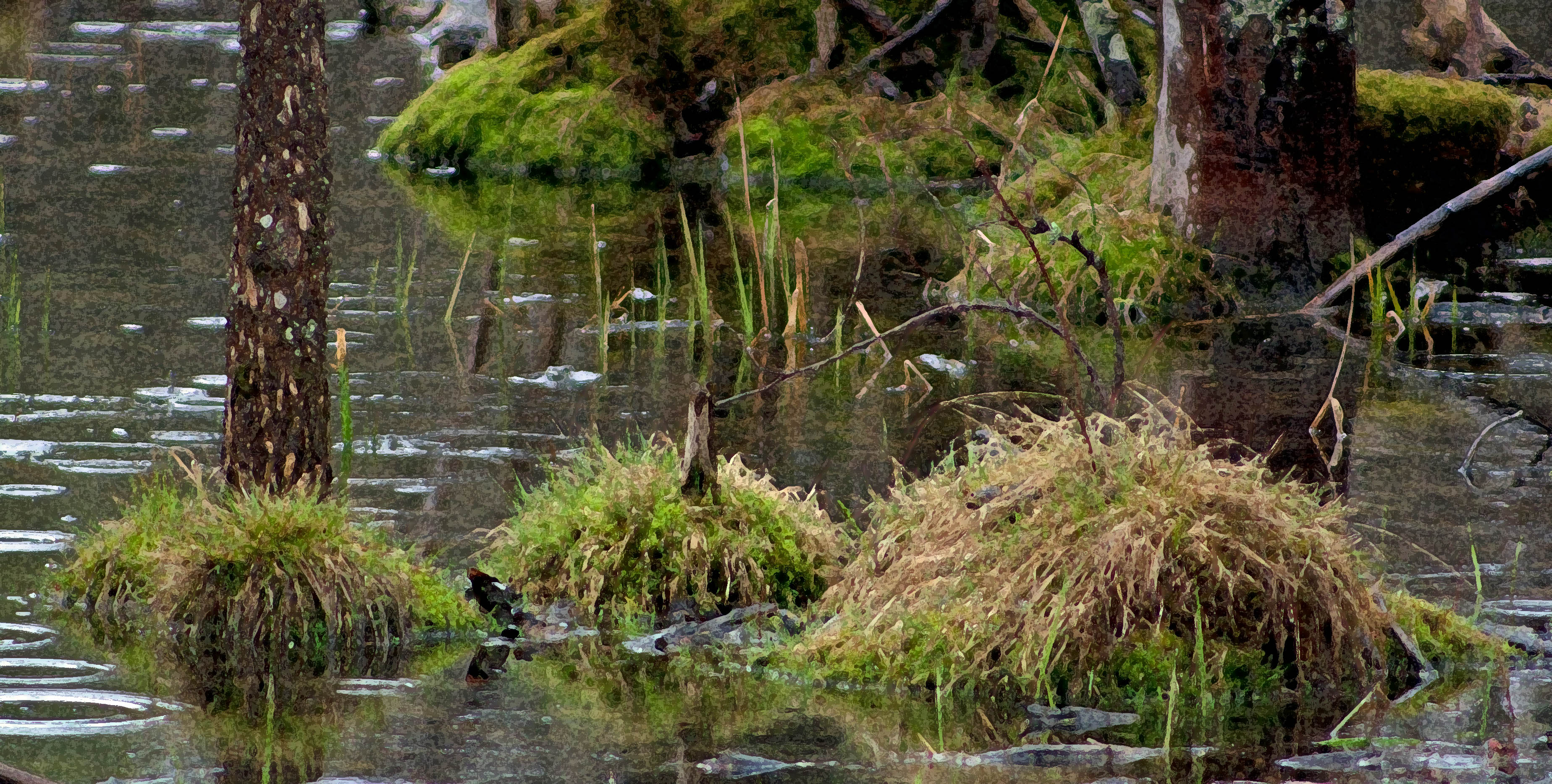
Swamp forest in the rain, off a country road, ON (photo and dry brush rendition by Nina Munteanu)
Geese at the mouth of tributary to the Otonabee River, ON during a spring shower (photo by Nina Munteanu)
.
Nina Munteanu is a Canadian ecologist / limnologist and novelist. She is co-editor of Europa SF and currently teaches writing courses at George Brown College and the University of Toronto. Visit www.ninamunteanu.ca for the latest on her books. Nina’s bilingual “La natura dell’acqua / The Way of Water” was published by Mincione Edizioni in Rome. Her non-fiction book “Water Is…” by Pixl Press(Vancouver) was selected by Margaret Atwood in the New York Times ‘Year in Reading’ and was chosen as the 2017 Summer Read by Water Canada. Her novel “A Diary in the Age of Water” was released by Inanna Publications (Toronto) in June 2020.
“Write with passion. A lot of people say ‘write what you know.’ Those two in some ways are the same thing. You can do a lot of research on things that you don’t know and bring that in [to your writing.] But to know in your soul, in your heart, the thing that’s important that you need to write about is more what I mean by ‘write what you know.’ If you’re passionate about something—a global catastrophe or a personal journey with abuse—if it comes from the heart, it will keep you on track through those rejections and to finish and complete your work. Otherwise you won’t persist and you’ll let someone tell you that it isn’t important, it’s just a hobby.”
On water:
Nina and Fiona discuss the perils of commodifying water and Canada’s role in protecting the freshwater of the world and the boreal zone of Canada.
Nina talks about how she turned her fear of water as a child into a fascination for water and a passion for its protection. “I’m a limnologist, an ecologist. I’ve have been studying it since I was a little kid who was scared of water. I triumphed over that into fascination and made that into a career.” Nina’s non-fiction book Water Is… was published in 2016 as a biography of water and was endorsed by Margaret Atwood in the New York Times ‘Year in Reading.’
Nina talks about some of water’s over 70 anomalous properties and how virtually each is life-giving. She shares how water can teach us to be stewards and protectors of water within an emerging paradigm of gratitude and humbleness.
On being both scientist and artist:
Nina suggests that: “All great scientists are informed by art. They are creative in some way. [Scientists] bring that creativity, that original thinking and that curiosity, with them into their science. That’s what makes their science great because they are willing to look outward…We try to compartmentalize so we can better understand [art and science] but the irony is that we better understand them by bringing them together and integrating them…”
Nina Munteanu is a Canadian ecologist / limnologist and novelist. She is co-editor of Europa SF and currently teaches writing courses at George Brown College and the University of Toronto. Visit www.ninamunteanu.ca for the latest on her books. Nina’s bilingual “La natura dell’acqua / The Way of Water” was published by Mincione Edizioni in Rome. Her non-fiction book “Water Is…” by Pixl Press(Vancouver) was selected by Margaret Atwood in the New York Times‘Year in Reading’ and was chosen as the 2017 Summer Read by Water Canada. Her novel “A Diary in the Age of Water” was released by Inanna Publications (Toronto) in June 2020.
On Writing My First Speculative Fiction Novel: The Darwin-Angel Duology
The first novel I wrote at the tender age of fifteen was Caged in World, a hundred-page speculative story about a world that had moved “inside” to escape the ravages of a harsh post climate-change environment.
It was 1969, the year that humans first stepped on the moon and the first Concorde test flight was conducted in France. But I was concerned by the environment and what was happening on our planet. It was seven years since Rachel Carson had published Silent Spring, which warned of our declining bird and bee populations and impacts to human health from unregulated pesticide/herbicide use (such as carcinogens and hormone disruptors). It was just a year after Paul Erlich’s Population Bomb warned that attempts to stretch the Earth’s resources to support the ever-growing population would result in mass starvation, epidemics, and, ultimately, the breakdown of social order.
In the 1960s it was already apparent that environmental imbalance and destruction were global concerns and we were on the brink of an environmental crisis. Unchecked deforestation was destroying forests around the world, including the boreal and old-growth forests of my own country Canada. Brazil had already begun cutting down trees and burning forest at an alarming rate. Unregulated use of pesticides, herbicides and growth hormones created toxic contamination of our natural world and our food and water supply—despite Carson’s dire warning with Silent Spring. Our waterways were being contaminated by mining wastes and industrial effluents. Killer smog. Noxious algal blooms. Oil spills. Dead zones. The list was growing.
Bamboo Forest, Kyoto, Japan (photo by Nina Munteanu)
I joined S.T.O.P. (Society To Overcome Pollution) and marched in protests to call for responsible behaviour by governments and large corporations. I tried to raise awareness at my school about our deteriorating environment and likely consequences to human survival; my own teachers tried to silence me. I wrote my first dystopia, Caged in World. The eco-novel was about a subway train driver and a data analyst caught in the trap of a huge lie. The story later morphed into Escape from Utopia. My dad, who was impressed with my dedication and what I’d done, became my first agent; he brokered a meeting with a Doubleday editor he’d met and impressed (my dad was a character and very charming); I did my first book pitch at age sixteen. The editor read my book and, while he didn’t pick the book for Doubleday, he told me that the story was original and imaginative and that I should keep writing.
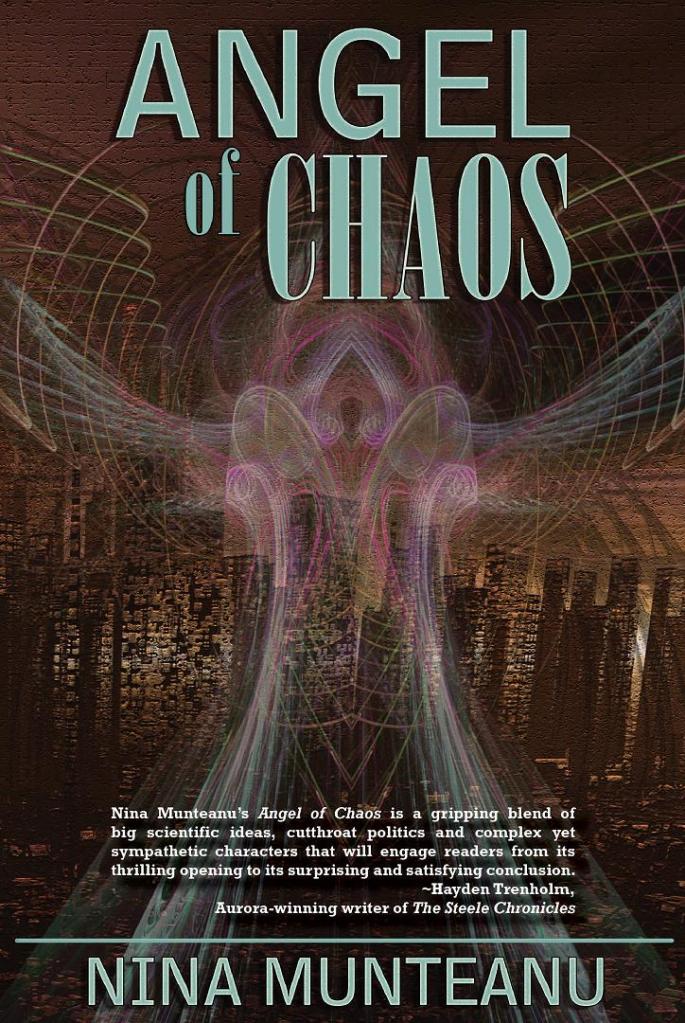
Several drafts—and years later—the novel became the eco-medical thriller Angel of Chaos, set in 2095 as humanity struggles with Darwin’s Disease—a mysterious neurological environmental pandemic. Icaria 5 is one of many enclosed cities within the slowly recoving toxic wasteland of North America, and where the protagonist Julie Crane works and lives. The city is run by technocrats, deep ecologists who call themselves Gaians, and consider themselves guardians of the planet.
The Gaians’ secret is that they are keeping humanity “inside” not to protect humanity from a toxic wasteland but to protect the environment from a toxic humanity.
Since she was a young child, Julie has been hearing voices in her head. She’s not a schizophrenic, but a gifted veemeld (someone who can tap into machine intelligence wavebands). Feeling an inexplicable “karmic” guilt and intent on making a contribution to her society, Julie searches for a cure to Darwin Disease; instead, she makes a horrifying discovery that incriminates her in a heinous conspiracy to recast humankind.
“This is a story with great scope … As Julie finds out the truth about her father, she discovers a truth that will tear her world apart.“
Bill Johnson, author of “a story is a promise”
By virtue of their gifted powers in communicating with the machine world, veemelds are considered a commodity, to be used, traded, hoarded and discarded by ruling technocrats all over North America.
I spent several years shopping the book to agents and publishing houses. Although I received many bites, all finally let go. In the meantime, I did several things: 1) I started writing short stories, some of which were cannibalized from the book, and several were published; 2) I wrote Angel’s prequel, The Great Revolution (never published, it sits in a drawer hibernating) and Angel’s sequel Darwin’s Paradox, (which was published). In fact, in 2007, Dragon Moon Press in Calgary made an offer to publish Darwin’s Paradox; the sequel became my debut novel. Dragon Moon Press later picked up Angel of Chaos and published it in 2010 as a prequel.
“Angel of Chaos is a gripping blend of big scientific ideas, cutthroat politics and complex yet sympathetic characters that will engage readers from its thrilling opening to its surprising and satisfying conclusion.”
Hayden Trenholm, Aurora-winning author of The Steele Chronicles
Darwin’s Paradox follows humanity in its cloistered indoor world as it deteriorates with the disease. Darwin’s Disease—related to indoor living—sweeps across humanity with debilitating genetic deterioration, violent death and the promise of extinction. This is something the self-professed deep ecology Gaians are content to see in—if it means preserving the natural world. Of course, the Gaians—being self-serving humans after all—have an exit plan.
In 2012, Derek Newman-Stille of Speculating Canada wrote an essay on Darwin’s Paradox entitled “Patient Zero and the Post Human”; the article provides an insightful description of the eco-novel and interesting historical context and irony to our current situation with the COVID-19 pandemic:
“In Darwin’s Paradox Nina Munteanu displays her awareness of scientific discourse: focussing on areas like chaos theory, biological theories of co-evolution, symbiosis and virology, and ecological theories. Her protagonist, Julie, is patient zero in a spreading epidemic that has infected most of modern civilisation. Munteanu creates a civilisation where human society is centred around a few urban locales, leaving large parts of the world unoccupied by human beings, and allowing for ecological development uninterrupted by human interference. Technology in this future world has fused with the viral epidemic, questioning the barriers of the human and the nature of human existence. The nature of humanity has changed with this introduction of other elements into the human biosystem, creating a post-human world in which the possibilities of the future of human existence are called into question, and in which several powers are vying for control of the next stage of humanity and the future of the human race.
Munteanu’s Darwin’s Paradox illustrates a collision of past and future as Julie is haunted by her past and ideas of home, while simultaneously representing a next stage in human evolution. The city Icaria 5 itself is a representation of past and present intersecting: buried under the city of Toronto and rising from the structures of the past. Munteanu’s plot is full of family secrets, the hidden past, and the resurfacing of guilt (particularly Julie’s guilt about being patient zero in the spreading viral apocalypse). She explores the draw of the past and home and the continual pull the past has upon one’s existence. Munteanu explores Julie’s simultaneous desire to return home and her realisation that home has forever changed – becoming a foreign place.
Munteanu explores society’s fear of epidemic and the role of medical technology as a mechanism for solving all of the world’s problems. She illustrates that medical technology has its limits and complicates the nature of technological methods of solving problems by allowing virus and technology to meld. Simultaneously Munteanu explores the continuation of society’s obsession with beauty and perfection by creating a society where one can restore one’s beauty through instant medical treatments: Nuyu and Nuergery, using nanites to restore one’s youth and change undesirable aspects of one’s form. Political groups fearing the over-use of technology and the complications to the idea of the human that these surgeries may cause begin using scarring to assert their difference and reluctance to submit to social controls.
Media plays an important role in Munteanu’s vision of the future, illustrating the continuance of the media hegemony for defining the nature of “truth” as media messages replace facts and political leaders manipulate the media system to enforce their own controls over society and further embed their interests into the developing social system. She illustrates the danger of the current system of using the politics of fear as a mechanism for controlling voters (particularly focussing on the use of fear by political groups to shift cultural ideas, sympathies, and ultimately gain control of the developing social system). In Munteanu’s vision of the future, it is impossible to trust anyone completely and layers within layers of plot are illustrated, leaving the reader distrusting of every message he or she receives.
Munteanu raises questions and challenges the development of society’s current systems, asking her readers to think critically about messages they are given and to question everything. She illustrates that the truth is socially constructed and that ideas of the truth serve social purposes and can be used to support hidden agendas.”—Derek Newman-Stille, Patient Zero and the Post-Human
In some ways, the Darwin duology shares a special place in my heart—not just because the duology became my first and second traditionally published novels, but because through them I found my writing voice. Since first writing Caged In World, I spent close to four decades honing my craft; I published short stories and two novellas (Collision with Paradise in 2005 andThe Cypol in 2006), and attended writing workshops and conventions, before publishing my first novel with a traditional publisher. It was a fulfilling heuristic path that taught me writing craft in all its facets.
Since publishing my first novel in 2007, I have published on average a book every year (alternating each year between fiction and non-fiction). I now have fourteen books published with various publishing houses. Most are in keeping with an environmental theme. My latest non-fiction book Water Is… was picked by Margaret Atwood in New York Time’s ‘Year in Reading’ in 2016. My latest eco-novel A Diary in the Age of Water was published by Inanna Publications in 2020 in the midst of the COVID-19 pandemic.
My journey as writer has been rich and varied. I’ve moved and lived from one end of Canada to the other. I raised a family and travelled the world. I worked as a field researcher and environmental consultant, investigating many water bodies in Canada and helping communities in watersheds. I taught limnology and phycology at the University of Victoria and currently teach writing at the University of Toronto. I continue my personal research in the natural world to satisfy my unending curiosity. I’ve changed. My writing has changed. But one thing will never change: my passion for the written word and the worlds of the imagination. That journey will never end (until the end, that is).
Readers have asked for a sequel to Darwin’s Paradox. I’ve also been approached by several writers to collaborate on a sequel. While many of their ideas were wonderfully original, I’ve not taken any of them on their offer. Others have said that both novels would make a great series or movie. I’m inclined to agree. If that were to come to pass, I might be persuaded to create a Darwin’s Paradox series and continue the story of Julie, Daniel, and Angel.
Bamboo Forest in Kyoto, Japan (photo by Nina Munteanu)
Nina Munteanu is a Canadian ecologist / limnologist and novelist. She is co-editor of Europa SF and currently teaches writing courses at George Brown College and the University of Toronto. Visit www.ninamunteanu.ca for the latest on her books. Nina’s bilingual “La natura dell’acqua / The Way of Water” was published by Mincione Edizioni in Rome. Her non-fiction book “Water Is…” by Pixl Press(Vancouver) was selected by Margaret Atwood in the New York Times‘Year in Reading’ and was chosen as the 2017 Summer Read by Water Canada. Her novel “A Diary in the Age of Water” was released by Inanna Publications (Toronto) in June 2020.