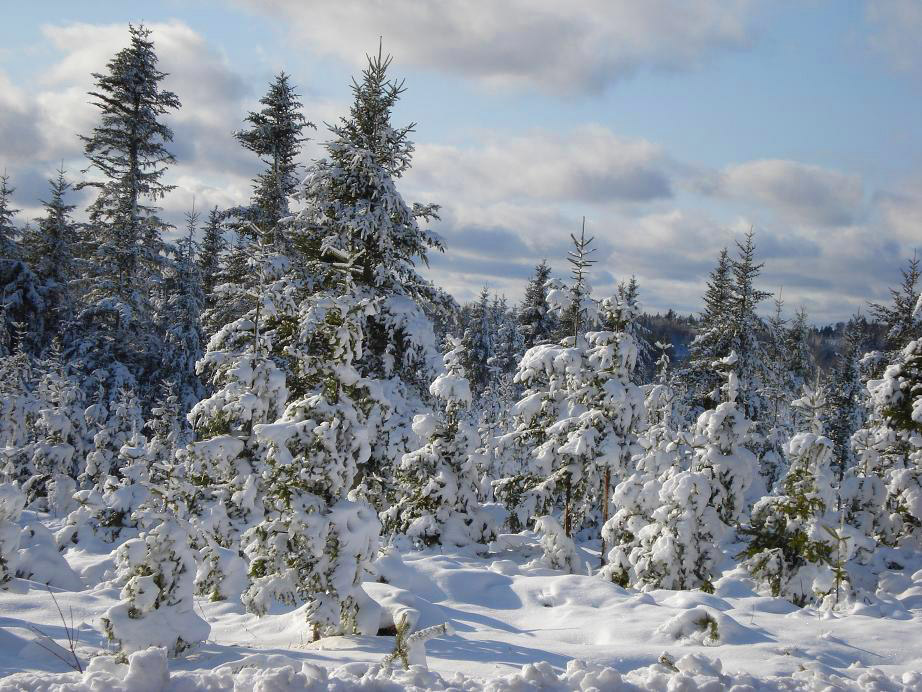
Rhea Hawke and The Legend of the Sacred Trees…

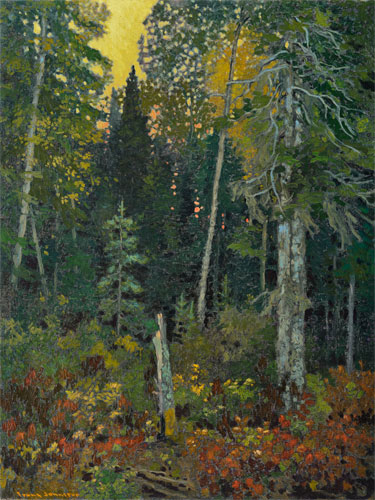
Tree yellow birch moss covered roots Apr DRYBR JC

EXCERPT from Outer Diverse, Book 1 of The Splintered Universe Trilogy:

My mother had fantasized that one day she would see Eos. Her hero was Genevieve Dubois, the space explorer who’d flown the last of a series of ill-fated ZetaCorp flights to Eos some two hundred years ago when it took years to travel anywhere in the galaxy. Dubois was the first―and only―human to have set foot on the mythical planet of Eos, secluded in the giant blue nebula of the Pleiades. After apparently experiencing an epiphany of universal proportions, when she encountered one of the god-like Epoptes, Dubois returned, pregnant, to Florida with her Eosian lover, Azaes. They mysteriously disappeared after being taken into captivity by the American government and ZetaCorp for questioning. Rumors abounded that Azaes had unleashed a tremendous and fearful weapon out of his head on a human―the melting look, I figured―which condemned him as a dangerous monstrosity. Humans rallied to have him imprisoned or banished. Even killed.

The historical records suggested that Dubois and Azaes were murdered soon after. My mother, however, agreed with popular lore that they’d escaped to live a simple secluded life, and that Dubois’s baby by Azaes was born and its descendants were living to this day. The most popular story ― and therefore the least likely―was that only Dubois got away, travelled north to Canada and returned to her native Quebec where she stoically gave birth alone to her child in some abandoned barn in the country. The whole thing smelled of mythos.

Despite the rampant anti-alienism, many humans strongly believed that Dubois bore this child, making her the first human to give birth to a human-alien. A fanatical cult, L’Ordre de l’Arbre Sacré—Order of the Sacred Tree, sprang up in Quebec, and its mostly human members devoted themselves to the notion that Dubois’s child was a kind of messiah who walked secretly among humans and was linked to the tree of life and knowledge, the vishna. They regarded the vishna an ancient soul that carried infinite wisdom and the answer to achieving the ‘balance of all things’.

The Order of the Sacred Tree claimed that all the ills plaguing life in the galaxy were due to a misalignment of forces, an imbalance that the now-extinct Hopi Native Indians called koyaanisquatsi. They claimed that this messiah—Dubois’s child— would provide the balance needed to begin a new age of enlightenment and peace. They spread wild stories of how the child was consummated not through Dubois’s lover Azaes but somehow through Dubois’s interaction with an Eosian vishna tree, which had godly powers and came to be known as one of the sacred trees, along with the migratory trees of Horus, which were also thought to be ancient souls.

According to the Order, Genevieve Dubois had, in fact, perished in a giant igapo that flooded Eos’s great forest as she saved the natives from the evils of her mad crew. The legend claims that Dubois was swept up by the igapo, battered and dying, to the top of the highest vishna tree and there joined with an Epoptes. When she died, the Epoptes took her form, and it was she who returned to Earth with Azaes. Their child was the first Epoptes to live among humans … as a human, bringing the message of the ancient souls for achieving sacred balance and eternal existence.

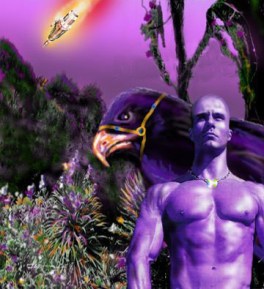
Members of the Tree Cult swelled to the thousands, spreading the word of enlightenment through sacred trees, such as the native oak, the extraterrestrial vishna, and the mythical migratory trees of Horus. Yet their membership and much of their practices remained veiled in mystery. I couldn’t understand their popularity in a world of rampant anti-alien sentiment. Perhaps this was why the Tree Cult remained a secret society. The Tree Cult continued to petition for Earth to acquire the sacred vishna tree of enlightenment. Well, Earth had them now aplenty, I thought with a sour smile. Only there were hardly any humans left there to enjoy them… the Vancouver of my youth no longer existed; the Eosians had altered my world.

Rhea is referring to the fact Earth was now the home of Eosians, who claimed that Earth was their initial home, eons ago. In the bargain for their part in saving humanity from the Vos attacks of 186-191 SGT, Eosians claimed Earth as their ancient homeland and humanity was pushed into exodus.

rhea-contemplative01

Rhea Hawke (Vali Gurgu)

“…the baldies had transformed my home planet into a lush jungle. I’d heard that they’d introduced their own trees, the vishna that supposedly made them immortal, and had coaxed Earth to revert to what it had been prior to the agricultural revolution thousands of Sol years ago. The Eosians had made Earth their home, living a symbiotic-organic life through their superior bio-technology.”

While some humans remained to live with the Eosians and adapt to their way, most took the offered package to leave: Eosians provided several bio-geo-engineered planets suitable for humans to colonize, one of which was Iota Hor-2, where Rhea lives and works.

The World—and its Myths—According to Rhea:

collision with paradise-no title

Azaes and his scree on Eos

Eosians: The whole Eosian race was supposedly the result of a foolish transgression by the overseeing ‘gods’ of ancient Earth, the Epoptes. The ‘watchers.’ Although they’d sworn not to, some Epoptes came down and fornicated with the primitive stone-age humans. My mother had quoted the lines in the Bible often enough: the sons of God saw the daughters of men that they were fair; and they took them wives of all which they chose. It was always males who did the ‘taking,’ I thought. Of course, the logic was obvious: only women gave birth. There was no point in female ‘gods’ coming down to frolic with the primitive human males. Not if the point of fornication was to produce a new species in the original community.

[The Epoptes] had created a hybrid giant race, the Eosians, who became the original inhabitants of Atlantis: the Nephilim (giants) were on the earth in those dayswhen the sons of God came in to the daughters of men, and they bore children to them. Those were the mighty men. So went the new myth, anyway … and when the Atlanteans plummeted into debauchery themselves, the matter-energy manipulating Epoptes unleashed their wrath in the form of a global disaster that was known throughout countless civilizations as the ‘great flood.’ Choosing a few still good Atlanteans to take on their ‘ark,’ the Epoptes found them a new home: Eos, an Earth-like jungle planet nested deep in the Pleiades. They left any original humans who’d managed to survive the wrath of the gods to their own devices. And now the Eosians were back on Earth, where they’d originated. And no sign of any Epoptes, I thought cynically. Of course, the logical cover-up story was that the Epoptes had learned their lesson and never made themselves known to others again. It was all pretty convenient. 

Epoptes: Phantom ‘gods’ the Eosians supposedly consulted through their dreams to police the galaxy. According to the baldies, the Epoptes had commanded them a hundred years ago to end their reclusive existence to form the Galactic Guardians and to fight the Vos seventy years later. Luckily they did or Earth would have been destroyed and humanity rendered extinct… “It’s all myth. Gods are a myth. Vos. Epoptes. I don’t believe any of it.”

Vos: Rumors of what the Vos looked like and the treacherous things they did to their victims were just that: rumors. No one had ever lived to tell. I was familiar with most of the rumors: depending on who you talked to, the Vos were anything from giant god-like humanoids to massive reptilian-like creatures with glowing red eyes or huge fluorescent blobs of amoebic protoplasm. They also ate their victims. Of course, the obvious question Metaverse-FRONT-web copywas: if no one had ever survived a Vos encounter, how could anyone possibly know this? Galaxy News spread as much fantasy as it did real news, I thought with a cynical and humorless smile.

In Metaverse, the third and last book of The Splintered Universe Trilogy, Detective Rhea Hawke travels back to Earth—now all Vishna jungle—hoping to convince an eccentric mystic to help her defend humanity from an impending Vos attack. Instead, Rhea finds herself trapped in a deception that promises to change her and her two worlds forever.

You can listen to a sample recording of Outer Diverse, Inner Diverse, and Metaverse through Audible. Find The Splintered Universe reviews on Goodreads.
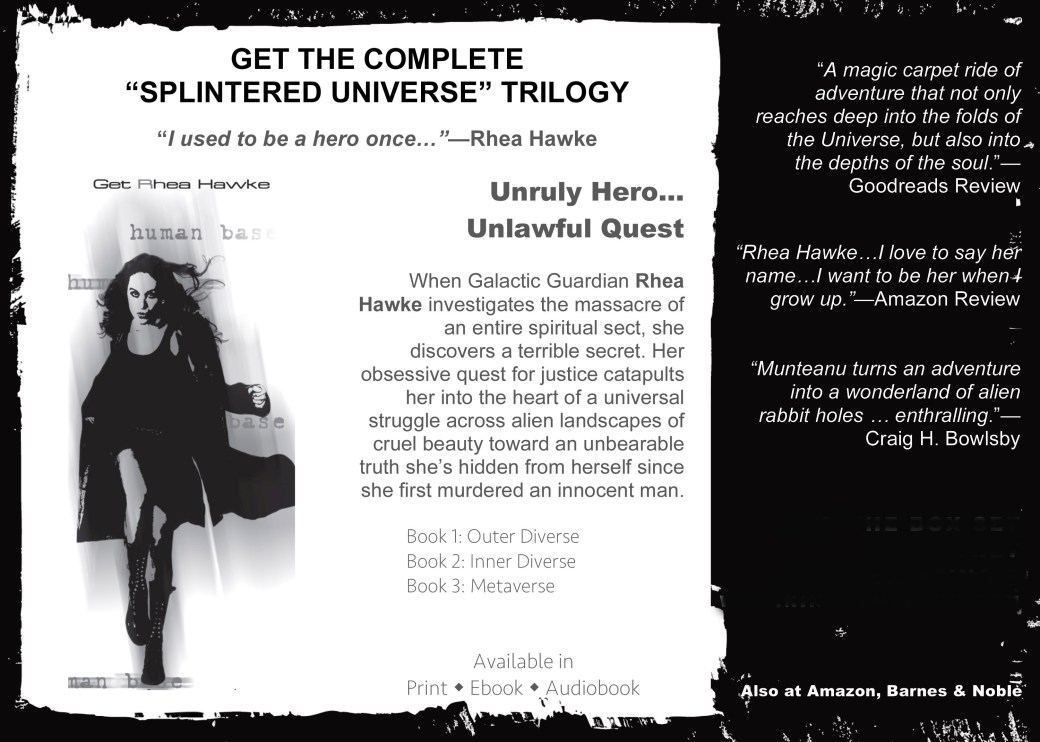
audible listen

Microsoft Word - trilogy-poster03.docx

nina-2014aaa

Nina Munteanu is a Canadian ecologist / limnologist and novelist. She is co-editor of Europa SF and currently teaches writing courses at George Brown College and the University of Toronto. Visit www.ninamunteanu.ca for the latest on her books. Nina’s bilingual “La natura dell’acqua / The Way of Water” was published by Mincione Edizioni in Rome. Her non-fiction book “Water Is…” by Pixl Press (Vancouver) was selected by Margaret Atwood in the New York Times ‘Year in Reading’ and was chosen as the 2017 Summer Read by Water Canada. Her novel “A Diary in the Age of Water” will be released by Inanna Publications (Toronto) in 2020.

Rhea and Her Sentient Ship Benny

Rhea library02

Rhea Hawke (Vali Gurgu)

People who have read the trilogy often tell me that Rhea’s sentient spaceship Benny is one of their favourite characters. He certainly was for Dawn Harvey, the voice actor who narrated the three audiobooks of The Splintered Universe Trilogy. She gave Benny a cultured and intelligent but unassuming voice that resonated with a gentle kindness. Just what Rhea needs. And she often needs Benny’s unique abilities to get her out of trouble.

Peering through the door’s window, my gaze swept the hangar, and I spotted what I was looking for. Benny stood at the far end, unscathed but decidedly lonely. My beautiful ship, my brown-green camouflage two-man interstellar craft with his elegant and practical design took my breath away. His long snub-ended snout was flanked on either side by narrow concave triangular fuel-scoops. Foil wings at his stern folded up over his fuel scoops. They’d left the pilot’s canopy shield up to give the inside of the AI-ship some air.

Benny was a rare retro/state-of-the-art Fauche design, which used old-fashioned Earth sleep technology along with a sophisticated Fauche kappa particle fuel system. Two hundred years ago, harvesting dream-time theta waves was considered an innovative use of required hibernation during long space voyages. Now, with new particle-stream travel, hibernation was no longer necessary. But the innovative Fauche had improved the archaic bio-technology for short-time use. The ray was the smallest ship capable of long distance star travel along the ‘stream,’ thanks to the Fauches’ inventive fuel technology. Benny was the first—and almost last—of his kind. There were only four others that I knew of in existence. But Tangent Shipping could find no interested buyers, which was why I got Benny.

In Outer Diverse, Rhea meets a stranger who becomes very curious about her and manages to find a little bit about how she came to name her sentient ship:

“So, why did you become a Guardian? I mean, you’re pretty unconventional for one. Galaxy News described you as a loner who drives a non-regulation ship.”

I looked up sharply. “I didn’t choose the Fauche ship,” I said defensively, glad of the chance to respond to his added comment and avoid the difficult question. “No one else wanted Benny, so I took him.”

“Benny?” He smiled with amused curiosity.

I returned him a wry smile. “After the brother I never had.”

We find early on—particularly in their conversations and actions—that Benny and Rhea resonate with good understanding. Part of it, we realize, is from Rhea’s programming; but given that Benny is sentient and capable of learning, it goes far beyond Rhea’s input. Benny is far more than just a smart spaceship; Benny serves as caretaker, butler, organizer, medic, secretary, and companion for Rhea.

In the first pages of Outer Diverse, Benny must save Rhea’s life after a chase goes south and she gets dusted with a fatal dose of Glitter Dust. Not liked at the Precinct (she’s the only human in an all-Eosian force), Rhea must endure snide ridicule about her and Benny. The day of her return to the Precinct from her near-death encounter with Dust, Rhea walks past several of the old guard loitering by the entrance to the Precinct, as if waiting for her:

“Lucky for the kid, her creon of a ship rescued her—again!”

My lips tightened, hearing the barrage of laughter. I didn’t bother to acknowledge Euaimon by turning my head, but I blew out a casual bubble with my gum then brought it back lazily into my mouth.

“You two belong together, Hawke!” Euaimon jeered. “You jag up and that hunk of junk saves your sorry blenoid ass!”

I passed the mob and tried to hasten my steps without making it obvious.

When Rhea is fired as a Guardian Enforcer—weapons, coat and badge taken and Benny impounded—she wanders the streets of Neon City on Iota Hor-2, ruminating on her short career:

rhea-contemplative01

Rhea Hawke (Vali Gurgu)

Night shadows crept in and kept me company as I wandered aimlessly. Iota Hor b glowed orange in the night sky, bathing Neon City with its warm light like a harvest moon. I stopped for a moment and let my gaze drift away from the luminescent planet toward the night sky…

My hands dove deep into the pockets of my flight jacket as I recalled the first time I’d seen the Milky Way on Earth. I remembered the night my mother had sat with me on Ambleside Beach and first pointed it out. She’d explained that it was a huge spiral galaxy of billions of stars about fourteen billion years old. Fascinated, I dreamed of travelling to the farthest arms of the Milky Way.

When I’d joined up as an Enforcer, the Guardians gave me my own starship, a rare ray-class retro Earth/alien design that no one else wanted. It didn’t matter to me. Benny was mine. Thanks to Benny’s plasma shields, we’d weathered treacherous ionic storms, gamma-ray bursts, and the high-velocity clouds of the breathing galaxy. We jacked the Magellanic Stream and travelled to the farthest arms of the spiral galaxy, surfing scalar fields into thrilling particle stream shortcuts. We’d even slingshot our way around the black hole in the galactic core using its immense gravitational field and high-energy emissions. I’d witnessed many galactic wonders like the terrifying beauty of nebulas: tangled filaments of dust and ionized gas that poured out in jets and waves from the stellar corpse of a neutron star. Pulsing electromagnetic energy, the shock wave of material flung from the supernova created a spectacular lightshow that shredded anything in its path, drawing me into breathless wonder.

And now the adventure was over, I concluded and dropped my gaze from the stars to the dimly lit street. I was grounded. Benny wasn’t mine anymore. I was only twenty-three and I was already a has-been.

When Rhea finds out that Benny is headed for the scrap yard (no one wants it: it’s too small, old and weird), she steals Benny in a daring rescue with the help of her colleague Bas. Rhea breaks into the hanger where Benny is being held, leaps inside and fires up the engines.

Rhea-marsh02

Rhea Hawke (Vali Gurgu)

“Rhea? Is that you?” Benny piped up.

“It’s me, Benny,” I said, chewing madly and seizing the controls. “I’ve come to rescue you from the scrap yard.”

“I’m so glad to see you!”

“I missed you too, Benny. But there’s no time to chat now. You have to let me get us out of here.”

“Done.”

I swung Benny around and shot out of the hangar bay as the guard fired on us.

“Yeah, I owe you for that one, Bas,” I murmured with a grateful but sad smile as Benny sailed into the upper atmosphere of Iota Hor-2. “Big time, buddy.”

“I guess we’re both fugitives now,” Benny said as we shot past the Athena, Iota Hor-2’s orbiting defense/research station, without incident.

I blinked. “Yeah,” I agreed solemnly, gazing at the long solar panels that surrounded the station. I didn’t have the heart to tell Benny that no one was likely to be chasing us on his account. Even the scrappers had better metalloid to chase.

In Metaverse, the third and last book of The Splintered Universe Trilogy, Detective Rhea Hawke travels back to Earth, hoping to convince an eccentric mystic to help her defend humanity from an impending Vos attack—only to find herself trapped in a deception that promises to change her and her two worlds forever.

You can listen to a sample recording of Outer Diverse, Inner Diverse, and Metaverse through Audible. Read The Splintered Universe reviews on Goodreads.

audible listen

Microsoft Word - trilogy-poster03.docx

nina-2014aaa

Nina Munteanu is a Canadian ecologist / limnologist and novelist. She is co-editor of Europa SF and currently teaches writing courses at George Brown College and the University of Toronto. Visit www.ninamunteanu.ca for the latest on her books. Nina’s bilingual “La natura dell’acqua / The Way of Water” was published by Mincione Edizioni in Rome. Her non-fiction book “Water Is…” by Pixl Press (Vancouver) was selected by Margaret Atwood in the New York Times ‘Year in Reading’ and was chosen as the 2017 Summer Read by Water Canada. Her novel “A Diary in the Age of Water” will be released by Inanna Publications (Toronto) in 2020.

Artist Costi Gurgu Explains his Cover Art for The Splintered Universe Trilogy

Get Rhea-HawkeGOODWhen I first met Costi and Vali Gurgu at the World Fantasy Convention in Montreal several years ago, I had no idea that Costi would end up creating the stunning book covers for The Splintered Universe Trilogy or that his wife, Vali, would serve as the model for the hero of my story, the relentless and steely detective, Rhea Hawke. You can find his cover art and other artworks on Costi’s illustration site.

Nina: Hi, Costi. Thanks so much for agreeing to do this interview. 

Costi: Hi, Nina. The pleasure is mine.

Nina: You came up with a “Triptych” design for the Splintered Universe Trilogy. What inspired you to come up with it and what do you like about it?

Costi: There is the danger of spoilers in this answer. The fact is that your main character, Rhea, undergoes a certain evolution from a regular human being to… let’s just say something else. And that evolution has three parts, one for each book of the trilogy and it also has a touch of divine. So, the triptych design, so often used for religious paintings, fits like a glove on the entire concept.

Microsoft Word - trilogy-poster03.docx

Nina: Your design for Outer Diverse (and designs for the other two covers) carries a powerful image that conjures a portal or gateway into another world (which is what the trilogy is about). The reader is drawn into an infinite landscape, looking in, and Rhea is looking out. Can you tell us a little about how you conceived this compelling design. Is there a meaning behind the symbols and colours you used? 

Costi: To be honest, the initial idea was for the red ring to be a sort of mapping device and a radar combined into one, since Rhea travels great distances in her quest. Then I realized it might as well be a portal device on top of everything else and serve all her travelling needs.

There were two options —either we would look with her outside, to whatever target she had, or look towards her. I thought that it would be more powerful if we could look towards her and see her determined face, see the unflinching resolution in her eyes, while she’s pondering her next move and readying herself to use the device once again. But to look towards her and see her in a confining room of a space ship, or such, would have defeated the purpose. So I needed to have her against the infinite landscape as the backdrop. She is in a continuous journey to discover herself and this journey takes her literally through the infinite spaces of not just one universe.

BewareRhea-GOOD copyNina: Yes, I love the metaphoric elements you’ve woven into the design. The image speaks to us on many levels. Do you use music or other devices in your work to evoke your creativity? What other tools did you use to create the stunning covers of Splintered Universe (e.g., animation software, etc.)?

Costi: I’m always listening to music while working. The kind of music varies depending on what I’m working on. If I’m writing for instance, I need instrumental music, without words to influence my own ones. Also, it depends on the kind of feeling and mood I try to generate through my writing or my illustration. Music helps me channel those feelings into the right words or imagery.

Technically speaking, I always start with sketches on paper, which I later scan. I mainly use Adobe Photoshop, but for this illustration I had to use Adobe Illustrator as well. Obviously, the layout and the typography were done in Adobe InDesign.

Nina: Your wife, Vali, was the model for Rhea Hawke. I understand you had a great time doing the photo-shoot (p.s., some of the additional shoots can be seen in the Youtube book trailer). I’ve attended several launches and events and both the cover and the model have been extolled. One reader compared Vali to actress Catherine Zeta Jones. How does Vali feel about being somewhat of a celebrity?

Costi: I’m so happy to hear that. You know, I had to decide how to treat her image. I could have gone towards a more glamorous, shiny look, like in a fashion image, or I could just simply keep it more realistic. Despite Vali’s protests, I chose to keep it that way, because I wanted to offer a realistic image of an ex-police officer: a woman who was used to fighting and chasing criminals, rather than taking care of her appearances. Now, to hear that her rougher and tougher image created that kind of reaction gives me a sort of peace and satisfaction.

Nina: You and Vali have had rich and varied careers in commercial art, law and writing. You’ve served, for instance, as art director for several high-end magazines including Playboy, and you taught graphic design at the college level. You journeyed from Romania to England and finally to Toronto, Canada. No doubt your law degree helped you in your entrepreneurial pursuits. Did you pursue illustration and design in England?

Costi: Well, three years [after England] saw us going back to Romania; our families expected us to go back to the Bar Association and behave responsibly. But after showing my portfolio around I got a designer job at Playboy Magazine! The Art Director and I launched its first Romanian edition issue a few months later. Three years later I became the Creative Director of MediaPro Group, the largest publishing company in Romania and Vali took on the position of Art Director of Playboy Magazine.

Two years later we came to Canada to pursue a dream. So, yes, I could say that my law degree created the perfect opportunity for me to discover my passion for visual arts. It took me to England and eventually to Canada. Life is funny that way.

Nina: Does Vali help you with your work and do you help her with hers?

Costi: We help each other a lot in our work. Because we worked together in our first legal job and after that in our first design job, we have become a team. We have different approaches to the art process and we have different styles. I went deeper into illustration to complement my design skills, while she chose photography to do that.

Even now, for the most important projects we have for our different employers we involve each other not only for need of feedback, but also for need of different ideas and fresh approaches. We basically complement each other.

Not to mention that she’s always my first reader for any piece of fiction I write. She’s the toughest reader I have but in the same time I know she’s also the most sincere one.

Nina: Thanks so much, Costi, for joining us. I wish you the best of luck in all your writing and illustration projects. It’s been an honor to work with you.

Costi: Again, my pleasure, Nina.

Microsoft Word - Rhea Triptych.docx

In Metaverse, the third and last book of The Splintered Universe Trilogy, Detective Rhea Hawke travels back to Earth, hoping to convince an eccentric mystic to help her defend humanity from an impending Vos attack—only to find herself trapped in a deception that promises to change her and her two worlds forever.

You can listen to a sample recording of Outer Diverse, Inner Diverse, and Metaverse through Audible. You can access the complete Splintered Universe Audiobook Trilogy on Audible. Read the Splintered Universe reviews on Goodreads.

audible listen

Microsoft Word - trilogy-poster03.docx

nina-2014aaa

Nina Munteanu is a Canadian ecologist / limnologist and novelist. She is co-editor of Europa SF and currently teaches writing courses at George Brown College and the University of Toronto. Visit www.ninamunteanu.ca for the latest on her books. Nina’s bilingual “La natura dell’acqua / The Way of Water” was published by Mincione Edizioni in Rome. Her non-fiction book “Water Is…” by Pixl Press (Vancouver) was selected by Margaret Atwood in the New York Times ‘Year in Reading’ and was chosen as the 2017 Summer Read by Water Canada. Her novel “A Diary in the Age of Water” will be released by Inanna Publications (Toronto) in 2020.

Nina Munteanu Talks about The Splintered Universe with Simon Rose

Author, writer, coach and consultant Simon Rose interviews Nina Munteanu about The Splintered Universe Trilogy, now out in three formats: print, ebook, and audiobook. Listen to a sample from each of the trilogy audiobooks on Audible:

audible listen

Here’s Simon’s interview with me:

SimonRose site

nina interview 3

Nina interview 2

nina interview 4

nina interview 5

nina interview 6

In Metaverse, the third and last book of The Splintered Universe Trilogy, Detective Rhea Hawke travels back to Earth, hoping to convince an eccentric mystic to help her defend humanity from an impending Vos attack—only to find herself trapped in a deception that promises to change her and her two worlds forever.

You can listen to a sample recording of Outer Diverse, Inner Diverse, and Metaverse through Audible. Read The Splintered Universe reviews on Goodreads.

Microsoft Word - trilogy-poster03.docx

Nina Highland Cr 1

Nina checks her photos, Highland Creek, ON (photo by Merridy Cox)

nina-2014aaa

Nina Munteanu is a Canadian ecologist / limnologist and novelist. She is co-editor of Europa SF and currently teaches writing courses at George Brown College and the University of Toronto. Visit www.ninamunteanu.ca for the latest on her books. Nina’s bilingual “La natura dell’acqua / The Way of Water” was published by Mincione Edizioni in Rome. Her non-fiction book “Water Is…” by Pixl Press (Vancouver) was selected by Margaret Atwood in the New York Times ‘Year in Reading’ and was chosen as the 2017 Summer Read by Water Canada. Her novel “A Diary in the Age of Water” will be released by Inanna Publications (Toronto) in 2020.

The Splintered Universe, Book 3: “Metaverse” Audiobook

Metaverse-FRONT-web copyIn Metaverse, the third and last book of The Splintered Universe Trilogy, Detective Rhea Hawke travels back to Earth, hoping to convince an eccentric mystic to help her defend humanity from an impending Vos attack—only to find herself trapped in a deception that promises to change her and her two worlds forever.

Lilly’s Book World summarizes the audiobook:

Oh, Yes! An explosive ending indeed! This was such a great series, with such great world development and great characters, full of action and with an amazing narration! I am sorry it’s over! (but I still have the books!)

“Metaverse” concludes so many open points from the previous books.  Some may say the blurb is evasive, but with so much going on, it’s great we have no spoilers in there. However, I can tell you that our main character Rhea is in for a treat! The same goes to her amazing companions.

Rhea develops even more; she manages to discover so much about her heritage and her role in this war that has enveloped the universe. Her story transcends planets and she becomes so much more than a simple presence. I like her and I admire her power.  I’m sorry, I’m being cryptic here. But if you have read or listened to books 1 and 2, you are compelled to see how it all ends. And you already know how great the story is.

Rhea mountain 06

Rhea Hawke (Vali Gurgu)

The narration is as amazing as in the other two books. Dawn Harvey has done an amazing job giving life to Rhea, making all this action real and palpable. At times, I was listening to her breathlessly. Everything was enhanced due to the narration!

I have little else to add, except that maybe one day I will see this series in our Romanian libraries, so that my fellow countrymen can enjoy Nina Munteanu’s writing. 5 stars!

SplinteredUniverseTrilogy-Amazon

This episode of the space trilogy is everything I wanted and more… Rhea and her helpers are running out of time to save the outer verse from war. There is so much happening in this book it keeps you listening far into the night—Book Addict

Dawn Harvey continues to bring a great performance to this series. Her narration is so well done. She’s got the perfect voice for Rhea Hawke. I love how she manages all the different alien voices. Truly, I don’t know how she pulled some of them off, and with such consistency across all three books. 5/5 stars—Dab of Darkness

The trilogy consists of Outer Diverse, Inner Diverse, and Metaverse. and is available in ALL THREE FORMATS: print, ebook, and audiobook. You can listen to a sample recording of all three audiobooks through Audible.

audible listen

Microsoft Word - trilogy-poster03.docx

nina-2014aaa

Nina Munteanu is a Canadian ecologist / limnologist and novelist. She is co-editor of Europa SF and currently teaches writing courses at George Brown College and the University of Toronto. Visit www.ninamunteanu.ca for the latest on her books. Nina’s bilingual “La natura dell’acqua / The Way of Water” was published by Mincione Edizioni in Rome. Her non-fiction book “Water Is…” by Pixl Press (Vancouver) was selected by Margaret Atwood in the New York Times ‘Year in Reading’ and was chosen as the 2017 Summer Read by Water Canada. Her novel “A Diary in the Age of Water” will be released by Inanna Publications (Toronto) in 2020.

The Deserts of Upsilon-3 and the Problem with Blenoids

desert planet

Upsilon-3

EXCERPT from Inner Diverse, Book 2 of The Splintered Universe Trilogy: In a desperate attempt to find the Ancient One—the key to the mysterious killings—Detective Rhea Hawke steals a Vos ship and the Vos leader, forcing the terrorist A’ler at gunpoint into taking her to Upsilon-3.

Upsilon-3 is a desert planet with a thin atmosphere, heavy gravity and highly fluctuating temperatures—uncomfortable for any species, save its indigenous small creatures and the blenoids who eat them. Upsilon-3 is one of the moons of Upsilon b, a ringed gas giant. The moon is about Earth-size, an arid wasteland that diurnally shifts between extreme temperatures. During the height of midday, it easily reaches 45ºC, an Azorian’s dream, and in the deep of night it is often below freezing, an Azorian’s nightmare. And speaking of mad blenoids, the planet is full of them…Rhea knows first hand:

Sand dunes Oregon3

Dunes of Epsilon 3

I’d been there before. I’d tracked and dispatched an Azorian assassin to the small ephemeral town there once—but at the cost of a blenoid attack. In his desperation, the Azorian had fled the ghost town into the arid wilderness, and if I hadn’t shot him, the blenoids would have torn him apart. If they hadn’t, he would have died a horrible death of severe hypothermia. As it turned out, my shot infuriated a pack of sleeping blenoids and I became the subject of their fury instead.

Ferocious and unpredictable, with dull brains and razor sharp teeth, blenoids were the galaxy’s most dangerous predators; but beneath their tough hide, blenoid meat was considered a galactic delicacy, so long as you stayed away from their organs. Their eating habits made them akin to the seagulls of Earth; they ate everything and anything, including their own and what came out of them. And they were prolific. Blenoids weren’t very large. They stood about a meter long and almost that high but with the anatomy and mad tenaciousness of a pit bull and the rough ochre hide of a rhino.

Adapted to the arid heat of the Upsilon desert, they resembled hyenas with extremely large ears and paws to increase surface area and promote heat loss. Five beady eyes, two on either side of their massive head and one centrally located, were adapted to the harsh bright sunlight of the Upsilon 3 dessert. Their massive powerful jaws contained three layers of razor-sharp teeth. Once they bit down on a prey, the jaw locked into a vice-like grip that either ground deeper or tore out deep muscle. Blenoid saliva contained a powerful narcotic and poison that dulled its victims and caused severe infection that spread swiftly. My grandmother was right; most blenoid attack victims died from shock. Those who’d survived, and there weren’t many, had only done so due to drastic measures like having a limb immediately severed to save the rest of their body. Blenoids attacked anything, no matter what its size and tore it to shreds. They were even known to rip one another apart in a frenzy of aroused anger or if they sensed any weakness. It was natural selection at its cruellest, I considered…

The Galactic meat-traders didn’t stay beyond the time it took to hunt and prepare the blenoid meat for galaxy-wide sale. Apart from the Gnostics who’d claimed one cluster of the ancient alien buildings as their temple of worship, no one lived here—except the Ancient One, that is. So, between the Venik slave traders, the blenoid meat traders, the Gnostic priests and the Nihilists, this backwater planet was actually getting crowded.

desert planet from above

desert moon Upsilon-3 seen from above

As A’ler banks the ship to the arid planet, Rhea observes the vast expanse of open desert:

I gazed down at the waved pattern of cresent-shaped dunes, obviously formed by a constant wind. It was a harsh and miserable environment, I thought.

“Barkhans,” A’ler offered, pointing to the dunes and breaking her taciturn silence. “That’s the West Ghouroud. No one’s ever crossed it and lived.” She eyed me with a dismissive look of disgust as much as to imply, especially a puny human like you.

I didn’t respond and let my gaze stray back to the dune sea. The dunes looked like the capped waves of a red ocean, the deep ochre of their shaded slipfaces contrasting with the harsh bright windward sides, still baking in the sun. The dunes looked small, but I guessed that some were at least three hundred meters high.

sand dunes

Sand dunes (Barkhans)

When they reach their destination—an enclave of strange buildings built by some ancient civilization—Rhea is hit with the harsh environment:

A’ler opened the hatch and a blast of furnace-hot air knocked me gasping and recoiling…Even at sunset, I could feel the stifling heat as we awkwardly disembarked. I inhaled a cloyingly sweet fragrance, reminiscent of cabbage, sewage and rotting flesh: blenoids, I concluded. And remembered; they stank… I followed her gaze and let mine take in the wide expanse of shifting red sands, dotted with islands of low creeping grey-green scrub. My gaze settled to the east.

upsilonandromadae d copy

View of Upsilon b and its ring bisecting the star Upsilon Andromedae

Upsilon Andromedae sat poised over the horizon. I could manage only a glance at the large bluish sphere of Upsilon b above the sun, its huge-diameter ring extending vertically down beyond the horizon and cutting a knife-sharp blade through the sun that cast a long shadow of the ring across the russet expanse. I stared, struck by the terrible beauty of this harsh landscape and just made out what looked like a dust storm on the horizon.

When both her Vos enemy and she are abandoned in the open desert, Rhea must use all her skills to survive the beating heat of the sun, wild blenoids, quicksand, sinkholes and killer plankton as they journey toward a far settlement, hoping for reprieve.

desert playa

desert playa

We’d left the flats of the playa and were heading toward rougher terrain. By tomorrow we would enter the desert proper, the ghouroud, with its massive barkhans that I’d seen from A’ler’s ship. I could already see them looming in the distance. I heard their low stuttering roar as the wind sang through them. And dreaded the crossing. Not only would it be treacherous with more possible quicksand traps, but it would serve a tortuous climb for A’ler up the slipface of the barkhans then down the soft sand on the other side…

The desert became a frozen sea, red clouds of sand rising off huge cresting waves that boomed and creaked like an old boat pitching at sea. The wind whistled like a chorus of laughing witches, hurling red grit into our faces. Our pace slowed to a crawl as our wading steps in the hot yielding sand turned to stumbles and falls.

When they finally reach a settlement, they collide with sadistic meat-traders. There Rhea will learn the grim truth about blenoid physiology, ecology and behaviour—and herself.

Get the complete Splintered Universe Trilogy. Available in ALL THREE FORMATS: print, ebook, and audiobook. You can listen to a sample recording of all three audiobooks through Audible.

audible listen

Microsoft Word - trilogy-poster03.docx

nina-2014aaa

Nina Munteanu is a Canadian ecologist / limnologist and novelist. She is co-editor of Europa SF and currently teaches writing courses at George Brown College and the University of Toronto. Visit www.ninamunteanu.ca for the latest on her books. Nina’s bilingual “La natura dell’acqua / The Way of Water” was published by Mincione Edizioni in Rome. Her non-fiction book “Water Is…” by Pixl Press (Vancouver) was selected by Margaret Atwood in the New York Times ‘Year in Reading’ and was chosen as the 2017 Summer Read by Water Canada. Her novel “A Diary in the Age of Water” will be released by Inanna Publications (Toronto) in 2020.

Love Among the Ruins…


Log over water forest-DeasPark copy

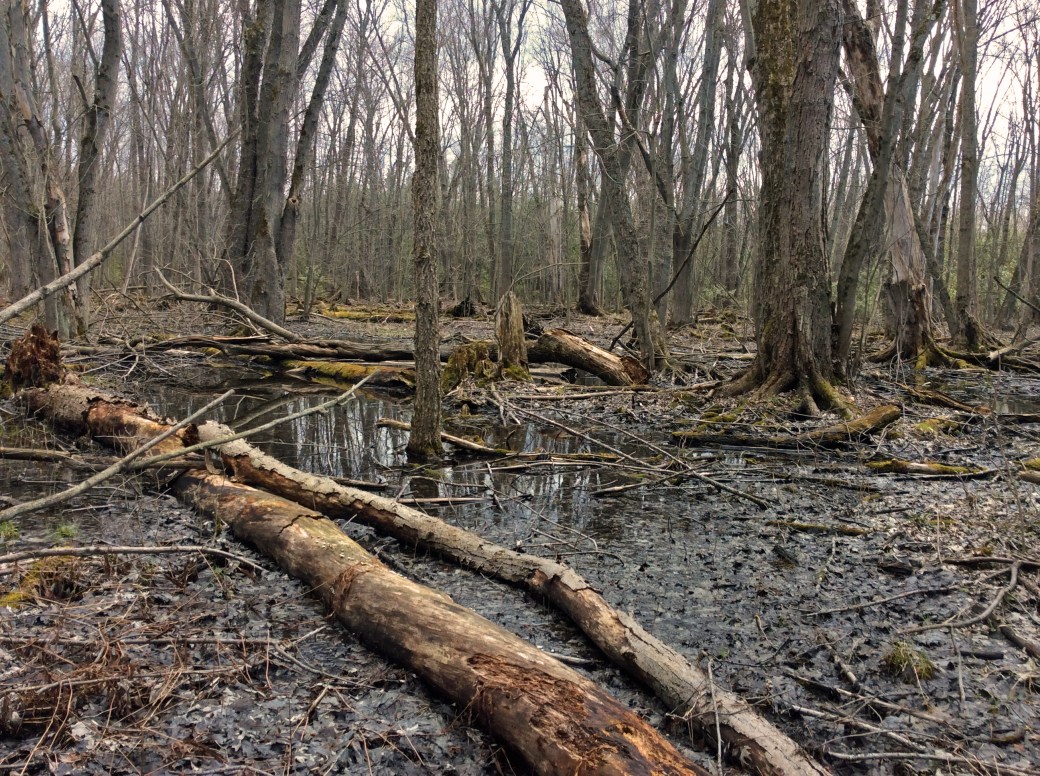
Swamp on Sekmet

EXCERPT from Inner Diverse, Book 2 of The Splintered Universe Trilogy: after a daring escape from Hades on the bog planet of Sekmet, Rhea finds herself stumbling through thick wet scrub, past gnarly drowned trees then plunging with gasps into surprisingly deep crevices filled with bog water. The glacial wind whips her hair and wails through her shivering body as rain pelts her. Her breaths stutter and gut burns with black longing for the wakesh root. She sobs in her breaths, struggling over islands of soggy hummocks that cave under her weight, plunging her into deep frigid murky pools and thrashes her way across deep bog water. As a convulsive tremor of withdrawal runs through her, Rhea despairs and begins to wonder if she will survive her escape. No one got off Sekmet, after all, so the saying goes. Then she remembers glimpsing Serge at the penal colony. Her lover. Her nemesis. Had it been a dream? Had he come to rescue her only to disappear?

Rhea-marsh02

Rhea Hawke (Vali Gurgu)

A twig snapped behind me and I jumped, heightened senses inhaling musk and strawberries.

Serge!

“Rhea.”

Relief and panic competed inside me. Serge was the last person I wanted to catch me this way: filthy, junked-up, vulnerable…and longing for him. Suddenly tearful, I scrambled to my feet with a grunt of effort. I fled into a staggering run, tripping and stumbling over a tangle of roots in the muck. I didn’t dare look back.

“What?” I heard him quip. “No warm welcome like: ‘It’s so good to see you Serge, I missed you so much.’” Then after a pause of huffing breaths, he added in exasperation, “Rhea! Wait up!”

“Why are you following me?” I threw a withering look over my shoulder at him. He’d gone back to being a human, those ugly lumi pants recklessly low-riding his hips and revealing taut abdomen muscles and the alluring curve of his pelvis. I noticed with some satisfaction that he was having a hard time negotiating the underwater root tangle as well.

“What do you think?” he answered in a sarcastic tone.

“I don’t need your help!”

“That’s a matter of opinion. You’re hurt and you’re crying—”

“You’re the one making me cry.” I glared at him. I hadn’t noticed I was crying. “This is all your fault. I never cried before I met you.”

He barked out an exasperated laugh then added, “That’s because I woke up your senses. I made you alive.”

“You made me miserable!”

“Alive and miserable, then,” he conceded. “Let me help you.” He broke into a sprint, splashing in awkward steps.

“I told you, I don’t need help from a lying scoundrel,” I huffed and threw myself into a frenzied lopsided gallop to keep ahead of him. “I don’t need help from a God-damned Vos, Nihilist, anti-Nihilist, spy, thief—whatever you are!” I tripped and fell. Serge was bending over me, pulling me up, even as I struggled to get free. My chest heaved. Black bog juice dripped off my face. I turned to face him and caught his intoxicating smell: a cottonwood forest in spring cut by musk and a hint of strawberry. It overwhelmed my senses and made me dizzy with desire. I stared up into his face and longed to fling my arms around him and kiss him. I bit out, “I’m perfectly fine on my own.”

“Oh, you are, are you?” he retorted. “In case you didn’t notice, I saved your scrawny flat butt.” His face was close to mine, eyes blazing and breathing hard.

“Where were you the rest of the time? Sun tanning in the penthouse suite? Get off me!” I twitched my face from his and pushed away. I didn’t like how he’d described my butt.

“It took me over a month just to get in,” he huffed out, clinging to me and fighting off my struggles. “By then you were already running the place. I was stunned. I’m amazed at your talents, particularly in escaping. Frankly, Rhea, I didn’t expect you to be in any shape to do anything—”

“Well, thanks for the encouraging thoughts and incredible faith in my abilities,” I said tartly. “I had a little help from several friends and none of them was you.” I thrashed out furiously to get free. “I didn’t ask for your help back there. I could have managed, damn you!”

“You ungrateful little witch!” he growled, pinning my arms in a forceful embrace. He glared at me. “You’re too jagging proud to admit that you need my help.”

Lips snarling, I jerked out of his grasp but slipped in the wet sod with a shriek and took him down with me. We fell with a splat, black oily mud oozing over both of us. He scrambled on top of me, straddling my hips, and pinned my flailing arms with his hands.

For a hesitant moment I inhaled his heady aroma and felt myself tumbling dangerously into his tempest eyes. He held my gaze and I drew in a shuddering breath. So much passed between us in that gaze and for a moment we were staring at each other like the time when we’d first made love. It was an exquisite moment of infinite devotion, wonder and tenderness. And mutual surrender. And I felt as though I’d loved him and trusted him all my life—

Desperate, I shifted with a shrill grunt into a massive Venik, realizing too late that my clothes tore to shreds off of me. I struck out. Within a heartbeat, Serge matched my form, lumi-pants ripping off, and countered. I tried an Azorian. He matched. A Khonsus—he was already one! I finally returned to my human form and Serge followed suit, barking out a laugh and breathing hard like me. His dark eyes grew large. We were both naked.

“Good try,” he panted with a rough laugh. He glanced down my body before locking eyes with mine. “Just look at you…You’ve chopped off your beautiful hair. The drugs have wasted your skin, done something to your eyes…But you’re still so…”

I dreaded what he saw and met his thunderstorm gaze with my own vulnerable gaze. I knew I was a spectacle: wet and bedraggled hair plastered over my face in tangles of mud—yet I returned him a plaintive thirsty look…How I’d missed those eyes.

They blazed into mine. “…so beautiful,” he finished in a hoarse voice. Then he slammed his mouth against mine in a crushing embrace. Like a spring released I yielded and we kissed. I flung my arms around him, clasping his neck and pulling him close, feeling the hard heat of his response. I savoured his body stirring over mine as I rocked my hips up against him. His lips flamed over my face, defining every feature, and I trembled at the tantalizing rasp of his whiskers. His hands mauled my body with uncontrollable ardour. I was all his…except—

“No!” I slithered out from beneath him and kicked out. He barked out a yelp. I scrambled to my wavering feet, slipping, and stuttered out in a shaky voice, “I won’t let you take advantage of me.”

“Advantage!” he exclaimed and rubbed his thigh. “You want it too, damn it. You were kissing back.”


Inner-diverse-front-cover-WEBInner Diverse is the second book of The Splintered Universe Trilogy:

When Galactic Guardian Rhea Hawke investigates the genocide of an entire spiritual sect, she collides not only with dark intrigue but with her own tarnished past. Her quest for justice catapults Rhea into the heart of a universal struggle across alien landscapes of cruel beauty and toward an unbearable truth she’s hidden from herself since she murdered an innocent man.

Get the complete Splintered Universe Trilogy. Available in ALL THREE FORMATS: print, ebook, and audiobook. You can listen to a sample recording of Outer Diverse, Inner Diverse, and Metaverse through Audible.

audible listen

Microsoft Word - trilogy-poster03.docx

GIVE AWAY! GIVE AWAY! GIVE AWAY! GIVE AWAY! GIVE AWAY! GIVE AWAY!

Rhea likes to use proverbs as barbs and to unhinge her opponent when she gets nervous or feels trapped. Send me a good proverb for Rhea to use and I will send you a code to obtain a free Audiobook from Audible. Codes are limited, so it will be first come, first serve until we’re out. Send your proverb to Nina Munteanu at: nina.sfgirl[at]gmail.com.


nina-2014aaa

Nina Munteanu is a Canadian ecologist / limnologist and novelist. She is co-editor of Europa SF and currently teaches writing courses at George Brown College and the University of Toronto. Visit www.ninamunteanu.ca for the latest on her books. Nina’s bilingual “La natura dell’acqua / The Way of Water” was published by Mincione Edizioni in Rome. Her non-fiction book “Water Is…” by Pixl Press (Vancouver) was selected by Margaret Atwood in the New York Times ‘Year in Reading’ and was chosen as the 2017 Summer Read by Water Canada. Her novel “A Diary in the Age of Water” will be released by Inanna Publications (Toronto) in 2020.


The Pit of Despair…

EXCERPT from Inner Diverse, Book 2 of The Splintered Universe: When Rhea is sent to Sekmet to live out her remaining life run by the scum of the criminal community—all addicted to the drugged food—she finds herself reviled as a puny human and an ex-enforcer—she’d put some of them there, after all. Knowing her days are numbered and finding herself without a safe place to bed-down, Rhea makes a desperate bid to survive. Taking a Rill’s advice, she agrees to be sponsored by the ruffian Bondar as a contestant in The Game—a game of survival involving strength, courage and wits to an audience, who bet on a winner. It is a simple contest with one winner and one loser: the simple task is to immobilize or kill the opponent and capture the “magical” wakesh root—a highly sought after elixir that can break her from the soporific addiction of the prison’s drugged food:

rhea-contemplative01

Rhea Hawke (Vali Gurgu)

I stood in the centre of the five hectare blood-stained arena, facing the semi-circular bleachers where Bondar and Barbariccia and an audience of several dozen aliens sat, packed like blood hounds smelling death.

I inhaled the rank smell of unwashed bodies, sweat and old blood and privately wondered what I was doing here. Bondar seemed to think I was capable enough; he’d gleefully accepted me as his candidate and now looked smug, seated not far from Barbariccia, who ignored him and studied me with a look of amusement on his calm face… Suddenly aware of my soiled clothes, I grew self-conscious and nervously fidgeted as I waited for Barbariccia’s candidate to enter the arena.

Bondar abruptly stood up and held up my original jacket in one hand and my slacks in the other.

“I’m still looking for a buyer for these!” he announced happily in a multi-timbral chorus. “Great clothes of impeccable quality. Original Enforcer clothes.”

Which they weren’t, I thought scathingly. They were just ordinary flight clothes. Damn that Bondar! The bastard was selling my clothes right in front of me, his own candidate. It showed me what kind of team we were…and what he thought of my chances.

“Are they intelligent?” someone in the audience asked.

Bondar brought both my jacket and pants up to his reptilian face and buried his snout in them with a deep inhale. All he smelled was me, I thought, wincing inside. I felt my face tighten to a grimace as I watched him smear my clothes over his face: it seemed that essence of Rhea was a perfume for him because his doleful eyes flickered dreamily shut and his many mouths smiled lecherously. Several inmates cackled.

“You can’t tell by smelling it, creon!” someone scoffed.

“They’re far too small!” said another. “She’s just a puny little pip.”

My gaze involuntarily flickered down my own torso. I wasn’t that small, I thought petulantly. I was almost six feet tall.

Bondar bent down and lifted up my boots. “What about these? Real gravity boots. They instantly adjust according to the weight of the wearer to the gravitational pull of any planet you travelled to—”

“No one’s going anywhere, you buffoon!”

They started booing him and shouted for him to sit down.

I dropped my gaze to the dirty blood-stained floor as the jeers and slanders spread to me. I heard several pointed insults aimed at the human race. What was I doing here besides inviting abuse?

Mayling had sagely waited until just before I entered the arena, when it was too late to back out, to fully explain the game to me: “It’s a simple contest: just find and takes possession of the wakesh root, hidden in the obstacle course of the arena, before the opponent does—and keep it by immobilizing the other contestant. This is usually done by killing the opponent but youz don’t haves to…” I had repeated the part about usually killing the opponent and Mayling ignored me to continue: “Whatever youz do, don’t let yourself falls into the pit.”

“Pit?” I had repeated with a hard swallow.

“No one ever gets out. Usually youz just hears a lot of splashing then a lots of silence. Sometimes a sobeks wanders in and manages to eludes the peat saws and turbines, then youz also hear thrashing and lots of awful cries of terrors and pains as the sobek bites off a limb and—”

“I get it,” I cut in.

“There are two ways to plays the games,” Mayling went on. “Defeats your opponent first then looks for the root ats your leisure, or finds the root first and use its to defeats your opponent. Which way youz goes depends on your personal strengths. Considering your present status and your humans abilities, I suggests youz first finds the root, then takes a bite of the root immediately to gives yourselfs a decided advantage over your opponent.”

That only worked if I got it first. And that was unlikely, given the wave-sensitive eyesight of the Xhix, who’d just entered the arena through an adjacent door. Wonderful, I thought with growing despair. Xhix could see through objects.

Holding a mining shovel in one hand, the Xhix waved to the cheering crowd with his other. I dismally recalled the crowd’s jeers and catcalls when I’d entered the arena. It was obvious who they thought would win.

I was contemplating the misnomer of Mayling’s use of the term obstacle course, when Barbariccia stood and shouted, “Let the contest begin!”

I kept a sharp eye on the Xhix, who stood poised several meters from me. Maybe I could outsmart him. I might be more swift, if I let him lead me to the root. The Xhix seemed to realize what I was thinking. He faced me with a smirk and turned black, tapping his shovel with his paw. He wasn’t about to give away the whereabouts of the root.

The floor rumbled and, just a meter from where I stood, it abruptly separated, giving off a strong waft of sulfur. The gap in the floor groaned into a long chasm that continued to widen. Both the Xhix and I stepped back. This must be the infamous pit Mayling had referred to. I carefully leaned over to catch a glimpse of what lay below. I made out murky bog and peat, moving slowly across the gaping opening as the penal facility rolled along, churning up peat and mire some ten meters below—

Something hard and painful struck my head, throwing me off balance into the gap with a startled grunt. I briefly registered the Xhix’s victorious laugh as I pitched forward and blacked out.

I jerked awake, inhaling water. I’d plunged into black cold churning water and broke the surface with gasping breaths.

saltwater marsh-NS copy

Marsh on Sekmet

Inner-diverse-front-cover-WEBInner Diverse is the second book of The Splintered Universe Trilogy:

When Galactic Guardian Rhea Hawke investigates the genocide of an entire spiritual sect, she collides not only with dark intrigue but with her own tarnished past. Her quest for justice catapults Rhea into the heart of a universal struggle across alien landscapes of cruel beauty and toward an unbearable truth she’s hidden from herself since she murdered an innocent man.

Get the complete Splintered Universe Trilogy. Available in ALL THREE FORMATS: print, ebook, and audiobook. You can listen to a sample recording of all three audiobooks through Audible. Read the Splintered Universe reviews on Goodreads.

audible listen

Microsoft Word - trilogy-poster03.docx

nina-2014aaa

Nina Munteanu is a Canadian ecologist / limnologist and novelist. She is co-editor of Europa SF and currently teaches writing courses at George Brown College and the University of Toronto. Visit www.ninamunteanu.ca for the latest on her books. Nina’s bilingual “La natura dell’acqua / The Way of Water” was published by Mincione Edizioni in Rome. Her non-fiction book “Water Is…” by Pixl Press (Vancouver) was selected by Margaret Atwood in the New York Times ‘Year in Reading’ and was chosen as the 2017 Summer Read by Water Canada. Her novel “A Diary in the Age of Water” will be released by Inanna Publications (Toronto) in 2020.

Sekmet, Mistress of Dread

Bog Planet wholeSekmet is the penal planet from which no one ever escapes. The planet is a giant bog-marsh and the prison itself is a massive 2-kilometre barge that travels the wetland planet and mines the peat. The very word evokes fear. Sekmet is the bogeyman. Early on, in Outer Diverse, Rhea’s colleague Bas warns her to be careful or she might end up on Sekmet for her transgressions; Rhea scoffs that only senseless killers go to that bog planet to die and rot. But soon Rhea will alter her cavalier defence. Things will change for her…

Sekhmet

Sekhmet

Sekmet is named after the lioness-headed Egyptian warrior goddess (Sekhmet). Variously known as “the one who is powerful or mighty”, “One before whom evil trembles”, “mistress of dread”, and “Lady of Slaughter”, Sekhmet is often depicted in red, the colour of blood.

In Inner Diverse, Bas’s warning is realized; Rhea is hunted and captured then after a hasty “trial” she is sent to Sekmet. There, she, too, will meet the goddess’s wrath—and tremble.

As the AI ship takes Rhea down to the planet surface, she has a good view of the wetland planet:

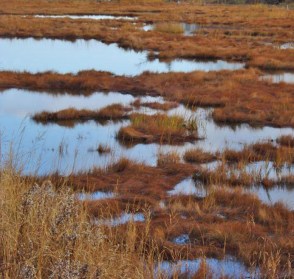
I gazed out my porthole at the barren patchwork of the small wetland-dominated planet, whose surface resembled an early impressionist’s painting. Dominated by sombre russet and indigo tones, the raised bog was dotted by a hasty spray of cobalt lakes and pools.

Although it was mid-morning on the planet, the mostly grey sky was saturated in low cloud and it was drizzling outside. Spates of wind drove sheets of rain hailing sporadically against my porthole. It was a wet desolate place. But then again, “A drowning man is not troubled by rain—Persian Proverb, Rhea,” I said quietly to myself. The weather was the least of my concerns.

Wetland-Trent6

Swamp on Sekmet

As the ship descended, I could make out the individual pool system of the blanket bog with its inhospitable tapestry of dark and wet shapes. I dispassionately reviewed what I knew of the planet. Its cool wet climate and rich iron deposits promoted the development of muskeg, string bogs, darkly forested swamps and wildflower-filled fens. This was Sekmet, a less than Earth sized planet that orbited the KO star, HD177830 in the constellation Vulpecula. My new home. Where I was going to die.

As the ship turned, I made out the actual penal colony with its dozens of grey tapered stacks billowing out white smoke. The facility resembled a huge factory, floating on a glistening wet mosaic of multi-textured and coloured vegetation. The facility, appropriately named Hades by its inmates, was in fact a huge peat mine that migrated across the huge blanket bog, extracting peat for sale to maintain the colony.

The life span of inmates on Sekmet was usually less than a year and I wasn’t sure I was going to be all that tenacious. The Eosian Guardian who’d shoved me into this AI ship had offered his own prognosis with a sinister laugh: “You won’t last a jagging week, human. They despise Enforcers. They’ll eat you alive then excrete you as bog fertilizer!”

The ship had informed me earlier that Hades contained an inordinately high number of Rills as inmates. If any one alien race had the right to despise me, the Rill did. I’d single-handedly subverted their one and only attempt at obtaining freedom from a long life of oppression by the Legess. I decided that Sekmet was going to be my personalized purgatory.

They will eat the fruit of their ways and be filled with the fruit of their schemes,” I recited the lines from Proverbs in a quiet breath.

When the AI ship lands on the huge barge platform, Rhea is instructed to get off.

Log over water forest-DeasPark copy

Wetland on Sekmet

The exit hatch door opened and the AI droned, “This is your destination, Rhea Hawke. Please disembark.”

My chest clenched. I swallowed down my fear and stepped out onto the platform of Sekmet’s landing bay, catching the faint sulphurous smell of the bog. The doors of the ship abruptly closed behind me, making me involuntarily flinch. Annoyed at my reaction, I gathered my composure and swiftly assessed the empty platform, hearing only the hum of the ship’s engine. My gaze rested on the endless hummocks and large meandering ponds of tea-stained water outside.

As the ship made ready to leave, I felt my heart pounding with the sudden urge to bolt. I had a panicked notion to leap off the platform into the murky bog. Swim, wade, scrabble to eventual safety in the wilderness of Sekmet in those distant hills. The ship lifted off the ground in a turmoil of dust and thunder. My face twisted with indecision as I tensed, poised to flee—

A male Azorian burst in from the adjoining chamber and I braced for an attack. He pelted right past me then leapt into the murky water. I watched him thrash through the undulating bog, stumbling, submerging and trying to swim—his left arm was amputated at the elbow. I was about to follow when laser shots peppered the water around him for several heartbeats. I flinched. As suddenly as the shots began, they ended and the Azorian slowly sank until only his head remained above the water. I stood stiff, trembling hands over my mouth, and breathing hard. I stared at the head bobbing slowly in the water.

With the ship departed, chaotic sounds drifted in from inside the colony. Faint echoes of shrill outcries, mad laughter and raucous groans filtered in with the light breeze. It sent a chill through me—

“The stupids ones stills thinks theys cans escapes thats ways,” a nasal voice said behind me.

Startled, I spun around. When I saw the female Rill waddle toward me, huge arm—weapon—stretched out, I instinctively went for my MEC and caught air. My MEC was, of course, no longer holstered on my hip. That damned gesture and ominous paw got me every time, I thought and let the tension drain from my posture. I grimaced and murmured to myself, “Speak of the devil.”

At the entrance from the platform inside the penal barge, Rhea passes the looming statues of Anubis—ancient Egyptian jackal god (who took part in judging a person’s guilt) and the lion-headed Sekhmet. High between the massive statues, a makeshift sign has been erected that hangs above the open doorway. Words inscribed in a messy but clear scrawl read: I am the way into eternal grief; abandon every hope, all you who enter.

*****

Inner-diverse-front-cover-WEBInner Diverse is the second book of The Splintered Universe Trilogy:

When Galactic Guardian Rhea Hawke investigates the genocide of an entire spiritual sect, she collides not only with dark intrigue but with her own tarnished past. Her quest for justice catapults Rhea into the heart of a universal struggle across alien landscapes of cruel beauty and toward an unbearable truth she’s hidden from herself since she murdered an innocent man.

Get the complete Splintered Universe Trilogy. Available in ALL THREE FORMATS: print, ebook, and audiobook. You can listen to a sample recording of any of the three audiobooks through Audible. Read the Splintered Universe reviews on Goodreads.

audible listen

Microsoft Word - trilogy-poster03.docx

nina-2014aaa

Nina Munteanu is a Canadian ecologist / limnologist and novelist. She is co-editor of Europa SF and currently teaches writing courses at George Brown College and the University of Toronto. Visit www.ninamunteanu.ca for the latest on her books. Nina’s bilingual “La natura dell’acqua / The Way of Water” was published by Mincione Edizioni in Rome. Her non-fiction book “Water Is…” by Pixl Press (Vancouver) was selected by Margaret Atwood in the New York Times ‘Year in Reading’ and was chosen as the 2017 Summer Read by Water Canada. Her novel “A Diary in the Age of Water” will be released by Inanna Publications (Toronto) in 2020.

Who Is Rhea Hawke?

Rhea-courtyard01

Rhea Hawke (Vali Gurgu)

We look a little more closely at what makes Rhea Hawke the Galactic Guardian Enforcer she is:

Date and place of birth Twenty-three years ago, 192 SGT, in Vancouver, Canada; daughter of Laura Wood and Colonel Mark Hawke. The story goes that Hawke was shot down in the Vos invasion of Earth when Laura was six months pregnant with Rhea—just as the Eosians came to rescue Earth from annihilation.
Physical attributes Face dominated by strong features for a woman: a long, almost aquiline nose and full mouth framed by well-defined cheek bones and a firm jaw. Face framed by dark, long, wavy hair, which Rhea tends to tie back when she’s working. She stands at 6-feet—tall for a human female but short for the Galaxy among very tall aliens. Nevertheless, she carries a long confident stride.
Idiosyncrasy A tendency to bluster and bluff with biting sarcasm when under attack. She often recites a wise proverb when she’s nervous. Rhea hides her kindness and compassion—even from herself—with an arrogant, overly-confident and alienating composure.
Job Galactic Guardian Enforcer. Rhea joined when she was fifteen. She served as an Enforcer-in-training for two years then became a full Galactic Enforcer at seventeen—over much protest from the rest of the Eosian Precinct.
Weapon of choice MEC (Mechanical-Electro-Concussion) pistol, a solid hand gun of her own design. In a single sweep, the wave-weapon can maim, render unconscious or kill according to someone’s DNA.
Clothing of choice Black Enforcer clothes and her Great Coat, made of intelligent material that protects, alerts, and enhances her abilities in her work.
First injury as an Enforcer A long wound on her lower left buttock from the slash of a dool blade; she’d received it in a skirmish with Venik slave traders who had ambushed her on EpsEri 2. It was before she learned how to handle her Great Coat.
Most loved 1) Her tappin, Jasper, a cat-like stray she feeds and sleeps with when she’s home.
2) Benny, her AI ship, who has a sense of humour and excellent taste in music;
3) Serge, the mysterious seductive art collector (before her discovery)
Most hated 1) The Vos, who invaded the galaxy and killed her father.
2) The Eosians, who saved Earth from annihilation by the Vos. It’s complicated. Rhea calls them baldies (given they are completely hairless).
3) Serge (after her discovery)
Most ironic Rhea signed on with the Galactic Guardians, Rhea as the only human amid only Eosians—who she hates.
Favourite drink/drug Rhea likes to drink soyka, a coffee-like soy-based stimulant. She is addicted to soyka gum and relies on it when she is nervous. Despite telling Laura Dob of Galaxy News that her favourite drinking place is the Muddy Pit in the Hive, Rhea very seldom goes there.
Dark secret Rhea has several, but the best ones she isn’t even aware of.

Here is some backstory to the present:

Splintered Universe         ~Timeline~            Book I: Outer Diverse

Detail When Date
Azaes makes contact with Earth 215 years ago 0 SGT
Genevieve Dubois crash lands on Eos and returns to Earth with first alien contact 200 years ago 15 SGT
Azaes murdered, Genevieve escapes into countryside and gives birth to Diana 199 years ago 16 SGT
Diana Wood born (daughter of Azaes and Genevieve Dubois, 51) and lives in seclusion 199 years ago 16 SGT
Laura Wood (Hawke) born (daughter of Diana Wood, 110, and an unknown mate [Vos shape-shifter, Ka]) 110 years ago 105 SGT
Spiritual leaders share dream of Borrias;

Eosians end their isolation to form Galactic Guardians and research the galaxy, terraforming

100 years ago 115 SGT
Vos destroy Bor, begin siege of Earth 30 years ago 185 SGT
Eosians take on the Vos, colonize Earth (eventually defeat the Vos in five years) 29 years ago 186 SGT
Rhea Hawke born (daughter of Laura, 87, and Ennos, [Vos] ageless) 23 years ago 192 SGT
Rhea (at age 5) melts U’clid 18 years ago 197 SGT
Rhea joins Galactic Guardians at age 15 8 years ago 207 SGT
present 215 SGT

Inner-diverse-front-cover-WEB

Inner Diverse is the second book of The Splintered Universe Trilogy:

When Galactic Guardian Rhea Hawke investigates the genocide of an entire spiritual sect, she collides not only with dark intrigue but with her own tarnished past. Her quest for justice catapults Rhea into the heart of a universal struggle across alien landscapes of cruel beauty and toward an unbearable truth she’s hidden from herself since she murdered an innocent man.

Get the complete Splintered Universe Trilogy. Available in ALL THREE FORMATS: print, ebook, and audiobook. You can listen to a sample recording of any of the three audiobooks through Audible. Read the Splintered Universe reviews on Goodreads.

audible listen

Microsoft Word - Trilogy-Vcon-AD-2.docx

nina-2014aaa

Nina Munteanu is a Canadian ecologist / limnologist and novelist. She is co-editor of Europa SF and currently teaches writing courses at George Brown College and the University of Toronto. Visit www.ninamunteanu.ca for the latest on her books. Nina’s bilingual “La natura dell’acqua / The Way of Water” was published by Mincione Edizioni in Rome. Her non-fiction book “Water Is…” by Pixl Press (Vancouver) was selected by Margaret Atwood in the New York Times ‘Year in Reading’ and was chosen as the 2017 Summer Read by Water Canada. Her novel “A Diary in the Age of Water” will be released by Inanna Publications (Toronto) in 2020.