 In the Green Kingdom, stimulation through the sense of taste has become a powerful and complex art form that rules the lives of the males—the phrils. Not only does it bring pleasure, it can change a phril’s destiny, even guide him into death and beyond. But only if he can afford the services of the artists called Recipears. Without a Recipear, a phril will live and die a pagan, with no chance of an afterlife. The female of the species, called phriliras, cannot experience RecipeArium; they replace it with their faith in one God with changing names. In the world within the huge body of a monstrous beast, the Recipears rule society.
RecipeArium is a tale of sensation and flesh, in which the very hope of an afterlife is determined by one’s sex. The novel takes us on a journey to discover the meaning of love in a boldly imagined world where art is transformative and immortality the destiny of the few.
Carrying the soul of his RecipeArium master within him, Morminiu comes to the royal Court with two objectives: to exact revenge on his master’s enemies and to win for himself the most desired and treacherous position in the realm: Master Recipear of the Kingdom.

Costi Gurgu, launching at Pierre Leon Gallery
My own testimonial of the book follows:
Gurgu delivers a full course meal of epic transcendence in an alien landscape that is at once grotesque and wondrously compelling.
From the vast and forgotten lands of the Edge of the World to the corrupt decadence and intrigue of the nobility who dwell inside the monstrous Carami, Gurgu’s Recipearium unveils a fascinating world in transformation. Recipearium is a sensual metaphoric tale that explores the dialectic quest of duality to realize itself as whole.
Imaginative. Outrageous. Original.
Gurgu subverts traditional fantasy and SF with the promise of new heights in storytelling.
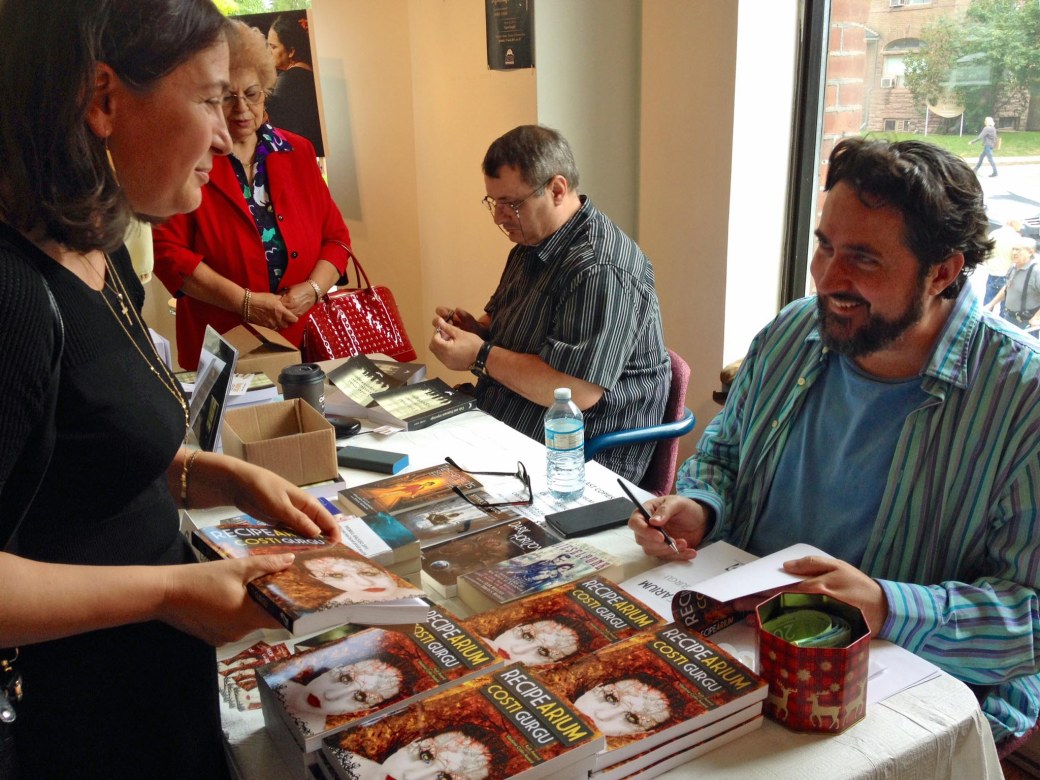
Costi Gurgy signing his book at launch in Pierre Leon Gallery
The publisher, White Cat Publishers interviewed Costi recently; a few choice questions and answers appear below:
Regarding his aspirations for the book, Costi responded:
First of all, this new release will bring Recipearium to the English speaking market, which is quite a big aspiration in itself. And through Recipearium I hope to open the hearts of North American readers to the rest of my fiction as well as to Romanian Speculative Fiction in general.
To their mention that RecipeArium is considered the “new weird” (even in science  fiction, which is itself considered strange), Costi responded:
Several publishers told me that they hadn’t read anything like it, and therefore they couldn’t compare it to any other book. Yes, at first I wanted to thank them because they practically told me it really was an original novel, but only later I realized that they meant they wouldn’t know how to market it and sell it. They didn’t even know if it would sell, because nobody has sold something similar before.
When I signed the contract in Romania, my Romanian publisher also didn’t know how to market it. So, my editor decided to write and talk about it like any other book and completely ignored that one thing that made it different. He hoped that when the readers discovered it, they would already be hooked and therefore it would be too late for them to freeze in awe. J
It paid off. The story proved a success. Not only because of the awards and the numerous reviews but mostly because of the satisfied readers … So, as a conclusion, I won’t tell you what makes it different from the rest. I want my readers to discover it for themselves. And I promise you it’s not the kind of surprise that goes BANG! It creeps on you slowly.
White Cat then asked Costi to elaborate on his earlier comment about the difference between European and American genre writing. Here’s what Costi said:
Sure. In my opinion there are two major differences. The first one is of perception. In Europe we read fiction works by writers from over seventy countries from all around the world. That is over seventy different cultures in which their authors write stories without worrying that maybe a foreign reader would not understand a certain social, political or cultural event, or a certain attitude, habit or tradition.
Yes, maybe the South American characters act according to a different code of social conduct than Romanians, or maybe French characters’ attitude is strange for a Bulgarian reader, or Chinese motivations are weird to Greeks. But if the story or the characters are gripping enough, all those things don’t stop us from getting the underlying concept from the context and we just keep reading.
The stories we read can take place in real cities or villages from different and unfamiliar parts of the world. Usually the European writer doesn’t care that his readers may have never been in his city and he keeps telling the story as if all his readers are his co-nationals, or even his neighbours.
We embrace the exotic, the foreign, the strange, the unknown… the alien.
American editors have rejected translating huge names from European speculative fiction because they’re considered too strange and not easily understood by North American readers. Because the North American readership has read only North American genre writers for the past fifty years and they wouldn’t accept something different than an American way of perceiving reality and interpreting information. Something that may be too far from the North American system of values.
“But they’re readers of Science Fiction! I mean, they read Science Fiction or Fantasy because they want to be transported to different worlds. You mean that the American readers better understand a story happening on a strange planet or in the underworld, but they will find it difficult to follow a story happening in Bruges, or Warsaw?” I replied.
North American editors don’t appear to have that confidence in their readers. I, on the other hand, have that confidence. It has been proven to me over and over again, that the true SF&F reader, European or North American, is thirsty for new and exotic, and strange, and alien.
The second aspect is technical. It’s about the writing techniques, the story structure, the point of view approach, and so on. It’s an aspect I will not detail here. Suffice to say that while in North America a writer is supposed to write according to a certain and more strict system of technical rules if she’s to be accepted by professional markets, in Europe the editors don’t care if the writer abides by the rules or breaks them, as long as it’s good writing and the readers want more of that author.
 “In his introduction to this all-original set of (at times barely) futuristic tales, Meyer warns readers, “[The] imaginings of today could well become the cold, hard facts of tomorrow.” Meyer (Testing the Elements) has gathered an eclectic variety of eco-fictions from some of Canada’s top genre writers, each of which, he writes, reminds readers that “the world is speaking to us and that it is our duty, if not a covenant, to listen to what it has to say.” In these pages, scientists work desperately against human ignorance, pockets of civilization fight to balance morality and survival, and corporations cruelly control access to basic needs such as water. The most affecting tale, Wendy Bone’s “Abdul,” is also the least futuristic, an emotional story that touchingly contrasts Western guilt against the life of a captive orangutan. The anthology may be inescapably dark, but it is a necessary read, a clarion call to take action rather than, as a character in Seán Virgo’s “My Atlantis” describes it, “waiting unknowingly for the plague, the hive collapse, the entropic thunderbolt.” Luckily, it’s also vastly entertaining. It appears there’s nothing like catastrophe to bring the best out in authors in describing the worst of humankind.”
 She imagines its coolness gliding down her throat. Wet with a lingering aftertaste of fish and mud. She imagines its deep voice resonating through her in primal notes; echoes from when the dinosaurs quenched their throats in the Triassic swamps.
 A limnologist (lake ecosystem biologist) by trade, Munteanu recognizes the incredible way that water shapes life and brings attention to the fact that water connects us to each other just as water connects with other water, forming bonds. She evokes in the reader a sense of reverence for water and an awareness that the same water that flows through our bodies have flowed through the bodies of our ancestors, cycling through life since the first life forms coalesced.
 “Water covers every aspect of this science fiction story that pits the vulnerable citizen against the evil multinational corporation in a dystopian Canada sometime in our future. Water is presented in its multiplicity of facets: in the science behind its composition, in its history, in it’s symbolic nature and different physical states; water is a giver and taker of life, and is the form in which the friendship of protagonists Hilda and Hanna functions. Water is also magic and the ultimate righter of wrongs committed to it and to a humanity it gives life to. Within this framework, Munteanu spins a thought-provoking tale that projects where our headlong pursuit of profit may one day lead us to, and how nature will ultimately, with a little human coaxing, be the only one to correct the balance.”—Shane Joseph, Canadian author of Fringe Dwellers
 love; a story to read, not only to deal with the possible but, above all, to understand that the time still available for “love” might be less than what you believe.”—Simone Casavecchia,
  Nina Munteanu is an ecologist and internationally published author of award-nominated speculative novels, short stories and non-fiction. She is co-editor of Europa SF and currently teaches writing courses at George Brown College and the University of Toronto. Visit
 “Water, Abundance, Scarcity, and Security in the Age of Humanity” (NYU Press) by Jeremy Schmidt is an intellectual history of America’s water management philosophy. Debates over how human impacts on the planet, writes
 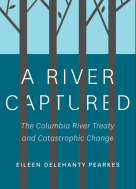 “A River Captured: The Columbia River Treaty and Catastrophic Change” (RMB Books) By Eileen Delehanty Pearkes reviews key historical events that preceded the Treaty, including the Depression-era construction of Grand Coulee Dam in central Washington, a project that resulted in the extirpation of prolific runs of chinook, coho and sockeye into B.C. Prompted by concerns over the 1948 flood, American and Canadian political leaders began to focus their policy energy on governing the flow of the snow-charged Columbia to suit agricultural and industrial interests.
 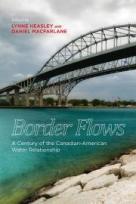 “Border Flows: A Century of the Canadian-American Water Relationship” (University of Calgary Press), Lynne Heasley and Daniel Macfarlane, editors, explore and discuss Canada-U.S. governance.
  “New York 2140” (Orbit) by Kim Stanley Robinson is a novel set in New York City following major sea level rises due to climate change.
  “The Death and Life of the Great Lakes” (WW Norton & Company Inc. Press) by Dan Egan is a frank discussion of the threat under which the five Great Lakes currently suffer. This book, writes
 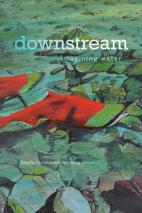 “Downstream: reimagining water” (Wilfred Laurier University Press) by Dorothy Christian & Rita Wong “brings together artists, writers, scientists, scholars, environmentalists, and activists who understand that our shared human need for clean water is crucial to building peace and good relationships with one another and the planet. This book explores the key roles that culture, arts, and the humanities play in supporting healthy water-based ecology and provides local, global, and Indigenous perspectives on water that help to guide our societies in a time of global warming. The contributions range from practical to visionary, and each of the four sections closes with a poem to encourage personal freedom along with collective care,” writes
  “
“
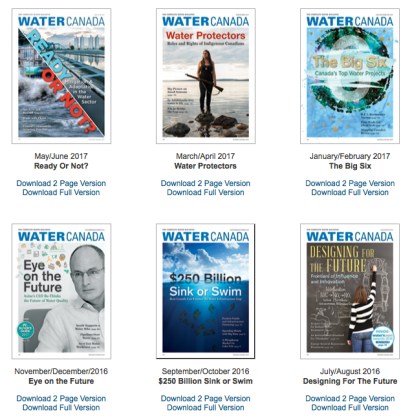 Water Canada




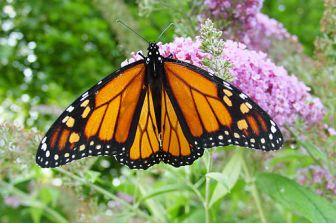
 Barbara Kingsolver’s 2012 novel Flight Behavior was, according to


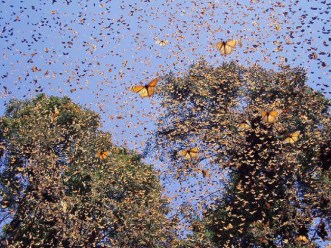 Kathleen Byrne of The Globe and Mail
 We—humanity—may not be around here for much longer. Nature will endure without us. Planet Earth will continue, in some form and Nature and life will endure, evolve, and flourish—in its own way. It will change, perhaps grow more unruly than it is already, but Gaia will continue after she has kicked us off. Ecologists have long recognized the pattern of colonization, exploitation, decadence and succession. How hubristic of humanity not to include itself in that cycle. The cycle of continuing change. We grasp—we clamor—for the world we knew—even as we senselessly impose irreparable change. Shaving forests to the ground so water has no where else to go but down and in a torrent. Creating hot deserts by diverting great rivers somewhere else. Mining vast oil and mineral reserves by scraping the earth until it “bleeds” from unhealable wounds.
 Nina Munteanu is an ecologist and internationally published author of award-nominated speculative novels, short stories and non-fiction. She is co-editor of Europa SF and currently teaches writing courses at George Brown College and the University of Toronto. Visit
