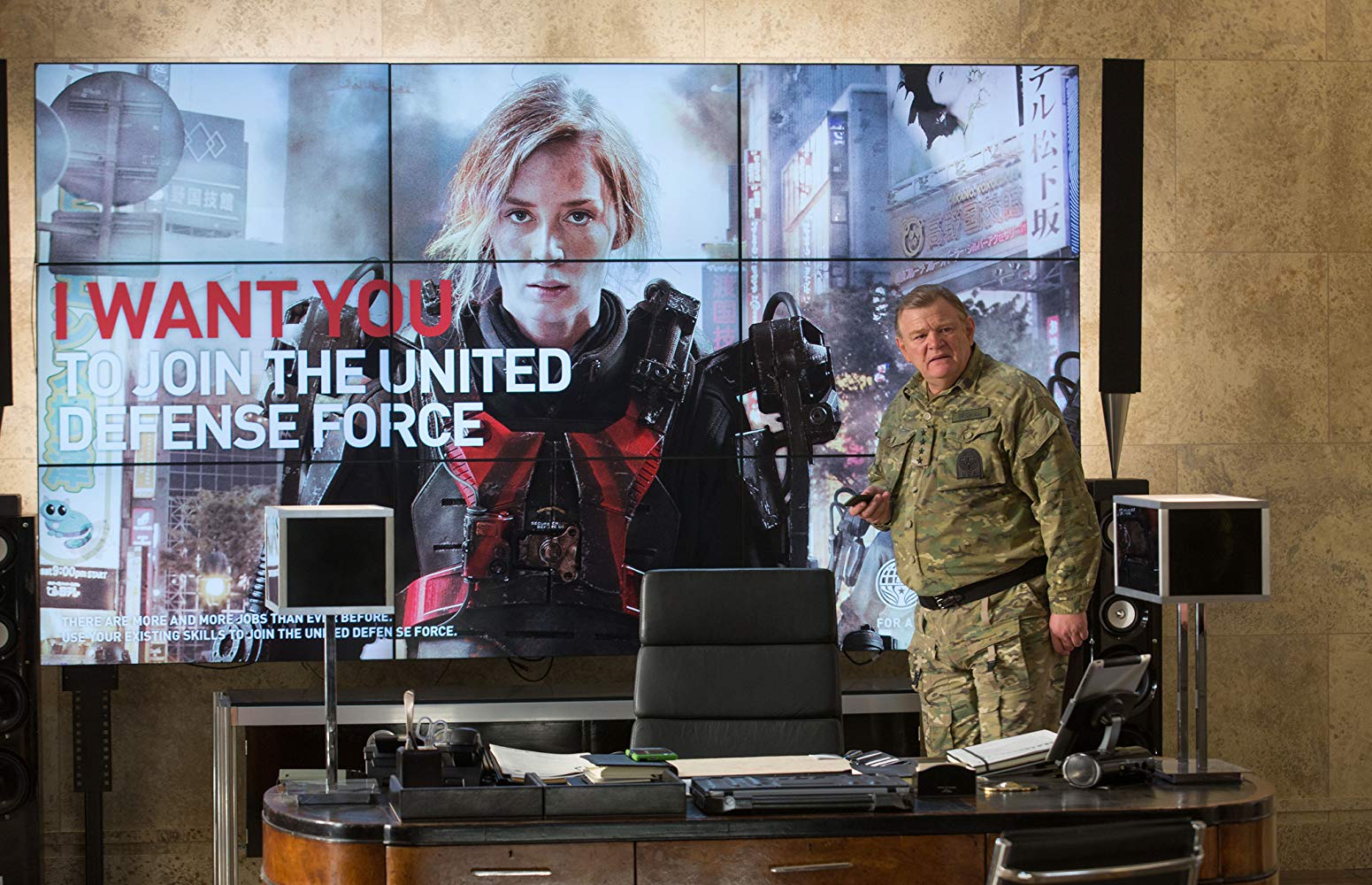
Recruiting poster by the United Defense Force featuring war hero Rita Vrataski, the Angel of Verdun
She’s called The Angel of Verdun. You also see another name scrawled in bright red over a London bus: Full Metal Bitch. When we first see her, angry and fierce in her battle gear (which resembles a modern-day knight’s armour) she’s heading out to battle, stomping out of the bunker, surrounded by an entourage, and summarily knocks an acolyte down who gets in her way. She’s badass. She’s the Full Metal Bitch.
Rita Vrataski is the face of the war; UDF General Brigham drafts our unwilling hero American William Cage (not pictured here) to the front
Her real name is Rita Vrataski. She wields a sharpened helicopter blade as her weapon of choice and serves as the poster girl for the United Defense Force to recruit more into the fight.
Rita (Emily Blunt) is a very different kind of poster girl for the war effort of the recent SF action movie Edge of Tomorrow, directed by Doug Liman and written by Christopher McQuarrie. There is an “edge of tomorrow” in this military SF story that explores how much we’ve changed since the time of World War I and II. And that change is most apparent in how women are seen and act.
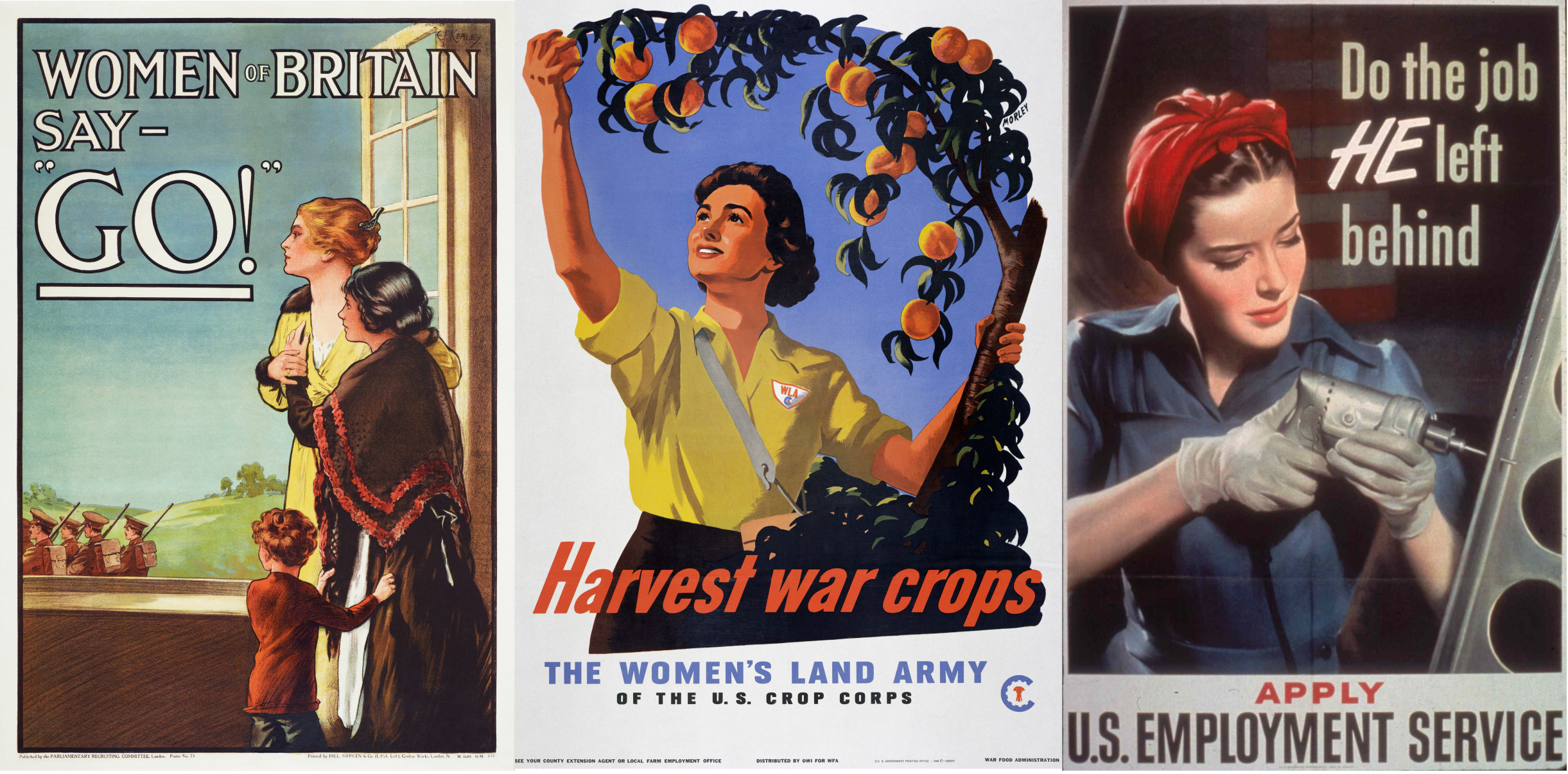
World War I and II propaganda posters to recruit women in the war effort
Edge of Tomorrow makes subtle and not so subtle reference to both world wars: from its June 6th release (70th anniversary of D-Day and the massive and decisive Normandy landing) to its reference to the trenches of Verdun in WWI, the Nazi or German Empire forces as the original seat of the Omega entity and many more.
The premise is straight-forward science fiction stuff: Earth is under attack by an alien species, who have seeded themselves with a meteor shower. The aliens have conquered Russia and China and now threaten France and England. Evoking echoes of World War II’s Normandy invasion, the United States joins the fray in support of their allies.
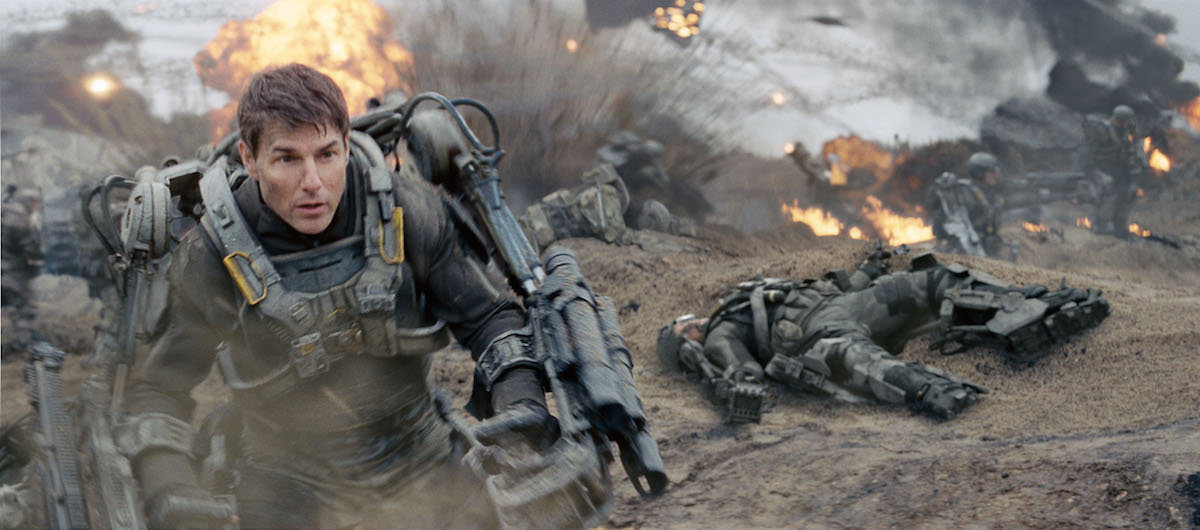
William Cage runs for his life after landing on a French beach, found to be a killing field of mimics
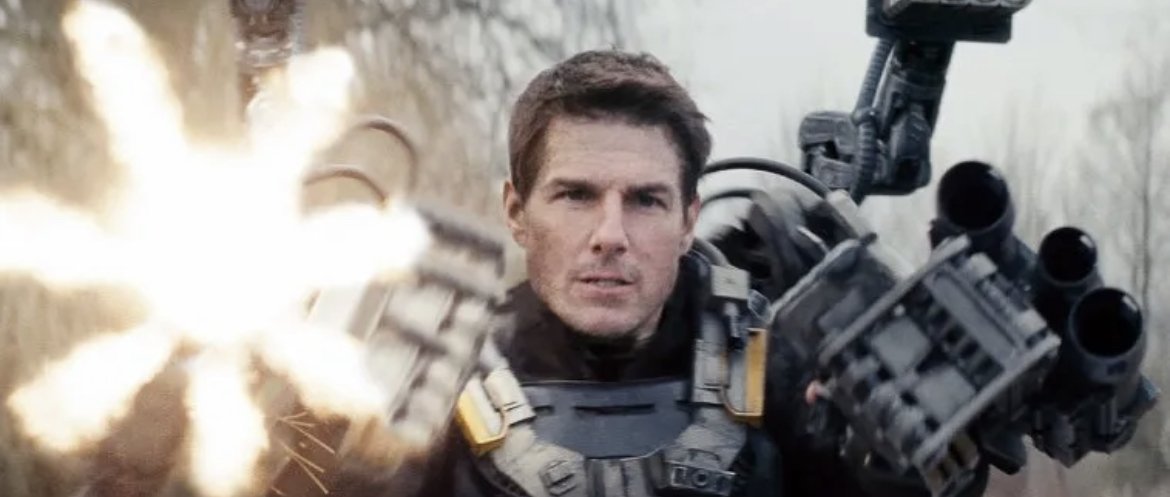
Cruise finally figures out how to use his weapon and kills a giant mimicbefore dying himself
American Major William Cage (Tom Cruise), who is with the PR staff of the war effort, gets unwillingly drafted to the front as a rookie private and dies in the first five minutes of landing on the shores of Normandy—but not before he kills an alpha alien, which covers him in blue blood. This sends him into a vicious time loop, where he must relive and die over and over in that horrendous bloodbath. Each time, he glimpses the Angel of Verdun repeatedly killed. On one occasion, Vrataski runs across him, lying injured in the mud. He can’t move, sure victim to the aliens. She snatches his battery pack and moves on, leaving him there to die. Astonished at the Angel’s apparent lack of compassion, Cage will later mimic her “let him die” attitude when he knowingly lets fellow soldier Kimmel get crushed.
Vrataski stands over wounded Cage, about to steal his battery pack and leave him to die
Cage finds Vrataski in her training room
In a later iteration he finally meets Vrataski on the battlefield, where she realizes (having gone through the time loop and lost it) that he is now in a time loop and therefore the key to their victory; she tells him to find her when he wakes up just seconds before she lets herself get blown up and they begin their looping journey together.
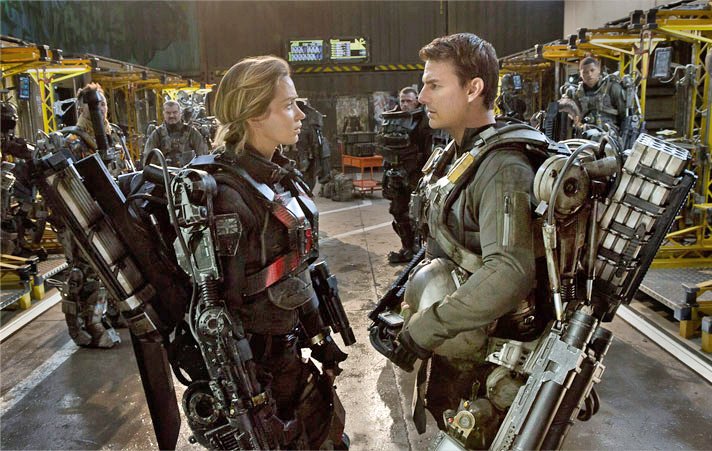
Vrataski and Cage, outfitted in intelligent body armour suits, discuss strategy
To his complaint, “I’m not a soldier,” Vrataski replies, “No, you’re a weapon.” That’s how she sees him. And to that end, she mentors him in the art and science of soldiering. When things go awry she time and again unflinchingly shoots him dead to reset the time. Cage tries to engage her in casual conversation and finds her taciturn. “You don’t talk much,” he observes, to which she quips, “Not a fan.” She’s all about the business of defeating the enemy before the human race is wiped out.
UK movie poster
Edge of Tomorrow provides a refreshing kind of woman hero; someone who is equal to her male protagonist in skill, intelligence and heroic stature. What I mean by heroic stature is that her heroic journey of transformation does not play subservient to her male counterpart’s journey. This almost happens on two occasions when Cage gives her an “out” to stay behind and let him take over. She declines. In fact, Cruise lets her character take the lead, even though this it truthfully Cage’s story of metaphoric transformation from “onlooker” to “participant”.
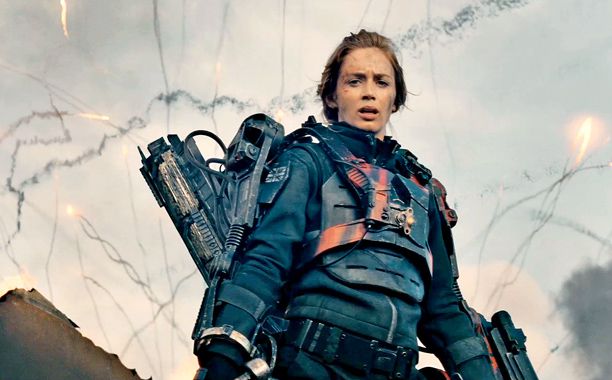
Rita Vrataski, the Angel of Verdun
William Cage, transformed soldier, trained by Vrataski
In so many androcentric storylines, the female—no matter how complex, interesting and tough she starts out being—must demure to the male lead; as if only by bowing down to his superior abilities can she help ensure his heroic stature. Returning us right back to the cliché role of the woman supporting the leading man to complete his hero’s journey. And this often means serving as the prize for his chivalry. We see this in so many action thrillers and action adventures today: Valka in How to Train Your Dragon, Wyldstyle in The Lego Movie, Neytiri in Avatar, Trinity in The Matrix, and so many more. There’s even a name for it: the Trinity Syndrome.
Various female heroes fallen prey to the Trinity Syndrome
Tasha Robinson writes in her excellent article entitled, We’re losing all our Strong Female Characters to Trinity Syndrome: “The idea of the Strong Female Character—someone with her own identity, agenda, and story purpose—has thoroughly pervaded the conversation about what’s wrong with the way women are often perceived and portrayed today, in comics, video-games, and film especially…it’s still rare to see films in the mainstream action/horror/science-fiction/fantasy realm introduce women with any kind of meaningful strength, or women who go past a few simple stereotypes.”
I give Cruise, Liman and McQuarrie full credit for not doing this. For example, after Cage makes his case to his Squadron to go find the Omega in Paris, they remain reluctant until Vrataski emerges. “I don’t expect you to follow me,” says Cage. “I do expect you to follow her.” The Angel of Verdun—or better yet, the badass Full Metal Bitch. And why not? Who wouldn’t follow her?
Is this one of the reasons that this movie didn’t do so well in the North American box office as it did overseas, whose audience may reflect a more mature, open and enlightened audience?
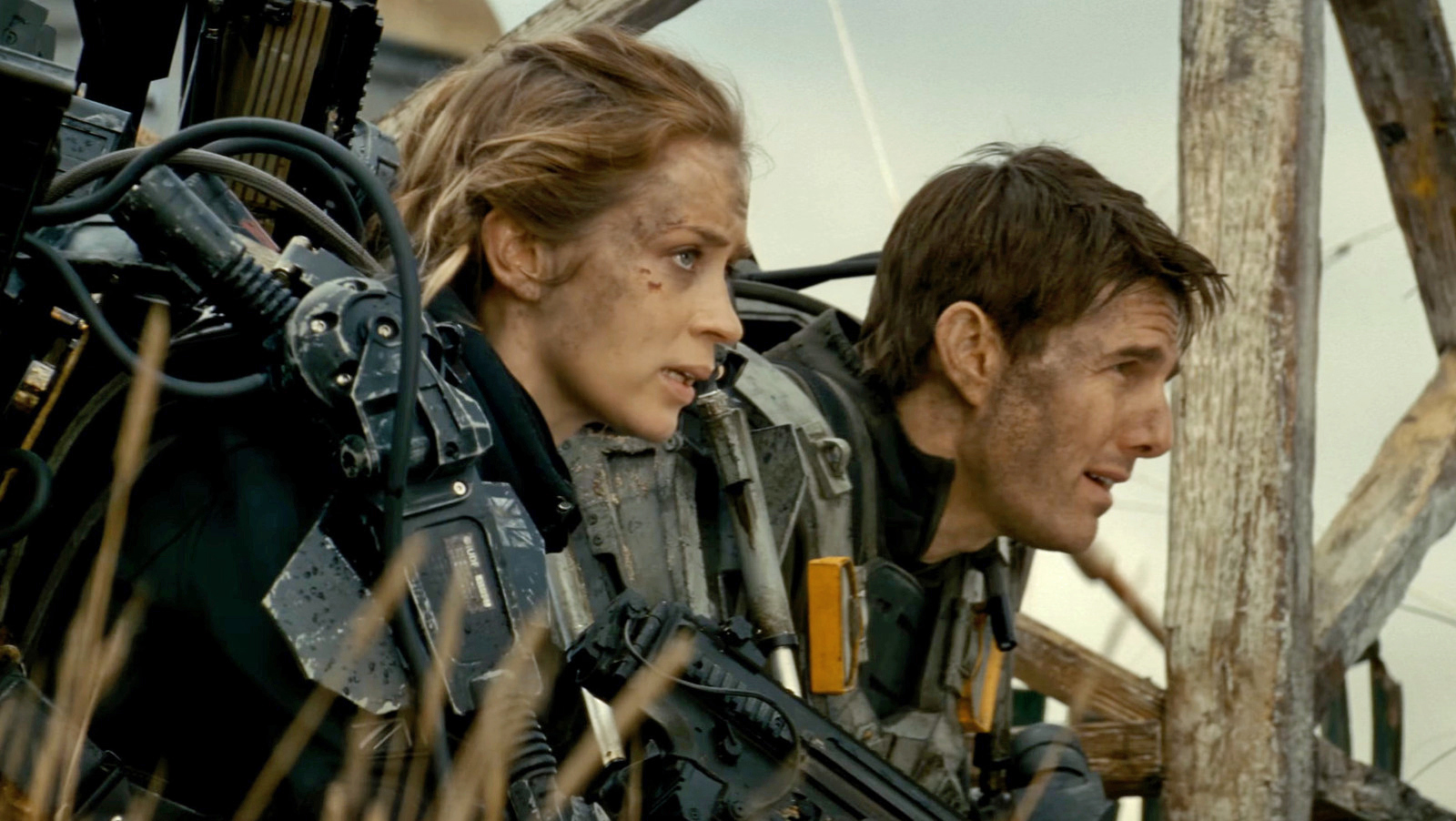
Vrataski and Cage trek across France in search of the mimic headquarters
When a female lead is stronger than the male protagonist, some reviewers (OK—male reviewers) treat and categorize that movie as a “woman’s story”. I’ve been told by some of my male friends that they couldn’t possibly empathize with such a character—mainly because she is a woman and she is stronger than the male lead “they want to be”. Invariably, in many of these, the male counterpart is so much “milk-toast” compared to that awesome female-warrior. And have you ever noticed that, while the male hero gets the girl, the female hero usually ends up alone? Great examples include: Buffy the Vampire Slayer; Xena: Warrior Princess; Sarah in The Terminator and of course Vasquez in Aliens. These women are amazons; they stand apart, goddess-like, unrelenting, unflinching—untouchable. It’s actually no wonder that my ex-husband dislikes Sigourney Weaver to this day—she could crush him underfoot and eat him for breakfast at a moment’s notice. And probably would!
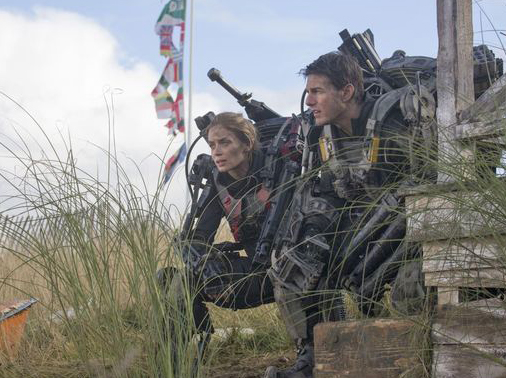
Cage and Vrataski comb the French landscape in search of a vehicle that will take them to the Mimic headquarters
“…I want to point out two things that Richard has, that Bond and Captain America and Batman also have, that Peggy (Carter of Captain America), however strong she is, cannot attain. They are very simple things, even more fundamental than “agency”.
1) Richard has the spotlight. However weak or distressed or passive he may be, he’s the main goddamn character.
2) Richard has huge range of other characters of his own gender around him, so that he never has to act as any kind of ambassador or representative for maleness. Even dethroned and imprisoned, he is free to be uniquely himself.
Promotional poster for the Marvel “The Avengers”
On the posters [women are] posed way in the back of the shot behind the men, in the trailers they may pout or smile or kick things, but they remain silent. Their strength lets them, briefly, dominate bystanders but never dominate the plot. It’s an anodyne, a sop, a Trojan Horse – it’s there to distract and confuse you, so you forget to ask for more.”
There is another type of female hero. She is equal to her male counterpart. Her story is not secondary to his story; her heroic status and hero’s journey is equal to his; in fact they may share the same journey. Examples include: The Expanse; Aeon Flux; Farscape; Battlestar Galactica, Hunger Games, The Beyond, Missions, Orphan Black, Advantageous…
Promotional poster for “edge of Tomorrow”
And now Edge of Tomorrow. As with the above examples, Vrataski and Cage form a team, in which together they are more than the sum of their parts. A marriage of independent autopoiesis, combining skills, abilities and vision. This is also why, in my opinion, the ending of Edge of Tomorrow is totally appropriate: not because it’s “the happy ending”; but because it carries the message of enduring collaboration of equals.
Nina Munteanu is a Canadian ecologist / limnologist and novelist. She is co-editor of Europa SF and currently teaches writing courses at George Brown College and the University of Toronto. Visit www.ninamunteanu.ca for the latest on her books. Nina’s bilingual “La natura dell’acqua / The Way of Water” was published by Mincione Edizioni in Rome. Her non-fiction book “Water Is…” by Pixl Press (Vancouver) was selected by Margaret Atwood in the New York Times ‘Year in Reading’ and was chosen as the 2017 Summer Read by Water Canada. Her novel “A Diary in the Age of Water” was released by Inanna Publications (Toronto) in June 2020.






 Nina Munteanu Writing Coach