On my third day in Paris, I got lost. I didn’t mean to; it just happened.
I’d started early and joined the morning crowd at the Musée d’Orsay. After a breathtaking journey through the visions of French Impressionists, I ventured by bus to the Champ du Mars and climbed the Eiffel Tower to see Paris from the perspective of the Gods: a wheeled mosaic of art, magic and scene. Then I decided to walk home from there. I thought my adventure was over; in truth, it had just begun…
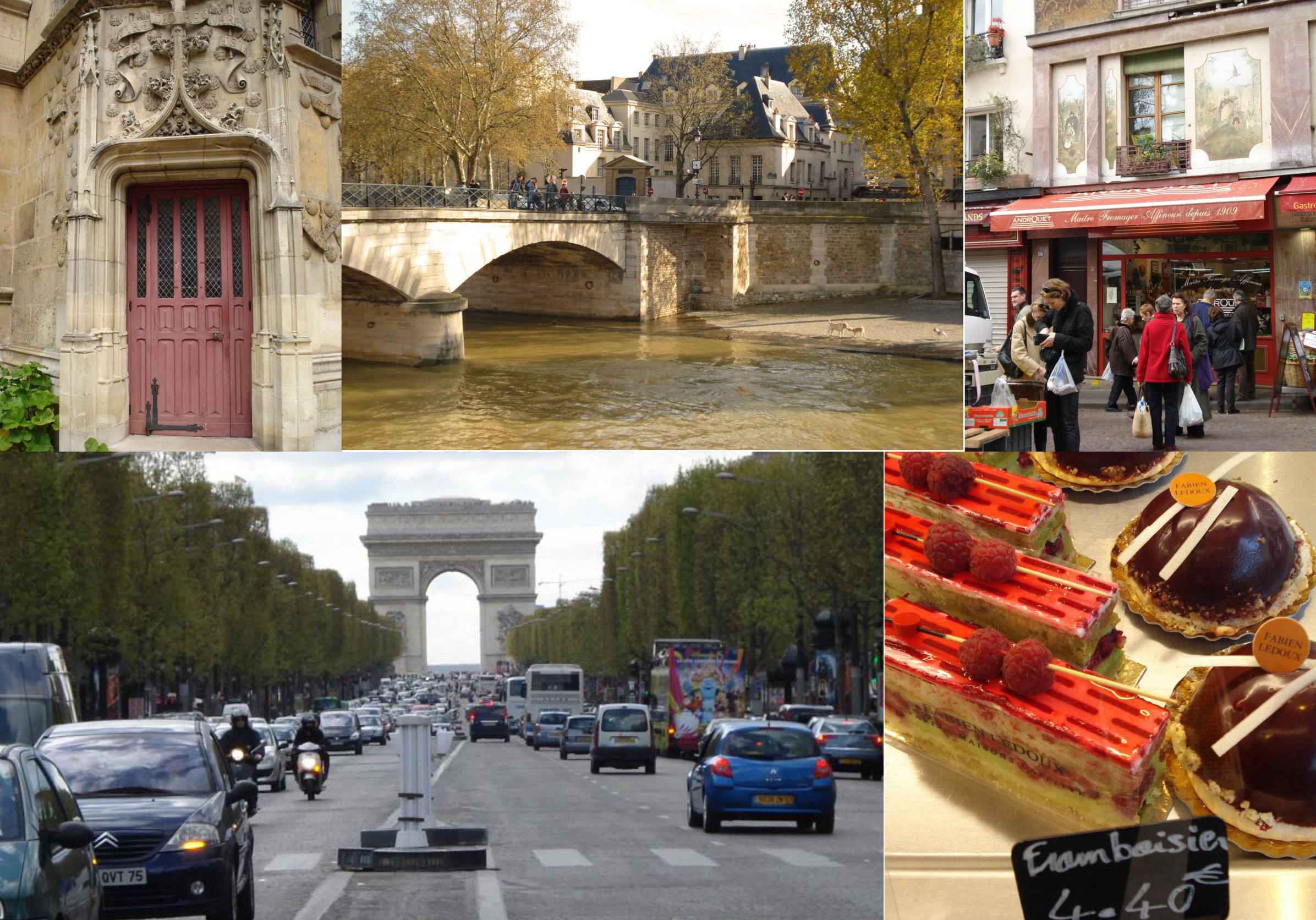
One of my many stops for delightful sustenance in Paris (photo by Nina Munteanu)
As I wound my way down a tree-lined street, the flower blossoms rained down with the fragrant breeze, painting the cobblestones in pale shades of diaphanous pink. A young couple sat wrapped around each other on a bench, kissing. It suddenly struck me that I was in Paris in the springtime; and I was alone. It was just an observation. It didn’t make me sad or uncomfortable; I’ve traveled a great deal on my own and have enjoyed the edgy play on my mind and soul that solitude in a strange place brings.
Montage of Paris (photos by Nina Munteanu)
Philosopher Mark Kingwell wrote, “travel is a drug, and not just because it can be addictive. More because it alters consciousness, dilates the mind and maybe even rewires the cerebral cortex…going somewhere different from home [is] the best way to challenge your habitual ways of thinking.”
I’d come to Paris to research the book I was writing—about a young girl (a medieval time-traveller) who can alter history (The Last Summoner). Paris, with its Neo-Classical architecture, quaint cobble streets, and stylish Parisians, lends itself to a wandering eye and finally to introspection. For Kingwell, “somewhere beyond the contrived, comfortable cityscapes, we’ll encounter a potentially more profound version of ourselves.”
Paris, like the Parisians, is a seductive dance. It is so attractive to view. But ultimately one must participate in it to fully experience it.
I don’t know when I finally noticed that I had no idea where I was. It just happened. Along one of Paris’s charming narrow cobble streets as the Hausmann-style buildings blushed in the sunset, I found myself utterly lost.
Montage of Paris (photos by Nina Munteanu)
The sky’s light shades of peach gave way to a deeper shade of ochre as I walked on, feeling more and more a stranger and more and more self-conscious that I was. I wasn’t dressed fashionably. Oh, I had the obligatory scarf and stylish leather jacket; but I lacked the finesse of these Parisians who glided confidently along the darkening streets that were familiar to them. The sounds, sights and smells of this foreign city heightened in a frisson of increasing tension. But I refused to let the darkness take me and let my feet lead me on, confident that I would find something. This was Paris, after all…
Display of one of the many patisseries in Paris (photo by Nina Munteanu)
“Not to find one’s way in a city may well be uninteresting and banal,” wrote Walter Benjamin. “It requires ignorance—nothing more. But to lose oneself in a city—as one loses oneself in a forest—that calls for quite a different schooling.” A school for questions, not answers, says Kingwell.
I’d come to Paris with questions, many questions; some of which I would not answer. Perhaps the most important ones. I’d come with the hubristic ambition of defining Paris. But I discovered that to define Paris is to define life…and oneself.
Montage of Paris (photos by Nina Munteanu)
Paris unfolds like an impressionist canvas, to be interpreted through experience. It is an aria, both exquisite and haunting. Like the lingering aftertaste in the back of my throat of a complex bitter-sweet Bordeaux. I lost myself willingly to its mystery. “Real travel,” says Kingwell, “means we must surrender expectations and submit to chance, to challenge our desires, not merely satisfy existing ones…Leaving home ought to be, above all…that plunge into otherness. Becoming strange to ourselves is the gateway to seeing how dependent on strangers we are for our identities…Getting lost to yourself might be the best way to find out who you are.”
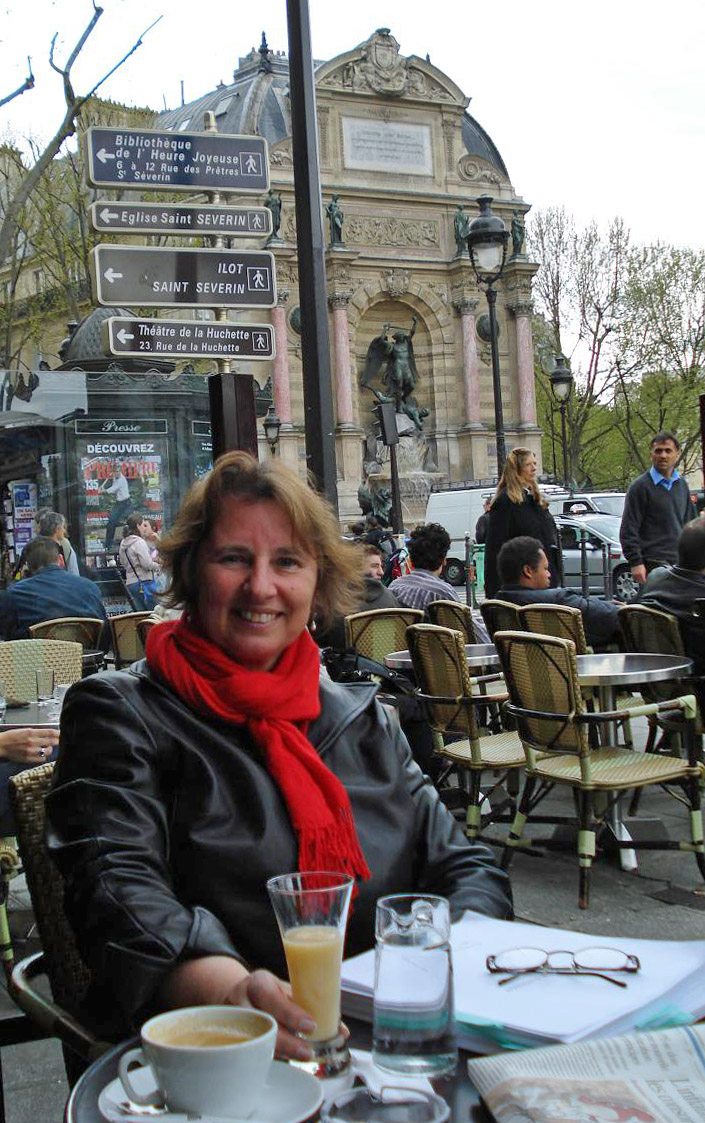
Author sits with her novel manuscript for “The Last Summoner”, a cafe creme and Pastis in Place Saint-Michel, Latin Quarter of Paris
Nina Munteanu is a Canadian ecologist / limnologist and novelist. She is co-editor of Europa SF and currently teaches writing courses at George Brown College and the University of Toronto. Visit www.ninamunteanu.ca for the latest on her books. Nina’s bilingual “La natura dell’acqua / The Way of Water” was published by Mincione Edizioni in Rome. Her non-fiction book “Water Is…” by Pixl Press (Vancouver) was selected by Margaret Atwood in the New York Times ‘Year in Reading’ and was chosen as the 2017 Summer Read by Water Canada. Her novel “A Diary in the Age of Water” was released by Inanna Publications (Toronto) in June 2020.
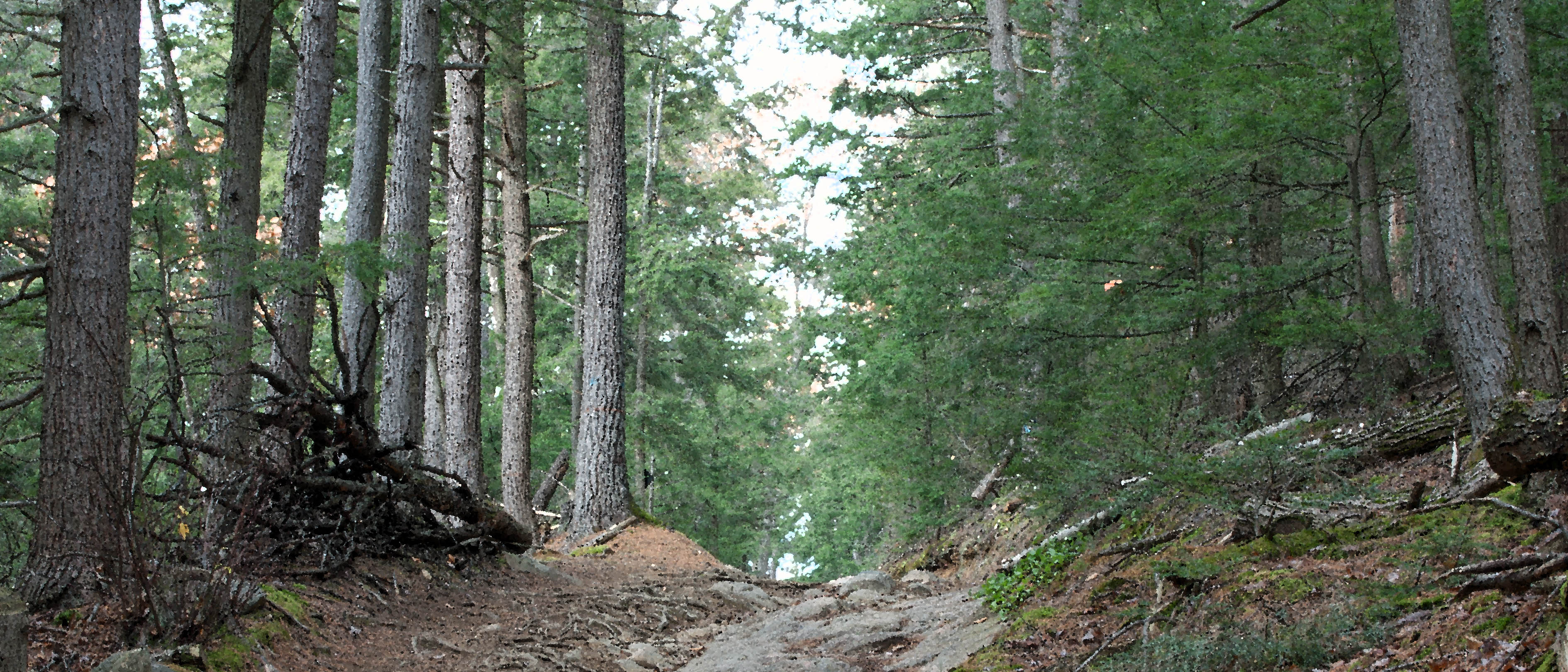
Rocky trail through ancient eastern hemlock forest, Catchacoma Park, ON (photo and rendition by Nina Munteanu)
I look forward to my daily walks. I find that walking helps me centre myself. Depending on the time I have, some walks last half an hour to an hour. Others walks will stretch from three hours to a day long. These aren’t city-walks.
Stream swells in a spring rain in Trent Nature Sanctuary, ON (photo and rendition by Nina Munteanu)
My favourite place to walk is in the forest, by a river.
Perhaps it is the solitude… or the negative ions, the fresh pungent scents of damp loam, moss and trees. The humbling magnificence of these stately trees. The fishy bog smell of algae. Or the unknown treasures hiding in plain sight for me to discover… Whatever the combination, I find it most pleasing. And freeing.
It is also here, wandering in the forest, that my creativity flourishes as I find expression through the joy of discovery.
Old-growth forest surrounding Pierce Lake, BC (photo by Kevin Klassen)
The first step is to lose myself…
That’s the fun part: not knowing what’s beyond that hillside or down that ravine on the shores of the creek I barely see or around that bend in the root-gnarled trail among the swamp cedars. Like a moth to light, I’m drawn to the unknown. Ever the explorer.
Old-growth cedar forest in Jackson Creek forest, ON (photo and rendition by Nina Munteanu)
Gnarly cedar roots cross a path through morning fog in a swamp cedar forest, ON (photo by Nina Munteanu)
It is often here, as I walk along uneven trails or maneuver through undergrowth, up hills or down stream banks to explore and record with my camera, that I do my best thinking… Well, best in that it does not feel like thinking; more like simply ‘being.’ As my body responds to Nature’s sensual treasures, my ingenuous mind ‘walks away’ from restrictions of consciousness and roams in a kind of euphoric state of simple joy. Freed from thinking to feel and sense.
No need for a destination. The journey is my destination…
Gnarly roots of an old yellow birch snake across the old-growth cedar forest, ON (photo by Nina Munteanu)
Moss-covered boulder erratic (Nina’s Boulder) in old-growth cedar forest of Jackson Creek park, ON (photo by Nina Munteanu)
Walking in a forest unclutters my mind. The forest is simple in its natural complexity. Its beauty combs out the tangles of human encumbrance and grounds me in the simplicity of natural life.
Cookout in old-growth rainforest at Mamquam River near Squamish, BC (photo by Kevin Klassen)
I go prepared. Depending on the kind of walk, I’ll bring my clementine to snack on or a hearty lunch and fruit snacks that I carry in my backpack, along with a notebook and first aid kit. And, of course, I bring my camera. When I stop for lunch or snack, I choose my location thoughtfully, sometimes a place to sit, but mostly with a view of something worth studying. Lunch or snack stops are particularly alluring with unexpected experience.
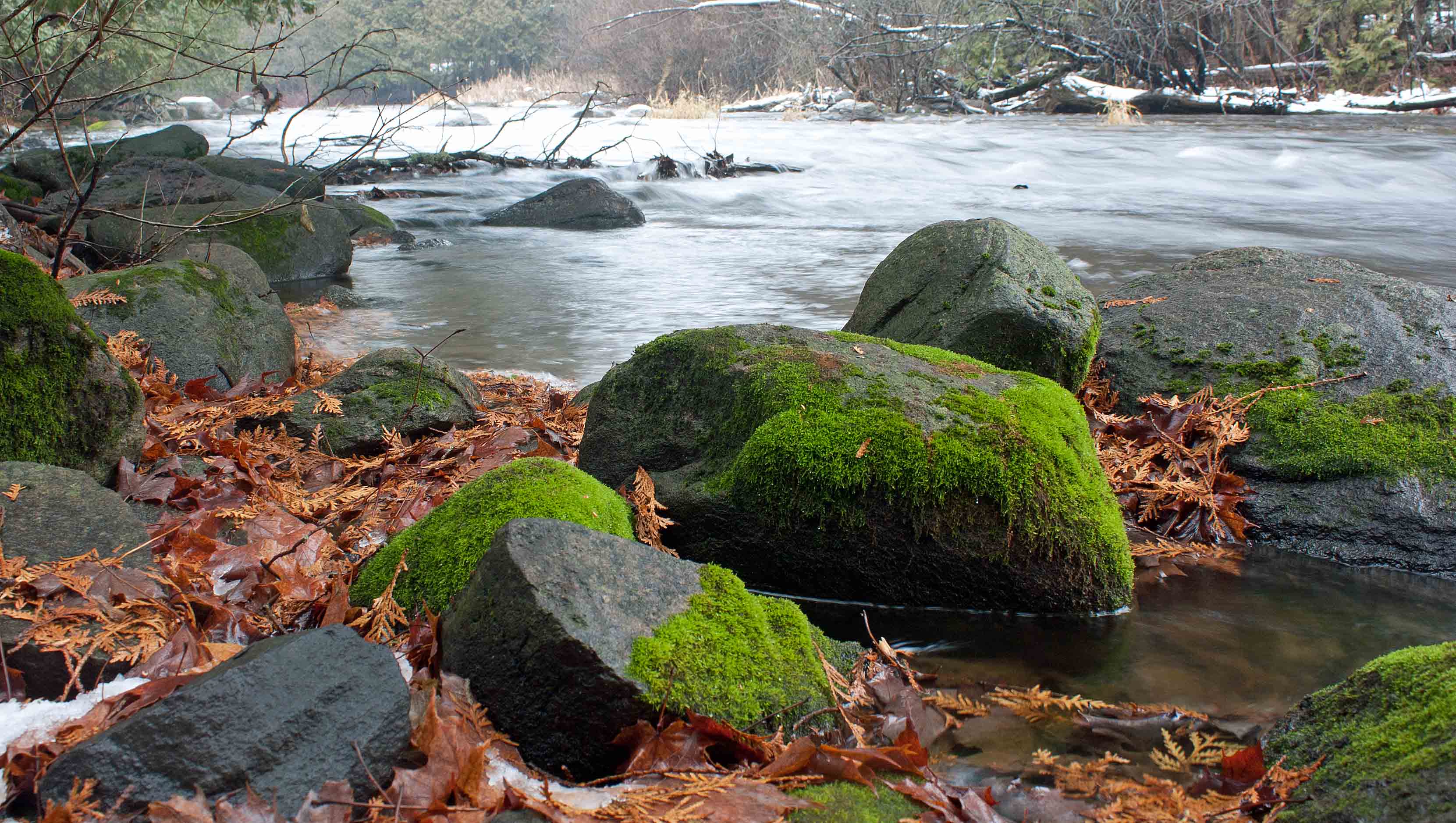
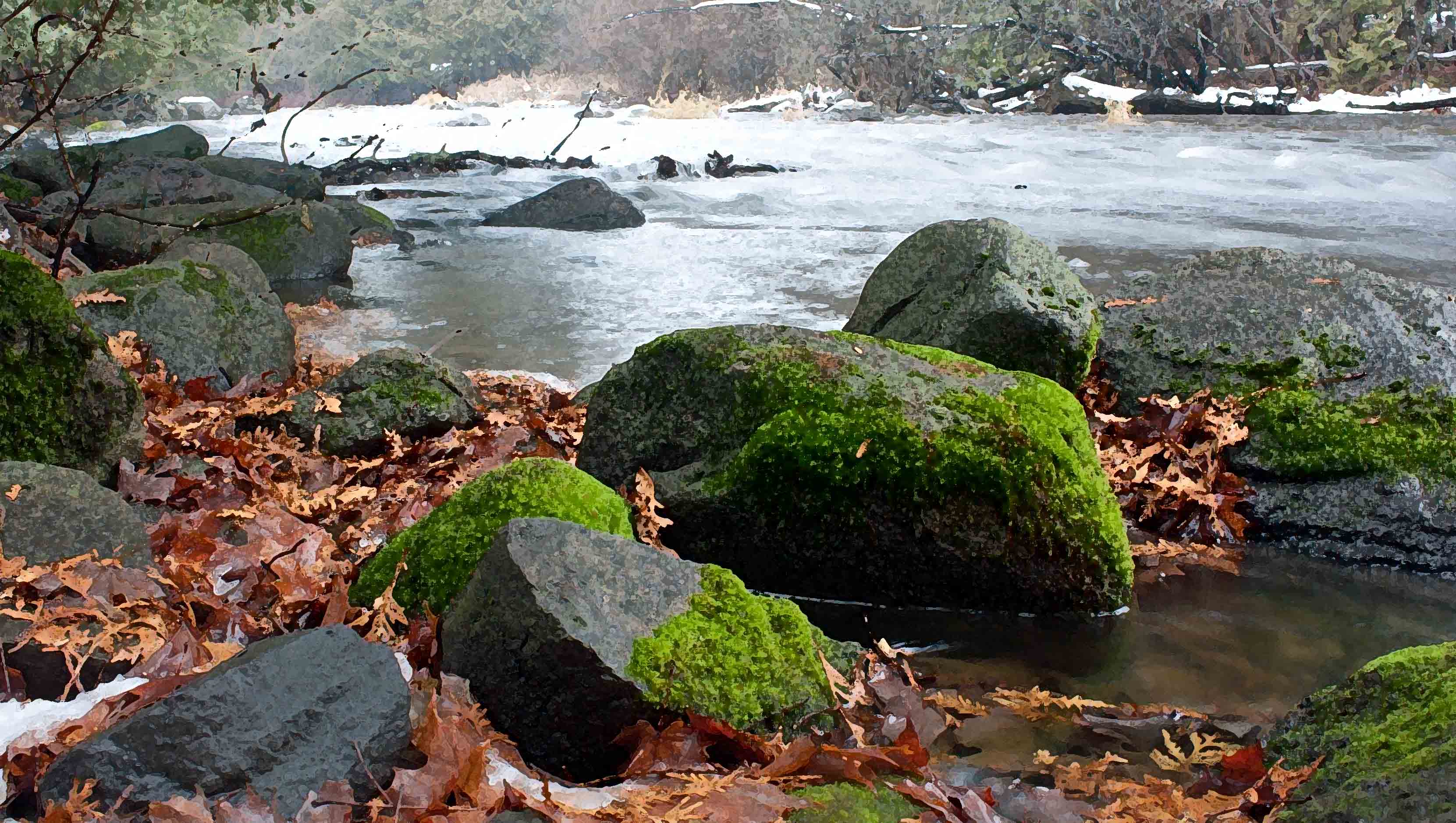
Moss-covered rocks scatter along the banks of Jackson Creek, ON (photo by Nina Munteanu)
It is then, when I’ve stopped walking and have become quiet, when nature closes around me like a soft blanket and often gifts me with a precious sight or sound. A nearby red squirrel eating a nut. A bird flitting from berry to berry in a viburnum shrub. Oft times, I will be rewarded with the sight of a mushroom right at my feet or next to where I sit. That is often followed by the sight of many more.
As though the one had to be first seen to reveal the many.
Various mushrooms in Ontario forests (photos by Nina Munteanu)
Now lost, I open myself to possibility…
Like the propagules of Virginia creeper, my senses reach out to find the unexpected. I’m looking to be surprised. To discover something new that will draw me outside myself.
Various flowers and trees in southern Ontario (photos by Nina Munteanu)
The river trickles in the background as I step through dappled light and inhale the organic scents of the forest. The forest and the river help me re-align and focus—without trying. That’s the magic of it. It’s in the not trying.
Marcescent beech leaves drape over old road through swamp forest, ON (photo and rendition by Nina Munteanu)
I take my camera (and tripod) with me on most walks for those moments that I can never anticipate: like the time a deer stepped gracefully out from behind a tree not three metres from me in a moss-covered red pine forest. I was in the process of setting up my camera on its tripod to capture the trail through the pines when the deer moved gracefully into my sight. Startled, we both froze and stared at one another for a moment made eternity. The deer then sprang away and loped through the trees, disappearing within seconds. I stood, hands fixed on my camera shutter button, and smiled. I had not taken a picture. But I now basked in that frozen moment of fascination between two curious animals, a deer and a human.
I didn’t need a picture; I already had my prize, the enduring memory of that moment.
Pine trees loom tall at the location where I met the deer in Petroglyph National Park, ON (photo and rendition by Nina Munteanu)
In the April 2014 issue of the Journal of Experimental Pshychology: Learning, Memory and Cognition, Stanford researchers Marily Oppezzo and Daniel L. Schwartz demonstrated that walking boosts creative inspiration. Using the Guildford’s Alternative Uses Test they showed that the act of walking significantly increased creativity for 81% of the participants. Oppezzo and Schwartz were able to demonstrate that the creative ideas generated while walking were not irrelevant or far-fetched, but innovative and practical.
Moss-covered ancient hemlock in the Catchacoma old-growth forest, ON (photo by Nina Munteanu)
It begins with changes to our chemistry. In the September 3 2014 issue of TheNew Yorker, journalist Ferris Jabr describes why walking opens the mind to creativity:
“When we go for a walk, the heart pumps faster, circulating more blood and oxygen not just to the muscles but to all the organs—including the brain. Many experiments have shown that after or during exercise, even very mild exertion, people perform better on tests of memory and attention. Walking on a regular basis also promotes new connections between brain cells, staves off the usual withering of brain tissue that comes with age, increases the volume of the hippocampus [a brain region crucial to relational memory and contextual learning], and elevates levels of molecules that both stimulate the growth of new neurons and transmit messages between them.”
Beech tree with marcescent leaves in a mixed forest, ON (photo by Nina Munteanu)
So, I walk and I create in my mind and my heart as I prepare to write my next novel…
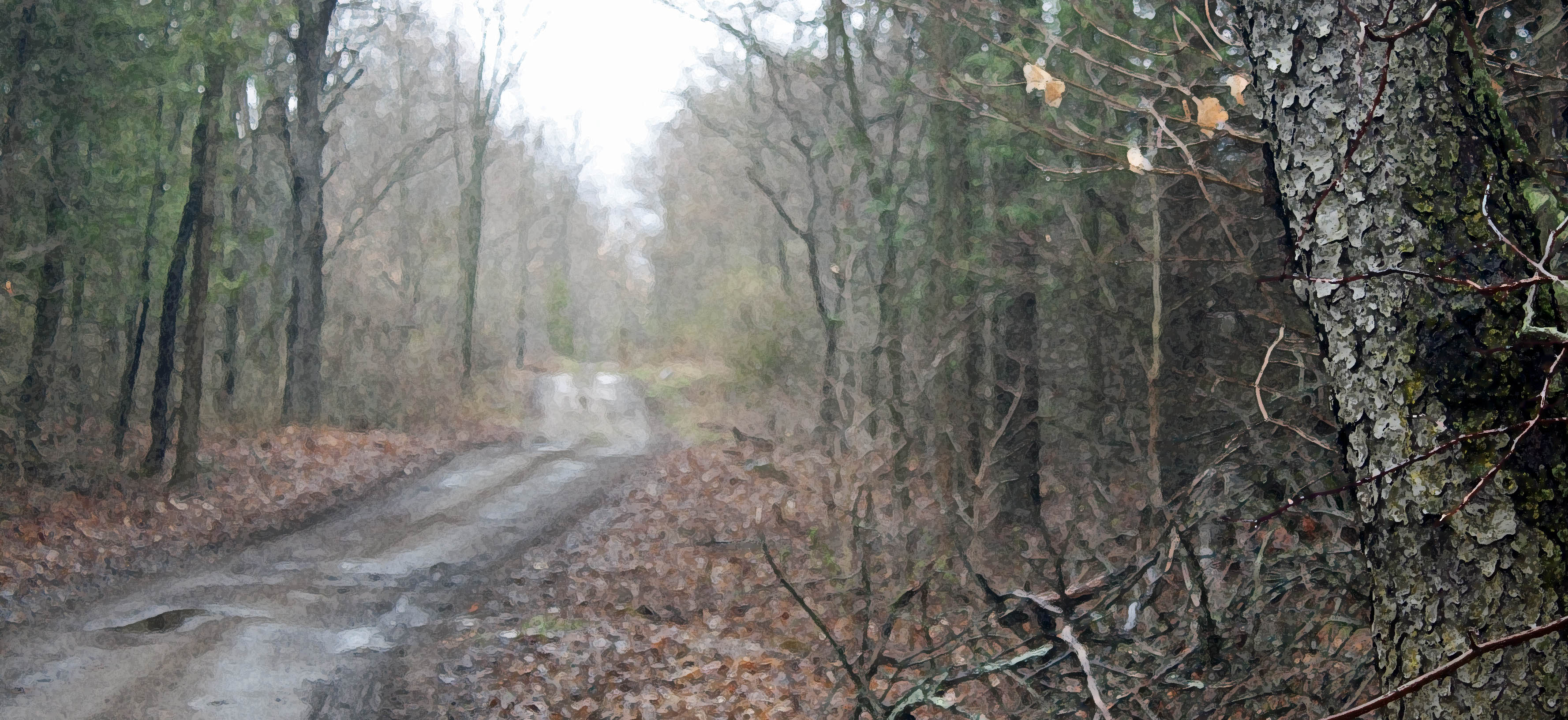
Payne Line road in the mists of an early morning rain, ON (photo and rendition by Nina Munteanu)
Nina Munteanu is a Canadian ecologist / limnologist and novelist. She is co-editor of Europa SF and currently teaches writing courses at George Brown College and the University of Toronto. Visit www.ninamunteanu.ca for the latest on her books. Nina’s bilingual “La natura dell’acqua / The Way of Water” was published by Mincione Edizioni in Rome. Her non-fiction book “Water Is…” by Pixl Press (Vancouver) was selected by Margaret Atwood in the New York Times ‘Year in Reading’ and was chosen as the 2017 Summer Read by Water Canada. Her novel “A Diary in the Age of Water” was released by Inanna Publications (Toronto) in June 2020.
“What if water doesn’t like being owned or ransomed? What if it doesn’t like being channelled into a harsh pipe system or into a smart cloud to go where it normally doesn’t want to go? What if those hurricanes and tornadoes and floods are water’s way of saying that it’s had enough?”
Hilde Dresden
“Thoroughly researched and cleverly executed, A Diary in the Age of Water is a must-read, especially for those who are longing for nature, and touch, while fearing both.”
CARA MOYNES, Amazon Review
“This novel made my heart clench…An extremely detailed and downright terrifying look into the future of our planet. A Diary in the Age of Water will appeal to lovers of eco-fiction and hard speculative fiction.”
GOODREADS REVIEW
Maple tree branches hover over shallows of Otonabee River, ON (photo and rendition by Nina Munteanu)
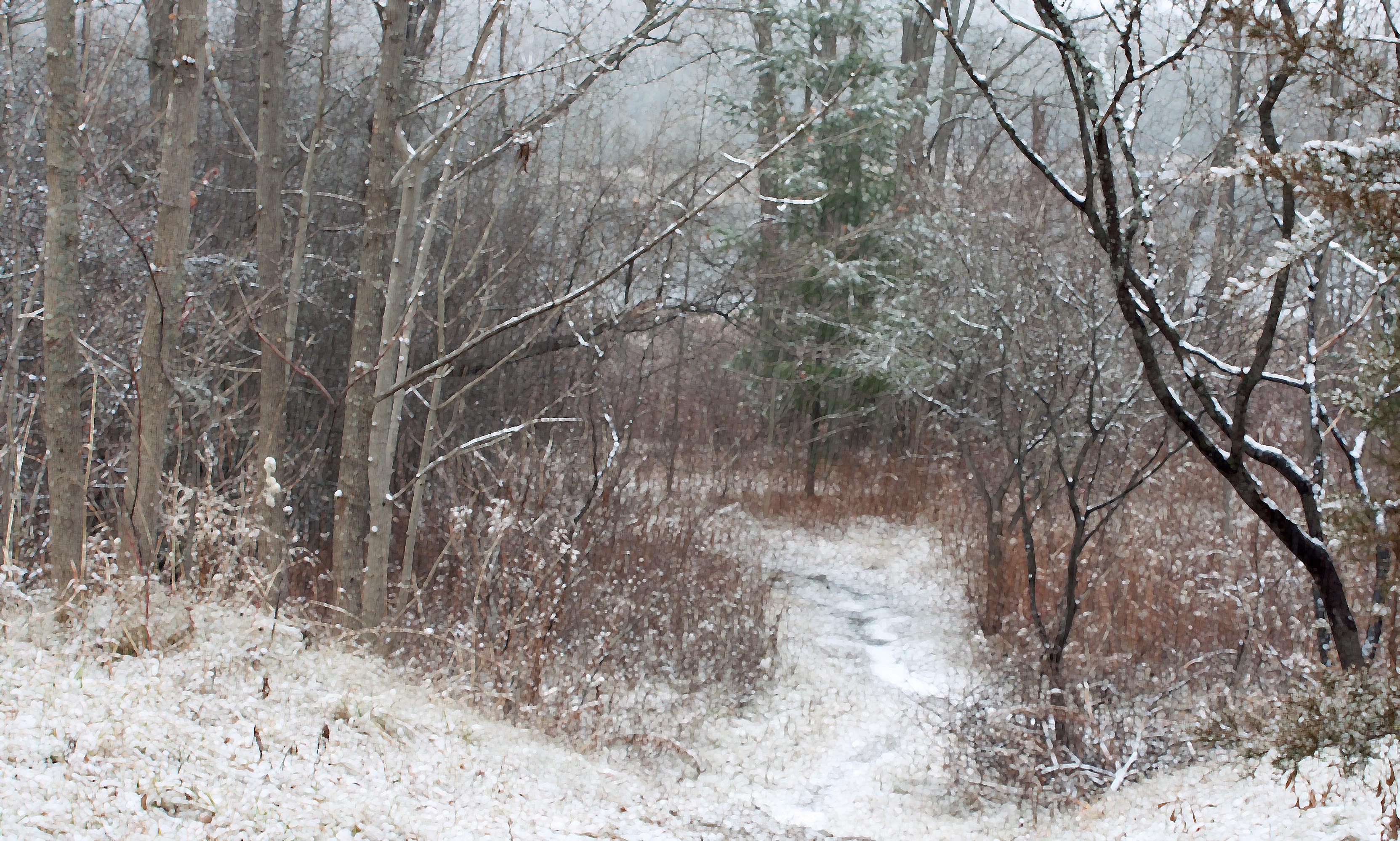
Beech trees stand with bronzed leaves as the snow falls in the mixed forest of South Drumlin park, ON (photo and rendition by Nina Munteanu)
Yesterday, it started snowing near the end of my work shift, and I kept glancing out the window as it turned into a heavy thick snow, the kind I just adore. Whenever this happens, I long for werifesteria…
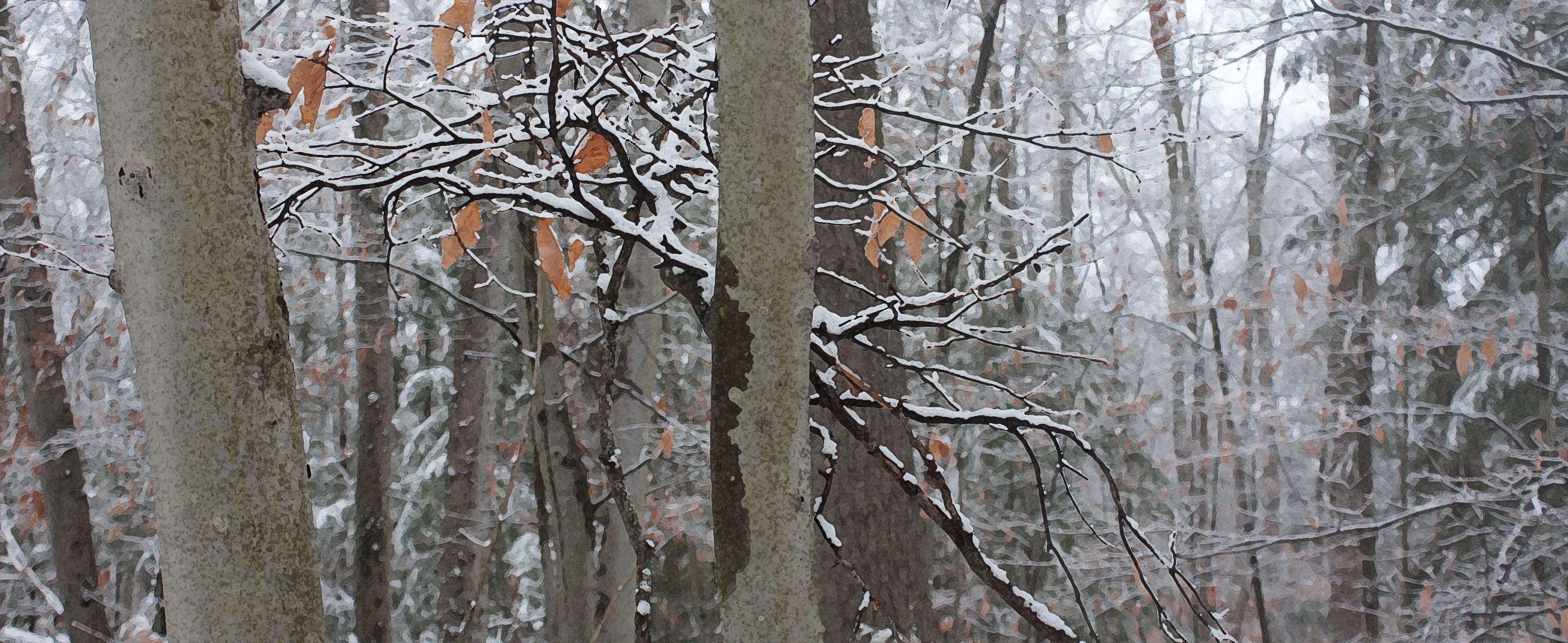
A pair of beech trees stand pale among hemlocks and poplar trees, South Drumlin park, ON (photo and rendition by Nina Munteanu)
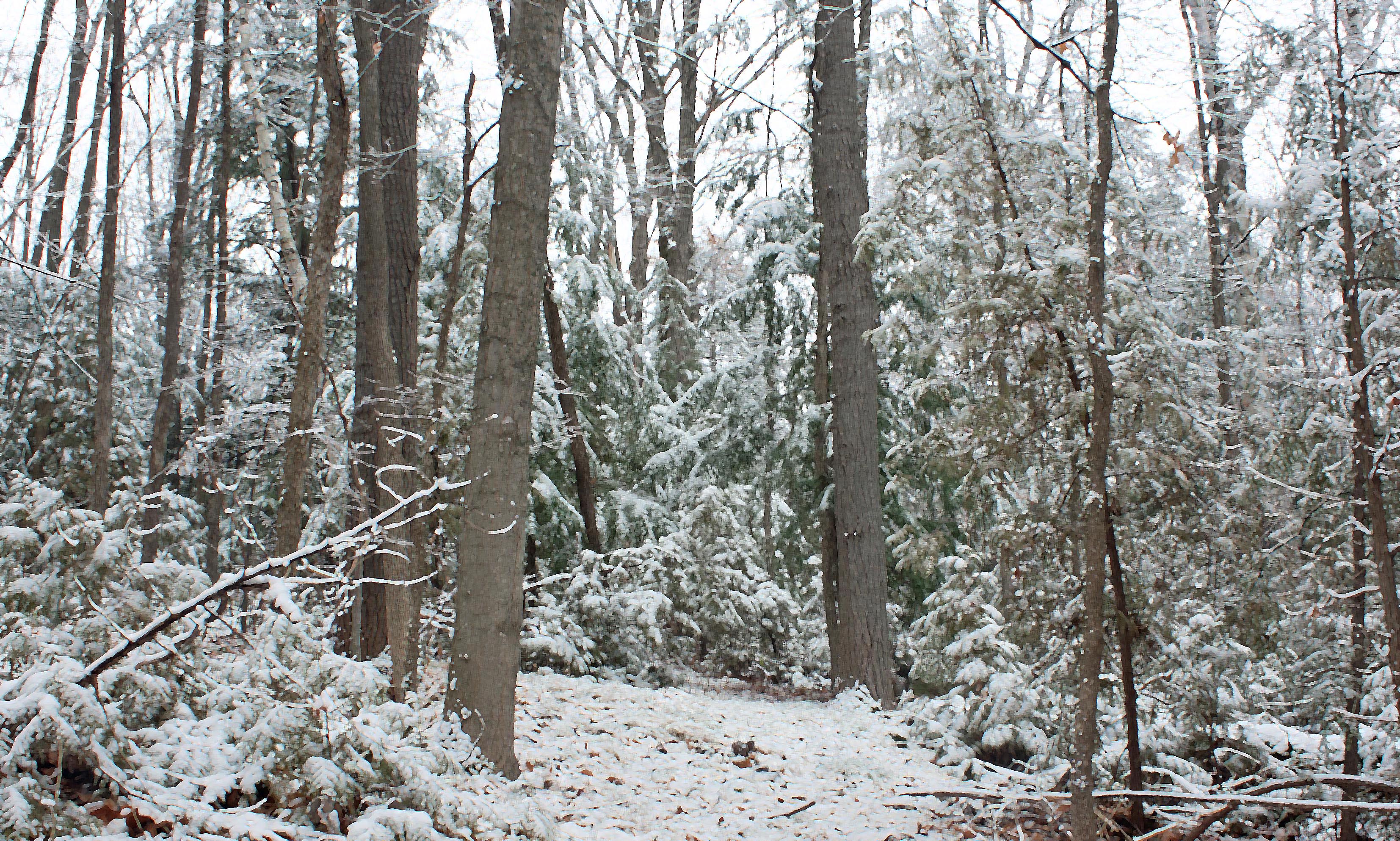
Beech-hemlock forest after a light snow in South Drumlin park, ON (photo and rendition by Nina Munteanu)
As soon as the shift was over, I snatched my gear and rushed off with my camera and tripod and a pack of blueberries to the beech-maple-hemlock forest nearby. The place is called South Drumlin Park, because the forest runs up and down a hogsback with wonderful trails throughout.
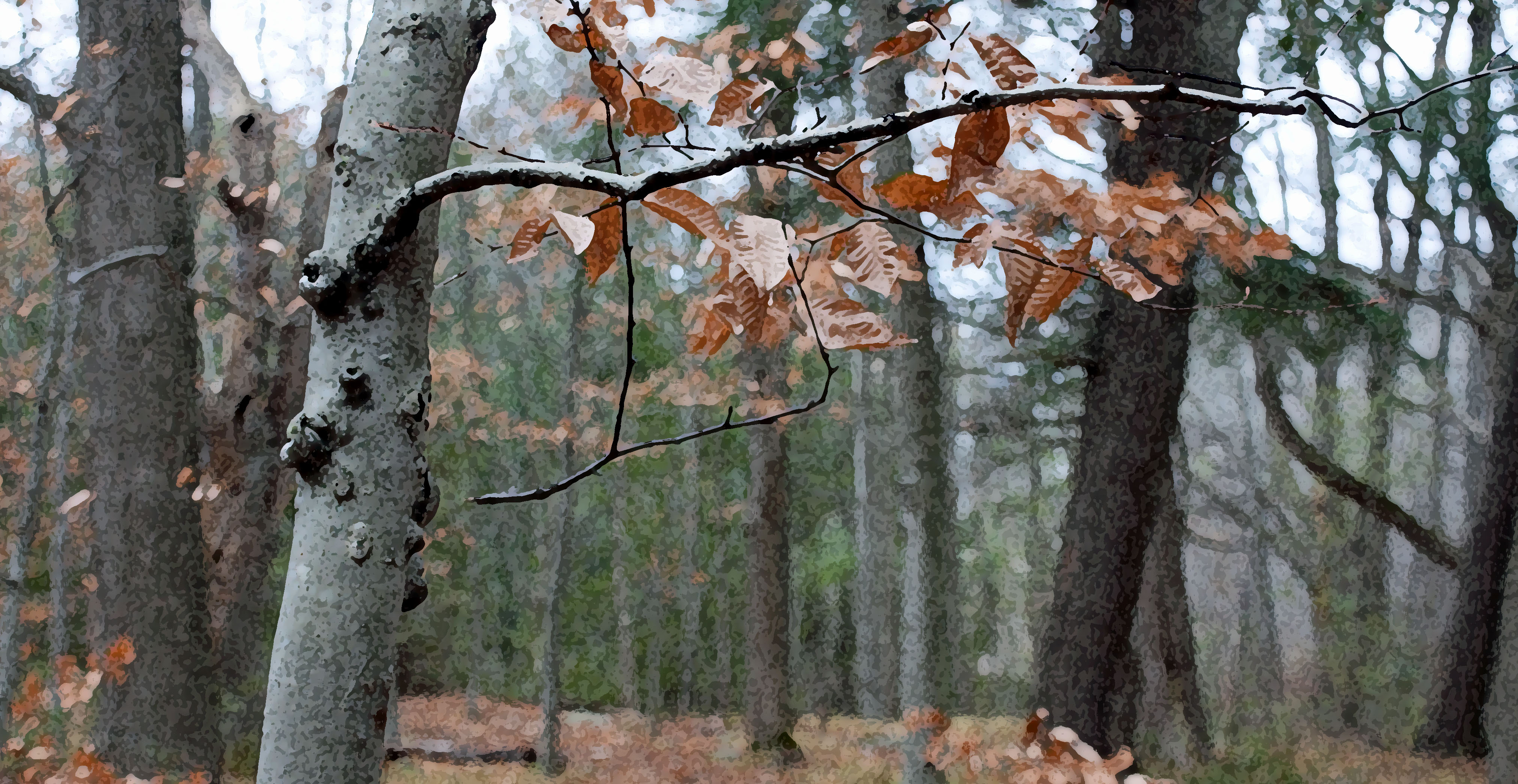
Marcescent beech trees greet me along a trail in South Drumlin park, ON (photo and rendition by Nina Munteanu)
I was the only person there. I walked and crunched through snow and frost-hardened leaf litter and I let myself get lost in the labyrinth of trails through the open winter forest. The pale beech trees, because they keep their now copper-coloured marcescent leaves, stood out amid the bare maples, oaks, poplars and birch trees.
Pale bronze beech leaves light up the dark hemlock forest, South Drumlin park (photo and rendition by Nina Munteanu)
I wandered there for hours, inhaling the peaceful freshness and the quiet hush of gentle snowing in the forest.
There were just a few rowdy red squirrels and one persistent bluejay, but all else lay quiet in the deep of the forest. I had found my magic and mystery … It felt sublime and my heart sang…
Trail through poplars, cedars and hemlocks toward the river, South Drumlin park, ON (photo and rendition by Nina Munteanu)
Nina Munteanu is a Canadian ecologist / limnologist and novelist. She is co-editor of Europa SF and currently teaches writing courses at George Brown College and the University of Toronto. Visit www.ninamunteanu.ca for the latest on her books. Nina’s bilingual “La natura dell’acqua / The Way of Water” was published by Mincione Edizioni in Rome. Her non-fiction book “Water Is…” by Pixl Press (Vancouver) was selected by Margaret Atwood in the New York Times ‘Year in Reading’ and was chosen as the 2017 Summer Read by Water Canada. Her novel “A Diary in the Age of Water” was released by Inanna Publications (Toronto) in June 2020.
I recently returned to southern Ontario from a novel-research trip to the Arctic, where I hope next time to see the incredible northern lights (this recent visit was during their midnight sun period; so, no luck with northern lights). But, in the future I may not have to travel north to see them…
My eco-novel A Diary in the Age of Water begins sometime in the future with Kyo, a blue multi-armed being, living in the dying boreal forest of post-apocalypse Canada; Kyo finds a diary by Lynna Dresden, a limnologist from the calamitous time when climate change ravaged the planet and when the Water Twins destroyed humanity. Yearning for clarity about that holocaust, Kyo reads the diary.
Lynna begins her February 24, 2057 diary entry with a definition of the Aurora Borealis:
“Also called northern lights, this is a natural electrical phenomenon caused by the interaction of electrically charged particles from the sun with the upper atmosphere near the north magnetic pole. It is characterized by the appearance of bands of reddish, greenish, and other coloured lights in the sky that follow the magnetic lines of force. The colours differ based on the type of gas particles that are colliding. The most common colour—a pale yellowish-green—comes from oxygen molecules some sixty miles above the earth. All-red auroras are rare and are associated with high-altitude oxygen, up to two hundred miles high. Nitrogen produces blue or purplish-red aurora.”
A Diary in the Age of Water
Lynna lives with her daughter Hilde in now warm Toronto, in southern Canada, where the northern lights had been up to recently only rarely observed. By 2057, this has changed:
Last night after supper, Hilde and I went for a walk along Shaw to Christie Pits, where I used to play as a kid. She wanted to show me the magnificent aurora borealis that had been streaming dramatically for the past several weeks. When I was a kid, auroras this far south were unheard of. Now they are common. The night sky was clear, and we enjoyed the fresh spring air as we ambled down Shaw Street. We parked ourselves on the damp grass among other spectators of the colourful night sky and watched the dancing light show. It was mesmerizing: ribbons of mostly green and pink light rippled as if tugged by a mischievous wind. They danced with a kind of life that brought me back to my childhood.
Northern lights happen when the magnetic field of our planet is disturbed by the solar wind. As the particles slide along the contours of the Earth’s magnetosphere, they glow as they lose their energy. The particles energize the air molecules enough to make them glow in various colours, depending on the composition of the gases.
Earth’s magnetic field is generated and maintained by an ocean of superheated, swirling metal around a solid iron core. These act like a dynamo to create electrical currents, which, in turn, create our magnetic field. But our magnetic field is weakening, and a flip is imminent. In the past two hundred years, the field has weakened by fifteen percent. That’s why we’re seeing these auroras in Toronto. A weaker field creates more auroras. They’ve become common here, particularly during the winter and spring months. NASA predicts that the field could be gone in five hundred years or less and then take another two hundred years to rebuild.
The field will first become more complex and might show more than two magnetic poles—playing havoc with our navigation systems and God knows what else—until it is entirely gone. Then it will presumably build and align in the opposite direction. When the magnetic field goes, so will our shield against radiation. First, the ozone layer—our shield against ultraviolet rays—will be stripped away, and then the atmosphere may lose other key elements and grow thinner. Will we end up like Mars 4.2 billion years ago, when severe solar storms stole its very atmosphere and evaporated all its water?
Mars once had a strong magnetic field like Earth. But then Mars cooled and its conducting geodynamo stopped rotating. In the absence of the protective field, the solar wind surged in and excited the ions in the upper Martian atmosphere to an escape velocity. The solar wind just swept the air away. The surface pressure of the Martian atmosphere dwindled from one thousand millibars to six millibars. Mars lost about the same atmosphere that Earth has today.
Mars is our destiny; it’s just a question of when. We’re all batteries, running dry. I considered this probable fate for Earth as we watched the exquisite example of our changing magnetic field. But I didn’t share it with Hilde, who watched with her mouth open in rapt wonder. If she’s lucky, she will experience no more of this progression than these amazing auroras. The weakening magnetic field and the associated loss of protection and atmosphere won’t happen for a while. I hope.
I shared none of my thoughts with Hilde.
a Diary in the Age of Water
How Auroras Work
The Aurora Borealis is named after the Roman goddess of the dawn, Aurora, and the Greek name for north wind, Boreas. According to scientists, the colorful and eerie streams of light known as the Aurora Borealis result from “magnetic ropes” that link the Earth’s upper atmosphere to the sun. Solar winds surf them, providing energy for geomagnetic storms and auroras. NASA researchers describe the “ropes” as “a twisted bundle of magnetic fields organized much like the twisted hemp of a mariner’s rope.”
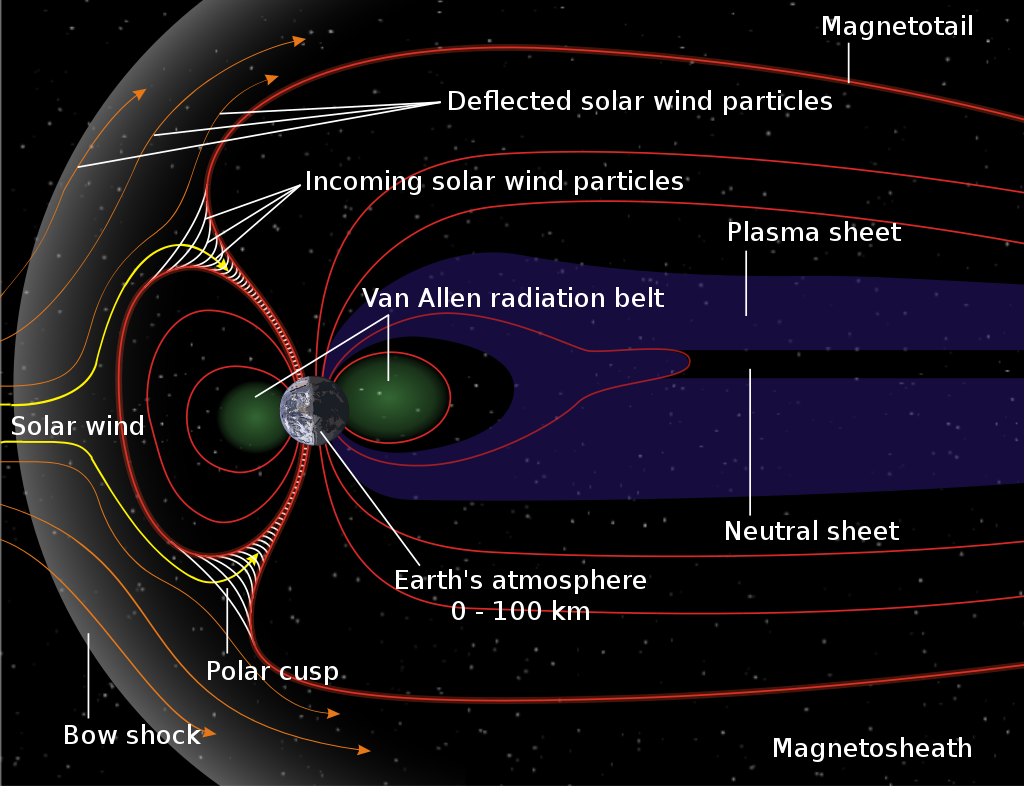
The earth is constantly immersed in the solar wind, a rarefied flow of hot plasma emitted by the sun in all directions. Auroras happen when charged particles from the magnetosphere collide with atoms and molecules of the Earth’s upper atmosphere (at altitudes above 80 km). Most of these particles originate from the sun and arrive in a relatively low-energy solar wind. When the trapped magnetic field of the solar wind is favourably oriented (mostly southwards) it reconnects with the earth’s magnetic field and solar particles then enter the magnetosphere and are swept to the magnetotail. Further magnetic reconnection accelerates the particles towards earth.
Earth’s magnetosphere (image by Wikipedia)
These atmospheric collisions electronically excite atoms and molecules in the upper atmosphere. The excitation energy can be lost by light emission or collisions. Most auroras are green and red emissions from atomic oxygen. Molecular nitrogen and nitrogen ions produce some low level red and very high blue/violet auroras. Typically, an aurora appears either as a diffuse glow or as “curtains” that extend more or less in an east-west direction. Each curtain is made of many parallel rays, each lined up with the local direction of the magnetic field lines, suggesting that aurora are shaped by the earth’s magnetic field.
The earth’s magnetosphere is the space region dominated by its magnetic field. It forms an obstacle in the path of the solar wind, causing it to be diverted around. When the solar wind is “perturbed”, it transfers energy and material into the magnetosphere. The electrons and ions in the magnetosphere that become energized move along the magnetic field lines to the polar regions of the atmosphere.
Auroras have been observed on Jupiter, Saturn, Venus, Mars, Uranus and Neptune. The auroras on the gas giants appear to be powered by the solar wind. In addition, Jupiter’s moons, especially Io, are powerful sources of auroras. These come from electric currents along field lines, generated by a dynamo mechanism due to the relative motion between the rotating planet and the moving moon. Io, which experiences active volcanism and has an ionosphere, is a particularly strong source, and its currents also generate radio emissions.
The passage from A Diary in the Age of Water I quoted from A Diary in the Age of Water was based on current science by NASA and real predictions by scientists. It isn’t so much a question of what, but of when… Who will witness the change in the magnetic pole?
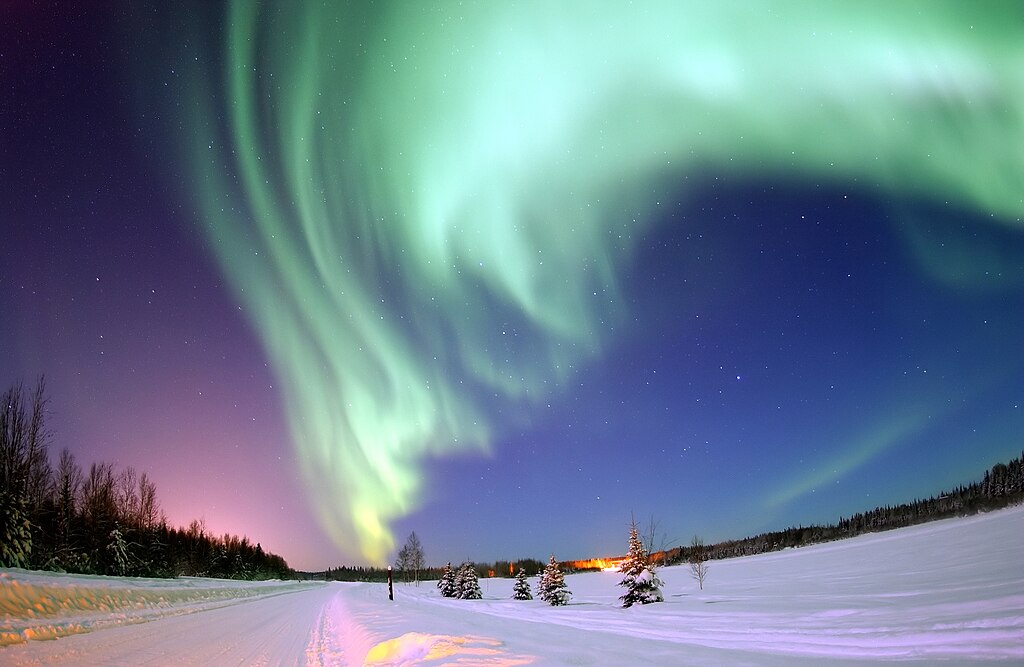
EIELSON AIR FORCE BASE, Alaska. The Aurora Borealis, or Northern Lights, shines above Bear Lake ( photo by Senior Airman Joshua Strang)
Nina Munteanu is a Canadian ecologist / limnologist and novelist. She is co-editor of Europa SF and currently teaches writing courses at George Brown College and the University of Toronto. Visit www.ninamunteanu.ca for the latest on her books. Nina’s bilingual “La natura dell’acqua / The Way of Water” was published by Mincione Edizioni in Rome. Her non-fiction book “Water Is…” by Pixl Press (Vancouver) was selected by Margaret Atwood in the New York Times ‘Year in Reading’ and was chosen as the 2017 Summer Read by Water Canada. Her novel “A Diary in the Age of Water” was released by Inanna Publications (Toronto) in June 2020.
“The slow violence of free-market capitalism isn’t so much the deliberate and focused actions of a few evil men as the accumulated negligence of an undiscriminating collective of unimaginative humans.”
Lynna Dresden
“In her dystopian novel Canadian limnologist Nina Munteanu employs Solar Punk’s technique of using dystopic descriptions of present ecological catastrophe to predict the end of the world as we know it, and to indicate a utopian future.”
THE SONOMA INDEPENDENT
Reflections on a calm Otonabee River, showing old pumphouse, ON (photo and rendition by Nina Munteanu)
The knight in Vivianne’s dream (illustration by Tomislav Tikulin)
If you want to find the secrets of the universe, think in terms of energy, frequency and vibration
Nikola Tesla
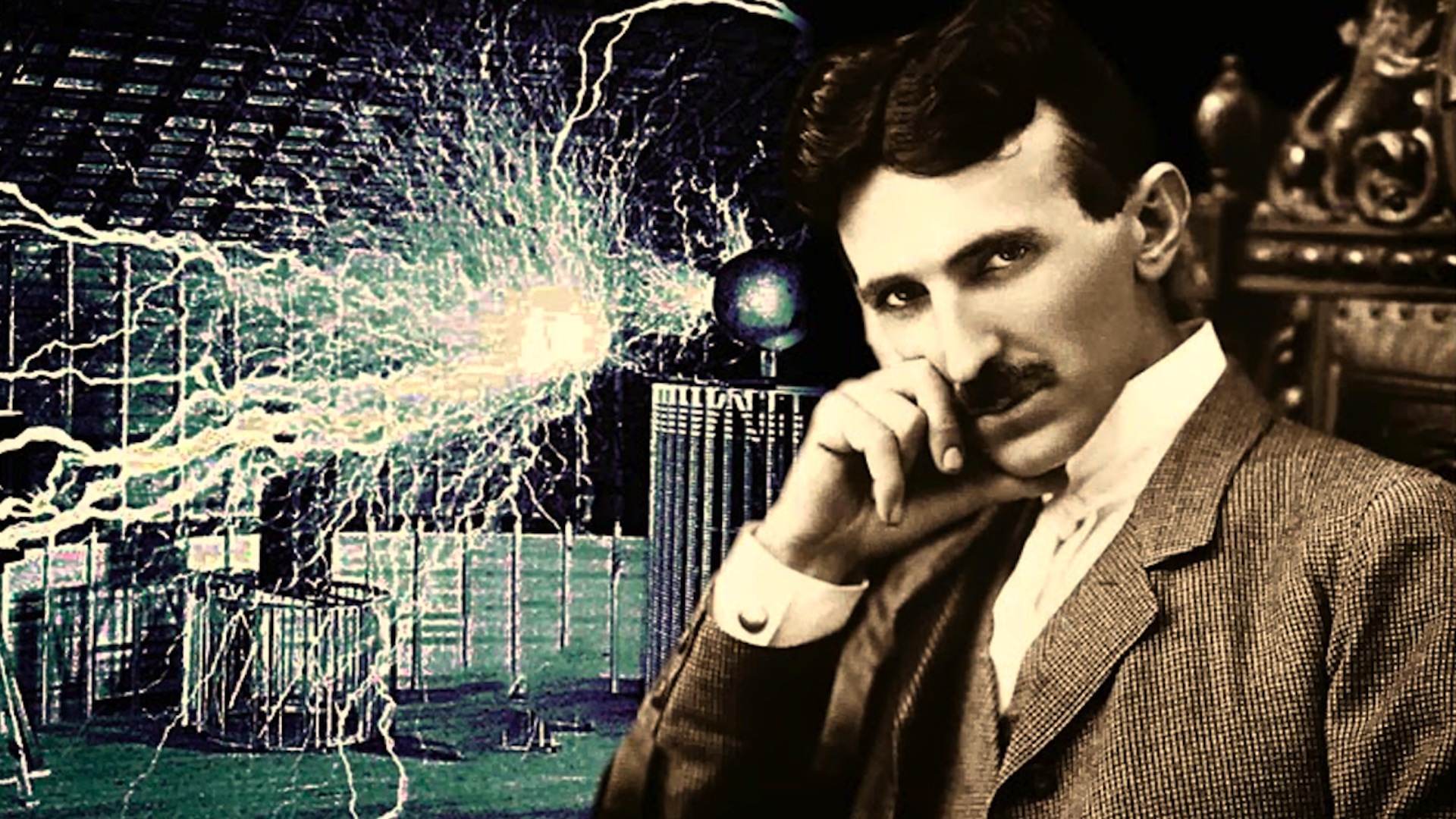
In my historical fantasy The Last Summoner, Vivianne Schön, the Baroness Von Grunwald, travels through time from the 1400s to 1905 to meet Nikola Tesla and make a deal with the eccentric scientist in a bid to make the world a better place:
The Story (excerpt of The Last Summoner)
New York, 1905
VIVIANNE straightened when she glimpsed the elegantly dressed Serbian as he entered Bryant Park. From her bench in the shade of a sycamore tree, she watched him saunter to his favourite bench then sit down and cross his legs. He emitted a somber sigh, pulled out a small notebook from his jacket pocket and began to write. Vivianne studied his long face, straight nose and well groomed mustache. It was an intense face, though worn with reserve. He quelled the fire that burned inside him beneath a shell of enigmatic reflection. He brushed a hand over his thick hair, then set his mouth in a thin line of determined concentration as he hastily sketched something inside the notebook. He didn’t look terribly heartbroken for a man who had just lost his dream, she reflected. But she did recognize disappointment on his furrowed brow. He was used to that, she decided, reviewing his personal history, which had been plagued by rivalry and betrayal for nearly all his life. A visionary of his genius quality was easy fodder for bullying, whether it was schoolmates or the scientific community.
After adjusting her brimmed hat and flowing blue lace gown, Vivianne rose and approached the forty-eight year old Serbian visionary, musing how he would later be called the “Father of the 20th Century”.
She was barely a metre away from him before he looked up, ready to express annoyance at being interrupted. She took pleasure in seeing his expression change from a glower to a startled look of curiosity. She knew she was beautiful, but it was rather delightful to see that she could divert this intense scientist.
“Hello, Mister Tesla,” Vivianne greeted him with a curtsy. “I am the Comptesse d’Anjou at your service. May I join you and sit down?”
He frowned at first then nodded politely with not quite a smile. He was not known for his smiles, she recalled. Tesla rose to his feet and bowed to her but did not offer his hand. She did not press him, knowing of his particular compulsion for avoiding human contact. “Of course you may,” he said with a mild accent and nodded to her in invitation. They both sat down in unison and he added, “To what do I owe this pleasure, Comptesse? Do I know you?”
“No, Mister Tesla.” She smiled with irony. “We have never met—not in person, anyway. But I believe you may be interested in what I have to say.” She paused to take in his curiosity and continued, “Pardon me for what I am about to reveal of your affairs, but I represent the interests of La Banque Internationale du Monde in Geneva, Switzerland—perhaps you know of us—and the law offices of Frankl & Frankl. We are one of the five largest investment banks in the world, dating back to the late 1400s with offices in Amsterdam and Hamburg. We are a private bank who screen for altruistic and environmentally conscious investors. In short, we help finance only those projects that will help make the world a better world.” She paused.
Tesla studied her inquisitively but said nothing.
She smiled internally at his puzzled expression then continued, “We are very interested in your Wardenclyffe Tower in Shoreham, Long Island, and associated global wireless power transmission.”
Tesla slid his notebook back into his jacket pocket and now gave her his full attention. She knew that he’d been trying for years to gain backing for his enigmatic projects with little to no success.
She continued, “You theorized that electrical energy can be transmitted through the earth and the atmosphere…without power lines.”
“Yes, I can light lamps at moderate distances and can detect the transmitted energy at much greater distances. The Wardenclyffe Tower uses a rapidly alternating electrostatic field and was a proof-of-concept for global wireless power trans-mission.”
“Yes, I know.”
He frowned. “But my funding—“
“Yes, I know. Your backers don’t like the idea of unmetered power consumption.”
His face hardened with dark thoughts. “Free electricity isn’t profitable.”
“Least of all to greedy bankers with no vision or faith like J.P. Morgan or John Jacob Astor,” she added. “I know you’ve been in financial trouble with high construction costs since Morgan pulled out last year and encouraged other investors to do the same.”
Her last remark made him stiffen. She was hitting a painful nerve.
“I know about your expired patents and the resulting lack of royalty payments,” she continued. “Within another five to ten years your projects will all be defunk and you will be totally broke. And no one will listen to the ideas that come to you fully formed through visions and dreams.”
He straightened and looked her directly in the eyes. “What do you want of me, Comptesse? Who are you?”
“An ally,” she answered. “I am well aware of your humanitarian pursuits and altruistic nature. I know that you wish simply to make the world a better world. That is my wish also. Energy is and will continue to be one of the most important forces on this earth. Like water, it should be free and available to each and everyone of us. I think you can provide us with that gift and would be happy to as well. Mister Tesla, I want to offer you financial backing at zero percent interest.”
He let loose a humourless laugh. He had finally learned to be cynical about bankers, she thought.
“Make no mistake, Mister Tesla; I expect to become one of the wealthiest people on this planet because of you. But I will gain that wealth only as you gain yours, through a partnership, and not at the expense of others; rather, for the benefit of others. Your wireless technology will help in areas you have yet to imagine: instant global communications and the personal computer; clean energy for homes and industry; laser medicine; robotics; interstellar travel; instant matter transference; even time travel and so much more.”
He was staring at her now. “Who are you, really?”
An angel, she thought to herself. “I’m part of the future, Mister Tesla. A future of your making.” Then without thinking, she held out her hand. “You can call me Vivianne.”
To her delighted surprise, he smiled for the first time. He took her hand then lightly kissed it, as was the custom of most eastern Europeans. “And you can call me Nikola.”
The Man
Nikola Tesla and his experiments with electricity
Nikola Tesla intuited that energy waves in the earth and the atmosphere could be used to transmit power to any point on the globe. He understood that the surface of the Earth, the ionosphere and the atmosphere together form one gigantic electrical circuit—an electrified Gaia, so to speak—and this formed the basis for his work on wireless energy transmission. Tesla was able to transmit power and energy wirelessly over long distances (via transverse waves and longitudinal waves). He transmitted extremely low frequencies (ELF) through the ground and between the Earth’s surface and the Kennelly-Heaviside layer of the ionosphere. Tesla patented wireless transceivers that developed standing waves and it was he who discovered that the resonant frequency of the Earth was about 8 Hz and in the range of the Schumann Resonance or Cavity.
Tesla in his Colorado Springs lab
Modern technology appears to be threatening humanity’s connection with earth’s fundamental frequency and the natural vibrations of Schumann Resonance. Threats include artificial man-made EMF radiation, wireless technology, and high frequency heating microwaves pulsed at 2.45 GHz. Whether we co-evolved with Earth’s natural electromagnetic environment or were created with Divine Intelligence to live in harmony with it, many experts believe that artificial man-made EMF radiation masks the natural beneficial frequency of the Earth and may create an environment that is literally `out of tune’ with Nature itself.
The Book
The Last Summonerby Nina Munteanu is a fresh twist on chaos theory and observer-induced collapse of quantum entanglement. It’s June 14th, 1410, on the eve of the Battle of Grunwald when history records that a ragtag peasant army will slaughter the arrogant monk knights of the imperialistic Teutonic Order … or will they? Because of an impetuous choice, 14-year old Vivianne Schoen, Baroness von Grunwald, makes the startling discovery that she can alter history—but not before she’s branded a witch and must flee through a time-space tear. Now in an alternate present-day France ruled by fascist Black Knights of the ancient Teutonic Order, she must decide how to remake history.
Detail of ‘The Battle of Grunwald’ (painting by Jan Matejko)
“For those in love with science fiction at its best, The Last Summoner is a complex story of ignored responsibilities and their dire consequences, of love and betrayal that span centuries and multiple worlds. Time travel, multiverse travel, immortality, alternate history in which the Nazis have won, not in the twentieth century but way earlier, in the Teutonic age. Angels and mutants, utopias and dystopias, even a Tesla occurrence— everything a science fiction reader could ever desire in a book. A masterfully told story with great characters. Nina Munteanu moves flawlessly from a medieval story to a modern one and everything in between.”
Depiction of fierce Teutonic Knights crusading in the Baltic north during the 13th Century (illustration by Mariusz Kozik)
Nina Munteanu is a Canadian ecologist / limnologist and novelist. She is co-editor of Europa SF and currently teaches writing courses at George Brown College and the University of Toronto. Visit www.ninamunteanu.ca for the latest on her books. Nina’s bilingual “La natura dell’acqua / The Way of Water” was published by Mincione Edizioni in Rome. Her non-fiction book “Water Is…” by Pixl Press (Vancouver) was selected by Margaret Atwood in the New York Times ‘Year in Reading’ and was chosen as the 2017 Summer Read by Water Canada. Her novel “A Diary in the Age of Water” was released by Inanna Publications (Toronto) in June 2020.
McGill University, view from main gate on Rue Sherbrooke (photo by Nina Munteanu)
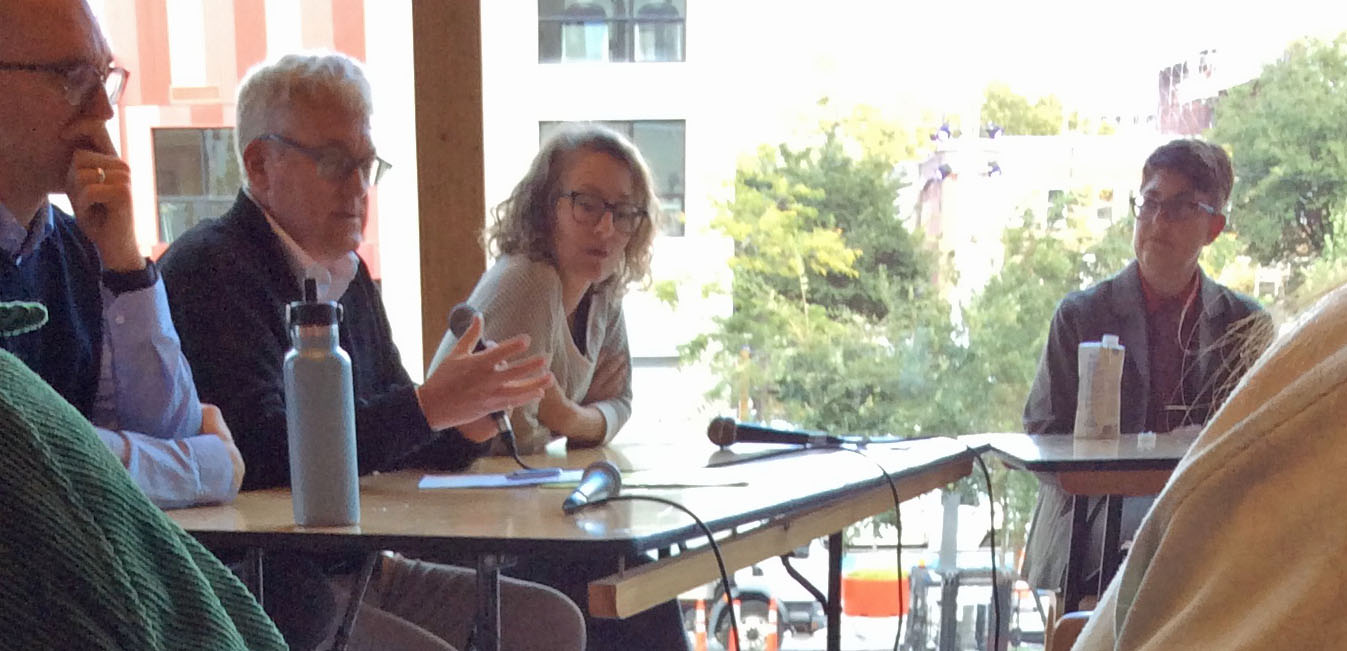
I’ve just returned from Montreal, where I was invited to participate in a two-day conference hosted by McGill University’s Bieler School of Environment at Esplanade Tranquil. Named after Kim Stanley Robinson’s eco-fiction novel New York 2140, the conference brought together a diverse assemblage of scientists, academic researchers, urban planners, speculative fiction writers, artists, and students in a small setting dedicated to encourage cross-pollination of ideas and visions through panels and workshops. I sat on a panel and a roundtable with other writers, urban planners, engineers, scientists and activists to discuss futures through science and story. Much of the event focused on the literary genre called Hopepunk—a sub-genre of Speculative Fiction devoted to optimistic themes of scientific transformation, discovery and empathy. Resulting dialogue explored forms of communication, expression, and ways not just to deal with growing solastalgia, eco-grief, and environmental anxiety but to move forward through action and hope.
Breakout groups in Seeds of Good Anthropocenes Workshop (photo by Nina Munteanu)
McGill faculty in Panel on ‘Turning Research into Hopeful Stories’ (photo by Nina Munteanu)
In the Thursday morning writer’s panel, in which we explored the role of science knowledge and hope in story, I shared the writing process I underwent with my latest published novel A Diary in the Age of Water, which I categorize as a hopeful dystopia (‘Hopeful dystopias’ are much more than an apparent oxymoron; they are in some fundamental way, the spearhead of the future—and ironically often a celebration of human spirit by shining a light through the darkness of disaster):
The main character in A Diary in the Age of Water was a limnologist like me who kept a journal (the diary referenced in the title of the book). This part of the story took place in the near-future when the water crisis and associated climate change phenomena had become calamitous. Being a scientist with so much intimate knowledge of the crisis, the diarist became cynical and lost her faith in humanity. I recall my own journey into despair as I did the research needed to convey the character’s knowledge and situation. I found myself creating a new character (the diarist’s daughter) much in the way a drowning swimmer takes hold of a life-saver, to pull me out of the darkness I’d tumbled into. The daughter’s hopeful nature and faith in humanity pulled both me and the reader out of the darkness. The cynical nature of the diarist came from a sense of being overwhelmed by the largeness of the crisis and froze her with feelings of powerlessness. The diarist’s daughter rose like an underground spring from the darkness by focusing on a single light: her friend and lover who pointed to a way forward. As Greta so aptly said once, “action leads to hope” and hope leads to action. Despite the dire circumstances in the novel, I think of A Diary in the Age of Water as a story of resilience. And ultimately of hope.
I came to the conference as a writer, scientist, mother, and environmental activist. What I discovered was an incredible solidarity with a group so diverse in culture, disciplines, expression and language—and yet so singularly united. It was heartwarming. Hopeful. And necessary. This conference ultimately felt like a lifeline to a world of possibilities.
Organizers brought in a wide variety of talent, skill, and interest and challenged everyone through well-run workshops to think, feel, discover, discuss, collaborate and express. Workshops, panels, and multimedia art incited co-participation with all attendees in imaginative and fun ways. On-site lunches and drinks helped keep everyone together and provided further space for interaction and discussion.
Student-led break out group discussing ways to transform eco-emotions into hope (photo by Nina Munteanu)
At every turn, I made contacts across disciplines and interests and had stimulating and meaningful conversations. I discovered many hopeful ‘stories’ of Montreal and elsewhere on hopeful visions and endeavors. These included “Seeds of good Anthropocenes” (small ground-rooted projects and initiatives aimed at shaping a future that is just, prosperous, and sustainable); turning scientific research into hopeful stories; and world building as resistance. I talked with artistic creators, students doing masters in Hopepunk literature and co-panelists on all manner of subjects from urban encampments, greening and rewilding Montreal, to how Rachel Carson’s Silent Spring informed a main character in Liu Cixin’s novel The Three Body Problem.
Creating visual art via MAPP (photo by Nina Munteanu)
Marc-Olivier Lamothe stands next to a MAPP projection (photo by Nina Munteanu)
Conversations often led to an acknowledgement of art as an effective means of expression and creative therapy in the context of the climate crisis. I met creatives such as Marc-Olivier Lamothe and his colleagues at MAPP and had the chance to experiment first hand with his creative tools. I had wonderful discussions with storytelling visual artist Alina Gutierrez Mejia of Visual Versa, whose evolving mural of each day’s events was truly mesmerizing to watch—and rather revealing.
Alina Gutierrez Mejia creates a visual representation of the day’s conference (photo by Nina Munteanu)
In future, I’ll post more on these and other creatives I encountered at the conference.
Program for Montreal 2140
THURSDAY morning began with an introduction by BDE Director Frédéric Fabry.
This was followed by a panel entitled Hopeful Stories Across Science and Fiction, in which I participated, along with fellow writers Su J. Sokol (author of Zee), Alyx Dellamonica (author of Gamechanger), Rich Larson (author of Annex and Ymir), Genevieve Blouin (author of Le mouroir des anges) and Andrea Renaud Simard (author of Les Tisseurs). The panel was moderated by McGill geographer Renee Sieber and McGill urban planner Lisa Bornstein.
After lunch, a panel entitled Faculty Workshop: Turning Research into Hopeful Stories was moderated by McGill researcher Kevin Manaugh and Annalee Newitz (journalist and author of Four Lost Cities). McGill researchers included: Caroline Wagner (bioengineering), Hillary Kaell (anthropology and religious studies); Jim Nicell (civil engineering); Sébastien Jodoin (law); and Michael Hendricks (biology).
McGill students who lead the workshop on Hope and the Future stand with one of the conference organizers Daniel Lukes (photo by Nina Munteanu)
The faculty panel was followed by the Student Workshop, Hope and the Future, led by McGill students Tom Nakasako, Rachel Barker, Tatum Hillier, and Lydia Lepki.
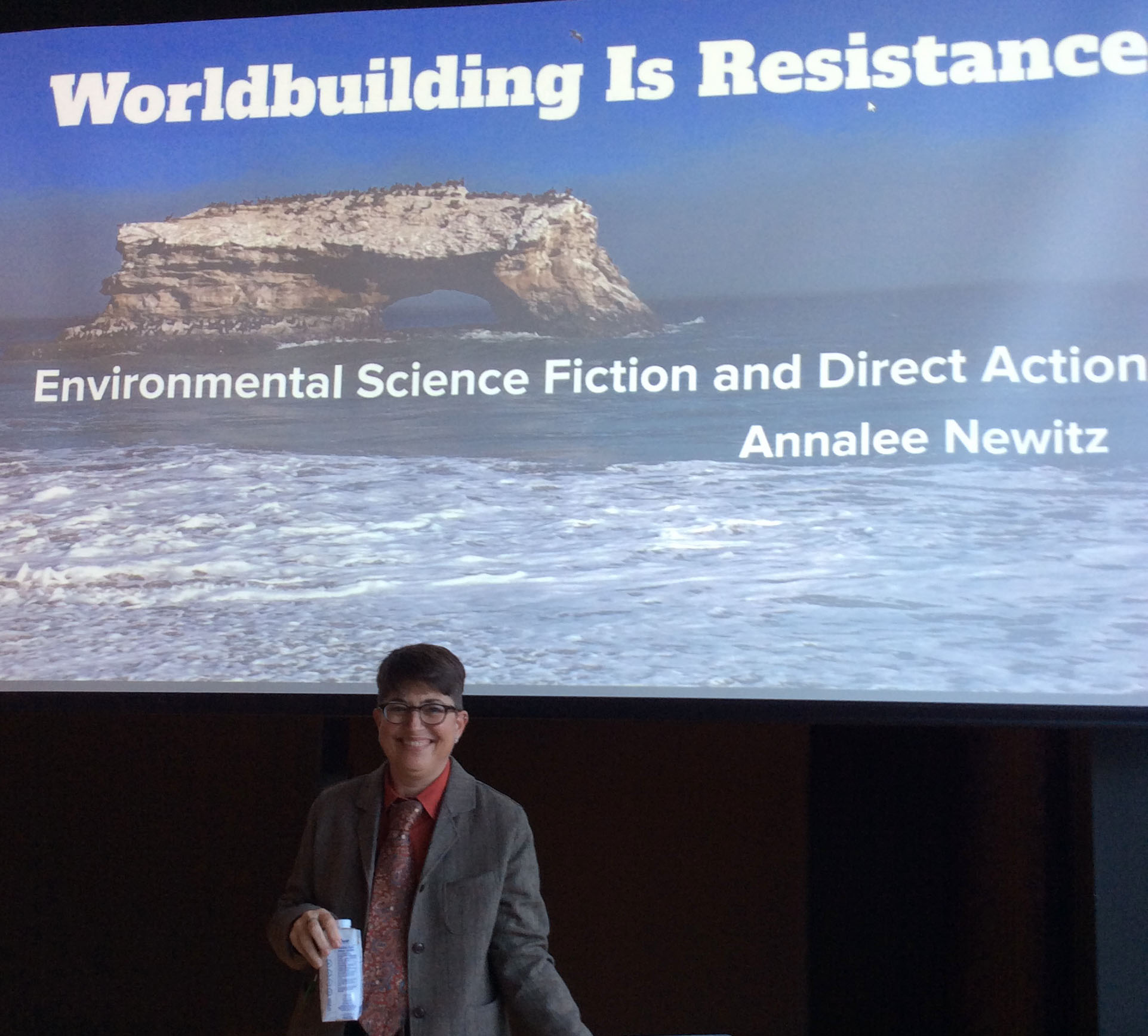
Annalee Newitz gives her keynote (photo by Nina Munteanu)
Annalee Newitz closed the day with their keynote presentation Worldbuilding Is Resistance that explored the dystopia binary of environmental science fiction. A theme to which the next keynote by Kim Stanley Robinson would touch on as well.
Elson Galang presenting Seeds workshop (photo by Nina Munteanu)
FRIDAY morning started with Elson Galang and Elena Bennett (McGill University), who led the Seeds of Good Anthropocenes Workshop, which introduced the concept of seeds programs then further explored through breakout discussion groups they moderated.
This was followed by faculty-led Teaching and Learning for Hopeful Futures Workshop, in which McGill instructors from varied disciplines (including education, political science, environment, urban planning and planetary sciences) discussed translating science into hopeful narratives.
pre-meet on Zoom of participants of the Roundtable
I then participated in a roundtable of authors, scholars, researchers and planners entitled Telling the Story of the Future, moderated by Chris Barrington-Leigh (McGill BSE/Health and Social Policy). The roundtable included fellow authors Alyx Dellamonica and Su J. Sokol. Other participants of the roundtable included Stephanie Posthumus (languages, literatures, cultures at McGill), Jayne Engle (public policy at McGill) Richard Sheamur (urban planning at McGill), and limnologist Irene Gregory-Eaves (biology at McGill).
BDE Director Frédéric Fabry introduces the conference (photo by Nina Munteanu)
The final keynote was given by Kim Stanley Robinson (author of New York 2140 and The Ministry of the Future).
Storyboard of the first day of the conference by Visual Versa (photo by Nina Munteanu)
Nina Munteanu is a Canadian ecologist / limnologist and novelist. She is co-editor of Europa SF and currently teaches writing courses at George Brown College and the University of Toronto. Visit www.ninamunteanu.ca for the latest on her books. Nina’s bilingual “La natura dell’acqua / The Way of Water” was published by Mincione Edizioni in Rome. Her non-fiction book “Water Is…” by Pixl Press (Vancouver) was selected by Margaret Atwood in the New York Times ‘Year in Reading’ and was chosen as the 2017 Summer Read by Water Canada. Her novel “A Diary in the Age of Water” was released by Inanna Publications (Toronto) in June 2020.