Crossing into the Ecotone to Write Meaningful Eco-Fiction

If you have an apple and I have an apple and we exchange apples then you and I will still each have one apple. But if you have an idea and I have an idea and we exchange these ideas, then each of us will have two ideas.”—George Bernard Shaw

At Calgary’s When Words Collide some years ago, I moderated a panel on Eco-Fiction with publisher/writer Hayden Trenholm, and writers Michael J. Martineck, Sarah Kades, and Susan Forest. The panel was well attended; panelists and audience discussed and argued what eco-fiction was, its role in literature and storytelling generally, and even some of the risks of identifying a work as eco-fiction.

Someone in the audience brought up the notion that “awareness-guided perception” may suggest an increase of ecological awareness in literature when it is more that readers are just noticing what was always there. Authors agreed and pointed out that environmental fiction has been written for years and it is only now—partly with the genesis of the term eco-fiction—that the “character” and significance of environment is being acknowledged beyond its metaphor; for its actual value. It may also be that the metaphoric symbols of environment in certain classics are being “retooled” through our current awareness much in the same way that Aldous Huxley’s Brave New World or George Orwell’s Nineteen Eighty Four are being re-interpreted—and newly appreciated— in today’s world of pervasive surveillance and bio-engineering.

I would submit that if we are noticing it more, we are also writing it more. Artists are cultural leaders and reporters, after all. I shared my own experience in the science fiction classes I was teaching at UofT and George Brown College, in which I noted a trend of increasing “eco-fiction” in the works in progress that students were bringing in to workshop in class. Students were not aware that they were writing eco-fiction, but they were indeed writing it.

I started branding my writing as eco-fiction a few years ago. Prior to that—even though my stories were strongly driven by an ecological premise and strong environmental setting—I described them as science fiction and many as technological thrillers. Environment’s role remained subtle and—at times—insidious. Climate change. Water shortage. Environmental disease. A city’s collapse. War. I’ve used these as backdrops to explore relationships, values (such as honour and loyalty), philosophies, moralities, ethics, and agencies of action. The stuff of storytelling.

Environment, and ecological characteristics were less “theme” than “character,” with which the protagonist and major characters related in important ways.

Just as Bong Joon-Ho’s 2014 science fiction movie Snowpiercer wasn’t so much about climate change as it was about exploring class struggle, the capitalist decadence of entitlement, disrespect and prejudice through the premise of climate catastrophe. Though, one could argue that these form a closed loop of cause and effect (and responsibility).

The self-contained closed ecosystem of the Snowpiercer train is maintained by an ordered social system, imposed by a stony militia. Those at the front of the train enjoy privileges and luxurious living conditions, though most drown in a debauched drug stupor; those at the back live on next to nothing and must resort to savage means to survive. Revolution brews from the back, lead by Curtis Everett (Chris Evans), a man whose two intact arms suggest he hasn’t done his part to serve the community yet.

Minister Mason (Tilda Swinton), an imperious yet simpering figure who serves the ruling class without quite being part of it, reminds the lower class that: 

We must all of us on this train of life remain in our allotted station. We must each of us occupy our preordained particular position. Would you wear a shoe on your head? Of course you wouldn’t wear a shoe on your head. A shoe doesn’t belong on your head. A shoe belongs on your foot. A hat belongs on your head. I am a hat. You are a shoe. I belong on the head. You belong on the foot. Yes? So it is.  In the beginning, order was prescribed by your ticket: First Class, Economy, and freeloaders like you…Now, as in the beginning, I belong to the front. You belong to the tail. When the foot seeks the place of the head, the sacred line is crossed. Know your place. Keep your place. Be a shoe.”

Ecotones are places where “lines are crossed,” where barriers are breached, where “words collide” and new opportunities arise. Sometimes from calamity. Sometimes from tragedy. Sometimes from serendipity.

When environment shapes a story as archetype—hero, victim, trickster, shadow or shape shifter—we get strong eco-fiction. Good eco-fiction, like any good story, explores the choices we make and the consequences of those choices. Good eco-fiction ventures into the ecotone of overlap, collision, exchange and ultimate change.

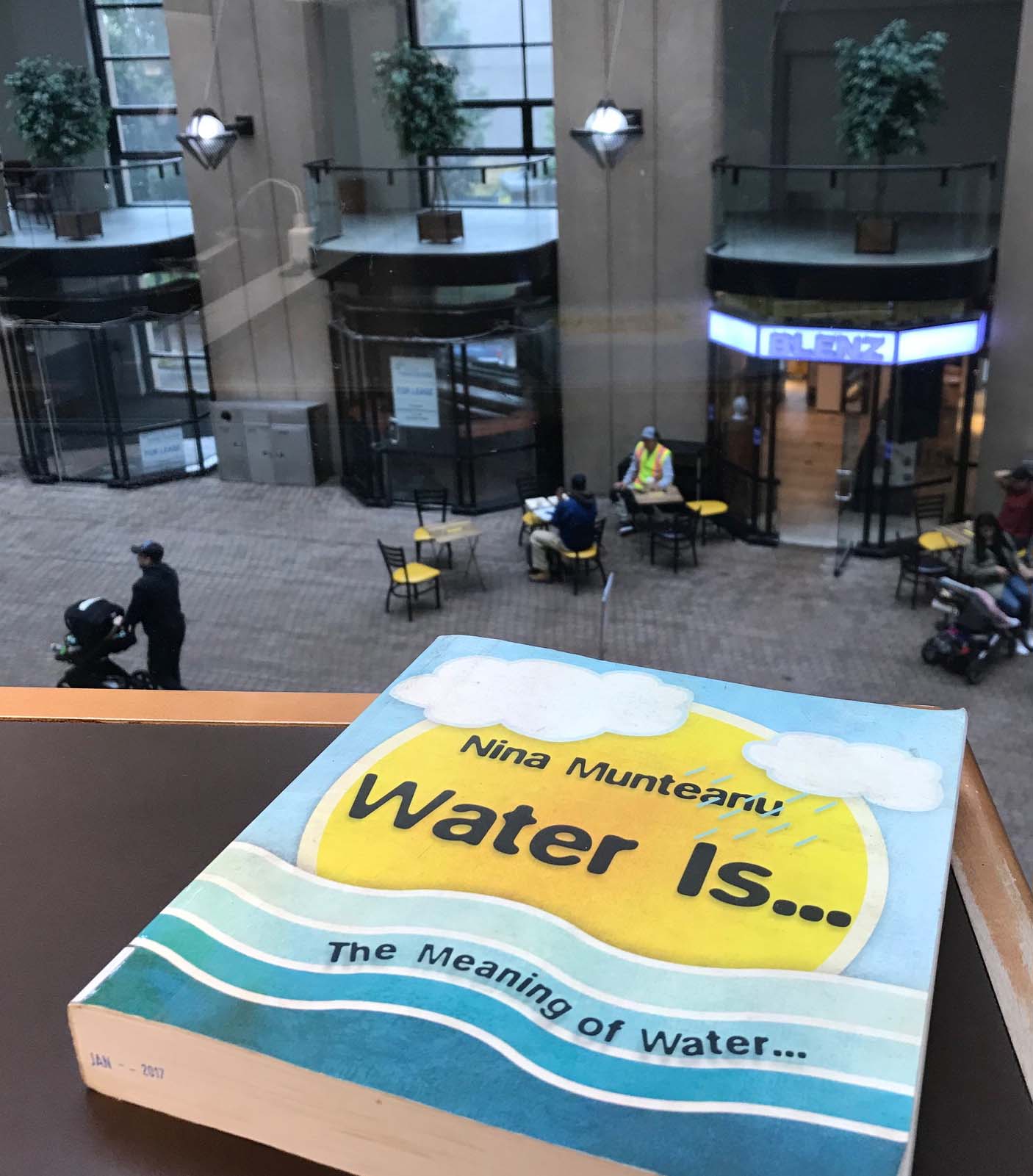
In my non-fiction book Water Is… I define an ecotone as the transition zone between two overlapping systems. It is essentially where two communities exchange information and integrate. Ecotones typically support varied and rich communities, representing a boiling pot of two colliding worlds. An estuary—where fresh water meets salt water. The edge of a forest with a meadow. The shoreline of a lake or pond.

For me, this is a fitting metaphor for life, given that the big choices we must face usually involve a collision of ideas, beliefs, lifestyles or worldviews: these often prove to enrich our lives the most for having gone through them. Evolution (any significant change) doesn’t happen within a stable system; adaptation and growth occur only when stable systems come together, disturb the equilibrium, and create opportunity. Good social examples include a close friendship or a marriage in which the process of “I” and “you” becomes a dynamic “we” (the ecotone) through exchange and reciprocation. Another version of Bernard Shaw’s quote, above, by the Missouri Pacific Agriculture Development Bulletin reads: “You have an idea. I have an idea. We swap. Now, you have two ideas and so do I. Both are richer. What you gave you have. What you got I did not lose. This is cooperation.” This is ecotone.

I think we are seeing more eco-fiction out there because ecosystems, ecology and environment are becoming more integral to story: as characters in their own right. I think we are seeing more eco-fiction out there because we are ready to see it. Just as quantum physics emerged when it did and not sooner, an idea—a thought—crystalizes when we are ready for it.

Don’t stay a shoe … go find an ecotone. Then write about it.

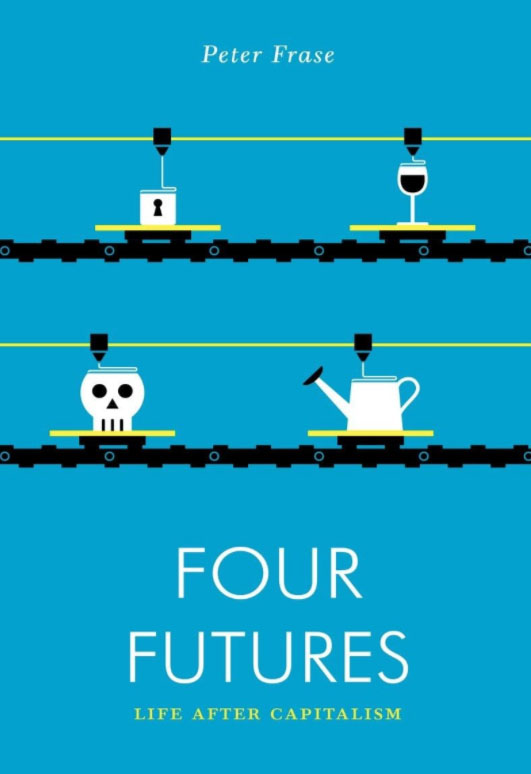
Thirty-Six Eco-Fiction Books Worth Reading…

Nina Munteanu is a Canadian ecologist / limnologist and novelist. She is co-editor of Europa SF and currently teaches writing courses at George Brown College and the University of Toronto. Visit www.ninamunteanu.ca for the latest on her books. Nina’s bilingual “La natura dell’acqua / The Way of Water” was published by Mincione Edizioni in Rome. Her non-fiction book “Water Is…” by Pixl Press (Vancouver) was selected by Margaret Atwood in the New York Times ‘Year in Reading’ and was chosen as the 2017 Summer Read by Water Canada. Her novel “A Diary in the Age of Water” was released by Inanna Publications (Toronto) in June 2020.

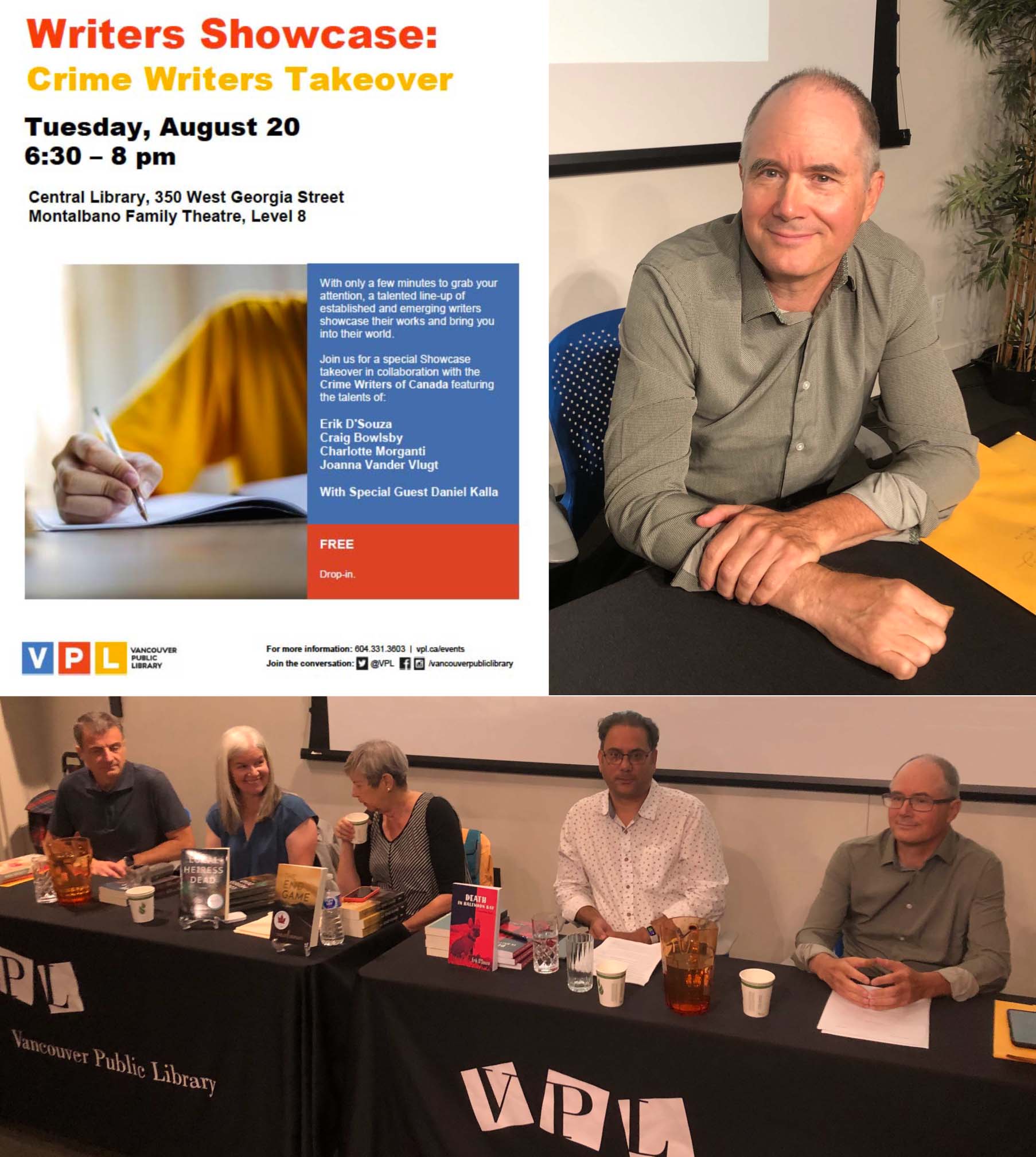
Vancouver’s Craig H. Bowlsby wins his second Crime Writers of Canada Award of Excellence in two years.

My good friend author Craig Bowlsby just won the Crime Writers of Canada Award of Excellence for Best Unpublished Crime Novel manuscript.

Requiem for a Lotus takes place in 1917 Shanghai, where police detective Harmon Fletcher must solve the murder of a Chinese sing-song girl he’d failed to protect. Adding his Canadian prairie hunting experience to modern forensic techniques, Fletcher scours Shanghai’s dangerous jig-saw underworld for answers. But while he brings one killer to justice, another escapes, and Fletcher must sacrifice more than he expected before he’s done.

Here’s the opening to Requiem for a Lotus:

“When a man named Hong Song Lin shot his neighbour five times for blowing roasted pig smoke onto his second floor balcony, it wasn’t a hard case to figure out. There was two angry men, a gun, and a hot Shanghai summer.”

The judges selected Craig’s novel for its excellent writing and storytelling, a tense and compelling plot and pace, and intriguing characters:

“… What enjoyable reading! The author quickly pulls the reader into 1917 Shanghai and pins them there with its smells, sights, customs and politics … A very engaging crime novel.”

“… Loved the historical setting of Shanghai and it kept me fascinated … Inspector Fletcher is a solid and clever character, a somewhat rougher Sherlock Holmes.”

Requiem for a Lotus is the first novel of a trilogy. I’m confident that this exciting crime novel and series will be snapped up by a publisher soon. And when it is, I’ll be buying a copy.

Here’s Craig’s podcast interview with CWC interviewer Erik D’Souza when the manuscript was a finalist before it won top prize:

Last year Craig’s short story “The Girl Who Was Only Three Quarters Dead,” published by Mystery Magazine in April 2022, won the Crime Writers of Canada Award for Best Short Story.

Nina Munteanu is a Canadian ecologist / limnologist and novelist. She is co-editor of Europa SF and currently teaches writing courses at George Brown College and the University of Toronto. Visit www.ninamunteanu.ca for the latest on her books. Nina’s bilingual “La natura dell’acqua / The Way of Water” was published by Mincione Edizioni in Rome. Her non-fiction book “Water Is…” by Pixl Press (Vancouver) was selected by Margaret Atwood in the New York Times ‘Year in Reading’ and was chosen as the 2017 Summer Read by Water Canada. Her novel “A Diary in the Age of Water” was released by Inanna Publications (Toronto) in June 2020.

When Art Helps Story

No writer works alone. Sure, we may work alone when writing, but all other aspects of getting our writing out to you, the reader, involves a team of other people. Like all good things, writing is a collaborative affair. All professional writers enter a contract with their publisher to work with editors, marketers, and also with cover artists, designers and interior artists. All together create the final artistic expression shared with the reading audience.

I want to focus on the latter here and celebrate how art and design help create more than what the writer alone produces. When my writing career started in earnest in 1995 with my first publication in a professional magazine, I was involved in collaborations with artists, who all improved my work.

Arc of Time was my first short story publication, appearing in Armchair Aesthete in the Summer/Fall issue of 2002. Armchair Aesthete is a small literary magazine in the United States and features funky cover art.

Magazine cover for Ultra! and interior design for “Arc of Time”

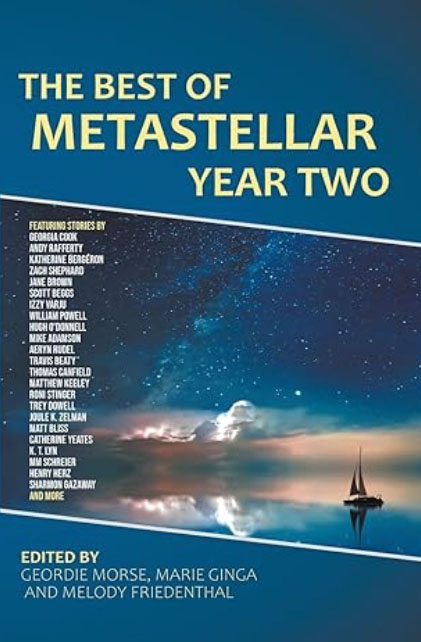
Arc of Time was then accepted in the premiere issue of Ultra! (Aardwolf Publications) in 2004. That issue contained a fully illustrated and designed interior, which really set off the story—an epistemological exchange of emails linked with narrative. In 2013, MetaStellar Speculative Fiction and Beyond, which provides illustrations for each story it carries, used one of my own photographs to illustrate Arc of Time.

Feature cover illustration for “Arc of Time” on MetaStellar site

Virtually Yours first appeared in Hadrosaur Tales in Issue #15 in December 2002. Hadrosaur Tales is a small but vibrant literary magazine out of Las Cruces, New Mexico and featured interesting covers.

Cover and story illustrations in Nowa Fantastyka for “Virtually Yours”

Virtually Yours was republished all over the world and is up to its tenth publication this year. Several publications included artwork specifically for the story. Nowa Fantastyka, out of Poland, is a slick magazine that boasts a lot of images, colour interiors and illustrations. My story was introduced with illustrations that enhanced its impact.

Interior illustrations for “Virtually Yours” in Amazing Stories and MetaStellar, respectively

Its reprint in Amazing Stories was illustrated evocatively by Duncan Long. In the story’s later reprint in MetaStellar Speculative Fiction and Beyond, Brigitte Werner created a beautiful illustration for the story.

Nowa Fantastyka cover art and story art for “A Butterfly in Peking”

A Butterfly in Peking first appeared in Issue #17 of Chiaroscuro in 2003. Its reprint in the Polish magazine Nowa Fantastyka in 2005 included interior art that introduced the tone and feel of the story.

Megan Survival Anthology cover art and story art for “Fingal’s Cave”

Fingal’s Cave was first published in The Megan Survival Anthology (Reality Skimming Press) in December 2016. The publication included art by Jeff Doten specific to each story in the anthology and I found his artwork for Fingal’s Cave wonderfully intriguing.

Artwork for “The Way of Water” in various publications

The Way of Water was first published in Future Fiction then in a smart print publication by Mincione Edizioni in Rome, Italy in May 2016. The story was reprinted several times and artwork associated with it included in some of the publications. One is Little Blue Marble, an online magazine that features artwork for each story it runs.

Cover art of Eagle Magazine and story art for “Natural Selection”

Natural Selection first came out in my short story collection of the same name in 2013. It was then reprinted in the premiere issue of Eagle Magazine and featured stellar and evocative interior illustrations by Ionuț Bănuță.

Interior story art for “Natural Selection”

Out of the Silence first appeared in Issue #85 of subTerrain Magazine in May 2020 and featured diverse and rich interior art and design (not pictured here). Its reprint in A House of Dawn in 2021 received its own artwork, which enhanced the tone and subject of the story.

Cover art for subTerrain Magazine and story art for “Out of the Silence” in A House of Dawn

I’d be remiss if I didn’t add the important artwork of artists on the covers of several of my novels and collections. As a reader, I can attest that cover art plays an important role in introducing a book to a potential reader. Whether we pick up a new author’s book to peruse depends upon the image, title and design of the cover. I have been very fortunate with my publishers and their artists.

Book covers for “Collision with Paradise” and “The Cypol”

My first published novel (Collision with Paradise) and novella (The Cypol)—both SF erotica—were designed to intrigue and titillate.

Costi Gurgu illustrated and designed the covers of my space detective thriller The Splintered Universe Trilogy for Starfire. The three books and their covers, formed a tryptic that reflected the journey of the lead character—a badass galactic detective—and her evolution.

Cover art for books of “The Splintered Universe” Trilogy

Costi Gurgu also designed the cover of my short story collection Natural Selection for Pixl Press in 2013 using an illustration by West Coast artist Anne Moody that showed the fluidity of nature.

Tikulin-illustrated covers for “Darwin’s Paradox” and “The Last Summoner”

Tomislav Tikulin illustrated the cover of my novel Darwin’s Paradox for Dragon Moon Press in 2007. The cover image ostensibly represented a work of hard science fiction and attracted much attention from SF fans. Tikulin’s evocative illustration of a knight in a drowning cathedral was then used for the cover of The Last Summoner for Starfire, with attractive typology design by Costi Gurgu. As with all of Tikulin’s work, this mysterious cover attracted the attention of many readers with many questions.

L’Ultima Evocatrice, a novella version of The Last Summoner in Italian was illustrated and designed for Delos Digital Publications in 2021 and draws the reader into the intrigue of the story.

My most recent novel, A Diary in the Age of Water, published by Inanna Publications in 2020, features elegant cover art by Val Fullard and over thirty pieces of interior art work by my own hand.

Interior art representing the diarist’s sketches in “A Diary in the Age of Water

I wasn’t sure if the publisher would agree to use my sketches, but she did, to my surprised delight. She agreed with me that the interior illustrations, which represent sketches by the scientist diarist, lend a tangible reality to the story and a further focus of interest.

Interior art representing the diarist’s sketches in “A Diary in the Age of Water
Interior art representing the diarist’s sketches in “A Diary in the Age of Water”

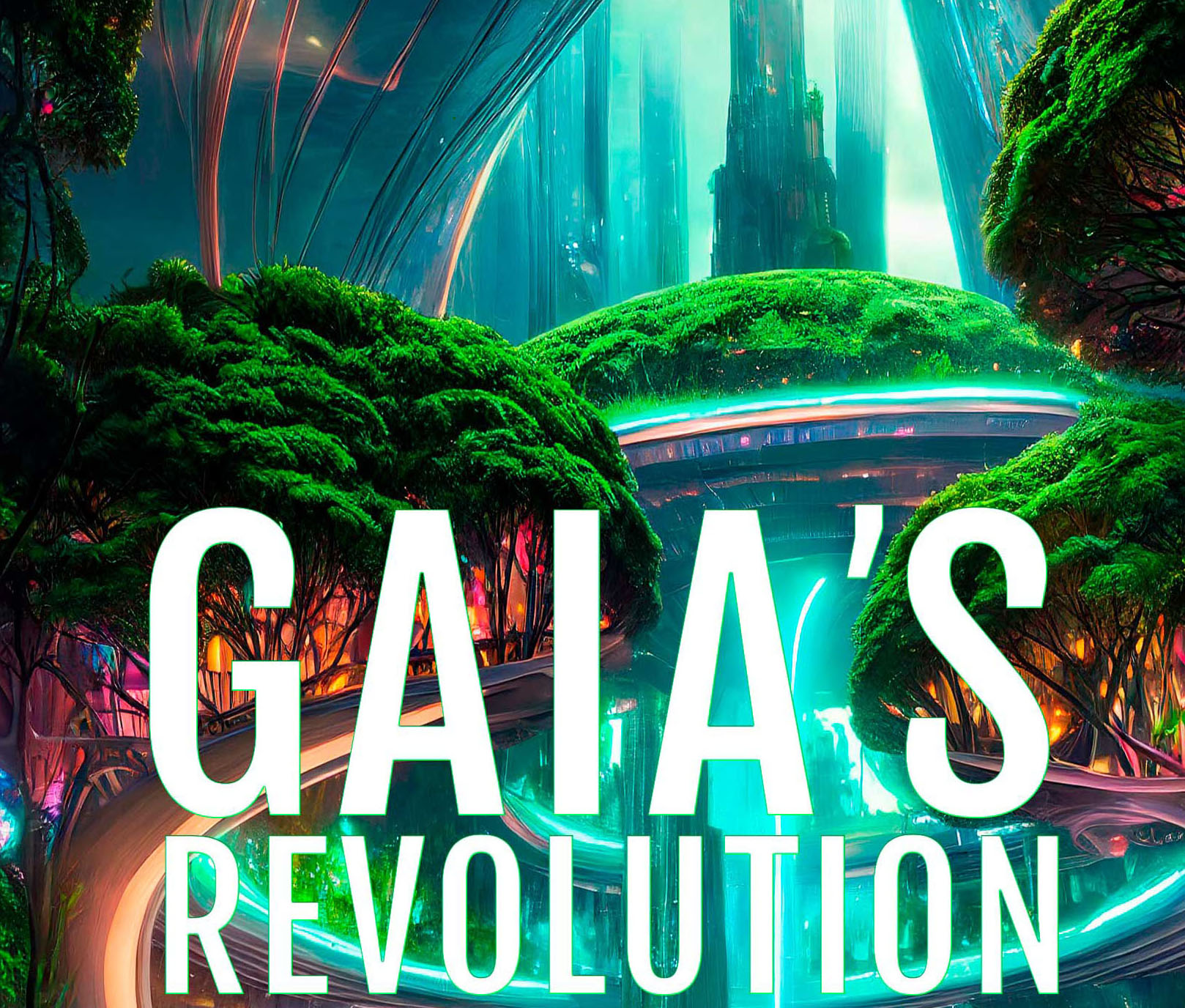
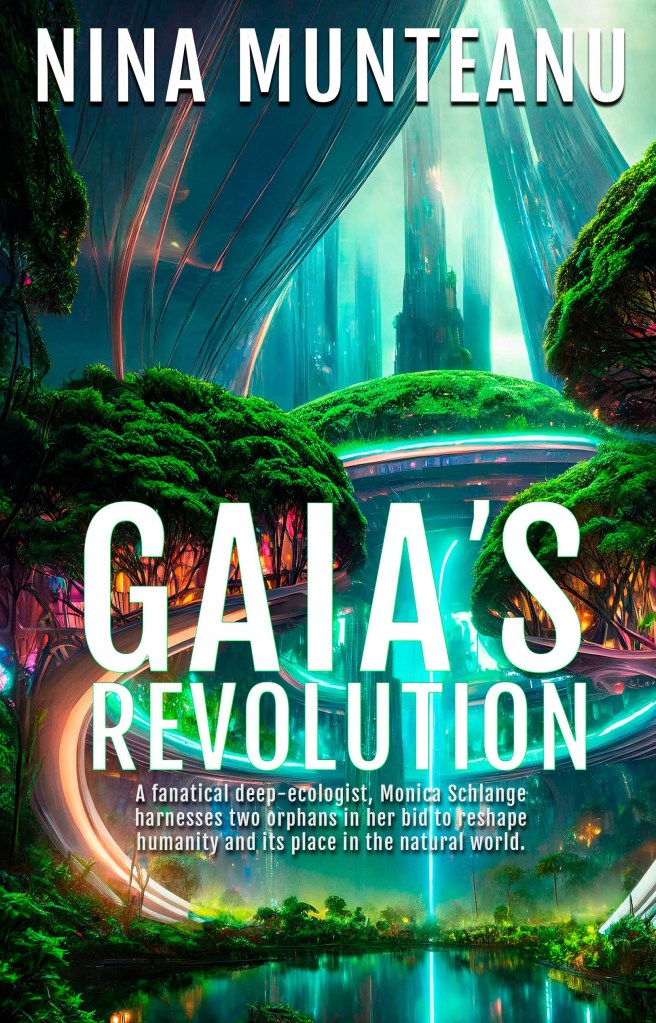
The excitement never ends for me as a writer … With the newest installation to the Icaria Series imminent, Dragon Moon Press will be re-issuing Darwin’s Paradox and Angel of Chaos, along with the newest addition Gaia’s Revolution along with new covers and interiors. I can’t wait to see what Dragon Moon Press comes up with! …

Cover art of print publications my work has appeared in up to 2021-end

Nina Munteanu is a Canadian ecologist / limnologist and novelist. She is co-editor of Europa SF and currently teaches writing courses at George Brown College and the University of Toronto. Visit www.ninamunteanu.ca for the latest on her books. Nina’s bilingual “La natura dell’acqua / The Way of Water” was published by Mincione Edizioni in Rome. Her non-fiction book “Water Is…” by Pixl Press (Vancouver) was selected by Margaret Atwood in the New York Times ‘Year in Reading’ and was chosen as the 2017 Summer Read by Water Canada. Her novel “A Diary in the Age of Water” was released by Inanna Publications (Toronto) in June 2020.

The Magic of the Muse: When A Simple Rewrite Reveals Synchronicity

It started with a simple tweet of mine on X regarding doing research for one’s writing projects. I’d met Isabella Mori a few years ago, when we both contributed to an ekphrastic anthology of flash fiction, inspired by Group of Seven art. We met again when she submitted a story to an anthology I was editing for Exile Editions. After my tweet on research, Isabella and I traded brief stories about rewrites based on research findings and ‘mistakes’ and the arcane revelations in the creative process that may result. I was intrigued by her recounting and asked her to share it with you; so here it is:

“Synchronicities And The Sea” by Isabella Mori

(Trigger warning: Substance use and suicide)

This is about the magic that comes to pass when we let the Muse guide our work and consent to synchronicity. Here is what happened:

When I go away on vacation, I try to visit the local library, and always make sure to check out the community announcements. On one of those forays, I came across a notice of a project that teamed up visual artists with writers for a short story or poem. I love these types of collaborations and immediately jumped on it. Max was the artist I paired up with, and we hit it off right away. After a few conversations, we settled on the painting below, for which I was going to write a story. As you can see, it had a moody, dark feeling. I drafted this text as a response:

The memory of a map showed her the way as she wandered, blinded by the night, along the shore. Numb with cold, her bare feet dug into the wet sand. She could not see that she left no tracks. There was something in her searching; she felt it in the deep pit of her stomach but there was no image in her mind’s eye of what it was, no tinkling that alerted her, no smell, no taste. A sense of despair drained the blood from her heart and tugged at her from the right, where the forest rushed. Foot-dragging ennui invited her onto a soft-moss carpet to the left, and thoughts of numbers, cars and cash register receipts tried to wrangle her back to where she came from. She was near giving up. But at that precise moment there tracked the light only she of the searching could see—a light bigger more forceful than giants could ever imagine; all-embracing, all-revealing, all-nurturing just like the frothy ocean beneath it, just like the sand with its fierce sparkle, each grain a diamond just like the heart-bud that could not help but open under its rays, under those rays that only she of the searching could see.

However, for reasons we have both forgotten, Max decided to lighten the colours, and the dark mood of the first draft didn’t fit anymore. This is the version we ended up with:

Walk With The Angels

The ocean has known her share of angels over the eons. They come and go but the tide is older. When an angel appears in a cloud of glistening light, beats its wings and brings out the trumpets, little humans fall to their knees and beg for mercy and miracles.

But the water stays still.

Great mother ocean has seen it all.

She waits until the angel grows tired, then she takes the worn-out wings and heavenly body into her arms and carries them into her depths. Brings the apparition to visit kelp, salmon, starfish, barnacles, otters and crabs. Anemones. Killer whales. A visit one by one, under the summer sun, beneath the light of the Hunter’s moon, when the snow falls, with the Easter rains. The angel leaves a bit of themselves here, a bit there, a gift everywhere, until only the tiniest of diamonds are left.

And that’s the sand.

Walk with the angels.

There were a few tweaks before we arrived at this text, the major one being that in a previous version, I referred to ‘angel dust’ for the sand until the editor pointed out that that term refers to a street drug, PCP. In my enthusiasm I had forgotten that.

The change away from ‘angel dust’ was very important. When Max read the new version, they called me, their tone of voice both moved and perturbed.

“When I read this,” they said, “it feels like you channeled what happened with my cousin last year, not far from the place that inspired my painting. She had had problems with drugs all her life, and one day she just walked into the ocean. Her body was found a day later.”

Under those circumstances, we definitely did not want to refer to drugs.

That story stayed with me for months until one day when I was listening to one of my playlists of Latin music. I lived in Paraguay and Chile 1977-1980, and often enjoy the nostalgia of the music I listened to back then. The first song that came on was one of my all-time favourites, Alfonsina Y El Mar – Alfonsina And The Sea. Now I have to confess, I am terrible with lyrics, no matter what language, whether it be my native German, English, or the Spanish I was fluent in for quite a few years. For some reason, I really listened to the song last summer, and then looked up the lyrics. That’s when it hit me – was it possible that the lyrics of that song had subconsciously influenced me to write the second text? Or was it one of those Jungian collective conscious moments?

Alfonsina And The Sea

(Music: Ariel Ramirez. Lyrics: Felix Luna)

In the soft sand
Licked by the sea
Her small footprints
Don’t return.
Just one path
Full of pain and silence
Led to the water,
Deep water,
And one single path of unspoken pain
Led to the foam.

God knows what sorrows accompanied you,
What old suffering shut down your voice
That made you lie down and nestle into the songs
Of the sea snails,
The song that sings in the deep dark of the sea,
The sea snail.

There you go, Alfonsina, with your loneliness,
What new poems did you go find?
An old, old voice of wind and salt
Sways your soul and carries it
And you go there dreaming,
Sleeping, Alfonsina, clothed in the sea

Five little sirens will carry you
Through passages of algae and corals
And glowing sea horses will dance
Around you
And all the creatures of the sea will soon
Play at your side.

Turn down the light a little more,
Nurse, let me sleep in peace.
And when he calls tell him I’m not in,
Tell him Alfonsina won’t come back.
And when he calls don’t ever tell him I’m in,
Tell him I’m gone.

There you go, Alfonsina, with your loneliness,
What new poems did you go find?
An old, old voice of wind and salt
Sways your soul and carries it
And you go there dreaming,
Sleeping, Alfonsina, clothed in the sea.

(Used with permission, my translation.)

Alfonsina ended up in the ocean just like Max’s cousin did.  

With some research, I found out that the story was about the Argentinian poet Alfonsina Storni who, after a difficult life that included poverty, questions she had about gender identity, and breast cancer, one night wrote a last poem to her son and then let herself fall into the ocean amid torrential rain. (An  apocryphal version has her just walk into the ocean, and that’s the one the lyricist chose.) Some of that last poem was incorporated into Alfonsina Y El Mar – the nurse who is asked to lower the light, and told to tell ‘him’ that she won’t come back. Nobody seems to know who ‘he’ is.

The other research that had to happen was to find who the inheritors of Felix Luna’s estate were to obtain permission should I tell the story that you have before you. It turned out to be his daughters. Then I had to sleuth out their contact.

Felix Luna, the lyricist, imagined Alfonsina’s death not only as the terrible tragedy that it was but also as a mystical transformation into a sea creature that nestles into the songs of the sea snails. She finds new poems and sleeps clothed in the sea. She is embraced by sirens and wanders through algae and corals. She dances with sea horses and plays with all the other sea creatures.

I definitely cannot compare myself with a great poet like Felix Luna but notice with humility the similarities of my transformed angel who sinks into the embrace of mother ocean and also visits the more-than-humans of the sea.

I went pregnant with the idea of writing about the experience of Max’s and my collaboration for half a year when in February, I chanced upon a tweet by Nina about research for writing. I met Nina through submitting a story to an anthology she was editing. I told her about needing to tweak the angel story so that it does not talk about angel dust and ended up telling her the outline of what happened. She invited me to write a guest post about this, and here we are.

So many synchronicities. I could have not gone to that library. A different artist could have been paired up with me. Max could have wanted to stay with the original painting. Or they could have chosen a painting that would not have reminded them of their cousin. They could have opted not to share that sad story with me, or they could have been paired up with someone who doesn’t understand suicide as intimately as I do (I look back on a 30+ year career in social services.) I could have heard Alfonsina Y El Mar and still not really listened to the lyrics. There was no guarantee I could have managed to find out from whom to get permission to quote the song. I could not have submitted a story to one of Nina’s anthologies, and could not have followed her on Twitter. Coming across the particular tweet that prompted the publication of this story was like chancing upon a needle in a haystack. All this, and probably more, had to come together for this magical synchronicity to happen.

Thank you, Muse.

(Note: Since this is a sensitive topic, the artist’s name and some of the circumstances of my collaboration with them have been changed. However, the artist has consented to using their images.)

Boat wharf at sunset in Ladner Marsh, BC (photo and rendition by Nina Munteanu)

Isabella Mori writes fiction, poetry and nonfiction, and is the author of three books of and about poetry, including A bagful of haiku – 87 imperfections. Isabella’s work has appeared in publications such as State Of Matter,  KingfisherSigns Of LifePresence, and The Group Of Seven Reimagined. Isabella is the founder of Muriel’s Journey Poetry Prize, which celebrates socially engaged poetry. A book about mental health and addiction is planned for publication with Three Ocean Press in 2024. They live on the unceded, traditional and ancestral lands of the Musqueam, Squamish and Tsleil-Waututh people aka Vancouver, BC.

“Robin’s Last Song” at Climate Imaginarium in New York City’s Governor’s Island

Governor’s Island, NYC

My short story Robin’s Last Song was selected by the NYC Climate Writers Collective as part of an exhibition in the Climate Imaginarium on Governors Island in New York. The exhibition, starting May 18, will run throughout the summer of 2024.

Robin’s Last Song

Robin’s Last Song first appeared in the #128 Issue of Apex Magazine in 2021. It tells the story of Robin, a blind elder whose digital app failed to warn the world of the sudden global loss of birds with disastrous ecological consequences. After years of living in self-exile and getting around poorly on sight-enhancing technology, a discovery gives her new hope in rekindling her talents in the field of Soundscape Ecology.

In a recent interview with writer Simon Rose, I described my thoughts in writing Robin’s Last Song:

I wanted to make “Robin’s Last Song” a realizable work of fiction in which science and technology play both instigator of disaster and purveyor of salvation. Our biogenetic technology comes to us as a double-edged sword in the form of gene-editing, proteomics, DNA origami, and CRISPR—just to name a few. These biotechnological innovations promise a cornucopia of enhancements: from increased longevity and health in humans to giant disease-resistant crops. But, for every ‘magic’ in technology, there is often unintended consequence. Unforeseen—or even ignored—casualties and risks. I suppose my ultimate question with this story is: will synthetic biology redesign Nature to suit hubris or serve evolution? Science doesn’t make those decisions. We do.

You can read my interview with Rebecca E. Treasure at Apex Magazine (where Robin’s Last Song first appeared) about the greater implications of the story and my other eco-fiction. You can also read the story on Metastellar Speculative Fiction and Beyond.

Climate Imaginarium

Anyone living in or visiting the NYC area is welcome to the Climate Imaginarium launch on May 18 on Governor’s Island. Check this Eventbrite link for details. The exhibition will continue throughout the summer of 2024 and will include: climate storytelling and poetry by Climate Café, the Sixth Festival, and the Climate Writers Collective; opening exhibition of “What is Environmental Art?” by Forest for Trees; artwork from the Climate Imaginarium community and Climate Writers exhibition; “Eye of Flora” virtual reality exhibition by Synphisica Collective; and more.

Here’s what they say:

Come to Governors Island for the grand opening of our Climate Imaginarium house! The Climate Imaginarium will serve as a community center for climate and culture, with galleries and spaces for exhibitions, performances, film screenings, and events that respond to the climate crisis with solutions and visions for hope and justice. Join us at Building 406A on Colonels Row for a lively celebration of climate art, storytelling, and community.

Exhibitions will be open to the public at noon, and the party will officially start at 2pm. All donations will support programming in our community space.

Nina Munteanu is a Canadian ecologist / limnologist and novelist. She is co-editor of Europa SF and currently teaches writing courses at George Brown College and the University of Toronto. Visit www.ninamunteanu.ca for the latest on her books. Nina’s bilingual “La natura dell’acqua / The Way of Water” was published by Mincione Edizioni in Rome. Her non-fiction book “Water Is…” by Pixl Press (Vancouver) was selected by Margaret Atwood in the New York Times ‘Year in Reading’ and was chosen as the 2017 Summer Read by Water Canada. Her novel “A Diary in the Age of Water” was released by Inanna Publications (Toronto) in June 2020.
The A to Z of Writing Fiction: X, Y, Z…

Snowy marsh in spring, ON (photo and rendition by Nina Munteanu)

In this series of articles, I draw from key excerpts of my textbook on how to write fiction The Fiction Writer: Get Published, Write Now! whose 26 chapters go from A to Z on the key aspects of writing good and meaningful fiction.

X is for Use eXceptional Language … but Don’t Overdo it

What makes some writing stunning and other writing lackluster? Mostly, it’s the language—the words—you use. And, it isn’t just what words you use; it’s how you use them. Here are a few things you need to consider when translating your work into something that sings:

  • Use active verbs and reduce modifiers: many writers, not just beginners, slide into the pattern of using passive and weak verbs (e.g., were, was, being, etc.). Then they add a modifier to strengthen it. It doesn’t. Actively look for strong, vivid verbs. This is a key to good writing. I can’t emphasize this enough.
  • Avoid using excessive prose: novice writers often use too many words to describe an event, action or scene. An overabundance of words slows down the story and obscures plot and action.
  • Use alliteration, metaphor, simile, personification (but don’t overuse): these devices bring lyricism and cadence and powerful imagery to your prose. However, as with anything powerful, you need to use these judiciously. Use them where you wish to convey a strong image and to punctuate your prose.
  • Be mindful of word-accuracy: more often than you might think, a writer inadvertently misuses a word to convey an idea or emotion.
  • Read your writing aloud & punctuate your pauses. Reading out loud helps define cadence, tone and pace of your prose and streamlines your writing. When you read aloud, pay attention to where you naturally pause. You may wish to put in a comma, semi-colon or period there.
  • Size your paragraphs: paragraphs are visual elements that help people read; they break up text on a page in logical places to provide white space for reader ease. This is one of the reasons some passages are harder to read than others; long paragraphs are more tiring to the eye. Find those logical breaks and put them in.
  • Size your sentences: as with paragraphs, overly long sentences can try a reader’s patience and you may lose them entirely. Too many short choppy sentences can also reduce your prose to a mundane level. Varying your sentence length in a paragraph creates the lyricism and cadence that makes prose enjoyable to read.

Y is for Yesterday, Today, and Tomorrow

Have you taken the time to consider tense in your story? While most stories are told in the past tense (e.g., Vinnie ran out of the house), I’ve seen many written in the present tense (e.g., Vinnie runs out of the house). You see the latter more in literary and esoteric works, where the immediacy and dream-like quality of present tense is in keeping with the kind of story being told. I write mostly genre fiction (e.g., science fiction, SF thrillers, historical fantasy, etc.) where the story-telling is normally fast-paced. These read better in the past tense. Stories which follow a more reflective tone can be quite powerful in the present tense.

In her series The Dragon Quartet, Marjorie B. Kellogg alternates from past tense to present tense as she hops from one protagonist’s point of view to the other’s. This deliberate shift in tense between sections works very well. The key is that she is consistent.

In the manuscripts that I read for novice writers I often find what I call uncontrolled shifting of tense within a sentence or paragraph. OWL provides these hints:

  • Use past tense to narrate events and to refer to ideas as historical entities.
  • Use present tense to state facts, to refer to perpetual or habitual actions, and to discuss your own ideas or those expressed by an author in a particular work; also to describe action in a literary work, movie, or other fictional narrative.
  • Future action may be expressed in a variety of ways, including the use of will, shall, is going to, are about to, tomorrow and other adverbs of time, and a wide range of contextual cues.

Z is for The Zen of Passionate Writing

Ralph Keyes, author of The Courage to Write, admits that “what makes writing so scary is the perpetual vulnerability of the writer. It’s not the writing as such that provokes our fear so much as other people’s reaction to our writing.” In fact, adds Keyes, “the most common disguise is fear of them, their opinion of us, when it’s actually our own opinion of ourselves that we’re worried about.” Keyes suggests that ultimately “mastering techniques [of style and craft] will do far less to improve writing than finding the will, the nerve, the guts to put on paper what you really want to say.”

Welcome to the threshold of your career as a writer. This is where many aspiring writers stop: in abject fear, not just of failure but of success. The only difference between those that don’t and those that do, is that the former come to terms with their fears, in fact learn to use them as a barometer to what is important. How do you get past the fear of being exposed, past the anticipated disappointment of peers, past the terror of success? The answer is passion. If you are writing about something you are passionate about, you will find the courage to see it through.

This is ultimately what drives a writer to not just write but to publish: the need to share one’s story, over and over again. Some of us only have one story we need to tell (Margaret Mitchell only needed to tell one, Gone With the Wind); others of us have many to tell. Either way, what is key here is that to prevail, persist, and ultimately succeed, a writer must have conviction and believe in his or her writing. You must believe that you have something to say that others want to read. Ask yourself why you are a writer. Your answer might surprise you.

The first step is to acknowledge your passion and own it. Flaunt it, even. Find your conviction, define what matters and explore it to the fullest. You will find that such an acknowledgement will give you the strength and fortitude to persist and persevere, particularly in the face of those fears. Use the fears to guide you into that journey of personal truths. Frederick Busch described it this way: “You go to dark places so that you can get there, steal the trophy and get out.”

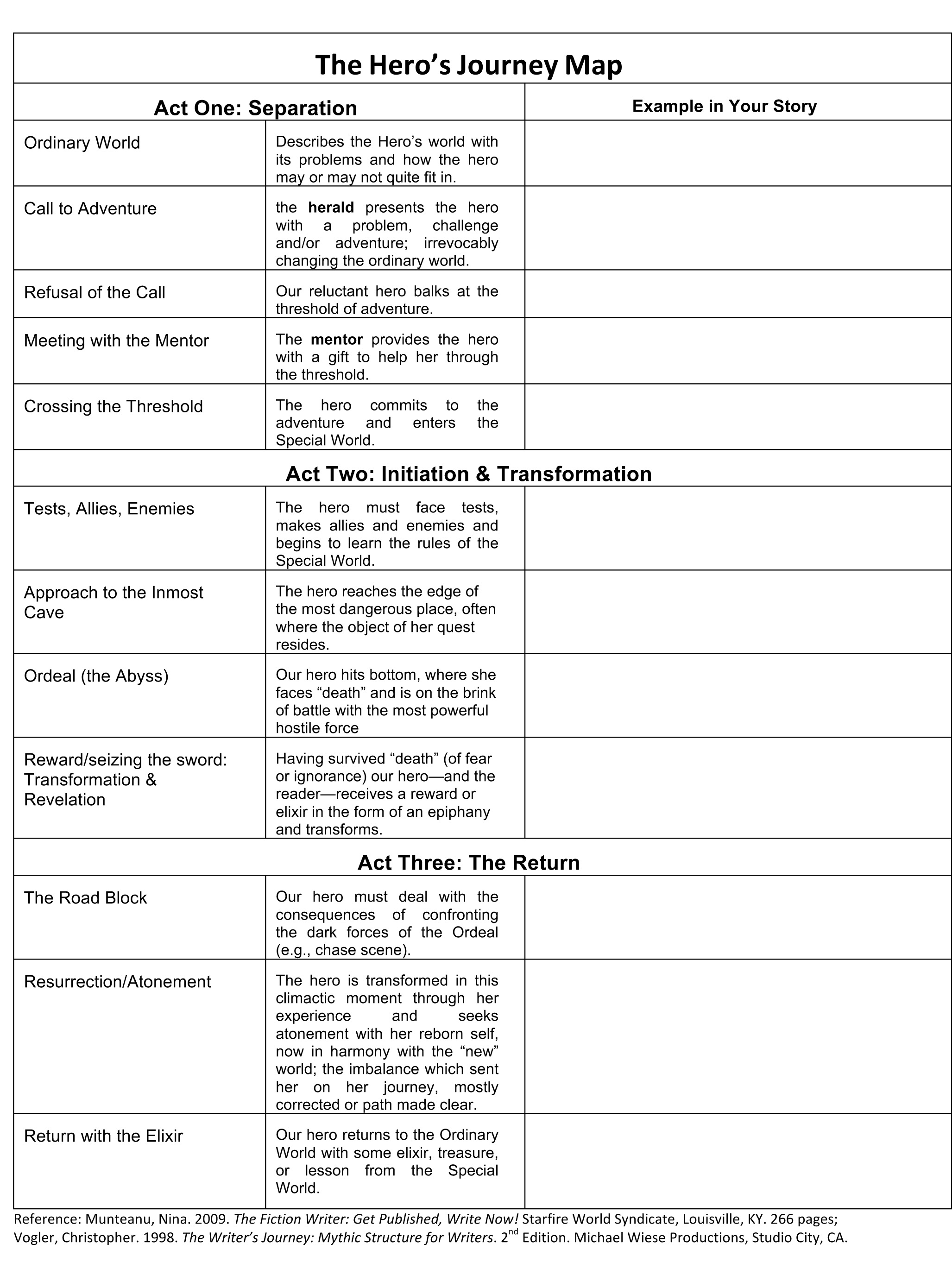
Every writer, like her protagonist, is on a Hero’s Journey. Like the Hero of our epic, we too must acknowledge the call, pass the threshold guardian, experience the abyss and face the beast before we can return “home” with our prize.

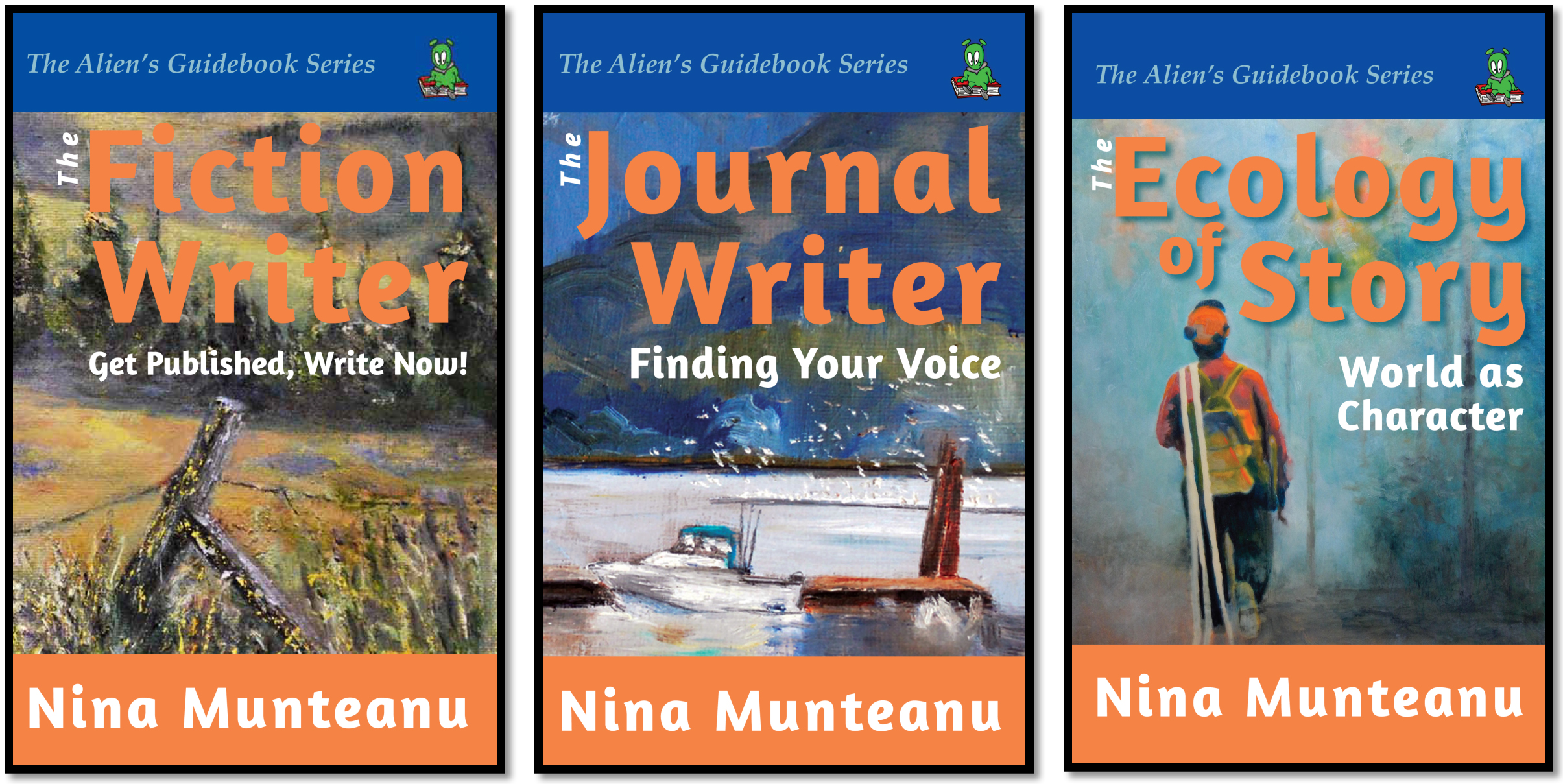
The Fiction Writer: Get Published, Write Now! (Starfire World Syndicate) May 2009. Nominated for an Aurora Prix Award. Available through Chapters/IndigoAmazonThe Book Depository, and Barnes & Noble.

The Fiction Writer is a digest of how-to’s in writing fiction and creative non-fiction by masters of the craft from over the last century. Packaged into 26 chapters of well-researched and easy to read instruction, novelist and teacher Nina Munteanu brings in entertaining real-life examples and practical exercises. The Fiction Writer will help you learn the basic, tried and true lessons of a professional writer: 1) how to craft a compelling story; 2) how to give editors and agents what they want’ and 3) how to maintain a winning attitude.

“…Like the good Doctor’s Tardis, The Fiction Writer is larger than it appears… Get Get Published, Write Now! right now.”

David Merchant, Creative Writing Instructor
Otonabee River glistens under a spring sun, ON (photo and rendition by Nina Munteanu)

Click here for more about my other guidebooks on writing.

Nina Munteanu is a Canadian ecologist / limnologist and novelist. She is co-editor of Europa SF and currently teaches writing courses at George Brown College and the University of Toronto. Visit www.ninamunteanu.ca for the latest on her books. Nina’s bilingual “La natura dell’acqua / The Way of Water” was published by Mincione Edizioni in Rome. Her non-fiction book “Water Is…” by Pixl Press (Vancouver) was selected by Margaret Atwood in the New York Times ‘Year in Reading’ and was chosen as the 2017 Summer Read by Water Canada. Her novel “A Diary in the Age of Water” was released by Inanna Publications (Toronto) in June 2020.
The A to Z of Writing Fiction: W…

Snowy marsh in spring, ON (photo and rendition by Nina Munteanu)

In this series of articles, I draw from key excerpts of my textbook on how to write fiction The Fiction Writer: Get Published, Write Now! whose 26 chapters go from A to Z on the key aspects of writing good and meaningful fiction.

W is for Who, Where, When and Why of Doing Research

Research is something many writers dislike and find daunting or even intimidating. In truth, as a writer, you are doing research all the time: when you’re riding the bus or train to work, when you’re traveling on vacation, when you’re having a lively discussion—or better yet an argument— with a friend or colleague. Everything you experience and observe is research. This is what I call non-directed research. It’s also called living. Writers, like all artists, are reporters of life, actively participating and passively observing. A writer is an opportunist, gathering her data through her daily life experiences. Writing fiction draws on this but also on much more…

When writing about a realizable and believable world, whether it takes place in contemporary New York or far future planet Zero, you will need impeccable world building (which includes setting, circumstances, surrounding characters and events) and that will always ultimately require research. you will find very quickly that in order to build a consistent world (even if it’s mostly from your own imagination), you will need to draw upon something real to anchor your imaginary world upon. Whether this reflects a powerful myth or forms an alternative version of a real society, you will still need to apply some rules to follow, so you don’t lose your reader.

With so many useful internet sites and search engines, research has become far easier. But there is also more risk. Finding and confirming information as reliable is an important aspect of doing research. When doing research, particularly on the Internet (but anywhere), you should do several things:

• Use more than one source, particularly for important things; this will give you a wider range of material from which to discern accuracy and reliability.

• Verify your sources and preferably cross reference to measure out objective “truth” versus bias.

• Try to use primary sources (original) vs. secondary or tertiary sources (original cited and open to interpretation); the closer you are to the original source, the closer you are to getting the original story.

• When going to more than one source, try to get a range of different source-types (e.g., conservative newspaper versus blog versus special interest site, etc.) to gain a full range of insight into the issue you’re researching.

Don’t forget that highly valuable and satisfying research can take on the form of interview. You can gain incredible insight into the subject of your research by using a live expert. The advantages he or she has to a book or online database is that they interact with you and may give you something you didn’t even know you needed. Experts include people in your community, your neighbors and friends, professionals in business and in the universities and other educational facilities. Special interest forums and sites can be used to access people to interview.

I keep a journal or scrapbook for every novel I write. This permits me to do several things:

1. Organize relevant research material into one place for easy access (which makes up for my appalling note taking practices).

2. Satisfy my inclination for info dump and expository back-story by providing a place to house it—in my journal, where it belongs, instead of in the story.

By the time I was through with it, the journal I’d kept of my last book—a historical fantasy set in medieval Prussia and modern-day Paris—was its own rich compendium of interesting information, lovingly put together with photos of Paris, drawings and sketches of castles, armour, and long swords, maps of great battles, spreadsheets of timelines and family trees and, of course, commentary on all the great cafés and patisseries in Paris between Rue Princess and Boulevard Saint-Michel.

The Fiction Writer: Get Published, Write Now! (Starfire World Syndicate) May 2009. Nominated for an Aurora Prix Award. Available through Chapters/IndigoAmazonThe Book Depository, and Barnes & Noble.

The Fiction Writer is a digest of how-to’s in writing fiction and creative non-fiction by masters of the craft from over the last century. Packaged into 26 chapters of well-researched and easy to read instruction, novelist and teacher Nina Munteanu brings in entertaining real-life examples and practical exercises. The Fiction Writer will help you learn the basic, tried and true lessons of a professional writer: 1) how to craft a compelling story; 2) how to give editors and agents what they want’ and 3) how to maintain a winning attitude.

“…Like the good Doctor’s Tardis, The Fiction Writer is larger than it appears… Get Get Published, Write Now! right now.”

David Merchant, Creative Writing Instructor
Otonabee River glistens under a spring sun, ON (photo and rendition by Nina Munteanu)

Click here for more about my other guidebooks on writing.

Nina Munteanu is a Canadian ecologist / limnologist and novelist. She is co-editor of Europa SF and currently teaches writing courses at George Brown College and the University of Toronto. Visit www.ninamunteanu.ca for the latest on her books. Nina’s bilingual “La natura dell’acqua / The Way of Water” was published by Mincione Edizioni in Rome. Her non-fiction book “Water Is…” by Pixl Press (Vancouver) was selected by Margaret Atwood in the New York Times ‘Year in Reading’ and was chosen as the 2017 Summer Read by Water Canada. Her novel “A Diary in the Age of Water” was released by Inanna Publications (Toronto) in June 2020.

The A to Z of Writing Fiction: T, U, V…

Light snow falls by the river, ON (photo and rendition by Nina Munteanu)

In this series of articles, I draw from key excerpts of my textbook on how to write fiction The Fiction Writer: Get Published, Write Now! whose 26 chapters go from A to Z on the key aspects of writing good and meaningful fiction.

T is for Don’t Tell; Show

While telling may be more direct and economical in words, showing is more evocative, more vivid, more cinematic. And, ultimately, more engaging. This is what showing does; it engages the reader by luring them into the experience of the story. Telling simply imparts information to you without engaging your emotions. Showing, by its very nature, invites you to experience the event being described. Showing also reveals something about the narrator (usually the main POV character) through their observation.

Novice writers (and some professionals) often fall into the trap of info dumping instead of presenting information dramatically (i.e., showing it). Unless you’re Gabriel García Márquez, who can write superb exposition for pages, the best way is to dramatize your description. It takes courage and confidence to say less and let the reader figure it out. Exposition needs to be broken up and appear in the right place as part of the story. Story is paramount. Telling is one of the things beginning writers do most and editors will know you for one right away. Think of the story as a journey for both writer and reader. The writer makes a promise to the reader that s/he will provide a rip-roaring story and the reader comes onside, all excited. This is done through a confident tease in the beginning and slow revelation throughout the story to keep it compelling. Exposition needs to be very sparingly used, dealt out in small portions.

Telling has its place in narrative. Telling is very useful when you need to let the reader know about an event or action that you do not want to describe in vivid detail; for instance, a scene that isn’t critical. For example:

Sally raced to the airport to catch the plane.

Simple and succinct telling works effectively as transitional narrative. Instead of spending time with this rather mundane journey through city traffic, we can move forward in a sentence to where the action on the plane—the next critical scene—will occur. Telling sentences serve as bridges for critical showing scenes.

When you show your work to editors, agents and fellow writers and they describe it as “evocative”, “cinematic” or “vivid”, take heart—you are showing. If, on the other hand you receive a response that uses the word “padded”, you know you’ve been telling a bit more than you should.

U is for Unclutter Your Writing: Less is More

“Fiction by new writers often suffers from excessive length,” says author Maya Kaathryn Bohnhoff. “Inflated prose is frequently a contributing factor. Too many words are devoted to recounting basic events.” She’s talking about telling versus showing and info-dumping with description that slows action.

One of the best ways to unclutter your writing is to simplify it. This doesn’t necessarily mean that you have to be a Spartan and write sparingly like Hemingway. The model of achieving “simple” within “complex” is as hard to understand as chaos theory and autopoiesis. So, I won’t bother. But I will talk about various writing components that would benefit from simplification.

Fluid writing lies at the basis of uncluttered prose. Here are a few suggestions:

  1. Cut down extraneous words: when constructing a scene, it is wise to pay attention to cadence, rhythm, number of phrases or clauses and general length of sentences. Sentences in early works tend to be full of extra words (e.g., using “ing” verbs, add-ons like “he started to think” instead of simply “he thought”) that slow down narrative. Try reading your sentences out loud; this practice often helps you to find the clutter.
  2. Use active & powerful verbs. Active verbs are the key to vivid writing; and, ironically, to uncluttering your writing.
  3. Cut down the words in your paragraphs: pay particular attention to your intro chapters and cut down your words by at least 20%. Be merciless; you won’t miss them, believe me, and you will add others later in your second round of edits. Find the most efficient way to say what you mean. You are guaranteed to achieve this if you follow suggestion number 2.
  4. Reduce redundancy: a common phenomenon with many writers, including those who write nonfiction, is that the introductory sentence of a narrative paragraph is often paraphrased unnecessarily in the very next sentence; as though the writer didn’t trust the reader to get it the first time. Lack of confidence and experience is common with novice authors and is something that you must learn to combat. Say it once and say it right the first time.
  5. Show, don’t tell: Embracing this way of writing may be the single most effective way to reduce clutter and enhance the vividness of your writing at the same time. While showing may in fact add more words than simple telling, the way it is read (mostly in the form of action) makes up for the added words.

V is for Voices in Your Head

Your voice and story is expressed through tone, perspective, style, language and pace. All of these reflect your intent and are ultimately expressed in the story’s overarching theme. The overarching theme is ultimately the author’s theme, the “world view” of the story. The principal character and minor characters will carry variations on the main theme, each with his or her unique voice.

It’s important to give each character a distinctive “voice” (including use of distinct vernacular, use of specific expressions or phrases, etc.). This is one way a reader can identify a character and find them likeable — or not. In a manuscript I recently reviewed, I noticed that each character spoke in a mixture of formal and casual speech. This confuses the reader and bumps them out of the fictive dream. Most people’s speech is more consistent. Consistency is very important for readers; it helps them identify with a character. They will abandon a story whose writing—and voice—is not consistent. So, my advice to this beginning writer was to pick one style for each character and stick to it. Voice incorporates language (both speech and body movements), philosophy, and humor. How a character looks, walks, talks, laughs, is all part of this.

The story’s viewpoint can be told from several perspectives and which one you choose can be critical to how your story comes across. Different stories lend themselves to different narrative styles and points of view (POVs). David Morrell, author of First Blood, warns that some writers may “select a viewpoint merely because it feels natural, but if you…don’t consider the implications of your choice…your story might fight you until you abandon it, blaming the plot when actually the problem is how you’re telling it.” (Fiction Writer, April 2000). The choices are several:

• omniscient

• third person limited

• first person

• second person

When telling a story through the eyes of a single viewpoint character, it makes most sense to tell it through the main character, the protagonist, around whom the story usually revolves. She is the one who’s going to be chiefly affected by the events of the story.

The use of multiple viewpoints is common among writers and adds an element of richness and breadth to a story. With each added character’s POV, readers are more enlightened to the thoughts and motivations of characters in a story. When you have several characters telling the story, this is called a rotating viewpoint. A few points to follow include:

• Alternate or rotate your differing viewpoints clearly (scene by scene, chapter by chapter, or part by part)

• Don’t change viewpoints within a scene

• Separate different POV scenes within chapters with extra white space or some kind of graphic (e.g., ****)

The Fiction Writer: Get Published, Write Now! (Starfire World Syndicate) May 2009. Nominated for an Aurora Prix Award. Available through Chapters/IndigoAmazonThe Book Depository, and Barnes & Noble.

The Fiction Writer is a digest of how-to’s in writing fiction and creative non-fiction by masters of the craft from over the last century. Packaged into 26 chapters of well-researched and easy to read instruction, novelist and teacher Nina Munteanu brings in entertaining real-life examples and practical exercises. The Fiction Writer will help you learn the basic, tried and true lessons of a professional writer: 1) how to craft a compelling story; 2) how to give editors and agents what they want’ and 3) how to maintain a winning attitude.

“…Like the good Doctor’s Tardis, The Fiction Writer is larger than it appears… Get Get Published, Write Now! right now.”

David Merchant, Creative Writing Instructor
Snowy marsh in spring, ON (photo and rendition by Nina Munteanu)

Click here for more about my other guidebooks on writing.

Nina Munteanu is a Canadian ecologist / limnologist and novelist. She is co-editor of Europa SF and currently teaches writing courses at George Brown College and the University of Toronto. Visit www.ninamunteanu.ca for the latest on her books. Nina’s bilingual “La natura dell’acqua / The Way of Water” was published by Mincione Edizioni in Rome. Her non-fiction book “Water Is…” by Pixl Press (Vancouver) was selected by Margaret Atwood in the New York Times ‘Year in Reading’ and was chosen as the 2017 Summer Read by Water Canada. Her novel “A Diary in the Age of Water” was released by Inanna Publications (Toronto) in June 2020.
The A to Z of Writing Fiction: Q, R, S…

Light snow falls by the river, ON (photo and rendition by Nina Munteanu)

In this series of articles, I draw from key excerpts of my textbook on how to write fiction The Fiction Writer: Get Published, Write Now! whose 26 chapters go from A to Z on the key aspects of writing good and meaningful fiction.

Q is for Queries & Other Quests

A query letter is your letter of enquiry to a publisher/editor or agent regarding the possible publication or representation of your work. “It’s a writer’s introduction, our calling card and, hopefully, our foot in the door,” says Lynn Flewelling, author of Luck in the Shadows. “Some agents and editors glance at the letter but read the chapters first,” she adds. “Others read the query and reject the chapters unseen if the letter doesn’t sing. You never know, so write the letter like it’s the one thing standing between you and success. It just might be.”

In her book, The Sell Your Novel Toolkit, Elizabeth Lyon dissects the query into:

  • Lead: using a creative hook (direct immersion in the story; discussion of the period, setting or milieu; or presentation of the theme of the book) or business hook (with particulars about the book, comparisons with others, and author’s credentials and awards)
  • Body: short synopsis, either story- or characterization/theme-focused; brief biography with credentials, etc.
  • Conclusion: closing sentences; the “handshake”

Polish and be professional:

  • Ensure that there are no spelling or grammatical errors
  • Make sure your editor’s name is correct as well as the publication name and address
  • Use standard letter format and standard paper (keep it simple and professional) and stay away from fancy patterns or coloured paper
  • Keep the letter to one page if possible
  • Include a self-addressed stamped envelope (SASE) for mailed queries
  • Include your name, postal address, email address and phone number

John Hewitt provides a good list of what NOT to do in a query letter. Here are a few:

  • Don’t mention who has rejected the piece before
  • Don’t apologize for any weaknesses
  • Don’t ask for advice, comments or criticism/analysis
  • Don’t gush about how excited you are about being published
  • Don’t go on about this being your first
  • Don’t include a lot of personal information about yourself
  • Don’t provide several projects in the same query, unless they are related and part of a series
  • Don’t query the same editor twice
  • Don’t discuss copyright information, or payment
  • Don’t include inappropriate off-subject samples

R is for How to Reject Rejection Letters

In a 1999 article in Writer’s Journal, Dennis E. Hensley, associate professor of English at Taylor University Fort Wayne and author of Writing for Profit, told the story of when his writing teacher in college tried to console him after a short story of his had been rejected for the umpteenth time. “Listen,” she had said, “you weren’t rejected, your manuscript was.” He didn’t quite see it that way. “It was my title, my lead, my characters, my plot and my ending,” he’d responded. “No one else had anything to do with it. If the story was rejected, then let’s face it: as a writer, I was rejected.” Rejection is still rejection. Thirty years later, Hensley adds that he still gets rejection letters and he is still not overjoyed to receive them. As time goes on and you become a more seasoned writer, you develop a business-attitude and an objective way of viewing rejection letters. The irony is that it is the beginner writer who is more likely to get rejections.

Think of rejection as part of a road to success. The bottom line is that if you have never been rejected then you haven’t really tried, have you? Rejection really is the first step toward acceptance. With anything that is worth doing, there is risk and there is vulnerability. So too in writing. In order to publish, you have to risk being rejected. In fact, count on it. YOUR WORK WILL BE REJECTED. The good news is that at some point your work will also BE ACCEPTED; count on that too.

My Bus-Terminal Approach: One way to see your way through rejection is to find ways to distance yourself from your story once you’ve sent it off and to see the whole process of submission-rejection-acceptance as a business. The very best way to do this is to submit lots of stories and to keep submitting them. With novels, this is a little harder to do but you can certainly be working on the next one once you’ve submitted the first. When I was writing short stories, I kept a list of what and where I submitted, along with the most important item: where to submit NEXT. At any given time, I made sure that I had at least x-number of submissions out there and each story had a designated place to go if it returned. As soon as a story came back from magazine A, I simply re-packaged it and sent it to magazine B. The critical part of the list was to have a contingency for each story: the next place where I would send the story once it returned. I was planning on the story being rejected with the hope that it would be accepted; that way, a rejection became part of a story’s journey rather than a final comment. I ran my submissions like a bus terminal. A story was in and out so fast it never had a chance to cool off. And, since I had five other pieces out there, I could do this with little emotion. I was running a fast-paced “story depot”, after all. All my stories had to be out there as soon as possible; if they were sitting in the terminal, they were doing nothing for me. This approach really worked for me.

S is for Get Sensual  

Writers can provide readers with a rich spectrum of sensuality such as what a place smells like, the texture of an object, the taste of a food, as well as the nuances of light and sound. Readers don’t just “watch” a character in a book; they enter the character’s body and “feel”.

So, how do writers satisfy the readers’ need to experience the senses fully? Description, yes. But how cold is cold? What does snow really smell like? What colour is that sunset? How do you describe the taste of wine to a teetotaler? Ultimately, literal description doesn’t quite cut it. To have the sense really sink in and linger with the reader, it should be linked to the emotions and memories of the character experiencing it. By doing this, you are achieving several things at the same time:

• You’re describing the sense as the character is experiencing it—emotionally

• You’re revealing additional information on the character through his/her reaction

• You’re likely creating a more compelling link for the reader’s own experience of the sense

There are several tools a writer may use to achieve this. Here are a few:

• Use metaphor to describe the sense

• Link the sense to memories

• Use synesthesia (cross-sensory metaphor) to describe the sense

• Link the sense psychologically to an emotion or attitude

• Relate to the sense in a different way (e.g., a visual scene from the point of view of a painter)

The use of metaphor when used to describe an object or place through one or several senses adds a dimension of emotion, tone and direction. While all five of our senses can be linked to memories, two of them stand out. Smell and taste let us sample the chemicals around us for information.

 “Memory lies coiled within us like a magician’s trick handkerchief, and a simple smell or taste can pluck the tiniest corner and pull out the world,” says Fitch. “Smell is different from all the other senses in a very special way. A smell from your distant past can unleash a flood of memories that are so intense and striking that they seem real,” says Dr. Karl (Kruszelnicki), author of Great Moments in Science (1984). “This kind of memory, where an unexpected re-encounter with a scent from the distant past brings back a rush of memories, is called a ‘Proustian Memory’”.

Ironically, smell, along with taste, is often neglected in our own overt observations and in writing. By consciously attending to these two senses alone, the writer is assured of engaging the reader’s more deeply rooted sensuality.

The Fiction Writer: Get Published, Write Now! (Starfire World Syndicate) May 2009. Nominated for an Aurora Prix Award. Available through Chapters/IndigoAmazonThe Book Depository, and Barnes & Noble.

The Fiction Writer is a digest of how-to’s in writing fiction and creative non-fiction by masters of the craft from over the last century. Packaged into 26 chapters of well-researched and easy to read instruction, novelist and teacher Nina Munteanu brings in entertaining real-life examples and practical exercises. The Fiction Writer will help you learn the basic, tried and true lessons of a professional writer: 1) how to craft a compelling story; 2) how to give editors and agents what they want’ and 3) how to maintain a winning attitude.

“…Like the good Doctor’s Tardis, The Fiction Writer is larger than it appears… Get Get Published, Write Now! right now.”

David Merchant, Creative Writing Instructor
Snowy marsh in spring, ON (photo and rendition by Nina Munteanu)

Click here for more about my other guidebooks on writing.

Nina Munteanu is a Canadian ecologist / limnologist and novelist. She is co-editor of Europa SF and currently teaches writing courses at George Brown College and the University of Toronto. Visit www.ninamunteanu.ca for the latest on her books. Nina’s bilingual “La natura dell’acqua / The Way of Water” was published by Mincione Edizioni in Rome. Her non-fiction book “Water Is…” by Pixl Press (Vancouver) was selected by Margaret Atwood in the New York Times ‘Year in Reading’ and was chosen as the 2017 Summer Read by Water Canada. Her novel “A Diary in the Age of Water” was released by Inanna Publications (Toronto) in June 2020.
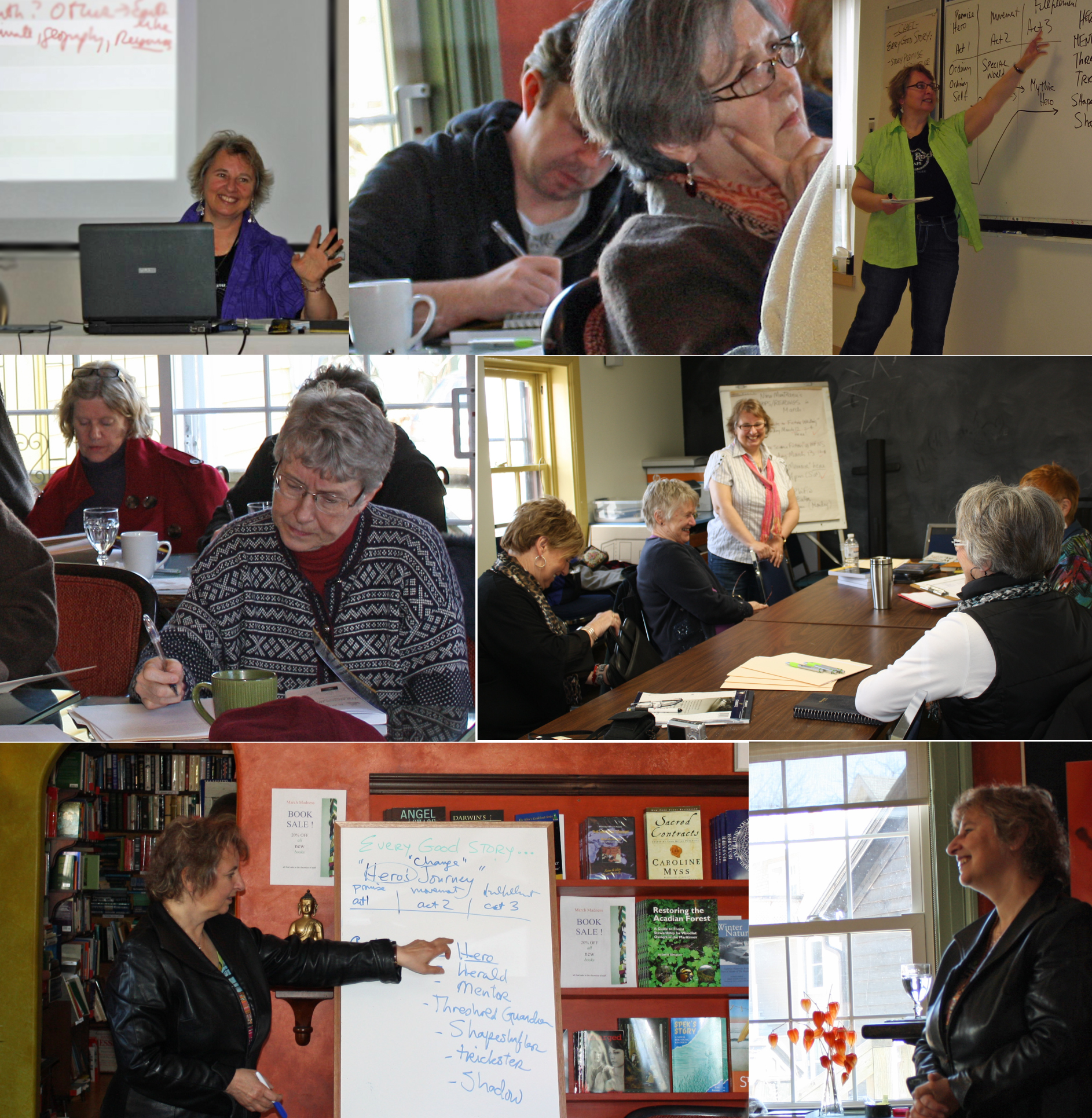
The A to Z of Writing Fiction: P…

Snowing in cedar forest, ON (photo and rendition by Nina Munteanu)

In this series of articles, I draw from key excerpts of my textbook on how to write fiction The Fiction Writer: Get Published, Write Now! whose 26 chapters go from A to Z on the key aspects of writing good and meaningful fiction.

P is for Plotting with Purpose

“Plot is the things characters do, feel, think, or say, that make a difference to what comes afterward,” says Ansen Dibel, author of Elements of Fiction Writing: Plot. I’ve also heard authors describe plot as all the nasty things they throw at their main character to stop them from getting where or what they want or need. Plot is motion. “Plot is a verb,” says Dibell. “For a reader to care about your story, there has to be something at stake—something of value to gain, something of value to be lost.”

Although plots will vary as much as individual stories, there are some basic elements and forms. Here are some:

• Cause and Effect: this is simply when one event leads to another. Many writers talk about scenes and sequels when constructing stories (see below).

• Thematic: this is where events are tied together by a thematic thread, a common relationship, a central event, place, character or theme.

• Lyric: this is when plot is organized like music, with a cyclical return to key images, events or themes that grow deeper each time (Finnegan’s Wake, by James Joyce, for example.)

• Hero’s Journey: this plot approach follows the mythic steps of the hero’s journey.

Plot structure generally follows a progression from scene (action) to sequel (reaction) and back to scene again. A scene has the three-part pattern of: goal, conflict, disaster. A sequel follows with this three-part pattern: reaction, dilemma, decision. Plot structure generally follows a thematic story arc. A seven-point plot structure goes like this: hoot, problem, backfill, complication, action, the dark moment, resolution. This step-wise plot approach reflects the three act elements of the “hero’s journey”.

Bill Johnson said that every story makes a promise at the beginning to the reader. Those promises, says Dibell, are mostly unspoken ones. And some are made indirectly through pattern. As the journey continues, problems build on the previous ones, always moving the main plot toward the final crisis. “The job of a middle,” says Dibell, “is to build toward and deliver crisis.”

“Detail on detail, incident on incident, character on character, the pattern(s) begin to form,” says Dibell. “…they’re what hold your story together, give it both diversity and unity.” Dibell describes plot as a tapestry of pattern, form, shape and color that share recognizable meanings. Which brings me to subplots, the threads that make up the story’s fabric.

Subplots are more common in long fiction, where they are used to deepen a story and add layers that make it more intriguing and tease out more depth to the story. Subplots may provide varying aspects of a theme, from community to individual as played out by different characters. Ultimately, subplots and how they are crafted, provide the writer with the means to transcend plot into what Dibell calls pattern.

Dibell describes “braided” plots, in which two or more subplots are woven together, and parallel plot lines, in which two plots share almost equal footing. This happens when strong protagonists carry each plot. Parallel plot lines often run counterpoint to each other in pace, tone and colour. Each plot becomes richer and stronger when contrasted with the other. And they are always connected in some way, in many ways. In Matrix Reloaded, Neo’s introspective and thoughtful plot with the architect of the matrix runs counterpoint with Trinity’s action plot as she sabotages the matrix and battles an agent. Both demonstrate conflict and tension but the tone and pace are opposite. This contrast only heightens each plot line. Notice also how the two plot lines are connected and eventually converge in the final scene where Neo saves Trinity’s life by restarting her heart. Earlier on, while Trinity is totally engrossed in her problems, Neo becomes aware of her struggle through the architect’s artful hint; this prompts Neo to choose his path to join her plot. His awareness is the bridge between the two plot lines. If you look carefully, you will find many other ways the two plot lines are connected, visually, mentally and viscerally and how they inevitably draw together in that riveting last scene; “how thoroughly,” Dibell says, “the story belongs to itself.”

Crawford Kilian, SF writer and author of Writing Science Fiction and Fantasy, set down these ten commandments:

  • Nothing should happen at random
  • Plot stems from character under adversity
  • Give each character an urgent personal agenda
  • The plot of a story is the synthesis of the plots of its individual characters
  • The plot “begins” long before the story
  • Foreshadow all important elements
  • Keep in mind the kind of story you’re telling
  • Ironic plots subvert their surface meanings
  • The hero must eventually take charge of events
  • Plot dramatizes character.

The Fiction Writer: Get Published, Write Now! (Starfire World Syndicate) May 2009. Nominated for an Aurora Prix Award. Available through Chapters/IndigoAmazonThe Book Depository, and Barnes & Noble.

The Fiction Writer is a digest of how-to’s in writing fiction and creative non-fiction by masters of the craft from over the last century. Packaged into 26 chapters of well-researched and easy to read instruction, novelist and teacher Nina Munteanu brings in entertaining real-life examples and practical exercises. The Fiction Writer will help you learn the basic, tried and true lessons of a professional writer: 1) how to craft a compelling story; 2) how to give editors and agents what they want’ and 3) how to maintain a winning attitude.

“…Like the good Doctor’s Tardis, The Fiction Writer is larger than it appears… Get Get Published, Write Now! right now.”

David Merchant, Creative Writing Instructor
Light snow by the river, ON (photo and rendition by Nina Munteanu)

Click here for more about my other guidebooks on writing.

Nina Munteanu is a Canadian ecologist / limnologist and novelist. She is co-editor of Europa SF and currently teaches writing courses at George Brown College and the University of Toronto. Visit www.ninamunteanu.ca for the latest on her books. Nina’s bilingual “La natura dell’acqua / The Way of Water” was published by Mincione Edizioni in Rome. Her non-fiction book “Water Is…” by Pixl Press (Vancouver) was selected by Margaret Atwood in the New York Times ‘Year in Reading’ and was chosen as the 2017 Summer Read by Water Canada. Her novel “A Diary in the Age of Water” was released by Inanna Publications (Toronto) in June 2020.