The A to Z of Writing Fiction: X, Y, Z…

Snowy marsh in spring, ON (photo and rendition by Nina Munteanu)

In this series of articles, I draw from key excerpts of my textbook on how to write fiction The Fiction Writer: Get Published, Write Now! whose 26 chapters go from A to Z on the key aspects of writing good and meaningful fiction.

X is for Use eXceptional Language … but Don’t Overdo it

What makes some writing stunning and other writing lackluster? Mostly, it’s the language—the words—you use. And, it isn’t just what words you use; it’s how you use them. Here are a few things you need to consider when translating your work into something that sings:

  • Use active verbs and reduce modifiers: many writers, not just beginners, slide into the pattern of using passive and weak verbs (e.g., were, was, being, etc.). Then they add a modifier to strengthen it. It doesn’t. Actively look for strong, vivid verbs. This is a key to good writing. I can’t emphasize this enough.
  • Avoid using excessive prose: novice writers often use too many words to describe an event, action or scene. An overabundance of words slows down the story and obscures plot and action.
  • Use alliteration, metaphor, simile, personification (but don’t overuse): these devices bring lyricism and cadence and powerful imagery to your prose. However, as with anything powerful, you need to use these judiciously. Use them where you wish to convey a strong image and to punctuate your prose.
  • Be mindful of word-accuracy: more often than you might think, a writer inadvertently misuses a word to convey an idea or emotion.
  • Read your writing aloud & punctuate your pauses. Reading out loud helps define cadence, tone and pace of your prose and streamlines your writing. When you read aloud, pay attention to where you naturally pause. You may wish to put in a comma, semi-colon or period there.
  • Size your paragraphs: paragraphs are visual elements that help people read; they break up text on a page in logical places to provide white space for reader ease. This is one of the reasons some passages are harder to read than others; long paragraphs are more tiring to the eye. Find those logical breaks and put them in.
  • Size your sentences: as with paragraphs, overly long sentences can try a reader’s patience and you may lose them entirely. Too many short choppy sentences can also reduce your prose to a mundane level. Varying your sentence length in a paragraph creates the lyricism and cadence that makes prose enjoyable to read.

Y is for Yesterday, Today, and Tomorrow

Have you taken the time to consider tense in your story? While most stories are told in the past tense (e.g., Vinnie ran out of the house), I’ve seen many written in the present tense (e.g., Vinnie runs out of the house). You see the latter more in literary and esoteric works, where the immediacy and dream-like quality of present tense is in keeping with the kind of story being told. I write mostly genre fiction (e.g., science fiction, SF thrillers, historical fantasy, etc.) where the story-telling is normally fast-paced. These read better in the past tense. Stories which follow a more reflective tone can be quite powerful in the present tense.

In her series The Dragon Quartet, Marjorie B. Kellogg alternates from past tense to present tense as she hops from one protagonist’s point of view to the other’s. This deliberate shift in tense between sections works very well. The key is that she is consistent.

In the manuscripts that I read for novice writers I often find what I call uncontrolled shifting of tense within a sentence or paragraph. OWL provides these hints:

  • Use past tense to narrate events and to refer to ideas as historical entities.
  • Use present tense to state facts, to refer to perpetual or habitual actions, and to discuss your own ideas or those expressed by an author in a particular work; also to describe action in a literary work, movie, or other fictional narrative.
  • Future action may be expressed in a variety of ways, including the use of will, shall, is going to, are about to, tomorrow and other adverbs of time, and a wide range of contextual cues.

Z is for The Zen of Passionate Writing

Ralph Keyes, author of The Courage to Write, admits that “what makes writing so scary is the perpetual vulnerability of the writer. It’s not the writing as such that provokes our fear so much as other people’s reaction to our writing.” In fact, adds Keyes, “the most common disguise is fear of them, their opinion of us, when it’s actually our own opinion of ourselves that we’re worried about.” Keyes suggests that ultimately “mastering techniques [of style and craft] will do far less to improve writing than finding the will, the nerve, the guts to put on paper what you really want to say.”

Welcome to the threshold of your career as a writer. This is where many aspiring writers stop: in abject fear, not just of failure but of success. The only difference between those that don’t and those that do, is that the former come to terms with their fears, in fact learn to use them as a barometer to what is important. How do you get past the fear of being exposed, past the anticipated disappointment of peers, past the terror of success? The answer is passion. If you are writing about something you are passionate about, you will find the courage to see it through.

This is ultimately what drives a writer to not just write but to publish: the need to share one’s story, over and over again. Some of us only have one story we need to tell (Margaret Mitchell only needed to tell one, Gone With the Wind); others of us have many to tell. Either way, what is key here is that to prevail, persist, and ultimately succeed, a writer must have conviction and believe in his or her writing. You must believe that you have something to say that others want to read. Ask yourself why you are a writer. Your answer might surprise you.

The first step is to acknowledge your passion and own it. Flaunt it, even. Find your conviction, define what matters and explore it to the fullest. You will find that such an acknowledgement will give you the strength and fortitude to persist and persevere, particularly in the face of those fears. Use the fears to guide you into that journey of personal truths. Frederick Busch described it this way: “You go to dark places so that you can get there, steal the trophy and get out.”

Every writer, like her protagonist, is on a Hero’s Journey. Like the Hero of our epic, we too must acknowledge the call, pass the threshold guardian, experience the abyss and face the beast before we can return “home” with our prize.

The Fiction Writer: Get Published, Write Now! (Starfire World Syndicate) May 2009. Nominated for an Aurora Prix Award. Available through Chapters/IndigoAmazonThe Book Depository, and Barnes & Noble.

The Fiction Writer is a digest of how-to’s in writing fiction and creative non-fiction by masters of the craft from over the last century. Packaged into 26 chapters of well-researched and easy to read instruction, novelist and teacher Nina Munteanu brings in entertaining real-life examples and practical exercises. The Fiction Writer will help you learn the basic, tried and true lessons of a professional writer: 1) how to craft a compelling story; 2) how to give editors and agents what they want’ and 3) how to maintain a winning attitude.

“…Like the good Doctor’s Tardis, The Fiction Writer is larger than it appears… Get Get Published, Write Now! right now.”

David Merchant, Creative Writing Instructor
Otonabee River glistens under a spring sun, ON (photo and rendition by Nina Munteanu)

Click here for more about my other guidebooks on writing.

Nina Munteanu is a Canadian ecologist / limnologist and novelist. She is co-editor of Europa SF and currently teaches writing courses at George Brown College and the University of Toronto. Visit www.ninamunteanu.ca for the latest on her books. Nina’s bilingual “La natura dell’acqua / The Way of Water” was published by Mincione Edizioni in Rome. Her non-fiction book “Water Is…” by Pixl Press (Vancouver) was selected by Margaret Atwood in the New York Times ‘Year in Reading’ and was chosen as the 2017 Summer Read by Water Canada. Her novel “A Diary in the Age of Water” was released by Inanna Publications (Toronto) in June 2020.

The A to Z of Writing Fiction: W…

Snowy marsh in spring, ON (photo and rendition by Nina Munteanu)

In this series of articles, I draw from key excerpts of my textbook on how to write fiction The Fiction Writer: Get Published, Write Now! whose 26 chapters go from A to Z on the key aspects of writing good and meaningful fiction.

W is for Who, Where, When and Why of Doing Research

Research is something many writers dislike and find daunting or even intimidating. In truth, as a writer, you are doing research all the time: when you’re riding the bus or train to work, when you’re traveling on vacation, when you’re having a lively discussion—or better yet an argument— with a friend or colleague. Everything you experience and observe is research. This is what I call non-directed research. It’s also called living. Writers, like all artists, are reporters of life, actively participating and passively observing. A writer is an opportunist, gathering her data through her daily life experiences. Writing fiction draws on this but also on much more…

When writing about a realizable and believable world, whether it takes place in contemporary New York or far future planet Zero, you will need impeccable world building (which includes setting, circumstances, surrounding characters and events) and that will always ultimately require research. you will find very quickly that in order to build a consistent world (even if it’s mostly from your own imagination), you will need to draw upon something real to anchor your imaginary world upon. Whether this reflects a powerful myth or forms an alternative version of a real society, you will still need to apply some rules to follow, so you don’t lose your reader.

With so many useful internet sites and search engines, research has become far easier. But there is also more risk. Finding and confirming information as reliable is an important aspect of doing research. When doing research, particularly on the Internet (but anywhere), you should do several things:

• Use more than one source, particularly for important things; this will give you a wider range of material from which to discern accuracy and reliability.

• Verify your sources and preferably cross reference to measure out objective “truth” versus bias.

• Try to use primary sources (original) vs. secondary or tertiary sources (original cited and open to interpretation); the closer you are to the original source, the closer you are to getting the original story.

• When going to more than one source, try to get a range of different source-types (e.g., conservative newspaper versus blog versus special interest site, etc.) to gain a full range of insight into the issue you’re researching.

Don’t forget that highly valuable and satisfying research can take on the form of interview. You can gain incredible insight into the subject of your research by using a live expert. The advantages he or she has to a book or online database is that they interact with you and may give you something you didn’t even know you needed. Experts include people in your community, your neighbors and friends, professionals in business and in the universities and other educational facilities. Special interest forums and sites can be used to access people to interview.

I keep a journal or scrapbook for every novel I write. This permits me to do several things:

1. Organize relevant research material into one place for easy access (which makes up for my appalling note taking practices).

2. Satisfy my inclination for info dump and expository back-story by providing a place to house it—in my journal, where it belongs, instead of in the story.

By the time I was through with it, the journal I’d kept of my last book—a historical fantasy set in medieval Prussia and modern-day Paris—was its own rich compendium of interesting information, lovingly put together with photos of Paris, drawings and sketches of castles, armour, and long swords, maps of great battles, spreadsheets of timelines and family trees and, of course, commentary on all the great cafés and patisseries in Paris between Rue Princess and Boulevard Saint-Michel.

The Fiction Writer: Get Published, Write Now! (Starfire World Syndicate) May 2009. Nominated for an Aurora Prix Award. Available through Chapters/IndigoAmazonThe Book Depository, and Barnes & Noble.

The Fiction Writer is a digest of how-to’s in writing fiction and creative non-fiction by masters of the craft from over the last century. Packaged into 26 chapters of well-researched and easy to read instruction, novelist and teacher Nina Munteanu brings in entertaining real-life examples and practical exercises. The Fiction Writer will help you learn the basic, tried and true lessons of a professional writer: 1) how to craft a compelling story; 2) how to give editors and agents what they want’ and 3) how to maintain a winning attitude.

“…Like the good Doctor’s Tardis, The Fiction Writer is larger than it appears… Get Get Published, Write Now! right now.”

David Merchant, Creative Writing Instructor
Otonabee River glistens under a spring sun, ON (photo and rendition by Nina Munteanu)

Click here for more about my other guidebooks on writing.

Nina Munteanu is a Canadian ecologist / limnologist and novelist. She is co-editor of Europa SF and currently teaches writing courses at George Brown College and the University of Toronto. Visit www.ninamunteanu.ca for the latest on her books. Nina’s bilingual “La natura dell’acqua / The Way of Water” was published by Mincione Edizioni in Rome. Her non-fiction book “Water Is…” by Pixl Press (Vancouver) was selected by Margaret Atwood in the New York Times ‘Year in Reading’ and was chosen as the 2017 Summer Read by Water Canada. Her novel “A Diary in the Age of Water” was released by Inanna Publications (Toronto) in June 2020.

The Journal Writer: Example Steps for Keeping  a Nature Journal

Forget not that the earth delights to feel your bare feet and the winds long to play with your hair

Kahlil Gibran
White birch tree in mixed cedar hemlock forest, ON (photo and rendition by Nina Munteanu)

According to naturalist John Muir Laws, “Keeping a journal of your observations, questions, and reflections will enrich your experiences and develop gratitude, reference, and the skills of a naturalist. The goal of nature journaling is not create a portfolio of pretty pictures but to develop a tool to help you see, wonder, and remember your experiences.”

Sketches from “The Laws Guide to Nature Drawing and Journaling” by John Muir Laws

Here are the steps for keeping a nature journal:

  1. Decide on the kind of nature journal you want to make: your decision should take into account whether you wish to include samples, pictures or only text. If you’re using a notebook (not a computer) size is important. Keep it large enough to include what you need but small enough to be portable. You may wish to create a journal only for a specific place, topic, issue or trip (e.g., the river behind your place; local birds; recycling in your community; your trip to Tanzania or the local zoo). There are different kinds of journal styles for different uses. For instance, Grinnell journals are field journals used by scientists and phenology journals are specific to making field observations. If you are really serious about journaling in nature — rain or shine— you can get one with waterproof paper, like Rite in the Rain, or DeckExpert. Butler Survey Supplies also makes waterproof loose leaf paper.
  2. Make or buy a suitable journal: most nature journals are compiled from notebooks or notepads of plain white paper. You can get some that have one side lined for writing and the opposite side unlined for drawing, sketches and pasting in pictures or samples. Make sure your journal is sturdy and protected against the elements. Some covers are waterproof. Otherwise, it might be a good idea to carry a plastic bag with you.
  3. Get the other equipment you need: if you plan to make sketches or paint with watercolor or collect specimens, ensure that you have the equipment: pencils, pencil crayons, paint kit, adhesive tape, camera, other collection material. A backpack would be useful to put your journal and materials into.
  4. Dedicate time and place to journaling: nature journals, like most themed journals, do not need to be kept daily or on a routine. Journal entries will depend on the specific topic or area you have chosen to follow. Keep your journal handy to your journal topic. You may wish to keep it and associated materials in a dedicated backpack, handy to grab when you go on your outings. If you keep lists of things to bring on various trips or outings, include the journal.
  5. Observe the world around you: nature journaling relies mostly on observing and reflecting. Cultivate your observational skills by learning to quiet your mind from distractions and focusing on the subject matter. Sketching and taking pictures can help provide the focus you need as well as giving you something to put into your journal. Slow down. Stop and watch and listen. Get close. Don’t be afraid to crouch and move in close. The wonders of nature are often right in front of your nose, just waiting for a new way to be seen.
  6. Write on location: your nature journal will be most valuable if you use it in the field to record what you see as you see it. If you rely on your memory to write in your journal later, it will be less accurate (though it might be more poetic). You are more likely to make an entry if you bring your journal with you; if you leave your journal at home and wait until later, you may not get to it and the magic of the moment may be lost. Once you get home and revisit your entry, you can confirm and elaborate on your observations in the field.
  7. Begin each entry with location, date, time:  “where” and “when” are important pieces of information to include in any journal entry. They are particularly important in a nature journal. Time and place relate to important natural cycles like season and diurnal cycle. If your nature journal is more scientific, you may wish to include other important descriptors like weather, temperature, wind, precipitation, etc. You may wish to leave the odd page blank as space to paste in additional information from later research related to your entry.
  8. Record observations in several ways: regardless of whether you consider yourself a good artist or not, sketches and drawings can provide a wealth of information (that you may not have thought to add in your writing) and add an element of interest to a journal entry.  Pictures are a great tool for adding accurate details to an observation. Don’t be afraid to get close. All too often we take a picture, thinking the camera sees what we see (and interpret) and when we look at the photo the object of your attention is too far away or surrounded by so much “noise” it’s hard to distinguish.
  9. Learn more about what you saw: it’s a good idea to confirm and elaborate your observations with research. When you go to the library or read online about what you saw, you will likely generate even more interest. This is where sketches or images or samples come in handy, particularly if you want to identify something you’ve seen.
  10. Revisit your past entries: you may wish to consult a previous entry to compare with something you’ve just observed or use it in an experiment you’re conducting. Either way, reading your nature journal can be a great learning experience and a lot of fun.
White birch tree, showing lenticels, ON (photo and rendition by Nina Munteanu)

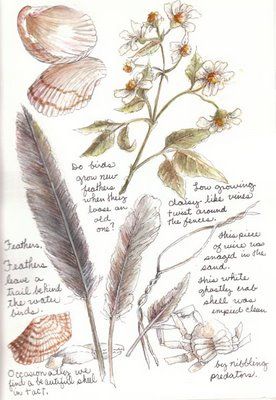
The American Museum of Natural History describes a field journal as being unique to the journalist. “There is no one way to keep a field journal,” they say. “Some scientists will sketch simple pencil drawings, and others will paint colorful, detailed images. You can use whatever tools work best for you. Try working with pens, pencils or watercolors to capture an image, whether it is a view of the Moon, the veins of a leaf, or the legs of a beetle.” You can record your observations with charts, list and labels, sketches, samples and photos. You can also write long, detailed descriptions.

Journal page (image by stowelandtrust.org)

Some questions they come up with to help prompt you include:

  • “What do I see?” Some things to include are: size, shape and color, what it is doing, how it relates to other things, why it is so interesting to you.
  • “Do I see anything that surprises me?”
  • “How have I traveled to this spot?” This is good information for possible later visits, especially if you wish to do a series of related observations.
  • “What tools do I have?” This is good to remember for later visits and to assess the appropriateness of the observation. In most scientific observations, the methods and techniques used are critical to the validity of the observation.
  • “Who is with me on this expedition?” Researchers always include who was there. This helps for later consultation.
  • “What time of day is it?” In the natural sciences time of day is critical because so much in nature is diurnal (e.g., responds and changes as the day changes)
White birch tree with polypore fungus, ON (photo and rendition by Nina Munteanu)

Lynda Richardson at Virginia Wildlife talks about keeping a nature journal, which includes plein air painting and what goes into a field kit.

Page from Lynda Richardson’s nature journal (image by L. Richardson)

Sixteen year old Fiona Gillogly tells the wonderful story of how she started journaling in the “The joy of curiosity in my nature journal.”

Page of Fiona Gillogly’s nature journal (image by F. Gillogly)

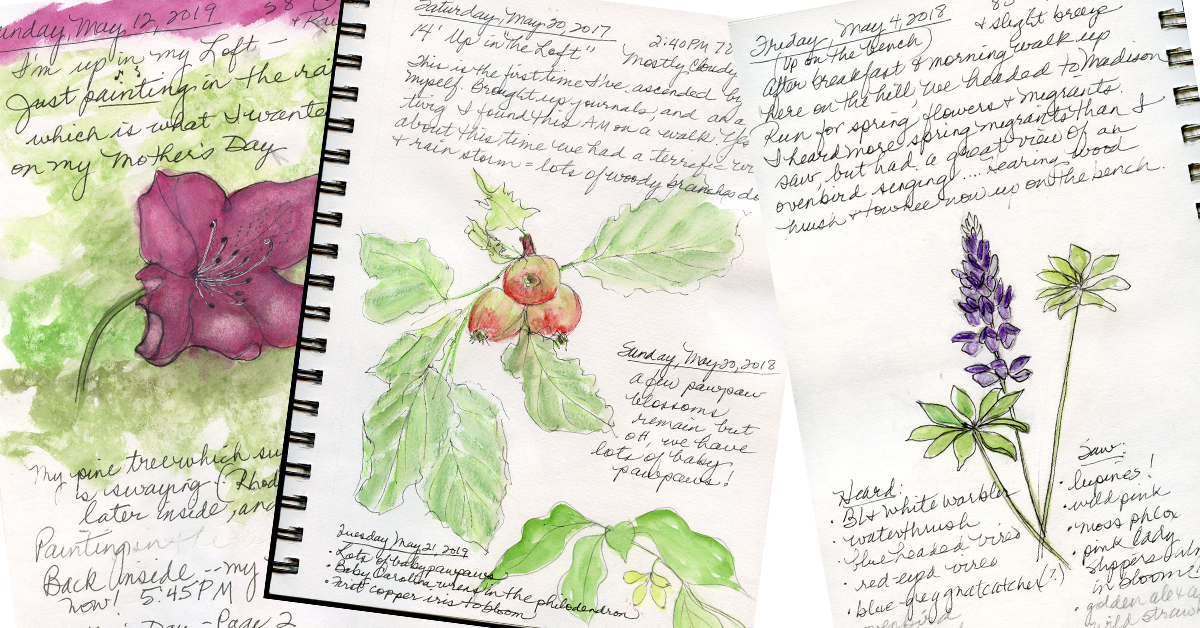
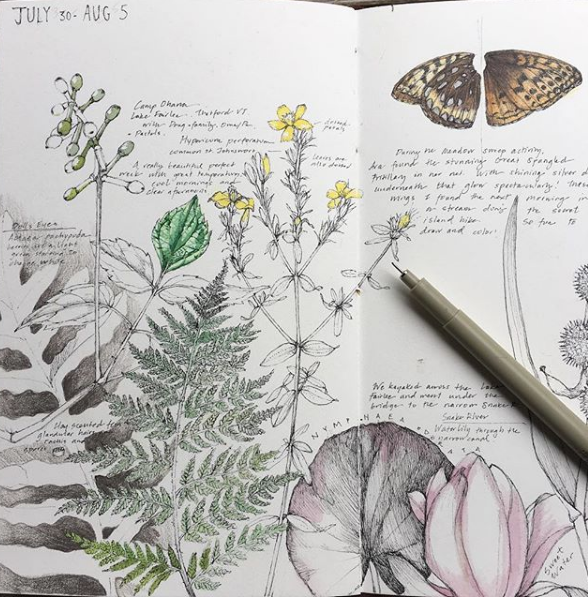
While recently browsing on the Internet, I ran across a very attractive yet simple nature blog. What made Judy Butler’s “Naturalist Journal: Down the Nature Trail” so appealing was her mixed use of regular text augmented with scanned handwritten pages containing color-pencil drawings and flower pressings. This charming “homespun” expression resembled a real three-dimensional journal.

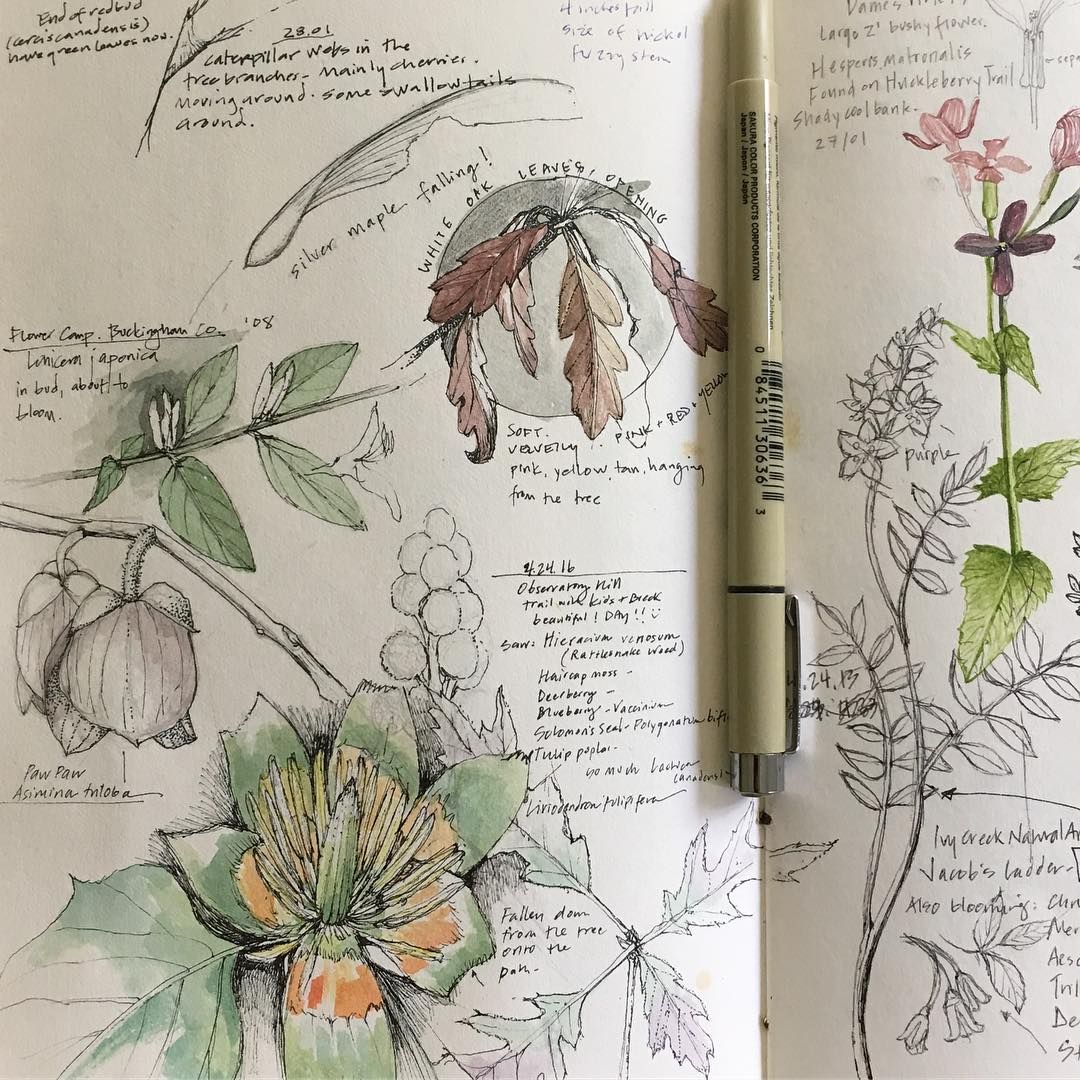
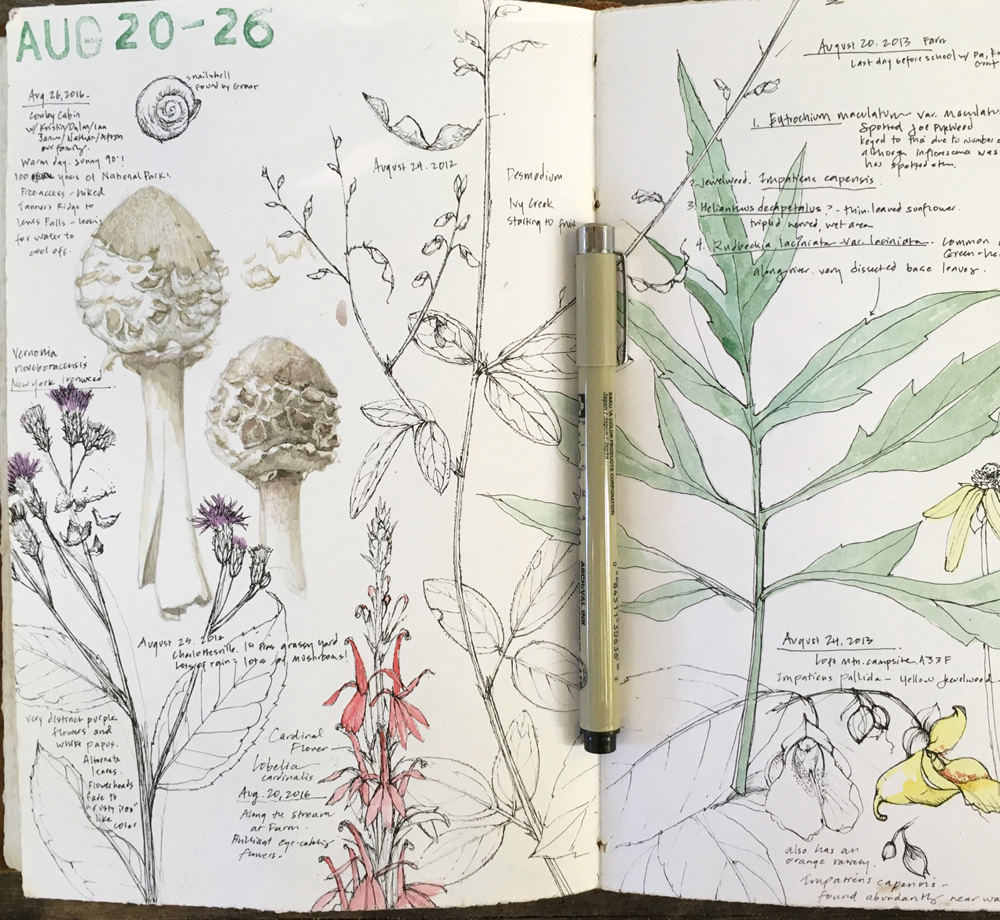
Botanical artist and illustrator Lara Call Gastinger teaches how to maintain a perpetual journal.

Nature Journal page by Lara Call Gastinger
Nature Journal page by Lara Gall Gastinger
Nature Journal page by Lara Call Gastinger

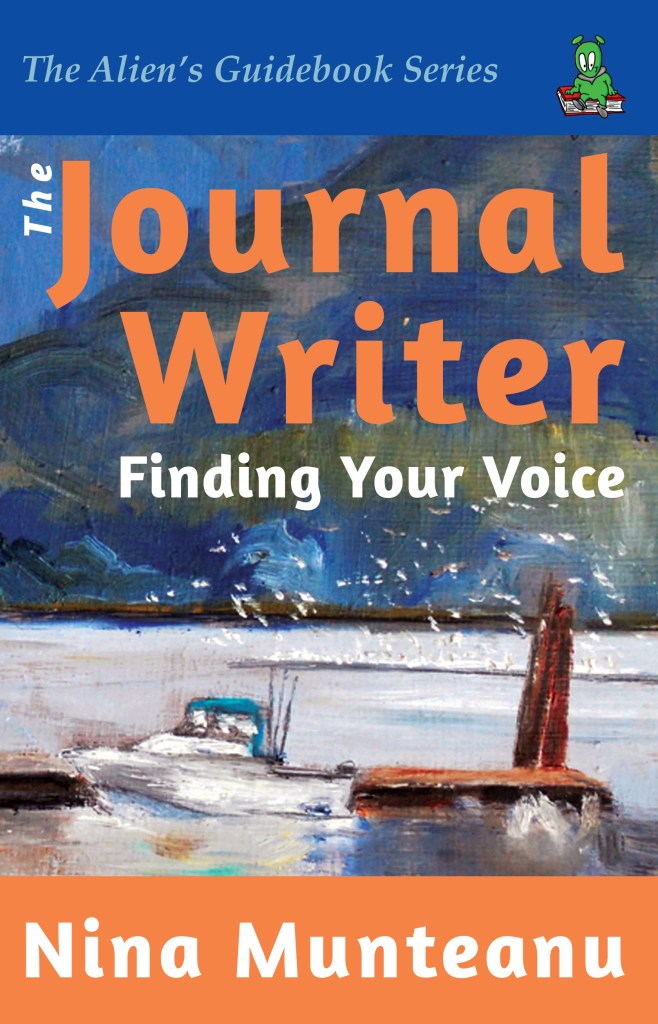
This article is an excerpt from The Journal Writer: Finding Your Voice (Pixl Press, 2013) by Nina Munteanu.

The Journal Writer is the second writing guide in the Alien Guidebook Series. This comprehensive guidebook will help you choose the best medium, style and platform for your expressive writing. The guide provides instruction on issues of safety, using the computer and electronic devices, social media and the internet.

Engaging, accessible, and easily applicable…Brava, Nina, brava.”—David Merchant, Instructor, Louisianna Tech University

Straight up, fact-filled, enriching, joyful and thorough…Nina is honest, she is human and she wants you to succeed.”—Cathi Urbonas, Halifax writer

.

References:

Munteanu, Nina. 2013. “The Journal Writer: Finding Your Voice.” Pixl Press, Vancouver. 170pp.

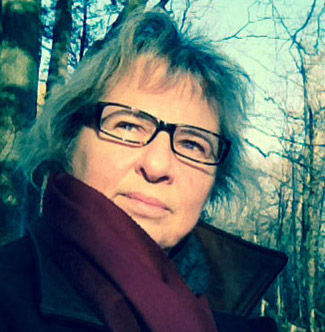
Nina Munteanu is a Canadian ecologist / limnologist and novelist. She is co-editor of Europa SF and currently teaches writing courses at George Brown College and the University of Toronto. Visit www.ninamunteanu.ca for the latest on her books. Nina’s bilingual “La natura dell’acqua / The Way of Water” was published by Mincione Edizioni in Rome. Her non-fiction book “Water Is…” by Pixl Press(Vancouver) was selected by Margaret Atwood in the New York Times ‘Year in Reading’ and was chosen as the 2017 Summer Read by Water Canada. Her novel “A Diary in the Age of Water” was released by Inanna Publications (Toronto) in June 2020.

The Journal Writer: Why Keep a Journal?

Old maple tree under snow dusting in a mixed cedar-pine forest in early winter, ON (photo and rendition by Nina Munteanu)

There are as many reasons for writing a journal as there are people in the world: to express, to heal and clarify, to create, learn and influence, to record, to celebrate, to share with friends or the world even…and everything in-between. The journal is a way to connect—to yourself and to others—with gentleness, compassion and deeper understanding. It’s a “safe home” where your deepest thoughts can reside without fear of judgment, blame or need for justification. A place where you can be just you.

Late afternoon sun glimmers through cedar-pine forest in winter, ON (photo and rendition by Nina Munteanu)

What is a Journal?

Most people think of a journal as a bound notebook with text, sketches and pasted-in mementos. But it can also be a binder full of memorabilia and notes, a collection of digital information on a computer, CD or flash drive, or an audio tape. According to Ron Klug (2002), a journal is essentially a “day book” where you record daily happenings. But it is much more than that. The journal is a tool for self-discovery, an aid to concentration and finding clarity, a “mirror for the soul”, a training ground for a writer and a good friend and confidant. It is at its heart a place of learning and being.

Mary Louise Holly (1989) describes a journal as “a reconstruction of experience and, like the diary, has both objective and subjective dimensions, but unlike diaries, the writer is (or becomes) aware of the difference. The journal…is a book that someone returns to. It serves purposes beyond recording events and pouring out thoughts and feelings. Like the diary, the journal is a place to ‘let it all out’. But the journal is also a place for making sense of what is out.” The journal helps you assess the next step and help you find direction. I talk more about this in Chapter 5 of my guide The Journal Writer: Finding Your Voice.

Swamp forest reflected in icing pond, ON (photo and rendition by Nina Munteanu)

Some reject journaling as too self-absorbing; the truth is that most of us during some part of our lives are too little connected to ourselves. We keep so busy, filling our lives with activities, filling our senses with stimuli, running at full tilt. We may be constantly communicating with others through cell phones, computers, notebooks, at school and at work. But we aren’t communicating with ourselves. For that to happen we need to quiet our minds and our environment to have a meaningful self-dialogue. This is the gift that journaling brings to us.  It helps us find the depth of ourselves and lead richer more truthful lives. The key is to use it to learn.

A journal need not be the dark brooding place many people envision when they think of diaries and journals. A journal can be a happy place, a place to celebrate one’s explorations and achievements and self-education. Here’s what journal writer Jennifer Moon (1999) says about her journal:

A journal is a friend that is always there and is always a comfort. In bad moments I write, and usually end up feeling better. It reflects back at me things that I can learn about my world and myself. It represents a private space in my life, a beautiful solitude, the moments before I go to sleep just to stop and note what there is about the day or about my life at the time. I think that it has enabled me to feel deeper and more established as a person, more in control and more trusting of life. On a less introverted note, I think that it contributes to my ability to write in general, and it underlies an interest in poetry and creative writing which awaits a quieter time in my life for fulfillment. 

–Jennifer Moon

Remember, it is just as important to record your happy, wonderful, scintillating and inspirational experiences as those dark moments.

Moss-covered base of a cedar tree under a light dust of snow in early winter, ON (photo and rendition by Nina Munteanu)

Why Keep a Journal?

Writer Louise DeSalvo shared an interesting story about what expressive writing means to her. Here’s what she said:

“Many people I know who want to write but don’t (my husband, Ernie, for example) or who want to write more than they have but say they can’t find the time (my friend Marla) have told me that taking the time to write seems so, well, self-indulgent, self-involved, frivolous even. And that finding the time to write—even a diary, much less fiction or memoir or poetry—in their busy schedules is impossible. I’ll write when I have the time, they say.”

–Louise DeSalvo

DeSalvo adds, “what if writing weren’t such a luxury? What if writing were a simple, significant, yet necessary way to achieve spiritual, emotional, and psychic wholeness? To synthesize thought and feeling, to understand how feeling relates to events in our lives and vice versa? What if writing were as important as a basic human function and as significant to maintaining and promoting our psychic and physical wellness as, say, exercise, healthful food, pure water, clean air, rest and repose, and some soul-satisfying practice?”

Journal writing encourages engagement and reflection. It helps you deepen your self-understanding and make added sense of your life and what you believe. It can provide you with added perspective on you and the world, by giving you a greater awareness of what is happening to and around you in your daily world. Writing a journal can help you write better and help improve your skills in observing, recording and interpretation. It can also help you set goals and manage your time and priorities.

Give yourself the permission to write. Give yourself the gift of expression.

Beech tree with marcescent leaves in early winter, ON (photo and rendition by Nina Munteanu)

This article is an excerpt from The Journal Writer: Finding Your Voice (Pixl Press, 2013) by Nina Munteanu.

The Journal Writer is the second writing guide in the Alien Guidebook Series. This comprehensive guidebook will help you choose the best medium, style and platform for your expressive writing. The guide provides instruction on issues of safety, using the computer and electronic devices, social media and the internet.

Engaging, accessible, and easily applicable…Brava, Nina, brava.”—David Merchant, Instructor, Louisianna Tech University

Straight up, fact-filled, enriching, joyful and thorough…Nina is honest, she is human and she wants you to succeed.”—Cathi Urbonas, Halifax writer

References:

Baikie, Karen & Kay Wilhelm. 2005. “Emotional and physical health benefits of expressive writing.” Advances in Psychiatric Treatment. 11: 338-346.

DeSalvo, Louise. 1999. “Writing as a Way of Healing: How Telling Our Stories Transforms Our Lives.” Beacon Press, Boston. 226pp.

Holly, Mary Louise. 1989. “Writing to Grow. Keeping a personal-professional journal”. Heinemann. Portsmouth, New Hampshire.

Klug, Ron. 2002. “How to Keep a Spiritual Journal: a guide to journal keeping for inner growth and personal discovery.”Augsburg, Minneapolis, 4th ed.

Moon, Jennifer. 1999. “Learning Journals: A handbook for academics, students and professional development.” Kogan Page. London.

Munteanu, Nina. 2013. “The Journal Writer: Finding Your Voice.” Pixl Press, Vancouver. 170pp.

Nina Munteanu is a Canadian ecologist / limnologist and novelist. She is co-editor of Europa SF and currently teaches writing courses at George Brown College and the University of Toronto. Visit www.ninamunteanu.ca for the latest on her books. Nina’s bilingual “La natura dell’acqua / The Way of Water” was published by Mincione Edizioni in Rome. Her non-fiction book “Water Is…” by Pixl Press(Vancouver) was selected by Margaret Atwood in the New York Times ‘Year in Reading’ and was chosen as the 2017 Summer Read by Water Canada. Her novel “A Diary in the Age of Water” was released by Inanna Publications (Toronto) in June 2020.

The Aroma of Story

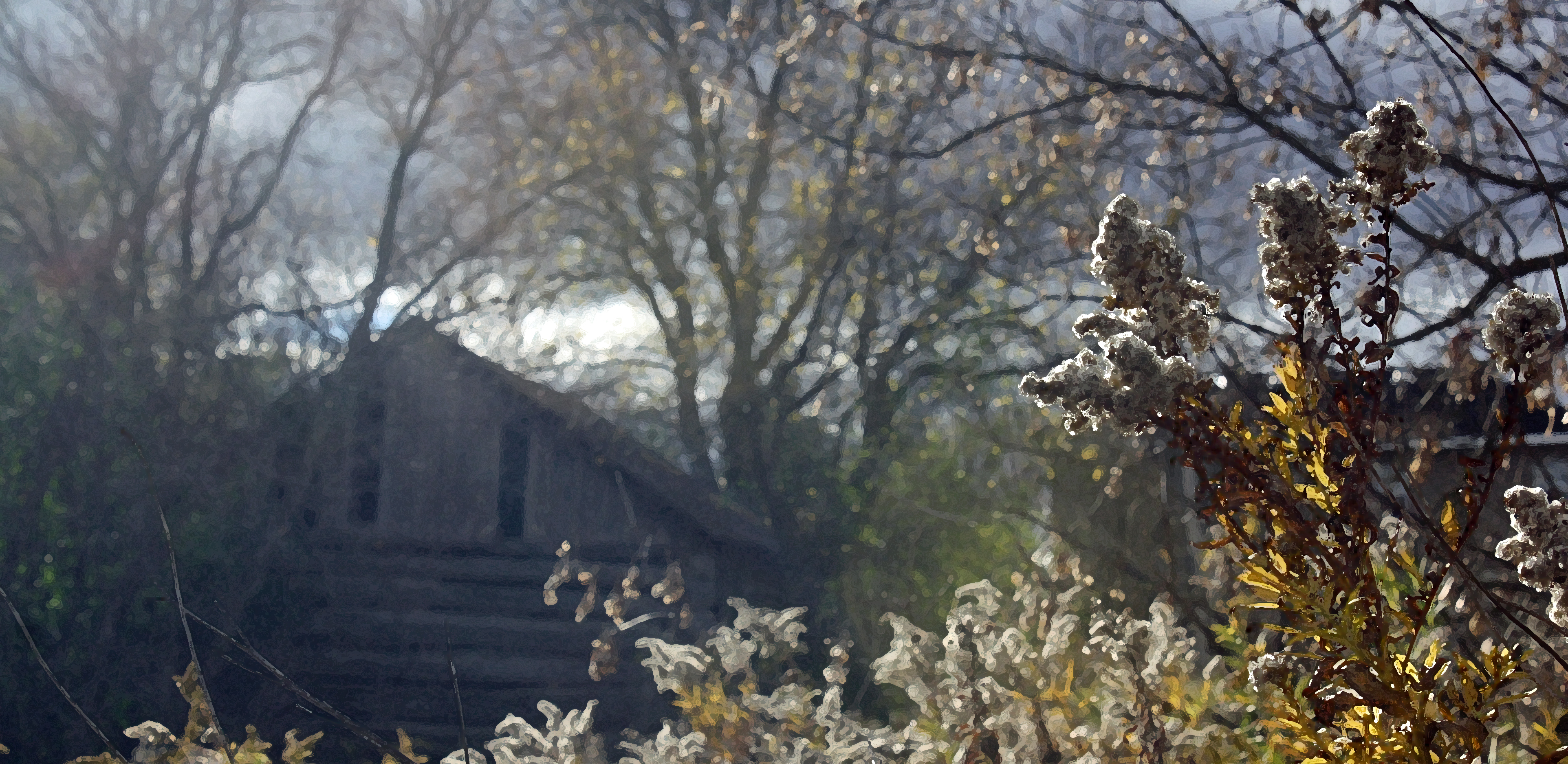
Old cabin behind seeding goldenrods, ON (photo and rendition by Nina Munteanu)

One of my favourite smells is of pipe tobacco smoke. 

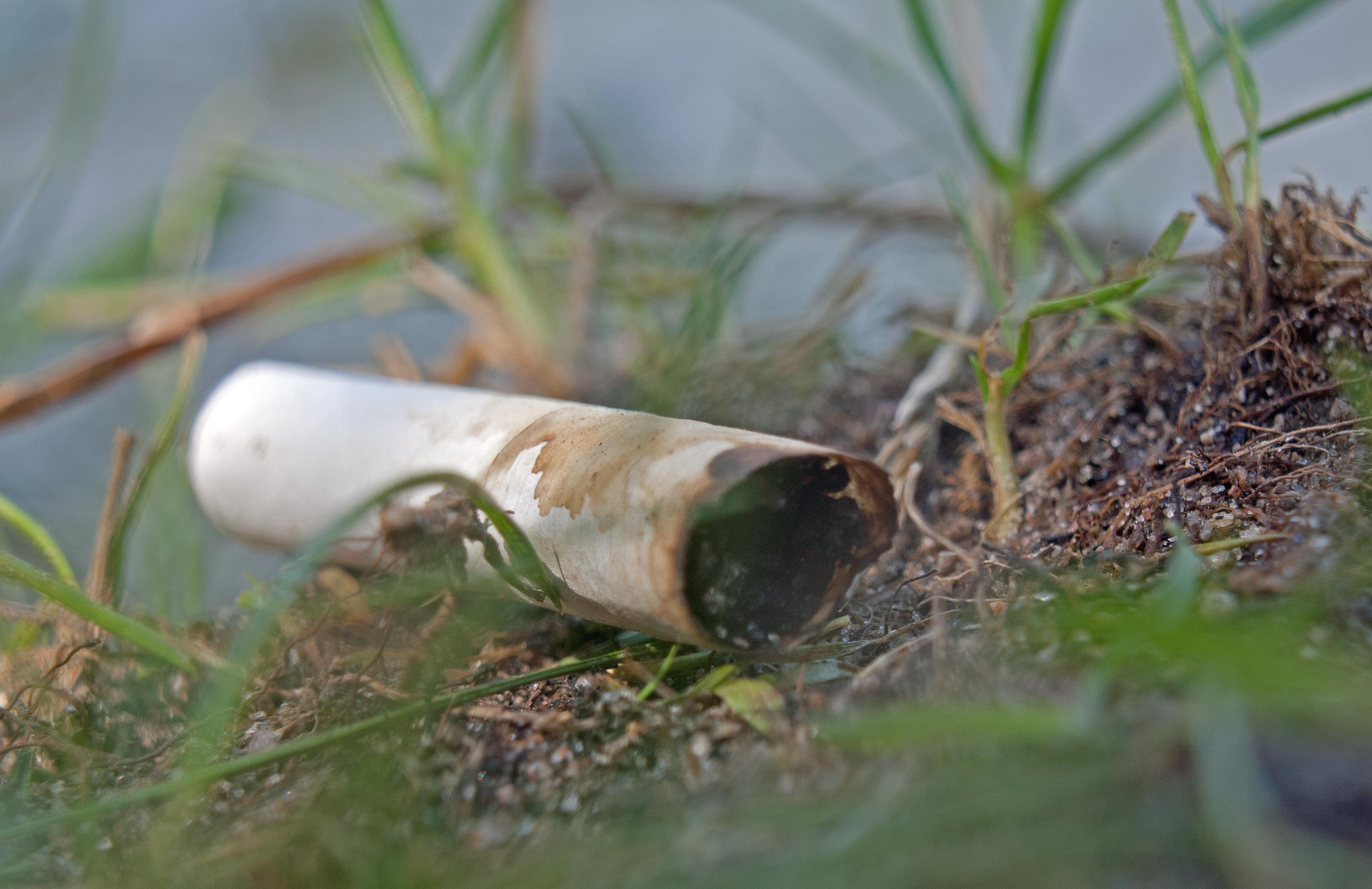
But here’s the thing:  I’m really not a fan of smoking. Both my parents were chain smokers (who wasn’t back then?) and I quickly discovered that cigarette butts carried thousands of ugly toxins and lasted years on the ground. In the one rebellious occasion that I skipped school with two school mates to spend the day in the forest, I accidentally lit my hair on fire trying to light the cigarette. Taking the karmic connection seriously, I decided that was the end of both skipping school and smoking for me.   

Cigarette butt found near a river in a park, ON (photo by Nina Munteanu)

So, why the allure with pipe smoke?

Well, to begin my rationalization, pipe smoke is nothing like cigarette smoke. Cigarette smoke squeals up my nose and mouth, choking my breath with an acrid burning that lodges like a smothering cancer in my throat; pipe smoke coils heavy and loose into my nostrils with lazy notes of fermenting cherry or plum.

There’s more to it, obviously . . . 

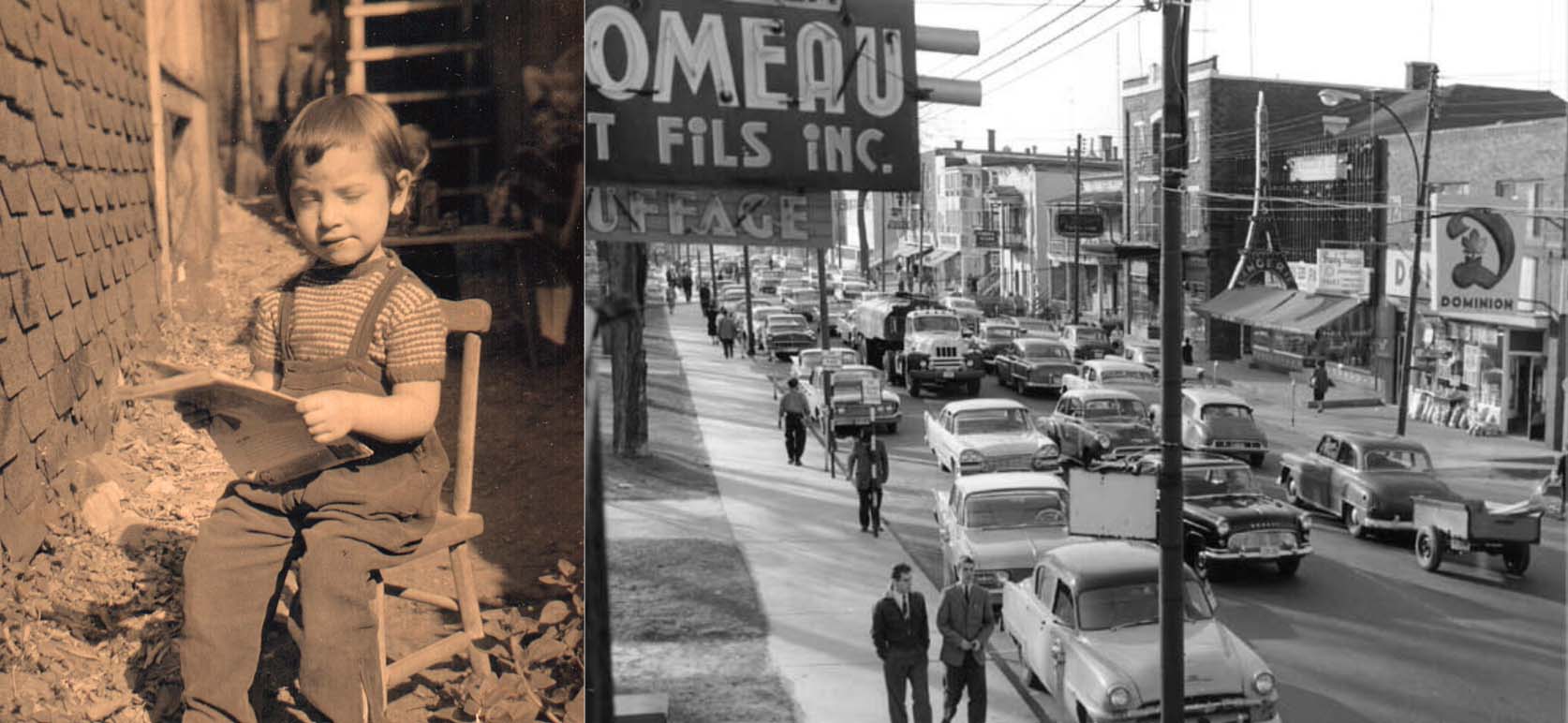
Left: Four-year old Nina Munteanu pretending to read; Right: Rue Principal in Granby, Quebec in the early 1960s

When I was little, one of my favourite things to do was hide behind the comic stand in the back corner of William’s General Store and read comic books. Superman, Supergirl, Green Lantern, Magnus Robot Fighter. So many more . . .

Mr. Williams knew I was there. I was, after all, hiding in plain sight, as kids generally do. But he was a kind man and let me stay and read for free. He recognized someone who loved story. 

The store was a typical general store of that era. Long and narrow, dark wood walls covered in paraphernalia. Shelves and stands cramped full with stuff. Anything from toys and penny candy to games, puzzles, watches, newspapers, pocket books and magazines, household necessities, shoeshine kits, canned goods and preserves, pocket knives, to cigars, pipes and the tobacco and lighters to go with them. A smoky mist settled on everything in the store and the place gave off the complex scent of old polished wood with a tobacco undercurrent. Williams might have smoked a pipe himself; I don’t recall. However, my sense-mind has wonderfully coupled that evocative aroma with a sense of freedom to immerse myself in fantastical worlds of imagination. And, in turn, to imagine my own worlds. 

That place and my experience in it not only gave me an abiding love for pipe smoke; it made me the storyteller I am today.  

Taste and smell appear to linger most in memory and yet are often neglected by writers. According to the California Institute of Technology, smell is generally considered the sense tied most closely to human memory. Smell profoundly influences people’s ability to recall past events and experiences. “A smell from your distant past can unleash a flood of memories that are so intense and striking that they seem real,” says Dr. Karl (Kruszelnicki), author of Great Moments in Science. “This kind of memory, where an unexpected re-encounter with a scent from the distant past brings back a rush of memories, is called a ‘Proustian Memory’.”

In Remembrance of Things Past, Marcel Proust writes: 

When from a long-distant past nothing subsists, after the people are dead, after the things are broken and scattered, taste and smell alone, more fragile but more enduring, more immaterial, more persistent, more faithful, remain poised a long time, like souls.

In this excerpt of The Florist’s Daughter by Patricia Hampl, fragrance permeates with meaning: 

The flower shop was here and it was my father’s domain, but it was also marvelously other, this place heavy with the drowsy scent of velvet-petaled roses and Provencal freesias in the middle of winter, the damp-earth spring fragrance of just-watered azaleas and cyclamen all mixed up with the headachey smell of bitter chocolate. 

In John Steinbeck’s East of Eden, his main character recalls the following memories, through several evocative smells: 

I remember my childhood names for grasses and secret flowers. I remember where a toad may live and what time the birds awaken in the summer— and what trees and seasons smelled like—how people looked and walked and smelled even. The memory of odors is very rich. 

Barrels of aging bourbon in Kentucky (photo by Nina Munteanu)

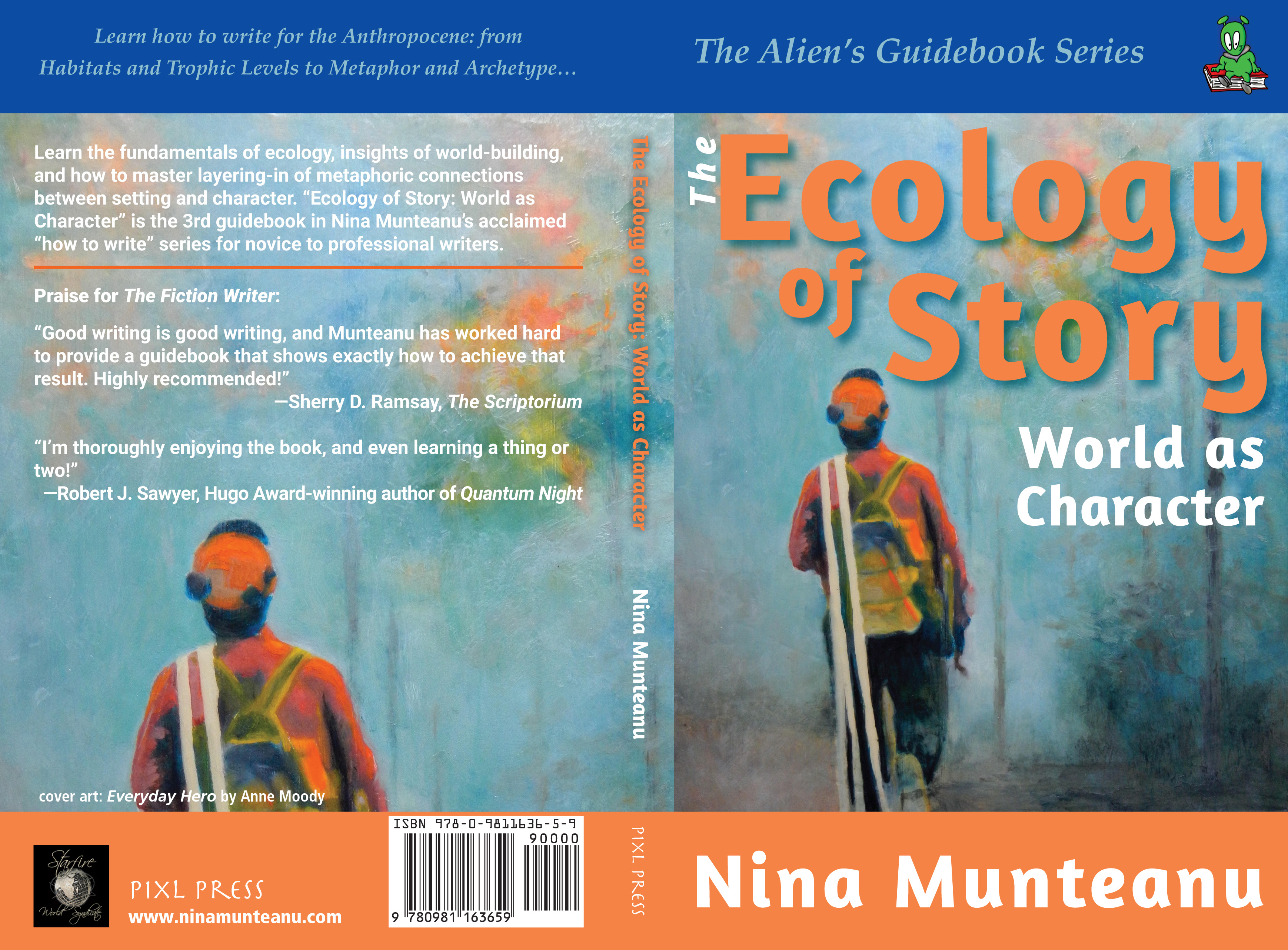
In Part 2 of my writing guidebook The Ecology of Story: World as Character, I discuss how the various senses—not just smell—are strong tools in storytelling and provide examples and working exercises.

Psychologist Michael McCollough argues that environment plays a key role in human behaviors, such as forgiveness and revenge. He theorizes that various social environments can cause either forgiveness or revenge to prevail. McCollough relates his theory to game theory. In a tit-for-tat strategy, cooperation and retaliation are comparable to forgiveness and revenge. The choice between the two can be beneficial or detrimental, depending on what the game partner (or organism) chooses. The brain’s limbic system processes external stimuli related to emotions, social activity, and motivation; these then propagate an instinctual behavioural response. Examples include maternal care, aggression, defense, and social hierarchy; these behaviours are influenced by sensory input, such as sight, sound, touch, and—of course—smell.

Parts of this article are excerpted from the third book of The Alien Guidebook Series:The Ecology of Story: World as Character.

Nina Munteanu is a Canadian ecologist / limnologist and novelist. She is co-editor of Europa SF and currently teaches writing courses at George Brown College and the University of Toronto. Visit www.ninamunteanu.ca for the latest on her books. Nina’s bilingual “La natura dell’acqua / The Way of Water” was published by Mincione Edizioni in Rome. Her non-fiction book “Water Is…” by Pixl Press(Vancouver) was selected by Margaret Atwood in the New York Times‘Year in Reading’ and was chosen as the 2017 Summer Read by Water Canada. Her novel “A Diary in the Age of Water” was released by Inanna Publications (Toronto) in June 2020.