The Otonabee River under rosy haze from northeastern wildfires, ON (photo and rendition by Nina Munteanu)
It was pleasantly cool yesterday evening during my walk along the Otonabee River. Over the day, the smell of ‘campfire’ smoke from the raging northern wildfires intensified and the sun became an eerie copper disk in the peach-coloured sky. The river had gone still, as if hushed and waiting beneath the cloud of haze. Houses along the shore had become fluid watercolour paintings, colours and textures blending in a soft fabric of grey and green. As I set my gaze on a favourite cottage by the river, its reflection caught in the still waters, I thought the scene beautiful…
My heart then reminded me that this wasn’t a mist rising off the river but the yellow-brown dust descending from the corpses of millions of burnt trees, sent here by a cruel northeast wind.
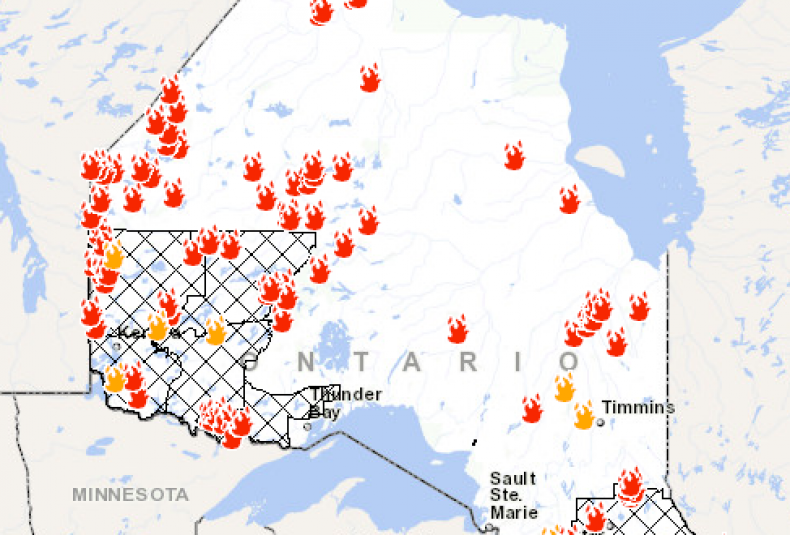
Map of Ontario wildfires June 5, 2023
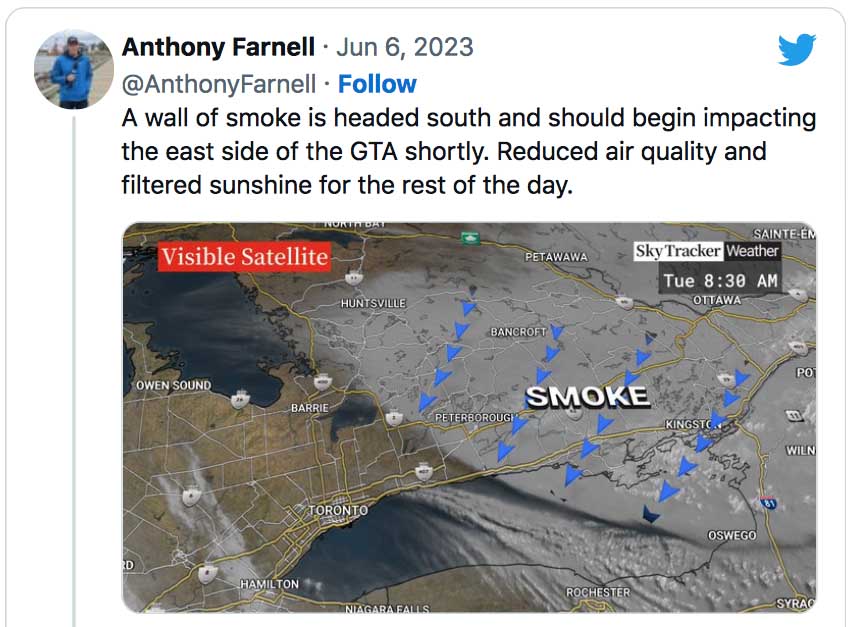
Today, the Ontario government reported heavy smoke conditions in the Northeast Region due to a large number of fires in eastern Ontario and Quebec—with fires worse than usual this year in Quebec. More than 160 fires are burning, most out of control, in Quebec. Smoke drift is travelling as far as just north of Timmins, down through Sudbury and past Parry Sound. Environment Canada issued Air quality warnings today for Peterborough, where I currently live.
Global News reported today that “relentless wildfires have devoured 3.3 million hectares of land across Canada so far this year—roughly 10 times the normal average for the season.” In the last 24 hours, 21 new fires were discovered across Ontario, amounting to 159 active fires provincially. According to Global News, “Searing hot, tinder-dry conditions, similar to what was seen in western Canada, has only worsened the situation in Ontario.” And Quebec.
Map of Quebec wildfires June 5, 2023
Sun setting over smoky Otonabee River, ON (photo by Nina Munteanu)
There is an old willow tree on the river bank by the path I walk daily. Its massive arms stretch out over the water and one arm leans low over the path so you must bend down to walk under it. The derecho last May had cracked the tree open. But the sturdy willow continues on, undaunted, as all Nature does, thrusting up suckers from its large limbs toward a future of many more willows. It’s a favourite tree of many a walker who like to sit on its generous arms and look out over the river. Each day I touch its bark and say hello.
Old willow on the path by the Otonabee River, the glow of smoke-sun on its generous arms (photo by Nina Munteanu)
New suckers burst out of the leaning willow limb (photo by Nina Munteanu)
I think of my old friend. How a fire would take it.
First its leaves would sizzle and take flight in a requiem dance. The trunk, a funnel of fire and smoke, would sway and groan then crack with a final death shout to the roaring hissing fire. Like flying kites, leaf corpses would join embers of curling bark and soar in a vortex of billowing coal black fury. The river would flow through a killing field, black stumps and burned debris flying with the vagaries of a mischievous wind. Covered in a film of thick and oily debris, the lonely river would grow dark and surly, smothering its own aquatic forest—the algae, benthic invertebrates and fish.
And I would weep…
Sun setting over hazy forest at mouth of Thompson Creek, ON (photo by Nina Munteanu)
Nina Munteanu is an ecologist and internationally published author of award-nominated speculative novels, short stories and non-fiction. She is co-editor of Europa SF and currently teaches writing courses at George Brown College and the University of Toronto. Visit www.ninamunteanu.ca for the latest on her books. Nina’s recent book is the bilingual “La natura dell’acqua / The Way of Water” (Mincione Edizioni, Rome). Her latest “Water Is…” is currently an Amazon Bestseller and NY Times ‘year in reading’ choice of Margaret Atwood.
Port Guichon in Ladner at 6 pm (photo by Nina Munteanu
Today—as writing friend Sylvia and I decided to have our coffees inside Stir Coffee House rather than its pleasant patio under the peach-coloured haze of Ladner—much of British Columbia was under high evacuation alert, was being evacuated or was under an air quality advisement. More than 20,000 people have evacuated their homes or are on alert while over 500 fires burn across the province.
In Vanderhoof, where good friend Anne lives on her ranch, the air quality index is beyond the high limit of the scale (over 600 on a scale that only runs to 500).
An air quality advisory was issued for Metro Vancouver and the Fraser Valley on Tuesday. Then the smoke from higher elevations descended that night. Wednesday morning, I walked into Ladner village through a haze that smelled of old fire. An uneasy disquiet stirred inside me. Then I realized it; the air wasn’t that easy to breathe. The AQI was over 150 and steadily climbing. By the time Sylvia and I left the café, the AQI would measure over 200 (considered “very unhealthy”).
According to Environment Canada meteorologist Lisa Coldwells, a broad dome of high pressure is sitting on top of the province, providing only slight winds even at high altitudes. “The smoke doesn’t have a chance to dissipate. It just comes up off the fire(s) and it’s just sort of gently moving towards Vancouver, the southern tip of Vancouver Island and the most populated areas,” she says. A temperature inversion is making the situation worse, effectively trapping the smoke.
Fine particulate matter, also known as PM2.5 (measured as particles at or smaller than 2.5 µm) is causing most of the haze and driving the health warnings. These particles pose the greatest health risk. Much smaller than the width of a human hair these particles can go deep into the lungs and bloodstream, resulting in oxidative stress and affecting the heart. Smoke will also carry coarse particulate matter, known as PM10 (particles that measure 10 µm to 2.5 µm). Coarse particles are of less concern, given they are more easily caught by our filtering systems (like nose hairs and phlegm) but can irritate your eyes, nose and throat. Concentrations of PM2.5 greater than 25 micrograms per cubic metre prompt health warnings. According to Chris Carlsten, UBC public health associate professor, these higher levels dysregulate the normal balance in the lungs, leading to inflammation that causes difficulty in breathing and wheezing.
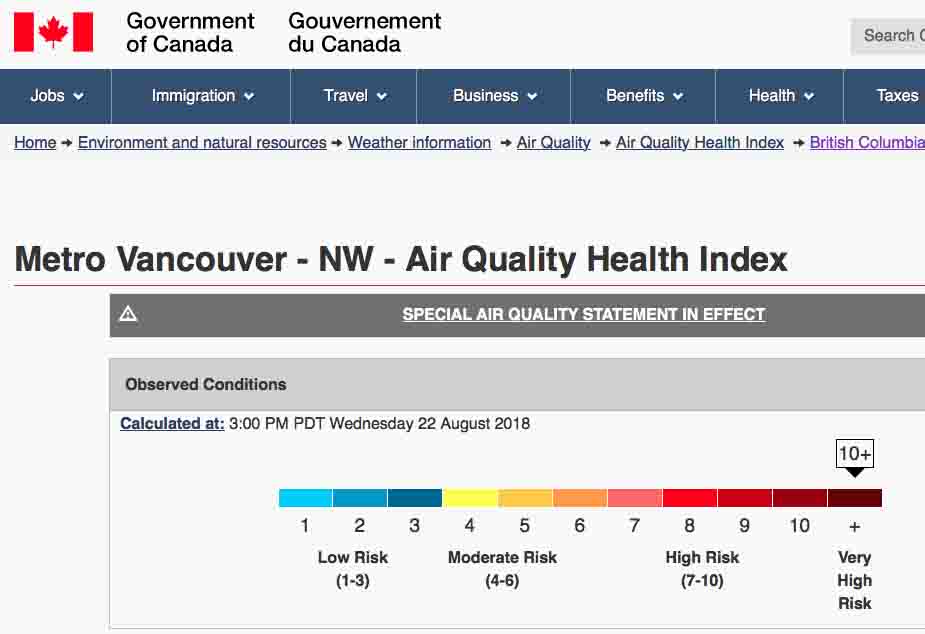
The Air Quality Health Index (AQHI) was developed by Environment Canada, the BC Ministry of Environment and BC Ministry of Health, Metro Vancouver and the BC Lung Association to measure air quality on a scale. The index typically goes from 0 to 10 with 7-10 representing “high risk” conditions. Numbers higher than 10 are unusual and indicate a very high risk to health. The 0 to 10 index corresponds roughly to the Air Quality Index (AQI), which measures concentrations of particulate matter, sulfur dioxide, carbon monoxide, nitrogen dioxide and ozone and converts these to a number on a scale of 0 to 500.
As you can see, an AQI of over 100 is moderately polluted and considered unhealthy, particularly for sensitive groups such as people with asthma, respiratory issues, elderly or small children. Today, Ladner’s AQI rose steadily during the day until it was well over 200, considered very unhealthy.
According to Tiffany Crawford of the Vancouver Sun, the air quality in Vanderhoof—30 kilometres south of the more than 86,000-hectare Shovel Lake wildfire—measured over 600 on the AQI; more than double the level considered hazardous to health. The AQI in Houston measured 410 and in Burns Lake it was 408—all levels way beyond ‘hazardous’.
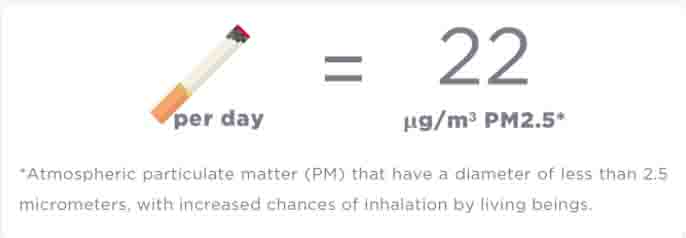
To give you an idea of how that feels, someone developed an app using Berkley Earth’s findings on the equivalence between air pollution and cigarette smoking. According to Berkley’s formula one cigarette smoked per day equals 22 µg/m3 of fine particulate matter.
The current air quality rating in Vancouver measured 10 today, which is like smoking 7.4 cigarettes. In Abbotsford in the Fraser Valley, that comes to 8.3 cigarettes. Further north in Fort St. John you’re smoking 11.8 cigarettes and in Prince George you’re smoking 16.7 cigarettes. By contrast, in Gwallior India—one of the most air-polluted places in the world—the equivalent daily cigarettes smoked is only 3.5.
Smoky sun over Ladner at 6 pm (photo by Nina Munteanu)
As the coffee machines ground and wheezed with the sweet aroma of coffee, Sylvia and I talked about an exciting project that involved ecology and empowerment. Of course, we talked about the wildfires too. How could we not? It was on everyone’s mind today. With such overt signs, who couldn’t think of them. It was the smoke. We saw it coil and loiter along the street corners. We smelled it. Breathed it in. Felt it inside us. The remains of so many trees that had burned to the ground. “The souls of trees,” as good friend Anne had blurted out. Their ashes and smoke had soared high into the atmosphere and now descended on us, kilometres away. I couldn’t help feeling a sadness. Not just for so many people in hardship. But for so much living tissue, burnt up in smoke.
Sylvia later told me that she didn’t make her next appointment in Vancouver. Feeling the effects of the smoke, she had decided to go home, where her HEPA filter awaited. Smart move, Sylvia.
Nina Munteanu is an ecologist, limnologist and internationally published author of award-nominated speculative novels, short stories and non-fiction. She is co-editor of Europa SF and currently teaches writing courses at George Brown College and the University of Toronto. Visit www.ninamunteanu.ca for the latest on her books.







 Nina Munteanu is an ecologist, limnologist and internationally published author of award-nominated speculative novels, short stories and non-fiction. She is co-editor of Europa SF and currently teaches writing courses at George Brown College and the University of Toronto. Visit
  Nina Munteanu Writing Coach