One of the lectures I give to my science fiction writing students is called “Ecology in Storytelling”. It’s usually well attended by writers hoping to gain better insight into world-building and how to master the layering-in of metaphoric connections between setting and character.1
I talk about the adaptations of organisms to their changing environments. I describe the trophic (energy) relationships from producers to consumers and destroyers in a complex cycle of creative destruction. Students perk up when I discuss some of the more strange and interesting adaptations of organisms to their environment: twisted stories of adaptations and strategies that involve feeding, locomotion, reproduction and shelter.
Purposeful Miscommunication & Other Lies
For instance, the Alcon blue butterfly hoodwinks ants into caring 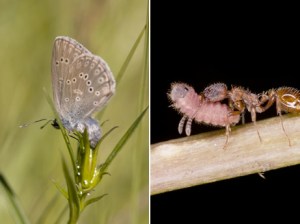 for its larvae. They do this by secreting a chemical that mimics how ants communicate; the ants in turn adopt the newly hatched caterpillars for two years. There’s a terrible side to this story of deception. The Ichneumon wasp, upon finding an Alcon caterpillar inside an ant colony, secretes a pheromone that drives the ants into confused chaos; allowing it to slip through the confusion and lay its eggs inside the poor caterpillar. When the caterpillar turns into a chrysalis, the wasp eggs hatch and consume it from inside.
This reads like something out of a noir thriller. Or better yet, a horror story. Nature is large, profligate, complex and paradoxical. She is by turns gentle and cruel. Creative and destructive. Competitive and cooperative. Idle and nurturing.
When I bring in extremophiles, who thrive in places you and I would cringe to set foot in, students’ imaginations run wild with ideas. I describe a panoply of weird adaptations in Nature—involving poisons, mimicry and deception, phototaxis and something called anhydrobiosis, which permits the tiny tardigrade to shrivel into a tun in the absence of water then revive after a 100 years with just a drop of water.
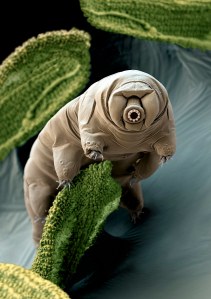
Tardigrade
All this adaptation hinges on communication. How an organism or population communicates with its environment and among its own. Examples of “strange” communication are the purview of the science fiction writer … and already the nature of our current world—if you only know where to look. The scope of how Nature communicates—her devices and intentions—embraces the strange to the astonishing. From using infrasound to chemical receptors and sensing magnetic fields. To allelopathy. Aggressive symbiosis. And so much more.
When Trees Share the Dirt
“Trees are the foundation of a forest, but a forest is much more than what you see,” says University of British Columbia forest ecologist Suzanne Simard.
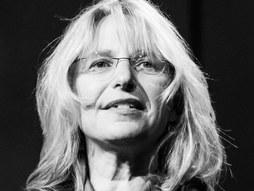
Suzanne Simard
Simard, who has published hundreds of papers over 30 years of research, suggests a kind of “intelligence” when she describes the underground world “of infinite biological pathways that connect trees and allow them to communicate” In a forest. This communication allows the forest to behave as if it was a single organism, says Simard. Her early in situ experiments showed solid evidence that tree species, such as Paper Birch and Douglas Fir communicated in a cooperative manner underground through an underground mutualistic-symbiosis involving mycorrhizae (e.g., fungus-root). These trees were conversing in the language of carbon and nitrogen, phosphorus, water, defense signals, allelo-chemicals, and hormones via a network of mycelia. Fungal threads form a mycelium that infects and colonizes the roots of all the trees and plants. Simard compares this dense network to the Internet, which also has nodes and links—just as the forest.

Myccorhyzae and fungal highways
Fungal highways link each tree and plant to its community, with busiest nodes called hub trees or mother trees. Calling them mother trees is appropriate, given that they nurture their young in the understory; sending excess carbon to the understory trees, which receive less light for photosynthesis. “In a single forest,” says Simard, “a mother tree can be connected to hundreds of other trees.” These mature trees act as nodal anchors—like major hub sites on the Internet—for tree groupings; according to Simard, they look after their families, nurture seedlings and even share wisdom—information—when they are injured or dying.
Simard made another incredible discovery: that mother trees “recognize their kin.” In experiments her team ran using related and unrelated seedlings, the mother tree preferentially sent its excess carbon to kin over non-kin seedlings.
These discoveries pose some serious implications in how we do and should manage our forests. “You can take out one or two hub trees, but there’s a tipping point,” says Simard. “You take out one too many and the whole system collapses.”
Simard shared that “in 2014 the World Resources Institute reported that Canada in the past decade has had the highest forest disturbance rate of any country worldwide…In Canada it’s 3.6% per year…about four times the rate that is sustainable.”
“Massive disturbance at this scale is known to affect hydrological cycles, degrade wildlife habitat and emit greenhouse gases back to the atmosphere, which creates more disturbance and more tree die-backs,” says Simard. She adds that the practice of planting commercially valued species at the expense of the indigenous aspens and birches lacks complexity and promotes vulnerability to disease. It’s creating “a perfect storm,” Simard concludes.
Trees & Climate Change
A major international report on climate change shows that wildlife habitats will be dramatically impacted around the world. In Canada, this could fundamentally alter 65 per cent of its existing natural habitat in the boreal and Arctic regions, where warming will be the greatest. The report says that seven Canadian provinces – Ontario, Quebec, Alberta, British Columbia, the Yukon, Newfoundland and Labrador and Manitoba – will have more than half of their natural habitat at risk.
Simard asks: “Instead of weakening our forests, how can we reinforce them and help them deal with climate change?” She suggests four simple solutions:
- Get out into the forest and re-establish local involvement in our forests, using management techniques based on local knowledge
- Save our old-growth forests, the repositories of genetic material, mother trees and micorhizal networks
- Save the mother trees when cutting trees
- Regenerate our forests with a diversity of species types and structures
“Forests aren’t just a bunch of trees competing with each other; they are super-cooperators,” Simard points out. “The great thing about forests,” she reminds us, “is that as complex systems, they have an enormous capacity to self-heal.”
How Healing Trees Can Heal Us
Aside from being highly evolved water management specialists, trees are chemical factories that broadcast a host of aerosols into the atmosphere around them. Researchers have found over 120 substances, of which only half could be identified. These aerosols are part of a sophisticated survival strategy, writes botanist and biochemist Diana Beresford-Kroeger. Studies have shown that willows, poplars and maples warn each other about insect attacks; undamaged trees then pump bug-repelling chemicals to ward off the attack. Black walnut trees emit juglone, an aerosol that repels competing nearby plants and some insects. Scientists demonstrated that airborne communication between individual sagebrush plants (called “eavesdropping”) helped neighbouring plants resist attacks. The monoterpenes like pinene and linene can relieve asthma and even fight cancer.
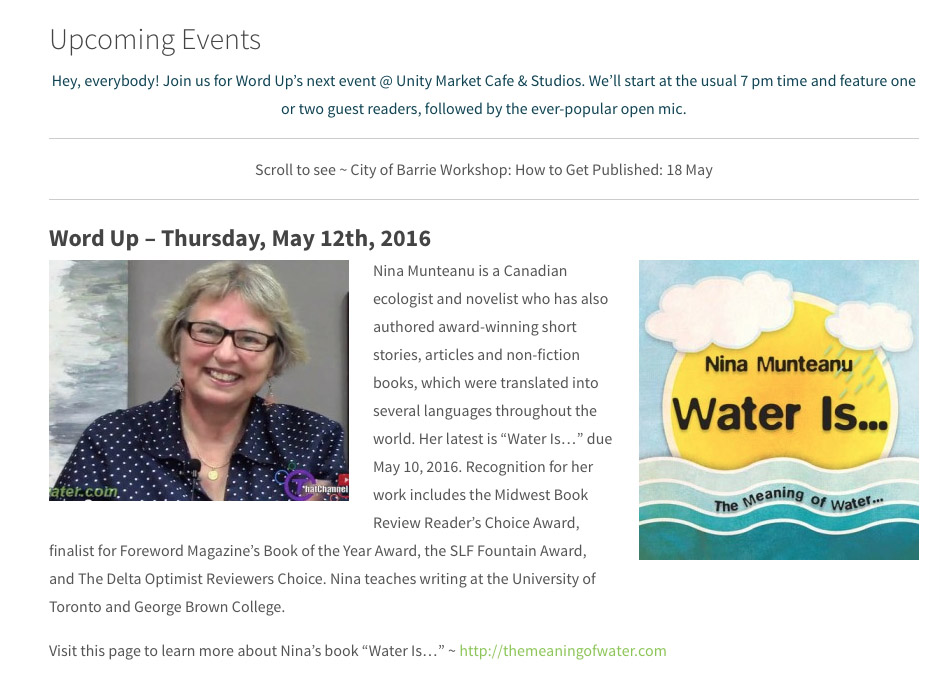
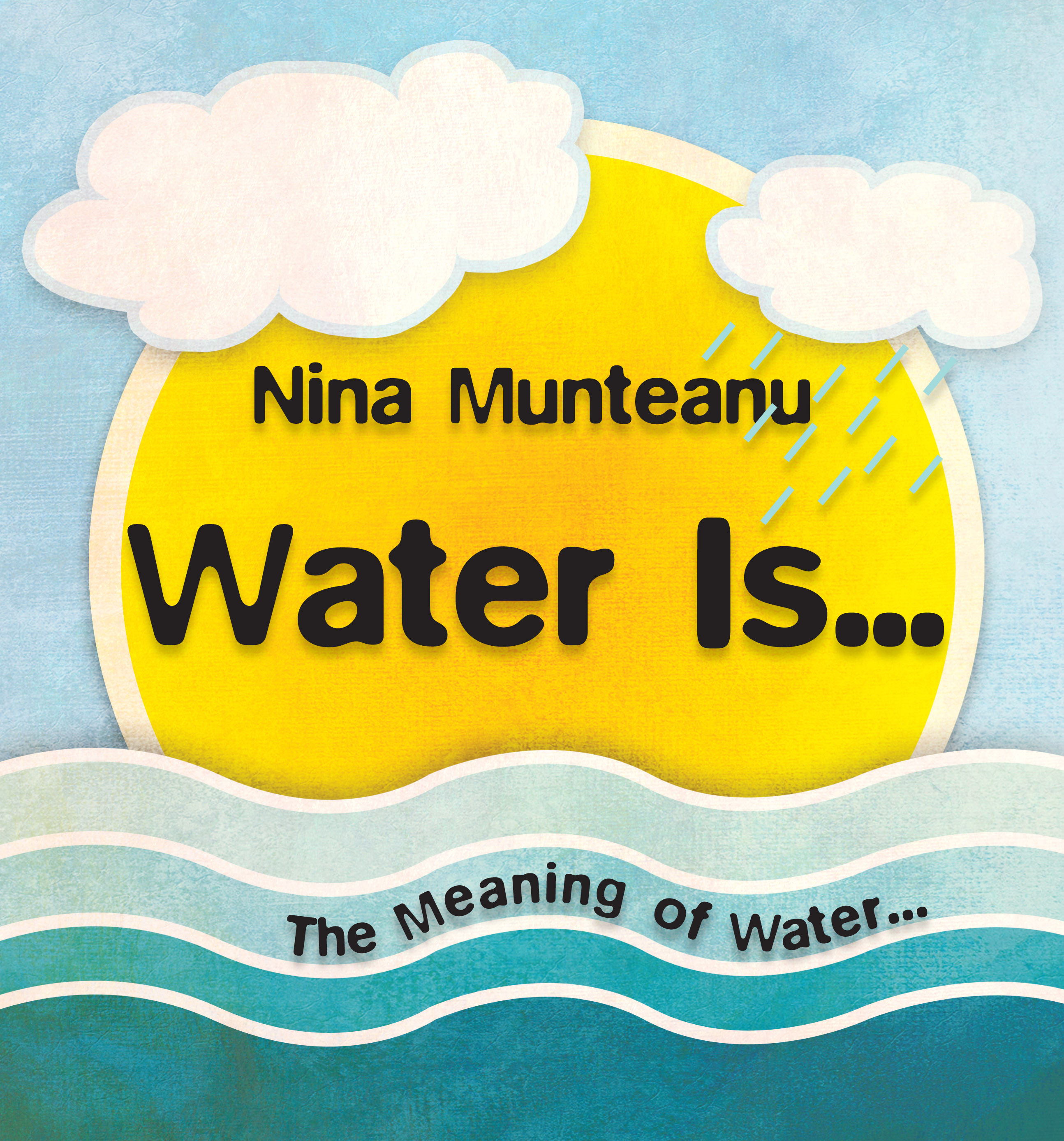
 You can read more about this in my book “Water Is…” (Pixl Press).
1I give several lectures based on this general topic of world building for writers. One I gave recently, at CanCon2016 in Ottawa, focused on aquatic worlds, my scientific area of expertise. These lectures are based on my upcoming guidebook “The Ecology of Story: World as Character”
.
.
 Nina Munteanu is an ecologist and internationally published author of award-nominated speculative novels, short stories and non-fiction. She is co-editor of Europa SF and currently teaches writing courses at George Brown College and the University of Toronto. Visit www.ninamunteanu.ca for the latest on her books. Read Nina’s climate/eco-fiction Darwin’s Paradox, Angel of Chaos and Natural Selection.








 Nina Munteanu Writing Coach