Montreal 2140: Hopeful Futures in Science and Storytelling Conference

McGill University, view from main gate on Rue Sherbrooke (photo by Nina Munteanu)

I’ve just returned from Montreal, where I was invited to participate in a two-day conference hosted by McGill University’s Bieler School of Environment at Esplanade Tranquil. Named after Kim Stanley Robinson’s eco-fiction novel New York 2140, the conference brought together a diverse assemblage of scientists, academic researchers, urban planners, speculative fiction writers, artists, and students in a small setting dedicated to encourage cross-pollination of ideas and visions through panels and workshops. I sat on a panel and a roundtable with other writers, urban planners, engineers, scientists and activists to discuss futures through science and story. Much of the event focused on the literary genre called Hopepunk—a sub-genre of Speculative Fiction devoted to optimistic themes of scientific transformation, discovery and empathy. Resulting dialogue explored forms of communication, expression, and ways not just to deal with growing solastalgia, eco-grief, and environmental anxiety but to move forward through action and hope.

Breakout groups in Seeds of Good Anthropocenes Workshop (photo by Nina Munteanu)
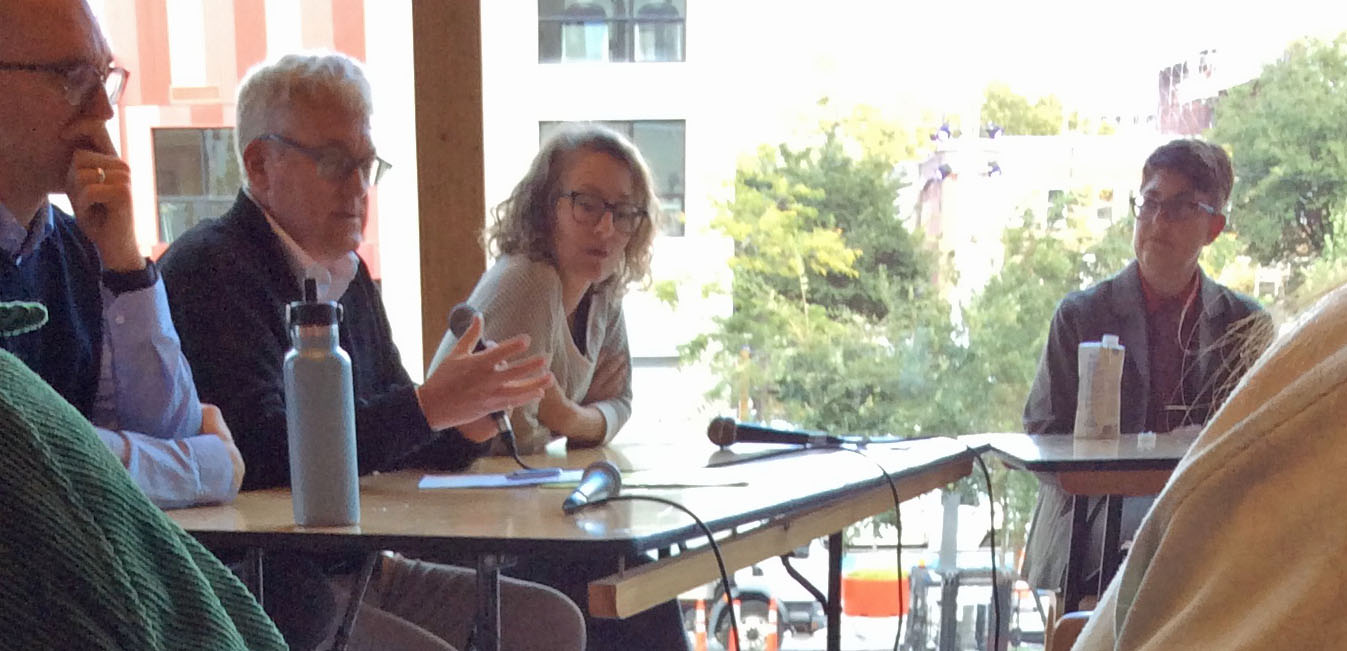
McGill faculty in Panel on ‘Turning Research into Hopeful Stories’ (photo by Nina Munteanu)

In the Thursday morning writer’s panel, in which we explored the role of science knowledge and hope in story, I shared the writing process I underwent with my latest published novel A Diary in the Age of Water, which I categorize as a hopeful dystopia (‘Hopeful dystopias are much more than an apparent oxymoron; they are in some fundamental way, the spearhead of the future—and ironically often a celebration of human spirit by shining a light through the darkness of disaster):

The main character in A Diary in the Age of Water was a limnologist like me who kept a journal (the diary referenced in the title of the book). This part of the story took place in the near-future when the water crisis and associated climate change phenomena had become calamitous. Being a scientist with so much intimate knowledge of the crisis, the diarist became cynical and lost her faith in humanity. I recall my own journey into despair as I did the research needed to convey the character’s knowledge and situation. I found myself creating a new character (the diarist’s daughter) much in the way a drowning swimmer takes hold of a life-saver, to pull me out of the darkness I’d tumbled into. The daughter’s hopeful nature and faith in humanity pulled both me and the reader out of the darkness. The cynical nature of the diarist came from a sense of being overwhelmed by the largeness of the crisis and froze her with feelings of powerlessness. The diarist’s daughter rose like an underground spring from the darkness by focusing on a single light: her friend and lover who pointed to a way forward. As Greta so aptly said once, “action leads to hope” and hope leads to action. Despite the dire circumstances in the novel, I think of A Diary in the Age of Water as a story of resilience. And ultimately of hope.  

I came to the conference as a writer, scientist, mother, and environmental activist. What I discovered was an incredible solidarity with a group so diverse in culture, disciplines, expression and language—and yet so singularly united. It was heartwarming. Hopeful. And necessary. This conference ultimately felt like a lifeline to a world of possibilities.  

Organizers brought in a wide variety of talent, skill, and interest and challenged everyone through well-run workshops to think, feel, discover, discuss, collaborate and express. Workshops, panels, and multimedia art incited co-participation with all attendees in imaginative and fun ways. On-site lunches and drinks helped keep everyone together and provided further space for interaction and discussion.    

Student-led break out group discussing ways to transform eco-emotions into hope (photo by Nina Munteanu)

At every turn, I made contacts across disciplines and interests and had stimulating and meaningful conversations. I discovered many hopeful ‘stories’ of Montreal and elsewhere on hopeful visions and endeavors. These included “Seeds of good Anthropocenes” (small ground-rooted projects and initiatives aimed at shaping a future that is just, prosperous, and sustainable); turning scientific research into hopeful stories; and world building as resistance. I talked with artistic creators, students doing masters in Hopepunk literature and co-panelists on all manner of subjects from urban encampments, greening and rewilding Montreal, to how Rachel Carson’s Silent Spring informed a main character in Liu Cixin’s novel The Three Body Problem

Creating visual art via MAPP (photo by Nina Munteanu)
Marc-Olivier Lamothe stands next to a MAPP projection (photo by Nina Munteanu)

Conversations often led to an acknowledgement of art as an effective means of expression and creative therapy in the context of the climate crisis. I met creatives such as Marc-Olivier Lamothe and his colleagues at MAPP and had the chance to experiment first hand with his creative tools. I had wonderful discussions with storytelling visual artist Alina Gutierrez Mejia of Visual Versa, whose evolving mural of each day’s events was truly mesmerizing to watch—and rather revealing.

Alina Gutierrez Mejia creates a visual representation of the day’s conference (photo by Nina Munteanu)

In future, I’ll post more on these and other creatives I encountered at the conference.

Program for Montreal 2140

THURSDAY morning began with an introduction by BDE Director Frédéric Fabry.

This was followed by a panel entitled Hopeful Stories Across Science and Fiction, in which I participated, along with fellow writers Su J. Sokol (author of Zee), Alyx Dellamonica (author of Gamechanger), Rich Larson (author of Annex and Ymir), Genevieve Blouin (author of Le mouroir des anges) and Andrea Renaud Simard (author of Les Tisseurs). The panel was moderated by McGill geographer Renee Sieber and McGill urban planner Lisa Bornstein.

After lunch, a panel entitled Faculty Workshop: Turning Research into Hopeful Stories was moderated by McGill researcher Kevin Manaugh and Annalee Newitz (journalist and author of Four Lost Cities). McGill researchers included: Caroline Wagner (bioengineering), Hillary Kaell (anthropology and religious studies); Jim Nicell (civil engineering); Sébastien Jodoin (law); and Michael Hendricks (biology).

McGill students who lead the workshop on Hope and the Future stand with one of the conference organizers Daniel Lukes (photo by Nina Munteanu)

The faculty panel was followed by the Student Workshop, Hope and the Future, led by McGill students Tom Nakasako, Rachel Barker, Tatum Hillier, and Lydia Lepki.
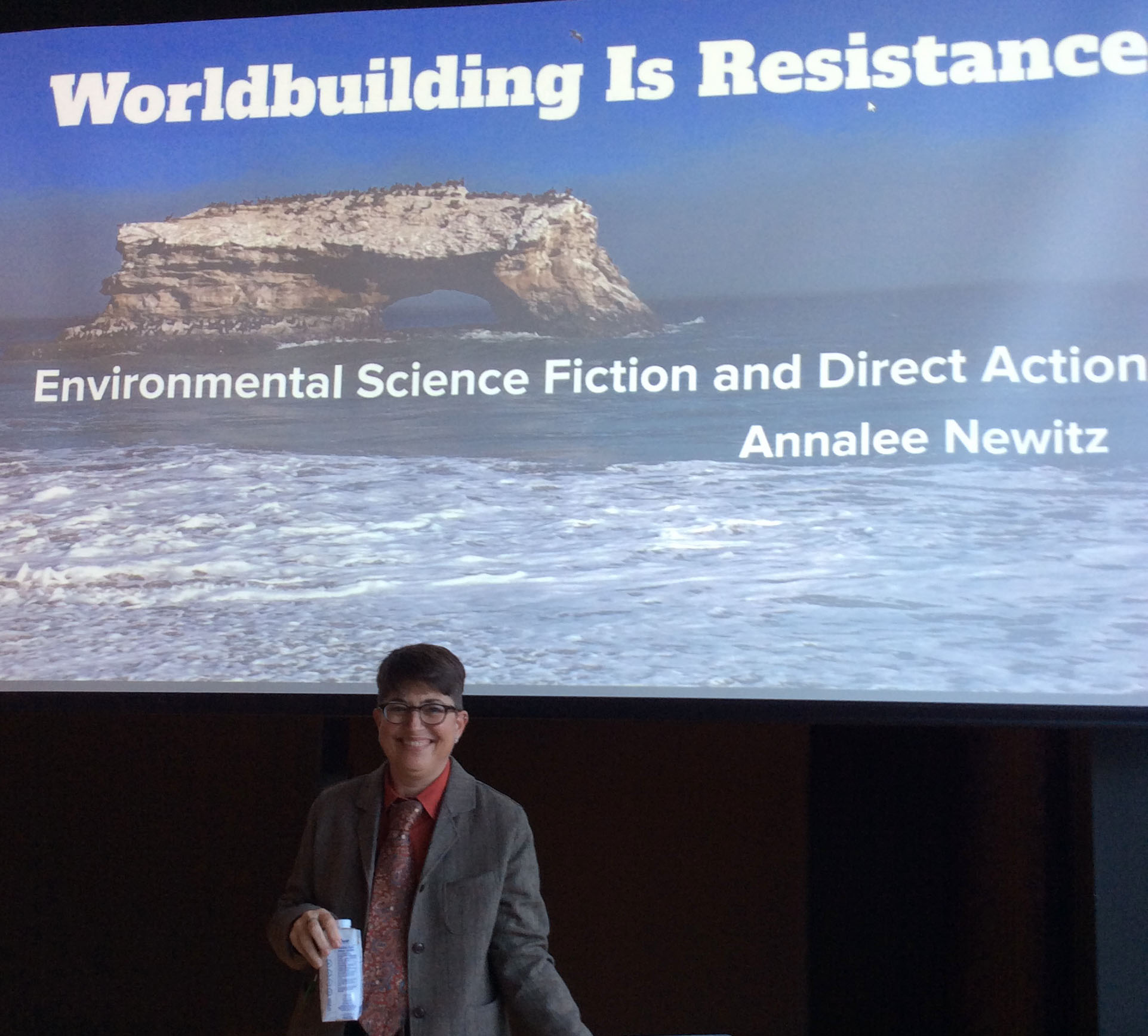
Annalee Newitz gives her keynote (photo by Nina Munteanu)

Annalee Newitz closed the day with their keynote presentation Worldbuilding Is Resistance that explored the dystopia binary of environmental science fiction. A theme to which the next keynote by Kim Stanley Robinson would touch on as well.

Elson Galang presenting Seeds workshop (photo by Nina Munteanu)

FRIDAY morning started with Elson Galang and Elena Bennett (McGill University), who led the Seeds of Good Anthropocenes Workshop, which introduced the concept of seeds programs then further explored through breakout discussion groups they moderated.

This was followed by faculty-led Teaching and Learning for Hopeful Futures Workshop, in which McGill instructors from varied disciplines (including education, political science, environment, urban planning and planetary sciences) discussed translating science into hopeful narratives.

pre-meet on Zoom of participants of the Roundtable

I then participated in a roundtable of authors, scholars, researchers and planners entitled Telling the Story of the Future, moderated by Chris Barrington-Leigh (McGill BSE/Health and Social Policy). The roundtable included fellow authors Alyx Dellamonica and Su J. Sokol. Other participants of the roundtable included Stephanie Posthumus (languages, literatures, cultures at McGill), Jayne Engle (public policy at McGill) Richard Sheamur (urban planning at McGill), and limnologist Irene Gregory-Eaves (biology at McGill).

BDE Director Frédéric Fabry introduces the conference (photo by Nina Munteanu)

The final keynote was given by Kim Stanley Robinson (author of New York 2140 and The Ministry of the Future).

Storyboard of the first day of the conference by Visual Versa (photo by Nina Munteanu)

Nina Munteanu is a Canadian ecologist / limnologist and novelist. She is co-editor of Europa SF and currently teaches writing courses at George Brown College and the University of Toronto. Visit www.ninamunteanu.ca for the latest on her books. Nina’s bilingual “La natura dell’acqua / The Way of Water” was published by Mincione Edizioni in Rome. Her non-fiction book “Water Is…” by Pixl Press (Vancouver) was selected by Margaret Atwood in the New York Times ‘Year in Reading’ and was chosen as the 2017 Summer Read by Water Canada. Her novel “A Diary in the Age of Water” was released by Inanna Publications (Toronto) in June 2020.

Embracing Your Future: Flying Algal Ships

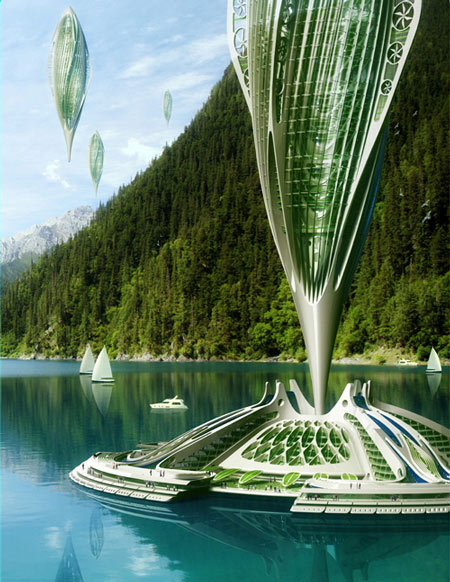
Hydrogenase design by Vincent Callebaut

You walk toward English Bay to the nearest Hydrogenase Hub, where you are meeting with your team to discuss the presentation.

The hub is a floating algal farm. The farm and the elongated seed-shaped airship docked at its centre both produce biofuel—essentially hydrogen—from the microorganism Chlamydomonas reinhardtii. Your mom, a former environmental consultant and algal scientist—now she writes science fiction—explained to you that this unicellular organism has both plant and animal properties; it carries out photosynthesis but is also heterotrophic (able to use organic carbon to grow) and will in the absence of oxygen produce gaseous hydrogen and metabolites such as formate and ethanol through hydrogenase enzymes. Chlamydomonas reinhardtii was first discovered as a clean source of hydrogen back in 1939 by German scientist Hans Gaffron at the University of Chicago (ironically the same year Germany invaded Poland). Gaffron called it “photosynthetic hydrogen production by algae”; and today it is a process that produces electricity and biofuel with zero emissions. 

The algae farm recycles CO2for the bio-hydrogen airship you will be boarding after your meeting in the hub. You enter the airy station, whose honeycomb circular design resembles a stylized lily pad and glance up through the high nano-glass ceiling toward the elongated seed-shaped transport rising ten stories above you. The sun glances off the diaphanous double helix frame that resembles a freshwater spirogyra. The hub you’re standing in is a floating algae farm with solar cells on top and hydro-turbines below to capture tidal energy. The algae farm recycles CO2 for the bio-hydrogen airship you will be boarding after your meeting in the hub. You enter the airy station, whose honeycomb circular design resembles a stylized lily pad and glance up through the high nano-glass ceiling toward the elongated seed-shaped transport rising ten stories above you.

The sun glances off the diaphanous double helix frame that resembles a freshwater spirogyra. The hub you’re standing in is a floating algae farm with solar cells on top and hydro-turbines below to capture tidal energy.

The concept is the “subversive architecture” of Belgian architect Vincent Callebaut and inspired by the principles of biomimicry, coined by Janine Benyus in 2002 in her book “Biomimicry: Innovation Inspired by Nature”.  Callebaut conceived Hydrogenase in 2010 as a 100% self-sufficient and zero-emission transport system using algae. He claimed that a hectare of seaweeds could produce 120 times more biofuel than a hectare of colza, soya or sunflower without consuming land needed for crops or forests. He called Hydrogenase a true miniature biochemical power station. Able to absorb CO2 as the main nutrient through photosynthesis the algae, under anaerobic conditions, produce hydrogen in vitro or in bioreactors. 

You swipe your PAL over the ticket booth sensor and the optional ticket-brochure pops out. You take it and read the specs between glances at the tall vessel loading in the dock of the hub. It’s really like a vertical dirigible, you think, studying the seed-shaped airship with self-cleaning “intelligent” nanostructured glass—inspired by the lotus leaf that doesn’t get wet. The semi-rigid unpressurised airship stretches vertically around an arborescent spine that twists like chloroplast ribbons 400 meters high and 180 meters in diameter.

You read that each Hydrogenase airship is covered with flexible inflatable photovoltaic cells and twenty wind turbines to maneuver and collect energy. The interior spaces provide room for housing, offices, scientific laboratories, and entertainment, and a series of vegetable gardens that provide a source of food while recycling waste.

You read that this self-sufficient organic transport flies about 2000 meters high at about 175 km/hr (twice the speed of a conventional ship). Given its ease in negotiating airspace and its ability to land and take off from virtually any location, the Hydrogenase is used by many groups in various capacities. Your friend Michael who teaches at the University of Victoria uses one as a mobile research station in his studies along the coast of northern British Columbia.  

The vessel is made of “intelligent layers” and “self-separable ceramics”. Its bionic coating draws inspiration from sharkskin that is self-cleaning and flow-efficient. 

Hydrogenase concept with algal farm pods and air ships

You head down the spiral staircase to the third subsea level toward the meeting room you booked earlier on your PAL. The view is spectacular from here through the nano-glass panes. Rays of shimmering light stream through a gently swaying forest of kelp. You glimpse the sun-glinted flickering of hundreds of anchovies as they school through the kelp. This floating farm is an organic purifying station of four carbon wells where the algae recycle the carbonated waste brought by the airships and, in turn, feed the airship with biohydrogen. It’s the new “gas station”, you reflect with a smile.

After your meeting with staff, you and three others of your team board the airship and settle in one of the skyview chambers. The journey is relaxing, like the BC Ferry used to be, but without the pungent smell and pollution of conventional motorized sea vessels. It’s a quiet and relaxing trip with a spectacular view of the Gulf Islands. Your team strategizes your presentation over a light lunch and Matcha lattes. 

Vincent Callebaut’s Hydrogenase

The PA system sounds and a woman’s voice informs you that the ship will be making an emergency landing on Saturna Island to rescue two hikers injured at East Point. This will only add twenty minutes to the trip, the woman assures you. You don’t mind and recall the disclaimer at the bottom of the ticket. Given the ability of this airship to take off and accurately land virtually anywhere, all Hydrogenases are by law mandated to be on standby for rescue missions in rough terrain.

You pull out the ticket and read again: The Hydrogenase is affiliated with the International Red Cross and BC Coastguard. The Hydrogenase must by law respond to any distress call at sea or rough terrain associated with coastal waters. Because of this service, we cannot guarantee a timely schedule.  

You recall how Hydrogenases were deployed in the last hurricane disaster off the coast of Florida last year, saving countless people trapped in the flooding that accompanied the storm. The International Red Cross uses them as flying hospitals.

Bernard frets over the time delay. He is concerned about the lack of preparation and set up time once you get into Victoria. You assuage him gently. The best preparation is sincerity, you tell him. The landscape architect Thomas Woltz, whose work you highly respect, saw himself as someone who embraces the complexity of modern life while seeking meaning and narrative in both natural and human-made environments.

“We’re storytellers,” you tell Andre. Invoking metaphor through design. “They know we’re coming and they know we’re helping someone; they’ll wait for our story. And it’s all about harmony.”

The lines of Henry David Thoreau come to you: Man’s life must be of equal simplicity and sincerity with nature, and his actions harmonize with her grandeur and beauty.

Then you point your PAL at the ServiceBot and order three more lattes. You lean back in your bamboo fabric chair and cross your legs over the leg rest. 

It’s a brave new world. 

Pine forest in Jackson Creek Park, ON (photo and dry brush rendition by Nina Munteanu)


Nina Munteanu is a Canadian ecologist / limnologist and novelist. She is co-editor of Europa SF and currently teaches writing courses at George Brown College and the University of Toronto. Visit www.ninamunteanu.ca for the latest on her books. Nina’s bilingual “La natura dell’acqua / The Way of Water” was published by Mincione Edizioni in Rome. Her non-fiction book “Water Is…” by Pixl Press(Vancouver) was selected by Margaret Atwood in the New York Times‘Year in Reading’ and was chosen as the 2017 Summer Read by Water Canada. Her novel “A Diary in the Age of Water” was released by Inanna Publications (Toronto) in June 2020.
The Ontario Climate Symposium: Adaptive Urban Habitats by Design

SONY DSC

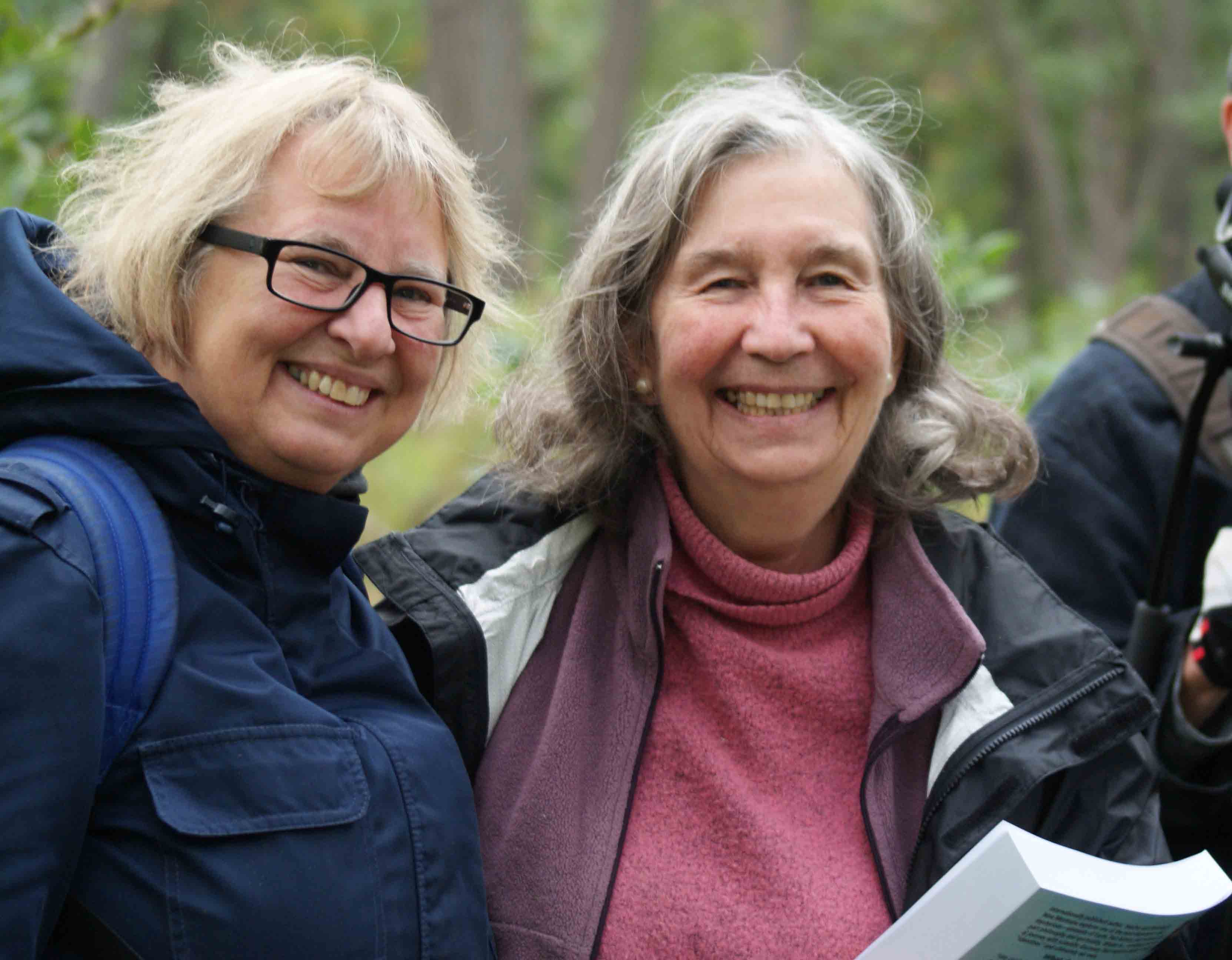
Nina presents Diana Beresford-Kroeger with a copy of “Water Is…”

I recently participated in the 2018 Ontario Climate Symposium “Adaptive Urban Habitats by Design” at OCAD University in Toronto, hosted by the Ontario Climate Consortium and the Toronto and Region Conservation Authority.

Day 1 opened with a ceremony by Chief R. Stacey Laforme of the Mississauga of the New Credit First Nation, followed by keynote address by Dr. Faisal Moola, associate professor of the University of Guelph.

A three-track panel stream provided diverse and comprehensive programming that helped further the goal to foster important discussions for how art and design can play a role in developing adaptive, low carbon cities. Panels sparked much networking among a diverse group of participants, who clustered around the refreshments in the Great Hall, where my “Water Is…” exhibit was located.

OCS-venue

The Great Hall, where participants networked over refreshments

WaterIs...at OCS2

one participant clutches “Water Is…”

Water Is… was also there for sale, as part of my exhibit on water, along with Environment and Climate Change Canada, Green Roofs, Waste, and the Environmental Commissioner of Ontario. I had several lively and insightful conversations with participants and I’m glad to say that Water Is… made it into several people’s hands at the symposium. Water is, after all, a key component of climate and climate action.

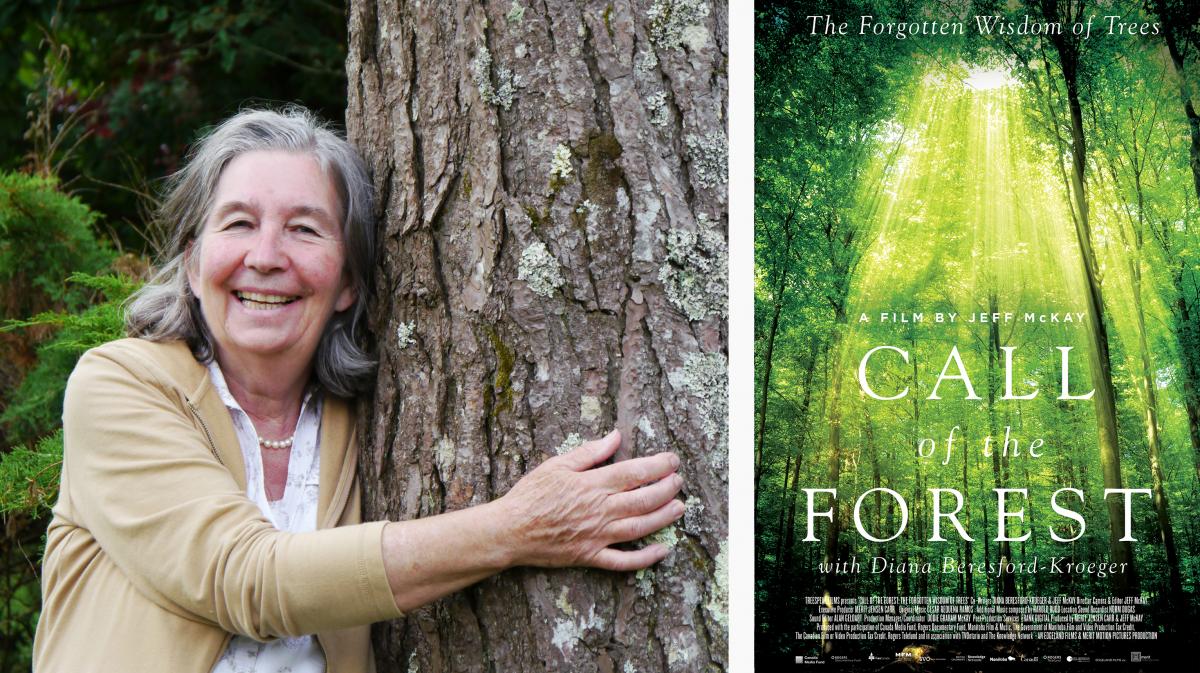
The film “Call of the Forest: The Forgotten Wisdom of Trees” was screened and scientist Diana Beresford-Kroeger participated in a question and answer period then signed her latest book.

diana_and_the_tree_

Call of the Forest” was called “a folksy and educational documentary with a poetic sort of alarmism about disappearing forests,” by the Globe and Mail. The film “takes us on a journey to the ancient forests of the northern hemisphere, revealing the profound connection that exists between trees and human life and the vital ways that trees sustain all life on this planet.” The movie describes the numerous health-giving aerosols that trees use to communicate. Diana’s genuine and earnest concern illuminates her simple yet powerful narrative, such as when she says that the forests are “haunted by silence and a certain quality of mercy.” Featuring forests from Japan and Germany’s Black Forest to Canada’s boreal forest, this documentary is a powerful manifesto for sustainability.

DianaBeresfordKroeger

Diana lecturing in High Park

On Day 2, I toured the Black Oak savanna in High Park with Diana Beresford-Kroeger (author of The Global Forest). The tour was refreshing and enlightening. Diana is a genuine advocate for the forest and showed some of the medicinal properties of forest plants. An example is the common weed, Goldenrod; its astringent and antiseptic qualities tighten and tone the urinary system and bladder, making goldenrod useful for UTI infections; Its kidney tropho-restorative abilities both nourishe and restore balance to the kidneys.

Diana spoke from the heart and brought a wealth of scientific knowledge to us in ways easy to understand—like the biochemistry of photosynthesis or quantum coherence. Diana shared how over 200 tree aerosols help combat anything from asthma to cancer. I also talk about this in the “Water Is Life” chapter of my book, Water Is…, which I gave a copy to Diana.

lunenburg-shop01

Shops in Lunenburg, NS (photo by Nina Munteanu)


nina-munteanuNina Munteanu is an ecologist, limnologist and internationally published author of award-nominated speculative novels, short stories and non-fiction. She is co-editor of Europa SF and currently teaches writing courses at George Brown College and the University of Toronto. Visit www.ninamunteanu.ca for the latest on her books.