An Autumn Walk in an Ontario Forest

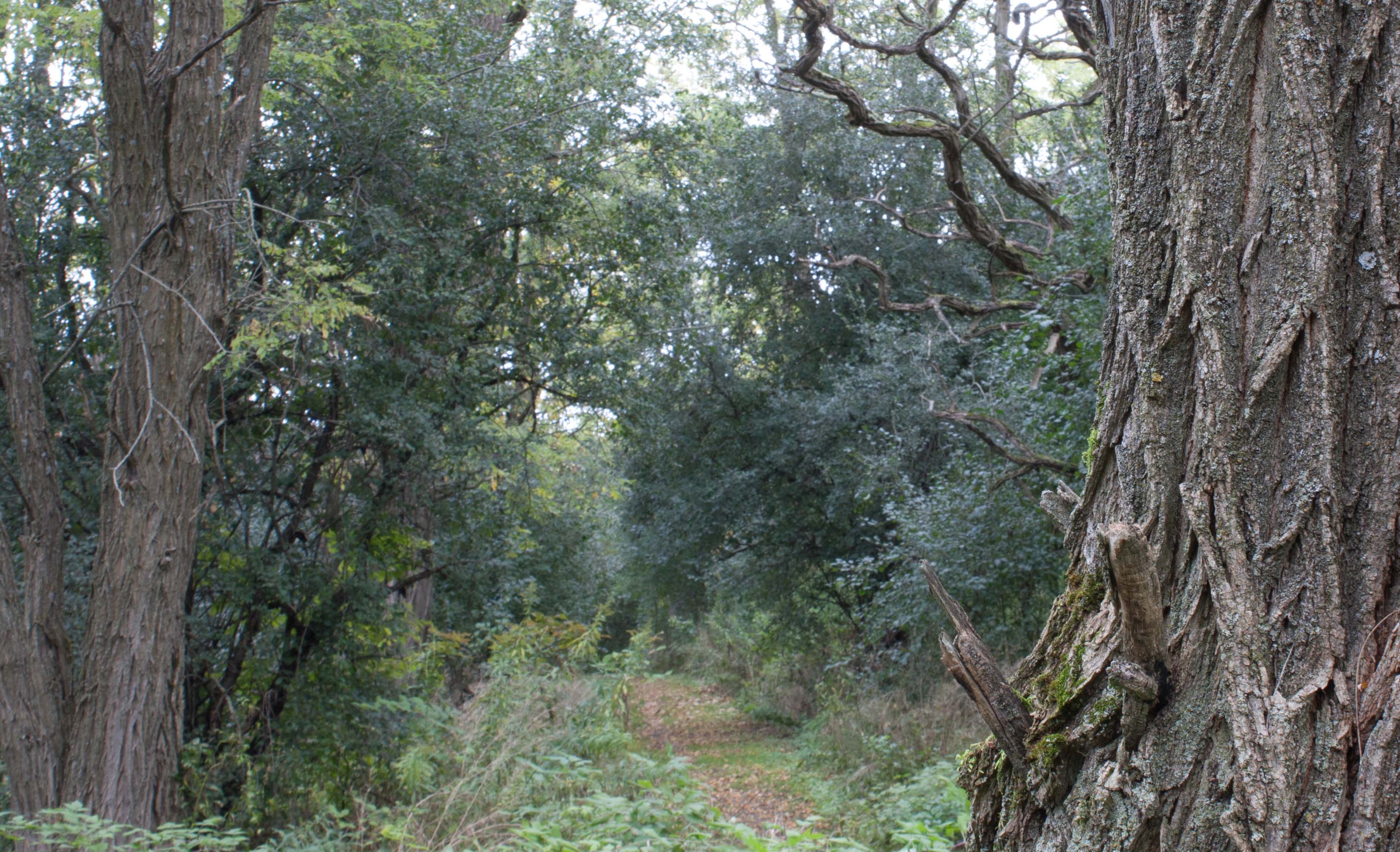
Gnarly branches of black locust trees overhang a trail in Trent Forest, ON (photo by Nina Munteanu)

It was a late October morning and I had chosen a less walked trail in the Trent Forest. It was a cloudy day that promised rain from the northeast with dark clouds; but the sun still shone in the southeastern sky through a thin screen, giving everything a bright and soft ethereal quality.

Deeply furrowed trunk of black locust on trail through black locust grove, Trent Forest, ON (photo by Nina Munteanu)

The main walk went first along a lowland of marshy swamp forest, mostly cedars and poplars. The less travelled trail veered up a steep incline and eventually tapered to another drier mini-ecosystem. I felt like I’d entered an enchanted grove with tall and crooked black locust trees, some very thick (a metre or so in diameter) and no doubt quite old. Vines of creepers tangled down from gnarly branches, forming intriguing webs of colour and texture. I adore the bark of the Black Locust tree; It is deeply furrowed and resembles entwined rope. When I touched the craggy light bark of a large tree, I felt its corky lightness. The bark was covered in small moss patches and tiny foliose and crustose lichen in shades of pale green and deep yellow. An entire ecosystem.

Old black locust tree showing rope-like bark covered in lichen, Trent Forest, ON (photo by Nina Munteanu)

Not another soul came by during the time I was there in the black forest grove. In fact, I didn’t encounter anyone on my entire walk in the forest. It was so quiet in the black locust grove. Except for some bird calling—possibly a woodpecker—and the soft trill of several little songbirds, chickadees and warblers, my constant companions.

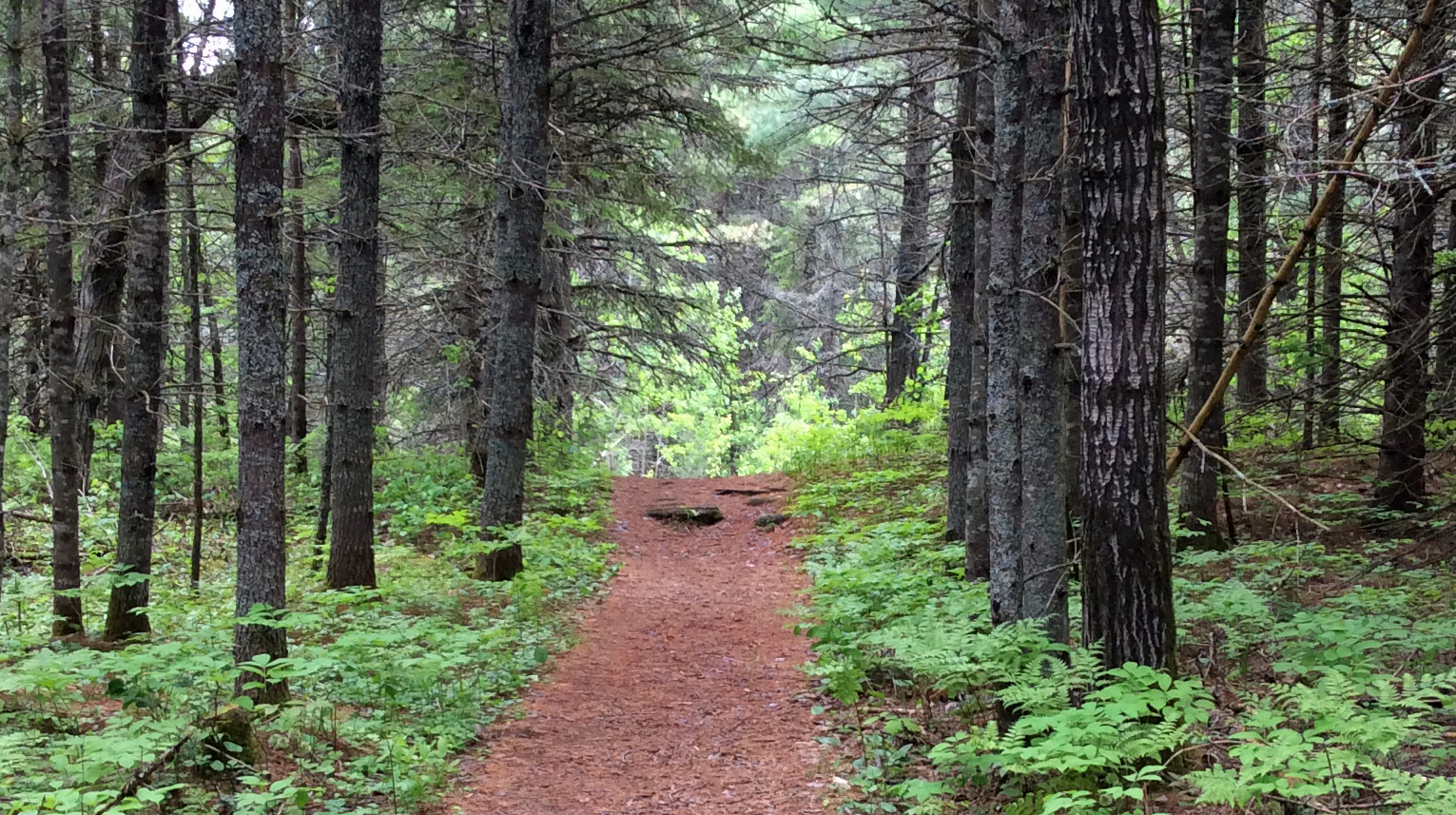
Trail through black locust grove, Trent Forest, ON (photo by Nina Munteanu)

I felt a quiet calm descent on me like a soft blanket and I didn’t want to leave. But I was keenly aware of the coming storm as the dark clouds billowed closer in gusts of fresh wind and a few raindrops started to spatter down on me. Yet I lingered.

Gnarly branches of black Locust tree arc over the trail, Trent Forest, ON (photo by Nina Munteanu)

I got home just as the dark clouds opened to a hard rainfall. The rain turned to hail. it came down in thick sheets, bouncing hard on the pavement. By then, I was glad to be indoors with my cup of hot tea.

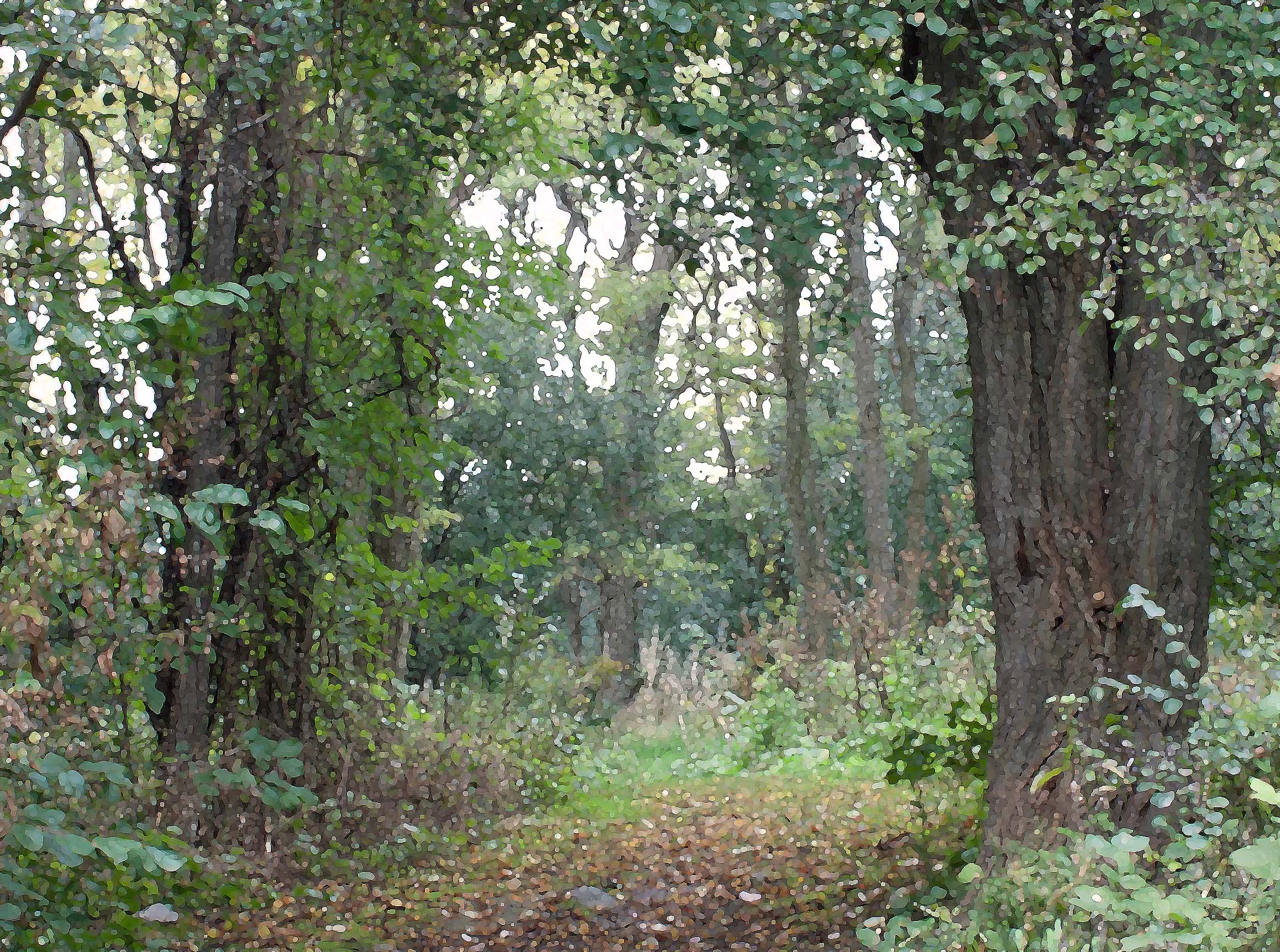
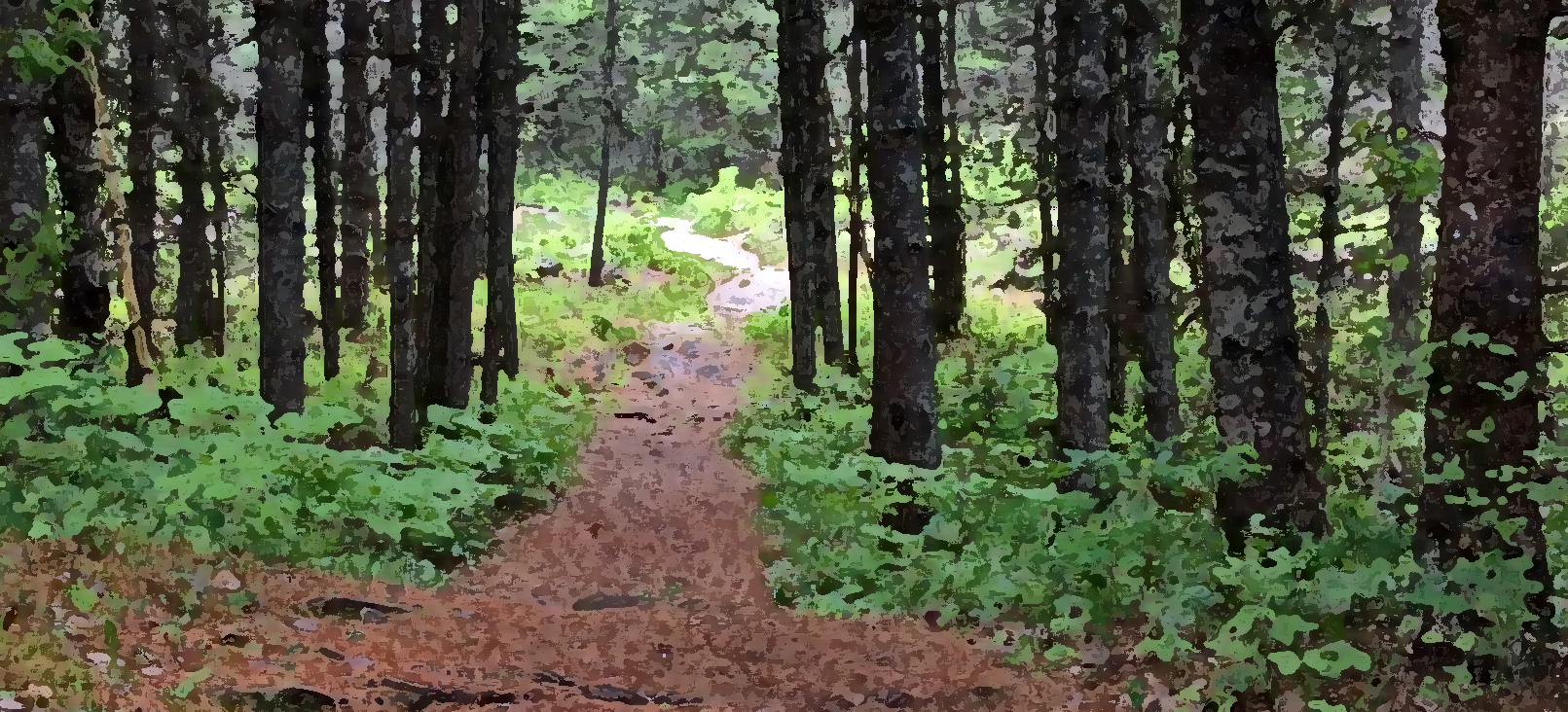
Upland trail through black locust grove, Trent Forest, ON (photo and rendition by Nina Munteanu)

Nina Munteanu is a Canadian ecologist / limnologist and novelist. She is co-editor of Europa SF and currently teaches writing courses at George Brown College and the University of Toronto. Visit www.ninamunteanu.ca for the latest on her books. Nina’s bilingual “La natura dell’acqua / The Way of Water” was published by Mincione Edizioni in Rome. Her non-fiction book “Water Is…” by Pixl Press (Vancouver) was selected by Margaret Atwood in the New York Times ‘Year in Reading’ and was chosen as the 2017 Summer Read by Water Canada. Her novel “A Diary in the Age of Water” was released by Inanna Publications (Toronto) in June 2020.

Smoke on the Water … When a Northeastern Blows

The Otonabee River under rosy haze from northeastern wildfires, ON (photo and rendition by Nina Munteanu)

It was pleasantly cool yesterday evening during my walk along the Otonabee River. Over the day, the smell of ‘campfire’ smoke from the raging northern wildfires intensified and the sun became an eerie copper disk in the peach-coloured sky. The river had gone still, as if hushed and waiting beneath the cloud of haze. Houses along the shore had become fluid watercolour paintings, colours and textures blending in a soft fabric of grey and green. As I set my gaze on a favourite cottage by the river, its reflection caught in the still waters, I thought the scene beautiful…

My heart then reminded me that this wasn’t a mist rising off the river but the yellow-brown dust descending from the corpses of millions of burnt trees, sent here by a cruel northeast wind.

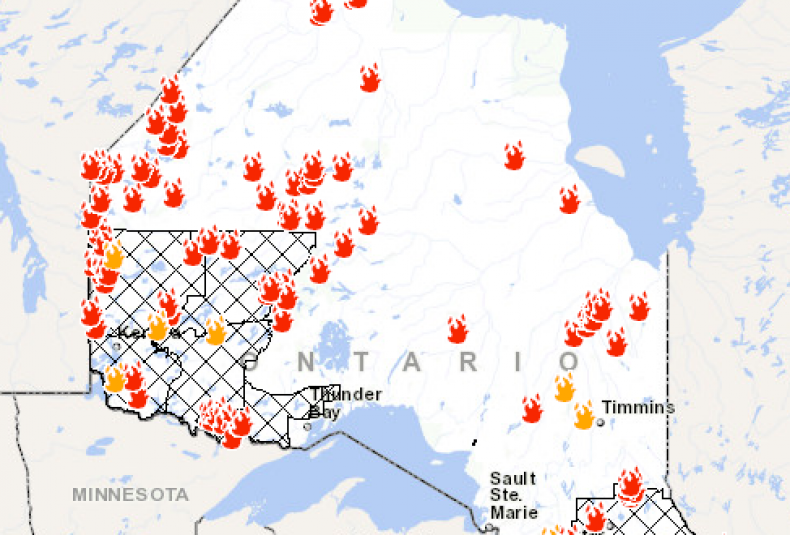
Map of Ontario wildfires June 5, 2023

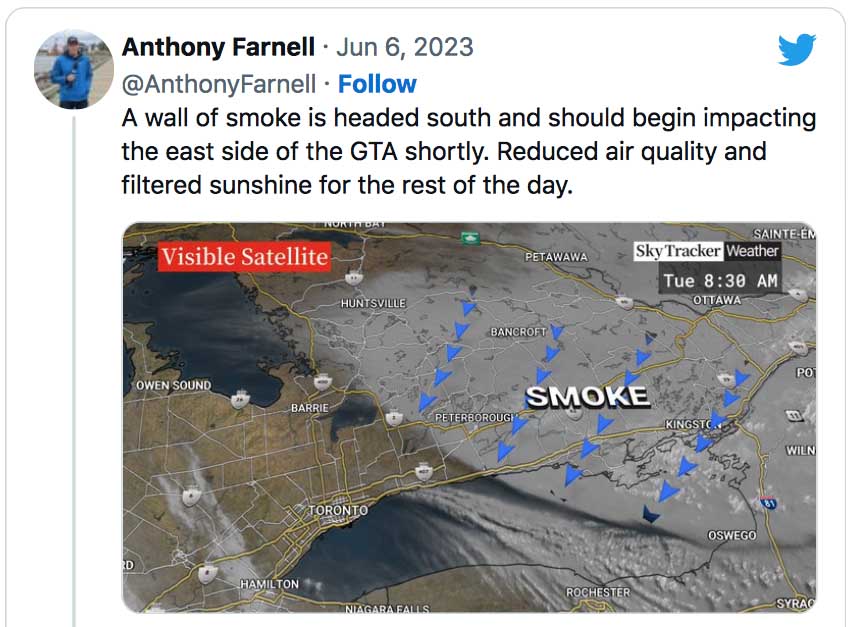
Today, the Ontario government reported heavy smoke conditions in the Northeast Region due to a large number of fires in eastern Ontario and Quebec—with fires worse than usual this year in Quebec. More than 160 fires are burning, most out of control, in Quebec. Smoke drift is travelling as far as just north of Timmins, down through Sudbury and past Parry Sound. Environment Canada issued Air quality warnings today for Peterborough, where I currently live.  

Global News reported today that “relentless wildfires have devoured 3.3 million hectares of land across Canada so far this year—roughly 10 times the normal average for the season.” In the last 24 hours, 21 new fires were discovered across Ontario, amounting to 159 active fires provincially. According to Global News, “Searing hot, tinder-dry conditions, similar to what was seen in western Canada, has only worsened the situation in Ontario.” And Quebec.

Map of Quebec wildfires June 5, 2023

Sun setting over smoky Otonabee River, ON (photo by Nina Munteanu)

There is an old willow tree on the river bank by the path I walk daily. Its massive arms stretch out over the water and one arm leans low over the path so you must bend down to walk under it. The derecho last May had cracked the tree open. But the sturdy willow continues on, undaunted, as all Nature does, thrusting up suckers from its large limbs toward a future of many more willows. It’s a favourite tree of many a walker who like to sit on its generous arms and look out over the river. Each day I touch its bark and say hello.

Old willow on the path by the Otonabee River, the glow of smoke-sun on its generous arms (photo by Nina Munteanu)
New suckers burst out of the leaning willow limb (photo by Nina Munteanu)

I think of my old friend. How a fire would take it.

First its leaves would sizzle and take flight in a requiem dance. The trunk, a funnel of fire and smoke, would sway and groan then crack with a final death shout to the roaring hissing fire. Like flying kites, leaf corpses would join embers of curling bark and soar in a vortex of billowing coal black fury. The river would flow through a killing field, black stumps and burned debris flying with the vagaries of a mischievous wind. Covered in a film of thick and oily debris, the lonely river would grow dark and surly, smothering its own aquatic forest—the algae, benthic invertebrates and fish.

And I would weep…   

Sun setting over hazy forest at mouth of Thompson Creek, ON (photo by Nina Munteanu)

Nina Munteanu is an ecologist and internationally published author of award-nominated speculative novels, short stories and non-fiction. She is co-editor of Europa SF and currently teaches writing courses at George Brown College and the University of Toronto. Visit www.ninamunteanu.ca for the latest on her books. Nina’s recent book is the bilingual “La natura dell’acqua / The Way of Water” (Mincione Edizioni, Rome). Her latest “Water Is…” is currently an Amazon Bestseller and NY Times ‘year in reading’ choice of Margaret Atwood.

Walking in the Rain: Reprised

Flooding creek in Trent Nature Sanctuary during a rain, ON (photo and rendition by Nina Munteanu)

One morning, in late spring, I went walking in the rain through the Trent Nature Sanctuary forest. Looking for magic…
Moisture covered everything. It coaxed out vivid colours and textures in a tangle of stable chaos. I felt like I’d entered a Tom Thomson painting…

Moss-covered cedar trees after a soft rain in Trent Nature Sanctuary, ON (photo by Nina Munteanu)

The rain intensified the forest’s mosaic of unique scents from pungent, heavy and sharp to floral, fresh and sweet. The gossamer morning light favoured photography with a gentleness that softened and deepened everything, and invited intimacy. Mist hung low and rose like steam from the damp earth, slowing time. It felt as though I was walking through a cloud. The forest emerged ghost-like in glimpses of tree, shrub and grass. The brilliant red of the osier dogwood. The vivid greens of mosses and leaves. A tangle of blue-green lichens and bright red cedar roots. I was witness to a chaotic tapestry of Nature’s art. Infinite shades of green, brown, grey and yellow created a fluid landscape that water painted into a vibrant watercolour scene.

I moved through it, boots squelching along the spongy loam path, as though wrapped in a moving artwork.

Dew drops on hawksweed, lichen fruiting bodies in background, ON (photo by Nina Munteanu)
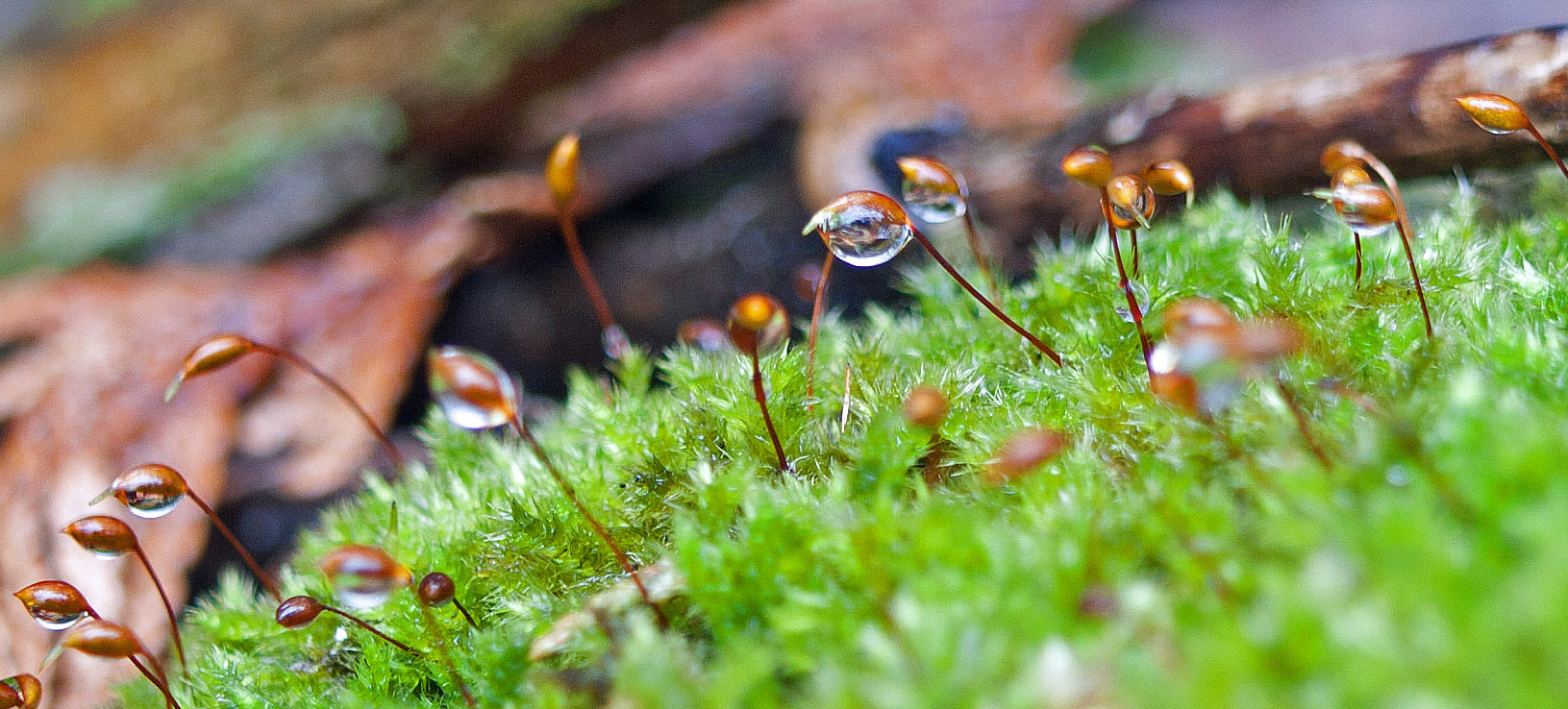
Moss with spore capsules in the rain, Trent Nature Sanctuary, ON (photo by Nina Munteanu)
Cedar roots and ferns in the heavy mist of a morning rain, Trent Nature Sanctuary, ON (photo by Nina Munteanu)
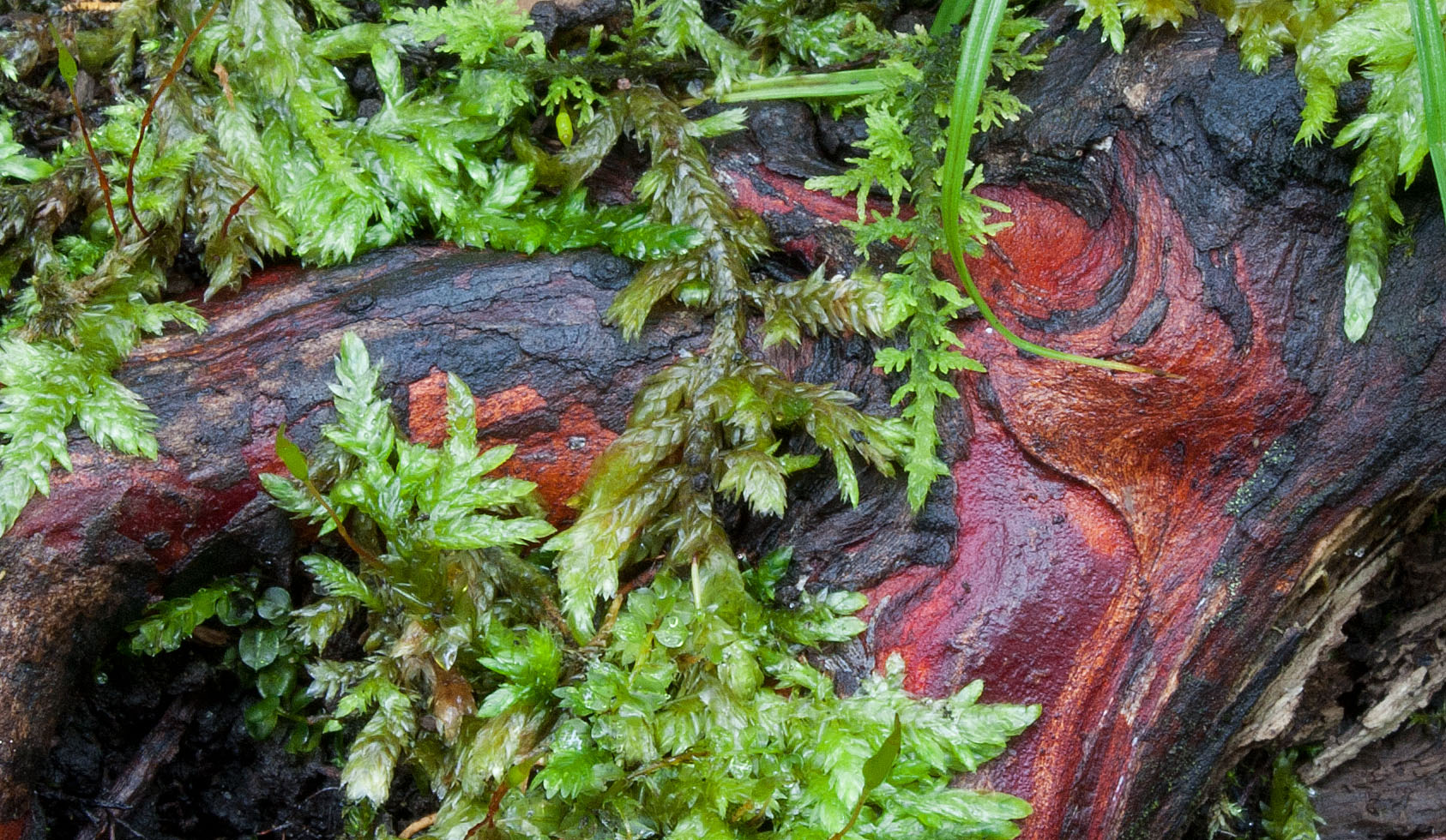
Cedar root and moss during a mild rain, Trent Nature Sanctuary, ON (photo by Nina Munteanu)
Cedar root and moss shortly after a rain, Trent Nature Sanctuary, ON (photo by Nina Munteanu)

The moisture carried the warbles and fluting chirps of lively bird song amid the hush of raindrops on vegetation. Each surface had a unique voice. And the rainfall—from light drizzle to hard pour—carried its own tune, rhythm and percussion. A symphony of diverse frequency from rich infrasound to beyond. 

Nina’s Canon EOS Rebel camera on its tripod, ready to take photos, Trent Nature Sanctuary, ON (photo by Nina Munteanu)

I kept my camera, attached to its tripod, tucked under several water-proof bags and walked with deliberate steps through wet duff, decayed leaves and mud. I had a hood but couldn’t stand to keep it up—I needed to hear and feel all of it: the rain sizzling through the vegetation, the red-winged blackbird’s conk-a-lee! The robin’s cheerily-cheer-up-cheerily-cheer up! The crow’s caw and rattle. The primordial shriek of a blue jay or kingbird. All were out, though not visible, as I navigated the huge puddles and slippery mud-leaf mix. Hair dripping, face in a grin.

Rain falling on the marsh to the Otonabee River, ON (photo by Nina Munteanu)
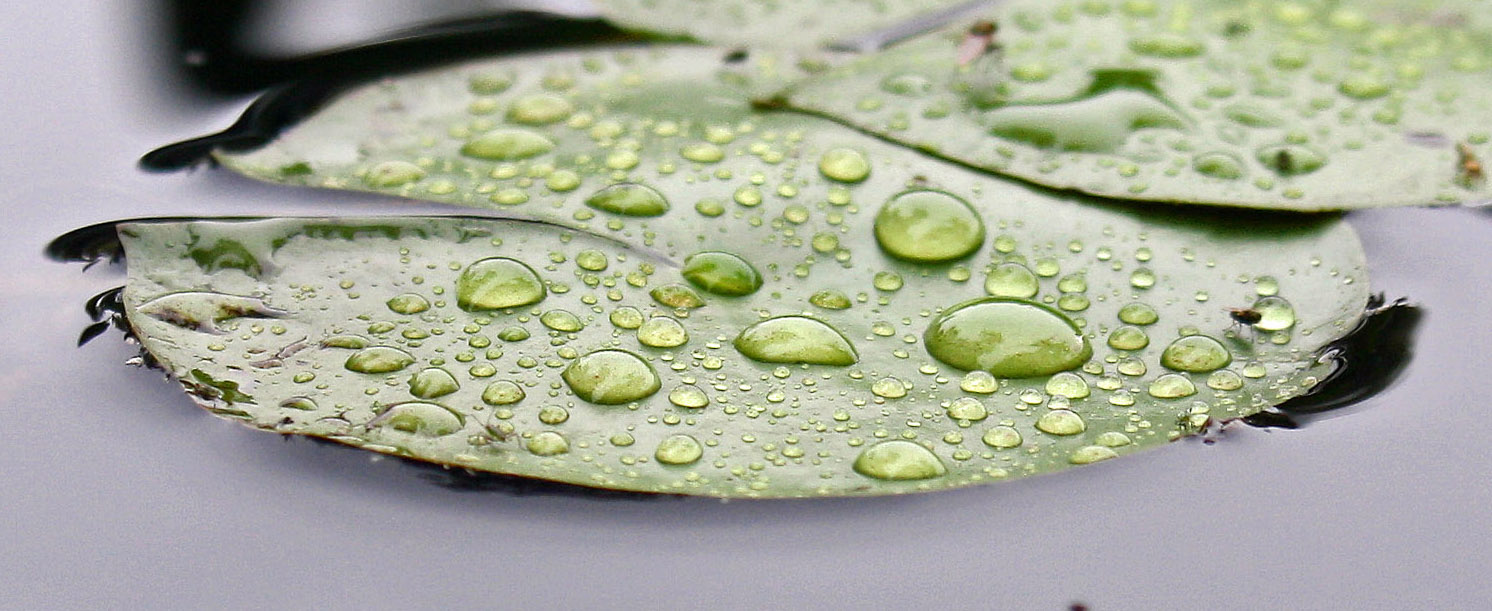
Pond lilies in the rain, ON (photo by Nina Munteanu)
Rain falls on the Otonabee River, ON (photo by Nina Munteanu)

I felt elation in Nature’s celebration of life.
I was the only person in the park and thoroughly basked in that feeling of humbleness that comes with a kind of knowing: of being part of something far greater than oneself and yet in some way being that greater ‘self.’ Like I belonged there. Hard to explain. But it felt truly awesome and eternal.

Nina Munteanu
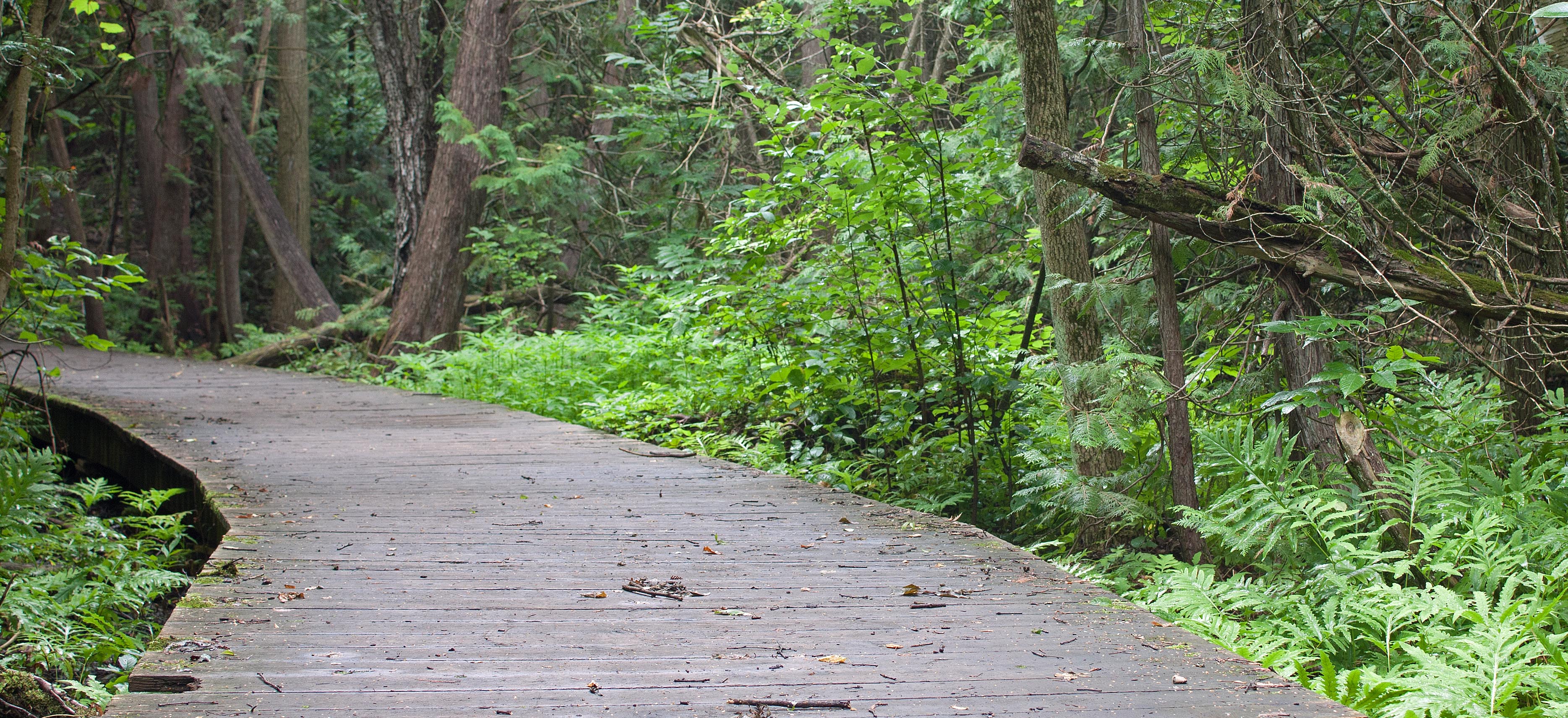
Boardwalk over the forest swamp, Trent Nature Sanctuary, ON (photo by Nina Munteanu)
Fence post with marsh in the background during a steady rainfall, ON (photo by Nina Munteanu)
Country road in the rain, ON (photo and rendition by Nina Munteanu)

I could have stayed there, wet in the rain, for hours. But I felt sorry for my camera and headed home, thinking of a warm cup of tea… 

NINA MUNTEANU is a Canadian ecologist / limnologist and novelist. She is co-editor of Europa SF and currently teaches writing courses at George Brown College and the University of Toronto. Visit  www.ninamunteanu.ca for the latest on her books. Nina’s bilingual “La natura dell’acqua / The Way of Water” was published by Mincione Edizioni in Rome. Her non-fiction book “Water Is…” by Pixl Press(Vancouver) was selected by Margaret Atwood in the New York Times ‘Year in Reading’ and was chosen as the 2017 Summer Read by Water Canada. Her novel “A Diary in the Age of Water” was released by Inanna Publications (Toronto) in June 2020.

The Ontario Derecho: When a Disaster Brings Out Kindness

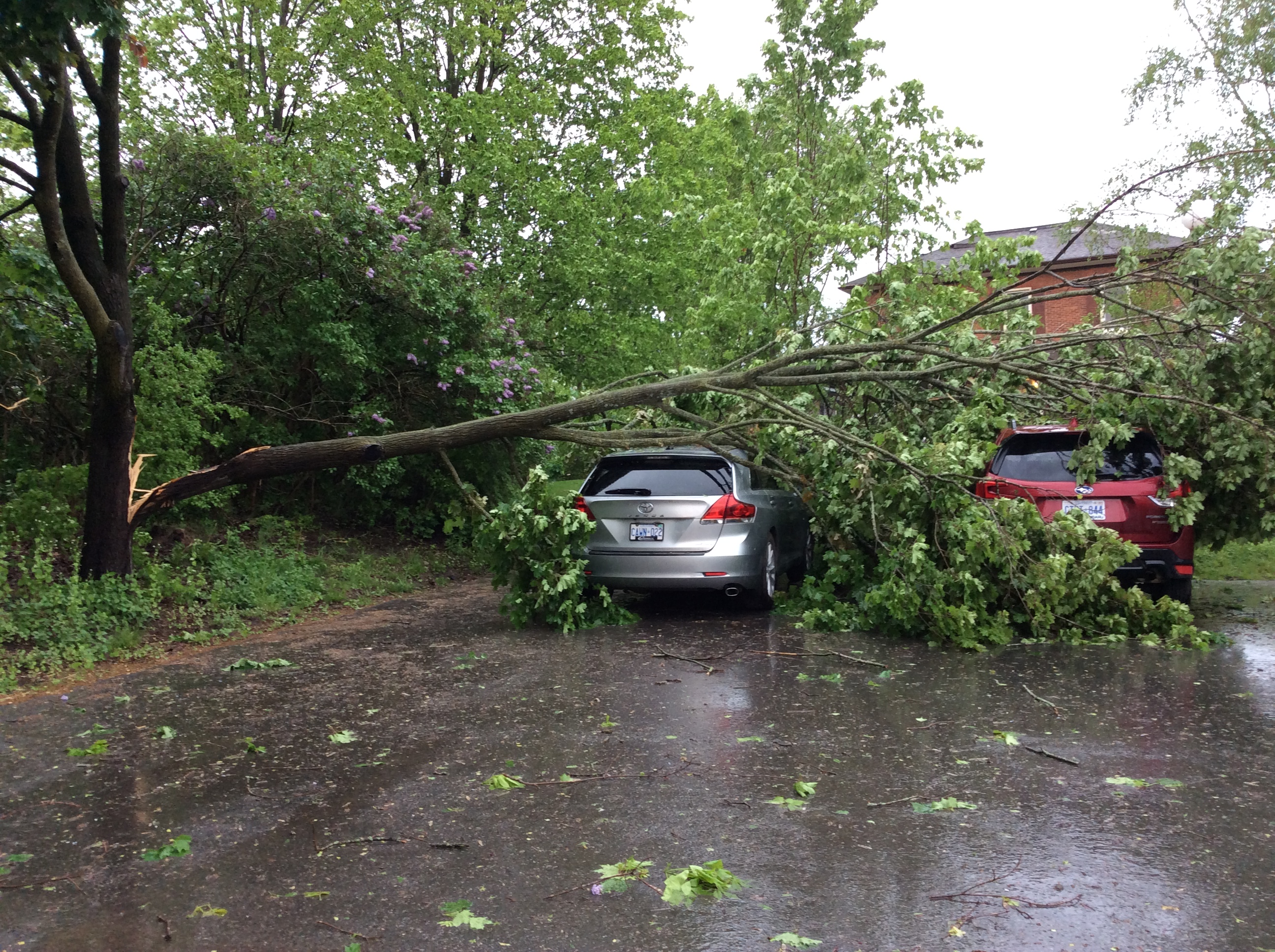
Cars trapped when a sugar maple snaps and falls on them in Saturday’s Derecho, Peterborough, ON (photo by Nina Munteanu)

It’s Wednesday and parts of the city still have no power since Saturday’s storm swept through like a ferocious lion. We got our power yesterday. We’d relied on our kind neighbours, who had a barbecue, to cook up some suppers. The power has come back in stages depending on where lines were brought down by trees or the violent wind microbursts.

A string of power poles and lines downed by the violent winds of the derecho along Highway 29 near Lakefield, ON (photos by Nina Munteanu)

Environment Canada calls Saturday’s storm a derecho: a long line of very active and violent thunderstorms or microbursts that include winds of at least 93 km/h with focused gusts of 121 km/h or greater. According to Environment Canada Senior Climatologist David Phillips, the storm spanned about 1,000 kilometers from Michigan to Maine as it went across Ontario and Quebec. Derechos typically contain numerous downburst clusters (families of downburst clusters) that, in turn, have smaller downbursts, and smaller microbursts. These tight, often cyclic tornado-like bursts within larger linear downbursts are what likely created the random devastation seen in Peterborough, where one tree was entirely uprooted and the tree beside it left untouched.

Birch uprooted on Auburn Street, Peterborough (photo by Nina Munteanu)

A true ‘herald archetype’, environmental disasters incite change, often through disorder. In doing so, they can bring out the best in us. The true mettle of a person is often revealed during such times, through the emergence of compassion and kindness.   

I live just off the Rotary Trail in Peterborough, facing a mixed riparian forest of mostly black walnut and locust trees, with some silver maple, willow, Manitoba maple, oak and ash. The trail is well used every day by cyclists and walkers. The tornado-force winds and deluge rains singled out a few trees on the forest edge and flung them across the trail. A quick inspection shortly after the storm revealed that several trees formed obstacles to those using the trail: a silver maple just in front of my good friend Merridy’s place; an old half-dead elm; and a large Manitoba maple whose upper canopy had gotten tangled in the telephone wires.

Various damaged and uprooted trees in Peterborough, ON (photos by Nina Munteanu)

When Merridy and I decided to attempt clearing the Rotary Trail of strewn maple limbs and branches, we weren’t there more than five minutes when a cyclist stopped and without a word helped us; he grabbed large tree limbs and hoisted them aside like Superman then got on his bike and took off without a word—like Spiderman. After more dragging of tree limbs and my deft hand at the tree clippers and the broom, we cleared the trail for walkers and cyclists. 

Before (left) and after (right) we cleared the Rotary Trail of downed silver maple from the derecho (photos by Nina Munteanu)

And then there was Charlie … a fashion-savvy quasi hipster-hippy who came cycling in with his chainsaw and hand saw on his back; he’d been all over the trail clearing tree debris just because he could. Charlie set to work on the huge Manitoba maple that had fallen across the trail and was leaning heavily on the telephone wire. Charlie proceeded to climb the tree and saw branches here and there to lighten the limb on the wire before cutting it. Two of us ladies became his cleanup crew, hauling big tree sections off the path as he downed them. By the time he got to the main tree limb on the wire, a group of cheerleaders had formed to watch. We all clapped when the big branch came off the line. One elder lady on two walking canes hobbled out from her home and handed Charlie a Bobcaygeon Petes Lager as thanks.

Charlie sawing off branches from Manitoba maple tangled on telephone wire (photo by Nina Munteanu)
Charlie saws the remaining tree trunk to clear the trail (photo by Nina Munteanu)

At first it was just me and Charlie. Watching him set up, I’d asked him if he was from the city and in the same breath knew he wasn’t—we both knew they were very busy getting the city’s power back on and freeing streets and getting trees off the roofs of houses; it would be a long time before they came to the Rotary Trail and other parks to clear. He responded, “well, that depends… are you a lawyer?” I laughed. We both recognized that Charlie was a rogue Good Samaritan, using less than regular protocol (no safety harness or equipment [except for goggles] and climbing shoes). When I said no, he relaxed and we introduced ourselves and exchanged stories about the storm, then got to work. I was soon joined by Susan, and together we became Charlie’s support team, hauling limbs and branches out of the tangle then rolling large tree bole sections to the side. Eventually several more walkers and nearby residents came to support the work and watch. Within an hour, the entire tree was off the path and off the wire. I felt a wonderful sense of community as people gathered exchanged names and stories about the storm. And it all started with one person’s kindness. Thanks, Charlie!

Before (left) and after (right) Charlie and his gang cleared the way (photo by Nina Munteanu)

I find that we really find our humanity and sense of kindness when a disaster strikes… one of the ‘good’ things about them.

Derecho damage to trees in the forest in Peterborough area, ON (photos by Nina Munteanu)

Nina Munteanu is a Canadian ecologist / limnologist and novelist. She is co-editor of Europa SF and currently teaches writing courses at George Brown College and the University of Toronto. Visit www.ninamunteanu.ca for the latest on her books. Nina’s bilingual “La natura dell’acqua / The Way of Water” was published by Mincione Edizioni in Rome. Her non-fiction book “Water Is…” by Pixl Press(Vancouver) was selected by Margaret Atwood in the New York Times ‘Year in Reading’ and was chosen as the 2017 Summer Read by Water Canada. Her novel “A Diary in the Age of Water” was released by Inanna Publications (Toronto) in June 2020.

Squirrel Joy

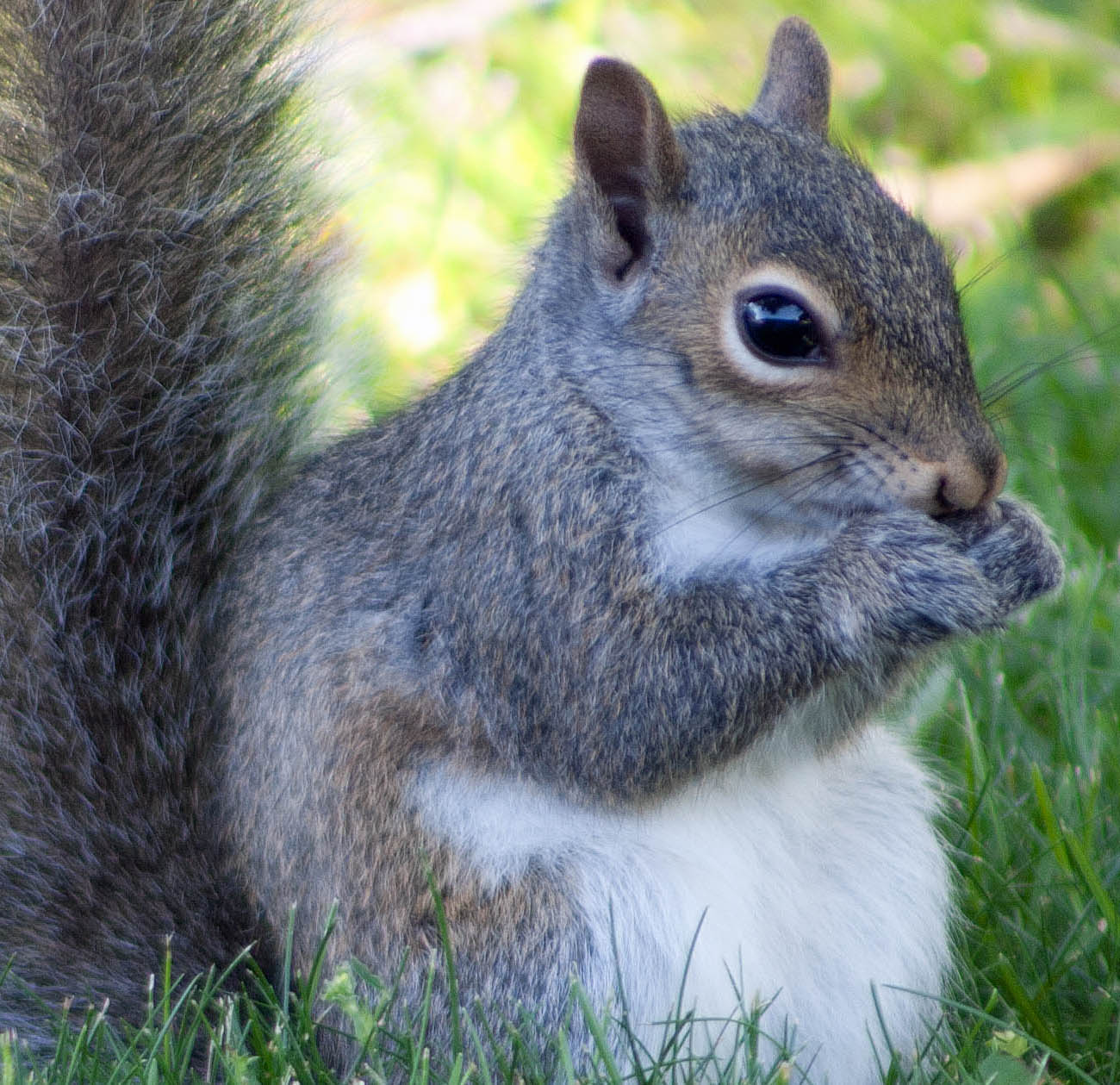
Grey squirrel munching on a maple seed, ON (photo by Nina Munteanu)

Do you believe in serendipity or destiny? That all things are interconnected in a flowing web that responds like a super consciousness? 

Swiss psychiatrist Carl Jung called it “meaningful coincidence.” Bohm used the term “implicate order”; the Vedas call it “akasha; Goethe gave it the name “the ground of all being”; and Mae-Wan Ho described it as “quantum entanglement”: when puzzle pieces cooperatively arrange themselves into a symbiotic pattern of synchronicity to provide meaning. 

The universe provides…

I’ve come to rely on it in my writing: moments when key things of interest reveal themselves to me just when I need them. I call it writing in sync. Time and again, I’ve serendipitously discovered just what I needed for a plot point or something to complete a backstory: a news event, a conversation with a friend, or an image on the internet. Synchronicity occurs all around us. Birds flying in formation during migration. Electrons synchronizing by the billions and passing through impenetrable barriers. Fireflies flashing in harmony.

Rupert Sheldrake , British botanist and author of The Rebirth of Nature, suggests that “our minds are extended in both space and time with other people’s minds, and with the group mind or cultural mind by way of their connection to the collective unconscious.” Sheldrake posits that we tune into archetypal fields or patterns and “our minds are much broader than the ‘things’ inside our brains. He’s talking about Jungian archetypal gestalt synchronicity. The notion of consciousness as a global phenomenon that occurs everywhere in the body, not just our brains. “Consciousness, at its most basic, [is] coherent light,”writes science journalist Lynne McTaggart in her book The Field

young black squirrel lies on the branch of a silver maple tree (photo by Nina Munteanu)

It started when I was lunching with good friend Merridy and we were observing several young black and grey squirrels stretched out, lying down on the grass or a branch of the silver maple. They were obviously litter mates and had just finished a playful romp on the grass with sneak-ups, great leaps in the air, twirls and ‘attacks’ and rolls. Such fun! Merridy and I agreed that they looked satisfied and happy after their play, stretched out and languishing in the sun. We talked about how playful squirrels were and how science didn’t seem to acknowledge this. That led to a discussion on people’s perception being largely based on worldview. I shared how we see only what we’re prepared to see and we discussed how science, in its preoccupation with objectivity, can take the ‘soul’ out of life by not observing as much as it could by observing. The concept of anthropomorphism—ascribing exclusively human traits and behaviours to other animals—is based on our own limited definition of what is an exclusively human trait. Who unequivocally proved that only humans are capable of thought or feelings? This recalled a quote of Goethe that I used in the preface of my book Water Is…: “Whatever you cannot calculate, you do not think is real.” We are often blinded by our beliefs and hubris. 

Young grey squirrel climbs up the silver maple tree, ON (photo by Nina Munteanu)

During the 1600s in what is ironically called the “Age of Enlightenment,” the highly regarded philosopher René Descartes denied thought to animals; he claimed that animals could not process pain through thought and certainly not through emotions such as joy, sadness, or embarrassment. Only humans were conscious, had souls, and were capable of meaningful communication and language. What he failed to observe—in his own pet dog, even—was that animals other than humans are capable of these thoughts and emotions. One need only pay attention through an unrestricted lens to recognize their expressions and behaviours. 

In western exploitive society and religions particularly, this Cartesian view has persisted into the present day with those who still argue that animals are incapable of altruism or empathy, can’t reason or calculate, are bound by the “selfish gene”, and don’t have souls. These persist in the face of scientific evidence to the contrary and ironically serve an economic and social worldview of Nature exploitation.

Then, in a wonderfully serendipitous moment of synchronicity, Merridy announced the next day that she had just read the following passage by David George Haskell in his recent book The Forest Unseen. It was as though he had overheard our conversation about the squirrels:

Four grey squirrels loaf in the bright upper branches of a dead shagbark hickory tree fifty meters down the slope. I watch them for an hour, and mostly they loll in the sun, limbs sprawled. They seem companionable, sporadically nibbling the fur on one another’s hind legs or tails. Occasionally one will break from sunbathing and chew the fungus-encrusted dead branches, then return to sit silently with the other squirrels.

This scene of scoured tranquility makes me unaccountably delighted. Perhaps I so often see and hear squabbling among the squirrels that today’s ease seems particularly sweet. But something more is behind my delight; I feel freed from some burden carried by my over-trained mind. Wild animals enjoying one another and taking pleasure in their world is so immediate and so real, yet this reality is utterly absent from textbooks and academic papers about animals and ecology.

This insight is not that science is wrong or bad. On the contrary; science, done well, deepens our intimacy with the world. But there is a danger in an exclusively scientific way of thinking. The forest is turned into a diagram; animals become mere mechanism; nature’s workings become clever graphs. Today’s conviviality of squirrels seems a refutation of such narrowness. Nature is not a machine. These animals feel. They are alive; they are our cousins, with the shared experience that kinship implies.

And they appear to enjoy the sun, a phenomenon that occurs nowhere in the curriculum of modern biology.

Sadly, modern science is too often unable or unwilling to visualize or feel what others experience. Certainly science’s “objective” gambit can be helpful in understanding parts of nature and in freeing us from some cultural preconceptions. Our modern scientific taste for dispassion when analyzing animal behaviour formed in reaction to the Victorian naturalists and their predecessors who saw all nature as an allegory confirming their cultural values. But a gambit is just an opening move, not a coherent vision of the whole game. Science’s objectivity sheds some assumptions but takes on others that, dressed up in academic rigour, can produce hubris and callousness about the world. The danger comes when we confuse the limited scope of our scientific methods with the true scope of the world. It may be useful or expedient to describe nature as a flow diagram or an animal as a machine, but such utility should not be confused with a confirmation that our liming assumptions reflect the shape of the world.

Not coincidentally, the hubris of narrowly applied science serves the needs of the industrial economy. Machines are bought, sold, and discarded; joyful cousins are not.

David George Haskell, “The Forest Unseen”
Grey squirrel peers at the camera, ON (photo by Nina Munteanu)
A sugar maple tree flowers in early spring in Ontario (photo and dry brush rendition by Nina Munteanu)

Nina Munteanu is a Canadian ecologist / limnologist and novelist. She is co-editor of Europa SF and currently teaches writing courses at George Brown College and the University of Toronto. Visit www.ninamunteanu.ca for the latest on her books. Nina’s bilingual “La natura dell’acqua / The Way of Water” was published by Mincione Edizioni in Rome. Her non-fiction book “Water Is…” by Pixl Press(Vancouver) was selected by Margaret Atwood in the New York Times ‘Year in Reading’ and was chosen as the 2017 Summer Read by Water Canada. Her novel “A Diary in the Age of Water” was released by Inanna Publications (Toronto) in June 2020.

To the Mystic Forest by Bev Gorbet–an Ekphrastic Poem

Path birch PPP

Trail through mixed birch-pine forest at Petroglyph Park, ON (photo by Nina Munteanu)

Since moving temporarily to Peterborough during COVID-19, I have been on an adventure with Nature in the Kawartha region, north of Toronto. The region contains a chain of lakes that form the upper watershed of the Trent River; the lakes are situated on the boundary between the Paleozoic limestone region of the Golden Horseshoe and the Precambrian granite Canadian Shield of northern and central Ontario.

I’ve explored several local parks and lakes with wonderful swamp cedar on the Otonabee River and Jackson Creek and uphill beech-maple forest in the Trent Nature Sanctuary.

Farther afield, I wandered through the pine forests of Petroglyph Park, north of Peterborough, with its intriguing meromictic McGinnis Lake.

When I shared some of my Petroglyph Park photos with Toronto poet and friend Bev Gorbet, she was inspired to write this poem. I am overjoyed to share her ekphrastic poem with you here:


Path pine forest wide PPP

Trail through pine forest, Petroglyph Park, ON (photo by Nina Munteanu)

To the Mystic Forest: Reflections on Natural Beauty

Forests of the mind, wild forests of the heart…
The ethereal sounds: windstorm and echo
On a spring day…
The wind’s fierce flight through bended bough,
Through swaying treetop

High high above, the windswept call, the cry,
All the beauty in a wilderness forest…
The whispering grasses, below,
Song all bend, all flow in a cathedral clearing…

Trillium aging white

Aging white trillium, Petroglyph Park, ON (photo by Nina Munteanu)

Radiant beams, sunlight and shadow peppering
The moving boughs overhead…
Azure and lavender, sky-swept cloud
And mystic glow…

Oh! great forests of the mind,
Great forest of the heart…
A deepest beauty along an existential meridian:
The heart passionately centred, deeply into reflection:
Haunted days and alone

Wind call and cry, whisper and sigh
Great wilderness lands, wide forested plains
All the wondrous beauty, all the holy mystery:
Windswept, wind-tossed skies, the great forests
Mystery glorious, mystic days beyond time.

Bev Gorbet, June 2020


BevGorbetBev Gorbet is a Toronto poet and retired school teacher. She has published several poems with the Retired Teachers Organization and most recently in “Literary Connection IV: Then and Now” (In Our Words Inc., 2019), edited by Cheryl Antao Xavier.


Path Pine forest drybrush PPP

Petroglyph Park pine forest trail (artwork by Nina Munteanu)


nina-2014aaa

Nina Munteanu is a Canadian ecologist / limnologist and novelist. She is co-editor of Europa SF and currently teaches writing courses at George Brown College and the University of Toronto. Visit www.ninamunteanu.ca for the latest on her books. Nina’s bilingual “La natura dell’acqua / The Way of Water” was published by Mincione Edizioni in Rome. Her non-fiction book “Water Is…” by Pixl Press (Vancouver) was selected by Margaret Atwood in the New York Times ‘Year in Reading’ and was chosen as the 2017 Summer Read by Water Canada. Her novel “A Diary in the Age of Waterwas released by Inanna Publications (Toronto) in June 2020.

Age Of Water Podcast: Nina Reads from “The Overstory”

AoW Logo-smallWe are now living in the Age of Water. Water is the new “gold”, with individuals, corporations and countries positioning themselves around this precious resource. Water is changing everything. The Age of Water Podcast covers anything of interest from breaking environmental news to evergreen material. This also includes human interest stories, readings of eco-literature, discussion of film and other media productions of interest.

In this episode of Age of Water, Nina reads from the eco-fiction book “Overstory” by Richard Powers, an exploration of the relationship of trees and humanity…


At the heart of Richard Powers’s The Overstory are the pivotal lives of two women, botanist Patricia Westerford and college student Olivia Vandergriff. Both will inspire a movement against the destruction of forests.

theoverstoryPatricia Westerford—whose work resembles that of Diana Beresford-Kroeger (author of The Global Forest) and UBC’s Suzanne Simard—is a shy introvert who discovers that trees communicate, learn, trade goods and services, and have intelligence. When she shares her discovery, she is ridiculed by her peers and loses her position.  But, just as with Lynn Margulis and her theory of endosymbiosis, Westerford is finally validated. She is the archetypal ‘mother tree’, the metaphoric Tachigali versicolor, who ultimately brings the tangle of narratives together through meaning. Westerford writes in her book The Secret Forest:

“There are no individuals in a forest, no separable events. The bird and the branch it sits on are a joint thing. A third or more of the food a big tree makes may go to feed other organisms. Even different kinds of trees form partnerships. Cut down a birch, and a nearby Douglas fir may suffer…Fungi mine stone to supply their trees with minerals. They hunt springtails, which they feed to their hosts. Trees, for their part, store extra sugar in their fungi’s synapses, to dole out to the sick and shaded and wounded. A forest takes care of itself, even as it builds the local climate it needs to survive…A tree is a wondrous thing that shelters, feeds, and protects all living things. It even offers shade to the axmen who destroy it.”

Olivia Vandergriff miraculously survives an electrocution to become an ecowarrior after she begins to hear the voices of the trees. She rallies others to embrace the urgency of activism in fighting the destruction of California’s redwoods and even camps in the canopy of one of the trees to deter the logging. When the ancient tree she has unsuccessfully protected is felled, the sound is “like an artillery shell hitting a cathedral.” Vandergriff weeps for this magnificent thousand-year old tree. So do I. Perhaps the real heroes of this novel are the ancient trees.

EcologyOfStoryIn his review of Overstory in The Guardian, Banjamin Markovits wrote, “ There is something exhilarating…in reading a novel whose context is wider than human life. Like Moby-DickThe Overstory leaves you with a slightly adjusted frame of reference… And I found, while reading, that some of what was happening to his characters passed into my conscience, like alcohol into the bloodstream, and left a feeling behind of grief or guilt, even after I put it down.”

I further explore the use of metaphor and other storytelling devices used by Richard Powers in his strongly symbolic novel in my writing guidebook “Ecology of Story: World as Character.”


nina-2014aaa

Nina Munteanu is a Canadian ecologist / limnologist and novelist. She is co-editor of Europa SF and currently teaches writing courses at George Brown College and the University of Toronto. Visit www.ninamunteanu.ca for the latest on her books. Nina’s bilingual “La natura dell’acqua / The Way of Water” was published by Mincione Edizioni in Rome. Her non-fiction book “Water Is…” by Pixl Press (Vancouver) was selected by Margaret Atwood in the New York Times ‘Year in Reading’ and was chosen as the 2017 Summer Read by Water Canada. Her novel “A Diary in the Age of Waterwas released by Inanna Publications (Toronto) in June 2020.

Age of Water Podcast: Nina Reads from “Barkskins”

AoW Logo-smallWe are now living in the Age of Water. Water is the new “gold”, with individuals, corporations and countries positioning themselves around this precious resource. Water is changing everything. The Age of Water Podcast covers anything of interest from breaking environmental news to evergreen material. This also includes human interest stories, readings of eco-literature, discussion of film and other media productions of interest.

In this episode of Age of Water, Nina reads from the novel “Barkskins” by Annie Proulx a poignant exploration of the forest industry in Canada and North America.


Annie Proulx’s Barkskins chronicles two immigrants who arrive in Canada in 1693 (Rene Sel and Charles Duquet) and their descendants over 300 years of deforestation of North America starting with the arrival of the Europeans to contemporary global warming. “Barkskins” (woodcutters) are, in fact indentured servants who were brought from the Paris slums to the wilds of New France “to clear the land, to subdue this evil wilderness,” says their seigneur. Sel is forced to marry a native woman and their descendants live trapped between two cultures; Duquet runs away to become a fur trader and build a timber empire.

Barkskins AnnieProulxProulx immerses the reader in rich sensory detail of a place and time, equally comfortable describing a white pine stand in Michigan and logging camp in Upper Gatineau to a Mi’kmaq village on the Nova Scotia coast or the stately Boston home of Charles Duquet. The foreshadowing of doom for the magnificent forests is cast by the shadow of how settlers treat the Mi’kmaq people. The fate of the forests and the Mi’kmaq are inextricably linked through settler disrespect and a fierce hunger for “more.”

The novel rolls out events in a relentless stream of life and death; no character is safe from the ravages of nature or the notions of that time period. While most of the book flows like a great amoral river—filled with feckless, unheroic and at times miserable characters—there are moments of emotional shoring. They act like exclamation marks for their rarity.

EcologyOfStory“The reader comes to realize that the novel isn’t really about the human characters so much as it is about the forests,” Gus Powell of The National Post concludes of Barkskins. “As [the forests] disappear, the narrative seems to recede in importance, revealing a crucial interdependence between the human and the natural world previously handled almost entirely as subtext. This is especially true in the novel’s closing, where the anger and despair that have characterized the novel shift into an outspoken environmental advocacy.”

I further explore the use of metaphor and other storytelling devices used by Annie Proulx in this strongly symbolic novel in my writing guidebook “Ecology of Story: World as Character.”


nina-2014aaa

Nina Munteanu is a Canadian ecologist / limnologist and novelist. She is co-editor of Europa SF and currently teaches writing courses at George Brown College and the University of Toronto. Visit www.ninamunteanu.ca for the latest on her books. Nina’s bilingual “La natura dell’acqua / The Way of Water” was published by Mincione Edizioni in Rome. Her non-fiction book “Water Is…” by Pixl Press(Vancouver) was selected by Margaret Atwood in the New York Times‘Year in Reading’ and was chosen as the 2017 Summer Read by Water Canada. Her novel “A Diary in the Age of Waterwas released by Inanna Publications (Toronto) in June 2020.

Walking Helps Me Think and Imagine

Beaches-snow03

Walking in The Beach (photo by Nina Munteanu)

I’ve written many articles and over a dozen books and readers often remark on my imagination with something akin to awe and incredulity. I often get asked where I get my ideas. Let me tell you a story first…

A Toronto friend—himself a prolific letter writer—shares that his ideas come to him during his daily walks (you’ll find his witty, humorous and somewhat pithy letters in the National Post, Globe and Mail or Toronto Star … almost weekly). David Honigsberg doesn’t use his car (that’s reserved for when his son is in town) and he walks every opportunity he gets, whether it’s a short jaunt to the coffee shop several blocks from his work place or a long trek to his home in Mount Pleasant after a lunch engagement near Bloor and Yonge. He tells me that he uses his phone to capture his “eureka” moments in what may now be considered unorthodox—he doesn’t make digital notes (it’s not that kind of phone!) but instead leaves a series of voice mails on his home phone. When he gets home, David replays his messages and writes out his letter to the editor.

What Dave does is not new to creative thinkers all over the world and throughout time. He shares great company with people who used walking as a venue toward creative thinking (and writing); people like Aristotle, Charles Darwin, Charles Dickens, Ludwig van Beethoven, Friedrich Nietzsche, William Wordsworth, Henry David Thoreau, Steve Jobs, and Soren Kierkegaard—just to name a few. All great walkers.

Winter-Forest Hill

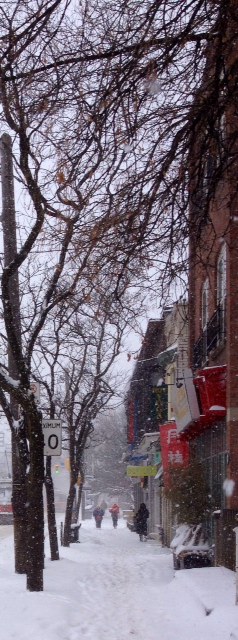
Snow day in Forest Hill, Ontario (photo by Nina Munteanu)

Aristotle conducted his lectures while walking the grounds of his school in Athens. His followers, who chased him as he walked, were known as the peripatelics (e.g., Greek for meandering). Darwin refined his ideas on natural selection and other topics during his frequent walks along his “thinking path”, a gravel road called Sandwalk Wood near his home in southeast England. Dickens walked for miles each day and once said, “If I could not walk far and fast, I think I should just explode and perish.” Beethoven often took solitary walks. He strolled the Viennese woods for hours, finding inspiration for his works and jotting them down on a notepad that he carried with him. Nietzsche loved his walks in the mountains. He wrote, “it is only ideas gained from walking that have any worth.” For Wordsworth, the act of walking was one in the same with the act of writing poetry.

Both involved rhythm and meter. Henry David Thoreau was known for his great walkabouts. Walking through nature for Thoreau was a pilgrimage without a destination—more discovery and rapture. “Taking a long walk was [Steve Job’s] preferred way to have a serious conversation,” wrote Job’s biographer Walter Isaacson. Writer and avid walker, Soren Kierkegaard writes:

“Above all, do not lose your desire to walk. Everyday, I walk myself into a state of well-being and walk away from every illness. I have walked myself into my best thoughts, and I know of no thought so burdensome that one cannot walk away from it.”

In the April 2014 issue of the Journal of Experimental Pshychology: Learning, Memory and Cognition, Stanford researchers Marily Oppezzo and Daniel L. Schwartz demonstrated that walking boosts creative inspiration. Using the Guildford’s Alternative Uses Test they showed that the act of walking, whether inside or outside, significantly increased creativity for 81% of the participants. Oppezzo and Schwartz were able to demonstrate that the creative ideas generated while walking were not irrelevant or far-fetched, but innovative and practical.

snowy street TheBeach

Snow day walk in The Beach (photo by Nina Munteanu)

In the September 3 2014 issue of The New Yorker, journalist Ferris Jabr describes why this is the case:

“The answer begins with changes to our chemistry. When we go for a walk, the heart pumps faster, circulating more blood and oxygen not just to the muscles but to all the organs—including the brain. Many experiments have shown that after or during exercise, even very mild exertion, people perform better on tests of memory and attention. Walking on a regular basis also promotes new connections between brain cells, staves off the usual withering of brain tissue that comes with age, increases the volume of the hippocampus (a brain region crucial for memory), and elevates levels of molecules that both stimulate the growth of new neurons and transmit messages between them.”

It isn’t just strolling or sauntering that stimulates the creative mind to new heights.
SONY DSC

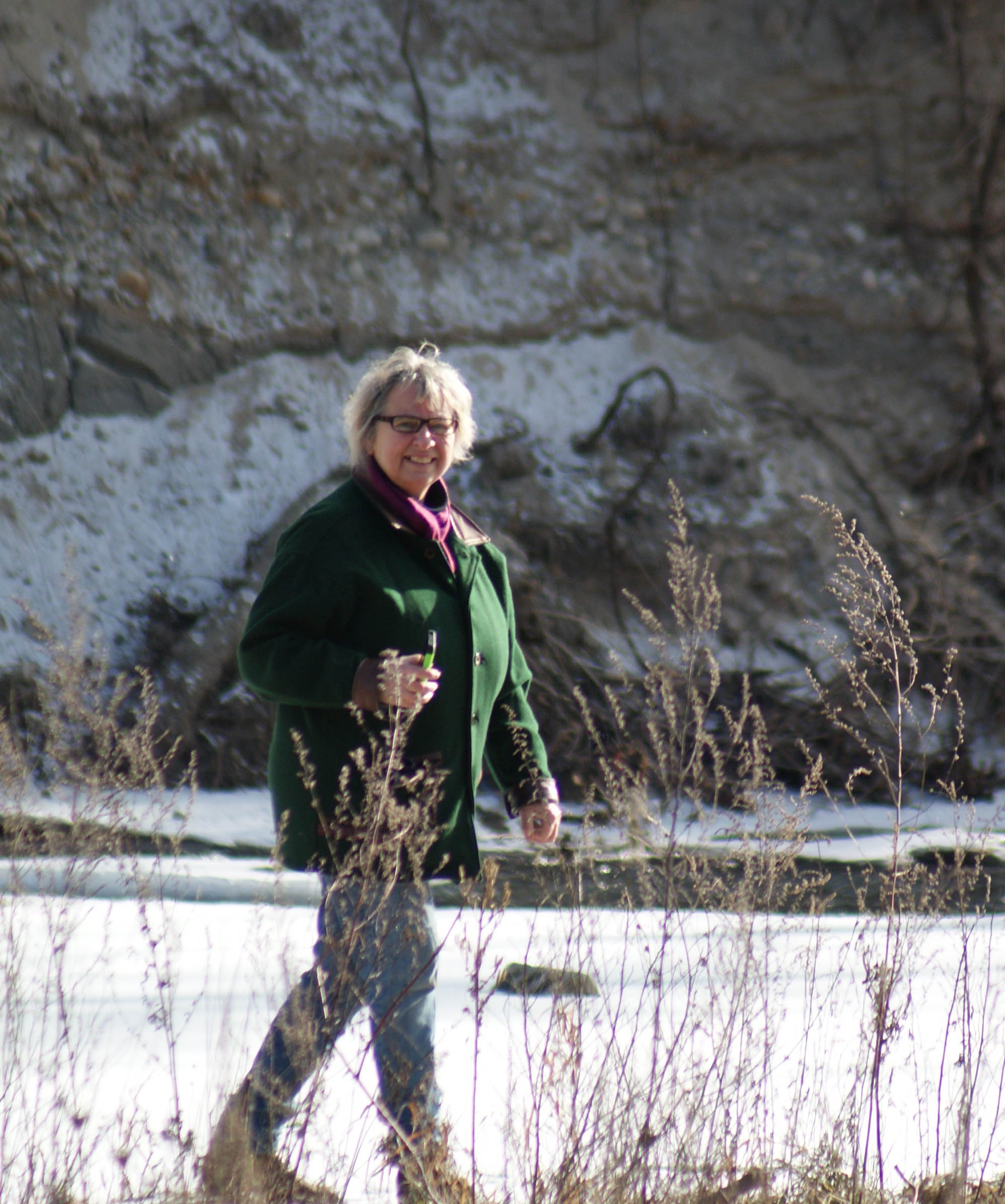
Author hiking Highland River, Ontario (photo by Merridy Cox)

Stoking the creative artist inside you may be as simple as giving your mind the chance to wander—and taking the time to pay attention. In her book The Artist’s Way Julia Cameron talks about how “rhythm” and regular, repetitive actions play a role in priming the artistic well. She lightheartedly describes how the “s” activities work so well for this: showering, swimming, scrubbing, shaving, strolling, steering a car. I can testify to the latter—how many great plot ideas have I cooked up while driving to work! Filmmaker Steven Spielberg claimed that his best ideas came to him while he was driving the freeway. Negotiating through the flow of traffic triggered the artist-brain with images, translated into ideas. “Why do I get my best ideas in the shower?” Einstein was known to have remarked. Scientists tell us that this is because showering is an artist-brain activity.

The magic part in this is to pay attention. Pay attention to your life experiences; don’t ignore them. Sit up in the bus and watch people, play with the images, sounds and smells. Get sensual and let your eyes, ears, nose and limbs delight in the world. It’s amazing how interesting the world becomes once you start paying attention.

So, to answer the question above about where I get my ideas: in one word, everywhere.

Of course, I find those “s” activities mentioned above very helpful in quieting my mind to “listen” to my creative spirit and see; they calm and focus me. I would add another “s” word–scrawling–to the list. While Dave sends a voice message home on his phone when he gets an idea, I carry a notebook with me to jot down my eureka moments. I find writing by hand additionally helps in the creative process.  What works best for me is a walk in Nature. Nothing beats that…having a dialogue with the wind, or the chiming birds and rustling trees, the gurgling brook or surging sea or tiny insect, the soothing sun…rough bark of a fir tree… The texture of the world…


Snowy Path scarborough

Snowy path in Scarborough, Ontario (photo by Nina Munteanu)

“The texture of the world, its filigree and scrollwork, means that there is the possibility for beauty here, a beauty inexhaustible in its complexity, which opens to my knock, which answers in me a call I do not remember calling, and which trains me to the wild and extravagant nature of the spirit I seek.”—Annie Dillard, Pilgrim at Tinker Creek


References:

Cameron, Julia. 1992. “The Artist’s Way”. Penguin Putnam Inc., New York, NY. 222pp.

Dillard, Annie. 1974. Pilgrim at Tinker Creek. Harper Perennial. 304pp.

Downden, Craig. 2014. “Steve Jobs was Right About Walking” In: The National Post, December 23, 2014.

Munteanu, Nina. 2013. The Journal Writer: Finding Your Voice. Pixl Press, Vancouver, BC. 170pp.

Oppezzo, Marily and Daniel L. Schwartz. 2014. “Give Your Ideas Some Legs: The Positive Effect of Walking on Creative Thinking”, Journal of Experimental Psychology: Learning, Memory, and Cognition, Vol. 40, No. 4: 1142-1152.


nina-2014aaa

Nina Munteanu is a Canadian ecologist / limnologist and novelist. She is co-editor of Europa SF and currently teaches writing courses at George Brown College and the University of Toronto. Visit www.ninamunteanu.ca for the latest on her books. Nina’s bilingual “La natura dell’acqua / The Way of Water” was published by Mincione Edizioni in Rome. Her non-fiction book “Water Is…” by Pixl Press (Vancouver) was selected by Margaret Atwood in the New York Times ‘Year in Reading’ and was chosen as the 2017 Summer Read by Water Canada. Her novel “A Diary in the Age of Water” will be released by Inanna Publications (Toronto) in 2020.

How Walking in Nature Helps Me Write

StoneStairs-oakforest Rouge

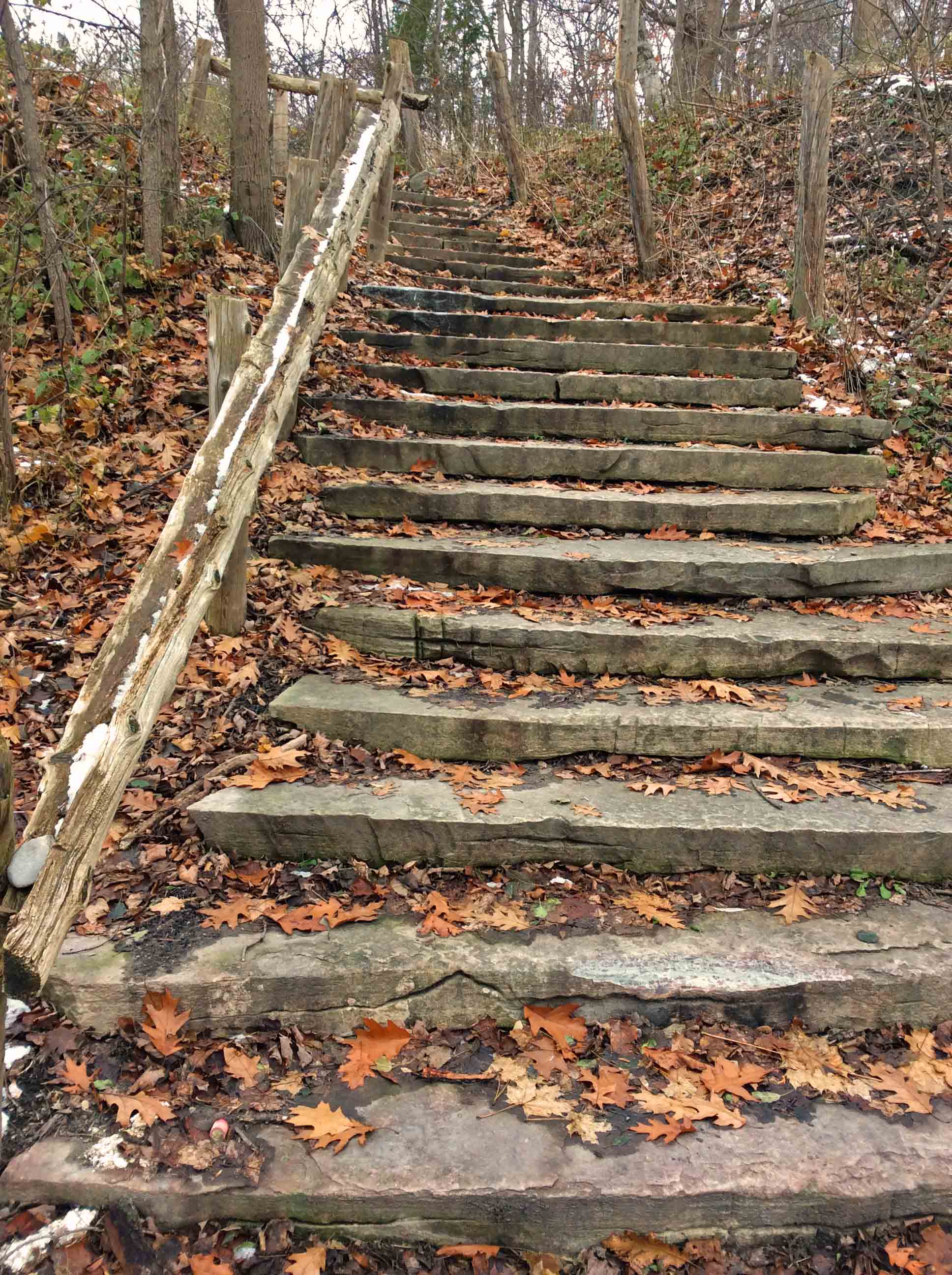
Staircase to Rouge River (photo by Nina Munteanu)

I don’t often get writer’s block. I just walk out of it into Nature.

My favourite place to walk is the forest, along a river.

Walking in a forest unclutters my mind and soul. The forest is simple in its natural complexity. Its beauty combs out the tangles of human complexity like a dam dissolving and grounds me back to the simplicity of natural life.

The river trickles in the background as I step through dappled light and inhale the organic scents of the forest. The forest and the river help me re-align and focus—without trying. That’s the magic of it. It’s in the not trying.

I carry a notebook with me to jot down ideas that come to me. They always do. I find writing by hand additionally helps in the creative process.

My favourite park is the little woodland of the Little Rouge River, located off a small road hidden from the sprawling desert of suburbia.

LittleRougeRiver-Maple-spring

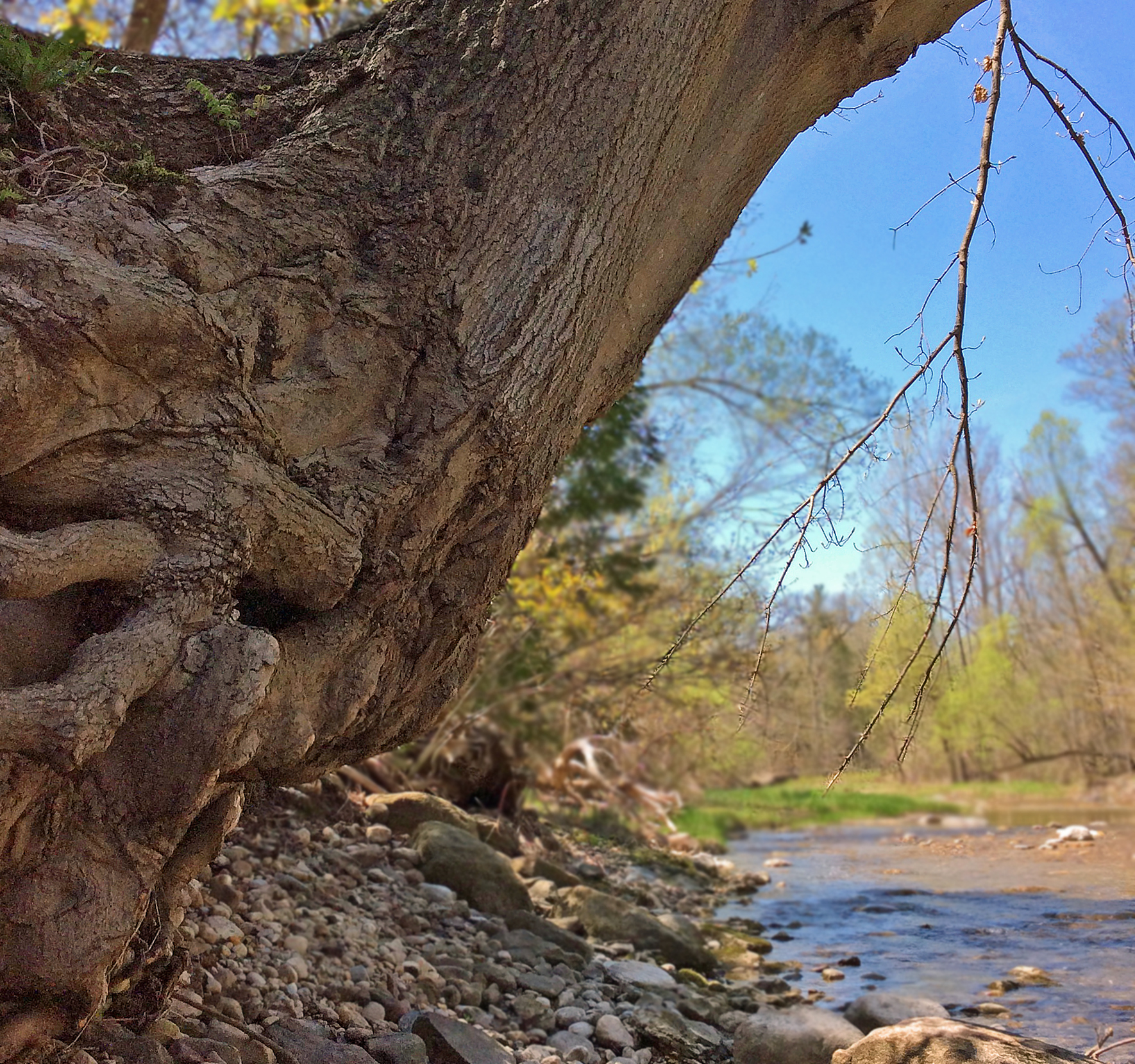
my old maple leaning over the Little Rouge River (photo by Nina Munteanu)

It was spring when I first entered this forest. I inhaled its complex smell, awakening with spring flowers. At my entrance, chipmunks scattered and scolded me for interrupting their calm. I chuckled and thought that I’d seen more within the space of one minute here than I had in a year in the suburb I currently live in. A duff-strewn path led me beneath the pungent smell of pine and cedar. I made my way toward the riverbank where beech and maple leaned over the water. I found a place to write.

When I returned in the fall, the forest was a mix of colour.  Most of the deciduous trees had dropped their leaves in a revealing show of textured grays, gray-browns and blacks. The bare trunks and fractal branches contrasted with the deep greens of the conifers. Rogue trees—like the oak and beech—still claimed their leaves, adding deep russet tones to the varied grays and deep greens of the canopy. The forest was now more open, emerging with ancient magnificence from a soft brown carpet on the ground. The air was fresh with the scent of loam, decaying leaves and saprophyte activity.

LittleRouge-icing shallows

A shallow part of the Little Rouge ices over with the first snowfall in late autumn (photo by Nina Munteanu)

I strayed off the path toward the riverbank again. I was looking for the old sugar maple I’d spent time with the previous spring. After several bends in the river, I saw it, leaning precipitously over the river like an old man sharing an intimate story. It had already lost its leaves; they covered the ground in a soft carpet. The old tree literally hugged the bank in a braided network of snaking roots; like a carved figurehead hugs the prow of a great tall ship.

My OldMaple-burl copy

Burl on my maple (photo by Nina Munteanu)

Eager to see my old friend up close, I scrambled down the overhanging bank using the old maple’s root “stairway,” then ungracefully dropped onto the cobbles below. Every part of my gnarly old maple tree was splendid. Its shaggy trunk stretched up with typical silhouette of branching-out arms that every Canadian kid drew when they were six. The horizontal roots stretched out in a tangle and stitched the bank together, keeping it intact.

The Little Rouge River calls me to sit and listen to its flowing song—a joyful playful symphony of breaths, chortles and open-throated froth. I sit. And still my breath. I find my whole body relax from the tension of the suburban drive. I am home, sighing with a rhythm I’d forgotten. Re-aligning. Bones with rock. Rock with twig. Twig with root. The animals no longer scold me. They have resumed their natural rhythm, as I merge into scenery. And write…

****

gnarly cedar

gnarly cedar roots (photo by Nina Munteanu)

What I do is not new to creative thinkers all over the world and throughout time. I share great company with people who used walking (usually in Nature) as a venue toward creative thinking (and writing). All great walkers.

Aristotle conducted his lectures while walking the grounds of his school in Athens. His followers, who chased him as he walked, were known as the peripatelics (e.g., Greek for meandering). Darwin refined his ideas on natural selection and other topics during his frequent walks along his “thinking path”, a gravel road called Sandwalk Wood near his home in southeast England. Dickens walked for miles each day: “If I could not walk far and fast, I think I should just explode and perish.” Beethoven often took solitary walks. He strolled the Viennese woods for hours, finding inspiration for his works and jotting them down on a notepad that he carried with him. Nietzsche loved his walks in the mountains: “it is only ideas gained from walking that have any worth.” For Wordsworth, the act of walking was one in the same with the act of writing poetry. Both involved rhythm and meter. Henry David Thoreau was known for his great walkabouts. Walking through nature for Thoreau was a pilgrimage without a destination—more discovery and rapture.

YellowBirch-winter

Yellow birch trunk (photo by Nina Munteanu)

Stanford researchers demonstrated that walking boosts creative inspiration. They showed that the act of walking significantly increased creativity for 81% of the participants and that the creative ideas generated while walking were not irrelevant or far-fetched, but innovative and practical.

“The answer begins with changes to our chemistry,” writes journalist Ferris Jabr in The New Yorker (2014). “When we go for a walk, the heart pumps faster, circulating more blood and oxgen not just to the muscles but to all the organs—including the brain. Many experiments have shown that after or during exercise, even very mild exertion, people perform better on tests of memory and attention. Walking on a regular basis also promotes new connections between brain cells, staves off the usual withering of brain tissue that comes with age, increases the volume of the hippocampus (a brain region crucial to memory) and elevates levels of molecules that both stimulate the growth of new neurons and transmit messages between them.”

SONY DSC

Nina Munteanu walks the forest (photo by Merridy Cox)

While walking is good for our creativity and general well-being, walking in a park or wilderness is so much better. Researchers in Europe and Japan found that anxiety and depression was significantly reduced in the presence of green space and that it boosted attentiveness, focus and academic performance. Vegetation creates “a halo of improved health.” Dr. Frances Kuo at the University of Illinois demonstrated that just seeing a tree helps cognition and promotes a sense of well-being. While a human-made environment of objects—cars and buildings—requires high-frequency processing in the brain; a landscaped environment allows the observer to relax his or her attention, resulting in reduced muscle tension, lower heart rate, and a generally less stressful physiology.

Finding a favourite tree might be the best thing you do to boost your creativity.


Forest path-NS

Forest path in Nova Scotia (photo by Nina Munteanu)

References:

Nina-willowtree

Nina Munteanu by a large willow tree (photo Jane Raptor)

Cameron, Julia. 1992. “The Artist’s Way”. Penguin Putnam Inc., New York, NY. 222pp.

Deasey, Louise. 2015. “Negative Ions Are Great for Your Health”. 
Body and Soul.

Munteanu, Nina. 2013. The Journal Writer: Finding Your Voice. Pixl Press, Vancouver, BC. 170pp.

Oppezzo, Marily and Daniel L. Schwartz. 2014. “Give Your Ideas Some Legs: The Positive Effect of Walking on Creative Thinking”, Journal of Experimental Psychology: Learning, Memory, and Cognition, Vol. 40, No. 4: 1142-1152.

Wells, Nancy M. 2000. “At Home with Nature: Effects of ‘Greenness’ on Children’s Cognitive Functioning”. Environment and Behavior 32 (6): 775–795.


nina-2014aaaNina Munteanu is an ecologist and internationally published author of award-nominated speculative novels, short stories and non-fiction. She is co-editor of Europa SF and currently teaches writing courses at George Brown College and the University of Toronto. Visit www.ninamunteanu.ca for the latest on her books. Nina’s recent book is the bilingual “La natura dell’acqua / The Way of Water” (Mincione Edizioni, Rome). Her latest “Water Is…” is currently an Amazon Bestseller and NY Times ‘year in reading’ choice of Margaret Atwood.