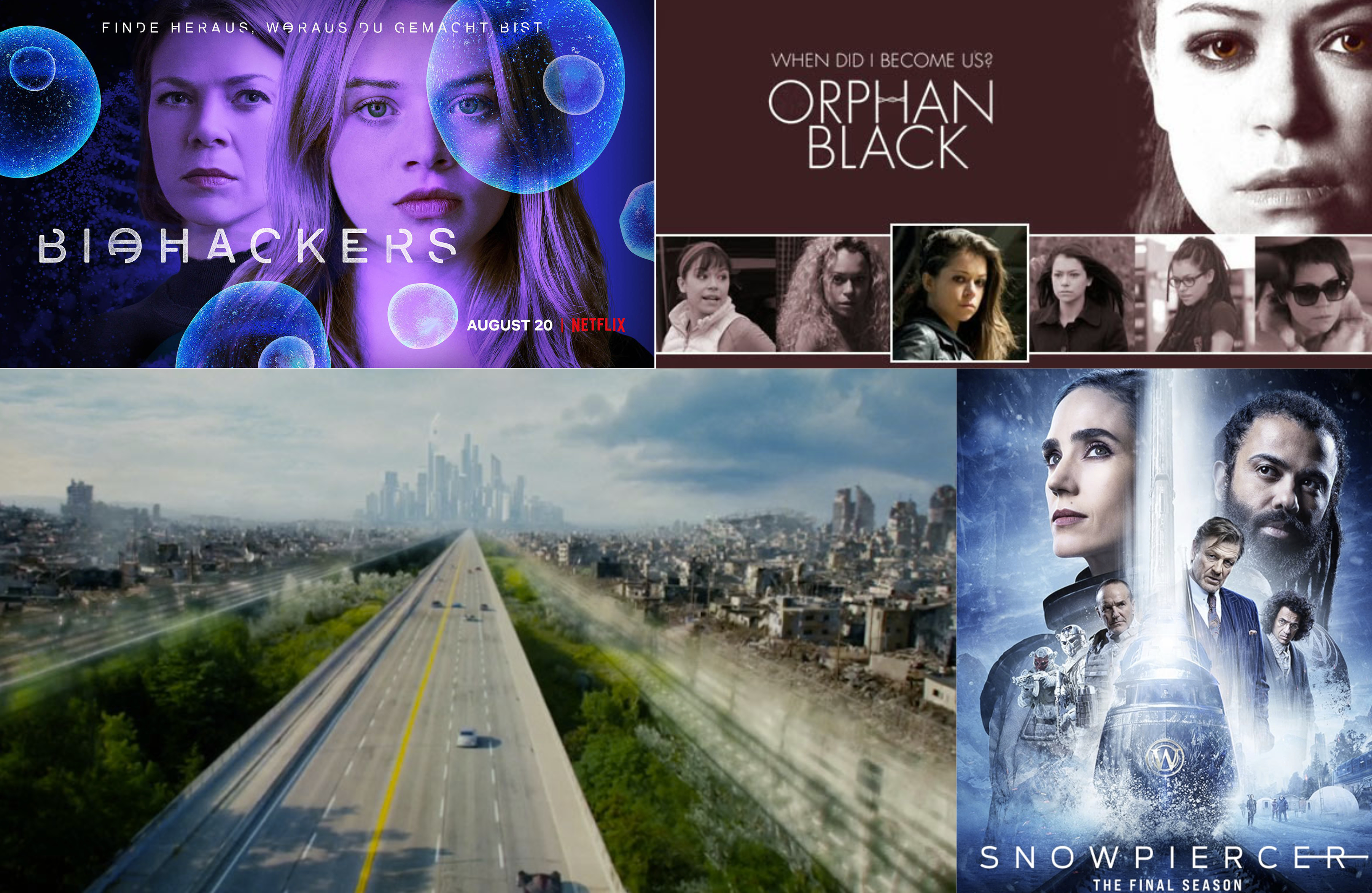
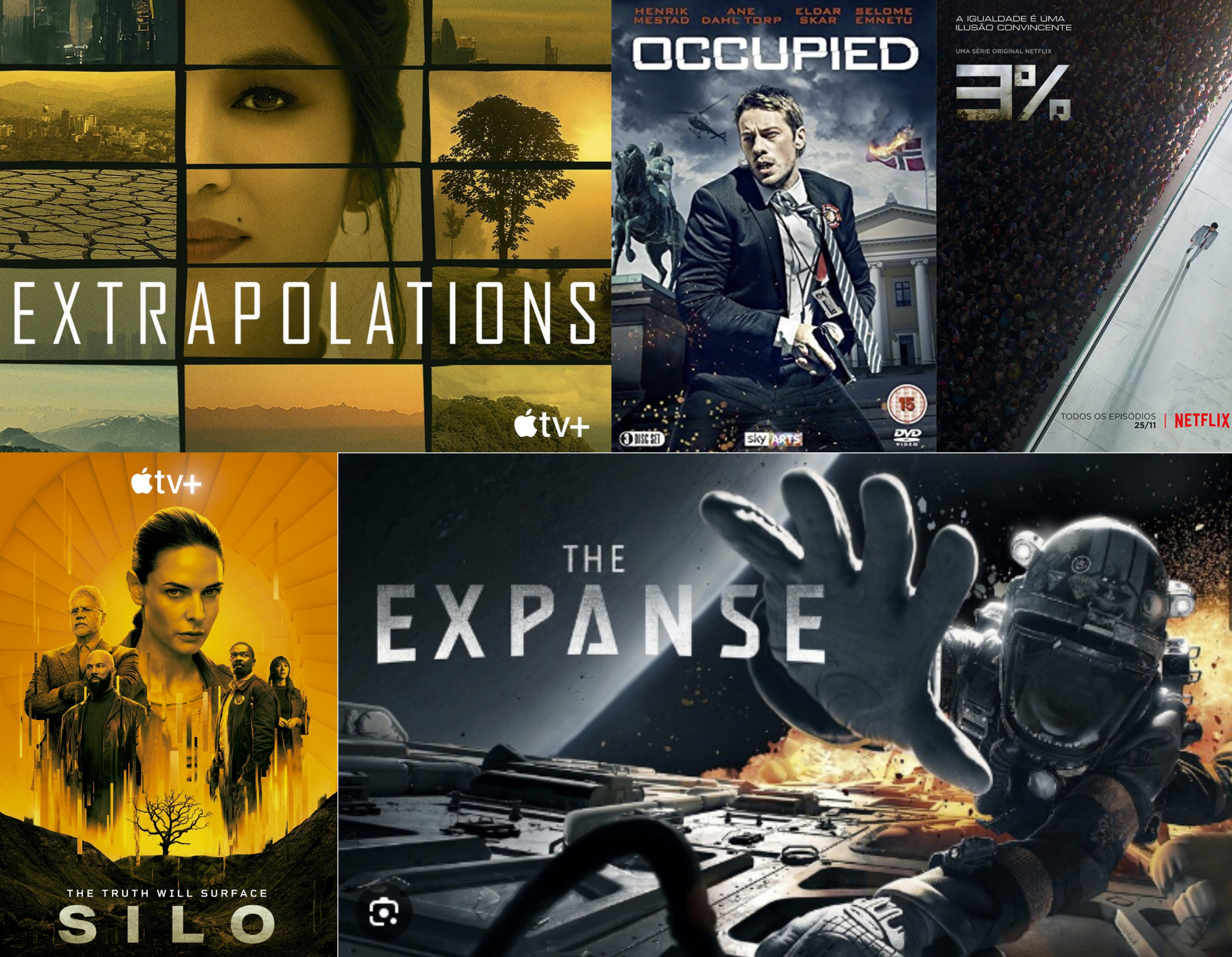
I’ve selected ten TV series that have intrigued me, moved me, and stayed with me for various reasons that touch on: abuse of justice, including eco-justice and environmental abuse; technology use and abuse; and the effects and horrors of climate change.
Some are well known; others not so well known. All approach storytelling with a serious dedication to depth of character, important themes, realistic world building, and excellent portrayal by actors. The world-building is extremely well done—in some cases rivalling Ridley Scott’s best—with convincing portrayals of worlds that are at times uncanny in their realism. Worlds that reflect story from an expansive landscape to the mundane minutiae of daily life: like the cracked phone device of Detective Miller in The Expanse or the dirty fingernails of engineer Juliette Nichols in the Down Deep of Silo. Stories vary in their treatment of important themes from whimsical and often humorous ironies to dark and moody treatises on existential questions. In my opinion, these TV series rival the best movies out there, often reflecting large budgets (but not always) and a huge commitment by producers. The ten TV series I’ve selected here come from around the world: Brazil, Germany, France, Norway, Canada and the United States.
In Part 1, I look at five TV series that touch on ethical issues we are facing today; issues that reach far into existential questions of what it means to be human. These TV series explore synthetic biology, cloning and gene editing, and justice in space colonization and exploitation.
Shot in and around Toronto, Ontario, the series focuses on Sarah Manning, a fringe-dweller with questionable friends, who assumes the identity of her clone, cop Elizabeth (Beth) Childs, after witnessing her suicide and stealing her stuff. In Season 1 alone, seven clones are revealed. Those still alive include suburban housewife Alison Hendrix, university evolutionary biologist Cosima Niehaus, corporate mogul Rachel Duncan, and crazed sociopath Helena.
Toronto is filmed brilliantly in a vague every-city pastiche that combines the look of London’s eastside, NYC and northern Europe all in one. Like its characters, the show is both sparsely existentialist and baroque funk. Besides Sarah’s own diverse clones there is foster brother Felix and his various friends or cronies who add significant colour to this film-noir set. Unsavory antagonists not only add intrigue but provide significant texture from sophisticated and subtle to the banal and truly terrifying. And like biology itself—perhaps the true main character here—all the characters are shape-shifters, looking for balance in a shifting world where “normal” keeps chasing itself.
.
Sarah Manning at the train station where she meets her first clone (image by Orphan Black)
.
Orphan Black is a slick, sophisticated and edgy exploration of human evolution that raises issues about the moral and ethical implications of bio-engineering and genetic tampering—specifically human cloning (currently against the law), personal identity, and intellectual property. Manson and Fawcett enlist symbols and clever metaphor to enrich the story with layers of depth—no item is free of meaning: from the seemingly innocuous naming of a transit station (Huxley Station) in the show’s premiere, or Delphine’s passing reference to “a brave new world” to a terse discussion between a religious extremist and a restaurant proprietor over the merits of factory-farmed eggs: “They’re not normal,” the extremist complains. “They’ve been interfered with.” There is nothing normal about Orphan Black.
.
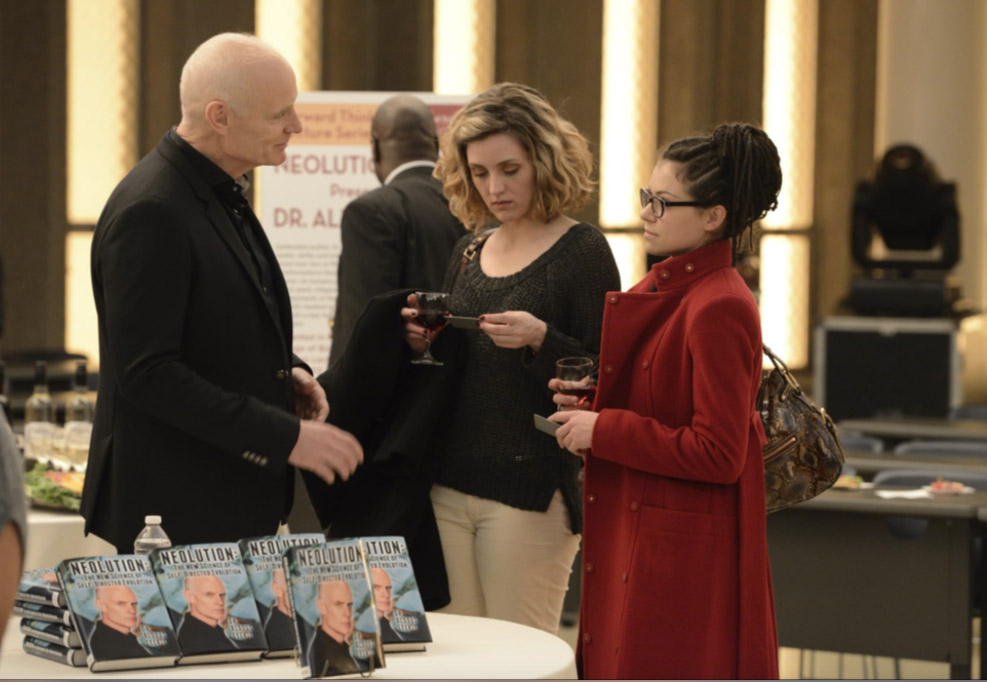
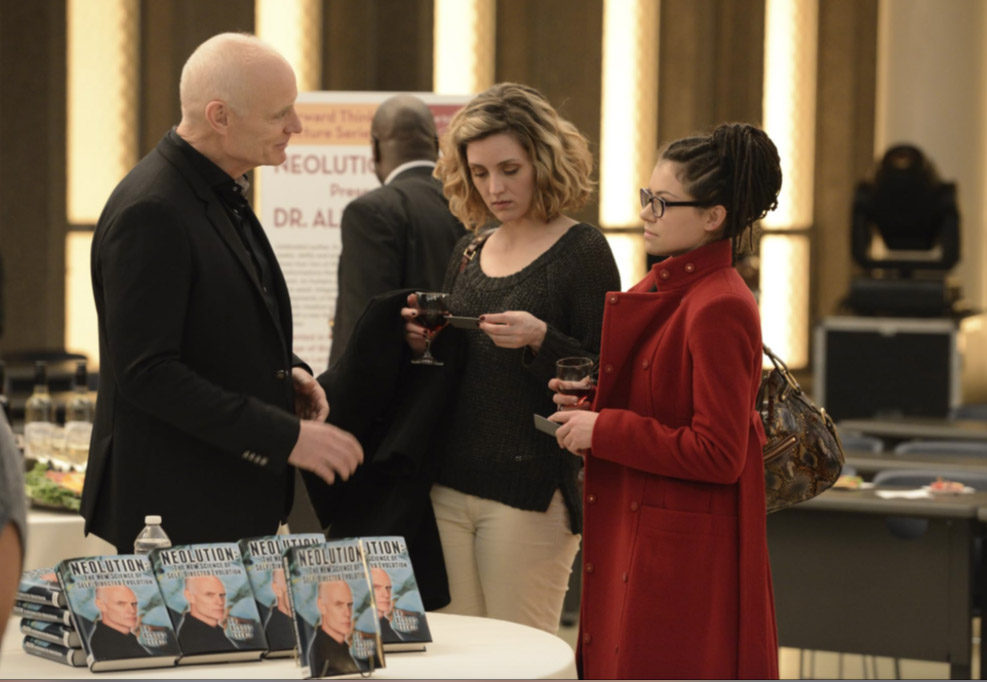
Cosiima meets Dr. Aldous Leaky of Neolution, a transhumanist organization about self-directed evolution
.
Episode titles in Season One quoted parts of Charles Darwin’s evolutionary text On The Origin of Species. Titles like “Natural Selection” (series premiere) and “Parts Developed in an Unusual Manner” elucidate concepts of evolution and survival of the fittest. Season 2 adopts the works of Sir Francis Bacon, reflecting the ethical and moral implications of scientific pursuit in a world of contrasting philosophies and values.
In Orphan Black, The Dyad Institute, a biotech corporation with arcane connections to invisible powers and eugenics, patented the clones as theirs to do with as they please—which might be anything. The ownership of the clones’ genomes by The Dyad Institute would be lawful if all the clones’ DNA was entirely synthetically made. The company would also have exclusive rights to study the clones’ genome, effectively placing the clone Cosima under copyright infringement if she decided to study and apply her research (on herself) outside of the Dyad Institute. If the clones were synthetic, like the DNA created by scientist Dr. Craig Venter, then the Dyad Institute would be in a unique situation with regards to ethics and newly emerging considerations of human rights yet to be determined. For instance, how much of the clones really belong to the company that made them? What even constitutes a person?
.
Nina Munteanu is a Canadian ecologist / limnologist and novelist. She is co-editor of Europa SF and currently teaches writing courses at George Brown College and the University of Toronto. Visit www.ninamunteanu.ca for the latest on her books. Nina’s bilingual “La natura dell’acqua / The Way of Water” was published by Mincione Edizioni in Rome. Her non-fiction book “Water Is…” by Pixl Press (Vancouver) was selected by Margaret Atwood in the New York Times ‘Year in Reading’ and was chosen as the 2017 Summer Read by Water Canada. Her novel “A Diary in the Age of Water” was released by Inanna Publications (Toronto) in June 2020.
I’ve selected ten TV series that have intrigued me, moved me, and stayed with me for various reasons that touch on: abuse of justice, including eco-justice and environmental abuse; technology use and abuse; and the effects and horrors of climate change.
Some are well known; others not so well known. All approach storytelling with a serious dedication to depth of character, important themes, realistic world building, and excellent portrayal by actors. The world-building is extremely well done—in some cases rivalling Ridley Scott’s best—with convincing portrayals of worlds that are at times uncanny in their realism. Worlds that reflect story from an expansive landscape to the mundane minutiae of daily life: like the cracked phone device of Detective Miller in The Expanse or the dirty fingernails of engineer Juliette Nichols in the Down Deep of Silo. Stories vary in their treatment of important themes from whimsical and often humorous ironies to dark and moody treatises on existential questions. In my opinion, these TV series rival the best movies out there, often reflecting large budgets (but not always) and a huge commitment by producers. The ten TV series I’ve selected here come from around the world: Brazil, Germany, France, Norway, Canada and the United States.
In Part 1, I look at five TV series that touch on ethical issues we are facing today; issues that reach far into existential questions of what it means to be human. These TV series explore synthetic biology, cloning and gene editing, political justice, and justice in space colonization and exploitation.
.
.
BIOHACKERS: When Synthetic Biology Meets Ethical Intrigue
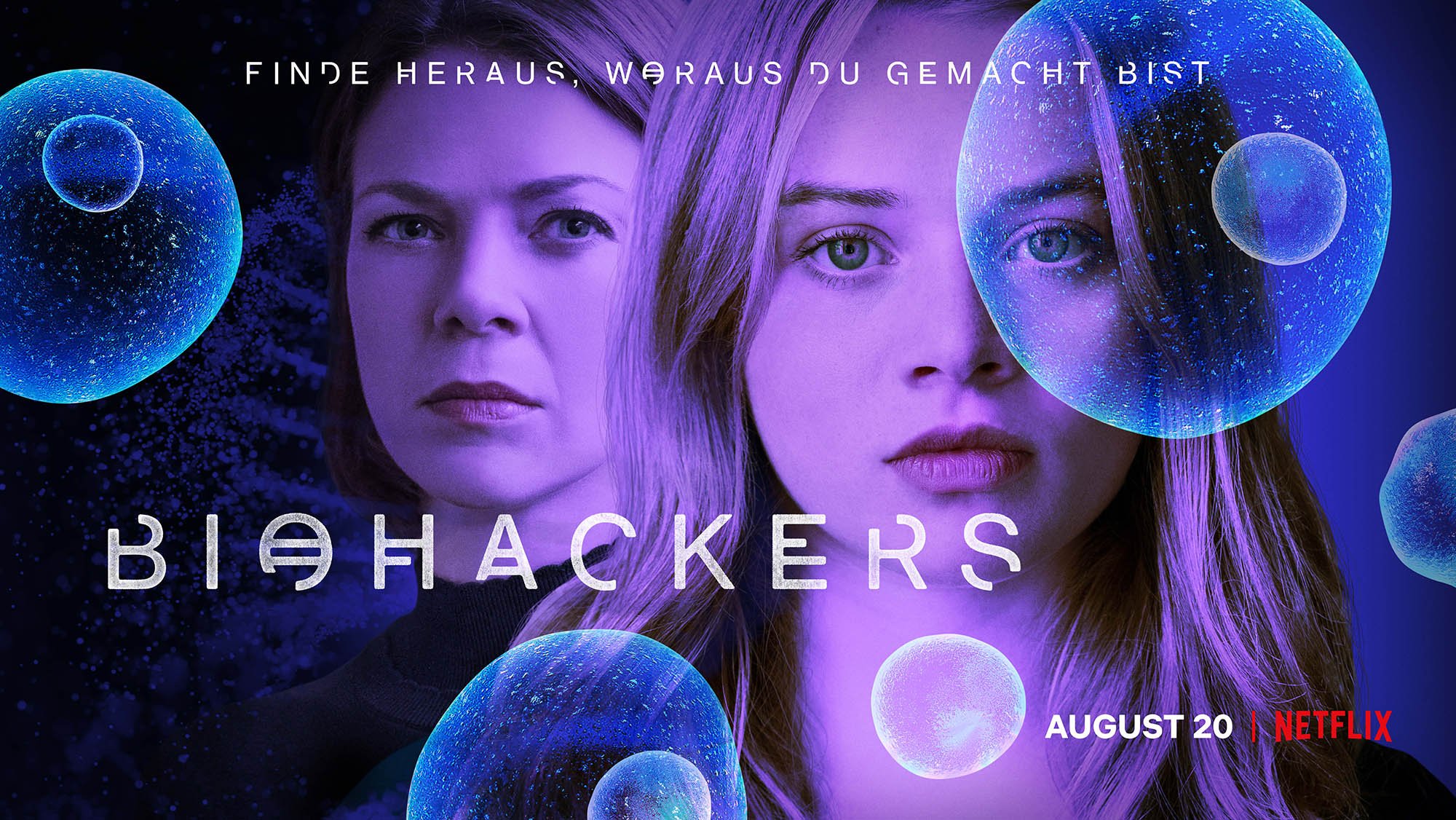
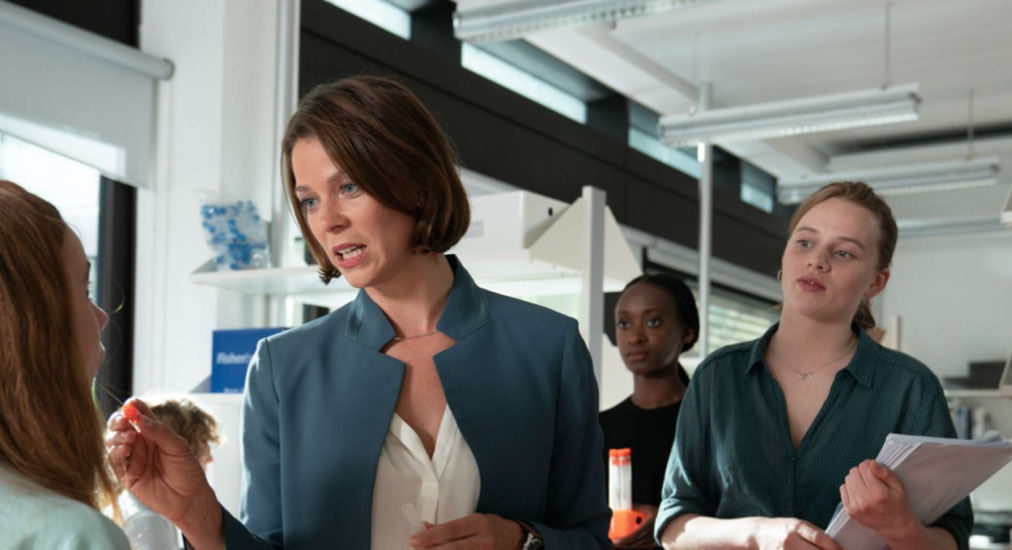
This fast-paced techno-thriller created by Christian Ditter has at the very centre of its intrigue synthetic biology. In the journal Science Dov Greenbaum describes this German TV series as “a fictional tale centred around the sociotechnological movement known as do-it-yourself (DIY) biology, in which amateurs, professionals, anarchists, and civic-minded citizens push the boundaries of mainstream biology.” The show centres on Mia Akerlund (played by Luna Wedler) a secretive med-student prowling for answers to the death of her twin brother and her antagonist, the enterprising Machiavellian and narcissistic Professor Tanja Lorenz (Jessica Schwarz). But the real star of the show is biohacking: human enhancement or augmentation to improve health, performance, or well-being. Biohacking ranges from efforts to improve brain function to faster weight loss. Some are relatively safe to try at home; others may pose health risks. Among others, the show features glow-in-the-dark mice, gene-modded weed, underwater pills that extend your ability to hold your breath, and payment microchips in your hand.
The series lent a critical realism to the story by using accurate world building, real sets and equipment from genetics labs and university settings. Dov Grenbaum’s article in the journal Scienceentitled “Biology’s brave new world” celebrates the show for its accurate representation of complex laboratory equipment and procedures and how it accurately represents the intricacies, motivations and ethical issues of biohacking from sophisticated big-business gene therapies to DIY homespun biology.
Biohackers opens with a disturbing scene of bioterrorism on a train headed to Berlin. All passengers suddenly choke and fall unconscious—except for young med student Mia Akerlund, who tries to help and fails. From that explosive flash-forward scene, the show jumps back to two weeks prior, as college freshman Mia settles into Freiburg University’s prestigious medical school, and betrays a particular interest in synthetic biology, biohacking and genome editing. We soon learn that she is obsessed by celebrated professor and geneticist/entrepreneur Tanja Lorenz (who runs a biopharmaceutical company and has an entire building dedicated to her research with huge neon logo of her name). Both women are connected by a dark secret to do with Mia’s twin brother who mysteriously died when still a boy. Mia quickly gains a position working for Lorenz, which plunges her into the dangerous intrigue of illegal genetic experiences.
.
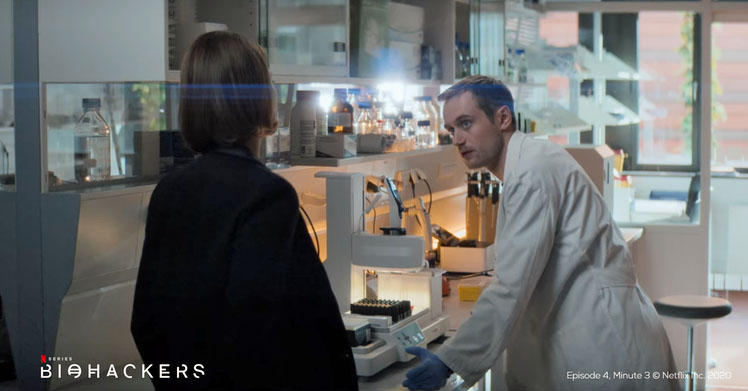
Lorenz and her grad student Jasper discuss experiments in their sophisticated lab (image from Biochackers)
.
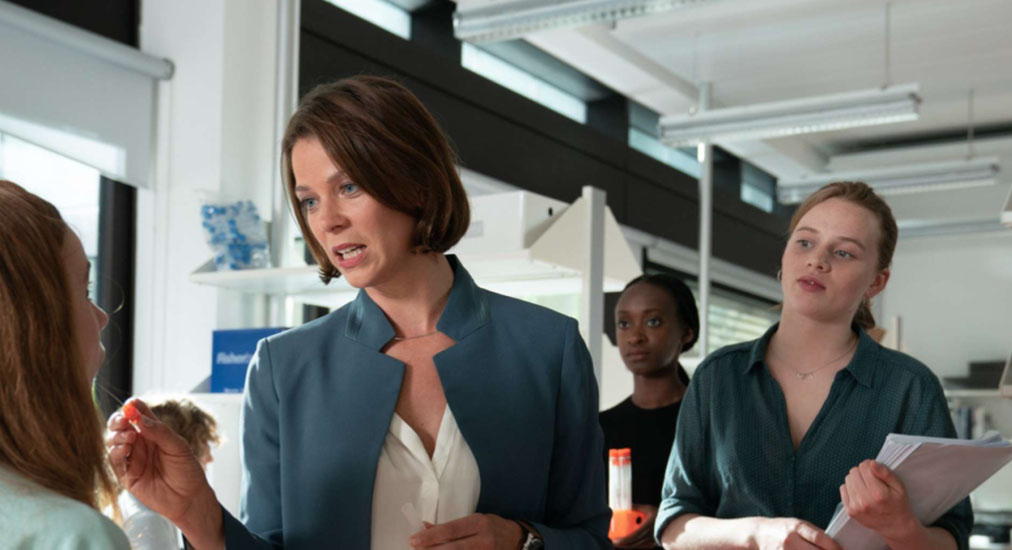
An early, rather enlightening, scene of the first episode is of Mia’s first introductory biology class given by celebrated gene therapy tycoon Professor Lorenz. Not only does the scene introduce the controversial subject of synthetic biology; it reveals a disturbing sense of what’s at stake and the danger of scientific hubris. Tall, svelte and confident in a smart haircut and tailored suit, Lorenz struts like a self-proclaimed goddess in front of a student-crowded lecture hall and preaches the benefits of synthetic biology. When she asks the class “What is synthetic biology?” and a student replies “with the help of synthetic biology, we can alter existing life forms or create new ones,” Lorenz prickles beyond her already frosty demeanor and impatiently berates the students for their lack of vision. She challenges them to think bigger: “Synthetic biology transforms us from creatures into creators. It’s not just the future of medicine, but of humankind. We can cease entire infections before the outbreak … We eliminate genetic disorders. But if we don’t do our work exceedingly well, it could end our species. It is on us to find a way; this is your future. Your responsibility. You are the creators of tomorrow. We make God obsolete…”
Science, academia and intrigue are skillfully woven in an intelligent mystery-thriller that not only represents science accurately but delivers commentary on the ethical and moral questions of this highly dynamic and rapidly evolving field of science.
Biohackers touches on several ethical and moral questions, such as genetic modification of stem cells, access to advanced gene therapies, and privacy and consent surrounding genomic data. Synthetic biologist Elsa Sotiriadis warns that, “this topic will likely become an ethical minefield in the coming years. On the one hand, we need large and diverse datasets to train medical AI and develop therapies. But on the other, there’s nothing as personal as your literal blueprint. Unlike stolen credit cards, you can’t change your genomic data. I like that Biohackers brings this up.”
.
Lorenz does a throat swab for DNA on a candidate in her experiment as Mia looks on (image from Biohackers)
Nina Munteanu is a Canadian ecologist / limnologist and novelist. She is co-editor of Europa SF and currently teaches writing courses at George Brown College and the University of Toronto. Visit www.ninamunteanu.ca for the latest on her books. Nina’s bilingual “La natura dell’acqua / The Way of Water” was published by Mincione Edizioni in Rome. Her non-fiction book “Water Is…” by Pixl Press (Vancouver) was selected by Margaret Atwood in the New York Times ‘Year in Reading’ and was chosen as the 2017 Summer Read by Water Canada. Her novel “A Diary in the Age of Water” was released by Inanna Publications (Toronto) in June 2020.
Since “Expanse”, I’ve been on the lookout for an equally sophisticated treatment of space exploration—something that doesn’t slide into horrific mind-numbing and gut-wrenching insult to the senses, unrealistic character twists and visceral shock devices. Something that delivers…
Season One of French TV series “Missions” has delivered in so many ways. Created by Henri Debeurme, Julien LaCombe and Ami Cohen, Season 1 (2017) of this series on the exploration of Mars has explored human evolution, ancient history, trans-humanism, artificial intelligence, and environmental issues in a thrilling package of intrigue, adventure and discovery. From the vivid realism of the Mars topography to the intricate, realistic and well-played characters and evocative music by Étienne Forget, “Missions” builds a multi-layered mystery with depth that thrills with adventure and complex questions and makes you think long after the show is finished.
Gale Crater on Mars, showing inverted channels (image by NASA)
The first episode of the 10-episode Season One starts with a real tragedy: the first human to die in space flight; the 1967 fatal crash landing of the Russian Soyus 1 piloted by Cosmonaut Vladimir Komorov. In a stirring article on National Public Radio, Robert Krulwich provides incredible insight into this historic tragedy:
Starman by Jamie Doran and Piers Bizony, tells the story of a friendship between two cosmonauts, Vladimir Komarov and Soviet hero Yuri Gagarin, the first human to reach outer space. The two men were close; they socialized, hunted and drank together. In 1967, both men were assigned to the same Earth-orbiting mission, and both knew the space capsule was not safe to fly. Komarov told friends he knew he would probably die. But he wouldn’t back out because he didn’t want Gagarin to die. Gagarin would have been his replacement.
Gagarin and Komarov
The story begins … when Leonid Brezhnev, leader of the Soviet Union, decided to stage a spectacular mid-space rendezvous between two Soviet spaceships. The plan was to launch a capsule, the Soyuz 1, with Komarov inside. The next day, a second vehicle would take off, with two additional cosmonauts; the two vehicles would meet, dock, Komarov would crawl from one vehicle to the other, exchanging places with a colleague, and come home in the second ship. It would be, Brezhnev hoped, a Soviet triumph on the 50th anniversary of the Communist revolution. Brezhnev made it very clear he wanted this to happen.
The problem was Gagarin. Already a Soviet hero, the first man ever in space, he and some senior technicians had inspected the Soyuz 1 and had found 203 structural problems — serious problems that would make this machine dangerous to navigate in space. The mission, Gagarin suggested, should be postponed. The question was: Who would tell Brezhnev? Gagarin wrote a 10-page memo and gave it to his best friend in the KGB, Venyamin Russayev, but nobody dared send it up the chain of command. Everyone who saw that memo, including Russayev, was demoted, fired or sent to diplomatic Siberia.
Commemorative stamp for Komarov
With less than a month to go before the launch, Komarov realized postponement was not an option. He met with Russayev, the now-demoted KGB agent, and said, “I’m not going to make it back from this flight.” Russayev asked, Why not refuse? According to the authors, Komarov answered: “If I don’t make this flight, they’ll send the backup pilot instead.” That was Yuri Gagarin. Vladimir Komarov couldn’t do that to his friend. “That’s Yura,” the book quotes him saying, “and he’ll die instead of me. We’ve got to take care of him.” (italics mine).
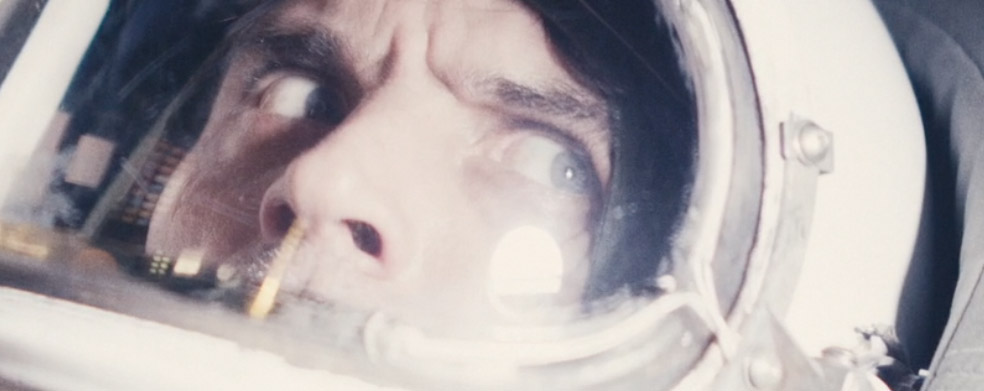
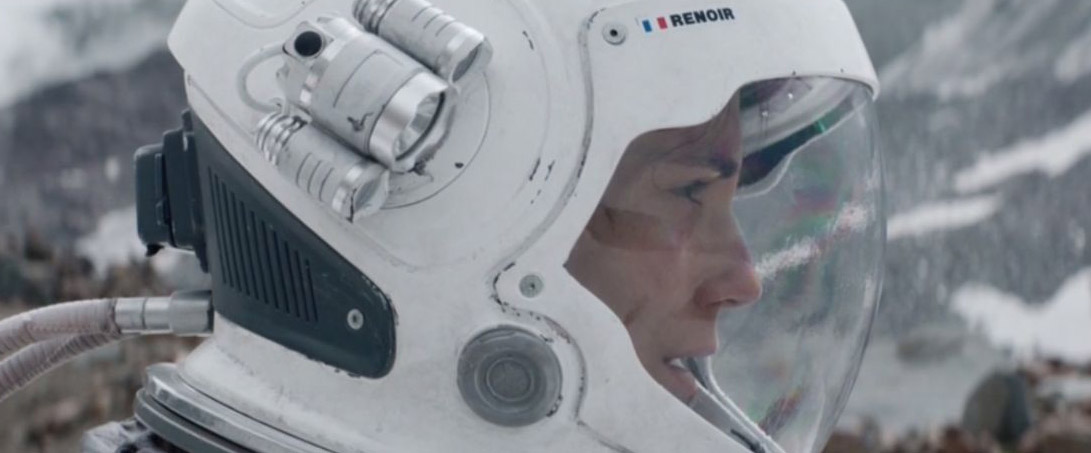
In the opening scene of “Missions”, we never see the actual crash landing; instead, as Komarov hurtles to the ground, he suddenly sees a strange white light and then we cut to the present day. Now in an alternate present day, the international crew of the space ship Ulysses is readying for its journey to Mars. Days before the Ulysses mission takes off from Earth, psychologist Jeanne Renoir is asked to replace the previous psychologist who died suddenly in a freak accident.
We are introduced to Jeanne as she conducts a test at l’Université Paris with children on self-restraint using marshmallows. It’s a simple test: she leaves each child with one marshmallow and instructs that if they don’t eat it, she’ll give them a second one when she returns. Of course, the little girl can’t resist when left alone with the marshmallow and gobbles it down, giving up a second for her impatience. And we see that Jeanne correctly anticipates each child’s reaction.
Jeanne gives her psychology report of the crew to William Meyer onboard the Ulysses
Jeanne joins the international team of the Ulysses but maintains a detached relationship with them, refusing to get emotionally close to anyone; she cites her need as psychologist to remain impartial and objective and successfully hides a gentleness beneath an impenetrable layer of cold severity. The team consists of Captain Martin Najac and his estranged and depressed wife Alessandra (ship’s doctor), moody and laconic Simon Gramat (second in command), twitchy and paranoid Yann Bellocq (ship’s engineer), Basile (Baz), the sociopathic computer scientist who is more at ease with the ship’s AI Irène than the rest of the crew, and geologist Eva Müller, the target of Baz’s awkward advances.
Simon Gramat, second in command on Ulysses
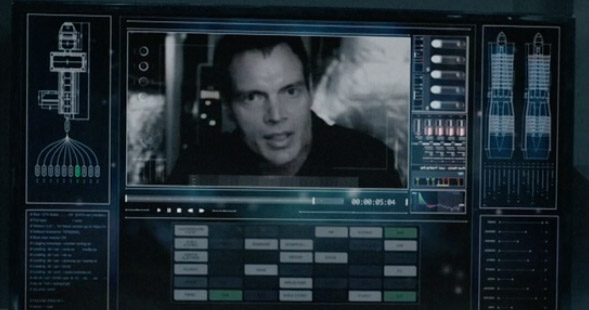
The eccentric Swedish corporate billionaire and David Bowie fan, William Meyer is also on board the Ulysses. His goal is to lead the first mission to land on Mars. However, shortly before they are scheduled to land, the crew discover that Z1—a ship sent by charismatic but highly unlikable Ivan Goldstein of rival corporation Zillion (partnered with NASA)—has overtaken them and has already landed on Mars. But the Z1 crew have not been heard from since sending a cryptic warning: “Don’t come here. Don’t try and save us… It’s too dangerous,” an intense Z1 astronaut warns.
Z1 astronaut warns help away
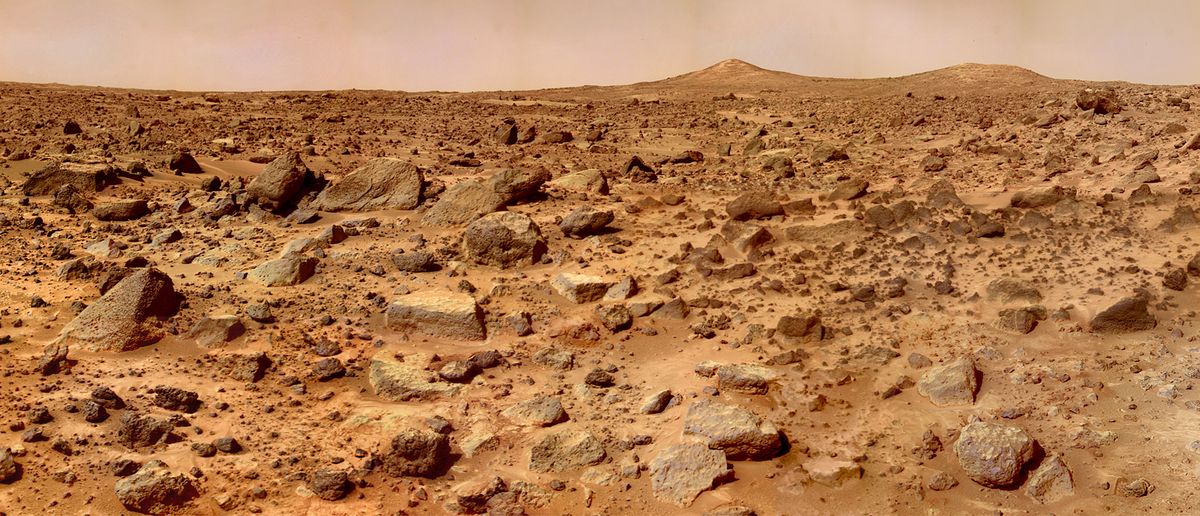
Martian terrain (image by Perseverance NASA)
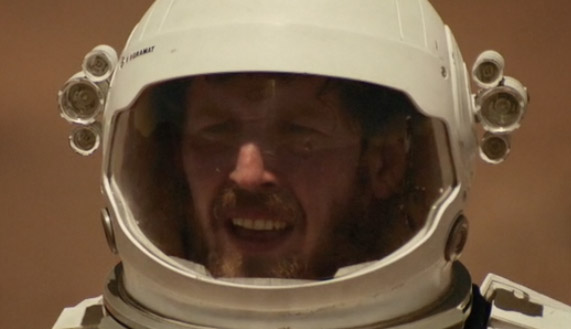
After a rough landing through a major dust storm on Mars, the Ulysses crew struggle to fix an inoperable computer system (Irène) and life support system aboard their shuttle, which was presumably damaged by the landing. While not expecting to find any survivors of the Z1 crew, part of the Ulysses crew head to the Z1 landing site in a rover, looking for parts they can scavenge to power their shuttle. They find only remnants of the Z1 ship, but close by they discover someone alive in the Martian desert along with the ship’s black box. They presume he is from the American team but he insists that he is Russian and that his name is Vladimir Komarov…
The Ulysses shuttle on Mars
So begins this surrealistic mystery that transcends history, identity and our concepts of reality with tantalizing notions of Atlantis, the mythical metal Orichalcum, programmable DNA-metal and much more. The first season of “Missions” focuses on cynical Jeanne Renoir as she unravels the mystery of Mars; a mystery that ties her inextricably to Komarov. When she first interviews Komarov, he surprises her by using her late father’s call to their favourite pastime of stargazing: “Mars delivers!” We then find that Komarov is her father’s hero for his selfless action to save his friend, and her father considered him “the bravest man of his time.” Jeanne is intrigued. Who—what—is this man they’ve rescued? Surely not the dead cosmonaut resurrected from 1967?
Martian terrain (image by NASA)
Throughout the series, choices and actions by each crew member weave narrative threads that lead to its overarching theme of self-discovery and the greater question of humanity’s existence. Yann Bellocq refuses to let the party who discovered Komarov back into the ship, citing oxygen depletion as his reason (“If you use oxygen to pressurize the airlock, you know what will happen. Better four survivors than eight corpses,” he says matter-of-factly as he dooms the four astronauts waiting to board). Eva later laments to Alex that “I thought I knew him.” Alex (who’s earlier terror had instigated the accidental death of her husband Captain Najac) tells Eva: “You’re young; there are situations which change people, for better or,” with a sideways glance at Bellocq, “worse.”
Martian surface (image by ESA)
Intrigue builds quickly. By the third episode (Survivor), the crew make a startling discovery about Mars and humanity. After Komarov mysteriously leaves the ship and leads the small search party to a mysterious sentiently-created stone object, a stele, the ship’s computer Irène describes the hieroglyphs as ancient Earth-like. The main block, supported by four Doric columns is similar to the Segesta Temple in Sicily; its central designs are similar to Mayan Calakmul bas-reliefs; and its height-width ratio is equal to Phi, known as the golden ratio in ancient Greece.
Komarov leads the crew to the stele
Irène concludes that “either someone was inspired by our civilizations to build it…” “…Or our civilizations were inspired by it,” finishes Jeanne.
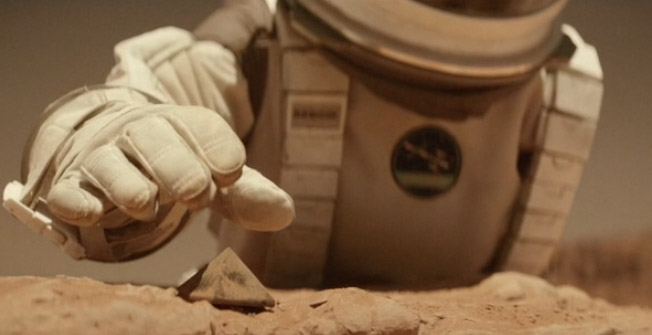
Jeanne picks up a pyramid made of Orichalcum
Alex, the ship’s doctor, informs the crew that the DNA of Mars-Komarov is identical to that of original-Komarov, except for an additional single strand; his DNA has three strands instead of two. She concludes, “He isn’t human.” Jeanne adds, “or he’s something more than human.” They also discover that the stone stele is actually an artificial alloy not known in any geology database but described in ancient script as the mythical substance ancient Greek and Roman texts called Orichalcum—the metal of Atlantis. Irène also identifies similar triple helix DNA in the rock, similar to Komarov’s, that is data-processing—which makes Komarov a living computer program, capable of controlling the ship.
Jeanne later confronts Komarov about the stone object; stating the need for expediency, she asks him what he meant to show them by leading them there. After telling her that humans need to discover truths for themselves before accepting them, Komarov slides into metaphor that reflects her previous psychology experiments on restraint and patience: “Imagine that your right hand holds all the answers about me and your left hand holds all the answers about you, Mars, and the universe. If you open your right hand, the left disappears.” Jeanne quips back, “I’d open the left first.” Komarov rejoins, ”That would be too easy. Some rules can’t be broken. Making a choice means giving something up.” She must wait before she can open her left hand. Like the child and the second marshmallow…
From the beginning, we glimpse a surreal connection between Jeanne and Komarov and ultimately between Earth and Mars: from her childhood admiration for the Russian’s heroism on Earth to the “visions” they currently share that link key elements of her past to Mars and Komarov’s strange energy-giving powers, to Jeanne’s own final act of heroism on Mars. “You’re the reason I’m here,” he confesses to her in one of their encounters. “You have an important decision to make; one you’ve made in the past…”
As the storyline develops, linking Earth and Mars in startling ways, and as various agendas—personal missions—are revealed, we finally clue in on the main question that “Missions”—through the actions of each crew member and the exchanges between Komarov and Jeanne—is asking: are we worth saving?
In a flashback scene of her interaction with Komarov, Jeanne recalls Komarov telling her that, “people dream of other places, while they can’t even look after their own planet… You must remember your past in order to think about your future. Do you think Earth has a future?” When she responds that she doesn’t know, he challenges with “Yes, you do. They eat their marshmallow right away, when they could have two…Or a thousand. Do you think humanity can continue like that? You know the answer and it terrifies you.”
Jeanne embarks on the Martian surface, seeking answers
In the sixth episode (Irène), Jeanne pieces together a complex scenario from her encounters with Komarov, compelling her to leave the ship to discover more.
Gramat pursues Jeanne on the surface of Mars
Fearing for her safety and spurred on by a frank discussion with Komarov who recognizes how much Gramat cares for Jeanne (“You’re an impulsive man, especially when you talk about her…She’s counting on you, even if she’s too proud to say so”), Gramat pursues her on the surface of Mars. It is the first of two times that he will save her life, the second by using mouth-to-mouth resuscitation. After they appear to cross a time-space portal, Komarov is waiting for them and the two astronauts learn Mars’s greatest secret: it was green and inhabited once, a very long time ago, by Martians who destroyed it then colonized Earth. Jeanne learns that she is an “evolutionary accident”: “You alone can save them … from themselves…or not,” says Komarov. She must return to Earth, he tells her, despite their ship not having enough fuel to get them off Mars.
Gemma Williams of the Z2 brings both hope and despair to the Ulysses crew
Even after Zillion’s second ship, Z2, lands on Mars, giving the Ulysses crew a possible way off the planet, by season-end (Episode 10, Storm), it doesn’t look like Jeanne will leave Mars as the Ulysses crew meet with resistance from the other crew and a sudden storm surges toward them. Even if she does, will she return to save humanity or deliver them to their end? We’re not sure as we watch the ship take off with her still standing on Mars after dispatching their last impediment–one of the Z2 crew wishing to stop them. But she is not the same Jeanne we first met in episode one as she assures Gramat that she has no regrets—except for one (him, obviously). She follows with, “Let’s say you gave me the kiss of life…”
On to Season Two for more answers, and probably more questions…
Sirenum fossae crater on Mars (photo by NASA)
Gale Crater on Mars (photo by Curiosity, NASA)
The Lore—and the Lure—of Mars
When I was a child, my older brother told me that my parents found me in the huge garden behind our house and they brought me home out of pity. I scoffed back: ‘no, I wasn’t,’ I said with great confidence. I’d come down from Mars to study humans, I pronounced. I was born in April, after all; I’m an Aries and Mars is my planet.
Mars terrain (photo by ESA)
Ancient Observations of Mars
In ancient times of Mars observation (before 1500) little was known about it except that it appeared as a fiery red star and followed a strange loop in the sky, unlike other stars. In Roman myth, Mars was a fierce warrior god, protector of Rome, with the wolf his symbol. To the Greeks, Mars was Ares and that’s what they named the star (planet). The Babylonians, who studied astronomy as early as 400 BC, called Mars Nergal, the great hero, the king of conflicts. The Egyptians noticed that five bright objects in the sky (Mercury, Mars, Venus, Jupiter, and Saturn) moved differently from the other stars. They called Mars Har Decher, the Red One.
Mars in the 1600s and 1700s
In 1609 Johannes Kepler, a student of Tycho Brahe, published Astonomia Nova, which contained his first two laws of planetary motion. His first law assumed that Mars had an ellipitical orbit, which was revolutionary at the time. Then Galileo Galilei made the first telescopic observation of Mars in 1610 and within a century astronomers discovered distinct albedo features on the planet, including the dark patch Syrtis Major Planum and polar ice caps. They also determined the planet’s rotation period and axial tilt.
In 1659 Dutch astronomer Christian Huygens made the first useful sketch of Mars using an advanced telescope of his own design. He recorded a large dark spot or maria (probably Syrtis Major) and noticed that the spot returned to the same position at the same time the next day, which made him conclude that Mars had a 24 hour period. He later observed a white spot, likely the southern polar cap and likely assumed it was made of snow, ice or both. Huygens believed that Mars might be inhabited, perhaps even by intelligent creatures, and shared his belief with many other scientists. Giovanni Cassini later confirmed the polar caps and his nephew Giacomo Filippo Maraldi speculated that their changes showed evidence of seasons. In 1783, William Herschel confirmed that Mars experienced seasons; he is thought to be the first person to use the term “sea” for maria, though he was not the first to assume that maria actually contained liquid water. In 1860, Emmanuel Liais suggested that the variations in surface features were due to changes in vegetation (not flooding or clouds). Indeed, Father Pierre Angelo Secchi noticed in 1863 that maria changed colour, showing green, brown, yellow and blue.
Map of Mars by Giovanni Schiaparelli with ‘canali’
The (In)Famous Canals of Mars
In the 1880s Giovanni Schiaparelli made a map of Mars that showed maria, but also connected by thin lines. He assumed the lines were natural landscape features and called them “canali,” which is Italian for “groove.” Translated into English it became “canal,” meaning something entirely different and opening speculation about an intelligent civilization on Mars. French astronomer Camille Flammarion wrote a book on Mars, suggesting that these canals might be signs of intelligent life.
Martian surface (image by NASA)
Although Edward Emerson Barnard observed craters on Mars in 1892 (which suggested a lack of protective atmosphere and unlikely vibrant civilization there), public attention remained on the Martian canals, primarily through Percival Lowell’s efforts. His 1907 book “Mars and its Canals,” which suggested that the canals were built by Martians to transport water from the poles to the dry Martian plains, was widely read and embraced by a humanity eager for romantic adventure. That same year Alfred Russel Wallace (yes, the same scientist who came up with the theory of evolution based on natural selection before Darwin published On the Origin of Species, receiving full credit for its development) made a sound rebuttal with his own book that argued that Mars was completely uninhabitable; Wallace used measurements of light coming from Mars and argued that its surface temperature of minus 35 degrees Fahrenheit precluded the existence of liquid water. He also concluded correctly that the polar caps were frozen carbon dioxide, not water ice. But it didn’t matter; Wallace seemed doomed to be ignored, again… The idea of intelligent Martian life endured. The canal controversy was finally resolved in the 1960s with incontrovertible proof delivered by photographs taken by spacecraft on flybys or orbits around Mars. Mariner 4. Viking series. Pathfinder, the Mars Global Surveyor and Odyssey.
Illustration depicting Ray Bradbury’s “Martian Chronicles” (image from Tyler Miller Writes)
Mars in Literature and Film
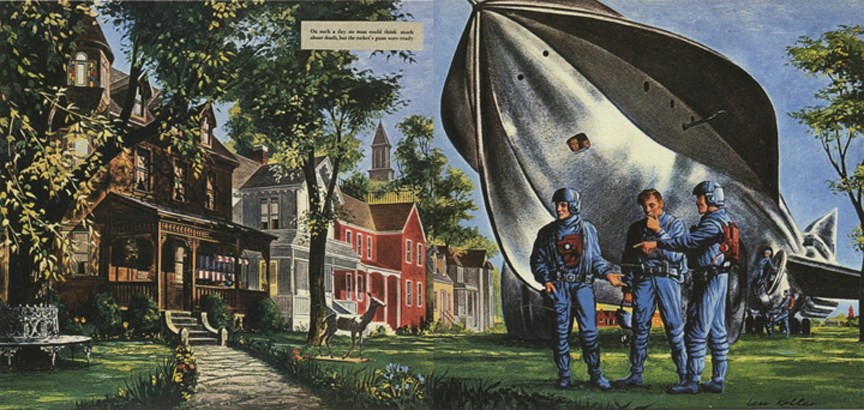
Edgar Rice Burrough’s Barsoom series continued the romantic portrayal of Mars with its canals.And, of course a long tradition of portraying Martians as evil warmongering types is typified in the 1938 radio production by Orson Wells of the H.G. Wells 1897 work of fiction War of the Worlds, a story of Martians invading the Earth. The production was so convincing, that it set off a panic. In the 1940s Ray Bradbury wrote The Martian Chronicles, a poetic satire about humanity’s colonization of Mars and our inevitable destruction of its indigenous inhabitants–but not before the Martians attacked the settlers with their only weapon: telepathy. In the 1950 film Rocketship X-M, Martians are disfigured cave people who inhabit a barren wasteland, descendants of a nuclear holocaust. Martians have been depicted in various ways: enlightened and superior by Kurd Lasswitz in the 1897 novel Auf zwei Planeten, where the Martians visit Earth to share their more advanced knowledge with humans and gradually end up acting as an occupying colonial power. The 1934 short story “A Martian Odyssey” by Stanley G. Weinbaum describes the first ‘alien aliens’ in science fiction. The story broke new ground in portraying an entire Martian ecosystem unlike that of Earth—inhabited by species that are alien in anatomy and inscrutable in behaviour—and in depicting extraterrestrial life that is non-human and intelligent without being hostile. Several stories after the various Mariner and Viking probes had visited Mars, focused on its lifeless habitat and attempts to colonize it. The disappointment of finding Mars to be hostile to life is reflected in the 1970 novel Die Erde ist nah (The Earth is Near) by Ludek Pesek, which depicts members of an astrobiological expedition on Mars driven to despair by the realization that their search for life there is futile.
The theme of terraforming Mars later became prominent in the latter part of the 20th century, exemplified by Kim Stanley Robinson’s 1990s Mars Trilogy. The Expanse books and TV series portrays humans who have colonized Mars and in the process of terraforming it.
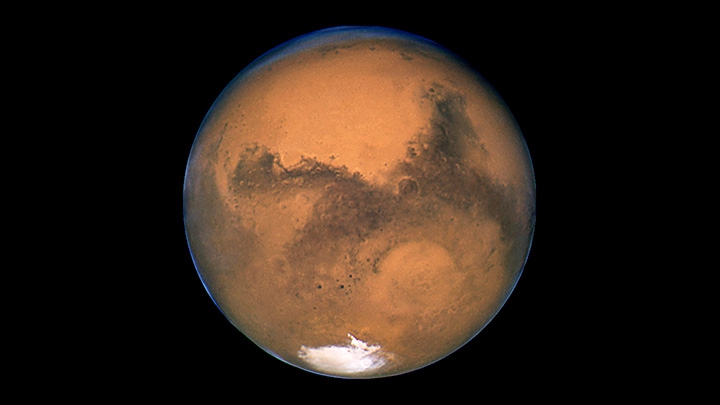
Mars (photo by Hubble)
What Scientists Now Know About Mars
Thanks to NASA, ESA, and other science agencies with various countries, we now have a very different picture of Mars. Some parts of Mars have numerous craters like Mercury and the Moon, but other parts of Mars have plains, volcanoes, canyons and river channels. The volcanoes and canyons are bigger than any other known examples. Data prove Mars was warmer and had abundant liquid water in its early history. Today there is still water, but almost all is in the form of ice in the polar caps and below the surface (some locations on Mars may experience temperatures above the melting point of water, hence transient pools of liquid water are possible). There is also the possibility that Mars may have had tectonic plates like the Earth does now. The atmosphere of Mars is mostly carbon dioxide (95%) with nitrogen, argon and traces of oxygen, carbon monoxide, water, methane and other gases, along with dust. The polar caps are partly water ice and partly frozen carbon dioxide, with differences between the northern and southern polar caps.
Mars surface showing south pole cap (image NASA)
Martian surface (image by NASA)
Victoria Crater on Mars (image by NASA)
Dune field in Endurance Crater on Mars (image by NASA)
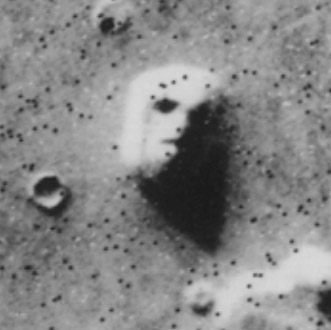
Apparently, Viking 1 photographs taken in 1976 in the region known as Cydonia look like a human face, but later higher resolution MGS photographs of the same region look like a pile of rocks and it is likely a pareidolia (the tendency to perceive meaning in a natural pattern without significance, like the Man in the Moon).
Remnants of an old stream bed on Mars (image by NASA)
Possible methane sources and sinks (image by NASA)
When I was a child—and to this day—I would look up at the deep night, dressed in sparkling stars, often find that red planet blazing in the darkness, and let my mind and heart wander. If given the choice to explore the deep sea or the deep of space, I’d instantly reply: space, of course. I used to wonder why I chose to look up and away, beyond my home, to the far reaches of the unknown blackness of space, and find some thrilling element that provided an abiding fulfillment. Why did I abandon my home? Maybe I didn’t…
Dune field in Endurance Crater, Mars (image by Curiosity, NASA)
Nina Munteanu is a Canadian ecologist / limnologist and novelist. She is co-editor of Europa SF and currently teaches writing courses at George Brown College and the University of Toronto. Visit www.ninamunteanu.ca for the latest on her books. Nina’s bilingual “La natura dell’acqua / The Way of Water” was published by Mincione Edizioni in Rome. Her non-fiction book “Water Is…” by Pixl Press (Vancouver) was selected by Margaret Atwood in the New York Times ‘Year in Reading’ and was chosen as the 2017 Summer Read by Water Canada. Her novel “A Diary in the Age of Water” was released by Inanna Publications (Toronto) in June 2020.
“Oh, Brave New World that has such people in it!”—Minerva in Shakespeare’s The Tempest and John the Savage in Aldous Huxley’s Brave New World
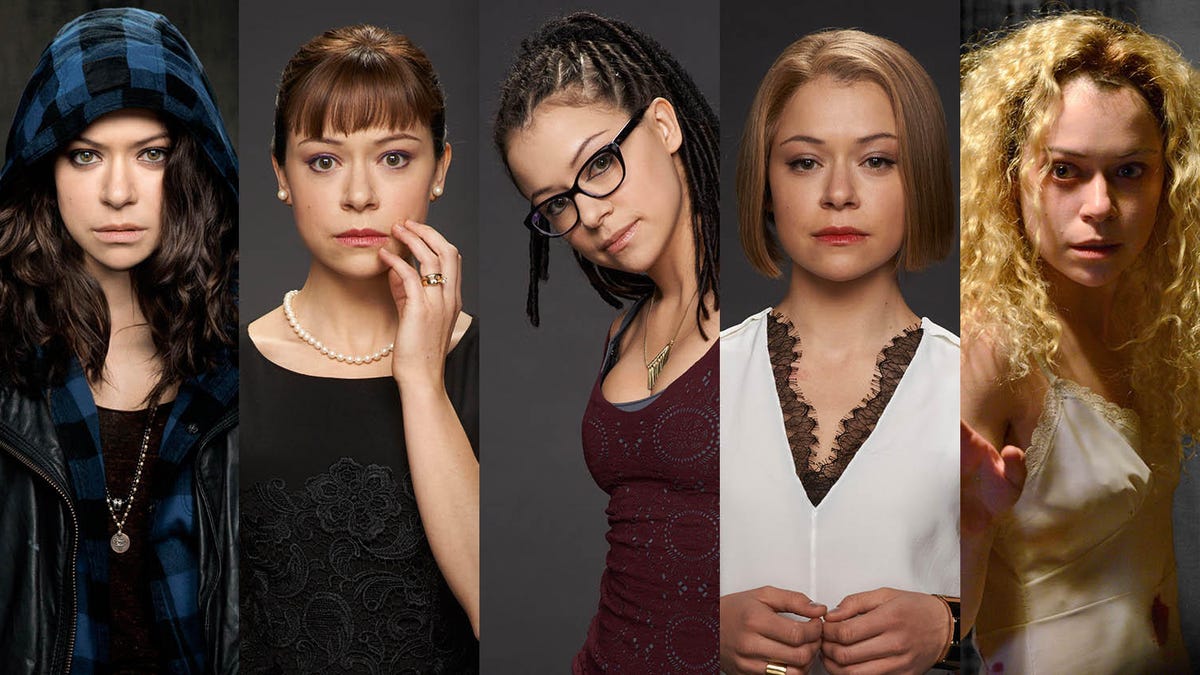
Canadian science fiction thriller Orphan Black, written by Graeme Manson and directed by John Fawcett stars the extraordinary multi-talented Tatiana Maslany in multiple roles of herself. If you haven’t yet watched the series (five seasons worth), you must on this point alone: to enjoy Maslany’s superb performance as seven clones, all different, yet all the same.
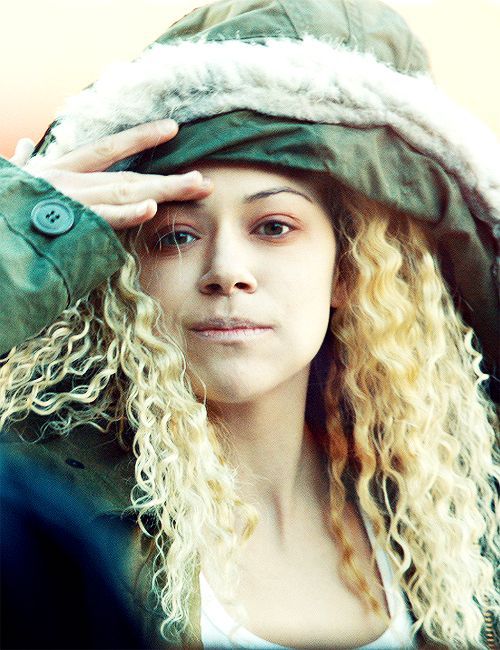
The various clone identities of Tatiana Maslany: Sarah, Alison, Cosima, Rachel, and Helena
Shot in and around Toronto, Ontario, the series focuses on Sarah Manning, a fringe-dweller with questionable friends, who assumes the identity of her clone, cop Elizabeth (Beth) Childs, after witnessing her suicide and stealing her stuff. In Season 1 alone, seven clones are revealed. Those still alive include suburban housewife Alison Hendrix, university evolutionary biologist Cosima Niehaus, corporate mogul Rachel Duncan, and crazed sociopath Helena.
Toronto is filmed brilliantly in a vague every-city pastiche that combines the look of London’s eastside, NYC and northern Europe all in one. Like its characters, the show is both sparsely existentialist and baroque funk. Besides Sarah’s own diverse clones there is foster brother Felix and his various friends or cronies who add significant colour to this film-noir set. Unsavory antagonists not only add intrigue but provide significant texture from sophisticated and subtle to the banal and truly terrifying. And like biology itself—perhaps the true main character here—all the characters are shape-shifters; looking for balance in a shifting world where “normal” keeps chasing itself.
Sarah at train station where she will encounter her first clone
“While other stories, including Jurassic Park and H.G. Wells’ The Island of Doctor Moreau, could certainly be categorized as biopunk science fiction, very few television shows and movies today delve into the idea of biology,” says Isabella Kapur in her 2013 article “Clones are People Too: The Science and Science Fiction of BBC America’s Orphan Black.” There was, of course, the 2005 film The Island and the 2004-2008 Canadian TV series Regenesis. And, since then, there have been some excellent films and TV series that have delved imaginatively into the wonders and terrors of genetic engineering, human cloning, and synthetic biology, including the German 2020-21 series Biohackers, 2022 film Vesper, and 2023 film The Creator. But Orphan Black was certainly one of the first to explore this topic with such unflinching depth.
Orphan Black is a slick, sophisticated and edgy exploration of human evolution that raises issues about the moral and ethical implications of bio-engineering and genetic tampering—specifically human cloning (currently against the law), personal identity, and intellectual property. Manson and Fawcett enlist symbols and clever metaphor to enrich the story with layers of depth—no item is free of meaning: from the seemingly innocuous naming of a transit station (Huxley Station) in the show’s premiere, or Delphine’s passing reference to “a brave new world” to a terse discussion between a religious extremist and a restaurant proprietor over the merits of factory-farmed eggs: “They’re not normal,” the extremist complains. “They’ve been interfered with.” There is nothing normal about Orphan Black.
Clone identities: Alison, Helena, Sarah, Beth, Cosima, and Katia
Episode titles in Season One quoted parts of Charles Darwin’s evolutionary text On The Origin of Species. Titles like “Natural Selection” (series premiere) and “Parts Developed in an Unusual Manner” elucidate concepts of evolution and survival of the fittest. Season 2 adopts the works of Sir Francis Bacon, reflecting the ethical and moral implications of scientific pursuit in a world of contrasting philosophies and values. “The frequently antagonistic relationship between ‘sound reason’ and ‘true religion’ and the attempt to reconcile the two,” says SlantMagazine, “emerges here as the structuring principle of Orphan Black‘s sophomore season—exemplified by the decision to title each episode after the writings of Sir Francis Bacon, whose body of work at once advocated empiricism and abhorred atheism.”
The Season 2 Premiere title, “Nature Under Constraint and Vexed” excerpts Bacon’s “Plan Of The Work” published in 1620:
“Next, with regard to the mass and composition of it: I mean it to be a history not only of nature free and at large (when she is left to her own course and does her work her own way)—such as that of the heavenly bodies, meteors, earth and sea, minerals, plants, animals—but much more of nature under constraint and vexed; that is to say, when by art and the hand of man she is forced out of her natural state, and squeezed and moulded…seeing that the nature of things betrays itself more readily under the vexations of art than in its natural freedom.”
Sir Francis Bacon
Tatiana Maslany (center) plays several different clones on the BBC America series Orphan Black.
Mingling Its Own Nature With It…
Human cloning made a media comeback when three different research groups created embryonic stem cells out of embryos cloned from adult cells. Scientists insisted that the cloned embryos are meant for research and therapeutic purposes—not to create human clones (shades of The Island?). John Farrell of Forbes Magazine wrote, “The breakthrough also means that it is now just a matter of time before reproductive cloning is achieved. Probably within the next decade.”
Issues, brought on by GMO foods and medical genetic research, have propelled a major debate in gene patenting. The United States Supreme Court ruled against patenting sequences of the human genome in Association for Molecular Pathology Et Al. vs. Myriad Genetics, Inc., Et Al., reports Isabella Kapur in her 2013 article. “Myriad Genetics had patented two genes they had isolated that were identified as genes involved in increased ovarian and breast cancer risks,” said Kapur. “Companies, like Myriad, that spend money to identify nucleotide sequences want to be able to patent those discoveries. However, the patenting allows for monopolies on illness treatments and allows companies to have exclusive access to portions of human DNA. In 2013 companies like Myriad Genetics were not allowed to legally copyright portions of DNA they isolated in the human genome, but they were, according to the Supreme Court, allowed to patent synthetically created sequences of complementary DNA.” This is still the case, as far as I know.
In Orphan Black, The Dyad Institute, a biotech corporation with arcane connections to invisible powers and eugenics, patented the clones as theirs to do with as they please—which might be anything. The ownership of the clones’ genomes by The Dyad Institute would be lawful if all the clones’ DNA was entirely synthetically made. The company would also have exclusive rights to study the clones’ genome, effectively placing the clone Cosima under copyright infringement if she decided to study and apply her research (on herself) outside of the Dyad Institute. If the clones were synthetic, like the DNA created by scientist Dr. Craig Venter, then the Dyad Institute would be in a unique situation with regards to ethics and newly emerging considerations of human rights yet to be determined. For instance, how much of the clones really belong to the company that made them? What even constitutes a person?
Felix encounters several biohackers at a Neolution getogether
Intrigue unfolds as Sarah and Felix discover that her clones are being systematically killed and/or getting sick. The series unravels a frightening panoply of stakeholders in this biological transhumanist game, spanning from the ultra-sophisticated to the deranged fanatic. Among the frightening stakeholders are the Proletheans, a religious extremist group who seek to systematically eliminate clones as “abominations” against the natural order of things. Pastor Henrick, a Waco-style cult “prophet” who quotes Einstein, conducts Mengele-style “breeding” experiments to recast humanity in his version of “perfection.”
Neolutionist Dr. Aldous Leekie talks with Cosima about human self-directed evolution
Sarah and Felix trace the origin of her clones to The Dyad Institute. One of the institute’s scientists, Aldous Leekie, heads Neolution, a transhumanist movement whose notion of “self-directed evolution” to recast humanity in the image of “perfection” evokes social Darwinism and the Übermensch. It brings to mind the early American eugenics programs that inspired the fascist sonderweg and Hitler’s aggressive application of eugenics in the Holocaust.
Nazi poster promoting eugenics and sterilization
The terrible question remains: why were the clones made? Who exactly is the Dyad Institute and who is behind them? In the Season Two episode Variable and Full of Perturbation, we discover that not only are the clones female prototypes (of what?) but that they were purposefully created to be sterile. Frightening motivations reveal themselves over the remaining seasons as we discover just how far some are willing to go to achieve their goals of a ‘perfect society.’
Conditions of Existence…
Where do we draw the line in our tightrope walk across the sea of chaos to find the Holy Grail? When does a Transhumanist’s individual expression of “transcendence” become a movement toward the Singularity? When does a singular powerful thought encompass an entire society?
The political ambitions that wish to use science to “enhance” humanity, based on someone’s idea of “perfect” carry great social implications. Enter the pseudoscience of eugenics and scientific racism, concepts as old as Plato that have haunted humanity since the biblical portrayal of Adam and Eve. Simply put, eugenics is the scientifically erroneous and immoral theory of “racial improvement’ and “planned breeding” which gained popularity during the early 20th century; the practice of eugenics is based on the notion that not only physical traits but mental and behavioral attributes—like mental capacity, musical ability, insanity, sexual licentiousness and criminality—are inheritable and therefore can be directed through breeding, sterilization and now through genetic manipulation.
“Perhaps more than any other science, biology has consistently been employed as an accomplice to moral claims because it has tremendous social utility in translating scientific findings into political imperatives,” says Cosima Herter, science consultant for Orphan Black. “Historian of science, Garland Allen, argued that the “decline in economic and social conditions” gives strong indications ‘of our potential to find eugenical arguments […] attractive once again,’ albeit ‘clothed in the updated language of molecular genetics.’ The social importance of genetics lies not only in how genetic research has contributed towards advances in biology (and undoubtedly it does in many, many beneficial ways – medicine not the least among them), but because we have yet to counter ‘simplistic claims of a genetic basis for our social behavior’ with modern facts. Our understanding of genetics has changed, but many of our social aspirations for its uses have not. Deeply embedded in the public consciousness is the hope that social problems can be solved with ‘scientific panaceas’.”
Herter goes on to say that, “We may indeed have a richer understanding of the science of heredity and genetic mechanisms, but public attitudes as to their social relevance have changed very little in the last 100 years. And we might be well advised to remember that science can as easily act as an ally to existing institutions and justify pernicious prejudices – racism, sexism, homophobia, and class disparity to name but a few – as it can produce wondrous, beautiful, and beneficial fruits in the service of a better world where these prejudices could be overcome. Many of us still hold on to ambitions that we can build ‘perfect’ people and genetically engineer ‘perfect’ societies, yet do so without much pause as to how we measure what ‘perfect’ is, and what horrendous and inhuman costs this aspiration towards perfection might incur. Many traits we value, and are wont to consider ‘perfect,’ are historically plastic. And ‘genes are not rigid pieces of information’ that necessarily lead to a particular behavioral trait. If our definitions of many behavioral traits we study today are known to be highly subjective, then our attempts at studying the genetics behind them is likely to remain on precariously shifting grounds.”
Cosima attends presentation by Neolutionist Aldous Leekie
Eugenics: Designing A Perfect Society from a Perfect Human…
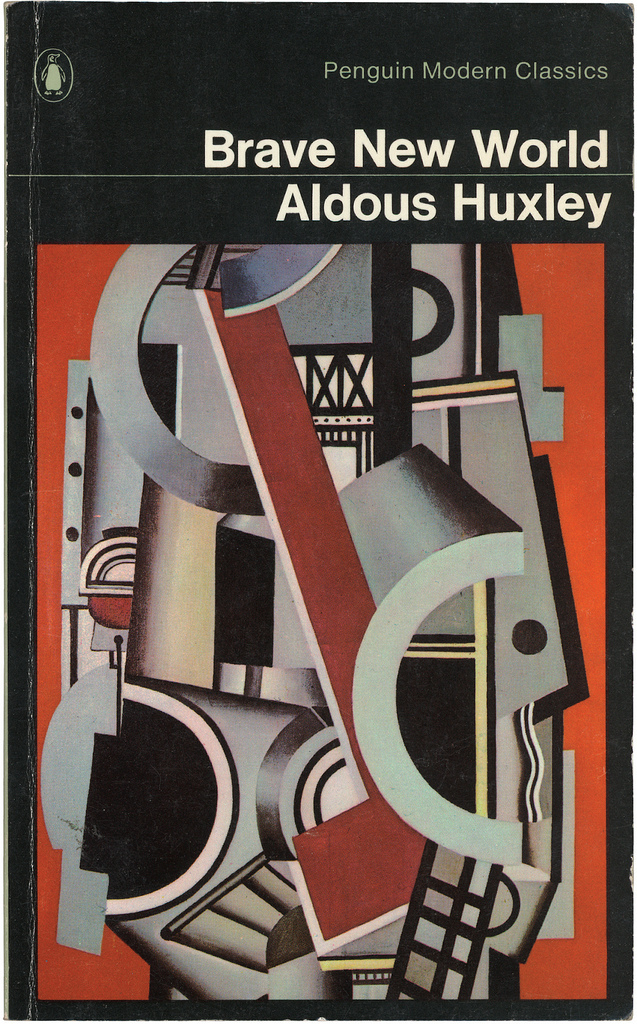
Aldous Huxley’s dystopian novel Brave New World describes a society based on eugenic principles. It is a stratified genetic caste society where the lower orders are deliberately stunted both mentally and physically. The destiny of its five main strata is determined from an early age. The strata consist of Alphas, destined for leadership positions; Betas, who hold less exalted but still intellectually demanding jobs; Gammas and Deltas, who occupy roles needing some intelligence; and finally Epsilons, happy morons capable of only the most menial and unskilled tasks.
“And it seems to me perfectly in the cards that there will be within the next generation or so a pharmacological method of making people love their servitude, and producing a kind of painless concentration camp for entire societies, so that people will in fact have their liberties taken away from them but will rather enjoy it, because they will be distracted from any desire to rebel by propaganda, brainwashing, or brainwashing enhanced by pharmacological methods.”
Aldous Huxley in a speech at the University of California
“Perhaps more than any other science, biology has consistently been employed as an accomplice to moral claims because it has tremendous social utility in translating scientific findings into political imperatives,” says Cosima Herter, science consultant for Orphan Black. “Deeply embedded in the public consciousness is the hope that social problems can be solved with ‘scientific panaceas’,” Herter adds. “…Science can as easily act as an ally to existing institutions and justify pernicious prejudices – racism, sexism, homophobia, and class disparity to name a few – as it can produce wondrous, beautiful, and beneficial fruits in the service of a better world.”
Helena on the chase
Transhumanism: Nature Under Constraint and Vexed…
In 1923 British geneticist J.B.S. Haldane predicted great benefits to humanity from applications of advanced sciences to human biology. He also suggested and that every such advance would be considered blasphemy or perversion, “indecent and unnatural”.
In 1929, Cambridge crystallographer J.D. Bernal, speculated on radical changes to human bodies and intelligence through bionic implants and cognitive enhancement. Two years before that, Fritz Lang’s expressionist SF film Metropolis introduced the first robot depicted in cinema: the Maschinenmensch, the machine-human.
Biologist Julian Huxley, brother of the writer Aldous, first used the word Transhumanism in a 1957 article, where he presented the concept of the technological singularity, or the ultra-rapid advent of superhuman intelligence. Julian Huxley defined Transhumanism as “man remaining man, but transcending himself, by realizing new possibilities of and for his human nature.” As an aside, Aldous Huxley’s Brave New World was published in 1932.
The founders of Transhumanism were educated wealthy individuals of mostly British and European descent. They were an elite ruling class, who considered themselves the forward-thinking intelligentsia. Transhumanism is an intellectual and cultural movement that promotes eugenic principles through science & technology to improve human mental and physical characteristics and capacities. Transhumanists seek to expand technological opportunities for people to live longer and healthier lives and enhance their intellectual, physical, and emotional capacities through the use of synthetic biology: genetic, cybernetic and nanotechnologies. From the transhuman perspective, “in time the line between machines and living beings will blur and eventually vanish, making us part of a bionic ecology.”
While early Transhumanists advocated the elitest pseudoscience of Eugenics or “racial hygiene”, many of today’s Transhumanists argue that market dynamics and individual choice will drive twenty-first century eugenics. However, this argument contradicts the movement’s own dialectic: that of achieving the Singularity. The Transhuman quest for the Singularity of the Übermensch consists of the ability to upload the minds of all individuals to a Hive Mind, a symbiotic collective consciousness, in which all peoples can link to an artificial “brain” or global hard drive, to achieve super-intelligence. The Mind Upload Research Group (MURG) is currently researching this possibility.
Futurist Ray Kurzweil, author of The Age of Spiritual Machines and co-founder of the Singularity University, predicts that humans will be uploading their minds to computers by 2045 and that bodies will be replaced by machines—essentially achieving “immortality”—before the end of the century. “We’re going to become increasingly non-biological to the point where the non-biological part dominates and the biological part is not important any more,” says Kurzweil. “In fact the non-biological part – the machine part – will be so powerful it can completely model and understand the biological part. So even if that biological part went away it wouldn’t make any difference.”
Author Paul Joseph Watson reminds us that—even if desirable—such a utopia would not be available to everyone; rather, it would remain the domain of a wealthy aristocracy, creating yet another class system. Kurzweil seems to agree: “Humans who resist the pressure to alter their bodies by becoming part-cyborg or are unable to afford such procedures will be ostracized from society. “Humans who do not utilize such implants are unable to meaningfully participate in dialogues with those who do.”
In Kurzweil’s brave new world of “biological and non-biological intelligence, immortal software-based humans, and ultra-high levels of intelligence that expand outward in the universe at the speed of light,” will such an elite see the mass of humanity as worthless parasites and either prevent them from reproducing via mass sterilization programs or simply slaughter them outright?
What is perfect and how do we measure it? What is the risk of even suggesting a recipe for such a thing? A perfect society? Isn’t a Utopia an oxymoron of unresolvable paradox? Science fiction literature has given us many visions of where so-called utopias may descend (e.g., Brave New World, 1984, Fahrenheit 451, A Stranger in a Strange Land, The Handmaid’s Tale, The Matrix, The Hunger Games, Elysium, Divergent, Clockwork Orange, Delirium, and so many more). The very act of being an individual provides complexity and diversity that promotes stability in change. Stable chaos.
Perhaps, what Orphan Black demonstrates the best is that even clones—who are exactly the same genetically—can differ significantly, given free reign in a diverse environment.
What Orphan Black does exceptionally well is ask those hard questions. OK. It’s not asking the questions so much as presenting the “then” scenario to some pretty important “what if” premises. It’s doing what all good art—versus polemic—does: it’s providing the seeds for viewers to engage in intelligent conversation on emerging social issues via Twitter, Facebook, blogs and other social media.
Join in.
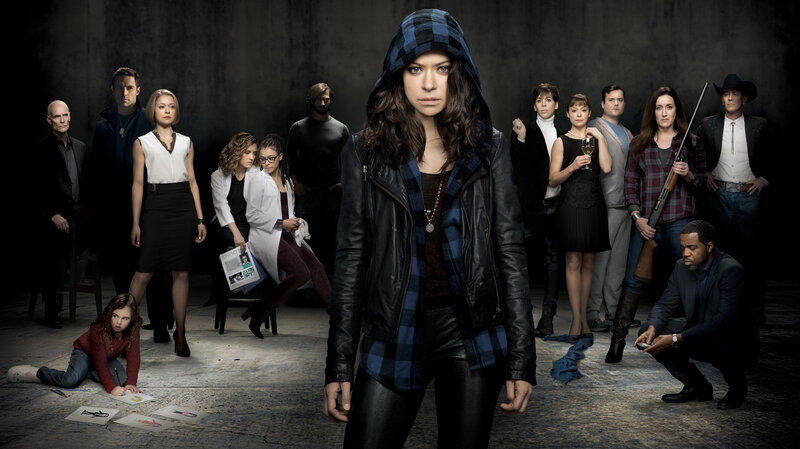
The clones of Orphan Black
Nina Munteanu is a Canadian ecologist / limnologist and novelist. She is co-editor of Europa SF and currently teaches writing courses at George Brown College and the University of Toronto. Visit www.ninamunteanu.ca for the latest on her books. Nina’s bilingual “La natura dell’acqua / The Way of Water” was published by Mincione Edizioni in Rome. Her non-fiction book “Water Is…” by Pixl Press (Vancouver) was selected by Margaret Atwood in the New York Times ‘Year in Reading’ and was chosen as the 2017 Summer Read by Water Canada. Her novel “A Diary in the Age of Water” was released by Inanna Publications (Toronto) in June 2020.
Biohacking is an umbrella term comprising synthetic biology, DIY science, bodyhacking, and health optimization
Elsa Sotiriadis, synthetic biologist
Biohackers, currently streaming on Netflix, is a fast-paced techno-thriller created by Christian Ditter with synthetic biology at the very center of its intrigue. In the journal Science Dov Greenbaum describes the German show as “a fictional tale centred around the sociotechnological movement known as do-it-yourself (DIY) biology, in which amateurs, professionals, anarchists, and civic-minded citizens push the boundaries of mainstream biology.” Greenbaum describes the show’s main characters as “a wealthy biopharmaceutical executive, a group of medical students, a number of stereotypical biohackers, and a community of transhumanists intent on modifying their bodies for seemingly impractical endeavors.” The show stars Luna Wedler as Mia Akerlund and Jessica Schwarz as Professor Tanja Lorenz; but the real star of the show is biohacking: human enhancement or augmentation to improve health, performance, or well-being. Biohacking ranges from efforts to improve brain function to faster weight loss. Some are relatively safe to try at home; others may pose health risks. Among others, the show features glow-in-the-dark mice, gene-modded weed, underwater pills that extend your ability to hold your breath, and payment microchips in your hand.
Scientist in hazmat suit confronts Mia, the soul survivor of bioterrorism on a train to Berlin
Biohackers opens with a disturbing scene of bioterrorism on a train headed to Berlin. All passengers suddenly choke and fall unconscious—except for young med student Mia Akerlund, who tries to help and fails.*
From that explosive flash-forward scene, the show jumps back to two weeks prior, as college freshman Mia settles into Freiburg University’s prestigious medical school, and betrays a particular interest in synthetic biology, biohacking and genome editing. We soon learn that she is obsessed by celebrated professor and geneticist/entrepreneur Tanja Lorenz (who runs a biopharmaceutical company and has an entire building dedicated to her research with huge neon logo of her name). Both women are connected by a dark secret to do with Mia’s twin brother who mysteriously died when still a boy. Mia quickly gains a position working for Lorenz, which plunges her into the dangerous intrigue of illegal genetic experiences.
“The truth will set you free” inscribed on the collegiate building of Freiburg University
A touching reflection of Mia’s quest sits emblazoned on the front façade of the collegiate building, where she has her first class: in gold letters, is the inscription “Die Wahrheit wird euch frei Machen” (The truth will set you free) from the Gospel of John. Ironically, we soon realize that she is a purveyor of many secrets, including her own name.
Lorenz lectures students
An early, rather enlightening, scene of the first episode is of Mia’s first introductory biology class given by celebrated gene therapy tycoon Professor Lorenz. Not only does the scene introduce the controversial subject of synthetic biology; it reveals a disturbing sense of what’s at stake and the danger of scientific hubris. Tall, svelte and confident in a smart haircut and tailored suit, Lorenz struts like a self-proclaimed goddess in front of a student-crowded lecture hall and preaches the benefits of synthetic biology. When she asks the class “What is synthetic biology?” and a student replies “with the help of synthetic biology, we can alter existing life forms or create new ones,” Lorenz prickles beyond her already frosty demeanor and impatiently berates the students for their lack of vision. She challenges them to think bigger: “Synthetic biology transforms us from creatures into creators. It’s not just the future of medicine, but of humankind. We can cease entire infections before the outbreak … We eliminate genetic disorders. But if we don’t do our work exceedingly well, it could end our species. It is on us to find a way; this is your future. Your responsibility. You are the creators of tomorrow. We make God obsolete…”
Lorenz obtains throat swab for DNA sequencing from a patient in a fertility clinical trial as Mia looks on
Mia uses Jasper (Adrian Julius Tillmann) one of Lorenz’s teaching assistants to get herself noticed and hired by Lorenz and we are soon introduced to the glossy Lorenz Excellence Centre, a prestigious biopharmaceutical firm. Mia also discovers that Lorenz keeps her illegally obtained DNA database and does illicit gene therapy work in a secret well-equipped lab in her home. Mia is after that database to prove what she fears is true.
Mia helps Jasper capture his glow-in-the-dark mouse, that had escaped in the library
The first season (of two) unravels an unconventional conspiracy plot delivered through slow-building suspense, using flashbacks and flash-forwards, until its cliffhanger ending. Science, academia and intrigue are skillfully woven in an intelligent mystery-thriller that not only represents science accurately but delivers commentary on the ethical and moral questions of this highly dynamic and rapidly evolving field of science.
Speaking of rapidly evolving field, I found it interesting that Dr. Lorenz makes note of this in one of her lectures in the show; after singling out Mia for relying on sources other than the textbook to solve a problem, Lorenz literally trashes the textbook in front of the class with a pithy comment on its being already out of date due to the dynamic nature of the field. I ran across this in my own experience as a university student in the field of cell physiology; my prof negated using a textbook, and instead suggested a huge list of journals for our edification.
Biohackers touches on several ethical and moral questions, such as genetic modification of stem cells, access to advanced gene therapies, and privacy and consent surrounding genomic data. Synthetic biologist Elsa Sotiriadis warns that, “this topic will likely become an ethical minefield in the coming years. On the one hand, we need large and diverse datasets to train medical AI and develop therapies. But on the other, there’s nothing as personal as your literal blueprint. Unlike stolen credit cards, you can’t change your genomic data. I like that Biohackers brings this up.”
Mia’s roomates enjoy a biohacker’s party
Dov Grenbaum’s article in the journal Scienceentitled “Biology’s brave new world” celebrates the show for its accurate representation of complex laboratory equipment and procedures and how it accurately represents the intricacies, motivations and ethical issues of biohacking from sophisticated big-business gene therapies to DIY homespun biology. Jasper, Lorenz’s teaching assistant, has his own biohackspace where he develops the gene therapy for his rare genetic disease. It’s housed off-campus in a makeshift van on some scrubby property in the woods. With professional lab machines being extremely expensive, Jasper relies on DIY lab equipment.
Jasper in his off-campus biohackspace
Smartlab Architects helped make Biohackers as technologically accurate as possible and connected the directors with lab industry experts to create the modern labs and DIY biohacker space featured in the Netflix series. They also take you on a brief tour of Jasper’s biohackspace set up and equipment.
Professor Lorenz’s university lab in the Lorenz Excellence Centre, where she runs her official studies and where Jasper and Mia work, was actually located in LMU Biocampus Martinsried and used by students and professors for their regular research.
Lorenz interrogates Jasper in the lab of her Excellence Center
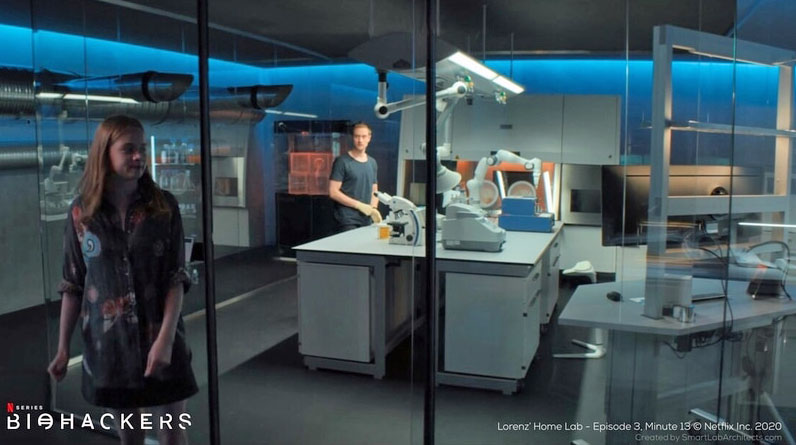
Smartlab Architects also designed Professor Lorenz’s secret private lab located in the basement of her mansion: “We designed this lab with the goal to build he most futuristic automated and sexy laboratory one could imagine.”
Jasper and Mia in Lorenz’s secret lab in her house
Thanks to the emergence of the open-source movement, greater access to reagents and devices, lowered costs of sequencing costs, and increased access of tools and methodologies for non-experts, expensive genetic engineering experiments that could previously only be carried out behind the walls of big institutions can now be done on a kitchen table with ingredients bought on eBay. For instance, there is Chen-Lu (Jing Xiang), the “introverted nerd,” a DIY biologist who genetically modifies fungi and plants (to make beef-tasting mushrooms or to create a bio-piano); Ole (Sebastian Jakob Doppelbauer) does various bodyhacking self-experiments and uses an NFC microchip in his hand to pay in shops. It’s worth noting here that biohacking is illegal in Germany.
Sotiriadis notes that, “the cut-throat Machiavellian culture of Lorenz’s secretive big-budget lab clashes with the free-spirited biohackers who are engineering mushrooms with new flavours to make livestock farming obsolete and “CRISPR together” in a camper van lab in the woods and at home. It’s a nicely captured contrast.”
Sotiriadis adds that, “the series shows experiments as multi-step scientific protocols that sometimes go wrong, which is refreshing.” Sotiriadis further describes the show as: “Part revenge plot, part young adult love drama, part dismantling a large-scale conspiracy; the unconventional pieces sometimes move smoothly together and sometimes clash, but the plot is glued together with lots of visually appealing synthetic biology experiments and bioluminescent matter of diverse natures.”
Greenbaum has the last words: Biohackers “serves as a pedagogical vehicle to raise many timely and interesting ethical, legal, and social concerns. From bioluminescent mammals to the collection of genetic material for clinical trials, the series’ storyline highlights how cavalierly we sometimes approach genomic data and genetic engineering.” Greenbaum cites one of the characters who suggests that the ends of her research justify the experimental means, even though her methods demonstrate a gross disregard for test subjects who may suffer as a result. The show also offers insight into the motivation for DIY biology: a friend confides to Akerlund on how Lorenz is willing to sell a cheaply acquired drug to desperate patients for inflated prices. “Such frustrations are what drive many citizens operating outside traditional institutions to develop their own pharmaceutical solutions.”
“It is ironic that Biohackers is set in Germany,” says Greenbaum, “one of the few places where genetic engineering experimentation outside of licensed facilities is illegal and can result in a fine or even imprisonment.”
*An interesting note here; the show was initially slated to first air in April 2020; however, given the highly disturbing opening scene and its likeness to COVID-19 currently raging at the time, the show’s premiere was pushed to August. While Biohackers isn’t about a pandemic, its chilling first scene was thought to stir up too many fears from an already disease-stricken public. Another science thriller that covers similar themes and issues of synthetic biology is Regenesis, a Canadian TV show currently airing.
Nina Munteanu is a Canadian ecologist / limnologist and novelist. She is co-editor of Europa SF and currently teaches writing courses at George Brown College and the University of Toronto. Visit www.ninamunteanu.ca for the latest on her books. Nina’s bilingual “La natura dell’acqua / The Way of Water” was published by Mincione Edizioni in Rome. Her non-fiction book “Water Is…” by Pixl Press (Vancouver) was selected by Margaret Atwood in the New York Times ‘Year in Reading’ and was chosen as the 2017 Summer Read by Water Canada. Her novel “A Diary in the Age of Water” was released by Inanna Publications (Toronto) in June 2020.








































 Nina Munteanu Writing Coach