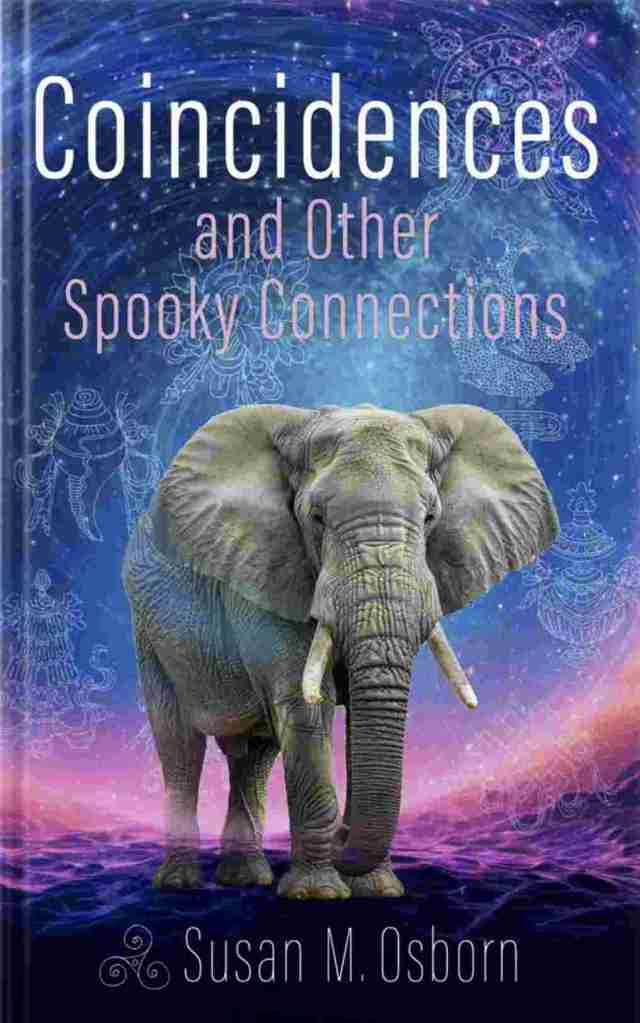
Susan M. Osborn explores the nature, influence—and importance—of coincidence, synchronicity and serendipitous discovery in our lives.
.
.
The book is laid out in ten chapters, each featuring some aspect of coincidence, synchronicity, and events of pure serendipity. Within each chapter, the narrative flows from biography to historic exposition or topical study, unraveling delicious facts, suppositions, dreams and fantasies coiled up in patterns and signs of potential significance.
.
Locked between the many entertaining and enlightening examples of synchronicity experienced by famous and not-so-famous people, are gems of interesting and notable facts and astute observations—from the origins and history of the term synchronicity with Jung’s early work in archetypes to the origins of “serendipity” with Horace Walpole to the foundations and influences of the ‘I Ching’.
The latter part of Osborn’s title, “and Other Spooky Connections”, riffs off Albert Einstein’s famous quote about “spooky actions at a distance”, a reference to quantum entanglement, which describes how two particles may remain connected regardless of the distance between them. Einstein asserted that quantum entanglement violated the principles of a realistic, deterministic universe. And, yet, experiments have repeatedly verified the reality of quantum entanglement. This speaks to the power of connection. All the “spooky connections” described in Osborn’s book ultimately address a common theme of all life: to make meaning of our world. I believe that this is essentially the purpose of all life. It even has a term: biosemiosis, which describes how all life is involved in meaning-making.
I agree with Osborn when she writes, “we can solve many of our problems if we have more than one way to look at them.” And this is how she has laid out her book, offering “a way to look at the world from a wider perspective” to gain insight from an otherwise chaotic and seemingly random pattern. When we learn from chaos, we are making meaning and fulfilling what all life is doing. This too is biosemiosis: the notion that all life embraces a process of signification and meaning-generation—from mammals to bacteria—that recognizes its Umwelt (species-specific environmental reality) through the production, action, and interpretation of non-linguistic signs and codes.
Ultimately, Osborn’s stories, disclosures and explorations challenge the reader to become more mindful and ‘present’ in our world, to exercise curiosity, integrate more aspects of our reality to arrive at meaning so we can forge connections—even spooky ones—that open doors of possibility and fulfill us with purpose and joy.
References:
Barbieri, Marcelo. 2008 (ed). “Introduction to Biosemiotics: The New Biological Synthesis” Springer, Netherlands. 525pp.
Hoffmeyer, Jesper. 2001. “Seeing virtuality in nature.” Semiotica 134.
Kull, K. 2016. “The biosemiotics concept of the species.” Biosemiotics 9:61-71.
Lowenhaupt Tsing, Anna. 2015. “The Mushroom at the End of the World: On the Possibility of Life in Capitalist Ruins” Princeton University Press, New Jersey. 331pp.
Trewavas, Anthony. 2003. “Aspects of Plant Intelligence.” Annals of Botany 92(1): 1-20.
Uexküll, Jakob von. 1931. “Die Rolle des Subjekts in der Biologie.” Die Naturwissenschaften 19: 385-391.
Uexküll, Jakob von. 1940 (1982). “The theory of meaning.” Semiotica 42(1): 25-82.
.
Nina Munteanu is a Canadian ecologist / limnologist and novelist. She is co-editor of Europa SF and currently teaches writing courses at George Brown College and the University of Toronto. Visit www.ninamunteanu.ca for the latest on her books. Nina’s bilingual “La natura dell’acqua / The Way of Water” was published by Mincione Edizioni in Rome. Her non-fiction book “Water Is…” by Pixl Press (Vancouver) was selected by Margaret Atwood in the New York Times ‘Year in Reading’ and was chosen as the 2017 Summer Read by Water Canada. Her novel “A Diary in the Age of Water” was released by Inanna Publications (Toronto) in June 2020.
It started with a simple tweet of mine on X regarding doing research for one’s writing projects. I’d met Isabella Mori a few years ago, when we both contributed to an ekphrastic anthology of flash fiction, inspired by Group of Seven art. We met again when she submitted a story to an anthology I was editing for Exile Editions. After my tweet on research, Isabella and I traded brief stories about rewrites based on research findings and ‘mistakes’ and the arcane revelations in the creative process that may result. I was intrigued by her recounting and asked her to share it with you; so here it is:
“Synchronicities And The Sea”by Isabella Mori
(Trigger warning: Substance use and suicide)
This is about the magic that comes to pass when we let the Muse guide our work and consent to synchronicity. Here is what happened:
When I go away on vacation, I try to visit the local library, and always make sure to check out the community announcements. On one of those forays, I came across a notice of a project that teamed up visual artists with writers for a short story or poem. I love these types of collaborations and immediately jumped on it. Max was the artist I paired up with, and we hit it off right away. After a few conversations, we settled on the painting below, for which I was going to write a story. As you can see, it had a moody, dark feeling. I drafted this text as a response:
The memory of a map showed her the way as she wandered, blinded by the night, along the shore. Numb with cold, her bare feet dug into the wet sand. She could not see that she left no tracks. There was something in her searching; she felt it in the deep pit of her stomach but there was no image in her mind’s eye of what it was, no tinkling that alerted her, no smell, no taste. A sense of despair drained the blood from her heart and tugged at her from the right, where the forest rushed. Foot-dragging ennui invited her onto a soft-moss carpet to the left, and thoughts of numbers, cars and cash register receipts tried to wrangle her back to where she came from. She was near giving up. But at that precise moment there tracked the light only she of the searching could see—a light bigger more forceful than giants could ever imagine; all-embracing, all-revealing, all-nurturing just like the frothy ocean beneath it, just like the sand with its fierce sparkle, each grain a diamond just like the heart-bud that could not help but open under its rays, under those rays that only she of the searching could see.
However, for reasons we have both forgotten, Max decided to lighten the colours, and the dark mood of the first draft didn’t fit anymore. This is the version we ended up with:
Walk With The Angels
The ocean has known her share of angels over the eons. They come and go but the tide is older. When an angel appears in a cloud of glistening light, beats its wings and brings out the trumpets, little humans fall to their knees and beg for mercy and miracles.
But the water stays still.
Great mother ocean has seen it all.
She waits until the angel grows tired, then she takes the worn-out wings and heavenly body into her arms and carries them into her depths. Brings the apparition to visit kelp, salmon, starfish, barnacles, otters and crabs. Anemones. Killer whales. A visit one by one, under the summer sun, beneath the light of the Hunter’s moon, when the snow falls, with the Easter rains. The angel leaves a bit of themselves here, a bit there, a gift everywhere, until only the tiniest of diamonds are left.
And that’s the sand.
Walk with the angels.
There were a few tweaks before we arrived at this text, the major one being that in a previous version, I referred to ‘angel dust’ for the sand until the editor pointed out that that term refers to a street drug, PCP. In my enthusiasm I had forgotten that.
The change away from ‘angel dust’ was very important. When Max read the new version, they called me, their tone of voice both moved and perturbed.
“When I read this,” they said, “it feels like you channeled what happened with my cousin last year, not far from the place that inspired my painting. She had had problems with drugs all her life, and one day she just walked into the ocean. Her body was found a day later.”
Under those circumstances, we definitely did not want to refer to drugs.
That story stayed with me for months until one day when I was listening to one of my playlists of Latin music. I lived in Paraguay and Chile 1977-1980, and often enjoy the nostalgia of the music I listened to back then. The first song that came on was one of my all-time favourites, Alfonsina Y El Mar – Alfonsina And The Sea. Now I have to confess, I am terrible with lyrics, no matter what language, whether it be my native German, English, or the Spanish I was fluent in for quite a few years. For some reason, I really listened to the song last summer, and then looked up the lyrics. That’s when it hit me – was it possible that the lyrics of that song had subconsciously influenced me to write the second text? Or was it one of those Jungian collective conscious moments?
Alfonsina And The Sea
(Music: Ariel Ramirez. Lyrics: Felix Luna)
In the soft sand Licked by the sea Her small footprints Don’t return. Just one path Full of pain and silence Led to the water, Deep water, And one single path of unspoken pain Led to the foam.
God knows what sorrows accompanied you, What old suffering shut down your voice That made you lie down and nestle into the songs Of the sea snails, The song that sings in the deep dark of the sea, The sea snail.
There you go, Alfonsina, with your loneliness, What new poems did you go find? An old, old voice of wind and salt Sways your soul and carries it And you go there dreaming, Sleeping, Alfonsina, clothed in the sea
Five little sirens will carry you Through passages of algae and corals And glowing sea horses will dance Around you And all the creatures of the sea will soon Play at your side.
Turn down the light a little more, Nurse, let me sleep in peace. And when he calls tell him I’m not in, Tell him Alfonsina won’t come back. And when he calls don’t ever tell him I’m in, Tell him I’m gone.
There you go, Alfonsina, with your loneliness, What new poems did you go find? An old, old voice of wind and salt Sways your soul and carries it And you go there dreaming, Sleeping, Alfonsina, clothed in the sea.
(Used with permission, my translation.)
Alfonsina ended up in the ocean just like Max’s cousin did.
With some research, I found out that the story was about the Argentinian poet Alfonsina Storni who, after a difficult life that included poverty, questions she had about gender identity, and breast cancer, one night wrote a last poem to her son and then let herself fall into the ocean amid torrential rain. (An apocryphal version has her just walk into the ocean, and that’s the one the lyricist chose.) Some of that last poem was incorporated into Alfonsina Y El Mar – the nurse who is asked to lower the light, and told to tell ‘him’ that she won’t come back. Nobody seems to know who ‘he’ is.
The other research that had to happen was to find who the inheritors of Felix Luna’s estate were to obtain permission should I tell the story that you have before you. It turned out to be his daughters. Then I had to sleuth out their contact.
Felix Luna, the lyricist, imagined Alfonsina’s death not only as the terrible tragedy that it was but also as a mystical transformation into a sea creature that nestles into the songs of the sea snails. She finds new poems and sleeps clothed in the sea. She is embraced by sirens and wanders through algae and corals. She dances with sea horses and plays with all the other sea creatures.
I definitely cannot compare myself with a great poet like Felix Luna but notice with humility the similarities of my transformed angel who sinks into the embrace of mother ocean and also visits the more-than-humans of the sea.
I went pregnant with the idea of writing about the experience of Max’s and my collaboration for half a year when in February, I chanced upon a tweet by Nina about research for writing. I met Nina through submitting a story to an anthology she was editing. I told her about needing to tweak the angel story so that it does not talk about angel dust and ended up telling her the outline of what happened. She invited me to write a guest post about this, and here we are.
So many synchronicities. I could have not gone to that library. A different artist could have been paired up with me. Max could have wanted to stay with the original painting. Or they could have chosen a painting that would not have reminded them of their cousin. They could have opted not to share that sad story with me, or they could have been paired up with someone who doesn’t understand suicide as intimately as I do (I look back on a 30+ year career in social services.) I could have heard Alfonsina Y El Mar and still not really listened to the lyrics. There was no guarantee I could have managed to find out from whom to get permission to quote the song. I could not have submitted a story to one of Nina’s anthologies, and could not have followed her on Twitter. Coming across the particular tweet that prompted the publication of this story was like chancing upon a needle in a haystack. All this, and probably more, had to come together for this magical synchronicity to happen.
Thank you, Muse.
(Note: Since this is a sensitive topic, the artist’s name and some of the circumstances of my collaboration with them have been changed. However, the artist has consented to using their images.)
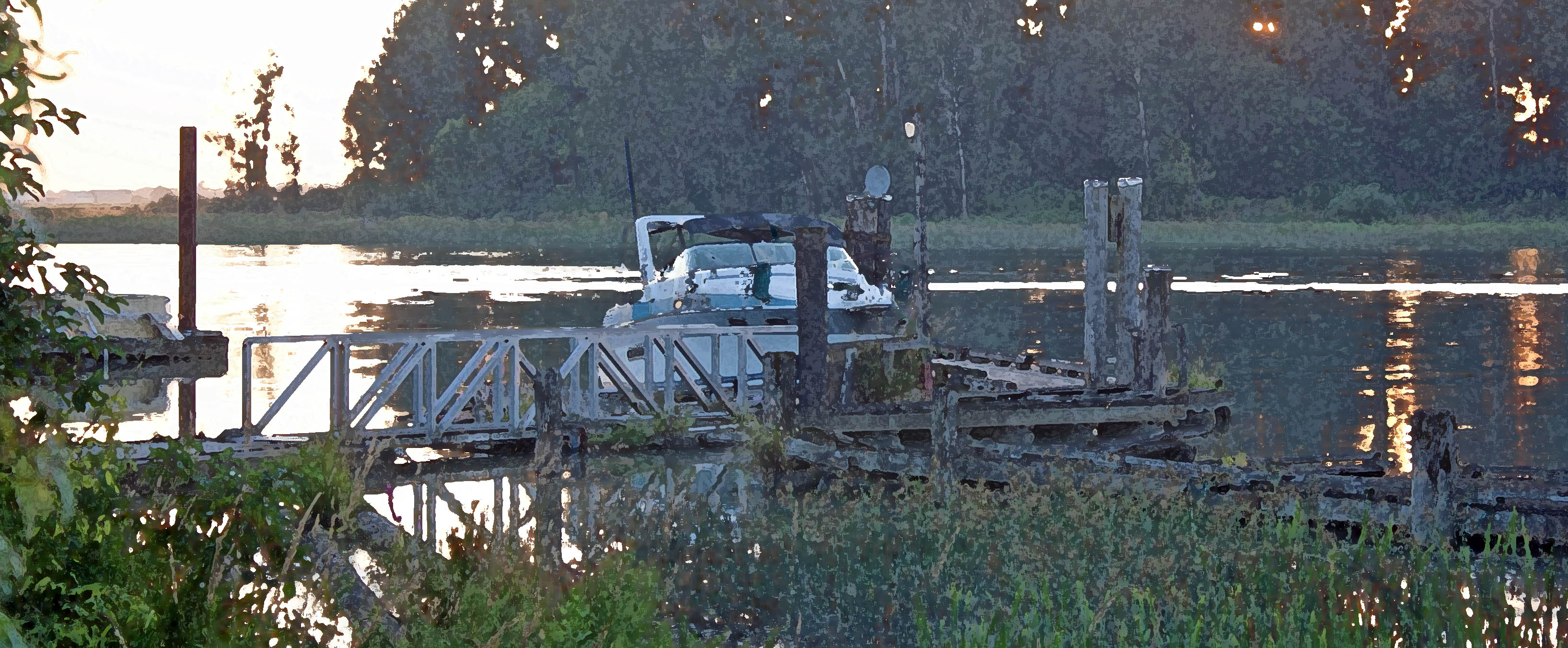
Boat wharf at sunset in Ladner Marsh, BC (photo and rendition by Nina Munteanu)
Imagination is more important than knowledge—Albert Einstein
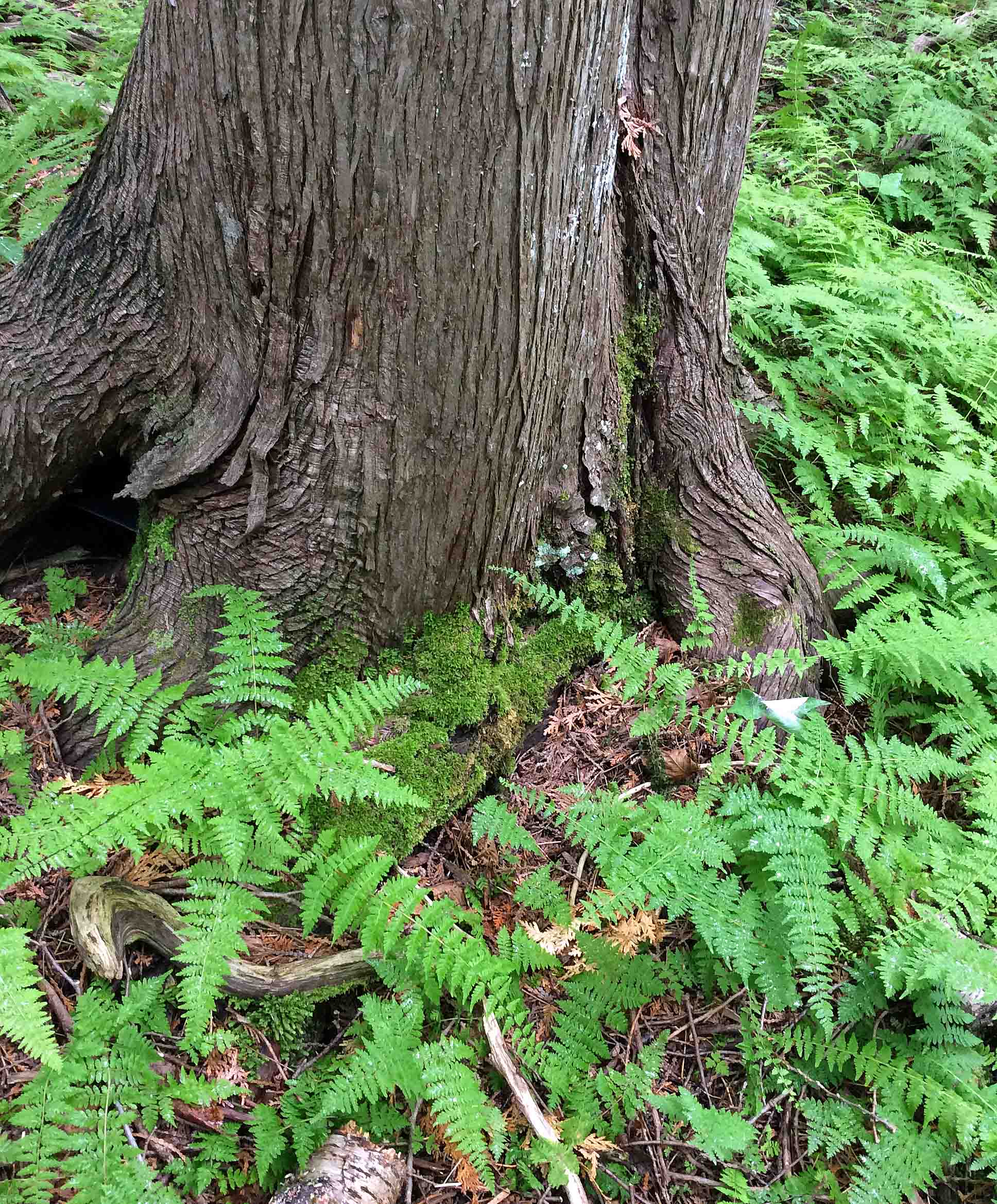
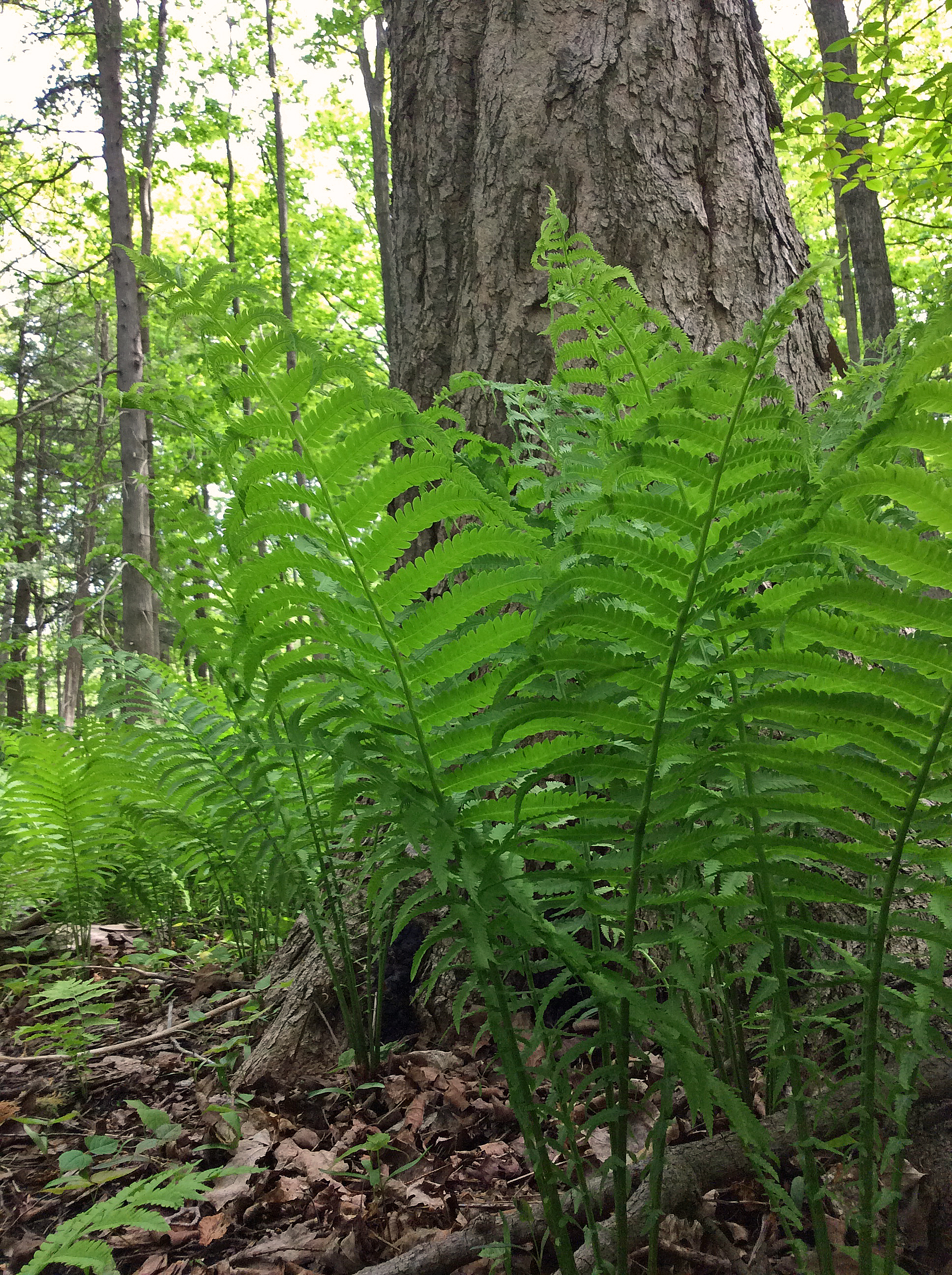
Eastern cedar and wood fern in Jackson Creek Park, ON (photo by Nina Munteanu)
I tell stories. I’m also a scientist. I use the scientific method in my research to seek truth; I also find truth presented to me through the symbols of intuition.
Several years ago, I was introduced to Krista Fogel, a University of British Columbia masters student at the time, who was investigating the use of creative art in high-ability scientists. She named her thesis: “The Self-Perceived Experience of Investigating Science with an Artistic Spirit: A Hermeneutic Phenomenological Study of High Ability Scientists Who Also Engage in the Arts”. Hermeneutic, by the way, is the development and study of theories of the interpretation and understanding of texts (I had to look it up) and phenomenology is an approach to philosophy through the study of phenomena.
Krista wanted to interview me as part of her project. I was flattered, of course. Me, a High Ability Scientist? Who’d told her that? Once I got past my own humble angst, I found Krista’s questions bracing; they reopened a world of compelling ideas I had carried with me for some time. The concept of using art to do good science has dwelled inside me since registration day at Concordia University when I quit my fine arts program to pursue a science degree only to come full circle and write fiction.
Wood fern and moss, Jackson Creek, ON (photo by Nina Munteanu)
I’d received my Masters Degree in Ecology and Limnology and was then working as a scientist for an environmental consulting firm (I now write and teach writing full time). I conducted research, drove boats, collected samples and analyzed data then wrote up my findings and made recommendations. I wrote science fiction novels on the side.
“History shows that eminent scientists, such as Leonardo da Vinci, also engaged in the arts,” said Fogel. She went on to cite 400 other famous scientists who also practiced art at a high level. “If not entirely engaged in the arts, scientists throughout history have at least engaged in science with an artistic spirit. Scientists and artists use common tools for thinking such as intuition and imaginative processes.”
Krista and I met several times at the local Starbucks, where I “toked” on coffee as she fumbled with her notes. A young gal with a direct but unassuming gaze and a gentle smile, Krista asked me to share my personal experience of mixing art with science. Every good scientist is an artist at heart, she told me: science is the tool and art is the process.
Fogel concluded that when conducting scientific investigations with an artistic spirit, the scientist holds her heart central, from which the artist springs. This “allows us to connect with serendipitous occurrences, which breed discovery,” Fogel added.
You can train your mind as both artist and scientist to become more aware of serendipitous occurrences around you. I call it being in sync and wrote about it in a previous article here. Often, when I’m researching a novel, I pick up things serendipitously. Something will come up that just fits with what I was searching for. An article pops up in the news. Or I’m talking to someone and they bring up just the topic I am researching. These things always happen to me. This occurs not only in my fiction writing but in my scientific pursuits. Some years ago, I was doing a pollution study using glass slides for colonizing algae to compare communities of an urban stream to those of an agricultural stream. I was really looking to see the difference between communities of these different stream environments when I discovered that the algae were colonizing the glass surfaces according to the current. Compelled with more questions of why, how and what if, I pursued this new line of research (which turned out to be far more interesting than my original research premise) and wrote several ground-breaking papers on it.
Indeed, questions like “why” and “what if” are germane to both art and science; the ‘what if’ question is the science fiction writer’s mantra and the premise, which comes from the artist part of you: imagination and an inquisitive and open mind. The idea of seemingly unrelated events intersecting to produce meaningful patterns has spawned new notions of thought from the scientific study of spontaneous order in the universe (synchrony), to Synchromysticism — the discovery of convergent archetypal symbols in pop culture (e.g., books, music and film).
Wood fern and Solomon seal, ON (photo by Nina Munteanu)
Writer and philosopher Jake Kotze suggests that, “Synchronicity happens when we notice the bleed-through from one seemingly separate thing into another — or when we for a brief moment move beyond the mind’s divisions of the world.” Synchronicity and serendipitous discovery, like metaphor, appears when we change the way we look at things.
Serendipitous discovery comes to us through peripheral vision. Like our muse, it doesn’t happen by chasing after it; it sneaks up on us when we’re not looking. It comes to us when we focus outward and embrace our wonder for this world. When we quiet our minds and nurture our souls with beauty. It is then that what we had been seeking naturally comes to us. Like a gift.
Author Sibyl Hunter tells us that “Sync operates as an undercurrent of divine awareness personified through the myriad processes and symbols that make up the building blocks of our reality. Within that current, we spin our modern-day myths into books, fairy tales and movies, subconsciously retelling ourselves the same story over and over.” This also holds true in the models and metaphors of scientific genius, which often spring from the creativity of an intuitive heart and imaginative mind.
According to Mark A. Runco (California State University) “creativity depends on originality, while accomplishment and achievement reflect other problem-solving skills. Creative thinking involves at least three things: 1) the cognitive capacity to transform experience into original interpretations, 2) an interest in producing original interpretations, and 3) discretion.” The title of Piaget’s monograph, To Understand Is to Invent, reflects the fact that we do not have an authentic understanding of our experience until we construct that understanding for ourselves. In other words, “it is one thing to memorize some datum; it is quite another to discover it for one’s self; only then do we understand,” says Runco. Fogel concurs: “what Piaget called inventionis a kind of creation, a creation of personal meaning. Piaget tied assimilation to imaginative play into creative interpretation.”
According to Dean Keith Simonton (University of California), even the most illustrious creative geniuses of history have careers riddled by both hits and misses, both successes and failures. He uses Albert Einstein as an example. A man who has achieved almost mythical status as a genius, Einstein’s career “was plagued by terrible ideas, false starts and surprising disasters.” Simonton tells the story of Einstein’s debate with Niels Bohr over the implications of quantum theory, in which Einstein offered a series of arguments that Bohr countered. Bohr once even pointed out that Einstein failed to take into consideration the theory of relativity! According to some, Einstein wasted the final years of his career working on a unified field theory that was almost universally rejected by his colleagues. Einstein defended his missteps by noting that errors can advance science so long as they are not trivial; the greater the error, the greater the opportunity for new perspective and discovery.
It is left for us to simply recognize the dance.
Wood fern and two Eastern cedars, ON (photo by Nina Munteanu)
Nina Munteanu is a Canadian ecologist / limnologist and novelist. She is co-editor of Europa SF and currently teaches writing courses at George Brown College and the University of Toronto. Visit www.ninamunteanu.ca for the latest on her books. Nina’s bilingual “La natura dell’acqua / The Way of Water” was published by Mincione Edizioni in Rome. Her non-fiction book “Water Is…” by Pixl Press (Vancouver) was selected by Margaret Atwood in the New York Times ‘Year in Reading’ and was chosen as the 2017 Summer Read by Water Canada. Her novel “A Diary in the Age of Water” was released by Inanna Publications (Toronto) in June 2020.
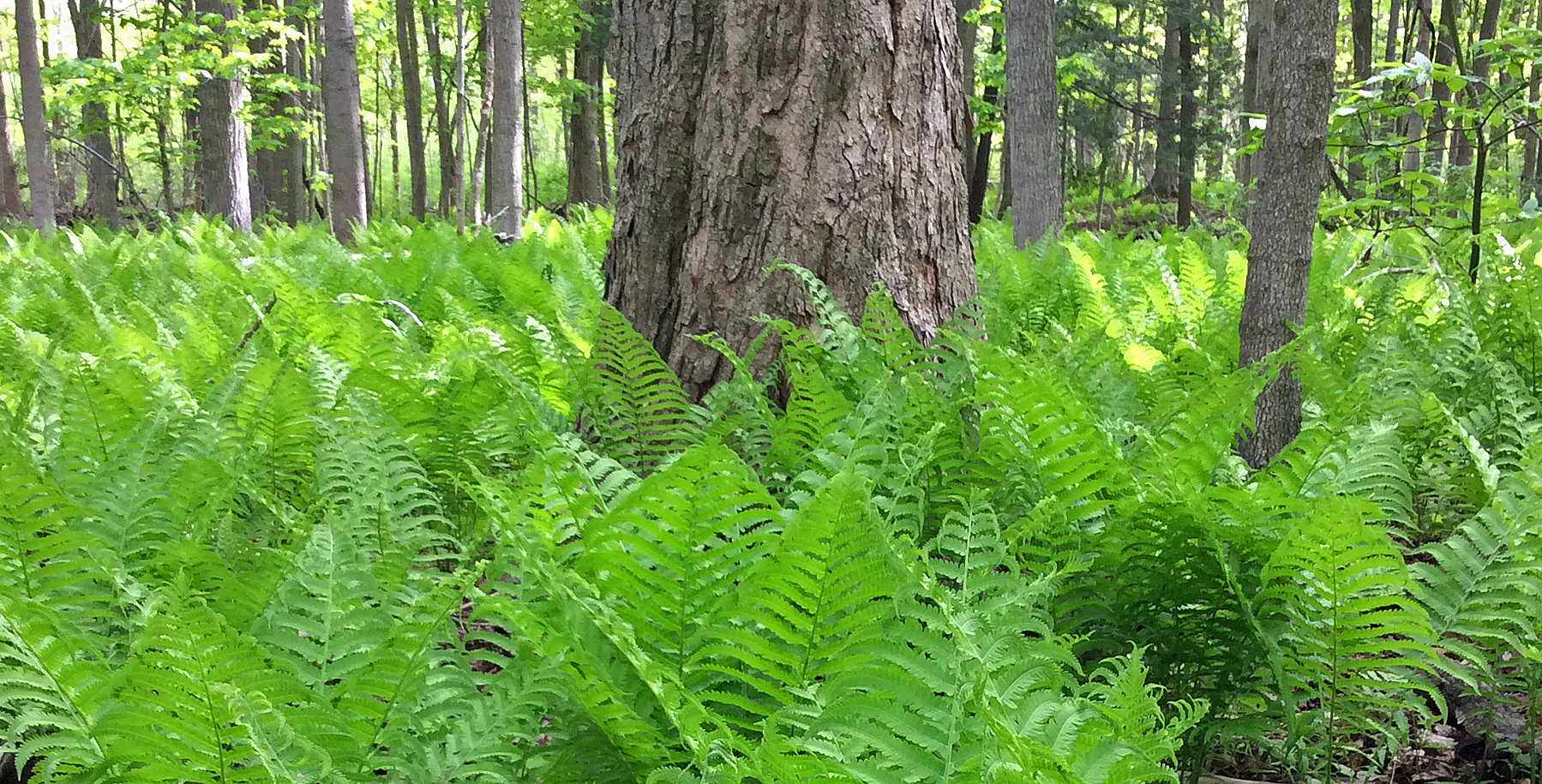
Ostrich ferns, Little Rouge forest, ON (photo by Nina Munteanu)
“At the heart of the universe is a steady, insistent beat: the sound of cycles in sync,” says Steven Strogatz in the opening to his compelling book, Sync: the emerging science of spontaneous order. He then describes how every night along the tidal rivers of Malaysia, thousands of fireflies congregate in the mangroves and flash in unison, without any leader or cue from the environment. “Even our bodies are symphonies of rhythm, kept alive by the relentless, coordinated firing of thousands of pacemaker cells in our hearts…almost as if nature has an eerie yearning for order,” adds Strogatz. The tendency to synchronize pervades the universe, from atoms to animals, and people to planets.
To be in sync is to intuitively connect (which is what spontaneous order is) and “know”… Each of you has felt that “knowing” that otherworldly, euphoric wave of resonating with something that is more than the visible world: when the hairs on the back of your neck tingle as you write that significant scene or trembling with giddy energy as you create that perfect line on a painting … or glowing with a deep abiding warmth when you defend a principle … or the surging frisson you share with fellow musicians on that exquisite set piece.
These are all what I call “God moments”. And they don’t happen by chasing after them; they sneak up on us when we’re not looking. They come to us when we focus outward and embrace our wonder for this world. When we quiet our minds and nurture our souls with beauty. It is then that what we had been seeking naturally comes to us. Like a gift.
It’s the blue pill to a new world of synchrony.
This teaches us above all else that we are all journeying together and part of something greater.
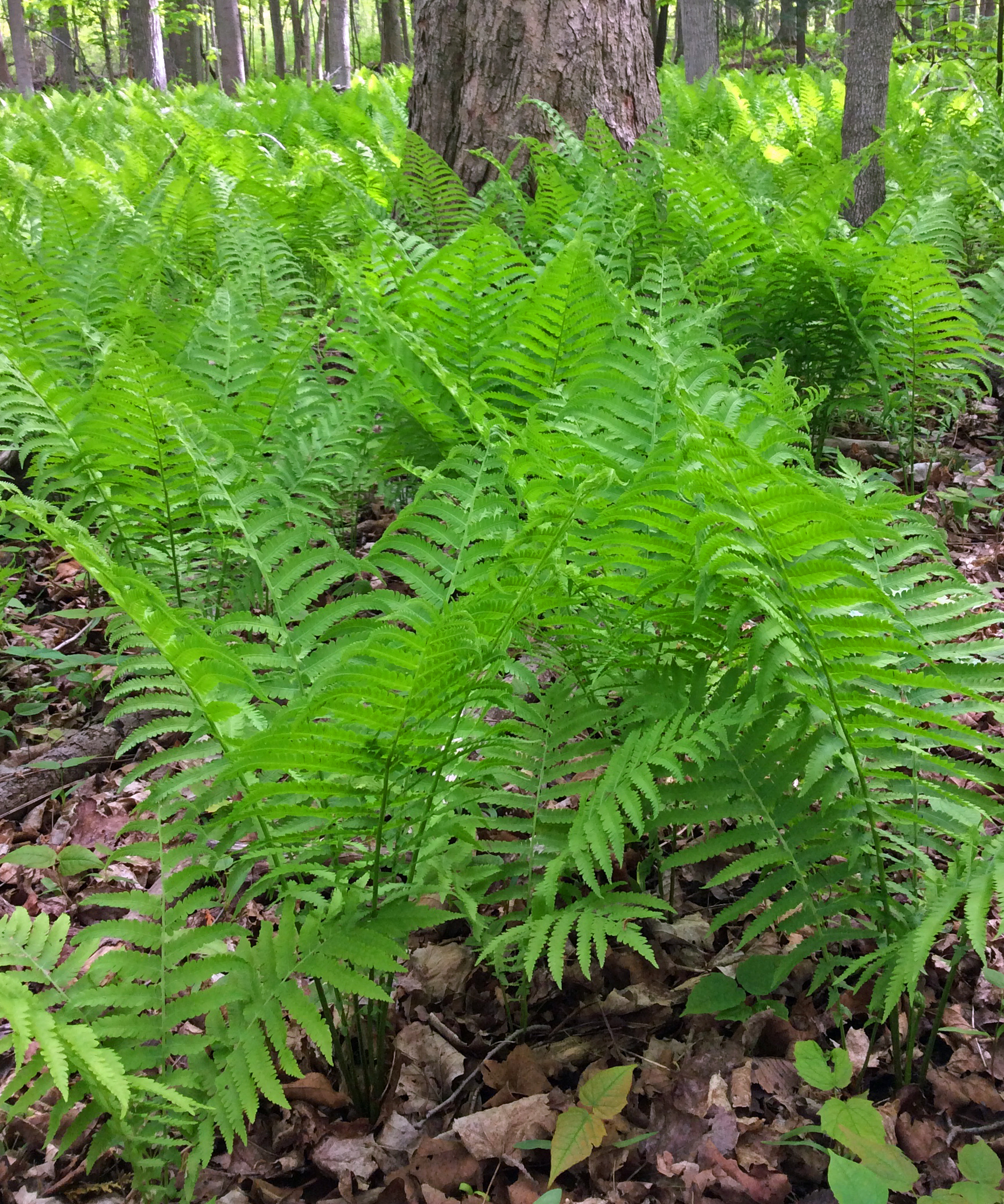
Wood ferns in Jackson Creek park, ON (photo by Nina Munteanu)
I want to share with you my own experience of synchronicity in art. When I’m working on a story, I find that events, opportunities, actions and resources directly germane to my project present themselves: watching an applicable movie that a friend chose for us to see; picking up a newspaper (which I seldom do) and reading a relevant article; looking for something on the internet and finding something totally different (ok; that happens to me all the time); a friend out of the blue introduces a pertinent topic, or someone you haven’t seen in a long time bumps into you with significant news. As though the universe was providing me with what I needed. Of course, my mind was focused on anything to do with my current piece. It was as though I had donned a concentrating filter, one that would amplify relevant details. I’ll go further: I was unconsciously acting in a way that was bringing me more information relevant to my project. Ask and you shall receive.
Ostrich fern, Little Rouge River woodland, ON (photo by Nina Munteanu)
Jake Kotze says it this way: “Synchronicity happens when we notice the bleed-through from one seemingly separate thing into another—or when we for a brief moment move beyond the mind’s divisions of the world.” Swiss psychologist Carl Jung introduced synchrony in the 1920s as “temporally coincident occurrences of acausal events.” The idea of seemingly unrelated events intersecting to produce meaningful patterns has spawned new notions of thought from the scientific study of spontaneous order in the universe (synchrony), to Synchromysticism — the discovery of convergent archetypal symbols in pop culture (e.g., books, music and film). Author Sibyl Hunter tells us that “Sync operates as an undercurrent of divine awareness personified through the myriad processes and symbols that make up the building blocks of our reality. Within that current, we spin our modern-day myths into books, fairy tales and movies, subconsciously retelling ourselves the same story over and over.”
As the myth builders of today, authors tap in to the synchronicity of ancient story, of resonating archetypes and metaphor and the “mythic journey”. To write in sync.
Joseph Campbell reminds us that, “Anyone writing a creative work knows that you yield yourself, and the book talks to you and builds itself … you become the carrier of something that is given to you from the Muses or God. What the shaman or seer [or artist] brings forth is something that is waiting to be brought forth in everyone.” It’s sync in action.
Oak tree amid Ostrich fern, Little Rouge River woodland, ON (photo by Nina Munteanu)
Path through profusion of Black walnut and locust forest, ON (photo by Nina Munteanu)
Nina Munteanu is a Canadian ecologist / limnologist and novelist. She is co-editor of Europa SF and currently teaches writing courses at George Brown College and the University of Toronto. Visit www.ninamunteanu.ca for the latest on her books. Nina’s bilingual “La natura dell’acqua / The Way of Water” was published by Mincione Edizioni in Rome. Her non-fiction book “Water Is…” by Pixl Press (Vancouver) was selected by Margaret Atwood in the New York Times ‘Year in Reading’ and was chosen as the 2017 Summer Read by Water Canada. Her novel “A Diary in the Age of Water” was released by Inanna Publications (Toronto) in June 2020.
Imagination is more important than knowledge—Albert Einstein
Cedar log (photo by Nina Munteanu)
I tell stories. I’m also a scientist. I use the scientific method in my research to seek truth; I also find truth presented to me through the symbols of intuition.
A few years ago, I was introduced to Krista Fogel, a University of British Columbia masters student, who was investigating the use of creative art in high-ability scientists. She named her thesis: “The Self-Perceived Experience of Investigating Science with an Artistic Spirit: A Hermeneutic Phenomenological Study of High Ability Scientists Who Also Engage in the Arts”. Hermeneutic, by the way, is the development and study of theories of the interpretation and understanding of texts (I had to look it up) and phenomenology is an approach to philosophy through the study of phenomena.
Krista wanted to interview me as part of her project. I was flattered, of course. Me, a High Ability Scientist? Who’d told her that? Once I got past my own humble angst, I found Krista’s questions bracing; they reopened a world of compelling ideas I had carried with me for some time. The concept of using art to do good science has dwelled inside me since registration day at Concordia University when I quit my fine arts program to pursue a science degree only to come full circle and write fiction. I got my Masters Degree in Ecology and Limnology and was then working as a scientist for an environmental consulting firm (I now write and teach writing full time). I did research, drove boats, collected samples and analyzed data then wrote up my findings and made recommendations. I wrote science fiction novels on the side.
“History shows that eminent scientists, such as Leonardo da Vinci, also engaged in the arts,” said Fogel. She went on to cite 400 other famous scientists who also practiced art at a high level. “If not entirely engaged in the arts, scientists throughout history have at least engaged in science with an artistic spirit. Scientists and artists use common tools for thinking such as intuition and imaginative processes.”
Krista and I met several times at the local Starbucks, where I “toked” on coffee as she fumbled with her notes. A young gal with a direct but unassuming gaze and a gentle smile, Krista asked me to share my personal experience of mixing art with science. Every good scientist is an artist at heart: science is the tool and art is the process.
Fogel concluded that when conducting scientific investigations with an artistic spirit, the scientist holds her heart central, from which the artist springs. This “allows us to connect with serendipitous occurrences, which breed discovery,” Fogel added.
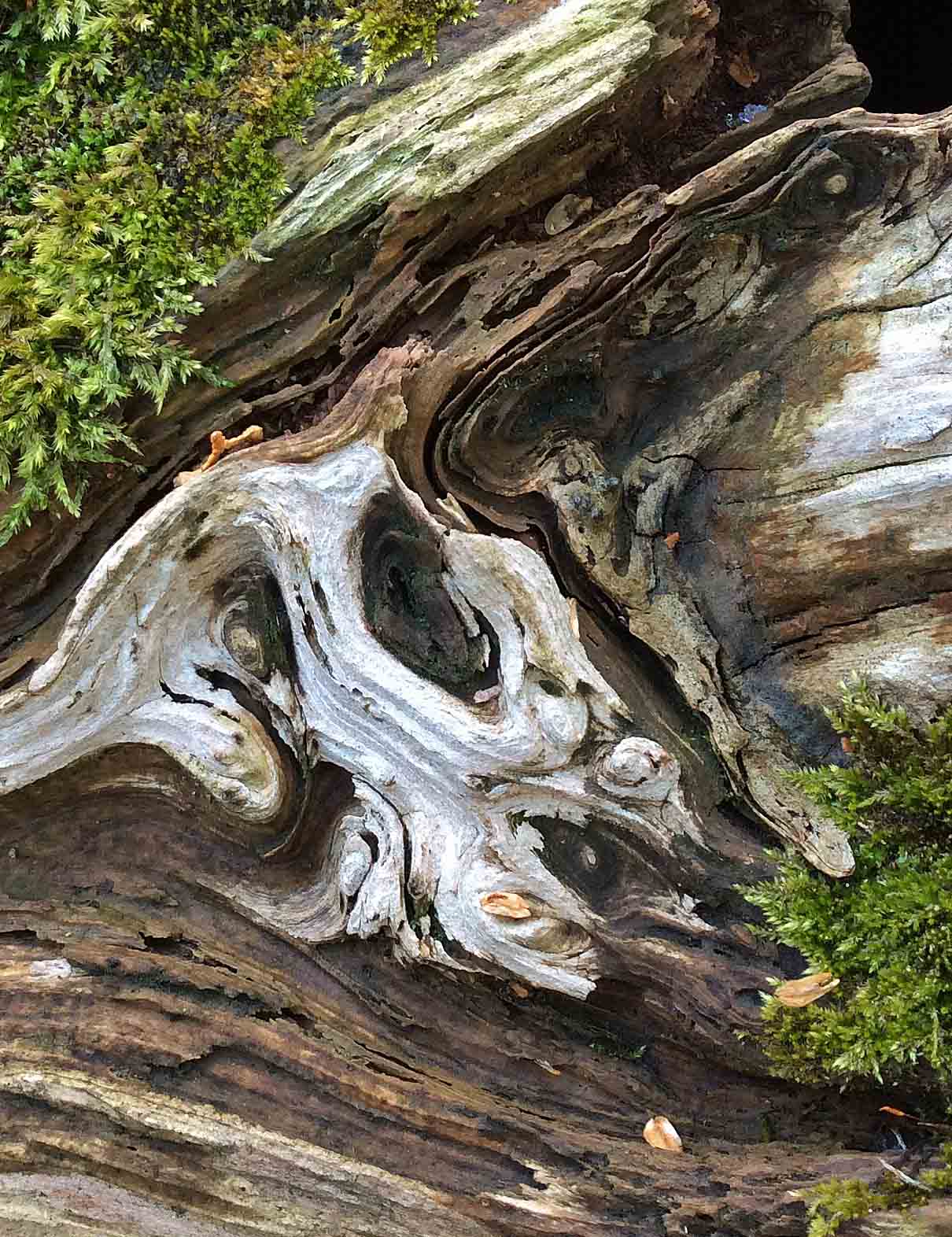
Decaying log with insect bore holes (photo by Nina Munteanu)
You can train your mind as both artist and scientist to become more aware of serendipitous occurrences around you. I call it being in sync and wrote about it in a previous article here (“Writing in Sync”). Often, when I’m researching a novel, I pick up things serendipitously. Something will come up that just fits with what I was searching for. An article pops up in the news. Or I’m talking to someone and they bring up just the topic I am researching. These things always happen to me. This occurs not only in my fiction writing but in my scientific pursuits. Some years ago, I was doing a pollution study using glass slides for colonizing algae to compare communities of an urban stream to those of an agricultural stream. I was really looking to see the difference between communities of these different stream environments when I discovered that the algae were colonizing the glass surfaces according to the current. Compelled with more questions of why, how and what if, I pursued this new line of research (which turned out to be far more interesting than my original research premise) and wrote several ground-breaking papers on it.
Indeed, questions like “why” and “what if” are germane to both art and science; the ‘what if’ question is the science fiction writer’s mantra and the premise, which comes from the artist part of you: imagination and an inquisitive and open mind. The idea of seemingly unrelated events intersecting to produce meaningful patterns has spawned new notions of thought from the scientific study of spontaneous order in the universe (synchrony), to Synchromysticism — the discovery of convergent archetypal symbols in pop culture (e.g., books, music and film).
Writer and philosopher Jake Kotze suggests that, “Synchronicity happens when we notice the bleed-through from one seemingly separate thing into another — or when we for a brief moment move beyond the mind’s divisions of the world.” Synchronicity and serendipitous discovery, like metaphor, appears when we change the way we look at things.
Serendipitous discovery comes to us through peripheral vision. Like our muse, it doesn’t happen by chasing after it; it sneaks up on us when we’re not looking. It comes to us when we focus outward and embrace our wonder for this world. When we quiet our minds and nurture our souls with beauty. It is then that what we had been seeking naturally comes to us. Like a gift.
Author Sibyl Hunter tells us that “Sync operates as an undercurrent of divine awareness personified through the myriad processes and symbols that make up the building blocks of our reality. Within that current, we spin our modern-day myths into books, fairy tales and movies, subconsciously retelling ourselves the same story over and over.” This also holds true in the models and metaphors of scientific genius, which often spring from the creativity of an intuitive heart and imaginative mind.
According to Mark A. Runco (California State University) “creativity depends on originality, while accomplishment and achievement reflect other problem-solving skills. Creative thinking involves at least three things: 1) the cognitive capacity to transform experience into original interpretations, 2) an interest in producing original interpretations, and 3) discretion.” The title of Piaget’s monograph, To Understand Is to Invent, reflects the fact that we do not have an authentic understanding of our experience until we construct that understanding for ourselves. In other words, “it is one thing to memorize some datum; it is quite another to discover it for one’s self; only then do we understand,” says Runco. Fogel concurs: “what Piaget called invention is a kind of creation, a creation of personal meaning. Piaget tied assimilation to imaginative play into creative interpretation.”
Decaying log displaying spalting (photo by Nina Munteanu)
According to Dean Keith Simonton (University of California), even the most illustrious creative geniuses of history have careers riddled by both hits and misses, both successes and failures. He uses Albert Einstein as an example. A man who has achieved almost mythical status as a genius, Einstein’s career “was plagued by terrible ideas, false starts and surprising disasters.” Simonton tells the story of Einstein’s debate with Niels Bohr over the implications of quantum theory, in which Einstein offered a series of arguments that Bohr countered. Bohr once even pointed out that Einstein failed to take into consideration the theory of relativity! According to some, Einstein wasted the final years of his career working on a unified field theory that was almost universally rejected by his colleagues. Einstein defended his missteps by noting that errors can advance science so long as they are not trivial; the greater the error, the greater the opportunity for new perspective and discovery.
It is left for us to simply recognize the dance.
Nina Munteanu is an ecologist and internationally published author of award-nominated speculative novels, short stories and non-fiction. She is co-editor of Europa SF and currently teaches writing courses at George Brown College and the University of Toronto. Visit www.ninamunteanu.ca for the latest on her books. Read Nina’s climate/eco-fiction Darwin’s Paradox, Angel of Chaos and Natural Selection.
Pebbles on Hirtle Beach, NS (photo by Nina Munteanu)
“At the heart of the universe is a steady, insistent beat: the sound of cycles in sync,” says Steven Strogatz in the opening to his compelling book, Sync: the emerging science of spontaneous order. He then describes how every night along the tidal rivers of Malaysia, thousands of fireflies congregate in the mangroves and flash in unison, without any leader or cue from the environment. “Even our bodies are symphonies of rhythm, kept alive by the relentless, coordinated firing of thousands of pacemaker cells in our hearts…almost as if nature has an eerie yearning for order,” adds Strogatz. The tendency to synchronize pervades the universe, from atoms to animals, and people to planets.
To be in sync is to intuitively connect (which is what spontaneous order is) and “know”…
Each of you has felt that “knowing”: that otherworldly, euphoric wave of resonating with something that is more than the visible world: when the hairs on the back of your neck tingle as you write that significant scene or trembling with giddy energy as you create that perfect line on a painting … or glowing with a deep abiding warmth when you defend a principle … or the surging frisson you share with fellow musicians on that exquisite set piece …
These are all what I call God moments. And they don’t happen by chasing after them; they sneak up on us when we’re not looking. They come to us when we focus outward and embrace our wonder for this world. When we quiet our minds and nurture our souls with beauty. It is then that what we had been seeking naturally comes to us. Like a gift.
It’s the blue pill to a new world of synchrony.
This teaches us above all else that we are all journeying together and part of something greater.
I want to share with you my own experience of synchronicity in art. When I’m working on a story, I find that events, opportunities, actions and resources directly germane to my project present themselves: watching an applicable movie that a friend chose for us to see; picking up a newspaper (which I seldom do) and reading a relevant article; looking for something on the internet and finding something totally different (ok; that happens to me all the time); a friend out of the blue introduces a pertinent topic, or someone you haven’t seen in a long time bumps into you with significant news. As though the universe was providing me with what I needed. Well, maybe it was! Of course, my mind was focused on anything to do with my current piece. It was as though I had donned a concentrating filter, one that would amplify relevant details. I’ll go further: I was unconsciously acting in a way that was bringing me more information relevant to my project. Ask and you shall receive.
Jake Kotze says it this way: “Synchronicity happens when we notice the bleed-through from one seemingly separate thing into another—or when we for a brief moment move beyond the mind’s divisions of the world.” Swiss psychologist Carl Jung introduced synchrony in the 1920s as “temporally coincident occurrences of acausal events.” The idea of seemingly unrelated events intersecting to produce meaningful patterns has spawned new notions of thought from the scientific study of spontaneous order in the universe (synchrony), to Synchromysticism — the discovery of convergent archetypal symbols in pop culture (e.g., books, music and film). Author Sibyl Hunter tells us that “Sync operates as an undercurrent of divine awareness personified through the myriad processes and symbols that make up the building blocks of our reality. Within that current, we spin our modern-day myths into books, fairy tales and movies, subconsciously retelling ourselves the same story over and over.”
As the myth builders of today, authors tap in to the synchronicity of ancient story, of resonating archetypes and metaphor and the “mythic journey”. To write in sync.
Joseph Campbell reminds us that, “Anyone writing a creative work knows that you yield yourself, and the book talks to you and builds itself … you become the carrier of something that is given to you from the Muses or God. What the shaman or seer [or artist] brings forth is something that is waiting to be brought forth in everyone.” It’s sync in action.
Nina Munteanu is an ecologist and internationally published author of award-nominated speculative novels, short stories and non-fiction. She is co-editor of Europa SF and currently teaches writing courses at George Brown College and the University of Toronto. Visit www.ninamunteanu.ca for the latest on her books.








 Nina Munteanu is an ecologist and internationally published author of award-nominated speculative novels, short stories and non-fiction. She is co-editor of Europa SF and currently teaches writing courses at George Brown College and the University of Toronto. Visit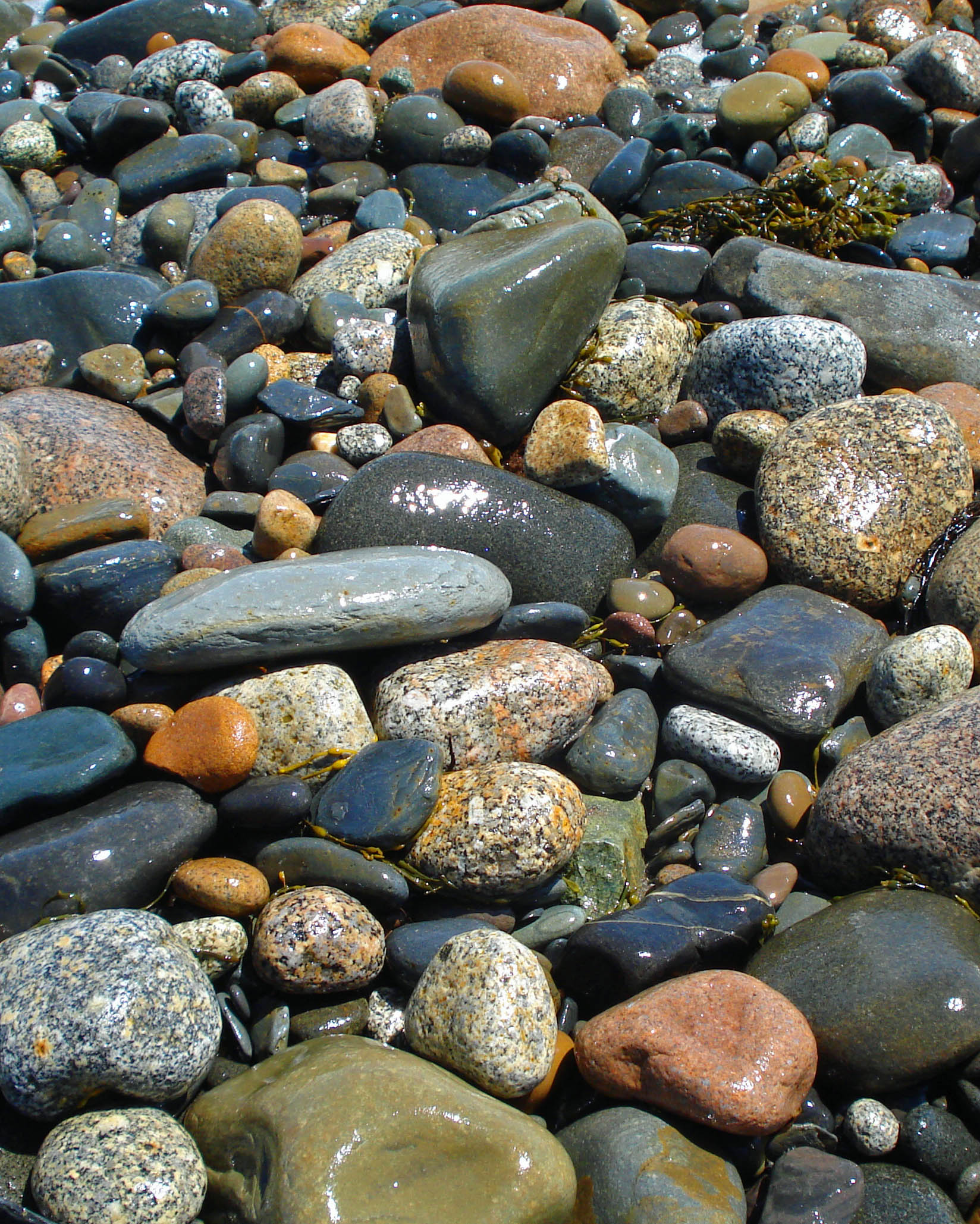

 Nina Munteanu Writing Coach