Mermaids, arborists, and pollinators are among the characters to be found in Through the Portal: Tales from a Hopeful Dystopia. Edited by Lynn Hutchinson Lee and Nina Munteanu, this eco-fiction collection gathers over thirty stories that fall under the general umbrella of hopeful dystopias…
Through the Portal offers intriguing and imaginative glimpses into the future. As [one of its short stories] “A Fence Made of Names” suggests, we often don’t appreciate what we have until we lose it. By showing us what we stand to lose, these stories offer a reason to increase our actions to preserve the planet…
While many of the tales hint at dark times ahead, it was refreshing to find so many that offered a ray of hope despite that. Whether it’s finding the will to live another day, returning to a better relationship with the land and the Earth, or taking steps to improve the world in even a small way, these stories affirm humanity’s potential for resilience in challenging times.
Will ingenuity, love, and respect for the earth help us work through whatever changes might lie ahead? Through the Portal offers hope that these qualities, if not enough in and of themselves, will help us find our way.
Nina Munteanu is a Canadian ecologist / limnologist and novelist. She is co-editor of Europa SF and currently teaches writing courses at George Brown College and the University of Toronto. Visit www.ninamunteanu.ca for the latest on her books. Nina’s bilingual “La natura dell’acqua / The Way of Water” was published by Mincione Edizioni in Rome. Her non-fiction book “Water Is…” by Pixl Press (Vancouver) was selected by Margaret Atwood in the New York Times ‘Year in Reading’ and was chosen as the 2017 Summer Read by Water Canada. Her novel “A Diary in the Age of Water” was released by Inanna Publications (Toronto) in June 2020.
AI entity performing a myriad of duties (image from Bernard Marr & Co.)
.
I teach academic writing to students at the University of Toronto Writing Centre. It’s wonderful and fulfilling work and I enjoy helping students in several disciplines (engineering, health sciences, social sciences) learn to write better. As with the rest of the academic world of writing, we are all making sense of the use of AI-generated tools by students, instructors and researchers: large language models (LLMs) such as ChatGPT, Claude, Copilot, and even Grammarly. Students have told me that they found AI helpful in brainstorming and outlining as well as organizing literature reviews and editing for grammar and such. A recent survey of universities and corporations around the world by the Digital Education Councilrevealed that a majority of students used AI tools. Of those surveyed, close to two thirds used AI as a search engine; a third used it to summarize documents; and a fifth used it to create first drafts.
In her 2024 article “The Future Is Hybrid”, Beth McMurtrie suggested that genAI “may eventually take its place in the pantheon of game-changing technologies used every day in education—alongside calculators, search engines, and Excel.”
In my other pursuit as a professional fiction author, I see the artistic and communication industries embracing AI, particularly in the visual arts. I’m now told that several publishing houses and magazines have dedicated efforts to publish AI-generated work. Some magazines are entirely AI generated, Copy Magazine, for instance. Author futurist Bernard Marr writes that “Generative AI is already being adopted in journalism to automate the creation of content, brainstorm ideas for features, create personalized news stories, and produce accompanying video content.” Marr then goes on to provide 13 ways that all writers should embrace Generative AIthat includes anything from drafting plot lines to world building. Sports Illustrated was recently found to publish AI generated stories. Even newspapers, such as the LA Times, the Miami Herald, and Us Weekly acknowledge AI-written content. And I recently learned that one of the top five online science fiction magazines, Metastellar, accepts AI-assisted stories with the proviso that “they better be good.” And Metastellar provides some convincing reasons. This has become a hot topic among my fellow professional writers at SF Canada. One colleague informed me that a “new publisher Spines plans todisrupt industry by publishing 8000 AI books in 2025 alone.” On checking the news release, I discovered that Spines is, in fact, a tech firm trying to make its mark on publishing, primarily through the use of AI. The company offers the use of AI to proofread, produce, publish, and distribute books. They are, in fact, a vanity publishing platform (essentially a service for self-publishing), charging up to $5000 a book and often taking just three weeks to go from manuscript to a published title.
The emerging field of AI-assisted writing and communicating is a burgeoning field that promises to touch every person in some way—writers and readers alike. Tech companies are scrambling to use it to save time and effort. Others are involved in improving current and developing new models. Many are training LLMs for improved use. Even I was headhunted as a creative writer by one tech firm to help create more safe, accurate and reliable LLMs.
Generative AI applications (Image from Neebal Technologies)
.
Universities and Other Educational Institutions Use of AI
How universities and other educational institutions are dealing with the challenge and promise of these emerging tools in communication varies from out right forbidding AI use in the classroom to full on acceptance and obligatory use in some classroom projects. McMurtrie described how two instructors at Rollins College, Dan Myers and Anne Murdaugh, had students collaborating with AI on semester-long research projects. They were instructed to use Claude and Copilot to brainstorm paper topics, conduct literature reviews, develop a thesis, and outline, draft, and revise their papers. Myers and Murdaugh asserted that “the skills that students use to engage thoughtfully with AI are the same ones that colleges are good at teaching. Namely: knowing how to obtain and use information, thinking critically and analytically, and understanding what and how you’re trying to communicate.”
In fall of 2024, Stephanie Wheeler and others at the department of writing and rhetoric in the University of Central Florida, along with their philosophy department, set up an interdisciplinary certificate in AI. Their purpose was to develop conceptual knowledge about AI. Wheeler asserted that writing and rhetoric have long been concerned with how technology shapes these disciplines. Sharon L.R. Kardia, senior associate dean of education at the University of Michigan argued that AI could greatly benefit public health in its ability to aid in data analysis, research review, and the development of public-health campaigns. However, she cautioned that LLMs also absorb and reflect the social biases that lead to public-health inequities.
One of my Writing Centre colleagues at UofT recently shared some thoughts about a conference session he’d participated in, in which a student panel listed tasks that they thought genAI cannot do (yet). These included: generate music, offer interpersonal advice, and verify facts; I think AI can already help with two of these. Chad Hershock, executive director of the Eberly Centre for Teaching Excellence and Educational Innovation at Carnegie Mellon University shared that they are researching key questions about whether AI enables or impedes: does using AI while brainstorming generate more or fewer ideas? Can generative AI give less-experienced students a better chance to be successful in technical courses? To what extent does using AI help or hinder writing skills? Does having generative AI as a thought partner enhance students’ ability to make a claim and support it with evidence?
My own experience with a less-experienced student’s use of genAI was often abysmal. The student had used the tool as a crutch and had failed to learn from their use of the tool. This suggests that the most important limitations of the tool lie with the user’s own limitations and it points to the need for guidance by educators.
In her 2024 Axios article “Why AI is not substitute for human teachers” Megan Morrone described findings of the Wharton School on access to genAI: while genAI tutors improved student performance on practice math problems, students who used these tools performed significantly worse on exams (where they couldn’t use AI). The school concluded that the students used genAI to copy and paste answers, which led them to engage less with the material. Wharton School associate professor Hamsa Bastani argued that, “if you just give unrestricted access to generative AI, students end up using it as a crutch…[and] end up performing a lot worse.” This is partly because students—often stressed-out by heavy work loads—find that LLMs save time and can produce content close to what the user might produce themselves. Researchers have even come up with a term for this: Cognitive Miserliness of the User, which, according to writer Stephen Marche, “basically refers to people who just don’t want to take the time to think.”
Melanie M. Cooper, chemistry professor at Michigan State University cautioned that while “there’s a lot of ebullience in the AI field, it’s important to be wary.” She argued that it is easy to misuse AI and override the system to get a quick answer or use it as a crutch. McMurtrie shares that, while “AI evangelists promise that these tools will make learning easier, faster and more fun,” academics are quick to reject that rhetoric. McMurtrie ends her article with a cautionary statement by Jennifer Frederick of Yale: “Universities really need to be a counterpoint to the big tech companies and their development of AI. We need to be the ones who slow down and really think through all the implications for society and humanity and ethics.”
Humans can relinquish control, but not responsibility
Attribution remains important
Historical definitions of plagiarism no longer apply
.
6 tenets of Postplagiarism (image from Sarah Elaine Eaton)
.
Eaton’s fifth point (attribution remains important), I think becomes all that more important in the presence of AI use. Transparency in presentation, particularly in an academic setting, takes on a new level of importance when communicating with tools such as generative AI. Where things come from, which tool was used and how it was used are key to understanding and interpreting the nature of the writing itself. The path taken to the destination becomes all important when interpretation and comprehension (and replication) is required. To fully understand “where you are”; we need to know “how you got there.” It’s like solving math problem; if you don’t show your work and just provide the answer, I have no way of knowing that you actually understood the problem and really solved it.
I am certain that generative AI will continue to take on various forms that will continue to astonish. Its proper use and development will serve humanity and the planet well; but there will always be abusers and misusers and those who simply don’t care. We must be mindful of them all. We must remain vigilant and responsible. Because, just as with freedom, if we grow lazy and careless, we run the risk of losing so much more.
Nina Munteanu is a Canadian ecologist / limnologist and novelist. She is co-editor of Europa SF and currently teaches writing courses at George Brown College and the University of Toronto. Visit www.ninamunteanu.ca for the latest on her books. Nina’s bilingual “La natura dell’acqua / The Way of Water” was published by Mincione Edizioni in Rome. Her non-fiction book “Water Is…” by Pixl Press (Vancouver) was selected by Margaret Atwood in the New York Times ‘Year in Reading’ and was chosen as the 2017 Summer Read by Water Canada. Her novel “A Diary in the Age of Water” was released by Inanna Publications (Toronto) in June 2020.
The environment and how we treat it has always been important to me since I was a child. My passion for storytelling morphed into writing, but the underlying spark came through environmental activism. I got a university degree in aquatic ecology, published numerous papers, and now write eco-fiction that is grounded in accurate science with a focus on human ingenuity and compassion. The most meaningful and satisfying eco-fiction is ultimately optimistic literature that explores serious issues with heroic triumph. Each of these five favourites intimately connects human to environment. Each novel moved me to think and deeply care.
The Books I Picked & Why
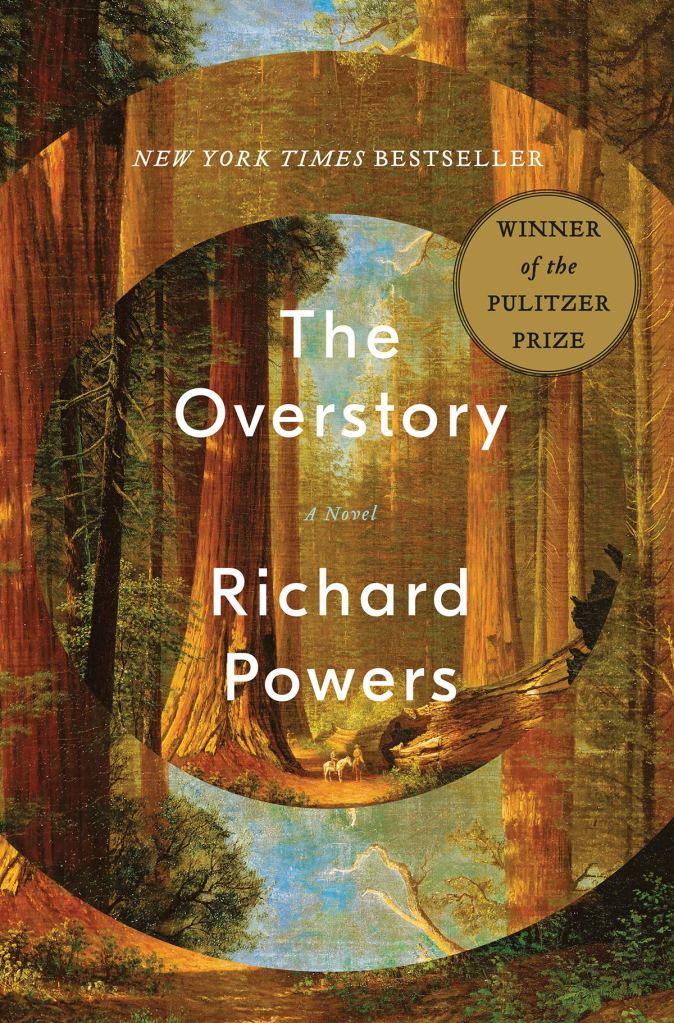
The Overstory
by Richard Powers
What resonated with me on so many levels was the author’s use of lyrical and beautiful language in describing trees and forests: as characters. I’m an ecologist and I felt a particular kinship with the botanist Patricia Westerford, a disabled introvert who must swim against the hegemonic tide with heretical ideas. When she argues that trees communicate, learn, trade goods and services, have intelligence and society, her scientific peers ridicule her and end her university career. This story is as much her triumph over overwhelming challenges as it is about the dwindling majestic forests that must quietly endure our careless apathy as they continue to offer their gift of life-giving oxygen and medicinal aerosols for hundreds of years.
.
Barkskins
by Annie Proulx
This 600-year saga about human-environment interaction through the forest industry in Canada evoked emotional connections with my environment, the Canadian forests, and the plight of indigenous Canadians. From the arrival of the Europeans in pristine forest to its destruction under the veil of global warming, Proulx weaves generational stories of two settler families into a crucible of terrible greed and tragic irony. The bleak impressions by the immigrants of a harsh environment crawling with pests underlie their combative mindset of a presumed infinite resource. I was particularly moved by the linked fate between the Mi’kmaq and the majestic pine forests, how both were similarly mistreated and changed. This history is also my legacy. As the daughter of immigrants, I felt both educated and moved.
.
The Breathing Hole
by Colleen Murphy, Siobhan Arnatsiaq-Murtphy and more
What struck me most was the use of simple language to portray powerful intimacy and connection between human and animal, and by extension, environment. Murphy’s humorous dialogue, together with sparing, often ironic, descriptions, struck deep into my heart. The play starts in 1535 on an ice shelf up north—when an Inuk widow risks her life to save a lost one-eared polar bear cub on an ice floe, and adopts him. In the last scene five hundred years later in the oily waters of the Northwest Passage, the same bear—starving and cruelly injured by eco-tourists on a cruise ship—struggles to keep from drowning. No one on the ship cares. No one weeps for him. But I did. I wept for him and for his world destroyed by apathy.
.
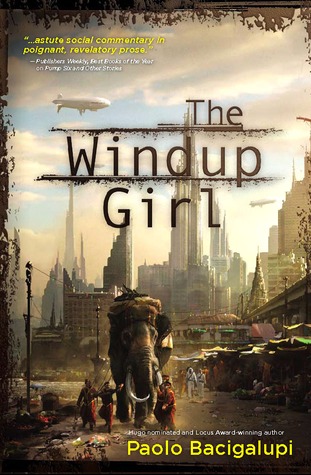
The Windup Girl
by Paolo Bacigalupi
Paolo Bacigalupi’s biopunk science fiction novelexplores a 23rd-century post-food crash Thailand after global warming has raised sea levels and depleted carbon fuel sources. The main character, Emiko, is a ‘windup,’ a modified human who is vilified and abused by humanity, despite her abilities. I was struck by how well this work of ‘mundane science fiction’ used Emiko as an avatar for a trickster Nature after abuse by humanity through the disrespect of reckless gene-hacking, greedy corporate espionage, and arbitrary foreign takeovers. I cheered Emiko’s breakaway from her oppressors as she emerged from a cloak of obedience and embraced her survival in this changing world of unintended consequences—only realizing later that I was cheering for that changing world and the optimism it promised.
.
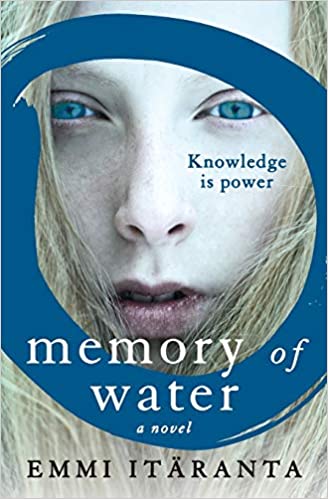
Memory of Water
by Emmi Itäranta
This book features a passion of mine as an ecologist and mother: water and how we treat it. Life-giving symbols of water flow throughout this story, which explores a post-climate change world of sea level rise in which freshwater is severely rationed due to scarcity. Water’s very nature is tightly interwoven with the main character, Noria, a tea master who guards a secret spring in the fell by her house against cruel government agents who would kill her for water crimes. In prose both sensual and lyrical, this book explores honor, sacrifice, betrayal, and friendship, and how each can be victimized through commodification in a power play of ideology. I found myself pulled in by the intrigue even as I cherished and lingered in the beautiful metaphoric prose.
.
Explore my eco-fiction book:
A Diary in the Age of Water follows the climate-induced journey of Earth and humanity through four generations of women, each with a unique relationship to water.
Centuries from now, in a dying boreal forest in what used to be northern Canada, Kyo, a young acolyte called to service in the Exodus, yearns for Earth’s past—the Age of Water—before the “Water Twins” destroyed humanity. Looking for answers and plagued by vivid dreams of this holocaust, Kyo discovers the diary of Lynna, a limnologist from that time of severe water scarcity just prior to the destruction. In her work for a global giant that controls Earth’s water, Lynna witnesses and records in her diary the disturbing events that will soon lead to humanity’s demise.
The feminist book review site Liisbeth recently wrote about A Diary in the Age of Water: “If you believe Canada’s water will remain free forever (or that it’s truly free now) Munteanu asks you to think again. Readers have called A Diary in the Age of Water “terrifying,” “engrossing,” and “literary.” We call it wisdom.”
Marcescent beech leaves among evergreen hemlocks, ON (photo by Nina Munteanu)
.
Nina Munteanu is a Canadian ecologist / limnologist and novelist. She is co-editor of Europa SF and currently teaches writing courses at George Brown College and the University of Toronto. Visit www.ninamunteanu.ca for the latest on her books. Nina’s bilingual “La natura dell’acqua / The Way of Water” was published by Mincione Edizioni in Rome. Her non-fiction book “Water Is…” by Pixl Press (Vancouver) was selected by Margaret Atwood in the New York Times ‘Year in Reading’ and was chosen as the 2017 Summer Read by Water Canada. Her novel “A Diary in the Age of Water” was released by Inanna Publications (Toronto) in June 2020.
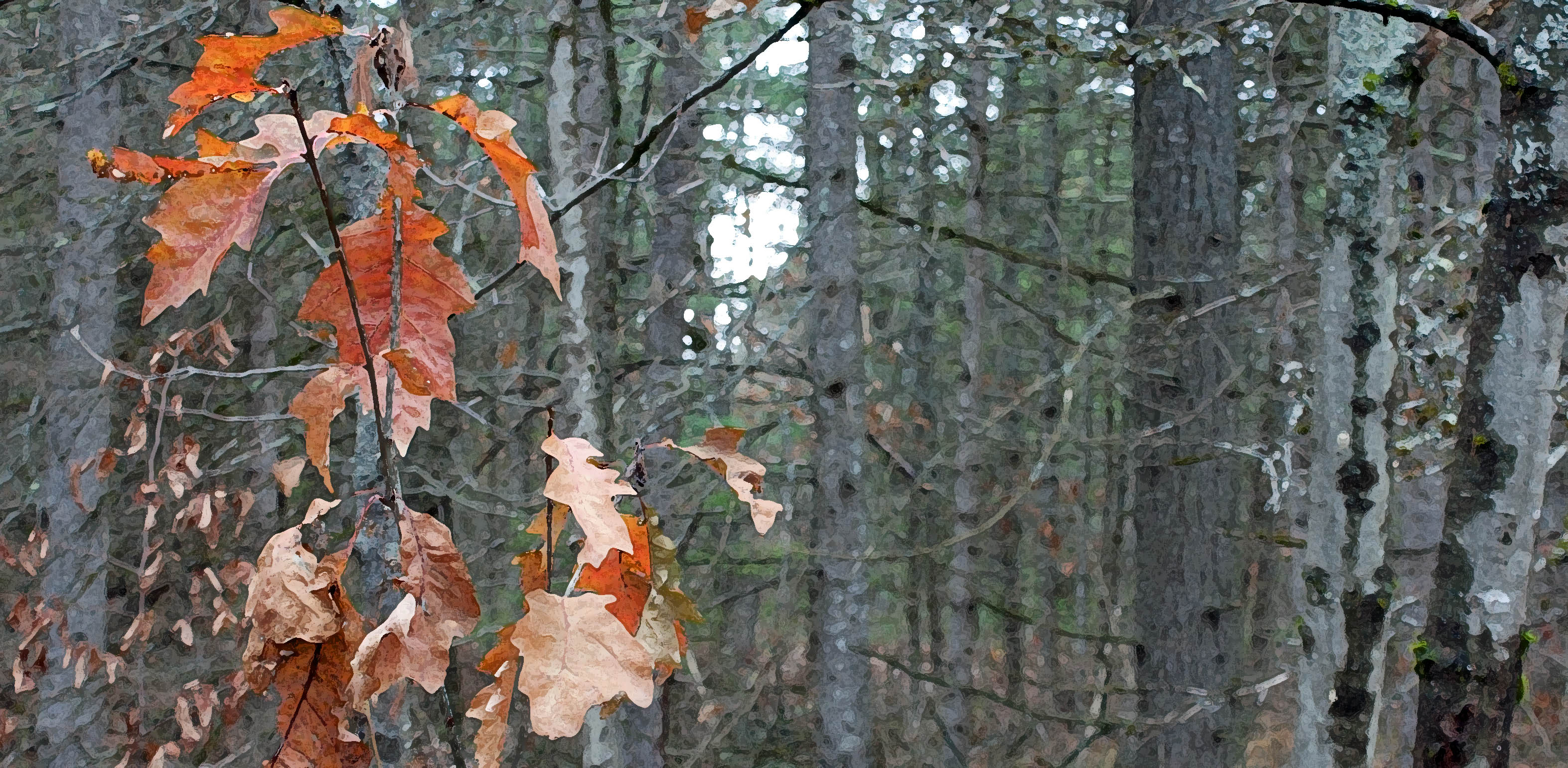
Marcescent oak leaves tremble in the cold wind of November, Petroglyph Park, ON (photo and rendition by Nina Munteanu)
I parked my car by the closed gate and walked inside along the road. The park was closed but not for me, I thought. The walk through this magnificent pine forest with its fresh pungent aromas of coming winter, invigorated me with thoughts of hope and wonder. I felt at home in this unviolated forest. It felt natural and I realized that I was desperately seeking “natural”…
Oak leaves blaze in the grey-green hemlock-pine forest, Petroglyph Park, ON (photo and rendition by Nina Munteanu)
I live close to a riparian forest and a large river. But there is little natural about it. Despite supporting an abundance of wildlife (e.g., squirrels, chipmunks, muskrat, skunk, groundhog, mink, ermine, voles, and red fox), the forest is disturbed and infested with invasive species. When I walk through this forest, the sounds of traffic are never far away, and I yearn for the sounds and smells of Nature inviolate.
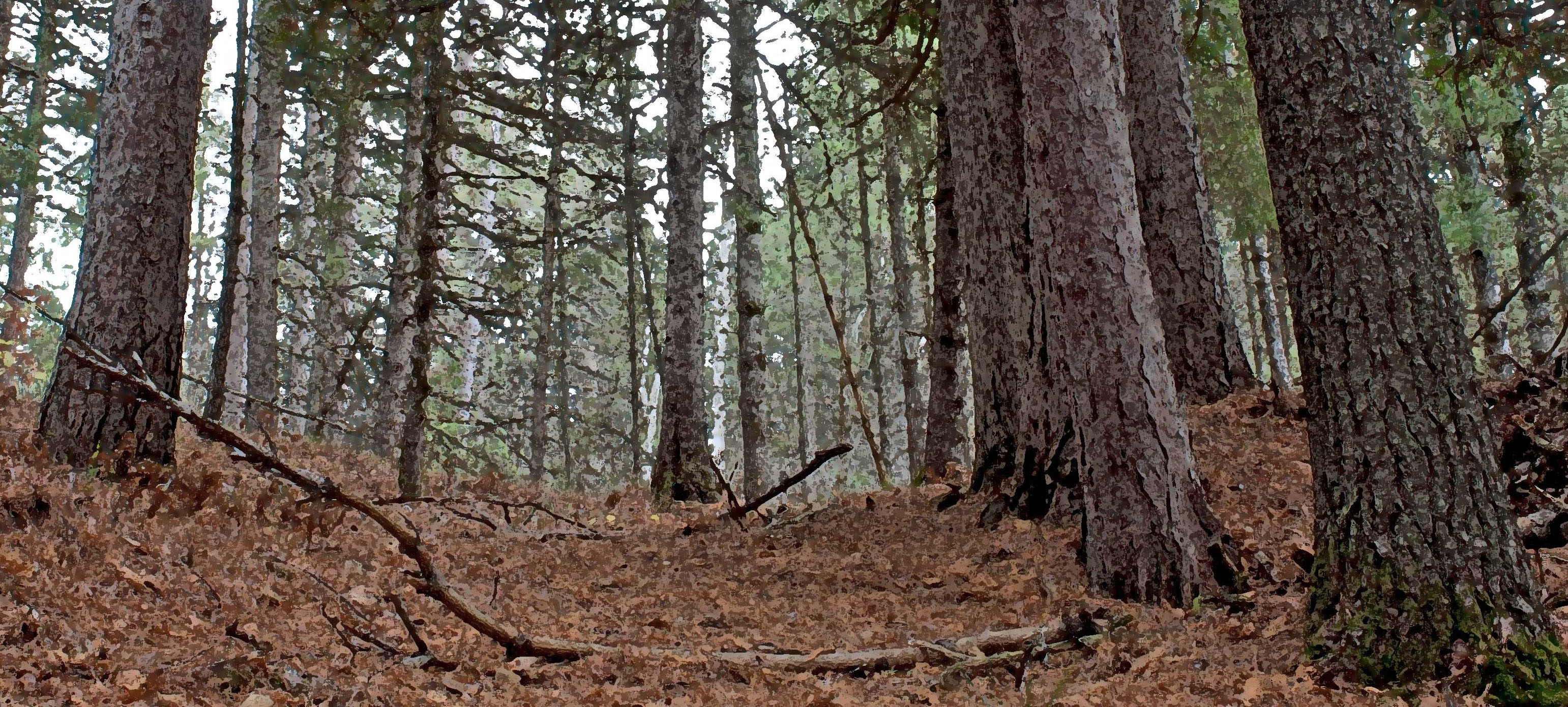
Small trail through pine and aspen to the meromictic lake in Petroglyph Park, ON (photo and rendition by Nina Munteanu)
Petroglyph Park lies in the Kawartha Region of Ontario and is an hour’s drive north of where I live. Here, the sounds of Nature prevail: the wind raking through pines, the shrill haunting cry of a bluejay or aggressive chittering of a red squirrel. Nothing else. It was gloriously silent; except for the sound of my boots crunching along the trail or when I scared up a deer that scampered with the rush and rattle of leaves through the anonymity of the brush into a deep silence.
Road through tall red pine forest, Petroglyph Park, ON (photo and rendition by Nina Munteanu)
It was a crisp and fresh November day. I’d packed a lunch and my camera and set off down the road and along various trails to explore the park, not worried about getting lost.
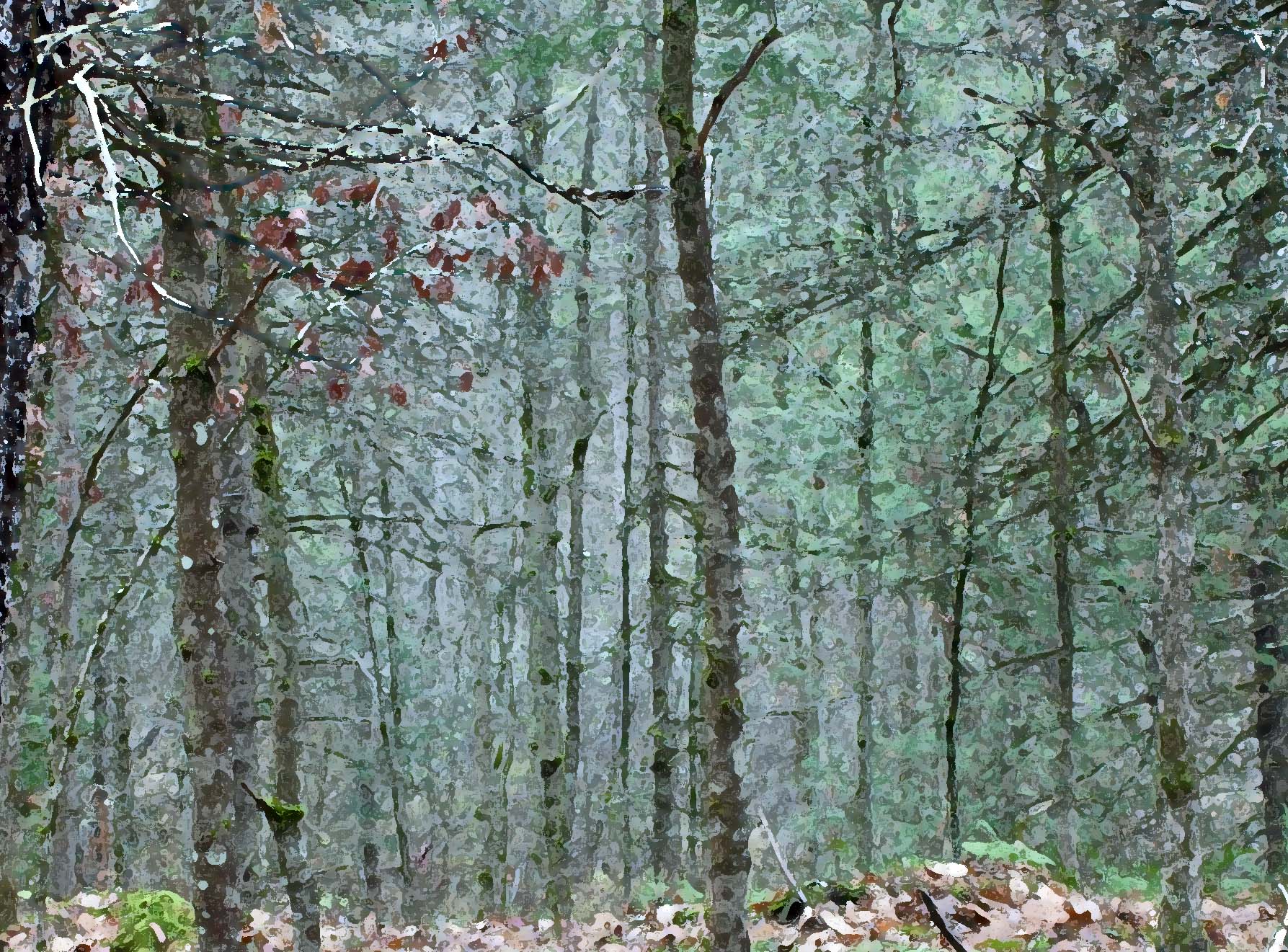
Forest fades from single oak tree into a fog of grey-green pine and hemlock, Petroglyph Park (photo and rendition by Nina Munteanu)
And I did get wonderfully lost, particularly when I ventured off the main trail, seeking adventure. I didn’t mind being lost; when you lose yourself you find another part of you through adventure…
Marcescent beech and oak trees add bronze colour to the grey-green of the pine forest, Petroglyph Park, ON (Photo and rendition by Nina Munteanu)
It’s early winter, when the chill winds carve through mixed forests in a restless howl, snatching leaves of deciduous trees and sending them flying. But in this primeval ancient forest of evergreens, the few deciduous trees mimic their conifer cousins by stubbornly clutching their leaves. In winter, the leaves of oak and beech trees cling to their branches, marcescent. To the silver greens of pine and hemlock, they add flames of copper and gold
Red pine trees tower over a deer trail near the lake, Petroglyph Park, ON (photo and rendition by Nina Munteanu)
I found myself walking on the spongy ground, a carpet of leaves, needles and debris, not far from Gilford Lake, among a tall stand of red pines, whose thick canopy created a green ceiling overhead. Breathing in the strong scent of pine and loam, I set up my camera and tripod to capture the mood of a natural path through the forest. I’d just set up the camera, hand poised on the shutter, when a deer wandered in front of me—just three metres away! It saw me and stopped mid-step. We stared at one another in a halting pause, a moment made eternity. Then the deer leapt gracefully away, disappearing within seconds into the dark forest and leaving me in the silence of rapture. I felt laughter tease up my throat; I hadn’t taken a picture.
Road winds through the mixed forest in Petroglyph Park, ON (photo and rendition by Nina Munteanu)
Winding road through mixed forest in Petroglyph Park, ON (photo and rendition by Nina Munteanu)
My walk through this natural forest is both thrilling and comforting, uplifting and restful. I am living outside myself, sensing the textures, sounds and tastes of the forest—in sublime discovery. It is here, where the sounds and smells of the natural world abide, without regard to me, that I feel most at home.
I am simply being…
Mixture of oak, beech, pine and hemlock conspire in a wash of colour and texture, Petroglyph Park, ON (photo and rendition by Nina Munteanu)
Nina Munteanu is a Canadian ecologist / limnologist and novelist. She is co-editor of Europa SF and currently teaches writing courses at George Brown College and the University of Toronto. Visit www.ninamunteanu.ca for the latest on her books. Nina’s bilingual “La natura dell’acqua / The Way of Water” was published by Mincione Edizioni in Rome. Her non-fiction book “Water Is…” by Pixl Press (Vancouver) was selected by Margaret Atwood in the New York Times ‘Year in Reading’ and was chosen as the 2017 Summer Read by Water Canada. Her novel “A Diary in the Age of Water” was released by Inanna Publications (Toronto) in June 2020.
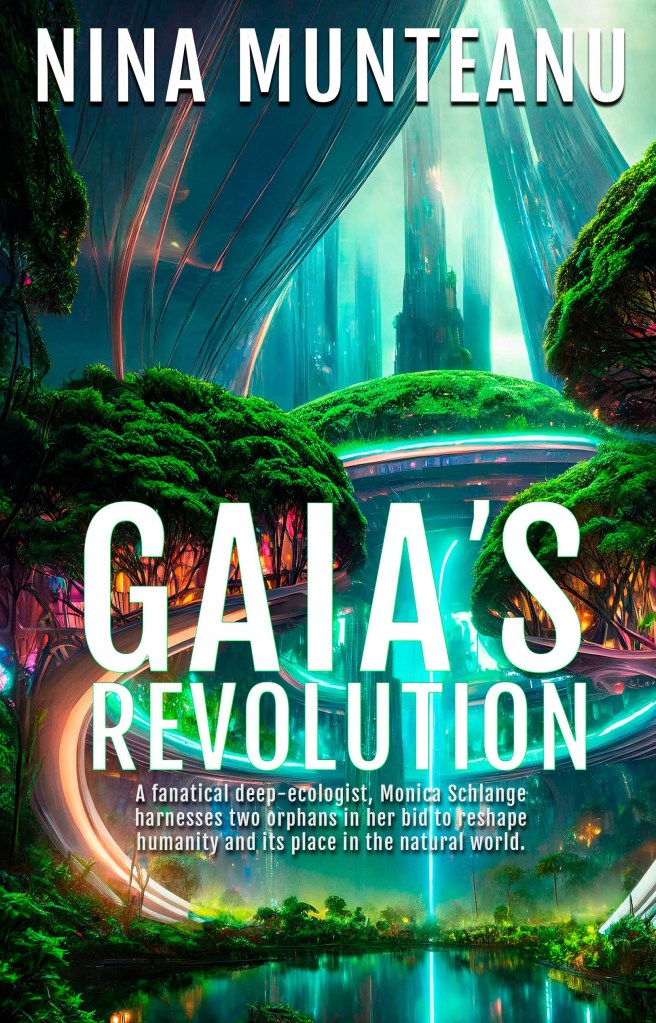
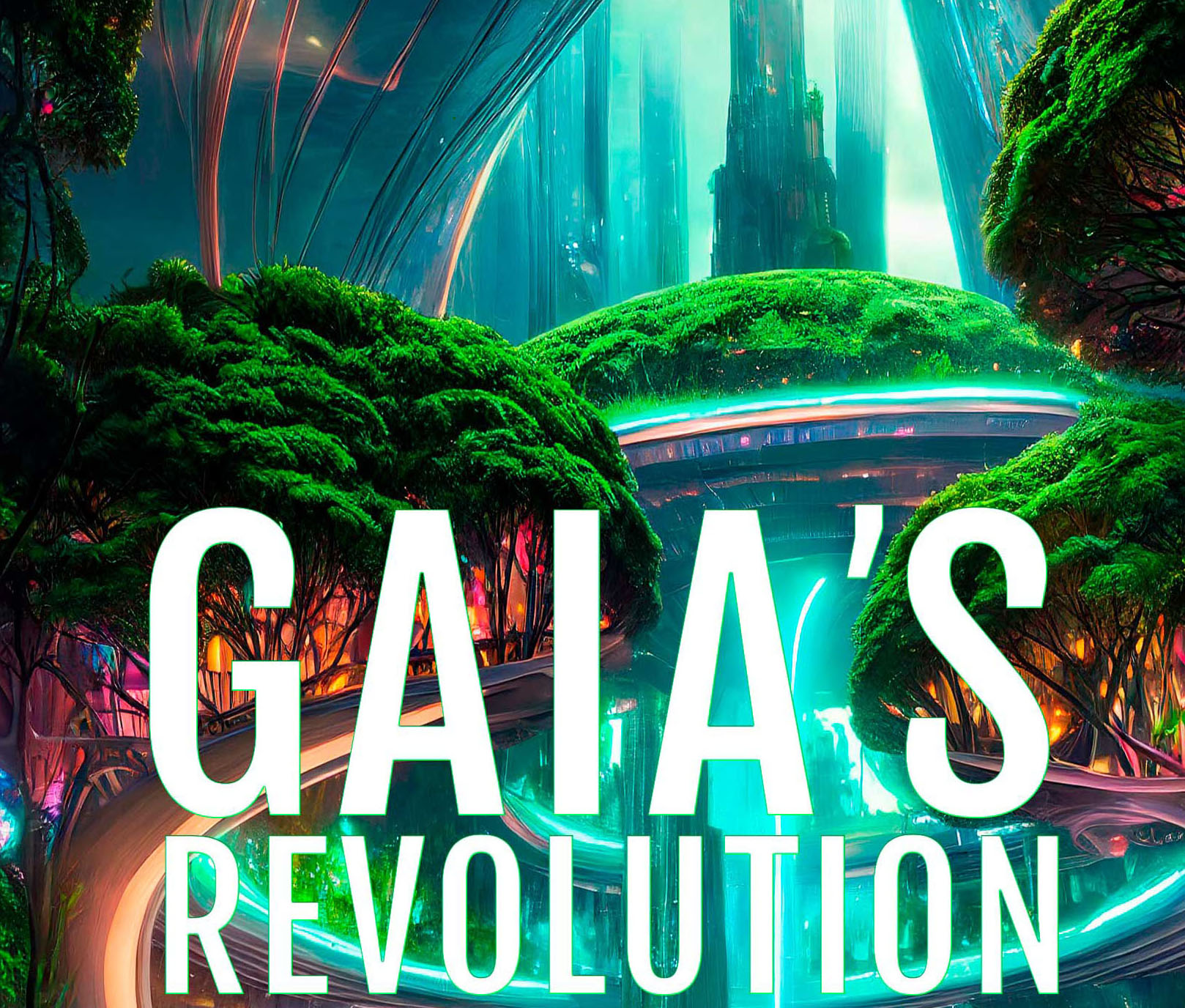
My upcoming book Gaia’s Revolution (Book 1 of The Icaria Trilogy by Dragon Moon Press) explores a collapsing capitalist society in Canada through ravages of climate change and a failing technology. The story is told through the lives of ambitious twin brothers Eric and Damien Vogel, and the woman who plays them like chess pieces in her gambit to ‘rule the world.’
.
It is 2032 and Eric Vogel sits in the Canadian prime minister’s office, ruminating on the changes coming. He imagines what a post-capitalist world will look like and how his twin brother Damien—left behind in Germany—would disagree with his vision:
Over a hundred years ago, Spartacist Rosa Luxemburg—who was shot by the right-wing Freikorps—argued that the “Bourgeois stands at the crossroads, either transition to socialism or regress into barbarism.” Both he and Damien agree with sociologist Wolfgang Streeck who argues that the end of capitalism—of a reigning bourgeois, in love with the objects that define them—is already underway. The signs are neon loud: a ruthless downward trend in economic growth, social equality, and financial stability. All reinforced by climate change and the ongoing collapse of the planet’s sustaining environment. Any system and dialectic based on a concept of infinite resources in a finite world is bound to fail eventually. That collapse has already begun and its catastrophic end is imminent. Already, climate refugees and refugees of resource war (which amounts to the same thing) have flooded northern nations, like Canada, and caused tension and strife. Germany is just one example where left and right have torn the country apart as an influx of foreigners challenged the already tenuous German identity. When Canada granted asylum to over two million climate-refugees in ‘28, with no viable plan for the new residents during a time when unemployment was higher than it had been in decades and housing prices were skyrocketing due to environmental uncertainty, this sparked renewed tensions between ultra-right and ultra-left and opened the gap for a new party based on science and reason. The party now in power: the Technocratic Party of Canada.
But what will life after capitalism look like?
It’s no surprise that he and his brother disagree on what a post-capitalist world should look like and how to best achieve that world. Damien too easily prescribes to the old leftist shibboleth of Nature being the answer to everything and Market being evil. His deep ecology utopia would spring from an atavistic rejection of modern life, a return to ‘the ancient farm.’ But how that fantasy could be achieved without a drastic population reduction is beyond his brother’s imagination. Damien fetishizes the natural world. Just like he does their mother. The naïve fool is a blind romantic, refusing to see reality right in front of him: that Nature is ultimately cruel, cold, and preoccupied with its own survival. Just like their mother.
.
Brother Damien recalls an earlier argument the two brothers had in Berlin that ultimately motivated him to follow his twin to Canada. They’d been debating about the effect of climate change on the human population:
.
Pulled down by a truculent mood, Damien responds to Eric’s usual glib solutions by painting a dark vision of a humanity descending into some pre-technological ‘dark age’ apocalypse.
Eric just laughs. He pokes his fork into the sauerkraut as if to make a point in his argument and scoops up a pile that he shoves into his mouth. He leans forward and argues with a full mouth, “The real question is not whether humanity will survive an ecological collapse, but what part of humanity will survive. You can be sure that the stinking boujee plutocrats will find a way to survive at the expense of everyone else.” He chews down the sauerkraut followed by a gulp of beer and a loud burp. “The stinking rich are already doing it, Dame. They’re already creating their Elysium right here, right now.” Fork now swings like a conductor’s baton. “The future is already here; it’s just unevenly distributed.”
Using his fingers, Damien pulls apart some crisp skin off the pork knuckle—his favourite part—and feeds his mouth. Arguing with Eric always makes him hungry despite his surly temper. He crunches down, enjoying the tasty juices of brazed salty pork skin, and retorts, “You politicize everything and resort to cheap references in pop culture. You always do that: over-simplify the crisis and Nature’s existential power to sustain life. Trophic cascades caused by ecosystem simplification would irreparably devastate the planet and all adapted life. With the Sixth Extinction Event there won’t be any boujee plutocrats because there won’t be anything left to monetize—”
“You’re such a doom-gloom lefty, Dame!” Eric grabs the last of the pork skin—also his favourite— and shoves it into his mouth. He smacks his lips and counters, “The stinking rich will always have technology at their disposal. I’m talking about genetic engineering, nano-technology, gene modification, cybernetics, and even environmental control. For instance, look at Harvard’s RoboBee: tiny robots that mimic flying insects that can fill in as pollinators for the crashing bee populations.”
“You over-estimate technology’s ability to save the planet—and us by extension.”
Eric finishes the pork skin and wipes his mouth on his sleeve with a sniff. “I’m not talking about saving the entire planet—just enough of it. You underestimate what we’re willing to do to survive.”
That is when he brings up E.P. Thompson’s paper on stages of a neoliberal capitalist civilization and the ‘extermination endgame.’ “You’re the population ecologist, Dame, but it’s obvious that when a neoliberal capitalist society exceeds its carrying capacity— when technology makes the masses surplus—there’s no alternative in the scramble for resources and ecological support. Get rid of the surplus. That simple. Thompson tells us that under military capitalism—and you have to accept that all countries are militarizing—the ‘outcome must be the extermination of multitudes.’”
“For God’s sake, Eric!”
“Technology will save humanity, Dame,” Eric insists. He leans back and stretches his legs under the laminate table in self-pleased satisfaction. “One way or another.”
Damien shakes his head and gulps down the last of his beer. “Whatever is left of humanity, you mean. And you accuse me of giving up on humanity. So, the greedy capitalist wins?”
“That’s why the world needs us, Dame. To keep humanity from going down the wrong road.”
And what is that for Eric, Damien wonders. Increasingly, he feels discomfort at what that might be. Eric leans forward, eyes bright with inspiration. He resembles a great bird of prey, long hawk-like nose—the iconic Vogel nose—and copious dark hair cresting back from a high forehead. It’s like looking at a more confident version of himself in the mirror, thinks Damien. And sometimes disconcerting, particularly when it reminds him of what he is not.
“You and I know that humanity won’t stop climate change,” Eric goes on animatedly. “Too many tipping points are already upon us and the direction we’re all going in now…” He swings his fork around the room to indicate this place, Germany, the world. “… isn’t promising to check that. Change is inevitable.” He points the fork at Damien. “But, if we can direct how humanity adapts to our changing environment, we can still win…” Before Damien can charge in with a rebuttal, Eric pushes his face forward, raptor eyes scintillating like sapphires on fire. “So, how do we de-thrown the ultra-rich elite—who are mostly a rabble of materialist self-serving hedonists with no vision or care for the future—and ensure a meritocracy of responsible citizens who can take humanity through the changes to come? … Like establishing a universal basic income toward an egalitarian society. Putting a full stop to fossil fuel mining and adopting clean energy. Re-wilding key ecosystems. Engaging reforestation and dedicating large areas to Nature.”
Damien shakes his head, lost for words. Where is his brother going with this? Will he suggest violent revolution to establish a dictatorship? How else would the rich give up their riches? And how is that any different from the Bolsheviks of 1917 or the Nazis of 1933 or the Stasi-run DDR? Those fascist Reichsbürgers would happily reinstate a society of surveillance, repression, and incarceration that would threaten to slide into the final solution of genocide of an unwanted ‘surplus’. A society of disposable bodies, a biopolitical world of exterminism. Damien thinks of Nietzsche’s aphorism: Beware that, when fighting monsters, you yourself do not become a monster … for when you gaze long into the abyss, the abyss gazes also into you. Violent revolution is not the answer, he decides.
Eric pulls out the worn copy of Walden Two from his jacket pocket. He slaps it on the table and pushes it toward Damien. “That’s the answer, Dame.”
.
.
Models of a Post-Capitalist Future Society
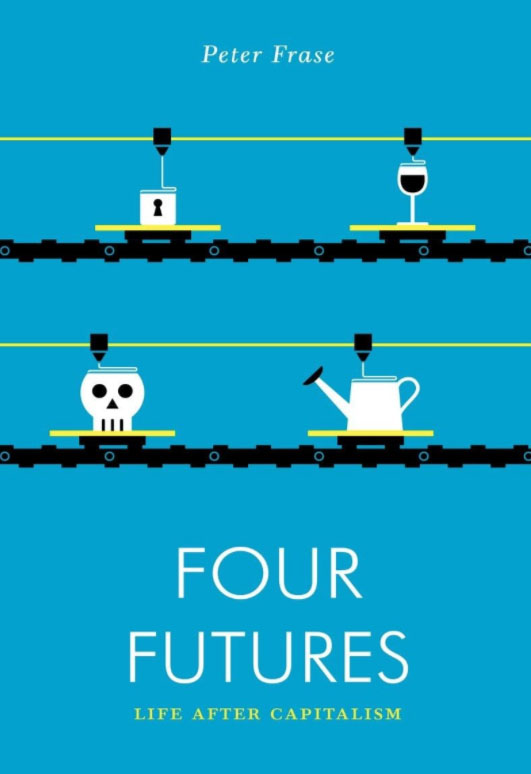
In his book Four Futures: Life After Capitalism , sociologist Peter Frase considers effects of climate change and automation in possible outcomes of a post-Trump election America. Frase envisions four scenarios based on abundance and scarcity and whether a society operates by equality (e.g., communism under abundance / socialism under scarcity) or hierarchy (rentism under abundance /exterminism under scarcity).
.
With scarce resources, the following scenarios are possible:
Socialism (aka Ecotopia) may arise within an egalitarian society if driven by altruistic notions of self-limitation. Ecologists describe such a self-limiting system as K-selected (see my discussion of K-selection and r-selection in “Water Is…”). A K-selected population is at or near the carrying capacity of the environment, which is usually stable and favors individuals that creatively compete, through cooperation, for resources and produce few young. The K-selected strategy runs on a successive gradient of maturity, from initially competitive to ultimately cooperative. Competition is a natural adaptive remnant of uncertainty and insecurity and forms the basis of a capitalist economy that encourages monopolization and hostile takeovers. Competition results from an initial antagonistic reaction to a perception of limited resources. It is a natural reaction based on distrust—of both the environment and of the “other”—both aspects of “self” separated from “self.” The greed for more than is sustainable reflects a fear of failure and a sense of being separate, which ultimately perpetuates actions dominated by self-interest in a phenomenon known as “the Tragedy of the Commons.” Competition naturally gives way to creative cooperation as trust in both “self” and the “other” develops and is encouraged through continued interaction.
Exterminism (aka Mad Max) may arise under a hierarchical model, driven by greed and exacerbated by uncertainty in the environment—not unlike what we are currently experiencing with the planet’s system and cyclical changes. In this scenario, in which resources are both limited and uncertain, those with access to them would guard or hide them away with desperate fervor.
“When mass labor has been rendered superfluous [through automation], a final solution* lurks: the genocidal war of the rich against the poor.”—Peter Frase
.
References:
Frase, Peter. 2016. “Four Futures: Life After Capitalism.” Verso Press, London. 150pp.
Luxemberg, Rosa. 1915. “The Junius Pamphlet: The Crisis in the German Democracy.” Marxists.org.
Munteanu, Nina “Gaia’s Revolution.” Book 1 of the Icaria Trilogy, Dragon Moon Press, upcoming.
Munteanu, Nina. 2016. “Water Is…The Meaning of Water.” Pixl Press, Vancouver. 586pp.
Streeck, Wolfgang. 2014. “How Will Capitalism End?” New Left Review 2 (87): 47p.
Thompson, E.P. 1980. “Notes on Exterminism: the Last Stage of Civilisation, Exterminism, and the Cold War.” New Left Review 1(121).
*the Final Solution was originally used by Nazi Germany as “the Final Solution to the Jewish Question”: the Nazi plan to exterminate the Jews during World War II, formulated in 1942 by Nazi leadership at the Wannsee Conference near Berlin, culminated in the Holocaust, which murdered 90 percent of Polish Jews.
.
.
Nina Munteanu is a Canadian ecologist / limnologist and novelist. She is co-editor of Europa SF and currently teaches writing courses at George Brown College and the University of Toronto. Visit www.ninamunteanu.ca for the latest on her books. Nina’s bilingual “La natura dell’acqua / The Way of Water” was published by Mincione Edizioni in Rome. Her non-fiction book “Water Is…” by Pixl Press (Vancouver) was selected by Margaret Atwood in the New York Times ‘Year in Reading’ and was chosen as the 2017 Summer Read by Water Canada. Her novel “A Diary in the Age of Water” was released by Inanna Publications (Toronto) in June 2020.
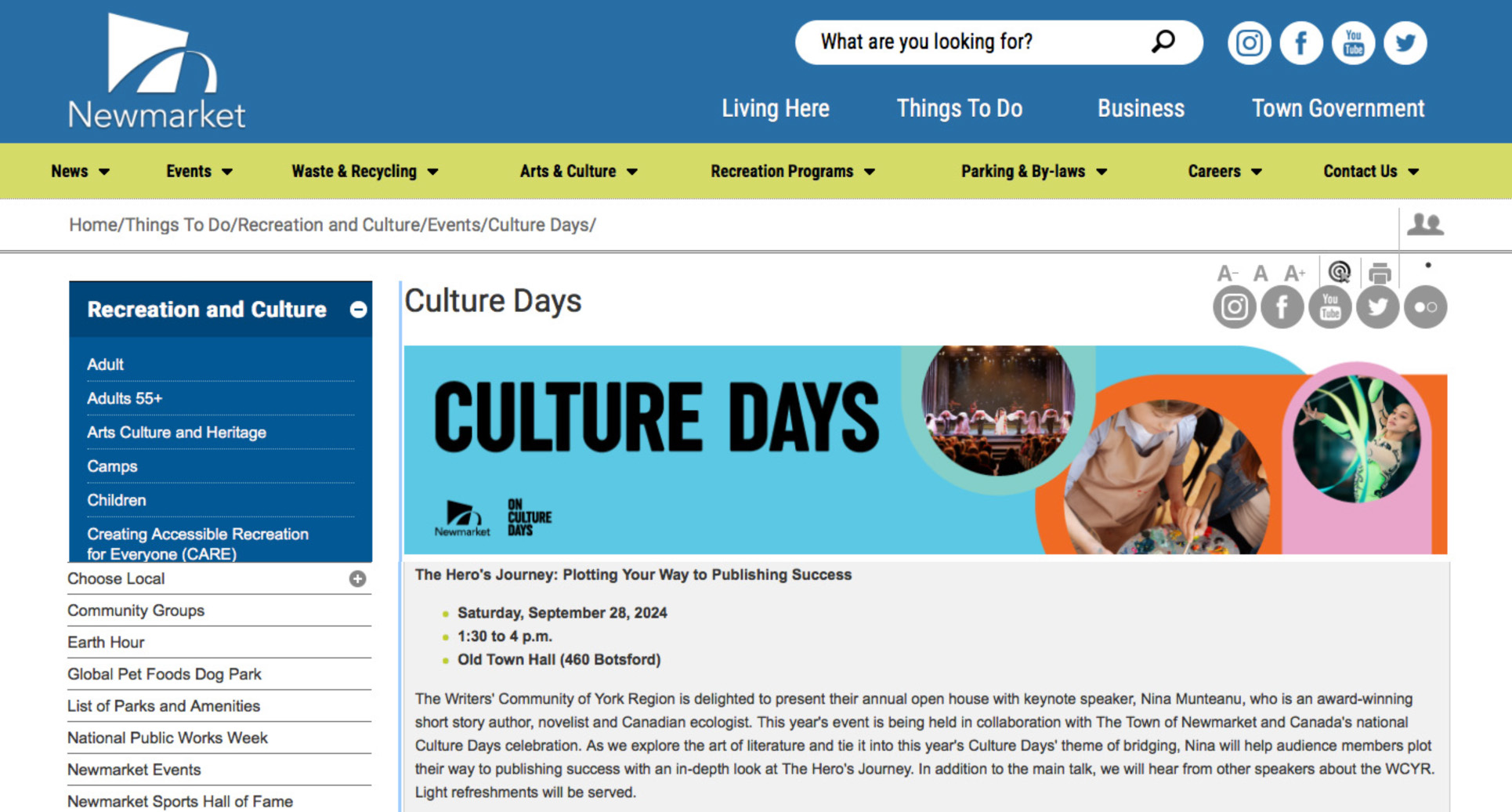
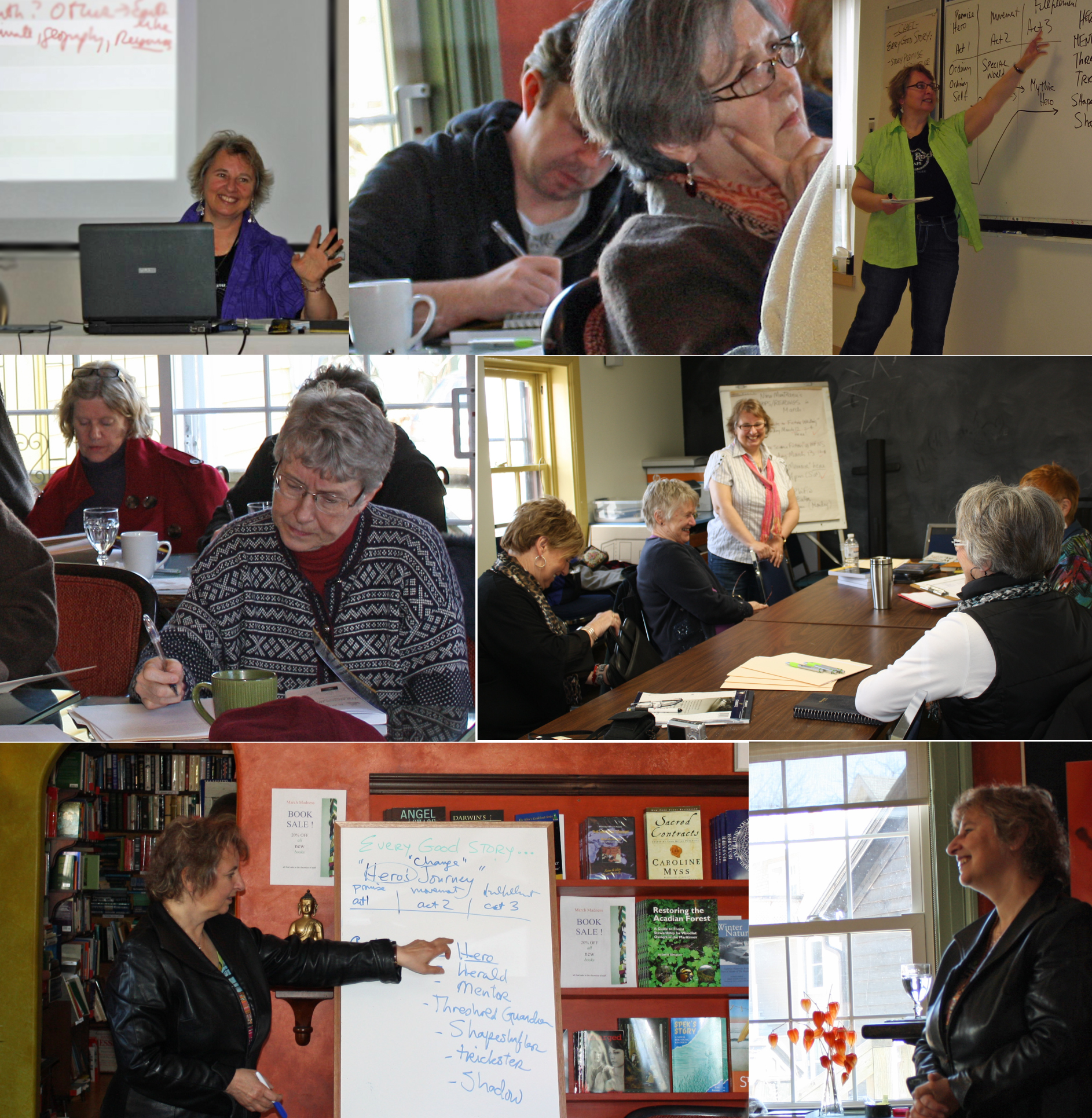
I recently gave my lecture / workshop on the Hero’s Journey plot approach to a group of writers for Culture Days in Newmarket, Ontario.
The event, organized by the WCYR (Writing Community of York Region), took place in the art gallery of the Old Town Hall, located in the old downtown part of the city—an attractive section of streets and lanes with eclectic shops, cafés, bistros and bookstores for curious amblers.
Bustling Main Street near the Old Town Hall, Newmarket, ON
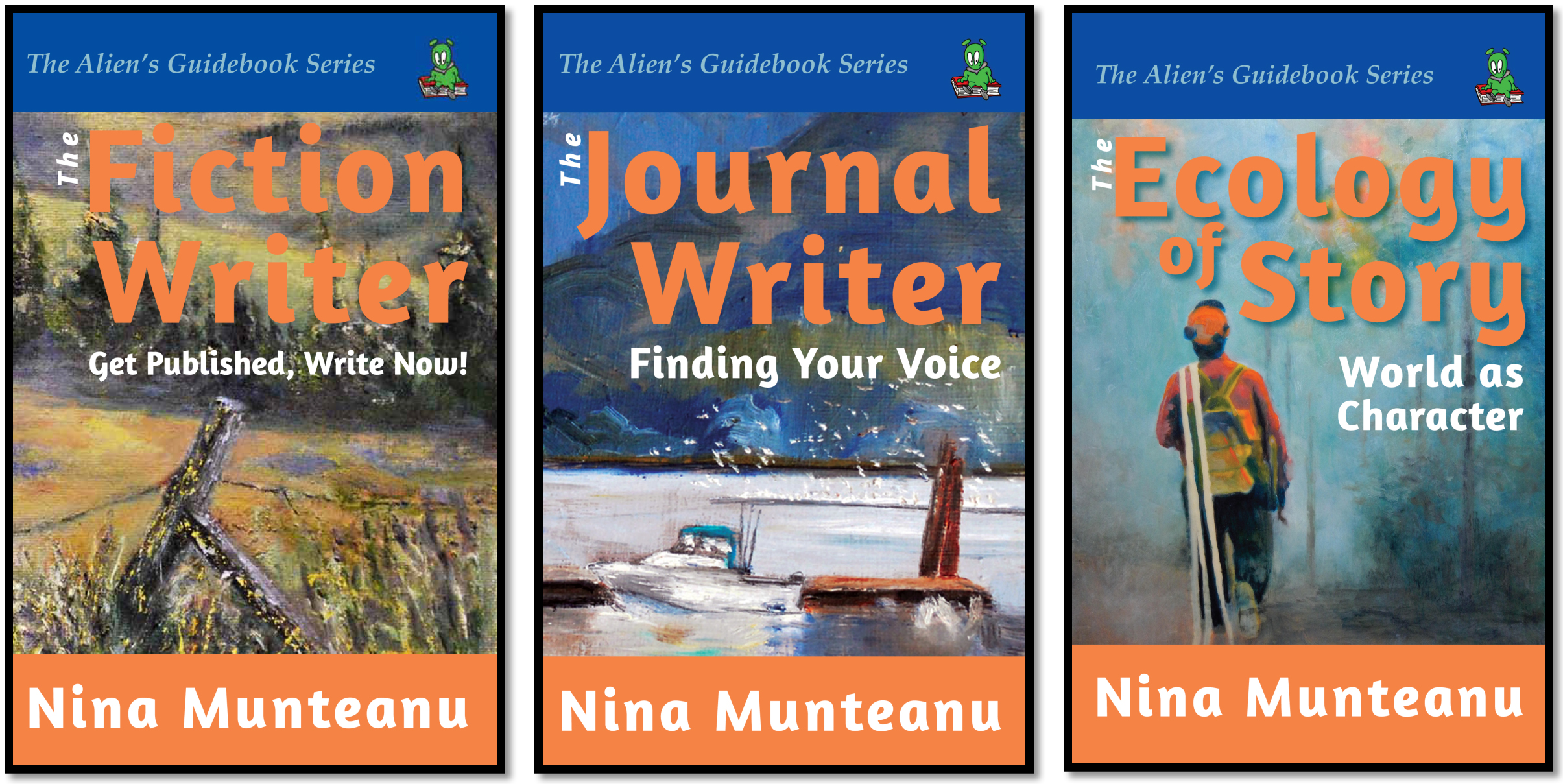
Three guidebooks of the Alien Guidebook series for writers
Cathy Miles, the program coordinator, encouraged me to brings books for sale, so I certainly included the three books of my Alien Guidebook Series on writing: The Fiction Writer, The Journal Writer, and The Ecology of Story, all also available at Amazon, Kobo, Barnes & Noble and other quality bookstores, which I sold for a workshop price. Cathy gave me a wonderful introduction to a room full of eager writers and I also had the pleasure of meeting Janice Luttrell, the Recreation Programmer with the City of Newmarket, who was hosting the event as part of Newmarket’s Culture Days.
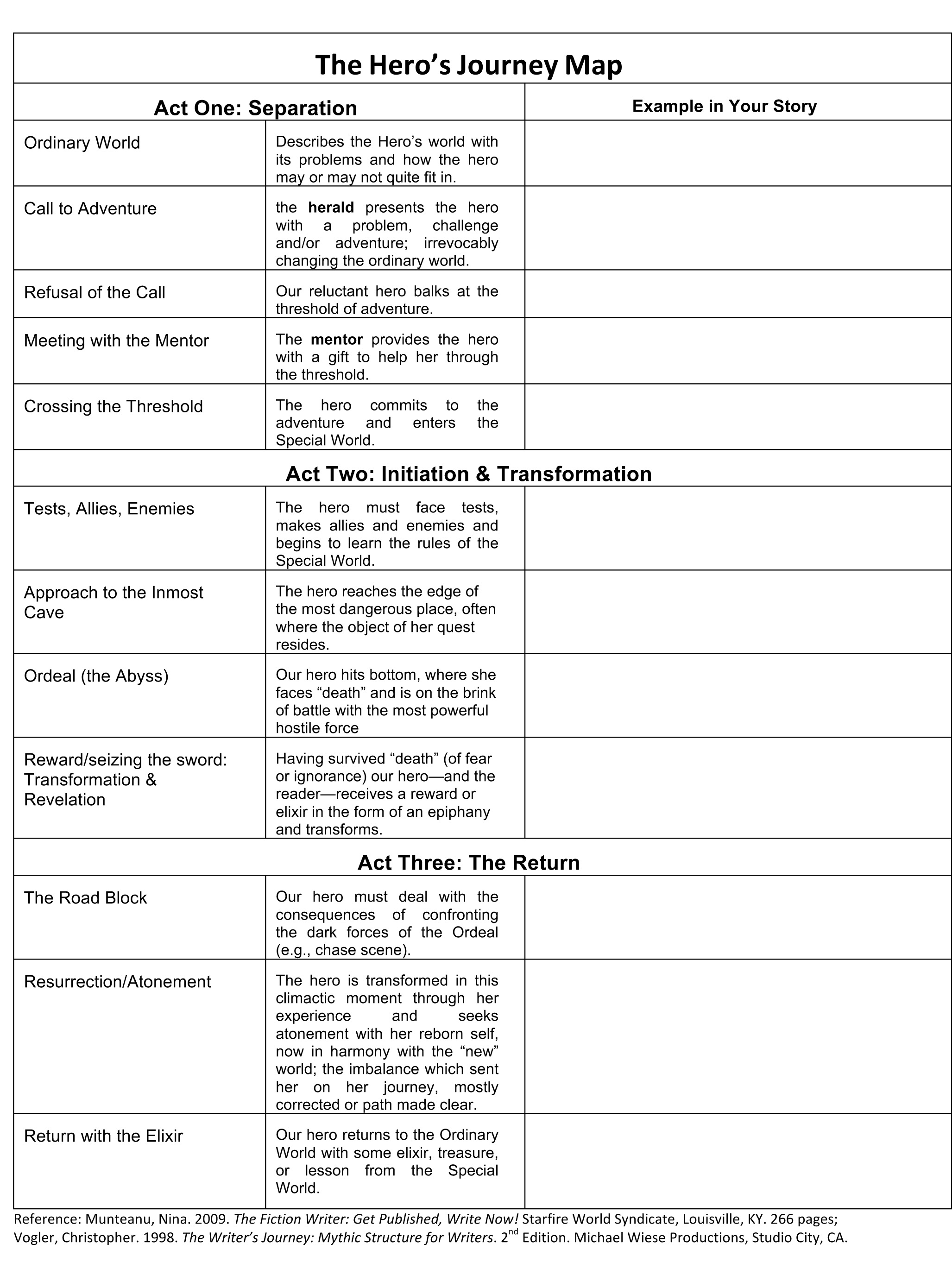
Drawing from several chapters in The Fiction Writer, I introduced the Hero’s Journey map structure, based on Ingrid Sundberg’s plot structure, and discussed the 12-step hero’s journey according to mythologist Joseph Campbell.
We also discussed the seven chief archetypes associated with the journey steps: hero, mentor, herald, threshold guardian, trickster, shapeshifter, and shadow.
Nina teaching “The Hero’s Journey” plot approach over the years in Nova Scotia, BC and Ontario
I’ve given this workshop many times and always enjoyed the lights that came on in participants; this time was no different. My session was fun and very well received. I saw lots of interest and received many good questions—a sure sign. One participant was quoted as saying:
“What a great event! Your presentation was insightful. I really appreciated being able to follow along in the book while listening to your explanations. That is going to help me remember the concepts as I read the book and then apply them to my writing.”
The WCYR book table at the event (photo by Nina Munteanu)
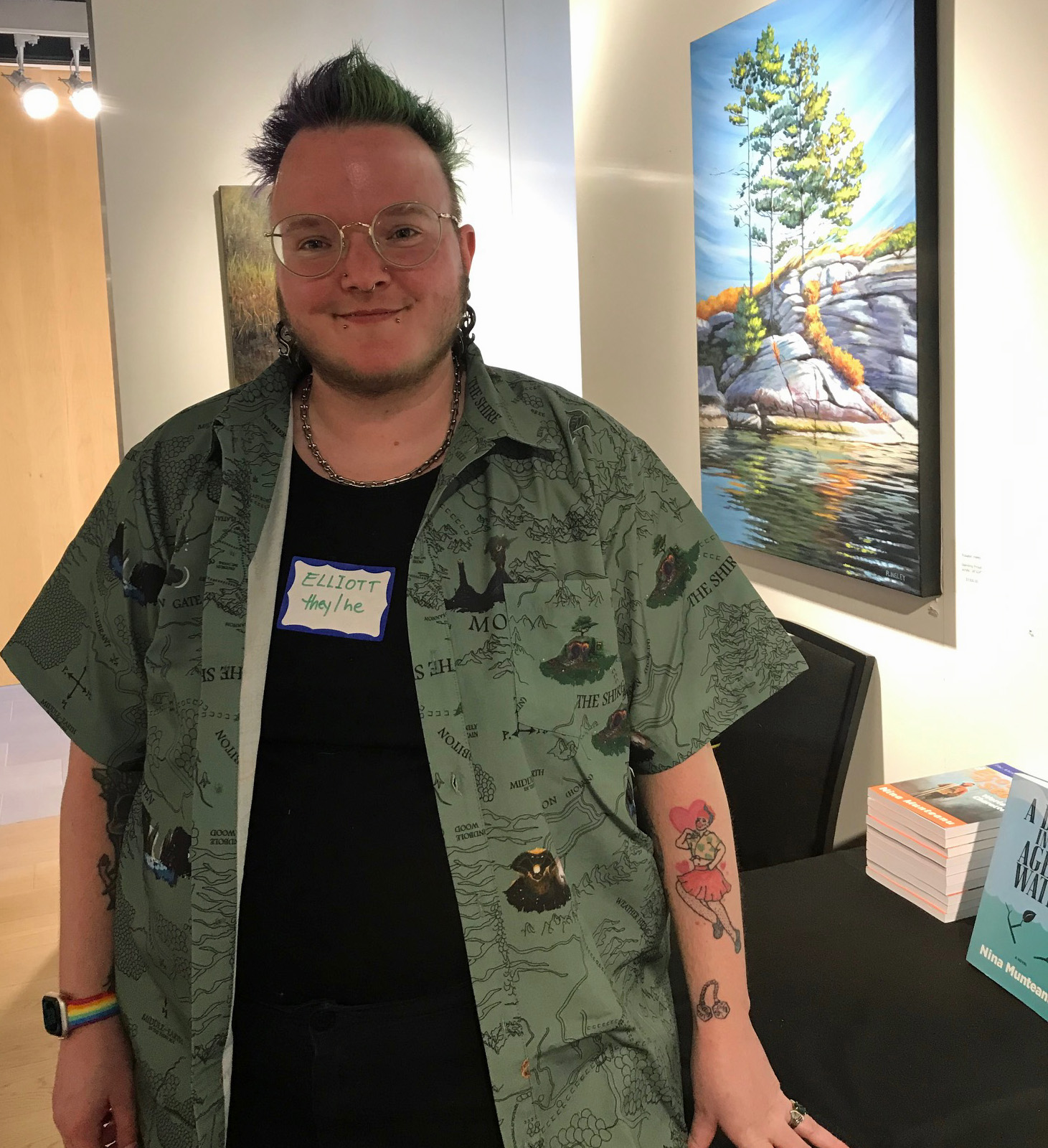
Elliott sells my books at the WCYR book table (photo by Nina Munteanu)
All in all, it was a good day…
Nina Munteanu is a Canadian ecologist / limnologist and novelist. She is co-editor of Europa SF and currently teaches writing courses at George Brown College and the University of Toronto. Visit www.ninamunteanu.ca for the latest on her books. Nina’s bilingual “La natura dell’acqua / The Way of Water” was published by Mincione Edizioni in Rome. Her non-fiction book “Water Is…” by Pixl Press (Vancouver) was selected by Margaret Atwood in the New York Times ‘Year in Reading’ and was chosen as the 2017 Summer Read by Water Canada. Her novel “A Diary in the Age of Water” was released by Inanna Publications (Toronto) in June 2020.
My eco-fiction book A Diary in the Age of Water was recently cited along with Paolo Bacigalupi’s book The Water Knife, in an article on conflict risk in international transboundary water bodies.
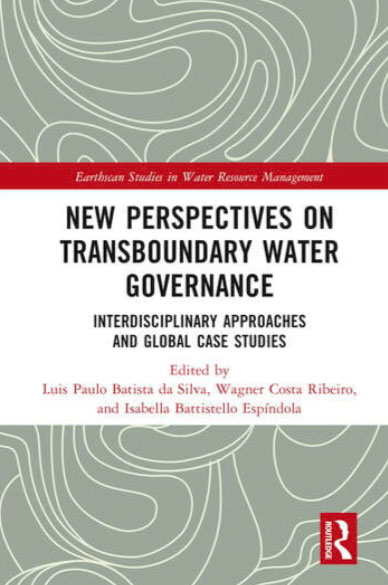
The citation was made in Ken Conca’s article (Chapter 1: “Climate change, adaptation, and the risk of conflict in international river basins: Beyond the conventional wisdom”) of the 2024 Routledge book “New Perspectives on Transboundary Water Governance:Interdisciplinary Approaches and Global Case Studies” (edited by Luis Paulo Batista da Silva, Wagner Costa Ribeiro, and Isabela Battistello Espíndola).
Conca begins his chapter with a statistic—an estimated 310 rivers in the world cross national borders, form borders, or both—and goes on to discuss the risk of conflict that naturally arises in such situations. Conca traces a rich history of disputes, with one of the oldest occurring between Lagash and Umma (present-day southern Iraq) in 2500 BCE. Conca explores the early warning indicators explored by the World Resources Institute that imply “a future in which our bordered politics, combined with hydrologic interdependencies, could yield a combustible mix of tension and grievances” and adds that several rivers flagged in the WRI study lie in regions of crhonic tension and political instability. He then includes a 2013 quote by former UN Secretary-General Ban Ki-moon:
“Our experiences tell us that environmental stress, due to lack of water, may lead to conflict, and would be greater in poor nations … population growth will make the problem worse. So will climate change. As the global economy grows, so will its thirst. Many more conflicts lie just over the horizon.” Ban also stated that climate change promised “an unholy brew that can create dangerous security vacuums” in which “mega-crises may well become the new normal.”
Conca makes his point by quoting the U.S. Center for Strategic and International Studies: “the real wild card for political and social unrest in the Middle East over the next 20 years is not war, terrorism, or revolution—it is water.”
Conca makes the connection with narratives of fiction:
“This framing of scarcity-induced conflict risk has even crept into the world of fiction. Paulo Bacigalupi’s dystopian novel The Water Knife (2016) portrays a parched southwestern United States of the near future. He foresees American states militarizing both their water relations (with corporate militias destroying infrastructure meant to divert water) and their borders (with the water-rich states seeking to keep thirsty migrant out, and the water poor states seeking to keep them in). Nina Munteanu’s A Diary in the Age of Water (2020) envisions Canada as a wholly-owned colony of the United States (itself owned by China). She describes a world in which Niagara Falls has been turned off and pet ownership is outlawed as an unacceptable water burden.”
Conca unpacks various misconceptions on sources of conflict and conflict resolution to do with transboundary water bodies. The chapter is very enlightening, as is the entire book!
The 2024 Routledge book “New Perspectives on Transboundary Water Governance:Interdisciplinary Approaches and Global Case Studies” (edited by Luis Paulo Batista da Silva, Wagner Costa Ribeiro, and Isabela Battistello Espíndola) is described by the publisher below:
This book presents a novel examination of transboundary water governance, drawing on global case studies and applying new theoretical approaches.
Excessive consumption and degradation of natural resources can either heighten the risks of conflicts or encourage cooperation within and among countries, and this is particularly pertinent to the governance of water. This book fills a lacuna by providing an interdisciplinary examination of transboundary water governance, presenting a range of novel and emerging theoretical approaches. Acknowledging that issues vary across different regions, the book provides a global view from South and Central America, Africa, Asia, and the Middle East, with the case studies offering civil society and public managers concrete situations that indicate difficulties and successes in water sharing between bordering countries. The volume highlights the links between natural resources, political geography, international politics, and development, with chapters delving into the role of paradiplomacy, the challenges of climate change adaptation, and the interconnections between aquifers and international development. With rising demand for water in the face of climate change, this book aims to stimulate further theoretical, conceptual, and methodological debate in the field of transboundary water governance to ensure peaceful and fair access to shared water resources.
This book will be of interest to students and scholars of water resource governance from a wide variety of disciplines, including geography, international relations, global development, and law. It will also be of interest to professionals and policymakers working on natural resource governance and international cooperation.
Nina Munteanu is a Canadian ecologist / limnologist and novelist. She is co-editor of Europa SF and currently teaches writing courses at George Brown College and the University of Toronto. Visit www.ninamunteanu.ca for the latest on her books. Nina’s bilingual “La natura dell’acqua / The Way of Water” was published by Mincione Edizioni in Rome. Her non-fiction book “Water Is…” by Pixl Press (Vancouver) was selected by Margaret Atwood in the New York Times ‘Year in Reading’ and was chosen as the 2017 Summer Read by Water Canada. Her novel “A Diary in the Age of Water” was released by Inanna Publications (Toronto) in June 2020.
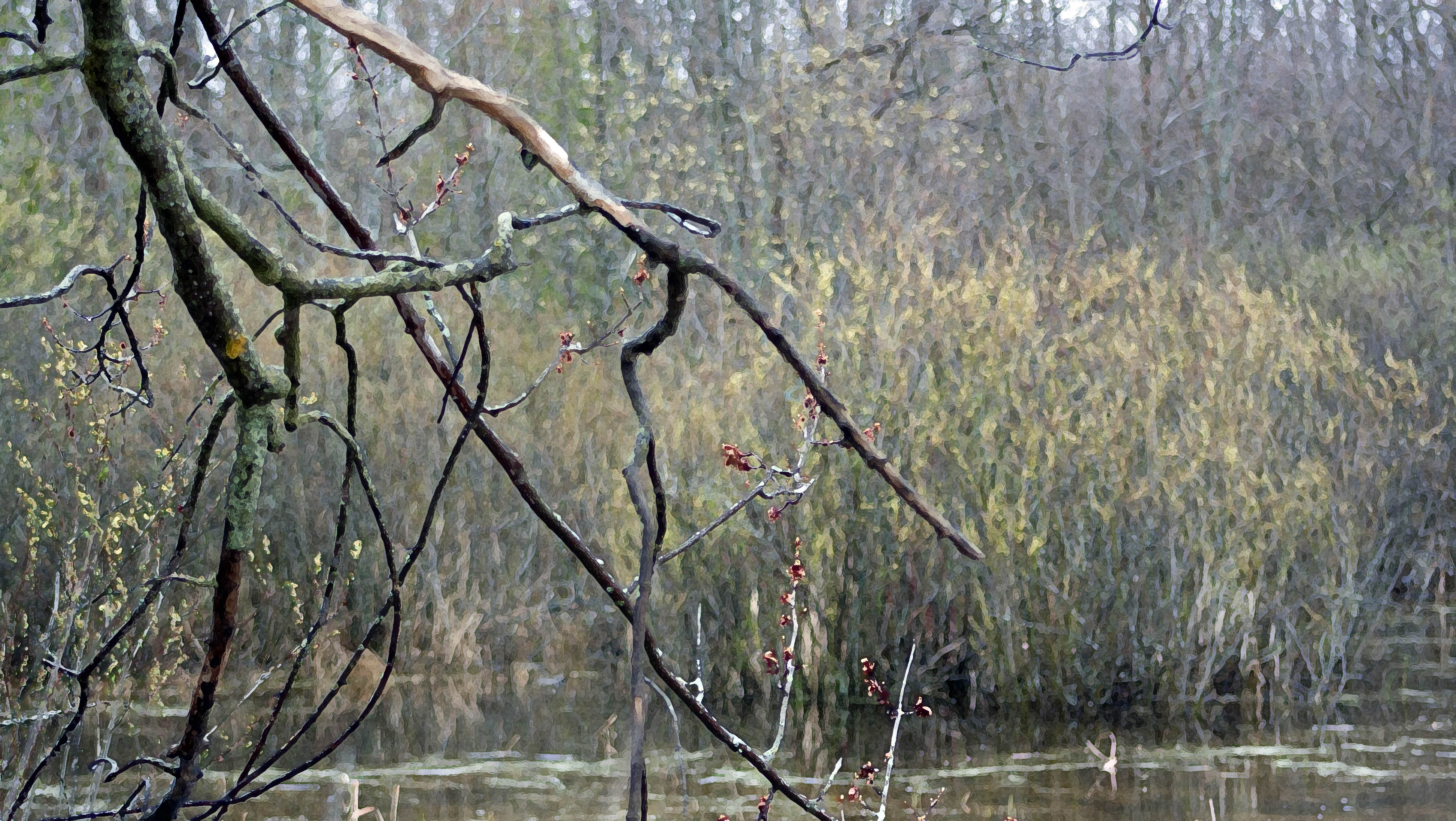
Fence and post at marsh during a rain, ON (photo by Nina Munteanu)
The Universe is made of stories, not atoms—Muriel Rukeyser
Canadian writer Mary Woodbury tells us that: “Fiction exploring humanity’s impacts on nature is becoming more popular [and] has the distinct ability to creatively engage and appeal to readers’ emotions. In fact, it can stir environmental action.” A survey she took in 2020 showed that “88% of its participants were inspired to act after reading ecological fiction.”
Eco-Fiction (short for ecological fiction) is a kind of fiction in which the environment—or one aspect of the environment—plays a major role, either as premise or as character. “Principled by real science and exalting our planet’s beauty, these stories are works of art. They live within classic modes of fiction exploring the human condition, but also integrate the wild,” writes Woodbury. At the heart of eco-fiction are strong relationships forged between the major character on a journey and an aspect of their environment and place. Environment and place can illuminate through the sub-text of metaphor a core aspect of the main character and their journey.
Green architecture design by Vincent Callebaut
All great literature distills its art form through the exploration of relationship: our relationship with technology, with science, Nature, God, our children, each other, our history. Science fiction illuminates our history and our very humanity by examining our interaction with “the other”—the unfamiliar, the feared, the often downtrodden, the invisible, the ignored. This is the hero’s journey. And it is through this journey relating to the “other” (whether it’s Earth or an alien planet, its water, environment and issues, and its varied peoples and cultures) that our hero discovers herself and her gift to the world. When will we stop portraying Nature as “other”?…
Green neighbourhood design by Vincent Callebaut
We currently live in a world in which climate change and associated water crisis pose a very real existential threat to most life currently on the planet. The new normal is change. And it is within this changing climate that eco-fiction is realizing itself as a literary pursuit worth engaging in. The emergence of the term eco-fiction as a brand of literature suggests that we are all awakening—novelists and readers of novels—to our changing environment. We are finally ready to see and portray environment as an interesting character with agency and to read this important and impactful literature.
Lavender farm and house design by Vincent Callebaut
Many readers are currently seeking fiction that describes environmental issues but also explores a successful paradigm shift: fiction that accurately addresses our current issues with intelligence and hope. This is reflected in the growing popularity of several emerging sub-genres of fiction such as solar punk, optimistic climate fiction, clifi, eco-lit, hope punk, and others. The power of envisioning a certain future is that the vision enables one to see it as possible. Eco-fiction—and all good science fiction—uses metaphor to study the world and the consequences of humanity’s actions through microcosmic dramatization. What makes this literature particularly exciting is: 1) its relevance to our current existential situation; and 2) that it often provides a way forward.
Solarpunk world imagined (image by Imperial Boy)
The Way Forward with Solarpunk
In his 2014 article “Solarpunk: Notes toward a manifesto” in Hieroglyph Adam Flynn writes of under-30 futurists: “Many of us feel it’s unethical to bring children into a world like ours. We have grown up under a shadow, and if we sometimes resemble fungus it should be taken as a credit to our adaptability.”
“We’re solarpunks because the only other options are denial or despair.”
ADAM FLYNN
Solarpunk, says Flynn, “is about finding ways to make life more wonderful for us now, and more importantly for the generations that follow us—i.e., extending human life at the species level, rather than individually.” Our future, asserts Flynn, “must involve repurposing and creating new things from what we already have (instead of 20thcentury “destroy it all and build something completely different” modernism).” Solarpunk futurism “is not nihilistic like cyberpunk and it avoids steampunk’s potentially quasi-reactionary tendencies: it is about ingenuity, generativity, independence, and community.”
“Hydrogenase” algae-powered airships by Vincent Callebaut
The ‘punk’ suffix comes from the oppositional quality of solarpunk; opposition that begins with infrastructure as a form of resistance. Flynn tells us that solarpunk draws on the ideal of Jefferson’s yeoman farmer, Ghandi’s ideal of swadeshi, and countless other traditions of innovative dissent.
“Hyperion” eco-neighbourhood design by Vincent Callebaut
“Solarpunk is a future with a human face and dirt behind its ears.”
ADAM FLYNN
In response to Flynn’s article, Bob Vanderbob writes, “going solar is a deep mental shift: it will be the central metaphor of our future civilization.”
Green Paris design by Vincent Callebaut
Musician photographer Jay Springett calls solarpunk, “a movement in speculative fiction, art, fashion, and activism that seeks to answer and embody the question ‘what does a sustainable civilization look like, and how can we get there?’… At once a vision of the future, a thoughtful provocation, and an achievable lifestyle.” Jennifer Hamilton observes in The Conversation that “as a category of fiction, solarpunk remains a fringe dweller…Nevertheless, the aesthetic sensibilities of the subculture are starting to emerge.” Hamilton asserts that “the focus on the cultural change that will necessarily accompany the full transition to renewable energy is the defining feature of solarpunk.” She adds, “we usually ask ‘can renewables replace fossil fuels?’ … solarpunks ask ‘what kind of world will emerge when we finally transition to renewables?’ and their [works] are generating an intriguing answer.”
Beach house design by Vincent Callebaut
How Eco-Fiction Inspires and Galvanizes
Readers responded to Mary Woodbury’s survey question “Do you think that environmental themes in fiction can impact society and if so, how?” with these observations:
Environmental fiction encourages empathy and imagination. Stories can affect us more than dry facts. Fiction reaches us more deeply than academic understanding, moving us to action.
Environmental fiction triggers a sense of wonder about the natural world, and even a sense of loss and mourning. Stories can immerse readers into imagined worlds with environmental issues similar to ours.
Environmental fiction raises awareness, encourages conversations and idea-sharing. Fiction is one way that helps to create a vision of our future. Cautionary tales can nudge people to action and encourage alternative futures. Novels can shift viewpoints without direct confrontation, avoid cognitive dissonance, and invite reframed human-nature relationships through enjoyment and voluntary participation.
Environmental themes can reorient our perspective from egocentrism to the greater-than-human world.
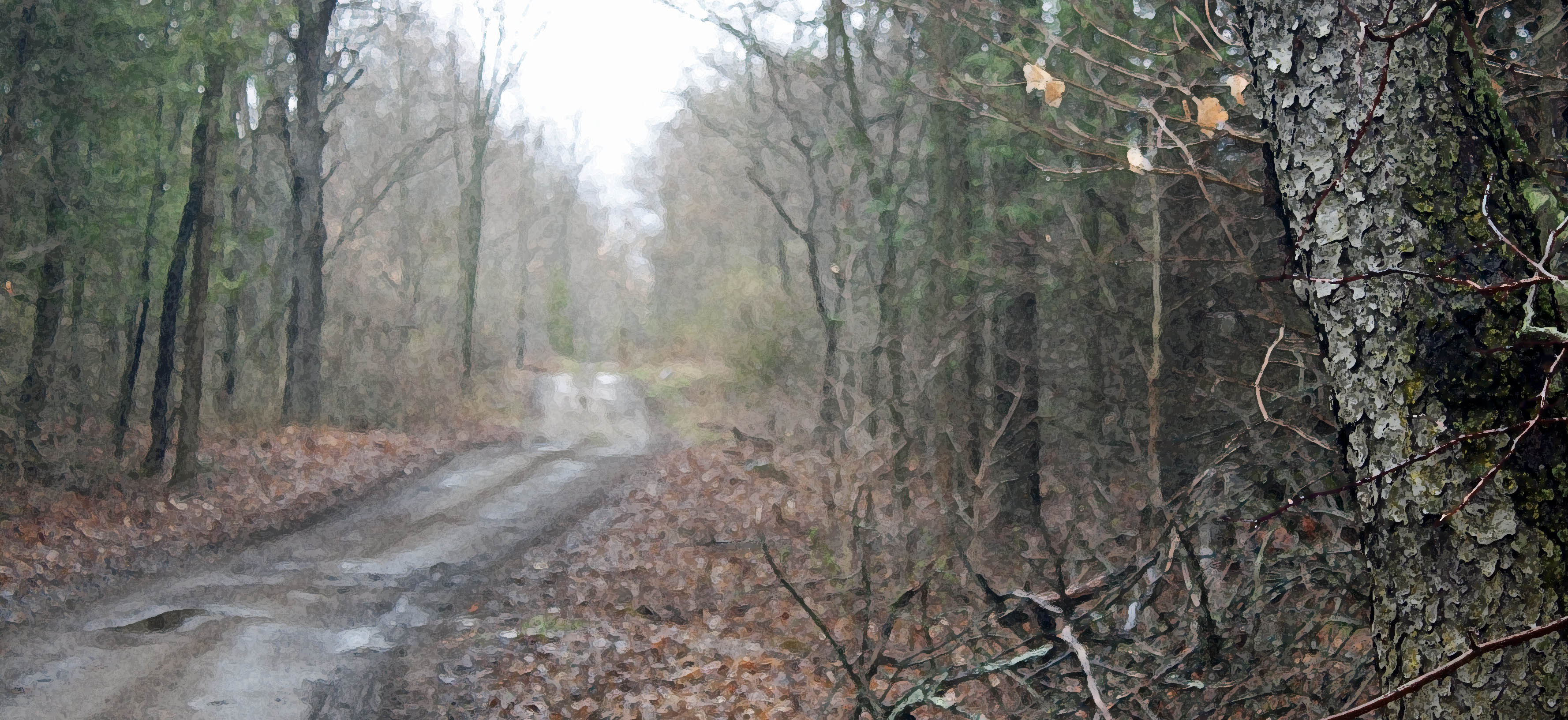
Dirt road in Kawarthas during a misting rain, ON (photo and rendition by Nina Munteanu)
Why Our Stories Are Important
We are all storytellers. We share our curiosity with great expression; our capacity and need to tell stories is as old as our ancient beginnings. From the Palaeolithic cave paintings of Lascaux to our blogs on the Internet, humanity has left a grand legacy of “story” sharing. Evolutionary biologist and futurist Elisabet Sahtouris tells us that, “whether we create our stories from the revelations of religions or the researches of science, or the inspirations of great artists and writers or the experiences of our own lives, we live by the stories we believe and tell to ourselves and others.”
Compelling stories resonate with the universal truths of metaphor that reside within the consciousness of humanity. According to Joseph Campbell, this involves an open mind and a certain amount of humility; and giving oneself to the story … not unlike the hero who gives her life to something larger than herself. Fiction becomes memorable by providing a depth of meaning. Stories move with direction, compel with intrigue and fulfil with awareness and, sometimes, with understanding. The stories that stir our hearts come from deep inside, where the personal meets the universal, through symbols or archetypes and metaphor.
Ultimately, we live by the narratives we share. “What you think, you become,” said Buddha.
In my writing guidebook The Ecology of Story: World as Character, I write: “When a writer is mindful of place in story and not only accurately portrays environment but treats it as a character, then her story will resonate with multilayers of meaning.”
Poplar stand in the Kawarthas, ON (photo and rendition by Nina Munteanu)
Changing the Narrative…
I was recently interviewed by Forrest Brown on Stories for Earth Podcast in which we discussed the need to change our narrative (particularly our colonial neoliberal capitalist narrative) and various ways to do this, taking into account the challenges posed by belief and language. Lessons from our indigenous wise elders will play a key role in our change toward genuine partnership with the Earth.
“We need to have a whole cultural shift, where it becomes our culture to take care of the Earth, and in order to make this shift, we need storytelling about how the Earth takes care of us and how we can take care of her.” ― Ayana Elizabeth Johnson,All We Can Save: Truth, Courage, and Solutions for the Climate Crisis
“This world, in which we are born and taken our being, is alive. It is not our supply house and sewer; it is our larger body. The intelligence that evolved us from stardust and interconnects us with all beings is sufficient for the healing of our Earth community, if we but align with that purpose. Our true nature is far more ancient and encompassing than the separate self defined by habit and society. We are as intrinsic to our living world as the rivers and trees, woven of the same intricate flows of matter/energy and mind. Having evolved us into self-reflexive consciousness, the world can now know itself through us, behold its own majesty, tell its own stories–and also respond to its own suffering.”
JOANNA MACY and CHRIS JOHNSTONE, “Active Hope”
Swamp forest in Kawartha region, ON (photo and rendition by Nina Munteanu)
References:
Campbell, Joseph, Bill Moyers. 1991. “The Power of Myth.” Anchor. 293pp.
Sahtouris, Elisabet. 2014. “Ecosophy: Nature’s Guide to a Better World.” Kosmos, Spring/Summer 2014: 4-9pp.
Nina Munteanu is a Canadian ecologist / limnologist and novelist. She is co-editor of Europa SF and currently teaches writing courses at George Brown College and the University of Toronto. Visit www.ninamunteanu.ca for the latest on her books. Nina’s bilingual “La natura dell’acqua / The Way of Water” was published by Mincione Edizioni in Rome. Her non-fiction book “Water Is…” by Pixl Press (Vancouver) was selected by Margaret Atwood in the New York Times ‘Year in Reading’ and was chosen as the 2017 Summer Read by Water Canada. Her novel “A Diary in the Age of Water” was released by Inanna Publications (Toronto) in June 2020.
A man tries to survive In the ruins of a bloody war between Gaians and Technocrats where Techno-clones rule.
Here’s an excerpt:
The ruins of the city rippled in the heat like a bad movie. Gunther raked his fingers through his hair and paced the exposed second floor of the dilapidated building. His gaze panned the city. Haze the color of rust lingered over phantom pools on the horizon.
“It’s hot as hell,” he complained, shrugging his Computerized Automatic Rifle over his shoulder. His camouflage fatigues clung to his body like something he needed to shed. “I’m dying in this heat.” Several flies buzzed around his head and he flapped his gangly arm madly in the air. “Damn flies.”
Slouched against some rubble, Rick ignored him and ran diagnostics on the CARifle stretched out on his lap, verifying the output data on his eye-com. Rick’s sullen face was barely visible under the V-set strapped to his head. Gunther pulled out a stick of gum, unraveled the wrapper and pushed the wad into his mouth. Smacking his lips, he savored the mint flavor and tossed the wrapper.
“Ass hole!” Rick snapped. “Pick that up.”
Gunther snatched the wrapper. The rifle slipped off his shoulder and clattered to the ground. Forcing on a nervous grin he scrambled to pick up the weapon then stepped on the vee-set he’d yanked off earlier.
“We’re Gaians.” Rick’s finger stabbed the green band on his arm. “Protectors of the Earth, ass hole.” He turned back to his CARifle and muttered, “Just like a filthy Techno. . . no idea why you’re doing anything.”
Gunther replaced the V-set on his head and slung the CARifle over his shoulder. He sagged under its weight and let his gaze stray to where the roof had been blasted away. The air smelled of smoke and burning metal. He blinked away the sweat that ran into his eyes and squinted at the sun, suspended in a yellow dust cloud. “Those lousy Technos caused this heat wave. We’re turning into a desert!”
Rick ignored him and kept tinkering with his weapon.
“Hell, if it weren’t for this revolution,” Gunther continued, “the planet would be toast already . . .” he trailed, lost for a moment in a terrifying place. More flies buzzed furiously around his head. “Get off!” he shouted and shook his head violently. He frowned and muttered, “We better see some action soon.” Gunther poked the rubble with his rifle. “When I took this post I was glad I’d be toasting any coward Technos trying to escape the city.” He raised his rifle, aimed at an imaginary target and made clicking sounds with his tongue. “When I asked the Gaian committee for this post—”
“Ass hole!” Rick spat. “You didn’t ask for it; they assigned you.”
Gunther half-grinned, exposing dirty teeth, and shrugged.
Rick spit on the ground. “I know your story, turd. You hid in some hole during the whole clone siege. Waiting to find out who won so you could take their side.”
Gunther inhaled the gum and coughed.
Rick sneered. “I figure they put you with me to keep an eye on you. Make sure you don’t run away like them other Technos.” He rubbed the graying stubble on his creased face and his eyes narrowed to slits. “Hell, you were probably a Techno before we found you. Come to mind, you look like one of them. . . .”
You can read the complete story of “The Spectator” in the Teoria Omicron ezine. An earlier version of this story was published under the title “Frames” in my short story collection Natural Selectionpublished by Pixl Press.
Nina Munteanu is a Canadian ecologist / limnologist and novelist. She is co-editor of Europa SF and currently teaches writing courses at George Brown College and the University of Toronto. Visit www.ninamunteanu.ca for the latest on her books. Nina’s bilingual “La natura dell’acqua / The Way of Water” was published by Mincione Edizioni in Rome. Her non-fiction book “Water Is…” by Pixl Press (Vancouver) was selected by Margaret Atwood in the New York Times ‘Year in Reading’ and was chosen as the 2017 Summer Read by Water Canada. Her novel “A Diary in the Age of Water” was released by Inanna Publications (Toronto) in June 2020.
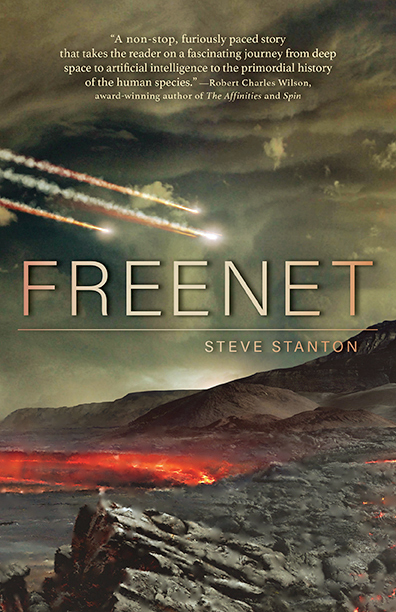
Steve Stanton’s 2016 science fiction book Freenet explores humanity in the far future after we have created the “Macpherson Doorway” through folded space-time, and vaulted ourselves with the blink of an eye into a galaxy far far away and 12 million years into the future. No traffic back through the doorway is permitted since a quarantine was placed some dozen years ago to prevent any unwanted DNA from sneaking through from Earth to “New Jerusalem”.
As the Canadian back book jacket reveals, Freenet is a novel about the “power of [free] information…in a post-digital age.” The book explores what digital immortality means, when “consciousness has been digitized and cybersouls uploaded to a near-omniscient data-matrix.” This is a world where information “is currency and the truth belongs to whoever has the greatest bandwidth.”
Stanton shared with me that he was inspired to write the novel “from the simple observation of watching a woman lose her cellphone. Young people today are so tied to technology that they freak out when the strings are cut. In the future when life experience is delivered directly to the brain by wi-fi, the personal loss will be catastrophic.”
Nina Munteanu reading her advanced copy of Freenet
Told in three parts, the book begins with Simara Ying—a plugged-in V-net jockey and spacer—about to crash-land on the desert planet Bali. Her rescuer, a naïve—almost too nice to be true—native, Zen Valda, introduces her to his cave-dwelling culture with no social network support. The persistent electromagnetic storms of Bali interfere with digital communication and wipe all data. Like a baby removed from her comfortable womb, Simara survives panic attacks and heavy withdrawal chiefly because she is bombarded so heavily with Bali experiences that demand her attention. Lost without the support of her V-net—a comforting web of infinite communication and information—Simara struggles with Bali’s foreign ways. At every turn, she stumbles across some custom or taboo, forced to rely on her own wits; making the kind of mistakes she’s not used to making. More than a simple communication/information tool, the V-net embraces Simara with confidence. Without it, she fears she may go insane.
Intrigue arrives on Bali and chases Simara with a bounty on her head for murder. Zen demonstrates a simple faith in her innocence and helps her escape. Zen accepts a cochlear installation to connect him to the V-net, thinking it will help him better communicate with Simara, who—already somewhat distant—is even more so now that she has reunited with the V-net. The V-net instead overwhelms him with a surging sea of irrelevant chatter and information, which threatens to drive him insane. Struggling with chaotic information overload, he remains with Simara, even after she estranges herself from him and is captured for murder. They escape and survive an arranged “accident” by literally jumping into space from an abandoned troopship about to crash.
Canadian book cover for Freenet
The story deepens into nuanced commentary in the last third of the book when Roni Hendrik, an energetic V-net anchorman of the Daily Buzz, pokes into the intrigue surrounding Simara Ying. He discovers that she is biogenic, an omnidroid—bioengineered from human DNA—and likely smuggled from Earth.
Omnidroids share a major cerebral augmentation that includes unlimited access to the V-net, higher intelligence and an unknown possibility of enhancements, including pre-cognition and telepathy across vast distances. Created as effective firewalls and filters, omnidroids streamline all V-net data for users across the galaxy. “Omnidroids [are] born into zero-day digital space and live in a fantasyland far beyond the mortal sphere of intelligence,” Henrik reflects, sensing a deeper story than a simple murder conspiracy. “Physical experience and bodily sensation [are] only tiny fragments of their transcendent existence, mundane accessories to digital infinity. In time,” Henrik concludes, “life itself might become a vestigial appendage.”
Hendrik, a humanist and closet idealist, pieces together connections with Neurozonics a New Jerusalem private corporation, responsible for the creation of biogenic humans. With holdings in a vast range of areas and an streaming amoeba of interests, Neurozonics is “a grinning spider on a translucent web of intrigue.” One discovery leads Henrik to more. He learns that the omnidroid community, to which Simara belongs, acts and communicates like a hive-mind, guided by a collective voice called “Mothership”. Other omnidroids have been targeted for elimination—and killed. Hell-bent on getting answers, Henrik confronts the owner of Neurozonics, Colin Macpherson—the same Macpherson who created the wormhole. Macpherson was uploaded earlier and runs his empire from digital space, part of the consortium of eternal intellect. Henrik’s meeting with Colin8 (the seventh clone of the original Colin Macpherson) runs like a “Neo-Architect” lecture in which the truth behind the omnidroids deaths is revealed. It’s not what you might think. Macpherson divulges his vision, which includes the reason for omnidroids’ communication abilities and the role of the Neurozonic brain. The ultimate meaning and use of the omnidroid freenet ties to a greater destiny that redefines what it is to be human and subverts the history of our primordial origins.
The story flows seamlessly from one perspective to another with crisp page-turning narrative, action and intrigue. Stanton trades some richness of character for a page-turning plot and clever dialogue. If there is a weakness in the narrative for me, it lies with Simara, the arcane omnidroid, who remains mysterious—from her introduction aboard her ship about to crash land, to the limited revelations of her character during her interactions with Zen, both in her POV and in his. Considering her unique characteristics and experiences as an omnidroid, I would have enjoyed more insight to her unique outlook and perspective, especially when faced with no social network—perhaps the most frightening experience for an omnidroid: to be disconnected from the hive. On the other hand, Zen Valda as the simple Bali boy on an insane rollercoaster ride is painted with a sensitive and graceful hand. Stanton also skillfully portrays his news team, Roni and Gladyz, with finesse and subtly clever notes. The dialogue and overall interactions between them is some of the most enjoyable of the novel.
Ultimately, Stanton’s Freenet flows like a fresh turbulent river, scouring and building up sediment then meandering like an oxbow into areas that surprise. He lulls you into expectation, based on your own vision of the digital world, then—like a bubble bursting—releases a quantum paradox of wormhole possibility.
“Ma, can you read the part where the cat omnidroid takes over the world?”
Nina Munteanu is a Canadian ecologist / limnologist and novelist. She is co-editor of Europa SF and currently teaches writing courses at George Brown College and the University of Toronto. Visit www.ninamunteanu.ca for the latest on her books. Nina’s bilingual “La natura dell’acqua / The Way of Water” was published by Mincione Edizioni in Rome. Her non-fiction book “Water Is…” by Pixl Press (Vancouver) was selected by Margaret Atwood in the New York Times ‘Year in Reading’ and was chosen as the 2017 Summer Read by Water Canada. Her novel “A Diary in the Age of Water” was released by Inanna Publications (Toronto) in June 2020.






























 Nina Munteanu Writing Coach