Women Heroes in Literature, Movies and Pop Culture

rita vrataski-3

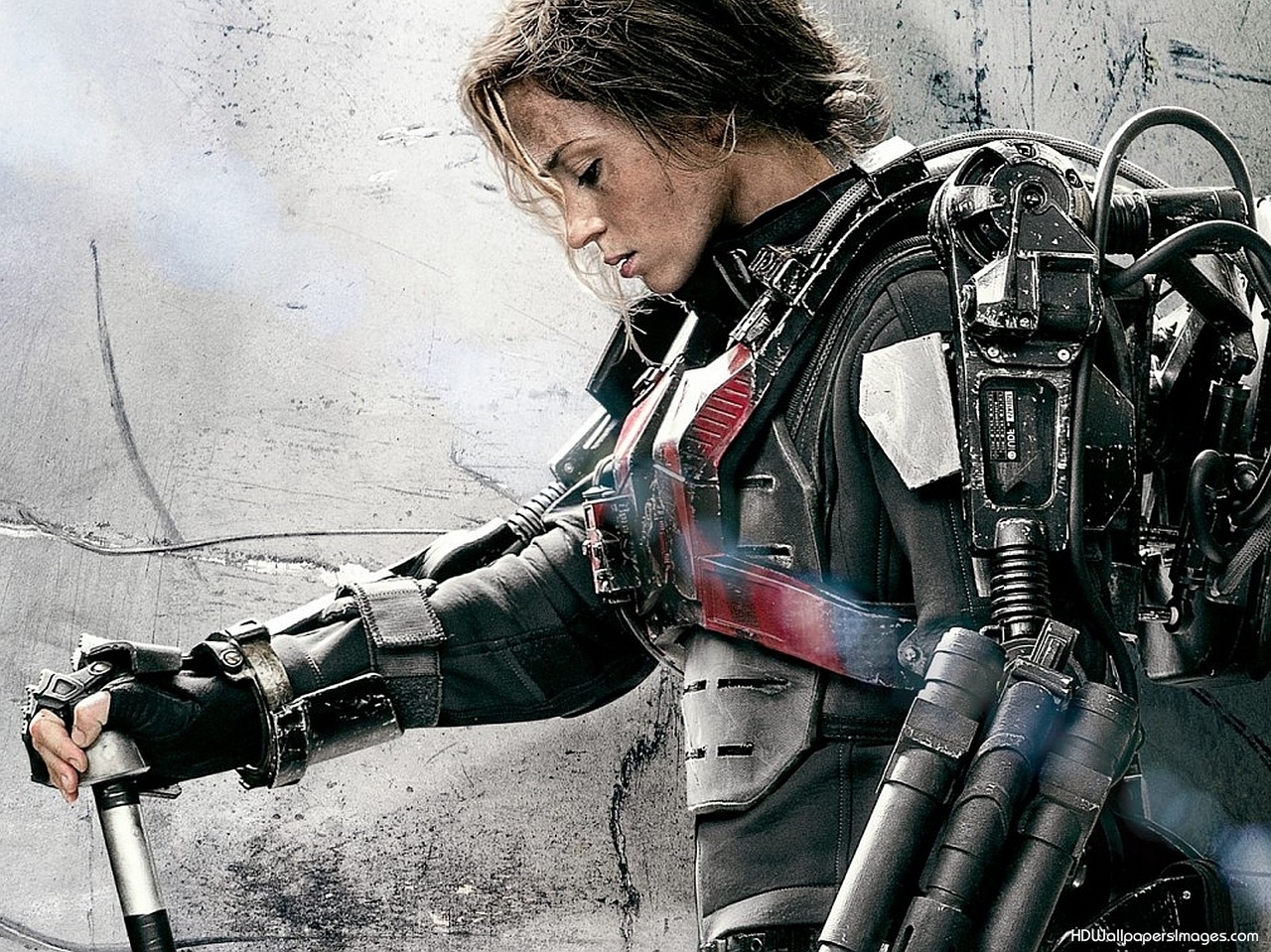
Rita Vrataski (Emily Blunt) fights a war against aliens

Some time ago on my birthday, I watched the popular — and somewhat controversial — Hunger Games. Well, controversial among some critics and followers of critics, anyway. I came across a particularly juicy article by critic Jeffrey Wells on Hollywood Elsewhere, in which he attributed the movie’s success to “reviews by certain female critics” who are “susceptible to the lore of this young-female-adult-propelled franchise.”

Whether this was true or not — and I highly doubt this — it brings up another stirring question: that of gender-bias. Is it truly still hard for a man like Wells to accept and enjoy a story which feature’s a female heroine?  Is it so hard to see a woman as a person first: championing a cause, delivering a world from evil and injustice, overcoming a great obstacle to become enlightened?

I think of my favorite stories in literature, peopled by men and women; all heroes: Tess of the d’Urbervilles, Fahrenheit 451, King Lear, Solaris, The Grapes of Wrath, 1984, Doctor Zhivago, Brave New World, Martian Chronicles, and To Kill a Mockingbird — to name just a few. The gender of the hero I empathized with was irrelevant. What remained important was their sensibilities and their actions.

Katniss fights the system in Hunger Games

Katniss fights the system in Hunger Games

It got me thinking … What does it take to be a hero—a female hero— particularly? And does there need to be a difference? The tweets and FB-talk and Internet buzz imply that male heroes differ from female heroes; they embrace differing quests and archetypal roles and reflect different qualities. In his 2013 web-article “Saving Science Fiction From Strong Female Characters” SF author John C. Wright attempted to elucidate a more realistic portrayal of women heroes in science fiction. Unfortunately, the article relied heavily on well-established androcratic stereotypes.

The male hero stereotype in literature and films of western culture—and science fiction particularly—is often characterized by strength, courage, integrity & honor, intelligence, assertiveness, single-mindedness, faith in his quest, and boundless determination: he is the altruist warrior, often acting alone against an unfair society through his conscience. All traits honored, respected and esteemed in men. In a woman, these Boadicean qualities often qualify her as “a bitch” or a “tomboy”. She may be considered unwomanly, unlady-like, intimidating, and with lesbian tendencies. Not the sort of girl you would take home to Mummy. The exciting Becky Sharp to the prosaic but sweet Amelia. And God forbid that she is more intelligent than her male counterpart!

Kara Thrace (Starbuck) fights Cylons in Battlestar Galactica

Kara Thrace (Starbuck) fights Cylons in Battlestar Galactica

For a woman to qualify as “hero” then, must she shed her feminine qualities of compassion, kindness, tenderness, and nurturing, to express those hero-defining qualities that are typically considered “male” to become less than either? Goddess untouchable? Women deserve better than that in literature and other story media.  I have seen too many 2-dimensional female characters limited by their own stereotype in the science fiction genre—particularly in the adventure/thriller sub-genre. If they aren’t untouchable goddesses or “witches” in a gynocratic paradigm (woman-dominating), they are often delegated to the role of enabling the “real hero” on his journey through their belief in him: as Trinity enables Neo; Hermione enables Harry; Mary Jane enables Spiderman; Lois enables Superman; etc. etc. etc.

aeryn sun gun

Aeryn Sun (Claudia Black) fights “humans” in Farscape

In an opinion piece in The Detroit News, Tom Long tells us that the women in top hero-style movies have usually been and still are portrayed in “romantic, sidekick or comedic roles. Often they’re waiting to be rescued (think Princess Leia). And some of them are part of action ensembles [think X-men].” Token figures to provide added “spice”, edge and diversity. This is, according to Gitesh Pandya, editor of a box office analyst site, because female-driven action movies have a hard time selling. “Most of the action films that have become huge hits are either male-driven or ensemble.” Pandya goes on to suggest that this is because more tickets are purchased by men than by women. “The film industry has been male-dominated for so long, the people who are creating and financing these films typically put men in there as heroes.” And yet women read far more fiction than men (by a 4:1 ratio according to some sources). We are in dire need of balance and we hunger for a female hero.

Lucy: victim, predator or neither?

Lucy: victim, predator or neither?

“What does it mean for our nation or our world if we treat [women] by a different script? What are we clinging to when we cling to that script that women need men’s protection?” said Ann Folino White, assistant professor at Michigan State University. She does well to call it a script when the storytellers of a culture define our humanity: who and what we are, our values and what we strive to be. Storytellers are the shamans of our culture and our time. We are the visionaries of our future.

The recent SF action film Edge of Tomorrow provided a refreshing kind of woman hero; Rita Vrataski (Emily Blunt) is equal—in fact superior—to her male protagonist, William Cage (played by Tom Cruise) in skill, intelligence and heroic stature. What I mean by heroic stature is that her heroic journey of transformation does not play subservient to her male counterpart’s journey.

trinity-syndromeIn so many androcratic storylines, the female—no matter how complex, interesting and tough she starts out being—must demure to the male lead; as if only by bowing down to his superior abilities can she help ensure his heroic stature. Returning us right back to the cliché role of the woman supporting the leading man to complete his hero’s journey. And this often means serving as the prize for his chivalry. We see this in so many action thrillers and action adventures today: Valka in How to Train Your Dragon, Wyldstyle in The Lego Movie, Neytiri in Avatar, Trinity in The Matrix, and so many more. There’s even a name for it: the Trinity Syndrome.

Tasha Robinson writes in her excellent article entitled, We’re losing all our Strong Female Characters to Trinity Syndrome: “The idea of the Strong Female Character—someone with her own identity, agenda, and story purpose—has thoroughly pervaded the conversation about what’s wrong with the way women are often perceived and portrayed today, in comics, video-games, and film especially…it’s still rare to see films in the mainstream action/horror/science-fiction/fantasy realm introduce women with any kind of meaningful strength, or women who go past a few simple stereotypes.”
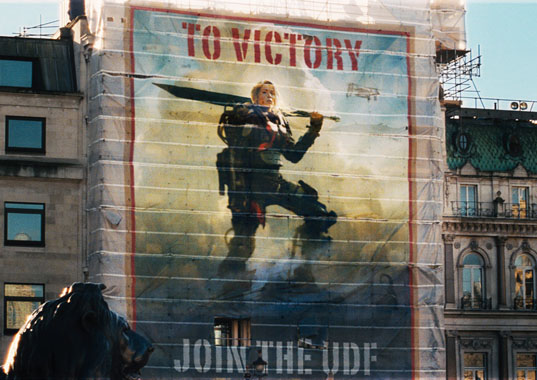
edge-of-tomorrow-emily-blunt-victory

Rita Vrataski poster girl for the war

I give Edge of Tomorrow full marks for not doing this. For example, after Cage makes his case to his Squadron to go on a mission, they remain reluctant until Vrataski emerges. “I don’t expect you to follow me,” says Cage. “I do expect you to follow her.” The Angel of Verdun—or better yet, the badass Full Metal Bitch.

When a female lead is stronger than the male protagonist, some reviewers (OK—male reviewers) categorize that movie as a “woman’s story”. I’ve been told by some of my male friends that they couldn’t possibly empathize with such a character—mainly because she is a woman and she is stronger than the male lead that “they want to be”.  It would appear that men are less willing to empathize with a woman character than a woman is willing to empathize with a male character; something in itself interesting. Invariably, in many of these “goddess” stories, the male counterpart is so much “milk-toast” compared to that awesome female-warrior. And have you ever noticed that, while the male hero gets the girl, the female hero usually ends up alone? Great examples include: Buffy the Vampire Slayer; Xena: Warrior Princess; Sarah in The Terminator and of course Vasquez in Aliens. These women are amazons; they stand apart, goddess-like, unrelenting, unflinching—untouchable. It’s actually no wonder that my ex-husband dislikes Sigourney Weaver to this day—she could crush him underfoot and eat him for breakfast at a moment’s notice. And probably would!

In a superb article in NewStatesman entitled I hate Strong Female Characters, Sophia McDougall says:Divergent
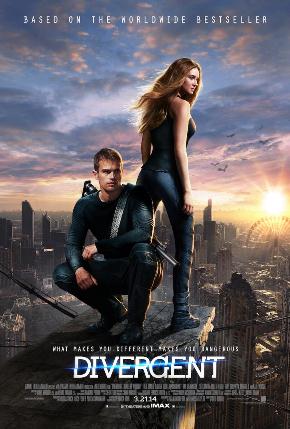
“…I want to point out two things that Richard II has, that Bond and Captain America and Batman also have, that Peggy (Carter of Captain America), however strong she is, cannot attain. They are very simple things, even more fundamental than “agency”

  • Richard has the spotlight. However weak or distressed or passive he may be, he’s the main goddamn character

  • Richard has a huge range of other characters of his own gender around him, so that he never has to act as any kind of ambassador or representative for maleness. Even dethroned and imprisoned, he is free to be uniquely himself. On the posters [women are] posed way in the back of the shot behind the men, in the trailers they may pout or smile or kick things, but they remain silent. Their strength lets them, briefly, dominate bystanders but never dominate the plot. It’s an anodyne, a sop, a Trojan Horse – it’s there to distract and confuse you, so you forget to ask for more.”

There is another type of female hero. She is equal to her male counterpart. Her story is not secondary to his story; her heroic status and hero’s journey is equal to his and not because he’s been reduced to a lesser character, diminished by her or overshadowed by her; in fact they may share the same journey. Examples include: Bonnie and Clyde; Peter Chang’s Aeon Flux; Aeryn Sun and John Crichton in Farscape; Starbuck and Apollo in Battlestar Galactica…And now Vrataski and Cage in Edge of Tomorrow.
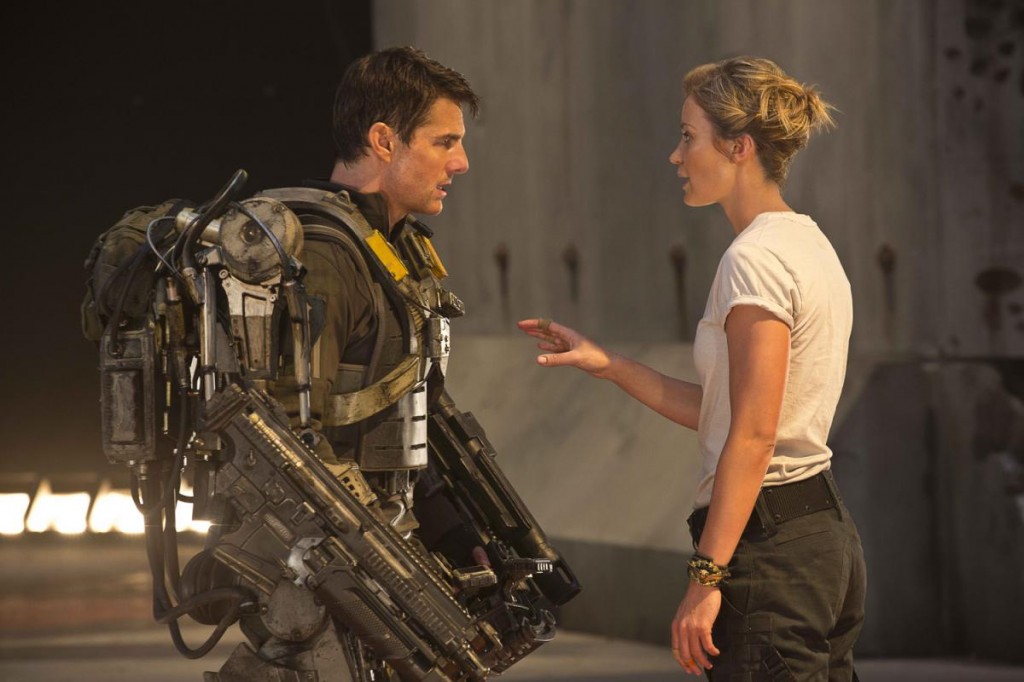
rita vrataski-cage

Cage and Vrataski discuss strategy

As with the above examples, Vrataski and Cage in Edge of Tomorrow form a team, in which together they are more than the sum of their parts. A marriage of independent autopoiesis, combining skills, abilities and vision. This is also why, in my opinion, the ending of Edge of Tomorrow is totally appropriate: not because it’s “the happy ending”; but because it carries the message of enduring collaboration of equals in a gylanic society.

So, in the end, I do agree with John C. Wright that science fiction requires whole female characters, but not for the reasons he gives.

The gylanic hero is emerging in science fiction and action-thrillers, one who will teach us more about what humanity needs now more than ever: the heroic gifts of altruism, compassion, faith, courage, passion, and endurance. She is already there, in movies and TV shows like Lucy, Edge of Tomorrow, Hunger Games, Divergence, Orphan Black, FarscapeBattlestar Galactica: fighting the dragons of prejudice, ignorance, cruelty, greed and intolerance–in partnership with her male counterpart.

image15

Aeryn Sun and John Crichton collaborate in Farscape

A list of SF books with whole and relevant female heroes–gylanic heroes– follows below. There are many more. I’ve listed these because they are ones I enjoyed and know, several being my own. Please add yours:

GYLANIC HEROES

  • The Hunger Games by Suzanne Collins (Scholastic Press). 2008. A series of books about teens forced to fight to the death on television.
  • The Steel Seraglio by Mike Carey, Linda Carey, Louise Carey and Nimit Malavia (Chizine Publications). 2012. A novel about the women of a harem in an ancient Middle Eastern kingdom, who forge themselves into an army after they’re exiled from the city of their birth — and then return to claim the city for themselves.
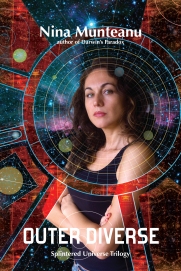
  • Front Cover ONLY-webThe Splintered Universe Trilogy by Nina Munteanu (Starfire). 2011-2014. This trilogy, starting with Outer Diverse, follows the quest of Galactic Guardian Rhea Hawke, a wounded hero who must solve the massacre of a spiritual sect that takes her on her own metaphoric journey of self-discovery to realize power in compassion and forgiveness.
  • Divergent by Veronica Roth (Katherine Tegen Books) 2012. a young girl overcomes her assigned caste in a dystopian Chicago to realize her true self-identity, revealed to be dangerous to the very existence of her ordered society
  • Cordelia’s Honor by Lois McMaster Bujold (Baen). 1999. A woman’s journey through deception and betrayal to find honour.
  • Contact by Carl Sagan (Simon and Schuster) 1985. A woman’s quest into the unknown for benevolent intelligence in the universe.
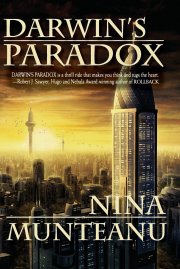
  • Darwins Paradox-2nd coverDarwin’s Paradox by Nina Munteanu (Dragon Moon Press). 2007. An eco-thriller about a woman unjustly exiled for murder and her quest for justice in a world ruled by technology and scientists.
  • Beggars in Spain by Nancy Kress (Harper Collins). 1993. A story that examines social consequences to transhumanist generic engineering.
  • His Dark Materials Trilogy by Philip Pullman (Laurel Leaf). 2003. A fantasy alternate world adventure about a young girl who discovers that the fate of the universe lies in her hands.
  • A Handmaid’s Tale by Margaret Atwood (Anchor). 1998. A chilling fable of the near future, about a monotheocratic government where women are strictly controlled and assigned roles.
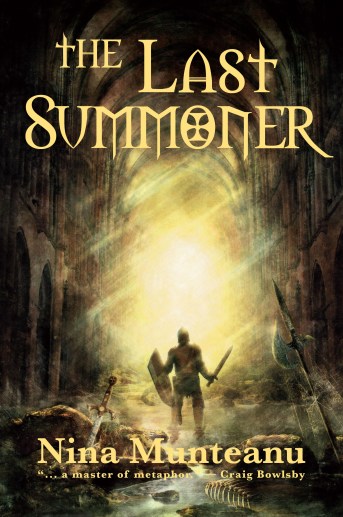
  • Cover1_LastSummoner-frontcoverThe Last Summoner by Nina Munteanu (Starfire). 2012. A young baroness discovers that her strange powers enable her to change history … but at a cost. Vivianne begins her journey in the year 1410, on the eve of a great battle. She dreams of her Ritter (knight), who will save her from her ill-fated marriage and the strange events that follow. But early on, she realizes that she is the Ritter she keeps dreaming about. She must save herself and her world.

Other Relevant Articles of Interest from The Alien Next Door:

Gylany: a social system based on equality of men and women

Androcracy: a form of governing system in which rulers are male

Riane Eisler (in The Chalice and the Blade) provides examples of sociobiologists who draw on nineteenth-century Darwinism by citing Edge-of-Tomorrow-emily bluntinsect societies to support their androcratic (social and political rule by men) theories. If humanity is to truly rise victorious over the scourge of climate change—a function of our current lifestyle and paradigms—we will need to adopt a cultural evolution that embraces a partnership society heralded by new and renewed symbology, language and “myth”: It starts with embracing gylanic heroes in literature and movies. Watching them, reading about them, writing and sharing these stories for the future they speak to.

Nina Munteanu is an ecologist and internationally published author of award-nominated speculative novels, short stories and non-fiction. She is co-editor of Europa SF and currently teaches writing courses at George Brown College and the University of Toronto. Visit www.ninamunteanu.ca for the latest on her books.

The Power of Myth in Storytelling

If a being from another world were to ask you, ‘How can I learn what it’s like to be human?’ a good answer would be, ‘Study mythology.’ ”—Joseph Campbell

GiantCedars boardwalk2

Boardwalk in Giant Cedar forest, Mount Revelstoke Park, BC (photo by Nina Munteanu)

For Joseph Campbell, perhaps our era’s most influential student of mythology, myths express our basic need to explain, celebrate and immortalize the essence of life. Given that life itself has no “meaning”—it simply is—it is our stories (pulled from the ethers of our “muse”) that give meaning to life. We tell stories about how the world began, our struggles to survive, our victories against greed and evil. Each culture clothes its stories according to the place and time and associated issues. And each defines its heroes and villains accordingly. At the root of all these lies a universal and timeless human experience; where metaphor and imagery of myth transcend culture, time and place to encompass all of humanity and our striving journey toward truth, grace and peace. This is why all myth, from Plutarch’s Theseus & the Minotaur to George Lucus’s Star Wars, resonates with us, regardless of whether it was created yesterday or thousands of years ago.

Greek, Roman, Norse, African and Asian myths all address fundamental questions about our humanity: the fall of Icarus, Jason and the Argonauts, Romulus and Remus, Oedipus, Medusa, Perseus, King Arthur, Oedisseus, Vassilisa, Siegfried and the Nibelungenleid, Beowulf and Grendel, Jonah and the whale, Isolde and Tristan, Persephone and the underworld, Orpheus and Eurydice, Hercules, Osiris, Gilgamesh … the list is endless.

Artist as Mythmaker … and Shaman

Cedar roots

Cedar roots, Revelstoke Park (photo by Nina Munteanu)

“There’s an old romantic idea in German, das Volk dichtet, which says that the ideas and poetry of the traditional cultures come out of the folk. They do not,” says Campbell. “They come out of an elite experience, the experience of people particularly gifted, whose ears are open to the song of the universe.” He is referring to the artist, who speaks to “the folk”, who answer and create an interaction. “The first impulse in the shaping of the folk tradition,” says Campbell, “comes from above, not from below.” He is referring to the divine source, the muse, the gift of “seeing” bestowed on those willing to open themselves to it. According to Campbell, “The function of the artist is the mythologization of the environment and the world.” Like the shamans of ancient times, the storyteller— whether painter, writer, actor, singer or filmmaker— interprets the divinity in nature for others. We interpret unseen things for a tangible world.

Artists are the mythmakers — the shamans — of today. The ancient shaman’s authority came from individual psychological experience, not a social ordination (like a priest). A shaman’s powers were symbolized through her own familiars and the deities of her own personal experience. Her personal truth. As artists we wholly participate in our “landscape”. Like Dante, we journey to the depths of our world, become its deepest truths to emerge later and share.

The Mythic Hero’s Journey in Story

Nina-giant cedar03

Nina in bliss with giant cedar, Revelstoke Park, BC (photo by Anne Voute)

In my opinion, the best stories follow the mythic hero’s journey plot structure. This is because “hero’s journey” stories are transformative for not only the protagonist (our hero) but for readers following along and identifying with her. Stories that pull a reader through the three steps of a human being’s evolution (separation, transformation, and return) promise great depth and fulfillment. This is what great storytelling does: they take us on a transformative journey of learning, through challenges of change to realize a prevailing victory. Writers are the shamans of today and the heroes we write about are our agents of change. Through our artistic drama of metaphor, we make commentary on the world and what it means to be human.

The hero archetype is particularly interesting, given that he or she is essentially us as we journey to prevail over the obstacles of our fears, weaknesses, and disappointments. Every hero is on a quest or mission (whether she realizes it or not). The true mark of a hero is in her willingness to sacrifice something of value, perhaps even her life, on behalf of an ideal or a group and ultimately for the greater good. A hero is the ultimate altruist. And she is you, the artist.

The Power of Mythologist

tall cedar-moss

Moss-covered cedar, Revelstoke (photo by Nina Munteanu)

I recall a discussion with a young friend some time ago about her knowledge of writers vs. book titles (she knew few names of writers, even those whose works she had enjoyed, but could happily recite book titles). I realized that she chose her books based on their cover and the “promised story” within—with no attention placed on the author and no intention of following that author’s other works.

I found that focus limiting; not just because I was an author myself, but because my young friend had made the choice not to connect with the artist and his or her inherent worldview. Not acknowledging the artist is to ignore that artist’s “voice” and their subtle but deep “sharing”.

“When you find an author who really grabs you, read everything s/he has done,” says Campbell. “Don’t say, ‘oh, I want to know what so-and-so did’—and don’t read the best-seller list. Just read what this one author has given you … the world opens up in a way that is consistent with a certain point of view … When you go from one author to another, you may be able to tell us the date when each wrote such and such —but he hasn’t said anything to you.”

Related Posts:


Nina Munteanu is an ecologist and internationally published author of award-nominated speculative novels, short stories and non-fiction. She is co-editor of Europa SF and currently teaches writing courses at George Brown College and the University of Toronto. Visit www.ninamunteanu.ca for the latest on her books.

How Are You Telling Your Story?…Part 2: Voice and Narration

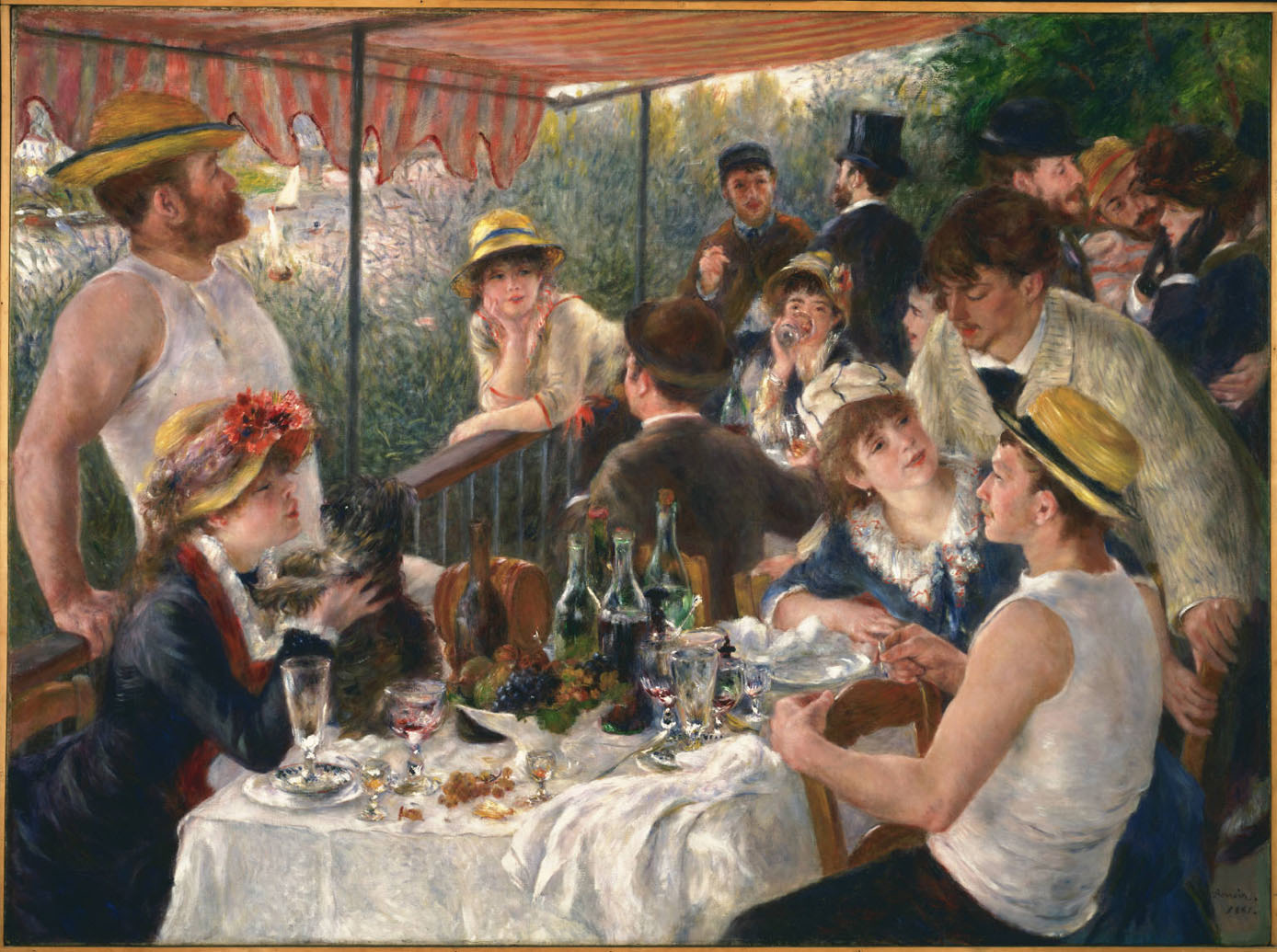
renoir-tableThe term “Voice” describes various aspects of a writer’s expression in story; it includes your unique writing style and the style you’ve chosen to adopt for the particular story you’re telling. The voice of your story is influenced by your audience—youth, adults, crazy people, etc.—as well as the subject matter and general overall theme of the story.

Voice is the feel and tone that applies to: 1) the story or book (narrative voice); 2) to each character in that story; and 3) the author’s own voice (authorial voice; in business it’s called the brand), which you carry with you in every work. It is the combination of all these “voices” that make each of your works unique. Think of a fine artist, a painter like Vincent Van Gogh, whose unique painter’s “voice” was apparent in all his Impressionistic works. The wild swirls of light and texture characterized all his paintings; yet, each individual work expressed its own unique message in Van Gogh’s artistic journey.


Authorial Voice

You express your authorial voice and the voice of your story through tone, perspective, style, language and pace. All of these reflect your intent and are ultimately expressed in the story’s overarching theme. The overarching theme is ultimately the author’s theme, the “world view” — the “so what part” — of the story. The principal character and minor characters will carry variations of the main theme, each with his or her unique voice. Invariably, the voice of the story reflects the author’s philosophy, biases and message.

Writers generally struggle in the beginning to obtain their unique “voice”, often adopting the voice of a writer they admire. Although this can help a writer define their own voice (by illuminating what they like and strive for), it can also retard an author’s unique self-expression. It is so much easier to use another’s proven formula; the danger is that you may never escape from beneath the shadow of your hero. In the area of science fiction, which I write, the internet is rich with “fan fic” (an endearing term for works based on already established stories, worlds, characters, and styles.) Many fan fic writers will not emerge from the shadow of unoriginality to find their own voice. So, take heed and be mindful of your own voice. Determine what is important to you and you will find your voice.


Narrative Voice

Narrative voice belongs to the persona telling the story. Which persona you adopt in narration depends on what kind of story you are telling, and the kind of emotional atmosphere you wish to achieve, says Crawford Kilian, Canadian author of over a dozen novels. The persona develops from the personality and attitude of the narrator, expressed through the narrator’s choice of words and depictions. Depending on your choice of POV (see my previous article on Viewpoint), the narrator of your story can be one or several main characters or you, the writer. More on this below.


Character Voice

It’s important to give each character a distinctive “voice” (including use of distinct vernacular, use of specific expressions or phrases, etc.). This is one way a reader can identify a character and find them likeable—or not.

In a manuscript I recently reviewed, I noticed that the characters spoke in a chaotic mixture of formal and casual speech. This confuses the reader and bumps them out of the story. Each person’s speech is typically consistent, reflecting their ethnic and regional background, who they hang around with, their education, history and biases. Consistency is critical; it helps readers identify with a character. They will abandon a story whose writing—and voice—is not consistent. So, my advice to this beginning writer was to pick one style for each character and stick to it.

Voice incorporates language (both speech and body movements), philosophy, and humor. How a character looks, walks, talks, laughs, is all part of this. Let’s take laughter for instance: does your character tend to giggle, titter, chortle, guffaw, belly-laugh? Does she usually put her hand over her mouth when she does? Does she do or say certain things when she’s nervous? See my upcoming article on body language for more detail.


Who Should Tell the Story?

When telling a story through the eyes of a single viewpoint character, it makes most sense to tell it through the main character, the protagonist, around whom the story usually revolves. She is the one who’s going to be chiefly affected by the events of the story. Ansen Dibell, author of The Elements of Fiction: Plot, asks the question: “Who is really at the story’s heart?” If you’re having trouble with the story of Sally and Norman from Sally’s point of view, perhaps you should try telling it through Norman’s point of view. Or perhaps your main POV character is a third person, looking on and, in turn, changed.

Narrating a story from an outsider’s viewpoint (the hidden protagonist as observer-narrator) —sometimes called displaced narrative — can also add an element of complexity and depth to a story. The Illusionist is a good example of this. This story, about Eisenheim (the Illusionist) and his beloved, is told through the cynical eyes of the city’s chief inspector, who learns to believe again through his “experience” of their story. Other examples include J.P. Hartley’s The Go-Between, Scott Fitzgerald’s The Great Gatsby, Saving Private Ryan, My Beloved, Charlotte Bronte’s Wuthering Heights, and Joanne Harris’s Chocolat.

Using a displaced viewpoint character to narrate a story works particularly well if you want to keep your main character strange and mysterious. Having an “outside” character tell the story of one or two other characters, also gives the writer a chance to add another thematic element to a story (the one belonging to the narrator). A story told through the eyes of a dreamer will be very different than one told by a ponderous thinker.

Other kinds of narration include:

  • detached autobiography (narrator looks back on long-past events; e.g., To Kill a Mockingbird by Harper Lee)
  • letters or diary (narrative told through letters, also known as the epistolary novel; e.g. my short story, Arc of Time)
  • interior monologue (narrator recounts the story as a memory; stream of consciousness is an extreme form of this narrative, e.g., Ulysses by James Joyce)


How Many Should Tell the Story?

The use of multiple viewpoints is common among writers and adds an element of richness and breadth to a story. With each added character’s POV, readers are more enlightened to the thoughts and motivations of characters in a story. When you have several characters telling the story, this is called a rotating viewpoint. A few points to follow include:

  • Alternate or rotate your differing viewpoints clearly (scene by scene, chapter by chapter, or part by part)
  • Don’t change viewpoints within a scene
  • Separate different POV scenes within chapters with extra white space or some kind of graphic (e.g., ****)
Boat-DesolationSound

Desolation Sound, BC coast (photo by Nina Munteanu)


References

Dibell, Ansen. 1999. Elements of Fiction Writing: Plot. Writer’s Digest Books. Cincinnati, Ohio. 170pp.

Killian, Crawford. 2003. “Narrative Voice”. In: Writing Fiction: http://crofsblogs.typepad.com/fiction/2003/07/narrative_ voice.html

Morrell, David. 2000. “First Blood, Third Person”. In: Fiction Writer. April, 2000.

Munteanu, Nina. 2009. The Fiction Writer: Get Published, Write Now! Starfire World Syndicate. Louisville, KY. 266pp.

Nina Munteanu is an ecologist and internationally published author of award-nominated speculative novels, short stories and non-fiction. She is co-editor of Europa SF and currently teaches writing courses at George Brown College and the University of Toronto. Visit www.ninamunteanu.ca for the latest on her books.

How Are You Telling Your Story?…Part 1: Viewpoint

renoir-girls-drawingThe story’s viewpoint can be told from several perspectives and which one you choose can be critical to how your story comes across.

Different stories lend themselves to different narrative styles and point of views (POVs). In his April 2000 article in Fiction Writer entitled “First Blood, Third Person” David Morrell warns that some writers may “select a viewpoint merely because it feels natural, but if you…don’t consider the implications of your choice…your story might fight you until you abandon it, blaming the plot when actually the problem is how you’re telling it.”

The viewpoint choices include:

  • Omniscient
  • Third person limited
  • Second person
  • First person

Omniscient View

The omniscient view is the broadest view. Through this viewpoint the narrator describes everything and everyone and may drop into any character at any time, and — in the case of a beginning writer — all too confusingly in the same paragraph.

While this POV is the easiest one to use it is really the hardest to master. In the wrong hands, this viewpoint can be as intrusive as it is distancing. And it is prone to polemic. In the hands of a masterful writer, this viewpoint can make for the most powerful and rich storytelling. Epics of any kind, especially epic fantasies or historical epics, lend themselves to this style. The omniscient viewpoint is particularly suited to a story that is “large”, where ultimately the main character is not any particular protagonist but “the story” itself, or a society or world or time period. The writer must still somehow achieve connection and intimacy with the reader to succeed with this viewpoint. You can do this through lyrical and compelling narrative, poetic language and powerful imagery.

Limited Third Person Viewpoint

A story told through limited third person POV is narrated from one or a few key characters (though not at the same time) by revealing not only their movements but their thoughts and feelings (e.g., he struggled up to his feet, giddy with pain). When starting out, it is often best to adopt this style, which is generally more personal, appealing and least confusing. So long as you respect the readers’ need for clarity by keeping to one POV per scene, you can choose to enter into the heads of as many characters as you wish. It is the norm to use chapter, section or scene breaks when changing from one POV to another.

This style of narrative is the most common one used in contemporary books, particularly genre books, thrillers and action/adventure books. Through conflicting perspectives of your characters, you can swiftly paint a rich tapestry of tension for both characters and reader.

Second Person Viewpoint

This second person viewpoint (“you”) is not often used, mostly because it is both distancing and less easy to read. Although it is a narrative often used in conversation (e.g., “you never know what you’re gonna get with a box of chocolates, do you?”) this style of narrative is harder for readers to embrace and get close to the story’s characters. This viewpoint works effectively in certain artistic situations when you wish to purposefully impart a distance to the narrator, due to their own limitations, infirmity or situation.

First Person Viewpoint

The first person point of view is both the most limiting perspective (told only through one viewpoint) and most personal and revealing (of that viewpoint character). This viewpoint works well in literary fiction where the main character’s thoughts and issues are the key focus in the story. When the character who changes the most is the one telling the story, this makes for very compelling reading.

Many detective stories are told in first person to great effect. The reader is right there with the detective, solving the mystery. The first person viewpoint is also the preferred POV for memoirs, for obvious reasons.

One thing to keep in mind, particularly when narrating through the first person POV, is the reliability of your character. You need to decide how reliable your first person POV character is in telling the story and how you will impart this to the reader. Writing through a character’s faulty perception of the world (and of themselves) provides a writer with an incredible opportunity but also an incredible challenge. You can only go so far with an unreliable character before losing your own credibility as a writer — and losing the reader in the long run. Obviously, you need a balance.

If you are struggling with your story and can’t quite pinpoint what is bogging it down, try changing how you are telling it. Change the viewpoint and see what happens.

Boat-DesolationSound

Prideaux Haven in Desolation Sound, BC coast (photo by Nina Munteanu


Nina Munteanu is an ecologist and internationally published author of award-nominated speculative novels, short stories and non-fiction. She is co-editor of Europa SF and currently teaches writing courses at George Brown College and the University of Toronto. Visit www.ninamunteanu.ca for the latest on her books.



The Hero’s Journey: Part 3, Defining Your Hero


GiantCedars boardwalk2

Boardwalk in Giant Cedar park, Revelstoke Park, BC (photo by Nina Munteanu)

To write a truly compelling story is to resonate with the universal truths of metaphor within the consciousness of humanity. According to scholar and mythologist Joseph Campbell this involves an open mind and a certain amount of humility; and giving oneself to the story…not unlike the hero who gives her life to something larger than herself: “Anyone writing a creative work knows that you open, you yield yourself, and the book talks to you and builds itself….you become the carrier of something that is given to you from … the Muses—or God.”

This is no fancy, it is a fact. Since, as Campbell says “the inspiration comes from the unconscious, and since the unconscious minds of the people of any single small society have much in common, what the shaman or seer [or artist] brings forth is something that is waiting to be brought forth in everyone.” I call this tapping into the universal truth where metaphor lives. A story comes alive when these two resonate.

All stories contain common structural elements found universally in myths, fairy tales, dreams, and movies. As writers we are the creators of our culture’s current myths. These are best summarized under “the Hero’s Journey”, which is essentially the 3-act ancient Greek play, handed down to us thousands of years ago. The hero’s journey draws from the depth psychology of Swiss psychologist Carl Jung and Joseph Campbell. In his now classic book The Hero with a Thousand Faces, Campbell describes the hero’s journey as steps of the “rite of passage” of self-discovery and self-integration. To be a hero is to be on a journey home. The hero’s journey is the soul’s search for home, a journey of transformation we all take in some form.

Describing the Hero & Her Journey

Anne-walking-Cedars

Friend Anne walks among the giant cedars, Revelstoke Park, BC (photo by N. Munteanu)

The hero is the ultimate altruist, sacrificing her life for the greater good. She is warrior and lover who slays the dragon of the status quo, so to speak. She enacts the ultimate in sacrifice in her quest to change the world (and/or herself) for the better.

Christopher Vogler, author of The Writer’s Journey tells us that writers are storytellers who utilize the principles of myth to create masterful stories that entertain and resonate with our psyche: “The Hero’s Journey is not an invention, but an observation. It is a recognition of a beautiful design, a set of principles that govern the conduct of life and the world of storytelling the way physics and chemistry govern the physical world… The Hero’s Journey is a pattern that seems to extend in many dimensions, describing more than one reality. It accurately describes, among other things, the process of making a journey, the necessary working parts of a story, the joys and despairs of being a writer, and the passage of a soul through life.”

In my opinion, the best stories follow the hero’s journey plot structure. This is because “hero’s journey” stories are transformative for not only the protagonist (our hero) but for readers following along and identifying with her. Stories that pull a reader through the three steps of a human being’s evolution (separation, transformation, and return) promise great depth and fulfillment. This is what great storytelling does: they take us on a transformative journey of learning, through challenges of change to realize a prevailing victory. Writers are the shamans of today and the heroes we write about are our agents of change. Through our artistic drama of metaphor, we make commentary on the world and what it means to be human.

The hero archetype is particularly interesting, given that he or she is essentially us as we journey to prevail over the obstacles of our fears, weaknesses, and disappointments. Every hero is on a quest or mission (whether she realizes it or not). The true mark of a hero is in her willingness to sacrifice something of value, perhaps even her life, on behalf of an ideal or a group and ultimately for the greater good. A hero is the ultimate altruist.

In some versions of The Holy Grail the hero reaches a huge chasm with no apparent way to get across the Grail castle. The space is too great for him to jump. Then he remembers how Grail teaching instructs him to step out in faith. As he puts one foot out into the abyss, a bridge magically appears and he is saved.  Of course, this is all metaphor. Anyone who has left a job, school or a relationship, or fallen in love, has stepped out into that abyss, separating them from the familiar world they’ve know.  The journey and the abyss is often not a physical but a spiritual adventure, as our hero transforms from ignorance and innocence toward experience and enlightenment.  In the end, our hero returns with a gift to the world.

Kinds of Heroes

DevilsClub Hemlock-CedarGrove

Devil’s club, Revelstoke Park (photo by Nina Munteanu)

Heroes may be willing or unwilling. Some can be downright unheroic to begin with. We call them anti-heroes. Anti-heroes are notably flawed characters who must grow significantly to achieve the status of true hero. Often the anti-hero starts off more like a villain, like the character Crais in Farscape or Tom Cruise’s character in Rain Man. The wounded anti-hero may be a heroic knight in tarnished armor, “a loner who has rejected society or been rejected by it,” according to Vogler. Examples include Jim Stark in Rebel Without a Cause and Aragorn in Lord of the Rings. The catalyst hero provides an exception to the rule of hero undergoing the most change. This type of hero shows less of a character arc but precipitates significant change or transformation in another protagonist (often the principal narrator). Examples include David Adams in Ben Bova’s Colony or The Illusionist of the same name. In both cases, the main protagonist (the one who changed the most) was another character, affected by the hero’s actions.

In Awakening the Heroes Within, Carol S. Pearson provides further categories for hero-archetypes, including: innocent, orphan, martyr, wanderer, warrior, caregiver, seeker, lover, destroyer, creator, ruler, magician, sage, and fool. As with Vogler’s archetypes, these aren’t necessarily fixed for an individual hero, who may embrace several of these archetypes during her transformation in response to events and ordeals set before her.

Pearson grouped these hero-archetypes according to stages of a hero’s journey and elements of his responding psyche. For instance, the Ego relates to the preparation for the journey and includes: Innocent; Orphan; Warrior; and Caregiver. The Soul (the unconsciousness) relates to the journey itself and includes: Seeker; Destroyer; and Lover. The Self (individuation) relates to the return from the journey and includes: Ruler; Magician; Sage; and Fool. A hero may use any of these archetypes at various times in her life, but she can also use all of them within a day or an hour.

The table below shows how Pearson breaks these down into six main archetypes with associated task, plot structure and hero’s “gift”.

A Hero’s Role & Gift

Archetype Task Plot Stucture Gift
Orphan Survive difficulty How she suffered & survived Resilience
Wanderer Find herself How she escaped & found her way Independence
Warrior Prove her worth How she achieved her goals Courage
Altruist Show generosity How she gave to others Compassion
Innocent Achieve happiness How she found the promised land Faith
Magician Transform herself How she changed the world power

References:

Campbell, Joseph. 1970. The Hero with a Thousand Faces. World Publishing Co. New York.
Henderson, Mary. 1997. Star Wars: The Magic of Myth. Bantam Spectra. New York. 214pp.
Pearson, Carol S. 1991. Awakening the Heroes Within. Harper. San Francisco.
Pearson, Carol S. 1998. The Hero Within: Six Archetypes We Live By. Harper. San Francisco. 3rd Edition.
Pearson, Ridley. 2007. “Getting Your Act(s) Together”. In: Writer’s Digest. April, 2007.
Vogler, Christopher. 1998. The Writer’s Journey: Mythic Structure for Writers. 2nd Edition. Michael Wiese Productions, Studio City, California. 326pp.

Previous Articles on The Hero’s Journey:

Part 1, The Hero & the Journey

Part 2, Heroes and other Archetypes

Edge-of-Tomorrow-emily blunt


Nina Munteanu is an ecologist and internationally published author of award-nominated speculative novels, short stories and non-fiction. She is co-editor of Europa SF and currently teaches writing courses at George Brown College and the University of Toronto. Visit www.ninamunteanu.ca for the latest on her books.
The Hero’s Journey: Part 2, Heroes and Other Archetypes

420px-Edmund_blair_leighton_accolade

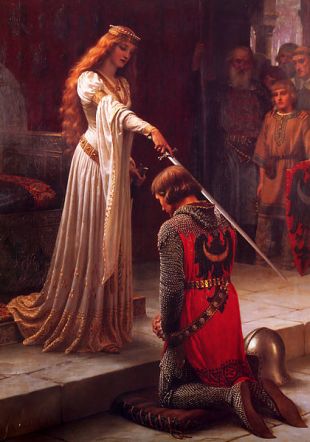
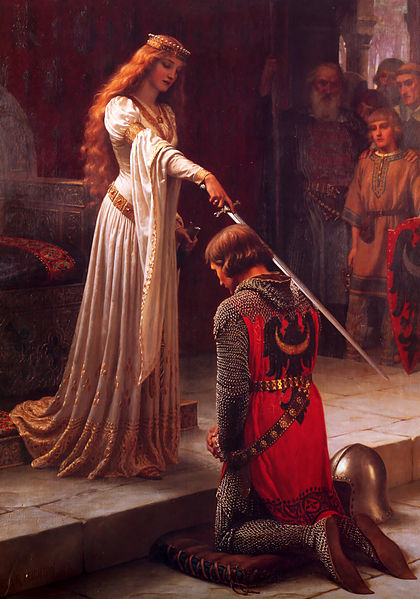
Accolade by Blair-Leighton

The world of fairy tales and myth is peopled with recurring character types and relationships. Heroes on a quest, heralds and wise old men or women who provide them with “gifts” or motive, shady fellow-travelers—threshold guardians—who “block” the quest, tricksters who confuse things and evil villains who simply want to destroy our hero and her quest.

Jung adopted the term archetypes, which means ancient patterns of personality shared by humanity, to describe these as a collective unconscious. An archetype models a personality or behavior; a mother-figure is an archetype. This is what makes archetypes, or symbols, so important to the storyteller. Archetypes are found in nearly all forms of literature, with their motifs mostly rooted in folklore.

Assigning an archetype to a character lets the writer clarify that character’s role in the story. Archetypes are an important tool in the universal language of storytelling, just as myth serves the overall purpose of supplying “the symbols that carry the human spirit forward.” (Joseph Campbell). Joseph Campbell went so far as to describe the archetype as something that is expressed biologically and is wired into every human being.

Christopher Vogler, author of The Writer’s Journey, lists the seven most useful archetypes for the writer.

The Hero

Anne-walking-Cedars

Friend Anne walks among giant cedars, Revelstoke, BC (photo by Nina Munteanu)

The hero sacrifices his own needs on behalf of others. He provides a character for us to identify with and is usually the principal POV character in a story, with qualities most readers can (or want to) identify with. The hero “transforms” through her journey as she encounters other archetypes on her journey, whether it is a physical journey or a psychological journey toward “home” (salvation or redemption) through sacrifice. The true mark of the hero, says Vogler, is in the act of sacrifice: “the hero’s willingness to give up something of value, perhaps even her own life, on behalf of an ideal or a group,” and ultimately for the greater good.

Heroes may be willing or unwilling. Anti-heroes are notably flawed characters that must grow significantly to achieve the status of true hero. Often the anti-hero starts off more like a villain, like Tom Cruise’s character in Rainman. The wounded anti-hero may be a “heroic knight in tarnished armor, a loner who has rejected society or been rejected by it,” says Vogler: Aragorn in Lord of the Rings. The catalyst hero shows less of a character arc, but precipitates significant change or transformation in other protagonists. A good example is David Adams, in Ben Bova’s Colony.

The Mentor

The mentor often possesses divine wisdom and has faith in the hero. He often gives the hero a “gift”, which is usually something important for the quest; either a weapon to destroy a “monster” or a “talisman” to enlighten the hero. A good example is in Star Wars, when Luke’s mentor, Obi Wan, provides him with his father’s lightsaber (Luke’s magic talisman).

The Herald

Heralds announce the coming of significant change, whether the hero likes it or not (and usually they don’t). They deliver the call to adventure. The herald is a catalyst that enters the story and makes it impossible for the hero to remain in status quo. Existing in the form of a person, an event, or just information, they shift the hero’s balance and change her world.

In Star Wars, Ben Kenobi issues the call when he invites Luke to join him on his mission to Alderaan. The herald also provides the hero with motivation. In Romancing the Stone, the herald for Joan Wilder comes to her as a treasure map in the mail, and a distressed phone call from her sister.

The Threshold Guardian

This archetype guards the threshold of “Separation from the Ordinary World” on the hero’s quest to achieve his destiny. Threshold guardians spice up the story by providing obstacles the hero must overcome. Threshold guardians are usually not the main antagonist. In the Harry Potter series, this role is fulfilled by Malfoy, Snape or Filch, even. They help round-out the hero’s journey and develop his character arc. The threshold guardian can be a “friend” who doesn’t believe in the hero or her quest. Ultimately, this is the role of the threshold guardian: to test the hero’s resolve in her quest.

The Shape shifter

The shape shifter adds dramatic tension to the story and provides the hero with a puzzle to solve. They can seem one thing and in fact be another. They bring doubt and suspense to the story and test the hero’s abilities to discern her path. Yoda in Star Wars is a bit of a shape shifter, initially masking his ancient wisdom with a foolish childlike appearance when Luke first encounters him.

The Shadow

The monster under the bed, repressed feelings, deep trauma, a festering guilt: these all possess the dark energy of the shadow. This is the dark force of the unexpressed, unrealized, rejected, feared aspects of the hero and represented by the main antagonist or villain.

Voldermort in the Harry Potter series; Darth Vader in Star Wars. These are shadows and worthy opponents for the hero, bringing out the best in her and usually demanding the ultimate in self-sacrifice (the hero’s destiny).The shadow force, if internalized by the hero, may serve as a threshold guardian, to overcome; ultimately challenging the hero to overcome her greatest weakness and prevail.

The Trickster

Nina-giant cedar03

Nina Munteanu leans against giant cedar, Revelstoke Park, BC (photo by Anne Voute)

Practically every Shakespearian play contains a jester or fool, who not only serves as comic relief but as commentator. This is because tricksters are usually witty and clever, even when ridiculous. The comedy of most successful comedians touches upon the pulse of a culture by offering commentary that is truism (often in the form of entertaining sarcasm). As commentator, the trickster is often you, the artist, with one foot in and one foot out for perspective

Recommended Reading:

Cameron, Julia. 1992. The Artist’s Way: a Spiritual Path to Higher Creativity. Penguin Putnam. 222pp.
Campbell, Joseph. 1970. The Hero with a Thousand Faces. World Publishing Co. New York.
Henderson, Mary. 1997. Star Wars: The Magic of Myth. Bantam Spectra. New York. 214pp.
Vogler, Christopher. 1998. The Writer’s Journey: Mythic Structure for Writers. 2nd Edition. Michael Wiese Productions, Studio City, California. 326pp.

The Hero’s Journey: Part 1, The Hero & the Journey

All stories consist of … common structural elements found universally in myths, fairy tales, dreams, and movies. They are known collectively as The Hero’s Journey — Christopher Vogler, “The Writer’s Journey: Mythic Structure for Writers”

GiantCedars boardwalk2

Boardwalk among giant cedars, Revelstoke Park, BC (photo by Nina Munteanu)

“The Hero’s Journey” myth follows the three-act structure of the ancient Greek play, handed down to us thousands of years ago. Drawn from the depth psychology of Swiss psychologist Carl Jung and the scholar and mythologist Joseph Campbell, author of The Hero with a Thousand Faces, it duplicates the steps of the “Rite of Passage” and is a process of self-discovery and self-integration.

The Power of Myth & Archetype

Old Cedar-MtRevelstokePark2019

Cedar tree, Revelstoke Park, BC (photo by Nina Munteanu)

Campbell recognized that myths weren’t just abstract theories or quaint ancient beliefs but practical models for understanding how to live. Ultimately, the Hero’s Journey is the soul’s search for “home”. It is a journey of transformation we all take, in some form.This is why the Hero’s Journey model for writing is so relevant and why it appeals to all readers.

Jung proposed that symbols appear to us when there is a need to express what thought cannot think or what is only divined or felt. Jung discovered reoccurring symbols among differing peoples and cultures, unaffected by time and space. He described these shared symbols as archetypes: irrepressible, unconscious, pre-existing forms of the psyche. Joseph Campbell suggested that these mythic images lay at the depth of the unconscious where humans are no longer distinct individuals, where our minds widen and merge into the mind of humankind. Where we are all the same.

The Hero’s Journey in Storytelling

Compelling stories resonate with the universal truths of metaphor within the consciousness of humanity. According to Joseph Campbell this involves an open mind and a certain amount of humility; and giving oneself to the story…not unlike the hero who gives her life to something larger than herself:

moss-covered everything

Creek in Revelstoke Park, BC (photo by Nina Munteanu)

“Anyone writing a creative work knows that you yield yourself, and the book talks to you and builds itself….you become the carrier of something that is given to you from … the Muses or God. This is no fancy, it is a fact. Since the inspiration comes from the unconscious, and since the unconscious minds of the people of any single small society have much in common, what the shaman or seer [or artist] brings forth is something that is waiting to be brought forth in everyone.”

I call this tapping into the universal truth where metaphor lives. A story comes alive when these two resonate.

Vogler suggested that using the principles of myth,helps “create a masterful story that is dramatic, entertaining, and psychologically true.”

The Hero and the Journey

Heroes are agents of change on a quest. The hero is the ultimate altruist, sacrificing her life for the greater good. She is warrior and lover who slays the dragon of the status quo, so to speak. She enacts the ultimate in sacrifice in her quest to change the world (and/or herself). The hero’s task has always been to bring new life to an ailing culture, says Carol S. Pearson, author of The Hero Within. Julia Cameron reiterates this in her book, The Artist’s Way, when she describes the concept of art as a healing journey (not just for the individual but for a culture). This is because the writer/artist changes society by changing themselves.

tall cedar-moss

Moss-covered cedar, Revelstoke Park, BC (photo by Nina Munteanu)

Campbell describes a 12-step journey of the hero within 3-acts and influenced by five major archetypes (herald, mentor, threshold guardian, trickster, shadow and shapeshifter). Our hero starts her journey in Act 1 — in the Ordinary World — and will eventually separate from the Ordinary World in Act 2— entering the Special World, where she will transform through her many challenges. In Act 3, she re-enters the Ordinary World, changed, with her gift to the world. I’ll go into more detail about how you integrate other archetypes and the steps of the journey in “storytelling” in Parts 2 and 3 of this series.

For now, let’s concentrate on our hero and what her journey means to her. She begins her quest with one giant step. How does she do it? How does she muster up the courage and resolution to proceed (often against all odds) on a journey that promises only challenge and hardship. She does so because our hero, whether she realizes it or not, has faith in her quest (even if she may not have faith in herself).

In some versions of the Holy Grail quest, relates Pearson, the hero reaches a huge chasm with no apparent way to get across to the Grail castle. The space is too great for him to jump across. Then he remembers the Grail teaching that instructs him to step out in faith. As he puts one foot out into the abyss, a bridge magically appears and he is saved. Anyone who has left a job, school, one’s home town, or a relationship has stepped out into that abyss, separating them from the familiar world they’ve known.

Just as “the knights of King Arthur’s Round Table set off to seek the Holy Grail,” says Mary Henderson, author of Star Wars: The Magic of Myth, “the great figures of every major religion have each gone on a ‘vision quest’, from Moses’ journey to the mountain, to Jesus’ time in the desert, Muhammad’s mediations in the mountain cave, and Buddha’s search for enlightenment that ended under the Bodhi tree.” The journey, and the abyss, is often not a physical adventure, adds Henderson, but a spiritual one, “as the hero moves from ignorance and innocence to experience and enlightenment.”

WesternRedCedar-moss2

Cedar tree, Revelstoke Park, BC (photo by Nina Munteanu)

Here are the 12 steps of the Hero’s Journey:

ACT ONE: Separation

  • Ordinary World
  • Call to Adventure
  • Refusal of the Call
  • Meeting with the Mentor
  • Crossing the Threshold

ACT TWO: Initiation & Transformation

  • Tests, Allies, Enemies
  • Approach to the Innermost Cave
  • Ordeal (Abyss)
  • Reward/Seizing the Sword (Transformation and Revelation)

ACT THREE: the Return

  • The Road Block
  • Resurrection / Atonement
  • Return with the Elixor
DevilsClub Hemlock-CedarGrove

Devil’s club (photo by Nina Munteanu)

I’ll talk about these in more detail and show you some examples in Part 3 of my Hero’s Journey series. Next in the series is “The Hero’s Journey—Part 2, Archetypes”.


Recommended Reading:

  • Cameron, Julia. 1992. The Artist’s Way: a Spiritual Path to Higher Creativity. Penguin Putnam. 222pp.
  • Campbell, Joseph. 1970. The Hero with a Thousand Faces. World Publishing Co. New York.
  • Campbell, Joseph. 1988. The Power of Myth.
  • Henderson, Mary. 1997. Star Wars: The Magic of Myth. Bantam Spectra. New York. 214pp.
  • Munteanu, Nina. 2009. The Fiction Writer: Get Published, Write Now! Starfire World Syndicate, Louisville, KY. 266pp.
  • Pearson, Carol S. 1998. The Hero Within: Six Archetypes We Live By. Harper. San Francisco. 3rd Edition.
  • Vogler, Christopher. 1998. The Writer’s Journey: Mythic Structure for Writers. 2nd Edition. Michael Wiese Productions, Studio City, California. 326pp.

Edge-of-Tomorrow-emily blunt

Nina Munteanu is an ecologist and internationally published author of award-nominated speculative novels, short stories and non-fiction. She is co-editor of Europa SF and currently teaches writing courses at George Brown College and the University of Toronto. Visit www.ninamunteanu.ca for the latest on her books.

Why We Need to Write

Words are a form of action, capable of influencing change—Ingrid Bengis

moss-covered everything

Moss-covered creek in Revelstoke Park, BC (photo by Nina Munteanu)

We’re all writers here… But how many of us, when asked about what we do, respond with “I write” or “I’m writing a book” or “I write stories”? I know. It’s complicated. It’s so much easier to leave that part out of our busy and serious lives. Besides, what do you say when the inevitable question of “so, what have you published?” comes up? All too often in North America, if you are not yet published you aren’t considered a writer. Until you’re published, you and your writing aren’t taken seriously. Even after I was published, my husband called my writing a hobby. He’s my ex-husband now.

Anne-walking-Cedars

Friend Anne walks among the giants, Revelstoke Park, BC (photo by Nina Munteanu)

What my ex-husband failed to recognize, but you and I know in our hearts, is that we live to write and write to live. Writing is the breath and light of our soul and the well-spring of our very essence. Isaac Asimov said, “I write for the same reason I breathe—because if I didn’t, I would die.” That was every bit as true when he was unpublished as after he’d published a bazillion books. This is more than metaphoric truth; it is scientifically proven.

Expressive writing — whether in the form of journaling, blogging, writing letters, memoir or fiction — improves health. Over the past twenty years, a growing body of literature has shown beneficial effects of writing about traumatic, emotional and stressful events on physical and emotional health. In control experiments with college students, Pennebaker and Beall (1986) demonstrated that college students who wrote about their deepest thoughts and feelings for only 15 minutes over four consecutive days, experienced significant health benefits four months later. Long term benefits of expressive writing include improved lung and liver function, reduced blood pressure, reduced depression, improved functioning memory, sporting performance and greater psychological well-being. The kind of writing that heals, however, must link the trauma or deep event with the emotions and feelings they generated. Simply writing as catharsis won’t do.

Whether you publish or not, your writing is important and worthwhile. Take ownership of it, nurture it, and hold it sacred. Command respect from others and respect all writers in turn; don’t let ignorance intimidate you to silence. My colleague, Louise DeSalvo wrote in her book, Writing as a Way of Healing:

GiantCedars boardwalk2

Boardwalk among giant cedars, Revelstoke Park (photo by Nina Munteanu)

“Many people I know who want to write but don’t or who want to write more but say they can’t find the time, have told me that taking the time to write seems, well, self-indulgent, self-involved, frivolous even. And that finding the time to write—even a diary, much less fiction or memoir or poetry—in their busy schedules is impossible. ‘I’ll write when I have the time,’ they say … What, though, if writing weren’t such a luxury? What if writing were a simple, significant, yet necessary way to achieve spiritual, emotional, and psychic wholeness? To synthesize thought and feeling, to understand how feeling relates to events in our lives and vice versa? What if writing were as important and as basic a human function and as significant to maintaining and promoting our psychic and physical wellness as, say, exercise, healthful good, pure water, clean air, rest and repose, and some soul-satisfying practice?”

tall cedar-moss

Mossy cedar, Revelstoke Park (photo by Nina Munteanu)

Of course, in our hearts we know this is true. DeSalvo adds of her long journey toward accepting writing in her life: “I didn’t know that if you want to write, you must follow your desire to write … I didn’t know that you could write simply to take care of yourself, even if you have no desire to publish your work. I didn’t know that if you want to become a writer, eventually you’ll learn through writing … all you need to know about your craft … I didn’t know that if you want to write and don’t, because you don’t feel worthy enough or able enough, not writing will eventually begin to erase who you are.”

Writing, like any form of creativity, requires faith; in ourselves and in others. And that’s scary. It’s scary because it requires that we relinquish control. All the more reason to write. Resistance is a form of self-destruction, says Julia Cameron, author of The Artist’s Way (1992). We resist to maintain some idea of control but instead we increase depression, anxiety, and confusion. Booth et al (1997) found that written disclosure significantly reduces physiological stress on the body caused by inhibition. We were born to create. Why do we demure and resist? Because, says Cameron, “we have bought the message of our culture … [that] we are meant to be dutiful and then die. The truth is that we are meant to be bountiful and live.”

Nina-giant cedar03

Nina Munteanu in bliss with giant cedar tree, Revelstoke Park, BC (photo by Anne Voute)

Joseph Campbell wrote: “Follow your bliss and doors will open where there were no doors before.” Cameron adds, “It is the inner commitment to be true to ourselves and follow our dreams that triggers the support of the universe. While we are ambivalent, the universe will seem to us also to be ambivalent and erratic.”

Seize the muse and proclaim it proudly. I AM A WRITER.


Nina Munteanu is an ecologist and internationally published author of award-nominated speculative novels, short stories and non-fiction. She is co-editor of Europa SF and currently teaches writing courses at George Brown College and the University of Toronto. Visit www.ninamunteanu.ca for the latest on her books.

How We Will Tell Stories in the Future

Cover1_LastSummoner-frontcoverIn the early 1400s, when Lady Vivianne Schoen (the hero of my book  The Last Summoner) lived, one of the largest libraries in Europe was at the University of Cambridge; it held an impressive list of 122 books. That library currently houses over 7 million books.

Books were a work of art in the 1400s. And part of an elite. Delicate, large and beautiful, they were created in the language of the church—Latin—and in turn copied entirely by hand by the monks. With the dimensions of a current newspaper, but much thicker, these large illuminated manuscripts sometimes weighed more than 50 pounds.

There is a scene early on in The Last Summoner where, under the tutelage of Pere Daniel at her father’s castle in Grunwald, Vivianne learns this arcain craft of manuscript copying.

An illuminated manuscript, the exemplar, and its parchment copy, still in progress, lay on the desk top; both were held down from curling by several hanging weights. Ink pots, gold leaf, a pen knife and a quill lay beside the sloped desk-top—the scribe’s tools.

Père Daniel had studied the art of manuscript illumination, scribing, binding and even parchment-making at the Sorbonne. Last year he’d begun to teach Vivianne the art of creating illuminated manuscripts and she had eagerly begun her own, finding that she had a steady hand at illumination. Père Daniel had shown her how to make parchment from the skins of deer that the Baron brought back from his hunts in the Grunwald forest. Despite the availability of paper, parchment was preferred “because it is velvety, folds easily and gives an agreeable flexibility to pen strokes compared with the unyielding flatness of writing on paper,” the chaplain reasoned. He always gave a reason for the painstaking preparation that involved flaying, soaking, stretching and scraping: “Parchment wants to curl onto its darker, grain side; and hastily prepared parchment wants to do it more.” Nothing was better than parchment made from game “because the vein marks left from blood in the skin when the animal died is the animal’s contribution to the art of illumination,” he attested with the fervency of a man with a passion.

Père demonstrated with exacting care and infinite patience how to use the illuminator’s tools and create a professional-looking manuscript. He provided Vivianne with parchment, a quill for a left-handed scribe, a penknife to sharpen her quills, a pot of ink and a sloping desktop. He taught her how to make iron-gall ink by mixing a solution of tannic acids and copperas with added gum arabic from the dried-up sap of the acacia tree as thickener. It was important, said the Père, to pick a mature oak-gall, one that bore a hole from the matured wasp that had developed inside and left a juicy concoction of gallic acids. The galls were then crushed up and boiled for a long as it took to recite the Pater Noster three times, he’d said. The blackness, he told her, resulted from the chemical reaction of the oak-gall potion when copperas was stirred in. He’d shown her how to create the vermillion color, commonly used in headings, which he made from brazilwood chips infused in urine and stirred with gum arabic. Vivianne never asked Père Daniel where he got his urine. She and Père also raided Theobald’s kitchen to hunt down the outer right wing pinions of a goose for making a quill pen that naturally curved to the left, because she was left-handed.

knight-cameoPère showed Vivianne how the height of the written area should equal the width of the whole page in a well-proportioned manuscript. Père also showed her how to rule the guidelines for the script and make the initial under-drawing of her illumination in plummet then in ink after which the gold leaf was applied. Vivianne had become adept at applying the gold leaf over the raised gesso, that she made of slaked lime and white lead mixed with pink clay, sugar, a dash of gum and egg glair glue. After painstakingly painting the gesso where she wanted the gold leaf to remain and letting it dry, Vivianne then carefully lowered the fragile tissue-thin leaf over the gesso and pressed down through a piece of silk then buffed the gold to a brilliant finish with a dog’s tooth by vigorously rubbing back and forth until it was smooth and the edges where there was no gessocrumbled away.
Making books was called “black art” from the black ink that stained the worker’s hands after a long day of creating type. Readers were mostly scholars and the religious elite. In fact, reading was an elite occupation. The majority of people at the time were illiterate and had no interest in books. Moreover, books were written in the language of the church, not in the commonly spoken language of the countryside such as English, French, German or Spanish.

So, when Johannes Gutenberg invented the revolutionary printing press in 1452 to publish the Gutenberg Bible, neither monk nor Joe peasant took much notice. The monks considered the product inferior to their works of art and dismissed the new technology—until it had largely replaced their trade.

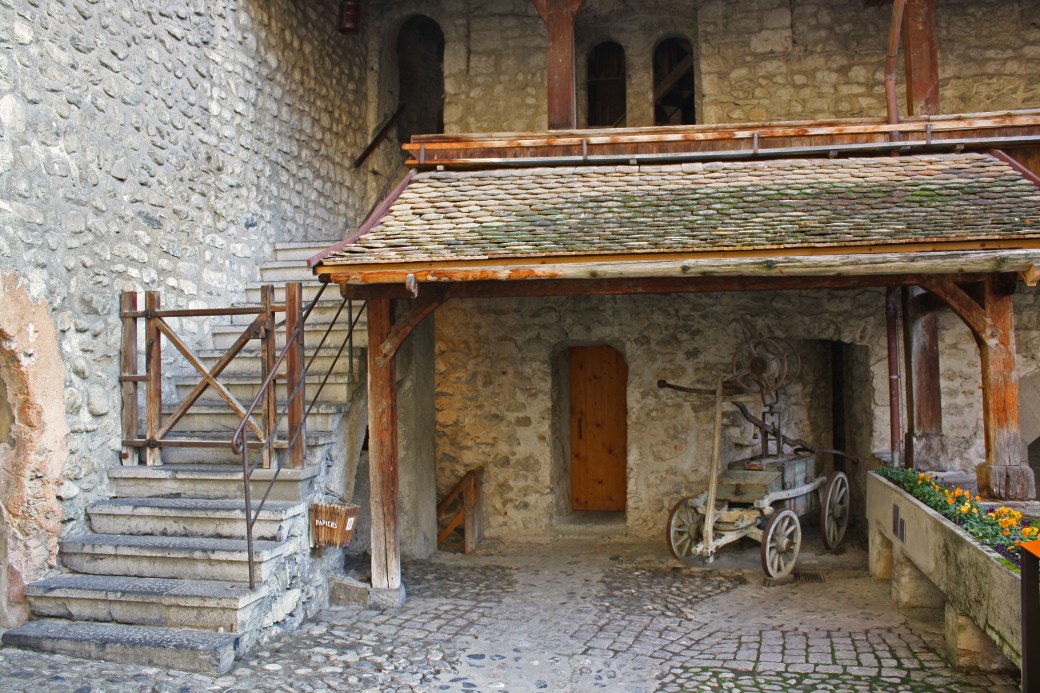
chillon-inner courtyard

Inner courtyard of Chilean Castle, Switzerland (photo by Nina Munteanu)

In fact, the presses formed the very basis of the artistic Renaissance, the religious reformations and the scientific revolution, wrote Elizabeth Eisenstein in The Printing Press as an Agent of Change. “The printing press allowed the spread of information that couldn’t be controlled by the clergy, kings, politicians, or the religious elite,” adds New York Times technology reporter Nick Bilton in I Live in the Future and Here’s How It Works. Storytelling was no longer confined to an elite clergy; books could be created by anyone and shared in the spoken languages of the people.

Bilton shares another interesting fact: Gutenberg’s printed books were as heavy and unwieldy as the original handmade books of the monks. It was much later, in 1502, that Aldus Manutius of Venice invented a more portable book that could fit in a large jacket pocket; essentially inventing “the mobile phone of his day” wrote Bilton.

Historian Alistair McCleery wrote that the political and religious leaders initially panicked over the potential for the uncensored sharing of new and varied ideas among the lay public (which brings to mind similar fears of what the internet was providing to and enabling in the lay public: uncensored self-expression by the masses for the masses). Up until then, sharing stories among the common folk was limited to oral storytelling, which suffered from inconsistency and other limitations of the oral tradition. Within a short period of time, the ability to record and share “stories” had moved from a closeted elite to the world citizen. That is what the printing press—and the Internet today—did. Both have shifted the zeitgeist of an entire world.

Storytelling today is changing again. While many people still read books and go to the cinema, watch pre-programmed TV or rent DVDs, many more enjoy their stories through other devices like computers, downloads, mobile phones and e-readers that provide material through other media and venues such as Indie and self-publishing, amateur YouTube videos, interactive games and social networks. We stand poised on the edge of a wonderful cliff that celebrates the expression — and consumer choice — of the individual. The music industry shows this the best, where people dismissed the prepackaged albums and CDs and opted to create their own unique playlists through individual song downloads. The publishing industry is currently struggling with its own painful yet thrilling metamorphosis as is the visual arts industry. In fact, they are all blurring into one large integrated amalgam of artistic expression.

NYC-times-square-lawn-chairs

Times Square in New York City (photo by Nina Munteanu)

The information you get today is coming “more and more through your friends and through your social network. It’s being distributed through channels of trust and the trust isn’t necessarily the BBCor The New York Times. It’s people,” says B.J. Fogg founder of the Persuasive Technology Lab at Stanford University.

new-york-toulouse-officer-montalvo

New York policeman sports my friend Toulouse on his gun (photo by Nina Munteanu)

During the days of packaged content, leading storytellers were published authors, journalists and writers of newspapers and magazines. “Now distribution channels matter less and anyone with an appropriate device can be a storyteller,” says Bilton, who shares that on the internet we tend to follow individuals we trust (e.g., Clive Thompson or David Carr) as much if not more than established organizations (like Wired Magazine or The New York Times). Accessible technology, platforms, free applications and software has truly enabled the individual.  No longer confined to the written word via paper books or visual expression through movies or TV shows, storytelling has embraced many forms. Amateur and professional have equally blurred.

It comes down to content. Technology and format aside, nothing compares to a good solid story. We all listen to or watch stories. We all tell or show stories, some of us more than others and some better than others.

With the advent of new and accessible technologies and applications available to individuals, the art of storytelling has entered a new renaissance. Good stories, like good content, will always prevail and surface into prominence, like cream in milk. They have just been released into a sea of possibilities like a stream previously confined in a gorge, spilling joyfully into the ocean.

Front Cover ONLY-webHarnessing the opening range of technologies available to us will only give us more choices to tell our stories. For instance, my latest book Outer Diverse (the first book of The Splintered Universe Trilogy) was published by Starfire World Syndicate in print form and e-format and will soon be available in audiobook format through Audible. I have also created associated YouTube promotional videos and am working with colleagues to produce a short story musical video on the book. Another colleague has embraced the image of the strong female hero with a jewelry line called the Rhea Hawke Collection and is looking at other “storytelling” merchandise. I am discussing with other colleagues possibilities for a graphic novel and an interactive video game version of the trilogy that will offer reader participation in storytelling.

The future embraces story in all its possible facets. Our role as storytellers is to embrace the future in all its facets.


Nina Munteanu is an ecologist and internationally published author of award-nominated speculative novels, short stories and non-fiction. She is co-editor of Europa SF and currently teaches writing courses at George Brown College and the University of Toronto. Visit www.ninamunteanu.ca for the latest on her books.