Women Heroes, Part 2: How Brienne of Tarth Saved “Game of Thrones”

brienne of tarth-valar morghulisI’ve been following the insanely popular—yet excruciatingly brutal—Game of Thrones for several seasons now. I must confess, partly because I don’t own or watch TV, that I am a little behind. I’m currently watching Season Four, while still metaphorically shaking in the violent wake of the shocking and brutal Red Wedding episode of Season Three. As the Internet buzz revealed, this was an extremely difficult show to watch for everyone. What was the purpose of its graphical brutality? Who needs to see that level of violence? I am reminded of an introductory scene in the show in which character John Snow counsels his little brother Bran to not avert his eyes when his father executes a deserter, by chopping off his head—an act that foreshadows his own decapitation later in the series. It is as though the producers of the show are counselling us in the same way as they subject us to grisly scene after grisly scene. Many cheap and gratuitous, as far as I am concerned.

The Red Wedding scene, in which several beloved characters are brutally slaughtered set into play a new set of rules for audience engagement: that of total distrust. Distrust in the storytellers (primarily in the producers of the show, whose scripts, I’m told, have deviated from the novels in some important ways). Distrust that creates an uneasy tension. Distrust that precipitates a panicked wish for clairvoyance. This is because we have no concept of fairness in the story; yet we’ve so invested in the characters. That is the storyteller’s worst act of cruelty: to hold us hostage to the characters. The rules of fair play in story have been broken. We’re stuck in a kind of free fall, desperately hoping that our beloved characters will make it through the night intact, if not unscathed. And when they don’t, its like watching our children die, as we stand powerless by.

Good fiction—as opposed to reality—tells a purposeful story. A story with fictional characters, who play a purposeful role. All good stories make a promise in the beginning; a promise they keep in the end. They create a covenant with their audience to participate in a fulfilling journey. This doesn’t have to mean a happy ending, but it does include meaning and fulfillment—even if only for its audience. And that must involve victory of sorts—and hope—whether it is through redemption, acceptance, enlightenment, or some change that gives us “more”—not less; something that allows us to prevail alongside.

If I feel that I am simply witnessing a cesspool of meaningless chaos and brutality, dominated by ruthless and insane people, in which heroes are equally powerless victims as they are true agents of change—with no rhyme or reason to tell the difference—then I must ask myself the question: why am I watching this? What does this story mean to me? I start to feel like a misanthropic voyeur, as perverse as Joffrey or Littlefinger as I watch people get tortured, flayed alive, dismembered, and worse… with no recourse. This is NOT entertainment and it certainly isn’t of any value to me. For such an offence to the senses to have value, there must be an element of—or at least a grain of hope of—prevailing and movement.

By Season Three end, both the series and I are feeling a little tired. And for good reason; most of the characters—the women particularly—are trapped in an incessant pattern of simple endurance. That seems to be all they are able to do: endure. Certainly they manage to act and create within their limited sphere of influence; but mostly to colour their position, not change it. So, we endure alongside; and we can endure only so much.

Then enter Brienne of Tarth. Also known as Maid of Truth.

And with her, a breath of much needed fresh air.brienne of tarth-close

When Brienne was first introduced in “What is Dead May Never Die” in Season Two, she brought with her the anachronistic romanticism of a true knight. We first see her besting favored champion Ser Loras Tyrell (Knight of Flowers) in a tournament. When she presents herself to King Renly Baratheon and removes her helm, the crowd hushes in surprise. To his offer of prize, Brienne requests a place in his Kingsguard, which he gladly grants, despite her gender and lack of formal stature as a knight.

Brienne is the iconic knight of the chivalric sagas: noble, virtuous, compassionate and brave. Singularly honest and loyal. So much so that her contemporaries deride her as simple, naïve and stupid. As though embracing such virtues is outmoded, foolish and weak. That she is a woman—albeit tall, ungainly and considered unfeminine—makes her virtues all the more powerful and refreshing.

BrienneoftarthWhen King Renly is assassinated, Brienne swears fealty to Catelyn Stark and becomes her sworn sword. Catelyn charges Brienne to return her captive Jaime Lannister to King’s Landing to exchange him for her two daughters held hostage there. Their journey provides some of the best scenes of the TV series and some of the most fulfilling interactions. Throughout Jaime’s insufferable taunts about her appearance and likely dismal history with the opposite sex, Brienne remains stoically silent. Except when she speaks:

“All my life men like you’ve sneered at me, and all my life I’ve been knocking men like you into the dust.”—Brienne to Jaime Lannister, Game of Thrones

Essayist Brent Hartinger suggests that Brienne’s character is a well-written departure from fantasy novels where the main characters are commonly “the slender… average-heighted, the conventionally abled and traditionally gendered.”

Essayist Caroline Spector describes Brienne as a “study in heartbreaking contradictions. She embraces the romantic ideals of her culture, both emotionally and through her actions, but is continually betrayed by the real world simply because she cannot turn herself into the woman the Westerosi legends tell her she should be.”

By upholding her ideals of integrity, Brienne refuses to conform to the established cultural expectations. Her very nature—from physique to comportment to idealism—defies the notion in Westeros that women are to be taken or coerced, and meant to endure their lot; not be agents of their own change. Spector describes Brienne as a woman who has “taken for herself most of the attributes of male power.” She embodies “how women who dare to take male power for their own are judged and treated not only in Westeros but in all conventionally patriarchal societies.”brienne-jaime-GoT

The journey of Brienne and Jaime is a fine tale of initial antagonism, discovery, surprising tenderness and ultimate friendship, based on honour and mutual respect. Throughout, Brienne defends and encourages a flagging Jaime and he, in turn, saves her on several occasions, culminating in his return to rescue her from a brutal death in the bearpit.

What makes “The Bear and the Maiden Fair”—or any other scene in which Brienne and Jaime appear—so pleasing? We witness in the interactions between them an evolution in character, great opportunities for learning and redemption, and finally the development of an iconic friendship based on respect and equality—something normally reserved for individuals of the same sex—that neither had previously enjoyed. Like two souls missing something, each is a gift to the other. And though delivered differently, it is the same for both: honour, self-respect and faith in humanity. And neither is the same for their interaction.

brienne-jaime-swords“The bathhouse had been thick with the steam rising off the water, and Jaime had come walking through that mist naked as his name day, looking half a corpse and half a god.”—George R.R. Martin, A Feast for Crows

Brienne is the catalyst hero. She gives us hope. She gives us hope to save the world. She does this through her influence on others. By shear strength of her genuine goodness, Brienne transforms, challenges, and supports. She is über-strong, yet vulnerable; which Jaime recognizes and appreciates as something truly beautiful. The reason he returns to save her in the bear pit.

“I am grateful, but… you were well away. Why come back?”

A dozen quips came to mind, each crueler than the one before, but Jaime only shrugged. “I dreamed of you,” he said.—George R.R. Martin, A Storm of Swords

Jaime slides back to his scoundrel-self once returned safely to King’s Landing and out of Brienne’s sphere of influence—and beneath the shadow of his overbearing father. He is a chameleon, a shape shifter, who struggles to lift himself out from the shadow of his soulless father. Despite some continued reprehensible behavior (particularly to do with his sister, with whom he had formed a perverse relationship), Brienne’s light of honour appears to burn inside him in some form. His actions—tasking her to find and secure Sansa’s safety and giving her his own sword—maintains their honour-bond. When he gives her his longsword, forged of Valyrian steel, he asks her to name it; showing the cooperative respect between the two. She chooses the name Oathkeeper, fulfilling again her role in their story.

In fact, Brienne’s story follows a more traditionally male narrative. Her quest is to save the beautiful maiden (Sansa), but not to marry her or benefit from the quest; it is simply to secure her safety. Feminist writer Rihannon tells us that this is a storyline that “the mother, the young girl and the shieldmaiden are all given equal weight and worth…She uses her strength and her skill to respect and help other women in ways that most men in Westeros would never even think to attempt, because she understands, more than any other knight, that women are truly worth something as individuals.”

Are other women of Westeros poised to rise as true agents of change and takebrienne-of-tarth command not only of their lives but to save the world? Daenerys Targaryen, the dragon mother, liberates slaves; courage and a sense of justice animates the independent Arya. And we’ll see what becomes of Brienne…and Jaime.

I will continue to watch this series with uneasy anticipation.


nina-2014aaNina Munteanu is an ecologist and internationally published author of award-nominated speculative novels, short stories and non-fiction. She is co-editor of Europa SF and currently teaches writing courses at George Brown College and the University of Toronto. Visit www.ninamunteanu.ca for the latest on her books.

From Pocketbook to Tablet … What’s Next?

aldus manutius bookThe recent exhibition at the Grolier Club in Manhattan, “Aldus Manutius: A Legacy More Lasting Than Bronze” reminded me that the pocket-sized book was invented some five hundred years ago.

The pocket book revolutionized not only how we read but who and what we read.

In a recent talk I gave to the Editors Association of Canada about the changing face of publishing, I defined two milestones in the publishing industry.

First Milestone…

The first milestone came in two stages, beginning with the invention of the printing press by Johannes Guttenburg in 1452. Up to then,

…Books were a work of art… And part of an elite. Delicate, large and beautiful, they were created in the language of the church—Latin—and in turn copied entirely by hand by the monks. With the dimensions of a current newspaper, but much thicker, these large illuminated manuscripts sometimes weighed more than 50 pounds.

Readers were mostly scholars and the religious elite. In fact, reading was an elite occupation. The majority of people at the time couldn’t read and had no interest in books. Besides, books were not written in the commonly spoken language of the countryside such as English, French, German or Spanish.

In fact, the presses formed the very basis of the artistic Renaissance, the religious reformations and the scientific revolution, wrote Elizabeth Eisenstein in The Printing Press as an Agent of Change. “The printing press allowed the spread of information that couldn’t be controlled by the clergy, kings, politicians, or the religious elite,” adds New York Times technology reporter Nick Bilton in I Live in the Future and Here’s How It Works. Storytelling was no longer confined to an elite clergy; books could be created by anyone and shared in the spoken languages of the people.

The printing press had opened a gate of opportunity for secular expression to a greater audience. Whenever an opportunity is created, a corresponding need is identified. The need to connect a literate lay public with scholars and storytellers was resolved fifty years later by Aldus Manutius.

Until then, books, albeit printed in the language of the people, remained large, heavy and cumbersome. In 1502, Aldus Manutius invented the portable pocketsize book—the small format libelli portatiles (portable little books)—effectively creating “the mobile phone of his day,” according to Bilton.

Bound in vellum, these long, narrow libelli portatiles, easily transported in a pocket or a satchel, “could be held in the hand and learned by heart by everyone,” wrote Manutius. aldine press book

Manutius founded The Aldine Press in 1495 in Venice. His printing company proudly bore the logo of dolphin entwining an anchor—taken from the term festina lente (hasten slowly), a motto Manutius took from a Roman coin—and Aldine books quickly gained a reputation for their clean design, excellence in typography and inexpensive and accessible price. The Aldine press emphasized Greek and Latin lexicons and grammar manuals, with the first printed edition of Aristotle in 1495. Manutius was also the first to print Thucydides, Herodotus, Sophocles and other Greek philosophers. “He was possibly the first printer to compare manuscripts to arrive at the most reliable text,” adds Jennifer Schuessler of the New York Times (February 27, 2015).

Manutius was the first to use italic type, mimicking the handwriting of that time, and the first to use the semicolon in its modern sense. In 1501, Manutius released Virgil’s Opera as the first of his octavo editions of the classics and the first book to use italic print. It was produced in higher-than-normal print runs (1,000 rather than the usual 200 to 500 copies).

The octavo format book is created from one or more full sheets of paper on which 16 pages of text are printed; the sheet is folded three times to produce eight leaves. Each leaf of an octavo book represents one-eighth the size of the original sheet. The actual size of the book depends on the original size of the full sheet of paper on which it is printed. These varied according to place and time. A sixteenth century octavo printed in France or Italy was about the size of a modern paperback; an eighteenth-century octavo printed in England was larger, about the size of a modern hardcover novel.

Second Milestone…

The second milestone I talked about is, of course, the worldwide use of the Internet. Like the Guttenberg printing press, the Internet and associated World Wide Web has created a gate of opportunity that has identified a need. That need is currently being satisfied by ebook publishing, mobile phone communication and the Indie/self-publishing model.

In my September 6, 2014 article “How We Will Tell Stories in the Future” I describe the effect of the Internet and use of digital devices as agents of change and empowerment in storytelling and publishing.

The first email was delivered in 1971 and in 1989 Cern gave us the WorldWide Web. The Internet wasn’t commercialized until 1995. The first web log (blog) was published in the late 1990s and Facebook was launched in 2004. A few years later smart communication devices were created and mass marketed with multi-touch interface (e.g., the iPhone). By 2013, over 2 billion people were using the Internet and social media via computer, smartphones, tablets, game consoles, e-readers and music players. Over 156 million blogs were identified and over 1 billion files were uploaded daily to Dropbox.

While many people still read books and go to the cinema, watch pre-programmed TV or rent DVDs, many more enjoy their stories through other devices: computers, downloads, mobile phones and e-readers that provide material through other media and venues such as Indie and self-publishing, amateur YouTube videos, interactive games and social networks. We stand poised on the edge of a wonderful cliff that celebrates the expression — and consumer choice — of the individual. The music industry shows this the best, where people dismissed the prepackaged albums and CDs and opted to create their own unique playlists through individual song downloads. The publishing industry is currently struggling with its own painful yet thrilling metamorphosis as is the visual arts industry. In fact, they are all blurring into one large integrated amalgam of artistic expression.

The information you get today is coming “more and more through your friends and through your social network. It’s being distributed through channels of trust and the trust isn’t necessarily the BBCor The New York Times. It’s people,” says B.J. Fogg founder of the Persuasive Technology Lab at Stanford University.

WardIsland wall in forest

Ward Island, Ontario (photo by Nina Munteanu)

During the days of packaged content, leading storytellers were published authors, journalists and writers of newspapers and magazines. “Now distribution channels matter less and anyone with an appropriate device can be a storyteller,” says Bilton, who shares that on the Internet we tend to follow individuals we trust (e.g., Clive Thompson or David Carr) as much if not more than established organizations (like Wired Magazine or The New York Times). Accessible technology, platforms, free applications and software has totally enabled the individual.  No longer confined to the written word via paper books or visual expression through movies or TV shows, storytelling has embraced many forms. Amateur and professional have equally blurred.

From paperbacks to digital phones and tablets, we are embracing the shifting zeitgeist of an entire world. The future belongs to the storyteller, from pocketbook to tablet. What’s next?


nina-2014aaNina Munteanu is an ecologist and internationally published author of award-nominated speculative novels, short stories and non-fiction. She is co-editor of Europa SF and currently teaches writing courses at George Brown College and the University of Toronto. Visit www.ninamunteanu.ca for the latest on her books.

Who’s Your Audience and Why Should You Care?


Beaches-snow06

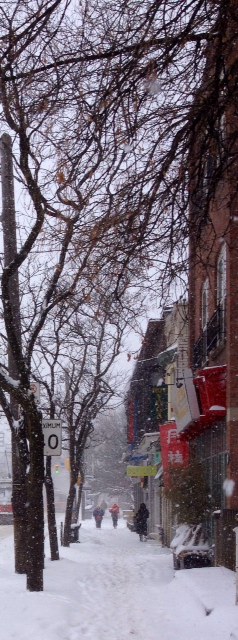
Winter in The Beach (photo by Nina Munteanu)

The artistic process, whether painting or prose, is admittedly the child of self-expression. The long-standing image of the cloistered artist in her studio — hunched over her writing desk or standing before her canvas to create from the depths of her soul — is surely a truism. Artists create from the heart; we dive deep inside our often tortured souls and closeted past to draw out the universal metaphors that speak to humanity and share—

Ay, there’s the rub. For to share is to have a dialogue and to have a meaningful dialogue is to demonstrate consideration of the other. Somewhere in that journey that began with self, others entered. It is, in fact, something of a paradox and a conundrum for many artists. One that has challenged the artistic community for centuries. It is also why many artists have relied on agents, benefactors, and advocates to effectively communicate, target — and even interpret — their often abstruse “message” to their appropriate audiences.

Purists will tell you that a true artist need not consider her audience; because her self-expression naturally finds relevance with the culture and zeitgeist from which she writes through universally understood metaphor: her story is their story.

But is that enough?

I suppose it finally comes back to whether you are interested in sharing. I don’t know any published authors who don’t wish their books to sell. Every storyteller needs an audience to connect with and engage. That is ultimately what good storytelling does: engage, connect, rouse emotions and evoke empathic feelings. Make an impact.

Beaches-snow03

Photo N. Munteanu

Does identifying and targeting a specific audience result in more satisfied readers and ultimately better sales? Of course it does. The more you—and whoever is helping you market your work—know about your audience, the more likely you are going to attract them to your book, convince them to buy it and ultimately connect with them. That’s the irony of art: it is a treasure that is created out of the depths of solitude but ultimately brought into the light and shared with the world. For your art to have impact, you must know and understand your world.

Knowing your audience will affect every aspect of your book project. It will help determine:

  • What your story is about and how you write it (from language, voice or personality, narrative style, tone or mood/attitude, characters, setting and theme)
  • What genre it lies under
  • the look and tone of the cover and blurb
  • all aspects of promotion

For instance, who are your intended readers? To what age group to they belong? What culture and sub-culture? What gender(s)? What education and intellectual capacity? Economic status? What regions? What political leanings? Prejudices and beliefs? What knowledge-base?

To know your audience is to know your story better.


nina-2014aaNina Munteanu is an ecologist and internationally published author of award-nominated speculative novels, short stories and non-fiction. She is co-editor of Europa SF and currently teaches writing courses at George Brown College and the University of Toronto. Visit www.ninamunteanu.ca for the latest on her books.


Nina Talks to EAC About the Changing Face of Publishing

In January 2014, I gave a talk to the Editor’s Association of Canada (EAC) on the changing face of publishing and what it means for editors and writers. Editors learned about self-publishing and indie publishing, publishing myths, and where to find new editing opportunities.


nina-2014aaNina Munteanu is an ecologist and internationally published author of award-nominated speculative novels, short stories and non-fiction. She is co-editor of Europa SF and currently teaches writing courses at George Brown College and the University of Toronto. Visit www.ninamunteanu.ca for the latest on her books.

Rejection, Part 1: How to Accept Rejection

hirtle beachNS

Pebbles on Hirtle Beach, NS (photo by Nina Munteanu)

We’ve all suffered rejection and disappointment. Perhaps that job you coveted or someone you loved who might have even led you on before dropping you. It hurts. But you move on. And it does get better. Eventually. It does, trust me. It helps by starting with knowing that we don’t always get what we want, but we always get what we need…

Being a published writer involves accepting rejection. It’s part of the job description. Think of rejection as an integral part of your road to success. If you have never been rejected then you haven’t really tried, have you? There are several ways that you can gain a good perspective on your rejection letters and even make them work to your advantage.

Adopt a Healthy Perspective

One way is to adopt a realistic, objective and healthy viewpoint on your story’s rejection:

  • View selling manuscripts as a “cold call” business: When you view it this way, you will treat it that way. Until you establish a relationship with your market, selling becomes a numbers game. The more you send, the more likely you are to get a hit. It’s all in the statistics.
  • View rejections as an opportunity. Rejections can provide you with the opportunity to learn and re-evaluate, usually of appropriate market and publisher subjectivity rather than writing quality.
  • View rejections as the beginning of a relationship. Not all rejections are final; in fact most aren’t. Most rejections by a publisher or magazine editor stem from story redundancy, lack of space or editorial requirements. Many rejection letters will reflect this (e.g., “Thanks, but this isn’t a match for us…do try us again.” They mean it. It just means that the story wasn’t right—they may have run something too similar to it already or it didn’t fit with the other pieces or theme or whatever.)
  • View rejections as part of your success journey. Rejection is a given in the writing business and a necessary aspect of your journey as a soon-to-be and published writer (you don’t stop getting rejections once you’re published!). Often a story may be considered “before its time”; too different, a risk and is therefore harder to place. This is often why a book that was rejected so many times becomes a great hit once it is published. The very quality that made it hard for a publisher to accept made it a success with the readership: its refreshing yet topical originality.
  • View rejections as your first step to success. Take heart in the fact that you reached this stage in your writing career. Getting that first rejection in the mail is a great affirmation that you have taken that first significant step to becoming a serious writer. It means that you’ve completed a work and had the courage to enter it into the world.

Acceptance begins with rejection.

Make Rejection Work for You

You can maintain a more objective view on your rejections by keeping an objective view on your submissions. This can be accomplished by submitting a lot and submitting often. Treat your submissions—and rejections—like a business. The best way to do this is to submit lots of stories and to keep submitting them. The critical part of this process is to always have a contingency ready for each story submitted: once a story is returned, you have a place to send it already. Most professional writers will recommend that you do not revise the story before resending it out. This is because many rejections occur not on account of poor writing, but because of poor or unlucky marketing.

Remember that You’re in Great Company

Virtually every writer of merit who has published has had their work rejected several times. Beatrix Potter’s The Tale of Peter Rabbit was turned down so many times that she initially self-published. Irving Stone’s Lust for Life was rejected sixteen times before a publisher finally picked it up and sold about twenty-five million copies. Not bad for a story that was passed off as “a long, dull novel about an artist.” Jonathan Livingston Seagull was turned down twenty-three times and Dune twenty-one times. There are a bazillion examples; I’ve just picked a few. Go check J.K. Rowling’s track record for rejections before getting her Harry Potter published…

FictionWriter-front cover-2nd ed-webI’ll be talking more about how to read a rejection letter, how to recognize their sub-text messages, and how to make the most out of them in Part 2, the evolution of rejection letters.


This article is an excerpt from my fiction writing guidebook The Fiction Writer: Get Published, Write Now! (Starfire, 2009).


nina-2014aaNina Munteanu is an ecologist and internationally published author of award-nominated speculative novels, short stories and non-fiction. She is co-editor of Europa SF and currently teaches writing courses at George Brown College and the University of Toronto. Visit www.ninamunteanu.ca for the latest on her books.

Lessons from a Linguist, Part 1: Steven Pinker on Reverse Engineering

college-window-UoT

Window of University College, UofT (photo by Nina Munteanu)

When I’m not teaching students how to write science fiction, or giving workshops on writing craft or marketing, I am teaching design engineers how to write clearly and convincingly. As Communications Instructor at the University of Toronto in the Faculty of Applied Science and Engineering, I help young engineers navigate the dark and churning waters of fluent and meaningful English.

So, when fellow Montrealer, Steven Pinker starts Chapter 1 of his book The Sense of Style, talking about “reverse engineering”—one of the key features in the design engineering toolkit—I perk up.

Good writing, says Pinker, begins with “reverse-engineering good prose as the key to developing a writerly ear.”

I’d recently picked up Steven Pinker’s new book The Sense of Style: the thinking person’s guide to writing in the 21st century after I watched several of his videos on language, and communicating science and technology.

Pinker starts Chapter 1 of the book with this quote from Oscar Wilde: “Education is an admirable thing, but it is well to remember from time to time that nothing that is worth knowing can be taught.” When Pinker asked several accomplished writers about which style manuals they had consulted early in their careers, the most common answer he got was “none”. Writing, they said, just came naturally to them.

“I’d be the last to doubt that good writers are blessed with an innate dose of fluency with syntax and memory for words,” says Pinker. “But no one is born with skills in English composition per se. Those skills may not have come from stylebooks, but they must have come from somewhere. That somewhere is the writing of other writers.”

Which is why successful authors like Neil Gaimen tell aspiring writers to “read a lot.” Read the best authors. The classics. Authors in your genre; authors of other genres. Authors of other cultures and time periods. Read. Read. Read. My previous article on reading fiction is particularly germane here.

The first thing you need to do is develop a writer’s ear. “Writers acquire their technique by spotting, savoring, and reverse-engineering examples of good prose,” says Pinker. He goes on to demonstrate this in his book Sense of Style by deconstructing several examples of good prose and providing great lessons on what great prose looks like and why.

So, why do we need style guides at all, then? Particularly given that, in Pinker’s own admission, “much advice on style is stern and censorious,” and a writer needn’t approach learning the craft like a treacherous obstacle course to be suffered and endured. Mastering the craft of writing is a lifelong pursuit and ultimately best approached with the passion that hopefully drives the writer to express. “Though the quest for improvement may be informed by lessons and honed by practice,” says Pinker, “it must first be kindled by a delight in the best work of the masters and a desire to approach their excellence.”

Pinker adds, rather pithily, that, “The classic manuals written by starchy Englishmen and rock-ribbed Yankees, try to take all the fun out of writing, grimly adjuring the writer to avoid offbeat words, figures of speech, and playful alliteration. A famous piece of advice from this school crosses the line from the grim to the infanticidal: ‘Whenever you feel an impulse to perpetrate a piece of exceptionally fine writing, obey it—wholeheartedly—and delete it before sending your manuscript to press. Murder your darlings.’”

Many style manuals, Pinker admits, “treat traditional rules of usage the way fundamentalists treat the Ten Commandments: as unerring laws chiseled in sapphire for mortals to obey or risk eternal damnation.” Language, he says, evolves and is meant to evolve over time. He adds that, “the graybeard sensibilities of the style mavens come not just from an under-appreciation of the fact of language change but from a lack of reflection on their own psychology. As people age, they confuse changes in themselves with changes in the world, and changes in the world with moral decline—the illusion of the good old days. And so every generation believes that the kids today are degrading the language and taking civilization down with it.”

So, why use a style guide if you’re reading a lot and taking in the best from the best? While Pinker no doubt sprinkles many reasons throughout his style manual (I haven’t finished reading it), here are two of mine:

  1. Once you are on that path toward writing the very best you can, a style guide can help you improve your writing faster by helping you understand why you like a particular “style” used by a favorite master writer and how it is applied. Simply liking isn’t enough; it’s the first step. Mastering it and using it in your own voice only comes with understanding it. I, for one, learn and retain better when I understand why something works for me. My ability to apply that “style” correctly increases markedly when I understand the rules associated with it (whether that particular “style” was in fact following or breaking a particular rule).
  2. The style guide also helps the novice writer ultimately find their own voice, and move out from the shadow of their beloved master and their techniques. It does this by providing a toolkit that applies can then apply objectively to any voice, making it easier for a writer to discover her own unique voice.


Of course, there are—as Pinker already pointed out—style guides and STYLE GUIDES. I’ve included a list below of a few I like to use and why.


The Chicago Manual of Style. 2010. 16th Ed. University of Chicago Press.1026pp: a comprehensive, easily navigated style guide that is relevant, current and clearly presented, with examples and discussions on a wide range of writing from essays, to fiction. A go-to “bible” for writers and editors.

Strunk, William Jr. and E.B. White. 1918. Elements of Style. Harcourt. 52pp:Even though it’s really OLD, and contains some outmoded notions and prescriptions, this manual is entertaining, smart and still very relevant in many cases. Compared with the Chicago Manual of Style, it’s pint-sized and therefore highly mobile.

Pinker, Steven. 2014. The Sense of Style. Viking. 359pp: called “the thinking person’s guide to writing in the 21st Century, it is full of excellent advice, written with a engaging flare and with relevant examples, that speak to process. Read it more for narrative rather than reference.

Munteanu, Nina. 2009. The Fiction Writer: Get Published, Write Now! Starfire. 264pp: FictionWriter-front cover-2nd ed-webnot just because it’s MY book, but because it’s FUN and contains the advice of over thirty experts in the craft of writing, including style and grammar. It’s easy to read and easy to learn with relevant examples and exercises. This book is more of a writing-storytelling guide than strictly a style guide.


nina-2014aaNina Munteanu is an ecologist and internationally published author of award-nominated speculative novels, short stories and non-fiction. She is co-editor of Europa SF and currently teaches writing courses at George Brown College and the University of Toronto. Visit www.ninamunteanu.ca for the latest on her books.


The Art and Magic of Storytelling: Part 1, Sparking the Premise

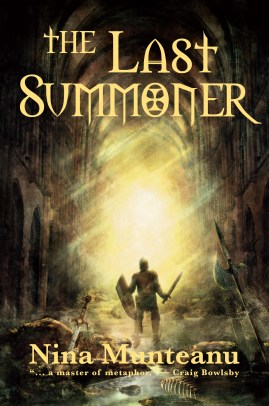
Cover1_LastSummoner-frontcover copyFrom where do we get our stories?

This is a question I am asked time and again. My readers, friends and colleagues alike marvel at my imagination, and ask me how I create these fantastical worlds and situations. Cornered in a moment of inarticulate bliss (this often happens to me), I shrug and blather off some ridiculously obscure tale of luciferous logolepsy.

The simple of it is that it always comes as a spark. Followed by inspiration. And from there, a story emerges. Premise to dramatization. So, let me tell you a story about how my 2012 historical fantasy The Last Summoner —about a medieval time traveler who must save the past from the future—came to be.

It all began with the Battle of Grunwald and the Fate of the Teutonic Knights—that is, when I stumbled upon it during an Internet ramble. But, in fact, it started before that—the spark, that is.

My part in this piece of history really began sometime in 2008 with the vision of an incredible image by Croatian artist Tomislav Tikulin (who had done the cover art for a previous novel Darwin’s Paradox). On Tikulin’s website I glimpsed the image of a magnificent knight, standing in a war-littered mire and gazing up, questioning, at the vaulted ceiling of a drowned cathedral. A great light shone upon the knight in streams of white gold. It sent my imagination soaring with thoughts of chivalry, adventure and intrigue.

Who was this knight standing in the mire?…

teutons3-close1

With that image imprinted inside me, the next nexus moment came when I stumbled across a significant but little-known battle in the medieval Baltic, the Battle of Grunwald. It would turn out to be the defining battle for what are now the countries of Poland and Lithuania. On June 14th 1410, they were still part of Prussia and tyrannized by the Teutonic Order, who were Christianizing the pagan Baltic on behalf of the Pope. In truth, the Order had been for centuries gathering wealth and land for colonizing Germans in their drang nach osten; they built sturdy castles (many of which still stand today) and a force of monk warriors, feared for their cunning strategy and treacherous combat abilities.

The Battle of Grunwald was, in fact, an upset in history. The Teutonic Order was powerful, intimidating and extremely capable. They should have won; but the peasant armies of Prussia slaughtered the Order, killing most of its knights. Historians debate that the hochmeister’s arrogance—indeed, the arrogance of the entire Order—precipitated their downfall. They underestimated their adversaries and got sloppy. After the Polish and Lithuanian armies outsmarted the Order and slayed their hochmeister, along with many of their knights, the Order’s own peasant slaves finished the job using clubs, pitchforks and stones.

Intrigued by this little known order of religious crusaders and their bizarre fate in an upset battle with a peasant army, I pursued the premise of an alternative consequence: what if the Teutonic Knights had NOT underestimated their enemy and won the Battle of Grunwald? Would they have continued their catastrophic sweep of North-east Europe into Russia and beyond? Would they have continued their catastrophic sweep of north- east Europe into Russia and beyond? Would they have claimed the whole for Germany’s expansionist lebensraum movement, fueled by its sonderweg, a dialectic that would ultimately lead to the killing fields of the Holocaust? What if the success of the Teutonic Order helped consolidate a united fascist elite, ambitious to conquer the world? And what if, as a result, Nazism sprang up 100 years earlier?

The Last Summoner, arose from this premise. Enter our heroine, young 14-year old Vivianne Schoen, Baroness von Grunwald, a self-centered romantic who dreams that her ritter (her knight) will rescue her from an arranged marriage to some foreign  warrior. As a result of an impetuous choice, she makes the startling discovery that she can alter history—but not before she’s branded a witch and must flee through a time-space tear into an alternate present-day France ruled by fascists. There, she learns that every choice has its price.

Warrior Woman Silhouette

Spanning from medieval Poland to present day Paris, France, The Last Summoner explores the sweeping consequences of our “subtle” choices. From the smallest grab to the most sweeping gesture, we are accountable for the world we’ve made. During her 600-year journey to save the world and undo the history she authored, Vivianne learns wisdom and humility. Through the paradox of history, she learns that what might have seemed the right choice for an immediate future, turns out to be disastrous for a distant future. To win is also to lose; to save oneself one must surrender oneself; and to save the world one need only save a single soul.

knight-cameoThe knight standing in the mire is Vivianne.

The Last Summoner, published by Starfire World Syndicate, was released in 2012 and remained a Canadian bestseller on Amazon for several months. It represents my first historical fantasy in an otherwise repertoire of hard science fiction. The Polish and Lithuanians celebrate June 14th with pride, erecting mock-ups of the battle annually. Some day I hope to participate.

The cover art for The Last Summoner is that very image that inspired my story. The Universe gifted me with the chance to acquire the image from Mr. Tikulin and a publisher willing to purchase it. I’d entered my own dream.

p.s. definition for luciferous logolepsy: “an illuminating obsession with words”

p.p.s. A novelette version, Summoning the Future’s Past, was released April 2021 in Italian by Delos Digital entitled l’Ultima Evocatrice.

This article first appeared on Warpworld on Nov. 30, 2013.

nina-2014aaNina Munteanu is an ecologist and internationally published author of award-nominated speculative novels, short stories and non-fiction. She is co-editor of Europa SF and currently teaches writing courses at George Brown College and the University of Toronto. Visit www.ninamunteanu.ca for the latest on her books.

.

Why Reading Fiction is Smart — Especially if You Write

chillon-inner courtyard

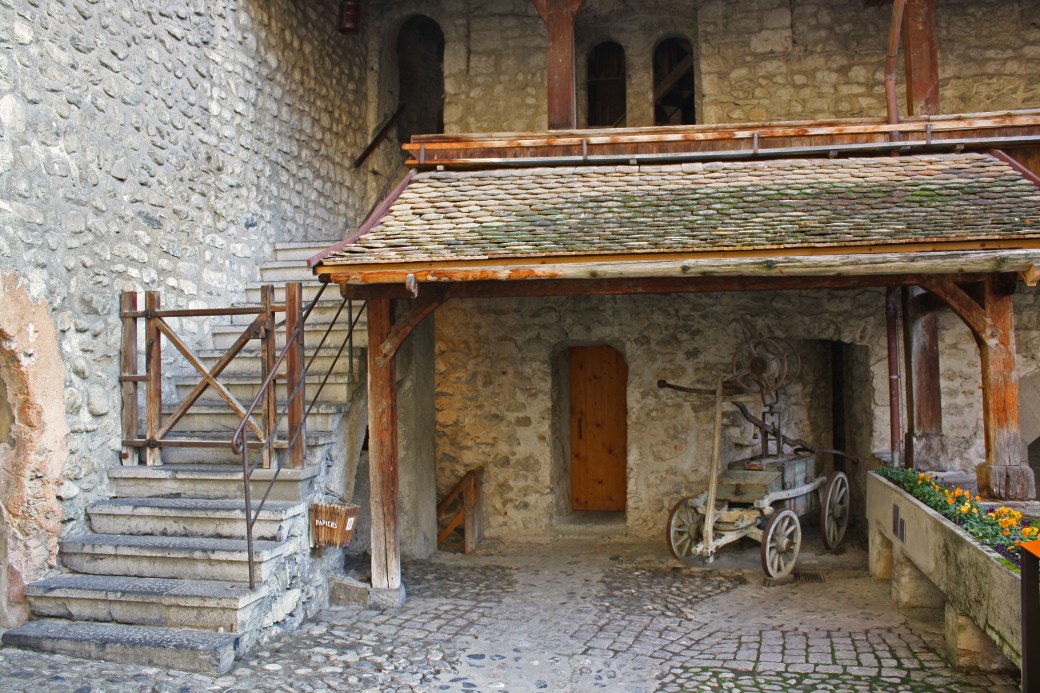
Courtyard of Chateau Chillon, Switzerland (photo by Nina Munteanu)

When a friend of mine asked me recently what book changed my life, I didn’t have to think too far. Two books came to mind instantly, both novels: Martian Chronicles by Ray Bradbury and Far from the Madding Crowd by Thomas Hardy. Two very different books, genres, time periods and subject matter. Yet they held in common superlative storytelling, incredible sensuality, and stirring use of metaphor. Bradbury’s simple yet powerful prose held humanity’s most vulnerable traits at close scrutiny, stirring me with the stories of ordinary people journeying into extraordinary places. Hardy’s lyrical and evocative prose entranced me with stories of extraordinary people journeying in ordinary places.

Of course there were many other books and authors who’d influenced me greatly, but these two particularly made me want to be a writer and move people as they had moved me.

A recent discussion with one of my writing students got me thinking about the merits of reading—fiction, particularly—in the writing process and creative writing, especially.

Janice confided to me in an email that her husband prefers non-fiction and reads slowly, while her daughter reads both fiction and non-fiction voraciously and quickly.

chateau-chillon-lake-geneva

Chillon Castle, Switzerland (photo by Nina Munteanu)

“I think (and I could be wrong),” said Janice, “but the more fiction someone reads, the better they are able to communicate in a written form.” She suggested that, “Non-fiction does not have the breadth of style that fiction has, and thus the opportunities to find a style which adequately reflects the writer is somewhat curtailed if all they read is non-fiction. Style is a very personal thing and to have to write large swaths of material, the writer has to be comfortable in writing, thus if they find their ‘voice’ the information can be communicated in a manner which the writer does not find drudgery to write and best of all the reader will not find dry and difficult to read.”

It turns out that Janice’s keen observations and conclusions are corroborated by a fair amount of recent research. In their study a study entitled “Reading Literary Fiction Improves Theory of Mind” in the October 2013 issue of Science, researchers Kidd and Castano reported that reading literary fiction led to better performance on tests of affective and cognitive Theory of Mind compared with reading nonfiction, popular fiction or nothing at all. Theory of Mind (ToM) describes the ability to understand others’ mental states, a crucial skill in complex social relationships that characterize human societies.

Reading Fiction Improves Empathy

Neuroscientists at Emory University, led by Professor Gregory S. Berns, published findings in the December 2013 issue of the journal Brain Connectivity that suggested that reading a novel can improve brain function on a variety of levels. Reading fiction, reported Berns et al., improved the reader’s ability to empathize with others and “flex their imagination in a way that is similar to the visualization of a muscle memory in sports,” says Christopher Bergland in a recent article in Psychology Today.

“Changes caused by reading a novel are registered in the left temporal cortex,” says Bergland. That’s an area of the brain associated with receptivity for language. It’s also the primary sensorimotor region of the brain. “Neurons of this region have been associated with tricking the mind into thinking it is doing something it is not, a phenomenon known as embodies cognition.” Bergland suggests that just thinking about playing basketball can activate the neurons associated with the physical act of playing.

The neural changes suggested that “reading a novel can transport you into the body of the protagonist,” says Berns, who is director of Emory University’s Center for Neuropolicy in Atlanta. “Stories shape our lives and in some cases help define a person,” adds Berns. “We want to understand how stories get into your brain and what they do to it.”

nina-workshop 2

Nina Munteanu lectures in class

Storytelling in novels is a multi-faceted communication that engages a broad range of brain regions. I spend an entire 12-week course at George Brown College and the Universtiy of Toronto workshopping the story tools of an effective writer with my students; tools ranging from the use of metaphor to multi-layered plotting and character archetypes. Story—unlike anecdote, which many mistake for story—resonates with readers in a variety of conscious and sub-conscious ways. Neurobiological research has just begun to identify the brain networks that are activated when processing stories.

The Emory study used a 2003 thriller by Robert Harris (Pompeii), which follows a protagonist rushing against time to save the love of his life. Researchers chose the book for its page-turning plot. “It depicts true events in a fictional and dramatic way,” Bern says. “It was important to us that the book had a strong narrative line.”

Using functional magnetic resonance imaging (fMRI) scans on a group of students before and after reading a portion of the Harris novel, the Emory researchers demonstrated heightened connectivity in student’s brains. Areas of enhanced connectivity included students’ left temporal cortex, associated with language comprehension, and the central sulcus, associated with sensations and movement.

“The anterior (front) bank of the sulcus contains neurons that control movement of parts of the body,” Berns tells us. “The posterior (rear) bank contains neurons that receive sensory input from the parts of the body. Enhanced connectivity here was a surprise finding, but it implies that, perhaps, the act of reading puts the reader in the body of the protagonist.”

“The ability to put yourself in someone else’s shoes through embodied cognition is key to improving theory of mind and also the ability to be compassionate,” says Bergland in his article in Psychology Today. He adds, “Although this study does not directly draw these conclusions, it seems like common sense that if we encourage our children to read—as opposed to tuning out through television—theory of mind and the ability to be compassionate to another person’s suffering will improve.”

“We already knew that good stories can put you in someone else’s shoes in a figurative sense,” says Berns. “Now we’re seeing that something may also be happening biologically.”

The Berns study concluded, “At a minimum, we can say that reading stories—especially those with strong narrative arcs—reconfigures brain networks for at least a few days. It shows how stories can stay with us. This may have profound implications for children and the role of reading in shaping their brains.”

Reading Sharpens Your Brain

In her paper What Reading Does for the Mind, Berkley professor Anne E. Cunningham tells us that those that read generally have higher GPA’s, higher intelligence, and general knowledge than those that don’t. Her study also suggested that reading improves vocabulary and helps compensate for the normally deleterious effects of aging.

Cunningham’s studies demonstrated that reading boosted analytical thinking. This includes the ability to detect patterns more quickly. When I started to read more, my vocabulary increased tremendously. It also improved my spelling. Both of these are important to writers. As psycholinguist Steven Pinker pointed out in The Sense of Style, reading the works of writers you admire is an important way to becoming a better writer. Reading improves your memory. It also helps prioritize goals, by helping us to see another perspective and think “outside” our comfortable box.

Wilson et al. reported in the July 3 2013 issue of the journal Neurology that those who engaged in mentally stimulating activities (such as reading) earlier and later on in life experienced slower memory decline compared to those who didn’t. In particular, people who exercised their minds later in life had a 32 percent lower rate of mental decline compared to their peers with average mental activity.

Reading May Help Against Alzheimer’s Disease

According to research published in the journal Proceedings of the National Academy of Sciences in 2001, adults who engage in hobbies that involve the brain, like reading or puzzles, are less likely to have Alzheimer’s disease, while leisure limited to TV watching may increase the risk.

“The brain is an organ just like every other organ in the body. It ages in regard to how it is used,” lead author Dr. Robert P. Friedland told USA Today. “Just as physical activity strengthens the heart, muscles and bones, intellectual activity strengthens the brain against disease.”

Reading Reduces Stress and Helps You Sleep Better

That reading reduces stress and helps you sleep better is an intuitive notion recently corroborated by research at the University of Sussex. Findings by neuropsychologists, led by Dr. David Lewis show that reading a newspaper or book works better and faster than listening to music, going for a walk or sitting down with a cup of tea to calm stressed out nerves. Reading reduced stress levels by 68 per cent. Psychologists say this is because the human mind has to concentrate on reading and the distraction eases the tensions in muscles and the heart. Lewis and his team found that subjects only needed to read, silently, for six minutes to slow down the heart rate and ease tension in the muscles.

Dr Lewis said: “Losing yourself in a book is the ultimate relaxation. “This is more than merely a distraction but an active engaging of the imagination as the words on the printed page stimulate your creativity and cause you to enter what is essentially an altered state of consciousness.”

So, here’s my question to you: what book changed your life and why?


References:

Berns Gregory S., Blaine Kristina, Prietula Michael J., and Pye Brandon E. 2013. “Short-and Long-Term Effects of a Novel on Connectivity in the Brain.” Brain Connectivity 3(6): 590-600. doi:10.1089/brain.2013.0166.

Cunningham, Anne. E. 1998. “What Reading Does for the Mind.” In: American Educator/American Federation of Teachers. Spring/Summer,1998.

Kidd, David Comer and Emmanuele Castano. 2013. “Reading Literary Fiction Improves Theory of Mind.” Science 342 (6156): 377-380. October 2013.


Nina Munteanu is an ecologist and internationally published author of award-nominated speculative novels, short stories and non-fiction. She is co-editor of Europa SF and currently teaches writing courses at George Brown College and the University of Toronto. Visit www.ninamunteanu.ca for the latest on her books.


Why Writers Can’t Spell

scribeWhen I participated in those humiliating spelling bees in primary school, I was usually among the last chosen because I was a lousy speller. I grew up in an immigrant family where Romanian was the official language; I heard my parents speaking German in the house and lived in a French-Canadian neighbourhood. English was actually the fourth language I learned and only once I started going to school. It seemed that my facility with language came at some expense. My spelling sucked. It didn’t help that I was probably borderline ADD, dyslexic and allergic to reading.

Are you a lousy speller too? Well, take heart. You’re in excellent company. Samuel R. Delany is dyslexic. Thomas Jefferson, F. Scott Fitzgerald, Herman Melville, Woodrow Wilson and John Irving were all rotten spellers.

Grenadian SF/F writer, Tobias Buckell, author of Sly Mongoose, admitted that “homophones practically kill me, even the ones I know are wrong, b, d, g, and p are often swapped, as is, of course, 6 and 9.” He confesses that rewriting “is a painful, deliberate struggle” as he must pore over his work word by word.

So, why is it that some of us can just look at the word “preposterous” and spell it, while others can see it a thousand times and never get it right? Neuroscience has shown us that it’s in the brain. Recent studies using functional MRI analysis have not only begun to map the areas of the brain we use in reading and writing, they’ve shown how a neurological glitch in about 20 percent of people may make them chronically poor spellers. That’s me!

My particular weakness is the homonym. These are words that sound the same but are spelled differently (e.g., right and write). I’ve seen writers mix homonyms a lot in my workshops and manuscript critiques. Common ones include:


There, their, they’re Bare, bear
To, too, two Grate, great
Who’s, whose Here, hear
Reel, real Meet, meat
Deer, dear Heel, heal
Brake, break Council, counsel
Mantle, mantel Principle, principal
Which, witch Where, wear

Keep a dictionary by your side and consult it often. For those of you, like me, who spend most of your writing time in front of the computer with internet access, you may wish to bookmark the online Merriam-Webster dictionary, www.m-w.com.

If you are, like Tobias Buckell, particularly susceptible to self-correcting when you revise your work, then have someone you trust proofread for you.

And hope that they, unlike Tobias or me, are NOT susceptible to self-correcting!

References:

Munteanu, Nina. 2009. The Fiction Writer: Get Published, Write Now! Starfire World Syndicate. Louisville, KY. 266pp


Nina Munteanu is an ecologist and internationally published author of award-nominated speculative novels, short stories and non-fiction. She is co-editor of Europa SF and currently teaches writing courses at George Brown College and the University of Toronto. Visit www.ninamunteanu.ca for the latest on her books.


How to Hook Your Reader and Deliver

Beaches-snow03

Winter in The Beach (photo by Nina Munteanu)

A great story opening arouses, delays and rewards. Constructing a compelling beginning—often called a hook—is a common challenge for even established writers, and one of the most important parts of a story.

The opening should sweep the reader into the story like a tidal wave. It doesn’t need to be wild action. It just needs to compel the reader to want to know more. This is accomplished by engaging the reader with “intrigue”. In his article “Three Ways to Keep Your Readers Hooked” in the April 2001 issue of Writer’s Digest, Joe Cardillo suggested that the three elements of hooking a reader resemble the steps he uses to train his Samoyed puppy: 1) arouse interest; 2) delay, then 3) reward.

The writer arouses interest in the reader by providing enough detail to get the reader to ask questions. Now they want something. You tease them with the delay; that keeps them reading and turning the pages. It also gives them the chance to try to come up with the answers themselves. The reward comes in stages. Don’t answer all their questions at once. That’s what the book—the story—is for. The reward, parceled out in stages, lets the reader know that you can deliver and will ultimately provide them with a fulfilling story at the end. The beginning of your book sets up a covenant between you and the reader, a covenant for a journey you will take together toward resolution.

There is no beginning without an end. In her book The Sell Your Novel Tool Kit (Revised Edition, Perigee Trade, 2002) Elizabeth Lyon suggested that the beginning of a novel should “reflect the entire book. There should be a tie-in [between] the beginning and the end”. This is sometimes called “framing” a story, where the principal thematic problem is given in the beginning and then resolved in the end. In his book, A Story is a Promise (Blue Heron Publishing, 2000) Bill Johnson describes it as a promise to the reader.

Beaches-snow02

Toronto streetcar (photo by Nina Munteanu)

“Dramatic story-issues revolve around issues of human need,” says Johnson. “The need to be loved. To have control of one’s fate. To feel a sense of purpose. To be able to overcome obstacles. To be able to grow and heal from life’s wounds. To understand and make sense of the events of life.” He warns that “if you can’t name the issue at the heart of your story [the theme], it risks being unclear to your audience.” And this needs to be identified, at least intuitively for the reader, at the beginning of the story. You do this through intrigue in the beginning and pointing out through scene what is at stake or at issue in your story.

Additional things to consider in openings include:

  • Avoid starting your story at “the beginning”: instead, start mid-way, when something is already happening—preferably to someone important in your story and at the pivotal point when you provide the “story promise” pertinent to the theme.
  • Quell the urge to put in a lot of information about setting, character and situation: get things in motion first, then reveal here and there. Let the details unfold with the story like a flowing piece of artwork.
  • Trust your reader: novice writers have not yet gained the confidence to trust that they won’t lose the reader in the beginning if they don’t tell them everything right away. The key is to choose just enough to whet their appetite for more. And, yes, it is critical what you choose. What you choose should relate to your story’s theme and its story promise: the problem.

A great opening is a seductive tease, deliciously delivered; it promises an exotic ride that only you can fulfill.

This article is an excerpt from The Fiction Writer: Get Published, Write Now!

Recommended Reading:Beaches-snow01

  • Cardillo, Joe. 2001. “Three Ways to Keep Your Readers Hooked”. Writer’s Digest, April, 2001, volume 81, no. 4.
  • Johnson, Bill. 2000. A Story Is a Promise. Blue Heron Publishing. Portland, Oregon. 187pp.
  • Lyon, Elizabeth. 2002. The Sell Your Novel Took Kit. Revised Edition. Perigee Trade. 320pp.
  • Munteanu, Nina. 2009. The Fiction Writer: Get Published, Write Now! Starfire World Syndicate, Louisville, KY. 264pp.


Nina Munteanu is an ecologist and internationally published author of award-nominated speculative novels, short stories and non-fiction. She is co-editor of Europa SF and currently teaches writing courses at George Brown College and the University of Toronto. Visit www.ninamunteanu.ca for the latest on her books.