Movie Review: Reaching for “Elysium”–Why the movie could have been great but wasn’t

In the “Hero’s Journey” myth, Elysium (or the Elysium Fields in Greek mythology) is the paradise that true heroes go to when they die (think of Frodo in Lord of the Rings and the hero in The Gladiator). To the ancient Greeks, Elysium was a place at the ends of the earth where heroes, favoured by the gods for their altruism, went. It is a state or place of perfect happiness; the equivalent of Heaven.

Elysium is also the name given to the Earth-orbiting space station of Neill Blomkamp’s (District 9) new science fiction political allegory of the same name. Elysium is where the privileged live in luxury and perfect health (thanks to health-pods) — after they abandoned Earth to the squalor they no doubt helped create. This is not made clear enough for me and is one of the film’s major weaknesses, in my opinion (more on that below).

Earth seen from Elysium

The year is 2154 in a Los Angeles that strangely resembles the slum shanties of Johannesburg, South Africa (where Blomkamp filmed District 9).  We soon learn that Earth struggles in the mire of humanity’s waste in a state of general social strife. Abandoned by the wealthy elite (who have moved to Elysium), the rest of an overpopulated humanity lives in the squalor of abject poverty without food, healthcare, or the motivation to live. I, for one, would have liked to know a little of how humanity devolved so dramatically on a planetary scale.

A Different Hero’s Journey

From the time he was a young orphan, Max Da Costa (Matt Damon; Maxwell Perry Cotton) dreamed of going to Elysium, its impressive phantom form visible in the daytime sky. He promised his childhood love Frey (sympathetically played by Alice Braga and Valentina Giros) that he would take her there, to paradise. His mentor, a kind mother-figure nun at the orphanage, gives him the hero’s talisman (a locket with a picture of Earth inside), and prophesizes, “Es su destino hacer algo maravilla cuando tu es hombre” (“It is your destiny to do something great when you are a man”). She reminds him that when he gets to Elysium, he will see the most beautiful thing: planet Earth. “You see how beautiful it is,” she says to him as he gazes out at the ghost of Elysium in the sky. Then, as she hands him the locket with Earth inside, she adds, “look how beautiful we are from there. Never forget where you come from.”  Seen from this perspective, the planet Earth is a beautiful thing to behold.
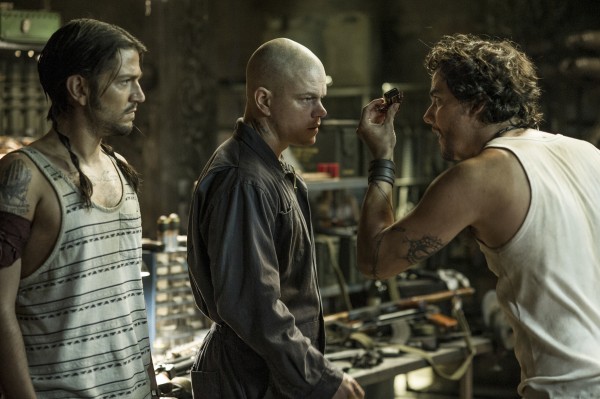
Max and Spider share a heated conversation

Max is a reformed criminal who, like Blomkamp’s “workaday” anti-hero in District 9 (Sharlto Copley), is not very hero-like until the last five minutes of the film, when he has his personal epiphany and decides to act altruistically rather than self-servingly. This is a pattern that Blomkamp has used before; the reluctant-hero (Wikus Van De Merwe) of District 9 was an unimpressive man with many obvious blemishes. A rather unlikeable man until he makes his heroic decision in the end. This is where Blomkamp’s heroes differ from most action movie heroes, who generally start their journey from higher positions on the evolutionary scale. Blomkamp’s heroes must journey farther to gain their hero-status; they are perhaps more realistic portrayals of ordinary men who finally shine under extra-ordinary circumstances. Men who we start out disliking—hating, even—but find ourselves cheering for, perhaps even crying for. Max’s behaviour defines that true hero: rising from his need to save himself to his quest to save humanity—at the cost of his own life. But, as with the ordinary man, it is only when he connects a personal quest to save the daughter of his first love to his global quest to save Earth that Max transforms into the altruistic mythic hero he is destined to become. Everything came together at the film’s end, in a montage of scenes that depict the locket of the planet Earth in his dying hand (Earth is Home; save the planet), the demise of a police state, the saviour of his love’s daughter, and med-pods landing on Earth to dispense aid to the dying masses.

Elysium orbiting the Earth

A Story About the Planet Earth

Ironically, it is to do with our beloved planet Earth that I felt in Elysium the most discord in plot/thematic story treatment and lack of resonance. Blomkamp begins with the planet and he ends his film with the planet. The symbolism is clear: in the stylish shots of Earth seen from Elysium (and vice versa); in the strategic scenes of Max and the image in his precious locket of not his childhood love Frey but of planet Earth; and his mentor’s advice to Max, delivered in one of the most powerful scenes of the movie. Yet, Blomkamp fails to follow through to give us that visceral connection. Why is the planet so important? How is Max connected to it or anyone else, for that matter. What is Spider’s story (Wagner Moura), a latter-day Che-Guevara, who fervently leads the proletarian rebellion of Earth? Who, why and how did the planet come to be so destroyed? There is not one ounce of suggestion, backstory or context. This is an important consideration; because without it, instead of feeling total resolution and redemption in the end, I felt a disconnect to those masses being helped and even some distrust in their fate and direction. Instead of feeling true victory, I felt ambivalence.  

Called a “sci-fi socialist film” by P.J. Gladnick of Newsbusters.org, Elysium is clearly an attempt at examining and dramatizing the social segregation of humanity and economic fascism: a dystopia that promises commentary on social and economic issues in society today. However, I felt that its delivery was compromised by Blomkamp’s choice to focus more on action tech at the expense of good backstory, context and empathic character development. I’m not saying that it’s a bad story. It is a very good story; it’s just that it could have been a great story. The heart of the story—delivered through the main protagonist—lacks the global connection it could have had. This is not, as some reviewers suggest, due to any infirmity of the hero, his antagonists, or lack of symbolism (of which there is much), but the lack of context, backstory and richness of setting (I’m not talking about the visible setting, which was spectacular, elegant and stylish). It comes back to how each character relates to “home”, the planet, and to each other.

Matt Goldberg of Collider.com says that, “Elysium‘s message about economic inequality is couched in a finely-drawn sci-fi world, but the power of that message becomes diminished when we cease to care about the messenger.” Detroit News Tom Long added that, “Elysium is the sort of big, noisy sci-fi film that seems to want to say something but opts instead to concentrate on fight scenes involving gimmickry.” While I appreciated the depth and breadth of Blomkamp’s references to pop culture from an Armani-clad female Darth Vader to the Judeo-Christian references and symbolism, it just didn’t hold its promise.
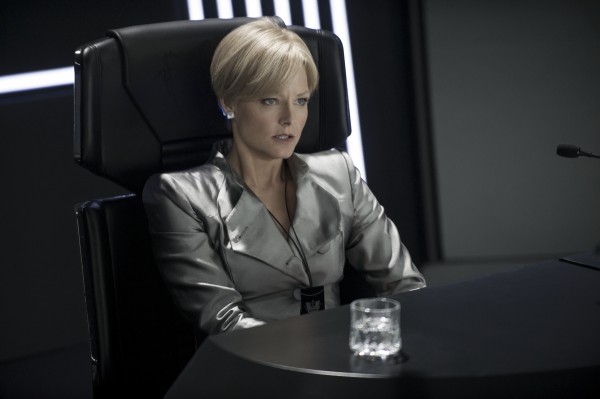
Jodi Foster plays Defence Secretary Delacourt, the threshold guardian of Elysium

What began as a promising exploration about an important social issue, devolved into a sequence of ever-escalating gratuitous gore and violence—clearly aimed for a different audience.

Elysium

Nina Munteanu is a Canadian ecologist / limnologist and novelist. She is co-editor of Europa SF and currently teaches writing courses at George Brown College and the University of Toronto. Visit www.ninamunteanu.ca for the latest on her books. Nina’s bilingual “La natura dell’acqua / The Way of Water” was published by Mincione Edizioni in Rome. Her non-fiction book “Water Is…” by Pixl Press (Vancouver) was selected by Margaret Atwood in the New York Times ‘Year in Reading’ and was chosen as the 2017 Summer Read by Water Canada. Her novel “A Diary in the Age of Water” was released by Inanna Publications (Toronto) in June 2020.

Make Your Opening Count

Beech-leaves-trunk LR

Beach leaves (photo by Nina Munteanu)

When I began marketing my short stories and novels, I was often puzzled by the request to just see the first page of my work. “I only need to see the first page to know whether your book is good or ready to publish,” they would say. I was aghast. How presumptuous! Surely, that wasn’t enough! Surely they were just putting me off and not really interested in the first place! That couldn’t be enough…

I was wrong. It often is.

Years later—and currently a seasoned writer of over a dozen published books, short stories, and a writing teacher & coach—I can tell you that it is generally true. The opening page is usually enough for me to know whether the author is professional, knows their ending, writes a compelling and directed story, and whether the story is ready to be published. Does that sound pompous of me?

If you think so, then read no further. If you’re not sure, read on and I hope to convince you that your opening is more than likely the most important part of your novel or short story. That doesn’t mean that you should inordinately concentrate on polishing it over and over and over at the expense of the rest of your work. That won’t work either; this is because a good opening relies on a good story. Think of it as the introduction to the core issue of your story. Think of it as a long title. If you don’t know where your story is going or what it is about, then your opening will undeniably reflect this.

A good opening resonates with the theme of your story; a great opening creatively illuminates that theme with intrigue.

My post entitled “How to Hook Your Reader and Deliver” discusses the three-step model of hooking the reader in an opening and how to maintain their interest throughout the length of your story. You can read it there, so I won’t go into it here (e.g., the steps are 1) arouse; 2) delay; and 3) reward). What I wanted to talk about here is more about what goes into a first page of any piece of writing to make it a great opening.

“A novel is like a car,” says Sol Stein (Sol Stein on Writing). “It won’t go anywhere until you start the engine.” Take a look at the opening of your WIP and see if its engine is running.

Openings should:

  • Begin with something happening to a major character
  • Arouse the Reader’s interest (with intrigue)
    • Introduce conflict
    • Threaten a likeable character
    • Reveal an unusual character or situation
  • Begin with a “scene” (action; “showing”) not a “sequel” (reflection; “telling”)

“Start your book with a scene where something is happening, and action takes place; show the drama not the reaction to it,” says Elizabeth Lyon (The Sell Your Novel Toolkit). Start in the middle, not the beginning of your story. Dwight Swain (Techniques of the Selling Writer) tells us that scenes and their corresponding sequels form an integral part of a story’s larger plot movement. And to apply sound story-building, this dynamic relationship must be first understood. You “show” in a scene, which plays out the goal, conflict and inevitable disaster of the protagonist; sequels, in turn, often “tell” of the protagonist’s reaction, dilemma, and decision (which propels the character on to the next scene). Yet, time and again, I read openings that are actually sequels (leading to action; but not action themselves). They may languish and even entertain with clever intellectual description, but they do not scintillate with intrigue or direction. It is a little like reading the review of a movie before watching it for yourself (one of the reasons why I never consult a review before I watch a movie—because I want to live it with the characters first hand, or at least give myself the chance to).

Another way of thinking of the scene / sequel dynamic is to see them as cause and effect or action and reaction. An opening in action is more likely to grip the reader in its visceral intrigue and promise of the story’s direction than an intellectualization of an event that happened off stage.

The table below provides a few suggestions on what to include and what not to in an opening page.

Good Openings Don’t… Instead They…
Contain lots of back story Integrate back story in with scene as needed in the appropriate place
Contain lots of exposition, setting, character description, etc. Reveal place and character detail with action as needed
Start with reflection, explanations – particularly about something “off-stage” in time or space Start with action / conflict / turmoil / discovery – start mid-stride with intrigue, then reveal after…
Start with a dream or waking up or other ordinary / mundane scenario heading towards the action or conflict Start with something HAPPENING … Start with a SCENE in “the NOW” as it is happening
TELL SHOW


Beech-leaves-trunk LRThere are many ways to manage the fine balance of exposition, telling and showing and
other challenges in grabbing and keeping the reader’s interest; all very pertinent to your opening page. But that’s another article.


Nina Munteanu is an ecologist and internationally published author of award-nominated speculative novels, short stories and non-fiction. She is co-editor of Europa SF and currently teaches writing courses at George Brown College and the University of Toronto. Visit www.ninamunteanu.ca for the latest on her books.

Ten Things to Consider When Revising Your Novel

Log patterns 6

Spalted log (photo by Nina Munteanu)

No piece of writing is complete without submitting it to the scrutiny of revision. A colleague of mine once shared the story of what a student of hers had said about revision: it’s “like beating up a nice friend. Why would I want to do that?” Because, my colleague replied, without a little pummelling all you have is a “nice draft”.

Here are ten things you can do to revise your first and subsequent drafts into something stellar.

  1. Let Your Work Breathe

Once you’ve completed your draft, set it aside for a while. This is key to helping you make objective observations about your writing when you return. The longer you leave it, the more objective you will be. Don’t worry about losing momentum or interest; they most certainly will return. But if hey don’t, then you didn’t have a story in the first place—and that, too, is a good thing to discover.

  1. Dig Deep

Now that you have the whole story in front of you, you’re in the position to restructure plotlines, subplots, events and characters to best reflect your overall story and its main theme. Don’t be afraid to remove large sections or even whole characters; you will likely add others.

  1. Take Inventory

Take stock of how each chapter and scene/sequel contributes to plotline and theme; root out the inconsistencies as you relate the minutia to the whole. You may decide to merge two characters into one or add a character or change a character’s gender or age to better serve your plotline and theme.

  1. Highlight the Surges

Some passages will stand out as being particularly stunning; pay attention to them in each chapter and apply their energy to the rest of your writing.

  1. Purge & Un-clutter

Make a point of shortening everything; this forces you to use more succinct language and replace adjectives and adverbs with power-verbs. Doing this will tighten prose and make it more clear. Reading aloud, particularly dialogue, can help streamline your prose.

  1. Check Point of View

This is the time to take stock of whether you’ve chosen the best point of view style for your story (e.g., first person, third person limited, omniscient). Many first manuscripts by my students have suffered from shifting or inconsistent point of view. Ensure that yours is consistent. You may wish to experiment with different points of view at this stage (e.g., changing your narrative from the third person to the first person, for instance); the results may surprise you.

  1. Make a Plot (Story) Promise

Given that you are essentially making a promise to your readers, it is advisable that you revisit that promise. Tie up your plot points; don’t leave any hanging unless you’re intentionally doing this. But, be aware that readers don’t generally like it. Similarly, if you’ve written a scene that is lyrical, beautiful and compelling but doesn’t contribute to your plotline, nix it. You can file it away for another story where it may be more applicable.

  1. Deepen Your Characters

The revision process is an ideal time to add subtle detail to your main characters: a nervous scratch of his beard, an absent twisting of the ring on her finger, the frequent use of a particular expression. Purposefully adding unique qualities to your characters, like vernacular, body language, and inflections grounds them in reality and makes them more personable and memorable. However, if you want a particular character trait to stick with the reader, you should repeat it a few times throughout the story. This applies to minor characters as well. When you paint your minor characters with more detail, you create a more three-dimensional tapestry for your main characters to walk through.

  1. Write Scenes (show, don’t tell)

Use the revision process to convert flat narrative into “scene” through dramatization. Narrative summaries often read like lecture or polemic. They tend to be passive, slow, and less engaging. Scenes are animated by action, tension and conflict, dialogue and physical movement.

  1. Be Concrete

Ground your characters in vivid setting and rich but unobtrusive detail. Don’t abandon them to a generic and prosaic setting, drinking “beverages” and driving “vehicles” on “roads”; instead brighten up their lives by having them speeding along Highway 66 in a red Carmen Ghia while sipping a Pinot Noir.

Remember to pace yourself when revising; otherwise you may become overwhelmed and discouraged, even confused into incessant rewrites. Your story needs to settle between revision stages. As my colleague said, “you don’t need to beat up your nice friend all at once.”


nina-2014aaNina Munteanu is an ecologist and internationally published author of award-nominated speculative novels, short stories and non-fiction. She is co-editor of Europa SF and currently teaches writing courses at George Brown College and the University of Toronto. Visit www.ninamunteanu.ca for the latest on her books.


How to Hook Your Reader and Deliver

Beaches-snow03

Winter in The Beach (photo by Nina Munteanu)

A great story opening arouses, delays and rewards. Constructing a compelling beginning—often called a hook—is a common challenge for even established writers, and one of the most important parts of a story.

The opening should sweep the reader into the story like a tidal wave. It doesn’t need to be wild action. It just needs to compel the reader to want to know more. This is accomplished by engaging the reader with “intrigue”. In his article “Three Ways to Keep Your Readers Hooked” in the April 2001 issue of Writer’s Digest, Joe Cardillo suggested that the three elements of hooking a reader resemble the steps he uses to train his Samoyed puppy: 1) arouse interest; 2) delay, then 3) reward.

The writer arouses interest in the reader by providing enough detail to get the reader to ask questions. Now they want something. You tease them with the delay; that keeps them reading and turning the pages. It also gives them the chance to try to come up with the answers themselves. The reward comes in stages. Don’t answer all their questions at once. That’s what the book—the story—is for. The reward, parceled out in stages, lets the reader know that you can deliver and will ultimately provide them with a fulfilling story at the end. The beginning of your book sets up a covenant between you and the reader, a covenant for a journey you will take together toward resolution.

There is no beginning without an end. In her book The Sell Your Novel Tool Kit (Revised Edition, Perigee Trade, 2002) Elizabeth Lyon suggested that the beginning of a novel should “reflect the entire book. There should be a tie-in [between] the beginning and the end”. This is sometimes called “framing” a story, where the principal thematic problem is given in the beginning and then resolved in the end. In his book, A Story is a Promise (Blue Heron Publishing, 2000) Bill Johnson describes it as a promise to the reader.

Beaches-snow02

Toronto streetcar (photo by Nina Munteanu)

“Dramatic story-issues revolve around issues of human need,” says Johnson. “The need to be loved. To have control of one’s fate. To feel a sense of purpose. To be able to overcome obstacles. To be able to grow and heal from life’s wounds. To understand and make sense of the events of life.” He warns that “if you can’t name the issue at the heart of your story [the theme], it risks being unclear to your audience.” And this needs to be identified, at least intuitively for the reader, at the beginning of the story. You do this through intrigue in the beginning and pointing out through scene what is at stake or at issue in your story.

Additional things to consider in openings include:

  • Avoid starting your story at “the beginning”: instead, start mid-way, when something is already happening—preferably to someone important in your story and at the pivotal point when you provide the “story promise” pertinent to the theme.
  • Quell the urge to put in a lot of information about setting, character and situation: get things in motion first, then reveal here and there. Let the details unfold with the story like a flowing piece of artwork.
  • Trust your reader: novice writers have not yet gained the confidence to trust that they won’t lose the reader in the beginning if they don’t tell them everything right away. The key is to choose just enough to whet their appetite for more. And, yes, it is critical what you choose. What you choose should relate to your story’s theme and its story promise: the problem.

A great opening is a seductive tease, deliciously delivered; it promises an exotic ride that only you can fulfill.

This article is an excerpt from The Fiction Writer: Get Published, Write Now!

Recommended Reading:Beaches-snow01

  • Cardillo, Joe. 2001. “Three Ways to Keep Your Readers Hooked”. Writer’s Digest, April, 2001, volume 81, no. 4.
  • Johnson, Bill. 2000. A Story Is a Promise. Blue Heron Publishing. Portland, Oregon. 187pp.
  • Lyon, Elizabeth. 2002. The Sell Your Novel Took Kit. Revised Edition. Perigee Trade. 320pp.
  • Munteanu, Nina. 2009. The Fiction Writer: Get Published, Write Now! Starfire World Syndicate, Louisville, KY. 264pp.


Nina Munteanu is an ecologist and internationally published author of award-nominated speculative novels, short stories and non-fiction. She is co-editor of Europa SF and currently teaches writing courses at George Brown College and the University of Toronto. Visit www.ninamunteanu.ca for the latest on her books.